Thanks to Beach Lane Books and Barbara Fisch at Blue Slip Media for sending me a copy of Dark on Light for review consideration. All opinions on the book are my own.
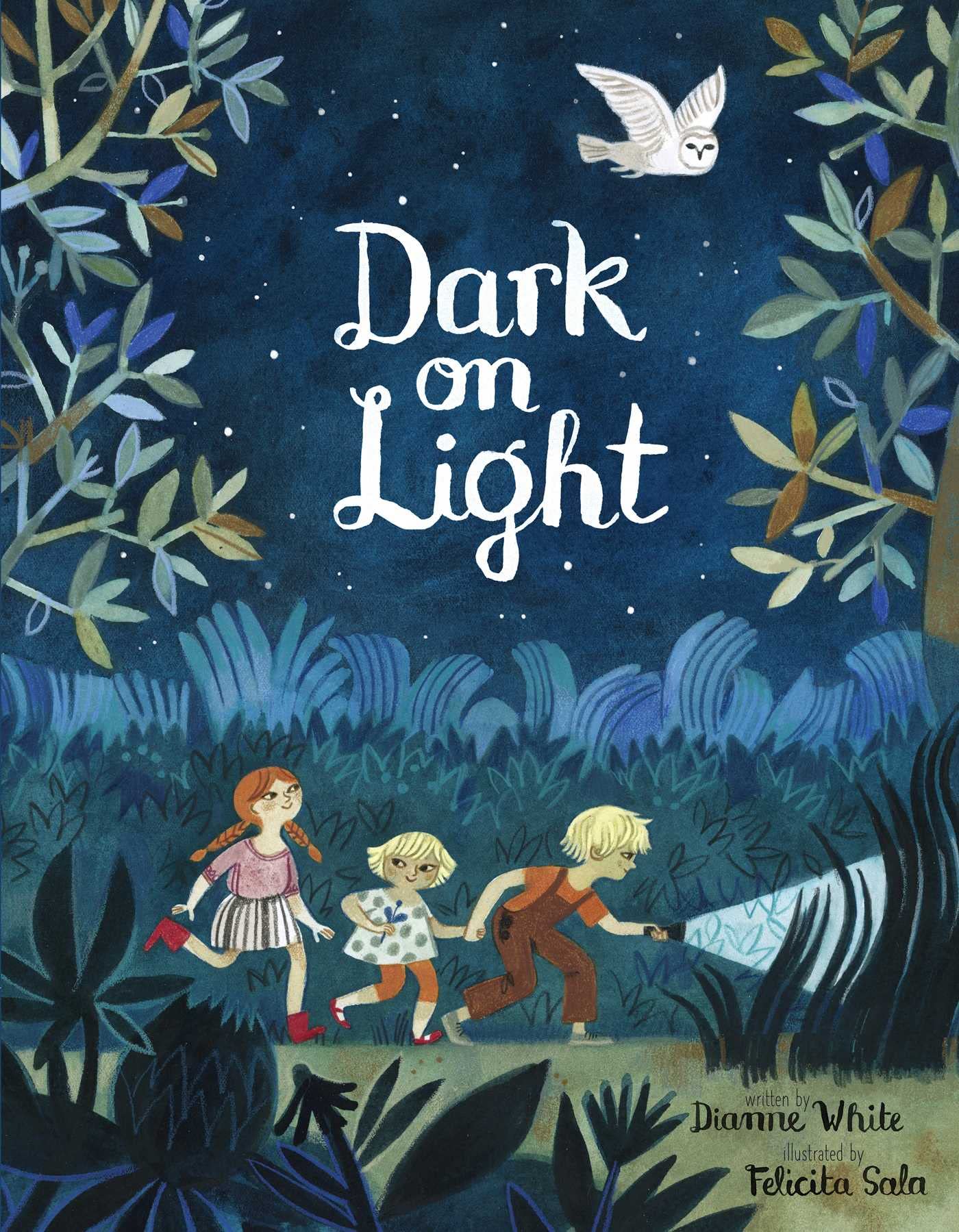
Dark on Light
Written by Dianne White | Illustrated by Felicita Sala
The setting sun paints the sky a golden yellow, deepening to rose as it slips below the horizon. Trotting down the path from the cozy red farmhouse, it’s windows already aglow, a dog makes its way towards the woods. Three children—a brother and two sisters—look out over their yard and beyond to the rolling hills, wondering where their pet might be. They pull on boots and grab a flashlight. The youngest sister checks the doghouse just in case.
Image copyright Felicita Sala, 2022, text copyright Dianne White, 2022. Courtesy of Beach Lane Books.
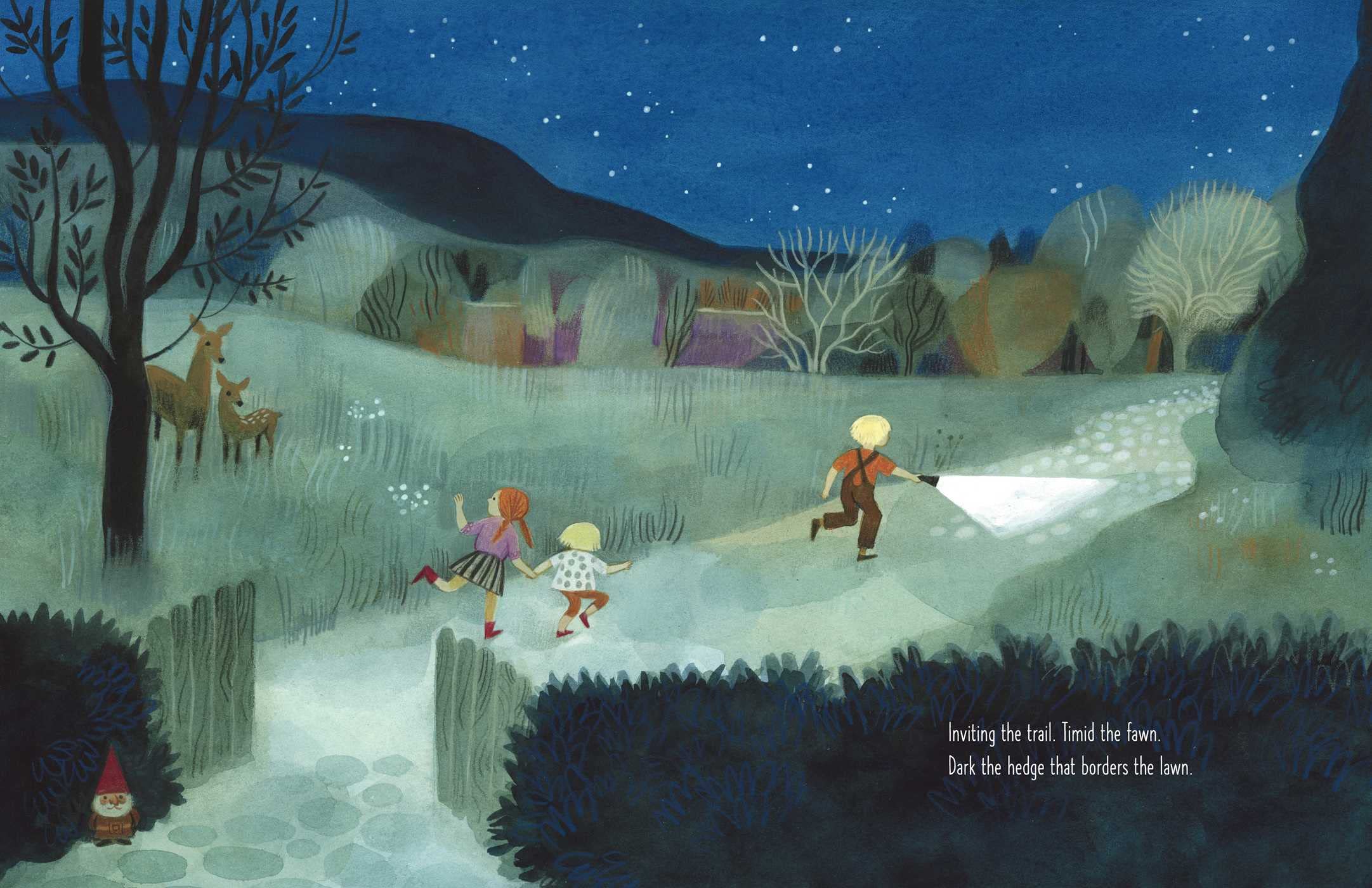
Following behind the beam of light, they pass through the gate, leaving their garden gnome behind while knowing how “inviting the trail. Timid the fawn. / Dark the hedge that borders the lawn.” The older sister waves to a doe and her baby standing silently in the meadow as she passes by, The full moon is on the rise as the children wade into the tall grasses where “lavender blooms, fragrant and bright. / Hedge and trail and dark on light.”
The late autumn sky is scattered with stars now as a ghostly figure moves overhead. The boy directs his flashlight upward, just in time to catch a barn owl pass by on its way to perch in a nearby tree. The older children call out their dog’s name and look behind trees while their little sister inspects tiny discoveries hidden in the grass and turns cartwheels in the deepening shadows. The flashlight’s beam illuminates something that begs more investigation.
Image copyright Felicita Sala, 2022, text copyright Dianne White, 2022. Courtesy of Beach Lane Books.
As a fox looks on and a squirrel, curled up in its nest, dozes, the girl bends down and shines the light into the hollow underneath a tree’s thick roots. And who should appear, but their adventurous pup. The game of hide-and-seek over, the four take in the mystery of the forest: “Damp the moss. Ancient the sky. / Dark the leaves, crisp and dry.” The dog runs from the woods as the kids give chase, the flashlight no longer needed under the glimmering moon. A lone rabbit hidden in undergrowth at the edge of the woods witnesses their play.
They near the house, elated by their nighttime escapade and brimming with the story as they run toward their father, who has come out to meet them with a lantern. The door opens and silver light spills across the porch, down the steps, and onto the well-worn path. Inside, it’s time for quiet cuddling, a story, and saying goodnight: “Cozy the blanket. Pillowed the head. / Dark the attic. Snug the bed. / Sapphire the window, glowing and bright. / Attic and blanket and dark on light.” Downstairs, the dog snoozes in his bed while in the sky above: “white the star, shimmering bright. / House and room and dark on light.”
Image copyright Felicita Sala, 2022, text copyright Dianne White, 2022. Courtesy of Beach Lane Books.
In this follow up to Green on Green, also illustrated by Felicita Sala, and Blue on Blue, illustrated by Beth Krommes, Dianne White calls readers back to explore the natural world. Her lovely, effortlessly flowing cadence transports readers into the wonders and mystery of a late autumn night with a trio of siblings on a mission to find their playful dog. As the three search, White invites readers to notice animals and plants, scents and sounds, and the colors and comfort of darkness and light with her overlapping and repeated phrasing. Her evocative vocabulary (a “timid fawn,” the “burnished moon,” an “ancient sky,” and the forest “veiled and deep,” among other beautiful choices) not only adds to the ambiance of the story but encourages readers to reflect on the complexity of the world around them. White does all of this while also presenting a mystery that kids will no less compelling for it’s gentle and straightforward resolution.
Accompanying White’s lyrical storytelling are Felicita Sala’s captivating watercolor, gouache, and colored pencil illustrations that glow with the setting sun, the warmth of a waiting home, the shimmer of the rising full moon, and the steadfast comfort of a flashlight in hand. Sala perfectly captures the rhythms of childhood, from the three siblings gathered at the window looking for their dog to their search through bushes and grasses close to home and farther afield to their excited return home and quiet bedtime routine. You can almost feel the smooth paving stones leading away from the house, smell the lavender as the older sister picks a small bouquet, and hear the children’s shouts and laughter upon returning home with their pet. The final scenes of cuddled-up reading and goodnight kisses and the house finally dark for the night make Dark on Light a perfect book for bedtime story times.
A superlative melding of lyrical storytelling and exquisite illustration that invites discovery and a love for language, Dark on Light is a book that both children and adults will love sharing for snuggly story times any time. The book is a must for home, school, and public library collections.
Ages 3 – 8
Beach Lane Books, 2022 | ISBN 978-1534487895
About the Author
Dianne White is fond of lavender blooms and the way an orange moon hangs in the evening sky. She’s the author of several picture books, including the award-winning Blue on Blue, illustrated by Caldecott medalist Beth Krommes, and Green on Green, illustrated by Felicita Sala. Dianne lives with her family in Gilbert, Arizona, where many nights at twilight, the desert blazes rose on sapphire on dark on light. For more information and to download a free activity kit, visit diannewrites.com. You can connect with Dianne on Facebook: Dianne White | Instagram: @diannewrites | Twitter: @diannewrites
About the Illustrator
Felicita Sala is a self-taught illustrator and painter. She has a degree in philosophy from the University of Western Australia. She now lives and works in Rome. She draws inspiration from nature, children, mid-century illustration, folk art, and architecture. To learn more, visit felicitasala.com. You’ll also find Felicita on Instagram: @felicita.sala
Read a New Book Month Activity
Flashlight On, Flashlight Off Game
It’s fun to play games in the dark! During Earth Hour flip off your lamps and overhead lights and play this game that challenges your memory while you think about our planet! This game can be played with two or more players.
Supplies
Flashlight
6 – 12 small objects (the number of objects can be adjusted depending on the ages of the players)
A table or floor area large enough to lay out the objects
Directions
With the Flashlight On:
Lay out the objects on a table or on the floor
Give all the players time to look at the objects and try to memorize them
Choose one player to remove one of the objects
With the Flashlight Off
Turn off the flashlight
While the room is dark, the designated player removes one object from the rest
Turn the flashlight back on
With the Flashlight Back On
The other players try to figure out which object is missing
Variations
In addition to removing one object, the other objects can be moved around to different positions
For children, picture books provide one of the best ways to interact with facts and feelings. Stories that speak to their experiences, both common and new, alongside illustrations that bring the story to life let them discover the world around them. Today’s stunning nonfiction books are loaded with illustrations or photographs that let kids see exciting details about science, history, biographies, nature, and so much more. This month, take a look for fiction and nonfiction picture books about your child’s passions to add to your home library. And be sure to check out today’s book that incorporates both!
Thanks to Star Bright Books for sharing a digital copy of Leaves to My Knees with me for review consideration. All opinions on the book are my own.
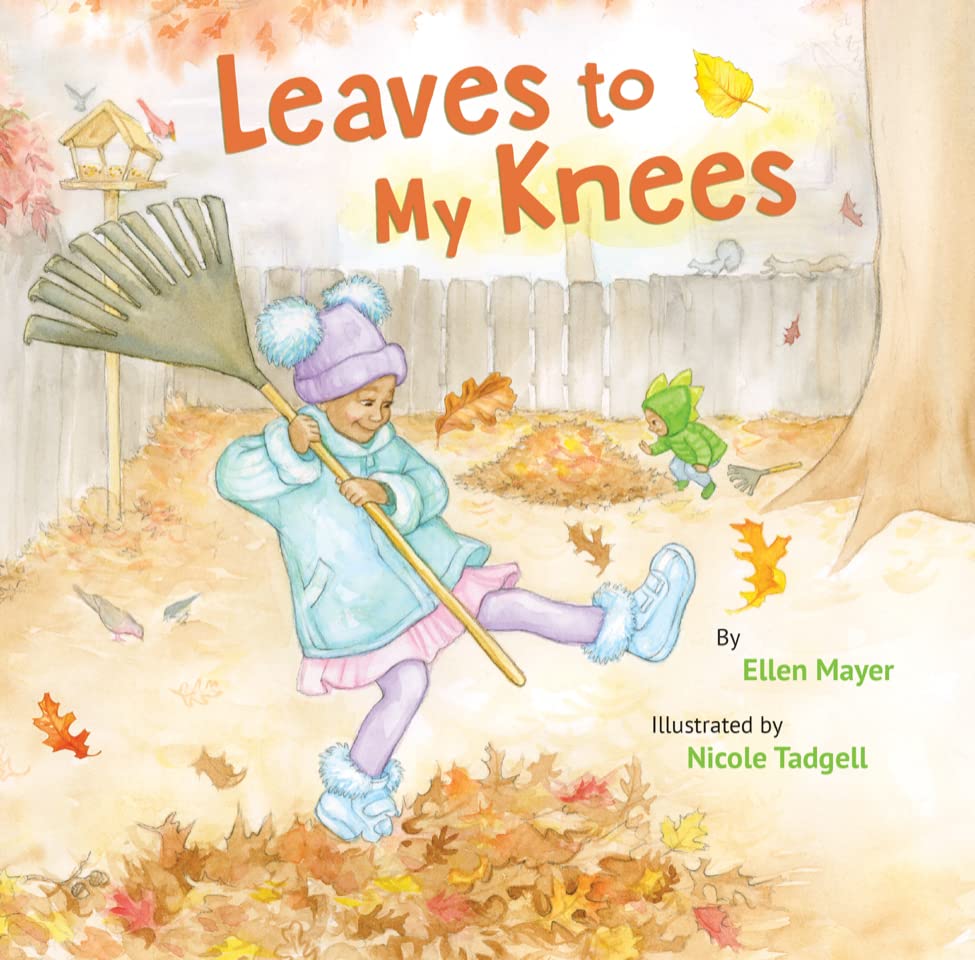
Leaves to My Knees
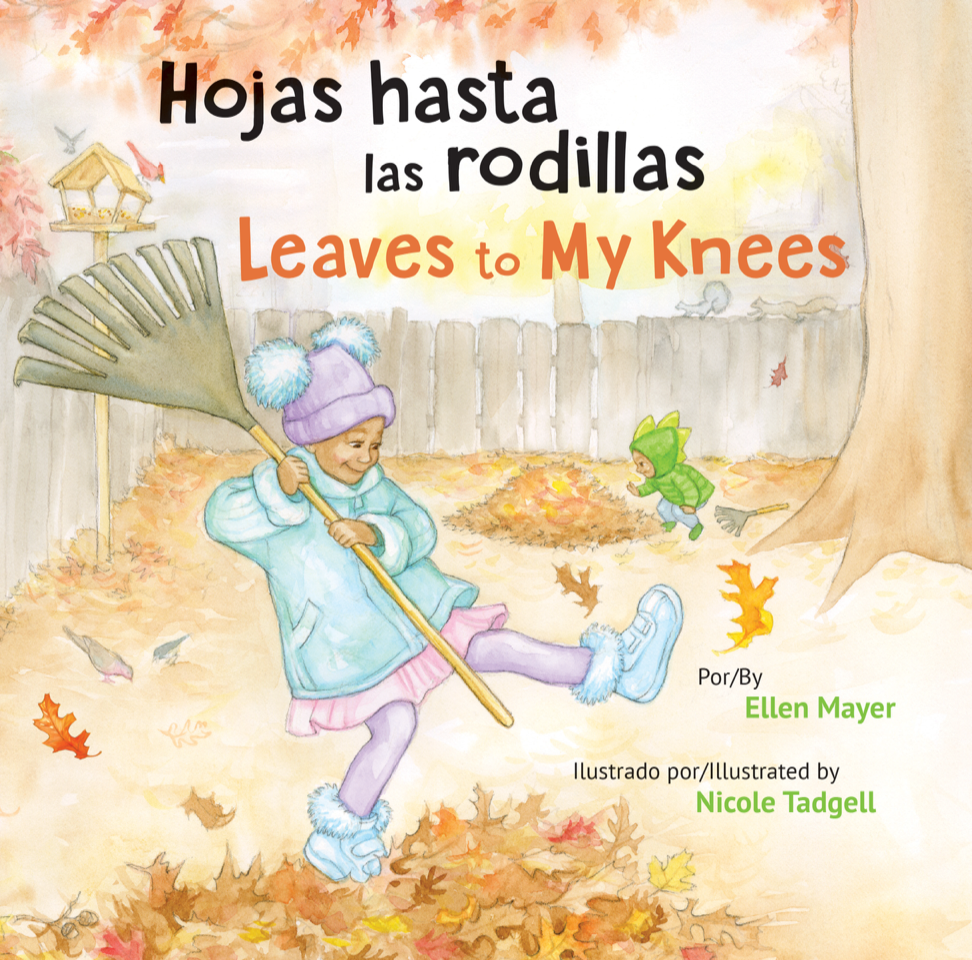
Hojas hasta las rodillas/Leaves to My Knees
Written by Ellen Mayer | Illustrated by Nicole Tadgell
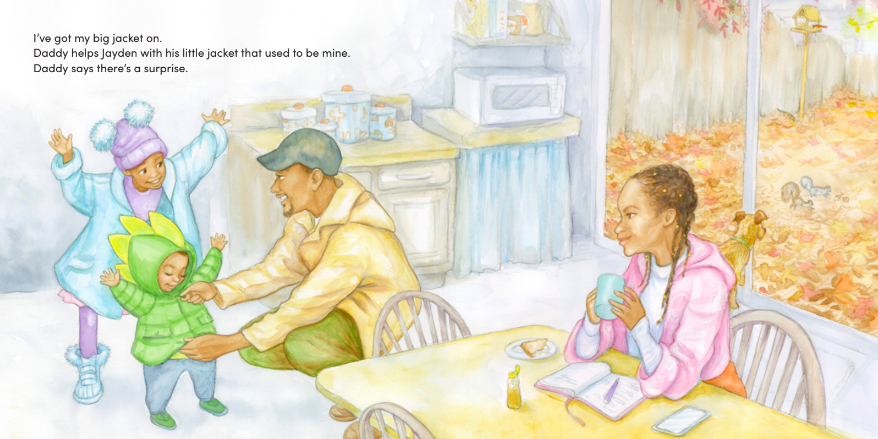
Daddy has a surprise for Camille and her little brother Jayden. They get dressed in their coats—big for Camille and little jacket with a stegosaurus hood for Jayden—and head into the backyard. There, Camille discovers her dad has gotten her a rake of her own. It’s not as big as Dad’s, but it’s bigger than Jayden’s little rake. It’s the perfect size for Camille.
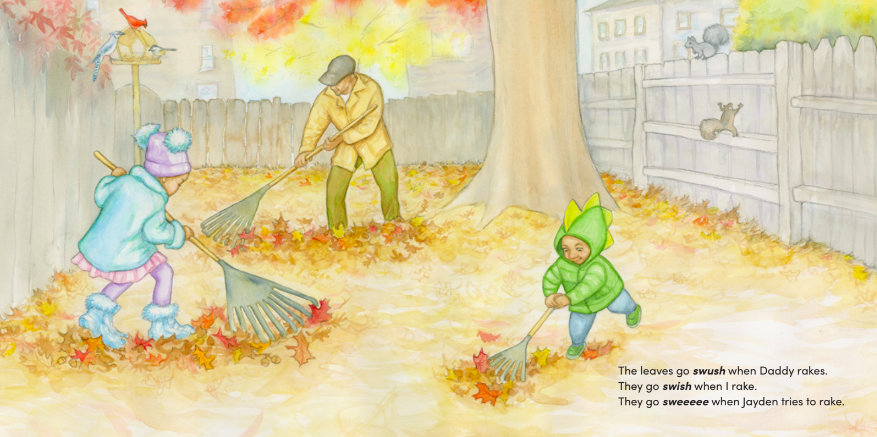
Camille marches right off to rake a pile of leaves. But not just any pile—she has a goal. “‘I’ll rake leave all the way up to my knees!’” she tells her dad. The three get working on the yard. Camille concentrates on gathering leaves, listening to the different sounds that the various sized rakes make: “The leaves go swush when Daddy rakes. They go swish when I rake. They go sweeeee when Jayden tries to rake.”
Image copyright Nicole Tadgell, 2022, text copyright Ellen Mayer, 2022. Courtesy of Star Bright Books.
Lurking under the leaves are twigs and acorns that clog up Camille’s rake. She worries that she’ll never be able to rake leaves to her knees. She calls for Daddy’s help, and together they clear Camille’s rake. “‘You’re good to go now, Camille,’” Daddy tells her. Back at it, Camille rakes and rakes. Then she steps into the pile she’s accumulated to measure it. Her pile only comes up to her ankles. Camille grabs her rake harder and with determination she collects more leaves. But wait! Jayden is stealing leaves from her pile to add to his! Camille guards her pile with her rake, and sends her little brother over to Daddy’s bigger pile. Camille checks her measurements again. Her pile has grown, but only up to the top of her boots.
Image copyright Nicole Tadgell, 2022, text copyright Ellen Mayer, 2022. Courtesy of Star Bright Books.
Camille rakes ‘bunches of leaves,” and her pile gets taller, until “‘Oh no! A BIG BREEZE!!’” sends lots and lots of leaves swirling “Whoosh!” into the air and scattered to the ground. “I will never rake leaves to my knees!” Camille thinks. And when she measures again, her pile is back to her ankles. Daddy encourages her to keep going, and Camille is committed to achieving her goal. She throws off her coat, grabs her rake, and works on gathering up all the leaves she had, plus more. At last, too tired to rake anymore, Camille wonders. Has she done it? “‘Time for measuring!’ says Daddy.”
Image copyright Nicole Tadgell, 2022, text copyright Ellen Mayer, 2022. Courtesy of Star Bright Books.
Camille relinquishes her rake to her dad then, holding her breath, steps into her pile. “‘TA-DA!’” Camille raises her arms in victory. She steps out, positions herself a good ways away, and winds up for the run and jump. “‘GO!’ yells Daddy. ‘GO!’ Jayden yells too.” Camille flies through the air and lands, laughing, into her pile. Then Jayden jumps in. And Daddy? He gives Camille “really big squeeze” for raking “leaves all the way up to [her] knees.”
A note for parents, teachers, and other caregivers written by Marlene Kliman, a mathematics learning expert and senior scientist at TERC, describes how the story incorporates the math of measurement and sizes and how adults can extend the lesson by pointing out elements in the book’s illustrations and while going about their day or doing common chores, such as cleaning up and sorting laundry.
Image copyright Nicole Tadgell, 2022, text copyright Ellen Mayer, 2022. Courtesy of Star Bright Books.
Ellen Mayer’s Leaves to My Knees has everything that makes a story a young reader’s favorite—a spunky main character that kids will identify with, an achievable goal, successes and setbacks, suspense, humor, and a child-propelled victory. And it all revolves around an early math concept that comes naturally to children and which invites playful learning not only during the fall, but any time of the year. Shoveling snow and making snowballs in winter, yard cleanup and gardening in spring, and building sandcastles and raking grass clippings in summer as well as in-home fun with laundry piles, toys, and other objects are all ways to extend the story.
Told from Camille’s point of view, the story also engages children’s emotions as they join in to cheer Camille on as her leaf pile grows and commiserate with her when it shrinks. The close relationships among Camille and her dad and little brother ring true with dialogue-rich storytelling that is always encouraging. Strong themes of determination and persistence will also appeal to parents and teachers, who can point to how many times Camille has to start over before accomplishing her goal and her positive, resolute attitude.
Nicole Tadgell’s exuberant illustrations shine with personality, and kids will immediately become invested in each character as Dad gets working on a big job that needs doing, Jayden runs, jumps, and copies his big sister, and Camille unwaveringly works on her pile of leaves. Camille’s setbacks are clearly depicted, along with her and her father’s facial expressions that give adults and kids an opportunity to talk about disappointment, frustration, perseverance, and feelings of accomplishment. Each image also demonstrates the math component of measurement and sizes in the story with various-sized rakes, the growing and diminishing leaf pile, big and little jackets, and other objects that invite comparison.
Tadgell’s soft-hued pages are infused with the feeling of fall and hum with activity as cardinals, blue jays, chickadees gather at the bird feeder, squirrels scamper up and along the fence, and leaves continue to float to the ground. Readers will love following little Jayden’s antics and be inspired by Camille’s wide smile as she enjoys the reward of all her hard work.
Leaves to My Knees is a multilayered read aloud infused with the enthusiasm and rhythms of childhood that kids will want to hear again and again. Its mathematics base and themes of determination and perseverance rewarded will appeal to parents, teachers, and other educators as a way to engage children in active, hands-on learning. The book is a must for home, classroom, school, and public library collections.
Ages 4 – 8
Star Bright Books, 2022 | ISBN 978-1595729590 (Leaves to My Knees) | ISBN 978-1595729613 (Hojas hasta las rodillas/Leaves to My Knees
Picture Book Month Activities
Coloring Pages and Teaching Guides
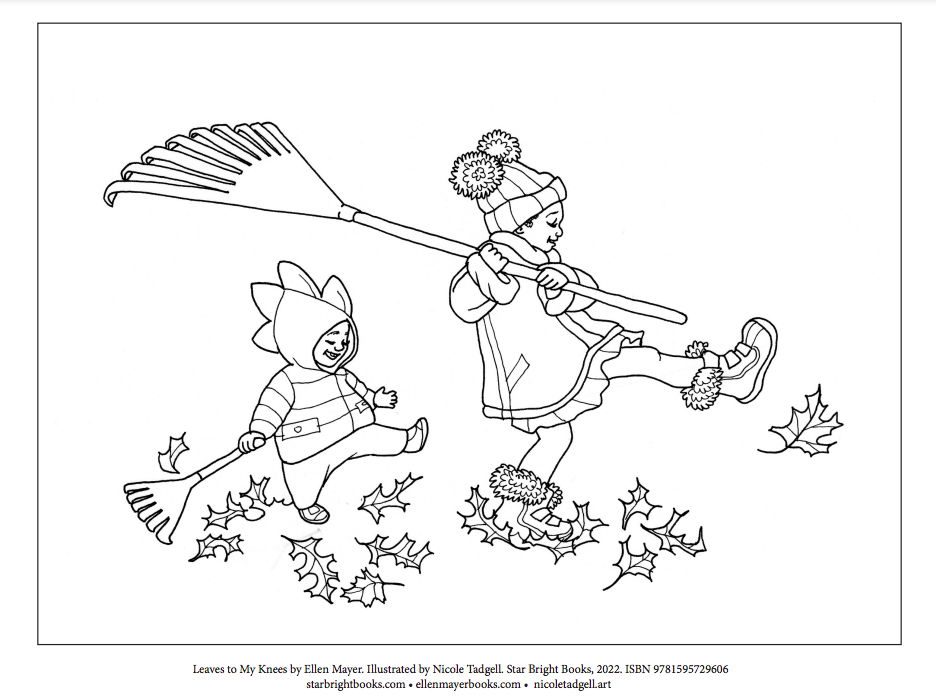
You can extend the fun and learning in Leaves to My Knees with these activities, which include three fun coloring pages from the story, a hands-on play-dough art and discovery activity, and a detailed educator’s guide for teachers, homeschoolers, parents, and other caregivers that offers multiple ways to use Leaves to My Knees to explore math, mathematical thinking, and reading comprehension through the story and beyond at home, school, and elsewhere.
Ellen Mayer is an award-winning author who writes picture books for babies and young children and the grown-ups who read to them. Leaves to My Knees is her ninth book for children. Her other math story books include Banana for Two and Clean Up, Up, Up!, two board books in her Small Talk Books® series with Star Bright Books.
For many years Ellen was an education researcher at the Harvard Graduate School of Education, studying how families are engaged in their children’s learning. She also worked as an early literacy home visitor with young children and their parents in a local affiliate of the ParentChild+ program. Now, Ellen volunteers as a visiting children’s book author with public schools and city-run playgroups in her local Cambridge and Somerville, MA, communities. Long ago she earned an M.Phil. in Sociology from Columbia University.
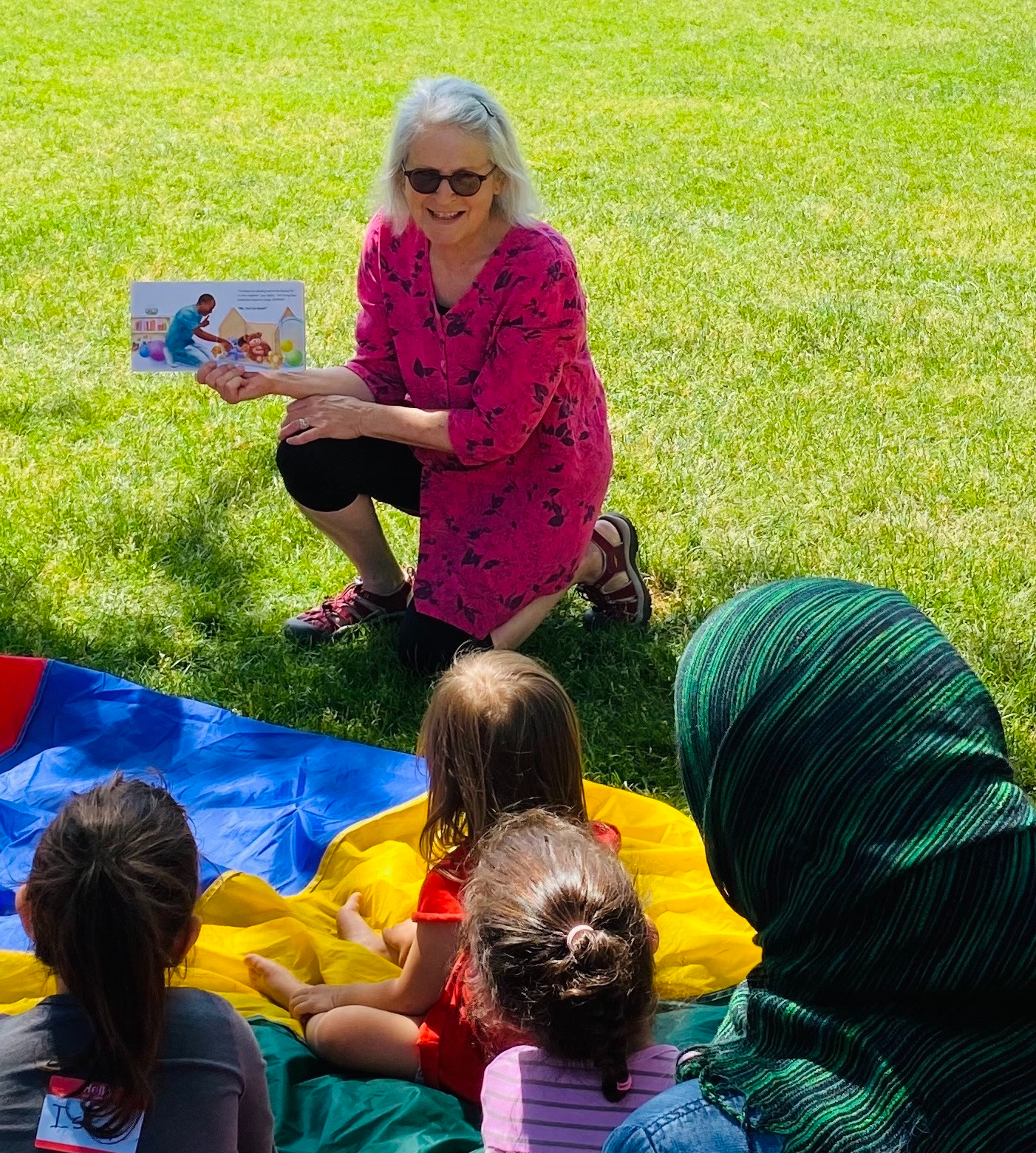
Ellen often collaborates with her musician husband in “Books + Banjo” reading and sing-along programs for young children. Ellen loves to rake leaves in the fall—especially when she has help from her grandchildren.
I have so many great memories of raking leaves with my kids when they were small. You really capture the fun and challenges of this favorite fall activity in your story. Were you inspired by your own family’s experiences in any way while writing it?
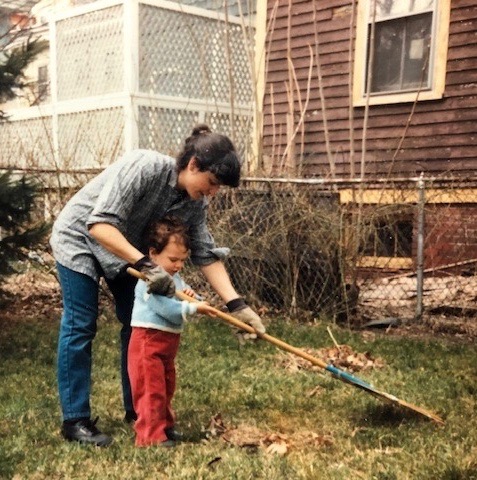
Very much so! Since the time our kids were very little they’ve joined us in the backyard for all sorts of yardwork. My daughter wanted to hold the rake from a young age, even as I did the less exciting early springtime rake of the lawn.
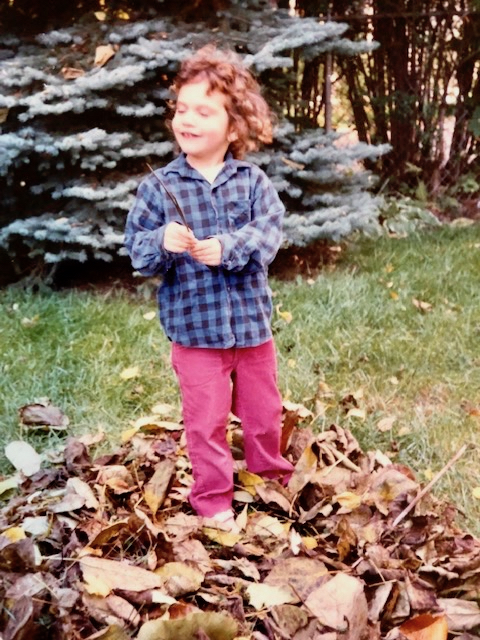
At first our trees didn’t yield much in the way of fall foliage, so we would haul a big bag of fallen leaves in from the tree out on the city sidewalk to have as leaves for play. The piles that resulted were often rather puny, only up to the ankles, as protagonist Camille would tell us.
But as the backyard trees matured, raking and jumping took off, much like in the story! I should add, too, that the sibling dynamic between our older daughter and younger son was also a source of story inspiration, influencing how I wrote the sister-brother characters here. Older sister was always the more determined and focused raker of the two, with younger brother taking it upon himself to annoy and distract her as much as possible, and generally try to steal the show, as was his lovable wont in those early years.
Marlene Kliman, an early math expert who is a Senior Scientist at nonprofit STEM education organization TERC in Cambridge, MA, has contributed a back matter note for parents and caregivers. In it she writes that Camille uses the math of measurement as she works at raking a knee-high pile of leaves and as she describes the sizes of things around her. Can you tell us how Camille and other young children approach measurement?
Preschoolers and toddlers, before they are ready to understand and engage in measuring with standardized units like inches and feet, try out measuring in their own ways. For instance, they compare the thing to be measured with an object or their body. Here, Camille measures the changing height of her leaf pile as it moves up her leg to her knees—first reaching up to her ankles, then up to her boots, but then back down to her ankles after a big breeze, then finally after some serious raking all the way up to her knees—where it’s the perfect size for jumping in. Young children naturally love to consider their world in terms of the different sizes of things. Throughout the story, Camille actively references the sizes of things all around her, whether it’s that big breeze or the size of her jacket, rake, and leaf pile in comparison with the smaller jacket, rake, and leaf pile that belong to her little brother, Jayden.
Today’s post celebrates this beautiful and exuberant cover! What was your first reaction to seeing the final cover art?
When I first saw the final cover I gasped! I love cover art that is inviting and also contains a little mystery to it. Here, Nicole created the most glorious, radiant, luminescent fall day, and I immediately wanted to join in the play. And what was that cute little dragon/dinosaur up to in the background? Definitely intriguing. Then, also, there are hints of the size-comparison math to come in the story in the form of the differently sized two rakes and three birds. The idea of “leaves to my knees” is there too, center stage. The joy and energy in this cover scene is palpable as the leaves float from the tree and Camille almost seems to be dancing in her leaf pile. Thank you so much for introducing this gorgeous cover into the world, Kathy!
Do you have another favorite spread in the book? Why is this one special to you?
Nicole creates this wonderful dance here in her art, from cover to close, with captivating facial expressions on each page. It’s hard to single out a favorite spread—there is something that takes my breath away on each page! But I keep returning to the one near the end where all is right with the leaf pile, the jump, and the siblings. Here, Camille and Jayden have flopped onto her pile and are luxuriating side-by-side on the big crackly bed of leaves, enormous matching grins on their faces. Maybe I was worried that Camille wouldn’t let the little mischief-maker into her pile? But she’s not shooing him anyway anymore—they are just celebrating together the joys of a fall leaf pile.
What would you like for kids and adults to take away from the story?
I hope they will come away with a warm feeling inside after spending time with this playful and loving family, a family that’s engaged in a fall chore, but one that is also enjoying a lot of fun and learning together. I hope they take away that math is everywhere around us, and that young children—all young children—love to measure and compare as they go about their day. I hope they take away the powerful image of a child of color, and a girl, as an active mathematician. There still aren’t nearly enough Camilles in the pages of picture books, and everyone—kids of all backgrounds listening to this story and all their reading adults too—need to see and normalize children of color and girls doing math.
Nicole Tadgell is an award-winning watercolor artist of more than 30 luminous picture books. Her books have received numerous honors, including the Christopher Award and the Children’s Africana Book Award. They have been included on the Smithsonian Notable Books for Children, the New York Public Library’s Best 100 Titles for Reading and Sharing, and many more notable lists. Born in Detroit, Michigan, frequent moves weren’t easy for Nicole, especially to new schools where she was the only Black kid in class. Art has always been both an escape and a labor of love for Nicole. Today, she brings stories to life while advocating for diversity in children’s literature. Nicole lives in Chesapeake, Virginia.
Can you share what attracted you to Ellen’s story from an illustrator’s point of view?
Because I often illustrate older children, I saw the opportunity to showcase two young children playing in autumn leaves. (My favorite season!)
Camille shows so much personality and determination on this cover image. Can you describe your process of designing and finalizing the cover?
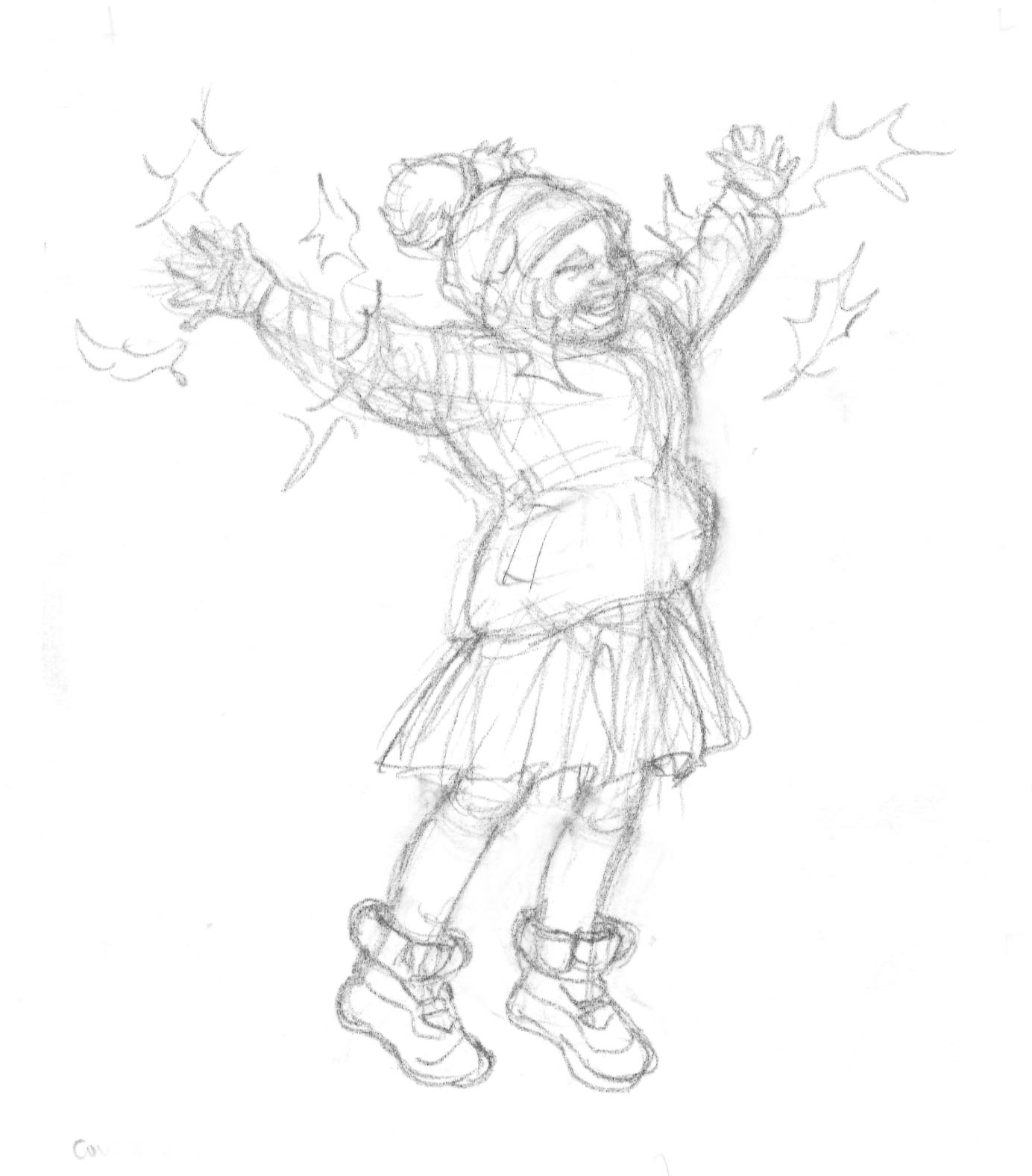
Covers can be a challenge, to be sure. There’s a compromise to paint what’s fun . . .
Image copyright Nicole Tadgell, 2022
. . . versus showing the audience what the book is about!
Image copyright Nicole Tadgell, 2022
Were you inspired by personal memories of raking leaves as you worked on this cover image and interior spreads? Do you have a story about raking leaves you’d like to share?
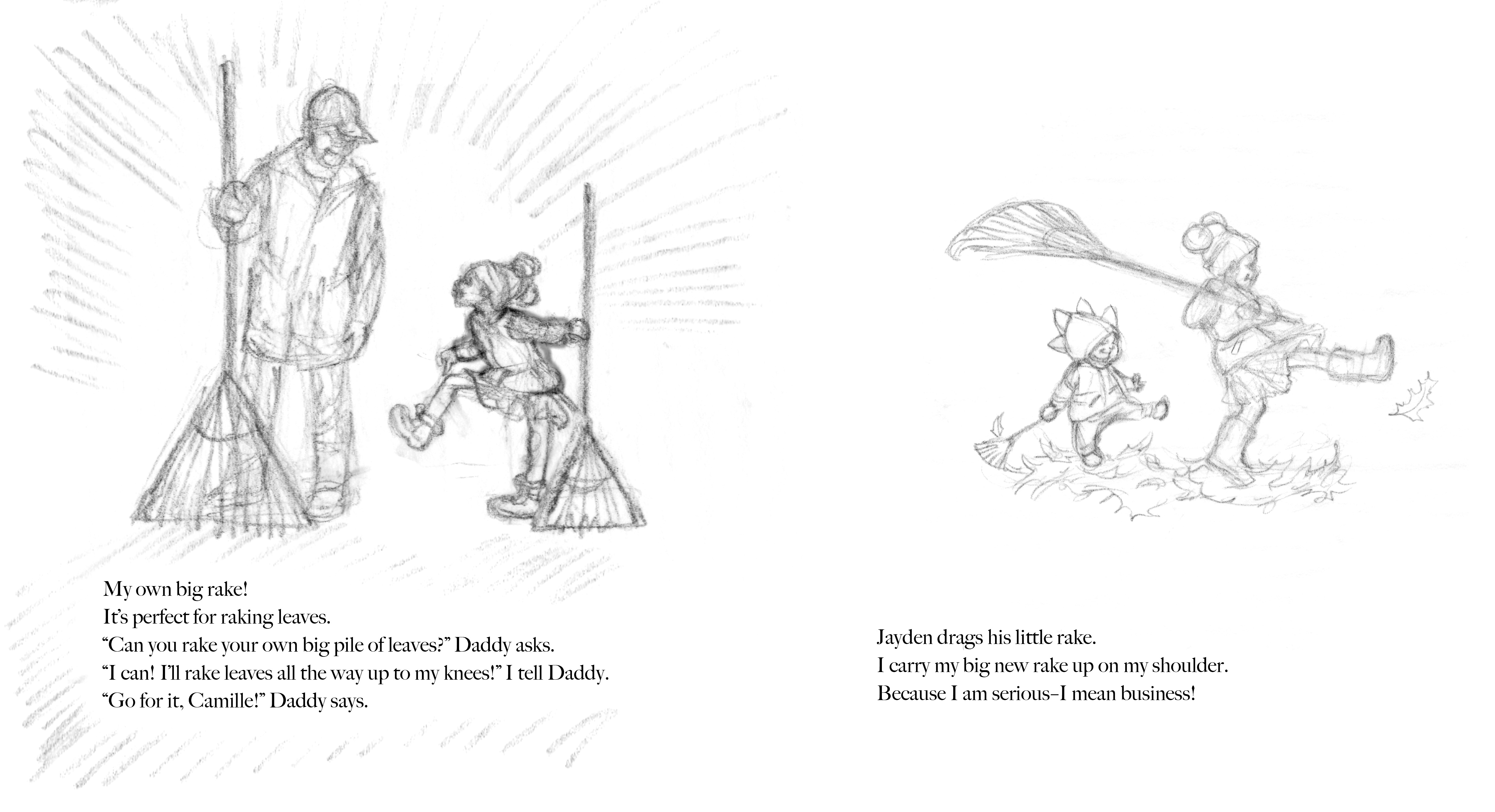
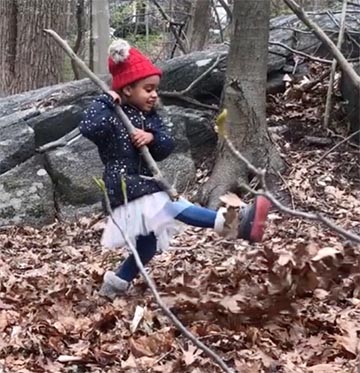
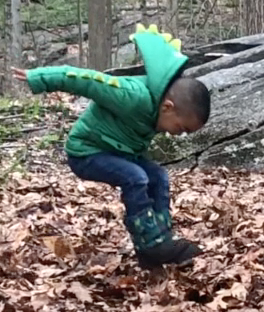
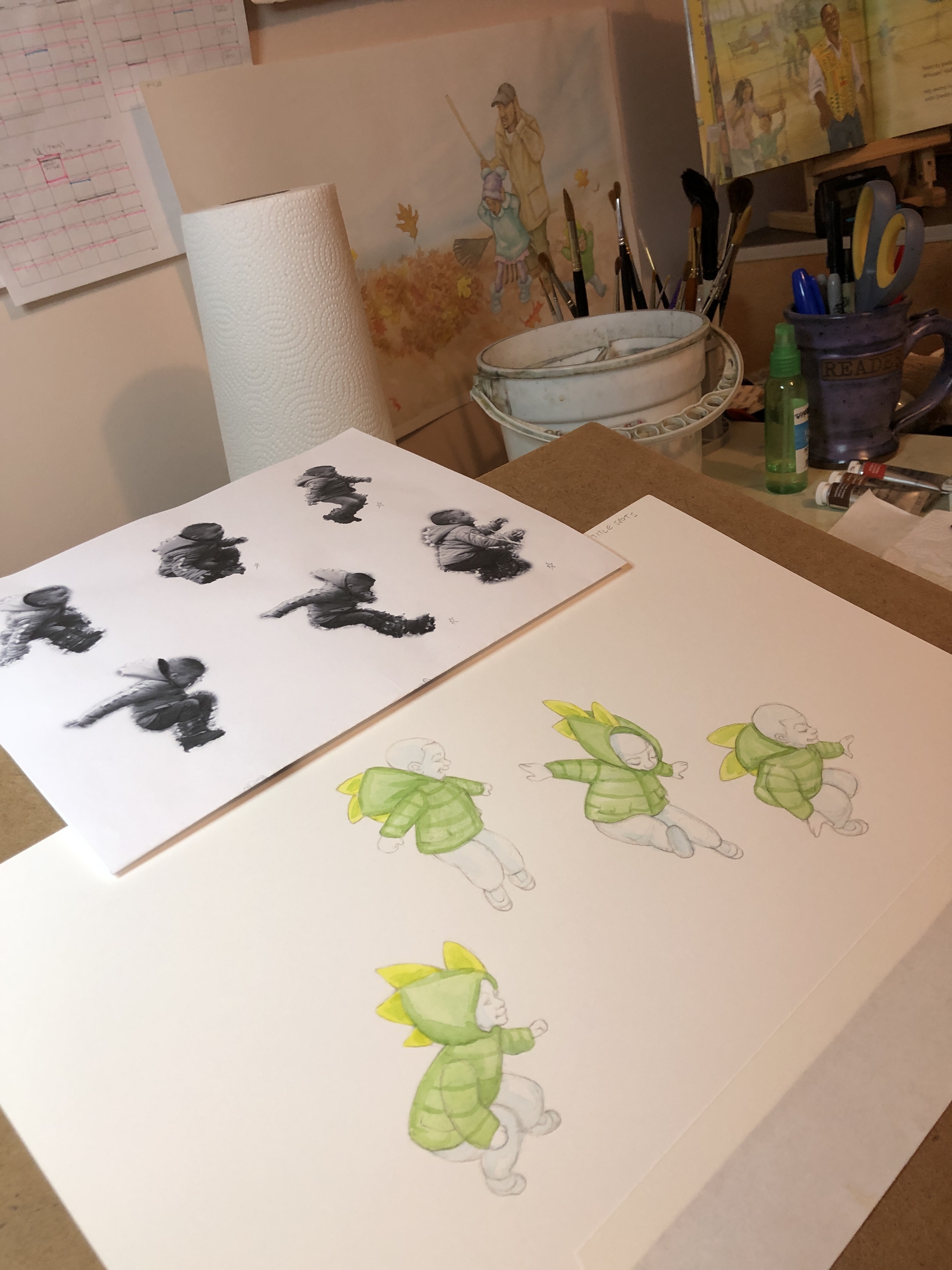
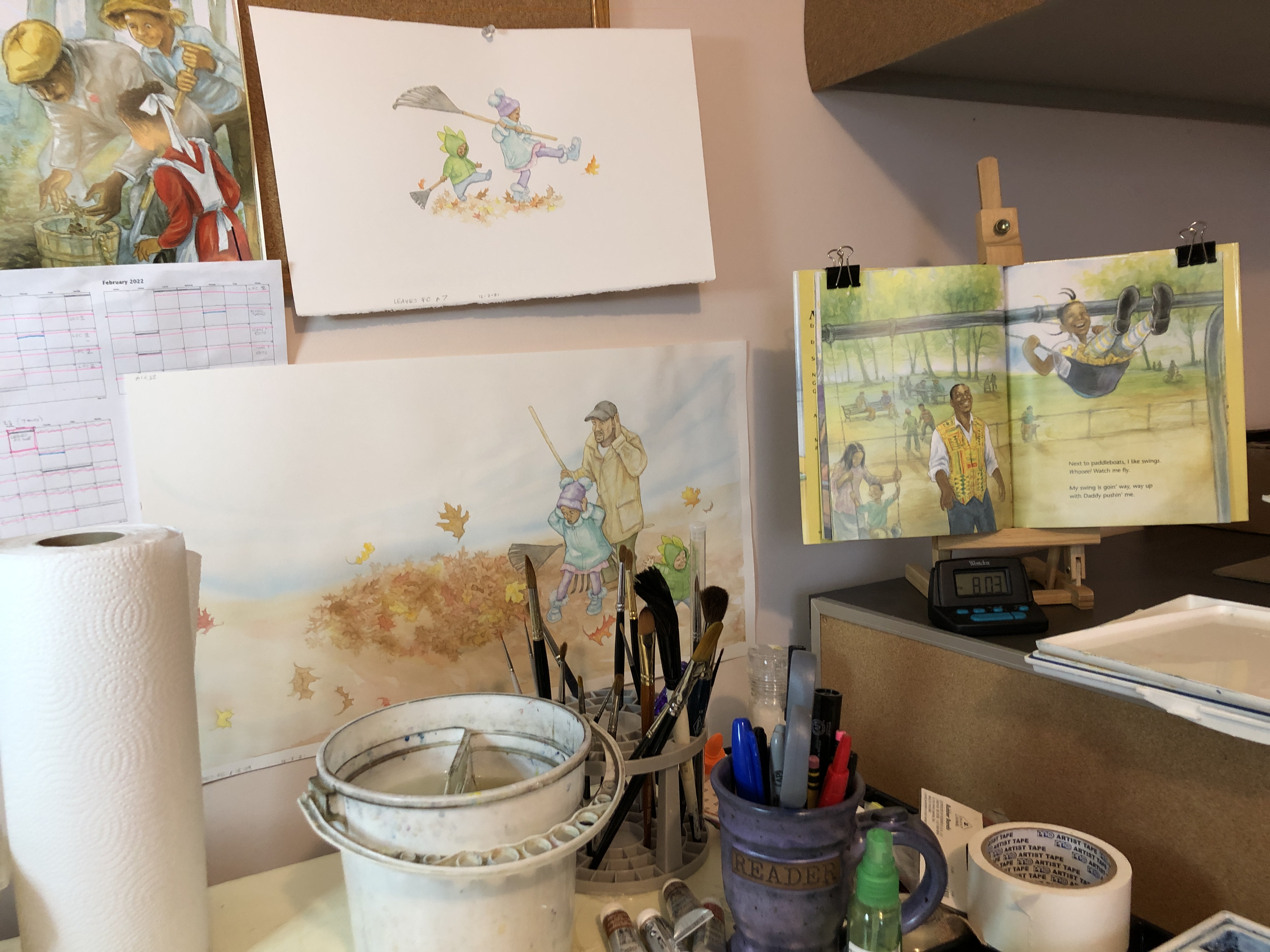
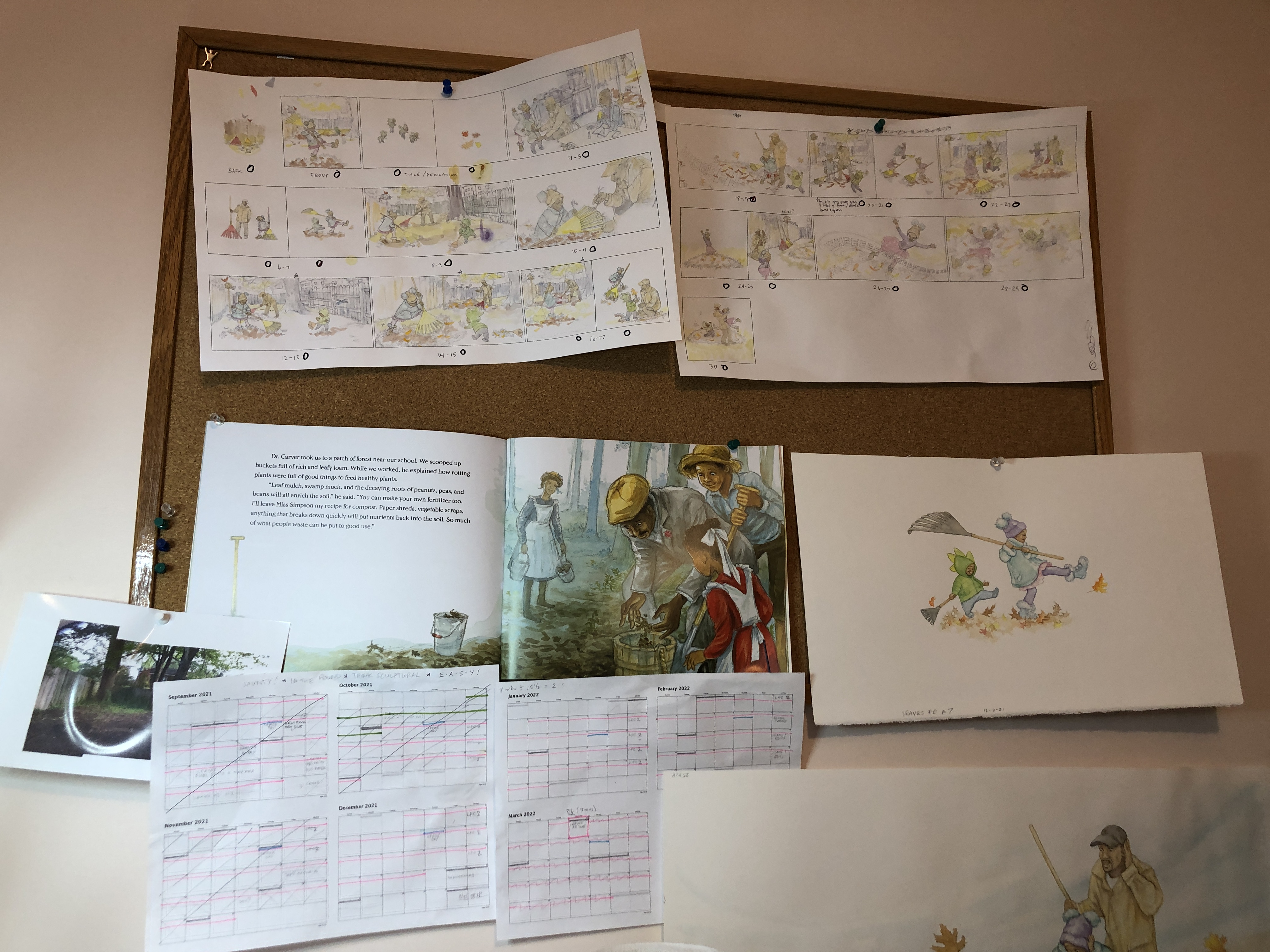
I admit I had grown-up thoughts about there being spiders in the leaves! I don’t have a clear childhood memory of that happening, but I’ve seen plenty of spiders in leaves as an adult. A fun story is about the models for this book! My sister’s friend has two kids the right age. Their Dad was wonderful—instead of taking pictures of the kids playing in leaves, he shot video so I could pause and sketch. They were perfect! Original down to Camille’s double pom-poms and Jayden’s dinosaur coat.
Image copyright Nicole Tadgell, 2022
The soft colors of your illustrations in Leaves to My Knees are really lovely. Can you talk about how you choose a color palette for your work in general and for this cover in particular?
Endless choices! It’s hard to decide. Knowing the season, I began with fall colors: reds, oranges, yellows. I felt that contrast would help our family stand out, so I chose cool colors for Camille and Jayden. I chose earth tones for Dad to make the kids stand out even more.
Image copyright Nicole Tadgell, 2022
Image copyright Nicole Tadgell, 2022
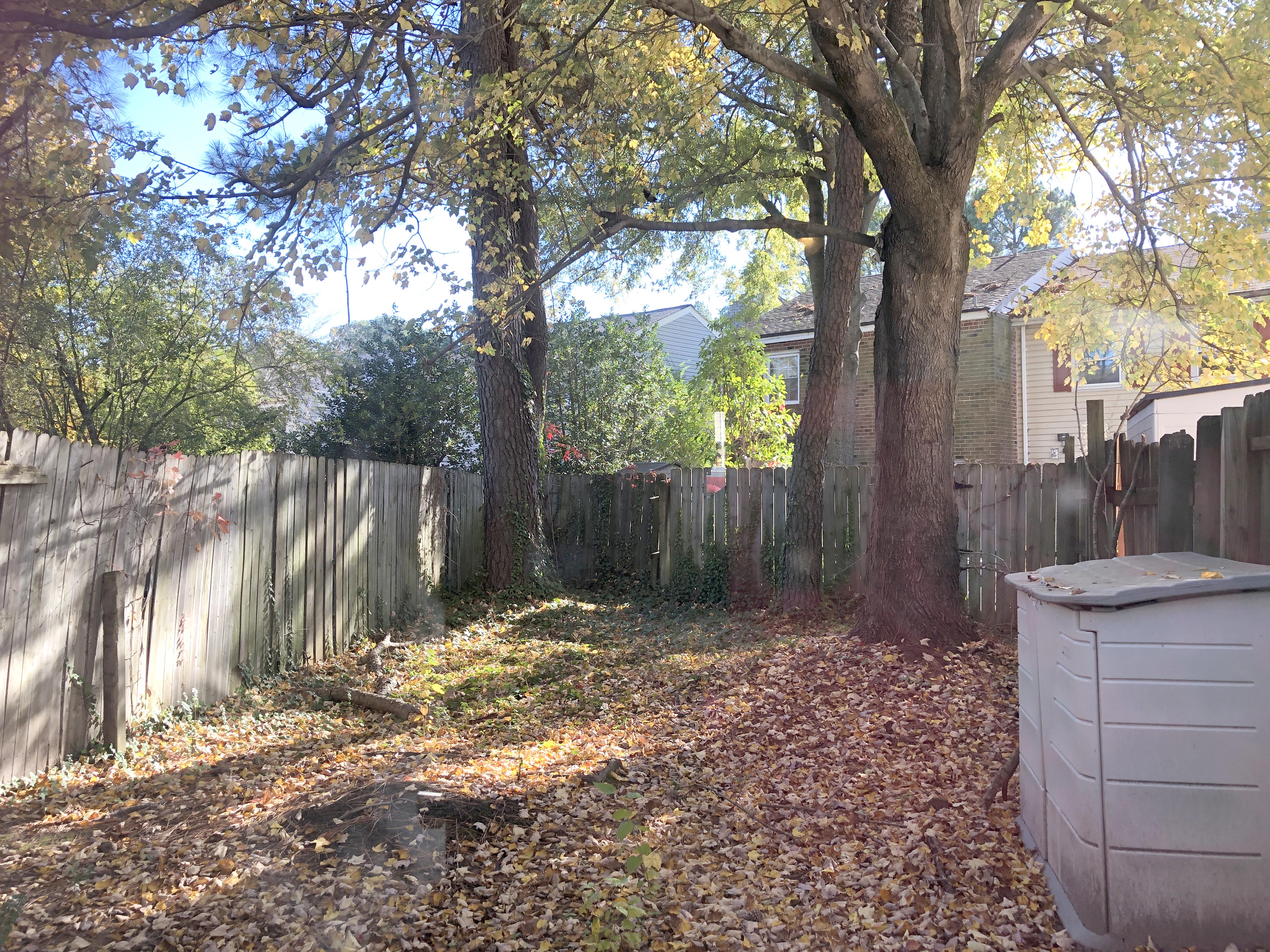
Interestingly, in the images I used for reference the real leaves had lost their color, so I just painted them colorful. I did make our Jayden a bit younger than the model’s age. For the backyard fence, I found a place nearby that had an interesting fence and small leaf-filled yard. I watched as cardinals flit between branches and squirrels chased each other, and inspiration came for the animal antics in the background!
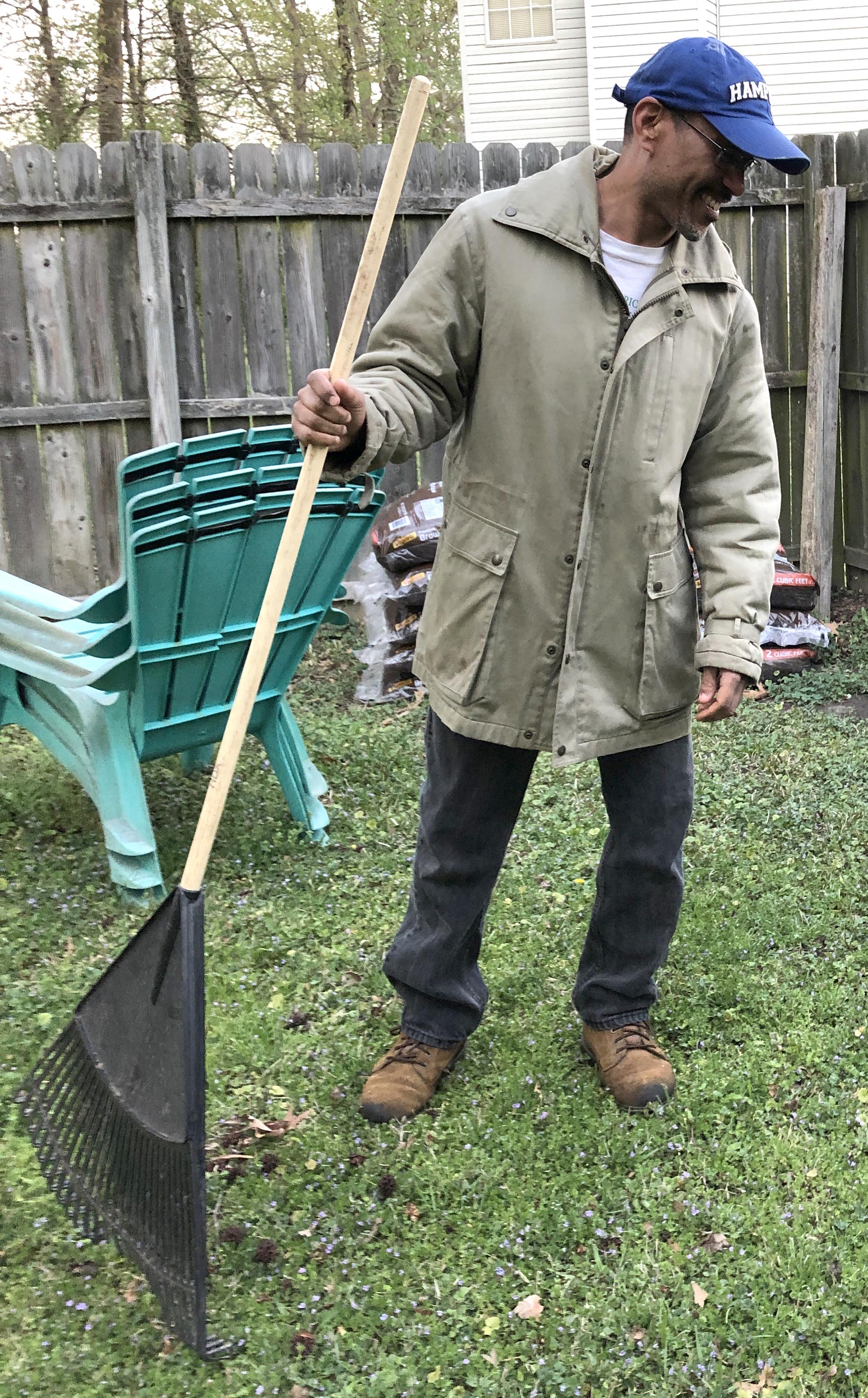
And finally, my partner Anthony was kind enough to pose as the dad in the book!
Now that picture book creators are more free to interact with readers, what are you most looking forward to in promoting Leaves to My Knees?
Fun! I love signing books for kids & personalizing.
In addition to celebrating a fun (and necessary) fall activity, Leaves to My Knees incorporates early math concepts of size and measurement. Can you give an example of how you depicted these ideas in your illustrations?
By using different sizes of the rakes and making sure the leaf piles matched the text (up to ankles, then knees).
I can almost feel the chill in the air and hear that crisp crunch of leaves underfoot that means it’s leaf-raking time!
Children benefit so much from close relationships to grandparents, aunts, uncles, cousins, and other extended family members. This month and next, as family gathers together for special holiday events, it’s fun for adults to share family history and their own funny or moving stories of growing up with the younger generation. Letting kids know how much they’re loved by everyone in the family is important too. It helps them develop a sense of belonging, a good self-image, and confidence. Reading together is a perfect way to spend time together and get conversations started.
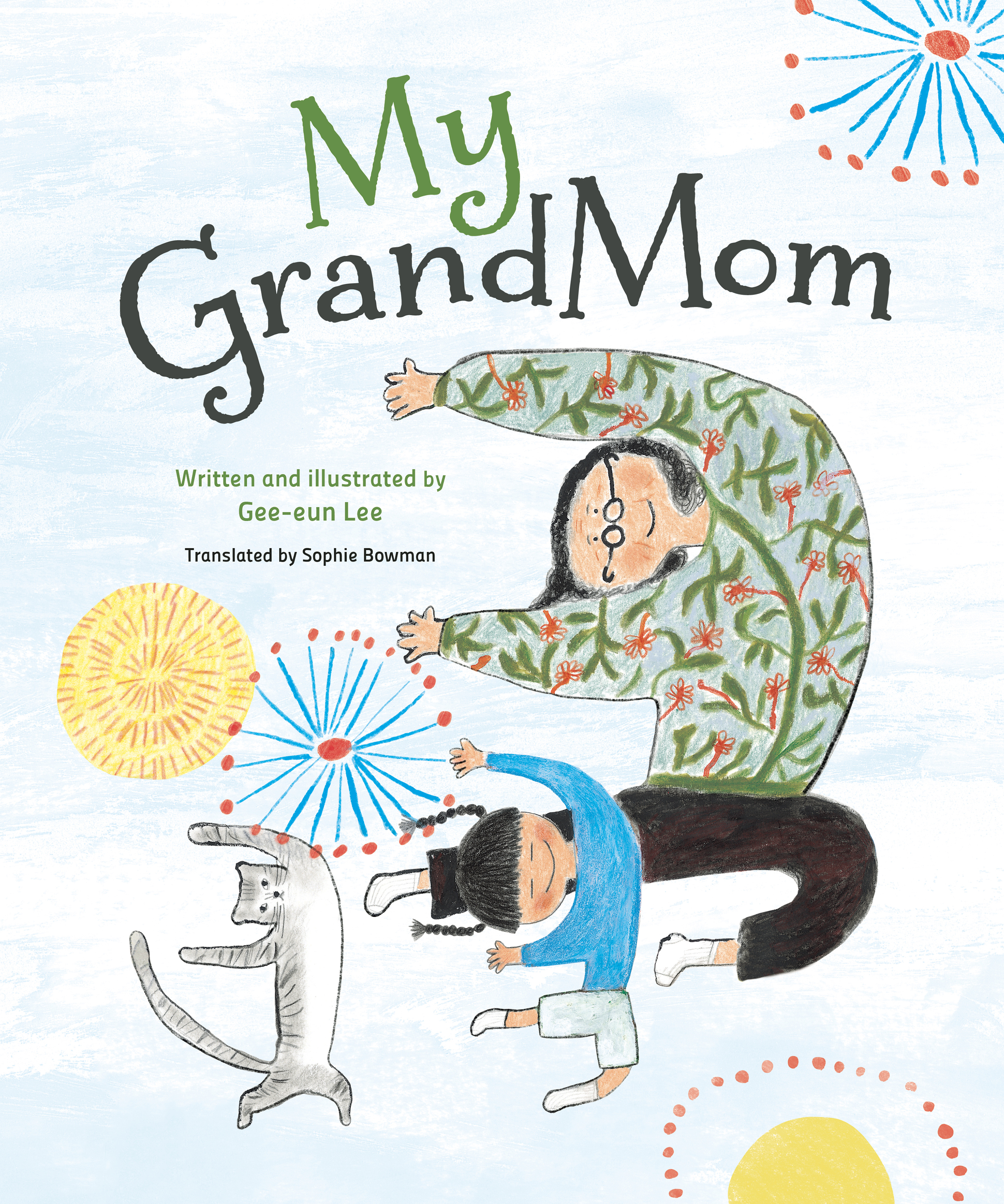
Thanks to Amazon Crossing Kids and Barbara Fisch of Blue Slip Media for sending me a copy of My GrandMom for review consideration. All opinions on the book are my own.
My GrandMom
By Gee-eun Lee | Translated by Sophie Bowman
Gee-eun’s Grandma sits on the floor, holding her sobbing granddaughter in her lap. Breakfast is on the table and toys are strewn about. A gray cat comes to see what’s going on. “‘Dear me, your mom will have to take a boat to work to get across all these tears,'” she says. Grandma, who Gee-eun calls Halmoni in Korean, distracts her by letting her help make kalguksu. She gives Gee-eun a bit of the noodle dough, and while Halmoni rolls out the dough and slices the noodles, Gee-eun fashions little figures of her, her mom, dad, grandma, and their cat, Mari. When it comes time to make the kalguksu, Gee-eun’s dough family goes into the boiling pot along with the other ingredients. “‘…You tell them to hang on tight to the noodles so they stay afloat,'” Halmoni says.
Copyright Gee-eun Lee, 2022, translation by Sophie Bowman, 2022. Courtesy of Amazon Crossing Kids.
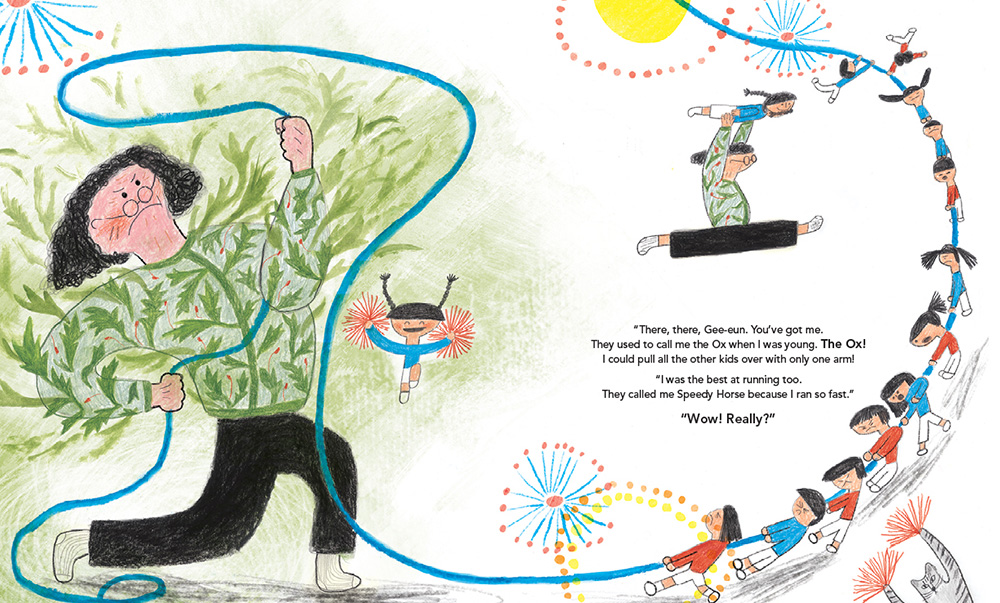
Gee-eun has been waiting and waiting for Family Sports Day to arrive, but when it does, her mom has to work and can’t go along as she had promised. Gee-eun was looking forward to doing the cheer dance, the tug-of-war, and the running race with her. Now who can she go with? Halmoni tells her granddaughter that she will go. She then relates tales from her own childhood, when she was so strong at tug-of-war that she “could pull all the other kids over with only one arm,” she was such a fast racer that they called her “Speedy Horse,” and was such a good dancer that it “goes without saying.” Then she shows Gee-eun some of her moves.
Copyright Gee-eun Lee, 2022, translation by Sophie Bowman, 2022. Courtesy of Amazon Crossing Kids.
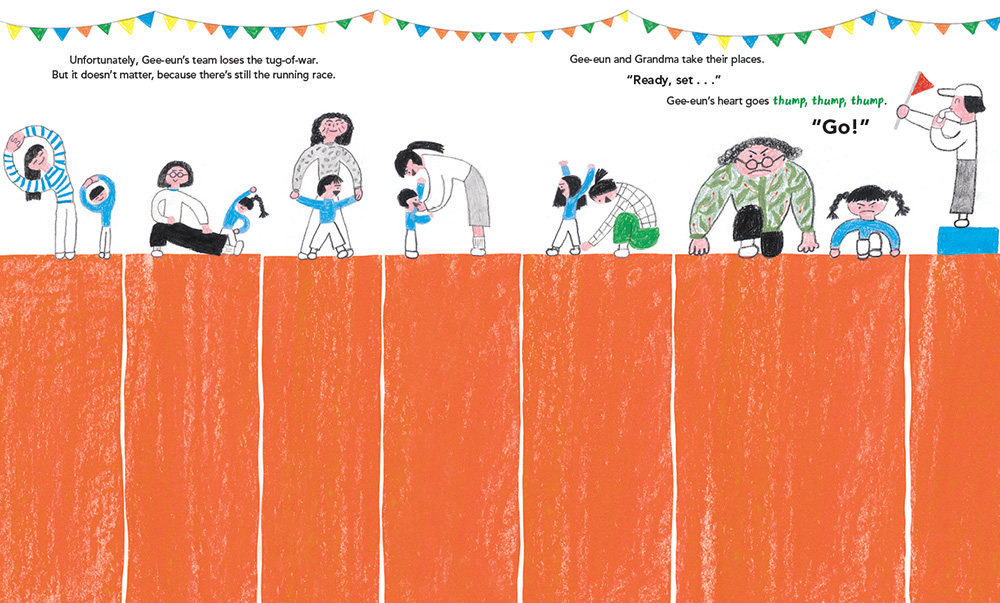
At Family Sports Day, Gee-eun feels confident in her and her grandma’s chances. But things don’t pan out exactly as she’d hoped, and Halmoni even trips and falls during the race. Gee-eun is so disappointed that her tears flow freely. Walking home, Halmoni and Gee-eun get a curry bun—and then a second one that is their secret. “No matter how you may be feeling, curry buns are always delicious, especially when shared with Grandma,” Gee-eun says.
They then buy mackerel, bean sprouts, and eggs for dinner, while Gee-eun’s grandma assures her that her father would easily beat a mackerel in a swimming race, that she once bought a bean sprout as big as Gee-eun to season just for her mom, and that a hen always misses her eggs. “‘Halmoni,'” Gee-eun then asks, “‘when will Mom get home?'” The food is on the table when her parents get home, and she runs to the door to greet them so they can eat dinner together…because “nothing beats a mean made by Grandma.”
Copyright Gee-eun Lee, 2022, translation by Sophie Bowman, 2022. Courtesy of Amazon Crossing Kids.
Gee-eun Lee’s story is infused with those types of events in life, both inconsequential and significant, that are filled with emotional power that make them memorable. From Gee-eun’s meltdown at her mother’s leaving to her grandma’s quick thinking that leads to bonding over food and creativity to the bravado and disappointment of the Family Sports Day, Lee invites readers into the touching and humorous relationship between Gee-eun and her grandmother. Wily, proud, comforting, and understanding, Gee-eun’s grandmother is the heart of the family, bridging the generations with her wisdom and constant love. Lee’s storytelling draws readers in with her warm and familiar dialogue that ingeniously pivots back and forth in time, tying together moments in Gee-eun’s mother’s life, her grandmother’s life, and Gee-eun’s experiences.
Gee-eun Lee’s soft colored pencil and paint illustrations are delightfully childlike, as if the character Gee-eun had drawn them. In that vein the expressive depictions of Gee-eun’s adult grandma fiercely besting a dozen children at tug of war, her smooth dance and nimble dance moves, and her and Gee-eun’s “set and ready” stance at the track while other mother/child pairs stretch, play, and tie laces are comical joy. The theme of bridging generations also appears cleverly in the image of Gee-eun’s dough family floating together in the soup and the portrait of Gee-eun brushing her doll’s hair while her grandmother brushes and braids Gee-eun’s, among others.
Written with a unique voice that echoes universal truths about family relationships, My GrandMom is a humorous, poignant, and heartening read aloud that will quickly become a favorite for parents, grandparents, other caregivers, and children to share. The book is highly recommended for home and classroom libraries and a must for school and public library collections.
Ages 3 – 7
Amazon Crossing Kids, 2022 | ISBN 978-1662508257
About the Author
Gee-eun Lee is an award-winning Korean author/illustrator. She recently won the prestigious BolognaRagazzi Award in the comics category for her book, The Story of How the Korean Shaved Ice Dessert Was Born, and is also a top winner of the Korean Young Illustrator Award. She studied design and illustration in Korea and the UK. Her first picture book, Paper Dad, was made into a children’s musical in Korea. My GrandMom is the second book she both wrote and illustrated and is based on her own grandmother. You can connect with Gee-eun on Instagram: @studio_geeeun
About the Translator
Sophie Bowman is a PhD student at the University of Toronto, studying Korean literature. She was awarded the ICF Literature Translation Fellowship at Ewha Womans University. In 2015, she won the Korea Times Modern Korean Literature Translation Award grand prize for poetry with her translations of Jin Eun-young and co-translated Kim Bo-Young’s I’m Waiting for You and Other Stories. She recently translated the picture book Magic Candies by Heena Baek, which received a starred review from Publishers Weekly. Follow her on Twitter @SophieOrbital.
I’d like to thank The Children’s Book Review and Amy Nielander for sharing a digital copy of My Name Is Not Ed Tug with me.
My Name Is Not Ed Tug
By Amy Nielander
Edimorwhitimormiligimmus Tug knew where he came from and just where he fit into his family. After all, “he was named after his Grandpa Edimor,” who helped him learn how to spell his name with a tall tower of blocks; “his Great Uncle Whitimor,” who taught him how to play the accordion; his Aunt Mili,” who ran a butterfly farm; “and his Granny Gimmus,” who filled his tummy with warm, homemade soup.” Anyone hearing his name might think it was gibberish, but Edimorwhitimormiligimmus thought “it was perfect.”
Copyright Amy Nielander, 2022, courtesy of West Margin Press.
School, of course, was a challenge since the other kids had a hard time spelling or even remembering his name. And his teacher, Ms. Mell, found that her mouth grew “quite tired” just trying to pronounce it. But one Monday, Ms. Mell announced that a new student, Ty, would be joining their class. Mrs. Mell had made name tags for each student to make it easier for Ty to remember their names, and she slapped one on Edimorwhitimormiligimmus’s shirt. When he looked, Edimorwhitimormiligimmus saw that the tag simply read “Ed.” He gazed at the tag with sadness. “Edimorwhitimormiligimmus Tug was shocked. He was perplexed. He felt like his heart had been stung by a giant bee. Twice.”
Copyright Amy Nielander, 2022, courtesy of West Margin Press.
After school, Edimorwhitimormiligimmus went straight to his room and stayed there, thinking. When he emerged, he had a plan (and a very perfectly sized name tag taped to his sweater). The next day, he approached Ty, who was playing with puzzle blocks. He stood proudly, displaying his sweater, and introduced himself—his whole self. He slowly said each part of his name and, miraculously, Ty repeated it. Edimorwhitimormiligimmus “was so happy his curls bounced.” Then as he and Ty constructed a tall bridge with the blocks, he explained how he and his Grandpa Edimor “love to build things together”—and had even invented those blocks.
Copyright Amy Nielander, 2022, courtesy of West Margin Press.
At lunch he did the same thing with the kids at his table, and they also repeated his name. To explain how important his Uncle Whitimor was to him, Edimorwhitimormiligimmus, he played his uncle’s favorite song on the accordion. When the class went out for recess, he told more kids about his Aunt Mili and pointed out, and they too learned his name.
On Tuesday, Mrs. Mell was out sick, and Edimorwhitimormiligimmus saw an opportunity to be kind and explain about his name. He and Ty delivered a steaming pot of Granny Gimmus’s soup to her doorstep and told her all about cooking with his granny. “The delicious soup warmed her heart.” Edimorwhitimormiligimmus’s plan worked. Now everyone, including Ms. Mell, knew—and used—Edimorwhitimormiligimmus’s full name.
Copyright Amy Nielander, 2022, courtesy of West Margin Press.
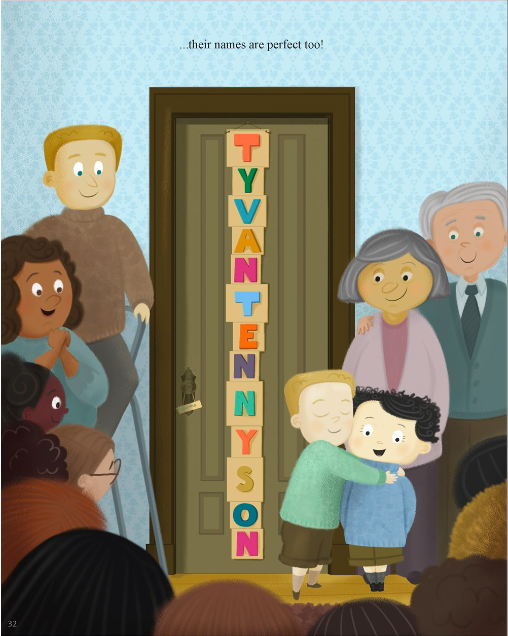
The experience prompted Edimorwhitimormiligimmus to come up with a new plan, a project to ensure all of his friends knew their names were just as perfect for them as Edimorwhitimormiligimmus was for him. And he and his classmates got started with the gift they made for Tyvantennyson to give him at his birthday party.
Copyright Amy Nielander, 2022, courtesy of West Margin Press.
Amy Nielander’s heartwarming and affirming story will captivate kids from the first recitation of “Edimorwhitimormiligimmus Tug”—a name that initially elicits giggles but soon rolls smoothly off the tongue. As they learn how each piece of Edimorwhitimormiligimmus’s name reflects not only the family member he’s named for but also the special things they do together, readers will empathize with the pride he feels in his name and his disappointment when they can’t get it right.
While Nielander’s clever story revolves around one child’s name, there are many other important lessons for both kids and adults woven throughout. Children will understand that their names, personalities, heritage, talents, and dreams are perfect for them just the way they are. For adults, Ms. Mell’s dismissive mangling and shortening of Edimorwhitimormiligimmus’s name to “make it easier for all of us” reminds us that every child deserves to be really seen and accepted for who and everything they are.
Nielander’s illustrations are full of warmth and love, charm and humor as she introduces the unique talents of each member of Edimorwhitimormiligimmus’s inclusive and close-knit family. As Edimorwhitimormiligimmus puts his plan to teach each classmate and Ms. Mell his name into action, the children’s sweet faces and palpable excitement are infectious and will draw readers into this universal hug of a story. The surprise reveal of Ty’s full name and the collective gift the class makes him—with the promise of the same for each child—will delight readers and is sure to spur them to create name signs for themselves.
An engaging, multi-layered story about acceptance, self-esteem, family, and friendship, My Name is Not Ed Tug is a story kids will want to hear again and again. The book is highly recommended for home bookshelves and is a must for classroom, school, and public libraries.
Ages 4 – 8
West Margin Press, 2022 | ISBN 978-1513134871
Discover more about Amy Nielander, her books, and her art on her website.
Take a peek at the book trailer for My Name Is Not Ed Tug!
You can purchase My Name Is Not Ed Tug at these booksellers
Thanks to Eerdmans Books for Young Readers for sharing a copy of Madani’s Best Game with me for review consideration. All opinions on the book are my own.
Madani’s Best Game
Written by Fran Pintadera | Illustrated by Raquel Catalina | Translated from the Spanish by Lawrence Schimel
“Our whole neighborhood knows it: no one plays soccer like Madani does.” Thus, a teammate of Madani’s begins the story about this friend who captivates the neighborhood (and sometimes it seems the whole world) with his barefoot ball-handling prowess. Madani has elevated the team’s game to “the best soccer we’ve ever seen.” After Madani has scored a “Gooooal!” the sound of the cheers soars above the playing field and “…crosses through doorways, rushes past the magazine stand, slips down alleyways, swirls around the fountain, and, growing fainter and fainter, climbs the steps up to Madani’s house.”
Image copyright Raquel Catalina, 2022, text copyright Fran Pintadera, 2022. Courtesy of Eerdmans Books for Young Readers.
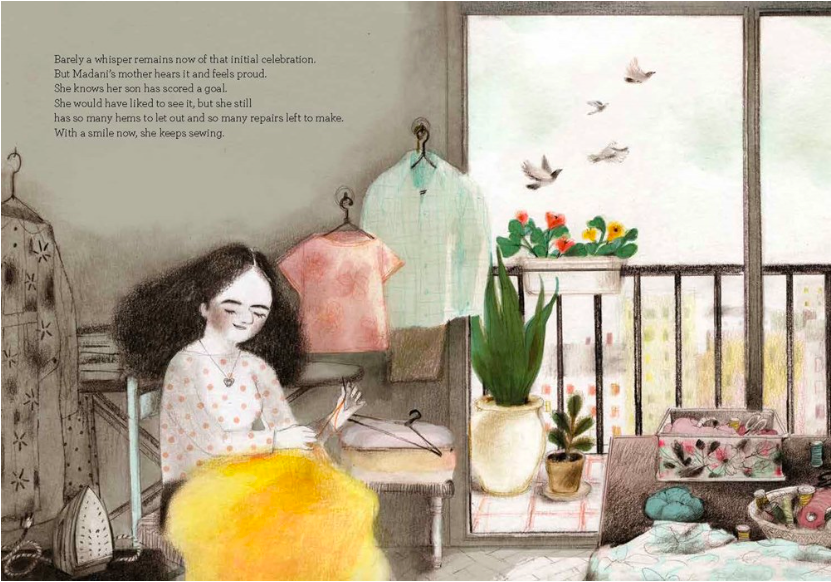
There, his mother hears it and knows the cheers are for Madani. She wishes she could attend his games, but she’s a seamstress and has so many garments to sew by hand. After the game, Madani’s teammates can only imagine how much better he would play if he only had a good pair of cleats. Their team might even be able to beat the Southside team—their biggest rival.
Image copyright Raquel Catalina, 2022, text copyright Fran Pintadera, 2022. Courtesy of Eerdmans Books for Young Readers.
The members of the team know that Madani’s saving up money in a special tin that gets heavier every time he declines to buy a snack, walks to away games instead of riding the bus, and makes other sacrifices. They know that when the box is full, Madani’s going shopping. “…then our games will be better than ever!’” he says, and they all dream of the day Madani buys his new cleats.
Image copyright Raquel Catalina, 2022, text copyright Fran Pintadera, 2022. Courtesy of Eerdmans Books for Young Readers.
The big game against Southside is only a day away, but Madani doesn’t come to practice. Instead, his friends watch him head downtown with the tin under his arm. Without Madani at practice, the team falls apart, but they don’t worry. Finally, they thought, their dreams of new cleats and beating Southside would come true!
When Madani shows up at the game the next day, “he looks radiant,” but he’s still barefoot. His teammates question him about his new cleats, but Madani doesn’t know what they’re talking about. The money wasn’t for shoes but for a present for his mother so that “‘she’ll be able to finish her work faster and come watch me play every Saturday.’”
Image copyright Raquel Catalina, 2022, text copyright Fran Pintadera, 2022. Courtesy of Eerdmans Books for Young Readers.
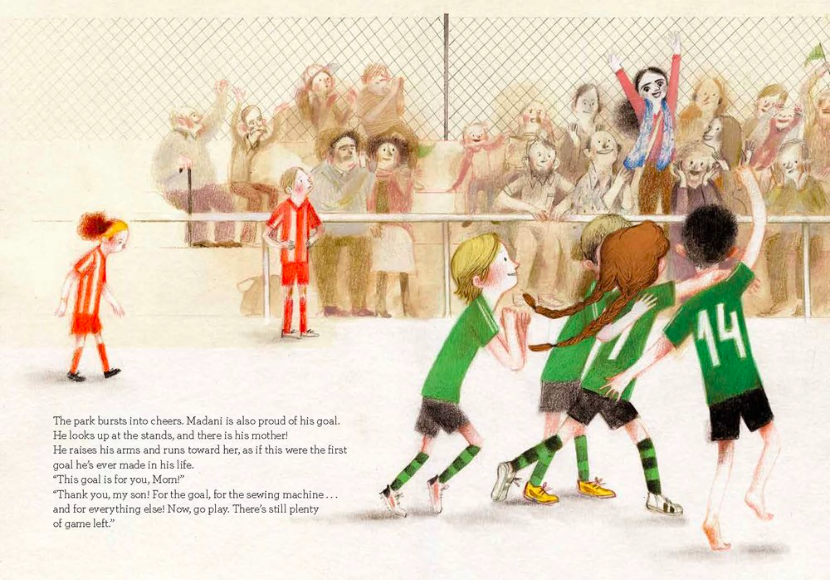
Madani’s friends still don’t quite get it, but the game begins, and in moments Madani has already stolen the ball away from the Southside players, run downfield and scored. He looks into the stands, sees his mother, and shouts “‘This goal is for you, Mom!’” Madani makes another goal, but Southside scores too, and the game ends in a tie. It’s okay, though, Madani’s teammate says, “‘because now more than ever, everyone in the neighborhood knows … There’s no player like Madani!’”
Back matter consists of notes from Fran Pintadera and Raquel Catalina that reveal their creative journeys and connections to this story.
Image copyright Raquel Catalina, 2022, text copyright Fran Pintadera, 2022. Courtesy of Eerdmans Books for Young Readers.
Fran Pintadera, who based Madani’s Best Game on his experiences as a social educator in new immigrant housing, tells his story with open-hearted affection for his subject as well as the relationships between teammates and mother and child. Through his perceptive and humorously observed details and lyrical language, Pintadera captures the wide-eyed wonder of children in awe of a great player (or artist, singer, scientist, or other talent). When Madani gets the ball, readers will hold their breath along with the neighbors, traffic, and even pigeons while he entertains the crowd and scores a goal. Then the action begins again, but this time the suspense revolves not around the game but on what Madani will buy. The answer is joyous, affirming family devotion and revealing the pure giving nature of a child’s heart.
From their first introduction to Madani, smiling out from the page, his bare foot on a soccer ball, readers will be captivated by him, his teammates, his neighborhood, and the game. Raquel Catalina’s endearing pencil, gouache, and colored pencil illustrations charm with realistic images of kids on the soccer field surrounded by city onlookers. Catalina creates not only gorgeous visuals of Madani’s supportive neighborhood, but an almost auditory experience as well.
Readers can almost hear the players’ running feet, the sudden cheers, the flap of the rising pigeons’ wings, and – as the celebration reaches Madani’s mother’s ears – even the whisper of her sewing needle through the fabric on her knees. Catalina deftly weaves the theme of friendship, between people both young and old, throughout the pages, enhancing the bond between Madoni and his mom as well as Madani’s teammates’ understanding of the true importance of that long-awaited game.
A beautiful poignant, joyful, and affirming story of family and friendship, Madani’s Best Game is a read aloud that adults and kids will love to share over and over. The book is a must for all home, classroom, school, and public libraries.
Ages 5 – 9
Eerdmans Books for Young Readers, 2022 | ISBN 978-0802855978
You can discover more about Fran Pintadera and his work on his website and connect with him on Instagram.
To learn more about Raquel Catalina, her books, and her art, visit her website. You can also connect with her on Instagram.
You can connect with Lawrence Schimel and learn more about his writing and his translating work on Instagram and Twitter.
You can find Madani’s Best Game at these booksellers
Even though we’re saying goodbye to Read a New Book Month, families don’t have to stop seeking out new books at their local bookstore or library. In fact, fall and the lead-in to the holidays is one of the busiest times of the year for publishers as they release wonderful books that share traditions and take readers through the winter in thoughtful, funny, and always surprising ways. Maybe that’s why December is also tagged as Read a New Book Month! Really, there’s never a time when you don’t want to celebrate new books—like today’s!
Thanks go to Albert Whitman & Company for sharing a digital copy of Gracie Brings Back Bubbe’s Smile with me for review consideration. All opinions on the book are my own.
Gracie Brings Back Bubbe’s Smile
Written by Jane Sutton | Illustrated by Debby Rahmalia
Gracie always loves when Bubbe comes to visit, but this time Bubbe was too sad to do the things she and Gracie usually did together because her husband had died. She didn’t feel like doing yoga or making jokes. “She hardly even smiled.” Gracie missed all the things she used to do with Zayde too—talks about science and sharing inside jokes.
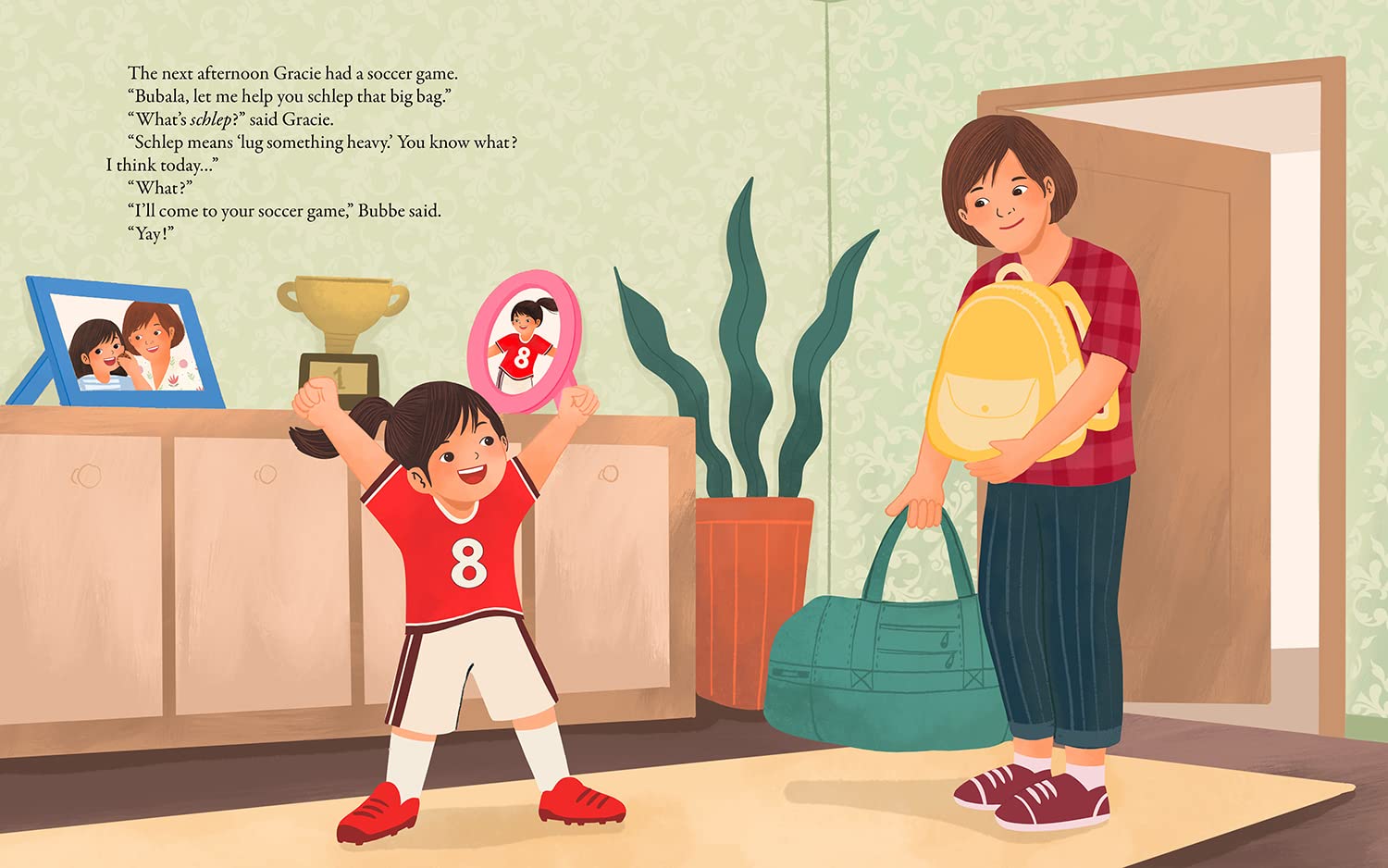
Gracie tried different things to make Bubbe happy again. She asked if she’d like to sing while Gracie played the guitar, if she’d like to come to her soccer game, or help her draw a picture. But each time, Bubbe just said “‘No thank you, Bubala.'” This answer got Gracie thinking. “She knew bubbe meant ‘grandma’ in Yiddish. And zayde meant ‘grandpa.'” But she didn’t know what bubala meant. When Gracie asked Bubbe, she explained that “‘it means “little grandmother. …But you call someone you love “bubala.”‘”
Image copyright Debby Rahmalia, 2022, text copyright Jane Sutton, 2022. Courtesy of Albert Whitman & Company.
Then Bubbe sighed and told Gracie how much she and Zayde “‘loved using Yiddish words together.'” Gracie wanted to learn Yiddish words too, and asked Bubbe to teach her. They went into the kitchen, and while Bubbe cut up an apple, she taught Gracie the word nosh. “‘It means “eat a snack.”‘” As Gracie noshed on her apple, she thought she saw Bubbe smile just a little.
That night Bubbe taught Gracie how to say “good night” in Yiddish, and the next day when Gracie came home from school she wanted to walk around the neighborhood like they used to, but Bubbe said she didn’t feel like it. Gracie persisted, pulling on her hand and telling her how beautiful it was outside. Bubbe had to admit that it was sheyn. Gracie was excited to understand this Yiddish word for “beautiful” because Zayde often called her sheyna meidala or “pretty girl.” Bubbe conceded and put on her sneakers.
Image copyright Debby Rahmalia, 2022, text copyright Jane Sutton, 2022. Courtesy of Albert Whitman & Company.
Once outside, Bubbe even started jogging a little and taught Gracie another Yiddish word when Gracie asked her to slow down. As the week went on, Gracie and Bubbe began talking about their memories of Zayde. Bubbe even decided to go to Gracie’s next soccer game. At the game Bubbe smiled and even cheered when Gracie scored a goal, and back home they laughed together when Bubbe told Gracie her socks were “‘… so farshtunken, my nose might explode!'”
“‘Bubbe! You’re laughing!'” Gracie cried. And Bubbe had to agree and told Gracie it was for a very special reason. “‘Because you give me naches. That means ‘joy.'”
Back matter includes a short Author’s Note about the Yiddish language as well as a glossary of Yiddish words that includes and expands on the words found in the story, their meaning in English, and a pronunciation for each of them.
Image copyright Debby Rahmalia, 2022, text copyright Jane Sutton, 2022. Courtesy of Albert Whitman & Company.
Jane Sutton’s poignant story will touch readers’ hearts on many levels, from a child and grandmother overcoming grief to the passing on of family heritage to the way children bring a healing kind of joy through their exuberance, empathy, and love. Sutton’s storytelling hits all the right notes as she depicts Bubbe’s transition from mourning to joy over superbly paced scenes and seamlessly introduces Yiddish words through Gracie and Bubbe’s authentic conversations while also demonstrating the family’s strong bond of love and trust. Dialogue rich, the story makes a perfect read aloud that will excite kids about learning the Yiddish words along with Gracie and prompt families to talk about their own history.
In her vibrant illustrations, Debby Rahmalia lets young readers see through Gracie’s viewpoint how Bubbe’s sadness affects her and how much she wants to help her grandmother find happiness again. As Gracie does yoga while Bubbe stands by and shares a silent dinner with her usually talkative grandmother, Gracie’s expressions register concern and disappointment. In Gracie’s attempts to enlist Bubbe in doing their usual activities, Rahmalia portrays not only Gracie’s strong connection with Bubbe, but also a realistic look at how loss can affect emotions and physical energy. When Gracie hits on learning Yiddish as a way to interact with Bubbe, Rahmalia effectively shows how Bubbe’s smile, enthusiasm, and laughter return as she and Gracie share the language and memories of Zayde.
Touching, reassuring, and joyful, Gracie Brings Back Bubbe’s Smile comforts and restores while celebrating family love and generational ties. The book would be a meaningful addition to home bookshelves for all families and one school and public librarians will want in their picture book or family issues collection.
Ages 4 – 7
Albert Whitman & Company, 2022 | ISBN 978-0807510230
You can discover more about Jane Sutton and her books on her website and connect with her on Instagram.
You can view a portfolio of work by Debby Rahmalia here and connect with her on Instagram and Twitter.
Read a New Book Month Activity
Gracie Brings Back Bubbe’s Smile Matching Puzzle
Gracie loved learning Yiddish words from Bubbe! With this puzzle you can learn the Yiddish words from the book too. Just print the puzzle and match each word with its definition to get started using these words yourself!
Written by Ellen Mayer | Illustrated by Nicole Tadgell
Camille is determined to rake her own pile of leaves―all the way up to her knees! She swishes leaves to and fro, watching her pile grow bigger alongside the piles made by Daddy and her little brother, Jayden. WHOOSH! After raking leaves to the top of her boots, a giant breeze blows the pile back down to her ankles. But Camille won’t be stopped until she gets the job done––a knee-high pile, the perfect size for… jumping in!
Leaves to My Knees and Spanish/English bilingual Hojas hasta las rodillas/Leaves to My Knees are playful introductions to the early math concepts of size comparison and measurement. A note by researcher and mathematics learning expert Marlene Kliman explains how parents and caregivers can use the book to help young children explore different sizes and measurement in everyday environments.
I’m thrilled to be talking with Ellen Mayer and Nicole Tadgell today about this gorgeous cover and their adorable—and educational—book that will be available this fall, just in time for leaf-raking season!
Meet Ellen Mayer
Ellen Mayer is an award-winning author who writes picture books for babies and young children and the grown-ups who read to them. Leaves to My Knees is her ninth book for children. Her other math story books include Banana for Two and Clean Up, Up, Up!, two board books in her Small Talk Books® series with Star Bright Books.
For many years Ellen was an education researcher at the Harvard Graduate School of Education, studying how families are engaged in their children’s learning. She also worked as an early literacy home visitor with young children and their parents in a local affiliate of the ParentChild+ program. Now, Ellen volunteers as a visiting children’s book author with public schools and city-run playgroups in her local Cambridge and Somerville, MA, communities. Long ago she earned an M.Phil. in Sociology from Columbia University.
Ellen often collaborates with her musician husband in “Books + Banjo” reading and sing-along programs for young children. Ellen loves to rake leaves in the fall—especially when she has help from her grandchildren.
I have so many great memories of raking leaves with my kids when they were small. You really capture the fun and challenges of this favorite fall activity in your story. Were you inspired by your own family’s experiences in any way while writing it?
Very much so! Since the time our kids were very little they’ve joined us in the backyard for all sorts of yardwork. My daughter wanted to hold the rake from a young age, even as I did the less exciting early springtime rake of the lawn.
At first our trees didn’t yield much in the way of fall foliage, so we would haul a big bag of fallen leaves in from the tree out on the city sidewalk to have as leaves for play. The piles that resulted were often rather puny, only up to the ankles, as protagonist Camille would tell us.
But as the backyard trees matured, raking and jumping took off, much like in the story! I should add, too, that the sibling dynamic between our older daughter and younger son was also a source of story inspiration, influencing how I wrote the sister-brother characters here. Older sister was always the more determined and focused raker of the two, with younger brother taking it upon himself to annoy and distract her as much as possible, and generally try to steal the show, as was his lovable wont in those early years.
Marlene Kliman, an early math expert who is a Senior Scientist at nonprofit STEM education organization TERC in Cambridge, MA, has contributed a back matter note for parents and caregivers. In it she writes that Camille uses the math of measurement as she works at raking a knee-high pile of leaves and as she describes the sizes of things around her. Can you tell us how Camille and other young children approach measurement?
Preschoolers and toddlers, before they are ready to understand and engage in measuring with standardized units like inches and feet, try out measuring in their own ways. For instance, they compare the thing to be measured with an object or their body. Here, Camille measures the changing height of her leaf pile as it moves up her leg to her knees—first reaching up to her ankles, then up to her boots, but then back down to her ankles after a big breeze, then finally after some serious raking all the way up to her knees—where it’s the perfect size for jumping in. Young children naturally love to consider their world in terms of the different sizes of things. Throughout the story, Camille actively references the sizes of things all around her, whether it’s that big breeze or the size of her jacket, rake, and leaf pile in comparison with the smaller jacket, rake, and leaf pile that belong to her little brother, Jayden.
Today’s post celebrates this beautiful and exuberant cover! What was your first reaction to seeing the final cover art?
When I first saw the final cover I gasped! I love cover art that is inviting and also contains a little mystery to it. Here, Nicole created the most glorious, radiant, luminescent fall day, and I immediately wanted to join in the play. And what was that cute little dragon/dinosaur up to in the background? Definitely intriguing. Then, also, there are hints of the size-comparison math to come in the story in the form of the differently sized two rakes and three birds. The idea of “leaves to my knees” is there too, center stage. The joy and energy in this cover scene is palpable as the leaves float from the tree and Camille almost seems to be dancing in her leaf pile. Thank you so much for introducing this gorgeous cover into the world, Kathy!
Do you have another favorite spread in the book? Why is this one special to you?
Nicole creates this wonderful dance here in her art, from cover to close, with captivating facial expressions on each page. It’s hard to single out a favorite spread—there is something that takes my breath away on each page! But I keep returning to the one near the end where all is right with the leaf pile, the jump, and the siblings. Here, Camille and Jayden have flopped onto her pile and are luxuriating side-by-side on the big crackly bed of leaves, enormous matching grins on their faces. Maybe I was worried that Camille wouldn’t let the little mischief-maker into her pile? But she’s not shooing him anyway anymore—they are just celebrating together the joys of a fall leaf pile.
What would you like for kids and adults to take away from the story?
I hope they will come away with a warm feeling inside after spending time with this playful and loving family, a family that’s engaged in a fall chore, but one that is also enjoying a lot of fun and learning together. I hope they take away that math is everywhere around us, and that young children—all young children—love to measure and compare as they go about their day. I hope they take away the powerful image of a child of color, and a girl, as an active mathematician. There still aren’t nearly enough Camilles in the pages of picture books, and everyone—kids of all backgrounds listening to this story and all their reading adults too—need to see and normalize children of color and girls doing math.
Nicole Tadgell is an award-winning watercolor artist of more than 30 luminous picture books. Her books have received numerous honors, including the Christopher Award and the Children’s Africana Book Award. They have been included on the Smithsonian Notable Books for Children, the New York Public Library’s Best 100 Titles for Reading and Sharing, and many more notable lists. Born in Detroit, Michigan, frequent moves weren’t easy for Nicole, especially to new schools where she was the only Black kid in class. Art has always been both an escape and a labor of love for Nicole. Today, she brings stories to life while advocating for diversity in children’s literature. Nicole lives in Chesapeake, Virginia.
Can you share what attracted you to Ellen’s story from an illustrator’s point of view?
Because I often illustrate older children, I saw the opportunity to showcase two young children playing in autumn leaves. (My favorite season!)
Camille shows so much personality and determination on this cover image. Can you describe your process of designing and finalizing the cover?
Covers can be a challenge, to be sure. There’s a compromise to paint what’s fun . . .
Image copyright Nicole Tadgell, 2022
. . . versus showing the audience what the book is about!
Image copyright Nicole Tadgell, 2022
Were you inspired by personal memories of raking leaves as you worked on this cover image and interior spreads? Do you have a story about raking leaves you’d like to share?
I admit I had grown-up thoughts about there being spiders in the leaves! I don’t have a clear childhood memory of that happening, but I’ve seen plenty of spiders in leaves as an adult. A fun story is about the models for this book! My sister’s friend has two kids the right age. Their Dad was wonderful—instead of taking pictures of the kids playing in leaves, he shot video so I could pause and sketch. They were perfect! Original down to Camille’s double pom-poms and Jayden’s dinosaur coat.
Image copyright Nicole Tadgell, 2022
The soft colors of your illustrations in Leaves to My Knees are really lovely. Can you talk about how you choose a color palette for your work in general and for this cover in particular?
Endless choices! It’s hard to decide. Knowing the season, I began with fall colors: reds, oranges, yellows. I felt that contrast would help our family stand out, so I chose cool colors for Camille and Jayden. I chose earth tones for Dad to make the kids stand out even more.
Image copyright Nicole Tadgell, 2022
Image copyright Nicole Tadgell, 2022
Interestingly, in the images I used for reference the real leaves had lost their color, so I just painted them colorful. I did make our Jayden a bit younger than the model’s age. For the backyard fence, I found a place nearby that had an interesting fence and small leaf-filled yard. I watched as cardinals flit between branches and squirrels chased each other, and inspiration came for the animal antics in the background!
And finally, my partner Anthony was kind enough to pose as the dad in the book!
Now that picture book creators are more free to interact with readers, what are you most looking forward to in promoting Leaves to My Knees?
Fun! I love signing books for kids & personalizing.
In addition to celebrating a fun (and necessary) fall activity, Leaves to My Knees incorporates early math concepts of size and measurement. Can you give an example of how you depicted these ideas in your illustrations?
By using different sizes of the rakes and making sure the leaf piles matched the text (up to ankles, then knees).
I can almost feel the chill in the air and hear that crisp crunch of leaves underfoot that means it’s leaf-raking time!

















 celebratepicturebooks.com