March 14 – It’s Expanding Girls’ Horizons in Science and Engineering Month

About the Holiday

Expanding Girls’ Horizons in Science and Engineering Month was established in 2020 by the Expanding Your Horizons (EYH) Network. Founded in 1974 as a series of conferences aimed at promoting STEM careers to middle and high school girls, EYH provides hands-on activities, mentoring, and contact with role models as well as information about science and engineering fields.

Women still make up only 28% of the science and engineering workforce. With this month-long observance, the EYH Network hopes to make a significant impact on girls’ perceptions and career choices, encouraging them to explore and embrace STEM subjects​.

Thank you to Heyday and Barbara Fisch at Blue Slip Media for sharing a copy of I Love Salmon and Lampreys: A Native Story of Resilience with me!

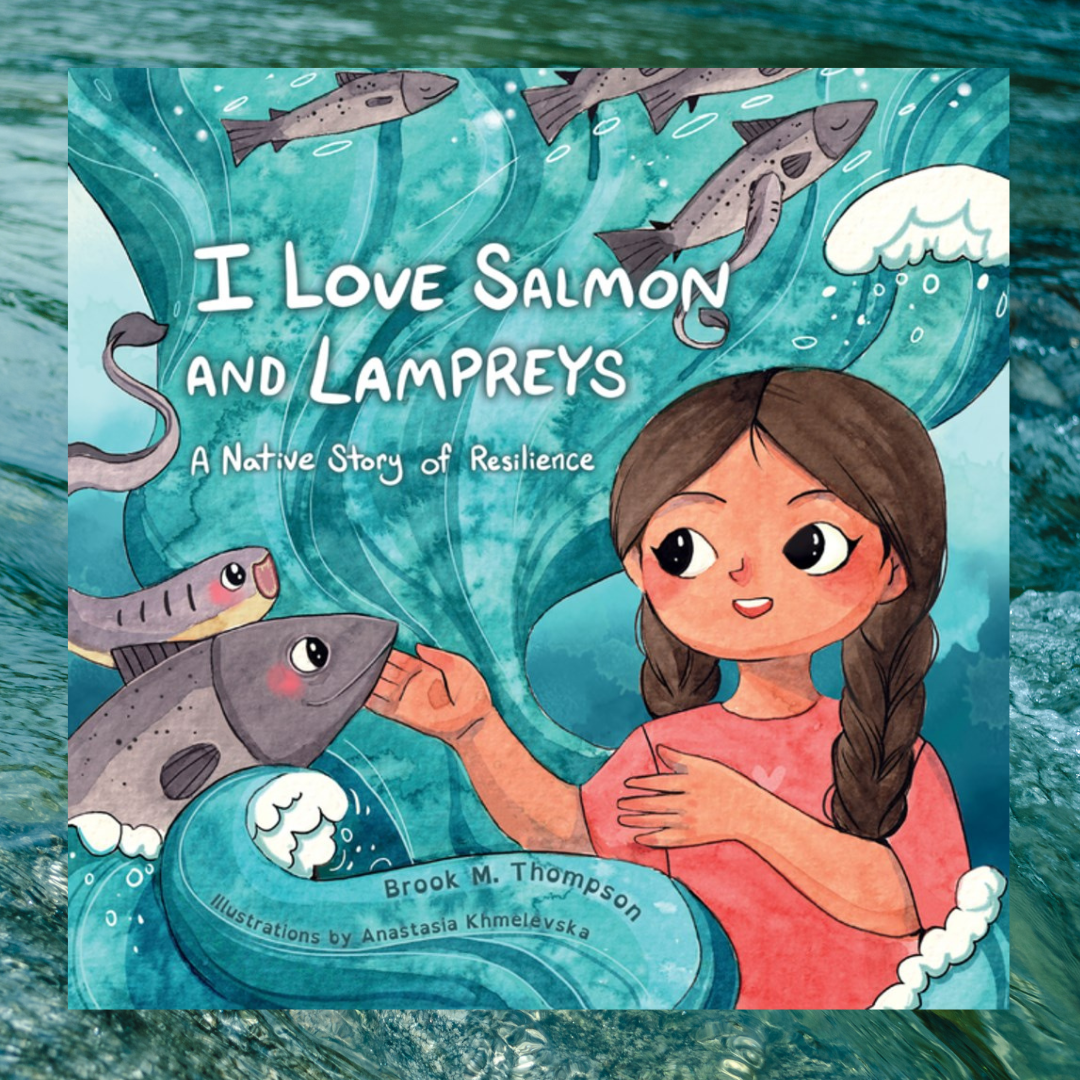
I Love Salmon and Lampreys: A Native Story of Resilience

Written by Brook M. Thompson | Illustrated by Anastasia Khmelevska


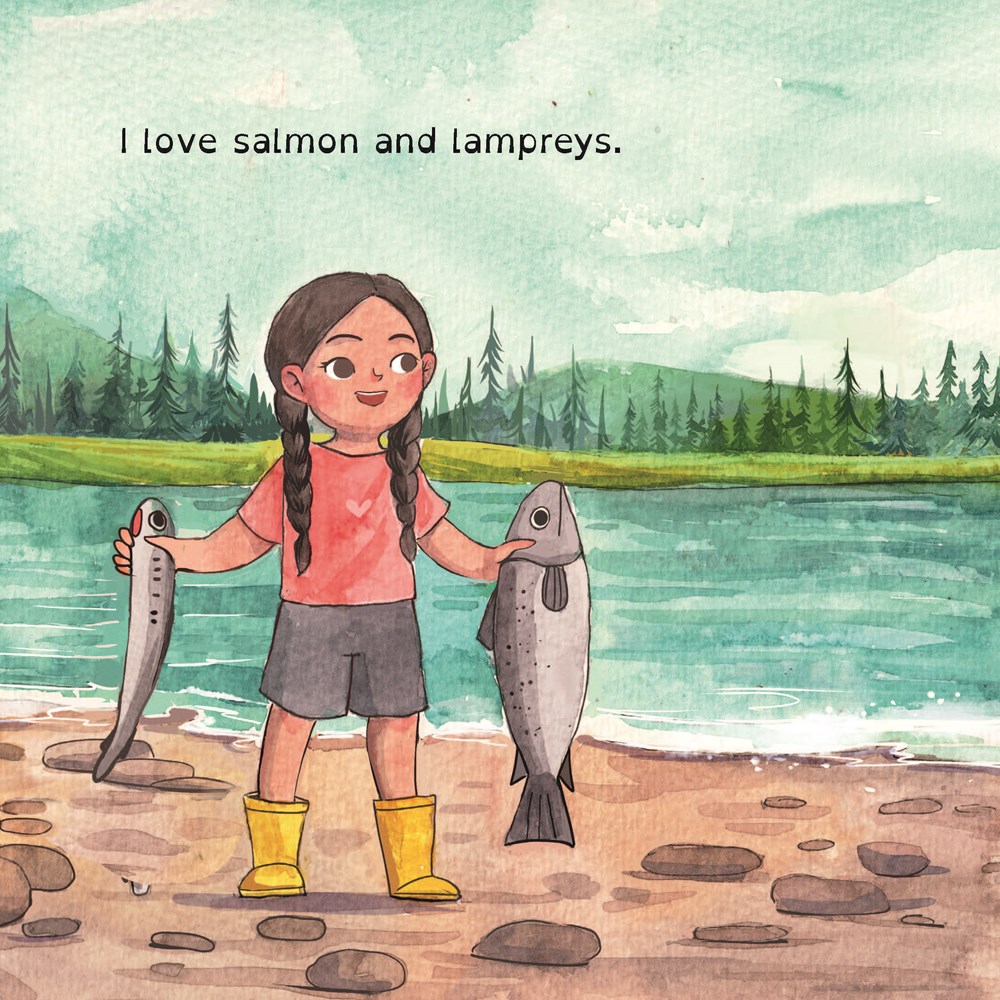
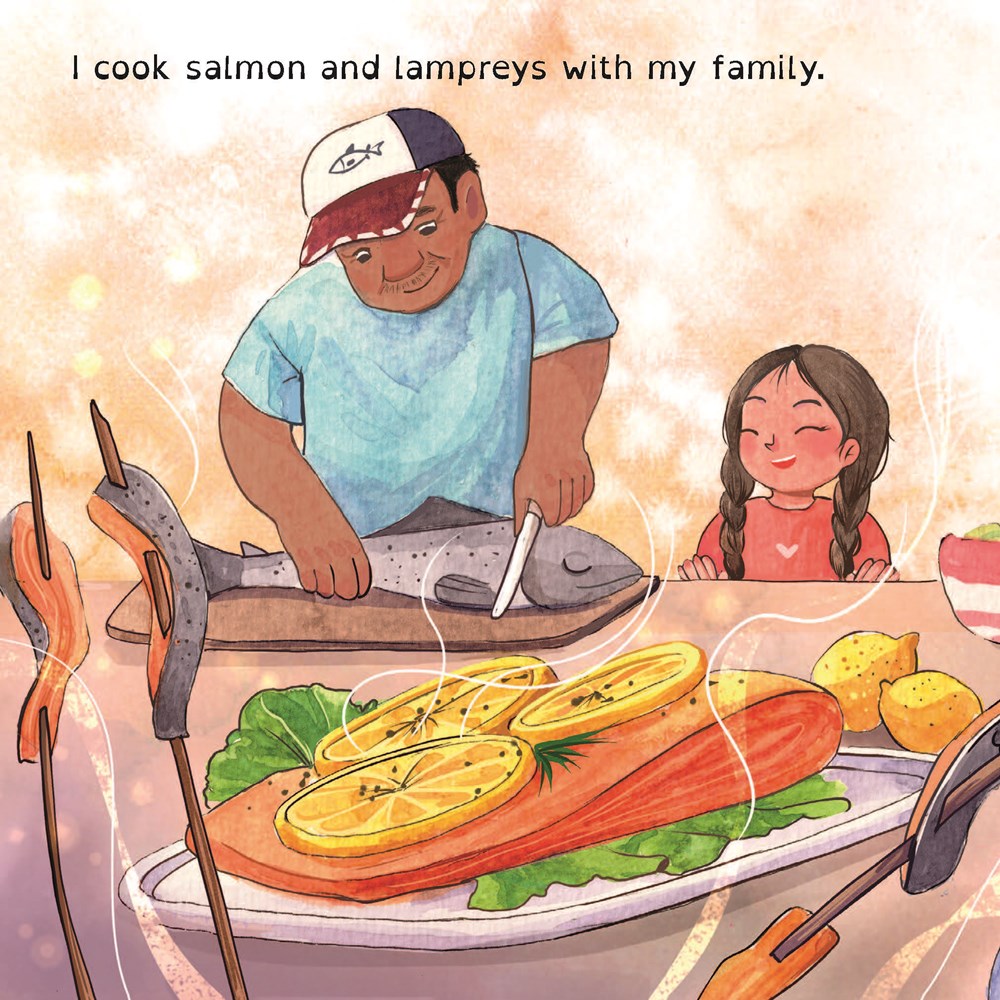
In her powerful autobiographical story, Brook Thompson, a member of the Yurok and Karuk Tribes, warmly invites readers to join her on her journey from childhood to the present day to experience her intense love for her tribes’ traditions and the fish that sustain them. Readers are first taken out on Brook’s family’s fishing boat, where her father and her grandfather tell stories of their own childhoods as they check the nets in their designated fishing spots along the Klamath River in Northern California. Then it’s back home to learn how Brook helps cook the fish (lampreys in the winter and salmon the rest of the year) in a wide variety of delicious ways.

Illustration © 2025 by Anastasia Khmelevska, text © 2025 by Brook M. Thompson. Courtesy of Heyday.

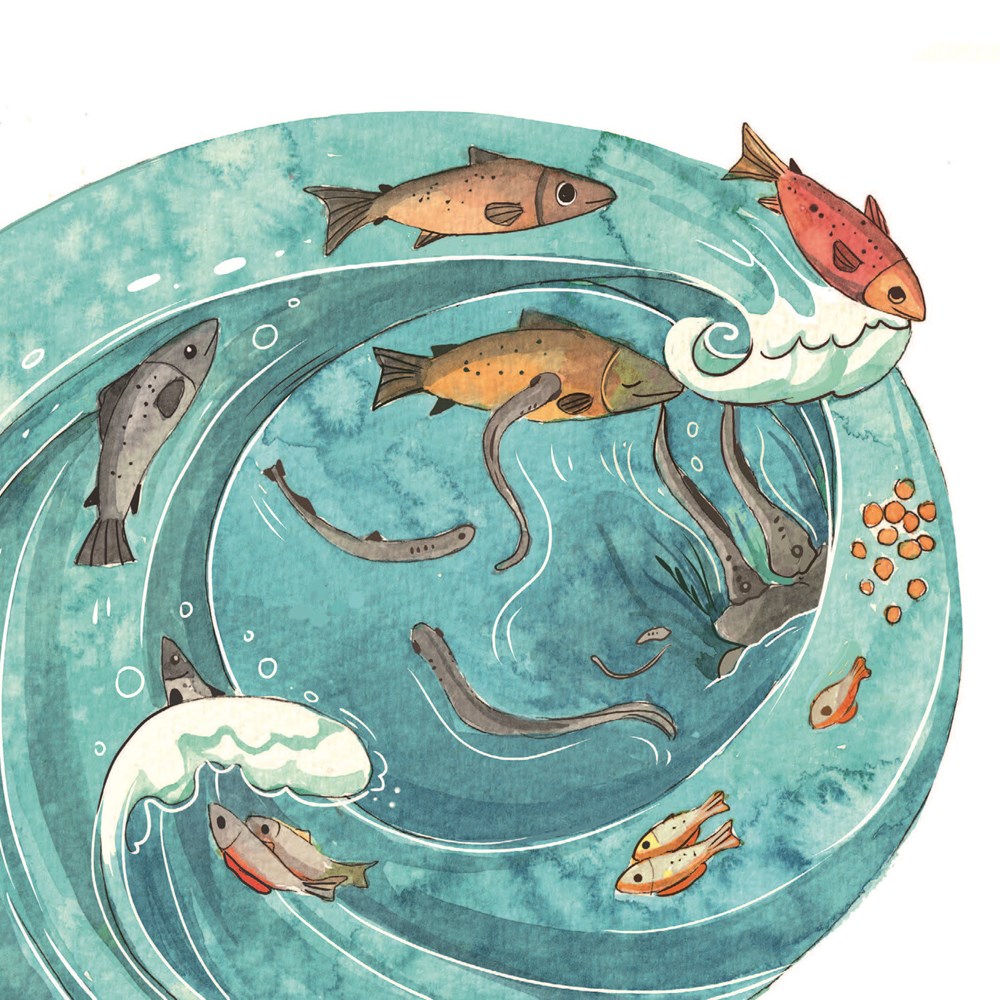
Salmon and lampreys are more than just food to Brook, however. They are creatures of the earth to be admired and honored. She tells readers about their life and spawning cycles, how they predate the dinosaurs, and even about their fascinating symbiotic relationship. For Brook, this love she feels is shared. She says, “I feel loved by salmon because years ago my ancestors took care of the salmon for their future family” and reveals that the fish in the river now “are the great-great-great-great-great-great-grandkids of the salmon who had a relationship with my great-grandparents.”

Illustration © 2025 by Anastasia Khmelevska, text © 2025 by Brook M. Thompson. Courtesy of Heyday.

In 2002, when Brook was still young, over 60,000 salmon perished from a parasite which spread when the water level of the river became too low and the temperature too hot due to the six dams erected on the river. She explains how dams “block the salmon’s way home” and how the warming water promotes the growth of toxic green algae, which affects the fishes’ breathing and spreads disease. 

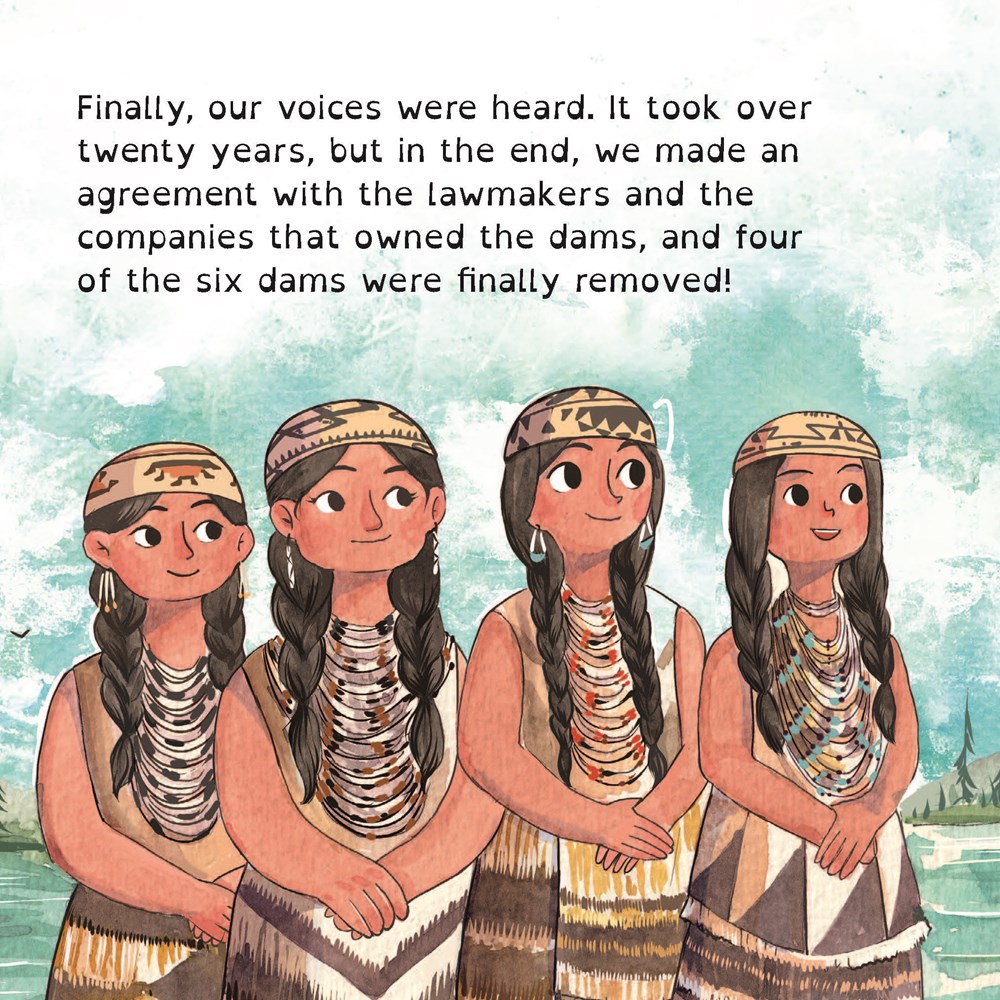
Brook joined protests by the tribal people and others, while scientists did research and local politicians lobbied for change. More than 20 years later agreements with the politicians and the companies that owned the dams were signed, and four of the six dams along the Klamath River were removed.

Illustration © 2025 by Anastasia Khmelevska, text © 2025 by Brook M. Thompson. Courtesy of Heyday.

As she grew into adulthood and inspired by her experiences, Brook set her eyes on higher education. She “went to college to learn about dams and about how to protect salmon in the future.” She became an engineer and a scientist who studies the interconnectedness of  “water, nature, people, animals, and buildings” and returned home to the Klamath River, where she continues the legacy of her ancestors in caring for the salmon, lampreys, and the environment.

Back matter includes Fun Facts about lampreys and salmon; photographs of Brook with salmon and at Iron Gate Dam, which was removed in 2024; a map of the Klamath River Watershed area; a note about the inspiration behind the book as well as the book’s font, OpenDyslexic, which makes it easier for those with dyslexia, like Brook, to read; and notes about the author and illustrator.

Illustration © 2025 by Anastasia Khmelevska, text © 2025 by Brook M. Thompson. Courtesy of Heyday.

Brook Thompson, in her compelling autobiographical story, will captivate children and touch their hearts. Thompson’s eloquent and straightforward storytelling immediately immerses readers in the Native relationship with nature and will inspire both young and adult readers to think deeply about how the earth sustains us and how we can show our appreciation in return. The theme of environmental justice and how citizens can and do make a difference is made personal through Thompson’s clear explanations of how the dams affected the salmon population and the long-term steps people took to reverse their damage. Thompson’s dedication—even from childhood—to her tribes, family, and future generations will impress readers. Children will also develop an understanding of how issues of interest to them now can inform their future endeavors.

Anastasia Khmelevska’s vibrant earth tone illustrations endear Brook to children through her evident passion for family, fishing, and the salmon and lampreys that have been a constant in her tribes’ lives. Her pacing and realistic depictions of people and events help children clearly understand the importance of each element of Thompson’s story from how the cyclical lives of salmon and lampreys are demonstrated in a swirling wave to the stunning landscapes highlight of the Pacific Northwest. These images make her depiction of the salmon die-off all the more impactful. Her final portrait of Brook Thompson coming home after earning her university degrees links her life to the salmon she loves so well. 

The combination of Native culture and environmental awareness makes I Love Salmon and Lampreys: A Native Story of Resilience a must addition to school and public libraries. The book offers extensive value and research opportunities for science and social studies classes. For families who care about the environment, sustainability, activism, and the future of our planet, I Love Salmon and Lampreys would be a much-loved choice.

Ages 4 – 8

Heyday, 2025 | ISBN 978-1597146685

About the Author

Brook M. Thompson is a part of the Yurok and Karuk Tribes. She is a neurodivergent and Two-Spirit author with dyslexia. She has a BS in civil engineering from Portland State University and an MS in environmental engineering from Stanford University, and she will soon have a PhD in environmental studies from University of California, Santa Cruz, where she studies water, politics, restoration, and salmon. You can find out more about her at brookmthompson.com.

About the Illustrator

Anastasia Khmelevska is an illustrator based in Lviv, Ukraine. She has illustrated several children’s books, including My Invisible Zoo, Marella the Mermaid, and Anything Helps. Follow her on Instagram @cute_miuu.

Expanding Girls’ Horizons in Science and Engineering Month Activities

Illustration © 2025 by Anastasia Khmelevska, text © 2025 by Brook M. Thompson. Courtesy of Heyday.

I Love Salmon and Lampreys Activity Pages

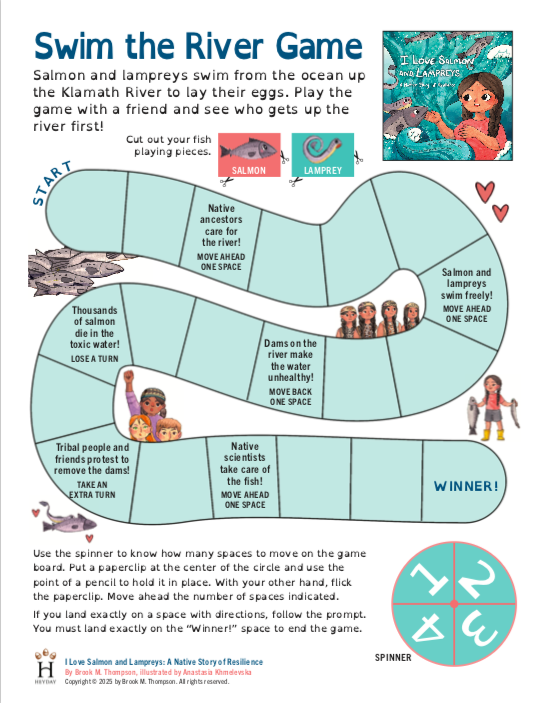
Play a printable board game, write about your dreams for the future, and learn fun facts about salmon and lampreys with these three I Love Salmon and Lampreys Activity Pages!

Chinook and Coho Salmon Coloring Pages

Coho and Chinook Salmon are vital to the Pacific Northwest. You can learn more about California salmon at caltrout.org. Enjoy these coloring pages of coho and chinook salmon. Colored images are included for your reference.

Chinook Salmon Coloring Page | Colored Image of Chinook Salmon

Coho Salmon Coloring Page | Colored Image of Coho Salmon

You can purchase I Love Salmon and Lampreys: A Native Story of Resilience at these bookstores

Amazon | Barnes & Noble | Bookshop

Picture Book Review

February 13 – It’s Random Acts of Kindness Week

About the Holiday

If you’re celebrating Random Acts of Kindness Week (February 9–15 in the UK and February 14–20 in the US), you can consider yourself a RAKtivist—a Random Acts of Kindness Activist. Being a RAKtivist is awesome! And easy! All it takes is to be kind to anyone you meet. Acts of kindness don’t have to be big, or hard, or expensive. In fact, the best kindness acts are free! If you see someone having a bad day, give them a smile. If someone’s struggling with a box, a bag or keeping their stuff in their locker, give them a hand. Does someone always eat lunch alone? Sit with them and get to know them. There are many other ways to embrace the slogan of the Random Acts of Kindness Foundation: “Make Kindness the Norm” and show you care about people near and far. You can learn how to become a RAKtivist and find lots of free resources to download for schools, households, and workplaces at randomactsofkindness.org. Here’s a daily Kindness Calendar to get you started! 

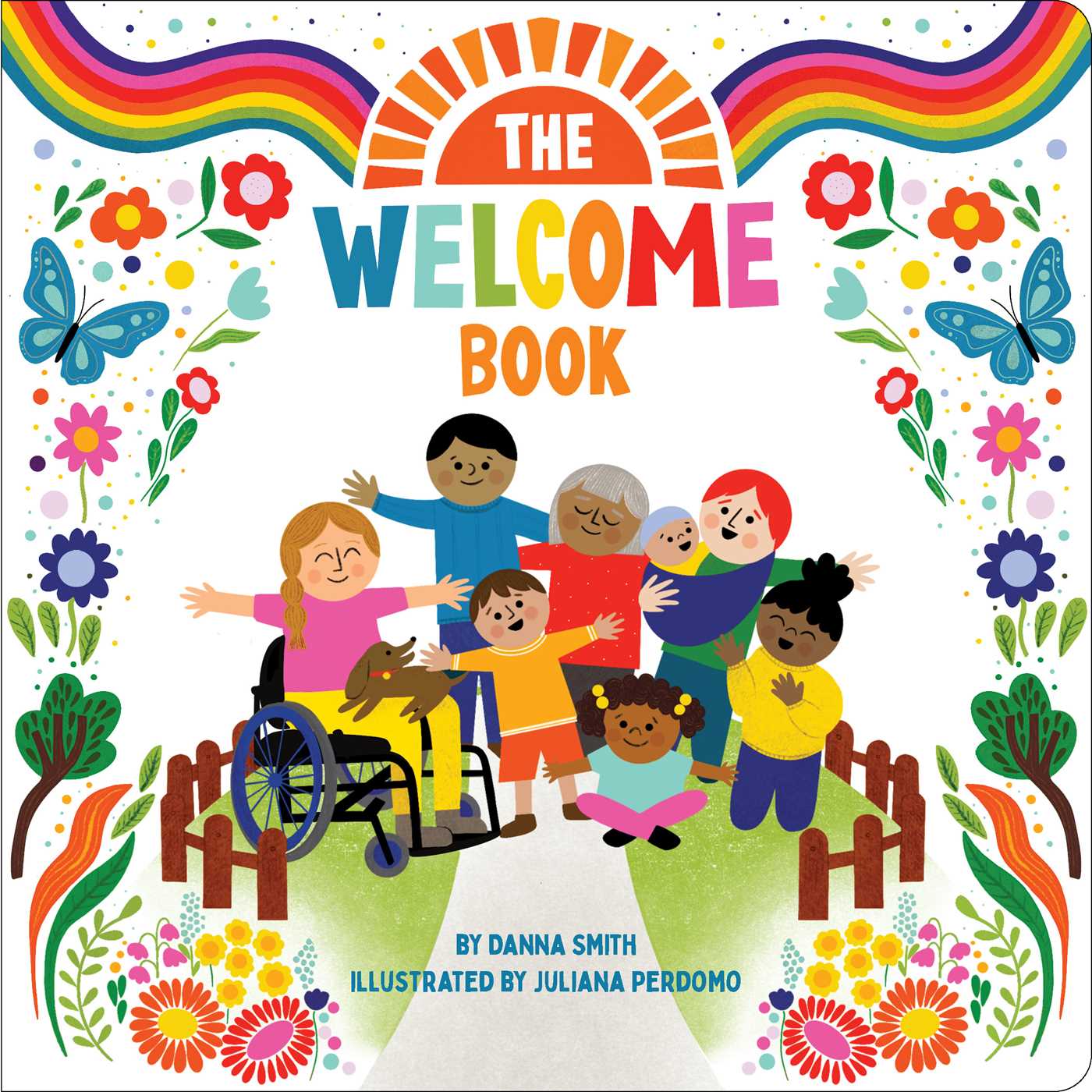
The Welcome Book

Written by Danna Smith | Illustrated by Juliana Perdomo


New experiences and new people to meet are all around us every day. This is especially true for young children as they begin exploring the world around them. On the playground, in the classroom, at the library, on the bus or subway, in stores, and even during visits by extended family, little ones are always learning how to work or play together with someone new.

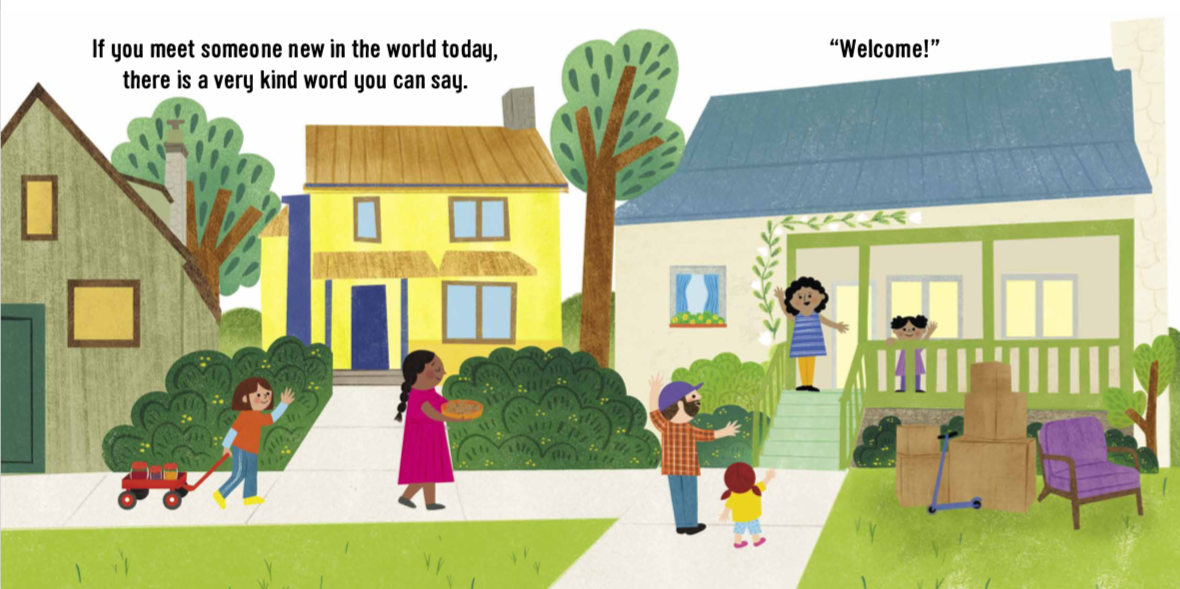
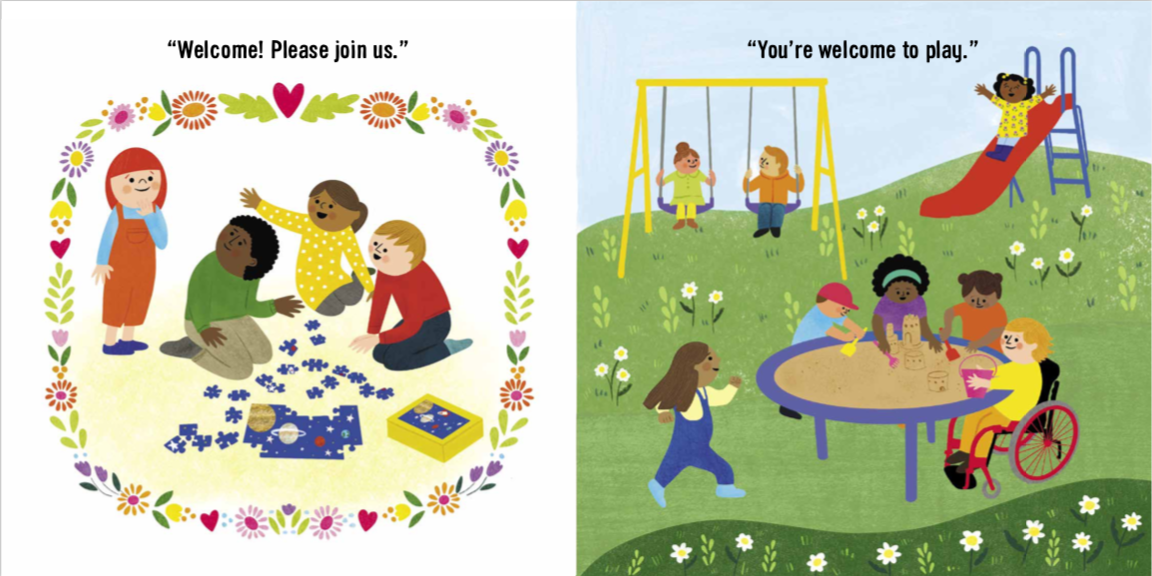
In her joyful and openhearted story, Danna Smith celebrates all the opportunities children have to embrace others and make them feel at home. In her uplifting rhyming verses, she tells little ones how much the word “Welcome!” and the warm feelings behind it mean to someone new or someone who is alone: “Welcoming someone shows that you care. / You’re happy to see them. You’re glad they are there.”

Image © 2025 by Juliana Perdomo, text © 2025 by Danna Smith. Courtesy of Little Simon.

Smith also presents a pleasing array of examples of everyday and special occasions when children can make a difference by offering friendship—including calling someone over to join a lunch table or group activity, cradling a new sibling, greeting a dog with hugs, and listening when someone is sad. She ends her story with the reassuring knowledge that friendship shared is friendship gained.

Readers can’t help but smile at Julia Perdomo’s vivid illustrations that radiate the warmth of welcome on each page. Kids will connect with Perdomo’s varied scenes of diverse groups of kids supporting each other as they play and work together. Her expressive characters and clearly depicted situations invite kids and adults to talk about their own experiences in both being the new person and welcoming others as well as to role play “What if?” scenarios.

Image © 2025 by Juliana Perdomo, text © 2025 by Danna Smith. Courtesy of Little Simon.

A bright, cheerful, and thoughtful board book to open the world of kindness, empathy, and friendship to the youngest readers, The Welcome Book is a story parents, teachers, and other adults will love sharing with their little ones and that kids will eagerly reach for again and again. This sweet book would make a heartwarming addition to home bookshelves and is a must for daycare, school, and public library collections.

Pair The Welcome Book with The Thank You Book by Danna Smith and Juliana Perdomo to spark an understanding and appreciation for gratitude in young children.

Ages Baby – 4

Little Simon, 2025 | ISBN 978-1665952026 (Board book)

About the Author

Danna Smith is a poet and award-winning author of numerous books for children, including One Blue GnuRooftop GardenWake Up, Freight Train!; and several Little Golden Books. Her nonfiction picture book, The Hawk of the Castle: A Story of Medieval Falconry, received two starred reviews and is a Junior Library Guild Selection and a Bank Street College of Education Best Children’s Books of the Year. Danna currently lives in northern California, where she is hard at work on her next book. For more information about her books and teaching activities, visit her website at DannaSmithBooks.com.

About the Illustrator

Juliana Perdomo is a writer and illustrator born in Bogotá, Columbia, surrounded by a huge loving family, friends, bright colors, music, weird fruits, sunshine, and lots of rain but also rainbows. She now lives there with her amazing son, Luca, her rocker partner Iván, and their crazy old dog, Menta. Juliana has a background as a psychologist and an art therapist, but her passion is children’s literature. She tries to make her work diverse, heartfelt and personal, folkish, a bit retro, joyful, and with a Latin touch. She feels deeply grateful to have participated in many beautiful projects: books, puzzles, animations, branding, family portraits, and magazines all over the world. Find out more at JulianaPerdomo.com.

Random Acts of Kindness Week Activity

Image © 2025 by Juliana Perdomo, 2025, text © 2025 by Danna Smith. Courtesy of Little Simon.

The Welcome Book Coloring Pages

Have fun coloring these cheerful pages from The Welcome Book

Welcoming the Rain | Welcoming a New Friend

You can purchase The Welcome Book from these booksellers

Amazon | Barnes & Noble | Bookshop (to support your local independent bookstore)

Picture Book Review

March 22 – It’s Women’s History Month

celebrate-picture-books-picture-book-review-cactus-queen-cover

About the Holiday

National Women’s History Month is all about celebrating women who broke barriers with their intelligence, creativity, courage, persistence, and unwavering confidence in their abilities. In every discipline, women have brought and continue to bring new perspectives, experiences, and talents to make contributions toward a better world. The theme for Women’s History Month 2024 celebrates “’Women Who Advocate for Equity, Diversity and Inclusion.’ This theme recognizes women who understand the need to eliminate bias and discrimination from individuals’ lives and institutions.”

Today’s book celebrates a visionary woman who made it her life’s work to protect a unique ecosystem, educate people on the importance of the environment and conservation, and provide the US with one of its most stunning national parks. 

I’d like to thank Calkins Creek/Astra Books for sharing a copy of Cactus Queen” Minerva Hoyt Establishes Joshua Tree National Park with me for review consideration. All opinions on the book are mt own.

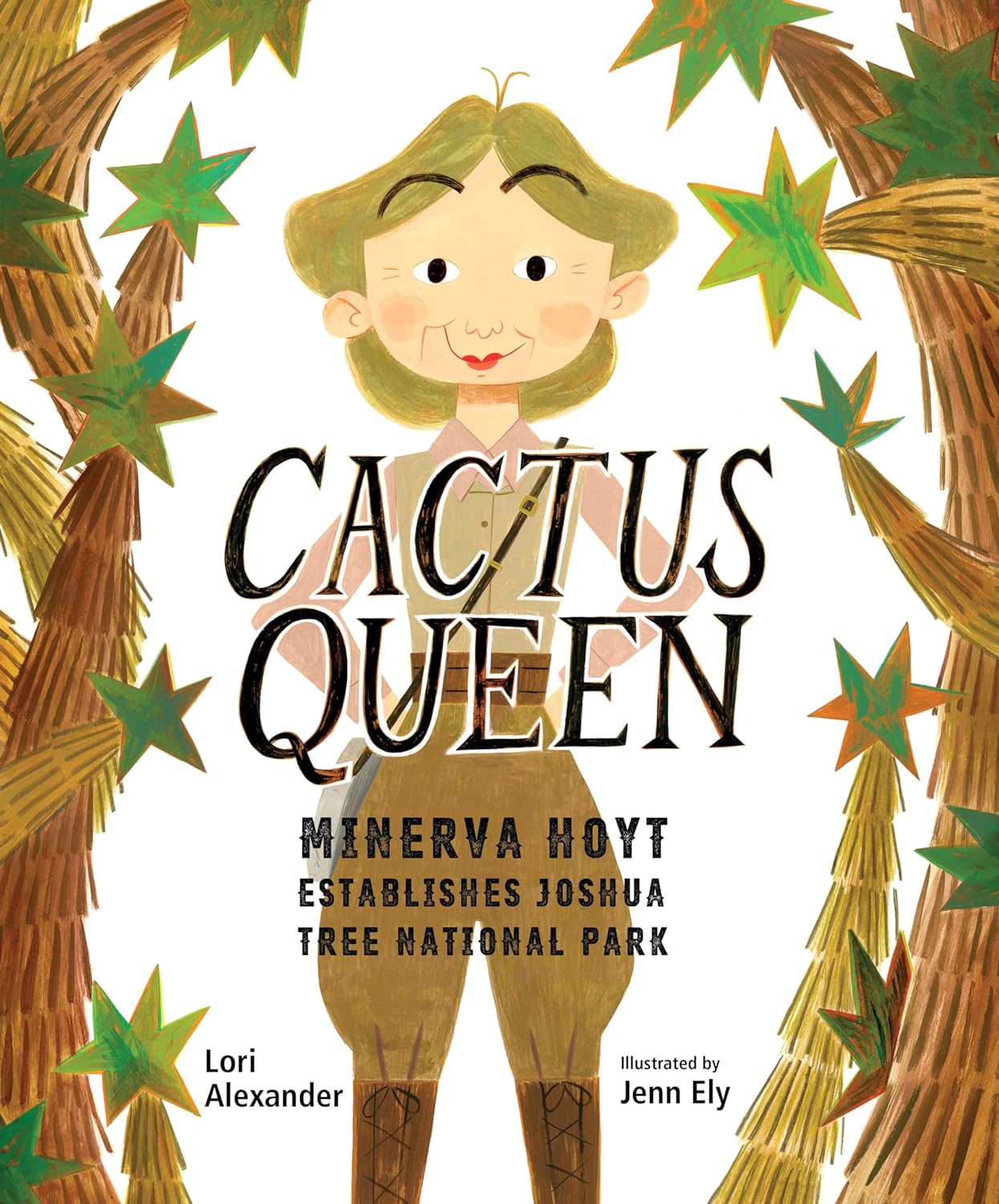
Cactus Queen: Minerva Hoyt Establishes Joshua Tree National Park

Written by Lori Alexander | Illustrated by Jenn Ely


Even as a child, Minerva loved the outdoors, was eager to share her thoughts and opinions, and enjoyed “long chats with friends.” When she grew up she married Dr. Albert Hoyt. In 1897 Minerva and her husband moved from Mississippi to Pasadena, California, close to Los Angeles. To meet new friends, Minerva hosted a backyard party, complete with games, food, and, of course, long chats.

Settled into her new city, Minerva took to making trips to the Mojave Desert. She was awed by the Joshua trees, which grew nowhere else but here. After the death of her husband in 1918, Minerva spent more time in the desert, even camping out while “the wind whistled through the Joshua trees,” and “bright constellations swirled overhead.”

celebrate-picture-books-picture-book-review-cactus-queen-garden-party

Illustration copyright Jenn Ely, 2024, text copyright Lori Alexander, 2024. Courtesy of Calkins Creek, Astra Books for Young Readers.

As Los Angeles grew and grew, with more buildings, more cars, and more noise, people began to visit the desert frequently. They didn’t just visit, though, they wanted to take it home. People dug up the “… fuzzy cholla, spiky yucca, and barrel cacti to keep in their backyards.” They even dug up Joshua trees and carted them away. Many of these desert plants didn’t survive their new city surroundings. The Joshua trees were also cut down for construction materials, and motorists lost in the desert set them afire to communicate with other drivers.

By the late 1920s little remained of Minerva’s beloved desert. She wanted to save it . . . but how? Suddenly, “Minerva had a wild idea.” She would show the rest of the country just how special the desert was. With help from garden clubs, artists, taxidermists, and friends, she gathered samples of desert flora and fauna and took them east—by train.

celebrate-picture-books-picture-book-review-cactus-queen-camping

Illustration copyright Jenn Ely, 2024, text copyright Lori Alexander, 2024. Courtesy of Calkins Creek, Astra Books for Young Readers.

At the 1928 International Flower Show in New York City, Minerva erected a display of the desert. Crowds were thrilled to discover this “strange landscape,” and reporters took pictures for magazines and newspapers. Minerva won a gold medal for her exhibit, The Spirit of the Desert. Minerva also won awards in Boston and London for exhibits there. But more important than these accolades was that people were really listening to her and beginning to love the desert. When she donated her exhibits to museums, more people became interested in the desert.

By 1933, Minerva was ready to move on to the next stage in her plan. She wanted 1,000,000 acres of the desert to be declared a national park, protected by federal laws. Minerva garnered an audience with President Franklin D. Roosevelt and brought photographs to show him. She convinced the President—now it was up to Roger W. Toll, superintendent of Yellowstone National Park, to inspect Minerva’s desert and agree.

celebrate-picture-books-picture-book-review-cactus-queen-museum-exhibit

Illustration copyright Jenn Ely, 2024. Courtesy of Calkins Creek, Astra Books for Young Readers.

As Roger Toll stood in the middle of the desert on a rainswept day, he asked, “where are the lush trees, the waterfalls, and lakes?” When he later filed his report, he rejected the desert for National Park status. Minerva was disappointed but did not give up. She began a letter-writing campaign, convincing “scientists, teachers, politicians, and friends” to write to the National Park Service. Letters poured in—enough to convince the Service to send out a new inspector.

This time Assistant Director Harold C. Bryant, who lived in California, was sent. “He knew all about desert plants and animals.” When he arrived, Minerva and more than one hundred supporters greeted him. After touring the desert for three days, Bryant announced his decision: Yes! “Minerva’s desert was worth saving.”

celebrate-picture-books-picture-book-review-cactus-queen-park

Illustration copyright Jenn Ely, 2024, text copyright Lori Alexander, 2024. Courtesy of Calkins Creek, Astra Books for Young Readers.

Extensive backmatter, accompanied by photographs, offers more biographical information about Minerva, points about wildlife in Joshua Tree National Park, facts about other national parks in the United States, tips for how young people can help the environment through easy-to-implement actions, and a bibliography. In Lori Alexander’s Author’s Note, she relates the dangers and destruction that the fragile environment of Joshua Tree National Park and the surrounding desert continues to suffer from “vandalism, urban development, and the effects of climate change,” a report that demonstrates the need for continued education and care taking of our natural resources.

In Cactus Queen, Lori Alexander has created a compelling biography of a remarkable woman as well as a call to action for readers to stand up for the environmental or other causes that are important to them. Alexander highlights Minerva Hoyt’s love of the desert, her dedication, and her unflagging determination to overcome setbacks. Hoyt’s creativity, pragmatism, and lifelong focus serves as an inspirational roadmap for accomplishing goals for children, teens, and even the adults who read with them.

The first thing readers may notice upon opening Cactus Queen is Jenn Ely’s beautiful color palette that mirrors the unique hues of the desert. Her stunning images of the desert and Minerva’s ingenious ways of rallying the country and the President to her cause transport children from Hoyt’s earliest days through her long-fought success. Ely’s charming illustrations reveal not only the special plants and creatures of the Mojave Desert but Minerva’s distress at its destruction and her tenacity to enact change to protect it. 

Both a fascinating biography of Minerva Hoyt and an in-depth look at the multifaceted workings of conservation efforts, Cactus Queen: Minerva Hoyt Establishes Joshua Tree National Park will inspire readers to advocate for causes that are important to them. For educators the book would make an excellent addition to science and language arts curriculum. Cactus Queen would also be an engaging accompaniment to museum visits or field trips for families and teachers.

Cactus Queen is a top pick for classrooms, public and school libraries, museum shops, and families.

Ages 7 – 10

Calkins Creek, 2024 | ISBN 978-1662680212

About the Author

Lori Alexander is the award-winning author of several children’s books, including All in a Drop: How Antony van Leeuwenhoek Discovered an Invisible World, which won a Robert F. Sibert Honor, and A Sporting Chance: How Ludwig Guttmann Created the Paralympic Games, an NCSS Notable Book. Her work has received several starred reviews from KirkusSchool Library Journal, and Horn Book Magazine, has made the NSTA Outstanding Science Trade Book list, and has been selected by the Junior Library Guild. Visit Lori Alexander at lorialexanderbooks.com.

About the Illustrator

Jenn Ely is an artist and animator, who has worked on the movies The Boxtrolls and Guillermo Del Toro’s Pinocchio. In her recent foray into children’s books, she illustrated The Gardener of Alcatraz and If You Were a Kid Building a Pyramid. Visit Jenn Ely at jennely.com.

Women’s History Month Activity

celebrate-picture-books-picture-book-review-joshua-tree-national-park-wildlife

Become a Joshua Tree National Park Junior Ranger

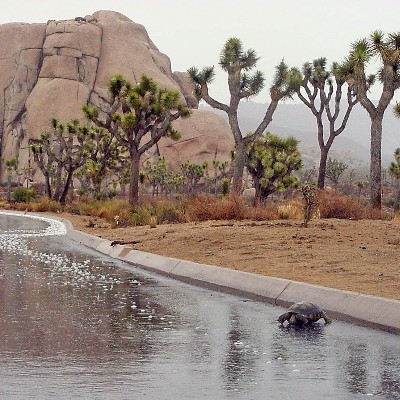
How would you like to become a Joshua Tree National Park Junior Ranger? You can your badge with this online program full of fun and educational activities for all ages! You can learn how to draw a Joshua Tree, create your own constellation, learn all about desert tortoises, create your own rock formation, learn about adaptable plants and design your own, and more.

To earn your badge kids ages 5 – 7 are asked to complete 2 activities; kids ages 8 – 10 are asked to complete 3 activities; and kids ages 10 and above are asked to complete 4 or more. After finishing projects, you just need to send images of your work to receive your badge in the mail!

Simply visit the official Joshua Tree National Park website and learn more about their Junior Ranger program! Learn more about the park and view lots of pictures and videos here.

Joshua Tree National Park Coloring Page

celebrate-picture-books-picure-book-review-joshua-tree-national-park-coloring-page

Enjoy this activity page by filling it with all the colors of the desert.

Joshua Tree National Park Coloring Page

celebrate-picture-books-picture-book-review-cactus-queen-cover

Order from Bookshop to support your local independent bookstore.

You can also find Cactus Queen: Minerva Hoyt Establishes Joshua Tree National Park at these booksellers

Amazon | Barnes & Noble | Books-a-Million

Picture Book Review

December 2 – It’s Buy a New Book Month

  • celebrate-picture-books-picture-book-review-leaves-to-my-knees-cover
  • celebrate-picture-books-picture-book-review-leaves-to-my-knees-spanish-english-cover

Picture Book Review

About the Holiday

For children, picture books provide one of the best ways to interact with facts and feelings. Stories that speak to their experiences, both common and new, alongside illustrations that bring the story to life let them discover the world around them. Today’s stunning nonfiction books are loaded with illustrations or photographs that let kids see exciting details about science, history, biographies, nature, and so much more. This month, take a look for fiction and nonfiction picture books about your child’s passions to add to your home library. And be sure to check out today’s book that incorporates both!

Thanks to Star Bright Books for sharing a digital copy of Leaves to My Knees with me for review consideration. All opinions on the book are my own.

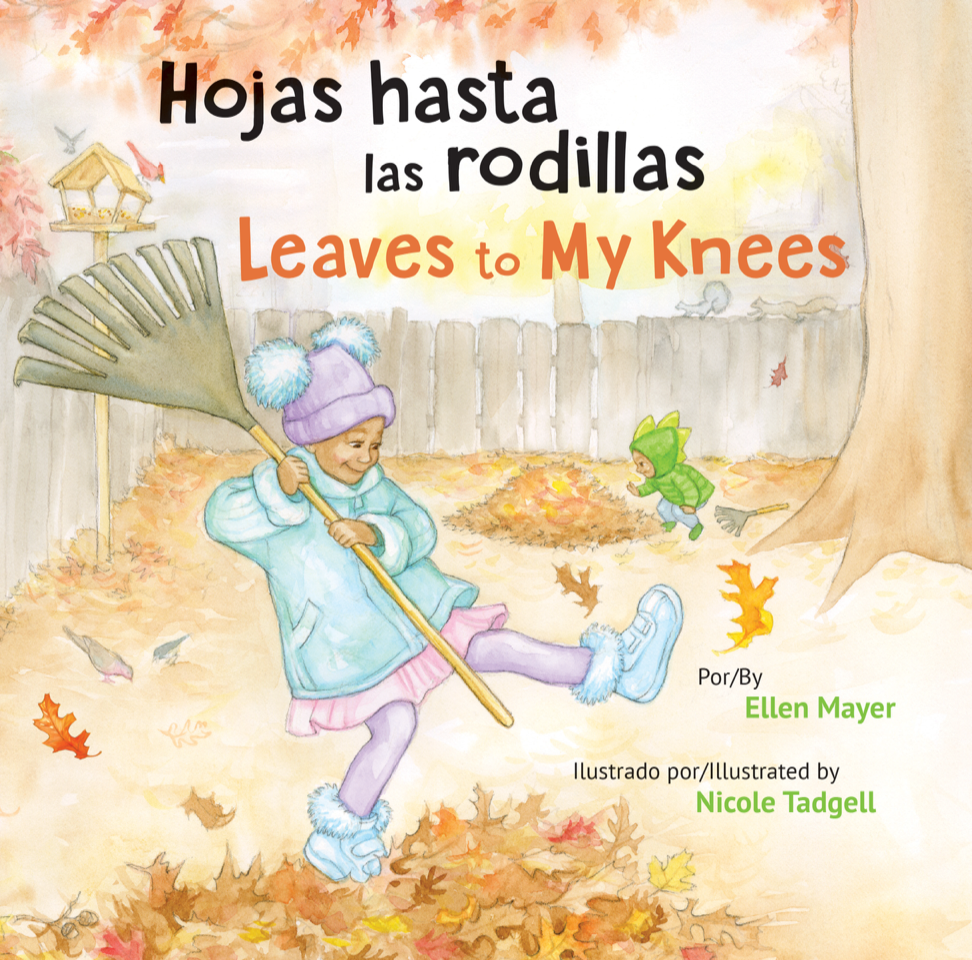
Leaves to My Knees

Hojas hasta las rodillas/Leaves to My Knees

Written by Ellen Mayer | Illustrated by Nicole Tadgell


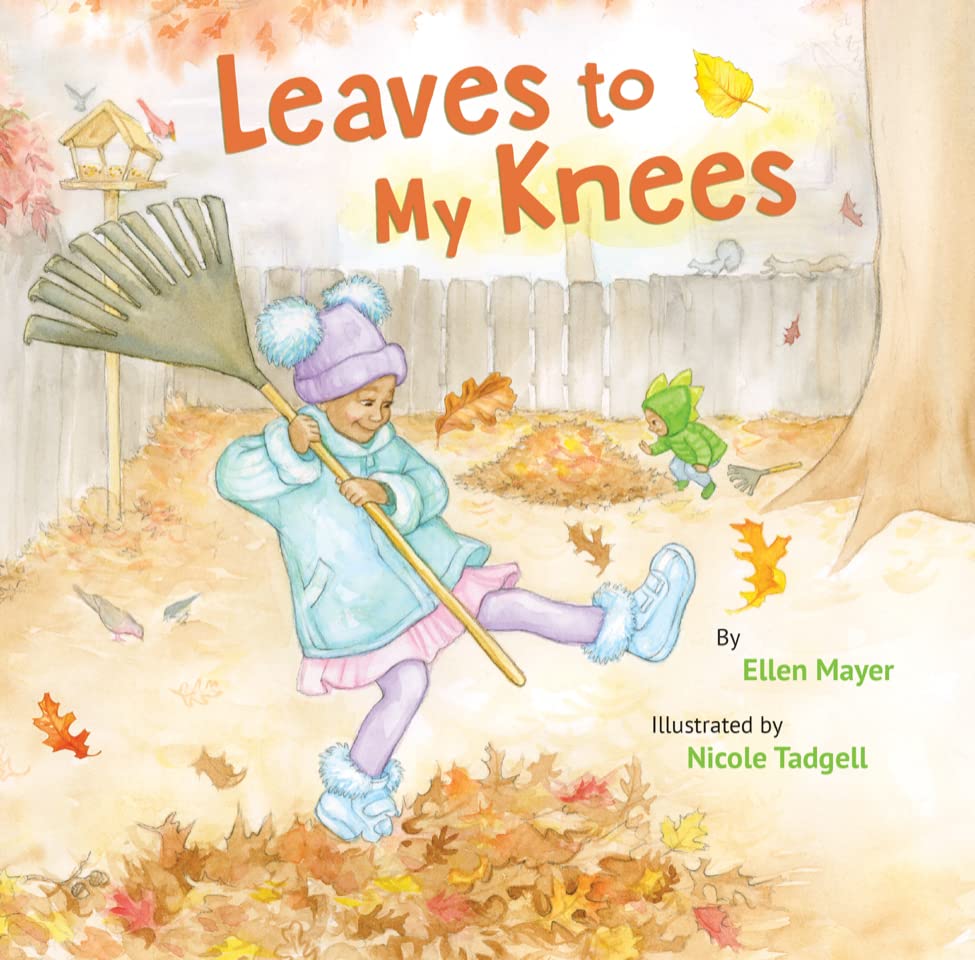
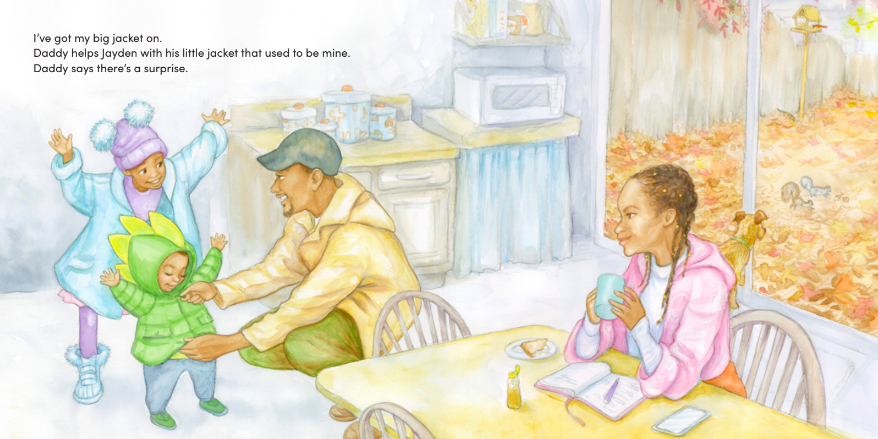
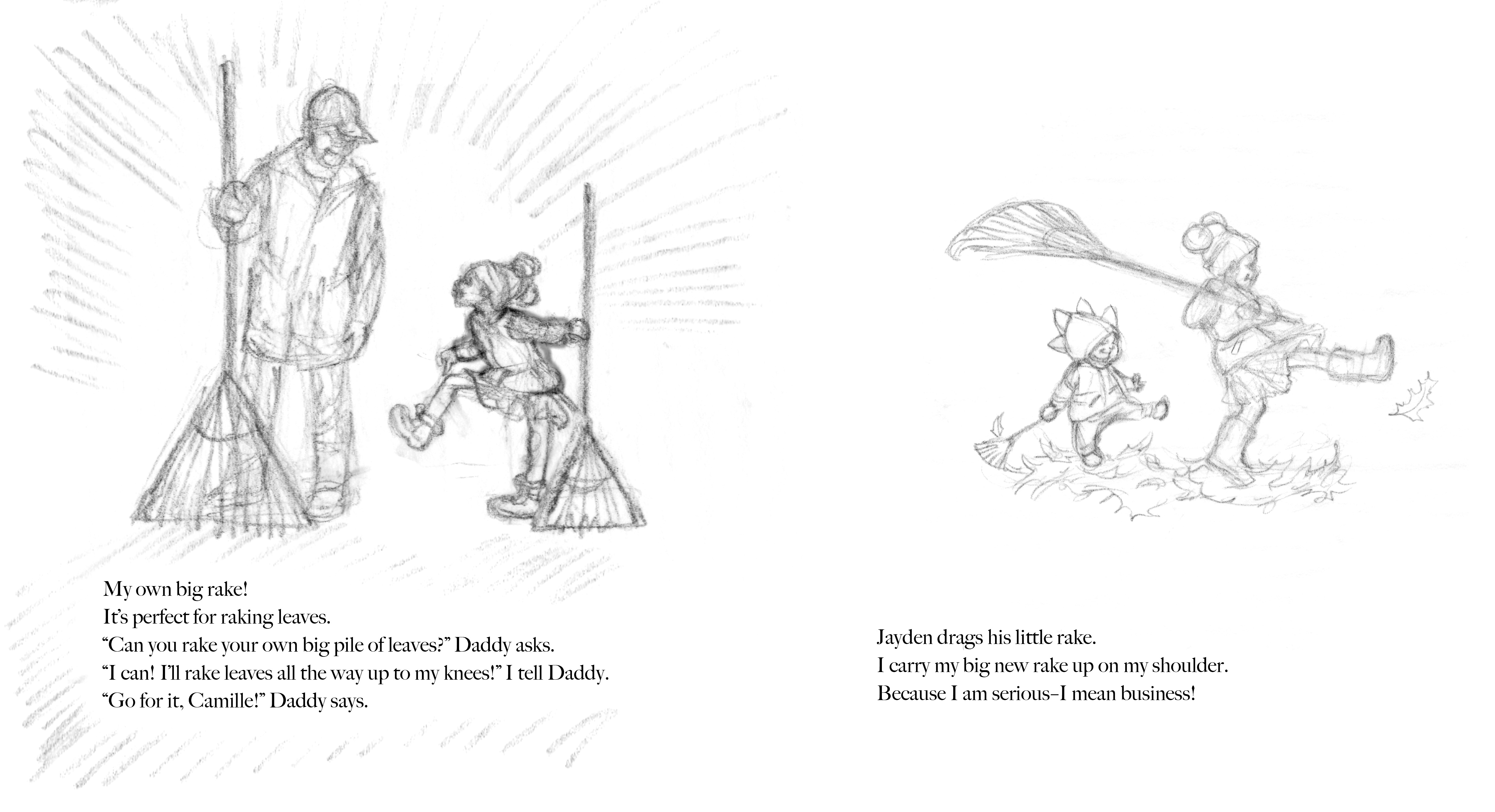
Daddy has a surprise for Camille and her little brother Jayden. They get dressed in their coats—big for Camille and little jacket with a stegosaurus hood for Jayden—and head into the backyard. There, Camille discovers her dad has gotten her a rake of her own. It’s not as big as Dad’s, but it’s bigger than Jayden’s little rake. It’s the perfect size for Camille.

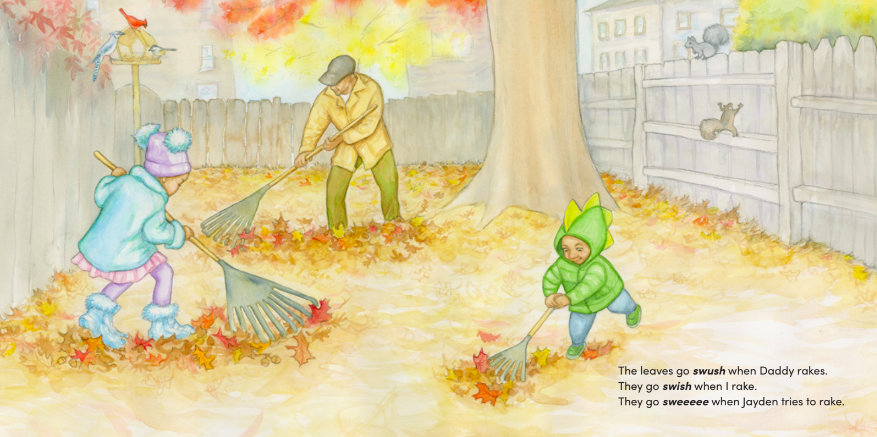
Camille marches right off to rake a pile of leaves. But not just any pile—she has a goal. “‘I’ll rake leave all the way up to my knees!’” she tells her dad. The three get working on the yard. Camille concentrates on gathering leaves, listening to the different sounds that the various sized rakes make: “The leaves go swush when Daddy rakes. They go swish when I rake. They go sweeeee when Jayden tries to rake.”

celebrate-picture-books-picture-book-review-leaves-to-my-knees-putting-on-jackets

Image copyright Nicole Tadgell, 2022, text copyright Ellen Mayer, 2022. Courtesy of Star Bright Books.

Lurking under the leaves are twigs and acorns that clog up Camille’s rake. She worries that she’ll never be able to rake leaves to her knees. She calls for Daddy’s help, and together they clear Camille’s rake. “‘You’re good to go now, Camille,’” Daddy tells her. Back at it, Camille rakes and rakes. Then she steps into the pile she’s accumulated to measure it. Her pile only comes up to her ankles. Camille grabs her rake harder and with determination she collects more leaves. But wait! Jayden is stealing leaves from her pile to add to his! Camille guards her pile with her rake, and sends her little brother over to Daddy’s bigger pile. Camille checks her measurements again. Her pile has grown, but only up to the top of her boots.

celebrate-picture-books-picture-book-review-leaves-to-my-knees-raking

Image copyright Nicole Tadgell, 2022, text copyright Ellen Mayer, 2022. Courtesy of Star Bright Books.

Camille rakes ‘bunches of leaves,” and her pile gets taller, until “‘Oh no! A BIG BREEZE!!’” sends lots and lots of leaves swirling “Whoosh!” into the air and scattered to the ground. “I will never rake leaves to my knees!” Camille thinks. And when she measures again, her pile is back to her ankles. Daddy encourages her to keep going, and Camille is committed to achieving her goal. She throws off her coat, grabs her rake, and works on gathering up all the leaves she had, plus more. At last, too tired to rake anymore, Camille wonders. Has she done it? “‘Time for measuring!’ says Daddy.”

celebrate-picture-books-picture-book-review-leaves-to-my-knees-pile-up-to-ankles

Image copyright Nicole Tadgell, 2022, text copyright Ellen Mayer, 2022. Courtesy of Star Bright Books.

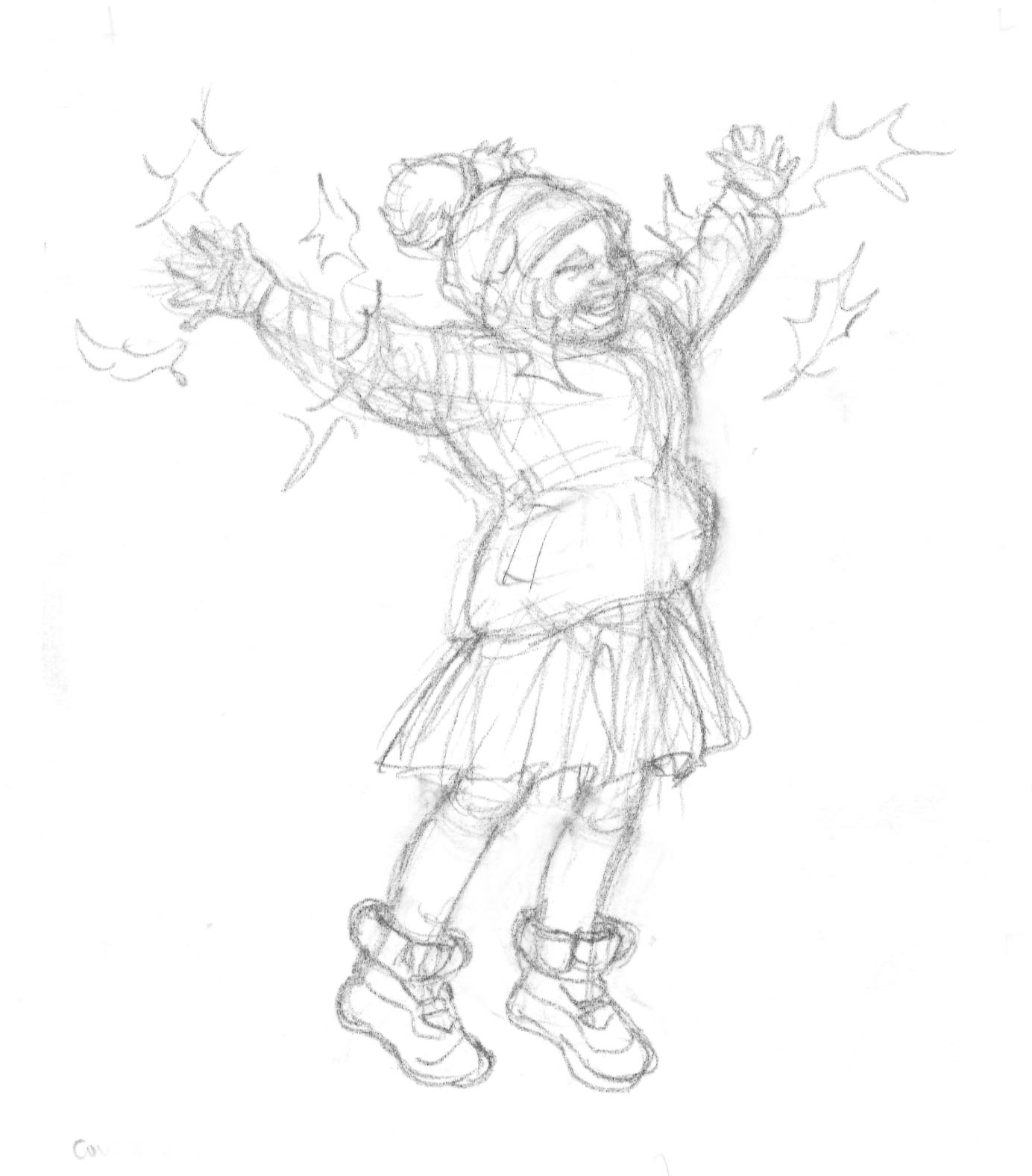
Camille relinquishes her rake to her dad then, holding her breath, steps into her pile. “‘TA-DA!’” Camille raises her arms in victory. She steps out, positions herself a good ways away, and winds up for the run and jump. “‘GO!’ yells Daddy. ‘GO!’ Jayden yells too.” Camille flies through the air and lands, laughing, into her pile. Then Jayden jumps in. And Daddy? He gives Camille  “really big squeeze” for raking “leaves all the way up to [her] knees.”

A note for parents, teachers, and other caregivers written by Marlene Kliman, a mathematics learning expert and senior scientist at TERC, describes how the story incorporates the math of measurement and sizes and how adults can extend the lesson by pointing out elements in the book’s illustrations and while going about their day or doing common chores, such as cleaning up and sorting laundry.

celebrate-picture-books-picture-book-review-leaves-to-my-knees-jumping-in

Image copyright Nicole Tadgell, 2022, text copyright Ellen Mayer, 2022. Courtesy of Star Bright Books.

Ellen Mayer’s Leaves to My Knees has everything that makes a story a young reader’s favorite—a spunky main character that kids will identify with, an achievable goal, successes and setbacks, suspense, humor, and a child-propelled victory. And it all revolves around an early math concept that comes naturally to children and which invites playful learning not only during the fall, but any time of the year. Shoveling snow and making snowballs in winter, yard cleanup and gardening in spring, and building sandcastles and raking grass clippings in summer as well as in-home fun with laundry piles, toys, and other objects are all ways to extend the story.

Told from Camille’s point of view, the story also engages children’s emotions as they join in to cheer Camille on as her leaf pile grows and commiserate with her when it shrinks. The close relationships among Camille and her dad and little brother ring true with dialogue-rich storytelling that is always encouraging. Strong themes of determination and persistence will also appeal to parents and teachers, who can point to how many times Camille has to start over before accomplishing her goal and her positive, resolute attitude.

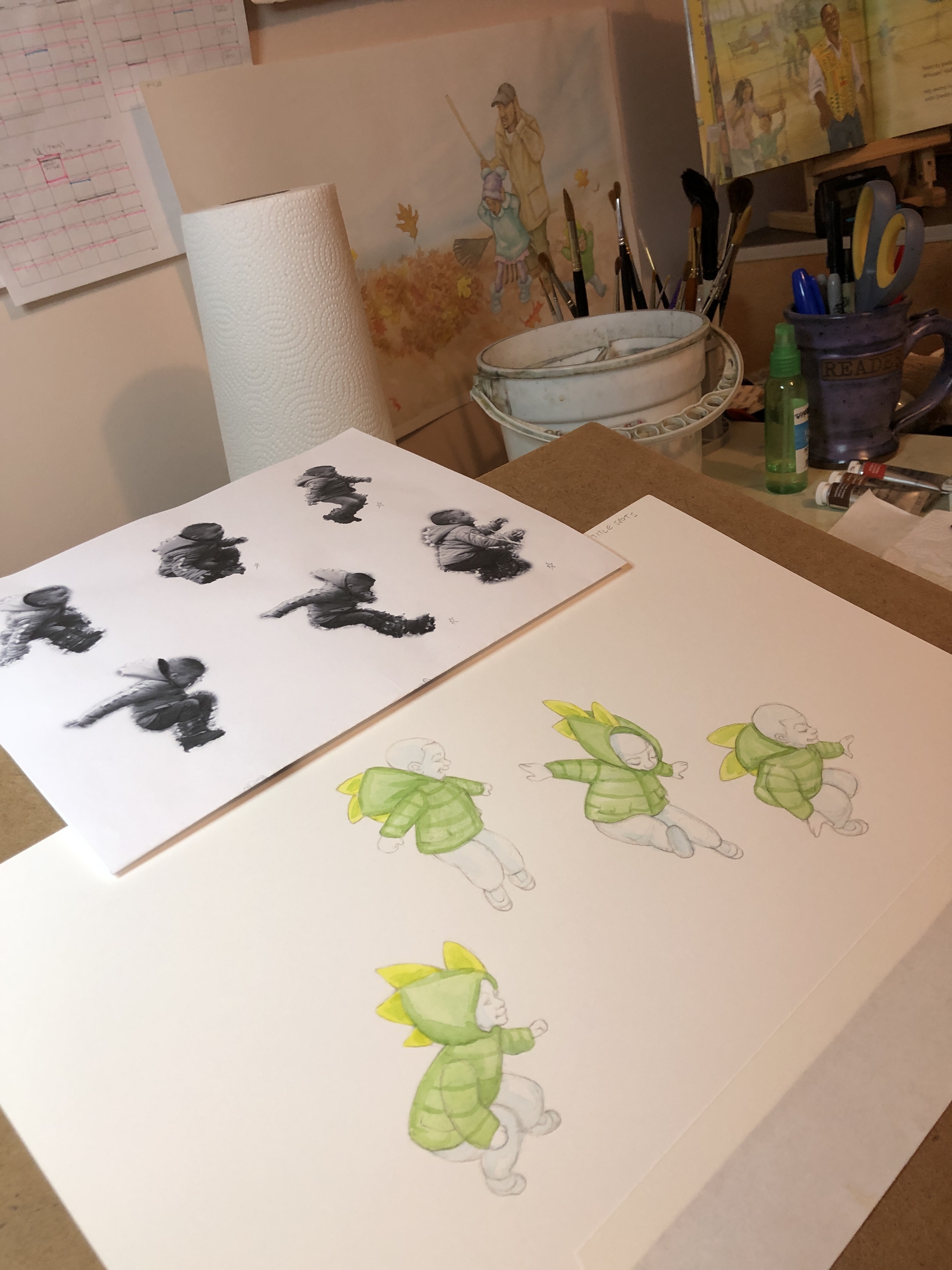
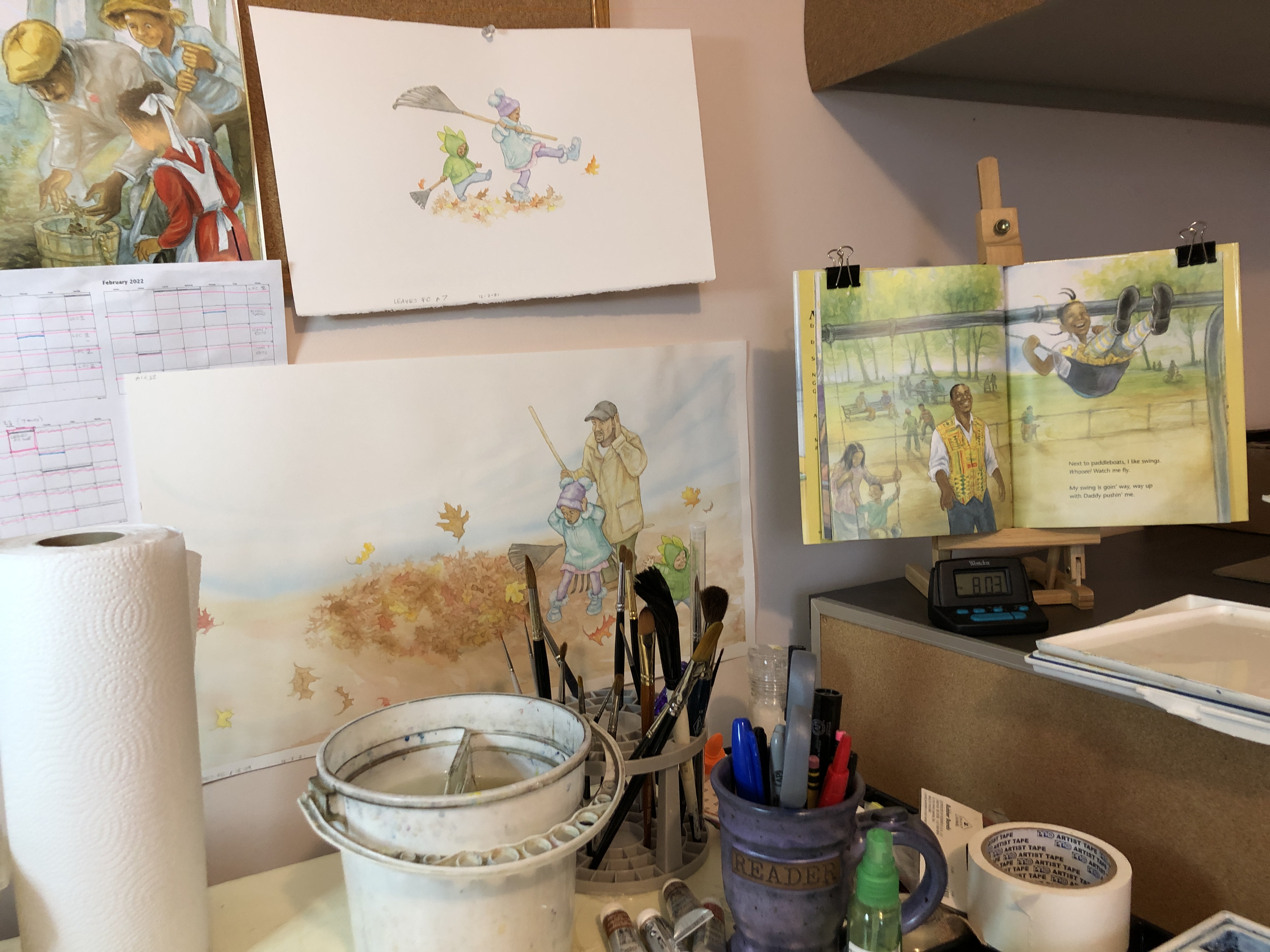
Nicole Tadgell’s exuberant illustrations shine with personality, and kids will immediately become invested in each character as Dad gets working on a big job that needs doing, Jayden runs, jumps, and copies his big sister, and Camille unwaveringly works on her pile of leaves. Camille’s setbacks are clearly depicted, along with her and her father’s facial expressions that give adults and kids an opportunity to talk about disappointment, frustration, perseverance, and feelings of accomplishment. Each image also demonstrates the math component of measurement and sizes in the story with various-sized rakes, the growing and diminishing leaf pile, big and little jackets, and other objects that invite comparison.

Tadgell’s soft-hued pages are infused with the feeling of fall and hum with activity as cardinals, blue jays, chickadees gather at the bird feeder, squirrels scamper up and along the fence, and leaves continue to float to the ground. Readers will love following little Jayden’s antics and be inspired by Camille’s wide smile as she enjoys the reward of all her hard work.

Leaves to My Knees is a multilayered read aloud infused with the enthusiasm and rhythms of childhood that kids will want to hear again and again. Its mathematics base and themes of determination and perseverance rewarded will appeal to parents, teachers, and other educators as a way to engage children in active, hands-on learning. The book is a must for home, classroom, school, and public library collections.

Ages 4 – 8

Star Bright Books, 2022 | ISBN 978-1595729590 (Leaves to My Knees) | ISBN 978-1595729613 (Hojas hasta las rodillas/Leaves to My Knees

Picture Book Month Activities

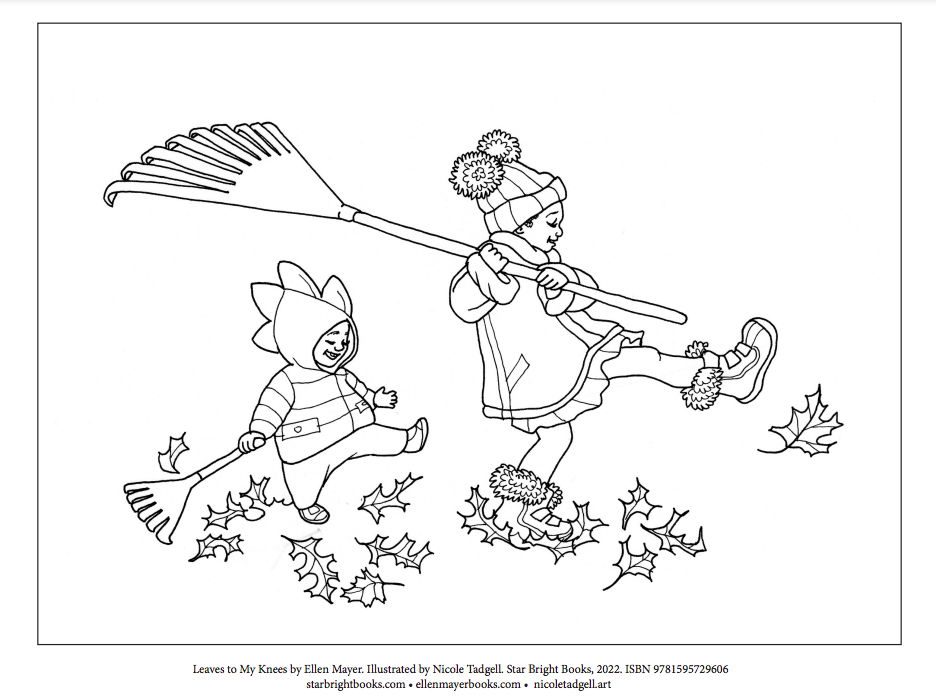
celebrate-picture-books-picture-book-review-leaves-to-my-knees-coloring-page


Coloring Pages and Teaching Guides


You can extend the fun and learning in Leaves to My Knees with these activities, which include three fun coloring pages from the story, a hands-on play-dough art and discovery activity, and a detailed educator’s guide for teachers, homeschoolers, parents, and other caregivers that offers multiple ways to use Leaves to My Knees to explore math, mathematical thinking, and reading comprehension through the story and beyond at home, school, and elsewhere.

Meet Ellen Mayer

celebrate-picture-books-picture-book-review-ellen-mayer-reading-headshot

You can find Leaves to My Knees on Amazon

Leaves to My Knees: Hardcover | Paperback

Hojas hasta las rodillas / Leaves to My Knees: Paperback

You can also order from Star Bright Books

Leaves to My Knees: Hardcover | Paperback

Hojas hasta las rodillas / Leaves to My Knees: Paperback

Picture Book Review

April 22 – Earth Day and National Poetry Month

celebrate-picture-books-picture-book-review-friends-and-anemones-cover

About the Holidays

Earth Day

Earth Day was created in 1970 by a US Senator, Gaylord Nelson. Nelson created the day because he was worried about how humans were harming the environment through their actions. Heard of this holiday before? We certainly hope so! In 1990, environmental leaders mobilized to make the holiday go global. And now, according to earthday.org, 1 BILLION people mobilize on Earth Day every year, to help save and celebrate our beloved planet. You can watch an educational animated video on Gaylord Nelson here. Learn more about Earth Day and how you can make a difference all year around at Earthday.org.

National Poetry Month

2021 marks the twenty-fifth anniversary of National Poetry Month. The holiday was launched by the Academy of American Poets to celebrate writers, poets, poetry lovers and the positive impact poetry has on our culture, literacy and lives. Check out the 2021 National Poetry Month Poster here. You can learn more about National Poetry Month at Poets.org.

Today’s book celebrates both of these holidays with a collection of ocean poems for children. Not a huge lover of poetry? Perhaps the following collection will sway you like an ocean tide. Crafted by The Writers’ Loft Authors and Illustrators, Friends and Anemones is truly as dazzling as a sea-floor pearl.

Thanks to The Writers’ Loft for sending me a copy of Friends and Anemones: Ocean Poems for Children for review consideration. All opinions on the book are my own. 

Reviewed by Dorothy Levine

Friends & Anemones: Ocean Poems for Children

By The Writers’ Loft Authors & Illustrators


Dive headfirst into poetry month by exploring “the very, very, bottom of the deep blue sea. With: Salty snails and tuna tails. Bottle caps and lobster traps. Popped balloons, Plastic spoons…” and everything in between! (The Bottom of the Ocean by Kristen Wixted.) In honor of Earth Day AND National Poetry month, Celebrate Picture Books presents a book that deserves to be celebrated twice over: Friends & Anemones: Ocean Poems for Children. Seventy New England authors and illustrators joined ship with the Rozalia Project to create a treasure-worthy collection of ocean-themed poems and illustrations.

As described in the title page, “Rozalia Project works to conserve a healthy and thriving marine ecosystem—the plants and animals need our help to keep human debris out of their homes.” Through this partnered anthology, children will learn about subject matter ranging from unique sea creatures and beach dwellers – like cuttlefish, vampire squids, red knots, and rainbow lobsters – to the habits of more well-known ocean dwellers, like whales taking off debris, sharks getting their teeth cleaned, and sea turtles hatching eggs.

They’ll also find poems about human additions to the ocean scene in odes to lighthouses, ships’ remnants, sea litter, and more. Each poem contains deep knowledge to share with readers about poetry, the ocean, and marine life. Little pieces of advice float in between hysterical ocean puns. This perfect concoction of sea-worthy information is also backed by all types of fin-tastic and crabulous art.

Some of the poems are sure to make you laugh out loud. Deep-Sea Jellyfish by Cindy Cornwall opens with: “Jelly of the sea, not jam for your toast. It’s deep in the water, a silky scarf ghost.” Seal of disApproval by Lynda Mullay Hunt fills a whole page with the rhyming, pun-y story of a seal who becomes a dentist and stands up to sharks.

Other poems are less humorous and more pensive; the last of the series, Sea Serenity by Luke Hargraver, holds an existential truth for readers to swim through: “The world is like water / Easily disturbed by ripples / But when still, / Beautiful.” Under a short and sweet poem called Minnow, by Brook Gideon, a message to ocean explorers reads: “It’s very important to release everything you catch back into the ocean right away!”

Each spread is distinctly created in the individual poets’ and artists’ styles. Yet, the whole compilation works together in perfect, charming harmony. Some poems mirror each other in content. Horseshoe Crabulous by Doreen Buchinski is followed by Red Knots by Jane Sutton, in which: “In the sand their goal is chiefly / To dart—and swerve —on twiggy legs / In mad search for horseshoe eggs.” The two beautifully crafted poems are followed by a third gem, Mollusk Mansions by Charlotte Sheer, and accompanied with an illustration featuring horseshoe crabs, red knots, and mollusk shells—all painted by Doreen Buchinski herself!

Children will explore the deep cerulean sea through a range of sincere rhyming couplets, honest haikus, positively silly prose, magical motifs, and everything in between. All poems and artwork share with readers a deep admiration for under the sea creatures, while spreading ocean knowledge, and a love for poetry and beauty.

The watercolors, collages, and digital art pieces mesh beautifully while each achieving a distinctly artistic picturesque scene. Some illustrations run horizontally across the spread to create poster-like, masterful images. On page 23 illustrator Julia Young Cuffe paints a long, horizontal lighthouse against a watery dark blue sky, littered with stars. A person stands at the top, waving a piece of cloth, illuminated by the lighthouse light. The poem, Boston Light by Heidi E.Y. Stemple, is artfully placed running vertically down the lighthouse.

Others run across the two-page spreads to create one image that ties together the poems featured on the separate pages into a collective unit. An example of this can be seen in Marlo Garnsworthy’s opening spread of deep ocean waves intermingling with whales, and Amanda Davis’s DEEP deep sea spread that features spookily realistic vampire squids, angler fish, and sea plumes. Each piece stands out as thoughtfully crafted to instill in readers a sense of awe for the beauty of marine life and ocean ecology.

Friends & Anemones: Ocean Poems for Children would make a wonderful addition to classroom science and language arts lessons as well as a fun collection to share at home, especially in conjunction with trips to the beach or aquariums. 

The Writers’ Loft is a community based in Sherborn, Massachusetts which helps local writers foster their creativity, strengthen their spirit, and grow professionally by providing them with quiet writing space, educational programs, opportunities to connect with supportive colleagues, and access to industry experts, as well as opportunities to give back to the greater writing community. To learn more about The Writers’ Loft, visit their website.

The Rozalia Project runs educational programs, ocean cleaning initiatives and research projects focused on how to aid ocean clean-up and maintain sustainability of ocean and shoreline ecosystems. The Rozalia Project, along with the “Writer-and-Artist-Ocean-Protectors from the Writers Loft” hopes to use this book to “foster an appreciation of the importance, beauty, and wonder of the ocean in the change-makers of tomorrow.”

To learn more about the Rozalia Project, or get involved with them on this Earth Day, check out their website. You can also watch this video on their Expedition CLEAN.

Earth Day and National Poetry Month Activities

celebrate-picture-books-picture-book-review-friends-and-anemones-coloring-page  celebrate-picture-books-picture-book-review-friends-and-anemones-coloring-page

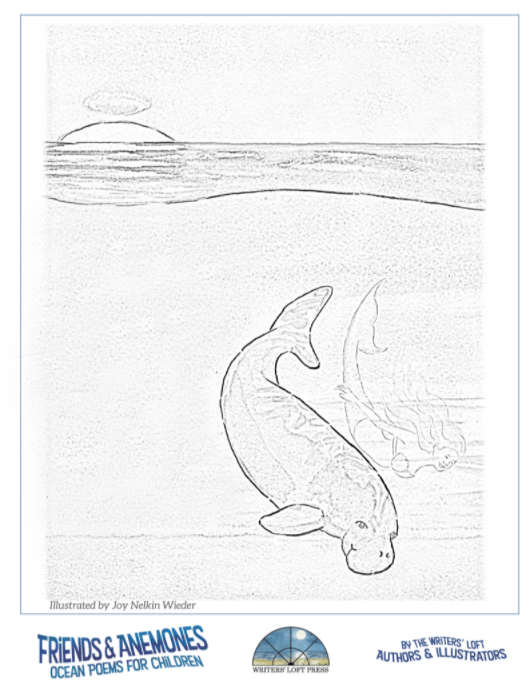
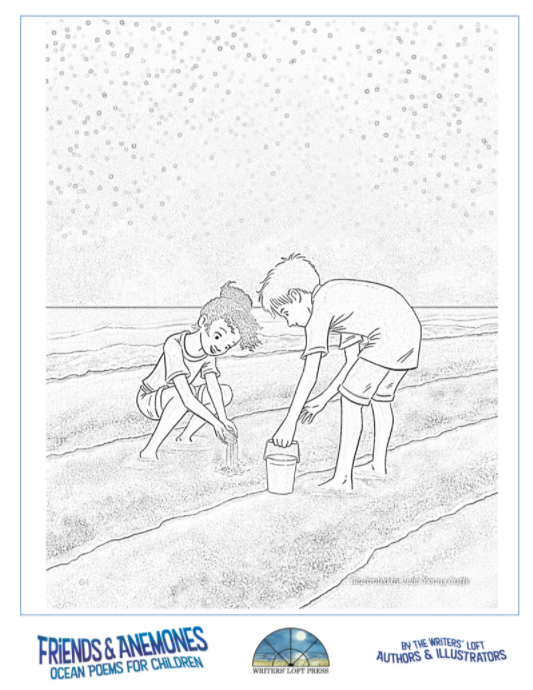
Color pages from Friends & Anemones in your OWN style with these black and white versions of the illustrations. You can find 18 more pages to print or download to your iPad to color on The Writers’ Loft website.

Manatee and Mermaid Coloring Page | Kids on the Beach Coloring Page

celebrate-picture-books-picture-book-review-under-the-sea-word-search

Find ten ocean critters’ names in this printable sea-star shaped word search.

Under the Sea Word Search Puzzle | Under the Sea Word Search Solution

Explore some poems specifically written for younger readers at Poets.org and write your own poetry if you feel inspired.

celebrate-picture-books-picture-book-review-friends-and-anemones-cover

To support The Writers’ Loft, you can order Friends & Anemones: Ocean Poems for Children from their website.

You can find Friends & Anemones at these booksellers

Amazon | Barnes & Noble | Books-a-Million

To support your local independent bookstore, order from

Bookshop | IndieBound

Picture Book Review

March 24 – It’s Women’s History Month

celebrate-picture-books-picture-book-review-june-almeida-virus-detective-cover

About the Holiday

From its beginning as a single-day observance in 1911 in Sonoma, California, the celebration of women’s achievements and contributions throughout history grew to a week-long event in 1980 and finally to encompass the entire month of March in 1987. During this month we remember the trail-blazing women of yesteryear who used their creativity, intelligence, and perseverance to promote rights for women while contributing their own innovations to science, art, social reform, medicine, and other disciplines as well as today’s pioneers who carry on their legacy and make our world a better place. Today, we feature a book about a woman who revolutionized virology and medical research, connecting the past and the present. To learn more about the holiday, visit the National Women’s History Museum website and check out their resource toolkit.

June Almeida, Virus Detective! The Woman Who Discovered the First Human Coronavirus

Written by Suzanne Slade | Illustrated by Elisa Paganelli

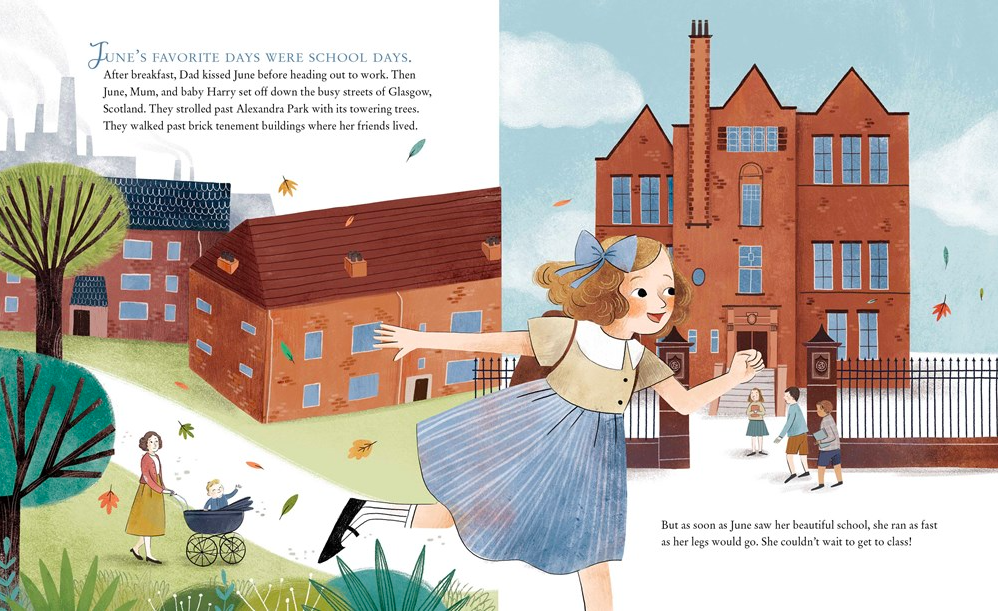
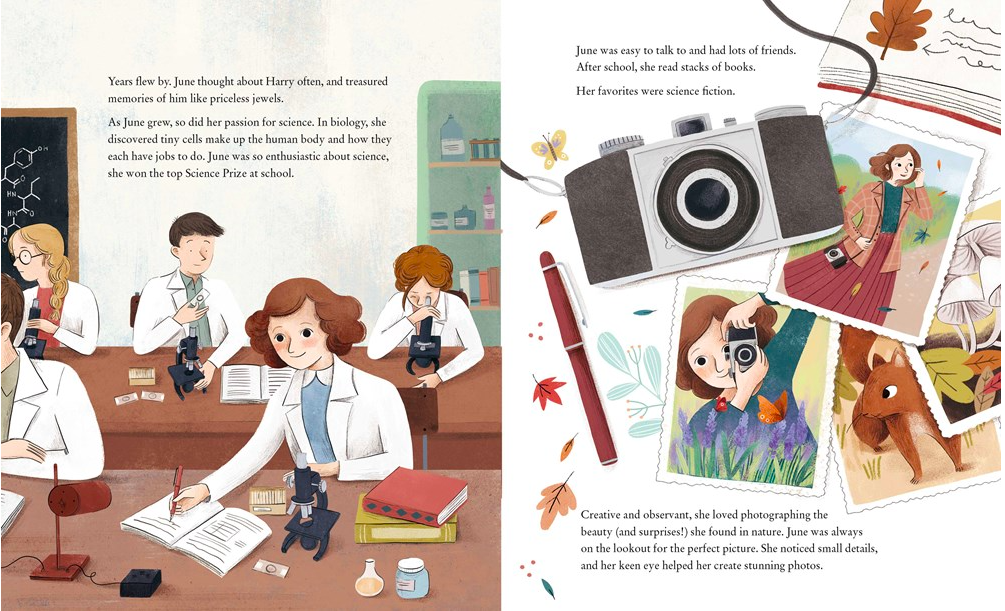
Growing up in Glasgow, Scotland, June Almeida loved school. After class she couldn’t wait to share what she’d learned—especially science subjects—with her mother, father, and little brother, Henry. When June was ten, however, her life changed when Henry became sick and passed away. Throughout elementary school and into high school, June loved studying science, especially biology in which she learned about the cells in the body and their functions. “June was so enthusiastic about science, she won the top science prize at school.”

celebrate-picture-books-picture-book-review-june-almeida-virus-detective-childhood

Image copyright Elisa Paganelli, 2021, text copyright Suzanne Slade, 2021. Courtesy of Sleeping Bear Press.

But science wasn’t the only thing June loved. She had lots of friends, was an avid reader, and became an excellent photographer. Whenever she was out with her camera, “she noticed small details, and her keen eye helped her create stunning photos.” June dreamed of attending college, but the jobs her father and mother held did not pay enough, and when June was sixteen, she dropped out of school to get a job to help pay the bills. June wanted to make a difference, “so she applied to work at the nearby hospital” and was hired as a lab worker. Here she learned how to examine cells with a microscope. “Her findings helped doctors treat patients.”

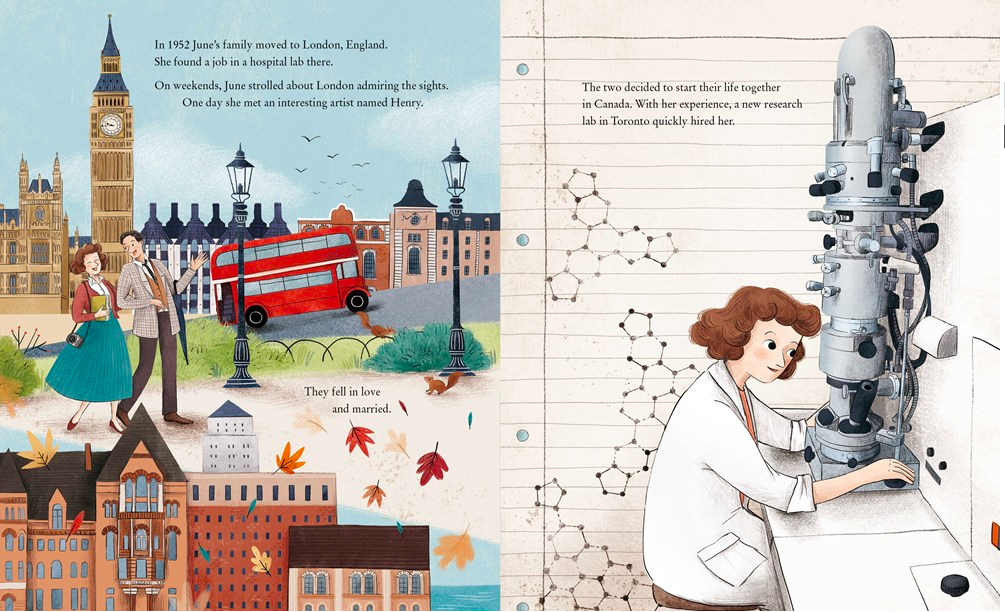
When June was twenty-two, she and her family moved to London. She got a job in a hospital lab and also met and married an artist named Henry. June and Henry moved to Canada, where she quickly found a job at a “new research lab in Toronto.” In this lab, June worked with an electron microscope that could magnify things 25,000 times and produced detailed pictures of the samples being studied. These photos “were helpful. But it was hard to tell which tiny blobs were viruses and which were cells.” June thought she could improve on the photos.

celebrate-picture-books-picture-book-review-june-almeida-virus-detective-photographer

Image copyright Elisa Paganelli, 2021, text copyright Suzanne Slade, 2021. Courtesy of Sleeping Bear Press.

June knew that in the body antibodies would surround viruses as they worked to fight it. June wondered if by introducing antibodies to her samples, scientists would be able to determine the virus from the cells. June’s idea worked. The scientists were astonished. Because of June’s innovation, they now had clear pictures that would help them study and combat viruses.

After June took time away from work to have a baby in 1960, she returned to her research and often lectured about her work. She was recruited to work at a hospital lab in London, so she and her family moved once again. At the time, a researcher named David Tyrrell had been trying to identify a virus that had affected a young boy. Could it be a new virus? He was hoping that June could help.

celebrate-picture-books-picture-book-review-june-almeida-virus-detective-hospital

Image copyright Elisa Paganelli, 2021, text copyright Suzanne Slade, 2021. Courtesy of Sleeping Bear Press.

When June received the sample, she knew that “since it was an unknown virus, there were no antibodies to help find it.” But she was an expert at using another method that might work. Carefully, June implemented the intricate steps. Then she put the sample under the microscope and scanned the picture. “June was stunned.” Each virus blob was encircled by tiny dots “like a crown. ” She had seen this twice before when looking at viruses from sick animals. She had written a paper on it, but it had been rejected by other researchers because they thought her pictures were just blurry and not those of a new virus.

June presented her findings to doctors who agreed with her discovery. They decided to name the new virus coronavirus, after the Latin word for crown, corona. June and David then published a paper telling other doctors and researchers about the new virus. Following this discovery, June continued to study viruses, such as hepatitis B and HIV. Her pictures of these viruses helped researchers develop medications that could “block them from making people sick.” Even after she retired, June never lost her love of learning, teaching herself to play the flute, about antiques, and how to use a digital camera to continue creating incredible photos.

Backmatter includes more about June Almeida and her life’s work, an illustrated timeline of her life, and a selected bibliography.

celebrate-picture-books-picture-book-review-june-almeida-virus-detective-London

Image copyright Elisa Paganelli, 2021, text copyright Suzanne Slade, 2021. Courtesy of Sleeping Bear Press.

Suzanne Slade’s compelling biography of June Almeida gives context for and insight into the research and discovery of the coronavirus and informs present-day events and breakthroughs. Slade’s fluid storytelling clearly reveals Almeida’s intelligence and passion for science as well as her determination to use her skills to the betterment of society. Kids will be astounded that June was able to begin her career at the age of sixteen, and that her beloved hobby of photography became a career that changed medical research. Slade’s sprinkling of personal details about Almeida’s life creates a well-rounded understanding of this influential woman.

Through Elisa Paganelli’s realistic and detailed illustrations, children have the opportunity to see a researcher at work in world-class laboratories. Readers will be especially impressed by images of the electron microscope and how Almeida improved the photographs these powerful machines produced. Children familiar with the shape of the coronavirus will be interested in seeing the faithfully reproduced photographs and how the virus got its name. Kids will also enjoy seeing illustrations of Almeida’s family life, including her daughter Joyce, who is herself a doctor.

An inspirational and fascinating biography of a woman with a very innovative mind, June Almeida, Virus Detective! will thrill children interested in science, medicine, and the arts. The book would be an impactful addition to STEM and STEAM lessons. It is highly recommended for home libraries and is a must for school and public library collections.

Ages 6 – 9 

Sleeping Bear Press, 2021 | ISBN 978-1534111325

Discover more about Suzanne Slade and her books on her website.

To learn more about Elisa Paganelli, her books, and her art, visit her website.

Women’s History Month Activity

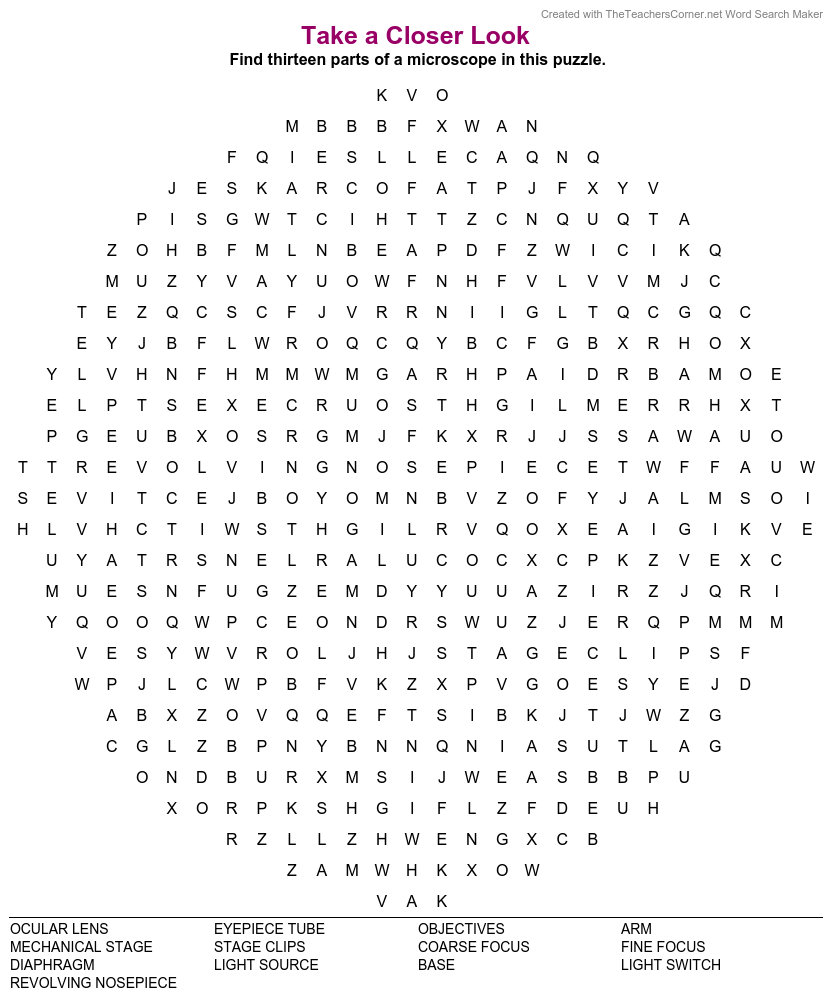
celebrate-picture-books-picture-book-review-microscope-coloring-page          celebrate-picture-books-picture-book-review-microscope-wordsearch-puzzle

Take a Closer Look Coloring Page and Word Search 

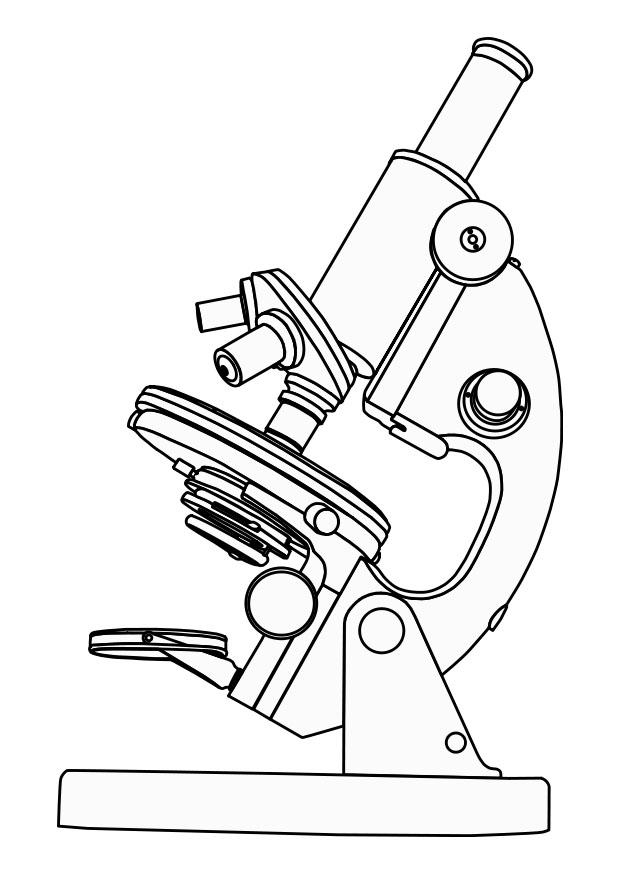
You can examine the parts of a microscope with this printable word search puzzle and coloring page.

Take a Closer Look Word Search Puzzle | Take a Closer Look Word Search Solution | Coloring Page

celebrate-picture-books-picture-book-review-june-almeida-virus-detective-cover

You can find June Almeida, Virus Detective! at these booksellers

Amazon | Barnes & Noble | Books-a-Million

To support your local independent bookstore, order from

Bookshop | IndieBound

Picture Book Review

January 15 – Celebrating the Book Birthday of Stompin’ at the Savoy

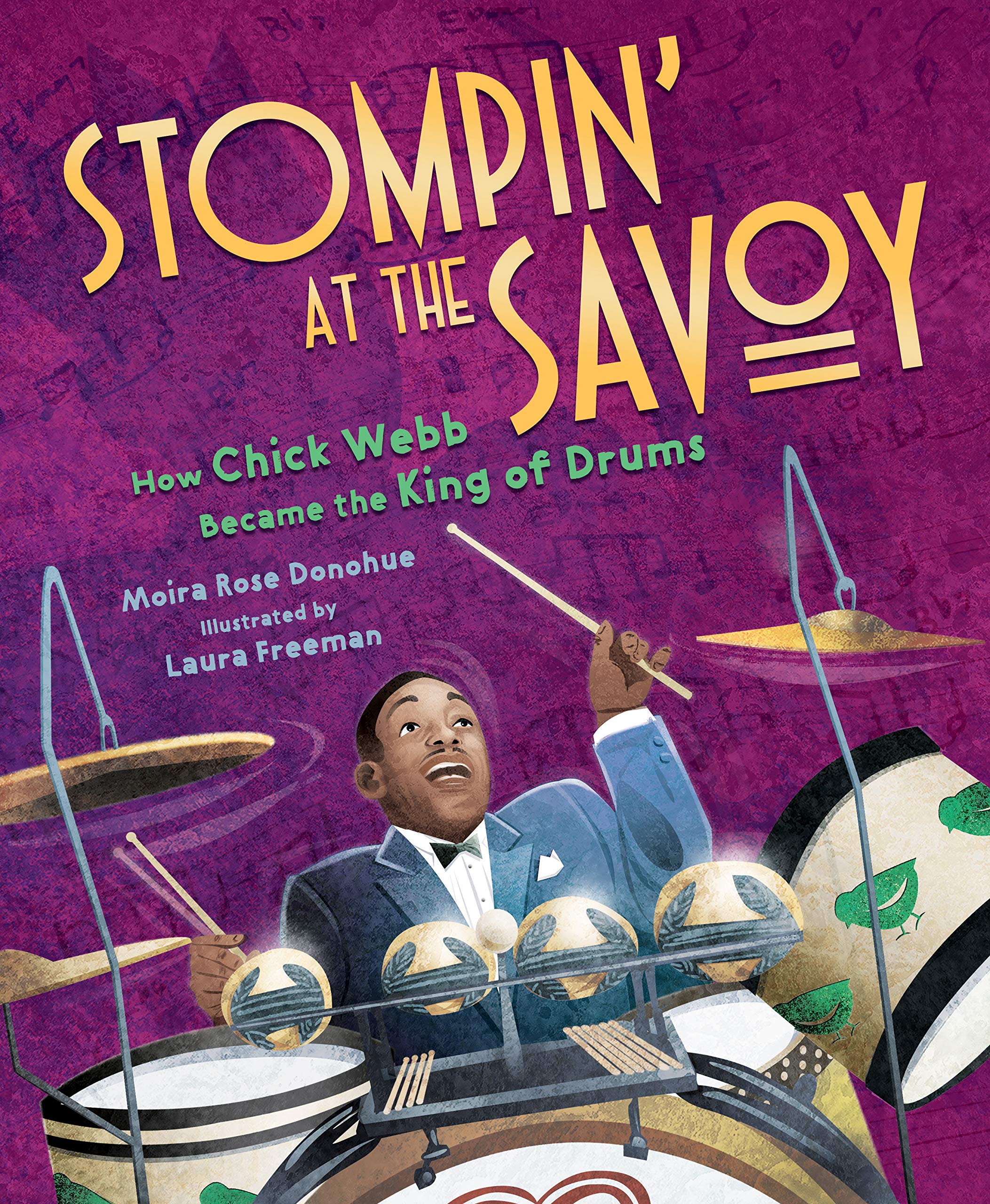
celebrate-picture-books-picture-book-review-stompin-at-the-savoy-cover

About the Holiday

I was thrilled to host the cover reveal of Stompin’ at the Savoy and am now excited to be celebrating the book birthday of this extraordinary biography of one of the greats of Jazz with a review, an interview with Moira and Laura, and a giveaway of the book. Enjoy!

Thanks goes to Sleeping Bear Press for sending me a copy of Stompin’ at the Savoy for review consideration. all opinions of the book are my own. I’m happy to be teaming with them in a giveaway of the book. See details and two ways to enter below.

Stompin’ at the Savoy: How Chick Webb Became the King of Drums

Written by Moira Rose Donohue | Illustrated by Laura Freeman


As a child William Henry “Chick” Webb turned everything into a drum. “He tapped rhythms on iron railings. Tinkety-tink! He slapped rhythms on marble steps. Thwapety-thwap!” Years later he would be competing in the “biggest band battle of the century” at the Savoy Ballroom in Harlem. But before that he had to overcome many obstacles. Throughout his life, William suffered with a spinal illness that stunted his growth. After an operation after a fall, the doctor recommended getting him a drum set to strengthen his arms. But drums—even drumsticks—were too expensive, so William used wooden spoons and pots and pans to make music.
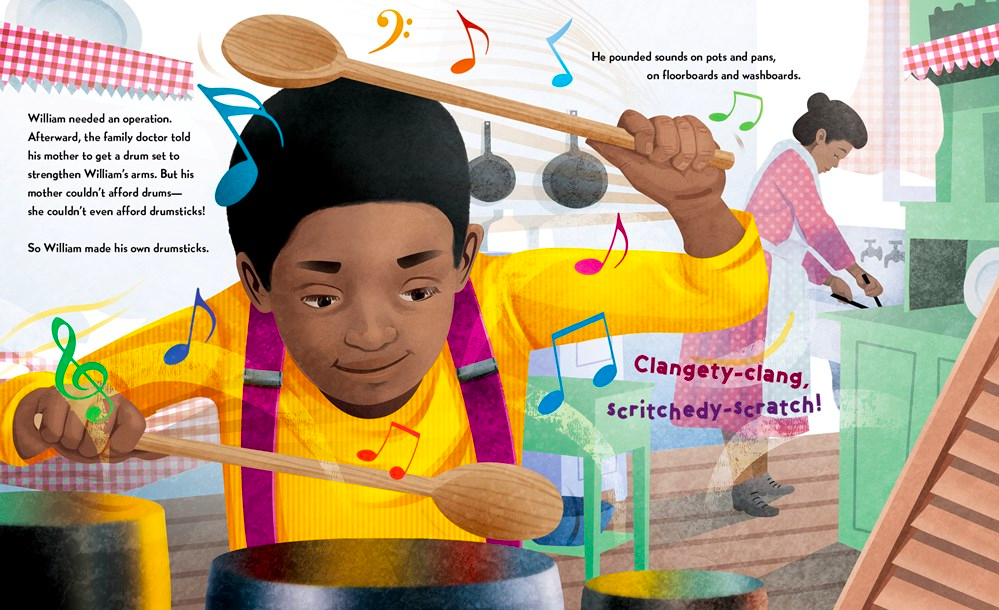
celebrate-picture-books-picture-book-review-stompin-at-the-savoy-pots-and-pans

Image copyright Laura Freeman, 2021, text copyright Moira Rose Donohue, 2021. Courtesy of Sleeping Bear Press.

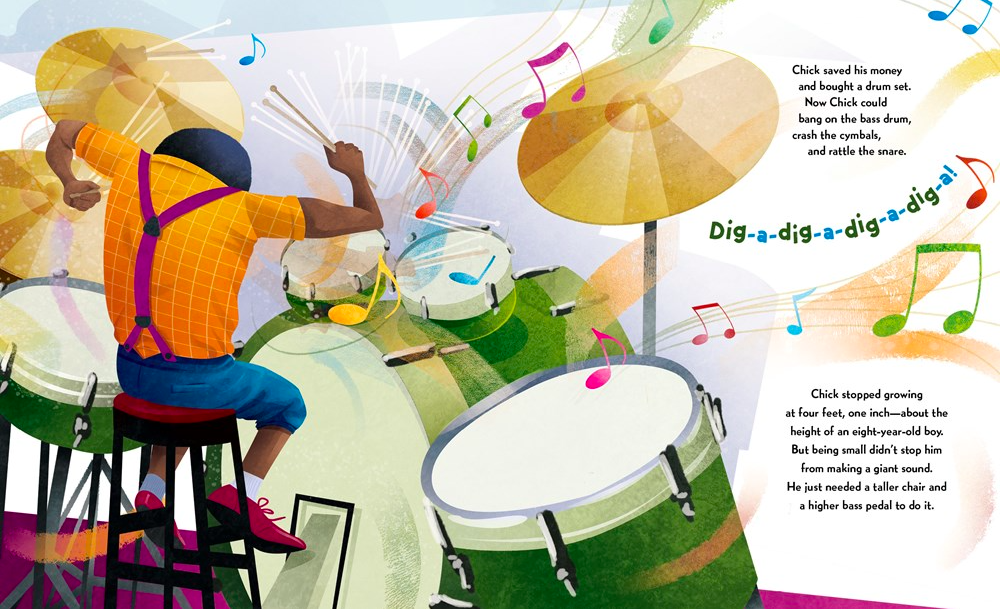
William’s illness left him with a hunchback and the “kids called him ‘Chicken’—shortened to “Chick”— because of the way he walked. To make money, Chick began selling newspapers when he was nine or ten. Soon he had bought real drumsticks and finally a drum set. Even though Chick only grew to be four feet, one inch that “didn’t stop him from making a giant sound. He just needed a taller chair and a higher bass pedal to do it.”

As a teenager, Chick was hired to play in local bands. He met Duke Ellington. He thought Chick was ready to lead his own band, but Chick waited. In the late 1920s a new kind of music—swing, with its dance-driving beat—came on the scene. “This new music was just right for Chick” and after choosing the best musicians he could find, he began touring the country. On one of these trips he hired Ella Fitzgerald to be the band’s lead singer. By 1937, Chick and his band was playing at the famous Savoy Ballroom. Some even called him the “‘Savoy King.’”
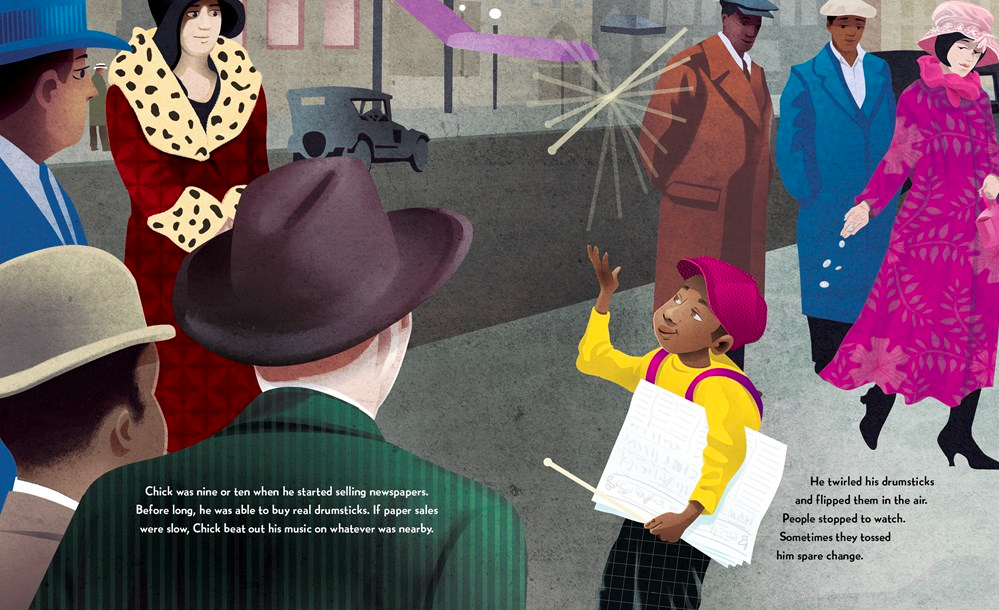
celebrate-picture-books-picture-book-review-stompin-at-the-savoy-newspapers

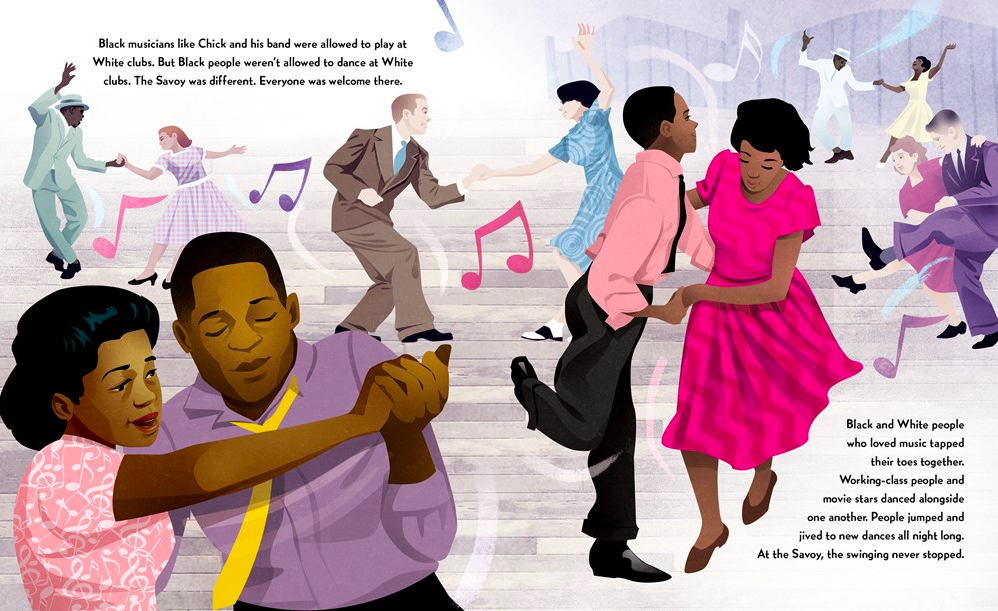
The Savoy Ballroom was different from most clubs. Here, both Black and White people were welcome to dance. “Working-class people and movie stars danced alongside one another. People jumped and jived to new dances all night long.” At the time, bands competed in live “battles,” which Chick usually won. But then in February 1937, his band lost to Duke Ellington.

Chick didn’t let that get him down. Instead he challenged Benny Goodman—who led the number one big band in the country—to a battle of the bands. Benny laid down some rules: his and Chick’s band would play the same songs, his band would play first, and he would play on the biggest stage at the Savoy. Chick agreed. “That night, four thousand people crowded together on the dance floor” and another five thousand gathered outside in the street. In the crowd were also reporters from music magazines. Before his band went on, Chick laid down just one rule as he talked to his bandmates: “‘I don’t want nobody to miss.’”
celebrate-picture-books-picture-book-review-stompin-at-the-savoy-drums

Benny Goodman and his band started off with his smooth, sweet clarinet that set the crowd swaying. But when Chick’s band took the stage, they gave the song a “hotter and faster… Swingier” beat, and the audience bounced along. The music swelled as “back and forth the bands played.” But it may have been “Jam Session” that decided it. As Chick “pounded louder and faster than a speeding train… Benny’s band just shook their heads in disbelief.” Everyone agreed that Chick had won. From that night on, Chick had a new nickname—“the ‘King of Drums.’”

An Authors note telling more about the life of Chick Webb follows the text.
celebrate-picture-books-picture-book-review-stompin-at-the-savoy-dancing

Thrilling for music-lovers, readers, and dreamers alike, Moira Rose Donohue’s biography of Chick Webb will inspire children to look not at the obstacles they may face but at ways to rise above them to achieve their goals. Donohue’s early focus on Chick’s determination to make music—whether he was using wooden spoons and pots or, much later, real drumsticks and drums—will impress on kids that practice, confidence, and an unfailing vision for the future can move mountains.

An important underlying lesson in Chick’s story is his self-awareness and willingness to wait until he felt ready to find his own niche and create his own band. This example, highlighted in Donohue’s compelling storytelling, will reassure readers who are meticulous, careful, and chafe under a “hurry, hurry” atmosphere. Through Donohue’s lyricism, pacing, and riveting vocabulary, readers can almost hear Chick at his drums as his drumsticks sizzle, whether at home, at venues across the country, or at the Savoy.

Laura Freeman’s rich colors and realistic depictions of Chick Webb—nearly always with drumsticks in his hands—will captivate readers as they watch a little boy with a big talent become the King of Drums. From his childhood kitchen to the school hallway to his natural entertaining spirit while selling newspapers, Freeman shows Chick’s singular focus and the times in which he grew up. Swirled musical bars, floating notes, and shadowed drumsticks give her illustrations movement. The look of rapture on Chick’s face as he plays and images of couples dancing to swing depict how the music transported people from the normal rhythms of life. The final spreads of Chick and Benny Goodman’s battle of the bands are raucous and enthralling and will have kids wanting to hear Chick’s music for themselves.

An absorbing biography of Chick Webb and the era of the big bands as well as a shining example of how one’s belief in oneself can conquer hurdles, Stompin’ at the Savoy: How Chick Webb Became the King of Drums is highly recommended for home bookshelves and a must for school and library collections.

Stompin’ at the Savoy Book Birthday Activity
celebrate-picture-books-picture-book-review-stompin-at-the-savoy-coloring-page

Stompin’ at the Savoy Activity Kit


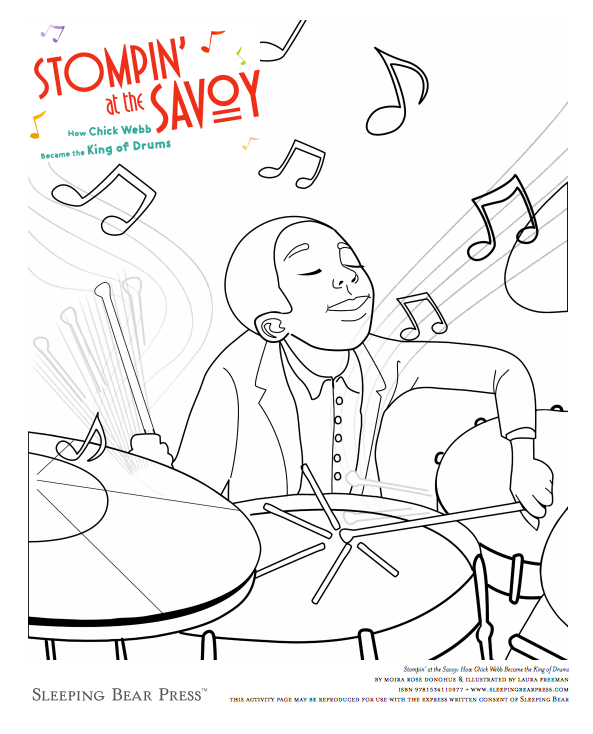
You can enjoy coloring a picture of Chick Webb at his drums and challenging yourself with the word search puzzle found in this printable Activity Guide found on the Sleeping Bear Website.

Stompin’ at the Savoy Activity Kit

Meet Moira Rose Donohue
celebrate-picture-books-picture-book-review-moira-rose-donohue-headshot

Moira Rose Donohue has written over 35 books for children, most of them nonfiction, including National Geographic’s Little Kids First Big Book of the Rain Forest and two Junior Library Guild selections: Great White Sharks (Scholastic/Children’s Press) and The Invasion of Normandy (North Star Editions). She loves tap dancing, opera, hockey, and animals. Moira lives in St. Petersburg, Florida, with her dog, Petunia.

Among the many titles you’ve published are books on nature, history, and many, many biographies of figures from explorers to sports stars to civil rights leaders. What is your favorite thing about writing biographies? What was the initial spark that prompted you to choose Chick Webb as the subject of your newest book?

The thing I like most about writing biographies is that through the extensive research you have to do, you eventually discover the “essence” of the person—that unique quality that guided him/her/them to act in a way that made a difference in the world.

My initial interest in Chick was sparked when I was watching a re-airing of the Ken Burns documentary on jazz music. When the movie reached the evolution of swing and big bands, Chick Webb was mentioned. I have always loved Big Band music, even though it was not the music of my era. I was familiar with all the big band musicians discussed except Chick Webb. So, of course I had to research him. When I saw his life-loving grin and learned that he had to face the challenges of an affliction that left him no taller than an average eight-year-old boy, I was hooked.

Can you talk a little about the story readers will discover in Stompin’ at the Savoy and take readers on the book’s journey from idea to published book?

This book is not a chronicle of Chick’s life. It focuses on his resilient and competitive spirit because that’s what struck a chord with me. I love contests, and so, apparently, did Chick. To showcase his competitiveness, the climax of the book is his legendary band battle with 6-foot tall Benny Goodman, the King of Swing—a contest so exciting that almost 10,000 people showed up, inside the Savoy and outside on Lenox Avenue. You’ll have to read the book to find out who won!

What was one of the most surprising things you learned about Chick Webb during your research?

As a drummer and a band leader, Chick was precise and demanding. He told his musicians to practice and to be perfect. This didn’t surprise me because my daughter is a percussionist and I know that to be successful, practice and discipline are essential. What did surprise me is that, on occasion, Chick was known to give in to his wilder side and ride around town on the back of a motorcycle, standing up.

Researching Chick Webb was tricky because not much has been written about him. I had to call upon librarians, my superheroes, to watch a documentary at the Library of Congress and to find out what his childhood home looked like (thanks to the Enoch Pratt Free Library in Baltimore).

For an author it must be thrilling to see your story come to life visually. When did you see the cover and illustrations for your story? What was your first reaction?

I have been a big fan of Laura’s work for some time, so I knew when I got the sketches in May, 2020 that they would be wonderful. But the best part was that she completely understood the Big Band era and captured the ethos of the Savoy perfectly. It turns out that she had a connection to it—her father danced at the Savoy Ballroom.

As for the cover, which I didn’t see until early October, 2020, well…it brought tears to my eyes. The purple background is such a perfect choice for the King of Drums. And Laura even managed to put his signature green chicks on his drum set!

What would you like young readers to take away from the story of Chick Webb?

Although I cannot fully understand the magnitude and complexities of Chick’s struggle, as someone who is only 4 feet 11 inches tall and always trying to figure out how to reach things in high places, I relate to the challenges of being a short person. I completely understood his need to make his bass drum pedal higher so he could reach it! And I admired his perseverance. I hope the young readers will see Chick’s story as an inspiration—a story of someone who believed in himself and his music. Chick was a person with short stature who created a giant sound.  

When will readers be able to find Stompin’ at the Savoy on bookstore shelves? Do you have any special events to planned that readers can look forward to?

Stompin’ at the Savoy will be available for purchase on January 15, 2021. We are holding a virtual book release celebration this Monday, January 18 at 3:30 EST with Tombolo Books bookstore. You can register for the event as well as buy signed copies of the book there. You’ll find more information and the link to register on my website, moirarosedonohue.net. And I am hoping to have an in-person event in Baltimore, Chick’s (and my son’s) home, when it’s safe to do so. 

You can connect with Moira Rose Donohue on

Her website | Twitter

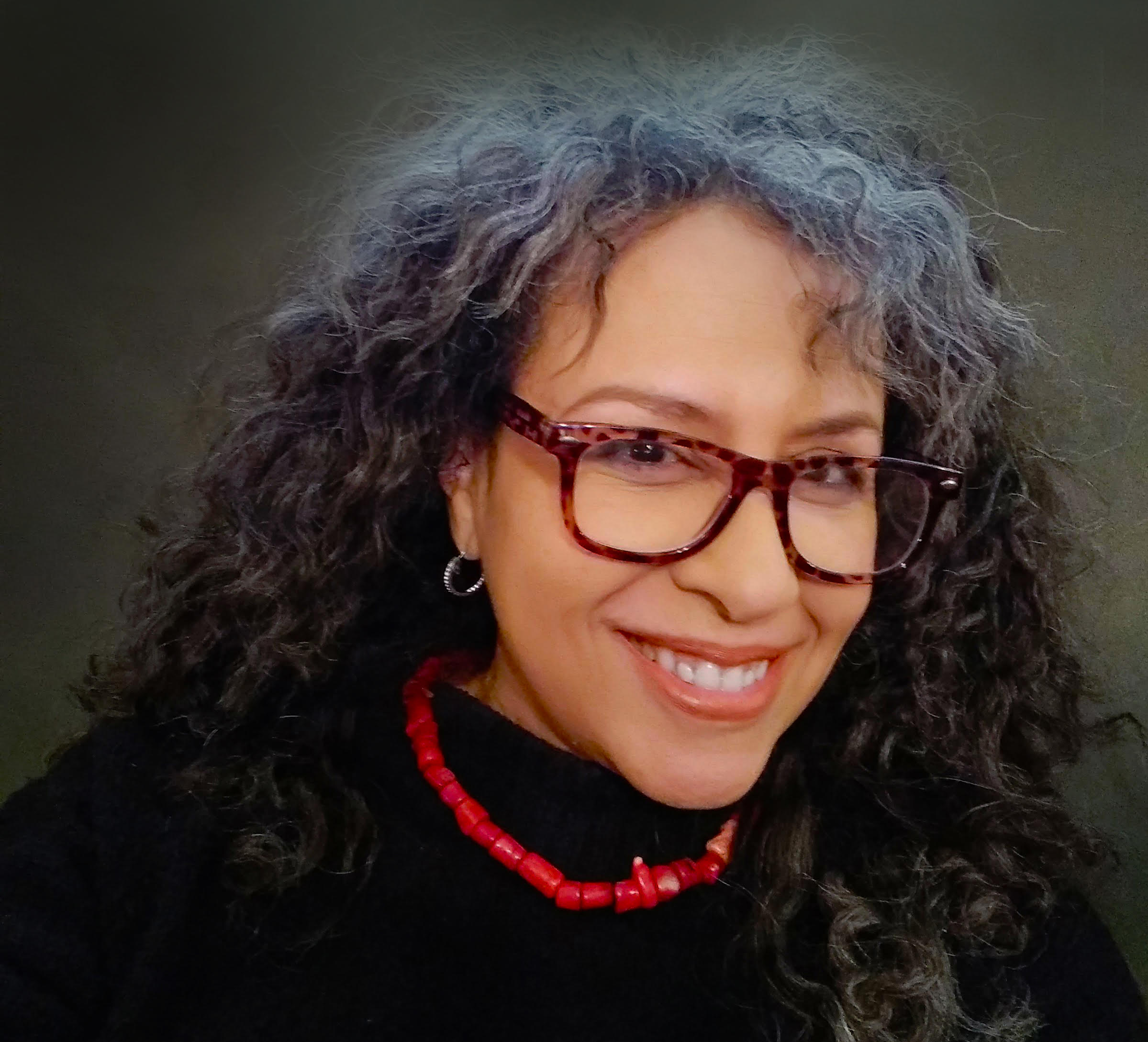
Meet Laura Freeman
celebrate-picture-books-picture-book-review-Laura-Freeman-headshot

Laura Freeman has illustrated many fine children’s books over the years, including Fancy Party Gowns: The Story of Fashion Designer Ann Cole Lowe, written by Deborah Blumenthal, and the Coretta Scott King Honor book Hidden Figures: The True Story of Four Black Women and the Space Race, by Margot Lee Shetterly and Winifred Conkling. Laura now lives in Atlanta, Georgia, with her husband and their two children. 

I think readers are fascinated by an artist’s process in translating a manuscript to images that explain, highlight, and enhance the text. Can you talk a little about how you approached the manuscript for Stompin’ at the Savoy and then developed your illustrations.

I always spend a lot of time looking at photos and researching the character and time period before starting. For Stompin’ I wanted to get in the mood, and so I searched for his music online and was surprised to find that I recognized the title song (which was written in 1933!). Maybe I watch too many old movies, but it really is great! I found great old photos of him at his drum kit and photos of the Savoy nightclub as well as people dancing and swinging to the orchestra. Since it was the ’30’s, all the photos I found were in black and white so I dug into the internet to find out what color his drum kit was… and I found conflicting information. One article stated that the kit was pearlized cream decorated with sparkly green chicks but the accompanying photo showed the chicks as being red. I ended up trusting the words since the photo was obviously hand tinted. I hope I got it right but guess it’s not the end of the world if I’m wrong! 

What were your thoughts as you began to design the interior images for Stompin’ at the Savoy?

I wanted to give the illustrations a sense of movement to mimic the way Chick’s music makes me feel. There are a lot of colorful musical notes dancing throughout almost all of the pages. There is one spread in particular where if you look closely you can find them in a pattern in the ironwork of the staircase that Chick falls down as a child. Even though he’s not playing music on this page I wanted the notes to foreshadow his future.

What aspects of Chick Webb’s story did you most want to express in your illustrations? Is there a spread in the book that you particularly enjoyed creating?

Even though he had a tragic accident when he was a child that affected him for the rest of his life, his music is so full of joy – I wanted the book to feel joyful! I wanted it to be bright and colorful. There’s one spread in the book that depicts a battle of the bands. The one where Chick’s band goes up against Benny Goodman’s band. It was one of the last images I tackled because I have to admit, I had no idea how I was going to pull it off. There was just so much going on. I wanted to show the excitement and electricity of the moment – both bands playing their instruments, Chick’s band in white tuxedos, Benny Goodman’s band in black, Chick at his drum kit, Gene Krupka breaking his drum head. All this, but I didn’t want it to look busy and confusing. It ended up being one of my favorite images in the book!

I’ve been fortunate to review several of your picture books. In each one the illustrations are uniquely suited for the subject and yet instantly recognizable as your work. What would you say is your signature style? How did you develop it?
Thank you for saying so! I guess I’d say my illustrations are somewhat realistic in that I do try to capture a likeness. But still not so much so that I can’t deviate from reality to make a point. I guess you could say my work has a collage feel to it since I love to play around with patterns and textures too. I think that the amount of research I do shows up in the illustrations. I try to immerse myself in the time period of the book. I love finding the right clothing and hairstyles. What did the streets look like? The cars? What kind of technology was available? What about the furniture? I collect 100’s of photos of all these things. Very few end up in the books, but the essence of what I’ve seen does… I hope!
What do you hope children will take away from your illustrations for Stompin’ at the Savoy?

I hope that they can see themselves in his story. I love that he didn’t let his physical limitations stop him from doing what he wanted to do. He had to sit on a high stool to reach the drums. He couldn’t reach the bass drum pedal on the stool, so he had a special one made. He even embraced what surely started out as a derogatory nickname and called himself Chick.

Like Moira, many of your books for children are biographies. What draws you to those projects? What are the challenges and the rewards of working on biographies?

I especially like learning about people I may never have heard of and learning new things about people I have heard of. If I don’t know the information, chances are that most kids don’t either. With a biography there’s the challenge of capturing a likeness. Sometimes there are lots of photos and videos of the person I’m depicting to reference. Other times, not so much. I may need to distill the person’s facial features and try to figure out what they might look like from a different angle or as a child when there really aren’t any reference photos to go by. I want to do them justice because I feel honored to be involved in uncovering their stories.
You can connect with Laura Freeman on

Her website | Instagram | Twitter

Thanks so much Moira and Laura for these insightful answers! I’m sure readers are as excited to read Stompin’ at the Savoy: How Chick Webb Became the King of Drums as I am! While we have to wait a little longer to find the book in bookstores, everyone’s invited to enter my giveaway for a chance to win a copy!

Stompin’ at the Savoy: How Chick Webb Became the King of Drums Giveaway


I’m excited to partner with Sleeping Bear Press in Twitter giveaway of:

  • One (1) copy of Stompin’ at the Savoy, written by Moira Rose Donohue| illustrated by Laura Freeman 

Here’s how to enter:

  • Follow Celebrate Picture Books 
  • Retweet a giveaway tweet OR leave a comment below
  • Bonus: Reply with your favorite kind of music for an extra entry (each reply gives you one more entry).

This giveaway is open from January 15 through January 21 and ends at 8:00 p.m. EST.

A winner will be chosen on January 22. 

Giveaway open to U.S. addresses only. | Prizing provided by Sleeping Bear Press.

celebrate-picture-books-picture-book-review-stompin-at-the-savoy-cover

You can preorder Stompin’ at the Savoy: How Chick Webb Became the King of Drums at these booksellers

Amazon | Barnes & Noble | Books-a-Million

To support your local independent bookstore, order from

Bookshop | IndieBound

Picture Book Review