It’s Shark Week! In its 38th year of highlighting all things shark-related, the Discovery Channel is once again hosting one of the most iconic weeks of summer with education and entertainment revolving around these denizens of the deep, especially the Great White. But there are many more sharks in the sea – about 500 species! – and they’re all an important part of the world’s ecosystem. To celebrate ancestors of today’s sharks and the wonders of discovery, you’ll want to put today’s book at the top of your reading list!
Thank you to Random House Studio and Barbara Fisch at Blue Slip Media for gifting me a copy of this book!
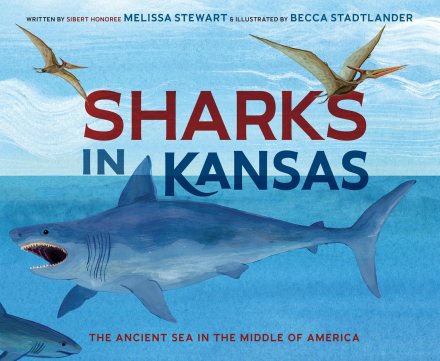
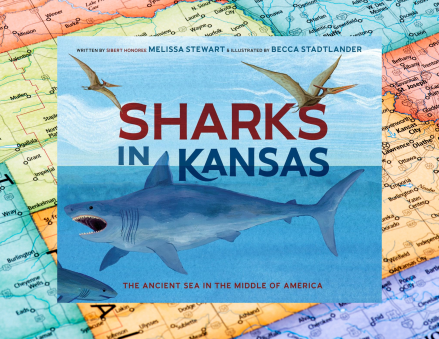
Sharks in Kansas: The Ancient Sea in the Middle of America
Written by Melissa Stewart | Illustrated by Becca Stadtlander
When you think of finding sharks, you might consider the east and west coasts of the United States and South America, areas around Africa, or perhaps the waters off the coast of Australia. I’d hazard a guess, however, that the US midwestern state of Kansas would not be on your list. Melissa Stewart is here to change that.
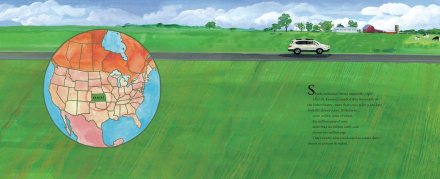
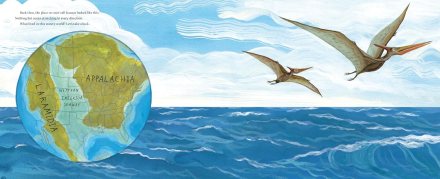
In Sharks in Kansas, Stewart reveals that Kansas—yes, that state known for its “seven million acres of wheat, five million acres of corn, more than six million cattle, and almost two million pigs” that add up to “90 percent farmland” was once the home to sharks and a plethora of other prehistoric creatures. She begins with fossilized evidence that 85 million years ago what is now Kansas as well as “thirteen states and five Canadian provinces” was underwater in what scientists now call the Western Interior Seaway.
Stewart then transports readers back millions of years to experience the vibrant and strange creatures that plied the sea, land, and sky. As a herd of herbivore Claosaurus track the shoreline, “a Pteranodon glides across the sky in search of fish.” But what about the sharks, you ask? They’re in attendance too. Different types of sharks of various sizes, one nearly twice as long as a Great White, lurk in the water’s depths, waiting . . . Those early sharks aren’t alone, either. Quirky—and toothy—mosasaurs, plesiosaurs, and fish as well as mollusks that would never fit in a bucket vie for space and food.
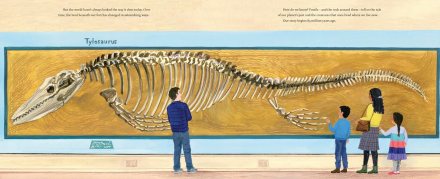
So what happened to the Western Interior Seaway? Stewart takes readers on a fascinating tour through the changes that slowly occurred to the land, the creatures, and this body of water that was once so vital. You may wonder how people—both scientists and casual observers—know all this. As Stewart explains, they can see its effects in the fossils discovered under those fertile fields; in the “rippled sandstone” walls that stand as reminders of an “ancient shoreline” and which visitors to Dinosaur Ridge in Colorado can trace with their fingers; and in the towering “chalky white” Monument Rocks of Kansas, created by untold numbers of coccolithophore fossils. Stewart and Becca Stadtlander then team up to textually and visually explain how the Western Interior Seaway was formed and then displaced by land once again.
A master of setting a scene that envelops children in mysterious landscapes, Melissa Stewart introduces readers to prehistoric sharks and other sea creatures that once populated the Western Interior Seaway. Portraying dramatic encounters between marine animals, Stewart brings to life the vitality of this ancient ocean while clearly outlining how the seaway came to be and receded again.
Becca Stadtlander’s stunning gouache illustrations immerse readers in the prehistoric period, providing perspective on the size of these marine animals and diving into the depths of the Western Internal Seaway to witness the awe-inspiring interactions among them. Tails flick, teeth are bared, and chomps are taken for food and defense. The images of above-ground proof of the seaway’s existence will also entice kids to learn more about this ancient phenomenon.
Sharks in Kansas is extremely well-designed, with most pages containing sidebars that present illustrations of and facts about the creatures featured in that spread. There’s no flipping back and forth to a glossary at the end to discover the information readers want to know and match with what they see in front of them.
Children will be surprised and entranced by the strong science, dynamic storytelling, and riveting illustrations found in Sharks in Kansas: The Ancient Sea in the Middle of America. The book is a must for all library collections and will be a pored-over favorite for kids fascinated by science, marine creatures, and history.
Ages 4 – 8
Random House Studio, 2026 | ISBN 978-0593904718
Melissa Stewarthas written more than 200 science books for children, including Whale Fall, winner of the AAAS/Subaru Prize for Excellence in Science Books; Feathers: Not Just for Flying, an ALA Notable Book; and Pipsqueaks, Slowpokes, and Stinkers: Celebrating Animal Underdogs, an SCBWI Golden Kite Honor title. She co-authored 5 Kinds of Nonfiction: Enriching Reading and Writing Instruction with Children’s Books and edited the anthology Nonfiction Writers Dig Deep: 50 Award-Winning Authors Reveal the Secret of Engaging Writing. Melissa maintains the award-winning blog Celebrate Science and serves on the Society of Children’s Book Writers and Illustrators board of advisors. Visit her at melissa-stewart.com.
Becca Stadtlander is an illustrator and fine artist. In 2019, she won the Golden Kite Award for Picture Book Illustration for Made by Hand: A Crafts Sampler. Picture books she has illustrated include Mr. McCloskey’s Marvelous Mallards, Sleep Tight, Farm, and On Wings of Words, which received four starred reviews. Her work is also featured in adult books, editorial publications, stationery, home decor products, and book covers. Visit her at beccastadtlander.com.
Shark Week Activity
Fintastic Shark Fun
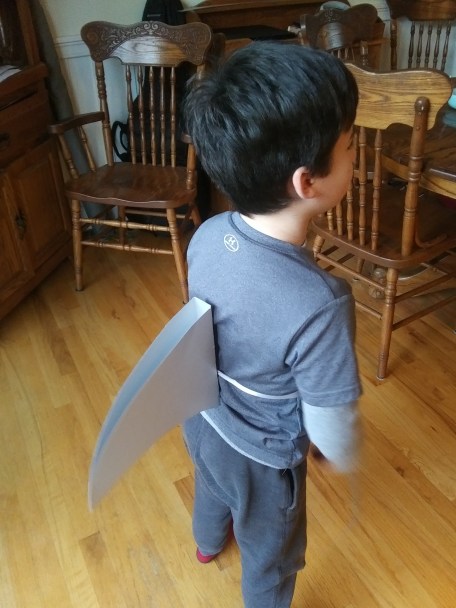
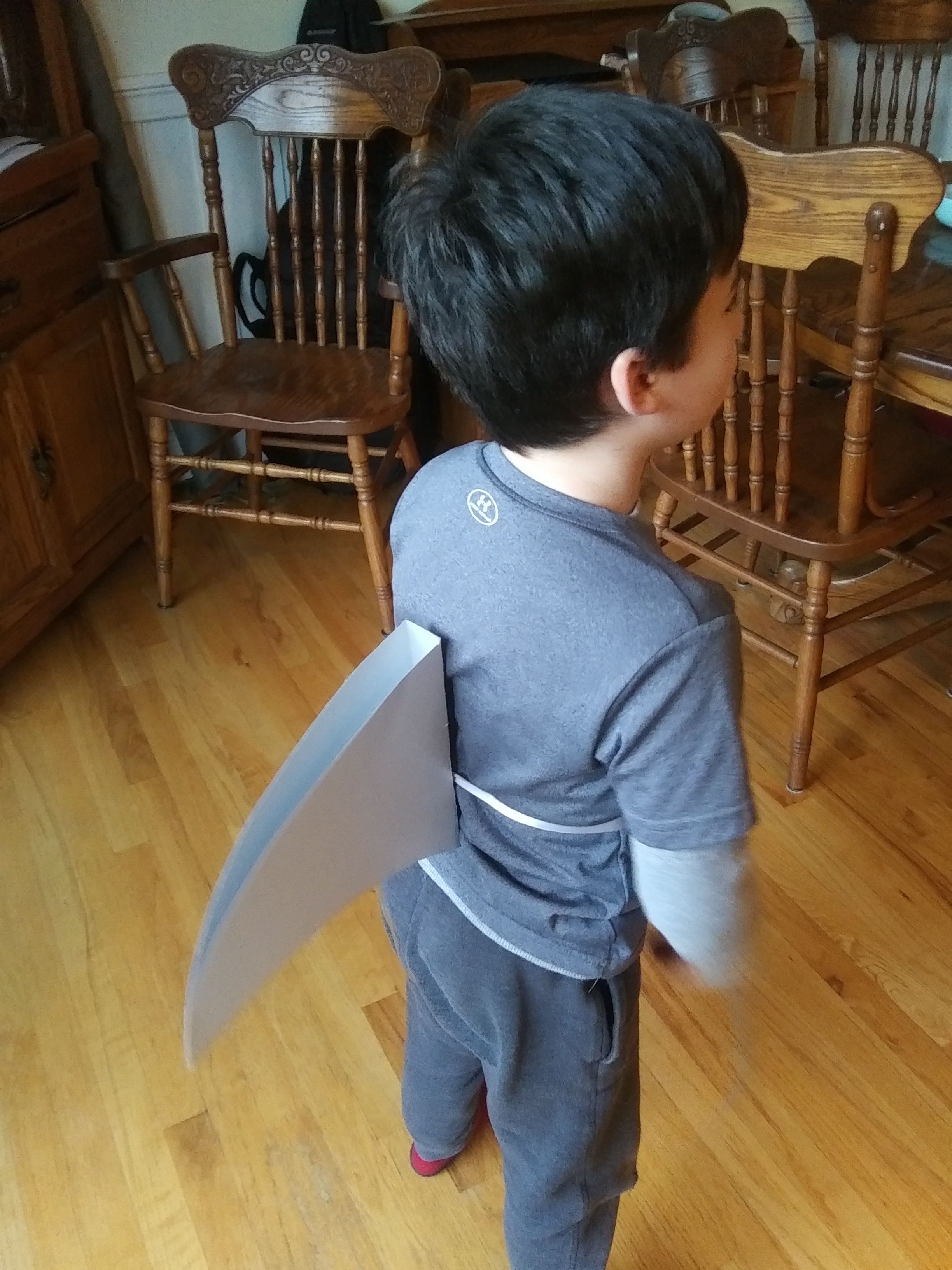
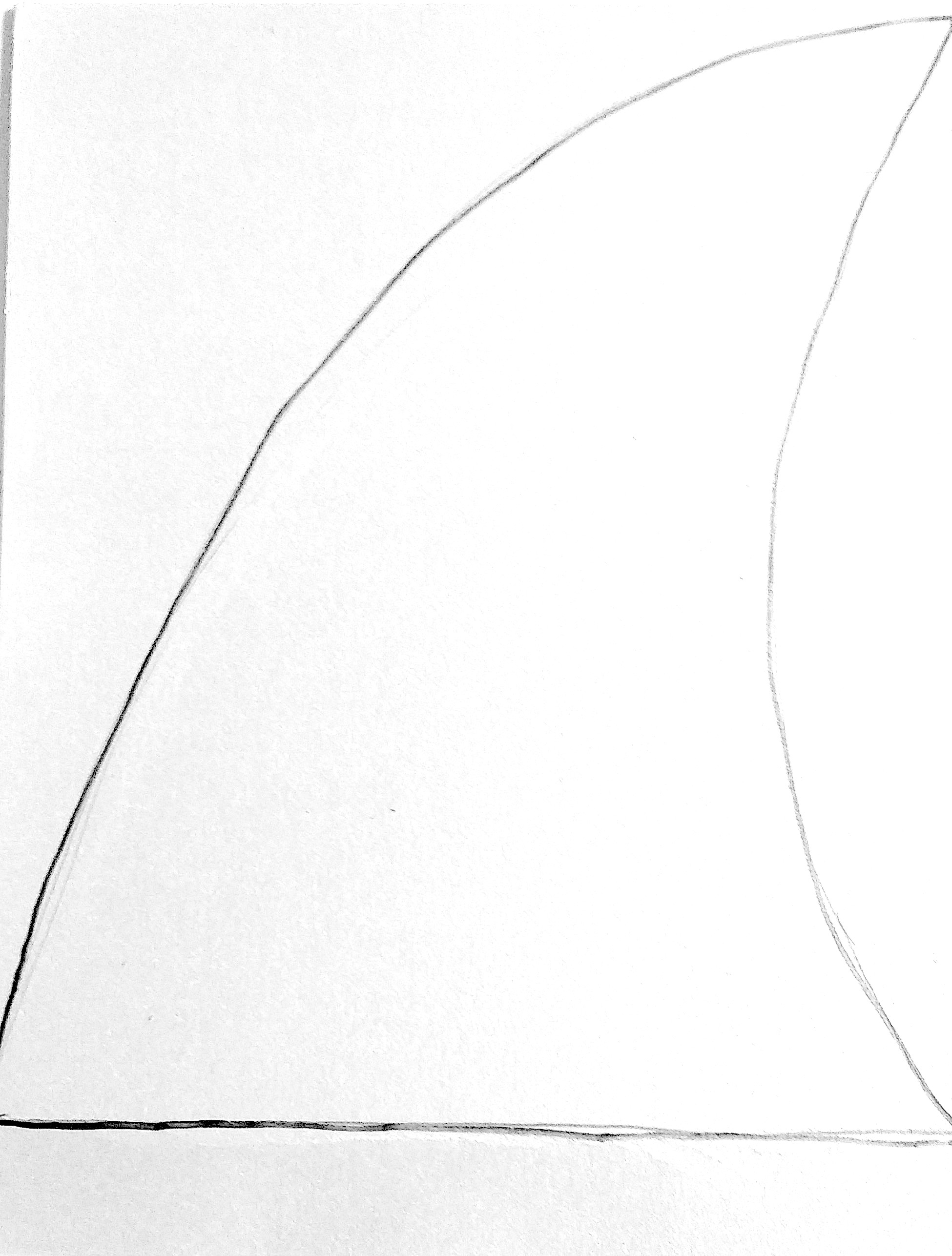
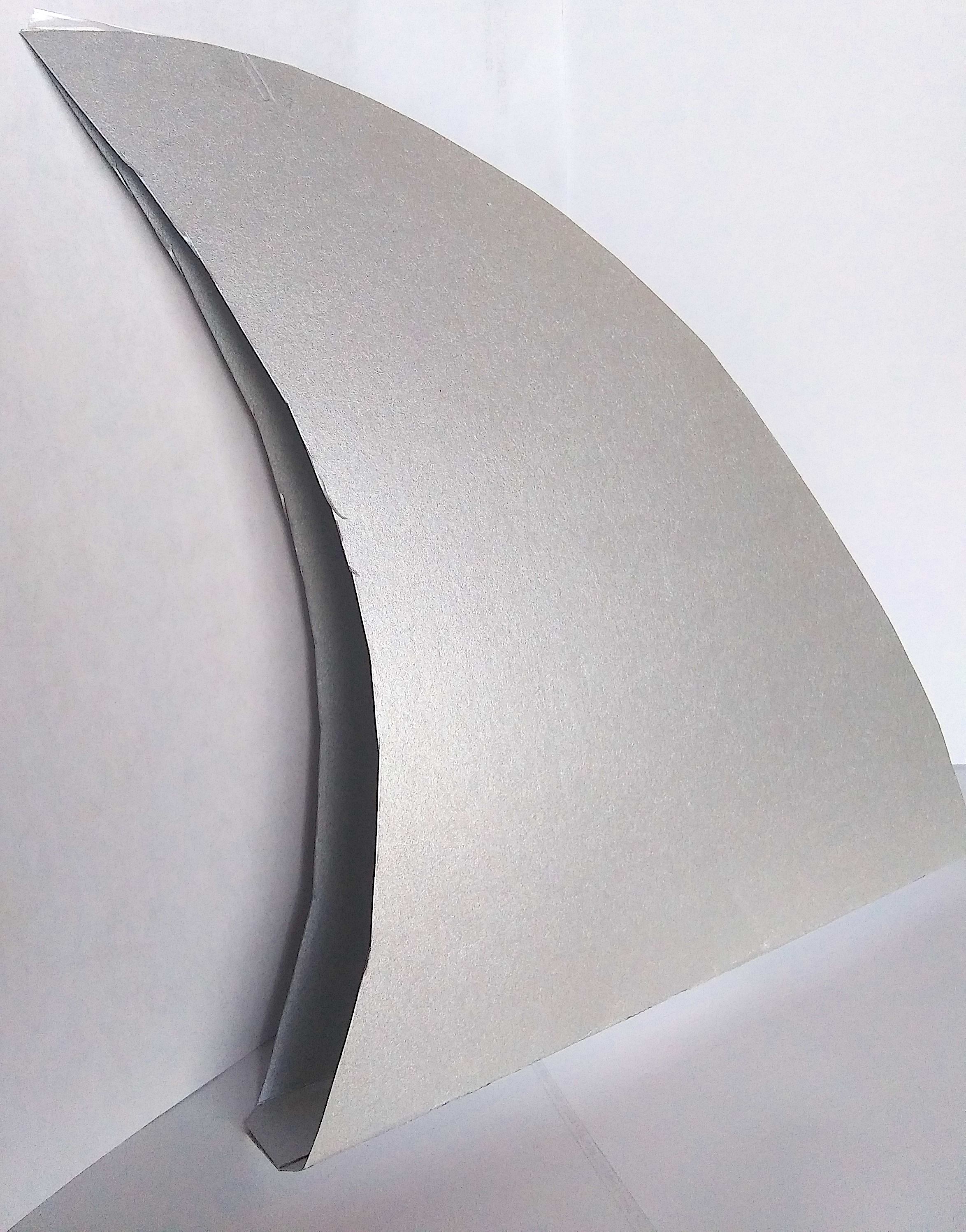
Dive into some shark fun with this shark fin craft! Just follow the directions below!
Supplies
2 pieces of 8.5 x 11 gray cardstock paper
Ribbon
Tape
Scissors
Pencil
Directions
Tape the top of the two pieces of paper together
Fold them back together
Measure an inch up from the bottom of the papers (the un-taped side) and trace a straight line across both papers
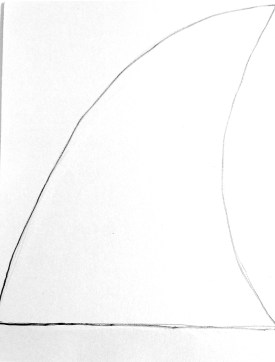
Trace a shark fin outline onto your paper. The shark outline should stop an inch above the bottom
Cut out the fin on both pieces of paper. If you should cut through the tape, re-tape the tops together
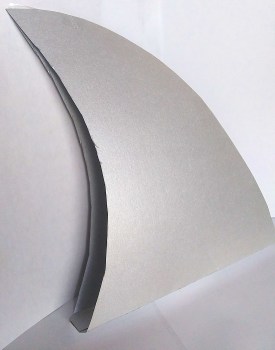
Fold along the lines of both papers so the folds face towards each other.
Tape the folds so the fin becomes a triangle
Cut two slits parallel to the folded lines
Thread ribbon through slits
Sharks in Kansas Coloring Page and Reading Guide
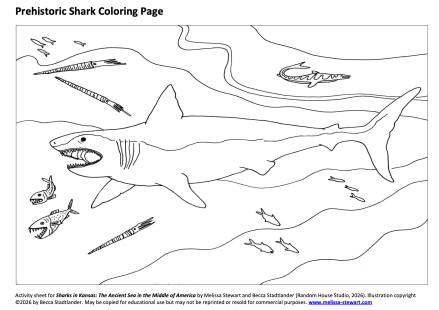
Families and educators can find a Sharks in Kansas coloring page as well as a Reading Guide on Melissa Stewart’s website.
You can purchase Sharks in Kansas: The Ancient Sea in the Middle of America from these booksellers
This month’s observance pays tribute to the role of zoos and aquariums and the work they do for education, conservation, and research to protect the world’s animals. Through interactive and hands-on programs, zoos and aquariums provide visitors with up-close experiences in which they can learn about the environments and science of each amazing creature. These institutions are also reaching out with personal and online visits to schools by zoologists and other experts, increasing the interest in biology and animal science to students. To celebrate, plan a visit to your local zoo or aquarium—or make it a “must see” of any vacation!
Thanks to Chronicle Books and Barbara Fisch of Blue Slip Media for sending me a copy of this beautiful book for review!
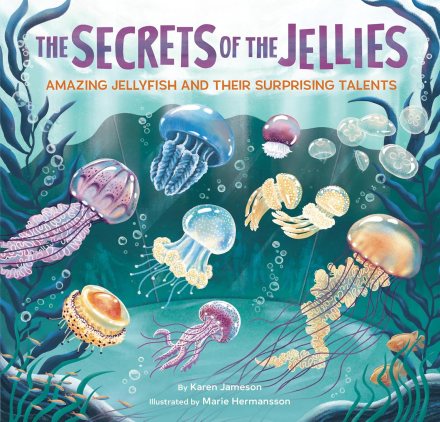
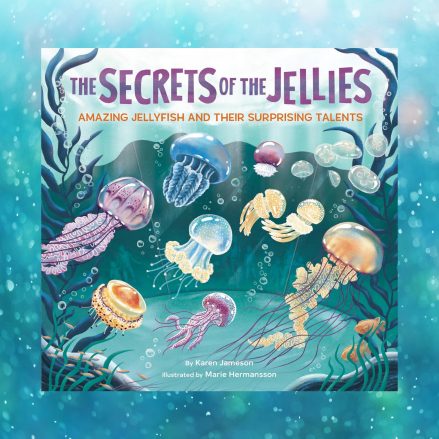
The Secrets of the Jellies: Amazing Jellyfish and Their Surprising Talents
Written by Karen Jameson | Illustrated by Marie Hermansson
It’s impossible not to be fascinated by jellyfish. We’re captivated by their beauty and grace and can’t help but admire their defensive subterfuge—as long as we’re not on the receiving end! In her lyrical nonfiction picture book, Karen Jameson reveals intriguing facts about these dazzling underwater creatures that can be found in every ocean zone, from the shallows to the deepest recesses. She celebrates “see-through jellies, bright ones, too—colors in each shade and hue! / And in the darkness, down below, they radiate a blue-green glow!”
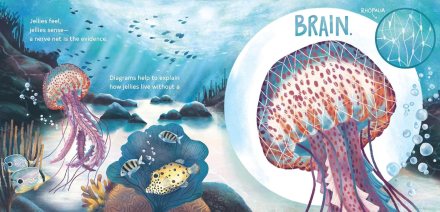
Jellies bioluminescence is only part of their charm, however. We marvel as we watch jellyfish seemingly glide effortlessly through the water, wondering, “how do they do that?” Jameson has the answer, not only to how they propel themselves, but also to how “jellies live without a brain,” how they reproduce, how they satisfy their hunger, and even how other sea creatures befriend jellies for their own survival.
You might think that by just bobbing along, jellyfish would be easy prey, but Jameson reassures readers that “jellies hide, jellies dodge with super-sneaky camouflage! / In the depths or close to shores, they stay away from predators!” With such smarts and agility, it’s no wonder the sea blooms with “jellies here, jellies there—hundreds, thousands everywhere!” or that “we’ll study them for years to come, these stars of the aquarium!”
Extensive back matter follows the story, with a section on Jellyfish Facts that explains more about the number of “true jellies” around the world, information on the smallest and largest jellyfish, their bioluminescent properties, how they move, how they “think,” their life cycle, diet, predators, groupies, and jellyfish blooms. Readers also learn about how aquariums care for their jellyfish, their role in the ocean’s ecosystem, how they sting, and how climate change affects them. In a paragraph on current jellyfish research, children are invited to become citizen scientists and track jellyfish through a provided website link. Children are next introduced to 22 types of jellyfish that they will then enjoy finding throughout the book.
Readers will happily glide along with the incredible jellyfish Karen Jameson introduces through her perfectly rhyming and rhythmic storytelling that educates while also providing the fun of an interactive read-aloud. Excitement builds as the verses flow toward the final rhyming word, which kids will be eager to call out as they engage with Jameson’s clever learning experience. In her conversational back matter, Jameson explains jellyfish facts and features in clear terms, using examples and vocabulary that resonates with her young audience. Each paragraph offers fascinating information to spur further research for classroom or homeschool cross-curricular assignments.
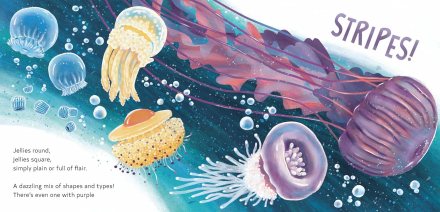
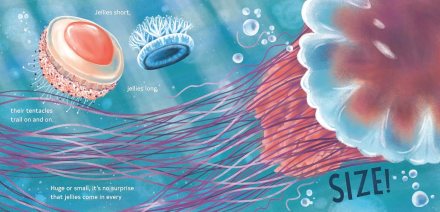
Marie Hermansson’s vibrant lifelike digital illustrations float and swirl with the motion of jellies, transporting readers under the ocean to witness the variety of shapes, colors, and sizes of these aquatic marvels. Scientific concepts, such as jellies’ propulsion and nerve net, are clearly portrayed to enhance understanding. The endpapers give kids a glimpse of the Monterey Aquarium, whose jellyfish exhibits inspired this book.
Shimmering with the magic and mystery of jellyfish, The Secrets of the Jellies: Amazing Jellyfish and Their Surprising Talents is scintillating nonfiction at its best. The book is a must for any public, school, or classroom library collection and an exciting addition to home bookshelves for any child fascinated with the ocean or marine biology.
Ages 5 – 8+
Chronicle Books, 2026 | ISBN 978-1797221977
About the Author
Karen Jameson is a children’s author, poet, teacher, and literacy advocate. Her picture books include Woodland Dreams and Wake Up, Woodlands, illustrated by Marc Boutavant; Farm Lullaby, illustrated by Wednesday Kirwan; and Where the Wee Ones Go, illustrated by Zosienka. She lives and works in Southern California. Visit her at karenjameson.com.
About the Illustrator
Marie Hermansson has a deep appreciation for the natural world, with a love of illustrating animals, plants, landscapes, and the ecosystems they exist in. She has illustrated numerous picture books, including Tera Kelley’s award-winning Listen to the Language of the Trees. When she’s not working, she enjoys traveling, hiking, beachcombing, and reading. Marie currently resides in North Carolina with her husband and two children. Visit her at mariehermanssonillustration.com.
National Zoo and Aquarium Month Activity
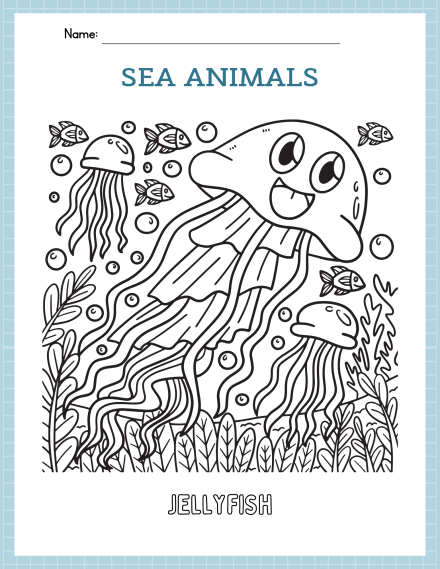
Marine Animal Coloring Pages
Kids can bring a bit of the ocean or aquarium to their room with these marine animal coloring pages!
If your motto is “So many books, so little time” then you’ll be happy to know that January is Book Blitz Month! During this month book lovers are given the green light to read as many books as possible! For kids, Book Blitz Month can be particularly exciting as they discover new fiction and nonfiction that captivates their imagination. To celebrate, take your kids to a local bookstore and the library to find new and favorite books to binge on all month long. If you don’t have a dedicated space for your children’s books, this month is also a great time to create a home library for your child so that they have a shelf, a crate, or even a whole bookcase of stories they can enjoy again and again!
I’d like to thank Lydia Lukidis for sharing a digital copy of Deep, Deep Down: The Secret Underwater Poetry of the Mariana Trench with me for review consideration. All opinions on the book are my own. You can read my interview with Lydia below.
Deep, Deep Down: The Secret Underwater Poetry of the Mariana Trench
Written by Lydia Lukidis | Illustrated by Juan Calle
Imagine being invited to visit a mysterious place where only a few have ever been; where only they have truly seen the creatures that inhabit it; and where it’s murky depths are accessible by only one type of vehicle. Would you dare to go? Lydia Lukidis and Juan Calle extend just such an invitation, but no notes for missing school, packing a suitcase, or plucking of courage need to be considered, for through their phenomenal book, readers find a seat in the incredible submersible that will transport them to “…the deepest underwater valley in the world”: the Mariana Trench.
Image copyright Juan Calle, 2022, text copyright Lydia Lukidis, 2022. Courtesy of Capstone Editions.
The submersible plunges deeper and deeper to where the sun doesn’t penetrate. Here, in the darkness, “food is scarce, and a bone-chilling cold blasts through the water. Earthquakes shake the ocean floor, and the water pressure, like a thick, heavy blanket with a thousand hands, presses down, / down, / down.” What flashes by the porthole window? A monster? No—a fish with a long and slender tail perfectly suited for its austere home, where it can survive for months without eating if necessary. “Diving deeper, a long, thin body slinks and sways, ever so slowly. The cutthroat eel is not fearsome, some rather, mesmerizing.”
The light beam of the submersible also reveals feathery crinoids “twirling and whirling like an underwater acrobat,” and a curious snailfish “dances, ghost-like, to the rhythms of the ocean” as it comes to take its own peek in the window from the other side. Snailfish aren’t affected by the heavy water pressure because “they can swim deeper than any other fish in the world. That’s because their bodies contain RMAO. This special substance protects the fish from high pressure, making sure their bodies aren’t crushed.”
Image copyright Juan Calle, 2022, text copyright Lydia Lukidis, 2022. Courtesy of Capstone Editions.
It might seem impossible to sink still lower, but the submersible plummets into water populated by tiny creatures, almost insect-like with their multiple pairs of legs and long antennae that propel them and help them find food. But explorers are not at the very bottom of the Mariana Trench even yet. The submersible floats slowly down to the bottom—“the very deepest spot on Earth. Look out the window . . . and witness a world of surprises.” Extraordinary creatures, some small, soft, and translucent and others—neither plant nor animal—large and with protective shells, and all adapted to thrive in their formidable surroundings will amaze you.
At last it’s time for the submersible to return to the surface. Slowly, it makes its way through the darkness to lighter seas, where it passes by more familiar fish and other creatures on its way to “SPLASH!” surfacing once again and “leaving the marvels of the Mariana Trench far below” still waiting to be explored again.
Insets of scientific information on diet, anatomical adaptations, and other aspects that make them suited to their environment also accompany the introduction of each sea creature.
Back matter includes an illustrated cutaway of the ocean above and descending into the Mariana Trench with various sea creatures labeled and oriented to the level in which they are found; “Did You Know?” facts about the water pressure in the Trench, its creation, and how many people have visited; why the Mariana Trench matters; an author’s note; and a glossary.
Image copyright Juan Calle, 2022, text copyright Lydia Lukidis, 2022. Courtesy of Capstone Editions.
When undertaking an excursion into unknown territory—especially through words and pictures—explorers need guides who can truly immerse them not only in the sights and sounds of an area but also the rhythms and almost intangible aura that makes it so uniquely compelling. Readers of all ages find that quality in Deep, Deep Down. Lydia Lukidis’s lithe and lyrical language is at once straightforward—answering questions any reader might have—and evocative—capturing the enigmatic and secret world at the bottom of the Earth as it flashes into view or slowly reveals itself and retreats again. Her vocabulary, rich with active verbs, ensures that readers appreciate the Mariana Trench as teeming with life and alive with wonders more amazing than we can even imagine.
Don’t be surprised if you find yourself forgetting that you’re looking at illustrations of a vampire squid, anglerfish, rattail fish, cutthroat eels, crinoids, and even the rocky and sandy ocean floor instead of photographs as you inspect Juan Calle’s magnificent pages. As the submersible—seen from many angles—plunges into darker and darker water, bioluminescent fish begin to appear alongside their grayer sea mates (children will enjoy pointing out the dark shapes that lurk in the shadows of the submersible and the stony outcroppings.)
As a rattail drifts into view, each rose-gold scale is visible, shimmering in the beam of light thrown from the submersible; it’s blue eye seemingly as curious about readers as they are about this unusual fish. Calle mesmerizes with careful details, shading, and perspective that portrays each creature in all of their weird and wonderful floating, creeping, or stock-still spectacle.
Deep, Deep Down: The Secret Underwater Poetry of the Mariana Trench will thrill ocean and nature lovers and will spur increased interest and research into this unique, nearly untouched habitat that we are only now beginning to discover. The book is a must for any environmental science enthusiast at home and for all classroom, school, and public library collections.
Ages 7 – 10
Capstone Editions, 2022 | ISBN 978-1684466153
About the Illustrator
Juan Calle is a former biologist turned science illustrator, trained on the Science Illustration program at UC Monterrey Bay. He worked early on his illustrator career for field guides of plants and animals of his country of origin, Colombia, and now owns and works in his art studio, LIBERUM DONUM in Bogota, Columbia, creating concept art, storyboarding and his passion: comic books. You can connect with Juan onInstagram.
Take a plunge into Deep, Deep Down with this book trailer!
Meet Lydia Lukidis
Lydia Lukidis is the author of 50+ trade and educational books for children. Her titles include DANCING THROUGH SPACE: Dr. Mae Jemison Soars to New Heights (Albert Whitman, 2024), DEEP, DEEP, DOWN: The Secret Underwater Poetry of the Mariana Trench (Capstone, 2023), THE BROKEN BEES’ NEST (Kane Press, 2019) which was nominated for a Cybils Award, and NO BEARS ALLOWED (Clear Fork Media, 2019). A science enthusiast from a young age, she now incorporates her studies in science and her everlasting curiosity into her books.
Lydia is an active member of SCBWI, CANSCAIP, 12 x 12, and The Authors Guild. She’s very involved in the kidlit community and also volunteers as a judge on Rate your Story. Another passion of hers is fostering love for children’s literacy through the writing workshops she regularly offers in elementary schools. Lydia is represented by literary agent Miranda Paul from the Erin Murphy Literary Agency.
Hi Lydia! I’m really thrilled to have the chance to talk to you about this gorgeous book, how it all came together, and your other work as a writer.
You have degrees in Pure and Applied Science as well as English Literature. After graduating from college did you work in the science field? If so, can you talk about your work a little? How has your science background influenced your writing?
When I was younger, I was drawn to both science and the arts. I once saw them as mutually exclusive but then came to realize how connected these disciplines are. Upon graduating university, I did something completely out of left field but that satiated my artistic desires. I started my own jewelry line! After that, I became a puppeteer, writing plays for children. That brought me back to my love of writing, and here I am writing kidlit. I often focus on STEM topics so it’s full circle. I feel like this is truly where I belong.
What drew you to write about the Mariana Trench for children? What kind of research did you do in creating this book?
In 2019, I read an article about how scientists found a plastic bag floating in the Mariana Trench. They also discovered plastic in the belly of various marine animals. My heart sank. I wondered how we human beings managed to start damaging one of the most remote places on the planet.
At that point, I didn’t know that much about the Mariana Trench and my curiosity grew. I began my research on the internet and then came to realize most of that information was false. The book really came together once I interviewed a slew of experts (7 in total) who’ve devoted their lives to studying the deep sea, the hadal zone, and geology. They also helped me find the right books and articles to read for updated information.
What was the most surprising thing you learned during your research? Do you have a favorite creature or one that you’d like to learn more about?
The most surprising thing was that despite the hostile conditions in the trench (no sunlight, scarcity of food, and crushing pressure), life still thrives deep, deep down. Though, the creatures are not what you would expect. There aren’t any sharks, for example, or any large creatures for that matter. My favorite has to be the sea cucumber. I must have watched hours and hours of them oscillating and floating, like underwater ballet. I was love struck!
Your storytelling in Deep, Deep Down is so fluid and as mesmerizing as the Mariana Trench itself. Can you talk about your writing process for this book and how you achieved such a visceral experience for readers?
Wow, what a compliment! Writing this book was nothing short of magical. I’m normally very hard on myself and many books don’t even make it to my agent. Other books take years to figure out. With nonfiction, finding the right structure is crucial. But somehow, with DEEP, DEEP DOWN, I didn’t have my usual “tormented writing struggle.” The writing was fluid and literally flowed out, and never changed in structure. There was a lot of editing, to be sure, I had to rewrite the manuscripts over 55 times to get the facts right, but the vision never changed. Will that always be the case? No! The next book I tried to write crashed and burned (maybe to be resurrected one day), so I’m grateful for this experience.
As a biologist who turned to illustration and who studied at the University of California at Monterrey Bay, Juan Calle must have been a dream match for Deep, Deep Down. Can you talk about how was he paired with your manuscript? When during the publication process did you begin to see his work? What emotions did his interpretations of your words stir in you?
Yes! It was Capstone who wisely suggested Juan. When I saw the proofs, I think my jaw hit the floor. He did SUCH a great job at getting all the details right (and believe me, it was tough—I had made a 20-page document with reference photos and notes vetted by Dr. Gerringer, my main consultant.) Although we never met, spoke, or even corresponded via email, Juan was able to follow my direction and bring his own flavor to the table. I think I first started seeing artwork about 8 months ago, so it was a speedy process. His work was stunning and scientifically accurate, although we couldn’t always draw everything to scale. It was also infused with magic.
What do you hope children will take away from Deep, Deep Down?
My goal in writing this book was twofold: firstly, to educate children on the deepest ocean of our world and debunk the myth that “scary” creatures live within its depths, and, secondly, to talk about ocean conservation and the importance of this fascinating ecosystem.
Kids may think the Trench is so far removed from their lives and that their actions don’t matter, or that what happens in the Trench doesn’t affect them. But that’s simply not true. Everything is connected, and I’d like to remind them that our actions affect our planet, even in its deepest spots.
You’ve written over 50 books for children and are very active in the writing community. What do you love best about being an author? What do you find rewarding about helping other writers succeed?
Thank you for the sweet words! I got my start with work-for-hire and most of my published books are for the educational market. DEEP, DEEP DOWN is my first trade nonfiction book, so it feels like a big accomplishment.
What do I love about writing? Everything. That said, it’s also a tough profession and every year, I usually have a moment when I reassess why I keep choosing this craft.
I also love supporting the kidlit community; it comes deep from the heart. I know what it is to struggle as a writer, and I see so many others struggling, hustling, working so hard. I like to support and acknowledge their efforts. Every little achievement is a milestone and should be celebrated!
What’s up next for you?
I’m excited to have just announced my second trade nonfiction book, DANCING THROUGH SPACE: Dr. Mae Jemison Soars to New Heights (Albert Whitman, 2024). I actually wrote this in 2015, and it’s a very long and convoluted story about how it got acquired. I did think long and hard whether or not I should tell this story and I ultimately decided to follow my heart because I felt so connected to the hook of the story. I invested in a sensitivity reader and will do so again once we start the editing process at Albert Whitman. They also chose a fantastic illustrator, Sawyer Cloud.
Other than that, I’m knee deep in other WIPs, some of them fiction. I wanted to try to stay in one lane as an author but it’s just not happening—it seems there are different stories of different genres inside me that need to come out. I’m always following the flow of my inspiration, which is often not linear!
Thanks again, Lydia, for sharing so much about your writing life! I know readers are going to love Deep, Deep Down and will be looking forward to Dancing Through Space!
Book Blitz Month Activity
Creatures of the Mariana Trench Word Search
The Mariana Trench is home to so many amazing creatures! Can you find the names of seventeen in this printable word search puzzle?
March 3rd is not only part of National Reading Month, but it’s World Book Day and World Wildlife Day too! How can readers celebrate all three holidays at the same time? With today’s book! Here’s a little bit about each holiday:
National Reading Month
All month long, people celebrate all the joys and benefits of reading. When you read with your child or children every day you’re helping them develop the language and literacy skills that will promote success in school and beyond. Even if your child isn’t talking yet, they’re listening and learning about their language as you read to them. Older kids also love being read to, and setting aside time to read together builds strong bonds that can last a lifetime. The month is typically marked with special events in schools, libraries, bookstores, and communities.
World Wildlife Day
In December of 2013 the United Nations General Assembly proclaimed March 3rd to be World Wildlife Day to promote awareness of our environment and the dangers to it. This year’s theme is “Recovering key species for ecosystem restoration,” which seeks to draw attention to the conservation status of some of the most critically endangered species of wild fauna and flora and to drive discussions toward devising and implementing solutions to conserve them. To learn more, visit the World Wildlife Day website.
World Book Day
World Book Day was created by the United Nations Educational, Scientific and Cultural Organization (UNESCO) to be celebrated on April 23rd, 1995 in honor of William Shakespeare, Miguel de Cervantes, and Inca Garcilaso de la Vega, who all died on this date. Some countries, such as Great Britain, Ireland, and Scotland celebrate on March 3. No matter what date you pick – or whether you choose to celebrate on both days – the holiday encourages families and individuals to rediscover the joys of reading for pleasure and promotes the availability of a wide range of books to all and in all languages.
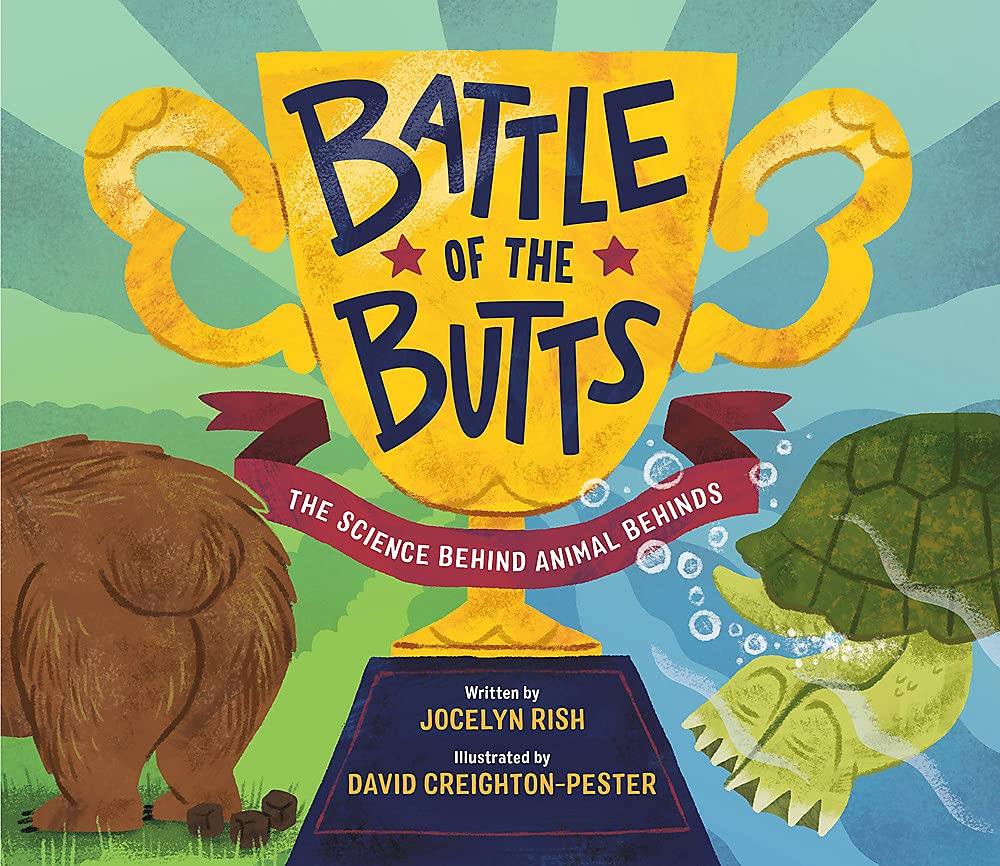
Thanks to Running Press Kids for sharing a copy of Battle of the Butts with me for review consideration. All opinions on the book are my own.
Battle of the Butts: The Science Behind Animal Behinds
Written by Jocelyn Rish | Illustrated by David Creighton-Pester
Get ready to RUUUMBLE! as ten of the world’s most fascinating animals put their butts on the line in Jocelyn Rish’s genius look at how certain sea creatures, mammals, insects, and reptiles eat, swim, talk, and defend themselves using their powerful posteriors. Readers don’t have to passively sit by and read, though. Rish invites kids to judge the challengers based on their own preferences and assign a rating from “Terrific Tushie” to “Boring Backside” on their way to crowning the “King of Keisters.”
Image copyright David Creighton-Pester, 2021, text copyright Jocelyn Rish, 2021. Courtesy of Running Kids Press.
As each challenger steps up, readers are presented with their stats, which include their “genus, length, weight, home turf, and posterior power.” Turning the page, kids are then drawn into the science of each critter’s anatomy and how they use it as Rish – in her conversational, detailed, and descriptive text – uses dynamic phrasing and familiar comparisons to help kids visualize each animal’s endgame. An “Extra Booty” paragraph and a highlighted “Butt Bonus” provide more info.
So who’s on the roster for this awesome competition? First up is the manatee, who moves through the water by holding onto or releasing farts. Lest kids begin “picturing a manatee zipping through the water like it has a jetpack on its back end,” Rish goes on to explain the mechanics of their gas-fueled swimming, how they fill up, and the enormity of their intestinal system that allows them to store their gas until they need it.
Image copyright David Creighton-Pester, 2021, text copyright Jocelyn Rish, 2021. Courtesy of Running Kids Press.
Another fierce contender is the bombardier beetle, which at a max length of 1.181 inches (30 millimeters), proves that mighty things come in small packages. This mini-monster might just become the next superhero, with moves worthy of a big-budget blockbuster. Just picture this movie trailer: “A bombardier beetle strolls through the leaves, minding its own business. A bunch of hungry ants attack. Things don’t look so good for the beetle. Then . . . Pew! Pew! Pew! The bombardier beetle fires a pulsing spray of scalding chemicals from its butt, twisting its tushie in different directions to hit all the ants. The bombardier beetle escapes, while the ants regret their decision to snack on the beetle.” Phew! Pass the popcorn! How do they do this? Rish takes kids step-by-step through the bombardier beetle’s chemical processes that read like a blue-ribbon-winning science fair project, complete with boiling blasts ejected at a “speed of 22 miles per hour.” What if the beetle gets eaten anyway? Find out in the explosive Butt Bonus.
Image copyright David Creighton-Pester, 2021, text copyright Jocelyn Rish, 2021. Courtesy of Running Kids Press.
Not all of these challengers use their powers for defense. Parrotfish, which are found in “shallow tropical and subtropical waters around the world” use their poop to do double doody – I mean duty. You might feel a little squeamish about walking barefoot on a beautiful beach that’s near a coral reef once you learn that “a large portion of that white sand is actually parrotfish poop.” Say what?! Yep! Parrotfish “eat the algae, polyps, and bacteria that live on and in coral reefs.”
To get at it, they also end up ingesting coral and, after its well ground up by the 1,000 teeth along the fish’s beak and the “throat-teeth [that] work like a pepper grinder to crush the bits of coral into fine sand,” they deposit this non-nutritious detritus which then becomes the stuff of sandcastles, tanning beds, and sunny day seaside playgrounds. Sounds like a lot of poop, huh? The Butt Bonus tells you just how much.
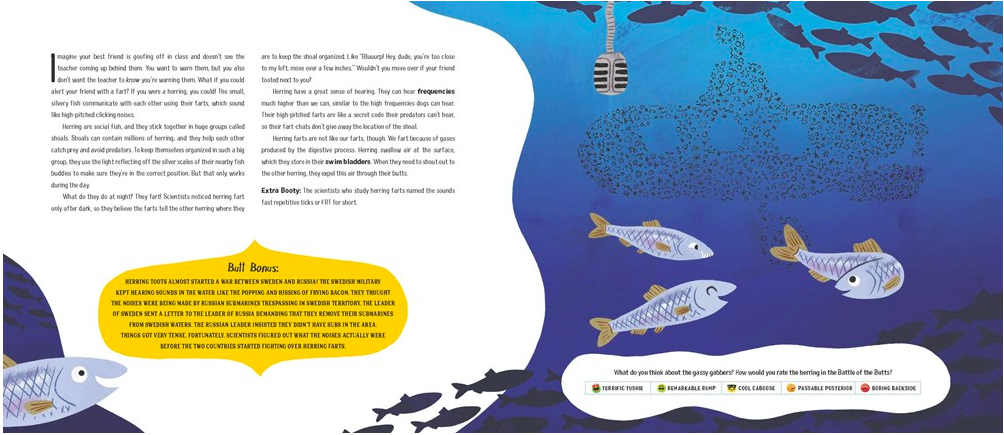
These are just a few of the entrants vying for your verdict. Will any of them win the crown? Or will it be the wombat, with its armored butt; the Fitzroy river turtle, that’s a butt breather; the herring and its unusual communication style; the silver-spotted skipper caterpillar, that puts medieval warriors to shame; the beaded lacewing and its fatal farts; the Sonoran coralsnake that’s a master of confusion; or the sea cucumber, that throws everything it’s got at would-be predators? It’s up to you! Award your favorite with the trophy while rewarding yourself with a full flush of scintillating facts with which to entertain friends and dazzle your teachers!
A Glossary of words found in bold type throughout the book follows the text.
Image copyright David Creighton-Pester, 2021, text copyright Jocelyn Rish, 2021. Courtesy of Running Kids Press.
If you’re looking for a riveting book steeped in nature and environmental science with some chemistry and lots of laughs thrown in for your child, classroom, or other group of kids, you can’t miss with Jocelyn Rish’s Battle of the Butts. Perfect for both younger kids as a read aloud and for independent readers, the book offers opportunities for exciting learning, expanded research, and even experimentation. Rish’s knowledge of her subject and talent for captivating kids jumps off the page with her smooth, alliterative, and hilarious storytelling.
Accompanying each chapter are David Creighton-Pester’s vibrant and dynamic illustrations that accentuate the humor while realistically showing kids how each creature uses their particular skills in their natural environment. Catapulted poop, shooting toots, and funny facial expressions make each page turn a blast. The book’s excellent format also makes it easy to navigate the short chapters and get the most out of all the material presented. At the end of each chapter, kids are invited to rate the creature in this mega-battle of the butts.
A superb way to engage kids in science learning, The Battle of the Butts would be a favorite on any home bookshelf and is a must for school and public library collections.
Ages 4 – 8 and up
Running Press Kids, 2021 | ISBN 978-0762497775
Discover more about Joycelyn Rish and her books on her website.
It’s Shark Week – one of the most anticipated holiday’s of the year! Kids and adults are fascinated by these denizens of the deep, and especially the Great White, which sports fearsome teeth and intimidates with their imposing size. But there are many more sharks in the sea – about 500 species! – and they are an important part of the world’s ecosystem. If Shark Week is your favorite week of the summer, you’re no doubt enjoying a full schedule of shark-related shows on the Discovery Channel. To learn more information about sharks, including statistics from this year’s coastal shark survey, a chance to cast your vote for “freakiest shark,” a line-up of top videos, and more, visit the National Oceanic and Atmospheric Administration’s Shark Week page. To celebrate sharks and the wonders of the ocean every day, you’ll want to put today’s book at the top of your reading list.
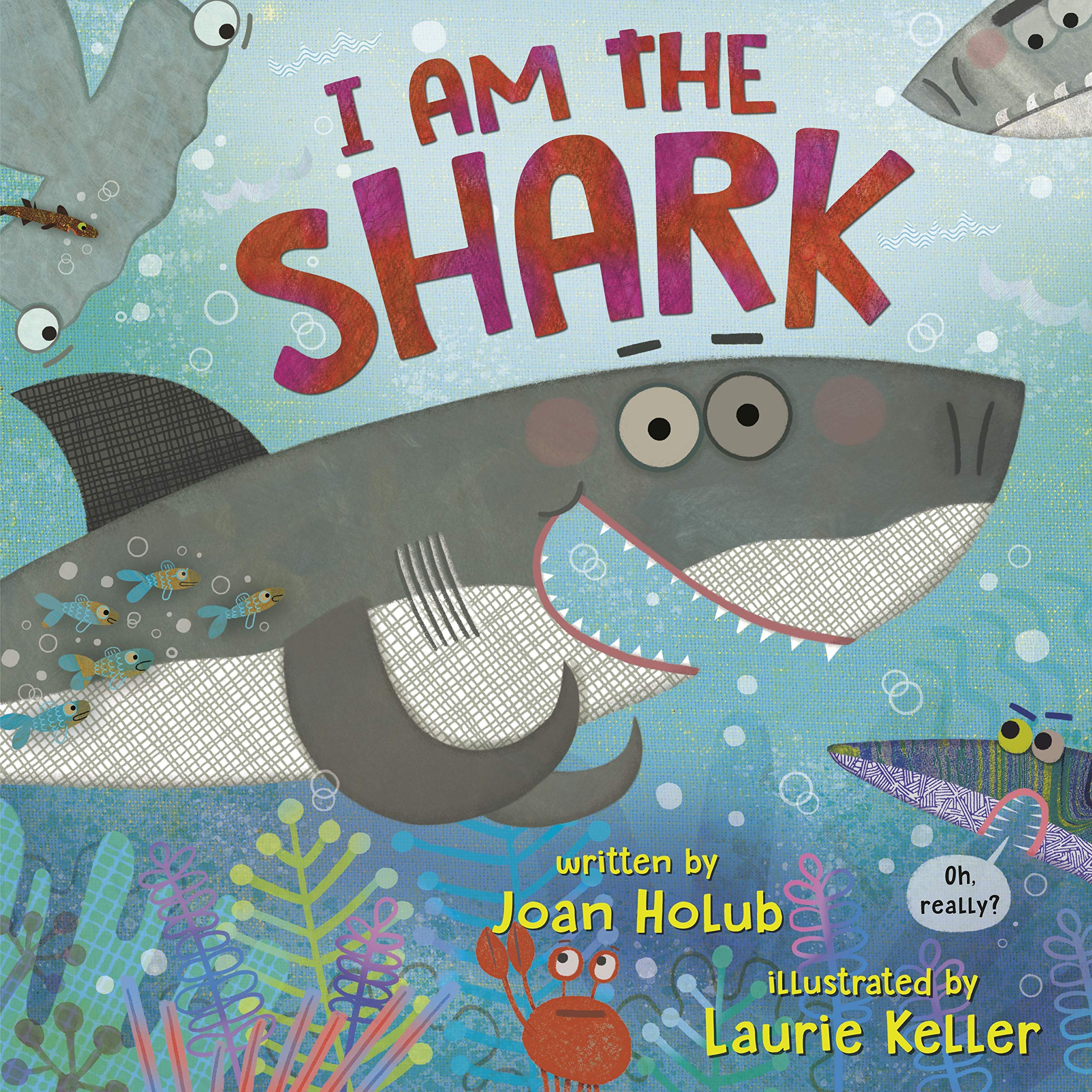
Thanks to Joan Holub for sharing a copy of I Am the Shark with me for review consideration. All opinions on the book are my own. I’m excited to be teaming with Joan in a giveaway package that kids will love. See details below.
I Am the Shark
Written by Joan Holub | Illustrated by Laurie Keller
Great White Shark is excited to introduce himself, especially since he is “the GREATEST SHARK in this book.” But a voice contradicts Great White. Who begs to differ? It’s Whale Shark, and she loses no time in demonstrating why she is “the greatest shark in this book” due to her enormous size, which can’t be matched anywhere in the undersea world. And if that weren’t enough, she adds this bite: “Compared to me, you are small.”
Image copyright Laurie Keller, 2021, text copyright Joan Holub, 2021. Courtesy of Crown Books for Young Readers.
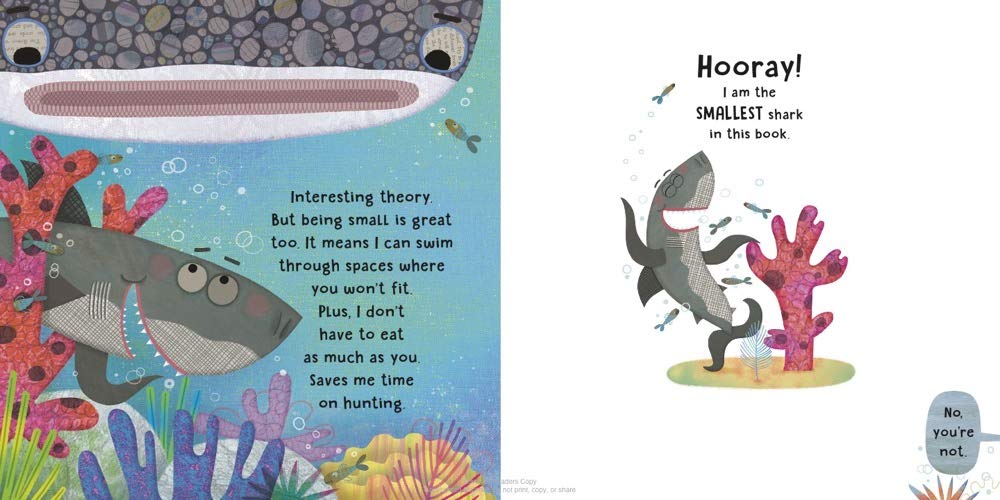
But Great White takes it in stride. If he isn’t the greatest shark, that’s okay because being the smallest has some pretty great perks too. So he’s in the middle of a “smallest shark” victory dance when a voice calls out, “No, you’re not.” It seems there’s a much smaller shark in the sea—Dwarf Lantern Shark, who, besides being the tiniest shark has a rather enlightening ability too. After the long take down from Whale Shark, this time Great White pivots quickly, thinking about how “smart and curious” he is. Could he be “the smartest shark in this book?”
Well, that would be a no. Hammerhead Shark has that one nailed down as well as a unique view of their colorful world. This time, Great White is a little intimidated. “Whoa!” he exclaims. “How can I top that?” But being smart (just not as smart as Hammerhead), Great White has another idea. This one, though, is quashed just like the others in a sneak attack. Turns out Great White isn’t the best hunter, the oldest, or even the “fishiest” shark in this book.
Image copyright Laurie Keller, 2021, text copyright Joan Holub, 2021. Courtesy of Crown Books for Young Readers.
Undeterred, Great White decides to do a little research in other books to “figure out the greatest thing about [him]. He learns all about his different body parts and even shares a labeled diagram (on graph paper and everything) with you. And he doesn’t stop there. He’s discovered all sorts of awesome facts about their skeletons, senses, teeth, skin, and other cool tidbits that he lets you know about. Great White could probably go on and on, but suddenly there’s a “snack alert” and all the sharks take off at top speed after their prey. Great White’s fast! He’s in the lead! Great White’s the fast..est… “Crumbs.” Great White’s passed up by a faster shark. Who is that anyway?
By this time Great White is feeling pretty down in the dumps. “Maybe I should change my name to Just-Okay White Shark or Not-So-Great White Shark,” he bemoans. But then Dwarf Lantern Shark swims up to him and enlightens him with some perspective and sage advice: “Just be happy being you.” Great White takes it to heart. In fact, it helps him think of a new, can’t-miss quality that finally gives him a “GREATEST in this book” status.
Backmatter includes more details on the eight sharks introduced in the story as well as books and links about sharks for kids wanting to learn more.
Image copyright Laurie Keller, 2021, text copyright Joan Holub, 2021. Courtesy of Crown Books for Young Readers.
Kids are always fascinated by the superlative—the fastest, the biggest, the smallest, the silliest, the best—and Joan Holub makes superlative use of this fact in her highly entertaining and educational romp. As Great White goes on a rollercoaster of emotions, one moment thinking he’s the best at something while the next moment having his hopes dashed, readers learn eye-opening details about eight sharks, described in engaging ways that will wow kids. Great White’s boundless optimism is infectious while setting up his disappointment for maximum comic effect. Kids will eagerly await the chance to chime in on the “No, you’re not.” asides that are sure to bring plenty of giggles. But this story isn’t all about sharks. Holub masterfully weaves in an important message for kids about self-acceptance, true happiness, and finding their unique qualities and talents.
Laurie Keller uses her prodigious talent for humor in her up-close images (and is there any other way kids would want to see them?) of these competitive sharks. Loaded with attitude, each shark swims onto the pages to demonstrate their “greatest” trait in ways that will stick with kids and have them excited to learn more. Expressive faces and silly antics add personality and laughs to each page spread. Keller’s vivid, textured, and collage-style illustrations are eye-catching, and funny details, such as Tiger Shark’s tattoos, chain bangle, band-aid, and gold tooth, will have kids lingering over the pages. While they’re there, they’ll want to keep a look out for the Dwarf Lantern Shark who finally lets Great White in on a great secret.
Full of facts, action-packed, and loaded with laughs, I Am the Shark is creative non-fiction at its GREATEST. Kids who love learning about sharks, nature, and the ocean or who just love a fantastic read will want to sink their teeth in this charmer. I Am the Shark is a can’t-miss must for homes, classrooms, and public libraries.
Ages 4 – 8
Crown Books for Young Readers, 2021 | ISBN 978-0525645283
Joan Holub has authored and/or illustrated over 150 children’s books, including the Goddess Girls series and the Heroes in Training series (with Suzanne Williams); the New York Times bestselling picture book Mighty Dads, illustrated by James Dean; Little Red Writing, illustrated by Melissa Sweet; and Zero the Hero, illustrated by Tom Lichtenheld. Her board & novelty books include This Little Trailblazer and Fa la la Llama. Joan adores line dancing to the Jaws theme, reading Sharkspeare, and vacationing in Finland.
Laurie Keller is the author and illustrator of many books, including The Scrambled States of America, Potato Pants!, Arnie the Doughnut, Do Unto Otters: A Book About Manners, the Adventures of Arnie the Doughnut chapter book series, and We Are Growing!, part of the Elephant & Piggie Like Reading! series and winner of the Theodor Seuss Geisel Award. When Laurie isn’t busy making books, she enjoys playing the banjo, traveling, cross-country skiing, and splashing in Lake Michigan, where as far as she knows, there is not a single shark.
The International Day of the Tropics is a United Nations–sponsored holiday that celebrates the extraordinary diversity of the tropics while putting a spotlight on the unique challenges and opportunities the nations of the Tropics face. The Tropics are a region roughly defined as the area between the tropic of Cancer and the tropic of Capricorn and have in common a warm and typically unvaried seasonal temperature fluctuations and the prevalence of rain determined by a region’s proximity to the equator. While it is projected that by 2050, the Tropics will be home to most of the world’s population and two-thirds of its children, the area faces challenges due to climate change, deforestation, logging, urbanization, and demographic shifts. Today’s observance provides individuals, organizations, and governments an opportunity to take stock of progress across the tropics, to share stories and expertise, and to acknowledge the diversity and potential of the region. Today’s book tell the true story of one woman who is working to make a difference.
Thanks to Lee & Low Books for sending me a copy of Galápagos Girl/ Galápagueña for review consideration. All opinions about the book are my own.
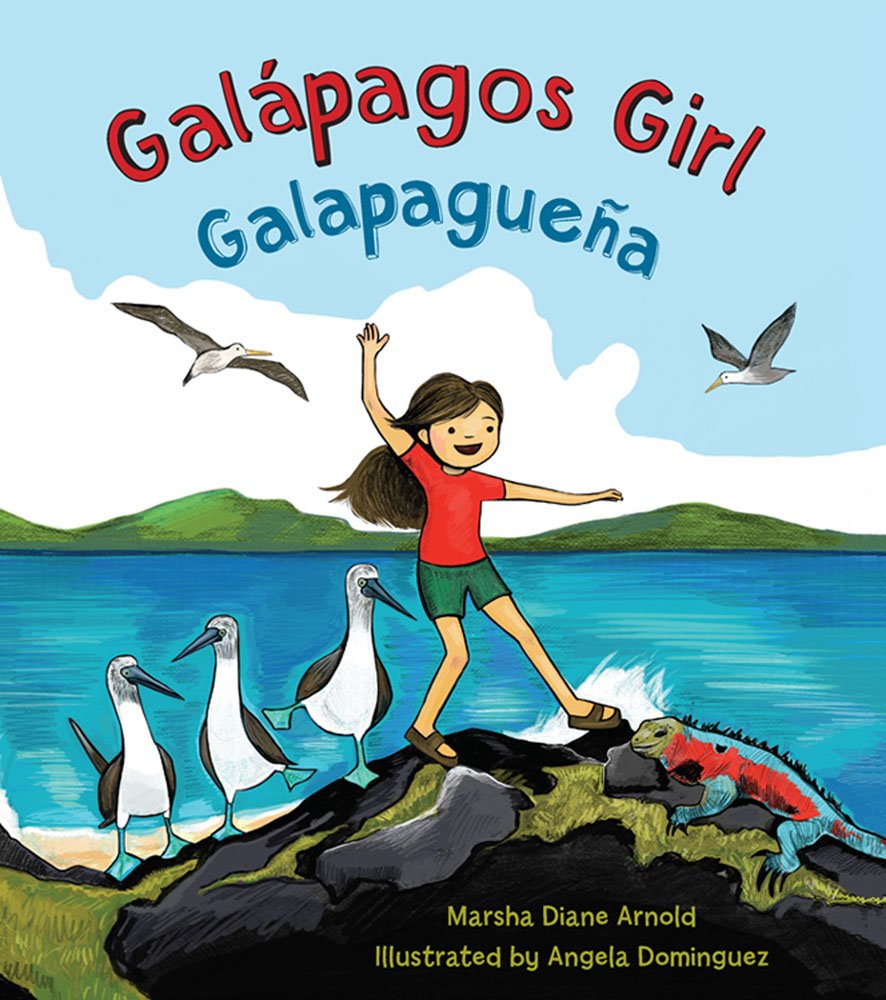
Galápagos Girl / Galapagueña
Written by Marsha Diane Arnold | Illustrated by Angela Dominguez | Translated by Adriana Dominguez
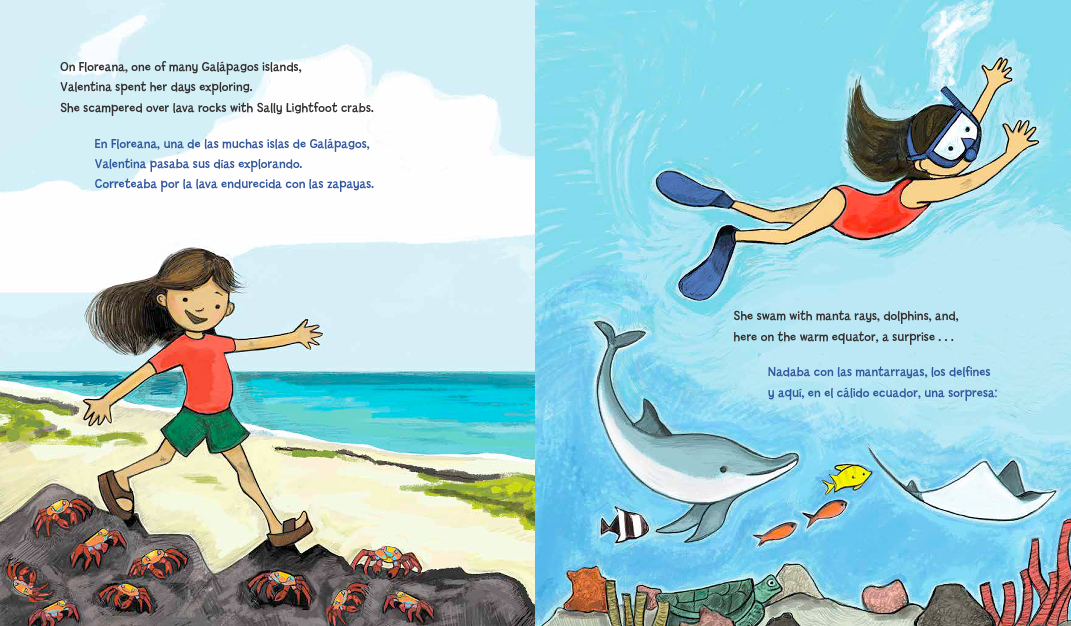
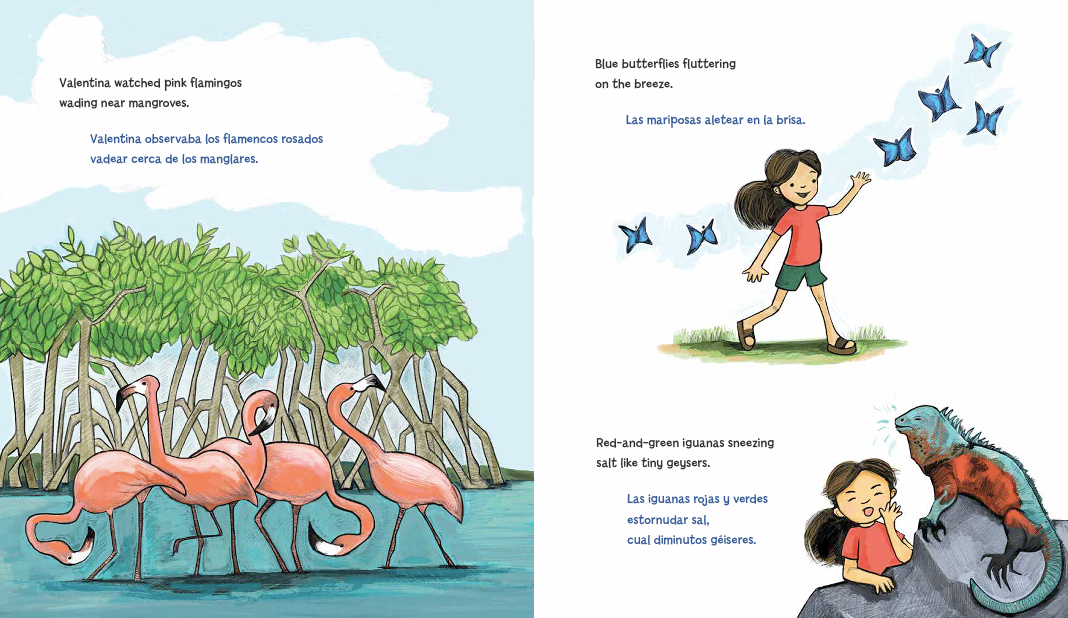
On the day when baby Valentina joined Mamá, Papá, and eleven brothers and sisters, even the sea lions, blue-footed boobies, and iguanas seemed to welcome her to the “island formed by fire.” Valentina loved growing up on the Galápagos Island of Floreana. She explored the lava rocks, where Sally Lightfoot crabs scuttled back and forth. She swam with dolphins and manta rays, and even played with penguins.
Image copyright Angela Dominguez, 2018, text copyright Marsha Diane Arnold, 2018. Courtesy of Lee & Low Books.
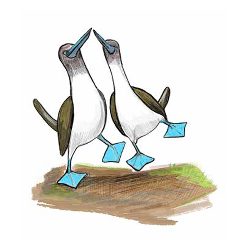
“Valentina watched pink flamingoes wading near mangroves. Blue butterflies fluttering on the breeze. Red-and-green iguanas sneezing salt like tiny geysers.” The crashing waves, albatross, and finches created a symphony as Valentina stopped to rest on a grassy cliff overlooking the ocean. The lava lizards, blue-footed boobies, and twirling sea lions provided young Valentina with a variety of dance partners.
Image copyright Angela Dominguez, 2018, text copyright Marsha Diane Arnold, 2018. Courtesy of Lee & Low Books.
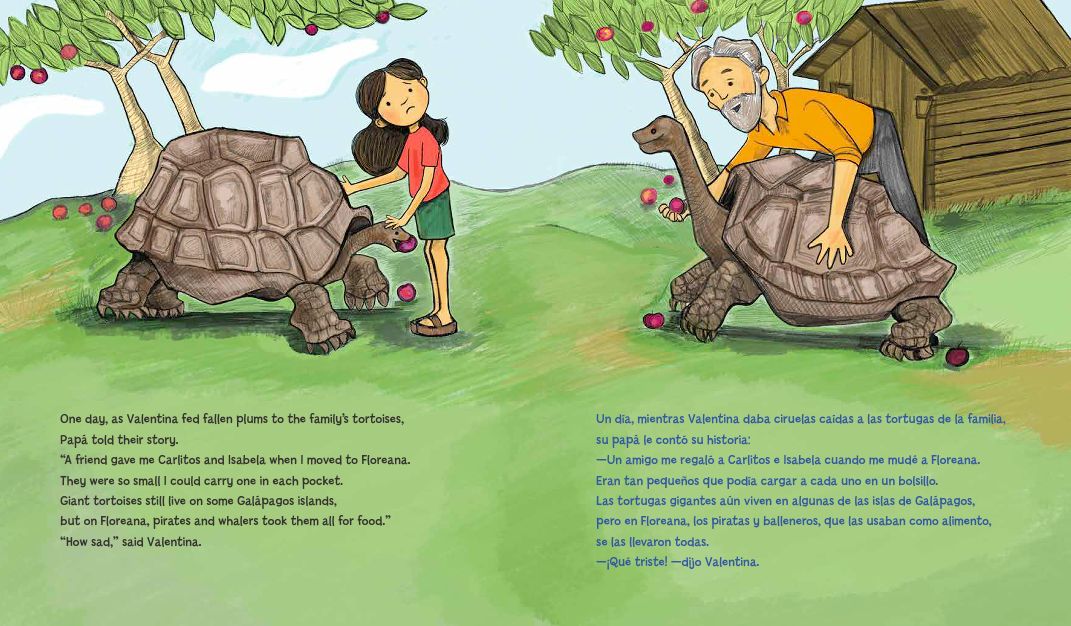
At home, Valentina’s family shared their home with two giant tortoises—Carlitos and Isabella. One day Papá told Valentina their story as they fed the tortoises plums that had fallen from their backyard trees. Papá had gotten Carlitos and Isabella from a friend when he first moved to Floreana. Although it was nearly impossible to imagine now that the tortoises were grown, at the time they were so small that they fit into Papá’s pockets.
Image copyright Angela Dominguez, 2018, text copyright Marsha Diane Arnold, 2018. Courtesy of Lee & Low Books.
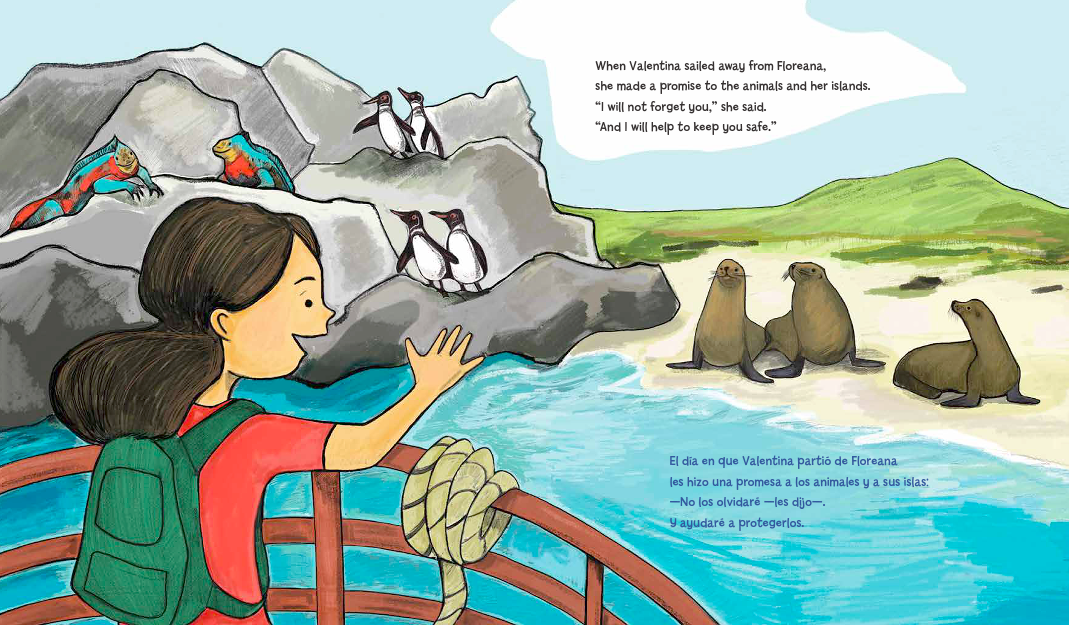
There was also a sad note to Papá’s story. He said that while giant tortoises still lived on other Galápagos islands, pirates and whalers had wiped out the population on Floreana. Papá went on to tell Valentina that many Galápagos animals were in danger. They were “threatened by other animals that don’t belong here. Threatened by people who don’t understand how to care for our islands.” Valentina promised that she would always protect them.
When she was older, Valentina left the island to go to school. She didn’t want to leave her beautiful home, but Mamá told her that she was “ready to learn about the world beyond.” And Papá reminded her that “like our islands, you have a heart full of fire.” On school vacations, Valentina always came back to study the wildlife on the Galápagos islands. She had not forgotten her promise to keep them safe.
Image copyright Angela Dominguez, 2018, text copyright Marsha Diane Arnold, 2018. Courtesy of Lee & Low Books.
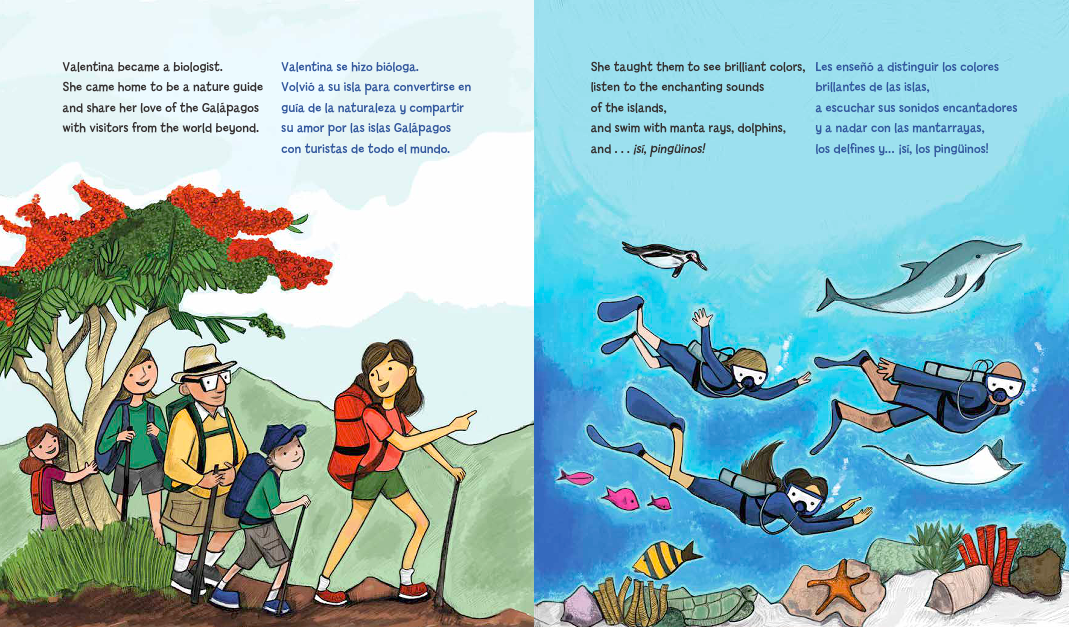
After she graduated with a degree in biology, Valentina returned to the islands as a nature guide to teach visitors about the beauty and uniqueness of the Galápagos. Some visitors were even lucky enough to meet Carlitos and Isabella when the plums dropped from the trees and the two old tortoises returned from exploring Floreana to eat them. Because of Valentina’s commitment to the Galápagos, her visitors also made a promise to always remember and protect them.
Extensive backmatter includes an Author’s Note about Valentina Cruz, the tortoises Carlitos and Isabella, and the history of tortoises on Floreana. There is also information on the Galápagos as well as fun facts about all of the animals in the story. A bibliography of sources invites readers to learn more.
Each two-page spread presents the text in English and translated into Spanish by Adriana Dominguez.
Image copyright Angela Dominguez, 2018, text copyright Marsha Diane Arnold, 2018. Courtesy of Lee & Low Books.
Marsha Diane Arnold’s lyrical and buoyant passages sing with the carefree joy Valentina felt as a girl exploring her beloved Galápagos and which brought her back home as a biologist to protect them. After seeing Valentina playing and swimming with the native animals and feeding Carlitos and Isabella, readers will also feel Valentina’s sadness at the dangers they face and want to make a positive difference to the environment and the world around them. Arnold’s dialogue-rich storytelling highlights the personal nature of the subject and will draw children into Valentina’s world.
Saturated with glorious color, each of Angela Dominguez’s illustrations is a celebration of the splendor of the Galápagos. Playful sea lions, high-stepping blue-footed boobies, scampering crabs, and even a sneezing iguana will captivate young readers and inspire them to learn more about these creatures and the islands. Images of Valentina camping out to study the animals during school breaks will excite environmentally conscious kids, and pictures of Carlitos and Isabella happily munching on plums will generate smiles and “awwws.”
Galápagos Girl / Galapagueña will excite kids to learn more not only about the Galápagos region but about their own local environment, and the call to action will spark an enthusiasm for protecting the earth’s animals. The book would make an inspiring addition to home bookshelves and an excellent way to begin classroom discussions on environmental issues and science lessons. The engaging Spanish translation will delight Spanish-speaking and bilingual families.
Ages 4 – 8
Lee & Low Books, 2018 | ISBN 978-0892394135
Discover more about Marsha Diane Arnold and her books on her website. You can also download activity sheets and teachers’ guides for most of her books here as well.
To learn more about Angela Dominguez, her books, and her art, visit her website.
Welcome Marsha Diane Arnold
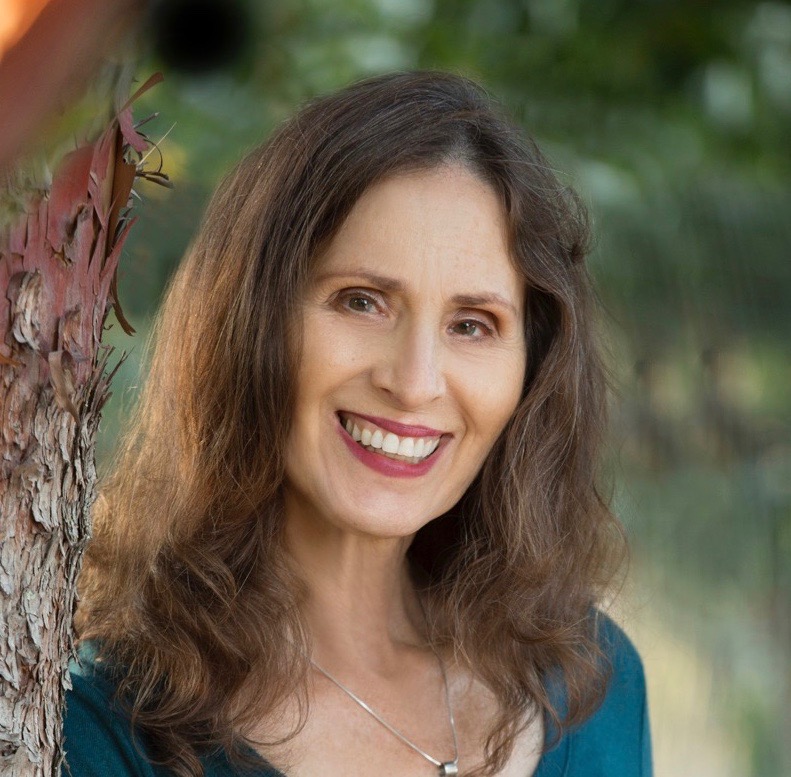
In 2018, I was thrilled to talk with award-winning picture book author Marsha Diane Arnold about the backstory of Galápagos Girl / Galápagueña. Her interview, originally for National Wildlife Day, is just as timely today. Marsha was inspired to write this story after traveling to the Galápagos Islands, where she met Valentina Cruz and had the opportunity to swim with sea lions and dolphins.
Marsha Diane Arnold is an award-winning picture book author whose books have sold over one million copies. Her 21st book, Lights Out, was published in the fall of 2020.Arnold’s other books include Badger’s Perfect Garden, May I Come In? and Mine. Yours. Among Marsha’s honors are the Ridgeway Award for Best First Book, state Children’s Choice awards, IRA Distinguished Book, and Smithsonian Notable Book. Her bilingual book Galápagos Girl was selected as a 2019 Bank Street Best Books of the Year, a Campoy-Ada honor book, and a 2019 Green Prize in Sustainable Literature. The media has referred to her as, “a born storyteller.” Educators have called her a “true literary artist” whose books show “warmth and respect for one’s self.” She lives with her family in Alva, Florida.
Thank you, Kathryn, for inviting me to celebrate Galápagos Girl / Galápagueña, along with conservation of wild places and animals!
As a child, would you have enjoyed swimming with sea lions? Feeding plums to giant tortoises by hand? Having warblers fly through your house? That was the life of Valentina Cruz. Galápagos Girl is based on her idyllic life on remote Floreana island in the Galápagos Islands, a volcanic archipelago west of Ecuador.
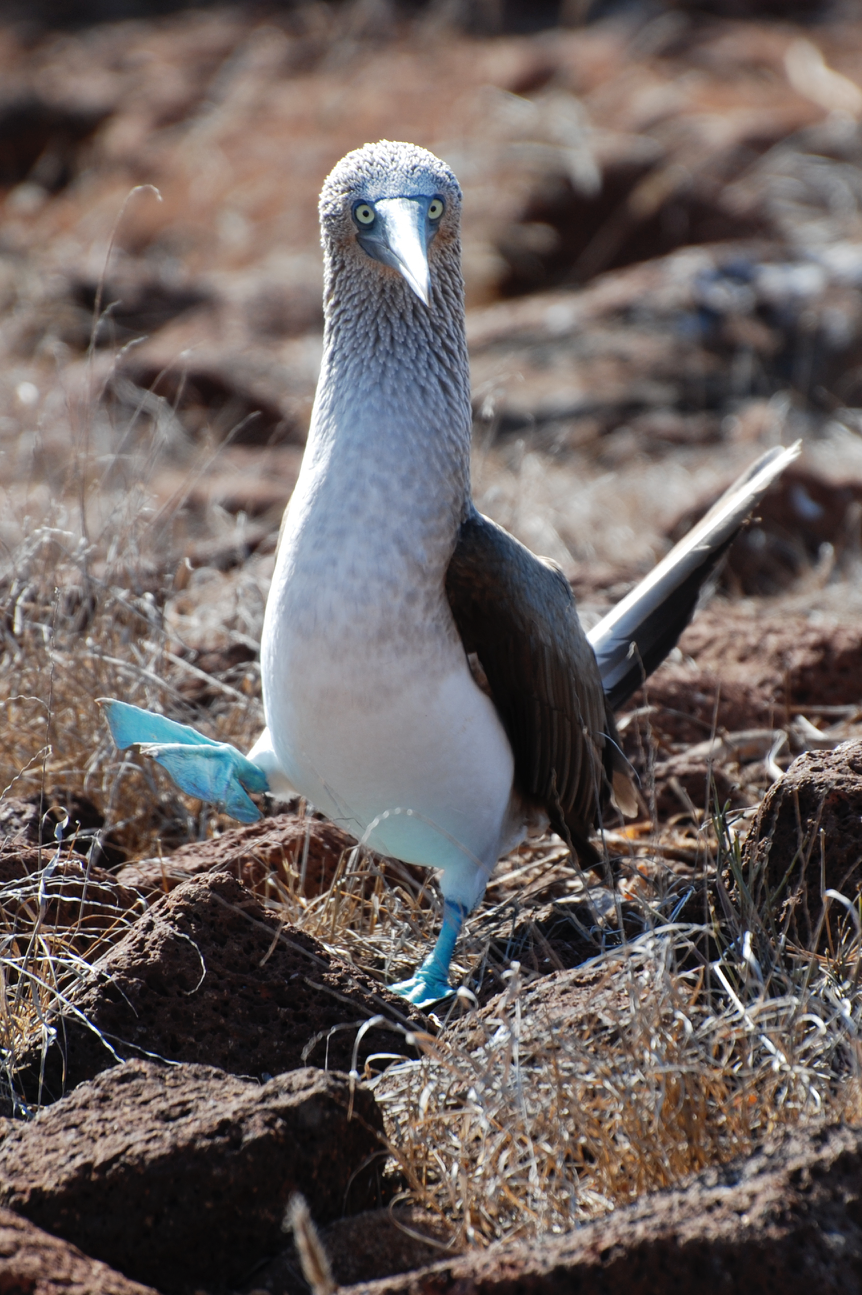
My photos of actual blue-footed booby and Galápagos marine iguana.
Valentina grew up surrounded by nature, but perhaps more accurately, she grew up in nature. I think when a child grows up seeing wild wonders every day, they grow up respecting and protecting nature and wildlife. Valentina and her siblings certainly did. She grew up to be a biologist and naturalist guide. One brother, Eliecer Cruz, was director of the Galápagos National Park and, later, director of the Galápagos branch of the World Wildlife Fund. Another brother, Felipe, worked on many projects with the Charles Darwin Research Station, including studying the challenges that face the Galápagos petrel. Her sister, Marilyn, is director of Galápagos Biosecurity Agency, which helps control and prevent invasive species in the islands.
In some ways, Valentina’s childhood was similar to mine. She was surrounded by a loving family—her parents and eleven brothers and sisters. I only had one brother, but along with my parents, cousins, aunts, and uncles, we gathered on many Sunday afternoons at my grandmother’s house. Valentina and I both delighted in nature, though hers was a more exotic nature—the distant Galápagos Islands, where Charles Darwin discovered those famous finches and came up with his theory of natural selection. Mine was a small farm on the Kansas plains—I didn’t see the ocean until I was an adult. Valentina had Galápagos tortoises as pets and swam with sea lions. (Of course, keeping tortoises as pets is not allowed today.) I played with my neighbor’s pet raccoon (also, not allowed today) and listened to the meadowlark’s song from the roof of my house.
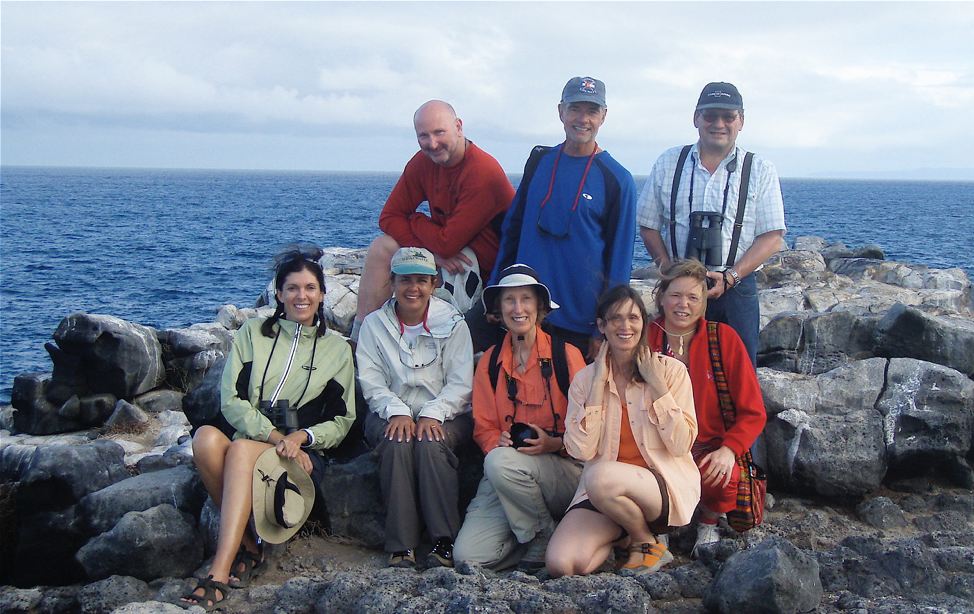
Valentina loves nature, home, and family, but has the soul of an adventurer. I’m much the same. When I grew up I yearned to see as much of the world as possible. When my long-time traveling buddy, Jean Gallagher, asked me to travel with her to the Galápagos, one of my long-time dreams came true.
The Galápagos Gang – fellow travelers to a far-off land. Jean is 3rd to right in front. I am 4th.
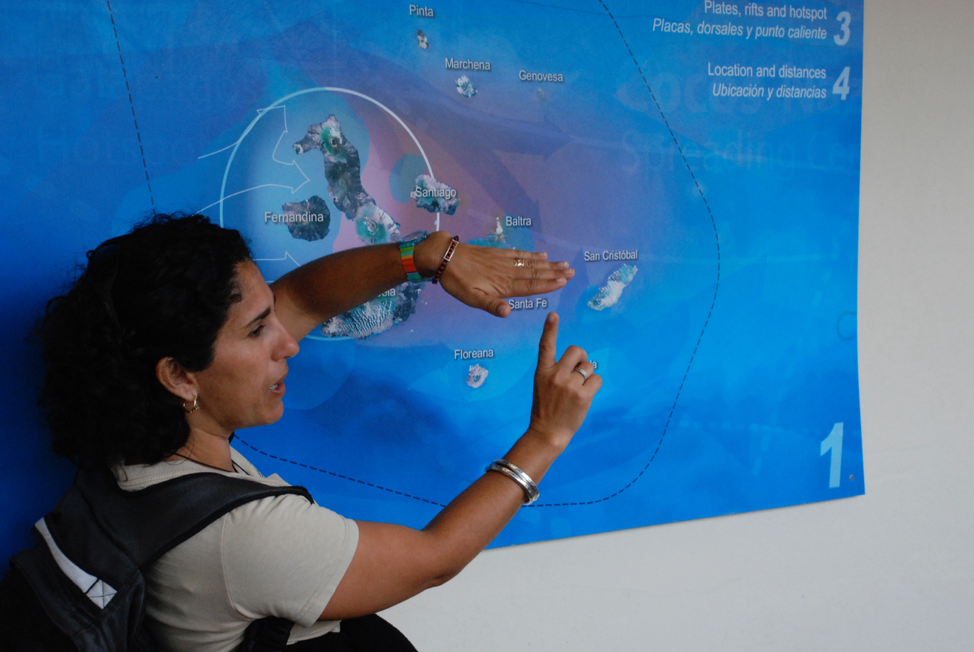
It was on that 2007 trip that I met Valentina, one of our naturalist guides. With her, we visited Floreana and saw the home where she grew up. I was enamored. I thought how wonderful a book about the islands and their unique wildlife, woven together with Valentina’s childhood, would be. Yet it wasn’t until April 2009 that I emailed Valentina and told her of my dream to write a picture book based on her life. Over months and years, Valentina generously shared her stories with me.
Valentina showing us the lay of the land.
Valentina got her sense of adventure and love of nature from her father, Eliecer Cruz Cevallos, who first arrived in the Galápagos in 1939. He was one of only 100 people living in the Galápagos at that time!
Eliecer returned to Ecuador and married Valentina’s mother, Emma Bedon. She made him promise they would never live in the Galápagos. Who can blame her? They’d have almost no human neighbors! But in 1944, she changed her mind. Emma sailed to Floreana with Eliecer to build a life together. Valentina told me that even living in the wild, her mother taught her children “to keep all the rules of a city so we do not grow up wild.”
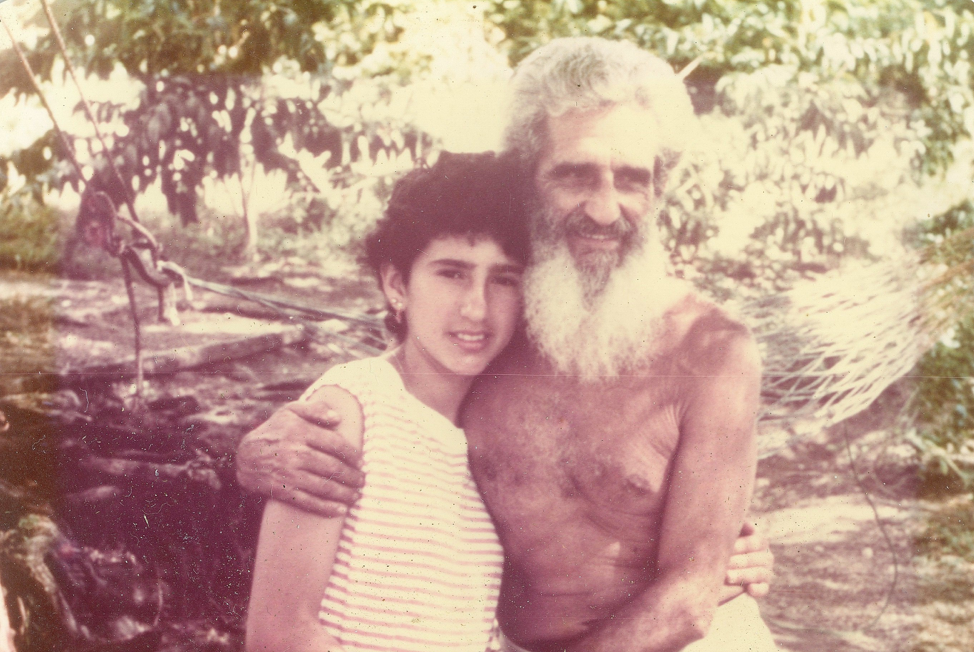
Valentina and her father on Floreana
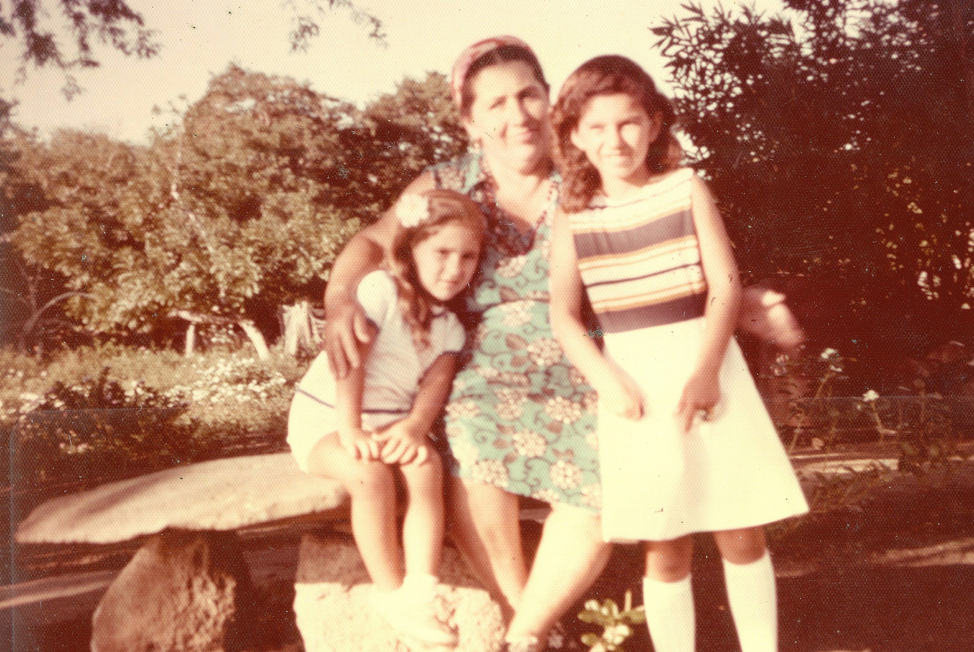
Valentina, her mother, and her sister
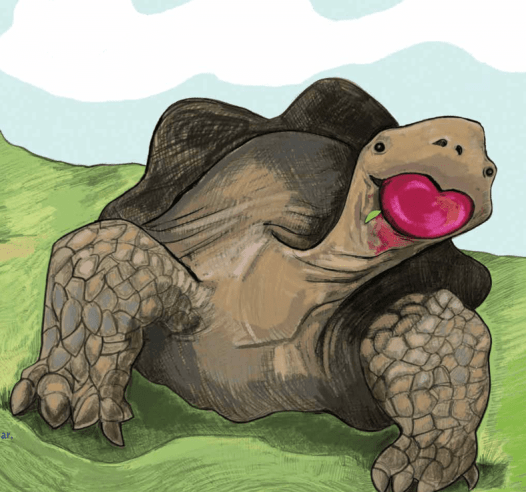
Two Galápagos tortoises were a big part of Valentina’s childhood, so I had to include them in Galápagos Girl. Floreana tortoise had long been extinct (or so it was thought). So when Eliecer moved to Floreana, his friend gave him young tortoises from other islands. Eventually, the family released the tortoises to roam free. One of the most exciting things that happened to Valentina as a child was seeing the tortoises return to their farm that first year after their release. The main reason was the tasty plums dropping from the trees. Every year after that, when the plums ripened, the family waited for the tortoises to return. They always did!
An illustration of one of the family’s tortoises eating a plum treat by Angela Dominguez
The tortoise story changed several times during the writing of my book due to Valentina’s remembering more over time, checking facts with her family, and a discovery near Wolf Volcano on Isabela, another Galápagos Island. What’s in my book isn’t exactly the way things were, but it’s close to the real story. As Valentina wisely shared: “Each of us remember things in different ways. Our memory is like pictures of what impresses us in that specific moment, so everything can be true and everything can be fiction.”
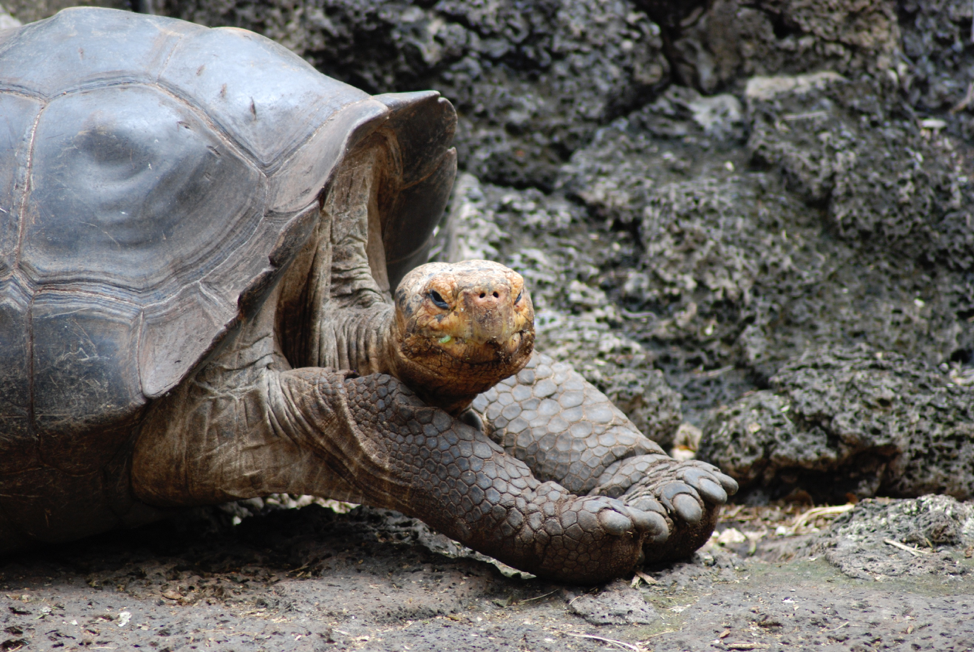
One of eleven species of Galápagos tortoise
Regarding the exciting discovery on Wolf Volcano, scientists recently found tortoises there that carry some of the Floreana tortoise genes! There is a project now to bring these tortoises back to Floreana. Wouldn’t it be wonderful to have partial Floreana tortoises wandering freely, restoring the ecology of Floreana?
You may ask, “How did Floreana tortoises get on Isabela Island?” That’s one more fascinating question about the Galápagos. If I visit your school, you can ask me and I’ll share more.
Thanks so much, Marsha, for sharing the fascinating story behindGalápagos Girl / Galápagueña!
There are so many fascinating animals that live in the Galápagos! Can you match the picture of each animal to its description in this printable Animals of the Galápagos Match Up Puzzle? You can find and download the activity sheet from the Lee & Low Books website:
Earth Day was created in 1970 by a US Senator, Gaylord Nelson. Nelson created the day because he was worried about how humans were harming the environment through their actions. Heard of this holiday before? We certainly hope so! In 1990, environmental leaders mobilized to make the holiday go global. And now, according to earthday.org, 1 BILLION people mobilize on Earth Day every year, to help save and celebrate our beloved planet. You can watch an educational animated video on Gaylord Nelson here. Learn more about Earth Day and how you can make a difference all year around at Earthday.org.
National Poetry Month
2021 marks the twenty-fifth anniversary of National Poetry Month. The holiday was launched by the Academy of American Poets to celebrate writers, poets, poetry lovers and the positive impact poetry has on our culture, literacy and lives. Check out the 2021 National Poetry Month Poster here. You can learn more about National Poetry Month at Poets.org.
Today’s book celebrates both of these holidays with a collection of ocean poems for children. Not a huge lover of poetry? Perhaps the following collection will sway you like an ocean tide. Crafted by The Writers’ Loft Authors and Illustrators, Friends and Anemones is truly as dazzling as a sea-floor pearl.
Thanks to The Writers’ Loft for sending me a copy of Friends and Anemones: Ocean Poems for Children for review consideration. All opinions on the book are my own.
Reviewed by Dorothy Levine
Friends & Anemones: Ocean Poems for Children
By The Writers’ Loft Authors & Illustrators
Dive headfirst into poetry month by exploring “the very, very, bottom of the deep blue sea. With: Salty snails and tuna tails. Bottle caps and lobster traps. Popped balloons, Plastic spoons…” and everything in between! (The Bottom of the Ocean by Kristen Wixted.) In honor of Earth Day AND National Poetry month, Celebrate Picture Books presents a book that deserves to be celebrated twice over: Friends & Anemones: Ocean Poems for Children. Seventy New England authors and illustrators joined ship with the Rozalia Project to create a treasure-worthy collection of ocean-themed poems and illustrations.
As described in the title page, “Rozalia Project works to conserve a healthy and thriving marine ecosystem—the plants and animals need our help to keep human debris out of their homes.” Through this partnered anthology, children will learn about subject matter ranging from unique sea creatures and beach dwellers – like cuttlefish, vampire squids, red knots, and rainbow lobsters – to the habits of more well-known ocean dwellers, like whales taking off debris, sharks getting their teeth cleaned, and sea turtles hatching eggs.
They’ll also find poems about human additions to the ocean scene in odes to lighthouses, ships’ remnants, sea litter, and more. Each poem contains deep knowledge to share with readers about poetry, the ocean, and marine life. Little pieces of advice float in between hysterical ocean puns. This perfect concoction of sea-worthy information is also backed by all types of fin-tastic and crabulous art.
Some of the poems are sure to make you laugh out loud. Deep-Sea Jellyfish by Cindy Cornwall opens with: “Jelly of the sea, not jam for your toast. It’s deep in the water, a silky scarf ghost.” Seal of disApproval by Lynda Mullay Hunt fills a whole page with the rhyming, pun-y story of a seal who becomes a dentist and stands up to sharks.
Other poems are less humorous and more pensive; the last of the series, Sea Serenity by Luke Hargraver, holds an existential truth for readers to swim through: “The world is like water / Easily disturbed by ripples / But when still, / Beautiful.” Under a short and sweet poem called Minnow, by Brook Gideon, a message to ocean explorers reads: “It’s very important to release everything you catch back into the ocean right away!”
Each spread is distinctly created in the individual poets’ and artists’ styles. Yet, the whole compilation works together in perfect, charming harmony. Some poems mirror each other in content. Horseshoe Crabulous by Doreen Buchinski is followed by Red Knots by Jane Sutton, in which: “In the sand their goal is chiefly / To dart—and swerve —on twiggy legs / In mad search for horseshoe eggs.” The two beautifully crafted poems are followed by a third gem, Mollusk Mansions by Charlotte Sheer, and accompanied with an illustration featuring horseshoe crabs, red knots, and mollusk shells—all painted by Doreen Buchinski herself!
Children will explore the deep cerulean sea through a range of sincere rhyming couplets, honest haikus, positively silly prose, magical motifs, and everything in between. All poems and artwork share with readers a deep admiration for under the sea creatures, while spreading ocean knowledge, and a love for poetry and beauty.
The watercolors, collages, and digital art pieces mesh beautifully while each achieving a distinctly artistic picturesque scene. Some illustrations run horizontally across the spread to create poster-like, masterful images. On page 23 illustrator Julia Young Cuffe paints a long, horizontal lighthouse against a watery dark blue sky, littered with stars. A person stands at the top, waving a piece of cloth, illuminated by the lighthouse light. The poem, Boston Light by Heidi E.Y. Stemple, is artfully placed running vertically down the lighthouse.
Others run across the two-page spreads to create one image that ties together the poems featured on the separate pages into a collective unit. An example of this can be seen in Marlo Garnsworthy’s opening spread of deep ocean waves intermingling with whales, and Amanda Davis’s DEEP deep sea spread that features spookily realistic vampire squids, angler fish, and sea plumes. Each piece stands out as thoughtfully crafted to instill in readers a sense of awe for the beauty of marine life and ocean ecology.
Friends & Anemones: Ocean Poems for Children would make a wonderful addition to classroom science and language arts lessons as well as a fun collection to share at home, especially in conjunction with trips to the beach or aquariums.
The Writers’ Loft is a community based in Sherborn, Massachusetts which helps local writers foster their creativity, strengthen their spirit, and grow professionally by providing them with quiet writing space, educational programs, opportunities to connect with supportive colleagues, and access to industry experts, as well as opportunities to give back to the greater writing community. To learn more about The Writers’ Loft, visit their website.
The Rozalia Project runs educational programs, ocean cleaning initiatives and research projects focused on how to aid ocean clean-up and maintain sustainability of ocean and shoreline ecosystems. The Rozalia Project, along with the “Writer-and-Artist-Ocean-Protectors from the Writers Loft” hopes to use this book to “foster an appreciation of the importance, beauty, and wonder of the ocean in the change-makers of tomorrow.”
To learn more about the Rozalia Project, or get involved with them on this Earth Day, check out their website. You can also watch this video on their Expedition CLEAN.
Earth Day and National Poetry Month Activities
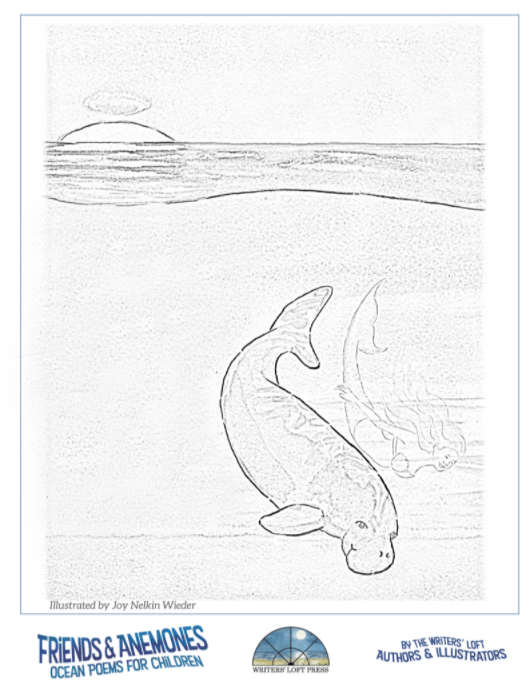
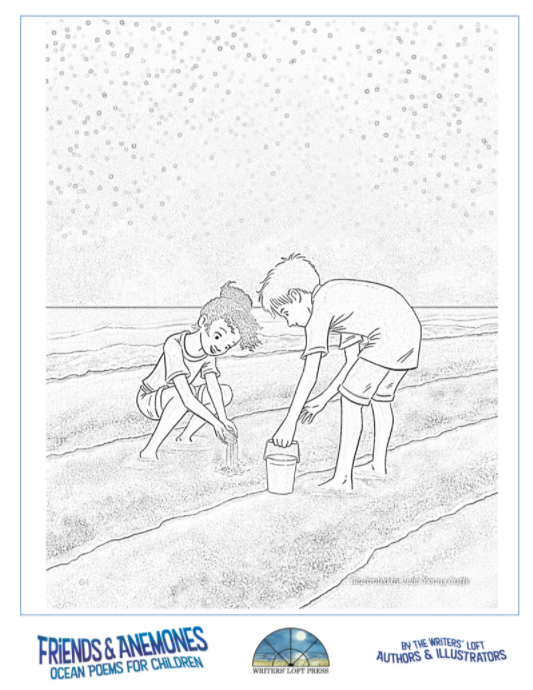
Color pages from Friends & Anemones in your OWN style with these black and white versions of the illustrations. You can find 18 more pages to print or download to your iPad to color on The Writers’ Loft website.