March 13 – International Dark Sky Week

About the Holiday

International Dark Sky Week (IDSW) was founded in 2003 by high school student Jennifer Barlow, who wanted to raise awareness about the problems caused by light pollution and invite people to make beneficial changes. The initiative is now managed by DarkSky International, an association founded in the 1980s by astronomers with the hopes of restoring the nighttime environment from the damage created by the excessive use of light. To learn more about DarkSky International and how you can help, visit them at idsw.darksky.org. Make sure to check out their Activity Page for kids crafts, activity pages, virtual nighttime and NASA tours, and ways that you and your family can get involved in citizen-science projects, and more!

Thanks to Eerdmans Books for Young Readers for sending me this book for review!

Who Hid the Stars?: How Light Pollution Changes Our World

Written by Danio Miserocchi and Maciej Michno | Illustrated by Valentina Gottardi | Translated by Sylvia Notini


Through their informative text, translated from Italian, Danio Miserocchi and Maciej Michno take readers on nighttime walks to see for themselves the types of artificial light that, while beneficial to humans are detrimental to many creatures. They begin with a short history of artificial light and define light pollution while Valentina Gottardi illustrates how outdoor light fixtures can be shielded for least-polluting effect.

In their chapter on birds, Miserocchi and Michno discuss how artificial light creates unnatural and even dangerous conditions for diurnal birds, who sleep at night; nocturnal birds, who need darkness to hunt; and night-flying migratory birds, who can get lost or confused by lights along their routes. Gottardi’s map showing the world lit up at night will fascinate readers while demonstrating how pervasive, bright, and intrusive artificial light is for migrating birds. The authors also reveal how some birds have learned to use artificial lighting to their advantage.

Illustration copyright © 2026 by Valentina Gottardi. Text copyright © 2026 by Danio Miserocchi and Maciej Michno. Courtesy of Eerdmans Books for Young Readers.

A chapter on insects clearly explains how artificial light not only attracts nocturnal insects but how it confuses their natural flight patterns and why we see moths swarming around streetlights, porch lights, and other outdoor fixtures. An interesting spread on fireflies goes in depth on how and why they light up, their blinking communication codes, and all the ways artificial disturbs them. Children also learn how light affects bats, small mammals, amphibians, spiders, and even underwater creatures.

Illustration copyright © 2026 by Valentina Gottardi. Text copyright © 2026 by Danio Miserocchi and Maciej Michno. Courtesy of Eerdmans Books for Young Readers.

It might surprise you that artificial light can even alter the growth and seasonal shifts of trees and plants. From plants’ blooming schedules to pollinator visits to vulnerability to disease and even to the impact on allergies, extended light exposure creates issues that affect us all. In closing, Miserocchi and Michno invite readers to look up at the nighttime sky and contemplate how many stars you can see. They then encourage us to take steps—even small steps—to reducing light pollution around our homes and neighborhoods.

Back matter includes a glossary, simple ideas anyone can do to reduce light pollution, and resources for learning more.

Illustration copyright © 2026 by Valentina Gottardi. Text copyright © 2026 by Danio Miserocchi and Maciej Michno. Courtesy of Eerdmans Books for Young Readers.

Danio Miserocchi’s and Maciej Michno’s straightforward text is as engaging as it is informative. Not only do readers discover the harmful effects of artificial light pollution in general, but they learn about specific species of insects, birds, and other creatures and the various ways their habits and habitats—altered by light pollution—begin chain reactions with wide-ranging adverse results. 

Valentina Gottardi’s luminescent mixed media illustrations transport readers to nighttime landscapes, where her beautiful, nearly photographic images of a wide array of birds, moths and fireflies, bats, geckos and toads, fish and sea turtles will captivate nature lovers. Between chapters, Gottardi’s two-page spreads beckon readers to explore a darkened park dotted with glowing lamps, a city courtyard where street lights and apartment windows glow, and a glitzy boulevard, where the neon glare never sleeps.

Eye-opening science wrapped in nature’s nighttime beauty, Who Hid the Stars?: How Light Pollution Changes Our World is an impactful addition for classrooms, school and public library collections, and for all children interested in the environment and nature.

Ages 8 – 14

Eerdmans Books for Young Readers, 2026 | ISBN 978-0802856517

About the Authors

Danio Miserocchi is a coauthor of The Tomorrow Tree (Phaidon) and Who Hid the Stars? (Eerdmans). He is an Italian naturalist and teacher who works with museums and community organizations on conservation and biodiversity initiatives. Follow her on Instagram @daniomiserocchi.

Maciej Michno is an editor at Cocai Books, which creates educational, scientifically verified books focused on often-overlooked natural subjects.  His titles include Who Hid the Stars? (Eerdmans) and The Tomorrow Tree (Phaidon).

About the Illustrator

Valentina Gottardi has pursued her dual passions of art and nature since childhood. At Cocai Books, she serves as artistic director and designer for all projects, including Who Hid the Stars? (Eerdmans), and The Tomorrow Tree (Phaidon). Visit her here.

About the Translator

Sylvia Notini has translated over 200 titles from Italian into English, including Who Hid the Stars? (Eerdmans) and Sea Wonders (Princeton Architectural). Her translation of Just a Girl (HarperCollins) won the 2023 Mildred L. Batchelder Award, and her translation of Chickenology (Princeton Architectural) was a finalist for the AAAS Prize for Excellence in Science Books. Sylvia lives in Castenaso, just outside of Bologna, Italy. Visit her at sylvianotini.com.

International Dark Sky Week Activity

Look deep into the naturally dark night sky over Bryce Canyon National Park as Astronomy Ranger Kelly Ricks talks about the stars, the Milky Way, and the excitement of children seeing it all for the first time!

You can purchase Who Hid the Stars? from these booksellers

Amazon | Barnes & Noble | Bookshop

Picture Book Review

April 6 – National Poetry Month

About the Holiday

The Academy of American Poets established National Poetry Month in April 1996, making this year the 30th anniversary of this event that has become the largest literary celebration in the world. The holiday highlights  the achievements of poets, past and present; to promote the reading and writing of poetry in schools and by individuals; and to encourage people to discover the joys poetry can bring all year round. To celebrate, check for events at libraries, bookstores, schools, and other venues in your area and enjoy reading the work of your favorite—or a new—poet. You might even try writing your own poetry! Get inspired all year long with today’s book! To learn more visit the Academy of American Poets and American Writers Museum.

Poems for Every Season: A Year of Haiku, Sonnets, and More

Written by Bette Westera | Illustrated by Henriette Boerendans | Translated by David Colmer


We may begin our year in January, but Poems for Every Season takes it’s cue from nature, which celebrates renewal in Spring. Bette Westera welcomes March and warming weather with her rondel “Spring Dance,” in which a newborn lamb “. . . wobbles through the field with knobbly knees” but soon “gambols, bucks, and bounces . . . with ease” as nearby the farmer plants corn and the mother sheep rests. By April we’re all feeling like gamboling, but Westera acknowledges such “Spring Fever” with the now busy bees and butterflies in her acrostic poem that is a homage to Vincent Van Gogh alongside Henriette Boerendans’ woodcut of almond branches—one of Van Gogh’s favorite subjects to paint.

Illustration copyright © 2026 by Henriette Boerendans. Text copyright © 2026 by Bette Westera. Courtesy of Eerdmans Books for Young Readers.

In her summer haiku, Westera opens the warmest season with the steady and reassuring resolve of bees: “Bumblebees buzz by / Golden sunlight fills the sky / It must be summer.” Her pantoum poem for June, “The Longest Day”, takes place on the summer solstice—that day when “the sun’s refusing to go down” and “there’s much too much to see”—as a mother deer cautions her newborn fawn to lie low in the grass and be quiet while she grazes and a fox waits for darkness that will not come. August rings with a request from sunflowers to stormy clouds before autumn is upon them.

Illustration copyright © 2026 by Henriette Boerendans. Text copyright © 2026 by Bette Westera. Courtesy of Eerdmans Books for Young Readers.

The cooling temperatures of Fall bring “Windfall” apples in September, and a diamond-shaped diamante verse for October pays tribute to animals and plants that bravely face the shivery days of mid-autumn. A repeating line in Westera’s charming rondelet for November celebrates the snuggly warmth of the season before winter comes with it’s ice and snow. A playful December limerick eavesdrops on the “Stay-at-homes”—those birds who know the benefits of a free buffet. And suddenly we’re in the deepest part of winter, with January’s defining colors eloquently found in the feathers of a goose. January, however, soon gives way to a hopeful thaw in February and the whispers of a beckoning spring in Westera’s sonnet that reminds us of the character of this mercurial month.

The poems are followed by conversational discussions about each poetic form that will enlighten readers and prove instructional for writers and teachers. The poems include haiku, rondel, acrostic, double dactyl, pantoum, elevenie, tanka, quatrain, diamante, rondelet, limerick, stacking poem (an invention by Bette Westera), and sonnet.

Illustration copyright © 2026 by Henriette Boerendans. Text copyright © 2026 by Bette Westera. Courtesy of Eerdmans Books for Young Readers.

Bette Westera opens a curtain on fleeting, heart-stirring moments in nature throughout the year with her poems that are as alluring as they are direct. Her lovely vignettes are layered with humorous similes, charming anthropomorphism, unexpected happenstance, and sometimes the hint of danger. Each varied verse offers a rich reading experience and beckons us to look closely and with appreciation at the world around us. 

Through her exquisite woodcut prints, Henriette Boerendansis allows young readers to join the lambs, deer, birds, and other wildlife on a farm as it hosts them and the changing seasons. Children will relish being within petting distance of a newborn lamb, concealed among buttercups with a fawn, curled up with a hedgehog preparing for hibernation, and the confidante of birds. Boerendansis’s breathtaking colors soothe with the tranquil greens and blues of spring, delight with the deep hues of summer, glow with autumn warmth, and shiver with winter’s icy cloak.

David Colmer’s translation is nimble and smart, illuminating Bette Westera’s combination of humor and insight with easy grace.

Poems for Every Season: A Year of Haiku, Sonnets, and More is a luminous poetry collection that grows more brilliant with every read. It is a book that will enhance any library collection, would make a wonderful gift, and which, at home, should be kept in a place of prominence to be enjoyed throughout the year.

Ages 5 – 9 

Eerdmans Books for Young Readers, 2026 | ISBN 978-0802856524

About the Author

Bette Westera has written over fifty books for children, including Fast Cheetah, Slow Tortoise and the Mildred L. Batchelder Honor Book Later, When I’m Big (both Eerdmans). She has also translated books by Dr. Seuss, Astrid Lindgren, and Julia Donaldson into the Dutch language. Bette lives in the Netherlands, where her books have received two Golden Pencil awards and six Silver Pencil honors. Visit her website at bettewestera.nl.

About the Illustrator

Henriette Boerendansis an Amsterdam-based printmaker and illustrator. Poems for All Seasons is her English-language debut. While walking in nature together one day, Bette and Henriette brainstormed new projects and came up with the idea for this book. Follow Henriette on Instagram @henriette.boerendans and visit her website at boerendans.com.

About the Translator

David Colmer is an Australian writer and translator of Dutch and Flemish literature. He has translated over eighty books throughout his career, including I’ll Root for You, A Pond Full of Ink, and Fast Cheetah, Slow Tortoise (all Eerdmans). His work has been honored with many awards, including the PEN Translation Prize and the Dutch Foundation for Literature’s James Brockway Prize, which recognizes a translator’s body of Dutch-language poetry. David lives in Amsterdam.

National Poetry Month Activity

CPB - Plant Poem

Grow a Poem Craft


A poem often grows in your imagination like a beautiful plant—starting from the seed of an idea, breaking through your consciousness, and growing and blooming into full form. With this craft you can create a unique poem that is also an art piece!

Supplies

  • PrintablLeaves Template, available here and on the blog post — or draw your own
  • Printable Flower Template, available here and on the blog post — or draw your own
  • Wooden dowel, ½-inch diameter, available in craft or hardware stores — or green bamboo or plastic garden plant stakes
  • Green ribbon
  • Green craft paint
  • Colored paper for leaves and flowers
  • Flower pot or box
  • Oasis or clay
  • Hole punch
  • Glue

Directions

  1. Paint the dowel green, let dry
  2. Print the leaves and flower templates — or draw your own
  3. Cut out the leaves and flowers
  4. Punch a hole in the bottom of the leaves or flowers
  5. Write full poems or lines of poems on the leaves and flowers 
  6. String the leaves and flowers onto the green ribbon in the order you want your poem to be read 
  7. Attach the ribbon to the bottom of the pole with glue or tape
  8. Wrap the ribbon around the pole, leaving spaces between the ribbon
  9. Gently arrange the leaves and flowers so they stick out from the pole 
  10. Put oasis or clay in the flower pot or box
  11. Stick your poem pole in the pot
  12. Display your poem!

You can purchase Poems for Every Season: A Year of Haiku, Sonnets, and More from these booksellers

Amazon | Barnes & Noble | Bookshop

Picture Book Review
March 25 – National Reading and March into Literacy Month

About the Holiday

All month long, we celebrate reading—and writing! This focus on literacy spotlights the importance of reading with your children early—even from birth. Reading with your kids helps them develop language and writing skills that will promote future success in school and beyond. Even if your child isn’t talking yet, as you read to them they’re listening and learning about their language, how it sounds and looks on a page. The rich experience in today’s two board books, which combine reading, critical thinking, and fine motor skills, can get you and your little one started on a lifetime of learning. 

Ready for Mazes: Baby Animal Mazes

By Susann Hoffmann


Little ones can’t get enough of baby animals! They squeal in delight when they see tiny ducks, bunnies, and other small animals and just want to pet or be near them. Baby Animal Mazes gives the youngest readers a hands-on chance to help baby animals navigate winding paths while avoiding obstacles to find their family, play games, and complete other fun challenges.

Each visually rich and adorable puzzle introduces a baby animal with a sweet storyline involving family, friends, or a favorite treat. But there’s a catch! In each maze, important parts of the path are missing. Here’s where young readers can help the baby animal cross the two-page spread to their goal by finishing the path. To do this, three sturdy, round disks printed with a section of path (straight-away, intersection, or curve) are provided on the first page. These fit snugly into circles where the path is broken. Children will have fun finding the right piece and how it fits to complete the path. A range of difficulty—from one missing piece to three—offers a challenge and increasing confidence.

Little readers will be enchanted with Susann Hoffmann’s vibrant and charming images of wildlife that are just waiting to be named, counted, or found in an impromptu “I-spy” game. Textured pages keep little fingers on the paths and offer a sensory experience while reading.

With just the right amount of challenge for little ones, plenty of repeat play and readability, and a large, durable format, Baby Animal Mazes will be a favorite go-to book on any young child’s bookshelf. The book makes a perfect take-along activity and gift.

Ages 2+

Twirl, 2026 | ISBN 978-2408061951

Susann Hoffmann is a freelance illustrator and animator. Her work can be seen in various digital media, books, and film. She lives in Hamburg, Germany. Visit her at susannhoffmann.com.

You can purchase Ready for Mazes: Baby Animal Mazes from these booksellers

Amazon | Barnes & Noble | Bookshop

Where Are You, Baby?

By Elena Selena


Sweet endearments, loving looks, and cuddly togetherness makes this interactive board book a perfect companion for snuggly story times with your baby or young child. “Where are you, little one?” mother and father animals ask, and children will love lifting the intricately cut lion, hedgehog, parrot and other flaps to discover the babies underneath. “Here I am!” they eagerly answer. Lifting the babies’ flaps in this well-designed book bring them close to mom or dad so they can have fun exploring, flying, and more together.

Elena Selena infuses her bold, colorful illustrations with all the heart of parenthood, drawing the eyes of both adult and baby animals so that they are always looking at each other with affection and, in many, outstretched arms are ready for hugs. 

Moms and dads will cherish sharing this book with their little ones. It’s sure to become a favorite for bedtime or playtime at home or for entertainment while out at the park, beach, or anywhere waiting is expected. Where Are You, Baby? would make a much-loved addition to home bookshelves as well as a gift for baby showers or new babies. 

Ages Baby – 4

Twirl, 2026 | ISBN 979-1027613892

Born in Lithuania, Elena Selena initially trained at the Vilnius Academy of Arts before discovering her talent for making pop-up books at the École Estienne (ESAIG) in Paris. She now splits her time between illustration and pop-up projects, and conducts pop-up workshops for children as well. She lives in Paris, France. Visit her at elenaselena.com.

You can purchase Where Are You, Baby? from these booksellers

Amazon | Barnes & Noble | Bookshop


March 20 – International Day of Happiness

About the Holiday

International Day of Happiness celebrates happiness around the world, supporting this important sense of wellbeing no matter how it is measured. While in its recognition of the holiday, the United Nations focuses on economic, human rights, environmental, peace, and social initiatives, including these 17 Sustainable Development Goals, we are all invited to find happiness in ways that are meaningful to us and spread that joy to others. One way to find lasting peace and happiness is to embrace the connectedness of all things and our place in the world alongside our family and neighbors and within all aspects of nature. Today’s book was written for children, but its message is true and offers happiness for all ages.

Thank you to Abrams Books for Young Readers for sharing a digital copy of this book with me!

The Animals Speak: The Lakota Way / Wamákashkaŋ’iya: Lakhól Wichóh’aŋ Kiŋ

By S. D. Nelson | Translated by Dakota Goodhouse


“If you look with your eyes and listen with your ears, our animal relatives will share their ancient wisdom with you. A spirit line connects us as we journey together.” 

With this welcome to explore the world, S. D. Nelson Maȟpíya Kiny’An (Flying Cloud), Hunkpapa Lakota and a member of the Standing Rock Sioux Tribe, invites young readers to look to nature and embrace the lessons that “the wild ones”: “the Four-leggeds and the Winged beings of the air . . . the little Creepy-crawlies, the Water-beings, and the Green, Growing Things” have to impart to us “Two-leggeds” from their vast histories and experiences in sharing this world. In Lakota tradition, each member of nature can inspire us every day to live with the curiosity, courage, heart, humor, and values that help us along our life’s journey while connecting us to each other and the environment.

Text and illustration copyright © 2026 by S. D. Nelson. Courtesy of Abrams Books for Young Children.

Beginning with “Buffalo Tatánka (tah-TAHN-kah),” that storied animal that once freely roamed the prairies, Nelson writes, “Buffalo is strong. In times past, we used his hide to make our clothes and tipis. Buffalo gave his life and nourished our people. Today, he guides us to SHARE and BE GENEROUS.” With her playfulness, “Otter Ptán (p’TAHN) . . . reminds us that SMILES and LAUGHTER are good for our hearts,” while “Butterfly Kimímela (kee-MEE-may-lah). . . shows us that CHANGE IS GOOD and to open ourselves to NEW WAYS.” Others remind us to keep our wits about us lest we be led astray by tricks or into danger, while still more speak to inspiration, insight, and new perspectives. 

Text and illustration copyright © 2026 by S. D. Nelson. Courtesy of Abrams Books for Young Children.

Following the story, Nelson reverently and poignantly discusses Lakota traditions and beliefs about the spirit line and the all-encompassing, yet incomprehensible force “Wakán Tánka (wah-KAHN TAHN-kah)—the Great Mystery” that connect humans, animals, plants, and all aspects of nature as we journey together through life.

Nelson accompanies his lyrical text with illustrations of soft mottled and blended natural hues of acrylic paint that, as Nelson explains in his Author’s Note,  “. . . are inspired by traditional Lakota pictographs and ledger-book drawings, with their bold use of line, shape, and color. My Indigenous ancestors painted on animal skins, their tipis, their horses, and even their own faces. We still do! These stylized images include natural forms as well as abstract symbols.” Each page invites readers to linger to absorb and talk about all of the stunning imagery. 

Text and illustration copyright © 2026 by S. D. Nelson. Courtesy of Abrams Books for Young Children.

The Animals Speak is a book that will change the way you look at the world—it’s animals, plants, people, and nature in general. While reading, one can feel—like a hug—the peace of interconnectedness, a happy perspective that can be incorporated into everyday life. This is a book to treasure and is a must for public, school, and classroom libraries as well as home bookshelves. It would also make a wonderful and much-loved gift.

Ages 4 – 8+

Abrams Books for Young Readers, 2026 | ISBN 978-1419764448

S. D. Nelson, Maȟpíya Kiny’An (Flying Cloud), is a member of the Standing Rock Sioux Tribe in the Dakotas and the author and illustrator of inspiring children’s books that celebrate Lakota and Indigenous cultures. Awards include an American Indian Library Association Honor Book, an ALA Robert F. Sibert Honor, and two Spur Awards from Western Writers of America. His original paintings are held in many national collections, including the Smithsonian Institution’s National Museum of the American Indian, Little Bighorn Battlefield National Monument, South Dakota State Historical Society, the Crazy Horse Memorial and State Historical Society of North Dakota. He lives in Cottonwood, Arizona. Visit him to see his many books and his art at sdnelson.net.

International Day of Happiness Activity

CPB - Happiness typography

Happiness Is . . . Game


Happiness is all around you! Grab one or more friends to play a game that reveals what things make you happy. Here are two ways to play and two possible endings for each game. Choose the one that will lead to maximum happiness for all! 

  1. Like the “Geography” game: the first player names something that makes them happy, the next player must think of something that starts with the last letter of the word the previous player said. The game continues with each player continuing the pattern. Players drop out as they cannot think of a word. The last player left is the winner. Or set a time frame to play and name no winner.
  2. Within a certain time limit (depending on age), players must think of something that makes them happy. Players drop out if they cannot think of a word within the time limit. The last player left is the winner. Or set a time frame to play and name no winner.

You can purchase The Animals Speak: The Lakota Way / Wamákashkaŋ’iya: Lakhól Wichóh’aŋ Kiŋ from these booksellers

Amazon | Barnes & Noble | Bookshop

Picture Book Review
 

March 9 – National Reading Month

About the Holiday

The month of March is dedicated to reading! National Reading Month was designed to  encourage children and adults to read every day and celebrates the joys and benefits that reading together can bring. When you spend time reading with your child,  you’re helping them develop the language and literacy skills that will promote future success in school and beyond. Even if your child isn’t talking yet, they’re listening and learning about their language as you read to them. Older kids also love being read to—or reading to you! Setting aside time to read together builds strong bonds that can last a lifetime. The month is typically marked with special events in schools, libraries, bookstores, and communities that bring authors, illustrators, and educators together with kids.

You’ll find book lists and recommendations, monthly reading theme ideas, tips for reading and for guest readers, and places to find free books and resources on the National Education Association website.

Disco Dave

Written by Jody Jensen Shaffer | Illustrated by Yana Kozak


Dave the walrus loved everything about disco, from the beat of the music to the hip clothes, sparkly décor, and the groovy dances. “Especially the dances!” He thought The Bump, The Funky Chicken, and The Robot were “‘far out!’” But Dave was not a natural dancer. In fact, when he hit the dance floor his moves were more of a natural disaster. Dave decided to take dance lessons.

Illustration © 2026 by Yana Kozak. Text © 2026 by Jody Jensen Shaffer. Courtesy of Magination Press.

He was doing pretty well until his flipper tripped him up. Still, when Dave received an invitation to a birthday dance, he was excited to bust the moves he’d learned in class. But things didn’t quite go as planned. Dave’s friends tried to let him down gently: “‘Maybe you groove to different dance moves,’ said KC.” But Dave adored Disco with all his heart, and when he saw an announcement for a Disco dance contest, he was ready to boogie down. But once again, his flippers failed him, and he had to admit Disco wasn’t for him.

Illustration © 2026 by Yana Kozak. Text © 2026 by Jody Jensen Shaffer. Courtesy of Magination Press.

“Dave boxed up his bell bottoms and platform shoes and made his way to the donation center. On his way there, though, he passed by Disco Heaven and saw that it was closed! His friend Donna told him that the disc jockey had quit. How would Dave and his friends groove to the beats without the club? Then Dave had an idea! He might not have all right the moves yet, but he did have Disco in his soul. He got behind the soundboard and started experimenting. It turned out Dave had just the right stuff to keep the music alive so he and his friends could keep on truckin’ to their own funky beats.

The story is followed by a detailed discussion by Silvi Guerra PsyD on the nature of learning new skills and how children can find joy in the process while developing perseverance, confidence, and resilience that will benefit them throughout their life. Using the example of dance, Guerra also gives parents and other caregivers tips on how they can make any learning journey fun and meaningful.

Illustration © 2026 by Yana Kozak. Text © 2026 by Jody Jensen Shaffer. Courtesy of Magination Press.

Jody Jensen Shaffer channels the Disco era in her story that envelops kids in a caring community of friends as Dave tries again and again to master the dances he loves so much. As Dave comes to accept that he has two left flippers—for now—Shaffer offers new perspectives on practice, perseverance, keeping an upbeat outlook, and being open to alternate opportunities to shine. Her storytelling is peppered with puns, 1970s’ slang, and you’ll want to check out the names of Dave’s friends for some back-in-the-(Disco) day references.

Yana Kozak lets kids in on all the glitter and groove of Disco, from mirrored Disco balls and multi-hued floors to rad fashions and hair styles to all those iconic dances. Children will also appreciate Dave’s enthusiasm for Disco and empathize with his mishaps. Dave’s ability to turn disappointment into triumph is clearly demonstrated and inspiring.

Ages 4 – 8

Magination Press—American Psychological Association, 2026 | ISBN 978-1433848582

Jody Jensen Shaffer is an award-winning poet and the author of more than seventy books of fiction and nonfiction for children. Jody’s poetry and fiction have been published in magazines like HighlightsLadybug, and Clubhouse Jr. She lives in Liberty, Missouri. Visit her at jodyjensenshaffer.com.

Yana Kozak is a Ukrainian children’s book illustrator living in France. She loves to create funny, emotional characters who are exploring the world. Follow her on Instagram.

National Reading Month Activity


Reading Fun Bookmarks to Color


Mark where you’ve stopped reading or your favorite page with these bookmarks you can color and make your own!

Just One More Page Bookmark | Happy Reading Bookmark

You can purchase Disco Dave from these booksellers

Amazon | Barnes & Noble | Bookshop

Picture Book Review
January 20 – Penguin Awareness Day

About the Holiday

I’m excited to be a stop on the blog tour for Zenguin just in time for Penguin Awareness Day! Today’s holiday celebrates these delightfully unique birds, a species in which both females and males share parenting duties, and their tightly knit colonies. The day also raises awareness of the need to protect penguins’ habitats in the face of declining populations. Scientists have found that penguins play a crucial role as indicators of oceanic and polar environmental health and the effects of climate change.

The Penguin Foundation was established on January 20, 2006 in Australia to address ways to support projects that make a positive difference to the environment in general and especially for the penguins and wildlife on and around Phillip Island. In 2020, due to social media attention, Penguin Awareness Day enjoyed a surge in interest. Now the holiday is recognized around the world. To learn more from the World Wildlife Foundation, visit wwf.org.uk. To learn more about Australia’s Penguin Foundation, visit penguinfoundation.org.au.   

Thanks to Danna Smith and Workman Kids Publishing for sending me a copy of Zenguin for review!

Zenguin

Written by Danna Smith | Illustrated by Sydney Hanson


Little Penguin had lots of family and friends in his colony and he loved them all, but they were a boisterous bunch—always sledding and splashing and throwing snowballs. Even his little sister, Pip, could be so loud! “All the commotion made Penguin nervous.” His heart would race, and sometimes “he got angry like a fierce Antarctic storm.” 

One day weary of it all, he yelled, “‘QUIET!!'” but the squawking simply continued. If only he could feel peaceful and calm like some of his friends. “They called it zen.” Penguin went in search of friends who could help him. He visited Blue Whale, Seal, and Gull. Each one had a different method for finding peace and staying calm. Penguin tried them all and with each one, he felt more relaxed. He felt zen.

Illustration © 2026 by Sydney Hanson. Text © 2026 by Danna Smith. Courtesy of Workman Kids Publishing.

One day, Penguin heard Pip cry for help. She had gotten tangled in her knitting. She was flailing and squirming, but this just made her predicament worse. Penguin rushed to help. He “took a deep breath in, and slowly let a long breath out.” He taught Pip how to do it too, and when she became calm, Penguin was able to free her. Pip appreciated her big brother so much that she knitted him a sweater, even weaving in a new name—Zenguin! Penguin thought “it was perfect!”

Following the story, readers find four easy mindfulness activities that children can do to recover internal peace when they feel nervous or anxious, or when strong emotions unsettle them.

Illustration © 2026 by Sydney Hanson. Text © 2026 by Danna Smith. Courtesy of Workman Kids Publishing.

Danna Smith engages little ones with simple language and sweet storytelling which acknowledges that even the youngest children feel the pressures and stresses of busy lives and raucous surroundings. While young children may not have the vocabulary to discuss their feelings, with Zenguin Smith gives kids and adults a way to recognize and talk about anxiety, nervousness, anger, and other emotions that interfere with enjoying life to its fullest. Smith then goes further by presenting mindfulness activities that are easy for kids to learn and perform to find inner peace both on the spot or as part of a regular calming routine.

Sydney Hanson’s adorable Penguin, Pip, and all of her other sea creatures invite children to Antarctica where, despite the snow and ice, warm friendships abide. Hanson cleverly fills her lovely, tranquil pages with “squawks” and “pips,” “thwacks” and “thumps,” and “screees” and “wheeees” that young and adult readers can have fun reading aloud to replicate just how loud Penguin’s noisy colony could be. Like Smith’s text, this also gives kids a chance to talk situations that bother them. Little ones will love copying Penguin’s moves as he learns techniques for finding peace and calm, and Penguin and Pip’s loving sibling relationship will endear this pair to all readers.

The length of the book is perfect for pulling off the shelf to calm a child who is experiencing strong emotions. It will also become a favorite recurring read aloud to reassurance children that they can have control over their reactions to situations they may find difficult. Zenguin would make an impactful addition to any home bookshelf and is highly recommended for school and public library collections.

Ages 3 – 6

Workman Kids, 2026 | ISBN 978-1523528660

Penguin Awareness Day Activity

Zenguin Activity Pages


Kids will enjoy slowing down and entering the zen zone with these three activity pages that invite them to  color and solve a puzzle with Penguin, Pip, and their friends. You can find a Zenguin and Pip Maze, Zenguin and Friends Coloring Page, Zenguin and Pip Coloring Page, Tips on creating a Personal Zen Space, and defined Zen-Related Words and Concepts on Danna Smith’s website!

You can purchase Zenguin from these booksellers

Amazon | Barnes & Noble | Bookshop

Picture Book Review
December 13 – It’s Gift-Giving Season

About the Holiday

It’s that time of year when we delight in sharing our love for family members and friends with gifts. Books are, of course, perfect gifts. Not only do readers enjoy them again and again, but books can give you a whole world of adventure and surprise and introduce you to characters who are courageous, empathetic, surprising, and funny and who can become like friends—especially when you dig into a series.

Thank you to Scholastic for gifting me a copy of this book for review!

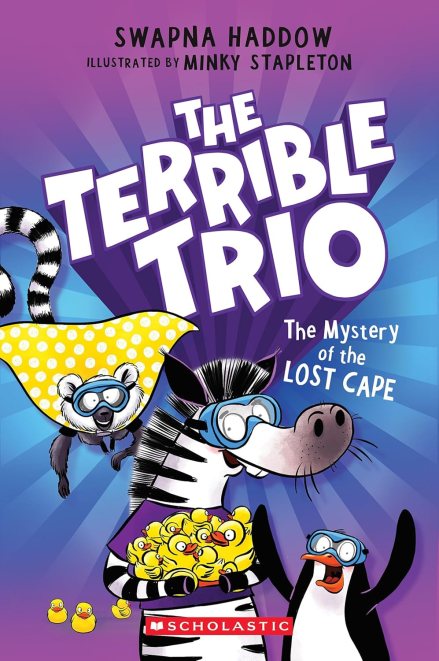
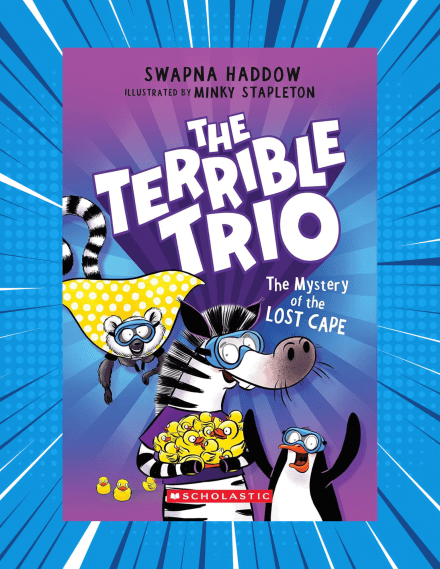
The (Not So) Superheroes: The Terrible Trio #1

Written by  Swapna Haddow | Illustrated by Minky Stapleton


When every animal in the world is invited to receive a superpower, Zeb the zebra, Barry the lemur, and Margarine the penguin (full name: Margarine on Toast, Marge for short) find themselves last in a very, very, very long line. As the line slowly moves, Zeb dreams of the riches and acclaim he’ll soon be enjoying. When Zeb, Barry, and Marge reach the front of the line, though, the superpower manager is all out of powers to give.

Illustration © 2025 Minky Stapleton. Text © 2025 Swapna Haddow. Courtesy of Scholastic.

Turns out, the manager has a smidgen of empathy and quickly makes up three more. Marge receives the power to make mac ‘n’ cheese, Barry gets nice handwriting, and Zeb? He now has “the power to blend in at a crosswalk!” Barry and Marge are thrilled with their superpowers, but Zeb? Not so much. Suddenly, Marge remembers that the Superheroes Cafe is looking for help and thinks they’d be perfect candidates.

The restaurant manager is all in on Marge as a macaroni-and-cheese-making chef and Barry as a menu writer. But Zeb? Barry suggests he can fold napkins. They’re hired and get right to work. Soon a new menu emerges (Mac ‘N’ Cheese for breakfast, Mac ‘N’ Cheese Salad (without the salad) for lunch, and Double Mac ‘N’ Cheese for dinner) while crumpled napkins pile up at Zeb’s station (to be fair, he is working with hooves, not hands).

Illustration © 2025 Minky Stapleton. Text © 2025 Swapna Haddow. Courtesy of Scholastic

The cafe fills with customers, and Zeb can’t help but overhear the rumors about the “worthless” power he got, which “ranged from ‘the power of no power’ to ‘the power of having quite sharp toenails on a Sunday.'” Zeb decides he and his friends need to complete a mission to prove they are “awesome superheroes” worth better powers. He even overhears the chicken who was given superstrength reveal that a supervillain crocodile is planning to escape from prison that very night. He plans to help.

With a mac-and-cheese ruse, they get into the prison to stop the breakout, but once inside they hear “Prisoner Break Out!” and are trapped in the kitchen as prisoners and the evil crocodile appear. Just about now, you’re probably on the edge of your seat wondering: Can Zeb use his superpower to save the day? Will Zeb ever learn to fold napkins? Is there a dessert mac ‘n’ cheese waiting in the wings? You’ll just have to tuck into The (Not So) Superheroes to find out!

Illustration © 2025 Minky Stapleton. Text © 2025 Swapna Haddow. Courtesy of Scholastic.

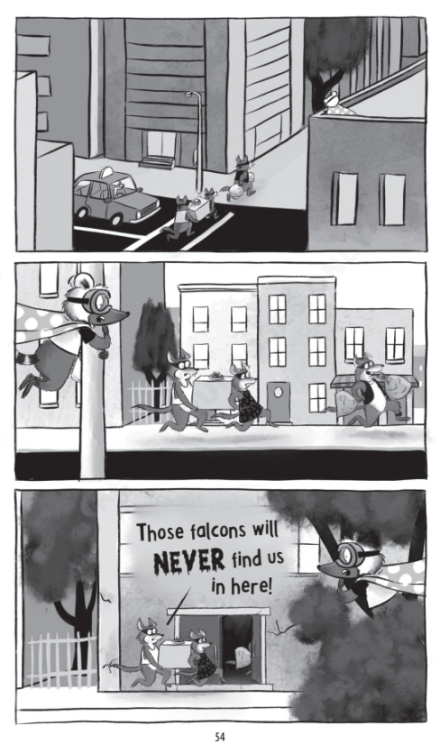
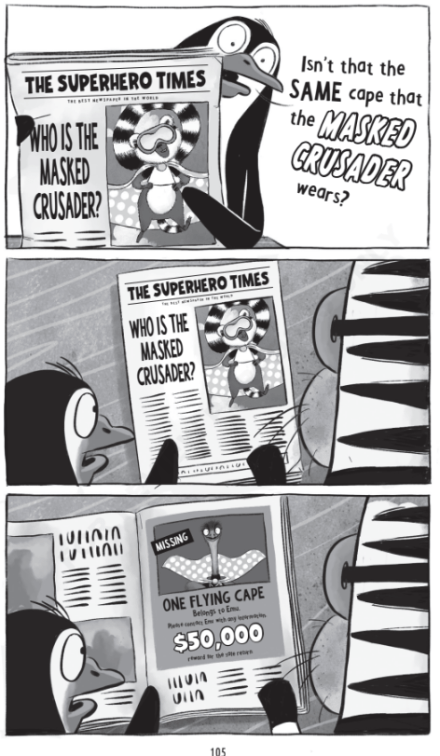
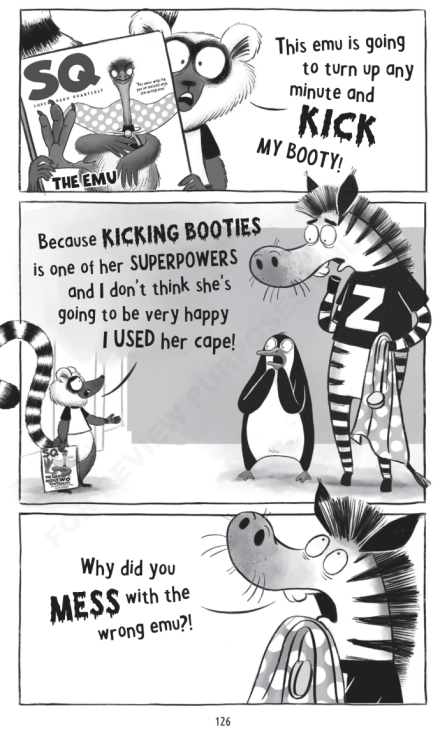
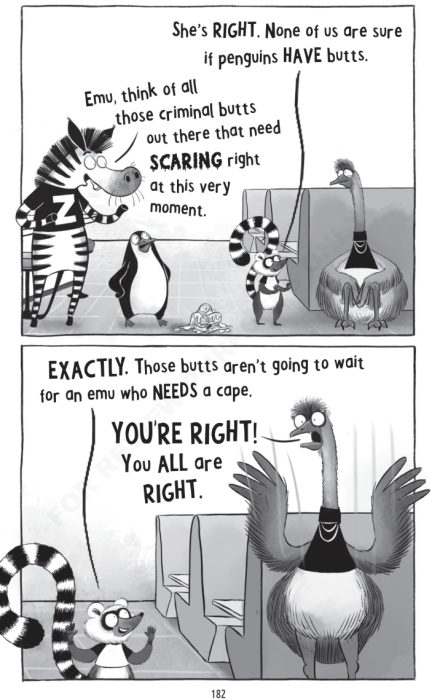
Swapna Haddow and Minky Stapleton’s new graphic novel series is joyful, silly, laugh-out-loud fun as the last three animals in an endless line of superpower hopefuls become fast friends, bonding over their less-than bestowments while using them to fulfill their remarkable destinies. Haddow’s spirited characters engage in hilarious banter and witty observations that will keep kids giggling as the trio accept (or in Zeb’s case, reject) their powers, squabbling and supporting each other the way good friends do. Her fast-paced plot, twists and turns, and amusing cast of secondary characters provide laughs and suspense on every page, keeping kids riveted to the story.
Minky Stapleton captures all the zany antics, fluctuating emotions, and high-stakes adventure of these newly branded superheroes in her comical illustrations that are jam-packed with humorous details, endearing facial expressions, and dynamic typography that has fun with superhero tropes. Readers can’t help but be charmed by Zeb, Barry, and Marge and become invested in their lives as superheroes. 

Introducing the well-conceived The Terrible Trio series (mac ‘n’ cheese as a superpower? Inspired perfection!), The (Not So) Superheroes is freewheeling comedic fun that will captivate kids, including reluctant readers, from the first page and offers plenty of repeat reading rewards. Book Two in the series: The Day the Mac ‘n’ Cheese Ran Out releases on February 3, 2026.

Ages 7 – 10

Scholastic, 2025 | ISBN 978-1546182986

About the Author

Swapna Haddow grew up in the UK and wrote her first book at age eight. She wishes she’d kept it, but it seemed like a good idea at the time to trade it for two stickers and a couple of marbles! Her first published book was the hilarious junior novel Dave Pigeon, which grew into a laugh-out-loud, award-winning series. She has since written many funny, colorful, and much-loved picture books as well as further junior fiction series. Swapna loves to write stories filled with boisterous animals causing mayhem, with friendship and humour consistently at the heart of her work. Swapna now lives in Dunedin, New Zealand, with her husband, son, and their dog. Her first homegrown tall tale with Scholastic New Zealand is But Then… the almost true story of an overdue book. You can visit her at swapnahaddow.com.

About the Illustrator

Minky Stapleton is a multi-faceted illustrator with a range of styles, all with a dash of humor. An award-winning Art Director and Creative Director originally from Johannesburg, South Africa, Minky gave up advertising to follow her first love, illustration. She now resides in Auckland, New Zealand, where she balances illustration projects with running classes for kids on how to design scary monsters. Minky has illustrated many titles for Scholastic, from hilarious picture books to historical fiction and high-energy, heavily illustrated junior fiction. Visit her at minkystapleton.com.

Gift-Giving Season Activity

The (Not So) Superheroes: The Terrible Trio Activity Sheets


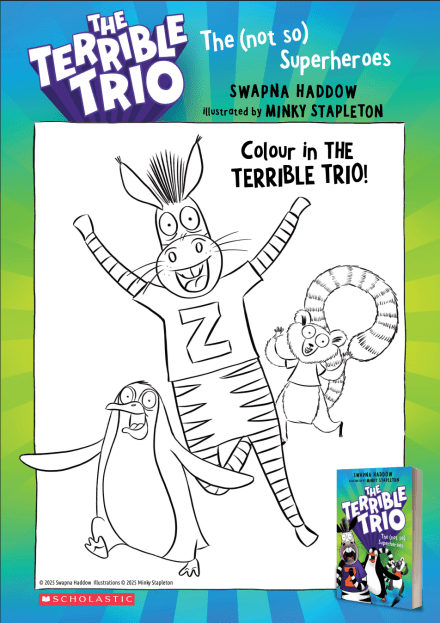
Kids can whip up lots of fun with the The (Not So) Superheroes activity sheets on author Swapna Haddow’s website. They’ll find sheets for discovering their superpower animal, character-drawing, coloring, and even Marge’s mac ‘n’ cheese recipe. Visit Swapna Haddow’s Fun Stuff page to download the activity pages!

You can purchase The (Not So) Superheroes: The Terrible Trio #1 from these booksellers

Amazon | Barnes & Noble | Bookshop

Picture Book Review