April 24 – Arbor Day

About the Holiday

Arbor Day, a national celebration of trees, began as a campaign by J. Morton Sterling and his wife after they moved from Michigan to Nebraska in 1854 and advocated for planting trees as windbreaks for crops, to keep soil from washing away, as building materials, and for shade. In 1872, Morton proposed that a tree-planting day be established in April. On the first Arbor Day nearly one million trees were planted in Nebraska. The idea was made official in 1874, and soon, other states joined in. In 1882 schools began taking part. Today, most states celebrate Arbor Day on the last Friday of April or day more suited for their growing season. To learn about events in your area, find activities to download, and more, visit the Arbor Day Foundation website.

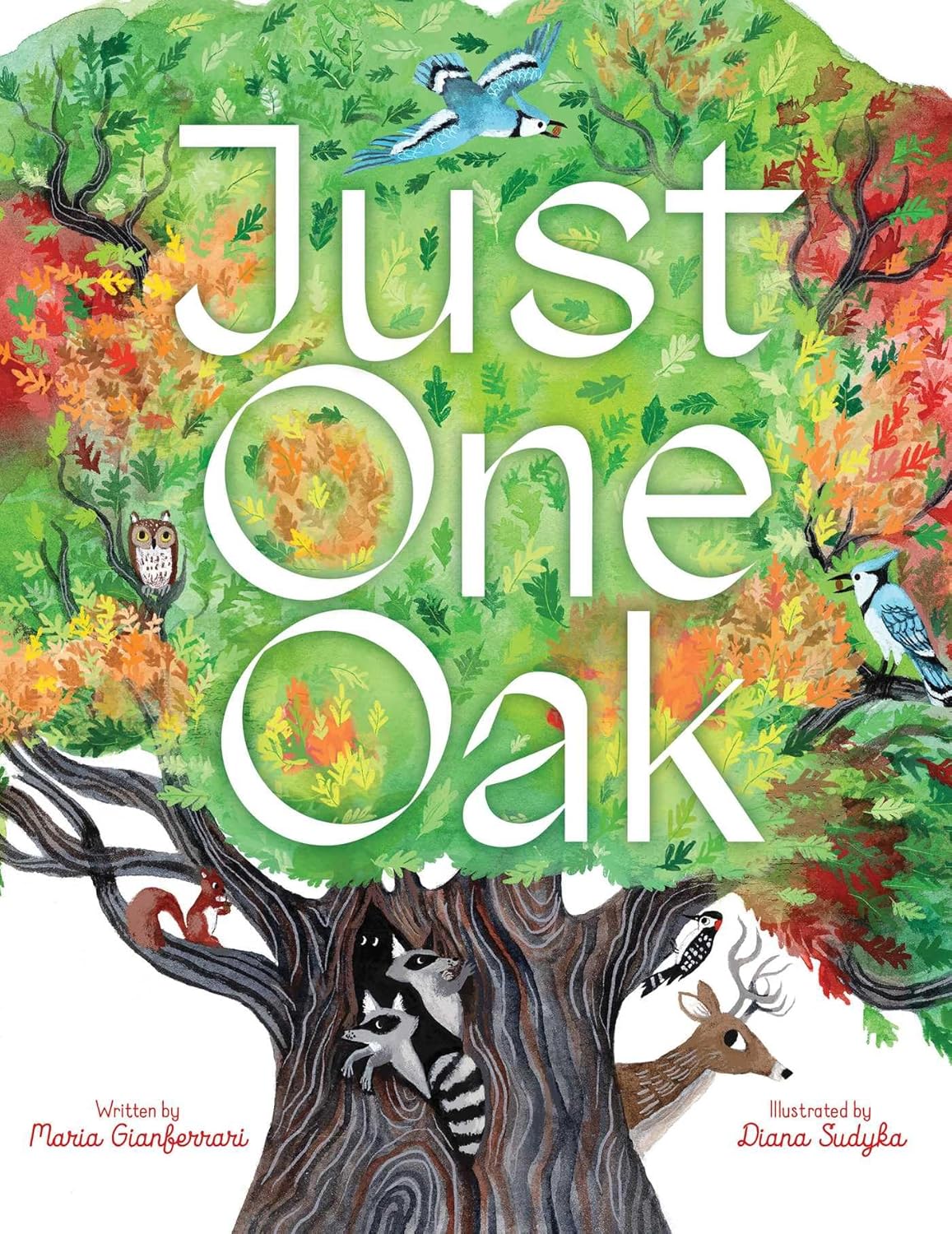
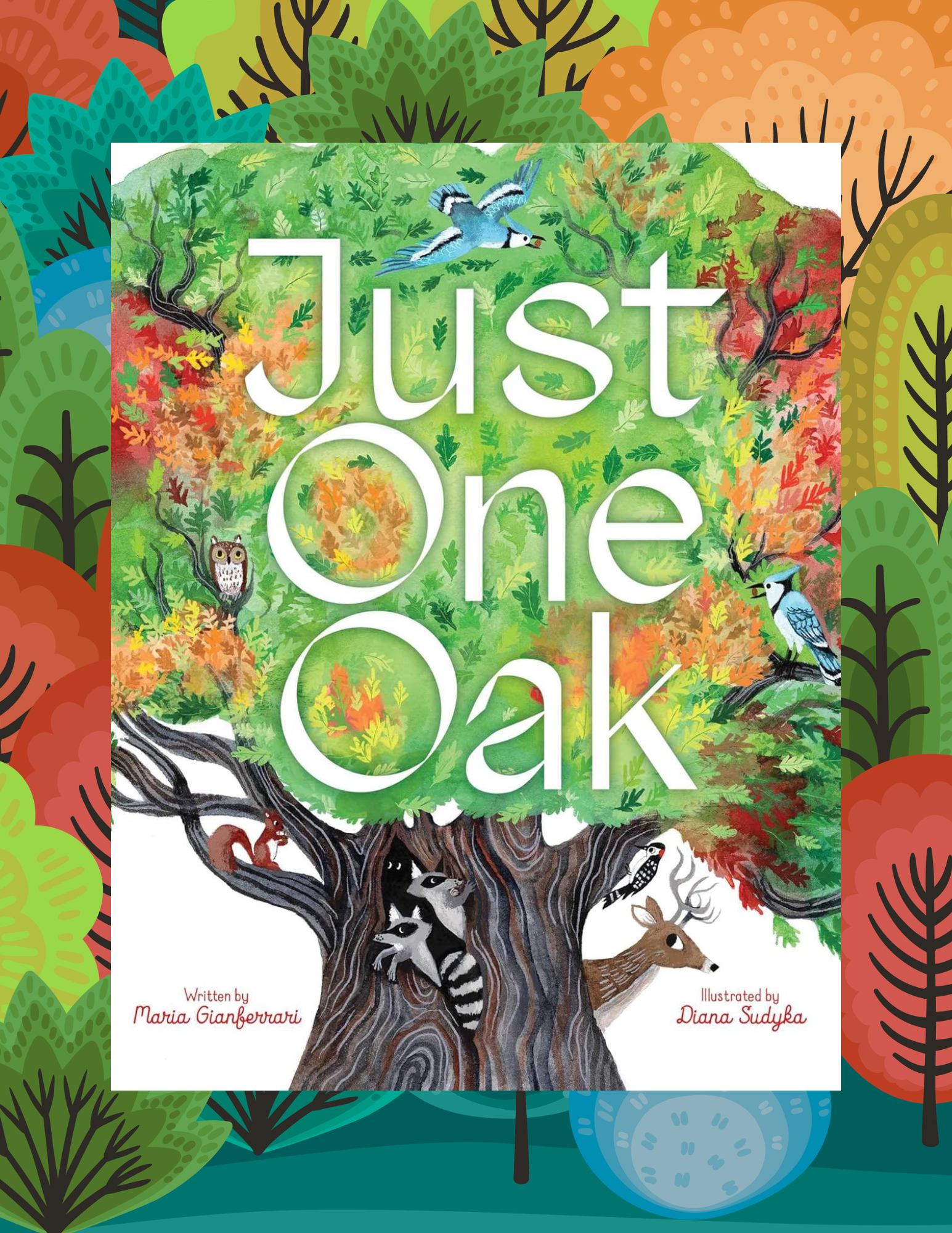
Just One Oak: What a Single Tree Can Be

Written by Maria Gianferrari | Illustrated by Diana Sudyka


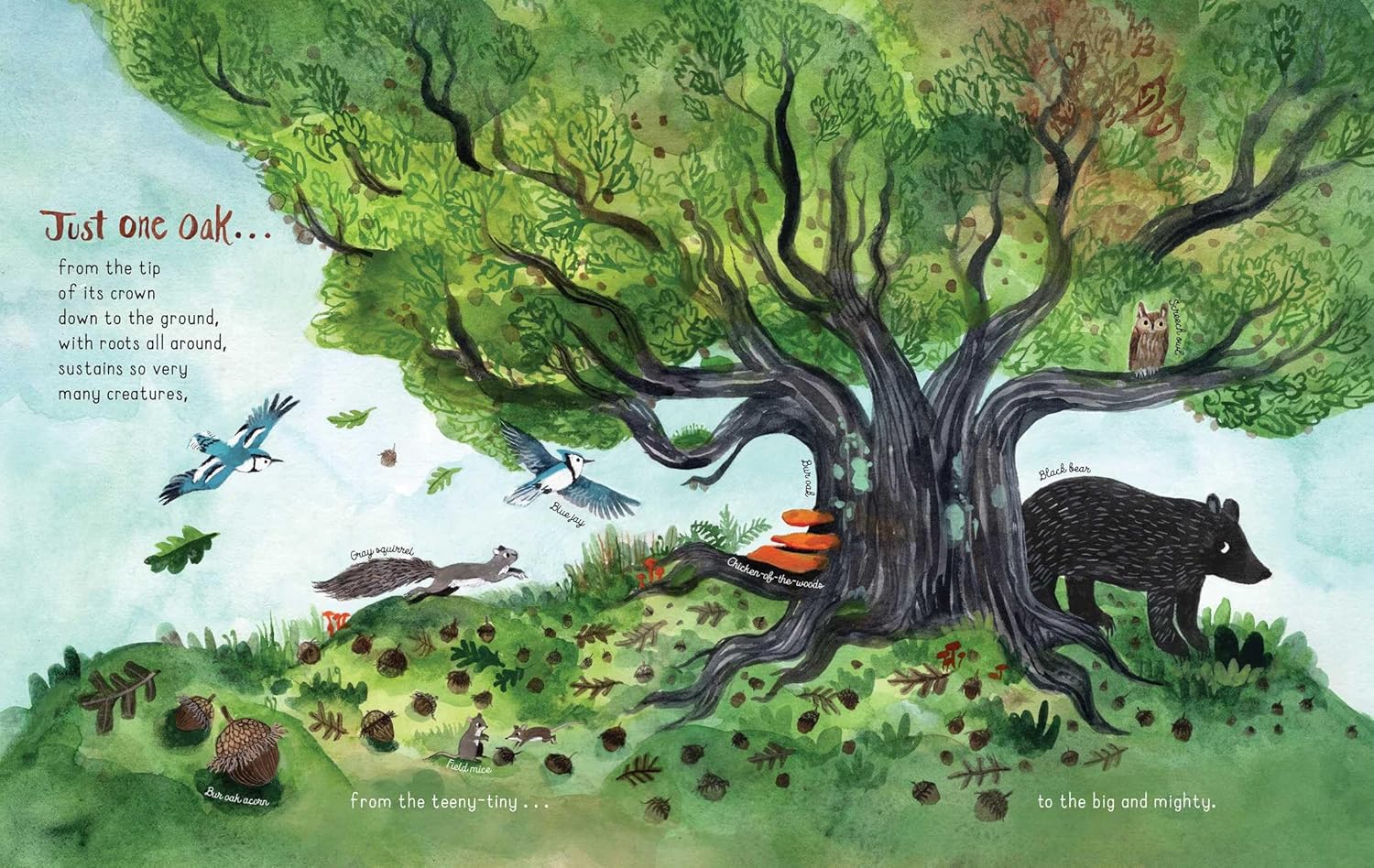
“Just one oak . . . from the tip of its crown down to the ground, with roots all around, sustains so very many creatures, from the teeny-tiny to the big and mighty.” So begins Maria Gianferrari’s fascinating exploration of all the ways oak trees contribute to and sustain the ecosystem where they live. From their distinctive leaves to their shaggy bark to their incredible acorns, oak trees are self-protecting while providing shelter and food for an amazing array of wildlife.

Illustration copyright © 2026 by Diana Sudyka. Text copyright © 2026 by Maria Gianferrari. Courtesy of Beach Lane Books.

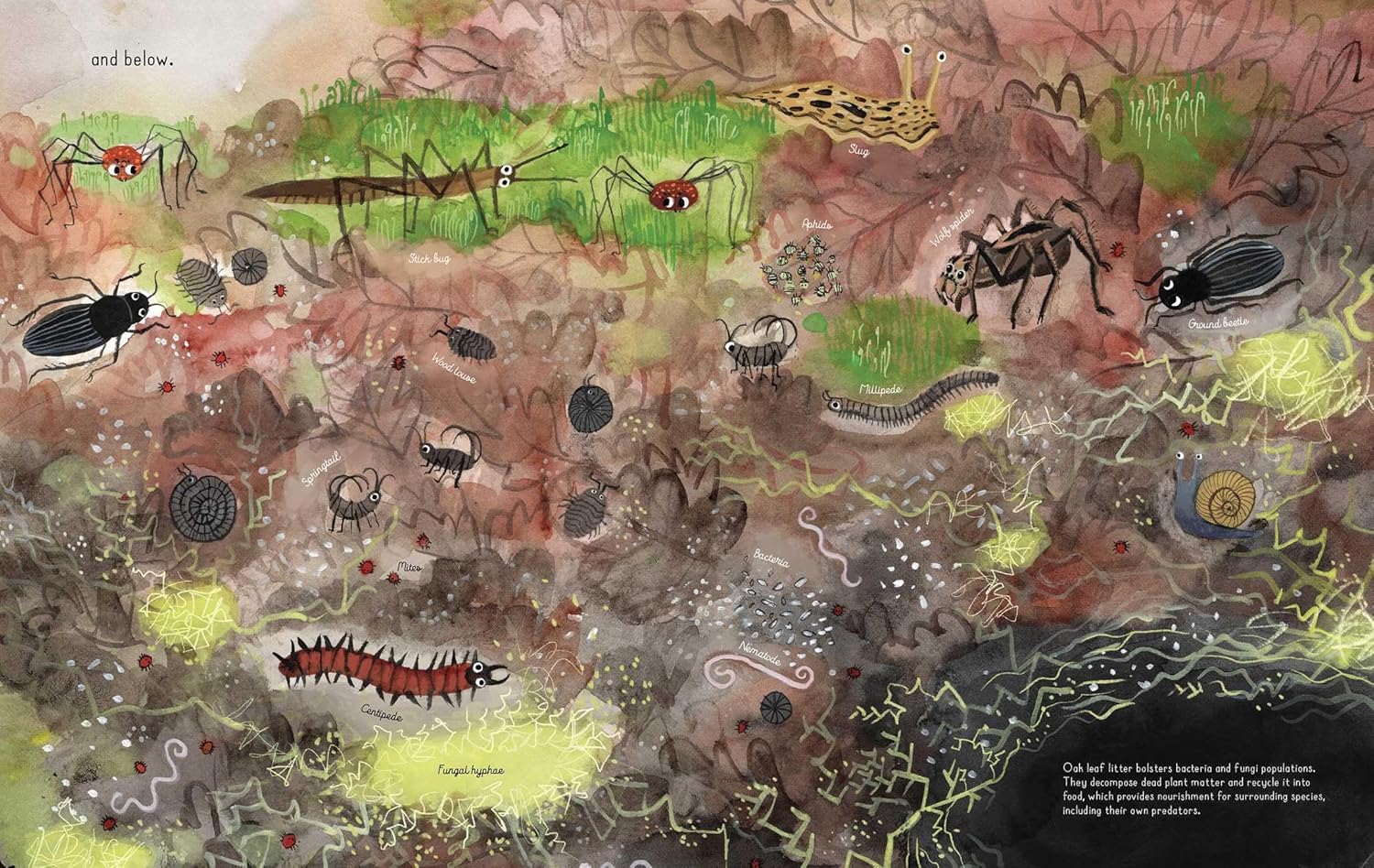
At ground level, Gianferrari shows how “leaf litter, the blanket beneath its boughs,” creates the perfect environment for snails, insects, amphibians, fungi, and more to hide, feed, and grow. And that little acorn nestled under the leaves? Gianferrari digs in to reveal how a mighty oak begins with just one taproot that branches and branches until its root system spreads “farther than the canopy is wide.”

Illustration copyright © 2026 by Diana Sudyka. Text copyright © 2026 by Maria Gianferrari. Courtesy of Beach Lane Books.

And oh those acorns! They’re so much more than their tiny size may lead you to believe. Just one acorn can house one creature or hundreds. They are a universal “superfood” as well as a tidy seed that can reproduce where it drops or be carried far afield. When it grows up, “just one oak creates a microclimate,” with its impressive canopy and prevents flooding, erosion, and drought with its far-reaching roots. Yes, “just one oak is beautiful and bountiful to all.”

Illustration copyright © 2026 by Diana Sudyka. Text copyright © 2026 by Maria Gianferrari. Courtesy of Beach Lane Books.

Maria Gianferrari takes readers outdoors to get a close-up view of one oak tree, and by extension an enlightened understanding of the reach of this keystone species. Her lyrical introductions, capped with a repeated “Just one oak . . .”—a phrase that reinforces the contributions of these trees, give way to paragraphs of factual information. Each of these paragraphs are packed with specific information about the types of creatures sustained by just one tree and the benefits they enjoy. The numbers here are simply astounding and could inspire many cross-curricular lessons in math, science, language arts, art, and more. 

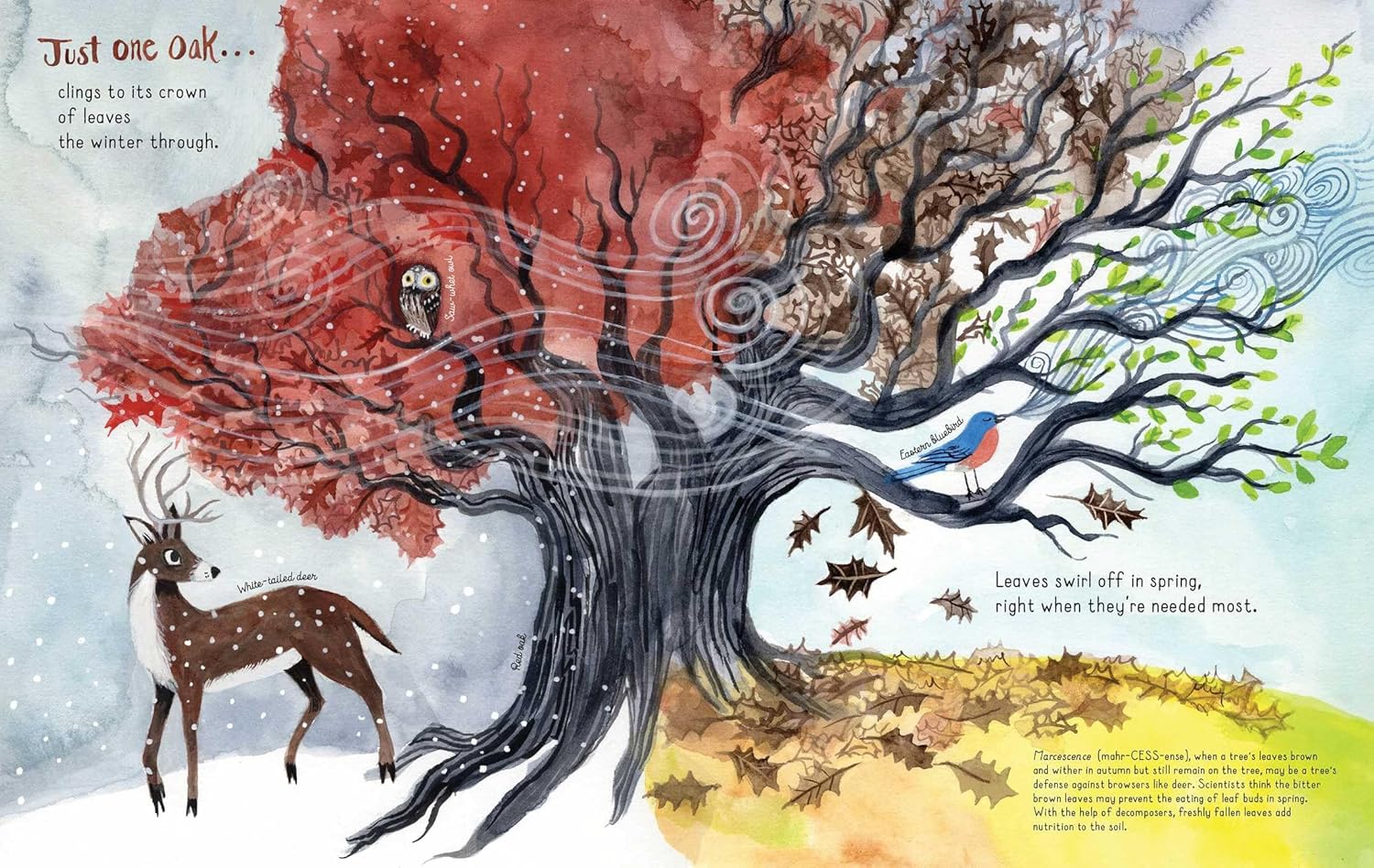
Diana Sudyka’s nature illustrations are beautiful, exciting, and full of the kinds of small, impactful details readers love and that expand their understanding of the text (especially for visual learners). Animals scamper, birds feast, and an entire community of creepy-crawlies scurry through leaf litter and below in Sudyka’s action-filled pages. Each spread will have children lingering to discover all the wonders of an oak tree.

A glorious celebration of the oak tree and the species that rely on it, Just One Oak will spark curiosity and an appreciation for the interconnections among wildlife. The book will delight any nature lover and is a must for school and public libraries. 

 Ages 4 – 8+

Beach Lane Books, 2026 | ISBN 978-1665961042

About the Author

Maria Gianferrari is a picture book reader/writer, tea-drinker, dog-lover, and birdwatcher. Maria writes books that honor our bonds with creatures both domestic and wild and that celebrate the natural world around us, including Fungi Grow and Just One Oak, illustrated by Diana Sudyka; Ice Cycle: Poems about the Life of Ice, illustrated by Jieting Chen; Being a Dog: A Tail of Mindfulness, illustrated by Pete Oswald; Bobcat Prowling, illustrated by Bagram Ibatouilline; and Be a Tree!, illustrated by Felicita Sala. She lives with her family in Massachusetts in a house encircled by trees. To learn more about Maria, visit her website: MariaGianferrari.com.

About the Illustrator 

Diana Sudyka is a Chicago-based illustrator. Early on, she created screen-printed gig posters for musicians but currently her illustration work focuses on young adult, middle grade, and children’s books. She has illustrated several volumes of the award-winning book series, including The Mysterious Benedict Society by Trenton Lee Stewart and Circus Mirandus by Cassie Beasley, as well as the picture books Would You Come Too? by Liz Garton Scanlon, Sometimes Rain by Meg Fleming, What Miss Mitchell Saw by Hayley Barrett, How to Find a Bird by Jennifer Ward, and Fungi Grow and Just One Oak by Maria Gianferrari. Visit her at DianaSudyka.com.

Arbor Day Activities

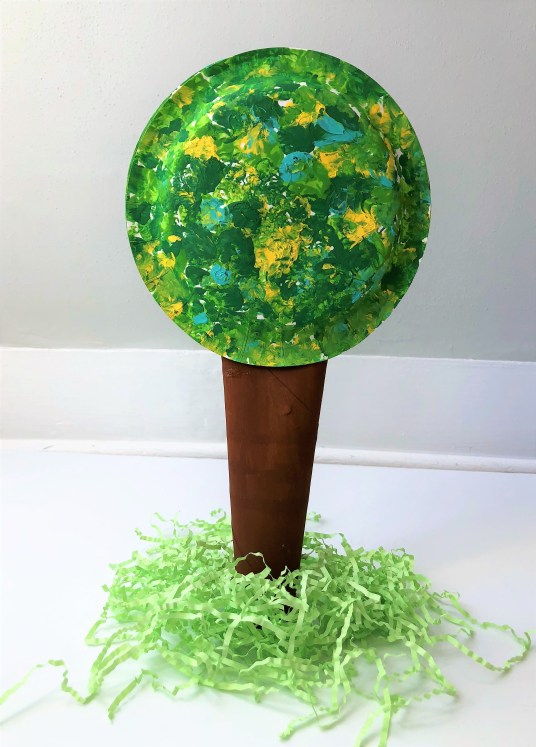
celebrate-picture-books-picture-book-review-paper-plate-tree-craft-2


Paper Plate Tree


On Earth Day children love planting trees in their yard or as part of a community project. With this easy craft, they can also plant a tree on their wall or bulletin board.

Supplies

  • Two paper plates 
  • Paper towel tube
  • Brown craft paint
  • Green craft paint (using a variety of green paints adds interest)
  • Paintbrush, cork, or cut carrot can be used to apply paint
  • Glue or hot glue gun or stapler

Directions

  1. Paint the paper towel tube brown, let dry
  2. Paint the bottoms of the two paper plates with the green (or other color) paints, let dry
  3. Flatten about 4 inches of the paper towel tube 
  4. Glue or tape the flat part of the paper towel tube to the unpainted side of one paper plate
  5. Glue the edges of the two paper plates together, let dry.
  6. Straighten the tree so that it can stand up, or hang your tree on a wall, bulletin board, in a window

Just One Oak Activity Kit from Beach Lane Books


Teachers and other educators can find a comprehensive Activity Kit with discussion questions, hands-on activities, and more to accompany Just One Oak on Maria Gianferrari’s website.

You can purchase Just One Oak: What a Single Tree Can Be from these booksellers

Amazon | Barnes & Noble | Bookshop

Picture Book Review

April 22 – Earth Day

About the Holiday

First celebrated 56 years ago, Earth Day is the world’s largest civic-focused event. The initiative began on April 22, 1970, when 20 million Americans (10% of the population) demonstrated against the industrialization, pollution, and pesticides that were damaging people and the environment. In response, in July of 1970, Republican President Nixon and the US Congress created the Environmental Protections Agency and enacted laws such as the Clean Water Act and the Endangered Species Act among others.

This year’s theme is “Our Power, Our Planet.” From Saturday, April 18 to Earth Day on the 22nd and beyond, Earth Day and Earth Month will organize communities and individuals to take part in community cleanups, teach-ins, peaceful demonstrations, tree planting, voter registration, town hall meetings, community organizing and more. Every action strengthens the movement and what we can accomplish. To learn how you can participate or access resources in your area, visit the official Earth Day website.

Thanks to Greystone Books for sending me a copy of this book for review!

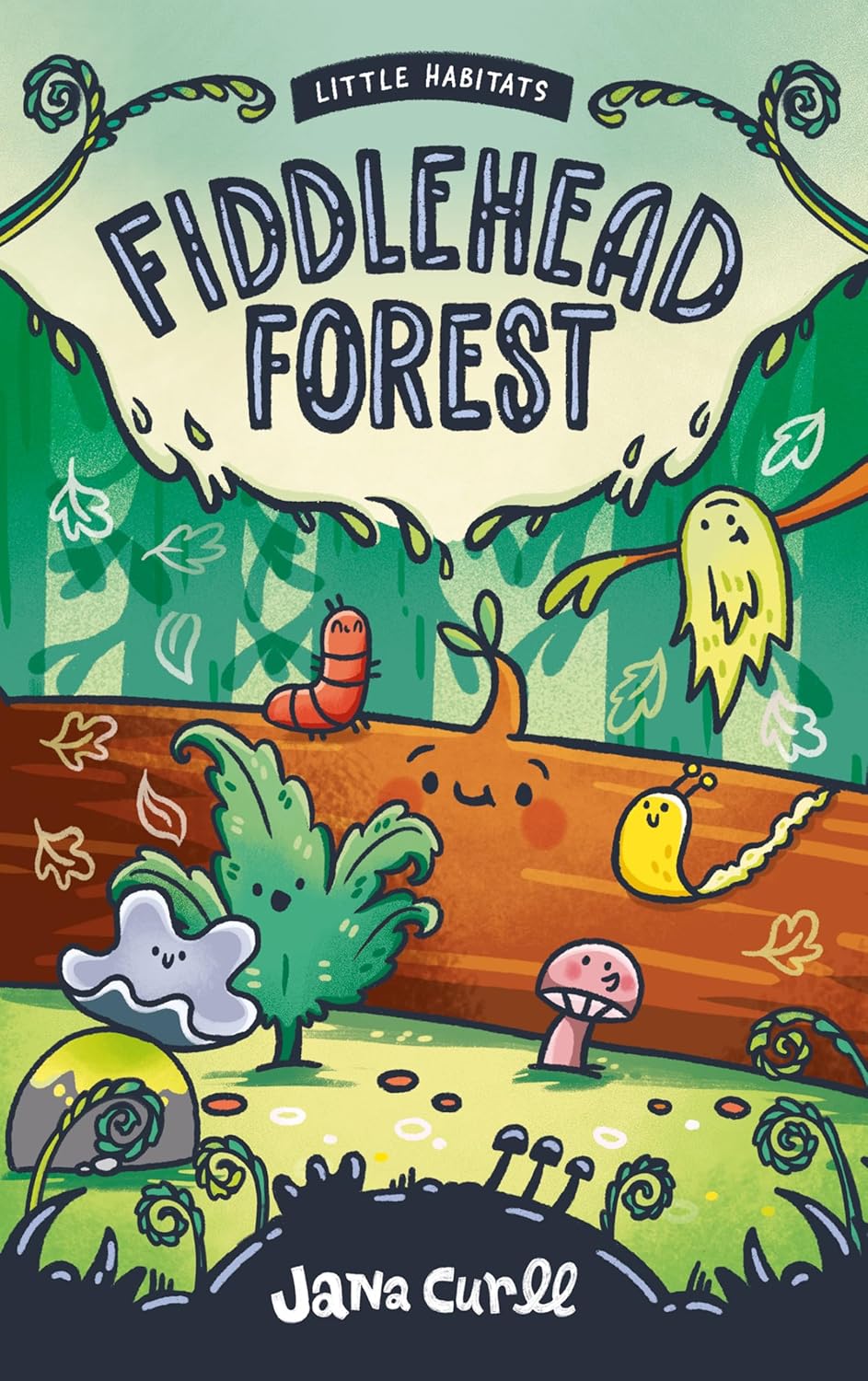
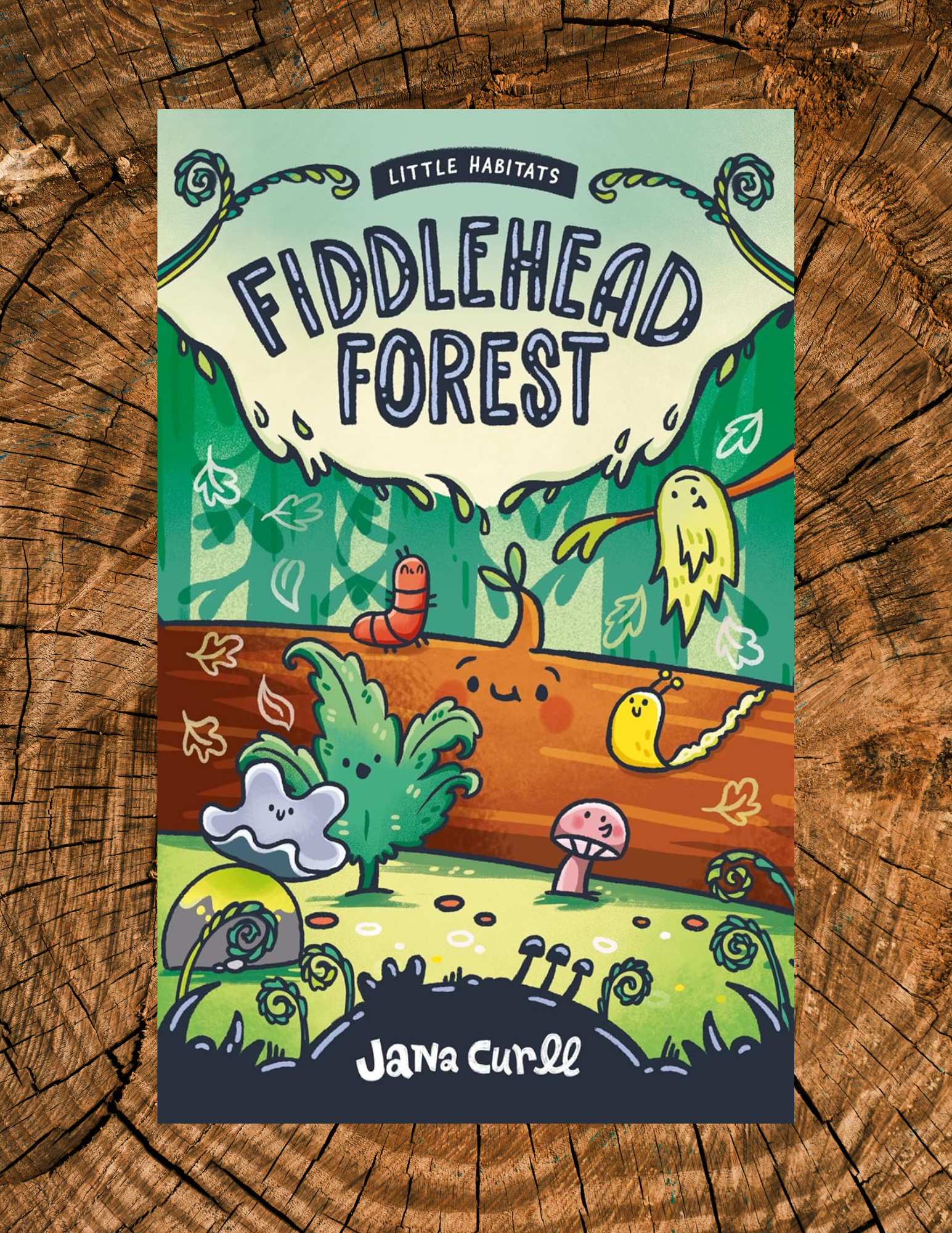
Fiddlehead Forest: Little Habitats 2

By Jana Curll


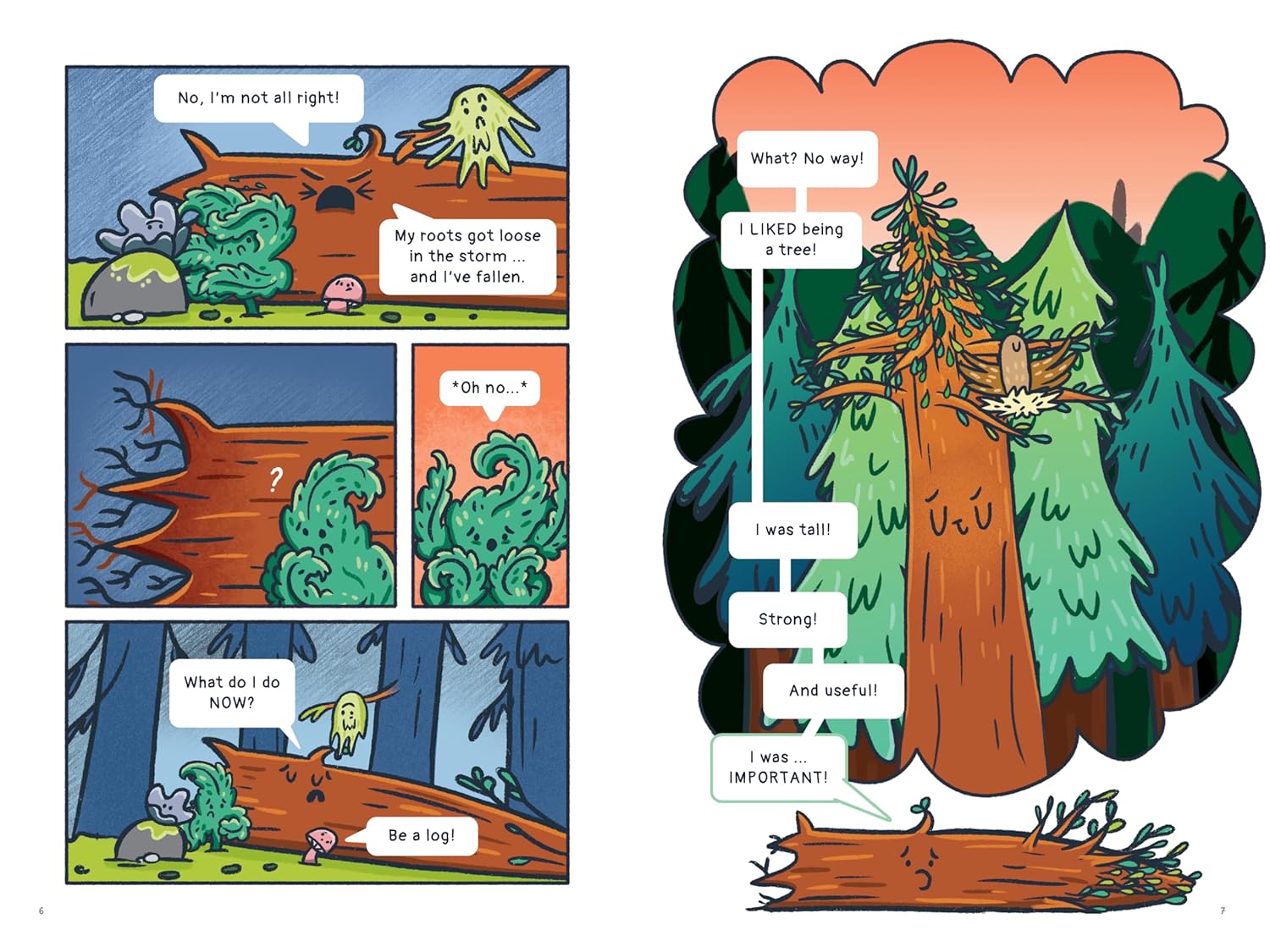
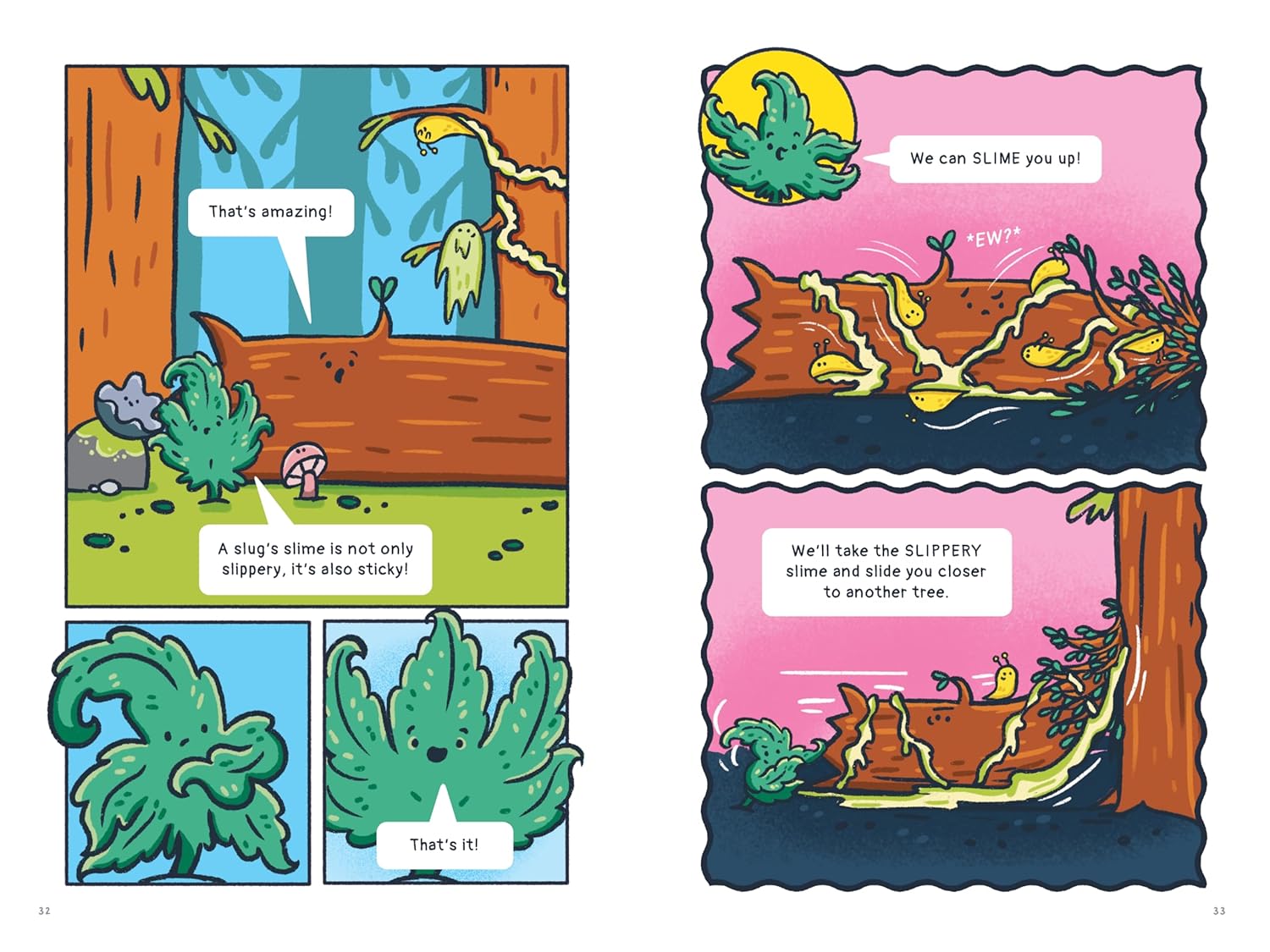
After a lightning storm, Fern and her fronds—Millipede, Slug, Moth, Mushroom, and the Lichens—discover a tree that’s fallen and can’t get up. Mushroom suggests the tree become a log, but the unhappy tree wants to return to its days of glory, of being “tall, strong, and useful—important!” Fern “guaran-trees” she will make it happen.

Text and Illustration copyright © 2026 by Jana Curll. Courtesy of Greystone Kids.

Tiny Millipede is first to volunteer his talents. It’ll be a cinch, he thinks. All he has to do is eat and eat and eat and molt and molt and molt until he’s grown enough segments and legs to push the tree back into position. It turns out, though, there’s only so much one millipede can eat before getting “in-dig-estion,” so Fern concocts another, kinda crazy plan involving Moth, dangerous animals, and “geome-TREE” (Beard Lichen thinks it’s “more like insani-TREE”). When that doesn’t fly, Fern enlists Slug in an even more convoluted idea that any slime lover could get behind. Unfortunately, it’s a no-goo too.

Text and Illustration copyright © 2026 by Jana Curll. Courtesy of Greystone Kids.

With the help of the Lichens’ and Mushroom’s insight, Tree accepts its fate and vows to “do my best with where I am now.” As night falls the friends stay close, keeping Log company. In the morning Fern has yet one more idea, but this one isn’t zany or complex. She invites everyone to stay, hang out, and just do their thing. “FERN-ally” Log discovers its new role—one in which it is long, strong, and useful—important!

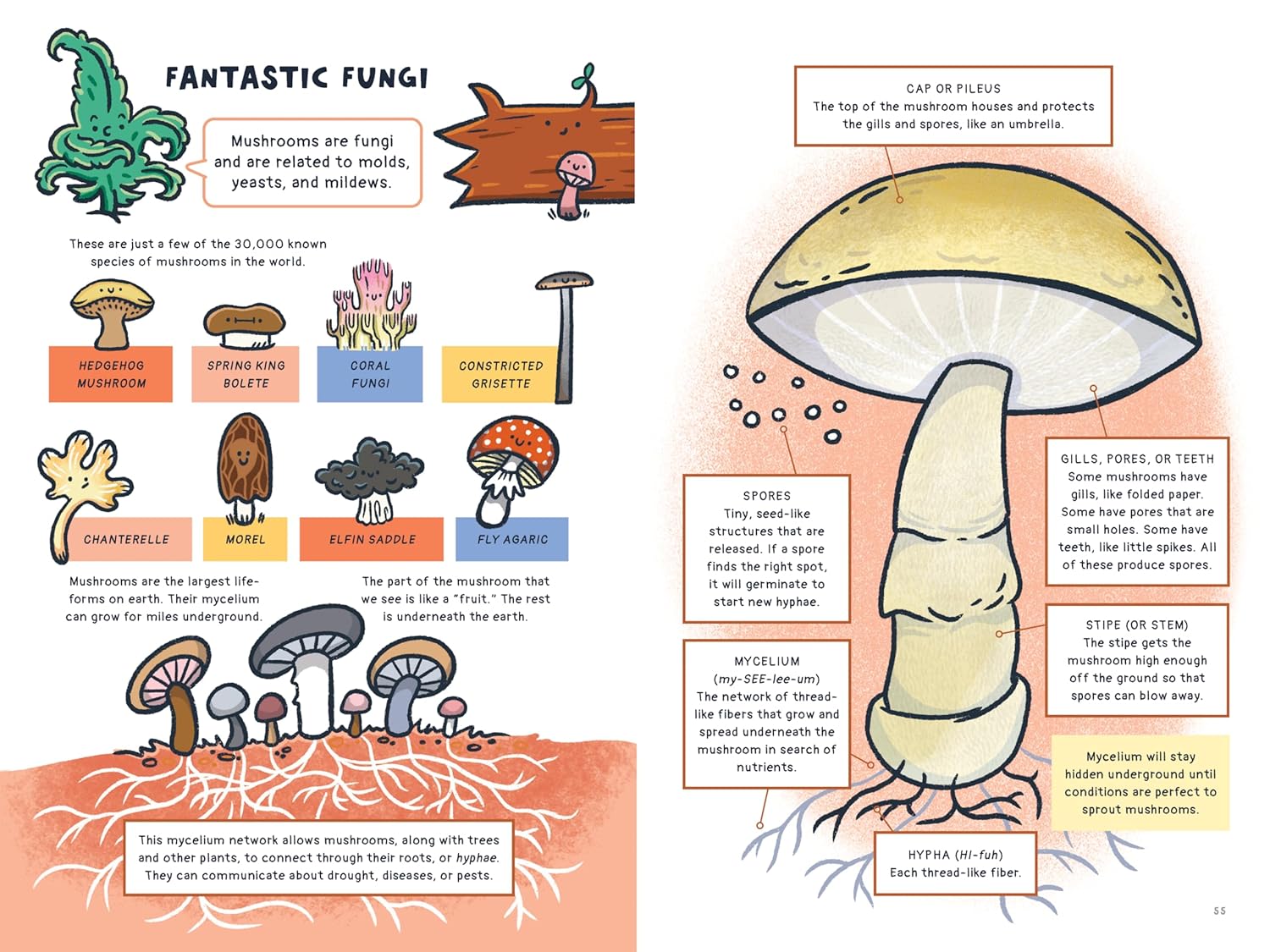
In addition to the story, each chapter includes a two-page spread of fascinating facts about millipedes, moths, slugs, lichens, fungi, ferns, and nurse logs that describe their importance to Earth’s ecosystems.

Text and Illustration copyright © 2026 by Jana Curll. Courtesy of Greystone Kids.

Equal parts hilarious and educational, Jana Curll’s Fiddlehead Forest is a punsters paradise, where kids will be giggling so often they may not even realize how much they’re learning. Curll’s mix of witty banter, caring friendship, and scientific facts, all presented in her bright and adorable graphic novel format, will delight kids. Fiddlehead Forest has plenty of repeat readability, applications for classrooms and homeschoolers, and appeal for any library collection.

Ages 6 – 9

Greystone Books, 2026 | ISBN 978-1778401046

About the Author

Jana Curll is a children’s illustrator based on the rainy west coast of Canada and is grateful to live on the traditional lands of the shíshálh Nation with her family. She is inspired by the creatures and environment of the local rainforests and the ocean and spends her spare time wandering through winding trails and along rocky beaches. She likes doodling funny maps and sipping strong coffee while her large cat sleeps on her lap. She’s also the author-illustrator of Barnacle Bay, the first book in the Little Habitats series also published by Greystone Kids. Visit her at janacurrl.com.

Earth Day Activity

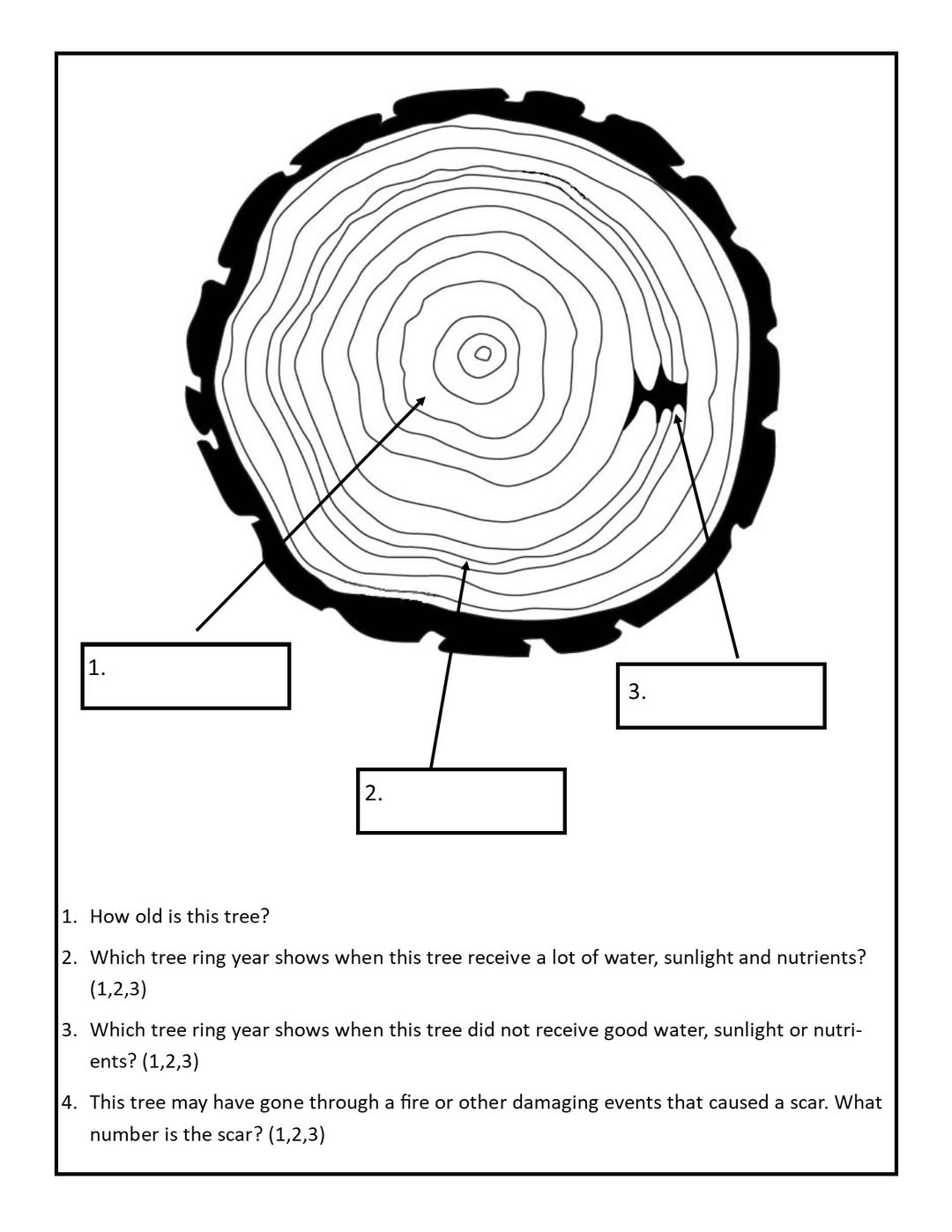
How Old Is This Tree? 

In this activity children learn what the rings on a cross section of a tree trunk mean and how to count them to determine the age of a tree is and discover events from its past. 

You can purchase Fiddlehead Forest (Little Habitats, 2) from these booksellers

Amazon | Barnes & Noble | Bookshop

Picture Book Review

March 26 – National Science Appreciation Day

About the Holiday

Launched in 2022 by Todd Stiefel, the founder and chair of ScienceSaves, Science Appreciation Day celebrates the power of science and scientific achievements. The holiday also raises awareness for the importance of critical thinking, thanks workers in the fields of science and medicine, and promotes the inclusion of science in public policy throughout the United States—and maybe even all over the world.” An appreciation for science begins early in life as children learn about their world and Earth’s long history through books like today’s stunning look at prehistoric times. To learn more about ScienceSaves and find resources for teachers and other educators from kindergarten through high school, visit ScienceSaves.org

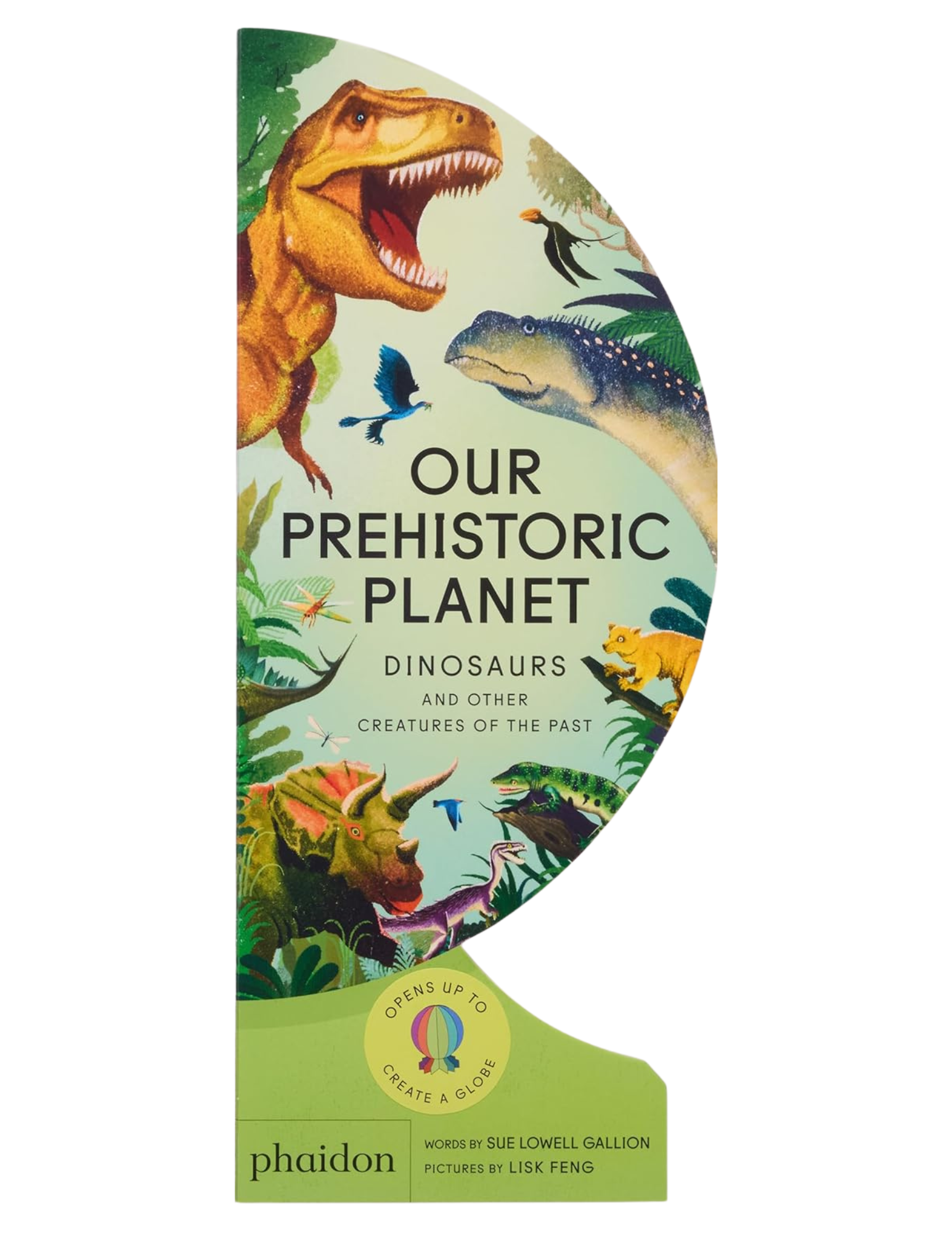
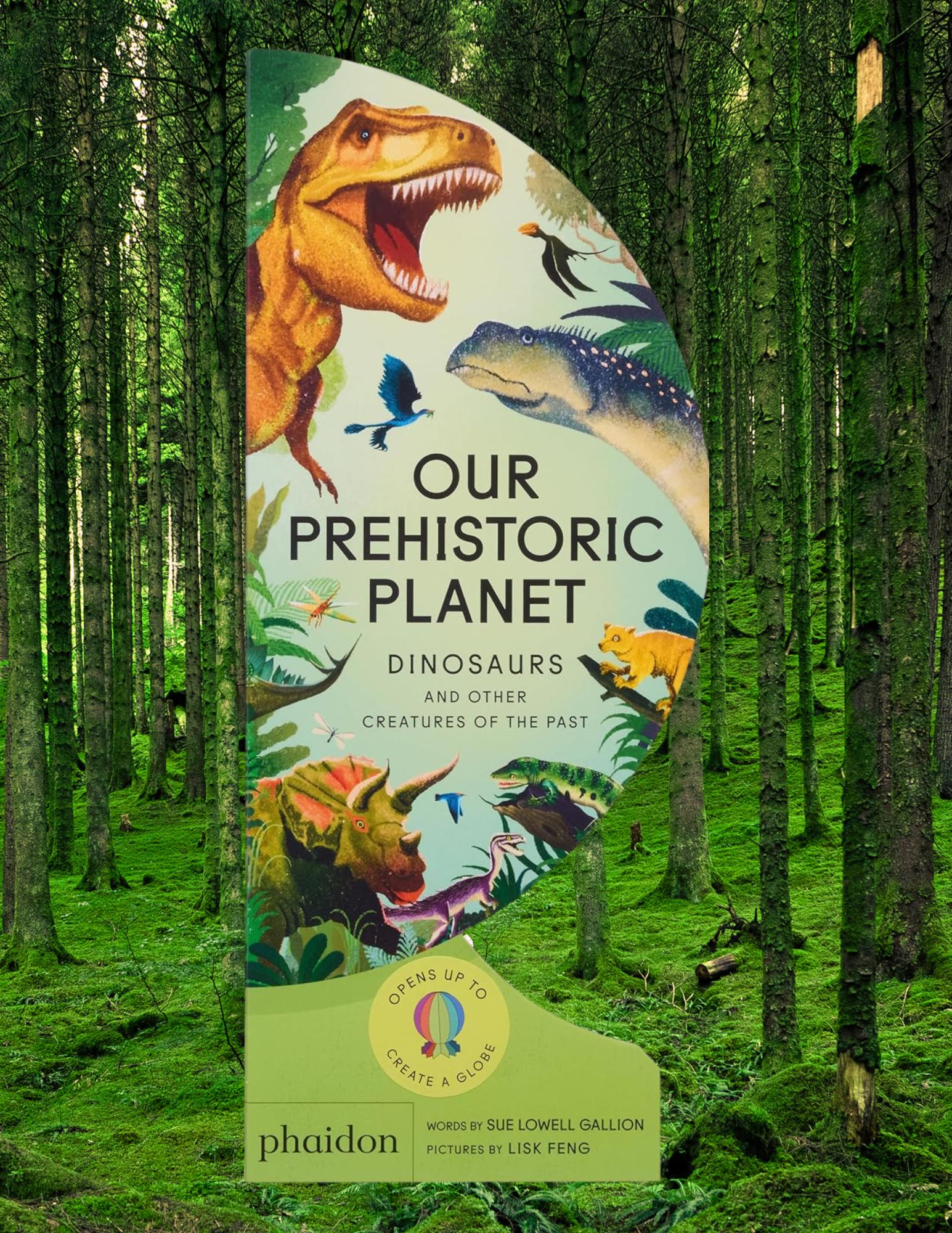
Our Prehistoric Planet: Dinosaurs and Other Creatures of the Past

Written by Sue Lowell Gallion | Illustrated by Lisk Feng


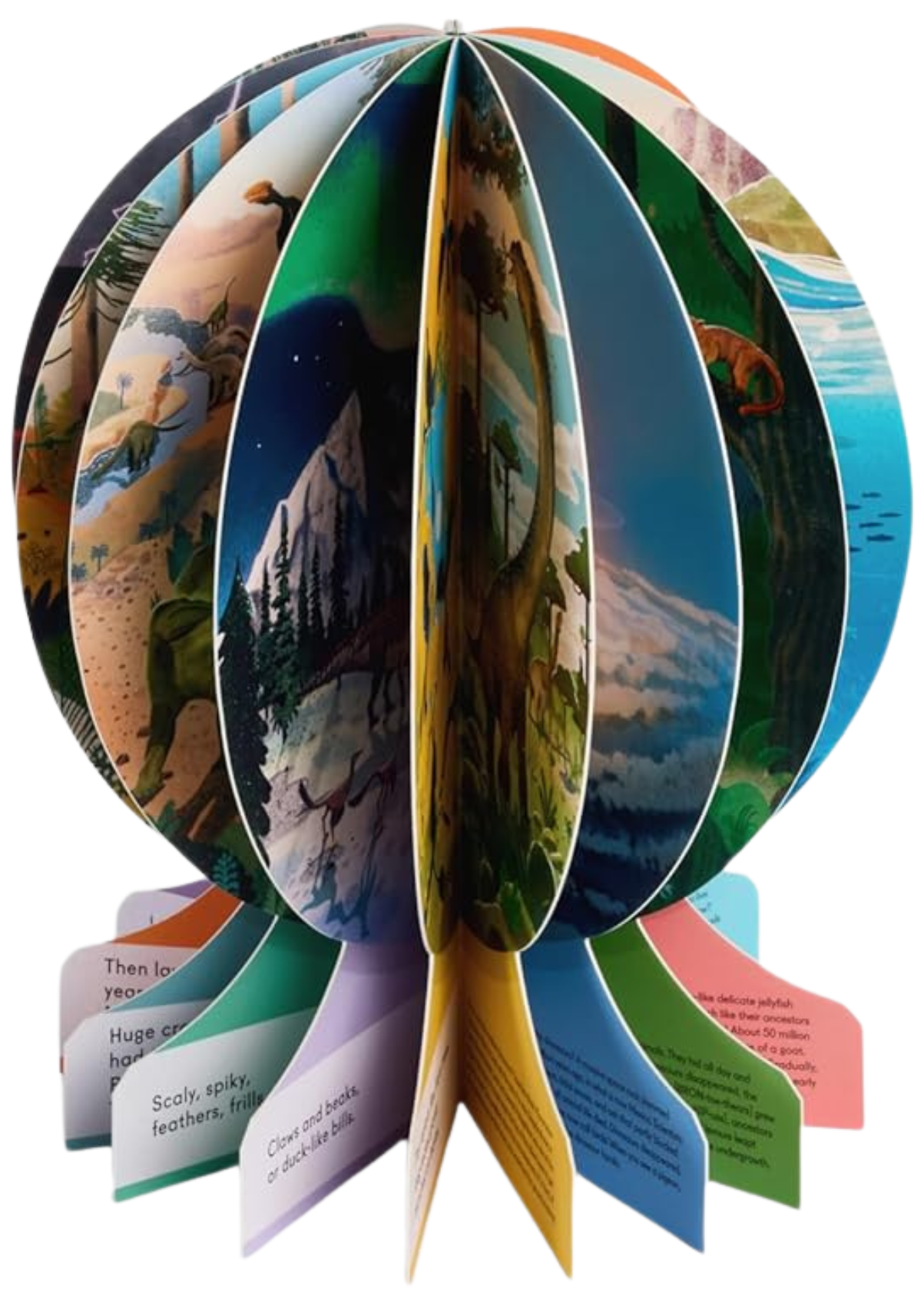
If you’re already a fan of Sue Lowell Gallion and Lisk Feng’s Our World collection of astounding books, you’re going to be excited about their newest one. If you’re new to this series of books, get ready to be amazed! Our Prehistoric Planet: Dinosaurs and Other Creatures of the Past not only takes us to a world we never knew yet are endlessly fascinated with, but opens to create a free-standing globe!

Illustration copyright © 2026 by Lisk Feng. Text copyright © 2026 by Sue Lowell Gallion. Courtesy of Phaidon.

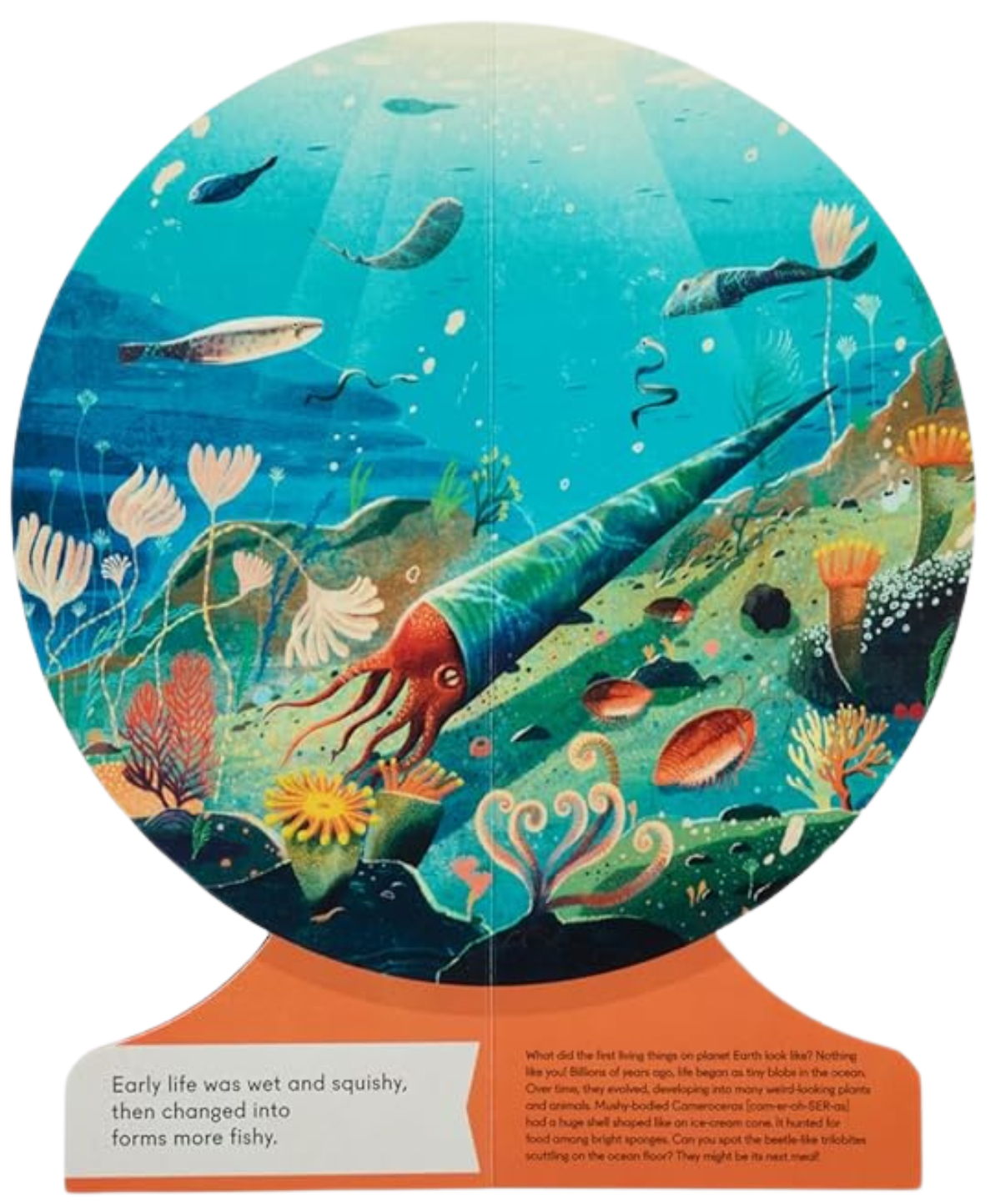
With this invitation: “Let’s tour the world of long ago, / so different from the Earth we know,” kids are transported through the chronological changes our planet has undergone from it’s “wet and squishy” beginnings billions of years ago to today. Transformations include the appearance of land animals and insects, including a “dragonfly-like bug the size of a chicken” and the rise of Rauisuchians—giant ancestors of our crocodiles that “were almost as big as a bus” and snacked on “the first dinosaurs, which were little!” 

Illustration copyright © 2026 by Lisk Feng. Text copyright © 2026 by Sue Lowell Gallion. Courtesy of Phaidon.

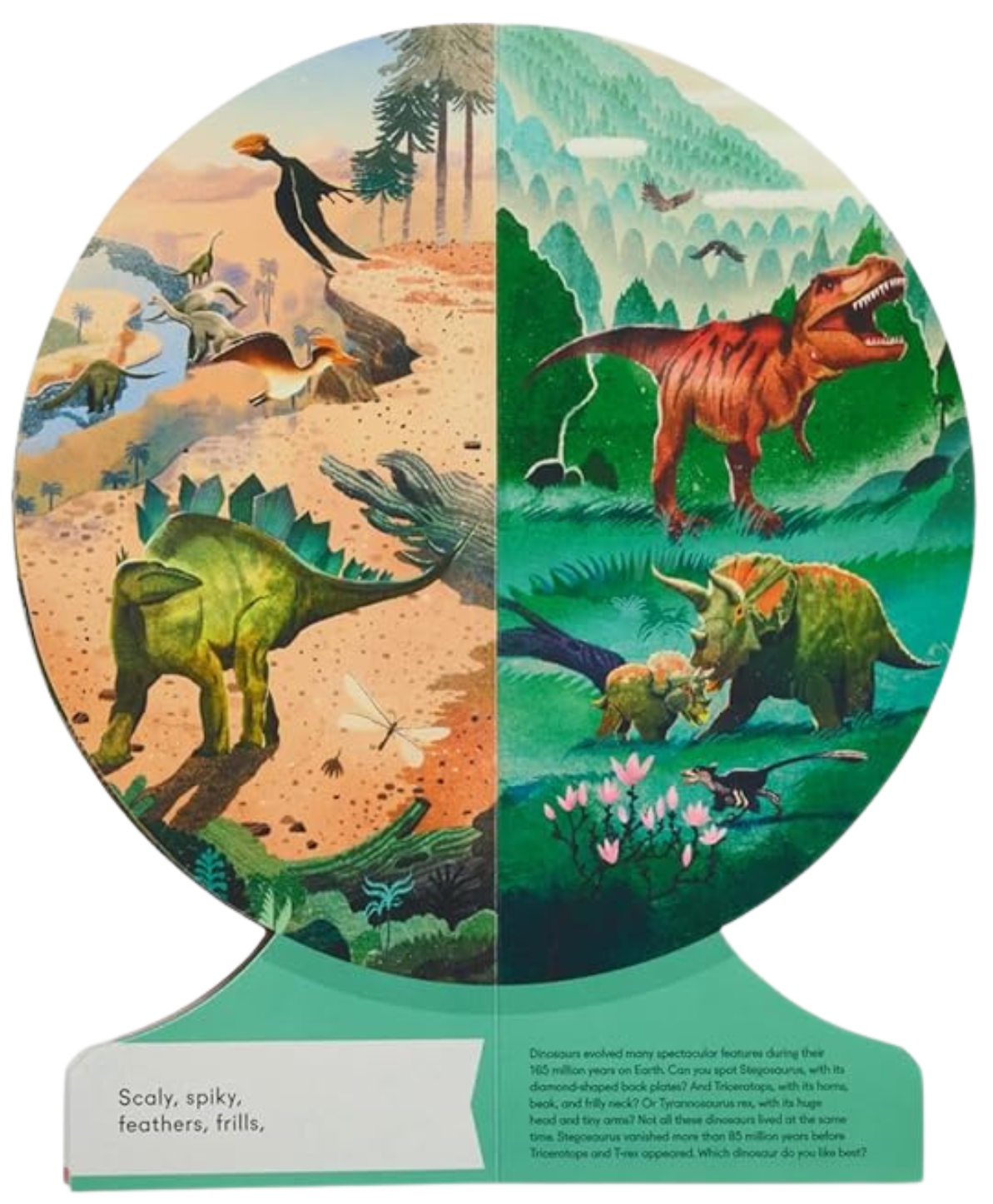
Kids will learn how these bite-sized dinos evolved into the monstrous-sized Stegosaurus, Triceratops, and T-Rex as well as the heavy-weight Patagotitan. Following the end of the age of dinosaurs, readers meet the first mammals and discover how different animals are now from their ancestors. Along the way children witness the cataclysmic events that ushered in each new era of evolution, resulting in the astounding changes in the types of animals, birds, and plants that populated Earth in prehistoric ages. A final page talks about fossils and provides a world map that shows where certain dinosaurs and other prehistoric creatures lived.

Illustration copyright © 2026 by Lisk Feng. Text copyright © 2026 by Sue Lowell Gallion. Courtesy of Phaidon.

On each two-page spread, Sue Lowell Gallion first captures readers attention with a short, rhyming verse that distills the scientific concepts into one easily grasped sentence. She then provides more information about the creatures’ traits, diet and size, the climate, scientists’ theories on extinction events, fossils, and more in a paragraph that combines detailed facts, kid-tantalizing language, pronunciation guides, and thought-provoking prompts.

Young readers get awe-inspiring views of our prehistoric past in Lisk Feng’s spectacular illustrations that provide realistic depictions of the animals, birds, insects, plants, and overall environments that thrived for millions of years. You can almost hear the buzz of enormous insects’ wings and feel the heat of bubbling lava. Children will love studying every fascinating page.

Open and display Our Prehistoric Planet: Dinosaurs and Other Creatures of the Past and watch kids gather ’round with exclamations of “Wow!” and eager excitement to learn. This book is a must addition to all classroom, school, and public library collections and would be a treasured favorite on home bookshelves for for dinosaur and prehistory buffs.

Ages 2+

Phaidon, 2026 | ISBN 978-1837290390

You can find an in-depth cross-curricular Our Prehistoric Planet Educator’s Guide on Sue Lowell Gallion’s website here.

About the Author

Sue Lowell Gallion is an award-winning children’s book author based in Kansas City. She is the author of Phaidon’s Our World: A First Book of GeographyOur Seasons: The World in Winter, Spring, Summer, and AutumnOur Underwater World: A First Dive into Oceans, Lakes, and Rivers and Our Galaxy: A First Adventure in Space among others. Visit her at suegallion.com.

About the Illustrator

Lisk Feng is an award-winning illustrator from China. She graduated from the Maryland Institute College of Art in 2014 with an MFA in Illustration and has since worked as a commercial illustrator for clients such as the New YorkerNew York Times, and Chanel. Follow her on Instagram.

National Science Appreciation Day Activity

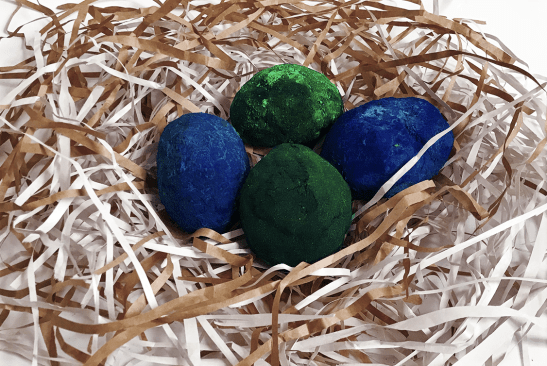
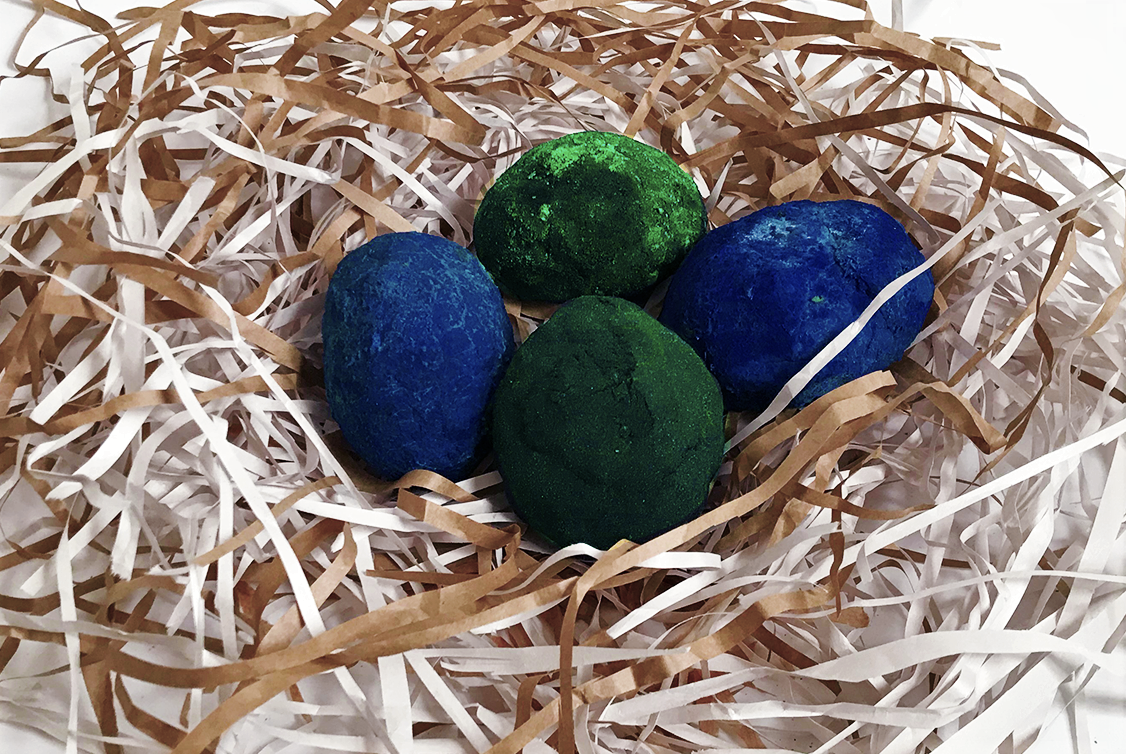
celebrate-picture-books-picture-book-review-dinosaur-eggs-craft-nest

Hatch Your Own Dinosaur Eggs


Think there are no more dinosaur eggs to be found? Think again! You can make your own with this easy craft that will have you hatching some T.-rex-size fun! All you need are a few simple ingredients!
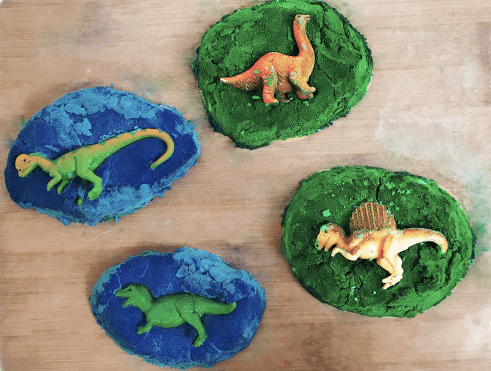
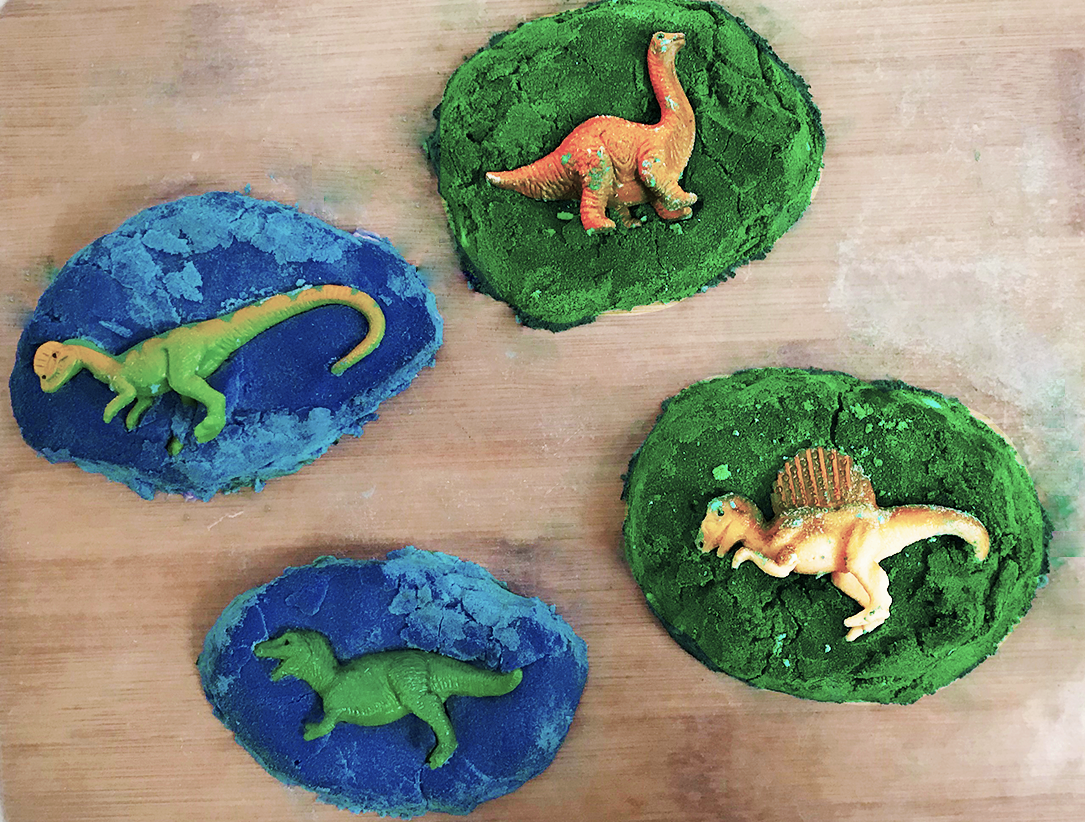
celebrate-picture-books-picture-book-review-dinosaur-eggs-craft-open-eggs

Supplies

  • Old clothes or apron
  • Large box of baking soda (makes between 6 and 8 eggs)
  • Food coloring
  • Water
  • Plastic dinosaur toys
  • Bowl
  • Fork
  • Spoon
  • Wax paper
  • Baking sheet
  • Foil
  • Vinegar
  • Spray bottle (optional)
  • Plastic or metal spoon, stick, popsicle stick, or other implement to chisel with
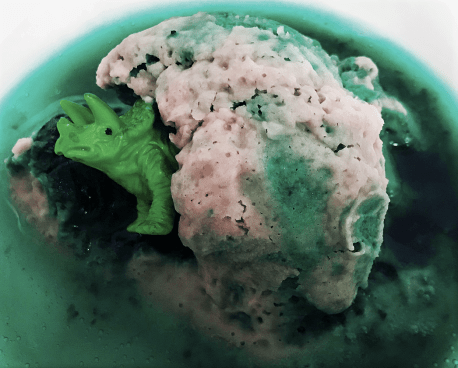
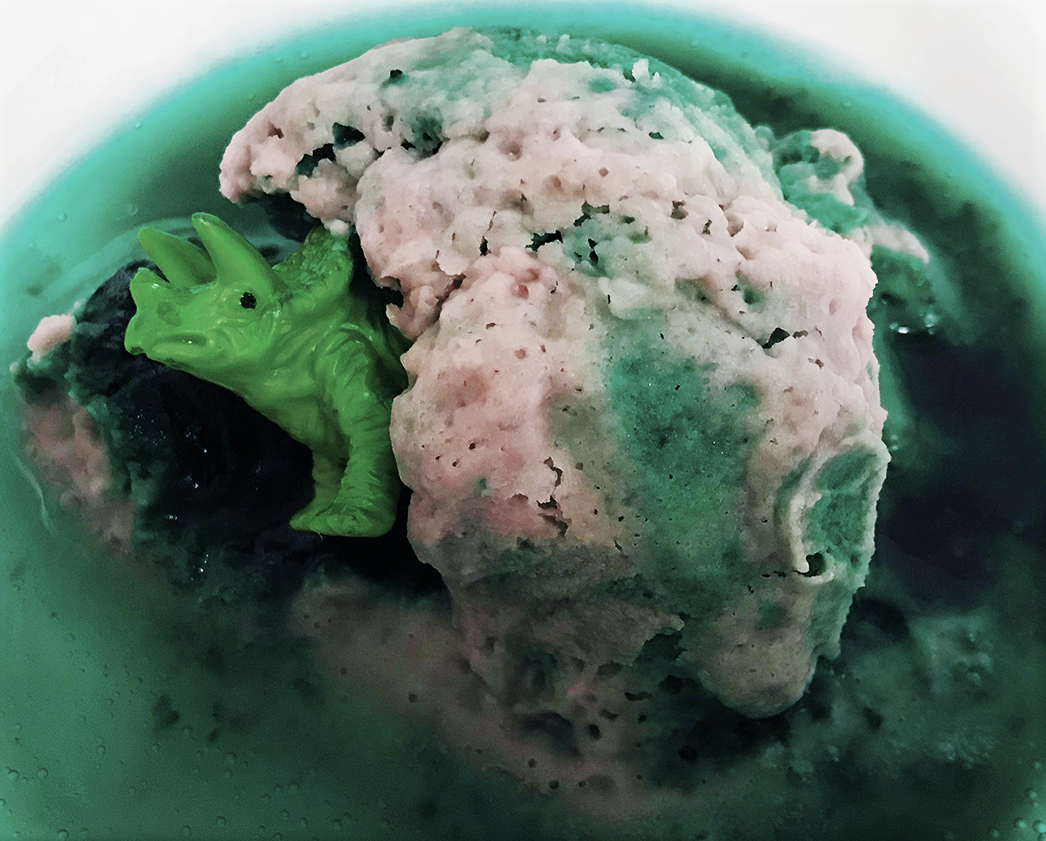
celebrate-picture-books-picture-book-review-dinosaur-eggs-craft-vinegar-egg-open-darker

Spray the egg with vinegar to hatch your dinosaur

Directions

  1. Wear old clothes or an apron
  2. Cover work surface with wax paper, parchment paper, newspaper, or other protection. Food coloring can stain some surfaces
  3. Pour baking soda into the bowl
  4. Add drops of food coloring in whatever color you’d like your eggs to be. The eggs will darken when baked.
  5. Mix in the food coloring with the fork. You may want to use your hands, too
  6. When the baking soda is the color you want it, begin adding water a little at a time
  7. Add water until the baking soda holds together when you squeeze it in your hand
  8. When the baking soda is the right consistency, spoon some out into your hand or onto wax paper
  9. Push one plastic dinosaur into the middle
  10. Cover the dinosaur with more of the baking soda mixture
  11. Carefully form it into an egg shape
  12. Repeat with other dinosaurs
celebrate-picture-books-picture-book-review-dinosaur-eggs-craft-chiseled -darker

Chisel the egg open to hatch your dinosaur

To Bake the Eggs

  1. Set the oven or toaster oven to 200 to 225 degrees
  2. Set the eggs on a baking sheet lined with foil
  3. Bake the eggs for 15 minutes, check
  4. Turn the eggs over and bake for 10 to 15 more minutes
  5. Remove from oven and let cool

To Hatch the Eggs

  1. Eggs can be hatched by chiseling them with a spoon, stick, or other implement
  2. Eggs can also be hatched by spraying or sprinkling them with vinegar
You can purchase Our Prehistoric Planet: Dinosaurs and Other Creatures of the Past from these booksellers

Amazon | Barnes & Noble | Bookshop

Picture Book Review

March 14 – National Learn about Butterflies Day

About the Holiday

Spring has sprung – or is right around the corner – so today’s holiday reminds us to watch out for butterflies in your area. With more than 20,000 species of butterflies around the world, these delicate beauties are one of the most recognized and beloved natural wonders. Beyond their wow factor, butterflies are an important part of our ecosystem, but habitat destruction and climate change are decreasing their numbers by alarming amounts. You can help! By planting milkweed and other plants as well as nectar-producing flowers in your yard or community, you can create an area where butterflies can find shelter, food, and a place to lay their eggs. To learn more about saving monarch butterflies, visit Save Our Monarchs.

Thanks to Beach Lane Books and Barbara Fisch at Blue Slip Media for sending me this book for review!

Monarch and Mourning Cloak: A Butterfly Journal

By Melissa Stewart and Sarah S. Brannen


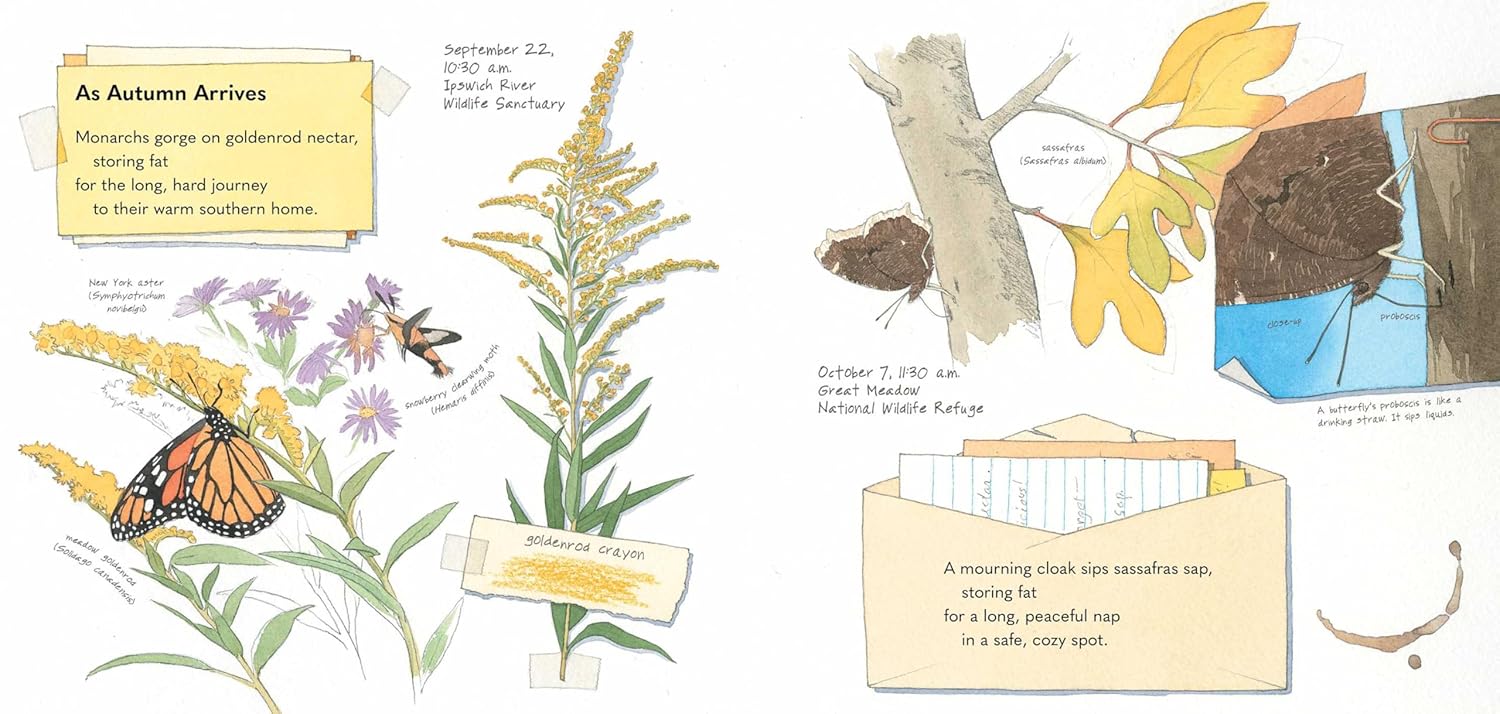
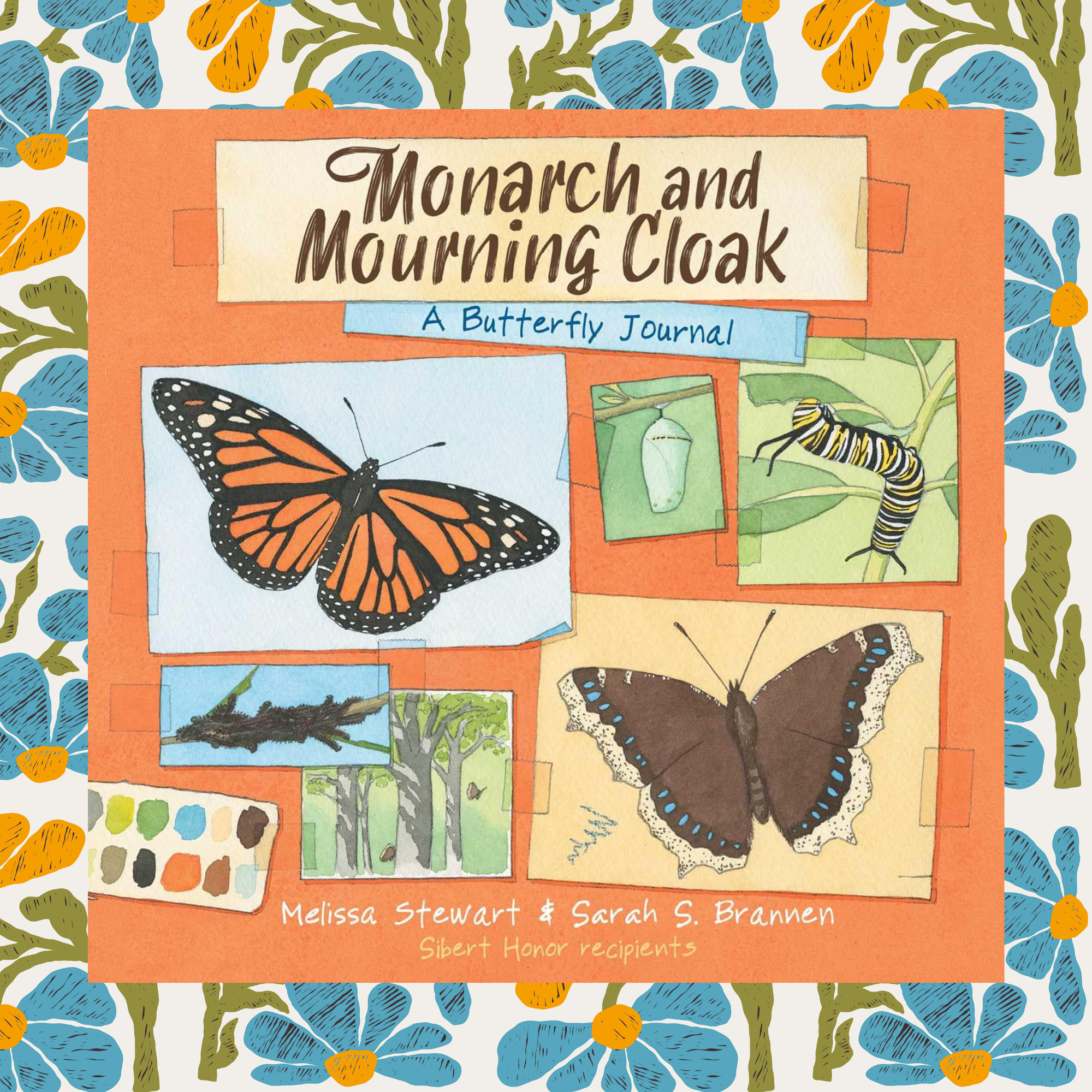
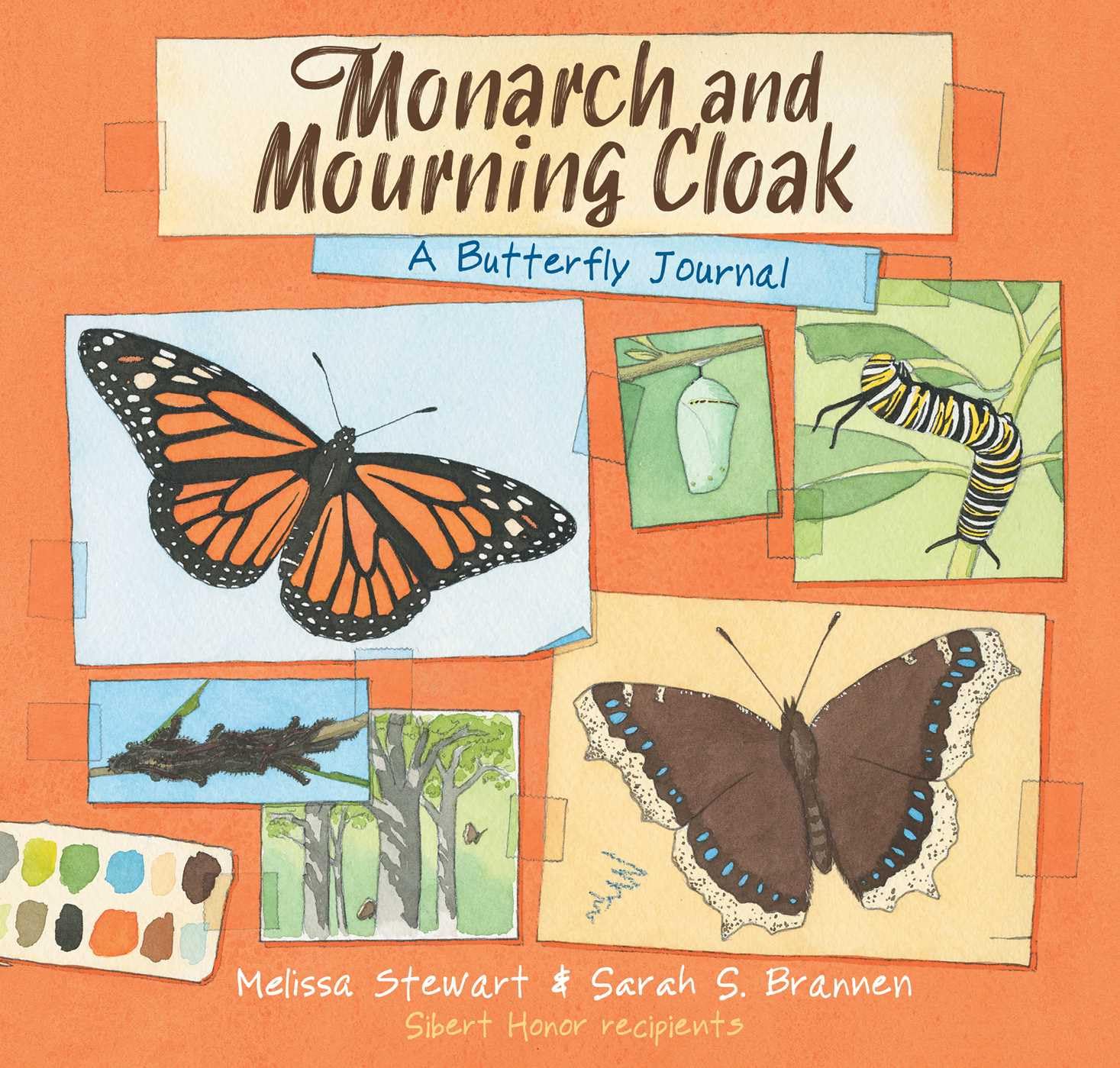
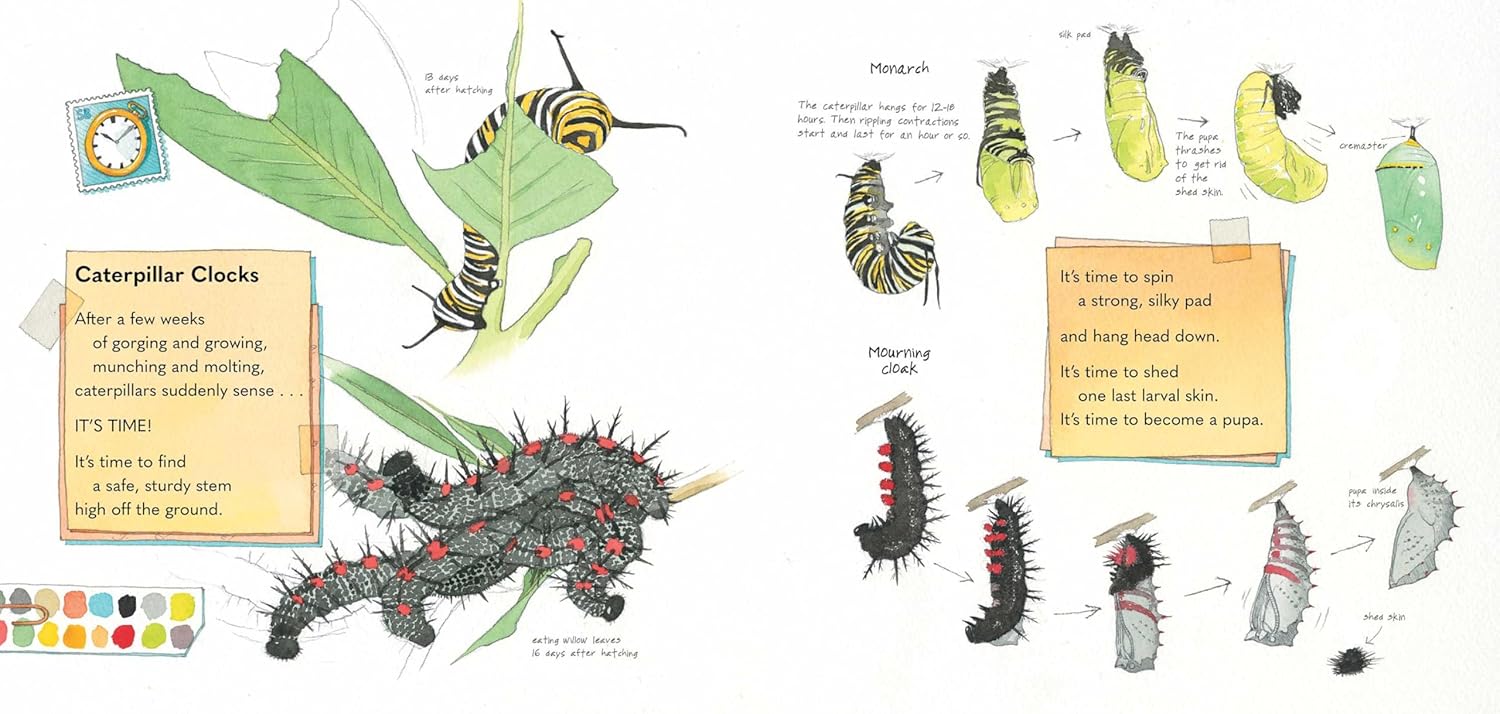
It’s impossible not to be captivated by the creative process. When we read, see, or hear something amazing, we want to ask the artist: How did you do that? The same can be said of metamorphoses in nature. Melissa Stewart and Sarah S. Brannen understand this fascination. In Monarch and Mourning Cloak, Melissa and Sarah give readers an immersive look not only into the lives of monarch and mourning cloak butterflies, but into their very own journal pages full of the research, notes, sketches, and multiple drafts of poems that became this stunning book. Images of papers stacked and taped together simulate the changes Melissa’s poems underwent while Sarah’s painted and rough-sketch images stand side-by-side along strips of watercolor tests and samples of flowers and leaves she used for reference.

Illustration copyright @ 2026 by Sarah S. Brannen. Text copyright @ 2026 by Melissa Stewart. Courtesy of Beach Lane Books.

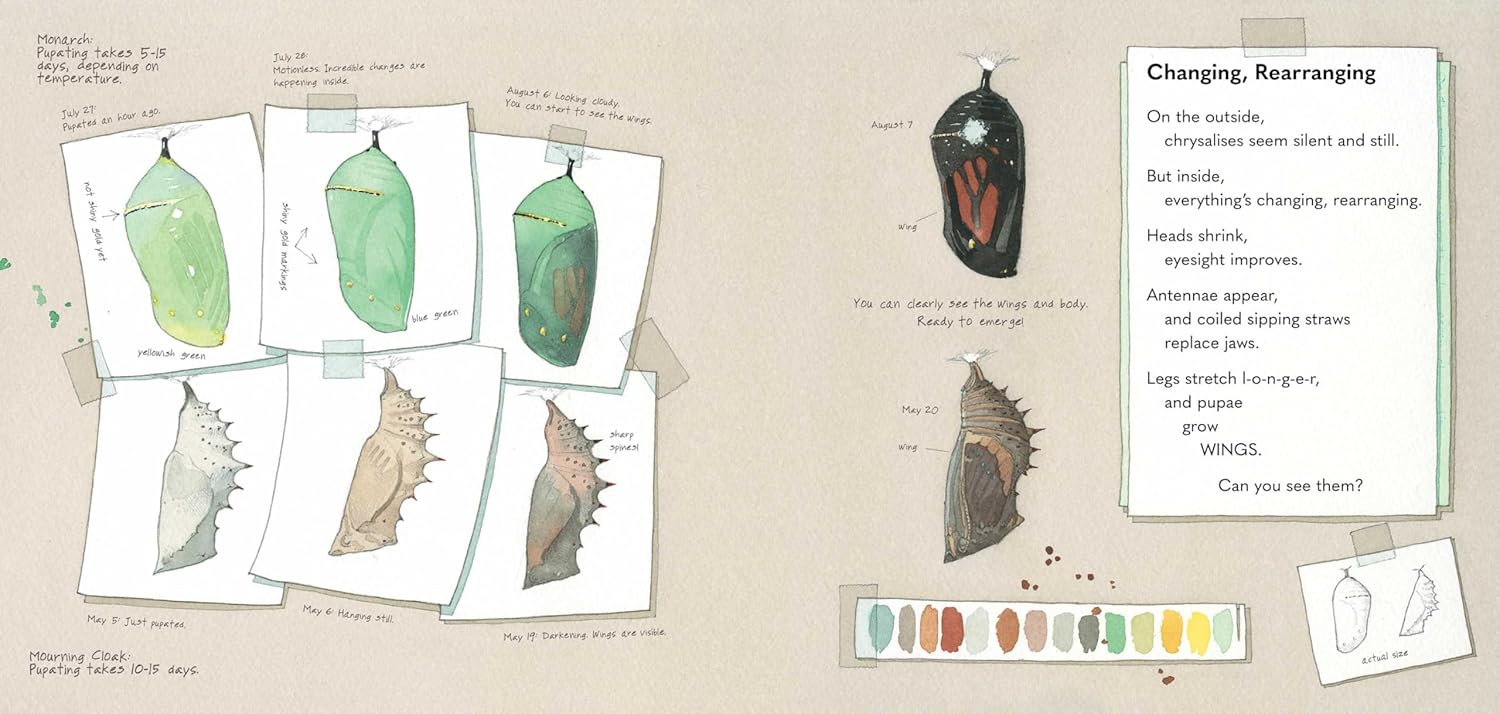
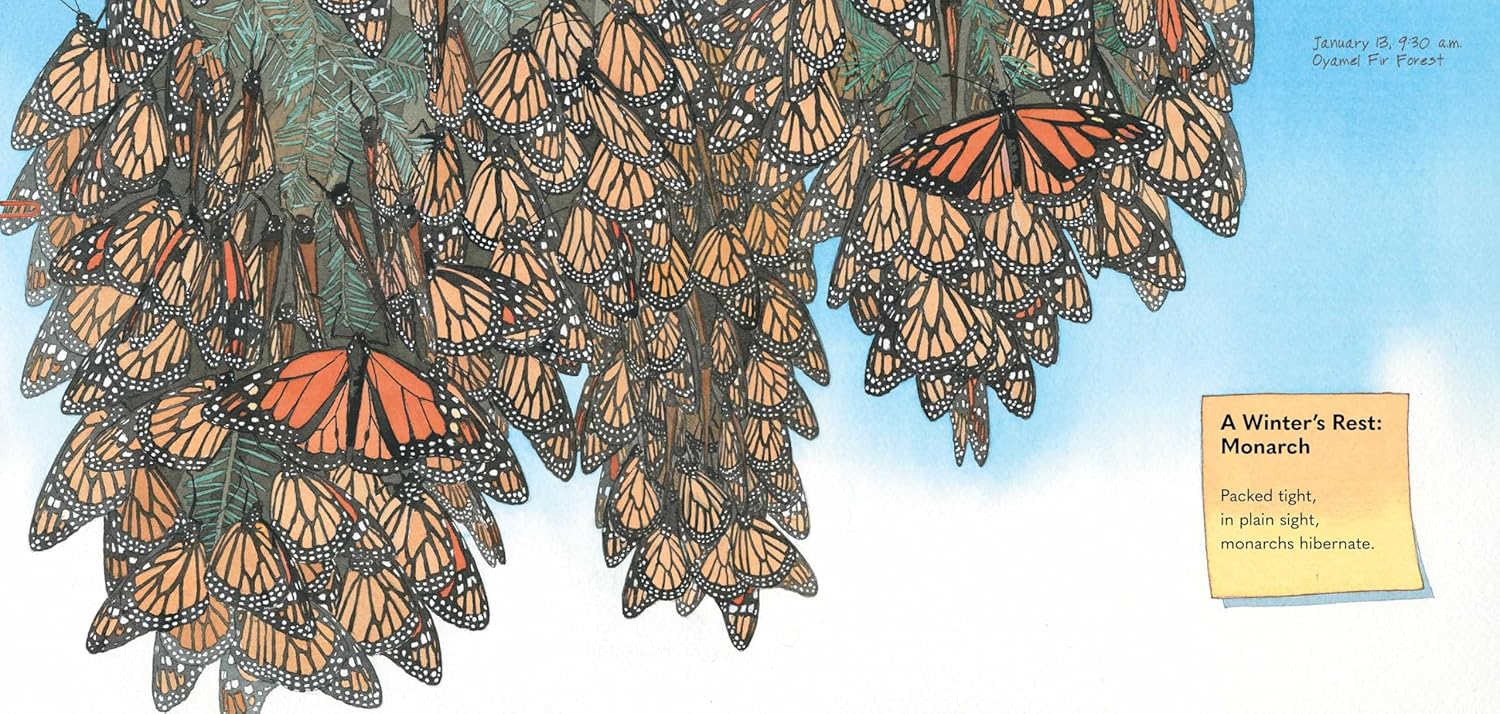
With each page—many inscribed with the date, time, and wildlife sanctuary or garden where observations took place—young nature-lovers receive an incredibly in-depth look at the very different lifecycles of monarch and mourning cloak butterflies through factual information that accompanies Sarah’s glorious illustrations and is sweetened with Melissa’s evocative verses. Particularly stunning are the pages dedicated to the metamorphosis of both monarch and mourning cloak butterflies.

Illustration copyright @ 2026 by Sarah S. Brannen. Text copyright @ 2026 by Melissa Stewart. Courtesy of Beach Lane Books.

Young naturalists first meet Monarch perched on a purple coneflower at Davis Field on June 12 at 1:15 p.m. Mourning Cloak makes its first appearance on a white oak tree in Harvard Forest at 6:15 p.m. on June 15. While these two butterflies are similar in size and share many traits, their lives diverge in many ways. Readers learn all about these similarities and differences by following each throughout the year as they float, feed, hibernate, mate, and fly away leaving their progeny behind. But leaving their readers wondering is not Melissa and Sarah’s style. Through their enlightening words and images, they show children the eggs’ day-by-day transitions from tiny shell to larvae to caterpillar to chrysalis until the fully transformed butterflies emerge and soar into the sky.

Illustration copyright @ 2026 by Sarah S. Brannen. Text copyright @ 2026 by Melissa Stewart. Courtesy of Beach Lane Books.

After the butterflies take wing, this well-conceived book expands with a section that includes illustrated tips by Melissa Stewart on keeping a journal and Sarah S. Brannen on creating a sketchbook; extensive information that elaborates on each of Melissa’s poems with fascinating information about each butterfly’s defenses, food choices, migration paths (including map), surviving winter, egg deposits and survival rates, caterpillar growth and metamorphosis, and its final preparations before flying. Even the endpapers and title page provide enticing facts.

Illustration copyright @ 2026 by Sarah S. Brannen. Text copyright @ 2026 by Melissa Stewart. Courtesy of Beach Lane Books.

For young butterfly and entomology enthusiasts, as well as for nature lovers, writers, and illustrators, Monarch and Mourning Cloak: A Butterfly Journal is an absolute must. Inspirational and educational, this radiant nonfiction title will be a go-to resource throughout the year and a standout addition to all library collections.

Ages 4 – 8+

Beach Lane Books, 2026 | ISBN 978-1665962711

About the Author

Melissa Stewart is the award-winning author of more than 150 science books for children, including the celebrated Meet the Mini Mammals, illustrated by Brian Lies, and Can an Aardvark Bark? and Fourteen Monkeys: A Rain Forest Rhyme, both illustrated by Steve Jenkins. After earning a bachelor’s degree in biology from Union College and a master’s degree in science journalism from New York University, Melissa worked as a children’s book editor for nine years before becoming a full-time writer. While gathering information for her books, she has explored tropical rain forests in Costa Rica, gone on safari in East Africa, and swum with sea lions in the Galapagos Islands. She lives in Acton, Massachusetts. Visit her at melissa-stewart.com.

About the Illustrator

Sarah S. Brannen is an award-winning author and illustrator of more than twenty books for children. Her authored works include the groundbreaking Uncle Bobby’s Wedding, illustrated by Lucia Soto, and her illustrated works include Melissa Stewart’s Sibert Honor book Summertime Sleepers. Sarah lives in Massachusetts. Visit her at sarahbrannen.com.

National Learn about Butterflies Day Activity

celebrate-picture-books-picture-book-review-the-very-impatient-caterpillar-craft

Chrysalis to Butterfly Craft

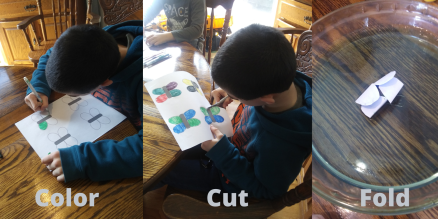
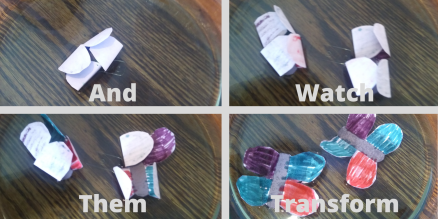
Make your own chrysalis and watch your butterflies emerge! Color your own butterflies and fold them into their own chrysalises. Once placed in the water, the butterflies will transform.

Supplies

  • Printable Butterfly Template
  • Paper
  • Markers/Crayons
  • Scissors
  • Shallow pan filled with water 

celebrate-picture-books-picture-book-review-the-very-impatient-caterpillar-craft-2

Directions

  1. Print the butterfly template
  2. Color butterflies
  3. Cut butterflies out. Be sure to snip in between the wings
  4. Gently fold butterflies. Do not fold hard or crease them, otherwise they will not unfold
  5. Place in the shallow pan in water. Butterflies will open up on their own!

You can purchase Monarch and Mourning Cloak: A Butterfly Journal from these booksellers

Amazon | Barnes & Noble | Bookshop

Picture Book Review
 

February 26 – 18th Anniversary of the Svalbard Global Seed Vault Opening

About the Holiday

In 2008, after more than 20 years of discussion and planning, The Svalbard Global Seed Vault in Svalbard, Norway, opened its doors to deposits of seeds from around the world. The vault’s mission is one that encompasses both history and the future as the facility safeguards both heirloom and modern varieties of seeds for future planting in the event that farmland, plants, and seeds are lost due to natural and/or human-created events. Each year, the seed vault typically accepts deposits during a few days in February (around its anniversary date), June, and October. Today’s book brings the story of this important global resource to children.

Thank you to Charlesbridge and Barbara Fisch of Blue Slip Media for sending me this book for review!

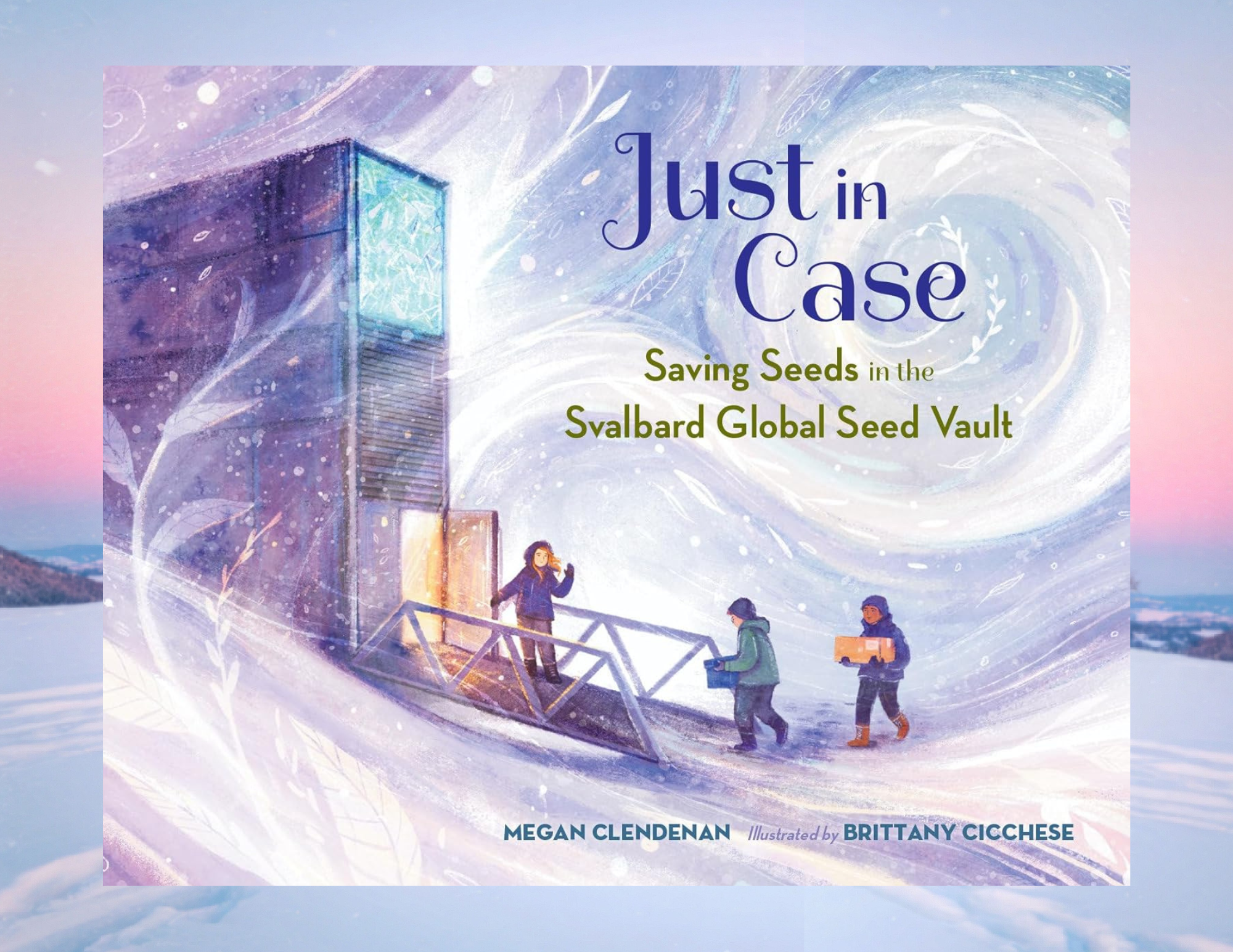
Just in Case: Saving Seeds in the Svalbard Global Seed Vault

Written by Megan Clendenan | Illustrated by Brittany Cicchese


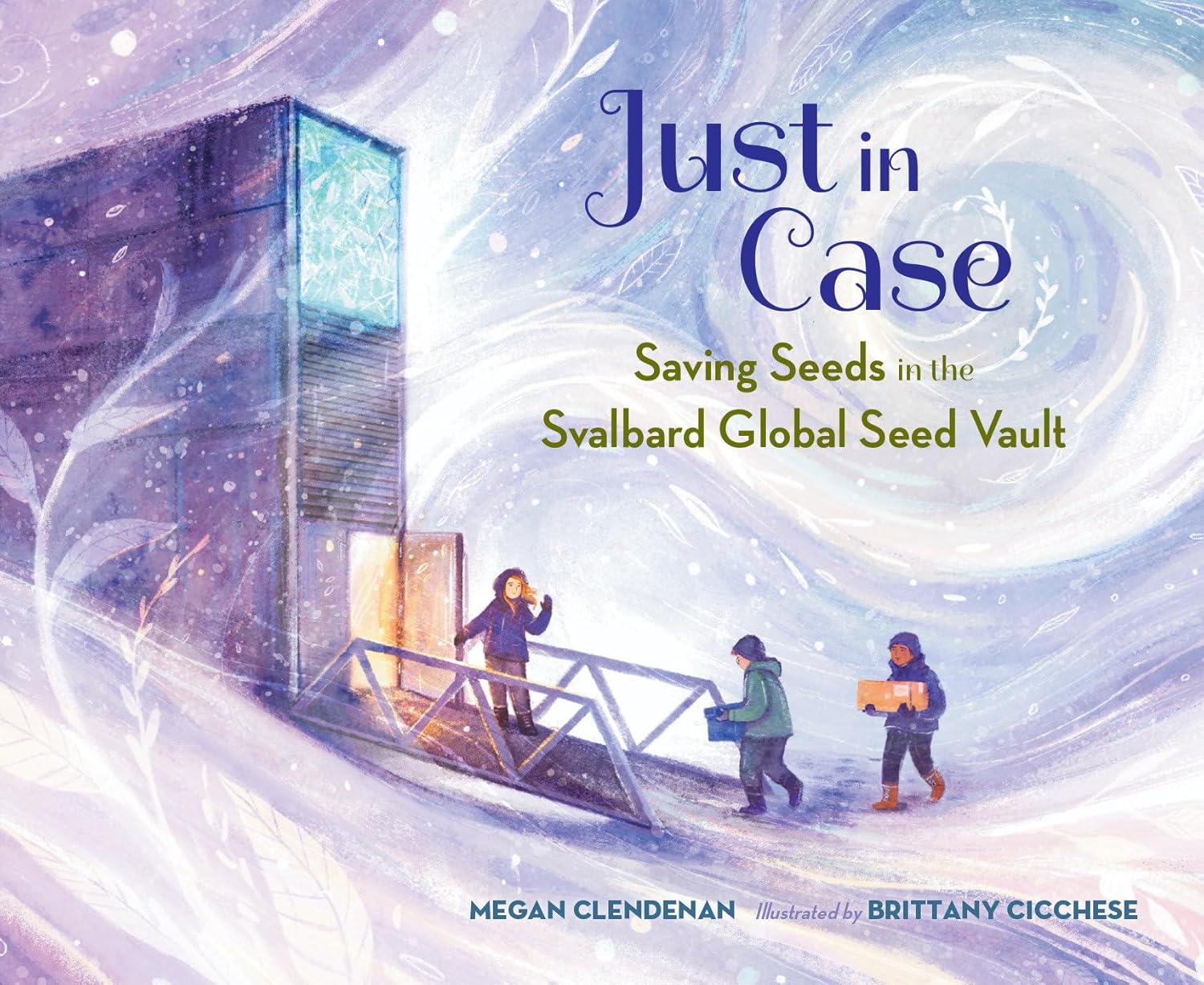
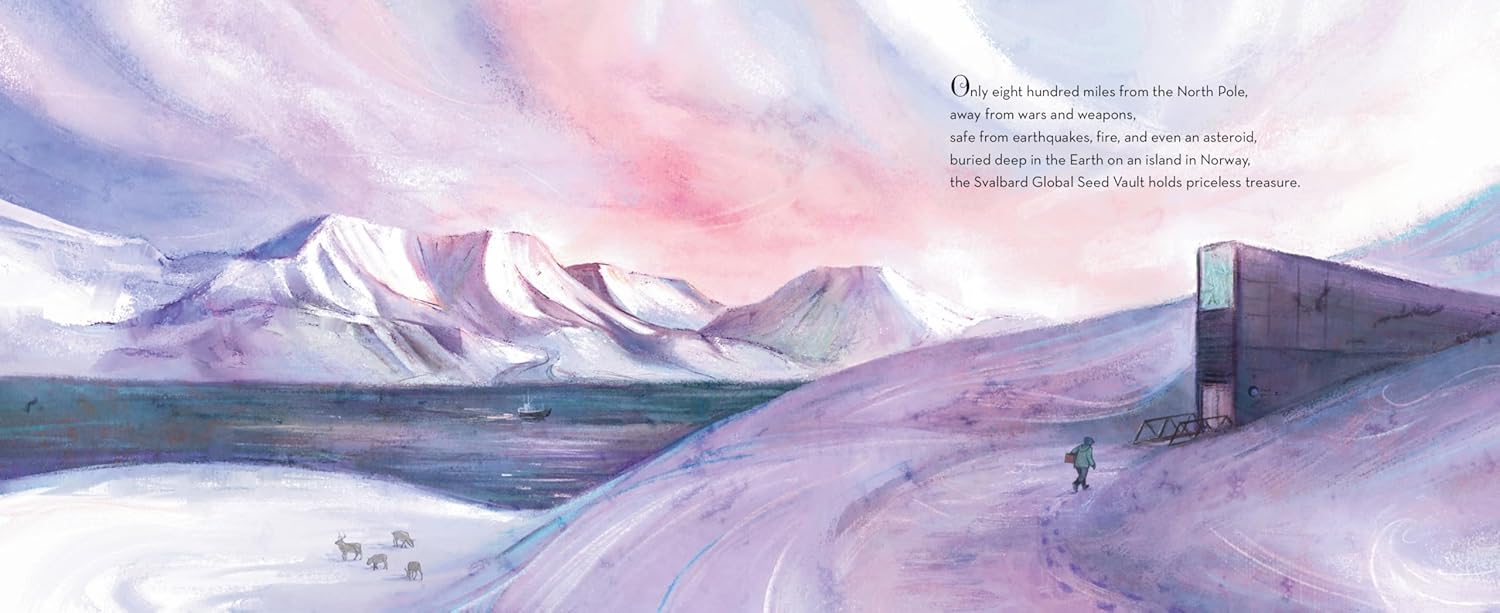
Imagine a vast vault carved into the heart of an arctic mountain where priceless treasure is kept safe from dangers like fire, floods, storms, war, and climate change. Sounds like a movie plot, doesn’t it? But there is such a vault—the Svalbard Global Seed Vault that protects perhaps the world’s most valuable resource: seeds.

Illustration © 2025 by Brittany Cicchese. Text © 2025 by Megan Clendenan. Courtesy of Charlesbridge.

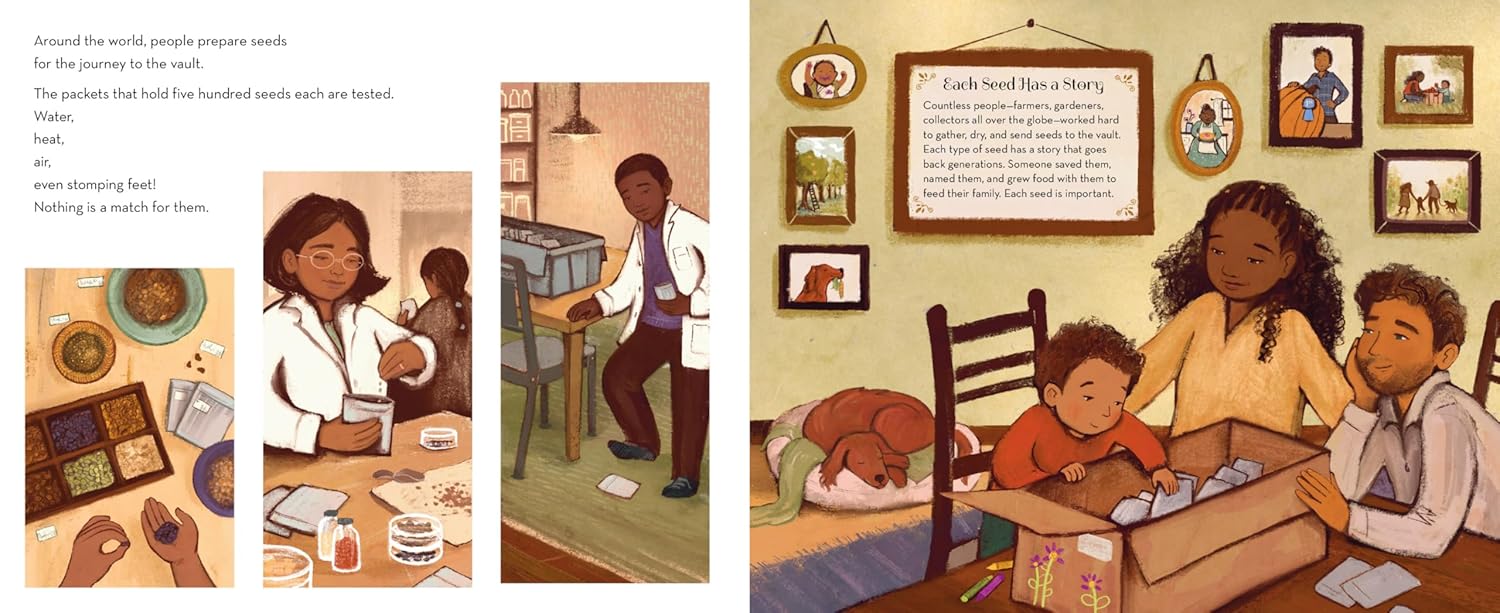
Before Megan Clendenan and Brittany Cicchese take children on a tour of the Svalbard Seed Vault, they plant a wide range of knowledge about seeds themselves. Kids learn world-wide traditions for saving local crop seeds, in both fortress-like seed banks and “simple community spaces with jars of seeds on shelves,” that each variety of seed has a “unique genetic code” that determines everything about it, and why some seeds may face extinction.

Illustration © 2025 by Brittany Cicchese. Text © 2025 by Megan Clendenan. Courtesy of Charlesbridge.

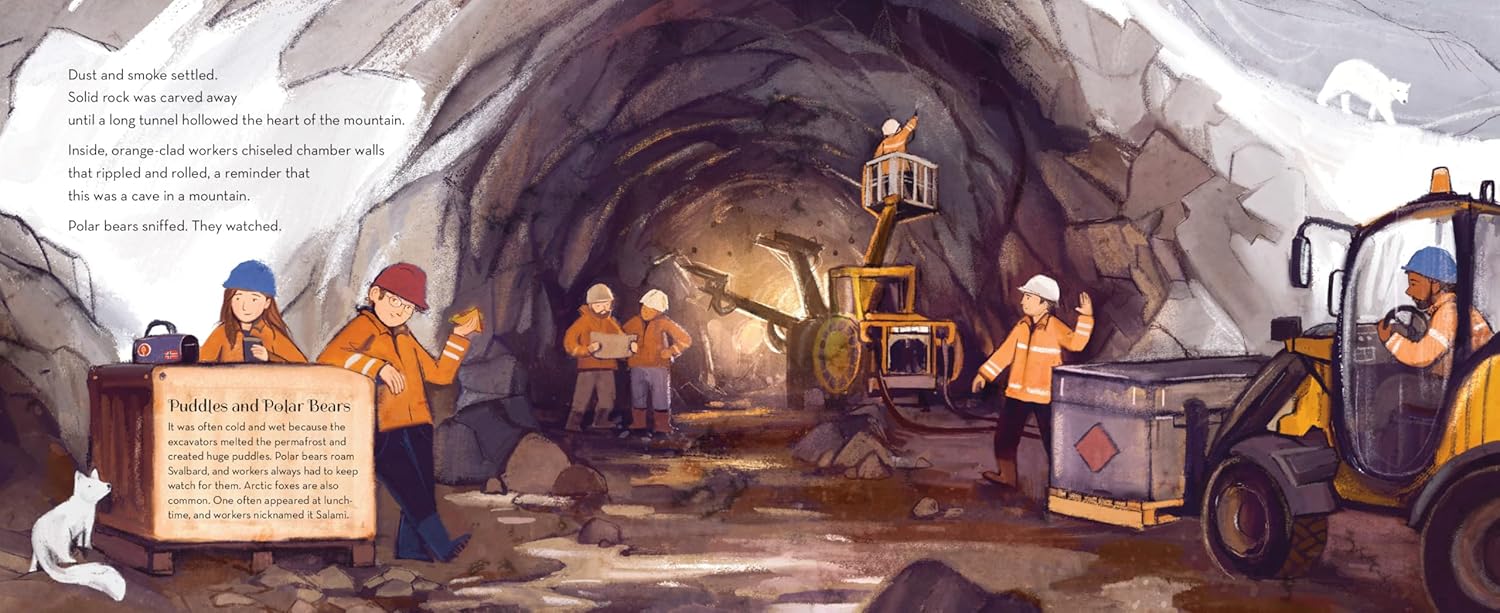
Then it’s off to Norway to see where a group of engineers, scientists, and architects designed the vault that was to be built “in the middle of a frozen mountain.” Step by step, kids join the crew to see equipment arrive, hear the blast that facilitated the digging and carving of the tunnel, and even meet a hungry arctic fox they befriended.

Readers learn about security at the vault, witness the care with which farmers, gardeners, and collectors from around the world contribute seeds to the vault’s shelves, and discover that in the vault’s “first five years, 80,000 unique crop varieties arrived . . . !” They also see how crucial the seed vault is through the story of the first withdrawal of seeds from the bank that helped a war-torn country recover their crops. Today, “inside the vault, a walk down the aisles becomes a walk through the world” with “more than 580 million seeds. / For you, for me / for everybody. / Just in case.”

Back matter extends the discussion of some issues presented in the text, including the difficulty of keeping seeds safe, the vault itself, the need to continually update crop seeds to reflect evolutionary changes, and an author’s note. 

Illustration © 2025 by Brittany Cicchese. Text © 2025 by Megan Clendenan. Courtesy of Charlesbridge.

With the allure and story-building of an adventure about hidden treasure, Megan Clendenan draws readers into the frozen, underground world of the Svalbard Global Seed Vault, where the survival of crucial food crops is protected. Her clear and lyrical text (“steel doors open and beckon into the belly of a mountain,” “walls of ice shine like stars.”) keeps readers riveted to the historical and current facts about farming, seed harvesting, and this global facility that may be unknown to many. Easy-to-understand sidebars illuminate particular aspects of Clendenan’s subject, including, information on local seed banks around the world, varietal differences and the threat of extinction of some seeds, vault design and construction, seed storage conditions, and the first seed withdrawal. 

Brittany Cicchese’s lovely illustrations take children to the arctic north to view the Svalbard Global Seed Vault, with it’s ethereal sculptural entrance, and its shelves lined with boxes of seeds before transporting them to various farms, gardens, markets, and seed repositories around the world. Cicchese’s detailed and realistic depictions clearly connect readers to those who grow and sell food, the design and construction of the vault from the meeting room to the mountain tunnel, the scientists and families who provide the seeds, and the plants that grow to feed us all.

An absorbing look at one of the world’s most important resources that also offers a sense of hope in its example of global collaboration, Just in Case: Saving Seeds in the Svalbard Global Seed Vault is a must for school, classroom, and public libraries as well as for children who love gardening, farming, science, and food.

Ages 5 – 8

Charlesbridge, 2025 | ISBN 978-1623544805

Megan Clendenan studied sociology, English, and environmental planning and has worked for nonprofit organizations focused on environmental law, women’s empowerment, mental health, and urban food security. As a children’s book author, she loves writing nonfiction that explores the connections between history, society, and the environment. She is the author of Design Like Nature: Biomimicry for a Healthy PlanetFresh Air, Clean Water: Our Right to a Healthy Environment, and Cities: How Humans Live Together. She lives near Vancouver, British Columbia, with her family and two fuzzy orange cats. This is her first picture book. You can visit her at meganclendenan.com.

Brittany Cicchese enjoys capturing emotion above all else, from expressive portraits to moody illustrations. She is the illustrator of The Kitten Story: A Mostly True Tale and No More Señora Mimí. When Brittany isn’t sketching or writing, you can find her working at the library, reading a good fantasy or sci-fi book, or hiking around the beautiful Rocky Mountains. Brittany lives in Denver, Colorado. Visit her at brittanycicchese.com.

Anniversary of the Svalbard Global Seed Vault Opening Activity

Just in Case Activity Kit


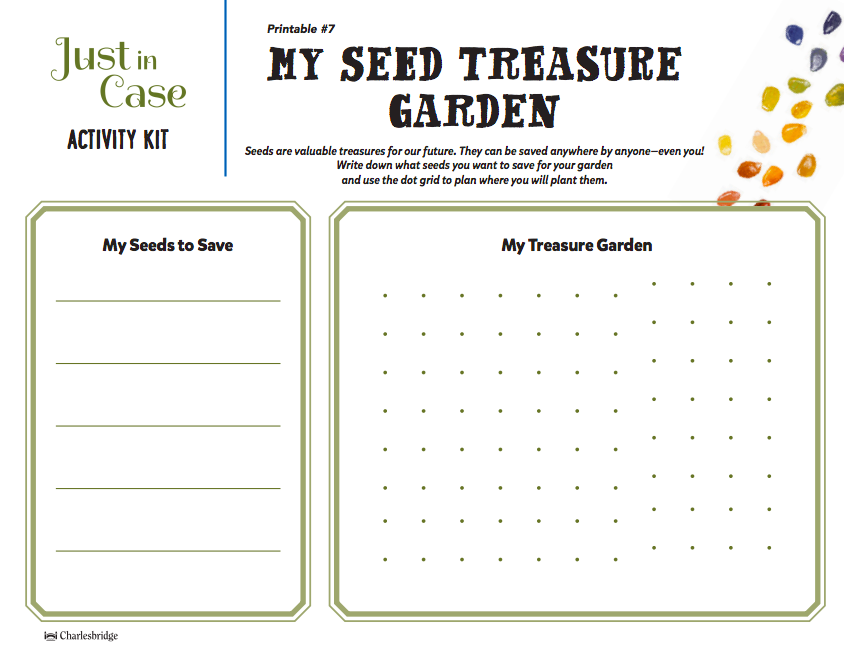
Educators and families will enjoy using the comprehensive Just in Case Activity Kit from Charlesbridge, Megan Clendenan, and Brittany Cicchese! It includes Connection Activities for English Language Arts, Social Studies, and Science; Discussion Questions; Tips to help children harvest seeds from their own fruit and vegetable plants; a garden planner; and a list of further resources. You can find the Just in Case Activity Kit on Megan Clendenan’s website and from Charlesbridge.

You can purchase Just in Case: Saving Seeds in the Svalbard Global Seed Vault from these booksellers

Amazon | Barnes & Noble | Bookshop

Picture Book Review
January 9 – Welcome Winter

About the Holiday

For children who live in northern climates, winter brings dreams of snow and all the enjoyment that goes with this fluffy, malleable, cooold precipitation. Snow isn’t just for playing in (or shoveling) though. It provides plenty of opportunities to engage with science in a fun and fascinating way—as you’ll see in today’s book!

Flurry, Float, and Fly!: The Story of a Snowstorm

Written by Laura Purdie Salas | Illustrated by Chiara Fedele


As readers open Flurry, Float, and Fly! autumn is welcoming its first impromptu snowflakes. The golden hues of fall still carpet the hills as “clouds lie heavy, gray, and low,” animals watch, and two children, anticipation in their hearts, don coats and boots. The siblings emerge from their house and pull out their sled.

There’s movement in the atmosphere: “From the north, a polar freeze . . . from the south, a humid breeze. All winds advance. They mix and dance.” And yet the children wait; they watch, and sit. There is no snow for sledding. But the winds are just getting started—picking up dust, working together. At last, a “tiny drop turns into ice— / six small sides, / arranged. / precise.”

Illustration © 2025 Chiara Fedele. Text © 2025 Laura Purdie Salas. Courtesy of Bloomsbury Children’s Books.

The crystals grow and begin to drift. They’re all unique. How can that be? “Each cloud’s type— / how cold?— / how wet?— / shapes each crystal’s silhouette.” The kids are ready; the snow is falling! Mom tells them that dinner’s calling. All night long the flakes float down. In the morning the world’s transformed into a winter playscape for snowmen, snow forts, and finally . . . sledding “before it’s time to say goodbye to flakes that flurry . . . float . . . and fly!”

Illustration © 2025 Chiara Fedele. Text © 2025 Laura Purdie Salas. Courtesy of Bloomsbury Children’s Books.

In her back matter, Laura Purdie Salas describes in clear and easy-to-understand language the science behind the formation of snow. She addresses the ingredients of a snowstorm, the polar jet stream, how snowflakes form and fall, and even how long it takes for a snowflake to drift to Earth. Salas also describes six common shapes of snowflakes (along with photographs) and includes websites, videos, and books for further research.

Illustration © 2025 Chiara Fedele. Text © 2025 Laura Purdie Salas. Courtesy of Bloomsbury Children’s Books.

Mixing winter hopes with science, Laura Purdie Salas’s rhyming storytelling flows as smoothly and joyfully as a sled ride down a snowy hill. Young readers will be just as invested in the suspense of the changing weather as the two siblings and forest animals who watch and feel it coming. Salas’s lyrical descriptions of how snowflakes are created are as much a marvel as the real thing, sparking excitement for learning as well as for the wonders of the season.

Chiara Fedele’s gorgeous watercolor, gouache, and colored-pencil illustrations are sumptuous portrayals of a landscape in flux as clouds bearing snow form above hills sparsely populated with homes. As winds roil, readers join two children with their minds set on sledding. As Salas’s verses begin portraying the scientific creation of snowflakes, Fedele spatters a spread with hazy white dots that with just a page turn become clearly delineated, luminescent crystals children can marvel over. Cozy images of the children and their mother through the home’s windows glow with familial warmth as squirrels, a badger, and a fox curl up in their snug dens.

Both young and adult readers will enjoy spying the squirrel, fox, badger, and raven from page to page, as well as the sibling’s changing fortunes. As the snow and dusk begin to fall at the same time, Fedele masterfully gives children a bird’s eye view of the conversation between the siblings and their mother, entirely understood by the characters’ gestures. The final two spreads reward the sibling’s patience as their friends arrive for exuberant winter play—and that long-awaited sled ride.

An exquisite and spellbinding story, Flurry, Float, and Fly!: The Story of a Snowstorm is creative nonfiction at its finest. The book is one you’ll want to add to your home or library collection. Teachers, science and nature educators, and homeschools will find this book to be a valuable resource to engage all learners. See below for how to access activities and resources to accompany the book.

Ages 4 – 7

Bloomsbury Children’s Books, 2025 | ISBN 978-1547603503

About the Author

Former teacher Laura Purdie Salas is the author of more than 130 books for kids, including Lion of the SkyWe BelongWater Can Be…, and BookSpeak! Laura grew up in Florida, but she has lived in Minnesota all her adult life. She loves thunderstorms, snowstorms, and brainstorms. She’s also a big fan of game nights, donuts, and getting up early in the morning. Visit her at laurasalas.com and on Instagram @laurapsalas.

About the Illustrator

Chiara Fedele was born in Milan and now lives in a nearby village. She took a degree in Illustration at La Scuola del Fumetto. Chiara works with Italian and international publishers. She has won a number of awards including the Premio Cento Illustrator Competition in 2008, Sydney Taylor Award Silver Medal in 2018 and 3×3 International Illustration Award Merit in 2019. You can visit her at chiarafedeleillustrator.it and on Insta: @chiaraillu.

Welcome Winter Activity

Flurry, Float and Fly! Coloring Pages and More!


Laura Purdie Salas welcomes children, readers, and educators to engage with Flurry, Float and Fly!: The Story of a Snowstorm through coloring pages, a winter trivia activity, and a teacher’s guide, plus so many more activity pages and ideas that will keep kids excited about words, writing, learning, and observing for home and classroom use. Just take a look through her dropdown menus to get started having fun!

Laura Purdie Salas Downloadables & Resources

You can purchase Flurry, Float, and Fly!: The Story of a Snowstorm from these booksellers

Amazon | Barnes & Noble | Bookshop

Picture Book Review
October 10 – World Space Week


About the Holiday

First declared by the United Nations in 1999, World Space Week has grown to be the largest public space-related event in the world. The week is an international celebration of science and technology, and their contribution to the betterment of the human condition. This year’s theme is “Living in Space” and “explores humanity’s journey toward making space a habitat, emphasizing the innovative technologies, challenges, and collaborative efforts that make this vision a reality.” Looking to celebrate this initiative with more than 15,000 events in more than 90 countries, the week sponsors space education and outreach events held by space agencies, aerospace companies, schools, planetaria, museums, and astronomy clubs around the world. To learn more about the week, visit worldspaceweek.org.

Thank you to Simon & Schuster/Paula Wiseman Books and Barbara Fisch at Blue Slip Media for sending me a copy of this book for review.

Rock Star: How Ursula Marvin Mapped Moon Rocks and Meteorites

Written by Sandra Neil Wallace | Illustrated by Nancy Carpenter

As a child growing up in Vermont, Ursula Marvin was captivated by the adventures winter brought. She was especially awed by the snowy mountains illuminated by “the frosty moonlight.” Her father was Vermont’s official entomologist, but Ursula had no intention of following in his footsteps or becoming any kind of scientist. She had her sights set on being an explorer. That was until she examined a rock under the microscope in college and decided to become a geologist. Her professor, however, denied her new major “because she was a woman.”

Illustration © 2025 Nancy Carpenter. Text © 2025 Sandra Neil Wallace. Courtesy of Simon & Schuster/Paula Wiseman Books.

Ursula took her talents to another university and earned a geology degree. She was an expert in recognizing rare minerals in Earth rocks and was tapped to be one of the first geologists to study rocks brought back from the moon. What she found was a world of color, minerals that proved “its surface was once a bubbling ocean of melted rock.” Ursula also studied meteorites, finding “minerals no one knew existed beyond Earth.” Her work revolutionized scientists’ views of the solar system.

But Ursula still yearned to explore, in particular she wanted to be the first woman to find meteorites in Antarctica—the coldest place on Earth. She loaded up a bag with frigid-cold-weather gear and joined an expedition. When Ursula and her male teammates landed, they set up camp. They had to work fast because winter was on its way, threatening to bury any meteorites under ice and snow for another year.

Illustration © 2025 Nancy Carpenter. Text © 2025 Sandra Neil Wallace. Courtesy of Simon & Schuster/Paula Wiseman Books.

Ursula wondered if she’d be able to recognize meteorites under these conditions, but she needn’t have worried. On her first day, a rock caught her eye. Examining it, she discovered distinctive traits—she’d discovered her first meteorite! Ursula was in her element, thriving in the harsh weather and “collecting meteorites more than four billion years old.”

But not every day was a success. Ursula struggled to climb a mountain-like nunatak in her too-big boots, she mistook an ordinary Earth rock for a meteorite, and on the worst day, with one snowmobile broken, the team went exploring without her. Ursula vowed never to be left behind again.

Illustration © 2025 Nancy Carpenter. Text © 2025 Sandra Neil Wallace. Courtesy of Simon & Schuster/Paula Wiseman Books.

With only one week left in the expedition, Ursula rode across the ice to “unexplored places where the meteorites were bigger and rarer.” She wanted to be the one to find the last meteorite of the trip, to be the one to discover a meteorite from the moon. But a fall dashed those dreams as she was airlifted to the hospital, leaving her teammates to collect the final meteorite.

Illustration © 2025 Nancy Carpenter. Text © 2025 Sandra Neil Wallace. Courtesy of Simon & Schuster/Paula Wiseman Books.

Back at home, Ursula was excited to examine this small meteorite, which looked so different from the others. She recognized the world of color from her earlier studies. “Ursula’s teammates had discovered the first lunar meteorite on Earth without her.” Instead of feeling disappointed, she was “jubilant.” She went on to become a preeminent expert on this moon meteorite and others and to inspire women to become scientists, many exploring Antarctica, where they found more moon meteorites and even some from Mars more than four billion years old. Ursula’s influence can still be seen today in her work as well as in the Marvin Asteroid and Moon’s Marvin Crater named for her.

Extensive back matter following the story includes an Author’s Note about the astonishing life and influence of Ursula Marvin; quotations from Ursula’s Antarctica journals; facts about Antarctica; dated milestones of Ursula’s life, education, and work; resources; and two photographs.

Illustration © 2025 Nancy Carpenter. Text © 2025 Sandra Neil Wallace. Courtesy of Simon & Schuster/Paula Wiseman Books.

Sandra Neil Wallace’s exhilarating biography of Ursula Marvin transports readers to the snow and ice of Antarctica, where they get to ride along with this extraordinary woman as she fulfills childhood goals while changing the face of science and forging new opportunities for women. Wallace’s storytelling is fast-paced and evocative and infused with emotion, suspense, and scintillating details that will captivate readers no matter what their interests.

Nancy Carpenter’s beautiful mixed media illustrations allow children to see early influences and experiences that spurred Ursula Marvin to pursue geology and the study of meteorites in particular. Her images of Antarctica bring chills and thrills as Ursula sets up her tent, speeds over icy fields in the swirling snow on her snowmobile, and flops on the ground to inspect rocks up close. Carpenter also depicts Ursula’s victories and disappointments, giving children a well-rounded view of this remarkable woman. Rock hounds will be wowed by Carpenter’s drawings of moon rocks and meteorites.
With much to impart not only on the life of Ursula Marvin but on believing in yourself, overcoming disappointments, and chasing your goals with gusto, Rock Star: How Ursula Marvin Mapped Moon Rocks and Meteorites is a top pick for home, school, and public library collections.

Ages 4 – 8

Simon & Schuster/Paula Wiseman Books, 2025 | ISBN 978-1534493339

Sandra Neil Wallace writes about people who break barriers and change the world. She is the author of several award-winning books for children, including Love Is Loud: How Diane Nash Led the Civil Rights Movement, illustrated by Bryan Collier; Marjory Saves the Everglades: The Story of Marjory Stoneman Douglas, illustrated by Rebecca Gibbon; and Between the Lines: How Ernie Barnes Went from the Football Field to the Art Gallery, illustrated by Bryan Collier, which received the Orbis Pictus Book Award and was an ALA Notable Book. A former ESPN reporter and the first woman to host an NHL broadcast, she is the recipient of the Outstanding Women of New Hampshire Award and creates change as cofounder of The Daily Good, a nonprofit bringing twenty thousand free, culturally diverse foods to college students each year through its Global Foods Pantries. Visit Sandra at sandraneilwallace.com.
Nancy Carpenter is the acclaimed illustrator of Thomas Jefferson and the Mammoth HuntQueen Victoria’s Bathing MachineFannie in the Kitchen, and Loud Emily, among other books. Her works have garnered many honors, including two Christopher Awards and the Jane Addams Children’s Book Award. She lives in Brooklyn, New York. Visit her at nancycarpenter.website.
World Space Week Activity

celebrate-picture-books-picture-book-review-rocket-to-the-moon-tic-tac-toe-game

Out-of-this-World Tic-Tac-Toe Game

If you’re kids are fascinated by the moon, moon rocks, and meteors, they’ll enjoy making this tic-tac-toe game from simple materials you have at home!

Supplies

  • Printable Moon Tic-Tac-Toe Game Board
  • 2 cardboard egg cartons
  • Heavy stock paper or regular printer paper
  • Crayons
  • Black or gray fine-tip marker

Directions

To Make the Rockets

  1. Cut the tall center cones from the egg carton
  2. Trim the bottoms of each form so they stand steadily, leaving the arched corners intact
  3. Pencil in a circular window on one side near the top of the cone
  4. Color the rocket body any colors you like, going around the window and stopping where the arched corners begin
  5. With the marker color the arched corners of the form to make legs
  6. On the cardboard between the legs, color flames for blast off

To Make the Capsule

  1. Cut the egg cups from an egg carton
  2. Color the sides silver, leaving the curved section uncolored. (If your egg cup has no pre-pressed curve on the sides of the cup, draw one on each side.)
  3. Color the curved section yellow to make windows
  4. With the marker, dot “rivets” across the capsule

Print the Moon Game Board and play!

You can purchase Rock Star: How Ursula Marvin Mapped Moon Rocks and Meteorites from these booksellers

Amazon | Barnes & Noble | Bookshop

Picture Book Review