March 6 – National Dress Day

celebrate-picture-books-picture-book-review-along-came-coco-cover

About the Holiday

Instituted by Ashley Lauren in 2016, the day encourages people to relive and celebrate their best dress memories. It’s also a day to honor those designers who design the styles that create a splash, feel comfortable, and make a statement. To celebrate today, get together with friends and talk about your favorite dress memories then go shopping and get ready to make some more!

Abrams sent me a copy of Along Came Coco to check out. All opinions are my own. I’m happy to be partnering with Abrams in a giveaway of the book. Details are below.

Along Came Coco: A Story about Coco Chanel

By Eva Byrne


Coco Chanel, born in 1883, grew up in an orphanage, “a strict convent tucked away in the French countryside.” While the girls wore identical uniforms and followed the nuns’ rules, Coco always found a way to be herself: when she learned how to sew, she used her creativity to make dolls for her friends, and each night as she brushed her curly hair the required one-hundred times, she vowed that when she grew up she’d cut her hair short.

celebrate-picture-books-picture-book-review-along-came-coco-orphanage

Copyright Eva Byrne, 2019, courtesy of Abrams Books for Young Readers.

Sometimes Coco was allowed to visit her grandparents in Moulins and her Aunt Louise in Varennes. During these trips she saw fashionable ladies strolling through the city and watched her aunt transform simple hats into fabulous creations. Coco wanted to make hats too. As soon as she was grown, she said au revoir to the convent and opened a hat shop. Then she began making clothing inspired by the sights all around her. She especially liked the “stripy tops of the local fisherman” and “sewed her own version.”

In 1914, Coco opened in the beachside town of Deauville. The summer was hot, and Coco created a stylish and cooler bathing suit so women could enjoy the shore. “She was one of the first designers who knew exactly what women wanted.”

celebrate-picture-books-picture-book-review-along-came-coco-boutique

Copyright Eva Byrne, 2019, courtesy of Abrams Books for Young Readers.

Soon she had a waiting list of women who wanted to wear her designs. She converted men’s fashions into stylish clothes for women and was the first to add pockets to women’s outfits. Her clothing was so popular that she was able to buy an entire building in Paris to sell her dresses, hats, and jewelry. She enjoyed the theater and opera, and one night as she was getting ready to go out, a gas lamp exploded. Her dress was ruined and her hair was burned. Coco was not about to miss the opera, so she cut her long hair short and discovered that it framed her face in a most delightful way.

But what would she wear? She cut and sewed a new evening gown that broke all the rules—it had no corset. “And with every stitch, Coco changed the way women dressed forever.” Her dress was black, simple, and elegant, without all the frills and poofs of the dresses of the time. “Coco dreamed that all women should have a black dress.” And thus the “little black dress was born” and women’s fashions and lifestyle changed forever.

An Author’s Note and more information on Coco Chanel, her life, and work follow the text.

celebrate-picture-books-picture-book-review-along-came-coco-sewing

Copyright Eva Byrne, 2019, courtesy of Abrams Books for Young Readers.

Eva Byrne weaves a fascinating biography of Coco Chanel that reveals the early influences and experiences that informed her creativity. Byrne infuses her text with Coco’s precocious spirit through examples of her dreams of the future, good-natured “rule breaking,” and fashion innovations. Coco’s natural talent, modern vision, and confidence to buck the system are all evident in Byrne’s engaging storytelling that will have kids marveling over women’s fashions of the time and appreciating Coco’s contributions not only to women’s clothing choices but to the way they lived. The story of how the first little black dress came to be will amaze both children and adults.

From the beginning of the book, where a pair of hands stitch the name Coco onto the title page, to the end, where Coco, needle and thread in hand, winks at the reader, Byrne treats kids to beautiful illustrations of Coco, her surroundings, and her fashions. Her fresh, vivid watercolors are light and airy as they take readers down French boulevards and to the beach. Readers will love lingering over the pages to study the styles of the time and how Coco’s designs stood out as revolutionary. Removing the gilded casewrap reveals a stunning canal-side landscape and the inspiration for Chanel’s famous striped look.

A superb book for kids who love fashion and fashion students as well as readers interested in history, the arts, biographies, and a well-told story, Along Came Coco makes an excellent gift and exciting addition to home, classroom, and public libraries.

Ages 4 – 8

Abrams Books for Young Readers, 2019 | ISBN 978-1419734250

To learn more about Eva Byrne and see a gallery of her artwork, visit her website.

Along Came Coco Giveaway

I’m excited to partner with Abrams Books for Young Readers in giveaway of:

  • One (1) copy of Along Came Coco: A Story about Coco Chanel, by Eva Byrne

To enter Follow me @CelebratePicBks on Twitter and Retweet a giveaway tweet.

This giveaway is open from March 6 through March 12 and ends at 8:00 p.m. EST.

A winner will be chosen on March 13.

Prizing provided by Abrams.

Giveaway open to U.S. addresses only. | No Giveaway Accounts. 

National Dress Day Activity

celebrate-picture-books-picture-book-review-hanging-on-fashion-word-search-puzzle

Hanging on Fashion Word Search Puzzle


Fashion design has its own special vocabulary. Can you find the twenty fashion-related words in this printable puzzle?

Hanging on Fashion Word Search Puzzle | Hanging on Fashion Word Search Solution

celebrate-picture-books-picture-book-review-along-came-coco-cover

You can find Along Came Coco at these booksellers

Amazon | Barnes & Noble | Books-a-Million | IndieBound

Picture Book Review


March 3 – World Wildlife Day

celebrate-picture-books-picture-book-review-galapagos-girl-cover

About the Holiday

In December of 2013 the United Nations General Assembly proclaimed March 3rd as World Wildlife Day to promote awareness of our environment and the dangers to it. Every year a different theme is chosen to spotlight an area of the world, a particular species, or a group of activists. This year’s theme is “life below water for people and planet” and focuses on marine species, the importance of marine wildlife, and the issues affecting the health and survival of the ocean and ocean creatures. The day also celebrates successful conservation and sustainability initiatives. To learn more about the day, special events, and how you and your kids can get involved today and throughout the year, visit the World Wildlife Day website.

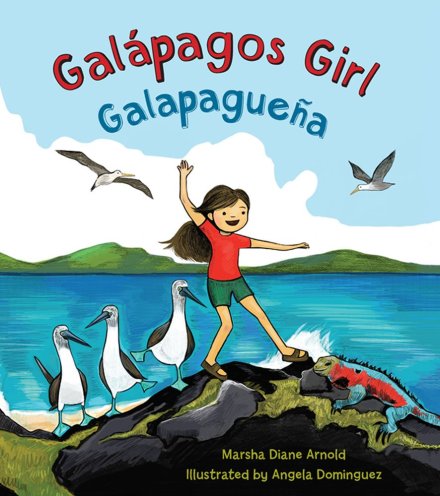
Galápagos Girl / Galapagueña

Written by Marsha Diane Arnold | Illustrated by Angela Dominguez | Translated by Adriana Dominguez


On the day when baby Valentina joined Mamá, Papá, and eleven brothers and sisters, even the sea lions, blue-footed boobies, and iguanas seemed to welcome her to the “island formed by fire.” Valentina loved growing up on the Galápagos Island of Floreana. She explored the lava rocks, where Sally Lightfoot crabs scuttled back and forth. She swam with dolphins and manta rays, and even played with penguins.

celebrate-picture-books-picture-book-review-Galápagos-Girl-crabscelebrate-picture-books-picture-book-review-Galápagos-Girl-crabs

Image copyright Angela Dominguez, 2018, text copyright Marsha Diane Arnold, 2018. Courtesy of Lee & Low Books.

“Valentina watched pink flamingoes wading near mangroves. Blue butterflies fluttering on the breeze. Red-and-green iguanas sneezing salt like tiny geysers.” The crashing waves, albatross, and finches created a symphony as Valentina stopped to rest on a grassy cliff overlooking the ocean. The lava lizards, blue-footed boobies, and twirling sea lions provided young Valentina with a variety of dance partners.

celebrate-picture-books-picture-book-review-Galápagos-Girl-iguana

Image copyright Angela Dominguez, 2018, text copyright Marsha Diane Arnold, 2018. Courtesy of Lee & Low Books.

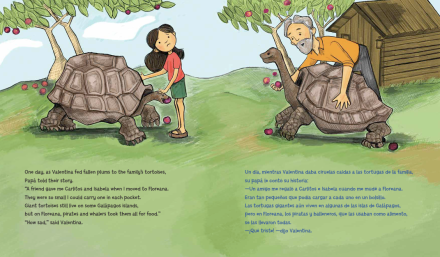
At home, Valentina’s family shared their home with two giant tortoises—Carlitos and Isabella. One day Papá told Valentina their story as they fed the tortoises plums that had fallen from their backyard trees. Papá had gotten Carlitos and Isabella from a friend when he first moved to Floreana. Although it was nearly impossible to imagine now that the tortoises were grown, at the time they were so small that they fit into Papá’s pockets.

celebrate-picture-books-picture-book-review-Galápagos-Girl-tortoises

Image copyright Angela Dominguez, 2018, text copyright Marsha Diane Arnold, 2018. Courtesy of Lee & Low Books.

There was also a sad note to Papá’s story. He said that while giant tortoises still lived on other Galápagos islands, pirates and whalers had wiped out the population on Floreana. Papá went on to tell Valentina that many Galápagos animals were in danger. They were “threatened by other animals that don’t belong here. Threatened by people who don’t understand how to care for our islands.” Valentina promised that she would always protect them.

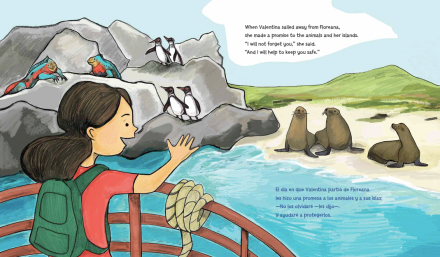
When she was older, Valentina left the island to go to school. She didn’t want to leave her beautiful home, but Mamá told her that she was “ready to learn about the world beyond.” And Papá reminded her that “like our islands, you have a heart full of fire.” On school vacations, Valentina always came back to study the wildlife on the Galápagos islands. She had not forgotten her promise to keep them safe.

celebrate-picture-books-picture-book-review-Galápagos-Girl-going-to-school

Image copyright Angela Dominguez, 2018, text copyright Marsha Diane Arnold, 2018. Courtesy of Lee & Low Books.

After she graduated with a degree in biology, Valentina returned to the islands as a nature guide to teach visitors about the beauty and uniqueness of the Galápagos. Some visitors were even lucky enough to meet Carlitos and Isabella when the plums dropped from the trees and the two old tortoises returned from exploring Floreana to eat them. Because of Valentina’s commitment to the Galápagos, her visitors also made a promise to always remember and protect them.

Extensive backmatter includes an Author’s Note about Valentina Cruz, the tortoises Carlitos and Isabella, and the history of tortoises on Floreana. There is also information on the Galápagos as well as fun facts about all of the animals in the story. A bibliography of sources invites readers to learn more.

Each two-page spread presents the text in English and translated into Spanish by Adriana Dominguez.

celebrate-picture-books-picture-book-review-Galápagos-Girl-guiding-visitors

Image copyright Angela Dominguez, 2018, text copyright Marsha Diane Arnold, 2018. Courtesy of Lee & Low Books.

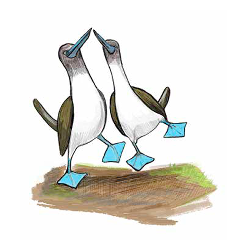
Marsha Diane Arnold’s lyrical and buoyant passages sing with the carefree joy Valentina felt as a girl exploring her beloved Galápagos and which brought her back home as a biologist to protect them. After seeing Valentina playing and swimming with the native animals and feeding Carlitos and Isabella, readers will also feel Valentina’s sadness at the dangers they face and want to make a positive difference to the environment and the world around them. Arnold’s dialogue-rich storytelling highlights the personal nature of the subject and will draw children into Valentina’s world.celebrate-picture-books-picture-book-review-Galápagos-Girl-blue-footed-booby

Saturated with glorious color, each of Angela Dominguez’s illustrations is a celebration of the splendor of the Galápagos. Playful sea lions, high-stepping blue-footed boobies, scampering crabs, and even a sneezing iguana will captivate young readers and inspire them to learn more about these creatures and the islands. Images of Valentina camping out to study the animals during school breaks will excite environmentally conscious kids, and pictures of Carlitos and Isabella happily munching on plums will generate smiles and “awwws.”

Galápagos Girl / Galapagueña will excite kids to learn more not only about the Galápagos region but about their own local environment, and the call to action will spark an enthusiasm for protecting the earth’s animals. The book would make an inspiring addition to home bookshelves and an excellent way to begin classroom discussions on environmental issues and science lessons. The engaging Spanish translation will delight Spanish-speaking and bilingual families.

Ages 4 – 8

Lee & Low Books, 2018 | ISBN 978-0892394135

Discover more about Marsha Diane Arnold and her books on her website.

Read an interview with Marsha Diane Arnold here.

To learn more about Angela Dominguez, her books, and her art, visit her website.

World Wildlife Day Activity

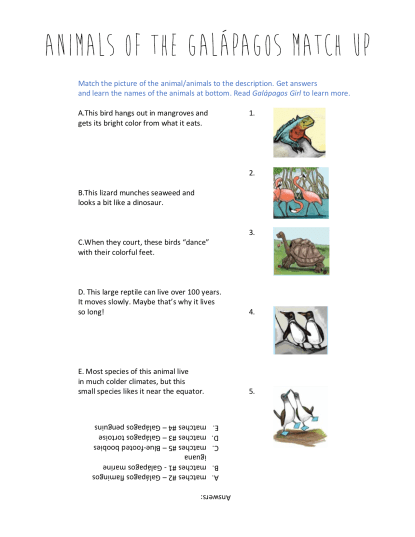
celebrate-picture-books-picture-book-review-animals-of-the-galapagos-match-up-puzzle

Animals of the Galápagos Match Up Puzzle


There are so many fascinating animals that live in the Galápagos! Can you match the picture of each animal to its description in this printable Animals of the Galápagos Match Up Puzzle? You can find and download the activity sheet from the Lee & Low Books website:

Animals of the Galápagos Match Up Puzzle

celebrate-picture-books-picture-book-review-galapagos-girl-cover

You can find Galápagos Girl / Galapagueña at these booksellers

Amazon | Barnes & Noble | Books-a-Million | IndieBound

Picture Book Review


February 28 – Digital Learning Day

celebrate-picture-books-picture-book-review-grace-hopper-queen-of-computer-code-cover

About the Holiday

Established in 2012, today’s holiday raises awareness of the advances in educational technology for classrooms and teachers and to spread opportunities to schools and communities across the country for all youth to use. Digital Learning Day also highlights innovative educators who are using technology to enhance their lessons and bring the latest information and learning tools to students from kindergarten through high school. For more information on today’s holiday and to find resources for using technology in the classroom visit the Digital Learning Day website.

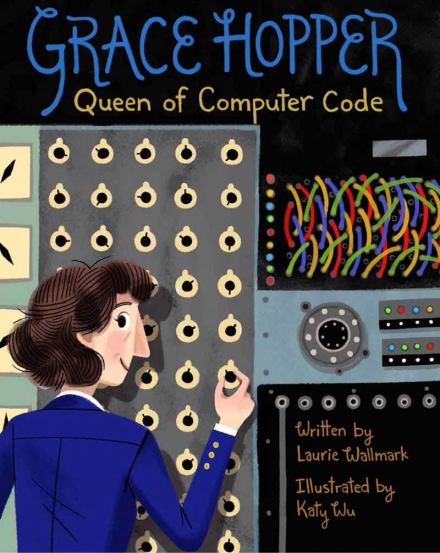
Grace Hopper: Queen of Computer Code

Written by Laurie Wallmark | Illustrated by Katy Wu


As Grace Hopper finished writing a computer code to guide Navy missiles, she noticed that there was a certain string of code that she had repeated many times. “Grace snorted. What a colossal waste of time! There had to be a better way. Why not make the computer do the work?” Grace figured out a way for the computer to store pieces of a program and then find them again to create another program. Grace was the first computer programmer to do this.

celebrate-picture-books-picture-book-review-grace-hopper-queen-of-computer-code-desk

Image copyright Katy Wu, 2017, text copyright Laurie Wallmark, 2017. Courtesy of Sterling Children’s Books.

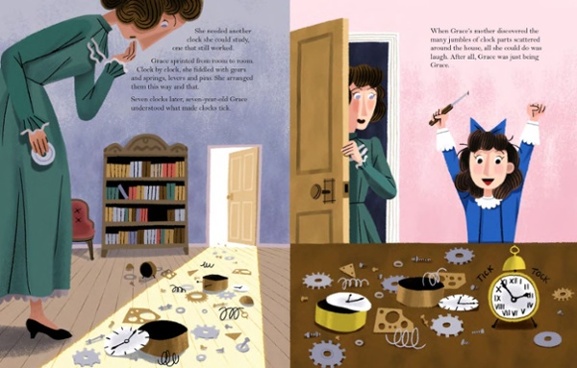
Even as a child Grace loved to tinker with mechanical things. She once opened all the clocks in the house to figure out how they worked. What did her mother say when she saw that? “…all she could do was laugh. After all, Grace was just being Grace.” Later, she built an electric elevator for her dollhouse. She reveled in difficult problems, and while the girls in her class “wore frilly dresses and learned to be young ladies, Grace studies math and science.”

Studying hard, Grace finished high school two years early, and while she had the grades in math and science to go to college, she failed Latin. Without passing Latin, she couldn’t go to college. Grace buckled down and the next year she was off to Vassar College. Grace passed up taking classes such as “Husbands and Wives” and “Motherhood” to take math and physics. But Grace did a lot more than just study. “Her personal motto was ‘Dare and Do,’ and she took it to heart. She flew in a barnstormer airplane.

celebrate-picture-books-picture-book-review-grace-hopper-queen-of-computer-code-clock

Image copyright Katy Wu, 2017, text copyright Laurie Wallmark, 2017. Courtesy of Sterling Children’s Books.

Grace went on to graduate school at Yale and then took a job teaching at Vassar. She knew how to make her classes fun and informative. At this time America was at war and needed mathematicians. She tried to join the Navy, but they told her she was too old and too thin. She kept asking, however, and after a year, the Navy agreed to let her join. She “was assigned to write programs for one of the first computers ever built, the Mark I. Only a few people had ever programmed before, so she had to learn how to do it on her own.”

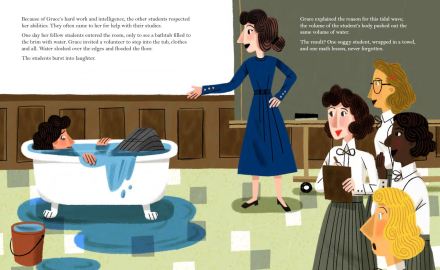
celebrate-picture-books-picture-book-review-grace-hopper-queen-of-computer-code-bath

Image copyright Katy Wu, 2017, text copyright Laurie Wallmark, 2017. Courtesy of Sterling Children’s Books.

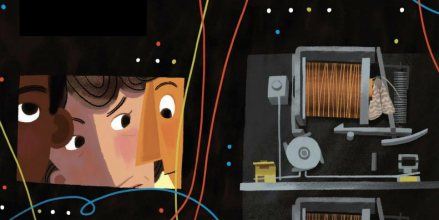
Then one day Grace learned that “the new computer, the Mark II, had stopped working.” Grace and her coworkers searched and searched for an error in the code, but they found none. Then Grace thought that maybe the problem wasn’t in the code but in the computer itself. They looked inside the huge machine for loose wires or electrical shorts. Nothing. Then they saw it—a moth had gotten inside and was blocking a switch.

celebrate-picture-books-picture-book-review-grace-hopper-queen-of-computer-code-computer

Image copyright Katy Wu, 2017, text copyright Laurie Wallmark, 2017. Courtesy of Sterling Children’s Books.

With a tweezer, a worker removed the moth and the computer started up again. Grace taped the moth into the log book and wrote, “‘First actual case of [a computer] bug being found,’” and the term “computer bug” was born. Grace also revolutionized programming when she “invented a program that let people use words to tell the computer what to do” instead of pages and pages of 1s and 0s.

When Grace turned sixty, the Navy made her retire. Within six months, they asked her to return and she worked for them for another twenty years. She retired again at the age of eighty as the Queen of Computer Code. As many people called her, she really was “Amazing Grace.”

A timeline of Grace Hopper’s life as well as a list of honors awarded her and resources for further reading about Grace and other women in STEM.

celebrate-picture-books-picture-book-review-grace-hopper-queen-of-computer-code-coil

Image copyright Katy Wu, 2017, text copyright Laurie Wallmark, 2017. Courtesy of Sterling Children’s Books.

Laurie Wallmark’s engaging biography of Grace Hopper will delight kids as they see her grow from a precocious and innovative child to a woman who used her intelligence and imagination to lead the computer revolution. Specific examples of Grace’s successes and the support she received at home will encourage other engineering-minded kids, and the inclusion of her failure in Latin demonstrates that everyone has areas of weakness that can be overcome with hard work. Grace’s perseverance in getting the Navy to accept her is also a good lesson for children on not giving up on their dreams. The provenance of the term “computer bug” will surprise and amuse readers.

Katy Wu’s charming illustrations of events in Grace Hopper’s life take readers back to time when computers were new. Children will marvel over the size and design of early computers. Grace’s sense of adventure and humor are on display is colorful and action-packed images. Uplifting and encouraging sayings by Grace Hopper that will inspire children are sprinkled throughout the pages.

A book to motivate children to reach for their dreams and spark pride in individual accomplishment, Grace Hopper: Queen of Computer Code would be an influential book to add to home, school, and public libraries.

Ages 5 and up

Sterling Children’s Books, 2017 | ISBN 978-1454920007

Discover more about Laurie Wallmark and her books on her website.

To learn more about Katy Wu, her books, and her art on Tumblr.

Digital Learning Day Activity

celebrate-picture-books-picture-book-review-trendy-trending-word-search-puzzle

Trendy Trending Word Search Puzzle


Digital communication has a language all its own! Open this laptop and find the twenty-two Internet-based words in this printable word search puzzle.

Trendy Trending Word Search Puzzle and Solution

celebrate-picture-books-picture-book-review-grace-hopper-queen-of-computer-code-cover

You can find Grace Hopper: Queen of Computer Code at these booksellers

Amazon | Barnes & Noble | Books-a-Million | IndieBound

Picture Book Review

February 3 – National Women Physicians Day

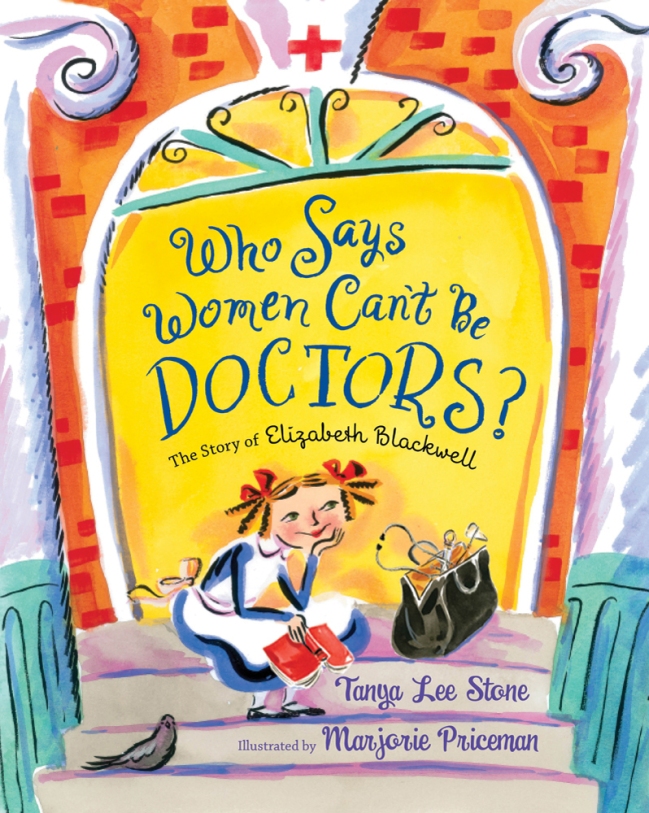
Who Says Women Can't Be Doctors by Tanya Lee Stone and Marjorie Priceman picture book review

About the Holiday

Today, we celebrate the birthday of Elizabeth Blackwell, who in 1849 became the first woman to earn a medical degree in the United States. Her courage in the face of much opposition paved the way for other women to pursue careers in the medical field. National Women Physicians Day also honors the achievements and contributions of all women physicians around the world. 

Who Says Women Can’t be Doctors? The Story of Elizabeth Blackwell

Written by Tanya Lee Stone | Illustrated by Marjorie Priceman


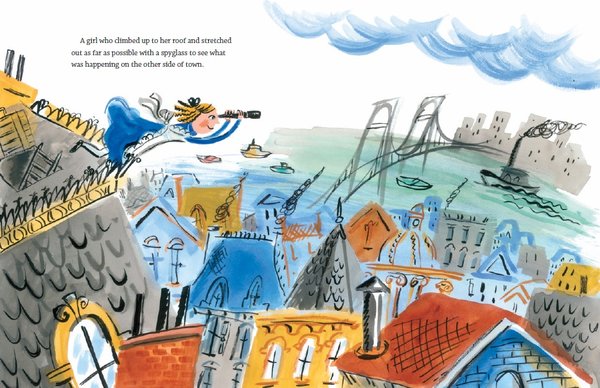
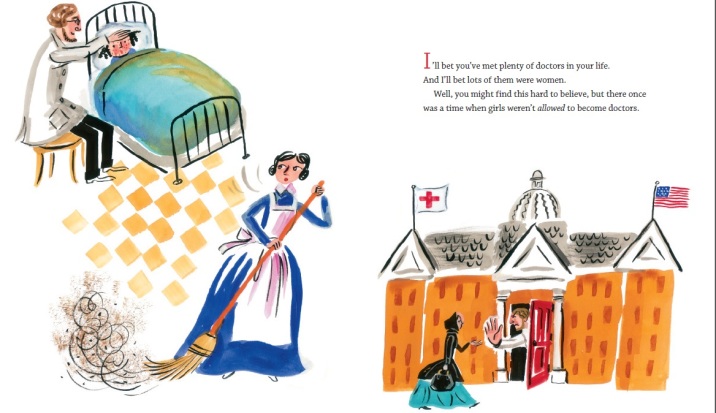
Once upon a time there were no women doctors. Women weren’t even allowed to be doctors. Sounds like a fairy tale, doesn’t it? But it was the truth. Then Elizabeth Blackwell, came along. Elizabeth was not like other girls of the 1830s. She loved to explore and take on challenges. She could lift her brother over her head, and to toughen herself up she slept on the hard wood floor. To get a better look at the world she once climbed to the roof of her house and leaned waaaaay out with a spyglass. What did she see? Maybe she saw her future. But it wasn’t what she imagined at the time. Blood made her queasy, dissection was disgusting, and being sick just made her want to hide from all the fussing.

celebrate-picture-books-picture-book-review-who-says-women-can't-be-doctors-elizabeth-brave

Image copyright Marjorie Priceman, 2013, text copyright Tanya Lee Stone, 2013. Courtesy of Henry Holt and Company.

A comment by a sick friend, however, puts a bee in Elizabeth’s bonnet. Mary Donaldson tells Elizabeth that she would much rather have been examined by a woman than her male doctor, and then says, “You should be a doctor, Elizabeth.” What a crazy notion, right? Well… Elizabeth can’t stop thinking about it. She asks around. Some people think it’s a good idea, but impossible; others simply think it’s impossible. They believe women aren’t strong enough or smart enough and they laugh at her. By this time, though, Elizabeth is determined.

celebrate-picture-books-picture-book-review-who-says-women-can't-be-doctors-no-women-doctors

Image copyright Marjorie Priceman, 2013, text copyright Tanya Lee Stone, 2013. Courtesy of Henry Holt and Company.

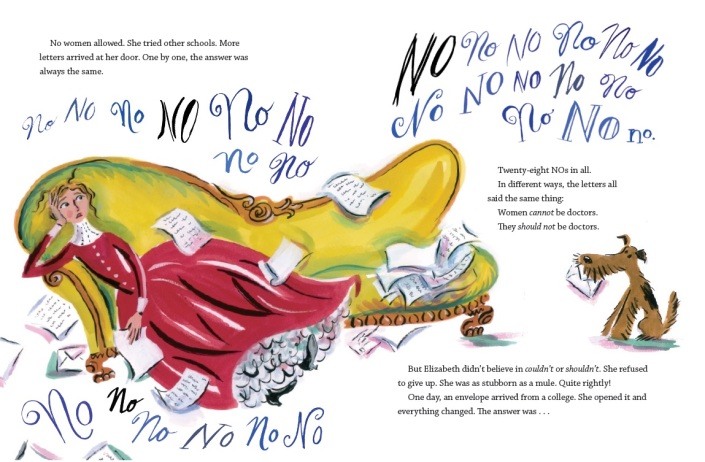
She applies to 28 medical schools, and they all say, “No.” But one day a “Yes” arrives in the mail. Elizabeth packs her bags. As she nears the school, Elizabeth sees that the townspeople have all come out to see her. They aren’t there to welcome their new medical student, though; they just want to whisper and point and stare. Surely, Elizabeth thinks, her classmates will be happy to see her. 

celebrate-picture-books-picture-book-review-who-says-women-can't-be-doctors-everyone-says-no

Image copyright Marjorie Priceman, 2013, text copyright Tanya Lee Stone, 2013. Courtesy of Henry Holt and Company.

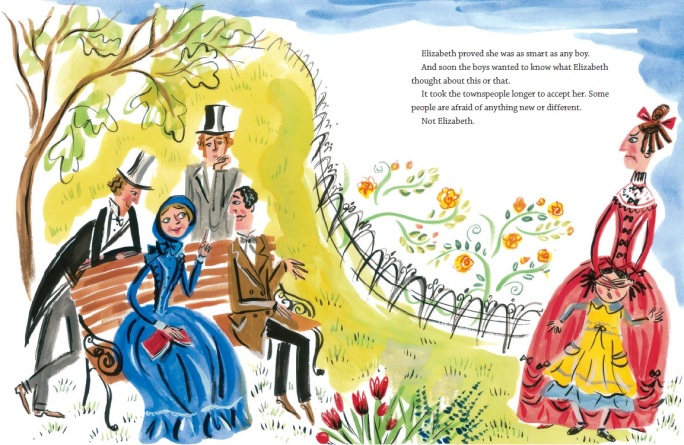
But she receives the same reception on the college campus. In fact, she learns that the only reason she was accepted was because the men voted to let her in as a joke! Elizabeth knows how to handle it. She studies hard and gives her opinions, and soon she wins the respect of her fellow students—even if the townspeople still don’t accept her.

On January 23, 1849 Elizabeth Blackwell graduates from medical school with the highest grades in the class. She has become the first woman doctor in America! Many people hope that she will be the last. But as we know…she was Not!

celebrate-picture-books-picture-book-review-who-says-women-can't-be-doctors-elizabeth-does-well-in-school

Image copyright Marjorie Priceman, 2013, text copyright Tanya Lee Stone, 2013. Courtesy of Henry Holt and Company.

Tanya Lee Stone magnificently imbues this short biography of Elizabeth Blackwell with enough mystery, conflict, and history for even the youngest readers to understand the type of girl and woman Elizabeth was as well as the challenges she faced. Stone has deftly included details of Blackwell’s life that  make her instantly recognizable and relatable to children. This biography is not only historical nonfiction, but a universal story for all generations. Blackwell may have started out as a reluctant dreamer, but once she dared to believe she accomplished more than she or anyone could have imagined. It is what we want for all our children.

Marjorie Priceman’s illustrations that swirl with words, are angled on the page, and float in white space are as topsy-turvy as the world Elizabeth Blackwell created with her courage and life’s work. Blackwell’s boldness is echoed in the rich colors and strong lines of Priceman’s gouache and India-ink paintings, and the emotions she stirred in others—from derision to horror to admiration—are cleverly and exceptionally drawn in a minimal style on the characters’ faces.

Ages 5 – 9

Henry Holt and Company, 2013 | ISBN 978-0805090482 (Hardcover) | ISNB 978-1250183392 (Paperback)

Learn more about Tanya Lee Stone and her work—both fiction and nonfiction—for children and teens on her website!

You can connect with Marjorie Priceman on Facebook!

National Women Physicians Day Activity

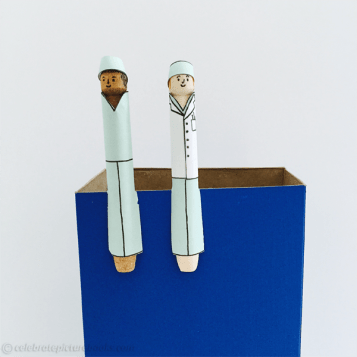
CPB - Doctors Clothespins

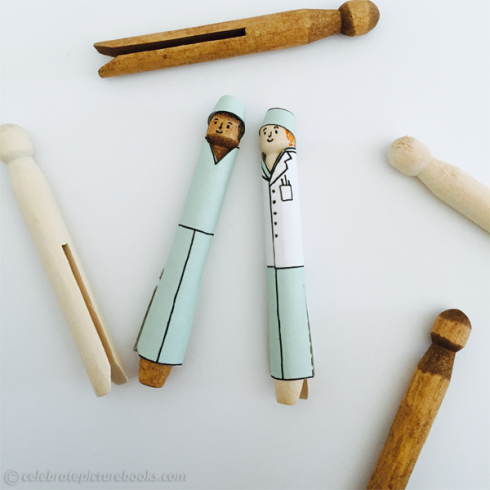
Doctor Clothespin Figures


Elizabeth Blackwell believed in herself and became the doctor she wanted to be. With this craft you can make a doctor figure or color your own clothes to make your figure any profession you are dreaming of!

Supplies

CPB - Doctors Clothespins on box

Directions

  1. Draw a face and hair on the clothespin
  2. Cut out the outfit you want your doctor to wear (color pants on your clothespin if you choose the lab coat)
  3. Wrap the coat or scrubs around the clothespin. The slit in the clothespin should be on the side.
  4. Tape the clothes together
  5. Wrap the cap around the head and tape it
  6. If you’d like to display your clothespin doctor on a wire, string, or the edge of a box or other container, cut along the dotted lines of the clothes template

Who Says Women Can't Be Doctors by Tanya Lee Stone and Marjorie Priceman picture book review

You can find Who Says Women Can’t be Doctors? at these booksellers

Amazon | Barnes & Noble | Books-a-Million | IndieBound

Picture Book Review


January 31 – Inspire Your Heart with Art Day

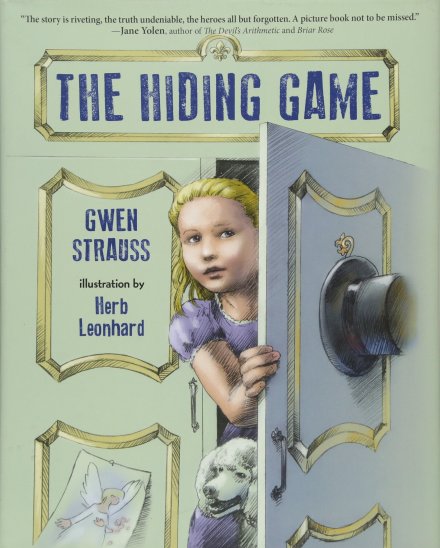
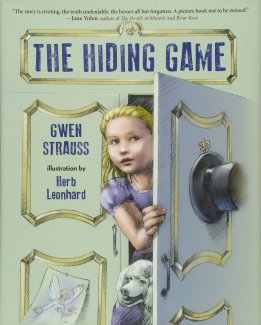
celebrate-picture-books-picture-book-review-the-hiding-game-cover

About the Holiday

Celebrating art is always a great thing! Today we champion that feeling you get inside when you create or experience art—no matter what kind is your favorite. Paintings, books, music, sculpture, quilts, photography, and other arts show you a bit of the world in a new way—a way, perhaps, you’ve never thought of before. Art can inspire, gladden, sadden, anger, teach, and compel action. It can also provide joy and inspiration when you need it most—as you’ll see in today’s book. Celebrate today’s holiday by visiting a museum, bookstore, library, concert, or gallery.

The Hiding Game

Written by Gwen Strauss | Illustrated by Herb Leonhard

It was October of 1940, and after moving from place to place to stay “one step ahead of the German soldiers,” Aube and her family had found a home where they could “live together until it was their turn to flee to safety. The Villa Air-Bel was rented by Varian Fry—a magician—and his assistant Danny Bénédite and served as a place to hide those looking to escape the war-torn country. On Sundays, the house was full of “thinkers, artists and writers who had to hide from the German soldiers because of their ideas of freedom and liberty” like Aube’s parents.

On those days, everyone played games, danced and made collages. One of Aube’s favorite games was Cadavre Exquis, in which a piece of paper was folded and each participant drew a design on one fold. When the whole paper was unfolded, amazing, artistic pictures emerged. These games and entertainment, Aube’s father told her, were their ways of fighting against fear. Because of the danger, many things had to be hidden at the Villa, including the radio and the cow that provided milk. Many ingredients for cooking were scarce. But even then Aube’s father used art to lighten the mood, leaving a drawing of a roast beef in the pantry where a real roast should have been.

Because the authorities were reading Varian and Danny’s mail and were listening to their phone calls, they had devised a way of hiding messages in toothpaste tubes that escaped the guard’s searches. The messages went to other people helping along the escape route to tell them who to expect next. Everyone in the house also had to have a special hiding place in case the police came. Aube chose the an old cabinet in the kitchen.

celebrate-picture-books-picture-book-review-the-hiding-game-tree

Image copyright Herb Leonhard, 2017, text copyright Gwen Strauss, 2017. Courtesy of Pelican Publishing Company.

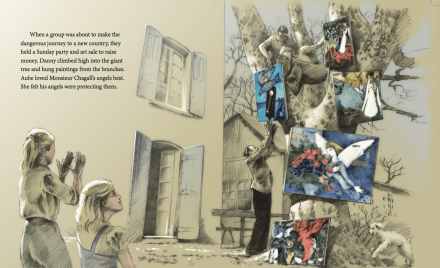
Whenever a new group of people were scheduled to “make the dangerous journey to a new country, they held a Sunday party and art sale to raise money.” Canvases painted by famous artists were hung among the branches of a large tree on the Villa grounds. When winter came, the Villa was so cold everyone had to wear all of their clothes to stay warm. They kept their spirits warm, too, by singing their favorite songs.

During the winter Danny visited camps where people were being held under terrible conditions. “Aube understood now that the danger was that they would be sent to the camps,” where people were dying of starvation and disease. They had little clothes and no blankets even though it was snowing. The people, Danny said, were going to freeze. Aube thought of the game freeze tag and worried about all of those “people freezing, waiting for someone to set them free.”

One day in December, the police raided the Villa. They took away all the men, including Danny, Varian, and Aube’s papa. Aube cowered in the kitchen cabinet with their dog in fear. The next week, the men were released, but they knew that the police would be back. Danny and Varian began to plan their escape. Before they all left, Aube’s father devised one more game. Each artist would paint their own version of a playing card to create a collective work of art. “The cards would remind them that they had laughed together and stayed free in their hearts even during the darkest times.”

Aube’s family were placed on a ship sailing to South America, and on February 18, 1941 they left the Villa and Danny and Varian behind and made the one-month-long journey to freedom. Several months later, Varian was “forced to leave France and return to America.” Danny went underground and “helped another 300 people escape France.” In 1943, however, Danny was “arrested by the Nazis and sentenced to death.” Just as he was facing the firing squad, soldiers fighting the Nazis burst through the gates of the camp and freed him and the other inmates.

celebrate-picture-books-picture-book-review-the-hiding-game-villa-air-bel

Image copyright Herb Leonhard, 2017, courtesy of Pelican Publishing Company.

Gwen Strauss includes extensive backmatter on this true-life story about her great-uncle Danny Bénédite. A detailed account of the work by Varian Fry, Danny Bénédite, and the American Rescue Committee, complete with photographs, as well as short biographies of some of the artists who visited the Villa (and a compelling list of others) plus resources for further study round out this compelling book.

Clearly written and with details from a child’s point of view that will resonate with readers, The Hiding Game is an absorbing tribute not only to two men involved in the Nazi resistance movement but to the resilience that uplifts people during the darkest times. This fascinating true story also offers a glimpse into the important role that artists and writers play in shining a light on history, interpreting it, and fighting against forces that destroy. Rich with the atmosphere of intrigue, suspense, and simple pleasures enjoyed, Strauss’s dynamic storytelling will thrill children. The Hiding Game will prompt them to learn more about this time period and will inspire in them their own acts of heroism.

Herb Leonhard’s realistic drawings of the Villa Air-Bel, the families who stopped there on their way to freedom, the moments of joy that sustained them, and the secret measures necessary for people’s safety take readers into the heart of the story and allow them to witness the danger and the creativity that swirled side-by-side within the Villa and the people living there. Largely depicted in somber tones of gray and green, the pages brighten with glowing yellows during times of laughter, games, and creativity. An illustration of the mammoth tree hung with canvases by famous artists will impress children, and the final image will leave an indelible and thought-provoking impression on young readers and adults.

An excellent book for facilitating discussions about World War II and the Holocaust with children at home and in the classroom as well as offering opportunities for cross-curricular learning in history, art, reading, and more, The Hiding Game is a superb choice to add to home, school, and public libraries.

Ages 7 – 12

Pelican Publishing Company, 2017 | ISBN 978-1455622658

Discover more about Gwen Strauss and her books on her website.

To learn more about Herb Leonhard, his books, and his art, visit his website.

Inspire Your Heart with Art Day Activity

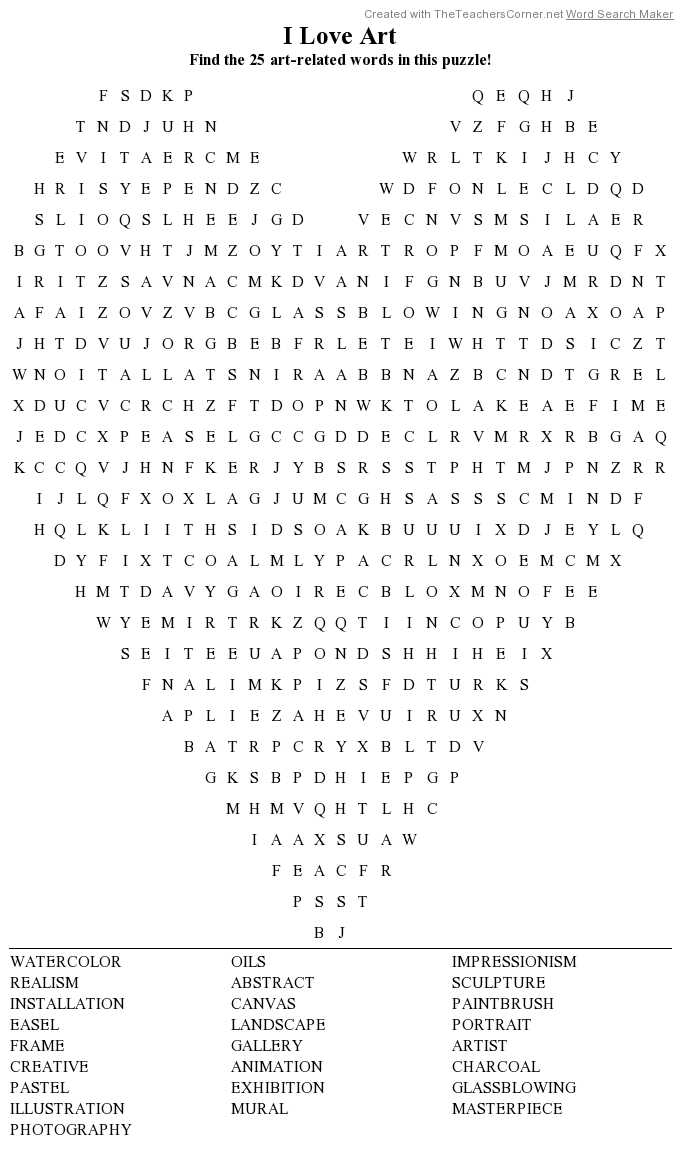
I Love Art! Word Search Puzzle

Art has a language all its own! Have fun finding the twenty-five art-related words in this printable puzzle.

I Love Art! Word Search Puzzle and I Love Art! Word Search Solution

celebrate-picture-books-picture-book-review-the-hiding-game-cover

You can find The Hiding Game at these booksellers

Amazon | Barnes & Noble | Books-a-Million | IndieBound

Picture Book Review
January 17 – Kid Inventors’ Day

celebrate-picture-books-picture-book-review-the-girl-who-thought-in-pictures-cover

About the Holiday

Today’s holiday celebrates all those ingenious kids who have improved the world with their inventions. This date was chosen to commemorate another child inventor—Benjamin Franklin—who designed the first swim fins when he was just 12 years old! (Seriously, is there nothing this man didn’t or couldn’t do?). With their supple minds and can-do attitudes, kids have changed the ways things are done in the fields of medicine, technology, communications, and even food—as today’s book shows! To learn more about the day and find lots of resources, including a list of books, contests, tips, and teachers’ guides, visit the K.I.D website.

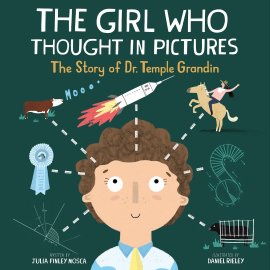
The Girl Who Thought in Pictures: The Story of Dr. Temple Grandin

Written by Julia Finley Mosca | Illustrated by Daniel Rieley


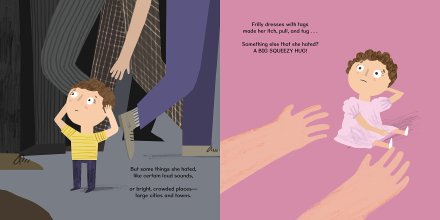
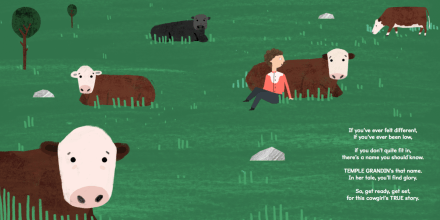
If you feel different and sometimes discouraged, the story of Temple Grandin may help you see that everyone has a talent and their own place in the world. Temple was born in Boston and “unique from the start, / an unusual girl, / she loved spinning in circles / and watching things twirl.” Loud sounds, big crowds, bright lights, and scratchy clothes disturbed her. And she did not like to get a “big squeezy hug.”

celebrate-picture-books-picture-book-review-the-girl-who-thought-in-pictures-too-loud

Image copyright Daniel Rieley, 2017, text copyright Julia Finley Mosca, 2017. Courtesy of The Innovation Press.

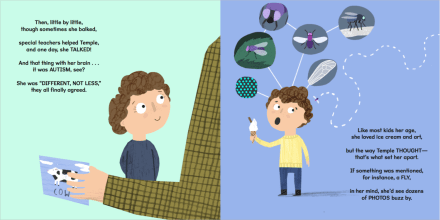
When she became overloaded with stress and frustration, Temple was known to “kick, holler, bang, shrieeeeek! Yet, still, by age three, not one word did she speak.” People told Temple’s parents that she’d never be normal and to send her away, but her mother would not hear of it. With a lot of work, special teachers helped Temple learn to talk. “And that thing with her brain… / it was AUTISM, see? / She was ‘different not less,’ / they all finally agreed.”

celebrate-picture-books-picture-book-review-the-girl-who-thought-in-pictures-doctor

Image copyright Daniel Rieley, 2017, text copyright Julia Finley Mosca, 2017. Courtesy of The Innovation Press.

While Temple was like her peers in many ways, she interacted with words differently. “If something was mentioned, / for instance, a fly, / in her mind, she’d see dozens / of PHOTOS buzz by.” Her different view point made it hard for her at school. The other kids chased her and teased her for the way that she acted and for “…saying things / over and over. / and over… / and over… / AND over.” When she had finally had enough, “she threw a book at a kid / and was kicked out of school!” No one understood Temple and Temple couldn’t understand them.

celebrate-picture-books-picture-book-review-the-girl-who-thought-in-pictures-fly

Image copyright Daniel Rieley, 2017, text copyright Julia Finley Mosca, 2017. Courtesy of The Innovation Press.

Her mother then sent her to visit her aunt, who lived on a ranch out west. Here, among the animals, Temple felt better. Her favorites were the cows, so silent and sweet. “At a NEW school that fall, / Temple found more support / said a teacher who taught her: / ‘You’ll never fall short.” That teacher was right, and at engineering and science she felt right at home.

Her first invention—made from memory—was “a machine / like she’d seen on some farms, / an INVENTION that hugged her / with boards, and not arms.” In this device she felt snug and calm, just like the cows. As she began to succeed, Temple came to see that her attention to detail was a benefit, and she began to feel special. Then she learned about farms where the cows were not treated kindly and resolved to change that.

celebrate-picture-books-picture-book-review-the-girl-who-thought-in-pictures-cows

Image copyright Daniel Rieley, 2017, text copyright Julia Finley Mosca, 2017. Courtesy of The Innovation Press.

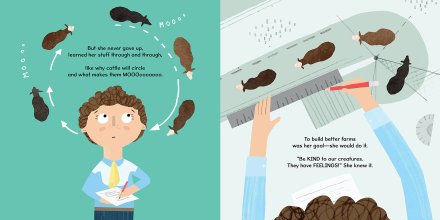
She went on to college and became an expert on farms, earning three degrees. Telling people about her ideas for farming improvements was sometimes scary because they ignored her and, well…weren’t very sweet. But she didn’t give up. She learned more about cattle, like why they circle and moo. “To build better farms / was her goal—she would do it. / ‘Be KIND to our creatures. / They have FEELINGS!’ She knew it.”

It took time, but people began to see that Temple was right, and farm after farm implemented her ideas. She won awards for this work and other ideas, a movie was made about her life, and she now travels the world telling her story and teaching: “‘Each person is special– / so UNIQUE are our minds. / This world needs YOUR ideas. / It takes brains of ALL kinds!”

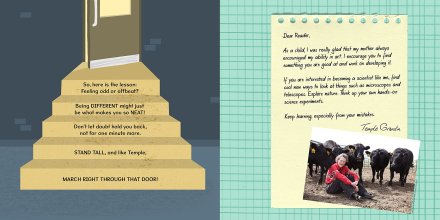
celebrate-picture-books-picture-book-review-the-girl-who-thought-in-pictures-letter

Image copyright Daniel Rieley, 2017, text copyright Julia Finley Mosca, 2017. Courtesy of The Innovation Press.

A letter from Temple Grandin to young readers, extensive information about Temple and tidbits from her interview with the author, a timeline of her life, and resources follow the text.

Julia Finley Mosca’s insightful biography of Temple Grandin offers inspiration and encouragement to children at those times when life seems difficult or if they feel misunderstood. Childhood can be filled with moments—both small and large, short or long—when comfort and reassurance are needed. Mosca’s rhyming verses make Temple’s story accessible to a wide age range of readers while providing an inclusive way to show how autism creates a different way of experiencing the world. Temple’s supportive teachers are role models for all educators. Temple Grandin’s fascinating life demonstrates that there is a niche for everyone and that through understanding, perseverance, and acceptance, all children can go far.

celebrate-picture-books-picture-book-review-the-girl-who-thought-in-pictures-cows-in-field

Image copyright Daniel Rieley, 2017, text copyright Julia Finley Mosca, 2017. Courtesy of The Innovation Press.

Daniel Rieley’s cartoon-style illustrations will resonate with readers as Temple takes in everything she sees with wide-open eyes and interprets it in her own way—even before she can speak. The separation between Temple and the other students at her first school is poignantly communicated in a two-page spread in which pointing hands and a lobbed ball of paper appear from the left-hand margin and Temple reads alone on the far side of the right-hand page. Temple’s ability to think in pictures is demonstrated throughout the book with inset images. Readers see some of the farming practices Temple wanted to change, her original drawings, and the resulting equipment now used on farms to improve the conditions of the animals raised there.

The Girl Who Thought in Pictures: The Story of Dr. Temple Grandin is a moving and motivational story for all children and is a must for school and public libraries.

Ages 5 – 10

The Innovation Press, 2017 | ISBN  978-1943147304 (Hardcover) | ISBN 978-1943147618 (Paperback), 2018

Discover more about Julia Finley Mosca and her Amazing Scientists series on the Amazing Scientists website.

Learn more about Daniel Rieley, his books, and his art on his website.

Kid Inventors’ Day Activity

celebrate-picture-books-picture-book-review-kid-inventors-coloring-page

Inventing Is Fun! Coloring Page


If you love to invent as much as these kids do, grab your crayons, markers, or pencils and give their lab a bit more color in this printable Inventing Is Fun! Coloring Page!

celebrate-picture-books-picture-book-review-the-girl-who-thought-in-pictures-cover

You can find The Girl Who Thought in Pictures: The Story of Dr. Temple Grandin at these booksellers

Amazon | Barnes & Noble | Books-a-Million | IndieBound

Picture Book Review
December 20 – Go Caroling Day

celebrate-picture-books-picture-book-review-write-on-irving-berlin-cover

About the Holiday

Caroling is a long-standing tradition of the holidays. Gathering with friends and neighbors as part of a professional singing group or just as amateurs and singing Christmas songs door to door, at nursing homes, and other community venues brings joy and cheer to all. Both hearing and singing favorite songs that only come around once a year makes caroling a much-anticipated activity. Today’s holiday celebrates the love of caroling and encourages people to raise their voices and join in. It’s also a perfect day to highlight the life of the man who wrote one of our most beloved carols—White Christmas—with today’s book!

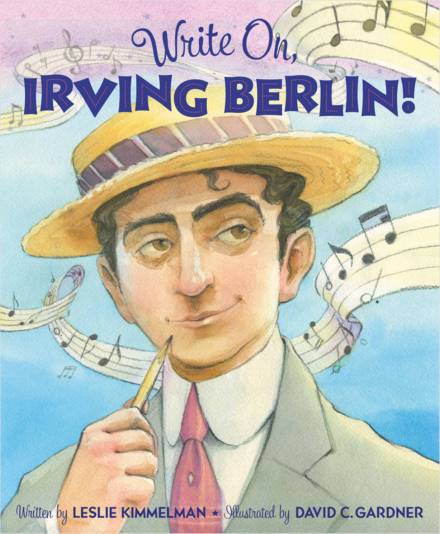
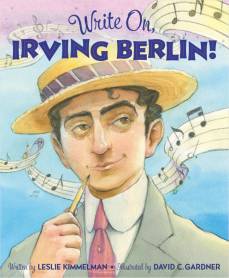
Write On, Irving Berlin!

Written by Leslie Kimmelman | Illustrated by David C. Gardner


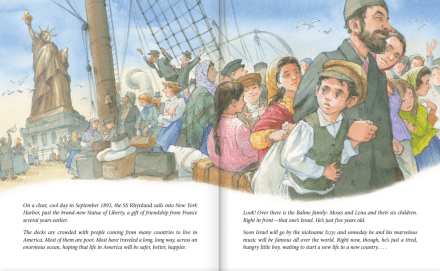
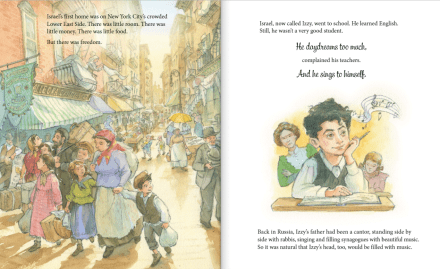
In September of 1893 Moses and Lena Baline and their six children, including 5-year-old Israel, sailed into New York Harbor hoping “to start a new life in a new country.” They came from Russia, where their home had been burned down by “gangs of angry men” who “rode from village to village in pogroms, destroying Jewish homes and hurting the people who lived in them.” In America, the Balines had a small apartment, little money, and little food. But they did have freedom.
celebrate-picture-books-picture-book-review-write-on-irving-berlin-immigrating

Image copyright David C. Gardner, 2018, text copyright Leslie Kimmelman, 2018. Courtesy of Sleeping Bear Press.

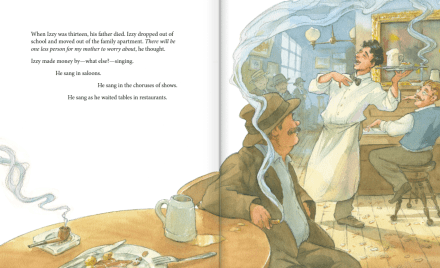
At school, Izzy—as Israel was nicknamed—paid less attention to his schoolwork than to the music in his head. When Izzy was only thirteen, his father died. Izzy knew that money was tight, so he moved out and made his own living singing in saloons, in the chorus line of New York shows, and even as he waited tables.  Irving as Izzy now called himself, became a professional song writer when he was paid 37 cents for his first song.

Irving continued to write the tunes that filled his head. When Ragtime was all the rage during the early 1900s, Irving tried this new, jazzy kind of music, and his “‘Alexander’s Ragtime Band’ was a smash.”  Irving married, but his wife died only a few months after their wedding. Irving consoled himself by writing. He became an American citizen, and when he was drafted into the US Army during WWI, he wrote songs to encourage his fellow soldiers. When he married again, he was inspired to write a song called “Always” about a love that lasts forever.

celebrate-picture-books-picture-book-review-write-on-irving-berlin-school

Image copyright David C. Gardner, 2018, text copyright Leslie Kimmelman, 2018. Courtesy of Sleeping Bear Press.

Irving never seemed to be without a tune in his head. He “wrote music for plays, for movies, for friends, for strangers. He scribbled ideas on napkins and on the sleeves of his shirt. He wrote songs in elevators and in taxicabs. He wrote songs in the bathtub.” During World War II, one of his older songs—“‘God Bless America’ became a HUGE hit.” In the winter of 1942, Irving wrote what he considered not only his best song, but the best song anyone had ever written: “White Christmas.” It’s sentimental words and catchy tune inspired the American soldiers engaged in battles around the world and helped them “remember all the things they were fighting for.”

Since Irving was too old to fight in the war, he developed a show called “This is the Army” that he took around the world to entertain the troops. His “cast was completely integrated—black and white soldiers lived, ate, and traveled together, which was rare in those days.” Even after the war ended, Irving continued to write songs that people still love today.

An Author’s Note about Irving Berlin and his songs as well as books for further reading follow the text.

celebrate-picture-books-picture-book-review-write-on-irving-berlin-thirteen

Image copyright David C. Gardner, 2018, text copyright Leslie Kimmelman, 2018. Courtesy of Sleeping Bear Press.

Leslie Kimmelman brings to life the story of one of America’s most prolific and beloved song writers with enthusiasm and wit and the kinds of details that capture kids’ attention and inspire them to learn more. Timely for this year’s 100th anniversary of the writing of “God Bless America” and the 80th anniversary of its public appearance, Write On, Irving Berlin would make an excellent centerpiece of school music units when paired with Berlin’s songs, many of which kids will recognize. Berlin’s success, as revealed in Kimmelman’s well-paced, upbeat, and conversational storytelling is a powerful motivator for any child with big dreams.

David C. Gardner’s beautiful, softly-washed and detailed paintings take readers from the New York neighborhoods, restaurants, and dance halls of the early 1900s to the battlefields of World Wars I and II to the bright lights of Broadway, where his last musical, “Annie Get Your Gun” is advertised on the marquee. Along the way, kids see Irving as a child, a young man, and an older professional, always with a pencil and paper in hand. Images of the Statue of Liberty seen throughout the book tie together the theme of the immigrant’s experience, Berlin’s love of America, and one of his most famous works, “God Bless America.”

Write On, Irving Berlin! is an excellent biography that should find a home in classroom, school, and public libraries as well as on home bookshelves for children who love history, music, and biographies and who have big ideas of their own.

Ages 6 – 9

Sleeping Bear Press, 2018 | ISBN 978-1585363803

Discover more about Leslie Kimmelman and her books on her website.

To learn more about David C. Gardner, his books, and his art, visit his website.

Go Caroling Day Activity

celebrate-picture-books-picture-book-review-mice-caroling

Musical Mice Coloring Page


Grab your crayons or pencils and have fun with this printable Musical Mice Coloring Page!

Musical Mice Coloring Page

celebrate-picture-books-picture-book-review-write-on-irving-berlin-cover

You can find Write On, Irving Berlin! at these booksellers

Amazon | Barnes & Noble | Books-a-Million | IndieBound

Picture Book Review