January 17 – Kid Inventors’ Day

celebrate-picture-books-picture-book-review-the-girl-who-thought-in-pictures-cover

About the Holiday

Today’s holiday celebrates all those ingenious kids who have improved the world with their inventions. This date was chosen to commemorate another child inventor—Benjamin Franklin—who designed the first swim fins when he was just 12 years old! (Seriously, is there nothing this man didn’t or couldn’t do?). With their supple minds and can-do attitudes, kids have changed the ways things are done in the fields of medicine, technology, communications, and even food—as today’s book shows! To learn more about the day and find lots of resources, including a list of books, contests, tips, and teachers’ guides, visit the K.I.D website.

The Girl Who Thought in Pictures: The Story of Dr. Temple Grandin

Written by Julia Finley Mosca | Illustrated by Daniel Rieley


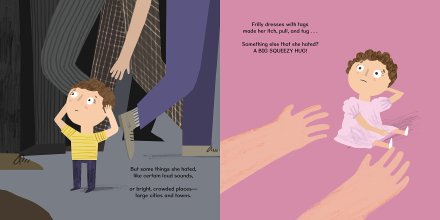
If you feel different and sometimes discouraged, the story of Temple Grandin may help you see that everyone has a talent and their own place in the world. Temple was born in Boston and “unique from the start, / an unusual girl, / she loved spinning in circles / and watching things twirl.” Loud sounds, big crowds, bright lights, and scratchy clothes disturbed her. And she did not like to get a “big squeezy hug.”

celebrate-picture-books-picture-book-review-the-girl-who-thought-in-pictures-too-loud

Image copyright Daniel Rieley, 2017, text copyright Julia Finley Mosca, 2017. Courtesy of The Innovation Press.

When she became overloaded with stress and frustration, Temple was known to “kick, holler, bang, shrieeeeek! Yet, still, by age three, not one word did she speak.” People told Temple’s parents that she’d never be normal and to send her away, but her mother would not hear of it. With a lot of work, special teachers helped Temple learn to talk. “And that thing with her brain… / it was AUTISM, see? / She was ‘different not less,’ / they all finally agreed.”

celebrate-picture-books-picture-book-review-the-girl-who-thought-in-pictures-doctor

Image copyright Daniel Rieley, 2017, text copyright Julia Finley Mosca, 2017. Courtesy of The Innovation Press.

While Temple was like her peers in many ways, she interacted with words differently. “If something was mentioned, / for instance, a fly, / in her mind, she’d see dozens / of PHOTOS buzz by.” Her different view point made it hard for her at school. The other kids chased her and teased her for the way that she acted and for “…saying things / over and over. / and over… / and over… / AND over.” When she had finally had enough, “she threw a book at a kid / and was kicked out of school!” No one understood Temple and Temple couldn’t understand them.

celebrate-picture-books-picture-book-review-the-girl-who-thought-in-pictures-fly

Image copyright Daniel Rieley, 2017, text copyright Julia Finley Mosca, 2017. Courtesy of The Innovation Press.

Her mother then sent her to visit her aunt, who lived on a ranch out west. Here, among the animals, Temple felt better. Her favorites were the cows, so silent and sweet. “At a NEW school that fall, / Temple found more support / said a teacher who taught her: / ‘You’ll never fall short.” That teacher was right, and at engineering and science she felt right at home.

Her first invention—made from memory—was “a machine / like she’d seen on some farms, / an INVENTION that hugged her / with boards, and not arms.” In this device she felt snug and calm, just like the cows. As she began to succeed, Temple came to see that her attention to detail was a benefit, and she began to feel special. Then she learned about farms where the cows were not treated kindly and resolved to change that.

celebrate-picture-books-picture-book-review-the-girl-who-thought-in-pictures-cows

Image copyright Daniel Rieley, 2017, text copyright Julia Finley Mosca, 2017. Courtesy of The Innovation Press.

She went on to college and became an expert on farms, earning three degrees. Telling people about her ideas for farming improvements was sometimes scary because they ignored her and, well…weren’t very sweet. But she didn’t give up. She learned more about cattle, like why they circle and moo. “To build better farms / was her goal—she would do it. / ‘Be KIND to our creatures. / They have FEELINGS!’ She knew it.”

It took time, but people began to see that Temple was right, and farm after farm implemented her ideas. She won awards for this work and other ideas, a movie was made about her life, and she now travels the world telling her story and teaching: “‘Each person is special– / so UNIQUE are our minds. / This world needs YOUR ideas. / It takes brains of ALL kinds!”

celebrate-picture-books-picture-book-review-the-girl-who-thought-in-pictures-letter

Image copyright Daniel Rieley, 2017, text copyright Julia Finley Mosca, 2017. Courtesy of The Innovation Press.

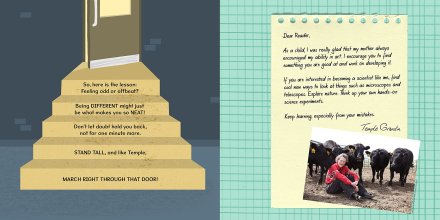
A letter from Temple Grandin to young readers, extensive information about Temple and tidbits from her interview with the author, a timeline of her life, and resources follow the text.

Julia Finley Mosca’s insightful biography of Temple Grandin offers inspiration and encouragement to children at those times when life seems difficult or if they feel misunderstood. Childhood can be filled with moments—both small and large, short or long—when comfort and reassurance are needed. Mosca’s rhyming verses make Temple’s story accessible to a wide age range of readers while providing an inclusive way to show how autism creates a different way of experiencing the world. Temple’s supportive teachers are role models for all educators. Temple Grandin’s fascinating life demonstrates that there is a niche for everyone and that through understanding, perseverance, and acceptance, all children can go far.

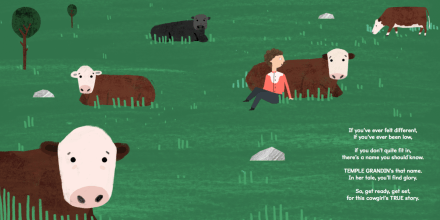
celebrate-picture-books-picture-book-review-the-girl-who-thought-in-pictures-cows-in-field

Image copyright Daniel Rieley, 2017, text copyright Julia Finley Mosca, 2017. Courtesy of The Innovation Press.

Daniel Rieley’s cartoon-style illustrations will resonate with readers as Temple takes in everything she sees with wide-open eyes and interprets it in her own way—even before she can speak. The separation between Temple and the other students at her first school is poignantly communicated in a two-page spread in which pointing hands and a lobbed ball of paper appear from the left-hand margin and Temple reads alone on the far side of the right-hand page. Temple’s ability to think in pictures is demonstrated throughout the book with inset images. Readers see some of the farming practices Temple wanted to change, her original drawings, and the resulting equipment now used on farms to improve the conditions of the animals raised there.

The Girl Who Thought in Pictures: The Story of Dr. Temple Grandin is a moving and motivational story for all children and is a must for school and public libraries.

Ages 5 – 10

The Innovation Press, 2017 | ISBN  978-1943147304 (Hardcover) | ISBN 978-1943147618 (Paperback), 2018

Discover more about Julia Finley Mosca and her Amazing Scientists series on the Amazing Scientists website.

Learn more about Daniel Rieley, his books, and his art on his website.

Kid Inventors’ Day Activity

celebrate-picture-books-picture-book-review-kid-inventors-coloring-page

Inventing Is Fun! Coloring Page


If you love to invent as much as these kids do, grab your crayons, markers, or pencils and give their lab a bit more color in this printable Inventing Is Fun! Coloring Page!

celebrate-picture-books-picture-book-review-the-girl-who-thought-in-pictures-cover

You can find The Girl Who Thought in Pictures: The Story of Dr. Temple Grandin at these booksellers

Amazon | Barnes & Noble | Books-a-Million | IndieBound

Picture Book Review

December 20 – Go Caroling Day

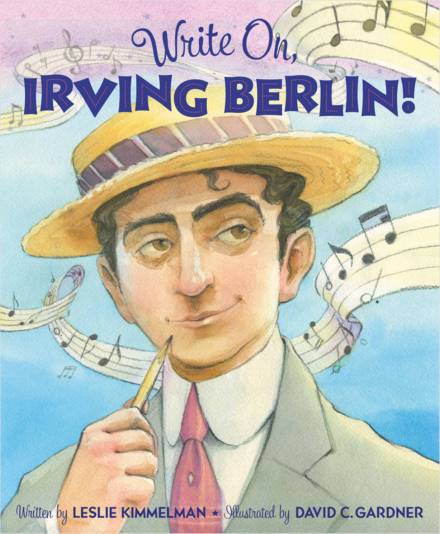
celebrate-picture-books-picture-book-review-write-on-irving-berlin-cover

About the Holiday

Caroling is a long-standing tradition of the holidays. Gathering with friends and neighbors as part of a professional singing group or just as amateurs and singing Christmas songs door to door, at nursing homes, and other community venues brings joy and cheer to all. Both hearing and singing favorite songs that only come around once a year makes caroling a much-anticipated activity. Today’s holiday celebrates the love of caroling and encourages people to raise their voices and join in. It’s also a perfect day to highlight the life of the man who wrote one of our most beloved carols—White Christmas—with today’s book!

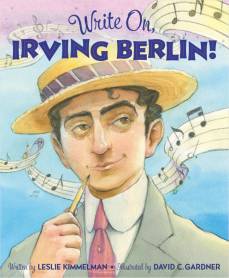
Write On, Irving Berlin!

Written by Leslie Kimmelman | Illustrated by David C. Gardner


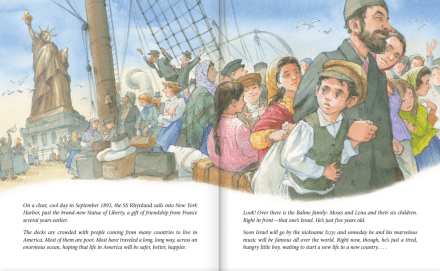
In September of 1893 Moses and Lena Baline and their six children, including 5-year-old Israel, sailed into New York Harbor hoping “to start a new life in a new country.” They came from Russia, where their home had been burned down by “gangs of angry men” who “rode from village to village in pogroms, destroying Jewish homes and hurting the people who lived in them.” In America, the Balines had a small apartment, little money, and little food. But they did have freedom.

celebrate-picture-books-picture-book-review-write-on-irving-berlin-immigrating

Image copyright David C. Gardner, 2018, text copyright Leslie Kimmelman, 2018. Courtesy of Sleeping Bear Press.

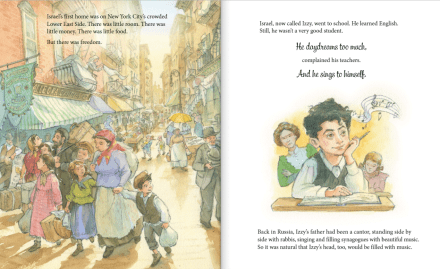
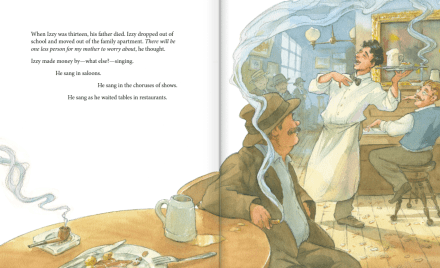
At school, Izzy—as Israel was nicknamed—paid less attention to his schoolwork than to the music in his head. When Izzy was only thirteen, his father died. Izzy knew that money was tight, so he moved out and made his own living singing in saloons, in the chorus line of New York shows, and even as he waited tables.  Irving as Izzy now called himself, became a professional song writer when he was paid 37 cents for his first song.

Irving continued to write the tunes that filled his head. When Ragtime was all the rage during the early 1900s, Irving tried this new, jazzy kind of music, and his “‘Alexander’s Ragtime Band’ was a smash.”  Irving married, but his wife died only a few months after their wedding. Irving consoled himself by writing. He became an American citizen, and when he was drafted into the US Army during WWI, he wrote songs to encourage his fellow soldiers. When he married again, he was inspired to write a song called “Always” about a love that lasts forever.

celebrate-picture-books-picture-book-review-write-on-irving-berlin-school

Image copyright David C. Gardner, 2018, text copyright Leslie Kimmelman, 2018. Courtesy of Sleeping Bear Press.

Irving never seemed to be without a tune in his head. He “wrote music for plays, for movies, for friends, for strangers. He scribbled ideas on napkins and on the sleeves of his shirt. He wrote songs in elevators and in taxicabs. He wrote songs in the bathtub.” During World War II, one of his older songs—“‘God Bless America’ became a HUGE hit.” In the winter of 1942, Irving wrote what he considered not only his best song, but the best song anyone had ever written: “White Christmas.” It’s sentimental words and catchy tune inspired the American soldiers engaged in battles around the world and helped them “remember all the things they were fighting for.”

Since Irving was too old to fight in the war, he developed a show called “This is the Army” that he took around the world to entertain the troops. His “cast was completely integrated—black and white soldiers lived, ate, and traveled together, which was rare in those days.” Even after the war ended, Irving continued to write songs that people still love today.

An Author’s Note about Irving Berlin and his songs as well as books for further reading follow the text.

celebrate-picture-books-picture-book-review-write-on-irving-berlin-thirteen

Image copyright David C. Gardner, 2018, text copyright Leslie Kimmelman, 2018. Courtesy of Sleeping Bear Press.

Leslie Kimmelman brings to life the story of one of America’s most prolific and beloved song writers with enthusiasm and wit and the kinds of details that capture kids’ attention and inspire them to learn more. Timely for this year’s 100th anniversary of the writing of “God Bless America” and the 80th anniversary of its public appearance, Write On, Irving Berlin would make an excellent centerpiece of school music units when paired with Berlin’s songs, many of which kids will recognize. Berlin’s success, as revealed in Kimmelman’s well-paced, upbeat, and conversational storytelling is a powerful motivator for any child with big dreams.

David C. Gardner’s beautiful, softly-washed and detailed paintings take readers from the New York neighborhoods, restaurants, and dance halls of the early 1900s to the battlefields of World Wars I and II to the bright lights of Broadway, where his last musical, “Annie Get Your Gun” is advertised on the marquee. Along the way, kids see Irving as a child, a young man, and an older professional, always with a pencil and paper in hand. Images of the Statue of Liberty seen throughout the book tie together the theme of the immigrant’s experience, Berlin’s love of America, and one of his most famous works, “God Bless America.”

Write On, Irving Berlin! is an excellent biography that should find a home in classroom, school, and public libraries as well as on home bookshelves for children who love history, music, and biographies and who have big ideas of their own.

Ages 6 – 9

Sleeping Bear Press, 2018 | ISBN 978-1585363803

Discover more about Leslie Kimmelman and her books on her website.

To learn more about David C. Gardner, his books, and his art, visit his website.

Go Caroling Day Activity

celebrate-picture-books-picture-book-review-mice-caroling

Musical Mice Coloring Page


Grab your crayons or pencils and have fun with this printable Musical Mice Coloring Page!

Musical Mice Coloring Page

celebrate-picture-books-picture-book-review-write-on-irving-berlin-cover

You can find Write On, Irving Berlin! at these booksellers

Amazon | Barnes & Noble | Books-a-Million | IndieBound

Picture Book Review

 

December 10 – Nobel Prize Day

celebrate-picture-books-picture-book-the-house-that-jane-built-cover

About the Holiday

When Alfred Nobel’s will was read after his death on December 10, 1896, his heirs were taken by surprise. Nobel had signed a new will the year before, leaving most of his wealth to create prizes recognizing those who had done their best to benefit mankind in the fields of physics, chemistry,  medicine, literature, and peace. Opposition to this will on the part of the family and those Nobel had chosen to award the prize delayed Nobel’s wishes until 1901. Today, the awards include a prize for economics and are announced in early October. The awards are presented on December 10 in Stockholm, Sweden, except for the Nobel Peace Prize, which is awarded in Oslo, Norway.

Jane Addams Day falls on the same date to commemorate her achievement in being the first American woman to win the Nobel Peace Prize in 1931 for her work to bring about social change, equality, and peace. Each year the Jane Addams Peace Association presents awards to outstanding children’s books that promote peace and justice. To learn more about Jane Addams and the Jane Addams Peace Association, visit janeaddamspeace.org.

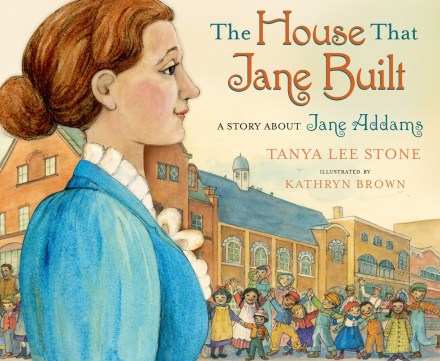
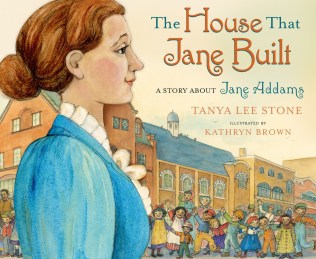
The House that Jane Built: A Story about Jane Addams

Written by Tanya Lee Stone | Illustrated by Kathryn Brown


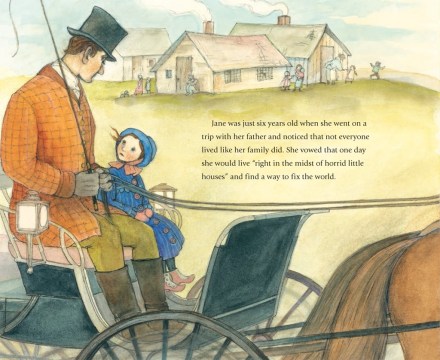
On a busy street stands a very special house where anyone is welcome and some find a home. In 1889 Jane Addams, a wealthy young woman, bought an elegant house in one of Chicago’s poorest neighborhoods. Why? At just six years old on a trip with her father, Jane “noticed that not everyone lived like her family did.” Right then she vowed that when she grew older, she would live in a poor community and “find a way to fix the world.”

celebrate-picture-books-picture-book-the-house-that-jane-built-trip-with-father

Image copyright Kathryn Brown, 2015, text copyright Tanya Lee Stone. Courtesy of us.macmillan.com.

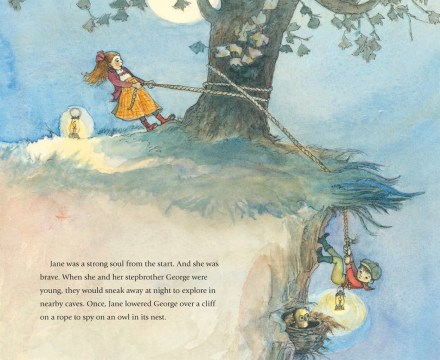
Jane was brave and strong. Sometimes she and her stepbrother George would “sneak away at night to explore in nearby caves.” Jane was also smart and “read and read her father’s book collection,” which also served as the town library. Unlike most women at the time, Jane went to college. She attended Rockford Female Seminary and “graduated at the top of her class.”

celebrate-picture-books-picture-book-the-house-that-jane-built-exploring-with-George

Image copyright Kathryn Brown, 2015, text copyright Tanya Lee Stone. Courtesy of us.macmillan.com.

After graduation, she didn’t know what she wanted to do, and when her father died that same summer, “Jane felt lost.” Two years later some friends invited her to travel to Europe with them. Although they went to the opera, museums, and many beautiful places, it was an experience in London that stuck with her. There she saw many “people in ragged clothes with outstretched hands, begging a cart vendor to buy his rotten fruits and vegetables that hadn’t sold at the market.” 

celebrate-picture-books-picture-book-the-house-that-jane-built-London-settlement-house

Image copyright Kathryn Brown, 2015. Courtesy of us.macmillan.com.

When Jane returned home, the question of how she could help nagged at her. She returned to London to learn about Toynbee Hall, where poor and wealthy people lived together and learned from each other. Here, skills, such as cooking, were taught to provide people with the education to find jobs. Toynbee Hall was called a settlement house, because the rich people who worked there lived there as well.

celebrate-picture-books-picture-book-the-house-that-jane-built-Chicago-neighborhood

Image copyright Kathryn Brown, 2015, text copyright Tanya Lee Stone. Courtesy of us.macmillan.com.

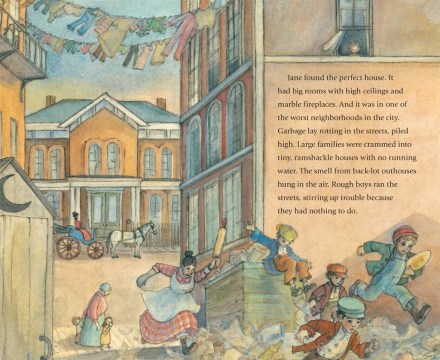
Jane now knew what she wanted to do. In 1889 Chicago was a diverse city with a large immigrant population. Many didn’t speak English, which made it hard for them to find jobs. “Large families were crammed into ramshackle houses with no running water.” Garbage lay in the street, and tough kids ran wild with nothing else to do.

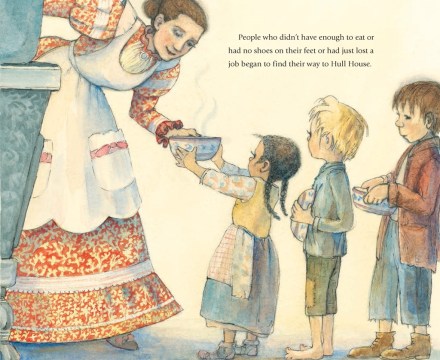
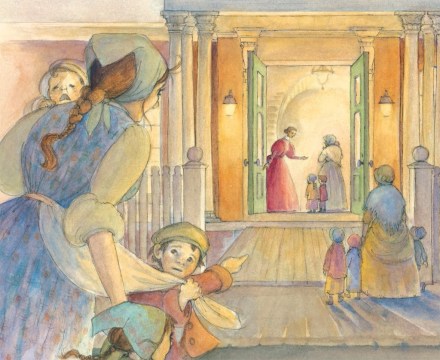
Jane found a large house in the middle of one of these areas that had once belonged to Charles J. Hull and upon his death had been given to his cousin, Helen Culver.  When Helen discovered what Jane wanted to do, she donated the house for free. Jane left the house unlocked, letting people know that they could come there whenever they needed. In time, people did find their way to Hull House when they were hungry or out of work. Jane also had her own way of dealing with unruly children or those who didn’t understand her generosity. Once when a man broke into Hull House twice because he had no job and no money, Jane gave him a job.

celebrate-picture-books-picture-book-the-house-that-jane-built-feeding-hungry

Image copyright Kathryn Brown, 2015, text copyright Tanya Lee Stone. Courtesy of us.macmillan.com.

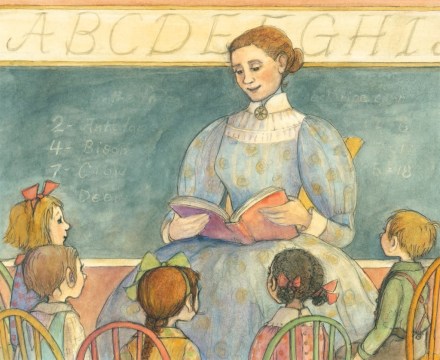
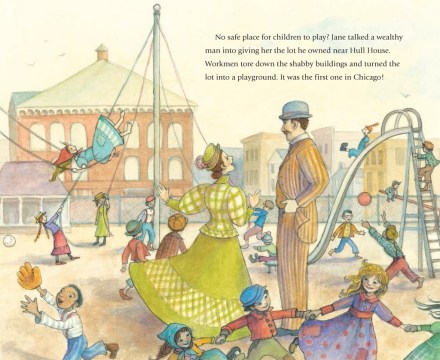
Jane helped the neighborhood in other ways too. She built a public bath so that people could stay clean and avoid illness. She convinced “public officials to build more public baths.” Because children had nowhere to play, Jane convinced a neighbor to give her his unused lot near Hull House. She tore down the buildings and built Chicago’s first playground. For kids whose parents worked long hours, she started a morning kindergarten and after school clubs. She also began offering evening classes for children who worked during the day.

celebrate-picture-books-picture-book-the-house-that-jane-built-kindergarten

Image copyright Kathryn Brown, 2015. Courtesy of us.macmillan.com.

Jane had help with her endeavors. Her friend “Ellen Gates Starr was her partner from the start.” Many other people also helped. They moved into Hull House and “taught literature, art, English, math, science, and cooking.” Hull House continued to grow, and by 1907 Jane oversaw thirteen buildings, including “a gymnasium, coffee house, theater, music school, community kitchen, and an art gallery.”

By the early 1920’s more than 9,000 people visited Hull House every week. Jane’s work “changed a bad neighborhood into a great and strong community.” Today, you can still see Jane Addams’ commitment to others in the community centers that bring people together in nearly every city and town.

An Author’s Note with more information on Jane Addams follows the text.

celebrate-picture-books-picture-book-the-house-that-jane-built-playground

Image copyright Kathryn Brown, 2015, text copyright Tanya Lee Stone. Courtesy of us.macmillan.com.

Tanya Lee Stone brings the story of Jane Addams’ work in Chicago to children in a compelling biography that gives readers a fully developed portrait of this most amazing woman. Stone’s active and evocative language puts children in the Hull House neighborhood, allowing them to get a feeling for and understanding of the issues of the time. Stone’s excellent examples of how Jane Addams responded to a variety of problems facing her community and even Hull House itself, demonstrate how generosity, empathy, and kindness can make positive changes in people’s lives. Depictions of Jane’s early compassion and commitment give children a sense that they too can make a difference in areas that are important to them.

celebrate-picture-books-picture-book-the-house-that-jane-built-front-door

Image copyright Kathryn Brown, 2015. Courtesy of us.macmillan.com.

Kathryn Brown’s riveting illustrations capture Jane’s early moments of concern for others, bravery, and study that informed her adult life; times of decision and cooperation that led to the establishment of Hull House; scenes of poverty, upheaval, and need that touched Jane’s heart; and images of her successes in Chicago that inspired others around the country. Brown’s softly hued watercolors are beautifully infused with realistic period details and honest emotion that provide readers with a strong foundation for understanding and appreciating the life of Jane Addams.

The House that Jane Built: A Story about Jane Addams is an inspiring choice for children with a philanthropic heart and to open discussions on how one person can make a difference. The book would be a welcome addition to home and classroom libraries.

Ages 6 – 10

Henry Holt and Co. Books for Young Readers, 2015 | ISBN 978-0805090499

To learn more about Tanya Lee Stone and her books, visit her website.

You can view a gallery of illustration work by Kathryn Brown on her website

Nobel Prize Day Activity

celebrate-picture-books-picture-book-jane-addams-coloring-page

Jane Addams Coloring Page Poster


Jane Addams is an inspiration to all! Print this Jane Addams Coloring Page and hang it in your room or locker to inspire you to make a difference and be a positive influence in your community!

celebrate-picture-books-picture-book-the-house-that-jane-built-cover

You can find The House that Jane Built: A Story about Jane Addams at these booksellers

Amazon | Barnes & Noble | Books-a-Million | IndieBound

Picture Book Review
November 17 – National Take a Hike Day

celebrate-picture-books-picture-book-review-grandma-gatewood-hikes-the-appalachian-trail-cover

About the Holiday

There may be a dusting of snow on the ground—or more—but that doesn’t need to stop you from enjoying a good hike. With over 60,000 miles of trails across the United States, there’s sure to be a trail that’s perfect for getting you out to enjoy some fresh air, beautiful scenery, and refreshing exercise. So take inspiration from the subject of today’s book, tie up your walking shoes, and get out on a path near you! 

Grandma Gatewood Hikes the Appalachian Trail

By Jennifer Thermes


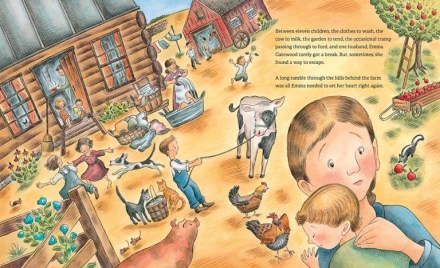
With eleven children, a farm to tend, and chores to do, Emma Gatewood’s days were plenty busy. When she needed a bit of escape, “a long ramble through the hills behind the farm was all Emma needed to set her heart right again.” So when her children had all left home and sparked by a magazine article about the Appalachian Trail, Emma put on her walking shoes and took to “‘the longest footpath in the world.’” The article had said that no woman had ever hiked the Trail from beginning to end, and Emma determined to change that.

celebrate-picture-books-picture-book-review-grandma-gatewood-hikes-the-appalachian-trail-kids

Copyright Jennifer Thermes, 2018, courtesy of Abrams Books for Young Readers.

On May 3, 1955, at the age of sixty seven, Emma left her home in Ohio and traveled to Mt. Oglethorpe in Georgia to begin her hike along the 2,190-mile-long Appalachian Trail. With just a light homemade sack and canvas shoes, Emma made her way up the trail, eating berries and drinking from streams as she went. When the trail took her through small towns and mountain farms, she got a real “supper and a cozy place to sleep.”

Word traveled about the older woman hiking the trail, and “Emma soon became known as ‘Grandma Gatewood.’” In June Emma crossed into Virginia and at the beginning of July took a quick jog through Maryland. The magazine article had said that hiking the trail was easy, but Emma had a different perspective. She once said the trail always seemed to “‘lead you right up over the biggest rock to the top of the biggest mountain they can find.’”

celebrate-picture-books-picture-book-review-grandma-gatewood-hikes-the-appalachian-trail-vista

Copyright Jennifer Thermes, 2018, courtesy of Abrams Books for Young Readers.

Grandma Gatewood walked in all weather and saw sights that were sometimes dull, but more often stunning. During July she crossed Pennsylvania, traced an edge of New Jersey, and hopped a corner of New York State. Pennsylvania’s sharp rocks “tore the soles of Emma’s shoes, so she held them together with tape.” By this time the newspapers had heard about Emma too, and “reporters met her at almost every stop.” Pretty soon, the whole country was talking about her! When people asked her why she was doing it, she answered, “‘Just for the heck of it.’”

celebrate-picture-books-picture-book-review-grandma-gatewood-hikes-the-appalachian-trail-new-hampshire-map

Copyright Jennifer Thermes, 2018, courtesy of Abrams Books for Young Readers.

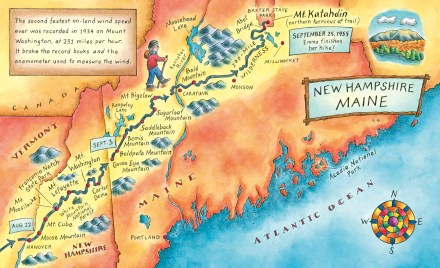
It was late summer and Emma was over halfway finished, but a bigger challenge was headed her way. A hurricane was swirling toward the East Coast. In early August, Emma hiked through Connecticut, Massachusetts, and Vermont. When the hurricane hit, she was soaked by rain, threatened by falling trees, and blown by the wind. She found shelter in a hut where a group of teenage boys were also waiting out the storm. They carried her across a swollen stream, and Emma continued her journey.

She met up with boy scouts and even went to tea with someone who had pinned an invitation to a tree along the trail. On September 3, she crossed from New Hampshire into Maine. Cold weather was coming, but the last mountain was in her sights. She bundled into every bit of clothes she had, and with torn shoes, cracked glasses, and aching muscles, Emma scrambled up the mountain all the way to the top. She had accomplished what she set out to do—and two years later, she did it again!

A timeline and an extensive author’s note about Emma Gatewood and the Trail follow the text.

celebrate-picture-books-picture-book-review-grandma-gatewood-hikes-the-appalachian-trail-night-scene

Copyright Jennifer Thermes, 2018, courtesy of Abrams Books for Young Readers.

Inspiring from beginning to end, Jennifer Thermes’ story highlights a woman who lived life on her terms and accomplished a personal goal while, literally, blazing a trail for women and the elderly. The jaunty lilt of Thermes’ storytelling mirrors Emma’s brisk pace while giving readers an excellent sense of her personality and the twists, turns, and obstacles of the Appalachian Trail. Facts about landmarks along the trail are sprinkled throughout.

The story of Grandma Gatewood and the Appalachian Trail is a perfect match for Thermes’ superb artwork and map-making skills. Colorful and detailed two-page maps, set every three pages, keep readers apprised of the dates that Emma passed through each state on her trek north. In between, kids get to see Emma scaring off a bear, making friends with townspeople along the way, trudging up mountains, cooling her feet in rushing streams, climbing over rocks, and weathering the storm. Themes also includes some of the gorgeous vistas that have made the Appalachian Trail a must for hikers of all ages and experience.

Grandma Gatewood Hikes the Appalachian Trail  would make an inspiring addition to home libraries for children who love nature, history, and the outdoors. The book would also enhance many classroom discussions and lesson plans from language arts to social studies to science.

Ages 5 – 9

Abrams Books for Young Readers, 2018 | ISBN 978-1419728396

Discover more about Jennifer Thermes, her books, and her art on her website

National Take a Hike Day Activity

celebrate-picture-books-picture-book-review-National-Parks-Map

National Park Coloring Pages and Map


The national parks are home to some of the most beautiful scenery in the country. With lots of marked trails, these parks offer great places to take a hike. Enjoy these coloring pages while you learn a little bit about four of America’s national parks. Then check the map and see if there’s a park near you!

Acadia National Park | Everglades National Park | Mesa Verde National Park | Rocky Mountains National Park | National Parks Map

celebrate-picture-books-picture-book-review-grandma-gatewood-hikes-the-appalachian-trail-cover

You can find Grandma Gatewood Hikes the Appalachian Trail at these booksellers:

Abrams BYR | Amazon | Barnes & Noble | Books-a-Million | IndieBound

Picture Book Review

November 9 – It’s National Aviation History Month

celebrate-picture-books-picture-book-review-aim-for-the-skies-cover

About the Holiday

It seems that people have always been fascinated with flight. The first kite was invented in 1000 BCE in China; around 400 BCE Archytas of Tarentum developed a steam-powered pigeon; and most people are familiar with the designs of flying machines that Leonardo de Vinci created in the late 1400s. It wasn’t until 1680 that actual human flight was abandoned when an Italian mathematician determined that human muscles were incompatible with flight.

Zip ahead about 100 years and the first hot-air balloon took flight, which led to more complex technology, resulting in Wilbur and Orville Wright’s flight in 1903. From there, it seemed, the sky was the limit. Amelia Earhart became the first woman to complete a trans-Atlantic Ocean solo flight in 1932, and in 1947 Charles Yeager broke the sound barrier. Given this long history, it’s astounding to think that only 58 years span the time from that modest 12-second flight by the Wright Brothers to the first manned space mission by Soviet cosmonaut Yuri Gagarin! To celebrate the month, visit a local museum or read up on some of the pioneers of early flight—like the courageous women in today’s book.

Aim for the Skies: Jerrie Mock and Joan Merriam Smith’s Race to Complete Amelia Earhart’s Quest

Written by Aimée Bissonette | Illustrated by Doris Ettlinger


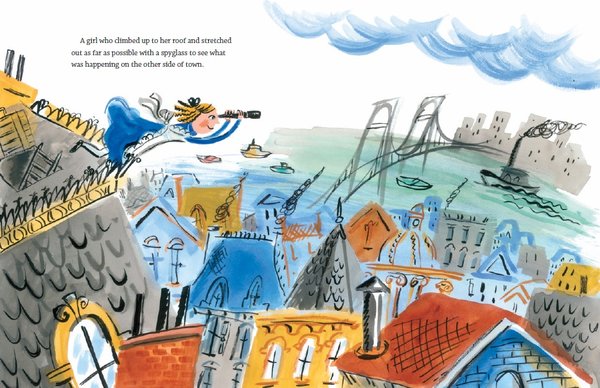
Jerrie Mock was only seven when her first airplane ride convinced her she wanted to be a pilot when she grew up. At first she only dreamed of flying across Ohio, but later, when she followed reports of Amelia Earhart’s daring flights, she decided she too wanted to see the whole world.

In 1952, Joan Merriam was fifteen years old when she took her first airplane ride and was invited by the pilots to see the cockpit. That’s all it took for Joan to know she wanted to be a pilot too. She began flying lessons and was in the air before she even got her drivers license. By 1963, Joan was working as a professional pilot and bought a plane of her own. One of Joan’s goals was to “circle the globe following the exact route” her idol Amelia Earhart had charted.

celebrate-picture-books-picture-book-review-aim-for-the-skies-Jerrie-Mock

Image copyright Doris Ettlinger, 2018, text copyright Aimée Bissonette, 2018. Courtesy of Sleeping Bear Press.

By the time Jerrie was thirty-seven, she had three children and ran a flight business with her husband, Russ. One night when she told Russ that she was bored, he joked, “‘Maybe you should get in your plane and fly around the world.’” Jerrie took him up on that. Both women spent months planning and charting their flights. Neither one knew that the other was getting ready for the same flight until their plans hit the media. Suddenly, what they had both thought was a solitary pursuit became a race to the finish.

Joan took off on March 17, 1964 from an airstrip in Oakland, California accompanied only by two stuffed bears. Two days later, surrounded by reporters asking if she thought she could beat Joan, Jerrie climbed into her tiny plane and took off too.

celebrate-picture-books-picture-book-review-aim-for-the-skies-Joan-Merriam

Image copyright Doris Ettlinger, 2018, text copyright Aimée Bissonette, 2018. Courtesy of Sleeping Bear Press.

Jerrie’s troubles began right away. First, her radio didn’t work then bad weather kept her grounded for six days. “Where was Joan?” she wondered. While Joan’s flight began smoothly, a gas leak brought her down to earth for a week while the tank was repaired. Back in the air, Jerrie seemed to suffer problems every day. “She battled dangerous ice buildup, burning radio wires, and bad weather. She flew into a sandstorm over the Arabian Desert and couldn’t see.” But she encouraged herself to stay calm and use her instruments. Joan was having it no easier. “Heavy rains pounded her pane. Her windshield leaked. Water puddled at her feet. When she finally made it to Brazil, she was delayed again. This time by a government revolution!”

Day by day both women battled the elements and equipment failures but kept flying. Everyone around the world seemed to be watching the race. Russ told Jerrie she had to fly faster—that Joan was winning. In Pakistan, people told Joan that Jerrie had landed there five days earlier. Finally, on April 17, twenty-nine days after she had left, Jerrie returned to Ohio to a hero’s welcome. Reporters and crowds pushed to see her. “Jerry’s heart pounded. She had done it. She had flown around the world. She had won the race.”

celebrate-picture-books-picture-book-review-aim-for-the-skies-Jerrie-bored

Image copyright Doris Ettlinger, 2018, text copyright Aimée Bissonette, 2018. Courtesy of Sleeping Bear Press.

Where was Joan? She “was in Lae, New Guinea—the last place Amelia Earhart was seen alive—when she heard the race was over.” Even though she knew she was behind Jerrie, “the news was still hard to take.” She sent Jerrie a congratulations telegram, and then left for Guam. There, she walked and “thought about her childhood dream. She thought about the race and she thought about losing.”  Then she thought about why she had undertaken the flight. She had done it to honor Amelia Earhart. Even though Jerrie had won the race, Joan thought that didn’t make her a loser. She “could still do what she set out to do.”

Joan landed back in Oakland, California on May 12, 1964. Her plane was in such bad shape that the Coast Guard had to dispatch a plane to guide her in. Joan was also welcomed by cheering crowds and reporters. Both Jerrie and Joan had accomplished incredible feats. Jerrie “became the first woman to fly around the world,” and Joan—”following Amelia’s exact route along the equator”—was the first “pilot—man or woman”—to fly that distance solo. And both women received thanks from Amelia’s sister, Muriel, for honoring Amelia—”a pilot who, like them, chose to follow her dreams.”

An Author’s Note describing the differences in Joan and Jerrie’s routes and aircraft as well as a bit more about their lives after the historic flight and a map outlining each woman’s flight pattern follow the text. Resources for further reading are also included.

celebrate-picture-books-picture-book-review-aim-for-the-skies-planning-routes

Image copyright Doris Ettlinger, 2018, text copyright Aimée Bissonette, 2018. Courtesy of Sleeping Bear Press.

Aimée Bissonette’s thrilling biography of two woman, two flights, and one race will keep young readers on the edge of their seats. Riveting details reveal the staggering dangers the women faced as well as their astonishing courage, dedication, and persistence. Bissonette’s fast-paced, electric storytelling puts kids in the cockpit as Joan and Jerrie cross the globe. As Jerrie wins the race and Joan reevaluates her goal, Bissonette makes important and welcome points about the nature of competition, keeping one’s eyes and heart on an original goal without getting caught up in distracting hype, and having the self-confidence to believe in oneself and recognize one’s accomplishments.

In her realistic, richly colored watercolors, Doris Ettlinger follows Jerrie and Joan as they experience their first airplane rides that determine their futures, plot their flights around the world, and take off. The obstacles each woman dealt with are dramatically portrayed as winds whip trees, blinding rain and sand storms thwart progress, and mechanical failures keep the women grounded. Children get a look at landscapes from Bermuda, the Philippines, Africa, and Pakistan as Joan and Jerrie complete their flights. Expressive depictions of Jerrie’s and Joan’s emotions show readers the determination, pressures, and ultimate joy each woman felt during these historic months of 1964.

An exhilarating biography and adventure story rolled into one, Aim for the Skies is a book that will inspire young readers to keep their eyes on their goals despite obstacles and setbacks while reassuring them that winning is accomplished by being true to yourself. Children who love history, flight, biographies, and adventure will find this a compelling book to add to their home bookshelf. Classroom, school, and public libraries will want to include Aim for the Skies in their collections for story times and lessons.

Ages 6 – 9

Sleeping Bear Press, 2018 | ISBN 978-1585363810

Discover more about Aimée Bissonette and her books on her website.

National Aviation History Month Activity

celebrate-picture-books-picture-book-review-Flying-is-Fabulous-Maze

Flying is Fabulous! Maze


Can you pilot the airplane along its route to the airport in this printable Flying is Fabulous! Maze?

Flying is Fabulous! MazeFlying is Fabulous! Maze Solution

celebrate-picture-books-picture-book-review-aim-for-the-skies-cover

You can find Aim for the Skies at these booksellers

Amazon | Barnes & Noble | Books-a-Million | IndieBound

Picture Book Review
 

October 29 – National Cat Month

celebrate-picture-books-picture-book-review-bambino-and-mr-twain-cover

About the Holiday

Cat lovers get it! The mercurial personalities of felines keep us laughing, shaking our heads, and, of course, loving these singular pets. Cats are the stars of social media, they inspire fashion statements, decorate mugs and dish ware, and are cuter than cute. But there are many cats and kittens that don’t have a forever home. National Cat Day was established in 2005 by pet and family lifestyle expert and animal welfare advocate, Colleen Paige. Her goal was to raise awareness of the number of rescue cats that need permanent homes while also celebrating the unique relationship between cats and those who love them. Today’s book is simply purr-fect for those who love cats and books!

Bambino and Mr. Twain

Written by P. I. Maltbie | Illustrated by Daniel Miyares

On a particular November day in 1904, a crowd gathered outside the brownstone where Samuel Clemens, known to readers as Mark Twain, had recently come to live. Reporters, readers, and neighbors had come to wish Sam a happy birthday. But they were shooed away by his housekeeper, Katy. Since his wife, Livy, had died five months earlier, Samuel had not felt happy; he didn’t want to see anyone or even leave the house.

“From an upstairs window an old man with wild white hair and a black cat watched the crowd walk away. ‘Everyone wants to meet witty Mark Twain,’ the man said. ‘But tell me, Bambino, would they want to meet sad, old Samuel Clemens?’” Soon his daughter Jean entered the room and persuaded her father to come downstairs for cake and ice cream with the promise that Bambino, their black cat, could have some too.

celebrate-picture-books-picture-book-review-bambino-and-mr-twain-brownstone

Image copyright Daniel Muyares, 2012. Courtesy of Charlesbridge.

In the middle of the cake stood a single candle—a tradition that Livy had started so that Samuel would “‘never grow old.’” With a dish of ice-cream to himself, Bambino took the place of Sam’s older daughter, Clara, who couldn’t be with them that night. Friends had invited Sam for dinner, but he did not want to go. As winter settle in, so did Samuel. He rarely left his bed, littering the covers with papers and books—so many “that the cat had difficulty finding a soft place to sleep.”

As Christmas approached, instead of attending the parties he was invited to, Samuel wandered around his big house, gazing at pictures of Livy and playing games—like billiards—with Bambino. When spring arrived, Katy rushed around opening windows to air out the house. In a sunlit upstairs room, “Bambino attacked the sunbeam dancing on the wardrobe door. Sam opened the door. The sunbeam shone on a white suit. Bambino swatted at it.” Sam lifted the suit from the closet and looked at it fondly. While Livy was alive he had worn that suit every summer. “‘Those were happy days,’” he recalled.

celebrate-picture-books-picture-book-review-bambino-and-mr-twain-window

Image copyright Daniel Muyares, 2012, text copyright P.I. Maltbie, 2012. Courtesy of Charlesbridge.

Just then, outside the open window, Bambino saw a squirrel that had been chattering at him for days. With a leap Bambino was chasing the squirrel down the street. “‘Bamb-i-i-i-n-o-o-o!’ Sam’s voice echoed over the city noises.” Sam and Jean put up Lost Cat posters offering a $5.00 reward (a week’s wages) for Bambino’s return. Sam didn’t know how he would tell Clara that Bambino was gone, but Jean reassured him that someone would find their cat.

“Soon a steady stream of people appeared on Sam’s doorstep with cats and kittens of every size, color, and breed.” Seeing the crowd, Sam came out onto his stoop. One little girl offered to let Sam borrow their family’s cat until Bambino returned, and others brought him cats they thought would comfort him. But Sam thought Bambino would not “‘take kindly to finding a foreign cat in his kingdom.’” Reporters wanted to talk to this beloved author about Bambino too, “and this time Sam talked to them.”

celebrate-picture-books-picture-book-review-bambino-and-mr-twain-grieving

Image copyright Daniel Muyares, 2012. Courtesy of Charlesbridge.

Four days later, Katy found Bambino on the doorstep as if nothing had happened. Sam was overjoyed. “‘To celebrate, we’ll feast on the fatted salmon,’” he said. Sam’s experience with his kindly friends, neighbors, and readers had given him a new perspective. He was ready to rejoin the world and enjoy what it had to offer. An announcement in the newspaper let people know that Bambino had returned, but they continued to drop by to wish Sam well. Now, Sam smiled and talked with them.

Sam had several white suits made, and they became his trademark. At his home in Connecticut, he held a musical gala and talked and joked the way he used to. Jean and Clara had not seen their father this happy in a long time. And Bambino? He just “blinked his eyes and purred.”

celebrate-picture-books-picture-book-review-bambino-and-mr-twain-musical-gala

Image copyright Daniel Muyares, 2012. Courtesy of Charlesbridge.

P.I. Maltbie’s focus on a particular year in Samuel Clemens’ life provides a deeper portrait of this author known for his wit, wisdom, and social commentary. Maltbie’s detailed and compassionate storytelling reveals the stages and effects of grief and the way a pet or a good friend can help in a way that is accessible and understandable for children. His tracing of the passage of time from fall to summer allows readers to see that recovery from sadness or other events is a personal journey, but one that is made easier with the enduring love and reassurance of family and friends. Readers who love the stories and novels of Mark Twain will appreciate this touching glimpse into Samuel Clemens’ life.

celebrate-picture-books-picture-book-review-bambino-and-mr-twain

Daniel Miyares’ crisp, mixed-media and digital illustrations resonate with muted, yet saturated colors that reflect Samuel Clemens’ mourning. Perky Bambino is a constant presence, celebrating Sam’s birthday, playing billiards with Sam, and curled up on Sam’s bed. Bambino’s dramatic leap out the window will wow kids, and they will empathize with Sam as pages without the black cat reflect Sam’s feeling of loss. Young readers will be inspired by the little girl who offers her own family cat to comfort Sam and be cheered to see the positive effect Bambino’s return has on Sam as he again embraces the world dressed in the iconic white suit, which signals Sam’s lightening mood and regained good humor.

Bambino and Mr. Twain is an excellent biography to share with children at home and school to show that everyone undergoes good and bad times, but with faithful and loving family and friends, problems can be resolved and happiness restored.

Ages 5 – 8

Charlesbridge, 2012 | ISBN 978-1580892728 

Coming in paperback in May, 2019. Available for preorder | ISBN 978-1580892735

To learn more about Daniel Miyares, his books, and his art on his website

National Cat Day Activity

Purr-fect Friends Maze

One little kitten wants to play with her friends. Help her find her way in this printable maze!

Purr-fect Friends Maze Puzzle |  Purr-fect Friends Maze Solution

celebrate-picture-books-picture-book-review-bambino-and-mr-twain-cover

You can find Bambino and Mr. Twain at these booksellers

Amazon | Barnes & Noble | Books-a-Million | IndieBound

Picture Book Review
October 20 – International Chef Day

celebrate-picture-books-picture-book-review-roy-choi-and-the-street-food-remix-cover

About the Holiday

Established in 2004 by chef Dr. Bill Gallagher, International Chefs Day celebrates the profession while also promoting the time-honored tradition of passing down culinary skills and knowledge to chefs on their way to working in the field and even perhaps owning their own restaurant. Sponsored by WorldChefs, which was created in 1928 in Sorbonne, Paris with August Escoffier as the organization’s first honorary president, the holiday emphasized eating healthy. Partnering with Nestlé Professional, WorldChefs has chosen Healthy Foods for Growing Up as year’s theme. The mission is to prompt kids to think about the profession they would like to have in the future and consider how eating healthy foods will help them reach their full potential. The holiday is celebrated with fun workshops and events across the globe. At home, parents and kids can discuss healthy diets, menu planning, and cooking together. When kids are involved in shopping for and preparing food, they develop a good and healthy relationship with what they eat. For more information about International Chefs Day as well as to find recipes, a toolkit, and interviews with chefs around the world, plus many more resources, visit the WorldChefs website.

Chef Roy Choi and the Street Food Remix

Written by Jacqueline Briggs Martin and June Jo Lee | Illustrated by Man One


“Chef Roy Choi can chop an onion in an instant, carve a mouse out of a mushroom. He’s cooked in fancy restaurants, for rock stars and royalty. But he’d rather cook on a truck.” Roy considers himself a “‘street cook,’” and he creates food with love and care—and especially sohn-maash—for anyone who stops by. What’s sohn-maash? “It is the love and cooking talent that Korean mothers and grandmothers mix into their handmade foods.”

When Roy was two his family moved from Seoul, Korea to Los Angeles, California. His mother made kimchi that was so delicious friends bought it from the trunk of her car. Eventually, Roy’s parents “opened a restaurant—Silver Garden.” Roy loved exploring the various ethnic foods in his neighborhood, but always liked his mom’s food the best.

celebrate-picture-books-picture-book-review-roy-choi-and-the-street-food-locols

Image copyright Man One, 2017, text copyright Jacqueline Briggs Martin and June Jo Lee, 2017. Courtesy of readerstoeaters.com.

Roy loved hanging out in the bustling kitchen of the Silver Garden. And when 3:00 rolled around “everyone gathered at booth #1 for Dumpling Time.” While they filled dumpling wrappers, they told stories, shared news, and laughed. “Family together, making food. Roy’s best good time.” In time his neighborhood changed, and the Silver Garden closed. His parents then opened a jewelry store, and the family moved to the suburbs. But Roy was not happy. He wasn’t like the other kids in the neighborhood.

After he graduated, Roy was at a loss; he didn’t know what he wanted to do. No matter what, though, he always went home, “where his mom helped him get strong with kimchi, rice, tofu, stew.” One day as Roy watched a cooking show, he realized his heart was in the kitchen. He went to cooking school and learned about recipes and preparing food. When he graduated, he got jobs in fancy restaurants where he cooked for a thousand diners a night and ran the kitchen crew. He knew that this was where he belonged.

celebrate-picture-books-picture-book-review-roy-choi-and-the-street-food-remix

Image copyright Man One, 2017, text copyright Jacqueline Briggs Martin and June Jo Lee, 2017. Courtesy of readerstoeaters.com.

“Roy was a success—until he wasn’t.” There came a time when he couldn’t keep up with the frantic pace, couldn’t remember recipes. He lost his job. A friend suggested they open a food truck together—putting Korean barbecue in a taco. Roy jumped at the idea of remixing “the tastes he loved on the streets that were his home. He used mad chef’s skills to build flavor and cooked with care, with sohn-maash.” They called their truck Kogi BBQ, and they hit the road, looking for hungry customers.

At first the idea of a Korean taco didn’t fly, but once people tried them, they lined up to buy them. “Roy saw that Kogi food was like good music, bringing people together and making smiles. Strangers talked and laughed as they waited in line—Koreans with Latinos, kids with elders, taggers with geeks.”

celebrate-picture-books-picture-book-review-roy-choi-and-the-street-food-remix-watts

Image copyright Man One, 2017, text copyright Jacqueline Briggs Martin and June Jo Lee, 2017. Courtesy of readerstoeaters.com.

Roy felt at home in his truck, and his Kogi tacos made him famous. He opened cafes in older neighborhoods, and called his chef friends, saying “Let’s feed those we aren’t reaching.” Chef DP joined up. Together they opened fast-food places for kids and others skateboarding, playing, or just hanging out.

In the Watts neighborhood of Los Angeles, across the street from an elementary school, they opened Locol. The two chefs wondered if people would “care about soulful fast food.” But he needn’t have worried. Before the doors even opened, a line formed down the street and around the corner. Now, Roy wants to bring the remixed flavors of Locol to other neighborhoods. He dreams of “‘feeding goodness to the world’” and says you can do that too. All it takes is to “cook with sohn-maash, cook with love.”

celebrate-picture-books-picture-book-review-roy-choi-and-the-street-food-remix-neighborhood

Image copyright Man One, 2017, text copyright Jacqueline Briggs Martin and June Jo Lee, 2017. Courtesy of readerstoeaters.com.

Extensive Authors’ and Illustrator’s Notes offering more information about Roy Choi, his work, and the making of the book follow the text.

For kids who love cooking—and eating—Jacqueline Briggs Martin and June Jo Lee have written a compelling biography of one of the culinary world’s stars. Beginning with Roy Choi’s childhood, Martin and Lee show young readers the family and social events that influenced not only his choice of career but his dedication to underserved neighborhoods. Scattered throughout the pages are poems that read like recipes and satisfy like comfort food. Full of care and love, the story will encourage readers to follow their heart, try out different ideas, and find the mission that’s important to them.

Graffiti artist and illustrator Man One infuses Chef Roy Choi and the Street Food Remix with the vibrancy of the Los Angeles neighborhoods that nurtured Choi’s talent. Readers get to gather with the family during dumpling time and see the vast array of ingredients enveloped in the tasty wrappers, watch Choi finesse a lamb dish in his fancy restaurant, and feel the vibe as he remixes tacos with a Korean tang. Along the way, kids also meet the customers from all walks of life who line up to experience Choi’s food.

Ages 5 – 12

Readers to Eaters, 2017 | ISBN 978-0983661597

Discover more about Jacqueline Briggs Martin and her books on her website.

You can read more about June Jo Lee on the Readers to Eaters website.

View a gallery of art, murals, prints, and more by Man One on his website.

International Chefs Day Activity

celebrate-picture-books-picture-book-review-lemon-and-chocolate-cookies

French Butter Cookies – Lemon and Chocolate


Whip up a batch of these delicious cookies to eat yourself or share with others! There are two distinct flavors to satisfy any palate!

Ingredients for Lemon Cookies

  • 10 tablespoons unsalted butter (room temperature)
  • 1/2 cup sugar
  • 1 large egg
  • 1 1/4 teaspoons vanilla extract
  • 2 cups flour
  • 1/2 teaspoon baking powder
  • 1/4 teaspoon salt
  • 2 teaspoons lemon zest (or to taste)

For Chocolate Cookies

  • 10 tablespoons unsalted butter (room temperature)
  • 1/2 cup sugar
  • 1 large egg
  • 1 1/4 teaspoons vanilla extract
  • 1 ½ cups flour
  • ½ cup cocoa powder
  • ½ teaspoon cinnamon
  • ¼ teaspoon ground ginger
  • 1/2 teaspoon baking powder
  • 1/4 teaspoon salt

For Egg Wash

  • 1 egg
  • 1 tablespoon water

Directions

  1. In a bowl beat butter and sugar until light and fluffy
  2. Add the egg and vanilla extract and beat until blended
  3. Add the flour, baking powder and salt and beat just until incorporated. Do not over mix the dough. **For Chocolate Cookies use 1 ½ cups flour and add cocoa powder, cinnamon, and ground ginger before mixing.**
  4. Transfer the dough to a lightly floured work surface, knead the dough a few times to bring it together, and then divide the dough in half.
  5. Wrap each half in plastic wrap and refrigerate for at least one hour or until firm
  6. Preheat oven to 350 degrees F (177 degrees C) and place rack in the center of the oven.
  7. Line two baking sheets with parchment paper and set aside.
  8. Remove one portion of the dough from the refrigerator and place on a lightly floured work surface. Roll out the dough until it is 1/4 inch (1 cm) thick.
  9. Using a lightly floured 2 inch (5 cm) round, fluted cookie cutter (or other cookie cutter of your choice), cut out the cookies and place them on the prepared baking sheet.
  10. Put the baking sheet of cut-out cookies in the refrigerator for about 15 -20 minutes to chill the dough.
  11. Meanwhile, in a small bowl, whisk the egg with the water for the egg wash. Remove the cookies from the refrigerator and brush the tops with the egg wash.
  12. Then, with the tines of a fork or a toothpick, make a crisscross pattern on the top of each cookie.
  13. Bake cookies for about 12-14 minutes or until golden brown around the edges.
  14. Cool cookies on wire rack.

celebrate-picture-books-picture-book-review-roy-choi-and-the-street-food-remix-cover

You can find Chef Roy Choi and the Street Food Remix at these booksellers

Amazon | Barnes & Noble | Books-a-Million | IndieBound

Picture Book Review
 

Picture Book Review