November 9 – It’s National Aviation History Month

celebrate-picture-books-picture-book-review-aim-for-the-skies-cover

About the Holiday

It seems that people have always been fascinated with flight. The first kite was invented in 1000 BCE in China; around 400 BCE Archytas of Tarentum developed a steam-powered pigeon; and most people are familiar with the designs of flying machines that Leonardo de Vinci created in the late 1400s. It wasn’t until 1680 that actual human flight was abandoned when an Italian mathematician determined that human muscles were incompatible with flight.

Zip ahead about 100 years and the first hot-air balloon took flight, which led to more complex technology, resulting in Wilbur and Orville Wright’s flight in 1903. From there, it seemed, the sky was the limit. Amelia Earhart became the first woman to complete a trans-Atlantic Ocean solo flight in 1932, and in 1947 Charles Yeager broke the sound barrier. Given this long history, it’s astounding to think that only 58 years span the time from that modest 12-second flight by the Wright Brothers to the first manned space mission by Soviet cosmonaut Yuri Gagarin! To celebrate the month, visit a local museum or read up on some of the pioneers of early flight—like the courageous women in today’s book.

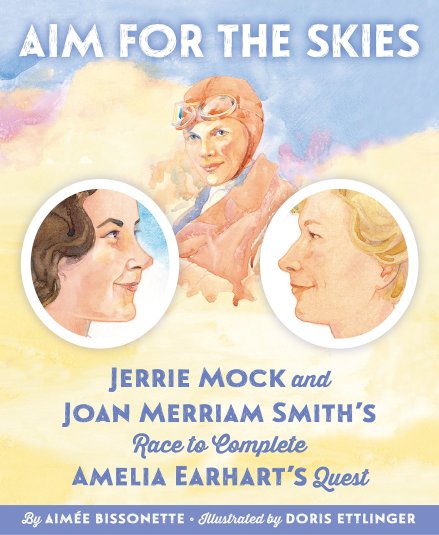
Aim for the Skies: Jerrie Mock and Joan Merriam Smith’s Race to Complete Amelia Earhart’s Quest

Written by Aimée Bissonette | Illustrated by Doris Ettlinger


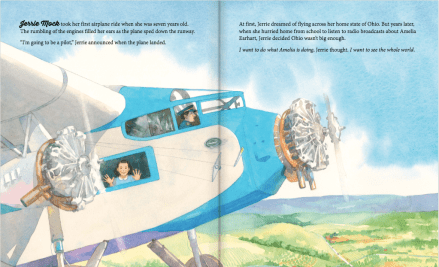
Jerrie Mock was only seven when her first airplane ride convinced her she wanted to be a pilot when she grew up. At first she only dreamed of flying across Ohio, but later, when she followed reports of Amelia Earhart’s daring flights, she decided she too wanted to see the whole world.

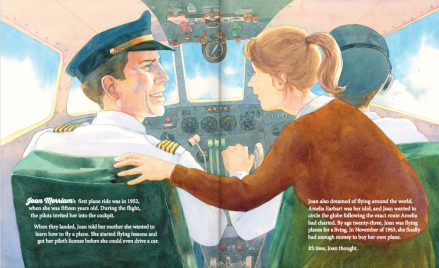
In 1952, Joan Merriam was fifteen years old when she took her first airplane ride and was invited by the pilots to see the cockpit. That’s all it took for Joan to know she wanted to be a pilot too. She began flying lessons and was in the air before she even got her drivers license. By 1963, Joan was working as a professional pilot and bought a plane of her own. One of Joan’s goals was to “circle the globe following the exact route” her idol Amelia Earhart had charted.
celebrate-picture-books-picture-book-review-aim-for-the-skies-Jerrie-Mock

Image copyright Doris Ettlinger, 2018, text copyright Aimée Bissonette, 2018. Courtesy of Sleeping Bear Press.

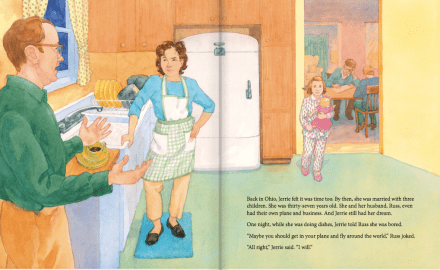
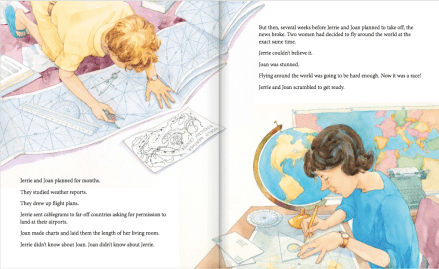
By the time Jerrie was thirty-seven, she had three children and ran a flight business with her husband, Russ. One night when she told Russ that she was bored, he joked, “‘Maybe you should get in your plane and fly around the world.’” Jerrie took him up on that. Both women spent months planning and charting their flights. Neither one knew that the other was getting ready for the same flight until their plans hit the media. Suddenly, what they had both thought was a solitary pursuit became a race to the finish.

Joan took off on March 17, 1964 from an airstrip in Oakland, California accompanied only by two stuffed bears. Two days later, surrounded by reporters asking if she thought she could beat Joan, Jerrie climbed into her tiny plane and took off too.
celebrate-picture-books-picture-book-review-aim-for-the-skies-Joan-Merriam

Image copyright Doris Ettlinger, 2018, text copyright Aimée Bissonette, 2018. Courtesy of Sleeping Bear Press.

Jerrie’s troubles began right away. First, her radio didn’t work then bad weather kept her grounded for six days. “Where was Joan?” she wondered. While Joan’s flight began smoothly, a gas leak brought her down to earth for a week while the tank was repaired. Back in the air, Jerrie seemed to suffer problems every day. “She battled dangerous ice buildup, burning radio wires, and bad weather. She flew into a sandstorm over the Arabian Desert and couldn’t see.” But she encouraged herself to stay calm and use her instruments. Joan was having it no easier. “Heavy rains pounded her pane. Her windshield leaked. Water puddled at her feet. When she finally made it to Brazil, she was delayed again. This time by a government revolution!”

Day by day both women battled the elements and equipment failures but kept flying. Everyone around the world seemed to be watching the race. Russ told Jerrie she had to fly faster—that Joan was winning. In Pakistan, people told Joan that Jerrie had landed there five days earlier. Finally, on April 17, twenty-nine days after she had left, Jerrie returned to Ohio to a hero’s welcome. Reporters and crowds pushed to see her. “Jerry’s heart pounded. She had done it. She had flown around the world. She had won the race.”
celebrate-picture-books-picture-book-review-aim-for-the-skies-Jerrie-bored

Image copyright Doris Ettlinger, 2018, text copyright Aimée Bissonette, 2018. Courtesy of Sleeping Bear Press.

Where was Joan? She “was in Lae, New Guinea—the last place Amelia Earhart was seen alive—when she heard the race was over.” Even though she knew she was behind Jerrie, “the news was still hard to take.” She sent Jerrie a congratulations telegram, and then left for Guam. There, she walked and “thought about her childhood dream. She thought about the race and she thought about losing.”  Then she thought about why she had undertaken the flight. She had done it to honor Amelia Earhart. Even though Jerrie had won the race, Joan thought that didn’t make her a loser. She “could still do what she set out to do.”

Joan landed back in Oakland, California on May 12, 1964. Her plane was in such bad shape that the Coast Guard had to dispatch a plane to guide her in. Joan was also welcomed by cheering crowds and reporters. Both Jerrie and Joan had accomplished incredible feats. Jerrie “became the first woman to fly around the world,” and Joan—”following Amelia’s exact route along the equator”—was the first “pilot—man or woman”—to fly that distance solo. And both women received thanks from Amelia’s sister, Muriel, for honoring Amelia—”a pilot who, like them, chose to follow her dreams.”

An Author’s Note describing the differences in Joan and Jerrie’s routes and aircraft as well as a bit more about their lives after the historic flight and a map outlining each woman’s flight pattern follow the text. Resources for further reading are also included.
celebrate-picture-books-picture-book-review-aim-for-the-skies-planning-routes

Image copyright Doris Ettlinger, 2018, text copyright Aimée Bissonette, 2018. Courtesy of Sleeping Bear Press.

Aimée Bissonette’s thrilling biography of two woman, two flights, and one race will keep young readers on the edge of their seats. Riveting details reveal the staggering dangers the women faced as well as their astonishing courage, dedication, and persistence. Bissonette’s fast-paced, electric storytelling puts kids in the cockpit as Joan and Jerrie cross the globe. As Jerrie wins the race and Joan reevaluates her goal, Bissonette makes important and welcome points about the nature of competition, keeping one’s eyes and heart on an original goal without getting caught up in distracting hype, and having the self-confidence to believe in oneself and recognize one’s accomplishments.

In her realistic, richly colored watercolors, Doris Ettlinger follows Jerrie and Joan as they experience their first airplane rides that determine their futures, plot their flights around the world, and take off. The obstacles each woman dealt with are dramatically portrayed as winds whip trees, blinding rain and sand storms thwart progress, and mechanical failures keep the women grounded. Children get a look at landscapes from Bermuda, the Philippines, Africa, and Pakistan as Joan and Jerrie complete their flights. Expressive depictions of Jerrie’s and Joan’s emotions show readers the determination, pressures, and ultimate joy each woman felt during these historic months of 1964.

An exhilarating biography and adventure story rolled into one, Aim for the Skies is a book that will inspire young readers to keep their eyes on their goals despite obstacles and setbacks while reassuring them that winning is accomplished by being true to yourself. Children who love history, flight, biographies, and adventure will find this a compelling book to add to their home bookshelf. Classroom, school, and public libraries will want to include Aim for the Skies in their collections for story times and lessons.

Ages 6 – 9

Sleeping Bear Press, 2018 | ISBN 978-1585363810

Discover more about Aimée Bissonette and her books on her website.

National Aviation History Month Activity

celebrate-picture-books-picture-book-review-Flying-is-Fabulous-Maze

Flying is Fabulous! Maze


Can you pilot the airplane along its route to the airport in this printable Flying is Fabulous! Maze?

Flying is Fabulous! MazeFlying is Fabulous! Maze Solution

celebrate-picture-books-picture-book-review-aim-for-the-skies-cover

You can find Aim for the Skies at these booksellers

Amazon | Barnes & Noble | Books-a-Million | IndieBound

Picture Book Review


October 29 – National Cat Month

celebrate-picture-books-picture-book-review-bambino-and-mr-twain-cover

About the Holiday

Cat lovers get it! The mercurial personalities of felines keep us laughing, shaking our heads, and, of course, loving these singular pets. Cats are the stars of social media, they inspire fashion statements, decorate mugs and dish ware, and are cuter than cute. But there are many cats and kittens that don’t have a forever home. National Cat Day was established in 2005 by pet and family lifestyle expert and animal welfare advocate, Colleen Paige. Her goal was to raise awareness of the number of rescue cats that need permanent homes while also celebrating the unique relationship between cats and those who love them. Today’s book is simply purr-fect for those who love cats and books!

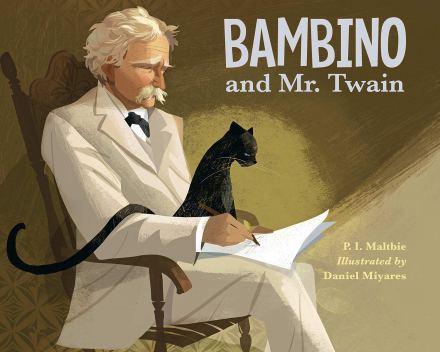
Bambino and Mr. Twain

Written by P. I. Maltbie | Illustrated by Daniel Miyares

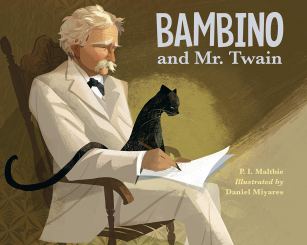
On a particular November day in 1904, a crowd gathered outside the brownstone where Samuel Clemens, known to readers as Mark Twain, had recently come to live. Reporters, readers, and neighbors had come to wish Sam a happy birthday. But they were shooed away by his housekeeper, Katy. Since his wife, Livy, had died five months earlier, Samuel had not felt happy; he didn’t want to see anyone or even leave the house.

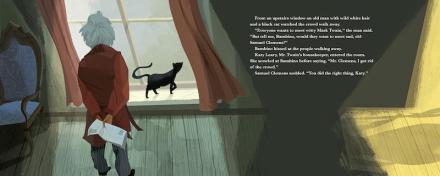
“From an upstairs window an old man with wild white hair and a black cat watched the crowd walk away. ‘Everyone wants to meet witty Mark Twain,’ the man said. ‘But tell me, Bambino, would they want to meet sad, old Samuel Clemens?’” Soon his daughter Jean entered the room and persuaded her father to come downstairs for cake and ice cream with the promise that Bambino, their black cat, could have some too.

celebrate-picture-books-picture-book-review-bambino-and-mr-twain-brownstone

Image copyright Daniel Muyares, 2012. Courtesy of Charlesbridge.

In the middle of the cake stood a single candle—a tradition that Livy had started so that Samuel would “‘never grow old.’” With a dish of ice-cream to himself, Bambino took the place of Sam’s older daughter, Clara, who couldn’t be with them that night. Friends had invited Sam for dinner, but he did not want to go. As winter settle in, so did Samuel. He rarely left his bed, littering the covers with papers and books—so many “that the cat had difficulty finding a soft place to sleep.”

As Christmas approached, instead of attending the parties he was invited to, Samuel wandered around his big house, gazing at pictures of Livy and playing games—like billiards—with Bambino. When spring arrived, Katy rushed around opening windows to air out the house. In a sunlit upstairs room, “Bambino attacked the sunbeam dancing on the wardrobe door. Sam opened the door. The sunbeam shone on a white suit. Bambino swatted at it.” Sam lifted the suit from the closet and looked at it fondly. While Livy was alive he had worn that suit every summer. “‘Those were happy days,’” he recalled.

celebrate-picture-books-picture-book-review-bambino-and-mr-twain-window

Image copyright Daniel Muyares, 2012, text copyright P.I. Maltbie, 2012. Courtesy of Charlesbridge.

Just then, outside the open window, Bambino saw a squirrel that had been chattering at him for days. With a leap Bambino was chasing the squirrel down the street. “‘Bamb-i-i-i-n-o-o-o!’ Sam’s voice echoed over the city noises.” Sam and Jean put up Lost Cat posters offering a $5.00 reward (a week’s wages) for Bambino’s return. Sam didn’t know how he would tell Clara that Bambino was gone, but Jean reassured him that someone would find their cat.

“Soon a steady stream of people appeared on Sam’s doorstep with cats and kittens of every size, color, and breed.” Seeing the crowd, Sam came out onto his stoop. One little girl offered to let Sam borrow their family’s cat until Bambino returned, and others brought him cats they thought would comfort him. But Sam thought Bambino would not “‘take kindly to finding a foreign cat in his kingdom.’” Reporters wanted to talk to this beloved author about Bambino too, “and this time Sam talked to them.”

celebrate-picture-books-picture-book-review-bambino-and-mr-twain-grieving

Image copyright Daniel Muyares, 2012. Courtesy of Charlesbridge.

Four days later, Katy found Bambino on the doorstep as if nothing had happened. Sam was overjoyed. “‘To celebrate, we’ll feast on the fatted salmon,’” he said. Sam’s experience with his kindly friends, neighbors, and readers had given him a new perspective. He was ready to rejoin the world and enjoy what it had to offer. An announcement in the newspaper let people know that Bambino had returned, but they continued to drop by to wish Sam well. Now, Sam smiled and talked with them.

Sam had several white suits made, and they became his trademark. At his home in Connecticut, he held a musical gala and talked and joked the way he used to. Jean and Clara had not seen their father this happy in a long time. And Bambino? He just “blinked his eyes and purred.”

celebrate-picture-books-picture-book-review-bambino-and-mr-twain-musical-gala

Image copyright Daniel Muyares, 2012. Courtesy of Charlesbridge.

P.I. Maltbie’s focus on a particular year in Samuel Clemens’ life provides a deeper portrait of this author known for his wit, wisdom, and social commentary. Maltbie’s detailed and compassionate storytelling reveals the stages and effects of grief and the way a pet or a good friend can help in a way that is accessible and understandable for children. His tracing of the passage of time from fall to summer allows readers to see that recovery from sadness or other events is a personal journey, but one that is made easier with the enduring love and reassurance of family and friends. Readers who love the stories and novels of Mark Twain will appreciate this touching glimpse into Samuel Clemens’ life.

celebrate-picture-books-picture-book-review-bambino-and-mr-twain

Daniel Miyares’ crisp, mixed-media and digital illustrations resonate with muted, yet saturated colors that reflect Samuel Clemens’ mourning. Perky Bambino is a constant presence, celebrating Sam’s birthday, playing billiards with Sam, and curled up on Sam’s bed. Bambino’s dramatic leap out the window will wow kids, and they will empathize with Sam as pages without the black cat reflect Sam’s feeling of loss. Young readers will be inspired by the little girl who offers her own family cat to comfort Sam and be cheered to see the positive effect Bambino’s return has on Sam as he again embraces the world dressed in the iconic white suit, which signals Sam’s lightening mood and regained good humor.

Bambino and Mr. Twain is an excellent biography to share with children at home and school to show that everyone undergoes good and bad times, but with faithful and loving family and friends, problems can be resolved and happiness restored.

Ages 5 – 8

Charlesbridge, 2012 | ISBN 978-1580892728 

Coming in paperback in May, 2019. Available for preorder | ISBN 978-1580892735

To learn more about Daniel Miyares, his books, and his art on his website

National Cat Day Activity

Purr-fect Friends Maze

One little kitten wants to play with her friends. Help her find her way in this printable maze!

Purr-fect Friends Maze Puzzle |  Purr-fect Friends Maze Solution

celebrate-picture-books-picture-book-review-bambino-and-mr-twain-cover

You can find Bambino and Mr. Twain at these booksellers

Amazon | Barnes & Noble | Books-a-Million | IndieBound

Picture Book Review
October 20 – International Chef Day

celebrate-picture-books-picture-book-review-roy-choi-and-the-street-food-remix-cover

About the Holiday

Established in 2004 by chef Dr. Bill Gallagher, International Chefs Day celebrates the profession while also promoting the time-honored tradition of passing down culinary skills and knowledge to chefs on their way to working in the field and even perhaps owning their own restaurant. Sponsored by WorldChefs, which was created in 1928 in Sorbonne, Paris with August Escoffier as the organization’s first honorary president, the holiday emphasized eating healthy. Partnering with Nestlé Professional, WorldChefs has chosen Healthy Foods for Growing Up as year’s theme. The mission is to prompt kids to think about the profession they would like to have in the future and consider how eating healthy foods will help them reach their full potential. The holiday is celebrated with fun workshops and events across the globe. At home, parents and kids can discuss healthy diets, menu planning, and cooking together. When kids are involved in shopping for and preparing food, they develop a good and healthy relationship with what they eat. For more information about International Chefs Day as well as to find recipes, a toolkit, and interviews with chefs around the world, plus many more resources, visit the WorldChefs website.

Chef Roy Choi and the Street Food Remix

Written by Jacqueline Briggs Martin and June Jo Lee | Illustrated by Man One


“Chef Roy Choi can chop an onion in an instant, carve a mouse out of a mushroom. He’s cooked in fancy restaurants, for rock stars and royalty. But he’d rather cook on a truck.” Roy considers himself a “‘street cook,’” and he creates food with love and care—and especially sohn-maash—for anyone who stops by. What’s sohn-maash? “It is the love and cooking talent that Korean mothers and grandmothers mix into their handmade foods.”

When Roy was two his family moved from Seoul, Korea to Los Angeles, California. His mother made kimchi that was so delicious friends bought it from the trunk of her car. Eventually, Roy’s parents “opened a restaurant—Silver Garden.” Roy loved exploring the various ethnic foods in his neighborhood, but always liked his mom’s food the best.

celebrate-picture-books-picture-book-review-roy-choi-and-the-street-food-locols

Image copyright Man One, 2017, text copyright Jacqueline Briggs Martin and June Jo Lee, 2017. Courtesy of readerstoeaters.com.

Roy loved hanging out in the bustling kitchen of the Silver Garden. And when 3:00 rolled around “everyone gathered at booth #1 for Dumpling Time.” While they filled dumpling wrappers, they told stories, shared news, and laughed. “Family together, making food. Roy’s best good time.” In time his neighborhood changed, and the Silver Garden closed. His parents then opened a jewelry store, and the family moved to the suburbs. But Roy was not happy. He wasn’t like the other kids in the neighborhood.

After he graduated, Roy was at a loss; he didn’t know what he wanted to do. No matter what, though, he always went home, “where his mom helped him get strong with kimchi, rice, tofu, stew.” One day as Roy watched a cooking show, he realized his heart was in the kitchen. He went to cooking school and learned about recipes and preparing food. When he graduated, he got jobs in fancy restaurants where he cooked for a thousand diners a night and ran the kitchen crew. He knew that this was where he belonged.

celebrate-picture-books-picture-book-review-roy-choi-and-the-street-food-remix

Image copyright Man One, 2017, text copyright Jacqueline Briggs Martin and June Jo Lee, 2017. Courtesy of readerstoeaters.com.

“Roy was a success—until he wasn’t.” There came a time when he couldn’t keep up with the frantic pace, couldn’t remember recipes. He lost his job. A friend suggested they open a food truck together—putting Korean barbecue in a taco. Roy jumped at the idea of remixing “the tastes he loved on the streets that were his home. He used mad chef’s skills to build flavor and cooked with care, with sohn-maash.” They called their truck Kogi BBQ, and they hit the road, looking for hungry customers.

At first the idea of a Korean taco didn’t fly, but once people tried them, they lined up to buy them. “Roy saw that Kogi food was like good music, bringing people together and making smiles. Strangers talked and laughed as they waited in line—Koreans with Latinos, kids with elders, taggers with geeks.”

celebrate-picture-books-picture-book-review-roy-choi-and-the-street-food-remix-watts

Image copyright Man One, 2017, text copyright Jacqueline Briggs Martin and June Jo Lee, 2017. Courtesy of readerstoeaters.com.

Roy felt at home in his truck, and his Kogi tacos made him famous. He opened cafes in older neighborhoods, and called his chef friends, saying “Let’s feed those we aren’t reaching.” Chef DP joined up. Together they opened fast-food places for kids and others skateboarding, playing, or just hanging out.

In the Watts neighborhood of Los Angeles, across the street from an elementary school, they opened Locol. The two chefs wondered if people would “care about soulful fast food.” But he needn’t have worried. Before the doors even opened, a line formed down the street and around the corner. Now, Roy wants to bring the remixed flavors of Locol to other neighborhoods. He dreams of “‘feeding goodness to the world’” and says you can do that too. All it takes is to “cook with sohn-maash, cook with love.”

celebrate-picture-books-picture-book-review-roy-choi-and-the-street-food-remix-neighborhood

Image copyright Man One, 2017, text copyright Jacqueline Briggs Martin and June Jo Lee, 2017. Courtesy of readerstoeaters.com.

Extensive Authors’ and Illustrator’s Notes offering more information about Roy Choi, his work, and the making of the book follow the text.

For kids who love cooking—and eating—Jacqueline Briggs Martin and June Jo Lee have written a compelling biography of one of the culinary world’s stars. Beginning with Roy Choi’s childhood, Martin and Lee show young readers the family and social events that influenced not only his choice of career but his dedication to underserved neighborhoods. Scattered throughout the pages are poems that read like recipes and satisfy like comfort food. Full of care and love, the story will encourage readers to follow their heart, try out different ideas, and find the mission that’s important to them.

Graffiti artist and illustrator Man One infuses Chef Roy Choi and the Street Food Remix with the vibrancy of the Los Angeles neighborhoods that nurtured Choi’s talent. Readers get to gather with the family during dumpling time and see the vast array of ingredients enveloped in the tasty wrappers, watch Choi finesse a lamb dish in his fancy restaurant, and feel the vibe as he remixes tacos with a Korean tang. Along the way, kids also meet the customers from all walks of life who line up to experience Choi’s food.

Ages 5 – 12

Readers to Eaters, 2017 | ISBN 978-0983661597

Discover more about Jacqueline Briggs Martin and her books on her website.

You can read more about June Jo Lee on the Readers to Eaters website.

View a gallery of art, murals, prints, and more by Man One on his website.

International Chefs Day Activity

celebrate-picture-books-picture-book-review-lemon-and-chocolate-cookies

French Butter Cookies – Lemon and Chocolate


Whip up a batch of these delicious cookies to eat yourself or share with others! There are two distinct flavors to satisfy any palate!

Ingredients for Lemon Cookies

  • 10 tablespoons unsalted butter (room temperature)
  • 1/2 cup sugar
  • 1 large egg
  • 1 1/4 teaspoons vanilla extract
  • 2 cups flour
  • 1/2 teaspoon baking powder
  • 1/4 teaspoon salt
  • 2 teaspoons lemon zest (or to taste)

For Chocolate Cookies

  • 10 tablespoons unsalted butter (room temperature)
  • 1/2 cup sugar
  • 1 large egg
  • 1 1/4 teaspoons vanilla extract
  • 1 ½ cups flour
  • ½ cup cocoa powder
  • ½ teaspoon cinnamon
  • ¼ teaspoon ground ginger
  • 1/2 teaspoon baking powder
  • 1/4 teaspoon salt

For Egg Wash

  • 1 egg
  • 1 tablespoon water

Directions

  1. In a bowl beat butter and sugar until light and fluffy
  2. Add the egg and vanilla extract and beat until blended
  3. Add the flour, baking powder and salt and beat just until incorporated. Do not over mix the dough. **For Chocolate Cookies use 1 ½ cups flour and add cocoa powder, cinnamon, and ground ginger before mixing.**
  4. Transfer the dough to a lightly floured work surface, knead the dough a few times to bring it together, and then divide the dough in half.
  5. Wrap each half in plastic wrap and refrigerate for at least one hour or until firm
  6. Preheat oven to 350 degrees F (177 degrees C) and place rack in the center of the oven.
  7. Line two baking sheets with parchment paper and set aside.
  8. Remove one portion of the dough from the refrigerator and place on a lightly floured work surface. Roll out the dough until it is 1/4 inch (1 cm) thick.
  9. Using a lightly floured 2 inch (5 cm) round, fluted cookie cutter (or other cookie cutter of your choice), cut out the cookies and place them on the prepared baking sheet.
  10. Put the baking sheet of cut-out cookies in the refrigerator for about 15 -20 minutes to chill the dough.
  11. Meanwhile, in a small bowl, whisk the egg with the water for the egg wash. Remove the cookies from the refrigerator and brush the tops with the egg wash.
  12. Then, with the tines of a fork or a toothpick, make a crisscross pattern on the top of each cookie.
  13. Bake cookies for about 12-14 minutes or until golden brown around the edges.
  14. Cool cookies on wire rack.

celebrate-picture-books-picture-book-review-roy-choi-and-the-street-food-remix-cover

You can find Chef Roy Choi and the Street Food Remix at these booksellers

Amazon | Barnes & Noble | Books-a-Million | IndieBound

Picture Book Review

 

Picture Book Review

October 16 – National Dictionary Day

celebrate-picture-books-picture-book-review-w-is-for-webster-cover-image

About the Holiday

Dictionary Day honors Noah Webster, who wrote the first American dictionary. He was born in 1758 to a family that loved learning and knew the importance of a good education. Even as a boy Noah Webster loved words. He went on to become a lawyer, newspaper editor, Connecticut and Massachusetts legislator, and he helped found Amherst College in Massachusetts. He is most well-known, however, for compiling the first American dictionary that is synonymous with his name and still the most popular dictionary in use. His work, first published in 1828, revolutionized the way language and words were presented and remains always current by every year adding new words that come into common use through new products, fads, and slang. Today, celebrate by taking a walk through the dictionary—either in book form or online—to learn a few new words!

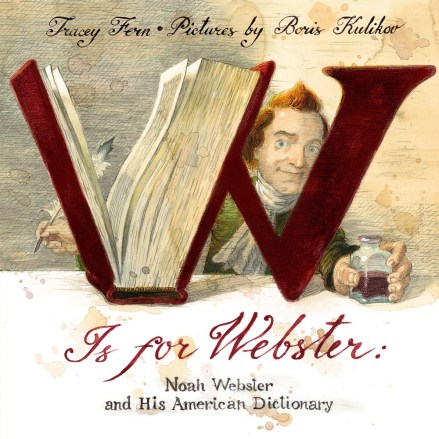
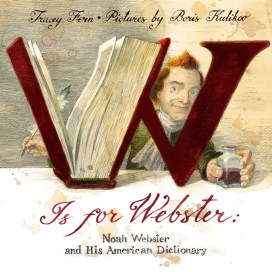
W is for Webster: Noah Webster and His American Dictionary

Witten by Tracey Fern | Illustrated by Boris Kulikov


Noah Webster was always different. Tall and thin with bright red hair, he liked to use big words when he spoke and wanted to do homework instead of goof around in school. Unfortunately for him school was in session for only a few months a year and goofing around seemed to be the major course of study. Of course, Noah didn’t call it “goofing around,” he called it “‘playing roguish tricks.’”

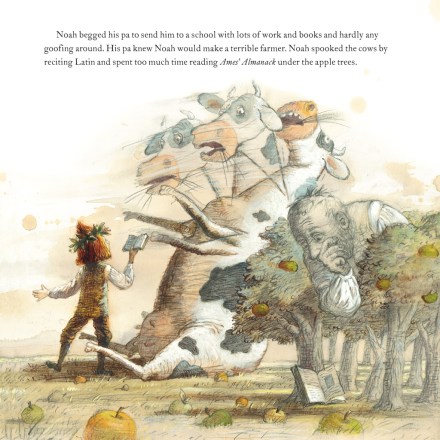
Noah begged to go to a harder school. “His pa knew Noah would make a terrible farmer. Noah spooked the cows by reciting Latin and spent too much time reading Ames’ Almanack under the apple trees.” His pa agreed, and in 1774 at the age of 16 Noah went off to study at nearby Yale College in New Haven, Connecticut. Yale had strict rules. Students had to rise at 5:30 a.m. and study for two hours before class. They were also fined “two shillings for making ‘tumult, noise, hallooing,’ or otherwise goofing around. Noah thought Yale was wonderful.”

celebrate-picture-books-picture-book-review-w-is-for-webster-spooking-horses

Image copyright Boris Kulikov, 2015, text copyright Tracey Fern, 2015 . Courtesy of us.macmillan.com.

Noah hadn’t been at Yale long before the American Revolutionary War broke out. Although Noah signed up to fight, he recognized that he was “‘ill able to bear the fatigues of a soldier,’” which was “Noah’s big way of saying he was a lousy soldier.” He returned to Yale and graduated in 1778, but he left the school with no job and no prospects. Even his pa told him to leave home to find work.

Noah became a teacher, but he found the British textbooks “‘defective and erroneous.’” He believed the students should have American textbooks that better reflected their diverse experiences. With the Revolutionary War at an end and America victorious, Noah wanted to help “hold his new, complicated nation together.” He believed that America needed a language different than the English spoked in Britain. “‘A national language is a national tie,’ Noah insisted to all who would listen, and to many who wouldn’t.”

celebrate-picture-books-picture-book-review-w-is-for-webster-teaching-school

Image copyright Boris Kulikov, 2015. Courtesy of us.macmillan.com.

He began the work himself with a speller. Right from the start Noah’s speller was different than the British books. It included everyday words “like scab, grub, and mop.” He also simplified the spelling by taking out unpronounced letters or spelling words phonetically. He also added pictures to every page and presented lists of rhyming words. He also priced his book so almost anyone could afford it. Noah’s speller became a bestseller.

Still, Noah had bigger ideas. He wanted to write a patriotic dictionary with uniquely American words. He took his idea on the road to make money for the venture, lecturing wherever he could. But Noah’s know-it-all tone of delivery, his “prickly personality,” even his “‘porcupine hair’” put people off. And what’s more, they didn’t like the idea of his dictionary. People thought he was a “lunatic” for wanting to replace British words with American ones.

celebrate-picture-books-picture-book-review-w-is-for-webster-working-on-letter-a

Image copyright Boris Kulikov, 2015, text copyright Tracey Fern, 2015. Courtesy of us.macmillan.com

In 1806 Noah went ahead and published “A Compendious Dictionary of the English Language. It was a flop, but Noah wasn’t discouraged.” The next year he started working on a bigger dictionary. He copied words out of British dictionaries and added American words and he traced the roots of all the words and wrote definitions, sometimes including quotes from famous people to show differences in meaning. He figured the whole dictionary would take 5 years to finish—eight to ten, tops.

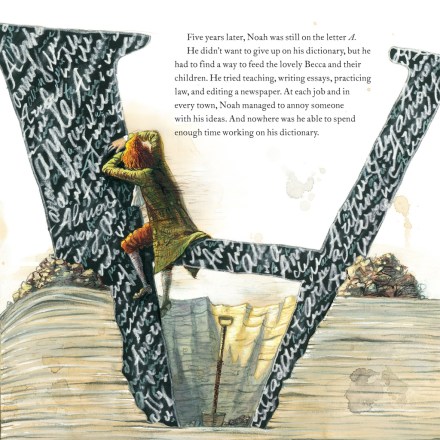
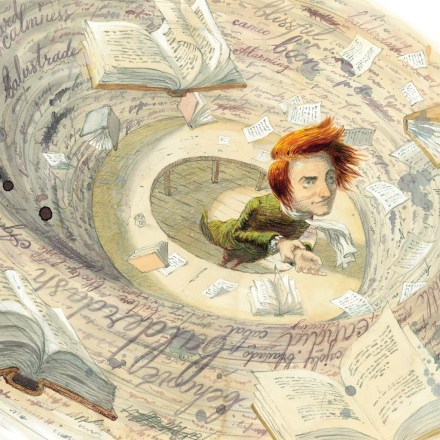
But five years later, Noah was still on the letter A. With no money coming in and a growing family, Noah took a variety of jobs, but he always seemed to rub someone the wrong way, and he lost job after job. He decided to sell his fancy house and bought a farm. Here he was able to gather books, books, and more books around his unusual donut-shaped desk. Standing inside the center of the desk, he spun around and around reading the books and finding words to include in his dictionary.

celebrate-picture-books-picture-book-review-w-is-for-webster-special-desk

Image copyright Boris Kulikov. 2015. Courtesy of us.macmillan.com.

By 1822 Noah had exhausted all the books in his study. He took to traveling to other American libraries, moved his family to New Haven to use the Yale library, and in 1824 even sailed to Europe to explore books found in the National Library in Paris and at the University of Cambridge in England.

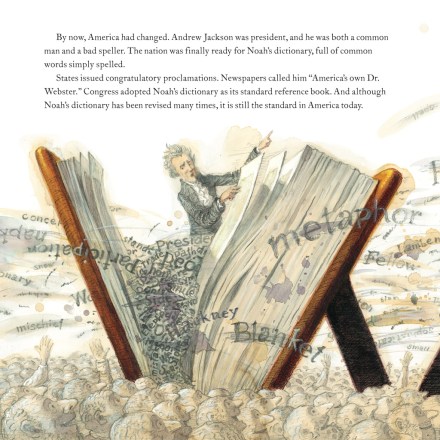
Finally, in 1825 Noah finished his dictionary.  With more than 70,000 words, An American Dictionary of the English Language was the largest English dictionary ever written. “Many people thought it was the best English dictionary ever written.” Why the change of heart? Well, one reason might have been that the President of the United States, Andrew Jackson, “was a common man and a bad speller.” Another might have been that the timing was just right.

celebrate-picture-books-picture-book-review-w-is-for-webster-finished-dictionary

Image copyright Boris Kulikov, 2015, text copyright Tracey Fern, 2015. Courtesy of us.macmillan.com.

However it came to be, Noah was now lauded as a hero by states and newspapers. Congress even adopted the dictionary as its standard reference book. Noah had not only succeeded in writing an American dictionary, he had “created a new American language for a new American nation.” One that is still beloved today.

An Author’s note as well as a list of resources follow the text.

Webster’s dictionary is intrinsically woven into every American child’s life through language and vocabulary development. Tracey Fern’s captivating story reveals the charm and foibles of its author, a man with just the right temperament and perseverance to tackle and complete such an overwhelming task. Fern’s exceptional storytelling skills and deft turns of phrase allow for a comprehensive review of Webster’s life that is full of exhilaration, empathy, and a good dose of the “big” words Webster loved. Fern builds suspense and tension while offering an insightful look at early American history by including details of the staggering research required and the adverse reactions to Webster and his work.

Boris Kulikov’s expressive illustrations perfectly capture the complex personality of Noah Webster, late-1700s-to-early-1800s American society, and the obstacles Webster faced in writing his dictionary. Fittingly, words, books, or ink blots abound on every page, pouring from the air, sprouting from the ground, stacked like the skyscrapers that would come, and surrounding Noah Webster the way they must have swarmed through his brain. Kulikov infuses humor into his paintings, as when Noah tears at his hair wondering how he will support himself after college, shrugs nonplussed at his students’ shenanigans, and buys himself quiet work time by handing out sweets to his kids. Visual metaphors for the hard, backbreaking and mind bending work also enhance this beautiful biography.

Ages 5 – 10 (adult’s will also enjoy this biography)

Farrar Straus Giroux, 2015 | ISBN 978-0374382407

Visit Tracey Fern’s website to learn more about her and her books!

Discover a gallery of artwork by Boris Kulikov on his website!

National Dictionary Day Activity

celebrate-picture-books-picture-book-review-big-words-vocabulary-word-search-puzzle

“Big Words” Word Search


Knowing and using a wide range of words allows you to express yourself in exact—and often—fun ways. Find the 26 “big” words—one for each letter of the alphabet—in this printable “Big Words” Word Search puzzle. Here’s the Solution!

celebrate-picture-books-picture-book-review-w-is-for-webster-cover-image

You can find is for Webster at these booksellers

Amazon | Barnes & Noble | Books-a-Million | IndieBound

Picture Book Review
October 7 – National Photographer Appreciation Month

celebrate-picture-books-picture-book-review-dorothea's-eyes-cover

About the Holiday

National Photographer Appreciation Month is for all photographers, whether professional or amateur. The month-long holiday gives people an opportunity to really look at the photographs they see in newspapers, books, online, and even in their own home and truly appreciate the artistry that goes into capturing a moment, a place, or a personality to tell a bigger story. October is also a great month to go through your own family photographs from today to generations past and relive or rediscover memories.And for those job seekers, a professionally taken picture for your online profiles can make a big difference in how you are perceived by potential employers. To celebrate, consider having a professional portrait taken of yourself, your kids, or your whole family to decorate your home, give as gifts, or send as a holiday card. There are also lots of galleries displaying photographic work to explore. 

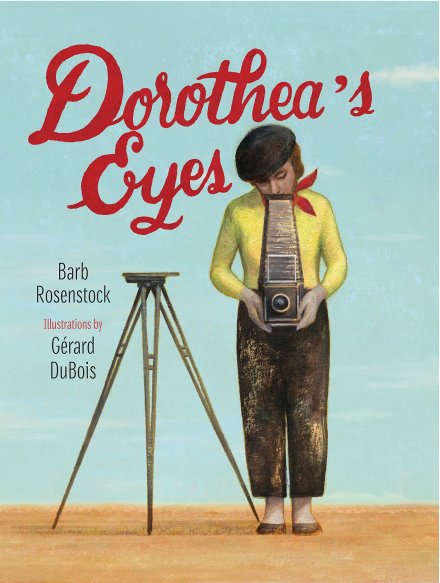
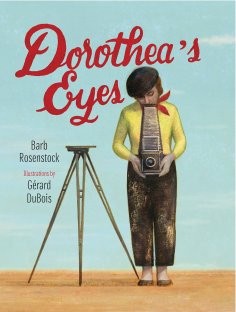
Dorothea’s Eyes: Dorothea Lange Photographs the Truth

Written by Barb Rosenstock | Illustrated by Gérard DuBois


When Dorothea Lange opens her green eyes, she sees things others miss. In the shadows, in patterns within the grain of wooden tables, in the repeated shapes of windows on a wall, and most especially in people’s faces. “Dorothea loves faces! When Dorothea looks at faces, it’s like she’s hugging the world.”

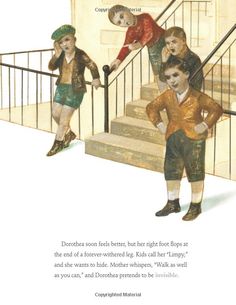
When Dorothea is seven she contracts polio. The disease withers her right leg and forever after she walks with a limp. Other kids tease her and make her want to hide. Her mother encourages her, but Dorothea pretends to be invisible. When her father leaves his family, her mother gets a job in New York and Dorothea goes to a new school. She is different and lonely.

celebrate-picture-books-picture-book-review-dorotheas-eyes-with-camera

Image copyright Gérard DuBois , text copyright Barb Rosenstock. Courtesy of Caulkins Creek.

As Dorothea waits for her mother to finish work, she looks around her, spying “into crowded tenements where fathers, home from peddling, read newspapers, and mothers wash dishes, clothes, and babies in rusty sinks—happy and sad mixed together.” She begins to skip school to wander the city, gazing at it with her curious eyes and heart.

When Dorothea grows up she decides to become a photographer. Her family is surprised—it is not a ladylike profession. She works any job she can find in the photography industry, learning about cameras, darkrooms, negatives, and the printing process. “Alone in the darkroom’s amber glow, she studies the wet printing paper while faces appear in black and white. Dorothea loves faces!”

When she is 23 Dorothea travels west and when all her money is stolen in San Francisco, she stays, gets a job, and starts her own portrait studio. She becomes the sought-after photographer of the richest families in California. She makes money, gains friends, gets married, and starts a family of her own. But she always wonders, “Am I using my eyes and my heart?”

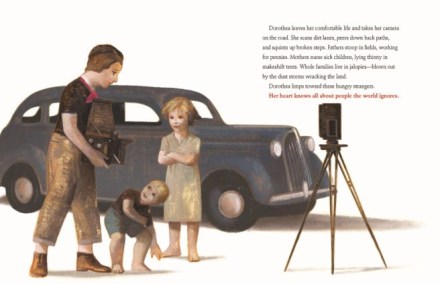
When the stock market crashes and the Great Depression sweeps the country, Dorothea focuses her camera on the desperate and the downtrodden. Her friends don’t understand, but Dorothea sees into these poor people’s hearts. She “knows all about people the world ignores.” For five years she goes out into the fields, peers into tents, documents families living in their cars, crouches in the dirt to reveal the stories of the people struggling with the devastation wrought by the Dust Bowl.

celebrate-picture-books-picture-book-review-dorotheas-eyes-with-car-and-camera

Image copyright Gérard DuBois , text copyright Barb Rosenstock. Courtesy of Caulkins Creek.

Newspapers and magazines publish her pictures. “Her photographs help convince the government to provide parents with work, children with food, and families with safe, clean homes. “The truth, seen with love, becomes Dorothea’s art.” Dorothea’s photographs are still known today. Their subjects continue to help us see others with our hearts.

Six of Dorothea Lange’s most famous and recognizable photographs are reproduced on the last page—still as riveting today as they were in the 1930s. Further information on her life and work is provided as well as sources where her photographs can be viewed, resources for further study, and a timeline of her life.

celebrate-picture-books-picture-book-review-dorotheas-eyes-kids

Image copyright Gérard DuBois , text copyright Barb Rosenstock. Courtesy of Caulkins Creek.

Barb Rosenstock brings Dorothea Lange’s vision to the page with love, honesty, and understanding in this excellent biography of a woman whose photographs defined the Great Depression and Dust Bowl era. Lange’s life-long connection to the poor and often overlooked people of the world is beautifully described and explained in a gentle, compassionate way that will resonate with children. Rosenstock’s language is lyrical with staccato sentences that echo the clicks of Lange’s shutter capturing life’s reality with her eyes and her heart.

Gérard DuBois’s illustrations are arresting and set Dorothea Lange’s story firmly in its historical and emotional landscape. Rendered in acrylic and digital imagery, they feature the muted colors and style of book illustrations from long ago. By placing the images of Dorothea, her family, and her photography subjects against white backgrounds, DuBois emphasizes Lange’s focus on the people she met and faces that inspired her. Distressed textures accentuate the troubled times and the anguish of both Dorothea and her subjects.

Ages 7 – 12

Calkins Creek, 2016 | ISBN 978-1629792088

Discover all the amazing books by Barb Rosenstock on her website!

View a portfolio of art and book illustration by Gérard DuBois on his website!

Here’s a snapshot of Dorothea’s Eyes!

National Photography Month Activity

CPB - New Professionals Picture

News Professionals Clothespin Figures


Make one of these clothespin figures that honors the men and women who work to keep the world informed.

Supplies

Directions

  1. Draw a face and hair on the clothespin
  2. Cut out the clothes you want your journalist or photographer to wear
  3. Wrap the clothes around the clothespin. The slit in the clothespin should be on the side.
  4. Tape the clothes together
  5. Cut out the camera
  6. Tape one end of a short length of thread to the right top corner of the camera and the other end of the thread to the left corner. Now you can hang the camera around the figure’s neck.

Idea for displaying the figures

  • Attach a wire or string to the wall and pin the figure to it
  • Pin it to your bulletin board or on the rim of a desk organizer

celebrate-picture-books-picture-book-review-dorothea's-eyes-cover

You can find Dorothea’s Eyes: Dorothea Lange Photographs the Truth at these booksellers

Amazon | Barnes & Noble | Books-a-Million | IndieBound


Picture Book Review

September 18 – World Bamboo Day COVER REVEAL: The Boy Who Grew a Forest: The True Story of Jadav Payeng

BoyWhoGrewAForest-Crys

About the Holiday

World Bamboo Day was established in 2009 by the Thai Royal Forest Department during the 8th World Bamboo Congress held in Bangkok in order to raise awareness of bamboo around the world. The day is dedicated to educating people about this natural resource, to protect it and the environment, to ensure it sustainability, to promote new cultivation of bamboo for new industries in regions around the world, and to promote traditional uses for community economic development. This year’s theme is “Sustainability = Environment + Society + Economy. To learn more about World Bamboo Day and what you can do to help, visit the World Bamboo Organization’s website.

The Boy Who Grew a Forest: The True Story of Jadav Payeng 

Written by Sophia Gholz | Illustrated by Kayla Harren


On Majuli Island in northeastern India, located in the Brahmaputra River, there is a mighty forest. The Molai Forest covers over 1,300 acres and contains thousands of different species of plants and trees. It is also home to many kinds of wildlife, including some endangered animals.

But the Molai Forest was not always there.

In 1979 young Jadav Payeng witnessed the devastating effects on Majuli Island from rising floodwaters, eroding land and killing wildlife. With an idea for saving his beloved island, Jadav began planting bamboo seedlings, which over time literally built a forest and an ecosystem from the ground up. In this true story, young readers will see that the mightiest of results really do begin with a small seed of an idea. 

When a book is this inspiring, you just can’t wait to see it! But before we get to the book’s stunning cover, let’s meet the author and illustrator who are bringing this incredible story to kids. 

Meet Sophia Gholz

sophia_gholz

Sophia Gholz is a children’s author, tree-hugger, music lover, magic seeker, and avid reader. Sophia grew up in the swamps of Florida, went to art school in Southern California, met her husband in Manhattan, and now enjoys life by the beach with her family. As a child, Sophia spent most of her time at the farm riding horses, causing mischief with her brothers, or exploring the globe with her parents. The latter often included tents and large forests. For more, find Sophia online at: www.sophiagholz.com

Hi, Kathy! Thank you for having me. I’m thrilled to be here and am so excited to reveal the cover of The Boy Who Grew a Forest!

What inspired you to write The Boy Who Grew a Forest?

I first learned about Jadav Payeng when I watched a short documentary film about him a few years ago. The instant the film began, I was completely fascinated with Jadav’s journey. Here is one single person who managed to plant an entire forest all by himself—what a feat! But more than that, Jadav’s mission wasn’t for fame or fortune—he had a vision and a passion to help the environment around him, and he worked tirelessly to do so.

To put it simply: I was in awe. I immediately began searching for interviews and updates on Jadav and the more I read, the more I knew I had to share this amazing story with others.

How did growing up in Florida influence your interest in environmental issues?

My youth in Florida was filled with forests. My father was a prominent forest ecologist and conservationist who, at the beginning of his career, worked with the University of Florida’s Forestry Department. My mother has two degrees: one in horticulture and one in science education and worked as both a science writer and freelance journalist. Our house was always filled with scientists from around the world, and we were constantly exposed to tales of the environment and faraway places. So, I was raised from day one with a deep love and appreciation for the environment (especially trees) and an interest in searching for wonderful stories to share.

I think what really struck me most about Jadav’s story was that his mission was one that everyone I knew while growing up fought for as well.

Can you tell me about your journey to publication with this book?

I wrote the initial manuscript a few years ago, and then set it aside for a while. This was one of those stories that was incredibly close to my heart and I feared I wouldn’t be able to capture it the right way. But I couldn’t stop thinking about it. About a year later, the Florida Society of Children’s Book Writers and Illustrators (SCBWI) put out a call for submissions to their annual Rising Kite Contest and, on a whim, I decided to submit The Boy Who Grew a Forest. You can imagine my surprise when my manuscript was awarded a Rising Kite in the nonfiction category! Winning that award was a turning point for me. I realized then that I couldn’t give up. My only hope was that this story would inspire others, like it did me.  

When I read Sarah Rockett’s response to my manuscript, I knew she and the team at Sleeping Bear Press shared my passion for this story. And I was thrilled when they brought Kayla on board—her artistic style is beautiful and fitting. Working with them both has been a dream!

I’ve also had the chance to talk with the director of Jadav’s short film and am happy to know he’s excited for this book as well.

How exciting was it for you to see the final cover for The Boy Who Grew a Forest?

This is my debut picture book, and the first time I’ve witnessed one of my stories brought to life. From viewing initial sketches to full-color layouts, the entire experience has been beyond anything that I could have imagined.

On top of that, this book is particularly personal for me, so it’s been quite emotional. I definitely cried the first time I saw the cover. Not only is my name on a book—a real book!—but also Kayla’s illustrations are breathtaking. I think she’s done a phenomenal job of portraying Jadav and capturing the spirit of this story. 

What can environmentally conscious children do to help protect nature?

There are so many ways we can all make positive changes on a daily basis. Simple things, like recycling and not using straws or plastic bags in order to lessen the amount of plastic in the world are great places to start. On a grander scale, reforestation efforts are vital to our future and the preservation of our planet. And, like Jadav has shown us, reforestation begins with planting. Children can start with seeds or seedlings for yard plants, house plants, gardens, or just spreading native seeds in the wild. Every little bit helps. We actually have a seed planting activity included in the book and will also share downloadable activities that kids can do in the classroom or at home.

What do you hope children will take away from The Boy Who Grew a Forest?

At its heart, this book is about a person who had a dream and refused to give up. I hope that after reading this, children are inspired to care for our planet. But most of all, I want children to know how important they are. Nothing is impossible, and it only takes one person to make a difference.

Meet Kayla Harren

Kayla Harren Headshot

Kayla Harren studied illustration at the School of Visual Arts in New York City. She is the author and illustrator of  Mary Had a Little Lizard, as well as the illustrator of Hannah’s Tall Order: An A to Z Sandwich and many other books and projects. She lives in St. Paul, Minnesota.

To learn more about Kayla, visit http://www.kaylaharren.com/


What intrigued you the most about this project?

Jadav and his amazing love of nature.  His dedication to helping wildlife is truly inspiring.  I get overwhelmed thinking about all the problems I can’t solve on my own, but then here is a person who takes action and saves an entire island by himself.  It is an amazing story and a good reminder that making a difference really can start with just one person.

What kind of research did you do for creating the illustrations for The Boy Who Grew a Forest?

I watched the documentary Forest Man and knew instantly that I wanted to illustrate Jadav’s story.  I watched many more interview videos of Jadav, read articles about his accomplishments, and read through Sophia’s bibliography for the book.  I looked through images of Majuli, read about the flooding of the Brahmaputra River, and researched the various wildlife species in Jadav’s forest.

Can you describe the process in creating and choosing this gorgeous cover image?

I have Sleeping Bear Press designer Jennifer Bacheller to thank for the cover design.  She played a big role in deciding the layout and I just filled in the spaces with plants and animals.  I am a sucker for sunsets and warm light. Jadav’s story felt magical to me, so I wanted to hint at his extraordinary spirit with an orange glow around him and his forest.

The illustrations in your books, such as your recent Hannah’s Tall Order: An A to Z Sandwich, are so beautifully and richly detailed. What methods did you use to create the lush natural landscape in this book?

Aw thanks! I love adding details.  One of my teachers in art school said that you can focus on any square inch of a great painting and it will be interesting. I try to keep that in mind when I am illustrating, I don’t want any part of the image to be wasted.

For this book I spent a lot of time in the sketch stage. I started studying a bunch of images of the forest, of Jadav, of each animal, of color palettes and lighting. I looked at reference photos to create rough sketches, but once I finished sketching I stopped looking at the references so I wouldn’t get too attached or copy the photos. 

I drew on my computer so I could move elements around to get just the right composition. Once I was happy with a layout, I drew the lines with a pencil brush on my tablet.  Then I began coloring layer by layer in Photoshop. I started with flat color, then added textures, then a layer of shadows, and finally details.

What inspired you to become an illustrator for children’s books and publications?

I don’t remember a defining moment when I decided to pursue picture book illustration. I think I always knew that if I was going to try making art my career, it had to be in children’s books. I have always loved books and fondly remember being read to as a child.  I would fervently study the illustrations of each book as my mom read aloud. I learned to read pictures before I could read the words. Picture books are where my obsession with books began. My goal is to create illustrations that draw a child in and get them excited about learning to read the story the pictures are telling.

What is the most rewarding thing about being a children’s illustrator?

Definitely knowing that I play a role in helping children read and learn. I love when children notice small details I include in my illustrations that the parents pass right over. It is exciting to see children be observant and curious and inquisitive.

Thanks so much Sophia and Kayla! You’ve both put so much of yourselves and heart into The Boy Who Grew a Forest: The True Story of Jadav Payeng. I can’t wait to read the book when it comes out in March, and I’m sure readers are excited for it too!

To learn more about The Boy Who Grew a Forest: The True Story of Jadav Payeng, visit Sleeping Bear Press.

And now I’m thrilled to reveal…

celebrate-picture-books-picture-book-review-the-true-story-of-jadav-payeng-the-boy-who-grew-a-forest-cover

The Boy Who Grew a Forest, will be released in March, 2019 from Sleeping Bear Press. The book is available for preorder at these booksellers

Amazon | Barnes & Noble | Books-a-Million | IndieBound

Picture Book Review

September 10 – It’s New York Fashion Week

celebrate-picture-books-picture-book-review-polka-dot-parade-cover

About the Holiday

A full month of attention to new fashions worldwide begins this week in New York with the 2019 Spring/Summer fashion collections shown to buyers, the press, and the public. Created in 1943 as Press Week, the New York show aimed at diverting attention away from the Paris event during World War II, when “fashion industry insiders were unable to travel to Paris,” and hoped to highlight American designers, whose innovations had largely been ignored. Showcasing the world’s most highly skilled and creative designers, famous models, and plenty of eye-catching styles, Fashion Week is a favorite event for celebrities and fashion lovers alike. As the show in New York winds down on September 14 , eyes will turn to London from September 14 to 18, Milan from September 19 to 25, and, finally, Paris from September 25 to October 3.

little bee books sent me a copy of Polka Dot Parade: A Book about Bill Cunningham to check out. All opinions are my own. I’m also excited to be partnering with little bee in a giveaway of the book. See details below.

Polka Dot Parade: A Book about Bill Cunningham

Written by Deborah Blumenthal | Illustrated by Masha D’yans


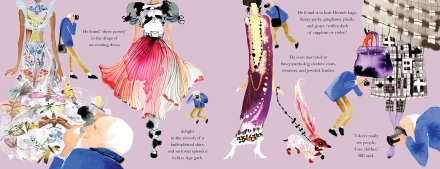
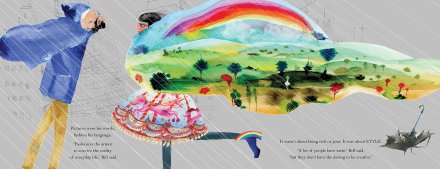
As Bill Cunningham bicycled through New York City in his trademark blue jacket, tan pants, and black shoes with his ever-present camera, he was forever searching for beauty. And he found it wherever he went. He saw “‘sheer poetry’ in the drape of an evening dress” and “delight in the swoosh of a knife-pleated skirt.” He clicked away as Hermès bags, plaids, stripes, polka dots, and even fanny packs and “fancy-pants dog clothes” paraded by. And the people wearing all of this? “‘I don’t really see people, I see clothes,’ Bill said.”

celebrate-picture-books-picture-book-review-polka-dot-parade-sheer-poetry

Image copyright Masha D’yans, 2018, text copyright Deborah Blumenthal, 2018. Courtesy of simonandschuster.com.

For Bill, all of these colorful clothes and creative styles told stories about the people who wore them—people daring enough to be creative whether they were rich or poor. “People who looked like leopards in their leopard prints, cool cats in their hats, dudes in dots and spots.” The New York Times newspaper published Bill’s photographs, letting the world see these stories too.

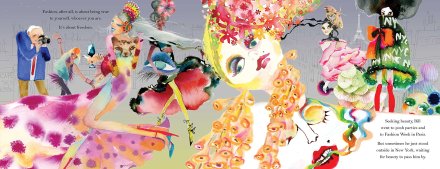
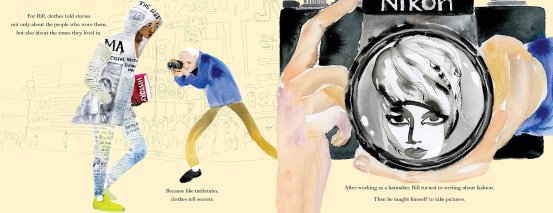
Before Bill taught himself the art of photography, he worked as a hat maker and then as a fashion writer. He believed that an individual’s sense of fashion was a kind of freedom. Bill found subjects to photograph at “posh parties,” Paris Fashion Week, and even on the streets of New York. His favorite New York corner was Fifth Avenue and Fifty-Seventh Street. He blended in to the hustle and bustle to snap pictures of passersby in all weather and seasons.

celebrate-picture-books-picture-book-review-polka-dot-parade-style

Image copyright Masha D’yans, 2018, text copyright Deborah Blumenthal, 2018. Courtesy of simonandschuster.com.

The people he photographed and those he worked for all loved Bill and his singular vision. In 2008, he was awarded the French Legion of Honor, and Bergdorf Goodman department store celebrated his work with a “lavish display in their Fifth Avenue window.” But Bill shunned the spotlight, preferring that others be recognized. When Bill died in 2016 at the age of 87, the fashion world mourned. But his life and his work live on in his “glorious pictures of clothes and the power they lend us…as we dress each day for the runway called life.”

An Authors Note giving more details about Bill Cunningham’s life follows the text,

celebrate-picture-books-picture-book-review-polka-dot-parade-freedom

Image copyright Masha D’yans, 2018, text copyright Deborah Blumenthal, 2018. Courtesy of simonandschuster.com.

With lyrical storytelling and staccato phrasing like the beat of a camera’s shutter, Deborah Blumenthal frames Bill Cunningham’s life in snapshots of the color, patterns, people, and philosophy that fueled his talent and his passion. Cunningham’s appreciation for the unique, quirky, and original is celebrated throughout and will inspire young readers to embrace their own identity and display it in their own, particular way.

celebrate-picture-books-picture-book-review-polka-dot-parade-camera

Image copyright Masha D’yans, 2018, text copyright Deborah Blumenthal, 2018. Courtesy of simonandschuster.com.

Visually stunning, Masha D’yans’ vibrant watercolor and mixed-media illustrations float across the pages with the beauty and flow of the runway as well as the hustle, bustle, and stories of the street. Just as in real life, Cunningham fades into the background, but his camera is always focused on the fashion and what it tells him. Images of Cunningham’s photographs scattered across the newspaper page, strings of negatives hanging like party streamers in his darkroom, and the gray treasure boxes in his stark apartment, provide readers with a deeper understanding of his work and world.

For children fascinated by fashion or who follow their own muse—or want to, Polka Dot Parade is an inspirational book to add to any home or classroom library.

Ages 4 – 8

little bee books, 2018 | ISBN 978-1499806649

Discover more about Deborah Blumenthal and her books on her website.

To learn more about Masah D’yans, her books, and her art, visit her website.

Polka Dot Parade: A Book about Bill Cunningham Giveaway

I’m excited to partner with little bee books in this giveaway of:

  • One (1) copy of Polka Dot Parade: A Book about Bill Cunningham written by Deborah Blumenthal | illustrated by Masha D’yans

To be entered to win, just Follow me on Twitter @CelebratePicBks and Retweet a giveaway tweet during this week, September 10 – September 16. Already a follower? Thanks! Just retweet for a chance to win.

A winner will be chosen on September 17.

Giveaway open to US addresses only. | Prizing provided by little bee books.

New York Fashion Week Activity

celebrate-picture-books-picture-book-review-hanger-photo-hanger-craft

Decorative Hanger Photo Hanger


A colorful plastic hanger, some washi tape, a few clothespins, and your own photos or pictures can make a one-of-a-kind way to display your art and personality!

Supplies

  • Plastic Hanger
  • Washi tape – 2 patterns (optional)
  • 3 to 4 clothespins
  • Craft paint
  • Paint brush
  • Photos or pictures

Directions

  1. Wrap the washi tape around the hanger. If using two patterns of tape, wrap the hook and neck of the hanger with one pattern and the body of the hanger in the other
  2. Paint the three or four clothes pins with one or more colors, let dry.
  3. Clip the clothespins to the hanger
  4. Insert photos into the clothespins

celebrate-picture-books-picture-book-review-polka-dot-parade-cover

You can find Polka Dot Parade at these booksellers

Amazon | Barnes & Noble | Books-a-Million | IndieBound

Picture Book Review