National Skating Month was established by U.S. Figure Skating as a week-long celebration in March 2002 following the Olympic Winter Games in Salt Lake City. Now co-sponsored by Learn to Skate U.S.A. and celebrated during the entire month of January, the holiday gives ice-skating rinks, clubs, and programs an opportunity to invite new families to the ice by offering free lessons and skating demonstrations. If figure skating isn’t your thing, you might like to take your skills to the hockey rink or just to a local pond for some free-style skating. However you choose to enjoy the ice, skating is fun and for everyone! To learn more about ice-skating programs in your area, visit usfigureskating.org and learntoskateusa.
The Three Canadian Pigs: A Hockey Story
Written by Jocelyn Watkinson | Illustrated by Marcus Cutler
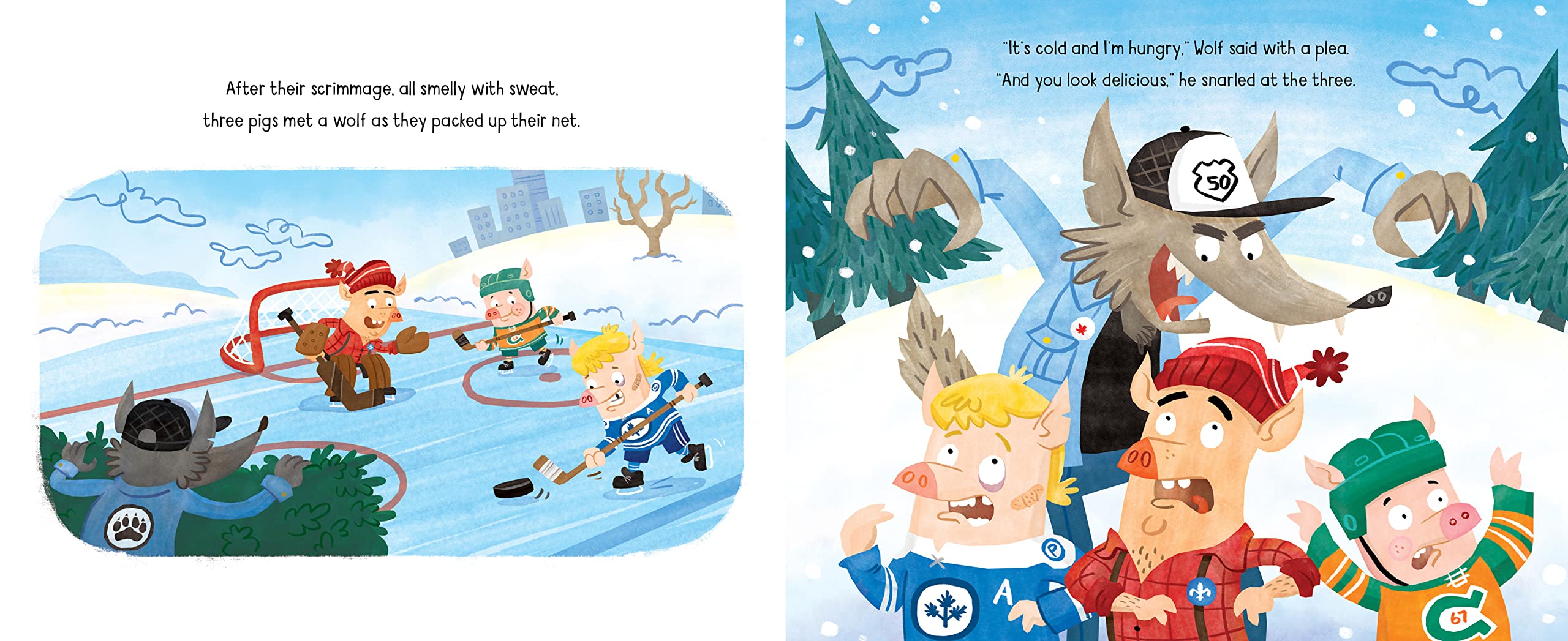
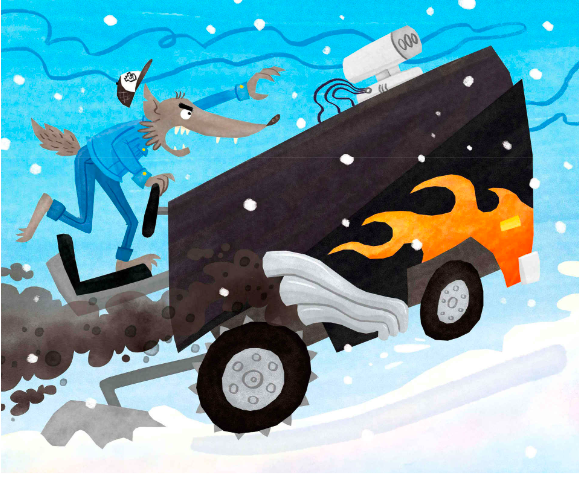
Three pigs were just finishing their hockey scrimmage when a wolf sprang from behind some bushes, fangs sharp and claws at the ready to satisfy his hunger since they looked so delicious. But as they quickly took off their skates and packed up their gear, they said, “‘I’m soorry there, Wolf, you are soorely mistaken—'” To which the wolf replied, “‘Oh no! But I’m not! You’re Canadian bacon!'” The pigs jumped on their snowmobile and hurried home to their snow fort in town.
Image copyright Marcus Cutler, 2022, text copyright Jocelyn Watkinson, 2022. Courtesy of Sleeping Bear Press.
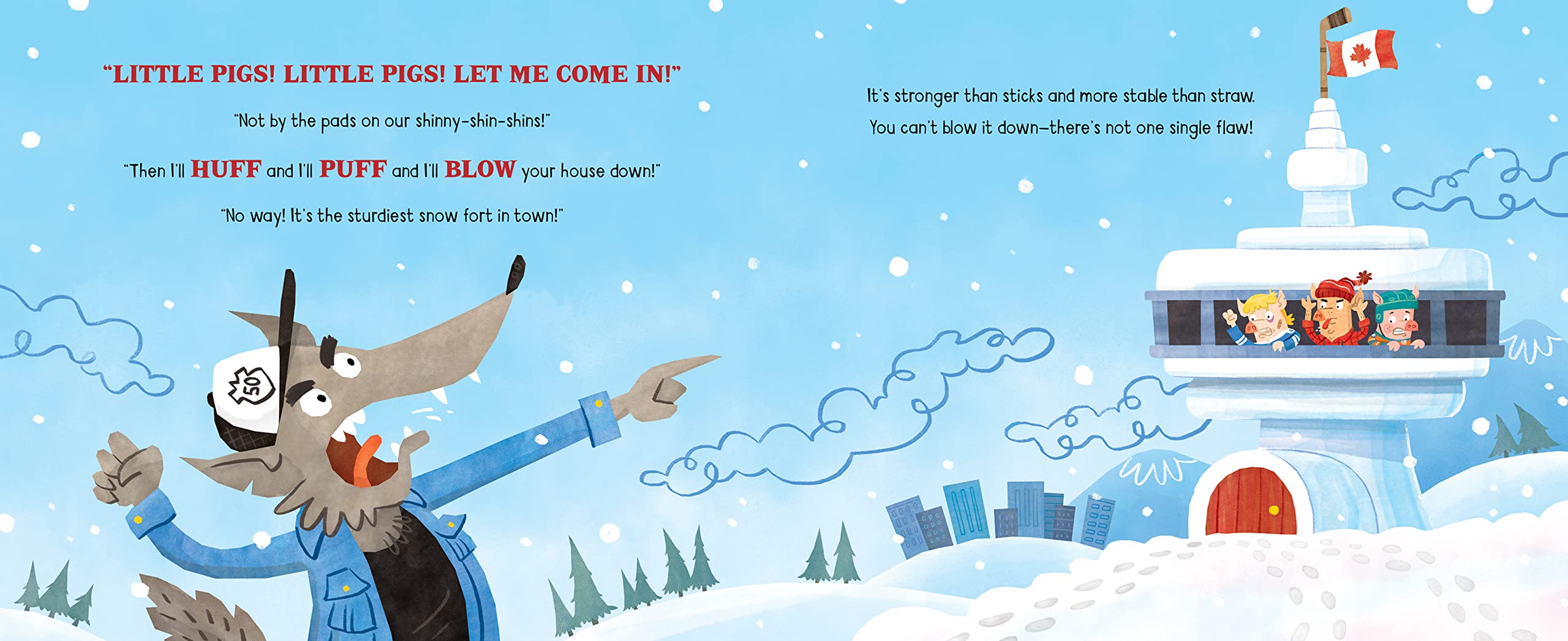
It didn’t take long for the wolf to catch up with them, and from outside their door, he shouted, “‘Little pigs! Little pigs! Let me come in!'” But they just replied, “‘Not by the pads on our shinny-shin-shins!'” The wolf threatened to blow the fort down, but this was no flimsy home built of sticks or straw. In fact, they told him, “‘there’s not one single flaw!'” The wolf wasn’t going to give up easily and he collected Moose and Bear to help him break in.
Image copyright Marcus Cutler, 2022, text copyright Jocelyn Watkinson, 2022. Courtesy of Sleeping Bear Press.
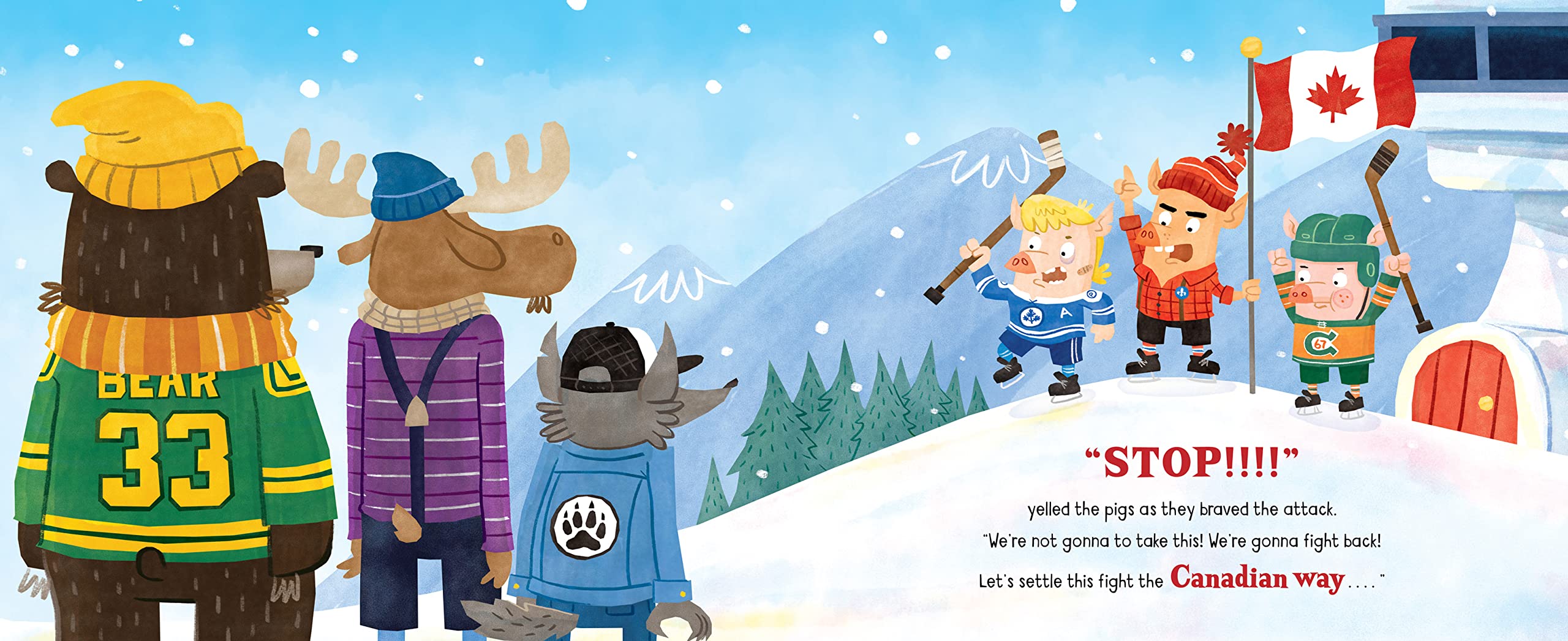
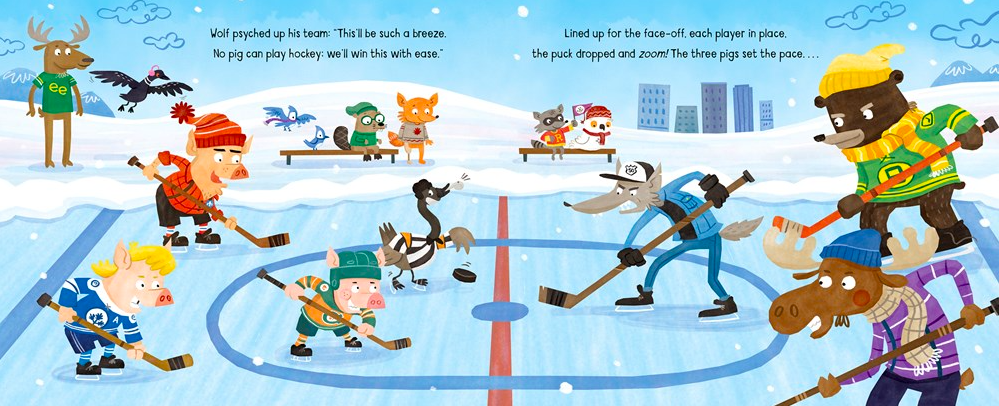
When the three pigs had just enough of the wolf’s team’s attack, they came out and challenged them to “‘settle this fight the Canadian way'” with “‘a hockey game showdown.'” With a Canada goose as a ref, they took to the ice, attracting a crowd of spectators. The wolf and his team thought they’d win with ease, but the pigs “deked and they cut: / the pigs couldn’t be caught,” and when they scored, the wolf took to underhanded measures to stop them.
But the pigs were too quick and too nimble, and they ran up the score. When the ref blew her whistle ending the game, the pigs celebrated saving their home, but the wolf “… full of frustration and hunger and spite, / … threw down his gloves and dove in for a bite.” It looked like the pigs were goners for sure, but Bear and Moose called him out on his poor sportsmanship. Wolf dropped the three pigs, feeling ashamed but still hungry.
Image copyright Marcus Cutler, 2022, text copyright Jocelyn Watkinson, 2022. Courtesy of Sleeping Bear Press.
Dragging his stick and hanging his head, the wolf trudged off the ice, but one pig called out to him, inviting him to join them in a feast back at the fort. When the wolf saw their spread of poutine, tourtière, beaver tails, butter tarts, and so many other mouthwatering delicacies, he apologized: “‘Pigs, I’m so sorry that I was a brute.'” / “‘There’s nothing for you to be soorry a-boot.'” a pig graciously told him. The pigs, Wolf, Bear, and Moose all made amends and piled up their plates. Then they settled in to watch a game on TV. And as “they put up their feet,” the wolf had to agree that “‘being friends with Canadian bacon is sweet!'”
Image copyright Marcus Cutler, 2022, text copyright Jocelyn Watkinson, 2022. Courtesy of Sleeping Bear Press.
Full of clever rhymes, puns, valuable lessons, and dialogue that winks at Canadian pronunciations, Jocelyn Watkinson’s story flows as smoothly as a hockey puck on ice. Her regional take on the traditional Three Little Pigs story is fast-paced and suspenseful while touching on themes of sportsmanship, remorse and forgiveness, and friendship all framed with high-energy hockey action and plenty of humor. Especially welcome is Watkinson’s depiction of Bear and Moose confronting Wolf when he reneges on his agreement to let the pigs go if they win the game. Standing up to a friend or for what’s right can be hard, but Watkinson shows readers that having the courage of your convictions is honorable, honest, and can often turn a negative situation into a positive experience.
Marcus Cutler scores with his funny, emotion-packed illustrations that will have kids laughing and cheering for the pigs from page to page. Winter sports fans will love all the hockey action and will want to linger over the pigs’ hard-won trophy, on which Cutler had fun hamming it up with the names of some of hockey’s greats, The spread of favorite Canadian foods is sure to inspire game-night treat feasts. Cutler also highlights the important role of Bear and Moose, who ultimately appeal to Wolf’s better nature.
Image copyright Marcus Cutler, 2022. Courtesy of Sleeping Bear Press.
In a humorous and foreshadowing scene, Bear halfheartedly scratches at the pigs’ snow fort with one paw while holding a steaming mug in the other as Wolf exhorts his friends to “ram and claw and maul” their way inside. When Bear and Moose finally challenge Wolf to live up to his deal, their disapproval is clearly visible to readers. Wolf’s resulting feelings, as well as their cause, are also evident, giving kids and adults openings for meaningful discussions on behavior.
Whether your kids wait all year for hockey season, are fans of fractured fairy tales, or simply love a great story, The Three Canadian Pigs is a funny and impactful read aloud that’s sure to become a story time favorite all year long and a book you’ll be glad you added to your home, classroom, school, or public library.
To learn more about Marcus Cutler, his books, and his art, visit his website.
Skating Month Activity
The Three Canadian Pigs Activity Kit
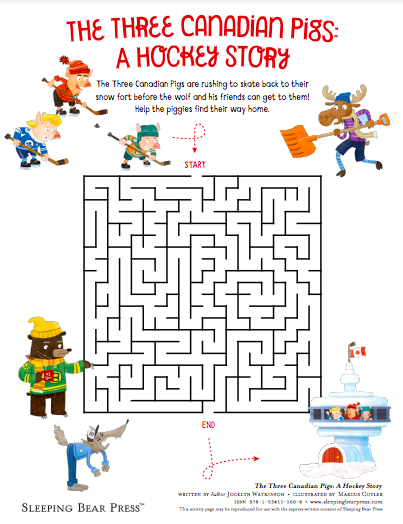
The game’s on with the two puzzles and two coloring pages inspired by today’s book! Just download and print them from the Sleeping Bear Press site here:
Every January 11 International Thank-You Day encourages people around the world to express their gratitude to those who have made their lives better in some way. The beginning of the year is the perfect time to think about how we might thank all those who show kindnesses, provide services, teach us new skills, and share our lives. Teaching children how to express gratitude is a valuable lesson, and sharing today’s book with little ones is a wonderful way to get started. You’ll even find two creative activities that will help kids think about and share thankfulness all year through.
The Thank You Book
Written by Danna Smith | Illustrated byJuliana Perdomo
For little ones, “Thank you” may be one of the first phrases they learn when they begin getting out into the world. Thanking grandparents and other relatives, friends, teachers, librarians, store employees, and others becomes a part of every day. But for kids just learning manners and communication skills, prompts to say “thank you” may seem kind of random, confusing, and maybe even a bit intimidating.
Image copyright Juliana Perdomo, 2022, text copyright Danna Smith. Courtesy of Little Simon.
This is where Danna Smith’s delightfully cheery story about sharing your appreciation comes in. With charming rhymes, Smith answers the questions of why, when, and to whom thanks are appropriate while infusing her story with the positive feelings that thanking someone for their kindness instills in the thanker and the one being thanked.
Image copyright Juliana Perdomo, 2022, text copyright Danna Smith. Courtesy of Little Simon.
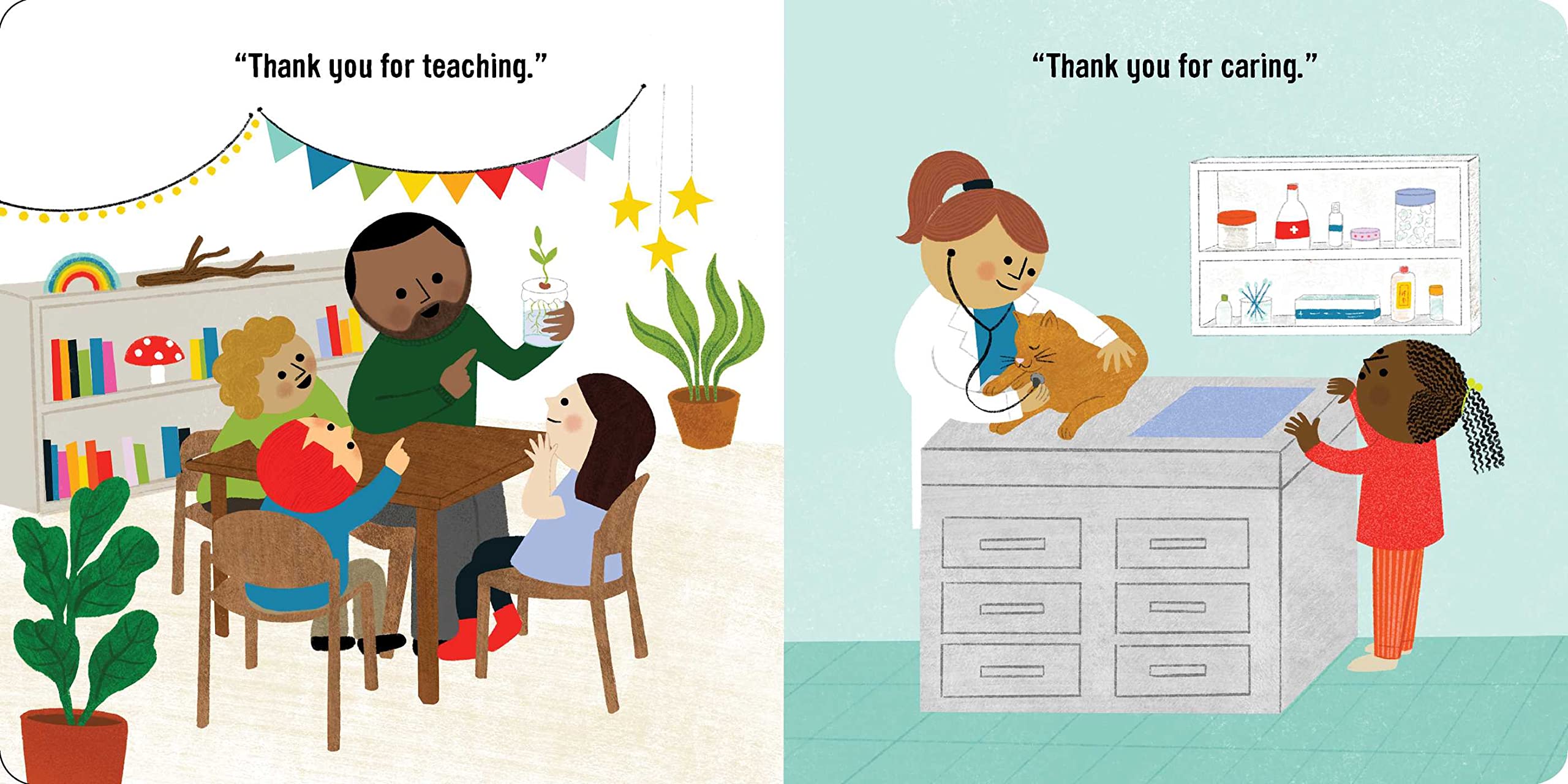
Smith begins with an inviting and easy-to-understand definition of thankfulness that will resonate with young children: “When someone is thoughtful or kind in some way, ‘thank you’ are two very nice words to say.” She then goes on to provide specific examples of times that gratitude is warranted as well as language to help kids express their feelings for specific acts of kindness. As illustrations show children engaged in various activities, readers discover they can say, “‘Thank you for helping.’ ‘Thank you for sharing.’ / ‘Thank you for teaching.’ ‘Thank you for caring.’”
Image copyright Juliana Perdomo, 2022, text copyright Danna Smith. Courtesy of Little Simon.
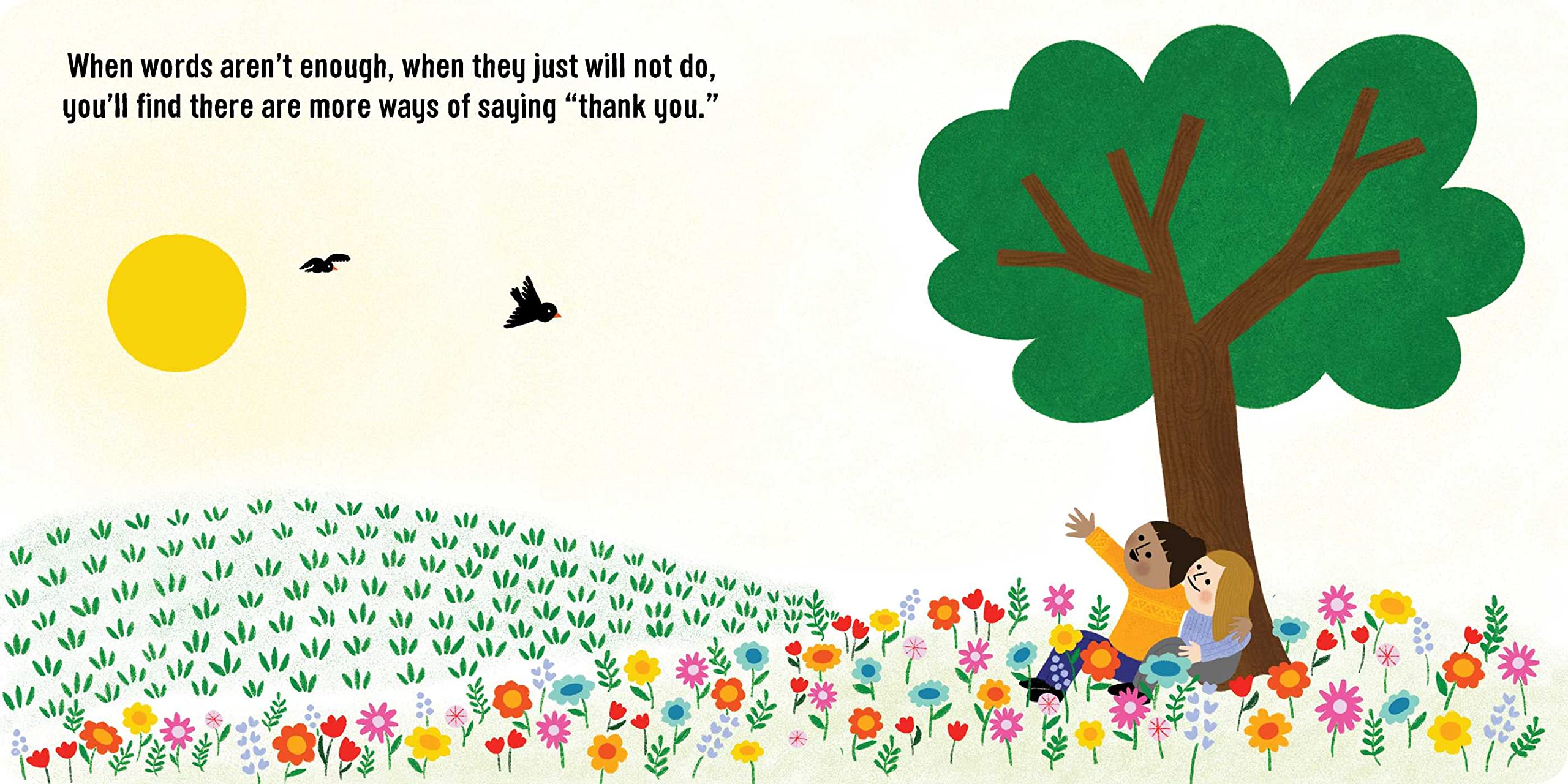
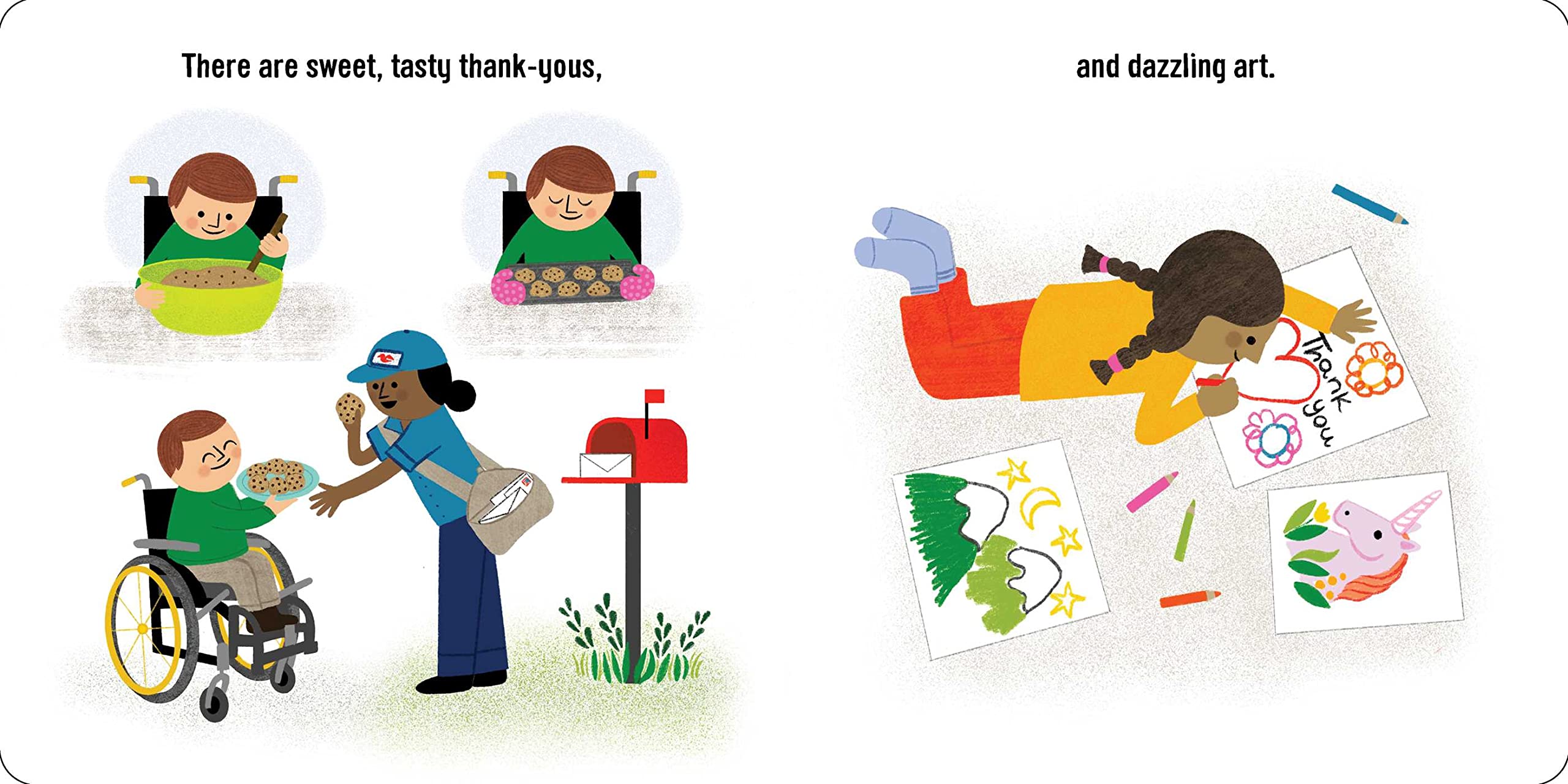
But is saying those types of words the only way to show your gratitude? Children (and especially those who are reluctant to talk with people they don’t know well or feel shy about speaking up) learn that there are other ways to show gratitude, including giving hugs, drawings, and tasty treats.
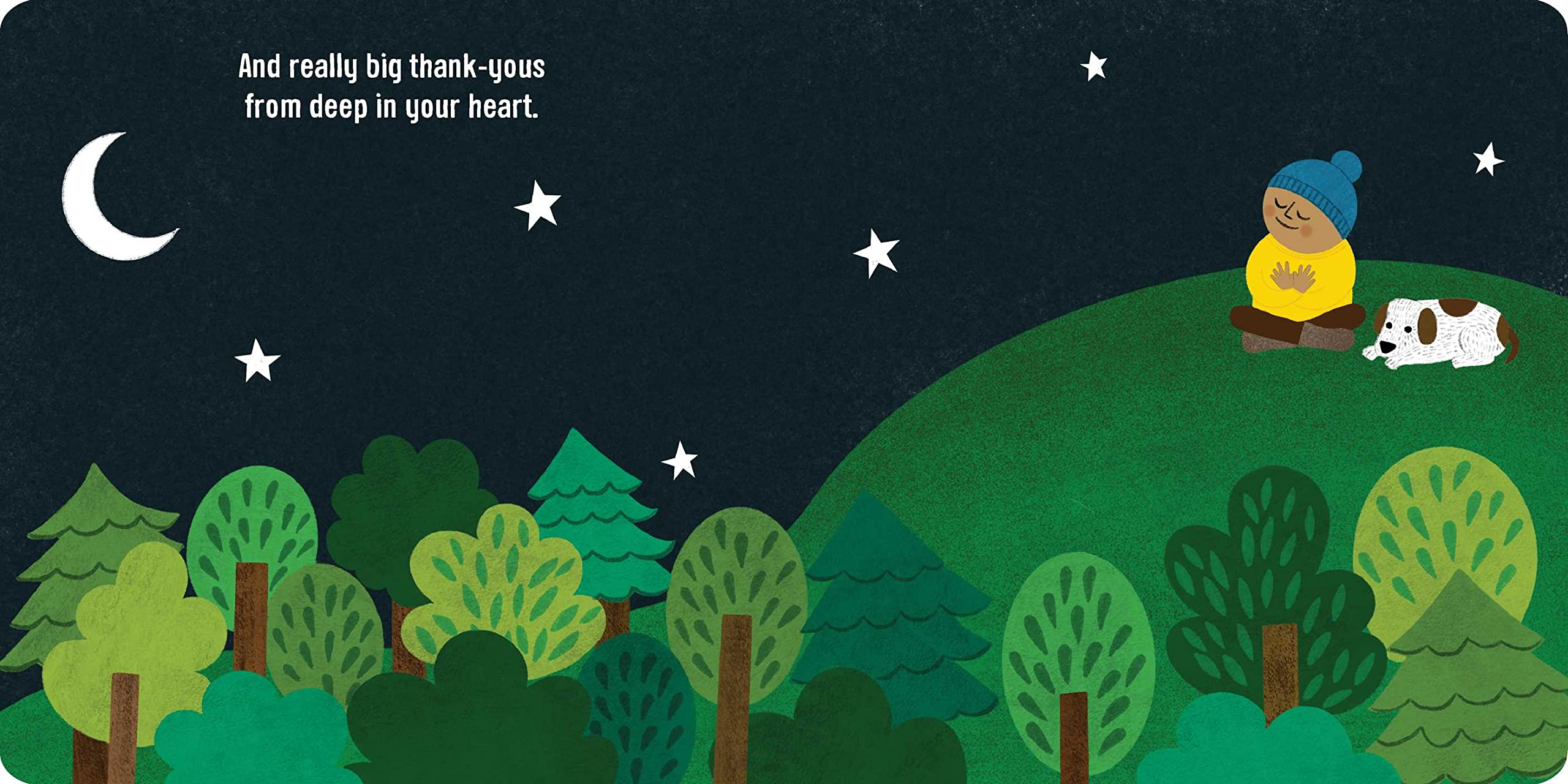
Smith then reveals a well-known secret about saying thank you that will make today’s inclusive kids happy to be part of an appreciative community: “If you start with one thank-you, you’ll find it will grow.” And, indeed, Smith finishes her story by assuring readers that kids all over the world are thanking others for their friendship and kindness.
Image copyright Juliana Perdomo, 2022, text copyright Danna Smith. Courtesy of Little Simon.
Danna Smith’s sweet board book, with its jaunty rhymes and enthusiasm for sharing gratitude is just the kind of story parents, teachers, and other adults will want to read with their little ones and little ones will want to hear again and again. Her open-ended phrasing allows adults and kids to discuss the types of people who are helpers, sharers, teachers, and care-ers, as well as those within their family and friends who are deserving of thanks and on which occasions. Smith also gives kids ideas for a wide range of ways to say thank you that may use their talents and mean more to them than words. These examples can also spark talks between parents, teachers, and other caregivers on other ways to show thanks. And what if you have a child who just feels appreciation deep inside? They are represented in these pages too.
Juliana Perdomo’s vibrant illustrations of kind acts by friends, parents, teachers, veterinarians, bus drivers, activity instructors, and others will enchant little ones and get them talking about all the times someone has done something nice for them. Readers of all ages can’t help but be filled with gratitude and good feelings when they’re greeted by Perdomo’s smiling and enthusiastic characters. Perdomo mirrors Smith’s text to give kids a concrete understanding of the concepts while filling her pages with cheer and heartfelt gratitude. The idea that saying thank-you can bring people together in a community and around the world is one that will excite kids and encourage them to show their appreciation.
Joyful and inspiring, The Thank You Book would be a favorite read aloud in any young child’s home library and is a must for all daycare, school, and public library board book collections.
Ages 3 and up
Little Simon, 2022 | ISBN 978-1665902922
Discover more about Danna Smith, her books, poetry, and paintings on her website.
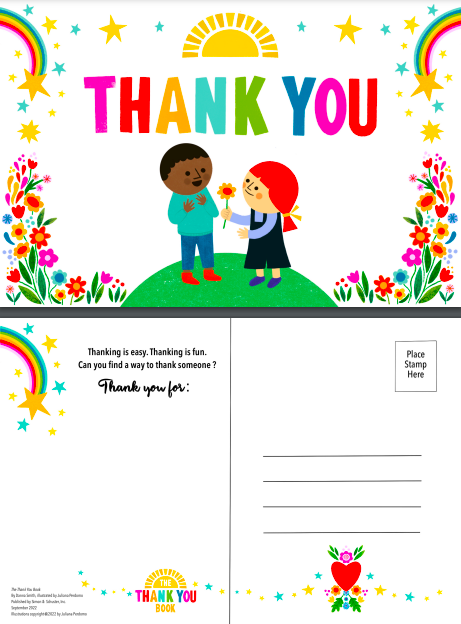
Do your kids have someone they’d like to thank for a kind act, a gift, or just for being a loved family member or friend? This cheery Thank You postcard makes it easy for kids to show their gratitude and share their love to people close by or far away. This card is also perfect to share for the upcoming holidays!
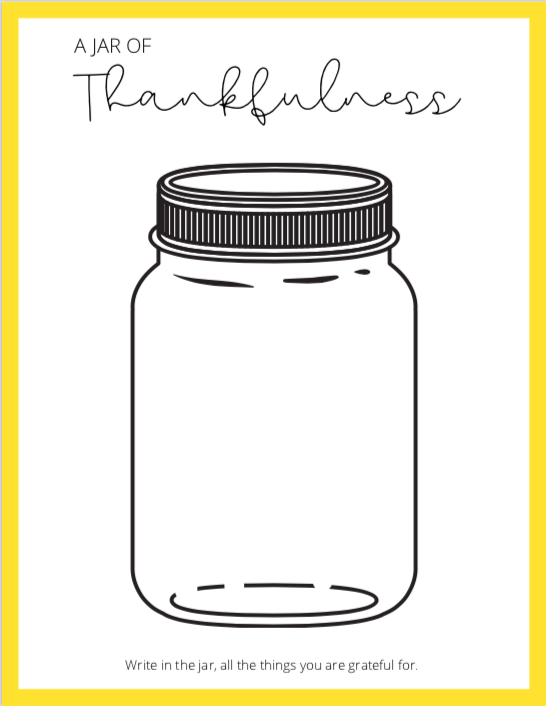
It’s good to remind yourself periodically – or even every day – of all the things you have to be thankful for and all the acts of kindness you’ve received. This activity sheet gives children (and adults who want to participate with their kids) a place to collect all these “thank-you”–worthy experiences. Just write a word or short description inside the jar each time you feel thankful. You might even want to share your appreciation with the people whose names appear in your jar with a note, a picture, a hug, or a homemade craft to show how much they mean to you.
This Thankfulness Jar also makes a meaningful activity for Thanksgiving Day! Why not print a copy for each guest at your table, provide a pencil, and get everyone sharing what they’re thankful for this year!
I’d like to thank Two Lions and Barbara Fisch at Blue Slip Media for sending me a copy of Love Made Me More for review consideration. All opinions on the book are my own.
Love Made Me More
Written by Colleen Rowan Kosinski | Illustrated by Sonia Sánchez
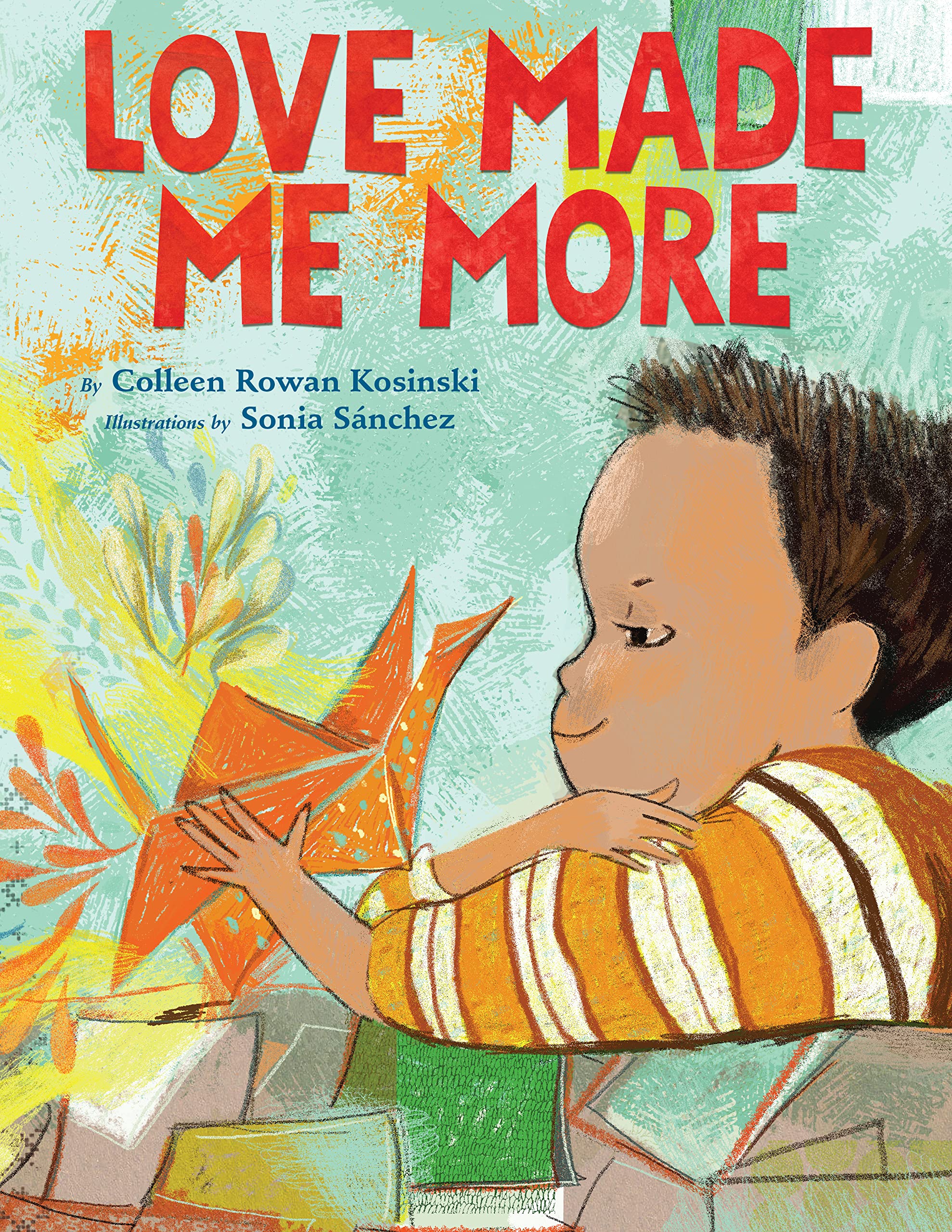
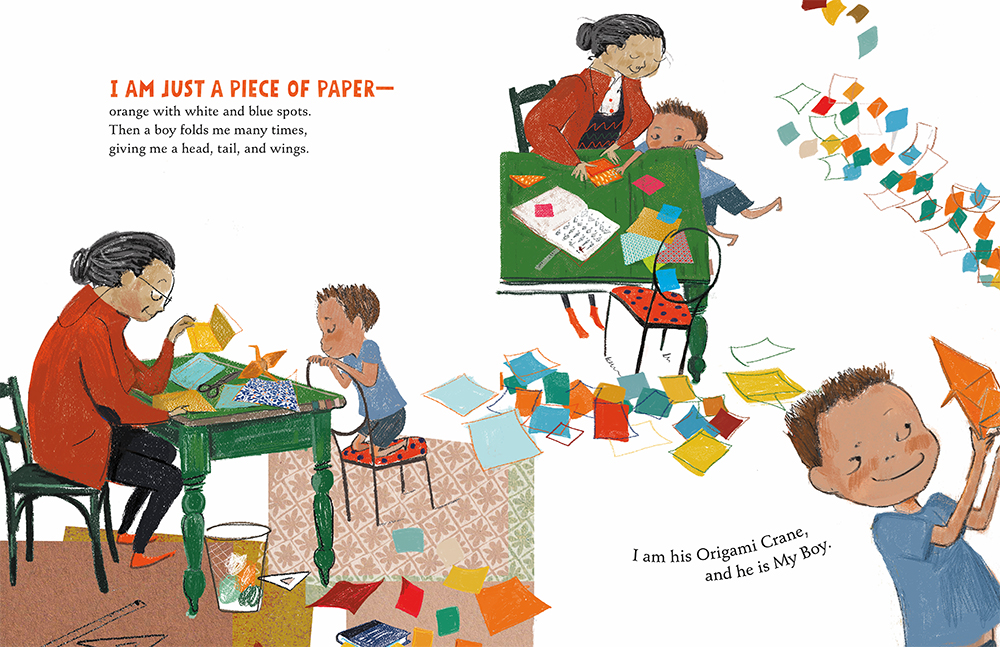
An origami crane reveals how it came to be after its origins as “just a piece of paper—orange with white and blue spots” and the day when “a boy folds me many times, giving me a head, tail, and wings” under the watchful eye of his grandmother. The crane becomes an instant favorite, and for the crane, the boy is “My Boy.” The young child places the crane on his nightstand, so that he sees it right before going to sleep and again as soon as he wakes up.
Image copyright Sonia Sánchez, 2022, text copyright Colleen Rowan Kosinski, 2022. Courtesy of Two Lions.
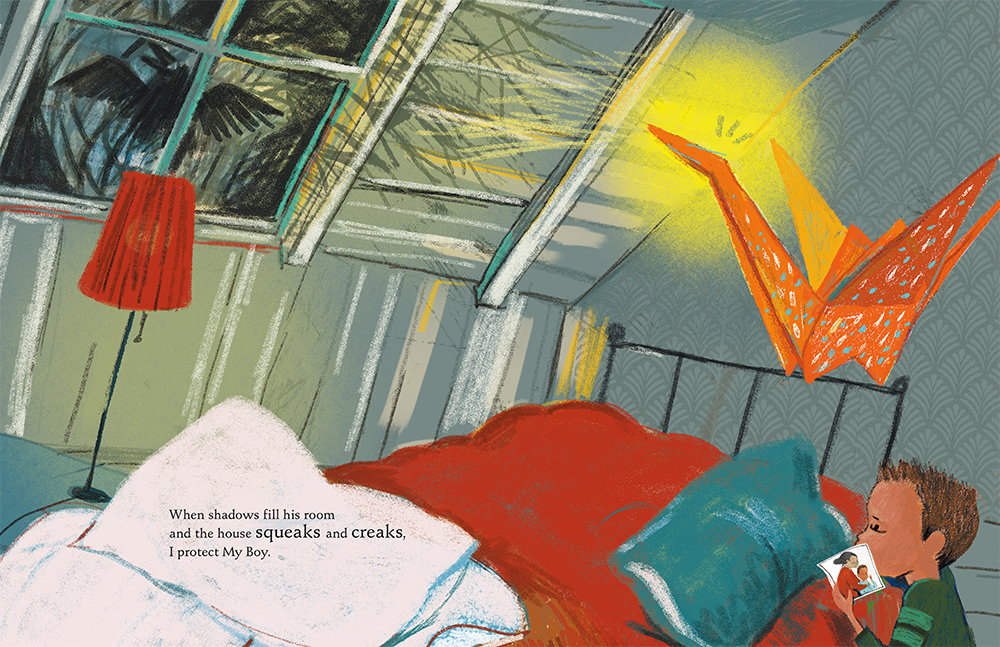
Over the years, the origami crane shares in his play, his dreams, and his wishes and it comforts him in his grief of losing a loved one and when shadows scare him. But as the boy grows older, finds new friends and interests, and becomes braver, he talks less and less to the origami crane. And while the crane still sits on his nightstand, the paper has grown dusty.
Then “one day,” the origami crane says,”My Boy places a photograph in front of me. I peek around and see a picture of a girl with an orange, white, and blue shirt. My colors. I fume.” The crane is jealous that “now she is the last thing he sees” at night and the first in the morning. But more years pass, and a day comes when the boy reaches for the origami crane once more. The crane is hopeful that they will play together again as in the past, but instead the boy unfolds it and “scrawls tickling words” on the paper before refolding it.
Image copyright Sonia Sánchez, 2022, text copyright Colleen Rowan Kosinski, 2022. Courtesy of Two Lions.
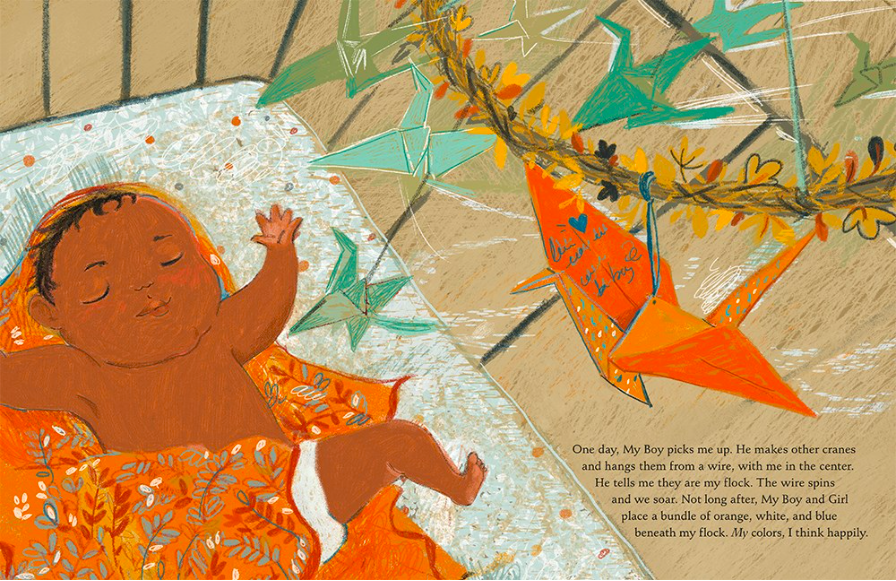
The origami crane has not been forgotten during all of these years. In fact, the crane’s stature has only grown, now offered to the girl with a love-affirming question hidden inside. “‘Yes, I will marry you,’ she says.” The crane embraces her as “My Girl too” as the boy refolds it. Soon, the origami crane finds itself in the center of a flock floating above a crib where a baby, wrapped in an orange, white, and blue blanket sleeps. “My colors,” the crane thinks happily.
The crane is proud that his flock is “the last thing Our Baby sees each night and the first thing he sees each morning” and that “he loves us.” As the baby grows into boyhood and learns how to make an origami crane himself—with his father’s crane close by—the origami crane realizes that what has made it so much more than “just a piece of paper” is all the love it has been shown and has been a part of.
Image copyright Sonia Sánchez, 2022, text copyright Colleen Rowan Kosinski, 2022. Courtesy of Two Lions.
Colleen Rowan Kosinski’s unique story, told from the perspective of an origami crane that has been molded by a boy from a simple piece of paper to become a beloved keepsake, reveals the endurance and transformative power of love. Infused with feelings of belonging and purpose, the story flows through the changes a lifetime brings not only for the boy but for the origami crane. Just as the boy finds friends, meets a girlfriend, gets married, and has a baby, the crane slowly learns to integrate other people and, finally, a flock of origami cranes into its sphere, changes often told with honest emotions and a sense of the years passing by.
When the boy proposes to the girl with the help of the crane and it now accepts his fiancé as “My Girl too,” the crane seems to gain a sense of new life and autonomy when the boy refolds the paper. Instead of defining itself as “his Origami Crane” it now asserts itself as “Origami Crane.” The idea of the importance of being seen, embraced, and given love over an entire lifetime is woven throughout the story and becomes the central theme as the crane realizes that the baby loves it too. Readers take away the knowledge that it is love freely given—and accepted—that makes all the difference in a person’s self-esteem and the way their life evolves.
Image copyright Sonia Sánchez, 2022, courtesy of Two Lions.
Sonja Sánchez’s vibrant and lively illustrations glow with the magic and comfort that the origami crane brings to the boy’s life as a child. Using angled images, strong lines that suggest the creasing that defines the origami crane, and warm earth tones, Sánchez centers her illustrations on the crane. Pages full of movement and color paint a picture of the boy’s childhood spent playing, wishing, and dreaming with the crane always by his side give way to a spread shrouded in brown, where the boy and his friends appear only as silhouettes and the orange crane, pushed to the side of the desk and dwarfed by the boy’s new interests in a computer, guitar, and other objects, is the only bright spot in the brown and darkened room.
Time passes and within two page turns, the boy, grown into a young man, once again has the crane in hand. Its former glow of magic is back as the boy unfolds, writes on, and refolds the paper. A baby comes along and, like his father, sails into imagination and play with the crane, finally learning how to fold his own crane as he grows into boyhood.
Love Made Me More is a singular story to share with children to reaffirm their special bond with a favorite toy or memento, but more: to remind and reassure them of the power of enduring love, expressed in so many ways, to transform people, experiences, and life itself. The book would be a unique, uplifting, and affecting addition to home, school, and public library collections.
Ages 4 – 8
Two Lions, 2022 | ISBN 978-1542006200
About the Author
Colleen Rowan Kosinski is the author of A Home Again and the author-illustrator of Lilla’s Sunflowers and A Promise Stitched in Time. She received her BA from Rutgers University in visual art, is an alumna of Philadelphia’s Moore College of Art and Design, and spent many years as a successful freelance fine artist. Colleen calls New Jersey her home and resides there with her family. To learn more, and to watch a tutorial on making an origami paper crane, visit www.colleenrowankosinski.com. You can connect with Colleen on Facebook | Instagram | Twitter
About the Illustrator
Sonia Sánchez is the illustrator of a number of picture books, including Evelyn Del Rey Is Moving Away by Meg Medina, A Crazy-Much Love by Joy Jordan-Lake, and The Little Red Fort by Brenda Maier. Her books have been nominated for the Eisner Award and named a CBC/NCSS Notable Social Studies Trade Book for Young People and a Bank Street College Best Book of the Year. She lives with her husband, her kids, and a sleepyhead cat in Barcelona, Spain. You can connect with Sonia on Instagram.
Love Made Me More Tour Launch Activity
Make an Origami Crane
Follow along with this tutorial from Origami Tsunami to make your own Origami Crane to love!
You can find Love Made Me More at these booksellers
For children, picture books provide one of the best ways to interact with facts and feelings. Stories that speak to their experiences, both common and new, alongside illustrations that bring the story to life let them discover the world around them. Today’s stunning nonfiction books are loaded with illustrations or photographs that let kids see exciting details about science, history, biographies, nature, and so much more. This month, take a look for fiction and nonfiction picture books about your child’s passions to add to your home library. And be sure to check out today’s book that incorporates both!
Thanks to Star Bright Books for sharing a digital copy of Leaves to My Knees with me for review consideration. All opinions on the book are my own.
Leaves to My Knees
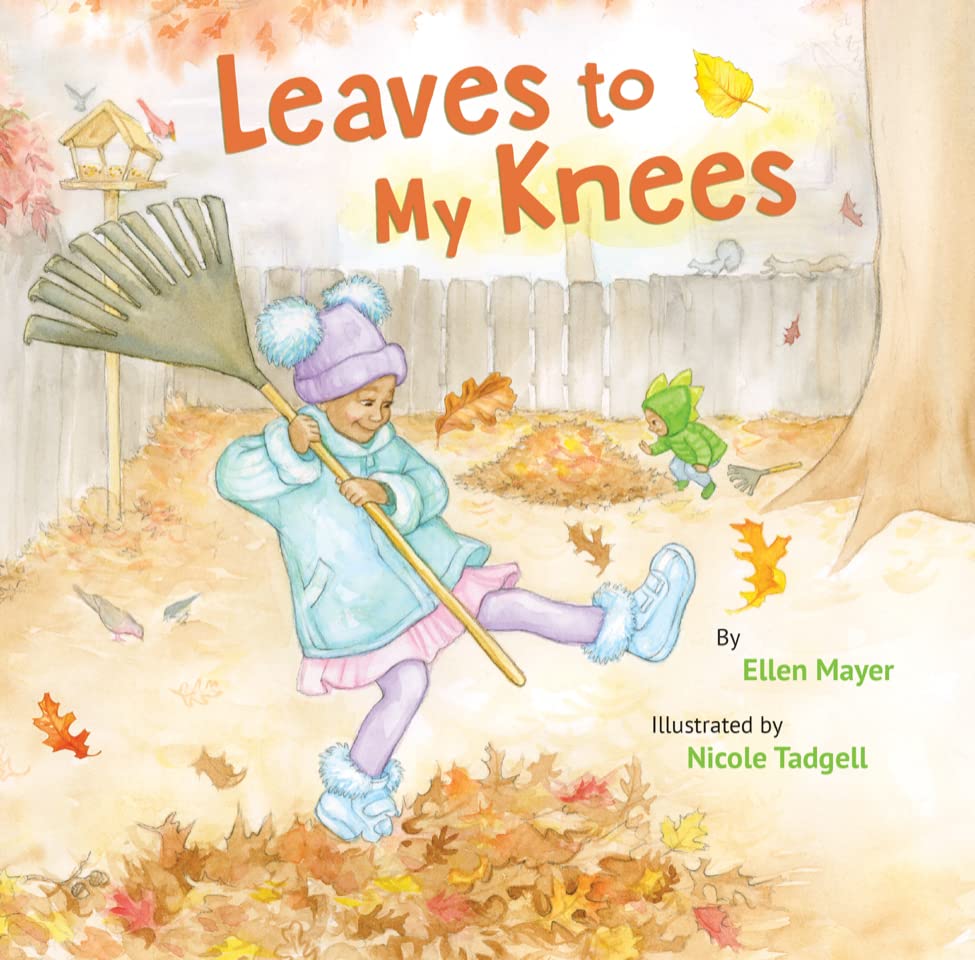
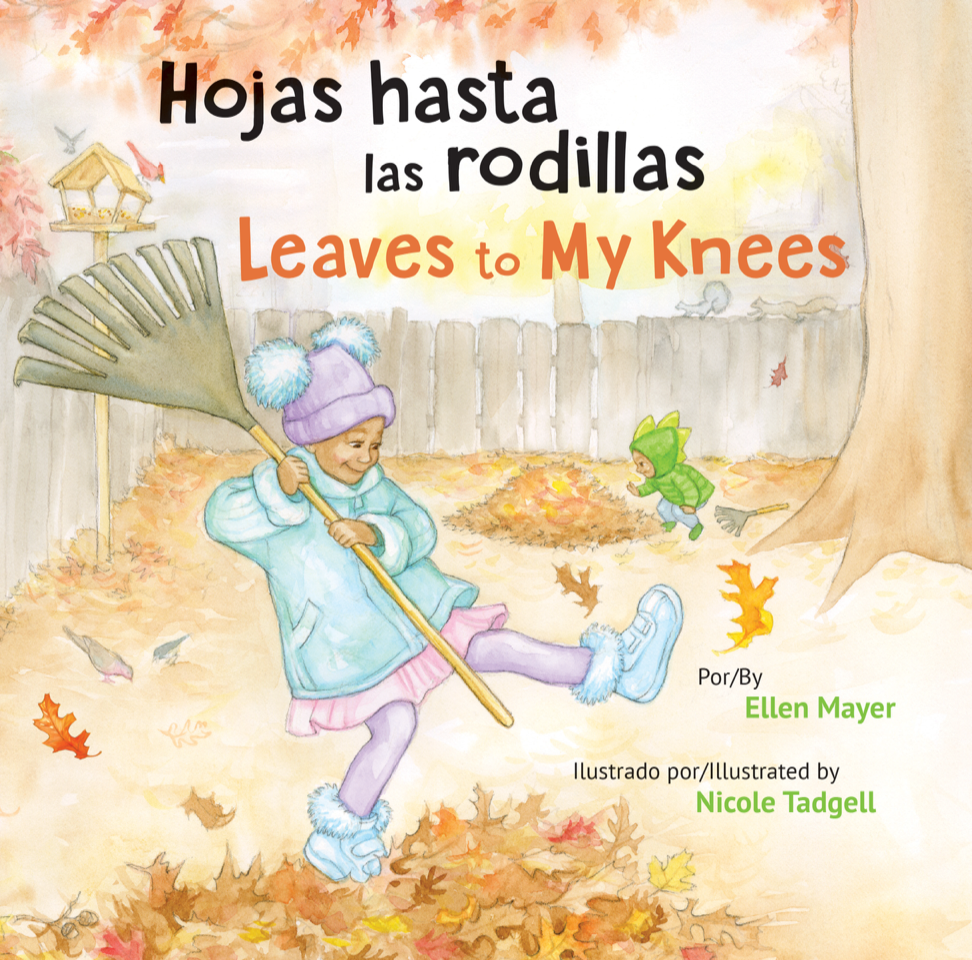
Hojas hasta las rodillas/Leaves to My Knees
Written by Ellen Mayer | Illustrated by Nicole Tadgell
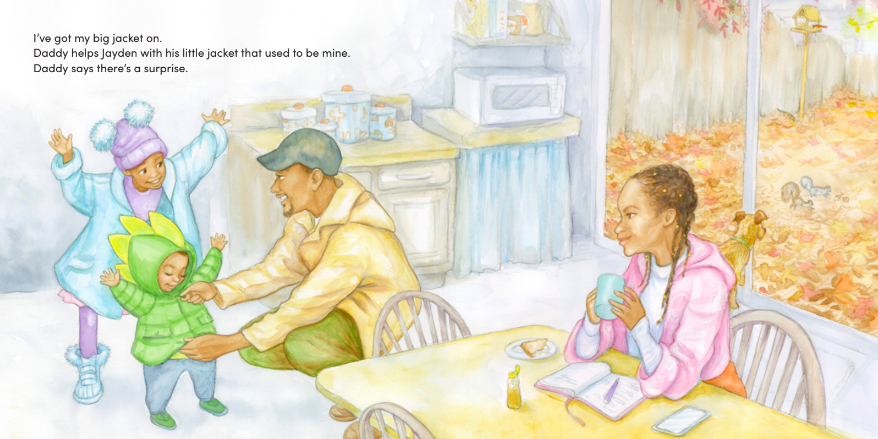
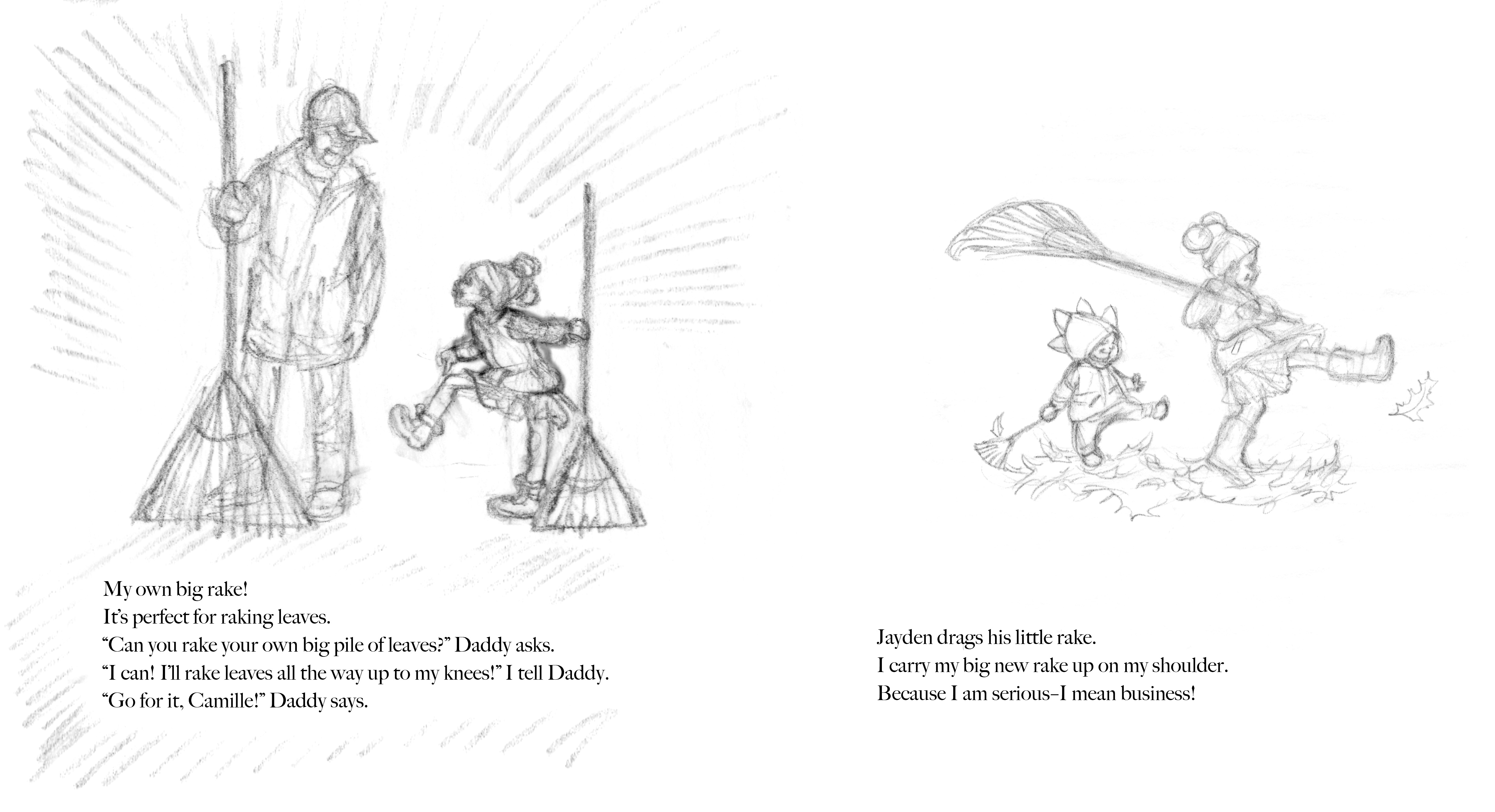
Daddy has a surprise for Camille and her little brother Jayden. They get dressed in their coats—big for Camille and little jacket with a stegosaurus hood for Jayden—and head into the backyard. There, Camille discovers her dad has gotten her a rake of her own. It’s not as big as Dad’s, but it’s bigger than Jayden’s little rake. It’s the perfect size for Camille.
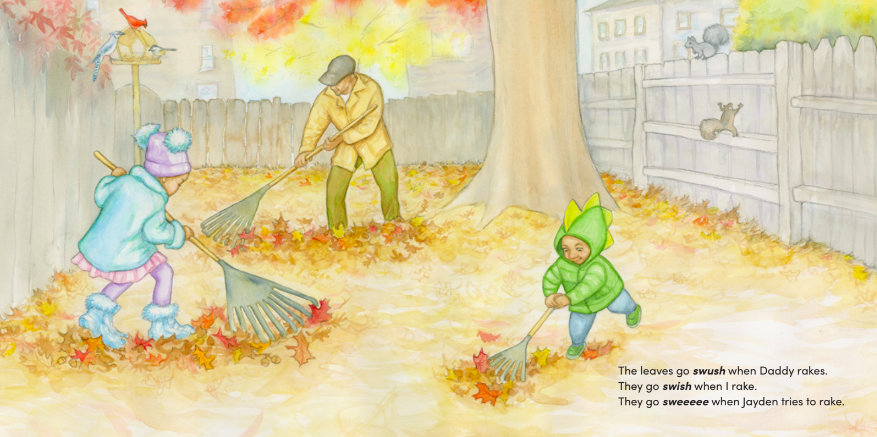
Camille marches right off to rake a pile of leaves. But not just any pile—she has a goal. “‘I’ll rake leave all the way up to my knees!’” she tells her dad. The three get working on the yard. Camille concentrates on gathering leaves, listening to the different sounds that the various sized rakes make: “The leaves go swush when Daddy rakes. They go swish when I rake. They go sweeeee when Jayden tries to rake.”
Image copyright Nicole Tadgell, 2022, text copyright Ellen Mayer, 2022. Courtesy of Star Bright Books.
Lurking under the leaves are twigs and acorns that clog up Camille’s rake. She worries that she’ll never be able to rake leaves to her knees. She calls for Daddy’s help, and together they clear Camille’s rake. “‘You’re good to go now, Camille,’” Daddy tells her. Back at it, Camille rakes and rakes. Then she steps into the pile she’s accumulated to measure it. Her pile only comes up to her ankles. Camille grabs her rake harder and with determination she collects more leaves. But wait! Jayden is stealing leaves from her pile to add to his! Camille guards her pile with her rake, and sends her little brother over to Daddy’s bigger pile. Camille checks her measurements again. Her pile has grown, but only up to the top of her boots.
Image copyright Nicole Tadgell, 2022, text copyright Ellen Mayer, 2022. Courtesy of Star Bright Books.
Camille rakes ‘bunches of leaves,” and her pile gets taller, until “‘Oh no! A BIG BREEZE!!’” sends lots and lots of leaves swirling “Whoosh!” into the air and scattered to the ground. “I will never rake leaves to my knees!” Camille thinks. And when she measures again, her pile is back to her ankles. Daddy encourages her to keep going, and Camille is committed to achieving her goal. She throws off her coat, grabs her rake, and works on gathering up all the leaves she had, plus more. At last, too tired to rake anymore, Camille wonders. Has she done it? “‘Time for measuring!’ says Daddy.”
Image copyright Nicole Tadgell, 2022, text copyright Ellen Mayer, 2022. Courtesy of Star Bright Books.
Camille relinquishes her rake to her dad then, holding her breath, steps into her pile. “‘TA-DA!’” Camille raises her arms in victory. She steps out, positions herself a good ways away, and winds up for the run and jump. “‘GO!’ yells Daddy. ‘GO!’ Jayden yells too.” Camille flies through the air and lands, laughing, into her pile. Then Jayden jumps in. And Daddy? He gives Camille “really big squeeze” for raking “leaves all the way up to [her] knees.”
A note for parents, teachers, and other caregivers written by Marlene Kliman, a mathematics learning expert and senior scientist at TERC, describes how the story incorporates the math of measurement and sizes and how adults can extend the lesson by pointing out elements in the book’s illustrations and while going about their day or doing common chores, such as cleaning up and sorting laundry.
Image copyright Nicole Tadgell, 2022, text copyright Ellen Mayer, 2022. Courtesy of Star Bright Books.
Ellen Mayer’s Leaves to My Knees has everything that makes a story a young reader’s favorite—a spunky main character that kids will identify with, an achievable goal, successes and setbacks, suspense, humor, and a child-propelled victory. And it all revolves around an early math concept that comes naturally to children and which invites playful learning not only during the fall, but any time of the year. Shoveling snow and making snowballs in winter, yard cleanup and gardening in spring, and building sandcastles and raking grass clippings in summer as well as in-home fun with laundry piles, toys, and other objects are all ways to extend the story.
Told from Camille’s point of view, the story also engages children’s emotions as they join in to cheer Camille on as her leaf pile grows and commiserate with her when it shrinks. The close relationships among Camille and her dad and little brother ring true with dialogue-rich storytelling that is always encouraging. Strong themes of determination and persistence will also appeal to parents and teachers, who can point to how many times Camille has to start over before accomplishing her goal and her positive, resolute attitude.
Nicole Tadgell’s exuberant illustrations shine with personality, and kids will immediately become invested in each character as Dad gets working on a big job that needs doing, Jayden runs, jumps, and copies his big sister, and Camille unwaveringly works on her pile of leaves. Camille’s setbacks are clearly depicted, along with her and her father’s facial expressions that give adults and kids an opportunity to talk about disappointment, frustration, perseverance, and feelings of accomplishment. Each image also demonstrates the math component of measurement and sizes in the story with various-sized rakes, the growing and diminishing leaf pile, big and little jackets, and other objects that invite comparison.
Tadgell’s soft-hued pages are infused with the feeling of fall and hum with activity as cardinals, blue jays, chickadees gather at the bird feeder, squirrels scamper up and along the fence, and leaves continue to float to the ground. Readers will love following little Jayden’s antics and be inspired by Camille’s wide smile as she enjoys the reward of all her hard work.
Leaves to My Knees is a multilayered read aloud infused with the enthusiasm and rhythms of childhood that kids will want to hear again and again. Its mathematics base and themes of determination and perseverance rewarded will appeal to parents, teachers, and other educators as a way to engage children in active, hands-on learning. The book is a must for home, classroom, school, and public library collections.
Ages 4 – 8
Star Bright Books, 2022 | ISBN 978-1595729590 (Leaves to My Knees) | ISBN 978-1595729613 (Hojas hasta las rodillas/Leaves to My Knees
Picture Book Month Activities
Coloring Pages and Teaching Guides
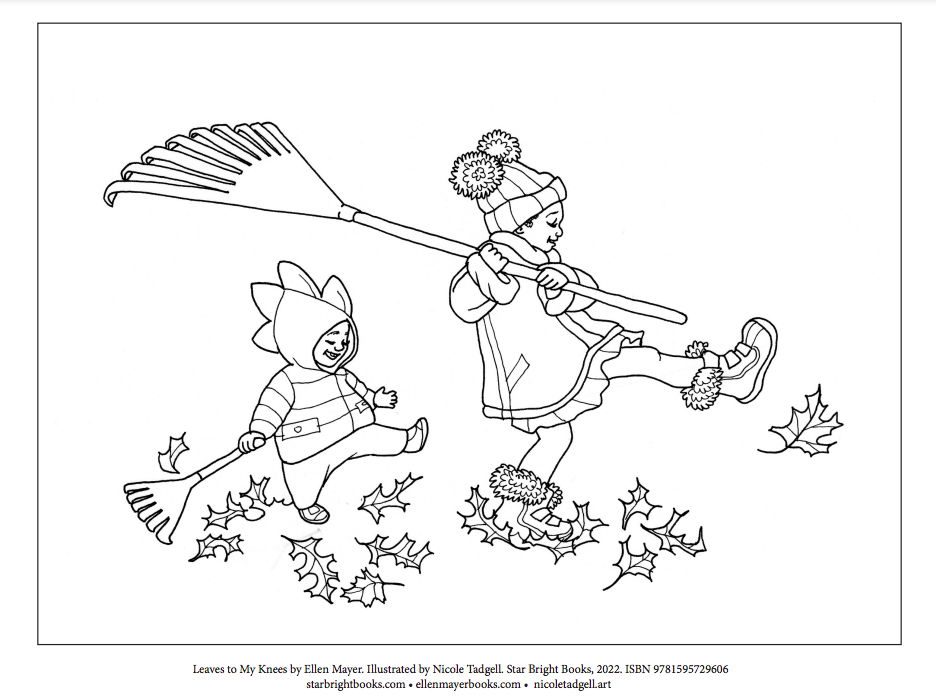
You can extend the fun and learning in Leaves to My Knees with these activities, which include three fun coloring pages from the story, a hands-on play-dough art and discovery activity, and a detailed educator’s guide for teachers, homeschoolers, parents, and other caregivers that offers multiple ways to use Leaves to My Knees to explore math, mathematical thinking, and reading comprehension through the story and beyond at home, school, and elsewhere.
Ellen Mayer is an award-winning author who writes picture books for babies and young children and the grown-ups who read to them. Leaves to My Knees is her ninth book for children. Her other math story books include Banana for Two and Clean Up, Up, Up!, two board books in her Small Talk Books® series with Star Bright Books.
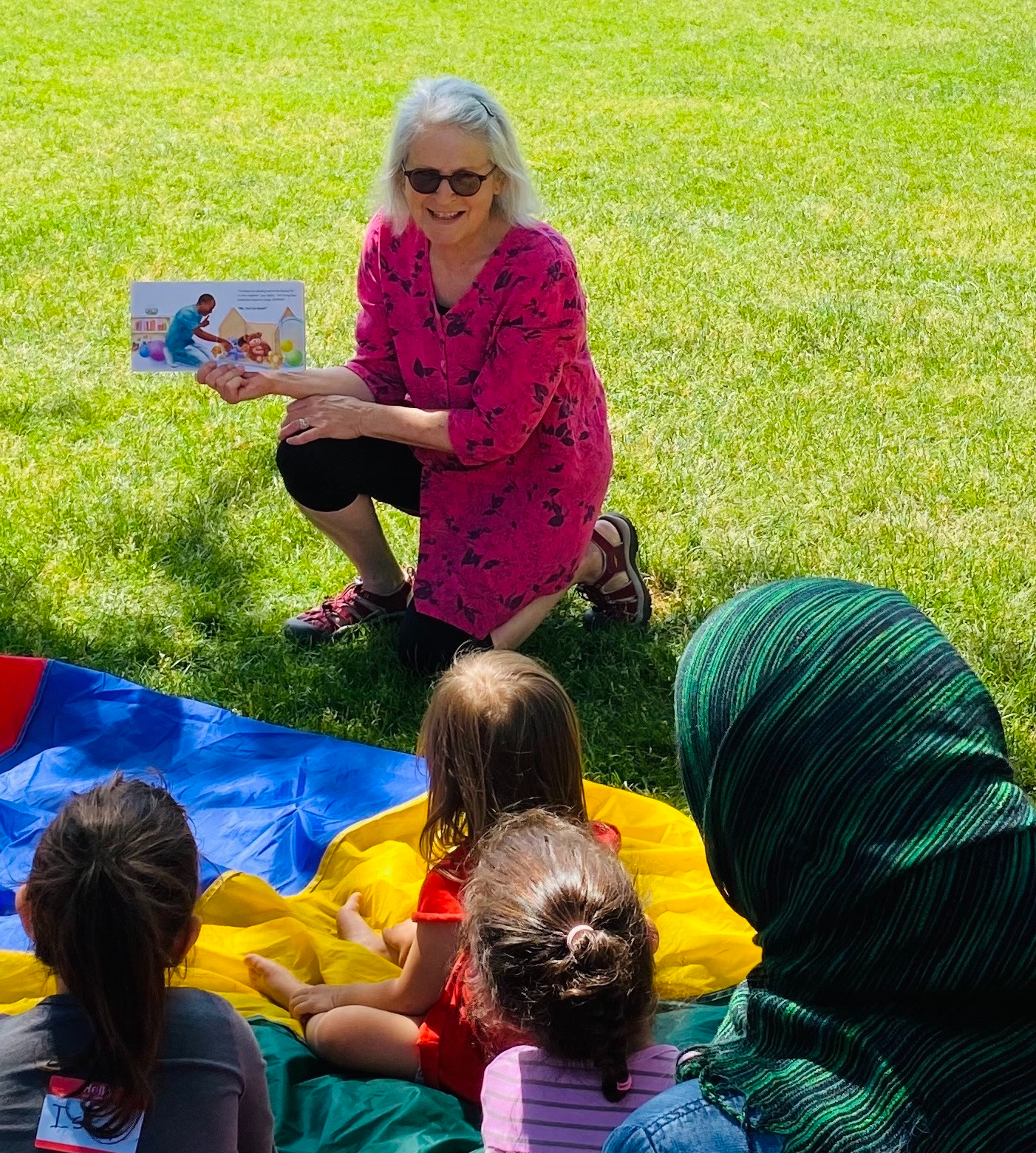
For many years Ellen was an education researcher at the Harvard Graduate School of Education, studying how families are engaged in their children’s learning. She also worked as an early literacy home visitor with young children and their parents in a local affiliate of the ParentChild+ program. Now, Ellen volunteers as a visiting children’s book author with public schools and city-run playgroups in her local Cambridge and Somerville, MA, communities. Long ago she earned an M.Phil. in Sociology from Columbia University.
Ellen often collaborates with her musician husband in “Books + Banjo” reading and sing-along programs for young children. Ellen loves to rake leaves in the fall—especially when she has help from her grandchildren.
I have so many great memories of raking leaves with my kids when they were small. You really capture the fun and challenges of this favorite fall activity in your story. Were you inspired by your own family’s experiences in any way while writing it?
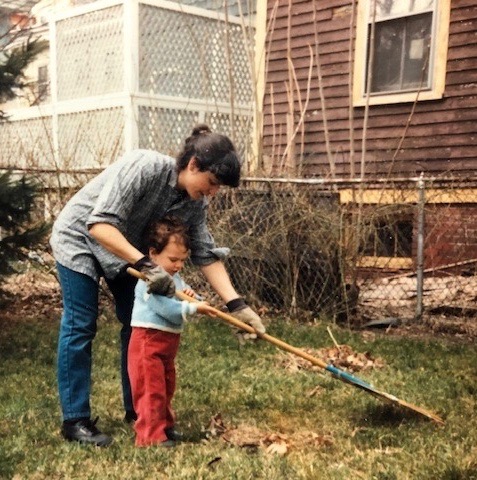
Very much so! Since the time our kids were very little they’ve joined us in the backyard for all sorts of yardwork. My daughter wanted to hold the rake from a young age, even as I did the less exciting early springtime rake of the lawn.
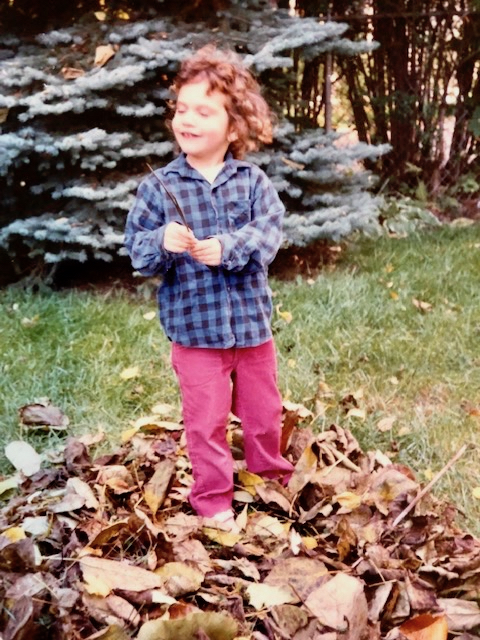
At first our trees didn’t yield much in the way of fall foliage, so we would haul a big bag of fallen leaves in from the tree out on the city sidewalk to have as leaves for play. The piles that resulted were often rather puny, only up to the ankles, as protagonist Camille would tell us.
But as the backyard trees matured, raking and jumping took off, much like in the story! I should add, too, that the sibling dynamic between our older daughter and younger son was also a source of story inspiration, influencing how I wrote the sister-brother characters here. Older sister was always the more determined and focused raker of the two, with younger brother taking it upon himself to annoy and distract her as much as possible, and generally try to steal the show, as was his lovable wont in those early years.
Marlene Kliman, an early math expert who is a Senior Scientist at nonprofit STEM education organization TERC in Cambridge, MA, has contributed a back matter note for parents and caregivers. In it she writes that Camille uses the math of measurement as she works at raking a knee-high pile of leaves and as she describes the sizes of things around her. Can you tell us how Camille and other young children approach measurement?
Preschoolers and toddlers, before they are ready to understand and engage in measuring with standardized units like inches and feet, try out measuring in their own ways. For instance, they compare the thing to be measured with an object or their body. Here, Camille measures the changing height of her leaf pile as it moves up her leg to her knees—first reaching up to her ankles, then up to her boots, but then back down to her ankles after a big breeze, then finally after some serious raking all the way up to her knees—where it’s the perfect size for jumping in. Young children naturally love to consider their world in terms of the different sizes of things. Throughout the story, Camille actively references the sizes of things all around her, whether it’s that big breeze or the size of her jacket, rake, and leaf pile in comparison with the smaller jacket, rake, and leaf pile that belong to her little brother, Jayden.
Today’s post celebrates this beautiful and exuberant cover! What was your first reaction to seeing the final cover art?
When I first saw the final cover I gasped! I love cover art that is inviting and also contains a little mystery to it. Here, Nicole created the most glorious, radiant, luminescent fall day, and I immediately wanted to join in the play. And what was that cute little dragon/dinosaur up to in the background? Definitely intriguing. Then, also, there are hints of the size-comparison math to come in the story in the form of the differently sized two rakes and three birds. The idea of “leaves to my knees” is there too, center stage. The joy and energy in this cover scene is palpable as the leaves float from the tree and Camille almost seems to be dancing in her leaf pile. Thank you so much for introducing this gorgeous cover into the world, Kathy!
Do you have another favorite spread in the book? Why is this one special to you?
Nicole creates this wonderful dance here in her art, from cover to close, with captivating facial expressions on each page. It’s hard to single out a favorite spread—there is something that takes my breath away on each page! But I keep returning to the one near the end where all is right with the leaf pile, the jump, and the siblings. Here, Camille and Jayden have flopped onto her pile and are luxuriating side-by-side on the big crackly bed of leaves, enormous matching grins on their faces. Maybe I was worried that Camille wouldn’t let the little mischief-maker into her pile? But she’s not shooing him anyway anymore—they are just celebrating together the joys of a fall leaf pile.
What would you like for kids and adults to take away from the story?
I hope they will come away with a warm feeling inside after spending time with this playful and loving family, a family that’s engaged in a fall chore, but one that is also enjoying a lot of fun and learning together. I hope they take away that math is everywhere around us, and that young children—all young children—love to measure and compare as they go about their day. I hope they take away the powerful image of a child of color, and a girl, as an active mathematician. There still aren’t nearly enough Camilles in the pages of picture books, and everyone—kids of all backgrounds listening to this story and all their reading adults too—need to see and normalize children of color and girls doing math.
Nicole Tadgell is an award-winning watercolor artist of more than 30 luminous picture books. Her books have received numerous honors, including the Christopher Award and the Children’s Africana Book Award. They have been included on the Smithsonian Notable Books for Children, the New York Public Library’s Best 100 Titles for Reading and Sharing, and many more notable lists. Born in Detroit, Michigan, frequent moves weren’t easy for Nicole, especially to new schools where she was the only Black kid in class. Art has always been both an escape and a labor of love for Nicole. Today, she brings stories to life while advocating for diversity in children’s literature. Nicole lives in Chesapeake, Virginia.
Can you share what attracted you to Ellen’s story from an illustrator’s point of view?
Because I often illustrate older children, I saw the opportunity to showcase two young children playing in autumn leaves. (My favorite season!)
Camille shows so much personality and determination on this cover image. Can you describe your process of designing and finalizing the cover?
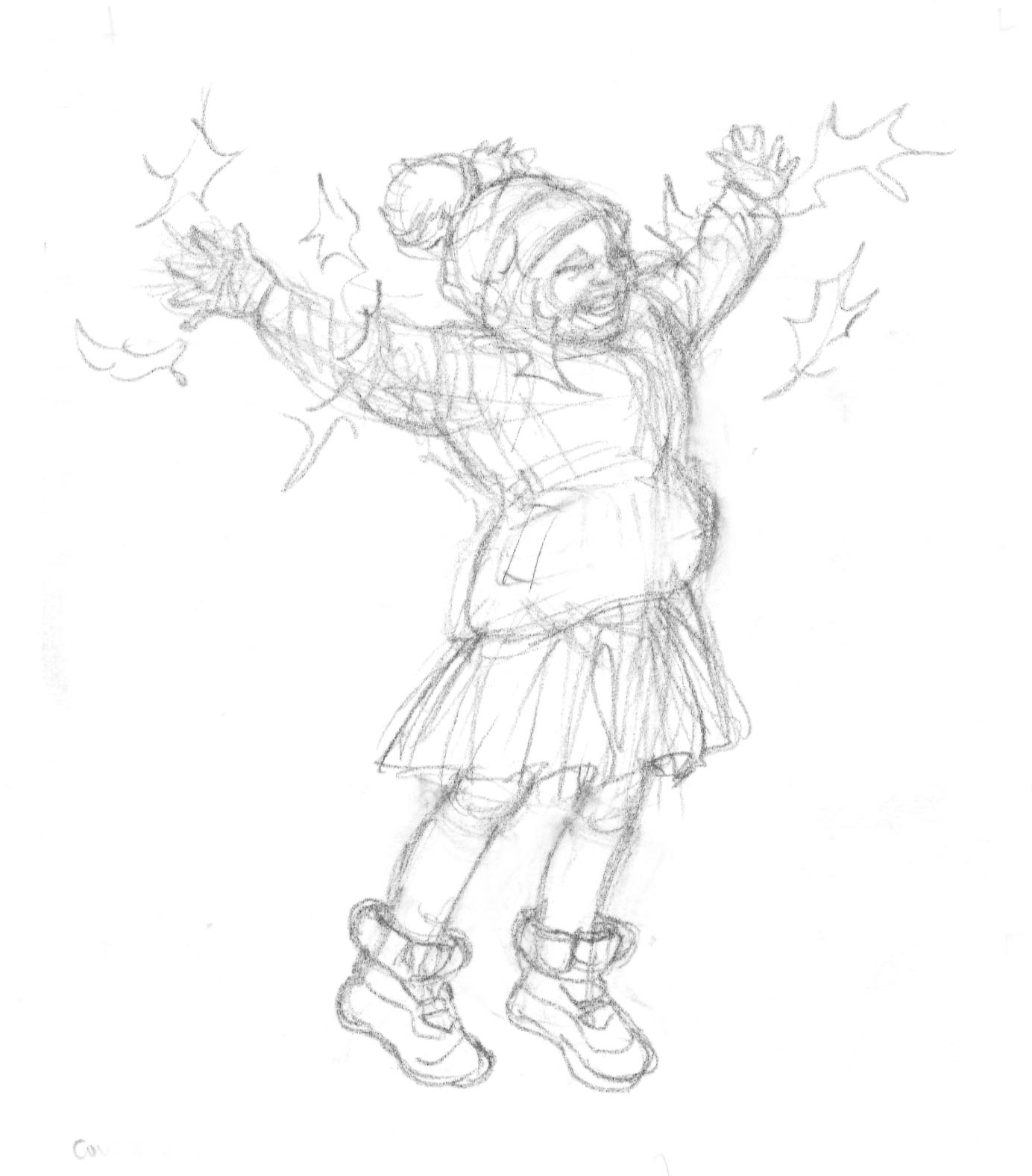
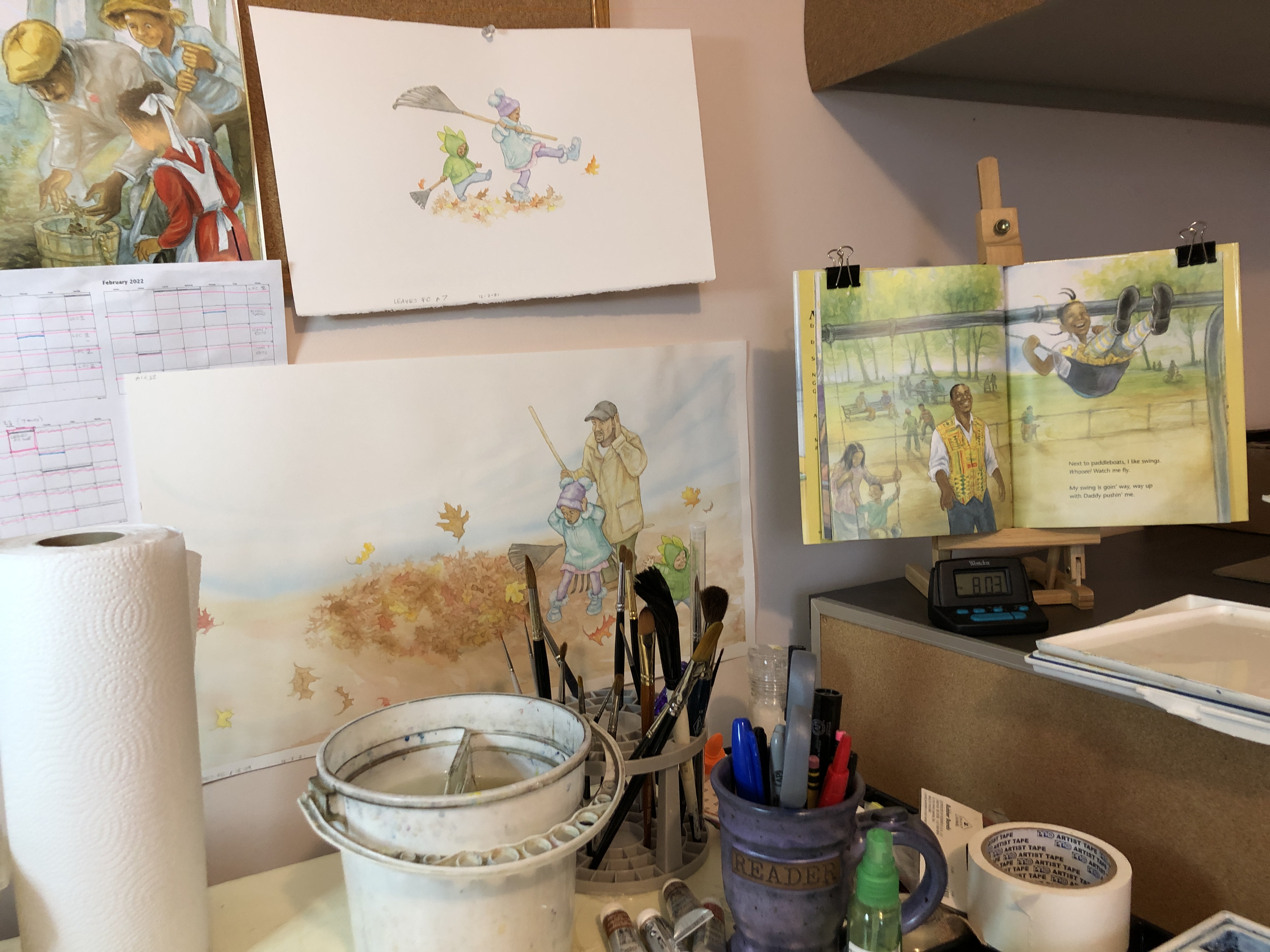
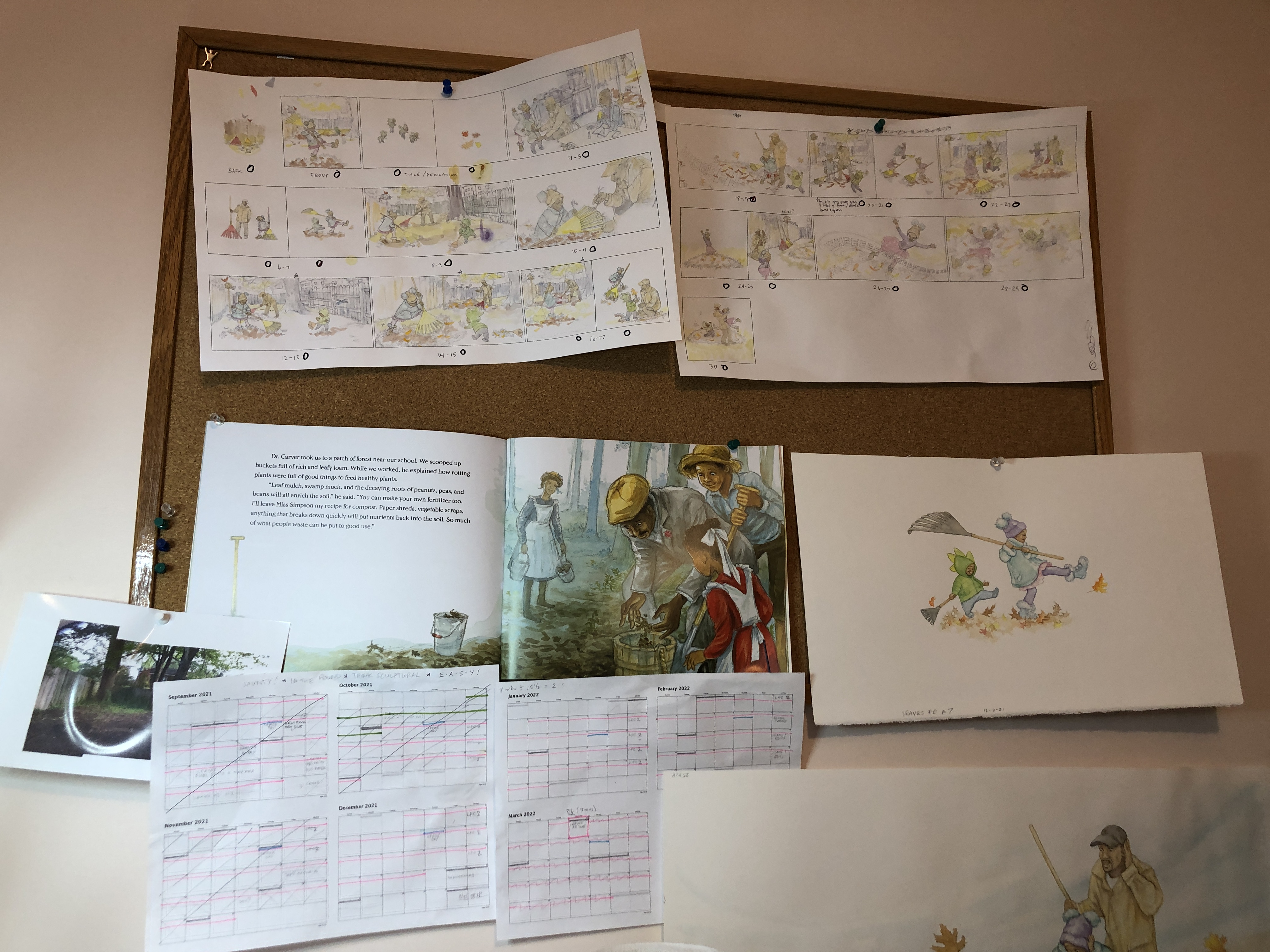
Covers can be a challenge, to be sure. There’s a compromise to paint what’s fun . . .
Image copyright Nicole Tadgell, 2022
. . . versus showing the audience what the book is about!
Image copyright Nicole Tadgell, 2022
Were you inspired by personal memories of raking leaves as you worked on this cover image and interior spreads? Do you have a story about raking leaves you’d like to share?
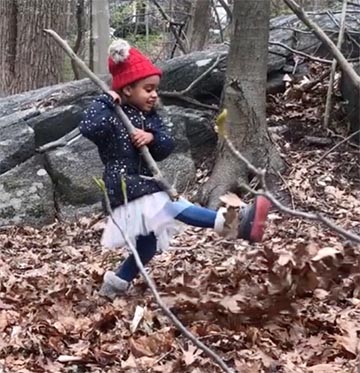
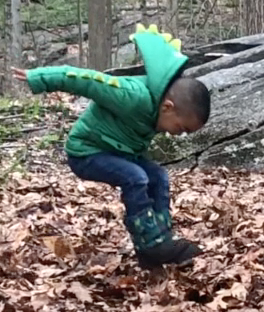
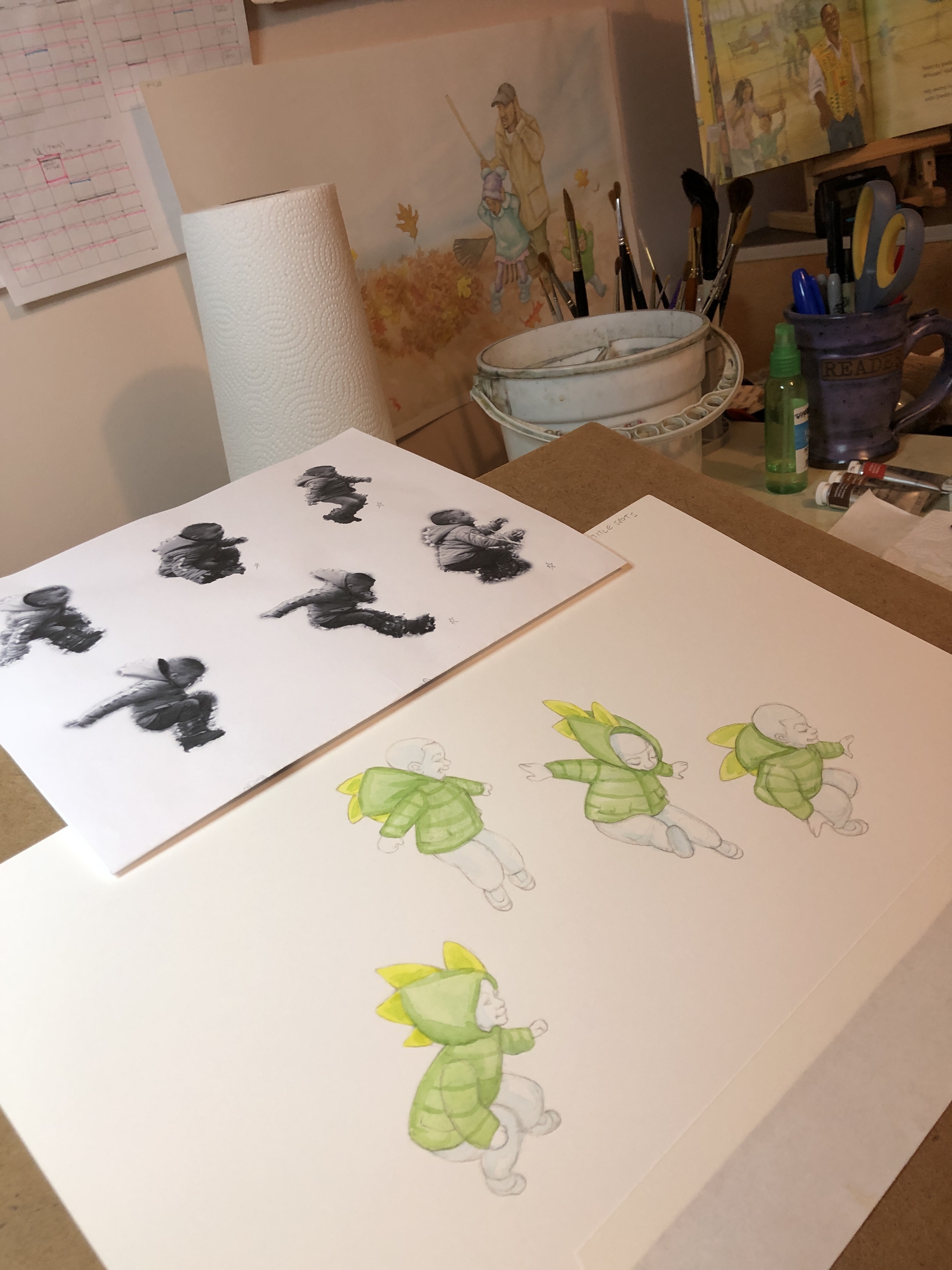
I admit I had grown-up thoughts about there being spiders in the leaves! I don’t have a clear childhood memory of that happening, but I’ve seen plenty of spiders in leaves as an adult. A fun story is about the models for this book! My sister’s friend has two kids the right age. Their Dad was wonderful—instead of taking pictures of the kids playing in leaves, he shot video so I could pause and sketch. They were perfect! Original down to Camille’s double pom-poms and Jayden’s dinosaur coat.
Image copyright Nicole Tadgell, 2022
The soft colors of your illustrations in Leaves to My Knees are really lovely. Can you talk about how you choose a color palette for your work in general and for this cover in particular?
Endless choices! It’s hard to decide. Knowing the season, I began with fall colors: reds, oranges, yellows. I felt that contrast would help our family stand out, so I chose cool colors for Camille and Jayden. I chose earth tones for Dad to make the kids stand out even more.
Image copyright Nicole Tadgell, 2022
Image copyright Nicole Tadgell, 2022
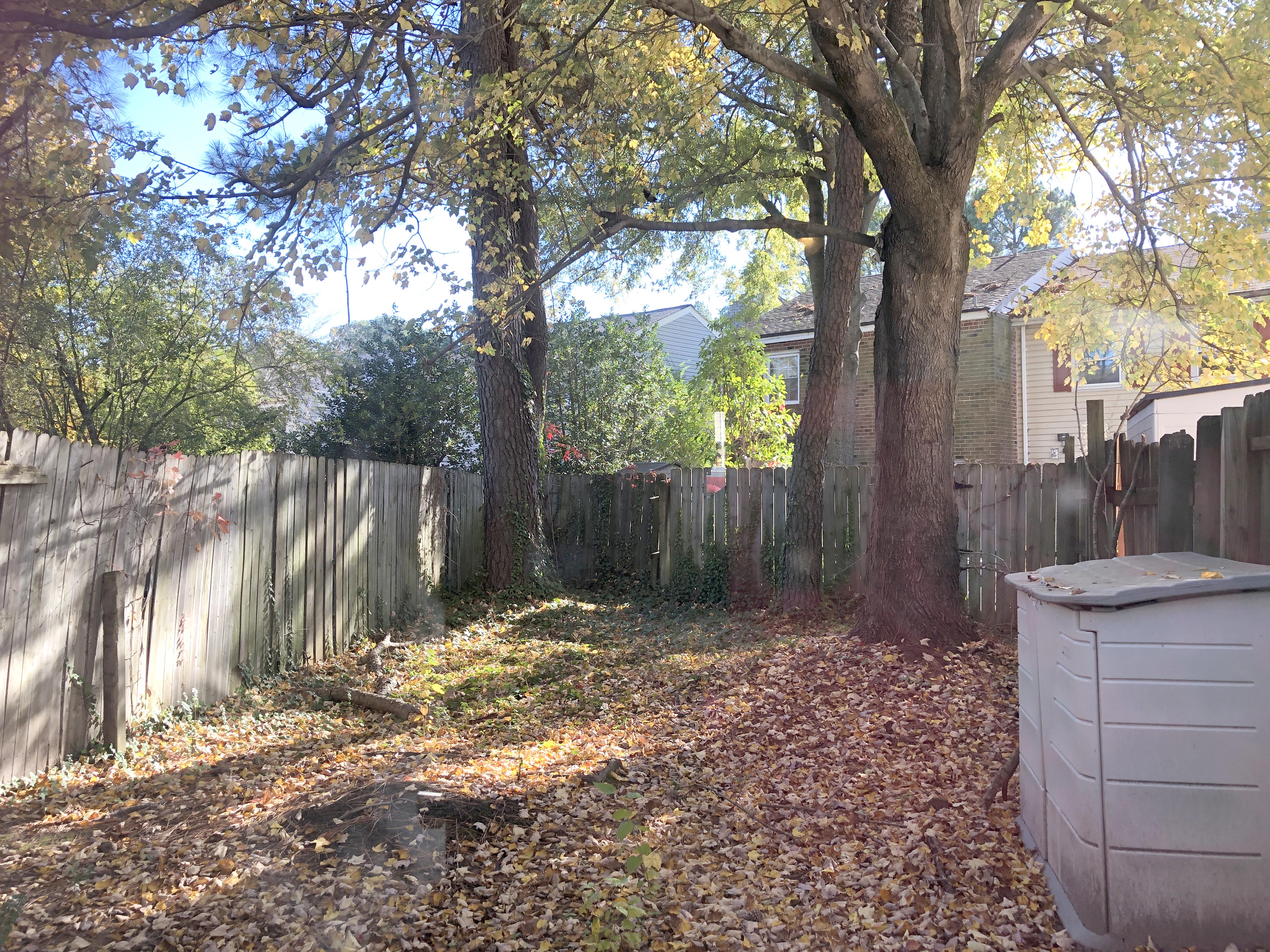
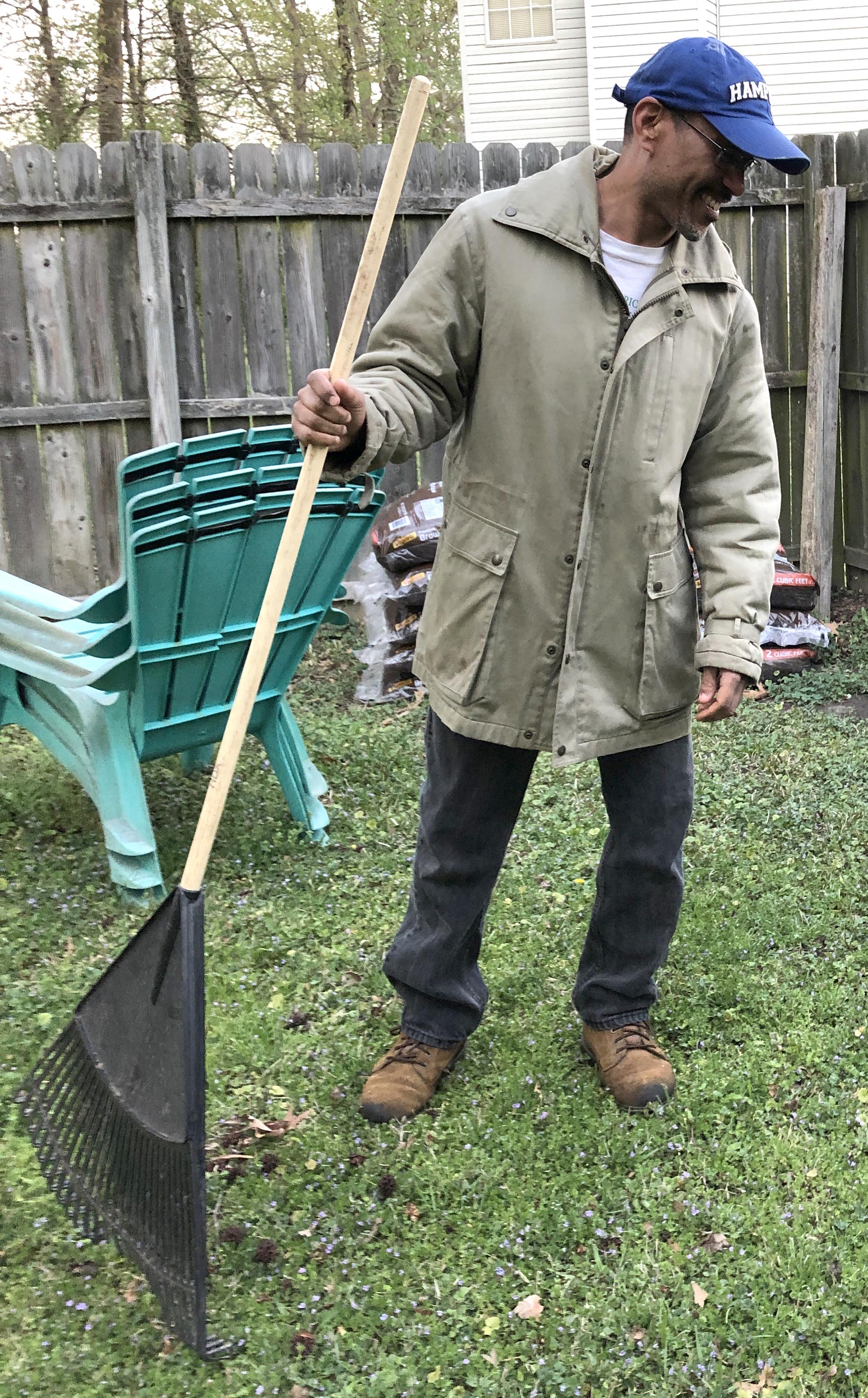
Interestingly, in the images I used for reference the real leaves had lost their color, so I just painted them colorful. I did make our Jayden a bit younger than the model’s age. For the backyard fence, I found a place nearby that had an interesting fence and small leaf-filled yard. I watched as cardinals flit between branches and squirrels chased each other, and inspiration came for the animal antics in the background!
And finally, my partner Anthony was kind enough to pose as the dad in the book!
Now that picture book creators are more free to interact with readers, what are you most looking forward to in promoting Leaves to My Knees?
Fun! I love signing books for kids & personalizing.
In addition to celebrating a fun (and necessary) fall activity, Leaves to My Knees incorporates early math concepts of size and measurement. Can you give an example of how you depicted these ideas in your illustrations?
By using different sizes of the rakes and making sure the leaf piles matched the text (up to ankles, then knees).
I can almost feel the chill in the air and hear that crisp crunch of leaves underfoot that means it’s leaf-raking time!
If you love picture books, you know the thrill of holding a new or a new-to-you book in your hands and opening up to that very first page. The children’s sections of bookstores and libraries draw you in with humor, fairy tales, poetry, biographies, science, and so much more—a whole universe of creativity, thought, knowledge, and imagination—that enlightens and entertains. This month take time to indulge your passion for picture books!
I’d like to thank Page Street Kids for sending me a copy of Sleepy Happy Capy Cuddles for review consideration. All opinions on the book are my own.
Sleepy Happy Capy Cuddles
Written by Mike Allegra | Illustrated by Jaimie Whitbread
The air in the rainforest rang with “squeaks, squawks, grunts, growls, hisses, harrumphs, and frenetic feather-and-fur-flying fury. It was quite the rumpus.” But all of these sounds didn’t make the animals happy, in fact, they were miserable and, even worse, all the noise “made them feel very alone—even though they weren’t alone.” But then one day, a visitor emerged from the river with sounds of her own—sounds the other animals had never heard before, like a “fwippa fwip of flickering ears” and a “shookita shimmy of a shaking booty bottom.”
Image copyright Jaimie Whitbread, 2022, text copyright Mike Allegra, 2022. Courtesy of Page Street Books.
Suddenly, the rainforest was silent as the animals stared at this unusual interloper as she yawned and stretched. A river turtle was the first to approach and ask what, exactly, she was. The answer came quickly (a capybara)—and with an invitation to “join my Sleepy Happy Copy Cuddle.” The turtle rebuffed this invite, thinking it would in some way soften his shell. When the capy reassured the turtle that he would stay as tough as ever, he relented.
So they cuddled next to each other, and the river turtle had to agree that he felt better. “‘That makes me happy,’ said the capy. So she floofed. Floof!” Hearing this FLOOF, an iguana came by to see what was happening. The iguana did not want to get so close, and the capy let the iguana know this was perfectly all right. So she had another happy cuddler and enjoed another happy FLOOF. All this FLOOFing started to attract more and more animals, each wanting to cuddle in their own way. The capy agreed that all these ways of cuddling were valid and just perfect.
Image copyright Jaimie Whitbread, 2022, text copyright Mike Allegra, 2022. Courtesy of Page Street Books.
At last, all the rainforest animals were content. Then a dark shape came slowly moving into view just below the surface of the river, and in a moment a crocodile splashed onto shore with a “ROOOOOOAR!” Undaunted, the capy asked if the crocodile would like a cuddle. The crocodile was baffled, bewildered, and even a bit alarmed. But then he was touched, if a little confused. “‘No one ever wants to cuddle me,’ the crocodile sniffled.” The capy assured the crocodile that she did. Now everyone was capy cuddle happy.
But what was this? More dark shapes and burbling bubbles were swimming their way. Was it? It was! “‘More Sleepy Happy Capy Cuddlers!'” Lots of them! Now there were plenty of cuddles—and FLOOFS—to go around for everyone!
In a short note Mike Allegra tells a little more about capybaras and includes a photo of the adorable cuddlers.
Image copyright Jaimie Whitbread, 2022, text copyright Mike Allegra, 2022. Courtesy of Page Street Books.
Mike Allegra, a very funny writer well versed in the magical gymnastics of language, dazzles with sentences energized with alliteration, assonance, and delightfully gleeful onomatopoeia. Add to that his recurring “sleepy happy capy cuddles” and infectious “Floofs,” and this is one story that will have kids and adults smiling from page one and long after the story is over. (Of course, adults should be ready to close the cover just to open it again immediately for at least one “one more time!”) What’s even more ingenious, perhaps, is that along with this giddiness comes some thought-provoking truths about feeling alone among a crowd, the diversity of ways to feel comforted, comfortable, and happy, how the most prickly of personalities may need love the most, as well as an education on capybaras and their behaviors.
Jaimie Whitbread brings this transformed rainforest to life with her realistic depictions of a wide variety of animals in all their glorious color and raucous, curmudgeonly, chill, or playful personalities. Her bold imagery clearly shows the difference in the stressed-out tension that existed pre-floof and the relaxed contentedness bestowed by the capy cuddles. Animal lovers and kids eager to do more research on the rainforest will find Whitbread’s illustrations particularly fascinating while the final floof-a-rama super cuddle is sure to inspire group snuggles at home.
A masterful combination of comical and educational that’s sure to be a favorite for kids and adults alike, Sleepy Happy Capy Cuddles is a joyful read aloud and a must for any home, classroom, school, and public library collection. If you’re looking for a gift for any child, this book is a superb choice.
Ages 4 – 8
Page Street Kids, 2022 | ISBN 978-1645675594
Discover more about Mike Allegra and his books on his website.
To learn more about Jaimie Whitbread, her books, and her art, visit her website.
Picture Book Month Activity
Take a Bookworm Trek! Maze
These two friends love reading! Can you help them through the maze to meet the bookworm?
I’d like to thank The Children’s Book Review and Amy Nielander for sharing a digital copy of My Name Is Not Ed Tug with me.
My Name Is Not Ed Tug
By Amy Nielander
Edimorwhitimormiligimmus Tug knew where he came from and just where he fit into his family. After all, “he was named after his Grandpa Edimor,” who helped him learn how to spell his name with a tall tower of blocks; “his Great Uncle Whitimor,” who taught him how to play the accordion; his Aunt Mili,” who ran a butterfly farm; “and his Granny Gimmus,” who filled his tummy with warm, homemade soup.” Anyone hearing his name might think it was gibberish, but Edimorwhitimormiligimmus thought “it was perfect.”
Copyright Amy Nielander, 2022, courtesy of West Margin Press.
School, of course, was a challenge since the other kids had a hard time spelling or even remembering his name. And his teacher, Ms. Mell, found that her mouth grew “quite tired” just trying to pronounce it. But one Monday, Ms. Mell announced that a new student, Ty, would be joining their class. Mrs. Mell had made name tags for each student to make it easier for Ty to remember their names, and she slapped one on Edimorwhitimormiligimmus’s shirt. When he looked, Edimorwhitimormiligimmus saw that the tag simply read “Ed.” He gazed at the tag with sadness. “Edimorwhitimormiligimmus Tug was shocked. He was perplexed. He felt like his heart had been stung by a giant bee. Twice.”
Copyright Amy Nielander, 2022, courtesy of West Margin Press.
After school, Edimorwhitimormiligimmus went straight to his room and stayed there, thinking. When he emerged, he had a plan (and a very perfectly sized name tag taped to his sweater). The next day, he approached Ty, who was playing with puzzle blocks. He stood proudly, displaying his sweater, and introduced himself—his whole self. He slowly said each part of his name and, miraculously, Ty repeated it. Edimorwhitimormiligimmus “was so happy his curls bounced.” Then as he and Ty constructed a tall bridge with the blocks, he explained how he and his Grandpa Edimor “love to build things together”—and had even invented those blocks.
Copyright Amy Nielander, 2022, courtesy of West Margin Press.
At lunch he did the same thing with the kids at his table, and they also repeated his name. To explain how important his Uncle Whitimor was to him, Edimorwhitimormiligimmus, he played his uncle’s favorite song on the accordion. When the class went out for recess, he told more kids about his Aunt Mili and pointed out, and they too learned his name.
On Tuesday, Mrs. Mell was out sick, and Edimorwhitimormiligimmus saw an opportunity to be kind and explain about his name. He and Ty delivered a steaming pot of Granny Gimmus’s soup to her doorstep and told her all about cooking with his granny. “The delicious soup warmed her heart.” Edimorwhitimormiligimmus’s plan worked. Now everyone, including Ms. Mell, knew—and used—Edimorwhitimormiligimmus’s full name.
Copyright Amy Nielander, 2022, courtesy of West Margin Press.
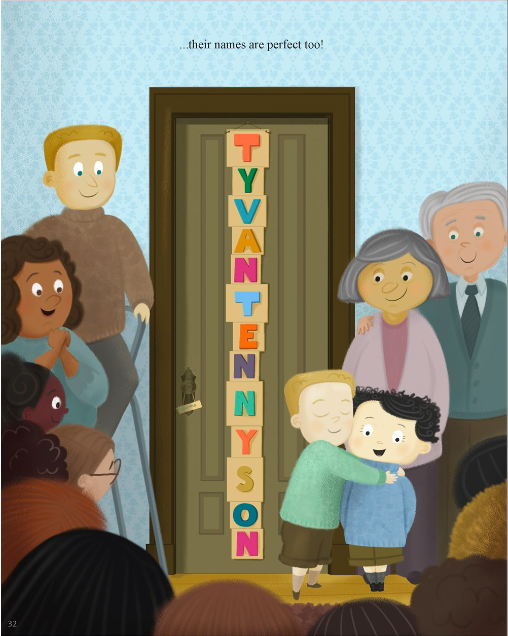
The experience prompted Edimorwhitimormiligimmus to come up with a new plan, a project to ensure all of his friends knew their names were just as perfect for them as Edimorwhitimormiligimmus was for him. And he and his classmates got started with the gift they made for Tyvantennyson to give him at his birthday party.
Copyright Amy Nielander, 2022, courtesy of West Margin Press.
Amy Nielander’s heartwarming and affirming story will captivate kids from the first recitation of “Edimorwhitimormiligimmus Tug”—a name that initially elicits giggles but soon rolls smoothly off the tongue. As they learn how each piece of Edimorwhitimormiligimmus’s name reflects not only the family member he’s named for but also the special things they do together, readers will empathize with the pride he feels in his name and his disappointment when they can’t get it right.
While Nielander’s clever story revolves around one child’s name, there are many other important lessons for both kids and adults woven throughout. Children will understand that their names, personalities, heritage, talents, and dreams are perfect for them just the way they are. For adults, Ms. Mell’s dismissive mangling and shortening of Edimorwhitimormiligimmus’s name to “make it easier for all of us” reminds us that every child deserves to be really seen and accepted for who and everything they are.
Nielander’s illustrations are full of warmth and love, charm and humor as she introduces the unique talents of each member of Edimorwhitimormiligimmus’s inclusive and close-knit family. As Edimorwhitimormiligimmus puts his plan to teach each classmate and Ms. Mell his name into action, the children’s sweet faces and palpable excitement are infectious and will draw readers into this universal hug of a story. The surprise reveal of Ty’s full name and the collective gift the class makes him—with the promise of the same for each child—will delight readers and is sure to spur them to create name signs for themselves.
An engaging, multi-layered story about acceptance, self-esteem, family, and friendship, My Name is Not Ed Tug is a story kids will want to hear again and again. The book is highly recommended for home bookshelves and is a must for classroom, school, and public libraries.
Ages 4 – 8
West Margin Press, 2022 | ISBN 978-1513134871
Discover more about Amy Nielander, her books, and her art on her website.
Take a peek at the book trailer for My Name Is Not Ed Tug!
You can purchase My Name Is Not Ed Tug at these booksellers
Thank you to Hippo Park and Deborah Sloan for sharing a copy of How to Draw a Happy Cat with me for review consideration. All opinions on the book are my own.
How to Draw a Happy Cat
Written by Ethan T. Berlin | Illustrated by Jimbo Matison
As the book opens, an unseen art teacher enthusiastically instructs kids in creating a cat. And not just any cat, but one that will be smiling at the end: “Learning how to draw a happy cat is fun and easy!” The narrator lays out clear instructions and gives an example of how the initial shape and each new addition should look. By the end of the first page spread, kids have a striped yellow cat with eyes, nose, and violet ears but no…mouth. On the page turn, the narrator prompts kids to add a smile. But wait! That smile doesn’t last long. On the next page she’s frowning. “What do you think she wants?” the instructor asks.
Image copyright Jimbo Matison, 2022, text copyright Ethan T. Berlin, 2022. Courtesy of Hippo Park.
The narrator makes some suggestions: “…a cool T-shirt, …a stuffy,” and “Oh, I know—a skateboard!” These items too are sketched out as examples. And, yeah! The cat is “totally happy now!” This happy cat has some moves on the skateboard too. Her wide smile just shows how happy she is. Even the unicorn on her T-shirt is grinning. But the stuffy? He’s looking a little glum and it brings down the whole vibe. Happy Cat is no longer happy.
Image copyright Jimbo Matison, 2022, text copyright Ethan T. Berlin, 2022. Courtesy of Hippo Park.
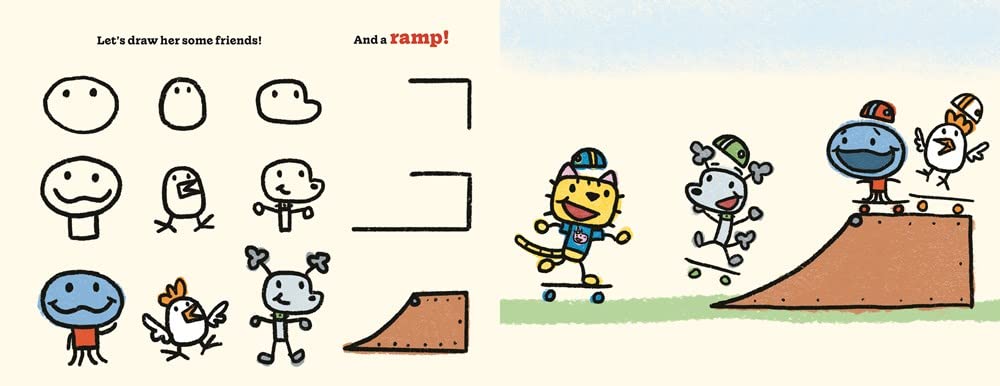
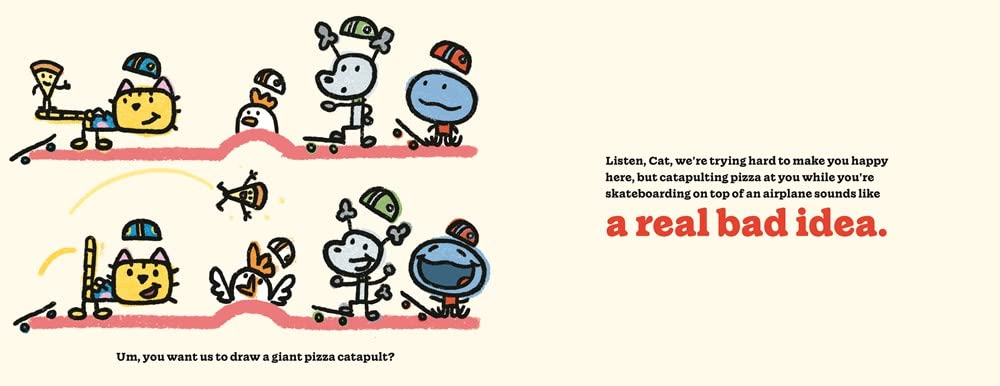
The instructor seems to know what’s needed and suggests readers “draw her some friends! And a ramp!” Now that’s more like it! A four-legged alien-type guy, a chicken, and a dog make very happy friends. So they’re soaring into the air off the ramp on their skateboards and… Oh no! You know—what goes up must come down. Suddenly, Cat is afraid. Down, down they begin to fall. What can readers do?
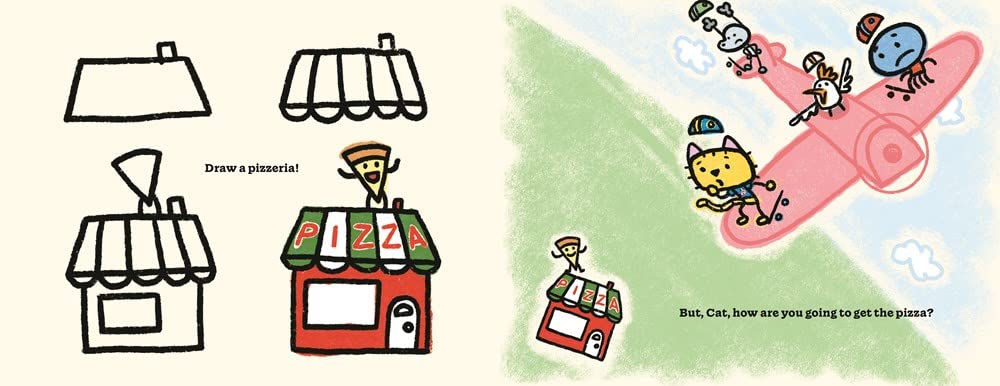
Quick as you can say “airplane,” readers can help a winged and propellered rescue appear. Phew! Now they’re all happy again. Turns out, though, that skateboarding on a plane whips up quite an appetite, and now Cat is hungry. How can readers help? Well, wouldn’t a slice of pizza taste delicious? Kids learn how to draw a pizzeria and a cheesy slice, but delivery? That could be a problem.
Image copyright Jimbo Matison, 2022, text copyright Ethan T. Berlin, 2022. Courtesy of Hippo Park.
Cat has an idea, and while it works… it kinda, also…doesn’t. Now Cat and her friends are falling once again. Luckily readers are right there to remedy the situation, and all turns out great. So great that Cat and her friends want to celebrate. They can’t do it without decorations, music, entertainment, and some really cool hats, though, so it’s up to readers to create the most awesome party ever to “draw a happy cat!”
Image copyright Jimbo Matison, 2022, text copyright Ethan T. Berlin, 2022. Courtesy of Hippo Park.
Starting out with a straightforward drawing lesson, Ethan T. Berlin and Jimbo Matison soon raise the stakes for readers by putting them in charge of pleasing this mercurial cat. Berlin’s enthusiastic narrator makes helpful suggestions throughout the story that prompt kids to use their natural creativity to make Cat happy while Matison actually teaches them how an artist or cartoonist puts together shapes to draw a vast array of characters, objects, moods, and action.
On top of this, Berlin’s rollercoaster story will have kids giggling on every page, and well-placed questions get them thinking about how happiness can turn to sadness or dissatisfaction (for Cat as well as themselves) in the blink of an eye (or the turn of a page) and how those moments can be turned around or amended. The story’s last line gives readers an opportunity to start all over again—or, now that they’ve got the skills, even come up with their own story to write and illustrate.
Matison’s cartoon characters (sometimes charmingly colored outside the lines) are energetic and optimistic, reveling in new playthings, friends, and experiences. Kids will love watching for Chicken’s reactions, one funny placement of a pizza slice, and a few mishaps that foreshadow the book’s cyclical ending. Colorful type highlights strong emotions, especially when Cat is happy.
Sure to make kids laugh and get excited about writing and drawing as well as providing an organic way to talk about emotions and ways to create your own happiness, How to Draw a Happy Cat makes a terrific addition to home bookshelves as a favorite story time read and go-to book for impromptu drawing fun. The book is highly recommended for school and public library collections, where it will certainly enjoy frequent rotation and its multiple layers inspire participatory programs.
Ages 4 – 8
Hippo Park, 2022 | ISBN 978-1662640049
Discover more about Ethan T. Berlin and his books, TV shows, and other funny stuff on his website.
To learn more about Jimbo Matison, his books, design work, and TV shows, visit his website.
Laugh—or commiserate—along with this How to Draw a Happy Cat book trailer!
How to Draw a Happy Cat Book Birthday Activity
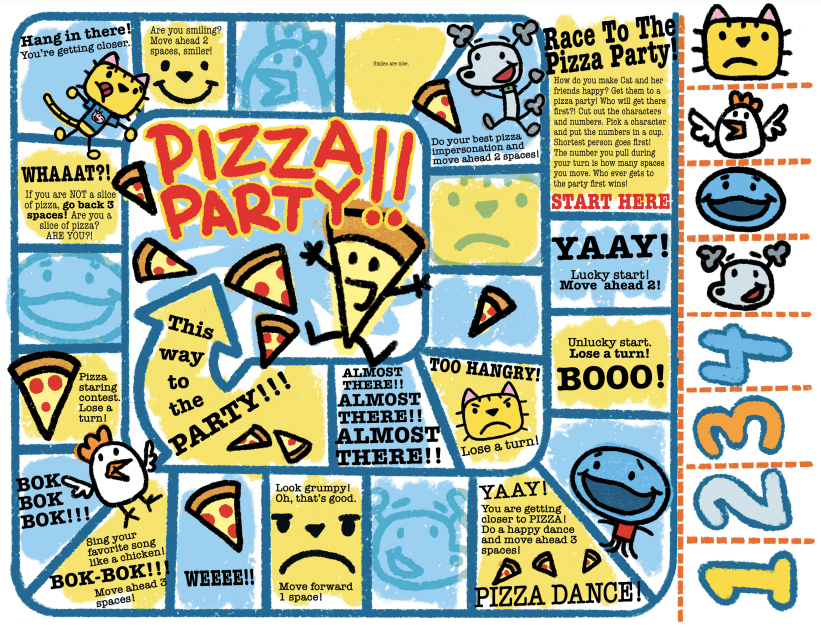
Pizza Party Board Game and Drawing Kit
Can you make Cat and her friends happy by getting them to the pizza party? Just pick your character, draw numbers to move around the board—and have some fun on the way! Play the game with your friends and then learn how to draw a happy chicken by downloading the How to Draw a Happy Cat Activity Kit from Hippo Park!















 celebratepicturebooks.com