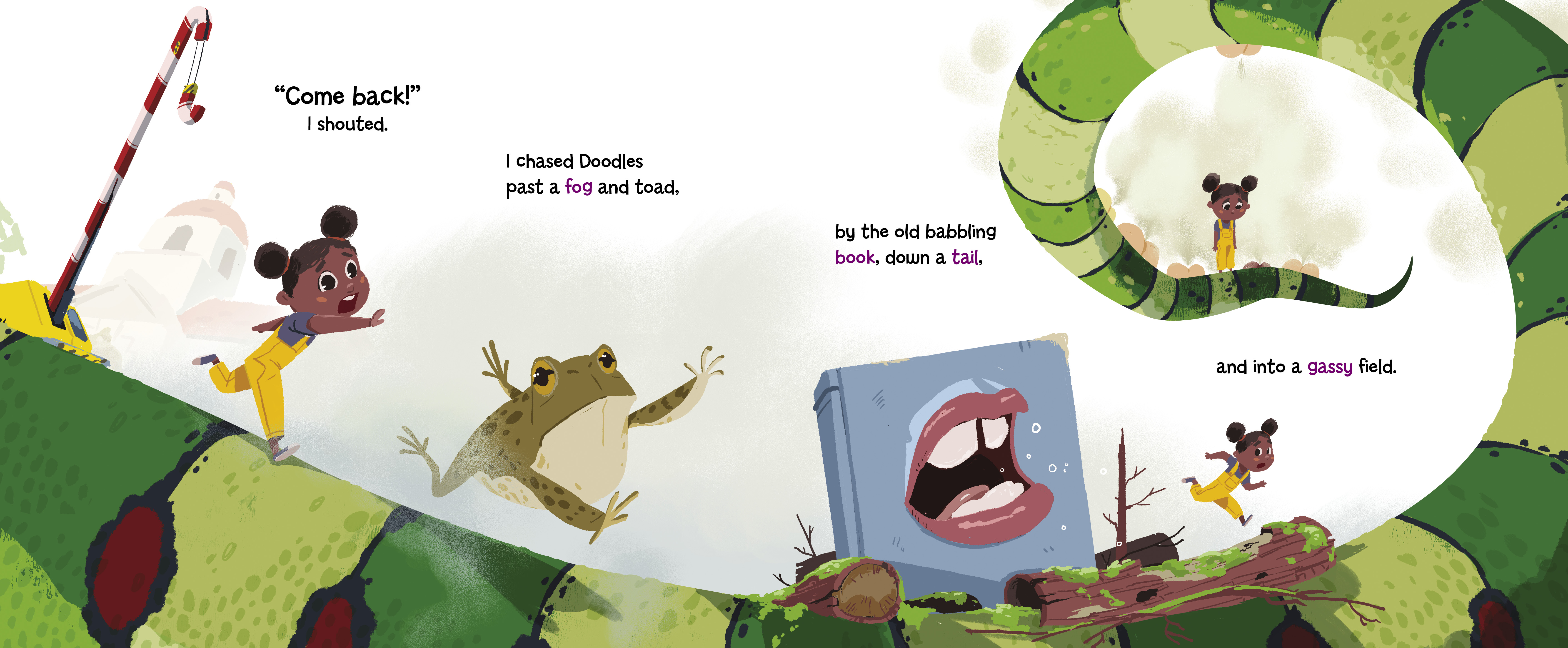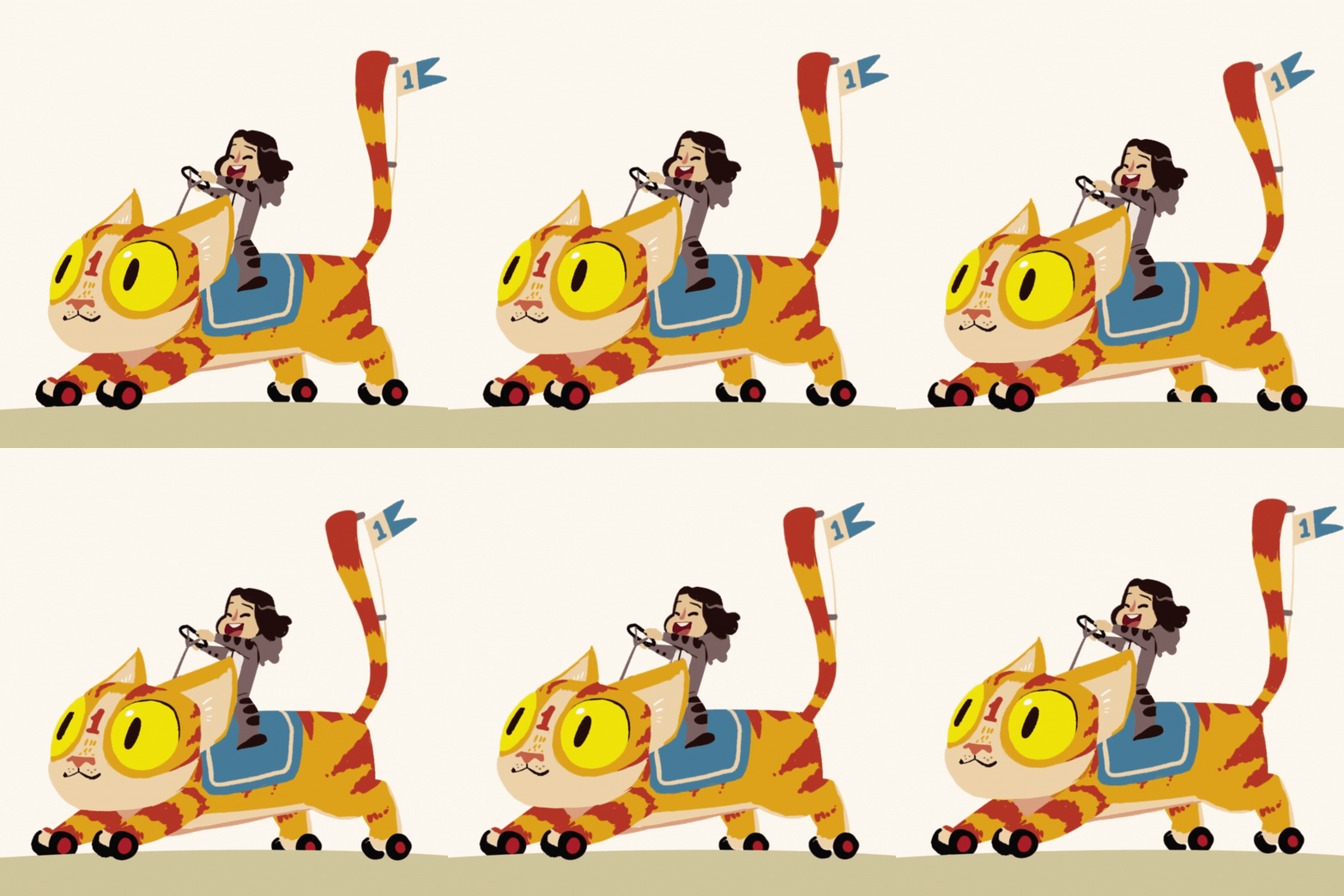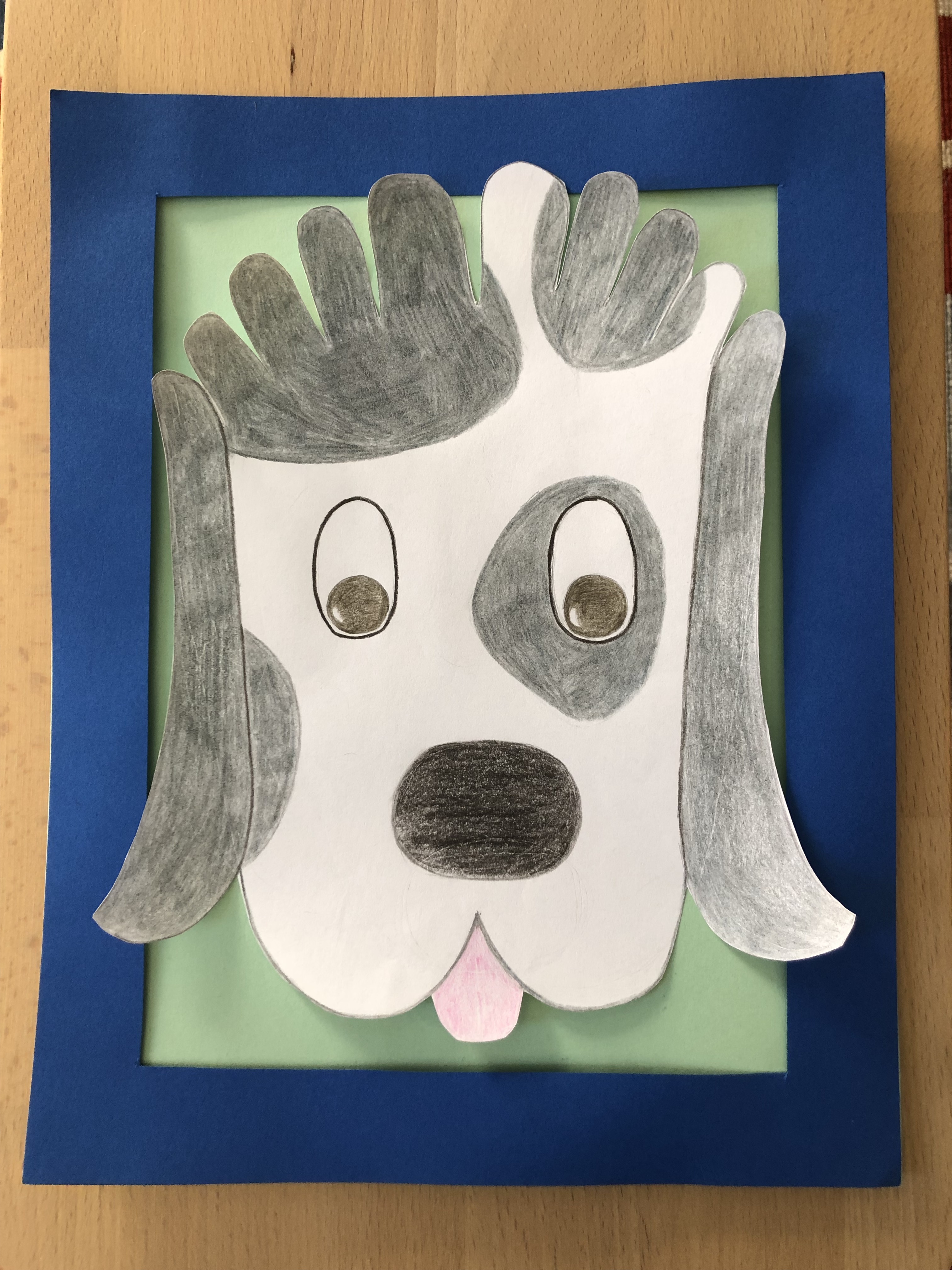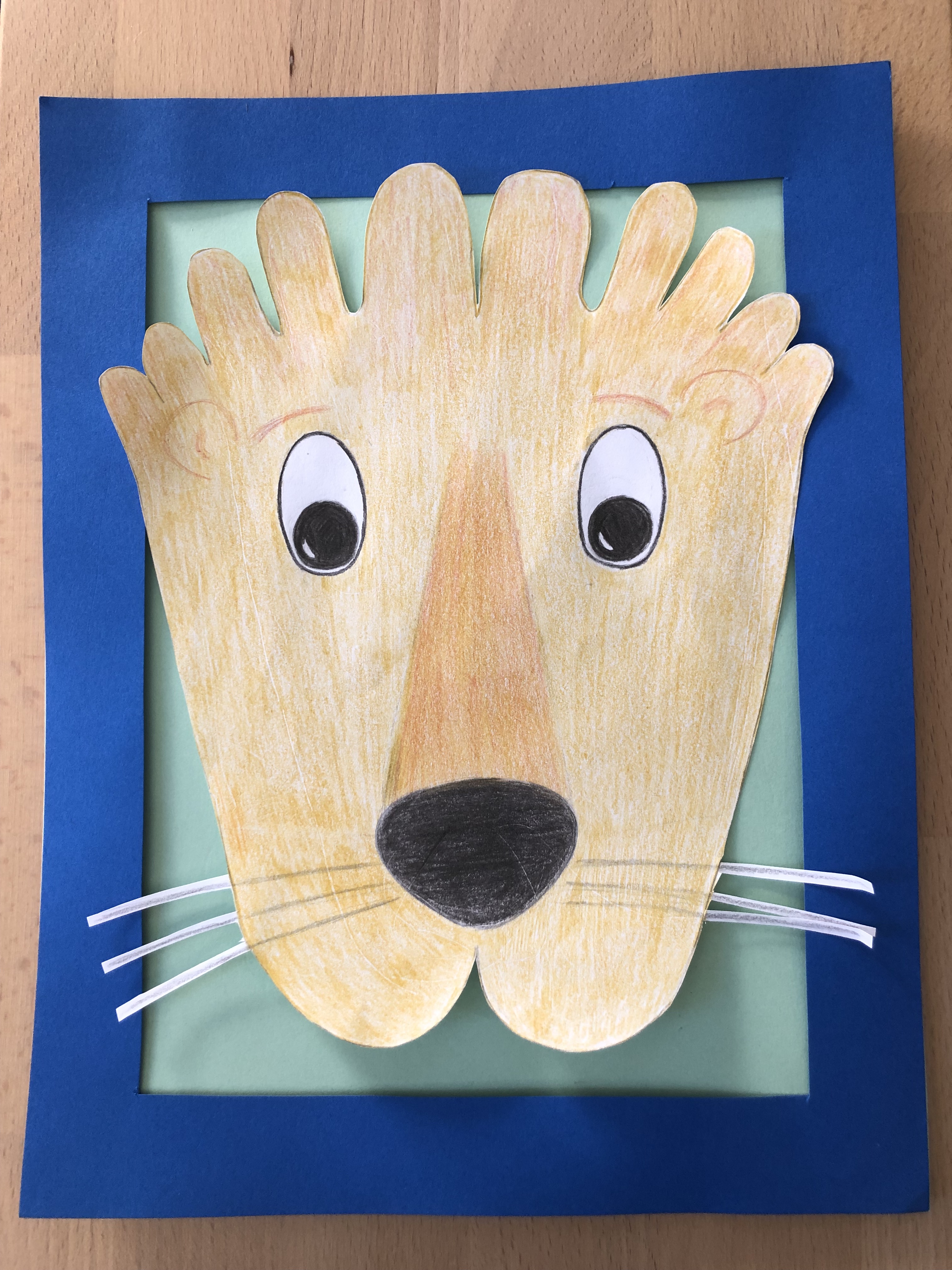
April 16 – National Stress Awareness Month

About the Holiday

Stress Awareness Month has been held every April since 1992, when it was founded by the Health Resource Network. The holiday aims to help people identify the stress factors in their own life as well as to assess how all members of their family are handling various pressures. The goal is for everyone—either individually or together—to look for ways to manage their feelings while adding positive changes to their life. Talking about pressures with kids and doing simple activities with them can often help lessen the load. Sharing today’s book is a wonderful place to start!

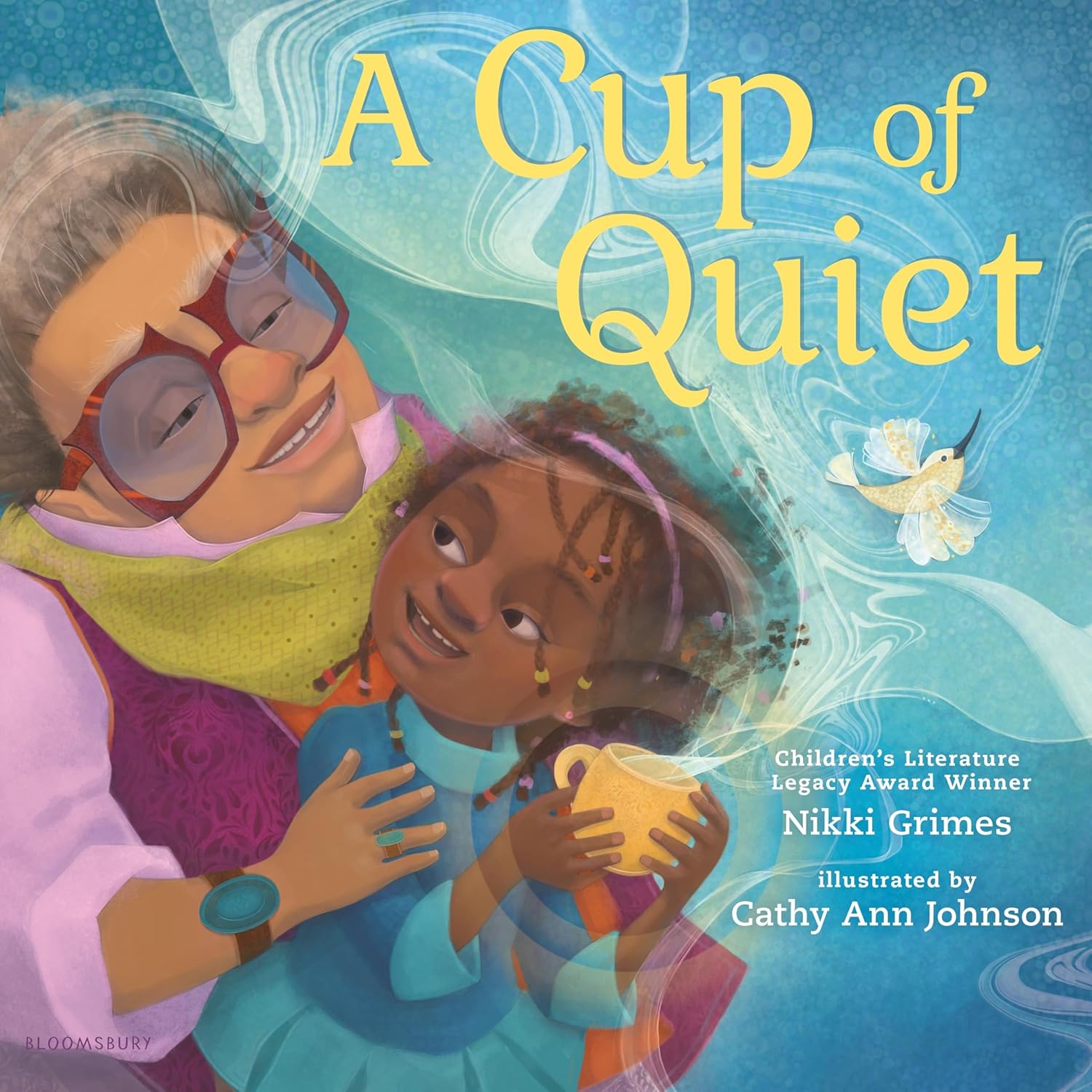
A Cup of Quiet

Written by Nikki Grimes | Illustrated by Cathy Ann Johnson

“You ever hear of smiles?” The young narrator’s talking about the two-week “summer camp” she gets to spend with her grandmother every June. In that breathless excitement of children, she reveals the visits give her and her Grandma time to “stitch sock puppets and put on shows, bake Martian Cake that tastes like banana bread and play tea party in the garden with my dolls.” But today, they’re acting out a story—that is until Grandpa’s hammering and loud music become just too much.
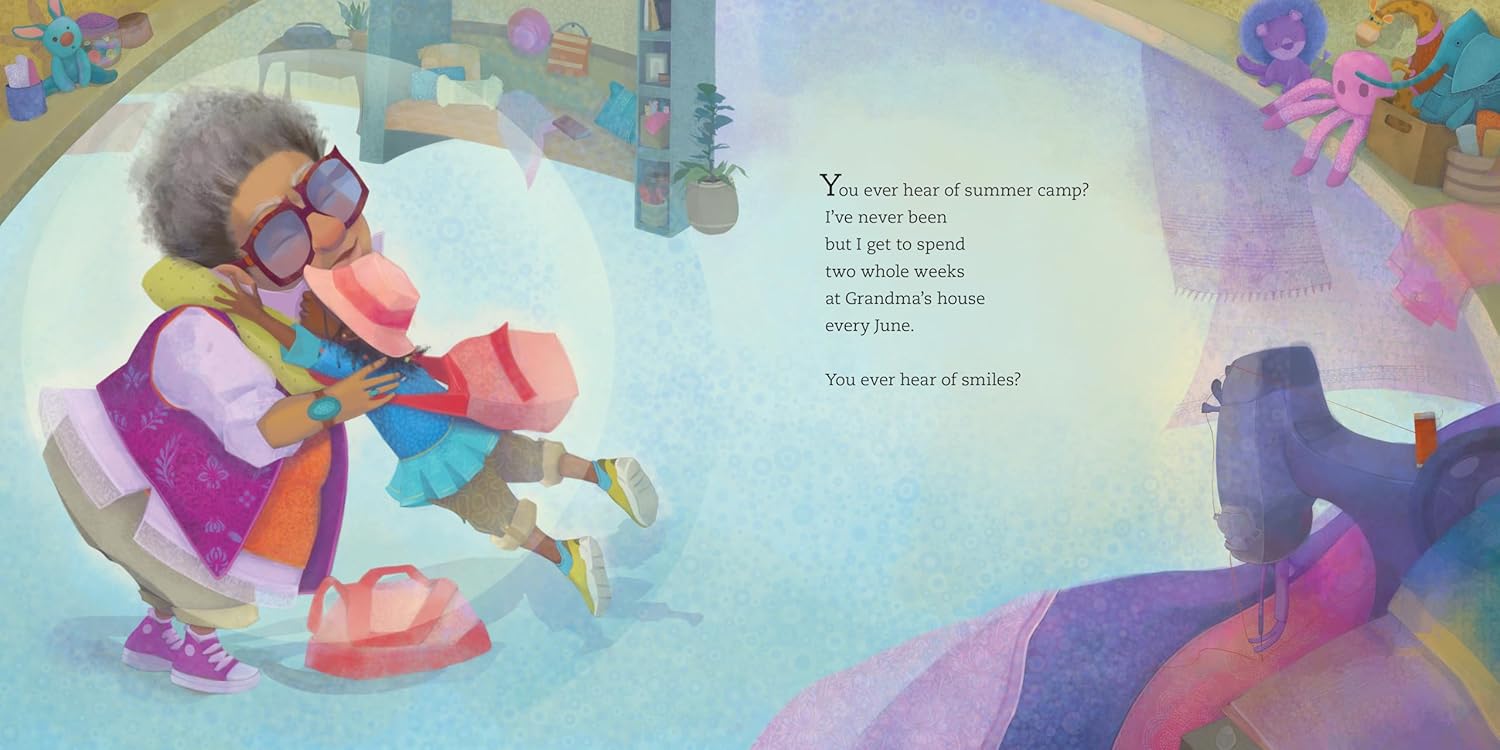
Illustration © 2025 by Cathy Ann Johnson, text © 2025 by Nikki Grimes. Courtesy of Bloomsbury Children’s Books.

Grandma flops into her chair with an “Ugh!” and tells her granddaughter she’s “thirsty for a cup of quiet.” This elicits a giggle and a bit of disbelief, but Grandma’s done with the noise and leads her granddaughter outside to the porch swing. But the city outside their house is just as noisy as Grandpa inside. A trip to the backyard garden is needed. Here, Grandma may be happy, but the narrator is getting fidgety.
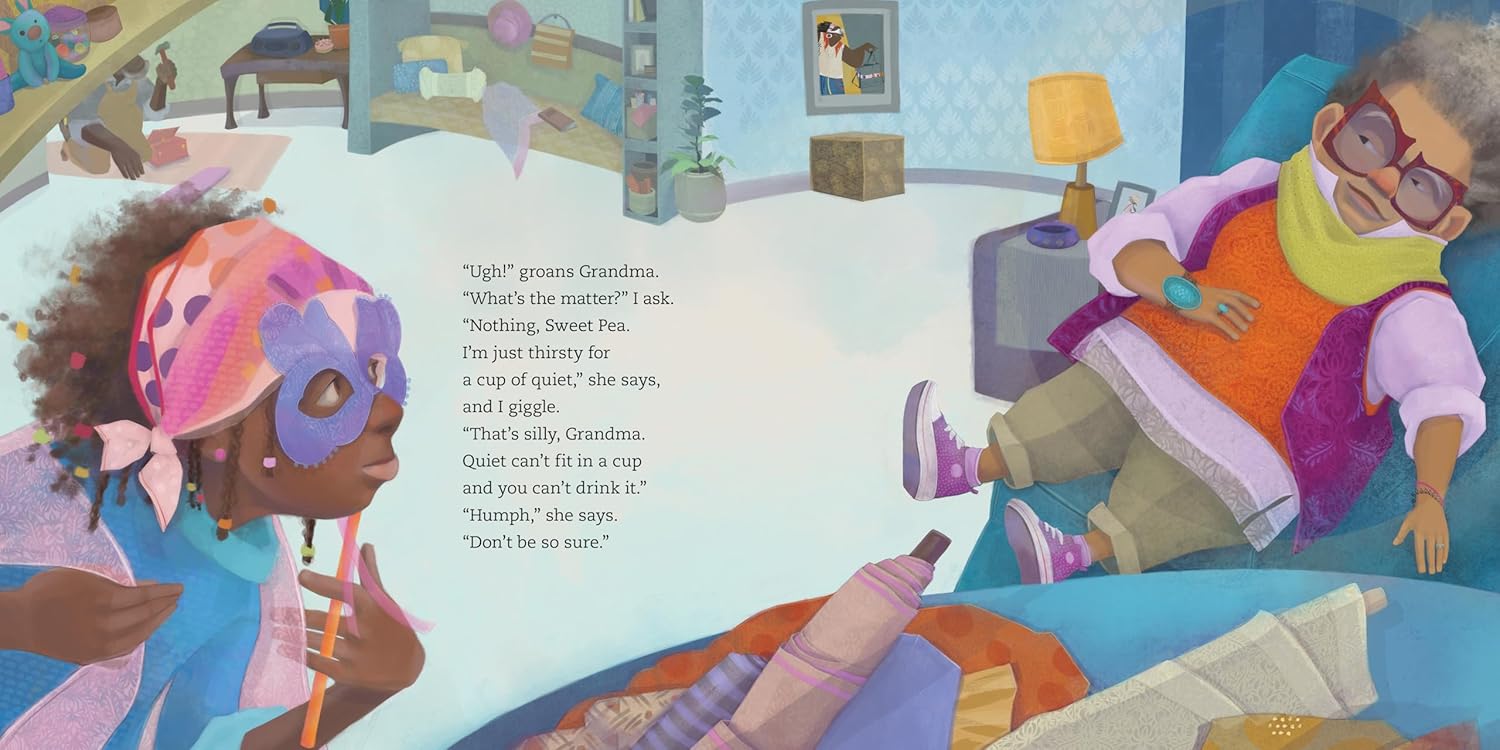
Illustration © 2025 by Cathy Ann Johnson, text © 2025 by Nikki Grimes. Courtesy of Bloomsbury Children’s Books.

Grandma gives her the side-eye and then hands her “an invisible cup” with instructions to “‘walk around the garden and fill this up with any sounds you hear.'” Up for this imaginative challenge, the girl first visits the rose bushes, where a bee is working and “snap[s] up a handful of his buzzing and drop[s] it in the cup.” On the ground below she sees a lizard and “spoon[s] up” the sound of its “scuttling across a dried leaf.” She begins paying more attention to the nature around her and listening harder to fill her cup.
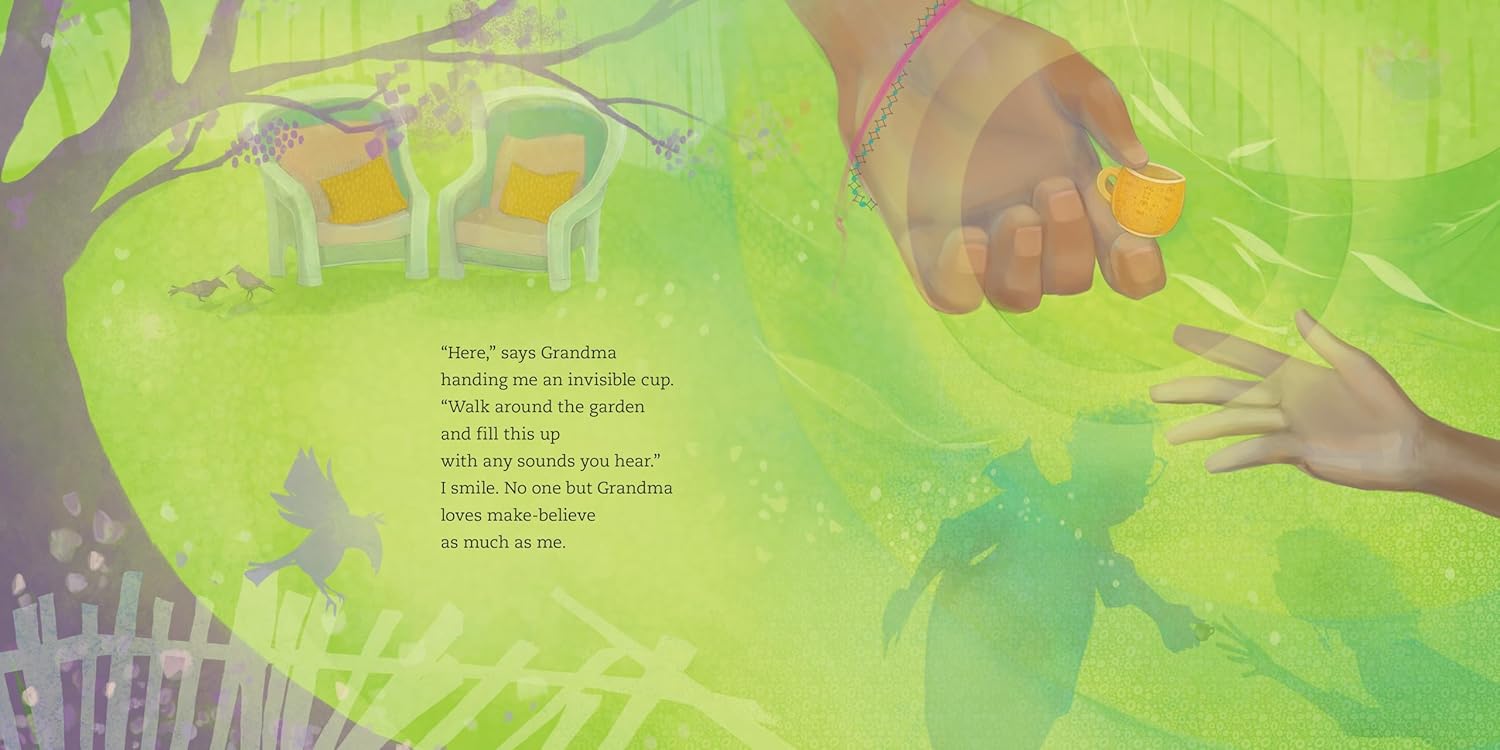
Illustration © 2025 by Cathy Ann Johnson, text © 2025 by Nikki Grimes. Courtesy of Bloomsbury Children’s Books.

A sudden thunderclap precipitates a downpour, but before she runs inside with Grandma, the narrator adds the first pings of raindrops on the roof to her nearly full cup. After drying off and changing, it’s finally time to enjoy a long sip from that make-believe cup. Ahhhh! So “‘refreshing!'” Her granddaughter thinks so too. Still, she has an observation: “‘… your quiet is awfully noisy!'” Grandma smiles and says, “‘I know, but Nature’s noise is peaceful, and I love that.'” Her granddaughter agrees—”You ever hear of perfect?”
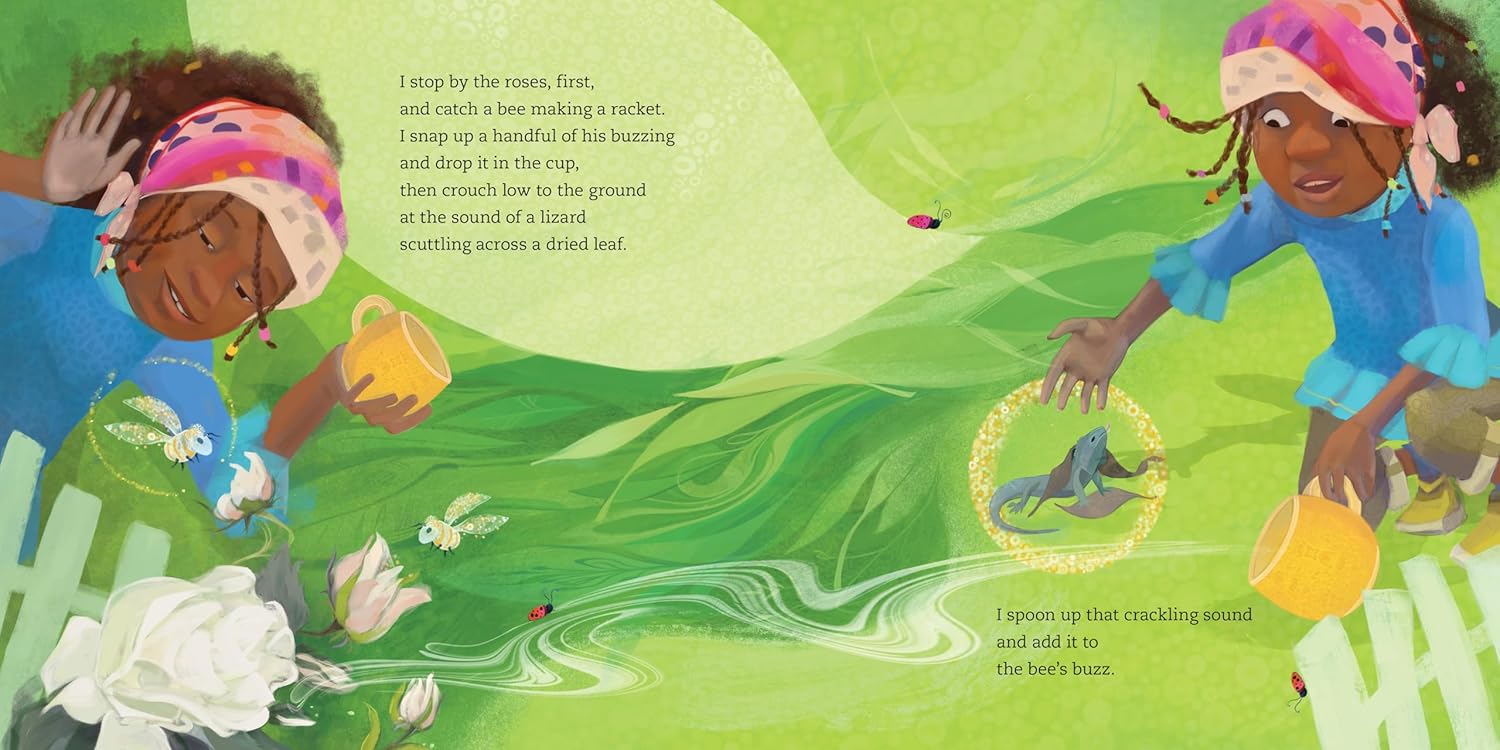
Illustration © 2025 by Cathy Ann Johnson, text © 2025 by Nikki Grimes. Courtesy of Bloomsbury Children’s Books.

Nikki Grimes invites readers to join in with a grandmother and granddaughter for a day of “summer camp” where love abounds. The easy banter between the two and affectionate gestures—such as Grandma’s playful tug on her granddaughter’s braid and the jump-into-her-arms hug the girl gives her grandma—immediately envelope both child and adult readers in this pair’s warm relationship. Grimes’ inventive call to interact with nature and find comfort there will have kids carrying their own imaginary cups to fill and spark other creative games and activities no matter where they live. 

Cathy Ann Johnson’s collage-style, mixed-media illustrations sweep readers into the creative and close-knit atmosphere of Grandma’s house during a week-long visit by her granddaughter. The vibrancy of the pair’s connection is shown through the colorful textures of the fabrics they use for crafting. The allure and importance of nature is likewise emphasized through the vivid greens and swirling motion in the grandmother’s back garden as well as the shimmering beauty of the creatures from which the girl collects sounds. The grandmother and granddaughter’s close bond is evident through their hugs, the way they sit close together (even touching hands while sitting in separate garden chairs), and the care Grandma provides after the rainstorm. The grandmother’s expressions are amusing in their honesty, and the look of wonder in the granddaughter’s eyes is inspirational.

Lyrical, playful, and full of love, A Cup of Quiet is a warm hug of a read aloud that adults and kids will love sharing again and again. The book is a must addition to school library, public library, and home collections.

Ages 3 – 7

Bloomsbury Children’s Books, 2025 | ISBN 978-1547610730

A Talk with Nikki Grimes
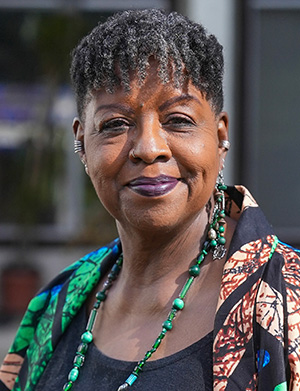
Photo Credit Marchel Hill

New York Times bestselling author Nikki Grimes was inducted into the Black Authors Hall of Fame in 2023. Her honors include the CSK Virginia Hamilton Lifetime Achievement Award, the ALAN Award for significant contributions to young adult literature, the Children’s Literature Legacy Medal, and the NCTE Award for Excellence in Poetry for Children. Author of the Coretta Scott King Award-winner Bronx Masquerade, and five Coretta Scott King Author Honors, she won the Printz Honor and Sibert Honofor her memoir Ordinary Hazards. Her latest titles include Garvey’s Choice:The Graphic Novel, a School Library Journal 2023 Best Book; Lullaby for the King, one of Book Riot’s 25 Best Christmas Books of All Time; and A Walk in the Woods, recipient of 8 starred reviews, and 11 Best Book listings for 2023, including the New York Times, NPR, and Smithsonian Magazine. Ms. Grimes lives in Corona, California. You can visit her at nikkigrimes.com.

Today, I’m honored to be talking with Nikki Grimes about the inspiration behind A Cup of Quiet, how she develops her characters, the joys and challenges of writing for multiple age groups, and much more!

A Cup of Quiet is a perfect book for adults and children to share, not only for outside noise but for times when life gets overwhelming.  Tell us about the inspiration for this story and a little about its journey to publication.

There’s a certain quality of quiet in nature that I’ve always found soothing. I need silence for my work because it allows me to concentrate fully when I write. But nature’s quiet is different. It’s rich with sound, but most of it requires you to pay close attention. To pick up the whir of a hummingbird’s wings, you have to be still, and you have to strain to hear it. The stillness that’s required is soothing, and the sounds you become attuned to are a healing balm. I wanted to write a story that celebrated those sounds, and the beauty of that kind of quiet.

In the early stages of the book, I’d go out to my garden and listen carefully, and I’d make mental notes of all that I heard that day. I’d jot everything down until I had a good list of sounds to play with.

My main character lived in the city and didn’t spend much time out in nature there, though she occasionally went to the park. But every summer, she’d travel out of the city for long visits with her grandmother who had a garden, and whose house was surrounded by trees, and greenery.

The story grew from there, and I knew immediately that I wanted Bloomsbury to publish the book, and I also knew intuitively who I wanted to illustrate—namely Cathy Ann Johnson. This teaming has proven to be perfect, all around.

If I had a cup to fill with quiet today, I’d add my cat’s little sleepy, dreamy purrs, the whoosh of cars passing my house, the rustle of squirrels in the trees, and a drop of water from my bubbling teapot. What would you put in your cup of quiet today?

I would put a bee’s buzz, the wind rustling leaves of a tree, the whir of a hummingbird’s wings—all the sounds I chose for A Cup of Quiet. Those are some of the sounds I listen for, and pay attention to, whenever I immerse myself in nature.

Cathy Ann Johnson’s mixed-media illustrations are a wonder of color, motion, humor, and the love between grandmother and granddaughter. What was your first impression when you saw her illustrations? Do you have a favorite spread?  Why is it a favorite?

First, I was over the moon for the grandmother! She had energy, and spunk, and style. I loved her!  And I loved her colors. Then, as I saw the book’s interiors, I was absolutely thrilled! Cathy Ann’s images, and their movements, were as lyrical as my own words. Our partnership on the page was the proverbial match made in heaven. I would be loath to choose a favorite spread.  Each one has its own magic.

A Cup of Quiet starts out “You ever hear of summer camp?”—a disarming introduction to the child narrator that’s so true to the way kids approach conversation. The dialogue in all of your work sings in this way with the kind of honesty, humor, emotion, and depth that makes your characters seem almost physically with the reader.  I’m curious about your process in developing your characters and stories.

My characters begin with a voice. I’ll hear a scrap of dialogue in my head—nothing extensive, just a few lines. The inspiration might come from the catalog of voices I’ve stored in memory over a lifetime of listening to people around me, or it might be the voice of a particular person in my life whose voice is special or one that has simply stayed with me for a long time. Either way, the voice feels familiar. I’ll jot down that scrap of dialogue as reference, then I’ll begin developing a character sketch and that character’s backstory. I never know how much or little of the backstory I’ll use, but that information guides me as I write. To nail the voice, I have to pay close attention. I climb into the character’s skin and look at the world from his or her perspective and write from that place, attuning myself to that character’s age, birth place, geographical region, quirks, fears—all of it guides me as I make decisions about what that character will say, how they’ll respond to various stimuli that shows up in the plot. If I step wrong, the character will bristle and call me out on it, almost audibly. “Do not put those words in my mouth! I would never say that!” or “I don’t speak like that!” It’s kind of eerie, actually. Characters can be very bossy!

You write books for all ages, from picture books to middle-grade to young adult. Can you talk a bit about the joys and challenges of each? What is one message you want readers in each age category to take away from your books? 

Each age format comes with its own set of limitations, constrictions, and also its own range of possibilities. I love mixing it up. Writing for different age groups keeps me on my toes. The picture book gives you very little room to develop character and plot, while, say, a young adult novel gives you so much unlimited space that you run the risk of overwriting, and of getting lost in the weeds of your plot, or tangled in the layers of your story. Being consistent with your tense or bookending your story in a way that is controlled and satisfying and that feels organic, is much more challenging in the long form of middle grade or YA storytelling.

Language choices are tricky, and different with each age group as well. You walk the line between accessibility and sophistication, between simplicity and complexity. The same variance is true of the emotional components appropriate for each age group as well. For those reasons, I think it’s wise to focus on one genre at a time until you work through the quirks of that genre and figure out a process that works for you. Then, by all means, go on and experiment with the next! It’s tough work, but I like that. For me, easy is boring!

As for your question about messages, I don’t write messages. I write stories. And a well-written story offers a number of ideas a reader might take away. It all depends on the particular reader. We bring ourselves to the page, as readers. Our own experiences, personalities, and what we need at a particular point in time, color what we see, what we notice, and what we ultimately take from a story. Of course, as the creator, I have a certain idea, or theme, I intend to weave into my story—and, by the way, it’s hard to know whether or not I’ve always succeeded—but I don’t worry about whether the reader will pick up on the specific note I had in mind. What matters to me is that, somewhere in the many layers of my story, readers find something valuable with which they resonate. Quite often, the things they find come as a surprise to me, but that’s okay. So long as they walk away with something of value to them, that’s all I can ask for.

While I read through your website, your generosity in sharing so much of your life really stood out.  I’m sure young readers and writers would love to know about when you first began writing and how you were recognized for your talent, having your first public reading when you were 13.  Could you share a little of our writing background with us?  What advice would you give to children and young adults who love to write and want to pursue it?

As I reference in my memoir Ordinary Hazards, and elsewhere, I started writing in earnest when I was six years old, and I did so because I would have burst, otherwise. I was so filled with the emotional and mental poison of anger, and pain, and confusion. I was desperate to get my feelings out, somehow. So, I began to pour those feelings onto a page. That’s how my writing began, but as I reached my teens, the idea of possibly pursuing writing as a career took root. I was encouraged by my father, by my sister, by the friends I dared share my poetry with, and later, by a couple of teachers.  At the same time, though, I also had peers who laughed me off the block for daring to dream of such a thing at all. But I decided early on to surround myself with other young people who nurtured dreams and goals of their own. Everyone else, I cut out of my circle. I refused to absorb the negativity of naysayers.

I encourage young people who have a heart for writing to read voraciously, and to read across genres.  Every genre has something to teach you, and the quality of your writing reflects the quality, variety, and breadth of your reading. So read, read, read.  

Next, write, write, write because writing is a muscle. You have to exercise that muscle if you want to become strong. There is no shortcut to excellence. And if you’re not going to pursue excellence, why even bother? Excellence is what your readers deserve. Remember: the world doesn’t need mediocrity, no matter what field you choose to pursue.

In addition to your many awards over the years, you received the Children’s Literature Legacy Award in 2017 and the Coretta Scott King-Virginia Hamilton Award for Lifetime Achievement Award in 2022. In 2023 you were inducted into the Black Authors Hall of Fame.  What does this recognition mean to you?

Recognition is affirmation, and who doesn’t appreciate that?  But an artist should never be satisfied to sit on their laurels. I use this recognition as fuel to keep pushing forward, to continue to stretch myself as an artist to try genres I’ve never attempted before, to explore forms of poetry I find challenging. Doing so keeps me alive, and grown, and excited about the work I’ve been doing professionally, now, for nearly 50 years. That way, even as I get old, my work never does!

What books of yours can readers look forward to next?

I have a new Dyamonde Daniel chapter book coming out in June.  It’s titled Loser, and it’s about healthy and unhealthy competition, and where to draw the line, especially when you’re competing with your best friend.

I also have a new picture book on the horizon, titled Stronger Than, a collaboration with Choctaw author, Stacy Wells and illustrated by E. B. Lewis, who I’ve worked with before. In this story, a Black Choctaw boy discovers the history of one ancestor who survived the Trail of Tears, and another ancestor who survived the Tulsa Race Massacre. Through their stories, he learns that he comes from stronger stock than he knew, and this knowledge helps him overcome one of his worst fears. I’m excited about both books, for very different reasons.

There are a few more books in production, as well, but it’s too soon to talk about those.

Is there a question I didn’t ask that you wish I had?  What would your answer be?

No. I think I’m about talked-out, for the moment!  This has been fun, though. And I hope you and the young readers in your life enjoy A Cup of Quiet.

Thank you so much, Nikki! It’s been terrific chatting with you! I wish you a wonderful spring and summer of nature’s refreshing quiet.
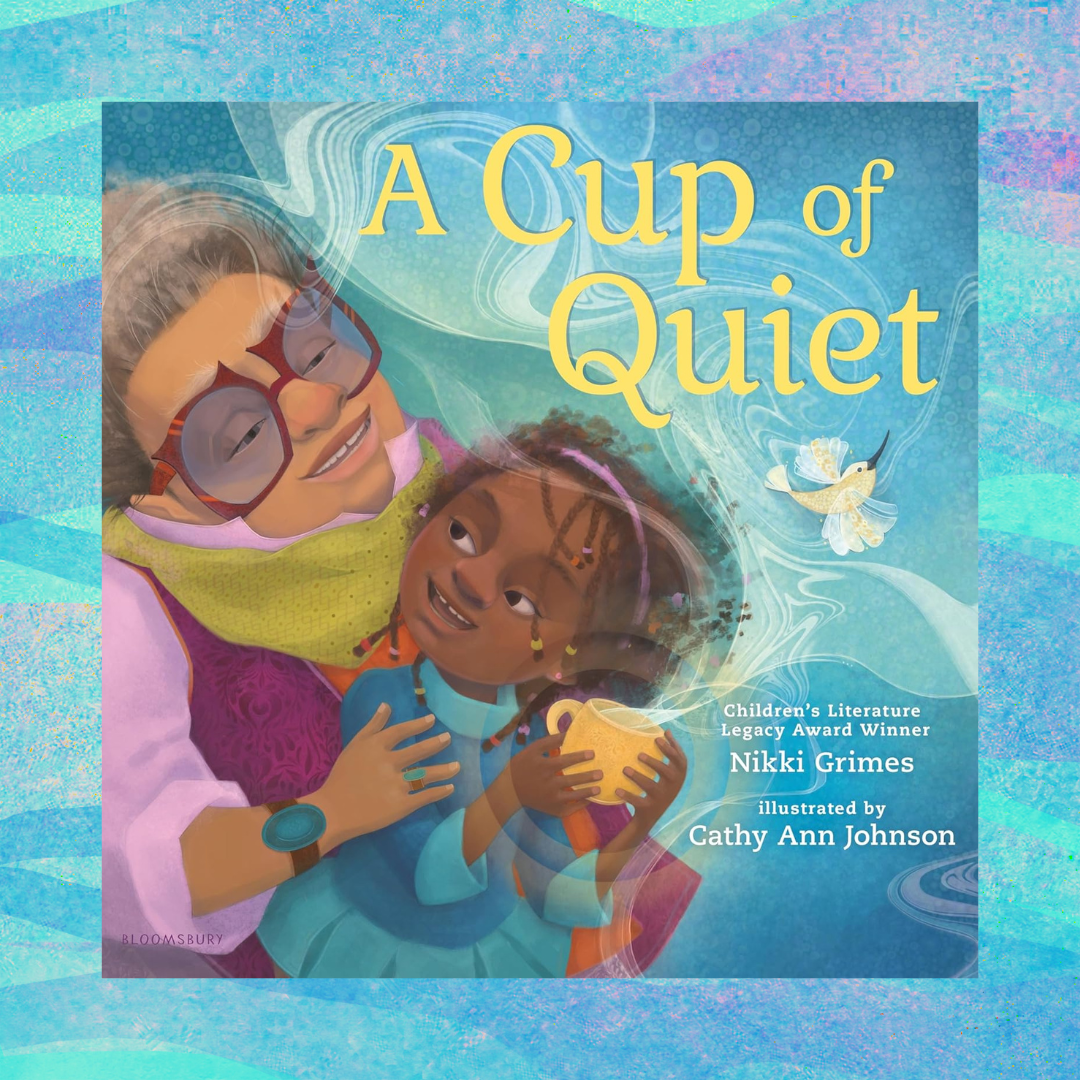
You can purchase A Cup of Quiet from these booksellers

Amazon | Barnes & Noble | Bookshop (discounted books and support for your local independent bookstore)

Picture Book Review

March 24 – Cover Reveal for ARLO

ARLO

Written by Sophia Gholz | Illustrated by MacKenzie Haley


ARLO works on the assembly line like the rest of the robots. But unlike the others, ARLO longs for something different. Then one day, a surprise changes everything. Follow this exciting adventure as ARLO discovers the unknown, learns home is where the metal heart is, and that “something different” can be created in many ways.

Meet Sophia Gholz

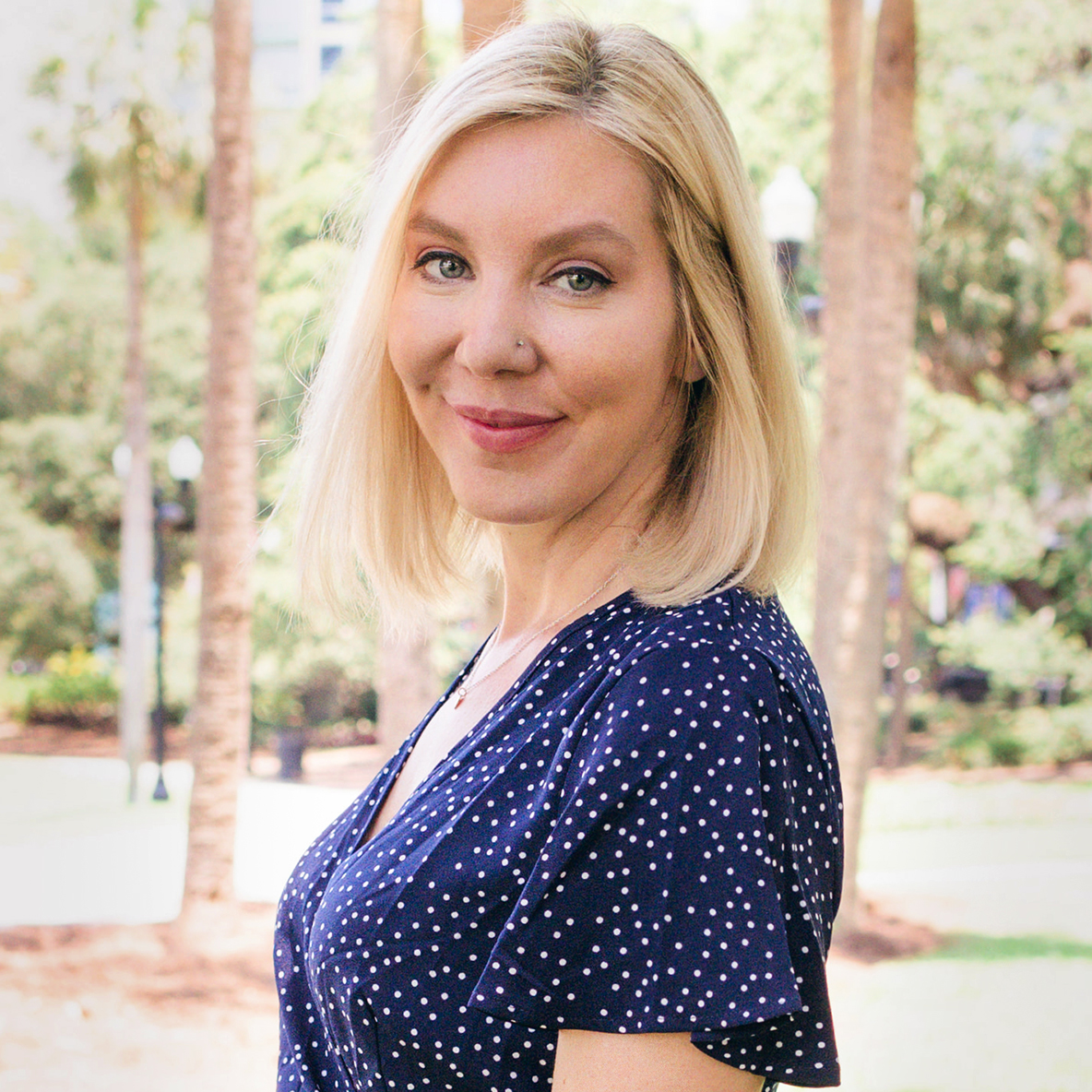
Sophia Gholz is an award-winning children’s book author, poet, magic seeker, and avid reader. Sophia enjoys writing fiction with humor and heart. When writing nonfiction, she pulls on her love of science and her strong family background in ecology. Since 2017, Sophia has helped oversee the Henry L. Gholz SEEDS National Field Trip Endowment for The Ecological Society of America, funding ecological field experiences for students. Sophia is the author of The Boy Who Grew a Forest: The True Story of Jadav PayengThis is Your World: The Story of Bob Ross, Bug on the RugA History of Toilet Paper (And Other Potty Tools), Bear at the Fair, and more. When she’s not writing from her home base in Florida, you can find Sophia reading, visiting schools, or exploring the great outdoors with her family. For more, visit Sophia at: www.sophiagholz.com.

Hi Sophia, I’m so excited to be sharing the cover for your adorable book! Just look at that face! ARLO melts your heart! I’m also happy to be talking to you about how ARLO came to be and so much more. I can’t wait to get started!

Robots are both timeless and timely—and, of course, always kid-favorites!  What was the inspiration behind ARLO?

ARLO actually began as a writing exercise a decade ago, in May of 2014. At the time, the buzzword in the picture book world was “character,” and agents and editors were hungry for “character-driven pictures books.”

Now, I know authors aren’t supposed to write for the market. Instead, you write the story that suits you and hope it fits into the market. However, at that time I was still fresh to the world of picture book writing. I wasn’t agented or published. I was still learning how to craft a story and hadn’t studied much on character building. So, I took the buzzword of the day and decided I wanted to explore that idea. In doing so, I created a metal bot that longed to swim, but couldn’t because—as the line when in my original manuscript said—“His boots sink like bricks, his gears rust, and oil and water don’t mix.”

Similar to the ARLO of today, this original bot worked on a factory assembly line and longed for something different. But unlike ARLO, that original bot had eight arms (like an octopus) and because he loved water, I called him Robotopus. It took me over a decade, 60+ drafts, and so many different variations to finally find ARLO at the heart of this story. And that is exactly why you don’t write for the market and instead write for yourself. It wasn’t until I let go of what I thought this story needed to be and allowed it to become what it was naturally that it clicked.

Growing up, did you have a favorite robot character in books, TV, or movies? What was it about that robot that you liked best?

I’ve always been a huge techy/sci-fi and fantasy fan! One of my favorite childhood movies was called Flight of the Navigator. I loved that film as a kid and it definitely sparked my interest in out-of-this-world robots at a young age. Flash forward, my daughter was on a competitive robotics team in school and that continued to fuel my love. But I’d be remiss if I didn’t shout out Disney’s WALL-E here. That little bot stole my heart from the get-go! In fact, I pitched ARLO’s story as “WALL-E meets The Wizard of Oz.”

Can you talk a little about the journey of this book from idea to publication?

Some books pour out in final form within a matter of hours. Other books take years. ARLO was one of the latter. The first draft was written in May of 2014. I’m one of those writers who likes to save all of their drafts as I revise in case I need to pull something from or revert back to a previous version of a story. So, it’s pretty easy for me to look back now and see exactly how this story changed and shifted over the years.

From the first draft, I fell in love with my little robot. I knew from the start he worked in an industrial factory, but needed nature and longed for something different. In those first drafts, my robot wanted to swim and he used his factory skills for building a suit to help him achieve that goal. That original story actually won an SCBWI Rising Kite Award in 2017. Still, I knew it was missing something. Like my little bot, the story longed for something more. I just couldn’t figure out what that was.

I eventually shelved this manuscript as I focused on other projects. But my bot lived on in my mind. Over the course of ten years, while I was in between other projects, I’d pull this manuscript out of the drawer and completely rework it again and again. Robotopus became Robbie, then Robotika, who morphed into Zigbee, then Ozzy, and ARO, who finally led me to ARLO.

It wasn’t until I let go of the idea of swimming (which I held onto for SOOOO long) and allowed ARLO to tell me what he wanted instead of me telling him, that his story finally poured out in late 2019. But in 2019, two things happened simultaneously: 1) my first book (a nonfiction book titled The Boy Who Grew a Forest) was released and 2) the pandemic struck. As a result, ARLO was shelved again, and it would be another two years before his story would be sent to editors for consideration.

When Sarah Rockett at Sleeping Bear Press made an offer, I jumped on it. I didn’t want the manuscript going anywhere else. Sleeping Bear makes such beautiful books and I knew Sarah really understood this character and the heart of ARLO’s journey.

Tell me about the first time you saw MacKenzie’s cover for ARLO.

I have loved MacKenzie’s art since I first saw it in The Scariest Kitten in the World. I was ecstatic when my editor, suggested MacKenzie as the artist to bring ARLO’s story to life. As soon as her name was floated, I couldn’t think of a better artist for this book.

When I first saw her cover sketch, I squealed in delight. I had no idea what to expect and Mackenzie completely nailed it. I mean, she really knew how to bring ARLO’s personality out and how to capture our little bot’s heart. I cannot wait for readers to immerse themselves in MacKezie’s art and ARLO’s world!

Since your first book The Boy Who Grew a Forest: The True Story of Jadev Payeng was published in 2019, you’ve written about a beloved artist, a famous paleontologist, a bug in a rug, a hangry bear, and even the evolution of toilet paper. These books have been recognized with multiple state and national awards. What do these honors mean to you?

When I began writing, I set out to complete one book. That was my only goal. I was a hopeful writer who wanted to know if I was even capable of crafting or sharing a story I loved. The fact that some of those stories actually became books that have been received in the way they have, is far beyond my wildest dreams. To say I am incredibly grateful, would be a vast understatement.

To this day, each time I sit at my desk, I question again if I’m capable. As an artist, you hope other people will love your art the way you do but that is far from guaranteed. I completely panic every time I release a new book. No matter how much time passes from that first story, I’m still just that girl, sitting behind a keyboard, hoping to complete a manuscript and praying someone out there might like it.

The last time we chatted, you were just getting started as a published author. Your career has really taken off since then. What do like best about being a children’s author? What have you found to be the most surprising?

I’m thankful you’ve been on this journey with me since the start! It feels so good to be back on the blog with you now.

As an author, there is nothing more gratifying than having a reader connect with your story or your character in some way. I absolutely love hearing from readers or seeing the spark in their eyes when I visit them in schools or events. Honestly, there’s nothing better than that.

The most surprising has been navigating book bans and political controversy. When I heard A History of Toilet Paper had been banned in some circles or when I got word from PEN America that Bug on the Rug had been flagged in Florida a while back, I was floored. I’m over here just trying to share stories I love. Call me naïve, but I had no idea how much people might pick them apart in search of negativity.

From the pictures of school, bookstores, and workshop appearances on your website, it’s clear you and the kids have a blast when you visit. Can you talk a little about what you do during a school visit? 

I love visiting schools and hosting author events. This past year, unfortunately, I had to cancel most of my appearances as my daughter went through some very scary health issues. Thankfully, we are on the other side of that now and I’m looking forward to reconnecting with everyone!

I’m not an educator by nature (shout out to all the amazing teachers out there!!!) and don’t know much about school curriculums. So, for me, I love to talk with people about the art of storytelling and finding inspiration in everyday life. One of my favorite things to do is work with an audience to create a story in real time during a visit.

What are you hoping kids will take away from this book?

ARLO is ultimately about finding yourself, learning to embrace differences, and stepping outside of your comfort zone. I hope readers of all ages will find inspiration in ARLO’s adventure.

When can readers look forward to seeing ARLO on bookstore shelves? Do you have tour or other plans you’d like to share?

 ARLO will be released August 1st, 2025 and is available now for preorder anywhere books are sold! Keep an eye out on my website for upcoming events and signings: sophiagholz.com.

Thanks, Sophia, for sharing so much about your journey with ARLO and your inspirations! It’s obvious that ARLO is very well loved!

Meet MacKenzie Haley

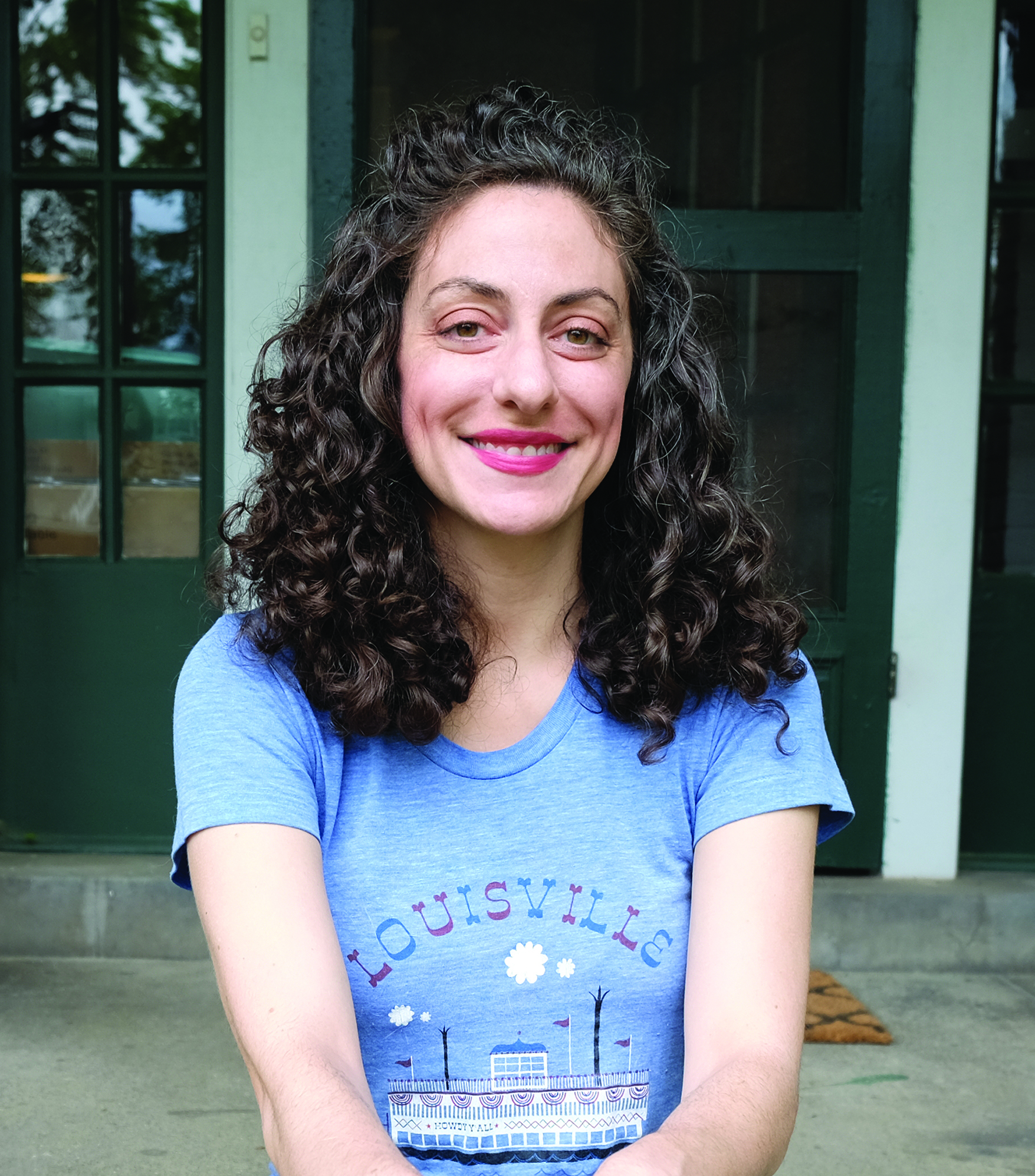
MacKenzie Haley is an award-winning illustrator born, raised, and living in Louisville, Kentucky with her two cats, Booger and Abby. She is the illustrator of Dolly Parton’s Billy the Kid series, as well as A Book for Bear, and The Scariest Kitten in the World. When she’s not drawing or playing with her cats, she can be found spending time with her friends and family, and learning what’s currently “cool” from her twelve-year-old niece, and eight-year-old nephew. To learn more about MacKenzie and view adorable “bits and bobs,” comics, and more, visit her at mackenziehaley.com

Hi Haley! I just fell in love with ARLO the moment I saw him, so I’m thrilled to get to talk to you about how you brought ARLO to life and all the considerations that go into creating illustrations for a picture book. I’ve also gotta know about the kitties you’ve fostered, but let’s start with ARLO.

What drew you to this project?

When I first got the ARLO manuscript, I immediately appreciated the idea of this little robot having the very human experience of daily mundanity. No matter how much we love our day job, our family, our friends, sometimes the day-to-day gets hard and we lose ourselves in that daily grind. The fact that ARLO is literally swept away into a whole new world, specifically into nature, was a reminder that as humans we can get stuck in our day-to-day existence, and begin to take things for granted, to let ourselves get run down. It reminded me that we need to go outside and appreciate the natural world around us. Take time to breathe and experience nature. When we do that, we bring some of that back into our daily lives, and it can change our daily experiences for the better, just like it does for ARLO.

Can you describe your process in creating and choosing this endearing cover image?

To start with, I’ve had good and not-so-good experiences in the past creating covers. I guess every illustrator has! In my earlier years I had publishers shut down my ideas for the cover and want me to just create their vision. When that would happen, the end result was usually not something I was happy with, or that I felt served the book very well. In more recent years I’ve been fortunate enough to work with some wonderful publishers and art directors who value my input and let me explore ideas and take the lead.

Creating the cover for ARLO was a really great example of the collaboration between myself and the publisher/art director/editor. Looking back, I can see I started the cover a bit more guarded than I realized. I can get too attached to my ideas, and sometimes feel like I’m losing my voice in how an image turns out when someone asks me to make certain changes that I’m not sure about at first.

Working with Sleeping Bear Press taught me that there is a good balance to be struck between having an idea you really like, and leaving room for creative feedback and space for positive changes. Not to be so precious with my ideas or images, so that when suggestions are made with a good team, I can step back and really hear what they are saying and work that into the cover vision. For example, I initially kept making ARLO too small in the cover sketches I was creating. So Jennifer took the time to talk with me on the phone and explain what they were looking for, and we were able to come up with an image that really showcases the main character, while hinting at the world he discovers in the story. I learned a lot throughout this process, and I’m really grateful for their endless patience with me.

Did you always want to be a children’s illustrator? How did your career begin?

Growing up, money was really tight. There was a time when my mom and dad didn’t buy themselves any new clothes for two years, but they made sure that I always had a full bookcase and a constantly growing little library of my own. I treasured those books and carry that love of books with me today. Each book was a little world I could explore and get lost in.

That being said, growing up I never realized you could make a living creating art. There was no one in my family’s sphere who did that, and I just didn’t know it was a possibility. I kept making art as I grew up though, and learned that there were jobs as artists. I got my BFA with an emphasis in illustration from The University of Dayton in 2002. While I always loved children’s books, I had no idea how to get into that field, so I cast my net wide and tried to get any and all illustration freelance jobs I could. I had a day job this whole time because my freelance income wasn’t paying my bills.

Around 2005 or 2006 I realized I needed to focus on one aspect of illustration. I had no idea how difficult the children’s book market was to break into, so I naively chose that, haha! I’ve heard it said that you don’t know what you can’t do if no one ever tells you. So I worked on my portfolio, submitted to agents, got rejected, worked on my portfolio some more, submitted again, and got rejected. I kept doing this, improving each round, until I finally got an agent in 2017. I was able to quit my day job in 2018 and have been illustrating children’s books full time ever since then!

What have you found to be the most rewarding aspect of being a children’s illustrator?

Seeing a book completed at the very end is such an incredible feeling and makes all the hard work worth every minute. To know that the author and I created this brand new thing where nothing existed before is an amazing feeling. The other most rewarding thing is hearing from parents or kids themselves about how much a book means to them, how much they like a book or what kind of impact it’s had on them. I remember being little and how important books were to me, how much I cherished them. I feel honored that I am able to be a part of children’s lives like that.

When you are given a manuscript for a picture book, what are your first considerations and how do you go about creating a detailed world for the story?

When I first get a manuscript, I read through it a number of times without trying to make any decisions, to just absorb the story. When I first started illustrating books, I didn’t really know what I was doing or have any kind of plan. That’s changed throughout the years, learning what works best for me and seeing what helps me create the best books I can.

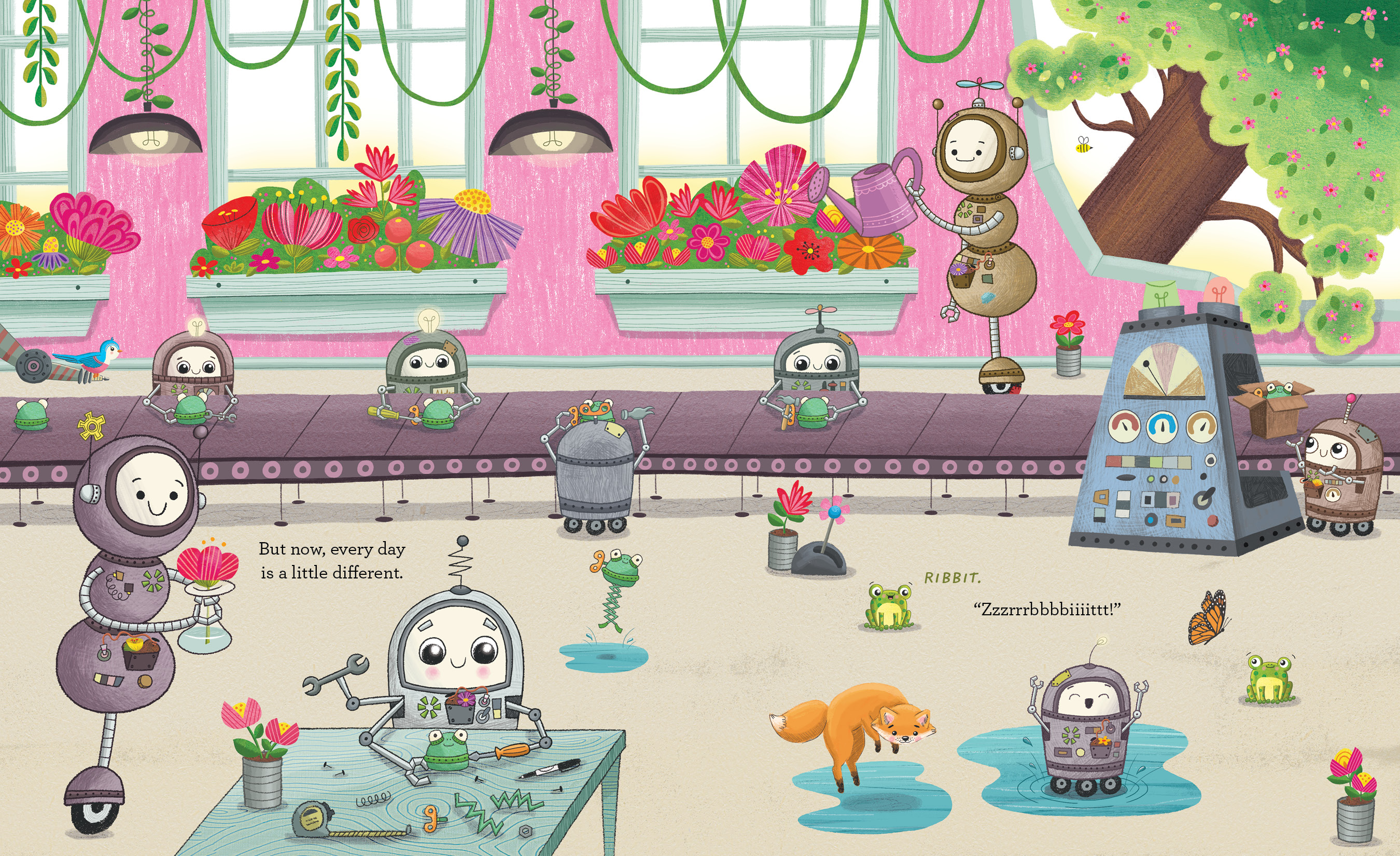
For ARLO, I took a more holistic approach, considering characters, color palettes, emotional tones and shifts. The first thing a publisher usually wants are sketches for the main characters. This was the case with ARLO, but for this story I took it further. I listed all of the characters, distilled the main message of the story, and noted what the characters were feeling and when, along with the major emotional shifts in the book. The robots are characters in this story, but I also considered the two worlds or environments as characters as well—the factory and nature. I wanted a color shift to occur throughout the book. The factory was created using almost exclusively neutral colors, with a pop of bright blue here and there, hinting at the natural world ARLO would explore later (the bird he follows in the story is bright blue).

Illustration © 2025 by MacKenzie Haley, text © 2025 by Sophia Gholz. Courtesy of Sleeping Bear Press.

The shift from neutrals in the factory to an explosion of bright, bold colors in nature was really important. The neutrals portray the mundanity of ARLO’s daily life in the beginning of the story, and at the end when he has learned from his adventure, he brings the brightness from nature into the factory, and we see neutrals and bright colors together, indicating in a visual way how ARLO’s and the robots’ daily lives are more fulfilling and happy now. Colors carry such emotional weight, and my hope is that the reader feels this as they progress through the story.

Illustration © 2025 by MacKenzie Haley, text © 2025 by Sophia Gholz. Courtesy of Sleeping Bear Press.

What was your favorite part of creating ARLO’s world?

My favorite part was creating ARLO himself. I had so much fun playing with basic shapes and forms and fun little details, such as the little compartments he has and what tools would pop out of them. But I also loved creating the outside world almost as much as ARLO. To make the flowers, I scanned in hand-painted swatches of watercolor, collaged shapes from them digitally in photoshop, and then drew on top of those shapes. I got to explore a lot and try several different things to see what worked best and what I was happiest with. It was a really fun process! I think the watercolor texture is a good contrast to the sleek metallics of the factory world.

Your bio on your website reveals that you’ve fostered around twelve cats and are a cat mom to two. How did you begin fostering cats? Your illustrations of cats are so adorable and true to cats’ goofy and sweet personalities. Do you use your own cats as inspiration? Will readers be meeting any kitties in ARLO?

I fostered my first kitties 13 or 14 years ago. At the time Louisville Metro’s animal shelter system had a really high kill rate. I didn’t have much money to donate, and they said the next best thing was to foster. They have food banks to cover that cost, and local vets who spay/neuter the cats for free, and take care of deworming, fleas, etc. I walked into the shelter that first day, having one cat at home, thinking to myself “okay, you get to foster one cat.” I ended up walking out of there with a huge crate holding a mom cat and her five one-day-old kittens. I obviously didn’t stick to my plan! I had asked them what their most immediate or urgent case was, expecting maybe a difficult or older cat. When they introduced me to mom cat and her kittens though, I couldn’t say no. I’m a sucker for kitties!

I definitely use my own cats for inspiration. The kitten in The Scariest Kitten in the World is basically my white cat, Booger. She’s so goofy and playful. She was one of the kittens in that first foster group I had, so I’ve known her since she was one day old. She would crawl up on my lap while I was working on an illustration and fall asleep, while the other kittens were playing with each other. I fell in love immediately. I think the situation is more that I’m her human, rather than that she is my cat. I adore her. There aren’t any kitties in ARLO. I should have tried to sneak one in! But there are some woodland creatures the readers will see along the way!

What would you like readers to take with them from your illustrations for ARLO?

I think I would like them to take away the idea of what an amazing wonder nature is, what a gift we have right in front of us, and what it can add to all of our lives. Just being outside for even five minutes a day, breathing in fresh air, feeling the sun on your skin, it all makes such a huge difference. I think it’s something humans crave and need to be whole and happy.

Thank you so much, MacKenzie, for this wonderful, in-depth look at your career in illustration and your process in creating ARLO’s world! I’m so looking forward to August 1, when readers everywhere will be able to bring ARLO home with them.

If you’re as eager to read ARLO as I am, you can preorder the book at these booksellers and from Sleeping Bear Press. ARLO will be released on August 1.

Sleeping Bear Press | Amazon | Barnes & Noble | Bookshop (to support your local independent bookstore)

Picture Book Review

January 2 – It’s Book Blitz Month & Interview with Author Lydia Lukidis

celebrate-picture-books-picture-book-review-deep-deep-down-cover

About the Holiday

If your motto is “So many books, so little time” then you’ll be happy to know that January is Book Blitz Month! During this month book lovers are given the green light to read as many books as possible! For kids, Book Blitz Month can be particularly exciting as they discover new fiction and nonfiction that captivates their imagination. To celebrate, take your kids to a local bookstore and the library to find new and favorite books to binge on all month long. If you don’t have a dedicated space for your children’s books, this month is also a great time to create a home library for your child so that they have a shelf, a crate, or even a whole bookcase of stories they can enjoy again and again!

I’d like to thank Lydia Lukidis for sharing a digital copy of Deep, Deep Down: The Secret Underwater Poetry of the Mariana Trench with me for review consideration. All opinions on the book are my own. You can read my interview with Lydia below.

Deep, Deep Down: The Secret Underwater Poetry of the Mariana Trench

Written by Lydia Lukidis | Illustrated by Juan Calle


Imagine being invited to visit a mysterious place where only a few have ever been; where only they have truly seen the creatures that inhabit it; and where it’s murky depths are accessible by only one type of vehicle. Would you dare to go? Lydia Lukidis and Juan Calle extend just such an invitation, but no notes for missing school, packing a suitcase, or plucking of courage need to be considered, for through their phenomenal book, readers find a seat in the incredible submersible that will transport them to “…the deepest underwater valley in the world”: the Mariana Trench.

celebrate-picture-books-picture-book-review-deep-deep-down-shark

Image copyright Juan Calle, 2022, text copyright Lydia Lukidis, 2022. Courtesy of Capstone Editions.

The submersible plunges deeper and deeper to where the sun doesn’t penetrate. Here, in the darkness, “food is scarce, and a bone-chilling cold blasts through the water. Earthquakes shake the ocean floor, and the water pressure, like a thick, heavy blanket with a thousand hands, presses down, / down, / down.” What flashes by the porthole window? A monster? No—a fish with a long and slender tail perfectly suited for its austere home, where it can survive for months without eating if necessary. “Diving deeper, a long, thin body slinks and sways, ever so slowly. The cutthroat eel is not fearsome, some rather, mesmerizing.”

The light beam of the submersible also reveals feathery crinoids “twirling and whirling like an underwater acrobat,” and a curious snailfish “dances, ghost-like, to the rhythms of the ocean” as it comes to take its own peek in the window from the other side. Snailfish aren’t affected by the heavy water pressure because “they can swim deeper than any other fish in the world. That’s because their bodies contain RMAO. This special substance protects the fish from high pressure, making sure their bodies aren’t crushed.”

celebrate-picture-books-picture-book-review-deep-deep-down-plunging-down

Image copyright Juan Calle, 2022, text copyright Lydia Lukidis, 2022. Courtesy of Capstone Editions.

It might seem impossible to sink still lower, but the submersible plummets into water populated by tiny creatures, almost insect-like with their multiple pairs of legs and long antennae that propel them and help them find food. But explorers are not at the very bottom of the Mariana Trench even yet. The submersible floats slowly down to the bottom—“the very deepest spot on Earth. Look out the window . . . and witness a world of surprises.” Extraordinary creatures, some small, soft, and translucent and others—neither plant nor animal—large and with protective shells, and all adapted to thrive in their formidable surroundings will amaze you.

At last it’s time for the submersible to return to the surface. Slowly, it makes its way through the darkness to lighter seas, where it passes by more familiar fish and other creatures on its way to “SPLASH!” surfacing once again and “leaving the marvels of the Mariana Trench far below” still waiting to be explored again.

Insets of scientific information on diet, anatomical adaptations, and other aspects that make them suited to their environment also accompany the introduction of each sea creature.

Back matter includes an illustrated cutaway of the ocean above and descending into the Mariana Trench with various sea creatures labeled and oriented to the level in which they are found; “Did You Know?” facts about the water pressure in the Trench, its creation, and how many people have visited; why the Mariana Trench matters; an author’s note; and a glossary.

celebrate-picture-books-picture-book-review-deep-deep-down-deepest-spot-on-earth

Image copyright Juan Calle, 2022, text copyright Lydia Lukidis, 2022. Courtesy of Capstone Editions.

When undertaking an excursion into unknown territory—especially through words and pictures—explorers need guides who can truly immerse them not only in the sights and sounds of an area but also the rhythms and almost intangible aura that makes it so uniquely compelling. Readers of all ages find that quality in Deep, Deep Down. Lydia Lukidis’s lithe and lyrical language is at once straightforward—answering questions any reader might have—and evocative—capturing the enigmatic and secret world at the bottom of the Earth as it flashes into view or slowly reveals itself and retreats again. Her vocabulary, rich with active verbs, ensures that readers appreciate the Mariana Trench as teeming with life and alive with wonders more amazing than we can even imagine.

Don’t be surprised if you find yourself forgetting that you’re looking at illustrations of a vampire squid, anglerfish, rattail fish, cutthroat eels, crinoids, and even the rocky and sandy ocean floor instead of photographs as you inspect Juan Calle’s magnificent pages. As the submersible—seen from many angles—plunges into darker and darker water, bioluminescent fish begin to appear alongside their grayer sea mates (children will enjoy pointing out the dark shapes that lurk in the shadows of the submersible and the stony outcroppings.)

As a rattail drifts into view, each rose-gold scale is visible, shimmering in the beam of light thrown from the submersible; it’s blue eye seemingly as curious about readers as they are about this unusual fish. Calle mesmerizes with careful details, shading, and perspective that portrays each creature in all of their weird and wonderful floating, creeping, or stock-still spectacle.

Deep, Deep Down: The Secret Underwater Poetry of the Mariana Trench will thrill ocean and nature lovers and will spur increased interest and research into this unique, nearly untouched habitat that we are only now beginning to discover. The book is a must for any environmental science enthusiast at home and for all classroom, school, and public library collections.

Ages 7 – 10

Capstone Editions, 2022 | ISBN 978-1684466153

About the Illustrator

Juan Calle is a former biologist turned science illustrator, trained on the Science Illustration program at UC Monterrey Bay. He worked early on his illustrator career for field guides of plants and animals of his country of origin, Colombia, and now owns and works in his art studio, LIBERUM DONUM in Bogota, Columbia, creating concept art, storyboarding and his passion: comic books. You can connect with Juan on Instagram.

Take a plunge into Deep, Deep Down with this book trailer!


Meet Lydia Lukidis

celebrate-picture-books-picture-book-review-Lydia-Lukidis-headshot

Lydia Lukidis is the author of 50+ trade and educational books for children. Her titles include DANCING THROUGH SPACE: Dr. Mae Jemison Soars to New Heights (Albert Whitman, 2024), DEEP, DEEP, DOWN: The Secret Underwater Poetry of the Mariana Trench (Capstone, 2023), THE BROKEN BEES’ NEST (Kane Press, 2019) which was nominated for a Cybils Award, and NO BEARS ALLOWED (Clear Fork Media, 2019). A science enthusiast from a young age, she now incorporates her studies in science and her everlasting curiosity into her books.

Lydia is an active member of SCBWI, CANSCAIP, 12 x 12, and The Authors Guild. She’s very involved in the kidlit community and also volunteers as a judge on Rate your Story. Another passion of hers is fostering love for children’s literacy through the writing workshops she regularly offers in elementary schools. Lydia is represented by literary agent Miranda Paul from the Erin Murphy Literary Agency.

You can visit her on her Website (with order links) | her Blog | Facebook | Twitter and you’ll also find her on Goodreads.

Hi Lydia! I’m really thrilled to have the chance to talk to you about this gorgeous book, how it all came together, and your other work as a writer.

You have degrees in Pure and Applied Science as well as English Literature. After graduating from college did you work in the science field? If so, can you talk about your work a little? How has your science background influenced your writing?

When I was younger, I was drawn to both science and the arts. I once saw them as mutually exclusive but then came to realize how connected these disciplines are. Upon graduating university, I did something completely out of left field but that satiated my artistic desires. I started my own jewelry line! After that, I became a puppeteer, writing plays for children. That brought me back to my love of writing, and here I am writing kidlit. I often focus on STEM topics so it’s full circle. I feel like this is truly where I belong.

What drew you to write about the Mariana Trench for children? What kind of research did you do in creating this book?

In 2019, I read an article about how scientists found a plastic bag floating in the Mariana Trench. They also discovered plastic in the belly of various marine animals. My heart sank. I wondered how we human beings managed to start damaging one of the most remote places on the planet.

At that point, I didn’t know that much about the Mariana Trench and my curiosity grew. I began my research on the internet and then came to realize most of that information was false. The book really came together once I interviewed a slew of experts (7 in total) who’ve devoted their lives to studying the deep sea, the hadal zone, and geology. They also helped me find the right books and articles to read for updated information.

What was the most surprising thing you learned during your research? Do you have a favorite creature or one that you’d like to learn more about?

The most surprising thing was that despite the hostile conditions in the trench (no sunlight, scarcity of food, and crushing pressure), life still thrives deep, deep down. Though, the creatures are not what you would expect. There aren’t any sharks, for example, or any large creatures for that matter. My favorite has to be the sea cucumber. I must have watched hours and hours of them oscillating and floating, like underwater ballet. I was love struck!

Your storytelling in Deep, Deep Down is so fluid and as mesmerizing as the Mariana Trench itself. Can you talk about your writing process for this book and how you achieved such a visceral experience for readers?

Wow, what a compliment! Writing this book was nothing short of magical. I’m normally very hard on myself and many books don’t even make it to my agent. Other books take years to figure out. With nonfiction, finding the right structure is crucial. But somehow, with DEEP, DEEP DOWN, I didn’t have my usual “tormented writing struggle.” The writing was fluid and literally flowed out, and never changed in structure. There was a lot of editing, to be sure, I had to rewrite the manuscripts over 55 times to get the facts right, but the vision never changed. Will that always be the case? No! The next book I tried to write crashed and burned (maybe to be resurrected one day), so I’m grateful for this experience.

As a biologist who turned to illustration and who studied at the University of California at Monterrey Bay, Juan Calle must have been a dream match for Deep, Deep Down. Can you talk about how was he paired with your manuscript? When during the publication process did you begin to see his work? What emotions did his interpretations of your words stir in you?

Yes! It was Capstone who wisely suggested Juan. When I saw the proofs, I think my jaw hit the floor. He did SUCH a great job at getting all the details right (and believe me, it was tough—I had made a 20-page document with reference photos and notes vetted by Dr. Gerringer, my main consultant.) Although we never met, spoke, or even corresponded via email, Juan was able to follow my direction and bring his own flavor to the table. I think I first started seeing artwork about 8 months ago, so it was a speedy process. His work was stunning and scientifically accurate, although we couldn’t always draw everything to scale. It was also infused with magic.

What do you hope children will take away from Deep, Deep Down?

My goal in writing this book was twofold: firstly, to educate children on the deepest ocean of our world and debunk the myth that “scary” creatures live within its depths, and, secondly, to talk about ocean conservation and the importance of this fascinating ecosystem.

Kids may think the Trench is so far removed from their lives and that their actions don’t matter, or that what happens in the Trench doesn’t affect them. But that’s simply not true. Everything is connected, and I’d like to remind them that our actions affect our planet, even in its deepest spots.

You’ve written over 50 books for children and are very active in the writing community. What do you love best about being an author? What do you find rewarding about helping other writers succeed?

Thank you for the sweet words! I got my start with work-for-hire and most of my published books are for the educational market. DEEP, DEEP DOWN is my first trade nonfiction book, so it feels like a big accomplishment.

What do I love about writing? Everything. That said, it’s also a tough profession and every year, I usually have a moment when I reassess why I keep choosing this craft.

I also love supporting the kidlit community; it comes deep from the heart. I know what it is to struggle as a writer, and I see so many others struggling, hustling, working so hard. I like to support and acknowledge their efforts. Every little achievement is a milestone and should be celebrated!

What’s up next for you?

I’m excited to have just announced my second trade nonfiction book, DANCING THROUGH SPACE: Dr. Mae Jemison Soars to New Heights (Albert Whitman, 2024). I actually wrote this in 2015, and it’s a very long and convoluted story about how it got acquired. I did think long and hard whether or not I should tell this story and I ultimately decided to follow my heart because I felt so connected to the hook of the story. I invested in a sensitivity reader and will do so again once we start the editing process at Albert Whitman. They also chose a fantastic illustrator, Sawyer Cloud.

Other than that, I’m knee deep in other WIPs, some of them fiction. I wanted to try to stay in one lane as an author but it’s just not happening—it seems there are different stories of different genres inside me that need to come out. I’m always following the flow of my inspiration, which is often not linear!

Thanks again, Lydia, for sharing so much about your writing life! I know readers are going to love Deep, Deep Down and will be looking forward to Dancing Through Space!

Book Blitz Month Activity

Screen Shot 2022-12-31 at 10.56.42 AM

Creatures of the Mariana Trench Word Search


The Mariana Trench is home to so many amazing creatures! Can you find the names of seventeen in this printable word search puzzle?

Creatures of the Mariana Trench Word Search Puzzle | Creatures of the Mariana Trench Word Search Solution

celebrate-picture-books-picture-book-review-deep-deep-down-cover

You can find Deep, Deep Down: The Secret Underwater Poetry of the Mariana Trench at these booksellers

Amazon | Barnes & Noble | Books-a-Million 

To support your local independent bookstore, order from

Bookshop | IndieBound

Picture Book Review

December 2 – It’s Buy a New Book Month

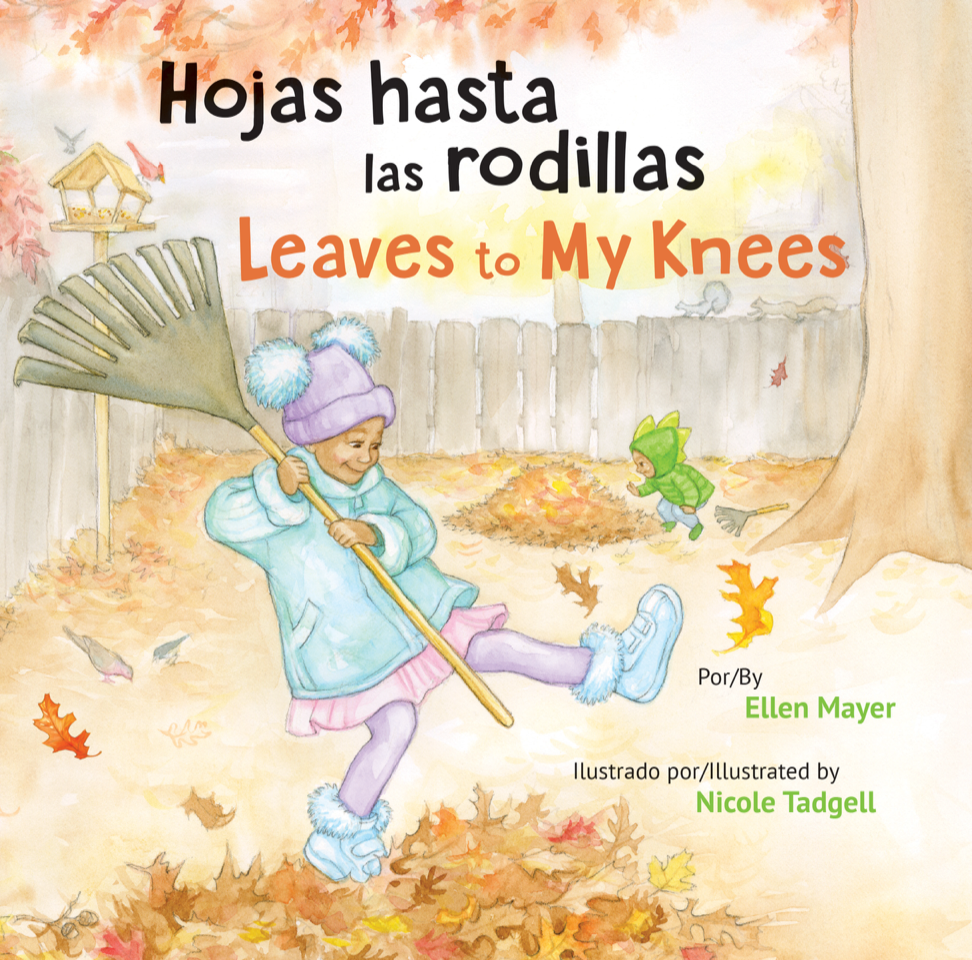
  • celebrate-picture-books-picture-book-review-leaves-to-my-knees-cover
  • celebrate-picture-books-picture-book-review-leaves-to-my-knees-spanish-english-cover

Picture Book Review
About the Holiday

For children, picture books provide one of the best ways to interact with facts and feelings. Stories that speak to their experiences, both common and new, alongside illustrations that bring the story to life let them discover the world around them. Today’s stunning nonfiction books are loaded with illustrations or photographs that let kids see exciting details about science, history, biographies, nature, and so much more. This month, take a look for fiction and nonfiction picture books about your child’s passions to add to your home library. And be sure to check out today’s book that incorporates both!

Thanks to Star Bright Books for sharing a digital copy of Leaves to My Knees with me for review consideration. All opinions on the book are my own.

Leaves to My Knees

Hojas hasta las rodillas/Leaves to My Knees

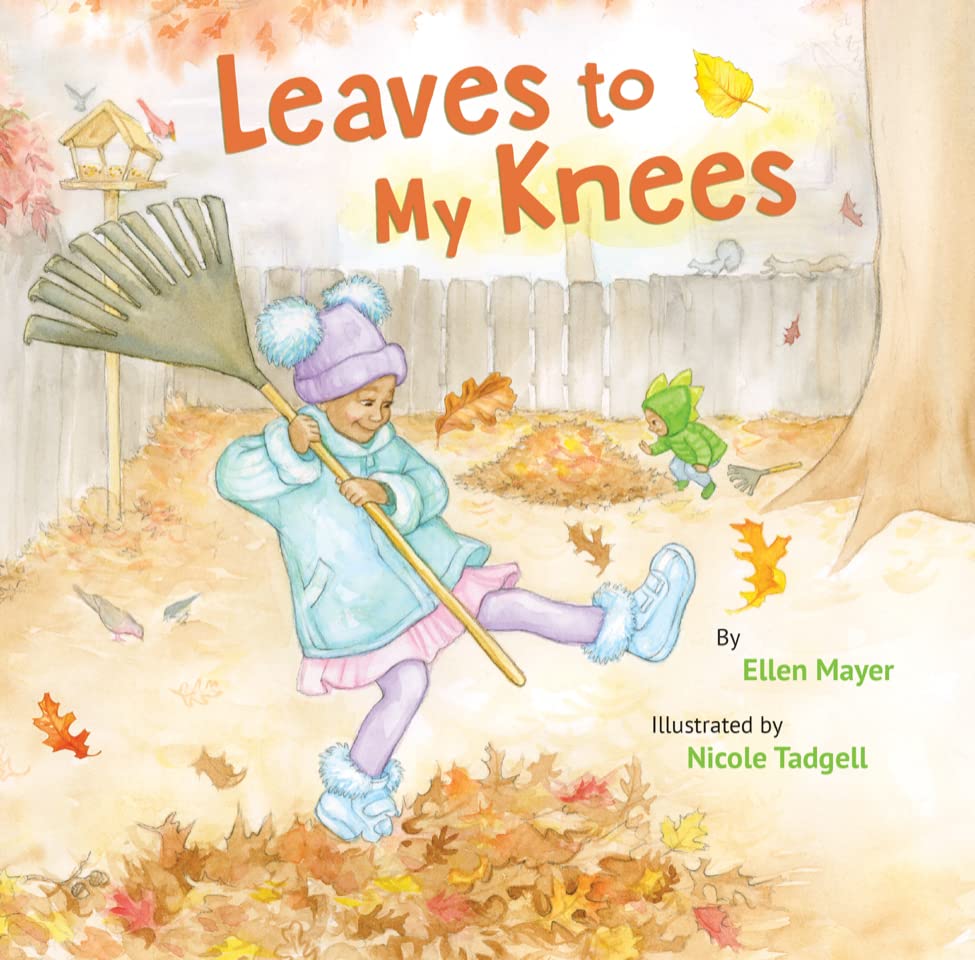
Written by Ellen Mayer | Illustrated by Nicole Tadgell


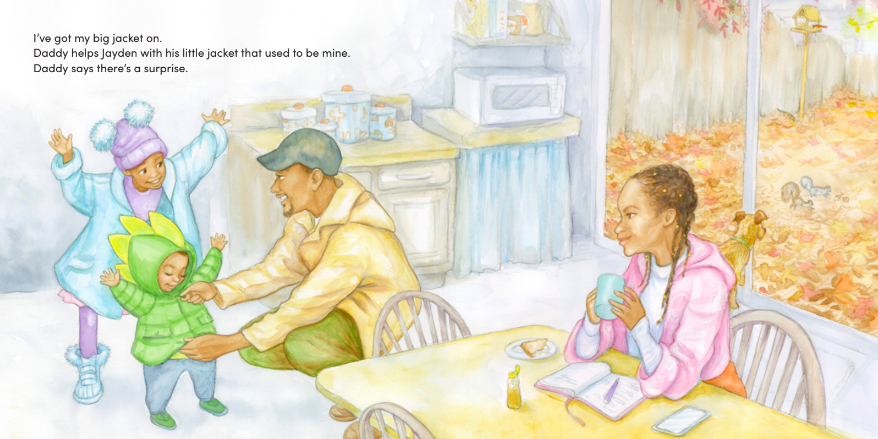
Daddy has a surprise for Camille and her little brother Jayden. They get dressed in their coats—big for Camille and little jacket with a stegosaurus hood for Jayden—and head into the backyard. There, Camille discovers her dad has gotten her a rake of her own. It’s not as big as Dad’s, but it’s bigger than Jayden’s little rake. It’s the perfect size for Camille.

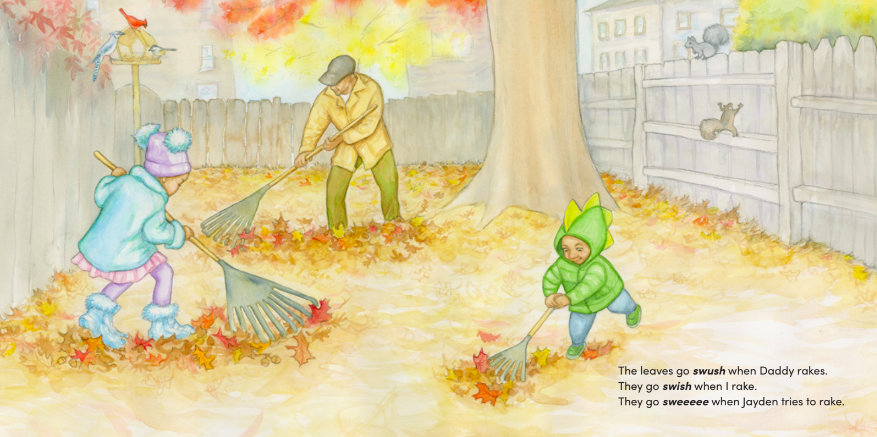
Camille marches right off to rake a pile of leaves. But not just any pile—she has a goal. “‘I’ll rake leave all the way up to my knees!’” she tells her dad. The three get working on the yard. Camille concentrates on gathering leaves, listening to the different sounds that the various sized rakes make: “The leaves go swush when Daddy rakes. They go swish when I rake. They go sweeeee when Jayden tries to rake.”

celebrate-picture-books-picture-book-review-leaves-to-my-knees-putting-on-jackets

Image copyright Nicole Tadgell, 2022, text copyright Ellen Mayer, 2022. Courtesy of Star Bright Books.

Lurking under the leaves are twigs and acorns that clog up Camille’s rake. She worries that she’ll never be able to rake leaves to her knees. She calls for Daddy’s help, and together they clear Camille’s rake. “‘You’re good to go now, Camille,’” Daddy tells her. Back at it, Camille rakes and rakes. Then she steps into the pile she’s accumulated to measure it. Her pile only comes up to her ankles. Camille grabs her rake harder and with determination she collects more leaves. But wait! Jayden is stealing leaves from her pile to add to his! Camille guards her pile with her rake, and sends her little brother over to Daddy’s bigger pile. Camille checks her measurements again. Her pile has grown, but only up to the top of her boots.

celebrate-picture-books-picture-book-review-leaves-to-my-knees-raking

Image copyright Nicole Tadgell, 2022, text copyright Ellen Mayer, 2022. Courtesy of Star Bright Books.

Camille rakes ‘bunches of leaves,” and her pile gets taller, until “‘Oh no! A BIG BREEZE!!’” sends lots and lots of leaves swirling “Whoosh!” into the air and scattered to the ground. “I will never rake leaves to my knees!” Camille thinks. And when she measures again, her pile is back to her ankles. Daddy encourages her to keep going, and Camille is committed to achieving her goal. She throws off her coat, grabs her rake, and works on gathering up all the leaves she had, plus more. At last, too tired to rake anymore, Camille wonders. Has she done it? “‘Time for measuring!’ says Daddy.”

celebrate-picture-books-picture-book-review-leaves-to-my-knees-pile-up-to-ankles

Image copyright Nicole Tadgell, 2022, text copyright Ellen Mayer, 2022. Courtesy of Star Bright Books.

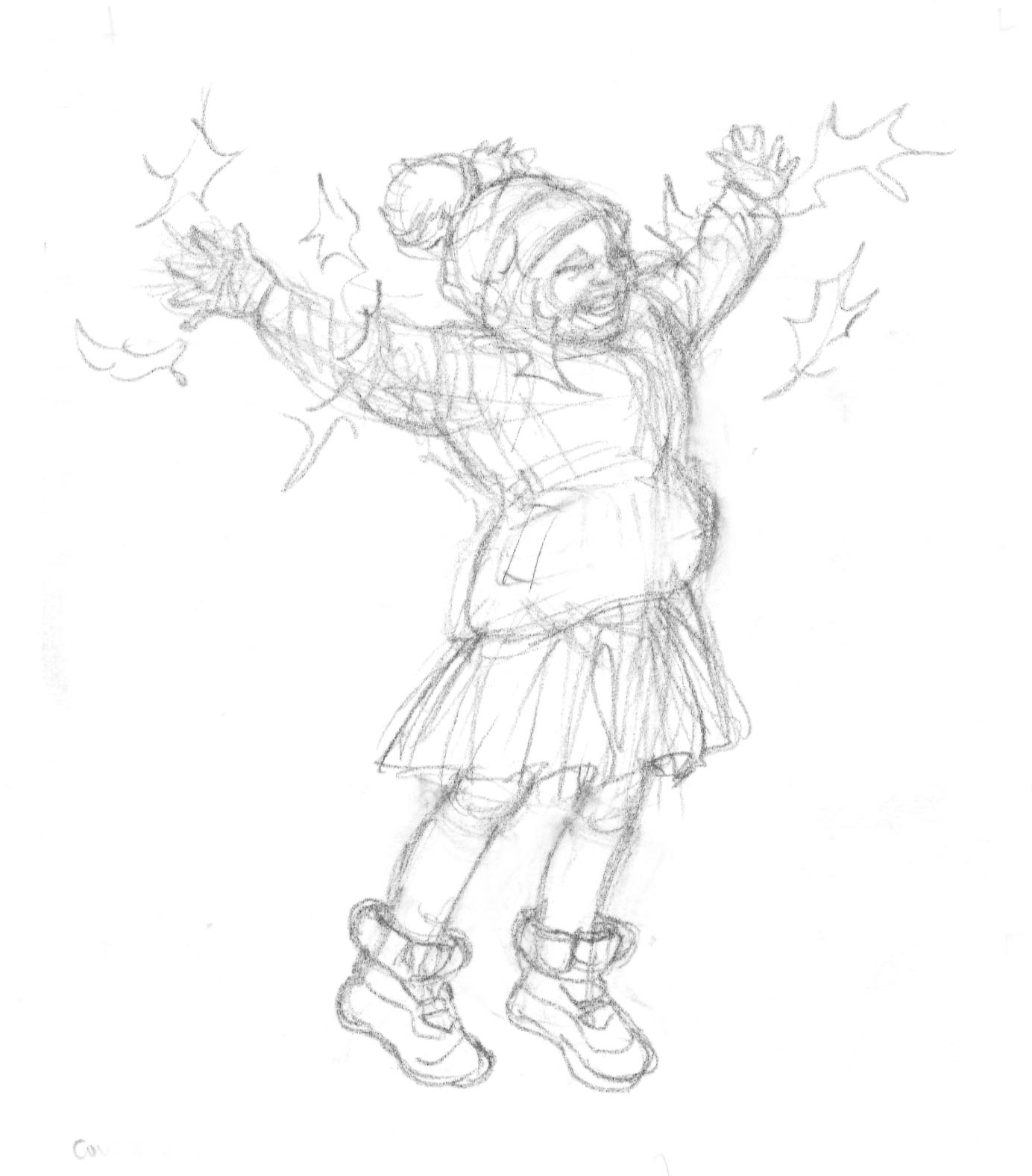
Camille relinquishes her rake to her dad then, holding her breath, steps into her pile. “‘TA-DA!’” Camille raises her arms in victory. She steps out, positions herself a good ways away, and winds up for the run and jump. “‘GO!’ yells Daddy. ‘GO!’ Jayden yells too.” Camille flies through the air and lands, laughing, into her pile. Then Jayden jumps in. And Daddy? He gives Camille  “really big squeeze” for raking “leaves all the way up to [her] knees.”

A note for parents, teachers, and other caregivers written by Marlene Kliman, a mathematics learning expert and senior scientist at TERC, describes how the story incorporates the math of measurement and sizes and how adults can extend the lesson by pointing out elements in the book’s illustrations and while going about their day or doing common chores, such as cleaning up and sorting laundry.

celebrate-picture-books-picture-book-review-leaves-to-my-knees-jumping-in

Image copyright Nicole Tadgell, 2022, text copyright Ellen Mayer, 2022. Courtesy of Star Bright Books.

Ellen Mayer’s Leaves to My Knees has everything that makes a story a young reader’s favorite—a spunky main character that kids will identify with, an achievable goal, successes and setbacks, suspense, humor, and a child-propelled victory. And it all revolves around an early math concept that comes naturally to children and which invites playful learning not only during the fall, but any time of the year. Shoveling snow and making snowballs in winter, yard cleanup and gardening in spring, and building sandcastles and raking grass clippings in summer as well as in-home fun with laundry piles, toys, and other objects are all ways to extend the story.

Told from Camille’s point of view, the story also engages children’s emotions as they join in to cheer Camille on as her leaf pile grows and commiserate with her when it shrinks. The close relationships among Camille and her dad and little brother ring true with dialogue-rich storytelling that is always encouraging. Strong themes of determination and persistence will also appeal to parents and teachers, who can point to how many times Camille has to start over before accomplishing her goal and her positive, resolute attitude.

Nicole Tadgell’s exuberant illustrations shine with personality, and kids will immediately become invested in each character as Dad gets working on a big job that needs doing, Jayden runs, jumps, and copies his big sister, and Camille unwaveringly works on her pile of leaves. Camille’s setbacks are clearly depicted, along with her and her father’s facial expressions that give adults and kids an opportunity to talk about disappointment, frustration, perseverance, and feelings of accomplishment. Each image also demonstrates the math component of measurement and sizes in the story with various-sized rakes, the growing and diminishing leaf pile, big and little jackets, and other objects that invite comparison.

Tadgell’s soft-hued pages are infused with the feeling of fall and hum with activity as cardinals, blue jays, chickadees gather at the bird feeder, squirrels scamper up and along the fence, and leaves continue to float to the ground. Readers will love following little Jayden’s antics and be inspired by Camille’s wide smile as she enjoys the reward of all her hard work.

Leaves to My Knees is a multilayered read aloud infused with the enthusiasm and rhythms of childhood that kids will want to hear again and again. Its mathematics base and themes of determination and perseverance rewarded will appeal to parents, teachers, and other educators as a way to engage children in active, hands-on learning. The book is a must for home, classroom, school, and public library collections.

Ages 4 – 8

Star Bright Books, 2022 | ISBN 978-1595729590 (Leaves to My Knees) | ISBN 978-1595729613 (Hojas hasta las rodillas/Leaves to My Knees

Picture Book Month Activities

celebrate-picture-books-picture-book-review-leaves-to-my-knees-coloring-page


Coloring Pages and Teaching Guides


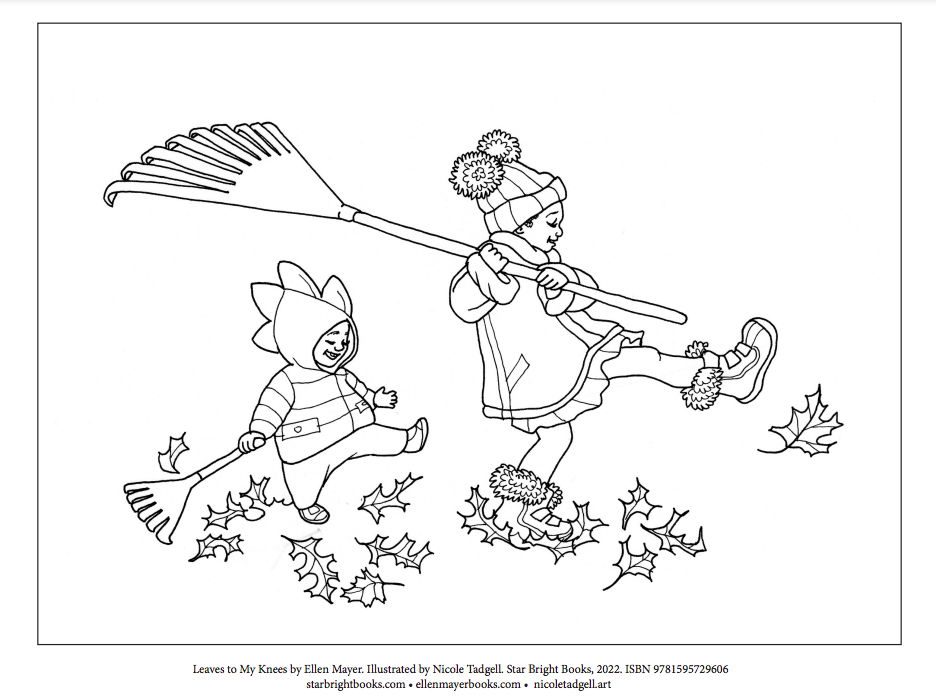
You can extend the fun and learning in Leaves to My Knees with these activities, which include three fun coloring pages from the story, a hands-on play-dough art and discovery activity, and a detailed educator’s guide for teachers, homeschoolers, parents, and other caregivers that offers multiple ways to use Leaves to My Knees to explore math, mathematical thinking, and reading comprehension through the story and beyond at home, school, and elsewhere.

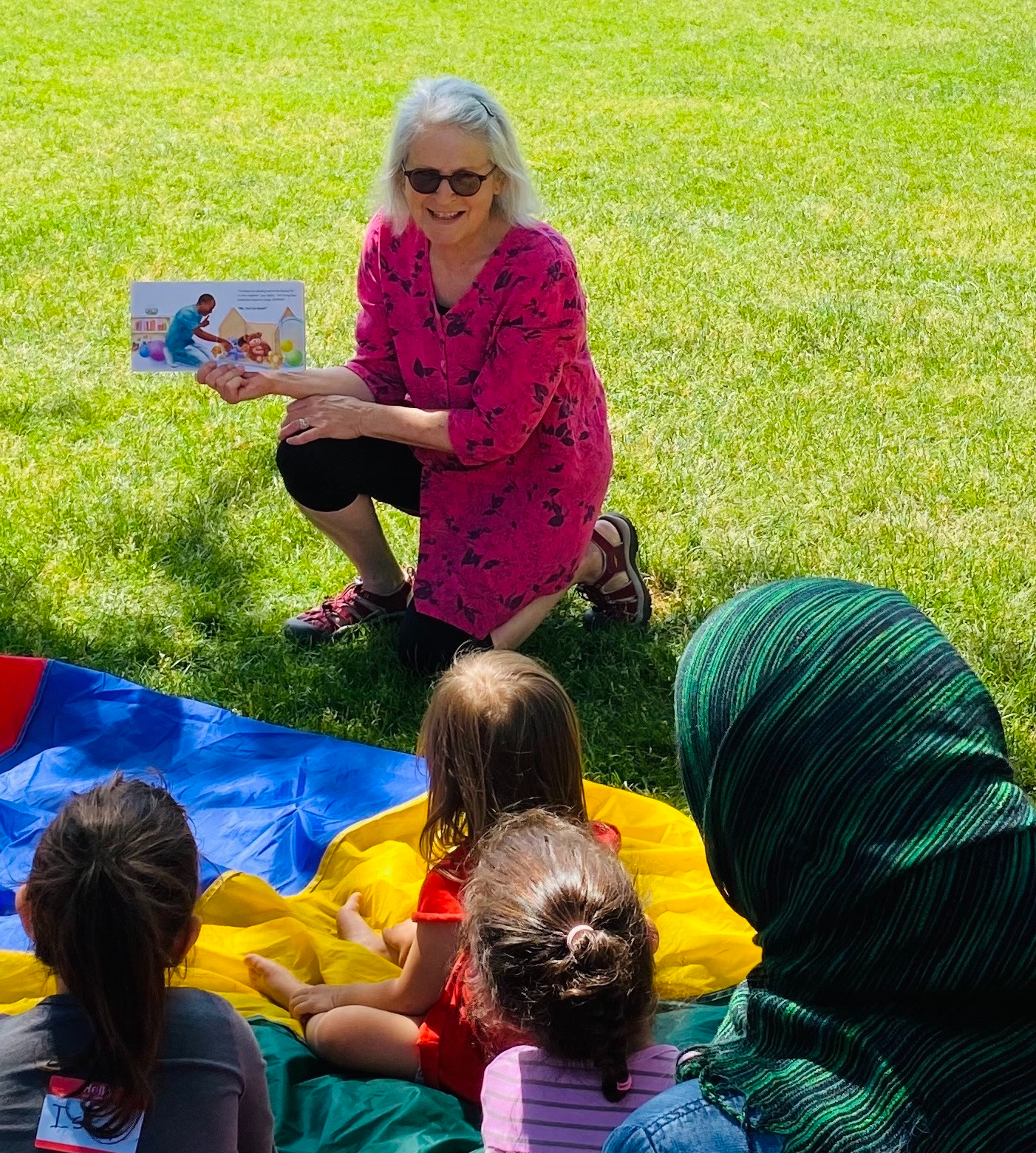
Meet Ellen Mayer

celebrate-picture-books-picture-book-review-ellen-mayer-reading-headshot

You can find Leaves to My Knees on Amazon

Leaves to My Knees: Hardcover | Paperback

Hojas hasta las rodillas / Leaves to My Knees: Paperback

You can also order from Star Bright Books

Leaves to My Knees: Hardcover | Paperback

Hojas hasta las rodillas / Leaves to My Knees: Paperback

Picture Book Review
November 30 – It’s Picture Book Month

celebrate-picture-books-picture-book-review-twinkle-twinkle-winter-night-cover

About the Holiday

There’s still time to celebrate one of the best months of the year—Picture Book Month! If you’re doing holiday shopping, don’t forget to add picture books to your list for the kids in your life. With so many picture books to choose from on all kinds of topics, there’s sure to be a perfect book for each child. You know what they say—and it’s really true: A book is a gift you can open again and again, and today’s story is one kids will love to hear all through the year.

Thanks to Megan Litwin and Clarion Books for sharing a digital copy of Twinkle, Twinkle, Winter Night with me for review consideration. All opinions on the book are my own.

Twinkle, Twinkle Winter Night

Written by Megan Litwin | Illustrated by Nneka Myers


Readers are invited along for a walk on a crystal-clear, moonlit snowy evening as a father and child discover how “nightfall sets the world aglow.” As darkness deepens overhead, and the stars twinkle over a white-blanketed field, “the sky sparkles like a chandelier.” Passing a pond where families are skating while snowflakes fall, “dusting glitter on earth’s face, / dressing trees in coats of lace,” the pair wave to a friend and then make their way into town.

celebrate-picture-books-picture-book-review-twinkle-twinkle-winter-night-skating

Image copyright Nneka Myers, 2022, text copyright Megan Litwin, 2022. Courtesy of Clarion Books.

Here they come upon their village shimmering with magic as strings of white, gold, and colored lights outline rooftops, connect building to building, and create a glistening spectacle of snowy patches. Windows glow with candles glittering in wreaths for Christmas, menorahs for Hanukkah, and kinaras for Kwanza. The flame of diya lamps for Diwali joins them. In the central square, a brilliant star shines forth as people gather around, enjoying all the sights, sounds, and tastes of the winter holidays. Father and child join in on this “Beaming, gleaming, lively sight— / twinkle, twinkle, winter night.”

celebrate-picture-books-picture-book-review-twinkle-twinkle-winter-night-windows

Image copyright Nneka Myers, 2022, text copyright Megan Litwin, 2022. Courtesy of Clarion Books.

On their way home and to bed, they pass a picture window where they can see a mom and her two kids hanging Christmas decorations, a fire flickers in the fireplace. In the woods, a deer and her fawn doze, curled up under a small tree, its branches covered in sparkling snow. In town, kids are tucked under covers but can’t resist going to the window for one last look, for “twinkle, twinkle, winter night. / Everywhere you look . . . / there’s light.”

celebrate-picture-books-picture-book-review-twinkle-twinkle-winter-night-town-square

Image copyright Nneka Myers, 2022, text copyright Megan Litwin, 2022. Courtesy of Clarion Books.

You know that special glow you feel during the winter when the moon and stars seem to shine more brightly; the hearth or wood stove glimmers with extra warmth; snow and ice twinkle when caught in a beam of light; and, around the holidays, neighborhood streets wink on with glorious displays? The glow you wish could last all year long? Megan Litwin captures that feeling in her lovely Twinkle, Twinkle, Winter Night not only for the winter months, but all year around. Litwin’s graceful rhymes and rhythms immerse readers in winter’s quieter atmosphere and slower pace and invites them to really look at nature, at their communities, and in their own homes to find the light and magic there. Throughout the story, Litwin reintroduces her title phrase strung with glittering new adjectives, reminding readers of just how ardently we embrace the exquisite beauty of light. Her flowing storytelling is a joy to read aloud, making this a perfect book for bedtime or quiet story times.

Nneka Myers’ stunning pages seem to actually dance with the twinkling of stars, the glittery shimmer of snowflakes, and the breathtaking radiance of decorated homes, shops, and streetscapes. Images from Christmas, Hanukkah, Kwanza, and Diwali can be found in Myers’ illustrations of the town and its winter festival. Her rich purples, blues, and fuchsias set off the sparkling lights, patches of snow, and wide smiles of the townspeople as they mingle in the square welcoming and celebrating winter’s diverse and poignant holidays.

A book that shines with an appreciation for the beauty of light, nature, and community all around us, Twinkle, Twinkle, Winter Night would quickly become a favorite on home bookshelves for snuggly reading throughout the year and is a must for school and public library collections.

Ages 4 – 8

Clarion Books, 2022 | ISBN 978-0358572046

Discover more about Megan Litwin and her books on her website.

To learn more about Nneka Myers, her books, and her art, visit her website. You can also visit her on Instagram and Twitter.

Meet Megan Litwin

celebrate-picture-books-picture-book-review-megan-litwin-headshot

Megan Litwin holds a Master of Arts in Children’s Literature from Simmons University and is a former teacher whose lifelong work is to grow lifelong readers. Megan lives in Massachusetts with her family. 

You can connect with Megan on Her Website | Instagram | Twitter

I’m excited to be talking with Megan Litwin today about her debut picture book, her journey to publication, and how parents can instill a love of reading in their kids.

Hi, Megan! Congratulations on your beautiful book! Your writing in Twinkle, Twinkle, Winter Night really shimmers with so many gorgeous images of light. Was there one spark of inspiration for your story, or how did it come about?

Thank you so much for those kind words! I certainly agree that illustrator Nneka Myers has created the perfect shimmery, glimmery world for readers here! As for the story, there absolutely was an initial memorable spark. It happened on a cold, dark December drive. One of my sons was newly captivated by all the light he saw—everything from the snow to the moon to the houses decked out for the holidays. It was like the whole world was suddenly made of magic. He kept calling out things he noticed in his tiny toddler voice as we drove and repeating the words “twinkle lights” over and over. I realized I wanted to find a way to showcase this bright and beautiful time of year, with the focus not on any one particular holiday, but on the shared magic of these lights.

Can you tell readers a little about what your journey from that first idea to having Twinkle, Twinkle, Winter Night published was like?

LONG. That December drive was eleven years ago! I had the initial spark and a first draft poured out of me immediately. But it was not yet the story I wanted to tell. It didn’t have the magic I had seen and felt. It was too long, too wordy, overly descriptive. And so . . . I let it sit. I revisited it off and on over the years, but only around times of great inspiration . . . usually around this time every year! The idea never left me, but it wasn’t until 2016 (when I joined SCBWI) that I began working on this manuscript with the serious attitude it takes to publish. I took it to my first critique groups, I took it to conferences to get agent/editor feedback, I cut and polished and rewrote with a keener eye and ear—and 25 drafts later, it went out on submission. Even then, it was not quick! This manuscript went all the way to acquisitions with another publisher before landing, very happily, with Kate O’Sullivan at Clarion/HarperCollins (then Houghton Mifflin) in 2020.

You previously worked as a classroom teacher and reading interventionist. Can you talk about these positions? What did you love best about being a teacher?

I was a second-grade classroom teacher for nine years, and then spent time in part-time roles after my second son was born. I’ve worked as a literacy interventionist and a school library teacher, and I also helped our local school set up and run a take-home book program. I have always felt entirely at home in a school, and think I’ll always be a “teacher-at-heart.” In fact, one of the things I’m most excited about in this new phase of my book-centered career is being able to go into classrooms to do reading and writing workshops with kiddos.

How did you help kids not only learn how to read but to be excited about reading?

My years as a classroom teacher were especially magical because of the tight-knit community we built each year. In those early years of school, each classroom feels like a family. And a lot of deep connection can happen through books. We connected through our daily read alouds, huddled close together on the rainbow rug, and also through discussions about whatever we were reading, which were full of connections to our own lives and the books we had read before as a “reading family.” It was so important to me that my students saw books as magical. I wanted them to learn to read – but to love to read as well, because engaging comfortably in that process for your whole life opens so many doors. One of the best thank-you gifts I ever received was from a parent who wrote that I had inspired her daughter to be an “under-the-covers-with-a-flashlight-reader!” Nothing could make me happier.

Do you have any suggestions for how parents can instill a love of reading in their kids?

My best advice for instilling a love of reading is simple. Read together. Read often. Surround your kids with books of all kinds. Find books that bring you joy and read them alongside your kids. Modeling a love of reading and celebrating books is the first step.

And, since we’re talking about this, if anyone is interesting in more tips on growing readers, I include a section focused on that in my seasonal author newsletter that comes out just four times a year. It is called “Read, Write, Magic”—and you can sign up on my website!

What was your favorite type of book to read when you were a child? What kinds of books do you gravitate toward as an adult?

As a child, I loved books about animals and also things that had a healthy dose of magic or wonder. Some favorites were The Velveteen Rabbit, Animalia, and The Polar Express. I also loved series as I got older because I got to spend time in a world with characters I came to know and love. I was a big Sweet Valley Twins and Nancy Drew fan, and was (and still am) a Harry Potter lover. As an adult, I still enjoy ALL those same things! I would add that overall, the books I love best are ones that make me FEEL something. Or according to my husband’s observations, books that make me cry…

You’ve also published poetry in two anthologies: Friends & Anemones and An Assortment of Animals, released by the Writer’s Loft. Do the rhythms of poetry come naturally to you? What is your writing process once you have an idea?

Yes, those rhythms do come naturally, actually—even though I wouldn’t consider myself a poet! I’ve never studied poetry, and don’t know how to analyze it using all the proper terminology. For me, it is all about feel and sound. I think that is what initially drew me to picture books, way back when. Picture books have a bit of poetry and music and theater all mixed in. I like to say that I “play with words” for a living now. I pour words out onto a page for a first draft…and then I play. I cut, change, arrange, rearrange…over and over and over. I count beats, I read it aloud. My kids say it looks like I’m talking to myself!

You have such enthusiasm for meeting your readers at book events as well as spending time with kids in the classroom through your three different school workshops designed for various elementary age groups. Do you have an anecdote from any of these events you’d like to share?

I love interacting with young readers and writers at events and in schools. Kids are the best! I love the way they see the world, their honest language, and their willingness to try new things.

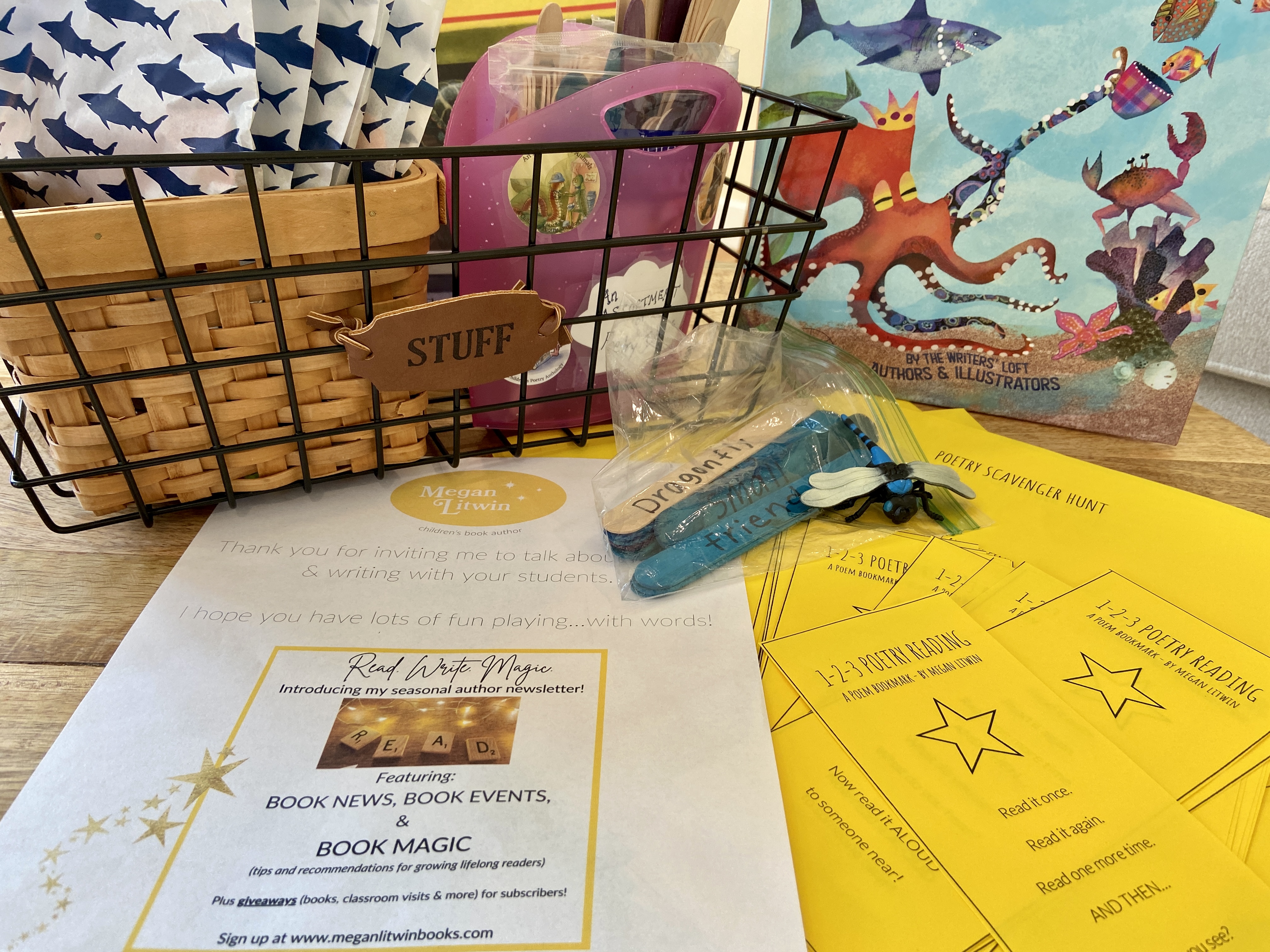
celebrate-picture-books-picture-book-review-megan-liwin-school-visit-basket

One of the workshops I offer schools is about poetry, and the idea that to write a poem (or most anything), you need to play with words. And at the end of the session, I always wrap up the same way I began—by asking them to finish the sentence “Poetry is (blank).” It is fun and illuminating to see how their answers differ from the beginning. One of my favorite moments was when a first grader simply said, ‘You were right. Poetry IS fun.” He looked both surprised and excited by that thought. I couldn’t have asked for a better end to the day.

What do you like best about being a children’s author?

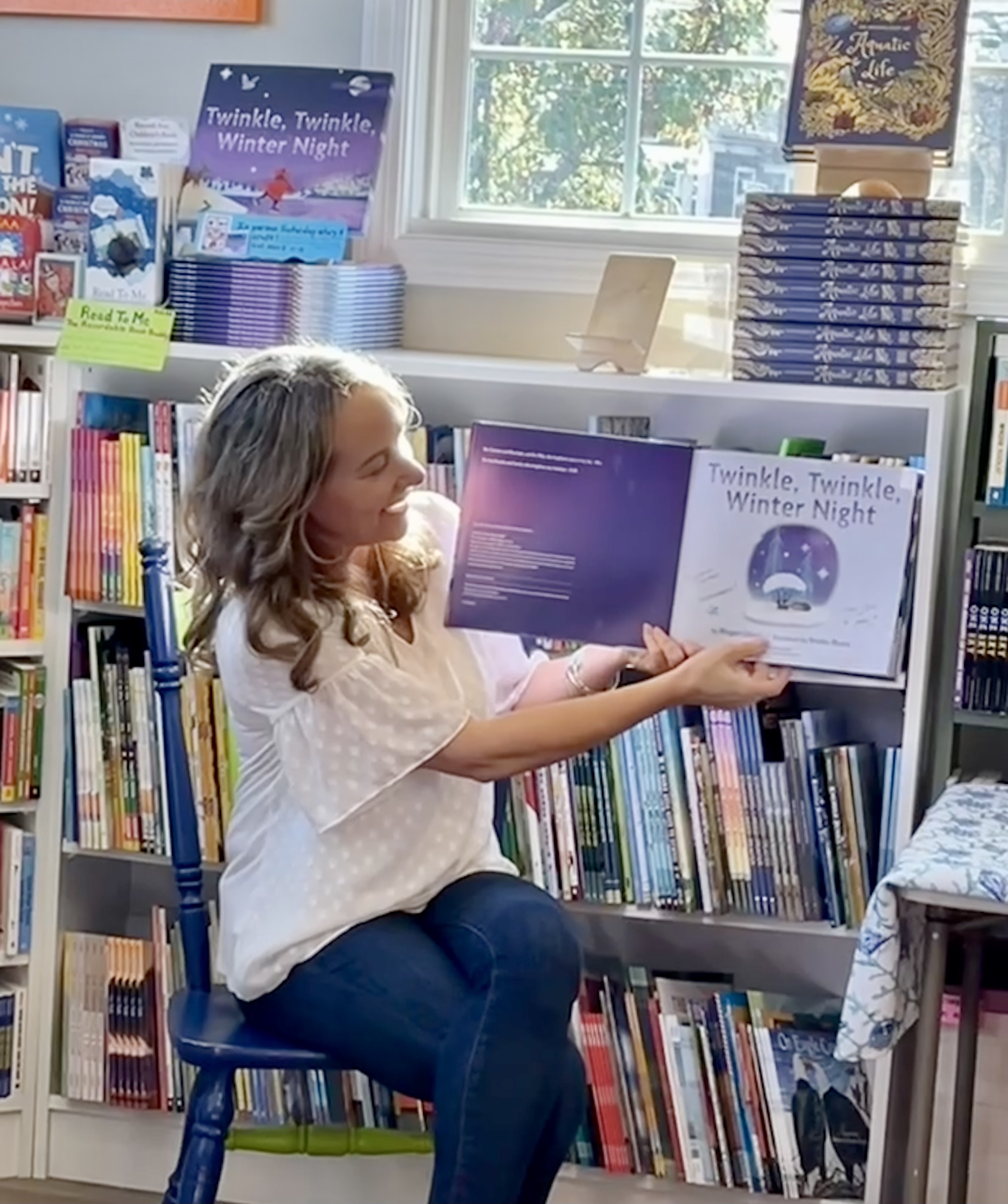
celebrate-picture-books-picture-book-review-megan-litwin-reading in-school

Reading aloud to kids! That was always my favorite part of the day when teaching. And now I get to do that all the time as an author—this time with words I wrote myself. It’s WILD!!

What’s up next for you?

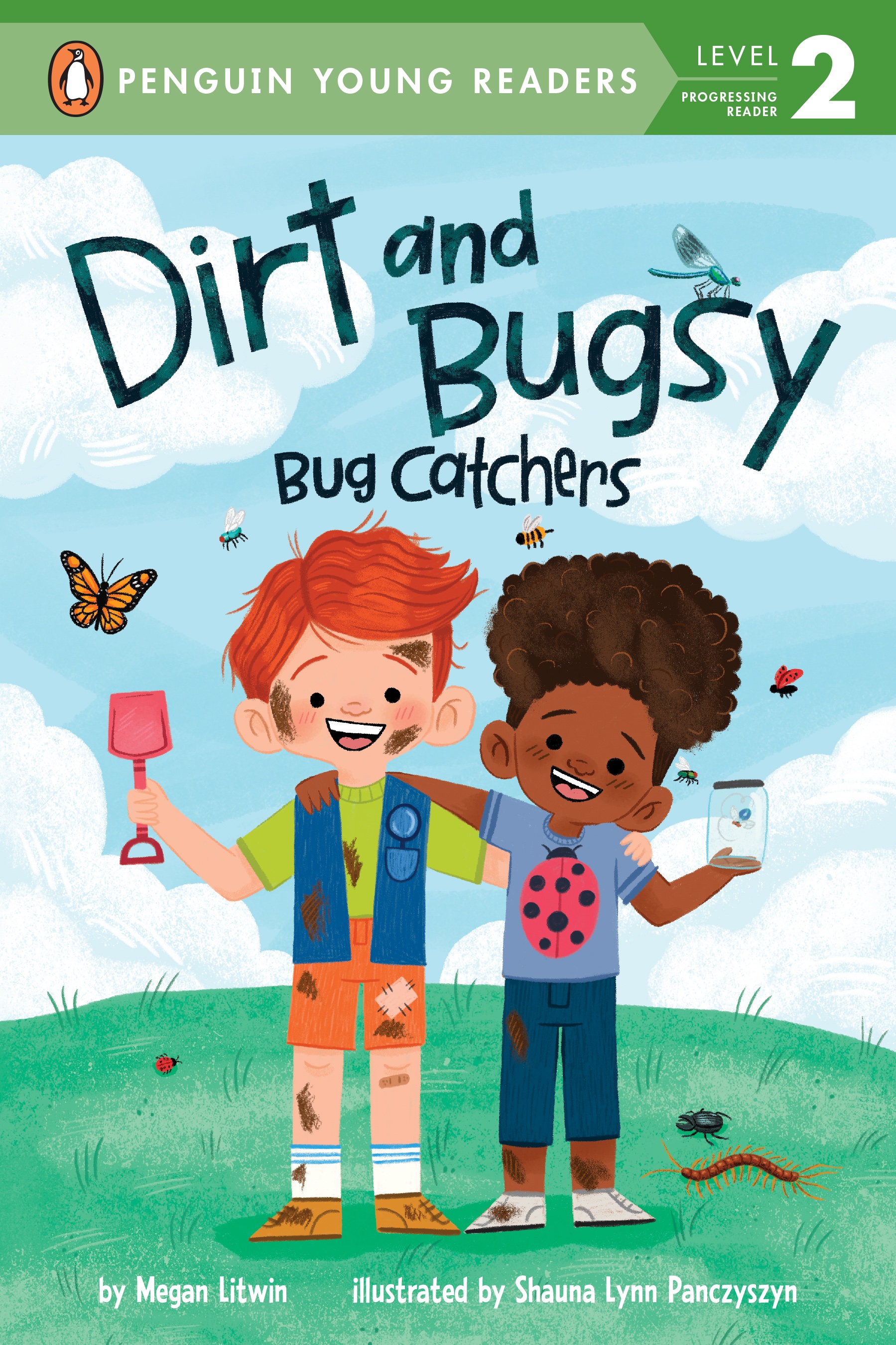
I am thrilled to be launching the first of two books in an early reader series with Penguin Young Readers in February 2023. Dirt & Bugsy: Bug Catchers is about two sweet boys who love to catch bugs.

celebrate-picture-books-picture-book-review-megan-litwin-dirt-and-bugsy-cover

Each book features backyard adventures and lots of cool bugs—including a bit of backmatter for bug-loving readers. Shauna Lynn Panczyszyn did a fabulous job illustrating, and I can’t wait for newly budding readers to hold these books in their hands and to feel confident (and happy) while reading them. Kirkus recently gave it a great review, saying “Bugs, friendship, and fun—what more could burgeoning readers want?” Hooray!

I also have a second picture book just under contract. Stay tuned…

Thanks, Megan, for this amazing chat! It’s easy to see how much you love kids and books—and connecting kids to books! Twinkle, Twinkle, Winter Nights certainly has that magical touch! I’m sure readers can’t wait to discover Dirt & Bugsy: Bug Catchers as well! I know I can’t! I wish you all the best with Twinkle, Twinkle Winter Night!

Picture Book Month Review

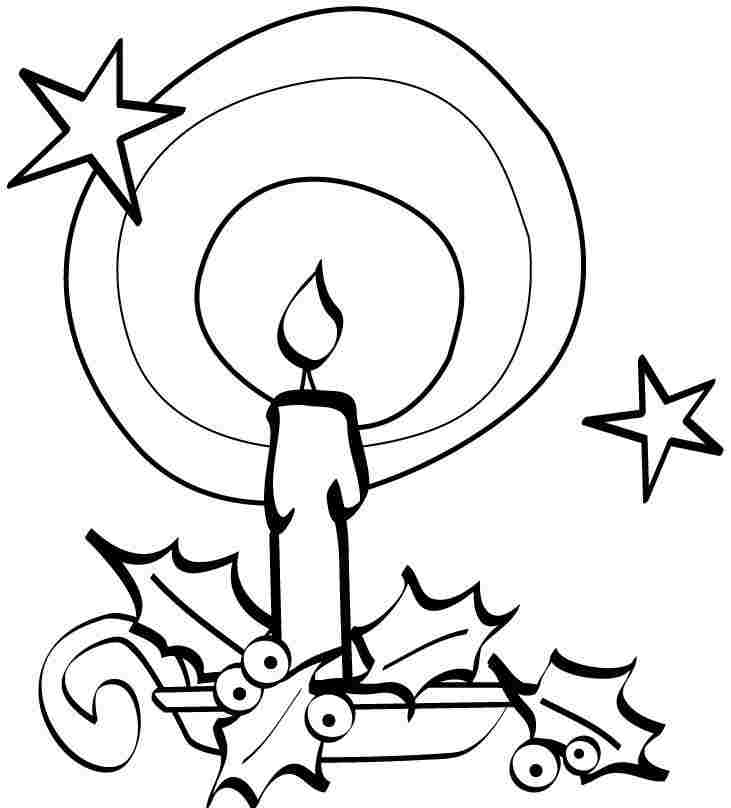
celebrate-picture-books-picture-book-review-christmas-candle-coloring-page   celebrate-picture-books-picture-book-review-diwali-coloring-page

celebrate-picture-books-picture-book-review-menorah-in-window-coloring-page  celebrate-picture-books-picture-book-review-kwanzaa-coloring-page

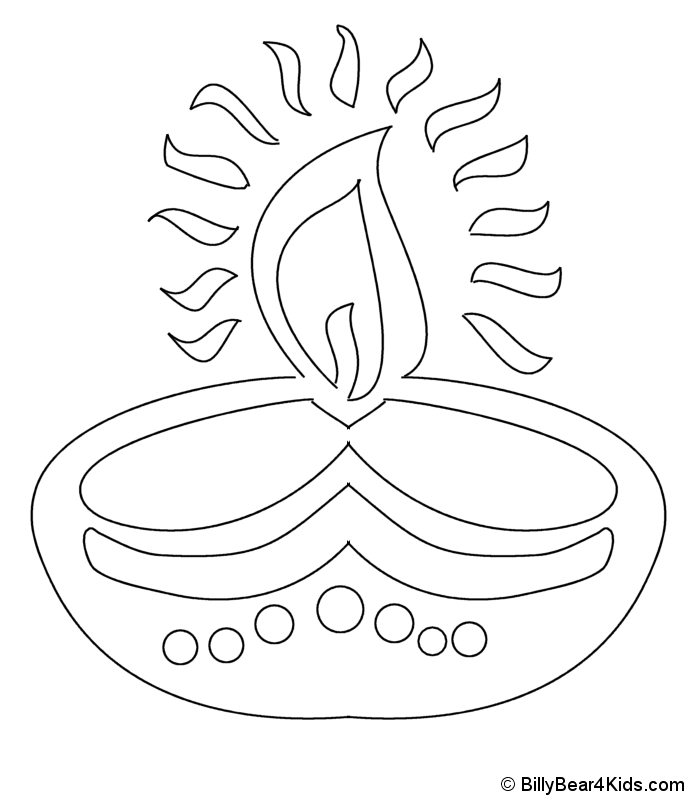
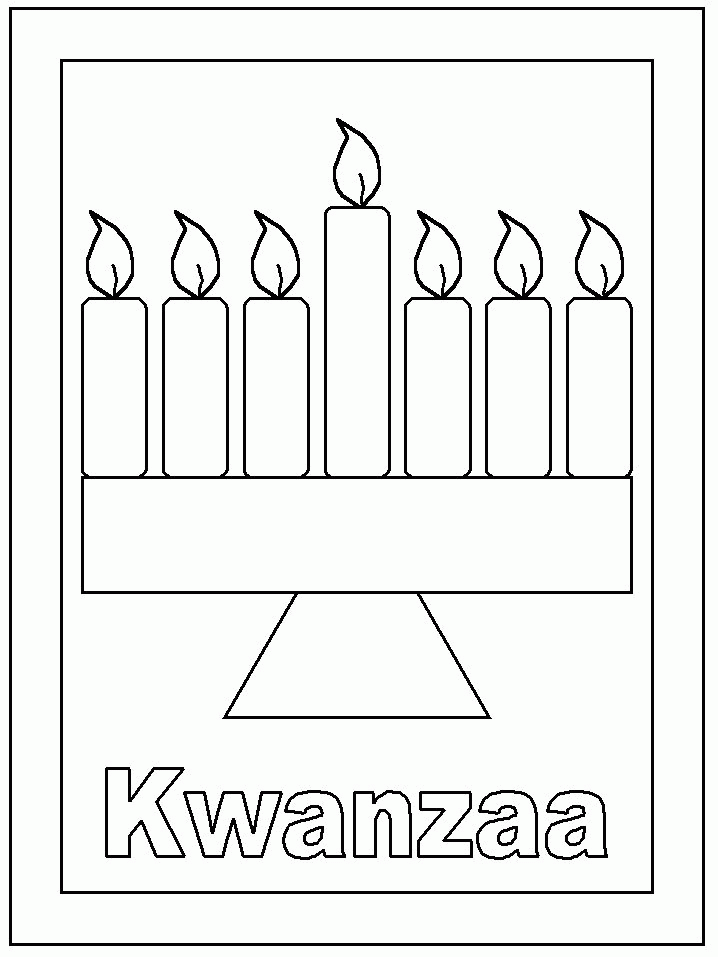
Winter Lights Coloring Pages


Celebrate the lights of winter with these printable coloring pages!

Christmas Candle | Diwali Diya Lamp | Hanukkah Menorah | Kwanzaa Kinara

celebrate-picture-books-picture-book-review-twinkle-twinkle-winter-night-cover

You can order signed or personalized copies of Twinkle, Twinkle, Winter Night at

Word on the Street Children’s Books and Gifts

You can find Twinkle, Twinkle Winter Night at these booksellers

Amazon | Barnes & Noble | Books-a-Million

To support your local independent bookstore, order from

Bookshop | IndieBound

Picture Book Review
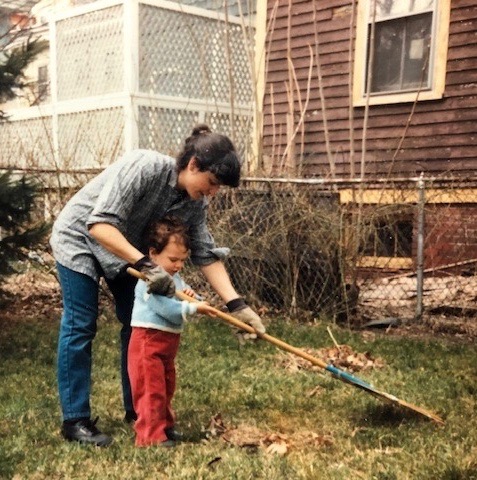
September 20 – It’s a Book Birthday Party for Come On In: There’s a Party in this Book!

celebrate-picture-books-picture-book-review-come-on-in-cover

About the Holiday

Today, I’m celebrating the book birthday of Come On In: There’s a Party in this Book! with two holidays – Read a New Book Month and Friendship Month. I also have amazing interviews with author Jamie Michalak and illustrator Sabine Timm that really dive into the creation of this unique book. So, come on in!

Thanks go to Hippo Park and Deborah Sloan for sharing a copy of Come On In: There’s a Party in this Book! with me for review consideration. All opinions on the book are my own.

Come On In: There’s a Party in this Book!

Written by Jamie Michalak | Illustrated by Sabine Timm


Kids first meet the sweet lemon (yes, an adorably sweet lemon) at the center of this story peeking out from a cutout in the cover. The narrator, having revealed that “there’ a party in this book,” now invites Lemon to find it: “Come on, Lemon! Let’s go look.” So, a little uncertainly, Lemon knocks at a red door with a mouse door knocker. Once inside, Lemon, readers, and the narrator meet a jaunty cast of characters—suspender shorts atop three pillows, a paint-tube mouse on a bed, a curious sock on the top of a bunkbed, and a little pink-and-green house on more pillows.

celebrate-picture-books-picture-book-review-come-on-in-lemon

image copyright Sabine Timm, 2022, text copyright Jamie Malachek, 2022. Courtesy of Hippo Park.

The scene sets Lemon and crew wondering… “Is this a mouse party? A pants, sock, and house party?” And the answer? “No! This is a game where we can’t touch the floor.” Ah! So the narrator says, “Lemon, keep looking. Try the next door.” Lemon tries another house, but there’s no party there either—just some fashionable cats and fruit.

celebrate-picture-books-picture-book-review-come-on-in-fruit

image copyright Sabine Timm, 2022, text copyright Jamie Malachek, 2022. Courtesy of Hippo Park.

Hmmm… Lemon is getting a little discouraged. But the narrator gives Lemon a nudge, saying “This book is not done.” Although Lemon meets a group of friends at the beach, they’re not partying, just hanging out together. Lemon meets some pigeons and enters a kitchen, where a bear, a bunny, and a little toast dog made of bread are baking up treats. But there’s no party! Finally, “…Lemon’s back home. Does the book end right here, with her sad and alone?”

celebrate-picture-books-picture-book-review-come-on-in-cake

image copyright Sabine Timm, 2022, text copyright Jamie Malachek, 2022. Courtesy of Hippo Park.

But then Lemon has an idea! An idea that needs readers’ help to succeed! Lemon (and readers) are going to host the party for everyone they’ve met! There’s going to be cake and candy, decorations and games. “This is a big and a small, / have a ball party. / Hooray for new friends at the / come one and all party!” And what about readers? Everyone shouts, “Come on in!”

celebrate-picture-books-picture-book-review-come-on-in-beach

image copyright Sabine Timm, 2022, text copyright Jamie Malachek, 2022. Courtesy of Hippo Park.

Kids can’t help but get excited about joining Lemon in searching for the party promised on the cover. Jamie Michalak’s enthusiastic, inclusive storytelling speaks directly to them from the very first words as she exclaims “What?! There’s a party in this book?” As Lemon goes from door to door and page to page, readers follow, carried along on Michalak’s buoyant rhythm and rhymes that surprise—coming at the ends of lines but also sometimes in the middle, which keeps each page fresh and fun. 

When Lemon returns home after not finding the party and hits upon the idea of being the one to host it, the promise that “there’s a party inside” is fulfilled in an unexpected way. An interactive page gets readers involved in the party preparations and will make them feel both included and empowered to invite others to their own party—or just to make new friends. 

Sabine Timm’s illustrations, created with found objects, burst with childlike imagination and endearing personalities. Each page is a showstopper that kids and adults will want to explore together to soak up all the details. And you don’t have to stop there! Each character—from Lemon to the yarn cat and clothespin rabbit to the paintbrush dog and soccer-loving log boy (see Sabine’s answer to question 2 in her interview below)—offers up an opportunity for readers to have fun creating their backstories, imagining what they’re doing when Lemon first encounters them, and guessing what their favorite part of the party is. But wait! The party isn’t over yet! The front and back endpapers, full of tiny objects from the story, give families a super search-and-find game to do together.

Full of humor, whimsy, imagination, and the joys of inclusive friendship. Come On In: There’s a Party in this Book! will quickly become a family favorite to read again and again. The book would make a terrific gift and one you’ll want in your home, school, or public library collection.

Ages 4 – 8

Hippo Park, 2022 | ISBN 978-1662640001

Meet Jamie Michalak

celebrate-picture-books-picture-book-review-Jamie-Michalak-headshot

Jamie Michalak is a children’s book writer, who loves toast, dogs, and toast shaped like dogs. She is the author of Come On In: There’s a Party in this Book! illustrated by Sabine Timm. Jamie’s other titles include the multiple starred reviewed Niki Nakayama: A Chef’s Tale in 13 Bites, co-written with Debbi Michiko Florence and illustrated by Yuko Kato-Jones; Dakota Crumb: Tiny Treasure Hunter, illustrated by Kelly Murphy; the Frank and Bean early reader series, illustrated by Bob Kolar, and the Joe and Sparky early readers series, illustrated by Frank Remkiewicz. She lives with her family in Rhode Island.

You can connect with Jamie Michalak on her website | Instagram | Twitter

This story feels so fresh—whimsical, comical, and surprising.  I’d love to have you talk about how your story came to be and your writing process for it.

Thank you! Long ago, I jotted down the title and idea for this story—an interactive picture book with a different party on every page that the reader was invited to join. But I never wrote it. Several years later, my agent, Victoria Wells Arms, told me that editor Jill Davis was looking for a manuscript for artist Sabine Timm. So I checked out Sabine’s irresistible art on Instagram.

I instantly fell in love with her characters and wanted to write a story that included as many of them as possible. That’s when my old idea for COME ON IN; THERE’S A PARTY IN THIS BOOK! came to mind. I wrote the story and threw a party for Sabine’s characters—cats wearing boots and fruits dressed in suits, pigeons named Fred, and dogs made of bread. As it turns out, this party was just waiting for the right guests to get it started!

The idea of anthropomorphizing everyday objects is so interesting, especially as it’s a practice universal to adults and kids. As a storyteller, do you think this is just part of human nature or do we learn it in childhood?

That’s a fascinating question! I’m not sure. But I do love how children and children book creators are always turning inanimate objects into characters. A hot dog and baked bean can be new friends who form a band called The Chili Dogs. Or the salt and pepper shakers might face off in a talent competition before dinner arrives. Life is more interesting when you use your imagination.

The story lends itself so well to the “search and find” fun of Sabine’s illustrations. Was this also part of your intention as you crafted the story?

It wasn’t, but you’re right! I discovered all of the seek-and-find elements, just like readers will, when I first saw Sabine’s illustrations. There are so many whimsical details that I spot new ones with every read.

Every page is so creatively put together, but do you have a favorite spread in the book?

The cats wearing boots spread is one of my favorites from any picture book ever. How did Sabine create a cat from a small ball of yarn and sassy plastic doll boots? I mean … the BEST!

What would you like kids to take away from the story?

Everyone is invited to this book’s party—and that’s what makes the last spreads, starring all of the characters, the most joyful of all. I hope that readers take away that parties are more fun when no one is left out.

Do you have any special events or other marketing planned that you’d like to tell readers about?

Here’s a video “Welcome to Sabine Timm’s Studio” that introduces readers to Sabine Timm and Lemon. Then Sabine gives a tutorial on how they can make a character of their own. a link to a video “Welcome to Sabine Timm’s Studio – the illustrator of COME ON IN.”

And here’s a short bit of animation showing closeups of the objects that make up the book cover.

What’s up next for you?

I’m excited about several books coming out next year. The first is a picture book about a tiny treasure hunt set in a Parisian bookshop: DAKOTA CRUMB AND THE SECRET BOOKSHOP illustrated by Kelly Murphy (Candlewick Press). It’s the follow-up to DAKOTA CRUMB: TINY TREASURE HUNTER about an Indiana Jones-ish mouse. The third Frank and Bean early reader, FRANK AND BEAN: THE STINKY FEET MONSTER, illustrated by Bob Kolar (Candlewick Press), is a hilarious take on Bigfoot. And two Chicken Soup for the Soul for Kids books—THE SUNSHINE GARDEN, illustrated by Jenna Nahyun Chung, and PLAYDATE (WITH BEAR TOO?), illustrated by Katie Mazeika—will be released from Charlesbridge.

Thanks, Jamie, for taking time to chat with me todat! Finding new book of yours is always a reason to celebrate! 

Meet Sabine Timm

celebrate-picture-books-picture-book-review-Sabine-Timm-headshot

Sabine Timm calls herself an artist, creator, beach-trash collector, flea-market lover, and photographer. She draws, paints, assembles and shares her work nonstop on Instagram. She lives in Dusseldorf Germany, but has fans from around the globe.

You can connect with Sabine Timm on Facebook | Instagram

Hi Sabine! I’m so thrilled to have a chance to talk with you about your incredible illustrations! As your 168K Instagram followers would, I’m sure, agree, your adorable creations are not only awe-inspiring but always bring a smile. Can you tell readers how you got started doing this kind of art?

It’s hard to say when I started making art like this. I always had a big interest in playing with found objects. When I was a child, I collected various things from nature. Shreds, sticks, seeds, buttons I’ve found on the streets etc.

I always loved the fairytales of Hans Christian Andersen and I was very much inspired by the hidden life of things in his stories. Many years later when I became a mother myself we had holidays at the sea and me and my son made a beach walk. We found a lot of funny things…a broken flip-flop, a red-checked French-fries bag, sandblasted wood sticks, small rope pieces, bottle caps, shells, feathers, and stuff like this.

Together we started playing, and we made characters from this found trash. We transformed trash to treasures…through our eyes and visions the things got a second life. I was deeply fascinated by these experiences, and I continued in arranging and photographing characters like this.

celebrate-picture-books-picture-book-review-Sabine-Timm-interview-radish

Image courtesy of Sabine Timm


celebrate-picture-books-picture-book-review-Sabine-Timm-interview-cat

Image courtesy of Sabine Timm


celebrate-picture-books-picture-book-review-Sabine-Timm-interview-faces

Image courtesy of Sabine Timm

When you look at an object, do you immediately see its potential to become something else? I’m thinking of the sofa you made from crackers that appeared on your Instagram page recently.

When I work with found or everyday objects there two options. Sometimes the objects themselves are attractive (colour, shape, size) and while looking at these things I get an inspiration. For example, the Swedish bread that became an upholstered sofa.

celebrate-picture-books-picture-book-review-Sabine-Timm-interview-cracker-sofa

Image courtesy of Sabine Timm

The other option is that I have the plan of creating a special character and I go around in my home or in my studio and look around for something that works.

I always try to look at the things around me with the eyes of a child. Forgetting about function and use, I enjoy playing and arranging.

For example the little tree trunk character from the book….I found the miniature soccer shoes at the flea market and I came back to my studio where I had a box with collected objects from nature. I immediately had the idea of a little tree trunk boy who loves playing soccer!

celebrate-picture-books-picture-book-review-Sabine-Timm-interview-log-character

Image courtesy of Sabine Timm

Come On In! is your debut picture book. What were your first impressions when you read Jamie’s manuscript?

I was totally thrilled!!! All my characters united in such a wonderful story! When I read the lovely text for the first time I could hardly believe that Jamie has never been in my studio.

She pictured everything so detailed and gripping. Jamie wrote a charming story of cohesion and team spirit. I love the rhymes and the imaginative language.

I’m so happy to have in Jamie an author who empathizes so much with my characters. Come on In! invites everyone to have a great time together, and I was inspired from the first moment! 

Your scenes in Come On In! are beyond adorable. Can you share a little bit about your process in creating them?

So let’s go into my studio . . .

celebrate-picture-books-picture-book-review-Sabine-Timm-interview-studio

Image courtesy of Sabine Timm

Here I will show you something about my working process. In the very first beginnings of this book, I started with sketches and scribbles to get an idea of the story and the characters.

When I want to build and arrange a scene, I usually start with the characters! When they “come to life“ I start playing and letting them interact with each other. I take a lot of test photos to see how it works.

Next step is building the background or finding the location. In the case of a cardboard background I recycle used boxes and cut them into the right size. I cut out windows and build doors and in the end I paint. 

When I just have to find a nice location, I pack all my utensils and my camera. I never go out before checking the weather forecast (no rain and wind, please)!

For example, the scenery with the pigeons is arranged on my studio rooftop even though I had built a nice cardboard roof, but it didn’t work as I imagined. I changed my plans and placed all the pigeons on the real rooftop…this was an authentic and perfect place for a crazy party with sunflower seed snacks and drinks and music! Adding these kind of items is like the icing on the cake!

celebrate-picture-books-picture-book-review-Sabine-Timm-interview-tools-for-fred-pages

Image courtesy of Sabine Timm


celebrate-picture-books-picture-book-review-Sabine-Timm-interview-space-for-fred-pages

Image courtesy of Sabine Timm


celebrate-picture-books-picture-book-review-Sabine-Timm-interview-final-fred-pages

Image courtesy of Sabine Timm

Did you have a favorite part of the story to create an assemblage for? What made it stand out for you?

It’s hard to make a decision…each assemblage is unique and special.

Creating the characters of fruits and bread was a great fun. Working with edible materials is particularly appealing to me—it is easy to get and you can eat it up when the work is done. (I have to say…sometimes I can’t eat them when they are looking at me so sweetly.)

For the kitchen scene, I was so happy that I could use my lovely vintage furnishings I’d collected for my photo arrangements years before.

I found the perfect buns and cakes to assemble the characters—Mr. Bear looked like a fantastic pastry chef and little bunny girl in her crunchy dress was so photogenic! Very same with the fruits-in-suits scene—in the beginning there is just a bag with fruits and vegetables, and after a few hours you have a gallery of fruity friends!

celebrate-picture-books-picture-book-review-Sabine-Timm-interview-building-bread-rabbit

Image courtesy of Sabine Timm


celebrate-picture-books-picture-book-review-Sabine-Timm-interview-photographing-kitchen-page

Image courtesy of Sabine Timm

What are you hoping to inspire in readers with your illustrations?

I hope I can inspire the readers to realise that the best thing in life is coming together, having a good time, respecting each other, and celebrating the uniqueness of each being.

Lemon takes the initiative, and I hope she will empower the readers to do the same.

What would you like for children to take away from your illustrations in this book?

Children are so creative, and I would like for my illustrations to encourage them to play with anything they find around at home, in nature. or wherever. They don’t need to buy new and expensive Playmobil or Lego figures…just a lemon can become a friend.

celebrate-picture-books-picture-book-review-Sabine-Timm-interview-lemon-characters

Image courtesy of Sabine Timm

Thanks, Sabine, for sharing so much of your creative process and all of these images! I’m sure readers are excited to read the book—and to stretch their creativity! I wish you all the best with Come On In: There’s a Party in this Book!

celebrate-picture-books-picture-book-review-come-on-in-cover

You can find Come On In: There’s a Party in this Book! at these booksellers

Amazon | Barnes & Noble | Books-a-Million

To support your local independent bookstore, order from

Bookshop | IndieBound

Picture Book Review
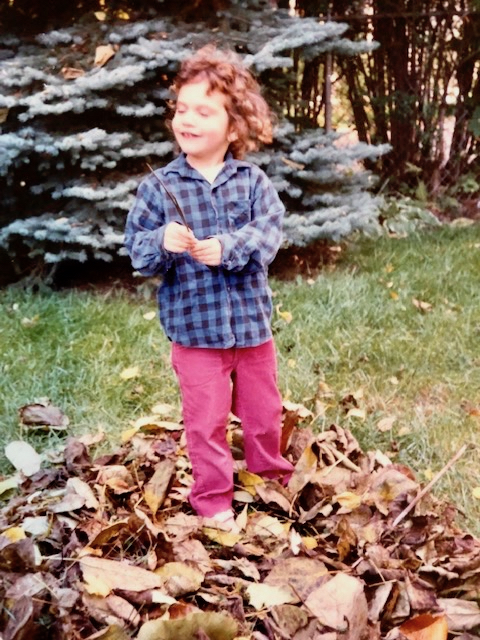
September 3 – Lower Case Letter Day Virtual Book Tour Stop for My Pet Feet plus Interview with Josh Funk and Billy Yong

celebrate-picture-books-picture-book-review-billy-yong-cover-gifG

About the Holiday

Today we celebrate those lowercase letters that make up a predominance of our sentences (and nearly all of our texting). The lowercase letter has a proud history, dating back to the earliest development of script and writing. The terms “lowercase” and “uppercase” come from the era of the printing press, when individual letters were inserted by hand into plates that were then inked and pressed onto paper. The tiles etched with each letter were kept in trays conveniently located for the printer to set them into the plates with capital letters found in the upper case and small letters arranged in the lower case. To learn more about the history of our script was developed, visit My Modern Met. You’ll find rules on using lowercase and uppercase letters at Gammerly. And to discover the fun you can have with the letters of the alphabet, read about today’s book below and meet its creators!

My Pet Feet

Written by Josh Funk | Illustrated by Billy Yong


A little girl wakes up on a glorious morning. The bees are buzzing and the palm tees (no, it’s not a typo, you’ll see…) outside her window are standing tall. First job of the day is to feed her pet ferret, Doodles. She goes to his cage only to find two very long feet and a very sad face looking up at her. “‘What happened to my pet feet?’” she cries. “‘I mean my pet feet. Why can’t I say ‘FEET’?’” She looks all over her room for an answer and then spies something suspicious. Her alphabet banner is missing the ‘R.’ She quickly assesses the situation and realizes that without the letter R, her beloved pet has become simply FEET. Immediately, she decides she must do something and calls her best friend Lucas to help her.

celebrate-picture-books-picture-book-review-my-pet-feet-Doodles

Image copyright Billy Yong, 2022, text copyright Josh Funk, 2022. Courtesy of Simon & Schuster Books for Young Readers.

But when she left the house, she discovered that the missing R wasn’t just affecting Doodles, but the whole town. On the way to find Lucas at his mom’s bake shop, she had to avoid “a bunch of kids on go-cats” and a policewoman on the back of a galloping hose.” Then when she found Lucas, her bestie had turned into a fiend. What was worse is that no one acted like anything was wrong.

Everywhere she went there was pandemonium, strange hybrid creatures, and weird machines. The girl wanted to find out “what happened to the eighteenth symbol of the alphabet. Could someone have taken it? “But who? And why? …I don’t want to have pet feet until the end of time!” Distressed to hear this, Doodles ran away, and even though she chased him “by the old babbling book, down a tail, and into a gassy field, the girl couldn’t find him.

celebrate-picture-books-picture-book-review-my-pet-feet-missing-r

Image copyright Billy Yong, 2022, text copyright Josh Funk, 2022. Courtesy of Simon & Schuster Books for Young Readers.

But then, faintly in the distance, she heard familiar footsteps and followed the sound until she found him at the seashoe …ummm…at the beach, which was not quite the way it used to be. Still, she found Doodles and apologized for hurting his feelings. He gave her a big hug, but then was off again—this time into the sea. The girl dove in too. Could Doodles be leading them to the answer for the missing R’s? Could life eally etun to nomal … ummm … Could life actually go back to the usual? To find out, jump in and paddle along! You don’t want to miss the supising esolution … I mean the astounding ending!

celebrate-picture-books-picture-book-review-my-pet-feet-bakery

Image copyright Billy Yong, 2022, text copyright Josh Funk, 2022. Courtesy of Simon & Schuster Books for Young Readers.

In My Pet Feet, Josh Funk has carefully crafted a grammatical mystery that will keep readers (both kids and adults) marveling over the cleverness of each word transformation and how they add to the richness of the story. As the little girl races to restore Doodles to his normal cuddly state, readers become totally immersed in the laugh-out-loud, fantastical R-less world even as they empathize with her dilemma. The pitch-perfect ending comes as a real surprise, one that is sure to please readers of all ages.

Perfectly matched to Funk’s comedic talents is new picture book bright light Billy Yong, who brings a fresh, vibrant, and hilarious sense of humor to this story. Readers will want to linger over every page as Yong infuses each spread with a wealth of astoundingly clever details in depicting not only the R-less words provided in the story but in creating a whole town and outlying regions in which every element is flawless. Yong’s illustrations set up an irresistible game of search-and-find for all the visual puns, and the before and after images of the town make for an engaging find-the-differences puzzle.

A joy from beginning to end, My Pet Feet charms on many levels. The book is laugh-out-loud fun for the whole family as well as a way to engage kids in lessons on the alphabet, sound recognition, spelling, and grammar for teachers. Both avid and reluctant readers will love the silliness that makes this a must-have addition to all home, classroom, school, and public library collections

Ages 4 – 8

Simon & Schuster Books for Young Readers, 2022 | ISBN 978-1534486003

I’m thrilled to be talking with Josh Funk and Billy Yong today about My Pet Feet. So put up your feet and get ready to learn about the amazing journey this story took from an initial idea to an instant classic!

Meet Josh Funk

celebrate-picture-books-picture-book-review-Josh Funk Headshot-Credit Carter Hasegawa
Credit Carter Hasegawa

Josh Funk writes silly stories such as the Lady Pancake & Sir French Toast series (including the forthcoming The Great Caper Caper, November 15, 2022); the It’s Not a Fairy Tale series (including the forthcoming It’s Not the Three Little Pigs, October 1, 2022); the How to Code with Pearl and Pascal series (including How to Code a Sandcastle and How to Code a Rollercoaster); the A Story of Patience & Fortitude series in conjuction with the New York Public Library (including Where Is Our Library? and Lost in the Library); Dear Dragon, Albie Newton, Pirasaurs!, A Night at the Bookstore: A Barnsie & Noble Adventure, and Dear Unicorn, coming in the fall of 2023!

Since the fall of 2015, Josh has visited (or virtually visited) over 500 schools, classrooms, and libraries and he is a board member of The Writers’ Loft in Hudson, MA. Josh grew up in New England and studied Computer Science in school. Today, he still lives in New England and when not writing Java code or Python scripts, he drinks Java coffee and writes manuscripts.

For more information about Josh Funk, visit him at www.joshfunkbooks.com and on TwitterInstagram, and Facebook at @joshfunkbooks.

Hi Josh! I’m so excited to be a part of your book tour for this comedic tour de force! Thanks for taking time to chat with me about My Pet Feet and how the story came to be! I’m sure readers would love to know a little about how you wrote this story. How much fun was it to find all of the convertible words? How long did your writing process take?

It started with a typo on my phone (or possibly an autocorrect). I meant to write the word ‘friend’ but it came out ‘fiend’ which led me to wonder … what happened to the R? Why would a friend become a fiend? Did other words also lose their R’s? Did ALL words lose their R’s? Why? And what would the world look like if there were no R’s? What silly illustratable shenanigans would occur in a book written without the letter R?

This led me to start searching for words where if you took away an R, it would become another word—especially word pairs that made for funny illustrations. Crows becoming cows. Babbling brooks becoming babbling books. The seashore becoming the seashoe.

But I still also needed a story. I needed a reason, an important reason, that someone needed to investigate the missing R’s … and needed to get them back. And rescuing a pet who had been transformed into something else was the perfect reason.

Once I had the list of words to play with along with the main character’s motivation, everything easily fell into place. JUST KIDDING! I wrote many, many, MANY revisions of this story both before and after it was acquired to get things in the shape they finally ended up in. And truly, nothing really came together until Billy Yong joined the team.

Speaking of Billy, what were your thoughts when you saw his illustrations? Do you have a favorite spread?

As an author of picture books, I think I benefit from not thinking too visually, at least in specifics. By that, I mean, I had no idea what ‘pet feet’ would look like. Would they be human feet (with human toes? Ew.)? Would it be like a rabbit’s foot? Would the foot have a face? I honestly didn’t even bother thinking about these things—I left that for someone else to tackle.

And unsurprisingly, I think Billy’s visual creation of pet feet is amazing! I have no idea how he made ‘pet feet’ look cute. The concept is just so ridiculous, but he managed to pull it off.

As far as favorite spreads and images, I love the spreads with all the visual gags in the background, like the one in town with everyone acting like it’s just a typical day. But the best, without a doubt, is the gassy field. I had no idea Billy was going to illustrate a bunch of butts farting—but I totally approve. Like I said, I don’t think too visually—I just wrote ‘gassy field’ and assumed someone else would take care of it. And there are no buts about it—Billy did.

Meet Billy Yong

celebrate-picture-books-picture-book-review-billy-yong-headshot

Billy Yong is an illustrator and character designer. Since starting out he has drawn storyboards, engaged in visual development, and has even voice acted for animation, games, and children’s books. When he’s not creating his professional doodlings, he can be found in a cafe drawing or painting in his sketchbook, in his studio developing his personal projects, or in the dojo teaching Japanese swordsmanship. Billy currently lives in sunny Singapore.

To learn more about Billy Yong and view a portfolio of his work, visit his website. You can connect with Billy on Instagram and Twitter

Hi Billy! I’ve been looking forward to chatting with you since the moment I saw my review copy of this book. First, I want to Congratulate you on your debut picture book! Can you talk about your previous work and how you came to illustrate Josh’s story?

Thanks Kathy! It is such a privilege to be debuting through Josh’s hilarious story. Up till then, most of my illustrative works centered around the Young Adults range. Now that I think about it, one of my most enjoyable school projects that brought me into the kid lit scene was The Boy Who Cried Wolf.

celebrate-picture-books-picture-book-review-billy-yong-intreview-wolf-1

celebrate-picture-books-picture-book-review-billy-yong-intreview-wolf-2

celebrate-picture-books-picture-book-review-billy-yong-intreview-wolf-3

Copyright Billy Yong

When I was first approached about the project, Josh, Kendra and Chloe (editor and art director respectively) said my sense of humor was what got me the role. At that time, I honestly struggled to understand what they meant, but never say no to great opportunities eh?

What were your first impressions when you read Josh’s manuscript?

Dude, I loved it. Probably not a good thing that I first read it just as I was about to turn in for bed (it was 02:32 in the morning since I live in Singapore). I couldn’t sleep for the next two hours because I was drawing scenes in my head haha.

Your illustrations are so ingenious, even including foreshadowing and visual puns that go beyond or riff on the “r-less” words in the text. I’m sure readers would love to learn a little about your process in creating them.

You’re too kind! First off, for anyone wanting to get into illustration, particularly with larger projects like these, understand that the process is more often a back-and-forth than a straight journey. I typically like to doodle on the script when I first read it, it helps to just spill out any ideas onto paper without restraint at the earliest phase.

Some of the earliest ideas featured the town name: Butterfield Shores -> Buttefield Shoes. Me being the adult that I am, figured why not a bronze statue, butt resplendent for all to see, with a sign sticking out his bum, and a shoe on his head, with a little flower growing from it.

celebrate-picture-books-picture-book-review-billy-yong-buttefield-shoes

Image copyright Billy Yong, 2022

Developments of bums are always a joy.

Another was around miscellaneous things we would encounter.

celebrate-picture-books-picture-book-review-billy-yong-unused ideas 2

Image copyright Billy Yong, 2022

Even though they were never used, it helped kick off the vibe of this crazy world our heroes lived in.

Back on the main subjects, I’m usually drawn most towards characters, so that’s usually what I like to start off with after doodling on the script.

celebrate-picture-books-picture-book-review-billy-yong-characters-1

Image copyright Billy Yong, 2022

I loved that our main human was pretty nondescript, so that left a lot of room to create a cast of characters. I eventually settled on no.2, since her shapes felt quite a lot like our fe(rr)et, Doodles. Below are some other characters I drew during the development process:

celebrate-picture-books-picture-book-review-billy-yong-go-cat-characters

Image copyright Billy Yong, 2022


celebrate-picture-books-picture-book-review-billy-yong-characters-crow-cows

Image copyright Billy Yong, 2022

When it came to laying out the pages however, my usual methods of working digitally lacked the grand overview and the bravery to push past mistakes. Ironic since the digital medium allows me to undo to my heart’s content, but that also means I don’t see my mistakes and move past them.
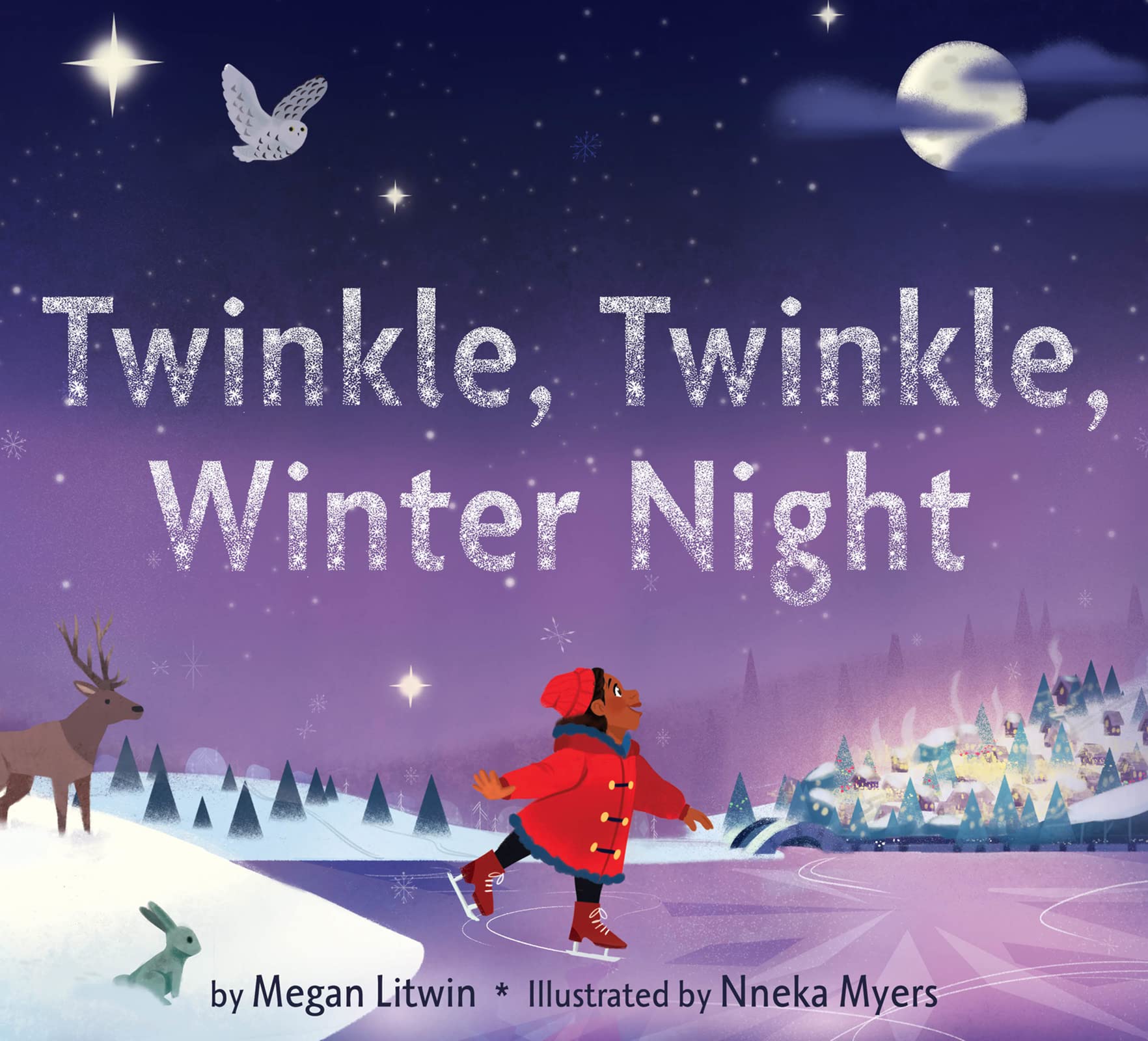
So, feeling stuck, I whipped out a giant A3 sketchpad with a sharpie and just went ham at it. No distractions, not even music in the background, just drawing at the dining table figuring out the flow and composition for Josh’s story. I think I managed to churn out the entire layout in 2 days because of this, haha.

celebrate-picture-books-picture-book-review-billy-yong-layout ruffs 1

Image copyright Billy Yong, 2022, text copyright Josh Funk, 2022.

celebrate-picture-books-picture-book-review-billy-yong-ferret-layout ruffs 2

Image copyright Billy Yong, 2022

(Initial doodles of the first couple of pages. When I liked a composition but didn’t like parts of it, I would paste a sticky note on top and just draw over it. It feels a lot more intuitive ideating like this compared to a digital drawing.)

This wouldn’t quite make sense to Josh, Chloe (art director) and Kendra (editor) though, so the next step was tidying up.

celebrate-picture-books-picture-book-review-billy-yong-Script-sketch

Image copyright Billy Yong, 2022, text copyright Josh Funk, 2022.


celebrate-picture-books-picture-book-review-billy-yong-layout sketch 1

Image copyright Billy Yong, 2022, text copyright Josh Funk, 2022.


celebrate-picture-books-picture-book-review-billy-yong-layout tight sketch 1

Image copyright Billy Yong, 2022, text copyright Josh Funk, 2022.

(I think the most important part about this sketch cleanup phase was not to be too married to the original sketches, so if it doesn’t work on cleanup, then it helps to go back to the sketchpad or just move on and revisit the spread.)

Once layouts were done, it was back to designing the characters. Doodles (or Feet) had the most rounds of back and forth. Ranging from foot-face, to a head on feet, ultimately to feet with a face, every interpretation brought us closer to what you see before you.

celebrate-picture-books-picture-book-review-billy-yong-ferret-face-on-feet

Image copyright Billy Yong, 2022


celebrate-picture-books-picture-book-review-billy-yong-doodles-feet-state

Image copyright Billy Yong, 2022


celebrate-picture-books-picture-book-review-billy-yong-feet-state-2

Image copyright Billy Yong, 2022

Doodles (Feet State) v.2 was what we settled on in the end.

Was there a spread that was particularly fun to illustrate? What made it so?

Haha, they were all a joy to do, but my favorites would be these three:

celebrate-picture-books-picture-book-review-billy-yong-go-cats-1

Image copyright Billy Yong, 2022, text copyright Josh Funk, 2022.

While the layout changed quite a fair bit from the original sketch, my goal of showcasing the go-cats and the topsy-turvy-ness of it all culminated in a winding road, with a subtle line at the top to lead the eyes back to the cat’s tail, ultimately to rest at the water splashing of the police ho(r)se.

celebrate-picture-books-picture-book-review-billy-yong-town

Image copyright Billy Yong, 2022, text copyright Josh Funk, 2022.

While this was less dynamic than the previous one, it was really fun laying out the look and feel of the town. I think the biggest challenge was to make it feel populated without overloading the senses, and allowing the eyes pockets of rest in a spread so full of colors and information. I also sneakily snuck in my friends, who are getting married at the end of 2022, so even though I couldn’t be there, it’s my little wedding present to them.

The @-rats were also a suggestion of my wife (I think). Honestly in the thick of things I’ve confused ideas I’ve received from Josh, Kendra (our editor), Chloe (art director), my wife Rachel and myself. It really has been a team effort to bring this book to life.

celebrate-picture-books-picture-book-review-billy-yong-gassy-field

Image copyright Billy Yong, 2022, text copyright Josh Funk, 2022.

Again with the swirly composition. (I’m starting to think I have a thing for these…) Also relatively simple, but I’m happy turning the tail into a device for our readers to traverse from left to right. Of course the gassy fields had to be a field of bums farting into the wind.

What do you like best about illustrating children’s books?

I enjoy the freedom of expression. It’s very daunting whenever you start a project like this, because said freedom means you often start on a very blank canvas, with only the story to guide you. You have to give yourself permission to be as wild as your skill and imagination can allow, and avoid listening to the doubts you have with certain decisions you make. When those doubts do manifest, I’ve found it useful to remind myself that this is a team process, and if the author, editor or art director don’t quite approve, they’ll let you know. Until then, go ham.

What’s up next for you?

Haha, I don’t think I’m allowed to say, but perhaps I could hint that it’s about a boy, his friends and a hammer. It’s quite the wild ride, and I hope when it’s released readers will enjoy it. I certainly have. Apart from that, just raising a baby girl with my wife. It’s an exercise in patience and endurance. I cannot wait to start drawing with her and learning from her. Perhaps I will become a better artist from that.

Wow! Thank you for sharing so much about how you brought My Pet Feet to life! Your awesome illustrations and sense of humor are going to keep kids searching for all the visual puns and laughing from beginning to end – and over and over again! I wish you all the best with this book and am really looking forward to seeing more of your work. And, since we’re talking about bringing the story to life, I think we have time for one more image ….

celebrate-picture-books-picture-book-review-my-pet-feet-billy-yong-go-cat-gif

Copyright Billy Yong, 2022

So, Everybody, jump on your Go-Cat and head to your local bookstore to pick up My Pet Feet to celebrate New Book Month in hilarious style! 

My Pet Feet Virtual Book Tour Activity

celebrate-picture-books-picture-book-review-feet-pet-portrait-dog

Feet Pet Portraits


Feet don’t have to be just for walking, running, or dancing. As today’s story shows, they can make pretty awesome pets (even when it’s just a mistake). With this craft you can use your own feet to make a pet portrait to decorate your room!

Supplies

  • 1 Sheet of regular printer paper or heavy stock paper for the portrait
  • 1 Sheet of colored heavy stock paper for the frame’s backing
  • 1 Sheet of heavy stock paper in a contrasting color from the backing to make the frame 
  • Crayons or colored pencils
  • Scissors
  • Glue or glue dots

celebrate-picture-books-picture-book-review-feet-pet-portrait-lion

Directions

  1. Stand on the white paper with your feet together and trace your feet
  2. Now it’s time to get creative! Turn the paper toes up, toes down, or toes to the side and design your pet.
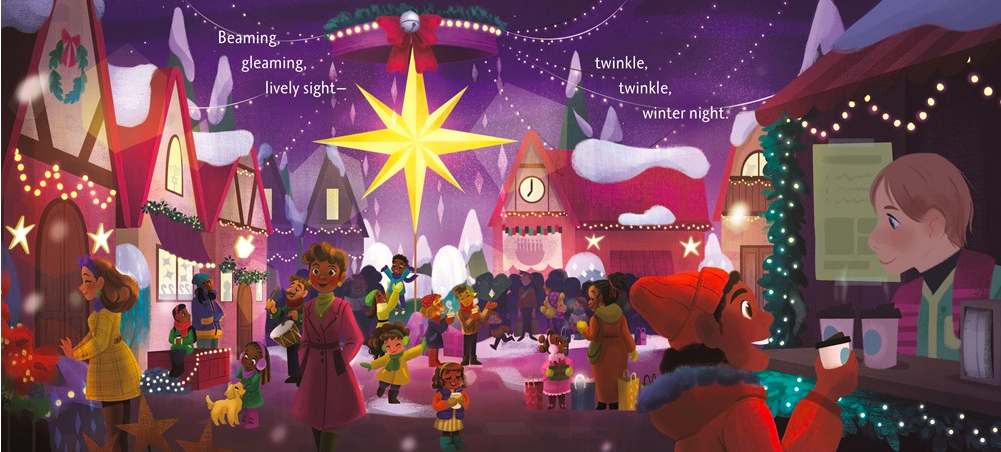
  3. After you’re finished drawing, color your picture in
  4. Cut your pet out

To Make the Frame and Frame Your Portrait

  • Measure one inch around each side of one piece of heavy stock paper
  • Cut out the middle
  • Use glue or glue dots to adhere the frame to the backing
  • Use glue or glue dots to adhere your feet pet portrait to the backing of the frame

Hang your pet portrait!

celebrate-picture-books-picture-book-review-my-pet-feet-cover

You can find My Pet Feet at these booksellers

Amazon | Barnes & Noble | Books-a-Million

To support your local independent bookstore, order from

Bookshop | IndieBound

Picture Book Review