Ideas and dreams lead to accomplishments and accomplishments can lead to greatness! And when does this all begin? In childhood as kids develop knowledge, skills, and confidence. Plant the Seeds of Greatness Month was established to help people remove barriers to their success and make changes to better their lives. To celebrate with your kids, talk to them about what they would like to achieve and what kind of support they need to make their dreams come true. Today’s book can help girls understand that they should always celebrate their talents and emotions and never feel second-best or accept impediments to their success. So, get started this month on planting – and nurturing – all the seeds of your greatness in your family or classroom.
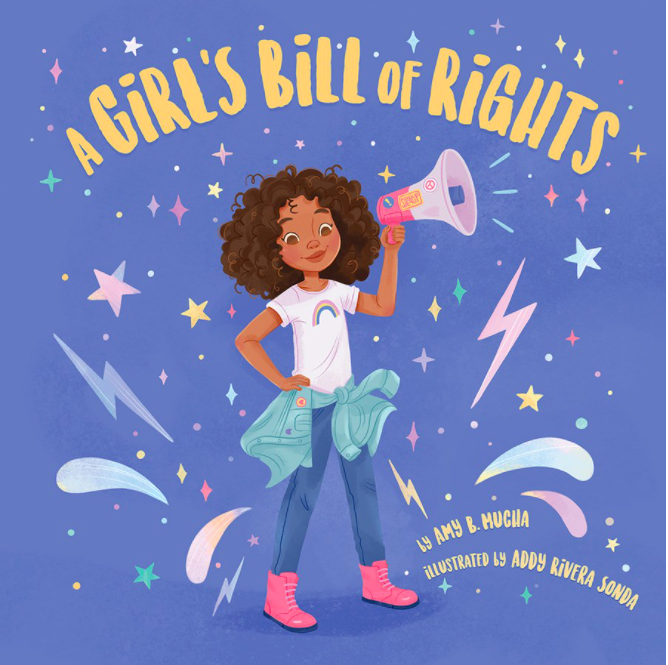
A Girl’s Bill of Rights
Written by Amy B. Mucha | Illustrated by Addy Rivera Sonda
In her super book that affirms a girl’s right to her own likes, dislikes, and feelings, Amy B. Mucha presents her story in the first person, allowing readers to internalize the affirming text and identify with her examples. The book opens with a Black girl talking about her skateboard and skateboarding for show and tell. The narrator states, I have the right to like what I like and love what I love.” In the front row of desks, Addy Rivera Sonda includes three more girls, including one who uses a wheelchair, ready to talk about their favorites: pets, soccer, and dance.
Image copyright Addy Rivera Sonda, 2021, text copyright Amy B Mucha. Courtesy of Beaming Books.
As the girl’s vote for class president, readers are told that they have the right to think for themselves, make their own choices, and for their “Yes” to mean yes and their “No” to mean no. And if they feel disappointed or frustrated or happy, they can show their feelings without being chastised or made to feel it’s not appropriate.
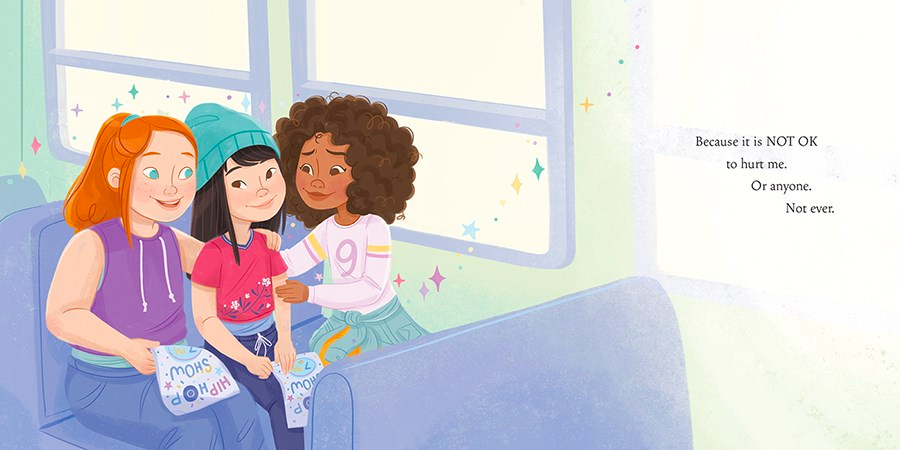
Girls are reminded that it’s okay to make mistakes, and that when it comes to making friends, they can choose their own as well as how they express their affection. Girl’s also learn that “if someone is hurting or disrespecting me, I have the right to say ‘STOP!’ and even the right to SCREAM it!’ Because it is NOT OK to hurt me. Or anyone. Not ever.” And every girl is reassured that she has the right to decide who she is now and what she will choose to do in the future; she’s reassured that she has the right to be herself.
Image copyright Addy Rivera Sonda, 2021, text copyright Amy B Mucha. Courtesy of Beaming Books.
In her straightforward , empowering text, Amy B. Mucha shows girls just how valuable they are. Through the examples I highlighted and many other common issues on which girls are criticized, ignored, or second guess themselves, Mucha delivers a strong message that their opinions, feelings, and preferences are valuable and should be heard. Periodic rhymes give the text a lyricism that flows easily from page to page. The number and range of rights that Mucha presents gives children and adults many opportunities to discuss these important and commonly faced experiences as well as their immediate and long-term effects on girls.
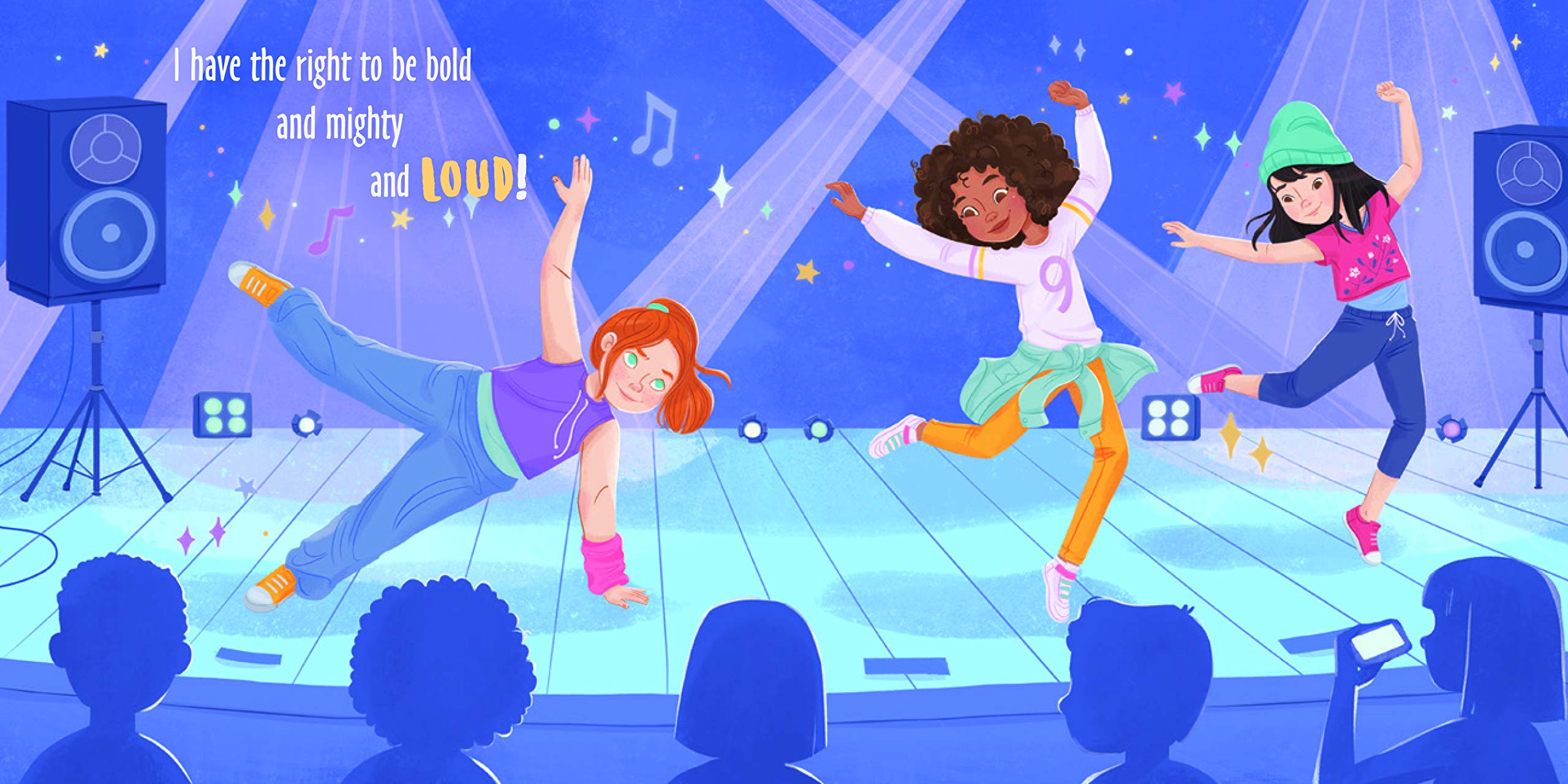
In her vibrant and expressive illustrations populated with a group of diverse girls, Addy Rivera Sonda shares clear images of girls doing what they love, adopting a look that reflects their personality, making choices, expressing their emotions, sticking up for themselves, and being proud of their accomplishments. From school to the soccer field to the stage to a party, Sonda presents uplifting examples of how this close-knit group supports each other. For girls, these images will resonate deep in their hearts. Boys reading or listening to the book—and this is a book every boy should know—will see how and why girls express a variety of emotions as well as behaviors on the part of others that are destructive to a girl’s self-esteem and autonomy. The final illustration showing all six girls happy to live as their true selves is a poignant and heartening vision for children to take away from this book.
A dynamic read to empower and celebrate girls, A Girl’s Bill of Rights is highly recommended for home, classroom, and public libraries.
Ages 4 – 8
Beaming Books, 2021 | ISBN 978-1506464527
Discover more about Amy B. Mucha and her books on her website.
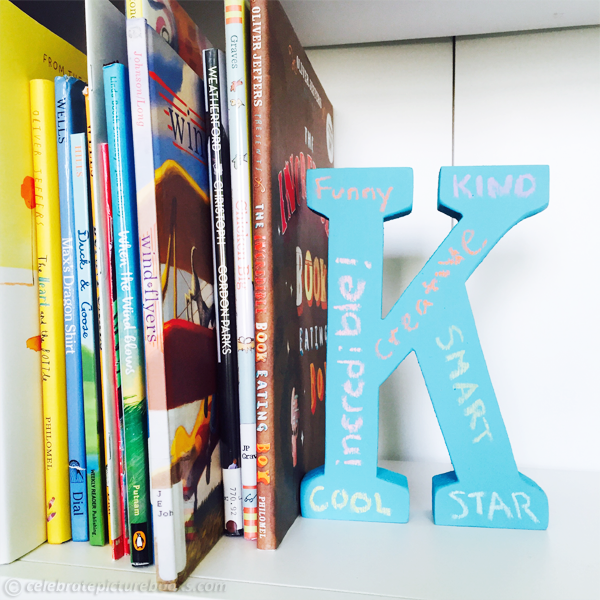
You can show your pride in your name (or play with changing it) with this easy craft that will keep all your books tidy on their shelf! This makes a great gift too!
Supplies
Sturdy wooden letter blocks in the child’s first and last initials. Or, if the child would like to try on a new name or nickname, the first letter of their new name.
Chalkboard or acrylic paint
Colored chalk
Paint brush
Directions
Paint the letters, let dry
With the chalk write words that describe you or names of your heroines and/or heroes
Display your bookends
You can find A Girl’s Bill of Rights at these booksellers
February, the month of love, is a perfect time to think up creative ways to surprise that special person in your life with a romantic gesture, exciting date night, or fun adventure that will add spice and fun to your relationship. With a little imagination you can find unique ways to show all the love that’s in your heart.
I’d like to thank Bloomsbury Children’s Books for sharing Bear Meets Bear with me for review consideration. All opinions on the book are my own.
Bear Meets Bear
By Jacob Grant
Bear was waiting for the teapot he and Spider had ordered to arrive. It was exciting to think of getting something new delivered. At last the doorbell rang. When Bear opened the door, he found Panda, a delivery person he’d never seen before. She asked him to sign for his package, but Bear was smitten. “His heart beat fast…. He wanted to say something clever, or funny, or anything at all,” but he couldn’t.
Copyright Jacob Grant, 2020, courtesy of Bloomsbury Children’s Books.
The delivery woman asked for his signature again, and finally he was able to sign the sheet. He watched Panda peddle away on her delivery bike. Spider thought Bear’s predicament was quite funny. Bear rushed to his computer and ordered another teapot. Bear waited and waited. He watched out the window, hoping to see Panda’s delivery bike roll up.
Copyright Jacob Grant, 2020, courtesy of Bloomsbury Children’s Books.
Bear was just considering ordering another tea pot when he saw Panda coming up the walk. But when she handed him the box and asked him to sign, Bear just stood silently again. “Spider felt sorry for his friend.” Bear ordered another teapot and another and another. Never could he summon the courage to talk to Panda, even though Spider encouraged him. Standing among all of the boxes of teapots, Spider told him he should “invite her to tea” or “at least remember to breathe” when Panda came to the door.
Bear agreed. He would order one more teapot and talk to Panda when it arrived. Bear waited with anticipation. But when the doorbell rang, it wasn’t Panda standing there, but a “gruff raccoon.” “Bear’s heart hurt.” He bemoaned the missed opportunities and regretted all the teapots. Spider wanted to help. He wrote a note and headed out to find Panda. He went from door to door asking if anyone had seen her. Finally, he found her at Duck’s house.
Copyright Jacob Grant, 2020, courtesy of Bloomsbury Children’s Books.
The next day Panda was excited to see Panda on his doorstep. She thanked him for his invitation to a tea party. Bear felt himself freeze, but then he told her he would be just a minute. He cleaned up the scattered teapots and welcomed her in. Soon Bear and Panda were chatting and laughing like old friends.
After Panda said goodbye, Bear thanked Spider and said that Panda was very nice but that they would “not be meeting for tea again.” It turned out that Panda didn’t like tea! Bear was nonplussed, but thought it was “all rather funny.” The next time he and Panda met, Bear served lemonade. And what about all those teapots? Bear held a yard sale!
Copyright Jacob Grant, 2020, courtesy of Bloomsbury Children’s Books.
Fans of Jacob Grant’s Bear and Spider series know that Bear is often hesitant to put himself out there, to try something new, or even, sometimes, to leave the house. It might be because his feelings are so strong or he doubts himself – or a little of both. Fortunately, Bear has his good friend Spider who supports him and gives him a nudge when he needs it. When Bear meets Panda and is smitten, he, like many people, can’t find the exact right words among all those feelings; a simple “hello” doesn’t seem like enough. Grant understands. Enter Spider, who offers a gentle dose of honesty and provides always-polite Bear with an opportunity to shine. When Bear discovers that Panda doesn’t like tea, Grant also shows readers that conditions don’t have to be perfect to make a new friend and that a little humor goes a long way toward smoothing things over.
Grant’s tranquil color palette and simple shapes make it easy for readers to immerse themselves in Bear’s feelings, empathizing with his all-too-human predicament while enjoying the comical collection of all those tea pots. When Bear watches out the window day after day, willing Panda to return only to be filled with fear and anxiety when she does, Grant perfectly captures that “oh no, now what?” emotion as Bear’s paws fly to his face and his eyes widen. Likewise, Bear’s regrets are palpable as, surrounded by boxes, he buries his head in the chair. Throughout, Spider is there, weaving his web, strumming his banjo, and watching out for Bear. Wordless images of Bear and Panda enjoying lemonade together and Bear’s yard sale let kids know it has all turned out all right.
A charming, poignant, and reassuring addition to the Bear and Spider series, Bear Meets Bear, a story about overcoming emotions that hold us back, is highly recommended for home, school, and public library bookshelves.
Ages 3 – 6
Bloomsbury Children’s Books, 2020 | ISBN 978-1547604241
Discover more about Jacob Grant, his books, and his art on his website.
Creative Romance Month Activity
Create a Mug
If you’re kids are looking for a gift to make for a family member or a friend for Valentine’s Day or any time, a personalized mug makes a creative way to share a little love every time it’s used.
Supplies
Plain ceramic mug
Bakeable markers or paint
Directions
Design and color your mug
Follow directions on the markers or paint to properly bake on your decoration and make it permanent.
Opera has been a favorite art form since its beginnings in Italy in the 1500s. Combining magnificent voices, soaring arias, grand costumes, and dramatic storylines, operas continue to thrill audiences and gain new fans. To celebrate Opera Day today or at a time in the future, enjoy a performance in your area or find one on YouTube and gather your family and friends for an opera party.
I received a copy of Diva Delores and the Opera House Mouse from Sterling Children’s Books for review consideration. All opinions are my own.
Diva Delores and the Opera House Mouse
Written by Laura Sassi | Illustrated by Rebecca Gerlings
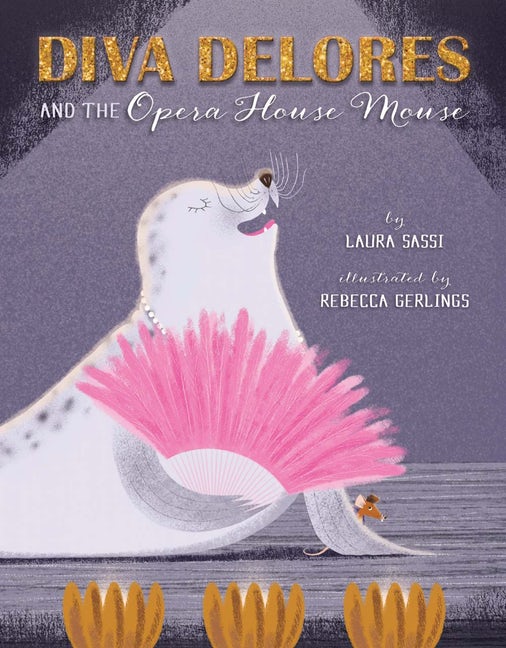
Fernando had many loves in his life—including chocolate, cheese, gumdrops, and popcorn—but what he loved most was “feasting on Mozart, Puccini, and Strauss, / and lending a paw at the Old Opera House.” Delores loved nothing more than being in the spotlight, and now she was getting the chance to leave her place in the chorus to “take center stage and be Diva Delores.” She warmed up in her dressing room with “Me-me-me-me!”
Image copyright Rebecca Gerlings, 2018, text copyright Laura Sassi, 2018. Courtesy of Sterling Children’s Books.
Fernando wanted to give Delores the benefit of all of his years of experience, but she wasn’t having it. A mouse was not a suitable helper for someone as great as she, she thought. At the rehearsal the next day, Delores was a flop, hitting wrong notes, missing her entrance, and the last song? Well…. From the back Fernando called out that he could help. He wrote cues on little cards “and—presto!—Delores knew just what to do.” You’d think Delores would be thankful, but instead she complained that a mouse’s help was just not proper for a diva, and she shooed Fernando away.
Image copyright Rebecca Gerlings, 2018, text copyright Laura Sassi, 2018. Courtesy of Sterling Children’s Books.
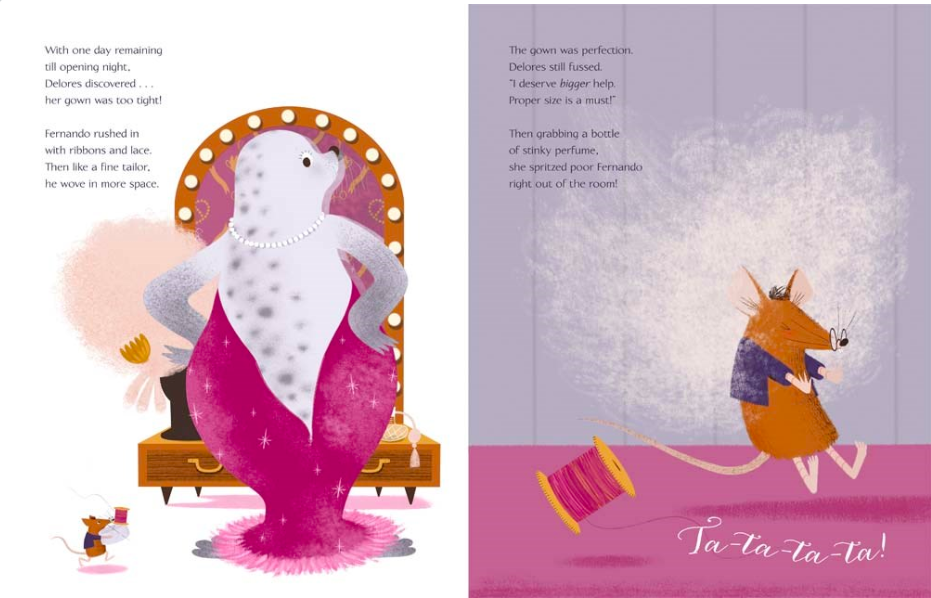
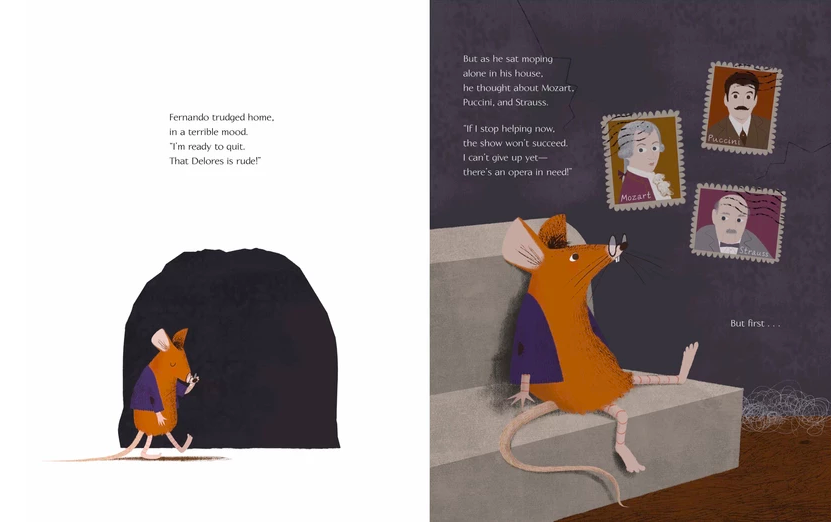
The day before her big performance, Delores found that her dress didn’t fit. Again, Fernando rushed to her rescue, but what thanks did he get? Delores grumbled and fussed. “Then grabbing a bottle / of stinky perfume, / she spritzed poor Fernando / right out of the room!” Fernando went home, wanting to quit. But as he looked at his pictures of Mozart, Puccini, and Strauss, he knew that without him the show would fail and that he couldn’t quit now.
Image copyright Rebecca Gerlings, 2018, text copyright Laura Sassi, 2018. Courtesy of Sterling Children’s Books.
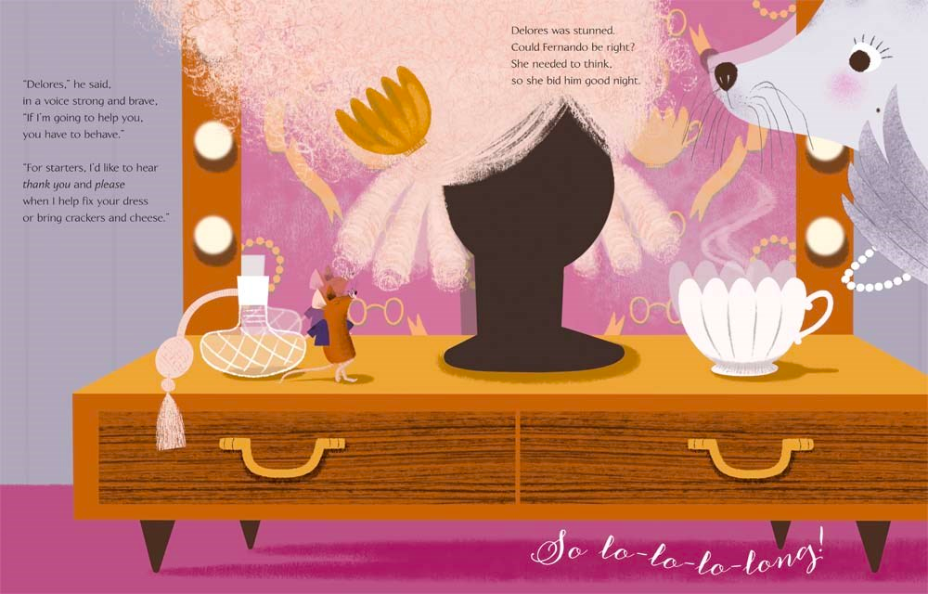
First, he went to Delores and laid down the rules: “For starters, I’d like to hear / thank you and please / when I help fix your dress / or bring crackers and cheese.” Delores was startled and quickly said good night. At home she wondered: had she been rude? The next day, Delores was nervous. She tried calming herself with candy and tea. She even looked for Fernando, but he was nowhere to be found.
Image copyright Rebecca Gerlings, 2018, text copyright Laura Sassi, 2018. Courtesy of Sterling Children’s Books.
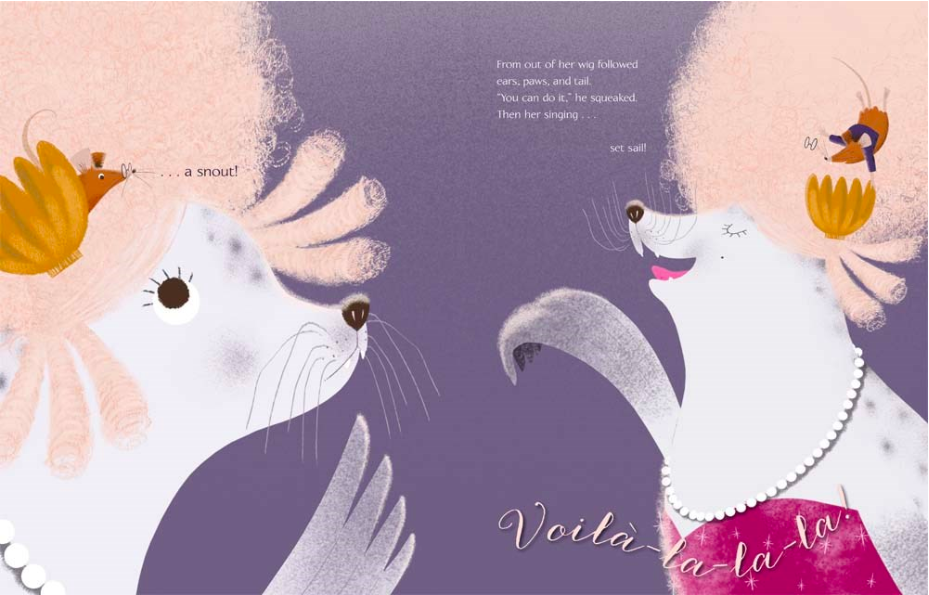
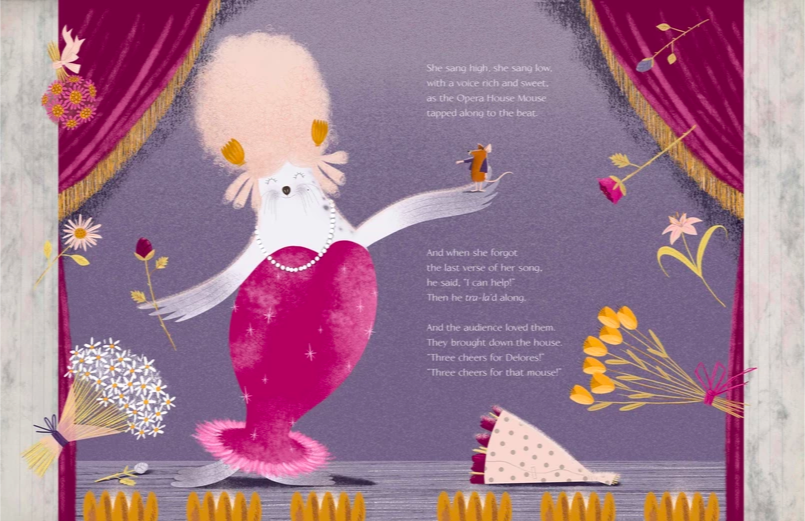
Standing on stage in the glare of the spotlights, “as the orchestra played, / Delores felt faint. / First she swooned… / then she swayed.” When she opened her mouth, no notes, no sound, no song came out. Then inside her wig she saw Fernando, who squeaked “‘You can do it.’” And then Delores did sing “with a voice rich and sweet.” When she forgot some words to her song, Fernando reminded her by tra-la-la-ing along.
The audience loved them. They cheered for Delores; they cheered for Fernando. Later, Delores admitted she could not have done it alone. Then she apologized to Fernando and asked for a fresh start on their friendship. “Of course!” he agreed, and now they bring down the house night after night as “the Opera House team!”
Image copyright Rebecca Gerlings, 2018, text copyright Laura Sassi, 2018. Courtesy of Sterling Children’s Books.
Laura Sassi’s clever and original story about teamwork and sharing the spotlight hits all the right notes in showing how accepting help can elevate anyone’s performance and lead to a new friendship. After playing second fiddle in the chorus, Delores finally gets her chance to shine, but her vanity exceeds her experience. When a tiny mouse offers help from his deep well of knowledge, Delores takes one look at Fernando’s diminutive size and rejects him and his advice. Through her perfect rhymes and musical rhythm, Sassi engages readers in how to graciously learn from another’s experience and encourages the Fernandos out there to keep trying, even when their initial offerings of assistance are rebuffed.
Rebecca Gerlings lends charm and humorous touches to Sassi’s tale, and the promise of the enticing cotton-candy fluff of a wig, introduced in the first pages and teased throughout the story, is comically and satisfyingly fulfilled in the end as Fernando directs Delores to a winning performance from within. Along the way, readers are treated to an octopus piano player, multiple meltdowns as Delores dispatches Fernando from her orbit, and demonstrations of persistence as the little mouse stands up for himself, good manners, and the honor of his beloved opera.
A smart, fresh, and fun read aloud, Diva Delores and the Opera House Mouse has multiple applications for discussing friendship, modesty, respect, and collaboration. The book would make a delightful addition to home, school, and public library bookshelves.
Ages 3 and up
Sterling Children’s Books, 2018 | ISBN 978-1454922001
Discover more about Laura Sassi and her books on her website.
To learn more about Rebecca Gerlings, her books, and her art, visit her website.
Opera Day Activity
Sparkly Opera Glasses by Laura Sassi
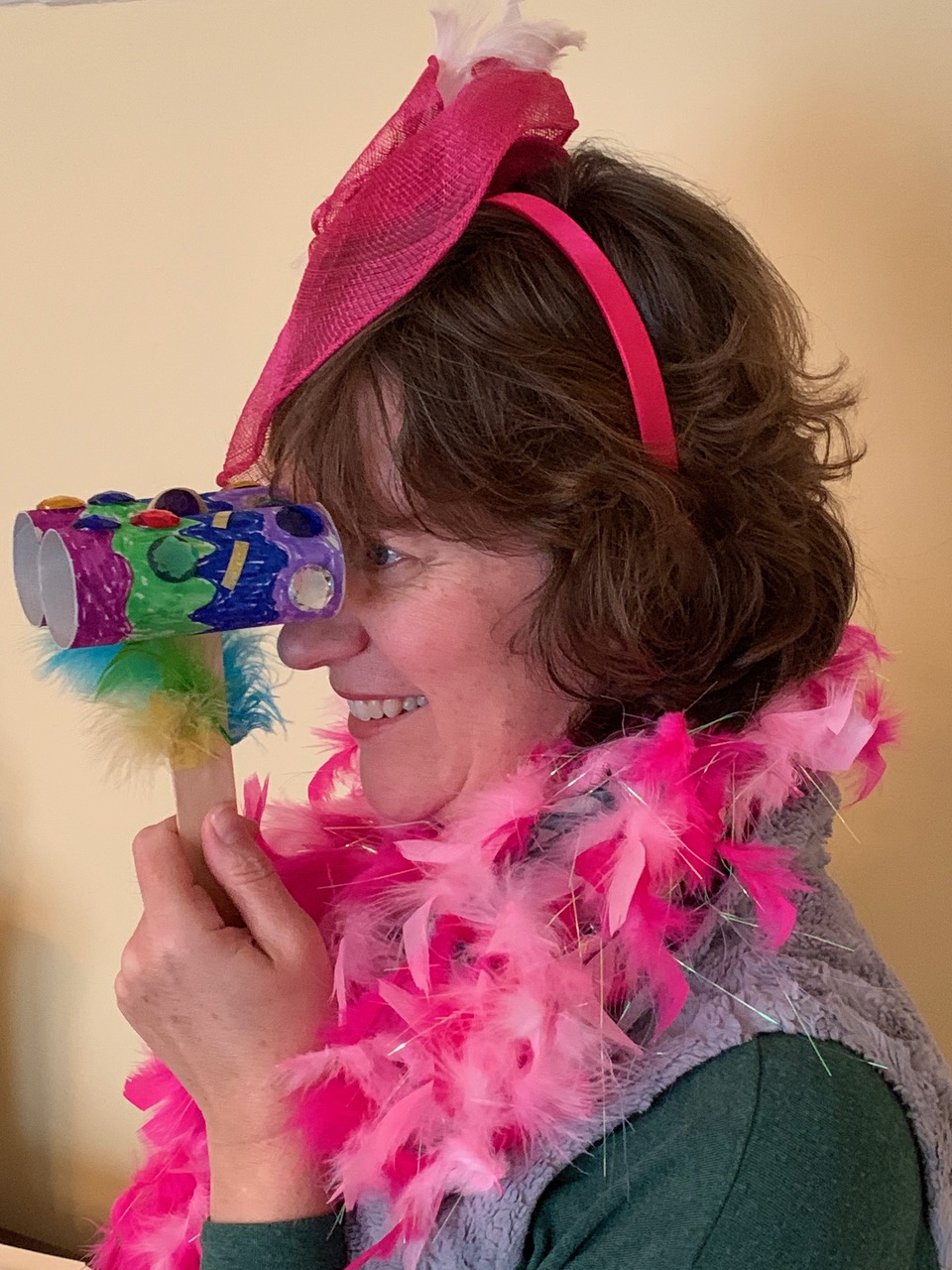
Make a pair of these fancy glasses, then pretend you are at the opera while reading Diva Delores and the Opera House Mouse.
Supplies for each pair of opera glasses
Two recycled toilet tissue tubes one large craft stick
Markers tacky glue
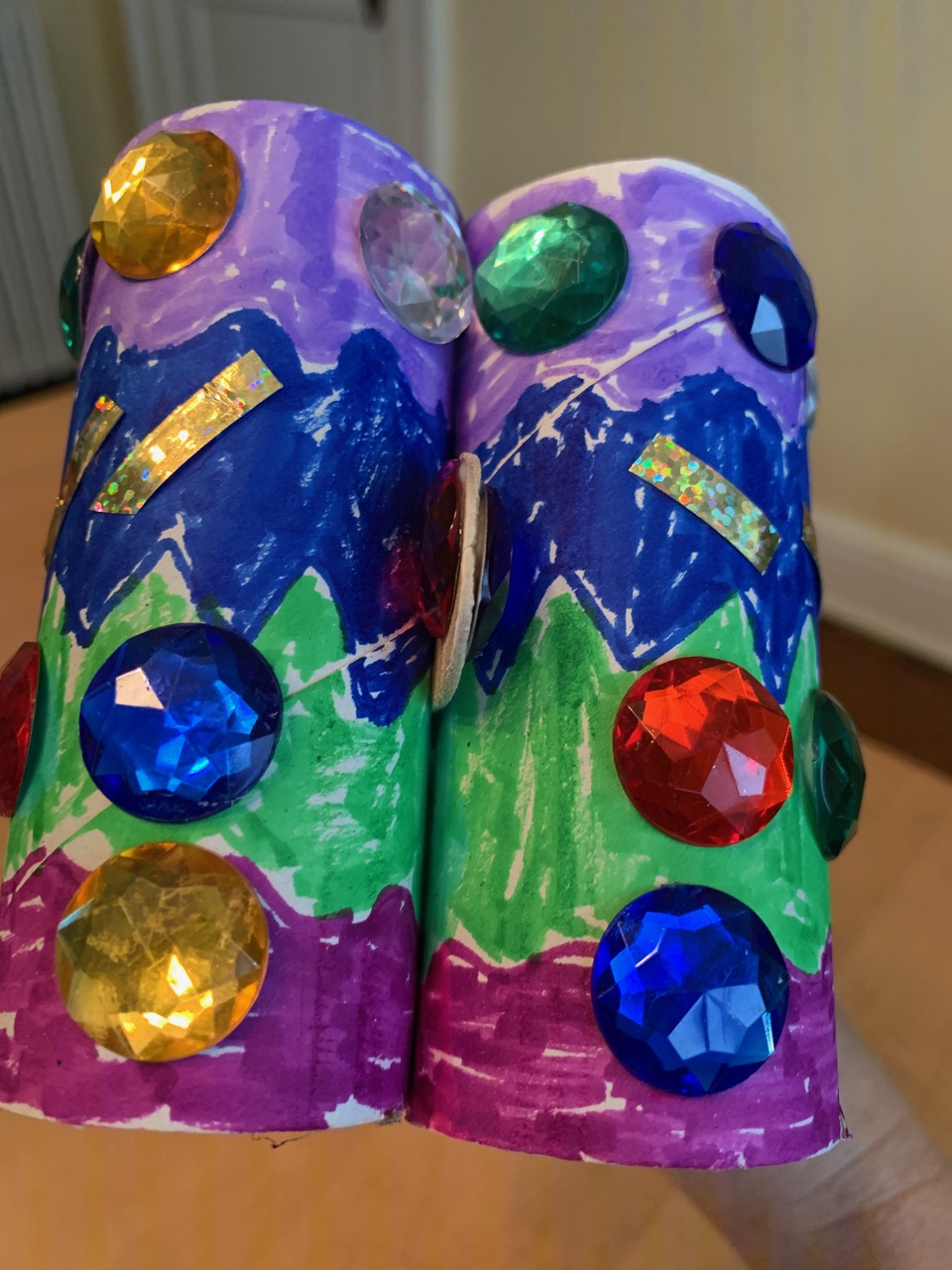
Two paper clips assorted fancy embellishments (We used feathers, sparkly gems and snippets of shimmery ribbon, but use whatever you have around the house. Be creative!)
Directions
Decorate the tissue tubes using markers.
Glue the tubes side by side, as shown. Be sure to insert the craft stick in between so your opera glasses have a handle. Slip a paper clip at each end over the sealed part for extra pressure while drying.
Use tacky glue to affix whatever fancy embellishments you choose. The more the better!
When dry, elegantly hold your opera glasses up to your eyes and pretend you are watching Diva Delores and Fernando at the opera!
You can find Diva Delores and the Opera House Mouse at these booksellers
In 2006, Ruth Spiro, a children’s author and mother, came up with a creative way for kids to raise funds for their school and other charity. By donating 50 cents, students would earn the right to chew bubble gum in class on Bubble Gum Day. While resin and other gooey substances from trees were used as early types of gum and dental care, the kind of gum we enjoy now was invented in 1928. After much trial and error, Walter Diemer, who worked for the Fleer Chewing Gum Company, created the first bubble-producing gum, which was sold as “Dubble Bubble.” To celebrate today, enjoy your favorite kind of gum, just make sure you don’t get it stuck… well, you’ll see….
Thanks to Chronicle Books for sending me a copy of On Account of the Gum for review consideration. All opinions of the book are my own.
On Account of the Gum
By Adam Rex
There are those days that start out… not so great. But you think, it can’t get much worse than this. But people—maybe even your own family—want to help and, through no fault of theirs (well…maybe a liiitle bit), things just go from bad to worse. What do I mean? Here’s an example:
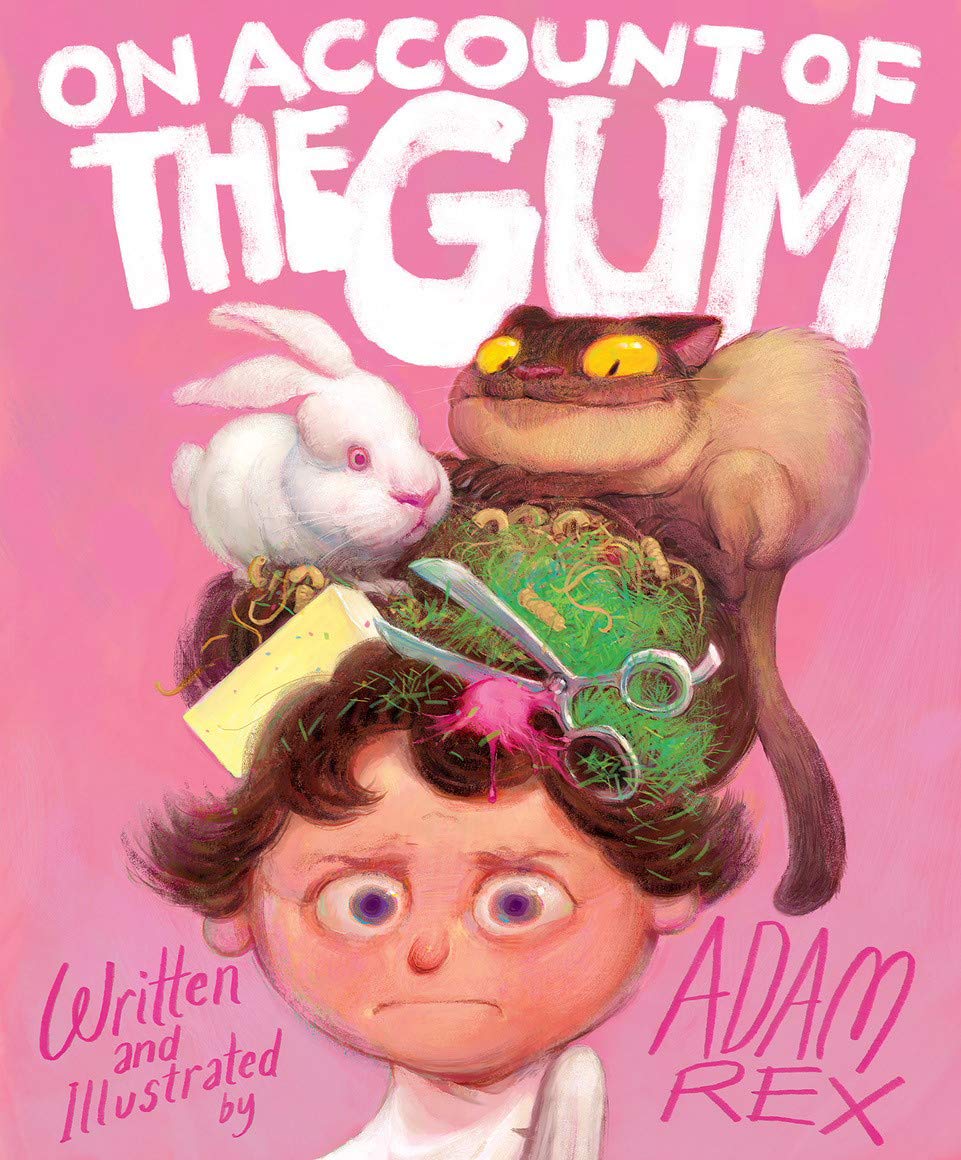
You know the warning: Don’t go to sleep chewing gum! But the little girl loves her bubble gum and falls asleep with it in her mouth. Overnight the gum migrates to the pillow, and when the girl wakes up in the morning, she finds the gum stuck in her hair. There it is, towards the front, in her bangs. Oh brother! So what happens? Let’s take a listen while Dad starts snipping: “the scissors got stuck in the gum that you got in your hair. Okay: We went on some websites and all of them swear / if you want to get scissors and gum out of hair / you take two sticks of butter and smear them along, and… I see. / It appears that those websites were wrong.”
Copyright Adam Rex, 2020, courtesy of Chronicle Books.
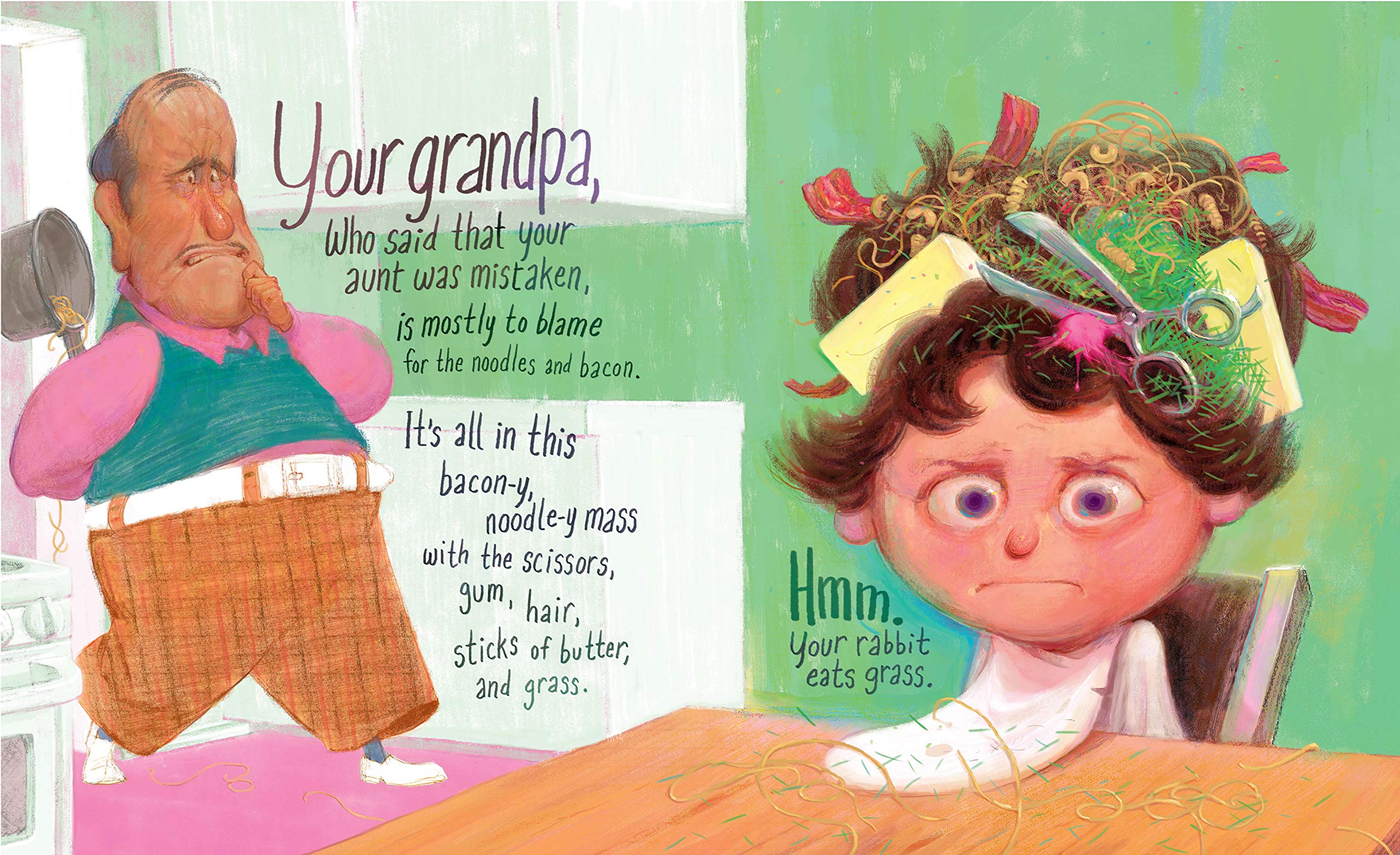
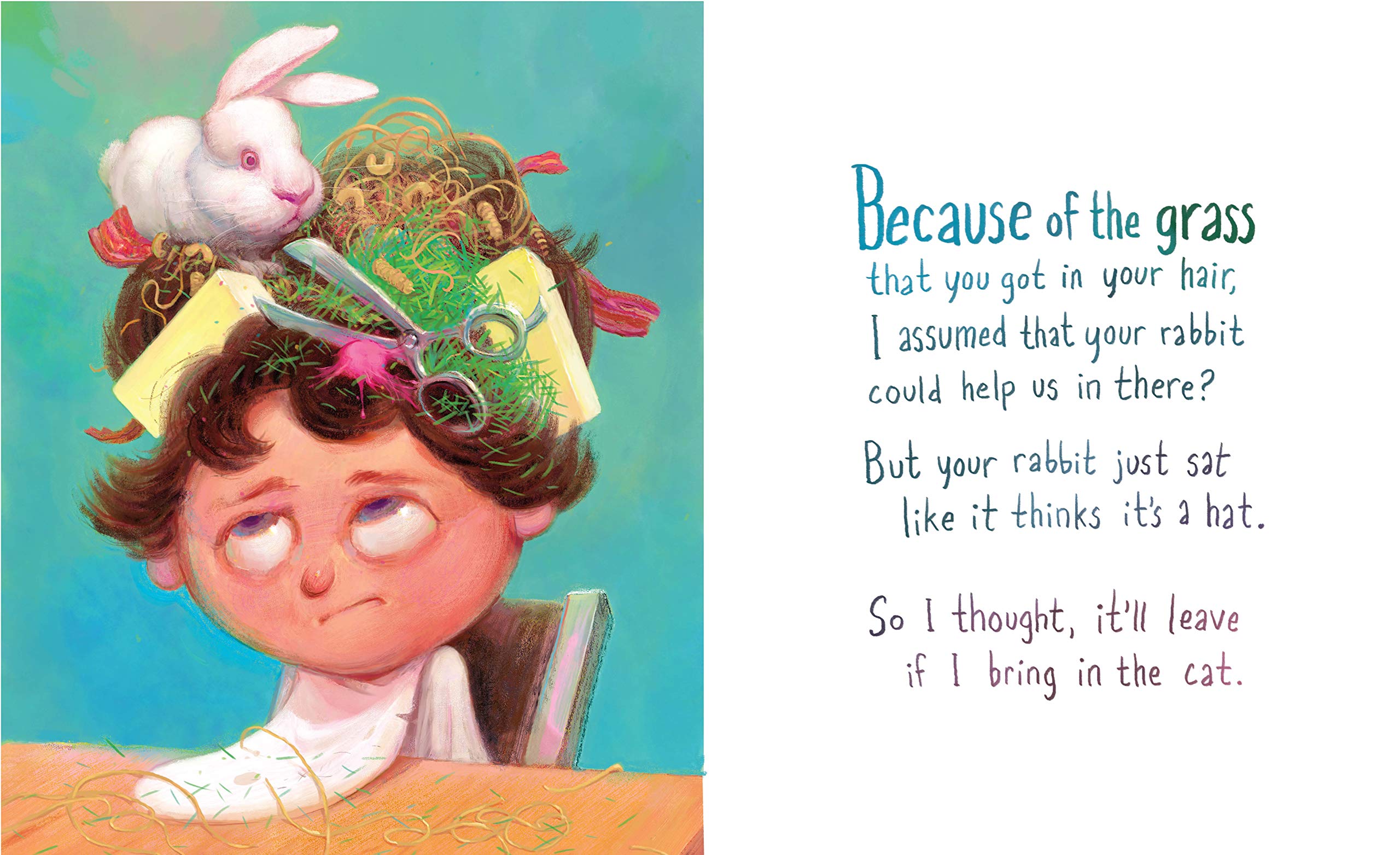
So, let’s see… your aunt says grass clippings will do the trick, and when that doesn’t work, your grandpa is sure that pasta and bacon really can’t miss. But that all sticks too, and so does the rabbit brought in because, well… “Because of the grass that you got in your hair, / I assumed that your rabbit could help us in there? / But your rabbit just sat / like it thinks it’s a hat.” What can get rid of a rabbit? How about a cat?
Copyright Adam Rex, 2020, courtesy of Chronicle Books.
You can see how it’s going. Then, after another disastrous addition, the girl’s aunt is back with a pink unicorn cake because…? Oh, Hey! It’s the girl’s birthday! No worries, she’ll be all right in no time. A cop’s on the scene and firemen too with their hose and dog and pot of chili. But the girl has had just about enough, and she shouts “STOP! GET OUT! Please.” So everyone packs up their gear and heads out—including the gum that started it all. But what about all the other stuff now stuck in her hair? They’ll have to figure that out later because it’s time to go to school, and she wouldn’t want “to miss Picture Day.”
Copyright Adam Rex, 2020, courtesy of Chronicle Books.
Laugh-out-loud funny absurdism will keep readers turning the pages in Adam Rex’s send up not only of gum-in-hair mishaps but of all those times when the best of intentions go awry. Rex’s second-person-address storytelling will draw in kids who may be well acquainted with the commotion that sometimes surrounds simple situations that become confounding. Rex’s syncopated rhymes and rhythm enhances the conversational style and suspense for what comes next. With so many “Oh no!” moments, this comic cumulative tale will have kids giggling from beginning to end.
Rex’s big-eyed girl tells kids all they need to know about her plight as she reacts to each new addition with eye rolls, questioning glances, resignation, and consternation until she just can’t… and explodes, sending everyone running and the wad of gum abandoning ship. Silliness abounds as food, animals, a vacuum cleaner, and even the girl’s aunt vie for space in the growing bouffant hairdo. The barber’s cloth that’s tied around the girl’s neck and lies unmoving on the table adds a comic touch to this story of a little girl with outsized patience who’s having a “we’ll laugh about this in the future” kind of special day. Fortunately for readers, we can laugh now.
For rollicking, laugh-infused story times, On Account of the Gum is a book that kids and adults will stick with again and again and is a must for home, school, and public libraries.
Ages 5 – 8
Chronicle Books, 2020 | ISBN 978-1452181547
Discover more aboutAdam Rexand his books on his website.
National Bubble Gum Day Activity
Gumball Machine Coloring Page
When you just have to have a piece of gum, where’s the best place to find one? A gumball machine, of course! Have fun adding all of your favorite colors to this printable coloring page.
I always love celebrating kids’ creativity, imagination, and smarts and today’s book has all three! If you never want to say goodbye to January’s “Creativity Month” and am looking forward to Expanding Girls’ Horizons in Science and Engineering Month and National Ideas Month in March, then you’ll want to add Sadie Sprocket to your reading list.
Thank you goes to Two Lions and Blue Slip Media for sending me a copy of Sadie Sprocket Builds a Rocket for review consideration. All opinions on the book are my own. I’m also excited to be teaming with them for a giveaway of the book. See details below.
Sadie Sprocket Builds a Rocket
Written by Sue Fliess | Illustrated by Annabel Tempest
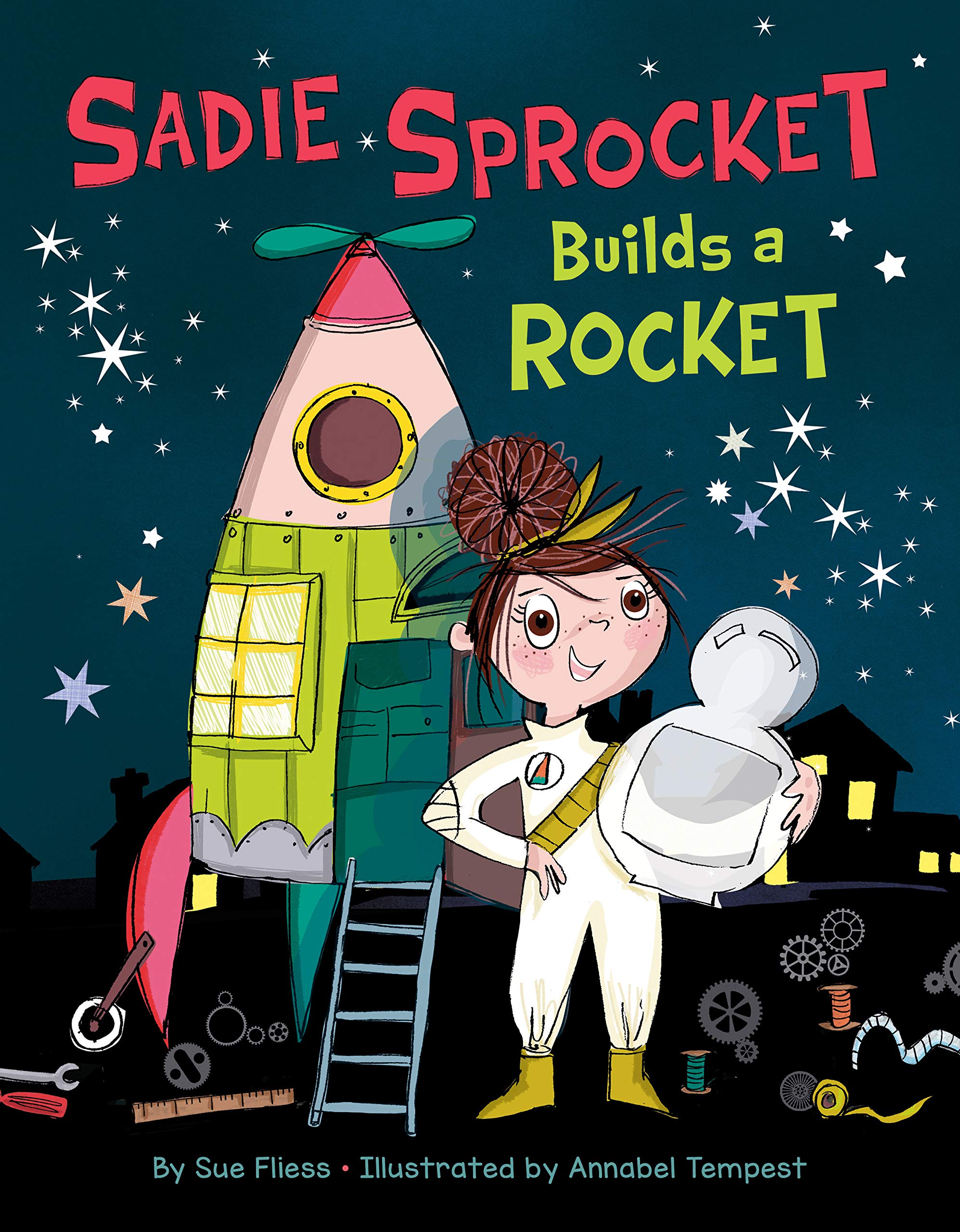
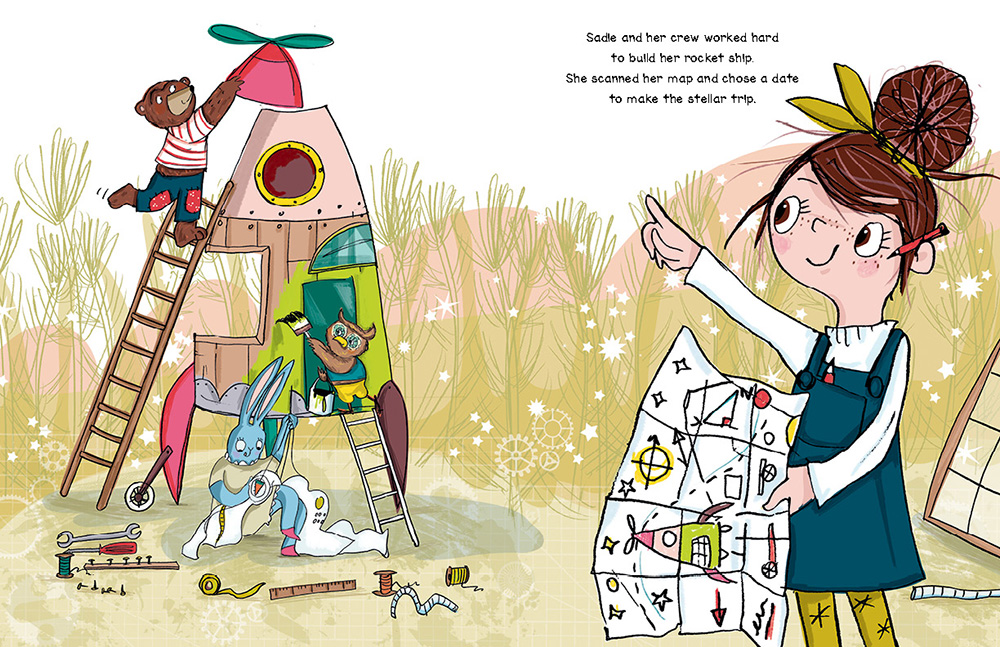
Sadie Sprocket wanted to travel. Not your regular vacation kind of travel but the kind that would take her across the galaxy. “So one day Sadie drew a map / to navigate the stars. / ‘It’s time to leave the Earth,’ she said, ‘and travel straight to Mars!’” She chose her crew—a bunny, bear, and owl—and began building her rocket ship with parts she got from the junkyard.
When the rocket was finished, Sadie and her crew were ready to blast off. Her family, friends, and even reporters gathered to see “this space-bound girl with smarts and skill / would soon make history.” They basted off on their journey that would take one hundred days. To pass the time the crew of four tried playing cards, and checkers and chess, but the pieces just floated away, so they read and cooked instead.
Image copyright Annabel Tempest, 2021, text copyright, Sue Fliess, 2021. Courtesy of Two Lions.
Soon, when Sadie looked out the window, Earth was no more than a dot while Mars came into view. When it was time to land, Sadie directed her crew to land on level ground. On the surface of the red planet, they gathered samples and put them into bags and then when they were done, they planted yellow flags. After a few selfies, Sadie knew it was time to go, but a storm blew up and “the rocket wouldn’t budge.”
Sadie, Bear, Bunny, and Owl got out and dug the landing gear free, but when they tried to leave Mars again, the sand swirling in the air was so thick, they couldn’t see. When the storm abated, they thought flying would be a snap, but the rocket didn’t work. Sadie grabbed her tools and they went to work sweeping sand from the circuit board and repairing the wires. Finally, Sadie said, it is “‘time to Blast!’” / They zoomed by stars and asteroids / and made it home at last.” When she landed back on Earth, Sadie learned she “had rocketed to fame,” but one trip was not enough. She now had Neptune in her sights, but clever Sadie Sprocket new she’d “need a bigger rocket.”
Following the text is “Sadie’s Notebook,” which contains facts about Mars and short bios on seven pioneering women in space.
Image copyright Annabel Tempest, 2021, text copyright, Sue Fliess, 2021. Courtesy of Two Lions.
Sue Fliess’s jaunty story about Sadie Sprocket, a young go-getter who doesn’t let things like gravity or obstacles get in the way of her dreams of discovery offers inspirational motivation for children who have big (or smaller) aspirations. Sadie’s confidence in herself and in science jumps off the page as she talks to the press and her supporters at her launch, gathers samples from the surface of Mars, and documents her finds. When the sand storm disrupts her return to Earth, she doesn’t give up the mission, but rallies her crew and fixes the problem. And does Sadie rest on her laurels? Nope! Like any inventive kid, she has her sights set on the next big adventure. Fliess’s pitch-perfect rhymes and quickly paced rhythm make the story an entertaining read aloud.
In her bright, active-packed illustrations, Annabel Tempest gives Sadie a cheery, self-assured look as she studies, makes plans, and builds her rocket. Kids will eagerly follow her steps as she gathers her supplies and gets to work. As Sadie, schematic in hand, directs her crew, kids will have fun seeing how she makes clever use of a wheelbarrow and appreciate the spacesuits and fitted helmets for each crew member. Images of the circuit board will appeal to tech-loving kids, and pictures of the rocket shooting across the galaxy will thrill readers. Any kids looking for inspiration to decorate their rooms will find plenty of ideas here too.
A lively story to encourage creative and science-loving kids, Sadie Sprocket Builds a Rocket is a terrific book for exciting story times and to enhance STEM lessons in school and at home. It is highly recommended for home, school, and public library collections.
Ages 3 – 7
Two Lions, 2021 | ISBN 978-1542018036
Sue Fliess is the author of more than thirty children’s books, including Mrs. Claus Takes the Reins, illustrated by Mark Chambers; Shoes for Me!, A Dress for Me!, and Books for Me!, all illustrated by Mike Laughead; and Let’s Build, illustrated by Miki Sakamoto. She lives with her family and their two dogs in northern Virginia, where they admire the moon, stars, and sometimes even planets from their backyard. You can connect with Sue onwww.suefliess.com | Twitter | Facebook | Pinterest
Annabel Tempest is the illustrator of a number of picture books and board books. She holds a degree in fashion and textiles and has worked as a freelance illustrator on everything from maps and packaging to greeting cards and children’s books. She lives in the beautiful Somerset countryside in the UK with her husband and a houseful of muddy boys and dogs. You can connect with Annabel on annabeltempest.com | Instagram | Twitter
Sadie Sprocket Builds a Rocket Giveaway
I’m happy to be teaming with Two Lions and Blue Slip Media in a giveaway of:
One (1) copy of Sadie Sprocket Builds a Rocket by Sue Fliess | illustrated by Annabel Tempest
Sponsored by global non-profit LitWorld and Scholastic, World Read Aloud Day encourages reading aloud to children not only today but every day. Reading aloud to children from birth is one of the best ways to promote language development, improve literacy, and enjoy bonding time together. Millions of people celebrate today’s holiday all across the United States and in more than one hundred countries around the world. Typically, special events are held in schools, libraries, bookstores, homes, and communities, and authors and illustrators hold readings and visit classrooms. This year, you can find virtual read alouds, live events on Instagram, Facebook, and Youtube, printable games, and book lists as well stickers, bookmarks, posters, and a reading crown to decorate, when you visit LitWorld.
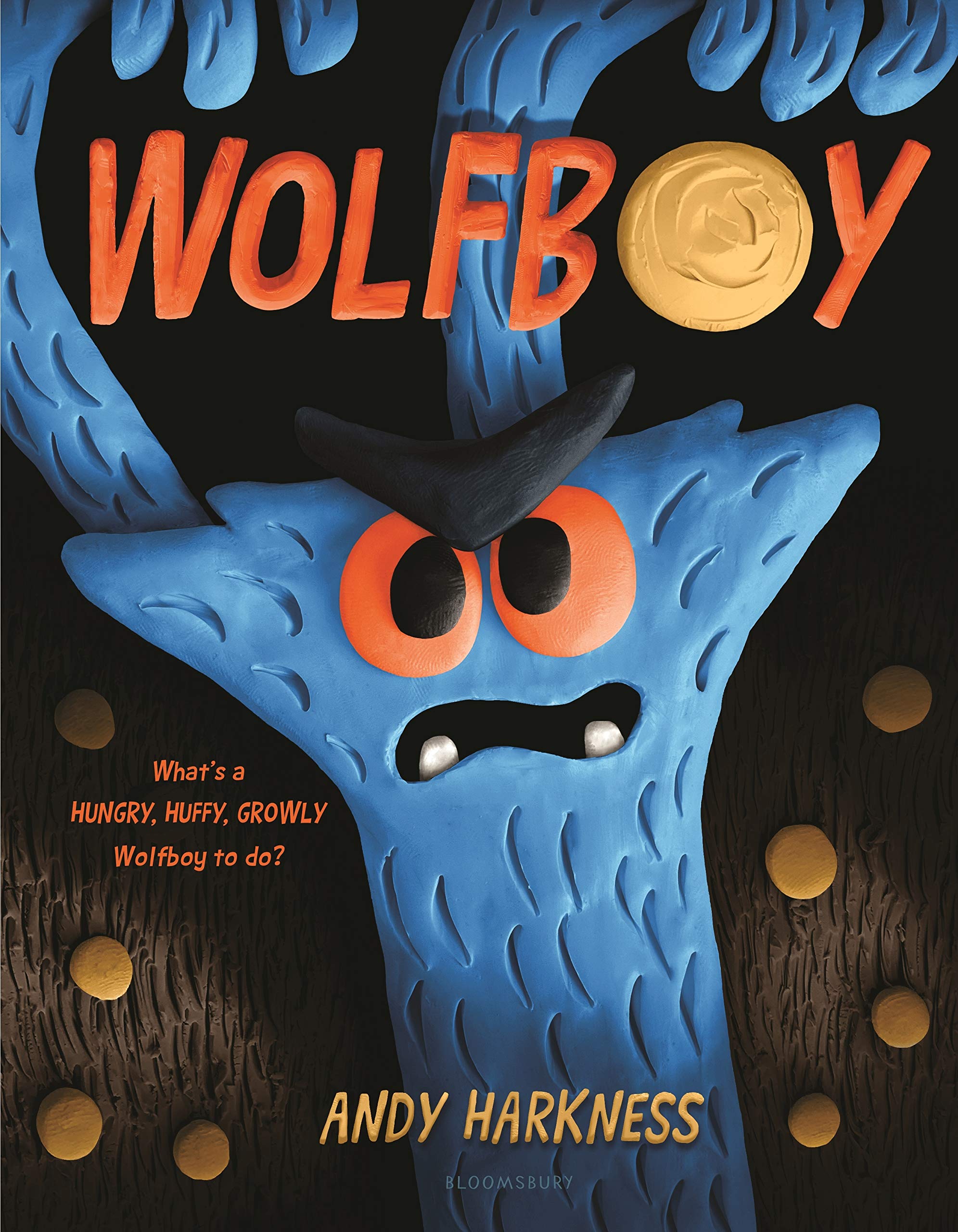
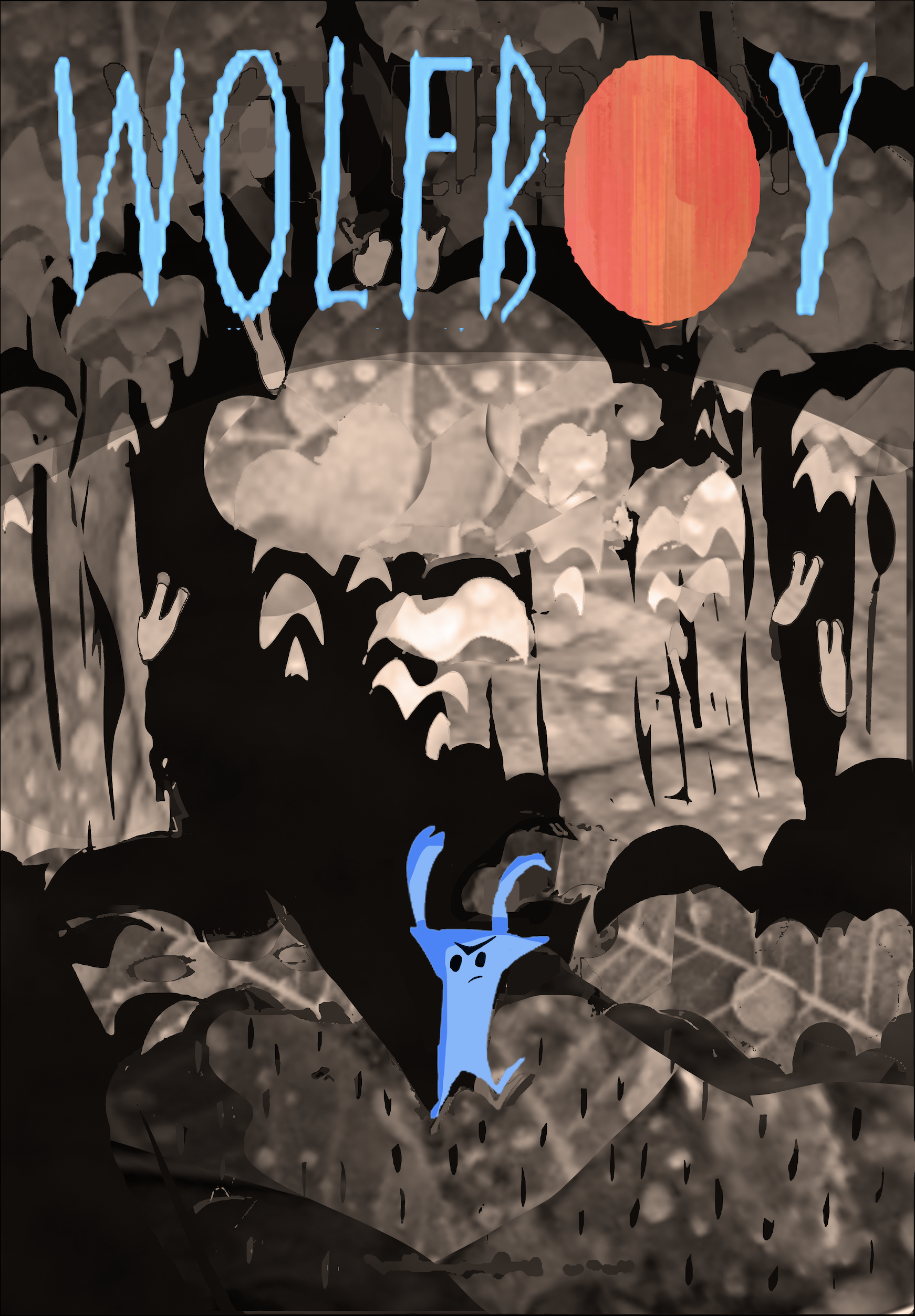
Thanks go to Bloomsbury Children’s Books for sending me a copy of Wolfboy for review consideration. All opinions of the book are my own. I’m also thrilled to be teaming with Bloomsbury in a giveaway of the book. See details below.
Wolfboy
By Andy Harkness
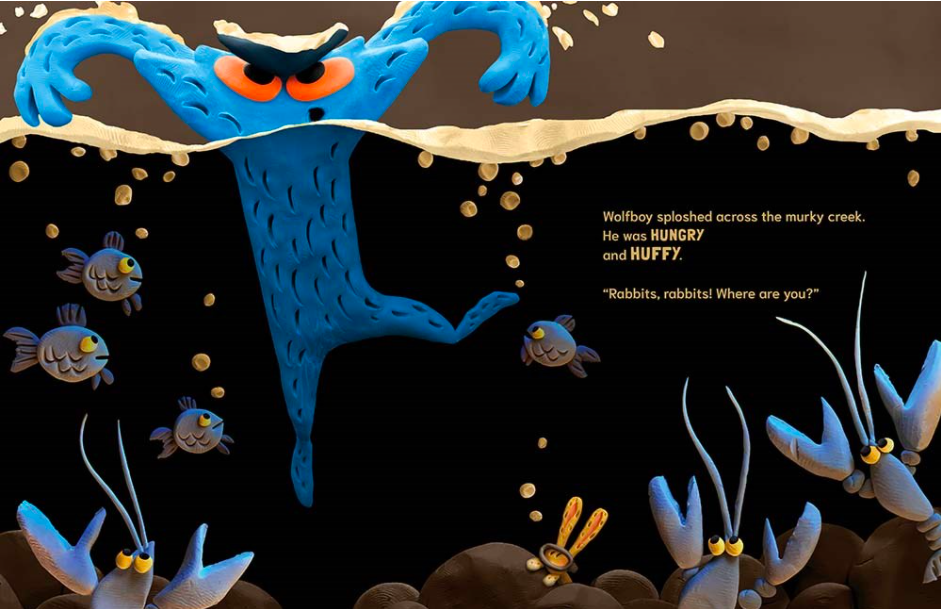
The full moon hung in the sky like a golden, frosted cupcake. Down below in the darkened forest Wolfboy was on the prowl. “He was HUNGRY. ‘Rabbits, rabbits! Where are you?’ he howled.” But he could find no rabbits. He “sploshed” into the creek, but no rabbits answered his calls. Not only was he “HUNGRY,” now he was also “HUFFY.” He climbed to the top of a very tall oak tree and scoured the ground far and wide. No rabbits. In addition to being “HUNGRY” and “HUFFY,” Wolfboy had become “DROOLY. He needed rabbits.”
Copyright Andy Harkness, 2021, courtesy of Bloomsbury Children’s Books.
Perhaps they were hiding in the bog, but there he only saw three crocodiles swimming his way. It made Wolfboy feel “GROWLY.” He made a daring leap into Moonberry Meadow. Surely, the rabbits were here. But no. Wolfboy could hardly contain himself. “he was HUNGRY and HUFFY and DROOLY and GROWLY and FUSSY.” He stomped and thrashed and leaped and menaced. He was done with rabbits, and he let the world (and those skittish rabbits) know it.
Copyright Andy Harkness, 2021, courtesy of Bloomsbury Children’s Books.
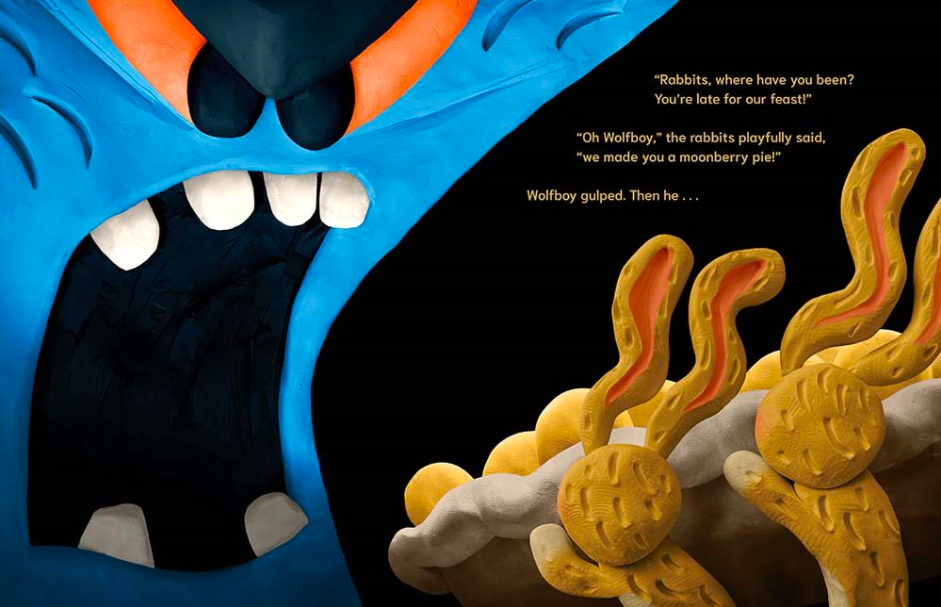
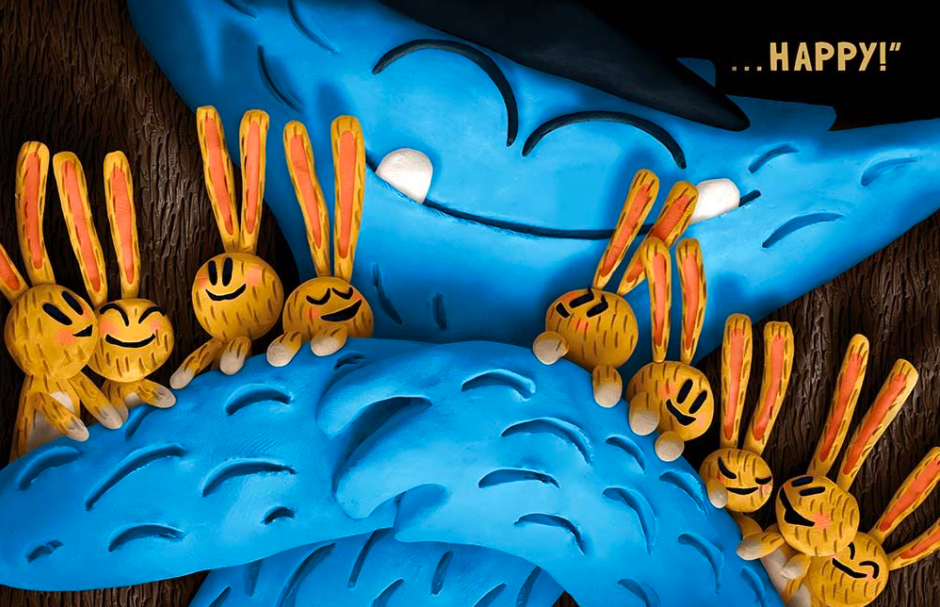
But then he heard a rustle and a snap. He focused his attention and saw some tell-tail signs. “Wolfboy crouched low” just as a warren-full of little bunnies emerged into the clearing. Wolfboy showed his teeth. His roar shook the forest. “‘Rabbits, where have you been? You’re late for our feast!’” But the rabbits just giggled and brought out the moonberry pie they’d made him. In a frenzy Wolfboy “CRUNCHED and MUNCHED and GOBBLED and GULPED!” When the pie was gone, Wolfboy explained that he had just been so, well… HUNGRY. But now he felt better and there was one huge happy rabbit hug for dessert.
Copyright Andy Harkness, 2021, courtesy of Bloomsbury Children’s Books.
Andy Harkness’s cumulative tale will get kids, who well-know that ravenously hungry feeling, up and growling along as Wolfboy goes from Hungry to Happy with all the personality-changing gastronomical feelings in between. Harness’s dialogue-rich storytelling is a delight, ripe for dramatic read alouds. The forest setting, with its creek, bog, oak, and ravine, inspires evocative vocabulary that enhances the suspense. What could this sharp-toothed, famished Wolfboy want with the rabbits? There could only be one thing… or could there? The endearing ending reaffirms that those Hangry wolves in our homes need only a little (or a big) treat to return to their true puppy natures.
Visually stunning, Harkness’s illustrations, built with clay and then photographed, immerse readers in extraordinary textured, intricate, and shadowy landscapes that beg close study. Neon blue Wolfboy, with his furrowed unibrow, rows of chicklet teeth, and long arms that waggle in hilariously menacing poses will have kids laughing out loud. And where are those rabbits? On every page! The little animal cracker-sized bunnies pop up in the most surprising places, and you can bet that you’ll hear plenty of “there’s one!” “I see two!” and “Let’s count them!” as you turn the pages.
For kids who love raucous, laugh-out-loud story times, those who appreciate exceptional art and the wonders of claymation, and readers who prefer their beasts to be big softies, Wolfboy is a must for home, school, and public library collections.
Ages 3 – 6
Bloomsbury Children’s Books, 2021 | ISBN 978-1547604425
Discover more about Andy Harkness, his books, movie work, and art on his website.
Meet Andy Harkness
Andy Harkness is an award-winning art director who has worked on Moana, Frozen, and Wreck-it-Ralph, among other movies. After twenty-five years at Disney, he recently moved to Sony Pictures Animation. Andy’s first book, Bug Zoo, was published by Disney as an Artist Showcase Book in 2016. He lives in California with his family. You can connect with Andy on His Website | Instagram | Twitter
I’m thrilled to be talking with Andy Harkness about his inspiration for Wolfboy, his process in creating the incredible illustrations, one of his biggest challenges, and more!
I think everyone can empathize with ravenously hungry Wolfboy! Where did the idea for your story come from?
I have always loved scary stories. In particular, werewolf stories. It’s the transformation that intrigues me. In 2005, I took a first pass at a story but it really didn’t go anywhere until my wife and I had children. We noticed an incredible transformation when they were hungry. Our little angels became little monsters. And the story of Wolfboy was born!
The shape of Wolfboy is so perfectly funny and menacing. Did his look undergo many revisions? How did you decide on the final design?
He went through so many revisions! Initially, he had a red striped shirt and blue jeans. Then he was a very detailed brooding character with huge hands and feet. When I was working on the rough design for the cover, I quickly drew him in blue. I wasn’t trying to design him at that moment but suddenly, there he was. He looked fierce but really funny. His final design is almost exactly like that quick sketch. One thing he always had was big pointy ears. I wanted him to be a very recognizable shape when he was small on the page.
Which brings us to your stunning pages, which are all entirely made from clay. Can you take readers through your process of making the pages? How long did it take you to carve all the settings and characters?
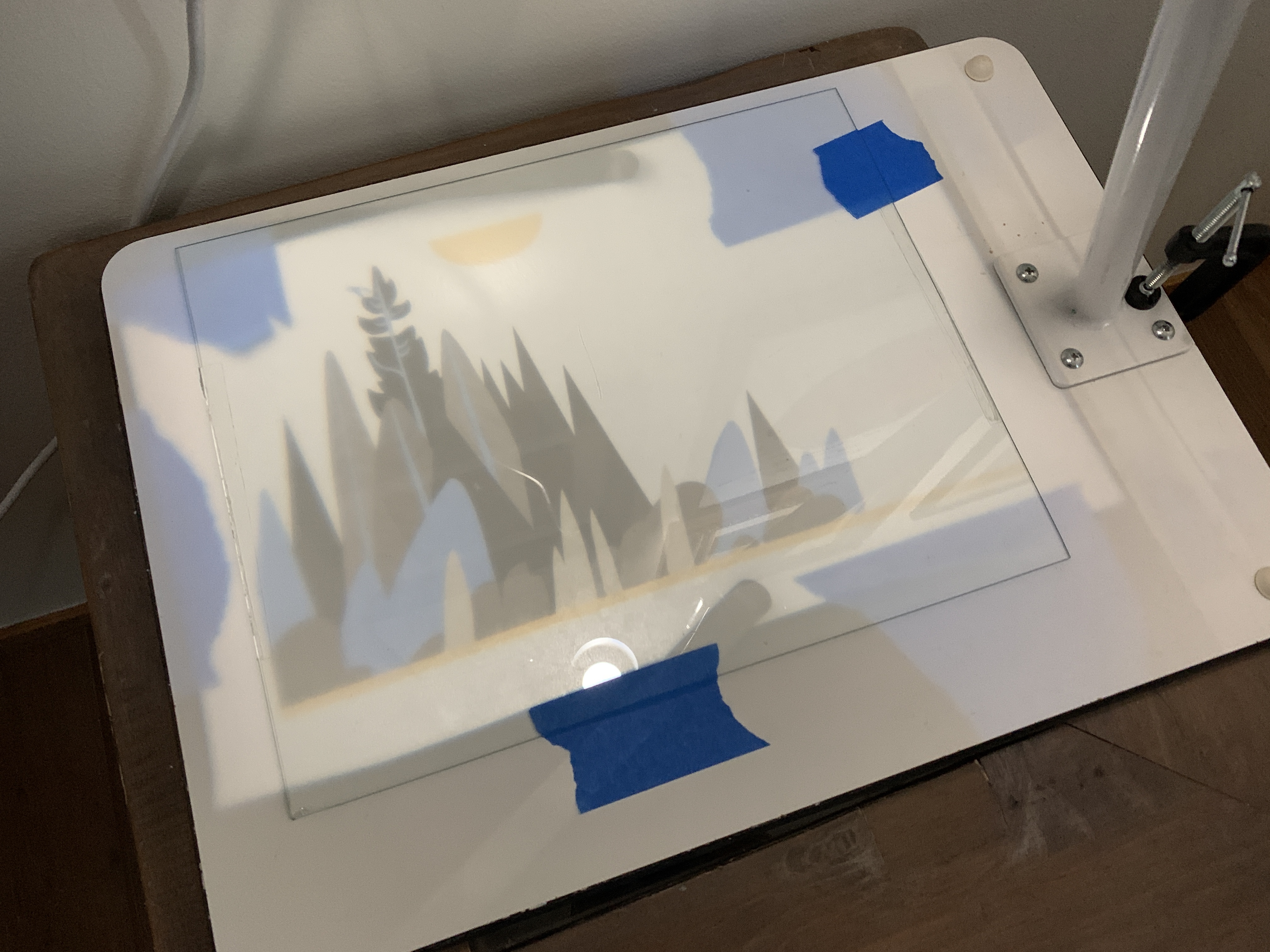
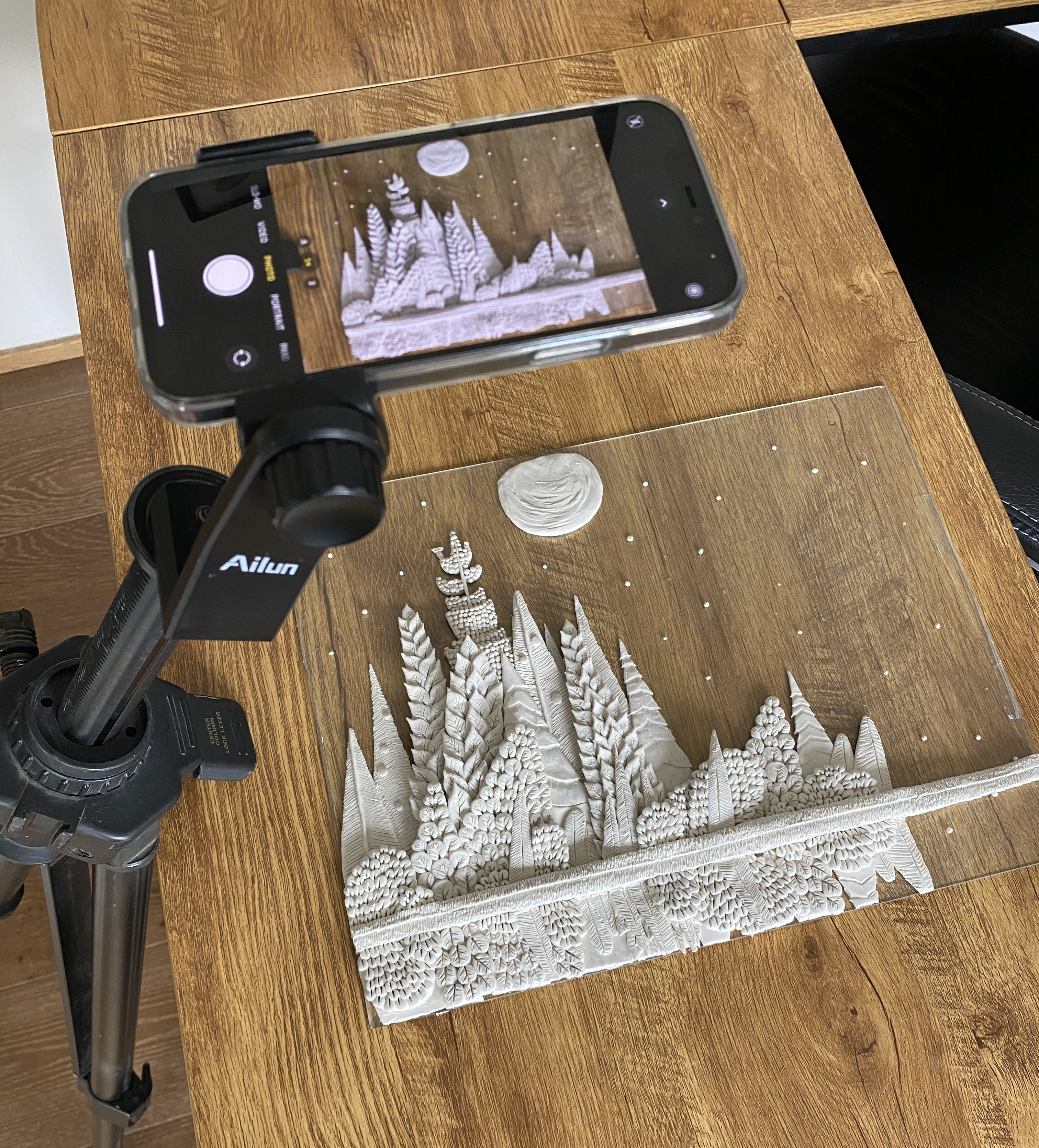
I start with a loose drawing that is projected onto a piece of glass, or is taped beneath the glass.
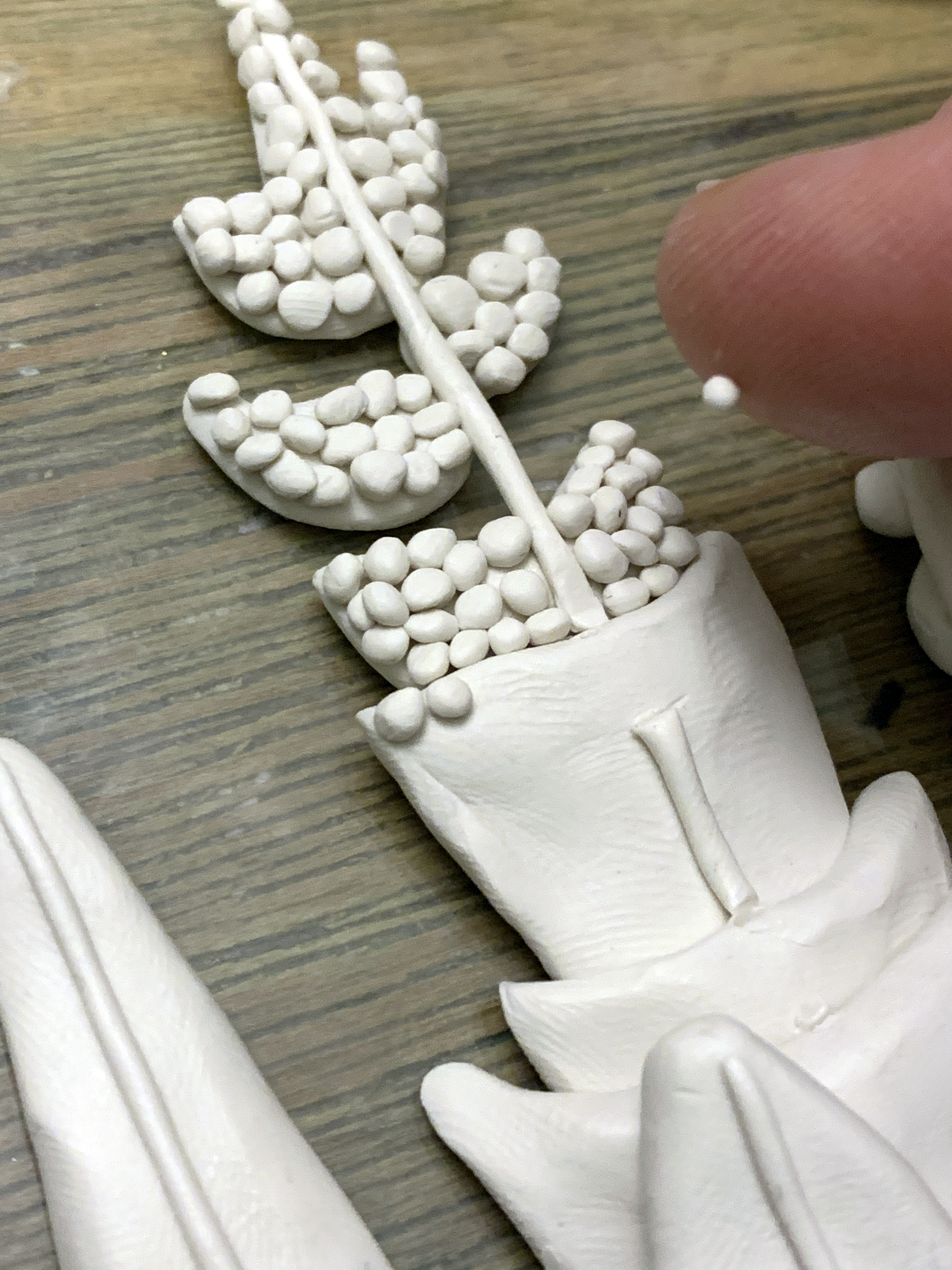
Using super sculpey polymer clay, I sculpt as much as possible by hand and use a few tools for the smallest details. When the sculpt is done, it is positioned near a window to get interesting natural light and shadow on the surface.
Then it’s photographed and the colors painted in layers in photoshop. The trick is to do as little touch up to the clay as possible. My fingerprints are literally all over this book! Each sculpt was redone at least two times. The first attempt was really for working out the problems so that the second attempt went smoothly. From start to finish, the sculpts that are in the book were done over the course of a year. Some took a day or two, others weeks, one took a whole year! I usually worked on several at the same time.
Readers might be interested in this behind-the-scenes video I made showing how I created the shadowy tree illustration near the beginning of the book.
The colors and shadowing you achieve is amazing and really immerses readers in the suspense of the story and their own hunt for rabbits on each page. Do you have a favorite spread? Was there one that was the most difficult?
Great question and thank you! I am inspired by old black and white horror movies and really wanted to bring that dramatic lighting into the book. My favorite spread is when Wolfboy leaps over the steep ravine. I think the symmetry and how it’s lit from beneath make it feel like a stage. Very theatrical. The hardest spread by far was the “creaky old oak” spread. That sculpt was redone 6 times before I was happy. And the reflection in the water is sculpted as well. I worked on that one on and off for about a year.
You’re currently working as the Art Director on Vivo, coming from Sony Animation Pictures later this year and you’ve previously worked for Disney. In these positions you’ve helped create many kid-favorite blockbusters, such as Moana, Frozen, Tangled, and Wreck-it-Ralph among many others. Can you briefly describe for kids (and maybe future animation artists) the steps as an animated feature is conceptualized, designed, and ultimately put together? What was one of the biggest challenges you’ve faced on a movie you’ve worked on? One of the best surprises?
It starts with a great idea. Early concept paintings are done to get everyone excited about the project. As the story develops, a visual style and color palette is created to support it. A character designer develops the characters while working closely with the production designer to make sure the shape language is consistent with the backgrounds. Then a literal army of talented modelers, riggers, animators, special effects artists, layout artists and lighters begin to build the world we see on screen. It’s an incredible undertaking actually. If it’s done right, it’s like a finely tuned orchestra.
The biggest challenge I’ve ever faced was designing Motu Nui, Moana’s home island. Everything was researched and done with the utmost respect for the culture. We had South Pacific advisors with us the whole time. Every plant and tree was what would have been there 3000 years ago. A botanist helped us make sure of that. From the positioning of the village in the valley, to the various fales (homes and other structures), everything was as accurate as we could make it. Armed with all that knowledge, I sculpted that island in clay. That fragile sculpt is sitting in the Disney Archives today. The head of layout, head of environments, head of modeling, and myself won a VFX award for Outstanding Created Environment in an Animated Feature.
The biggest surprise happened on my current show, VIVO. I had the opportunity to collaborate with one of my heroes, Sir Roger Deakins, on the lighting and color for the movie. Still can’t believe it!
In addition to writing and illustrating Wolfboy, you’ve also illustrated Bug Zoo and The Ballad of Nessie. What do you like best about being a writer and illustrator for kids?
I think for me it really boils down to hearing that a kid loves one of my books so much the cover has fallen off. It’s how I felt about certain books as a kid. They sparked magic in my mind and I hope to give that back now through my own books.
What’s up next for you?
Well first up, I hope to do another Wolfboy book! After that I have several more children’s book ideas bouncing around in my head.
I will probably be working on a few more animated films, but one day I really hope to focus solely on writing and illustrating children’s books.
Thanks so much for this wonderful chat! Your work is amazing, and I’m sure readers are thrilled to learn more about it. I wish you all the best with Wolfboy – I really hope there will be a second Wolfboy adventure!
World Read Aloud Day Activity
I Love Reading Bookmarks
If you love to read then you know that sometimes you want to mark a favorite page or remember where you left off. With these special World Read Aloud Day bookmarks, you can do it in style!
Frozen potatoes come in all shapes and sizes – from shoestring fries to smiley fries to today’s celebrated favorite, tater tots. How beloved are tater tots? Every year approximately 3.5 billion of these little barrel-shaped nuggets are sold in the United States. Tater tots are created from the shredded leftovers from the process of making French fries and were the invention of Nephi and Golden Grigg, the brothers behind Ore-Ida who began their business in 1934. A fact author Cathy Breisacher makes clever use of in her fry-tastic story. The Grigg’s ingenuity is our delicious treat, so celebrate today by grabbing a bag of tater tots and enjoying them plain or in a family-favorite recipe!
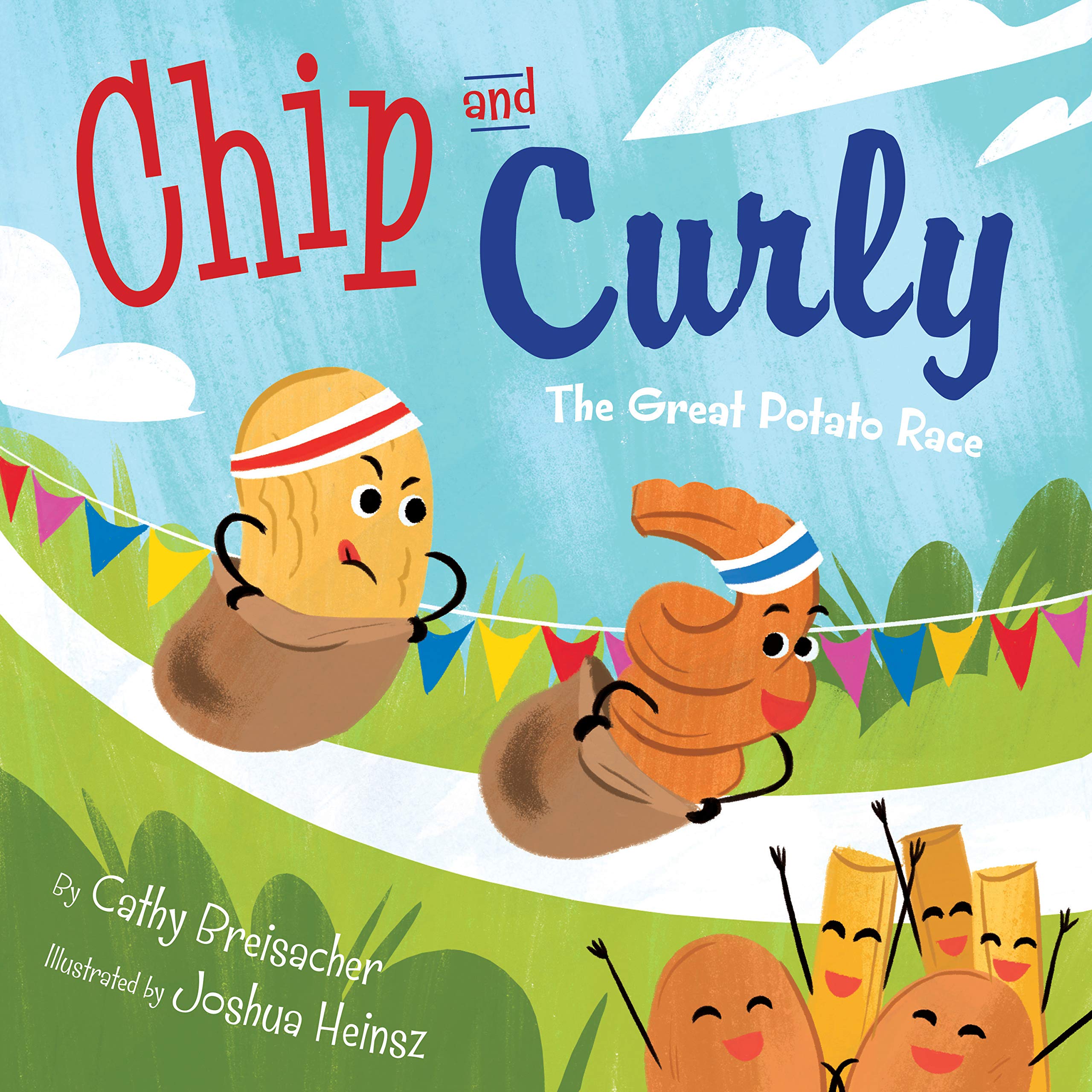
Chip and Curly, The Great Potato Race
Written by Cathy Breisacher | Illustrated by Joshua Heinsz
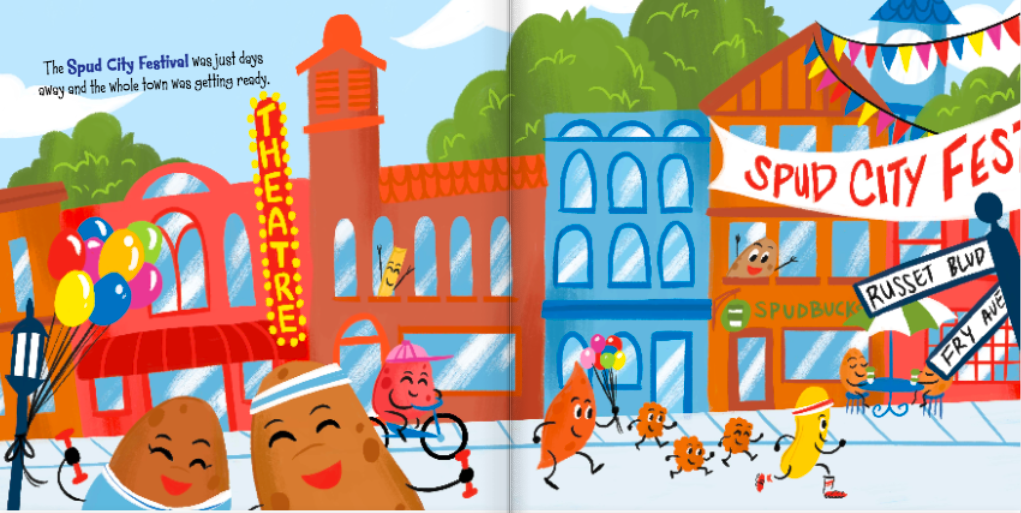
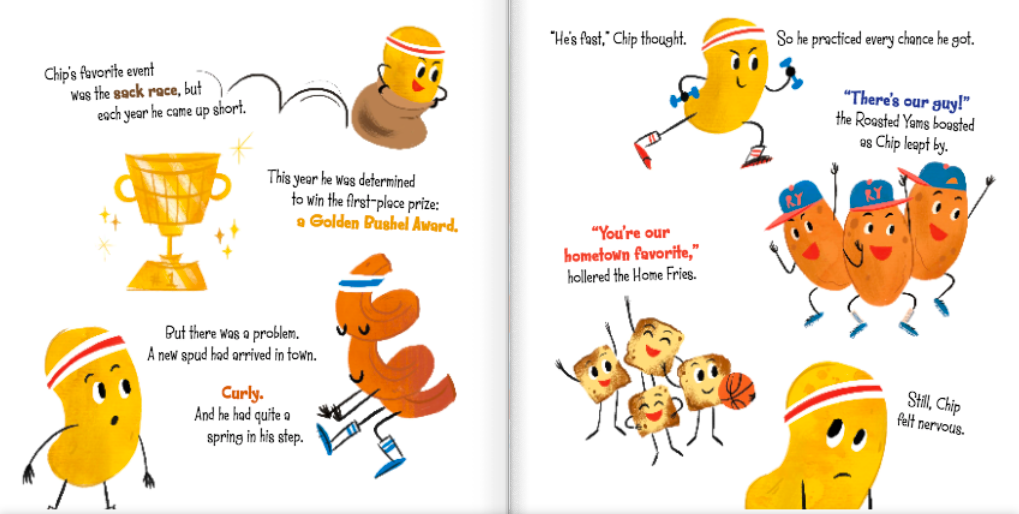
Spud City was about to hold its annual festival, and everyone was excited. Chip was practicing for the sack race. This year “he was determined to win the first-place prize: a Golden Bushel Award.” But a new spud in town—Curly—had a “spring in his step” and seemed to be real competition. Even though the other potatoes cheered him on, Chip was nervous.
On the day of the festival, the race route was lined with spectators. The couch potatoes lounged near the path while “the French Fries stood with their Tater Tots.” Even the sweet potato cheerleaders were waving pompoms and shouting. Just before the race began, Curly took a place next to Chip at the starting line.
Image copyright Joshua Heinsz, 2019, text copyright Cathy Breisacher, 2019. Courtesy of Sleeping Bear Press.
When the whistle blew, Chip took off. He was in the lead until he heard someone behind him. “‘Look out!’ the BBQ Chips shouted. ‘Here comes a hot potato!’” Chip raced on, but then Curly bounced in front of him and even though Chip gave it his all, he couldn’t catch up. A moment later, though, Curly tripped and fell, leaving the path—and the race—wide open for Chip.
Chip hopped past Curly and was in clear sight of the finish line when he realized “he felt rotten.” He glanced back and “hashed it over in his mind.” He decided the only right thing to do was to go back. He offered Curly a hand up, and together they bounded down the route and past the other racers. But Curly was too quick for Chip, and he broke through the tape first. “In an instant, Chip’s dreams of winning were mashed.”
Chip was just about to leave when Curly asked him to be his partner in the relay race. Curly thought they made a great team. They practiced until they found their groove. Everything was looking good until a new team showed up….
Image copyright Joshua Heinsz, 2019, text copyright Cathy Breisacher, 2019. Courtesy of Sleeping Bear Press.
Kids will devour Cathy Breisacher’s pun-filled romp that takes them to Spud City’s annual festival, where Chip and Curly face off to win a Golden Bushel Award in the sack race. While Chip pulls out to an early lead, Curly bounces back and threatens Chip’s years-long dream to win. A misstep by Curly gives Chip the opportunity to achieve his goal, but in his decision, Breisacher shows readers true sportsmanship and integrity. Curly also displays the qualities of a gracious winner, and as the two work together to perfect their relay skills, a friendship sprouts. The final scene offers a funny “oh, no!” moment while also reminding readers that winning can be fleeting, but friendship and staying true to oneself endure.
Joshua Heinsz populates Spud City with a wide array of taters—from tots to waffle fries, sweet potatoes to twice-bakeds, French fries to home fries, and more. Heinsz adds plenty of visual humor to the mix with clever street sign and shop names, and the couch potatoes are, ingeniously, those impossible-to-peel curved ones that lurk in many a 5-pound bag. Kids will love picking out their favorite kind of potato, and the expressive spuds will have readers captivated from the very first page.
For rollicking story times that also offer opportunities to discuss the nature of competition and friendship, Chip and Curly, The Great Potato Race is one to add to your home, classroom, or library shelf.
To learn more about Joshua Heinsz, his books, and his art on his website.
A Chat with Cathy Breisacher
It’s so great to be talking with you again! This must be a really exciting—and busy!—time for you, so I’m thrilled to have you stop by!
You’ve mentioned that the inspiration for this story was a local potato festival. Can you describe that event a bit and tell what sparked the idea for Chip and Curly?
Every year, on the last Saturday in September, a town not far from where I live holds a Potato Fest. The county where it is located is the second-largest supplier of potatoes in the state. People come from all around and a good portion of the downtown area is closed off for the event. There are tons and tons of vendors selling a variety of crafts, and the food vendors whip up all kinds of potato treats: sweet potato fries, potato candy, baked potatoes, pierogi, potato soup, French fries, potato bread, etc. There is live music as well as games for the kids. I love the fall season, and this is a great kick-off to the fall. I try to attend every year. So, in 2016 when I wrote this story, I thought about the potato festival and all of the kinds of potatoes that are sold at the event. The names CHIP AND CURLY came to me and the idea for the story just flowed from there.
Of course, I have to ask—what’s your favorite kind of potato? Do you have a favorite recipe? Would you like to share it?
I love twice baked potatoes. They are probably my favorite. But, there really isn’t a potato I don’t like. I also love perogies and sweet potato fries. Oh my goodness…it’s hard to choose just one.
I’ll share a recipe for Cheesy Hash Brown potatoes that are gobbled up at many family events. They are so easy to make.
CHEESY HASH BROWN POTATOES
26 oz.
Bag of frozen shredded hash brown potatoes (thawed)
2 cups
Sharp cheddar cheese (shredded)
16 ounces
sour cream
1 (10 1/2 ounce) can
cream of mushroom soup
1 ½ sticks
butter
3 cups
Crushed corn flakes
1 teaspoon
garlic salt and pepper to taste
Thaw the hash browns. Melt 1 stick of butter and mix it with the hash browns. Pour into 9 x13 pan. Mix the sour cream, soup and cheese in a bowl. Spread over the potatoes. Melt ½ stick of butter and mix it with the crushed corn flakes. Sprinkle over the potatoes. Bake at 350 degrees for an hour.
Being competitive can take so many forms. Do you consider yourself competitive? If so, in what way?
Yes, I’m definitely competitive. I always want to put 110% into things that I do. If there is a challenge of some sort, I am in it to win it. J In the past couple of years, I’ve been intrigued with Escape Rooms and trying to solve all of the clues before the time runs out. Recently, I heard of an Escape Room that no one has “broke out of” yet. I want to be the first! J
Chip and Curly is loaded with puns and really clever word play! The story must have been a blast, but also challenging to write. Can you talk a little about how you put it all together?
Chip and Curly was definitely a fun story to write. I just pulled out my first version of this story, and it has so few puns in it. I didn’t initially write this story to be punny. But, as I was doing my first set of revisions, a pun popped in my head. More puns came to me as I continued to revise. It wasn’t long before I knew this had to be a story that centered on potato puns. I scoured the Internet to find words associated with potatoes. I must have looked at every list that exists online. The tricky part was to include those words and phrases that fit nicely with the story. I didn’t want to include something just to include it if the word or phrase really didn’t flow with the storyline. My amazing editor, Sarah Rockett, had excellent suggestions for tweaking the story a bit more after she acquired it. And I was delighted with the fun, playful, colorful art provided by the illustrator, Joshua Heinsz.
After practicing for a year to win a Golden Bushel Award for the sack race, Chip makes a surprising decision part way through the race. What would you like kids to take away from the story?
This is the crucial part of the story. I want kids to know that competing can be a lot of fun. And it can feel good to win at something, too. However, practicing good sportsmanship is important and helps build character. When we show respect toward our opponents, we can still have fun and compete, but it helps us to keep our focus on what’s most important—treating one another the way we want to be treated.
Since CaveKid Birthday was released in March, what’s been the best part of being a published author? The most surprising? As a librarian, how does it feel to see your own book on your library’s shelf?
Gosh, there is so much I am enjoying about being a published author. I love meeting new people (kids and adults) at book events and talking with them about stories. It has also been a treat to see friends and family who I haven’t seen for a while. Being a school librarian, I get an extra treat when kids ask to check out my book. That has truly meant the world to me. When my students tell me they love my books, my heart just completely melts.
During our first interview for CaveKid Birthday how did I miss that you’re from Hollidaysburg, Pennsylvania? Does the town live up to its celebratory name? Do you have a favorite town celebration or spot to write or visit?
Hmmm…very good question. The town where I live is a true community. People really get behind and support the schools, sports teams, agencies, fundraising events, etc. So I guess you can say that the people who live in Hollidaysburg celebrate one another’s aspirations and accomplishments. I am proud to live in this town. I do have a few favorite spots that I like to visit. There are a couple of parks that are so beautiful and serene. They are a great place to spend timejyeither alone or with family and friends. As for a favorite town celebration, I would have to say the Winterfest Light-Up Night that is held at the end of November each year. There are festivities in the downtown area and everything is decorated for Christmas. Local restaurants hold soup samplings and people vote on their favorite. Santa arrives and a giant tree is lit up that evening. There are ice carvings, too. It’s such a fun night and everyone is in the holiday spirit.
Thanks, Cathy! I can’t wait to try those delish-sounding potatoes! I know you’ll have lots of fun with Chip and Curly, and I wish you all the best with all of your books!















 celebratepicturebooks.com