Today is a day to celebrate the simple pleasures of toasting marshmallows. Whether you like your marshmallows just lightly browned or blackened to a crisp, these ooey-gooey delights are fun to make and fun to eat! Why not make a campfire, start up the fire pit or grill, or even set the oven to broil and toast up some marshmallows today?
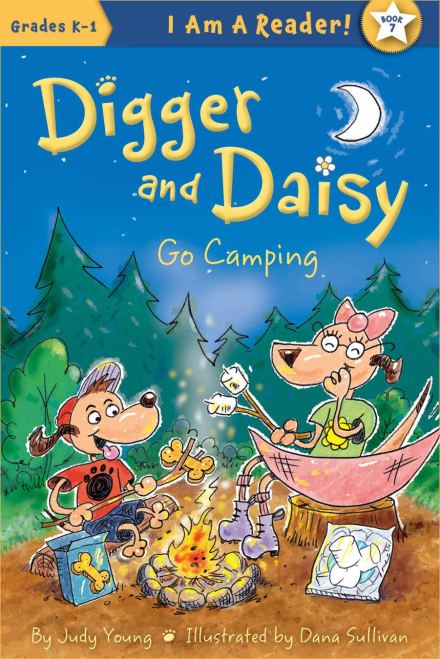
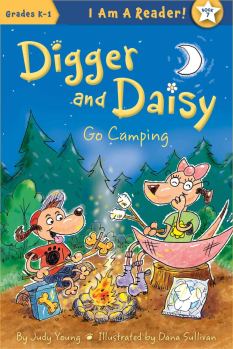
Digger and Daisy Go Camping
Written by Judy Young | Illustrated by Dana Sullivan
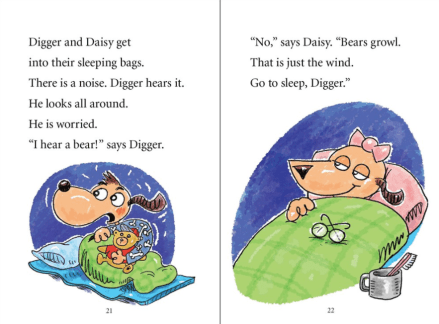
Summer vacation has come and Digger and Daisy are packing up for another adventure together. At least Daisy is. She’s excited to go camping, “but Digger is worried. There might be bears,” he thinks. With reassurance from Daisy that the trip will be fun, Digger fills his own backpack and grabs his sleeping bag. Out on the trail, “There is a noise. Digger hears it. He looks all around. He is worried. ‘I hear a bear!’ says Digger.”
Image copyright Dana Sullivan, 2019, text copyright Judy Young, 2019. Courtesy of Sleeping Bear Press.
Daisy points out that “bears growl” and the sound Digger hears is just a bird singing in a tree. Digger and Daisy sing along too all the way to the lake. Here there’s another noise that worries Digger. “‘I hear a bear!’” he tells Daisy. But this sound is just a fish jumping, and soon Daisy and Digger are splashing along with it. After a nice swim, Daisy thinks a fire will warm them up. While they’re picking up sticks, Digger hears another noise that he’s sure is a bear. But this sound isn’t a growl either. It’s a squirrel munching on nuts.
Image copyright Dana Sullivan, 2019, text copyright Judy Young, 2019. Courtesy of Sleeping Bear Press.
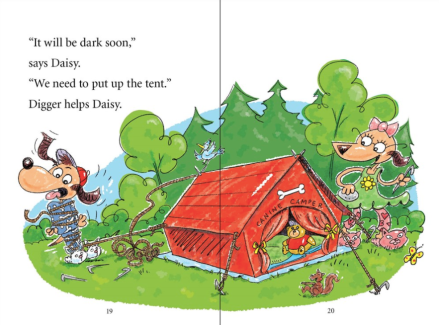
Digger and Daisy enjoy roasted nuts too along with their hot dogs and marshmallows. “‘It will be dark soon,’ says Daisy. ‘We need to put up the tent.’” Daisy feels safe and cozy in her sleeping bag, but Digger hears a noise. “He looks all around. He is worried. ‘I hear a bear!’ says Digger.” But this sound isn’t a growl—Daisy tells him it’s a howl from the wind.
Image copyright Dana Sullivan, 2019, text copyright Judy Young, 2019. Courtesy of Sleeping Bear Press.
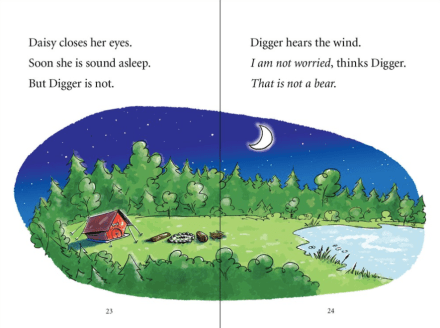
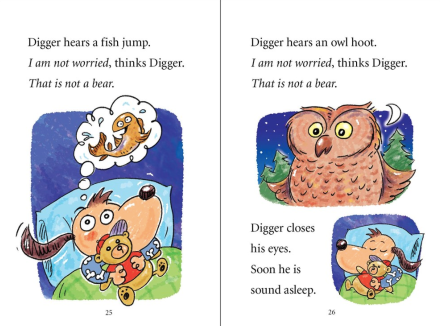
Daisy quickly falls asleep, but Digger doesn’t. He listens to all the sounds and recognizes the wind, a jumping fish, and the hoot of an owl. Satisfied, “Digger closes his eyes. Soon he is sound asleep.” Suddenly, there is a noise that Digger does not hear. It wakes Daisy. She shines her flashlight all around. “She is worried. ‘Digger, wake up! I hear a bear!’ says Daisy.” When Digger opens his eyes, the sound stops. Is a bear on their trail, or was it something a little tamer?
Image copyright Dana Sullivan, 2019, text copyright Judy Young, 2019. Courtesy of Sleeping Bear Press.
In their seventh adventure, Daisy plans an overnight camping trip. Daisy’s protective older-sibling instincts are sweetly in evidence as she encourages Digger to put his fear of bears aside and join her. Once in the forest, she reassures him that the noises he hears are harmless woodland creatures. Kids will love catching up with their favorite canine duo through Judy Young’s simple sentences that contain enough repetition of key words to bolster early readers’ confidence as well as accumulative drama, gentle suspense, and a humorous ending.
Every camping trip is filled with moments of wonder and humor, and Digger and Daisy’s adventure is no exception. In Dana Sullivan’s colorful snapshots, the birds are singing, butterflies flutter along, a gymnastic fish startles a fly, and a squirrel stuffs its cheeks with nuts. Daisy sports her trademark tutu skirt (even her bathing suit is a one-piece tutu), and Digger has not forgotten his favorite cap. Young readers will giggle as Digger panics, sending his firewood flying, and gets tied up in the tent ropes. They’ll also appreciate Sullivan’s cleverness in making Daisy and Digger’s tent look like a red doghouse. Of course, the siblings’ loving relationship is a highlight of this series, and this story strengthens that bond as Daisy takes care of her little brother and he in turn trusts her.
Fans of Digger and Daisy will want to add this new adventure to their collection. Digger and Daisy Go Camping also makes a sweet introduction to the series and will entice readers who have not yet met this brother and sister team to explore all of their escapades. The book would make a welcome addition to classroom and public library shelves as well.
Ages 5 – 7
Sleeping Bear Press, 2019 | ISBN 978-1534110229 (Hardcover) | ISBN 978-1534110236 (Paperback)
Discover more about Judy Young and her books on her website.
To learn more about Dana Sullivan, his books, and his art, visit her website.
Toasted Marshmallow Day Activity
A Fun In-Home Campfire
Kids and their friends and family can enjoy the cozy fun of a campfire in their own family room with this craft that’s easy to make from recycled materials. While the supplies might make the campfire artificial, kids will love it if the marshmallows are the real thing!
Supplies
Three or four paper or cardboard tubes
Cylindrical bread crumbs or oatmeal container
Tissue paper in red, orange, and yellow
Brown craft paint
Brown marker
Brown construction paper or white paper
Strong glue or hot glue gun
Chopsticks (one for each person)
Marshmallows
Directions
To Make the Logs
Cover the ends of the tubes with circles of brown construction paper or white paper and glue into place
Paint the tubes and the ends if needed, let dry
Paint the sides of the cylindrical container with the brown paint, let dry
With the marker draw tree rings on the ends of the tubes. Decorate the sides with wavy lines, adding a few knot holes and swirls.
To Make the Fire
Cut 9 squares from the tissue paper (3 in each color, about 8 to 6-inch square)
Layer the colors and gather them together at one tip. Fold over and hold them together with a rubber band.
To Assemble the Campfire
Stack the tube logs
Put the tissue paper fire in the middle of the logs
To “Roast” Marshmallows
Stick marshmallows on chopsticks for “roasting” and eating!
You can keep your logs and fire in the cylindrical log until the next time!
You can find Digger and Daisy Go Camping at these booksellers
Is fishing your thing? Do you like nothing better than heading down to the lake or stream and spending a relaxing day with a fishing pole, some bait, and the possibility of reeling in a “big one?” Perhaps you like fly fishing better, challenging yourself to flick that hook in just the right place. Then again, maybe taking a boat out to deep water and pitting yourself against the truly big fish is more your style. However you like to fish, make some time to enjoy your hobby this month!
Back Roads, Country Toads
Written by Devin Scillian | Illustrated by Tim Bowers
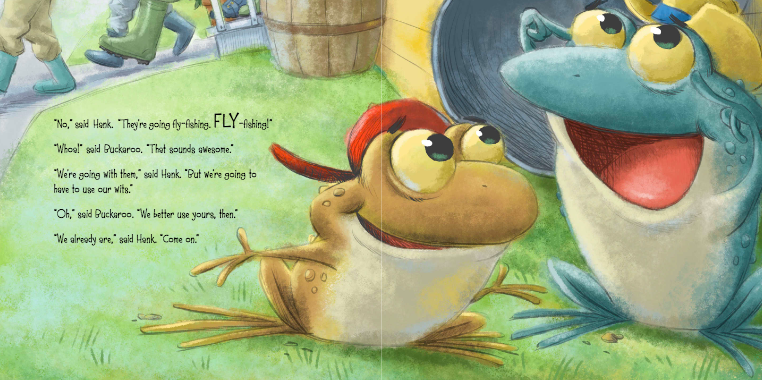
Best toady friends, Hank and Buckaroo, were just hanging out in “their favorite drainpipe near Cooper’s General Store” sipping the last drops from a discarded bottle of strawberry soda when they overheard Mr. Cooper and his friends talking about going fly-fishing. Hank and Buckaroo thought FLY-fishing sounded awesome and wanted to go along. They spied the perfect place to catch a ride: the fishermen’s open lunch basket. With a KERPLOP! they jumped in.
Image copyright Tim Bowers, 2019, text copyright Devin Scillian, 2019. Courtesy of Sleeping Bear Press.
Soon they were on their way to what Buckaroo said would be “‘the greatest day of their lives.’” “‘Toadally,’” agreed Hank. While they rode to the fishing stream, Hank and Buckaroo sang “When You Fish Upon a Star,” and as soon as the truck stopped they jumped out and hid in a nearby bush. But Emmitt the raccoon was already there. Hank and Buckaroo were reveling in the glory that was going to be that day’s “‘fly cafeteria’” and “‘down-home big-time fly barbecue’” when Emmitt gave them the bad news. Hank didn’t believe it. He thought “‘fishing WITH flies’” instead of “‘fishing FOR flies’” sounded ridiculous.
Image copyright Tim Bowers, 2019, text copyright Devin Scillian, 2019. Courtesy of Sleeping Bear Press.
And just then a nice juicy fly sailed by. Hank leaped and released his long tongue, but Emmitt pulled him back just before he grabbed onto the fake fly. The three watched as the fishermen caught fish after fish with the imitation flies. Hank and Buckaroo couldn’t imagine what Mr. Cooper and the rest of the fishermen would want with “‘those smelly fish.’” Emmitt disagreed—he loved smelly fish. To prove his point, he ran up and snatched one from the fishermen’s bucket.
Image copyright Tim Bowers, 2019, text copyright Devin Scillian, 2019. Courtesy of Sleeping Bear Press.
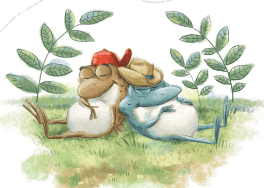
Seeing the fish, Hank had a brainstorm and asked to “‘borrow’” Emmitt’s fish. He placed it on a rock in the sun and went back to their hiding place in the bushes. Emmitt and Buckaroo were confused. But “before long, a swarm of flies hovered over the fish.” When there was a large cloud of flies, “Hank croaked, ‘Let’s go fishing!’” Their tongues snapped in the air, reeling in dozens of flies. When they were filled to the brim, they gave the fish back to Emmitt and happily made plans to go fly-fishing again the next Saturday.
Image copyright Tim Bowers, 2019, text copyright Devin Scillian, 2019. Courtesy of Sleeping Bear Press.
Devin Scillian’s clever, pun-filled fish story has everything needed to hook young readers and deliver a funny story time. With the lure of all the flies they can eat, Hank and Buckaroo take action to have the best day of their lives and discover a new hobby. When they meet up with Emmitt the raccoon and learn that their initial idea was a bit off the mark, Hank shows persistence and innovative thinking to make their fishing dreams come true. Demonstrating acceptance of each other’s different tastes and some creative cooperation, the camaraderie among Hank, Buckaroo, and Emmitt serves as a good example for readers. The close bond between Hank and Buckaroo—and their hilarious dialog—will endear them to kids, leaving them wanting more from this “toadally” charming duo.
Tim Bowers’ energetic toads, with their wide smiles, eager eyes, and spirited personalities are obvious best friends from the first page. Bowers’ vibrant, action-packed illustrations are laugh-out-loud funny as Buckaroo and Hank grow giddy at the thought of all those flies they’re going to catch, flick their loooong tongues, and hobble down the road with overstuffed bellies. Emmitt may chuckle at the toads’ misinterpretation of “fly-fishing,” but he’s a true and trusting friend to rescue Hank from a fisherman’s line and lend his filched treat to attract their lunch. In the background, images of the two fishermen and their young protégés casting their lines and reeling in bucket-loads of fish add depth, interest, and visual clues for readers.
A comical, well-developed tale that will captivate kids, Back Roads, Country Toads is a winner for group story times or one-on-one fun at home, in the classroom, or for public libraries.
Ages 5 – 8
Sleeping Bear Press, 2019 | ISBN 978-153411039
Discover more about Devin Scillian, his books, music, and journalism on his website.
To learn more about Tim Bowers, his books, and his art, visit his website.
National Fishing Month Activity
Tackle the Tackle Box Board Game
A good fisherman always needs a well-stocked tackle box. Play the Tackle the Tackle Box Game to earn lures, bobbers, hooks and more to fill your box. The first player to complete their set is the winner! For more fun, you can color the tackle box items any way you like. There are even three extra cards for you to draw your own tackle box items!
Today we celebrate the ratification of the 19th Amendment, which guaranteed a woman’s right to vote. Yet even as we commemorate this achievement, we must remain vigilant to protect our voting rights and access and teach children that most-important lesson – that every voice, every vote is important. Today’s book reveals the true story of that nail-biting vote for the 19th amendment while also keeping it’s eye on the future. For more information on the history of suffrage and to learn more about the brave women on the front lines of progress, visit the 2020 Women’s Vote Centennial Initiative website and Women’s Vote Centennial. You’ll find extensive resources, curriculum for middle school and high school students, as well as online exhibits, videos, and so much more.
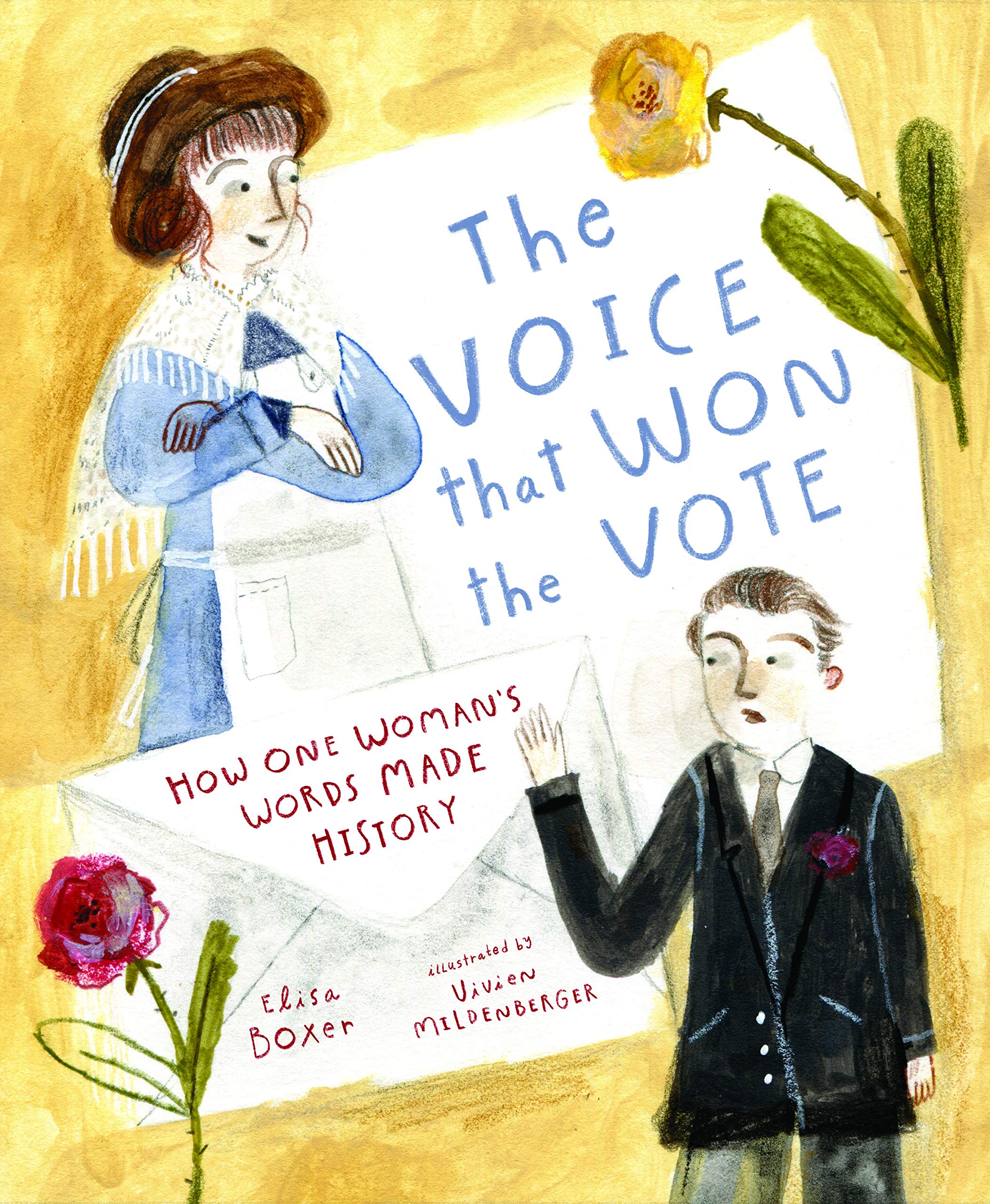
The Voice that Won the Vote: How One Woman’s Words Made History
Written by Elisa Boxer | Illustrated by Vivien Mildenberger
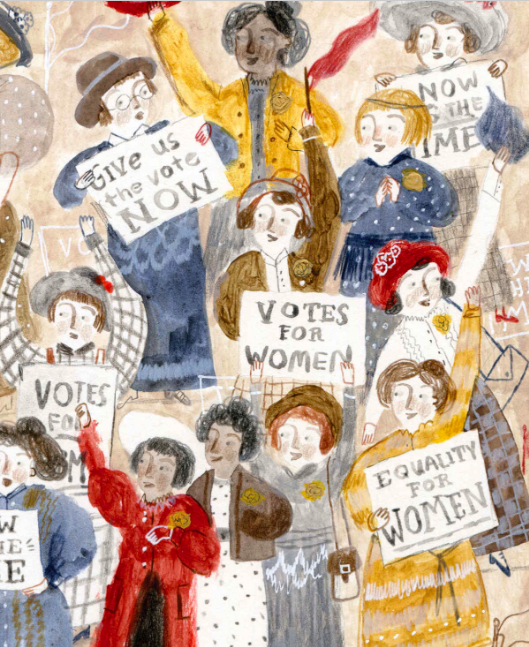
The year was 1920 and women were demanding the right to vote, just as they had been for the last seventy-five years. But all of their meetings, shouting, and signs were silenced. Men called the women “troublemakers” and “uncivilized.” Some men said it would “cause chaos” if women could vote, and others said “‘the only vote a woman needs is the vote to choose her husband.” There were even other women who thought women shouldn’t vote.
Image copyright Vivien Mildenberger, 2020, text copyright Elisa Boxer, 2020. Courtesy of Sleeping Bear Press.
But then there was Febb Burn from East Tennessee who had gone to college, become a teacher, and loved to keep learning. She was especially interested in laws and how they were made, and every year as she watched her farmhands head off to vote on election day, she wanted to be able to go too. Finally, she grew so tired of being “shut out of the process” that she wrote a letter to her son.
Who was her son? His name was Harry Burn, and he was the “youngest lawmaker in Tennessee.” As he read his mother’s letter, he watched out his window as people from across the country gathered to decide the fate of women’s suffrage. One round of voting had already taken place, and it had resulted in a tie. Thirty-five states had voted yes on the issue, but thirty-six were needed to make it a law. Harry Burn for Tennessee had been one of the “no” votes in the first round. Now in the second round, Harry Burn would be the deciding vote. A “no” would deny women the vote, while a “yes” would change elections forever.
Image copyright Vivien Mildenberger, 2020, text copyright Elisa Boxer, 2020. Courtesy of Sleeping Bear Press.
“He knew that most of the people who had elected him hated the idea of women voting.” Many of them were even in the audience and were counting on him. He was, after all, wearing a red rose—”the symbol of keeping women in the home, and out of the voting booth”—in his pocket. When it came time for Harry to vote, all eyes were on him as he said “‘Yes.’” The officials thought he’d “made a mistake” or “gotten confused,” but he hadn’t. The suffragettes cheered and hugged.
Everyone wanted to know why Harry Burn had changed his mind. In answer, he pulled from his pocket the letter his mother had written urging him to vote for suffrage. Harry constituents were shocked and angry. They vowed to vote against him in the next election. The headlines in the newspapers said that Harry had ruined his career. But Harry already knew that. He knew that his vote would mean “giving up his seat in the Tennessee House of Representatives.”
Image copyright Vivien Mildenberger, 2020, text copyright Elisa Boxer, 2020. Courtesy of Sleeping Bear Press.
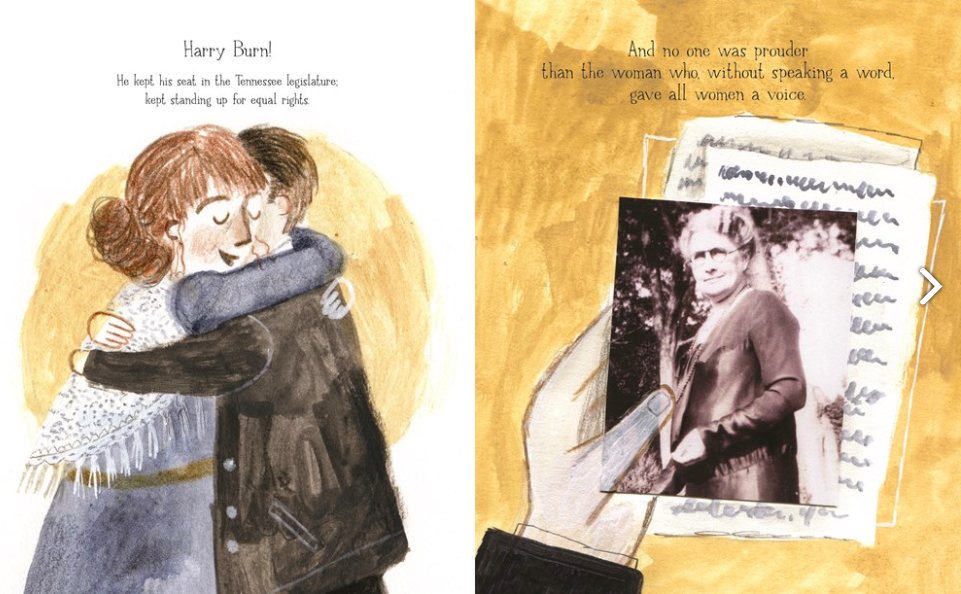
When interviewed for newspaper articles, Harry said that he had followed his conscience that all people should have the right to vote. At last the election was held, and Harry awaited his fate as all the votes were counted. Who would be the next Tennessee Representative? Harry Burn! “And no one was prouder than the woman who, without speaking a word, gave all women a vote.”
In an Author’s Note, Elisa Boxer talks more about the women’s suffrage movement, the courage to stand up for what you believe in, and the power of using the vote to voice your opinion. A timeline of significant events in the women’s suffrage movement is also included.
Image copyright Vivien Mildenberger, 2020, text copyright Elisa Boxer, 2020. Courtesy of Sleeping Bear Press.
For anyone wondering about the power of one vote, Elisa Boxer puts all doubts to rest with her engaging recounting of this little-known true story. While Harry Burn’s vote took place 100 years ago, the courage he showed in standing up for his own conscience and in opposition to what was expected of him reverberates today. Boxer opens the story with a clear and meaningful definition of how a vote equals one’s voice, instilling in children who are learning to speak up for themselves in classrooms, on social media, and elsewhere the importance of voting when they come of age.
Her inclusion of quotes revealing the reasons behind opposition to women’s suffrage will be eye-opening. Her well-paced building of suspense going into the second vote and the aftermath will have kids on the edge of their seat and offers many opportunities to discuss the mechanisms of politics, expectations, and courage. Through her straightforward yet multilayered storytelling, Boxer presents two heroes for children to look up to: Harry, who put the good of the country and women ahead of his own career and Febb, who used her voice to make lasting change.
Image copyright Vivien Mildenberger, 2020. Courtesy of Sleeping Bear Press.
Vivien Mildenberger’s lovely, textured illustrations take readers back to the pivotal year of 1920, when vocal suffragettes faced their equally vocal opposition and Febb Burn, sitting on her front porch decided to write her life-changing letter. Images of politicians sporting yellow and red roses reveal the long tradition of color as an identifying symbol. An especially powerful spread comes after Harry’s vote as he walks among his angry constituents, all of whom shun him behind newspapers full of articles about the historic vote. The inclusion of the actual Febb Burn’s letter to Harry and a photograph of Febb give readers see and hear from this influential woman.
A stirring true story about the power of one person to make a difference, The Voice that Won the Vote is highly recommended for home, school, and public library collections.
Discover more about Elisa Boxer, her book, journalism, and other work on her website.
To learn more about Vivien Mildenberger, her books, and her art on her website.
Meet Elisa Boxer
Elisa Boxer is an Emmy-winning journalist and columnist whose work has appeared in publications including The New York Times, Inc., and Fast Company. She has always been passionate about children’s literature, and finds herself especially drawn to stories of unsung heroes like Febb and Harry Burn. The Voice That Won the Vote is her first book, and she hopes it inspires children to give voice to what matters to them. Elisa lives in Maine with her family.
Today, I’m excited to chat with Elisa Boxer about her timely The Voice Who Won the Vote, her work as a journalist, and the themes woven through all of her stories. Elisa also gives kids an intriguing writing prompt. And my blogging partner Jakki’s sons, Steve and Jack, are back with their questions too!
Steve asked: How did you find the letter Febb Burn wrote to her son?
Hi Steve! So glad you liked the book. The story of how I found the letter goes back to a couple of years ago when my agent, Steven Chudney, let me know that 2020 would be the 100th Anniversary of women getting the right to vote. He asked if I could come up with a picture book about it. I’ve always been drawn to stories of unsung heroes, so I scoured the internet for little-known figures in the suffrage movement. When I stumbled across the story of Febb Burn and learned that she was the mom who saved suffrage, I knew this was a story I wanted to tell! More digging led me to the online archives at the Knox County Library in Tennessee. These archives included the letter.
I think it’s so cool to see the original papers that Harry received and read that day in the legislature back in 1920. And to see Febb’s actual handwriting! Aaah! I tend to geek out over historical documents like this.
Jack wondered: How much research did you have to do?
Hi Jack! The short answer is: Lots. After I found Febb’s story on the internet, I read as many articles online as I could find. I also read several books about the women’s suffrage movement. I wanted more background information to put the story in context, and I also wanted to know more about the legislative session in Tennessee that led to Harry Burn tipping the scales and giving women the right to vote. I also enlisted the help of the Special Collections department at the University of Tennessee Libraries. One of the most exciting things they shared with me was a scanned version of Harry Burn’s personal scrapbook from 1920, containing newspaper clippings and headlines from his historic vote!
Jack and Steve would like to know: Is voting important to you?
Definitely. I started the book with the line: “A vote is a voice,” because I believe that voting is one of the most powerful ways we can have our say in society.
Hi Elisa! I read in your bio that even as a child you loved to write. In fact, if readers look on your website they’ll see a picture of quite a large group of books with covers written in crayon. I’m sure kids would love to know what some of those stories were about. Can you share a few of the ideas you wrote about as a child?
Sure! It’s fun to look back on those and see some common themes, like defying authority (You Can’t Catch Me, for example, about a girl outrunning her parents) and grief (I wrote The Kitten and the Puppy after losing my beloved dog). And then, there was a book about a dinosaur making friends with a little girl and moving into her house, which I think I wrote because I had just learned how to draw dinosaurs ;).
With your early interest in writing books, did you ever consider becoming a children’s writer or novelist before going into journalism? What was it about journalism that attracted you?
Even though I’ve loved reading and writing children’s books for as long as I can remember, I never really considered making a career of it. I wish I had followed that passion earlier. I’m 49 and my first book was just published. So if you have any interest in creating children’s books, don’t wait as long as I did! Although, having said that, I really do love print and broadcast journalism. My specialty has always been long-form journalism, which involves in-depth research, multiple interviews, and spending time crafting a story. A lot like writing nonfiction picture books, actually. A couple of years ago, I got sidelined with a severe case of Lyme disease. It hurt to move and breathe and I was basically housebound. So that’s when I decided to re-visit my childhood passion. I began dusting off old picture book manuscripts, revising them, and querying agents.
Your stories in print for newspapers and for television news have garnered many awards. What aspects of story do you infuse into each of your pieces? What do you like best about each medium?
(Blushing). I am always looking for the soul of the story. Even with straight news pieces, I want to find people and circumstances to bring those stories to life in a way that readers or viewers can relate to. The thing I like best is the same for each medium, and that is finding the point of emotional resonance, the subtext, the theme that will stick with the audience long after they put down the paper or the magazine or turn off the TV. In fact, that’s one of the reasons I love books so much: people pick them up again and again. Sure, you can save a newspaper or magazine article that resonates with you. But it’s not the same as that feeling of finishing a book, internalizing its message, holding it in your hands and knowing it’s yours to return to whenever you want.
It seems very fitting that your first published book is a picture book. What is it about Febb Burn’s story that you think is most important for kids to know?
I really want kids to know how much their voices matter. It’s so easy to feel powerless, especially given the state of the world right now. But I hope kids come away from the book realizing that one small act of courage, in the form of giving voice to what matters to them, really can change the world.
Vivien Mildenberger’s illustrations are so evocative of 1920. What was your first reaction to seeing your story illustrated? Do you have a favorite spread?
Aren’t Vivien’s illustrations amazing? I’m still blown away by them every time I see the book. When I first saw her work on her website, even before I saw her illustrations for the book, I knew that her old-world style would be a perfect fit for this story. And then when I first saw her preliminary sketches, I thought, WHOA, this is going to be even better than I could have imagined. Hmmm, it’s tough to pick a favorite spread. But I’d have to say the one where Harry Burn is looking out the window of the state capitol, watching the throngs of people arrive to witness history. She really captures the mood here. “America was on the verge of change,” the text reads. You can’t even see Harry’s face, but Vivien somehow managed to convey so much tension and anticipation in this spread. You can feel his inner struggle to do what’s right and follow his heart in the face of opposition.
What’s up next for you?
I’m super excited to say that I have several more picture books on the way during the next couple of years, all nonfiction. I’m also working on a chapter book and two middle grade books, one nonfiction and the other historical fiction.
As kids stay home and are schooled at home, it’s wonderful to see them interacting with the kidlit community. Would you like to give readers a writing prompt?
It really is so wonderful to be interacting with kids, their parents and their teachers. As for a prompt, I’d ask kids: With the world the way it is, what are the words, the scenes, the images, and the messages that would touch your heart? In other words, what is the book you need right now? Take one small step to start creating it. And then another…
Thanks, Elisa! It’s been wonderful talking with you! I wish you all the best with The Voice Who Won the Vote, and I can’t wait to read your upcoming books. I hope we’ll have a chance to chat again!
For kids, going back to school means new art projects and using their creativity and ingenuity. For many it also means getting to know a new class pet or sharing their school day at home with a beloved furry or feathered friend. In today’s book the two are combined in a sweet and funny beginning reader – the third book in the kid-favorite Tip and Tucker series.
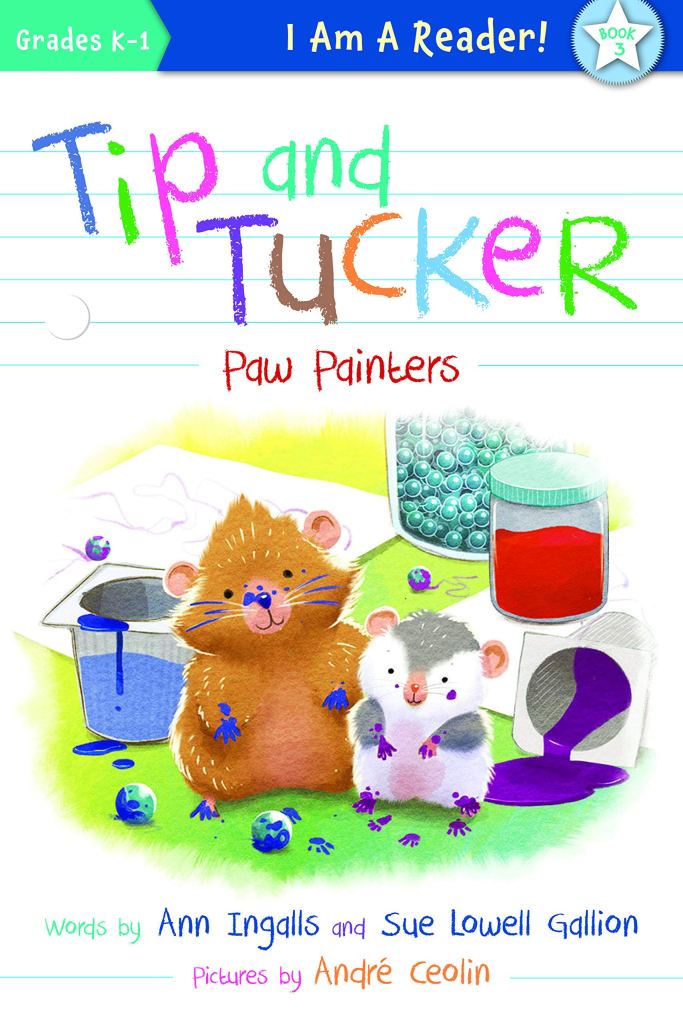
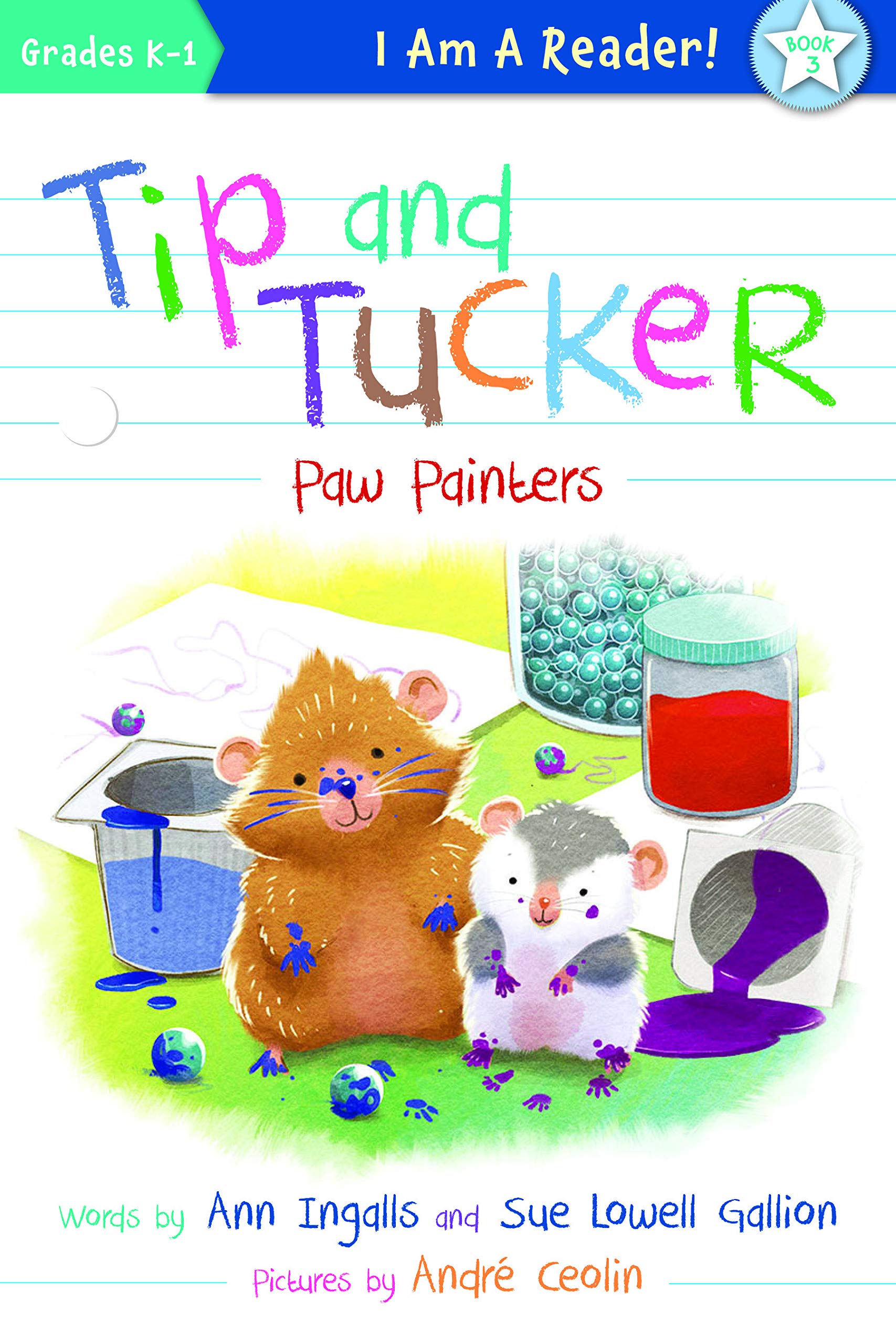
Tip and Tucker Paw Painters
Written by Ann Ingalls and Sue Lowell Gallion | Illustrated by André Ceolin
It’s art week in Mr. Lopez’s class, and the kids are choosing between painting with marbles and building with boxes—or doing both. The colors of paint available are listed on the whiteboard in English and Spanish. Emma picks up her marble as Tucker, one of the class’s hamsters, peeks over the top of his cage at all those boxes.
Image copyright André Ceolin, 2020, text copyright Ann Ingalls and Sue Lowell Gallion, 2020. Courtesy of Sleeping Bear Press.
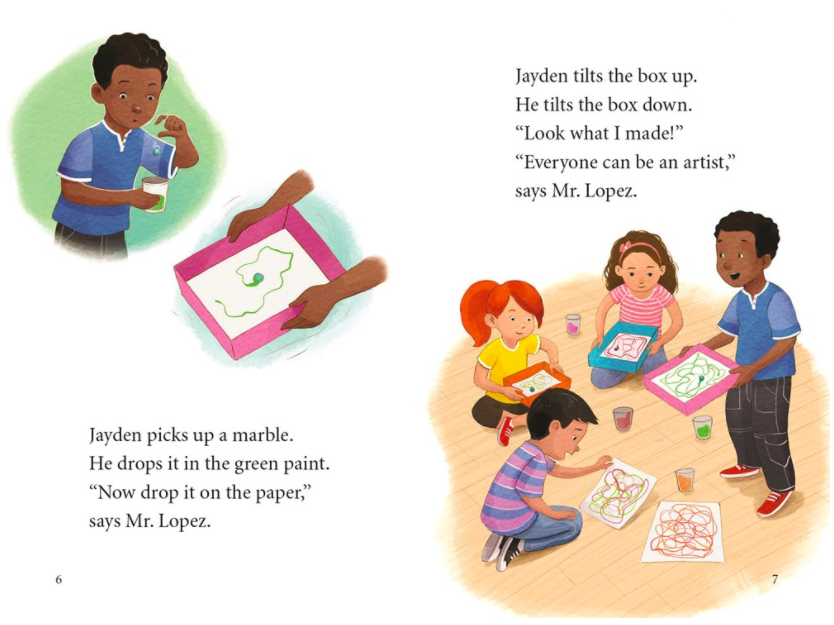
Jayden has chosen to paint with marbles too. “He drops it in the green paint. ‘Now drop it on the paper,’ says Mr. Lopez.” Jayden puts a sheet of paper in his box and drops the green-painted marble on top. He “tilts the box up and down.” A squiggly line snakes around Jayden’s paper. “‘Everyone can be an artist,’ says Mr. Lopez.”
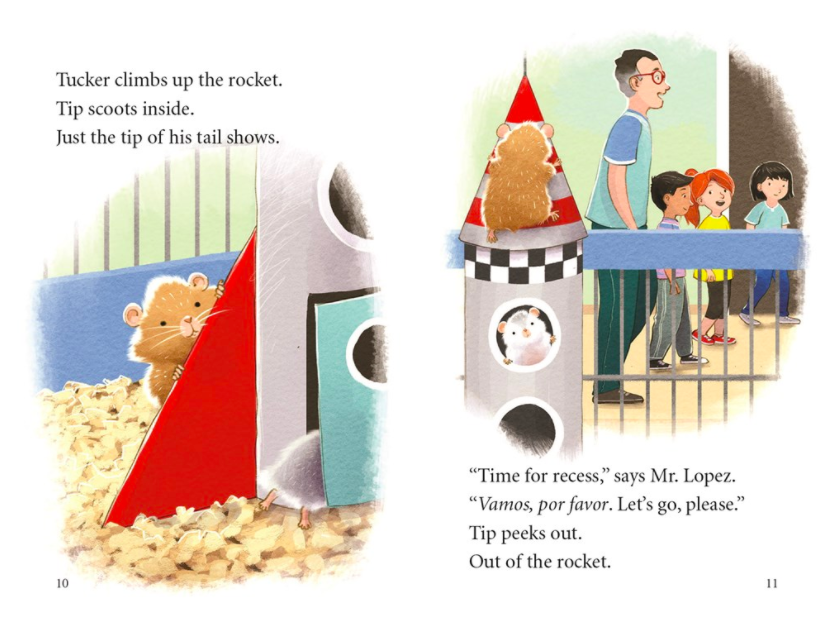
Emma and Pim are making a rocket with the boxes. It’s a special rocket to go in Tip and Tucker’s cage. Tucker climbs up the outside of the rocket while Tip scurries inside. They watch the class go to recess. Tucker wants Tip to join him at the top of the rocket, but when he gets there, “the rocket tips. The hamsters tumble.” They “BUMP! THUMP!” onto the tabletop.
Image copyright André Ceolin, 2020, text copyright Ann Ingalls and Sue Lowell Gallion, 2020. Courtesy of Sleeping Bear Press.
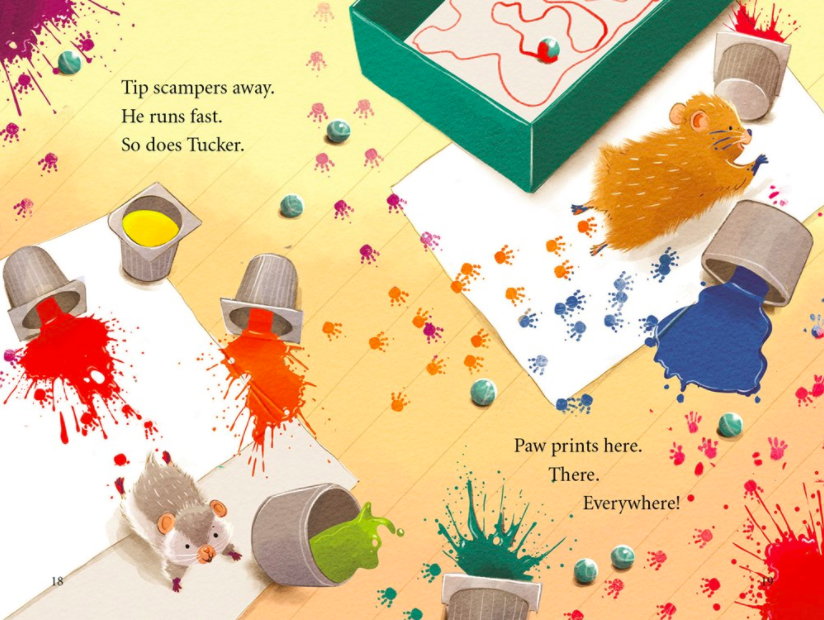
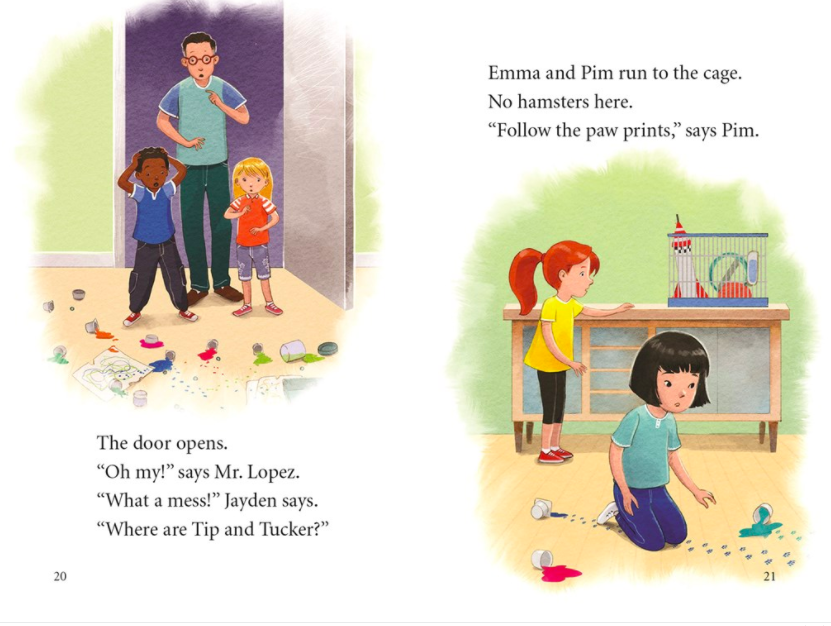
Tucker inspects a cup of paint, and when he looks up his whiskers are blue. Tip topples a cup of purple paint. “Now Tip’s paws are purple!” Both Tip and Tucker run away, leaving “paw prints here. There. Everywhere!” When the class returns from recess, they find a big mess, but no hamsters. “‘Follow the paw prints,’ says Pim.” The paw prints lead Carlos to his nibbled painting and Mr. Lopez to his nibbled lunch bag.
Image copyright André Ceolin, 2020, text copyright Ann Ingalls and Sue Lowell Gallion, 2020. Courtesy of Sleeping Bear Press.
But what, the kids wonder, is that crunching sound coming from inside the bag? Tip and Tucker wonder what that noise is that’s coming from outside the bag. Tucker “peeks out of the bag. Tip peeks too.” The class goes to work cleaning their room—and Tip and Tucker. While the hamsters settle in for a nap, Mr. Lopez hangs the students’ marble paintings, including one decorated with tiny paw prints. Then the class goes to lunch. In the quiet room, Tip wakes up Tucker and points to the wall. “Sleepy Tucker looks. ‘We are artists too!’ Tip says.”
Image copyright André Ceolin, 2020, text copyright Ann Ingalls and Sue Lowell Gallion, 2020. Courtesy of Sleeping Bear Press.
Tip and Tucker, back at school in their third adventure, are as cute and mischievous as ever. Children who are beginning to read independently will be charmed by Ann Ingalls’ and Sue Lowell Gallion’s tiny duo who make a big mess while the class is away in this high-interest and humorous story that also introduces an easy, satisfying art project to do in school or at home. For beginning readers, the authors’ short sentences, dialogue, and repeated words and phrases build confidence while instilling an appreciation for the fun of reading. As clues are dropped and suspense increases, fans of the series will eagerly read each page to discover what their favorite class pets get up to this time. Their funny discovery and the responses of the children are endearing, and the addition of Tip and Tucker’s work of art on the classroom wall reinforces the story’s themes of creativity and inclusion.
Readers will enthusiastically welcome back André Ceolin’s adorable Tip and Tucker and be happy to rejoin Mr. Lopez’s class with their friends Pim, Jayden, Emma, Carlos, and the others. Little Tucker with his blue whiskers and Tip with his purple paws will melt kids’ hearts, and their willy-nilly dash around the classroom is sure to bring on the giggles. Ceolin clearly depicts the concepts presented in the text on each page so that beginning readers can make the association between perhaps unknown words and their meaning. Images of the children’s happy faces as they create their art projects and cooperate in cleaning up contrast with their shock upon seeing their messy classroom and nibbled papers and their concern for Tip and Tucker. Tip and Tucker also display feelings of curiosity, joy, and surprise. These portrayals help kids explore their emotions and learn how to navigate new experiences.
Sure to captivate new and beginning readers, Tip and Tucker Paw Painters is one to add to your home, classroom, or public library collection. Check out the other I Am a Reader: Tip and Tucker books as well as an interview with Ann Ingalls and Sue Lowell Gallion here:
Sleeping Bear Press, 2020 | ISBN 978-1534110991 (Hardcover) | ISBN 978-1534111004 (Paperback)
Discover more about Ann Ingalls and her books on her website.
To learn more about Sue Lowell Gallion and her books, visit her website.
You can learn more about André Ceolin and find a portfolio of his work on his website.
Back to School Month Activity
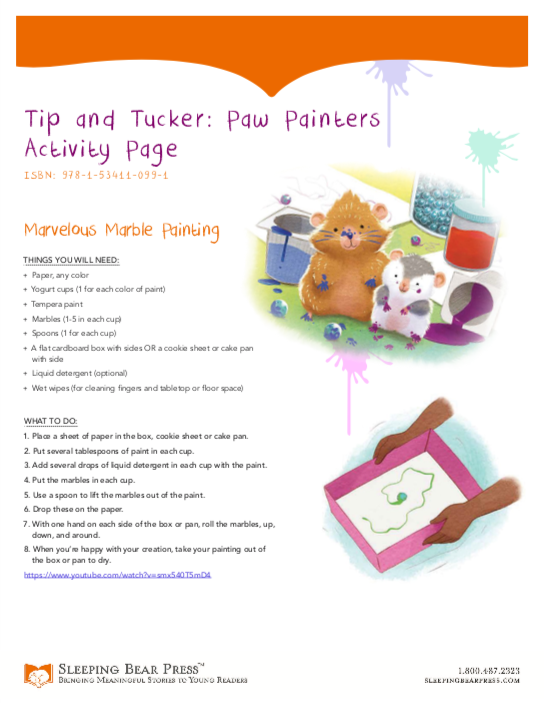
Marble Painting with Tip and Tucker Paw Painters Activity Sheet
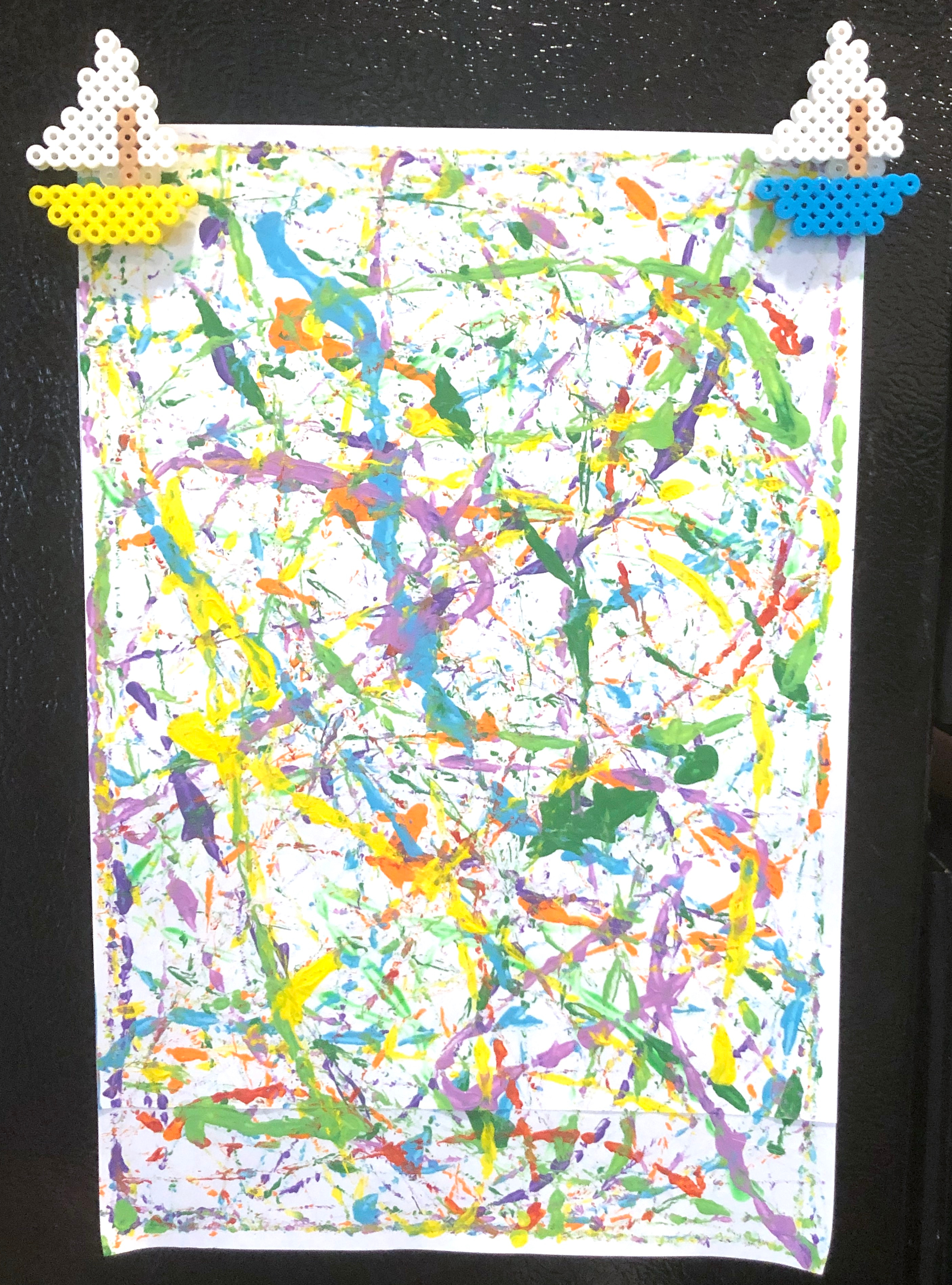
You can make a marble painting just like the kids in Mr. Lopez’s class with these printable directions from Sleeping Bear Press. And… you can even get as messy as Tip and Tucker!
This month-long holiday encourages people to think about what makes them happy and then go out and do it. The holiday also reminds us that happiness can be found in the simplest things and at random times – as long as we’re aware of and open to the wonder in our surroundings. An important part of finding fulfillment and happiness is being true to oneself. Today’s book inspires kids to do just that.
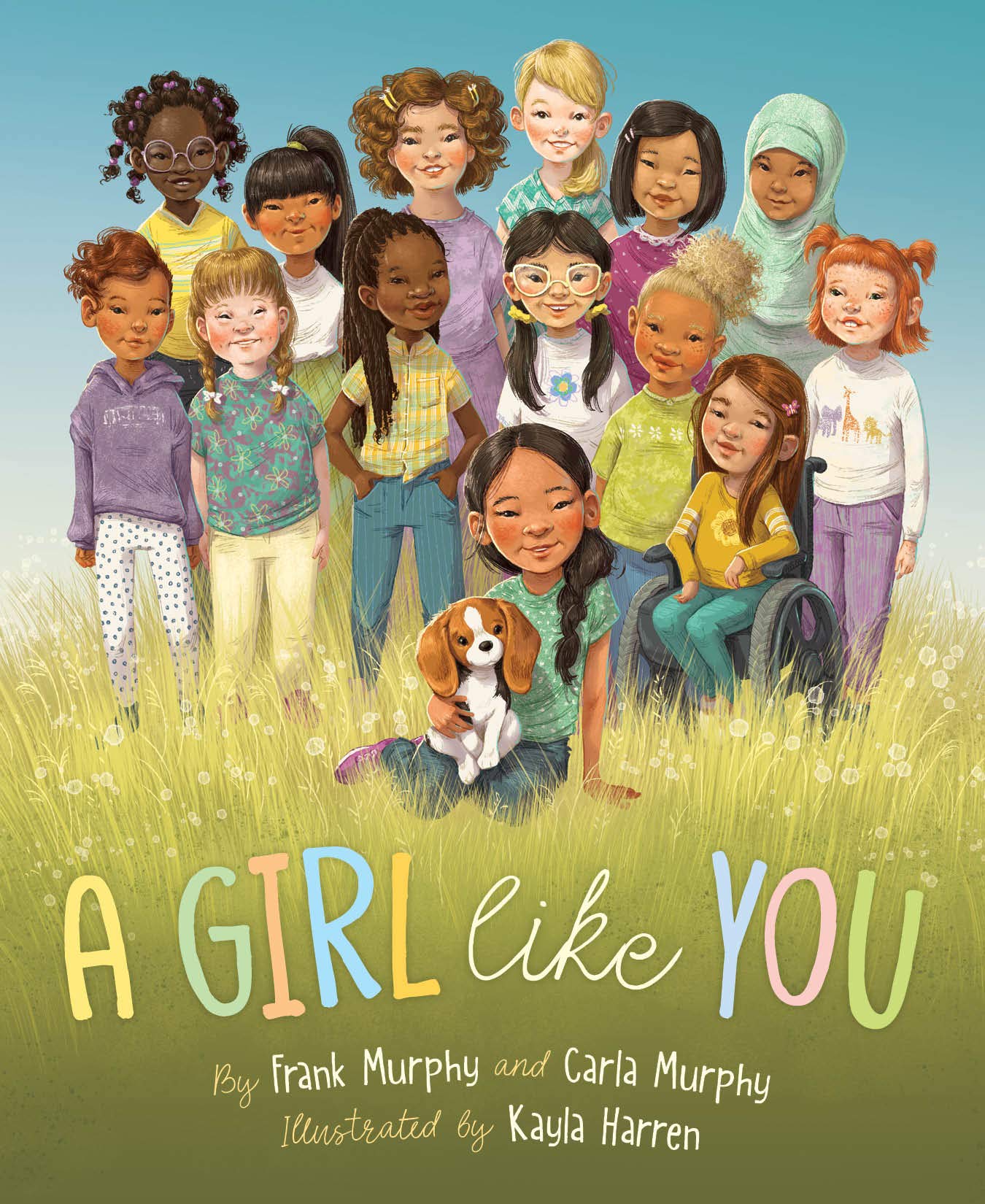
A Girl Like You
Written by Frank Murphy and Carla Murphy | Illustrated by Kayla Harren
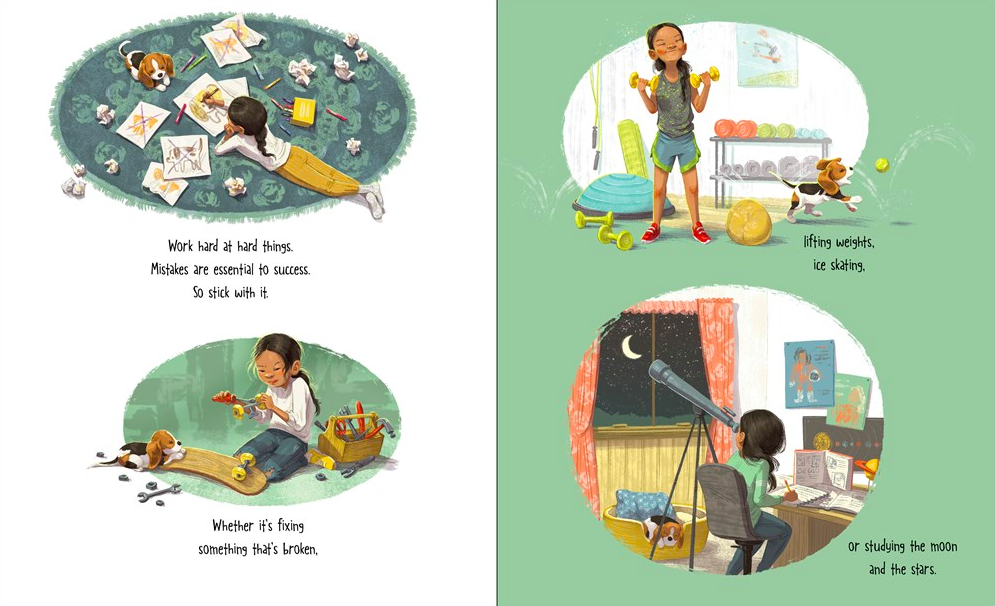
When you think of all the “billions and billions and billions of people in the world,” do you think about your place among them? You should, because “…you are the only YOU there is! And the world needs a girl like you.” What does this mean? It means you be you, a… “brave girl” who tries new things to discover what you like and what you’re good at. It takes hard work and lots of trial and error, but “mistakes are essential to success. So stick with it” no matter what you choose to do. By picking yourself up whenever you fall, “you’ll become tougher and stronger” and able to make your dreams come true.
Image copyright Kayla Harren, 2020, text copyright Frank Murphy and Carla Murphy, 2020. Courtesy of Sleeping Bear Press.
When you’re a “bold girl,” you can lend your voice and your actions to influencing causes that are important to you. Being bold also means choosing kind friends and being kind in return. Sometimes this will mean saying “sorry when you’re wrong or hurtful,” but it’s important to learn not to “make a habit of saying sorry for no reason.” Being a good friend can mean being quiet—like when someone needs to be heard or comforted. It also means being loud—like when a celebration is in order.
Image copyright Kayla Harren, 2020, text copyright Frank Murphy and Carla Murphy, 2020. Courtesy of Sleeping Bear Press.
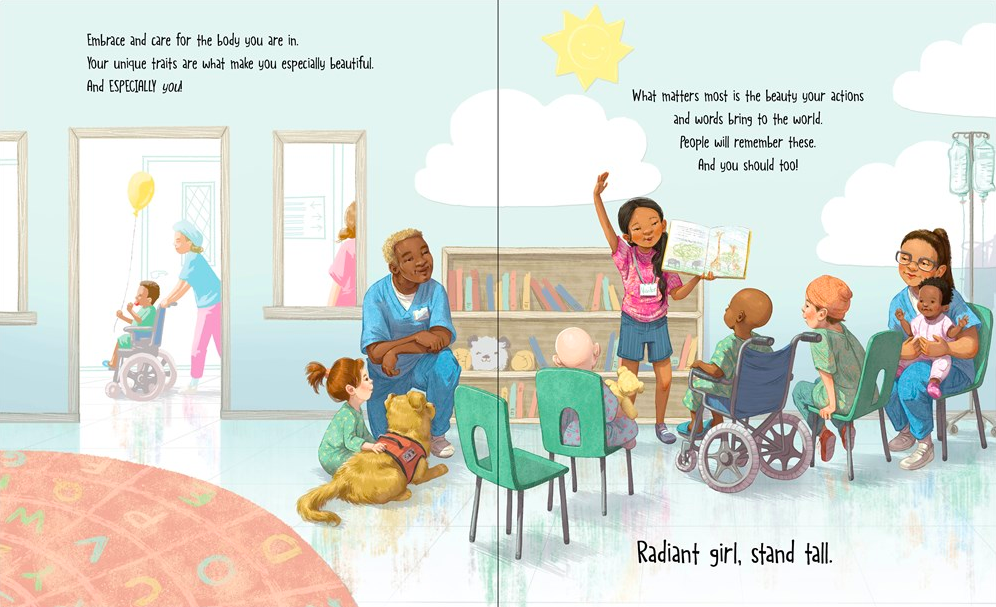
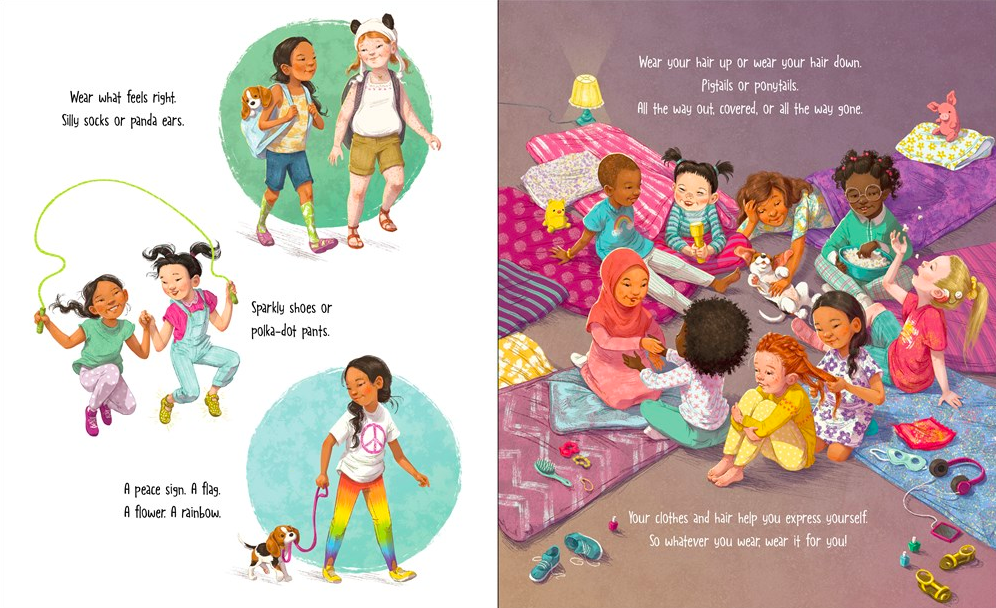
A “smart girl” is mindful of her feelings, and whether you’re “bored or lonely or sad” there are things you can do by yourself and with others to reach out and “take care of your heart.” Taking care of your body is important too so that your beauty shines. Don’t let others tell you what to wear or how to fix your hair. These are parts of you that “help you express yourself. So whatever you wear, wear it for you.” And, perhaps most important of all, remember to always “take pride in being the one and only you.” Because “the world needs a girl like you.”
An Authors’ Note about their inspiration for the book as well as a suggestion for a thoughtful Writing Activity follows the story.
Image copyright Kayla Harren, 2020, text copyright Frank Murphy and Carla Murphy, 2020. Courtesy of Sleeping Bear Press.
In this follow-up to A Boy Like You, Frank Murphy and Carla Murphy inspire girls to shake off preconceived notions of what a girl is and be true to their own feelings, talents, body image, likes, and dislikes in order to become the person they can and want to be. Framed by active adjectives that give readers touchstones to reach for and build on, the inspirational text highlights realistic situations that every child experiences as they navigate friendships, school, activities, and self-discovery. The specificity of the language is especially welcome as it speaks directly to the questions, conflicts, successes, and encounters kids have every day. The final reminder, directed sincerely at the reader, circles back to the beginning of the book and reinforces the idea that they are needed and inherently exceptional.
Kayla Harren is a master at portraying people in all of their individual beauty. Here, on first spread, a crowd spills off the edges of the pages as a single girl and her puppy stand out as she looks to join in. Subsequent illustrations follow this girl as she explores opportunities, crafts, sports, and other activities, sometimes alone and often with a group of friends. These group images are stirring for their diversity in ethnicity, body type, abilities, and expressions. Each page gives children and adults much to discuss, and the story’s open framework invites rereading when a child needs attention or conversation about a specific event or emotion they experience.
A moving and inspirational book to own for its wide applicability across years of growth and development, A Girl Like You is highly recommended for home, classroom, and public library collections. Sharing both books in this series with children can spark important discussions about, understanding of, and appreciation for the pressures and influences that all kids experience.
Ages 5 – 7
Sleeping Bear Press, 2020 | ISBN 978-1534110960
Discover more about Frank Murphy and his books on his website.
To learn more about Kayla Harren, her books, and her art, visit her website.
Happiness Happens Month Activity
Happiness Is…Game
Happiness is all around you! Grab one or more friends to play a game that reveals what things make you happy. Here are two ways to play:
Like the “Geography” game: the first player names something that makes them happy, the next player must think of something that starts with the last letter of the word the previous player said. The game continues with each player continuing the pattern. Players drop out as they cannot think of a word. The last player left is the winner.
Using a time limit (depending on age): players must think of something that makes them happy. Players drop out if they cannot think of a word within the time limit. The last player left is the winner.
You can find A Girl Like You from these booksellers
Since 1956, hot dogs have been top dog throughout July. Independence Day, summer picnics, and camping trips are just a few of the events that are more fun with this versatile favorite. Enjoyed throughout the world, hot dogs even get their own special days in the U.S., Great Britain, Canada, Australia and other countries. A favorite of kids and adults alike, hot dogs can be enjoyed plain or loaded with everything from mustard to chili. While Hot Dog Month may be winding down, there’s still plenty of summer left to enjoy this simple meal.
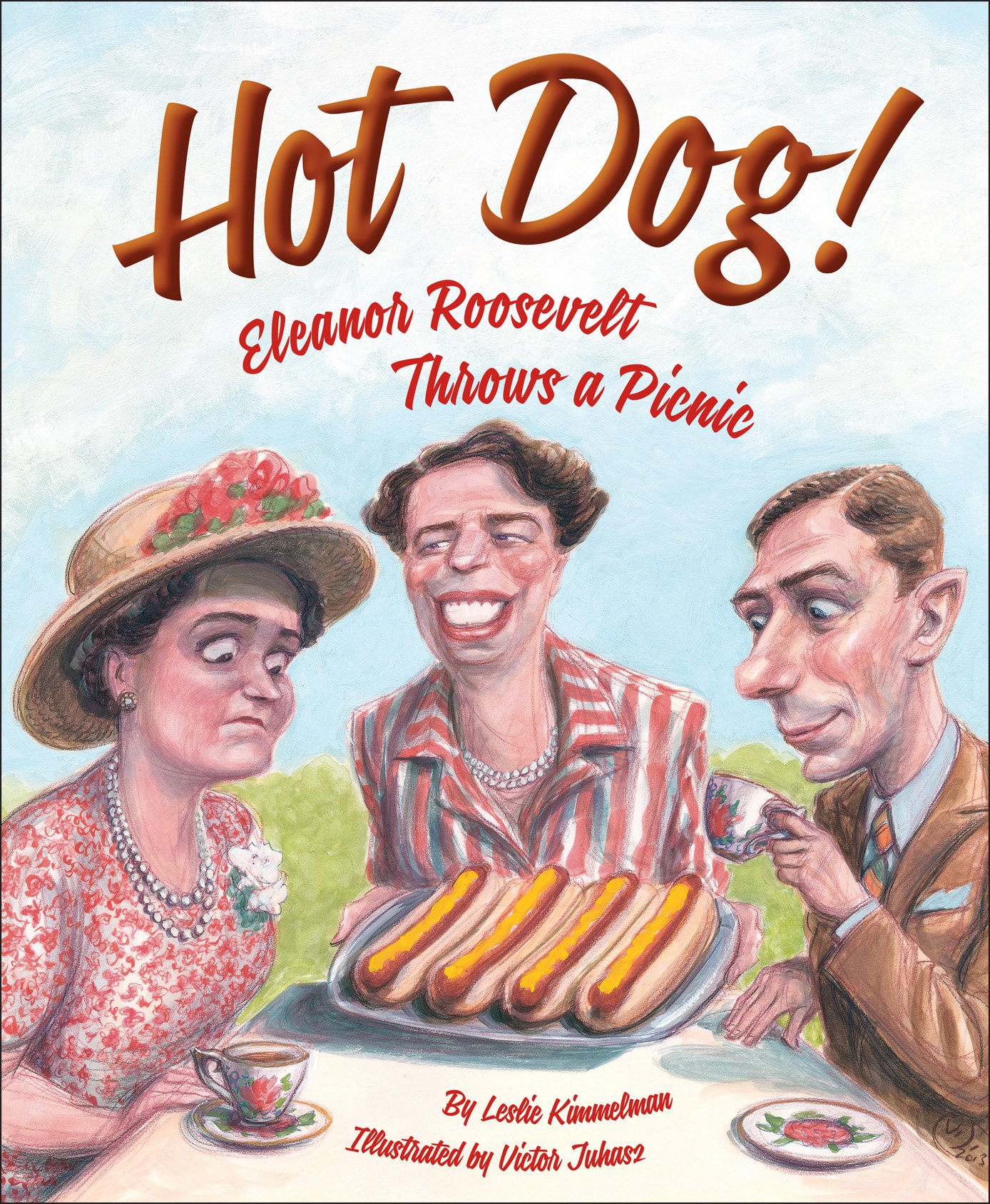
Hot Dog! Eleanor Roosevelt Throws a Picnic
Written by Leslie Kimmelman | Illustrated by Victor Juhasz
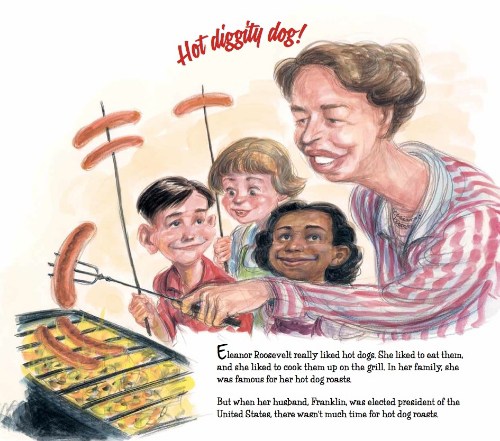
Before Eleanor Roosevelt became the first lady of the United States, she loved to grill up hot dog roasts for her family and friends. You see, Eleanor loved hot dogs! But after her husband Franklin became President, Eleanor had important duties. “Things were tough in the United States in the 1930s,” and since Franklin “couldn’t walk or move about easily, he counted on Eleanor to travel around the country for him” talking to people to see how the government could make things better. “Soon Eleanor was as popular as the president.”
Image copyright Victor Juhasz, 2014, text copyright Leslie Kimmelman, 2014. Courtesy of Sleeping Bear Press.
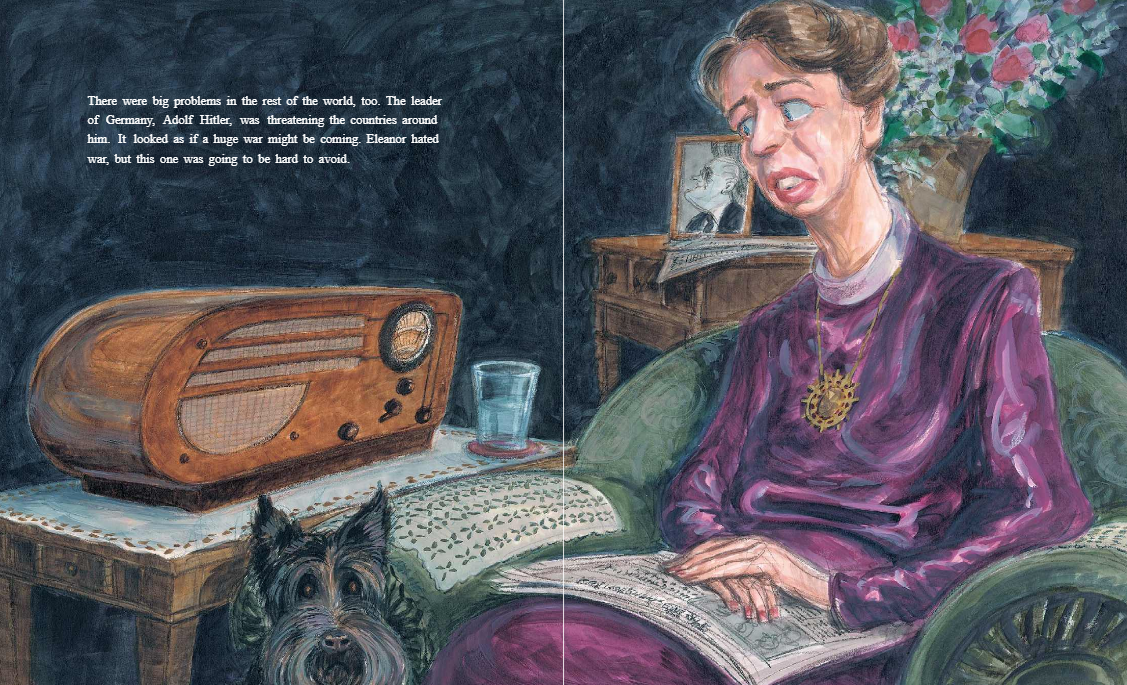
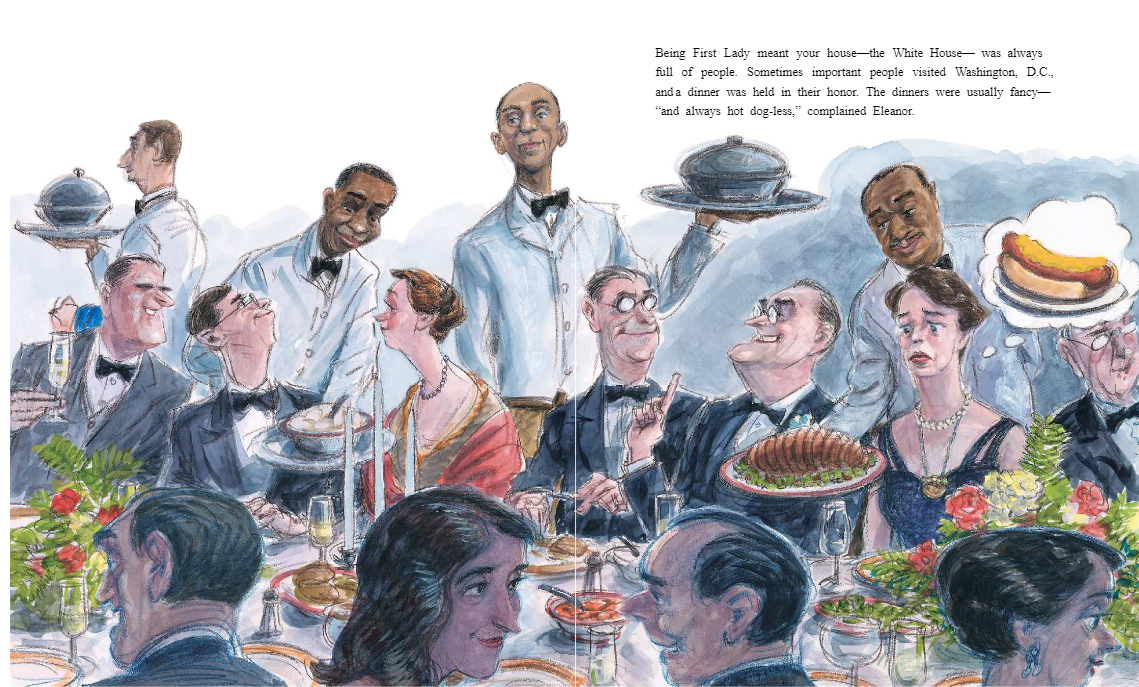
Not only was the United States suffering through a depression, it looked like the world would soon be at war. Eleanor presided over many fancy dinners in the White House given in honor of important people. These dinners, complained Eleanor, were “always hot dog-less.” Then, in 1939, the king and queen of England decided they would visit America to commemorate the 150th anniversary of our country’s independence from Britain. No English monarch had visited America in all that time.
Image copyright Victor Juhasz, 2014, text copyright Leslie Kimmelman, 2014. Courtesy of Sleeping Bear Press.
Eleanor did a little research and discovered that Queen Elizabeth was a distant cousin of George Washington. “‘She’s practically a member of the American family!’” Elizabeth exclaimed. “‘So to celebrate the first royal visit,’ Eleanor continued, ‘we need an all-American picnic.’” But first, came a fancy dinner. Following that, the Roosevelts and the king and queen drove to Hyde Park, New York, where the Roosevelts had an estate.
Image copyright Victor Juhasz, 2014, text copyright Leslie Kimmelman, 2014. Courtesy of Sleeping Bear Press.
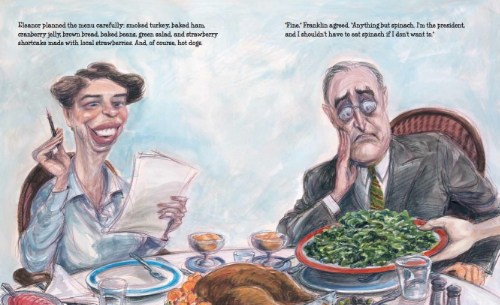
Eleanor planned her picnic to be held at a simple stone house on the property owned by the president, where the scenery was as pretty as it gets. Eleanor packed the menu full of traditional American favorites, including turkey, ham, cranberry jelly, baked beans, strawberry shortcake—and, of course, hot dogs. When the details of the menu were released, the White House was inundated with letters from all over the country protesting that hot dogs should not be offered to the queen.
Image copyright Victor Juhasz, 2014, text copyright Leslie Kimmelman, 2014. Courtesy of Sleeping Bear Press.
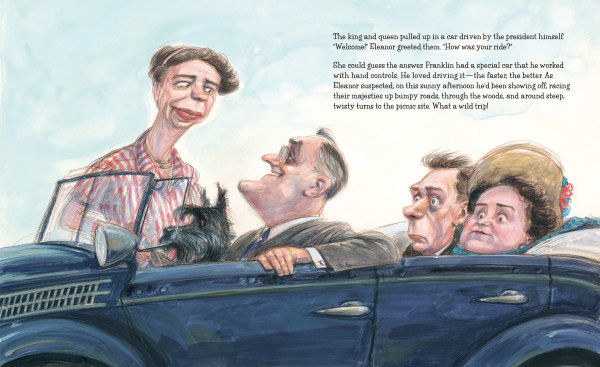
Eleanor answered the protesters in her daily newspaper column. She reassured them that there would be “plenty of other food, and…the more important guests will be served with due formality.” On June 11, Eleanor finished her morning routine and rushed to the cottage to prepare for the picnic. As the king and queen arrived—driven by the president himself in a specially outfitted car—Eleanor could see from the expressions on the royal faces that Franklin hadn’t resisted the temptation to show off, “racing their majesties up bumpy roads, through the woods, and around steep, twisty turns to the picnic site.”
When it came to eat, King George picked up a hot dog and “ate it with gusto … and mustard!” He even had seconds. And the queen? She daintily cut hers up with a fork and knife. After dinner, King George and Queen Elizabeth began their trip back to England with a train ride. Townspeople flocked to the station and stood along the banks of the Hudson River to see them off.
Image copyright Victor Juhasz, 2014, text copyright Leslie Kimmelman, 2014. Courtesy of Sleeping Bear Press.
Three months later, World War II began. England and America fought side by side to defeat their enemies. The Roosevelts had promised to visit Queen Elizabeth and King George, but Franklin died before the war’s end. Eleanor later made the trip alone. On June 11, 1989 another picnic was held at Hyde Park in remembrance of that other picnic fifty years earlier. Some of the guests had been children at that first memorable party, and Queen Elizabeth “sent a special message: ‘The memory of the picnic was a source of strength and comfort to the king and me through the dark days of the Second World War….’” And what did the guests enjoy at that second picnic? The menu was “exactly the same—right down to the hot diggity dogs!”
An Author’s Note adding a bit more information about Franklin and Eleanor Roosevelt and King George IV and Queen Elizabeth follow the text.
Image copyright Victor Juhasz, 2014, text copyright Leslie Kimmelman, 2014. Courtesy of Sleeping Bear Press.
Leslie Kimmelman’s engaging and smoothly paced story captures Eleanor Roosevelt’s warm-hearted personality and down-home friendliness that made her one of American history’s most beloved first ladies. Details of Eleanor’s White House duties juxtaposed with humorous anecdotes about her love of hot dogs, reaction to her choice of menu, and Franklin’s penchant for driving create a well-rounded portrait of a particular time in history. Including 1989’s 50th anniversary picnic reminds readers of the ongoing friendship between America and Great Britain.
Victor Juhasz uses lush, caricature-style art to great effect in representing the 1930s to ‘40s time period, the lavish trappings of the White House, and Eleanor’s larger-than-life personality and influence. Her wide smile and can-do attitude as well as her self-confidence are on display for young readers to appreciate and emulate. Other character’s facial expressions clearly spotlight the humorous incidents but also the seriousness of the times. And, of course, those hot dogs that Eleanor loved so much look good enough to eat!
For young readers interested in history, culinary arts, and biographies, adding Hot Dog! Eleanor Roosevelt Throws a Picnic to their reading menu would be a treat. Teachers will also find the book an engaging inclusion to lessons on the historical time period, women in history in general, and Eleanor Roosevelt in particular.
Ages 8 – 11
Sleeping Bear Press, 2014 | ISBN 978-1585368303
Discover more about Leslie Kimmelman and her books on her website.
To learn more about Victor Juhasz, his books, and his art, visit his website.
National Hot Dog Month Activity
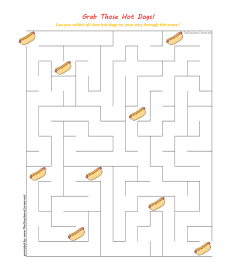
Grab Those Hot Dogs!
There are delicious hot dogs scattered throughout this maze! Can you collect all nine on the way from start to finish in this printable puzzle?
Seventy-five years ago today, Anne Frank received a diary for her 13th birthday. That diary went on to hold the thoughts, feelings, fears, and hopes of the young girl as she hid from the Nazis in a secret annex with her family for two years. It went on to become one of the most famous and widely read books in the world. Today, we honor Anne Frank, her remarkable work, and the woman who who saved Anne’s diary, Miep Gies. To learn more, visit the Anne Frank House Museum website.
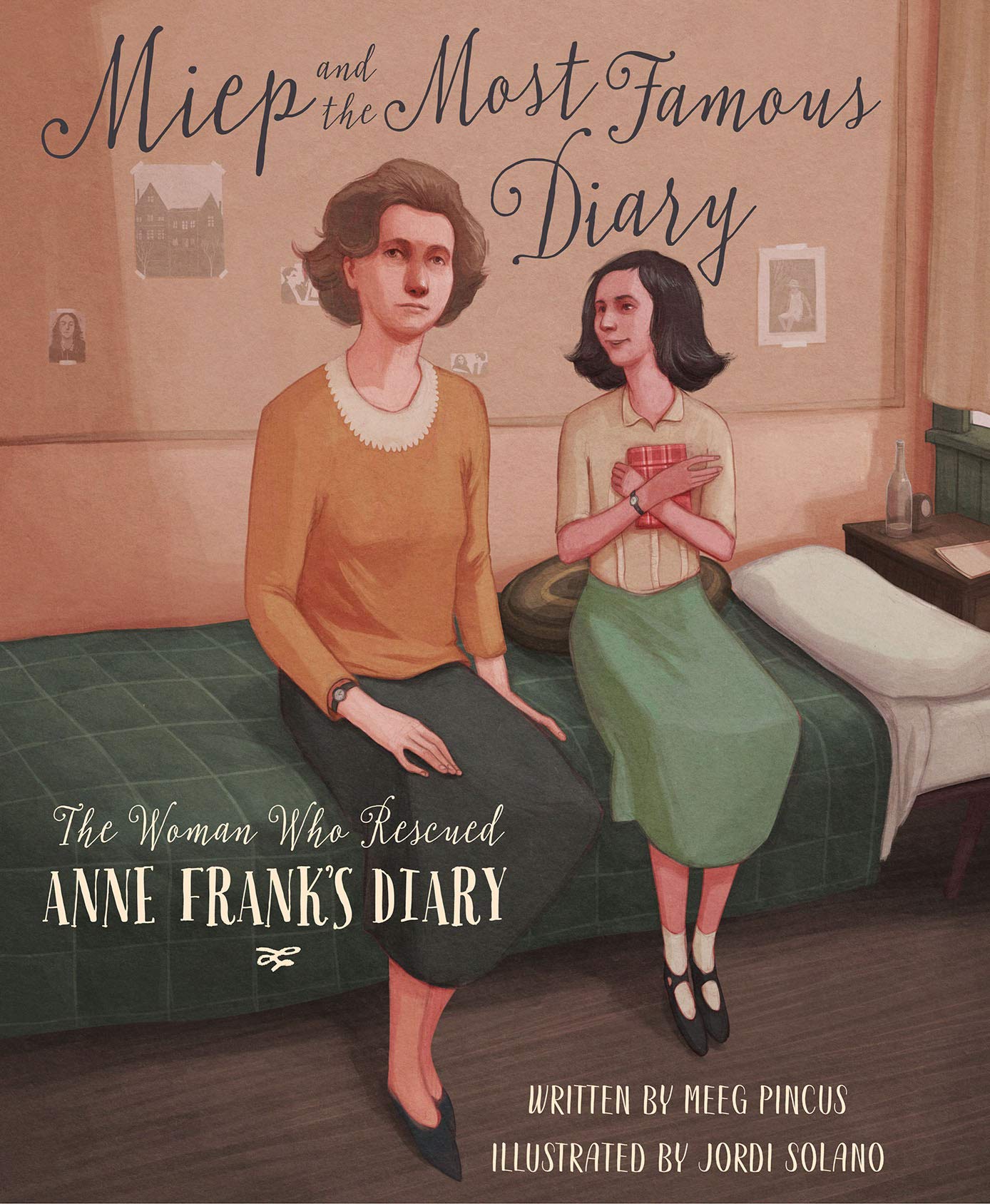
Miep and the Most Famous Diary: The Woman Who Rescued Anne Frank’s Diary
Written by Meeg Pincus | Illustrated by Jordi Solano
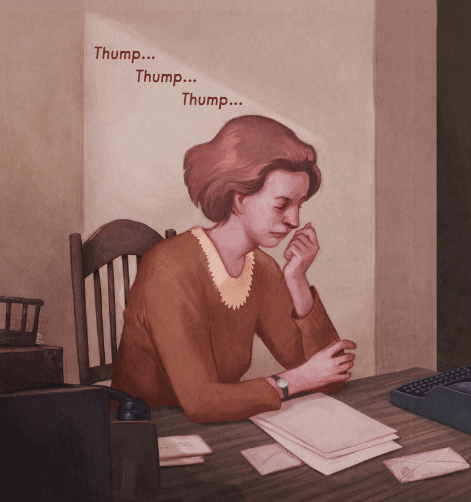
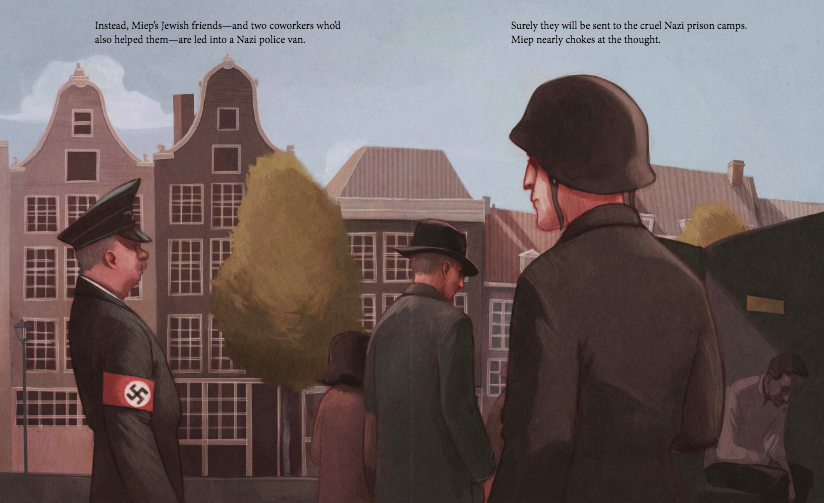
On August 4, 1944, Miep Gies hears the worst sound she’s ever heard: “footsteps on the secret back stairs.” The sound is “worse than the World War II bomber planes…. Worse than the queen’s quivering voice on the radio announcing the invading Nazi army.” The sound means that Nazi officers have come to arrest the Frank family who Miep has been hiding for two years. Miep hears the van carrying her friends roar away. She knows that soon Nazi movers will return to take away all of the Frank’s possessions. She knows too that she could be arrested for keeping anything belonging to her friends, but there is one item she must rescue. “It calls silently from the musty rooms above.”
Image copyright Jordi Solano, 2019, text copyright Meeg Pincus, 2019. Courtesy of Sleeping Bear Press.
It takes many hours before Miep can bring herself to enter the secret annex. With her husband, Henk, and a coworker, Elli, they enter the rooms. In the bedroom, Miep finds what she is looking for: a red checkered diary that holds the thoughts and hopes of the Franks’ young daughter Anne. Miep “knows Anne dreams of publishing it as a book after the war.” Elli gathers up more of Anne’s writing that lies strewn across the floor, and Miep “grabs…Anne’s delicate combing shawl, strands of her dark hair clinging to its fabric like silky noodles.”
Image copyright Jordi Solano, 2019, text copyright Meeg Pincus, 2019. Courtesy of Sleeping Bear Press.
Miep hides Anne’s diary and combing shawl in the drawer of her desk, never reading it. Nine months go by then one day Henk rushes into their apartment with news that the war is over and that the Nazis have surrendered. Miep and Hank wait for their “friends and neighbors to return from the camps,” wondering if the Franks will be among them. One day, Miep sees a familiar figure approaching her door. It’s Mr. Frank. He is alone, his wife having died in the camp. He has no knowledge about Anne and her sister as they were sent to another camp. While Mr. Frank regains his strength with the help of Miep, he sends letter after letter trying to locate his daughters.
At last a letter arrives, but it “contains the worst possible news: Anne and her sister did not survive the war. The air in the office hangs as still and shattered as the day of the capture.” With a broken heart, Miep opens her desk drawer and retrieves “Anne’s diary, papers, and shawl.” As she hands them to Mr. Frank, he gasps. He takes them to his office and reads Anne’s diary. “He savors her tales of growing up in hiding, her bright calls for hope when all seems lost.” He urges Miep to read it too, but she feels that she “will drown in sorrow” if she does.
Image copyright Jordi Solano, 2019, text copyright Meeg Pincus, 2019. Courtesy of Sleeping Bear Press.
With the help of a war historian, Mr. Frank has Anne’s diary published. But, still, Miep cannot read it. Years go by before Miep opens the cover of Anne’s book. As she reads Anne’s words, she feels “as if Anne is standing right beside her, chattering away. Within the pages of her diary, Anne expressed her gratitude for the “gift…of writing, of expressing all that is in me” and her desire to “go on living even after my death!” After reading Anne’s words, Miep’s sadness lessens and she realizes that by saving her diary, “her beloved Anne will live on and on.”
An Author’s Note about how this book came to be written as well as more about the life of Miep Gies follows the text.
Image copyright Jordi Solano, 2019, text copyright Meeg Pincus, 2019. Courtesy of Sleeping Bear Press.
Reading Meeg Pincus’s compelling first page, readers can almost hear the stomp of Nazi footsteps on the stairs leading to the secret annex and feel the constriction of Miep Gies’s heart as the Franks are arrested and taken away. Miep’s courage amid her sadness reverberates throughout this true story, tinted with the secrecy of grocery runs, the hurried collection of Anne’s most precious possession, and her ongoing mission to protect her friends. Pincus’s excellent pacing and evocative storytelling, which includes actual quotes from Miep’s writings and is punctuated with emotion will have children holding their breath as they listen or read on their own. Heartbreaking facts are portrayed candidly and with respect for the target age, allowing Anne’s boundless hope to shine through.
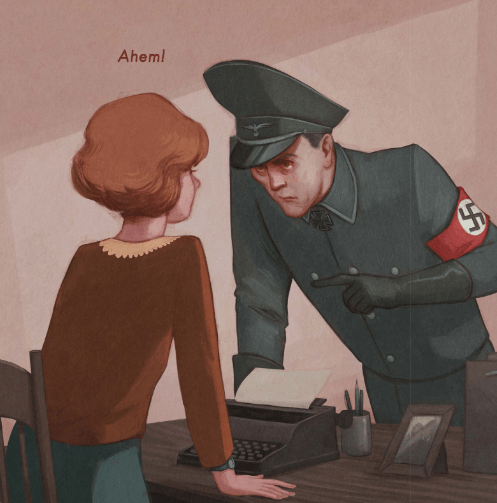
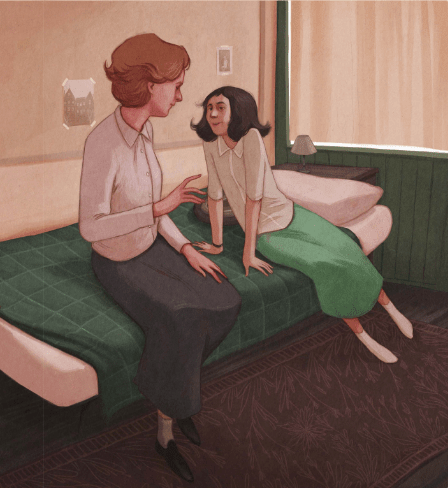
Seeming to take inspiration in color and tone from photographs on the front endpaper of Anne and her father flanked by Miep Gies and other helpers, Jordi Solano washes his illustrations in somber grays and greens, preserving bright spots for Anne’s red diary and her grass-green skirt that connects her to the colorfully clothed children who, on the final page, have come to visit the Anne Frank Museum. Miep’s grief at the arrest of her friends is palpable, and the Nazi officer who threatens her with arrest is depicted with sharp angles and an unrelenting stare. Children see Miep hide Anne’s diary in the back of a drawer and the approaching figure of Mr. Frank coming home from the detention camp. Solano portrays the moment when Mr. Frank, reunited with Anne’s diary and papers, clasps his daughter’s things to his heart. It is a poignant glimpse into this most private experience. As Miep finally reads Anne’s diary, Anne, herself, appears as she was, full of curiosity, joy, and love.
A must to be included in lessons about World War II, the Holocaust, and Anne Frank, Miep and the Most Famous Diary is also a poignant reminder of the crucial role of personal courage as well as the everlasting endurance of hope. The book should be included in all school and public libraries and would make a powerful addition to home libraries as well.
Ages 6 – 9
Sleeping Bear Press, 2019 | ISBN 978-1534110250
Discover more about Meeg Pincus and her books on her website.
To learn more about Jordi Solano, his books, and his art, visit his website.
You can find Miep and the Most Famous Diary at these booksellers




















 celebratepicturebooks.com