February 7 – National Periodic Table Day

celebrate-picture-books-picture-book-review-Marie-Curie-little-people-big-dreams-cover

About the Holiday

Today’s holiday was established in 2016 by David T. Steineker, an author, inventor, and – as you might imagine – chemistry teacher at Jefferson County Public Schools in Kentucky. He devised the holiday to honor the work of categorizing the elements begun by John Newlands, who published the first periodic table on February 7, 1863, and continued into the early 20th century as new elements were discovered. While the modern periodic table has undergone few changes since then, new discoveries and different ways of approaching the table may bring fresh changes in the years to come.

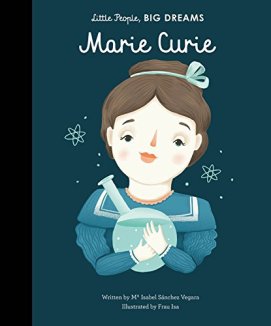
Marie Curie (Little People, Big Dreams)

Marie: My First Marie Curie (Board Book)

Written by Isabel Sánchez Vegara | Illustrated by Frau Isa


From the time when Marie was a little girl, she knew she wanted to be a scientist. Marie was very smart. “At school, she won a gold medal for her studies, which she kept in her drawer like a treasure.” Because women were not allowed to go to college in her country, she moved to France to go to the university there. Even though French was not her first language, Marie was soon the top math and science student in Paris.

celebrate-picture-books-picture-book-review-Marie-Curie-little-people-big-dreams-dreaming

Copyright Frau Isa, 2018, courtesy of Frances Lincoln Children’s Books.

One day Marie met Pierre, who loved science as much as she did. They got married and worked together in their own laboratory, where they discovered radium and polonium. “It was such a thrilling moment for science!” Marie and Pierre even won the Nobel Prize. Marie was the first woman ever to be awarded this honor. When Pierre later had an accident, Marie was left alone to continue their work.

celebrate-picture-books-picture-book-review-Marie-Curie-little-people-big-dreams-marie-and-pierre

Copyright Frau Isa, 2018, courtesy of Frances Lincoln Children’s Books.

All her research and experiments paid off when she was awarded her second Nobel Prize. When war broke out, “Marie’s discoveries were used by doctors to help injured soldiers.” Marie inspired many girls who studied science at her own institute in Paris. Besides science, Marie taught her students that there was nothing to fear, “many things to learn, and many ways to help those in need.”

A timeline and brief, yet detailed biography of her life follows the story.

celebrate-picture-books-picture-book-review-Marie-Curie-little-people-big-dreams-marie-with-noble-prize

Copyright Frau Isa, 2018, courtesy of Frances Lincoln Children’s Books.

With thrilling recognition that even in the youngest hearts beat future writers, artists, adventurers, designers, and scientists, the Little People, Big Dreams series introduces preschoolers to inspiring women role models. In Marie Curie: Little People, Big Dreams, Isabel Sánchez Vegara reveals the life and work of Marie Curie with straightforward storytelling that illuminates while affirming the intelligence of her young audience. Uplifting, life-determining personality traits that carried Marie over obstacles and to the top of her profession—such as not taking no for an answer, treasuring your accomplishments, working hard, and helping others—are highlighted for little ones to learn from.

Frau Isa’s stylish illustrations in a striking, subdued color palette will entice the youngest readers to listen and learn. While the spotlight is always on Marie, each page also focuses on one or two main images, such as Marie and Pierre’s lab table, a wounded soldier’s X-ray, and Marie holding her Nobel Prize, that help little ones see and understand the important aspects of the story.

Encapsulating both history and the timeless persistence that drives people to achieve their full potential, Marie Curie—available in both picture book and board book editions—is a must for preschool classrooms and would be a rousing addition to home bookshelves.

Ages 3 – 5

Frances Lincoln Children’s Books, 2018 | ISBN 978-1847809629 (Picture Book); 978-1786032539 (Board Book)

You can check out more about Isabel Sánchez Vegara on Instagram.

Discover more about Frau Isa and her art on her website.

National Periodic Table Day Activity

celebrate-picture-books-picture-book-review-green=pennies-experiment

Green Pennies Chemistry Experiment


You know what color pennies are! They’re those brownish coins amid all the silver. But what if you could turn those pennies green—like dollar bills? You can with this easy and way cool chemistry experiment!

Supplies

  • 10 – 12 dull pennies
  • Vinegar
  • Lemon juice
  • Salt
  • 2 small bowls
  • ¼ cup measuring cup
  • 1 teaspoon
  • Paper towels

Directions

IMG_6569

Experiment 1

  1. Pour ¼ cup vinegar into a bowl
  2. Add 1 teaspoon salt
  3. Mix thoroughly until salt has dissolved
  4. Place a few pennies in the bowl and leave for five minutes.
  5. Take the pennies out and place them on the paper towel.
  6. Let the pennies dry and watch what happens. The reaction becomes more dramatic over time, so check on your pennies at different times throughout the day

Extra Observation:

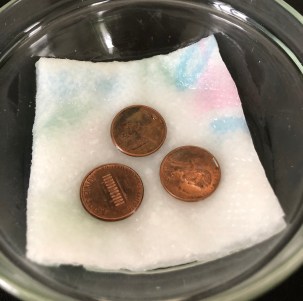
  1. To see the chemical reaction at work, dip one penny half way into the vinegar/salt solution and wait a minute
  2. Lift the penny out of the solution and see the result
IMG_6588

Experiment 2

  1. Fold a paper towel to several thicknesses and place in bowl
  2. Place a few pennies on top of the paper towel
  3. Pour enough vinegar over the pennies to saturate the paper towel
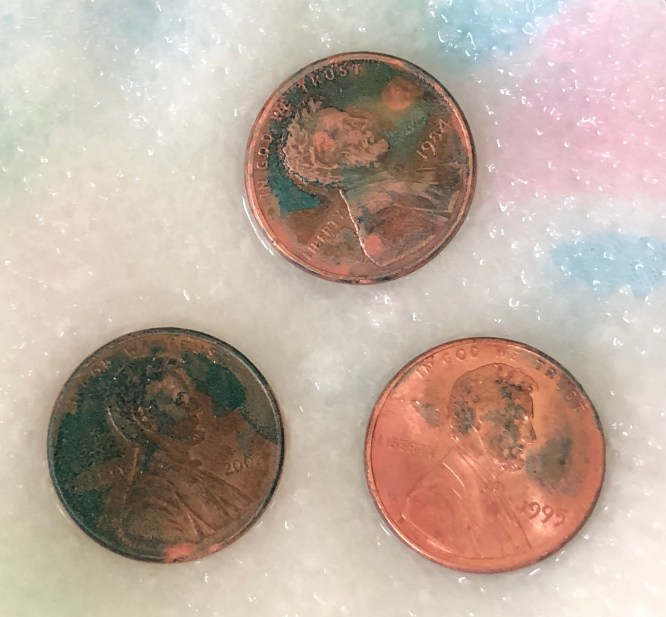
  4. Wait two to three hours and see what happens
  5. You can leave the pennies in the bowl and continue to add vinegar as the paper towel dries. Flip the pennies over to create a chemical reaction on both sides
IMG_6590

Experiment with other acids, such as the lemon juice.

Why do the pennies turn green?

Pennies are made of copper. The vinegar and salt solution helps the copper react with oxygen in the air to form the blue-green patina of malachite on the surface of the penny. This chemical reaction is called oxidation. You can see the same green color on other things made of copper like plumbing pipes and many statues—even the Statue of Liberty!

If you’d like to record your observations of your pennies like a chemist does, download and print this lab sheet.
celebrate-picture-books-picture-book-review-Marie-Curie-little-people-big-dreams-cover

You can find Marie Curie (Little People, Big Dreams) at these booksellers

Amazon | Barnes & Noble | Books-a-Million | IndieBound

You can find the board book edition, Marie: My First Marie Curie here

Amazon | Barnes & Noble | Books-a-Million | IndieBound

YouPicture Book Review

February 6 – It’s Black History Month

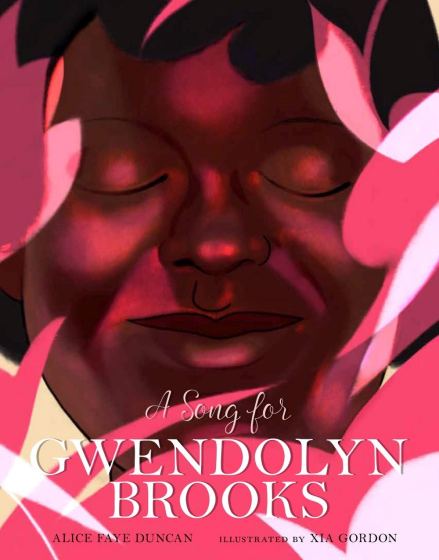
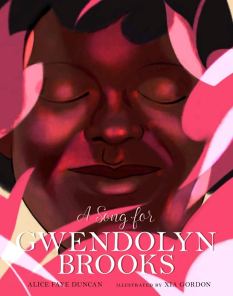
celebrate-picture-books-picture-book-review-a-song-for-gwendolyn-brooks-cover

About the Holiday

Black History Month, also known as National African American History Month, celebrates the achievements and contributions of African Americans in United States History. Originally a week-long observance commemorating the birthdays of Abraham Lincoln on February 12 and Frederick Douglass on February 14,  Black History Month was officially established in 1976 by then president Gerald Ford. The holiday is now celebrated across the country with special events and commemorations in schools, churches, and community centers.

I received a copy of A Song for Gwendolyn Brooks from Sterling Children’s Books for review consideration. All opinions are my own. I’m excited to be partnering with Sterling in a giveaway of the book. See details below.

A Song for Gwendolyn Brooks

Written by Alice Faye Duncan | Illustrated by Xia Gordon


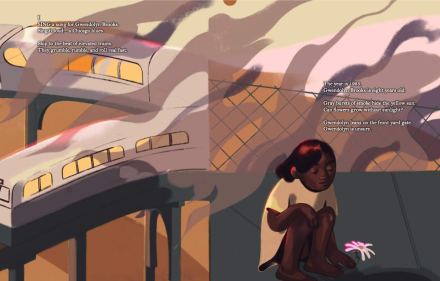
“SING a song for Gwendolyn Brooks. / Sing it loud—a Chicago blues.” This remarkable biography of the Pulitzer Prize-winning poet opens with these soaring lines which introduce eight-year-old Gwendolyn who, seeing a flower in the midst of the city, wonders how it will grow. Already she was observing the world with insight and originality.  “Her head is filled with snappy rhymes. / She writes her poems in dime store journals.” Even something as “simple” as a clock does not escape Gwendolyn’s consideration. In The Busy Clock she writes, in part: “Clock, clock tell the time, / Tell the time to me. / Magic, patient instrument, / That is never free.”

celebrate-picture-books-picture-book-review-a-song-for-gwendolyn-brooks-flower

Image copyright Xia Gordon, 2019, text copyright Alice Faye Duncan, 2019. Courtesy of Sterling Children’s Books.

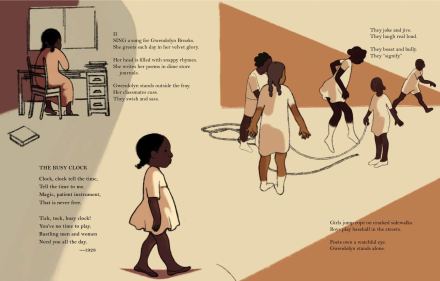
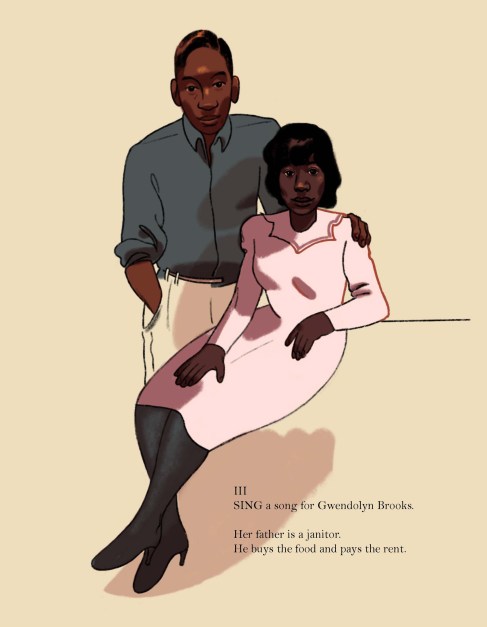
Out in the neighborhood, she stands quietly and watches the other kids laughing and playing—girls jumping rope and boys playing basketball. Gwendolyn’s father is a janitor and her mother stays at home with her and her brother, who is also her best friend. Gwen spends her time sitting on her porch, looking and listening to the sounds and the conversations of the neighborhood women and men. The “children call Gwen—‘ol’ stuck-up heifer!’”

celebrate-picture-books-picture-book-review-a-song-for-gwendolyn-brooks-jump-rope

Image copyright Xia Gordon, 2019, text copyright Alice Faye Duncan, 2019. Courtesy of Sterling Children’s Books.

“SING a song for Gwendolyn Brooks. / Her mother believes. / Her father believes. / But sometimes—Gwendolyn doubts her radiance, / When jarring, crashing, discordant words, / Splotch and splatter her notebook paper.” And what does Gwen do with these poems that just don’t work? She buries them under the snowball bush in the backyard. Once, unbelieving, a teacher accuses Gwendolyn of plagiarism. Her mother takes her daughter back to school, and there on the spot, she composes a poetic answer to the charges: Forgive and Forget. It makes Gwen feel proud, she believes in herself and feels the sun shining on her.

celebrate-picture-books-picture-book-review-a-song-for-gwendolyn-brooks-parents

Image copyright Xia Gordon, 2019, text copyright Alice Faye Duncan, 2019. Courtesy of Sterling Children’s Books.

During the Great Depression, when jobs and money are scarce, Gwendolyn’s “parents are wise and see her light.” They give her time to write and she hones her words and her craft through draft after draft. With each completed poem, Gwen’s confidence grows. The Chicago Defender publishes some of Gwendolyn’s poems, and now she has an audience. Her parents believe that one day their daughter will be a famous poet.

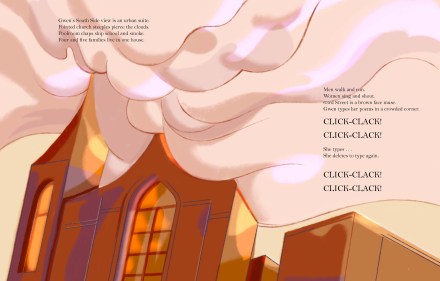
Soon, Gwendolyn finds her way to a group of poets who meet in a South Side community center. She studies under Inez Stark and meets Henry Blakely, who will become her husband. She enters her poems in contests and wins first place over and over. When she and Henry move into their own two-room apartment, Henry goes to work, leaving Gwendolyn to translate the neighborhood into poetry that she types “in a crowded corner.”

celebrate-picture-books-picture-book-review-a-song-for-gwendolyn-brooks-typing

Image copyright Xia Gordon, 2019, text copyright Alice Faye Duncan, 2019. Courtesy of Sterling Children’s Books.

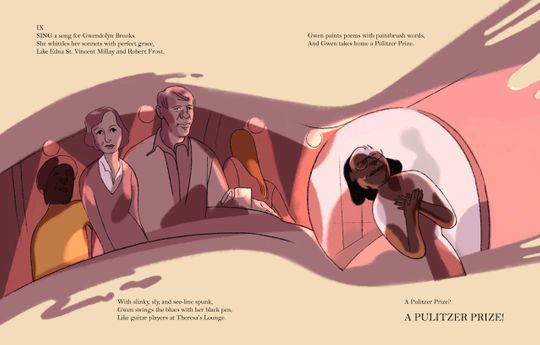
Readers swarm to buy her books. “Gwen paints poems with paintbrush words, / And Gwen takes home a Pulitzer Prize.” Henry and their son celebrate, and Gwen’s parents “…cry tears of joy. / They praise her shine.” For they had always known and had “…Planted love and watered it. / Gwendolyn believed. / She found her light. / And— / A furious flower / GREW!”

An extensive Author’s Note detailing more about the life of Gwendolyn Brooks and her work as well as a timeline and suggested readings follow the text.

celebrate-picture-books-picture-book-review-a-song-for-gwendolyn-brooks-pulitzer

Image copyright Xia Gordon, 2019, text copyright Alice Faye Duncan, 2019. Courtesy of Sterling Children’s Books.

With her own sterling verses, Alice Faye Duncan celebrates the life of Gwendolyn Brooks—the first African American to win the Pulitzer Prize for Literature—taking readers to the Chicago neighborhoods that informed and inspired Brooks’ ideas and the words and rhythms with which she defined them. Along an arc that takes Gwendolyn from a child contemplating the potential of a flower to becoming that blossom herself, Duncan pays tribute to those who recognized Gwen’s genius and helped her fulfill her talent. For readers who themselves may be poets, writers, or other types of artists, Duncan’s beautifully crafted phrases about the artistic process of revision are inspirational and welcome. Standing side-by-side with Duncan’s storytelling are four of Brooks’ poems—The Busy Clock, Forgive and Forget, Ambition, and the children of the poor—Sonnet #2. From cover to cover, Duncan’s book sings with Gwendolyn Brooks’ positivity, confidence, uniqueness, and love for life that made her a unique voice for her time and always.

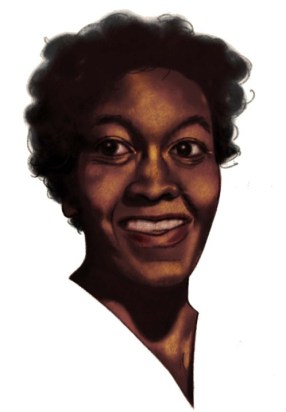
celebrate-picture-books-picture-book-review-a-song-for-gwendolyn-brooks-portrait

From the portrait of Gwendolyn Brooks that graces the title page and throughout the book, Xia Gordon’s distinctive artwork creates a masterpiece of motion and stillness that mirrors Brooks’ penchant for watching and listening to the sounds and sights that filled her mind and ultimately her notebooks. Downy swoops of violets, pinks, browns, and grays provide backdrops to images of Gwendolyn as a young girl and an adult rendered in lines that show her as down to earth but soaring in her thoughts. Her intelligence and spark shine through on every page. Gwendolyn’s parents appear often, always watchful and supportive. Her friends, her husband, her son, and her readers also populate the pages, giving the book an embracing warmth.

A Song for Gwendolyn Brooks is a must for school, classroom, and public library collections, and for children who are discovering their talents and the parents who nurture them, the book would be an inspirational and invaluable addition to home bookshelves.

Ages 4 and up

Sterling Children’s Books, 2019 | ISBN 978-1454930884

Discover more about Alice Faye Duncan and her books on her website.

To learn more about Xia Gordon, her books, and her art, visit her website.

A Song for Gwendolyn Brooks Giveaway

I’m excited to partner with Sterling Children’s Books in this Instagram giveaway of:

  • One (1) copy of A Song for Gwendolyn Brooks written by Alice Faye Duncan | illustrated by Xia Gordon

It takes just these two steps to enter:

A winner will be chosen on February 12.

Giveaway open to US addresses only. | No Giveaway Accounts 

Prizing provided by Sterling Children’s Books.

Black History Month Activity

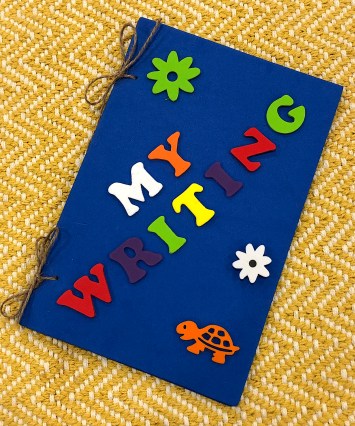
celebrate-picture-books-picture-book-review-writing-journal-craft-1

My Writing Journal


With this easy craft, kids can make a journal that will reflect their personality and inspire them to jot down ideas for poems or stories. 

Supplies

  • Two 9-inch by 6-inch pieces of foam or heavy paper
  • Plain or lined 8½ by 11 paper, as many pieces as you’d like
  • Twine or ribbon
  • Foam letters and objects, stickers, play jewels, or other decorations
  • Small scissor, paper hole puncher, or other instrument to make a hole through the foam and paper

Directions

  1. Fold the plain or lined 8½ by 11 paper in half
  2. Place the paper between the sheets of foam
  3. Make a hole through the foam covers and paper near the top and bottom for the twine to tie the journal together
  4. Slip the twine or ribbon through the holes and tie the journal together
  5. Decorate the cover
  6. Start writing!

celebrate-picture-books-picture-book-review-a-song-for-gwendolyn-brooks-cover

You can find A Song for Gwendolyn Brooks at these booksellers

Amazon | Barnes & Noble | Books-a-Million | Indiebound

Picture Book Review

February 5 – Chinese New Year

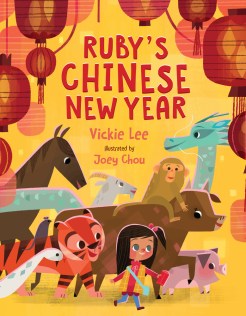
celebrate-picture-books-picture-book-review-ruby's-chinese-new-year-cover

About the Holiday

Chinese New Year begins today—ushering in the Year of the Pig—and celebrations take place until February 19. Also known as the Spring Festival, the New Year is a time for festivities that include lion and dragon dances, fireworks, visiting friends and relatives, family meals, and special decorations. The New Year is the busiest travel season of the year as family members return home to spend the holiday with loved ones. The Chinese New Year celebrations end each year with the Lantern Festival. To learn more about the history of Chinese New Year, how to celebrate, and the signs of the zodiac, click here.

Ruby’s Chinese New Year

Written by Vickie Lee | Illustrated by Joey Chou


Every year Grandmother would come to visit Ruby for Chinese New Year. “Together they celebrated, eating special foods and making drawings for good luck.” But this year Grandmother couldn’t make the trip, so Ruby decided to visit her grandmother instead. As a gift, Ruby drew a picture of her family enjoying a special dinner. She put it into a red envelope and tucked it away in her pocket. Soon after leaving, Ruby spied Cat and Rat and asked if they would like to come along too. They did, but Cat wondered how they would “cross the meadow and the pond.” Ruby suggested that they ask Ox.

celebrate-picture-books-picture-book-review-ruby's-chinese-new-year-drawing

Image copyright Joey Chou, 2018, text copyright Vickie Lee, 2018. Courtesy of Henry Holt Books for Young Readers.

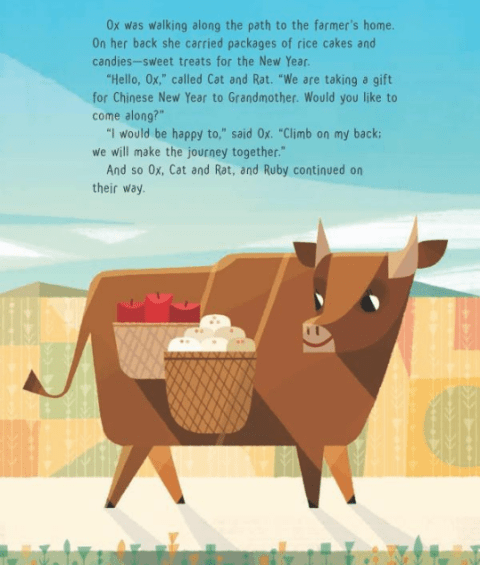
Soon, they found Ox, who was bringing rice cakes and candy to the farmer for the New Year celebration. When she heard that Ruby, Cat, and Mouse were going to Grandmother’s house, she offered to let them ride on her back. Just then, Tiger and Rabbit “bounded out of the bushes, streamers flying behind them.” They also wanted to go to Grandmother’s house, so Cat rode on Tiger’s back and Rat nestled between Rabbit’s furry ears, and they all headed down the path.

celebrate-picture-books-picture-book-review-ruby's-chinese-new-year-rat

Image copyright Joey Chou, 2018, text copyright Vickie Lee, 2018. Courtesy of Henry Holt Books for Young Readers.

They came to where Dragon and Snake “were making paper lanterns.” They were both excited to come along too. “Snake loved Grandmother and was happy to visit her,” and Dragon “was always ready for an adventure.” They packed up the lanterns they had made and the friends started off again. Horse and Goat were grazing in the nearby meadow, and they too wanted to come along. They picked flowers for Grandmother, and then the little parade was off.

celebrate-picture-books-picture-book-review-ruby's-chinese-new-year-ox

Image copyright Joey Chou, 2018, text copyright Vickie Lee, 2018. Courtesy of Henry Holt Books for Young Readers.

When Ruby and all the rest reached the pond, they saw Monkey and Rooster fishing for their holiday dinner from an overhanging branch. Grandmother’s house was just on the other side of the pond. Ruby was so excited that “with a leap and a bound, Ruby dove into the pond. She would swim to Grandmother’s. She was so close!” But when she jumped, the red envelope flew out of her pocket and drifted into the pond. All of the other animals dove into the pond to save Ruby’s gift. Monkey snatched it with his fishing hook, and Rooster flew across the water with the card in her beak. They all met Ruby on the other side of the pond and sadly showed her the drenched card. “‘Oh no,’ Ruby cried. ‘It’s ruined. Everything is ruined!’”

celebrate-picture-books-picture-book-review-ruby's-chinese-new-year-streamers

Image copyright Joey Chou, 2018, text copyright Vickie Lee, 2018. Courtesy of Henry Holt Books for Young Readers.

“‘It’s not ruined!’ cried Rooster.” And then each animal reminded Ruby that they had fish and flowers, lanterns and streamers, rice cakes and sweets, and most especially, “‘…we have our family,’ said Cat and Rat, looking toward the house.” Suddenly, Dog and Pig bounded out and “covered Ruby’s face with kisses and tickled her until she shrieked with joy.” The happy sounds brought Grandmother to the door. She was thrilled to see Ruby. When Ruby gave her the gift she thought was “ruined,” Grandmother assured her that it would dry and that seeing Ruby and all of her friends was “the best gift of all.” Then they all sat down at the long table decorated with streamers and lanterns and celebrated the New Year with a delicious dinner—“except for Cat, who had fallen fast asleep.”

Following the story, readers will enjoy learning one legend of the Chinese zodiac and discovering the  traits for each animal. Children will also find directions for making a paper lantern, a paper fan, and good luck banners.

celebrate-picture-books-picture-book-review-ruby's-chinese-new-year-pond

Image copyright Joey Chou, 2018, text copyright Vickie Lee, 2018. Courtesy of Henry Holt Books for Young Readers.

Inspired by one legend of the Chinese Zodiac and how each animal came to be included in the calendar, Vickie Lee tells an engaging cumulative story that keeps readers excited to discover who will be the next to join Ruby on her trip to Grandmother’s house. The fate of Ruby’s special gift reveals many truths about friendship and family as the animals work together to save the card and Grandmother reassures Ruby while showing her that love is the best gift of all. Readers may also enjoy talking about which of each animal’s trait—as found in the back matter—is reflected in their role in the story. Older children may like discussing references to Chinese New Year traditions and how Lee reimagined the legend to tell her story. And why is Cat sleeping through the delicious dinner? Legend has it that….

celebrate-picture-books-picture-book-review-ruby's-chinese-new-year-legend

Image copyright Joey Chou, 2018, text copyright Vickie Lee, 2018. Courtesy of Henry Holt Books for Young Readers.

Joey Chou’s delightfully cheerful illustrations are packed with action as each animal—included into the group in the order of the Chinese zodiac—adds a special ingredient to the New Year celebration. His lovely color palette sparkles with glowing reds, cool aquas, lush blues, and shadowy violets that create a homey atmosphere for this very special holiday. Scenes of togetherness and friendship include smiles and joy at being together as well as empathy for Ruby when her card gets wet.

A beautiful book to share with children for Chinese New Year and throughout the year, Ruby’s Chinese New Year would be a charming addition to home, school, and library bookshelves for its story and included activities.

Ages 4 – 8

Henry Holt Books for Young Readers, 2018 | ISBN 978-1250133380

To learn more about Joey Chou, his books, and his art, visit his website.

Chinese New Year Activity

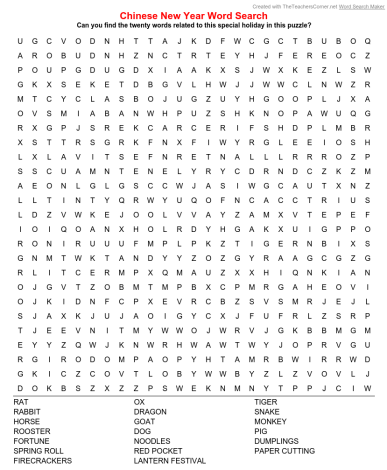
celebrate-picture-books-picture-book-review-chinese-new-year-word-search

Chinese New Year Word Search Puzzle


Can you find the twenty Chinese New Year-related words in this printable puzzle?

Chinese New Year Word Search Puzzle | Chinese New Year Word Search Solution

celebrate-picture-books-picture-book-review-ruby's-chinese-new-year-cover

You can find Ruby’s Chinese New Year at these booksellers

Amazon | Barnes & Noble | Books-a-Million | IndieBound

Picture Book Review
February 4 – It’s National Bake for Family Fun Month

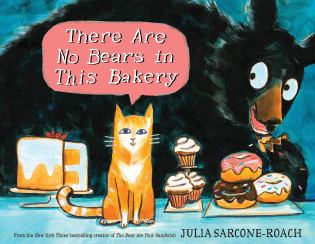
celebrate-picture-books-picture-book-review-there-are-no-bears-in-this-bakery-cover

About the Holiday

Mid-winter is a perfect time to gather with family and friends and spend those cold, indoor day baking your favorite recipes! Baking together is a great way to teach valuable cooking skills and a little math. Talking with kids while baking is fun too! Tell old family stories, talk about favorite recipes, and share funny or memorable culinary experiences. Of course, the best part of baking together is eating the delicious meals or treats afterward!

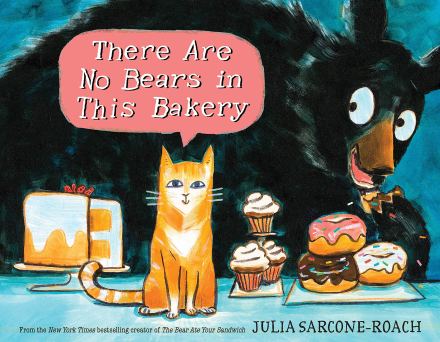
There Are No Bears in This Bakery

By Julia Sarcone-Roach

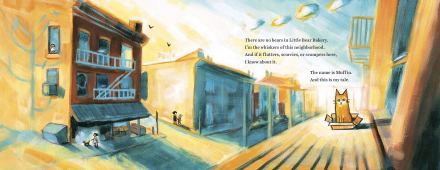
Muffin, the “whiskers” of the neighborhood assures readers that “there are no bears in Little Bear Bakery.” After all, he works the nightshift and knows everything that goes on. He knows the scratchy sounds of the mice, the clanging that means the raccoons are raiding the trash, and the flip flap of the bats. But he has to admit that last night there was a new sound: “grrrrrrrrrrr.” He went to investigate.

celebrate-picture-books-picture-book-review-there-are-no-bears-in-this-bakery-baked-window-sill

Copyright Julia Sarcone-Roach, 2019, courtesy of Knopf Books for Young Readers.

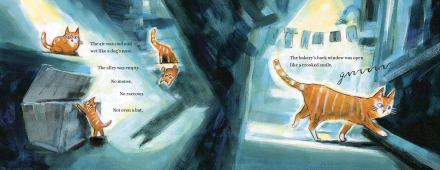
“The air was cool and wet like a dog’s nose.” None of the regular creatures were in the alley, but “the bakery’s back window was open like a crooked smile.” And, again, Muffin heard, “grrrrrr.” He entered the bakery thinking that maybe the intruder was a mouse looking for sprinkles. Then he saw it. Was it a huge mouse? No. It was a tiny bear. The bear was surprised; Muffin was surprised; and Muffin’s tale? It “was the most surprised” of all. The “grrrrrrrr” was coming from the bear’s stomach.

celebrate-picture-books-picture-book-review-there-are-no-bears-in-this-bakery-alley

Copyright Julia Sarcone-Roach, 2019, courtesy of Knopf Books for Young Readers.

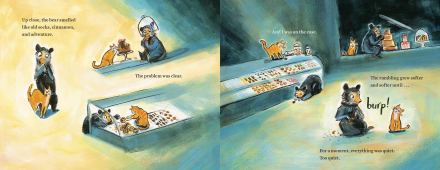
Muffin knew just what to do. He gave the cub a slice of cake, let her choose a doughnut from the bakery case, and toppled over a canister of cookies so she could nibble a few. The bear’s belly stopped grumbling, but then the bakery seemed quiet – too quiet. Muffin looked around and saw something in the darkness. It turned out to be a huge bear, and suddenly Muffin was in the dark as he was enveloped in a big hug. “It was warm, like a bath mat in the sunshine. It smelled like that bath mat needed a bath.”

celebrate-picture-books-picture-book-review-there-are-no-bears-in-this-bakery-bear-in-bakery

Copyright Julia Sarcone-Roach, 2019, courtesy of Knopf Books for Young Readers.

The mama bear was a bit hungry too and scarfed down some sprinkles. As the sun came up, the bears crept out the window and down the alley toward the forest. With the nightshift over, Muffin headed home to wake up his sleeping human and tell his heroic tale. “It was a messy job,” he said, “but I handled it.” And as Muffin curled up on his pillow, he just happened to mention, “By the way, we’re out of donuts.” Among other things….

celebrate-picture-books-picture-book-review-there-are-no-bears-in-this-bakery-baked-goods

Copyright Julia Sarcone-Roach, 2019, courtesy of Knopf Books for Young Readers.

Julia Sarcone-Roach’s storytelling is as frisky as a kitten and full of hilarious and oh-so-apropos similes from a cat’s point of view. Sarcone-Roach imbues her little feline security guard with the supreme confidence and guilt-free consciousness that cat lovers will recognize. Kids and adults will enjoy the noir-tone of this wry narrator, and like the best parodies, the suspenseful buildups give way to laughs. Sweet moments abound during the off-hours snackfest, and as readers gaze into Muffin’s wide, “who-me?” eyes, they’ll know that after the clean-up there will still be cuddles for this adorable cat.

Sarcone-Roach’s nighttime illustrations are rich with humor and shadowy atmosphere as Muffin relates her suspenseful tale of how she rid the bakery of bears. Clever perspectives immerse readers in Muffin’s experience while also allowing them to laugh at the feline expressions that make these pets so beloved. The little bear cub is as cute as a mini-cupcake and as endearing as any child. Those readers with a cat “alarm clock” will appreciate the morning scene, and the final spread of the bakery will elicit an “Oh!” or two.

If you love any of these: cats, bears, bakeries, mysteries, or a story wonderfully told that kids will want to hear again and again, you’ll want to add There Are No Bears in This Bakery to your home, classroom, or public library collection.

Ages 4 – 8

Knopf Books for Young Readers, 2019 | ISBN 978-0399556654

Discover more about Julia Sarcone-Roach, her books, and her art on her website

National Bake for Family Fun Month Activity

celebrate-picture-books-picture-book-review-cupcakes

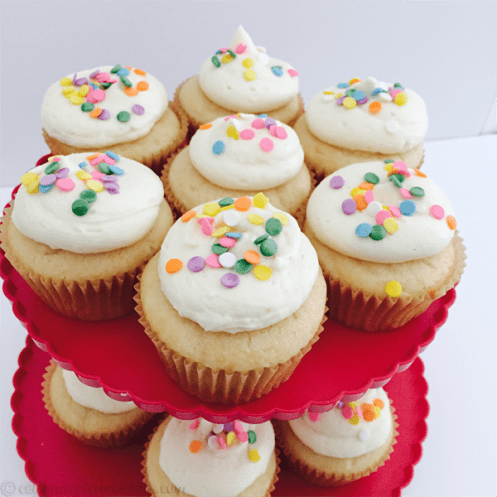
Very Vanilla Cupcakes

This delicious vanilla cupcake recipe from Sally’s Baking Addiction would definitely please Grandma—and they’ll become your favorite confection too!

Vanilla Cupcakes

  • 1 and 2/3 cup (210g) all-purpose flour (spoon & leveled)
  • 1/2 teaspoon baking powder
  • 1/4 teaspoon baking soda
  • 1/2 teaspoon salt
  • 1 cup (200g) granulated sugar
  • 1/2 cup (115g) unsalted butter, melted and slightly cooled
  • 2 large egg whites
  • 1/4 cup (60g) vanilla Greek yogurt (or plain; or regular yogurt; or even sour cream)
  • 3/4 cup (180ml) vanilla almond milk (or cow’s milk; or soy milk; or plain almond milk)
  • 2 teaspoons pure vanilla extract seeds scraped from 1/2 split vanilla bean1

Vanilla Bean Frosting

  • 1 cup (230g) unsalted butter, softened to room temperature
  • 4-5 cups (480-600g) confectioners’ sugar
  • 1/4 cup (60ml) heavy cream2
  • 1 teaspoon vanilla extract seeds scraped from 1/2 split vanilla bean1
  • Salt, to taste

Directions

  1. Preheat oven to 350F degrees. Line muffin tin with 12 cupcake liners. Set aside.
  2. In a medium bowl, mix together flour, baking powder, baking soda, and salt. Set aside. In a large microwave-safe bowl, melt butter in the microwave. Whisk in sugar – mixture will be gritty. Whisk in egg whites, yogurt, milk, and vanilla extract until combined. Split 1 vanilla bean down the middle lengthwise. Scrape seeds from half of the vanilla bean into batter. Reserve other half.
  3. Slowly mix dry ingredients into the wet ingredients until no lumps remain. Batter will be thick.
  4. Divide batter among 12 cupcake liners (or 24 mini) and bake for 20 minutes or until a toothpick inserted in the center comes out clean. Bake for 8-9 minutes if making mini cupcakes. Allow to cool.
  5. To make the frosting, beat softened butter on medium speed with an electric or stand mixer. Beat for about 3 minutes until smooth and creamy. Add confectioners’ sugar, cream, vanilla extract, and vanilla bean seeds with the mixer running. Increase to high speed and beat for 3 minutes. Add more powdered sugar if frosting is too thin or more cream if mixture is too thick. Add salt if frosting is too sweet (1/4 teaspoon). Frost cooled cupcakes (I used Wilton 1M piping tip). There may be leftover frosting depending how much you use on each cupcake.
  6. Store cupcakes in an airtight container at room temperature for up to 3 days and in the refrigerator up to 7.

Additional Notes

  1. If you can’t get your hands on vanilla beans, add an extra ½ teaspoon of pure vanilla extract instead.
  2. Strongly urged to use heavy cream. You may use milk or half-and-half, but heavy cream will give the frosting a thicker texture. I recommend it!

For ways to adapt this recipe and more scrumptious recipes, visit Sally’s Baking Addiction. I guarantee you’ll go back again and again!

celebrate-picture-books-picture-book-review-there-are-no-bears-in-this-bakery-cover

You can find There Are No Bears in This Bakery at these booksellers

Amazon | Barnes & Noble | Books-a-Million | IndieBound

Picture Book Review
February 3 – National Women Physicians Day

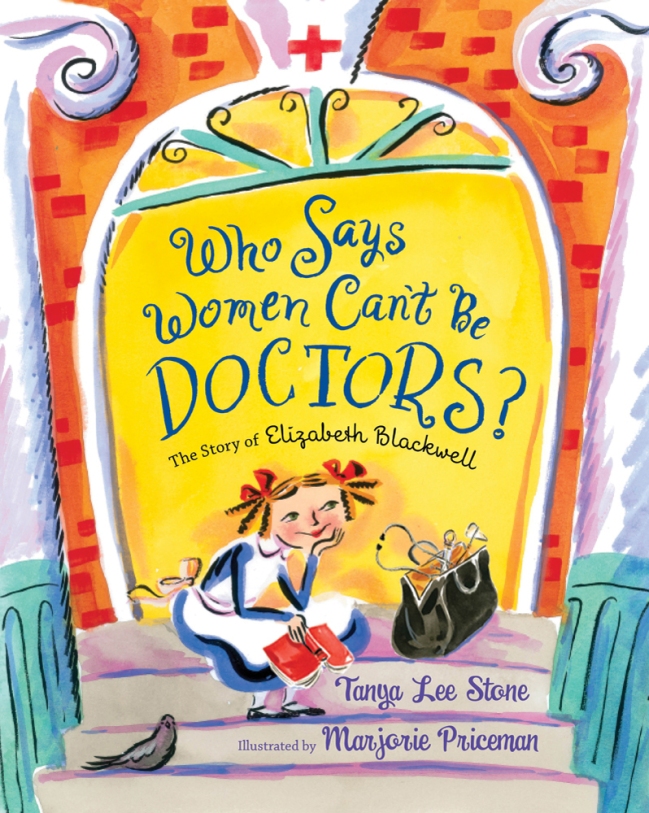
Who Says Women Can't Be Doctors by Tanya Lee Stone and Marjorie Priceman picture book review

About the Holiday

Today, we celebrate the birthday of Elizabeth Blackwell, who in 1849 became the first woman to earn a medical degree in the United States. Her courage in the face of much opposition paved the way for other women to pursue careers in the medical field. National Women Physicians Day also honors the achievements and contributions of all women physicians around the world. 

Who Says Women Can’t be Doctors? The Story of Elizabeth Blackwell

Written by Tanya Lee Stone | Illustrated by Marjorie Priceman


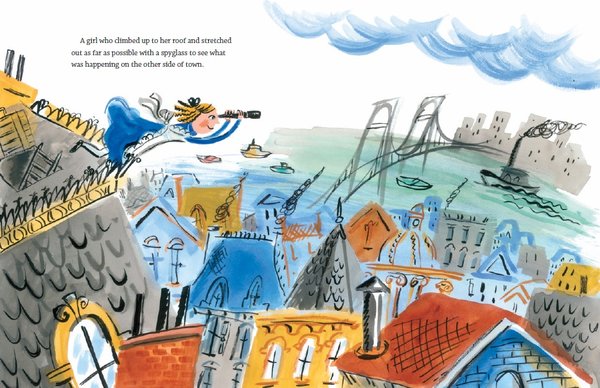
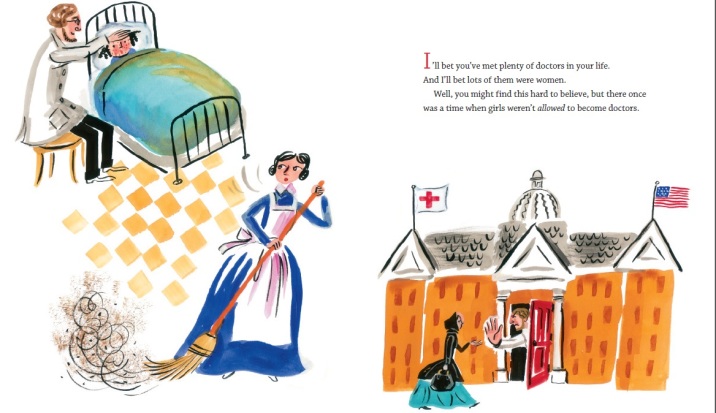
Once upon a time there were no women doctors. Women weren’t even allowed to be doctors. Sounds like a fairy tale, doesn’t it? But it was the truth. Then Elizabeth Blackwell, came along. Elizabeth was not like other girls of the 1830s. She loved to explore and take on challenges. She could lift her brother over her head, and to toughen herself up she slept on the hard wood floor. To get a better look at the world she once climbed to the roof of her house and leaned waaaaay out with a spyglass. What did she see? Maybe she saw her future. But it wasn’t what she imagined at the time. Blood made her queasy, dissection was disgusting, and being sick just made her want to hide from all the fussing.

celebrate-picture-books-picture-book-review-who-says-women-can't-be-doctors-elizabeth-brave

Image copyright Marjorie Priceman, 2013, text copyright Tanya Lee Stone, 2013. Courtesy of Henry Holt and Company.

A comment by a sick friend, however, puts a bee in Elizabeth’s bonnet. Mary Donaldson tells Elizabeth that she would much rather have been examined by a woman than her male doctor, and then says, “You should be a doctor, Elizabeth.” What a crazy notion, right? Well… Elizabeth can’t stop thinking about it. She asks around. Some people think it’s a good idea, but impossible; others simply think it’s impossible. They believe women aren’t strong enough or smart enough and they laugh at her. By this time, though, Elizabeth is determined.

celebrate-picture-books-picture-book-review-who-says-women-can't-be-doctors-no-women-doctors

Image copyright Marjorie Priceman, 2013, text copyright Tanya Lee Stone, 2013. Courtesy of Henry Holt and Company.

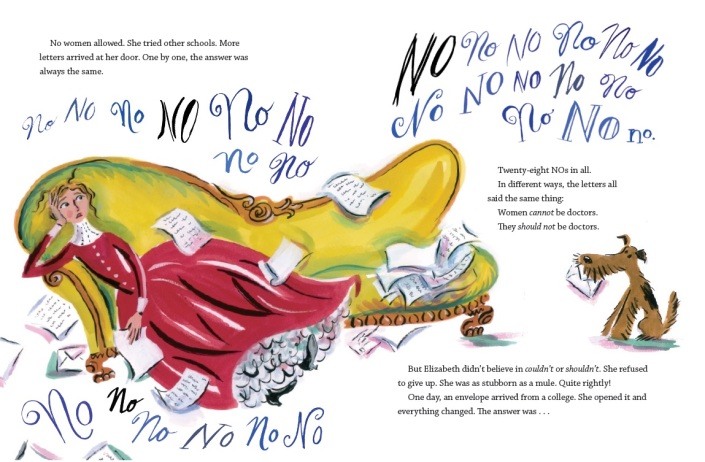
She applies to 28 medical schools, and they all say, “No.” But one day a “Yes” arrives in the mail. Elizabeth packs her bags. As she nears the school, Elizabeth sees that the townspeople have all come out to see her. They aren’t there to welcome their new medical student, though; they just want to whisper and point and stare. Surely, Elizabeth thinks, her classmates will be happy to see her. 

celebrate-picture-books-picture-book-review-who-says-women-can't-be-doctors-everyone-says-no

Image copyright Marjorie Priceman, 2013, text copyright Tanya Lee Stone, 2013. Courtesy of Henry Holt and Company.

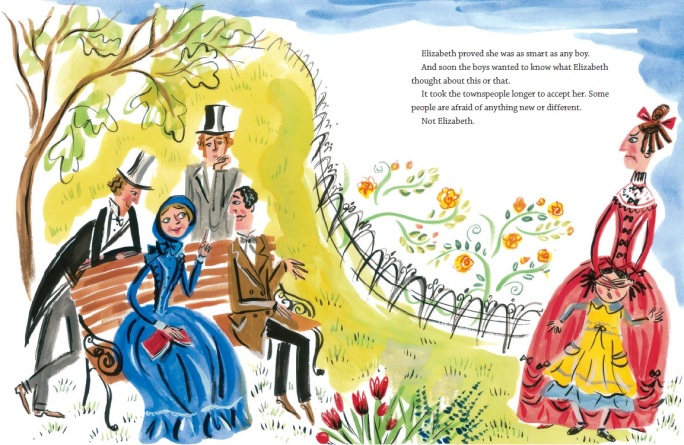
But she receives the same reception on the college campus. In fact, she learns that the only reason she was accepted was because the men voted to let her in as a joke! Elizabeth knows how to handle it. She studies hard and gives her opinions, and soon she wins the respect of her fellow students—even if the townspeople still don’t accept her.

On January 23, 1849 Elizabeth Blackwell graduates from medical school with the highest grades in the class. She has become the first woman doctor in America! Many people hope that she will be the last. But as we know…she was Not!

celebrate-picture-books-picture-book-review-who-says-women-can't-be-doctors-elizabeth-does-well-in-school

Image copyright Marjorie Priceman, 2013, text copyright Tanya Lee Stone, 2013. Courtesy of Henry Holt and Company.

Tanya Lee Stone magnificently imbues this short biography of Elizabeth Blackwell with enough mystery, conflict, and history for even the youngest readers to understand the type of girl and woman Elizabeth was as well as the challenges she faced. Stone has deftly included details of Blackwell’s life that  make her instantly recognizable and relatable to children. This biography is not only historical nonfiction, but a universal story for all generations. Blackwell may have started out as a reluctant dreamer, but once she dared to believe she accomplished more than she or anyone could have imagined. It is what we want for all our children.

Marjorie Priceman’s illustrations that swirl with words, are angled on the page, and float in white space are as topsy-turvy as the world Elizabeth Blackwell created with her courage and life’s work. Blackwell’s boldness is echoed in the rich colors and strong lines of Priceman’s gouache and India-ink paintings, and the emotions she stirred in others—from derision to horror to admiration—are cleverly and exceptionally drawn in a minimal style on the characters’ faces.

Ages 5 – 9

Henry Holt and Company, 2013 | ISBN 978-0805090482 (Hardcover) | ISNB 978-1250183392 (Paperback)

Learn more about Tanya Lee Stone and her work—both fiction and nonfiction—for children and teens on her website!

You can connect with Marjorie Priceman on Facebook!

National Women Physicians Day Activity

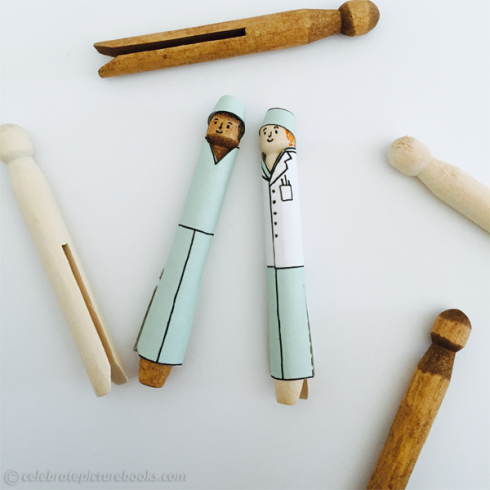
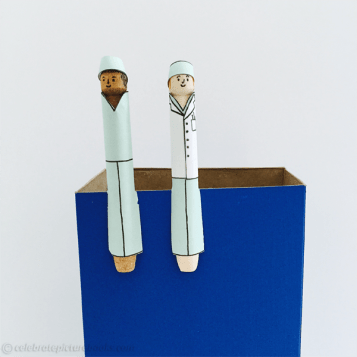
CPB - Doctors Clothespins

Doctor Clothespin Figures


Elizabeth Blackwell believed in herself and became the doctor she wanted to be. With this craft you can make a doctor figure or color your own clothes to make your figure any profession you are dreaming of!

Supplies

CPB - Doctors Clothespins on box

Directions

  1. Draw a face and hair on the clothespin
  2. Cut out the outfit you want your doctor to wear (color pants on your clothespin if you choose the lab coat)
  3. Wrap the coat or scrubs around the clothespin. The slit in the clothespin should be on the side.
  4. Tape the clothes together
  5. Wrap the cap around the head and tape it
  6. If you’d like to display your clothespin doctor on a wire, string, or the edge of a box or other container, cut along the dotted lines of the clothes template

Who Says Women Can't Be Doctors by Tanya Lee Stone and Marjorie Priceman picture book review

You can find Who Says Women Can’t be Doctors? at these booksellers

Amazon | Barnes & Noble | Books-a-Million | IndieBound

Picture Book Review
 

February 1 – National Freedom Day

celebrate-picture-books-picture-book-review-lift-every-voice-and-sing-cover

About the Holiday

National Freedom Day commemorates February 1, 1865, the day President Abraham Lincoln signed a joint U.S. House of Representatives and Senate resolution that outlawed slavery. This resolution became the 13th Amendment to the Constitution on December 6, 1865. Major Richard Robert Wright Sr., a former slave, founded the National Freedom Day Association and was instrumental in creating a formal national day of remembrance. The first celebration of National Freedom Day took place in 1942, and in 1947, a year after Wright’s death, the U.S. Congress passed a bill marking February 1 as National Freedom Day. The proclamation was signed into law on June 30, 1948 by President Harry S Truman. The holiday led to Black History Day, which was later expanded to Black History Month.

Lift Every Voice and Sing: A Celebration of the African American National Anthem

Written by James Weldon Johnson | Illustrated by Elizabeth Catlett


It has been more than 120 years since James Weldon Johnson, a principal at Stanton Elementary School in Jacksonville, Florida, wrote a poem to be used in the school’s commemoration ceremony of Abraham Lincoln’s birthday. His brother, composer John Rosamond Johnson, set the poem to music. On February 12, 1900, five hundred students performed the song. From that celebration, the song spread, gaining in popularity throughout the South and then throughout the country.

In 1949 the National Association for the Advancement of Colored People adopted Lift Ev’ry Voice and Sing as the official African American anthem. The song continues to inspire as it is sung and heard in churches and schools and during times of celebration and protest.

This new edition of Lift Every Voice and Sing brings together Johnson’s stirring poem with stunning black-and-white linocuts by Harlem Renaissance artist Elizabeth Catlett, who created them in the 1940s as part of a series of artworks focusing on black women.

celebrate-picture-books-picture-book-review-lift-every-voice-and-sing-guitar

Image copyright Elizabeth Catlett, 1993, text by John Weldon Johnson. Courtesy of Bloomsbury Children’s Books.

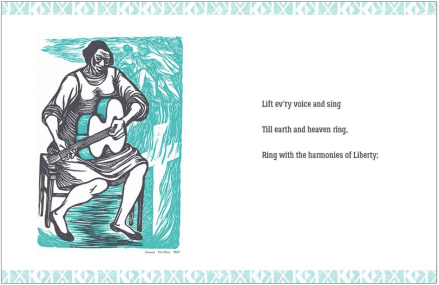
The book opens with these joyful lines punctuated with powerful images. On the first page a woman strums a guitar while beside her there is the image—perhaps it’s a memory or the subject of her song—of a black man being attacked by a klansman while a cross burns nearby. On the second page is a picture of Sojourner Truth with her left hand on a lectern that holds a Bible and her right, index finger extended, pointing skyward. In her eyes there is sadness and confidence and knowledge. “Lift ev’ry voice and sing / Till earth and heaven ring, / Ring with the harmonies of Liberty; // Let our rejoicing rise / High as the listening skies, / Let it resound loud as the rolling sea.”

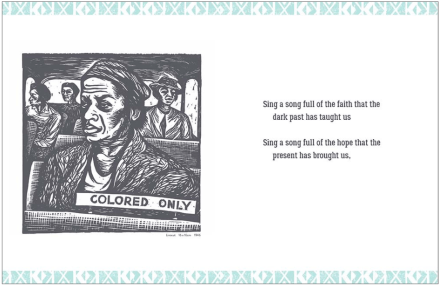
The poem continues with the exhortation to sing with the faith and hope learned from the past and present. A linocut of black women sitting on a bus behind the “colored only” sign, created by Catlett in 1946, is compelling for its truth and foresight, especially when paired with these lines. But knowing there was still much to do, Johnson encouraged his listeners: “Facing the rising sun of our new day begun / Let us march on till victory is won.” On the left-hand page Harriett Tubman points the way to freedom for escaping slaves—one couple carrying their belongings and their baby—along the Underground Railroad.

celebrate-picture-books-picture-book-review-lift-every-voice-and-sing-bus

Image copyright Elizabeth Catlett, 1993, text by John Weldon Johnson. Courtesy of Bloomsbury Children’s Books.

The song remembers the “stony road” and the “chastening rod” and also the “steady beat…” of “weary feet” that have brought them to a place for which their forefathers died. Johnson sees a brighter future, and Catlett’s linocut of Phyllis Wheatley, a child when she became a slave, writing one of her poems while three women chained together step into the light that her example demonstrates. Catlett’s original caption for this piece read: “I’m Phyllis Wheatley. I proved intellectual equality in the midst of slavery.”

The poem then goes on to appeal to God, “who has brought us thus far on the way” to keep them in the right path and in His hand so that “…may we forever stand. True to our GOD, True to our native land.”

Author/illustrator Ashley Bryan—a Newbery Honor and Coretta Scott King Award winner for Freedom Over Me—provides a poignant Foreword. Following the text are a short description of the project Elizabeth Catlett undertook after winning a Julius Rosenwald Foundation grant; her original captions for each linocut included in the book, and the music for Lift Ev’ry Voice and Sing.

An emotionally moving presentation of James Weldon Johnson and John Rosamond Johnson’s poem and song, Lift Every Voice and Sing: A Celebration of the African American National Anthem would make a beautiful thought-provoking and inspirational addition to school, home, and public library collections.

Ages 6 – 12 and up

Bloomsbury Children’s Books, 2019 | ISBN 978-1681199559

You can learn more about James Weldon Johnson and read several of his poems on the Poetry Foundation website.

To learn more about Elizabeth Catlett and view some of her artwork, visit the Artnet website.

Discover more about Ashley Bryan, his art, and his writing, visit the Ashley Bryan Center website.

National Freedom Day Activity

celebrate-picture-books-picture-book-review-chalk-garden-st

Freedom Stone


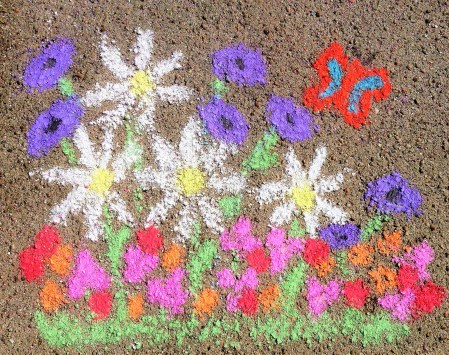
Freedom is a precious right—one that can be represented in different ways by each person. For today’s activity use a brick, paving stone, large stone, or molded plaster of Paris and decorate it with a picture or design that means freedom to you. Then put it in a special place—in a garden, near your front or back door, in your room, or in another spot—where it will remind you of freedom’s gifts.

Supplies

  • Brick, paving stone, large stone, plaster of Paris
  • Paint
  • Plastic gems, bead, or other small objects
  • Strong glue or other adhesive
  • Paint brush

Directions

  1. Create a design that shows what freedom means to you or an object that represents freedom to you
  2. Paint your stone with the design, let dry
  3. Add gems, beads, or other objects
  4. Display your Freedom Stone

celebrate-picture-books-picture-book-review-lift-every-voice-and-sing-cover

You can find Lift Every Voice and Sing at these booksellers

Amazon | Bloomsbury | Books-a-Million | IndieBound

Picture Book Review
January 31 – Inspire Your Heart with Art Day

celebrate-picture-books-picture-book-review-the-hiding-game-cover

About the Holiday

Celebrating art is always a great thing! Today we champion that feeling you get inside when you create or experience art—no matter what kind is your favorite. Paintings, books, music, sculpture, quilts, photography, and other arts show you a bit of the world in a new way—a way, perhaps, you’ve never thought of before. Art can inspire, gladden, sadden, anger, teach, and compel action. It can also provide joy and inspiration when you need it most—as you’ll see in today’s book. Celebrate today’s holiday by visiting a museum, bookstore, library, concert, or gallery.

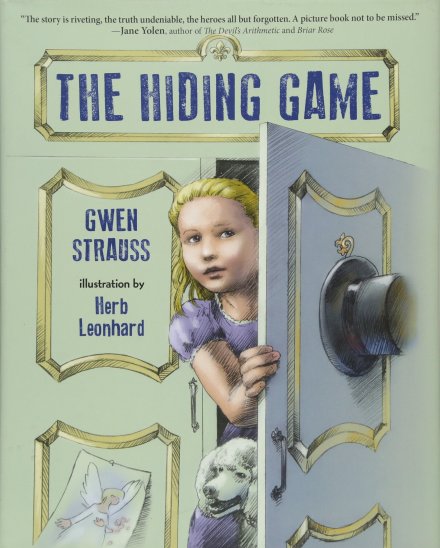
The Hiding Game

Written by Gwen Strauss | Illustrated by Herb Leonhard

It was October of 1940, and after moving from place to place to stay “one step ahead of the German soldiers,” Aube and her family had found a home where they could “live together until it was their turn to flee to safety. The Villa Air-Bel was rented by Varian Fry—a magician—and his assistant Danny Bénédite and served as a place to hide those looking to escape the war-torn country. On Sundays, the house was full of “thinkers, artists and writers who had to hide from the German soldiers because of their ideas of freedom and liberty” like Aube’s parents.

On those days, everyone played games, danced and made collages. One of Aube’s favorite games was Cadavre Exquis, in which a piece of paper was folded and each participant drew a design on one fold. When the whole paper was unfolded, amazing, artistic pictures emerged. These games and entertainment, Aube’s father told her, were their ways of fighting against fear. Because of the danger, many things had to be hidden at the Villa, including the radio and the cow that provided milk. Many ingredients for cooking were scarce. But even then Aube’s father used art to lighten the mood, leaving a drawing of a roast beef in the pantry where a real roast should have been.

Because the authorities were reading Varian and Danny’s mail and were listening to their phone calls, they had devised a way of hiding messages in toothpaste tubes that escaped the guard’s searches. The messages went to other people helping along the escape route to tell them who to expect next. Everyone in the house also had to have a special hiding place in case the police came. Aube chose the an old cabinet in the kitchen.

celebrate-picture-books-picture-book-review-the-hiding-game-tree

Image copyright Herb Leonhard, 2017, text copyright Gwen Strauss, 2017. Courtesy of Pelican Publishing Company.

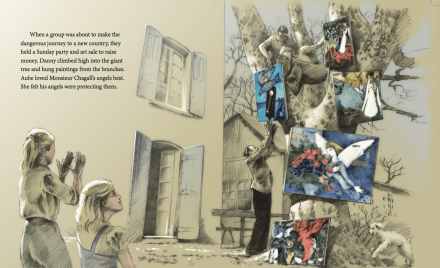
Whenever a new group of people were scheduled to “make the dangerous journey to a new country, they held a Sunday party and art sale to raise money.” Canvases painted by famous artists were hung among the branches of a large tree on the Villa grounds. When winter came, the Villa was so cold everyone had to wear all of their clothes to stay warm. They kept their spirits warm, too, by singing their favorite songs.

During the winter Danny visited camps where people were being held under terrible conditions. “Aube understood now that the danger was that they would be sent to the camps,” where people were dying of starvation and disease. They had little clothes and no blankets even though it was snowing. The people, Danny said, were going to freeze. Aube thought of the game freeze tag and worried about all of those “people freezing, waiting for someone to set them free.”

One day in December, the police raided the Villa. They took away all the men, including Danny, Varian, and Aube’s papa. Aube cowered in the kitchen cabinet with their dog in fear. The next week, the men were released, but they knew that the police would be back. Danny and Varian began to plan their escape. Before they all left, Aube’s father devised one more game. Each artist would paint their own version of a playing card to create a collective work of art. “The cards would remind them that they had laughed together and stayed free in their hearts even during the darkest times.”

Aube’s family were placed on a ship sailing to South America, and on February 18, 1941 they left the Villa and Danny and Varian behind and made the one-month-long journey to freedom. Several months later, Varian was “forced to leave France and return to America.” Danny went underground and “helped another 300 people escape France.” In 1943, however, Danny was “arrested by the Nazis and sentenced to death.” Just as he was facing the firing squad, soldiers fighting the Nazis burst through the gates of the camp and freed him and the other inmates.

celebrate-picture-books-picture-book-review-the-hiding-game-villa-air-bel

Image copyright Herb Leonhard, 2017, courtesy of Pelican Publishing Company.

Gwen Strauss includes extensive backmatter on this true-life story about her great-uncle Danny Bénédite. A detailed account of the work by Varian Fry, Danny Bénédite, and the American Rescue Committee, complete with photographs, as well as short biographies of some of the artists who visited the Villa (and a compelling list of others) plus resources for further study round out this compelling book.

Clearly written and with details from a child’s point of view that will resonate with readers, The Hiding Game is an absorbing tribute not only to two men involved in the Nazi resistance movement but to the resilience that uplifts people during the darkest times. This fascinating true story also offers a glimpse into the important role that artists and writers play in shining a light on history, interpreting it, and fighting against forces that destroy. Rich with the atmosphere of intrigue, suspense, and simple pleasures enjoyed, Strauss’s dynamic storytelling will thrill children. The Hiding Game will prompt them to learn more about this time period and will inspire in them their own acts of heroism.
Herb Leonhard’s realistic drawings of the Villa Air-Bel, the families who stopped there on their way to freedom, the moments of joy that sustained them, and the secret measures necessary for people’s safety take readers into the heart of the story and allow them to witness the danger and the creativity that swirled side-by-side within the Villa and the people living there. Largely depicted in somber tones of gray and green, the pages brighten with glowing yellows during times of laughter, games, and creativity. An illustration of the mammoth tree hung with canvases by famous artists will impress children, and the final image will leave an indelible and thought-provoking impression on young readers and adults.

An excellent book for facilitating discussions about World War II and the Holocaust with children at home and in the classroom as well as offering opportunities for cross-curricular learning in history, art, reading, and more, The Hiding Game is a superb choice to add to home, school, and public libraries.

Ages 7 – 12

Pelican Publishing Company, 2017 | ISBN 978-1455622658

Discover more about Gwen Strauss and her books on her website.

To learn more about Herb Leonhard, his books, and his art, visit his website.

Inspire Your Heart with Art Day Activity

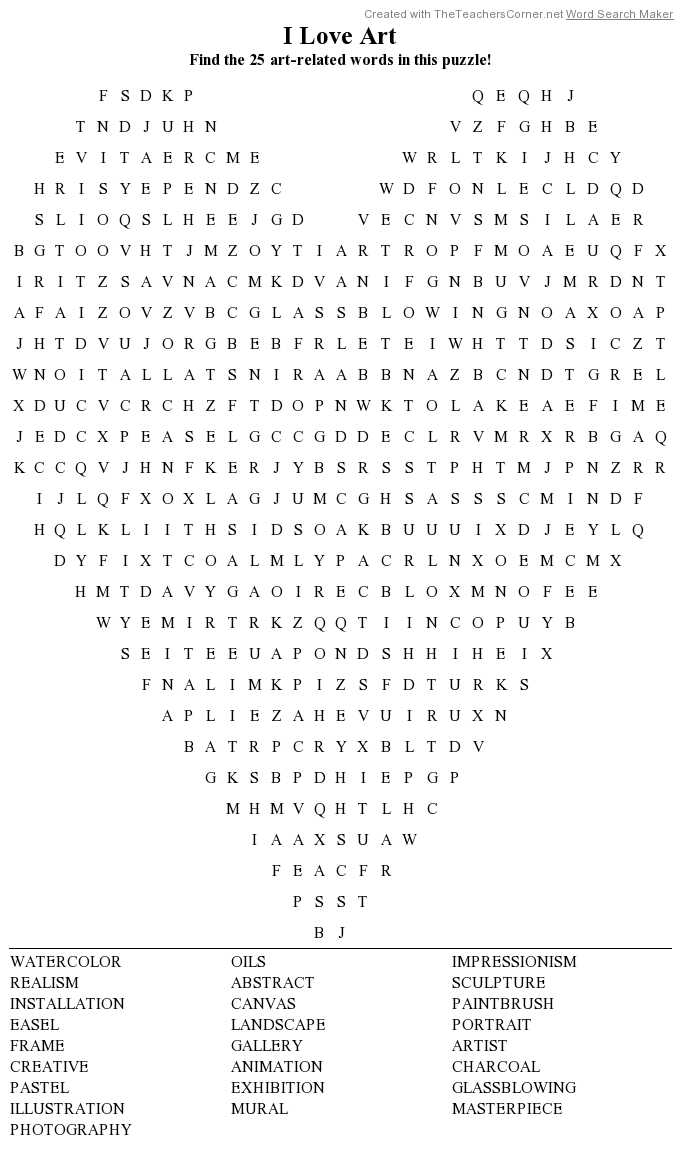
I Love Art! Word Search Puzzle

Art has a language all its own! Have fun finding the twenty-five art-related words in this printable puzzle.

I Love Art! Word Search Puzzle and I Love Art! Word Search Solution

celebrate-picture-books-picture-book-review-the-hiding-game-cover

You can find The Hiding Game at these booksellers

Amazon | Barnes & Noble | Books-a-Million | IndieBound

Picture Book Review