March 14 – It’s National Women’s History Month

celebrate-picture-books-picture-book-review-hedy-lamarr's-double-life-cover

About the Holiday

National Woman’s History Month was established by the United States Congress in 1987 to recognize and celebrate the achievements of American women in the past and today. This year’s theme is “Balance for Better,” which encourages true gender equity in the workplace, in government, and at home. Only when all people are heard and treated equally will communities thrive. There’s no better time than now to get involved to ensure that all have the same rights and standing in all areas of their lives.

I received a copy of Hedy Lamarr’s Double Life for review consideration. All opinions are my own. I’m excited to be partnering with Sterling in a giveaway of the book. See details below.

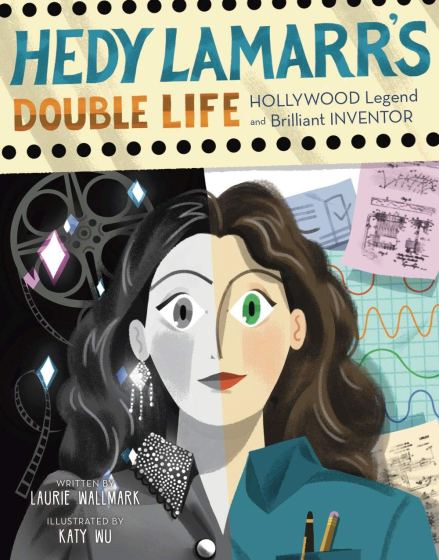
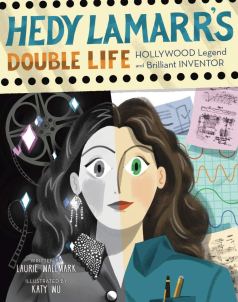
Hedy Lamarr’s Double Life: Hollywood Legend and Brilliant Inventor

Written by Laurie Wallmark | Illustrated by Katy Wu


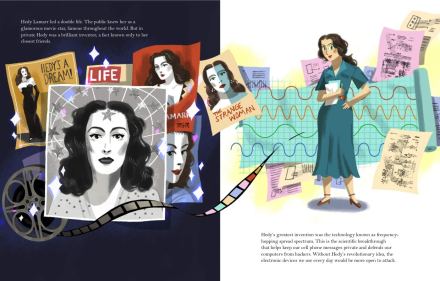
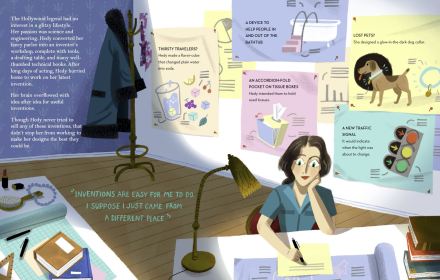
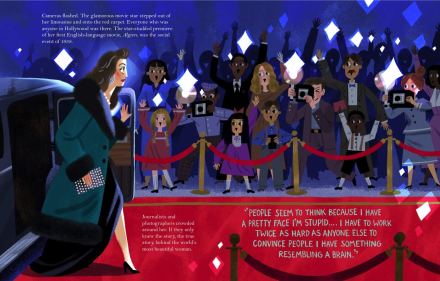
In 1938 people were lining up to see Hedy Lamarr in her first English-language movie Algiers. Hedy was the talk of Hollywood, and journalists and photographers captured her every move—almost. What movie-goers and the press didn’t know was that Hedy Lamarr was also a brilliant inventor. Instead of attending fancy celebrity parties, after a long day on the set, “Hedy hurried home to work on her latest invention. Her brain overflowed with idea after idea for useful inventions.” While she never tried to sell her ideas—like the collar to help find lost pets or the “flavor cube that changed plain water into soda”—she designed and redesigned them to perfection.
celebrate-picture-books-picture-book-review-hedy-lamarr's-double-life-magazines

Image copyright Katy Wu, 2019, text copyright Laurie Wallmark, 2019. Courtesy of Sterling Children’s Books.

But how did Hedy get her start? She was born in Austria and as a child took apart mechanical objects just to see how they worked. Hedy’s father also loved science, and he encouraged his daughter to hold onto her dreams. In addition to science, Hedy loved movies and would use her dolls to reenact the scenes she saw.

When she got older, Hedy got a job as a script girl and then worked as an extra in a movie. She loved acting and once said, “‘I acted all the time…. I was a little living copybook. I wrote people down on me.’” While playing the lead in a stage play, the Hollywood producer Louis B. Mayer saw her and offered her movie contract. Hedy moved to America. It only took her six months to land a starring role in Algiers. After that she starred in many movies with some of the most famous actors and actresses. 

By now, the world was at war. One day, Hedy met George Antheil, a former weapons inspector who now composed music. Hedy remembered a “discussion she had overheard back in Europe about a problem with the guidance system for torpedoes. The guidance system couldn’t prevent the enemy from jamming the weapon’s radio signals” and sending it off course. She learned from George Antheil that the US Navy had the same problem.

They decided to team up to see if they could figure out a solution. Hedy was also an accomplished pianist, and she and George often played musical games on the piano. Once, while they played the same song in different octaves, Hedy had a brainstorm for building “a secure torpedo guidance system.” At the time, torpedo guidance systems only worked if the ship launching a torpedo and the torpedo were on the same frequency.
celebrate-picture-books-picture-book-review-hedy-lamarr's-double-life-home

Image copyright Katy Wu, 2019, text copyright Laurie Wallmark, 2019. Courtesy of Sterling Children’s Books.

Hedy thought that if the ship and the torpedo could switch between a series of different frequencies, the enemy would be foiled. “Hedy called her discovery ‘the hopping of frequencies.” Working together, she and George devised a way to implement Hedy’s idea. When they presented their idea to the National Inventors Council, they were told the “idea had ‘great potential value.’”

There were still some issues to overcome to make the system automated, but Hedy and George answered those too. They applied for a patent, and a year later on August 11, 1942 it was granted. When they gave the idea to the United States Navy, “Hedy was proud her frequency-hopping idea might help America win the war.” But embroiled in the middle of the conflict, the Navy didn’t have “the time or money to implement a new system….”

Hedy, who still wanted to help America defeat the Nazis, was undaunted. She helped raise 25 million dollars by selling war bonds and volunteered at the Hollywood Canteen, where servicemen soon to be deployed gathered. Hedy went on to make more than twenty movies and continued to work on her inventions.

In the 1980s, the US Navy declassified Hedy’s frequency-hopping technology, meaning anyone could use it. Because the patent had long-ago expired, no one needed to give Hedy and George credit for the idea. “Companies raced to include frequency hopping in their own devices.” In 1997, Hedy and George were finally recognized when they “received the Pioneer Award from the Electronic Frontier Foundation for their significant contribution to computers.”

A timeline of Hedy Lamarr’s life, a description of how Hedy and George’s frequency-hopping technology worked, additional resources for further reading, and a list of Hedy’s movies follow the text.
celebrate-picture-books-picture-book-review-hedy-lamarr's-double-life-red-carpet

Image copyright Katy Wu, 2019, text copyright Laurie Wallmark, 2019. Courtesy of Sterling Children’s Books.

Laurie Wallmark knows how to weave a riveting tale that draws readers in to the lives of fascinating and scientifically minded women throughout history. Her detailed biography of Hedy Lamarr will wow kids with the twists and turns of how a vital feature of the electronics they use every day came to be. A history not only of this famous woman but of the times and policies that denied Hedy Lamarr the recognition and profits she deserved, the story is sure to spark plenty of discussion. The inclusion of a few of Hedy’s ingenious ideas as well as quotes on acting, inventing, and her views on life give children a glimpse into the mind of this unique woman.

Katy Wu takes readers back to the 1940s with her stylish illustrations reminiscent of magazine images of the time that depict both Hedy’s glamourous and inventive sides. Even as Hedy steps out of a limo to the glare of flashbulbs, acts under stage lights, and watches movies thrown by a projector’s beam, she’s dreaming of going home to work on her inventions in the light of a desk lamp. When the story turns to Hedy’s frequency-hopping idea, Wu clearly portrays the problems with the torpedo guidance system and the way single-frequency and multiple-frequency communications work. The way player pianos were controlled and how Hedy and George Antheil used this idea is also well portrayed. The final images of people using Hedy’s technology today lets kids fully understand the impact that Hedy Lamarr has had on their lives.

An important story about an extraordinary woman, Hedy Lamarr’s Double Life: Hollywood Legend and Brilliant Inventor will inspire children to follow and accomplish all of their dreams. The book will spur creative thought across subject matter and would be a motivational addition to home, classroom, and public libraries.

Ages 5 and up

Sterling Children’s Books, 2019 | ISBN 978-1454926917

Discover more about Laurie Wallmark and her books on her website.

To learn more about Katy Wu, and view a gallery of her book and art, visit her tumblr.

Hedy Lamarr’s Double Life Giveaway

I’m excited to partner with Sterling Children’s Books in a Twitter giveaway of:

  • One (1) copy of Hedy Lamarr’s Double Life: Hollywood Legend and Brilliant Inventor written by Laurie Wallmark | illustrated by Katy Wu

This giveaway is open from March 14 through March 20 and ends at 8:00 p.m. EST.

A winner will be chosen on March 21.

Prizing provided by Sterling Children’s Books

Giveaway open to U.S. addresses only. | No Giveaway Accounts 

National Women’s History Month Activity

celebrate-picture-books-picture-book-review-women-in-stem-coloring-book

Women in STEM Coloring Book


Discover five women who broke barriers  and made important contributions to the science, technology, engineering, and math fields in this printable  Women in STEM Coloring Book created by the United States Department of Energy.
celebrate-picture-books-picture-book-review-hedy-lamarr's-double-life-cover

You can find Hedy Lamarr’s Double Life: Hollywood Legend and Brilliant Inventor at these booksellers

Amazon | Barnes & Noble | Books-a-Million | IndieBound

Picture Book Review

March 12 – National Plant a Flower Day

celebrate-picture-books-picture-book-review-flower-talk-cover

About the Holiday

Spring is right around the corner and with it the beautiful blooms that color our yards, neighborhoods, and communities. In some places the flowers are already blossoming, while in others, people are eagerly waiting for the snow to melt so seeds and plants can grow again. If you’re looking forward to flower gardening—indoors or out—today’s the perfect day to start planning. Why not take a trip to your local nursery or garden supply store and stock up?

I received a copy of Flower Talk: How Plants Use Color to Communicate from Millbrook Press to check out. All opinions are my own. I’m happy to be partnering with Millbrook Press in a giveaway of the book. See details below.

Flower Talk: How Plants Use Color to Communicate

Written by Sara Levine | Illustrated by Masha D’yans


Do you hear something? Yeah, me too. Oh! It’s the little purple prickly pear down there with all the other cacti. It seems it has something to say about plants. Okay, we’re listening.

“I want to clear up some of your crazy ideas about what the colors of our flowers mean.” You’ve got it all wrong if you think “red roses stand for love and white ones are good for weddings.” While that may be how you interpret the colors, that’s not what they’re really for.

celebrate-picture-books-picture-book-review-flower-talk-cactu

Image copyright Masha D’yans, 2019, text copyright Sara Levine, 2019. Courtesy of Millbrook Press.

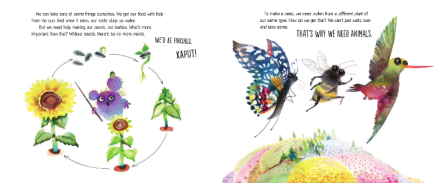
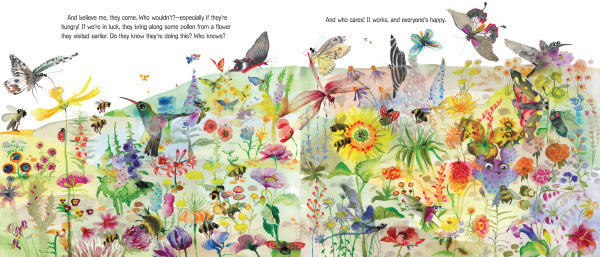
“We use our flowers to talk to the animals” so that we can make seeds and more plants. To do that each plant needs pollen from another plant that’s the same kind. Our flowers are like big ads that attract just the right birds, bees, or butterflies to help us out. Lots of times if they’re hungry they fly from flower to flower and bring pollen along with them.

How does each bird or butterfly or bee know which flowers to visit? That’s where our colors come in! And it’s pretty fascinating. Birds can see a color that insects can’t, and they don’t have a good sense of smell. Can you guess which flowers they’re attracted to? How about bees? Which colors do you think they like the best? I’ll give you a hint: “scientists just figured out that bees have three favorite colors.” Of course, we flowers “have known this for ages. That’s why so many of us make flowers in these colors. We like the reliable help.” This is fun, right?

celebrate-picture-books-picture-book-review-flower-talk-insects

Image copyright Masha D’yans, 2019, text copyright Sara Levine, 2019. Courtesy of Millbrook Press.

How about moths and bats—which flowers do you think they visit? The flowers even assist them in finding their way by putting “out perfume as an extra guide.” You may not like flies buzzing around you, but these color flowers love it. They put out a smell too, but I wouldn’t call it perfume—I don’t think you would either. There’s even a certain color flower that doesn’t talk to animals or insects at all. Go on, try to guess….

Colors aren’t the only trick flowers have either. Some are just the right shape—like mine. In fact, I’ve got to get going. “I’m making a new flower” and “I’m just about done with it.” Oh—what are the answers to the game we were playing? You’ll have to read my book and see!

Back matter includes an illustrated discussion about pollination, information on how to protect pollinators, and a list of other books for further reading.

celebrate-picture-books-picture-book-review-flower-talk-field

Image copyright Masha D’yans, 2019, text copyright Sara Levine, 2019. Courtesy of Millbrook Press.

With appropriate attitude, Sara Levine’s hilarious and knowledgeable prickly pear narrator engages kids in witty banter while taking them on a colorful garden tour. As the cactus explains a plant’s growing cycle and the need for pollinators, the information it imparts is eye-opening for children and adults. Why and how each flower’s color and scent attract just the right pollinator is clearly described in conversational language that kids will laugh along with and learn from. Every page contains an “ah-ha” moment that will spark discussion and an excitement to plant a garden and watch nature at work.

Like a riotous field of wildflowers, Masha D’yan’s dazzling illustrations put colors on glorious display as the flowers lure insects and animals to them. D’yan’s detailed images provide a great place for young naturalists to start researching the various plants introduced. Depictions of the prickly pear, birds, and bees match the humor of Levine’s text . Kids will love lingering over the two-page spreads to point out the various animals and insects and how they interact with the plants. They’ll also like following the growth of the prickly pear’s bud as it grows bigger and blossoms.

A superb book for teaching children about this fascinating feature of flowers and plants as well as providing a guide for gardeners interested in attracting a variety of pollinators, Flower Talk: How Plants Use Color to Communicate would be an outstanding addition to home, classroom, and public libraries.

Ages 7 – 11

Millbrook Press, 2019 | ISBN 978-1541519282

Discover more about Sara Levine and her books on her website.

To learn more about Masha D’yans, her books, and her art, visit her website.

National Plant a Flower Day Activity

celebrate-picture-books-picture-book-review-flower-pot-stake-craft

Flower Garden Stakes


It’s fun to start a garden from seeds, but how do you remember what you’ve planted where? With these easy to make garden stakes, you can mark your pots with style! 

Supplies

  • Wide craft sticks
  • Chalkboard paint in various colors
  • Colorful chalk
  • Paint brush

Directions

  1. Paint the stakes with the chalkboard paint, let dry
  2. With the chalk, write the name of the different flowers or plants
  3. After planting your seeds, stick the stake in the pot 
  4. Wait for your seeds to grow!

celebrate-picture-books-picture-book-review-flower-talk-cover

You can find Flower Talk: How Plants Use Color to Communicate at these booksellers

Amazon | Barnes & Noble | Books-a-Million | IndieBound

Picture Book Review

March 3 – World Wildlife Day

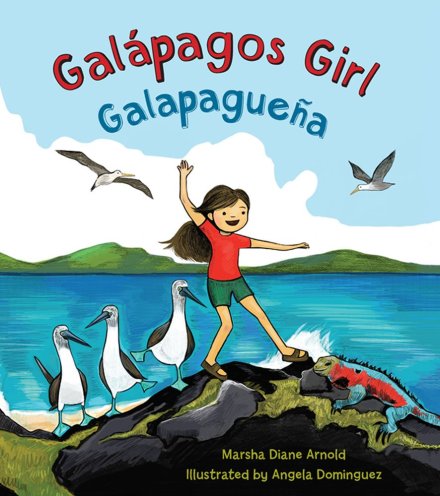
celebrate-picture-books-picture-book-review-galapagos-girl-cover

About the Holiday

In December of 2013 the United Nations General Assembly proclaimed March 3rd as World Wildlife Day to promote awareness of our environment and the dangers to it. Every year a different theme is chosen to spotlight an area of the world, a particular species, or a group of activists. This year’s theme is “life below water for people and planet” and focuses on marine species, the importance of marine wildlife, and the issues affecting the health and survival of the ocean and ocean creatures. The day also celebrates successful conservation and sustainability initiatives. To learn more about the day, special events, and how you and your kids can get involved today and throughout the year, visit the World Wildlife Day website.

Galápagos Girl / Galapagueña

Written by Marsha Diane Arnold | Illustrated by Angela Dominguez | Translated by Adriana Dominguez


On the day when baby Valentina joined Mamá, Papá, and eleven brothers and sisters, even the sea lions, blue-footed boobies, and iguanas seemed to welcome her to the “island formed by fire.” Valentina loved growing up on the Galápagos Island of Floreana. She explored the lava rocks, where Sally Lightfoot crabs scuttled back and forth. She swam with dolphins and manta rays, and even played with penguins.

celebrate-picture-books-picture-book-review-Galápagos-Girl-crabscelebrate-picture-books-picture-book-review-Galápagos-Girl-crabs

Image copyright Angela Dominguez, 2018, text copyright Marsha Diane Arnold, 2018. Courtesy of Lee & Low Books.

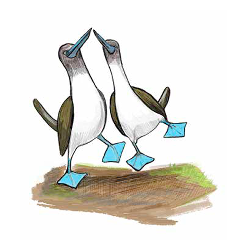
“Valentina watched pink flamingoes wading near mangroves. Blue butterflies fluttering on the breeze. Red-and-green iguanas sneezing salt like tiny geysers.” The crashing waves, albatross, and finches created a symphony as Valentina stopped to rest on a grassy cliff overlooking the ocean. The lava lizards, blue-footed boobies, and twirling sea lions provided young Valentina with a variety of dance partners.

celebrate-picture-books-picture-book-review-Galápagos-Girl-iguana

Image copyright Angela Dominguez, 2018, text copyright Marsha Diane Arnold, 2018. Courtesy of Lee & Low Books.

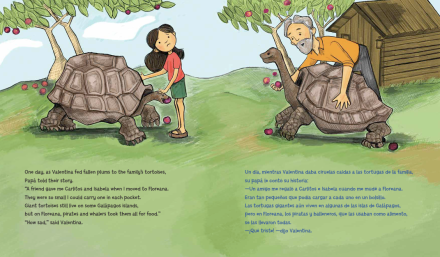
At home, Valentina’s family shared their home with two giant tortoises—Carlitos and Isabella. One day Papá told Valentina their story as they fed the tortoises plums that had fallen from their backyard trees. Papá had gotten Carlitos and Isabella from a friend when he first moved to Floreana. Although it was nearly impossible to imagine now that the tortoises were grown, at the time they were so small that they fit into Papá’s pockets.

celebrate-picture-books-picture-book-review-Galápagos-Girl-tortoises

Image copyright Angela Dominguez, 2018, text copyright Marsha Diane Arnold, 2018. Courtesy of Lee & Low Books.

There was also a sad note to Papá’s story. He said that while giant tortoises still lived on other Galápagos islands, pirates and whalers had wiped out the population on Floreana. Papá went on to tell Valentina that many Galápagos animals were in danger. They were “threatened by other animals that don’t belong here. Threatened by people who don’t understand how to care for our islands.” Valentina promised that she would always protect them.

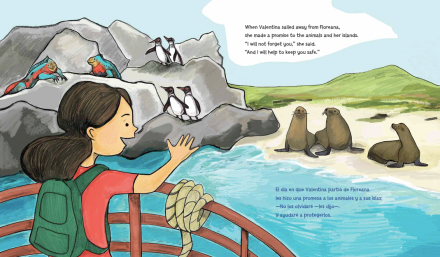
When she was older, Valentina left the island to go to school. She didn’t want to leave her beautiful home, but Mamá told her that she was “ready to learn about the world beyond.” And Papá reminded her that “like our islands, you have a heart full of fire.” On school vacations, Valentina always came back to study the wildlife on the Galápagos islands. She had not forgotten her promise to keep them safe.

celebrate-picture-books-picture-book-review-Galápagos-Girl-going-to-school

Image copyright Angela Dominguez, 2018, text copyright Marsha Diane Arnold, 2018. Courtesy of Lee & Low Books.

After she graduated with a degree in biology, Valentina returned to the islands as a nature guide to teach visitors about the beauty and uniqueness of the Galápagos. Some visitors were even lucky enough to meet Carlitos and Isabella when the plums dropped from the trees and the two old tortoises returned from exploring Floreana to eat them. Because of Valentina’s commitment to the Galápagos, her visitors also made a promise to always remember and protect them.

Extensive backmatter includes an Author’s Note about Valentina Cruz, the tortoises Carlitos and Isabella, and the history of tortoises on Floreana. There is also information on the Galápagos as well as fun facts about all of the animals in the story. A bibliography of sources invites readers to learn more.

Each two-page spread presents the text in English and translated into Spanish by Adriana Dominguez.

celebrate-picture-books-picture-book-review-Galápagos-Girl-guiding-visitors

Image copyright Angela Dominguez, 2018, text copyright Marsha Diane Arnold, 2018. Courtesy of Lee & Low Books.

Marsha Diane Arnold’s lyrical and buoyant passages sing with the carefree joy Valentina felt as a girl exploring her beloved Galápagos and which brought her back home as a biologist to protect them. After seeing Valentina playing and swimming with the native animals and feeding Carlitos and Isabella, readers will also feel Valentina’s sadness at the dangers they face and want to make a positive difference to the environment and the world around them. Arnold’s dialogue-rich storytelling highlights the personal nature of the subject and will draw children into Valentina’s world.celebrate-picture-books-picture-book-review-Galápagos-Girl-blue-footed-booby

Saturated with glorious color, each of Angela Dominguez’s illustrations is a celebration of the splendor of the Galápagos. Playful sea lions, high-stepping blue-footed boobies, scampering crabs, and even a sneezing iguana will captivate young readers and inspire them to learn more about these creatures and the islands. Images of Valentina camping out to study the animals during school breaks will excite environmentally conscious kids, and pictures of Carlitos and Isabella happily munching on plums will generate smiles and “awwws.”

Galápagos Girl / Galapagueña will excite kids to learn more not only about the Galápagos region but about their own local environment, and the call to action will spark an enthusiasm for protecting the earth’s animals. The book would make an inspiring addition to home bookshelves and an excellent way to begin classroom discussions on environmental issues and science lessons. The engaging Spanish translation will delight Spanish-speaking and bilingual families.

Ages 4 – 8

Lee & Low Books, 2018 | ISBN 978-0892394135

Discover more about Marsha Diane Arnold and her books on her website.

Read an interview with Marsha Diane Arnold here.

To learn more about Angela Dominguez, her books, and her art, visit her website.

World Wildlife Day Activity

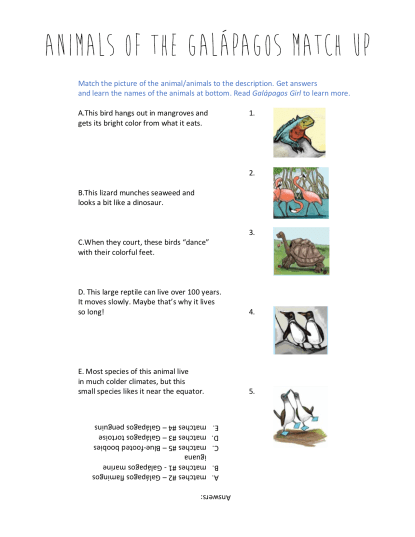
celebrate-picture-books-picture-book-review-animals-of-the-galapagos-match-up-puzzle

Animals of the Galápagos Match Up Puzzle


There are so many fascinating animals that live in the Galápagos! Can you match the picture of each animal to its description in this printable Animals of the Galápagos Match Up Puzzle? You can find and download the activity sheet from the Lee & Low Books website:

Animals of the Galápagos Match Up Puzzle

celebrate-picture-books-picture-book-review-galapagos-girl-cover

You can find Galápagos Girl / Galapagueña at these booksellers

Amazon | Barnes & Noble | Books-a-Million | IndieBound

Picture Book Review


February 28 – Digital Learning Day

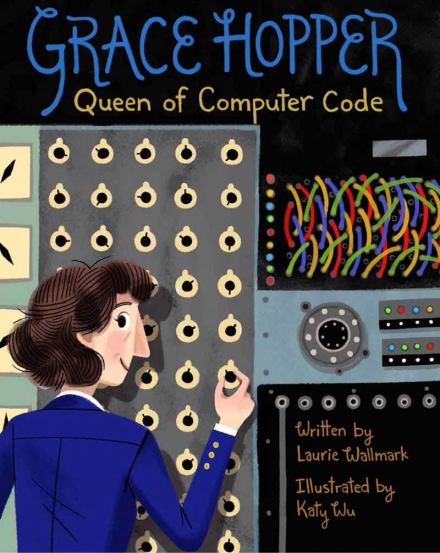
celebrate-picture-books-picture-book-review-grace-hopper-queen-of-computer-code-cover

About the Holiday

Established in 2012, today’s holiday raises awareness of the advances in educational technology for classrooms and teachers and to spread opportunities to schools and communities across the country for all youth to use. Digital Learning Day also highlights innovative educators who are using technology to enhance their lessons and bring the latest information and learning tools to students from kindergarten through high school. For more information on today’s holiday and to find resources for using technology in the classroom visit the Digital Learning Day website.

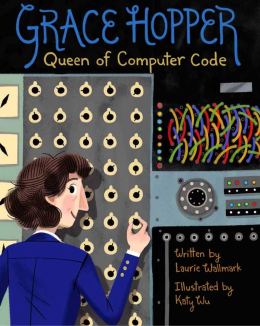
Grace Hopper: Queen of Computer Code

Written by Laurie Wallmark | Illustrated by Katy Wu


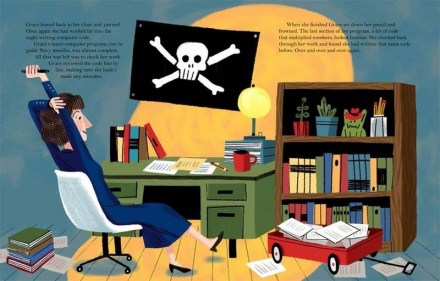
As Grace Hopper finished writing a computer code to guide Navy missiles, she noticed that there was a certain string of code that she had repeated many times. “Grace snorted. What a colossal waste of time! There had to be a better way. Why not make the computer do the work?” Grace figured out a way for the computer to store pieces of a program and then find them again to create another program. Grace was the first computer programmer to do this.

celebrate-picture-books-picture-book-review-grace-hopper-queen-of-computer-code-desk

Image copyright Katy Wu, 2017, text copyright Laurie Wallmark, 2017. Courtesy of Sterling Children’s Books.

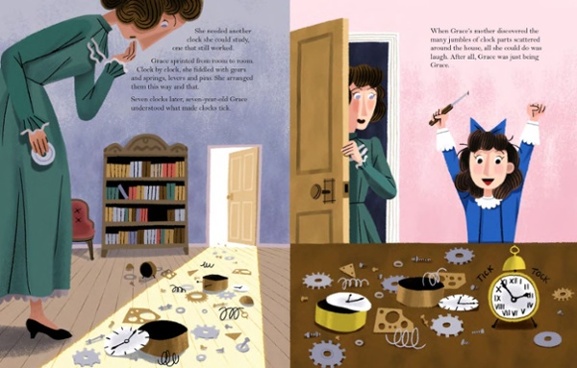
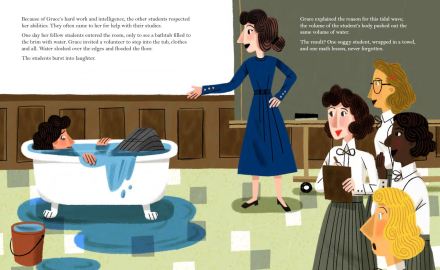
Even as a child Grace loved to tinker with mechanical things. She once opened all the clocks in the house to figure out how they worked. What did her mother say when she saw that? “…all she could do was laugh. After all, Grace was just being Grace.” Later, she built an electric elevator for her dollhouse. She reveled in difficult problems, and while the girls in her class “wore frilly dresses and learned to be young ladies, Grace studies math and science.”

Studying hard, Grace finished high school two years early, and while she had the grades in math and science to go to college, she failed Latin. Without passing Latin, she couldn’t go to college. Grace buckled down and the next year she was off to Vassar College. Grace passed up taking classes such as “Husbands and Wives” and “Motherhood” to take math and physics. But Grace did a lot more than just study. “Her personal motto was ‘Dare and Do,’ and she took it to heart. She flew in a barnstormer airplane.

celebrate-picture-books-picture-book-review-grace-hopper-queen-of-computer-code-clock

Image copyright Katy Wu, 2017, text copyright Laurie Wallmark, 2017. Courtesy of Sterling Children’s Books.

Grace went on to graduate school at Yale and then took a job teaching at Vassar. She knew how to make her classes fun and informative. At this time America was at war and needed mathematicians. She tried to join the Navy, but they told her she was too old and too thin. She kept asking, however, and after a year, the Navy agreed to let her join. She “was assigned to write programs for one of the first computers ever built, the Mark I. Only a few people had ever programmed before, so she had to learn how to do it on her own.”

celebrate-picture-books-picture-book-review-grace-hopper-queen-of-computer-code-bath

Image copyright Katy Wu, 2017, text copyright Laurie Wallmark, 2017. Courtesy of Sterling Children’s Books.

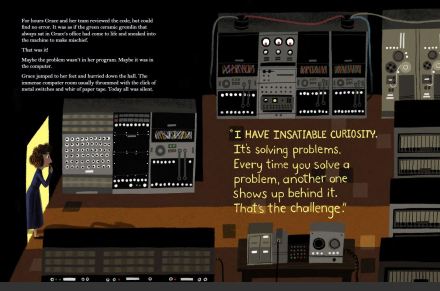
Then one day Grace learned that “the new computer, the Mark II, had stopped working.” Grace and her coworkers searched and searched for an error in the code, but they found none. Then Grace thought that maybe the problem wasn’t in the code but in the computer itself. They looked inside the huge machine for loose wires or electrical shorts. Nothing. Then they saw it—a moth had gotten inside and was blocking a switch.

celebrate-picture-books-picture-book-review-grace-hopper-queen-of-computer-code-computer

Image copyright Katy Wu, 2017, text copyright Laurie Wallmark, 2017. Courtesy of Sterling Children’s Books.

With a tweezer, a worker removed the moth and the computer started up again. Grace taped the moth into the log book and wrote, “‘First actual case of [a computer] bug being found,’” and the term “computer bug” was born. Grace also revolutionized programming when she “invented a program that let people use words to tell the computer what to do” instead of pages and pages of 1s and 0s.

When Grace turned sixty, the Navy made her retire. Within six months, they asked her to return and she worked for them for another twenty years. She retired again at the age of eighty as the Queen of Computer Code. As many people called her, she really was “Amazing Grace.”

A timeline of Grace Hopper’s life as well as a list of honors awarded her and resources for further reading about Grace and other women in STEM.

celebrate-picture-books-picture-book-review-grace-hopper-queen-of-computer-code-coil

Image copyright Katy Wu, 2017, text copyright Laurie Wallmark, 2017. Courtesy of Sterling Children’s Books.

Laurie Wallmark’s engaging biography of Grace Hopper will delight kids as they see her grow from a precocious and innovative child to a woman who used her intelligence and imagination to lead the computer revolution. Specific examples of Grace’s successes and the support she received at home will encourage other engineering-minded kids, and the inclusion of her failure in Latin demonstrates that everyone has areas of weakness that can be overcome with hard work. Grace’s perseverance in getting the Navy to accept her is also a good lesson for children on not giving up on their dreams. The provenance of the term “computer bug” will surprise and amuse readers.

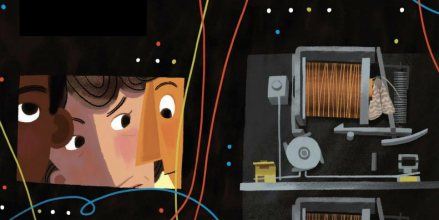
Katy Wu’s charming illustrations of events in Grace Hopper’s life take readers back to time when computers were new. Children will marvel over the size and design of early computers. Grace’s sense of adventure and humor are on display is colorful and action-packed images. Uplifting and encouraging sayings by Grace Hopper that will inspire children are sprinkled throughout the pages.

A book to motivate children to reach for their dreams and spark pride in individual accomplishment, Grace Hopper: Queen of Computer Code would be an influential book to add to home, school, and public libraries.

Ages 5 and up

Sterling Children’s Books, 2017 | ISBN 978-1454920007

Discover more about Laurie Wallmark and her books on her website.

To learn more about Katy Wu, her books, and her art on Tumblr.

Digital Learning Day Activity

celebrate-picture-books-picture-book-review-trendy-trending-word-search-puzzle

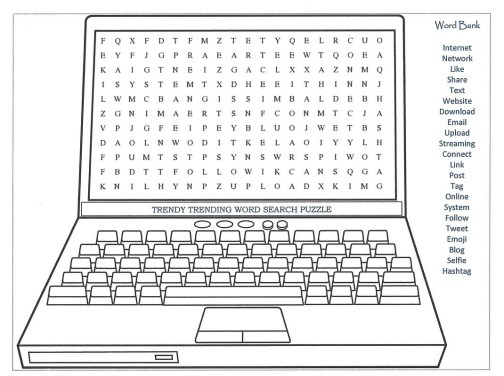
Trendy Trending Word Search Puzzle


Digital communication has a language all its own! Open this laptop and find the twenty-two Internet-based words in this printable word search puzzle.

Trendy Trending Word Search Puzzle and Solution

celebrate-picture-books-picture-book-review-grace-hopper-queen-of-computer-code-cover

You can find Grace Hopper: Queen of Computer Code at these booksellers

Amazon | Barnes & Noble | Books-a-Million | IndieBound

Picture Book Review
February 24 – National Tortilla Chip Day

celebrate-picture-books-picture-book-review-round-is-a-tortilla-a-book-of-shapes-cover-2

About the Holiday

If the tortilla-making machine had produced perfect rounds every time back in the 1950s, the world may never have known the crunchy deliciousness of tortilla chips. Back in the day, Rebecca Webb Carranza and her husband owned the El Zarape Tortilla Factory in Los Angeles, California and were one of the first to automate tortilla production. Instead of wasting the odd-shaped ones, Carranza cut them into triangles, fried them, and sold them in bags.They were a hit! People all over began enjoying them dipped in salsa and guacamole and smothering them in cheese. In 1994 Carranza was honored with the Golden Tortilla Award for her contributions to the Mexican food industry, and in 2003 Texas named the tortilla chip the official state snack!

Round is a Tortilla: A Book of Shapes

Written by Roseanne Greenfield Thong | Illustrated by John Parra


“Round are sombreros. / Round is the moon. / Round are the trumpets that blare out a tune. Round are tortillas and tacos too. / Round is a pot of abuela’s stew. / I can name more round things can you?” With wonderful, lyrical verses, Roseanne Thong introduces children to the shapes—circles, squares, triangles, rectangles, ovals, stars, and more—that make up their multicultural world.

celebrate-picture-books-picture-book-review-round-is-a-tortilla-squares

Image copyright John Parra, 2013, text copyright Roseanne Thong, 2013. Courtesy of Chronicle Books.

Here are round chiming campanas and nests full of swallows, square ventanas for peering through and clocks for telling time. Rectangles are cold paletas to eat on a hot summer day and the ice-cream carts that deliver them, and triangles make tasty quesadillas and gliding sailboats. Each verse ends with an invitation for kids to find more shapes around them—an invitation that’s hard to resist!

celebrate-picture-books-picture-book-review-round-is-a-tortilla-triangles

Image copyright John Parra, 2013, text copyright Roseanne Thong, 2013. Courtesy of Chronicle Books.

Rebecca Thong’s bright, fun-to-read verses shine with evocative words that create a concept book that goes beyond the introduction of shapes to celebrate the sights, sounds, and sensations that make up readers’ lives. Helping children find shapes in household objects, food, and other familiar places, makes them more aware of the math all around them. They will be excited to point out the squares, triangles, circles, and more that they encounter every day. Spanish words sprinkled throughout the story are defined following the text. 

celebrate-picture-books-picture-book-review-round-is-a-tortilla-star

Image copyright John Parra, 2013, text copyright Roseanne Thong, 2013. Courtesy of Chronicle Books.

John Parra’s beautiful folk-art illustrations, which are sure to put a smile on kids’ faces, immerse readers in the daily life of a Latino town. People dance, cook, play games, walk in the park, attend a festival, and more—all while surrounded by colorful shapes. Kids will love lingering over the pages to find all of the intricate details and may well want to learn more about what they see.

Round is a Tortilla is not only a book of shapes, it makes shapes exciting! The book is a wonderful stepping stone to discussions about early math concepts as well as the places, celebrations, symbols, and decorations found on each page. The book would be a welcome addition to any classroom or child’s bookshelf

Ages 3 – 6

Chronicle Books, San Francisco, 2013 | ISBN 978-1452106168 (Hardcover) | ISBN 978-1452145686 (Paperback)

Learn more about Roseanne Thong and her books for children and adults on her website!

View a gallery of books and artwork by John Parra on his website!

National Tortilla Chip Day Activity

CPB - Tortilla chips (2)

Homemade Baked Cinnamon Tortilla Chips


It’s easy to make these yummy tortilla chips at home! Why not invite your friends over and bake up a batch or two to enjoy while playing or reading together?

Ingredients

  • 2 10-inch flour tortillas
  • ¾ teaspoon cinnamon
  • 2 ½ tablespoons sugar
  • Butter

Directions

  1. Preheat oven to 350 degrees
  2. Combine the cinnamon and the sugar in a bowl
  3. Butter the tortillas
  4. Sprinkle the tortillas with the cinnamon sugar mixture
  5. Cut the tortillas into 8 pieces
  6. Place pieces on a baking sheet
  7. Bake in 350-degree oven for 12 – 15 minutes
  8. Chips will become crispier as they cool.

Makes 16 chips

celebrate-picture-books-picture-book-review-round-is-a-tortilla-a-book-of-shapes-cover-2

You can find Round is a Tortilla: A Book of Shapes at these booksellers

Amazon | Barnes & Noble | Books-a-Million | IndieBound

February 19 – It’s Bird-Feeding Month

celebrate-picture-books-picture-book-review-paddle-perch-climb-cover

About the Holiday

Have you been noticing more bird activity in your yard or neighborhood? Maybe you’ve been awakened by birdsong that you haven’t heard in many months. During February, as temperatures creep up, birds begin returning to their homes to nest and mate. But the effects of the long winter still make it hard for these little creatures to find enough to eat. Recognizing a need, John Porter created a Congressional resolution in 1994 recognizing February as National Bird-Feeding Month. One-third of Americans have backyard feeders that provide the sustenance birds need to survive when natural resources are scarce. To celebrate this month, if you have feeders make sure they are well stocked. If you don’t have a feeder in your yard, consider hanging one and enjoy the beauty and songs of the birds in your area. 

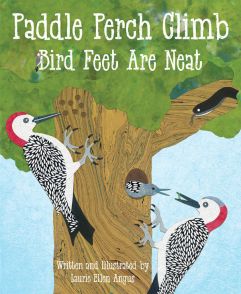
Paddle Perch Climb: Bird Feet Are Neat

By Laurie Ellen Angus


All birds get hungry, but not all birds eat the same thing, of course. Did you know that a bird’s feet are important in determining what they eat? Let’s find out how different kinds of feet help birds find the right food for them. “If you had webbing between your toes, you could… Paddle like a swan to dabble for pond plants.” Long legs and toes could help you “wade like a heron to sneak up on a school of fish.”

celebrate-picture-books-picture-book-review-paddle-perch-climb-heron

Copyright Laurie Ellen Angus, 2018, courtesy of Dawn Publications.

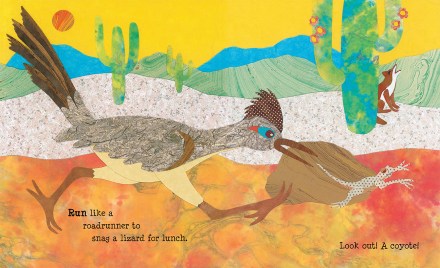
Birds who have long, strong legs can run and catch their dinner, and birds whose feet have sharp claws can climb tree trunks and hunt for insects in the bark. Birds with “small flexible toes” find their feet handy for perching on branches of trees and bushes to pick berries or—like towhees—to scratch in the dirt for bugs. There are also those birds that have “powerful feet with sharp talons” to snatch a meaty meal for themselves or their babies.

celebrate-picture-books-picture-book-review-paddle-perch-climb-roadrunner

Copyright Laurie Ellen Angus, 2018, courtesy of Dawn Publications.

There are many kinds of birds in the world, and each one has just the right kind of feet that help them move through their environment, find or catch food, and survive.

Extensive back matter that offers many opportunities to extend STEM learning in the classroom or at home includes

  • a detailed and illustrated exploration of each bird mentioned in the text, complete with a description of their feet and how they help the bird procure food. Kids will also enjoy learning the fun fact about each
  • A description of the bird that inspired the book
  • A discussion of adaptations, with a chart categorized with facts on habitat, feet, and beaks for seven birds and suggestions for a creative activity 
  • Common characteristics of birds
  • A discussion on predators
  • Bird-watching tips
  • More resources for further learning
celebrate-picture-books-picture-book-review-paddle-perch-climb-back-matter

Copyright Laurie Ellen Angus, 2018, courtesy of Dawn Publications.

In her engaging text, Laurie Ellen Angus takes kids out to the pond, desert, forest, and backyard to watch as a variety of birds catch or gather their dinner. Using evocative verbs, Angus reveals not only the action of getting a meal, but the way each bird goes about it—through stealth, quick motion, pecking, scratching, and more. Specific examples of bird/feet combinations give readers a starting point for further exploration. Each category also includes a partially hidden predator, such as a fox, bobcat, snake, and hawk, that the particular bird is warned about and which readers will want to join in pointing out.

celebrate-picture-books-picture-book-review-paddle-perch-climb-cardinals

Copyright Laurie Ellen Angus, 2018, courtesy of Dawn Publications.

Angus beautifully employs collage-style illustrations to give her birds and environments texture, color, and movement. Her use of various perspectives, lets readers wade into the pond with the heron, chase after the roadrunner that is trotting off the edge of page, cling to a tree trunk with a woodpecker, and come in for a landing with an owl. 

A visually stunning book, Paddle Perch Climb: Bird Feet Are Neat is a science book that will attract the attention of young learners and excite them to learn more about the wonders of the natural world.

Ages 4 – 8

Dawn Publications, 2018 | | ISBN 978-1584696131 (Hardcover) | ISBN 978-1584696148 (Paperback) 

To learn more about Laurie Ellen Angus, her books, and her art on her website.

Wild Bird Feeding Month Activity

celebrate-picture-books-picture-book-review-let's-go-birding-word-search

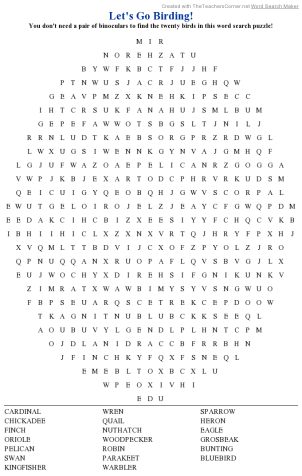
When you put up a bird feeder in your yard, you’ll see so many different types of birds come to visit! Find the names of twenty types of birds in this printable Let’s Go Birding! Word Search Puzzle.

Let’s Go Birding! Word Search Puzzle | Let’s Go Birding! Word Search Solution

celebrate-picture-books-picture-book-review-paddle-perch-climb-cover

You can find Paddle Perch Climb: Bird Feet Are Neat at these booksellers

Amazon | Barnes & Noble | Books-a-Million | IndieBound

Picture Book Review
February 7 – National Periodic Table Day

celebrate-picture-books-picture-book-review-Marie-Curie-little-people-big-dreams-cover

About the Holiday

Today’s holiday was established in 2016 by David T. Steineker, an author, inventor, and – as you might imagine – chemistry teacher at Jefferson County Public Schools in Kentucky. He devised the holiday to honor the work of categorizing the elements begun by John Newlands, who published the first periodic table on February 7, 1863, and continued into the early 20th century as new elements were discovered. While the modern periodic table has undergone few changes since then, new discoveries and different ways of approaching the table may bring fresh changes in the years to come.

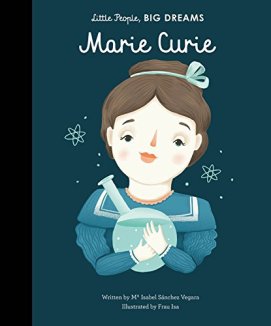
Marie Curie (Little People, Big Dreams)

Marie: My First Marie Curie (Board Book)

Written by Isabel Sánchez Vegara | Illustrated by Frau Isa


From the time when Marie was a little girl, she knew she wanted to be a scientist. Marie was very smart. “At school, she won a gold medal for her studies, which she kept in her drawer like a treasure.” Because women were not allowed to go to college in her country, she moved to France to go to the university there. Even though French was not her first language, Marie was soon the top math and science student in Paris.

celebrate-picture-books-picture-book-review-Marie-Curie-little-people-big-dreams-dreaming

Copyright Frau Isa, 2018, courtesy of Frances Lincoln Children’s Books.

One day Marie met Pierre, who loved science as much as she did. They got married and worked together in their own laboratory, where they discovered radium and polonium. “It was such a thrilling moment for science!” Marie and Pierre even won the Nobel Prize. Marie was the first woman ever to be awarded this honor. When Pierre later had an accident, Marie was left alone to continue their work.

celebrate-picture-books-picture-book-review-Marie-Curie-little-people-big-dreams-marie-and-pierre

Copyright Frau Isa, 2018, courtesy of Frances Lincoln Children’s Books.

All her research and experiments paid off when she was awarded her second Nobel Prize. When war broke out, “Marie’s discoveries were used by doctors to help injured soldiers.” Marie inspired many girls who studied science at her own institute in Paris. Besides science, Marie taught her students that there was nothing to fear, “many things to learn, and many ways to help those in need.”

A timeline and brief, yet detailed biography of her life follows the story.

celebrate-picture-books-picture-book-review-Marie-Curie-little-people-big-dreams-marie-with-noble-prize

Copyright Frau Isa, 2018, courtesy of Frances Lincoln Children’s Books.

With thrilling recognition that even in the youngest hearts beat future writers, artists, adventurers, designers, and scientists, the Little People, Big Dreams series introduces preschoolers to inspiring women role models. In Marie Curie: Little People, Big Dreams, Isabel Sánchez Vegara reveals the life and work of Marie Curie with straightforward storytelling that illuminates while affirming the intelligence of her young audience. Uplifting, life-determining personality traits that carried Marie over obstacles and to the top of her profession—such as not taking no for an answer, treasuring your accomplishments, working hard, and helping others—are highlighted for little ones to learn from.

Frau Isa’s stylish illustrations in a striking, subdued color palette will entice the youngest readers to listen and learn. While the spotlight is always on Marie, each page also focuses on one or two main images, such as Marie and Pierre’s lab table, a wounded soldier’s X-ray, and Marie holding her Nobel Prize, that help little ones see and understand the important aspects of the story.

Encapsulating both history and the timeless persistence that drives people to achieve their full potential, Marie Curie—available in both picture book and board book editions—is a must for preschool classrooms and would be a rousing addition to home bookshelves.

Ages 3 – 5

Frances Lincoln Children’s Books, 2018 | ISBN 978-1847809629 (Picture Book); 978-1786032539 (Board Book)

You can check out more about Isabel Sánchez Vegara on Instagram.

Discover more about Frau Isa and her art on her website.

National Periodic Table Day Activity

celebrate-picture-books-picture-book-review-green=pennies-experiment

Green Pennies Chemistry Experiment


You know what color pennies are! They’re those brownish coins amid all the silver. But what if you could turn those pennies green—like dollar bills? You can with this easy and way cool chemistry experiment!

Supplies

  • 10 – 12 dull pennies
  • Vinegar
  • Lemon juice
  • Salt
  • 2 small bowls
  • ¼ cup measuring cup
  • 1 teaspoon
  • Paper towels

Directions

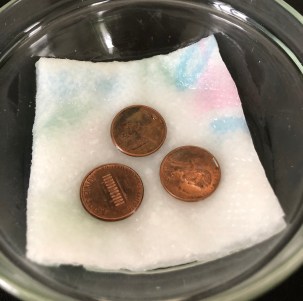
IMG_6569

Experiment 1

  1. Pour ¼ cup vinegar into a bowl
  2. Add 1 teaspoon salt
  3. Mix thoroughly until salt has dissolved
  4. Place a few pennies in the bowl and leave for five minutes.
  5. Take the pennies out and place them on the paper towel.
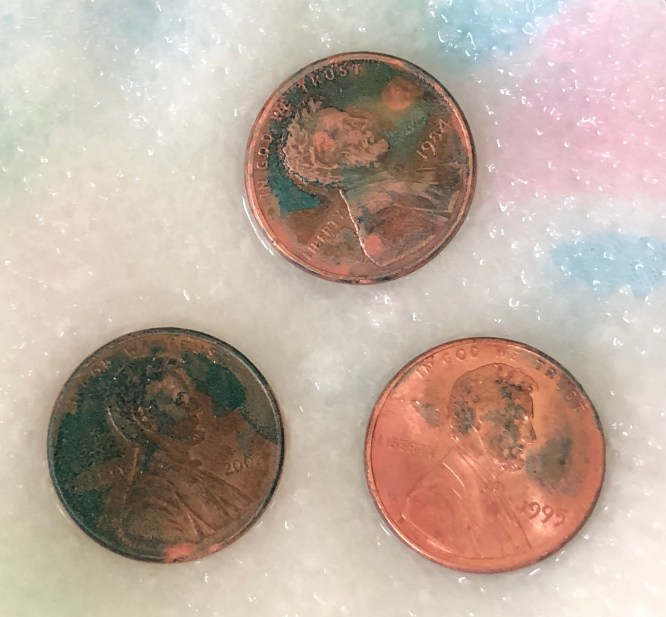
  6. Let the pennies dry and watch what happens. The reaction becomes more dramatic over time, so check on your pennies at different times throughout the day

Extra Observation:

  1. To see the chemical reaction at work, dip one penny half way into the vinegar/salt solution and wait a minute
  2. Lift the penny out of the solution and see the result

IMG_6588

Experiment 2

  1. Fold a paper towel to several thicknesses and place in bowl
  2. Place a few pennies on top of the paper towel
  3. Pour enough vinegar over the pennies to saturate the paper towel
  4. Wait two to three hours and see what happens
  5. You can leave the pennies in the bowl and continue to add vinegar as the paper towel dries. Flip the pennies over to create a chemical reaction on both sides

IMG_6590

Experiment with other acids, such as the lemon juice.

Why do the pennies turn green?

Pennies are made of copper. The vinegar and salt solution helps the copper react with oxygen in the air to form the blue-green patina of malachite on the surface of the penny. This chemical reaction is called oxidation. You can see the same green color on other things made of copper like plumbing pipes and many statues—even the Statue of Liberty!

If you’d like to record your observations of your pennies like a chemist does, download and print this lab sheet.

celebrate-picture-books-picture-book-review-Marie-Curie-little-people-big-dreams-cover

You can find Marie Curie (Little People, Big Dreams) at these booksellers

Amazon | Barnes & Noble | Books-a-Million | IndieBound

You can find the board book edition, Marie: My First Marie Curie here

Amazon | Barnes & Noble | Books-a-Million | IndieBound

YouPicture Book Review