November 8 – National STEM/STEAM Day

celebrate-picture-books-picture-book-review-santiago-saw-things-differently-cover

About the Holiday

November 8th is National STEM/STEAM Day. This holiday was founded in 2015, and the date was partially chosen for its secret play on words: “NOV 8” can be read as (in)novate! On this day, we highlight the importance of science, technology, engineering, art, and math in education and society at large. This holiday is also meant to uplift voices and perspectives that are often given less representation in STEAM careers and fields of study.

On this National STEM/STEAM Day we review a biography of Santiago Ramón y Cajal, Father of Neuroscience. Despite many people discouraging him along his journey Ramón y Cajal found ways to merge his love for art and observation with his scientific background to create new and important discoveries. 

Reviewed by Dorothy Levine

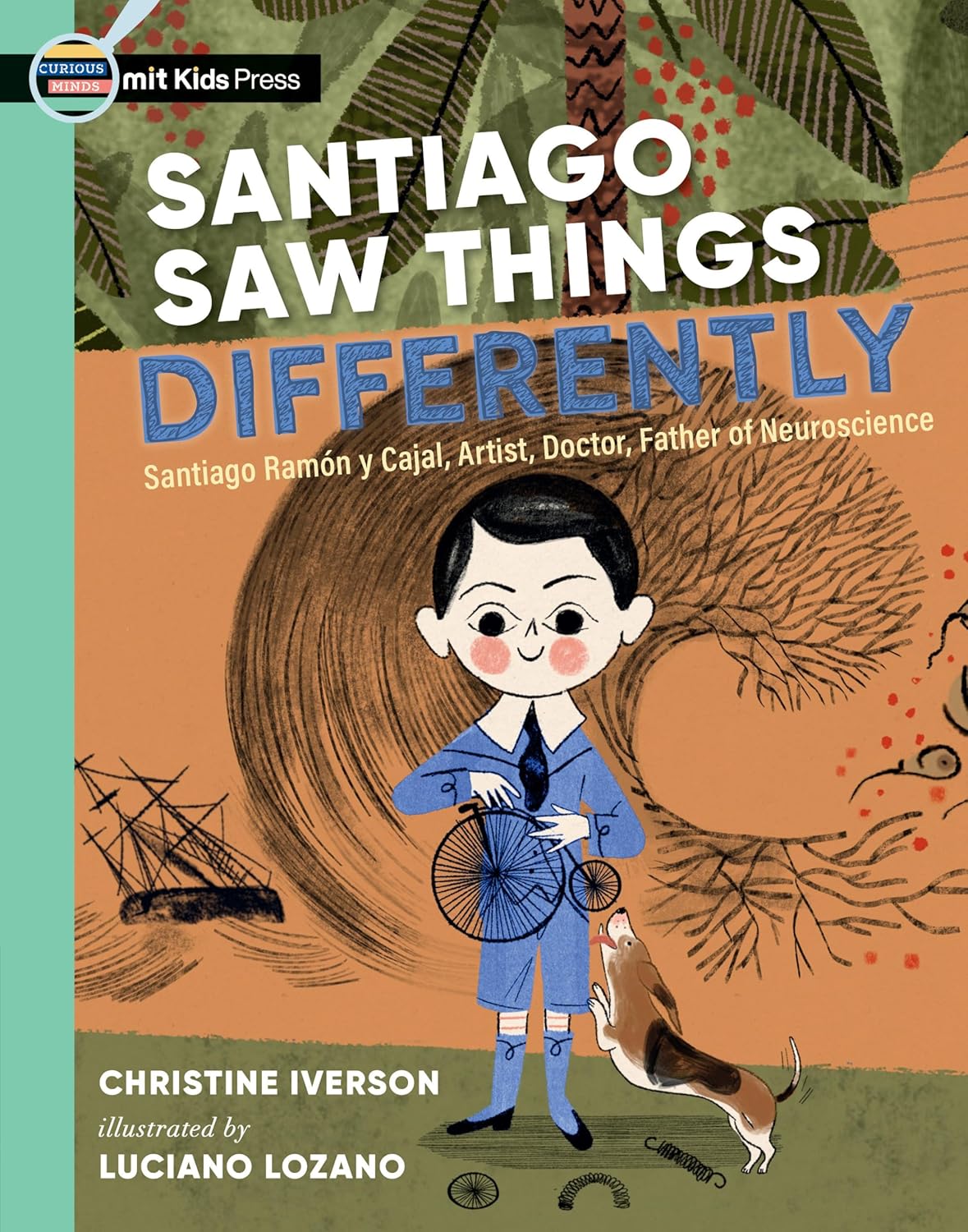
Santiago Saw Things Differently: Santiago Ramón y Cajal, Artist, Doctor, Father of Neuroscience

Written by Christine Iverson | Illustrated by Luciano Lozano


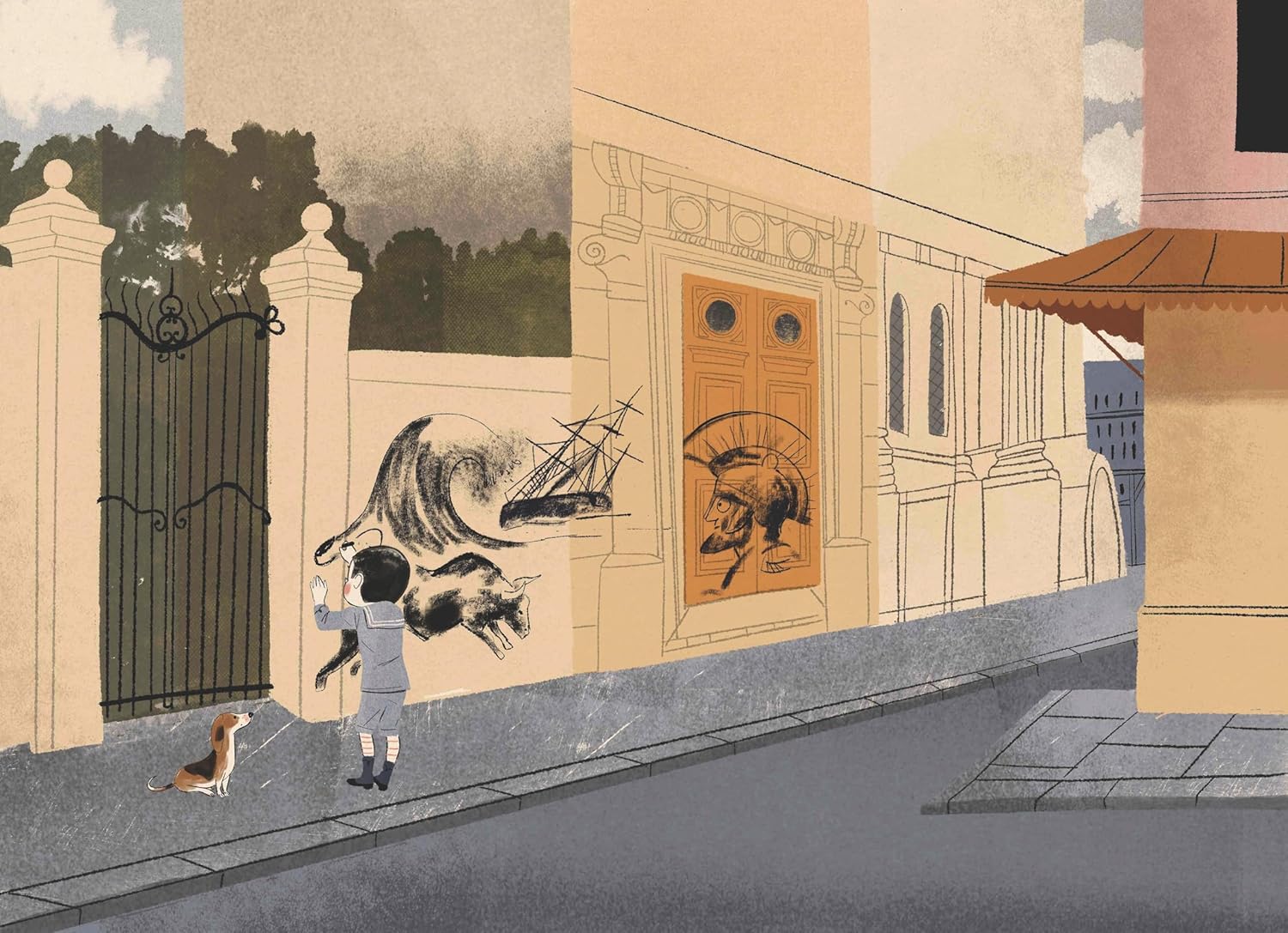
Santiago always had a passion for creating and exploring. As a child in Spain, he spent time creating music and inventing toys with any scraps he could find, drawing elaborate charcoal scenes across neighbors’ walls and racing around his grandfather’s loom shop. There, as “he twirled and tangled woolen thread…. Dust sparked and soared in a kaleidoscope of motion.” Unfortunately, not everybody understood the magic of his creations. Neighbors, and particularly Santiago’s father, believed Santiago’s public displays of art were more bothersome than intriguing. 

celebrate-picture-books-picture-book-review-santiago-saw-things-differently-drawing-on-wall

Image copyright Luciano Lozano, 2024, text copyright Christine Iverson, 2024. Courtesy of MIT Kids Press.

As Santiago’s father ushered him through many different schools, aiming to leave room for no “distractions” from study, Santiago held on to his artistic practice and passion for exploring the natural world in secret. When once admonished for drawing on the margins of his paper, Santiago was forced to spend time in his school’s dark basement. But, in a stroke of luck, “The room was lit by a wisp of light leaking through an old shutter—just enough for drawing.” Another time, stuck in a classroom with no paper, Santiago used his pencil to unlock the door. 

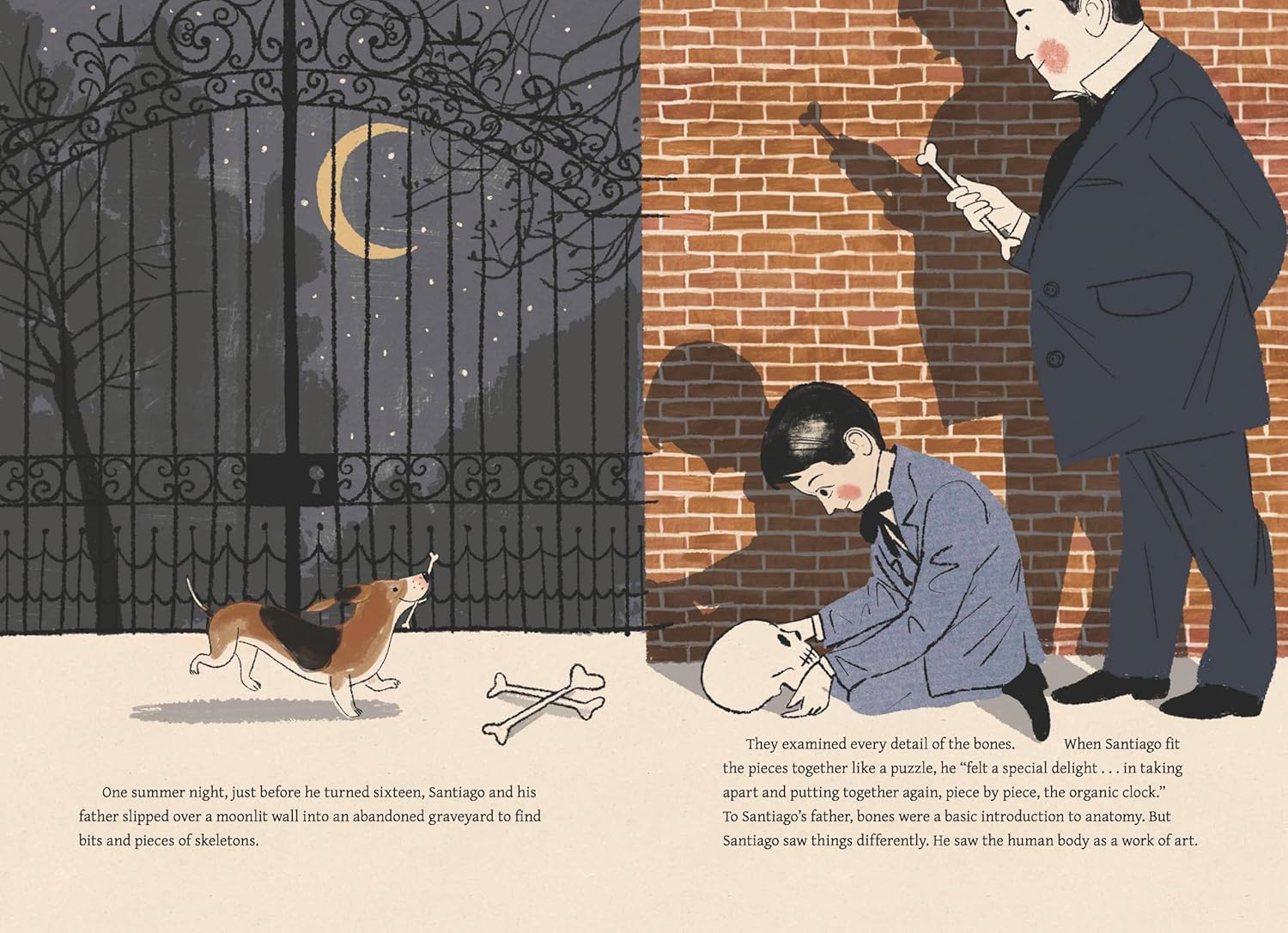
As he grew up, Santiago developed a specific fascination for the human body. At medical school, Santiago observed the way blood vessels in our bodies mirror the canals of the Ebro River near his university. “He saw the human body as a work of art,” a work that replicates in nature and is connected more broadly to the world at large.

celebrate-picture-books-picture-book-review-santiago-saw-things-differently-graveyard

Image copyright Luciano Lozano, 2024, text copyright Christine Iverson, 2024. Courtesy of MIT Kids Press.

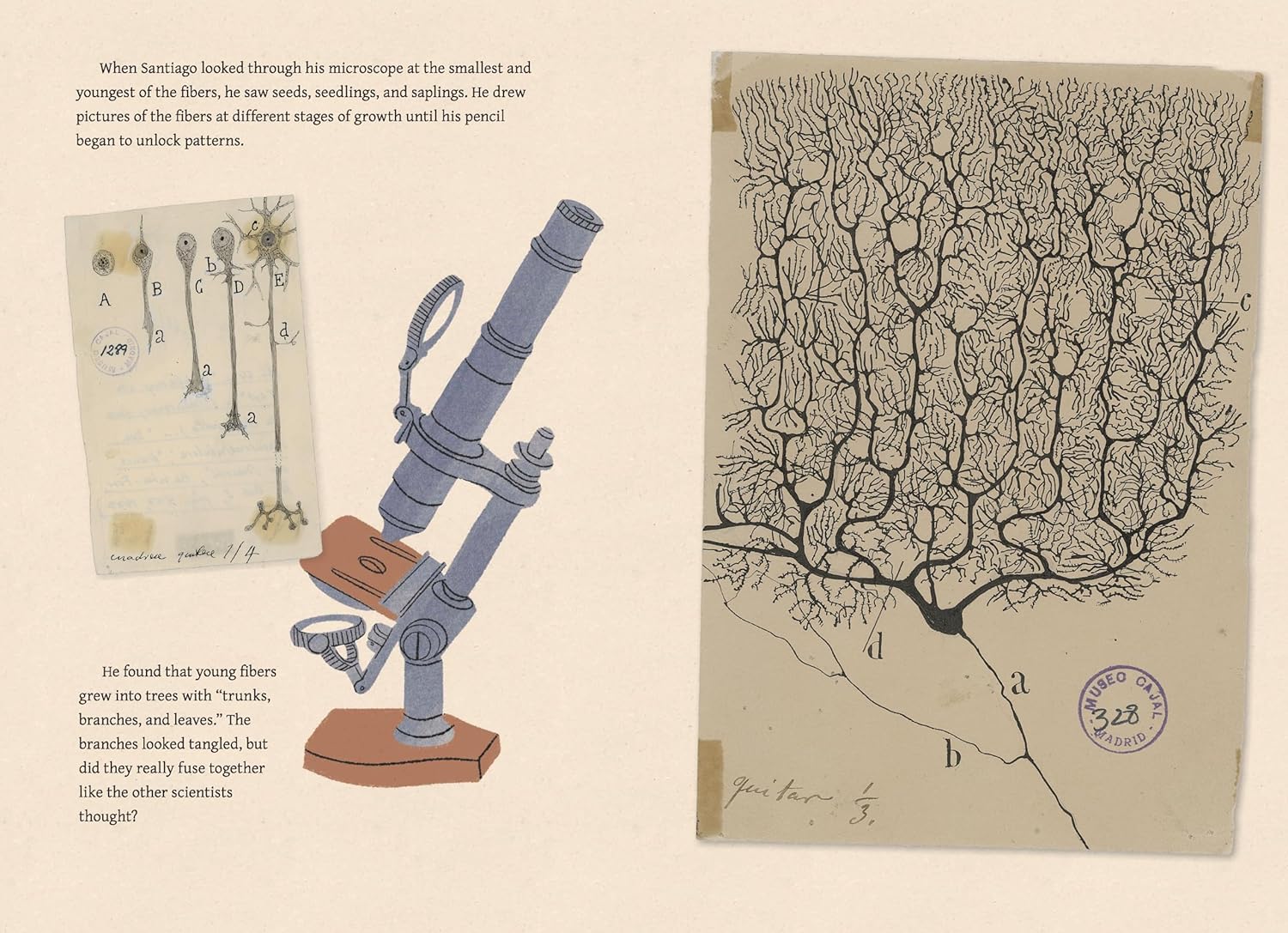
Years later, when scientists were focused on working out how the tiny connectors (or nerve fibers) in our brains worked, Santiago was able to use his microscope and drawing skills to sort out that the fibers spread in a similar fashion to the young trees he had spent so much of his time drawing and observing. With the help of ink stains, study, and lots of drawings of his observations, Santiago drew new conclusions about neurons and cells that helped scientists across the globe to understand the human brain better. 

All because “Santiago saw things differently” he was able to unlock new ways of understanding the brain, gaining him a Nobel prize and the eventual title of the Father of Neuroscience. 

celebrate-picture-books-picture-book-review-santiago-saw-things-differently-microscope-view

Image copyright Luciano Lozano, 2024, text copyright Christine Iverson, 2024. Courtesy of MIT Kids Press.

Iverson writes a detailed lyrical account of the life of Santiago Ramón y Cajal that is accessible for a wide range of readers. For interested older audiences, the book includes extensive back matter on the Anatomy of a Neuron, more biographical information on Santiago Ramón y Cajal and an explanation of the science behind one scene in the story. 

Interwoven with quotes and images from Ramón y Cajal’s original works are Lozano’s masterful swirling illustrations of Santiago and his environment as they both grow and change. Throughout the story, Lozano inserts details for readers to observe and make their own discoveries, such as the dog who follows Santiago throughout his childhood. Lozano illustrates the story mainly in blushing pinks, sky blues and light-yellow browns with accented vibrant greens and darker colors signifying location changes and key turning points in the story. There is a subtle humor helping to lighten the darker parts of Santiago’s life. The tale closes with the image of Santiago face-to-face with a cartoon-like human skeleton (filled with neurons) smiling back at him.

Santiago Sees Things Differently is a celebratory account of innovation, perseverance and appreciation for the often-interdisciplinary nature of outside-of-the-box thinkers. The title page opens with a poignant quote from Santiago Ramón y Cajal himself, encouraging “young investigators” to keep exploring the vast unknown of the natural world and to remember that what is left undiscovered is always larger than what has been already found. Santiago Sees Things Differently provides readers with the empowering knowledge that new perspectives are necessary for new discovery. And that while difference is often looked down upon, it is, often, in fact a superpower. 

(This book is available in both Spanish and English versions)

Ages 5 – 9

MIT Kids Press, 2024 | ISBN 978-1536238334

About the Author

Christine Iverson is a physical therapist with a strong interest in neural pathways. She holds a BS in history from the United States Military Academy at West Point, a doctoral degree in physical therapy from Baylor University, and an M.Ed. with a focus in children’s literature from Pennsylvania State University. She lives in Alexandria, Virginia. Visit her at christineiversonwrites. com.

About the Illustrator

Luciano Lozano is a Spanish author, illustrator, and graphic artist. He is the creator of several picture books, including Mayhem at the Museum: A Book in Pictures, and the illustrator of many others, including I (Don’t) Like Snakes by Nicola Davies. He lives in Spain. Visit him at lucianolozano.com.

STEM/STEAM Day Activities

celebrate-picture-books-brain-coloring-page


Neuroscience Coloring Pages

Follow Santiago’s footsteps by coloring pictures of different parts of the brain and scientific tools used in the story with these coloring pages from the University of Washington. You’ll also find brain games, plus loads of printable puzzles, worksheets, bookmarks, and even treasure hunts here too! (Coloring pages available in English and Spanish!)


Build a Hands-on Model of a Neuron

Have fun and learn about neurons by making a model! You can use almost any kind of material you like—clay, perler beads, bread dough, or even candy—to make it. So put on your thinking cap and get creative! You’ll find lots of ideas on this page from The University of Washington’s Neuroscience for Kids Page.

celebrate-picture-books-picture-book-review-santiago-saw-things-differently-cover

You can purchase Santiago Saw Things Differently at these booksellers

Amazon | Barnes & Noble | Bookshop (to support your local independent bookstore)

November 1 – National Author’s Day

celebrate-picture-books-picture-book-review-as-edward-imagined-cover

About the Holiday

Today’s holiday was instituted in 1928 by Nellie Verne Burt McPherson, president of the Bement, Illinois Women’s Club. An avid reader, she established Author’s Day to thank writer Irving Bacheller—author of 31 novels and founder of the first modern newspaper syndicate—who sent her an autographed story in response to her fan letter. The day was officially recognized in 1949 by the United States Department of Commerce. McPherson’s granddaughter, Sue Cole, promoted the holiday after Nellie’s death in 1968. To celebrate, people are encouraged to write a note of appreciation to their favorite author.

Thank you to Knopf Books for Young Readers and Barbara Fisch of Blue Slip Press for sharing a copy of As Edward Imagined with me for review consideration. All opinions on the book are my own.

As Edward Imagined: A Story of Edward Gorey in Three Acts

Written by Matthew Burgess | Illustrated by Marc Majewski


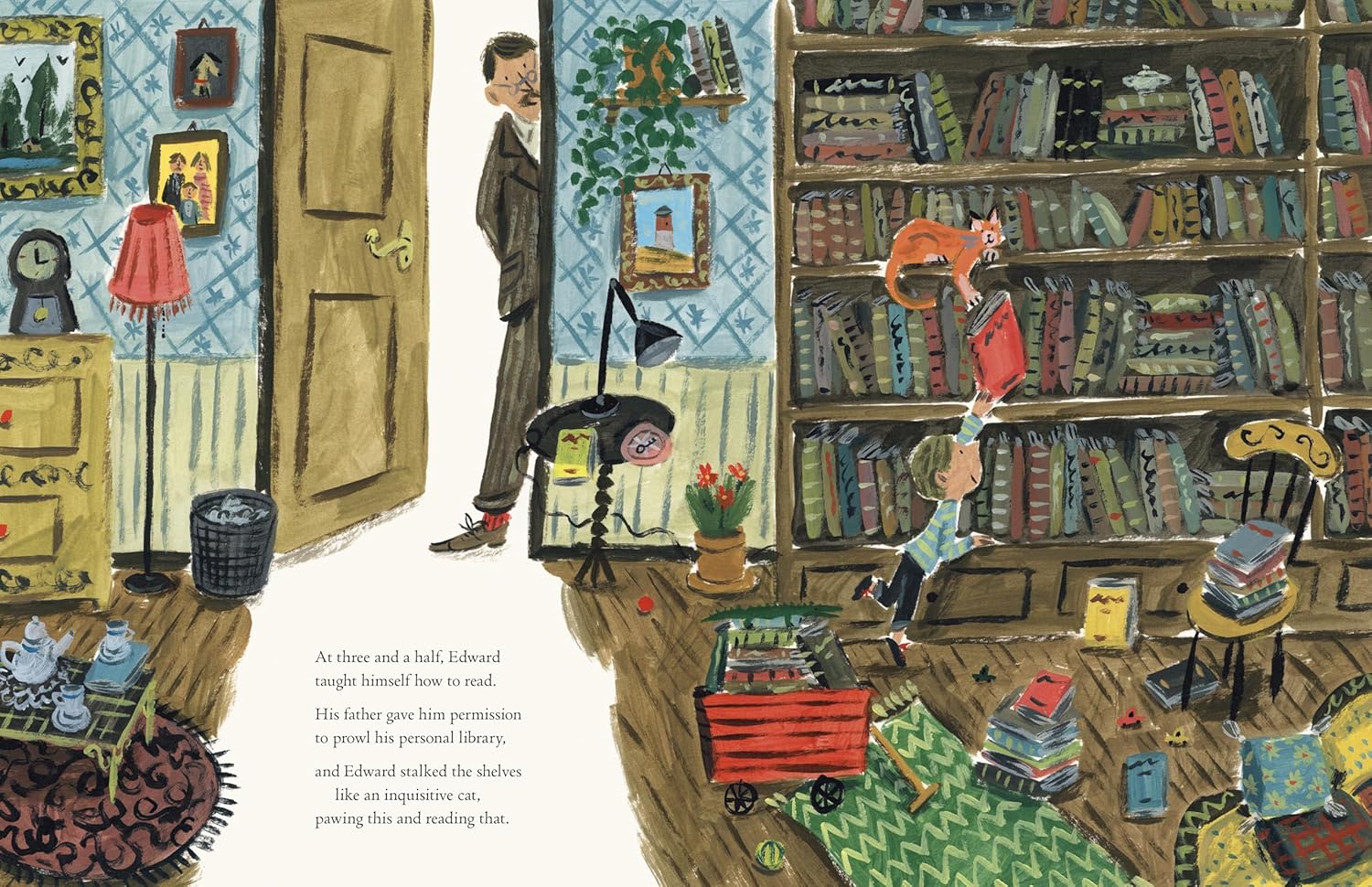
Edward Gorey’s artistic life began early—very early—and built on itself, bit-by-bit, experience-by-experience just like a play, and so it is fitting that Matthew Burgess’s biography is divided into three acts. In Act One readers meet Edward Gorey as a precocious preschooler, creating his first drawing at a year and a half and learning to read at three and a half.

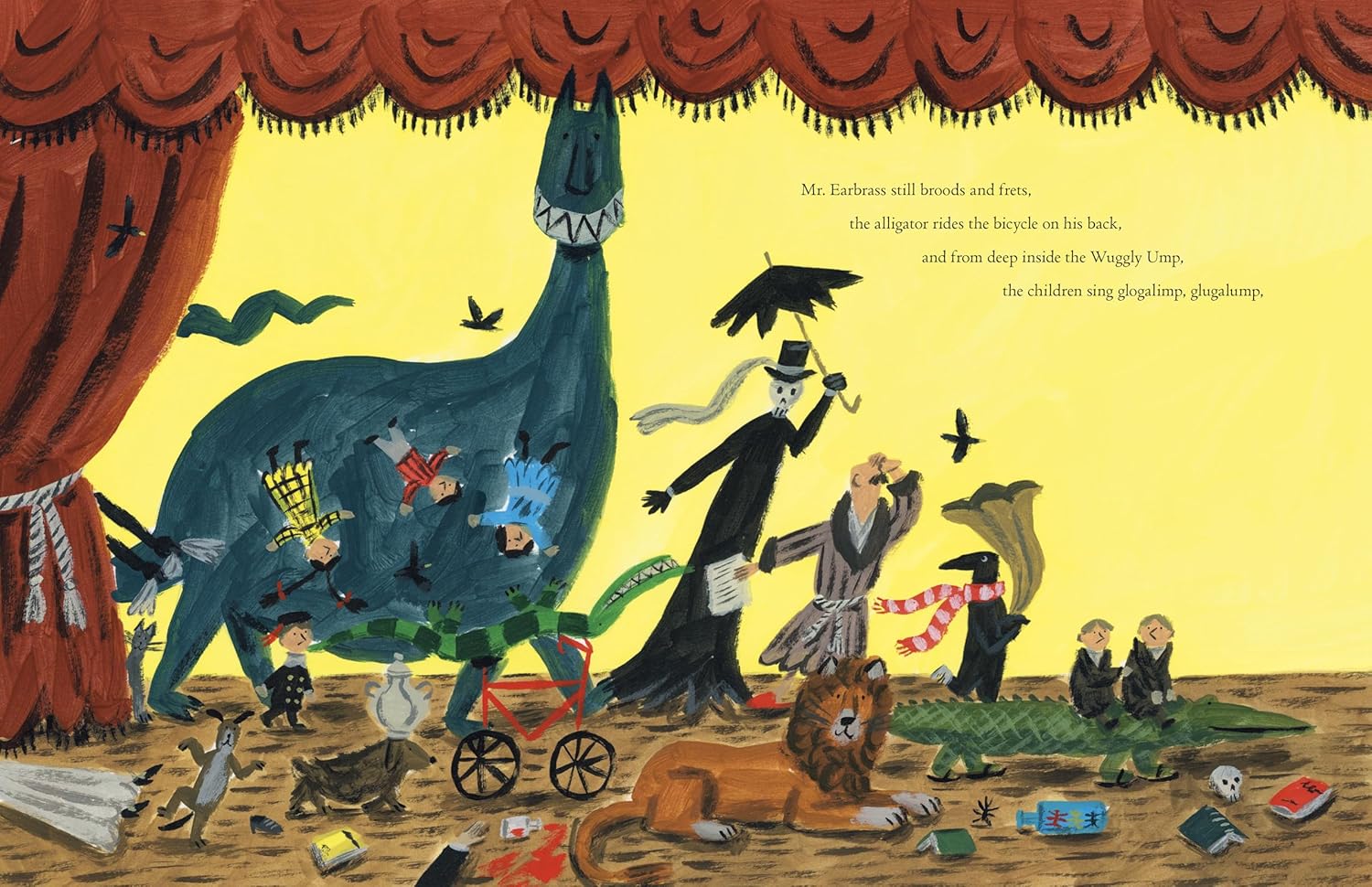
As a voracious reader, he devoured books from his father’s library, including Dracula before he was six. It didn’t take long before he was writing and illustrating his own stories. One was “titled ‘Hand of Doom,’ in which a skeleton’s fingers crept from page to page.” But Edward didn’t consign his “delightfully peculiar” personality to the page, “he [dared] to live the life he imagined.”

celebrate-picture-books-picture-book-review-as-edward-imagined-fathers-library

Image copyright Marc Majewski, 2024, text copyright Matthew Burgess, 2024. Courtesy of Knopf Books for Young Readers.

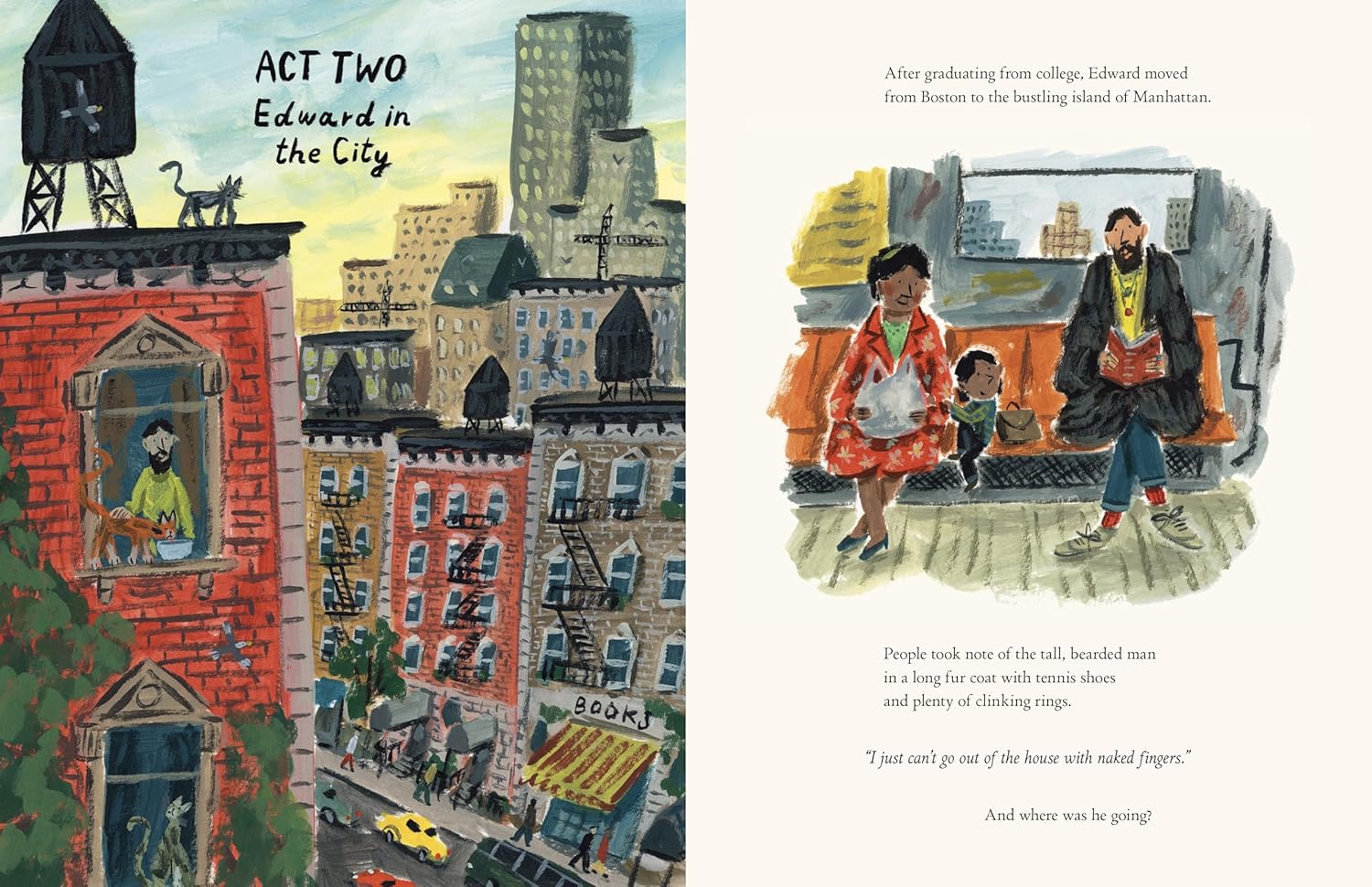
In Act Two, Edward has graduated from college and is living in New York, where he took the subway to attend nearly every performance of the New York City Ballet, dressed in his singular look: a fur coat, tennis shoes, and “plenty of clinking rings.” While working as a book illustrator, he also wrote, illustrated, and published his own stories, and little by little people began to take notice of “his stylish drawings, his outlandish poetry, and his deliciously sinister sense of humor.”

This popularity earned him an invitation to design the costumes and sets for a Broadway production of that classic he had read long ago—Dracula. The play was a smash, and Edward was nominated for Tony awards. Eschewing the limelight, however, Edward watched the ceremony and his own win from the comfort of his home and surrounded by his six beloved cats.

celebrate-picture-books-picture-book-review-as-edward-imagined-city

Image copyright Marc Majewski, 2024, text copyright Matthew Burgess, 2024. Courtesy of Knopf Books for Young Readers.

His success on Broadway brings readers to Act Three, and his purchase of an old captain’s house on Cape Cod, Massachusetts, drew, wrote, and collected. “Teddy bears, sea stones, skeletons of all sizes and shapes, and books by the thousands” became his companions and his inspirations. He also worked with local actors to bring his original plays to theaters. Here, Edward was happy living “his life precisely as he wished.” For readers today, he lives on in his one-of-a-kind characters and inimitable stories. 

Back matter includes an Author’s Note, a Bibliography, a photograph of Edward Gorey and one of his cats, and a Chronology of his life that fleshes out experiences from his childhood, during which he once owned a baby alligator, to his higher education and military service to his publishing career and animations for PBS’s Mystery! series to his time living on Cape Cod.

celebrate-picture-books-picture-book-review-as-edward-imagined-mr-earbrass

Image copyright Marc Majewski, 2024, text copyright Matthew Burgess, 2024. Courtesy of Knopf Books for Young Readers.

Matthew Burgess’s charming storytelling highlights the quirky ingenuity of Edward Gorey’s stories, plays, and illustrations. Cleverly divided into three acts, his biography emphasizes how Edward remained true to himself throughout his life, finding jobs that complimented his skills and pastimes that fed his imagination. Inspirational and celebrating the individual, Burgess’s breezy and uplifting text will engage children and encourage them to listen to and stay true to their own unique voice.

Marc Majewski’s enchanting and atmospheric illustrations will captivate readers with their combination of realism and whimsy that give them a tour through Edward Gorey’s childhood home, New York City haunts, Dracula sets, and Cape Cod comfort. Kids and adults alike will enjoy dawdling over each page to discover the themes of and influences on Edward’s life as well as his eccentric decor and characters and, of course, to point out all the cats.

A fabulous introduction to a truly unique talent and individual, As Edward Imagined: A Story of Edward Gorey in Three Acts will not only fascinate kids but also spark their creativity and an appreciation for the happiness that comes from following their own path. The book would be an often-asked-for favorite on home bookshelves and for public libraries and offers many applications for school libraries and creative arts programs. Pair with readings of Edward Gorey’s books to acquaint young readers with his endearing characters.

Ages 4 – 8

Knopf Books for Young Readers, 2024 | ISBN 978-1984893802

About the Author

Matthew Burgess is the author of Enormous Smallness: A Story of E. E. Cummings, and The Unbudgeable Curmudgeon. He has been a poet-in-residence in New York City elementary schools through the Teachers & Writers Collaborative since 2001. His work has appeared in various magazines and journals, and he recently received an award from the Fund for Poetry. He teaches creative writing and composition at Brooklyn College and lives in Brooklyn, New York. Visit Matthew at matthewjohnburgess.com.

About the Illustrator

Marc Majewski is a French author-illustrator based in Berlin. After obtaining a degree in literature and arts, he studied illustration and painting for two years. His picture books include, Does Earth Feel?, and Butterfly Child. Visit Marc at marc-majewski.com.

National Author’s Day Activity

celebrate-picture-books-picture-book-review-the-doubtful-guest-cover

Watch The Doubtful Guest by Edward Gorey

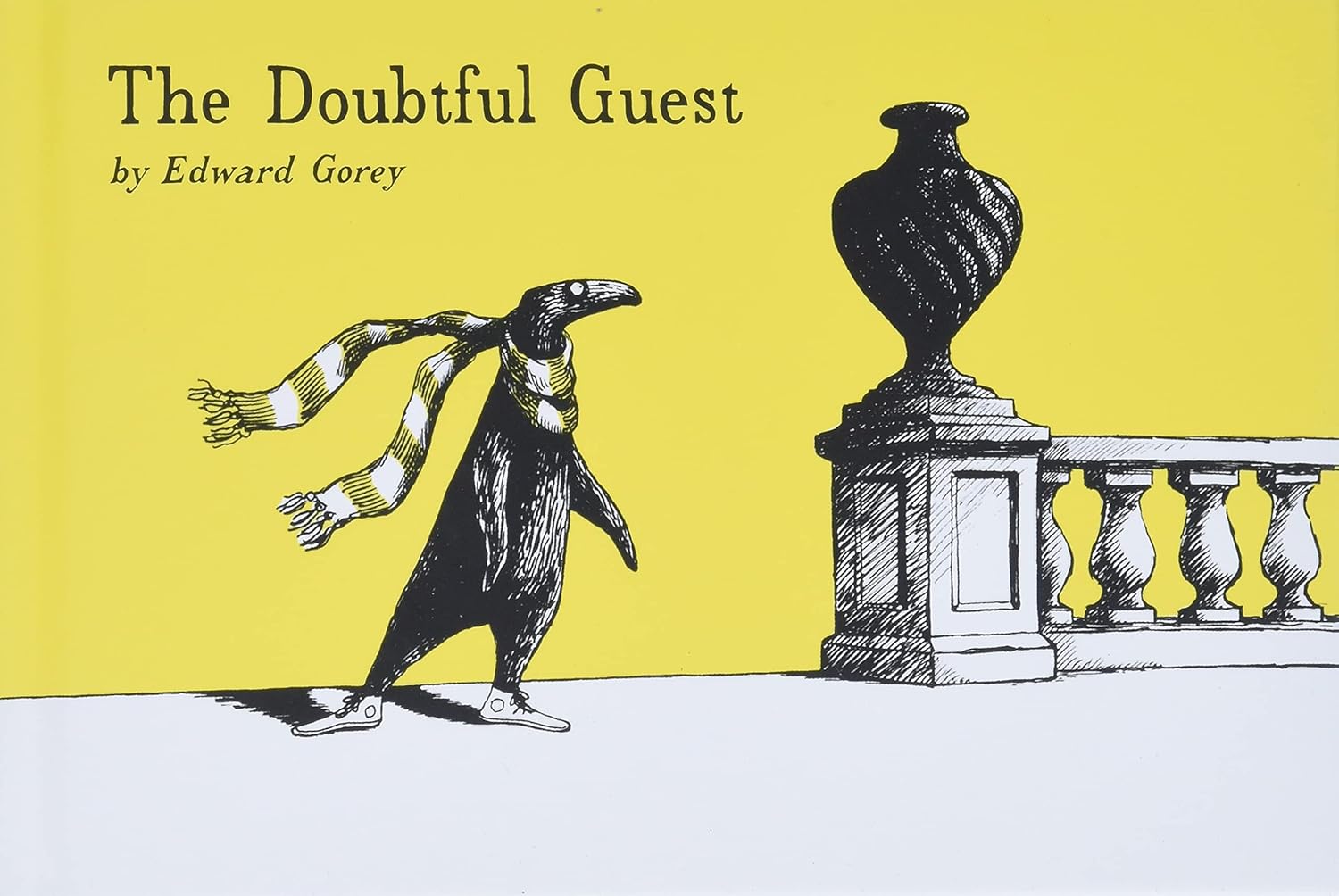
To celebrate today’s holiday listen to this reading of Edward Gorey’s The Doubtful Guest, a short, eccentric and slightly eerie tale of an uninvited guest. Then check out your local library for more books by Edward Gorey. 

celebrate-picture-books-picture-book-review-as-edward-imagined-cover

You can purchase As Edward Imagined: A Story of Edward Gorey in Three Acts at these booksellers

Amazon | Barnes & Noble | Bookshop (to support your local independent bookstore)

Picture Book Review

May 18 – It’s National Family Month

celebrate-picture-books-picture-book-review-Arletis-Abuelo-and-the-Message-in-a-Bottle-cover

About the Holiday

Established by KidsPeace, a private, not-for-profit organization dedicated to helping children and families since 1882, National Family Month is observed during the five-week period between Mother’s Day in May and Father’s Day in June. It coincides with the usual end of the school year, and raises awareness of the important role mothers and fathers as well as grandparents and extended family play as a support system for their children. To observe the holiday spend time talking with your kids about topics of importance to them and plan activities for fun and to help them achieve their goals.  

Thank you to Star Bright Books for sharing a copy of Arletis, Abuel, and the Message in a Bottle for review consideration. All opinions on the book are my own.

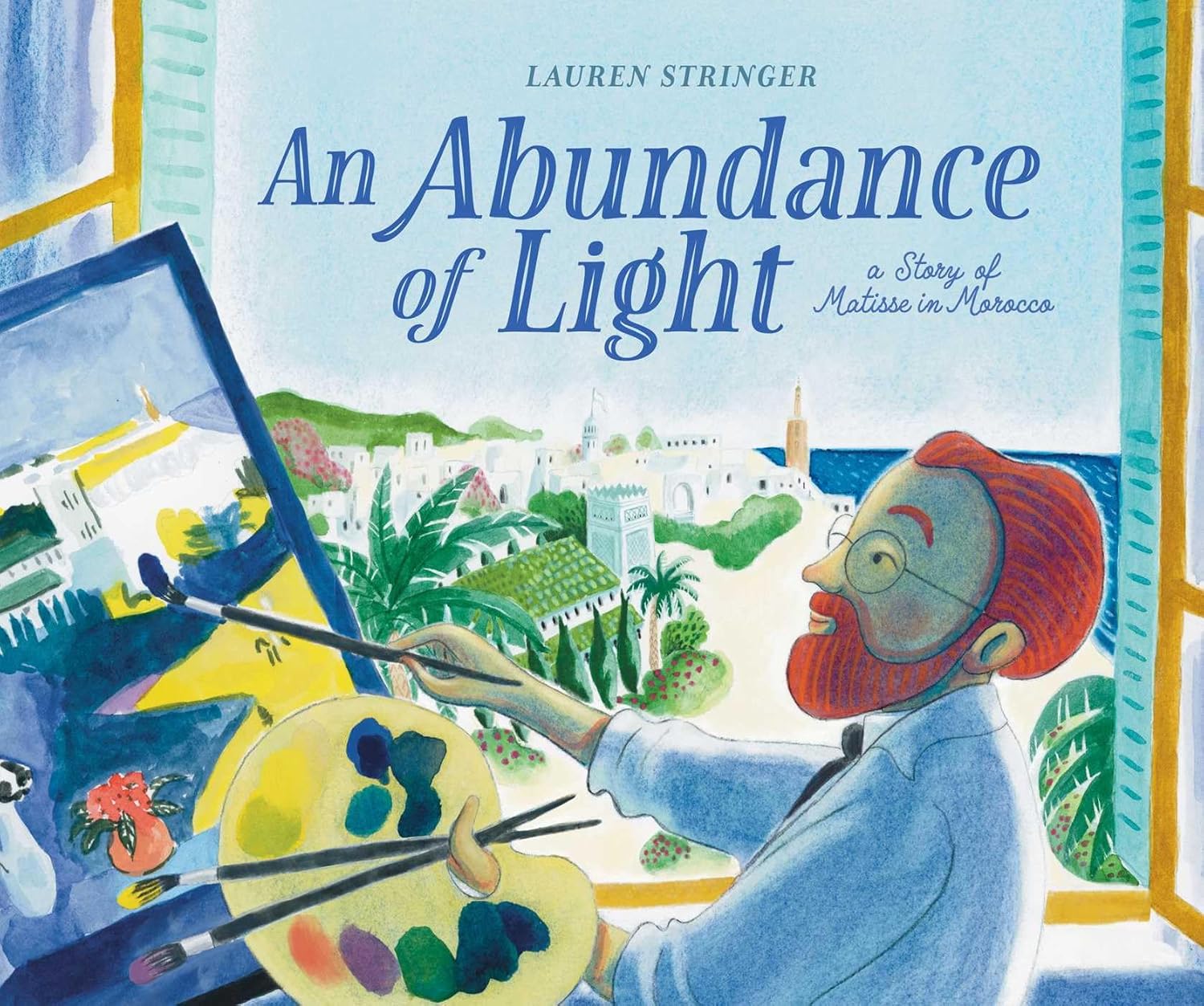
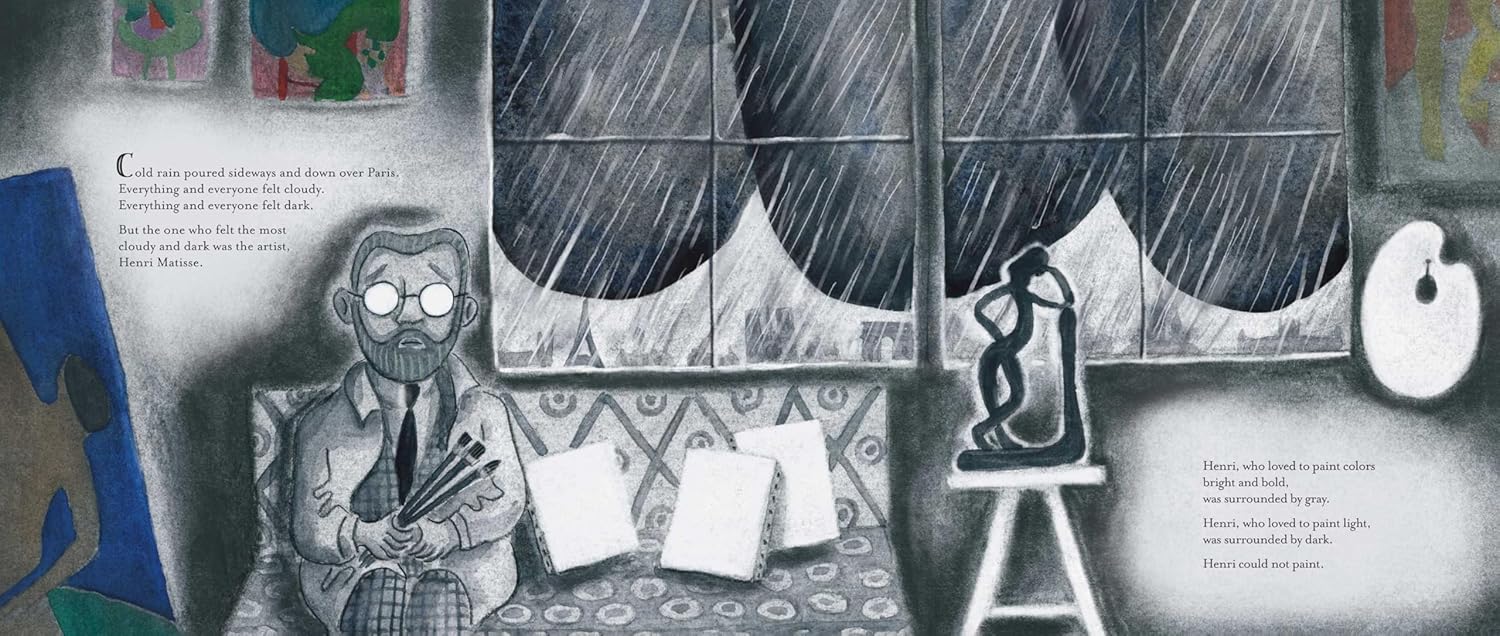
Arletis, Abuelo, and the Message in a Bottle

Written by Lea Aschkenas | Illustrated by Cornelius Van Wright and Ying-Hwa Hu


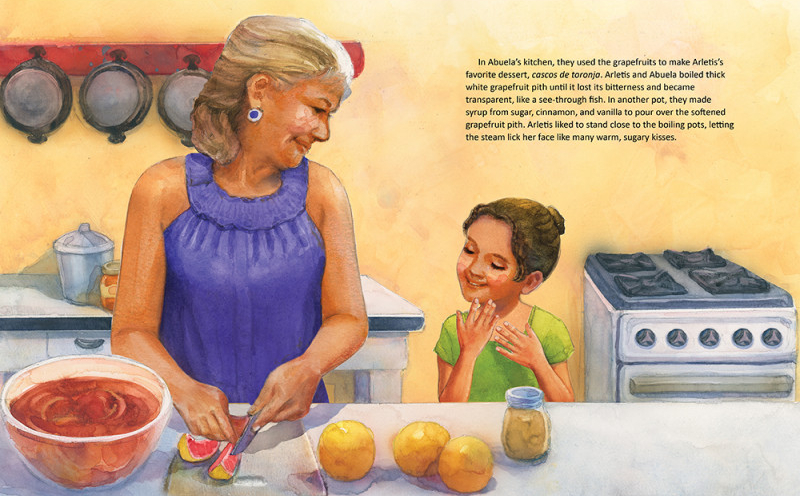
Growing up in Cuba, Arletis loved studying maps and wondering about the people and places beyond her island. “Her whole life took place on the long, unnamed street that ran in front of the unnumbered house, where she lived.” Some afternoons, she took the horse-drawn carriage that transported people around town to visit her abuela. While she was there, Abuela told her funny stories about her abuelo, who had died before she was born. Sometimes tears would form in Abuela’s eyes as she talked about her husband. Then “Arletis would suggest they pick the grapefruits that grew like miniature suns in the trees Abuela had planted when she was young” to make her favorite treat cascos de toronja.

celebrate-picture-books-picture-book-review-Arletis-Abuelo-and-the-Message-in-a-Bottle-carriage

Image copyright Cornelius Van Wright and Ying-Hwa Hu, 2023, text copyright Lea Aschkenas, 2023. Courtesy of Star Bright Books.

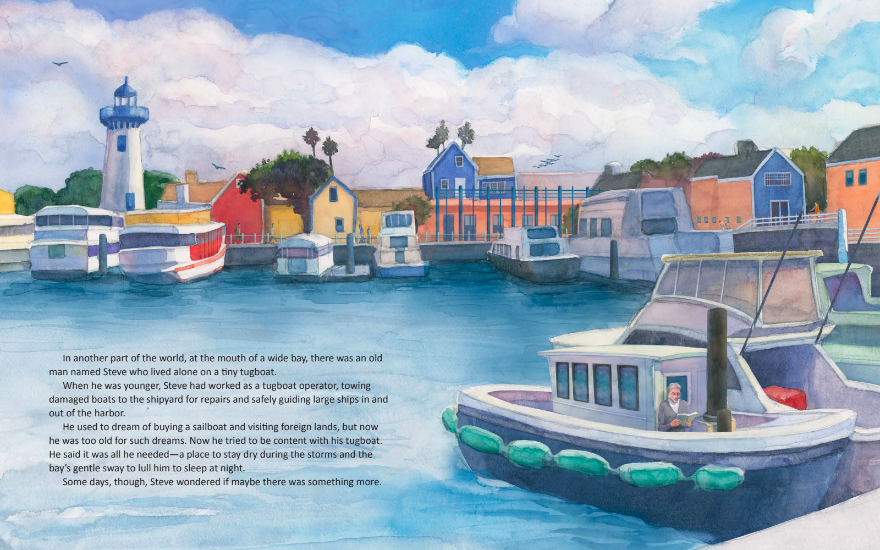
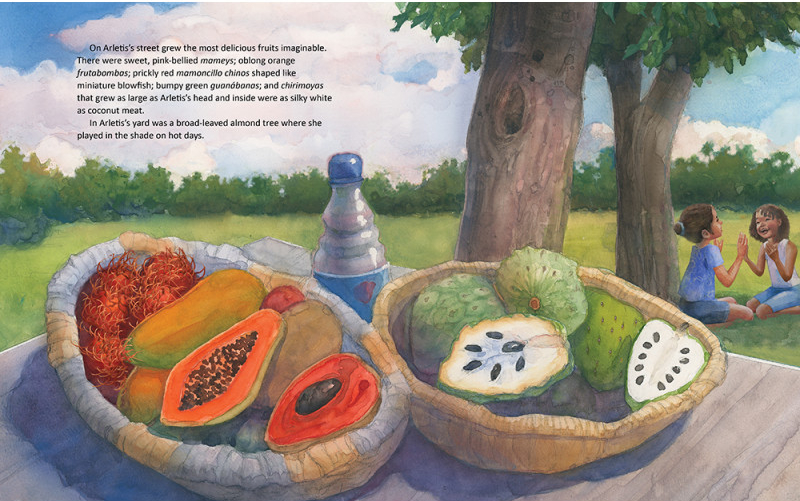
Arletis’s life was rich with delicious fruit that grew in trees along her street, swimming in the river when the heat became “so heavy and thick it rolled down the street in dizzying waves,” and playing her favorite game: choreographer, in which she, her cousin, and neighborhood kids danced to the music on the radio. Arletis loved her street, but sometimes she wondered if there was more. In another part of the world—off the coast of Sausalito, California—a man named Steve lived alone on the tugboat with which he had once made his living. While Steve was content on his tugboat, he too wondered if there was more.

celebrate-picture-books-picture-book-review-Arletis-Abuelo-and-the-Message-in-a-Bottle-abuela

Image copyright Cornelius Van Wright and Ying-Hwa Hu, 2023, text copyright Lea Aschkenas, 2023. Courtesy of Star Bright Books.

For Arletis’s eighth birthday, her parents rented a beach house for a weekend vacation to Playa Bailén, about 30 miles from home. On the bus ride there, Arletis, for the first time, saw the ocean that surrounded her island. On her birthday, Arletis took a walk along the beach and found a green bottle. The top was sealed with tape, and inside she could see a rolled up piece of paper. The paper turned out to be a letter written in a foreign language. Arletis was excited to realize that the bottle had come from another country.

Even though Arletis couldn’t read the words, she wrote a letter about “her life, about her family and her beautiful street. She asked every question she could think of about life in this other country” and she mailed it to the address provided at the bottom of the message from the bottle. When Steve received the letter, he immediately knew it was a response to his message in the bottle that he had given to a friend who was sailing down the coast and through the Panama Canal. The friend had dropped the bottle into the sea after he’d sailed into the Caribbean Sea.

celebrate-picture-books-picture-book-review-Arletis-Abuelo-and-the-Message-in-a-Bottle-Steve-on-tug

Image copyright Cornelius Van Wright and Ying-Hwa Hu, 2023, text copyright Lea Aschkenas, 2023. Courtesy of Star Bright Books.

Steve was thrilled to receive Arletis’s letter. He had begun studying Spanish and “had been wishing for someone to practice with.” Two months had gone by since Arletis had sent her letter when she heard the mail carrier call out her name and hand her an envelope. It was the first letter Arletis had ever received, and she handled it with great care. Steve had answered all her questions and even sent a picture of himself and his tugboat. Arletis thought Steve looked “old enough to be a grandfather. Arletis had always wished for a grandfather, so she decided to address her next letter, ‘Querido Abuelo Esteban.’ ‘Dear Grandfather Steve'” and invited him to visit her and her family one day.

Arletis and Abuelo Esteban began writing to each other monthly then in one letter, Abuelo Esteban said he would be coming for a visit. “Arletis couldn’t stop smiling.” When Abuelo Esteban arrived, he brought a gift. It was a map he had drawn “showing the path his bottle had taken, first on his friend’s boat and then on the wide open sea to Arletis’s island. It was the most beautiful map Arletis had ever seen.” During the five days that Abuelo Esteban spent with Arletis’s family, he played baseball with her friends, swam in the river, and enjoyed some of Arletis’s favorite foods. 

celebrate-picture-books-picture-book-review-Arletis-Abuelo-and-the-Message-in-a-Bottle-fruit

Image copyright Cornelius Van Wright and Ying-Hwa Hu, 2023, text copyright Lea Aschkenas, 2023. Courtesy of Star Bright Books.

On Abuelo Esteban’s last night visiting, Arletis’s mother and Abuela made a special dinner, complete with Arletis’s favorite dessert, cascos de toronja. Abuelo Esteban loved it too. He showed everyone pictures of his tugboat and the dock where it was moored. Arletis thought the dock looked just like a little island surrounded by water. When she asked Abuelo Esteban if he thought an island was a good place to live, he replied, “‘Yes, I think so. Especially if there is another island where you have family you can visit.'” 

Backmatter includes an Author’s Note that outlines how Lea Aschkenas first met Abuelo Esteban at the Sausalito library where she worked and learned about his story. She adds an update to the story about both Arletis, now an adult, and Steve, who has continued to visit his “familia de corazón”— his family of the heart. A recipe for cascos de toronja, glossary of the Spanish words found in the story, and a list of references for further reading, viewing, and listening in both English and Spanish are also included.

celebrate-picture-books-picture-book-review-Arletis-Abuelo-and-the-Message-in-a-Bottle-Steve-playing-baseball

Image copyright Cornelius Van Wright and Ying-Hwa Hu, 2023, text copyright Lea Aschkenas, 2023. Courtesy of Star Bright Books.

Lea Aschkenas’s gentle and uplifting story immerses readers in the sights, sounds, flavors, and warm hearts of Cuba. Her comprehensive storytelling is filled with the types of details about Arletis’s life that will captivate readers and resonate with their own love for spontaneous fun, favorite foods, and family relationships. Aschkenas’s lovely descriptive language—Cuba is an “alligator-shaped island,” boiled grapefruit pith for cascos de toronja is as transparent as “a see-through fish,” Arletis and Abuelo Esteban exchange letters “as regularly as the monthly full moon”—and Spanish words and phrases sprinkled throughout the text paint pictures in children’s minds of the special beauty of Cuba.

Through Cornelius Van Wright and Ying-Hwa Hu’s stunning watercolor illustrations, readers travel to Cuba to revel in the brilliant colors of the buildings and homes, the luscious hues of tropical fruit, the jewel-like water of the rivers and ocean, and, especially, the sunny smiles of the country’s people. When the story turns to the Sausalito dock where Steve lives, children see that the landscape is similar, with homes and businesses painted in pinks, yellow, red, and blue. Palm trees dot the skyline, and the ocean is as blue as the sky. Van Wright and Hu enchantingly capture Arletis’s wanderlust and her excitement to connect with Steve, with whom she immediately forms a grandfatherly bond. Images of Arletis cooking with her Abuela, dancing and playing baseball with friends, and sitting around the family dinner table with Abuela Esteban will charm children as they take this true story into their heart.

Wonderfully evocative and multilayered, Arletis, Abuelo, and the Message in a Bottle is a remarkable story of family, friendship, pride in one’s country, and the joys to be found in reaching out to others across the world. The book is a heartfelt choice for story times at home and school and would make an impactful addition to any classroom or homeschool geography or social studies curriculum. Arletis, Abuelo, and the Message in a Bottle is highly recommended for all home, school, and public library collections. The book is also available in a Spanish edition: Arletis, abuelo y el mensaje en la botella.

Ages 4 – 8

Star Bright Books, 2023 | ISBN 978-1595729699 (English Hardcover) | ISBN 978-1595729705 (English Paperback) | ISBN 978-1595729729 (Spanish Hardcover) | ISBN 978-1595729712 (Spanish Paperback)

About the Author

LEA ASCHKENAS has written book reviews and articles for Washington Post Book World, Los Angeles Review of Books, and Salon. She is also the author of a travel memoir, Es Cuba: Life and Love on an Illegal Island. She fell in love with Cuba and its people on her first trip to the island in the year 2000 and has been returning nearly every year since. Arletis, Abuelo, and the Message in a Bottle is her first book for children. Lea lives in Northern California where she works as a public librarian and teaches with the California Poets in the Schools program. Visit Lea at: leaaschkenas.com

About the Illustrators

CORNELIUS VAN WRIGHT and YING-HWA HU are a husband and wife children’s book illustration team. They have worked on many assignments together, but have also illustrated numerous projects and books individually. They have won a number of awards for their books. Their work has been exhibited at the Bologna Book Fair and the Society of Illustrators’ “The Original Art” show. Cornelius and Ying-Hwa live in New York City. You can learn more about Cornelius and Ying-Hwa Hu and their work at pencilmoonstudio.com. Visit Ying-Hwa Hu at yinghwahu.com.

celebrate-picture-books-picture-book-review-Arletis-Abuelo-and-the-Message-in-a-Bottle-cover

You can find Arletis, Abuelo, and the Message in a Bottle or the Spanish Edition, Arletis, abuelo y el mensaje en la botella, at these booksellers

Amazon | Barnes & Noble | Books-a-Million

Arletis, abuelo y el mensaje en la botella

Amazon | Barnes & Noble | Books-a-Million

To support your local independent bookstore, order from

Bookshop: English Edition | Spanish Edition


Picture Book Review
February 1 – World Read Aloud Day

celebrate-picture-books-picture-book-review-love-is-loud-cover

About the Holiday

Now in its 14th year World Read Aloud Day, founded by global non-profit LitWorld, encourages adults to read aloud to children not only today but every day. Reading aloud to children from birth is one of the best ways to promote language development, improve literacy, and enjoy bonding time together. Millions of people celebrate today’s holiday all across the United States and in more than one hundred countries around the world. Special events are held in schools, libraries, bookstores, homes, and communities, and authors and illustrators hold readings and visit classrooms in person and virtually. To learn more about World Read Aloud Day, visit LitWorld and check out their Activity Hub to find live events, virtual read alouds, downloadable bookmarks, posters, games, and more!

I would like to thank Simon & Schuster and Barbara Fisch at Blue Slip Media for sharing a copy of Love Is Loud with me for review consideration. All opinions on the book are my own.

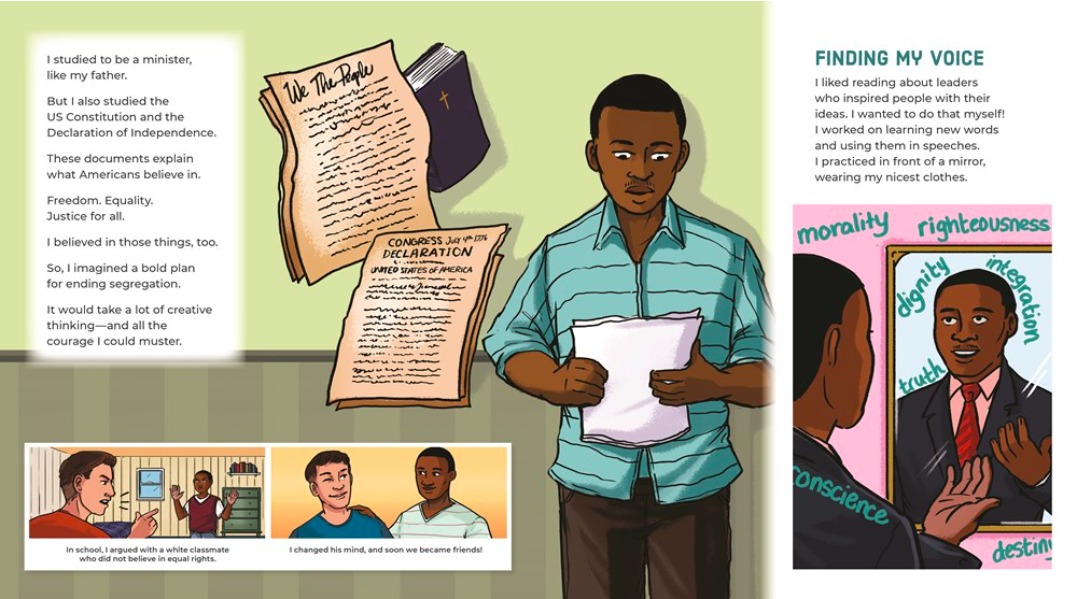
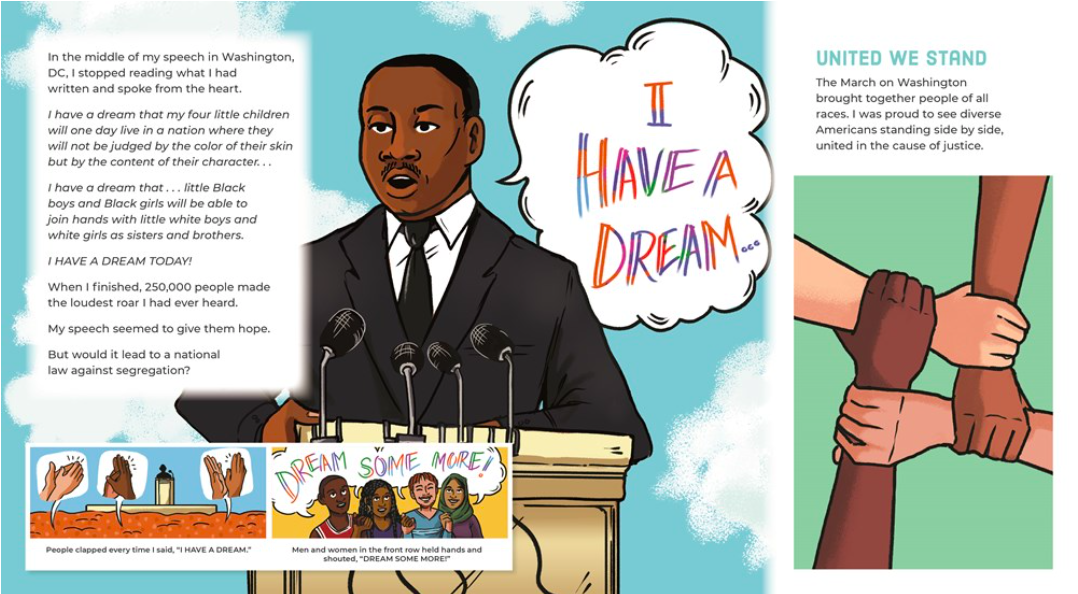
Love Is Loud: How Diane Nash Led the Civil Rights Movement

Written by Sandra Neil Wallace | Illustrated by Bryan Collier


Raised on Chicago’s South Side, Diane Nash is sheltered by her parents from the segregation of the South that they had grown up in. During the Second World War, Diane is taken care of by her grandmother while her father joins the army and her mother takes a job. Her Grandmother Bolton is from Tennessee and showers her with love. “You are ‘more precious than all the diamonds in the world,'” she told Diane, and growing “up in the rhythm and glow of her love” Diane knew “it must be true.”

celebrate-picture-books-picture-book-review-love-is-loud-baby

Image copyright Bryan Collier, 2023, text copyright Sandra Neil Wallace, 2023. Courtesy of Simon & Schuster/Paula Wiseman Books.

In high school kids of all colors learn together. Diane reads about segregation in textbooks, but it didn’t really touch her. Then she moves to Tennessee to attend Fisk University. Here, when her friends take her to a fair, Diane is confronted with the “sting of segregation” when she sees there are two restrooms: one labeled WHITE and the other COLORED. Her friends have grown up in this system; they tell her “to go along to get along,” but Diane “won’t follow rules if the rules are wrong.” The rhythms of her grandmother’s love and her pride in being “beautiful, honey brown” will not allow her to feel less than others.

In Nashville, Diane experiences the full indignation of segregation that demands separate water fountains and schools, back-of-the-bus seating, and—the worst for Diane—no eating at the lunch counter. She doesn’t want to be arrested for eating at a lunch counter, but neither does she want to let it go. Before each day of college classes, Diane and other students “pray and learn about change in a peaceful way.” They practice calmly sitting and ordering at a lunch counter, knowing that people may be rude, may push them off their stool, may throw sugar in their hair.

celebrate-picture-books-picture-book-review-love-is-loud-school

Image copyright Bryan Collier, 2023, text copyright Sandra Neil Wallace, 2023. Courtesy of Simon & Schuster/Paula Wiseman Books.

In February of 1960, Diane, now at twenty-one years old, leads a group of students to a lunch counter in Nashville. Their presence shocks the cooks and waitress, who drops plate after plate from her shaking hands. “Inside [Diane shakes] too. Hands sweating, never forgetting the danger, the fear of being arrested for ordering a sandwich.” Bravely, despite coffee burns and thrown sugar, Diane and the students hold sit ins at lunch counters across the city. And when Diane is arrested, there are hundreds of others to fill her seat.

After a bombing in April Diane, “quietly walking, without any talking… silently leads six-thousand marching feet to the beat of love” to meet the mayor, who at first says there is nothing he can do. Looking him in the eye, Diane asks him questions he cannot deny, and he admits that prejudice and segregation are wrong—even at the lunch counter. “At that moment, love scores. It soars as six thousand loving hands roar with applause.” And in May—Diane has just turned twenty-two—Nashville’s lunch counters are fully integrated. Martin Luther King Jr. congratulates her on her peaceful victory as she moves on to change the rules of bus travel with Freedom Rides, to uphold the “law of the land [that] says everyone is free to sit or stand together in a bus traveling across America.”

celebrate-picture-books-picture-book-review-love-is-loud-fair

Image copyright Bryan Collier, 2023, text copyright Sandra Neil Wallace, 2023. Courtesy of Simon & Schuster/Paula Wiseman Books.

While the movement makes progress, even attracting the attention of the president, a Mississippi judge charges Diane “with putting Freedom Riders on a bus.” Before her trial, Diane, pregnant with her first child, writes a letter heard around the world that said “‘I believe that if I go to jail now, … it may help hasten that day when my child and all children will be free.'” Her case rivets the world as she chooses to go to jail instead of paying bail. 

After she is released, Diane turns her attention to the issue of voting rights and the state of Alabama, where four young girls are killed in a bombing in a Birmingham church and “where Black people are denied the right to vote.” Following Diane’s example, thousands of adults and children choose jail over bail in protest of the injustice until the Civil Rights Act is signed by President Johnson in 1964 and a year after that when he “signs the 1965 Voting Rights Act to legally end racial discrimination that prevented Black people from voting.” But Diane Nash doesn’t stop there. She takes her message of peace and peaceful change across the country for fifty years, teaching young people “how love creates change.”

Image copyright Bryan Collier, 2023, text copyright Sandra Neil Wallace, 2023. Courtesy of Simon & Schuster/Paula Wiseman Books.

Image copyright Bryan Collier, 2023, text copyright Sandra Neil Wallace, 2023. Courtesy of Simon & Schuster/Paula Wiseman Books.

Extensive back matter includes an Author’s Note and an Illustrator’s Note about the work of Diane Nash; a detailed timeline from her birth to 2022, when she was awarded the Presidential Medal of Freedom; a list of video interviews with Diane Nash, four other books for young readers; sources for quotes found in the story; and a selected bibliography. A photograph of Nash and three other students integrating a lunch counter in Nashville and another of Nash leading demonstrators to meet the mayor of Nashville are also included.

celebrate-picture-books-picture-book-review-love-is-loud-love

Image copyright Bryan Collier, 2023, text copyright Sandra Neil Wallace, 2023. Courtesy of Simon & Schuster/Paula Wiseman Books.

Compelling and moving, Sandra Neil Wallace’s lyrical storytelling about the life and work of Diane Nash rivets readers to this young woman’s courage, confidence, and conviction to overturn the injustice of segregation and inequality for Blacks. Punctuated with often-rhyming phrases, and sharp, short sentences Wallace’s text flows with a rhythm of urgency that perfectly conveys not only Nash’s resolve, but the stakes for the peaceful demonstrators and the atmosphere of the times.

Written in the third person, the story directly addresses Nash, but the repeated “you” also builds a chorus that reverberates in each reader’s heart, telling them that they are brave, that they are strong, and that they too can change the world with love. This format poignantly culminates on the last page. Here, Wallace changes the dynamic with a subtle turn of phrase that now directly embraces each reader, letting them know that Diane Nash worked for freedom “because she loved you even before you were born” and reminding them that “Love is fierce. Love is strong. Love is loud!”

Bryan Collier’s rich watercolor-and-collage illustrations draw readers in with their realistic depictions of Diane Nash as a baby and young girl cherished by her family, as a high school and university student, at the fair that changed the trajectory of her life,  leading peaceful demonstrations at lunch counters and across the South, and crossing the country to bring her message to young people. Nash’s self-assurance, courage, and determination are evocatively expressed, and a full-page portrait of Diane looking out at the reader mirrors Wallace’s invitation for them to look into her eyes and see her love there.

Scraps of photographs are sprinkled here and there among the pages, providing a spark of recognition of the time and places depicted. But it is the cut paper elements that make certain images of people and objects jump off the page, working powerfully with Wallace’s text to make readers feel that they too are at the fair, at the lunch counter, joining the throng of marchers. Each page is a masterpiece of history and story that invites study, thoughtful contemplation, and action.

Absorbing, eloquent, and impactful, Love Is Loud: How Diane Nash Led the Civil Rights Movement is biography at its best: a moving tribute Diane Nash set amid a far-reaching immersion in the time period. Love Is Loud belongs in every home, classroom, school, and public library collection to teach children about the contributions of Diane Nash as well as to remind them that vigilance and the work for freedom is an ever-ongoing pursuit.

Ages 4 – 8 

Simon & Schuster | Paula Wiseman Books, 2022 | ISBN 978-1534451032

About the Author

Sandra Neil Wallace writes about people who break barriers and change the world. She is the author of several award-winning books for children, including Between the Lines: How Ernie Barnes Went from the Football Field to the Art Gallery, illustrated by Bryan Collier, which received the Orbis Pictus Book Award and was an ALA Notable Book. A former ESPN reporter and the first woman to host an NHL broadcast, she is the recipient of the Outstanding Women of New Hampshire Award and creates change as cofounder of The Daily Good, a nonprofit bringing twenty thousand free, culturally diverse foods to college students each year through its Global Foods Pantries. Visit Sandra at SandraNeilWallace.com.

About the Illustrator

Bryan Collier is a beloved illustrator known for his unique style combining watercolor and detailed collage. He is a four-time Caldecott Honor recipient for Trombone ShortyDave the PotterMartin’s Big Words, and Rosa. His books have won many other awards as well, including six Coretta Scott King Illustrator Awards. His recent books include By and By, ThurgoodThe Five O’Clock Band, and Between the Lines. He lives in New York with his family. Visit him at BryanCollier.com.

Watch the Book Trailer for Love Is Loud!

World Read Aloud Day Activities 

2022 Presidential Medal of Freedom Ceremony


Watch as Diane Nash is awarded the Presidential Medal of Freedom in this White House video from July 7, 2022. You can find President Joe Biden’s remarks about Diane Nash at the 5:50 mark, and see her receive her medal at the 41:29 mark.

celebrate-picture-books-picture-book-review-love-is-loud-curriculum-guide-cover

Love Is Loud Curriculum Guide


Teachers, educators, and homeschoolers can download an in-depth, 6-page Curriculum Guide for Love Is Loud full of a variety of ways for students to connect with the book and history from Sandra Neil Wallace’s website here.

celebrate-picture-books-picture-book-review-love-is-loud-cover

You can find Love Is Loud: How Diane Nash Led the Civil Rights Movement at these booksellers

Amazon | Barnes & Noble | Books-a-Million

To support your local independent bookstore, order from

Bookshop | IndieBound

Picture Book Review

November 11 – It’s Children’s Book Week

celebrate-picture-books-picture-book-review-building-an-orchestra-of-hope-cover

About the Holiday

Children’s Book Week is the longest-running national literacy program in the United States. The history of the holiday goes back to 1913, when Franklin K. Matthiews, the librarian of the Boy Scouts of America, toured the country to promote a higher standard in children’s books and proposed a Children’s Book Week. He then enlisted the help of Frederic G. Melcher, editor of Publishers Weekly, who believed that “a great nation is a reading nation,” and Anne Carroll Moore, the Superintendent of Children’s Works at the New York Public Library to help spread the word. This year’s theme is “How Do You Book?” The thought-provoking theme encourages readers to think about what they read, where they read, and how they read. To learn more about this literary holiday, visit Every Child a Reader to find out more about the week, how to join online, and lots of bookmarks and activities to download.

Building an Orchestra of Hope: How Favio Chávez Taught Children to Make Music from Trash

Written by Carmen Oliver | Illustrated by Luisa Uribe


As a child, Favio Chávez looked to music as an important touchstone. When he grew up, he was still involved with music, but his profession was as an environmental engineer. He was given a job in “Cateura, Paraguay—a small village built on a landfill—to try to help the families who lived and worked amid the hills of trash.” When trucks came and dumped load after load of trash, recyclers, called gancheros, filled bags of items they could resell. The air was choked with the stench of garbage, and anywhere the gancheros walked “they waded through filth.” It made Favio sad to think of people living this way.

celebrate-picture-books-picture-book-review-building-an-orchestra-of-hope-arriving

Image copyright Louisa Uribe, 2022, text copyright Carmen Oliver, 2022. Courtesy of Eerdmans Books for Young Readers.

As Favio supervised the gancheros, he “became friends with them and their children. He worried about what kind of lives they would live when they grew up. Besides his job at the landfill, “Favio conducted a youth orchestra in a nearby village.” One day, the people he worked with came to listen. They wondered if their kids could also learn to play instruments. Favio was excited by the prospect. 

He even brought his own guitars and violins for the children to play, but soon he had more kids in class than he had instruments. But there was another problem too. The instruments were valuable and could attract thieves to the homes of his students. He needed another idea, and while watching Nicolás “Colá” Gómez, a talented carpenter, picking through the trash, he thought of something that might work. 

celebrate-picture-books-picture-book-review-Colá-making-violin

Image copyright Louisa Uribe, 2022, text copyright Carmen Oliver, 2022. Courtesy of Eerdmans Books for Young Readers.

Colá began searching through the piles for anything that he could use to make instruments. He collected cans and pipes, crates and buttons, even X-ray film and eating utensils. As he looked at his materials, Colá envisioned how he could create a violin. Finally with violins and other instruments for each child, Favio began teaching them how to play and how to read music. They practiced and practiced until they were ready to perform for their parents.

celebrate-picture-books-picture-book-review-Colá-making-instruments

Image copyright Louisa Uribe, 2022, text copyright Carmen Oliver, 2022. Courtesy of Eerdmans Books for Young Readers.

At a local church, with the audience packed and excited, the notes of the children’s first song ‘”New York, New York’ floated out the windows and into the warm night air.” The adults were overcome with happiness. While their lives had been only about survival, they now “had hope in their hearts and dreams for a better tomorrow.”

Back matter includes further information about Favio Chávez and the Recycled Orchestra of Cateura from 1975, when Favio was born in Argentina to 2006, when he arrived to work at the Cateura landfill to today, when the Orchestra supports more children and families with building projects, food, computers for school, scholarships, and many more humanitarian efforts. A selected bibliography is also included.

celebrate-picture-books-picture-book-review-building-an-orchestra-of-hope-school-yard-practice

Image copyright Louisa Uribe, 2022, text copyright Carmen Oliver, 2022. Courtesy of Eerdmans Books for Young Readers.

From its earliest days the Recycled Orchestra of Cateura has inspired musicians, authors, movie makers, and listeners from around the world. In Building an Orchestra of Hope, Carmen Oliver tells the story through the lens of a hope fulfilled. As Favio Chávez begins his new job at the landfill educating the gancheros on how to work more efficiently, his initial thought is for the future of the children of the village. Oliver shows how Chávez not only supervised the workers but became their friend, honored to be included. While relating Chávez’s eagerness to share his love of music with the children, Oliver hints at what’s to come with lyrical descriptions of the sounds the glass, metal, and plastic makes as the gancheros rake through the piles of trash. She also includes pertinent facts that allow readers to understand the challenges the community faced and what a monumental undertaking the idea was.

While this story revolves around Favio Chávez, his idea could never have been brought to fruition without the talents of Nicolás “Colá” Gómez, who could envision the instruments and even hear their sound as he pored through the trash for materials. Oliver provides a satisfyingly detailed list of the types of items Colá repurposed and later reveals which items were used to create violins, drums, violas, flutes, saxophones, and trumpets, pages that are sure to pique young crafters’ interest. The emotional ending to this true story will swell the hearts of readers—those who already know about the orchestra and those being introduced to it for the first time.

Louisa Uribe’s soft-hued illustrations realistically depict the village of Cateura and the landfill it is built upon. They meet Favio Chávez and Nicolás Gómez and witness the idea of creating instruments from trash come to life. Uribe’s close up of a violin lets kids see how disparate items are used creatively to replicate each part of the instrument. As instruments are made, the number of children filling the courtyard grows until their hard work and practice is rewarded on a real stage, a microcosm of the growth and impact of one man’s caring and creativity.

Special Note: The inspirational back matter, worthy of its own picture book, will astound readers with just how far-reaching one idea when explored in collaboration with others can be. Themes of the vital importance and life-changing impact of the arts, persistence, determination, overcoming seemingly insurmountable challenges and odds, and the power of hope are what this true story is built on, and this factual back matter is sure to affect readers and get them thinking about how they can make a difference to a cause they believe in.

Powerful, accessible, and impactful, Building an Orchestra of Hope is a must for all home, school, and library collections, not only to tell this compelling, ongoing story but to remind them that their actions, too—from a single kind word or smile to large community effort—can change lives. 

Ages 4 – 9 

Eerdmans Books for Young Readers, 2022 | ISBN 978-0802854674

You can learn more about Luisa Uribe, her books, and her art on her website.

You can connect with Carmen Oliver on Twitter.

Children’s Book Week Activity

celebrate-picture-books-picture-book-review-bookworm-bookmark

Bookworm Bookmark


Are you a bookworm? If so, then this bookmark is for you! Just print, color, and cut along the dotted line. This little worm will happily save your page for you!

Bookworm Bookmark Template

celebrate-picture-books-picture-book-review-building-an-orchestra-of-hope-cover

You can find Building an Orchestra of Hope at these booksellers

Amazon | Barnes & Noble | Books-a-Million

To support your local independent bookstore, order from

Bookshop | IndieBound

Picture Book Review

September 23 – It’s National Sewing Month

celebrate-picture-books-picture-book-review-dressing-up-the-stars-cover

About the Holiday

Sewing is one of the most popular hobbies around and has historically been one of the most important industries in this country and around the world. National Sewing Month was established in 1982 to encourage people to learn more about this craft and to try their hand at picking up a needle or sitting down at a sewing machine. To celebrate read up on the history of sewing and the textile industry and consider taking a sewing class or learning on your own. Sewing can be a fun and rewarding activity for adults and children. Who knows? It may even become a career that can send you to the Oscars, as you’ll see in today’s book!

Dressing Up the Stars: The Story of Movie Costume Designer Edith Head

Written by Jeanne Walker Harvey | Illustrated by Diana Toledano


As a child, living in a dry, barren mining town, Edith felt like she didn’t belong. She dreamed of living “in a place full of people and sounds and dazzling lights.” She liked hosting pretend tea parties with colorful china and sweet treats for her stuffed animals and imaginary guests. She also dressed up her pet cat, dog, rabbit, horned toad, and two mules in scarves, clothes, and fancy hats that she made just for them.

celebrate-picture-books-picture-book-review-dressing-up-the-stars-doll-house

Image copyright Diana Toledano, 2022, text copyright Jeanne Walker Harvey, 2022. Courtesy of Beach Lane Books.

“Edith’s greatest treasure was her bag of fabric scraps,” which she added to by going door to door collecting cloth whenever she and her family visited Searchlight, Nevada, a few miles away. With these scraps she made furniture, rugs, and tablecloths for her dollhouse and clothes for her little dolls. But her favorite thing to do was make costumes for her two friends, who liked to perform and make up plays for their families and friends. Edith preferred staying behind the curtain, self-conscious about her straight hair and gasses.

celebrate-picture-books-picture-book-review-dressing-up-the-stars-friends

Image copyright Diana Toledano, 2022, text copyright Jeanne Walker Harvey, 2022. Courtesy of Beach Lane Books.

Every night, Edith wished on the stars that she could move away and transform her life. Her chance came when her mother enrolled her in high school in Los Angeles. Here, Edith set about trying to figure out what kind of career she would pursue. She tried piano and gymnastics, but finally found her passion at the movie theater. Watching actors on the screen, Edith was able to escape “feeling shy at school.”

celebrate-picture-books-picture-book-review-dressing-up-the-stars-movies

Image copyright Diana Toledano, 2022, text copyright Jeanne Walker Harvey, 2022. Courtesy of Beach Lane Books.

While Edith initially chose to become a teacher, after a few years “the allure of movies drew her back.” Without any formal art training, she found “a job as a sketch artist in a costume department of a movie studio.” When her boss discovered her lack of training, instead of firing her, he began teaching her how to draw costumes himself.

It took time and many rejections of her designs until Edith was finally entrusted with making costumes. But these weren’t for actors. “Instead, she dressed up animals. They were not easy clients.” But Edith was determined and soon she had a shot at dressing dancers as candy, but her designs, while creative, melted, cracked, and . . . flopped. But Edith got another chance.

celebrate-picture-books-picture-book-review-dressing-up-the-stars-animals

Image copyright Diana Toledano, 2022, text copyright Jeanne Walker Harvey, 2022. Courtesy of Beach Lane Books.

She worked hard for many years, gained experience, and was finally asked to “design costumes for famous movie stars.” Edith came to work on hundreds of movies, transforming actors into their characters and becoming famous herself. Then one night at the Oscars, Edith sat listening to the presenter announce the name of the winner for Best Costume Design. She was thrilled to hear her name, and “she climbed the stairs to the stage to accept her award” wearing a gown she’d designed herself.

Back matter includes an extended biography of Edith’s life, teaching, and work in Hollywood and includes photographs of Edith at work at her easel and dressing Dorothy Lamour in 1938 as well as a sketch for a costume worn by Grace Kelly in To Catch a Thief.

celebrate-picture-books-picture-book-review-dressing-up-the-stars-red-carpet

Image copyright Diana Toledano, 2022, text copyright Jeanne Walker Harvey, 2022. Courtesy of Beach Lane Books.

Jeanne Walker Harvey’s biography of Edith Head highlights this famous behind-the-scenes creator’s early life and dreams, her perseverance, and the self-confidence that spurred her on despite setbacks. Young readers will be interested to see how Edith’s childhood love for imaginary play, creating clothes for her pets and toys, and collecting cloth ultimately led to her career as a movie costume designer even though she pursued other jobs before recognizing her true passion. As she becomes involved in the movie industry, Edith’s receptiveness to learning and to learning from her mistakes provides a valuable lesson for all children. 

Diana Toledano’s charming illustrations show Edith at her creative and courageous best as she holds a tea party for her toys, dresses her bevy of unusual pets, and strikes out into the desert to play. Depictions of the small town of Searchlight, Nevada, Edith’s enchanting dollhouse, and a Los Angeles street orient readers to the time period, while the ornate movie theater and black-and-white film Edith watches show how the movies offered Edith escape from her shyness. Toledano’s textured images follow Edith as she practices, fails, practices some more, and finally achieves her goals. The final illustrations showing Edith at the Academy Awards ceremony, walking the red carpet and winning an Oscar shows kids that dreams really can come true.

An inspirational biography of a woman who broke barriers in Hollywood, Dressing Up the Stars will appeal to kids who are interested in the movies and all creative endeavors and encourage them to pursue their true passions.

Ages 3 – 8

Beach Lane Books, 2022 | ISBN 978-1534451056

Discover more about Jeanne Walker Harvey and her books on her website.

To learn more about Diana Toledana, her books, and her art, visit her website.

National Sewing Month Activity

celebrate-picture-books-picture-book-review-Dressing-Up-the-Stars-activity-kit-dressing-animals celebrate-picture-books-picture-book-review-Dressing-Up-the-Stars-activity-kit-paper-doll

Dressing Up the Stars Activity Kit


With this Dressing Up the Stars Activity Kit, kids can create their own costumes for Edith’s pets, a paper doll, and a character dressed as candy! They can even write the acceptance speech they’d give if they won an Oscar for their work on a movie!

celebrate-picture-books-picture-book-review-dressing-up-the-stars-cover

You can find Dressing Up the Stars: The Story of Movie Costume Designer Edith Head at these booksellers

Amazon | Barnes & Noble | Books-a-Million

To support your local independent bookstore, order from

Bookshop | IndieBound

Picture Book Review
September 14 – Live Creative Day

celebrate-picture-books-picture-book-review-ANNETTE-FEELS-FREE-cover

About the Holiday

National Live Creative Day was established to encourage people to embrace their innovative side. There are so many ways to be creative from the arts to science to sports to how you express yourself. Kids seem to know this inherently as they go about exploring and interacting with all the new things they see, hear, and do every day. Introducing kids to all kinds of hobbies, subjects, and professions expands their definition of creativity and their outlook on the future. Encouraging them to use their particular talents, helps them build confidence and find their place in the world. Reading today’s book with them is a great way to start! To celebrate today, take time to share your talents with others. You may be surprised at how creative you really are!

Thanks go to Beach Lane Books and Blue Slip Media for sharing a copy of Annette Feels Free with me for review consideration. All opinions on the book are my own.
Annette Feels Free: The True Story of Annette Kellerman, World-Class Swimmer, Fashion Pioneer, and Real-Life Mermaid

Written by Katie Mazeika


It was early 1900 and teenage Annette Kellerman was making a splash at Australia’s Melbourne Aquarium. She “was a real-life mermaid swimming and dancing with the fish…” to entertain visitors. The newspapers wrote about her, and people flocked to watch. Annette had always loved the freedom she felt while dancing, but when she was six, her legs became too weak for her to dance or to run or even to walk without braces. Sitting at home, Annette was no longer the happy little girl she had been.

Then one day, her father took Annette to swim in Lavender Bay. “She laughed and danced in the waves, kicking her legs. Splash, splash!” Annette swam so much that “she became the strongest swimmer in New South Wales” and no longer needed her leg braces. In addition to performing, Annette raced and soon she had broken all of Australia’s long-distance swimming records. She then moved to London and thrilled audiences there.

celebrate-picture-books-picture-book-review-ANNETTE-FEELS-FREE-aquarium

Copyright Katie Mazeika, 2022, courtesy of Beach Lane Books.

Annette and her father then traveled throughout Europe and America, where Annette performed her water dancing and raced against other swimmers—men included—and won. But there was one thing that was holding her back from even greater success—her swim costume. “Because she was a woman, she still had to perform and compete in a full skirt and pantaloons.” Why, she thought, did she have to wear something different and so cumbersome?

Annette decided to sew her own swim costume. Her new one-piece suit with short legs was so liberating. She felt as she had as a girl first learning to swim and dance in Lavender Bay. But not everyone saw her swimsuit in the same light. When she wore it to the beach in Boston, the crowd was shocked, and she was even arrested for “not wearing enough clothing!” Arguing her case in front of a judge, Annette showed the court the difference in men’s and women’s swimwear and stated that she should have the same freedom as men. The judge agreed, but with a caveat: she had to remain covered up all the way to the water’s edge. Her new swimwear became a hit with other women, who even called it the Annette Kellerman.

celebrate-picture-books-picture-book-review-ANNETTE-FEELS-FREE-dancing

Copyright Katie Mazeika, 2022, courtesy of Beach Lane Books.

Annette’s career continued to take her all over the world and even made her a movie star! She trained other women in “ornamental swimming”, which later became known as “synchronized swimming.” Now called “artistic swimming”, Annette Kellerman’s revolutionary style is a recognized sport at the Summer Olympics.

Back Matter includes an expanded biography of Annette Kellerman, complete with photographs, and an Author’s Note about Katie Mazeika’s own experiences with a physical disability and how these life-changing occurrences shape who someone is and the careers they pursue.

celebrate-picture-books-picture-book-review-ANNETTE-FEELS-FREE-diving

Copyright Katie Mazeika, 2022, courtesy of Beach Lane Books.

A comprehensive and compelling biography of a woman who broke barriers while advocating for women and changing fashion mores forever, Annette Feels Free is historical storytelling at its best. Katie Mazeika clearly links Annette’s early disability, her perseverance, and her recovery to her recognition of her unique talent. Mazeika’s conversational narrative draws readers into Annette’s emotions and passion for swimming. Historical points of interest—women’s swim costumes, hot cocoa sipped mid-swim across the English Channel, Annette’s success in court, and her continued influence on swimming, for example—will amaze children and spark a desire to investigate more about Annette Kellerman and her times.

Mazeika’s full-bleed illustrations in this slightly oversized book lend grandeur to the pages, bringing readers into the aquarium’s fish tank to watch spectators’ reactions as Annette becomes “the original mermaid”; depicting her early love of dancing and distress at her braced legs; and falling with her as she thrills London audiences with graceful dives. Children will be particularly fascinated by images of Annette swimming, diving, and dancing in the proscribed swimming costume for women that included a cap and dress trimmed in lace, pantaloons, tights, and ballet-flat type shoes tied to her ankles. Her self-confidence and indomitable spirit grace each spread and are sure to inspire readers. 

For young readers, Annette Kellerman’s long, prolific, and creative career has the power to inspire their own creative endeavors. Annette Feels Free offers multilevel opportunities for lessons in history, the arts, and even math and science (how much did that swim costume weigh, anyway?). The book is highly recommended for home, school, and public libraries.

Ages 4 – 8

Beach Lane Books, 2022 | ISBN 978-1665903431

Katherine Mazeika is an author and illustrator with a BFA from the Columbus College of Art and Design. When she isn’t in the studio, she likes to spend time at the theater, in her garden, or getting lost in a good book. She lives in Ohio with her husband, two kids (Lillian and Jack), and two dogs.

celebrate-picture-books-picture-book-review-ANNETTE-FEELS-FREE-curriculum-guide-cover

To learn more, and download a free curriculum guide, visit her website at katiemazeika.com. You can connect with Katie on Facebook: Katie Mazeika Illustration | Instagram: @kdmazart | Twitter: @kdmaz

Live Creative Day Activity


Video of Annette Kellerman’s “Ornamental Swimming”


Watch Annette Kellerman swim her water ballet in this rare footage from MermaidFX.

Million Dollar Mermaid Movie Scene


Now watch a thrilling scene from the movie Million Dollar Mermaid, the 1952 biopic about Annette Kellerman’s life starring Esther Williams, whose career was inspired by Kellerman.

celebrate-picture-books-picture-book-review-ANNETTE-FEELS-FREE-cover

You can find Annette Feels Free at these booksellers at

Amazon | Barnes & Noble | Books-a-Million

To support your local independent bookstore, order from

Bookshop | IndieBound

Picture Book Review