September 16 – Chef Appreciation Week

Chef Appreciation Week was established in 2013 by Donald and Lisa Crutch to encourage people to offer their appreciation for all the dedication and hard work shown by those who work in the culinary industry as well as home chefs. Every year the week is celebrated with the theme “Great People Inspire Great Food!” Today, the holiday has grown to be the largest global recognition of chefs and culinarians, celebrated across the United States and in more than 30 countries around the world. As today’s book demonstrates, even the youngest chefs can come up with new and creative recipes.

Thanks to Scholastic Press for sending me this book for review!

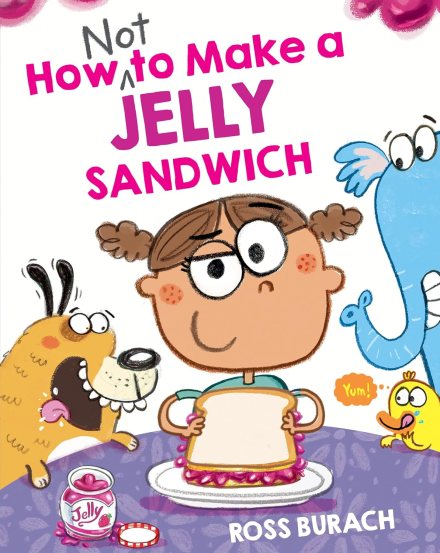
How Not to Make a Jelly Sandwich

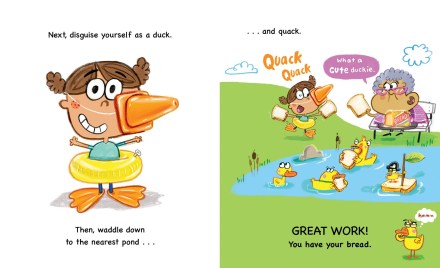
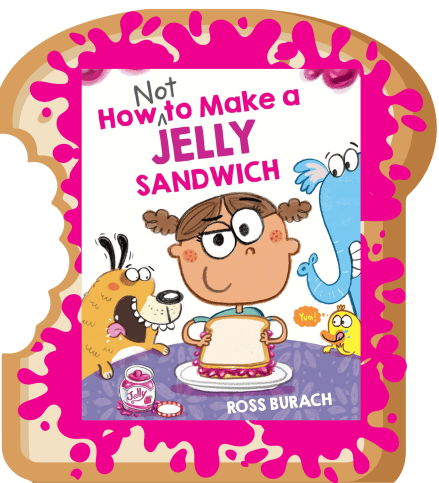
As kids open the book to the first page, Frankie immediately welcomes them with a simple, five-step recipe for making a jelly sandwich. Sounds yummy, and the sandwich begins where you might imagine—with two slices of bread. Easy-peasy, right? Well, at the store, Frankie passes up the wrapped-bread and instead recommends buying a traffic cone and two pool accessories as a way to procure your slices. Then it’s just a quick trip to a duck pond, some clever impersonations, and a generous granny with bread to share, and you’re well on your way to that first delicious bite!

Text and illustration copyright © 2026 by Ross Burach. Published by Scholastic Press copyright © 2026.

Step 2, of course, involves the jelly. As everyone knows “opening a jar of jelly is very straightforward.” All you need to do is find an elephant, lure it to a playground, “kindly ask it to sit on the whirly-go-round and tightly grip the jar” in its trunk while you hang from the monkey bars and hold onto the lid as the elephant spins round and round. Hear that familiar “Pop!”? You’re moving on to Step 3: Applying the Jelly, which, as you know, “is super simple.” In fact, you may even have all the required components in your house already! Got a dog, a bathtub, some bubbly soap? You’re good to go!

Text and illustration copyright © 2026 by Ross Burach. Published by Scholastic Press copyright © 2026.

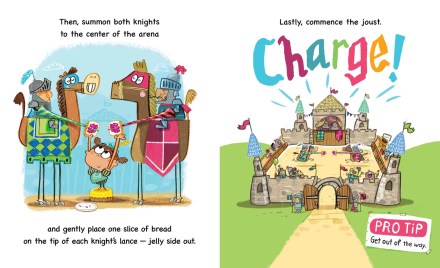
With two jellied-up slices of bread, you’re in the home stretch. All you’re going to need is basic coordination. You know, the type needed to “organize a joust” between well-matched knights who can “smush” those slices together in style. Finally, the “least complicated step of all”: cutting your sandwich. Sure, you’ll need a little help—I mean helper—but with a bit of training and the right enticement, you’ll be eating that jelly sandwich in . . . well . . . Just make sure you’ve made plenty for all your new friends.

Following the story, Ross Burach gives readers a glimpse into Frankie’s alternate brainstorm for making a jelly sandwich and then invites them to write their own silly steps.

Text and illustration copyright © 2026 by Ross Burach. Published by Scholastic Press copyright © 2026.

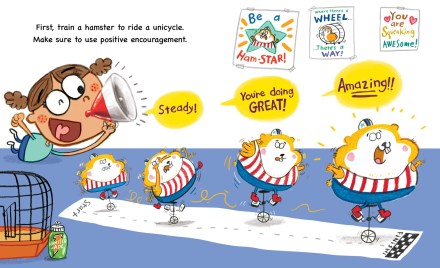
In his latest book, Ross Burach takes on sequential writing with laugh-out-loud silliness that will spark kids’ creativity while showing them that there are as many ways to complete tasks as there are people to devise of them. As he sets up each step, readers may think they know what’s coming next, but Burach serves up plenty of surprise ingredients that will keep kids and adults giggling. Burach’s hilarious illustrations are full of hijinks and puns, and alert readers will be happy to spy guest appearances from some of his other books.

Sweet fun for delicious read aloud story times, How Not to Make a Jelly Sandwich will quickly become a favorite treat, requested again and again from libraries and home bookshelves.

Ages 4 – 8

Scholastic, 2026 | ISBN 978-1338877090

Ross Burach is the creator of the riotously funny Very Impatient Caterpillar series that includes The Very Impatient Caterpillar; The Little Butterfly That Could; Goodnight, Butterfly; and Make Way for Butterfly. All the books combine humor with curriculum-friendly science topics and relatable social-emotional themes. Ross’s other acclaimed books include the picture book Truck Full of Ducks, the board books I Love My Tutu Too!, Potty All-Star, Hi-Five Farm!, and Hi-Five Animals!, named the best board book of the year by Parents Magazine, and the Acorn early reader series Bumble and Bee. He also illustrated Audrey Perrott’s Moo Hoo and Baa Haa. His most recent title is How NOT to Make a Jelly Sandwich. Ross lives with his family in Brooklyn, New York. You can visit him online at rossburach.com.

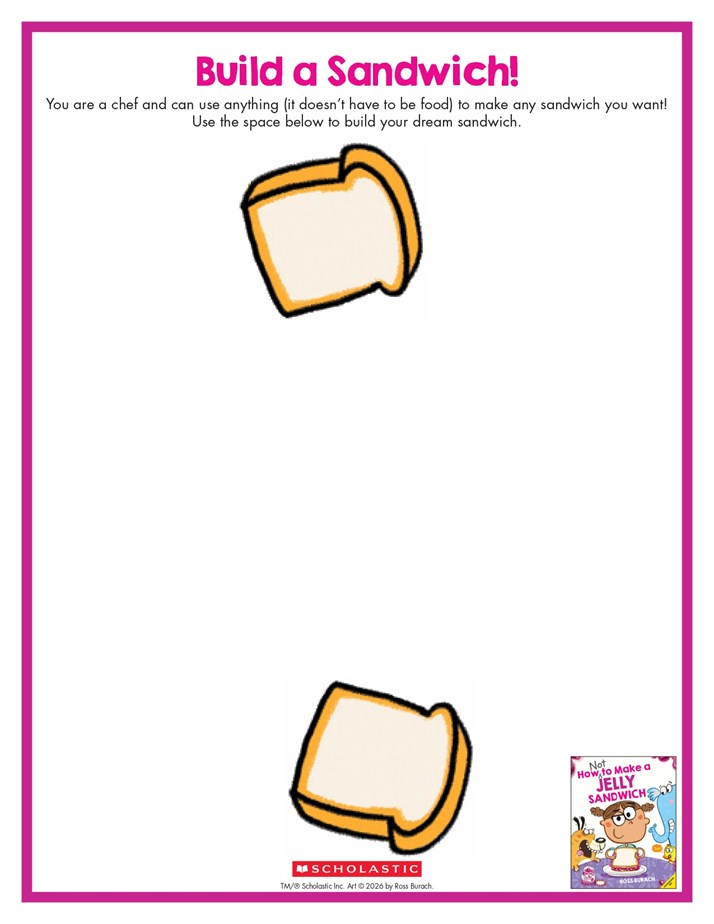
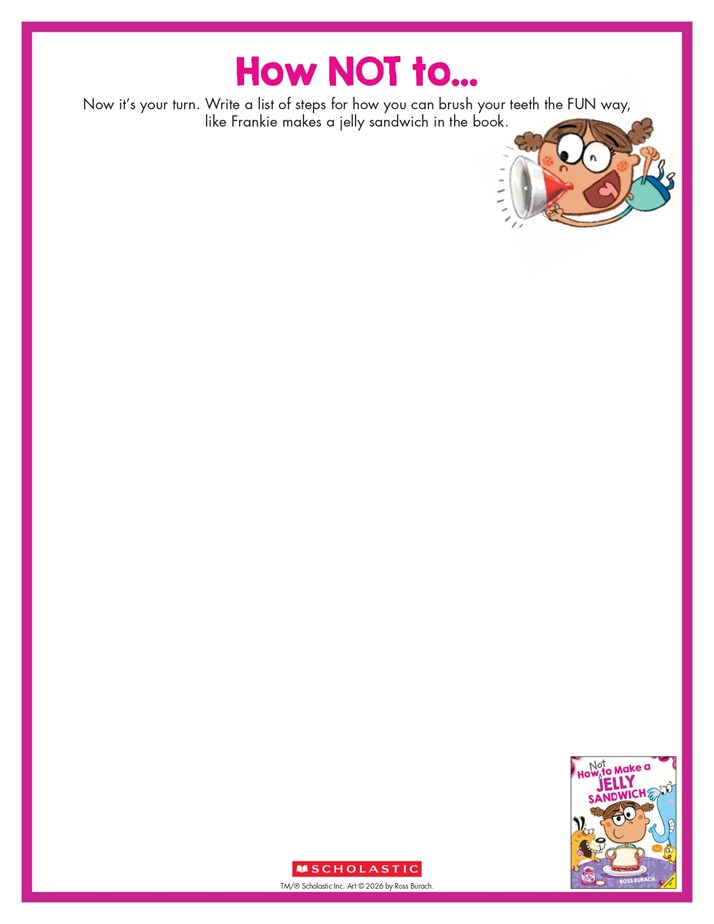
Kids can have fun building their dream sandwich and writing their own sequential list on How Not to Brush Your Teeth with these creative activity pages from Ross Burach and Scholastic!

You can purchase How Not to Make a Jelly Sandwich from these booksellers

Amazon | Barnes & Noble | Bookshop

March 6 – It’s Read Across America Week

About the Holiday

Today’s holiday, established by the National Education Association in 1997, encourages children across the country to celebrate reading and all of its joys and benefits. A love of reading is one of life’s greatest pleasures and begun early can be a powerful force for future success. Celebrate today by reading with a child or on your own. There are fabulous worlds and stories waiting to be discovered!

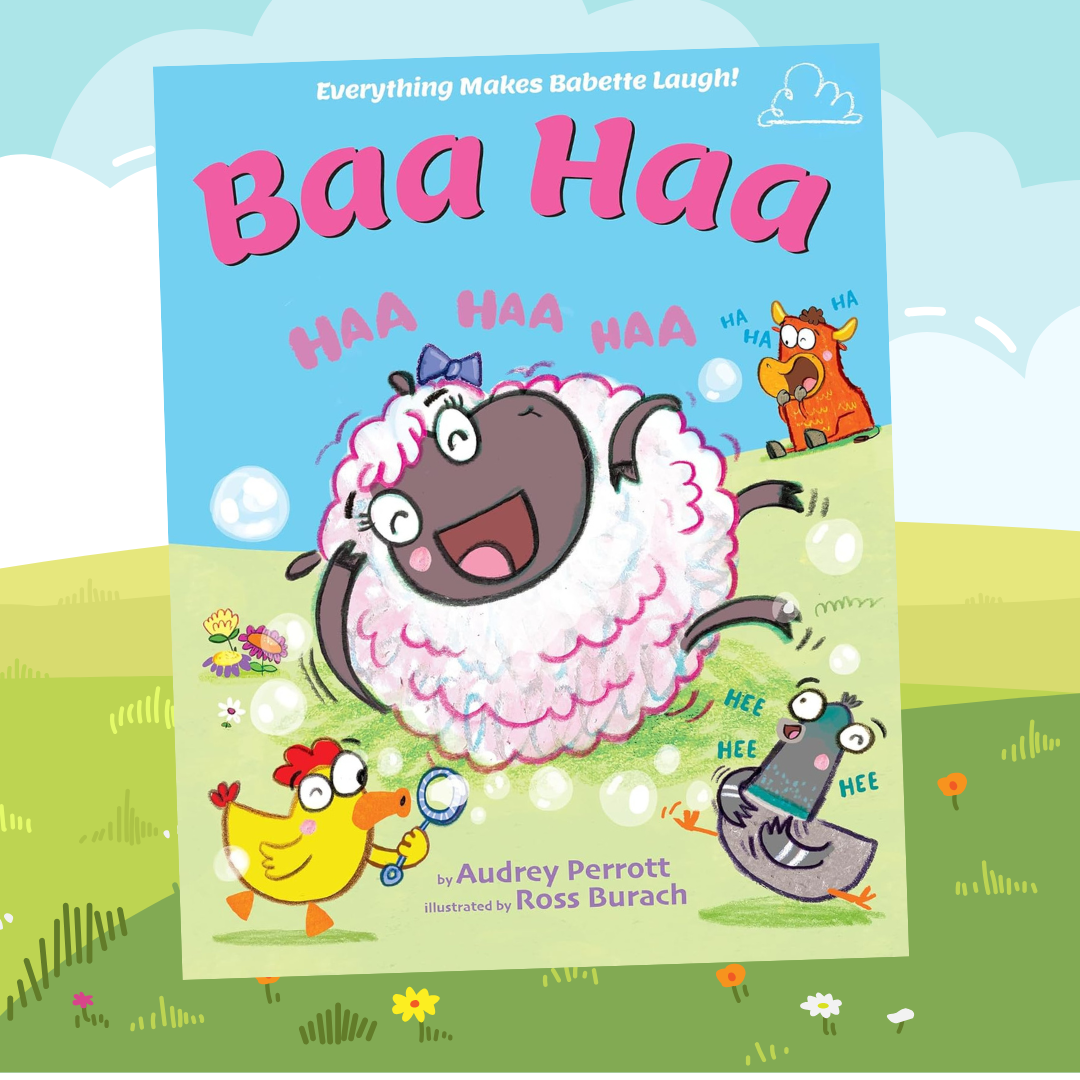
Baa Haa

Written by Audrey Perrott | Illustrated by Ross Burach

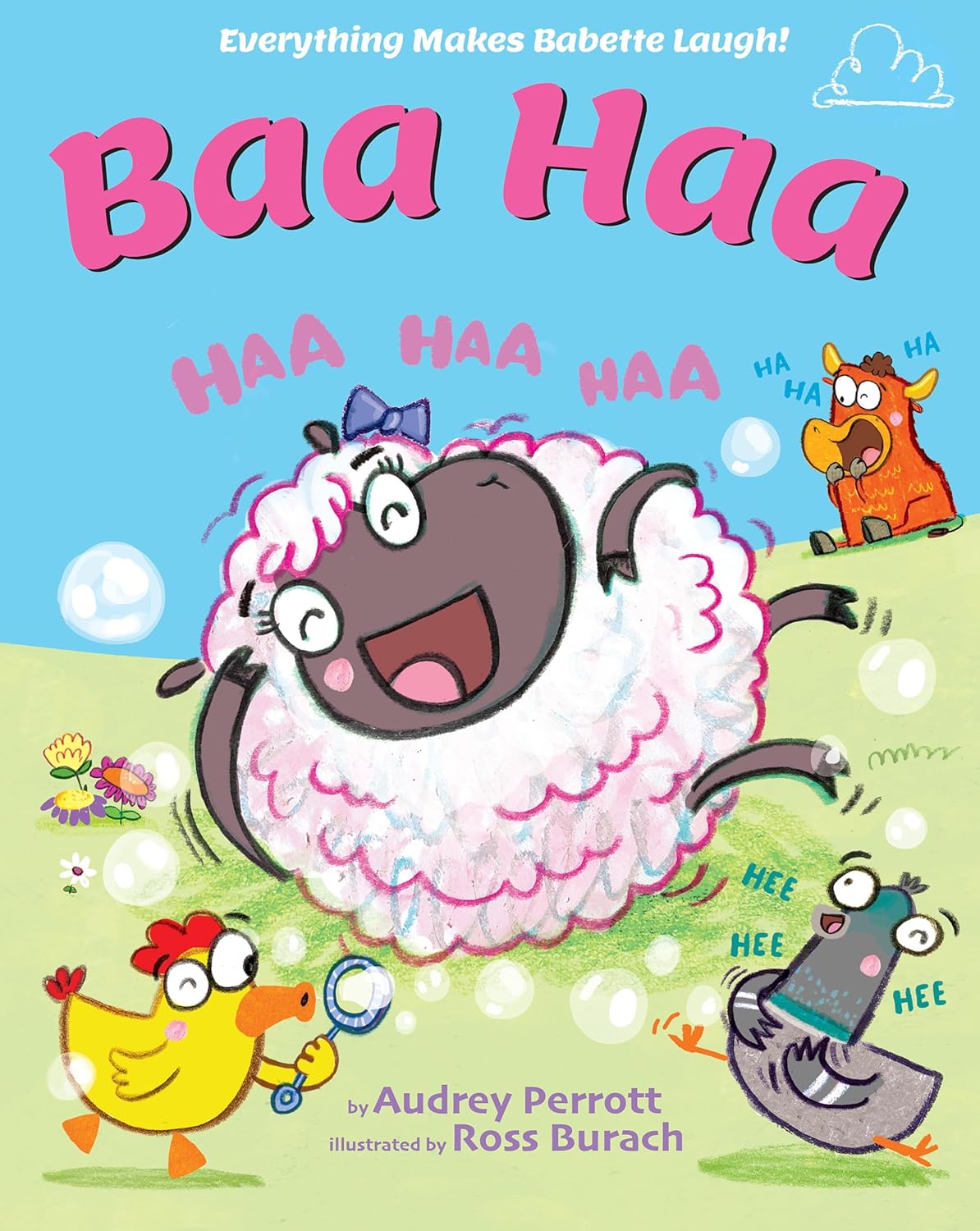
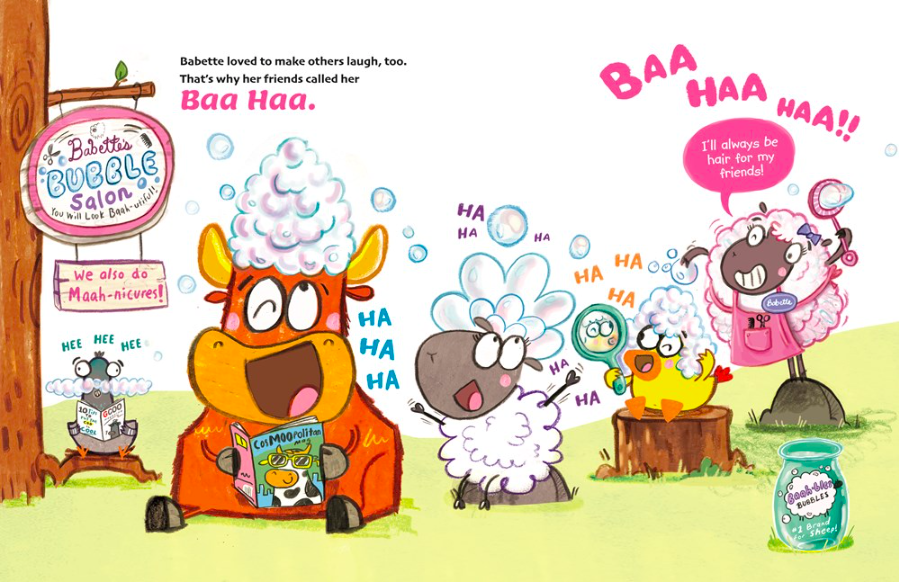
Babette was a happy sheep. Anyone on the farm and beyond could tell you, since “her laughter could be heard across the pasture for miles.” In fact, Babette’s friends all called her “Baa Haa” because she made them hee hee and ha ha, and even guffaw with all of her jokes and antics.

Yes, Babette loved to laugh, and her bubbly personality burst out no matter what she was doing or feeling. When she was surprised, she laughed. When she was “glaaaaad,” she laughed. She even laughed when things didn’t quite go her way. Wait a minute . . . really?

Illustration © 2025 Ross Burach, text © 2025 Audrey Perrott. Courtesy of Scholastic Press.

Really. Babette didn’t like feeling nervous or scared or disappointed, so whenever she felt “baaaaad,” the giggles let her escape. But all this laughter and hiding her real feelings was “tangling her insides into a knot,” and the problem was getting worse. Nothing she tried helped her to feel better. Then one day she couldn’t keep her tears from welling up and spilling out. She tried putting “on a big fake smile” for her friends, but she couldn’t keep the tears from falling.

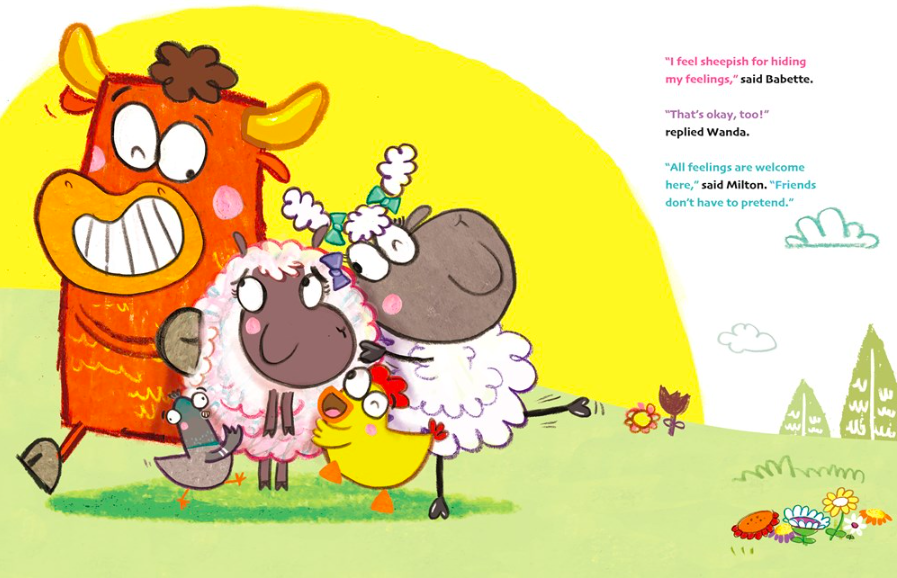
The other animals assured her that “It’s okay if you’re not okay,” and that she should feel free to show her real feelings. “‘We love ewe for ewe,'” her friend Wanda said. Babette began to feel better and was even able to acknowledge that sometimes she did feel sad or mad or nervous. From then on, Babette “let all her feelings show” and shared them with her friends. “Because that’s what true friends do.”

Illustration © 2025 Ross Burach, text © 2025 Audrey Perrott. Courtesy of Scholastic Press.

Audrey Perrott’s follow up to Moo Hoo gently and with plenty of humor reassures children that they don’t have to be happy all the time, and that expressing their true emotions is better than bottling them up. Filled with puns, jokes, and word play, Perrott’s story will have kids giggling as they embrace her message that everyone shares the same feelings and that showing them can bring support, understanding, and quicker recovery.  

Kids will love Ross Burach’s goofy and kind-hearted farmyard animals. His animated illustrations effectively demonstrate the disconnect between Babette’s mirthful reactions and disappointing or nerve-wracking events. As Babette’s true emotions begin to emerge, Burach’s characters clearly show their empathy and understanding. Throughout the story, readers will have fun finding all of the visual puns Burach has added to his illustrations.

An engaging read aloud with an essential, heartening message, Baa Haa is highly recommended for home and library collections.

Ages 4 – 8

Scholastic Press, 2025 | ISBN 978-1546134039

About the Author

Audrey Perrott is the author of Moo Hoo, her debut picture book, as well as nine nonfiction and board book projects with Tangerine Press/Scholastic, including her most recent, Five Buzzy Bees, and A Hat for House with Putnam. An SCBWI Rising Kite Honorable Mention recipient, she lives with her family in North Carolina. You can visit her online at audreyperrott.com.

About the Illustrator

Ross Burach is the creator of the riotously funny Very Impatient Caterpillar series that includes The Very Impatient Caterpillar; The Little Butterfly That Could; Goodnight, Butterfly; and Make Way for Butterfly. All the books combine humor with curriculum-friendly science topics and relatable social-emotional themes. Ross’s other acclaimed books include the picture book Truck Full of Ducks, the board books I Love My Tutu Too!, Potty All-Star, Hi-Five Farm!, and Hi-Five Animals!—named the best board book of the year by Parents Magazine—and the Acorn early reader series Bumble and Bee. He also illustrated Audrey Perrott’s Moo Hoo and Baa Haa. Ross lives with his family in Brooklyn, New York. You can visit him online at rossburach.com.

Read Across America Week Activity

Baa Haa Fun Sheets

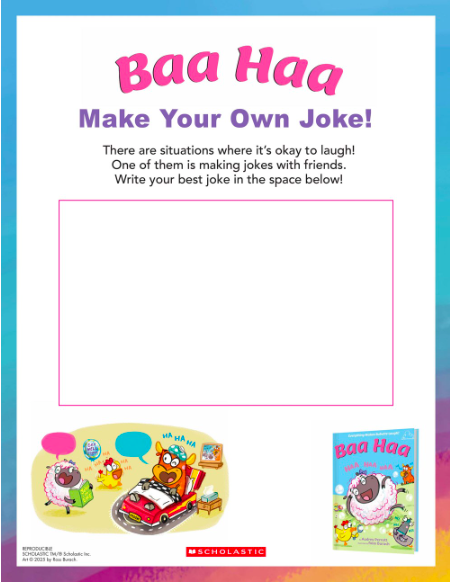
Kids will have fun giggling through these Baa Haa Make a Joke and Word Search Activity Sheets!

You can purchase Baa Haa at these booksellers

Amazon | Barnes & Noble | Bookshop (to support your local independent bookseller)

Picture Book Review

January 20 – Martin Luther King, Jr. Day and Interview with Dean Robbins

celebrate-picture-books-picture-book-review-you-are-a-star-martin-luther-king-jr-cover

About the Holiday

Martin Luther King Jr. Day celebrates the life and legacy of the man who dedicated his life and work to teaching—as Coretta Scott King once stated—“the values of courage, truth, justice, compassion, dignity, humility and service” and who led a non-violent Civil Rights movement to enact racial equality and justice through state and federal laws. President Ronald Reagan created the national holiday in 1983, setting it on the third Monday of January to coincide with Martin Luther King Jr.’s birthday on January 15. To commemorate the holiday, learn more about the life and work of Martin Luther King Jr. We still have a long way to go before there is true justice and equality for all, and it’s more important now than ever to look for ways to offer help and hope.

Thank you to Scholastic Press for sharing a copy of You Are a Star, Martin Luther King, Jr. with me. All opinions on the book are my own.

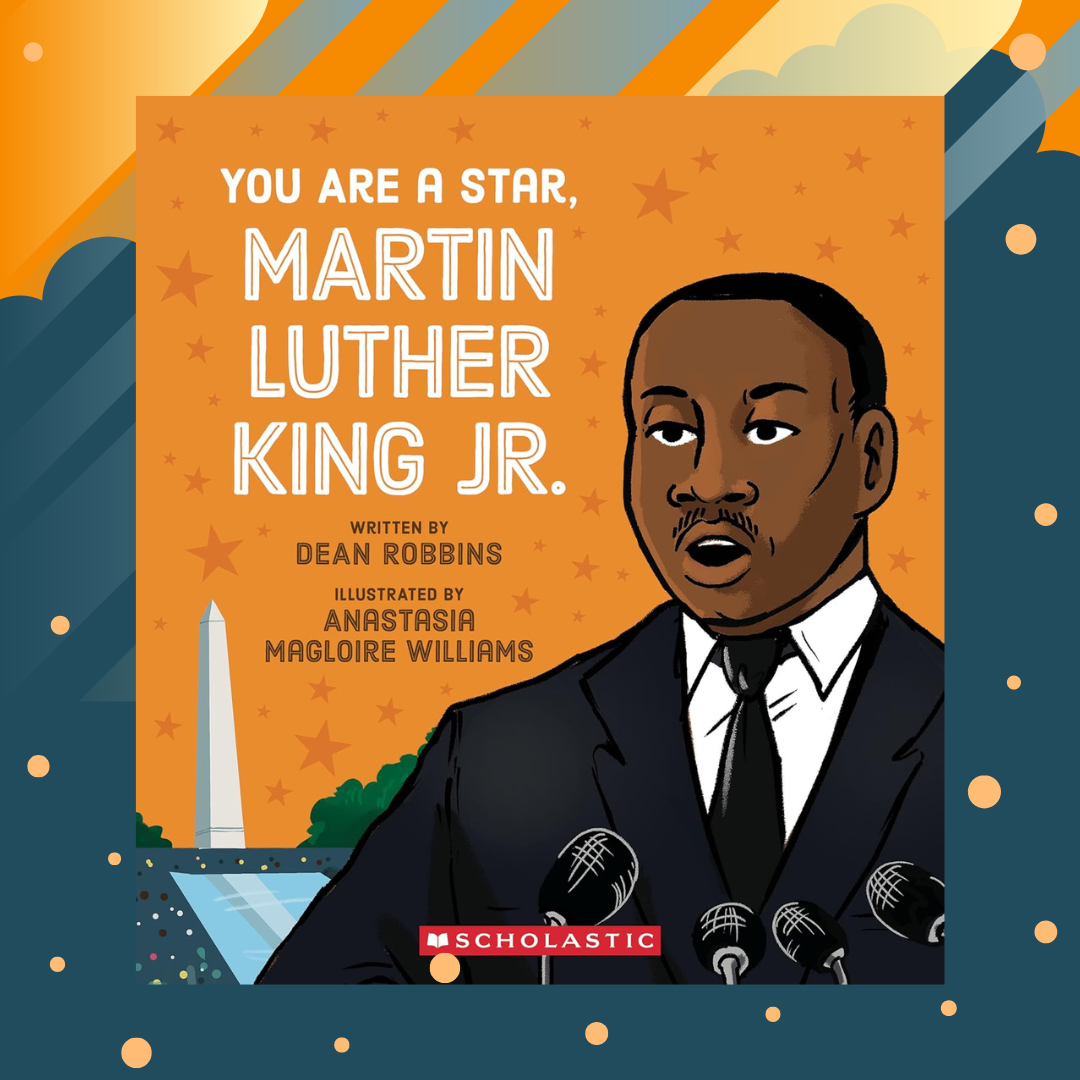
You Are a Star, Martin Luther King, Jr.

Written by Dean Robbins | Illustrated by Anastasia Magloire Williams

Opening the cover to this visually engaging biography, readers are first introduced to Martin Luther King, Jr. as he stands at a podium on August 28, 1963 ready to address the throngs of people who had joined the March on Washington and now filled the National Mall. He wonders if he’s prepared the right words to offer hope for a better future. His thoughts take him back to when he first experienced discrimination, and readers follow along, learning about segregation in schools, restaurants, recreation areas, even at drinking fountains.

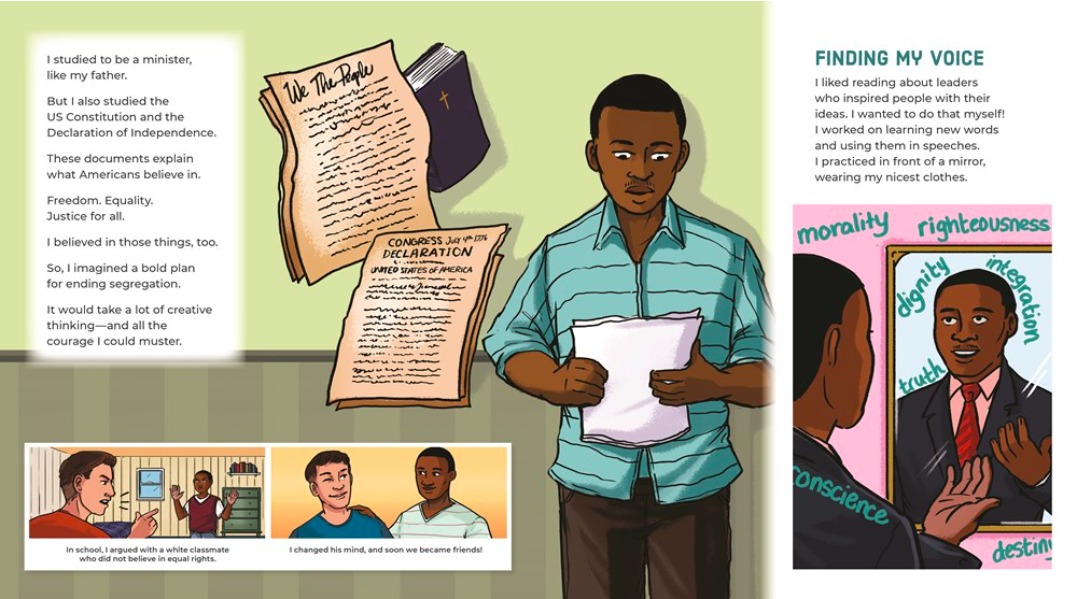
Kids learn that even when Martin Luther King, Jr. was their age he was already thinking that “someone had to change these unfair rules” and deciding “Why not me?” Through the book’s first-person narration, children gain a close portrait of Martin Luther King, Jr. as a committed intellectual, believer in the foundations of America, and outspoken advocate for equal rights. They learn of his life as a minister, his work with Rosa Parks and others to end discrimination on public busses, and his adoption of nonviolent protests to affect change. 
celebrate-picture-books-picture-book-review-you-are-a-star-martin-luther-king-jr-finds-voice

Image copyright Anastasia Magloire Williams, 2025, text copyright Dean Robbins, 2025. courtesy of Scholastic Press.

Readers come to understand how success in Montgomery spurred Martin Luther King, Jr. and others to work toward ending segregation in other places—like stores and restaurants—and even to “challenge American leaders to make a national law against segregation.” They learn how Martin Luther King, Jr. ended up in jail in Birmingham, Alabama, after a peaceful protest and wrote a letter to the world about oppression. Kids also hear about the Children’s March, which took place at the same time and during which more than 2,000 children were also arrested. 

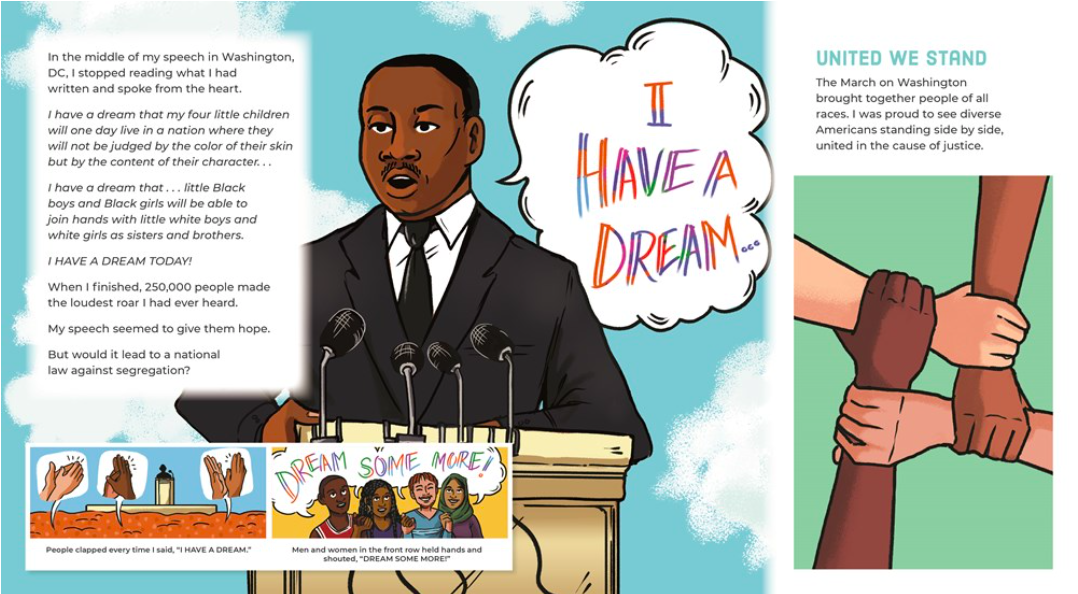
Returning to the March on Washington, Dr. King decides to abandon his written speech and talk from his heart. The result is his now-famous “I have a dream” speech. Following this gathering of 250,000 people and more calls for a national law against segregation from around the country, Dr. King reveals that “In 1964, Congress passed the Civil Rights act.” But even then Dr. King says, “I knew we had more work to do. Many places still had rules to keep Black people from voting.” 
celebrate-picture-books-picture-book-review-you-are-a-star-martin-luther-king-jr-I-have-a-dream-speech

Image copyright Anastasia Magloire Williams, 2025, text copyright Dean Robbins, 2025. courtesy of Scholastic Press.

Another peaceful march was planned for Selma, Alabama, with a 50-mile march to Montgomery. This time, however, Alabama’s governor send troops to attack the marchers. The participants were not intimidated, though, and even invited more Americans to join them. Thousands answered the call. “Maids, students, and movie stars. Parents pushing baby carriages. People on canes and crutches.” Five days later, they reached Montgomery. “The Selma protest was our movement’s greatest victory,” Dr. King tells readers. “It led to a national voting rights law!”

Martin Luther King, Jr. reminds readers, though, that there’s still more to do to “see the good in one another,” “live with each other in peace,” “join together and change the world with love,” and “make my dream come true.”

Beneath the narration of Dr. King’s story, a comic-style panel highlights a single talking point, event, or fact—such as during the Montgomery bus boycott, one man “rode to work on a mule”—often with a light-hearted approach. On the righthand page, Robbins defines concepts such as nonviolent protests, boycotts, freedom of speech, protest songs, the Children’s March, polling place intimidation, and the Voting Rights Act of 1965 in easily understood language. 

Extensive back matter includes an Author’s Note, how children can “Be Like Martin,” notable quotations by Martin Luther King, Jr., four types of Nonviolent civil rights protests, a brief timeline of Dr. King’s life from his birth on January 15, 1929 to 2011, when the Martin Luther King, Jr. Memorial was dedicated in Washington, DC. Also included are a glossary of important terms and a list of resources.
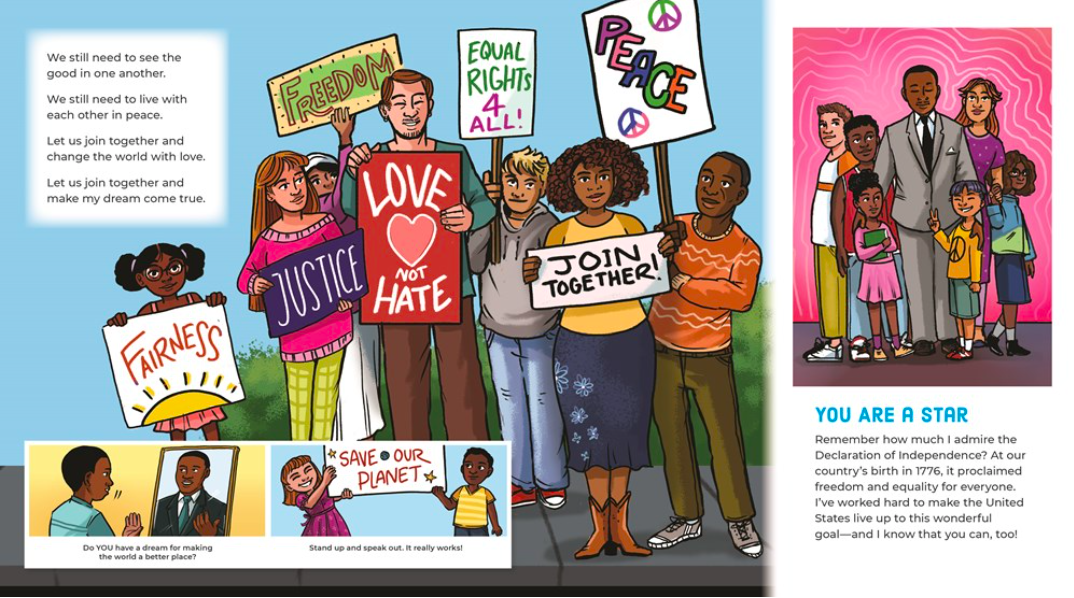
celebrate-picture-books-picture-book-review-you-are-a-star-martin-luther-king-jr-more-to-do

Image copyright Anastasia Magloire Williams, 2025, text copyright Dean Robbins, 2025. courtesy of Scholastic Press.

Dean Robbins’ immediately welcoming and dynamic first-person narration style not only draws young readers into Martin Luther King’s life and the history of the Civil Rights Movement, but makes children feel that they have a personal connection with Dr. King’s legacy. Robbin’s clear, factual writing, is presented in short, separated sentences. These make it easy for children to digest and understand King’s nonviolent approach to protest as well as the social and legal issues of the time and how, unfortunately, vigilance is still needed today. Robbins ends on a note of hope and an invitation to readers to join others and use their talents to help make Martin Luther King, Jr.’s dream come true.

Accompanying Robbins’ text are Anastasia Magloire Williams’ compelling illustrations that are at once realistic and accessible for today’s visual learners. Her stirring depiction of Martin Luther King, Jr. speaking at the 1963 March on Washington sets the tone for children to discover the impact King has had on people’s hearts, minds, and actions for more than 60 years. Through Williams’ expressive portraits, children see Martin Luther King, Jr.’s commitment to studying, practice, and rallying support as well as the effects of segregation, the determination of protestors during the Montgomery, Alabama, bus boycott, and how people from all parts of society working together created—and can still bring about—much-needed change.

With its graphic-style illustrations and well-researched content, You Are a Star, Martin Luther King, Jr. is vibrant and captivating. The book offers exhilarating learning opportunities for individuals, classrooms, and homeschoolers and may spark extended study or activism for a favorite cause. It is highly recommended for home bookshelves and a must for school and library collections.

Ages 5 – 7 and up

Scholastic Press, 2025 | ISBN 978-1338895100

Meet Dean Robbins

celebrate-picture-books-picture-book-review-dean-robbins

Photo credit David Giroux

Dean Robbins is a journalist and the author of the children’s picture books Two Friends: Susan B. Anthony and Frederick Douglass, Margaret and the Moon: How Margaret Hamilton Saved the First Lunar Landing, and Miss Paul and the President: The Creative Campaign for Women’s Right to Vote. His award-winning books have received starred reviews in Publishers Weekly and Kirkus Reviews and have been praised in the New York Times and USA Today. Dean grew up idolizing Apollo astronauts and loved working with Alan Bean on The Astronaut Who Painted the Moon. Learn more at deanrobbins.net.

Hi Dean! I’m thrilled to be talking with you today about your latest book, the impact heroes have always had on your life, and the importance of having heroes for children.

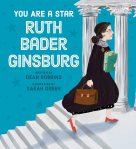
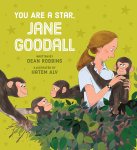
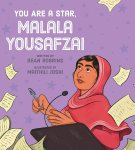
This biography about Martin Luther King, Jr. joins your You Are a Star series that began in 2022 with the story of Supreme Court Justice Ruth Bader Ginsburg. Other inspirational figures in the series are Jane Goodall and Malala Yousafzai. Can you discuss a little about how this series came to be and how you choose the subjects?

My passion is writing about my personal heroes, some of whom are relatively unknown and whose stories I can share with children for the first time. But then there are those like Jane Goodall, Ruth Bader Ginsburg, and Malala Yousafzai who are widely admired and frequently represented in children’s books. I developed the You Are a Star series with Scholastic to present such iconic figures in a new way for young readers, striving to combine emotional storytelling and humor. Each title tells an exciting life story from the subject’s point of view, including anecdotes and quirky details that don’t appear in other picture-book biographies. I hope this approach makes Jane, Ruth, and Malala feel like human beings that kids can relate to rather than like distant statues on Mount Rushmore.           

In You Are a Star, Martin Luther King, Jr., you so clearly present and connect the pivotal moments in King’s life as well as the Civil Rights Movement so children can understand and even feel as if they know Martin Luther King, Jr. How did you approach writing this biography? What kind of research did you do? What was the most meaningful part of the research and writing for you?

It’s a challenging subject to write about for elementary school students—that is, to write about both clearly and entertainingly. I tried to explain such important ideas as desegregation, free speech, and civil disobedience while also telling a page-turning story that, while concise, does justice to Dr. King’s life and work. I’m so glad you think I pulled it off! As a journalist, I love to do research, so the best part was immersing myself in the extensive literature on the civil rights movement to find material that might surprise and delight young readers.

As a library assistant in the children’s department of my local library, I see how excited kids are to read graphic novels. I love the way the format of the You Are a Star series bridges traditional picture books with that of the graphic style. Can you talk about the design of this striking series, and especially about Anastasia Magloire Williams’ dynamic illustrations in this book?

The format is what allows me to have so much fun with You Are a Star. It features a main story that flows throughout the book, supplemented by a two-panel comic and an essential-fact sidebar on each spread. The comics and sidebars offer the chance to introduce key concepts and funny details without bogging down the narrative.

As you noted, the format also provides a showcase for Anastasia’s brilliant illustrations. She artfully combines poignant and playful images, making Dr. King and his movement come alive on the page. She also has a genius for visualizing abstract ideas so that kids can understand them and feel their power. In one of the sidebars, for example, I introduce Dr. King’s comment that “the arc of the moral universe is long, but it bends toward justice.” How on earth do you illustrate such a thing? Anastasia’s creative solution was to show Black and white hands building a wall together, with bricks marked “Justice,” “Equality,” “Unity,” “Change,” “Love,” “Peace,” and “Freedom.” What a lovely way to help children grasp Dr. King’s humane vision.

You’ve talked about the wide range of heroes you had as a child, from sports stars to early social and political reformers. Some of these are represented in the books you’ve written, but could you name some others? What do you think it was about them and yourself that drew you to these specific people?

Ever since I read Superman and Wonder Woman comics as a child, I’ve been attracted to those who overcome seemingly insurmountable obstacles to make the world a better place. And how thrilling is it that our world has real-life analogues to Superman and Wonder Woman? I hope I live long enough to publish a children’s book about every heroic figure whose picture hangs on my office wall, ranging from Jackie Robinson to Emily Dickinson to Louis Armstrong. 

Why do you think it’s important for children to have heroes?

Someone has to demonstrate the best that human beings are capable of, right? Especially when we’re so often confronted with the worst. The more kids who grow up to be like Dr. King, the better our world will be. In the back matter of You Are a Star, Martin Luther King, Jr. is a list of tips titled “Be Like Martin,” which I hope will facilitate this process!

I’ve read that you relish traveling to historical sites. Which place is your favorite or made the biggest impact on you and why?

One of the most stirring places I’ve seen is Susan B. Anthony’s house in Rochester, New York. On my tour of this national historic landmark, the guide pointed out the parlor where Susan would have tea with her neighbor and fellow activist Frederick Douglass. It was news to me that Anthony and Douglass socialized in this way, and I was moved by the idea of two titanic reformers humbly sipping tea while sharing their hopes and dreams. The experience inspired me to write my Scholastic picture book Two Friends: Susan B. Anthony and Frederick Douglass.

Not only has your life included careers as a K–12 school teacher, a journalist, and an author, but you also present fascinating pieces about famous people—from Houdini to Theodore Roosevelt to Harrison Ford to a full stadium’s worth of musicians and sports stars—and their connection to Wisconsin on Public Radio. How did this collaboration come about? Could you take readers through a bit of your process in writing and recording the segments?

It’s yet another way to spread the word about my heroes, and I like doing so in a different medium—one with sound effects! I’ve included some of these pieces in a book of essays that will be published in April by the Wisconsin Historical Society Press. Wisconsin Idols: 100 Heroes Who Changed the State, the World, and Me offers my perspective on heroic figures with often surprising connections to Wisconsin, including Oprah Winfrey, Duke Ellington, and Georgia O’Keeffe. It makes the case for Wisconsin as a notably influential place: a crossroads for people who transformed the world.

What do you enjoy most about being a children’s author?

 When kids tell me that one of my heroes has now become one of their heroes. I can’t begin to describe how gratifying that is.

As a former teacher, you must love going to schools for presentations. From the photos on your website, it looks like you and the kids have a fantastic time! Could you describe what your presentations are like?

My own child has inspired much of my writing but is now 28 years old, so these days I visit schools to hang out with my favorite demographic. With their curiosity and enthusiasm, elementary school kids never fail to restore my hope for the world. The presentations are geared toward maximum interaction so we can get to know each other. I joke, read, ask questions, and give them lots of chances to clap and shout things out. I tell them about my favorite heroes, and they tell me about theirs.

What’s up next for you?   

Next year, Scholastic will publish a book about another one of my heroes: Albert Einstein. The Genius Next Door is based on a little-known true story that, I hope, will make Einstein seem relatable and math seem fun!

Thanks so much for sharing your insight and some background on your wonderful You Are a Star series. I wish you all the best with this book and am looking forward The Genius Next Door.

Look for the rest of the books in the You Are a Star series!

You can visit Dean Robbins on his website at deanrobbins.net | Instagram | X

Martin Luther King, Jr. Day Activity

Students and kids at home will enjoy spending time with these fun and thought-provoking printable activities about Martin Luther King, Jr. from A Day in Our Shoes.

Martin Luther King, Jr. Activity Pack
You can purchase You Are a Star, Martin Luther King, Jr. at these booksellers

Mystery to Me (Dean Robbins’ hometown independent bookstore)

Amazon | Barnes & Noble | Bookshop (to support your local independent bookstore)

Picture Book Review

April 27 – National Tell a Story Day

celebrate-picture-books-picture-book-review-let-liberty-rise-cover

About the Holiday

Today’s holiday was established to celebrate the art of storytelling. Historically, oral storytelling was the way people handed down knowledge, philosophies, and experiences from one generation to the next. Today, while National Storytelling Day highlights oral storytelling, the day also encourages families to get together and have fun remembering and sharing family tales, traditions, history, and events. Reading together is another wonderful way to discover your own stories and those of others around the world. Today’s book reveals a story every reader should know – the story of what perhaps is America’s most recognized symbol and the children who saved her.  

Thanks to Scholastic Press and Blue Slip Media for sending me a copy of Let Liberty Rise! for review consideration. All opinions on the book are my own. 

Let Liberty Rise! How America’s Schoolchildren Helped Save the Statue of Liberty

Written by Chana Stiefel | Illustrated by Chuck Groenink


America was about to celebrate her 100th birthday and the people of France were creating a huge gift to commemorate the two countries’ friendship. “It was an enormous statue — one of the largest the world was yet to see! Her name was Liberty” and she symbolized freedom. To be shipped across the ocean, Liberty had to be disassembled and packed into 214 crates. In the spring of 1885 the ship Isère began her voyage with her precious cargo.

It took a month for Isère to reach New York’s Bedloe Island, and soon the crates were waiting to be unloaded. “But a colossal problem had been brewing.” To hold the weight of the statue, the Americans were building a pedestal for Liberty to stand on, and it was only half built. To finish it would “cost more than $100,000 to complete. (That’s $2.6 million today…)” and no one, it seemed, wanted to help. “Without a pedestal, Lady Liberty would never rise.” Lady Liberty needed a champion.

celebrate-picture-books-picture-book-review-let-liberty-rise-foot

Image copyright Chuck Groenink, 2021, text copyright Chana Stiefel, 2021. Courtesy of Scholastic.

When Joseph Pulitzer, owner of the New York World newspaper and an immigrant himself, heard about the problem, he was furious. He wrote a small article for the newspaper appealing  not to the millionaires of America but to the common people and asking them to give money to finish the pedestal. He also offered to print the name of every person who contributed, no matter how much they gave. “The next day pennies, nickels, dimes, and dollars poured in.”

Even schoolchildren sent what they could. Kids donated money they had saved to go to special events or for special treats, they made up Pedestal Fund clubs, and wrote letters saying how proud they were to give. Schools from around the country raised as much as they could—and whether it was $105.07 from New Jersey, $10.00 from a charity group, or $1.35 from a kindergarten class in Iowa, every bit helped.

“Finally, on August 11, 1885, the World’s headline read: ‘One Hundred Thousand Dollars!’” From across the nation, 120,000 people had donated money to make sure Lady Liberty had a pedestal to stand on. As soon as the pedestal was finished, work began on constructing Lady Liberty piece by piece. On October 28, 1886 the inauguration of Lady Liberty was celebrated with festivities and a parade. Now everyone could see America’s monument to “freedom and hope,” and the Statue of Liberty welcomed the immigrants who sailed to our shores in steamships from around the world. Today, Lady Liberty still stands “thanks to the contributions of people all across America — and children just like you.”

celebrate-picture-books-picture-book-review-let-liberty-rise-face

Image copyright Chuck Groenink, 2021, text copyright Chana Stiefel, 2021. Courtesy of Scholastic.

Extensive back matter includes a timeline of Lady Liberty’s history from 1865 to 2020, more facts about the Statue of Liberty, resources for further reading and research, and photographs from the original construction of Lady Liberty and the pedestal as well as the inauguration celebration and photographs of sculptor Frédéric-Auguste Bartholdi and Joseph Pulitzer.

Chana Stiefel raises children’s empowerment, excitement, and pride in what they can achieve in her uplifting true story of how children were instrumental in building the foundation for the Statue of Liberty. Her straightforward storytelling shines with her conversational style and size and monetary comparisons that clearly demonstrate the enormity of the fundraising accomplishment. The inclusion of quotes from children’s letters at the time will impress and charm today’s kids. As children today become the champions of so many causes they care about, this connection to their historical peers will bring cheer, satisfaction, and inspiration.

Chuck Groenink’s delightful mixed media illustrations inform readers on every page about the time period surrounding, the personalities involved in, and the scale of the project to build the pedestal for the Statue of Liberty. As Groenink portrays the creation of the statue in France, children can see the size of the sculpture in proportion to the men working on it. His depiction of the French harbor town from which the Isère launches is charming, and the process of offloading the crates onto barges that deliver them to the island reveals the meticulous procedures necessary to ensure the statue’s safe arrival.

So when readers turn the pages to discover the scowling faces of adults who didn’t want to pay for the pedestal—and even wanted to send the statue back—they may be shocked. The images of kids donating their hard-earned change, knitting socks to sell, sacrificing candy and trips to the circus, and creating special clubs to raise money will remind charitable readers that they are carrying on a proud tradition to make a difference to their community and their country. A vertical two-page spread of the Statue of Liberty standing over the harbor with fireworks flashing behind her, followed by a view of Lady Liberty as seen through the eyes of immigrants coming to America’s shores are two illustrations that are as inspirational as they get.

A noble, inspiring story about the hope and charity offered by our country, our symbol of freedom, and our children, Let Liberty Rise! is a must-read for all children and should be included in every home, classroom, and public library collection.

Ages 6 – 9

Scholastic Press, 2021 | ISBN 978-1338225884

Chana Stiefel is the author of more than 25 books for kids. She hails from sunny South Florida and now lives in New Jersey, just a ferry ride away from the Statue of Liberty. Chana loves visiting schools and libraries as well as sharing her passion for reading and writing with children. She earned a master’s degree in Science, Health, and Environmental Reporting from New York University. To learn more, visit Chana at chanastiefel.com. You can connect with Chana on Facebook | Instagram | Twitter

Chuck hails from an overgrown village among the peat bogs in the north of the Netherlands, where he spent his formative years climbing trees, drawing, reading, and cycling. He attended the Artez Institute of Visual Arts in Kampen, graduating from the Department of Illustration in 2004. He now resides in Valatie, New York, with his wife, dog, and two cats. Visit Chuck at chuckgroenink.com and on Instagram.

Watch the Let Liberty Rise! Book Trailer!

Tell a Story Day Activity

celebrate-picture-books-picture-book-review-let-liberty-rise-educator's-guide

Let Liberty Rise! Educator’s Guide


Download this six-page educator’s guide and enjoy the cross-curricular activities that are great for classrooms, homeschoolers, or just having family fun.

Let Liberty Rise! Educator’s Guide

celebrate-picture-books-picture-book-review-let-liberty-rise-cover

You can find Let Liberty Rise! at these booksellers

Amazon | Barnes & Noble | Books-a-Million

To support your local independent bookstore, order from

Bookshop | IndieBound

Picture Book Review 

May 8 – It’s Get Caught Reading Month

celebrate-picture-books-picture-book-review-two-tough-trucks-cover

About the Holiday

The Get Caught Reading campaign was initiated in 1999 by the Association of American Publishers with the idea to promote literacy and language development through reading to children and encouraging them to read on their own. As part of the campaign, posters of celebrities, dignitaries, and even fictional characters enjoying a book are available for schools, libraries, and other organizations to hang where kids will see them. The excitement of reading also takes over social media all month long, which this year is more important than ever. To celebrate this holiday, make sure you stock up on new and favorite books or download ebooks or audiobooks from your library and get caught reading! Learn more by visiting the Get Caught Reading website and the Every Child a Reader website.

I received a copy of Two Tough Trucks from Orchard Books for review consideration. All opinions are my own.

Two Tough Trucks

Written by Corey Rosen Schwartz and Rebecca J. Gomez | Illustrated by Hilary Leung


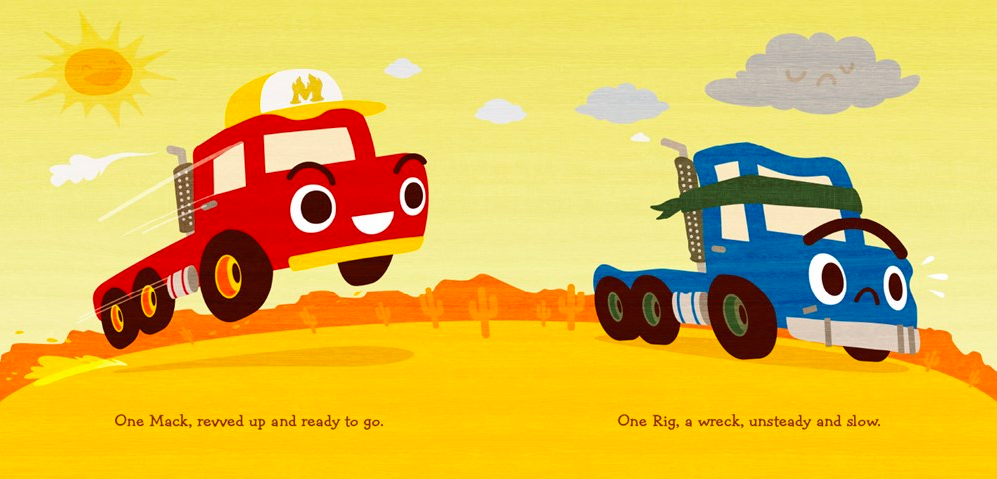
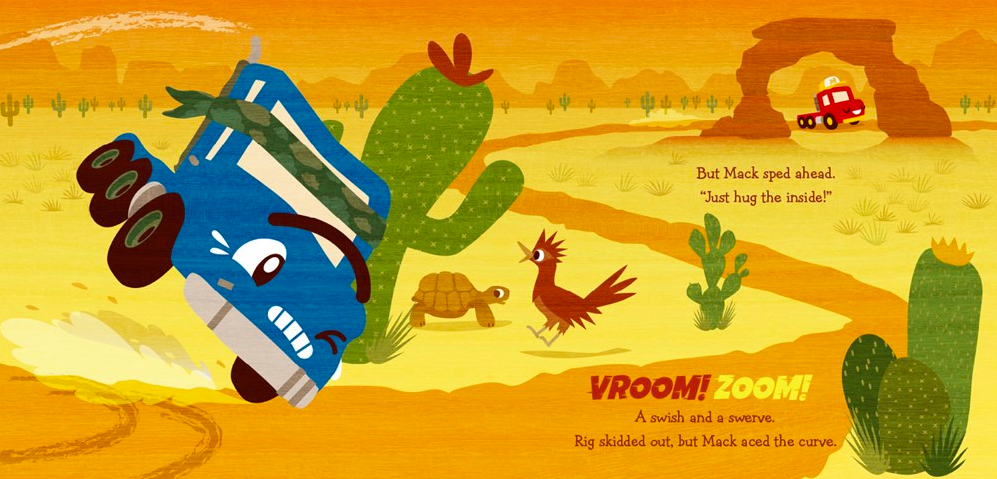
One morning, two trucks are ready “for their first day of class.” But Rig’s “riding the brakes” while Mack’s “hitting the gas.” In their classroom, their teacher Miss Rhodes pairs these two up for a practice run on the track. First up is the circuit, with twists and a hairpin turn. Rig feels shaky, but Mack’s “a speedy red blur.” Mack picks up speed going into the turn and keeps on going, but Rig hits the brakes and skids off the course.

celebrate-picture-books-picture-book-review-two-tough-trucks-meeting

Image copyright Hilary Leung, 2019, text copyright Corey Rosen Schwartz and Rebecca J. Gomez, 2019. Courtesy of Orchard Books.

Next comes learning to downshift while climbing a hill. Mack breezes up as Rig carefully inches along. First to the top, Mack gloats, “‘I knew I was fast.’” And although Rig tried his best he “finished dead last.” Mack thought Rig was just dragging him down. For Rig, Mack just seemed liked a braggart. As he vroomed, Mack fumed and left Rig “in the dust.”

celebrate-picture-books-picture-book-review-two-tough-trucks-sharp-curve

Image copyright Hilary Leung, 2019, text copyright Corey Rosen Schwartz and Rebecca J. Gomez, 2019. Courtesy of Orchard Books.

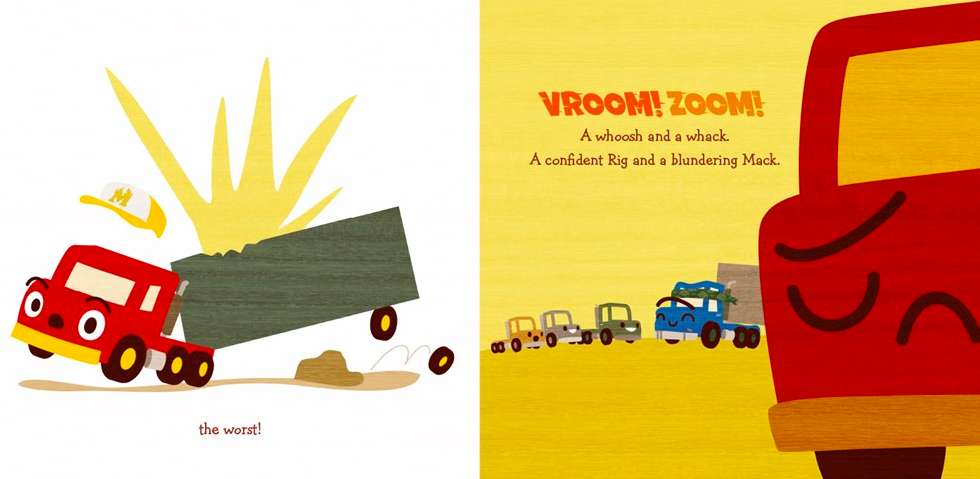
The students moved on to practicing backing up. As they moved around traffic cones,  “they veered and corrected, / they turned and reversed. / Rig had good instincts, but Mack was… the worst.” Rig aced the course, but Mack? He was ready to quit until Rig steered him right. “Vroom! Zoom! / They backtracked and bumped. / A Mack making progress, / a Rig feeling pumped!”

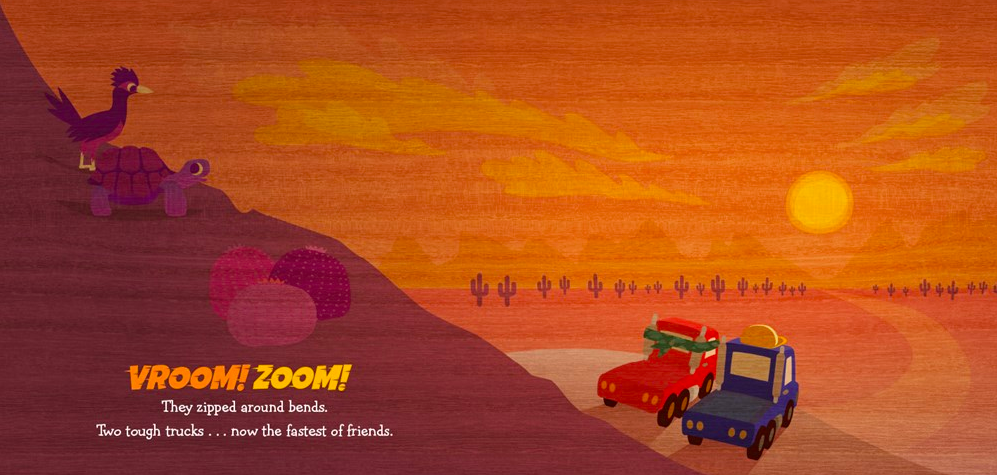
Mack was surprised that Rig had helped him, but for Rig it was just the right thing to do. They headed back to the track and took it by storm. These two trucks were “now the fastest of friends.”

celebrate-picture-books-picture-book-review-two-tough-trucks-blundering-mack

Image copyright Hilary Leung, 2019, text copyright Corey Rosen Schwartz and Rebecca J. Gomez, 2019. Courtesy of Orchard Books.

Like life’s road itself, this original story of two trucks with distinct personalities and different strengths has many twists and turns and takes little ones on a multilayered journey of discovery. While Mack is rarin’ to go on his first day of truck school, Rig is more hesitant. When these two are teamed up for the day, Mack’s fast and daring approach to the track seems to be the right one as he nails the sharp curve and is the first to reach the peak of the hill, leaving Rig far behind. These early successes cause him to honk his own horn and complain about Rig.

But then in a clever literal and metaphorical reversal, Rig’s thoughtful restraint makes backing up his forte. In Mack’s reaction to being last, Corey Rosen Schwartz and Rebecca Gomez gently ramp up life lessons about perseverance and losing gracefully. Rig then goes on to demonstrate another winning trait in his generosity to teach Mack the finer points of driving in reverse. Mack’s acceptance of Rig’s kindness shows that the experience has taught him to be humble. Kudos to Miss Rhodes for creating a track that leads to strong bonds and friendship.

A book by Schwartz and Gomez always charms with smart rhyming and jaunty rhythms and Two Tough Trucks is no exception. Ingenious puns, evocative and active vocabulary, and plenty of “vrooms” and “zooms” for kids to chime in on make this book a lively read aloud.

celebrate-picture-books-picture-book-review-two-tough-trucks-sunset

Image copyright Hilary Leung, 2019, text copyright Corey Rosen Schwartz and Rebecca J. Gomez, 2019. Courtesy of Orchard Books.

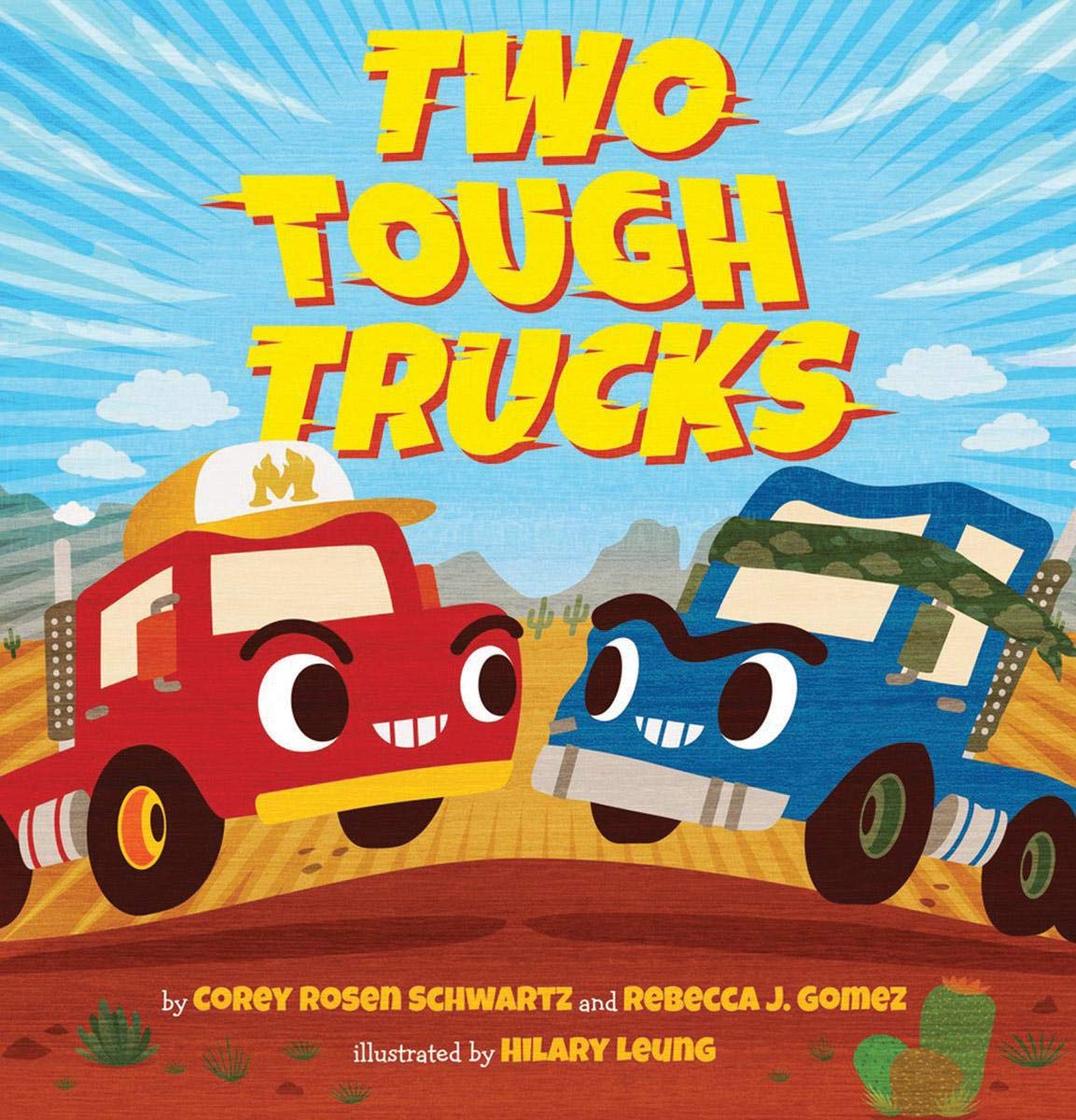
Hilary Leung’s textured and boldly colored pages will thrill little readers as Mack and Rig take center stage on the dusty, western track. Mack’s confidence shows in his straight, crisp lines and grinning grill while Rig’s wariness takes the form of wobbly tires, bent frame, furrowed brow, and grimacing grill. Fittingly, the Truck School building is shaped like a parking garage, complete with a spiral ramp that takes students to the second and third story. Cacti, roadrunners, and craggy rock formations dot the sun-drenched desert track where Mack, Rig, and the rest of the students strut their stuff.

A joy to read out loud and a story kids will want to hear again and again, Two Tough Trucks is highly recommended for home bookshelves, preschool and kindergarten classrooms, and public libraries.

Ages 3 – 5

Orchard Books, 2019 | ISBN 978-1338236545

Discover more about Corey Rosen Schwartz and her books on her website.

To learn more about Rebecca J. Gomez and her books, visit her website.

To view a portfolio of work by Hilary Leung and learn more about his work, visit her website.

Get Caught Reading Month Activity

celebrate-picture-books-picture-book-review-truck-racing-game-wood

Racing for Friendship Game


Here’s a racing game that kids will love! With poster board, paper, and chalk or other art supplies, kids can place their track in a city, the country, the desert, or even in outer space! Once the scene is ready, get out your own toy cars or trucks to play with or use the printable truck game pieces included below. Use a traditional playing die or the included printable 8-sided playing die. The first player to the finish line wins—or shake it up a bit and make the last person to the line the winner.

The track can be laid out on the floor and taped in place or created on poster board or paper with the supplies below:

Supplies

  • Poster board or tri-fold display board. I used a 12-inch by 4-foot section of a tri-fold board in my example. This allows you to fold up the board for easier storing.
  • White paper
  • Chalk, crayons, or colored pencils
  • Glue or tape
  • Scissors
  • Toy trucks or cars
  • Printable Truck Game Pieces (optional)
  • Printable 8-sided Playing Die

Directions

  1. Cut 30 4- or 5-inch by 1½-inch strips from the white paper
  2. Have kids lay out a track on the board using the white paper strips (each strip is one space) leaving room in between the rows for scenery
  3. Glue or tape the strips in place
  4. Draw scenery around the track OR cut trees, buildings, landmarks, or other scenery from paper and color. Glue or tape to board. 
  5. Print and assemble 8-sided playing die with tape (optional)
  6. Give each player a toy truck or car. Alternately, print and cut out included Truck Game Pieces. (To make them sturdier, print on heavy paper or glue them to cardboard)
  7. Choose a player to go first
  8. Players take turns rolling the die and moving the appropriate number of spaces
  9. The first (or last) player to the finish line is the winner

celebrate-picture-books-picture-book-review-two-tough-trucks-cover

You can find Two Tough Trucks at these booksellers

Amazon | Barnes & Noble | Books-a-Million | IndieBound

celebrate-picture-books-picture-book-review-two-tough-trucks-get-lost-cover

Vroom and zoom with Mack and Rig in Two Tough Trucks Get Lost!, a new  adventure coming on September 1! You can preorder it here

Amazon | Barnes & Noble | Books-a-Million | IndieBound


November 5 – It’s National Family Stories Month

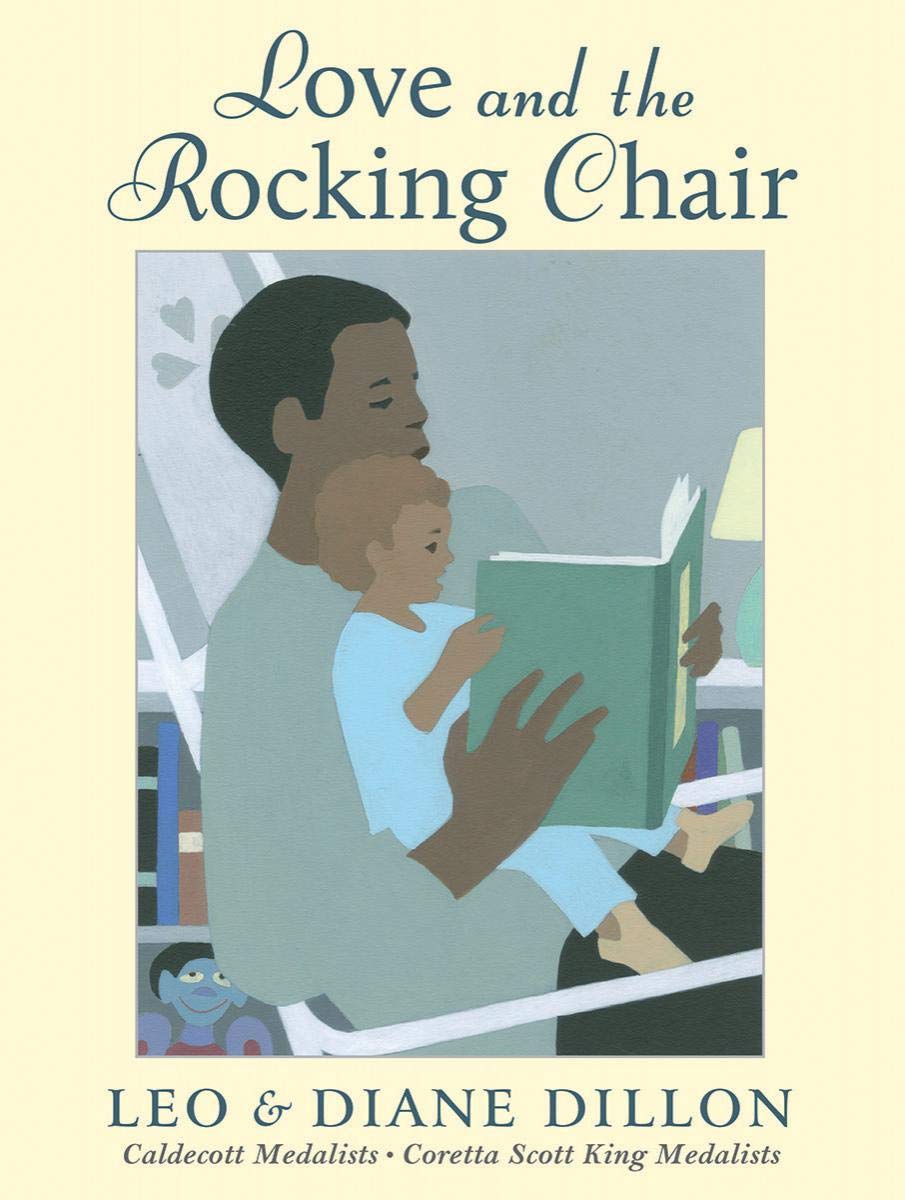
celebrate-picture-books-picture-book-review-love-and-the-rocking-chair-cover

About the Holiday

Children benefit so much from close relationships to grandparents, aunts, uncles, cousins, and other extended family members. This month and next, as family gathers together for special holiday events, it’s fun for adults to share family history and their own funny stories of growing up with the younger generation. Letting kids know how much they’re loved by everyone in the family is important too. It helps them develop a sense of belonging, a good self-image, and confidence. Reading together is a perfect way to spend time together and get conversations started.

I received a copy of Love and the Rocking Chair from The Blue Sky Press for review consideration. All opinions are my own. I’m happy to be teaming with The Blue Sky Press in a giveaway of the book. See details below.

Love and the Rocking Chair

By Leo and Diane Dillon

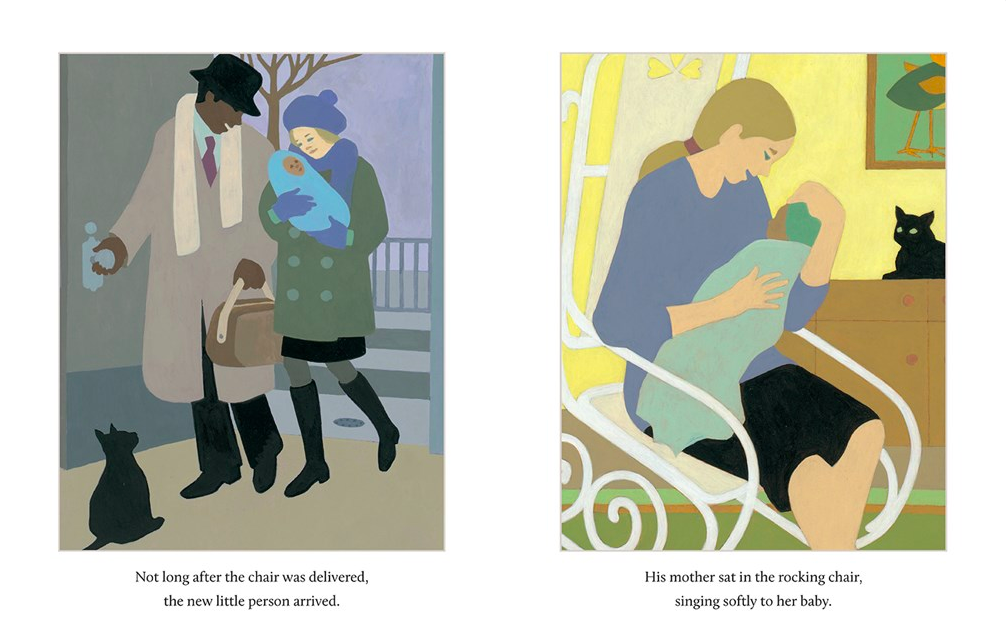
A couple, about to have a baby, “stood in a sea of chairs, searching for just the right one.” Across the store they spied a delicate bentwood rocking chair carved with hearts and knew it was perfect. Soon after the chair was delivered, the couple’s baby boy was born. When they brought him home from the hospital, “his mother sat in the rocking chair, singing softly to her baby.”

celebrate-picture-books-picture-book-review-love-and-the-rocking-chair-baby-boy

Copyright Leo and Diane Dillon, 2019, courtesy of The Blue Sky Press.

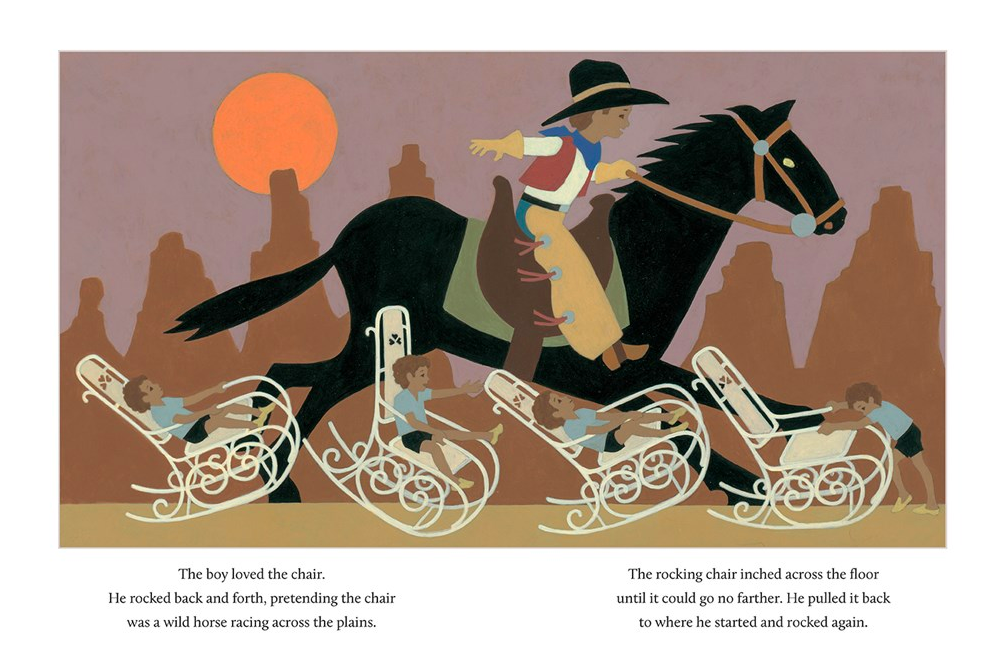
When the boy was a little older, his dad read to him in the rocking chair. As the boy grew, the rocking chair became a “wild horse racing across the plains.” The boy rocked and rocked until the chair moved across the floor. When the chair came to the wall, the boy started over again. A few years went by and soon school beckoned. Now, the boy had friends and homework while the chair sat laden with forgotten toys.

celebrate-picture-books-picture-book-review-love-and-the-rocking-chair-horse

Copyright Leo and Diane Dillon, 2019, courtesy of The Blue Sky Press.

Years passed and the boy went off to college. “The chair was moved to the attic,” where it gathered dust. While the boy was growing older, so were his parents. His “father became ill” and “one sad day, he passed away.” His son came home “to say a last goodbye to his father and to comfort his mother.” When the boy came home again, he brought along his fiancé. His mother hugged her like a daughter.

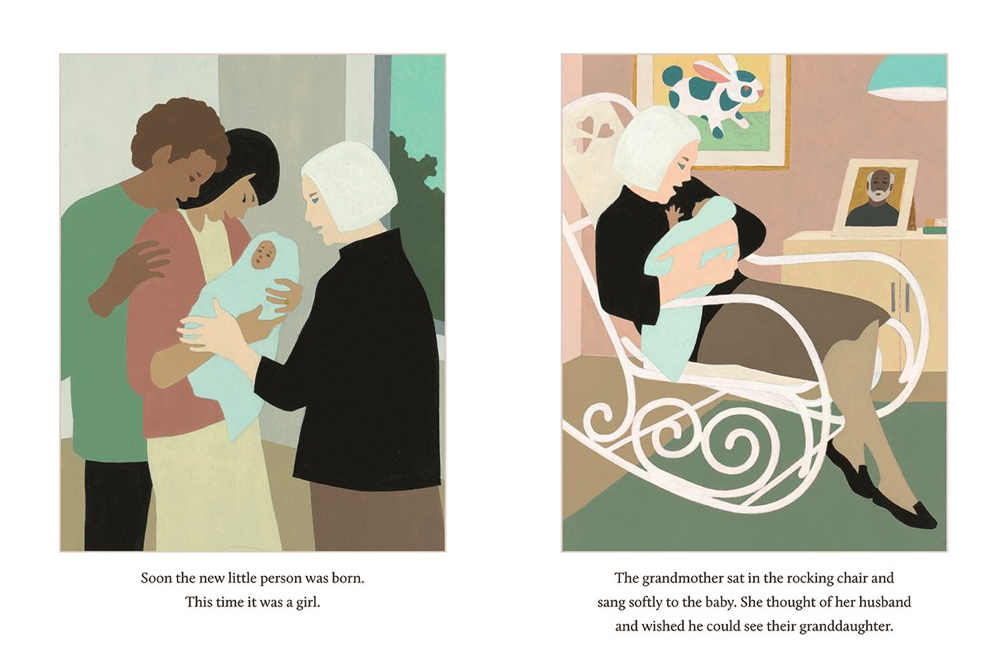
celebrate-picture-books-picture-book-review-love-and-the-rocking-chair-baby-girl

Copyright Leo and Diane Dillon, 2019, courtesy of The Blue Sky Press.

The young couple married and moved in with the man’s mother. Soon, they were going to have their own child. As they decorated the nursery, the man thought of the rocking chair. He brought it down from the attic and “lovingly dusted it off,” placing “it back where it belonged.” After the couple’s little girl was born, her grandmother rocked her in the chair and sang to her. She wished her husband could see her.

celebrate-picture-books-picture-book-review-love-and-the-rocking-chair-ship

Copyright Leo and Diane Dillon, 2019, courtesy of The Blue Sky Press.

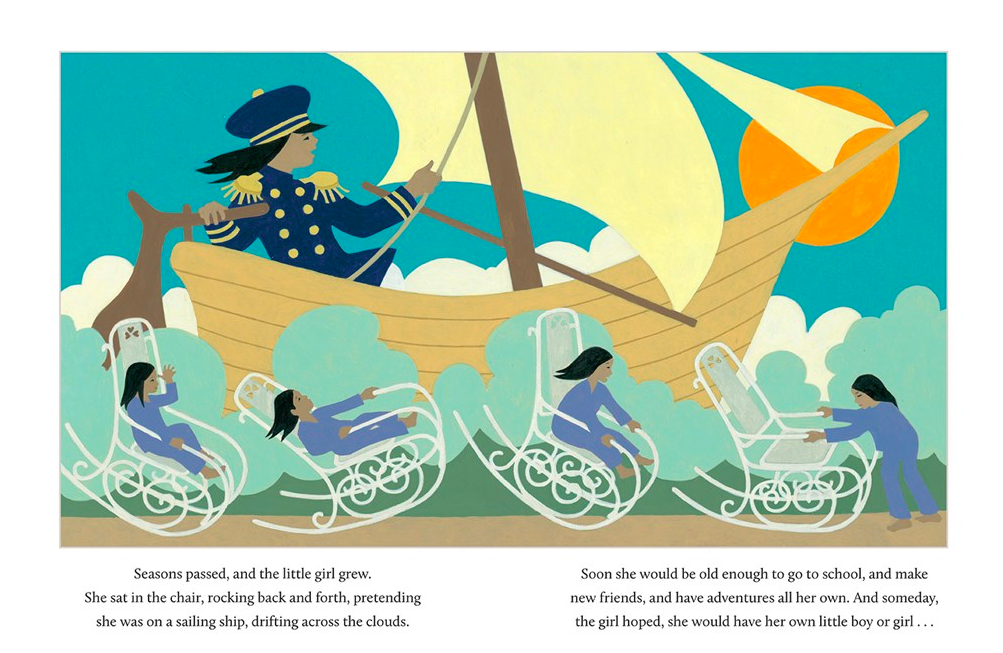
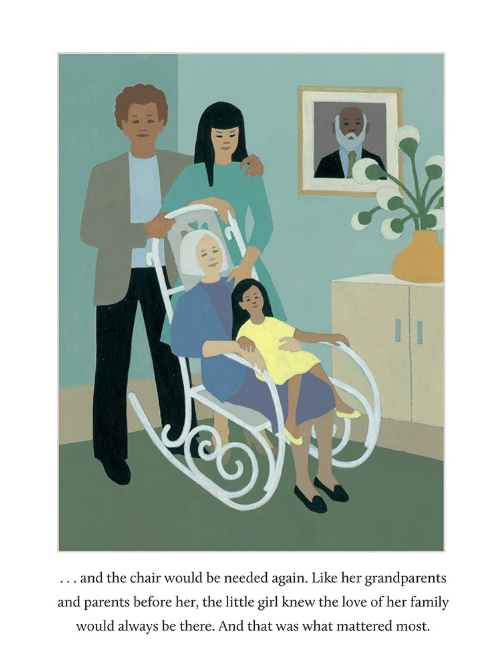
When the little girl was older, she rocked across her room in the chair. She was a sea captain sailing her boat “across the clouds.” Soon, she knew, she would “go to school, and make new friends, and have adventures all her own.” She looked forward to someday rocking a baby of her own in the chair. She thought of her parents and her grandparents and knew that “the love of her family would always be there.”

celebrate-picture-books-picture-book-review-love-and-the-rocking-chair-family

Copyright Leo and Diane Dillon, 2019, courtesy of The Blue Sky Press.

This last collaboration between two-time Caldecott Medal and Coretta Scott King Award winners Leo and Diane Dillon is a beautiful tribute to family and the longevity of love passed from one generation to another. Based on the Dillon’s own experience, the story reveals the bonds that keep people close through changes, additions, good times, and loss through the beloved rocking chair that becomes a touchstone for the family. The Dillon’s lyrical text is straightforward and honest, showing transitions for each family member as well as for the rocking chair.

Endearing illustrations of the parents reading and singing to their babies will resonate with little readers and reinforce the story’s message. The images, rendered in earth tones and blocked and framed with a white border, mirror family photographs or snapshots of transformative and unforgettable moments in a family’s history.

A treasure to share with your child or a child in your family while talking about your own traditions, Love and the Rocking Chair is a tender story to add to home, school, and public library collections.

Ages 3 – 5

The Blue Sky Press, and imprint of Scholastic, 2019 | ISBN 978-1338332650

Family Stories Month Activity

celebrate-picture-books-picture-book-review-sleep-buddy-craft

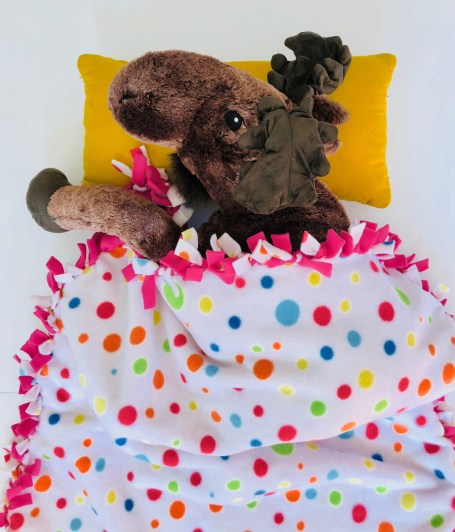
Reading Blanket

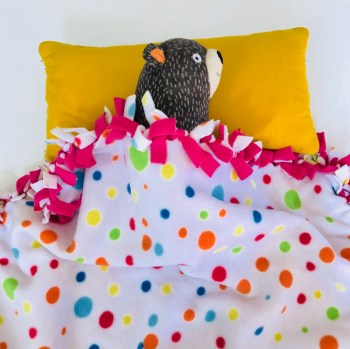
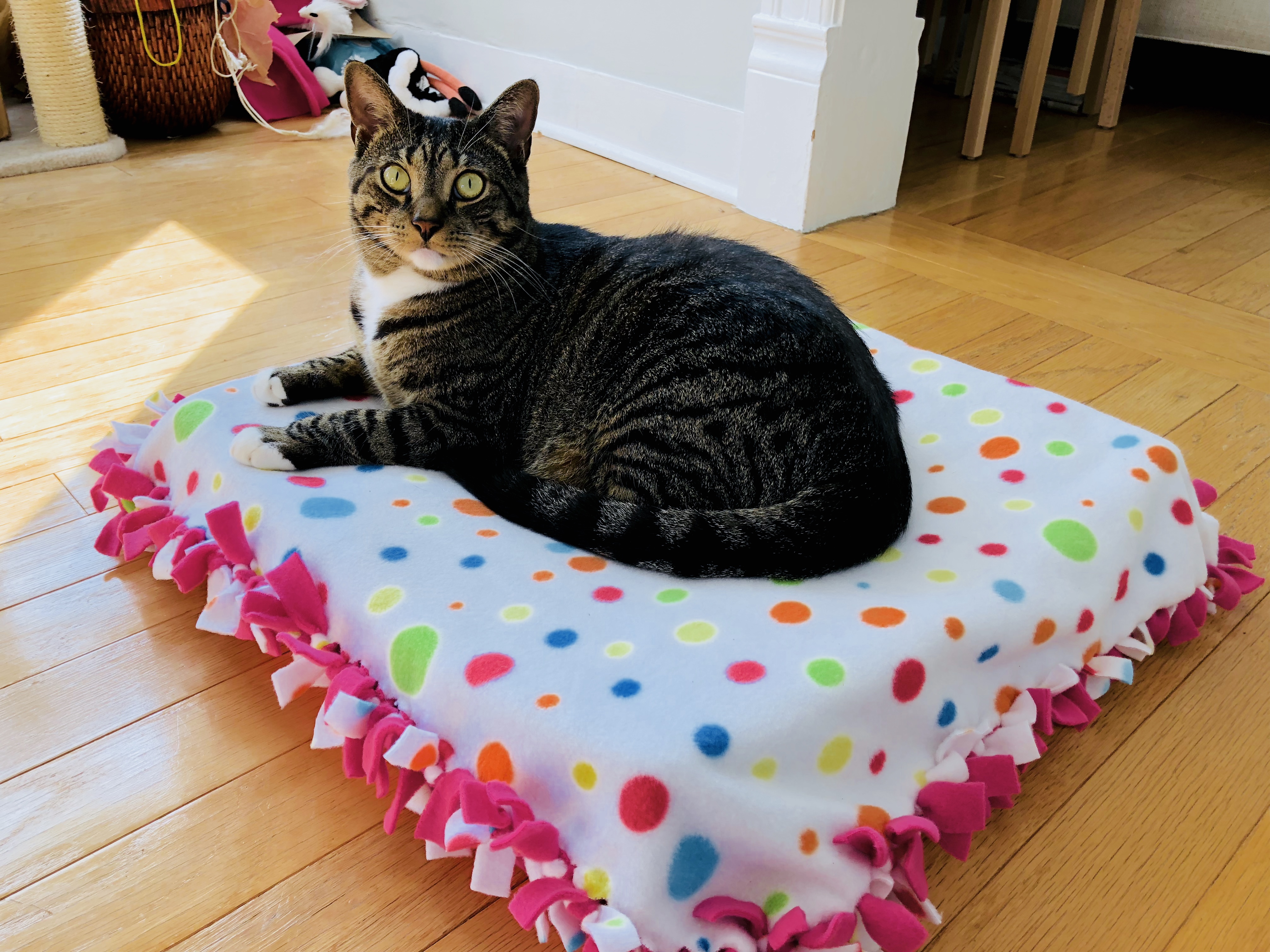
A special blanket to read with feels cozy and warm! With this craft you and your child can make a blanket for yourselves, a stuffed animal or even a pet! Children from ages 5 or 6 and up will enjoy helping to tie the tabs. For younger children, using fabric glue to attach the two pieces of fleece or cutting just one piece of fleece allows them to join in the craft fun.

Supplies

  • 2 pieces of fleece, solid, patterned, or a mix of both
  • Scissors
  • Measuring tape
  • Fluff or pillow (optional for pet bed)
  • Fabric glue (optional)

celebrate-picture-books-picture-book-review-sleep-buddy-craft

Directions

  1. Lay out one piece of fleece and measure a size that will make a comfortable blanket for the stuffed animal or is large enough for your pet to lie on
  2. Add 3 inches to that measurement on each side for the tie tabs
  3. Cut the fleece
  4. Lay out the second piece of fleece and cut it to the same size as the first piece
  5. With both pieces of fleece together cut three-inch long by ½ – ¾ – inch wide tabs all along each side. (If using fabric glue omit this step.)
  6. At the corners, four tabs will be cut off on each side

To Make a Blanket

  • Tie the top and bottom tabs together on all sides

To Make a Pet Bed

celebrate-picture-books-picture-book-review-cat-bed-craft

  1. Tie the tabs together on three sides
  2. Add the fluff or pillow insert
  3. Tie the tabs on the final side

celebrate-picture-books-picture-book-review-love-and-the-rocking-chair-cover

You can find Love and the Rocking Chair at these booksellers

Amazon | Barnes & Noble | Books-a-Million | IndieBound

Picture Book Review

September 17 – It’s Friendship Month

celebrate-picture-books-picture-book-review-two-tough-trucks-cover

About the Holiday

Established by the Oddfellows, an organization dedicated to philanthropy and charity, about ten years ago, Friendship Month encourages people to spend more time with their friends, get in touch with those they haven’t seen or talked to in a while, and especially to reach out to others who are alone or need a friend. As school gets underway, there are plenty of opportunities for kids to meet new people and form friendships – some of which may last a lifetime.

I received a copy of Two Tough Trucks from Scholastic for review consideration. All opinions are my own. I’m excited to be teaming with Scholastic in a giveaway of the book. See details below.
Two Tough Trucks

Written by Corey Rosen Schwartz and Rebecca J. Gomez | Illustrated by Hilary Leung


One morning, two trucks are ready “for their first day of class.” But Rig’s “riding the brakes” while Mack’s “hitting the gas.” In their classroom, their teacher Miss Rhodes pairs these two up for a practice run on the track. First up is the circuit, with twists and a hairpin turn. Rig feels shaky, but Mack’s “a speedy red blur.” Mack picks up speed going into the turn and keeps on going, but Rig hits the brakes and skids off the course.

celebrate-picture-books-picture-book-review-two-tough-trucks-meeting

Image copyright Hilary Leung, 2019, text copyright Corey Rosen Schwartz and Rebecca J. Gomez, 2019. Courtesy of Orchard Books.

Next comes learning to downshift while climbing a hill. Mack breezes up as Rig carefully inches along. First to the top, Mack gloats, “‘I knew I was fast.’” And although Rig tried his best he “finished dead last.” Mack thought Rig was just dragging him down. For Rig, Mack just seemed liked a braggart. As he vroomed, Mack fumed and left Rig “in the dust.”

celebrate-picture-books-picture-book-review-two-tough-trucks-sharp-curve

Image copyright Hilary Leung, 2019, text copyright Corey Rosen Schwartz and Rebecca J. Gomez, 2019. Courtesy of Orchard Books.

The students moved on to practicing backing up. As they moved around traffic cones,  “they veered and corrected, / they turned and reversed. / Rig had good instincts, but Mack was… the worst.” Rig aced the course, but Mack? He was ready to quit until Rig steered him right. “Vroom! Zoom! / They backtracked and bumped. / A Mack making progress, / a Rig feeling pumped!”

Mack was surprised that Rig had helped him, but for Rig it was just the right thing to do. They headed back to the track and took it by storm. These two trucks were “now the fastest of friends.”

celebrate-picture-books-picture-book-review-two-tough-trucks-blundering-mack

Image copyright Hilary Leung, 2019, text copyright Corey Rosen Schwartz and Rebecca J. Gomez, 2019. Courtesy of Orchard Books.

Like life’s road itself, this original story of two trucks with distinct personalities and different strengths has lots of twists and turns and takes little ones on a multilayered journey of discovery. While Mack is rarin’ to go on his first day of truck school, Rig is more hesitant. When these two are teamed up for the day, Mack’s fast and daring approach to the track seems to be the right one as he nails the sharp curve and is the first to reach the peak of the hill, leaving Rig far behind. These early successes cause him to honk his own horn and complain about Rig.

But then in a clever literal and metaphorical reversal, Rig’s thoughtful restraint makes backing up his forte. In Mack’s reaction to being last, Schwartz and Gomez gently ramp up life lessons about perseverance and losing gracefully. In addition, Rig goes on to demonstrate another winning trait in his generosity to teach Mack the finer points of driving in reverse. Mack’s acceptance of Rig’s kindness shows that the experience has taught him to be humble. Kudos to Miss Rhodes for creating a track that leads to strong bonds and friendship.

A book by Schwartz and Gomez always charms with smart rhyming and jaunty rhythms and Two Tough Trucks is no exception. Ingenious puns, evocative and active vocabulary, and plenty of “vrooms” and “zooms” for kids to chime in on make this book a lively read aloud.

celebrate-picture-books-picture-book-review-two-tough-trucks-sunset

Image copyright Hilary Leung, 2019, text copyright Corey Rosen Schwartz and Rebecca J. Gomez, 2019. Courtesy of Orchard Books.

Hilary Leung’s textured and boldly colored pages will thrill little readers as Mack and Rig take center stage on the dusty, western track. Mack’s confidence shows in his straight, crisp lines and grinning grill while Rig’s wariness takes the form of wobbly tires, bent frame, furrowed brow, and grimacing grill. Fittingly, the Truck School building is shaped like a parking garage, complete with a spiral ramp that takes students to the second and third story. Cacti, roadrunners, and craggy rock formations dot the sun-drenched desert track where Mack, Rig, and the rest of the students strut their stuff.

A joy to read out loud and offering so much repeat readability, Two Tough Trucks is highly recommended for home bookshelves, preschool and kindergarten classrooms, and public libraries.

Ages 3 – 5

Orchard Books, 2019 | ISBN 978-1338236545

Discover more about Corey Rosen Schwartz and her books on her website.

To learn more about Rebecca J. Gomez and her books, visit her website.

To view a portfolio of work by Hilary Leung and learn more about his work, visit her website.
Friendship Month Activity

celebrate-picture-books-picture-book-review-truck-racing-game-wood

Racing for Friendship Game

Here’s a racing game that kids will love making and playing with friends or family! With poster board, paper, and chalk or other art supplies, kids can place their track in, a city, the country, the desert, or even in outer space! Then get out your own toy cars and trucks to play with or use the printable truck tokens included below. Use a traditional playing die or the included printable 8-sided playing die. The first player to the finish line wins—or shake it up a bit and make the last person to the line the winner.

Supplies

  • Black poster board, thick poster board, or tri-fold display board. I used a 12-inch by 4-foot section of a tri-fold board in my example. This allows you to fold up the board for easier storing.
  • White paper
  • Chalk, crayons, or colored pencils
  • Glue or tape
  • Scissors
  • Toy trucks or cars
  • Printable Truck Tokens (optional)
  • Printable 8-sided Playing Die

Directions

  1. Cut about 30 4- or 5-inch by 1½-inch strips from the white paper
  2. Have kids lay out a track on the board using the white paper strips (each strip is one space) leaving room in between the rows for scenery
  3. Glue or tape the strips in place
  4. Cut trees, buildings, landmarks, or other scenery from paper and color. Glue or tape to board. Alternately, draw scenery on the board with chalk
  5. Print and assemble 8-sided playing die with tape (optional)
  6. Gather one toy truck or car for each player. Alternately, print and cut out included Truck Tokens. (To make them sturdier, print on heavy paper or glue them to cardboard)
  7. Choose a player to go first
  8. Players take turns rolling the die and moving the appropriate number of spaces
  9. The first (or last) player to the finish line is the winner

celebrate-picture-books-picture-book-review-two-tough-trucks-cover

You can find Two Tough Trucks at these booksellers

Amazon | Barnes & Noble | Books-a-Million | IndieBound

Picture Book Review