This week Juneteenth became America’s eleventh federal holiday when President Joe Biden signed the Juneteenth National Independence Day Act into law on June 17. Juneteenth commemorates the end of slavery and celebrates the historical date of June 19, 1865, when Union army general Gordon Granger came to Galveston, Texas to read “General Order #3,” which proclaimed the emancipation of the 250,000 slaves held in Texas. On the one-year anniversary of the proclamation, freedmen in Texas organized the first Jubilee Day, which became an annual event. Celebrations later spread across the south and then nationwide. The day includes parades, festivals, music, readings by prominent African American writers, educational events and barbecues, complete with refreshing strawberry soda. You can learn more about Juneteenth on the website for the Smithsonian Museum’s National Museum of African American History & Culture.
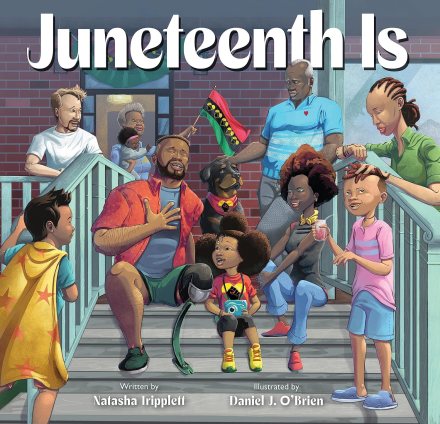
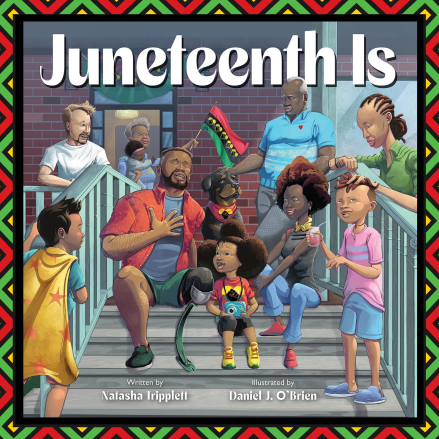
Juneteenth Is
Written by Natasha Tripplett | Illustrated by Daniel O’Brien
Juneteenth starts early for one young girl who’s awakened by the tantalizing aroma of brisket in her father’s smoker. Before the sun is fully risen, she, her family, and the whole neighborhood are heading out to the center of town to find a spot and set their chairs to watch the parade. As a group of young dancers passes by, accompanied by a freedom song on the horns, the girl’s mama calls them a “hope for tomorrow.”
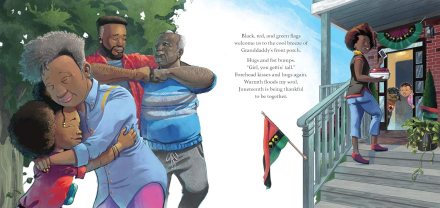
Following the parade the girl’s extended family gather at her grandaddy’s house, where black, red, and green flags join hugs, fist bumps, and forehead kisses in welcome. The girl says, “Warmth floods my soul. Juneteenth is being thankful to be together.” Soon the house is full of aunties and uncles, cousins, neighbors, and play-cousins. Music fills the air from the boombox. “Juneteenth is ladies singing in the kitchen.” After sweet watermelon and a pickup game, it’s time for dinner. Everyone circles the table, holding hands. “Juneteenth is prayer.”
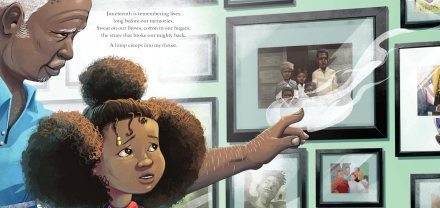
But this meal of old family recipes and reminiscences represents more—”Red in the sauce, red in the soda, red in the watermelon, red velvet cake. Red in the suffering.”—and the history of this holiday now takes center stage. As the girl and her young cousins look at the wall of family photographs, Grandaddy explains that Juneteenth is “about the door of opportunity no longer slamming in our faces” and “remembering lives long before our memories. Sweat on our brows. Cotton in our fingers. The straw that broke our mighty back.” The girl feels her history deep in her heart.
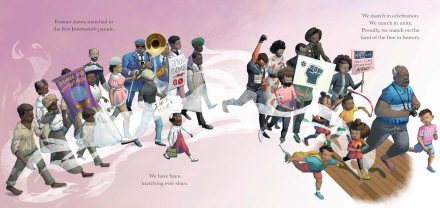
Grandaddy then talks about June 19, 1865—The American Day of Freedom, when General Granger came to Galveston, Texas and read the Proclamation that freed slaves. The day two years after Abraham Lincoln signed the Emancipation Proclamation. It was a freedom that looked into a future forged by leaders like Rosa Parks, Martin Luther King, Jr., Barack Obama and demonstrated with the first Juneteenth parade in 1866 and fought for and defended with marches ever since.
As the day ends, the girl’s family congregates in the yard for a final photograph. “Juneteenth is all of us,” she says. “We are America.”
Natasha Tripplett’s beautifully composed multigenerational story wraps readers in the camaraderie and loving support of one girl’s extended family and friends as they come together to celebrate Juneteenth. As Tripplett reveals the traditions of Juneteenth and the hope for the future the holiday is built on and continues to represent, her seamless transitions superbly echo the rhythms of such poignant family get togethers. Readers can smell the brisket, hear the joyful parade, and feel the tight hugs among family members. Likewise, children will experience a tug of sadness as Grandaddy explains the history of the holiday. Tripplett’s warmhearted storytelling will resonate with children, making this an excellent book to introduce Juneteenth to young readers as well as a springboard for further discussion or research.
Daniel O’Brien’s stunning illustrations dynamically depict the community and fellowship of this family’s Juneteenth celebration. The characters’ facial expressions and movements light up the parade and pre-dinner scenes, while the girl’s, cousins’, and grandfather’s somber looks during his recitation of history reveal the deep meaning of the holiday. A common bond between Granddaddy and the young narrator is reflected in the cameras both carry, a symbol, also, of history being passed down through the generations.
Encompassing the warmth of family as well as the historical and emotional significance of this important holiday, Juneteenth Is is a must for any library and school collection and a book that families will embrace.
Ages 5 – 8
Chronicle Books, 2024 | ISBN 978-1797216805
About the Author
Natasha Tripplett lives in Northern California, where she writes from a tree house perched in a sycamore. She is a Jamaican Jewish American author who is passionate about cultural representation in children’s literature. You can visit her at natashabooks.com.
About the Illustrator
Daniel J. O’Brien is a Trinidadian-born author and illustrator. He holds a BFA in illustration from the School of Visual Arts. He currently lives in New York with his fantastic partner and loyal dog. You can visit him at danielostudios.com.
You can purchase Juneteenth Is from these booksellers
Now in its 14th year World Read Aloud Day, founded by global non-profit LitWorld, encourages adults to read aloud to children not only today but every day. Reading aloud to children from birth is one of the best ways to promote language development, improve literacy, and enjoy bonding time together. Millions of people celebrate today’s holiday all across the United States and in more than one hundred countries around the world. Special events are held in schools, libraries, bookstores, homes, and communities, and authors and illustrators hold readings and visit classrooms in person and virtually. To learn more about World Read Aloud Day, visit LitWorld and check out their Activity Hub to find live events, virtual read alouds, downloadable bookmarks, posters, games, and more!
I would like to thank Simon & Schuster and Barbara Fisch at Blue Slip Media for sharing a copy of Love Is Loud with me for review consideration. All opinions on the book are my own.
Love Is Loud: How Diane Nash Led the Civil Rights Movement
Written by Sandra Neil Wallace | Illustrated by Bryan Collier
Raised on Chicago’s South Side, Diane Nash is sheltered by her parents from the segregation of the South that they had grown up in. During the Second World War, Diane is taken care of by her grandmother while her father joins the army and her mother takes a job. Her Grandmother Bolton is from Tennessee and showers her with love. “You are ‘more precious than all the diamonds in the world,'” she told Diane, and growing “up in the rhythm and glow of her love” Diane knew “it must be true.”
Image copyright Bryan Collier, 2023, text copyright Sandra Neil Wallace, 2023. Courtesy of Simon & Schuster/Paula Wiseman Books.
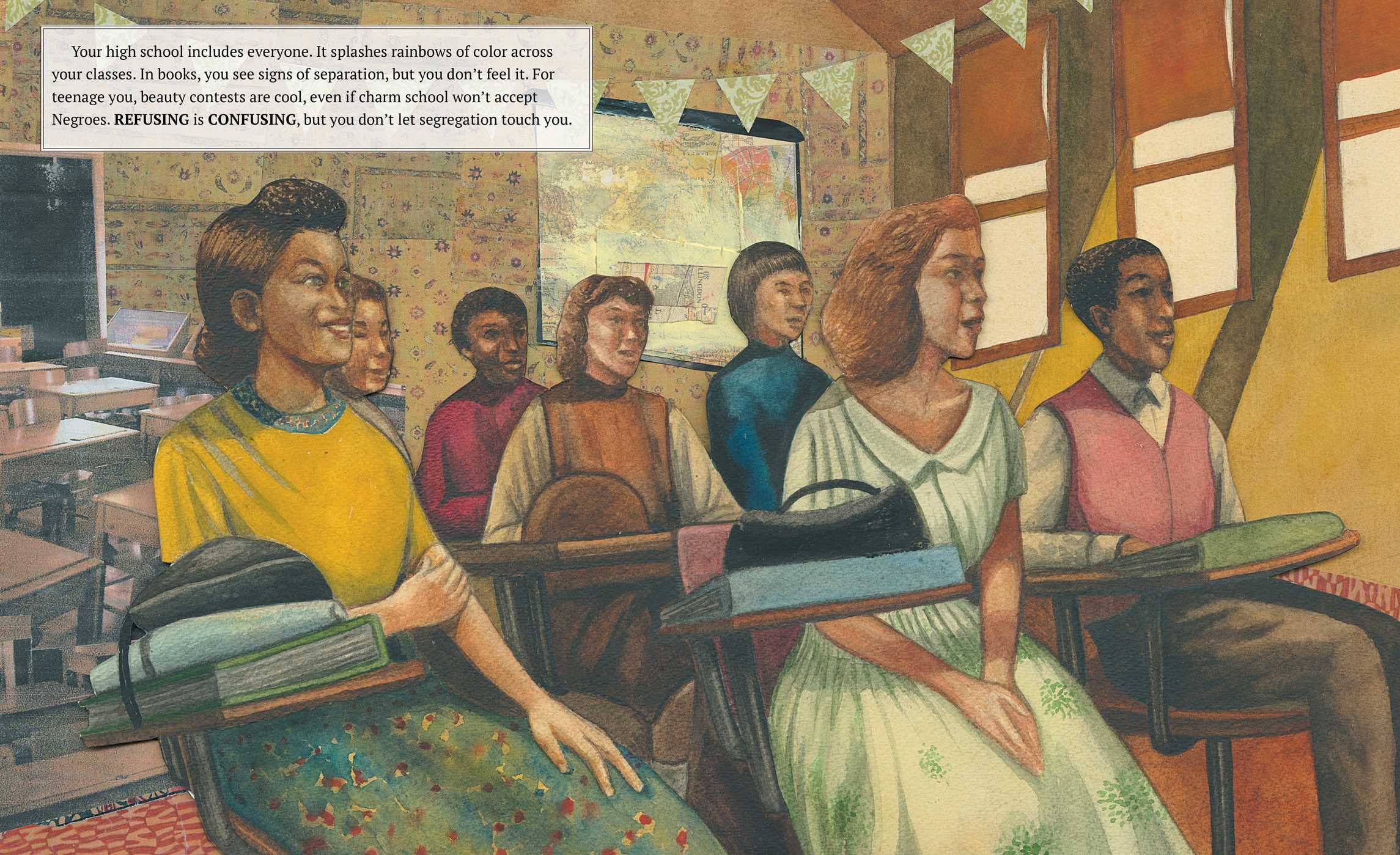
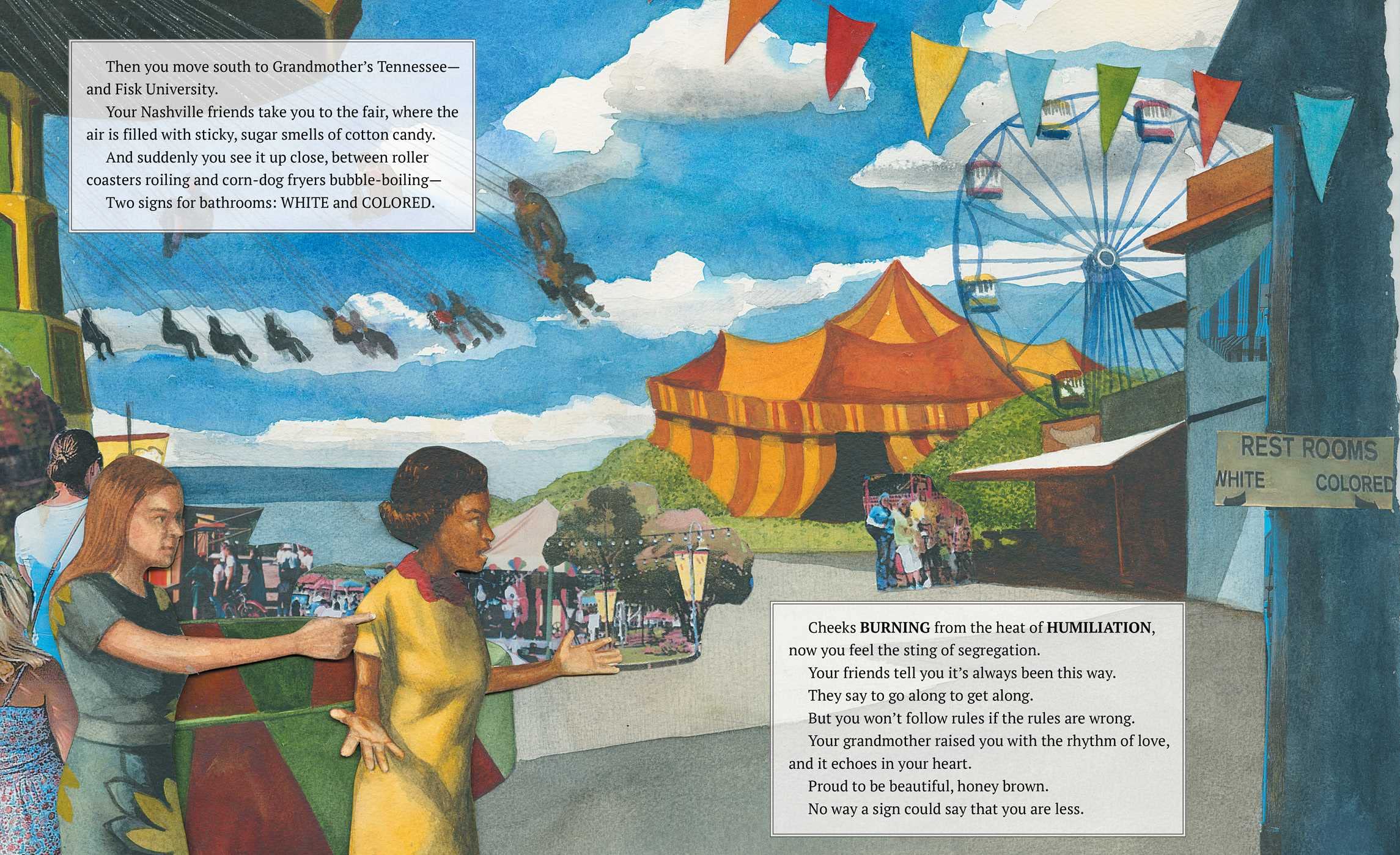
In high school kids of all colors learn together. Diane reads about segregation in textbooks, but it didn’t really touch her. Then she moves to Tennessee to attend Fisk University. Here, when her friends take her to a fair, Diane is confronted with the “sting of segregation” when she sees there are two restrooms: one labeled WHITE and the other COLORED. Her friends have grown up in this system; they tell her “to go along to get along,” but Diane “won’t follow rules if the rules are wrong.” The rhythms of her grandmother’s love and her pride in being “beautiful, honey brown” will not allow her to feel less than others.
In Nashville, Diane experiences the full indignation of segregation that demands separate water fountains and schools, back-of-the-bus seating, and—the worst for Diane—no eating at the lunch counter. She doesn’t want to be arrested for eating at a lunch counter, but neither does she want to let it go. Before each day of college classes, Diane and other students “pray and learn about change in a peaceful way.” They practice calmly sitting and ordering at a lunch counter, knowing that people may be rude, may push them off their stool, may throw sugar in their hair.
Image copyright Bryan Collier, 2023, text copyright Sandra Neil Wallace, 2023. Courtesy of Simon & Schuster/Paula Wiseman Books.
In February of 1960, Diane, now at twenty-one years old, leads a group of students to a lunch counter in Nashville. Their presence shocks the cooks and waitress, who drops plate after plate from her shaking hands. “Inside [Diane shakes] too. Hands sweating, never forgetting the danger, the fear of being arrested for ordering a sandwich.” Bravely, despite coffee burns and thrown sugar, Diane and the students hold sit ins at lunch counters across the city. And when Diane is arrested, there are hundreds of others to fill her seat.
After a bombing in April Diane, “quietly walking, without any talking… silently leads six-thousand marching feet to the beat of love” to meet the mayor, who at first says there is nothing he can do. Looking him in the eye, Diane asks him questions he cannot deny, and he admits that prejudice and segregation are wrong—even at the lunch counter. “At that moment, love scores. It soars as six thousand loving hands roar with applause.” And in May—Diane has just turned twenty-two—Nashville’s lunch counters are fully integrated. Martin Luther King Jr. congratulates her on her peaceful victory as she moves on to change the rules of bus travel with Freedom Rides, to uphold the “law of the land [that] says everyone is free to sit or stand together in a bus traveling across America.”
Image copyright Bryan Collier, 2023, text copyright Sandra Neil Wallace, 2023. Courtesy of Simon & Schuster/Paula Wiseman Books.
While the movement makes progress, even attracting the attention of the president, a Mississippi judge charges Diane “with putting Freedom Riders on a bus.” Before her trial, Diane, pregnant with her first child, writes a letter heard around the world that said “‘I believe that if I go to jail now, … it may help hasten that day when my child and all children will be free.'” Her case rivets the world as she chooses to go to jail instead of paying bail.
After she is released, Diane turns her attention to the issue of voting rights and the state of Alabama, where four young girls are killed in a bombing in a Birmingham church and “where Black people are denied the right to vote.” Following Diane’s example, thousands of adults and children choose jail over bail in protest of the injustice until the Civil Rights Act is signed by President Johnson in 1964 and a year after that when he “signs the 1965 Voting Rights Act to legally end racial discrimination that prevented Black people from voting.” But Diane Nash doesn’t stop there. She takes her message of peace and peaceful change across the country for fifty years, teaching young people “how love creates change.”
Image copyright Bryan Collier, 2023, text copyright Sandra Neil Wallace, 2023. Courtesy of Simon & Schuster/Paula Wiseman Books.
Extensive back matter includes an Author’s Note and an Illustrator’s Note about the work of Diane Nash; a detailed timeline from her birth to 2022, when she was awarded the Presidential Medal of Freedom; a list of video interviews with Diane Nash, four other books for young readers; sources for quotes found in the story; and a selected bibliography. A photograph of Nash and three other students integrating a lunch counter in Nashville and another of Nash leading demonstrators to meet the mayor of Nashville are also included.
Image copyright Bryan Collier, 2023, text copyright Sandra Neil Wallace, 2023. Courtesy of Simon & Schuster/Paula Wiseman Books.
Compelling and moving, Sandra Neil Wallace’s lyrical storytelling about the life and work of Diane Nash rivets readers to this young woman’s courage, confidence, and conviction to overturn the injustice of segregation and inequality for Blacks. Punctuated with often-rhyming phrases, and sharp, short sentences Wallace’s text flows with a rhythm of urgency that perfectly conveys not only Nash’s resolve, but the stakes for the peaceful demonstrators and the atmosphere of the times.
Written in the third person, the story directly addresses Nash, but the repeated “you” also builds a chorus that reverberates in each reader’s heart, telling them that they are brave, that they are strong, and that they too can change the world with love. This format poignantly culminates on the last page. Here, Wallace changes the dynamic with a subtle turn of phrase that now directly embraces each reader, letting them know that Diane Nash worked for freedom “because she loved you even before you were born” and reminding them that “Love is fierce. Love is strong. Love is loud!”
Bryan Collier’s rich watercolor-and-collage illustrations draw readers in with their realistic depictions of Diane Nash as a baby and young girl cherished by her family, as a high school and university student, at the fair that changed the trajectory of her life, leading peaceful demonstrations at lunch counters and across the South, and crossing the country to bring her message to young people. Nash’s self-assurance, courage, and determination are evocatively expressed, and a full-page portrait of Diane looking out at the reader mirrors Wallace’s invitation for them to look into her eyes and see her love there.
Scraps of photographs are sprinkled here and there among the pages, providing a spark of recognition of the time and places depicted. But it is the cut paper elements that make certain images of people and objects jump off the page, working powerfully with Wallace’s text to make readers feel that they too are at the fair, at the lunch counter, joining the throng of marchers. Each page is a masterpiece of history and story that invites study, thoughtful contemplation, and action.
Absorbing, eloquent, and impactful, Love Is Loud: How Diane Nash Led the Civil Rights Movement is biography at its best: a moving tribute Diane Nash set amid a far-reaching immersion in the time period. Love Is Loud belongs in every home, classroom, school, and public library collection to teach children about the contributions of Diane Nash as well as to remind them that vigilance and the work for freedom is an ever-ongoing pursuit.
Ages 4 – 8
Simon & Schuster | Paula Wiseman Books, 2022 | ISBN 978-1534451032
About the Author
Sandra Neil Wallace writes about people who break barriers and change the world. She is the author of several award-winning books for children, including Between the Lines: How Ernie Barnes Went from the Football Field to the Art Gallery, illustrated by Bryan Collier, which received the Orbis Pictus Book Award and was an ALA Notable Book. A former ESPN reporter and the first woman to host an NHL broadcast, she is the recipient of the Outstanding Women of New Hampshire Award and creates change as cofounder of The Daily Good, a nonprofit bringing twenty thousand free, culturally diverse foods to college students each year through its Global Foods Pantries. Visit Sandra at SandraNeilWallace.com.
About the Illustrator
Bryan Collier is a beloved illustrator known for his unique style combining watercolor and detailed collage. He is a four-time Caldecott Honor recipient for Trombone Shorty, Dave the Potter, Martin’s Big Words, andRosa. His books have won many other awards as well, including six Coretta Scott King Illustrator Awards. His recent books include By and By,Thurgood, The Five O’Clock Band, and Between the Lines. He lives in New York with his family. Visit him at BryanCollier.com.
Watch the Book Trailer for Love Is Loud!
World Read Aloud Day Activities
2022 Presidential Medal of Freedom Ceremony
Watch as Diane Nash is awarded the Presidential Medal of Freedom in this White House video from July 7, 2022. You can find President Joe Biden’s remarks about Diane Nash at the 5:50 mark, and see her receive her medal at the 41:29 mark.
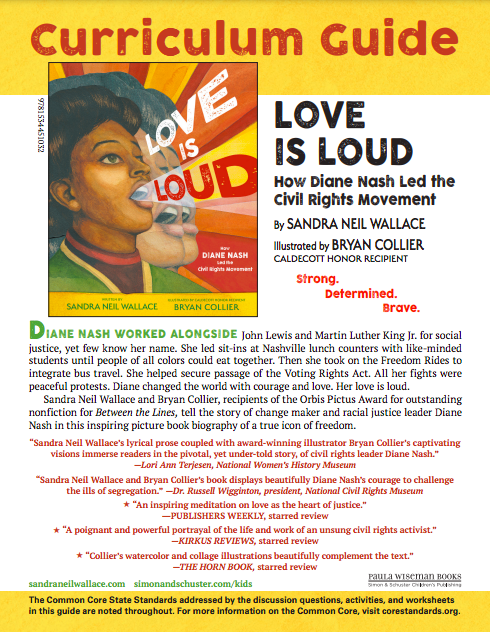
Love Is Loud Curriculum Guide
Teachers, educators, and homeschoolers can download an in-depth, 6-page Curriculum Guide for Love Is Loud full of a variety of ways for students to connect with the book and history from Sandra Neil Wallace’s website here.
You can find Love Is Loud: How Diane Nash Led the Civil Rights Movement at these booksellers
Black History Month celebrates the achievements and contributions of African Americans in United States History. Originally a week-long observance initiated by writer and educator Dr. Carter G. Woodson in1926 and occurring during the second week in February to commemorate the birthdays of Frederick Douglass and Abraham Lincoln, Black History Month was officially established in 1976 by then president Gerald Ford. The holiday is now celebrated across the country with special events in schools, churches, and community centers.
The theme for 2022 is “Black Health and Wellness” and focuses on the legacy of not only Black scholars and medical practitioners in Western medicine, but also on alternate ways of practicing medicine throughout the African Diaspora. The 2022 theme considers activities, rituals, and initiatives that Black communities engage in to live healthy lives.
To learn more about Black History Month, find information on this year’s events, access resources for more research, and find content for teachers, visit the BlackHistoryMonth.gov.
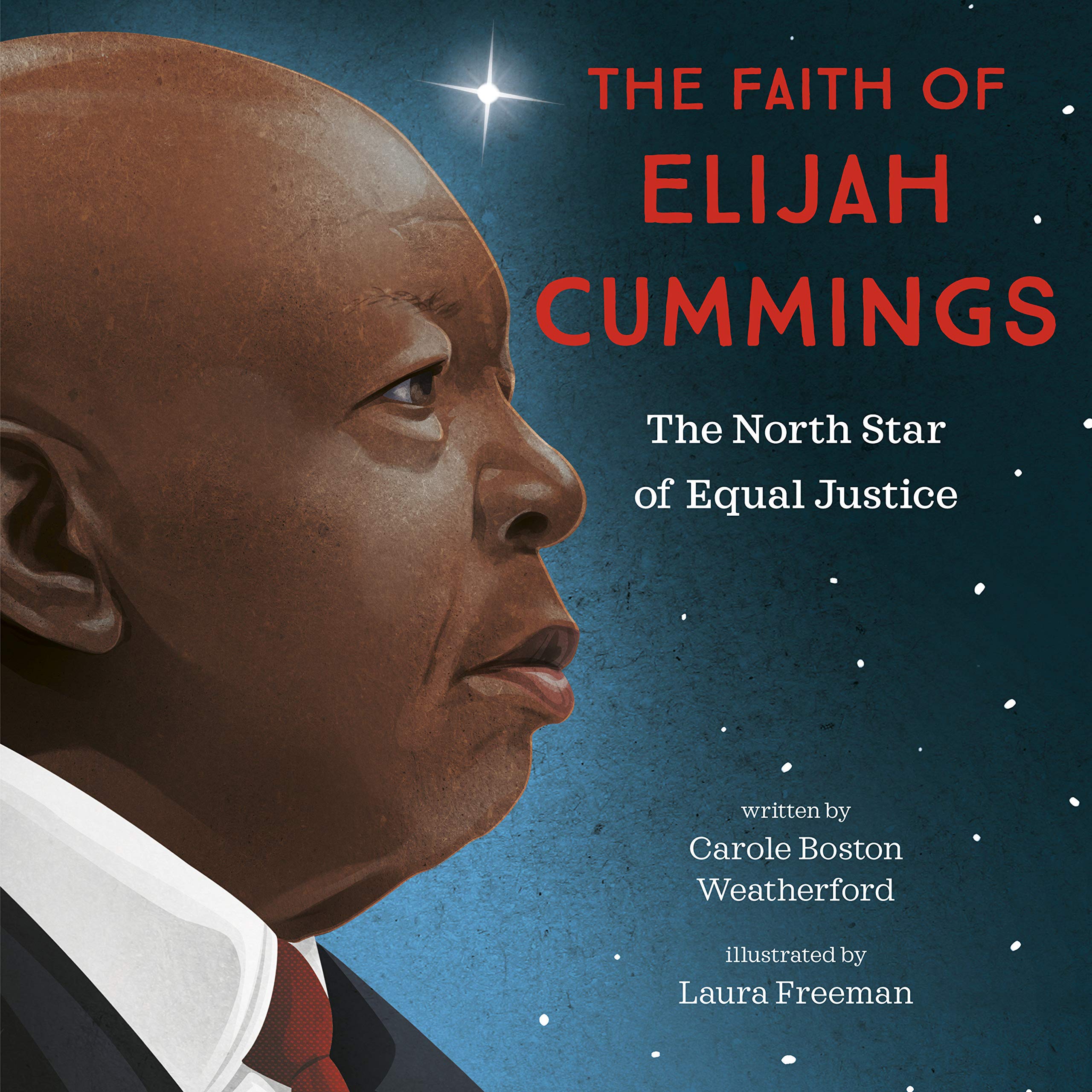
The Faith of Elijah Cummings: The North Star of Equal Justice
Written by Carole Boston Weatherford | Illustrated by Laura Freeman
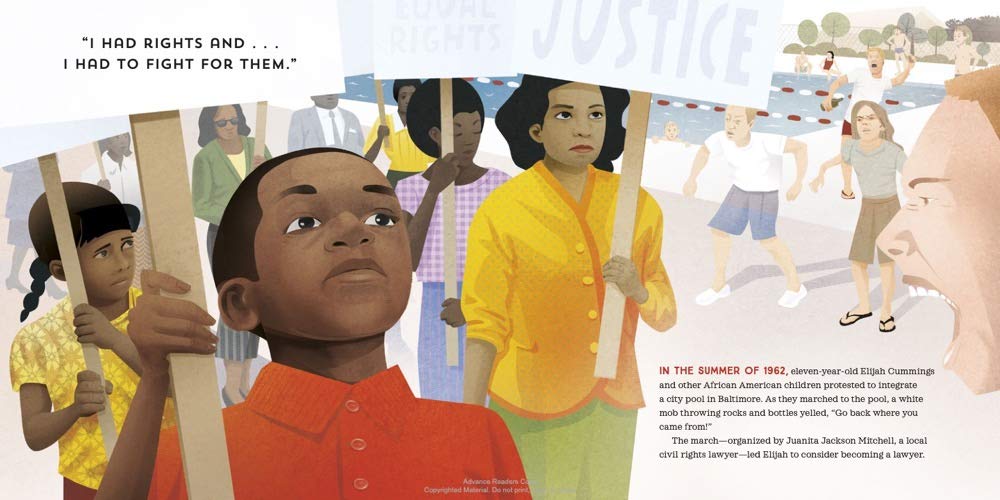
During the summer of 1962, when Elijah Cummings was eleven years old, he and other African American children marched for the integration of a Baltimore city pool. They were met with a white mob who shouted at them to “‘Go back where you came from!'” and threw rocks and bottles at them. This protest, organized by civil rights lawyer Juanita Jackson Mitchell, inspired Elijah to consider becoming a lawyer also.
Elijah’s parents had moved to Maryland from South Carolina in the 1940s, where they had worked the land where their parents had once been enslaved and where “Blacks were beaten for seeking voting rights. Elijah, his parents, and his six siblings lived in a four-room row house, where his mother and father – having only a fourth-grade education – stressed the importance of schooling. But for inquisitive Elijah, the nuts and bolts of reading and writing were elusive. Because of the cramped conditions at home, Elijah took to studying at the library, where the librarians tutored him after their shifts and made it possible for Elijah to succeed.
Image copyright Laura Freeman, 2022, text copyright Carole Boston Weatherford, 2022. Courtesy of Random House Studio.
Through hard work, scrimping, and saving, Elijah’s parents were able to buy a house with more room and a yard. Here, Elijah’s mother became a preacher and grew her small group of women who met in their home’s basement into a small church, the Victory Prayer Chapel. In addition to leading services, Elijah’s mother lived what she believed by helping those in need. Elijah’s father inspired him to become all that he could be.
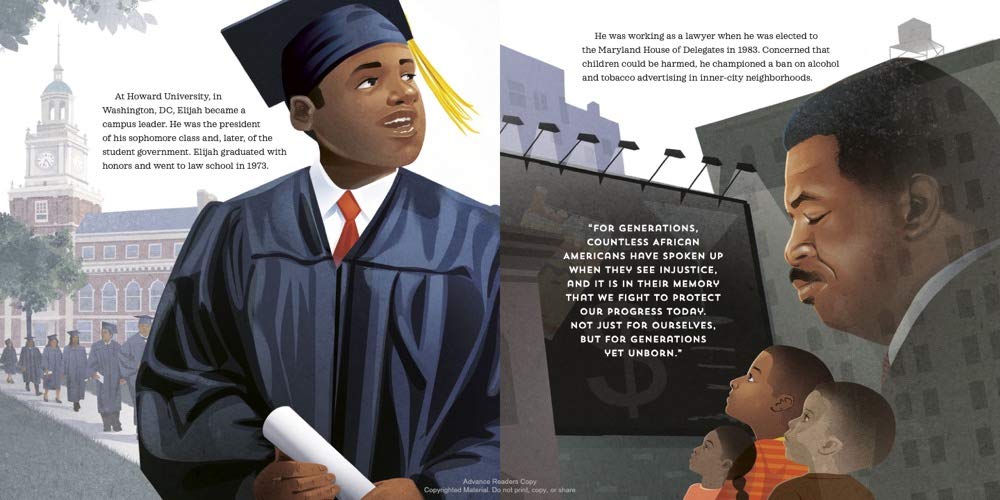
Even as a young boy, Elijah worked hard and, on Sundays after church, he listened to Rev. Martin Luther King’s speeches by transistor radio. He watched as African American boys were put into reform school, and he vowed to become a lawyer, but his high school guidance counselor tried to dissuade him. With the help of his parents and the pharmacist at the drug store where he worked, Elijah attended Howard University, where he was a standout student and leader. He became a lawyer and in 1983 was elected to the Maryland House of Delegates.
Image copyright Laura Freeman, 2022, text copyright Carole Boston Weatherford, 2022. Courtesy of Random House Studio.
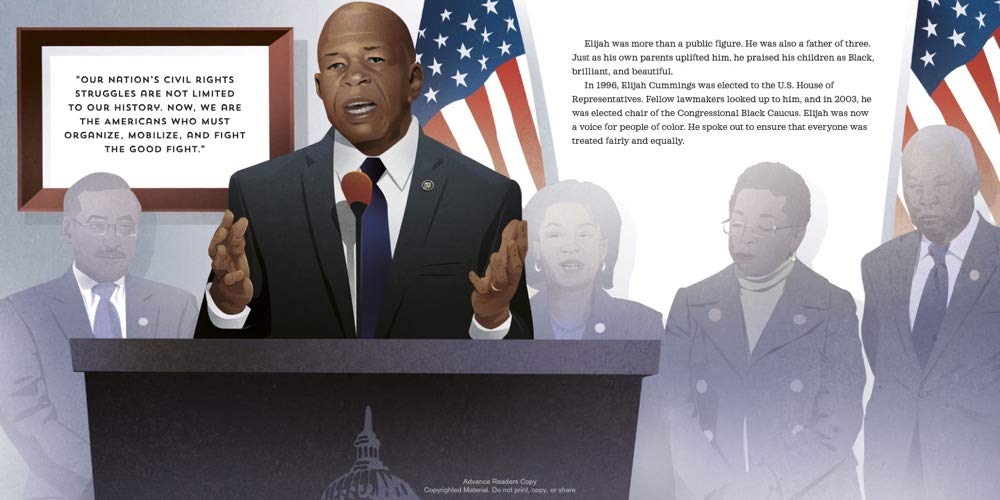
“In 1996, Elijah Cummings was elected to the U.S. House of Representatives,” and later became the chair of the Congressional Black Caucus. “He spoke out to ensure that everyone was treated fairly and equally.” Even though he was a leader in Washington DC, Elijah continued to live in his inner-city Baltimore neighborhood, and during the protests against police brutality in 2015, he appealed for calm as he walked “with residents singing an African American spiritual: ‘This little light of mine, I’m gonna let it shine.'” Before his death in 2019, Elijah Cummings was named chair of the House Committee on Oversight and Reform, where, as he had for his entire career, he advocated for change now and for the future our children will inherit.
Quotes by Elijah Cummings on his inspirations, work, and beliefs included throughout the story allow readers to hear in Cummings’ own words his passion and dedication to creating a more equitable and caring America for all.
A Foreword reprints remarks given by Speaker of the House of Representatives Nancy Pelosi at Elijah Cummings’ funeral on October 25, 2019. Back matter includes an excerpt of the statement from the Congressional Black Caucus upon Cummings’ death on October 17, a Timeline of his life and work, a Bibliography, and Source Notes for the Cummings’ quotes found throughout the story.
Image copyright Laura Freeman, 2022, text copyright Carole Boston Weatherford, 2022. Courtesy of Random House Studio.
Carole Boston Weatherford’s moving biography of Elijah Cummings highlights the strong and supportive family unit that inspired and sustained Elijah as he grew from a thoughtful and hardworking boy into an empathetic and influential leader. Her focus on formative events in Cummings’ life depict how early experiences often shape the person children become while continuing to inform their opinions, beliefs, and occupations. Through his own words, Weatherford reveals Cummings’ commitment to the children who will read this biography as well as to all young people who will benefit from and carry on his work.
In her rich and expressive illustrations, Laura Freeman recreates pivotal events, touching examples of the Cummings’ family solidarity, and community-based actions inspired by the family’s religious faith to paint a portrait of Elijah’s youth and young adulthood. As he rises to the highest levels within the US Congress, while never losing touch with the neighborhood and people he loved, Freeman’s striking images will entice readers to learn more about Elijah Cummings’ legislative legacy and the workings of Congress and to, perhaps, become involved in their own community.
A masterful biography of Elijah Cummings that deftly interweaves the internal and external influences of his youth with their lifelong effects on his principles, his work, and his lasting influence, The Faith of Elijah Cummings is highly recommended for home bookshelves and a must for school and public library collections.
There may be no better month to celebrate Author’s Day than in November. Not only is it Picture Book Month, but thousands of people set aside their usual routine to take part in NaNoWriMo or National Novel Writing Month, when writers try to complete at least a first draft of a novel in one month. The holiday was instituted in 1928 by Nellie Verne Burt McPherson, president of the Bement, Illinois Women’s Club. An avid reader, she established Author’s Day to thank writer Irving Bacheller who sent her an autographed story in response to her fan letter. The day was officially recognized in 1949 by the United States Department of Commerce. McPherson’s granddaughter, Sue Cole, promoted the holiday after Nellie’s death in 1968. To celebrate, people are encouraged to write a note of appreciation to their favorite author.
Thanks go to Workman Publishing and Big Honcho Media for sharing a copy of The ABCs of Black History with me for review consideration. All opinions on the book are my own.
The ABCs of Black History
Written by Rio Cortez | Illustrated by Lauren Semmer
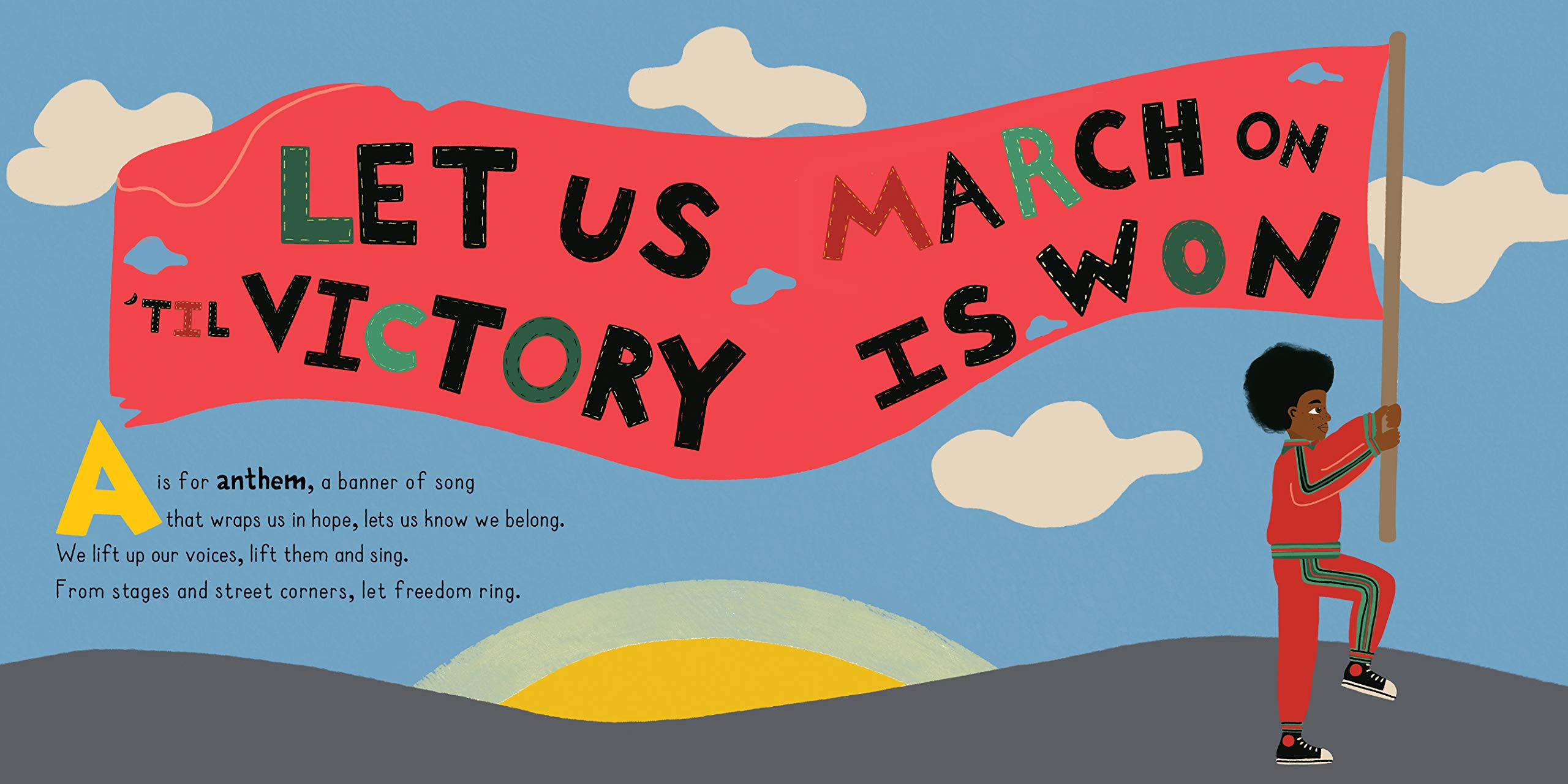
This stunning compendium of lyrical verses defies easy categorization as it bridges the genres of alphabet books, encyclopedias, history books, biographies, and more for young readers. The book opens with words from James Baldwin, in which he says “History is not the past. It is the present. We carry our history with us. We are our history,” and within its pages children discover not only specific events and well-known people, but the emotions, philosophies, and traits that have carried and sustained African Americans.
Image copyright Lauren Semmer, 2020, text copyright Rio Cortez, 2020. Courtesy of Workman Publishing Company.
This inspiring alphabetic journey begins with “A is for anthem, a banner of song / that wraps us in hope, lets us know we belong. / We lift up our voices, lift them and sing. / From stages and street corners, let freedom ring.” From there kids come to B, which is for “beautiful…brave…bright…and bold.” It also describes “brotherhood” and “believing in grace.” At E children meet Explorers Matthew Henson and Mae Jemison as well as some of those who fought to make Education open to all, such as Ruby Bridges, Linda Brown, and the Little Rock Nine.
Image copyright Lauren Semmer, 2020, text copyright Rio Cortez, 2020. Courtesy of Workman Publishing Company.
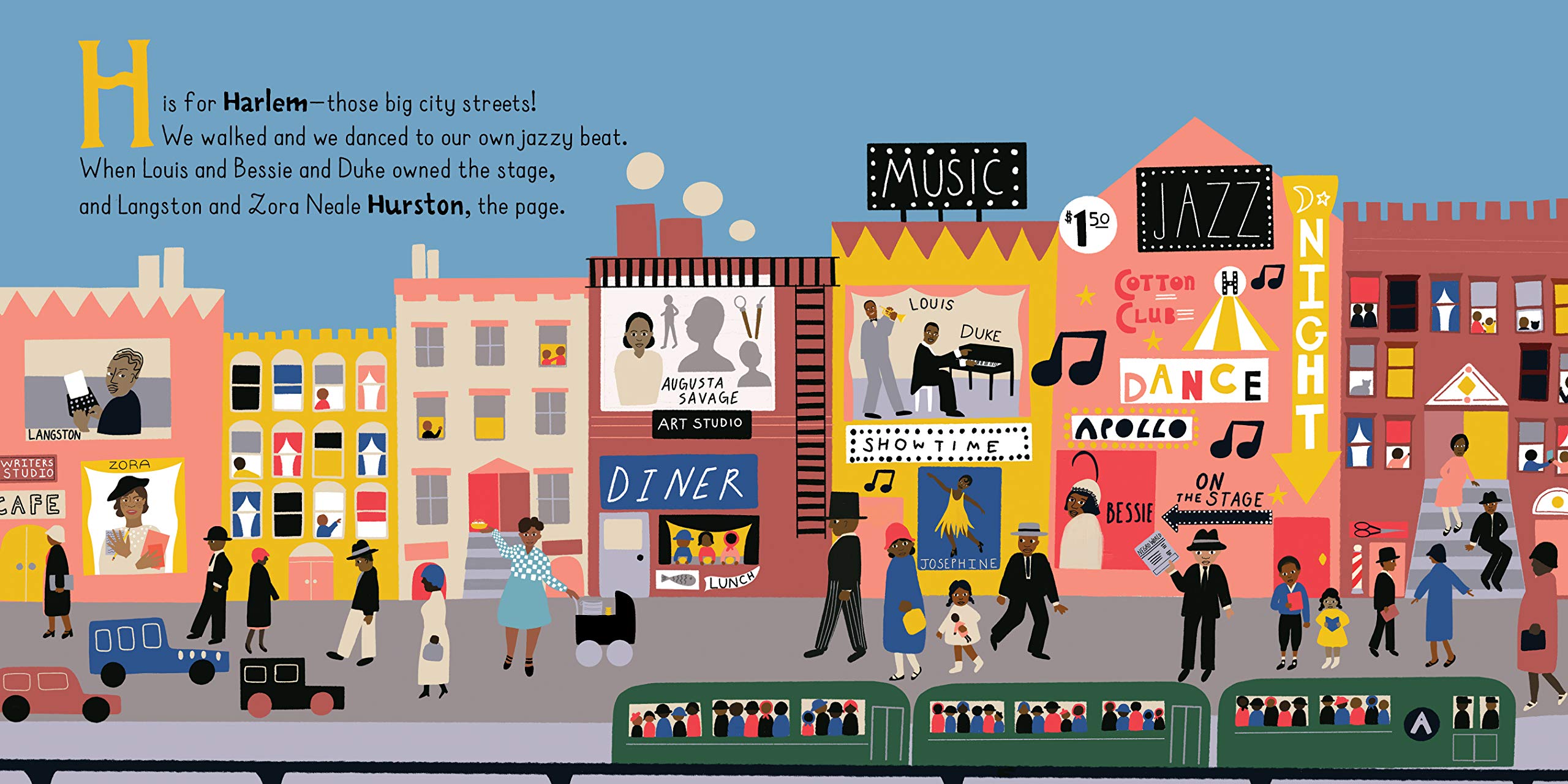
G and the Great Migration follow Black Americans from farmland to cities to “Harlem – those big city streets! / We walked and we danced to our own jazzy beat.” “Imagine, invent, innovative” define letter I, where readers find Alvin Ailey, Jean-Michel Basquiat, Gwendolyn Brooks, Madam C. J. Walker, George Washington Carver, and DJ Kool Herc.
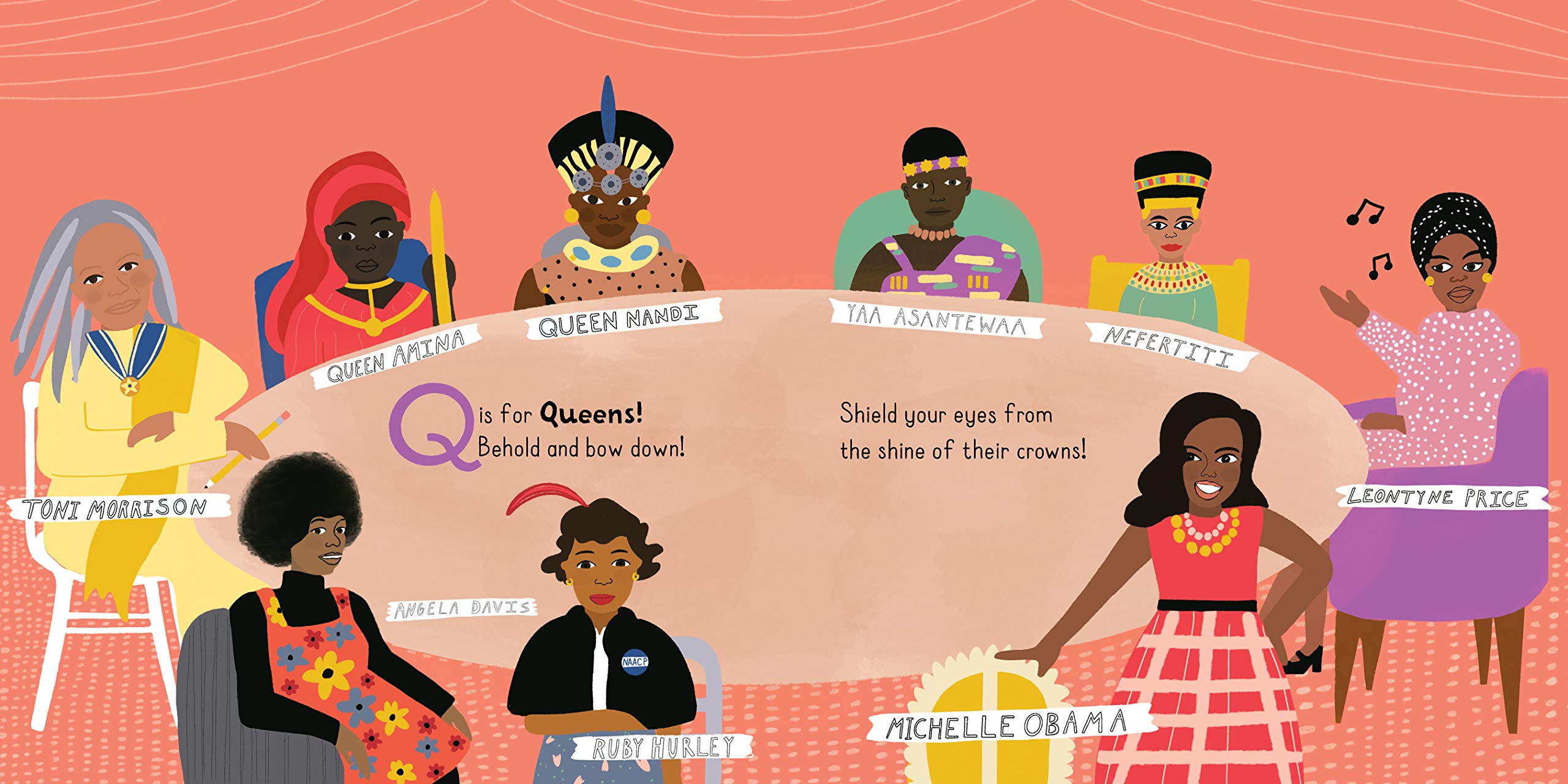
The drive to move forward, to aspire, and succeed is eloquently traced from the past: “M is for march, for lifting our feet, / taking the movement, the cause to the street” to today: “Black lives matter. Every breath, every dream – / Every thought, each idea, each impossible scheme.” From sit-ins to their organizers, from African queens to today’s women leaders, from award-winning athletes to scientists to singers of soul, Black achievement is highlighted across the alphabet.
Image copyright Lauren Semmer, 2020, text copyright Rio Cortez, 2020. Courtesy of Workman Publishing Company.
At U children and adults arrive at poignant verses that should prompt deeper discussions: “U is for United States – this story is tough. / The birth of a nation was deadly for us. / We the people? In the land of the free? / No one who was enslaved would agree.” A second and third verse take in the Civil War and the “unbroken, unshaken, unbound, / like Harriet Tubman, who went underground,” and the battle for freedom and rights that continued after the war’s end. But the pages end on a note of hope, revealing that U is also “for unfinished, this American tale. / With courage and strength, we will prevail!”
Image copyright Lauren Semmer, 2020, text copyright Rio Cortez, 2020. Courtesy of Workman Publishing Company.
As this is National Author’s Day, I must mention that “W is for writers whose wisdom and words / bring to life worlds where our voices are heard. / Rappers adn poets and songwriters, too, / all those who spin from our point of view.” And how does this collection of events, holidays, personalities, hopes, and dreams end? At Z for zenith – “The top of that mountain King said we would reach” to which “we march on, / rising, rising, like the sun with the dawn.”
Back matter includes further elucidation of each letter of the alphabet and it’s accompanying concept. These are detailed entries that also lend themselves to further study. Resources also include websites to organizations and museums and suggestions for books and poetry to read.
Image copyright Lauren Semmer, 2020, text copyright Rio Cortez, 2020. Courtesy of Workman Publishing Company.
Rio Cortez’s poetry soars on optimism, achievement, hope, and a palpable pride in Black history and the future. Musical and conversational, the verses flow off the tongue, creating an exciting and meaningful read-aloud experience for adults and children. The breadth of information that Cortez imparts is stirring, adding up to an impactful look at history and a rousing celebration of Black culture. Every page offers many, many opportunities for further learning, listening, viewing, and research.
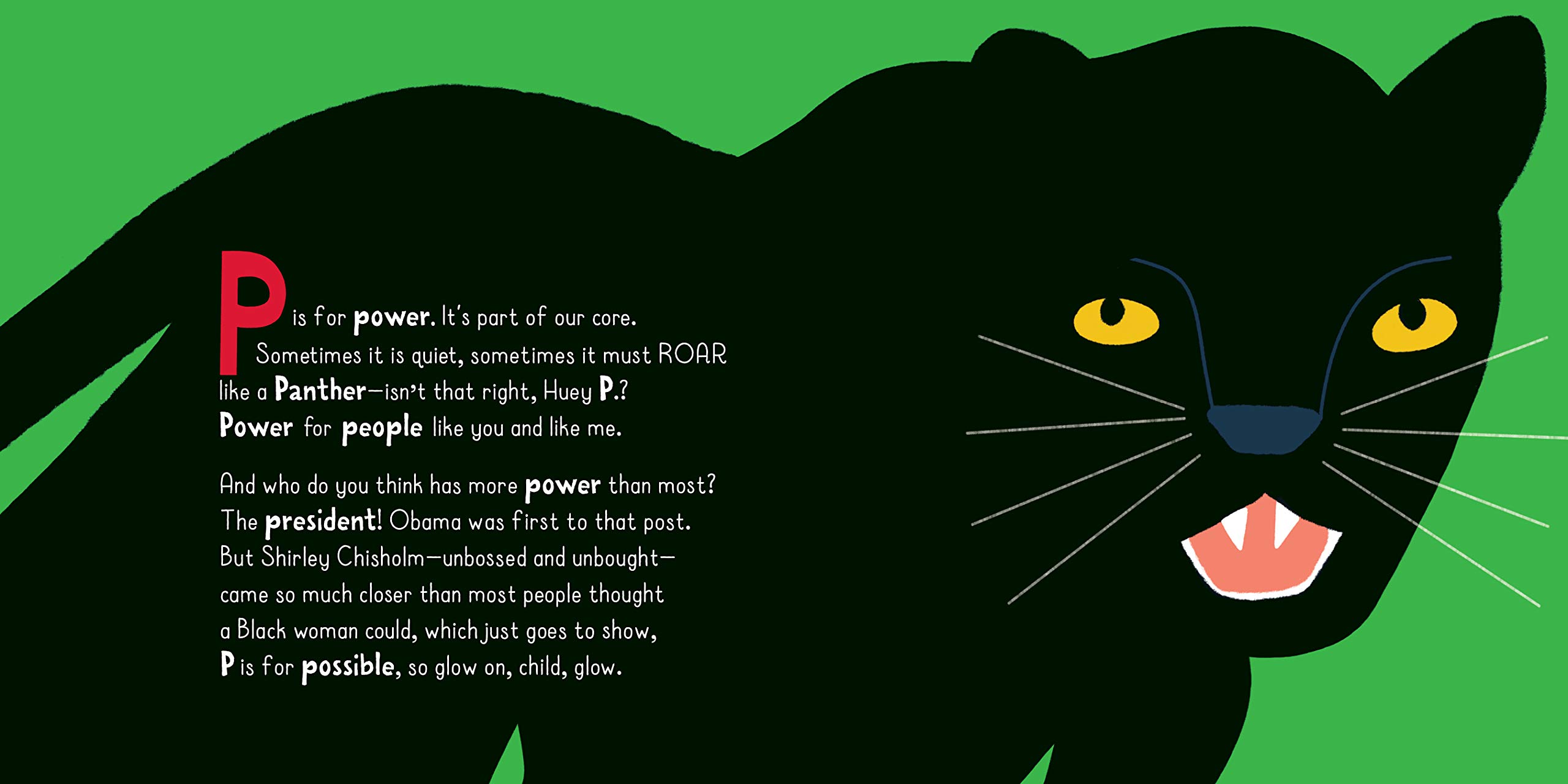
Lauren Semmer’s vivid illustrations – opening with an uplifting group shot of young, happy, and hopeful black and brown faces that welcome their young peers – will enthrall readers with their action, energy, and colors. Portraits of famous figures and unsung heroes will inspire children to get involved in their communities and causes they believe in, while reaching for their dreams.
The ABCs of Black History is an exhilarating picture book for family reading times, a superb cross-curricular resource for homeschoolers and classrooms from elementary school to high school, and a must for all school and public library collections.
Ages 5 and up
Workman Publishing Company, 2020 | ISBN 978-1523507498
Discover more about Rio Cortez and her books on her website.
To learn more about Lauren Semmer, her books, and her art, visit her website.
National Author’s Day Activity
Black Leaders Coloring Pages
Whether you’re interested in law and politics, science, sports, or the arts, you can find a role model in the people in the printable coloring pages below. You’ll find more coloring pages of Black leaders to print at Scribble Fun.
This week Juneteenth became America’s eleventh federal holiday when President Joe Biden signed the Juneteenth National Independence Day Act into law on June 17. Juneteenth commemorates the end of slavery and celebrates the historical date of June 19, 1865, when Union army general Gordon Granger came to Galveston, Texas to read “General Order #3,” which proclaimed the emancipation of all those held as slaves in Texas. On the one-year anniversary of the proclamation, freedmen in Texas organized the first Jubilee Day, which became an annual event. Celebrations later spread across the south and then nationwide. The day includes parades, festivals, music, readings by prominent African-American writers, educational events and barbecues, complete with refreshing strawberry soda. You can learn more about Juneteenth and the symbolism of the flag on Oprah Daily.
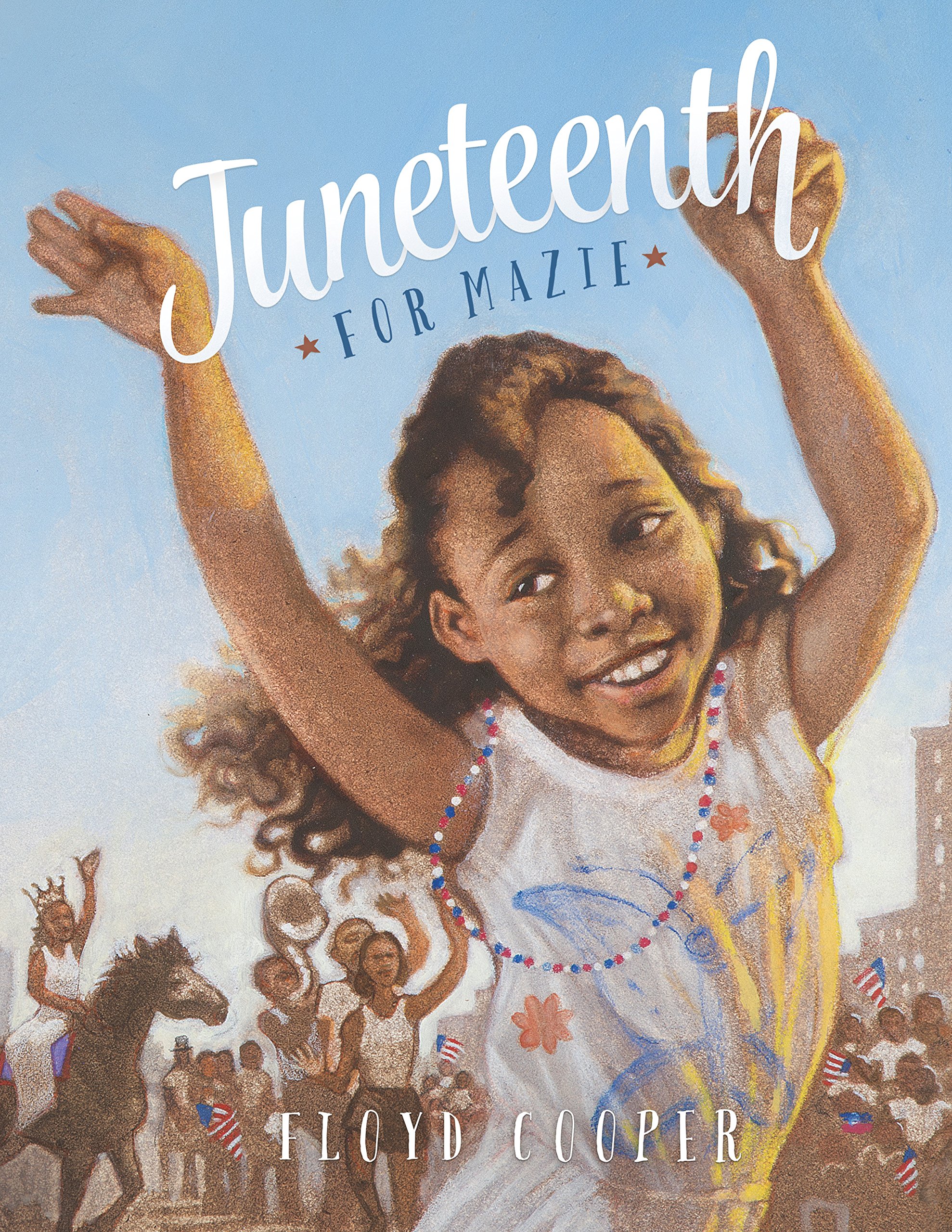
Juneteenth for Mazie
By Floyd Cooper
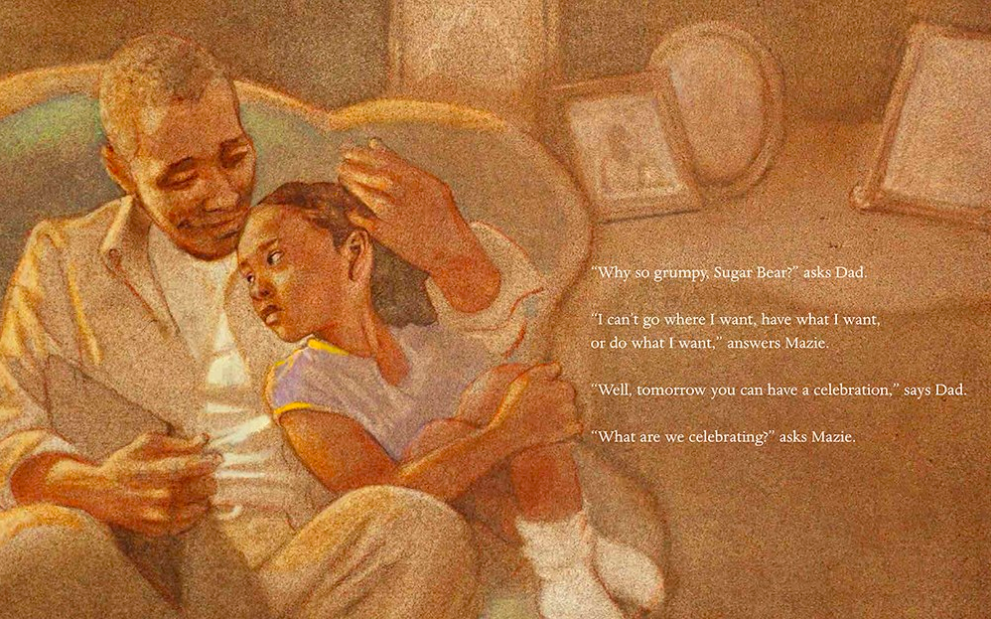
As nighttime falls, Mazie would like to go outside to play, but she’s told it’s too late. Later, she’d like a cookie, but when she asks the answer is “‘Not now, little one. It’s too close to bedtime.’” And when she wants to stay up late, she’s reminded of the bedtime rule. Mazie’s dad notices that she’s feeling a little grumpy and asks why. “‘I can’t go where I want, have what I want, or do what I want,’” Mazie says. To cheer her up, Mazie’s dad tells her that tomorrow she can celebrate.
Copyright Floyd Cooper, 2016, courtesy of Picture Window Books.
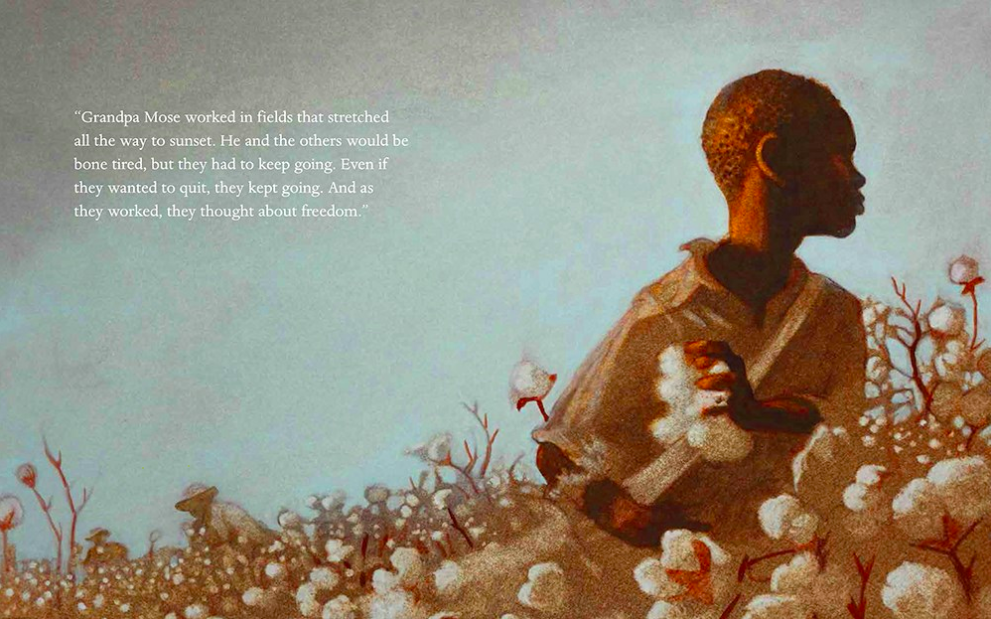
Mazie’s dad lifts her into a big hug and tells her that tomorrow they will celebrate the day when her “great-great-great grandpa Mose crossed into liberty.’” He tells Mazie about Grandpa Mose’s life as a slave working in the cotton fields from sunup to sundown, all the while thinking about freedom. Before they slept, they prayed and planned for a better future. And, finally, it came.
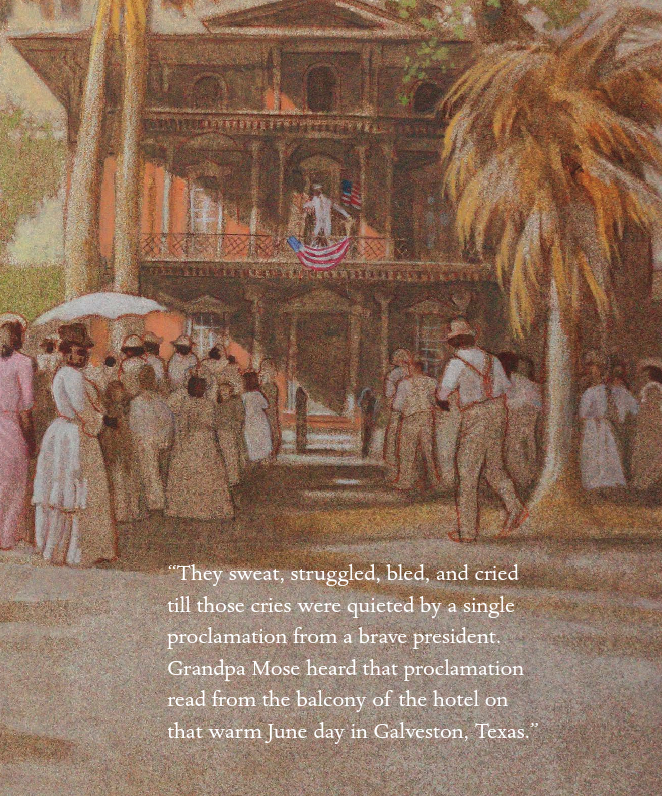
On June 19, 1865 in Galveston, Texas, Grandpa Mose heard President Abraham Lincoln’s proclamation that the Civil War was over and that slavery was abolished. Cheers rang out from the crowd gathered there. Then “‘the cheers became dancing. The dancing became celebrating. It went on and on into the night.’”
Copyright Floyd Cooper, 2016, courtesy of Picture Window Books.
Now when Grandpa Mose worked, he was paid for his labor. He saved and made that better future he had long prayed and prepared for. Life for Black people continued to be hard as they struggled for equality, lobbying for jobs, schools, voting rights, opportunity. “‘But they never gave up.’” Mazie’s Dad tells his daughter, “‘and every year on Juneteenth, they celebrated and remembered.’”
Black people moved forward, with higher education, talent, and perseverance woven with forgiveness. They became heroes and leaders—even the President of the United States. Now, Mazie’s dad says, it’s her time to celebrate where she’s come from and where she’s going.
A short note about the history of Juneteenth follows the story.
Copyright Floyd Cooper, 2016, courtesy of Picture Window Books.
Floyd Cooper’s beautiful and soft-hued paintings accompany his straightforward storytelling with emotional resonance as Mazie snuggles close to her father in a big chair and listens as he tells her about her great-great-great grandpa Mose, who was among the first slaves to be emancipated on June 19th in 1865. Cooper focuses on the perseverance, faith, and optimism that filled the hearts of Mazie’s ancestors and the generations of Black families who followed. His paintings span the more-than-150 years since Lincoln’s proclamation, with powerful depictions of newly freed men and women standing proudly in their best clothes as if posing for a photograph; the types of jobs Black men were able to get in the mid 1900s; a freedom march of the 1960s; and another grandfather passing down the stories to a younger generation gathered at his feet.
Cooper’s image of a Black woman raising her hand in university classroom of all-white students and his simple mention of those who have become leaders—with an illustration of Barack Obama taking the presidential oath of office, provide opportunities for further discussion and research. Mazie’s father’s exhortation for his daughter to celebrate now is paired with images of today’s kids laughing and smiling while they enjoy a cookout, cheer, dance, and parade, while always holding their past close to their hearts.
A gorgeous book to celebrate not only Juneteenth but the accomplishments and history of Black Americans, Juneteenth for Mazie is highly recommended for all readers and should be included in school and public library collections.
Ages 6 – 9
Picture Window Books, 2016 | ISBN 978-1479558209
To learn more about Floyd Cooper, his books, and his art, visit his website.
Enjoy this Juneteenth for Mazie book trailer!
Juneteenth Activity
Celebrate Juneteenth Coloring Pages
You can celebrate our newest federal holiday with these two printable Juneteenth coloring pages!
In 1966 UNESCO (United Nations Organization for Education, Science and Culture) established International Literacy Day on this date to “actively mobilize the international community to promote literacy as an instrument to empower individuals, communities, and societies.” This year, the COVID-19 pandemic has affected education and educational resources around the world. In response, this year’s initiative focuses on “‘literacy teaching and learning in the COVID-19 crisis and beyond,’ and especially on the role of educators and changing pedagogies.” 2020 also ushers in a new five-year program: UNESCO Strategy for Youth and Adult Literacy to develop policies and strategies to address the learning needs of disadvantaged groups, especially women and girls; to leverage digital technologies to expand access and improve outcomes; and to monitor and assess literacy programs. To learn more about today’s holiday and UNESCO’s global literacy programs, visit the United Nations International Literacy Day webpage.
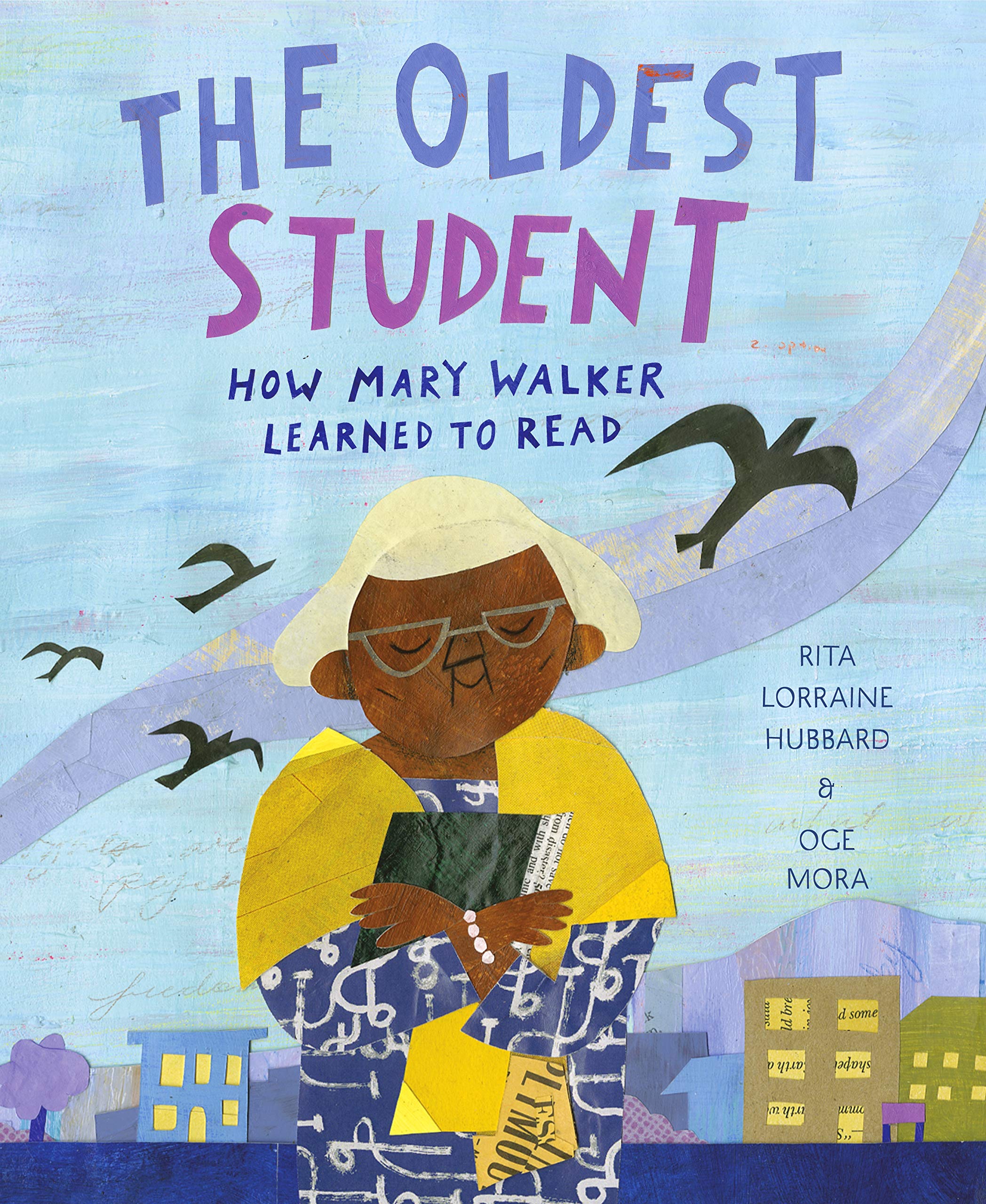
The Oldest Student: How Mary Walker Learned to Read
Written by Rita Lorraine Hubbard | Illustrated by Oge Mora
As a child slave on an Alabama plantation, Mary Walker knew the rules: Keep working and no learning to read or write. But when she stopped for a moment to rest while “picking cotton, toting water to Papa and the other slaves who chopped wood for the train tracks, or helping Mama clean the Big House,” she watched the birds and dreamed of being free. In bed at night, she would think “When I’m free, I’ll go where I want and rest when I want. And I’ll learn to read too.”
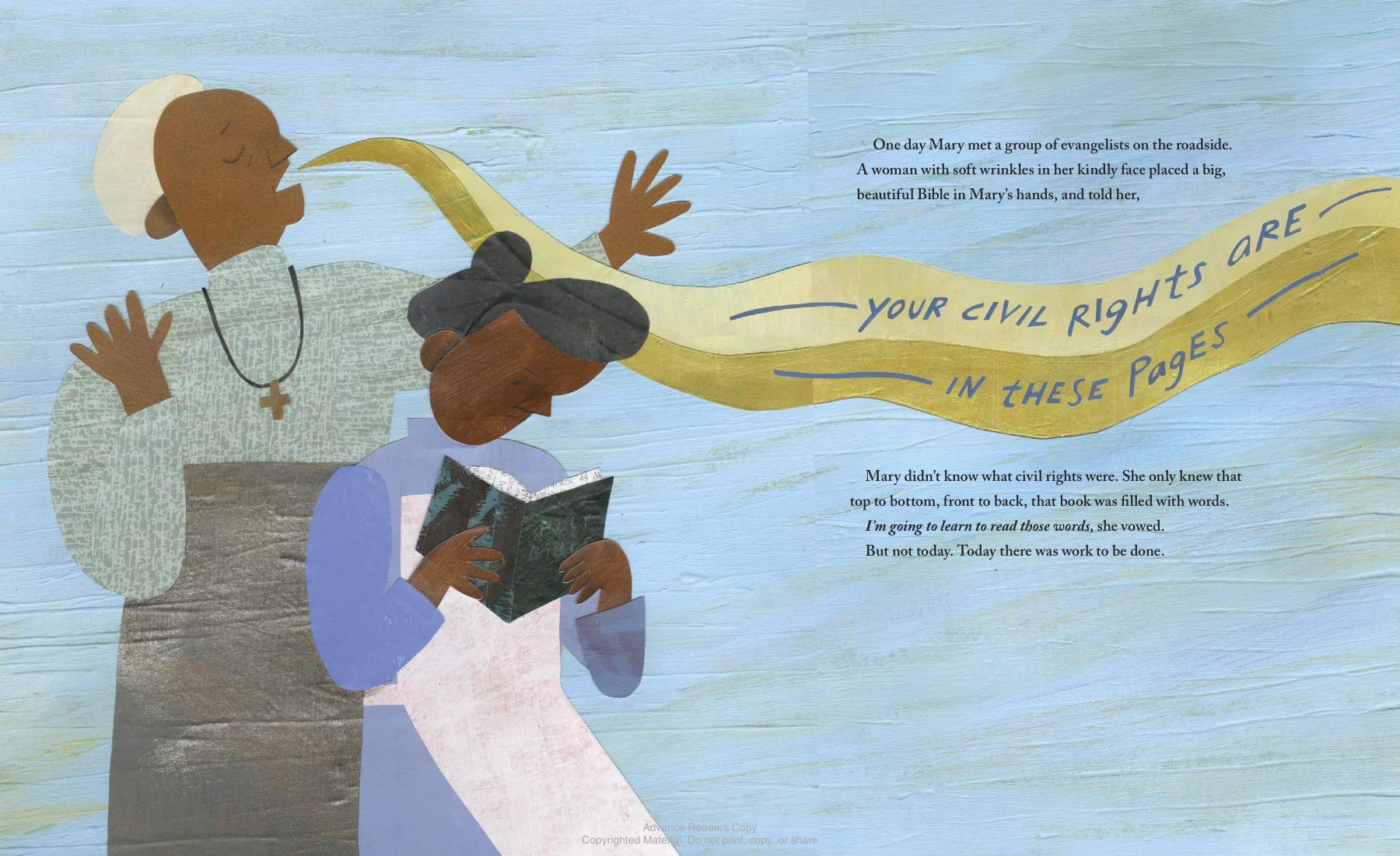
When Mary was fifteen, the Emancipation Proclamation was signed. While many freed slaves moved north, Mary and her family, like others, chose to stay in the South. With the help of the Freedmen’s Bureau, they moved into a one-room cabin. To raise money, Mary worked long hours every day of the week without a break to eat, drink, or even use the outhouse. “At week’s end, she would offer Mama the one lonely quarter she had earned.” One day, Mary met an evangelist who gave her a Bible, telling her “Your civil rights are in these pages.”
Image copyright Oge Mora, 2020, text copyright Rita Lorraine Hubbard, 2020. Courtesy of Schwartz & Wade.
Mary didn’t know what that meant. “She only knew that top to bottom, front to back, that book was filled with words”—words she vowed to learn…someday. But first came marriage, sharecropping, and a son. When a friend wrote his birth date in the Bible, all Mary could do was make a mark beside the words.
When Mary’s first husband died, she married again and had two more sons. To bring them up, Mary spent the next forty years sharecropping and doing odd jobs to help support her family. Eventually, the family moved to Chattanooga, Tennessee. Mary was sixty-eight and too old to farm, but she still cooked, cleaned, and cared for other people’s children to make money. She also cooked and sold food to support her church. On Sunday’s she listened to the preacher while clutching “her family Bible—the Bible she still couldn’t read.”
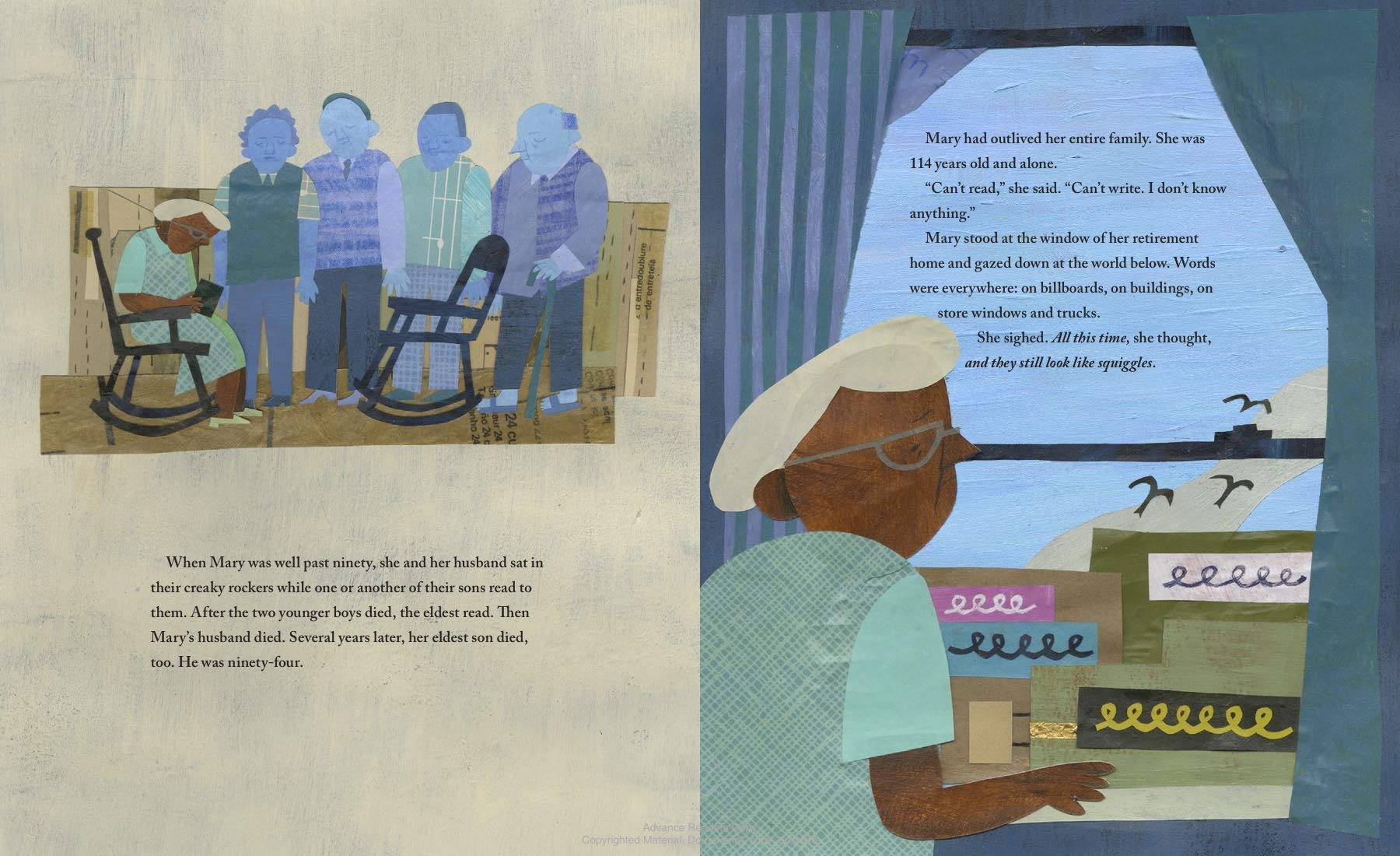
“When Mary was well past ninety,” her sons read to her and her husband. As time passed, her younger sons died and then her husband. Her oldest son died at the age of ninety-four, leaving Mary alone and living in a retirement home. As she looked out the window at the signs and billboards, “she sighed. All this time, she thought, and they still look like squiggles.”
Image copyright Oge Mora, 2020, text copyright Rita Lorraine Hubbard, 2020. Courtesy of Schwartz & Wade.
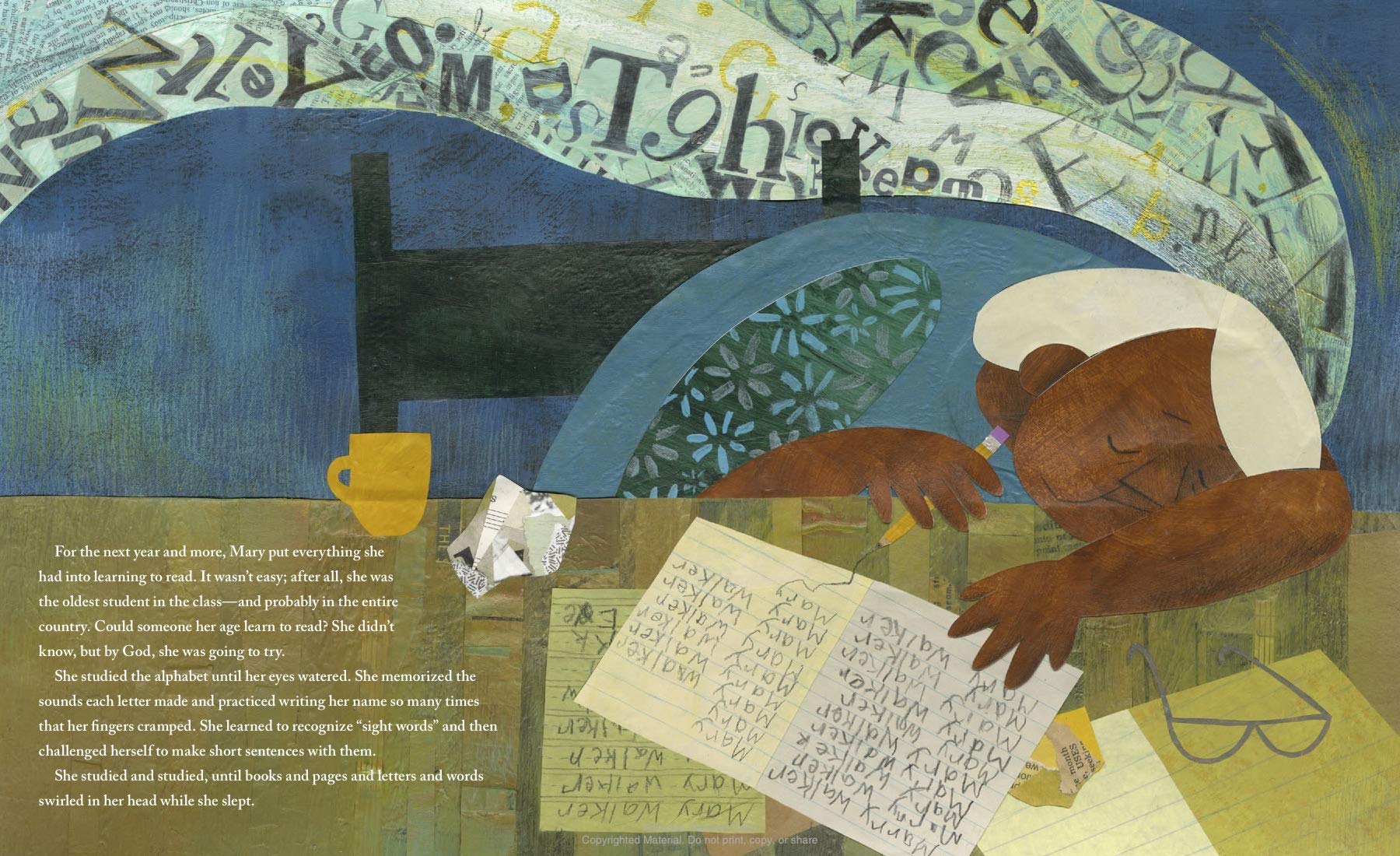
When her retirement home offered a reading class, Mary joined in. At 114, “she was the oldest student in the class—and probably in the entire country.” For the next year and longer, she studied and wrote and memorized. She began recognizing sight words and putting them together into short sentences. All of Mary’s hard work came together, and at last at the age of 116, she could read! Mary’s story traveled across the country, and journalists came to interview her. A representative from the US Department of Education pronounced her “‘the world’s oldest student.’”
“Mary felt complete.” When she felt lonely, she read her Bible or the signs she could see from her window. In Chattanooga, Mary’s accomplishment was celebrated with annual birthday parties. President Lyndon B. Johnson sent her a letter when she turned 118 in 1969, and President Richard Nixon sent a card when she turned 121. Among all the gifts she received over those years, her favorite was a ride in small airplane that dipped and soared like the birds she had watched as a child. As she looked at the landscape below, “Mary decided that flying was a lot like reading: they both made a body feel as free as a bird.” Each year, to start her birthday celebration, Mary read to the people gathered and as she closed the book, she always said, “You’re never too old to learn.”
An Author’s Note that reveals more about Mary Walker’s life follows the text.
Image copyright Oge Mora, 2020, text copyright Rita Lorraine Hubbard, 2020. Courtesy of Schwartz & Wade.
Rita Lorraine Hubbard’s moving portrait of Mary Walker and her resolve to learn to read even at an advanced age is inspirational for all. Hubbard’s straightforward storytelling focuses on Mary’s grueling work and the obstacles and responsibilities that delayed her education while also revealing her resilience, her generosity, and the strong bonds she shared with her family. Mary’s equating reading and education with freedom even as a child will resonate with today’s students and offers encouragement when lessons are difficult. With excellent pacing and a depth of details that will keep children riveted to this true story, Hubbard tells not only Mary’s history but that of many African-American families, making The Oldest Student a poignant book to share for reading, history, and social studies in classrooms as well as for home story times.
Oge Mora’s collage-style illustrations, incorporating strips of written text and musical scores, enrich Hubbard’s story with images of Mary working as a slave and later at various jobs always surrounded by words she cannot read. Later, as Mary gazes out of the window of her retirement home and passes fliers on the bulletin board there, the signs and papers are covered in squiggles, giving young readers an idea of how Mary sees the written world. After Mary learns to read, Mora replaces these with the actual signs, a clear example of the difference the ability to read makes. Mora’s early depictions of Mary, her head and back bowed by arduous, exhausting labor, are heartbreaking, making later images of her, head held high with pride and accomplishment, all the more emotional.
An uplifting and powerful lesson on perseverance and never giving up on a dream, The Oldest Student: How Mary Walker Learned to Read is highly recommended for home bookshelves and a must for school and library collections.
This week Juneteenth became America’s eleventh federal holiday when President Joe Biden signed the Juneteenth National Independence Day Act into law on June 17. Juneteenth commemorates the end of slavery and celebrates the historical date of June 19, 1865, when Union army general Gordon Granger came to Galveston, Texas to read “General Order #3,” which proclaimed the emancipation of all those held as slaves in Texas. On the one-year anniversary of the proclamation, freedmen in Texas organized the first Jubilee Day, which became an annual event. Celebrations later spread across the south and then nationwide. The day includes parades, festivals, music, readings by prominent African-American writers, educational events and barbecues, complete with refreshing strawberry soda.
Juneteenth for Mazie
By Floyd Cooper
As nighttime falls, Mazie would like to go outside to play, but she’s told it’s too late. Later, she’d like a cookie, but when she asks the answer is “‘Not now, little one. It’s too close to bedtime.’” And when she wants to stay up late, she’s reminded of the bedtime rule. Mazie’s dad notices that she’s feeling a little grumpy and asks why. “‘I can’t go where I want, have what I want, or do what I want,’” Mazie says. To cheer her up, Mazie’s dad tells her that tomorrow she can celebrate.
Copyright Floyd Cooper, 2016, courtesy of Picture Window Books.
Mazie’s dad lifts her into a big hug and tells her that tomorrow they will celebrate the day when her “great-great-great grandpa Mose crossed into liberty.’” He tells Mazie about Grandpa Mose’s life as a slave working in the cotton fields from sunup to sundown, all the while thinking about freedom. Before they slept, they prayed and planned for a better future. And, finally, it came.
On June 19, 1865 in Galveston, Texas, Grandpa Mose heard President Abraham Lincoln’s proclamation that the Civil War was over and that slavery was abolished. Cheers rang out from the crowd gathered there. Then “‘the cheers became dancing. The dancing became celebrating. It went on and on into the night.’”
Copyright Floyd Cooper, 2016, courtesy of Picture Window Books.
Now when Grandpa Mose worked, he was paid for his labor. He saved and made that better future he had long prayed and prepared for. Life for Black people continued to be hard as they struggled for equality, lobbying for jobs, schools, voting rights, opportunity. “‘But they never gave up.’” Mazie’s Dad tells his daughter, “‘and every year on Juneteenth, they celebrated and remembered.’”
Black people moved forward, with higher education, talent, and perseverance woven with forgiveness. They became heroes and leaders—even the President of the United States. Now, Mazie’s dad says, it’s her time to celebrate where she’s come from and where she’s going.
A short note about the history of Juneteenth follows the story.
Copyright Floyd Cooper, 2016, courtesy of Picture Window Books.
Floyd Cooper’s beautiful and soft-hued paintings accompany his straightforward storytelling with emotional resonance as Mazie snuggles close to her father in a big chair and listens as he tells her about her great-great-great grandpa Mose, who was among the first slaves to be emancipated on June 19th in 1865. Cooper focuses on the perseverance, faith, and optimism that filled the hearts of Mazie’s ancestors and the generations of Black families who followed. His paintings span the more-than-150 years since Lincoln’s proclamation, with powerful depictions of newly freed men and women standing proudly in their best clothes as if posing for a photograph; the types of jobs Black men were able to get in the mid 1900s; a freedom march of the 1960s; and another grandfather passing down the stories to a younger generation gathered at his feet.
Cooper’s image of a Black woman raising her hand in university classroom of all-white students and his simple mention of those who have become leaders—with an illustration of Barack Obama taking the presidential oath of office, provide opportunities for further discussion and research. Mazie’s father’s exhortation for his daughter to celebrate now is paired with images of today’s kids laughing and smiling while they enjoy a cookout, cheer, dance, and parade, while always holding their past close to their hearts.
A gorgeous book to celebrate not only Juneteenth but the accomplishments and history of Black Americans, Juneteenth for Mazie is highly recommended for all readers and should be included in school and public library collections.
Ages 6 – 9
Picture Window Books, 2016 | ISBN 978-1479558209
To learn more about Floyd Cooper, his books, and his art, visit his website.
Juneteenth Activity
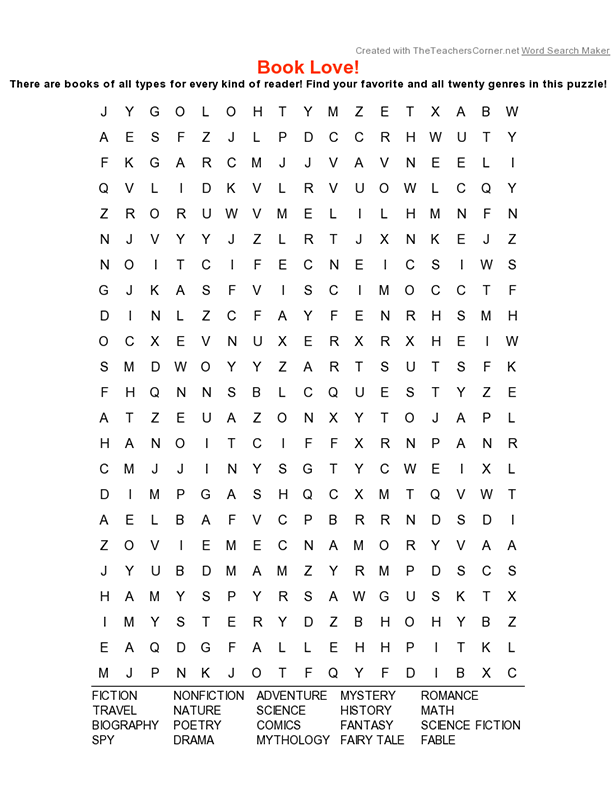
Celebrate Juneteenth Word Search
Can you find the fifteen words related to Juneteenth in this printable puzzle?















 celebratepicturebooks.com