National Skating Month was established by U.S. Figure Skating as a week-long celebration in March 2002 following the Olympic Winter Games in Salt Lake City. Now co-sponsored by Learn to Skate U.S.A. and celebrated during the entire month of January, the holiday gives ice-skating rinks, clubs, and programs an opportunity to invite new families to the ice by offering free lessons and skating demonstrations. If figure skating isn’t your thing, you might like to take your skills to the hockey rink or just to a local pond for some free-style skating. However you choose to enjoy the ice, skating is fun and for everyone! To learn more about ice-skating programs in your area, visit usfigureskating.org and learntoskateusa.
The Three Canadian Pigs: A Hockey Story
Written by Jocelyn Watkinson | Illustrated by Marcus Cutler
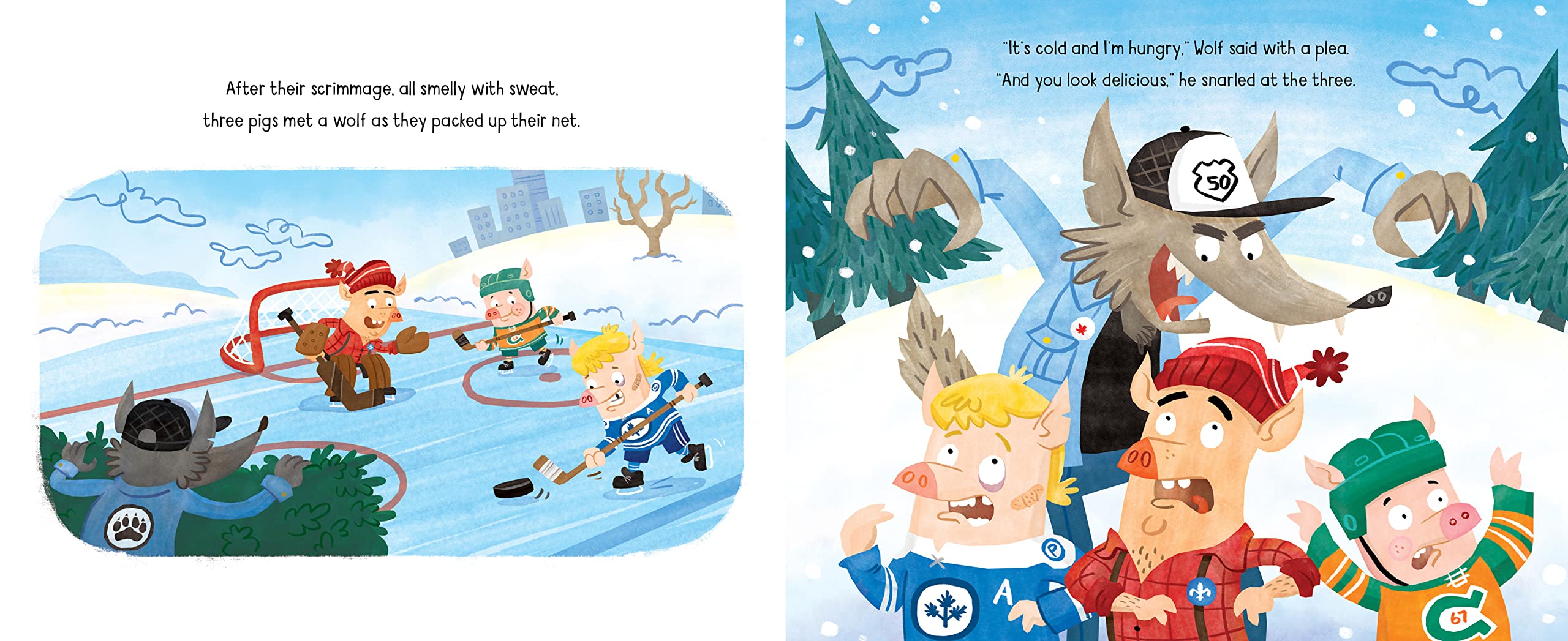
Three pigs were just finishing their hockey scrimmage when a wolf sprang from behind some bushes, fangs sharp and claws at the ready to satisfy his hunger since they looked so delicious. But as they quickly took off their skates and packed up their gear, they said, “‘I’m soorry there, Wolf, you are soorely mistaken—'” To which the wolf replied, “‘Oh no! But I’m not! You’re Canadian bacon!'” The pigs jumped on their snowmobile and hurried home to their snow fort in town.
Image copyright Marcus Cutler, 2022, text copyright Jocelyn Watkinson, 2022. Courtesy of Sleeping Bear Press.
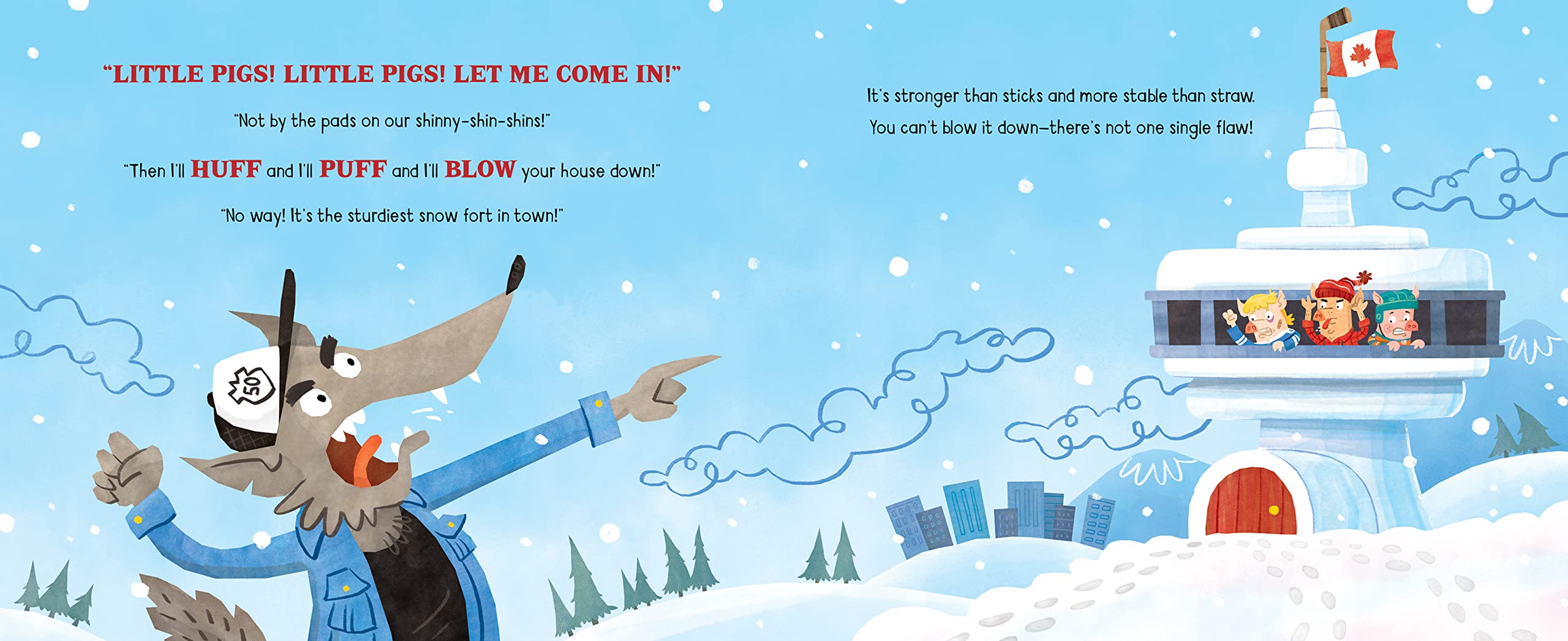
It didn’t take long for the wolf to catch up with them, and from outside their door, he shouted, “‘Little pigs! Little pigs! Let me come in!'” But they just replied, “‘Not by the pads on our shinny-shin-shins!'” The wolf threatened to blow the fort down, but this was no flimsy home built of sticks or straw. In fact, they told him, “‘there’s not one single flaw!'” The wolf wasn’t going to give up easily and he collected Moose and Bear to help him break in.
Image copyright Marcus Cutler, 2022, text copyright Jocelyn Watkinson, 2022. Courtesy of Sleeping Bear Press.
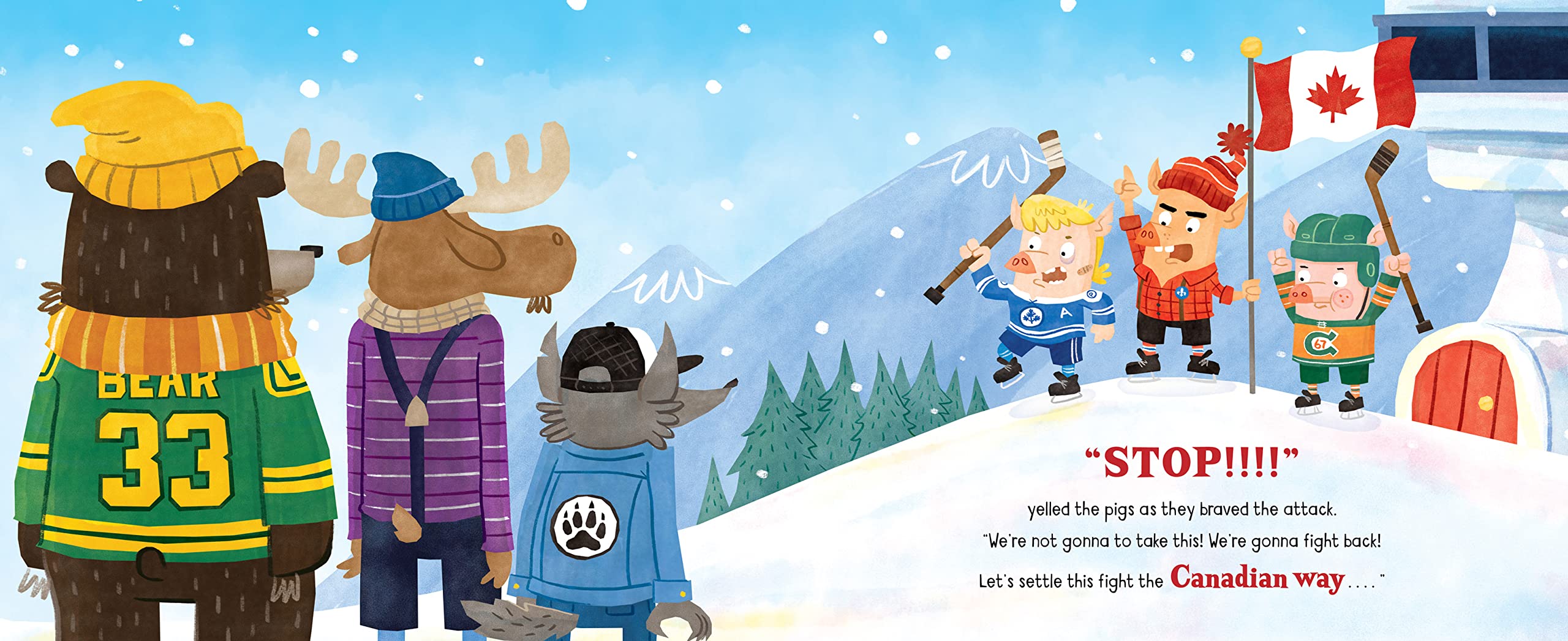
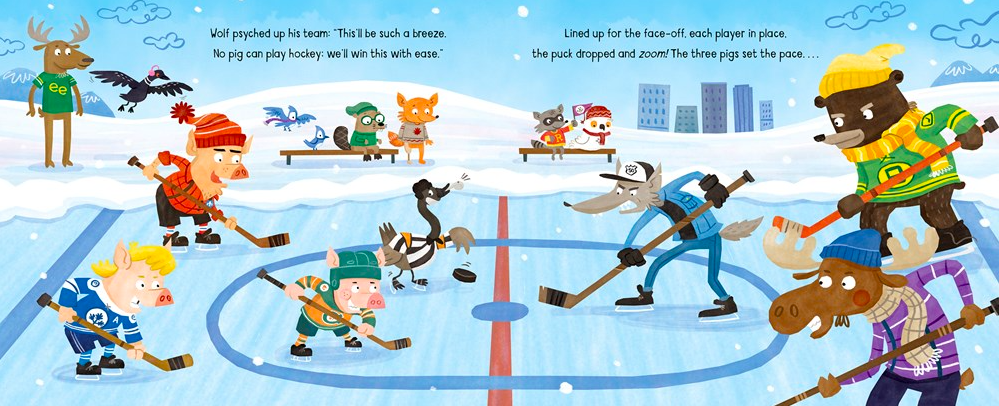
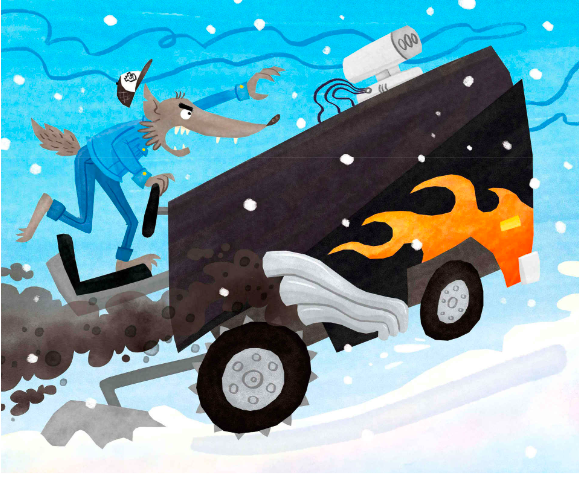
When the three pigs had just enough of the wolf’s team’s attack, they came out and challenged them to “‘settle this fight the Canadian way'” with “‘a hockey game showdown.'” With a Canada goose as a ref, they took to the ice, attracting a crowd of spectators. The wolf and his team thought they’d win with ease, but the pigs “deked and they cut: / the pigs couldn’t be caught,” and when they scored, the wolf took to underhanded measures to stop them.
But the pigs were too quick and too nimble, and they ran up the score. When the ref blew her whistle ending the game, the pigs celebrated saving their home, but the wolf “… full of frustration and hunger and spite, / … threw down his gloves and dove in for a bite.” It looked like the pigs were goners for sure, but Bear and Moose called him out on his poor sportsmanship. Wolf dropped the three pigs, feeling ashamed but still hungry.
Image copyright Marcus Cutler, 2022, text copyright Jocelyn Watkinson, 2022. Courtesy of Sleeping Bear Press.
Dragging his stick and hanging his head, the wolf trudged off the ice, but one pig called out to him, inviting him to join them in a feast back at the fort. When the wolf saw their spread of poutine, tourtière, beaver tails, butter tarts, and so many other mouthwatering delicacies, he apologized: “‘Pigs, I’m so sorry that I was a brute.'” / “‘There’s nothing for you to be soorry a-boot.'” a pig graciously told him. The pigs, Wolf, Bear, and Moose all made amends and piled up their plates. Then they settled in to watch a game on TV. And as “they put up their feet,” the wolf had to agree that “‘being friends with Canadian bacon is sweet!'”
Image copyright Marcus Cutler, 2022, text copyright Jocelyn Watkinson, 2022. Courtesy of Sleeping Bear Press.
Full of clever rhymes, puns, valuable lessons, and dialogue that winks at Canadian pronunciations, Jocelyn Watkinson’s story flows as smoothly as a hockey puck on ice. Her regional take on the traditional Three Little Pigs story is fast-paced and suspenseful while touching on themes of sportsmanship, remorse and forgiveness, and friendship all framed with high-energy hockey action and plenty of humor. Especially welcome is Watkinson’s depiction of Bear and Moose confronting Wolf when he reneges on his agreement to let the pigs go if they win the game. Standing up to a friend or for what’s right can be hard, but Watkinson shows readers that having the courage of your convictions is honorable, honest, and can often turn a negative situation into a positive experience.
Marcus Cutler scores with his funny, emotion-packed illustrations that will have kids laughing and cheering for the pigs from page to page. Winter sports fans will love all the hockey action and will want to linger over the pigs’ hard-won trophy, on which Cutler had fun hamming it up with the names of some of hockey’s greats, The spread of favorite Canadian foods is sure to inspire game-night treat feasts. Cutler also highlights the important role of Bear and Moose, who ultimately appeal to Wolf’s better nature.
Image copyright Marcus Cutler, 2022. Courtesy of Sleeping Bear Press.
In a humorous and foreshadowing scene, Bear halfheartedly scratches at the pigs’ snow fort with one paw while holding a steaming mug in the other as Wolf exhorts his friends to “ram and claw and maul” their way inside. When Bear and Moose finally challenge Wolf to live up to his deal, their disapproval is clearly visible to readers. Wolf’s resulting feelings, as well as their cause, are also evident, giving kids and adults openings for meaningful discussions on behavior.
Whether your kids wait all year for hockey season, are fans of fractured fairy tales, or simply love a great story, The Three Canadian Pigs is a funny and impactful read aloud that’s sure to become a story time favorite all year long and a book you’ll be glad you added to your home, classroom, school, or public library.
To learn more about Marcus Cutler, his books, and his art, visit his website.
Skating Month Activity
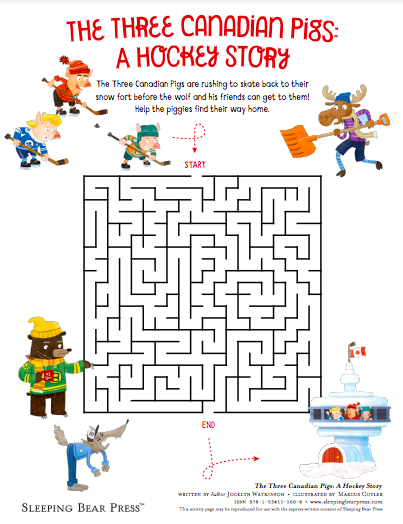
The Three Canadian Pigs Activity Kit
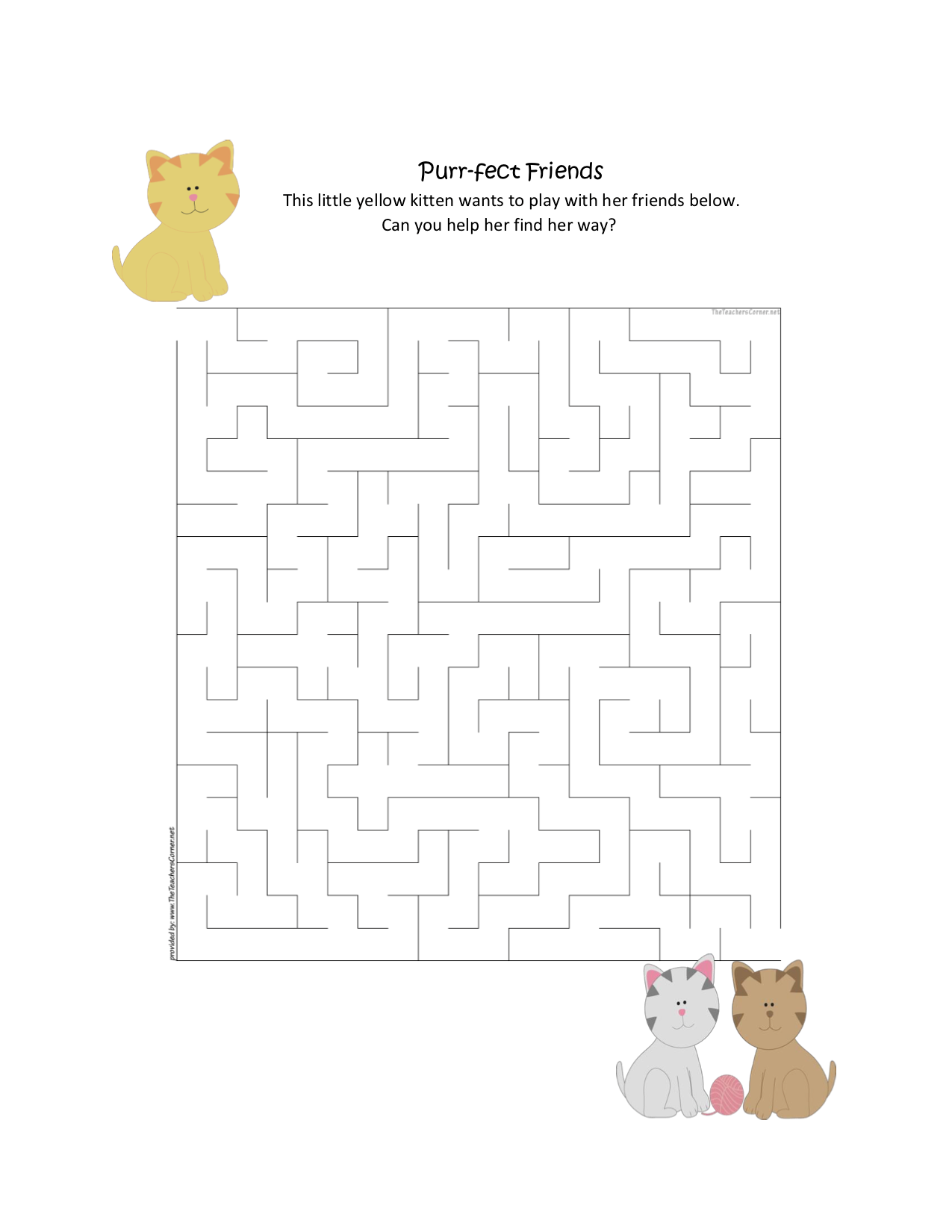
The game’s on with the two puzzles and two coloring pages inspired by today’s book! Just download and print them from the Sleeping Bear Press site here:
Every January 11 International Thank-You Day encourages people around the world to express their gratitude to those who have made their lives better in some way. The beginning of the year is the perfect time to think about how we might thank all those who show kindnesses, provide services, teach us new skills, and share our lives. Teaching children how to express gratitude is a valuable lesson, and sharing today’s book with little ones is a wonderful way to get started. You’ll even find two creative activities that will help kids think about and share thankfulness all year through.
The Thank You Book
Written by Danna Smith | Illustrated byJuliana Perdomo
For little ones, “Thank you” may be one of the first phrases they learn when they begin getting out into the world. Thanking grandparents and other relatives, friends, teachers, librarians, store employees, and others becomes a part of every day. But for kids just learning manners and communication skills, prompts to say “thank you” may seem kind of random, confusing, and maybe even a bit intimidating.
Image copyright Juliana Perdomo, 2022, text copyright Danna Smith. Courtesy of Little Simon.
This is where Danna Smith’s delightfully cheery story about sharing your appreciation comes in. With charming rhymes, Smith answers the questions of why, when, and to whom thanks are appropriate while infusing her story with the positive feelings that thanking someone for their kindness instills in the thanker and the one being thanked.
Image copyright Juliana Perdomo, 2022, text copyright Danna Smith. Courtesy of Little Simon.
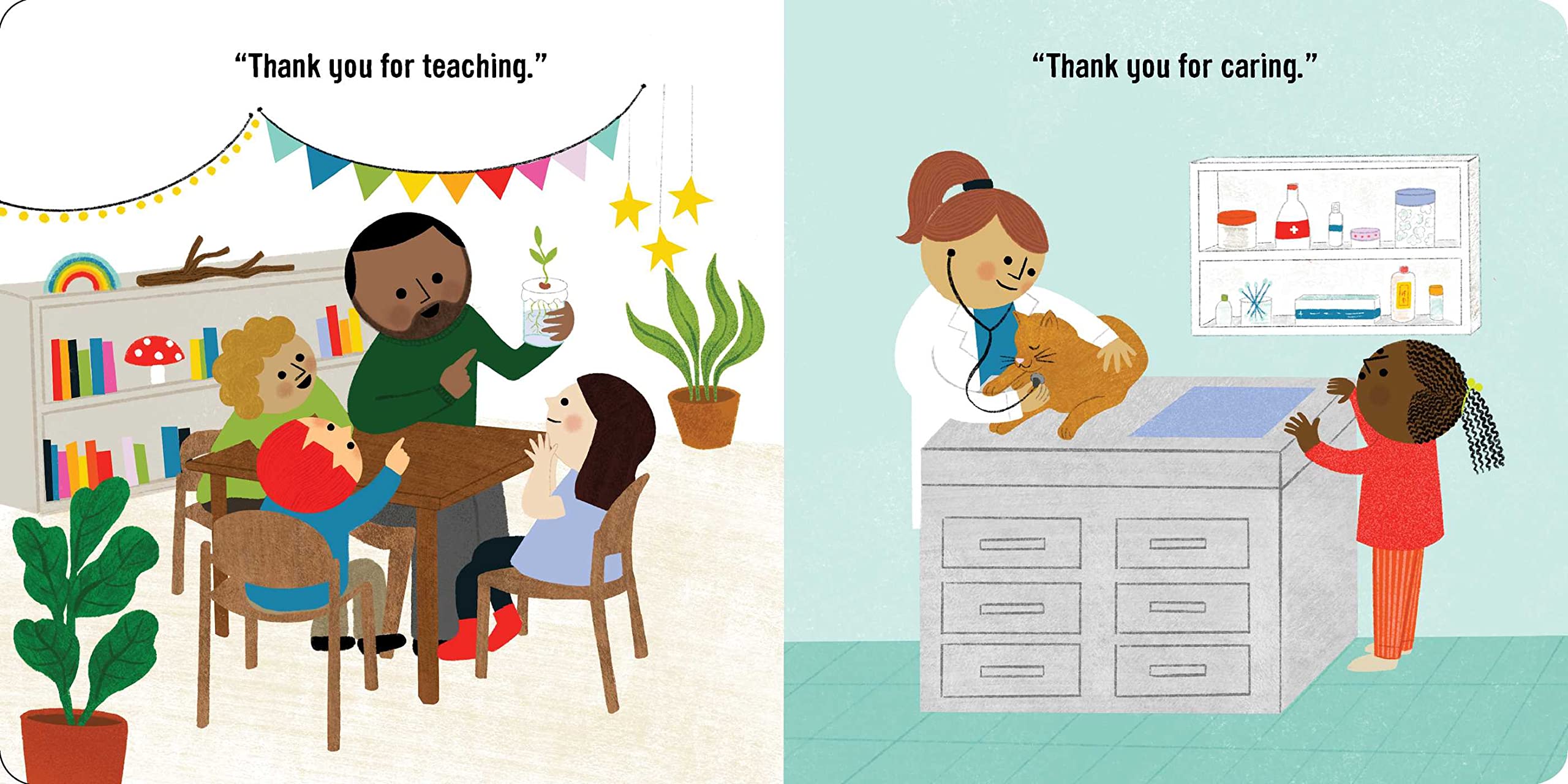
Smith begins with an inviting and easy-to-understand definition of thankfulness that will resonate with young children: “When someone is thoughtful or kind in some way, ‘thank you’ are two very nice words to say.” She then goes on to provide specific examples of times that gratitude is warranted as well as language to help kids express their feelings for specific acts of kindness. As illustrations show children engaged in various activities, readers discover they can say, “‘Thank you for helping.’ ‘Thank you for sharing.’ / ‘Thank you for teaching.’ ‘Thank you for caring.’”
Image copyright Juliana Perdomo, 2022, text copyright Danna Smith. Courtesy of Little Simon.
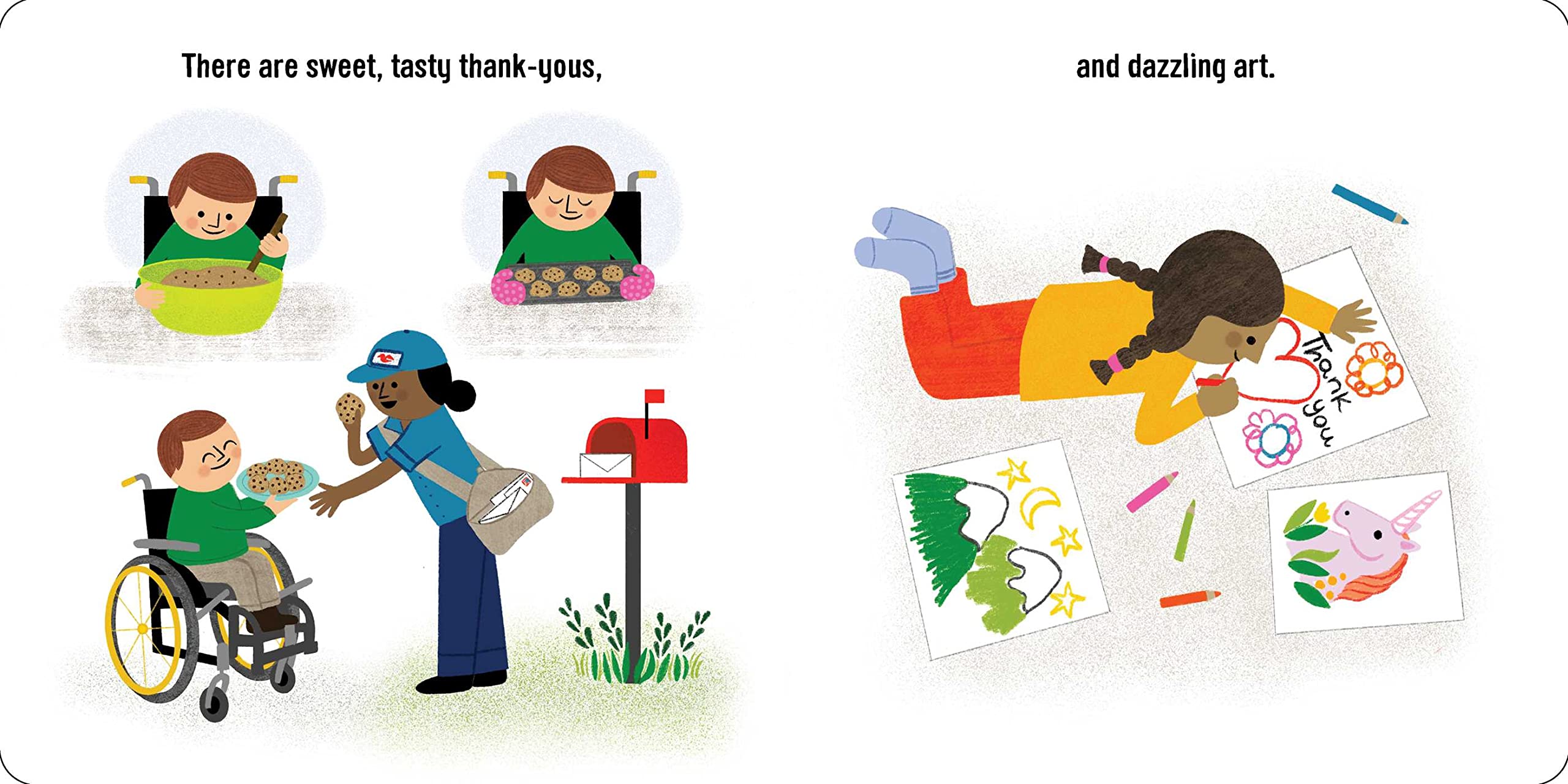
But is saying those types of words the only way to show your gratitude? Children (and especially those who are reluctant to talk with people they don’t know well or feel shy about speaking up) learn that there are other ways to show gratitude, including giving hugs, drawings, and tasty treats.
Smith then reveals a well-known secret about saying thank you that will make today’s inclusive kids happy to be part of an appreciative community: “If you start with one thank-you, you’ll find it will grow.” And, indeed, Smith finishes her story by assuring readers that kids all over the world are thanking others for their friendship and kindness.
Image copyright Juliana Perdomo, 2022, text copyright Danna Smith. Courtesy of Little Simon.
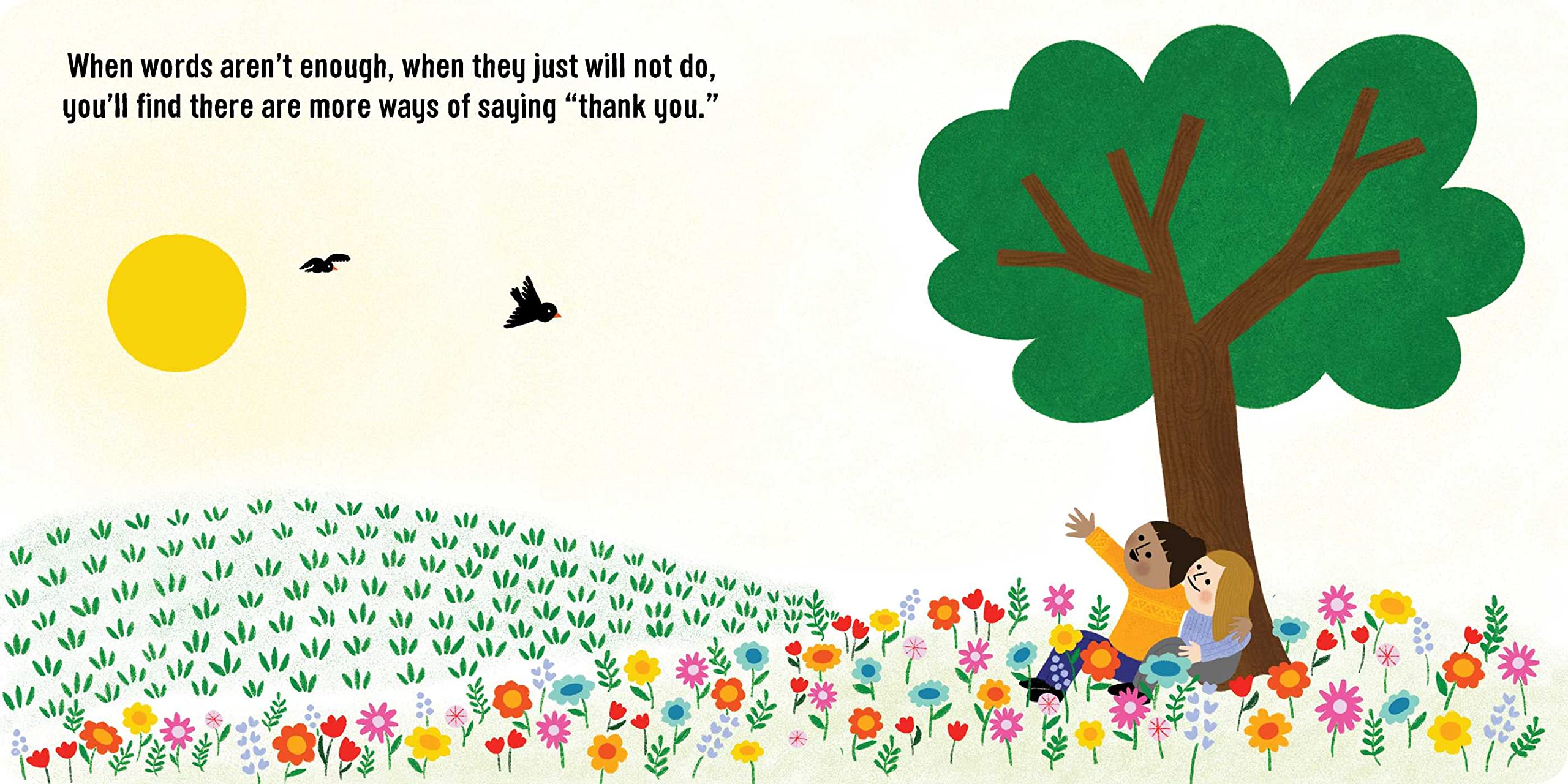
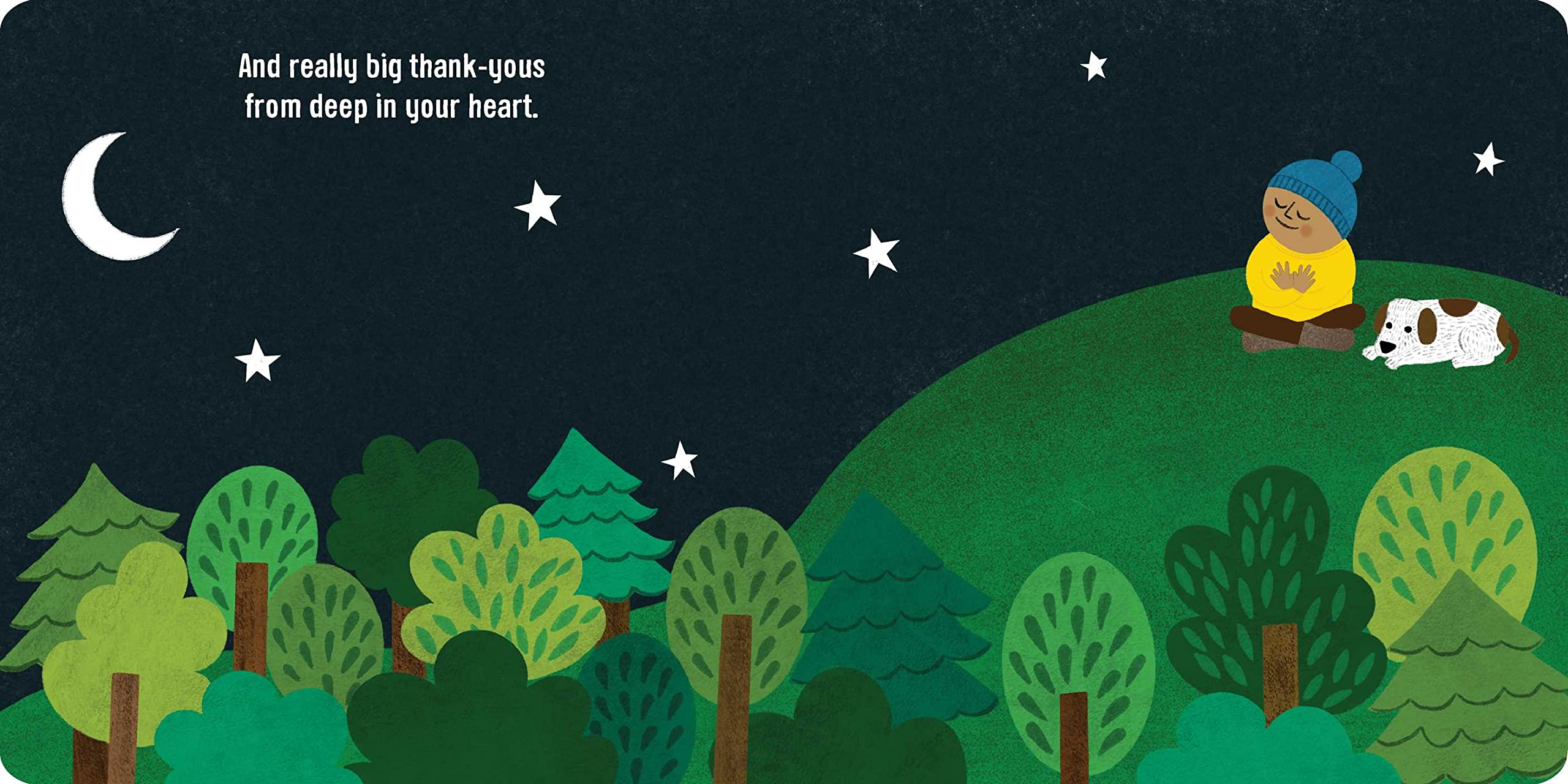
Danna Smith’s sweet board book, with its jaunty rhymes and enthusiasm for sharing gratitude is just the kind of story parents, teachers, and other adults will want to read with their little ones and little ones will want to hear again and again. Her open-ended phrasing allows adults and kids to discuss the types of people who are helpers, sharers, teachers, and care-ers, as well as those within their family and friends who are deserving of thanks and on which occasions. Smith also gives kids ideas for a wide range of ways to say thank you that may use their talents and mean more to them than words. These examples can also spark talks between parents, teachers, and other caregivers on other ways to show thanks. And what if you have a child who just feels appreciation deep inside? They are represented in these pages too.
Juliana Perdomo’s vibrant illustrations of kind acts by friends, parents, teachers, veterinarians, bus drivers, activity instructors, and others will enchant little ones and get them talking about all the times someone has done something nice for them. Readers of all ages can’t help but be filled with gratitude and good feelings when they’re greeted by Perdomo’s smiling and enthusiastic characters. Perdomo mirrors Smith’s text to give kids a concrete understanding of the concepts while filling her pages with cheer and heartfelt gratitude. The idea that saying thank-you can bring people together in a community and around the world is one that will excite kids and encourage them to show their appreciation.
Joyful and inspiring, The Thank You Book would be a favorite read aloud in any young child’s home library and is a must for all daycare, school, and public library board book collections.
Ages 3 and up
Little Simon, 2022 | ISBN 978-1665902922
Discover more about Danna Smith, her books, poetry, and paintings on her website.
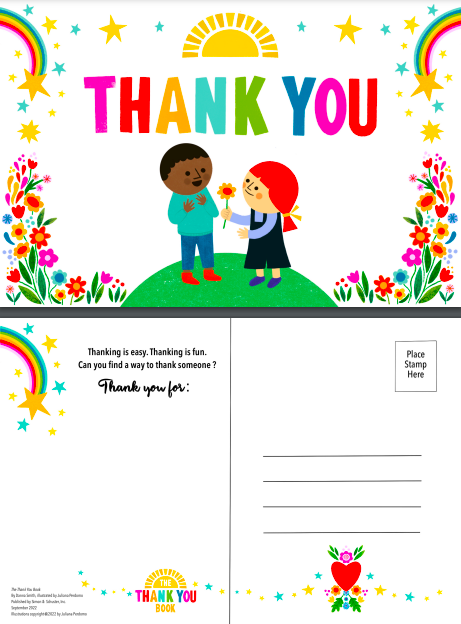
Do your kids have someone they’d like to thank for a kind act, a gift, or just for being a loved family member or friend? This cheery Thank You postcard makes it easy for kids to show their gratitude and share their love to people close by or far away. This card is also perfect to share for the upcoming holidays!
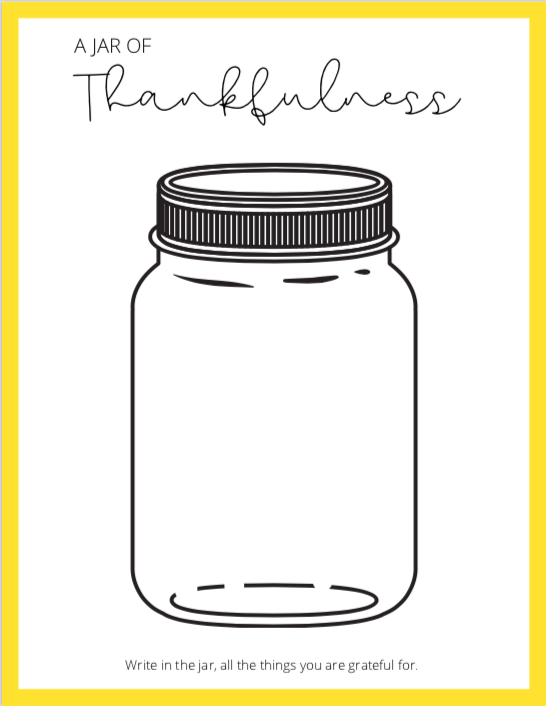
It’s good to remind yourself periodically – or even every day – of all the things you have to be thankful for and all the acts of kindness you’ve received. This activity sheet gives children (and adults who want to participate with their kids) a place to collect all these “thank-you”–worthy experiences. Just write a word or short description inside the jar each time you feel thankful. You might even want to share your appreciation with the people whose names appear in your jar with a note, a picture, a hug, or a homemade craft to show how much they mean to you.
This Thankfulness Jar also makes a meaningful activity for Thanksgiving Day! Why not print a copy for each guest at your table, provide a pencil, and get everyone sharing what they’re thankful for this year!
Missing the green leaves and colorful flowers of spring and summer? Maybe it’s time to recreate the sights of warmer days inside with houseplants! Placed in a sunny window, some plants will continue blooming all winter long, making you feel happier. Houseplants also provide health benefits as they produce oxygen, release moisture into that dry winter air, and improve air quality. Add a few herb plants and even cooking will take on new life. Whether you add just one plant or create an indoor garden, today’s the perfect day to get started.
Luna’s Green Pet
Written by Kristen Pendreigh | Illustrated by Carmen Mok
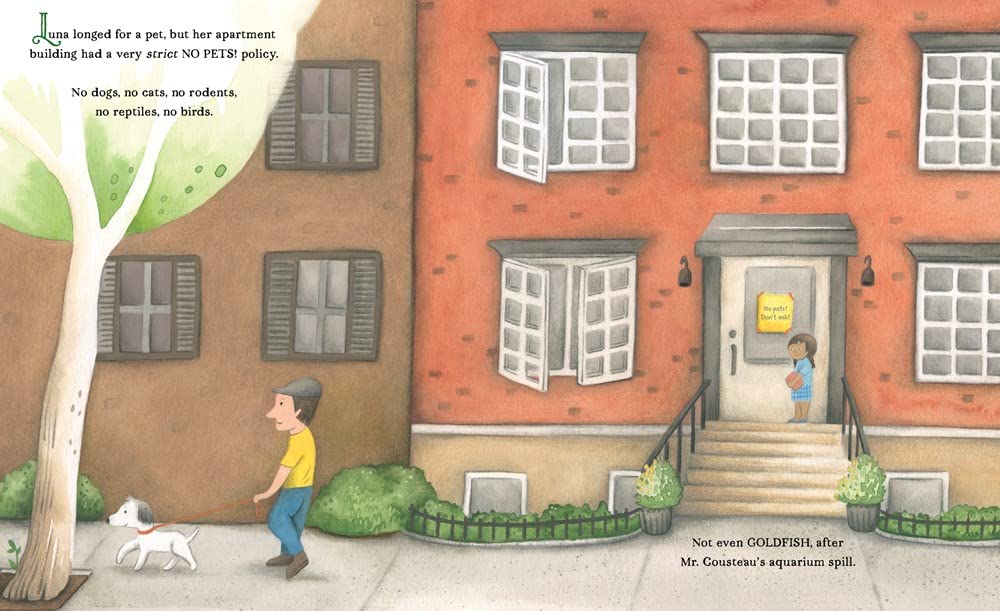
When Luna saw people on her block walking their dogs and playing with their pets, she wished she could have one. “But her apartment building had a very strict NO PETS! policy.” Luna’s friends tried to help out by suggesting other types of pets, including a pet rock, an expensive dog-shaped purse, and an ant farm, but none of these were quite what Luna was looking for. Then one day, she found a small discarded plant in a trash can. She decided it would be the perfect pet.
Image copyright Carmen Mok, 2022, text copyright Kirsten Pendreigh, 2022. Courtesy of Sleeping Bear Press.
Luna took it home. The plant’s tag read Stephanotis Floribunda, which Luna shortened to Stephanie. Luna gave her pet a “bigger crate, new bedding, and fresh water.” Stephanie took to her new home right away. At night Luna read to her; every morning she took her to the park. Luna’s friends “were not impressed.”
Image copyright Carmen Mok, 2022, text copyright Kirsten Pendreigh, 2022. Courtesy of Sleeping Bear Press.
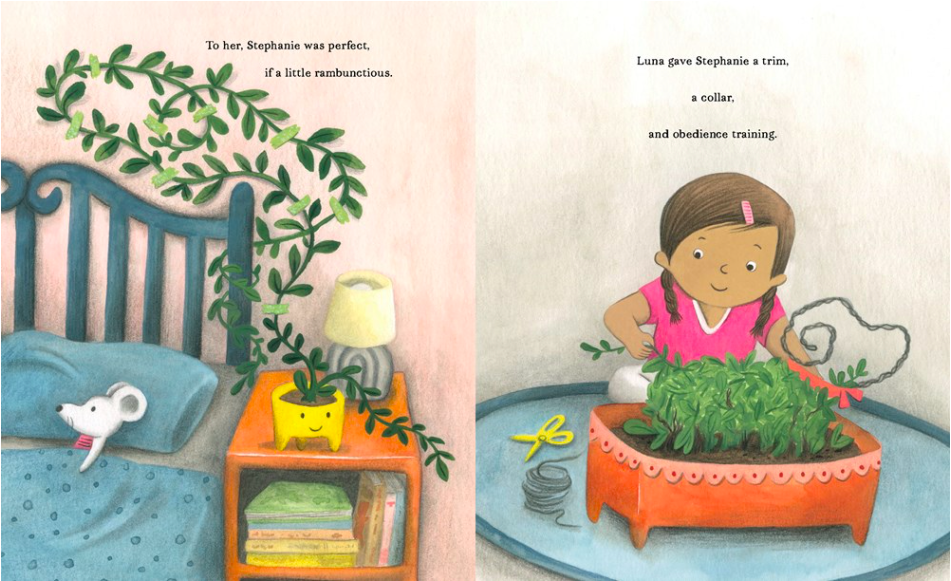
Stephanie turned out to be more “rambunctious” than she appeared, climbing the walls and wrapping herself around the headboard of Luna’s bed. Luna trimmed her and got her into shape with “obedience training” and a collar. One day unusual white “clumps of bumps appeared” among Stephanie’s leaves. As the bumps grew, Luna tried washing and hugging Stephanie, but the bumps only got bigger.
Image copyright Carmen Mok, 2022, text copyright Kirsten Pendreigh, 2022. Courtesy of Sleeping Bear Press.
Luna decided she’d take Stephanie to the botanist the next day to see what was wrong. During the night under a full moon, though, “the bumps burst open!” Then a “powerful perfume woke Luna.” Luna couldn’t believe her eyes—or her nose. The sweet scent floated out the window and soon attracted bees, hummingbirds, and butterflies during the day and moths at night.
Image copyright Carmen Mok, 2022, text copyright Kirsten Pendreigh, 2022. Courtesy of Sleeping Bear Press.
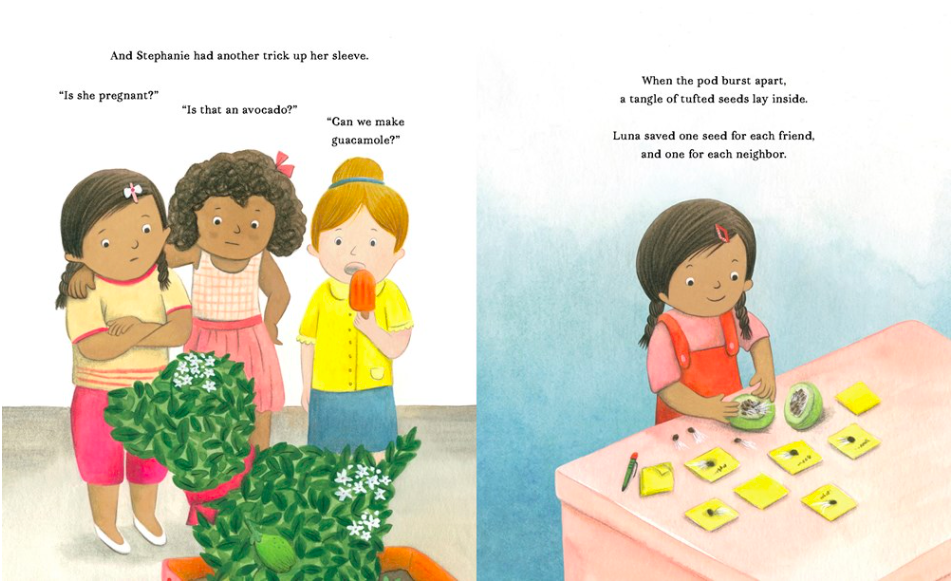
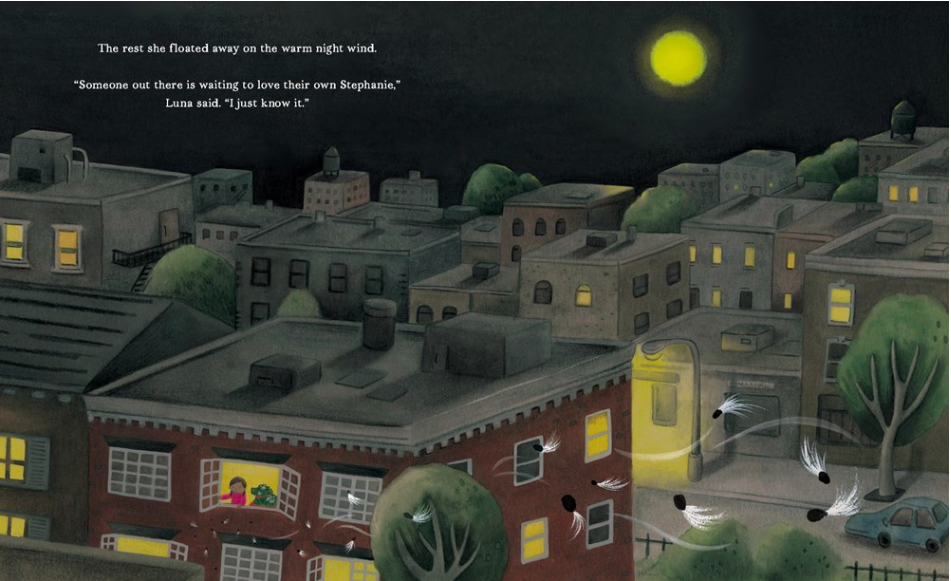
When Luna entered Stephanie in the neighborhood pet parade, she even “won a special prize—Best in Scent.” But Stephanie wasn’t finished with her tricks. A green fruit grew from her branches, and when it burst open Luna found that “a tangle of tufted seeds lay inside.” Carefully, Luna took out one seed for each of her friends and neighbors so they could grow their own Stephanotis Floribunda. And the rest, she let fly away on the “warm night wind” to find new homes where they would be loved as much as Stephanie.
Detailed back matter includes ways in which plants make great pets, a list of ten houseplants that are easy to grow, more information on Stephanotis Floribunda and how to care for it as a houseplant or in a garden.
Image copyright Carmen Mok, 2022, text copyright Kirsten Pendreigh, 2022. Courtesy of Sleeping Bear Press.
Kirsten Pendreigh’s gentle and creative story will charm kids who have a natural tendency to anthropomorphize plants, toys, furniture, and anything they love, imbuing these inanimate objects with personalities all their own. As Luna repots her plant, cares for it, and reigns in its wandering tendrils, Pendreigh enhances her pet imagery by using terms commonly associated with pets, a detail that will also enchant kids. With Luna’s sharing of Stephanie’s seeds, Pendreigh sparks wider ideas of generosity, friendship, and nurturing the environment.
Carmen Mok’s soft-hued, yet vivid illustrations have a quiet grace that allow readers to identify with Lulu’s creative thinking and caring nature. During Lulu’s serendipitous discovery of Stephanie in a trash can, Mok emphasizes Lulu’s personality with a kitty purse, shirt decorated with hearts, and gentle way she examines the plant’s wilted leaves. Kids will love seeing tiny Stephanie grow from a straggly stem into a lush, dog-shaped shrub with the help of some topiary framing.
Any child who has raised plants from seeds or seedlings will understand Lulu’s love for Stephanie and her surprise when Stephanie blooms unexpectedly. Mok’s lovely nighttime spreads spotlight the starlike beauty of the Stephanotis Floribunda flowers and the heady scent that calls out to pollinators. With the appearance of Stephanie’s seedpod, Mok realistically depicts its size, the tufted seeds inside the pod, and how those tufts carry the seeds to new far-flung growing spots.
Unique and heartwarming, Luna’s Green Pet will enchant kids who love pets, plants, a well-told story, or all three and will become a quick favorite to be heard again and again. The book is sure to inspire young botanists and would be a creative way to introduce lessons on plants in school classrooms or for homeschoolers, to spark projects for extracurricular clubs or library programs, and to get kids excited about gardening as well as planting a pollinator space at home. Luna’s Green Pet will enhance any home, school, or public library collection and is highly recommended.
Ages 4 – 8
Sleeping Bear Press, 2022 | ISBN 978-1534111615
Discover more about Kirsten Pendreigh, her poetry her debut book on her website.
To learn more about Carmen Mok, her books, and her art, visit her website.
World Pet Day Activity
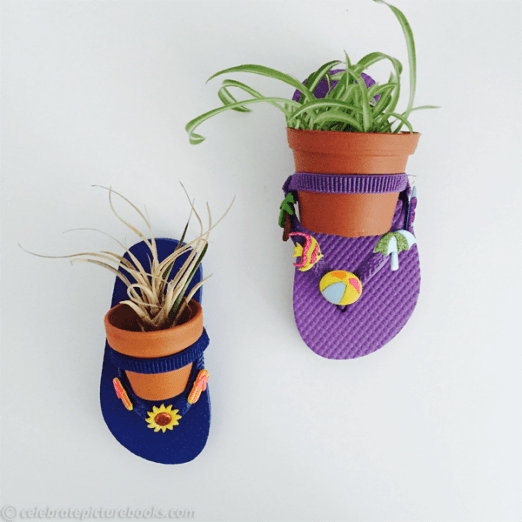
Flip-Flop Plant Holder
Have you outgrown your flip-flops or sandals this summer? Well, you can repurpose them with this easy craft that turns summer shoes into a creative way to hang small plants on walls or even windows!
Supplies
Child’s flip-flops with elastic heel straps
Buttons or charms
Small plastic solid-bottom pot
Small plant
Dirt
Hot glue gun
Heavy duty mounting strips
Small shovel or spoon
Directions
Place the flip-flop toe down on your work surface. With the hot glue gun, attach the buttons to the plastic toe straps of the flip-flops.
Add dirt to the pot
Add plant to the pot
Slip the pot into the elastic strap and gently push down so it is also supported by the plastic toe straps
To hang, use appropriate-weight mountable strips.
To make an interesting and attractive arrangement, use various sizes of flip-flops
You can find Luna’s Green Pet at these booksellers
I’d like to thank Matt Forrest Esenwine for sharing a digital copy of Everybody Counts! with me for review consideration. All opinions on the book are my own.
Everybody Counts!
Written by Matt Forrest Esenwine | Illustrated by Emma Graham
Children are invited to a lively international food festival in this rhyming and educational book that introduces readers to twelve nationalities through their cardinal numbers from 1 to 10 and a favorite dish that kids will be eager to try. As they visit each “booth,” readers learn about the ingredients and how each meal is made and meet an animal commonly found in each country. Along the way, they also gain a sprinkling of history, traditions, and information on the featured language. Kids even discover which number is considered the luckiest in China and why.
Image copyright Emma Graham, 2023, text copyright Matt Forrest Esenwine, 2023. Courtesy of The Little Fig.
With a verse that plays on the idea of counting, Matt Forrest Esenwine starts off his world tour by prompting readers to look not only for the special attributes of each animal and their country but for those inside themselves and in those around them too: “Everyone is helpful, / in large or small amounts. / Everybody matters. / Everybody counts!” The enthusiasm in these words carry over onto each page spread, which includes a deliciously descriptive rhyming verse, a charming paragraph of explanatory text, and a row of numbers along the bottom, presented in their written form and how each is spelled in the particular language.
Image copyright Emma Graham, 2023, text copyright Matt Forrest Esenwine, 2023. Courtesy of The Little Fig.
Emma Graham immediately captivates readers with her vibrant opening spread that frames Esenwine’s introductory verse with a series of beautifully patterned plates representing the countries found within the book’s pages. With a page turn, kids are invited into the festival to meet some of the excited participants as they chat with their neighbors and show off their dishes. Graham packs her pages with personality, adorable animals, images of ingredients, and symbols, patterns, landscapes, and colors that give kids plenty to talk about and to jumpstart research projects or new recipes to try.
Image copyright Emma Graham, 2023, text copyright Matt Forrest Esenwine, 2023. Courtesy of The Little Fig.
The multifaceted approach of Everybody Counts! is sure to engage kids in many ways—from feeling pride in their own heritage to the sense of accomplishment in learning to count in another language to wanting to try new tastes and foods. For teachers, homeschoolers, parents, and other adults, the book provides an enticing way to introduce geography, language learning, math, and even art lessons. The book’s familiar frame of an international festival can also spark ideas for events in classrooms, schools, and extracurricular clubs or organizations.
Sure to prompt enthusiasm for story times, educational reading, and a host of extended activities, Everybody Counts! is highly recommended for home libraries and is a must for school and public library collections.
Ages 4 – 8
The Little Fig, 2023 | ISBN 978-1633330559
About the Author
Matt Forrest Esenwine’s children’s poetry can be found in numerous anthologies, including The National Geographic Book of Nature Poetry. His various poems and picture books have received numerous positive reviews, including a Kirkus star. Flashlight Night was selected by the New York Public Library as one of the Best Books for Kids and chosen by Kirkus as one of the Best Picture Books of the Year. Matt currently has twelve other books under contract and coming soon. He lives in New Hampshire with his wife, kids, and more pets than he has fingers. You can visit Matt on His website | Facebook | Instagram | Twitter.
About the Illustrator
Emma Graham is a versatile and experienced illustrator and graphic artist. Since graduating from Norfolk Institute of Art she has build a vibrant portfolio including children’s picture books, private commissions, and Wild In Art sculptures. She was longlisted for the Picture Books Hooks mentoring scheme and a finalist in The Hook at the SCBWI BI conference. As author, she was a finalist in the Stratford Literary Festival’s Salariya Prize for picture books. Emma is commissioned illustrator for the Children’s Appeal at Ipswich Hospital(UK)–a charity raising funds for a full refurbishment of the children’s ward. You can connect with Emma on Her website | Facebook | Instagram | Twitter.
You can find Everybody Counts! at these booksellers
I’d like to thank Two Lions and Barbara Fisch at Blue Slip Media for sending me a copy of Love Made Me More for review consideration. All opinions on the book are my own.
Love Made Me More
Written by Colleen Rowan Kosinski | Illustrated by Sonia Sánchez
An origami crane reveals how it came to be after its origins as “just a piece of paper—orange with white and blue spots” and the day when “a boy folds me many times, giving me a head, tail, and wings” under the watchful eye of his grandmother. The crane becomes an instant favorite, and for the crane, the boy is “My Boy.” The young child places the crane on his nightstand, so that he sees it right before going to sleep and again as soon as he wakes up.
Image copyright Sonia Sánchez, 2022, text copyright Colleen Rowan Kosinski, 2022. Courtesy of Two Lions.
Over the years, the origami crane shares in his play, his dreams, and his wishes and it comforts him in his grief of losing a loved one and when shadows scare him. But as the boy grows older, finds new friends and interests, and becomes braver, he talks less and less to the origami crane. And while the crane still sits on his nightstand, the paper has grown dusty.
Then “one day,” the origami crane says,”My Boy places a photograph in front of me. I peek around and see a picture of a girl with an orange, white, and blue shirt. My colors. I fume.” The crane is jealous that “now she is the last thing he sees” at night and the first in the morning. But more years pass, and a day comes when the boy reaches for the origami crane once more. The crane is hopeful that they will play together again as in the past, but instead the boy unfolds it and “scrawls tickling words” on the paper before refolding it.
Image copyright Sonia Sánchez, 2022, text copyright Colleen Rowan Kosinski, 2022. Courtesy of Two Lions.
The origami crane has not been forgotten during all of these years. In fact, the crane’s stature has only grown, now offered to the girl with a love-affirming question hidden inside. “‘Yes, I will marry you,’ she says.” The crane embraces her as “My Girl too” as the boy refolds it. Soon, the origami crane finds itself in the center of a flock floating above a crib where a baby, wrapped in an orange, white, and blue blanket sleeps. “My colors,” the crane thinks happily.
The crane is proud that his flock is “the last thing Our Baby sees each night and the first thing he sees each morning” and that “he loves us.” As the baby grows into boyhood and learns how to make an origami crane himself—with his father’s crane close by—the origami crane realizes that what has made it so much more than “just a piece of paper” is all the love it has been shown and has been a part of.
Image copyright Sonia Sánchez, 2022, text copyright Colleen Rowan Kosinski, 2022. Courtesy of Two Lions.
Colleen Rowan Kosinski’s unique story, told from the perspective of an origami crane that has been molded by a boy from a simple piece of paper to become a beloved keepsake, reveals the endurance and transformative power of love. Infused with feelings of belonging and purpose, the story flows through the changes a lifetime brings not only for the boy but for the origami crane. Just as the boy finds friends, meets a girlfriend, gets married, and has a baby, the crane slowly learns to integrate other people and, finally, a flock of origami cranes into its sphere, changes often told with honest emotions and a sense of the years passing by.
When the boy proposes to the girl with the help of the crane and it now accepts his fiancé as “My Girl too,” the crane seems to gain a sense of new life and autonomy when the boy refolds the paper. Instead of defining itself as “his Origami Crane” it now asserts itself as “Origami Crane.” The idea of the importance of being seen, embraced, and given love over an entire lifetime is woven throughout the story and becomes the central theme as the crane realizes that the baby loves it too. Readers take away the knowledge that it is love freely given—and accepted—that makes all the difference in a person’s self-esteem and the way their life evolves.
Image copyright Sonia Sánchez, 2022, courtesy of Two Lions.
Sonja Sánchez’s vibrant and lively illustrations glow with the magic and comfort that the origami crane brings to the boy’s life as a child. Using angled images, strong lines that suggest the creasing that defines the origami crane, and warm earth tones, Sánchez centers her illustrations on the crane. Pages full of movement and color paint a picture of the boy’s childhood spent playing, wishing, and dreaming with the crane always by his side give way to a spread shrouded in brown, where the boy and his friends appear only as silhouettes and the orange crane, pushed to the side of the desk and dwarfed by the boy’s new interests in a computer, guitar, and other objects, is the only bright spot in the brown and darkened room.
Time passes and within two page turns, the boy, grown into a young man, once again has the crane in hand. Its former glow of magic is back as the boy unfolds, writes on, and refolds the paper. A baby comes along and, like his father, sails into imagination and play with the crane, finally learning how to fold his own crane as he grows into boyhood.
Love Made Me More is a singular story to share with children to reaffirm their special bond with a favorite toy or memento, but more: to remind and reassure them of the power of enduring love, expressed in so many ways, to transform people, experiences, and life itself. The book would be a unique, uplifting, and affecting addition to home, school, and public library collections.
Ages 4 – 8
Two Lions, 2022 | ISBN 978-1542006200
About the Author
Colleen Rowan Kosinski is the author of A Home Again and the author-illustrator of Lilla’s Sunflowers and A Promise Stitched in Time. She received her BA from Rutgers University in visual art, is an alumna of Philadelphia’s Moore College of Art and Design, and spent many years as a successful freelance fine artist. Colleen calls New Jersey her home and resides there with her family. To learn more, and to watch a tutorial on making an origami paper crane, visit www.colleenrowankosinski.com. You can connect with Colleen on Facebook | Instagram | Twitter
About the Illustrator
Sonia Sánchez is the illustrator of a number of picture books, including Evelyn Del Rey Is Moving Away by Meg Medina, A Crazy-Much Love by Joy Jordan-Lake, and The Little Red Fort by Brenda Maier. Her books have been nominated for the Eisner Award and named a CBC/NCSS Notable Social Studies Trade Book for Young People and a Bank Street College Best Book of the Year. She lives with her husband, her kids, and a sleepyhead cat in Barcelona, Spain. You can connect with Sonia on Instagram.
Love Made Me More Tour Launch Activity
Make an Origami Crane
Follow along with this tutorial from Origami Tsunami to make your own Origami Crane to love!
You can find Love Made Me More at these booksellers
If your motto is “So many books, so little time” then you’ll be happy to know that January is Book Blitz Month! During this month book lovers are given the green light to read as many books as possible! For kids, Book Blitz Month can be particularly exciting as they discover new fiction and nonfiction that captivates their imagination. To celebrate, take your kids to a local bookstore and the library to find new and favorite books to binge on all month long. If you don’t have a dedicated space for your children’s books, this month is also a great time to create a home library for your child so that they have a shelf, a crate, or even a whole bookcase of stories they can enjoy again and again!
I’d like to thank Lydia Lukidis for sharing a digital copy of Deep, Deep Down: The Secret Underwater Poetry of the Mariana Trench with me for review consideration. All opinions on the book are my own. You can read my interview with Lydia below.
Deep, Deep Down: The Secret Underwater Poetry of the Mariana Trench
Written by Lydia Lukidis | Illustrated by Juan Calle
Imagine being invited to visit a mysterious place where only a few have ever been; where only they have truly seen the creatures that inhabit it; and where it’s murky depths are accessible by only one type of vehicle. Would you dare to go? Lydia Lukidis and Juan Calle extend just such an invitation, but no notes for missing school, packing a suitcase, or plucking of courage need to be considered, for through their phenomenal book, readers find a seat in the incredible submersible that will transport them to “…the deepest underwater valley in the world”: the Mariana Trench.
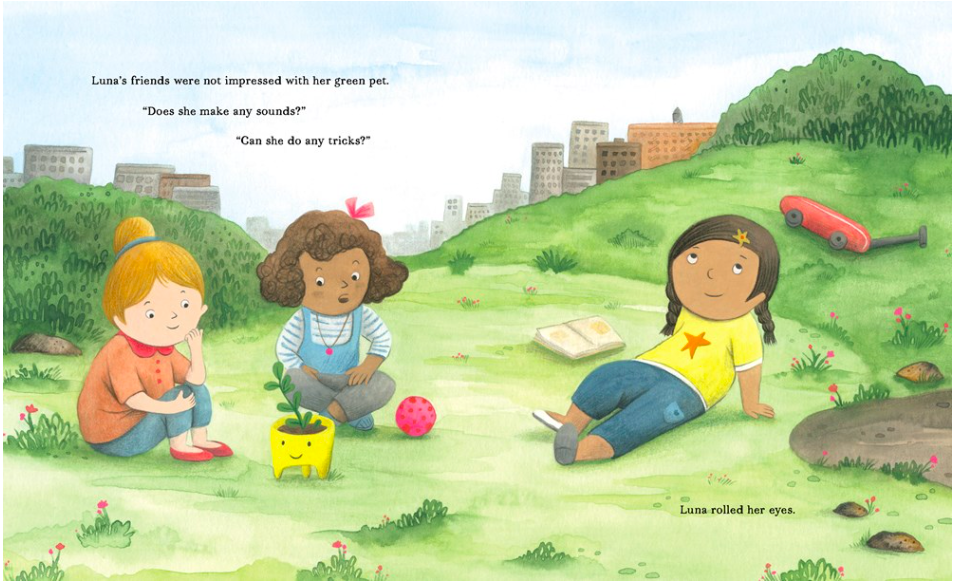
Image copyright Juan Calle, 2022, text copyright Lydia Lukidis, 2022. Courtesy of Capstone Editions.
The submersible plunges deeper and deeper to where the sun doesn’t penetrate. Here, in the darkness, “food is scarce, and a bone-chilling cold blasts through the water. Earthquakes shake the ocean floor, and the water pressure, like a thick, heavy blanket with a thousand hands, presses down, / down, / down.” What flashes by the porthole window? A monster? No—a fish with a long and slender tail perfectly suited for its austere home, where it can survive for months without eating if necessary. “Diving deeper, a long, thin body slinks and sways, ever so slowly. The cutthroat eel is not fearsome, some rather, mesmerizing.”
The light beam of the submersible also reveals feathery crinoids “twirling and whirling like an underwater acrobat,” and a curious snailfish “dances, ghost-like, to the rhythms of the ocean” as it comes to take its own peek in the window from the other side. Snailfish aren’t affected by the heavy water pressure because “they can swim deeper than any other fish in the world. That’s because their bodies contain RMAO. This special substance protects the fish from high pressure, making sure their bodies aren’t crushed.”
Image copyright Juan Calle, 2022, text copyright Lydia Lukidis, 2022. Courtesy of Capstone Editions.
It might seem impossible to sink still lower, but the submersible plummets into water populated by tiny creatures, almost insect-like with their multiple pairs of legs and long antennae that propel them and help them find food. But explorers are not at the very bottom of the Mariana Trench even yet. The submersible floats slowly down to the bottom—“the very deepest spot on Earth. Look out the window . . . and witness a world of surprises.” Extraordinary creatures, some small, soft, and translucent and others—neither plant nor animal—large and with protective shells, and all adapted to thrive in their formidable surroundings will amaze you.
At last it’s time for the submersible to return to the surface. Slowly, it makes its way through the darkness to lighter seas, where it passes by more familiar fish and other creatures on its way to “SPLASH!” surfacing once again and “leaving the marvels of the Mariana Trench far below” still waiting to be explored again.
Insets of scientific information on diet, anatomical adaptations, and other aspects that make them suited to their environment also accompany the introduction of each sea creature.
Back matter includes an illustrated cutaway of the ocean above and descending into the Mariana Trench with various sea creatures labeled and oriented to the level in which they are found; “Did You Know?” facts about the water pressure in the Trench, its creation, and how many people have visited; why the Mariana Trench matters; an author’s note; and a glossary.
Image copyright Juan Calle, 2022, text copyright Lydia Lukidis, 2022. Courtesy of Capstone Editions.
When undertaking an excursion into unknown territory—especially through words and pictures—explorers need guides who can truly immerse them not only in the sights and sounds of an area but also the rhythms and almost intangible aura that makes it so uniquely compelling. Readers of all ages find that quality in Deep, Deep Down. Lydia Lukidis’s lithe and lyrical language is at once straightforward—answering questions any reader might have—and evocative—capturing the enigmatic and secret world at the bottom of the Earth as it flashes into view or slowly reveals itself and retreats again. Her vocabulary, rich with active verbs, ensures that readers appreciate the Mariana Trench as teeming with life and alive with wonders more amazing than we can even imagine.
Don’t be surprised if you find yourself forgetting that you’re looking at illustrations of a vampire squid, anglerfish, rattail fish, cutthroat eels, crinoids, and even the rocky and sandy ocean floor instead of photographs as you inspect Juan Calle’s magnificent pages. As the submersible—seen from many angles—plunges into darker and darker water, bioluminescent fish begin to appear alongside their grayer sea mates (children will enjoy pointing out the dark shapes that lurk in the shadows of the submersible and the stony outcroppings.)
As a rattail drifts into view, each rose-gold scale is visible, shimmering in the beam of light thrown from the submersible; it’s blue eye seemingly as curious about readers as they are about this unusual fish. Calle mesmerizes with careful details, shading, and perspective that portrays each creature in all of their weird and wonderful floating, creeping, or stock-still spectacle.
Deep, Deep Down: The Secret Underwater Poetry of the Mariana Trench will thrill ocean and nature lovers and will spur increased interest and research into this unique, nearly untouched habitat that we are only now beginning to discover. The book is a must for any environmental science enthusiast at home and for all classroom, school, and public library collections.
Ages 7 – 10
Capstone Editions, 2022 | ISBN 978-1684466153
About the Illustrator
Juan Calle is a former biologist turned science illustrator, trained on the Science Illustration program at UC Monterrey Bay. He worked early on his illustrator career for field guides of plants and animals of his country of origin, Colombia, and now owns and works in his art studio, LIBERUM DONUM in Bogota, Columbia, creating concept art, storyboarding and his passion: comic books. You can connect with Juan onInstagram.
Take a plunge into Deep, Deep Down with this book trailer!
Meet Lydia Lukidis
Lydia Lukidis is the author of 50+ trade and educational books for children. Her titles include DANCING THROUGH SPACE: Dr. Mae Jemison Soars to New Heights (Albert Whitman, 2024), DEEP, DEEP, DOWN: The Secret Underwater Poetry of the Mariana Trench (Capstone, 2023), THE BROKEN BEES’ NEST (Kane Press, 2019) which was nominated for a Cybils Award, and NO BEARS ALLOWED (Clear Fork Media, 2019). A science enthusiast from a young age, she now incorporates her studies in science and her everlasting curiosity into her books.
Lydia is an active member of SCBWI, CANSCAIP, 12 x 12, and The Authors Guild. She’s very involved in the kidlit community and also volunteers as a judge on Rate your Story. Another passion of hers is fostering love for children’s literacy through the writing workshops she regularly offers in elementary schools. Lydia is represented by literary agent Miranda Paul from the Erin Murphy Literary Agency.
Hi Lydia! I’m really thrilled to have the chance to talk to you about this gorgeous book, how it all came together, and your other work as a writer.
You have degrees in Pure and Applied Science as well as English Literature. After graduating from college did you work in the science field? If so, can you talk about your work a little? How has your science background influenced your writing?
When I was younger, I was drawn to both science and the arts. I once saw them as mutually exclusive but then came to realize how connected these disciplines are. Upon graduating university, I did something completely out of left field but that satiated my artistic desires. I started my own jewelry line! After that, I became a puppeteer, writing plays for children. That brought me back to my love of writing, and here I am writing kidlit. I often focus on STEM topics so it’s full circle. I feel like this is truly where I belong.
What drew you to write about the Mariana Trench for children? What kind of research did you do in creating this book?
In 2019, I read an article about how scientists found a plastic bag floating in the Mariana Trench. They also discovered plastic in the belly of various marine animals. My heart sank. I wondered how we human beings managed to start damaging one of the most remote places on the planet.
At that point, I didn’t know that much about the Mariana Trench and my curiosity grew. I began my research on the internet and then came to realize most of that information was false. The book really came together once I interviewed a slew of experts (7 in total) who’ve devoted their lives to studying the deep sea, the hadal zone, and geology. They also helped me find the right books and articles to read for updated information.
What was the most surprising thing you learned during your research? Do you have a favorite creature or one that you’d like to learn more about?
The most surprising thing was that despite the hostile conditions in the trench (no sunlight, scarcity of food, and crushing pressure), life still thrives deep, deep down. Though, the creatures are not what you would expect. There aren’t any sharks, for example, or any large creatures for that matter. My favorite has to be the sea cucumber. I must have watched hours and hours of them oscillating and floating, like underwater ballet. I was love struck!
Your storytelling in Deep, Deep Down is so fluid and as mesmerizing as the Mariana Trench itself. Can you talk about your writing process for this book and how you achieved such a visceral experience for readers?
Wow, what a compliment! Writing this book was nothing short of magical. I’m normally very hard on myself and many books don’t even make it to my agent. Other books take years to figure out. With nonfiction, finding the right structure is crucial. But somehow, with DEEP, DEEP DOWN, I didn’t have my usual “tormented writing struggle.” The writing was fluid and literally flowed out, and never changed in structure. There was a lot of editing, to be sure, I had to rewrite the manuscripts over 55 times to get the facts right, but the vision never changed. Will that always be the case? No! The next book I tried to write crashed and burned (maybe to be resurrected one day), so I’m grateful for this experience.
As a biologist who turned to illustration and who studied at the University of California at Monterrey Bay, Juan Calle must have been a dream match for Deep, Deep Down. Can you talk about how was he paired with your manuscript? When during the publication process did you begin to see his work? What emotions did his interpretations of your words stir in you?
Yes! It was Capstone who wisely suggested Juan. When I saw the proofs, I think my jaw hit the floor. He did SUCH a great job at getting all the details right (and believe me, it was tough—I had made a 20-page document with reference photos and notes vetted by Dr. Gerringer, my main consultant.) Although we never met, spoke, or even corresponded via email, Juan was able to follow my direction and bring his own flavor to the table. I think I first started seeing artwork about 8 months ago, so it was a speedy process. His work was stunning and scientifically accurate, although we couldn’t always draw everything to scale. It was also infused with magic.
What do you hope children will take away from Deep, Deep Down?
My goal in writing this book was twofold: firstly, to educate children on the deepest ocean of our world and debunk the myth that “scary” creatures live within its depths, and, secondly, to talk about ocean conservation and the importance of this fascinating ecosystem.
Kids may think the Trench is so far removed from their lives and that their actions don’t matter, or that what happens in the Trench doesn’t affect them. But that’s simply not true. Everything is connected, and I’d like to remind them that our actions affect our planet, even in its deepest spots.
You’ve written over 50 books for children and are very active in the writing community. What do you love best about being an author? What do you find rewarding about helping other writers succeed?
Thank you for the sweet words! I got my start with work-for-hire and most of my published books are for the educational market. DEEP, DEEP DOWN is my first trade nonfiction book, so it feels like a big accomplishment.
What do I love about writing? Everything. That said, it’s also a tough profession and every year, I usually have a moment when I reassess why I keep choosing this craft.
I also love supporting the kidlit community; it comes deep from the heart. I know what it is to struggle as a writer, and I see so many others struggling, hustling, working so hard. I like to support and acknowledge their efforts. Every little achievement is a milestone and should be celebrated!
What’s up next for you?
I’m excited to have just announced my second trade nonfiction book, DANCING THROUGH SPACE: Dr. Mae Jemison Soars to New Heights (Albert Whitman, 2024). I actually wrote this in 2015, and it’s a very long and convoluted story about how it got acquired. I did think long and hard whether or not I should tell this story and I ultimately decided to follow my heart because I felt so connected to the hook of the story. I invested in a sensitivity reader and will do so again once we start the editing process at Albert Whitman. They also chose a fantastic illustrator, Sawyer Cloud.
Other than that, I’m knee deep in other WIPs, some of them fiction. I wanted to try to stay in one lane as an author but it’s just not happening—it seems there are different stories of different genres inside me that need to come out. I’m always following the flow of my inspiration, which is often not linear!
Thanks again, Lydia, for sharing so much about your writing life! I know readers are going to love Deep, Deep Down and will be looking forward to Dancing Through Space!
Book Blitz Month Activity
Creatures of the Mariana Trench Word Search
The Mariana Trench is home to so many amazing creatures! Can you find the names of seventeen in this printable word search puzzle?
It just isn’t Christmas without reading favorite traditional stories. Familiar characters, heartfelt themes, and feelings of warmth and excitement are tucked inside the pages just waiting to be released again after a long year. A Christmas Carol, written by Charles Dickens was published on December 19, 1843. By then, Dickens had already published the Pickwick Papers (1837), Oliver Twist (1838), and Nicholas Nickleby (1839) and was the most popular author of the time. Spurred on by financial need and a desire to highlight the miserable way those less fortunate were treated in Victorian England, Charles Dickens wanted to produce a novel before the Christmas holiday. He began writing the story in October and finished it six weeks later. As we all well know, Dickens’ tale has become one of the most beloved and widely read stories of all time. Today’s book allows you to share this Christmas classics with the youngest members of your family.
Thanks to Familius for sending me a copy of A Christmas Carol: Lit for Little Hands for review consideration. all opinions of the book are my own.
A Christmas Carol: Lit for Little Hands
Adapted by Brooke Jorden | Illustrated by David Miles
One of the world’s most recognizable novels, Charles Dickens’ A Christmas Carol has thrilled readers ever since it was published on December 19, 1843. The novel’s combination of spooky ghosts, a loving family, and a lost soul in need of redemption keeps readers and listeners enthralled no matter how many times they’ve read it. But why should adults and older kids have all the fun? Now, with this Lit for Little Hands board book, even the youngest readers can enjoy all the intrigue of A Christmas Carol.
Image copyright David Miles, 2019, text copyright Brooke Jorden, 2019. Courtesy of Familius.
Brooke Jorden’s nimble adaptation loses none of the snap of the original. Turn to the first page and there is Bob Cratchit toiling away under the gaze of a stern Ebenezer Scrooge who “was the meanest miser the world had ever known.” The counting house is as cold as Scrooge’s hatred of Christmas. On a pull-out tab kids even see him send away a little boy who’s come caroling. That night at home “a terrible clanking noise” interrupts Scrooge’s meager meal. What we know—but little ones might not—is what lurks on the other side of Scrooge’s door. With the pull of a tab, kids slide open the door to reveal the ghostly figure of Jacob Marley “surrounded by a heavy iron chain: punishment for all the cruel things Marley had done while he was alive.” He tells Scrooge he’s in for the same unless he changes his ways and tells him to expect three more ghosts.
Another turn of the page brings the Ghost of Christmas past. When kids pull the tab, the ghost and Scrooge fly from the window into the night sky and to the boarding school where Scrooge spent lonely Christmas’s alone. It makes Scrooge think of the boy who’d come caroling and sorry that he hadn’t given him a bit of money. As you may remember, the Ghost of Christmas Past also takes Scrooge to a party given by his former boss Mr. Fezziwig. Kids can spin a wheel and set old Scrooge dancing round and round with his younger self and his former colleagues and friends. “Scrooge remembered the joy he used to feel around Christmas, surrounded by friends and a kind employer.” He realizes that when money became the most important thing to him, he became sad and friendless.
Image copyright David Miles, 2019, text copyright Brooke Jorden, 2019. Courtesy of Familius.
When the clock strikes two, the Ghost of Christmas Present appears in the midst of an enormous feast, Nearby a fire quivers and crackles as kids spin the wheel. The ghost transports Scrooge to the window of Bob Cratchit’s house, where he sees the large family having dinner. With a toggle, readers can set Tiny Tim’s famous cheery toast in motion as Scrooge “marveled that the Cratchit family has so little and yet were so happy.”
Scrooge didn’t have long to wait until the Ghost of Christmas Yet to Come visited. In a cemetery, Scrooge saw Mr. and Mrs. Cratchit crying at Tiny Tim’s gravestone. The sight broke his heart, but then the ghost pointed Scrooge to another stone. Who’s is it? Children pull a tab that reveals the engraved name: Ebenezzer Scrooge. When he woke up the next morning, “Scrooge knew he must change.” He went out into town spreading Christmas cheer and “became as good a man as the world had ever known.”
Image copyright David Miles, 2019, text copyright Brooke Jorden, 2019. Courtesy of Familius.
Quotations from Dickens’ original novel are sprinkled throughout the text, giving it the Old-World atmosphere that contributes so much to the effect of the story. With each visit of a ghost, Brooke Jorden includes a lesson that Scrooge learns or a memory he has of a recent time when he could have been generous or happy and chose not to, allowing young readers to understand how the ghosts affect Scrooge and how he changes in that night. Jorden chooses evocative language that kids will enjoy hearing and learning. Jorden’s board book version of A Christmas Carol demonstrates anew the genius of Charles Dickens in this story that touches all ages and is ever timely.
Using fresh tones of red and green, David Miles brings 1800’s England to life for kids. Bob Cratchit scratches away in his ledger with a quill pen and only a candle for light as thick snow falls outside the window. At home, Scrooge sits in a darkened room where the eerie, translucent ghost of Jacob Marley, wrapped in a chain, is sure to impress. Miles’ image of the feast surrounding the Ghost of Christmas Present contrasts sharply with the small turkey and plum pudding on the Cratchit’s table, a detail that will resonate with today’s children just as it did when the novel was first published. The Ghost of Christmas Yet to Come is appropriately spooky, but not too frightening for young children. When Scrooge wakes up a changed man, the dark shades of Miles’ pages give way to bright pinks and cheery aqua, and the icy blizzard has ended.
Terrific fun and a fabulous way to share this classic with kids (adults will get a kick out of it too), Lit for Little Hands: A Christmas Carol would be a quick favorite on home, school, and public library bookshelves.
Ages 3 – 6
Familius, 2019 | ISBN 978-1641701518
A Christmas Carol Day Activity
It’s Snowing! Matching Puzzle
If you’re wishing for a white Christmas, you’ll enjoy finding the pairs of identical snowflakes in this printable puzzle.