July 20 – National Moon Day

celebrate-picture-books-picture-book-review-margaret-and-the-moon-cover

About the Holiday

Today’s holiday celebrates July 20, 1969, the day when astronauts first walked on the moon. Six hours after landing on the moon with his fellow astronauts, Neil Armstrong climbed down the ladder and stepped onto the moon’s surface. Watched by millions of people on TV, this monumental human achievement ushered in the technical advancements we enjoy today. To celebrate, why not share that historic moment with your child and read up on the people who helped make that mission possible—like the subject of today’s book!

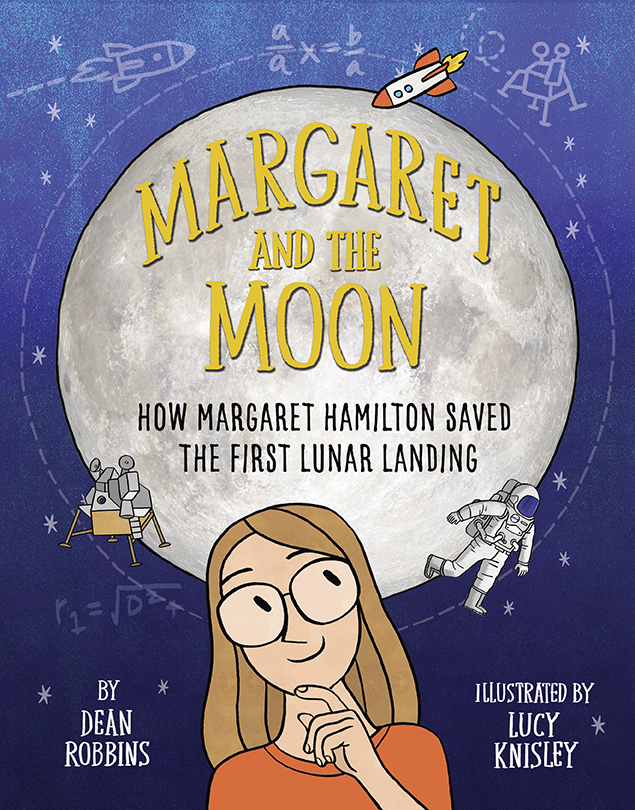
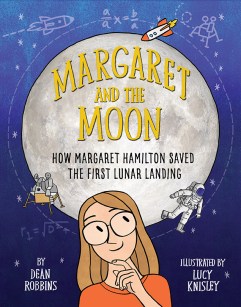
Margaret and the Moon: How Margaret Hamilton Saved the First Lunar Landing

Written by Dean Robbins | Illustrated by Lucy Knisley


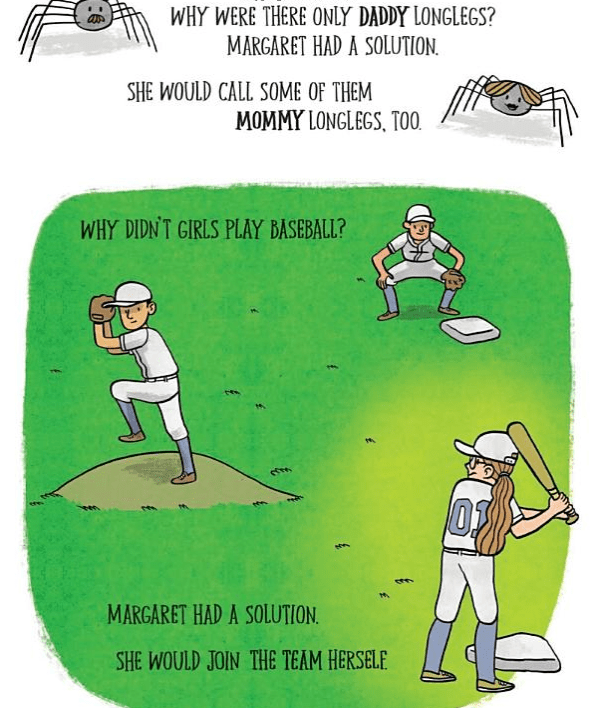
“Margaret Hamilton loved to solve problems.” When she looked around, she saw many things that made her wonder “why?” Instead of going with the status quo, though, she came up with her own answers. Some things she questioned were why girls didn’t play baseball and why there were so few women doctors, scientists, judges and other professionals. So Margaret joined the baseball team and studied “hard in every subject at school—reading, music, art, and especially mathematics.”

celebrate-picture-books-picture-book-review-margaret-and-the-moon-baseball

Image copyright Lucy Knisley, 2017, text copyright Dean Robbins, 2017. Courtesy of Knopf Books for Young Readers.

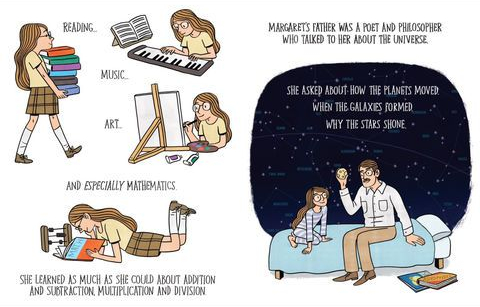
From her father who was a poet and philosopher, Margaret learned about the universe. She wanted to know “how the planets moved, when the galaxies formed, and why the stars shone.” She loved to gaze “at the night sky in wonder.” She especially wanted to know more about the moon—how far away is it? How many miles is its orbit around the Earth? What is its diameter?

In school, Margaret found it fun to solve “harder and harder math problems” in algebra, geometry, and calculus. “And then she discovered computers!” She realized that she could use computers to solve so many of her questions about the universe. She began writing code and called herself a software engineer. After starting with simple mathematical problems, Margaret moved on to writing code that “could track airplanes through the clouds,” predict the weather, and perform functions they never had before.

celebrate-picture-books-picture-book-review-margaret-and-the-moon-father

Image copyright Lucy Knisley, 2017, text copyright Dean Robbins, 2017. Courtesy of Knopf Books for Young Readers.

In 1964 she joined the team at NASA that was working on sending astronauts to the moon. In writing her code, “Margaret thought of everything that could happen on a trip to the moon.” What if the spacecraft went off course or lost power? What if one of the astronauts made a mistake? Margaret wrote code that could solve all of these problems and more. Soon Margaret was leading a team of her own as “Director of Software Programming for NASA’s Project Apollo.”

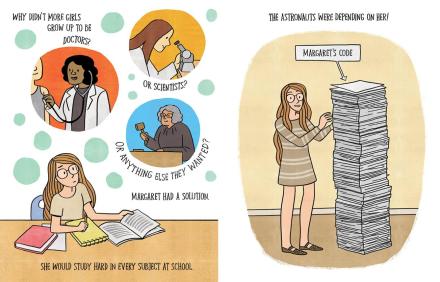
She was instrumental in helping Apollo 8 orbit the moon, Apollo 9 hook up with another ship in space, and Apollo 10 come “within nine miles of the moon’s surface.” When NASA was ready to land people on the moon, Margaret wrote the code. She thought of every problem that could arise and included a solution. The printout of her code stood taller than she was.

celebrate-picture-books-picture-book-review-margaret-and-the-moon-studied-hard

Image copyright Lucy Knisley, 2017, text copyright Dean Robbins, 2017. Courtesy of Knopf Books for Young Readers.

On the day of Apollo 11’s launch, Margaret was in the control room while the world watched on television. It took four days for the spacecraft to reach the moon. Finally, the lunar module, Eagle, separated and was ready to make the landing. But just as it was about to descend, an astronaut flipped a switch that sent the Eagle’s computer into overload.

Had Margaret “prepared for this problem? Of course! Margaret’s code made the computer ignore the extra tasks and focus on the landing.” Slowly the Eagle approached the surface of the moon and touched down. “The Eagle has landed!” Neil Armstrong announced to an amazed audience. In NASA’s control room, everyone cheered. “Margaret was a hero!”

An Author’s Note with more information about and photographs of Margaret Hamilton follow the text.

celebrate-picture-books-picture-book-review-margaret-and-the-moon-star-gazing

Image copyright Lucy Knisley, 2017, text copyright Dean Robbins, 2017. Courtesy of Knopf Books for Young Readers.

With excellent examples from Margaret Hamilton’s childhood and adult life, Dean Robbins presents an accessible and compelling biography that reveals, from the beginning, Margaret’s curiosity, confidence, and convictions. Robbin’s focus on Margaret’s hard work, her excitement at discovering computers, and her leadership at NASA creates a narrative that is inspirational for all children. His emphasis on positive, affirming events in Margaret’s life is welcome, allowing girls and boys to realize that through dedication and self-assurance, they can achieve their goals just as Margaret—a superb role model—did.

celebrate-picture-books-picture-book-review-margaret-and-the-moon-margaret

Lucy Knisley’s bright, supportive illustrations, full of thought bubbles of Margaret’s ideas and wonderings, give readers the kinds of details that will spark their imaginations and help them understand and appreciate Margaret Hamilton’s many gifts and expertise. Images of mathematical problems give way to lines of code, helping children see the connection between what they’re learning at school and future careers. Kids interested in space exploration will be enthralled with the illustrations of the NASA control room and lunar launches.

For kids interested in computer science and other sciences, biographies, and history, Margaret and the Moon is an excellent addition to home as well as classroom and school libraries.

Ages 4 – 8

Knopf Books for Young Readers, 2017 | ISBN 978-0399551857

Discover more about Dean Robbins and his books on his website.

To learn more about Lucy Knisley, her artwork, books, and comic, visit her website.

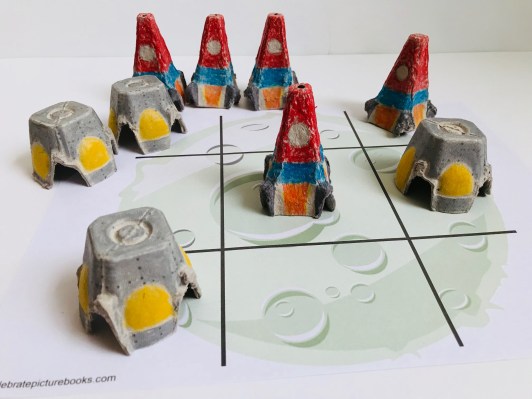
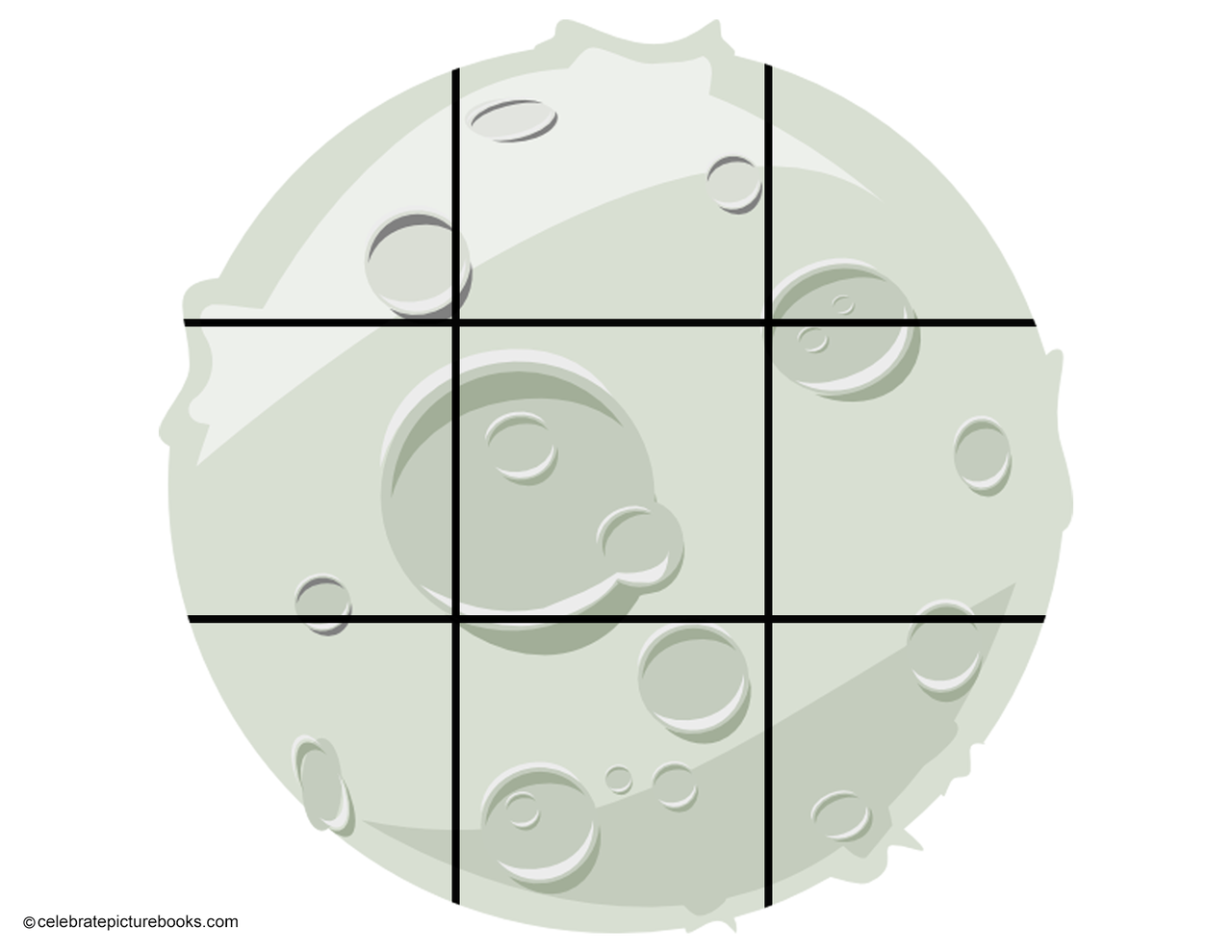
You can launch your own Tic-Tac-Toe Game with this set you make yourself! With just a couple of egg cartons, some crayons, and a printable game board, you’ll be off to the moon for some fun! Opposing players can be designated by rockets and capsules. Each player will need 5 playing pieces. 

National Moon Day Activity

celebrate-picture-books-picture-book-review-rocket-to-the-moon-tic-tac-toe-game

Out-of-this-World Tic-Tac-Toe Game

SUPPLIES

  • Printable Moon Tic-Tac-Toe Game Board
  • 2 cardboard egg cartons
  • Heavy stock paper or regular printer paper
  • Crayons
  • Black or gray fine-tip marker

DIRECTIONS

To Make the Rockets

  1. Cut the tall center cones from the egg carton
  2. Trim the bottoms of each form so they stand steadily, leaving the arched corners intact
  3. Pencil in a circular window on one side near the top of the cone
  4. Color the rocket body any colors you like, going around the window and stopping where the arched corners begin
  5. With the marker color the arched corners of the form to make legs
  6. On the cardboard between the legs, color flames for blast off

To Make the Capsule

  1. Cut the egg cups from an egg carton
  2. Color the sides silver, leaving the curved section uncolored. (If your egg cup has no pre-pressed curve on the sides of the cup, draw one on each side.)
  3. Color the curved section yellow to make windows
  4. With the marker, dot “rivets” across the capsule

Print the Moon Game Board and play!

celebrate-picture-books-picture-book-review-margaret-and-the-moon-cover

You can find Margaret and the Moon: How Margaret Hamilton Saved the First Lunar Landing at these booksellers

Amazon | Barnes & Noble | Books-a-Million | IndieBound

Picture Book Review

July 17 – National Yellow Pig Day

The Boy Who Loved Math: The Improbable Life of Paul Erdős by Deborah Heiligman and LeUyen Pham picture book review

About the Holiday

Today’s holiday isn’t really about the color yellow or about pigs—it’s about math! Who knew? Well, plenty of people, actually! Mathematicians, college professors, and students spend the day celebrating the number 17 with special problems and yellow pig cakes, songs, parades, and more. The holiday was established in the 1960 when two Princeton University students, David Kelly and Michael Spivak began obsessing over the number 17. And the yellow pig? One story say it’s a reference to David Kelly’s collection of yellow pigs while another goes that the two concocted the idea of a yellow pig with 17 toes, teeth, eyelashes, etc. To celebrate, study up on the prime number 17 and have some more math fun!

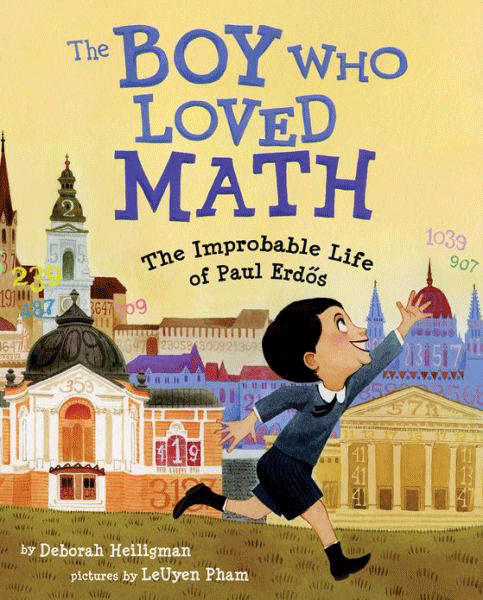
The Boy Who Loved Math: The Improbable Life of Paul Erdős

Written by Deborah Heiligman | Illustrated by LeUyen Pham


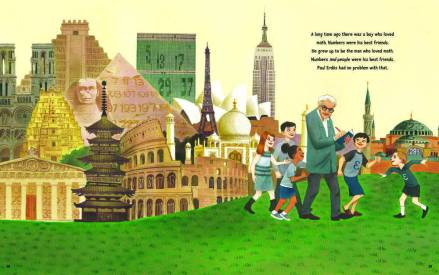
In Budapest, Hungary a boy is born who loves math. His name is Paul Erdős and he lives with his mother, who loves him “to infinity” just as Paul loves her. When she goes back to work as a math teacher, she leaves Paul with Fräulein, his nanny. Fräulein loves rules and tries to get Paul to sit still, eat all his lunch, take a nap—to obey. But Paul hates rules.

celebrate-picture-books-picture-book-review-the-boy-who-loved-math-the-improbable-life-of-paul-erdos-young-paul-calendar

Image copyright LeUyen Pham, 2013, text copyright Deborah Heiligman, 2013. Courtesy of usmacmillan.com.

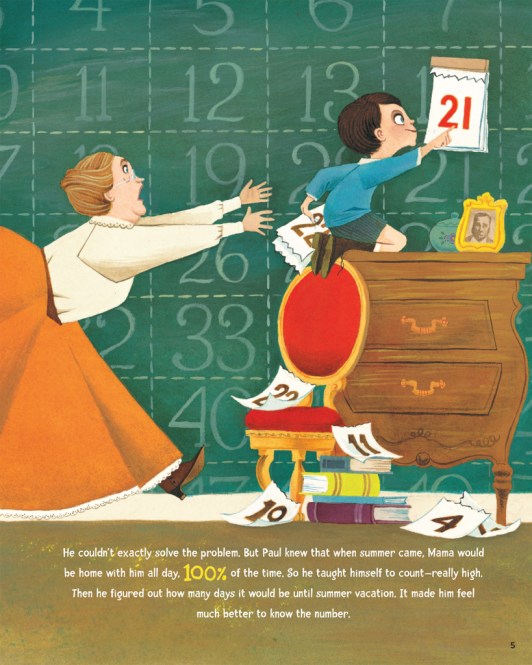
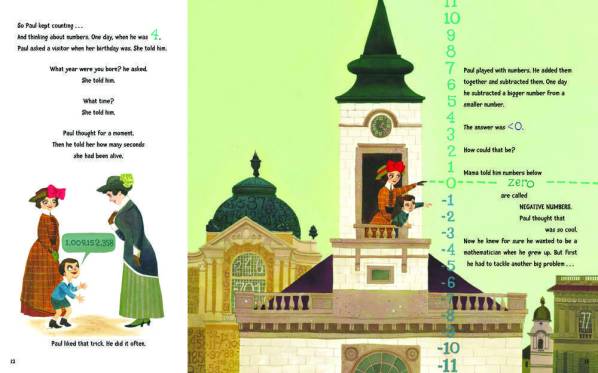
At three years of age he teaches himself to count the days until his mother will be home with him 100 percent of the time. Knowing the number makes Paul feel better as his head is constantly full of numbers and what they can do. One day when he is four years old, he meets a woman and asks her two questions—what year she was born and at what time. When the woman tells him, it only takes him a moment to reveal how many seconds she has been alive.

celebrate-picture-books-picture-book-review-the-boy-who-loved-math-the-improbable-life-of-paul-erdos-tower

Image copyright LeUyen Pham, 2013, text copyright Deborah Heiligman, 2013. Courtesy of usmacmillan.com.

He continues to play with numbers, learning more and more about the various types. He decides he will be a mathematician when he grows up. When Paul is old enough to go to school, he once again encounters rules he can’t abide. His mother decides he will be schooled at home, and even though this means more time with Fräulein, Paul considers it the better option.

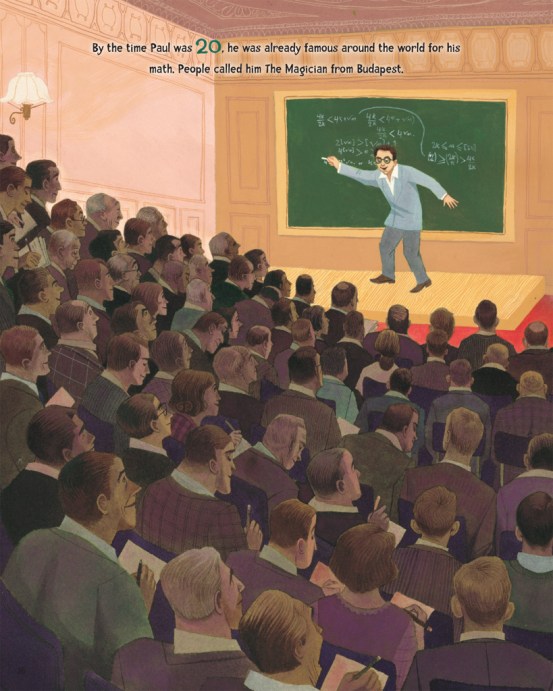
There’s just one thing – while Paul thinks about numbers, Fräulein and his mother do everything for him. At meals they cut his meat and butter his bread; they dress him, and tie his shoes. When he becomes a teenager, he goes to high school and meets other kids who love math. He and his friends spend all their time doing math and by the time Paul is 20 he is famous around the world for his math equations.

celebrate-picture-books-picture-book-review-the-boy-who-loved-math-the-improbable-life-of-paul-erdos-paul-around-the-world

Image copyright LeUyen Pham, 2013, text copyright Deborah Heiligman, 2013. Courtesy of usmacmillan.com.

There’s just one problem – even as an adult, Paul is so focused on numbers and math that he still doesn’t know how to do basic things for himself. When he is 21 he’s invited to go to England to work. At his first dinner there he stares at his bread and he stares at his meat. What is he supposed to do? With a little experimentation, he figures it out, but he also figures out that he sees the world in a different way.

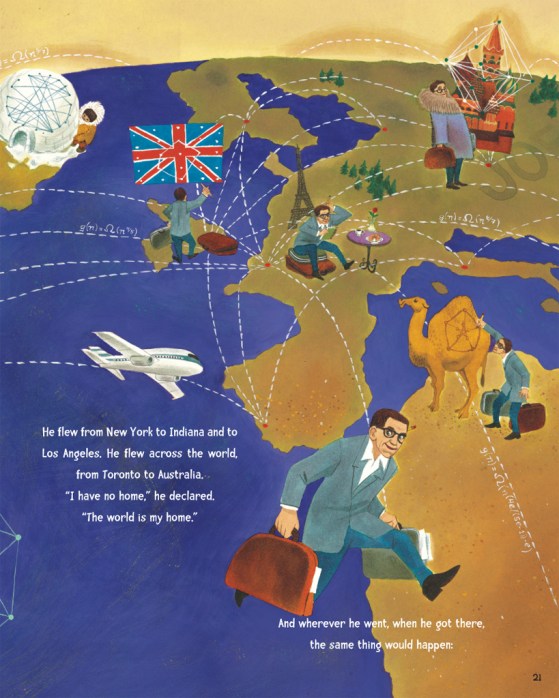
He doesn’t want a normal life with a family and a house and a regular job. He designs for himself a very unusual lifestyle. Everything he owns fits into two suitcases, and with a little money in his pocket he flies from city to city to do math. He knows so many mathematicians that wherever he goes they invite Paul to stay with them. These families take care of Paul just as his mother and Fräulein had! They do his laundry, cook his meals, and pay his bills.

celebrate-picture-books-picture-book-review-the-boy-who-loved-math-the-improbable-life-of-paul-erdos-teacher-paul

Image copyright LeUyen Pham, 2013, text copyright Deborah Heiligman, 2013. Courtesy of usmacmillan.com.

But even so, everyone loves “Uncle Paul!” He brings people together and shares his knowledge. His work in mathematics has given the world better computers, better search engines, and better codes for our spies to use. He was so admired that even now people represent their relationship with Paul by giving it a number – the “Erdős number.” Paul was a unique person who counted numbers and people as his best friends and experienced the world in a way that added up to a very special life.

celebrate-picture-books-picture-book-review-the-boy-who-loved-math-the-improbable-life-of-paul-erdos-older-paul

Image copyright LeUyen Pham, 2013, text copyright Deborah Heiligman, 2013. Courtesy of usmacmillan.com.

Reading Deborah Heiligman’s The Boy Who Loved Math is a liberating experience. Her biography reveals not just what Paul Erdős did, but the quirky genius he was. It also honors all the people around the world who embraced his personality, allowing Erdős to focus on the work he was born to do. Heiligman’s engaging patter, full of interesting anecdotes, humor, and personality, is storytelling at its best and provides an absorbing look at a very unique life.

LeUyen Pham’s illustrations perfectly complement the text, exposing Erdős’s chafing under rules, his delight in math, and his development from youth to old age. Each fascinating page cleverly represents the way Erdős saw the world as numbers, equations, and geometric shapes appear on buildings, domes, and even in the very air! The text too is infused with numerals and mathematical symbols (“Paul loved Mama to ∞, too!), making this a prime book for any math lover!

Ages 5 – 9

Roaring Brook Press, 2013 | ISBN 978-1596433076

Discover more about Deborah Heiligman and her books on her website.

To learn more about LeUyen Pham, her books, and her art, visit her website.

Mathematics Awareness Month Activity

CPB - Math Mystery Phrase

Totally Cool Mystery Phrase! Puzzle


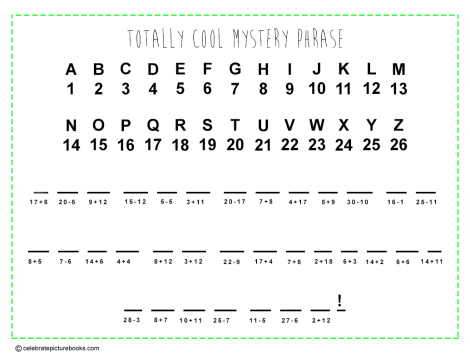
What plus what equals an equation that can’t be beat? You and numbers, of course! Complete this Printable Totally Cool Mystery Phrase! puzzle to discover a coded sentence! Here’s the Solution!

The Boy Who Loved Math: The Improbable Life of Paul Erdős by Deborah Heiligman and LeUyen Pham picture book review

You can find The Boy Who Loved Math at these booksellers

Amazon | Barnes & Noble | Books-a-Million | IndieBound

Picture Book Review
July 8 – Math 2.0 Day

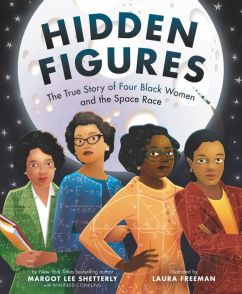
celebrate-picture-books-picture-book-review-hidden-figures-the-true-story-of-four-black-women-and-the-space-race-cover

About the Holiday

Today’s holiday celebrates the merging of math and technology together as the foundation of most of the things we use every day, such as computers, phones, tablets and other electronics. Math and technology are also employed by architects, scientists, researchers, and manufacturers. Math 2.0 Day was established to bring together mathematicians, programmers, engineers, educators, and managers to raise awareness of the importance of math literacy at all levels of education.


Hidden Figures: The True Story of Four Black Women and the Space Race

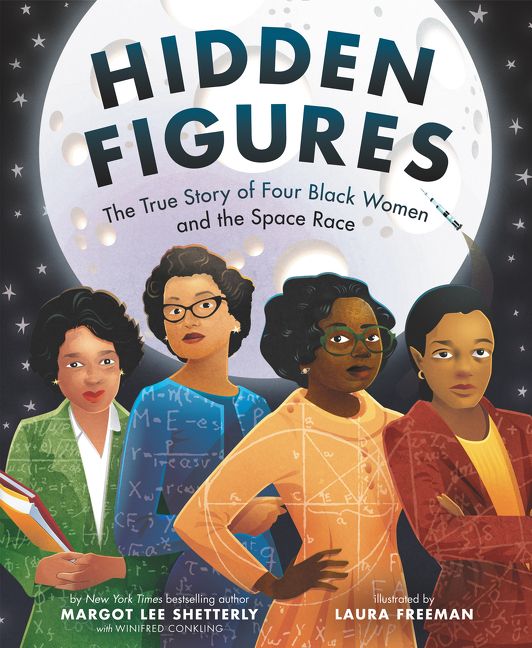
Written by Margot Lee Shetterly | Illustrated by Laura Freeman


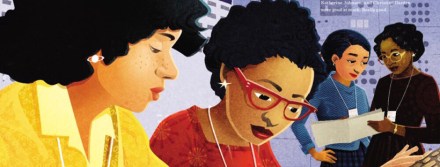
“Dorothy Vaughan, Mary Jackson, Katherine Johnson, and Christine Darden were good at math…really good.” The United States was involved in World War II, and Dorothy wanted to help the war effort by working for the National Advisory Committee for Aeronautics to make planes faster, stronger, and safer. Developing new airplanes required lots of tests at the Langley Laboratory in Virginia. Today, we use computers to do the kinds of math needed, “but in the 1940s computers were actual people like Dorothy, Mary, Katherine, and Christine.”

celebrate-picture-books-picture-book-review-hidden-figures-the-true-story-of-four-black-women-and-the-space-race-dorothy

Copyright Laura Freeman, 2018, courtesy of lfreemanart.com.

Even though Dorothy was a woman and an African-American in the segregated South, Dorothy did not think her dream of getting a job was impossible. After all, she was really good at math. She applied and was hired as a computer. At Langley, whites and blacks worked in different buildings and had separate facilities. After the United States won the war, Dorothy stayed on to create better aircraft.

Now America and Russia were in competition to build the best airplanes. This required more math, more tests, and more computers. Mary Jackson was hired at Langley to test model airplanes in wind tunnels. Mary had her sights set on becoming an engineer, but most of the engineers were men. To prepare, Mary needed to take advanced math classes, “but she was not allowed into the white high school where the classes were taught.” Mary didn’t take no for an answer. She got special permission to take classes, got good grades, and “became the first African-American female engineer at the laboratory.”

celebrate-picture-books-picture-book-review-hidden-figures-the-true-story-of-four-black-women-and-the-space-race-katherine

Copyright Laura Freeman, 2018, courtesy of HarperCollins.

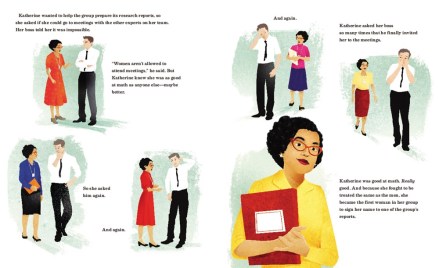
In 1953 Katherine Jackson was hired for a team who tested airplanes while they were in the air. Her work was to analyze turbulence to make planes safer in dangerous gusts of wind. She wanted to go to her team’s meetings, but she was told by her boss again and again that it was impossible; women were not allowed to attend meetings. At last her persistence paid off, and she became the first woman to sign one of the group’s reports.

When machine computers were installed at Langley in the 1950s, they were faster than the human computers but made many mistakes. “Dorothy learned how to program the computers so they got the right answers and taught the other women in her group how to program too.”

In 1957 Russia launched a satellite into space, ramping up the competition with the United States. Now “the United States started building satellites to explore space too,” and the name of the agency was changed to the National Aeronautics and Space Agency or NASA. Then President John F, Kennedy set a goal of sending a man to the moon. First, however, there would need to be many experiments, new space craft, and tests to send astronauts into orbit. This meant more people who were good at math would be needed.

celebrate-picture-books-picture-book-review-hidden-figures-the-true-story-of-four-black-women-and-the-space-race-separate-offices

Copyright Laura Freeman, 2018, courtesy of lfreemanart.com.

When the first manned space flight was planned, Katherine calculated the trajectory that would take John Glenn into space and bring him home again. In 1967 Dorothy Darden came to work at Langley. She loved electronic computers and wanted to become an engineer. “Her first job was to help with NASA’s mission to the moon.”

When Neal Armstrong stepped onto the moon’s surface for the first time on July 20, 1969, he said it was a giant leap for mankind. “It was also a giant leap for Dorothy, Mary, Katherine, Christine, and all of the other computers and engineers who had worked at the lab over the years.” The moon landing was just the beginning. NASA engineers were already dreaming of trips to other planets and super-fast spacecraft. And although it would be hard and require a lot of numbers, “Dorothy, Mary, Katherine, Christine knew one thing: with hard work, perseverance, and a love of math, anything was possible.”

celebrate-picture-books-picture-book-review-hidden-figures-the-true-story-of-four-black-women-and-the-space-race-four-women

Copyright Laura Freeman, 2018, courtesy of HarperCollins.

Margot Lee Shetterly brings her compelling story Hidden Figures to children in this exceptional picture book that skillfully reveals the talents and dreams of Dorothy, Mary, Katherine, Christine as well as the work atmosphere and social injustices of the time period. While acknowledging the struggles and obstacles the four women faced, Shetterly keeps her focus on the incredible achievements of these brilliant women and the positive changes and opportunities for others they created. Brief-yet-detailed descriptions and explanations of math, science, and computer terms flow smoothly in the text, allowing all readers to understand and appreciate the women’s work.

As Dorothy, Mary, Katherine, Christine each begin their work at Langley as young women, Laura Freeman establishes their dreams and their particular field of expertise through richly colorful illustrations that highlight the schematics, tools, equipment, and models they used. In one particularly affecting spread, Dorothy, Mary, Katherine, and Christine go off to their offices on the left-hand side, and their white counterparts head out to theirs on the right-hand side while the blueprint of their building lies under their feet. Dorothy, Mary, Katherine, and Christine’s clothing is also mirrored in color by the women on the other side of the fold. Period dress and electronics show progression through the years, and kids may marvel at the size of early computers. The final image of Dorothy, Mary, Katherine, and Christine as older women is moving and inspirational.

Hidden Figures: The True Story of Four Black Women and the Space Race is an outstanding biography of four women who contributed their gifts for math as well as their self-confidence not only to science but to dreamers in their own and future generations. The book would be a stirring choice for classroom and home libraries.

Ages 4 – 8

HarperCollins, 2018 | ISBN 978-0062742469

Discover more about Margot Lee Shetterly and her books on her website.

To learn more about Laura Freeman, her books, and her art, visit her website.

International Women’s Day Activity

celebrate-picture-books-picture-book-review-women-in-stem-coloring=book

Women in STEM Coloring Book


Discover five women who broke barriers  and made important contributions to the science, technology, engineering, and math fields in this printable  Women in STEM Coloring Book created by the United States Department of Energy.

celebrate-picture-books-picture-book-review-hidden-figures-the-true-story-of-four-black-women-and-the-space-race-cover

You can find Hidden Figures: The True Story of Four Black Women and the Space Race at these booksellers

Amazon | Barnes & Noble | Books-a-Million | IndieBound


Picture Book Review
June 27 – It’s Fresh Fruit and Vegetable Month

celebrate-picture-books-picture-book-review-banana-for-two-cover-final

About the Holiday

With all the scrumptious fresh fruit and vegetables available at your local farmers market or grocery store, how can you help but enjoy good nutrition? Those red, red strawberries and midnight blue blueberries make perfect smoothies, and the brilliant orange carrots and peppers look good enough to eat! Oh, wait! You can eat them! So grab your bag or basket and head to the store—or plant or pick your own!

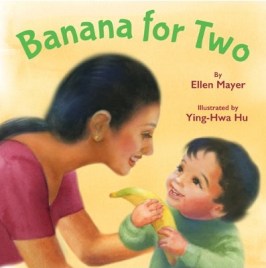
Banana for Two

Written by Ellen Mayer | Illustrated by Ying-Hwa Hu


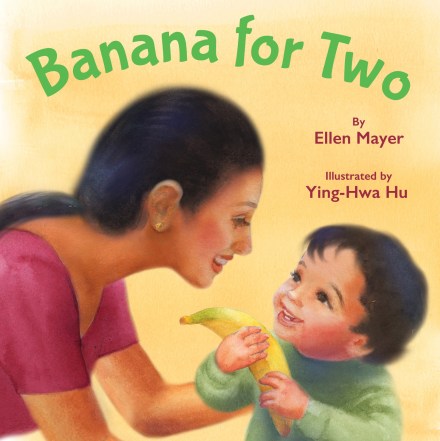
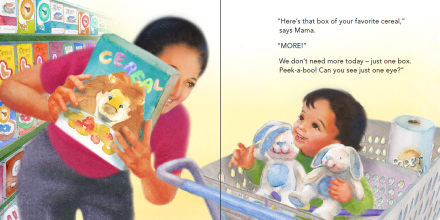
As a mother strolls her shopping cart through the grocery store, she engages her toddler, who’s brought along two stuffed bunnies, in choosing the items they need. Mama talks to her child about the one roll of paper towels she puts in the cart, then it’s off to the cereal aisle. Holding up a colorful box, Mama says, “‘Here’s your favorite cereal’” to which her toddler enthusiastically answers, “‘MORE!’” Playfully, Mama holds the box up to one eye and says, “‘we don’t need more—just one box. Peek-a-boo! Can you see just one eye?’”

celebrate-picture-books-picture-book-review-banana-for-two-cereal

Image copyright Ying-Hwa Hu, 2017, text copyright Ellen Mayer, 2017. Courtesy of Start Bright Books.

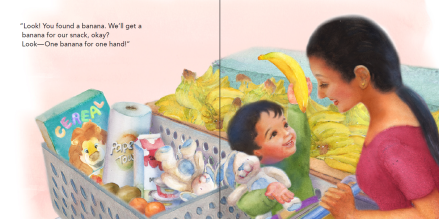
Her little one giggles as they head for the dairy aisle for yogurt. Here, the child’s wish for “‘MORE!’” is granted, and Mama lets her little one hold the containers. “‘One, two—one for each hand,’ says Mama.” The child laughs and kicks, excited to help. As they pass through the fruit section, the toddler grabs a banana from the display and holds it up triumphantly. Mama is happy to add the one banana to the cart to eat later. “‘Look—one banana for one hand!’” she points out.

celebrate-picture-books-picture-book-review-banana-for-two-banana

Image copyright Ying-Hwa Hu, 2017, text copyright Ellen Mayer, 2017. Courtesy of Start Bright Books.

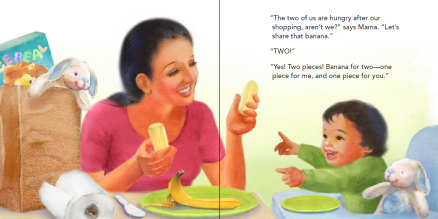
At check-out, Mama names each item and the quantity they are buying as she puts the banana, yogurt, carrots, potatoes, milk, and other things on the conveyor belt. But her little one wants to help too! Suddenly, one of the stuffed bunnies is riding toward the smiling clerk on top of the roll of paper towels. Back home, it’s time for a snack. As Mama cuts the banana in half, her toddler proudly exclaims, “‘TWO!’” showing an understanding of the concept of two.

A note for parents, grandparents, and caregivers by early math expert Deborah Stipek is included. Gender neutral clothing and hair and the absence of personal pronouns in the text make this a universal book for all children.

celebrate-picture-books-picture-book-review-banana-for-two-snack

Image copyright Ying-Hwa Hu, 2017, text copyright Ellen Mayer, 2017. Courtesy of Start Bright Books.

Ellen Mayer’s joyful math board book for the youngest readers introduces parents and other caregivers to ways that they can add math talk to everyday activities. In Banana for Two, grocery shopping becomes a fun opportunity for an adult and child to talk together about quantity—an important early building block for math understanding and future math success. Connecting concepts a child already knows—such as two containers of yogurt for two hands—as the mother does in Banana for Two is another way to strengthen understanding. Mayer’s conversational style—indeed the whole story is a conversation between mother and child—is sweet and loving and full of the kinds of moments that may seem routine to adults but that children cherish sharing with parents, grandparents, or other caregivers. And the final image of the little one happily savoring slices of banana will have kids asking for “‘MORE!'”

Ying-Hwa Hu’s exuberant illustrations of mother and child will make little ones and adults smile. Cheerful eye contact between the two shows the love they share and their enjoyment in spending time together. Colorful boxes and containers line the grocery store shelves, giving the pages a fresh and sunny feel. The items Mama adds to the cart are clearly shown in quantities of one and two. Little readers will love the adorable stuffed bunnies and join in the toddler’s pride as they too recognize the ideas of one and two.

Banana for Two makes an excellent shower or new baby gift and will quickly become a favorite at home and in preschool classrooms or programs.

Ages Birth – 2

Star Bright Books, 2017 | ISBN 978-1595727886 | Spanish/English Edition Banana para dosBanana for Two ISBN 978-1595727992

To discover more about Ellen Mayer and her books as well as  find lots of resources for adults and fun activities for kids, visit her website.

Learn more about Ying-Hwa Hu and her art, and her books, visit her website.

Fresh Fruit and Vegetable Month Activity

celebrate-picture-books-picture-book-review-math-fun-is-in-the-bag-game

Math Fun Is in the Bag Grocery Shopping Game


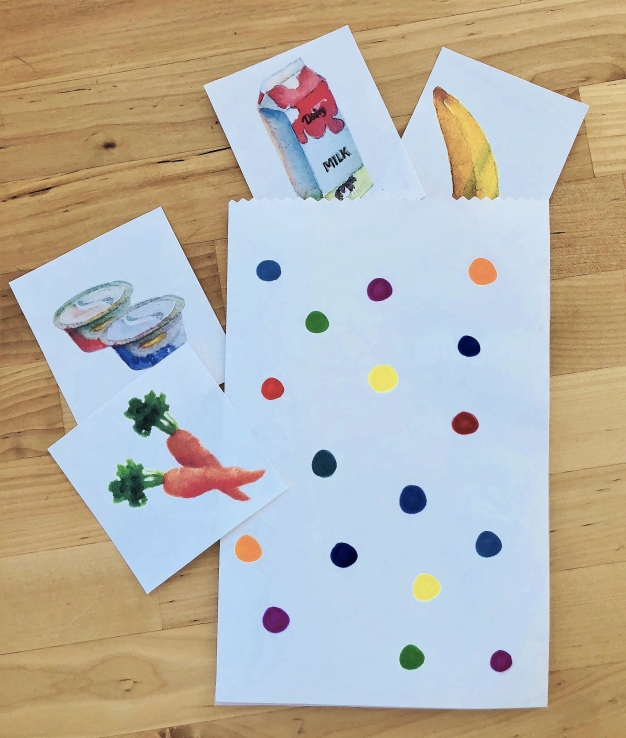
Little ones love to pretend to go grocery shopping! With the printable game pieces and instructions here, you and your child can fill a bag with items in quantities of one and two and share some math fun!

Supplies

Directions

To Make a Bag

  1. Fold the 8 ½” by 11” piece of paper in half and tape on the side and at the bottom
  2. Your child may enjoy decorating your homemade bag or a paper sandwich bag with crayons
  3. After printing the Math Fun Is in the Bag template, talk with your little one about the quantity of items in each picture. Even if your child is not talking yet, they are listening and learning.
  4. Help your child cut the pictures apart
  5. Ask your child to find a picture of one banana and put it in the bag
  6. Continue with the other pictures, noting the quantity of the item
  7. For older children, print two (or more) copies of the Math Fun Is in the Bag template and have them add two bananas, two cartons of milk, four carrots, and four containers of yogurt to the bag.
  8. Older children may also enjoy paying for their groceries with pennies in quantities of one or two (or more). Set a price for each item and help children count out the coins needed to pay for them.

celebrate-picture-books-picture-book-review-banana-for-two-cover

You can find Banana for Two at these booksellers

Amazon | Barnes & Noble | Books-a-Million | IndieBound

Picture Book Review
June 9 – World Doll Day

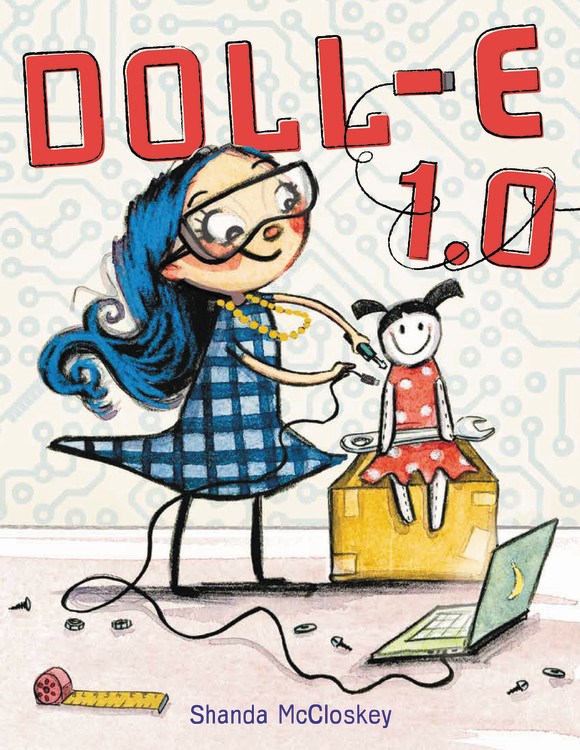
celebrate-picture-books-picture-book-review-doll-E-1.0-cover

About the Holiday

Dolls have been part of childhood from earlies times. Once simple cloth or wooded carved figures, dolls have evolved over the years to cry, talk, and move in almost a lifelike way.  Although dolls have changed, one thing has stayed the same: they are much-loved companions, especially for little ones. Adults are also fascinated by dolls, and collectible dolls of all types have an ardent following. Today’s holiday was established in 1986 by Margaret Seeley to spread the “universal message of happiness and love.” People are encouraged to give a doll to a child of a family member or friend or to donate a doll to a child in need. The day is also celebrated with special events and doll shows.

Doll-E 1.0

By Shanda McCloskey


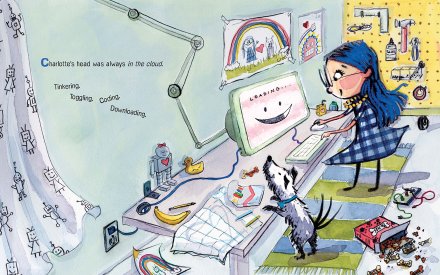
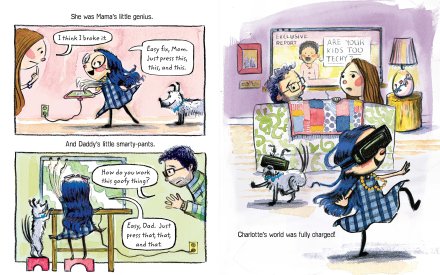
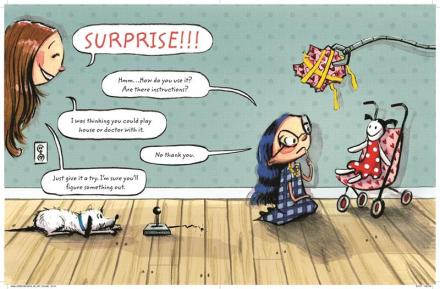
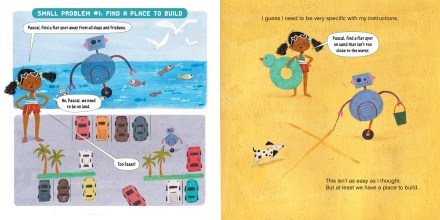
“Charlotte’s head was always in the cloud.” She knew everything about computers and was plugged in to the (virtual) realities of each day. One day her mother bought her a present. Charlotte wondered at what kind of electronic marvel might lie underneath the wrapping. When the robotic arm she’d build untied the bow and tore off the paper, Charlotte gazed at the cloth doll in the little stroller uncertainly.

celebrate-picture-books-picture-book-review-doll-E-1.0-lab

Copyright Shanda McCloskey, 2018, couirtesy of Little, Brown Books for Young Readers.

She wasn’t sure how to play with it; where was the instruction manual? Charlotte took the doll to her lab and tried to engage it in her favorite video game and to get it to dance under the revolving disco ball, but the doll just sat on the floor and stared at her. Suddenly, the doll said “Ma-ma.” Charlotte didn’t think she was Mama material, but then she had a thought: “If the doll could talk, then it must have a power supply.”

Sure enough when she opened the back, she found two batteries. This was more like it! Since the doll’s only word seemed to be “Ma-ma,” Charlotte ran an update on it to increase its vocabulary. But before she could finish, her dog grabbed the doll by the leg and ran off with it. Before Charlotte could stop him, Blutooth had ripped the doll apart.

celebrate-picture-books-picture-book-review-doll-E-1.0-virtual-games

Copyright Shanda McCloskey, 2018, couirtesy of Little, Brown Books for Young Readers.

Charlotte collected the doll’s arms, legs, and head, gathered some more supplies, and went to work in her lab. “With a few spare parts and a bit of code, Charlotte changed the doll.” It looked at Charlotte with its bright eyes and smile and said, “H-e-l-l-o m-y n-a-m-e i-s D-o-l-l-E 1.0.” “And the doll changed Charlotte too.” Charlotte loved Doll-E. She read to it, and played with it, and took it outside, where its fast stroller and new remote-controlled robotic arms were perfect for walking Blutooth.

celebrate-picture-books-picture-book-review-doll-E-1.0-gift

Copyright Shanda McCloskey, 2018, couirtesy of Little, Brown Books for Young Readers.

Shanda McCloskey wonderfully inventive doll story for a new generation will delight children and remind adults that while toys may change, the feelings associated with them never do. Sprinkled with puns and led off with a just-right first line, McCloskey’s smart story shines. Charlotte shows heart and intelligence as she embraces her new doll and makes it a reflection of her own life—just as children have always done with their toys. Charlotte, as a computer whiz, makes a captivating role model for kids, especially girls who code or would like to.

There’s so much to admire in McKloskey’s illustrations, from Charlotte’s dedicated work space/lab outfitted with hand tools, spare parts, and craft supplies to her sweet determination to understand her new, simple doll. Clever details, such as a light bulb hanging over Charlotte’s head when she gets a brilliant idea and a Frankenstein-esque scene as Charlotte repairs her doll add depth and fun to the story’s theme.

A spirited story, Doll-E 1.0 clicks all the buttons as a must for home and classroom bookshelves.

Ages 4 – 7

Little, Brown Books for Young Readers, 2018 | ISBN 978-0316510318

Discover more about Shanda McCloskey, her books, and her art on her website.

World Doll Day Activity

celebrate-picture-books-picture-book-review-stacking-dolls-coloring-page

Russian Nesting Dolls Coloring Page


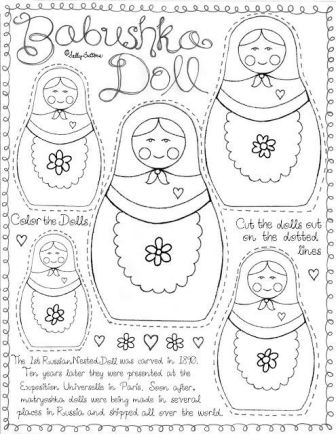
Russian nesting dolls are fun to play with! Open one up and see what’s inside! Then another… and another… and another…. Grab your crayons or pencils and your scissors and enjoy this coloring page!

Russian Nesting Dolls Coloring Page

Picture Book Review
May 30 – It’s Get Caught Reading Month

celebrate-picture-books-picture-book-review-albie-newton-cover

About the Holiday

Get Caught Reading Month was established in 1999 by the Association of American Publishers to encourage people of all ages to read more. Authors, illustrators, celebrities, athletes, and others participate by sharing pictures of themselves reading an old favorite or new book on social media. Schools, libraries, bookstores, and community venues hold special programs throughout the month. For more information and to find resources, visit the Get Caught Reading website.

Albie Newton

Written by Josh Funk | Illustrated by Ester Garay


Albie Newton was something of a prodigy. As a tyke, he retrofitted his stroller into a racecar, tried counting to infinity, and “learned to speak a language almost every week: / English, Spanish, Hindi, Klingon, Gibberish, then Greek.” When he moves to a new town and a new school, his classmates are excited to meet him. Albie is also revved up to start making friends, and he has a plan he thinks the other kids will love.

But as they all settle in to work, “the students noticed Albie was a whiz. / Albie wrote a sonnet while they took a spelling quiz.” During art class, the kids were likewise astounded (and a little dismayed) when, while they scribbled, drew swirls, and made handprints, Albie painted like Van Gogh. When free time rolled around, and some kids played dress up, Albie “sifted through the trash,” to build a science lab, leaving a mess for Arjun to clean up.

celebrate-picture-books-picture-book-review-albie-newton-toddler

Image copyright Ester Garay, 2018, text copyright Josh Funk, 2018. Courtesy of Sterling Children’s Books.

Then things began to disappear. “Hamilton the hamster tried to run but had no wheel. / Albie needed extra sprockets made of stainless steel.” While Sona and Shirley created paper masks, the glue went missing, and Albie “didn’t even ask.” The wings from Dave’s propeller plane were suddenly broken off, and reading time became impossible when “booming pandemonium descended on the school.” Albie, though, intent on his invention, didn’t notice the trouble he was causing or the crowd of angry kids rushing to complain.

Before they could reach Albie, though, Shirley stopped them, saying “‘maybe Albie didn’t know. Let’s look at what he made.’ Curious, the children headed straight to where he played.” When they say all the inventions Albie had made, they stopped and stared. Albie had made the class a gift—a spaceship, and with the push of a button, an amazing time machine!

celebrate-picture-books-picture-book-review-albie-newton-spelling

Image copyright Ester Garay, 2018, text copyright Josh Funk, 2018. Courtesy of Sterling Children’s Books.

With his inimitable style, Josh Funk creates a rambunctious tale of invention and creativity, but one that also has a deeper message about the way some kids see the world and communicate with peers and others. In the first pages, readers are introduced to the precocious Albie, who from birth has demonstrated a talent for learning and doing. When he enters a new school, however, his single focus doesn’t translate into the kinds of social interactions his classmates are used to. Albie gathers materials for his present unaware of the mayhem he’s causing, just as the other kids are unaware of Albie’s real goal. Only Shirley is sensitive to the idea that Albie may not be causing havoc on purpose but for a purpose. Her calming defense of Albie allows the other kids to see Albie in a new light and appreciate his gift—and his gifts.

While Funk’s rhyming verses are focusing on Albie and his actions, Ester Garay’s bright illustrations depict the other kids’ reactions to his talents and also his disruptions. A first hint at how Albie fits in with his new class comes as the kids welcome him with cheer and smiles. Instead of facing them to accept the welcome, Albie is faced away from them, happily imagining the gift he will make for them.

celebrate-picture-books-picture-book-review-albie-newton-drawings
Image copyright Ester Garay, 2018, text copyright Josh Funk, 2018. Courtesy of Sterling Children’s Books.

Throughout the day, Shirley follows Albie, and as she watches and wonders, her facial expressions demonstrate dismay at some of Albie’s antics but also a growing understanding and acceptance. Garay captures the close camaraderie of a preschool or kindergarten classroom, and her close-up view of Albie toiling away on his invention will have readers eager to see the result. The reveal of Albie’s spaceship time machine and the final spread of the kids frolicking on a distant planet with the likes of Freda Kahlo, William Shakespeare, Amelia Earhart, and a helpful dino, are sure to produce some oohs and ahhhs.

Albie Newton is a doubly impactful story that would be a welcome addition to home and, most especially, classroom bookshelves. It can be read as a boisterous story of innovation for lively story times, but it also provides adults and children an opportunity to discuss the ideas of social interaction and various personalities. Most children know someone like Albie who as naturally quiet, on the spectrum, or singularly focused on one area or another, communicates and socializes differently than others. Reading Albie Newton can help kids better understand different behaviors and, like Shirley, become more sensitive to all their classmates and friends.

Ages 5 – 9

Sterling Children’s Books, 2018 | ISBN 978-1454922582

Discover more about Josh Funk and his books as well as find fun activities and lots of resources on his website.

To learn more about Ester Garay, her books, and her art, visit her website.

Check out the Albie Newton book trailer!

Get Caught Reading Month Activity

celebrate-picture-books-picture-book-review-initial-bookend

Initial Bookends


You can keep your books neat and tidy on the shelf with this easy-to-make bookend that displays your talents and personality!

Supplies

  • Wooden letter block in the child’s first initial or both initials
  • Chalkboard paint
  • Chalk
  • Paint brush

Directions

  1. Paint the wooden letter with the chalkboard paint, let dry
  2. With the chalk, write words that your think best describe you on the letter
  3. Display your letter on your bookshelf!

May 6 – National Nurses Day

celebrate-picture-books-picture-book-review-nurse-soldier-spy-the-story-of-sarah-edmonds-cover

About the Holiday

Today’s holiday kicks off National Nurses Week, which runs until May 12, the birthday of Florence Nightingale. Nightingale, born in 1820, was an English social reformer and the founder of modern nursing. She was well-known for her work tending wounded soldiers during the Crimean War and was called “the lady with the lamp,” because of the rounds she made of her patients during the night.

During National Nurses Day and Week, we honor and thank all of the nurses working in hospitals, private practices, and with charitable organizations around the world for their dedication to and compassion for the patients under their care.

Nurse, Soldier, Spy: The Story of Sarah Edmonds, A Civil War Hero

Written by Marissa Moss | Illustrated by John Hendrix


When President Abraham Lincoln called for young men to join the army fighting against the Southern states that wanted to secede from the Union, Frank Thompson signed up. One thing though, Frank wasn’t really a man but, instead, a 19-year-old woman named Sarah Edmonds. Sarah already knew the freedom that posing as a man could bring in her society. Three years earlier to escape a marriage arranged by her parents, Sarah cut her long hair, began wearing pants, and crossed “the border from Canada into the United States, trading a bridal gown for trousers, trading countries, without a single regret.”

celebrate-picture-books-picture-book-review-nurse-soldier-spy-the-story-of-sarah-edmonds-becoming-frank

Image copyright John Hendrix, courtesy of johnhendrix.com

Now, outside the Michigan courthouse, Sarah slowly moved her way along the line to the table where she could sign up to join the troops. When she finally stood in front of the recruiter, however, he stopped her. Sarah was mystified. How did he know she wasn’t a man? She had grown up on a farm, learning the work, copying the gestures, and even wearing the clothes of her brother. But the recruiter took one look at “Frank Thompson” and told her…she was too young to join the army. “He looked at her peachy cheeks free of any sign of a whisker. ‘We aren’t taking any sixteen-year-olds,’” he told her.

A month later, however, more men were needed, and Sarah was allowed to join up. Now a soldier, Frank was a valuable member of the corps. She was an expert at riding and shooting, and she felt at home among the men, enjoying the jokes, stories, and letters. Keeping her identity a secret was made easier by the fact that soldiers did not change clothes to go to sleep. Her small feet led the other soldiers to give her a nickname: “Our little woman.” A name Frank enjoyed immensely.

celebrate-picture-books-picture-book-review-nurse-soldier-spy-the-story-of-sarah-edmonds-union-camp

Image copyright John Hendrix, courtesy of johnhendrix.com

On the battlefield Frank trained to be a nurse, “which was something only men with the strongest stomachs did because of the long, draining hours and the horrors of surgery without anesthetic.” She fearlessly participated in the battles of Bull Run and Fair Oaks, risking her own life to rescue wounded soldiers. One night the regimental chaplain approached Frank. He wanted to recommend her for a very important—and very dangerous—job. The chaplain wanted to recommend to the generals that Frank become a spy for the North.

“Frank didn’t hesitate. ‘I’m your man!’” she said. Disguising herself as a freed slave, she infiltrated “a group of slaves bringing breakfast to the rebel pickets, the men who guarded the camp.” With so much work to do, the group quickly accepted her, but when the rest of the men, women, and children went off to their own assignments Frank hesitated, not knowing where to go next. Suddenly, a Confederate soldier caught Frank and ordered her to work on the fortifications. The work was backbreaking and left her hands blistered and bloody. The other workers helped when she had trouble.

celebrate-picture-books-picture-book-review-nurse-soldier-spy-the-story-of-sarah-edmonds-battlefield

Image copyright John Hendrix, courtesy of johnhendrix.com

The work gave Frank an opportunity to count the number of guns the army had, sketch a layout of the fort, and notice that some cannons were fake—just logs painted to look like cannons. By switching jobs with the water boy, Frank was able to get closer to the troops, where she encountered another spy—one working for the Confederate army. When night fell, Frank returned to his Union battalion. Giving the password, Frank was let into camp and made her way to the general’s tent. “Freedom, she knew, wasn’t something to take for granted. It was something to fight for, to cherish. And so long as her heart was beating strong, that’s just what she would do.”

An extensive Author’s Note revealing more about Sarah Edmond’s life and an Artist’s Note on the creation of the illustrations follow the text.

Marissa Moss’s biography of Sarah Edmonds is a suspenseful, gripping, and enlightening story of a woman who broke molds, lived on her own terms, and paved the way for future generations of women. Her well-chosen vignettes from Edmonds’ time as a Union soldier demonstrate not only Edmonds’ bravery and abilities but also create a clear and exciting trajectory of her increasing responsibilities and the danger that went with them. Fascinating details of the Civil War period, the people and attitudes involved, and the duplicitous nature of warfare, add up to a rich account of Sarah Edmonds’ life as well as the Civil War era in general.

celebrate-picture-books-picture-book-review-nurse-soldier-spy-the-story-of-sarah-edmonds-as a spy

Image copyright John Hendrix, courtesy of johnhendrix.com

Meticulously researched and drawn, John Hendrix’s illustrations perfectly accompany and illuminate the text. Accurate depictions of Civil War-era buildings and clothing as well as Union and Confederate uniforms and weapons allow children to become fully immersed in the time period. Wide-view depictions of encampments and battlefields let readers peek into tents and scour trenches, and action abounds. In camp soldiers pick out tunes on banjos, write letters, and hang laundry; on the battlefield fires rage and ammunition explodes as soldiers follow the charge of their leaders; at the Confederate fortifications black workers steer wheelbarrows of rock; and in the medical tent Frank tends to wounded soldiers, the equipment used clearly visible. Scenes portrayed in both daylight and at night highlight the ongoing conflict and the dangerous, secretive work Sara Edmonds undertook.
Nurse, Soldier, Spy: the Story of Sarah Edmonds a Civil War Hero is historical and biographical work at its best. This fast-paced, fascinating look at one particular soldier informs readers about so many aspects of the Civil War era, including societal issues that shaped the United States and are still discussed today. The book is a must for school and public libraries and its in-depth, absorbing content makes it a welcome addition to home libraries for children who love history, art, biographies, and a well-told story.

Ages 5 – 12

Abrams Books for Young People, 2016 (Paperback edition) | ISBN 978-1419720659

Discover many more books, fun stuff, writing tips and more on Marissa Moss‘s website!

View a portfolio of picture book art, editorial illustration, a sketchbook, and more on John Hendrix‘s website!
National Nurses Day Activity

CPB - Doctors Clothespins

Nurse Clothespin Dolls


Make one of these clothespin figures that honors hard-working and compassionate emergency nurses!

Supplies

CPB - Doctors Clothespins on box

Directions

  1. Draw a face and hair on the clothespin
  2. Cut out the outfit you want your doctor to wear (color pants on your clothespin if you choose the lab coat)
  3. Wrap the coat or scrubs around the clothespin. The slit in the clothespin should be on the side.
  4. Tape the clothes together
  5. Wrap the cap around the head and tape it.
  6. If you’d like to display your clothespin doctor on a wire, string, or the edge of a box or other container, cut along the dotted lines of the clothes template.

Picture Book Review