June 15 – It’s National Shark Week

celebrate-picture-books-picture-book-review-i-am-the-shark-cover

About the Holiday

It’s Shark Week – one of the most anticipated holiday’s of the year! Kids and adults are fascinated by these denizens of the deep, and especially the Great White, which sports fearsome teeth and intimidates with their imposing size. But there are many more sharks in the sea – about 500 species! – and they are an important part of the world’s ecosystem. If Shark Week is your favorite week of the summer, you’re no doubt enjoying a full schedule of shark-related shows on the Discovery Channel. To learn more information about sharks, including statistics from this year’s coastal shark survey, a chance to cast your vote for “freakiest shark,” a line-up of top videos, and more, visit the National Oceanic and Atmospheric Administration’s Shark Week page. To celebrate sharks and the wonders of the ocean every day, you’ll want to put today’s book at the top of your reading list.

Thanks to Joan Holub for sharing a copy of I Am the Shark with me for review consideration. All opinions on the book are my own. I’m excited to be teaming with Joan in a giveaway package that kids will love. See details below.

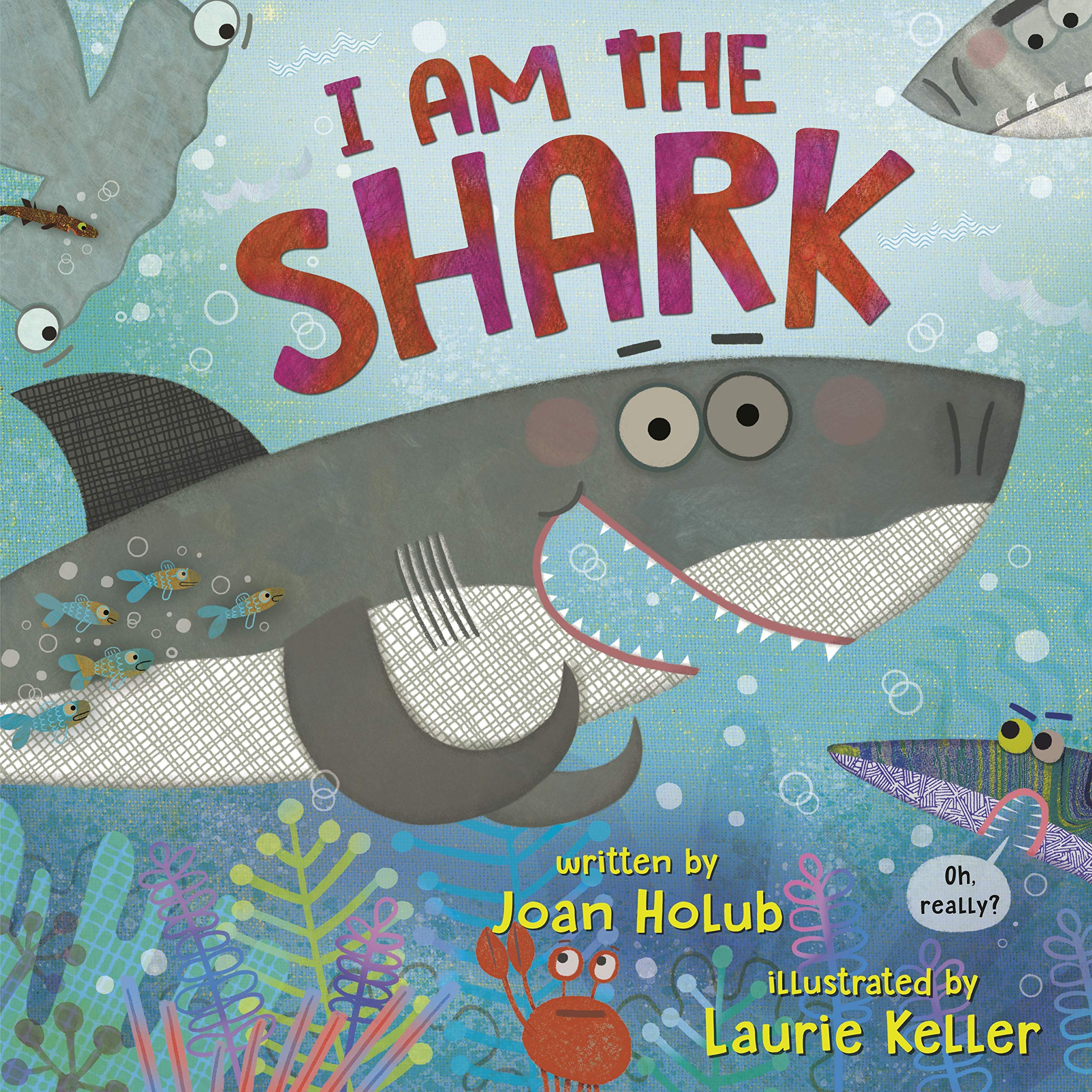
I Am the Shark

Written by Joan Holub | Illustrated by Laurie Keller


Great White Shark is excited to introduce himself, especially since he is “the GREATEST SHARK in this book.” But a voice contradicts Great White. Who begs to differ? It’s Whale Shark, and she loses no time in demonstrating why she is “the greatest shark in this book” due to her enormous size, which can’t be matched anywhere in the undersea world. And if that weren’t enough, she adds this bite: “Compared to me, you are small.”

celebrate-picture-books-picture-book-review-i-am-the-shark-great-white

Image copyright Laurie Keller, 2021, text copyright Joan Holub, 2021. Courtesy of Crown Books for Young Readers.

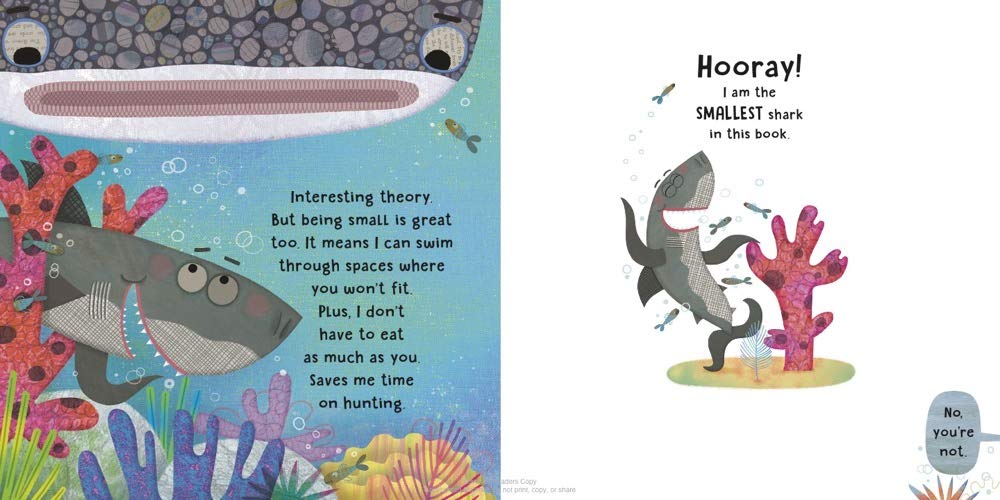
But Great White takes it in stride. If he isn’t the greatest shark, that’s okay because being the smallest has some pretty great perks too. So he’s in the middle of a “smallest shark” victory dance when a voice calls out, “No, you’re not.” It seems there’s a much smaller shark in the sea—Dwarf Lantern Shark, who, besides being the tiniest shark has a rather enlightening ability too. After the long take down from Whale Shark, this time Great White pivots quickly, thinking about how “smart and curious” he is. Could he be “the smartest shark in this book?”

Well, that would be a no. Hammerhead Shark has that one nailed down as well as a unique view of their colorful world. This time, Great White is a little intimidated. “Whoa!” he exclaims. “How can I top that?” But being smart (just not as smart as Hammerhead), Great White has another idea. This one, though, is quashed just like the others in a sneak attack. Turns out Great White isn’t the best hunter, the oldest, or even the “fishiest” shark in this book.

celebrate-picture-books-picture-book-review-i-am-the-shark-whale-shark

Image copyright Laurie Keller, 2021, text copyright Joan Holub, 2021. Courtesy of Crown Books for Young Readers.

Undeterred, Great White decides to do a little research in other books to “figure out the greatest thing about [him]. He learns all about his different body parts and even shares a labeled diagram (on graph paper and everything) with you. And he doesn’t stop there. He’s discovered all sorts of awesome facts about their skeletons, senses, teeth, skin, and other cool tidbits that he lets you know about. Great White could probably go on and on, but suddenly there’s a “snack alert” and all the sharks take off at top speed after their prey. Great White’s fast! He’s in the lead! Great White’s the fast..est… “Crumbs.” Great White’s passed up by a faster shark. Who is that anyway?

By this time Great White is feeling pretty down in the dumps. “Maybe I should change my name to Just-Okay White Shark or Not-So-Great White Shark,” he bemoans. But then Dwarf Lantern Shark swims up to him and enlightens him with some perspective and sage advice: “Just be happy being you.” Great White takes it to heart. In fact, it helps him think of a new, can’t-miss quality that finally gives him a “GREATEST in this book” status.

Backmatter includes more details on the eight sharks introduced in the story as well as books and links about sharks for kids wanting to learn more.

celebrate-picture-books-picture-book-review-i-am-the-shark-smallest

Image copyright Laurie Keller, 2021, text copyright Joan Holub, 2021. Courtesy of Crown Books for Young Readers.

Kids are always fascinated by the superlative—the fastest, the biggest, the smallest, the silliest, the best—and Joan Holub makes superlative use of this fact in her highly entertaining and educational romp. As Great White goes on a rollercoaster of emotions, one moment thinking he’s the best at something while the next moment having his hopes dashed, readers learn eye-opening details about eight sharks, described in engaging ways that will wow kids. Great White’s boundless optimism is infectious while setting up his disappointment for maximum comic effect. Kids will eagerly await the chance to chime in on the “No, you’re not.” asides that are sure to bring plenty of giggles. But this story isn’t all about sharks. Holub masterfully weaves in an important message for kids about self-acceptance, true happiness, and finding their unique qualities and talents.

Laurie Keller uses her prodigious talent for humor in her up-close images (and is there any other way kids would want to see them?) of these competitive sharks. Loaded with attitude, each shark swims onto the pages to demonstrate their “greatest” trait in ways that will stick with kids and have them excited to learn more. Expressive faces and silly antics add personality and laughs to each page spread. Keller’s vivid, textured, and collage-style illustrations are eye-catching, and funny details, such as Tiger Shark’s tattoos, chain bangle, band-aid, and gold tooth, will have kids lingering over the pages. While they’re there, they’ll want to keep a look out for the Dwarf Lantern Shark who finally lets Great White in on a great secret.

Full of facts, action-packed, and loaded with laughs, I Am the Shark is creative non-fiction at its GREATEST. Kids who love learning about sharks, nature, and the ocean or who just love a fantastic read will want to sink their teeth in this charmer. I Am the Shark is a can’t-miss must for homes, classrooms, and public libraries.

Ages 4 – 8

Crown Books for Young Readers, 2021 | ISBN 978-0525645283

celebrate-picture-books-picture-book-review-joan-holub-headshot

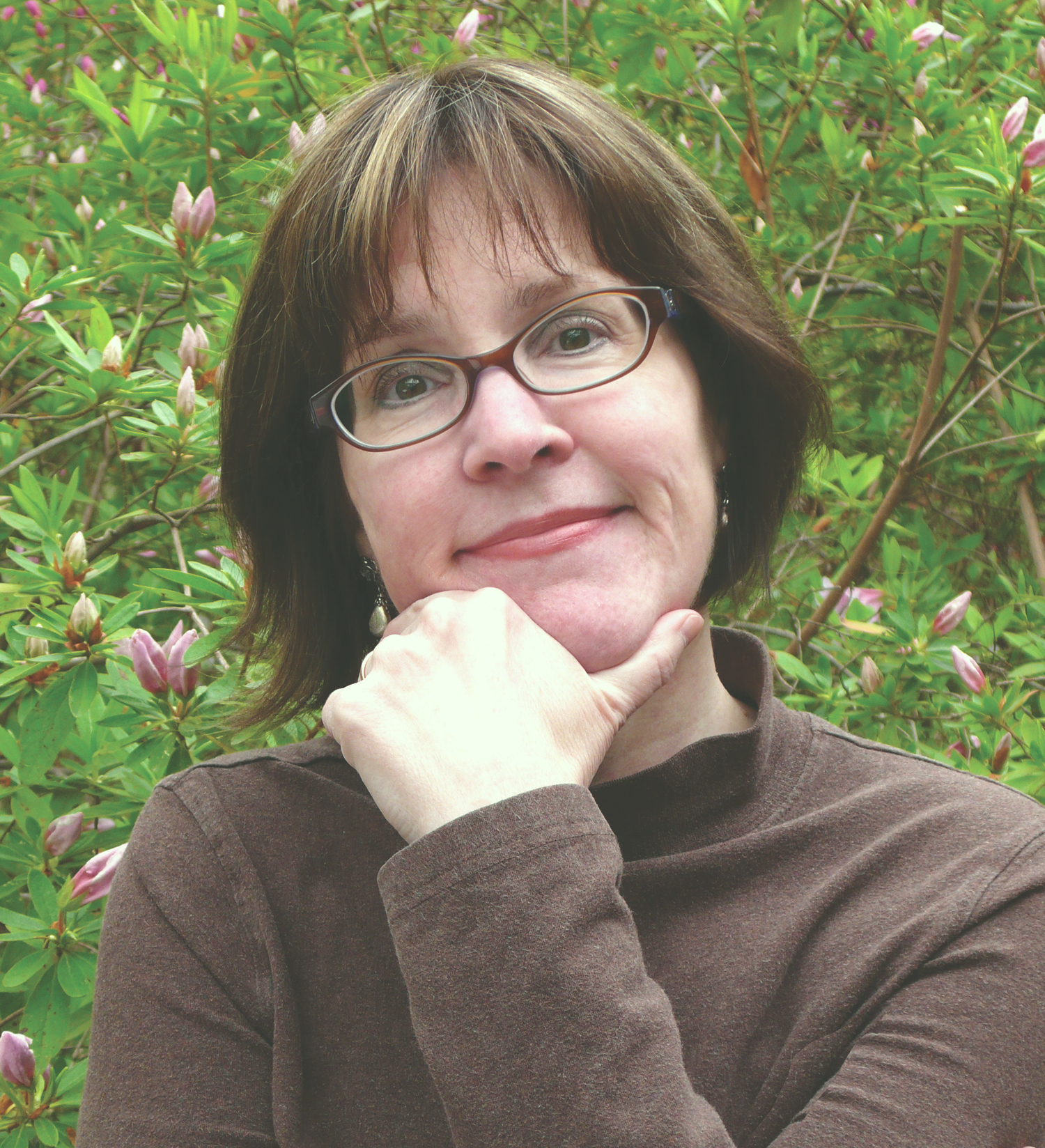
Joan Holub has authored and/or illustrated over 150 children’s books, including the Goddess Girls series and the Heroes in Training series (with Suzanne Williams); the New York Times bestselling picture book Mighty Dads, illustrated by James Dean; Little Red Writing, illustrated by Melissa Sweet; and Zero the Hero, illustrated by Tom Lichtenheld. Her board & novelty books include This Little Trailblazer and Fa la la Llama. Joan adores line dancing to the Jaws theme, reading Sharkspeare, and vacationing in Finland.

You can connect with Joan Holub on Her website | Instagram | Twitter

celebrate-picture-books-picture-book-review-laurie-keller-headshotLaurie Keller is the author and illustrator of many books, including The Scrambled States of America, Potato Pants!, Arnie the Doughnut, Do Unto Otters: A Book About Manners, the Adventures of Arnie the Doughnut chapter book series, and We Are Growing!, part of the Elephant & Piggie Like Reading! series and winner of the Theodor Seuss Geisel Award. When Laurie isn’t busy making books, she enjoys playing the banjo, traveling, cross-country skiing, and splashing in Lake Michigan, where as far as she knows, there is not a single shark.

You can connect with Laurie Keller on Her website | Instagram | Twitter

Shark Week Activity

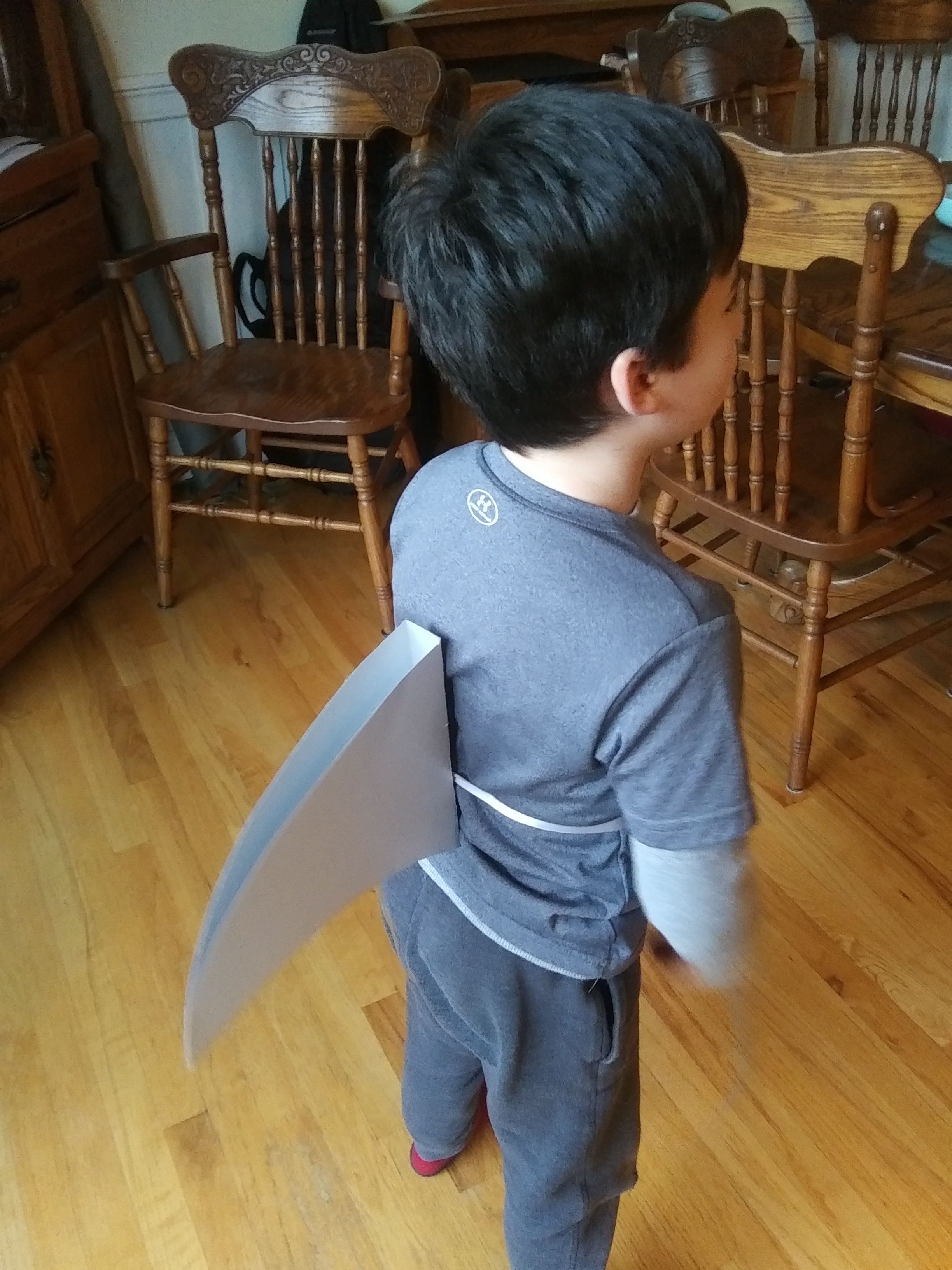
celebrate-picture-books-picture-book-review-shark-fin-craft

Fin-tastic Shark Fun


Your kids can make a splash during Shark Week and all year around with this easy-to-make craft! 

Supplies

  • 2 pieces of 8.5 x 11 gray card stock paper
  • Ribbon
  • Tape
  • Scissors
  • Pencil

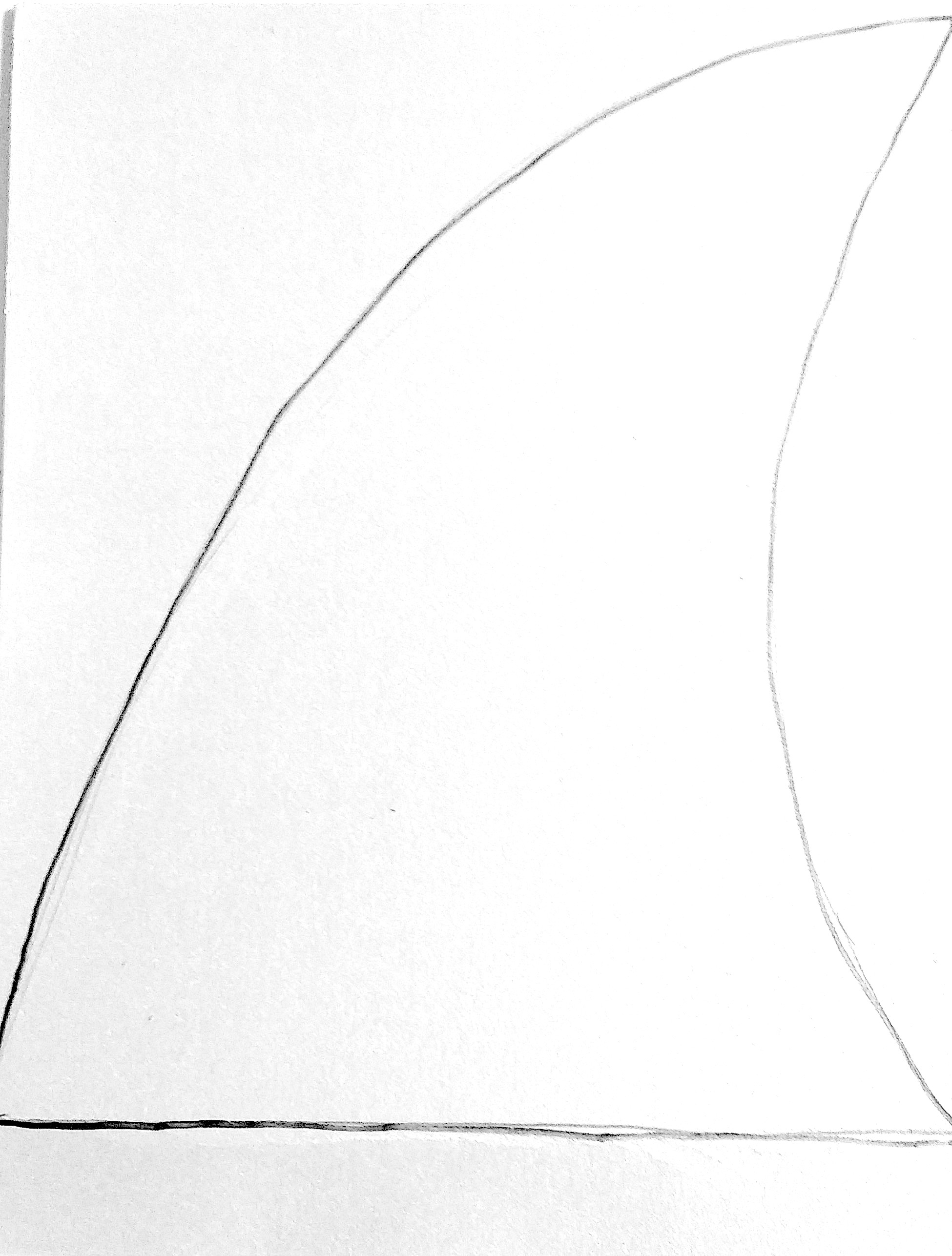
fin outline white

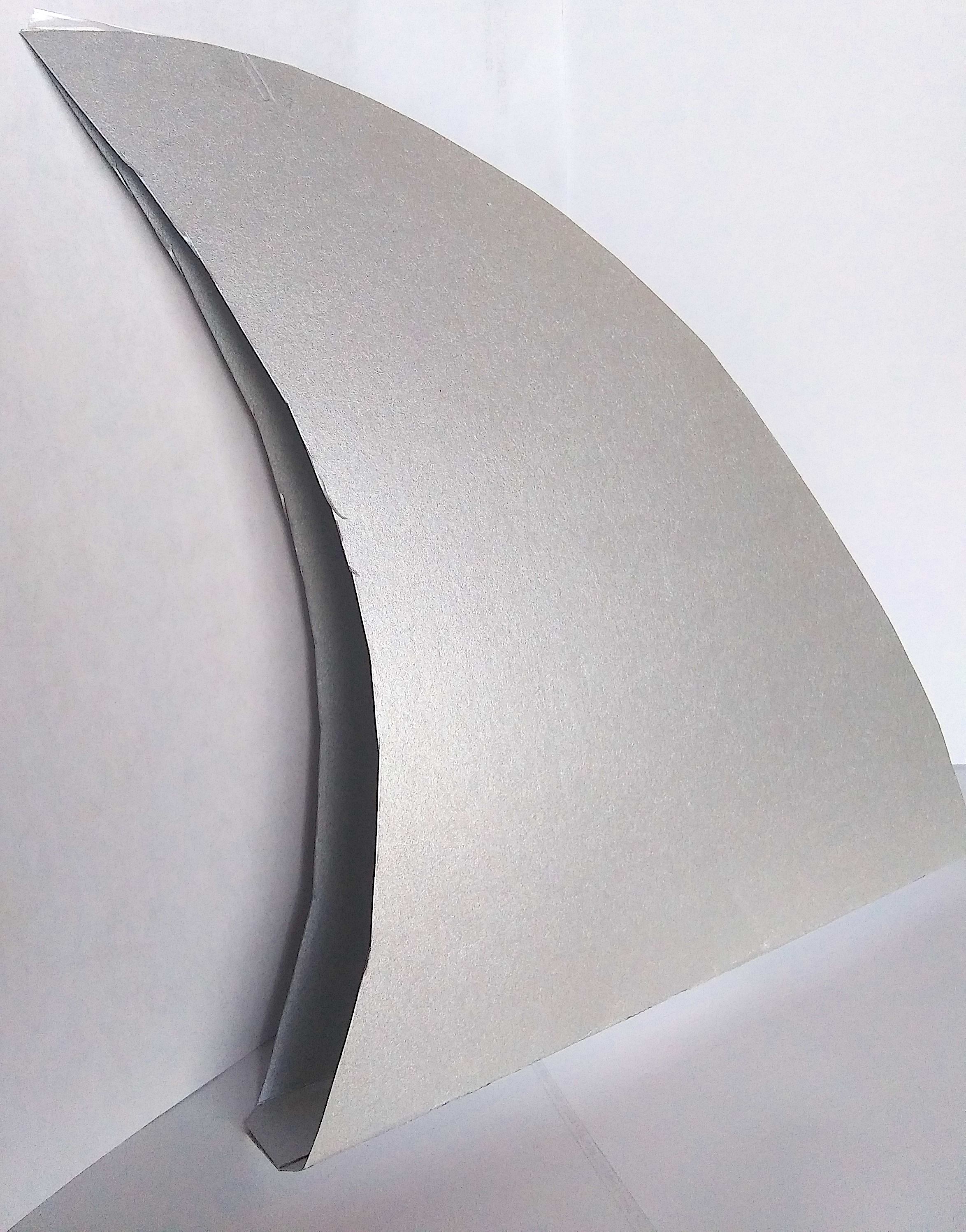
celebrate-picture-books-picture-book-review-shark-fin

Directions

  1. Tape the top of the two pieces of paper together
  2. Fold them back together
  3. Measure an inch up from the bottom of the papers (the un-taped side) and trace a straight line across both papers
  4. Trace a shark fin outline onto your paper. The shark outline should stop an inch above the bottom
  5. Cut out the fin on both pieces of paper. If you should cut through the tape, re-tape the tops together
  6. Fold along the lines of both papers so the folds face towards each other.
  7. Tape the folds so the fin becomes a triangle
  8. Cut two slits parallel to the folded lines
  9. Thread ribbon through slits

celebrate-picture-books-picture-book-review-i-am-the-shark-cover

You can find I Am the Shark at these booksellers

Amazon | Barnes & Noble | Books-a-Million

To support your local independent bookstore, order from

Bookshop | IndieBound

Picture Book Review

July 8 – Math 2.0 Day

celebrate-picture-books-picture-book-review-the-animals-would-not-sleep-cover

About the Holiday

Established in 2009, Math 2.0 Day celebrates math and technology and how these two disciplines complement each other. The day was conceived to bring together mathematicians, programmers, engineers, educators, and managers to raise awareness of the importance of math literacy at all levels of education. For kids a love of math and technology begins early as they experiment and explore every day during playtime, family time and even, as today’s book shows, at bedtime.

Thank you to Charlesbridge for sending me a copy of  The Animals Would Not Sleep! for review consideration. All opinions about the books are my own.

The Animals Would Not Sleep!

Written by Sara Levine | Illustrated by Marta Álvarez Miguéns


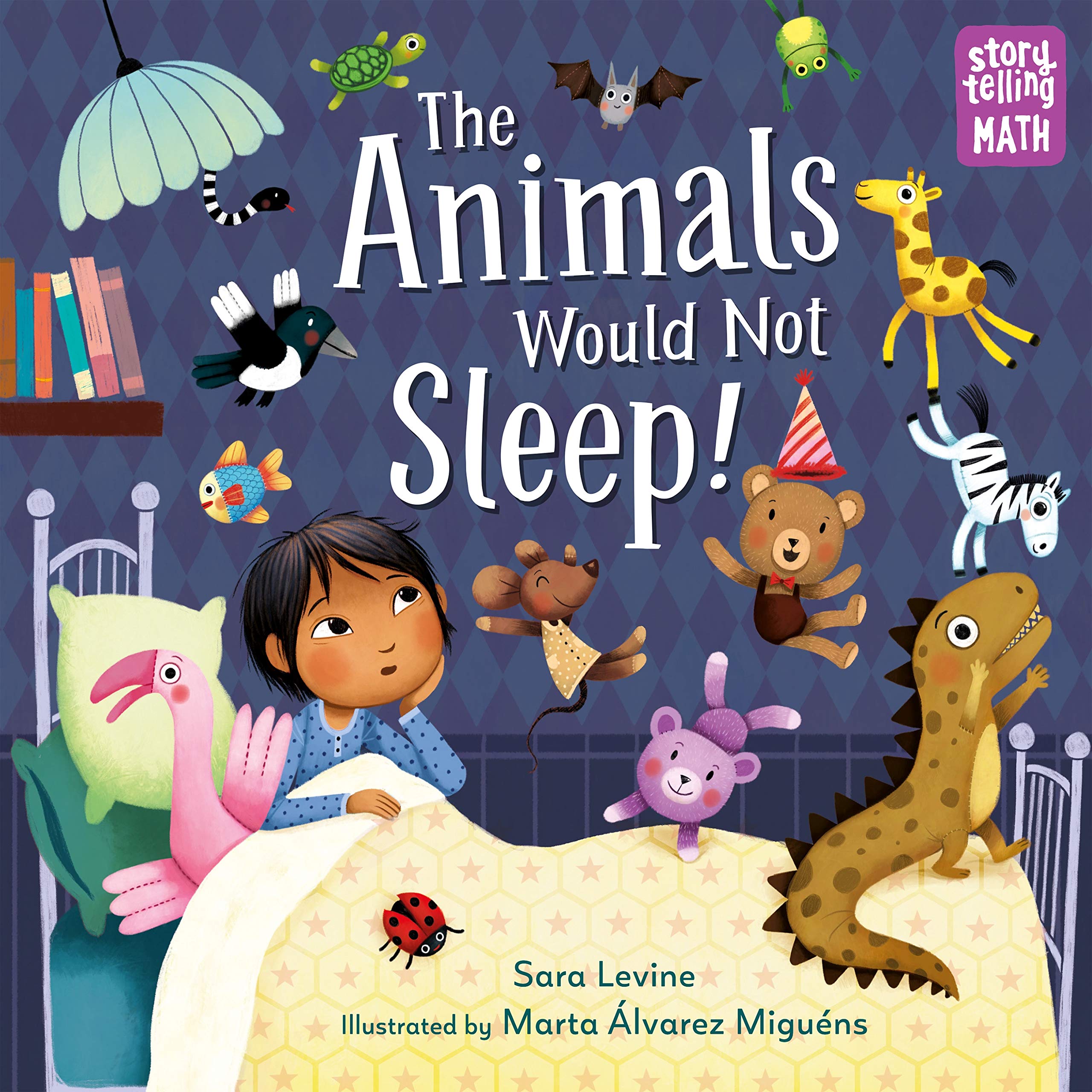
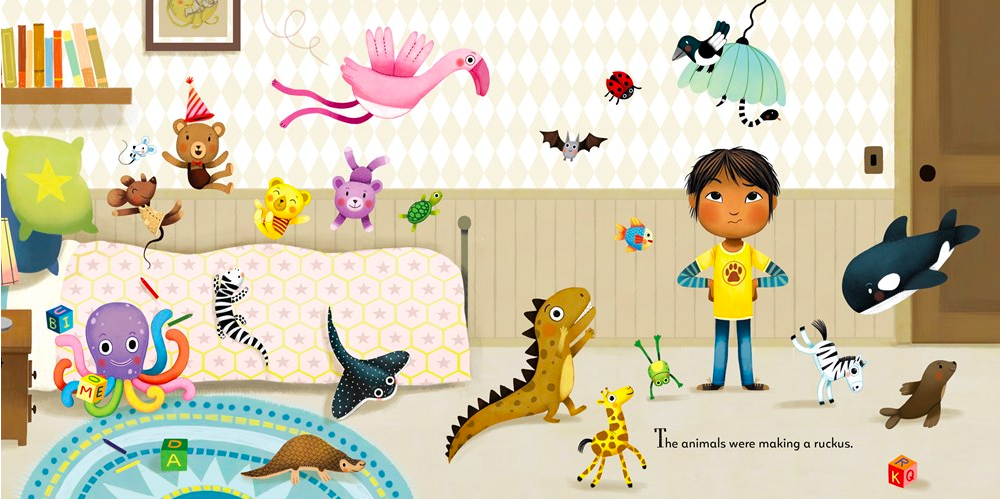
All of Marco’s stuffed “animals were making a ruckus” when his mom told him it was time to get cleaned up and ready for bed. She wanted to see all the toys put away, so Marco, who thought like a scientist, got to work. He wanted to sort his animals like a scientist would, so he got out three baskets and made signs for Flying Animals, Swimming Animals, and Animals That Move on Land. Then he picked up his dancing flamingo, bird, bat, and ladybug and put them in the first basket. He placed his octopus, stingray, frog, fish, whale, and seal in the second basket, and his dinosaur, giraffe, bears, snake, pangolin, gecko, mice, and zebra in the third basket.

But the animals were still wide awake, and “they egged one another on until not one remained in its container.” Marco thought they would settle down, but when his mom called the second time, he reconsidered his strategy. This time he made signs that sorted the animals by color, but zebra started to cry. He was afraid being in such close quarters with black-and-white snake and stingray, plus he missed his friend giraffe.

celebrate-picture-books-picture-book-review-the-animals-would-not-sleep-ruckus

Image copyright Marta Álvarez Miguéns, 2020, text copyright Sara Levine, 2020. Courtesy of Charlesbridge.

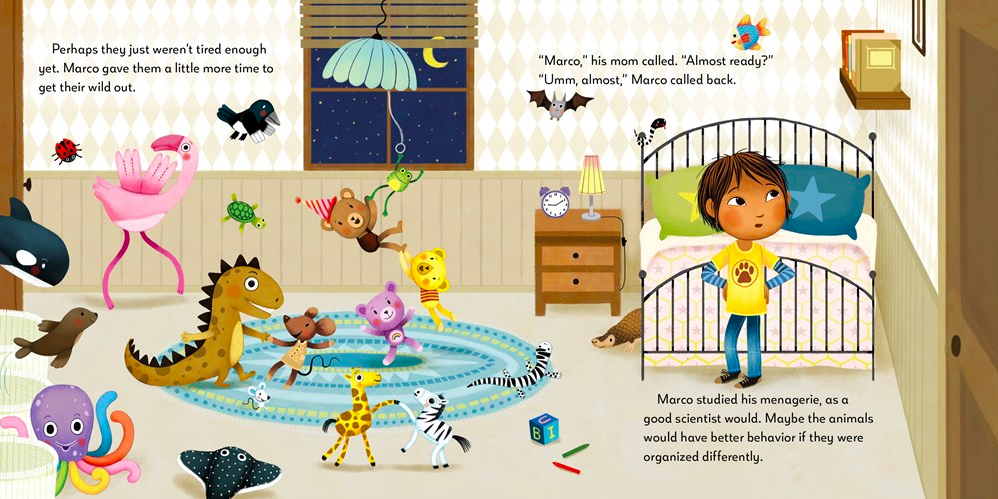
Marco decided to try again. He took all of his animals out and made signs that read Small, Medium, and Large. Things seemed to quiet down, so Marco began to put on his pajamas. But then he heard moaning and groaning coming from the Large basket. When he went to check, Dinosaur and Dancing Flamingo complained about being too cramped. Plus, Dancing Flamingo missed Rainbow Bear. Then he heard noises from the Small basket. Those animals weren’t happy either.

Marco’s mom gave him two minutes to get it all sorted out. Fortunately for Marco, being a scientist meant “he was used to coming up with ideas and thinking outside the box.” The animals were getting tired, and Yellow Bear had just burst into tears for no apparent reason. Like a good scientist, Marco cared about his animals and wanted them to be happy. He had one more sorting idea. With the large animals, medium-sized animals, and small animals all tucked in with plenty of room and their friends nearby on Marco’s bed, Marco got under the cozy covers. He got a goodnight kiss from Mom and then they all fell happily to sleep.

Back matter includes an illustrated Author’s Note about the way scientists sort, or classify, animals by their characteristics as well as a discussion that explores the math in the story. “Try This!” tips provided by Karen Economopoulos, co-director of the Investigations Center for Curriculum and Professional Development at TERC, give adults ideas for various ways to engage children in sorting.

celebrate-picture-books-picture-book-review-the-animals-would-not-sleep-marco

Image copyright Marta Álvarez Miguéns, 2020, text copyright Sara Levine, 2020. Courtesy of Charlesbridge.

Perfectly capturing the way young children interact with their toys, Sara Levine combines imagination and scientific thinking in her inventive story, part of the Storytelling Math series from Charlesbridge. In Marco, who’s proud of his scientific thinking, Levine shows readers that they, too, already think like a scientist. Marco’s empathy for his animals’ complaints will get kids thinking about classification and the various ways they might sort the animals. Levine’s use of realistic dialogue that echoes bedtime routines in many homes and gives each character—human and animal—distinct personalities will draw kids in to this charming story that is organically infused with strong math lessons. Levine gives Marco a sweet final solution to his problem that will please kids and have them wanting to extend the lessons in the story to their own toys and/or household objects while they think like a scientist too.

Marta Álvarez Miguéns opens the story with an enchantingly wild two-page spread where Marco stands in the middle of his room as his toys bounce on the bed, climb blocks, juggle, fly, and cause a ruckus. Turn the page, though, and these animals now lie motionless around the room as Mom peeks in to check on Marco. When Marco sorts his animals into the baskets, readers can clearly see which animals go where and why. Kids will knowingly giggle when the just-sorted animals spring from their resting places to prolong bedtime. Miguéns also plainly depicts Marco’s and the animals’ facial expressions from happy and playful to sad and crying to peaceful and satisfied. These images give adults and children an opportunity to discuss emotions and how to recognize various clues in faces, a skill important for social-emotional learning. Vivid colors, adorable animals, details such as alphabet blocks that stack or are turned to spell words, and kid-appealing décor will have kids wanting to come back again and again.

A book that’s sure to become a favorite at bedtime or to enhance classroom or homeschooling curriculum, The Animals Would Not Sleep! will spark mathematical and scientific thinking and recognition in all young learners. The book offers an irresistible invitation to experiment and interact with math and science and is a must for home, school, and public library collections.

Ages 3 – 6

Charlesbridge, 2020 | ISBN 978-1623541286 (Hardcover) | ISBN 978-1623541972 (Paperback) 

Discover more about Sara Levine and her books on her website.

To learn more about Marta Álvarez Miguéns, her books, and her art, visit her website.

About Storytelling Math

Storytelling Math offers books that celebrate children using math in their daily lives as they play, build, collaborate, compromise, and discover the world around them. Each story features characters of color who are empowered to solve problems, enjoy activities, and help out using their knowledge of and experimenting with math. Free downloadable hands-on activity kits are available for each book on the Charlesbridge website. Sharing these joyful stories with your littlest ones and older kids will make them eager to explore, use, and learn more about math every day. You can learn more about Storytelling Math on the Charlesbridge website

Storytelling Math: Math, Diversity, and the Power of Story was developed with Marlene Kliman at TERC—a nonprofit dedicated to STEM education—under a grant from the Heising-Simons Foundation.

Enjoy this The Animals Would Not Sleep! trailer with Author Sara Levine!

National Book Month Activity

celebrate-picture-books-picture-book-review-the-animals-would-not-sleep-activity-logo

The Animals Would Not Sleep! Activity Kit


You can have fun sorting and exploring math with your class or family with the Activity Kit for The Animals Would Not Sleep on the Charlesbridge website. Download it here!

The Animals Would Not Sleep Activity Kit

celebrate-picture-books-picture-book-review-the-animals-would-not-sleep-cover

You can find The Animals Would Not Sleep! at these booksellers

Amazon | Barnes & Noble | Books-a-Million

To support your local independent bookstore, order from

Bookshop | IndieBound

Picture Book Review

June 29 – International Day of the Tropics

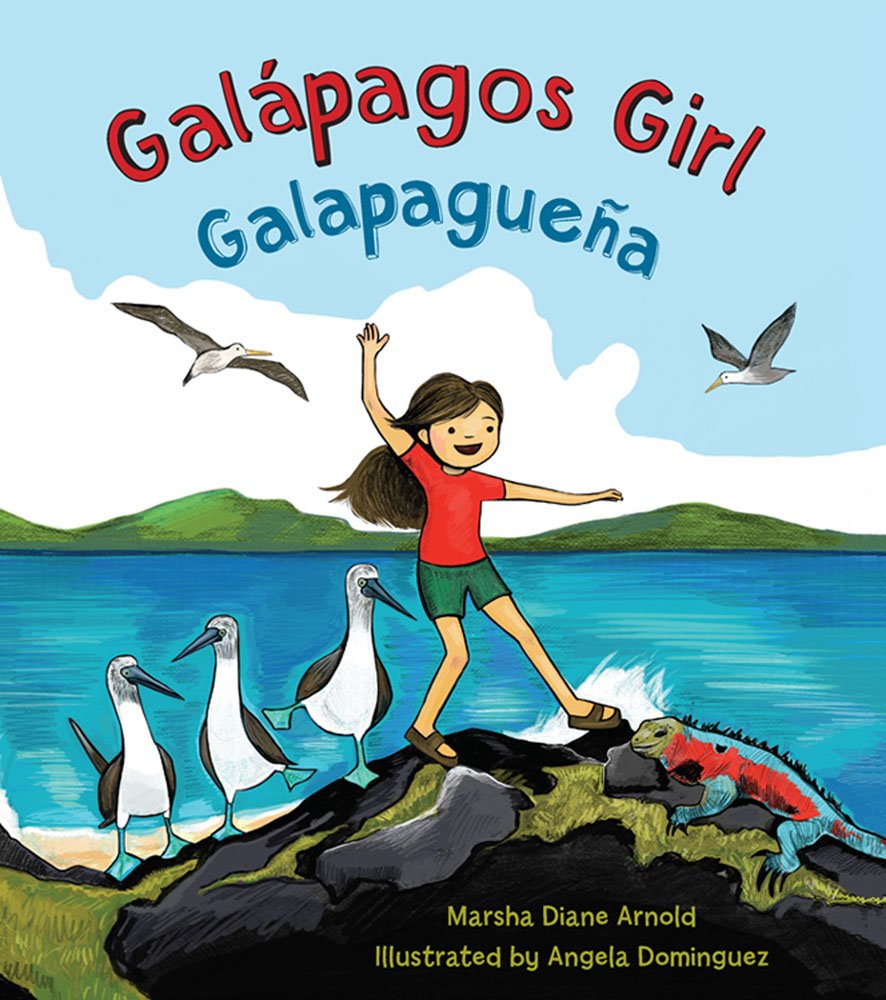
celebrate-picture-books-picture-book-review-galapagos-girl-cover

About the Holiday

The International Day of the Tropics is a United Nations–sponsored holiday that celebrates the extraordinary diversity of the tropics while putting a spotlight on the unique challenges and opportunities the nations of the Tropics face. The Tropics are a region roughly defined as the area between the tropic of Cancer and the tropic of Capricorn and have in common a warm and typically unvaried seasonal temperature fluctuations and the prevalence of rain  determined by a region’s proximity to the equator. While it is projected that by 2050, the Tropics will be home to most of the world’s population and two-thirds of its children, the area faces challenges due to climate change, deforestation, logging, urbanization, and demographic shifts.  Today’s observance provides individuals, organizations, and governments an opportunity to take stock of progress across the tropics, to share stories and expertise, and to acknowledge the diversity and potential of the region. Today’s book tell the true story of one woman who is working to make a difference.

Thanks to Lee & Low Books for sending me a copy of Galápagos Girl/ Galápagueña for review consideration. All opinions about the book are my own. 

Galápagos Girl / Galapagueña

Written by Marsha Diane Arnold | Illustrated by Angela Dominguez | Translated by Adriana Dominguez


On the day when baby Valentina joined Mamá, Papá, and eleven brothers and sisters, even the sea lions, blue-footed boobies, and iguanas seemed to welcome her to the “island formed by fire.” Valentina loved growing up on the Galápagos Island of Floreana. She explored the lava rocks, where Sally Lightfoot crabs scuttled back and forth. She swam with dolphins and manta rays, and even played with penguins.
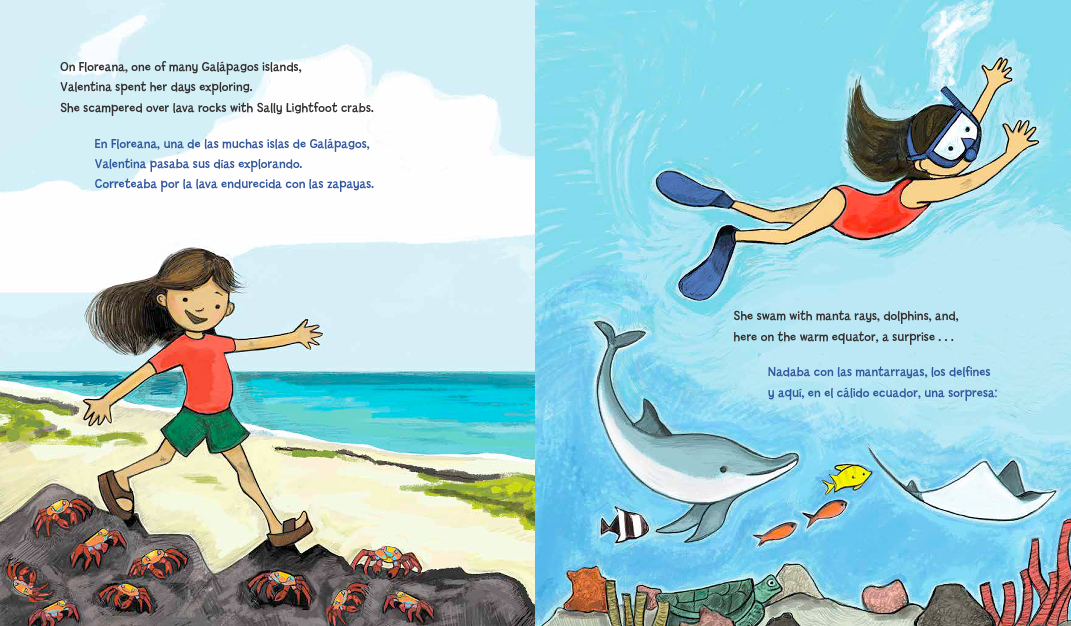
celebrate-picture-books-picture-book-review-Galápagos-Girl-crabscelebrate-picture-books-picture-book-review-Galápagos-Girl-crabs

Image copyright Angela Dominguez, 2018, text copyright Marsha Diane Arnold, 2018. Courtesy of Lee & Low Books.

“Valentina watched pink flamingoes wading near mangroves. Blue butterflies fluttering on the breeze. Red-and-green iguanas sneezing salt like tiny geysers.” The crashing waves, albatross, and finches created a symphony as Valentina stopped to rest on a grassy cliff overlooking the ocean. The lava lizards, blue-footed boobies, and twirling sea lions provided young Valentina with a variety of dance partners.
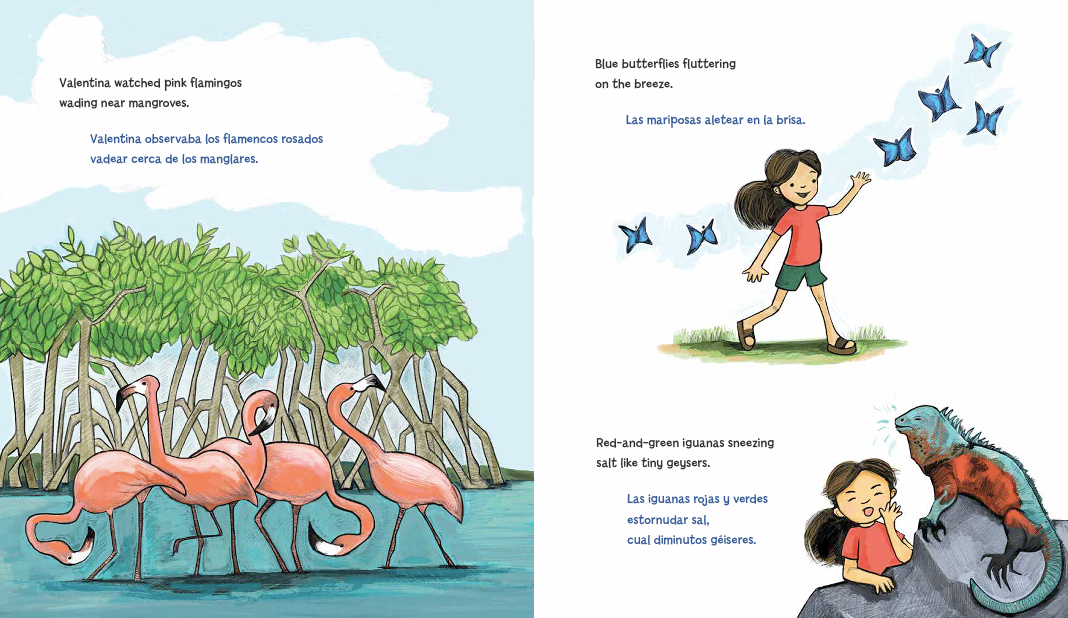
celebrate-picture-books-picture-book-review-Galápagos-Girl-iguana

Image copyright Angela Dominguez, 2018, text copyright Marsha Diane Arnold, 2018. Courtesy of Lee & Low Books.

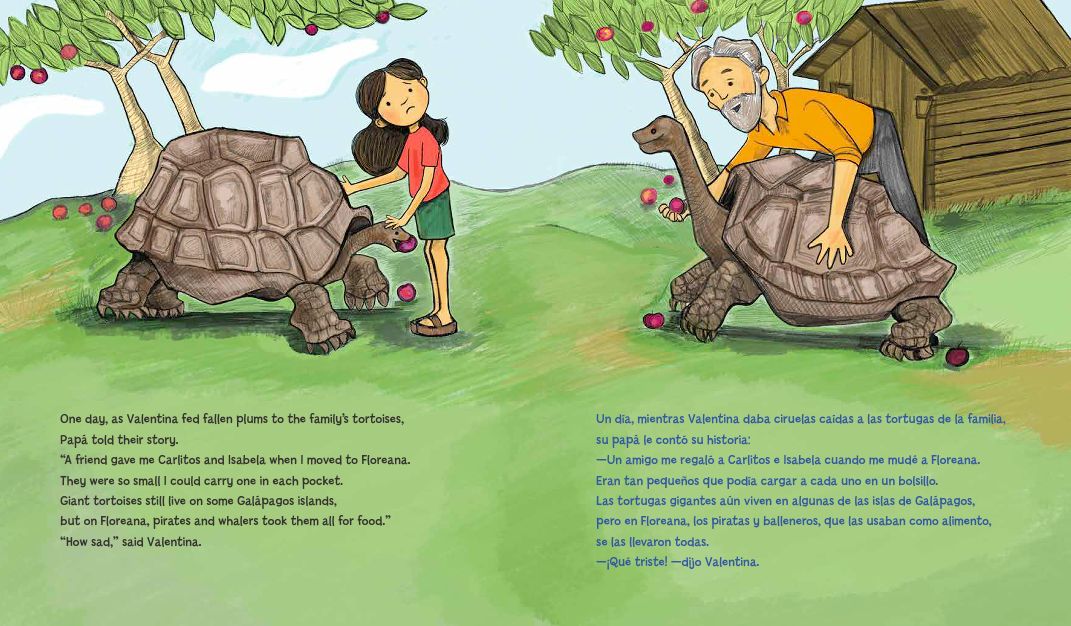
At home, Valentina’s family shared their home with two giant tortoises—Carlitos and Isabella. One day Papá told Valentina their story as they fed the tortoises plums that had fallen from their backyard trees. Papá had gotten Carlitos and Isabella from a friend when he first moved to Floreana. Although it was nearly impossible to imagine now that the tortoises were grown, at the time they were so small that they fit into Papá’s pockets.
celebrate-picture-books-picture-book-review-Galápagos-Girl-tortoises

Image copyright Angela Dominguez, 2018, text copyright Marsha Diane Arnold, 2018. Courtesy of Lee & Low Books.

There was also a sad note to Papá’s story. He said that while giant tortoises still lived on other Galápagos islands, pirates and whalers had wiped out the population on Floreana. Papá went on to tell Valentina that many Galápagos animals were in danger. They were “threatened by other animals that don’t belong here. Threatened by people who don’t understand how to care for our islands.” Valentina promised that she would always protect them.

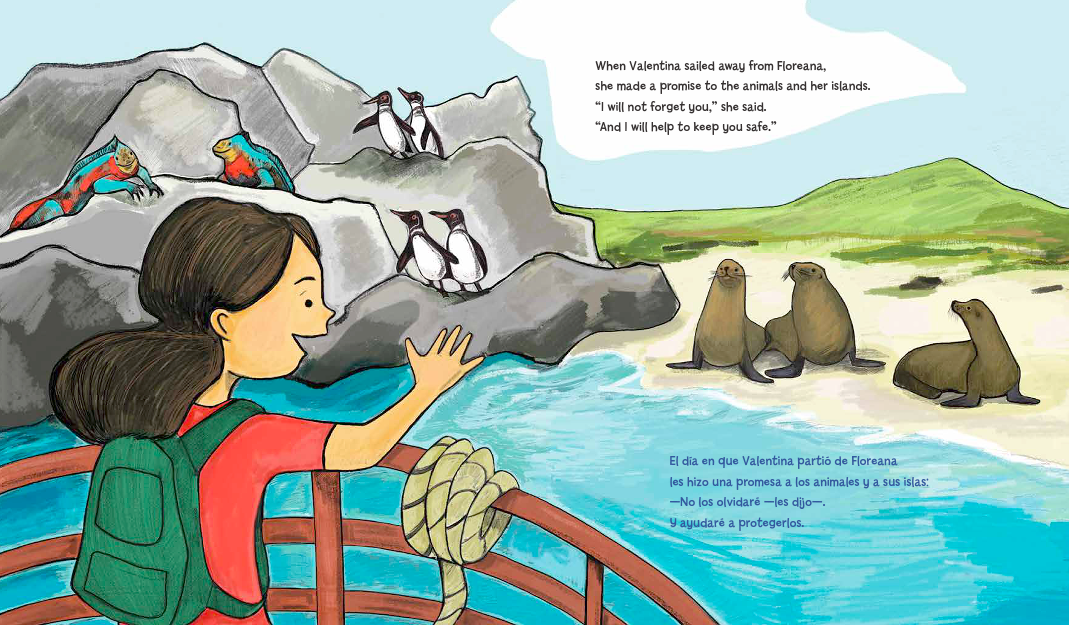
When she was older, Valentina left the island to go to school. She didn’t want to leave her beautiful home, but Mamá told her that she was “ready to learn about the world beyond.” And Papá reminded her that “like our islands, you have a heart full of fire.” On school vacations, Valentina always came back to study the wildlife on the Galápagos islands. She had not forgotten her promise to keep them safe.
celebrate-picture-books-picture-book-review-Galápagos-Girl-going-to-school

Image copyright Angela Dominguez, 2018, text copyright Marsha Diane Arnold, 2018. Courtesy of Lee & Low Books.

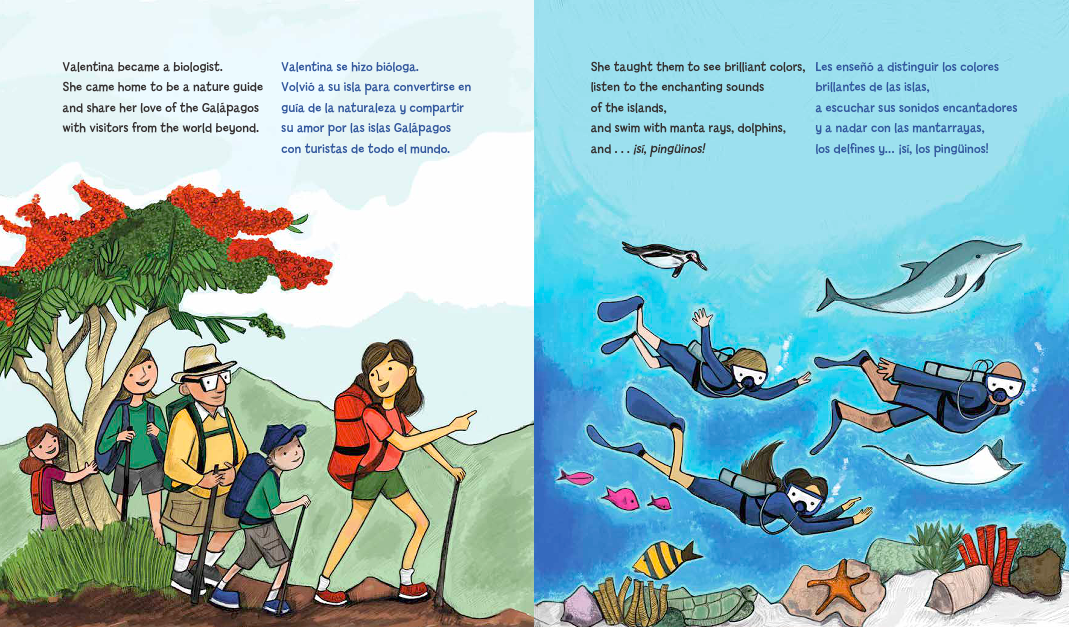
After she graduated with a degree in biology, Valentina returned to the islands as a nature guide to teach visitors about the beauty and uniqueness of the Galápagos. Some visitors were even lucky enough to meet Carlitos and Isabella when the plums dropped from the trees and the two old tortoises returned from exploring Floreana to eat them. Because of Valentina’s commitment to the Galápagos, her visitors also made a promise to always remember and protect them.

Extensive backmatter includes an Author’s Note about Valentina Cruz, the tortoises Carlitos and Isabella, and the history of tortoises on Floreana. There is also information on the Galápagos as well as fun facts about all of the animals in the story. A bibliography of sources invites readers to learn more.

Each two-page spread presents the text in English and translated into Spanish by Adriana Dominguez.
celebrate-picture-books-picture-book-review-Galápagos-Girl-guiding-visitors

Image copyright Angela Dominguez, 2018, text copyright Marsha Diane Arnold, 2018. Courtesy of Lee & Low Books.

Marsha Diane Arnold’s lyrical and buoyant passages sing with the carefree joy Valentina felt as a girl exploring her beloved Galápagos and which brought her back home as a biologist to protect them. After seeing Valentina playing and swimming with the native animals and feeding Carlitos and Isabella, readers will also feel Valentina’s sadness at the dangers they face and want to make a positive difference to the environment and the world around them. Arnold’s dialogue-rich storytelling highlights the personal nature of the subject and will draw children into Valentina’s world.celebrate-picture-books-picture-book-review-Galápagos-Girl-blue-footed-booby
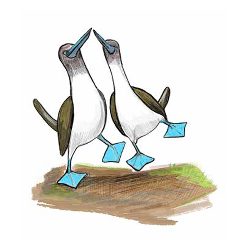
Saturated with glorious color, each of Angela Dominguez’s illustrations is a celebration of the splendor of the Galápagos. Playful sea lions, high-stepping blue-footed boobies, scampering crabs, and even a sneezing iguana will captivate young readers and inspire them to learn more about these creatures and the islands. Images of Valentina camping out to study the animals during school breaks will excite environmentally conscious kids, and pictures of Carlitos and Isabella happily munching on plums will generate smiles and “awwws.”

Galápagos Girl / Galapagueña will excite kids to learn more not only about the Galápagos region but about their own local environment, and the call to action will spark an enthusiasm for protecting the earth’s animals. The book would make an inspiring addition to home bookshelves and an excellent way to begin classroom discussions on environmental issues and science lessons. The engaging Spanish translation will delight Spanish-speaking and bilingual families.

Ages 4 – 8

Lee & Low Books, 2018 | ISBN 978-0892394135

Discover more about Marsha Diane Arnold and her books on her website. You can also download activity sheets and teachers’ guides for most of her books here as well.

To learn more about Angela Dominguez, her books, and her art, visit her website.

Welcome Marsha Diane Arnold
celebrate-picture-books-picture-book-review-marsha-diane-arnold

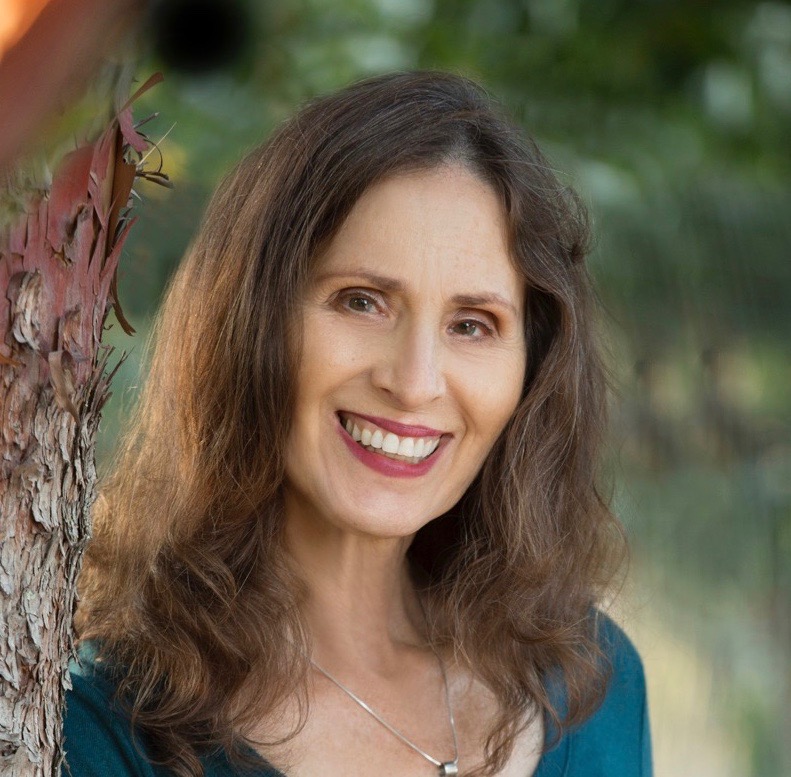
In 2018, I was thrilled to talk with award-winning picture book author Marsha Diane Arnold about the backstory of Galápagos Girl / Galápagueña. Her interview, originally for National Wildlife Day, is just as timely today. Marsha was inspired to write this story after traveling to the Galápagos Islands, where she met Valentina Cruz and had the opportunity to swim with sea lions and dolphins.

Marsha Diane Arnold is an award-winning picture book author whose books have sold over one million copies. Her 21st book, Lights Out, was published in the fall of 2020. Arnold’s other books include Badger’s Perfect Garden, May I Come In? and Mine. Yours. Among Marsha’s honors are the Ridgeway Award for Best First Book, state Children’s Choice awards, IRA Distinguished Book, and Smithsonian Notable Book. Her bilingual book Galápagos Girl was selected as a 2019 Bank Street Best Books of the Year, a Campoy-Ada honor book, and a 2019 Green Prize in Sustainable Literature. The media has referred to her as, “a born storyteller.” Educators have called her a “true literary artist” whose books show “warmth and respect for one’s self.”  She lives with her family in Alva, Florida.

Thank you, Kathryn, for inviting me to celebrate Galápagos Girl / Galápagueña, along with conservation of wild places and animals!

As a child, would you have enjoyed swimming with sea lions? Feeding plums to giant tortoises by hand? Having warblers fly through your house? That was the life of Valentina Cruz. Galápagos Girl is based on her idyllic life on remote Floreana island in the Galápagos Islands, a volcanic archipelago west of Ecuador.
celebrate-picture-books-picture-book-review-galapagos-girl-blue-footed-booby

celebrate-picture-books-picture-book-review-galapagos-girl-marine-iguana

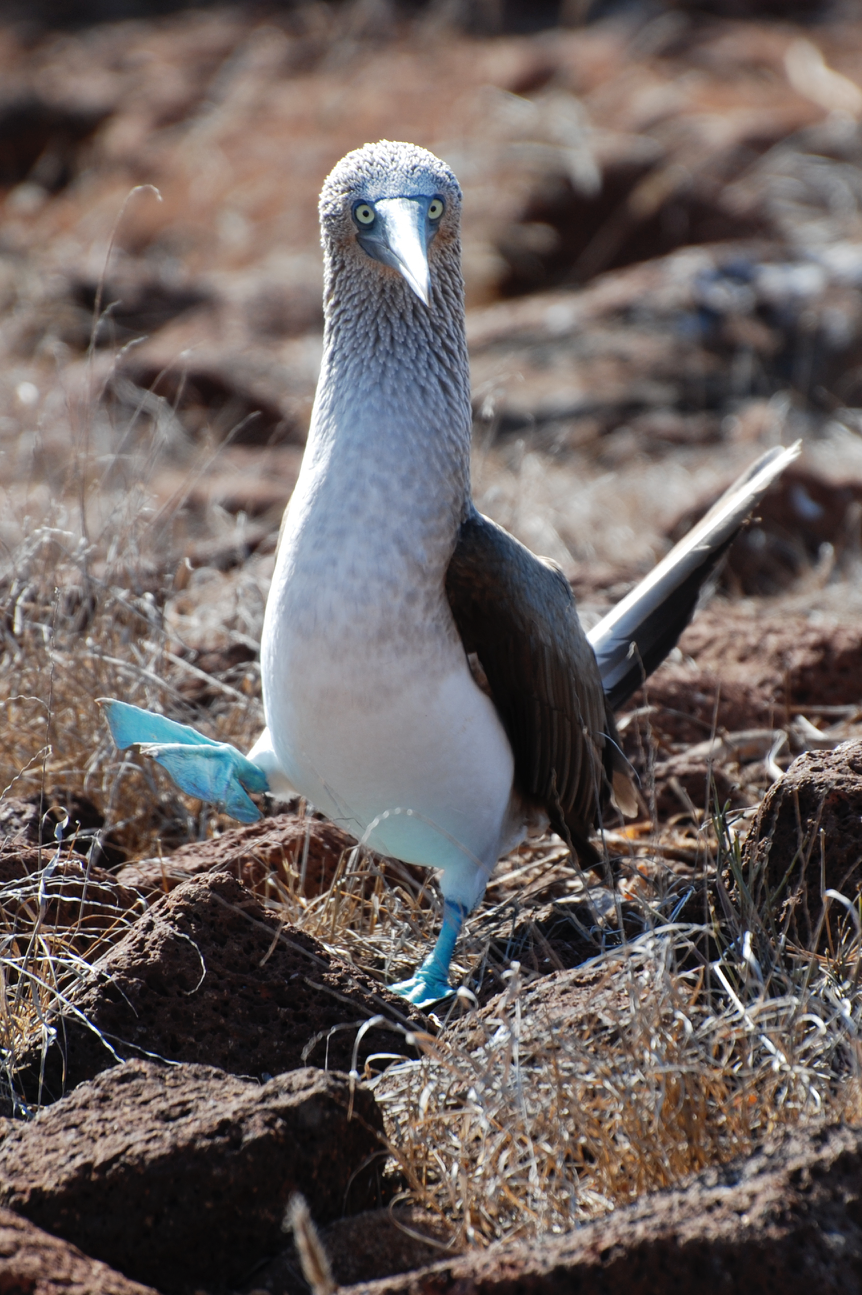
My photos of actual blue-footed booby and Galápagos marine iguana.

Valentina grew up surrounded by nature, but perhaps more accurately, she grew up in nature. I think when a child grows up seeing wild wonders every day, they grow up respecting and protecting nature and wildlife. Valentina and her siblings certainly did. She grew up to be a biologist and naturalist guide. One brother, Eliecer Cruz, was director of the Galápagos National Park and, later, director of the Galápagos branch of the World Wildlife Fund. Another brother, Felipe, worked on many projects with the Charles Darwin Research Station, including studying the challenges that face the Galápagos petrel. Her sister, Marilyn, is director of Galápagos Biosecurity Agency, which helps control and prevent invasive species in the islands.

In some ways, Valentina’s childhood was similar to mine. She was surrounded by a loving family—her parents and eleven brothers and sisters. I only had one brother, but along with my parents, cousins, aunts, and uncles, we gathered on many Sunday afternoons at my grandmother’s house. Valentina and I both delighted in nature, though hers was a more exotic nature—the distant Galápagos Islands, where Charles Darwin discovered those famous finches and came up with his theory of natural selection. Mine was a small farm on the Kansas plains—I didn’t see the ocean until I was an adult. Valentina had Galápagos tortoises as pets and swam with sea lions. (Of course, keeping tortoises as pets is not allowed today.) I played with my neighbor’s pet raccoon (also, not allowed today) and listened to the meadowlark’s song from the roof of my house.

Valentina loves nature, home, and family, but has the soul of an adventurer. I’m much the same. When I grew up I yearned to see as much of the world as possible. When my long-time traveling buddy, Jean Gallagher, asked me to travel with her to the Galápagos, one of my long-time dreams came true.
celebrate-picture-books-picture-book-review-galapagos-girl-blue-marsha-and-friends

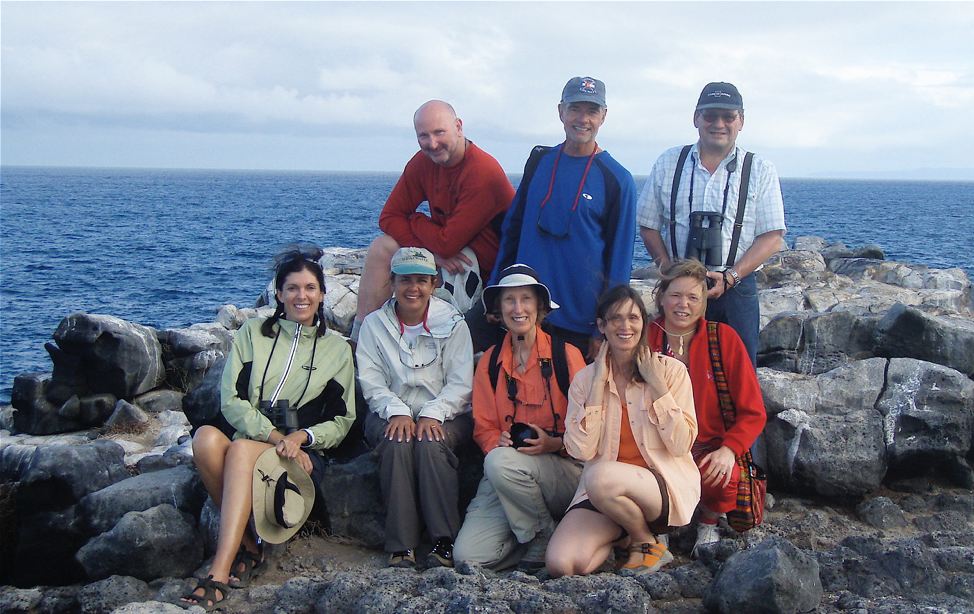
The Galápagos Gang – fellow travelers to a far-off land. Jean is 3rd to right in front. I am 4th.

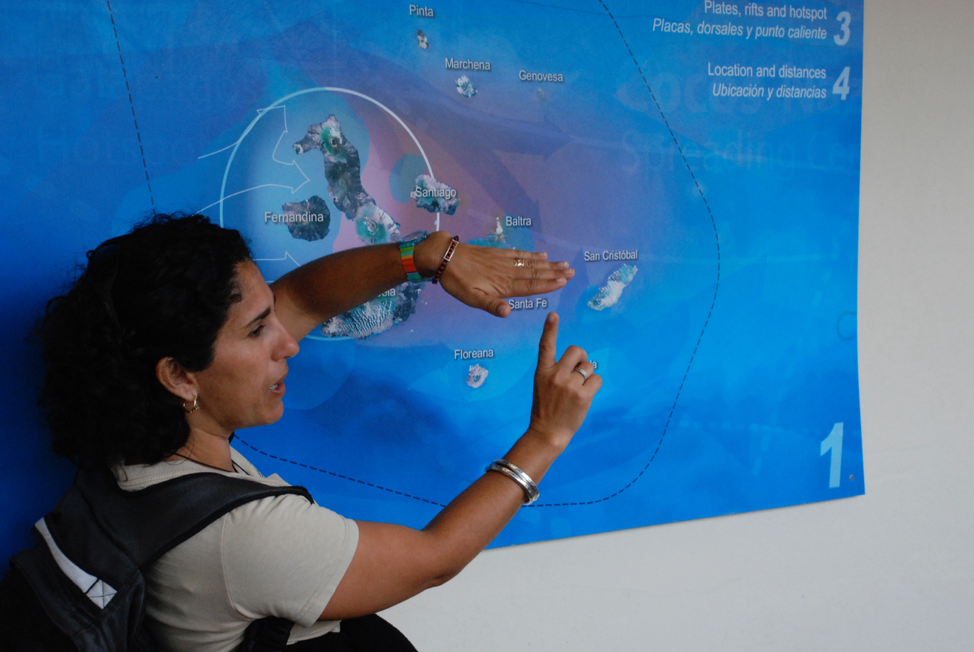
It was on that 2007 trip that I met Valentina, one of our naturalist guides. With her, we visited Floreana and saw the home where she grew up. I was enamored. I thought how wonderful a book about the islands and their unique wildlife, woven together with Valentina’s childhood, would be. Yet it wasn’t until April 2009 that I emailed Valentina and told her of my dream to write a picture book based on her life. Over months and years, Valentina generously shared her stories with me.
celebrate-picture-books-picture-book-review-galapagos-girl-valentina-showing-lay-of-land

Valentina showing us the lay of the land.

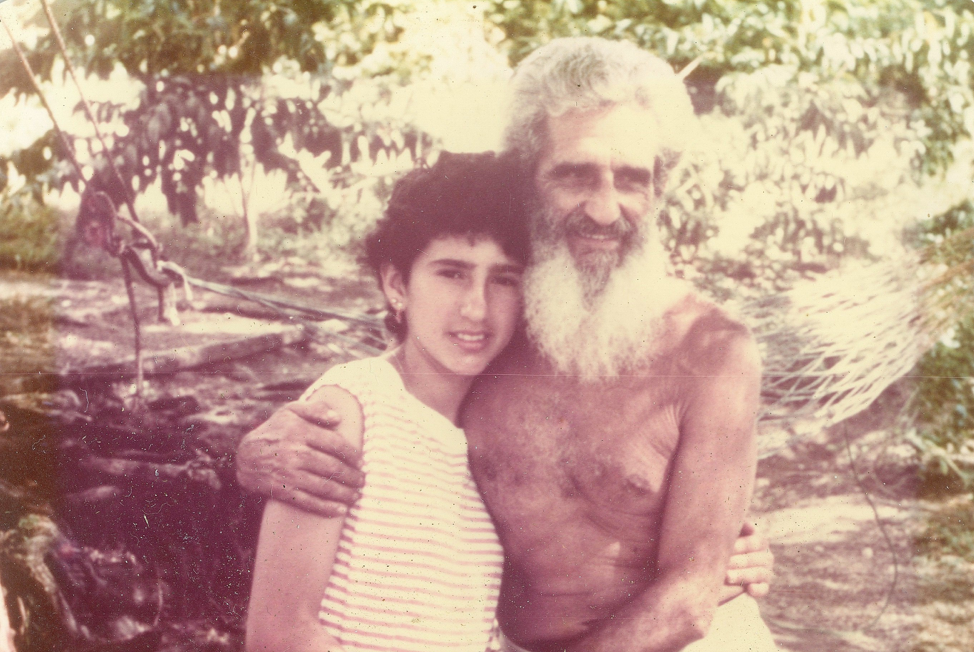
Valentina got her sense of adventure and love of nature from her father, Eliecer Cruz Cevallos, who first arrived in the Galápagos in 1939. He was one of only 100 people living in the Galápagos at that time!

Eliecer returned to Ecuador and married Valentina’s mother, Emma Bedon. She made him promise they would never live in the Galápagos. Who can blame her? They’d have almost no human neighbors! But in 1944, she changed her mind. Emma sailed to Floreana with Eliecer to build a life together. Valentina told me that even living in the wild, her mother taught her children “to keep all the rules of a city so we do not grow up wild.”
celebrate-picture-books-picture-book-review-galapagos-girl-valentina-and-father

Valentina and her father on Floreana

celebrate-picture-books-picture-book-review-galapagos-girl-valentina-mother-and-sister

Valentina, her mother, and her sister

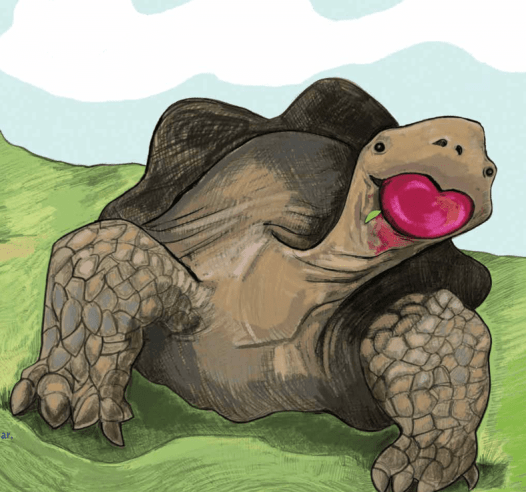
Two Galápagos tortoises were a big part of Valentina’s childhood, so I had to include them in Galápagos Girl. Floreana tortoise had long been extinct (or so it was thought).  So when Eliecer moved to Floreana, his friend gave him young tortoises from other islands. Eventually, the family released the tortoises to roam free. One of the most exciting things that happened to Valentina as a child was seeing the tortoises return to their farm that first year after their release. The main reason was the tasty plums dropping from the trees. Every year after that, when the plums ripened, the family waited for the tortoises to return. They always did!
celebrate-picture-books-picture-book-review-galapagos-girl-isabella-eating-plum

An illustration of one of the family’s tortoises eating a plum treat by Angela Dominguez

The tortoise story changed several times during the writing of my book due to Valentina’s remembering more over time, checking facts with her family, and a discovery near Wolf Volcano on Isabela, another Galápagos Island. What’s in my book isn’t exactly the way things were, but it’s close to the real story. As Valentina wisely shared: “Each of us remember things in different ways. Our memory is like pictures of what impresses us in that specific moment, so everything can be true and everything can be fiction.”
celebrate-picture-books-picture-book-review-galapagos-girl-galapagos-tortoise

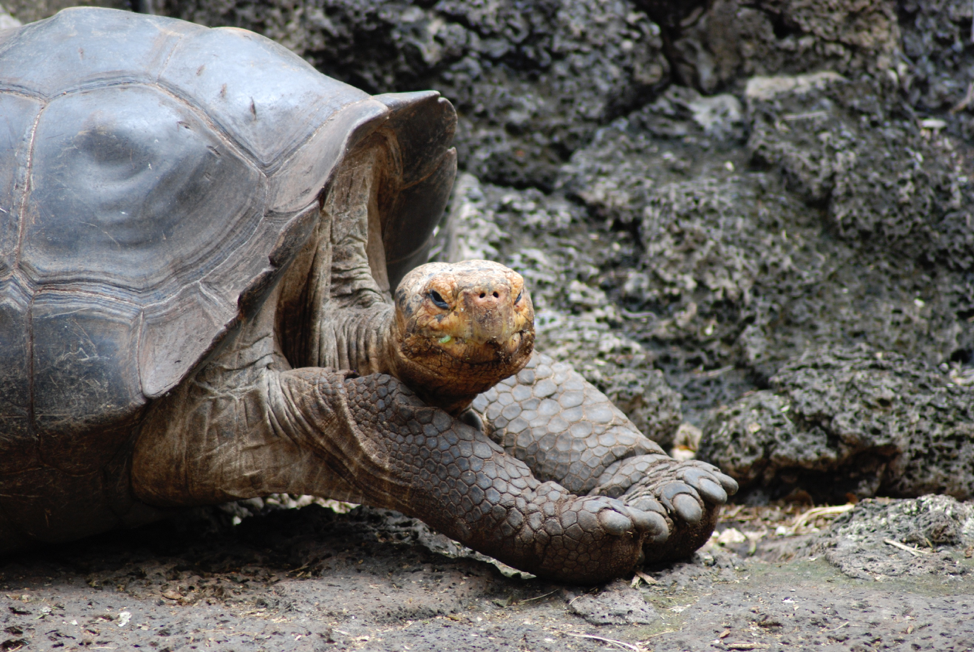
One of eleven species of Galápagos tortoise

Regarding the exciting discovery on Wolf Volcano, scientists recently found tortoises there that carry some of the Floreana tortoise genes! There is a project now to bring these tortoises back to Floreana. Wouldn’t it be wonderful to have partial Floreana tortoises wandering freely, restoring the ecology of Floreana?

You may ask, “How did Floreana tortoises get on Isabela Island?” That’s one more fascinating question about the Galápagos. If I visit your school, you can ask me and I’ll share more.

Thanks so much, Marsha, for sharing the fascinating story behind Galápagos Girl / Galápagueña!

You can connect with Marsha Diane Arnold on

Her Website | Earth’s Voices | Facebook

International Day of the Tropics Activity

celebrate-picture-books-picture-book-review-animals-of-the-galapagos-match-up-puzzle

Animals of the Galápagos Match Up Puzzle


There are so many fascinating animals that live in the Galápagos! Can you match the picture of each animal to its description in this printable Animals of the Galápagos Match Up Puzzle? You can find and download the activity sheet from the Lee & Low Books website:

Animals of the Galápagos Match Up Puzzle

celebrate-picture-books-picture-book-review-galapagos-girl-cover

You can find Galápagos Girl / Galapagueña at these booksellers

Amazon | Barnes & Noble | Books-a-Million

To support your local independent bookstore, order from

Bookshop | IndieBound

Picture Book Review

June 26 – It’s Hurricane Season

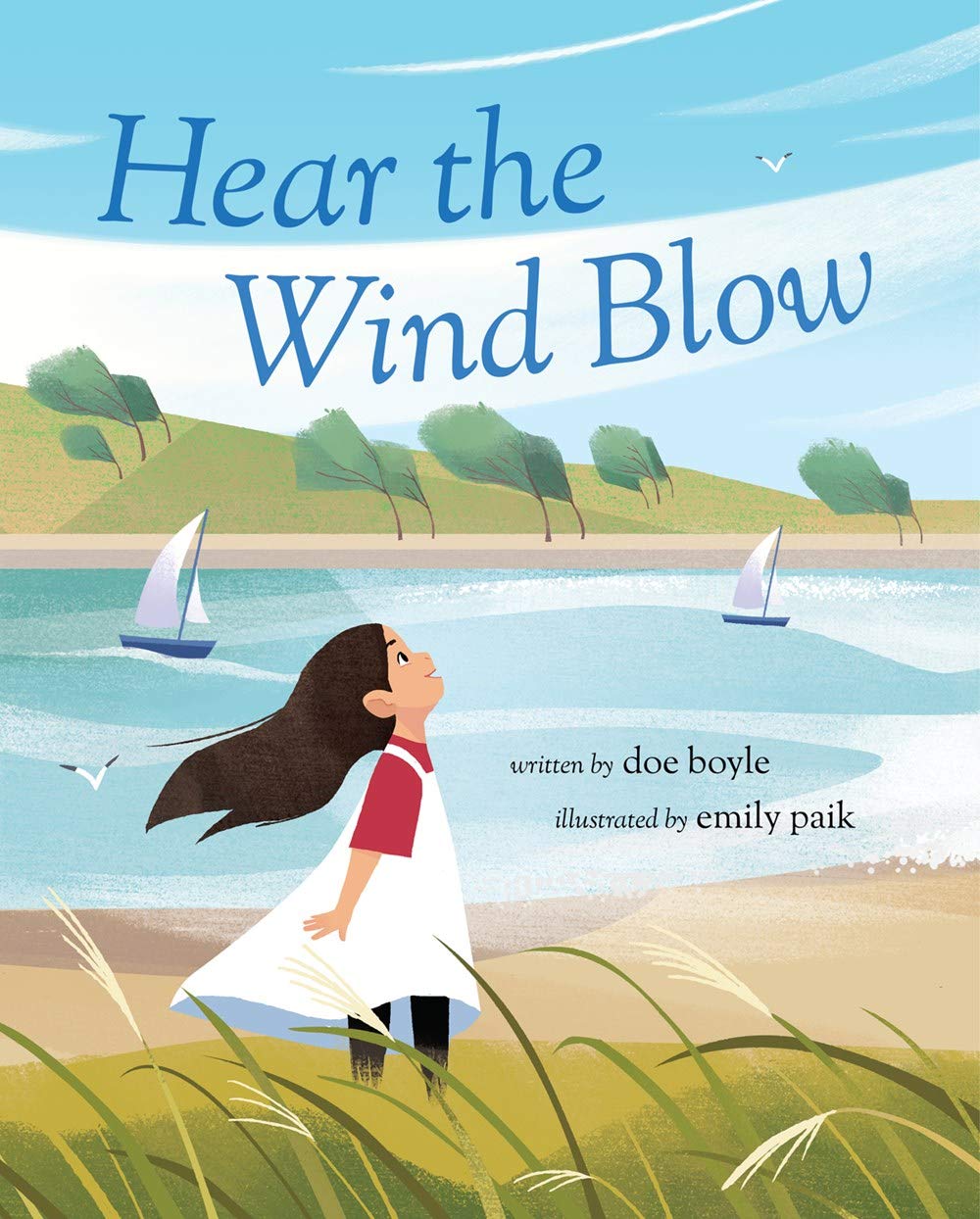
celebrate-picture-books-picture-book-review-hear-the-wind-blow-cover

About the Holiday

If you live in a coastal area, your used to watching for hurricanes during the summer and fall. Meteorologists and wary residents follow these tropical cyclones as they swirl across the ocean, threatening any landmass in their way. To be categorized as a hurricane, the storm must possess sustained winds of or above 74 miles per hour. You can learn more about hurricanes from the National Oceanic and Atmospheric Administration website. Kids can learn ten facts about hurricanes on the National Geographic Kids website.

Hear the Wind Blow

Written by Doe Boyle | Illustrated by Emily Paik


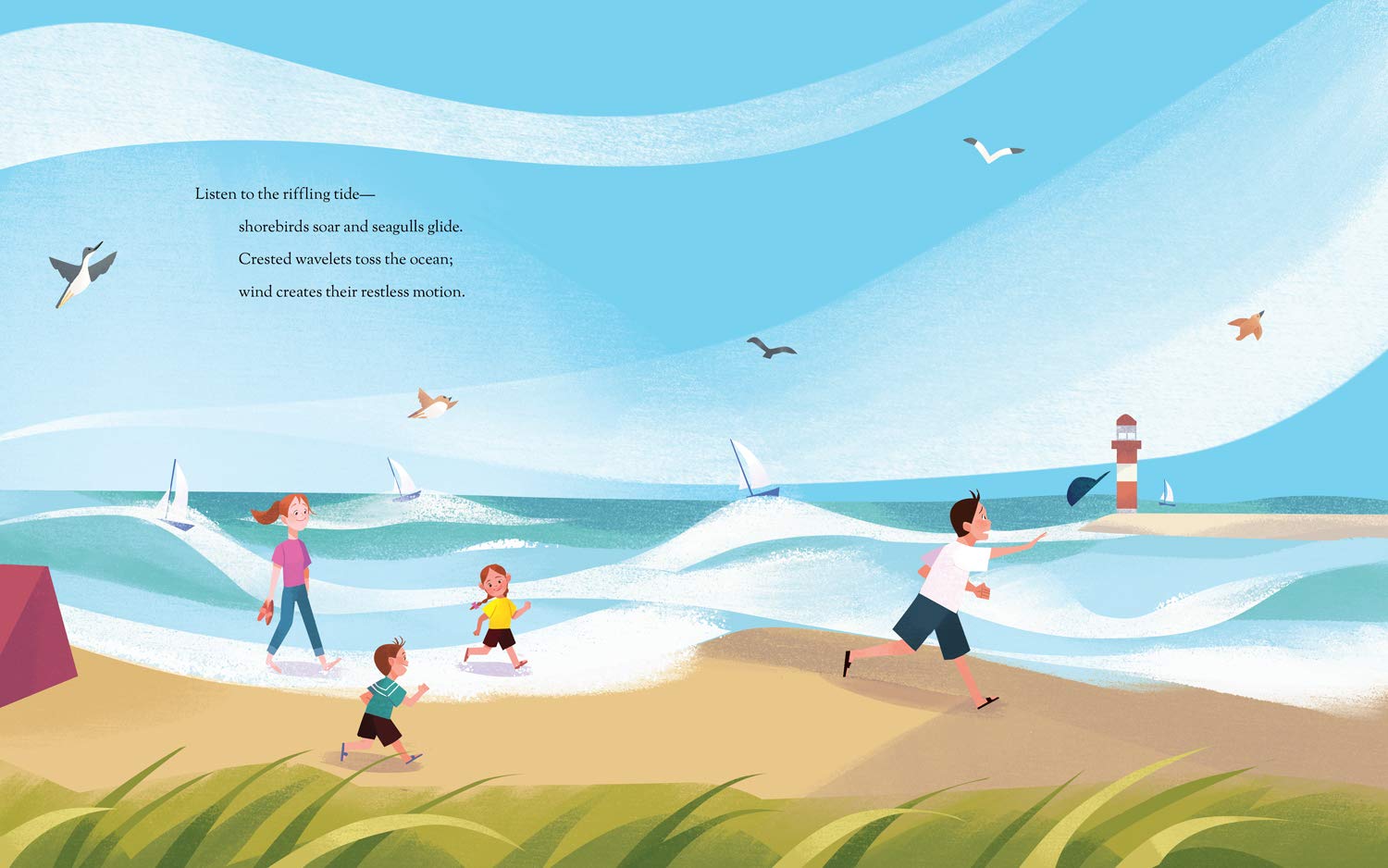
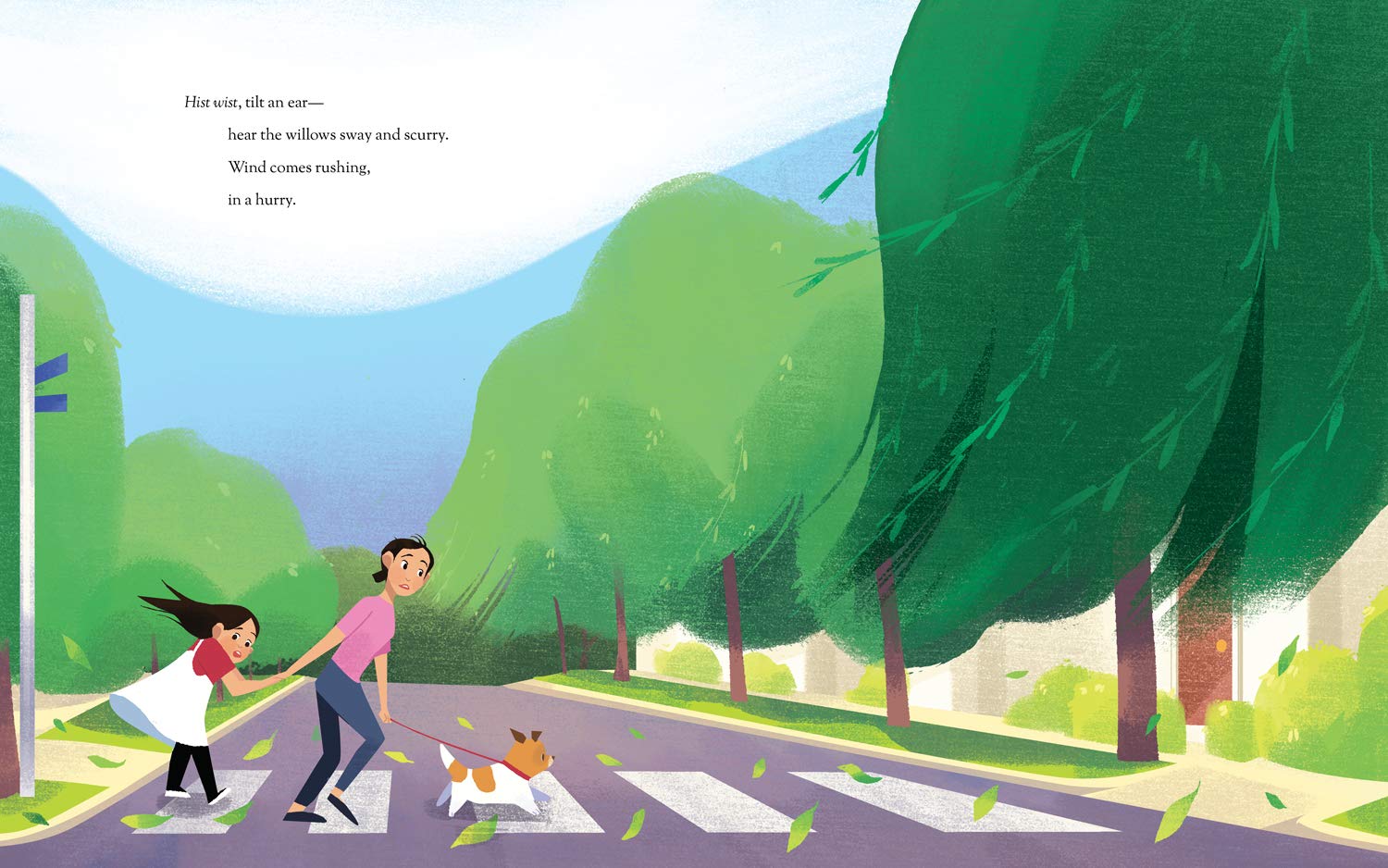
A girl wakes at dawn to a calm, quiet morning in her seaside town. Gazing out her open window she feels “a kiss of air— / a soft breath, a phantom wisp, / faint as shadows, cool and crisp.” As the breeze picks up, leaves rustle across the street as the girl and her mom leave the house to walk their dog. Meanwhile, along the shore the tall grasses begin “sharing whispered summer secrets / with the silent, stalking egrets,” and the flames of a family’s campfire dance with the growing breeze.

celebrate-picture-books-picture-book-review-hear-the-wind-blow-hat

Image copyright Emily Paik, 2021, text copyright Doe Boyle, 2021. Courtesy of Albert Whitman & Company.

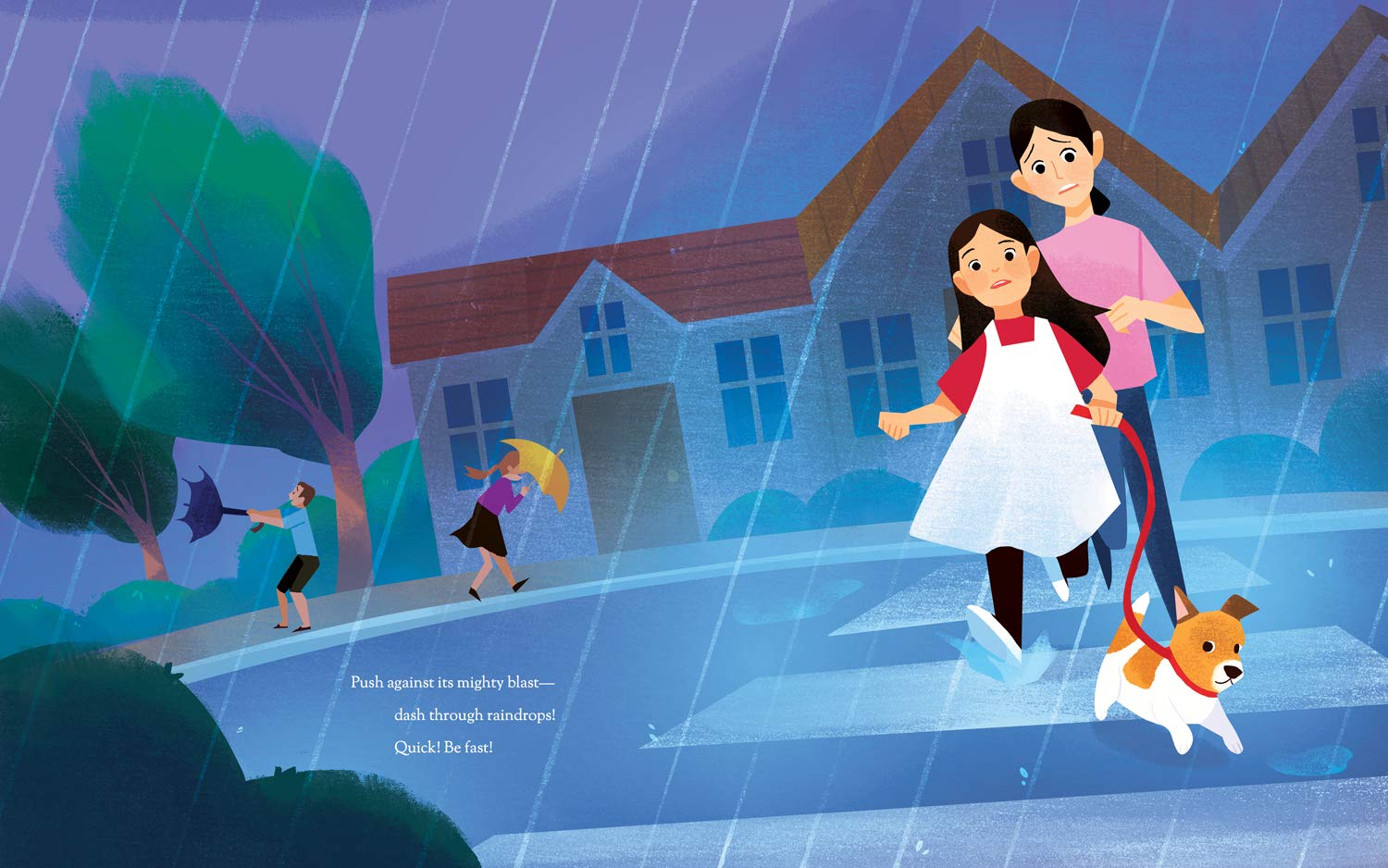
Suddenly, the wind whips up, sending leaves flying and trees swaying. The girl and her mom rush home, their dog running ahead, as rain pelts down. The sky has turned as dark as night and “now the windstorm whips and wails— / sucks at sand and billows sails.” As the storm approaches the girl, her mom and dad, and their pup huddle together in cozy quilts and sing loudly, drowning out “the fearsome sound.”

“When the hurricane comes roiling, / popcorn’s popped, the kettle’s boiling.” Outside the waves crash and spray, the wind screeches, and boats rock, their sails snapping and “their rigging slapping. / Wires droop, and tree roots shudder— / the world’s atilt, without a rudder.”

celebrate-picture-books-picture-book-review-hear-the-wind-blow-trees

Image copyright Emily Paik, 2021, text copyright Doe Boyle, 2021. Courtesy of Albert Whitman & Company.

But hours later the wind is gone, the sun is out and “stillness echoes through the town.” Neighbors emerge to inspect their homes and yards. They help each other clean up and mop up, sharing stories of where and how they sheltered from the storm. On the beach, the girl and her dog watch sailboats skim the now-gentle waves as “all the windswept world spins on.”

Backmatter includes an Author’s Note revealing that each stanza of the lyrical text “represents, in order, one of the thirteen categories of the Beaufort wind force scale, from 0 – 12” as well as a discussion on wind. Doe Boyle also includes a detailed description of the Beaufort scale, along with the chart, which categorizes wind by number, speed, force, sea effects, and land effects. A glossary of words found in the book and a list of suggested reading rounds out this fascinating and useful resource.

celebrate-picture-books-picture-book-review-hear-the-wind-blow-rain

Image copyright Emily Paik, 2021, text copyright Doe Boyle, 2021. Courtesy of Albert Whitman & Company.

With a stirring combination of poetry and science, Doe Boyle invites readers  to experience the coming and aftermath of a hurricane with a peer, her family, and her community. Beautiful, evocative vocabulary allow kids to hear the scurrying leaves, groaning trees, and pounding waves as the wind begins as a breezy whisper and grows to whipping, wailing force. As the storm intensifies, Boyle’s stanzas lengthen and her rhythms become quicker and more urgent, immersing readers in learning about the Beaufort Scale while also finding reassurance in the comfort of family.

Emily Paik’s vivid illustrations give readers visual clues to the onset of the hurricane, from calm blue skies and gently fluttering leaves to a wind strong enough to blow away a man’s hat and whip up rolling waves to a darkening sky, bending trees, and pattering rain. The girl and her mother’s facial expressions show their increasing concern and need to get home. When they reach their house, the girl’s dad has the door flung open, welcoming them back to their cozily lit home. An image of the family singing together above the wind is a heartening respite in the midst of the storm.

While Hear the Wind Blow focuses on a hurricane, the information about wind is applicable to any kind of windstorm. The book is an excellent choice for summer reading at home and would be a superb addition to lessons on weather for teachers and homeschoolers. Hear the Wind Blow book is highly recommended for home, classroom, and public library collections.

Ages 4 – 8

Albert Whitman & Company, 2021 | ISBN 978-0807545614

Discover more about Doe Boyle and her books on her website.

To view a portfolio of work by Emily Paik visit her website.

Hurricane Season Activity

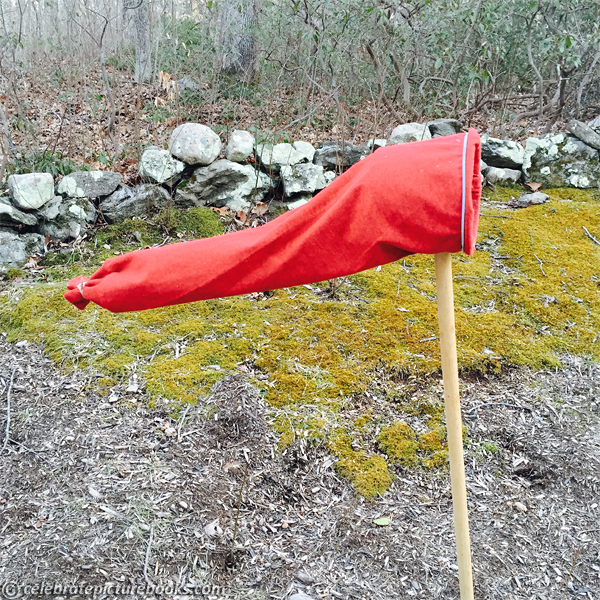
CPB - Windsock

Catch the Wind! Windsock Craft


You can feel the wind in your hair and see it blowing through the trees, but can you actually catch it? You can with this easy-to-make windsock!

Supplies

  • 1 large yogurt container (32 oz) or 1-pound deli salad container
  • 1 long-sleeve T-shirt
  • Strong glue
  • Dowel, 5/8 diameter x 48-inches long or longer
  • String
  • Rubber band
  • sewing seam ripper or cuticle scissors
  • X-acto knife
  • Scissors

Directions

  1. Remove the sleeve from a long-sleeve t-shirt with the seam ripper or cuticle scissors
  2. Cut the shoulder off the sleeve by cutting straight across from the underarm seam
  3. Cut 2 inches from the bottom of the yogurt container OR cut the bottom out of the deli container with the x-acto knife or scissors
  4. With the x-acto knife or scissors, make a hole a little smaller than the diameter of the dowel about 1 inch from the rim of the container
  5. Slide the container into the large opening of the sleeve
  6. Fold about a ¾ -inch edge over the rim of the container and attach all along the rim with strong glue
  7. Put the rubber band around the outside edge of the opening
  8. Tie the bottom of the sleeve’s cuff together with the string
  9. To attach the dowel: Option 1: leaving the t-shirt in place, push the dowel and material through the hole in the container. The t-shirt material will hold the dowel in place (I used this option).  Option 2: cut a small hole in the t-shirt at the location of the hole in the container. Push the dowel through this hole and the hole in the container. Secure with strong glue
  10. Stick your windsock in the ground in an open area where it can catch the wind. As the wind changes direction, you can turn your windsock so the opening faces the wind.

celebrate-picture-books-picture-book-review-hear-the-wind-blow-cover

You can find Hear the Wind Blow at these booksellers

Amazon | Barnes & Noble | Books-a-Million

To support your local independent bookstore, order from

Bookshop | IndieBound

Picture Book Review
June 15 – National Electricity Day

celebrate-picture-books-picture-book-review-energy-animated-cover

About the Holiday

Today’s holiday commemorates the date in 1752 when Benjamin Franklin conducted his famous experiment in which he flew a kite outfitted with some wire, silk, and a key to prove that lightning was caused by a discharge of electricity. His successful experiment led to a better understanding of positive and negative charges as well as to the invention of the lightning rod. To read the whole story of Benjamin Franklin’s experiment visit Checkiday.com.

Energy Animated

Written by Tyler Jordan | Illustrated by Elsa Martins


Little ones are fascinated by the magic – or what seems like magic – all around them. Flip a switch and the lights come on. Push a button and pictures appear on a screen. One box keeps food cold, another makes it hot. How do all of these things work? With the interactive Energy Animated, kids can learn the basics of where the energy comes from to create electricity.

celebrate-picture-books-picture-book-review-energy-animated-computer-tv

Image copyright Elsa Martins, 2021, text copyright Tyler Jorden, 2021. Courtesy of Familius.

Pull tabs, wheels, flaps, and toggles let kids see how different ways of collecting electricity makes everyday objects run. Little ones get to toggle an oil pump and see how oil is stored deep under the earth’s surface, past a bunny sleeping in its hole, worms aerating the soil, and ants building tunnels to where dinosaurs are buried. They learn about coal and uranium, which “can be used as fuel to heat water and created steam. The steam goes through a fan called a turbine to generate electricity.”

celebrate-picture-books-picture-book-review-energy-animated-kitchen

Image copyright Elsa Martins, 2021, text copyright Tyler Jorden, 2021. Courtesy of Familius.

Readers may be familiar with solar panels from hearing parents and teachers talk about them or even from their own homes. Here, kids also learn how the sun is used to store energy from the sun with mirrors. As children turn the wheel, night turns to day, and they see how sunshine is absorbed by mirrors and solar panels to generate steam and electricity.

celebrate-picture-books-picture-book-review-energy-animated-solar-panels-1

Image copyright Elsa Martins, 2021, text copyright Tyler Jorden, 2021. Courtesy of Familius.

Turn the page and the same wheel turns the blades of a wind turbine. Next, they take a trip to the beach to learn that “when wind blows over the ocean, it makes waves. The waves move buoys up and down, and we can capture that energy too. Then readers can dive in and with the pull of a tab make the buoy move up and down. Surprise! A little fish is watching too! Finally, readers get to lift the gate on a dam and let the water rush through a turbine to create even more electricity.

Little ones follow up on all the electricity they’ve generated by flying a plane and steering a ship by way of sliders as they learn how electricity is collected at power stations and brought to their house through the long power lines they see above them.

celebrate-picture-books-picture-book-review-energy-animated-solar-panels-2

Image copyright Elsa Martins, 2021, text copyright Tyler Jorden, 2021. Courtesy of Familius.

Tyler Jordan’s informative text teaches young readers a wide range of vocabulary used when talking about energy, the environment, and the processes used to collect, generate, and use electricity. Her short, straightforward sentences make the science concepts digestible for children and promote discussion between them and adult readers.

Jordan’s text is paired with Elsa Martin’s bright illustrations that put the focus on the pumps, turbines, solar panels, mirrors, buoys, dam, as well as the vehicles and home appliances and electronics that use electricity and energy. Uncluttered by non-essential details, Martin’s pages make it easy for young readers to see where the materials we use to generate electricity come from and how they are used. The interactive elements will entice kids to learn more about each alternative energy source and make them more aware of the power lines, solar panels, and other energy producers in their area.

An entertaining and educational way to teach young readers about energy sources and how electricity is generated, Energy Animated is a terrific addition to home, school, and public library collections for science learning.

You’ll also want to check out Physics Animated, an interactive way for kids to learn about how things move. You can read my review of Physics Animated here.

Ages 4 – 6

Familius, 2021 | ISBN 978-1641702546

To learn more about Elsa Martins, her books, and her art on her website.

National Electricity Day Activities

celebrate-picture-books-picture-book-review-energy-word-search-puzzle

Get Energized! Word Search Puzzle


Can you find the sixteen words about energy in this printable puzzle?

Get Energized! Word Search Puzzle | Get Energized! Word Search Solution

celebrate-picture-books-picture-book-review-silly-balloons

Have Fun with Static Electricity!


You and your kids can have lots of surprising and giggly fun with static electricity using blown-up balloons!

Babies and young children should be supervised by an adult while playing with balloons.

How does it work? Static electricity is generated when there is an excess of electrons on one object giving it an electric charge. These electrons are attracted to an object with fewer electrons and will jump to it when placed close by.

How do you produce static electricity? Just rub the blown-up balloon on your shirt, on your hair, on a blanket or other surface. Then try these experiments!

CRAZY HAIR

Generate static electricity on a blown-up balloon then hold it near your hair and watch it go a little crazy!

HANG A BALLOON

Generate static electricity on a blown-up balloon and gently place it on the wall and watch it hang all by itself.

BEND WATER

This bit of balloon magic will amaze you! Generate static electricity on a blown-up balloon. Turn on a faucet to a thin stream of water. Hold the balloon near the stream of water and watch it bend toward the balloon. 

More Experiments!

You can find some awesome and easy experiments to do with static electricity and current electricity from Frugal Fun for Boys and Girls.

celebrate-picture-books-picture-book-review-energy-animated-cover

You can find Energy Animated at these booksellers

Amazon | Barnes & Noble | Books-a-Million

To support your local independent bookstore, order from

Bookshop | IndieBound

Picture Book Review

May 27 – Rachel Carson Day and Interview with Shana Keller

celebrate-picture-books-picture-book-review-fly-firefly-cover

About the Holiday

Today’s holiday commemorates the birthday, on May 27, 1907, of Rachel Carson, the famous ecologist who launched the modern environmental movement with her 1962 book Silent Spring, which documented the dangers of pesticides to the environment. Silent Spring and Carson’s continued advocacy for the environment ultimately resulted in the banning of the pesticide DDT. To honor the day, learn more about the life and legacy of this influential woman whose work continues to impact our world. To learn more about Rachel Carson, visit rachelcarson.org.

I received a copy of Fly, Firefly! from Sleeping Bear Press for review consideration. All opinions about the book are my own.

Fly, Firefly!

Written by Shana Keller | Illustrated by Ramona Kaulitzki


As the wind curled through the forest on a breezy night, a little firefly was blown out to sea. “WHOOSH! Now he was farther than he meant to be.” Floating on the current, “he saw the sparkles that flashed and glowed.” He dove in search of the twinkling lights, but deep water was not the place for him.

celebrate-picture-books-picture-book-review-fly-firefly-whoosh

Image copyright Ramona Kaulitzki, 2020, text copyright Shana Keller, 2020. Courtesy of Sleeping Bear Press.

A woman and her niece, strolling along the beach, saw him sinking. The woman scooped him up and gently placed him in her niece’s hand. “‘Little firefly,’ Marjie said. / ‘It’s not flies that you see! / That’s bioluminescence swirling / and twirling through the great sea!’” Marjie carried her treasure up the beach to the edge of the woods, where hundreds of glittering friends and family were waiting to welcome him back, and she set him free.

Following the story, Shana Keller includes a discussion about Rachel Carson—scientist and author of Silent Spring and other books whose experience inspired this story­­—and a description of fireflies and bioluminescence.

celebrate-picture-books-picture-book-review-fly-firefly-marjie

Image copyright Ramona Kaulitzki, 2020, text copyright Shana Keller, 2020. Courtesy of Sleeping Bear Press.

Shana Keller’s glowing and lyrical story about one misdirected firefly that sparks an act of compassion and discovery will inspire children to learn more about both fireflies and the bioluminescent sea creatures that attracted him. The fact that the story is based on an actual event in the life of Rachel Carson will also appeal to readers, who may enjoy sharing one of their favorite marvels of summer with this influential environmentalist and author. Told in the first person, the story directly invites children to observe nature around them and lend a hand in protecting it.

celebrate-picture-books-picture-book-review-fly-firefly-sparkles

Image copyright Ramona Kaulitzki, 2020, text copyright Shana Keller, 2020. Courtesy of Sleeping Bear Press.

Ramona Kaulitzki’s illustrations are as beautiful as a summer sunset. Under the pink and lavender sky, dots of light flit among the bushes and low-standing trees. Children first meet the firefly at the center of the story as he’s tumbling head over tail in the wind toward the rippling ocean. As the firefly mistakenly dives into the waves, kids will empathize with his plight and be cheered when Marjie and her aunt rescue him. Kaulitzki’s gorgeous underwater images highlight the diversity of marine creatures found close to shore as well as those that glitter with bioluminescence. The brilliant glow of the firefly on the dusky pages glimmers like a precious jewel and serves as a beacon of the hope and promise of nature.

A unique book for kids who love nature and to inspire studies of bioluminescence, Fly, Firefly! would be a shining addition to home, school, and public library collections.

Ages 5 – 7

Sleeping Bear Press, 2020 | ISBN 978-1534110335

Discover more about Shana Keller and her books as well as extensive teacher and homeschool resources and readalouds of her books on her website.

To learn more about Ramona Kaulitzki, her books, and her art and find free coloring pages to download in her shop, visit her website.

Meet Shana Keller

celebrate-picture-books-picture-book-review-shana-keller-headshot

Shana Keller grew up a middle child in Middle America wondering exactly how clouds stayed in the air. She’s traveled all over the country and some parts of Europe with her family and moved too many times to count. She’s settled in Pittsburgh for now, a city built just for kids and one that she finds secretly inspiring. One of her favorite quotes is from Benjamin Banneker. “Every day is an adventure in learning.” That said, she graduated from the University of Miami, Florida, with a degree in Communications, from UCLA’s screenwriting program, and took a course in songwriting from Berklee College of Music. Her goal is to never stop learning.

You can connect with Shana Keller on

Her website | Twitter | Instagram

I’m excited to talk with Shana today about her books, her inspirations, and her extensive travels. My writing partner Jakki’s sons Steve and Jack also loved Fly, Firefly! and had some questions for Shana.

Steve asked: We like to capture fireflies. Did you capture fireflies as a kid?

I did! My brother and sister and I would compete to see if we could get one of them to land on us.

Jack wondered: Did you watch real fireflies to write your story?

I was so lucky and grateful to live close to where Rachel Carson lived in Pennsylvania while I wrote this story, and to have a pond in our yard. We had frogs, fish, birds, and a good number of fireflies. I watched them every night in the summer when the weather was warm. There was so much wildlife in our backyard! We had chipmunks, groundhogs, wild turkeys, voles, and woodpeckers.

celebrate-picture-books-picture-book-review-shana-keller's-backyard

Our back yard in Pittsburgh. On the bottom right is the pond. Our cat loved to sleep on the picnic table up the small hill. Can you see it behind the little tree? Back there is where the groundhog moseyed around.

celebrate-picture-books-picture-book-review-Shana-Keller-Koi-Image

One of the koi fish in our pond surrounded (and protected) by lily pads.

celebrate-picture-books-picture-book-review-Shana-Keller-groundhog-Image

A groundhog just past the picnic table in our (former) backyard.

CBP Shana Keller Toad Image

A picture of our frog in the same pond as the koi. Lots of critters lived in it and used it for water.

We don’t live in Pittsburgh anymore and I really miss that yard. Sadly, I haven’t seen any fireflies in my new neighborhood in North Carolina.

Jack and Steve said: We’ve brought frogs back to a pond. Have you ever rescued an animal?

Yes! In the traditional sense, our last dog Abby, was a pound puppy. (Though she has passed, I included a photo.) She always stayed up with me while I wrote, no matter how late it was. I still miss her, so it was the neatest surprise for me to see a beagle in the illustrations for Ticktock Banneker’s Clock. Abby was part beagle.

celebrate-picture-books-picture-book-review-Shana-Keller-Dog-Image

Abby running in the snow. She always looked like a deer or rabbit the way she bounded and jumped!

celebrate-picture-books-picture-book-review-Shana-Keller-cat-Image

Jazzy standing outside on our deck.

Today, one of our cats is also a rescue. Her name is Jasmine, but we call her Jazzy. And yes, in the literal sense I have rescued a handful of animals! My most memorable one was when I was about ten or eleven years old and I rescued a squirrel from my aunt’s swimming pool.

The little squirrel had tried to jump from one tall tree to the next and missed. He fell into their round pool. The water was too low, and the ledge was too high for him to climb out. I didn’t want him to drown, so I looked around the yard and grabbed a tree branch to see if he would climb onto it. He didn’t. Then, I ran into the shed and grabbed the biggest (which was also the heaviest) shovel I could find. The squirrel swam away from me even faster than before! I chased after him wielding the long shovel and tried not to rip the lining of the pool. Round and round we went until he finally slowed down long enough, I was able to scoop him out.

I’ve also stopped to scoot turtles along if I see them in the middle of the street. This one (photos are of the same turtle) was the littlest and also brightest green turtle I have ever seen in nature.  

celebrate-picture-books-picture-book-review-Shana-Keller-turtle-pavement-Image

A little turtle crossing the street.

celebrate-picture-books-picture-book-review-Shana-Keller-turtle-grass-Image

A picture of the same little green turtle after I moved him. It looked like he was headed toward a pond. I helped him cross the street so he could get there.

Hi, Shana! What fantastic stories about your love of nature and your pets! Thanks so much for sharing all of these beautiful pictures with us. I can see that nature has really been a life-long inspiration. What sparked your idea to write this particular story?

A few years ago, I read a letter Rachel Carson wrote to her friend Dorothy Freeman in a book called Always, Rachel. In her letter, Rachel and her niece, Marjorie (nicknamed Marjie), came across a firefly while at her summer home in Southport, Maine. Around midnight, Rachel and Marjie headed down to the shore to secure Marjie’s son’s raft.

On the shore, they turned their flashlights off and saw a sea filled with “diamonds and emeralds.” The sparkling was bioluminescence, a (likely) form of marine plankton called Dinoflagellates. Rachel joked with her niece how one gem “took to the air!” Of course, it was a firefly! Well, further in the letter, Rachel tells her friend that she had already thought of a children’s story based on her experience. That sentence is what sparked the idea! 

What kind of research did you do in writing Fly, Firefly! and the back matter about bioluminescence that follows the story? What was the most surprising thing you learned about fireflies?

With this story, I headed to the library first to learn as much about the area Rachel was located in (Maine), and the insects and bioluminescence there. Once I sorted through all of my facts, I reached out to an entomologist here in North Carolina, the director of the Rachel Carson Homestead in Springdale, Pennsylvania, and a marine biologist who studied at the very same Marine Biology Lab Rachel did.

I also read Rachel’s books to get a sense of her voice and style. It filters through in her letters, but her books definitely have a poetic aura about them.

The most inspiring thing I learned was the importance and prominence bugs have in our world. We take them for granted. We call many of them pests. But the truth is, they are an important part of our ecological system. As I discovered with fireflies, when you have them, it is a good indication that your ecosystem is in great health.

What inspired you to write Fly, Firefly! in verse?

While I was researching, I discovered Rachel Carson had a love of poetry. Though this is not pertaining (that I know of) to the children’s story she discusses; in another letter written to her, she was quoted by her friend Dorothy (regarding Rachel’s poetic aims), as having said, “I just want it to be simple and clean and strong and sharp as a sword—for it has work to do!”

I did my best to honor her vision in that way, so I kept it lyrical, simple, and clean!

In your bio, you describe how you’ve traveled and lived all over the country and in parts of Europe. What took you to all of these places? Can you name a favorite place in the US? In Europe? Why are those places special to you?

People always assume I was a military brat when I’m asked about the places I’ve lived. Family and school took me/us to Oklahoma (my birth state), Kansas, Florida, Pennsylvania and Texas. Adventure and jobs took me/us to Colorado, New Mexico, Virginia, Germany, & North Carolina.

My mom simply said she had wanderlust and gypsy blood. I definitely got my love of travel from her. Although now, with my kids in school we have settled down. At least until they graduate. J

My absolute favorite place in the United States is Big Bend national park. My mom and I camped there the year before I left for college. It’s right on the border of Texas and Mexico in a NO-FLY zone which means zero light pollution. Seeing the vast Milky Way at night is something I will carry with me forever. I wish every kid could see the sky that I saw.

My favorite place in Europe was in Berlin. It was the bombed Kaiser Wilhelm Memorial Church left as it was after the war and converted into a museum. When I first saw this monument of destruction but also of hope, it impacted me in a strong way. My photo from over ten years ago is on the left and does not do it justice. The photo on the right is what it originally looked like. It is definitely worth a Google search to see more pictures of it and compare the before and after.

celebrate-picture-books-picture-book-review-Shana Keller-Kaiser-William-Memorial-Church-after-Image

My photo of the Kaiser Wilhelm Memorial Church. Notice the top tower is broken.

celebrate-picture-books-picture-book-review-Shana Keller-Kaiser-William-Memorial-Church-Before-Image

An online photo of the Kaiser Wilhelm Memorial Church. See how big it was before the bombing?

You’ve also recently released Bread for Words: A Frederick Douglass Story from Sleeping Bear Press that relates how Douglass, born into slavery, taught himself to read and write despite overwhelming challenges. Your powerful telling of this story is written in first person. Why was writing Douglass’s story in first person important to you?

I was first introduced to Douglass’s autobiographies in college. I thought this was way too long of a wait to learn about someone who was the most photographed person in 19th century America and considered one of the greatest orators in our nation.

Frederick struggled for years in a hostile environment while he learned to read and write. To honor his accomplishment, one he was clearly proud of, I wanted to present this story in the same format he had and give children direct access to his own words.


celebrate-picture-books-picture-book-review-bread-for-words-cover

Can you describe a little about your process in writing Bread for Words?

I read Douglass’s autobiographies of course, but I also studied his speeches. I was able to take a trip to Baltimore and meet with Urban Ranger and docent, Bradley Alston thanks to the folks at Baltimore National Heritage Area. His insight and knowledge not just of Frederick Douglass but of the Baltimore Douglass grew up in was incredible. Touring the Frederick Douglass–Isaac Myers Maritime Park and museum (a place I highly recommend) with Bradley Alston rounded out my research. I’ve included a few photos from that trip!

celebrate-picture-books-picture-book-review-Shana-Keller-Frederick-Douglass-Museum-Image-1

A recreation of Frederick Douglass arriving in Baltimore. (Photo taken at the Frederick Douglass-Isaac Myers Maritime Park and Museum.)

celebrate-picture-books-picture-book-review-Shana-Keller-Frederick-Douglass-Museum-Image-2

A recreation of the letters Frederick Douglass saw carved into the wood. (Photo taken at the Frederick Douglass-Isaac Myers Maritime Park and Museum.)

celebrate-picture-books-picture-book-review-Shana-Keller-Frederick-Douglass-Museum-Image-3

This is me learning what it was like to caulk a ship, a job Douglass had. They took long rope, dipped it into tar and used the hammer and tool to wedge it in for a watertight seal. (Photo taken by Bradley at the Frederick Douglass-Isaac Myers Maritime Park and Museum.)

celebrate-picture-books-picture-book-review-Shana-Keller-Frederick-Douglass-Museum-Image-4

What Baltimore Harbor looks like today.

Did you always want to write for children? How did you get started?

I didn’t expect to, not at first. I always thought I would write screenplays. I got started when my oldest daughter came home with a small paragraph from school about a man named Benjamin Banneker. It was during Black History Month, and I was amazed that I had never heard of this scientist and astronomer. Curious, I began to research him. When I discovered he built a strike clock using only a pocket watch and a pocketknife, that was the story I shared with my daughter, and that’s when the idea to put it in picture book format took place. I haven’t stopped writing picture books since.

You’re really enthusiastic about connecting with readers. What’s your favorite part of book events and meeting kids? Do you have an anecdote from any event you’d like to share?

Yes! In fact, before all the quarantines, I had such a special moment with a group of fourth graders on the day I shared Bread for Words with them. A student referred to the picture that’s on the back of the cover and said, “See how Frederick wants to be with his friend?” The kids interpreted that image as Frederick waiting for his friend to finish with his tutoring so that they could play and hunt and eat together. But also waiting, so that his friend could teach him.

It seems so obvious now that they mentioned it, but my original interpretation was one of exclusion, not simply waiting. To them, all Fred had to do (which Fred actually did) was ask his friend for help. One of the 4th grade boys even said, “I’m glad he had a friend that could help him.” I agreed and said, “It’s amazing how all the kid’s helped each other, isn’t it?!” And there was the real ‘lesson’ which another student pointed out and said, “We have to help each other if we can.” That kind of interaction is my favorite part about school and library visits!

It does make me wonder how other students will interpret this image.

celebrate-picture-books-picture-book-review-Shana Keller Bread for Words Back Cover Image

Bread for Words – back cover. Courtesy of Sleeping Bear Press.

What’s up next for you?

Hopefully more picture books! I’m working on a WWI story, as well as a picture book that highlights the effects of light pollution on migratory birds. I also just finished a very cool Coast Guard story that I can’t wait to share with my editor.

Thank you, so much, Shana for this wonderful talk and your generous pictures! I wish you all the best with all of your books and am really looking forward to reading them as I’m sure kids are too!

You can connect with Shana Keller on

Her website | Twitter | Instagram

Rachel Carson Day Activity

celebrate-picture-books-picture-book-review-firefly-maze

Firefly Flight Maze


This little firefly wants to join her friends in the forest. Can you help her through the maze to find them in this printable maze?

Firefly Flight Maze Puzzle| Firefly Flight Mage Solution

celebrate-picture-books-picture-book-review-fly-firefly-cover

You can find Fly, Firefly! at these booksellers

Amazon | Barnes & Noble | Books-a-Million

To support your local independent bookstore, order from

Bookshop | IndieBound

Picture Book Review
May 20 – World Bee Day

celebrate-picture-books-picture-book-review-how-to-build-an-insect-cover

About the Holiday

Today is World Bee Day! These top-notch pollinators work hard to transport pollen from one flower to the next, so that plants can make their seeds, grow fruit, and launch the next generation of plants! In a larger sense, they keep the world spinning smoothly, by helping plants grow. World Bee Day was created by Slovenian beekeeper Bostjan Noc, president of the Slovenian Beekeepers Association, who first proposed the idea to the United Nations in 2014. The international holiday is meant to show appreciation for bees and other pollinators, and to acknowledge that some bee species are endangered. Make sure to respect and celebrate our bee friends today by reading books about bees, planting a pollinator garden, or installing a sustainable beekeeper. Visit https://www.worldbeeday.org/en/ and http://pollinator.org to learn about the importance of bees and the holiday. To summarize: bee friendly and keep reading.

Thanks to Millbrook Press for sharing a copy of How to Build an Insect for review consideration. All opinions about the book are my own.

Review by Dorothy Levine

How to Build an Insect

Written by Roberta Gibson | Illustrated by Anne Lambelet 


Have you ever wondered how to build an insect? Well, wonder no longer! Get ready to discover the world of creepy-crawlies with this hands-on, information-packed, quirky instruction-book! Ready to begin? First, gather your supplies. Got your “HEADS” jar? Great! Nearly every living creature has a head, and each one has a head that’s just right for them. So, pick a head from the jar and let’s get building. Next add a thorax and an abdomen to your creation. “What else should we add?” you may wonder. “What about bones like ours? Should we give it a skeleton? No. There isn’t any room for big bones inside a small insect. An insect has its skeleton on the outside. It is called an exoskeleton. The exoskeleton keeps the inside stuff in and the outside stuff out.” 

celebrate-picture-books-picture-book-review-how-to-build-an-insect-studio

Image copyright Anne Lambelet, 2021, text copyright Roberta Gibson, 2021. Courtesy of Millbrook Press.

After the correct number of legs and wings go on, the critical (and funky) five senses are added. “How will our insect see? Let’s give it some eyes! How many? Two? Guess again. Five!” The fun facts continue as sensory elements are added. Did you know, “An insect can have its ears anywhere”? This is “music to my knee ears!” a grasshopper chirps in, adding a comedic flare.

Finally, after adorning insects with “hair, or horns, or spikes, or spots” the builder is instructed to finally give their creation “a place to live and a snack.” The completion of the insect and its release into its habitat is followed by an detailed spread of a fly up close that contains further information about different insect body parts. The book also includes a glossary and information on how to create critters out of art materials and recycled parts.  

celebrate-picture-books-picture-book-review-how-to-build-an-insect-heads

Image copyright Anne Lambelet, 2021, text copyright Roberta Gibson, 2021. Courtesy of Millbrook Press.

The young narrator of How to Build an Insect leads readers on a journey of how to build an anatomically correct insect, with a new body part detailed on each spread. Readers will learn about comparative anatomy, what exactly classifies an insect as an insect, and how insect bodies compare to those of humans and other animals. With intricate illustrations detailing bug bits and parts, leaves, berries, skeletons, exoskeletons and a map of “how to” instructions, the book reads like a super-cool science scavenger hunt. The how-to pages are filled with scientific vocabulary that allows readers of all ages to learn the names of insect body parts, from thorax to mandibles, proboscis, cerci, spiracles, and more. 

celebrate-picture-books-picture-book-review-how-to-build-an-insect-abdomen

Image copyright Anne Lambelet, 2021, text copyright Roberta Gibson, 2021. Courtesy of Millbrook Press.

Roberta Gibson cleverly constructs a creative non-fiction storyline jam packed with enchanting scientific facts. Gibson pulled from her knowledge working as an entomologist and research specialist in crafting this fantastic premiere nonfiction picture book. Her well-crafted writing puts complex terms into digestible and interesting explanations that are accessible for kids and adults alike. The writing is snappy, humorous, educational and engaging, featuring silly insect dialogue, and questions bolded for readers to ponder. What more could one possibly ask for?

Anne Lambelet’s masterful illustrations not only provide visually entertaining content to accompany the story, but also provide further information and humor for curious, detail-oriented readers. Insects watch as a brown-skinned, unseen narrator assembles their own insect in their very own science learning space. Sometimes the insects pop in with silly dialogue or engage in human activities, all while maintaining their scientifically accurate appearances. The artwork matches the narrator’s curiosity and close attention to detail perfectly, while maintaining a funky, beautiful art style that is consistent throughout. Spreads are backed by beautiful bursts of purples and greens and feature labeled insect and human anatomy charts; intricate bug- and art-making tools are scattered throughout.

How to Build an Insect is a perfect book for science lovers, outdoorsy individuals, bug enthusiasts, and worm savers of all ages! Also, a good read for those who are less insect-lover-inclined to learn more about how these creatures are not all that different from us humans. A worthwhile addition to libraries, classrooms, and home collections. 

Ages 5 – 9

Millbrook Press, 2021 | ISBN 978-1541578111

Discover more about Roberta Gibson and her books on her website.

To learn more about Anne Lambelet, her books, and her art, visit her website.

World Bee Day Activities

celebrate-picture-books-picture-book-review-how-to-build-an-insect-activities

Bee an Insect Lover Activities


Enjoy these fun and creative How to Build an Insect Activities and Experiments from Millbrook Press!

How to Build an Insect Activities

celebrate-picture-books-picture-book-review-how-to-build-an-insect-pollinators-poster

Download this Pollinators and Agriculture Poster that artfully teaches about how pollinators work in harmony with agricultural landscapes.

Pollinators Poster

celebrate-picture-books-picture-book-review-how-to-build-an-insect-cover

You can find How to Build an Insect at these booksellers

Amazon | Barnes & Noble | Books-a-Million

to support your local independent bookstore, order from

Bookshop | IndieBound

Picture Book Review