December 3 – Chester Greenwood Day

celebrate-picture-books-picture-book-review-earmuffs-for-everyone-cover

About the Holiday

On March 13, 1877 Chester Greenwood—a 19-year-old inventor—received a patent for “improvements in ear-mufflers” and forever sealed his place in history—as well as making winter more comfortable for millions of freezing ears! Today we honor Chester and his invention that brought attention to Farmington, Maine and jobs for many people in the area. 2016 marks the 40th anniversary of Chester Greenwood Day, and the people of Farmington are pulling out all the stops. With a theme of Holiday Celebrations around the World, the day will include a parade, gingerbread contest, chili contest, craft fairs, historical open houses, Polarbear Dip, 5K race, Festival of Trees and more. If you live nearby, why not plan to attend? If not, and you live in an area where the cold winds are blowing, wear your earmuffs with pride!

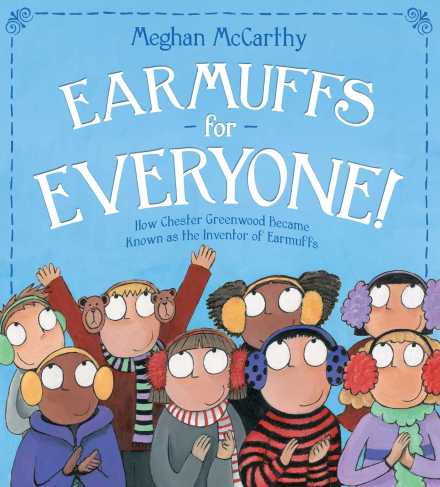
Earmuffs for Everyone! How Chester Greenwood Became Known as the Inventor of Earmuffs

By Meghan McCarthy


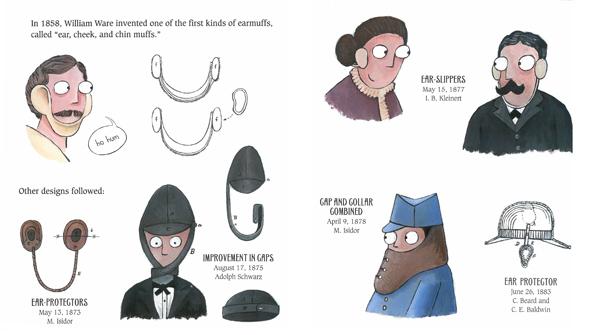
In the mid-1800s inventors were trying to solve the problem of winter’s chill effects on tender ears. William Ware designed an “ear, cheek, and chin muff” that one wore somewhat like a false beard. Ear protecting hats, ear “slippers,” high collars, and other designs followed. But it wasn’t until Chester Greenwood and his sensitive protruding ears came along that earmuffs became practical. While the exact steps Chester took in creating his earmuffs aren’t known, he eventually perfected his invention and received a government patent on March 13, 1877—when he was only 19 years old!

celebrate-picture-books-picture-book-review-earmuffs-for-everyone-patents

Copyright Meghan McCarthy, courtesy of Simon & Schuster

Chester was no one-invention wonder, though. Always on the lookout for clever ways to make money, he went on to improve other products. He applied his foresight to the tea kettle, rounding the edges of the bottom to reduce wear; constructed an interchangeable-tooth rake; and built a collapsible, if cumbersome, tent.

His inventions brought him a comfortable life that he shared with others—a beautiful house for his family in Maine, the first steam car in his town, and a bicycle shop on the bottom floor of his workshop. His wife, also a progressive thinker, worked for women’s suffrage and inspired her husband to hire women in his workshops.

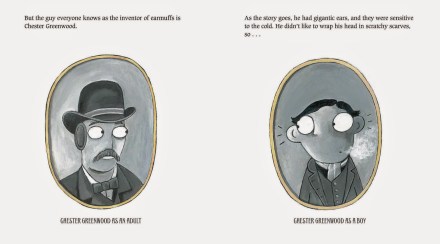
After Chester passed away, some people, most notably Mickey Maguire, thought he deserved more acclaim—even a day dedicated as Chester Greenwood Day. Maguire was so excited about this that he became a kind of inventor himself—an inventor of tall tales. Over time he told some whoppers about Chester which were repeated in the press, making it hard to separate fact from myth. But even without the made-up stories, it’s easy to say that Chester Greenwood had a very remarkable life

celebrate-picture-books-picture-book-review-earmuffs-for-everyone-portraits

Copyright Meghan McCarthy, courtesy of Simon & Schuster

Earmuffs for Everyone! goes beyond the story of Chester Greenwood to include other inventors, a discussion of the patent system (using products well-known to today’s kids), and an explanation of how an inventor’s legacy grows. Meghan McCarthy writes with verve and humor, making the story of Greenwood’s invention as well as others’ creations inviting, accessible, and fun. Her illustrations of early attempts at creating earmuffs as well as other products from the 1800s are sure to delight kids and make them curious about the time period.

In her author’s note following the text, McCarthy expands on the story of Chester Greenwood and the process of applying for and earning a patent.

Ages 4 – 8

Simon & Schuster/Paula Wiseman Books, 2015 | ISBN 978-1481406376 

Discover more about Meghan McCarthy and her books plus fun activities, videos,  artwork, advice for writers and artists and more visit her website!

National Earmuff Day Activity

CPB - Earmuff Maze.png

Here’s to Warm Ears! Maze


One muff on each side of the head—Genius! But it took inventors a lot of trial and error to make the perfect warming headgear. Use your own creative thinking on this Here’s to Warm Ears!earmuff-shaped maze. Solution included.

Picture Book Review

November 2 – Look for Circles Day

celebrate-picture-books-picture-book-review-squares-and-other-shapes-with-josef-albers-cover

About the Holiday

Today is one of those days that gets you really observing the world in a new way. As you go about your day at the office, at school, at shops, or just while driving here and there, be aware of all the different circles you see. Sure, there are the obvious ones—the tires on your car, the signals on a stoplight, the lid of your water bottle or coffee cup…but how about all the less-seen circles? Knots on trees, a lemon slice, the center of a flower, the ripple of a raindrop or pebble dropped in a puddle… Whether you look for circles through the eye of geometry or they eye of art, be fully aware of the shapes around you!

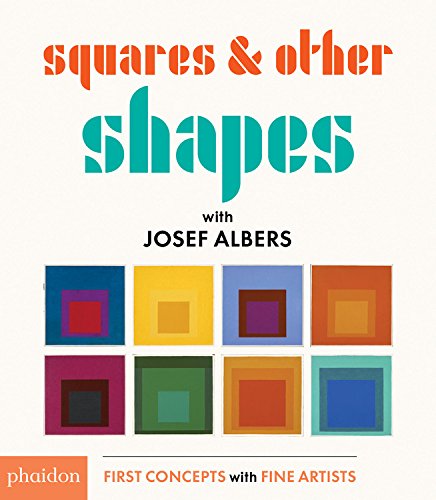
Squares & Other Shapes: with Josef Albers (First Concepts with Fine Artists)

Paintings by Josef Albers


Opening Squares & Other Shapes, readers encounter a vibrant magenta square nesting in an autumn maple leaf-hued square which floats in a square of clear, winter-sky blue. On the next page two orange squares beckon you to follow into the glowing, yellow center square. Could it be a doorway or window leading somewhere?

In another painting, a bold yellow rectangle and an equally bold blue rectangle host guests: “two little rectangles lying down for a nap.” But the calm is shattered on the next page as stacks of red and blue rectangles shake and tumble: “Watch Out! It’s raining rectangles!”

celebrate-picture-books-picture-book-review-squares-and-other-shapes-with-josef-albers-circle-circle-stop

Image courtesy of phaidon.com

Now circles want a turn, and they want to have fun! In a large black rectangle a white circle and a red circle play stoplight: “Circle, Circle, Stop!” while on the next page blue, black and spirally circles jump and frolic—“Bounce, Circles, Bounce!” Turn the page—can you count all of the little circles in the rectangle or all of the baby circles in the rectangle on the right-hand page? Some of the babies are leaping away—or are they just joining the group? What do you think?

celebrate-picture-books-picture-book-review-squares-and-other-shapes-with-josef-albers-hey-circles

Image courtesy of phaidon.com

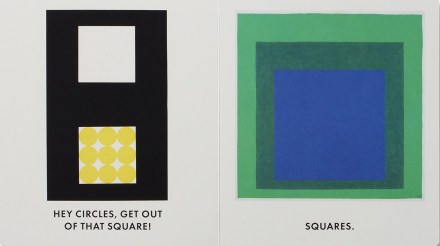
Next the black rectangle is back, but this time with two white squares inside. Wait a minute—how did those little yellow circles get into the bottom square? “Hey circles, get out of that square!” Of course triangles don’t want to be left out. Dusky triangles in many sizes connected tip to tip enjoy their light, white background, but on the next page they’re left in shadow—“Hey triangles, who turned out the lights?”

celebrate-picture-books-picture-book-review-squares-and-other-shapes-with-josef-albers-sharp-triangles

Image courtesy of phaidon.com

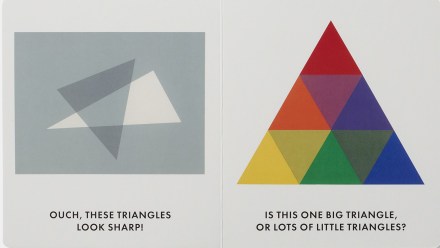
Be careful turning the page to look at the two intersecting triangles: “Ouch, these triangles look sharp!” Maybe it’s better to move on to the big, vivid triangle on the right. Oooh, so many colors! Nine, in fact! Hmmm… “Is this one big triangle, or lots of little triangles?” These paintings are getting more complex! Now there are “blue squares in pink squares, pink squares in blue squares; rectangles in rectangles, circles in circles, and more triangles in triangles. But here’s a different painting: the rectangles are perfect rectangles, but the squares are a little off, and what kinds of shapes do those curved lines make?—“Funny shapes in funny shapes!” And the last painting? Back to squares. Red, purple, and blue squares. “Beautiful squares.”

Following the paintings, the last page provides a captivating biography about Josef Albers’ life and work aimed at the book’s young audience.

celebrate-picture-books-picture-book-review-squares-and-other-shapes-with-josef-albers-sunny-side-up-squares

Image courtesy of phaidon.com

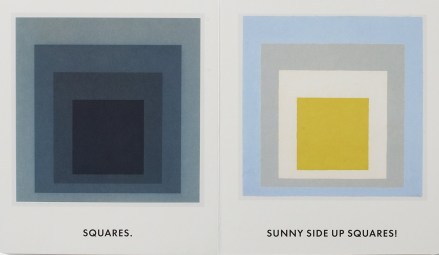
Imagine being able to own a stunning collection of famous paintings by a world-renowned artist and educator to teach your child about shapes, color, and art. With Squares & Other Shapes by Josef Albers you can! The second in the First Concepts with Fine Artists series, Squares & Other Shapes presents readers with more than 30 painting by Josef Albers, one of the most influential artists of the 20th century. Most well-known for his Homage to the Square paintings, Albers worked with color and shapes to challenge perceptions and promote creative thinking.

Shapes are one of the earliest concepts introduced to babies and young children. Even the youngest readers will be riveted by the beautifully reproduced paintings in this large board book that present squares, circles, rectangles, and trianges in clear but creative ways. The easily understood labels, repetition, and recognizable patterns offer key strategies that are known to build strong reading and comprehension skills. Kids will love the humorous text that brings the paintings to life, helping them to also see that art is not static, but active and open to interpretation by each viewer.

Squares & Other Shapes with Josef Albers is a wonderfully conceived concept book that can grow with children as it offers readers enjoyment and education on so many levels. The book would be an often-sought-out addition to home and library bookshelves and also makes a perfect present for baby showers and other gift-giving holidays.

Ages birth – 5 (and up)

Phaidon Press, 2016 | ISBN 978-0714872568

Look for Circles Day Activity

celebrate-picture-books-picture-book-review-circle-puzzle

Circle of Shapes Puzzle


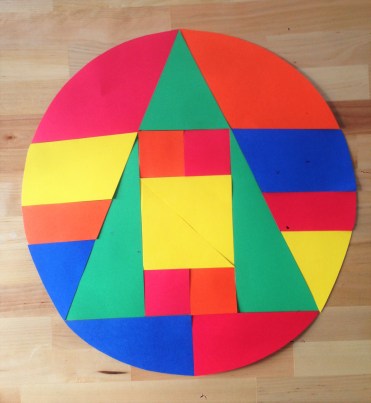
Build a circle from different shapes with this puzzle that grows as you add pieces! You can also use these shapes to create your own art!

Supplies

Directions

  1. Print the shape templates
  2. Cut out the shapes
  3. Trace shapes onto different colored paper
  4. Cut out the colorful shapes
  5. Build the puzzle from the central square to the edges of the circle (It may be easier to keep the puzzle in place by sticking the pieces down with a little tape applied to the back of the pieces)

You can also use the shapes to create your own art!

Picture Book Review


October 25 – International Artist Day

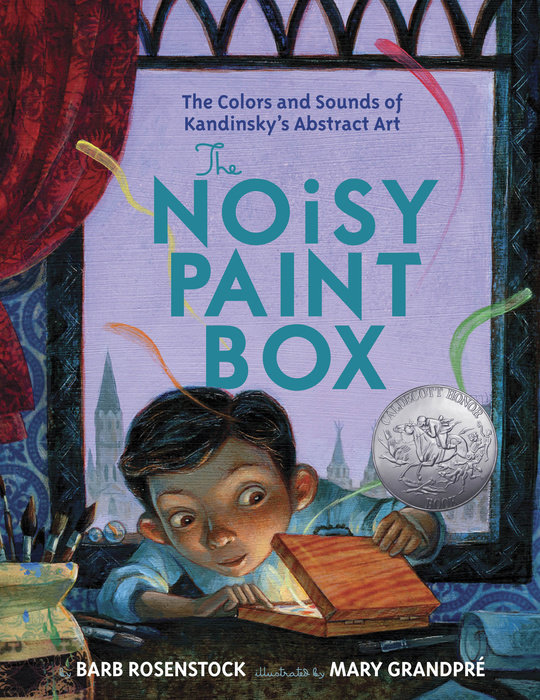
celebrate-picture-books-picture-book-review-the-noisy-paint-box

About the Holiday

Instituted in 2004 by Chris MacClure, a Canadian artist who specializes in Romantic Realism, National Artist Day celebrates the various forms of art, the artist, and the unique vision each one brings to their work and the world. Whether you like classic or abstract styles, watercolors or oils, sculpture or installations, why not take some time today to visit an art museum or gallery—or page through a collection of prints or a biography like today’s book!

The Noisy Paint Box: The Colors and Sounds of Kandinsky’s Abstract Art

Written by Barb Rosenstock | Illustrated by Mary GrandPré


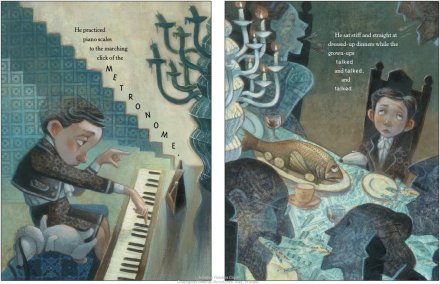
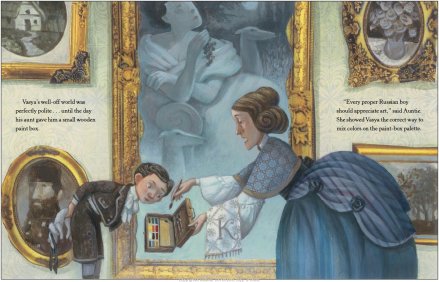
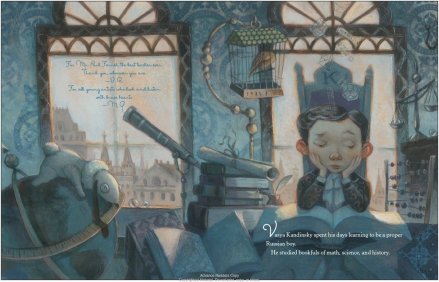
As a Russian child Vasya Kandinsky spends his days absorbed in learning math, science, and history. He takes piano lessons and attends formal dinners where the adults drone on and on. His life is polite, stiff, and colorless until the day his aunt gives him a small wooden paint box. “Every proper Russian boy should appreciate art,” Vasya’s aunt tells him while explaining how to mix colors.

celebrate-picture-books-picture-book-review-the-noisy-paintbox-piano-lessons

Image copyright Mary Grandpré, text copyright Barb Rosenstock. Courtesy of randomhouse.com

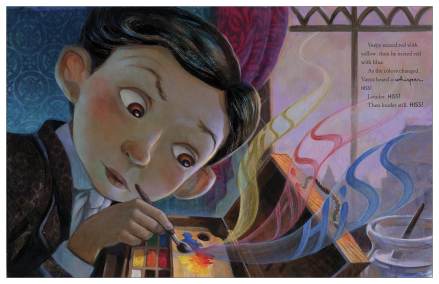
Vasya takes up the brush and combines red with yellow then red with blue. As the colors change to orange and purple, Vasya hears a whisper that grows into a noisy hiss. “‘What is that sound?’” he asks, but no one else hears anything. “The swirling colors trilled like an orchestra tuning up for a magical symphony,” and “Vasya painted the sound of the colors.” A lemon yellow “clinked like the highest notes on the keyboard; a navy blue “vibrated deeply like the lowest cello strings.” Crimsons “blared” and greens “burbled.”

celebrate-picture-books-picture-book-review-the-noisy-paintbox-colors-kandinsky-gets-his-first-paints

Image copyright Mary Grandpré, text copyright Barb Rosenstock. Courtesy of randomhouse.com

Vasya runs downstairs to show his family what he has created. His mother, father, and Auntie look at the canvas with its swoops, shapes, and angles. “What is it supposed to be?” they ask, and send him off to art school to learn how “to draw houses and flowers—just like everyone else.” Vasya finishes school and becomes a lawyer. He leaves his paint box untouched and lives the way he is expected, but the sounds of the colors are always with him.

One evening as he listens to an opera, the music surrounds him with color—“stomping lines of vermilion and coral; caroling triangles in pistachio and garnet; thundering arches of aqua and ebony…” Vasya can hear the colors and see the music. He knows then what he must do. He quits his job teaching law and moves to Germany to be a painter. He surrounds himself with artists and takes classes with famous teachers, and yet people still look at his canvases and asked, “What is it supposed to be?”

celebrate-picture-books-picture-book-review-the-noisy-paintbox-colors-have-sounds

Image copyright Mary Grandpré, text copyright Barb Rosenstock. Courtesy of randomhouse.com

Once again he paints what is expected. His teachers love his houses and flowers, but Vasya does not. His friends understand. They too want to expand the meaning of art. They agree with Vasya when he says, “‘Art should make you feel.’” In his studio Vasya continues to paint the sounds he hears, to give music color and color sound. Bravely, he invites the public to view his paintings, which are named after musical terms—Composition, Accompaniment, Fugue, and more.

This is a new kind of art—abstract art—and it takes a long time before people understand. They look and still ask, “What is it supposed to be?” “It is my art,” Kandinsky replies “How does it make you feel?” 

celebrate-picture-books-picture-book-review-the-noisy-paintbox-colors-kandinsky-at-a-concert

Image copyright Mary Grandpré, courtesy of randomhouse.com

An author’s note telling more about Kandinsky’s life and synesthesia, a genetic condition in which one sense triggers another, follows the story.

In the spirit of full disclosure, Kandinsky is one of my favorite artists, so I was excited to read this biography—I was not disappointed! With so many great artists, their work speaks for itself, but viewers wonder: How did it come about? What influenced the artist? Barb Rosenstock, with lyrical language and beautifully chosen descriptions, reveals the emotions and passion that fueled Kandinsky’s art from his earliest ages: as he walks through Moscow he can’t ignore “the canary-colored mailbox whistling as he rode to work. The scarlet sunset haze ringing above the ancient Kremlin walls.” Rosenstock’s inclusion of the conflicts and opposition Kandinsky faced and overcame will inspire children to listen to their inner voice and makes readers and lovers of his abstract art glad he never gave up.

Mary GrandPré’s unique style brilliantly depicts Kandinsky’s singular vision, allowing readers to experience the way he wielded his paint brush like a conductor’s baton. Vasya’s early life is painted in muted blues and grays, and the boredom on his face as he studies his schoolwork is obvious. Kids will appreciate his one-finger plinking at the piano and the rolled-eyed drowsiness of the formal dinner. Once Vasya is introduced to the paint box, however, GrandPré’s illustrations become vibrant, with swirling colors overlaid with the musical notes that Kandinsky associated with them. His uninhibited painting is gloriously shown as the young boy’s shirt comes untucked and the colors burst from the canvas upon his first painting.

celebrate-picture-books-picture-book-review-kandinsky-studying

Image copyright Mary Grandpré, text copyright Barb Rosenstock. Courtesy of randomhouse.com

As the adults look at his work, the room is again swathed in somber colors. The text revealing that Vasya attended regular art classes to learn to draw houses and flowers is set above a single wilting flower in a vase. The personal tug-of-war Kandinsky experienced even into adulthood is wonderfully rendered: Colors flow into his ears at the opera; he studies his own landscape and still life paintings with misgiving in a hazy studio, and the joy and freedom of his abstract art is demonstrated with wild abandon while a dove escapes its cage. The final image of a child sitting in front of a Kandinsky painting reinforces the idea that his art lives for all and for all time.

Ages 4 – 9

Alfred Knopf, Random House Children’s Books, 2014 | ISBN 978-0307978486

International Artists Day Activity

celebrate-picture-books-picture-book-review-i-love-art-word-search

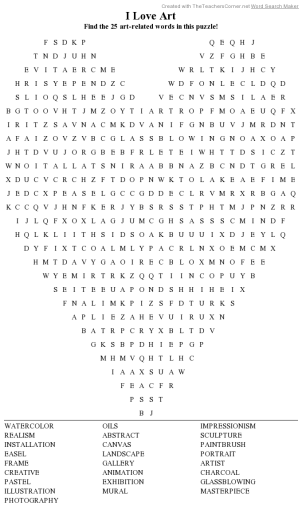
I Love Art! Word Search 


There are twenty-five art-related words for everyone to love in this printable I Love Art! word search puzzle! Here’s the Solution!

Picture Book Review

October 24 – United Nations Day

celebrate-picture-books-picture-book-review-welcome-barroux-cover

About the Holiday

Founded in the aftermath of World War II to promote cooperation among all nations and prevent another devastating conflict, the United Nations is an intergovernmental organization whose purpose has grown to include encouraging social and economic development, protecting human rights, and providing aid in times of natural disasters, famine, and war. Today’s holiday commemorates the establishment of the UN and advocates the remembrance and implementation of its principles for this and future generations.

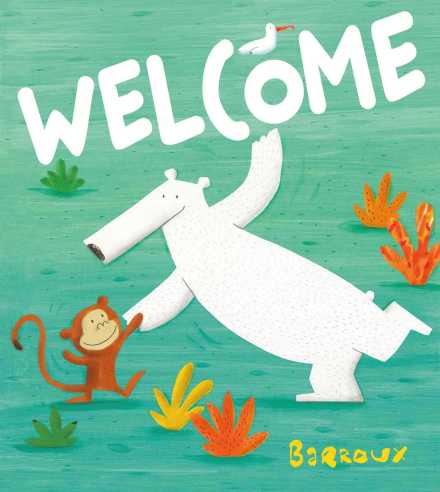
Welcome

By Barroux


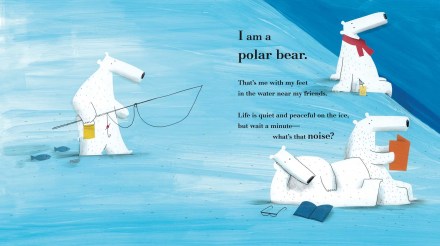
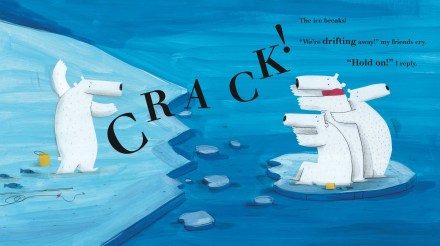
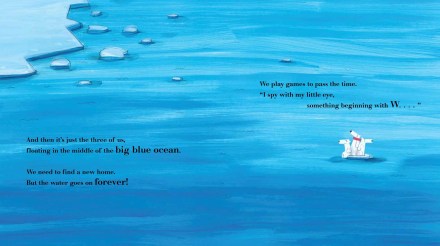
A polar bear sits on the edge of an ice floe enjoying some relaxing time with his friends when he hears an ominous noise. “CRACK! The ice breaks! ‘We’re drifting away!’” his friends cry. In no time at all the three polar bears are adrift in the middle of the sea in need of a new home. They float and float, but “the water goes on forever!” To pass the time the friends play games: “‘I spy with my little eye, something beginning with W…’”

celebrate-picture-books-picture-book-review-welcome-barroux-polar-bears-relaxing

Copyright Barroux, courtesy of little bee books and simonandschuster.com

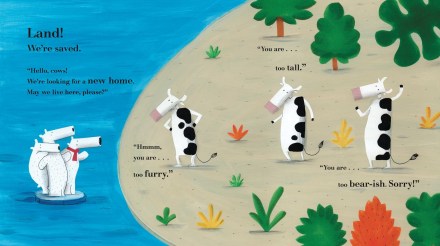
Perhaps days go by. The bears ride out a storm with dark skies and huge waves that threaten to sink them. It’s scary and the trio wants “to find a new home right now!” At last their ice floe—smaller now—approaches a sandy shore. “Land! We’re saved,” cheer the polar bears. They ask the cows on the beach if they can live there, but the cows take exception. The bears are “too furry…too tall…and too bear-ish.” And with a “Sorry!” the cows turn the weary travelers away.

celebrate-picture-books-picture-book-review-welcome-barroux-ice-breaks-away

Copyright Barroux, courtesy of little bee books and simonandschuster.com

Once again on their own, the bears have no choice but to let the current steer them. With standing room for only one their icy raft, they near another beach where a single panda relaxes on pillows in the midst of expansive land. “Yes! This could be our new home,” the polar bears shout. The panda ponders the situation for only a moment before stating, “‘…you are too many. Look around, there’s just not enough room! You can’t live here.’”

celebrate-picture-books-picture-book-review-welcome-barroux-polar-bears-meet-cows

Copyright Barroux, courtesy of little bee books and simonandschuster.com

As the polar bears continue on their journey, their “little ice boat has almost melted” and they are running out of time. They bob next to a tall sea wall. “‘Help us!’” they plead. Behind the wall two giraffes lounge on the beach, too lazy to investigate the noise they hear. The ice floe has melted to a thin disk, with room for only one. The bears are hanging on and about to give up hope when they find an empty island. They jump to shore just in the nick of time and begin enjoying their new home.

celebrate-picture-books-picture-book-review-welcome-barroux-polar-bears-adrift

Copyright Barroux, courtesy of little bee books and simonandschuster.com

It’s not long before a dinghy floats into view with three monkeys on board. “‘Excuse me, we’re looking for a new home. Can you help us please?’” The polar bears stop their game of badminton and step forward. “‘Hmmm,’” they think. “‘You are…

Welcome!’”

With vibrant blue, full-bleed pages as wide open as the sea itself and three endearing long-nosed polar bears, Barroux has crafted a poignant tale with depth and far-reaching applications for readers of all ages. Inspired by the Syrian refugee crisis, Welcome stands on its own as an uplifting story of friendship and inclusiveness, but also offers an excellent means for beginning a discussion on the world events that children see and have questions about. Employing a bear’s first person point of view and incorporating a child-centric perspective on travel—from the humor of the I Spy game to the perseverance of the bears—Barroux sets just the right tone for his audience.

With sparse text and repetition of the bears’ simple request, the subject matter is handled with sensitivity, not fright, which allows children to understand that the theme of the story is relevant on many levels. Whether the “traveler” comes from near or far, is a classmate, teammate or neighbor, or is even the reader or someone else feeling adrift in a certain situation, children will see that all deserve welcome.

Ages 4 – 8

little bee books, 2916 | ISBN 978-1499804447

United Nations Day Activity

celebrate-picture-books-picture-book-review-UN-day-puzzle

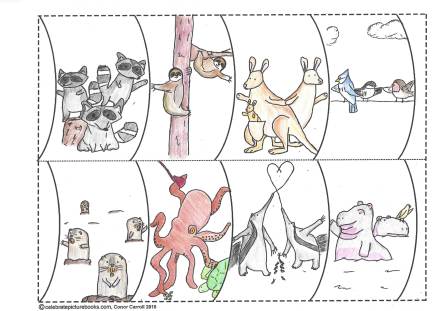
Give Me Your Hand! Puzzle


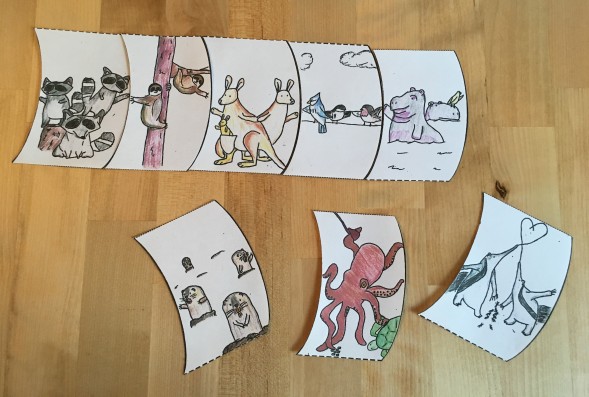
In this printable Give Me Your Hand! Puzzle, everyone is welcomed with a handshake. Offering friendship to all, the interchangeable pieces can be mixed and matched as the animals become buddies with one another.

Supplies

celebrate-picture-books-picture-book-review-UN-day-puzzle

Copyright Conor Carroll, courtesy of celebratepicturebooks.com

Directions

  1. Print the puzzle: to make the puzzle sturdier: Print on heavy stock paper or glue the page to poster board
  2. Color the pictures with colored pencils or crayons
  3. Cut the pieces apart
  4. Switch the pieces around to make many alternate pictures
celebrate-picture-books-picture-book-review-UN-day-puzzle

Copyright Conor Carroll, courtesy of celebratepicturebooks.com

Picture Book Review

Picture Book Review

October 16 – Dictionary Day

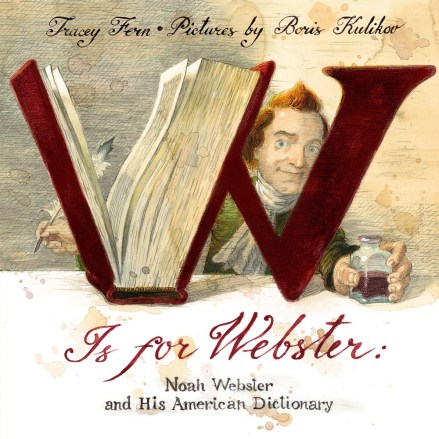
celebrate-picture-books-picture-book-review-w-is-for-webster-cover-image

About the Holiday

Dictionary Day honors Noah Webster, who wrote the first American dictionary. He was born in 1758 to a family that loved learning and knew the importance of a good education. Even as a boy Noah Webster loved words. He went on to become a lawyer, newspaper editor, Connecticut and Massachusetts legislator, and he helped found Amherst College in Massachusetts.

He is most well-known, however, for compiling the first American dictionary that is synonymous with his name and still the most popular dictionary in use. His work, first published in 1828, revolutionized the way language and words were presented and remains always current by every year adding new words that come into common use through new products, fads, and slang.

Wordsmiths the world over celebrate both the amazing accomplishment that is the dictionary, and I would imagine, their own well-thumbed and well-loved copies of this remarkable resource.

W is for Webster: Noah Webster and His American Dictionary

Witten by Tracey Fern | Illustrated by Boris Kulikov


Noah Webster was always different. Tall and thin with bright red hair, he liked to use big words when he spoke and wanted to do homework instead of goof around in school. Unfortunately for him school was in session for only a few months a year and goofing around seemed to be the major course of study. Of course, Noah didn’t call it “goofing around,” he called it “‘playing roguish tricks.’”

Noah begged to go to a harder school. “His pa knew Noah would make a terrible farmer. Noah spooked the cows by reciting Latin and spent too much time reading Ames’ Almanack under the apple trees.” His pa agreed, and in 1774 at the age of 16 Noah went off to study at nearby Yale College in New Haven, Connecticut. Yale had strict rules. Students had to rise at 5:30 a.m. and study for two hours before class. They were also fined “two shillings for making ‘tumult, noise, hallooing,’ or otherwise goofing around. Noah thought Yale was wonderful.”
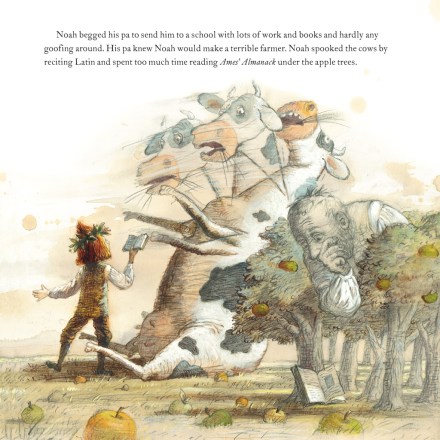
celebrate-picture-books-picture-book-review-w-is-for-webster-spooking-horses

Image copyright Boris Kulikov, text copyright Tracey Fern. Courtesy of macmillan.com

Noah hadn’t been at Yale long before the American Revolutionary War broke out. Although Noah signed up to fight, he recognized that he was “‘ill able to bear the fatigues of a soldier,’” which was “Noah’s big way of saying he was a lousy soldier.” He returned to Yale and graduated in 1778, but he left the school with no job and no prospects. Even his pa told him to leave home to find work.

Noah became a teacher, but he found the British textbooks “‘defective and erroneous.’” He believed the students should have American textbooks that better reflected their diverse experiences. With the Revolutionary War at an end and America victorious, Noah wanted to help “hold his new, complicated nation together.” He believed that America needed a language different than the English spoked in Britain. “‘A national language is a national tie,’ Noah insisted to all who would listen, and to many who wouldn’t.”

celebrate-picture-books-picture-book-review-w-is-for-webster-teaching-school

Image copyright Boris Kulikov. Courtesy of macmillan.com

He began the work himself with a speller. Right from the start Noah’s speller was different than the British books. It included everyday words “like scab, grub, and mop.” He also simplified the spelling by taking out unpronounced letters or spelling words phonetically. He also added pictures to every page and presented lists of rhyming words. He also priced his book so almost anyone could afford it. Noah’s speller became a bestseller.

Still, Noah had bigger ideas. He wanted to write a patriotic dictionary with uniquely American words. He took his idea on the road to make money for the venture, lecturing wherever he could. But Noah’s know-it-all tone of delivery, his “prickly personality,” even his “‘porcupine hair’” put people off. And what’s more, they didn’t like the idea of his dictionary. People thought he was a “lunatic” for wanting to replace British words with American ones.
celebrate-picture-books-picture-book-review-w-is-for-webster-working-on-letter-a

Image copyright Boris Kulikov, text copyright Tracey Fern. Courtesy of macmillan.com

In 1806 Noah went ahead and published “A Compendious Dictionary of the English Language. It was a flop, but Noah wasn’t discouraged.” The next year he started working on a bigger dictionary. He copied words out of British dictionaries and added American words and he traced the roots of all the words and wrote definitions, sometimes including quotes from famous people to show differences in meaning. He figured the whole dictionary would take 5 years to finish—eight to ten, tops.

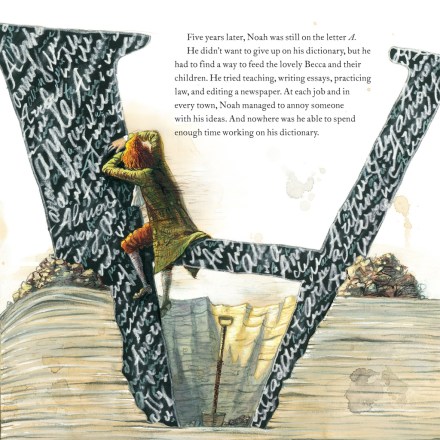
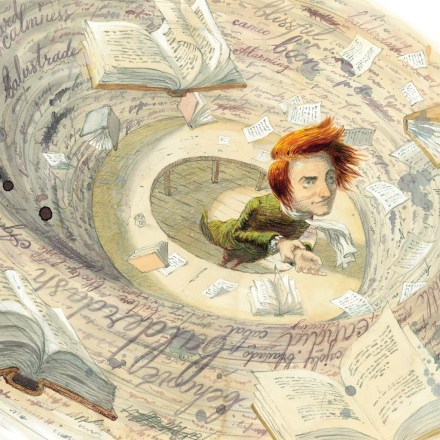
But five years later, Noah was still on the letter A. With no money coming in and a growing family, Noah took a variety of jobs, but he always seemed to rub someone the wrong way, and he lost job after job. He decided to sell his fancy house and bought a farm. Here he was able to gather books, books, and more books around his unusual donut-shaped desk. Standing inside the center of the desk, he spun around and around reading the books and finding words to include in his dictionary.
celebrate-picture-books-picture-book-review-w-is-for-webster-special-desk

Image copyright Boris Kulikov. Courtesy of macmillan.com

By 1822 Noah had exhausted all the books in his study. He took to traveling to other American libraries, moved his family to New Haven to use the Yale library, and in 1824 even sailed to Europe to explore books found in the National Library in Paris and at the University of Cambridge in England.

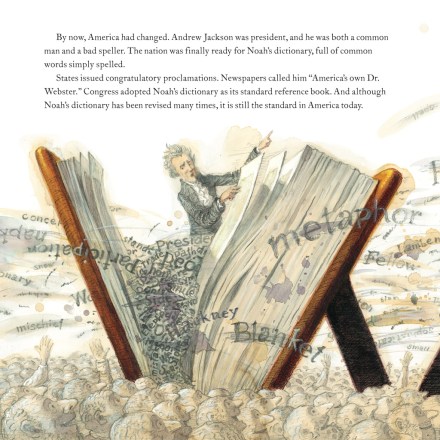
Finally, in 1825 Noah finished his dictionary.  With more than 70,000 words, An American Dictionary of the English Language was the largest English dictionary ever written. “Many people thought it was the best English dictionary ever written.” Why the change of heart? Well, one reason might have been that the President of the United States, Andrew Jackson, “was a common man and a bad speller.” Another might have been that the timing was just right.
celebrate-picture-books-picture-book-review-w-is-for-webster-finished-dictionary

Image copyright Boris Kulikov, text copyright Tracey Fern. Courtesy of macmillan.com

However it came to be, Noah was now lauded as a hero by states and newspapers. Congress even adopted the dictionary as its standard reference book. Noah had not only succeeded in writing an American dictionary, he had “created a new American language for a new American nation.” One that is still beloved today.

An Author’s note as well as a list of resources follow the text.

Webster’s dictionary is intrinsically woven into every American child’s life through language and vocabulary development. Tracey Fern’s captivating story reveals the charm and foibles of its author, a man with just the right temperament and perseverance to tackle and complete such an overwhelming task. Fern’s exceptional storytelling skills and deft turns of phrase allow for a comprehensive review of Webster’s life that is full of exhilaration, empathy, and a good dose of the “big” words Webster loved. Fern builds suspense and tension while offering an insightful look at early American history by including details of the staggering research required and the adverse reactions to Webster and his work.

Boris Kulikov’s expressive illustrations perfectly capture the complex personality of Noah Webster, late-1700s-to-early-1800s American society, and the obstacles Webster faced in writing his dictionary. Fittingly, words, books, or ink blots abound on every page, pouring from the air, sprouting from the ground, stacked like the skyscrapers that would come, and surrounding Noah Webster the way they must have swarmed through his brain. Kulikov infuses humor into his paintings, as when Noah tears at his hair wondering how he will support himself after college, shrugs nonplussed at his students’ shenanigans, and buys himself quiet work time by handing out sweets to his kids. Visual metaphors for the hard, backbreaking and mind bending work also enhance this beautiful biography.

Ages 5 – 10 (adult’s will also enjoy this biography)

Farrar Straus Giroux, 2015 | ISBN 978-0374382407

Visit Tracey Fern’s website to learn more about her and her books!

Discover a gallery of artwork by Boris Kulikov on his website!

Dictionary Day Activity
celebrate-picture-books-picture-book-review-big-words-vocabulary-word-search-puzzle

“Big Words” Word Search


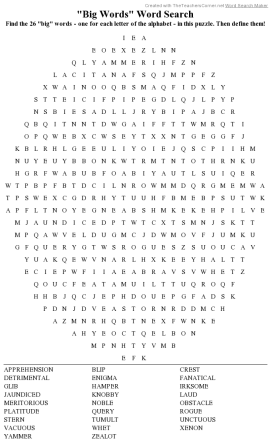
Knowing and using a wide range of words allows you to express yourself in exact—and often—fun ways. Find the 26 “big” words—one for each letter of the alphabet—in this printable “Big Words” Word Search puzzle. Here’s the Solution!

Picture Book Review

September 27 – It’s Fall Hat Month

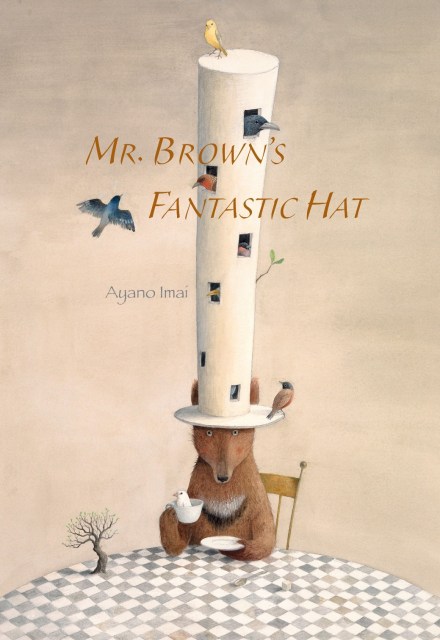
celebrate-picture-books-picture-book-review-mr-brown's-fantastic-hat-cover

About the Holiday

As the weather turns cooler in certain parts of the world, it’s time to pull out those old favorite cozy hats or buy a stylish new one to keep your head and ears warm! Whether you like wearing felt hats, knit hats, furry hats, or even top hats—like the character in today’s book—this is the season for you!

Mr. Brown’s Fantastic Hat

By Ayano Imaí


Mr. Brown lived alone and, if you asked him, he’d tell you he liked it that way. He “had no friends and he didn’t want any.” If you were privy to his secret thoughts, however, you’d learn that Mr. Brown was actually very lonely. Mr. Brown liked to take long walks, and when he went out, he always wore his “smart,” distinctive hat. “One day while Mr. Brown was sleeping, a woodpecker flew down and started tapping a hole in his hat, thinking, ‘What a wonderful nest this hat would make!’”

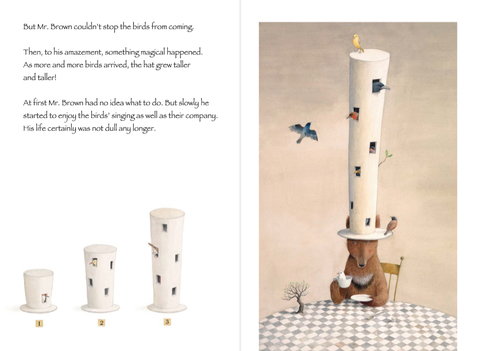
When Mr. Brown woke up he was shocked to discover that a bird had moved into his hat. Someone living this close to him was not what Mr. Brown had in mind at all. Then to Mr. Brown’s dismay the “woodpecker soon told all his friends about the wonderful new home and invited them all to join him.” Soon Mr. Brown’s hat was full of holes—and birds! You might think a regular hat would not have enough room for so many residents—but Mr. Brown’s hat was no ordinary one. As more and more birds moved in, his hat grew taller and taller!

celebrate-picture-books-picture-book-review-mr-brown's-fantastic-hat-birds-live-in-hat

Image copyright Ayano Imaí, 2014, courtesy of minedition

As the days went on Mr. Brown discovered that he was beginning to enjoy the birds’ singing and their company. Now Mr. Brown had renewed purpose in his daily walks: “He loved to show off his hat. Everywhere he went it was full of the music of singing birds.” People on the street took notice and wanted to emulate Mr. Brown. All over town people began wearing tall hats, “but the birds preferred to stay with Mr. Brown no matter how hard people tried to persuade them.”

One day as autumn settled in, Mr. Brown noticed that all the birds had flown away. He was sad and didn’t understand where they had gone or why they had left him. He wondered if he would see them again. The idea of a quiet life no longer held the appeal it once did, and Mr. Brown missed his friends. He tried to convince himself that he didn’t care that the birds had left, but he continued to fill the feeders and watch out for them every day.

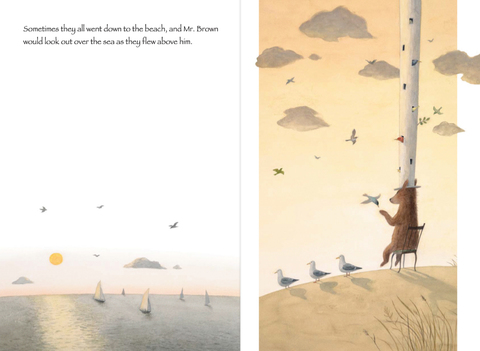
celebrate-picture-books-picture-book-review-mr-brown's-fantastic-hat-looking-out-to-sea

Image copyright Ayano Imaí, 2014, courtesy of minedition

Even though it was time for Mr. Brown to take a long winter’s nap, he tried to stay awake, worried that there would be no one to care for the birds if they returned. But nature took its course, and Mr. Brown fell into a deep sleep. One morning after a particularly vivid dream in which Mr. Brown could hear the birds singing, he woke to a tapping sound. He went to the door and peered out.

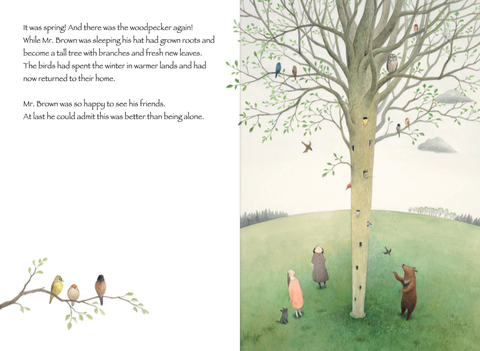
Spring had come and with it Mr. Brown’s hat had grown roots and sprouted branches and leaves. The old holes were filled with their previous tenants. The sight filled Mr. Brown with joy, and he finally could admit to himself that sharing his life with friends “was better than being alone.”

celebrate-picture-books-picture-book-review-mr-brown's-fantastic-hat-hat-grows-into-tree

Image copyright Ayano Imaí, 2014, courtesy of minedition

Ayano Imaí’s gloriously beautiful book plumbs the nature of solitude and loneliness as well as the value of friendship with an honesty that is at once heartrending and uplifting. For so many quiet, introspective people—children and adults alike—navigating the world of small talk, casual relationships, and making friends is similar to traveling uncharted territory, where the language and mores are foreign. It can become easier to tell oneself that it doesn’t matter, when in reality it matters a great deal. Many times happiness comes when one finds their niche or, in some surprising way, a niche finds them.

Imaí tells the story of Mr. Brown and his fantastical hat in straightforward narration, but more profound meaning is revealed in her illustrations. Mr. Brown, it is discovered, is a brown bear who has taken on the aspects of humans. He walks upright, carries an umbrella and bag, owns a home, and wears a hat. His fur is even the same color as the townspeople’s clothing. But while he may be among people, he is not of them. His home has a grass floor which sprouts mushrooms and weeds; another weed pokes out from the bristles of his brush; a tree branch juts from a wall; and mushrooms share space with the laundry on the drying line.

Mr. Brown comes from nature and belongs with nature, so it is no surprise that the birds flock to him and prefer him to humans, who in an ironic twist long to be like Mr. Brown. I especially like the ending of Mr. Brown’s Fantastic Hat, in which Mr. Brown stays true to himself. He does not suddenly discover his “wild” side and become someone that he is not. He is able to remain a quiet, introspective bear while also embracing his friends, his love for them, and his place in the world. He finds inner happiness and loved ones to share it with.

Ages 3 – 8 (and up)

minedition, 2014 | ISBN 978-9888240845

Fall Hat Month Activity

celebrate-picture-books-picture-book-review-favorite-hat-matching-puzzle

Favorite Fall Hat Matching Puzzle


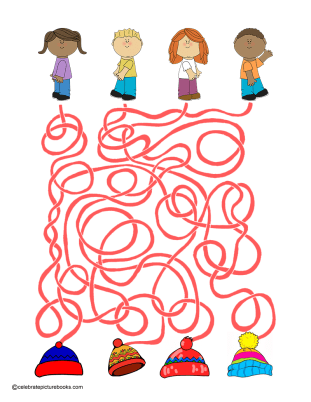
Each child has a favorite hat for cooler weather. Follow the paths in this printable Favorite Fall Hat Matching Puzzle to find out which hat each child chooses!

Picture Book Review
September 23 – Hug a Vegetarian Day

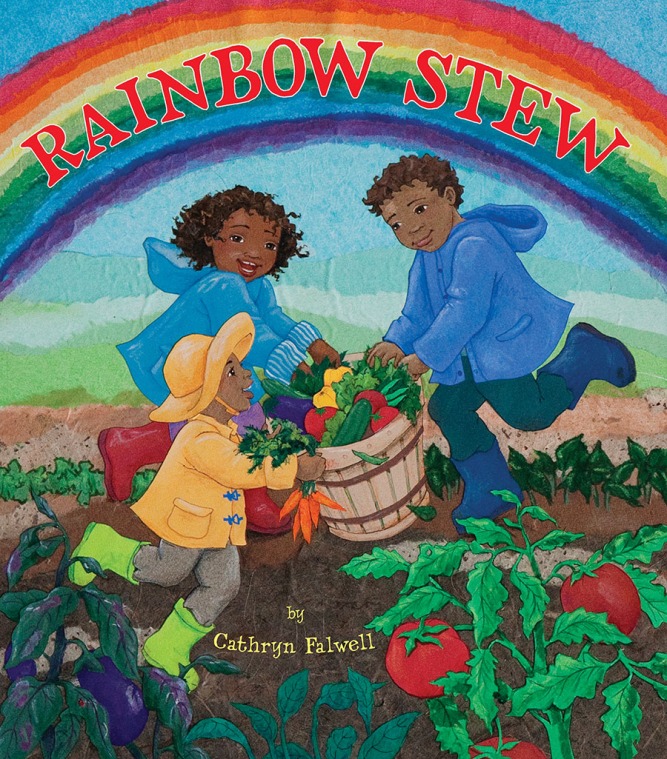
Rainbow Stew by Cathryn Falwell Picture Book Review
About the Holiday

Instituted by People for the Ethical Treatment of Animals (PETA),which was established by Ingrid Newkirk in 1949, Hug a Vegetarian Day promotes awareness of a meat-and animal- products-free diet. Over the years millions of people world wide have embraced the vegan and vegetarian lifestyle, giving rise to alternative diets and products that support this healthy choice. To celebrate today whip up a vegetarian meal – why not Rainbow Stew?! 

Rainbow Stew
By Cathryn Falwell


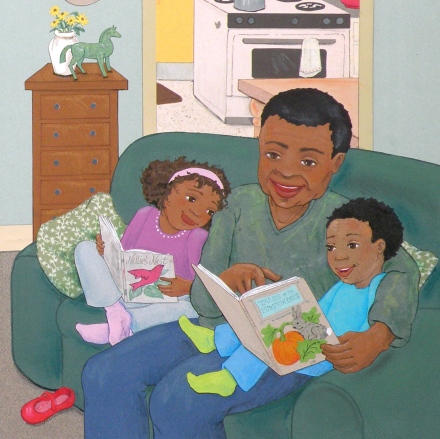
Grandpa’s making pancakes for his three favorite kids—his granddaughter and two grandsons. The kids are excited to be visiting their grandpa where they can play outside all day long. On this particular day, however, rain spatters the windows, and the kids are disappointed: “Whimper, sigh, / cloudy sky, / is it too wet to play? / We don’t want to stay inside / because of rain today.” But their grandpa knows just what to do! “Let’s go and find some colors for my famous Rainbow Stew!” he suggests.
celebrate-picture-books-picture-book-review-rainbow-stew-picking-vegetables

Image copyright Cathryn Falwell, courtesy of rainbowstewbook.com

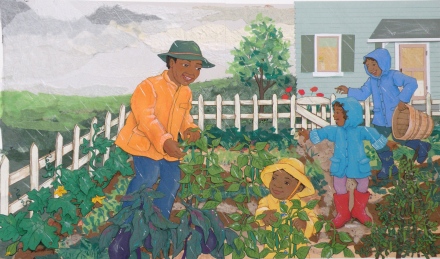
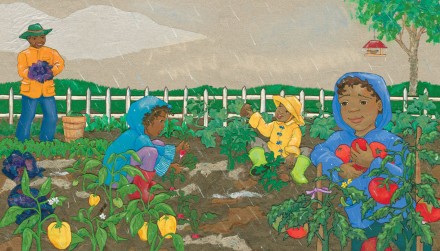
Out to the garden they run in their raincoats and hats. “Splish, splash, / puddle dash, / We bounce right out the door. / We’re off to find some red and green, / some yellow, orange, and more. / Grandpa shows us how to move / Between each garden row. / Lifting up the drippy leaves, /  we see what colors grow.” They collect green spinach, kale, and zucchini; yellow peppers, purple cabbage and eggplant, red radishes and tomatoes; brown potatoes; and orange carrots. After some muddy fun among the plants, the kids go inside, get dried off, and begin to prepare their colorful stew.

celebrate-picture-books-picture-book-review-rainbow-stew-playing-between-the-rows

Image copyright Catherine Falwell, courtesy of rainbowstewbook.com

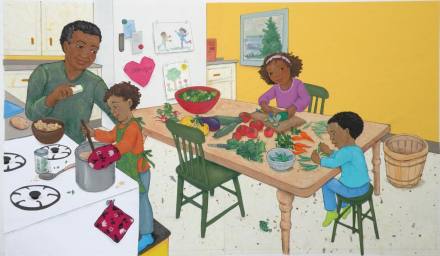
Peel, slice / chop and dice, / colors fill the pot. / Stir in herbs and water / and then wait till it gets hot.” While the pot simmers on the stove, Grandpa and the kids snuggle on the couch with favorite books, reading together until the stew has simmered to perfection. The family then sits down to a homemade, colorful, delicious lunch of Rainbow Stew. 

celebrate-picture-books-picture-book-review-rainbow-stew-playing-cooking-together

Image copyright Cathryn Falwell, courtesy of rainbowstewbook.com

Cathryn Falwell’s Rainbow Stew is a wonderful book to share with young children on many levels, offering opportunities for learning as well as playing. Introducing colors through familiar and delicious vegetables can get kids excited about gardening, cooking, even going to the grocery store. The rhyming verses each begin with an energetic couplet that kids will enjoy repeating or acting out. The bright colors of Grandpa’s house mirror the vividness of the garden vegetables, and young readers may enjoy matching the vegetables to items in the kitchen, living room, and more. 

Children will identify with the disappointment of the three siblings when they learn it’s too wet to spend the day outside as well as their glee at squishing in the mud. The close bond between the kids and their grandfather as they cook and read together is a strong anchor for this story and promotes early literacy.

celebrate-picture-books-picture-book-review-rainbow-stew-reading-together

Image copyright Cathryn Falwell, courtesy of rainbowstewbook.com

A recipe for Rainbow Stew follows the story. Reading Rainbow Stew, preparing the delicious dish, and doing the puzzle below makes for a fun rainy – or sunny – day!

Ages 4 – 7

Lee & Low Books, 2013 | ISBN 978-1600608476

Learn more about Cathryn Falwell and her books and art on her website!

To discover more about Rainbow Stew as well as activities to accompany the book, head over to rainbowstewbook.com!

Hug a Vegetarian Day Activity

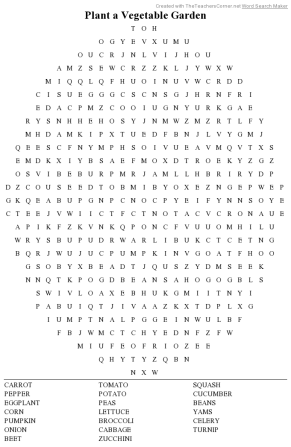
celebrate-picture-books-picture-book-review-vegetable-garden-word-search-puzzle


Plant a Vegetable Garden! Word Search


Find the names of 20 vegetables in this printable Plant a Vegetable Garden! Word Search Puzzle. Here’s the Solution!

Picture Book Review