December 14 – It’s Read a New Book Month

celebrate-picture-books-picture-book-review-eye-by-eye-comparing-how-animals-see-cover

About the Holiday

For kids who love nonfiction, this year has brought a bumper crop of creative, fascinating, and informative books on all topics from biographies to history to science and beyond. Innovative, interactive, and humorous, these books for all ages – even babies – open up the world for children in ways that resonate and make learning exciting and fun. Today’s book will have kids looking at the animals around them in a whole new way.

Eye by Eye: Comparing How Animals See

Written by Sara Levine | Illustrated by T.S Spookytooth


“Have you ever wondered what it would be like to see the world through someone else’s eyes?” Let’s make that musing even more intriguing—How would the world look if you gazed out at it through the eyes of an animal, insect, or bird (you know… a bird’s eye view)? Say, for instance, you had eight eyes dotting your face. “What kind of animal would you be, then?” Hmmm… With “four big eyes on the front of its face…” and “four smaller eyes on the top of its head,” the jumping spider can see what’s above and in front of it.

What if your eyes weren’t on your face at all, but on your arms instead? who would that be? Or how would you like it if your eyes were on “long stalks sticking out of the top of your head?” That might come in handy in a crowded movie theater or museum, but the animal with these eyes doesn’t really frequent those kinds of places. It’s more of an outdoorsman. Can you guess? While you’re contemplating that, you’re also going to want to learn about the animals whose eyes move to other parts of their face and the animals whose eyes are fixed in place.

Now, look deeeep into your eyes. What do you see? A pupil! What shape is it? Would it surprise you to learn that there are animals whose pupils are oval or even rectangular? Cat lovers know that their fav animals have oval pupils, but so do other “predators that hide and then ambush their prey.” Their unique eyes help them “judge distance and plan its attack without making any movements that might scare away its meal.” Animals with rectangular eyes use their peepers to stay safe. Which animals do you think those would be?

celebrate-picture-books-picture-book-review-eye-by-eye-comparing-how-animals-see-eight-eyes

Image copyright T.S Spookytooth, 2020, text copyright Sara Levine, 2020. Courtesy of Millbrook Press.

Some animals, including some humans, can’t see the colors red and green. You know this as color-blindness, but have you ever wondered exactly how color-blind people or animals view the world? Side-by-side pages show you! And that bird’s-eye-view? Because of the way birds’ eyes are constructed, their world is even more colorful than ours! How much more? “We have no idea… since our eyes can’t give us this information. But it’s pretty cool to know that there are things that exist out there that humans can’t see at all.”

One last question: What kind of animal could read the words in this book? If you know the answer, “you are a human who is using your eyes to read.” While other animals can’t read words, they can read the signs other animals and even plants provide. What are some of these? The answers plus even more fascinating information can be yours in the blink of an eye.

Back matter includes hands-on activities kids can do to “see” the way two animals do, a close-up examination of a human’s pupil, and a glossary as well as a list of books and websites for further research.

Sara Levine’s eye-opening guide to how a wide variety of creatures in the animal kingdom see will enthrall kids. In the fourth book of her Animal by Animal series, Levine continues her kid-enticing combination of humor and science to teach children about the specialized eyes that help animals navigate their particular environments. Her conversational storytelling, sprinkled with questions, will have kids engaged in the kind of predicting that reinforces learning. Levine’s detailed answers to the questions, including benefits of particular eye shapes or placement, physiological characteristics and adaptations, and the names of additional animals that share the same types of eyes, are enlightening will inspire young scientists to discover more about their world. 

A highlight of the Animal by Animal series is the artwork by T.S Spookytooth, who excels at translating Levine’s vision into illustrations that get kids giggling and learning. The first page starts off in familiar territory: a glasses-wearing girl stares eye-to-eye with the little wiener dog she’s holding in her hands. But turn the page and this same girl now sports eight eyes and two cleverly constructed pairs of glasses while other kids—and clues for discussions to come—stand by. On the next pages, eyeballs jut from the ends of six arms, peer out from long, wiggly stalks, and migrate across a girl’s face. These images will have kids laughing and riveted to the pages, while Spookytooth’s realistic depictions of the animals these eyes belong to will long remain in their memory. Insets of enlarged eyes allow kids to see the particular formation of eyes and pupils up close. The side-by-side page spread showing full-color human vision and the vision of someone who is color-blind is enlightening. Kids will enjoy following the pet crocodile from page to page and discussing all the reasons for its distinctive eyes. The diverse group of kids are charming companions on this educational journey.

An exciting and fascinating way to spur children to explore and learn about animals, nature, and themselves, Eye by Eye: Comparing How Animals See is a top pick for home, school and public library collections.

Ages 5 – 10

Millbrook Press, 2020 | ISBN 978-1541538382

Discover more about Sara Levine and her books on her website.

To learn more about T.S Spookytooth, his books, and his art, visit his website.

celebrate-picture-books-picture-book-review-eye-by-eye-comparing-how-animals-see-cover

You can find Eye by Eye: Comparing How Animals See at these booksellers

Amazon | Barnes & Noble | Books-a-Million

To support your local independent bookstore, order from

Bookshop | IndieBound

Picture Book Review

December 9 – Read a New Book Month

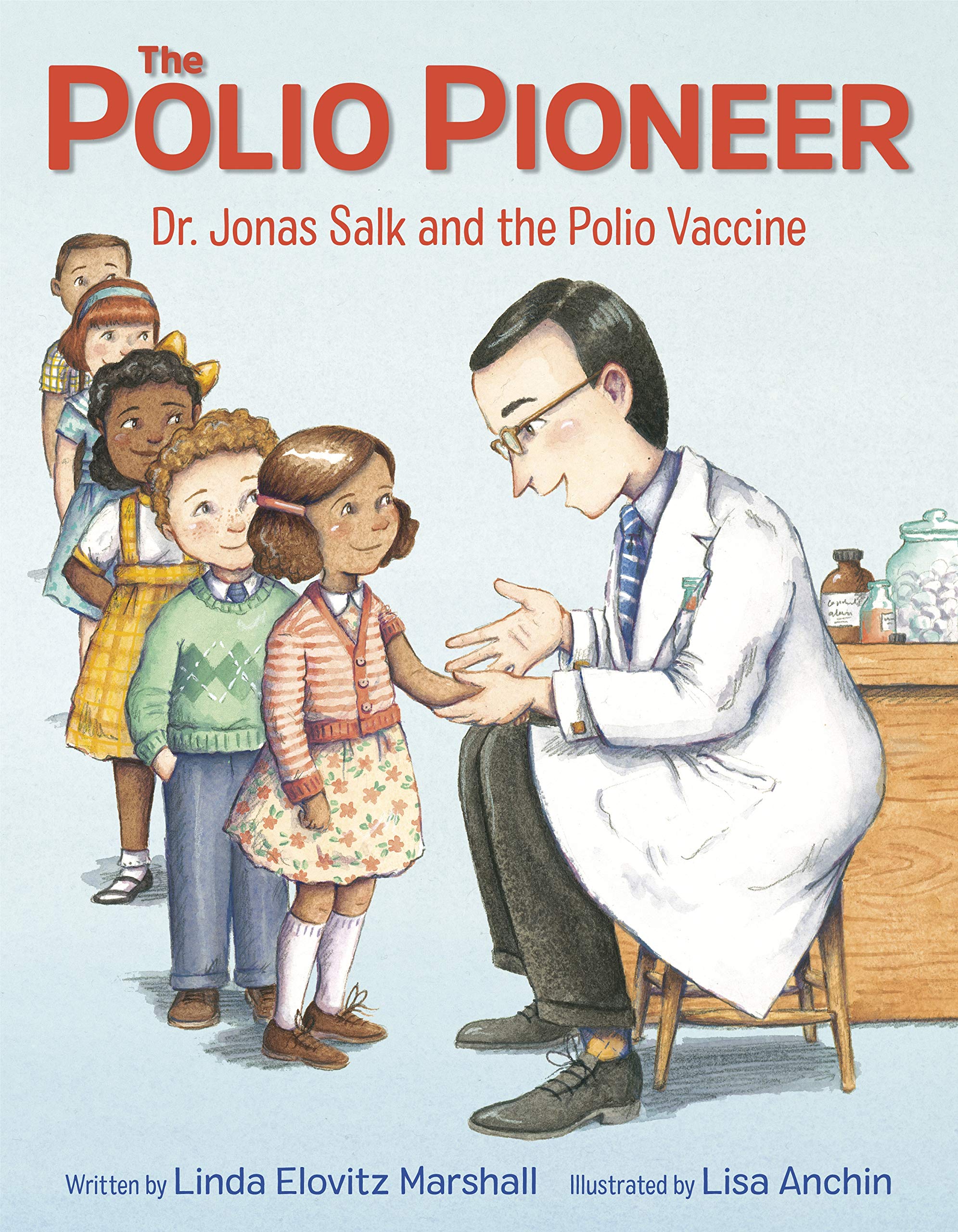
celebrate-picture-books-picture-book-review-the-polio-pioneer-cover

About the Holiday

The month of December is a gift-giver’s delight and looking at the long winter ahead there’s no better gift for everyone on your list than a book (or two or…). With so many new books hitting bookstore shelves, there really is a perfect book to fit everyone’s taste. Young children, especially, benefit from reading a wide range of picture books from laugh-out-loud or touching stories to nonfiction that introduces them to influential people, science, history, and—in a case like today’s book—to all three! Today’s reviewed book also has the distinction of being timely and inspirational. If you’re still looking for gifts to give, it’s not too late to head to your local bookstore or their online shop to find books that will make kids’ eyes light up.

Thank you to Knopf Books for Young Readers for sending me a copy of The Polio Pioneer for review consideration. All opinions about the book are my own. I’m happy to be teaming with Knopf in a giveaway of the book. See details below.

The Polio Pioneer: Jonas Salk and the Polio Vaccine

Written by Linda Elovitz Marshall | Illustrated by Lisa Anchin


Even at the tender age of four, “Jonas Salk was a kid who saw things differently.” As he watched the soldiers marching in the victory parade in New York City following World War I, instead of cheering, he was saddened by all of the injured and wounded men he saw. In his free time, instead of playing ball or games with his friends, he read book after book, and yet he was the one the other kids came to when they needed a fair and knowledgeable referee. Jonas’s family had moved to America, fleeing religious persecution of Jews in Russia and Lithuania. Money was short, yet Jonas’s parents “taught their children the importance of education, of kindness, and of doing good works. Jonas prayed that he might, someday, help make the world a better place.”

celebrate-picture-books-picture-book-review-the-polio-pioneer-parents

Image copyright Lisa Anchin, 2020, text copyright Linda Elovitz Marshall, 2020. Courtesy of Knopf Books for Young Readers.

In college Jonas became enthralled with the study of chemistry and its use in making medicines. He went on “to medical school to become a doctor and researcher.” After graduation, he joined Dr. Thomas Francis in developing a flu vaccine. They had an idea for a new kind of vaccine that could help a “person’s body ‘practice’ fighting the flu” with the hope that the person’s body would “learn to fight the flu virus… and WIN.” After much research and work, they succeeded.

But there was a disease worse than the flu that was paralyzing or killing thousands every year—“including many babies and small children.” Even future President Franklin Delano Roosevelt was affected and required a wheelchair to get around. Not fully knowing how the polio virus spread, public swimming pools and beaches were closed. “Parents kept children away from movie theaters, sleepovers, and crowds.”

celebrate-picture-books-picture-book-review-the-polio-pioneer-roosevelt

Image copyright Lisa Anchin, 2020, text copyright Linda Elovitz Marshall, 2020. Courtesy of Knopf Books for Young Readers.

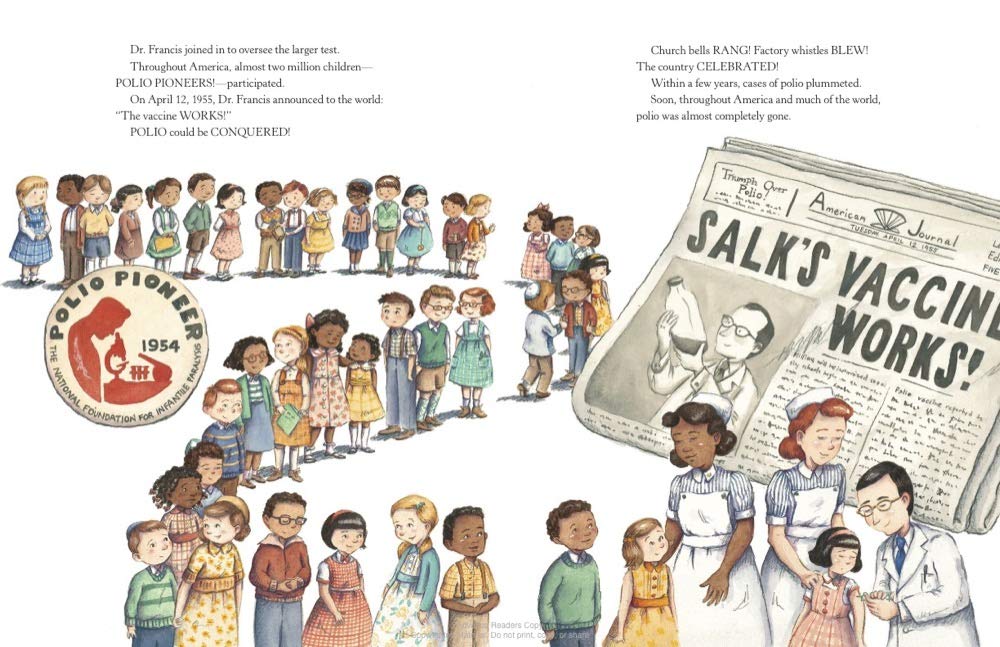
Dr. Salk believed a polio vaccine could prevent the disease. He and his team of scientists worked tirelessly to develop one. When a viable vaccine was made, they tested it on children in Pittsburg, Pennsylvania. Dr. Salk gave “many of the shots himself.” The vaccine did seem to help defend the body from polio, but could it prevent it? To learn the answer to that question, a larger trial was needed. “Throughout America, almost two million children—POLIO PIONEERS!—participated.” Then on April 12, 1955 the world learned that Dr. Salk’s vaccine could indeed conquer polio.

“Within a few years, cases of polio plummeted,” and soon it was nearly eradicated from America and most areas of the world. But polio was not the only disease that Dr. Salk wanted to eliminate. He continued to work and test and dream. Then in California, Jonas Salk established the Salk Institute for Biological Studies, where “researchers question and discover, seeking cures for cancer, HIV/AIDS, diabetes, multiple sclerosis, and many other diseases.” All of this good stemmed from a little boy “who saw things differently.” Perhaps you know a child like that too.

An Author’s Note from Linda Elovitz Marshall follows the text and describes her own experiences as a young child growing up with the fear of polio as well as what inspired her biography of Jonas Salk. Images of letters children sent to Dr. Salk thanking him for his life-changing vaccine are also included.
celebrate-picture-books-picture-book-review-the-polio-pioneer-vaccine-trial

Image copyright Lisa Anchin, 2020, text copyright Linda Elovitz Marshall, 2020. Courtesy of Knopf Books for Young Readers.

Linda Elovitz Marshall’s compelling biography of Jonas Salk, begun many years before the COVID-19 pandemic, reminds young readers—many of whom may also be dreamers like Dr. Salk—that their impressions, feelings, and unique view of the world can make valuable, even indispensable, contributions to the world. Marshall’s introduction of Jonas Salk as a serious, curious, intelligent, and caring child—even very young child—will impress readers with his life-long commitment to helping others and inspire their own good works. Her straightforward storytelling reveals to children a time with fears and hopes similar to their own recent experiences—an eye-opening history that offers context and hope and demonstrates the value of science not only for today but as a glimpse into the past and a light for the future. Through excellent pacing and well-chosen details, Marshall gives readers a sense of the urgency researchers, parents, and the public felt as polio raged and intensifies the suspense as Dr. Salk and his team race to find a vaccine for this dreaded disease. 

The parallels of today’s COVID-19 pandemic to the ravages of polio make The Polio Pioneer a unique teaching tool for parents, teachers, librarians and other caregivers for discussing viruses, how epidemics and pandemics occur, the role of doctors and researchers around the world in developing vaccines to combat them, and the importance of getting vaccinated.

Children curious about their peers from the past as well as how science and new ideas in history have transformed today’s medicine will find much to marvel at in Lisa Anchin’s realistic illustrations. Readers, familiar with modern scientific technology and laboratories, may be astonished at illustrations of a lab in the 1950s, where simple bottles, plastic tubing, and stacks of test tubes were the latest tools of the trade. They’ll enjoy comparing these earlier illustrations to a later spread showing scientists currently at work at the Salk Institute. Readers will empathize with images of children restricted to their homes, and a later illustration of a diverse group of children lined up to receive an experimental vaccine as part of the country-wide trial will impress them with the knowledge that kids just like them were instrumental in conquering polio for themselves and future generations.

The Polio Pioneer: Dr. Jonas Salk and the Polio Vaccine is a superb and timely book for teachers and parents to introduce children to one of the world’s great scientific thinkers and lifesaving doctors. The story also gives adults a way to discuss the COVID-19 pandemic and how vaccines are developed and work that will resonate with kids. A superb addition to STEM curriculum that will inspire future researchers and doctors, the book is a highly recommended for home libraries and a must for school and public libraries.

Ages 4 – 9

Knopf Books for Young Readers, 2020 | ISBN 978-0525646518

Discover more about Linda Elovitz Marshall and her books on her website.

To learn more about Lisa Anchin, her books, and her art, visit her website.

Meet Linda Elovitz Marshall
4I9A0399_final2 MPL FNL small

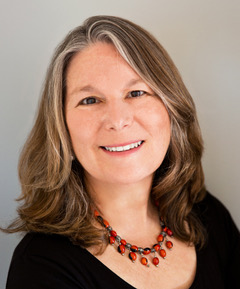
Linda Elovitz Marshall grew up near Boston, graduated from Barnard College, and raised four children and a flock of sheep on a farm in the Hudson River Valley. The author of several picture books, Linda still lives on the farm with her husband, Bob. To learn more, visit LindaMarshall.com.


I’m thrilled to be talking with Linda Elovitz Marshall today about this year’s cornucopia of books, her personal connection with The Polio Pioneer and how the book came to be, and her love of research.

2020 has been an amazing year for you with five books published—Saving the Countryside: Beatrix Potter and Peter Rabbit, Shalom Bayit, Have You Ever Zeen a Ziz?, Anne Frank: The Girl Heard Round the World, and The Polio Pioneer! Can you talk a little about each of your books? Did you conceive of them around the same time or have some been percolating longer than others?

Thank you very much for interviewing me, Kathy. What a year this has been! Hopefully, we’ll have a vaccine widely available soon and can return to being with people we love and doing things we love to do.

Still, in this midst of it all, having all these books come out has definitely kept me busy and kept my spirits up. I’m very thankful for that. I’m thankful, too, to be part of the wonderful community of children’s writers.

About the books…

The idea for THE POLIO PIONEER: DR JONAS SALK AND THE POLIO VACCINE came because Jonas Salk, who lead the team that discovered the polio vaccine, was a hero to me and many in my generation. That, coupled with the realization that people would soon forget about the once-dreaded disease polio – inspired me to write the book.
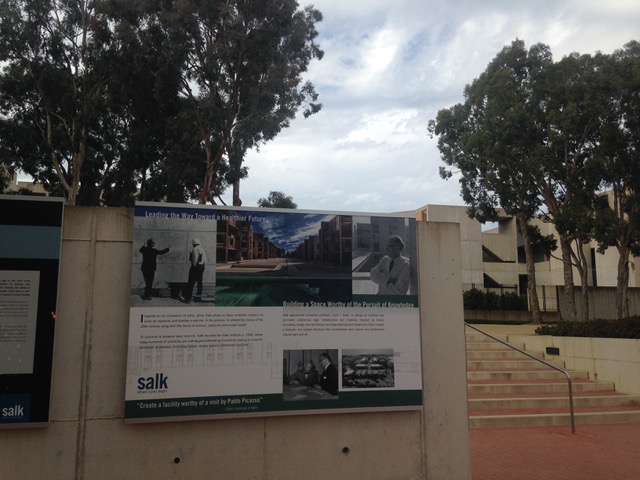
celebrate-picture-books-picture-book-review-the-polio-pioneer-linda-elovitz-marshall-interview-salk-institute

The Salk Institute for Biological Studies, La Jolla, California
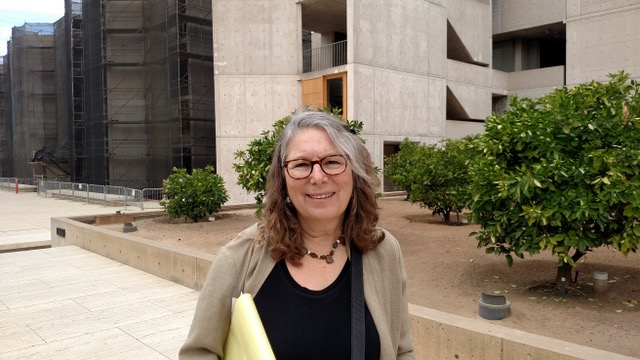
celebrate-picture-books-picture-book-review-the-polio-pioneer-linda-elovitz-marshall-headshot

My research began back in 2016 when I’d told a friend of mine—a scientist who had just moved east from California—that we were planning a trip to La Jolla. I asked him what to do there. When he mentioned the Salk Institute, I told him that Salk was one of my heroes. That conversation led to my getting a tour of the Institute. The people at the Salk Institute were so very helpful… and helped me get my research off to a wonderful beginning.

celebrate-picture-books-picture-book-review-shalom-bayit-coverSHALOM BAYIT: A PEACEFUL HOME (KarBen/Lerner 2020) was inspired by a project I did decades ago about how people live. I’ve come to believe that each home, whether small or grand, has the potential to be sacred space in its own way. A few years ago, a project that my synagogue did called the Jewish Home Project gave me the impetus to write the story. The book may have a specifically Hebrew title—the words mean “Peace in the Home”—but the concept in universal. We all need a sacred space, a place to feel safe, warm, and well-fed.
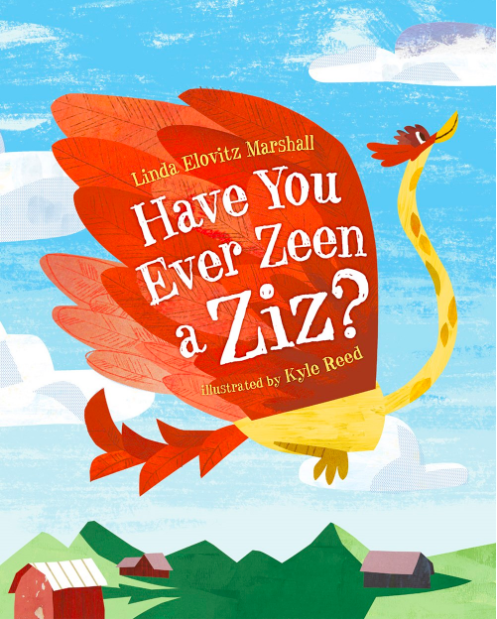
celebrate-picture-books-picture-book-review-have-you-ever-zeen-a-ziz-cover

HAVE YOU EVER ZEEN A ZIZ? – This story about a mythological Jewish bird just seemed to fly into my mind. I really don’t remember how it began. I heard the word ZIZ and chuckled…and made up a poem that later became this book. In a way, it really was magical!

celebrate-picture-books-picture-book-review-anne-frank-the-girl-heard-around-the-world-cover

ANNE FRANK: THE GIRL HEARD AROUND THE WORLD was suggested to me by my friend and editor (who was formerly) at Scholastic, Orli Zuravicky. She asked if I’d take on the challenge of writing about Anne Frank and how she became a writer. I was honored, but also frightened. Could I do it? Dare I try? That was back in 2017. I re-read Anne’s diary…and cried. I thought and thought about Anne and when, at last, I could feel Anne, I began writing.

celebrate-picture-books-picture-book-review-saving-the-countryside-cover

SAVING THE COUNTRYSIDE: THE STORY OF BEATRIX POTTER AND PETER RABBIT was inspired by a trip I took to England in 2018 with 11 other children’s writers and illustrators. As preparation, we each chose a writer or illustrator that we would become an “expert” on. As we visited the different writers’ homes, we shared our expertise. I chose Lewis Carroll but, in the end, it was Beatrix Potter whom I found so fascinating that I had to write about her. Beatrix was restrained by the many constraints of her day, and yet she broke loose and did what she wanted to do! She became a writer, an artist, a scientist, a sheep farmer, land conservationist, a helper to many in the countryside. She was AMAZING! I couldn’t stop myself from writing about her!

Three of your new books are biographies. What drew you to these particular people? What do you like best about writing biographies?

I love, love, love research. Also, I like to learn about a person so that I can feel what makes them tick. I want to identify—in some way—with that person about whom I’m writing.

Shortly after leaving my (not-completed) Ph.D. in Cultural Anthropology program, I began to interview people, tape-record the interviews, and write their as-told-to autobiographies. Following the interviews, I would personally transcribe each recording. It took hours! However, playing the tapes over and over would help me feel their voice and get a better sense of the interviewee. And when, at last, I had a good sense of them, I’d begin to write.

As for my choice of subjects… Anne came via a friend. Jonas Salk was a hero to me. Beatrix plopped herself in my lap.

What kind of research did you do for each of your biographies? What is one surprising thing you learned about each of your subjects while writing the books?

I’m a leave-no-stone-unturned researcher. I immerse myself in all things related to that person: books (non-fiction and fiction), movies, articles, everything. I try to get to know the time period, the sensibilities, issues, the problems of the time…I try to learn as much as I can so that I can feel that person and, for a while, carry that person inside me.

I learned that Beatrix Potter was a bit of a rebel but that she (somehow) did her rebelling quite graciously. If she had a pet that died, she boiled the animal, removed its skin, reassemble its bones, and studied its anatomy. She was a brilliant scientist and an amazing entrepreneur, too!
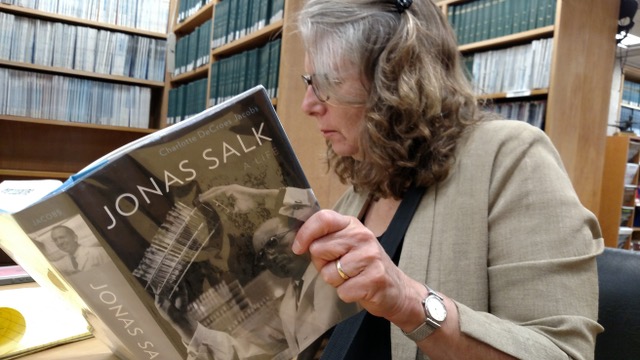
celebrate-picture-books-picture-book-review-the-polio-pioneer-linda-elovitz-marshall-interview-salk-institute

Linda Elovitz Marshall researching Jonas Salk at the Salk Institute.

I learned that, as a child, Jonas Salk thought about becoming a rabbi. Later, he decided to go into government. It was in college that he discovered chemistry…and fell in love with it! And when he and his wife were first married, he cut his own wood for the woodstove/fireplace that heated their cabin.

I also learned that Anne Frank was a lively, boisterous kid with a twinkle in her eye who loved making jokes and liked making a bit of mischief, too.

I’d like for you to talk a little more in depth about today’s reviewed book. Can you take readers on its journey from idea to publication? Why do you think it’s important for children to know about Jonas Salk?

Thank you for asking. As I mentioned earlier, Dr. Salk was a hero to me and to many of my generation. There was even a stamp issued in his honor! It was part of the Distinguished Americans series of postage stamps. When I decided to write picture book biographies in addition to my other writing, Dr. Salk—my hero—was one of the first people I chose to write about. He was someone who saw a problem, wanted to fix it, and did. He was such a hero to me and my husband that when our first son (who grew up to become a doctor) was born, my husband (also a doctor) and I named him Jonah.

When I started researching this book, years before COVID-19 came on the scene, Americans had all-but-forgotten how deadly and devastating a communicable disease could be. Sure, there was fear with recent outbreaks of diseases like Ebola, Zika, and H1N1. But with good fortune and quick action, those diseases were (temporarily, at least) brought under control and, consequently, swept off the radar. It seemed the United States had become a fairly safe place regarding communicable diseases. Then came COVID-19.

The first vaccine that Dr. Salk worked on was the flu vaccine. Worldwide, the Spanish flu had killed millions of people. More people were killed from flu than died during all of World War I. The flu vaccine that Dr. Salk and his mentor, Dr. Francis, developed is the basis of the vaccine we still use. It has saved millions of lives!

Then Dr. Salk saw another problem: polio. He wanted to solve that problem… and he did! But he didn’t stop there. After that, he opened the Salk Institute—a place to identify, study, and solve problems. As we are seeing first-hand with COVID-19, the first step is to recognize a problem. The second is to have the desire to solve them. The third is to get to work. I hope this book inspires people to do all three!

Your experiences with polio outbreaks when you were a child and today’s restrictions in response to the pandemic have direct correlations. What do you remember about those times? What would you tell children today?

I was quite young, but I remember not being allowed to go to lakes or swimming pools or even to the movies. There were many restrictions, much as there are now. Polio, however, was thought to be a disease that struck mostly young children and babies. I don’t remember not being allowed to see or hug my grandparents. On the other hand, we lived quite far from them and didn’t see them often.

What would I tell children today? Wear a mask. Wear a mask. Wear a mask. A mask helps keeps the wearer safe. It helps keep people around the wearer safe. It’s a little thing and it doesn’t hurt.

I would also like to start a public service announcement campaign about masks. Inspired by the words of former U.S. President John Fitzgerald Kennedy, “Ask not what your country can do for you; ask what you can do for your country,” this public announcement campaign would be:

MASK:

What YOU can do for your country!

Anyone want to come up with a graphic? Anyone want to help get the word out?

If we all wear masks and all work together—for our country—we can help stop this pandemic. We can each do our part. MASK: what YOU can do for your country.

And when the vaccine is ready for us to take, we need to be ready to take it…for ourselves, for our communities, for our country.

The announcement of a successful vaccine for COVID-19 has generated excitement and hope. Your descriptions of the research Jonas Salk and his team did on a flu vaccine and on the polio vaccine can inform children’s understanding of the world’s current search to develop a vaccine for COVID-19. How can adults use your biography of Jonas Salk to discuss this topic with their kids or students?

At last, we are seeing rays of sunshine, glimmers of hope. It looks like there will soon be a COVID-19 vaccine readily available. Maybe soon, COVID-19, like polio (and diphtheria, measles, pertussis, etc.), will be a preventable disease. But for that to happen, people need to take the vaccine.

This book is a wonderful teaching tool—especially with its soothing 1950’s retro look—for teaching about how a vaccine solved a problem in a previous epidemic. I’m hoping that teachers, parents, librarians, and caregivers will see the parallel and use it during COVID-19 (and, ugh, in the event that there’s yet another pandemic down the road…).

Adults can read The Polio Pioneer: Dr. Jonas Salk and the Polio Vaccine with their kids or students and talk about it. Read and talk about children around the country who took the shots. Those children, those “polio pioneers,” were heroes! By taking the vaccine, they helped save themselves—and many other people—from a devastating, communicable disease. Dr. Salk was so positive that his vaccine was safe and effective that he gave the shots to his own children!

Speaking of his children, I contacted them while I was researching this book. They’re grown up with children and grandchildren of their own. They were wonderfully helpful! If any of Dr. Salk’s children are reading this, thank you, again!

celebrate-picture-books-picture-book-review-the-polio-pioneer-linda-elovitz-marshall-interview-letter-from-child-1.  

celebrate-picture-books-picture-book-review-the-polio-pioneer-linda-elovitz-marshall-interview-letter-from-child-5

celebrate-picture-books-picture-book-review-the-polio-pioneer-linda-elovitz-marshall-interview-letter-from-child-3  

celebrate-picture-books-picture-book-review-the-polio-pioneer-linda-elovitz-marshall-interview-letter-from-child-4

Thank you letters to Dr. Salk from children who received the polio vaccine.

While you were raising your children, you lived on a farm. I’d love to hear a little more about your farm. Did the experience influence any of your books?

I raised my children on a small sheep farm in New York State’s Hudson River Valley. We had sheep, chickens, rabbits, and an occasional goat. We had dogs in the house and cats in the barn. My book, The Passover Lamb, was inspired by something that took place on our farm. The middle grade novel I’m working on is set on the farm. I also have several stories I’m working on, none of which are yet sold, that are also set on – or inspired by – the farm.

In doing a little research for this interview, I saw that you wrote a book about your father, Jerry Ellis (Gerald Elovitz), who founded Building #19—described as “New England’s laziest, messiest department store.” One joke that your dad incorporated into the store caught my eye. It was a sign at the door that read: “Wipe your feet before leaving this store.” Several of your books are based in humor. Did you inherit your sense of humor from your dad? How would you describe the humor in your books for kids?

I wish I could attribute my sense of humor to my father—he was a genius at humor and at making lemonade out of lemons. When he was completely bankrupt with three small children, a new house, and a new mortgage, he started a business that eventually became quite successful. Before that, he’d tried another business venture (selling TV’s and appliances) that failed miserably and depleted his (and the family’s) resources. When he started the new business—selling overstocked, imperfect goods, and damaged items from insurance losses—he wrote his own ads, saying he couldn’t afford to pay anyone else to write them. He even filmed his own TV commercials—using puppets because actors were too expensive! His humor helped make “America’s laziest and messiest department stores” a great success. The business eventually grew to 12 stores…and lasted almost 50 years!

Like my father, I try to add gentle humor to some of my writing. Have You Ever Zeen a Ziz? and The Mitzvah Magician are good examples of that type of humor. Sometimes, I’m serious, too. Mostly, though, I like to play with words. I also need to keep myself amused. That’s important! When I read what I wrote the day (or week or month) before and laugh out loud (assuming it was supposed to be funny), I know it’s good.

Are you working on any new projects now? Would you like to give readers a hint for what’s to come?

I’ve just put (what I hope are) the finishing touches on a picture book biography that will come out in 2022. I have another picture book bio coming out in 2023. I’ve also got another picture book coming out in 2022 or 2023. Covid-19 has changed some of the dates and the illustrators haven’t yet been selected, so I won’t say more about them yet.

I’m also working on several projects, including a middle grade novel. I’ve just completed a wonderful poetry course (taken online, of course) through Highlights. Now I have several poems brewing. I have a long list of projects as well as a list of things that are just twinkles-of-ideas, ranging from board books to adult novels. There’s no way I’ll ever finish even half of what I’m interested in doing. And the list grows longer every day!

Thanks, Linda, for this wonderful talk! Your enthusiasm for your subjects is inspiring! I wish you all the best with The Polio Pioneer and all of your books!

You can connect with Linda Elovitz Marshall on

Her website | Facebook | Twitter

The Polio Pioneer: Dr. Jonas Salk and the Polio Vaccine has been named to these “Best Books” lists!

The National Science Teaching Association Best STEM books for 2021

 The Jewish Journal Best Non-Holiday books 2020

And Kirkus calls it “An exciting, informative introduction to medical research, the work of Jonas Salk, and the man himself.”

The Polio Pioneer: Dr. Jonas Salk and the Polio Vaccine Giveaway

I’m happy to be teaming up with Knopf Books for Young Readers in a giveaway of

  • One (1) copy of The Polio Pioneer: Dr. Jonas Salk and the Polio Vaccine, written by Linda Elovitz Marshall | illustrated by Lisa Anchin

To enter:

  • Follow Celebrate Picture Books
  • Retweet a giveaway tweet
  • Reply with your hero or person you admire for an extra entry. Each reply earns one extra entry.

This giveaway is open from December 9 to December 15 and ends at 8:00 p.m. EST.

A winner will be chosen on December 16. 

Giveaway open to U.S. addresses only. | Prizing provided by Knopf Books for Young Readers

celebrate-picture-books-picture-book-review-the-polio-pioneer-cover

You can find The Polio Pioneer: Dr. Jonas Salk and the Polio Vaccine at these booksellers

Amazon | Barnes & Noble | Books-a-Million

To support your local independent bookstore, order from

Bookshop | IndieBound

Picture Book Review


October 29 – It’s National Book Month

celebrate-picture-books-picture-book-review-the-animals-would-not-sleep-cover

About the Holiday

For readers every month is National Book Month, but October is especially set aside to highlight books and the love of reading. Fall is a book bonanza as publishers release new books in all categories and the holiday gift-giving season beckons. Books, of course, make superb gifts for all ages! So whether you’re looking for a new or new-to-you book to read right now, or new titles to give to all the family and friends who will be on your list, this month is a perfect time to check out your local bookstore to see what wonderful books are on the shelves! This month is also a perfect time to discover books that get kids excited about math and science in a whole new way – like today’s book!

Thank you to Charlesbridge for sending me a copy of  The Animals Would Not Sleep! for review consideration. All opinions about the books are my own.

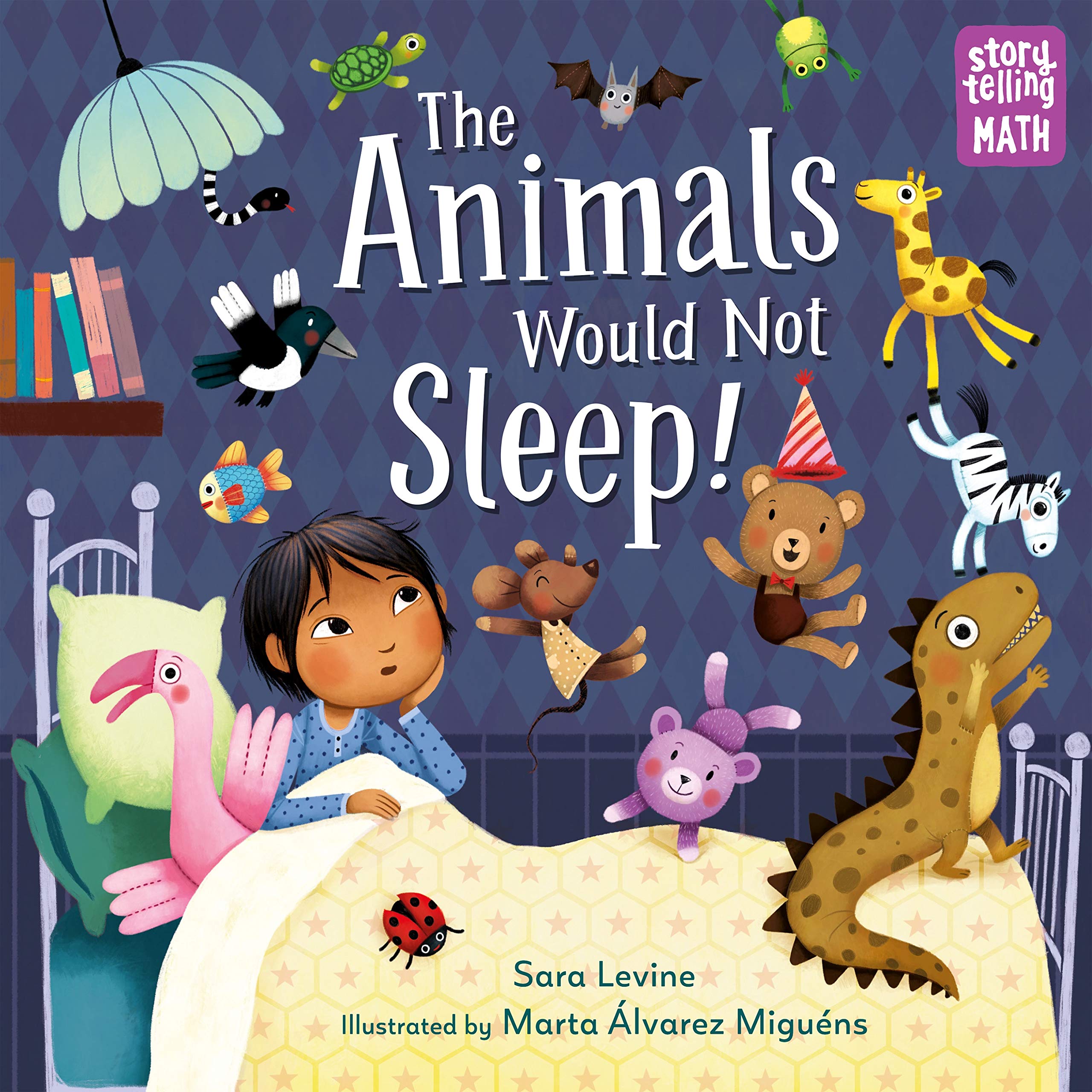
The Animals Would Not Sleep!

Written by Sara Levine | Illustrated by Marta Álvarez Miguéns


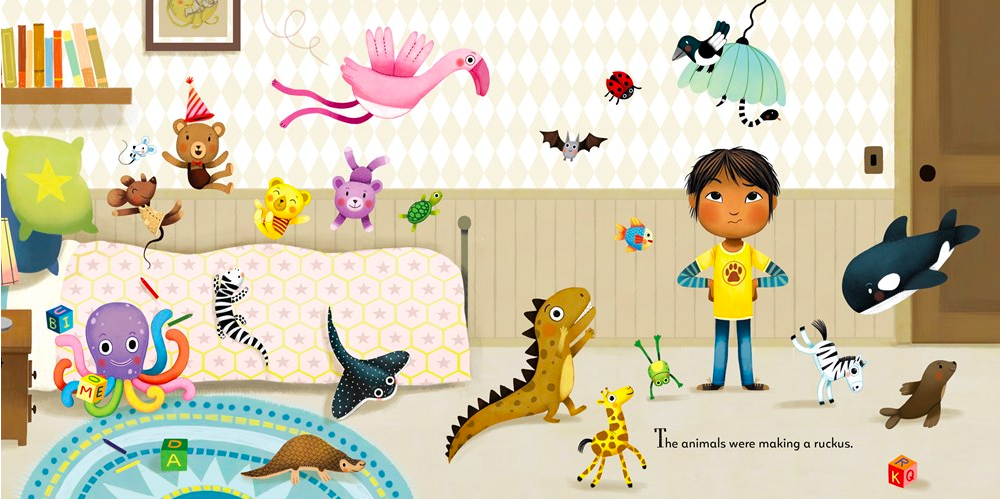
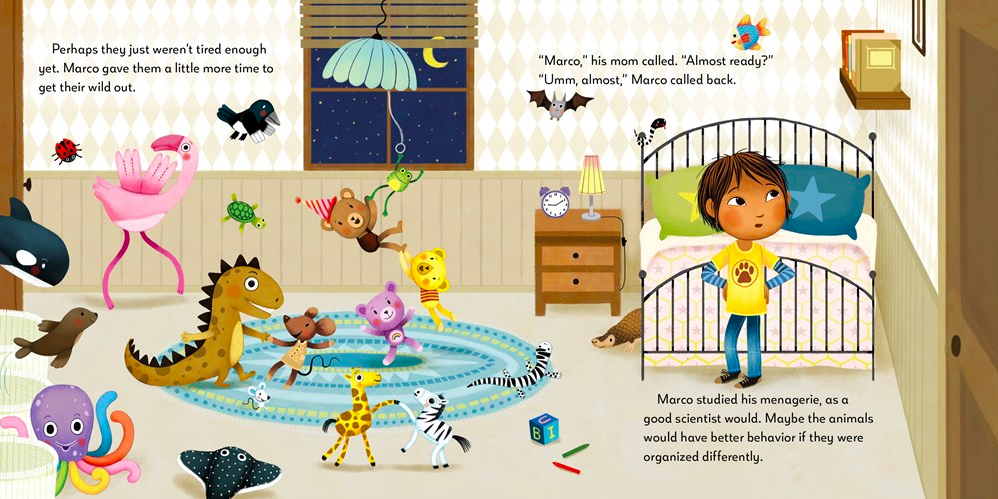
All of Marco’s stuffed “animals were making a ruckus” when his mom told him it was time to get cleaned up and ready for bed. She wanted to see all the toys put away, so Marco, who thought like a scientist, got to work. He wanted to sort his animals like a scientist would, so he got out three baskets and made signs for Flying Animals, Swimming Animals, and Animals That Move on Land. Then he picked up his dancing flamingo, bird, bat, and ladybug and put them in the first basket. He placed his octopus, stingray, frog, fish, whale, and seal in the second basket, and his dinosaur, giraffe, bears, snake, pangolin, gecko, mice, and zebra in the third basket.

But the animals were still wide awake, and “they egged one another on until not one remained in its container.” Marco thought they would settle down, but when his mom called the second time, he reconsidered his strategy. This time he made signs that sorted the animals by color, but zebra started to cry. He was afraid being in such close quarters with snake and stingray, plus he missed his friend giraffe.

celebrate-picture-books-picture-book-review-the-animals-would-not-sleep-ruckus

Image copyright Marta Álvarez Miguéns, 2020, text copyright Sara Levine, 2020. Courtesy of Charlesbridge.

Marco decided to try again. He took all of his animals out and made signs that read Small, Medium, and Large. Things seemed quiet and Marco began to put on his pajamas. But then he heard some kind of moaning or groaning coming from the Large basket. When he went to check, Dinosaur and Dancing Flamingo complained about being too cramped. Plus, Dancing Flamingo missed Rainbow Bear. Then he heard noises from the Small basket. Those animals weren’t happy either.

Marco’s mom gave him two minutes to get it all sorted out. Fortunately for Marco, “being a scientist, he was used to coming up with ideas and thinking outside the box.” The animals were getting tired and Yellow Bear had just burst into tears for no apparent reason. Like a good scientist, Marco cared about his animals and wanted them to be happy. He had one more sorting idea. With the large animals, medium-sized animals, and small animals all tucked in with plenty of room, friends nearby, and cozy warmth on Marco’s bed, Marco got under the covers and got a goodnight kiss from Mom. Then they all fell happily to sleep.

Back matter includes an illustrated Author’s Note about the way scientists sort, or classify, animals by characteristics and a discussion that explores the math in the story as well as Try This! tips for adults to engage children in sorting by Karen Economopoulos, co-director of the Investigations Center for Curriculum and Professional Development at TERC.

celebrate-picture-books-picture-book-review-the-animals-would-not-sleep-marco

Image copyright Marta Álvarez Miguéns, 2020, text copyright Sara Levine, 2020. Courtesy of Charlesbridge.

Perfectly capturing the way young children interact with their toys, Sara Levine combines imagination and scientific thinking in her inventive story, part of the Storytelling Math series from Charlesbridge. In Marco, who’s proud of his scientific thinking, Levine shows readers that they too already have this ability. Marco’s empathy for his animals’ when they are unhappy will engage children in thinking, along with Marco, about classification and the various ways the animals can be sorted, getting them excited about how math is used every day. Levine’s use of realistic dialogue that echoes bedtime routines in many homes and gives each character—human and animal—distinct personalities will draw kids in to this charming story that is organically infused with strong math lessons. Levine gives Marco a sweet final solution to his problem that will please kids and have them wanting to think like a scientist too.

Marta Álvarez Miguéns opens the story with an enchantingly wild two-page spread of Marco standing in the middle of his room as his toys bounce on the bed, climb blocks, juggle, fly, and cause a ruckus. Turn the page and, as Mom peeks into the room, these animals now lie motionless around the room. When Marco sorts his animals into the baskets, readers can clearly see which animals go where and why. Kids will knowingly giggle when the just-sorted animals spring from their resting places to prolong bedtime. Miguéns also plainly depicts Marco’s and the animals’ facial expressions from happy and playful to sad and crying to peaceful and satisfied. These images give adults and children an opportunity to discuss emotions and how to recognize various clues in faces, a skill important for social-emotional learning. Vivid colors, adorable animals, details such as alphabet blocks that stack or are turned to spell words, and kid-appealing décor will have kids wanting to come back again and again.

A book that’s sure to become a favorite at bedtime or to enhance classroom or homeschooling curriculum, The Animals Would Not Sleep! will spark mathematical and scientific thinking and recognition in all young learners. The book offers an irresistible invitation to experiment and interact with math and science and is a must for home, school, and public library collections.

Ages 3 – 6

Charlesbridge, 2020 | ISBN 978-1623541286 (Hardcover) | ISBN 978-1623541972 (Paperback) 

Discover more about Sara Levine and her books on her website.

To learn more about Marta Álvarez Miguéns, her books, and her art, visit her website.

About Storytelling Math

Storytelling Math offers books that celebrate children using math in their daily lives as they play, build, collaborate, compromise, and discover the world around them. Each story features characters of color who are empowered to solve problems, enjoy activities, and help out using their knowledge of and experimenting with math. Free downloadable hands-on activity kits are available for each book on the Charlesbridge website. Sharing these joyful stories with your littlest ones and older kids will make them eager to explore, use, and learn more about math every day. You can learn more about Storytelling Math on the Charlesbridge website

Storytelling Math: Math, Diversity, and the Power of Story was developed with Marlene Kliman at TERC—a nonprofit dedicated to STEM education—under a grant from the Heising-Simons Foundation.

Enjoy this The Animals Would Not Sleep! trailer with Author Sara Levine!

National Book Month Activity

celebrate-picture-books-picture-book-review-the-animals-would-not-sleep-activity-logo

The Animals Would Not Sleep! Activity Kit


You can have fun sorting and exploring math with your class or family with the Activity Kit for The Animals Would Not Sleep on the Charlesbridge website. Download it here!

The Animals Would Not Sleep Activity Kit

celebrate-picture-books-picture-book-review-the-animals-would-not-sleep-cover

You can find The Animals Would Not Sleep! at these booksellers

Amazon | Barnes & Noble | Books-a-Million

To support your local independent bookstore, order from

Bookshop | IndieBound

Picture Book Review

October 21 – It’s Squirrel Awareness Month

celebrate-picture-books-picture-book-review-girl-versus-squirrel-cover

About the Holiday

Squirrels elicit emotions on both sides of the spectrum. On one hand you can’t help but say “Awww!” when you see their tiny little paws and crafty antics. On the other hand their voracious appetites at bird feeders and penchant for darting into traffic is more likely to make you say “Arrgghhh!” This month is set aside, however, for enjoying the squirrels in your yard, park, or city. And really, don’t they make life just a little more fun?

Girl Versus Squirrel

Written by Hayley Barrett | Illustrated by Renée Andriani


Pearl built three birdhouses and put them in and near the tree in her backyard. One was shaped like a house, one was a tube, and the other was a tea cup atop a tall stand. After filling the house with suet, the tube with seeds, and the teacup with peanuts, Pearl settled in with her binoculars to wait. Soon cardinals, flickers, finches, and chickadees swooped in. But none of them wet for the peanuts.

celebrate-picture-books-picture-book-review-girl-versus-squirrel-bird-feeders

Image copyright Renée Andriani, 2020, text copyright Hayley Barrett, 2020. Courtesy of Margaret Ferguson Books, Holiday House.

Happily sitting next to the teacup was a squirrel with a peanut in its paws. Pearl scared the squirrel away and then went to work to win this contest of wits. She used her hockey stick to raise the teacup’s stand higher and “watched, breathless with anticipated success, but was soon disappointed” as the squirrel easily climbed to the top. Pearl added a mop to make the pole even higher.

But still the squirrel had no trouble getting to the top. “The squirrel stared at Pearl and seized an especially plump peanut.” Just then the “pole began to teeter and totter until…It toppled to the ground,” breaking the handle off the teacup. As the squirrel dashed up a nearby oak tree, Pearl shouted, “‘You’re a bird-feeder-crashing, teacup-smashing, peanut-poaching pest!’” A pest Pearl was not about to lose out to.

celebrate-picture-books-picture-book-review-girl-versus-squirrel-bird-garage

Image copyright Renée Andriani, 2020, text copyright Hayley Barrett, 2020. Courtesy of Margaret Ferguson Books, Holiday House.

While Pearl fixed her teacup, she devised a plan. She gathered supplies and started creating. Soon, a “network of obstacles emerged, each more squirrel-challenging than the last.” The squirrel may have been fast and determined, but the course ensured that “teacup triumph will require nerves of squirrely steel,” Pearl fixed her binoculars on the squirrel and waited.

It didn’t take long before the squirrel was headed in the right direction. He scampered over the rope, spun around the big spool, leaped to the swing, and scrambled through the rest of the course. Until… “CRUNCH!” Pearl was astounded. Then she saw the squirrel head for a nest in the oak tree with three baby kits in it. That’s when Pearl realized the squirrel was a mother. “‘I proclaim your victory,’ cheered Pearl, ‘ and I salute you, fearless, fluffy sister!’” Immediately, Pearl wanted to help this family grow and learn. Now her backyard is a birds’… and squirrels’… and contraption-lovers’ paradise.

“Some Squirrely Facts” about our favorite nature nemesis follows the story.

celebrate-picture-books-picture-book-review-girl-versus-squirrel-obstacle-course

Image copyright Renée Andriani, 2020, text copyright Hayley Barrett, 2020. Courtesy of Margaret Ferguson Books, Holiday House.

For anyone who has done battle with a squirrel at their birdfeeder, Hayley Barrett’s story is a delight. Her nimble alliterative phrasing and fun-to-read action verbs will make any story time a joy. Add in Pearl’s can-do attitude and the squirrel’s unstoppable energy and you have the makings of an epic battle—one that readers are sure to want to replicate in their own yards. Barrett nails the experimental nature of children’s building projects, a detail that kids will appreciate and that will endear Pearl to them.  Barrett’s nod to girl power provides a strong, uplifting ending. Factual information about birds, bird food and squirrel behavior is interwoven organically throughout the story. That and the fascinating back matter make this a terrific book to pair with classroom lessons.

Renée Andriani’s vibrant, action-packed illustrations will wow kids and have them on the edge of their seats for each page turn. Realistic depictions of the cardinals, finches, chickadees, and flickers that swarm Pearl’s bird feeders will entice readers to learn more about these birds. When Pearl raises her teacup feeder higher and higher, Andriani presents clear images of how Pearl tapes the stand, stick, and mop together as well as the crashing result when the squirrel hops on. As Pearl gathers items from her garage and begins building her obstacle course, readers will be in suspense, waiting to see the final result.

Presented in a wild, two-page spread, Andriani’s portrayal of Pearl’s obstacle course rewards readers with bold, expressive typography and images of the squirrel making her way from station to station with style. The final two-page spread of Pearl’s backyard, is a riot of color as feeders, birds, and mama and baby squirrels nosh to their hearts’ content. Kids will want to linger to catch every detail.

Imaginative, humorous, and educational, Girl Versus Squirrel will become a favorite and will inspire kids to create their own obstacle course. The book would also be a high-interest accompaniment to STEM lessons in the classroom and at home. It would make a terrific addition to home, school, and public library collections.

Ages 4 – 8

Margaret Ferguson Books, Holiday House, 2020 | ISBN 978-0823442515

Discover more about Hayley Barrett and her books on her website.

To learn more about Renée Andriani, her books, and her art, visit her website.

Squirrel Awareness Month Activity

celebrate-picture-books-picture-book-review-squirrel-community-coloring-page

Squirrely Activity Pages


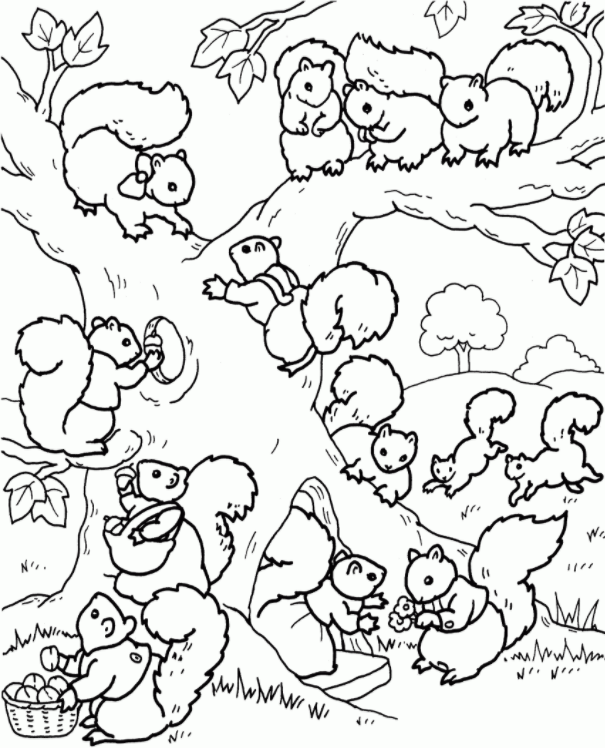
You can join a girl who’s watching squirrels, find a whole squirrel community to color, see a squirrel enjoying a snack, and follow the numbers to discover… with these printable Squirrely Activity Pages

Girl Watching Squirrel Coloring Page | Squirrel Community Coloring PageDot-to-Dot Coloring Page | Squirrel with Nut Coloring Page

celebrate-picture-books-picture-book-review-girl-versus-squirrel-cover

You can find Girl Versus Squirrel at these booksellers

Amazon | Barnes & Noble | Books-a-Million

To support your local independent bookstore, order from

Bookshop | IndieBound

Picture Book Review
 

October 14 – National Fossil Day

celebrate-picture-books-picture-book-review-when-sue-found-sue-cover

About the Holiday

Welcome to the 11th anniversary of National Fossil Day! Today’s holiday puts a spotlight on paleontology and its value in the scientific community and for education. The day raises awareness of the importance of preserving fossils for future generations. To celebrate today and Earth Science Week all this week, learn more about the prehistory of your area, or read up on fossils and prehistoric creatures. Visit the National Park Service Website to learn more about today’s holiday and find many resources for classrooms, homeschooling, and family fun. There you’ll find to download a Junior Paleontology Activity Book that can help kids explore the ways paleontologists work and learn about Earth’s history, ancient plants and animals as well as changes to past climate and environments. You’ll also find 20 ideas for digging into paleontology with links to museums and national parks, a site where you can view fossils in 3D, coloring pages, and even learn your state’s fossil.

Thanks to Abrams Books for Young Readers for sending me a copy of When Sue Found Sue for review consideration. All opinions about the book are my own.

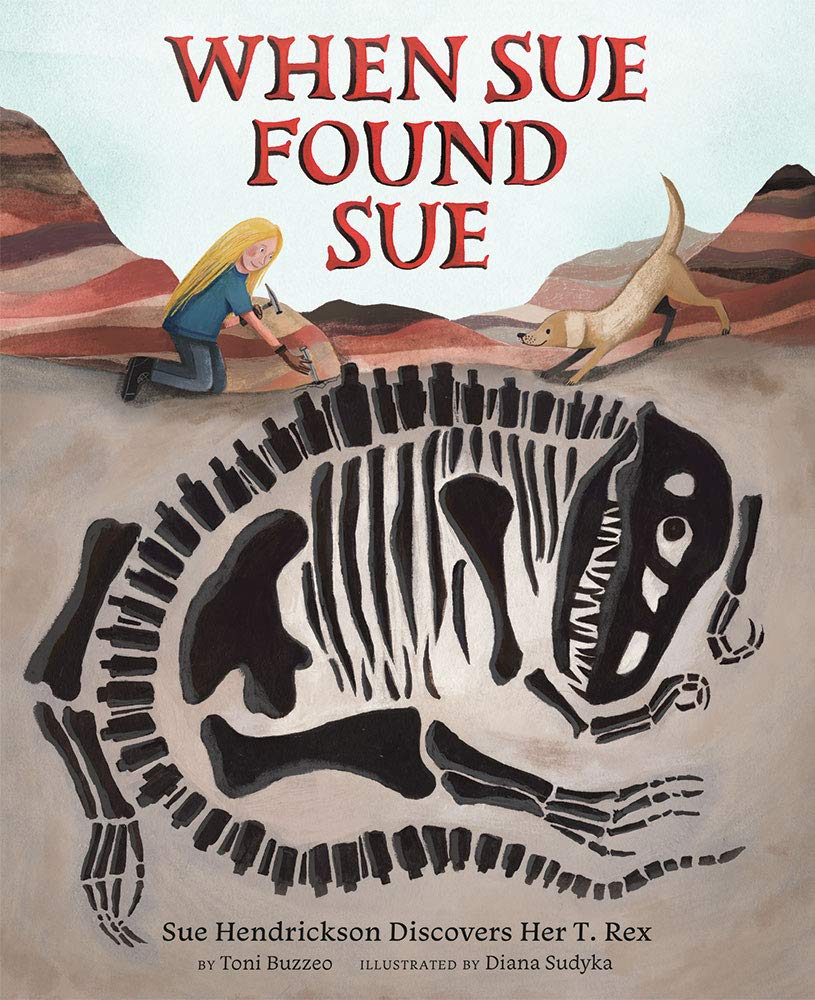
When Sue Found Sue: Sue Hendrickson Discovers Her T. Rex

Written by Toni Buzzeo | Illustrated by Diana Sudyka


Sue Hendrickson was an expert at finding things. The lure of buried or lost treasures kept her busy in her hometown of Munster, Indiana. “Born shy and incredibly smart,” Sue devoured books, discovering everything she could about the things that interested her. One of her favorite places was the Field Museum of Natural History in Chicago. There, she reveled in the treasures others had found and dreamed of the day when she could “search the wide world for hidden treasure on her own.”

celebrate-picture-books-picture-book-review-when-sue-found-sue-collection

Image copyright Diana Sudyka, 2019, text copyright Toni Buzzeo, 2019. Courtesy of Abrams Books for Young Readers.

When she was seventeen, Sue began her life of treasure hunting, joining teams that searched for sunken boats, airplanes, and even cars. She went to Dominican amber mines looking for prehistoric butterflies and deserts of Peru searching for whale fossils. Finally, she headed to South Dakota to dig for dinosaurs.

She spent four summers unearthing duck-billed dinosaurs, using more and more delicate tools to expose the bones. But near the end of her fourth summer, “Sue Hendrickson felt pulled to a sandstone cliff far off in the distance.” When she had the opportunity, she took her golden retriever and hiked the seven miles to the rock.

celebrate-picture-books-picture-book-review-when-sue-found-sue-alley

Image copyright Diana Sudyka, 2019, text copyright Toni Buzzeo, 2019. Courtesy of Abrams Books for Young Readers.

Walking around the perimeter, she noticed what looked like bones lying on the ground. When she looked up, she was astonished to see “three enormous backbones protruding from the cliff.” The size told her they must be from a Tyrannosaurus rex. Sue hurried back to her campsite and told her team the exciting news. They “immediately named the dinosaur Sue the T. rex.”

celebrate-picture-books-picture-book-review-when-sue-found-sue-ocean

Image copyright Diana Sudyka, 2019, text copyright Toni Buzzeo, 2019. Courtesy of Abrams Books for Young Readers.

It took five full days for the team to expose the skeleton. Then they mapped the location of each bone, photographing and drawing them. At last they began removing them, and after three weeks the bones were trucked to the Black Hills Institute. Eventually, Sue the T. rex was moved to the Field Museum in Chicago. If you visit the museum today, you will see Sue towering over you. “She is the world’s largest, most complete, best-preserved Tyrannosaurus rex fossil discovered so far”—discovered by a woman who was born to find things.

An Author’s Note about Sue Hendrickson and the battle over the T. rex skeleton as well as resources for further study and a photograph of Sue the T. rex follow the text.

celebrate-picture-books-picture-book-review-when-sue-found-sue-excavating

Image copyright Diana Sudyka, 2019, text copyright Toni Buzzeo, 2019. Courtesy of Abrams Books for Young Readers.

Toni Buzzeo’s inspiring story of how Sue Hendrickson discovered the most complete and best-preserved T. rex fossil delves into more than the finding and excavating of the skeleton. Buzzeo also emphasizes Hendrickson’s personality and long-held love of treasure hunting, qualities that informed and aided her career choice. Readers who also harbor dreams outside the mainstream and have a steady focus will find much to admire in Buzzeo’s storytelling and Sue’s example. Kids will be awed by Sue’s early treasure-hunting exploits and fascinated by the painstaking process of unearthing fossils. When Sue follows her intuition to the cliff—without explanation or facts—readers will be reminded that they can rely on their own curiosity, experience, and ideas to carry them forward. With nods toward the value of teamwork and sprinkled with Sue’s own words about her moment of discovery, the story exposes the bones of a life well-lived and points children in the right direction.

Screen Shot 2019-05-14 at 4.33.48 PM

Diana Sudyka opens the story of Sue Hendrickson with a lovely collage of the treasures she found and studied as a child and that led to her life-long love of discovery. As Sue grows, she visits the Field Museum, with its exhibits of a Triceratops and Hadrosaurus. Fast-forward several years and she’s swimming in a sea dotted with colorful coral toward an old sunken ship. But the centerpiece of the story takes place in the South Dakota hills, the layers of rock painted in stripes of earthy brown, rust, rose, and ivory. As the team works late nights to excavate the bones, a T. rex constellation appears above the team in the starry sky, urging them on. A two-page spread of how Sue the T. rex fossil appeared in its entirety in the ground is sure to elicit plenty of “Wows!,” and a rendition of Sue on exhibit in the Field Museum will no doubt inspire some travel wishes.

A book about a modern-day scientist that will engage and inspire children with scientific aspirations of their own as well as a celebration of individuality and big dreams and a must for dinosaur lovers, When Sue Found Sue would be a T. riffic addition to home, school, and public library collections.

Ages 4 – 8

Abrams Books for Young Readers, 2019 | ISBN 978-1419731631

Discover more about Toni Buzzeo and her books on her website.

To learn more about Diana Sudyka, her books, and her art, visit her website.

National Dinosaur Day Activity

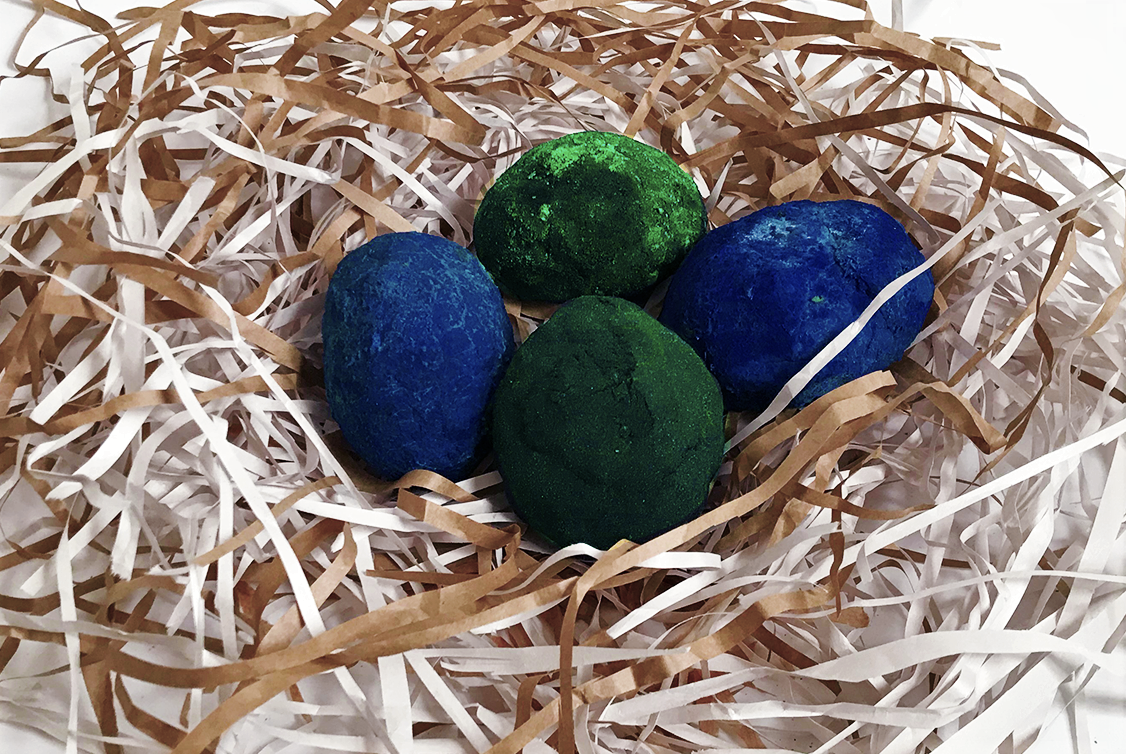
celebrate-picture-books-picture-book-review-dinosaur-eggs-craft-nest

Hatch Your Own Dinosaur Eggs


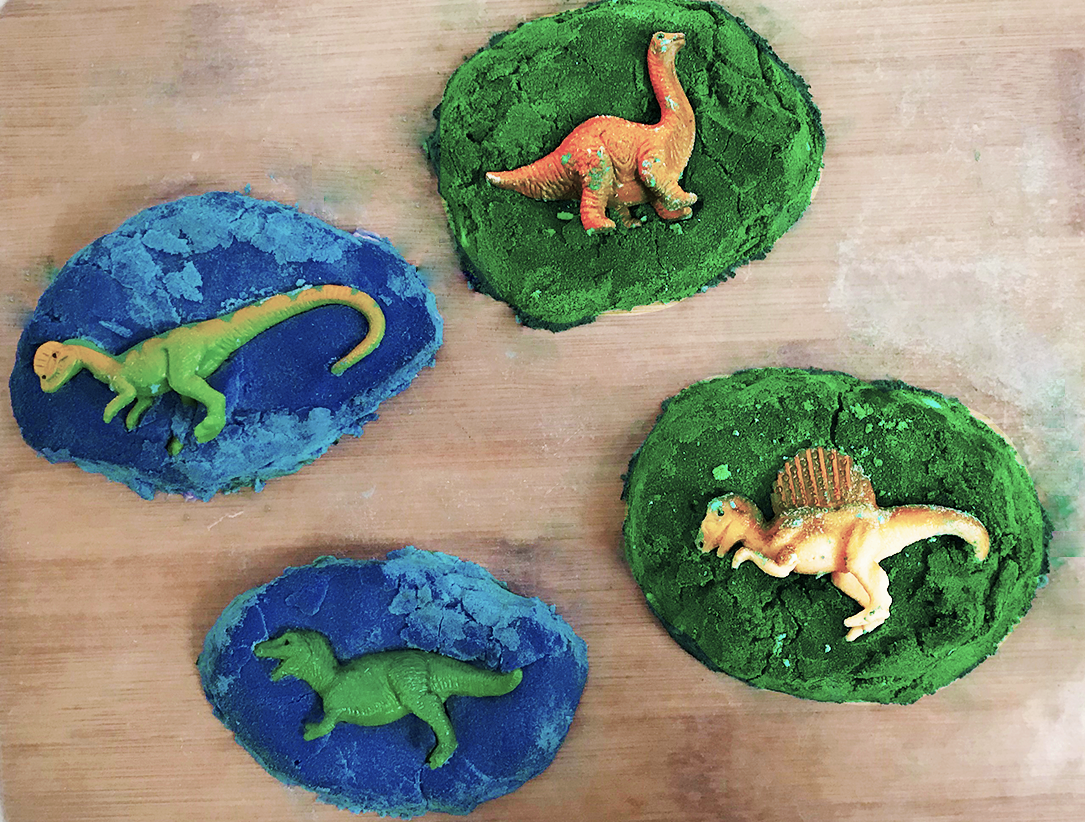
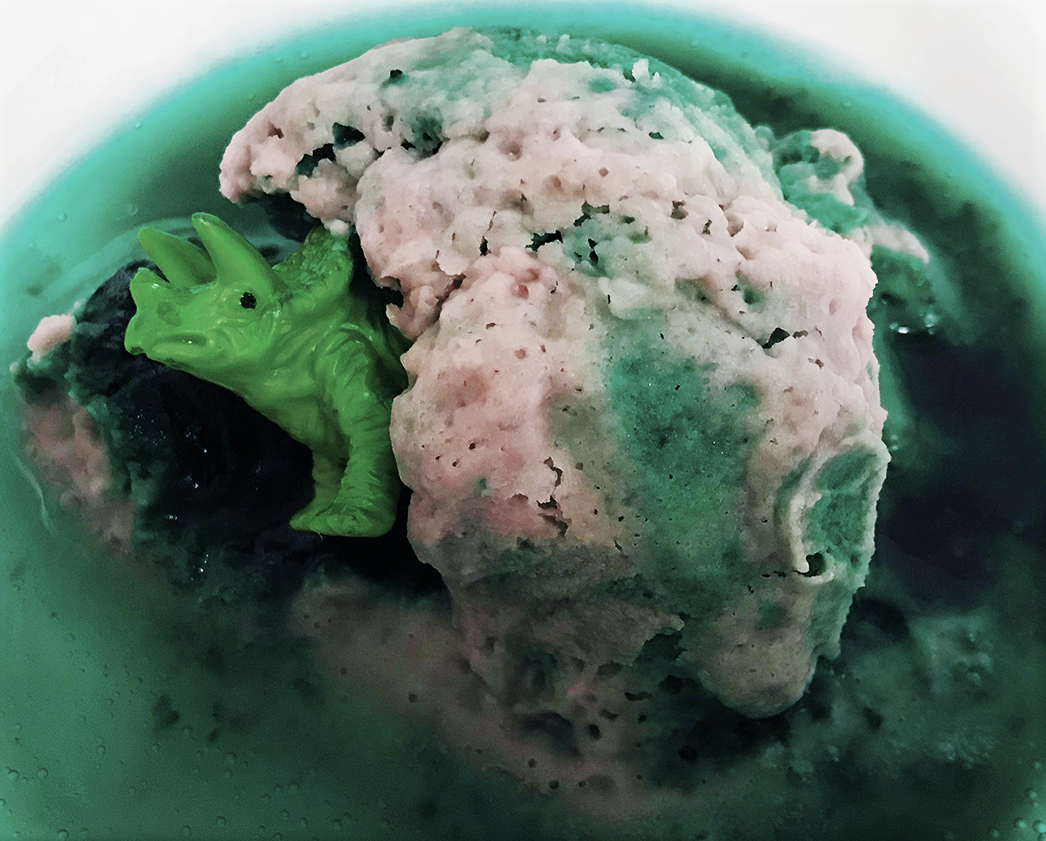
Think there are no more dinosaur eggs to be found? Think again! You can make your own with this easy craft that will have you hatching some T.-rex-size fun! All you need are a few simple ingredients!

celebrate-picture-books-picture-book-review-dinosaur-eggs-craft-open-eggs

Supplies

  • Old clothes or apron
  • Large box of baking soda (makes between 6 and 8 eggs)
  • Food coloring
  • Water
  • Plastic dinosaur toys
  • Bowl
  • Fork
  • Spoon
  • Wax paper
  • Baking sheet
  • Foil
  • Vinegar
  • Spray bottle (optional)
  • Plastic or metal spoon, stick, popsicle stick, or other implement to chisel with
celebrate-picture-books-picture-book-review-dinosaur-eggs-craft-vinegar-egg-open-darker

Spray the egg with vinegar to hatch your dinosaur

Directions

  1. Wear old clothes or an apron
  2. Cover work surface with wax paper, parchment paper, newspaper, or other protection. Food coloring can stain some surfaces
  3. Pour baking soda into the bowl
  4. Add drops of food coloring in whatever color you’d like your eggs to be. The eggs will darken when baked.
  5. Mix in the food coloring with the fork. You may want to use your hands, too
  6. When the baking soda is the color you want it, begin adding water a little at a time
  7. Add water until the baking soda holds together when you squeeze it in your hand
  8. When the baking soda is the right consistency, spoon some out into your hand or onto wax paper
  9. Push one plastic dinosaur into the middle
  10. Cover the dinosaur with more of the baking soda mixture
  11. Carefully form it into an egg shape
  12. Repeat with other dinosaurs
celebrate-picture-books-picture-book-review-dinosaur-eggs-craft-chiseled -darker

Chisel the egg open to hatch your dinosaur

To Bake the Eggs

  1. Set the oven or toaster oven to 200 to 225 degrees
  2. Set the eggs on a baking sheet lined with foil
  3. Bake the eggs for 15 minutes, check
  4. Turn the eggs over and bake for 10 to 15 more minutes
  5. Remove from oven and let cool

To Hatch the Eggs

  1. Eggs can be hatched by chiseling them with a spoon, stick, or other implement
  2. Eggs can also be hatched by spraying or sprinkling them with vinegar

celebrate-picture-books-picture-book-review-when-sue-found-sue-cover

You can find When Sue Found Sue: Sue Hendrickson Discovers Her T. Rex at these booksellers

Amazon | Barnes & Noble | Books-a-Million

To support your local independent bookstore, order from

Bookshop | IndieBound

Picture Book Review
October 12 – National Farmers Day

celebrate-picture-books-picture-book-review-the-farm-that-feeds-us-cover

About the Holiday

National Farmers Day events have taken place across the country since the 1800s, and these days events are held on different dates in different towns throughout the fall. The holiday celebrates the hardworking farmers who grow and raise the food that fills our grocery stores, farm markets, and tables. Beyond food, farmers contribute to our economy across industries.

Thanks to Quarto Knows for sending me a copy of The Farm That Feeds Us for review consideration. I used a digital copy of The Kitchen Pantry Scientist: Chemistry for Kids for my review. All opinions on the books are my own.

Introducing Quarto Classroom

celebrate-picture-books-picture-book-review-Quarto-Classroom-Logo

New this year, Quarto Classroom is a free video library on YouTube of expert authors using their books to teach everything from math to arts & crafts to social emotional learning. There are videos and activity sheets for every age, which can be used as supplements to your normal school curriculum—plus, you to get to know some pretty cool authors! Perfect to enhance virtual schooling and homeschooling, the videos and materials are exciting ways to engage your kids in hands-on learning. Today, I’m reviewing two books that approach science in different ways. The first covers the science of organic farming, and the second gets kids involved in chemistry experiments in their own kitchen. You can find all the available videos on various topics at Quarto Classroom.

The Farm That Feeds Us: A Year in the Life of an Organic Farm

Written by Nancy Castaldo | Illustrated by Ginnie Hsu


This encyclopedic beauty takes readers to an organic family farm, where they spend a year learning about various types of farms and then get a close-up look at the activities and transformations that take place from season to season. In Spring, the farmer is up before the birds to feed the animals and mild the cows and goats. The chicken coop is busy as the kids feed the chickens and rooster and collect eggs. Some chickens are “broody” today—sitting on their eggs until they hatch. What kind of chickens are there? This coop is home to Hamburg, Rhode Island Red, Ameraucana, Brahma, Plymouth Rock, and Leghorn, which can lay “around 280–300 eggs per year.”

Out in the orchard among the apple, cherry, pear, and plum trees, the bee hives are being checked. In the fields, the farmer is tilling the soil to plant lettuce, carrots, beans, radishes, beets, and peas. You can see many kinds of equipment and machinery farmers use here. Some crops love the cool weather of early spring, so workers are already harvesting the peas, lettuces and greens, asparagus, and radishes. Then it’s off to the farm market to sell the food to eager customers.

celebrate-picture-books-picture-book-review-the-farm-that-feeds-us-chicken-coop

Image copyright Ginnie Hsu, 2020, text copyright Nancy Castaldo, 2020. Courtesy of Words & Pictures, Quarto Knows.

With temperatures getting warmer, it’s time to sheer the sheep. Lambs are born now too. You can see and learn about six breeds of sheep that are found around the world. Summer brings thousands of strawberries, raspberries, and cherries in the farm’s pick-your-own fields. Summer also means corn, which comes in many colors and is used for different purposes, from feeding people and livestock to making fuel. “Some varieties of corn have hears filled with kernels that look like multi-colored gems. Come take a look!

Twice a day the cows are milked. “On some industrial farms, cows are kept in pens and are bred to produce unnaturally high volumes of milk. On this organic, family farm, the cows are free to roam around” pesticide-free fields. Without antibiotics or hormones to increase milk production, their milk is “healthier for people to drink.” You can learn about five distinct breeds of cows here too.

It’s been an exciting time for the farmers! This weekend was the county fair, where “farmers come from all over the county to show off their produce and livestock.” Come take a look at all the exhibits! Then a local chef visits, eager to learn about the fresh produce and heirloom varieties available. “Squash blossoms, tomatoes, and radishes are picked and packed for the chef to take back to the kitchen for tonight’s menu.” You can also learn about food distribution and why eating local is healthier and more delicious.

celebrate-picture-books-picture-book-review-the-farm-that-feeds-us-chicken-farm-machinery

Image copyright Ginnie Hsu, 2020, text copyright Nancy Castaldo, 2020. Courtesy of Words & Pictures, Quarto Knows.

While large farms often use manmade pesticides to thwart insects and other pests, “organic farms use many different methods, including crop rotation, crop isolation, and growing other plants nearby that ward off pests.” Take a look at how these methods work.

Autumn brings pumpkins—in so many varieties! Orange, white, and green; warty, smooth, and tiny, each pumpkin has its own use and flavor. In the farmhouse kitchen, freshly picked fruit and vegetables are becoming jams, pies, sauces, and chutneys. In preparation for winter, the fields must be “put to sleep to keep the soil healthy for the spring plantings. Discover how important cover crops, mowing, and even fall grazing by the animals is to the farm’s health.

While no crops are growing during the winter, that doesn’t mean things slow down on the farm. Now is the time when repairs and cleaning are done, the apple trees are pruned, and logs are split for the woodstove. The bee hives are also wrapped to keep them warm. As the snow falls, the family feeds the animals in the barn and then gathers around and chooses the seeds they want to plant in the spring.

A bread recipe, a discussion on how we can make a difference to ensure a variety of healthy food remains available, and a glossary of words used in the book close out the text.

celebrate-picture-books-picture-book-review-the-farm-that-feeds-us-contents

Nancy Castaldo’s gorgeous and informative book, written in a lyrical, conversational style and full of fascinating details about the life of a farm and its crops and animals will entice readers to learn more about their local farms, the food grown there, and shopping at farmers markets.

Ginnie Hsu’s bright and homey illustrations will enchant readers of all ages as they discover realistic depictions of farm equipment, planting methods, crops, animals, and the beauty and intricacies of a small farm. Two-page spreads allow for detailed and panoramic views of the always-changing scenery and activities that make a farm such an exciting and intriguing place.

Whether you’re a teacher, homeschooler, or gardener; love farms; or are a proponent of an organic lifestyle, The Farm That Feeds Us would be an excellent accompaniment to science, social studies, and environmental lessons. The book offers untold opportunities to spark further research into the topics presented and ideas for classroom or home gardens. It is highly recommended for home bookshelves and is a must for school and public libraries.

Ages 7 – 11

Words & Pictures, Quarto Knows, 2020 | ISBN 978-0711242531

Discover more about Nancy Castaldo and her books on her website

To learn more about Ginnie Hsu and view a portfolio of her art, visit her website.

celebrate-picture-books-picture-book-review-the-farm-that-feeds-us-cover

You can find The Farm That Feeds Us at these booksellers

Amazon | Barnes & Noble | Books-a-Million

To support your local independent bookstore, order from 

Bookshop | IndieBound

The Farm That Feeds Us Quarto Classroom Video

You can visit with Nancy Castaldo as she reads from her book and talks about food from her local farms as well as about food you may find in your own pantry, clothing hanging in your closet, and other items in your house and the farms where they came from. Nancy invites kids to go on a scavenger hunt in their classroom or home to discover how many things we eat and use come from farms. You can find her video and download a teachers’ guide on the Quarto Classroom website under Science.

celebrate-picture-books-picture-book-review-chemistry-for-kids-coverThe Kitchen Pantry Scientist: Chemistry for Kids 

By Liz Lee Heinecke | Illustrated by Kelly Anne Dalton | Photography by Amber Procaccini Photography


Replicating the experiments of twenty-five of the world’s most influential scientists from 1200 BCE to 1975 will give children and young people an appreciation for the long history and vast influence of chemistry since the beginning of time. Along with each experiment, readers learn about the scientists, background on their work, and “where you can still find it used or reflected in today’s world.”

celebrate-picture-books-picture-book-review-chemistry-for-kids-dmitri-mendeleev

Image copyright Kelly Anne Dalton, 2020, text copyright Liz Lee Heinecke, 2020. Courtesy of Quarry Books, Quarto Knows.

First up is Tapputi-Belatikallim—a woman and the first recorded chemist, who lived in ancient Mesopotamia over 3200 years ago. Her position within the royal household was that of fragrance preparer, an important role as scents were “believed to transcend the physical world to reach their gods, who would be pleased by their sacrifice.” Her recipe “includes the first description of a distillation apparatus ever recorded and a number of her methods are still used today….” With a slow cooker or pot, fresh or dried lemon, herbs, or flowers, and other common kitchen tools, readers can create their own fragrance. Clear photographs show budding chemists the steps to success.

What would carbonated-drink fans do without their sparkling bubbles? Fortunately, because of Joseph Priestley’s work in 1767, they’ll never need to know. With baking soda and vinegar, young scientists can go beyond the volcano and create their own carbonated water. They’ll also learn more about this man who was ahead of his time in many ways. Don’t put the vinegar away too soon! With the next experiment, kids can turn a pad of steel wool into a powdery rust with oxidation—just like Antoine Lavoisier.

celebrate-picture-books-picture-book-review-chemistry-for-kids-periodic-table

Photographs copyright Amber Procaccini, copyright 2020, text copyright Liz Lee Heinecke, 2020. Courtesy of Quarry Books, Quarto Knows.

Can’t quite get your head around the periodic table? With this experiment you can make your own and really see what’s up with all of those protons and neutrons! Who came up with the periodic table? That would be Dmitri Mendeleev, who legend has it dreamed up the format in…well…a dream. Can washing dishes ever be more than a chore? For Agnes Pockels, born in 1862, it led to a revelation about surface tension and how various soaps and other materials could disturb it. Get out a plate, some water, milk, food coloring, oil, and other ingredients and get to work!

How do you smell? I mean…how well can you smell? In 1991 Dr. Linda Buck discovered “a group of genes that no one had ever seen before. These genes coded for a group of 350 smell receptors that work in combination to detect thousands of different odors. “In 2004 Linda and her colleague Richard Axel won the Noble Prize in Physiology or Medicine for their discoveries of odorant receptors….” With the experiment here, you and your family can discover how sensitive your nose is by blind-testing a variety of objects.

celebrate-picture-books-picture-book-review-chemistry-for-kids-margaret-cairns-etter

Image copyright Kelly Anne Dalton, 2020, text copyright Liz Lee Heinecke, 2020. Courtesy of Quarry Books, Quarto Knows.

The next time your teacher, mom, or dad sees you using your phone in class, it might be because you’re doing Raychelle Burks’ colorimetric sensors experiment. With an app you can turn your phone into a spectrometer to test RGB ratings for a series of diluted liquids. Burks’ current research is focused on designing “sensing systems that can identify chemical clues tied to crime.” Who knows—you may find yourself working as a CSI after getting hooked by the science behind this fascinating experiment.

Along the way, young scientists can make soap, create chemical batteries, work with synthetic dyes, make lava lamps to test temperature and chemical reactions, do elemental extraction, discover the pH scale, learn about chromatography, extract organic oils, make crystals, extract medicinal compounds from aloe, and take part in many more educational and fun experiments. A glossary, the periodic table, and a list of resources and references follows the text.

celebrate-picture-books-picture-book-review-chemistry-for-kids-crystallography

Photographs copyright Amber Procaccini, copyright 2020, text copyright Liz Lee Heinecke, 2020. Courtesy of Quarry Books, Quarto Knows.

Prior to each experiment, readers learn about each chemist through Kitchen Pantry Scientist Liz Lee Heinecke’s lively biographies that spotlight stories from the scientist’s childhood, family life, education, early work, and influence on the world at large.

Kelly Anne Dalton’s engaging and vivid illustrated portraits of each chemist introduce each experiment and set the scientist in her or his time period.

A superb reference and resource for schools, homeschooling, today’s virtual schooling as well as for kids who just like to tinker (like many of the scientists highlighted), Chemistry for Kids would be a favorite go-to book for science lessons and free time and is highly recommended for home, school, and public library collections. The book would also make an excellent gift.

Ages 7 – 12

Quarry Books/QuartoKnows, 2020 | ISBN 978-1631598302

To learn more about Liz Lee Heinecke, her books, and her work, visit her website The Kitchen Pantry Scientist.

Discover more about Kelly Anne Dalton, her books, and her art on her website.

Chemistry for Kids Quarto Classroom Video

Liz Lee Heinecke invites you into her kitchen to talk about her book and hear the story of Agnus Pockles. Following the reading she takes kids step-by-step through Agnus’s experiment on surface tension, using milk and food coloring to explain how this phenomenon works. She then shows how detergents break surface tension with dramatic results. You can find Liz’s video and download a teachers’ guide at the Quarto Classroom website under Science.

celebrate-picture-books-picture-book-review-chemistry-for-kids-cover

You can find Chemistry for Kids at these booksellers

Amazon | Barnes & Noble | Books-a-Million

To support your local independent bookstore, order from

Bookshop | IndieBound

Picture Book Review
 

September 3 – It’s Read a New Book Month

celebrate-picture-books-picture-book-review-the-little-red-crane-cover

About the Holiday

Read a New Book Month is a fantastic time to scour your local bookstore and library for books that have recently been published or books that are new to you. Finding a book that you’ve never read before is exciting at any age, and discovering a new book about a favorite topic is one of life’s greatest pleasures. Today’s book is definitely one that will lift the spirits of all kids who love vehicles and good stories.

Thanks go to Star Bright Books for sending me a copy of The Little Red Crane for review consideration. All opinions about the book are my own. I’m happy to be teaming with Star Bright Books in a giveaway of the book. See details below.

The Little Red Crane

By Cornelius Van Wright


One day Dex, a little red crane, and his operator Pete received a letter from a place far away asking for help. The next day they set out to begin their long trip. On the way, Pete had to stop his truck to let their friend Larry the Loader Crane pass by. Larry was delivering steel beams to a construction site where a tall building was going up. He steadied himself with his outriggers so he didn’t tip over. Terry the Telescopic Crane was there too, helping to lift the beams into place. They both wondered if Dex would like to help. “No thanks,’ replied Dex. ‘I’m on my way to an incredibly important BIG job.’”

celebrate-picture-books-picture-book-review-the-little-red-crane-letter

Copyright Cornelius Van Wright, 2020, courtesy of Star Bright Books.

When Pete and Dex reached the docks, they met Sam the Ship-Building Crane. He was as tall as a skyscraper and straddled the new ocean liner he was helping to build. Dex would like to have accepted Sam’s invitation to watch, but they were due at Pier 11. When they got there, another giant, Sally the Ship-to-Shore Crane, was waiting to lift Dex and Pete and their truck onto the cargo ship that would take them across the ocean.
After sailing for a few days far out to sea, Dex heard the “sounds of offshore cranes at work” on a huge Oil Rig which was extracting “oil from under the seabed.” Coming close to land at last, the cargo ship passed under a bridge where Dex watched a Floating Crane installing a new section of concrete. Back on land and driving through the city, Dex marveled at the number of cranes he saw. “Giant Tower Cranes were busy helping to construct tall skyscrapers. Dex began to think someone had made a mistake in asking him to come to the city.
celebrate-picture-books-picture-book-review-the-little-red-crane-terry

Copyright Cornelius Van Wright, 2020, courtesy of Star Bright Books.

Finally, Pete and Dex arrived at a stately building. Dex felt tiny in the shadow of the mammoth marble columns that flanked the doorway. Inside, Pete used his remote control device to steer “Dex through narrow halls and doorways. Warning: Don’t try this, 18-Wheelers! They stopped in the center of a large room filled with crates. Ahhhhh! It felt good to “unfold and stretch his long legs.”

Carefully, Dex lifted piece after piece from the crates and lifted them into the air so that workers could put them together. Dex may have been little, but he was capable of lifting 2,000 pounds, which came in handy since he had just helped assemble the skeleton of a Tyrannosaurus Rex! Pete congratulated Dex on a job well done, and the museum visitors who streamed in to see the exhibit would agree.

An illustrated guide with fascinating facts about each crane, including alternate names for each, descriptions of how they work, and the amount of weight each can lift or carry, follows the story. 

celebrate-picture-books-picture-book-review-the-little-red-crane-oil-rig

Copyright Cornelius Van Wright, 2020, courtesy of Star Bright Books.

Little fans of big construction vehicles will be awestruck by Cornelius Van Wright’s story and vibrant illustrations. Van Wright understands young reader’s thirst for knowledge, and his straightforward descriptions of the work each type of crane performs are satisfying. The mystery of Dex’s very important job will pique kids’ interest, and the revelation that Dex, because of his small size, is the only kind of crane able to help assemble a dinosaur skeleton is empowering and will delight readers. The pages of back matter are sure to spark further research and learning.

Bold and bright, Van Wright’s illustrations depict realistic and detailed images of each type of crane while the natural formation of grills, headlights, and insignia create the slightly anthropomorphized faces that give each character its personality. In addition to the cranes, Van Wright includes construction materials and proportionate building and ships that allow children to visualize scale. Children will be fascinated by Van Wright’s gorgeous landscapes and seascapes as they learn that cranes work on land as well as on water. Images inside the museum will have kids guessing about the job Dex is about to do, and as he lifts bones and finally the T-rex skull from their crates, you can be sure there will be plenty of exclamations of “Wow!” and “Awesome!”

Sure to fascinate kids interested in vehicles and construction and to have them searching streets and skylines for the real thing, The Little Red Crane is also a unique book for sparking math and early physics extensions on size, scale, measurements, weight, and simple machines for young learners. The book would be a favorite go-to for home, school, and public library collections.

Ages 3 – 6

Star Bright Books, 2020 | ISBN 978-1595728432

To learn more about Cornelius Van Wright, his books, and his art, visit his website.

Follow Dex in this book trailer that’s loads of fun!

Read a New Book Month Activity

IMG_4264

Playful Pulleys


Exploring simple machines is fun for kids and a great way to learn about scientific concepts of physics and engineering. With this activity, children can experiment with the idea of pulleys by changing the number of lids the string wraps around, varying the thickness of the string they use, and trying heavy and lighter loads to discover what works and what doesn’t.

Supplies

  • Thick white board or cardboard
  • Plastic jar and bottle lids in various sizes (I used 8 lids)
  • String and/or cord (I used macramé cord). Kids can experiment with various materials, such as ribbon and different weights of string.
  • Binder clip (option: use a small pail or container)
  • Magnet (optional)
  • Small metal items to pick up
  • Hot glue gun or strong glue

Directions

  1. Attach lids to white board or cardboard in a scattered pattern with glue
  2. Cut a 7 or 8-foot length of string or cord
  3. Tie the binder clip to the string, attach the magnet to the bottom
  4. Wrap the string from lid to lid, allowing the two ends of the string to hang free
  5. Pulling the string should raise the binder clip; loosening the string should allow the clip to lower
  6. Put small metal items on the floor and lower the binder clip to pick them up
  7. Have fun experimenting with wrapping the string in various patterns around the lids

celebrate-picture-books-picture-book-review-the-little-red-crane-cover

You can find The Little Red Crane at these booksellers

Amazon | Books-a-Million

To support your local independent bookstore, order from

Bookshop | IndieBound

Picture Book Review