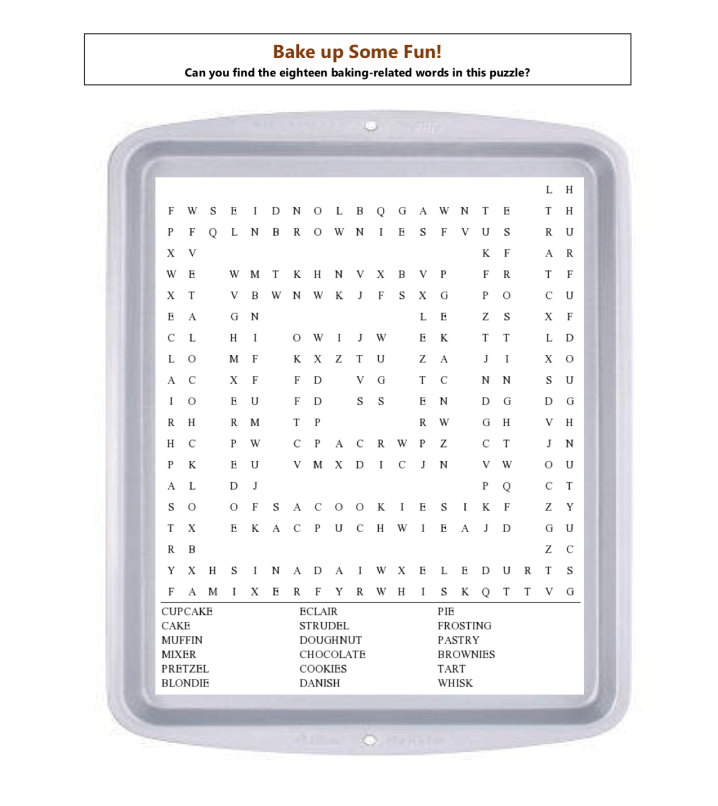
February 22 – It’s Bake for Family Fun Month

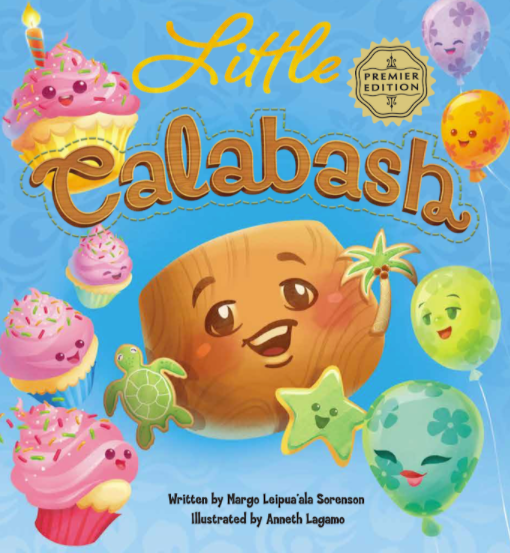
celebrate-picture-books-picture-book-review-little-calabash-cover

About the Holiday

Mid-winter is a perfect time to get out your favorite recipes, gather delicious ingredients, and bake with your kids! Not only does baking together teach valuable cooking skills, but it can bring a family closer. Talk about old family recipes and find new favorites. Of course the best part of baking together is eating the scrumptious treats afterward!

Little Calabash

Written by Margo Leipua’ala Sorenson | Illustrated by Anneth Lagamo


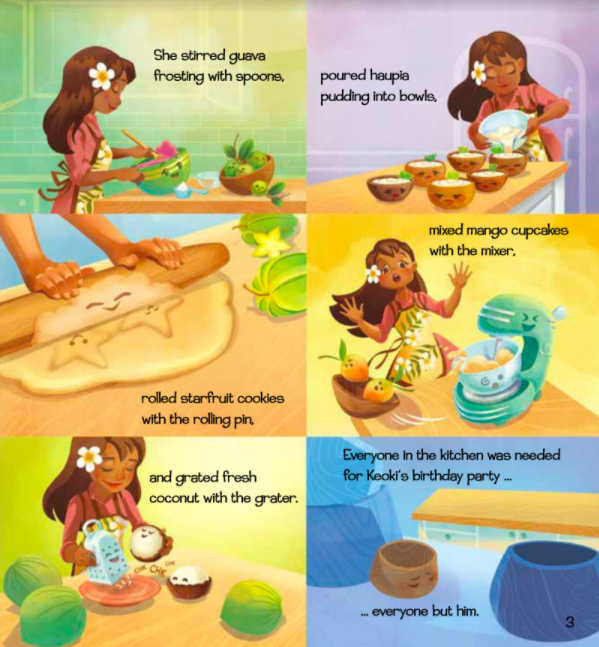
As Keoki’s mom rushed around the kitchen making mango cupcakes, guava frosting, haupia pudding, and starfruit cookies for her son’s birthday party, Little Calabash sat hidden behind the big calabash bowls on the shelf and sighed. The mixer, spoons, rolling pin, and even other bowls were needed. Everyone had a part to play in Keoki’s party… “everyone but him.”

celebrate-picture-books-picture-book-review-little-calabash-cooking

Image copyright Anneth Lagamo, text copyright Margo Leipua’ala Sorenson. Courtesy of Island Heritage.

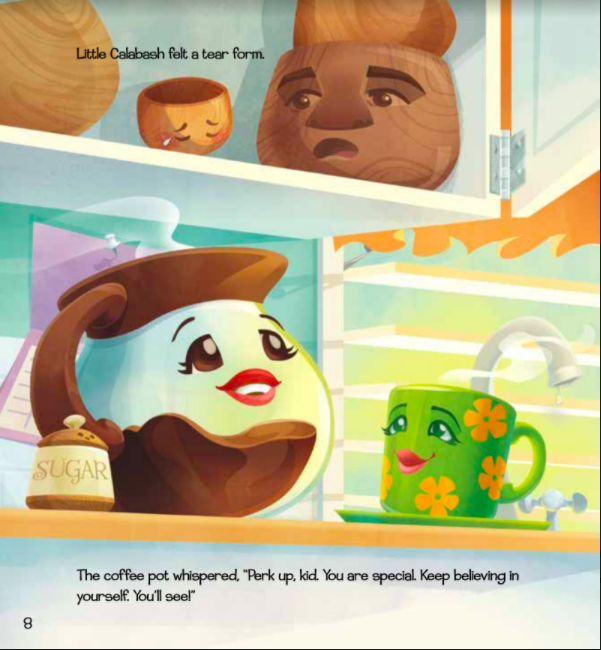
Little Calabash asked when it might be his turn, but the cocoa mug just told him, “‘get a handle on yourself,’” and the refrigerator said, “‘You need to chill out.’” Little Calabash just wanted to be special, to be useful. One of the large calabashes said that he just wasn’t big enough to help out. When the coffee pot saw how sad Little Calabash was, she reassured him and told him to keep believing in himself.

But Little Calabash didn’t know how Keoki’s mom would ever see him stuck behind the other items on the shelf. None of the other kitchen tools seemed to want to help, so he began rocking himself side-to-side and finally, he “wiggled his way from behind all the big calabashes.” Even though he had found his way to the edge of the shelf, some in the kitchen didn’t think he had what it took to be part of the birthday celebration.

celebrate-picture-books-picture-book-review-little-calabash-coffee-pot

Image copyright Anneth Lagamo, text copyright Margo Leipua’ala Sorenson. Courtesy of Island Heritage.

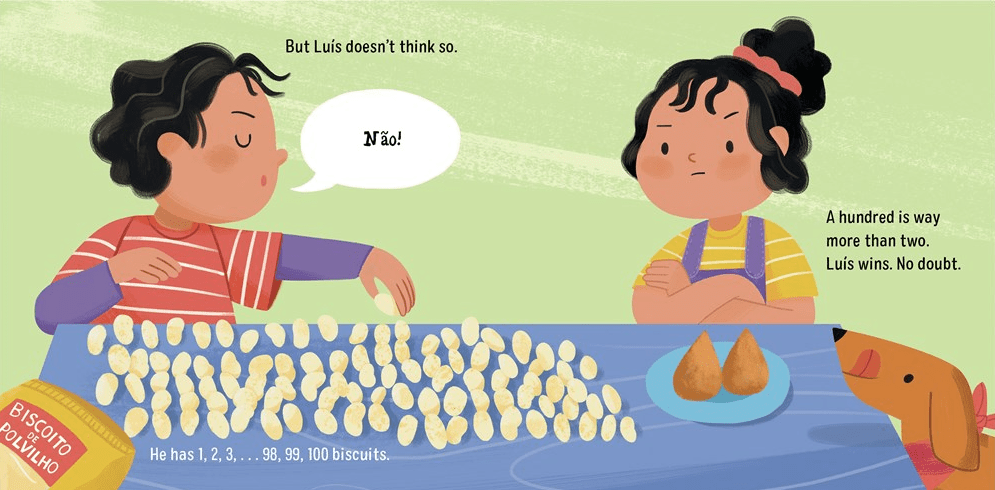
When Keoki’s mother came towards the cupboard, Little Calabash hoped she’d see him. Instead “she took two big calabashes off the shelf.” Soon, it was almost party time. When Keoki saw the cupcakes, he asked if his could be put in a calabash. His mom wasn’t sure they had one the right size. Then Keoki reminded her that they had a little calabash. When she went to look, there was Little Calabash, nearly tipping off the edge. Keoki placed his special cupcake into the bowl and Little Calabash beamed. He’d always known he could be a big part of Keoki’s special day.

A Glossary describing the foods served at Keoki’s birthday party follows the story.

celebrate-picture-books-picture-book-review-little-calabash-cupcakes

Image copyright Anneth Lagamo, text copyright Margo Leipua’ala Sorenson. Courtesy of Island Heritage.

With charm and plenty of puns to keep kids giggling throughout the story, Margo Leipua‘ala Sorenson’s Little Calabash reminds readers that even though they may be small, they still have much to offer. Kids will empathize with Little Calabash’s wish to be given a job on this important family day and will cheer on his confidence and initiative when the other kitchen utensils and appliances try to hold him back.

Anneth Lagamo’s vibrant kitchen will engage kids as the utensils, appliances, and dishware get ready to celebrate Keoki’s birthday. Readers will enjoy scanning the pages to match the speakers of Sorenson’s clever puns with the characters. Kids can also clearly see Little Calabash’s sadness at being overlooked, determination to be noticed, and happiness at being chosen at last. Infused with the colors of the Hawaiian Islands, where the story is set, the illustrations will entice kids to learn more about this beautiful area.

Ages 4 – 8

Island Heritage, 2021 | ISBN 978-1617104459

Discover more about Margo Sorenson and her books on her website.

Bake for Family Fun Month Activity

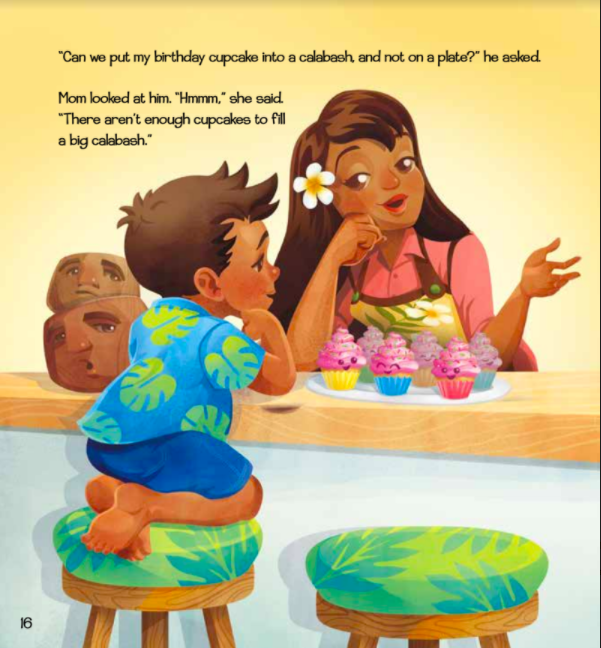
celebrate-picture-books-picture-book-review-hawaii-fruit-coloring-page

Sweet Hawaiian Fruit Coloring Page


From watermelon to strawberries to starfruit, the treats are sweet in Hawaii! Enjoy this printable coloring page then find more from Nico Made and Honolulu Family.

Sweet Fruit Coloring Page 

celebrate-picture-books-picture-book-review-little-calabash-cover

You can order Little Calabash from Island Heritage

Picture Book Review
February 18 – It’s Black History Month

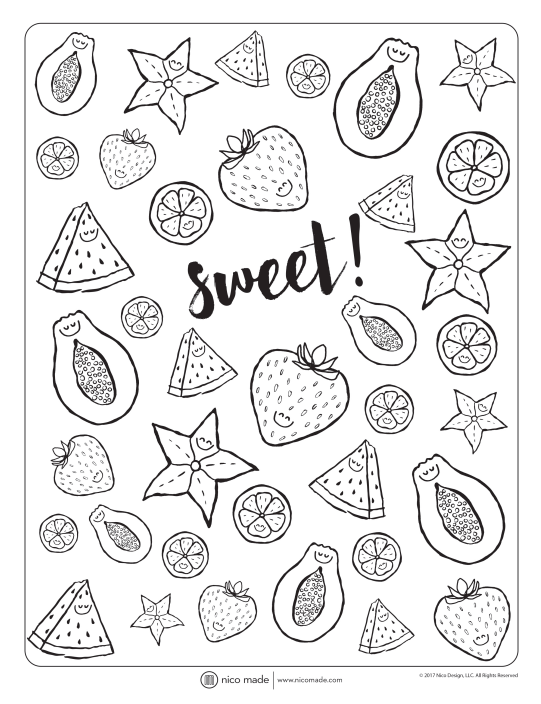
celebrate-picture-month-picture-month-review-the-teachers-march-cover

About the Holiday

Black History Month was instituted by Dr. Carter G. Woodson in 1926 to celebrate the achievements and contributions of African Americans in United States History. The holiday began as a week-long observance taking place during the second week of February to commemorate the birthdays of Frederick Douglass and Abraham Lincoln. In 1976 President Gerald Ford officially established Black History Month. The holiday is now celebrated across the country with special events in schools, churches, and community centers. The theme for 2021 is “Black Family: Representation, Identity and Diversity.” Online events will explore the African diaspora and the spread of Black families across the United States through multiple perspectives. For more information about Black History Month, visit the ASALH website and africanamericanhistorymonth.gov.

The Teachers March! How Selma’s Teachers Changed History

Written by Sandra Neil Wallace and Rich Wallace | Illustrated by Charly Palmer


Reverend F. D. Reese taught science at R. B. Hudson High School, but his favorite subject was freedom…. To be treated as less than equal, that just wasn’t right.” Reverend Reese led marches to register Black voters. The police called them “troublemakers” and used billy clubs to stop them from voting. If the people did make it inside the courthouse to register, they faced a test they had to pass—a test with impossible questions, such as “How many drops of water are in the Alabama River?” Reverend Reese decided he needed a “‘triumphant idea’” to change things.

It came to him that the teachers—leaders and respected in the community—should march for freedom. But a judge had made it illegal to march and even talk about voting rights. Most people were too afraid to march, so Reverend Reese looked for a “‘glorious opportunity’” to come his way. It came when he watched Dr. Martin Luther King Jr. speak on television and wrote him a letter inviting him to come to Selma to “help convince the teachers to march.”

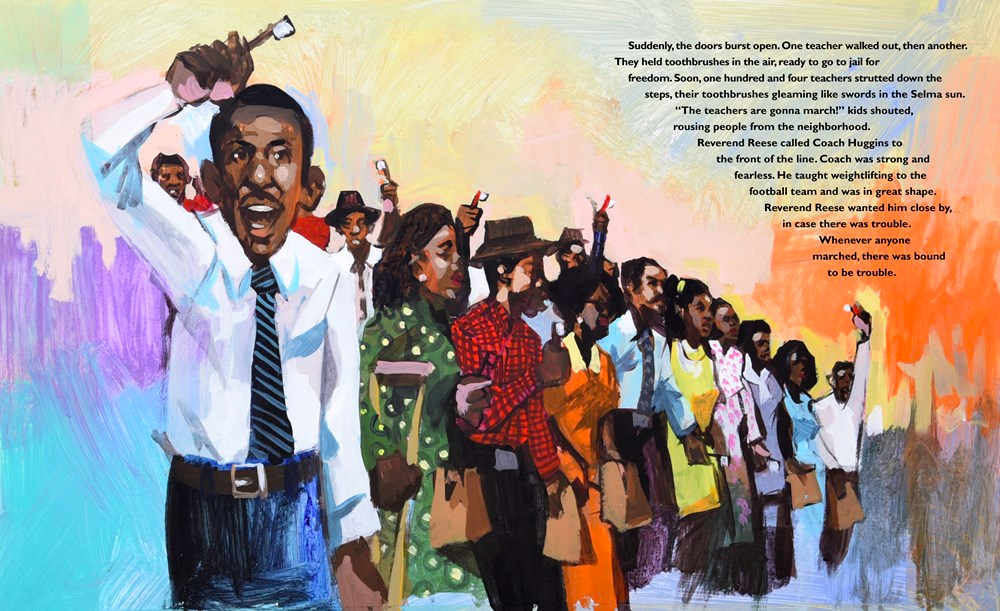
celebrate-picture-month-picture-month-review-the-teachers-march-toothbrushes

Image copyright Charly Palmer, 2020, text copyright Sandra Neil Wallace and Rich Wallace, 2020. Courtesy of Calkins Creek.

Dr. King agreed and spoke to a crowd of 700 people at Brown Chapel. He told the group that everyone should march and “go to jail by the thousands to defend the right to vote.” Two of the people listening to Dr. King were fifteen-year-old Joyce Parrish and her mother, “Two Sweet.” When Reverend Reese asked for teachers to sign up to march, he said that if both parents in a family were teachers, only one should march so that the other could take care of the children if the first went to jail. For Two Sweet it was a difficult decision. She was a teacher and also a single parent. More than 100 teacher signed up, including “Two Sweet.”

On January 22, the day of the march, Two Sweet packed a toothbrush and a sandwich—things she’d need in jail—and hugged Joyce goodbye. That afternoon as Reverend Reese waited alone outside the school alone, he wondered if the teachers would show up. Then one-by-one the teachers emerged from the building, holding their toothbrushes aloft. Reverend Reese called Coach Huggins to the front of the line and they started walking to the courthouse. People gathered along the street to watch, and Joyce paced nervously, wondering what would happen to her mother.

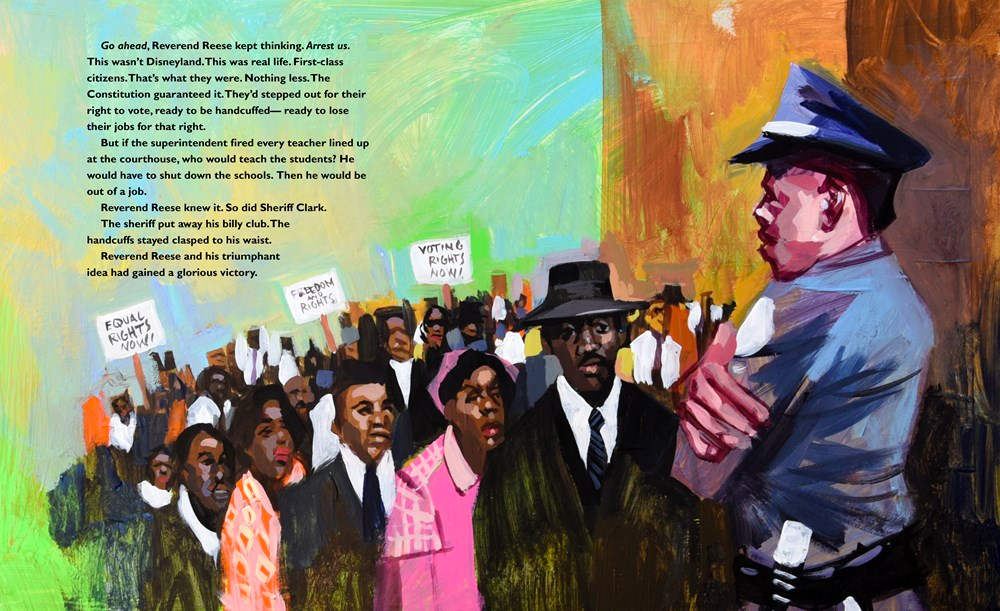
As the teachers crossed into the white section of town, the dirt roads became paved and people swarmed from shops to glare at the marchers, hoping to intimidate them. When they reached the courthouse, the sheriff and his deputies stood atop the steps. Reverend Reese announced that they were there to register to vote, but the sheriff said, “‘You can’t make a plaything out of the corridors of this courthouse.’” He gave the teachers one minute to disperse or face arrest. The teachers stayed put.

celebrate-picture-month-picture-month-review-the-teachers-march-courthouse

Image copyright Charly Palmer, 2020, text copyright Sandra Neil Wallace and Rich Wallace, 2020. Courtesy of Calkins Creek.

When the time was up, the police grabbed their billy clubs. They pushed Coach Huggins and Reverend Reese, causing the teachers to fall backward. When they got up, the police pushed them harder. Then the school superintendent came out of the courthouse. He had the power to fire every teacher. But Reverend Reese and the teachers stood firm for the right the Constitution guaranteed. The superintendent looked out over the crowd. He knew that if he fired them all, there would be no one to teach at the schools and he would lose his job.

The teachers had won the day. They went back to Brown Chapel, where young people were singing freedom songs. The kids were proud of their teachers, and Joyce hugged her mother. That night, Dr. King preached at Brown Chapel. “He praised Reverend Reese and the teachers for making civil rights history” by being the first leaders to risk their jobs by marching. Now other shop keepers and business people were emboldened to march for the right to vote. Kids and young people marched too. These Selma marchers were arrested by the thousands. Across America people took notice. Why, they wondered, were “respectable citizens in suits and dresses, and school kids carrying books” put in jail.

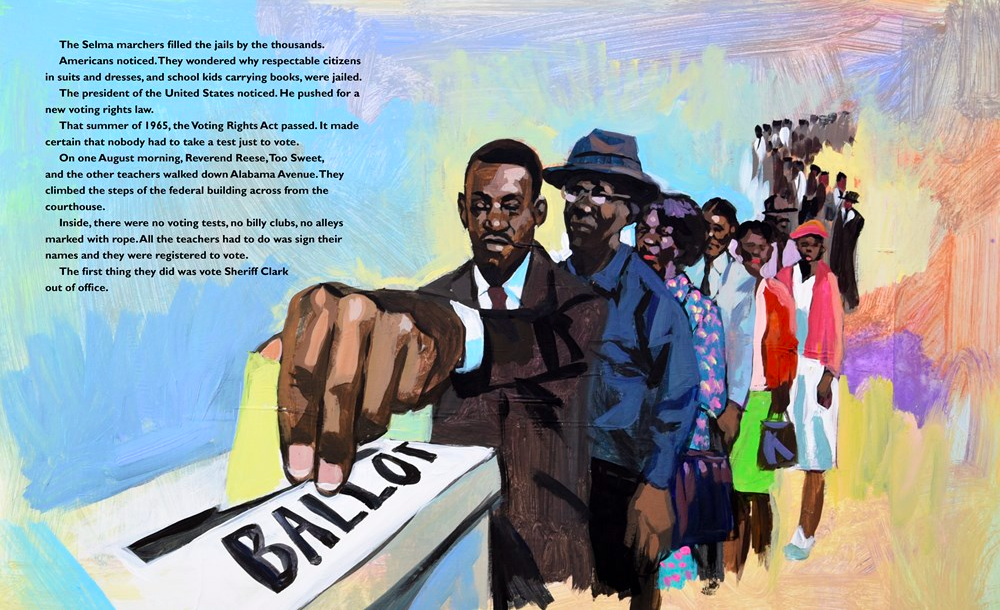
The president of the United States also noticed. In the summer of 1965, Congress passed the Voting Rights Act, ensuring that no test was required to register to vote. In August, Reverend Reese, Two Sweet, and other teachers walked to the federal building and registered to vote. With their first ballot, they voted the sheriff out of office.

Following the text are an extensive Author’s Note about the Teachers’ March and its leaders, with photographs as well as an Illustrator’s Note explains how the illustrations were created. A Timeline follows the 1965 Voting Rights Movement in Selma, Alabama from 1936 to 2018. A photograph of Dr. Martin Luther King Jr., Coretta Scott King, and Reverend Reese leading the 1965 voting rights march from Selma to Montgomery is also included. A selected bibliography of resources used in writing the book, as well as websites where readers can learn more, close out the excellent backmatter.

celebrate-picture-month-picture-month-review-the-teachers-march-ballot

Image copyright Charly Palmer, 2020, text copyright Sandra Neil Wallace and Rich Wallace, 2020. Courtesy of Calkins Creek.

Compelling and comprehensive, Sandra Neil Wallace and Rich Wallace’s story about the teachers march of 1964 is exhilarating reading. Powerful for its personal focus on Reverend Reese, Joyce, and Two Sweet and their fears, doubts, and courage, the story includes vital details that reveal inequalities of the time beyond the issue of voting rights and which will resonate with children aware of continuing inequalities, protests, gerrymandering, and other current issues in the news. Sandra and Rich Wallace build suspense through evocative descriptions to draw children in and immerse them in a reading experience that will have emotional impact.

Charly Palmer’s acrylic on board illustrations capture the motion and emotion of the teachers’ march and the events leading up to that day. All the more moving for their abstract quality, the images portray telling glances (on the first page a student looks out at the reader as Reverend Reese lectures about equal rights at the chalkboard); seminal moments, such as when Dr. Martin Luther King Jr. strides into Brown Chapel and Coach Huggins signs his name, promising to march; and the moments when the sheriff and his deputies confront the teachers with billy clubs raised. The reunion between a worried Joyce and her mother is poignant, and the final illustration of Reverend Reese putting his ballot into the box, reminds all readers of the successes of the past, but also that vigilance and action continues to be needed.

Superb for social studies, American history, homeschooling, and civics lessons, The Teachers March! How Selma’s Teachers Changed History  is highly recommended for home bookshelves and a must for school and public library collections.

Ages 7– 10 and up

Calkins Creek, 2020 | ISBN 978-1629794525

Discover more about Sandra Neil Wallace, and her books on her website. You can also find a downloadable Educator’s Guide for The Teachers March! and other books by Sandra.

You can learn more about Rich Wallace and his books on his website.

To learn more about Charly Palmer and view a portfolio of his art, visit his website.

Watch the trailer for The Teachers March!


Black History Month Activity

celebrate-picture-books-picture-book-review-Black-History-Month-Coloring-Pages-Martin-Luther-King-Jr

Role Model Coloring Pages


Whether you’re interested in law and politics, science, sports, or the arts, you can find a role model in the people in the printable coloring pages below. 

Dr. Mae Jemison | Jackie Robinson | Maya Angelou  | Louis Armstrong | Garrett Morgan | Rosa Parks

celebrate-picture-month-picture-month-review-the-teachers-march-cover

You can find The Teachers March! at these booksellers

Amazon | Barnes & Noble | Books-a-Million

To support your local independent bookstore, order from

Bookshop | IndieBound

Picture Book Review
January 21 – Luna’s Yum Yum Dim Sum Blog Tour Stop

celebrate-picture-books-picture-book-review-luna's-yum-yum-dim-sum-cover

About the Holiday

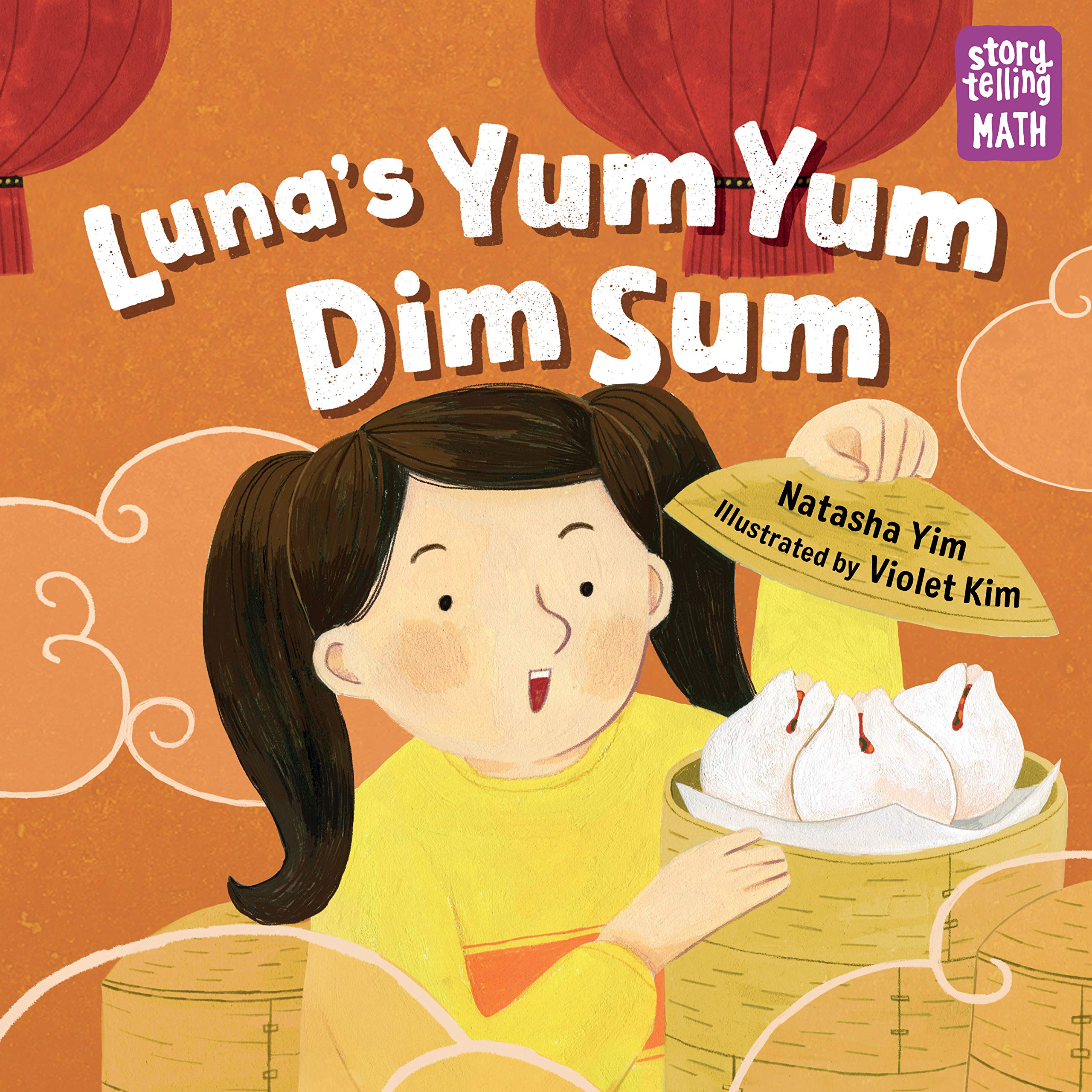
Today I’m excited to be a part of Natasha Yim and Violet Kim’s blog tour to share Luna’s Yum Yum Dim Sum, another engaging book in the Storytelling Math series from Charlesbridge that shows children how math occurs naturally in all aspects of their life and invites them to explore and experiment. 

Thanks to Charlesbridge for sending me a digital copy of Luna’s Yum Yum Dim Sum for review consideration. All opinions of the book are my own.

Luna’s Yum Yum Dim Sum (Storytelling Math)

Written by Natasha Yim | Illustrated by Violet Kim


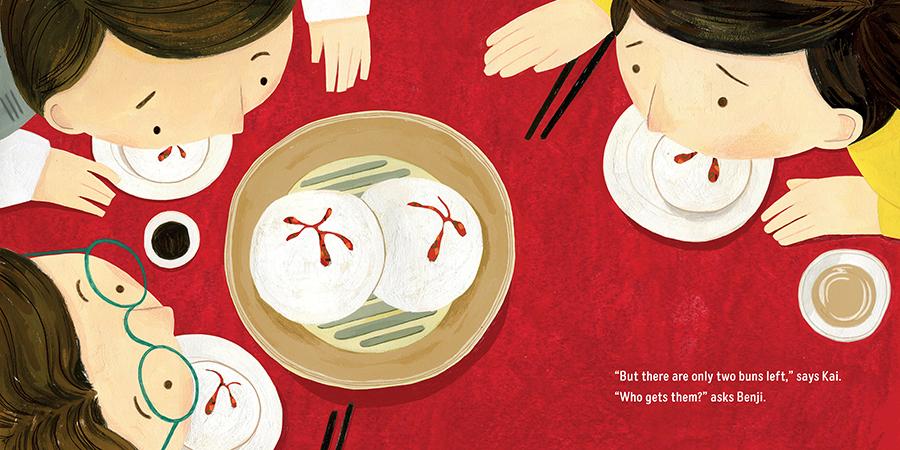
For Luna’s birthday, Ma Ma and Ba Ba take Luna and her brothers to a dim sum restaurant. They join the sound of happy voices and chopsticks that go “click, clickety, clack.” Servers wheel trolleys piled with plates and “baskets of dim sum. Warm smells of dumplings, buns, and sweet desserts tickle Luna’s nose.” Ba Ba asks the kids what they would like and Luna exclaims that she wants pork buns. Her older brother calls for two baskets, and her little brother Benji agrees. When the server brings two baskets of char siu bao to the table, the kids open the tops to find three buns in each.

Two buns for each of them, Benji proclaims. They each take a bun from the first basket, but just as Luna lifts hers up, it slips from her hand and falls to the floor— “Splat!” “‘Oh no!’” She takes a bun from the second basket. “‘That’s all you get,’ says Kai, and Benji seconds that. But Luna protests that it’s her birthday and she should get another bun. Benji and Kai gaze into the basket sadly, wondering what to do. Then Kai reminds his siblings that their mom always says they should respect their elders. But Benji remembers her saying “‘older kids should take care of younger kids,’” so he should get one too. And Luna? She exclaims that she’s the “‘birthday girl!’”

celebrate-picture-books-picture-book-review-luna's-yum-yum-dim-sum-two-buns-left

Image copyright Violet Kim, 2020, text copyright Natasha Yim, 2020. Courtesy of Charlesbridge.

The three kids stare each other down. Finally, Luna suggests cutting the two buns in half, and they do. But who will get the extra half, Benji wonders. Kai and Benji both have reasons they should get it. And Luna? She exclaims that she’s the “‘birthday girl!’” Kai thinks they should divide the half in half, but Luna tells him they’d just be back to the beginning. Kai and Benji like the idea of using their animals from the lunar calendar to choose who gets the pieces, but each has a valid claim to a half. Luna has one more suggestion that makes the division fair but the pieces tiny. Then Luna looks around and sees a hungry little boy at the next table and knows just what to do with the extra half.

Backmatter includes a description of Dim Sum and the Chinese Zodiac as well as a paragraph that explores the math found in the story and four activities to get kids working with math.

Natasha Yim’s charming tale will captivate readers with her funny and realistic competition between the siblings for the remaining two pork buns after Luna drops one. Her pitch-perfect dialogue invites kids to try and figure out how to divide the buns along with Luna, Kai, and Benji. Yim’s storytelling organically incorporates important concepts of one and two while also introducing the idea of one half in a way that they can—and will want to—replicate at home. Through Kai, Luna, and Benji’s  challenges to each other, kids also learn about superlatives and comparatives “oldest and older” and “tallest and shortest” as well as “bigger” and “bravest.” Luna’s solution to their dilemma is sweet and will entice kids to enjoy dim sum themselves.

Violet Kim’s vibrant illustrations take kids into a bustling dim sum restaurant, where they can see—and almost hear—happy diners and busy servers with their carts. By changing the perspective of her images, Kim allows kids to clearly see the buns in the baskets and take part in deciding how they can be divided. Children can also count chopsticks, tea cups, and other items on the table as well as the contents of baskets stacked on carts. Kim envisions the siblings’ competitions in humorous images that also demonstrate superlatives and comparatives that provide both math and language lessons. Readers will also empathize with Luna, Kai, and Benji as they debate, their facial expressions depicting their thought processes, doubts, and frustrations.

An enchanting read that combines math with familiar family dynamics, Luna’s Yum Yum Dim Sum is a story that will spark mathematical experimentation and understanding both at home and in the classroom, making the book an excellent choice for family, school, and public libraries.

Ages 3 – 6

Charlesbridge, 2021 | ISBN 978-1623541996

Discover more about Natasha Yim and her books on her website.

celebrate-picture-books-picture-book-review-Luna's-Yum-Yum-Dim-Sum-Tour-Graphic-Covers

To learn more about Violet Kim, her books, and her art, visit her website.

Storytelling Math Chat

You’re invited to listen to authors Natasha Yim, Sara Levine, and Ana Crespo as well as Charlesbridge editor Alyssa Mito Pusey and math expert Marlene Kliman talk about the math, diversity, and importance of storytelling in Storytelling Math..

celebrate-picture-books-picture-book-review-luna's-yum-yum-dim-sum-cover

You can find Luna’s Yum Yum Dim Sum at these booksellers

Amazon | Barnes & Noble | Books-a-Million

To support your local independent bookstore, order from

Bookshop | IndieBound

Picture Book Review 

January 14 – World Logic Day

celebrate-picture-books-picture-book-review-lia-&-luís-who-has-more-cover

About the Holiday

World Logic Day, sponsored by UNESCO in association with the International Council for Philosophy and Human Sciences aims to raise awareness and appreciation of the intellectual history, significance, and practical uses of logic to the broad community of scientists as well as the public. Celebrations of the holiday center on promoting international cooperation, supporting the development and activities of logic within universities, research facilities, and schools, and enhancing the understanding of logic and its implications for science, technology, and innovation.

Lia & Luís: Who Has More? (Storytelling Math)

Written by Ana Crespo | Illustrated by Giovana Medeiros


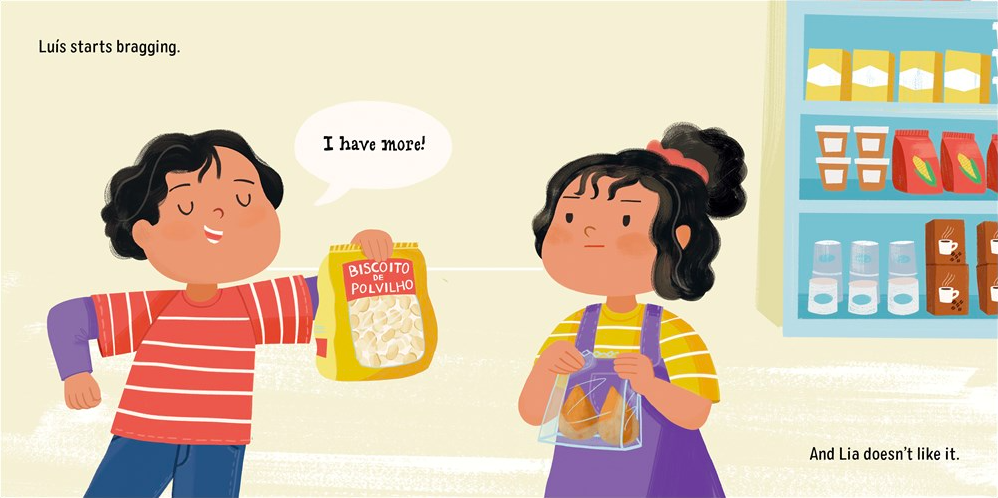
When Luís and his sister Lia were playing together, Luís worked quickly and bragged about the rickety tower he’d built. Lia didn’t really mind because she liked to take her time. Lia’s tower may have been shorter, but it stayed up longer. After playing, they ran “downstairs to their family’s store [to] pick their favorite Brazilian snacks.” Luís told his father, “I want biscoito de polvilho, Papai!” while Lia said, “Coxinhas de galinha, please!”

celebrate-picture-books-picture-book-review-lia-&-luís-who-has-more-bragging

Image copyright Giovana Medeiros, 2020, text copyright Ana Crespo, 2020. Courtesy of Charlesbridge.

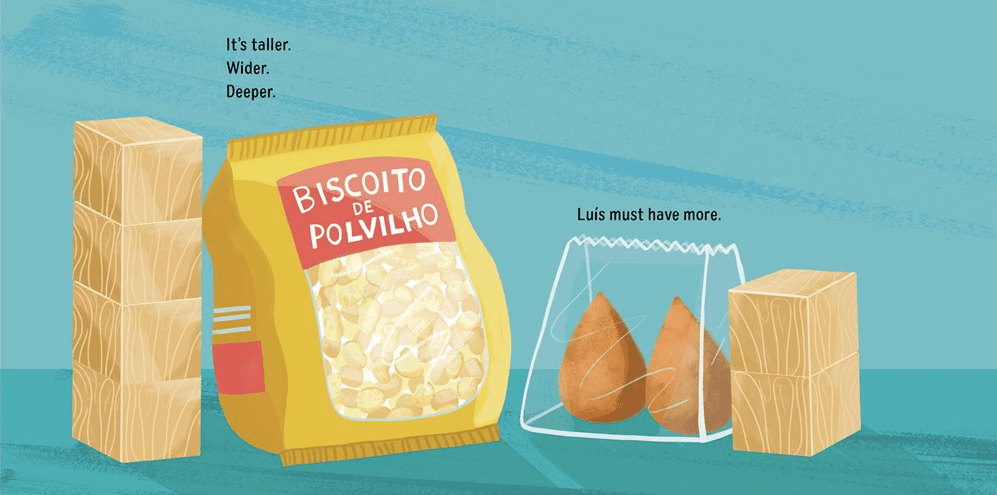
Papai handed Luís a bag of little nuggets and put two pear-shaped treats in a bag for Lia. Again, Luís began bragging, showing his sister that he had more than she did. This time Lia didn’t like it. But was Luís right? His bag was bigger than Lia’s. It was four blocks high and Lia’s bag was only two blocks high. Luís’s bag was also wider and deeper than Lia’s.

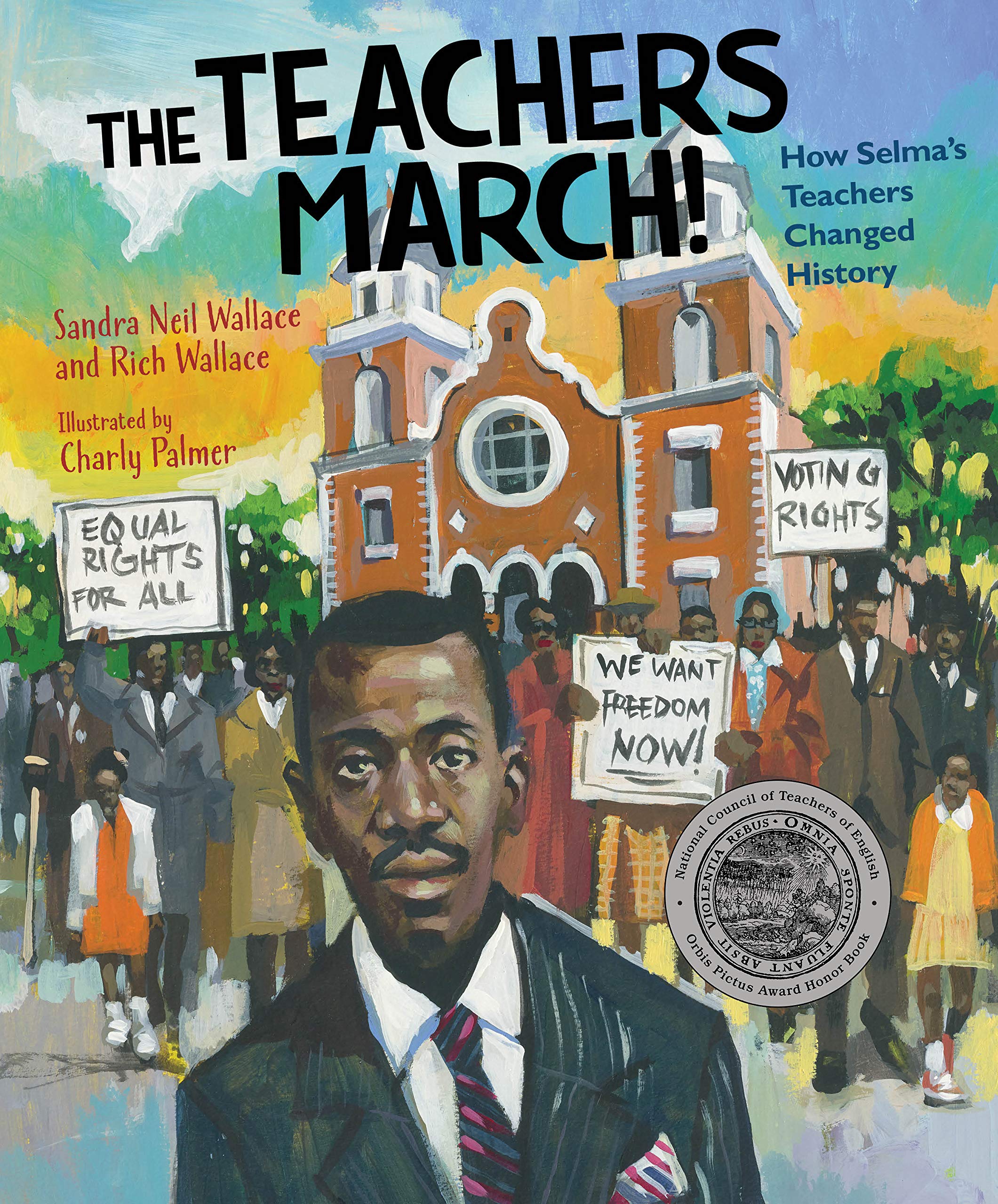
But Lia noticed something else. “Can’t you count?” she says then points out that she has two croquettes while her brother has only one bag. Could she be right about having more? Luís can’t leave this challenge unanswered, so he opens his bag and spills out the contents on the table. Lia looks at all of the tiny nuggets but is still unconvinced. She picks up a biscuit and a croquette. They are definitely different sizes and weights.

celebrate-picture-books-picture-book-review-lia-&-luís-who-has-more-biscuit-bag-taller

Image copyright Giovana Medeiros, 2020, text copyright Ana Crespo, 2020. Courtesy of Charlesbridge.

Luís begins to put a biscuit in his mouth, but Lia wants him to wait. “Para!” she tells him. Lia takes some time thinking about the problem. Finally, she has an idea. She gets the scale from the family store and puts her croquettes on one side and Luís’s biscuits on the other. The scale dips toward Lia; “she wins.” Lia doesn’t like seeing her brother so sad. She thinks again and has another idea. She breaks off a bit of a croquette and adds it to Luís’s biscuits. The scale balances! They eat up all their snacks. Will Papai give them mais?

Following the text readers will find a Glossary of Portuguese words used in the story and an Exploring the Math page, which describes the math concepts contained in the story as well as activities kids and adults can do to reinforce the math learning.

celebrate-picture-books-picture-book-review-lia-&-luís-who-has-more-one-hundred-biscuits

Image copyright Giovana Medeiros, 2020, text copyright Ana Crespo, 2020. Courtesy of Charlesbridge.

In her charming Storytelling Math book, Ana Crespo effectively uses siblings’ natural competitive spirit to explore concepts of comparing and measurement. These include size (and the comparatives taller, wider, deeper), quantity, and weight. As the story opens, Luís has built a taller tower than his sister, the image of which is later used to compare Lia’s snack to Luís’s. Crespo combines an engaged narrator plus dialogue sprinkled with Portuguese words that are organically defined to create a lesson in math that will keep readers turning the pages to see who actually does have more. As Lia and Luís try various methods to find an answer, kids can take time too to think about how they would solve the problem and discuss the idea of “more” and how they would define it. Lia and Luís may be competitive, but they’re also cooperative, making this a sweet sibling story as well.

Giovana Medeiros’s bright, crisp illustrations of these enthusiastic twins clearly depicts the math concepts discussed while also portraying the distinct personalities of Lia and Luís, inviting readers to root for one or the other or to just wait and see who wins. Medeiros includes lots of other opportunities to interact with math through counting the twins’ blocks, items on the shelves and in the display case of the family’s store, and the biscuits poured out on the table. Images of the balance scale allows kids to see how Lia’s croquettes weigh more and how adding a bit of one gives Luís the same amount by weight that Lia has. Speech bubbles and the characters’ actions help readers translate the Portuguese words themselves.

Sure to inspire kids to explore the cabinet, fridge, or classroom and engage with the math of comparing and measuring for themselves, Lia & Luís: Who Has More? would be a fun book to add to home, classroom, and public library collections to spark observations and experimentation that lead to deeper STEM learning.

Ages 3 – 6

Charlesbridge, 2020 | ISBN 978-1623541279 (Hardcover) | ISBN 978-1623541859 (Paperback)

Discover more about Ana Crespo and her books on her website.

To learn more about Giovana Medeiros, her books, and her art, visit her website.

World Logic Day Activity

Screen Shot 2021-01-13 at 4.21.02 PMcelebrate-picture-books-picture-book-review-lia-&-luís-who-has-more-activity-guide

Lia & Luís: Who Has More? Activity Kit


You can have fun experimenting with math using your toys, snacks, and other household items with the downloadable Activity Kit available on the Charlesbridge website!

celebrate-picture-books-picture-book-review-lia-&-luís-who-has-more-cover

You can find Lia & Luís: Who Has More? at these booksellers

Amazon | Barnes & Noble | Books-a-Million

To support your local independent bookseller, order from

Bookshop | IndieBound

Picture Book Review
December 29 – National Tick Tock Day

celebrate-picture-books-picture-book-review-ticktock-banneker's-clock-cover

About the Holiday

As the year winds down Tick Tock Day reminds us of the passage of time and encourages us to examine our life and find opportunities to accomplish the things we really want to. While a day only has 24 hours, a little creative scheduling, letting go of those tasks that aren’t so important, and even saying “no,” can help us achieve the things that matter.

Ticktock Banneker’s Clock

Written by Shana Keller | Illustrated by David C. Gardner


With winter approaching Benjamin Banneker has finished up his autumn chores and is looking forward to time to indulge his creative dreams. He finds his favorite spot under the chestnut tree—the place where during the summer he plays his violin and flute, “blending his soft music with the bird’s songs”—and pulls out a pocket watch he has borrowed from a gentleman. Benjamin is fascinated by the ticking and the movement of the small hands. He carefully opens the back of the watch and discovers “a world of wonderful whirls. There were gears of all shapes and sizes. Such a tiny maze!”

celebrate-picture-books-picture-book-review-ticktock-banneker's-clock-studying-pocket-watch

Image copyright David C. Gardner, courtesy of flyingdogstudio.com

The miniature timepiece is mesmerizing, but Benjamin’s mind holds a challenge—a big challenge. He envisions a large clock, one that chimes to tell the time. Remembering his math skills, Benjamin mulls over the scale needed to turn “something small into something big.” As the snow falls, Benjamin goes to work. First, he dismantles the pocket watch and draws careful diagrams of the gears and workings. Then he begins transposing these into larger drawings.

celebrate-picture-books-picture-book-review-ticktock-banneker's-clock-flute

Image copyright David C. Gardner, courtesy of flyingdogstudio.com

With the coming of spring and his drawings finished, Benjamin plans how he will build his clock. While the little pocket watch is made of metal, that material is much too expensive for a large version. As he ponders the problem under his favorite tree, Benjamin looks around him. Suddenly he knows! The answer is “right in front of him, even in his hands! The very instrument he played was made of wood!” There is a forest of trees on his farm, and this material is free.

During the summer between farm chores, Benjamin uses “every spare moment he had to find the perfect pieces of wood.” Once he has enough he begins to convert his drawings into carvings, whittling the gears and other pieces he will need. Soon, however, he becomes discouraged. The wood begins to split and come apart. Benjamin thinks about how his family cures tobacco leaves—drying them out until all the moisture evaporates. Perhaps, he thinks, he can do the same with wood to make it stronger. The process would take months, but Benjamin is patient.

celebrate-picture-books-picture-book-review-ticktock-banneker's-clock-carving

Image copyright David C. Gardner, courtesy of flyingdogstudio.com

Winter has come around again, and the wood is finally ready. In his warm house Benjamin sets about carving again. During the day he carves near the sunny window, and at night he works by candlelight. At last he has all the parts he needs to build his clock. Gears, wheels, tiny pins, and the boards that will become the case are scattered across Benjamin’s work table. There is only one piece missing. A piece that cannot be made of wood—the bell!

Benjamin buys a bell from a metalsmith, and back home begins to build his clock. With his drawings to guide him, he fits the gears together and then sets the hands to “match up perfectly with the second, minute, and hour of each day. It took more than one try, but Benjamin had learned to be patient.” Using the sun to determine the correct time, Benjamin positions the hands and steps back. His clock works! “The little iron bell chimed every hour, on the dot, for the next forty years.” Benjamin becomes famous, and neighbors from near and far come “to see his amazing invention.”  

An Author’s Note expanding on Benjamin Banneker’s life and work follows the text.

celebrate-picture-books-picture-book-review-ticktock-banneker's-clock-winter

Image copyright David C. Gardner, courtesy of flyingdogstudio.com

With lyrical language that glides as smoothly as a well-oiled timepiece, Shana Keller reveals the remarkable story of Benjamin Banneker, born free during the time of slavery, who possessed exceptional math and scientific skills and used them to help his friends and neighbors and to make real his vision of a striking clock. Keller’s detailed and descriptive storytelling animates this life story, allowing readers to take the journey with Banneker as he experiences excitement, setbacks, and ultimately success. Banneker, embodying determination, persistence, and creativity, is an excellent role model for kids with big dreams of their own.

celebrate-picture-books-picture-book-review-ticktock-banneker's-clock-studying-fall-chores

Image copyright David C. Gardner, courtesy of flyingdogstudio.com

David C. Gardner’s lovely full-page and two-page-spread illustrations gloriously portray Benjamin Banneker’s farm and home as well as his dedicated commitment to building a striking clock despite—or perhaps spurred on by—the challenges he faced. Gardner’s detailed images set the biography firmly in its time period, letting children experience farm and home life in the 1750s. Banneker carries wooden buckets to feed the animals, tobacco leaves hang in a dry shed, a fire blazes in a large, open fireplace, and a candle flickers as Banneker whittles wheels and gears with his pocket knife. The realistic paintings that depict Banneker’s emotions as he imagines creating a large clock, overcomes obstacles, and studiously works on his drawings and carvings will inspire readers to attempt their own inventions—whatever they may be.

For any would-be inventors, history lovers, tinkerers, and science buffs, Ticktock Banneker’s Clock is a stirring biography that would make an inspirational addition to home, school and public libraries.

Ages 6 – 10

Sleeping Bear Press, 2016 | ISBN 978-1585369560

Learn more about Shana Keller and her work on her website!

Discover a portfolio of picture book art, fine art, animation, and videos by David C. Gardner on his website!

Tick Tock Day Activity

celebrate-picture-books-picture-book-review-cuckoo-clock-coloring-page

Cuckoo Clock Coloring Page


The chirp of a cuckoo clock keeps you on time—or at least aware of the passing of time! If you like coloring, you’ll enjoy spending time with this printable Cuckoo Clock Coloring Page!

celebrate-picture-books-picture-book-review-ticktock-banneker's-clock-cover

You can find Ticktock Banneker’s Clock at these booksellers

Amazon | Barnes & Noble | Books-a-Million

To support your local independent bookstore, order from

Bookshop | IndieBound

Picture Book Review
December 28 – Get Ready for New Year’s Eve

celebrate-picture-books-picture-book-review-feliz-new-year-ava-gabriela-cover

About the Holiday

It’s safe to say we’re all happy to be saying goodbye to 2020 and looking forward to 2021 with hope and resolve. A new year offers opportunities for reflection and growth as well as sharing the traditions that keep our families and friendships strong no matter what challenges we face. Today’s book celebrates all three of these parts of life at the New Year or any time.

Feliz New Year, Ava Gabriela!

Written by Alexandra Alessandri | Illustrated by Addy Rivera Sonda


Ava Gabriela and her mamá and papa were visiting her grandmother’s farm for the New Years holiday. Her aunts, uncles and cousins were there too, but she had never met her tías and tíos or primas and primos before, and they “didn’t feel like familia yet.” When her mother prompted her to say hola, Ava Gabriela nervously opened her mouth, but no words came out. And when Abuelita asked if a mouse had nibbled her tongue, Ava hid behind Mamá. But then Tía Nena approached with her hand extended and asked, “‘Want to help us make buñuelos?’ Ava hesitated. But the fried cheesy fritters were her favorite.” Ava took Tía Nena’s hand and went into the kitchen.

celebrate-picture-books-picture-book-review-feliz-new-year-ava-gabriela-abuelita

Image copyright Addy Rivera Sondo, 2020, text copyright Alexandra Alessandri, 2020. Courtesy of Albert Whitman & Company.

There she found her cousins Sarita and Javier. Together they made the dough. As Tía Nena rolled it out, Sarita and Javier laughed and talked, but Ava watched silently. Even when Tía Nena sprinkled flour in her hair, Ava couldn’t call for a food fight like she wanted to but only giggled. After the buñuelos were finished, Ava’s cousins ran outside. Ava wanted to call after them to wait, “but her voice hid like a mouse in its hole” so Ava explored the farm by herself. When she found her mamá talking with Abuelita, she quietly asked her why she was so shy. Mamá reassured her that when she was ready, her voice would “come out and play.” After a hug, Ava felt a little better.

In another part of the house, Ava found her primo Pedro blowing up balloons for “el Año Viejo,” the balloon doll they would pop when the old year turned into a new year. When Pedro asked if she’d like to help, her words stuck in her throat again, but Pedro invited her to build the Año Viejo while he blew up balloons. When the doll’s clothes were all stuffed, Pedro handed Ava the marker to add the face. In her heart she was saying thank you, and then she realized that “she could say thank you. ‘Gracias,’” she said. “The word was whispery soft but tasted sweet like dulce de leche.”

celebrate-picture-books-picture-book-review-feliz-new-year-ava-gabriela-kitchen

Image copyright Addy Rivera Sondo, 2020, text copyright Alexandra Alessandri, 2020. Courtesy of Albert Whitman & Company.

The next morning, when Ava saw Mamá and Abuelita filling cups with twelve grapes that would bring good luck in the new year, Ava “plucked one and said a silent wish: Please let me not be shy today.” Then she ran outside. This time when her tía and Pedro talked to her, she answered back, but when Tío Mario called out, her voice disappeared again. Soon it was time to change for the celebration. Outside, lanterns twinkled and the table was spread with delicious food. While everyone else talked and played, Ava sat next to the Año Viejo. “Don’t you want to play? It seemed to ask.”

celebrate-picture-books-picture-book-review-feliz-new-year-ava-gabriela-mamá

Image copyright Addy Rivera Sondo, 2020, text copyright Alexandra Alessandri, 2020. Courtesy of Albert Whitman & Company.

Just then fireworks burst across the sky. Ava ran out into the yard. Her cousins came out too and asked if she’d like to play tag. Once again she knew she could and would say yes. “With her heart galloping, Ava blurted, ‘Sí.’ Her cousins cheered.” As she ran off with her primos, Ava felt feliz. When midnight came, Ava helped pop the Año Viejo and joined in as they all called out “‘¡Feliz Año Nuevo!’”

In an Author’s Note, Alexandra Alessandri reveals more about the Christmas season, which is celebrated from December 7 through January 6, in her native Columbia and across Latin America and the Caribbean. She describes the food, music, traditions, and superstitions associated with New Year’s Eve and talks about the significance of the Año Viejo. A glossary of words and phrases used in the story is also provided in the back matter.

celebrate-picture-books-picture-book-review-feliz-new-year-ava-gabriela-new-years-eve

Image copyright Addy Rivera Sondo, 2020, text copyright Alexandra Alessandri, 2020. Courtesy of Albert Whitman & Company.

Alexandra Alessandri’s lovely story organically combines Spanish and English to create a smoothly flowing story that brings to life the Columbian traditions of New Years and el Año Viejo while acknowledging how big gatherings of family and friends can be intimidating for some children. Through beautiful, lyrical language that incorporates imagery from Spanish idioms, food, animals, and musical instruments, Alessandri portrays a realistic picture of the emotions shyness can cause in children – and adults. Readers will be charmed by sweet and thoughtful Ava Gabriela and empathize with her feelings as she has small successes as well as setbacks on her way to feeling comfortable and finding her voice with her family. Hesitant and shy children will recognize themselves in Ava and welcome Alessandri’s sensitive depiction of her inner conflict. The understanding Ava’s mamá gives her is full of heartfelt love and models the kind of support that helps shy children thrive.

Addy Rivera Sonda’s fresh, cheerful illustrations will captivate readers with details that paint an enchanting portrait of this loving family and Abuelita’s tidy farmhouse from the opening scene, in which Ava’s family is welcomed home, to the tiled accents, chickens in the yard, and preparations for the New Year’s celebration. Sonda does an excellent job of portraying Ava’s fluctuating emotions—giggling at silly things but then too hesitant to say the words on the tip of her tongue and wandering the farm alone when she’d like to be playing with her cousins. Children who celebrate el Año Viejo will be excited to see their fun and meaningful tradition depicted here and kids who are not familiar with it will be intrigued to learn more. As Ava’s family gets ready for New Year’s Eve, children will also enjoy seeing other parts of the celebration that are aimed at bringing good luck for the next year.

A beautiful and superbly composed book rich in Columbian and Latin American culture that can also ease discussions about shyness, Feliz New Year, Ava Gabriela! will be a favorite on home bookshelves for all kids. The book would also spark fun and educational cross-curricular activities, making it a must for school and public library collections.

Ages 4 – 8

Albert Whitman & Company, 2020 | ISBN 978-0807504505

Discover more about Alexandra Alessandri and her books on her website.

To learn more about Addy Rivera Sonda and view a portfolio of her work, visit her website.

Get Ready for New Year’s Eve Activity

celebrate-picture-books-picture-book-review-new-years-coloring-page

New Year’s Eve Coloring Page


Celebrate the New Year with this printable coloring page! You might even want to add some glitter to make the fireworks even more spectacular!

New Year’s Eve Coloring Page

celebrate-picture-books-picture-book-review-feliz-new-year-ava-gabriela-cover

You can find Feliz New Year, Ava Gabriela! at these booksellers

Amazon | Barnes & Noble | Books-a-Million

To support your local independent bookstore, order from

Bookshop | IndieBound

Picture Book Review
December 15 – International Tea Day

celebrate-picture-books-picture-book-review-teatime-around-the-world-cover

About the Holiday

Established in 2005 in New Deli, India, International Tea Day was created to raise awareness within the governments of tea-growing countries of the rights of tea workers, their conditions, and their economic contributions. Today, the holiday is commemorated widely in tea-growing nations. Some of the issues the day focuses on include wages, medical care, and education for women tea workers, who make up fifty percent of of the workforce on tea plantations. Following water, tea is the most widely drunk beverage in the world. To celebrate today, enjoy a cuppa with a cookie, a scone, or another favorite treat. 

Teatime Around the World

Written by Denyse Waissbluth | Illustrated by Chelsea O’Byrne


Two women sit at a table with steaming cups of tea in front of them, talking. “Tea for one. Tea for two.” To the side sits a teapot, its contents still warm. At their feet a child is having a tea party with a bear, jauntily clad in a feathered hat. Cookies, strawberries, and croissants fill out this feast served from a special tea set. “Tea for me. Tea for you.” Tea time continues in Morocco, where a father and child kneel on pillows. The father pours out three cups of mint tea. Made with green tea, mint, and sugar, each cup of tea will have “a slightly different taste.”

celebrate-picture-books-picture-book-review-teatime-around-the-world-sugar

Image copyright Chelsea O’Byrne, 2020, text copyright Denyse Waissbluth, 2020. Courtesy of Greystone Books.

In India a street vendor sells a cup of masala chai to a woman, who’s looking for a peaceful break during her day. The “strong tea and spices like cinnamon, ginger, cloves, cardamom, and pepper…boiled with milk and sweetened” will hit the spot. Hot tea is relaxing, but on a hot day there’s nothing more refreshing than a glass of iced tea. In Thailand, locals and tourists enjoy cha yen, sold from street vendors’ carts. This “strongly brewed sweet tea is poured over ice and drunk from a bag through a straw. Indigenous people in North America soothe fevers, colds, sore muscles, and even sleepless nights with tea made from “berries, plants, and roots.”

celebrate-picture-books-picture-book-review-teatime-around-the-world-russia

Image copyright Chelsea O’Byrne, 2020, text copyright Denyse Waissbluth, 2020. Courtesy of Greystone Books.

Special tea times—like chanoyu, the Japanese tea ceremony during which matcha, a powdered green tea is served, and afternoon tea, enjoyed with trays of treats world wide—bring people together for comforting respites. You’ll be interested to discover the origins of afternoon tea too! Tea can be served quietly or dramatically, like “teh tarik, or pulled tea…the national drink of Malaysia,” is “poured from up high, or ‘pulled’ between two mugs, to make it frothy.”

celebrate-picture-books-picture-book-review-teatime-around-the-world-poured

Image copyright Chelsea O’Byrne, 2020, text copyright Denyse Waissbluth, 2020. Courtesy of Greystone Books.

Tea is as old as its discovery thousands of years ago in China and as new as bubble tea, created in Taiwan in the 1980s. In Argentina, Chile, and Uruguay, yerba maté tea is served in hollowed-out gourds with a “special straw called a bombilla,” while in Jamaica sorrel, made from roselle hibiscus buds, “spiced with ginger, cloves, and sugar,” is perfect for any festive occasion. No matter where you live, what flavors of tea you enjoy, or how you serve it, you can always count on “tea for one. / Tea for two. / Loved by all / the whole world through.”

celebrate-picture-books-picture-book-review-teatime-around-the-world-for-group

Image copyright Chelsea O’Byrne, 2020, text copyright Denyse Waissbluth, 2020. Courtesy of Greystone Books.

With a lilting poem that flows from page to page, Denyse Waissbluth introduces unique flavors, special brew methods, and the comforting feeling a cup of hot or iced tea infuses into a day. The shared experience of tea drinking provides a fascinating touchstone for Waissbluth’s travelogue that takes kids around the world to experience the rituals, recipes, and traditions from each country that makes their tea unique. Waissbluth’s conversational style will appeal to kids looking to learn how global cultures are similar to and different from their own.

Chelsea O’Byrne’s lovely matte illustrations take children to cities, the countryside, and the seaside around the globe, revealing not only diverse scenes of how tea is made, served, and enjoyed, but homes, food, and clothing as well. Children will be excited to see such homey and intimate portraits of their peers around the world.

Sure to spur readers to learn more about the countries featured and entice them to try their signature teas, Teatime Around the World would enhance geography, history, and multicultural lessons for school and homeschooling and is highly recommended for school and public library collections.

Ages 3 – 7

Greystone Books, 2020 | ISBN 978-1771646017

You can connect with Denyse Waissbluth on Instagram.

To learn more about Chelsea O’Byrne, her books, and her art, visit her website.

International Tea Day Activity

celebrate-picture-books-picture-book-review-tea-word-search-puzzle

Tea for You! Word Search


Can you find the names of eighteen delicious teas from around the world in this printable puzzle?

Tea for You! Word Search Puzzle | Tea for You! Word Search Solution

celebrate-picture-books-picture-book-review-teatime-around-the-world-cover

You can find Teatime Around the World at these booksellers

Amazon | Barnes & Noble | Books-a-Million

To support your local independent bookstore, order from

Bookshop | IndieBound

Picture Book Review