Today is one of those days that gets you really observing the world in a new way. As you go about your day at the office, at school, at shops, or just while driving here and there, be aware of all the different circles you see. Sure, there are the obvious ones—the tires on your car, the signals on a stoplight, the lid of your water bottle or coffee cup…but how about all the less-seen circles? Knots on trees, a lemon slice, the center of a flower, the ripple of a raindrop or pebble dropped in a puddle… Whether you look for circles through the eye of geometry or they eye of art, be fully aware of the shapes around you!
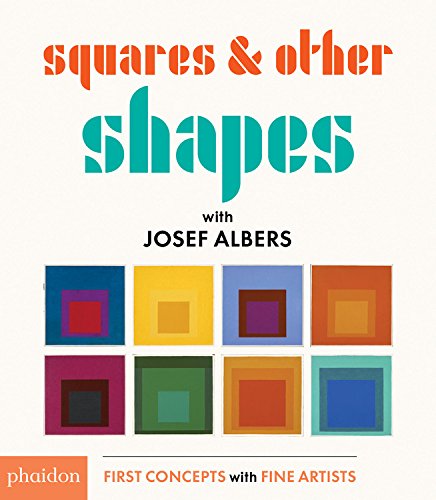
Squares & Other Shapes: with Josef Albers (First Concepts with Fine Artists)
Paintings by Josef Albers
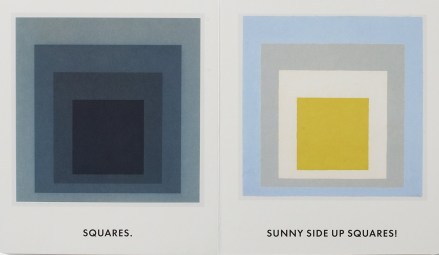
Opening Squares & Other Shapes, readers encounter a vibrant magenta square nesting in an autumn maple leaf-hued square which floats in a square of clear, winter-sky blue. On the next page two orange squares beckon you to follow into the glowing, yellow center square. Could it be a doorway or window leading somewhere?
In another painting, a bold yellow rectangle and an equally bold blue rectangle host guests: “two little rectangles lying down for a nap.” But the calm is shattered on the next page as stacks of red and blue rectangles shake and tumble: “Watch Out! It’s raining rectangles!”
Image courtesy of phaidon.com
Now circles want a turn, and they want to have fun! In a large black rectangle a white circle and a red circle play stoplight: “Circle, Circle, Stop!” while on the next page blue, black and spirally circles jump and frolic—“Bounce, Circles, Bounce!” Turn the page—can you count all of the little circles in the rectangle or all of the baby circles in the rectangle on the right-hand page? Some of the babies are leaping away—or are they just joining the group? What do you think?
Image courtesy of phaidon.com
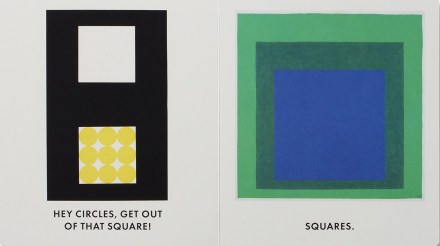
Next the black rectangle is back, but this time with two white squares inside. Wait a minute—how did those little yellow circles get into the bottom square? “Hey circles, get out of that square!” Of course triangles don’t want to be left out. Dusky triangles in many sizes connected tip to tip enjoy their light, white background, but on the next page they’re left in shadow—“Hey triangles, who turned out the lights?”
Image courtesy of phaidon.com
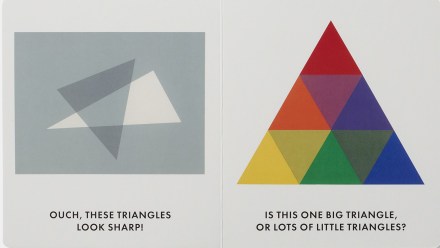
Be careful turning the page to look at the two intersecting triangles: “Ouch, these triangles look sharp!” Maybe it’s better to move on to the big, vivid triangle on the right. Oooh, so many colors! Nine, in fact! Hmmm… “Is this one big triangle, or lots of little triangles?” These paintings are getting more complex! Now there are “blue squares in pink squares, pink squares in blue squares; rectangles in rectangles, circles in circles, and more triangles in triangles. But here’s a different painting: the rectangles are perfect rectangles, but the squares are a little off, and what kinds of shapes do those curved lines make?—“Funny shapes in funny shapes!” And the last painting? Back to squares. Red, purple, and blue squares. “Beautiful squares.”
Following the paintings, the last page provides a captivating biography about Josef Albers’ life and work aimed at the book’s young audience.
Image courtesy of phaidon.com
Imagine being able to own a stunning collection of famous paintings by a world-renowned artist and educator to teach your child about shapes, color, and art. With Squares & Other Shapes by Josef Albers you can! The second in the First Concepts with Fine Artists series, Squares & Other Shapes presents readers with more than 30 painting by Josef Albers, one of the most influential artists of the 20th century. Most well-known for his Homage to the Square paintings, Albers worked with color and shapes to challenge perceptions and promote creative thinking.
Shapes are one of the earliest concepts introduced to babies and young children. Even the youngest readers will be riveted by the beautifully reproduced paintings in this large board book that present squares, circles, rectangles, and trianges in clear but creative ways. The easily understood labels, repetition, and recognizable patterns offer key strategies that are known to build strong reading and comprehension skills. Kids will love the humorous text that brings the paintings to life, helping them to also see that art is not static, but active and open to interpretation by each viewer.
Squares & Other Shapeswith Josef Albers is a wonderfully conceived concept book that can grow with children as it offers readers enjoyment and education on so many levels. The book would be an often-sought-out addition to home and library bookshelves and also makes a perfect present for baby showers and other gift-giving holidays.
Ages birth – 5 (and up)
Phaidon Press, 2016 | ISBN 978-0714872568
Look for Circles Day Activity
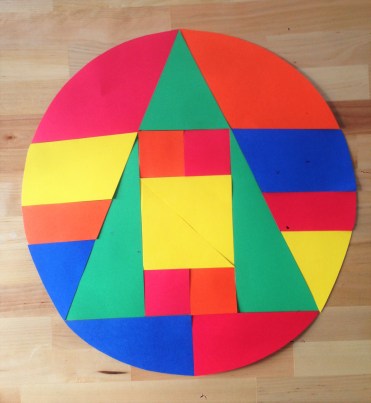
Circle of Shapes Puzzle
Build a circle from different shapes with this puzzle that grows as you add pieces! You can also use these shapes to create your own art!
Build the puzzle from the central square to the edges of the circle (It may be easier to keep the puzzle in place by sticking the pieces down with a little tape applied to the back of the pieces)
You can also use the shapes to create your own art!
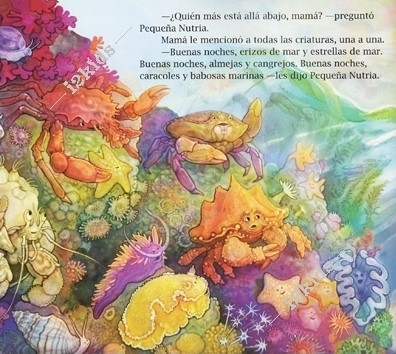
Established in 1953 by the International Federation of Translators, today’s holiday celebrates the translators in every language who work to break down barriers and bring great literature to all people across the globe. Everyone’s story matters, and it is through access to a wide range of books that readers acquire deeper understanding of the commonalities and unique experiences that make us all citizens of the world. For children in bilingual and multicultural homes the ability to read and hear books in their native tongue as well as their adopted language is especially comforting and promotes greater literacy and language learning. With eight bilingual editions available, today’s book is a great example of the importance of translators’ work!
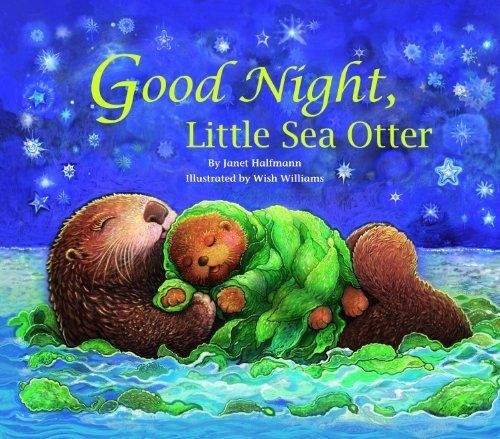
Good Night, Little Sea Otter
Written by Janet Halfmann | Illustrated by Wish Williams
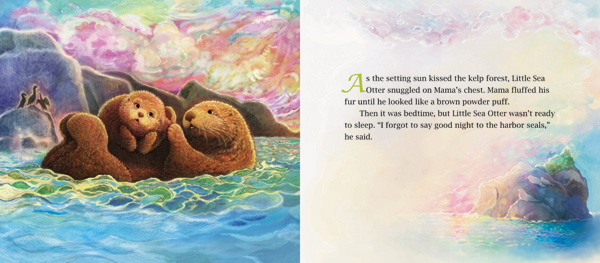
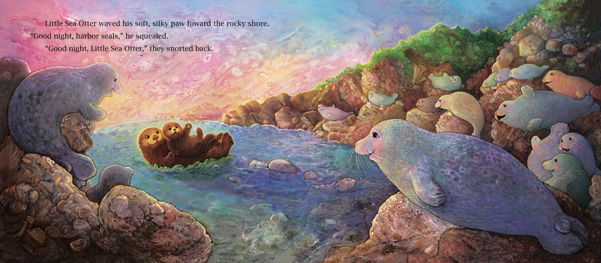
As twilight paints the sky pink, purple, and gold, Little Sea Otter gets ready to sleep in her kelp forest bed. Mama Otter fluffs her baby’s fur and snuggles with her, but Little Otter is still wide awake. “‘I forgot to say goodnight to the harbor seals,’” she tells Mama. The baby waves her “soft, silky paw toward the rocky shore” and says goodnight. The harbor seals all along the craggy cliffs wish the little otter goodnight in return.
Image copyright Wish Williams, text copyright Janet Halfmann, courtesy of starbrightbooks.org
Hearing the seals’ goodnight song, the sea lions join in, their loud barks echoing in the air. “‘Good night, father sea lions. Good night, mother sea lions and baby sea lions,’” Little Otter calls. Curious about all the commotion, a seagull swoops down and learns that it’s bedtime for Little Otter. The two say “Good night” to each other, and as the seagull flies away to find his own place to sleep, Mama Otter tries to tuck in her little pup.
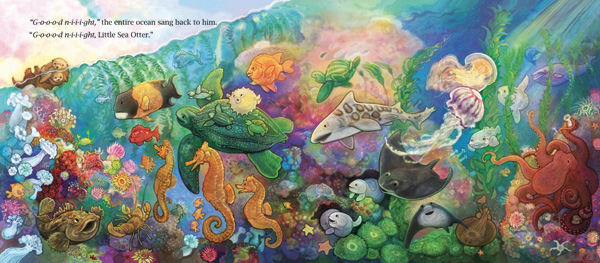
“But before she could say another word, Little Sea Otter dipped her furry face into the chilly water.” There she sees a whole ocean full of fish to greet. She says “Good night” to the yellow fish, the orange fish, and the purple fish. Of course she can’t forget the long fish or the short fish, the striped fish or the spotted fish either. All these fish are happy to wish the tiny pup sweet dreams too. Mama Otter points out other sea creatures getting ready for bed—different types of crabs, snails, sea stars, anemones, clams, and more. Little Otter says “Good night” to each in turn.
Image copyright Wish Williams, text copyright Janet Halfmann, courtesy of starbrightbooks.org
From every part of the ocean sea turtles, lobsters, octopi, rays, jelly fish, sea horses, eels and others bubble a chorus of “Good night” to Little Otter. She listens and responds to each one and then asks Mama if she has forgotten anyone. “‘Yes, you did,’” Mama says, “scooping her up in her paws. ‘You missed ME!’” Little Otter giggles and says “Good night.” Mama Otter hugs her tight and rolls over and over in the kelp, wrapping them both “in ribbons of seaweed” that will keep them secure on the ocean currents as they sleep.
Little Otter gazes up into the night sky and says “Good night” to the moon and the stars. As Little Otter’s eyes finally close and she drifts into sleep, Mama kisses her gently on the head and the sea whispers “‘rock-a-bye.’”
Image copyright Wish Williams, text copyright Janet Halfmann, courtesy of starbrightbooks.org
Janet Halfmann’s gentle bedtime story is a sweet reminder for children of all the people in their life who love them and are thinking of them every day. As Little Sea Otter puts off sleep with just one more “Good night” and then another and another, Halfmann reveals with lyrical language the wide world of the sea and the creatures in it. The readiness of the ocean creatures to respond with their own heartfelt wishes for the little pup suggest that this is a nightly and eagerly anticipated ending to each day by all.
One might imagine that in addition to “Good night” Little Otter’s nightly repertoire includes the request to be told all the names of the fish and sea animals, just as children love to look through pictures of family and friends and learn their names. Mama’s patient support of her pup’s curiosity and connections to her world provide tender moments between mother and child, as do their final bedtime rituals before drifting off to sleep.
Image copyright Wish Williams, text copyright Janet Halfmann, courtesy of starbrightbooks.org
Wish Williams’ beautiful, vivid illustrations are stunning and detailed, offering a magical realism that is perfect for this book’s wide-eyed audience. Little Otter and her sea creature friends are adorable, their smiling faces glowing with their happiness to see each other and finish the day together. While the fish and other sea creatures are colorful, the hues are true to their natural counterparts. The blue-green ocean swirls and foams along the rocky shore at twilight while whitecaps glitter in starlight when the sun goes down.
Little Otter’s repeated phrase of “Good night” gives children plenty of opportunities to read along. Kids and adults who enjoy the beach and marine environments will also be delighted in the scientific facts about sea otters organically sprinkled into the text. The lovely nature of the mother/child relationship, opportunities for child participation, and gorgeous art make Good Night, Little Sea Otter a welcome addition to home bookshelves for quiet story times and bedtime.
Translations
Star Bright Books also publishes Good Night, Little Sea Otter in eight bilingual editions. For information on each click on the links below:
Established in 1999 by UNESCO, Mother Language Day celebrates cultural diversity and promotes the protection of endangered languages. Events include multicultural festivals where all voices are heard and social cohesion, cultural awareness, and tolerance are honored.
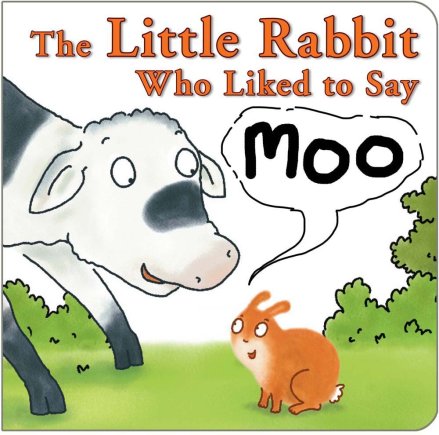
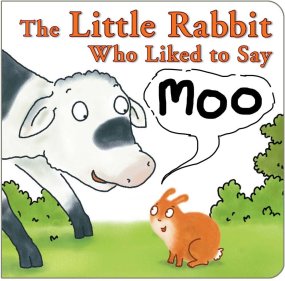
The Little Rabbit Who Liked to Say Moo
By Jonathan Allen
Little Rabbit sits in the farmer’s field listening to the animals talk and learning their languages. “Moo,” Little Rabbit repeats, “Moo.” A calf responds and questions Little Rabbit. It turns out that Little Rabbit knows and likes many languages. Calf joins Rabbit in the fun. “Baa,” they say together, which summons Lamb. The three friends decide to try “Oink.” With each new noise, the group expands and enthusiastically continues their linguistic experiment.
Copyright Jonathan Allen, 2008, courtesy of Boxer Books Ltd.
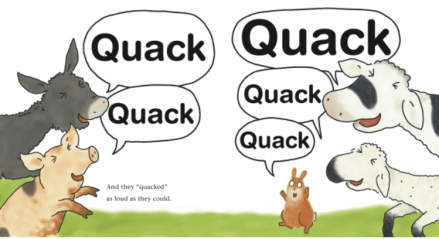
Finally, after a rousing chorus of “Quack,” Duckling asks , “Why are you all saying quack? You’re not ducks.” Baby Donkey is the first to answer. “I like Quack.” “So do I…Me too,” the other young animals pipe up. “Is quack your favorite animal sound?” Duckling asks. Each animal then reveals with pride that, while they like other noises, they prefer their own. But what about Little Rabbit, who doesn’t “have a big noise?” Will Rabbit’s answer begin the game again?
The wide-eyed, smiling animals in this adorable picture book by author-illustrator Jonathan Allen perfectly captures the joyous camaraderie of good friends discovering the world together. The book is a wonderful introduction for young children to the ideas of inclusiveness and self-esteem. Kids will love the repetition as each new animal joins the group, and will have as much fun saying each sound as Little Rabbit and the other farmyard friends.
Ages 2 – 5
Boxer Books Limited, 2015 (Board Book) | ISBN 978-1910126257
International Rabbit Day Activity
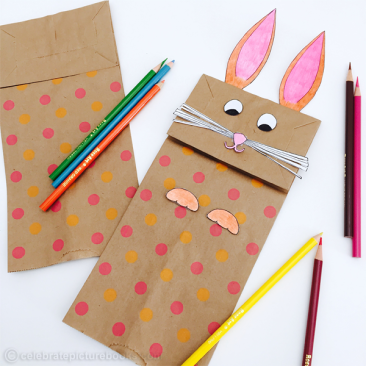
Paper Bag Rabbit Puppet
With this easy and fun craft you can make your own little rabbit who likes to play with you and talk in other languages! Make up stories of your own – what does your little rabbit like to do?
Place the flat paper bag on a table with the bottom flap facing you. Glue or tape the eyes, and the nose and whiskers to the bottom flap. Attach the ears, placing the tabs behind the top of the bottom flap. Attach the paws to the body below the bottom flap. Attach the cotton ball tail to the opposite side of the bag.
When it’s dry, use your puppet to read The Little Rabbit Who Liked to Say Moo again and play along, making the other animals’ sounds.
Then let your Little Rabbit try saying “Hi” in the languages below.
Learn to Say “Hello” in Other Languages
Spanish: Hola (oh-la)
French: Bonjour (bon zhur)
German: Hallo (hă-lo)
Chinese: Nin Hao (nee hah)
Filipino: Kamusta (ka-muh-stah)
Italian: Ciao (chi-ow)
Japanese: Kon’nichiwa (ko-nee-chee-wah)
Turkish: Merhaba (mĕr-hah-bah)
You can find The Little Rabbit Who Liked to Say Moo at these booksellers
Instituted by People for the Ethical Treatment of Animals (PETA),which was established by Ingrid Newkirk in 1949, Hug a Vegetarian Day promotes awareness of a meat-and animal- products-free diet. Over the years millions of people world wide have embraced the vegan and vegetarian lifestyle, giving rise to alternative diets and products that support this healthy choice. To celebrate today whip up a vegetarian meal – why not Rainbow Stew?!
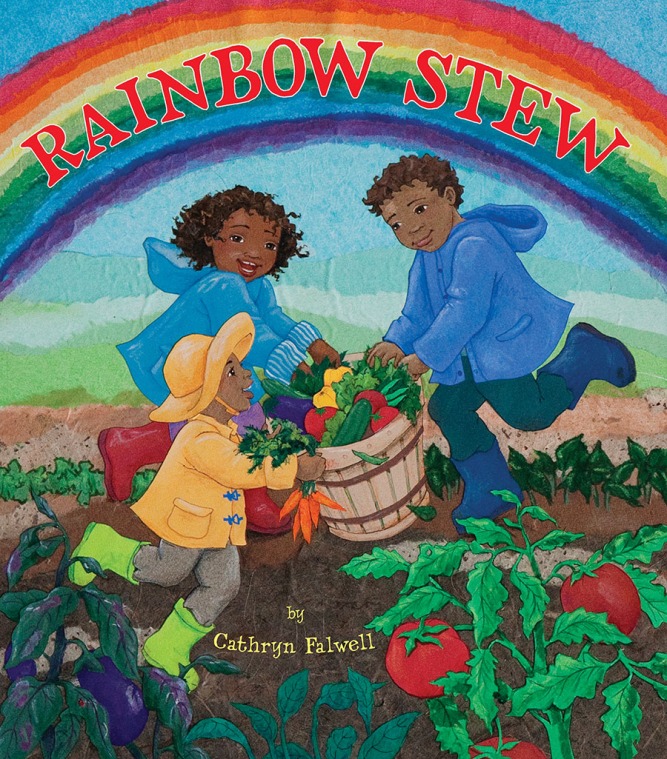
Rainbow Stew
By Cathryn Falwell
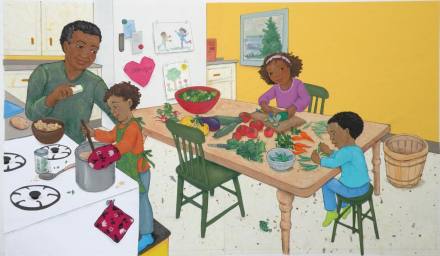
Grandpa’s making pancakes for his three favorite kids—his granddaughter and two grandsons. The kids are excited to be visiting their grandpa where they can play outside all day long. On this particular day, however, rain spatters the windows, and the kids are disappointed: “Whimper, sigh, / cloudy sky, / is it too wet to play? / We don’t want to stay inside / because of rain today.” But their grandpa knows just what to do! “Let’s go and find some colors for my famous Rainbow Stew!” he suggests.
Image copyright Cathryn Falwell, courtesy of rainbowstewbook.com
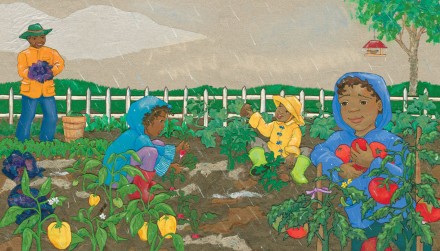
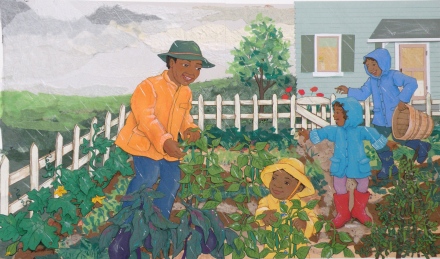
Out to the garden they run in their raincoats and hats. “Splish, splash, / puddle dash, / We bounce right out the door. / We’re off to find some red and green, / some yellow, orange, and more. / Grandpa shows us how to move / Between each garden row. / Lifting up the drippy leaves, / we see what colors grow.” They collect green spinach, kale, and zucchini; yellow peppers, purple cabbage and eggplant, red radishes and tomatoes; brown potatoes; and orange carrots. After some muddy fun among the plants, the kids go inside, get dried off, and begin to prepare their colorful stew.
Image copyright Catherine Falwell, courtesy of rainbowstewbook.com
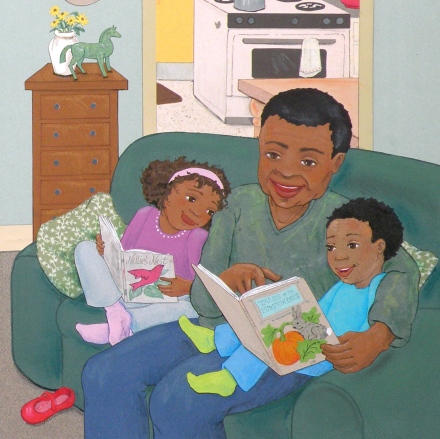
“Peel, slice / chop and dice, / colors fill the pot. / Stir in herbs and water / and then wait till it gets hot.” While the pot simmers on the stove, Grandpa and the kids snuggle on the couch with favorite books, reading together until the stew has simmered to perfection. The family then sits down to a homemade, colorful, delicious lunch of Rainbow Stew.
Image copyright Cathryn Falwell, courtesy of rainbowstewbook.com
Cathryn Falwell’s Rainbow Stew is a wonderful book to share with young children on many levels, offering opportunities for learning as well as playing. Introducing colors through familiar and delicious vegetables can get kids excited about gardening, cooking, even going to the grocery store. The rhyming verses each begin with an energetic couplet that kids will enjoy repeating or acting out. The bright colors of Grandpa’s house mirror the vividness of the garden vegetables, and young readers may enjoy matching the vegetables to items in the kitchen, living room, and more.
Children will identify with the disappointment of the three siblings when they learn it’s too wet to spend the day outside as well as their glee at squishing in the mud. The close bond between the kids and their grandfather as they cook and read together is a strong anchor for this story and promotes early literacy.
Image copyright Cathryn Falwell, courtesy of rainbowstewbook.com
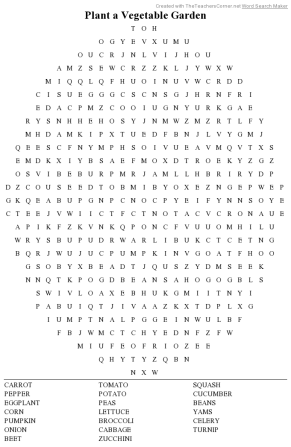
A recipe for Rainbow Stew follows the story. Reading Rainbow Stew, preparing the delicious dish, and doing the puzzle below makes for a fun rainy – or sunny – day!
Ages 4 – 7
Lee & Low Books, 2013 | ISBN 978-1600608476
Learn more about Cathryn Falwell and her books and art on her website!
To discover more about Rainbow Stew as well as activities to accompany the book, head over to rainbowstewbook.com!
The apple is one of the world’s most valuable foods, enjoyed by people all around the globe. Apples come in so many crispy, delectable types and flavors—from sweet to tangy. Whether you like red, green, or yellow apples they are delicious in pies, tarts, muffins, salads, or just by themselves. Today, why not buy a bushel or a peck of apples from your favorite store or farm stand—or for even more fun, visit an orchard to pick them right from the tree! What you do with them is all up to your imagination!
Toto’s Apples
By Mathieu Lavoie
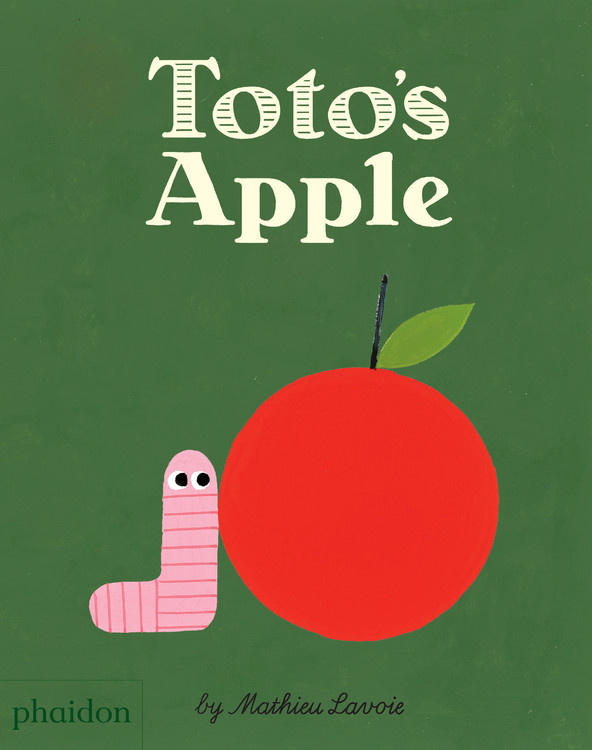
Like a more earthy Romeo, Toto the worm gazes at his beloved—a rosy red apple. He “is down low” and it “is up high”. He needs a plan because he is determined to win that apple. Just then a bird flies by and Toto has an idea. Using their natural enmity, “Toto gets busy” and paints a twig in his image. He displays it in a prominent place, and hides. When the bird zooms in to snatch the delicious snack, Toto catches a ride on the bird’s tail feathers. Up he soars…to be deposited in…the wrong tree.
Image copyright Matieu Lavoie, couresy of Phaidon Press, phaidon.com
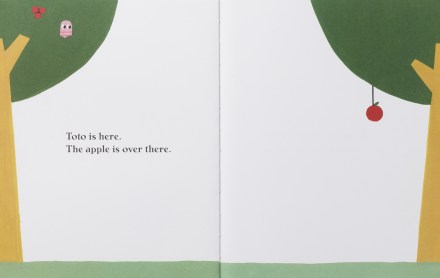
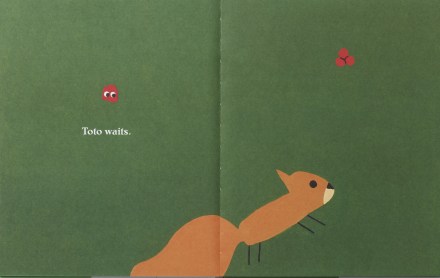
Now “Toto is here. The apple is over there.” As often happens “a squirrel approaches.” Watching it climb his tree, “Toto has an idea.” Once again “Toto gets busy.” He paints himself the red of the tree’s berries and when the squirrel passes him by, “Toto hangs on tight” to the squirrel’s bushy tail. Off Toto goes…into…the tree top. While the squirrel naps, Toto looks longingly at the apple of his eye so far below.
Image copyright Matieu Lavoie, couresy of Phaidon Press, phaidon.com
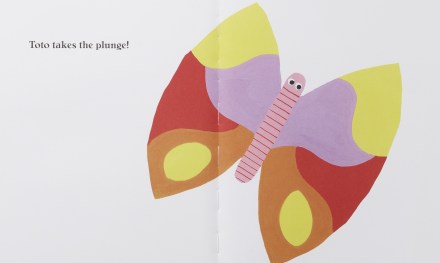
A falling leaf gives Toto another brainstorm. He paints a leaf with rainbow colors, and after a moment to bolster his courage…he “takes the plunge!” He flits and floats so close to…the ground. Landing gently on the grass, Toto is back to the beginning. Now what? Suddenly, he sees Didi and a friend arriving with a ladder. He hunkers down to scout out the situation. The ladder is placed against the tree trunk. The friend climbs the ladder. The apple lands in the hands of Didi, who…takes a big munch! “Toto is devastated.”
Just then Didi pivots to watch a passing airplane and drops the apple. Knowing “that it’s now or never,” Toto burrows in. As the plane disappears Didi again turns her attention to the apple…“and swallows Toto!” Poor Toto? No! “The apple is inside. So is Toto. Toto is happy.”
Image copyright Matieu Lavoie, couresy of Phaidon Press, phaidon.com
Mathieu Lavoie’s Toto’s Apple is part concept book, part tasty treat of absurdist fun that kids will eat up. As Toto’s predicament goes from bad to worse, his steadfast eye on his goal lends suspense and a growing comedic lilt to this very minimalist tale. Little Toto is an adorable hero, a tiny pink and red striped softie with one great love. His determination and clever solutions to his dilemma will not only make kids laugh but inspire them to muster their courage and think outside the box.
Lavoie’s simple but bold illustrations provide just the right amount of visual explanation of Toto’s changing fortunes (and facial expressions) for kids to enjoy the full, escalating, laugh-out-loud humor on every page. Readers will understand—as so many great literary works reveal—that wherever you and your beloved can be together is where true happiness is found.
At its core Toto’s Apple is a book that will be asked for again and again and should be “up high” or “down low” or anywhere in a child’s bookcase.
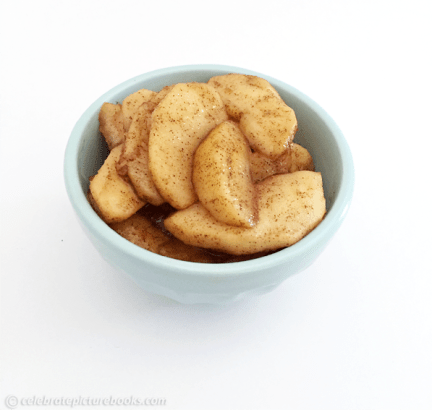
Warm apples sprinkled with cinnamon sugar is one of the most delectable treats of autumn. Here’s an easy recipe for making this delicious dessert or side dish.
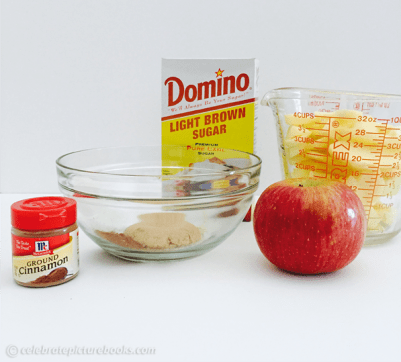
Ingredients
4 cups of apples, Macintosh or Granny Smith apples are good choices
2 tablespoons brown sugar
1 teaspoon cinnamon
1/4 teaspoon lemon juice
Directions
Mix brown sugar and cinnamon
Peel and core 2 large apples
Thinly slice apples
Combine apples and cinnamon sugar/brown sugar mixture
Stir until well combined
Drizzle with lemon juice and stir again
Cook apples on the stove at medium heat for 8 to 10 minutes or until desired texture
In the early 1970s Marion McQuade had the idea for a special day of the year when grandparents and grandchildren could show their love for one another. She further wanted it to be a day when grandparents could pass down the wisdom they had gained over their lifetime as well as share a bit of family history. Of course the same goes for grandparents learning the latest and greatest from the kids in their lives—from new technology to current fads. When all generations share their experiences, we’re all a lot smarter—and have closer relationships!
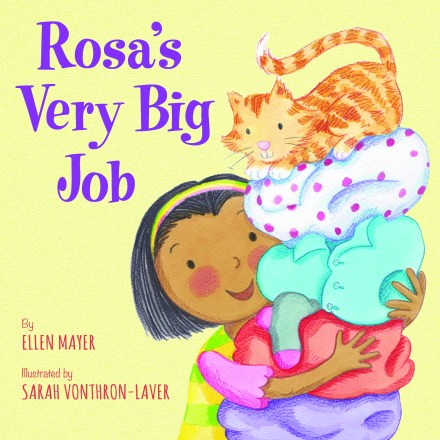
Rosa’s Very Big Job
Written by Ellen Mayer | Illustrated by Sarah Vonthron-Laver
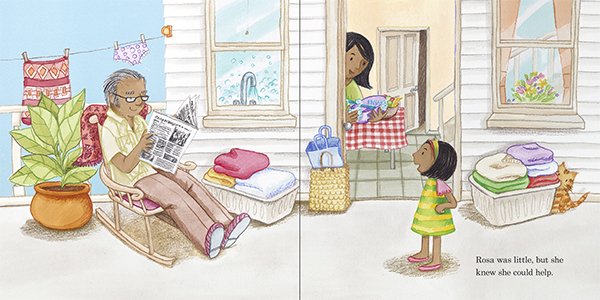
Rosa may be little, but she has big ideas about how to help. While Mama is out shopping for groceries for that night’s dinner, Rosa decides to surprise her by folding and putting away the laundry. The basket is piled high with fluffy dry clothes, sheets, and towels. Rosa watches her grandpa reading the newspaper. “‘Please help me, Grandpa!’” she says. She tugs on her grandpa’s hands, trying to pull him out of his chair. “‘Come on, Grandpa! Get up.”
Image copyright Sarah Vonthron-Laver, text copyright Ellen Mayer, courtesy of Star Bright Books, starbrightbooks.com
Grandpa seems to have a little trouble managing: “‘It’s difficult to carry these enormous piles,’” he sighs. But Rosa knows that smaller armloads work better. Grandpa’s clothes come unfolded as he puts them in the drawer. “‘Be neat. Like me,” Rosa says, showing him her tidy stack. Poor Grandpa! He has to keep hanging up the same jacket over and over. “‘It’s difficult to keep this jacket from sliding off the hanger,” he says. Rosa has the answer: “‘Zip it up,’” she explains. “‘Then it stays on.’”
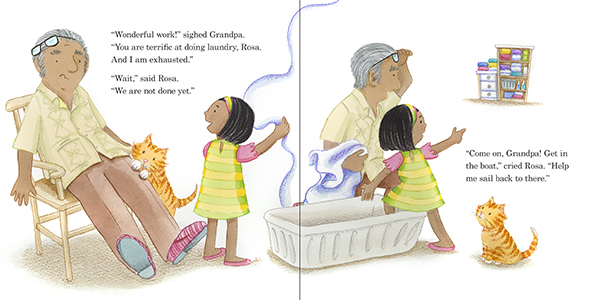
Grandpa sinks back into his chair. “‘You are terrific at doing laundry, Rosa. And I am exhausted,’” he says. But this is no time to quit—Rosa has big plans. As she steps into the now empty laundry basket, she exclaims, “‘Come on, Grandpa! Get in the boat. Help me sail back to there.’” Rosa points to the linen closet.
Image copyright Sarah Vonthron-Laver, text copyright Ellen Mayer, courtesy of Star Bright Books, starbrightbooks.com
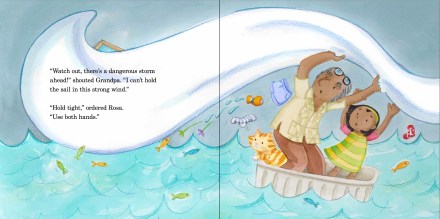
Suddenly, the floor swells with ocean waves teeming with fish. Grandpa channels his inner sailor as he holds aloft a sheet as a sail. As the wind billows and they come perilously close to the kitchen table, he says, “‘It’s difficult to sail around this enormous rock!’” Contemplating the rising sea, he exclaims, “‘It’s difficult to sail over this enormous wave!’”
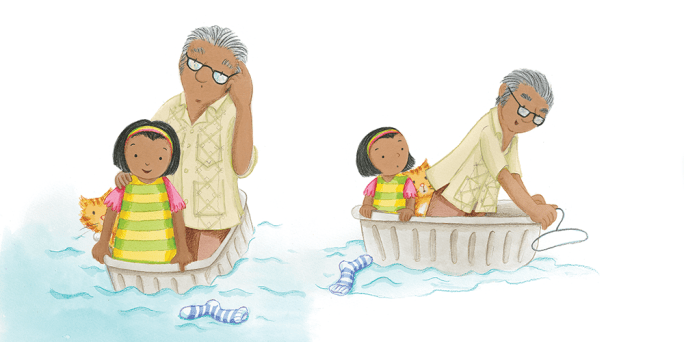
There’s a dangerous storm ahead, warns Grandpa, “‘I can’t hold the sail in this strong wind.’” Rosa is there to help and grabs one side of the sheet. “‘Hold tight,’” she orders. “‘Use both hands.’” At last the seas die down and Grandpa is ready to steer the laundry basket back to port, but Rosa has a more entertaining thought. Spying a sock on the floor, Rosa wants to catch the “enormous fish.” Grandpa obliges and picks up a hangar for a fishing pole. He holds Rosa as she stretches out over the edge of the laundry basket to land her fish.
Image copyright Sarah Vonthron-Laver, text copyright Ellen Mayer, courtesy of Star Bright Books, starbrightbooks.com
Just as Rosa nabs the fish, Mama comes home with her bags of groceries. She’s surprised to see that the laundry is not in the basket. Rosa runs to her and proudly explains, “‘We put all the laundry away. It was a very big job. We carried enormous piles. Grandpa dropped things. And I picked them up. It was very difficult for Grandpa. He got exhausted. But not me. I am terrific at laundry!’” Mama agrees that Rosa is a terrific helper. Then Rosa leads her mother to see the most surprising thing of all—the fish she has caught for dinner!
In her series of Small Talk Books® Ellen Mayer presents exciting stories for preschoolers full of imagination and rich language learning. Rosa’s Very Big Job introduces Rosa, a sweet girl bubbling with enthusiasm and the desire to help. The close relationships between Rosa, her mother, and her grandpa promote cooperation as well as effective modeling of speech patterns and a way to introduce larger words in an organic manner through play and common chores. Rosa’s inventive idea to turn the laundry basket into a boat is delightfully enhanced by her grandpa’s willingness to share in the story and expand on it. Humor, cheerful banter, and the easy camaraderie between Rosa and Grandpa invite young readers to join in the fun as they build confidence in their language learning.
Sarah Vonthron-Laver depicts Rosa’s afternoon with her Grandpa with joy and the spirited energy young children bring to everything they do. Grandpa is happy to spend time with his granddaughter, yet shows honest feelings of tiredness and frustration that spur on the plot. The transition from doing laundry to using the basket as a boat is as seamless as a child’s imagination, and the way Rosa and her grandpa use household items to create “sails,” “rocks,” “fish,” and “fishing poles” will give readers great ideas for post-reading play. Bright colors, an adorable kitten, and familiar surroundings welcome young children into the world of reading and expanded vocabulary.
Rosa’s Very Big Job would be a welcome addition to a young child’s bookshelf, not only for its fun story that kids will want to hear again and again, but for its leap into imagination that kids will want to replicate.
Dr. Betty Bardige, an expert on young children’s language and literacy development, provides tips for parents, grandparents, and caregivers following the text.
Ages 2 – 6
Star Bright Books, 2016 | ISBN 978-1595727497
Discover more about Ellen Mayer and her books as well as book-related activities and literacy initiatives she’s involved with on her website!
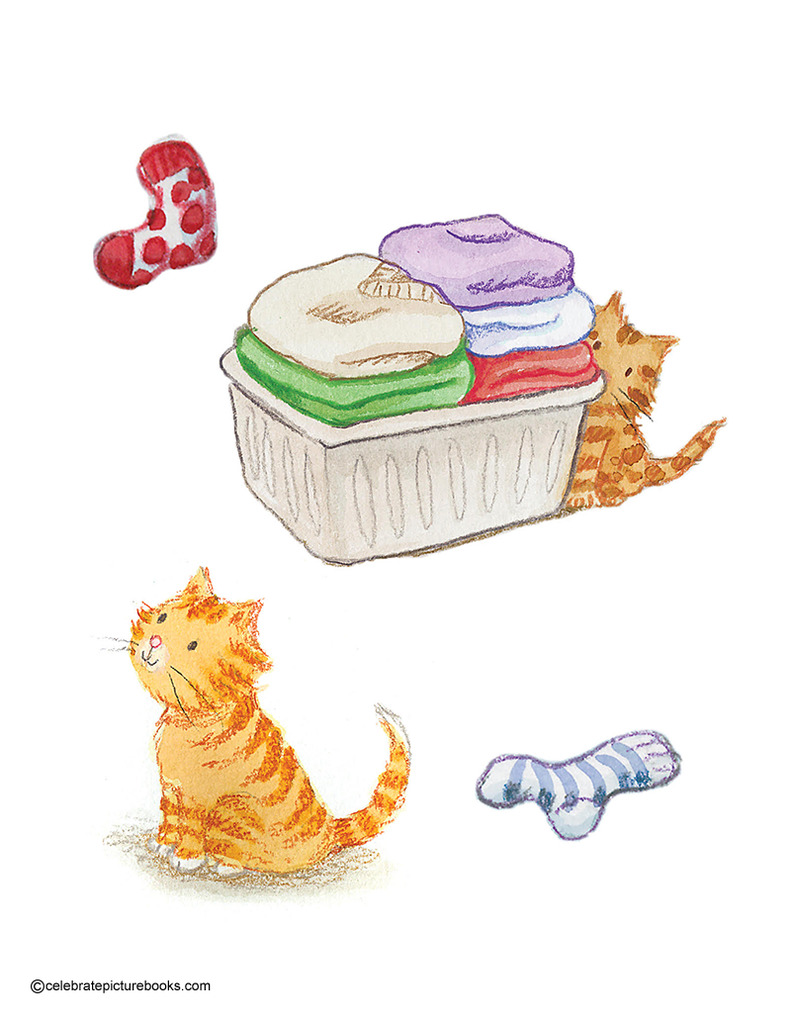
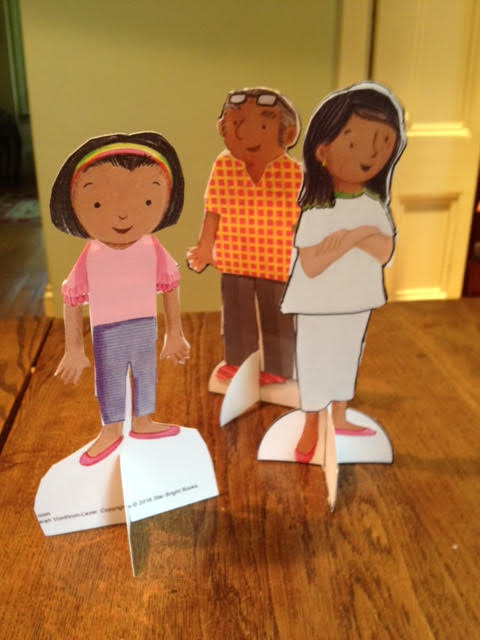
Rosa loves helping out at home. She’s terrific at doing laundry – folding and putting away the family’s clothes, socks, and linens. You are terrific at helping too! Can you help Rosa, Mama, and Grandpa get dressed and ready for the day with these printable paper dolls? You’ll even find a laundry basket, socks, and Rosa’s sweet kitty to play with!
Print dolls on regular paper or heavy stock paper. Dolls printed on heavy stock paper may stand on their own with the supplied stand cross piece. For dolls printed on regular paper, you can cut the supplied stand templates from poster board or card stock and glue the dolls to the backing.
Rosa’s kitty and the laundry basket can also be attached to the supplied template if needed
Print clothes for each figure
Color the blank clothes templates any way you’d like
Cut out clothes and extra items
Fit outfits onto dolls
Make up your own stories about Rosa, Mama, and Grandpa!
Interview with Author Ellen Mayer
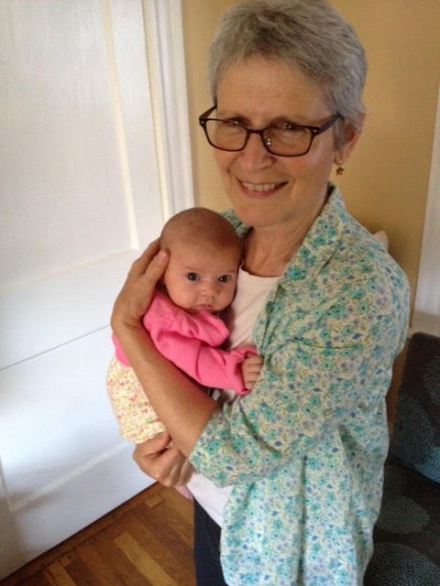
Today, I’m happy to present a fascinating interview with Ellen Mayer, a writer and expert in early literacy, in which she discusses her involvement with various organizations and programs, her baby granddaughter, why Hug Your Cat Day is at the top of her list of holidays, and gives us a peek at a very special sugar egg.
I’m really interested in your work in the education and literacy fields. Could you talk a little bit about your job as an education researcher and an early literacy home visitor, and how you got into those fields?
I got into these fields after leaving a Sociology PhD program right near the end. I didn’t want to be an academic and teach, I wanted to do applied research – to solve practical problems out in the world and to make a difference in the lives of those who were struggling. At the Harvard Family Research Project at Harvard’s Graduate School of Education, I studied the ways that families from underserved communities were engaged in supporting their children’s learning and education, and created research-based materials for families and schools to promote effective engagement. One of these was the Family Involvement Storybook Corner—curated picture book selections with family engagement themes. That got me interested in early literacy and picture books.
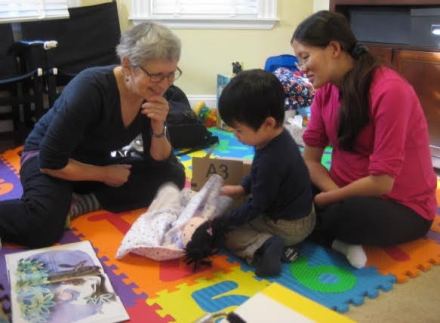
After researching family engagement in children’s learning for many years, I decided I wanted to go out into the field and be a practitioner and work directly with families on this topic. I worked as an early literacy home visitor with diverse families with the Parent-Child Home Program, modeling ways to share stories with little ones to build early language. I actually got paid to read picture books and play with families in their homes!
At the same time, I was pitching my Small Talk Books®, a collection of playful stories about everyday activities that provide fun for kids and ideas for adults – Rosa’s Very Big Job is one. The adults in the stories are engaged with children’s learning, modeling conversational ways to build young children’s language.
I read that your book Red Socks, another of the Small Talk Books®, is being used in a program to turn wash time at Laundromats into talk time for literacy development. Could you discuss this early literacy initiative?
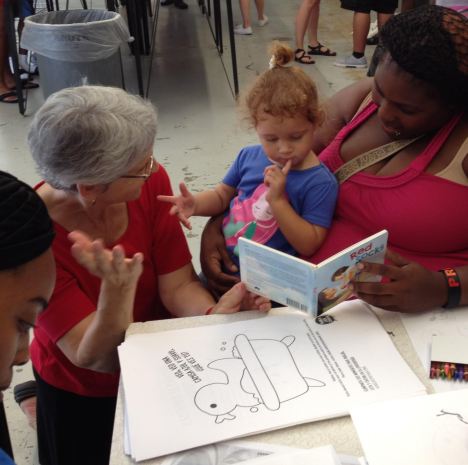
Yes! Wash Time/Talk Time is a terrific campaign led by Too Small To Fail, a joint initiative of the Clinton Foundation and the Opportunity Institute teaming up with a host of partners to turn Laundromats in underserved areas into venues for early literacy. This campaign distributes free books and information to families in Laundromats about building early language to help close what’s called the “word gap” by promoting parent conversation with babies and young children. Almost 60% of children in our country start kindergarten behind in their language development and this then sets them on a downward path and they get even further behind in school.
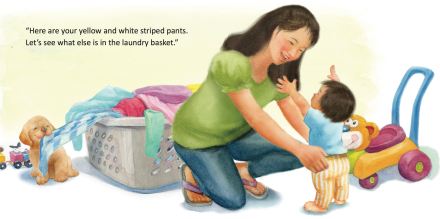
Red Socks was a natural fit for this program. In it a Mama narrates what she is doing for her little pre-verbal child as she folds the laundry and dresses the child—and as they search for a missing sock!
I have to say that it’s a dream come true that Too Small To Fail is using my book.
Wash Time/Talk Time is really reaching the families on the other side of the word gap who most need the ideas and inspiration in Red Socks. When I began writing the Small Talk Books® I wanted to include stories about doing laundry, as it’s something we all do as parents and provides lots of things to talk about with children. (Like the color of socks!) In fact, I used to sit in Laundromats and observe families when I was thinking up ideas for stories. I guess that’s the sociologist in me.
We just had the opportunity to visit one of the Laundromats in the campaign—at the Free Laundry Day in Tampa, FL hosted byThe Laundry Project—and share Red Socks with families. You can see some of the fun illustrator Ying-Hwa Hu and I had here:
What inspired you to begin writing picture books?
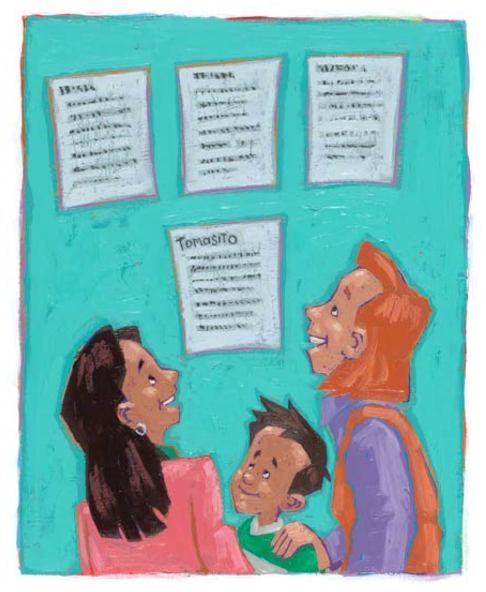
I came to picture book writing through a backdoor. When I was at Harvard Family Research Project, I was thinking about new ways to convey our ideas from research into practice for parents, and it occurred to me that a read-aloud picture book could address an audience of parents, as well as the primary one of children. My boss was enthusiastic about the idea, and so I enrolled in an adult ed class on writing for children. Then I turned one of our research case studies about challenges an immigrant Latino family had in communicating with their son’s teacher into a picture book,Tomasito’s Mother Comes to School/La mamá de Tomasito visita la escuela. Joe Cepeda did the art for it, and we made it downloadable for free.
Some new things! I have a fellowship with the Storytelling Math Project that’s funded by the Heising-Simons Foundation and coordinated by TERC, a not-for profit STEM research and development organization here in Cambridge, MA. I’ll be a member of a group that’s identifying, creating, and promoting math-infused storybooks for diverse young children and I hope to create a couple of Small Talk Books® along these lines—probably about supermarket shopping! I also was asked to help out the Highlights magazine editorial team that creates HELLO magazine for 0-2 years and be an outside reviewer for issues before they go to publication. And then I’ll be volunteering as a visiting children’s book author to the Somerville Family Learning Collaborative, the family engagement and early childhood hub of the Somerville, MA Public Schools, sharing my books with playgroups and new parent groups.
But mostly, I plan to write! I have a bunch of picture book manuscripts in various states, and ideas for new ones. These manuscripts are different from the Small Talk Books®; they don’t have a deliberate educational underpinning to them. They are fun, and just fun. One, for example, is called What To Do With Ruby-Lou and it’s about a baby who doesn’t laugh, no matter what her family does. Who is going to be able to get a laugh out of Lou? Well, it’s a surprise and it just might require some audience participation. I’ve had an agent in the past and hope to find a new one to rep me with these picture books.
You recently became a grandmother. Can you tell me a little about your granddaughter?
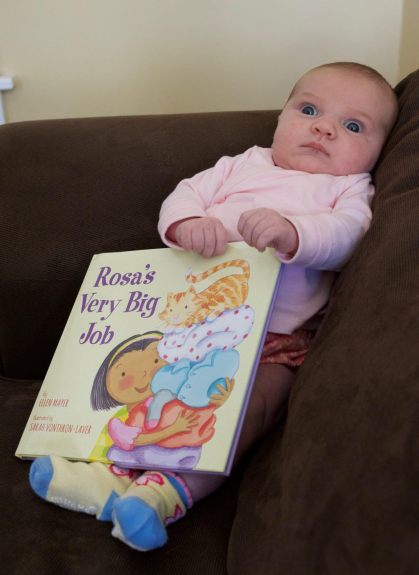
I thought our granddaughter was the most wonderful and expressive baby in the world when was she born – of course! She and my advance copy of the new Rosa book arrived into the world at just about the same time.
At three months now my granddaughter is a big reader and is riveted on the B&W hi-contrast board book genre, especially one board book about cars and trucks. She moves her head back and forth, from one end of the spread to the other, scanning the images on the page like a studious scholar of some ancient text.
What is the best part about being a grandmother?
For me the best part about being a grandmother is being able to simply enjoy my granddaughter and play with her and watch her develop, and not have to worry about taking care of her daily needs. I didn’t have to stress when she refused to take the bottle before starting full-day childcare. That wasn’t my job. (She did take it – of course!) They live nearby, and seeing her once or twice a week, I love noticing small changes on each visit. I also love seeing our daughter and son-in-law parent.
Have you given thought to what you’d like your granddaughter to call you?
Our daughter asked us ahead of time what we’d like to be called when we became grandparents. I thought it was a wise idea to be proactive and select a name immediately, to avoid being named by the grandchild something like “Grandma GA-GOO-GA.” My great aunt Jane is called “Nini” as a grandmother, and I’ve always loved that, but I didn’t want to steal it. So I chose “Mimi.”
It sounds as if Grandparents Day may be one of your top holidays! Do you have another favorite?
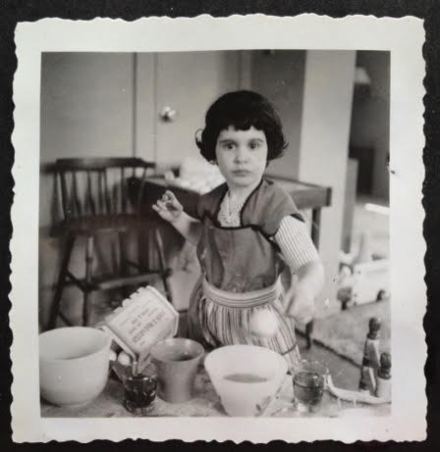
When I was little, I liked Easter a lot because it combined a lot of my favorite things: crafts, springtime, running around outside, candy. Also, we didn’t dress up much as kids, but I do remember Easter bonnets!
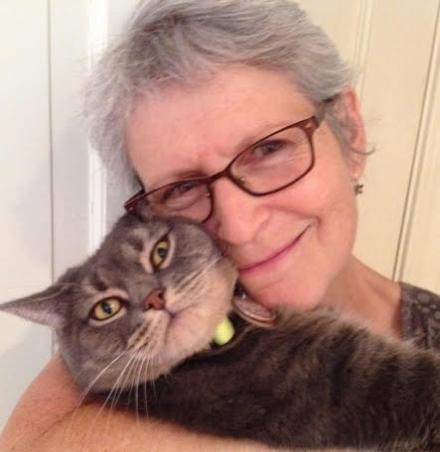
When our children were little, their birthdays became my favorite holiday celebrations. Now that they are grown, maybe I need to pick a new favorite holiday? I see that June 4th is Hug Your Cat Day. That might be just right: we have a rather large and ferocious cat and when she actually lets you hug her, well, it’s a cause for celebration.
Do you have an anecdote from any holiday that you’d like to share?
When I was six years old, I saw the Easter Bunny. I was staying at my Grandparents’ house, and I looked down the stairwell, and there he was, crossing the landing at the foot of the stairs. He was quite tall, wore a yellow slicker that was too small for him, and he was carrying a large Easter basket. I’m afraid I didn’t have my Brownie camera with me at the time to snap a photo.
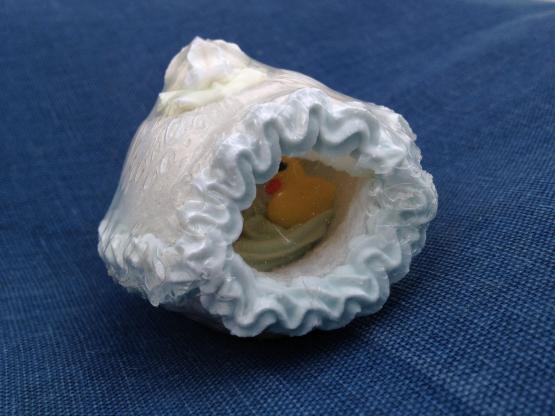
But I do have an unwrapped sugar Easter egg that I’ve saved from that era.
Thanks for sharing so much about your work and life, Ellen! I wish you all the best with Rosa’s Very Big Job, your other Small Talk Books®, and of all your other ventures!
Other Small Talk Books® available from Ellen Mayer and Star Bright Books include Cake Day, Red Socks, and A Fish to Feed and can also be found at the above booksellers.
In 1966 UNESCO (United Nations Organization for Education, Science and Culture) established International Literacy Day on this date to “actively mobilize the international community to promote literacy as an instrument to empower individuals, communities, and societies.” Marking its 50th anniversary, International Literacy Day is this year celebrating the theme “Reading the Past, Writing the Future” to commemorate five decades of efforts to increase in literacy rates around the world and the progress made. “It also looks to innovative solutions to further boost literacy in the future.” With a focus on innovation, International Literacy Prizes are also awarded to people with outstanding solutions that can drive literacy towards achieving future goals.
The World Literacy Foundation also celebrates today’s holiday with the 2016 campaign “The Sky’s the Limit,” which aims to eliminate the digital divide for students in the developing world.
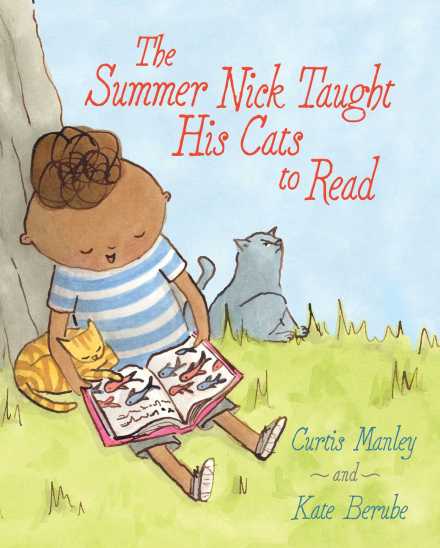
The Summer Nick Taught His Cats to Read
Written by Curtis Manley | Illustrated by Kate Berube
One summer Nick, Verne, and Stevenson did everything together. Nick is a little boy and Verne and Stevenson are two very different cats. Nick and Verne loved to spend time near the water—Stevenson tolerated it. Nick and Verne slept happily in a tent under the stars—Stevenson barely shut his eyes. While Nick rode his bike Verne eagerly sat in the front basket—Stevenson hunkered down in a box on the back. But when Nick sat down to read, both cats had their own ideas of fun—like lying on top of the book—and Nick could hardly read a sentence.
Image copyright Kate Berube, text copyright Curtis Manley, courtesy of simonandschuster.com
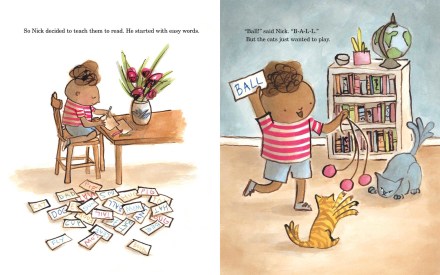
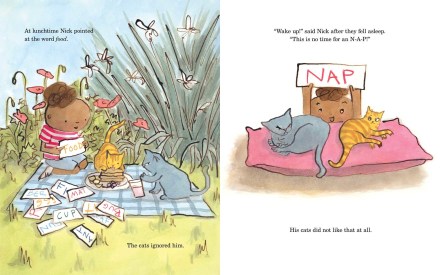
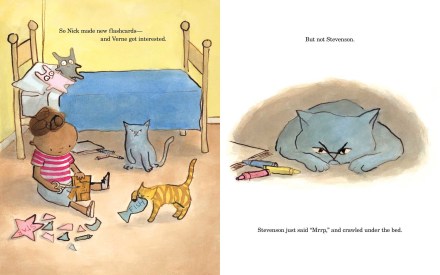
“So Nick decided to teach them how to read. He made flash cards and started with easy words” like “ball,” but Verne and Stevenson just wanted to play with the ball. While the three had a picnic on the lawn, “Nick pointed to the word food. The cats ignored him.” When the cats snoozed Nick woke them with a sign. “‘This is no time for an N-A-P!’” he said. Neither cat responded well, so Nick tried a new tactic. He made word-shaped flash cards. Verne took a nibble of “F-I-S-H,” but Stevenson hid under the bed.
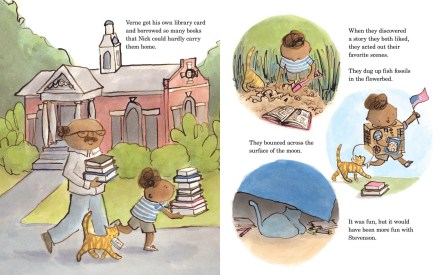
Nick began to see that Verne liked stories about cats and fish. “Verne loved fish. He followed along as Nick read, learning the sounds of the letters.” He even read by himself, discovering new stories, especially 2,000 Leagues Under the Sea. But Stevenson? When Nick spelled words for him, he merely ran under the porch, hissing. By this time Verne was reading so many books that he got his own library card and Nick needed help carrying all of his books home. Nick and Verne had fun acting out their favorite stories, but they missed Stevenson.
One day “Verne discovered a treasure under the bed—a great stack of Stevenson’s pirate drawings. “‘Wow!’” Nick whispered. “‘Stevenson drew a story.’” Nick and Verne put the pages together and began to write words to go with them. When the story was finished, Nick, Verne, and Stevenson “squeezed under the porch, gave Stevenson an eye patch, and read The Tale of One-Eyed Stevenson and the Pirate Gold. Stevenson listened and followed along. He didn’t run away. Or hiss. Not even once.”
Image copyright Kate Berube, text copyright Curtis Manley, courtesy of simonandschuster.com
Suddenly, Stevenson couldn’t get enough of books. Even before Nick woke up, Stevenson could be found with his nose in Treasure Island or another adventure book, and whenever Nick and Verne played pirates, Stevenson joined in. He helped bring down “scurvy mutineers” and found buried treasure. Now the three readers do everything together. They “hunt for dinosaurs in the lost world behind the garden…race around the yard in eighty seconds…and journey to the center of the basement.” And while they all like to read on their own, they also like it when someone reads to them. “Hmmm…,” Nick thinks, maybe next he could teach his cats to talk. “‘Meow,’ says Stevenson.”
Image copyright Kate Berube, text copyright Curtis Manley, courtesy of simonandschuster.com
Curtis Manley’s adorable tribute to reading and learning to read using cats, with their variety of personalities, is inspired. Just as some people respond more to the words while others are attracted by the pictures, Verne and Stevenson have their own relationships with books. The names of the cats and their preferred reading material are also reminders that books are personal, and disinterest in one type of story does not reflect disinterest in all stories. Manley’s text makes for a joyful read-aloud as his language and phrasing is evocative, lyrical, and imaginative.
In perfect accompaniment, Kate Berube brings this creative story to life, illustrating the tender relationship between Nick and his pets as well as emphasizing the humor and distinct personalities inherent in orange striped Verne and smoky gray Stevenson that influence their journeys to literacy. Depictions of the various books Verne and Stevenson are drawn to highlight the literary references in the trio’s further play. Readers will want to stop and peruse the page of library shelves, where such books as “Harry Picaroon and the Swashbuckler’s Stone”, “Harold and the Purple Canon”, “Millions of Rats”, and “Where the Wild Pirates Are” wait to be checked out in the Pirates section.
Kids will eagerly want to adopt The Summer Nick Taught His Cats to Read, and it will snuggle in nicely on children’s bookshelves.
Ages 4 – 8
Simon & Schuster Books for Young Readers, 2016 | ISBN 978-1481435697
Discover “the facts, fictions, poems, and numbers” of Curtis Manley on his website!
View a gallery of Kate Berube‘s art on her website!
International Literacy Day Activity
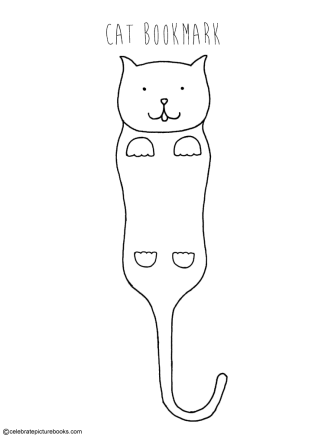
Feline Fine about Reading Bookmark
This want-to-be literary lion feels fine about reading! Let it hold your page while you’re away! Print your Feline Fine about Reading Bookmark and color it!










 celebratepicturebooks.com