November 3 – It’s Picture Book Month

celebrate-picture-books-picture-book-review-a-head-full-of-birds-cover

About the Holiday

November is all about picture books thanks to Picture Book Month founder author and storyteller Dianne de Las Casas and co-founders author/illustrators Katie Davis, Elizabeth O. Dulemba, Wendy Martin, and author Tara Lazar. This month-long international literacy initiative celebrates print picture books and all that they offer to young (and even older) readers. With gorgeous artwork and compelling stories, picture books open the world to children in surprising ways as they entertain, explain, excite, and help children learn empathy and understanding.

I’d like to thank Eerdman’s Books for Young Readers for sending me a copy of A Head Full of Birds for review consideration. All opinions on the book are my own.

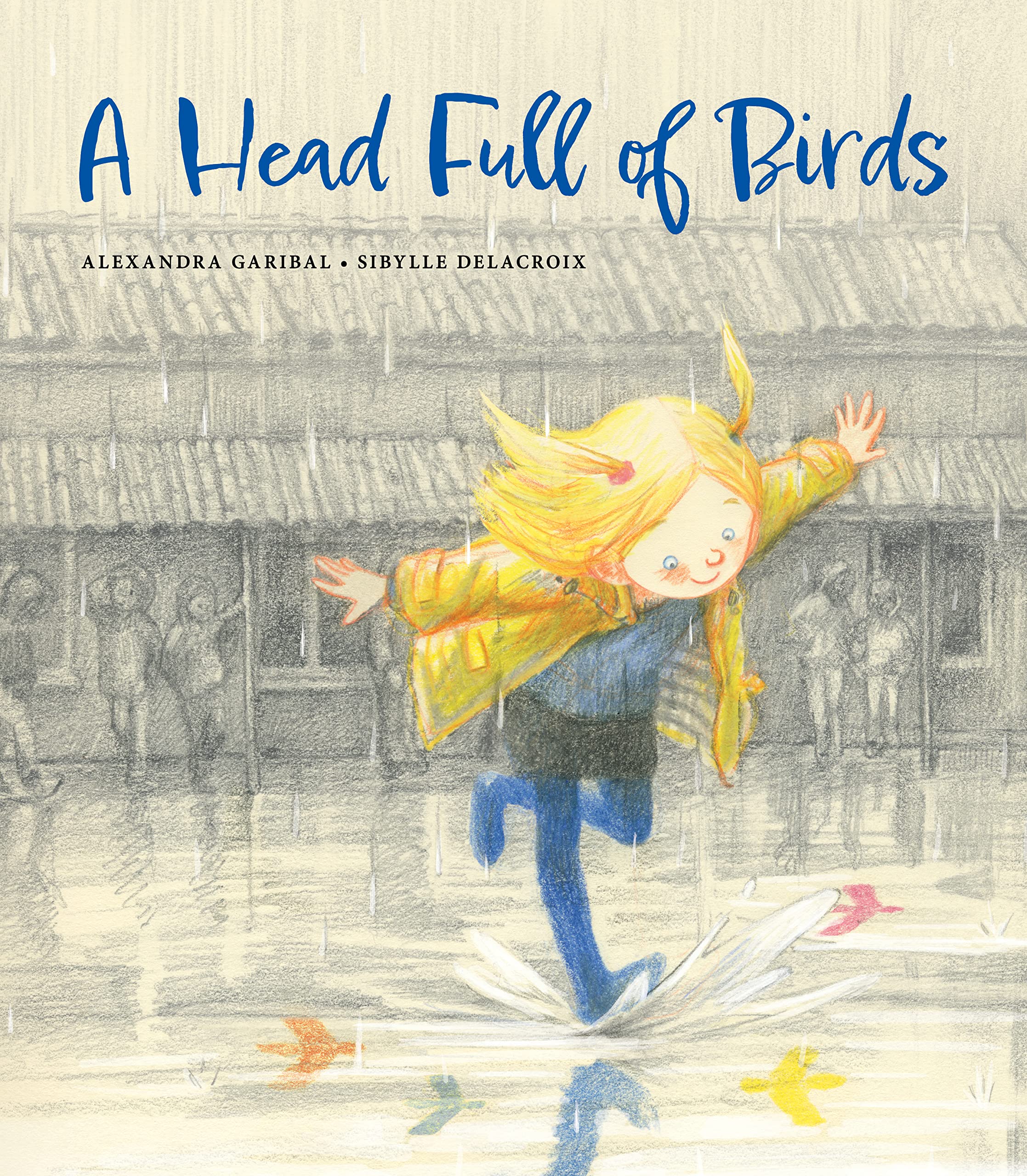
A Head Full of Birds

Written by Alexandra Garibal | Illustrated by Sibylle Delacroix | Translated from the French by Vineet Lal


Nanette is a little girl with “a head full of birds.” She mixed strange foods together, can spend hours looking at an empty spider’s web and “rocks back and forth, to and fro, fluttering her fingers like butterflies.” The kids at school taunt her, calling her “stupid” and treating her meanly. But Nanette doesn’t pay attention to them. One boy in her class, Noah, joins in. But one day while tossing paper airplanes during class, the teacher catches him and makes him sit up front.

celebrate-picture-books-picture-book-review-a-head-full-of-birds-butterflies

Image copyright Sibylle Delacroix, 2022, text copyright Alexandra Garibal, 2022. Courtesy of Eerdmans Books for Young Readers.

This means sharing a table with Nanette, which makes him angry. While pulling out his chair, “he pushes her out of irritation,” which causes her pencil to slide across her drawing of a bird. Nanette is disappointed, whispering “Oh. He won’t fly anymore.” Noah finds this ridiculous and tells her that drawings of birds can’t fly, but Nanette already knows. “‘The drawing doesn’t fly, the bird does,'” she answers.

That day after school, Noah watches as Nanette sets colorful little origami boats to sail down the rain-washed curb. He thinks it looks “so pretty.” The next day, it’s still raining, and during recess Noah sees Nanette standing in the middle of the school yard without her boots catching raindrops. His friends are calling him stupid, but he grabs her shoes and rushes out to bring her back in. But Nanette is happy. She takes her boots and fills them with water running off the roof. They both hide a boot in their coats and run back inside for class.

celebrate-picture-books-picture-book-review-a-head-full-of-birds-boats-on-curb

Image copyright Sibylle Delacroix, 2022, text copyright Alexandra Garibal, 2022. Courtesy of Eerdmans Books for Young Readers.

On the stairs, someone bumps into Noah, spilling his boot. Noah is angry that their plan is ruined, but Nanette tells him it’s okay, that one is enough. She passes him a tiny origami boat, and he drops it into her boot. “The boat twists and twirls, dancing merrily across the water. And it’s so pretty.” Now Noah and Nanette are friends, and “together, they look after the birds that nest in their heads.”

celebrate-picture-books-picture-book-review-a-head-full-of-birds-boot

Image copyright Sibylle Delacroix, 2022, text copyright Alexandra Garibal, 2022. Courtesy of Eerdmans Books for Young Readers.

While quietly straightforward, Alexandra Garibal’s story affects poignancy on multiple levels. Readers are first introduced to Nanette, a girl with neurodiversity who is happy in her observations and interactions with the world while also self-confident enough to ignore the comments of her classmates. Readers see Noah participating in the ridicule, but when he is moved to sit next to Nanette, readers begin to understand that it is he who needs to see the world differently, not Nanette. Children may feel that Noah already embodies this empathy as it doesn’t take long before he appreciates the beauty Nanette brings to their world. 

While he at first feels he must protect her, running out with her boots and aiming to take her back inside from the rain, he again learns that her actions have meaning, and when the boot he’s carrying spills on the way back to class, he now feels the same disappointment of a project ruined that Nanette felt with her bird drawing. With Nanette and Noah’s conspiratorial goofing off in class (and, bravely, in the front row!), Garibal brings the story full circle while infusing it with growth and joy for both characters as they go forward as friends.

celebrate-picture-books-picture-book-review-a-head-full-of-birds-filling-boot

Image copyright Sibylle Delacroix, 2022, text copyright Alexandra Garibal, 2022. Courtesy of Eerdmans Books for Young Readers.

Sibylle Delacroix’s lovely colored-pencil illustrations reveal Nanette as a shining light in the world and in her classroom. She is first shown gazing upward as if the sun is on her face, next with colorful butterflies, and then at school in a bright yellow raincoat, while the background is drawn in gray and the other kids in a single shade of red, all except Noah, who has brown hair and blue glasses, signifying to readers that perhaps he is a bit different as well. 

The two children’s growing friendship takes place against a gray-scale background, putting the focus on both their separation from their environment as well as their similarity to each other. Other visual clues in clothing and other elements also point to Nanette and Noah’s similarity, which can invite kids to find and talk about them. A particularly moving spread comes as the two children watch the little boat float in the boot, their two smiling faces reflected in the water. Turning the page, readers see the imagination Nanette and Noah share as they ride in an origami boat pointing out paper bird above.

This beautiful friendship story speaks not only to the acceptance and understanding of neurodiversity but of all the creative and different ways in which people see the world. A Head Full of Birds will fill your heart and resonate long after the story is over. The book invites multiple re-readings and will generate much thought and discussion. It is a must for all home, classroom, school, and public libraries.

Ages 4 – 8

Eerdmans Books for Young Readers, 2022 | ISBN 978-0802855961

About the Author

Alexandra Garibal is a French children’s author and editor. She has written over sixty picture books, novels, and magazine articles, and her titles have been translated for Chinese and Spanish readers. A Head Full of Birds is Alexandra’s English-language debut. Follow her on Instagram @alexandragaribal.

About the Illustrator

Sibylle Delacroix is the illustrator of Tears, Prickly Jenny, Grains of Sand, and Blanche Hates the Night (all Owlkids). She graduated from the ERG Saint-Luc School of Graphic Research in Brussels and worked for many years as a graphic designer before becoming a full-time illustrator. Sibylle lives in France. Follow Sibylle on Instagram @sibylledelacroix.

About the Translator

Vineet Lal is a literary translator of books from French to English, including A Perfect Spot (Eerdmans) and The Secret Life of Writers (Weidenfeld & Nicholson). He studied French at Princeton University and the University of Edinburgh. Vineet lives in Scotland. Follow him on Twitter @vineet_uk.
celebrate-picture-books-picture-book-review-a-head-full-of-birds-cover

You can find A Head Full of Birds at these booksellers

Amazon | Barnes & Noble | Books-a-Million

To support your local independent bookstore, order from

Bookshop | IndieBound

Picture Book Review

October 11 – Celebrating the Book Birthday of Madani’s Best Game

celebrate-picture-books-picture-book-review-madani's-best-game-cover

Thanks to Eerdmans Books for Young Readers for sharing a copy of Madani’s Best Game with me for review consideration. All opinions on the book are my own.

Madani’s Best Game

Written by Fran Pintadera | Illustrated by Raquel Catalina | Translated from the Spanish by Lawrence Schimel


“Our whole neighborhood knows it: no one plays soccer like Madani does.” Thus, a teammate of Madani’s begins the story about this friend who captivates the neighborhood (and sometimes it seems the whole world) with his barefoot ball-handling prowess. Madani has elevated the team’s game to “the best soccer we’ve ever seen.” After Madani has scored a “Gooooal!” the sound of the cheers soars above the playing field and “…crosses through doorways, rushes past the magazine stand, slips down alleyways, swirls around the fountain, and, growing fainter and fainter, climbs the steps up to Madani’s house.” 

celebrate-picture-books-picture-book-review-madani's-best-game-bare-feet

Image copyright Raquel Catalina, 2022, text copyright Fran Pintadera, 2022. Courtesy of Eerdmans Books for Young Readers.

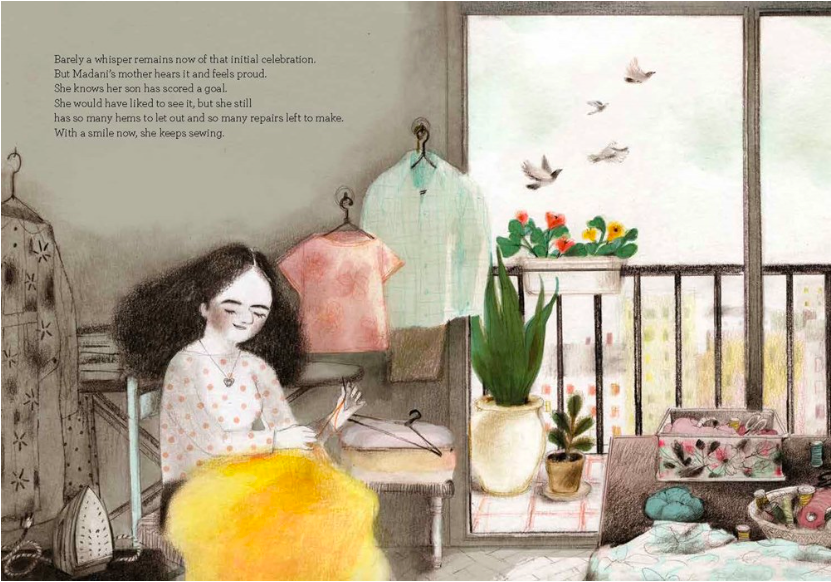
There, his mother hears it and knows the cheers are for Madani. She wishes she could attend his games, but she’s a seamstress and has so many garments to sew by hand. After the game, Madani’s teammates can only imagine how much better he would play if he only had a good pair of cleats. Their team might even be able to beat the Southside team—their biggest rival.

celebrate-picture-books-picture-book-review-madani's-best-game-madani's-moves

Image copyright Raquel Catalina, 2022, text copyright Fran Pintadera, 2022. Courtesy of Eerdmans Books for Young Readers.

The members of the team know that Madani’s saving up money in a special tin that gets heavier every time he declines to buy a snack, walks to away games instead of riding the bus, and makes other sacrifices. They know that when the box is full, Madani’s going shopping. “…then our games will be better than ever!’” he says, and they all dream of the day Madani buys his new cleats.

celebrate-picture-books-picture-book-review-madani's-best-game-listening

Image copyright Raquel Catalina, 2022, text copyright Fran Pintadera, 2022. Courtesy of Eerdmans Books for Young Readers.

The big game against Southside is only a day away, but Madani doesn’t come to practice. Instead, his friends watch him head downtown with the tin under his arm. Without Madani at practice, the team falls apart, but they don’t worry. Finally, they thought, their dreams of new cleats and beating Southside would come true!

When Madani shows up at the game the next day, “he looks radiant,” but he’s still barefoot. His teammates question him about his new cleats, but Madani doesn’t know what they’re talking about. The money wasn’t for shoes but for a present for his mother so that “‘she’ll be able to finish her work faster and come watch me play every Saturday.’”

celebrate-picture-books-picture-book-review-madani's-best-game-mother

Image copyright Raquel Catalina, 2022, text copyright Fran Pintadera, 2022. Courtesy of Eerdmans Books for Young Readers.

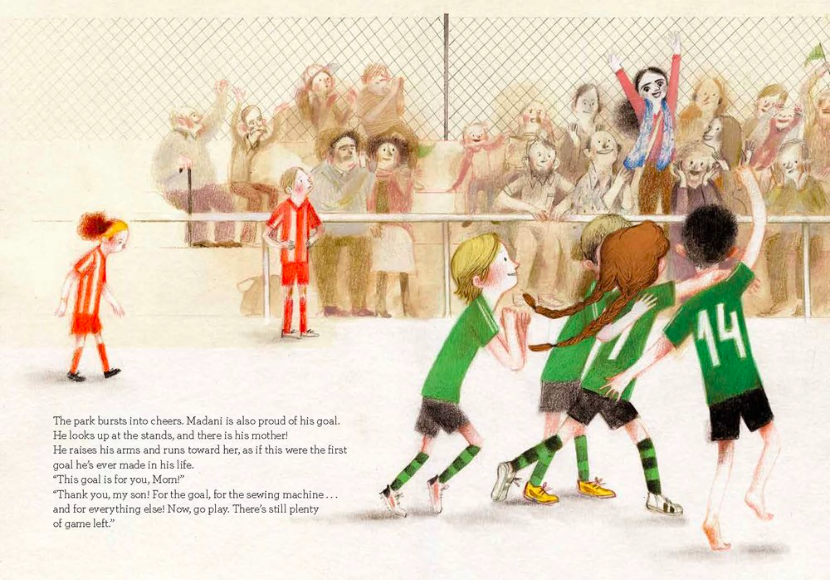
Madani’s friends still don’t quite get it, but the game begins, and in moments Madani has already stolen the ball away from the Southside players, run downfield and scored. He looks into the stands, sees his mother, and shouts “‘This goal is for you, Mom!’” Madani makes another goal, but Southside scores too, and the game ends in a tie. It’s okay, though, Madani’s teammate says, “‘because now more than ever, everyone in the neighborhood knows … There’s no player like Madani!’”

Back matter consists of notes from Fran Pintadera and Raquel Catalina that reveal their creative journeys and connections to this story.

celebrate-picture-books-picture-book-review-madani's-best-game-mother-at-game

Image copyright Raquel Catalina, 2022, text copyright Fran Pintadera, 2022. Courtesy of Eerdmans Books for Young Readers.

Fran Pintadera, who based Madani’s Best Game on his experiences as a social educator in new immigrant housing, tells his story with open-hearted affection for his subject as well as the relationships between teammates and mother and child. Through his perceptive and humorously observed details and lyrical language, Pintadera captures the wide-eyed wonder of children in awe of a great player (or artist, singer, scientist, or other talent). When Madani gets the ball, readers will hold their breath along with the neighbors, traffic, and even pigeons while he entertains the crowd and scores a goal. Then the action begins again, but this time the suspense revolves not around the game but on what Madani will buy. The answer is joyous, affirming family devotion and revealing the pure giving nature of a child’s heart.

From their first introduction to Madani, smiling out from the page, his bare foot on a soccer ball, readers will be captivated by him, his teammates, his neighborhood, and the game. Raquel Catalina’s endearing pencil, gouache, and colored pencil illustrations charm with realistic images of kids on the soccer field surrounded by city onlookers. Catalina creates not only gorgeous visuals of Madani’s supportive neighborhood, but an almost auditory experience as well.

Readers can almost hear the players’ running feet, the sudden cheers, the flap of the rising pigeons’ wings, and – as the celebration reaches Madani’s mother’s ears – even the whisper of her sewing needle through the fabric on her knees. Catalina deftly weaves the theme of friendship, between people both young and old, throughout the pages, enhancing the bond between Madoni and his mom as well as Madani’s teammates’ understanding of the true importance of that long-awaited game.

A beautiful poignant, joyful, and affirming story of family and friendship, Madani’s Best Game is a read aloud that adults and kids will love to share over and over. The book is a must for all home, classroom, school, and public libraries.

Ages 5 – 9

Eerdmans Books for Young Readers, 2022 | ISBN 978-0802855978

You can discover more about Fran Pintadera and his work on his website and connect with him on Instagram.

To learn more about Raquel Catalina, her books, and her art, visit her website. You can also connect with her on Instagram.

You can connect with Lawrence Schimel and learn more about his writing and his translating work on Instagram and Twitter.

celebrate-picture-books-picture-book-review-madani's-best-game-cover

You can find Madani’s Best Game at these booksellers

Amazon | Barnes & Noble | Books-a-Million

To support your local independent bookstore, order from

Bookshop | IndieBound

Picture Book Review

Picture Book Revi

September 2 – National Food Bank Day

celebrate-picture-books-picture-book-review-saturday-at-the-food-pantry-cover

About the Holiday

National Food Bank Day was established by St. Mary’s Food Bank, the world’s first food bank, which was founded by John van Hengel in Phoenix, Arizona in 1967. The idea spread throughout the country, and now St. Mary’s Food Bank distributes 250,000 meals daily with the help of staff, volunteers, and partner agencies, making it one of the largest food banks in the United States. This year, a record number of families (nearly 150,000 in August alone) have sought help. Food banks across the country help millions of men, women, and children who live with food insecurity due to job loss, illness, and other circumstances. Many food banks offer educational opportunities that help people change their situation and begin anew. Often, those who have benefited from the programs return to volunteer and contribute to the very food bank that helped them. To learn more about St. Mary’s Food Bank, visit their website. To find a food pantry in your area to get help for yourself, to donate, or to volunteer, visit the Ample Harvest website.

I’d like to thank Albert Whitman & Company for sharing a copy of Saturday at the Food Bank with me for review consideration. All opinions on the book are my own.

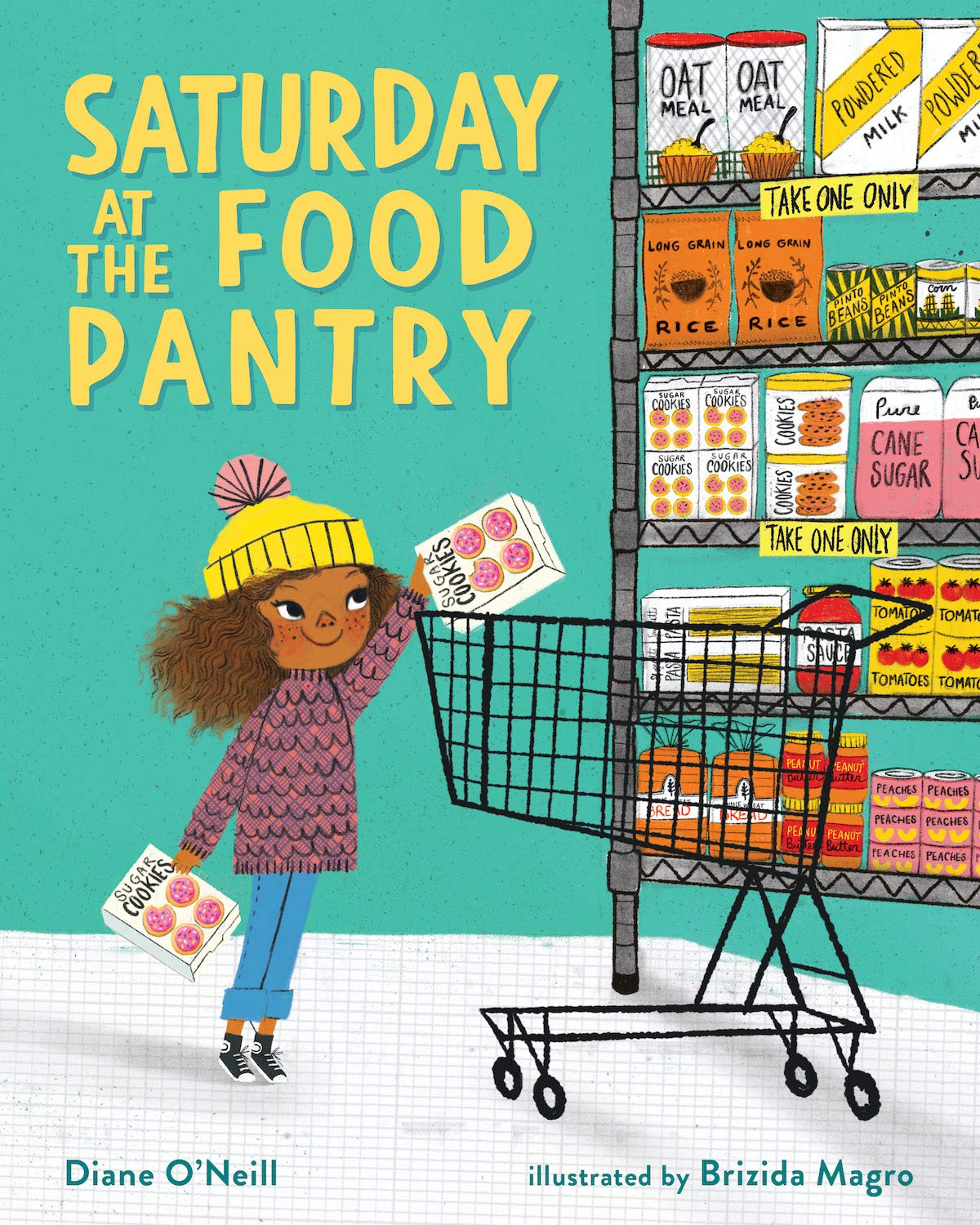
Saturday at the Food Pantry

Written by Diane O’Neill | Illustrated by Brizida Magro


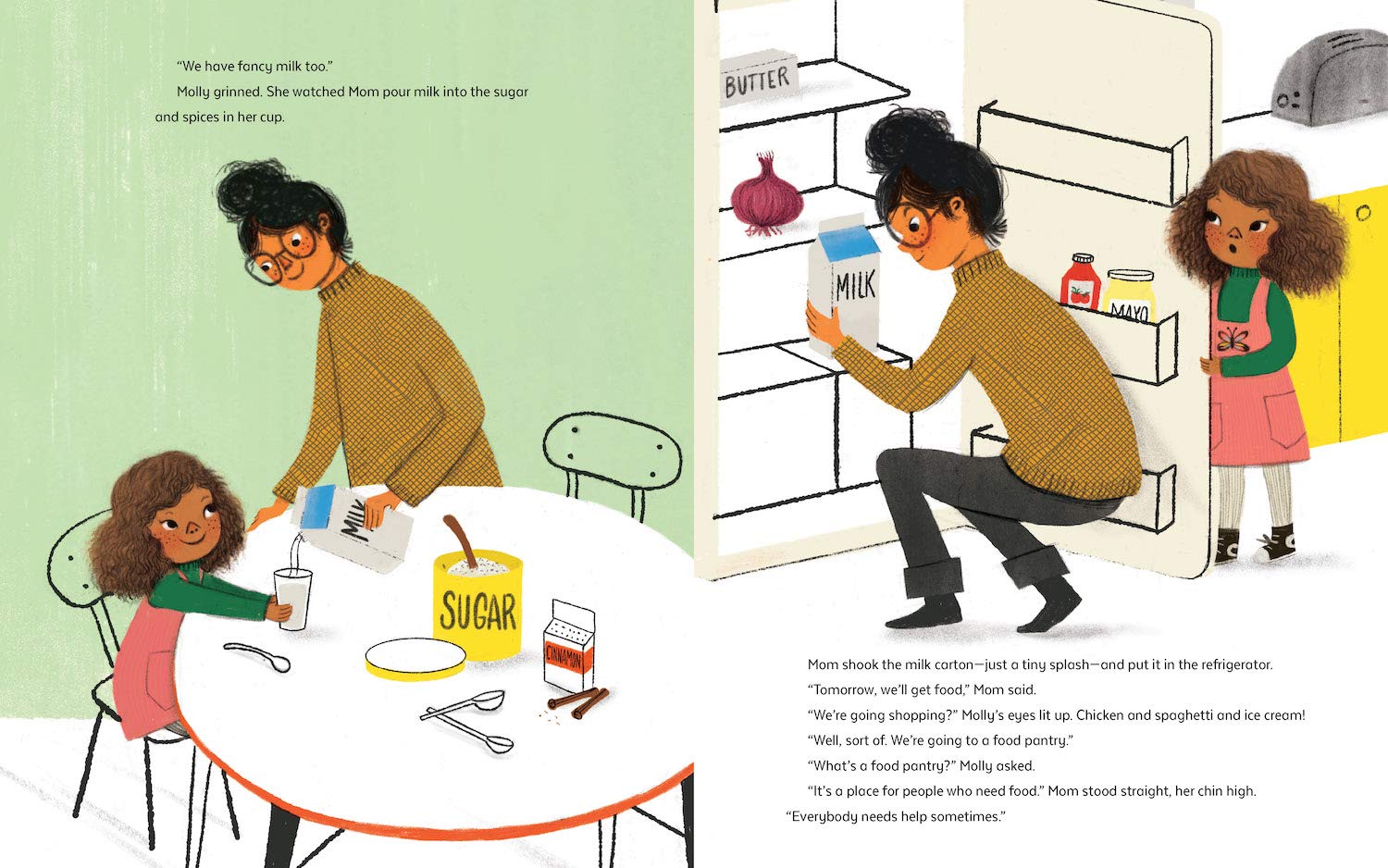
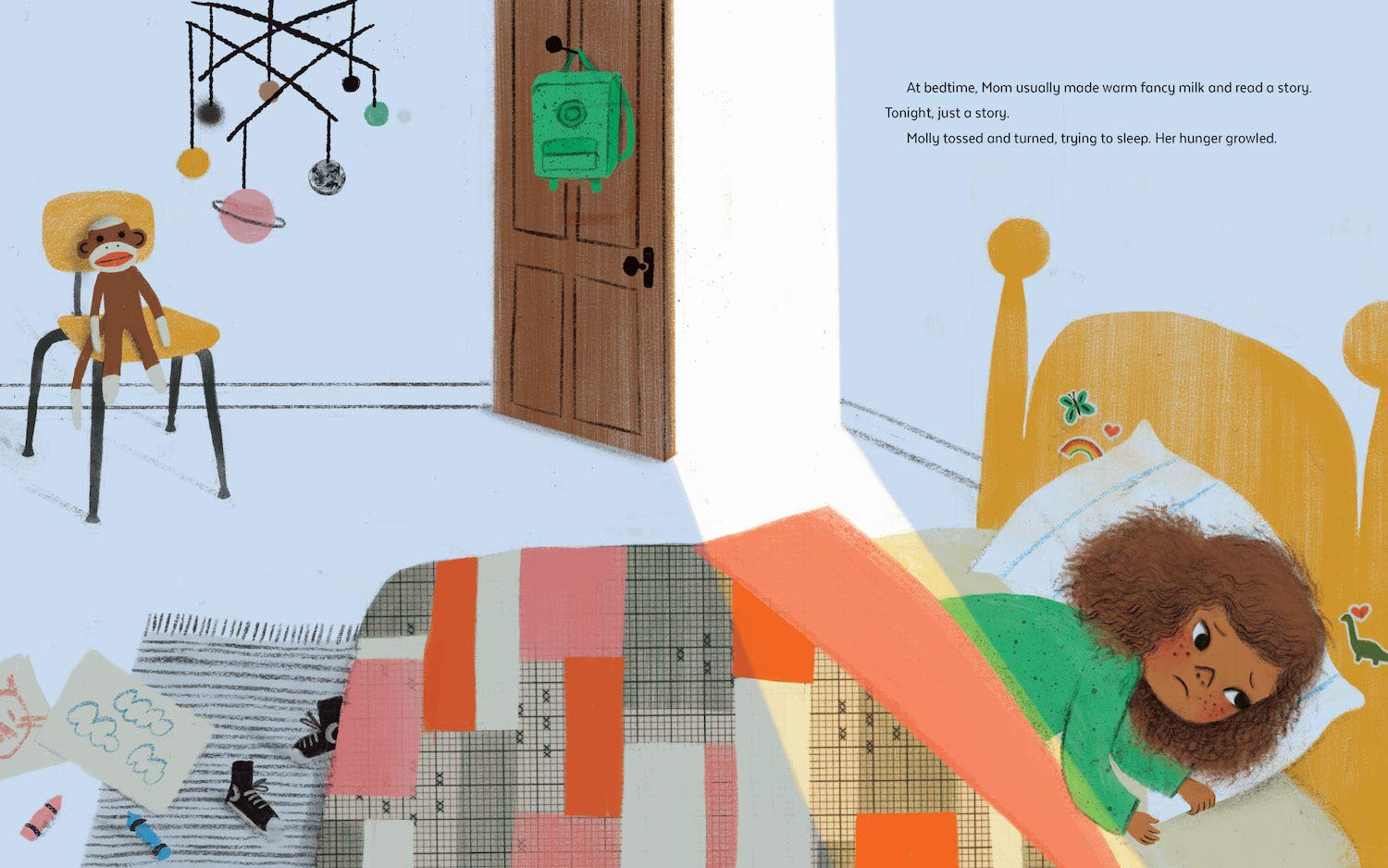
When Molly came to the table for dinner, she saw that they were having chili—again. She and her mom had eaten chili for two weeks straight. But there was “fancy milk too.” Molly smiled as her mom measured sugar and cinnamon into her glass and added milk.” There was only a splash of milk left when Mom put it back into the almost-empty refrigerator.

Tomorrow, Mom said, they’d go shopping. “Molly’s eyes lit up” as she imagined “chicken and spaghetti and ice cream.” But Molly’s mom tempered her expectations, saying that they’d be going to a food pantry. A food pantry, she explained, is “‘a place for people who need food…. Everybody needs help sometimes,’” she added. That night there was no warm milk before Molly went to bed and her stomach growled.

celebrate-picture-books-picture-book-review-saturday-at-the-food-pantry-milk

Image copyright Brizida Magro, 2021, text copyright Diane O’Neill. Courtesy of Albert Whitman & Company.

In the morning when Molly and her mom got to the food pantry there was already a line waiting for it to open. Molly had brought paper and crayons and sat down to draw. Then she saw a girl who was in her class at school. She called out a hello, but “Caitlin looked away.” When Molly ran over, Caitlin told her she didn’t want anyone to know that she and her grandmother needed help.

Molly went back to her mom, wondering if there was “something wrong with needing help.” She wanted to go home, but she was also hungry. Molly’s mom suggested she draw a picture, and the woman in front of them asked if she’d draw one for her too. Then everyone in line seemed to want a picture. Molly ran back to Caitlin to ask for help. Caitlin sat down and began to draw too.

celebrate-picture-books-picture-book-review-saturday-at-the-food-pantry-hungry

Image copyright Brizida Magro, 2021, text copyright Diane O’Neill. Courtesy of Albert Whitman & Company.

When the door opened, Molly and Caitlin each had a picture for the woman who welcomed them in too. Molly noticed that her mom had to sign in before she got a cart and they could begin shopping. They didn’t do that at the grocery store. The shelves at the food pantry were stocked with items she recognized from the store they usually shopped with. She ran over and took a box of sugar cookies off the shelf, but her mom told her “‘They—the people in charge—they’ll want us to take sensible stuff.’” Molly felt embarrassed and couldn’t understand why the cookies were there if they couldn’t take them. She sadly returned them to the shelf. As they went to look for food, Molly thought her mom didn’t want to be seen there, either—just like Caitlin. In a whisper, Molly reminded her that everyone needs help sometimes.

They went through the store taking one can, bag, or box of the food they needed. Then Molly’s mom reached for a box of powdered milk. They could have fancy milk that night. When they got to the checkout desk, Molly and Caitlin found their drawings hanging on the wall. The man at the counter bagged their groceries and then handed Molly’s mom a box of sugar cookies. “‘Saw your little girl looking at these. She can have them, if that’s okay with you, ma’am,’” he said. Molly noticed that her mom looked like she might cry.

celebrate-picture-books-picture-book-review-saturday-at-the-food-pantry-line

Image copyright Brizida Magro, 2021, text copyright Diane O’Neill. Courtesy of Albert Whitman & Company.

As they were walking home, Molly saw Caitlin and her grandmother coming the same way. They were all happy to discover that they were neighbors. Molly’s mom explained that she’d been looking for work since the factory closed, and Caitlin’s grandma said she’d been sick. Caitlin understood, but wished they didn’t have to shop at a food pantry. But then Molly told her that “everybody needs help sometimes” and reminded her that they had helped make the man at the checkout counter feel happy with their drawings. Caitlin hadn’t thought about it that way. She smiled. Then Molly invited her and her grandmother to have lunch with them—with sugar cookies for dessert.

Following the text, a note for parents, teachers, and other caregivers from Kate Maehr, the Executive Director and CEO of the Greater Chicago Food Depository, reveals more information about food insecurity, including recent statistics and a resource where people can find help and more information.

celebrate-picture-books-picture-book-review-saturday-at-the-food-pantry-shopping

Image copyright Brizida Magro, 2021, text copyright Diane O’Neill. Courtesy of Albert Whitman & Company.

Diane O’Neill’s well-executed story about two families who need the help of a food pantry is a poignant reminder of the many people—perhaps even readers’ classmates—who face food insecurity every day. Through the experiences of Molly and her mother and Caitlin and her grandmother, readers discover what it’s like to go to bed hungry, miss out on treats, and feel ashamed to ask for help. As this is Molly and her mother’s first trip to a food pantry, Molly’s questions and observations well reflect children’s own or reassures those who are familiar with these important resources.

O’Neill’s straightforward storytelling emphasizes the fact that at one time or another everyone needs help and demonstrates simple ways that children make things better through their generosity, optimism, and acceptance. Molly and Caitlin’s budding friendship makes for an uplifting and hopeful ending and may spur readers to recognize need in their midst and extend kindness.

Through her realistic illustrations of two families in need of assistance from a food bank, Brizida Magro helps children see and understand what food insecurity and food pantries look like. At home, Molly and her mom eat small portions of leftover chili and the last full glass of milk. When Molly’s mom puts the carton in the refrigerator, the shelves are nearly empty, and Molly lies awake in bed, too hungry to fall asleep.

The line outside the food pantry is made up of people from all walks of life, and inside the displays of food replicate a grocery store with the exception of signs asking shoppers to take one item only. These images can lead to meaningful discussions on the enormity of the issue. When Molly and Caitlin draw pictures that cheer up everyone in line as well as the food pantry workers, kids will recognize not only different ways of helping but their own role in making the world a kinder place.

Empathy shines on every page of O’Neill’s necessary and welcome story. Saturday at the Food Pantry is timely, heartfelt, enlightening and a must-buy addition to home, classroom, and school and public library collections.

Ages 4 – 7

Albert Whitman & Company, 2021 | ISBN 978-0807572368

Discover more about Diane O’Neill and her work on her website.

You can connect with Brizida Magro on Instagram.

celebrate-picture-books-picture-book-review-saturday-at-the-food-pantry-cover

You can find Saturday at the Food Pantry at these booksellers

Amazon | Barnes & Noble | Books-a-Million

To support your local independent bookstore, order from

Bookshop | IndieBound

Picture Book Review

December 6 – Mitten Tree Day

celebrate-picture-books-picture-book-review-the-mitten-tree-cover

About the Holiday

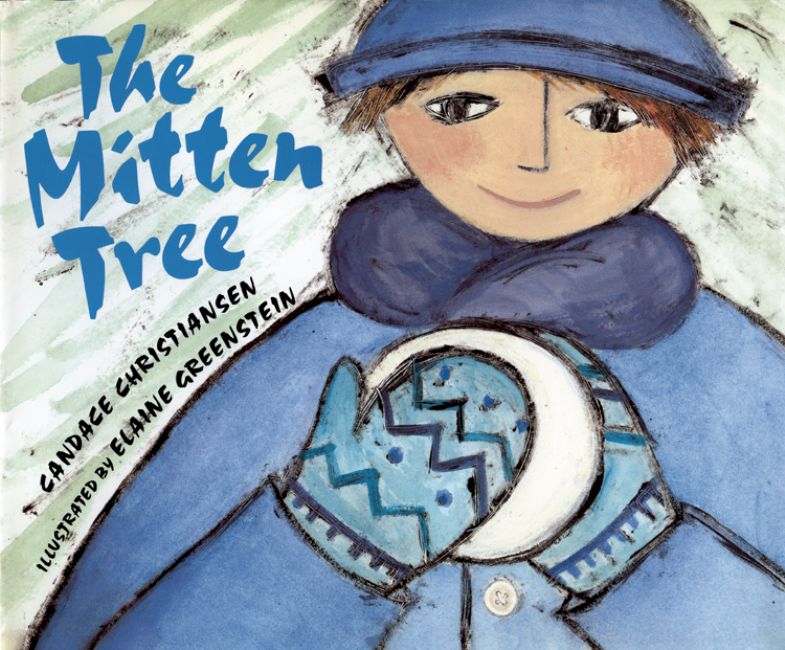
2021 marks the fifth year that I’ve celebrated Mitten Tree Day with the book that started it all. Originally published in 1997, The Mitten Tree has become a treasured read aloud and continues to inspire kindness programs in schools, libraries, and communities around the country. The feel of a cozy mitten on freezing fingers is one of the luxuries of wintertime. But where did mittens come from? The word “mitten” comes from the French word mitaine, which was an old nickname for a cat, because early mittens were typically made of animal fur. The earliest mittens, dating to around 1000 AD, were used as sheaths for gloves, adding extra protection for cold hands. Now that mitten weather is upon us, make sure your pair is still soft, wooly, and warm. If they’re not, consider buying a new pair from a local artisan, or, if you’re crafty, knit a new pair yourself. And, of course, enjoy the season with today’s book!

The Mitten Tree

Written by Candace Christiansen | Illustrated by Elaine Greenstein


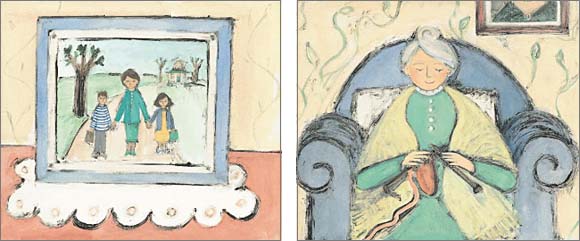
In a small house at the end of a lane Sarah lives all alone. Her own children have grown and moved away, but as she watches the kids gather at the blue spruce tree to wait for the school bus she remembers all the years that she walked her son and daughter to this same spot. As she makes her way down the lane to her mailbox, she wishes the children will wave and smile, but they never seem to notice her. Still, it makes Sarah smile to see them.

celebrate-picture-books-picture-book-review-the-mitten-tree-sarah

Image copyright Elaine Greenstein, 2009, courtesy of Fulcrum Publishing.

One winter morning Sarah notices all the kids throwing snowballs and making snowmen—all except one little boy dressed all in blue who lacks the mittens needed to join his friends. All day Sarah worries about the boy with no mittens. As the sun goes down Sarah digs “through the basket of yarn scraps she had saved for many years.” She finds her needles and four shades of blue wool. Then Sarah begins to knit.

With the rising sun Sarah hurries to the bus stop and hangs the new blue mittens on the spruce tree. Then she hides behind a hedge to watch. The little boy in blue is the first to arrive at the bus stop. When he sees the mittens hanging there, he tries them on and finds that they fit perfectly. With a big smile he makes “a perfect snowball” and throws “it high into the winter sky.” Soon Sarah sees a little girl with mismatched mittens. That night she finds the perfect color of wool and knits a pair to match the girl’s red coat.

celebrate-picture-books-picture-book-review-the-mitten-tree-blue-sprce

Image copyright Elaine Greenstein, 2009, text copyright Candace Christiansen, 2009. Courtesy of Fulcrum Publishing.

Every morning Sarah watches the children, looking for any who have no mittens. During the day her needles are busy making gifts for these children. The next morning before anyone else is up she rushes to the spruce tree and adorns it with the mittens she has knitted. The children have warmed to the “game,” and each day search “under every branch and bough for another pair of mittens.” Once or twice Sarah thinks the boy with her blue mittens sees her, but his eyes don’t linger.

On the day before the school’s winter break Sarah fills her knitting basket with the latest mittens she’s knit. She heads out the door and down the lane. When she reaches the blue spruce, she hangs “mittens on every branch.” When the children arrive, they stand “very still for a few minutes looking at the mysterious, beautiful mitten tree.” As they board the bus, each child is wearing a new pair of mittens. Sarah sees them appear one by one in the bus windows, but none see Sarah.

celebrate-picture-books-picture-book-review-the-mitten-tree-basket

Image copyright Elaine Greenstein, 2009, text copyright Candace Christiansen, 2009. Courtesy of Fulcrum Publishing.

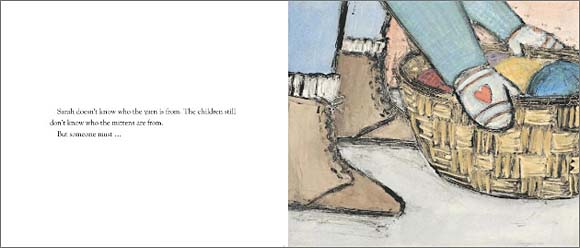
Sarah goes home feeling happy and with her heart as full as it was “when the sounds of her own children had filled her house.” But what awaits Sarah? As she climbs the stairs to her porch, she notices a “basket woven with thick brown vines and decorated with a large white bow.” She’s surprised to see that it is filled to the brim with balls of colorful yarn. Even today Sarah knits new mittens for all the children in town, and “every time her basket is empty, a new full one appears.” Sarah doesn’t know who brings the basket, just as the children don’t know who supplies the mittens. “But someone must….”

Screen Shot 2018-12-05 at 5.01.00 PM

Candace Christiansen’s heartwarming story of kindness given and reciprocated will inspire kids to see that anyone can make a difference in the lives of others by using their talents to fill a need. This gentle, quiet tale offers suspense that will pique readers’ curiosity from page to page, and the mystery surrounding the never-empty basket of wool provides a satisfying and moving ending that also reassures kids that deeds of thoughtfulness and compassion are noticed. The grandmotherly Sarah and familiar school bus stop setting and winter activities will resonate with readers.

Elaine Greenstein’s softly colored, folk-style illustrations give the story a cozy feeling—perfect for cold-weather reading, The variety of intricately knitted mittens, with their hearts, stripes, snowflakes and cables, are charming, and the enchanting image of the blue spruce decorated with mittens makes it easy to see how The Mitten Tree continues to inspire so many acts of kindness and charity.

Ages 3 – 7

Fulcrum Publishing, 2009 (paperback) | ISBN 978-1555917333

Mitten Tree Day Activity

celebrate-picture-books-picture-book-review-mitten-match

Mitten Match & Coloring Page


Mittens often get lost or mismatched in the fun of winter activities. Find the pairs in this printable Mitten Match & Coloring Page and then decorate them!

celebrate-picture-books-picture-book-review-the-mitten-tree-cover

You can find The Mitten Tree at these booksellers

Amazon | Barnes & Noble | Books-a-Million

To support your local independent bookstore, order from

Bookshop | IndieBound

Picture Book Review
December 2 – I AM TODAY Blog Tour Stop

celebrate-picture-books-picture-book-review-i-am-today-cover

About the Holiday

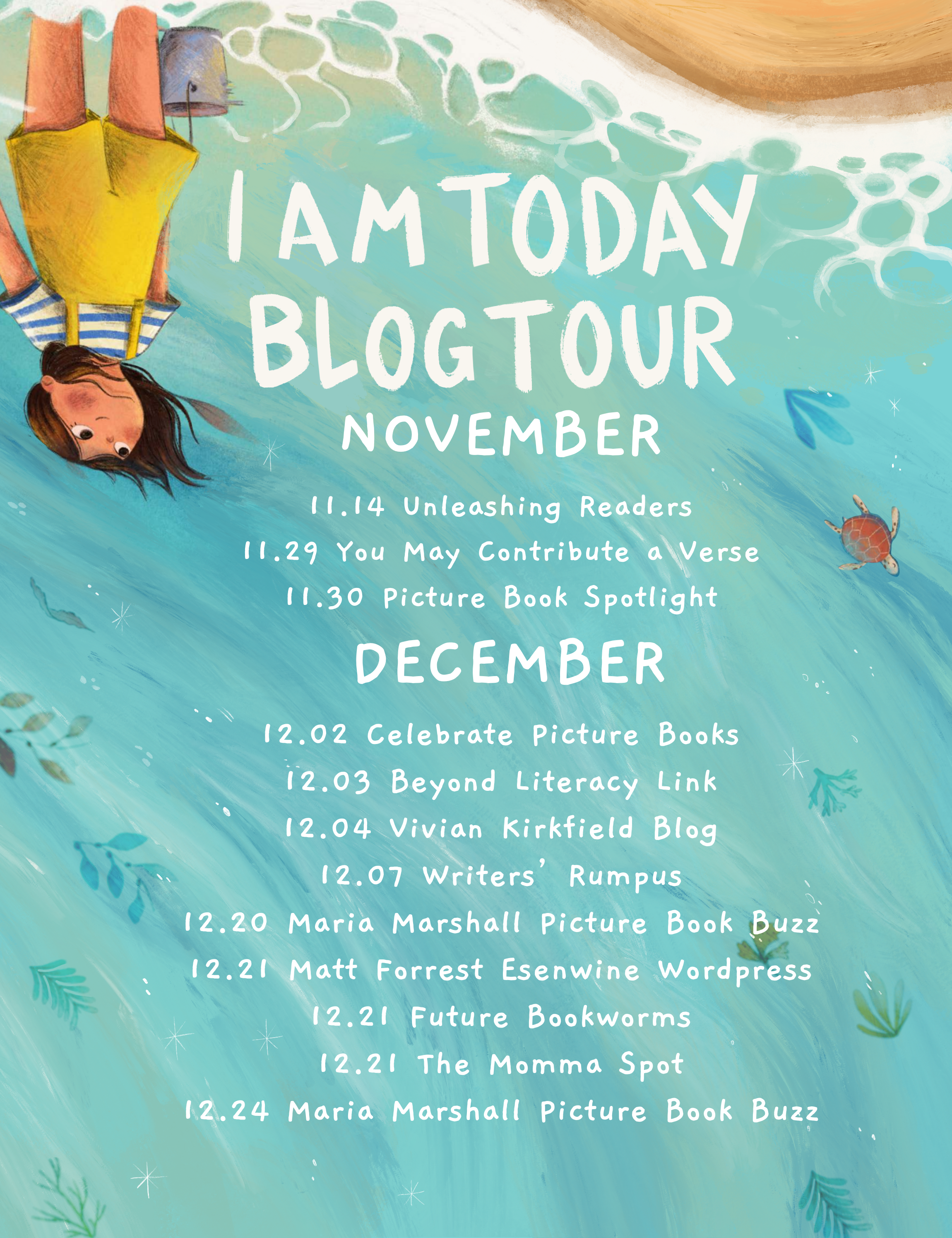
I’m thrilled to be a stop on the blog tour for I Am Today by Matt Forrest Esenwine and Patricia Pessoa. This season of giving is the perfect time to share this gorgeous book that reflects the desire of children to give their thoughts, talents, and actions to causes that are meaningful to them. If you’d like to follow I Am Today’s blog tour, see the graphic below for further dates and blogs.

I Am Today

Written by Matt Forrest Esenwine | Illustrated by Patricia Pessoa


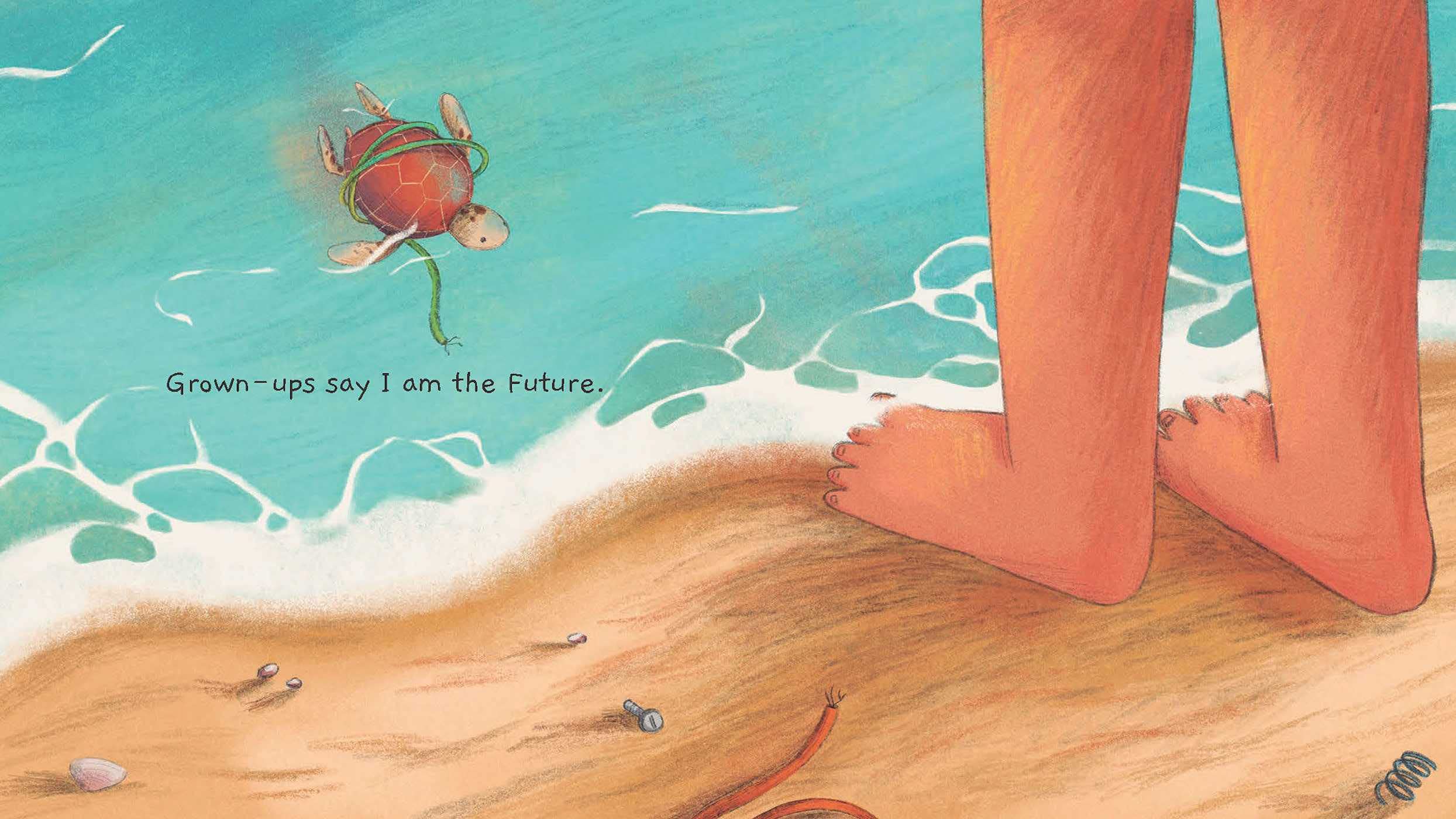
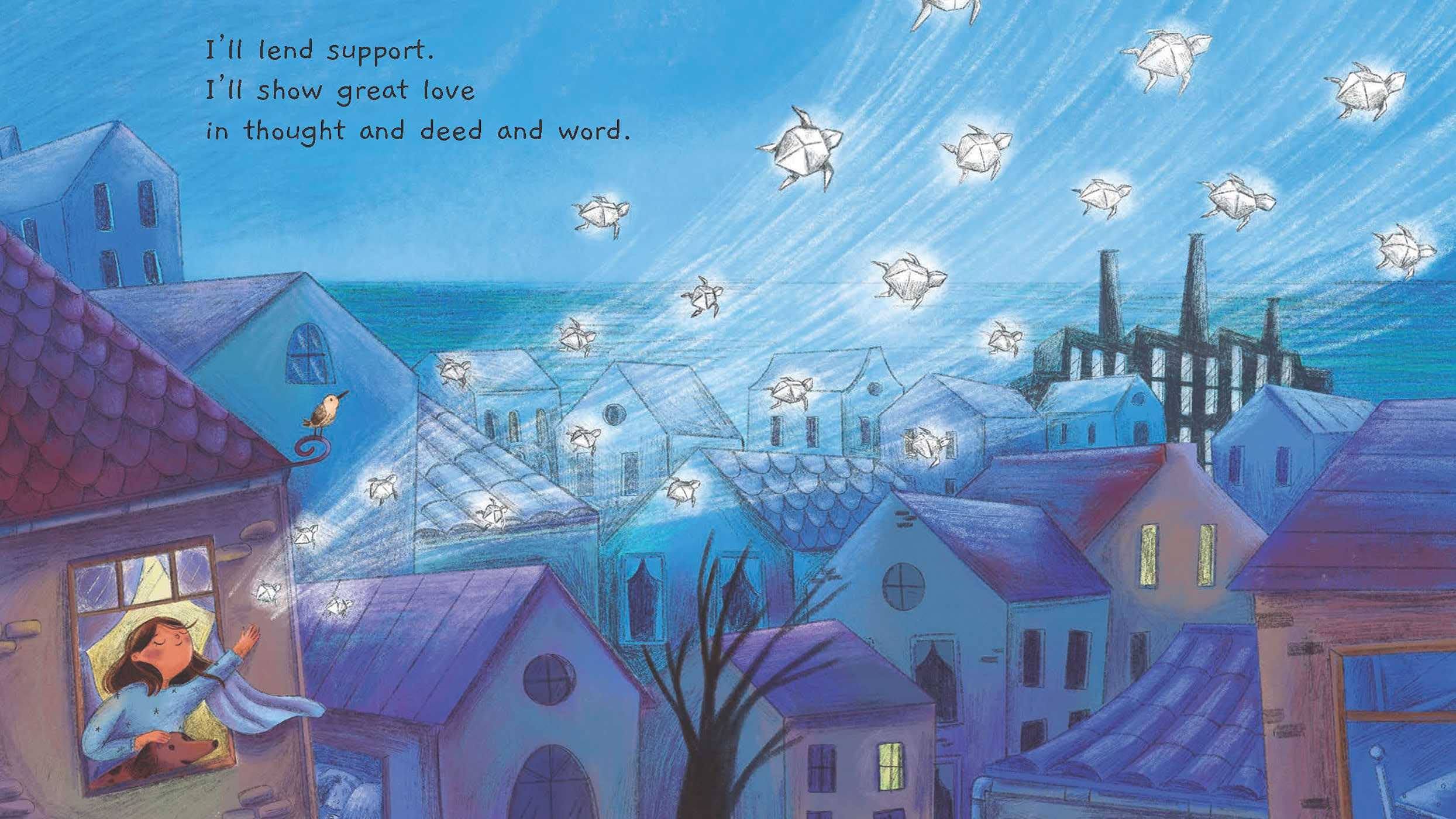
A child stands on the edge of the beach, letting the sea foam run over her bare toes. Below, a turtle wrapped in a strand of wire floats nearby, while in the background a factory belches smog into the air, and a pipe snakes over the dunes to the water, where it spills its industrial waste. As the child picks up the turtle and removes the wire, she states, “Grown-ups say I am the Future.” Then while releasing the freed turtle, she finishes her thought: “But I’d rather be the Now.” The child then makes her case, explaining that she’s ready to contribute in positive ways, having learned decency, fairness, and generosity from her family and other role models.

celebrate-picture-books-picture-book-review-i-am-today-turtle

Image copyright Patricia Pessoa, 2021, text copyright Matt Forrest Esenwine, 2021. Courtesy of POW! Kids Books.

The memory of the turtle she saved stays with her—her one small act inspiring her to do more. She determines “if I see something isn’t right, / I need to take a stand! / Why wait to offer kindness? / Why wait to lend a hand?” While trying to go to sleep, the little turtle and a whole sea of fish and other creatures swim in her mind. Suddenly, she has an idea and gets out of bed. She writes note after note and folds each paper into origami turtles. She then goes to her window and releases them on the wind.

celebrate-picture-books-picture-book-review-i-am-today-dinner

Image copyright Patricia Pessoa, 2021, text copyright Matt Forrest Esenwine, 2021. Courtesy of POW! Kids Books.

The next morning, despite the rain, a crowd of children has gathered at the child’s door—all are holding her note. They and their parents and other adults, many carrying signs urging protection for the sea animals, march down the sidewalk and past the polluting factory to the beach. Living in that moment, they think: “The past is far behind us, / the future, well beyond. / There’s never been / a better time to listen… / …learn… / …respond!”

celebrate-picture-books-picture-book-review-i-am-today-origami

Image copyright Patricia Pessoa, 2021, text copyright Matt Forrest Esenwine, 2021. Courtesy of POW! Kids Books.

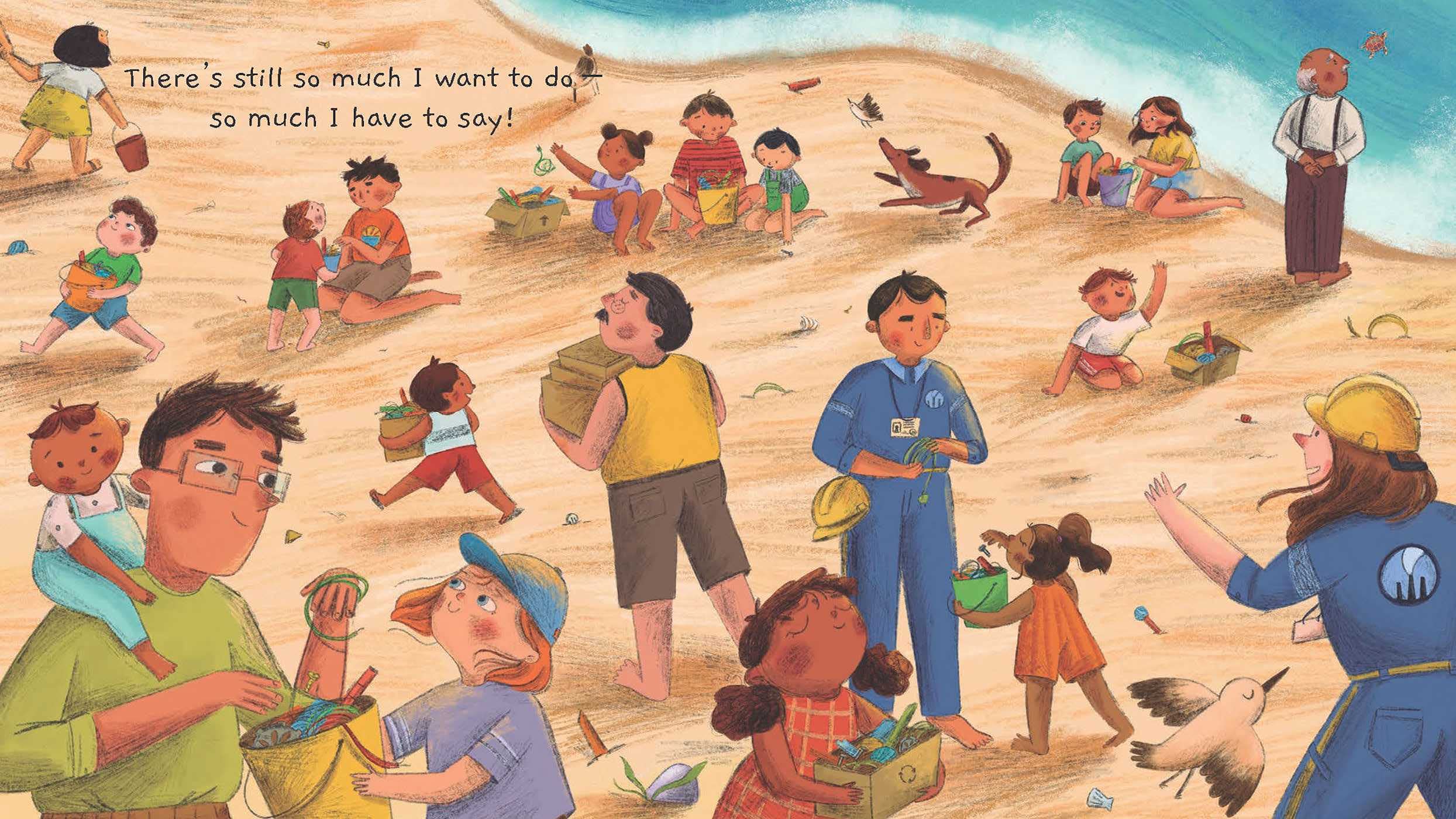
At the beach the group fans out across the sand to pick up debris, and a turn of the page reveals a clean beach and a newspaper containing a front-page article on the factory’s waste pipe that has been closed. “Someday I’ll be the Future” the child says, “But right now… / …I am Today.”

Illustrated instructions on how to make an origami turtle follow the story.

celebrate-picture-books-picture-book-review-i-am-today-beach

Image copyright Patricia Pessoa, 2021, text copyright Matt Forrest Esenwine, 2021. Courtesy of POW! Kids Books.

Children, having lived on our planet for only a few years, are all progress, moving forward, not looking back yet as each day they learn something new, develop another skill, break old barriers, and form unique opinions. So it’s no surprise that kids are concerned about what is happening today and how it will affect the future—their future and the world’s. In I Am Today, Matt Forrest Esenwine harnesses that power of wonder, confidence, and ambition that children possess and gives it a lyrical voice. Flowing with a rhythm as stirring as ocean swells, Esenwine’s story will resonate deeply within any child’s heart.

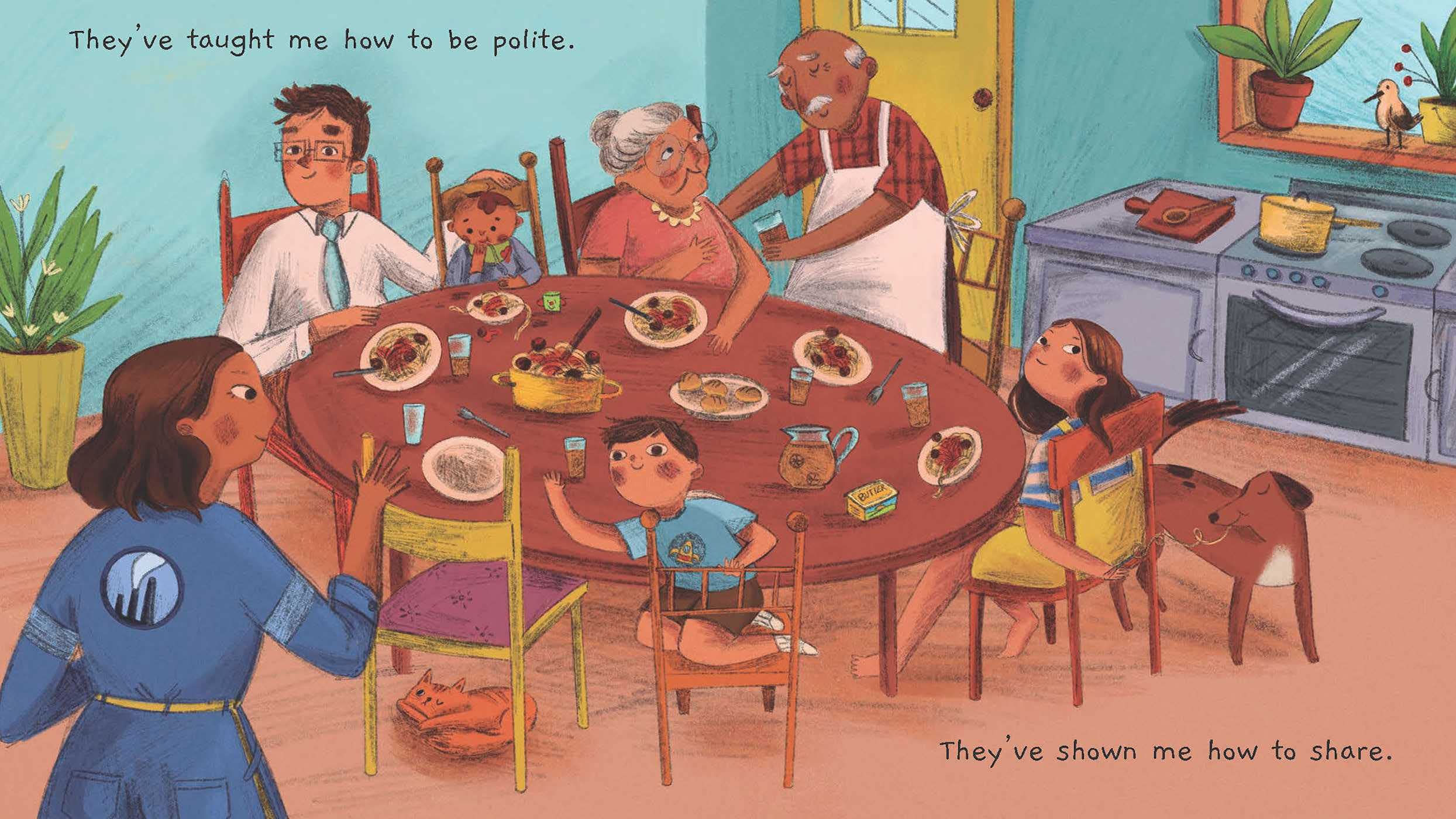
While Patricia Pessoa’s lovely illustrations depict a child concerned with protecting the ocean and its creatures, Esenwine’s text is universal and equally inspiring for any child and any cause. While recognizing the desire and ability of children and young people to bring about change, Esenwine also provides concrete ways that they can do so, from small gestures to larger actions, allowing all readers to feel included and important. I Am Today also presents a meaningful way for kids and adults to talk about causes that are important to them and ways that they can get involved.

With a warm, vivid color palette and fresh perspectives that allow readers to make some of their own deductions, Patricia Pessoa presents a lush landscape of a child’s family life, imagination, and ideas brought to fruition. Her images of the family’s picture wall and dinner time are full of heart and humor, and kids will enjoy lingering over the pages to catch all the action. Pessoa portrays the importance of saving the turtles and other sea creatures with clever imagery as the turtle appears in the bathroom mirror as the child brushes her teeth, swimming in the bathtub, and decorating the cup of water on her nightstand. Pessoa’s illustrations of the fish and other ocean creatures that fill the child’s mind are especially beautiful, as is the spread in which she sends her origami messengers out into the world.

I Am Today is an inspiring, uplifting, and motivational book that children will want to frequently revisit and one that families, classrooms, schools, and public libraries will want to add to their collections. The book’s beauty and message makes it a wonderful gift for any child on your list.

Ages 4 – 8 and up

POW! Kids Books, 2021 | ISBN 978-1576879948

Discover more about Matt Forrest Esenwine, his books, and his poetry on his website.

You can connect with Patricia Pessoa on Instagram.

Check out these upcoming dates and discover how other bloggers are celebrating I Am Today! 

I Am Today Blog Tour Schedule

This year many books have been delayed from their original publishing date to a later time due to shipping and supply issues. The best way to support authors and their wonderful new books is to preorder titles from your favorite bookseller. I Am Today will be available January 23, 2022.

celebrate-picture-books-picture-book-review-i-am-today-cover

You can preorder I Am Today at these booksellers

Amazon | Barnes & Noble | Books-a-Million

To support your local independent bookstore, order from

Bookshop | IndieBound

Picture Book Review
November 23 – It’s Adopt a Turkey Month

celebrate-picture-books-picture-book-review-cold-turkey-cover

About the Holiday

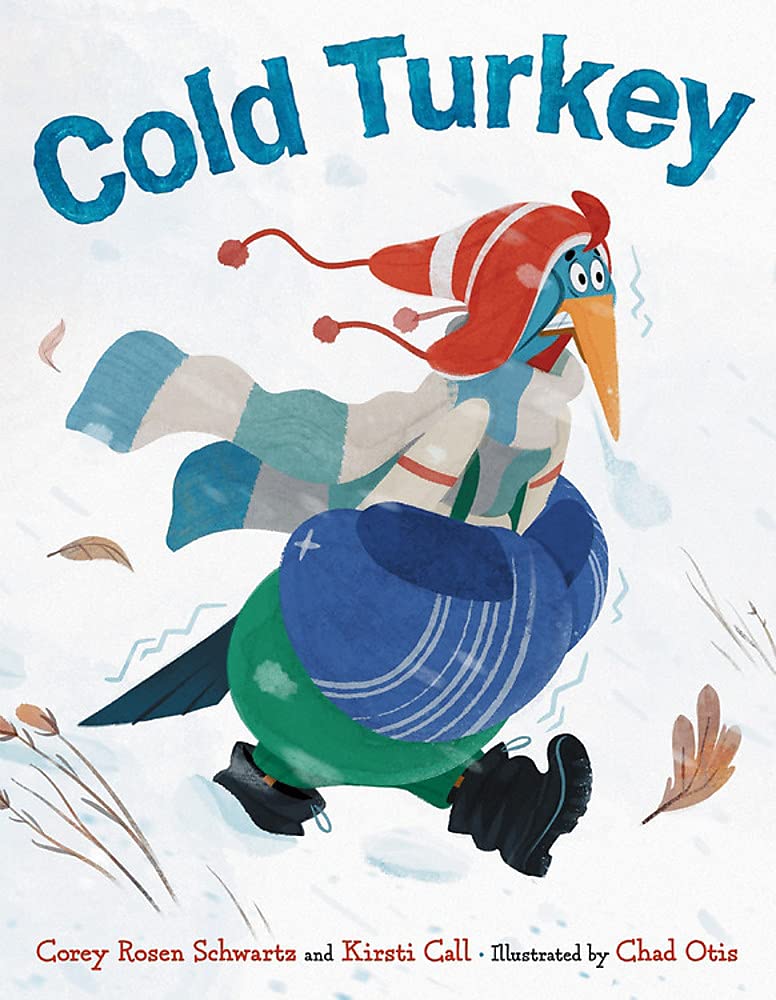
Established in 1986 with the founding of Farm Sanctuary, a refuge for farm animals and advocate for institutional farming practices and plant-based living, Adopt a Turkey Day inspires people to think of turkeys differently and encourages them to symbolically adopt one of the Sanctuaries rescued “spokesturkeys” to help with its care. Operating sanctuaries in Watkins Glen, NY and Los Angeles, CA, Farm Sanctuaries provides homes for chickens, cows, pigs, sheep, and goats, in addition to turkeys. They also connect animals with loving forever homes, where they can live with plenty of space and care. If you’d like to learn more about Farm Sanctuary, visit their website. To celebrate, give the generous turkey and his friends in Cold Turkey a forever home on your bookshelf!

Cold Turkey

Written by Corey Rosen Schwartz and Kirsti Call | Illustrated by Chad Otis


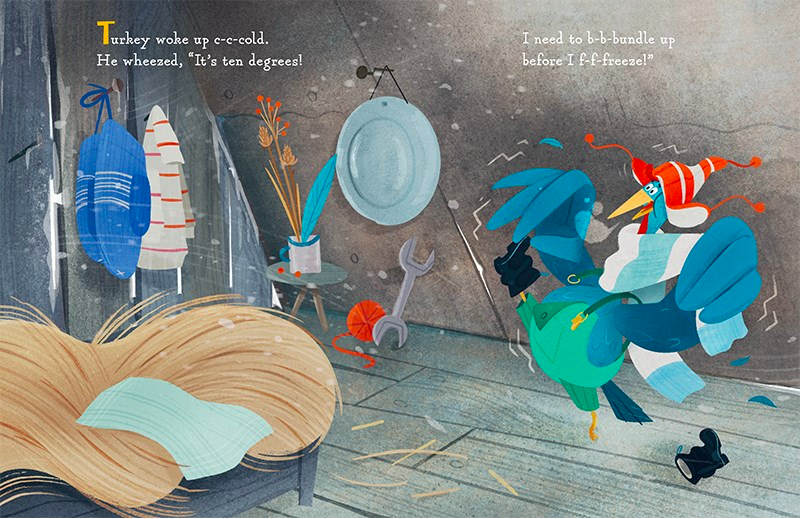
A frigid blizzard blast swirls through the coop, and “turkey woke up c-c-cold. / He wheezed, ‘It’s ten degrees! / I need to b-b-bundle up / before I f-f-freeze!'” Turkey pulls on a turtleneck sweater and overalls, a scarf, hat, and mittens and heads out into the snow. When he comes to Sheep’s shed, he finds his friend “s-s-shivering” and gives him his hat, tying it on nice and tight.

celebrate-picture-books-picture-book-review-cold-turkey-freeze

Image copyright Chad Otis, 2021, text copyright Corey Rosen Schwartz and Kirsti Call, 2021. Courtesy of Little Brown Books for Young Readers.

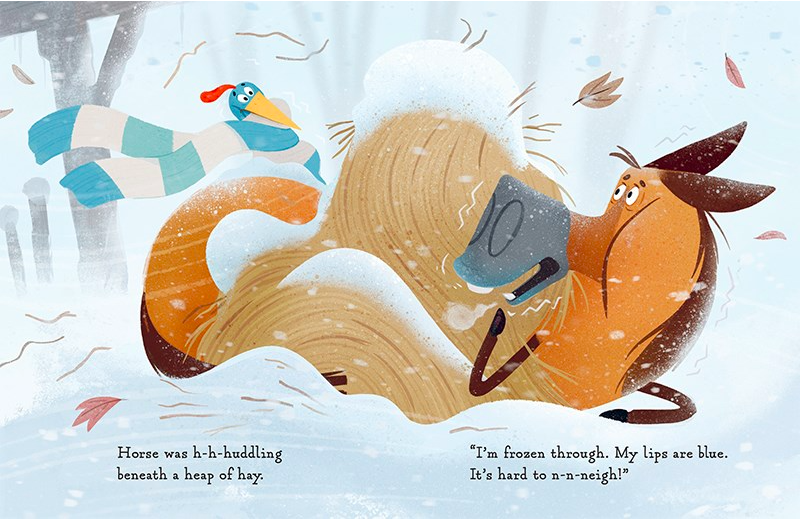
Further down the path, Turkey finds Chick “all alone.” She tells him that her “‘beak is ch-ch-chattering. / I’m chilled right to the bone.'” Turkey wants to help and stuffs Chick’s crown and tail feathers into his two oversized mittens. Continuing on, Turkey finds Horse, who’s having trouble neighing through his frozen lips, and provides just the warmth he needs by wrapping his muzzle in his long, long scarf.

celebrate-picture-books-picture-book-review-cold-turkey-horse

Image copyright Chad Otis, 2021, text copyright Corey Rosen Schwartz and Kirsti Call, 2021. Courtesy of Little Brown Books for Young Readers.

Turkey then discovers poor cow “qu-qu-quivering” and totally miserable. What can Turkey do? He find that his sweater makes an utterly warming udder warmer, and he’s on his way again. In the sty Turkey spies a “polar Pig” with icicles on his snout peeking from the straw. He says, “‘My body’s numb from snout to bum. / I don’t know when I’ll thaw.'” Turkey has just the thing to warm Pig’s cold behind. In a minute Pig is wearing Turkey’s overalls – even if they are a little snug.

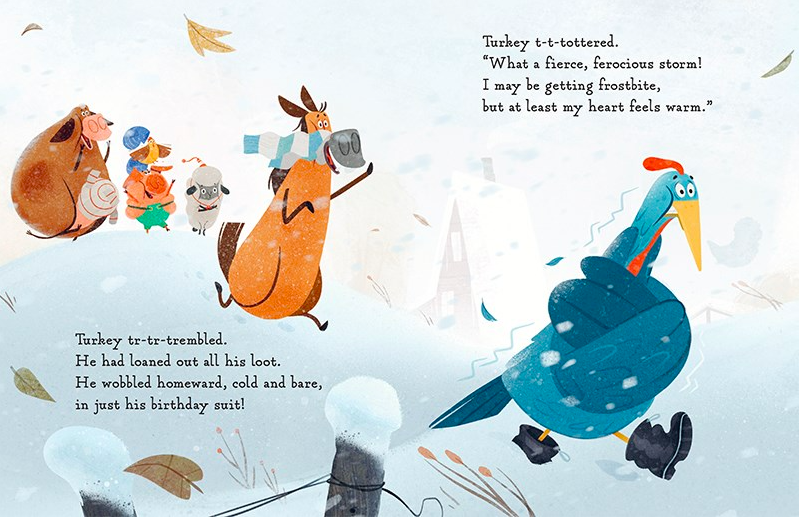
Now Turkey “had loaned out all his loot. / He wobbled homeward, cold and bare, / in just his birthday suit!” Although he now was freezing, he thought “‘At least my heart feels warm.'” But his friends were very thankful and they built a roaring fire. They sat around it toasty warm – Turkey in his feathers and the rest in his attire.

celebrate-picture-books-picture-book-review-cold-turkey-storm

Image copyright Chad Otis, 2021, text copyright Corey Rosen Schwartz and Kirsti Call, 2021. Courtesy of Little Brown Books for Young Readers.

If you and your kids love to laugh during story time and are looking for a new book to share this winter, you’ll want to trot out to your bookstore and pick up a copy of Corey Rosen Schwartz and Kirsti Call’s hilarious story. A perfect read aloud that will get all kids ch-ch-chiming in on every teeth-ch-ch-chattering line, Cold Turkey is fast-paced, full of puns, and loaded with charm and empathy. Turkey’s generosity and the farm animals’ reciprocation adds a layer of sweetness and friendship that will enchant kids. Rosen Schwartz and Call’s impeccable rhyming and rhythm creates a cold-weather giggle fest that readers will want to return to again and again. 

Chad Otis amplifies the humor with his adorably chunky animals and their goggle-eyed acceptance of Turkey’s largesse. Cowering, quivering, and complaining, the farm animals look laugh-out-loud funny stuffed into the bits and bobs of Turkey’s winter clothes. Otis’s clever choices and frozen landscape create active, dynamic scenes that flawlessly carry the story to its warm conclusion. 

A quirky, hilarious romp in which kindness shines, Cold Turkey would be a quick favorite on home, classroom, and public library shelves. The book is highly recommended for winter story times and all throughout the year.

Ages 4 – 8

Little Brown Books for Young Readers, 2021 | ISBN 978-0316430111

Discover more about Corey Rosen Schwartz and her books on her website.

To learn more about Kirsti Call and her books, visit her website.

You can find out more about Chad Otis and view a portfolio of his work on his website.

Adopt a Turkey Month Activity 

celebrate-picture-books-picture-book-review-cold-turkey-activity-sheet-little-brown-young-readers

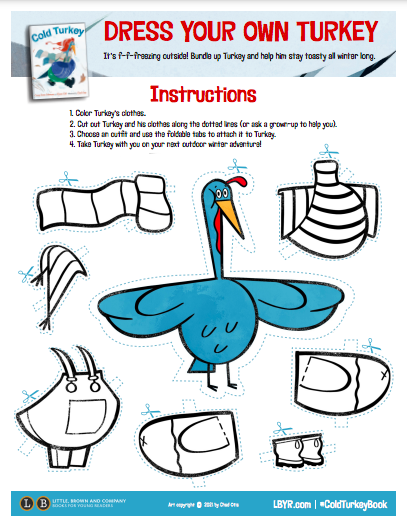
Dress Your Own Turkey Activity Sheet


If you’re cr-cr-creative and love to c-c-color, then this printable Cold Turkey activity sheet is for you! Color and cut out Turkey and his clothes then get him all bundled up for the winter. You can even make Turkey some clothes for the other seasons as well!

Dress Your Own Turkey Activity Sheet

celebrate-picture-books-picture-book-review-cold-turkey-cover

You can find Cold Turkey at these booksellers

Amazon | Barnes & Noble | Books-a-Million

To support your local independent bookstore, order from

Bookshop | IndieBound

Picture Book Review
October 5 – National Do Something Nice Day

celebrate-picture-books-picture-book-review-it's-hard-to-be-nice-cover

About the Holiday

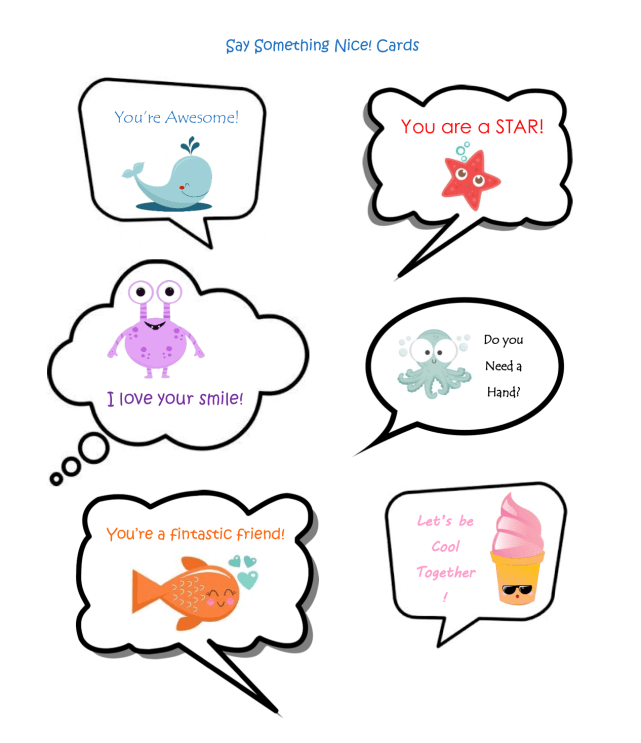
Similar to Random Acts of Kindness Day, National Do Something Nice Day encourages people to think of others and do nice things for them. These don’t have to be big or expensive; in fact, small gestures or thoughtful actions can make all the difference in the way a friend, family member, or stranger feels. These acts of kindness will make you feel good too! To celebrate today, keep an eye out for ways you can lend a hand, times you can share a smile or a conversation, or ways you can make a new friend. Kids may enjoy sharing the encouraging cards found below with friends, siblings, and teachers or by leaving them at school, the library, shops or anywhere that someone may find them.
Sometimes It’s Hard to Be Nice

Written by Maggie C. Rudd | Illustrated by Kelly O’Neill


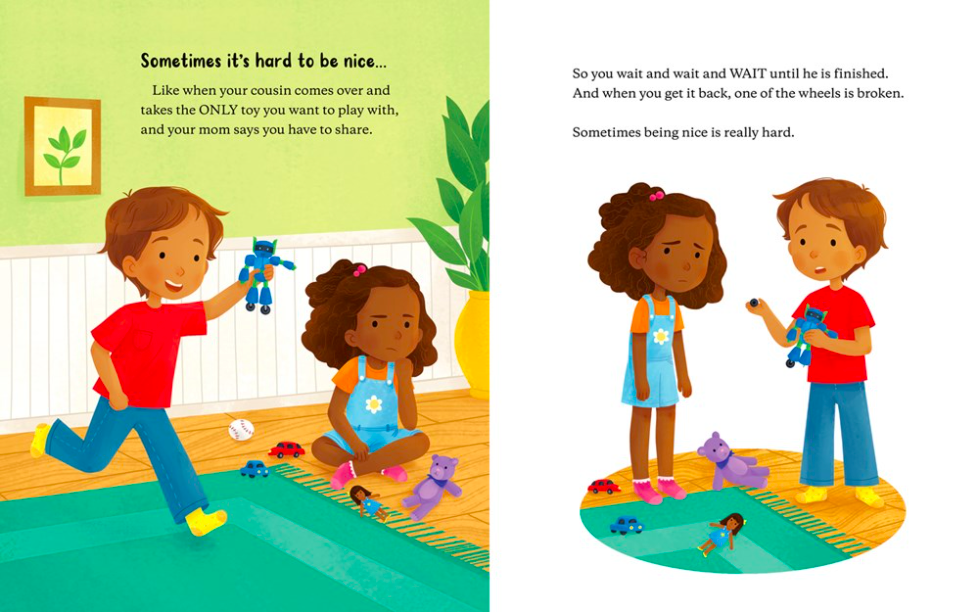
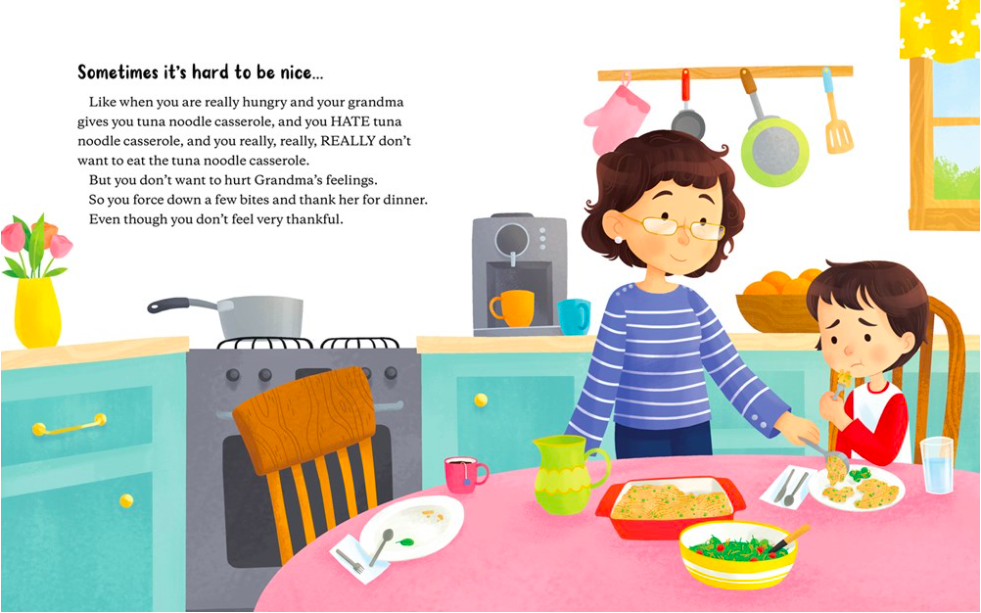
It seems like being nice should be easy, but there are so many emotions that often surround that one little word that sometimes doing the considerate thing is really hard. How hard? Like smiling and saying “that’s okay” when “your mom says you have to share” your favorite toy with a friend, sibling, or cousin and they break it. Like sitting through your brother or sister’s boring performance, game, or recital when you’d rather be somewhere else—anywhere else. Or like eating your least favorite food and thanking the cook for the meal because you don’t want to hurt their feelings.

celebrate-picture-books-picture-book-review-it's-hard-to-be-nice-cousin

Image copyright Kelly O’Neill, 2021, text copyright Maggie C. Rudd, 2021. Courtesy of Albert Whitman & Company.

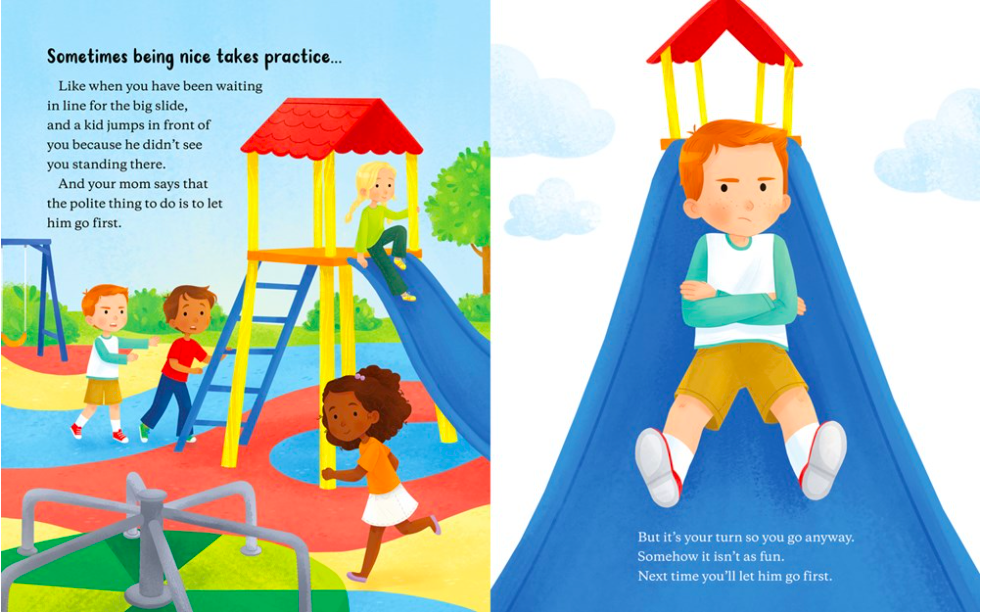
In fact, “sometimes being nice takes practice” like when a little brother or sister destroys your stuff and you yell at them, but then later you realize they didn’t really understand what they were doing. Or like when visiting someone you love in a nursing home or new place is scary and you hang back, not wanting to see them but then decide you won’t be scared next time you visit. And then there are times like these on the playground “when you have been waiting in line for the big slide, and a kid jumps in front of you because he didn’t see you standing there. And your mom says that the polite thing to do is to let him go first. But it’s your turn so you go anyway. Somehow it isn’t as fun. Next time you’ll let him go first.”

celebrate-picture-books-picture-book-review-it's-hard-to-be-nice-great-grandma

Image copyright Kelly O’Neill, 2021, text copyright Maggie C. Rudd, 2021. Courtesy of Albert Whitman & Company.

So what does all that practice lead to? The good feeling you get when you are nice. Like when you let your baby brother sit with you as you play a video game, “and he claps for you the whole time.” There’s also the great feeling you get when you’ve cleaned up after playing and your parents really appreciate it, or “when you’re late for soccer practice and your mom can’t find her keys, so you help her look for them . . . and find them in the doorknob! And your mom says she doesn’t know what she would do without you!”

While these examples may be hard because you feel slighted or tired or rushed or scared, there are times when being nice takes all your courage—like when you befriend the new kid or the kid everyone picks on and find out you have lots in common. Or when the bullies come around and you stand up for your new friend even though it’s scary and you end up in the principal’s office. So why would you want to be nice? Because “it’s worth it.”

celebrate-picture-books-picture-book-review-it's-hard-to-be-nice-playground

Image copyright Kelly O’Neill, 2021, text copyright Maggie C. Rudd, 2021. Courtesy of Albert Whitman & Company.

Maggie C. Rudd’s excellent primer to the emotions and circumstances around being nice presents children with realistic scenarios involving family members and friends, favorite toys and activities, and common situations at school that often require extra effort to respond to in a positive way. Rudd’s conversational writing style directly engages the reader, and while every example may not be an exact match to the reader’s experience, many will be spot on and the others easily recognized and adaptable.

Rudd’s four-step progression acknowledges that showing kindness or even just good manners can be difficult, but that it can become easier—especially when a situation seems unfair or is disappointing—with practice and perspective. Rudd’s examples of when being nice feels good are sprinkled with humor and warm family feelings that will bring smiles that support her point. A thread involving a favorite Galactic Star Crusher action figure ties several of the vignettes together, adding a sense of relationship and connectedness among the characters.

Kelly O’Neill illustrates each example for readers with clearly depicted scenes involving kids like them playing video games, visiting with grandparents, playing on the playground, helping their parents, and standing up for another child. In every instance, the children’s emotions are easily understood, which opens up many opportunities for adults and kids to discuss the feelings and issues surrounding how one treats others from both a child’s and adult’s perspective and experience. O’Neill’s bright colors, familiar settings, and uncluttered, well-conceived pages put the focus on her engaging children and elegantly complement Rudd’s important message.

Sometimes It’s Hard to Be Nice is a superb read aloud for honestly addressing the complexities and rewards of showing kindness and being nice. It is a book that families, teachers, and caregivers will find themselves turning to again and again in helping children navigate and learn this important social skill. The book is a must addition to home, classroom, school, and public library collections.

Ages 4 – 8

Albert Whitman & Company | ISBN 978-0807575734

Discover more about Maggie C. Rudd and her books as well as an Activity Kit for educators and parents on her website.

To learn more about Kelly O’Neill, her books, and her art, visit her website.

National Do Something Nice Day Activity

celebrate-picture-books-picture-book-review-say-something-nice-cards

Say Something Nice! Cards


Do you want to give someone a nice surprise? Print out these cards and give one to a friend, to someone you’d like to know, or to anyone who looks like they need a pick-me-up! If you’d like to make your own cards, print out the blank template and write and/or draw your own message! You can also print these on adhesive paper and make your own stickers.

Say Something Nice! Cards | Say Something Nice! Cards Blank Template

celebrate-picture-books-picture-book-review-it's-hard-to-be-nice-cover

You can find Sometimes It’s Hard to Be Nice at these booksellers

Amazon | Barnes & Noble | Books-a-Million

To support your local independent bookstore, order from 

Bookshop | IndieBound

Picture Book Review