The month of April is set aside for people to recognize and appreciate the varied cultures and beliefs around the world. Instead of finding division and differences, we should celebrate the beauty and wonder of our multifaceted planet. This month offers a great opportunity to discover ways to incorporate acceptance and inclusiveness throughout your life.
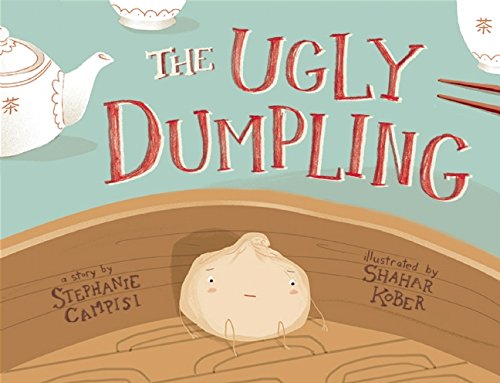
The Ugly Dumpling
Written by Stephani Campisi | Illustrated by Shahar Kober
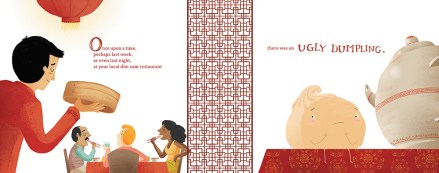
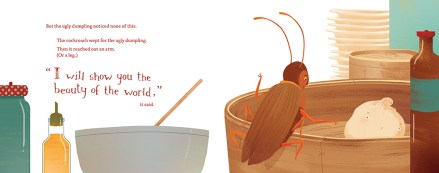
“Once upon a time, perhaps last week, or even last night, at your local dim sum restaurant…there was an ugly dumpling.” Sure, you might think all dumplings are ugly, but we’re talking about one particular ugly dumpling. It tried all sorts of tricks to make itself more attractive, but it still remained lonely and uneaten. It sat dejected until a cockroach traversing the kitchen caught sight of it and immediately fell in love.
Image copyright Shahar Kober, text copyright Stephani Campisi. Courtesy of Mighty Media Press.
The cockroach “reached out an arm. (Or a leg)” toward the dumpling and offered to show it the beauty of the world. Together they traveled to cities near and far, experiencing them through culinary lenses—stacked-plate skyscrapers, piled-dishes skylines, and chopstick bridges that took them over flour mountains and folded-napkin peaks. Then, in a certain restaurant, the dumpling saw something astonishing! Not only one, but two, three, four, and more dumplings just like itself!
Image copyright Shahar Kober, text copyright Stephani Campisi. Courtesy of Mighty Media Press.
Suddenly the ugly dumpling realized that it was not a dumpling at all, but a “steamed bun—a golden-hearted, smooth-skinned steamed bun, exactly like all the other steamed buns in the world.” The ugly dumpling puffed with meaning, importance, and…yeast! The restaurant patrons and staff and even the other steamed buns took notice. The cockroach by the ugly dumpling’s side cheered to see its friend receiving so much attention.
Image copyright Shahar Kober, text copyright Stephani Campisi. Courtesy of Mighty Media Press.
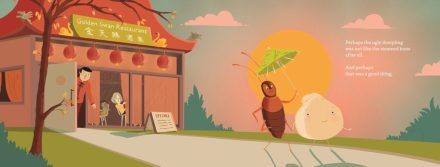
The people’s wide eyes and astonished expressions were not for the dumpling, however. Instead, they registered horror at the insect in their midst. The ugly dumpling was familiar with that look and did “something quite beautiful. It reached out an arm. (Or a leg.) And it led the cockroach out into the world, The beautiful, beautiful world.” And in that moment the ugly dumpling realized that it “was not like all the other steamed buns after all” and that “perhaps that was a good thing.”
Image copyright Shahar Kober, text copyright Stephani Campisi. Courtesy of Mighty Media Press.
Stephani Campisi’s The Ugly Dumpling is a fresh and delectable dish-up of the classic Ugly Duckling story for a new audience. Stuffed with charm and off-beat humor, this tale of friendship and diversity embraces all who feel at odds with their environment—with or without the recognition of why. Its sweet and insightful ending emphasizes the idea that finding your niche does not always mean fitting in with a certain crowd, and that having the courage to strike out on your own path leads to beautiful relationships and personal happiness.
Image copyright Shahar Kober, text copyright Stephani Campisi. Courtesy of Mighty Media Press.
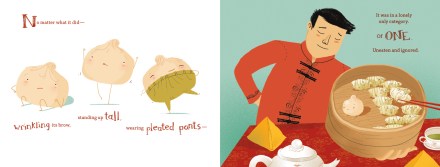
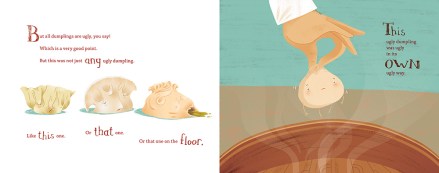
Shahar Kober’s dumpling is anything but “ugly.” His adorable puffed dough, lonely and ignored for not adhering to the mold, will melt readers’ hearts as he tries anything and everything—including green pleated pants—to fit in. Kobar’s stylish drawings are the perfect underscore to Stephani Campisi’s quick, dry wit—as in his rendition of three uglier-than-the-next dumplings—and if cockroaches were really as cute as Kober’s, we’d all set out a different kind of Roach Motel. A clever bit of typography transforms steam coming from a wok into the word HISS, and the restaurant scenes will make readers hungry for their favorite Asian eatery.
As readers turn to the last pages and watch the steamed bun and the cockroach leave the restaurant hand in hand (foot in foot?) under the shade of a paper umbrella, they will want to turn back to the beginning and start over again. The Ugly Dumpling is a must read and a wonderful addition to children’s bookshelves.
Ages 2 – 9
Mighty Media, 2016 | ISBN 978-1938063671
Get to know more about Stephanie Campisi and her work on her website!
To view a gallery of art by Shahar Kober for books, magazines, animation, and more, visit his website!
Check out the Mighty Media Press website for more about The Ugly Dumpling and a-dough-able coloring pages!
Take a look at the trailer for The Ugly Dumpling!
Celebrate Diversity Month Activity
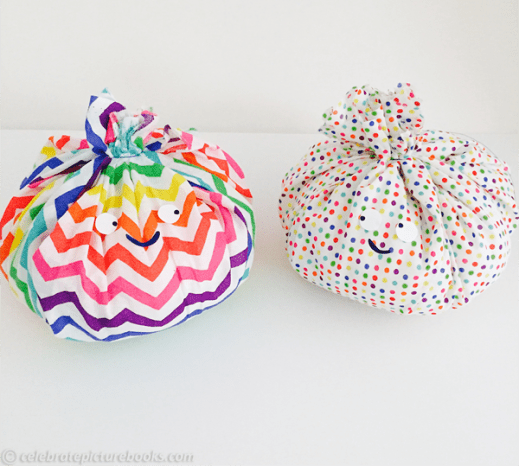
Embrace Your Inner Dumpling Plush
We are all beautiful “dumplings” in one way or another! With this easy craft you can create a huggable friend and show others what you’re made of!
Supplies
Square piece of cloth in any fabric and color. Size of plush depends on size of cloth (the plushes shown are made from 18”-square cotton fabric)
Poly fill (the plushes shown use about 1 1/8 ounces of fill)
White cloth for eyes and mouth
Twine or string
Fabric glue
Directions
Cut the corners from the square cloth to make a circular piece of cloth
Fill the middle with poly fill
Pull the edges of the cloth up and around the fill
Tie the top closed with the twine or string
To make the face, cut small circles and a mouth from the white cloth
Today’s holiday was established in 1982 by the International Council of Monuments and Sites to celebrate the joint history and heritage of the human race. World Heritage Day invites us to honor all of the world’s cultures and promotes awareness of important cultural monuments and sites in order to preserve these valuable historical places. Nearly 10,000 members from more than 150 countries, including architects, engineers, artists, geologists, civil engineers, and architects, work tirelessly to protect the world’s cultural achievements.
School Days Around the World
Written by Margriet Ruurs | Illustrated by Alice Feagan
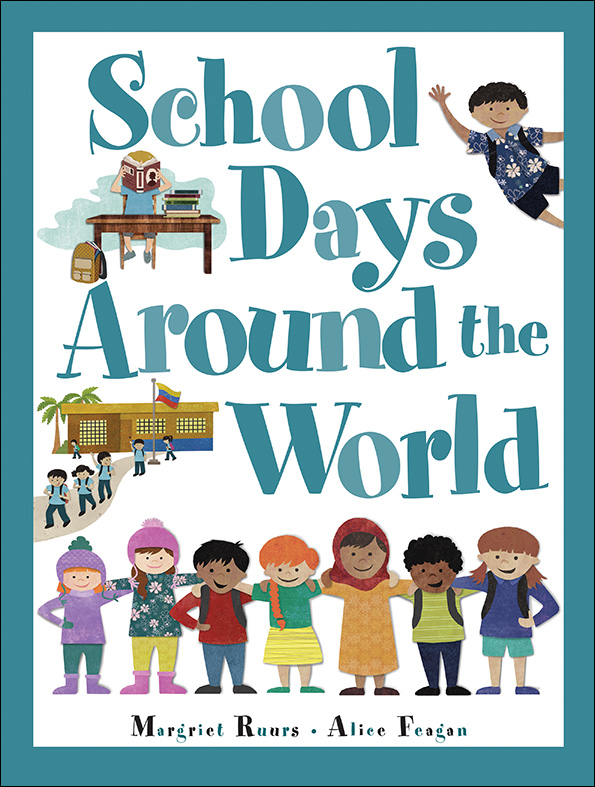
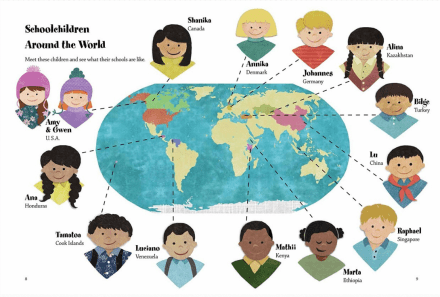
Every day millions of children around the world go to school, but schools can vary from place to place. Some classes are held in large buildings with libraries, science labs, and computer rooms while others gather in small buildings or even outside. “Schools around the world may be very different, but children everywhere like to have friends and learn new things.” In School Days Around the World, readers meet children from thirteen countries to learn what their educational day is like.
First, children meet Tamatoa, who attends school on Rarotonga, one of the Cook Islands in the South Pacific. Tamatoa arrives to school on a scooter just as the “thang-Thong-thang! of the wooden slit drum calls students inside. Tamatoa’s teacher is wearing flowers in her hair as she does every day. She teaches the children their Ura language, and in the afternoon they dance the hupa, the island’s traditional dance. In Singapore Raphael goes to an international school where the students speak many languages. Raphael knows Dutch, English, and Spanish. His best friend Aamon speaks Hindi, Chinese, and English. Raphael likes to read and write stories on the computer. Sometimes they “have a craft fair to raise money to help children in other parts of the world.”
Image copyright Margriet Ruurs, text copyright Alice Feagan. Courtesy of alicefeagan.com
Marta walks to her school in Azezo, Ethiopi, even though she is blind. Her friend Ayana holds her hand tightly to help “her around potholes and cow patties.” There are so many students that there are two different sessions. Marta goes in the morning with 500 other children. There are 70 students in her class. They learn Amharic and about Ethiopia. At noon Ayana and Marta “hurry home to help feed the ox and cow and to fetch water from the village well.”
Camilla is from Germany. Her older brother Johannes lives at a boarding school during the school year. He shares his room in an old stone house with three boys. Everyone eats together and cleans up afterward—just like in a family. In class he learns “about nature and science. They also learn how to sail.” Camilla can’t wait until it’s her turn to go to school.
If you visited Annika at school in Copenhagan, Denmark, you would probably spend most of the day outside. Some days the students take a bus to their forest school. There the “run and climb on an old boat.” They “play on swings and with a ball.” Outside they also listen to birds and learn about plants and insects and other parts of nature. While Annika enjoys spending cold days outside, Ana’s days are usually warm. She lives in San Luis, Honduras and walks an hour from her home in the hills to her new school. Inside, two teachers show the children how to read and write. Sometimes, Ana says, “a nurse visits our school. She teaches us how to brush our teeth and stay healthy.” One day a van delivers backpacks full of school supplies, books, and even running shoes.
In Alberta Canada, Shanika goes to a First Nations school where she learns her traditional Cree language along with math and language arts. After lunch, they hear stories, and elders teach them “powwow dances, drumming and how to raise a teepee. They also hold feasts where there are prayers, and the whole community shares tea, soup, bannock loaded with beans and cheese, and berries.
Image copyright Margriet Ruurs, text copyright Alice Feagan. Courtesy of alicefeagan.com
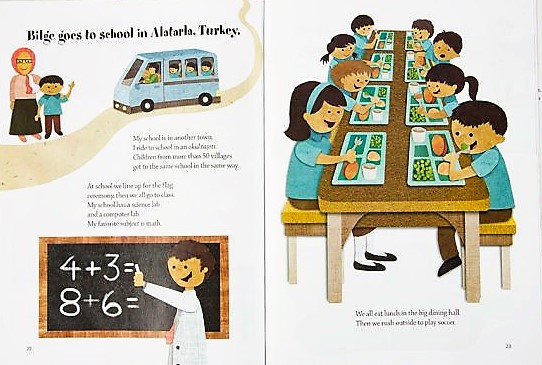
You can also spend school days with Lu in China, Alina in Kazakhstan, Mathii in Kenya, Bilge in Turkey, Luciano in Venezuela, and Amy and Gwen in Alaska, USA.
In her short, engaging stories based on the lives of real families, Margriet Ruurs takes readers globe-trotting with new friends to show readers a typical school day in cities big and small. The details of each child’s experience—both familiar and unique—help readers learn more about their peers, promoting greater empathy and understanding now and for a better future.
Alice Feagan’s cut paper collages are full of joy and personality as kids dance, play, read, and study together. While the students’ clothing, lunches, and school buildings may differ from country to country, readers will see that the enthusiasm to learn is universal. A world map at the beginning of the book points out where each featured child lives.
A discussion following the text gives teachers, homeschoolers, and individuals tips on using the book to expand on the stories told. A glossary provides definitions and a pronunciation key for the native words found throughout the book. School Days Around the World offers a wonderful opportunity to jumpstart lessons on world customs and geography.
Ages 3 – 8
Kids Can Press, 2015 | ISBN 978-1771380478
Discover more about Margriet Ruurs and her books as well as activities for teachers and readers on her website!
You’ll find more about Alice Feagan and a portfolio of her illustration work on her website!
World Heritage Day Activity
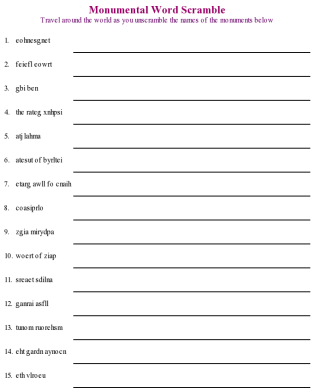
Monumental Word Scramble
You’ll travel the world as you unscramble the names of 15 world monuments in this printable Monumental Word Scramble Puzzle.
One of the wonderful activities of spring and summer is gardening. As the sun warms, farmers and gardeners till their land and plant seeds with eager anticipation of the harvest to come. April is Gardening Month, and the second week is designated especially for vegetable gardening. Our meals would not be as tasty and nutritious without carrots, squash, peas, beans, peppers, potatoes, and all the rest of these colorful foods. Today’s container gardens give even reluctant gardeners great ways to grow their own—without the work of a large plot. Whether you enjoy gardening on a large or small scale, take the opportunity of this month to start planting the seeds of a rewarding hobby!
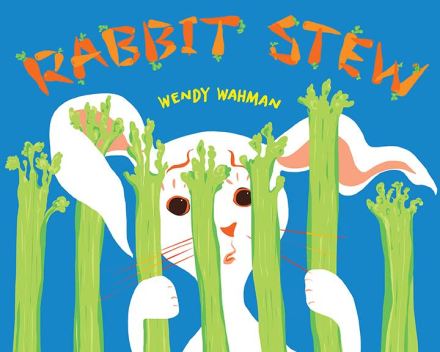
Rabbit Stew
By Wendy Wahman
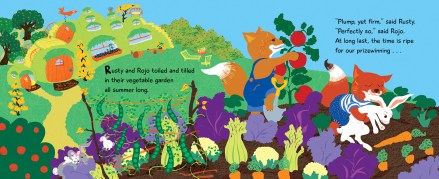
“Rusty and Rojo toiled and tilled in their vegetable garden all summer long.” But now the crops have ripened, and the two foxes are ready to enjoy the bounty of their hard work—so are their neighbors, the Rabbits. As Mommy Rabbit and the bunnies nibble away in a corner of the garden, Rusty gently squeezes the tomatoes and finds them “plump, yet firm.” “Perfectly so,” Rojo agrees as he lifts Daddy Rabbit from the carrot patch. “At last,” Rusty and Rojo exclaim, “the time is ripe for our prizewinning Rabbit Stew!”
Image copyright Wendy Wahman, 2017. Courtesy of wendywahman.com.
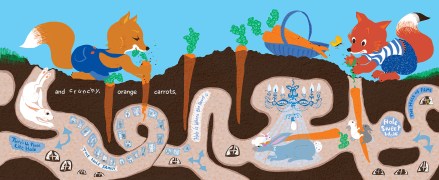
While Rojo picks “lean, green runner beans,” the Rabbits look on worriedly. Daddy tries to hide, but Rusty spies him in the wheelbarrow full of purple kale. Then, when the family dives back into their cozy “hole sweet hole,” they find that their convenient carrot snacks are being abruptly snatched away—only to be added to the pot of “splendid Rabbit Stew.”
Image copyright Wendy Wahman, 2017. Courtesy of wendywahman.com.
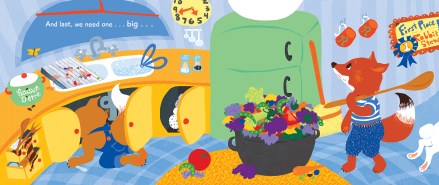
Next come raisins and celery “and roly-poly blueberries.” But what about those white and gray bits of fluff? Will they end up in the foxes’ buckets too? Of course “juicy red tomatoes, fresh sprigs of parsley, and sweet yellow peppers” are also musts for the foxes’ “finest-ever Rabbit Stew.” With the pot overflowing with colorful veggies, only one more thing is needed—“one…big…round…white…bowl…for our favorite Rabbit, Stew—and his family too!”
Image copyright Wendy Wahman, 2017. Courtesy of wendywahman.com.
With her fertile imagination and a clever play on words, Wendy Wahman offers up a delightful story that will have readers guessing until the very end. Along with the mystery and the yummy descriptions of each ingredient, Wahman presents a counting game for readers. As Rusty and Rojo pick their vegetables, children can count the ten runner beans on the trellis, nine purple kale leaves in the wheelbarrow, eight carrots from the burrow, and all of the other ingredients on down to one. But do Rusty and Rojo need one big white rabbit or something else? Kids will love the twist at the end and cheer to see Daddy Stew, Mommy Strudel, and their little bunnies—Dumpling, Biscuit, and Ragu—dining on the special meal grown and created just for them.
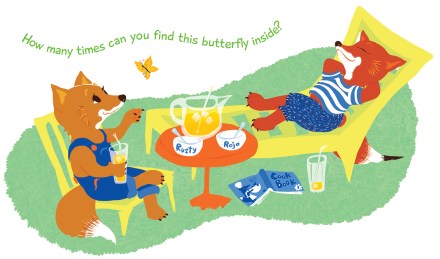
Everyone’s garden should look as deliciously vibrant as Wahman’s riotous patch of vegetables! The vivid colors jump off the page while providing texture and nuance to the illustrations. They also give kids another concept to learn and talk about. Little details, such as the tiny caterpillar and the yellow butterfly that follow the bunnies from page to page, as well as the fancy burrow lined with photos of friends and family will enchant readers.
Image copyright Wendy Wahman, 2017, courtesy o f Wendy Wahman.
Welcome themes of friendship, diversity, and inclusiveness can also be found within the illustrations and the story.
Rabbit Stew is a bright, humorously sly story that would be a wonderful addition to any child’s library. The book also makes a perfect companion for trips to the farmers market, on picnics, or to spur interest in home gardening. The attention to the details of what rabbits can safely eat, as well as the number and color concepts provided in the illustrations, makes Rabbit Stew a great choice for school story times and spring lessons.
Discover more about Wendy Wahman, her art, and her books on her website!
You’ll dig this Rabbit Stew book trailer!
Meet Author/Illustrator Wendy Wahman
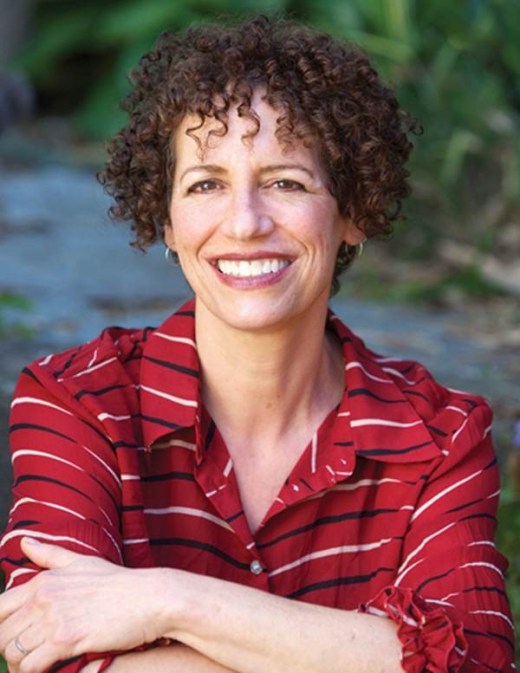
Today, I’m really happy to be chatting with Wendy Wahman about her art, her books, her inspirations, and a really sweet school visit she had recently.
Your bio mentions that you worked for the Seattle Post-Intelligencer until 2009. Can you describe your work there?
I worked in the art department doing maps, graphics, info-graphics and illustrations for every section of the newspaper. Ninety percent of the work was on deadline, so I learned to think and draw fast.
Our poor beloved P-I. It was 146 years old when Hearst closed it down. About 150 of us went down with the ship. Best job I ever had. I miss the variety and culture and importance — and honesty — of journalism. I miss my P-I family, very much.
How did you get started illustrating and writing books for children?
I was really just snooping around for illustration work. I had an idea for a book on dog body language I wanted to do, but imagined ‘a real writer’ should write it. I sent out some of the dog body-language art samples and heard back from four major publishers. Laura Godwin at Henry Holt called me, and was so passionate about dogs and kids—and my art. She asked to see a dummy. What dummy, right? I had no dummy, just an idea and some art samples. I took two weeks off from the P-I and put together a dummy. Laura helped me tremendously, as did my brilliant writer husband, Joe Wahman.
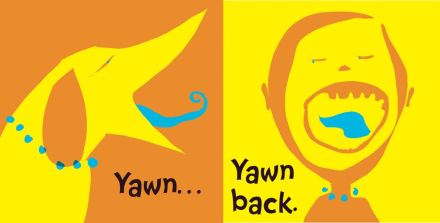
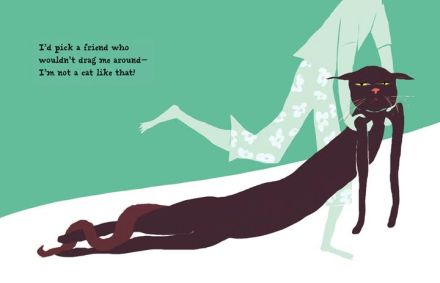
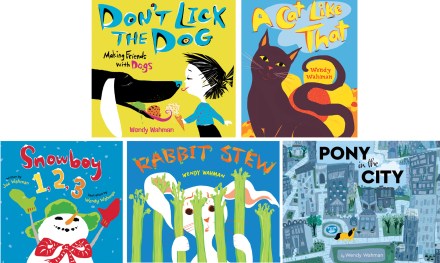
Don’t Lick the Dog is a how-to primer on being safe with dogs. We followed with the companion book, A Cat Like That. We never did do my dog body-language book. It’s sitting here patient as can be. “Good dog, book.”
Image copyright Wendy Wahman, Don’t Lick the Dog. Courtesy of Wendy Wahman.
Image copyright Wendy Wahman, A Cat Like That. Courtesy of Wendy Wahman.
Your art is so varied—from humorous to infographics to striking, serious editorial work. You also work with crisp, clean lines and beautiful textures. Can you talk about your process and inspirations?
Thank you so much, Kathy. Well. I sit and think and read a lot. Mostly I just look and try to distract myself from thinking too hard. I like to thumb through my Thesaurus. When I’m stuck, I try to remember to move away. This can be physically—exercise or a walk; mentally—read or look through books; or emotionally—play with my dogs or call somebody. I say, try, because too often I sit rooted, thinking, thinking. Better to get up and move.
What was the inspiration for Rabbit Stew?
I feed my dogs a homemade stew of meat & veggies. Long ago, I was stirring up an enormous batch of dog food, when “rabbit stew” fluttered to mind. Rabbit Stew is also a counting book, counting down veggies from ten to one. It’s also a color book. It was a challenge to find ingredients safe for rabbits, in different colors and not give it away. Like, rabbits love dandelions and they’re very good for them, but I only know a couple of people who would knowingly toss dandelions into the pot. No potatoes; they are toxic to bunnies, and cabbage isn’t good for them either.
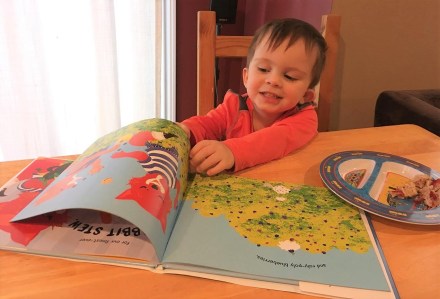
A happy fan enjoys reading “Rabbit Stew” with lunch! Photo courtesy of Wendy Wahman.
You give presentations at schools and libraries. Do you have an anecdote you’d like to share?
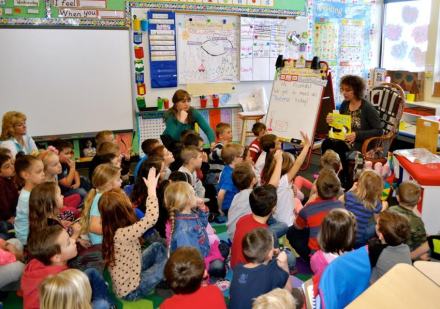
I did a school visit recently in southern California and got to take my mom to a presentation for 4th graders. I introduced her to the students, and they gave her a loud round of applause! Even more tender, when I was signing books (and the other stuff kids want signed), they asked if my mother would also give them an autograph. Is that the sweetest or what? Children can be so inspiring, healing, and wise.
Wendy reads “Don’t Lick the Dog” to enthusiastic kindergarteners in Kennewick, WA. Photograph courtesy of Wendy Wahman
You also teach bookmaking to kids. That sounds fun and fascinating! Can you tell me a little bit about these classes?
I’m so glad you asked about these little books, Kathy. I love making them and sharing the process. Anyone can make one. I’ve taught them to kindergarteners through seniors. I call them “Insight Books,” because what comes out can be surprising, revealing, and often cathartic. Random lines inspire images and ideas. Some people write, others write and draw. Sometimes we collage. Even if you do nothing at all put look, the lines may stimulate ideas. These book are fun to make with a partner too.
What’s up next for you?
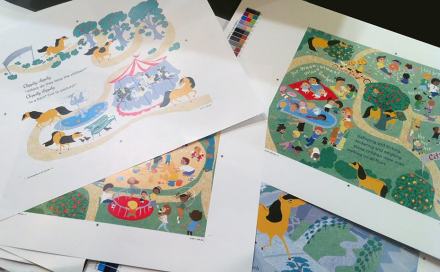
I’m very excited about my next book, Pony in the City (Sterling Publishers). Kevan Atteberry’s book, Swamp Gas, releases the same day, Sept. 9th, and we’re talking about having a co- launch party.
Image copyright Wendy Wahman. Proofs of “Pony in the City” (Sterling, releasing Sept. 9 this year) courtesy of Wendy Wahman.
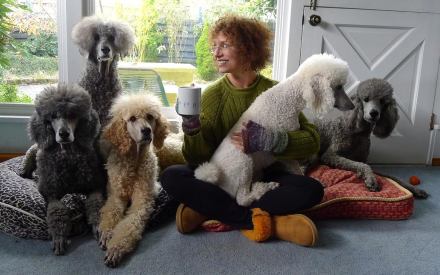
I’m working on Nanny Paws (Two Lions), a book inspired by my little white poodle, LaRoo, and the children next door. Here’s a picture of LaRoo and my other dog Jody with my friend Vikki Kaufman‘s poodles. Vikki is a breeder of beautiful silver and blue standard poodles. Vikki took the picture, can you tell? Her dogs are staring straight at her. Poor LaRoo. She is a shy girl and just wants to get away from the masses.
Wendy with LeRoo and Jody and Vikki’s TinTin, Nickel and Eureka.
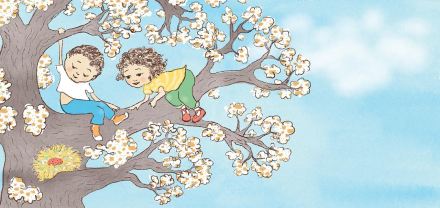
I’m also working on a dummy for a beautiful story written by Joe, “One Bird” (www.joewahman.com). I’m doing the art for both Nanny Paws and Joe’s story in a new/old style for me: pencil and watercolor.
Image from “One Bird,” written by Joe Wahman, illustrated by Wendy Wahman. Courtesy of Wendy Wahman
Do you have a favorite holiday?
Thanksgiving.
Do you have an anecdote from a holiday you would like to share
If you come over for Thanksgiving, prepare yourself for a vegetarian feast. We don’t eat animals here — but we do make them big, round, splendid bowls of stew.
Thanks so much, Wendy! It’s been a lot of fun! I wish you all the best with all of your books!
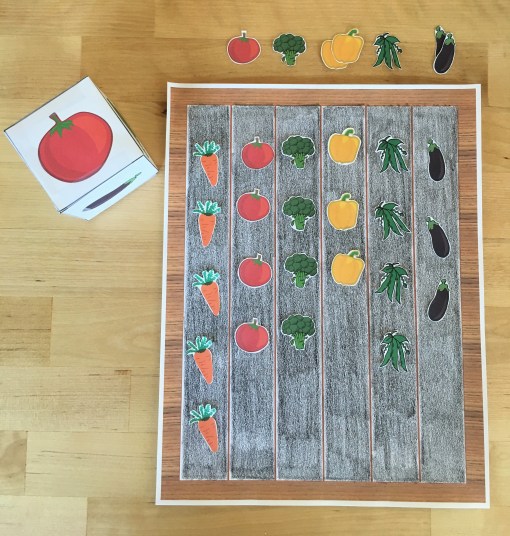
Object: The object of the game is for each player to fill their garden rows with vegetables. Depending on the ages of the players, the required winning number of rows to fill and the number of vegetables to “plant” in each row can be adjusted.
Print one Game Board for each player
Print one set of Playing Cards for each player (for sturdier playing items, print on card stock)
Print one Vegetable Playing Die and assemble it (for a sturdier die, print on card stock)
Cut the vegetables into their individual playing cards
Color the “dirt” on the Garden Plot with the crayon (optional)
Choose a player to go first
The player rolls the die and then “plants” the facing vegetable in a row on the game board
Play moves to the person on the right
Players continue rolling the die and “planting” vegetables until each of the number of determined rows have been filled with the determined number of vegetables.
The first person to “grow” all of their veggies wins!
Today’s holiday is all about those paper maps that have guided travelers along the trails, roads, highways, and biways as they search for adventure or just need to get from here to there. While the little window of GPS may be more prominent now, there’s nothing like opening the wide vista of a paper map and letting your mind wander to far-off places. Old maps are fascinating too, as they reveal the changes in road systems and population over time. Today, rediscover your local area or take an armchair trip to a new locale through a paper map.
The 50 States: Fun Facts
Written by Gabrielle Balkan | Illustrated by Sol Linero
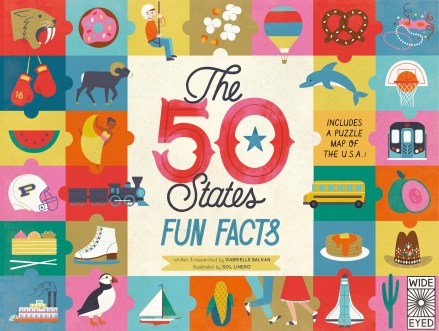
America is one vast country made up of 50 states that are each unique and fascinating in their own way. The history, people, topography, and even weather of each region has resulted in an incredible diversity of animal life, cuisine, transportation, leisure activities, and celebrations across the nation. The 50 States: Fun Facts offers up a patchwork of engaging and enlightening information about each state that will entice kids to learn more about their own home as well as other areas.
Image copyright Sol Linero, text copyright Gabrielle Balkan. Courtesy of Eyes Wide Editions, Aurum Press.
The large-format board book is divided into five two-page spreads, each dedicated to a particular topic. In 50 Animals readers discover that the first Seeing Eye dogs were trained in Nashville, Tennessee; that “the colors of Maryland’s state cat—the Calico Cat—match the state flag”; and that there are so many moose in Wyoming that there’s even a town named Moose! From state to state kids will also learn about the Chinook Dog of New Hampshire, meet white buffalo that roam North Dakota, and view the state insect of Connecticut—the praying mantis, which can turn its head 360 degrees—among many, many more.
Each state is also known for its own, particular mode of transportation. In Alaska the Tlingit Nation builds beautiful canoes, which the people believe are inhabited by their own spirit. If you’re interested in scanning the skies for alien lifeforms, you may want to head to the San Luis Valley of Colorado, which is considered to be prime UFO-spotting territory! If boats are more your thing, you might want to take a houseboat vacation in the lakes around Jamestown, Kentucky, or see a Navy Destroyer at the shipyard in Bath, Maine. Carousel lovers will want to take the road to Rhode Island, where they can catch the gold ring on the Flying Horse Carousel that has been going round and round for nearly 150 years! There are so many more Things That Go on these pages, including trains, trucks, trolleys, and a 16-story electric shovel!
Image copyright Sol Linero, text copyright Gabrielle Balkan. Courtesy of Eyes Wide Editions, Aurum Press.
After all that activity, readers may be a bit hungry. All they need to do is flip the page to find 50 Things to Eat—specialties from around the nation. Whether you call them blackberries or brambleberries, these sweet nuggets—Kentucky’s state fruit—are great alone or in special treats. If you love pretzels, then the pretzel festival in Germantown, Ohio is for you! Spicy foods more your style? Then you’ll want to check out Hatch, New Mexico—the chili capital of the world! After having Delaware’s chicken specialty, catfish from Mississippi, or potatoes from Idaho, you may just want to try a banana split—first served in Latrobe Pennsylvania in 1904—or even nosh on a few roasted Joshua Tree flower buds that are said to taste like candy.
Ready to work off that meal? The next page provides 50 Ways to Get Moving, including archery in California, rafting in West Virginia, base jumping in Utah, snowshoeing in Minnesota, and snorkeling in Hawaii.
Image copyright Sol Linero, text copyright Gabrielle Balkan. Courtesy of Eyes Wide Editions, Aurum Press.
Celebrations have been part of America since the first Thanksgiving, and each state has a entertaining—often quirky—spectacular to highlight their history or specialty. In Nebraska the old Pony Express mail system is reenacted every June; The Heart of the Ozarks Bluegrass Festival brings musicians and fans to West Plains, Missouri each year; and Honobia, Oklahoma’s Bigfoot Festival makes believers of us all—well, almost.
In Florida, you can learn how to wrestle an alligator with the Miccosukee tribe on American Indian Day; you can test your mettle on 98 flights of stairs during Washington’s Space Needle Base 2 Space Race for charity; and “you can cheer on bronc riders at the ‘Daddy of All Rodeos’” during Cheyenne Frontier Days in Wyoming. Perhaps the oddest celebration is Mike the Headless Chicken Festival held every May in Fruita, Colorado that commemorates “a rooster that lived for 18 months…with no head!”
Image copyright Sol Linero, text copyright Gabrielle Balkan. Courtesy of Eyes Wide Editions, Aurum Press.
Each spread also offers a sidebar scavenger hunt of sorts as it asks readers to see if they can find four different categories of items among the rest. After kids have soaked up all the facts about the 50 states, they can test their knowledge of American geography by completing the included jigsaw puzzle map.
Gabrielle Balkan has collected tons of engaging facts about the United States that are sure to delight and amaze children. Each category would be a wonderful starting point for learning about any or all of the states and gives kids an idea of the variety found across America. Sol Linero’s striking category “quilts,” composed of colorful patches decorated with clear, engaging illustrations, draw readers in to discover the fascinating facts presented about each state.
Ages 4 – 10
Wide Eyes Editions, Aurum Press, 2016 | ISBN 978-1847808691
Discover more about Gabrielle Balkan and her books on her website!
View a gallery of illustration work by Sol Linero on her website!
National Read a Road Map Day Activity
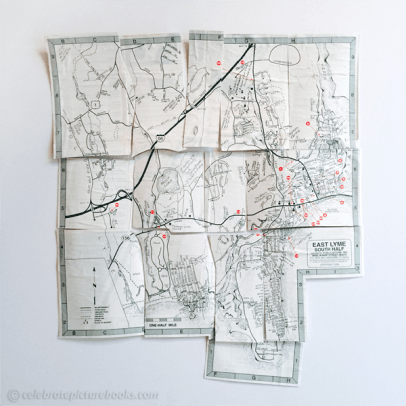
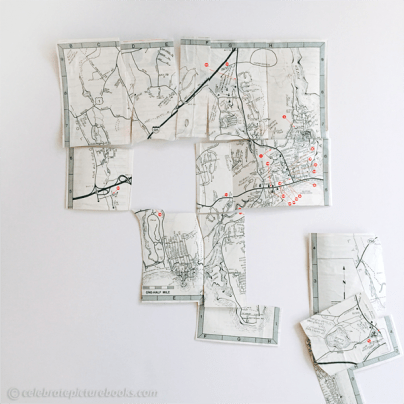
Make a Road Map Jigsaw Puzzle
It’s fun and easy to make your own jigsaw puzzle from a map of your local town or a place you’d like to visit!
Supplies
A paper map
Poster board
Glue or spray glue
Scissors
Directions
Smooth out the paper map
Glue the map to the poster board
Cut the poster board into interlocking or adjoining pieces (the number of pieces can depend on the child’s age)
Those Aztecs! Is there nothing they couldn’t invent? Culinary aficionados from kindergarten to gourmet chefs have the Aztecs to thank for peanut butter—that smooth (or chunky, or super chunky) concoction that is perfect by itself or as an ingredient in complex dishes. The Aztecs created their version by grounding roasted peanuts into a paste.
Peanut butter and jelly sandwiches are thought to have originated during the American Civil War, when soldiers combined their peanut butter ration with their jelly ration and slathered it all on bread. After the war peanut butter sales skyrocketed as everyone discovered what a delicious and nutritious delight this simple meal was. To celebrate today, make yourself a PB & J sandwich!
Peanut Butter & Jelly Brains: A Zombie Culinary Tale
Written by Joe McGee | Illustrated by Charles Santoso
Reginald was surrounded by culinary boredom. All “the other zombies wanted brains for breakfast, lunch, and dinner,” but Reginald really dug peanut butter and jelly sandwiches. The people of Quirkville weren’t too keen on the zombies’ preferred meal either. Whenever the zombies lumbered through town groaning “BRAINSSSSS,” everyone ran away screaming.
Image copyright Charles Santoso, text copyright Joe McGee. Courtesy of Harry N. Abrams
Poor Reginald didn’t join the herd. His stomach was too rumbly and grumbly, “and all he could do was dream about a peanut butter and jelly sandwich. ‘Sweet jelly…,’ moaned Reginald. ‘Sticky peanut butter…’” Sakes alive! The other zombies couldn’t understand. “‘No BRAINSSSSS?’” they asked. Reginald tried to explain how delicious peanut butter and jelly was, but the other zombies wouldn’t listen.
Reginald tried to satisfy his craving at the local café, but the man behind the counter just pointed to a sign that said “No Zombies Allowed.” In the school cafeteria, the lunch lady just plopped “a hunk of meatloaf” on his plate that looked disturbingly like brains. Reginald even went to the store to buy the ingredients himself, but when he got to the cash register, he had no money. No money meant no peanut butter, no jelly, and no bread.
Image copyright Charles Santoso, text copyright Joe McGee. Courtesy of Harry N. Abrams
Then Reginald spied Abigail Zink with a lunch bag in her grasp. He “recognized the familiar jelly stain that was seeping through the paper bag” and made his move. At the same time, the “zombie horde shuffled and shambled around the corner” straight for Abigail, who had her nose in a book and took no notice of the danger. The other townspeople froze, and in that moment Reginald dashed forward and grabbed Abigail’s sack. He could practically taste the deliciousness inside.
Image copyright Charles Santoso, text copyright Joe McGee. Courtesy of Harry N. Abrams
“Little Abigail Zink let out a shriek, the mayor’s poodle yipped and yapped, and the townspeople all screamed, ‘ AHHHHH!’” Reginald knew that if the other zombies had just one taste of peanut butter and jelly, they would change their minds about brains. Reginald held Abigail’s sandwich aloft and yelled, “‘BRAINS!’” The zombies crowded around as Reginald tossed the sandwich in the air.
Reginald had been right. With one taste, the zombies declared peanut butter and jelly “‘better than brains.’” Suddenly, the townspeople realized that the zombies were just hungry. With peanut butter and jelly sandwiches in their tummies, the zombies became valued parts of Quirkville. The townspeople were happy, the zombies were happy, and Reginald? Well, he was still a little different. While the zombies now enjoyed PB and J, he “had moved on to…PIZZA.”
Image copyright Charles Santoso, text copyright Joe McGee. Courtesy of Harry N. Abrams
Joe McGee’s tradition-bucking zombie offers a sweet wake-up call to anyone sleepwalking through life doing and liking the same things over and over while they follow the herd (or horde). McGee’s humorous descriptions of the marauding zombies and the townspeople’s reactions will have kids giggling all the way through the story. The resolution to Quirkville’s predicament is deliciously “brainy,” and Reginald’s continued individuality makes for a surprising and satisfying ending.
Charles Santoso knows that most families have one or two zombies of their own who latch onto a favorite food and won’t let go. His stitched up, shaggy haired, raggedy clothed child zombies are adorable, and kids will love finding their favorite among the horde. Clever touches, such as a pirate zombie and a zombie cat, as well as the screaming townspeople will make readers laugh.
For the walking hungry, Peanut Butter & Jelly Brains: A Zombie Culinary Tale is sure to be ordered from the book cupboard again and again for fun story times.
Ages 4 – 8
Harry N. Abrams, 2015 | ISBN 978-1419712470
Discover more about Joe McGee and his books on his website!
Peanut Butter and Jelly Muffins, recipe from Erica’s Sweet Tooth, ericasweettooth.com.
Peanut Butter and Jelly Muffins from Erica’s Sweet Tooth
Searching for a delicious alternative to a peanut butter and jelly sandwich—one that’s perfect for breakfast, lunch, or as an in between sweet? Look no further than this scrumptious recipe from Erica’s Sweet Tooth! Made with creamy peanut butter, your favorite berry preserves, and a luscious crumble, these muffins will satisfy your PB & J cravings.
This month we celebrate umbrellas, those perky protective accessories that have been around since earliest times. Ancient civilizations used palmetto fronds for shade and during inclemet weather. The first waterproof umbrellas were created by the Chinese, who waxed or lacquered their paper parasols. Umbrellas were strictly women’s accessories until Jonas Hanway, a Persian travel writer, used one in public in England in the 1700s. English men then took up the practice, calling their version a “Hanway.” The first collapsible umbrella was designed in 1710, and in 1928 the folding pocket umbrella appeared. Since then, umbrellas have become fashionable and necessary accessories for all.
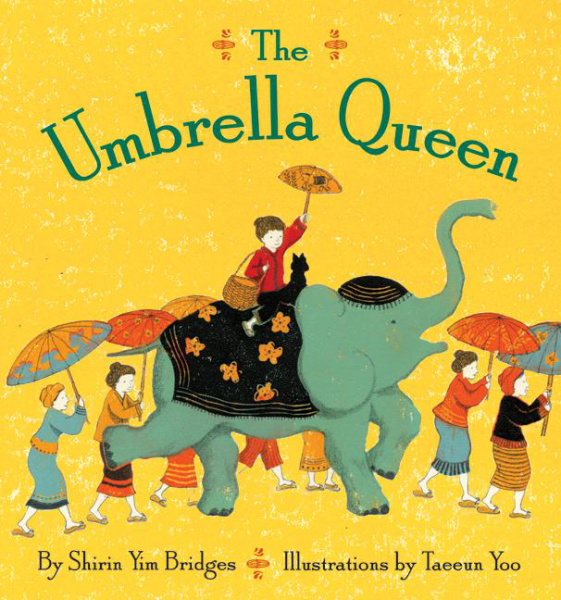
The Umbrella Queen
Written by Shirin Yim Bridges | Illustrated by Taeeun Yoo
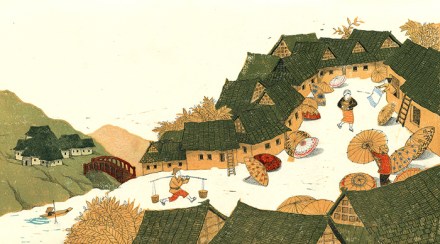
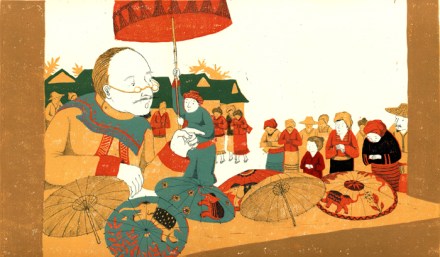
The residents of a small village in Thailand are well known for the beautiful paper umbrellas they make and sell in the local shops. The umbrellas are colorful, but always decorated with flowers and butterflies. Every New Year’s Day the villagers hold an Umbrella Parade, and the woman who has painted the most beautiful umbrella is chosen as the Umbrella Queen.
Noot is a little girl who longs to paint her own umbrellas and partake in the parade. One day her mother gives her an umbrella to paint and shows her how to copy her design. Noot is a natural artist, and her finished umbrella is nearly indistinguishable from her mother’s. She is given her own painting spot in the garden and five umbrellas to decorate.
Image copyright Taeeun Yoo, courtesy of taeeunyoo.com
Noot paints the familiar butterflies and is about to start on the flowers when she is inspired to draw elephants instead. She covers all five umbrellas with elephants doing handstands, playing and squirting water, walking trunk-to-tail, and just being silly. When her mother sees these umbrellas, she is unhappy. Flowers and butterflies sell in the local shops, not elephants. Noot understands the importance of the money made from the umbrellas to her family. For the next year she paints the large umbrellas with the traditional design. At night, however, using bits and pieces, she fashions tiny umbrellas. These she paints with elephants, and displays them on her windowsill.
Image copyright Taeeun Yoo, courtesy of taeeunyoo.com
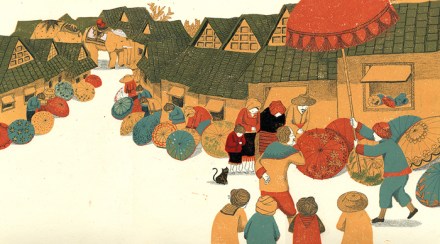
As New Year approaches there is much excitement in the village. It is rumored that the king will be visiting and will choose the Umbrella Queen himself. One day the villagers receive the message that the king will indeed arrive. The villagers spruce up their town and each woman displays her umbrellas in front of her home.
The king walks the length of the street, considering each umbrella until he comes to Noot’s house. He is very impressed with the umbrellas painted by Noot’s mother, but his gaze wanders to Noot’s windowsill, and he asks who painted the “strange” umbrellas.
Image copyright Taeeun Yoo, courtesy of taeeunyoo.com
A bit embarrassed by the attention, Noot shyly answers the king’s questions about the size of the small umbrellas and the unusual designs. In trying to explain herself, she forgets to look at the ground when talking to the king, and when her eyes meet his she realizes that, instead of judging her, he is charmed. “I like elephants,” she tells him, and he laughs. The king then takes Noot’s hand and names her the Umbrella Queen because “she paints from her heart.”
Shirin Yim Bridges has written a unique story that effectively and engagingly presents the often conflicting dilemma of responsibility to others while staying true to yourself. Noot’s journey from an observer in her family’s business to a valued artist is told straightforwardly, and the familial love and support are clearly emphasized. The king’s recognition of Noot’s talent and heart will be highly satisfying for young readers or listeners.
Taeeun Yoo’s delicate illustrations in gold, red, black, and green set the story firmly in Thailand and perfectly demonstrate the close-knit village and relationships as well as the intricate beauty of the umbrellas and the pride the villagers take in them.
The Umbrella Queen is a wonderful story about family, discovering your talents, and self-expression that would find a welcome spot on any child’s bookshelf.
Ages 4 – 8
Greenwillow Books, Harper Collins, New York, 2008 | ISBN 978-0060750404
Learn more about Taeeun Yoo, her books, and her art on her website!
Umbrella Month Activity
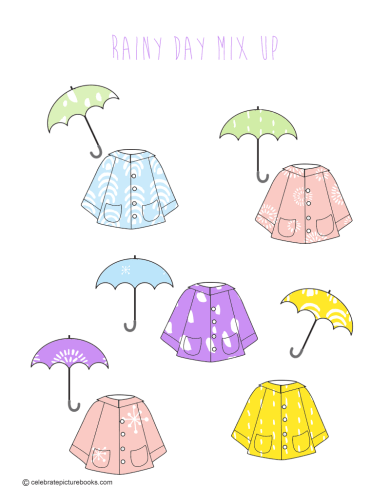
Rainy Day Mix Up Matching Game
A sudden storm scattered all the umbrellas and raincoats! Can you put the pairs together again? Draw a line to connect the umbrella and the raincoat that have the same pattern. Print the Rainy Day Mix Up Gamehere!
Okay, so it’s Friday and the end of a long work and school week. Maybe everything didn’t go as planned this week—maybe not even close. But who cares. Why? Because you are still awesome! Begun as a kind of inside joke among coworkers, International Day of Awesomeness continues to grow, attracting more and more awesome individuals around the world. To celebrate get creative and perform feats of awesomeness—whatever that might mean to you. Sometimes that just means having and showing an awesome amount of love—as you’ll soon see!
I Want That Love
By Tatsuya Miyanishi
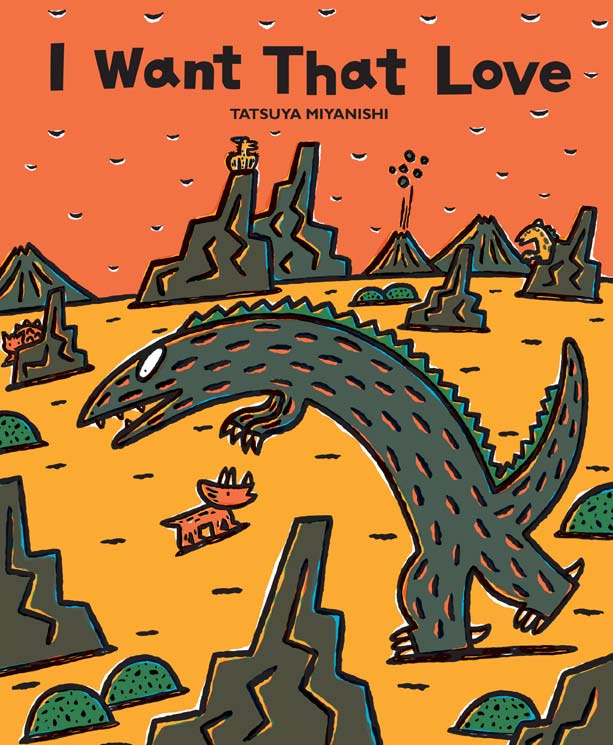
Long ago Tyrannosaurus ruled the earth. His philosophy was “In this world, strength means everything. The strongest wins. The strongest rules. And I am the strongest!” Tyrannosaurus stomped across the landscape crushing and eating the “worthless weaklings” in his path. The other dinosaurs quaked whenever they heard him roar. They hid and were quiet, and never opposed him. Soon this led to some skewed thinking—they also began to believe that “Tyrannosaurus could do anything he wanted to because he was the strongest.”
Text and image copyright Tatsuya Miyanishi, courtesy of museyon.com
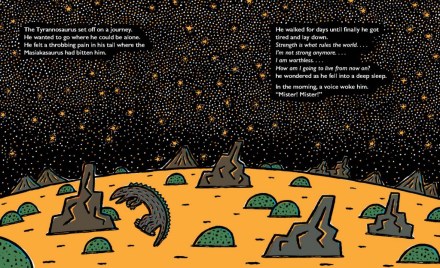
As time passed, however, the Tyrannosaurus grew old and feeble. One day he happened upon a Masiakasaurus who mocked him for moving so slowly. The Tyrannosaurus threatened him, but could do little else. Another Masiakasaurus bit the Tyrannosaurus’s tail. “‘Ouch…stop,’ the Tyrannosaurus cried.” But it did no good; no one was afraid of him anymore.
The Tyrannosaurus just wanted to be alone. He traveled for days, and when he was exhausted he lay down and went to sleep. Now that he was no longer strong, he felt he was worthless and wondered how he was “going to live from now on.” He was awakened by a voice. “He opened his eyes and saw a yummy-looking baby Triceratops right in front of him.” He had every intention of eating this little snack, but his tail was so sore he couldn’t move.
Text and image copyright Tatsuya Miyanishi, courtesy of museyon.com
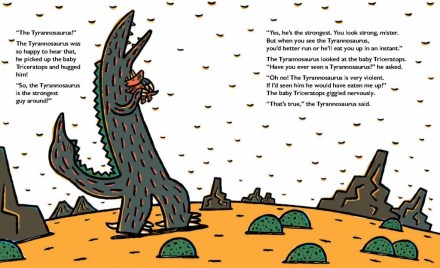
The little Triceratops noticed his swollen tail and stroked the injury to help it feel better. He also warned the Tyrannosaurus that sleeping in the open was dangerous because the “strong, scary Tarbosaurus” would eat him. The Tyrannosaurus scoffed, saying that there was someone much stronger than the Tarbosaurus. The Triceratops suggested the Gorgosaurus, but Tyrannosaurus disagreed. “‘I’m thinking of someone who is much, much stronger,’” he said. Oh, yes! The Triceratops remembered. “‘The Tyrannosaurus!’” Tyrannosaurus was so happy to hear his name that “he picked up the baby Triceratops and hugged him.” The baby warned the dinosaur to run away if he saw Tyrannosaurus because he would surely be eaten.
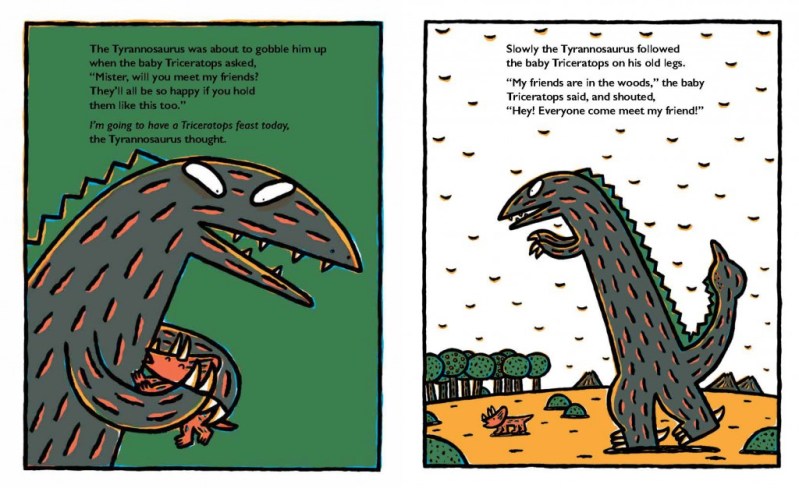
The giant dinosaur was surprised that the baby had never seen Tyrannosaurus before, and was just about to gobble him up when the little one asked if he would meet his friends and hug them too. The Tyrannosaurus eagerly followed the Triceratops, imagining the feast he was about to have. When they reached the woods all the little Triceratops came out to play and begged to be picked up and hugged. “‘No, no, guys!’ said one little Triceratops. ‘Even a mighty man like Mr. Rhabdodon can get tired.’”
Text and image copyright Tatsuya Miyanishi, courtesy of museyon.com
The Tyrannosaurus was insulted. Rhabdodon was stupid, a weakling, and an herbivore. But before he could protest, the other little Triceratops discovered his wound. They all began tending carefully to his injury and gathered red berries to help him heal even though it hurt their horns to ram the tree and dislodge the berries. Suddenly, Tyrannosaurus understood their sacrifice on his behalf. Tears sprang to his eyes, and he grabbed a trunk in his teeth and shook it. The youngsters were amazed as red berries rained down on them.
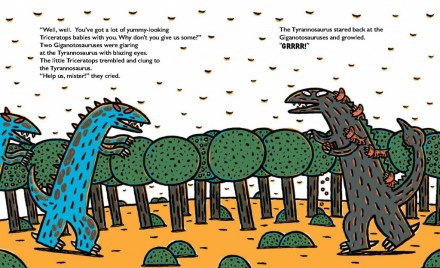
They cheered and said they wanted to be just like Mr. Rhabdodon. They bet that he could even beat mean Tyrannosaurus. The Tyrannosaurus mumbled his old slogan, and began to tell the little ones that strength wasn’t so important when they were interrupted by two Giganotosauruses who wanted a Triceratops snack. The Tyrannosaurus growled at the newcomers. But the Giganotosauruses attacked, biting the Tyrannosaurus to get at the babies in his arms. The Tyrannosaurus curled his body around them and promised to protect them.
Text and image copyright Tatsuya Miyanishi, courtesy of museyon.com
As the Giganotosauruses continued to bite him, the Tyrannosaurus “murmured, ‘I finally understand…Remember this, kids. It’s not being strong that is important. What’s most important is…’” At last, unsuccessful in their quest, the Giganotosaurus went away, and the Tyrannosaurus fell over. The little Triceratops crawled safely away and headed home when the Tyrannosaurus told them he was tired. Before he left, the first Triceratops asked what the most important thing was, but the Tyrannosaurus didn’t reply.
Many years later a father Triceratops and his babies were spotted by two Giganotosauruses looking for food in the woods. They jumped on the family, but the father hid his children under his body and endured the attack. “He remembered how the Tyrannosaurus had protected him and his friends.” Finally, the Giganotosauruses gave up and went away. His little ones were impressed but asked why he hadn’t beaten up the Giganotosauruses.
Text and image copyright Tatsuya Miyanishi, courtesy of museyon.com
With tears in his eyes, the father said, “‘Violence isn’t the answer. There is something more powerful than strength, and more precious too. That is love…A truly strong guy who broke this tree once gave me that love….’ One baby looked at his father and said, “‘Will you give me that love? I want that love.’”
Originally published in Japan, Tatsuya Miyanishi’s story of what constitutes true strength and how love can transform even the most hardened heart will resonate with kids and adults on many levels. Children’s familiarity with and love of dinosaurs allows them to easily understand the complexities of the actions and emotions revealed in the story. Ambiguity in the wording after the Tyrannosaurus defeats the Giganotosauruses allows for various interpretations of his fate depending on the age and sensitivity of the child, and a bit of humor when the Triceratops does not recognize Tyrannosaurus adds levity to the plot. The innocence and generosity of the Triceratops babies as an agent of change within the Tyrannosaurus is poignant and realistic. Likewise, the long-term effects of experiencing awesome love when young is well demonstrated as the father Triceratops later gives back to his own family.
The harsh dinosaur-eat-dinosaur landscape is effectively portrayed in Miyanishi’s bold green, gold, and orange illustrations in which the stylized Tyrannosaurus towers over trees, angular rock formations, and especially the tiny, unsuspecting Triceratops. Images of the Tryannosaurus and Triceratops father guarding the babies are touching and demonstrate a parent’s or caregivers love.
I Want That Love is the third book in the Tyrannosaurus series, along with You Look Yummy and You Are My Best Friend, and will reward readers who love dinosaurs as well as those looking for books on kindness and acceptance.
Ages 5 – 7
Museyon, 2016 | ISBN 978-1940842141
Day of Awesomeness Activity
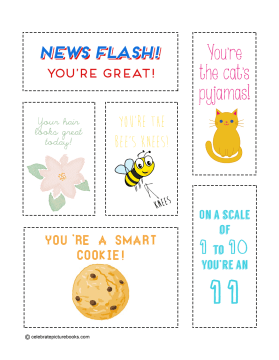
Awesomeness Cards
Do you have some awesome people in your life? Give them one of these printable Awesomeness Cards and watch them smile!