June 9 – It’s National Family Month

celebrate-picture-books-picture-book-review-it's-great-being-a-dad

About the Holiday

The weeks between Mother’s Day in May and Father’s Day in June have been designated as National Family Month. This time gives us the opportunity to honor everything that makes a group of people a family. Shared experiences and memories—and especially love—create that unique feeling in the heart that defines family. To celebrate, get the family together for some fun!

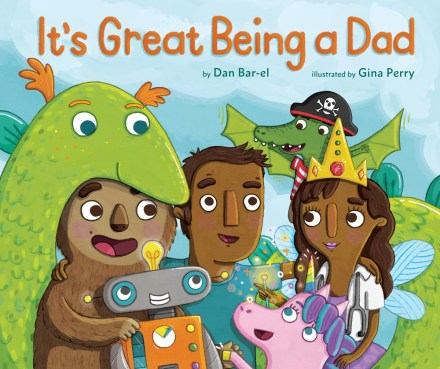
It’s Great Being a Dad

Written by Dan Bar-el | Illustrated by Gina Perry


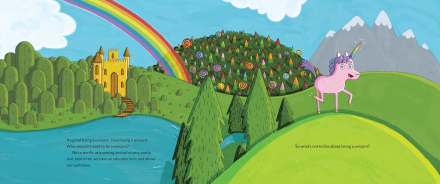
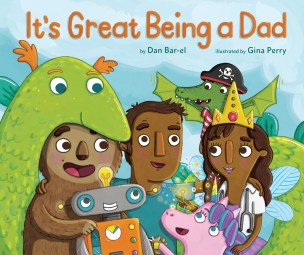
A lovely pink unicorn with a sparkling rainbow horn clip-clops over a grassy hill, a golden castle and a candy forest in the background. The playful animal believes it’s “great being a unicorn. Who wouldn’t want to be a unicorn?” What makes them so special? Well…as she says, “We’re terrific at prancing and we’re very pretty and, best of all, we have an adorable horn just above our eyebrows.” It’s hard to argue with those reasons!

celebrate-picture-books-picture-book-review-it's-great-being-a-dad

Image copyright Gina Perry, text copyright Dan Bar-el. Courtesy of Tundra Books.

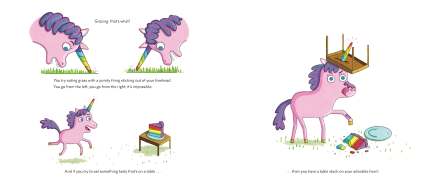
But it seems there are some downsides to this whole unicorn thing. Grazing might be at the top of the list. That shiny horn just always seems to get in the way. There’s no way for teeth to touch the ground, and trying to grab a snack off a table just results in the table stuck on the “adorable horn.”

celebrate-picture-books-picture-book-review-it's-great-being-a-dad

Image copyright Gina Perry, text copyright Dan Bar-el. Courtesy of Tundra Books.

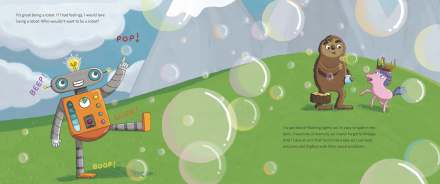
How about Bigfoot? What’s it like for him? Let’s ask—here comes Bigfoot now! “It’s great being Bigfoot. I love being Bigfoot. Who wouldn’t want to be Bigfoot?” What’s so great about being…you know…. Well…he’s warm in his furry coat, he’s well camouflaged among the trees, and his super strength “can help unicorns get tables off their heads.” Sounds great! What could go wrong? Hmmm…. It seems those big feet get themselves into some sticky situations—like ending up with a tree truck lodged around your leg.

celebrate-picture-books-picture-book-review-it's-great-being-a-dad

Image copyright Gina Perry, text copyright Dan Bar-el. Courtesy of Tundra Books.

Maybe being a Robot is better. Indeed! In fact, Robot says, “If I had feelings, I would love being a robot.” Pretty compelling stuff there. Robot is very flashy and has lots of memory and has an arm that can convert into a saw just in time to help “unicorns and Bigfoot with their wood problems.” So what’s not to like? Rain can really mess with the mo(tor)-jo.

Poor Loch Ness Monster! She’s not even going to try being positive. It kind of stinks being a monster—especially when you don’t feel like one. But maybe things aren’t all bad. Unicorn, Bigfoot, and Robot hitch a ride on Nessie’s back across the lake to the hospital. There they meet a “fairy queen ballerina doctor” who loves being a fairy queen ballerina doctor. Who wouldn’t?

celebrate-picture-books-picture-book-review-it's-great-being-a-dad

Image copyright Gina Perry, text copyright Dan Bar-el. Courtesy of Tundra Books.

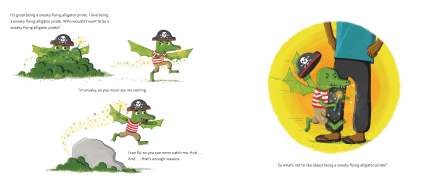
This Jill-of-all-trades can prescribe medicine for the sick, “perform a happy dance” for the sad, and wave her magic wand “if you have trouble with your saw arm…or your head horn or your big foot.” Sounds perfect…until a “sneaky flying alligator pirate” swoops in and swipes the magic wand just as the fairy queen ballerina doctor is about the save the day. “Dad!”

Ha! Ha! This little guy is super excited to be a sneaky flying alligator pirate. “I’m sneaky, so you never see me coming. I can fly, so you can never catch me. And… And…that’s enough reasons. So what’s not to like about being a sneaky flying alligator pirate?” Ooof! “Dads, that’s what!”

celebrate-picture-books-picture-book-review-it's-great-being-a-dad

Image copyright Gina Perry, text copyright Dan Bar-el. Courtesy of Tundra Books.

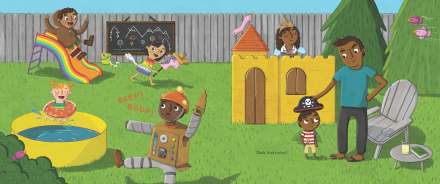
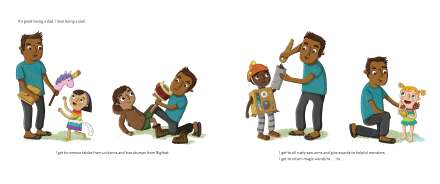
But how does Dad feel about being a dad? Let’s see: “It’s great being a dad. I love being a dad.” It does look pretty fun! Dad gets to remove pizza box “tables” from hobby horse unicorns; remove stepped-on drums from a brown-fuzzy-hoodied-and-hiking-booted Bigfoot; fix cardboard saw arms; give medals to super swimmers; and “return magic wands to… to… ‘Fairy queen ballerina doctors. I told you a million times already.’ Right. What she said.” Plus Dad can help little brothers play nicely.

So you must be wondering… “what’s not to like about being a dad? Sudden makeovers, that’s what.”

celebrate-picture-books-picture-book-review-it's-great-being-a-dad

Image copyright Gina Perry, text copyright Dan Bar-el. Courtesy of Tundra Books.

Dan Bar-el’s laugh-out-loud romp through an afternoon of play hits the perfect tone to entertain kids and adults as well. Bar-el’s wry delivery and repetition of the appealing—and not-so—traits of each fantasy character will have readers giggling and eagerly anticipating the next page. The revelation that the characters are kids with big imaginations offers multiple payouts in creativity, personalities, friendship, and family.

Gina Perry’s vibrant, whimsical illustrations riff on all the fantasy clichés to ramp up the humor in this vivacious story. When happily-ever-after turns into happily-never-after for each character, Perry amusingly depicts their dismay, but the next page finds them cheerfully adjusted to their new circumstance and weaving it into a revised storyline. As the story wraps up, readers will enjoy pointing out aspects of the kids’ interests and parts of their backyard that spurred their imagination in earlier pages. The diverse group of friends is welcome, and good-natured Dad doesn’t really seem to mind his impromptu makeover.

It’s Great Being a Dad is a perfect book for young readers to share with their own dads and would be an often-read addition to children’s home libraries.

Ages 4 – 8

Tundra Books, 2017 | ISBN 978-1770496057

Discover more about Dan Bar-el and his books on his website!

You find a gallery of illustration work and books by Gina Perry on her website!

National Family Month Activity

celebrate-picture-books-picture-book-review-charades-activities-cards

Family Charades


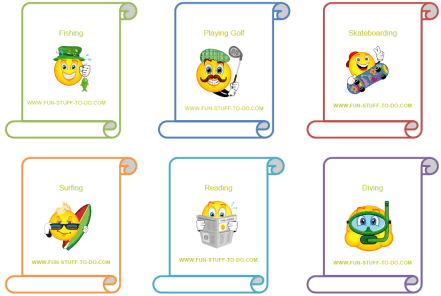
Getting together to play charades is a fun way to spend family time with a little bit of thought, a little bit of action, and lots of laughs. You can find lots of charades cards, ideas, and rules at funstufftodo.com.

celebrate-picture-books-picture-book-review-it's-great-being-a-dad

You can find It’s Great Being a Dad at these booksellers

Amazon | Barnes & Noble | Books-a-Million | IndieBound

June 8 – Upsy-Daisy Day

celebrate-picture-books-picture-book-review-a-crow-of-his-own-cover

About the Holiday

Do you wake up before the alarm or do you hit the snooze button a couple of times? Do you bound out of bed or do you pull the covers up tighter? Do you greet your family with a cheery “Good Morning” or do you mumble an incoherent “gmmmphngg?” If you’re more the latter type of person, then today’s holiday encourages you to be a happy “upsy-daisy” who starts the day with enthusiasm and an optimistic outlook. Beginning the day fresh as a daisy helps the whole day go better!

A Crow of His Own

Written by Megan Dowd Lambert | Illustrated by David Hyde Costello


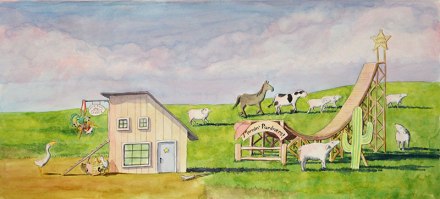
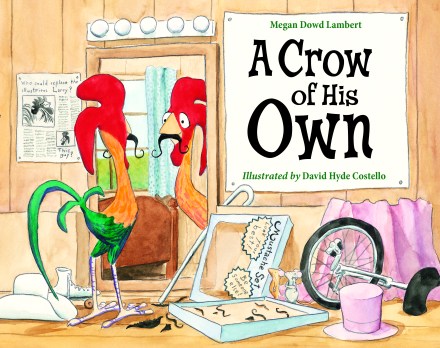
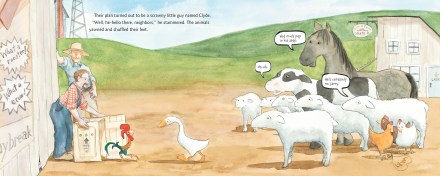
When fame and fortune came calling for Larry, the charismatic rooster of Sunrise Farm, the daily routine turned upside down. “The animals overslept and no one knew what to do.” But while the cow, horse, sheep, chickens, and goose fretted, Farmer Jay and Farmer Kevin had a plan. One day they gathered all the animals and introduced Clyde, the new rooster. Looking at the “scrawny little guy” as he stammered his hello, the cow, horse, and sheep expressed doubt in his abilities, already comparing him to their beloved Larry.

Roberta, the goose, stepped forward, however, and reassured him that “they just miss Larry.” When Clyde asked who Larry was, the animals gasped. “Only the best rooster ever,” claimed the sheep. “Take it straight from my mouth: he was more than that,” said the horse. “He was a genius,” the cow chimed in.” And the chickens? In the dirt they scratched a heart with Larry and XOX in the center.

celebrate-picture-books-picture-book-review-a-crow-of-his-own-clyde-joins-the-farm

Image copyright David Hyde Costello, text copyright Megan Dowd Lambert. Courtesy of Charlesbridge

Clyde was worried—how could he ever live up to Larry? Roberta tried to soothe him. “‘Larry wasn’t a genius…he just made quite a show of it.” Emboldened and with an inkling of what he needed to do, Clyde thanked Roberta and dashed off. “Clyde spent the whole day gathering props, designing his costume, and choreographing a sublime two-step.” As Clyde gave himself one last look in the mirror in his top hat and cloak, he had misgivings. “Could he put on a show of a crow?” He went to bed, but hardly slept at all.

celebrate-picture-books-picture-book-review-a-crow-of-his-own-sleeping

Image copyright David Hyde Costello, text copyright Megan Dowd Lambert. Courtesy of Charlesbridge

In the morning…well…Clyde overslept. The animals were not happy. “Who ever heard of a rooster sleeping in?” baaad mouthed the sheep. “What a worthless chicken,” complained the horse. And the cow had issues of her own. Once again Roberta came to Clyde’s defense. With a wagon full of new props and material, Clyde rushed away to prepare for the next day. Up bright and early and balanced on a unicycle atop the coop while surrounded by promotional signs, Clyde “opened his beak, and…promptly fell to the ground with an undignified croak.”

celebrate-picture-books-picture-book-review-a-crow-of-his-own-skating-ramp

Image copyright David Hyde Costello, text copyright Megan Dowd Lambert. Courtesy of Charlesbridge

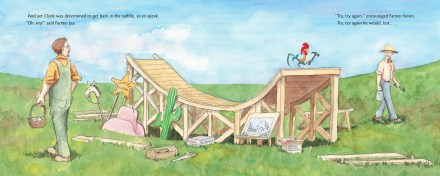
Poor Clyde! Humiliated and hurt he once again had to endure the slights of the farmyard animals, but their comments only spurred him on. Vowing to go bigger and better, Clyde built himself a ramp, ordered roller skates for birds and a parachute, and designed a colorful Western-themed set. “‘Oh, my!’” remarked Farmer Jay as he walked by. “‘Try, try again,’ encouraged Farmer Kevin.” But in the morning Clyde’s spectacular trick left him hanging upside down from the chicken coop, and the animals more “disgruntled and dismayed” than before.

celebrate-picture-books-picture-book-review-a-crow-of-his-own-ramp

Image copyright David Hyde Costello, text copyright Megan Dowd Lambert. Courtesy of Charlesbridge

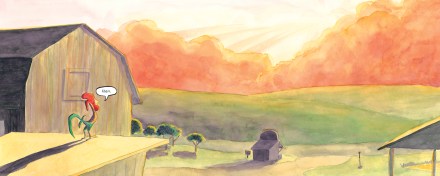
Clyde was distraught. “‘Forget about Larry.’” Roberta said. “‘Just crow your own crow.’” Clyde considered her advice. The next morning as the sky turned pink and orange with the rising sun, Clyde stood tall atop the chicken coop. He quietly cleared his throat and then—“COCK-A-DOODLE-DOO!” The newly awakened animals came running. Even Farmer Jay and Farmer Kevin came to see this new Clyde. The horse summed up their collective feeling: “It’s not so much like crowing, but crooning.” Roberta agreed. “‘Enough to give you goose bumps!’” she exclaimed. As an encore, “Clyde took a deep breath, gave a shake of his comb, and called out another crow of his own.”

celebrate-picture-books-picture-book-review-a-crow-of-his-own-sunrise

Image copyright David Hyde Costello, text copyright Megan Dowd Lambert. Courtesy of Charlesbridge

These days it’s nearly impossible for kids not to compare themselves or be compared to others—even those they’ve never met. All they need to do is jump on the Internet and discover that so-and-so has double, triple, or more friends and/or followers than they do; go to class and get their grade on that assignment they worked so hard on; or simply stand by their locker, go to lunch, or head out to gym and overhear the comments of other students. Avoidance isn’t the answer, but a good base of self-confidence and personal identity is. In A Crow of His Own Megan Dowd Lambert offers readers such a base in her entertaining and meaningful tribute to self-acceptance and love that hits all the right notes.

As soon as scrawny Clyde walks out of his crate to the scorn of his farm mates, kids will root for this underchicken. With a light touch and plenty of wordplay, Dowd deftly presents honest portrayals of the opposition Clyde is up against as well as Clyde’s distressed reactions. Clyde’s three attempts to act like Larry humorously demonstrate the difficulties of trying to be someone you’re not. When Clyde finally musters the courage to “crow his own crow” and is met with praise, readers will see that their own unique talents will find an appreciative audience.

celebrate-picture-books-picture-book-review-a-crow-of-his-own-sunrise-farm

Image copyright David Hyde Costello, text copyright Megan Dowd Lambert. Courtesy of Charlesbridge

David Hyde Costello knows how to put on a show! His Sunrise Farm is a gentle, bucolic spread still under the thrall of Larry. Humorous details, such as the valentines to Larry the chickens draw in the dirt, the movie house-style posters on the side of the barn, and the surprised and exasperated expressions of the animals, testify to Larry’s enduring legacy. But careful observers will notice that while Larry is a rather bland white rooster with some black tail feathers, Clyde is distinctively colorful from his comb to his feet. Kids will giggle at Clyde’s increasingly complex morning shenanigans even as they sympathize with his plight. When Clyde finally reveals his magnificent crow, readers will cheer.

A Crow of His Own is a winner on so many levels. It offers parents and children a way to discuss and begin building the strong sense of self so important to a happy and successful life. The book also presents a positive visual representation of diversity, and in Roberta and Farmer Jay and Farmer Kevin it shows that finding support helps. And it does all of this in a story that stands on its own as a funny, laugh-inducing romp. Because kids will want to hear this story over and over, A Crow of His Own would be a wonderful addition to libraries and home book collections.

Ages 4 – 9

Charlesbridge, 2015 | ISBN 978-1580894470

To learn more about Megan Dowd Lambert, her picture books, her Whole Book Approach to Reading, and more visit her website!

On David Hyde Costellos website you’ll find a gallery of artwork, a portfolio of picture books, videos, and more!

Upsy-Daisy Day Activity

celebrate-picture-books-picture-book-review-chicken-craft

A Chicken to Wake Up To


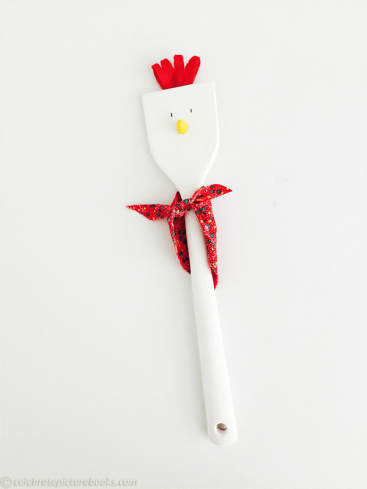
A long-handled wooden turner makes a plucky decoration for your room or kitchen—and a great reminder to bring your passions to every job! In a few simple steps, you’ll have a cute companion you’ll want to crow about!

Supplies

  • Printable Comb and Scarf Template
  • Long-handled wooded turner, available in kitchen supply stores
  • Red felt, 2 inches by 2 inches
  • Yellow bakable clay
  • Fabric, 12 inches square
  • A small piece of white felt or fleece (optional)
  • White paint (or any color you would like)
  • Black marker
  • Fabric glue
  • Glue gun
  • Paint brush

celebrate-picture-books-picture-book-review-chicken-craft

Directions

  1. Paint the wooden turner, let dry
  2. Cut the scarf from the piece of fabric
  3. Make a beak from the yellow clay and bake it according to package directions

To make the comb

  1. Fold the felt in half and glue the end together with the fabric glue
  2. Cut short strips from the folded top of the felt, about ½-inch to ¾ -inch in length
  3. Round the corners of the strips slightly

To make the scarf

  1. Fold the fabric in half
  2. With the long, straight edge of the scarf template along the fold, cut out the scarf
  3. With the fabric glue, glue the two sides of the scarf together so that you have two “right” sides
  4. Let dry

To assemble the chicken

  1. Pinch the bottom of the comb together so that the strips open and the felt pleats a little
  2. With the glue gun attach the comb to the back of the painted turner, keeping the bottom pinched together
  3. Attach the beak to the front of the turner
  4. Draw eyes on the chicken with the black marker
  5. Tie the scarf around the neck of the handle, hold in place with a drop of glue in the back if necessary
  6. To make tail feathers in a turner with a hole in the handle, pinch together a small folded piece of white felt or fleece and push it through the hole in the handle of the turner.
  7. Cut or arrange to look like feathers

Picture Book Review
May 21 – “I Need A Patch for That” Day

celebrate-picture-books-picture-book-review-stitchin'-and-pullin'-a-gee's-bend-quilt-cover

About the Holiday

Celebrated annually on May 21, “I Need a Patch for That” Day gives a little love to patches of all kinds. Have you been out working in your garden patch? Fabulous! Did you just finish all the requirements for a scouting patch? Good job! Waiting on a fix for the latest software kerfuffle? Who isn’t? Are you a pirate keeping one eye ready for the dark? Argghh! Do you need to patch up a misunderstanding? Good luck! Or maybe you’re a quilter like the amazing women in today’s book who create a patch to remember each of life’s important, inspirational, and formative events. 

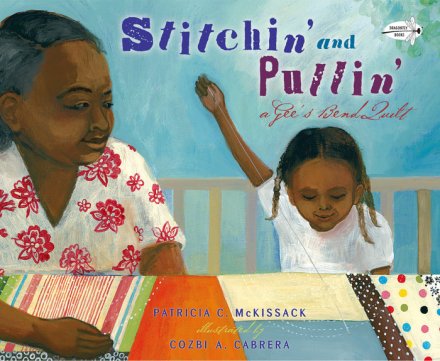
Stitchin’ and Pullin’: A Gee’s Bend Quilt

Written by Patricia C. McKissack | Illustrated by Cozbi A. Cabrera


In this story told through poems, a little girl begins telling readers about her life, starting with a recitation on Gee’s Bend Women: “Gee’s Bend women are / Mothers and Grandmothers / Wives / Sisters and Daughters / Widows.” They are every kind of woman you know, doing every type of work and activity. “Gee’s Bend women are / Talented and Creative / Capable / Makers of artful quilts / Unmatched. / Gee’s Bend women are / Relatives / Neighbors / Friends— / Same as me.”

In Who Would Have Thought, the girl muses on how perceptions change. “For as long as anyone can remember,” she says, the women of Gee’s Bend, Alabama have created quilts that were slept under, sat on, and wrapped around the sick or cold. But now those same quilts are “…hanging on museum walls, / their makers famous….”

When she was just a tot “Baby Girl” reveals in Beneath the Quilting Frame, she played under the quilting frame, listening to her “mama, grandma, and great-gran / as they sewed, talked, sang, and laughed / above my tented playground.” She remembers the “steady fingers  /[that] pieced together colorful scraps of familiar cloth / into something / more lovely / than anything they had been before” as her mother sang her a lullaby.

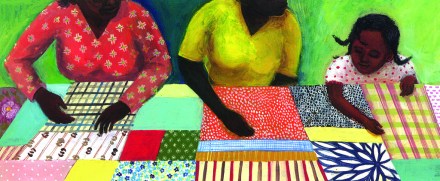
celebrate-picture-books-picture-book-review-stitchin'-and-pullin'-a-gee's-bend-quilt-puzzling-the-pieces

Image copyright Cozbi A. Cabrera, courtesy of Random House Books for Young Readers

In Something Else, “Baby Girl” is growing too big to play underneath the frame. Her legs are becoming longer and her mind is full of “recipes for eleven kinds of jelly…how to get rid of mold…and the words to a hundred hymns and gospel songs” while she waits for her turn at the frame. At last, her time does come, and in Where to Start?, the girl asks her mama how to begin. Her mother answers, “‘Look for the heart. / When you find the heart, / your work will leap to life… / strong, beautiful, and… / independent.’”

In Remembering, the girl thinks about how her mama has told her that “cloth has a memory.” As she chooses the cloth that will become her quilt she recounts the life and the history in each. 

Nothing Wasted sees Grandma pulling apart a red-and-white gingham dress stitch by stitch. Suddenly, the girl knows that this cloth will become the patch that “will be the heart of my quilt.” In Puzzling the Pieces the girl and her grandma stand over the quilting frame fitting the squares together in the perfect way to tell the girl’s story. Her quilt comes together piece by piece to tell the history of Gee’s Bend in The River Island. The brown strips along three sides mirror the muddy waters surrounding her town. The fourth side is a green strip—“a symbol of the fields where my ancestors / worked cotton from can to can’t— / can see in the morning until / can’t see at night.” Lined up next to the green strip are six squares representing the small communities “where families with / the same name / are not kin by blood / but by plantation.”

Being Discovered is portrayed with “a large smoke-gray square”—the color of the Great Depression and the 15 minutes of fame Gee’s Bend garnered when discovered “by sociologists, historians, / educators, and journalists” who came and went, leaving Gee’s Bend “the way it had been / before being discovered.”

celebrate-picture-books-picture-book-review-stitchin'-and-pullin'-a-gee's-bend-quilt-understanding-comes-later

Image copyright Cozbi A. Cabrera, courtesy of Random House Books for Young Readers

In Colors, the girl’s grandma explains the meanings and feelings behind each colored cloth. “Blue cools. / Red is loud and hard to control, / like fire and a gossiping tongue.” Green, orange, yellow, white, pink, and all the others have their own personalities. “Grandma says, / ‘Colors show how you / feel deep down inside.’”

In Dr. King Brings Hope, the little girl adds “a spotless white patch for the hope Dr. Martin Luther King / brought to the Bend” and goes on to tell how her grandma saw Dr. King at Pleasant Grove Baptist Church and what it meant to her. By and By follows the girl as she adds “golden thank-yous, for James Reeb,” a “bright blue piece of velvet for Viola Liuzzo,” and a “big plaid people circle of white, black, brown, yellow, and red for Reverend Dr. King, all “killed for believing in justice.”

In the 1960s, The Sewing Bee tells, Gee’s Bend quilters were once again discovered. Joining the Bee provided buyers for the handmade quilts, but there were stipulations on the types of quilts that could be made and sold. The girl asks her grandma if she was part of the Bee, to which she replies, “‘more money. Less freedom. I chose to stay free.’”

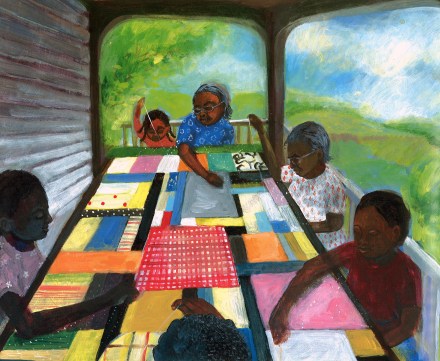
At last all of the patches are laid out and the time comes to stitch the girl’s quilt. Five women stand at the frame “all stitchin’ and pullin.’” They work “in a slow and steady rhythm” relaxing and enjoying being together until the quilt is finished. In Finished, the last stitch is sewn, and the thread bitten and knotted. The girl has hundreds of ideas for future quilts. “Quilts that are about me, / the place where I live, / and the people / who have been here for generations.”

Further poems unite the history of “Baby Girl,” her family, and neighbors, and an Author’s Note about quilting and the women of Gee’s Bend follow the text.

Patricia McKessack’s free verse poems capture the close relationships and camaraderie of the generations of women who join around the quilting frame to share and pass down their art and their heart. McKessack’s conversational verses, connected page after page like the patches of a quilt, reveal the complexity of this handmade art form in the way intimate talks between friends unveil a life. Readers learn not only about the little girl and her own thoughts, but the history and influence of her immediate family, world events, inspirational figures, and deeply held beliefs that make her who she is and ties her to the other Gee’s Bend women.

Cozbi A. Cabrera’s stunning acrylic paintings take readers inside the heart of the Gee’s Bend women, depicting the girl’s home, the table-sized quilting frame where the women collectively work, the plantations, the protests, and the changes that came but did not unravel the convictions, values, and love of the little girl’s family. Readers can almost hear the talking and singing of the Gee’s Bend women as they stitch their quilts, and the comforting, embracing environment is evident on every page. Cabrera’s portraits of the little girl, her mama, and her grandma are particularly moving. For What Changed, Cabrera depicts a yellow school bus appearing on the dirt road from the right hand corner of the page. In the  driver’s side mirror, a dot of a house is reflected, reminding readers that no matter how far these women are from home, Gee’s Bend is always with them.

Children—and adults—will find Stitchin’ and Pullin’: A Gee’s Bend Quilt inspirational and uplifting. This volume of poetry can be read at one sitting or delved into again and again, making it a wonderful choice for home libraries and a must for school and public libraries.

Ages 5 – 12

Dragonfly Books, Random House, 2016 (paperback edition) | ISBN 978-0399549502

View a gallery  of fashion designs, dolls, and other handmade art work by Cozbi A. Cabrera on her website!

“I Need a Patch for That” Day Activity

celebrate-picture-books-picture-book-review-stars-quilt-coloring-page

Design a Quilt Coloring Pages


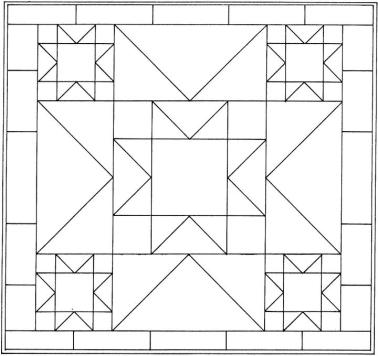
Quilts are so much more than pieces of material sewn together—they’re life stories! Here are two quilt coloring pages for you to design and color. What does each piece mean to you? As you color each section, write a sentence about an event or thought that is important to you.

Quilt Template 1 | Quilt Template 2

Picture Book Review

May 4 – Petite and Proud Day

celebrate-picture-books-picture-book-review-the-smallest-girl-in-the-smallest-grade-coverAbout the Holiday

Life’s not about how tall you are but about how big your heart is! Today we celebrate people who are 5’4” and under—the petite! There are many advantages to being on the smaller side—it’s easier to fit into tight spaces; airline, train, and other transportation seats are more comfortable; and we can blend into the crowd more easily when we’re having a bad hair day. All-in-all being petite is pretty perfect!

The Smallest Girl in the Smallest Grade

Written by Justin Roberts | Illustrated by Christian Robinson


Sally McCabe was so small that she was mostly overlooked. “She was the smallest girl in the smallest grade.” The other kids heard her name called every morning along with theirs, and they passed her in the hall on the way to class, but no one knew that “Sally was paying super extra special attention” to what went on around her. For instance, she noticed the kite someone had lost in the tree and had counted twenty-seven keys on the janitor’s ring.  She watched as the leaves turned “green to gold in the fall” and when “Tommy Torino was tripped in the hall.”

celebrate-picture-books-picture-book-review-the-smallest-girl-in-the-smallest-grade-classroom

Image copyright Christian Robinson, text copyright Justin Roberts. Courtesy of G. P. Putnam’s Sons.

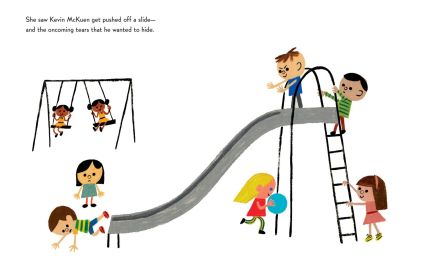
She saw wildflowers turn their face toward the sun and “was there when the stray cats who normally fought / conducted a meeting in the church parking lot.” On the playground she saw Kevin McKuen get shoved down the slide and knew of the “tears that he wanted to hide.” On Parent-Teacher day, too, she watched kids pulled down the hall by parents upset at what they had heard. But during all this, no one happened to see Sally watching or knew what that could mean.

celebrate-picture-books-picture-book-review-the-smallest-girl-in-the-smallest-grade-slide

Image copyright Christian Robinson, text copyright Justin Roberts. Courtesy of G. P. Putnam’s Sons.

Sally understood that these slights, mean words, and cruel actions kept building and building without any stop, and she finally decided that something must change. So one day during lunch she stepped out of line, stuck her hand in the air, and announced very loud, “‘I’m tired of seeing this terrible stuff. / Stop hurting each other! This is enough!’”

Some kids just giggled and ignored what she’d said, but many others joined in with their hands in the air. “Like waves rolling in, one after another— / first Molly rose up, then Michael’s twin brother. / It was Tyrone and Terence, then Amanda and Paul, / who pushed out their chairs and stretched their arms tall.” And they all felt connected “like the janitor’s keys. Fastened together with a heavy steel ring / that held all the secrets to unlock everything.”

celebrate-picture-books-picture-book-review-the-smallest-girl-in-the-smallest-jump-rope

Image copyright Christian Robinson, text copyright Justin Roberts. Courtesy of G. P. Putnam’s Sons.

After that day, things went back to normal—but with much welcomed kindness in small doses and places. Spaces were made for strangers to sit, doors held wide open, and many such “moments that get taken for granted—a wildflower appearing that no one had planted.” And so the world changed for this school and this town all because Sally was courageous and kind and paying attention.

Justin Roberts’ rhyming tribute to the empathy and bravery of one little girl who takes notice and makes a difference shows kids and adults that anyone can create change no matter who they are. Readers of all ages will recognize the hurts that Roberts chooses to include, good examples of the small and large acts that cause physical and emotional pain. The infectious rhythm and the inspirations of kindness—from the alley cats’ truce to wildflowers to keys (objects that at once have familiarity and deeper meanings)—give the book resonance far beyond the immediate reading.

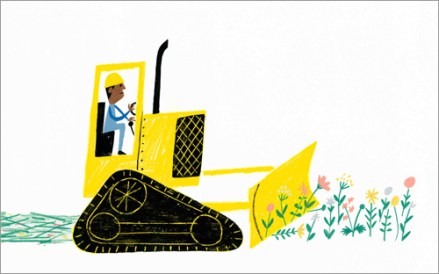
celebrate-picture-books-picture-book-review-the-smallest-girl-in-the-smallest-grade-bulldozer

Image copyright Christian Robinson, text copyright Justin Roberts. Courtesy of G. P. Putnam’s Sons.

Christian Robinson’s bright, wide-lens drawings of Sally’s schoolroom, cafeteria, and playground give young readers the same view Sally has, allowing them to also find the examples of arguing, pushing, whispering, and other slights that she reacts to. An illustration of Sally and her classmates sitting at their desks shows exactly how small she is in comparison to the other children; the rest of the pages demonstrate just how big her heart is. Each page offers opportunities for kids and adults to discuss the problems of bullying and options for how they can make a difference.

The Smallest Girl in the Smallest Grade is a wonderful reminder of how important each person is in making the world a happier place and would make an excellent addition to home libraries.

Ages 3 – 7

G. P. Putnam’s Sons, 2014 | ISBN 978-0399257438

Visit Christian Robinson’s website, where books and art are always fun!

Check out all the music, videos, activities, and other stuff by Justin Roberts on his website!

Petite and Proud Day

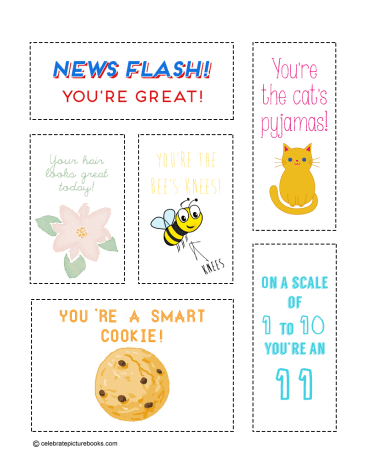
celebrate-picture-books-picture-books-review-kindness-cards

Kindness Cards


Being kind to someone can be as easy as slipping a friendly note into someone’s locker or backpack or leaving a card for a favorite teacher, bus driver, or librarian. If you notice someone who could use a pick-me-up, you could give them one of these cards too! Print out your Kindness Cards and start spreading some good cheer!

Picture Book Review
April 26 – It’s Humor Month

celebrate-picture-books-picture-book-review-quit-calling-me-a-monster-cover

About the Holiday

As we near the end of April and wind down National Humor Month, let’s take one more opportunity to laugh at the ridiculous and the silly and to find joy in every day. Not only does laughter bring people closer together, it’s therapeutic both for body and soul.

Quit Calling Me a Monster!

Written by Jory John | Illustrated by Bob Shea


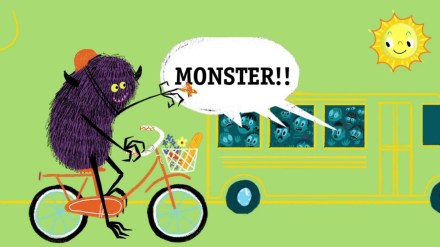
A purple, hairy guy with long stick legs and arms and long bent toes and fingers rides his bike along the street, catching a butterfly on his finger and carefully transporting a basket full of flowers and bread. But all the kids on the school bus see as he passes is the purple, the legs, the arms, the fingers, and the toes – a monste. And all the guy sees is the wide eyes and fearful expressions of the kids in the windows.

celebrate-picture-books-picture-book-review-quit-calling-me-a-monster-interior-art-bus      Image copyright Bob Shea, text copyright Jory John. Courtesy of Random House Books for Young Readers

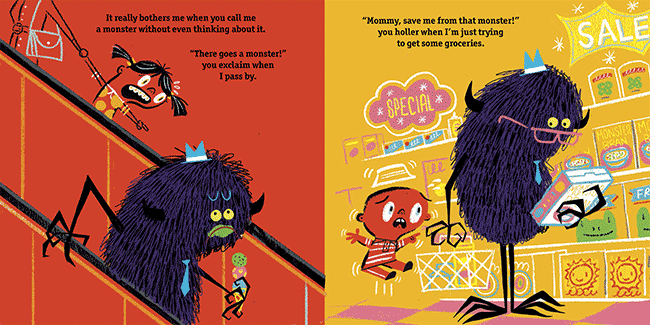
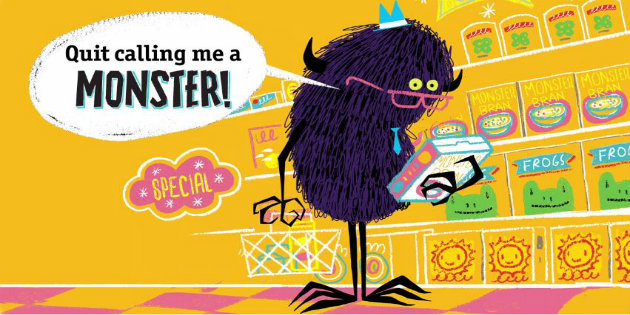
So he stands his ground, craggy hands on hips and says, “Quit calling me a monster! Just…stop it, right this minute!” He’s serious! In fact he throws a bit of a fit, rolling on the ground and spouting, “It really hurts my feelings. I’m no monster!” Just because he may have a few monster-ish qualities like horns and fangs and wild eyes and crazy hair. And yes, he knows he has “a huge toothy smile that glows in the dark.” And, yeah, ok, so he’s not exactly a wallflower and can “roar, holler, scream, whoop, and cackle,” and likes to hide where his discovery will frighten someone most…he still says, “It really bothers me when you call me a monster without even thinking about it.”

Kids are always yelling, “‘Mommy, save me from that monster!” when he’s just trying to shop or complaining that there’s a monster under the bed when he’s just trying to sleep. Can he help it that his claws reach upward or that he growls when he dreams? Does he ever call kids names? Does he ever taunt someone as a “meat snack?” No! And that’s because he’s “a monster with excellent manners!”

celebrate-picture-books-picture-book-review-quit-calling-me-a-monster-floyd-shopping-escalator

Image copyright Bob Shea, text copyright Jory John. Courtesy of Random House Books for Young Readers.

Umm…Well, I mean…he doesn’t “mean monster, exactly….” Oh, all right, if you’re going to get persnickety about it, he does have all those monster-ish traits and his parents are monsters, but he really doesn’t “like being called a monster one little bit.” If you want to call him, you can use his name, which is a very respectable Floyd Peterson. Now that that is settled, our purple friend is going to bed…in your closet. So if you hear him snoring in the middle of the night, you can rest assured that there is no monster in your closet, it’s just Floyd Peterson.

celebrate-picture-books-picture-book-review-quit-calling-me-a-monster-floyd-shopping

Image copyright Bob Shea, text copyright Jory John. Courtesy of Random House Books for Young Readers.

Jory John gives hilarious voice to the frustrations of being labeled as someone or something you’re not while also affirming that it’s okay to be who you really are. Snap judgements based on preconceived notions or stereotypes limits a person’s world view and the friends they can make. And what’s wrong with being a “monster” or “Floyd Peterson” or (insert word here) anyway? Kids and adults will laugh as Floyd lists page after page of his monster-ish qualities while also denying that he is, indeed, a monster. The ending is sweet and kid-like and puts to bed fear of the unknown.

Bob Shea’s monster, aka Floyd Peterson, is a frighteningly endearing character that kids will whole-heartedly embrace. Floyd’s coarse purple hair, scrawny legs and arms, and big grin along with his range of personas, from alarming to loveable, will make kids giggle. The bright solid backgrounds put the focus on Floyd and all of his roaring, flailing, and leaping—just as Floyd (and all little monsters) sometimes want and need.

Ages 3 – 7

Random House Books for Young Readers, 2016 | ISBN 978-0385389907

Jory John has a whole gallery of books for you to discover on his website!

Discover Bob Shea‘s “Books for Really Smart Kids” on  his website!

Quit what you’re doing and watch this Quit Calling me a Monster! book trailer!

National Humor Month Activity 

celebrate-picture-books-picture-book-review-merry-monsters-coloring-page

Merry Monsters Coloring Page 


These two cute monsters want to play, but first they need a little color! Get out your crayons, markers, or pencils and fix them up! Here’s your printable Merry Monsters Coloring Page! Now, it’s your turn – if you were a monster, what would you look like? Draw yourself as a Magnificent Monster!

Picture Book Review
April 21 – It’s Celebrate Diversity Month

celebrate-picture-books-picture-book-review-the-ugly-dumpling-cover

About the Holiday

The month of April is set aside for people to recognize and appreciate the varied cultures and beliefs around the world. Instead of finding division and differences, we should celebrate the beauty and wonder of our multifaceted planet. This month offers a great opportunity to discover ways to incorporate acceptance and inclusiveness throughout your life.

The Ugly Dumpling

Written by Stephani Campisi | Illustrated by Shahar Kober


“Once upon a time, perhaps last week, or even last night, at your local dim sum restaurant…there was an ugly dumpling.” Sure, you might think all dumplings are ugly, but we’re talking about one particular ugly dumpling. It tried all sorts of tricks to make itself more attractive, but it still remained lonely and uneaten. It sat dejected until a cockroach traversing the kitchen caught sight of it and immediately fell in love.

celebrate-picture-books-picture-book-review-the-ugly-dumpling-interior-art-dim-sum-restaurant

Image copyright Shahar Kober, text copyright Stephani Campisi. Courtesy of Mighty Media Press.

The cockroach “reached out an arm. (Or a leg)” toward the dumpling and offered to show it the beauty of the world. Together they traveled to cities near and far, experiencing them through culinary lenses—stacked-plate skyscrapers, piled-dishes skylines, and chopstick bridges that took them over flour mountains and folded-napkin peaks. Then, in a certain restaurant, the dumpling saw something astonishing! Not only one, but two, three, four, and more dumplings just like itself!

celebrate-picture-books-picture-book-review-the-ugly-dumpling-trying-to-fit-in

Image copyright Shahar Kober, text copyright Stephani Campisi. Courtesy of Mighty Media Press.

Suddenly the ugly dumpling realized that it was not a dumpling at all, but a “steamed bun—a golden-hearted, smooth-skinned steamed bun, exactly like all the other steamed buns in the world.” The ugly dumpling puffed with meaning, importance, and…yeast! The restaurant patrons and staff and even the other steamed buns took notice. The cockroach by the ugly dumpling’s side cheered to see its friend receiving so much attention.

celebrate-picture-books-picture-book-review-the-ugly-dumpling-roach

Image copyright Shahar Kober, text copyright Stephani Campisi. Courtesy of Mighty Media Press.

The people’s wide eyes and astonished expressions were not for the dumpling, however. Instead, they registered horror at the insect in their midst. The ugly dumpling was familiar with that look and did “something quite beautiful. It reached out an arm. (Or a leg.) And it led the cockroach out into the world, The beautiful, beautiful world.” And in that moment the ugly dumpling realized that it “was not like all the other steamed buns after all” and that “perhaps that was a good thing.”

celebrate-picture-books-picture-book-review-the-ugly-dumpling-leaving-together

Image copyright Shahar Kober, text copyright Stephani Campisi. Courtesy of Mighty Media Press.

Stephani Campisi’s The Ugly Dumpling is a fresh and delectable dish-up of the classic Ugly Duckling story for a new audience. Stuffed with charm and off-beat humor, this tale of friendship and diversity embraces all who feel at odds with their environment—with or without the recognition of why. Its sweet and insightful ending emphasizes the idea that finding your niche does not always mean fitting in with a certain crowd, and that having the courage to strike out on your own path leads to beautiful relationships and personal happiness.

celebrate-picture-books-picture-book-review-the-ugly-dumpling-different-dumplings

Image copyright Shahar Kober, text copyright Stephani Campisi. Courtesy of Mighty Media Press.

Shahar Kober’s dumpling is anything but “ugly.” His adorable puffed dough, lonely and ignored for not adhering to the mold, will melt readers’ hearts as he tries anything and everything—including green pleated pants—to fit in. Kobar’s stylish drawings are the perfect underscore to Stephani Campisi’s quick, dry wit—as in his rendition of three uglier-than-the-next dumplings—and if cockroaches were really as cute as Kober’s, we’d all set out a different kind of Roach Motel. A clever bit of typography transforms steam coming from a wok into the word HISS, and the restaurant scenes will make readers hungry for their favorite Asian eatery.

As readers turn to the last pages and watch the steamed bun and the cockroach leave the restaurant hand in hand (foot in foot?) under the shade of a paper umbrella, they will want to turn back to the beginning and start over again. The Ugly Dumpling is a must read and a wonderful addition to children’s bookshelves.

Ages 2 – 9

Mighty Media, 2016 | ISBN 978-1938063671

Get to know more about Stephanie Campisi and her work on her website!

To view a gallery of art by Shahar Kober for books, magazines, animation, and more, visit his website!

Check out the Mighty Media Press website for more about The Ugly Dumpling and a-dough-able coloring pages!

Take a look at the trailer for The Ugly Dumpling!

Celebrate Diversity Month Activity

celebrate-picture-books-picture-book-review-dumpling plush craft

Embrace Your Inner Dumpling Plush


We are all beautiful “dumplings” in one way or another! With this easy craft you can create a huggable friend and show others what you’re made of!

Supplies

  • Square piece of cloth in any fabric and color. Size of plush depends on size of cloth (the plushes shown are made from 18”-square cotton fabric)
  • Poly fill (the plushes shown use about 1 1/8 ounces of fill)
  • White cloth for eyes and mouth
  • Twine or string
  • Fabric glue

Directions

  1. Cut the corners from the square cloth to make a circular piece of cloth
  2. Fill the middle with poly fill
  3. Pull the edges of the cloth up and around the fill
  4. Tie the top closed with the twine or string
  5. To make the face, cut small circles and a mouth from the white cloth
  6. Smooth out a section of the dumpling body
  7. Glue the face to the body with fabric glue

Picture Book Review

April 18 – World Heritage Day

celebrate-picture-books-picture-book-review-school-days-around-the-world-cover

About the Holiday

Today’s holiday was established in 1982 by the International Council of Monuments and Sites to celebrate the joint history and heritage of the human race. World Heritage Day invites us to honor all of the world’s cultures and promotes awareness of important cultural monuments and sites in order to preserve these valuable historical places. Nearly 10,000 members from more than 150 countries, including architects, engineers, artists, geologists, civil engineers, and architects, work tirelessly to protect the world’s cultural achievements.

School Days Around the World

Written by Margriet Ruurs | Illustrated by Alice Feagan


Every day millions of children around the world go to school, but schools can vary from place to place. Some classes are held in large buildings with libraries, science labs, and computer rooms while others gather in small buildings or even outside. “Schools around the world may be very different, but children everywhere like to have friends and learn new things.” In School Days Around the World, readers meet children from thirteen countries to learn what their educational day is like.

First, children meet Tamatoa, who attends school on Rarotonga, one of the Cook Islands in the South Pacific. Tamatoa arrives to school on a scooter just as the “thang-Thong-thang! of the wooden slit drum calls students inside. Tamatoa’s teacher is wearing flowers in her hair as she does every day. She teaches the children their Ura language, and in the afternoon they dance the hupa, the island’s traditional dance. In Singapore Raphael goes to an international school where the students speak many languages. Raphael knows Dutch, English, and Spanish. His best friend Aamon speaks Hindi, Chinese, and English. Raphael likes to read and write stories on the computer. Sometimes they “have a craft fair to raise money to help children in other parts of the world.”

celebrate-picture-books-picture-book-review-schools-around-the-world-map

Image copyright Margriet Ruurs, text copyright Alice Feagan. Courtesy of alicefeagan.com

Marta walks to her school in Azezo, Ethiopi, even though she is blind. Her friend Ayana holds her hand tightly to help “her around potholes and cow patties.” There are so many students that there are two different sessions. Marta goes in the morning with 500 other children. There are 70 students in her class. They learn Amharic and about Ethiopia. At noon Ayana and Marta “hurry home to help feed the ox and cow and to fetch water from the village well.”

Camilla is from Germany. Her older brother Johannes lives at a boarding school during the school year. He shares his room in an old stone house with three boys. Everyone eats together and cleans up afterward—just like in a family. In class he learns “about nature and science. They also learn how to sail.” Camilla can’t wait until it’s her turn to go to school.

If you visited Annika at school in Copenhagan, Denmark, you would probably spend most of the day outside. Some days the students take a bus to their forest school. There the “run and climb on an old boat.” They “play on swings and with a ball.” Outside they also listen to birds and learn about plants and insects and other parts of nature. While Annika enjoys spending cold days outside, Ana’s days are usually warm. She lives in San Luis, Honduras and walks an hour from her home in the hills to her new school. Inside, two teachers show the children how to read and write. Sometimes, Ana says, “a nurse visits our school. She teaches us how to brush our teeth and stay healthy.” One day a van delivers backpacks full of school supplies, books, and even running shoes.

In Alberta Canada, Shanika goes to a First Nations school where she learns her traditional Cree language along with math and language arts. After lunch, they hear stories, and elders teach them “powwow dances, drumming and how to raise a teepee. They also hold feasts where there are prayers, and the whole community shares tea, soup, bannock loaded with beans and cheese, and berries.

celebrate-picture-books-picture-book-review-school-days-around-the-world-turkey

Image copyright Margriet Ruurs, text copyright Alice Feagan. Courtesy of alicefeagan.com

You can also spend school days with Lu in China, Alina in Kazakhstan, Mathii in Kenya, Bilge in Turkey, Luciano in Venezuela, and Amy and Gwen in Alaska, USA.

 In her short, engaging stories based on the lives of real families, Margriet Ruurs takes readers globe-trotting with new friends to show readers a typical school day in cities big and small. The details of each child’s experience—both familiar and unique—help readers learn more about their peers, promoting greater empathy and understanding now and for a better future.

Alice Feagan’s cut paper collages are full of joy and personality as kids dance, play, read, and study together. While the students’ clothing, lunches, and school buildings may differ from country to country, readers will see that the enthusiasm to learn is universal. A world map at the beginning of the book points out where each featured child lives.

A discussion following the text gives teachers, homeschoolers, and individuals tips on using the book to expand on the stories told. A glossary provides definitions and a pronunciation key for the native words found throughout the book. School Days Around the World offers a wonderful opportunity to jumpstart lessons on world customs and geography.

Ages  3 – 8

Kids Can Press, 2015 | ISBN 978-1771380478

Discover more about Margriet Ruurs and her books as well as activities for teachers and readers on her website!

You’ll find more about Alice Feagan and a portfolio of her illustration work on her website!

World Heritage Day Activity

Monumental Word Scramble

Monumental Word Scramble


You’ll travel the world as you unscramble the names of 15 world monuments in this printable Monumental Word Scramble Puzzle.

Picture Book Review