July 24 – National Cousins Day

celebrate-picture-books-picture-book-review-dear-primo-a-letter-to-my-cousin-cover

About the Holiday

Today we celebrate cousins—those family members who are close in age and in our hearts. Often getting together with family means getting to play with cousins who can become best friends. As we grow up and move on to other cities for school or jobs, it’s easy to lose touch. If you live far away from family, take the opportunity today to text, email, or call a special cousin and catch up. If you live close, why not plan a get together with your cousins or for your kids and their cousins?

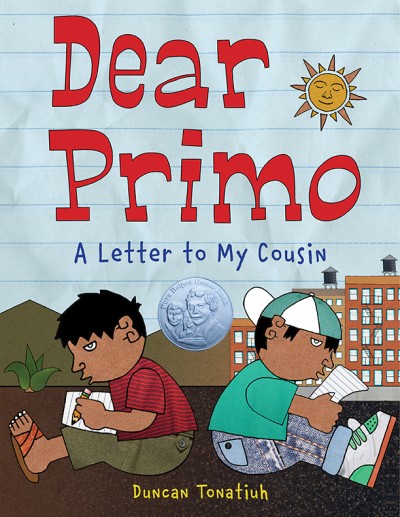
Dear Primo: A Letter to My Cousin

By Duncan Tonatiuh


Charlie runs through the house shouting with excitement. He’s gotten a letter from his cousin Carlitos who lives in Mexico. They’ve never met, but Charlie would like to. In his letter Carlitos tells Charlie that he lives on a farm where they grow maize. He has a burro, pollos, and a gallo that crows and crows. Charlie sits right down and writes a letter in return.

celebrate-picture-books-picture-book-review-dear-primo-a-letter-to-my-cousin-biking

Copyright Duncan Tonatiuh, 2010. Courtesy of duncantonatiuh.com.

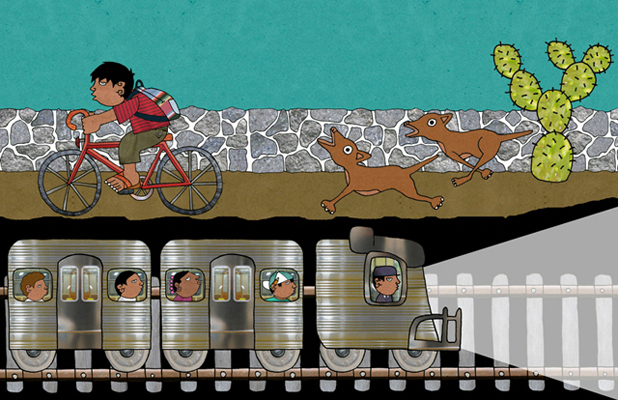
He tells Carlitos that he lives in a city. From his window he can see a bridge and skyscrapers. He writes: “Skyscrapers are buildings so tall they tickle the clouds. At night all the lights from the city look like stars from the sky.” To get to school, Carlitos says, he rides his bicicleta. Perros bark and run after him as he passes. Charlie goes to school on the subway that is like a “long metal snake” underground.

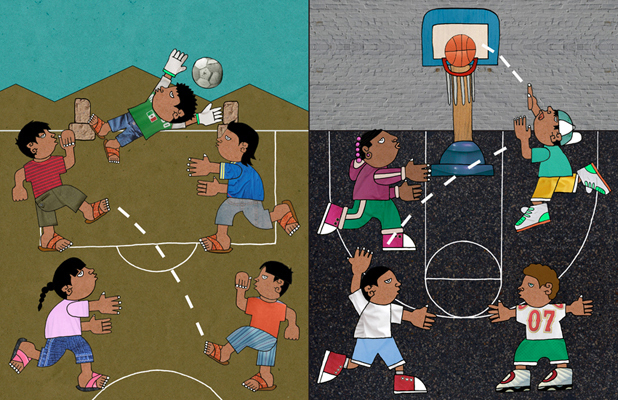
At recess Carlitos and his friends play fútbol. Charlie would call it soccer. Carlitos likes when another player passes him the ball and he kicks it into the net for a gol. Charlie likes scoring too. He plays basketball with his friends during recess. When he gets the ball he dunks it through the net for two points.

celebrate-picture-books-picture-book-review-dear-primo-a-letter-to-my-cousin-recess

Copyright Duncan Tonatiuh, 2010. Courtesy of duncantonatiuh.com.

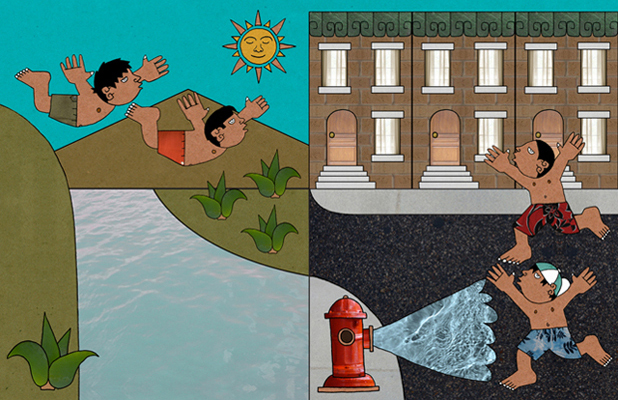
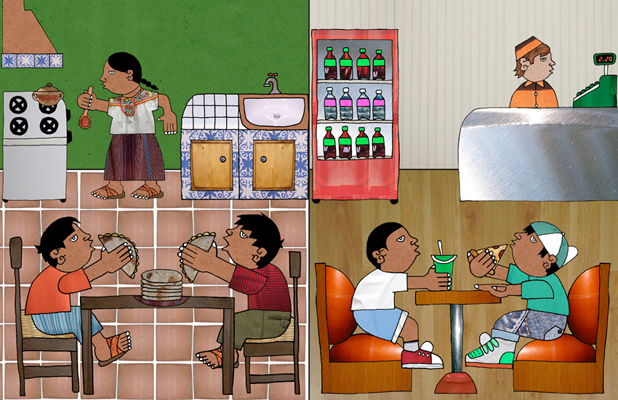
After school Carlitos helps his mama cook cheese quesadillas. Charlie grabs a slice of pizza on his way home from school. When Carlitos finishes his homework, he goes outside to play. He likes to shoot canicas and watch them roll, and he’s good at spinning the trompo. But his favorite thing to do is fly his papalote and watch its tail flutter as it soars into the sky. In the afternoon, Charlie says, he plays with his friends outside on the stoop. They jump rope and play hopscotch then they go inside to play video games. Sometimes it gets so hot that Carlitos and his friends go down to the río to go swimming. Charlie and his friends cool off in the spray of the fire hydrant when the firefighters open it for them.

celebrate-picture-books-picture-book-review-dear-primo-a-letter-to-my-cousin-cooling-off

Copyright Duncan Tonatiuh, 2010. Courtesy of duncantonatiuh.com.

Carlitos spends the weekends at the mercado selling the maize and prickly fruit, tunas, that his family grows on their farm. They also buy food they will need for the next week from other vendors. Weekends are market days for Charlie, too. He goes to the grocery store with his mom and checks off the items on their list as they put them in the cart.

Sometimes there are fiestas in town, Carlitos tells Charlie. The parties last for two or three days. “At night there are cohetas that light up the sky and mariachis who play and play.” Charlie replies that there are special celebrations in his city too where he watches parades with marching bands and people in costumes. Carlitos wishes Charlie could see the churros, cowboys who ride their caballos and twirl their reatas. Charlie thinks Carlitos would be amazed at the break-dancers in his neighborhood who can flip and spin on their heads.

celebrate-picture-books-picture-book-review-dear-primo-a-letter-to-my-cousin-snack

Copyright Duncan Tonatiuh, 2010. Courtesy of duncantonatiuh.com.

In Mexico, Carlitos writes, there are so many traditions. On Dia de los Muertes families honor those who have passed away, and in December there are parties called Posados with piñatas full of sweets and fruit. Charlie writes that in America we have traditions too. Two of his favorites are Thanksgiving, when he gets to eat turkey, and Halloween, when he dresses up in a costume and goes trick-or-treating for candy.

He’d like to write more, Charlie says, but his mom is calling for him to brush his teeth and get ready for bed. It seems Carlitos ended his letter on the same note. And as each boy pulls up the covers, they have the same idea: “My primo should come visit me!”

celebrate-picture-books-picture-book-review-dear-primo-a-letter-to-my-cousin-same-idea

Copyright Duncan Tonatiuh, 2010. Courtesy of duncantonatiuh.com.

Duncan Tonatiuh’s charming tribute to family and cultural similarities told through two letters written by cousins engages young readers on many levels. Filled with Spanish vocabulary, Carlitos’s letter introduces children to Spanish words for familiar things as well as to new ideas. Spanish-speaking readers find the same experience through Charlie’s letter to Carlitos. By juxtaposing similar daily and special events on each page or two-page spread, Tonatiuh emphasizes the fact that people are the same wherever they live.

Tonatiuh’s now well-known folk-art illustrations let kids travel to sites in Mexico and America as they get to know Charlie and Carlitos. Striking and vividly detailed images on each page invite kids to compare the lives of the two cousins and point out the similarities and differences.

Dear Primo: A Letter to My Cousin is an engaging multicultural book for home and school libraries. The book is a perfect way to introduce Spanish words and Mexican culture to kids learning about their world.

Ages 5 – 8

Harry N. Abrams, 2010 | ISBN 978-0810938724

Discover more about Duncan Tonatiuh, his books, and his artwork on his website!

National Cousins Day Activity

celebrate-picture-books-picture-book-review-cousins-connect-maze

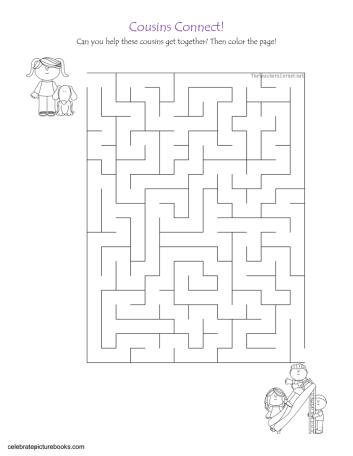
Cousins Connect! Maze


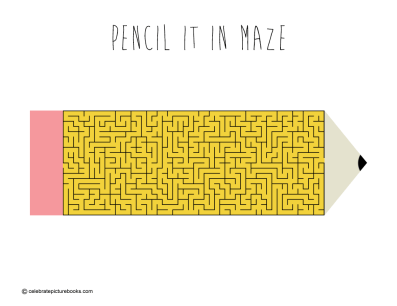
Can you help the cousins get together to play in this printable Cousins Connect! Maze? Then you can color the page! Here’s the Solution!

Picture Book Review

July 21 – It’s National Culinary Arts Month

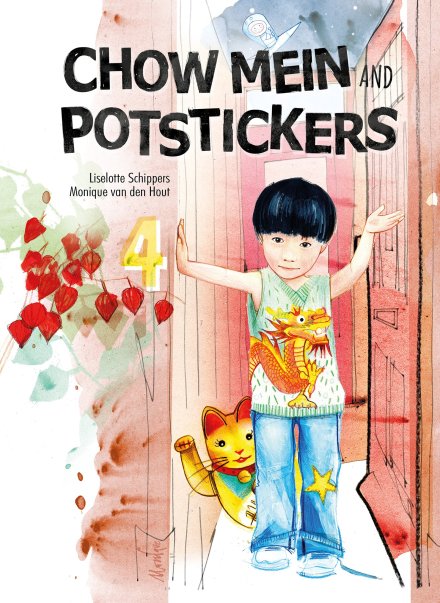
celebrate-picture-books-picture-book-review-chow-mein-and-potstickers-cover

About the Holiday

During the month of July we honor those professional chefs who provide us with tantalizing dishes at our favorite restaurants. In addition to cooking old favorites, chefs also stay up on trends and create new recipes to make life deliciously fresh and surprising. To celebrate, visit your local restaurants and try something new! If you like to cook at home, gather some different ingredients and see what you can create! This month is also a great time to explore foods and cuisine from other countries!

Chow Mein and Potstickers

Written by Liselotte Schippers | Illustrated by Monique van den Hout


A little boy named Chan has just moved here from China and is hoping to make new friends. He tells a little about himself: “I moved to this country with my father, / my mother and my sister. / My mother is starting a new job here. / She’s an astronaut and someday she’ll go to the moon!” He reveals that his favorite food is potstickers and chow mein. He’s just about to go door-to-door to meet his neighbors. He wonders if kids here like to play and how “things work around here.”

Next door at Number 6, Chan meets Mila, who is from Bosnia. Chan thinks “she looks like a princess from a country far away.” Chan and Mila play soccer until they “get tired and hungry!” Then they eat Mila’s “favorite dish / Bosnian ćevapĉići—rolls of ground / meat.” At the end of the day, they say goodbye: “‘Zàijiàn!’” and “‘Doviđenja!’”

The next day Chan meets Rani, who was born in Indonesia. Even though Rani is younger, Chan says that “you can tell he is very wise. / Rani’s father is a famous musician. / He has to travel a lot, touring with his band. / His mother works at the hospital and helps people who are sick.” Rani shows Chan how to play marbles. Afterward, they enjoy Rani’s “favorite foods: satay and kroepoek. / That’s meat on a stick and shrimp crackers.” Later, they wave good-bye and say: “‘Zàijiàn!’” and “‘Sampai jumpa!’”

Across the street lives a little girl named Jamila, who is originally from Afghanistan. “‘Salaam!’” she greets Chan. Jamila plays the guitar, and the two sing and dance along. Chan says: “After a while we get tired and hungry. / Jamila and I eat Afghan qabuli—rice and lamb. / That brings us to the end of our day. / As we wave good-bye, we say: “‘Zàijiàn!’” and “‘Khodahafez!’”

Twins Kim and Coen live at Number 10. They are from Belgium. “Their father is a master chocolatier. That means he / makes fancy chocolates. When he is working, the house / smells wonderful. / Their mother sells the chocolates in a  / special shop. We get to try some. I’ve never tasted / anything so delicious!” After roller skating, they eat frietjes, which are like French fries served with mayonnaise. “‘Zàijiàn!’” and “‘Tot ziens!’”

In the tall yellow house next to the church on Chan’s street, Chan meets Basu, who came here from South Africa. His mother is a minister and his father is a fireman. Chan thinks that maybe he’d like to be a fireman too when he grows up. “Basu loves to paint and draw.” He and Chan “get busy with brushes, paints and pens.” When their “masterpiece is finished,” Chan says, “We have paint splatters on our clothes and in our hair!” All that creating has made them “tired and hungry.” They “eat South African bobotie… / a dish made with seasoned ground meat.” Before Chan goes home, the boys say:  “‘Zàijiàn!’” and “‘Totsiens!’”

Chan is excited to discover that his street is full of other children to play with. In other homes live Ania from Poland, Nuray from Turkey, Clifton from Suriname, Gracy from England, and Nino from Italy. On one special day, Chan invites all of his new friends to go to the playground with him, and Chan’s father brings chow mein and potstickers for everyone to enjoy. At the end of the day, the air rings with each child’s special way of saying “good-bye.”

Liselotte Schippers free verse poetry opens the door to a world of children for young readers. Each poem gives children the kind of information they want to know about kids from around the world. What do they like to do? What are their families like? What do they eat? Every poem includes the words “hello” and “good-bye” in the native language of the child as well as a favorite dish from each country. Little Chan makes a delightful and enthusiastic tour guide to his multicultural neighborhood, and shows young readers that even though people may come from different countries, their dreams, desires, games, and even jobs are the same. The country that Chan has moved to is never named, making “here” everywhere.

Monique van den Hout’s beautiful illustrations combine the ethereal with realistic portrayals of the happy, bright-eyed children that Chan meets in his neighborhood. Each poem is presented on a two-page spread in which Chan and his new friend are surrounded by colorful images of symbols from that child’s native country. Following each poem, a short dictionary defines and gives a pronunciation guide to the greetings and food introduced.

Chow Mein and Potstickers is an enticing introduction to the global community for children. Each poem could be used to spark more discovery about the countries presented and their children. The book’s inclusion of languages and foods makes it a perfect addition to school, classroom, and homeschool libraries for social studies units as well as a fun book for personal bookshelves.

Ages 4 and up

Clavis, 2017 | ISBN 978-1605373287

National Culinary Arts Month Activity

celebrate-pictureb-books-picture-book-review-Kids-Baking-Cake-in-Cooking-Show-Bakery-Coloring-Pages

Let’s Bake Together Coloring Page


It’s fun for friends to create new recipes or just cook up some favorite treats! Have fun with this printable Let’s Bake Together Coloring Page!

Picture Book Review

July 11 – Cow Appreciation Day

celebrate-picture-books-pciture-book-review-prudence-the-part-time-cow-cover

About the Holiday

While today’s holiday started out as a clever ruse to entice people to eat more chicken, it also gives us an opportunity to think about the world’s bovine citizens. These gentle animals deserve healthy and humane treatment as they provide our diets with needed protein as well as delicious treats. Cows appear in untold numbers of stories and songs for little ones, making them a favorite of young readers everywhere!

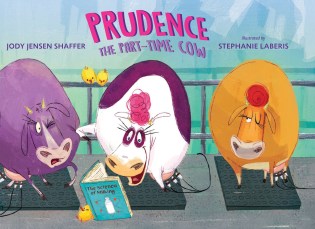
Prudence the Part-Time Cow

Written by Jody Jensen Shaffer | Illustrated by Stephanie Laberis


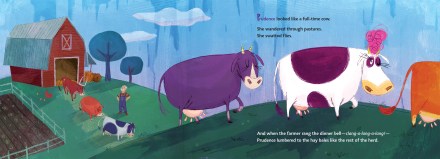
Out in the pasture swatting flies with her tail and lumbering along with the rest of the herd, “Prudence looked like a full-time cow.” But when she had a little time off from her bovine duties, Prudence “was a part-time cow.” While being milked she was a scientist, finding a book on the milking process “udderly amazing.” Salt licks were perfect blocks for architect Prudence’s wondrous structures. Engineer Prudence experimented with automatic lighting, even if the results were a bit electrifying.

celebrate-picture-books-pciture-book-review-prudence-the-part-time-cow-farm

Image copyright Stephanie Laberis, 2017, text copyright Jody Jensen Shaffer, 2017. Courtesy of Henry Holt & Co,

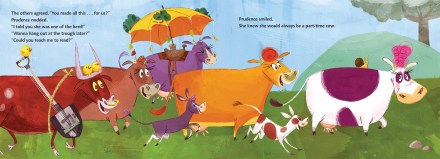
The other cows didn’t like it. They wanted Prudence to be more like them. She would never fit into the herd, they whispered to each other. Prudence fretted. She wanted to have friends and fit in, so “she decided to try to be like the others.” Dutifully, she went down to the pond for a little refreshment and was doing fine until… “she calculated the water temperature and wind speed. ‘Sixty-eight degrees and four miles per hour.’”

celebrate-picture-books-pciture-book-review-prudence-the-part-time-cow-tree-huddling

Image copyright Stephanie Laberis, 2017, text copyright Jody Jensen Shaffer, 2017. Courtesy of Henry Holt & Co,

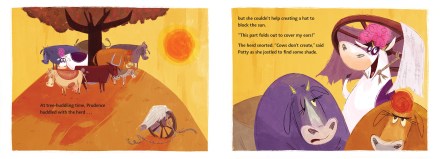
The other cows were miffed, especially Bessie, who carefully made sure she had all her calves as she moved them along. Another day as the herd lazed under a tree, Prudence joined them, leaving only once to create a hat from an old wagon wheel, scrap of cloth, and piece of rope she found nearby. The other cows snorted, especially Patty, who jockeyed for a better position in the shade.

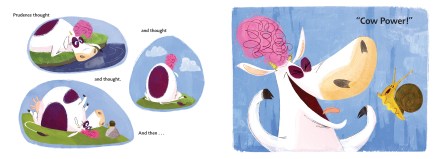
Even sleeping the same way as the others was difficult for Prudence when she had a brainstorm in the middle of the night. Spotz, the bull, was not happy with the noise she made with her latest invention. The herd had given up. Alone and sad, Prudence thought and thought of ways to make the others like her. Then it hit her! That night the barn rang with the sounds of her idea. But it wasn’t only one idea! When the herd woke and saw yet another contraption, they rolled their eyes. Until…

celebrate-picture-books-pciture-book-review-prudence-the-part-time-cow-cow-power

Image copyright Stephanie Laberis, 2017, text copyright Jody Jensen Shaffer, 2017. Courtesy of Henry Holt & Co,

Bessie saw the “cow-culator” Prudence had made to help her keep track of her calves. Patty was thrilled with the “portable shade tree” made from an umbrella, a saddle, and some dangly adornments. And Spotz thought his new guitar made from a shovel and fishing line was “gnarly.” Prudence was suddenly pretty popular! Even though “she knew she would always be a part-time cow,” she was happy to feel like a “full-time member of the herd.”

celebrate-picture-books-pciture-book-review-prudence-the-part-time-cow-happy-animals

Image copyright Stephanie Laberis, 2017, text copyright Jody Jensen Shaffer, 2017. Courtesy of Henry Holt & Co,

Jody Jensen Shaffer’s moooving and funny story of a cow with a scientific bent will delight kids. Little ones who think differently will empathize with Prudence’s wish to be herself while also fitting in with the herd. As the cows stand around in a pond and huddle under a tree, Shaffer offers a wink to the crowd mentality and peer pressure that can foster inaction and clone-like behavior. Prudence makes a gentle, but determined role model as a thinker who won’t be cowed by others’ opinions.

Stephanie Laberis’s cartoon-inspired illustrations of a herd of very distinct cows are a perfect accompaniment to this humorous story with a meaningful message. Prudence, with her fluff of pink hair, is happiest when fulfilling her creative visions. As the other cows disparage her efforts and isolate her from the herd, Prudence’s sad eyes and droopy tail and ears make the effect of their words obvious. Each page offers an opportunity for readers to discuss diversity, individuality, and what it means to be a friend.

Prudence the Part-Time Cow would be a wonderful addition to school and classroom libraries as well as to home bookshelves.

Ages 4 – 8

Henry Holt and Co, 2017 | ISBN 978-1627796156

Find out all about Jody Jensen Shaffer and her books and magazine writing for children on her website!

Discover a gallery of illustration and craft work by Stephanie Laberis on her website!

Cow Appreciation Day Activity

celebrate-picture-books-picture-book-review-cow-mug-craftMooo Mug


Milk—regular or chocolate!—will taste so much better in a Mooo Mug  you make yourself! 

Supplies

  • White ceramic mug, available at craft stores
  • Black permanent marker or paint for ceramics
  • Pink permanent marker or paint for ceramics
  • Brown permanent marker or paint for ceramics

celebrate-picture-books-picture-book-review-cow-mug-craft-back

Directions

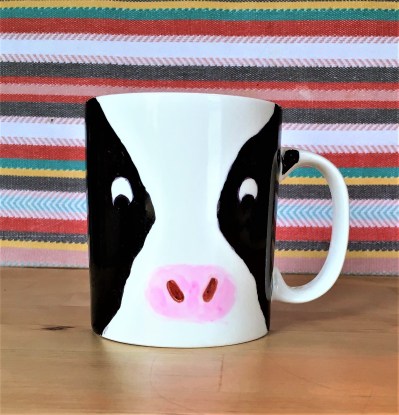
  1. With the pink marker or paint, draw an oval shape for the nose near the bottom of the mug. Let dry.
  2. With the brown marker or paint, draw two angled nostrils inside the pink oval and color them in. Let dry.
  3. Color in the nose with the pink marker or paint.
  4. With the black marker, color the top tip of the handle where it meets the mug to make the tail.
  5. With the black marker or paint, draw two wavy lines on either side of the face starting at the top, angling toward the middle and returning to the bottom of the mug. Leave white space between the lines.
  6. Draw circles for eyes within the black lines. Add black pupils at the bottom of the eyes.
  7. Color inside the black lines and around the eyes to make the face markings.
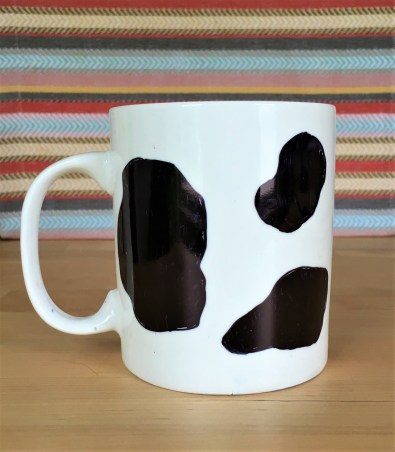
  8. With the black marker or paint, make two or three splotches on the back of the mug.
  9. Let the mug dry and follow the directions for the markers or paint to set the color.
  10. Pour yourself a cow mug of milk and enjoy!

celebrate-picture-books-pciture-book-review-prudence-the-part-time-cow-cover

You can find Prudence the Part-Time Cow at these booksellers

Amazon | Barnes & Noble | Books-a-Million |IndieBound

Picture Book Review

July 3 – International Plastic Bag Free Day

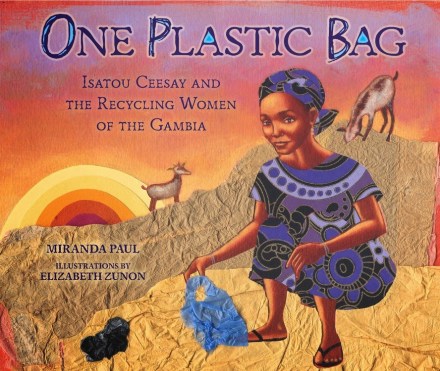
celebrate-picture-books-picture-book-review-one-plastic-bag-cover

About the Holiday

Plastic bags are everywhere! Used by supermarkets, department stores, discount stores, and just about anywhere goods are sold, plastic bags are a take-home-then-throw-away item that never quite goes away. These bags may seem lightweight, but they do heavy damage to the environment, taking hundreds of years to fully decompose. Many shops encourage patrons to bring their own bags and offer cloth and paper bags as well. These are great alternatives that benefit the earth. Today’s holiday was established to promote awareness around the world to the dangers of plastic bags and spur people to use reusable containers.

One Plastic Bag: Isatou Ceesay and the Recycling Women of the Gambia

Written by Miranda Paul | Illustrated by Elizabeth Zunon


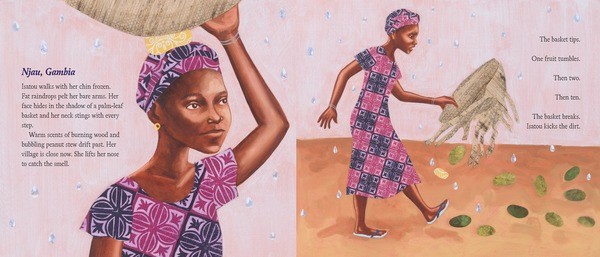
In Njau, Gambia Isatou walks home carrying a basket of fruit on her head. As raindrops begin to fall, the basket shields her, but suddenly the basket tips and falls. The fruit inside tumble to the ground. The basket is in shreds; how will Isatou carry her load? “Something silky dances past her eyes, softening her anger. It moves like a flag, flapping in the wind, and settles under a tamarind tree.” Isatou picks it up and finds that it can hold things. She gathers her fruit and puts them in the bag. She leaves her basket behind, “knowing it will crumble and mix back in with the dirt.”

celebrate-picture-books-picture-book-review-one-plastic-bag-basket

Image copyright Elizabeth Zunon , text copyright Miranda Paul. Courtesy of Millbrook Press.

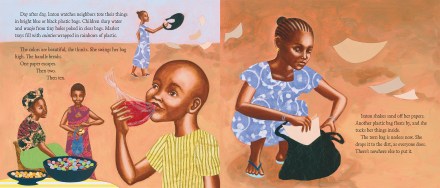
At home Grandmother Mbombeh has a dinner of spicy rice and fish ready. When Isatou tells her about the broken basket and shows her the bag, Grandmother frowns. She has seen more in the city. Now, Isatou notices plastic bags everywhere. They are as colorful as a rainbow. As Isatou swings her bag full of papers, the handle breaks, sending the papers inside flying. She finds another plastic bag lying nearby and transfers her papers. She leaves the torn bag in the dirt as everyone else does.

celebrate-picture-books-picture-book-review-one-plastic-bag-papers

Image copyright Elizabeth Zunon, text copyright Miranda Paul. Courtesy of Millbrook Press.

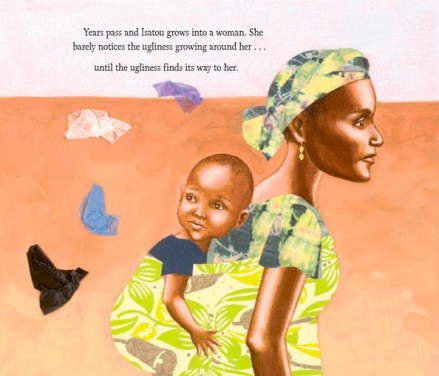
As she passes the spot day after day, she spies her old black bag. It has been joined by others, and the pile grows bigger and bigger. Isatou chooses another path to take and forgets about the bags. “Years pass and Isatou grows into a woman. She barely notices the ugliness growing around her…until the ugliness finds its way to her. One day when coming to Grandmother’s house, she hears one of her goats crying. It’s tied up and there is no sign of her Grandmother’s other goats.

celebrate-picture-books-picture-book-review-one-plastic-bag-Isatou-grown

Image copyright Elizabeth Zunon, text copyright Miranda Paul. Courtesy of Millbrook Press.

Inside, the butcher is talking to Grandmother Mbombeh. He says that the goats have eaten the plastic bags they find lying around. The bags get twisted around their insides, killing the goats. Three of Grandmother’s goats and many more in the village have died. Something must be done. Isatou goes to the road piled with bags. Insects, rotting food, and dirty water mingle with the bags. Goats “forage through the trash for food.”

Isatou retrieves bag after bag from the pile. She and other women wash the bags. While they dry Isatou asks her sister to teach her how to crochet. Isatou has an idea. From a broomstick she carves crochet needles. Then she and her friends cut the bags into strips of thread. The women teach themselves how to crochet with the plastic thread. The work is slow, and some villagers laugh at them. Long into the nights the women continue crocheting by candlelight.

celebrate-picture-books-picture-book-review-one-plastic-bag-purses

Image copyright Elizabeth Zunon , text copyright Miranda Paul. Courtesy of Millbrook Press.

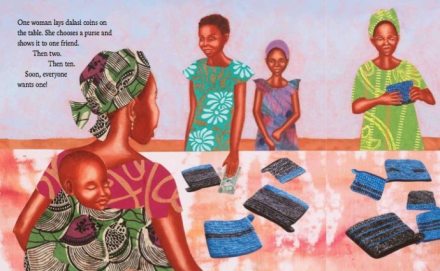
At last a day comes when the women can show what they have been working on. “Fingers sore and blistered, Isatou hauls the recycled purses to the city.” People laugh at her until “one woman lays dalasi coins on the table. She chooses a purse and shows it to one friend. The two. Then ten. Soon everyone wants one!” Later that day Isatou puts the money she has made into her own zippered purse. She can’t wait to show Grandmother that she has earned enough to buy a goat. The trash pile is smaller now. Isatou is determined that one day it will be gone. “And one day…it was.”

An Author’s Note provides more details about this true story as well as a Wolof language glossary and pronunciation guide.

Miranda Paul tells this true story of ingenuity and hope with honesty and evocative language. Young readers will learn how one woman’s concern for her community and courage in the face of opposition changed the lives of the people in her village. Paul’s descriptive text interspersed with native Wolof words allows children to discover details about the customs and daily lives of the citizens of Gambia. Paul’s use of the present tense, makes this a universal story that shows the continuing need for answers to ongoing environmental problems. Isatou’s creative solution to a world-wide problem may spur young readers to develop helpful ideas of their own.

Through her collage illustrations, Elizabeth Zunon brings the vibrant colors and patterns of Africa to readers. The textured papers she uses add depth and details to the women’s clothing, homes, foliage, and the plastic bags that Isotau and her friends transform. Children sit in on the candlelit nighttime crocheting sessions and view the beautiful, finished purses—each one unique.

Ages 6 – 9

Millbrook Press, 2015 | ISBN 978-1467716086

Discover more about Miranda Paul and her books and find resources, videos, photos, and more on her website!

Learn more about Elizabeth Zunon and her books and view a portfolio of her artwork on her website!

International Plastic Bag Free Day Activity

celebrate-picture-books-picture-book-review-book-bag-craft

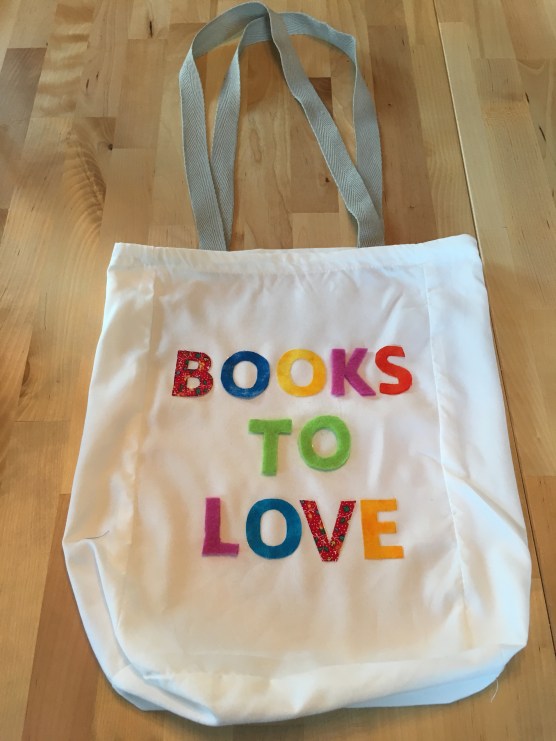
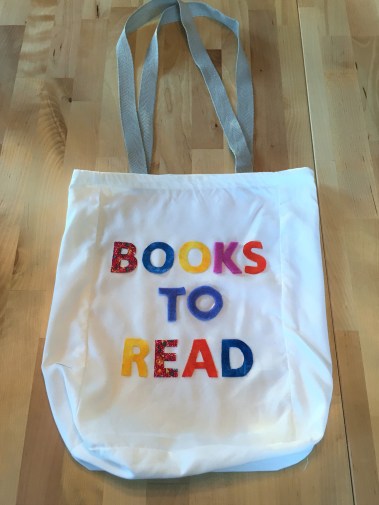
Books to Love, Books to Read Reusable Book Bag


True booklovers can’t go anywhere without a book (or two or three) to read along the way. With this easy craft you can turn a cloth bag into a kid-size book bag!

Supplies

  • Printable Templates: Books to Read Template | Books to Love Template
  • Small cloth bag, available from craft or sewing stores—Recyclable Idea: I used the bag that sheet sets now come in
  • Cloth trim or strong ribbon, available from craft or sewing stores—Recyclable Idea: I used the cloth handles from shopping bags provided from some clothing stores
  • Scraps of different colored and patterned cloth. Or use quilting squares, available at craft and sewing stores
  • Pen or pencil for tracing letters onto cloth
  • Scissors
  • Small sharp scissors (or cuticle scissors) for cutting out the center of the letters
  • Fabric glue
  • Thread (optional)
  • Needle (optional)

celebrate-picture-books-picture-book-review-books-bag-craft

Directions

  1. Print the sayings and cut out the letters
  2. Trace letters onto different kinds of cloth
  3. Cut out cloth letters
  4. Iron cloth bag if necessary
  5. Attach words “Books to Read” to one side of bag with fabric glue
  6. Attach words “Books to Love” to other side of bag with fabric glue
  7. Cut cloth trim or ribbon to desired length to create handles
  8. Glue (or sew) handles onto the inside edge of bag

Picture Book Review
June 21 – Make Music Day

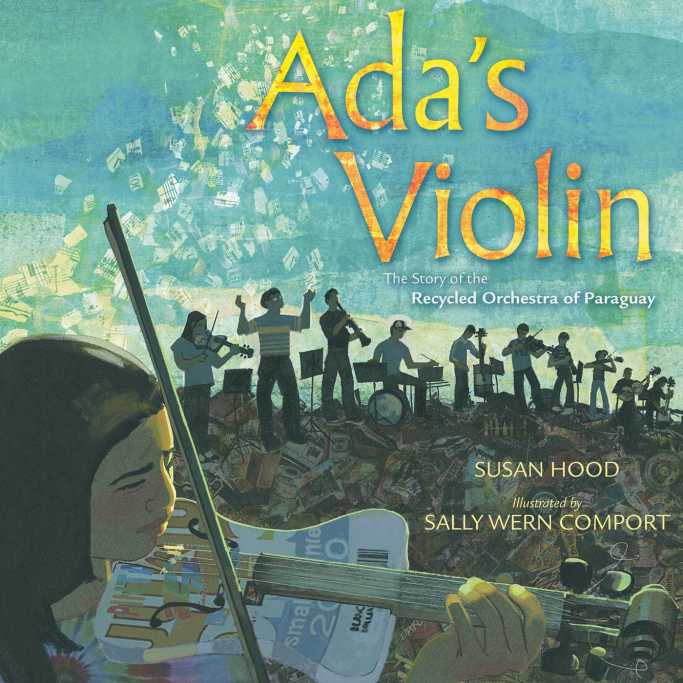
celebrate-picture-books-picture-book-review-ada's-violin-cover

About the Holiday

Make Music Day first rang out in 1982 in France as the Fête de la Musique. Celebrated by young and old, professional musicians and amateurs, the day invites all to make and share their music. People in more than 750 cities and towns in over 120 countries participate in this creative holiday.

Ada’s Violin: The Story of the Recycled Orchestra of Paraguay

Written by Susan Hood | Illustrated by Sally Wern Comport


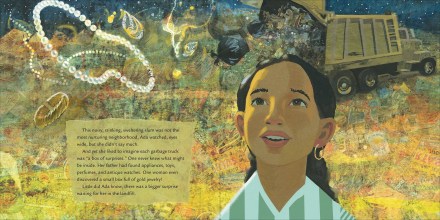
Ada Ríos is growing up in Cateura, a town built of trash as the main garbage dump for the capital city of Paraguay. Every morning the refuse trucks rumble into town to deposit their loads—1,500 tons of trash every day. The citizens of Cateura—gancheros or recyclers—go to work sifting through the mounds and tearing into bags looking for anything valuable enough to recycle or sell. Cardboard is worth 5 cents a pound, plastic 10 cents a pound.

Ada knows the landfill can hold surprises—“Her father, a ganchero, had found appliances, toys, perfumes, and antique watches.”—but she can never imagine what it holds for her. When Ada and her sister were little, their grandmother watched them while their parents worked. They loved to listen to music, to sing, and to learn stories of musicians and the sounds of different instruments. Ada fell in love with the violin.

celebrate-picture-books-picture-book-review-ada's-violin-making-singing

Image copyright Sally Wern Comport, text copyright Susan Hood. Courtesy of simonandschuster.com

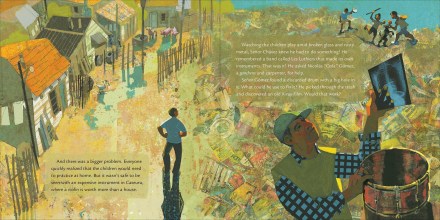
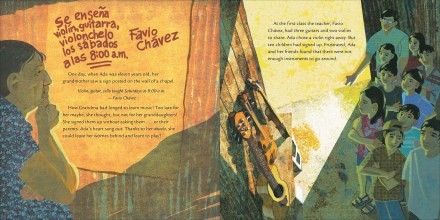
As the girls grow older and go to school, they venture farther into town, but there is little to fill their time. Many kids join gangs or get into fights. When Ada is 11 her grandmother signs her and her sister up for music lessons being offered by a new man in town named Favio Chávez. “Ada’s heart sang out” when she hears the news. On the first day ten children show up to play the five instruments available. But a bigger problem looms: the three guitars and two violins cannot be taken home for practicing as they are magnets for thieves. In Cateura a violin is worth more than a house.

But Favio Chávez has an idea. With help from Nicolás Gómez, a ganchero and carpenter, they pull bits and pieces from the landfill. An old broken drum and an X-ray film become a workable drum, water pipes become flutes, packing crates become guitars and violins, and oil drums become cellos. “Ada chose a violin made from an old paint can, an aluminum baking tray, a fork, and pieces of wooden crates. Worthless to thieves, it was invaluable to her. It was a violin of her very own.”

celebrate-picture-books-picture-book-review-ada's-violin-making-instruments

Image copyright Sally Wern Comport, text copyright Susan Hood. Courtesy of simonandschuster.com

The children practice tirelessly outside in 100-degree heat until the initial “screeches, twangs, and tweets hit all the right notes. Their class became ‘a small island’ where Chávez taught them to respect themselves and one another.” They become known as The Recycled Orchestra. Music now fills the air, adding a soundtrack of beauty to the grueling work. The orchestra is soon invited to play concerts in Cateura and the capital city of Asunción. When word spreads of their talent, the children receive offers to play from other cities and even other countries.

When Ada is 16 The Recycled Orchestra is invited to tour with a world-famous rock band. As Ada takes the stage in front of 35,000 people in Bogotá, Colombia, she is afraid, but the audience cheers for them and sings along as they play. On that night the children discover a new life. “Buried in the trash was music. And buried in themselves was something to be proud of.”

celebrate-picture-books-picture-book-review-ada's-violin-lessons

Image copyright Sally Wern Comport, text copyright Susan Hood. Courtesy of simonandschuster.com

An extensive author’s note plus a photograph of The Recycled Orchestra, lists of websites, videos and sources follow the text.

Ada’s Violin is also available in a Spanish edition—El violín de Ada: La Historia de la Orquesta de Instrumentos Reciclados del Paraguay.

Susan Hood has brought to light an incredible story of perseverance, hope, and the ability of music and other arts to provide opportunities and self-confidence that change lives. Told with unstinting honesty and sensitivity, Hood’s biography of Ada Ríos, Favio Chávez, and The Recycled Orchestra will inspire all who read it. The well-paced text offers revealing details on every page and flows with a lyrical quality that enhances the effect of the story and its impact. From the first sentence to the last, both children and adults will be riveted to The Recycled Orchestra.

celebrate-picture-books-picture-book-review-ada's-violin-hope

Image copyright Sally Wern Comport, text copyright Susan Hood. Courtesy of simonandschuster.com

Sally Wern Comport’s paintings beautifully capture the human spirit that shines through and drives people to astonishing achievements even in the most adverse conditions. With intricately created collages of rich hues, Comport depicts the town of Cateura and the mountains of trash the citizens work and play on. Warm lighting illuminates faces full of dreams and love. Readers will linger over depictions of the instruments workshop and cheer along with the concert audience as the children receive recognition. The full-bleed, two-page spreads echo the expanded world music gave to the children in the orchestra and the adults who heard them as music score confetti flutters throughout.

Both school classrooms and home libraries will benefit from the stirring message of Ada’s Violin.

Ages 4 and up

Simon & Schuster Books for Young Readers, 2016 | ISBN 978-1481430951 (English edition); 978-1481466578 (Spanish edition)

Discover more about Susan Hood and her books, plus fun activities for kids and information for teachers and parents on her website!

View a gallery of Sally Wern Comport’s artwork on her website!

Make Music Day Activity

celebrate-picture-books-picture-book-review-homemade-musical-instrument


Make Your Own Musical Instrument


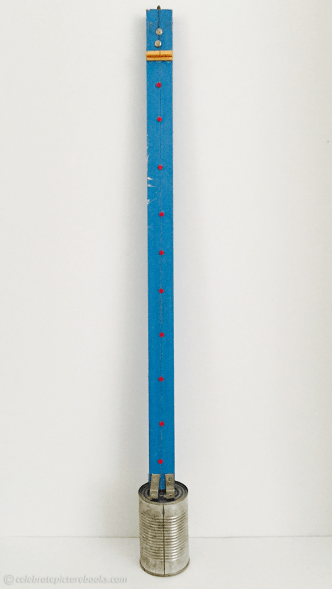
Inspiration for sound can come from almost any object! Look around your house or classroom and discover the music in boxes, cans, blocks of wood, plastic egg cartons or deli containers, and more. Add string or wire for plucking, sticks for drumming, or beans for shaking. With a little glue, tape, or hardware and some creativity, you’ll be making your own rhythms in no time!

Supplies for the stringed instrument shown in the picture above

  • Tin can
  • Two small L brackets
  • Piece of wooden molding, 2 1/2 feet by 1 1/2 inches by 3/4 inches
  • Five small strips of wood to raise the wire off the neck of the instrument. I used long wooden fireplace matches cut into 1 1/2″ sections 
  • Thin wire
  • Small circular hook screw or regular screw
  • Two tacks
  • A nail, screw, or piece of wood that will fit horizontally in the mouth of the can
  • a small nail to make a hole in the can
  • Hammer
  • Strong Glue
  • Paint
  • Foam decorative dots

Directions

  1. Paint the wood and let dry
  2. Paint the small strips of wood and let dry
  3. Decorate the can with paint, sticker, duct tape, or paper
  4. With the hammer and small nail, make a hole in the center of the bottom of the can
  5. Wrap one end of the wire around the nail and glue so it is firmly in place
  6. Feed the other end of the wire through the hole in the bottom of the can
  7. Screw or glue two L brackets to one end of the wood molding so that the bottom of the L is flush with the bottom of the wood molding and there is space between the brackets. This makes the neck of the instrument
  8. Screw the circular or regular screw into the top, center of the wooden molding
  9. When the wooden match strips are dry, glue three match strips side-by-side 3 inches from the top of the molding. Glue two more match strips, one on top of the other on the center strip.
  10. When the L brackets are dry, glue them (and the neck of the instrument) to the can, making sure the brackets are on either side of the hole in the can. Make sure the wire is out of the hole. 
  11. When the brackets are firmly attached to the can, pull the wire to the top of the neck. Settle it in the center of the small pieces of wood, so that the wire is not touching the neck.
  12. Wrap the wire around the screw at the top of the molding until it is firmly in place and the wire is taut. 
  13. Secure the wire to the neck with the tacks
  14. Mark the “frets” with the foam dots

Picture Book Review
 

June 15 – Smile Power Day

celebrate-picture-books-picture-book-review-welcome-barroux-cover

About the Holiday

We smile at people all day long, don’t we? I mean there’s 🙂  😀  🙂  😉  and so many more! But how about the real kind? Giving a warm smile to a friend, a stranger, or—especially—someone who looks as if they need one, makes everyone feel better! Today, be happy and welcome all with a smile!

Welcome

By Barroux


A polar bear is sitting on the edge of an ice floe enjoying some relaxing time with his friends when he hears an ominous noise. “CRACK! The ice breaks! ‘We’re drifting away!’” his friends cry. In no time at all the three polar bears are adrift in the middle of the sea in need of a new home. They float and float, but “the water goes on forever!” To pass the time the friends play games: “‘I spy with my little eye, something beginning with W…’”

celebrate-picture-books-picture-book-review-welcome-barroux-polar-bears-relaxing

Copyright Barroux, courtesy of little bee books and simonandschuster.com

Perhaps days go by. The bears ride out a storm with dark skies and huge waves that threaten to sink them. It’s scary and the trio wants “to find a new home right now!” At last, their ice floe—smaller now—approaches a sandy shore. “Land! We’re saved,” cheer the polar bears. They ask the cows on the beach if they can live there, but the cows take exception. The bears are “too furry…too tall…and too bear-ish.” And with a “Sorry!” the cows turn the weary travelers away.

celebrate-picture-books-picture-book-review-welcome-barroux-ice-breaks-away

Copyright Barroux, courtesy of little bee books and simonandschuster.com

Once again on their own, the bears have no choice but to let the current steer them. With standing room for only one on their icy raft, they near another beach where a single panda relaxes on pillows in the midst of expansive land. “Yes! This could be our new home,” the polar bears shout. The panda ponders the situation for only a moment before stating, “‘…you are too many. Look around, there’s just not enough room! You can’t live here.’”

celebrate-picture-books-picture-book-review-welcome-barroux-polar-bears-meet-cows

Copyright Barroux, courtesy of little bee books and simonandschuster.com

As the polar bears continue on their journey, their “little ice boat has almost melted,” and they are running out of time. They bob next to a tall sea wall. “‘Help us!’” they plead. Behind the wall two giraffes lounge on the beach, too lazy to investigate the noise they hear. The ice floe has melted to a thin disk. The bears are hanging on and about to give up hope when they find an empty island. They jump to shore just in the nick of time and begin enjoying their new home.

celebrate-picture-books-picture-book-review-welcome-barroux-polar-bears-adrift

Copyright Barroux, courtesy of little bee books and simonandschuster.com

It’s not long before a dinghy floats into view with three monkeys on board. “‘Excuse me, we’re looking for a new home. Can you help us please?’” they ask. The polar bears stop their game of badminton and step forward. “‘Hmmm,’” they think. “‘You are…

Welcome!’”

With vibrant blue, full-bleed pages as wide open as the sea itself and three endearing long-nosed polar bears, Barroux has crafted a poignant tale with depth and far-reaching applications for readers of all ages. Inspired by the Syrian refugee crisis, Welcome stands on its own as an uplifting story of friendship and inclusiveness, but also offers an excellent means for beginning a discussion on the world events that children see and have questions about. Employing a bear’s first person point of view and incorporating a child-centric perspective on travel—from the humor of the I Spy game to the perseverance of the bears—Barroux sets just the right tone for his audience.

With sparse text and repetition of the bears’ simple request, the subject matter is handled with sensitivity, not fright, which allows children to understand that the theme of the story is relevant on many levels. Whether the “traveler” comes from near or far, is a classmate, teammate or neighbor, or is even the reader or someone else feeling adrift in a certain situation, children will see that all deserve welcome.

Ages 4 – 8

little bee books, 2016 | ISBN 978-1499804447

You can view a gallery of illustration work for children, adults, and more by Barroux on his website!

Smile Power Day Activity

celebrate-picture-books-picture-book-review-give-me-your-hand-puzzle

Give Me Your Hand! Puzzle


In this printable Give Me Your Hand! Puzzle, everyone is welcomed with a handshake. Offering friendship to all, the interchangeable pieces can be mixed and matched as the animals become buddies with one another.

Supplies

celebrate-picture-books-picture-book-review-UN-day-puzzle

Directions

  1. Print the puzzle: to make the puzzle sturdier: Print on heavy stock paper or glue the page to poster board
  2. Color the pictures with colored pencils or crayons
  3. Cut the pieces apart
  4. Switch the pieces around to make many alternate pictures

celebrate-picture-books-picture-book-review-UN-day-puzzle

Picture Book Review
June 14 – International Bath Day

celebrate-picture-books-picture-book-review-around-the-world-in-a-bathtub-cover

About the Holiday

Today’s holiday encompasses so much more than keeping clean. Sure, a soaking in a tub of warm water is necessary and relaxing, but did you know that a bath is responsible for a mathematical and a linguistic discovery? The story goes that on or around June 14 in the year 287 BCE, the Greek mathematician, scientist, and scholar Archimedes realized that an object’s volume could accurately be measured when submerged in water. Archimedes was so excited about his revelation that he jumped from the tub shouting, “Eureka! Eureka!” as he ran through the streets of Syracuse. Thus both a scientific principle and a new word were born! To celebrate today, take some time for yourself and indulge in a nice long soak!

Around the World in a Bathtub: Bathing All Over the Globe

Written by Wade Bradford | Illustrated by Micha Archer


Even as you’re reading this, in some house somewhere in the world “water is filling up a bathtub, steam is fogging up a mirror, washcloths and rubber duckies are waiting…” They are waiting for the little boy who is running away, not wanting to stop playing to take a bath. “No, no!” he giggles as he scampers away. But maybe he can find a way to combine both. He leads his mom on a chase that ends up with a cannonball splash into the tub. Taking a bath is something that happens everywhere in the world, but in different ways.

celebrate-picture-books-picture-book-review-around-the-world-in-a-bathtub-splash

Image copyright Micha Archer, text copyright Wade Bradford. Courtesy of Charlesbridge Publishing.

In Japan a grandmother washes her granddaughter’s face and hair before she climbs into the deep, square tub, called an ofuro. Baths are taken in an orderly fashion, with the oldest family member going first and the youngest going last.

“In Turkey, families visit an enormous bathhouse called a hammam. Attendants scrub the bathers with rough cloths and strong soap. After the scrubbing, the children are given slippers and towels.” Afterward, they relax in the sauna, where they can wear mud masks to soothe their skin. In India families “honor their ancestors by bathing in the Ganges River.” The water may be too cold for little ones, who resist—“Nahi, Nahi!”—as they dip their toes in.

celebrate-picture-books-picture-book-review-around-the-world-in-a-bathtub-turkey

Image copyright Micha Archer, text copyright Wade Bradford. Courtesy of Charlesbridge Publishing.

On the snowy tundra in Alaska a Yup’ik family braves the weather to go to the makii—a wooden cabin. Inside, a young brother and sister wait while their grandfather lights a fire to heat the stones. When they are hot, steam fills the room and sweat drips, cleaning them. But the cabin is too hot now, and the little boy protests, “Qang-a, qang-a!”

celebrate-picture-books-picture-book-review-around-the-world-in-a-bathtub-india

Image copyright Micha Archer, text copyright Wade Bradford. Courtesy of Charlesbridge Publishing.

It’s true that for thousands of years, children have run away from taking a bath—whether they washed up in natural waterfalls or with oils and perfumes in ancient Egypt—and in the future they will continue to “say no to bath time as they float around in a space station.”  So it doesn’t matter if kids are washing in Australian bogey holes, Himalayan hot springs, South African lakes, or even atop a South American volcano, they will always say, “No, no!” when getting in but “Yes, yes!” to staying in longer.

celebrate-picture-books-picture-book-review-around-the-world-in-a-bathtub-volcano

Image copyright Micha Archer, text copyright Wade Bradford. Courtesy of Charlesbridge Publishing.

More descriptions of bathing customs as well as bathtubs and bathhouses around the world follow the text.

With humor and heart, Wade Bradford invites kids to jump in and learn about a customary activity that unites us all. Listening in as children first protest taking a bath and then beg for a little more time, readers will understand that people are the same around the globe. Including ancient history as well as a peek into the future extends the connection we all have to this basic need and may begin a discussion of what bathing could be like in years to come—both more immediate and farther afield. The variety of bathing spots will captivate children and make them wish they could take the plunge in these places themselves. The introduction of the words Yes and No in eight languages provides another wonderful way to interact with the book and with multicultural learning.

celebrate-picture-books-picture-book-review-around-the-world-in-a-bathtub-japan

Image copyright Micha Archer, text copyright Wade Bradford. Courtesy of Charlesbridge Publishing.

Micha Archer’s gorgeous and distinctive illustrations made from oils and custom made paper collages are stunning representations of outdoor and indoor bathing spots. The lakes, rivers, waterfalls, and volcano are surrounded by vibrant foliage, majestic buildings, and wind-whipped waves. The tubs, saunas, bathhouses and cabins have their own particular charms as children relax and get clean as the steam rises.

Around the World in a Bathtub is an excellent introduction for young readers to their peers and the world around them in both traditions and language. A great addition to classroom, school, and public libraries, the book may also inspire kids to try a different custom.

Ages 3 – 7

Charlesbridge, 2017 | ISBN 978-1580895446

Learn more about Wade Bradford, his books, and plays on his website

View a gallery of art and books by Micha Archer on her wesite!
International Bath Day Activity

celebrate-picture-books-picture-book-review-bathtub-clings-Conor-separate-with-fish

Homemade Bathtub Clings

Instead of buying bathtub clings for your kids to play with, make some yourself! It’s easy with regular foam sheets, cookie cutters or stencils, and scissors! Make it a family activity and watch the shower of creativity that results!

Supplies

  • Foam sheets in various colors
  • Cookie cutters or stencils
  • Scissors

Directions

  1. Trace cookie cutter shapes or stencils onto the foam 
  2. And/Or cut squares, triangles, rectangles, circles, and other shapes from the foam in a variety of sizes
  3. Cut out the shapes
  4. Wet the backs of the shapes with water and stick them to the tub or tiled or lined wall. Shapes will also stick with a little shaving gel or cream applied

Picture Book Review