Teachers are amazing! They dedicate their lives to connecting students to the wider world and opening doors to opportunities for a bright future. Today’s holiday celebrates all the work, thought, and planning that teachers put into every day’s lessons as well as the care and concern they have for every one of their students. Wherever you are, thank your teacher or teachers for everything they do to help you write your own story and ultimately your own ticket—like the sharp heroine of today’s book!
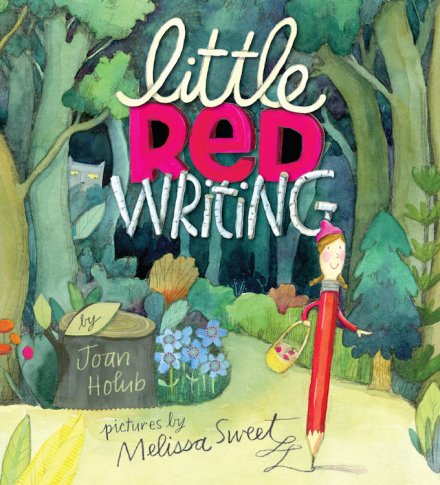
Little Red Writing
Written by Joan Holub | Illustrated by Melissa Sweet
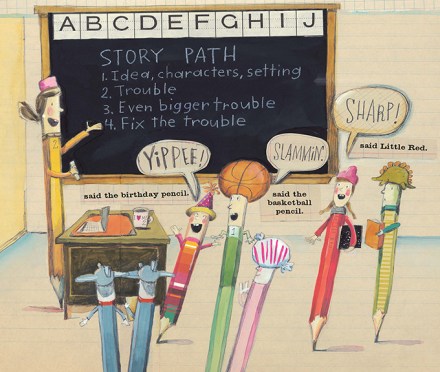
One day in pencil school Ms. 2, the teacher, tells her class that they are going to write a story. Her students are excited, and each one has an idea of what to write. The birthday pencil, wearing a bright pink cone-shaped hat, yells “‘Yippee! I want to write a happy story!’” The state pencil, sporting a map of Pencilvania on its eraser end, wants to tell a nonfiction tale about its state, and the basketball pencil with a small replica basketball topper imagines writing a sports story.
Image copyright Melissa Sweet, text copyright Joan Holub, courtesy of chroniclebooks.com
Little Red, looking sharp in her shiny scarlet coat of paint chooses to “write a story about bravery because red is the color of courage. But what would a brave pencil do?” she wonders. She decides to go in search of unusual characters that will give her a chance to fight evil and save the day. Ms. 2 gives “Little Red a basket of 15 red words to use in case she ran into trouble” and reminds her that “it’s ok to wander a little, but stick to your basic story path so you don’t get lost.”
Little Red takes her basket full of nouns and sets off. In her notebook she begins to describe her journey. “As she walked along…” she writes and then stops. “Walking is boring,” she decides. To discover some action she heads for the gym, where other pencils are twisting, throwing, catching, swinging, and jumping. Little Red bounces and boogies and cartwheels “right off the page into a deep, dark, descriptive forest.”
Image copyright Melissa Sweet, text copyright Joan Holub, courtesy of chroniclebooks.com
The adjectives lay thick on the gnarled, flowery, shadowy path. The towering trees smell piney and their verdant, russet leaves hide squirrelly creatures. The forest is beautiful, but suddenly Little Red feels “bogged down, hindered, lost!” Remembering her basket, she reaches in and pulls out scissors. They help her “cut through all this description and stick to the story path.” Back on the straight and narrower, Little Red encounters a bottle of “conjunction glue” with just the right kinds of words to help her. She gives the bottle a squeeze, but now finds that her sentences go on and on without saying anything important. All seems lost until “Suddenly” arrives.
“Suddenly,” she hears a throaty roar that begins to chase her. Little Red runs without stopping, throwing out any word she can grab from her basket until she can escape to the next page. Here, however, she discovers a “long, tangly tail” and decides to investigate. The tail winds all along the school corridors, passing the cafeteria, the music room, the art room, and the auditorium. It even meanders by the math room and the after school clubs room into the principal’s office.
Image copyright Melissa Sweet, text copyright Joan Holub, courtesy of chroniclebooks.com
Little Red knocks on the door. Inside, Principal Granny, her long tail tangled behind her, roars her greetings. Little Red is suspicious, but she continues to explain the growly voice she heard. In fact, she says, “It sounded kind of like yours.” “The betterrr to be hearrrd on the school interrrcom,” the principal states. Little Red also reports the tangly tail, to which the principal answers, “the betterrr to get charrrged up for my school duties when my batteries are rrrunning low. All at once Red notices the principal’s big sharp teeth. “The betterrr to chomp little pencils like you and grrrind them up!”
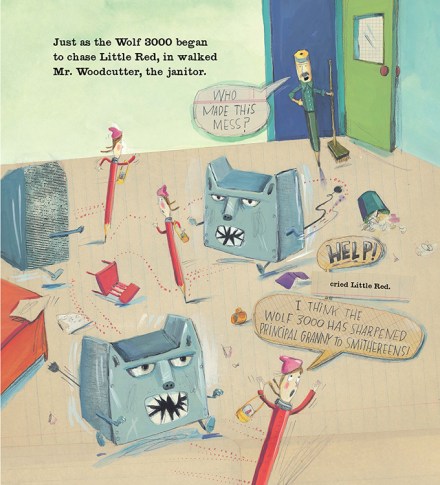
With that Little Red realizes that this isn’t Principal Granny but the “Wolf 3000: the grumpiest, growliest, grindingest pencil sharpener ever made!” The Wolf 3000 begins to chase Little Red around the office, and just when there seems no hope, in walks Mr. Woodcutter, the janitor—who immediately faints. There is only one thing left to do. Little Red grabs her last word and hurls it at the Wolf 3000. “KABLOOEY” goes the dynamite, reducing the Wolf 3000 to a pile of parts.
Principal Granny emerges from the rubble shortened but okay and declares Little Red a hero. Little Red rushes back to her classroom in time to hear the other pencils’ stories and to share her own brave adventure.
Image copyright Melissa Sweet, text copyright Joan Holub, courtesy of chroniclebooks.com
Joan Holub’s delightfully clever tribute to writing draws on the Little Red Riding Hood story to get kids excited about using the various parts of speech that make writing so fun and reading so enjoyable. The metaphorical “story path” that Little Red traverses brings her into contact with characters that provide immediate understanding of the concepts. When Little Red squeezes the bottle of conjunction glue, out squirt the words so, but, and, although, yet, and or, which are incorporated into the illustrations on the page. Readers’ familiarity with the original fairy tale increases suspense in this fractured version. The Wolf 3000 electric pencil sharpener makes a perfect nemesis, and the fainting janitor leaves Little Red to sharpen her wits and defeat the beast. Dynamite—at least the word itself—truly is mightier than the sword.
Holub’s nimble talent with puns and wordplay elevates Little Red Writing from simply a book about the subject of grammar and writing to a captivating story kids will love to hear again and again.
Grammar has never looked as enticing as in Melissa Sweet’s vivacious illustrations of adorable Little Red on the story path to prove her bravery. Sweet’s pages, combining pencil drawings, watercolor, and collage, burst with animated typography, scraps of vivid red nouns, and expressive characters in a detailed and fully realized pencil school. Little Red’s final battle with the Wolf 3000 gives full range to Sweet’s rousing visual humor in a highly satisfying climax to the story.
For kids who love reading, writing, and a really good story, Little Red Writing would be a welcome addition to their bookshelves. Teachers will find the story enhances any unit on writing, grammar, and literature.
Ages 5 – 9
Chronicle Books, 2013 | ISBN 978-1452152097
You will find children’s books for all ages as well as fun videos, activities, and teachers’ resources on Joan Holub‘s website!
Discover books, things to make, and lots of fun on Melissa Sweet‘s website!
World Teachers Day Activity
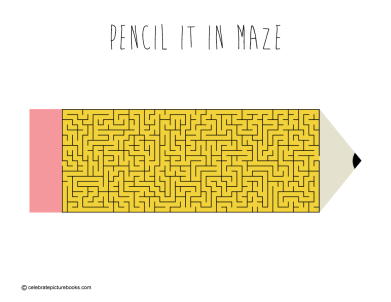
Pencil It In Maze
Writing a story is like completing a maze – you must stay on the right path from the beginning to the end to write a satisfying tale. Find your way through intricacies of this printable Pencil It In Maze!
Established in 1999 by UNESCO, Mother Language Day celebrates cultural diversity and promotes the protection of endangered languages. Events include multicultural festivals where all voices are heard and social cohesion, cultural awareness, and tolerance are honored.
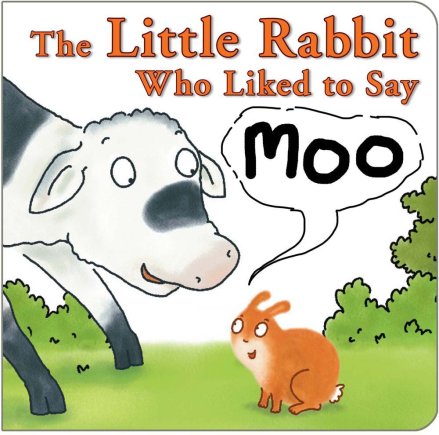
The Little Rabbit Who Liked to Say Moo
By Jonathan Allen
Little Rabbit sits in the farmer’s field listening to the animals talk and learning their languages. “Moo,” Little Rabbit repeats, “Moo.” A calf responds and questions Little Rabbit. It turns out that Little Rabbit knows and likes many languages. Calf joins Rabbit in the fun. “Baa,” they say together, which summons Lamb. The three friends decide to try “Oink.” With each new noise, the group expands and enthusiastically continues their linguistic experiment.
Copyright Jonathan Allen, 2008, courtesy of Boxer Books Ltd.
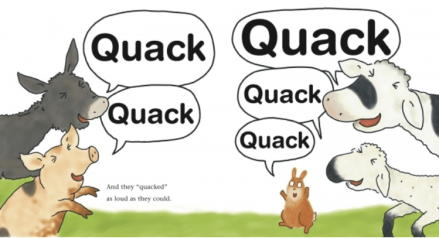
Finally, after a rousing chorus of “Quack,” Duckling asks , “Why are you all saying quack? You’re not ducks.” Baby Donkey is the first to answer. “I like Quack.” “So do I…Me too,” the other young animals pipe up. “Is quack your favorite animal sound?” Duckling asks. Each animal then reveals with pride that, while they like other noises, they prefer their own. But what about Little Rabbit, who doesn’t “have a big noise?” Will Rabbit’s answer begin the game again?
The wide-eyed, smiling animals in this adorable picture book by author-illustrator Jonathan Allen perfectly captures the joyous camaraderie of good friends discovering the world together. The book is a wonderful introduction for young children to the ideas of inclusiveness and self-esteem. Kids will love the repetition as each new animal joins the group, and will have as much fun saying each sound as Little Rabbit and the other farmyard friends.
Ages 2 – 5
Boxer Books Limited, 2015 (Board Book) | ISBN 978-1910126257
International Rabbit Day Activity
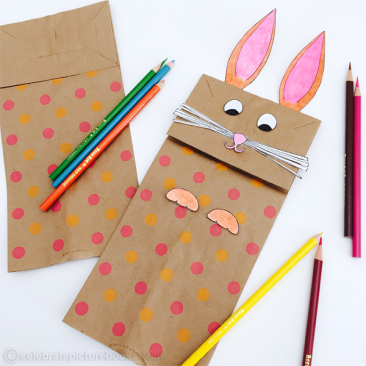
Paper Bag Rabbit Puppet
With this easy and fun craft you can make your own little rabbit who likes to play with you and talk in other languages! Make up stories of your own – what does your little rabbit like to do?
Place the flat paper bag on a table with the bottom flap facing you. Glue or tape the eyes, and the nose and whiskers to the bottom flap. Attach the ears, placing the tabs behind the top of the bottom flap. Attach the paws to the body below the bottom flap. Attach the cotton ball tail to the opposite side of the bag.
When it’s dry, use your puppet to read The Little Rabbit Who Liked to Say Moo again and play along, making the other animals’ sounds.
Then let your Little Rabbit try saying “Hi” in the languages below.
Learn to Say “Hello” in Other Languages
Spanish: Hola (oh-la)
French: Bonjour (bon zhur)
German: Hallo (hă-lo)
Chinese: Nin Hao (nee hah)
Filipino: Kamusta (ka-muh-stah)
Italian: Ciao (chi-ow)
Japanese: Kon’nichiwa (ko-nee-chee-wah)
Turkish: Merhaba (mĕr-hah-bah)
You can find The Little Rabbit Who Liked to Say Moo at these booksellers
Instituted by People for the Ethical Treatment of Animals (PETA),which was established by Ingrid Newkirk in 1949, Hug a Vegetarian Day promotes awareness of a meat-and animal- products-free diet. Over the years millions of people world wide have embraced the vegan and vegetarian lifestyle, giving rise to alternative diets and products that support this healthy choice. To celebrate today whip up a vegetarian meal – why not Rainbow Stew?!
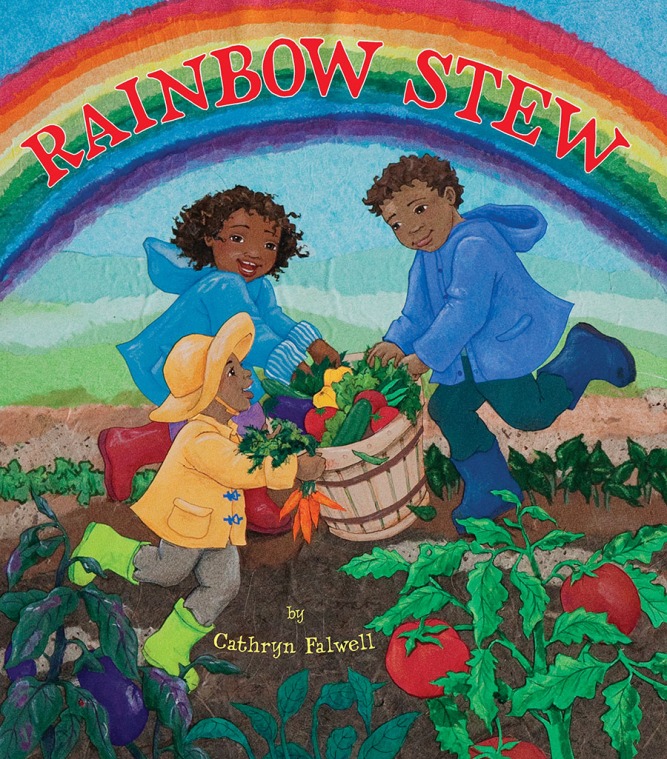
Rainbow Stew
By Cathryn Falwell
Grandpa’s making pancakes for his three favorite kids—his granddaughter and two grandsons. The kids are excited to be visiting their grandpa where they can play outside all day long. On this particular day, however, rain spatters the windows, and the kids are disappointed: “Whimper, sigh, / cloudy sky, / is it too wet to play? / We don’t want to stay inside / because of rain today.” But their grandpa knows just what to do! “Let’s go and find some colors for my famous Rainbow Stew!” he suggests.
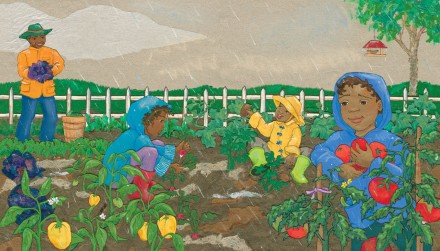
Image copyright Cathryn Falwell, courtesy of rainbowstewbook.com
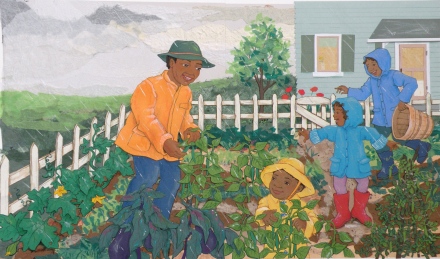
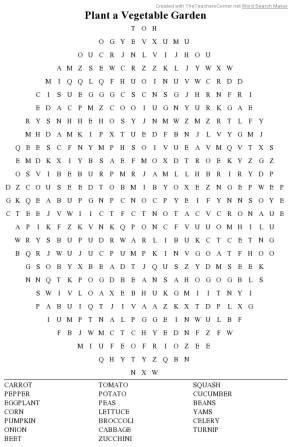
Out to the garden they run in their raincoats and hats. “Splish, splash, / puddle dash, / We bounce right out the door. / We’re off to find some red and green, / some yellow, orange, and more. / Grandpa shows us how to move / Between each garden row. / Lifting up the drippy leaves, / we see what colors grow.” They collect green spinach, kale, and zucchini; yellow peppers, purple cabbage and eggplant, red radishes and tomatoes; brown potatoes; and orange carrots. After some muddy fun among the plants, the kids go inside, get dried off, and begin to prepare their colorful stew.
Image copyright Catherine Falwell, courtesy of rainbowstewbook.com
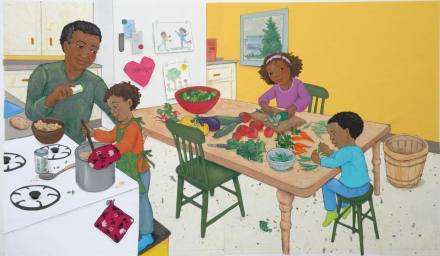
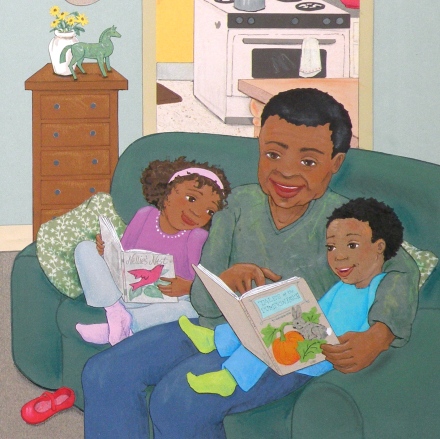
“Peel, slice / chop and dice, / colors fill the pot. / Stir in herbs and water / and then wait till it gets hot.” While the pot simmers on the stove, Grandpa and the kids snuggle on the couch with favorite books, reading together until the stew has simmered to perfection. The family then sits down to a homemade, colorful, delicious lunch of Rainbow Stew.
Image copyright Cathryn Falwell, courtesy of rainbowstewbook.com
Cathryn Falwell’s Rainbow Stew is a wonderful book to share with young children on many levels, offering opportunities for learning as well as playing. Introducing colors through familiar and delicious vegetables can get kids excited about gardening, cooking, even going to the grocery store. The rhyming verses each begin with an energetic couplet that kids will enjoy repeating or acting out. The bright colors of Grandpa’s house mirror the vividness of the garden vegetables, and young readers may enjoy matching the vegetables to items in the kitchen, living room, and more.
Children will identify with the disappointment of the three siblings when they learn it’s too wet to spend the day outside as well as their glee at squishing in the mud. The close bond between the kids and their grandfather as they cook and read together is a strong anchor for this story and promotes early literacy.
Image copyright Cathryn Falwell, courtesy of rainbowstewbook.com
A recipe for Rainbow Stew follows the story. Reading Rainbow Stew, preparing the delicious dish, and doing the puzzle below makes for a fun rainy – or sunny – day!
Ages 4 – 7
Lee & Low Books, 2013 | ISBN 978-1600608476
Learn more about Cathryn Falwell and her books and art on her website!
To discover more about Rainbow Stew as well as activities to accompany the book, head over to rainbowstewbook.com!
The apple is one of the world’s most valuable foods, enjoyed by people all around the globe. Apples come in so many crispy, delectable types and flavors—from sweet to tangy. Whether you like red, green, or yellow apples they are delicious in pies, tarts, muffins, salads, or just by themselves. Today, why not buy a bushel or a peck of apples from your favorite store or farm stand—or for even more fun, visit an orchard to pick them right from the tree! What you do with them is all up to your imagination!
Toto’s Apples
By Mathieu Lavoie
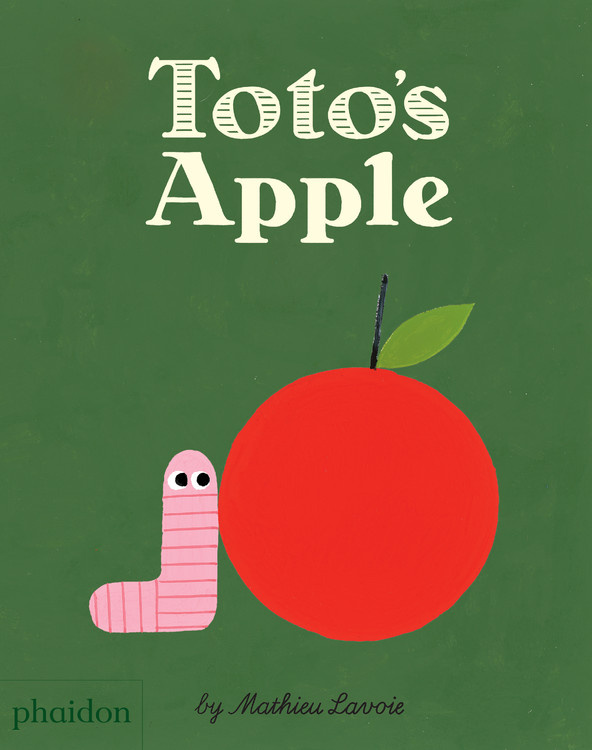
Like a more earthy Romeo, Toto the worm gazes at his beloved—a rosy red apple. He “is down low” and it “is up high”. He needs a plan because he is determined to win that apple. Just then a bird flies by and Toto has an idea. Using their natural enmity, “Toto gets busy” and paints a twig in his image. He displays it in a prominent place, and hides. When the bird zooms in to snatch the delicious snack, Toto catches a ride on the bird’s tail feathers. Up he soars…to be deposited in…the wrong tree.
Image copyright Matieu Lavoie, couresy of Phaidon Press, phaidon.com
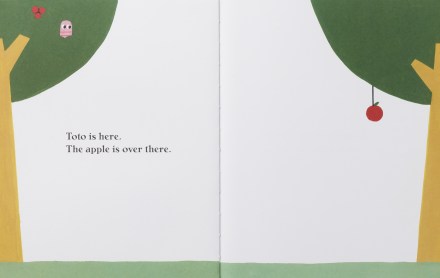
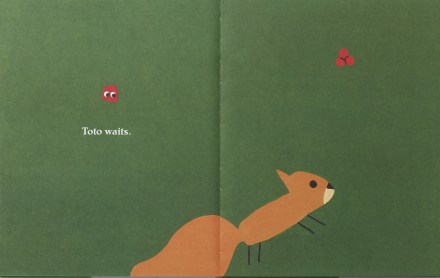
Now “Toto is here. The apple is over there.” As often happens “a squirrel approaches.” Watching it climb his tree, “Toto has an idea.” Once again “Toto gets busy.” He paints himself the red of the tree’s berries and when the squirrel passes him by, “Toto hangs on tight” to the squirrel’s bushy tail. Off Toto goes…into…the tree top. While the squirrel naps, Toto looks longingly at the apple of his eye so far below.
Image copyright Matieu Lavoie, couresy of Phaidon Press, phaidon.com
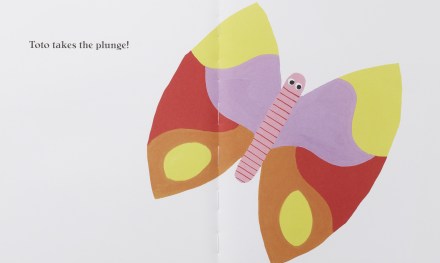
A falling leaf gives Toto another brainstorm. He paints a leaf with rainbow colors, and after a moment to bolster his courage…he “takes the plunge!” He flits and floats so close to…the ground. Landing gently on the grass, Toto is back to the beginning. Now what? Suddenly, he sees Didi and a friend arriving with a ladder. He hunkers down to scout out the situation. The ladder is placed against the tree trunk. The friend climbs the ladder. The apple lands in the hands of Didi, who…takes a big munch! “Toto is devastated.”
Just then Didi pivots to watch a passing airplane and drops the apple. Knowing “that it’s now or never,” Toto burrows in. As the plane disappears Didi again turns her attention to the apple…“and swallows Toto!” Poor Toto? No! “The apple is inside. So is Toto. Toto is happy.”
Image copyright Matieu Lavoie, couresy of Phaidon Press, phaidon.com
Mathieu Lavoie’s Toto’s Apple is part concept book, part tasty treat of absurdist fun that kids will eat up. As Toto’s predicament goes from bad to worse, his steadfast eye on his goal lends suspense and a growing comedic lilt to this very minimalist tale. Little Toto is an adorable hero, a tiny pink and red striped softie with one great love. His determination and clever solutions to his dilemma will not only make kids laugh but inspire them to muster their courage and think outside the box.
Lavoie’s simple but bold illustrations provide just the right amount of visual explanation of Toto’s changing fortunes (and facial expressions) for kids to enjoy the full, escalating, laugh-out-loud humor on every page. Readers will understand—as so many great literary works reveal—that wherever you and your beloved can be together is where true happiness is found.
At its core Toto’s Apple is a book that will be asked for again and again and should be “up high” or “down low” or anywhere in a child’s bookcase.
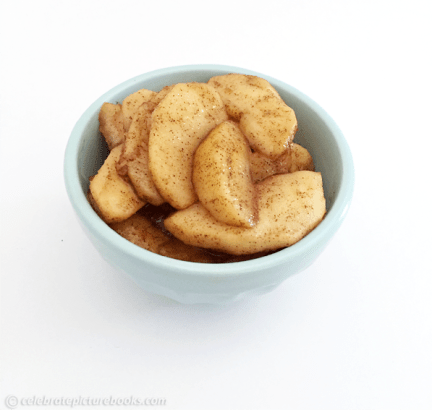
Warm apples sprinkled with cinnamon sugar is one of the most delectable treats of autumn. Here’s an easy recipe for making this delicious dessert or side dish.
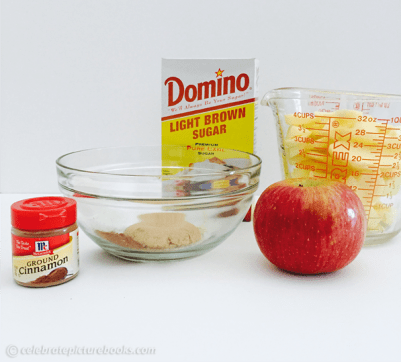
Ingredients
4 cups of apples, Macintosh or Granny Smith apples are good choices
2 tablespoons brown sugar
1 teaspoon cinnamon
1/4 teaspoon lemon juice
Directions
Mix brown sugar and cinnamon
Peel and core 2 large apples
Thinly slice apples
Combine apples and cinnamon sugar/brown sugar mixture
Stir until well combined
Drizzle with lemon juice and stir again
Cook apples on the stove at medium heat for 8 to 10 minutes or until desired texture
In the early 1970s Marion McQuade had the idea for a special day of the year when grandparents and grandchildren could show their love for one another. She further wanted it to be a day when grandparents could pass down the wisdom they had gained over their lifetime as well as share a bit of family history. Of course the same goes for grandparents learning the latest and greatest from the kids in their lives—from new technology to current fads. When all generations share their experiences, we’re all a lot smarter—and have closer relationships!
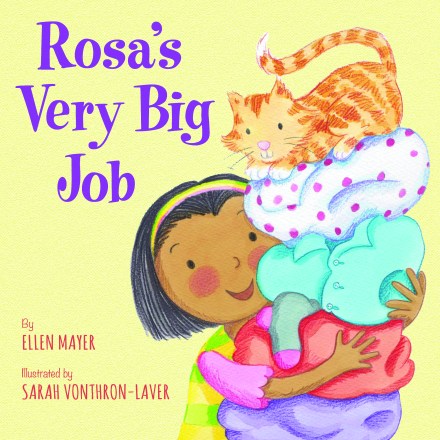
Rosa’s Very Big Job
Written by Ellen Mayer | Illustrated by Sarah Vonthron-Laver
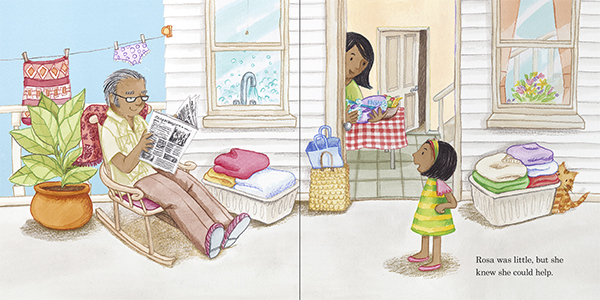
Rosa may be little, but she has big ideas about how to help. While Mama is out shopping for groceries for that night’s dinner, Rosa decides to surprise her by folding and putting away the laundry. The basket is piled high with fluffy dry clothes, sheets, and towels. Rosa watches her grandpa reading the newspaper. “‘Please help me, Grandpa!’” she says. She tugs on her grandpa’s hands, trying to pull him out of his chair. “‘Come on, Grandpa! Get up.”
Image copyright Sarah Vonthron-Laver, text copyright Ellen Mayer, courtesy of Star Bright Books, starbrightbooks.com
Grandpa seems to have a little trouble managing: “‘It’s difficult to carry these enormous piles,’” he sighs. But Rosa knows that smaller armloads work better. Grandpa’s clothes come unfolded as he puts them in the drawer. “‘Be neat. Like me,” Rosa says, showing him her tidy stack. Poor Grandpa! He has to keep hanging up the same jacket over and over. “‘It’s difficult to keep this jacket from sliding off the hanger,” he says. Rosa has the answer: “‘Zip it up,’” she explains. “‘Then it stays on.’”
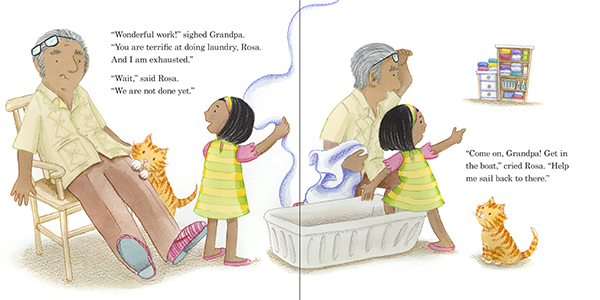
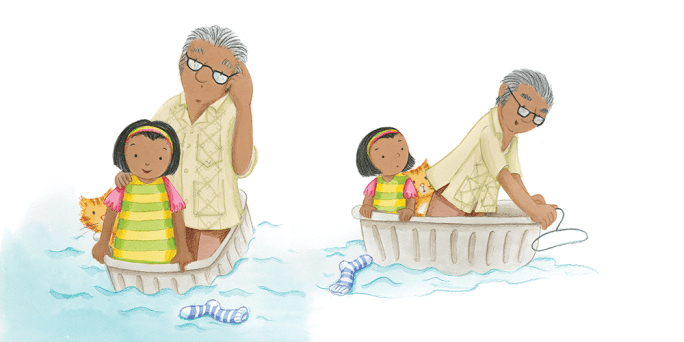
Grandpa sinks back into his chair. “‘You are terrific at doing laundry, Rosa. And I am exhausted,’” he says. But this is no time to quit—Rosa has big plans. As she steps into the now empty laundry basket, she exclaims, “‘Come on, Grandpa! Get in the boat. Help me sail back to there.’” Rosa points to the linen closet.
Image copyright Sarah Vonthron-Laver, text copyright Ellen Mayer, courtesy of Star Bright Books, starbrightbooks.com
Suddenly, the floor swells with ocean waves teeming with fish. Grandpa channels his inner sailor as he holds aloft a sheet as a sail. As the wind billows and they come perilously close to the kitchen table, he says, “‘It’s difficult to sail around this enormous rock!’” Contemplating the rising sea, he exclaims, “‘It’s difficult to sail over this enormous wave!’”
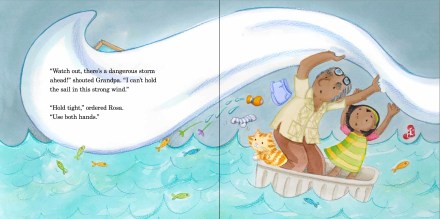
There’s a dangerous storm ahead, warns Grandpa, “‘I can’t hold the sail in this strong wind.’” Rosa is there to help and grabs one side of the sheet. “‘Hold tight,’” she orders. “‘Use both hands.’” At last the seas die down and Grandpa is ready to steer the laundry basket back to port, but Rosa has a more entertaining thought. Spying a sock on the floor, Rosa wants to catch the “enormous fish.” Grandpa obliges and picks up a hangar for a fishing pole. He holds Rosa as she stretches out over the edge of the laundry basket to land her fish.
Image copyright Sarah Vonthron-Laver, text copyright Ellen Mayer, courtesy of Star Bright Books, starbrightbooks.com
Just as Rosa nabs the fish, Mama comes home with her bags of groceries. She’s surprised to see that the laundry is not in the basket. Rosa runs to her and proudly explains, “‘We put all the laundry away. It was a very big job. We carried enormous piles. Grandpa dropped things. And I picked them up. It was very difficult for Grandpa. He got exhausted. But not me. I am terrific at laundry!’” Mama agrees that Rosa is a terrific helper. Then Rosa leads her mother to see the most surprising thing of all—the fish she has caught for dinner!
In her series of Small Talk Books® Ellen Mayer presents exciting stories for preschoolers full of imagination and rich language learning. Rosa’s Very Big Job introduces Rosa, a sweet girl bubbling with enthusiasm and the desire to help. The close relationships between Rosa, her mother, and her grandpa promote cooperation as well as effective modeling of speech patterns and a way to introduce larger words in an organic manner through play and common chores. Rosa’s inventive idea to turn the laundry basket into a boat is delightfully enhanced by her grandpa’s willingness to share in the story and expand on it. Humor, cheerful banter, and the easy camaraderie between Rosa and Grandpa invite young readers to join in the fun as they build confidence in their language learning.
Sarah Vonthron-Laver depicts Rosa’s afternoon with her Grandpa with joy and the spirited energy young children bring to everything they do. Grandpa is happy to spend time with his granddaughter, yet shows honest feelings of tiredness and frustration that spur on the plot. The transition from doing laundry to using the basket as a boat is as seamless as a child’s imagination, and the way Rosa and her grandpa use household items to create “sails,” “rocks,” “fish,” and “fishing poles” will give readers great ideas for post-reading play. Bright colors, an adorable kitten, and familiar surroundings welcome young children into the world of reading and expanded vocabulary.
Rosa’s Very Big Job would be a welcome addition to a young child’s bookshelf, not only for its fun story that kids will want to hear again and again, but for its leap into imagination that kids will want to replicate.
Dr. Betty Bardige, an expert on young children’s language and literacy development, provides tips for parents, grandparents, and caregivers following the text.
Ages 2 – 6
Star Bright Books, 2016 | ISBN 978-1595727497
Discover more about Ellen Mayer and her books as well as book-related activities and literacy initiatives she’s involved with on her website!
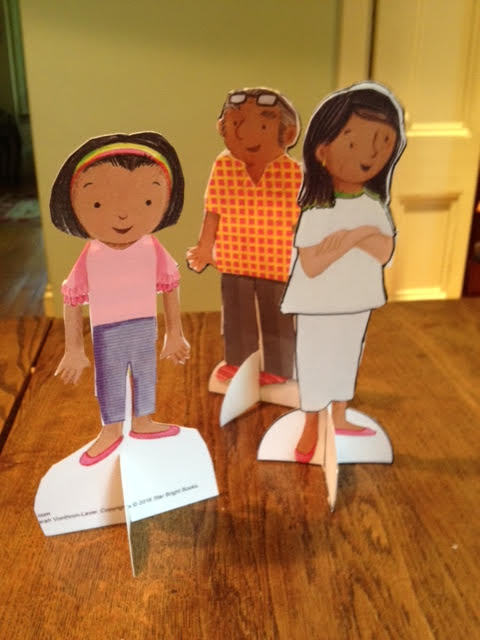
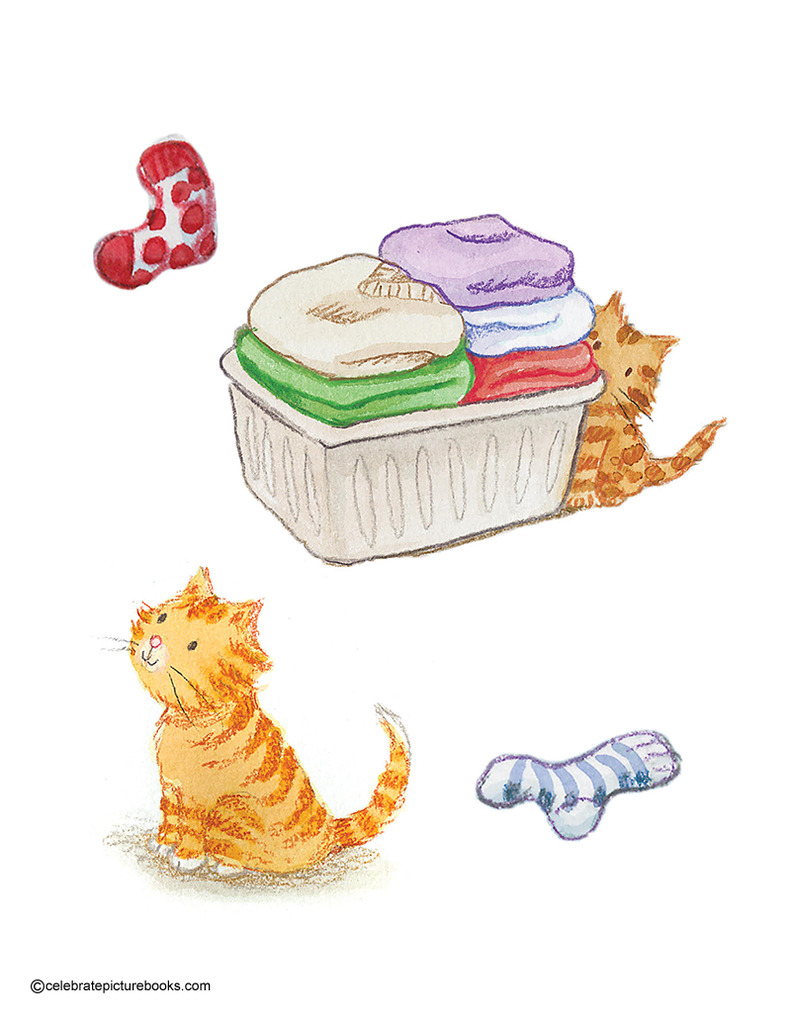
Rosa loves helping out at home. She’s terrific at doing laundry – folding and putting away the family’s clothes, socks, and linens. You are terrific at helping too! Can you help Rosa, Mama, and Grandpa get dressed and ready for the day with these printable paper dolls? You’ll even find a laundry basket, socks, and Rosa’s sweet kitty to play with!
Print dolls on regular paper or heavy stock paper. Dolls printed on heavy stock paper may stand on their own with the supplied stand cross piece. For dolls printed on regular paper, you can cut the supplied stand templates from poster board or card stock and glue the dolls to the backing.
Rosa’s kitty and the laundry basket can also be attached to the supplied template if needed
Print clothes for each figure
Color the blank clothes templates any way you’d like
Cut out clothes and extra items
Fit outfits onto dolls
Make up your own stories about Rosa, Mama, and Grandpa!
Interview with Author Ellen Mayer
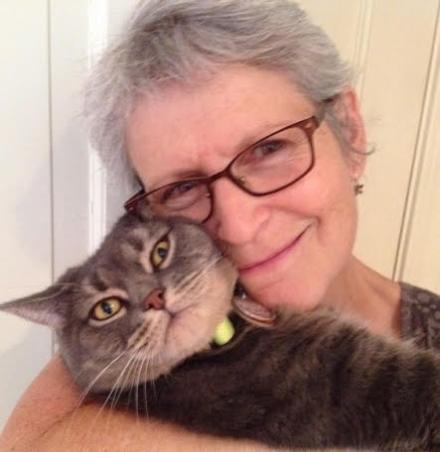
Today, I’m happy to present a fascinating interview with Ellen Mayer, a writer and expert in early literacy, in which she discusses her involvement with various organizations and programs, her baby granddaughter, why Hug Your Cat Day is at the top of her list of holidays, and gives us a peek at a very special sugar egg.
I’m really interested in your work in the education and literacy fields. Could you talk a little bit about your job as an education researcher and an early literacy home visitor, and how you got into those fields?
I got into these fields after leaving a Sociology PhD program right near the end. I didn’t want to be an academic and teach, I wanted to do applied research – to solve practical problems out in the world and to make a difference in the lives of those who were struggling. At the Harvard Family Research Project at Harvard’s Graduate School of Education, I studied the ways that families from underserved communities were engaged in supporting their children’s learning and education, and created research-based materials for families and schools to promote effective engagement. One of these was the Family Involvement Storybook Corner—curated picture book selections with family engagement themes. That got me interested in early literacy and picture books.
After researching family engagement in children’s learning for many years, I decided I wanted to go out into the field and be a practitioner and work directly with families on this topic. I worked as an early literacy home visitor with diverse families with the Parent-Child Home Program, modeling ways to share stories with little ones to build early language. I actually got paid to read picture books and play with families in their homes!
At the same time, I was pitching my Small Talk Books®, a collection of playful stories about everyday activities that provide fun for kids and ideas for adults – Rosa’s Very Big Job is one. The adults in the stories are engaged with children’s learning, modeling conversational ways to build young children’s language.
I read that your book Red Socks, another of the Small Talk Books®, is being used in a program to turn wash time at Laundromats into talk time for literacy development. Could you discuss this early literacy initiative?
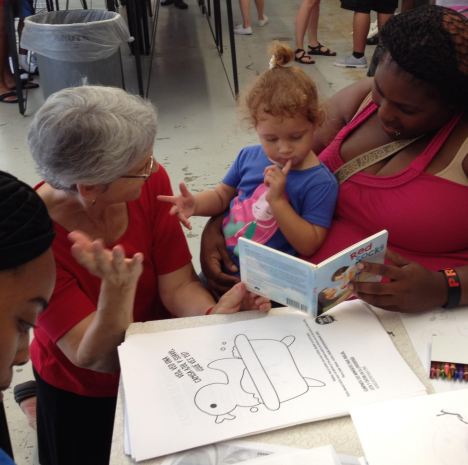
Yes! Wash Time/Talk Time is a terrific campaign led by Too Small To Fail, a joint initiative of the Clinton Foundation and the Opportunity Institute teaming up with a host of partners to turn Laundromats in underserved areas into venues for early literacy. This campaign distributes free books and information to families in Laundromats about building early language to help close what’s called the “word gap” by promoting parent conversation with babies and young children. Almost 60% of children in our country start kindergarten behind in their language development and this then sets them on a downward path and they get even further behind in school.
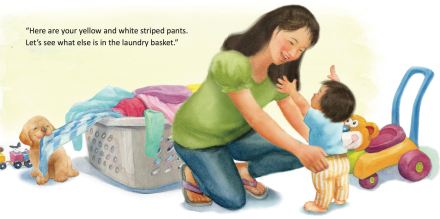
Red Socks was a natural fit for this program. In it a Mama narrates what she is doing for her little pre-verbal child as she folds the laundry and dresses the child—and as they search for a missing sock!
I have to say that it’s a dream come true that Too Small To Fail is using my book.
Wash Time/Talk Time is really reaching the families on the other side of the word gap who most need the ideas and inspiration in Red Socks. When I began writing the Small Talk Books® I wanted to include stories about doing laundry, as it’s something we all do as parents and provides lots of things to talk about with children. (Like the color of socks!) In fact, I used to sit in Laundromats and observe families when I was thinking up ideas for stories. I guess that’s the sociologist in me.
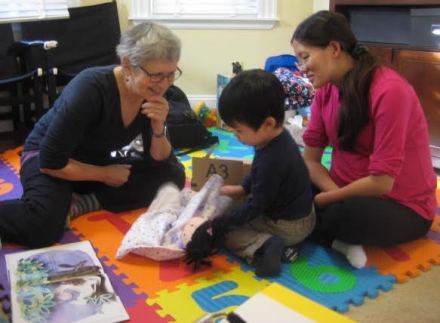
We just had the opportunity to visit one of the Laundromats in the campaign—at the Free Laundry Day in Tampa, FL hosted byThe Laundry Project—and share Red Socks with families. You can see some of the fun illustrator Ying-Hwa Hu and I had here:
What inspired you to begin writing picture books?
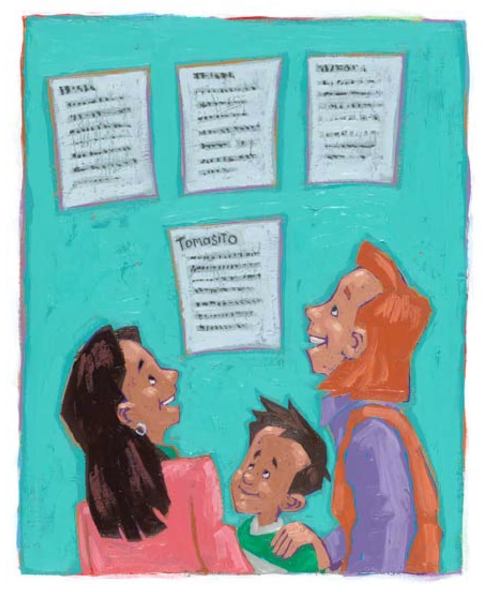
I came to picture book writing through a backdoor. When I was at Harvard Family Research Project, I was thinking about new ways to convey our ideas from research into practice for parents, and it occurred to me that a read-aloud picture book could address an audience of parents, as well as the primary one of children. My boss was enthusiastic about the idea, and so I enrolled in an adult ed class on writing for children. Then I turned one of our research case studies about challenges an immigrant Latino family had in communicating with their son’s teacher into a picture book,Tomasito’s Mother Comes to School/La mamá de Tomasito visita la escuela. Joe Cepeda did the art for it, and we made it downloadable for free.
Some new things! I have a fellowship with the Storytelling Math Project that’s funded by the Heising-Simons Foundation and coordinated by TERC, a not-for profit STEM research and development organization here in Cambridge, MA. I’ll be a member of a group that’s identifying, creating, and promoting math-infused storybooks for diverse young children and I hope to create a couple of Small Talk Books® along these lines—probably about supermarket shopping! I also was asked to help out the Highlights magazine editorial team that creates HELLO magazine for 0-2 years and be an outside reviewer for issues before they go to publication. And then I’ll be volunteering as a visiting children’s book author to the Somerville Family Learning Collaborative, the family engagement and early childhood hub of the Somerville, MA Public Schools, sharing my books with playgroups and new parent groups.
But mostly, I plan to write! I have a bunch of picture book manuscripts in various states, and ideas for new ones. These manuscripts are different from the Small Talk Books®; they don’t have a deliberate educational underpinning to them. They are fun, and just fun. One, for example, is called What To Do With Ruby-Lou and it’s about a baby who doesn’t laugh, no matter what her family does. Who is going to be able to get a laugh out of Lou? Well, it’s a surprise and it just might require some audience participation. I’ve had an agent in the past and hope to find a new one to rep me with these picture books.
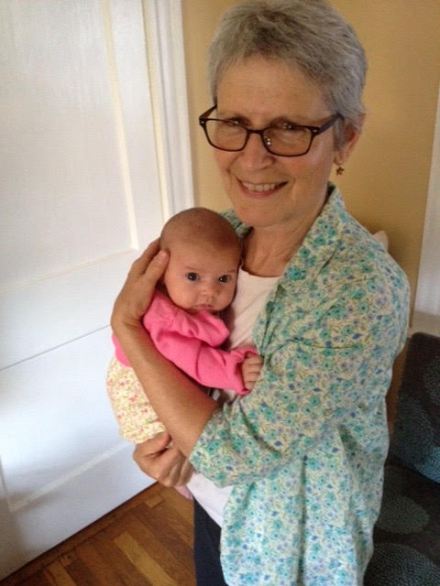
You recently became a grandmother. Can you tell me a little about your granddaughter?
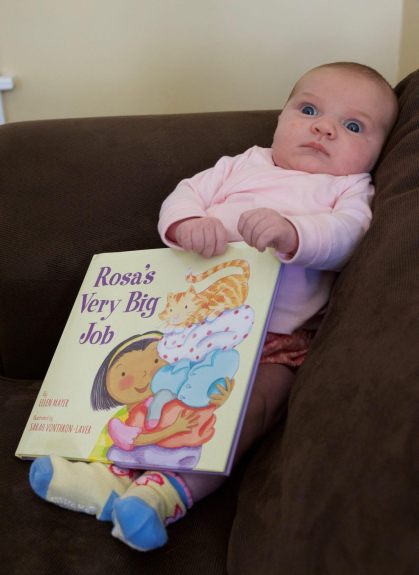
I thought our granddaughter was the most wonderful and expressive baby in the world when was she born – of course! She and my advance copy of the new Rosa book arrived into the world at just about the same time.
At three months now my granddaughter is a big reader and is riveted on the B&W hi-contrast board book genre, especially one board book about cars and trucks. She moves her head back and forth, from one end of the spread to the other, scanning the images on the page like a studious scholar of some ancient text.
What is the best part about being a grandmother?
For me the best part about being a grandmother is being able to simply enjoy my granddaughter and play with her and watch her develop, and not have to worry about taking care of her daily needs. I didn’t have to stress when she refused to take the bottle before starting full-day childcare. That wasn’t my job. (She did take it – of course!) They live nearby, and seeing her once or twice a week, I love noticing small changes on each visit. I also love seeing our daughter and son-in-law parent.
Have you given thought to what you’d like your granddaughter to call you?
Our daughter asked us ahead of time what we’d like to be called when we became grandparents. I thought it was a wise idea to be proactive and select a name immediately, to avoid being named by the grandchild something like “Grandma GA-GOO-GA.” My great aunt Jane is called “Nini” as a grandmother, and I’ve always loved that, but I didn’t want to steal it. So I chose “Mimi.”
It sounds as if Grandparents Day may be one of your top holidays! Do you have another favorite?
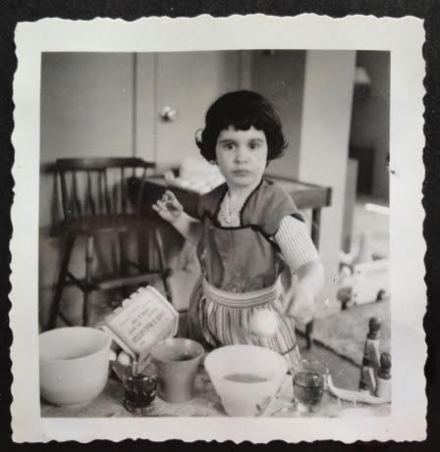
When I was little, I liked Easter a lot because it combined a lot of my favorite things: crafts, springtime, running around outside, candy. Also, we didn’t dress up much as kids, but I do remember Easter bonnets!
When our children were little, their birthdays became my favorite holiday celebrations. Now that they are grown, maybe I need to pick a new favorite holiday? I see that June 4th is Hug Your Cat Day. That might be just right: we have a rather large and ferocious cat and when she actually lets you hug her, well, it’s a cause for celebration.
Do you have an anecdote from any holiday that you’d like to share?
When I was six years old, I saw the Easter Bunny. I was staying at my Grandparents’ house, and I looked down the stairwell, and there he was, crossing the landing at the foot of the stairs. He was quite tall, wore a yellow slicker that was too small for him, and he was carrying a large Easter basket. I’m afraid I didn’t have my Brownie camera with me at the time to snap a photo.
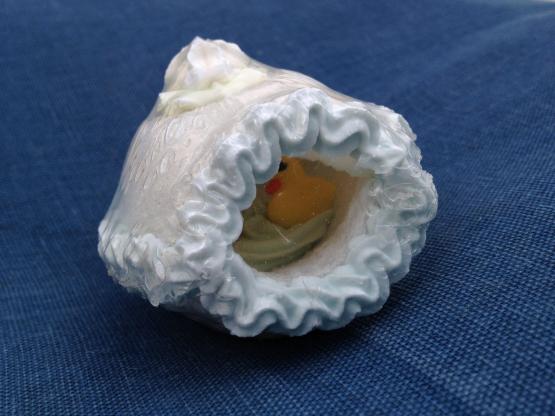
But I do have an unwrapped sugar Easter egg that I’ve saved from that era.
Thanks for sharing so much about your work and life, Ellen! I wish you all the best with Rosa’s Very Big Job, your other Small Talk Books®, and of all your other ventures!
Other Small Talk Books® available from Ellen Mayer and Star Bright Books include Cake Day, Red Socks, and A Fish to Feed and can also be found at the above booksellers.
Is there anything as delicious as a perfectly ripe peach? Native to China and classified with the almond, the peach is peachy in pies, tarts, fruit salads, and just on its own. To celebrate today pick some peaches from a local farm, farmer’s market, or grocery store and enjoy!
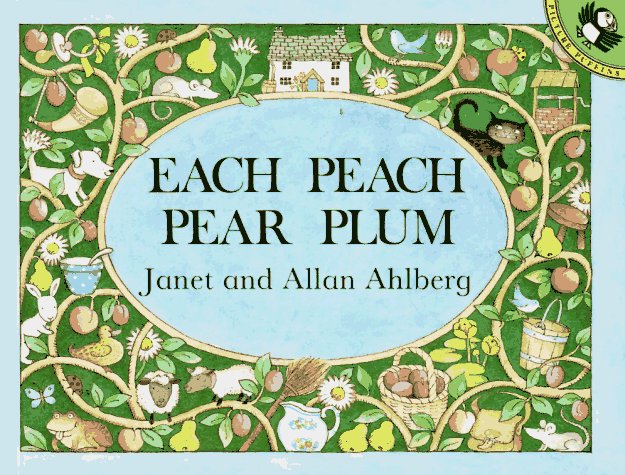
Each Peach Pear Plum
By Janet and Allan Ahlberg
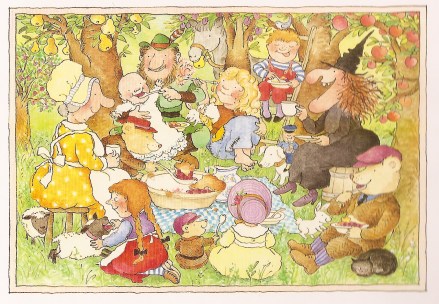
This perennial children’s favorite “I spy” nursery rhyme book is a perfect read any time, but especially during the summer when it can be tucked away in a travel bag or picnic basket and enjoyed on the go. After the first introduction of “Each peach pear plum / I spy Tom Thumb,” in which readers are invited to find Tom who is happily reading high in a peach tree nearly hidden by leaves and fruit, every page offers another double challenge.
Building on the discovery in the preceding page, kids are given a hint as to the current whereabouts of the previous character and are also urged to find another nursery rhyme or literary favorite: “Tom Thumb in the cupboard / I spy Mother Hubbard” followed by “Mother Hubbard down the cellar / I spy Cinderella.” This structure creates anticipation in even the youngest readers as they begin to recognize the pattern and wonder who is coming next.
Copyright Janet and Allan Ahlberg, 1999, courtesy of Viking Books for Young Readers
Besides Tom Thumb, Old Mother Hubbard, and Cinderella, the Three Bears, Baby Bunting, Little Bo-Peep, Jack and Jill, the Wicked Witch, Robin Hood, and a deliciously plump Plum Pie are hidden in the book. What makes Each Peach Pear Plum a classic is the Ahlberg’s artistic magic, which is on gorgeous display in every illustration. The vivid, fine-line drawings spare no details in bringing the short text fully to life.
Humor abounds, especially in the depiction of the “hidden” character or characters, whose only appearance is an arm dusting a shelf, faces at a window, feet sticking out of tall grass, a camouflaged archer, and more. And perhaps the clumsy baby bear could use a bit of assistance! Kids will love pointing out the birds and bunnies, dog, cat, and other animals that also follow from page to page.
Copyright Janet and Allan Ahlberg, 1999, courtesy Viking Books for Young Readers
Each Peach Pear Plum is also a wonderful introduction to the literature alluded to and will entice kids to hear all the stories contained in this forever favorite. Each Peach Pear Plum makes a fantastic gift for new babies or young readers and belongs on every child’s bookshelf.
Ages Birth – 5 and up
Viking Books for Young Readers, Penguin, 1999 | ISBN 978-0670882786 (Board Book Edition)
It’s National Peach Month Activity
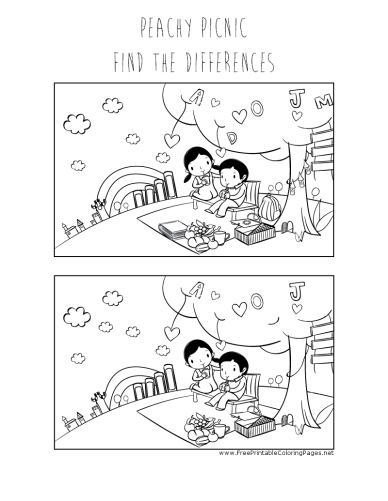
Peachy Picnic Find the Differences Puzzle
These two friends are enjoying a picnic and took two selfies. Can you spot the 12 differences between the two pictures in this printable Peachy Picnic Find the Differences Puzzle?
Today’s holiday comes during International Assistance Dog Week, a time to recognize the work and benefits of canine helpers of all types. Assistance dogs offer comfort, independence, and reassurance to people who have them as members of the family. Not only do dogs of various breeds help the vision and hearing challenged, but they are also trained to recognize the signs of medical emergencies, such as heart attacks, seizures, and epilepsy. Owners of these friends and helpers know that they have the perfect dog, just like the little girl in today’s book!
The Perfect Dog
By Keven O’Malley
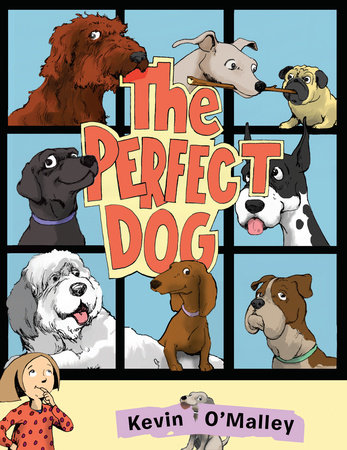
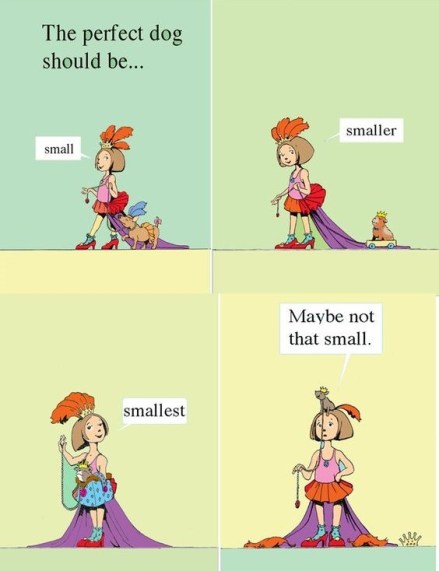
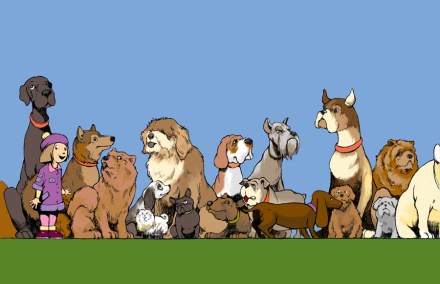
Getting a dog is a major decision. Paramount, perhaps, is what type of dog is best, and with so many breeds, how do you break it down? When the little girl in The Perfect Dog receives permission to get a dog, she begins her list for just the right pet. “The perfect dog should be big” she says as she imagines holding a Chow Chow. Or maybe “bigger” like a German Shephard, or even “biggest” like a Saint Bernard that stands taller than she is. But a Great Dane? Maybe not that big.
Image copyright Kevin O’Malley, courtesy of pinterest.com/booksbyomalley/kevin-omalley
On the other hand maybe “the perfect dog should be small”—standing around knee height—or “smaller”—mid shin height—or “smallest”—able to fit in a purse. But small enough to sit on her head? Maybe not that small. Next she considers the length of the dog’s hair. “The perfect dog should have long hair,” she believes, already assembling her grooming supplies to plump a poodle’s coif. Or the “longer” hair of a Sheep Dog might be fun to comb and cut, and the “longest” hair of an Afghan Hound would be a dream to brush. But the locks of a Komondor? Maybe not that long.
The girl knows the dog should not be too loud or too slobbery, but it should definitely be “fancy.” Speed is also a consideration. “Fast” as a Beagle? Maybe “faster,” like a Dalmatian. But “fastest,” like a Greyhound, could make walking the dog a challenge. Snuggly is nice for quiet times, but a dog so snuggly it takes over the whole chair is not what the girl has in mind. The little girl does not want a pet that is too slow or too messy either.
Image copyright Kevin O’Malley, courtesy of pinterest.com/booksbyomalley/kevin-omalley
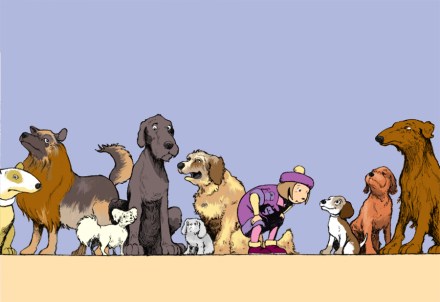
The day finally arrives for the girl and her family to pick out their new pet. There are so many to choose from! Looking into each face and taking each dog’s traits and qualities into consideration, the family decides that “the perfect dog should be happy…happier…happiest!” But there’s still one surprise waiting. Instead of the girl choosing the perfect dog, she reveals that “the perfect dog found me!” And it was a very happy ending!
Part concept book, part tribute to people’s “best friend,” Kevin O’Malley’s The Perfect Dog is a fun romp through different breeds and their unique qualities. If you’ve ever attended a dog show or watched one on TV, you know that there are as many types of canines as there are people. O’Malley applies the language concept of superlatives to describe big, bigger, biggest; long, longer, longest; and other shapes, sizes, and traits in a way that attracts kids’ attention and fosters understanding.
Image copyright Kevin O’Malley, courtesy of pinterest.com/booksbyomalley/kevin-omalley
As the little girl “tries out” various dogs, O’Malley’s bold, full-bleed illustrations proceed from funny to funnier to funniest, often to the little girl’s dismay. She gets knocked down by the biggest of biggest dogs, finds herself hidden in the longest of longest hair, and flies straight out from the end of the leash attached to the fastest of fastest dogs.
O’Malley knows, too, the real secret about choosing a new pet—one that kids will delight in, just as they do in this book. For any pet lover The Perfect Dog is…perfect!
Ages 3 – 8
Crown Books for Young Readers, Penguin, 2016 | ISBN 978-1101934418
Be sure to visit Kevin O’Malley’s website! You can learn more about his books, watch a video of one of his school visits, and even download free books!
Assistance Dog Day Activity
I (Heart) Dogs! Word Search
Assistance dogs come in all shapes, sizes, and breeds. Find the names of more than 25 types of dogs in this printable I (Heart) Dogs! Word Search!