At exactly 5:44 a.m. today winter arrives in the Northern Hemisphere. This also means that today offers those living there the least amount of sunshine—only 9 hours, 15 minutes, and 6 seconds. While the earth’s tilt in relation to the sun at this time of year brings cold and snowy weather to the World’s northern half, the Southern Hemisphere is basking in longer days and warm temperatures. For those of us just beginning to enjoy another winter’s chill, the onset of snow brings special beauty, outdoor adventure, and the fun explored in today’s book!
If Snowflakes Tasted Like Fruitcake
By Stacey Previn
Snowflakes gently fluttering down from a gray winter sky seem to tease “catch me if you can!” Perhaps it’s their similarity to coconut shavings or confectioners’ sugar sifted over a delicious cake that inspires us to stick our tongues out to taste those little white flakes. But what do they really taste like? And what if they tasted like other yummy foods? Stacey Previn explores that idea, starting with a winter favorite—“If snowflakes tasted like sugar plums…they’d be dancing in my head.” Or perhaps they are better for breakfast—“If snowflakes tasted like oatmeal…they would get me out of bed.”
Image and text copyright Stacey Previn, courtesy of simonandschuster.com
Maybe snowflakes would be better in a mug—“If snowflakes tasted like cocoa…they would warm me to my toes” Or if they came in whipped cream dollops, “they would tickle me on my nose.” Imagine “if snowflakes tasted like apples…” you could “bake them in a pie.” And “if snowflakes tasted like peppermint…” we’d “wish more fell from the sky.”
Image and text copyright Stacey Previn, courtesy of simonandschuster.com
Sometimes snowflakes twinkle like diamonds, but what if they were as shiny as gumdrops? Or imagine if they were as warm and soothing as noodle soup. Still, there is that title question: what “if snowflakes tasted like fruitcake?” Well, then, I’m afraid we “would give them all away.” So what is that special flavor that makes us stick out our tongues? “Winter,” of course!
Image and text copyright Stacey Previn, courtesy of simonandschuster.com
Stacey Previn offers up a whimsical, culinary menu of various taste sensations that might entice readers to eat up winter’s delicate, white morsels, including those above as well as honey, figs, chestnuts, gingerbread, popcorn, and marshmallows. Accompanying each verse are richly colored and wood-grain-textured folk-art illustrations that enhance the homey nature of the book. From verse to verse, a red-snowsuited child, joyful to wake to falling snow, imagines shaking snowflakes from tree branches, building a snowman and a snow choir, roasting snowflakes in a pan, catching snowflakes in a spoon, a net, a ladle, and more.
Kids who love playing in the snow—and for whom snowflakes are a delicacy—will delight in curling up with cup of hot chocolate and enjoying the sweet ideas and fanciful humor in this cozy wintertime book. Its sure to inspire kids to think up their own taste comparisons.
Ages 3 – 8
little bee books, 2016 | ISBN 978-1499801804
Discover more about Stacey Previn and her books on her website!
Winter Solstice Activity
Snowy Day Mind Jar
You can capture the beauty of a glittering snowfall in this easy craft—that also makes a special gift for a friend!
Supplies
Small to medium mason jar or other decorative jar with a tight lid
White glitter glue,
Light blue glitter glue,
Fine white and/or blue glitter
Large white and/or blue glitter
Warm water
Directions
1.For every 1/2 cup of warm water add:
1 1/2 teaspoons white glitter glue
1/2 teaspoon blue glitter glue
2 teaspoons fine glitter glue
1/2 teaspoon large glitter
2. Close lid tight
3. Shake
4. As glue dissolves, the liquid will become clearer and the glitter will remain suspended in it
Pancakes and waffles are great, but they’re even more delicious with maple syrup! That sweet, golden slooow-pouring topping that makes for a perfect breakfast (and breakfast-for-dinner meal) deserves its own holiday! Before you get out into the hustle and bustle of the weekend, why not celebrate a little with a tall stack and lots of maple syrup?!
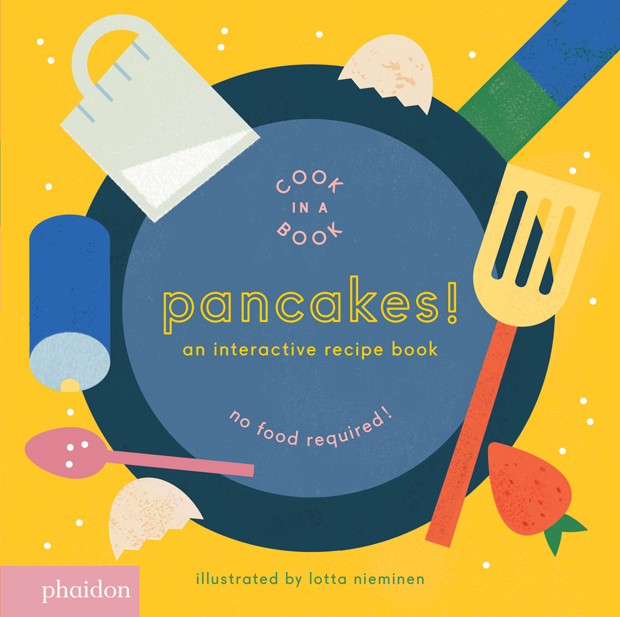
Pancakes! An Interactive Recipe Book
Illustrated by Lotta Nieminen
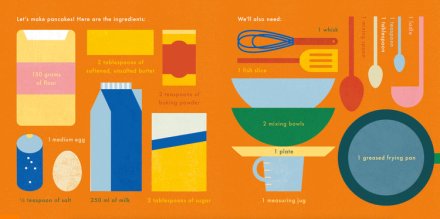
Sometimes a novelty book comes along that transcends the “kid” category and provides fun and “Ooooh!’ moments for readers of all ages. Pancakes! An Interactive Recipe Book offers just this kind of delicious excitement. Opening the cover is like walking into a cozy kitchen, finding your favorite recipe and gathering all the necessary ingredients. The first two-page spread presents in visuals and words the recipe and the utensils and other cooking items needed to make pancakes.
Image copyright Lotta Neiminen, courtesy of phaidon.com
With the second two-page spread, cooking begins! A scoop of baking powder, two tablespoons of sugar, and half a teaspoon of salt are added to the bowl. But what about the cup of flour? Readers get to add that themselves with a pull tab that simulates the flour joining the other ingredients in the green mixing bowl. The clever cut of the opening and the mottled and powdery appearance of the illustrated flour gives the sensation of actual pouring.
Image copyright Lotta Neiminen, courtesy of phaidon.com
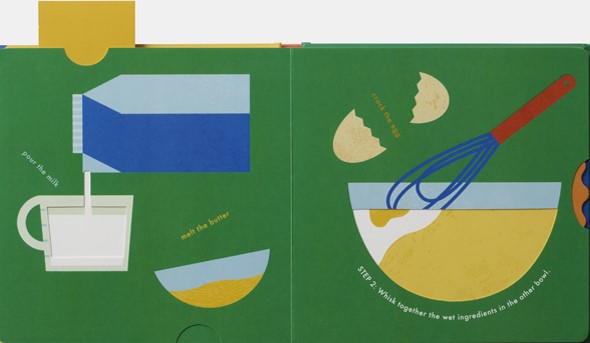
Next readers get to measure out the cup of milk with the help of a pull tab that gives kids control over the amount being served. Four marks on the side of the measuring cup provide an opportunity to talk about fractions and the ¼, ½, and ¾ lines that are also incorporated into real glass measuring cups or the separate cups that come as part of a set. Once the milk is ready, it goes into the mixing bowl with the melted butter and the egg.
Grab your whisk and get stirring! A wheel on the side of the page lets kids “combine” these wet ingredients from their individual parts into a cohesive yellow batter. Now that the batter is ready, it’s time for “STEP 4: Ladle the batter into separate circles in the hot, buttered frying pan.” Readers will love pulling the tab that releases the batter into the pan—leaving just a drop of batter to sizzle on its own (and you know how good those crispy drops can be!)
Image copyright Lotta Neiminen, courtesy of phaidon.com
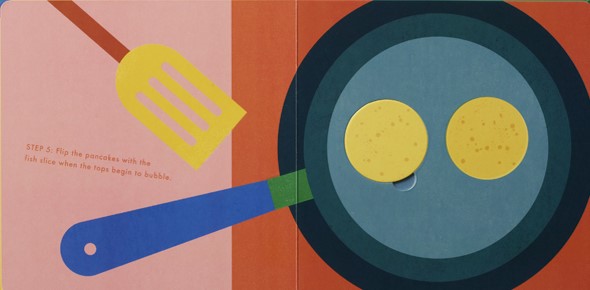
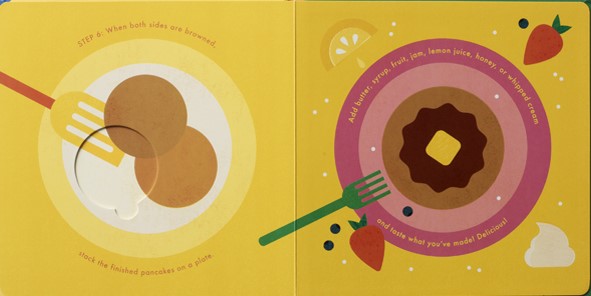
The batter is bubbling—which means it’s time to flip the flap jacks! As the spatula appears from the top of the page, kids can lift one of the little round yellow pancakes from the fry pan and turn it over. Ingeniously, the reverse side is delectably browned. A turn of the page invites by-now-hungry readers to follow “STEP 6: When both sides are browned, stack the finished pancakes on a plate.”
Image copyright Lotta Neiminen, courtesy of phaidon.com
A pancake-sized round indentation on the plate just begs to be filled with the browned pancake from the previous page. Adding the pancake to the sunny plate, kids will feel as if they are holding the spatula and carefully slipping it atop a stack ready to be eaten. The last page encourages readers to “add butter, syrup, fruit, jam, lemon juice, honey, or whipped cream and taste what you’ve made! Delicious!”
Lotta Nieminen’s Pancakes! is so wonderfully conceived in its bold vibrant images and simple recitation of a pancake recipe. The crisp lines and absence of labels on the ingredients packages, puts the focus on the shapes, providing a chance for discussion of concepts such as rectangle, circle, half-circle, cylinder, oval, and triangle; flat and round; and bigger and smaller. Ideas such as hot and cold, measuring, pouring, mixing, stacking and others can also be introduced. The brilliant interactive elements invite kids and adults alike to play with this book over and over.
The sturdy board pages and convenient size make this a perfect take-along for trips to the market, picnics, appointments, sibilings’ activities, or other outings where waiting is required. For kids and adults who like to help out in the kitchen, love to cook, or are attracted by all things culinary, Pancakes! An Interactive Recipe Book makes a terrific gift and must have for home bookshelves.
Ages 2 and up
Phaidon Press, 2016 | ISBN 978-0714872834
To view a gallery of graphic design and illustration work by Lotta Nieminen, visit her website!
Maple Syrup Day Activity
Pancake Flip-Out
Pancakes are served in a stack because they’re so delicious each one doesn’t last long! This game gives you the chance to see how many pancakes you can flip onto a plate! You can play this game several ways:
To Play Pancake Toss
Give each player the same number of pancakes and see how many they can toss onto the plate during their turn
Make a target with the plate in the middle and draw 3 concentric circles around it. Hitting the target can earn you 20 points. Getting your pancake in the first circle around the plate earns you 15 point, the second circle is worth 10 points, and the third is worth 5 points. Rotate through the players as many times as you like and add up the points at the end. The player with the most points wins!
Instead of tossing the pancakes with your hands, try throwing them with a spatula!
Make up your own rules—and have fun!
To Play With Dice
Choose a number of pancakes that each player must add to their plate—say, maybe, a baker’s dozen.
Take turns rolling the dice and adding the number of pancakes rolled to the plate. The first player to reach the agreed-upon number is the winner.
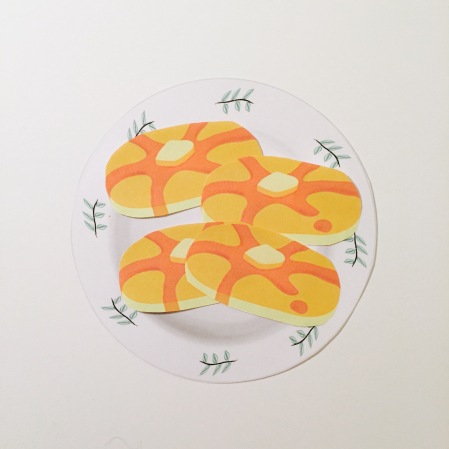
Print enough copies of the Pancakes and Breakfast Plates for the game you choose and cut them out. Playing pieces can be printed on card stock or on paper.
If printing on paper, you can glue the pancakes and plate to poster board, cardboard, or foam to give the pancakes more weight for throwing and the plate more support
Today’s observance was established in 1994 to promote family and community involvement in teaching and supporting children to read more. Family members can make reading a priority at home by sitting down together every day with a wide range of books and other reading material. By taking trips to the library and bookstores, children will also naturally pick up a love of reading. But families can’t do it alone. Kids acquire a drive to read when they see connections between books and their wider world. Fun book-related activities at schools, libraries, science centers, museums, and other places capture children’s attention and make them curious about reading more. Whether children are attracted by fiction or nonfiction, picture books or chapter books, novels or graphic novels, they should be encouraged to read. Universal literacy is a goal that can be accomplished.
About Small Talk Books®
Ellen Mayer’s Small Talk Books® feature young children and adults conversing (or adults speaking to children who are not talking yet) while they have fun, do chores, shop, and bake together. Their conversations demonstrate the kind of excitement and close relationships that encourage learning and language advancement. Each Small Talk Book® includes an accompanying note from Dr. Betty Bardige, an expert on young children’s language and literacy development and the author of Talk to Me, Baby! How You Can Support Young Children’s Language Development. The introduction discusses how children connect actions, words, and meaning as adults speak to them while doing particular jobs or actions.
Other titles in the Small Talk Books® series include Cake Day and Rosa’s Very Big Job. Each book makes a wonderful gift for baby showers, new parents, or anyone with young children in the family. They would be a welcome addition to any young child’s bookshelf as well as libraries and preschool classrooms.
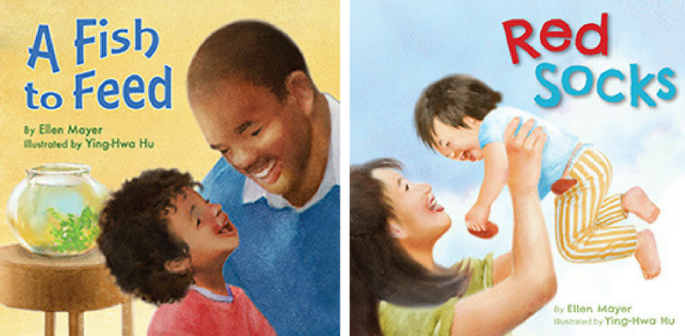
A Fish to Feed
Written by Ellen Mayer | Illustrated by Ying-Hwa Hu
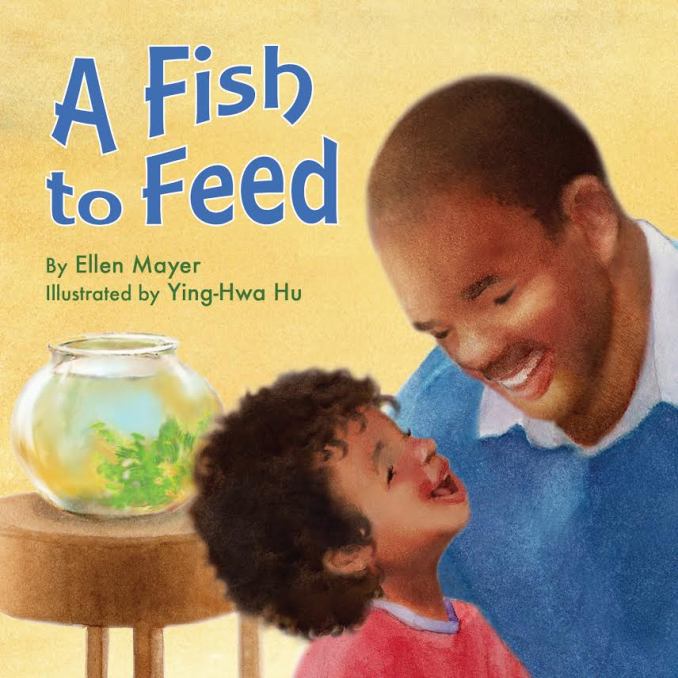
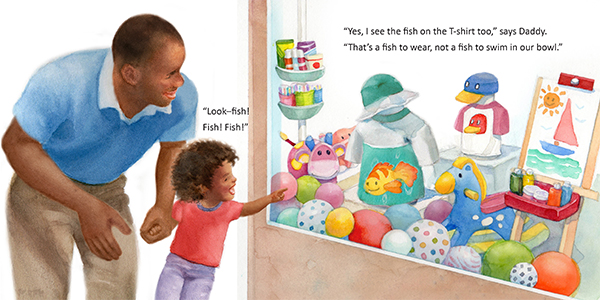
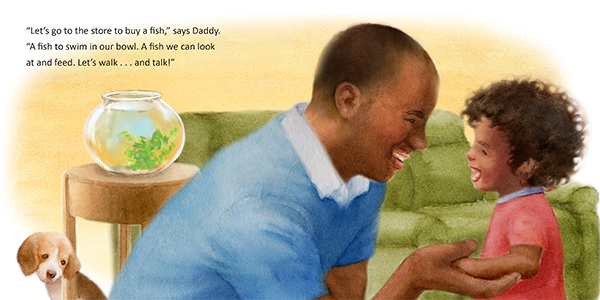
Dad plans a fun trip into town with his young child to buy a pet fish. He says, we will get “a fish to swim in our bowl. A fish we can look at and feed.” The pair are excited to go together and have time to “walk…and talk.” The two head out and soon pass a store. In the window the child sees a T-shirt with the picture of a fish on it and points. “Look—fish! Fish! Fish!” Dad reinforces the observation—“Yes, I see the fish on the T-shirt too.”—and further explains: “That’s a fish to wear, not a fish to swim in our bowl.”
Image copyright Ying-Hwa Hu, text copyright Ellen Mayer. Courtesy of starbrightbooks.com
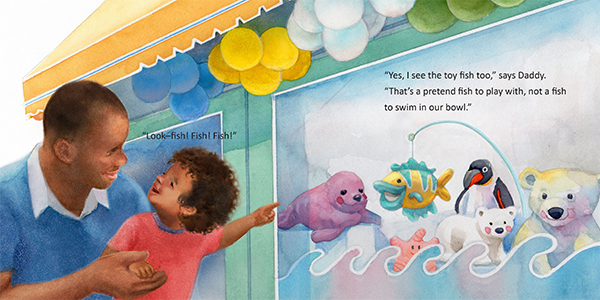
Going into the store, Dad and his youngster find another item with a fish on it. On a shelf is a backpack with a picture of a gold-and-yellow fish on the front pocket. This is a “fish to wear on your back,” Dad says, before going in search of a “fish to feed.” Next, the two come to a toy store. The child points to another fish—a fish on a mobile. “Look—fish! Fish! Fish!” the toddler exclaims. Dad affirms his child’s remark and expands on it using complete sentences that model conversation and increase vocabulary. They linger in the shop, finding other examples of fish.
Image copyright Ying-Hwa Hu, text copyright Ellen Mayer. Courtesy of starbrightbooks.com
“‘Now let’s go find a fish to feed,’ says Daddy.” They head out of the store and continue down the street. As they come to the Pet Shop, the little one shouts, “‘Look—fish! Fish swim!” Daddy echoes the excitement while praising his child. “‘You found a fish that swims!’” They take the goldfish home, where it swims happily in their bowl—a pet they “can love and feed.”
A Fish to Feed contains die-cut holes in the pages that kids will love peering through as they shop along on this adventure to find a special pet.
Image copyright Ying-Hwa Hu, text copyright Ellen Mayer. Courtesy of starbrightbooks.com
Ellen Mayer’s story of a dad and his child out for an afternoon together as they look for a pet to love offers adults and children such a sweet way to spend time with one another. The story, set in the familiar environments of home and stores and revolving around a close parent-child relationship, will engage even the youngest readers. The back-and-forth conversation between Dad and his child as they shop models ways in which adults can follow a child’s lead while providing language and literacy development. The abscence of gender-specific pronouns makes this a universal story.
Ying-Hwa Hu’s illustrations are vibrant and joyful. When Dad bends down to be at eye-level with his toddler as they talk, the close bond between them is obvious in their smiling and laughing faces. The shops are full of colorful toys, clothes, backpacks, and other items that will capture kids’ attention. Spending time looking at each page allows adults and children to point at the various items, name them, and talk about them.
Ages Birth – 5
Star Bright Books, 2015 | ISBN 978-1595727077
Red Socks
Written by Ellen Mayer | Illustrated by Ying-Hwa Hu
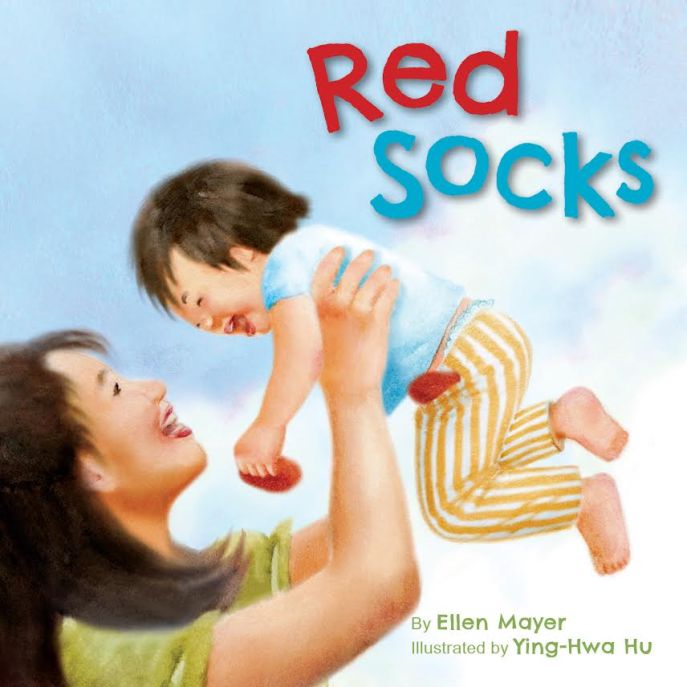
It’s laundry day and the clothes are all dried and soft and ready to wear. “‘Here is your blue shirt, with the goldfish on it,’” Mama says, pulling the top out of the basket and bending down to eye level to show it to her baby. Next, Mama describes the “yellow and white striped pants” she puts on her child. “‘Let’s see what else is in the laundry basket,’” she says.
Image copyright Ying-Hwa Hu, text copyright Ellen Mayer. Courtesy of starbrightbooks.com
Mama pulls a tiny red sock from the basket, but—“UH-OH!—where is the other red sock?’” Now it’s the baby’s turn to help. With a look down, the toddler shows Mama where the sock is. “‘You found the other red sock. Yay!’” she says, giving words to the baby’s action. She continues explaining while pointing to the sock poking out of the baby’s pocket: “‘It was hiding in your pants pocket!” Once the laundry is folded, Mama tells her child exactly what they will do next while she playfully slips the other red sock on the baby’s wiggling feet. “‘Let’s put that other sock on your foot. Then we can go play outside.’” As the baby flies in the swing outside, the red socks are brilliant dots against the blue sky.
Image copyright Ying-Hwa Hu, text copyright Ellen Mayer. Courtesy of starbrightbooks.com
Ellen Mayer’s simple and charming story of a particular moment in a mother and child’s day will immediately appeal to even the youngest reader. Familiar words coupled with clear, vivid illustrations will engage toddlers who are pre-talking and just learning language and concept development. The mother’s use of complete sentences as well as step-by-step descriptions of the activities the child sees and is involved in demonstrates how adults can converse with their babies and young children to encourage strong language and literacy skills. Free of gender-specific pronouns, Red Socks is a universal story.
Ying-Hwa Hu’s illustrations show a mother and child interacting on a typical day while they complete common chores and go outside to play. The mother and child portray a range of emotions and gestures, giving further depth to the understanding of the ideas and conversation presented. Kids will giggle at the adorable puppy who causes a bit of mischief on each page.
Ages Birth – 5
Star Bright Books, 2015 | ISBN 978-1595727060
To learn more about Ellen Mayer and her Small Talk Books® (including other titles: Cake Day and Rosa’s Very Big Job) as well as to find activities to accompany each book, visit her website!
Discover more about Ying-Hwa Hu and view a portfolio of her illustration work on her website!
Red Socks and Too Small to Fail
Red Socks was chosen by Too Small to Fail, an early literacy initiative of The Clinton Foundation to feature in their Wash Time is Talk Time project. Wash Time is Talk Time serves underserved communities and provides resources to turn time spent at the laundromat into an opportunity for families to talk together, read together, and learn together. Language-rich literacy resources will be delivered to more than 5,000 laundromats across the country.
Here’s a video from one fun afternoon with families, Ellen Mayer, and Ying-Hwa Hu during wash time!
National Family Literacy Month Activity
Child’s Sensory Board
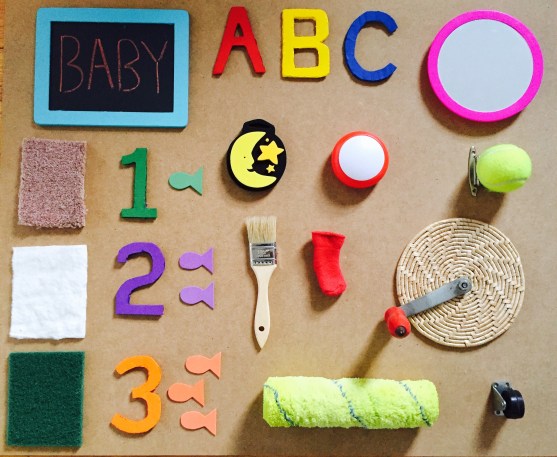
Toys or objects that provide many opportunities for sensory experimentation and observation stimulate a baby and young child to learn while having fun. You can make a sensory board for your own child using household items and that have a variety of textures, sizes, shapes, and movement. When you create your own sensory board, you can personalize it for your child by adding their name, pictures of family members, and other special items. While you play with your child, take time to talk about all of the objects on the board, what they do, and how they work. Count the objects. If you include words or your child’s name, spell them outloud and say them. There are so many ways to use a sensory board. Even if children can’t yet talk, they are listening and soaking in the rich language learning you are providing!
**When making your board always ensure that you use items that are not a choking hazard or can catch tiny fingers. Make sure that items are firmly attached to the board. Never leave a baby unattended while playing.**
Supplies
A board large enough to hold the items you want to attach. Boards that can be used include: those found at hardware stores or craft stores; large cutting boards; shelves; old table tops; etc.
Sample items for your sensory board can be age appropriate and include:
Large swatches of various textured material. (I used fur, a scrubbing sheet, and a piece of carpeting)
Wooden or thick cardboard letters and numbers, painted in a variety of colors. Letters can be used to add a child’s name to the board.
Figures cut from sheets of foam or wooden figures found at craft stores in a variety of numbers that you can count with your child (I used sets of 1, 2, and 3 fish cut from foam to go along with the numbers 1, 2, and 3)
Mirror
Push button light
Chalk board to write on
Castor or other wheel
Door latches
Door knockers
Mop heads
Paint rollers
Cranks
Drawer handles
Hinges (I attached a tennis ball to a hinge that children can push back and forth)
Pulleys
Paint in various bright colors
Paint brushes
Scissors
Screws
Nuts and bolts
Velcro
Super glue
Directions
Assemble your items
Paint wooden or cardboard items
Arrange item on the board so that your baby or child can easily reach or manipulate each one
Attach items with screws, nuts and bolts, or super glue
Push button lights or other objects that take batteries can be attached with strong Velcro. Ensure items attached with Velcro are large and not a choking hazard.
Set up board where you and your baby or child can enjoy playing with it together
Today is one of those days that gets you really observing the world in a new way. As you go about your day at the office, at school, at shops, or just while driving here and there, be aware of all the different circles you see. Sure, there are the obvious ones—the tires on your car, the signals on a stoplight, the lid of your water bottle or coffee cup…but how about all the less-seen circles? Knots on trees, a lemon slice, the center of a flower, the ripple of a raindrop or pebble dropped in a puddle… Whether you look for circles through the eye of geometry or they eye of art, be fully aware of the shapes around you!
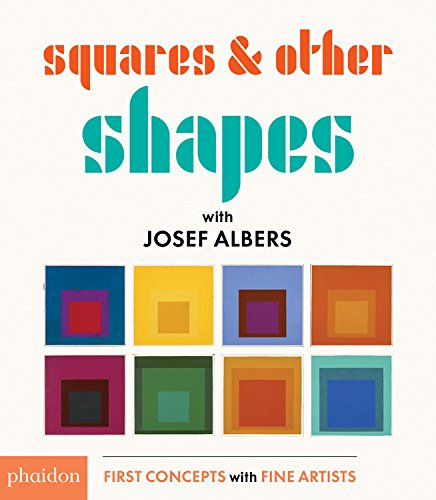
Squares & Other Shapes: with Josef Albers (First Concepts with Fine Artists)
Paintings by Josef Albers
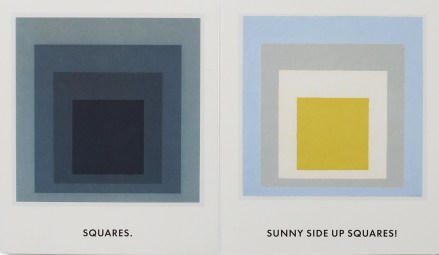
Opening Squares & Other Shapes, readers encounter a vibrant magenta square nesting in an autumn maple leaf-hued square which floats in a square of clear, winter-sky blue. On the next page two orange squares beckon you to follow into the glowing, yellow center square. Could it be a doorway or window leading somewhere?
In another painting, a bold yellow rectangle and an equally bold blue rectangle host guests: “two little rectangles lying down for a nap.” But the calm is shattered on the next page as stacks of red and blue rectangles shake and tumble: “Watch Out! It’s raining rectangles!”
Image courtesy of phaidon.com
Now circles want a turn, and they want to have fun! In a large black rectangle a white circle and a red circle play stoplight: “Circle, Circle, Stop!” while on the next page blue, black and spirally circles jump and frolic—“Bounce, Circles, Bounce!” Turn the page—can you count all of the little circles in the rectangle or all of the baby circles in the rectangle on the right-hand page? Some of the babies are leaping away—or are they just joining the group? What do you think?
Image courtesy of phaidon.com
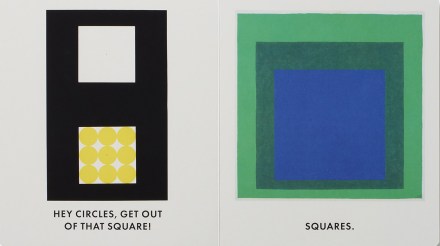
Next the black rectangle is back, but this time with two white squares inside. Wait a minute—how did those little yellow circles get into the bottom square? “Hey circles, get out of that square!” Of course triangles don’t want to be left out. Dusky triangles in many sizes connected tip to tip enjoy their light, white background, but on the next page they’re left in shadow—“Hey triangles, who turned out the lights?”
Image courtesy of phaidon.com
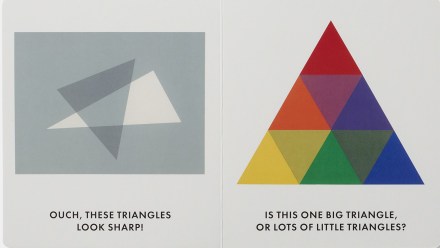
Be careful turning the page to look at the two intersecting triangles: “Ouch, these triangles look sharp!” Maybe it’s better to move on to the big, vivid triangle on the right. Oooh, so many colors! Nine, in fact! Hmmm… “Is this one big triangle, or lots of little triangles?” These paintings are getting more complex! Now there are “blue squares in pink squares, pink squares in blue squares; rectangles in rectangles, circles in circles, and more triangles in triangles. But here’s a different painting: the rectangles are perfect rectangles, but the squares are a little off, and what kinds of shapes do those curved lines make?—“Funny shapes in funny shapes!” And the last painting? Back to squares. Red, purple, and blue squares. “Beautiful squares.”
Following the paintings, the last page provides a captivating biography about Josef Albers’ life and work aimed at the book’s young audience.
Image courtesy of phaidon.com
Imagine being able to own a stunning collection of famous paintings by a world-renowned artist and educator to teach your child about shapes, color, and art. With Squares & Other Shapes by Josef Albers you can! The second in the First Concepts with Fine Artists series, Squares & Other Shapes presents readers with more than 30 painting by Josef Albers, one of the most influential artists of the 20th century. Most well-known for his Homage to the Square paintings, Albers worked with color and shapes to challenge perceptions and promote creative thinking.
Shapes are one of the earliest concepts introduced to babies and young children. Even the youngest readers will be riveted by the beautifully reproduced paintings in this large board book that present squares, circles, rectangles, and trianges in clear but creative ways. The easily understood labels, repetition, and recognizable patterns offer key strategies that are known to build strong reading and comprehension skills. Kids will love the humorous text that brings the paintings to life, helping them to also see that art is not static, but active and open to interpretation by each viewer.
Squares & Other Shapeswith Josef Albers is a wonderfully conceived concept book that can grow with children as it offers readers enjoyment and education on so many levels. The book would be an often-sought-out addition to home and library bookshelves and also makes a perfect present for baby showers and other gift-giving holidays.
Ages birth – 5 (and up)
Phaidon Press, 2016 | ISBN 978-0714872568
Look for Circles Day Activity
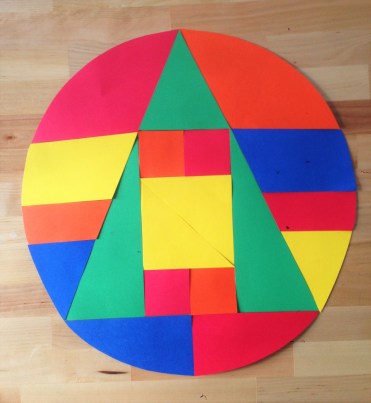
Circle of Shapes Puzzle
Build a circle from different shapes with this puzzle that grows as you add pieces! You can also use these shapes to create your own art!
Build the puzzle from the central square to the edges of the circle (It may be easier to keep the puzzle in place by sticking the pieces down with a little tape applied to the back of the pieces)
You can also use the shapes to create your own art!
Carving jack-o-lanterns from pumpkins, dressing up in spooky or funny costumes, and receiving candy just by ringing doorbells and calling out “Trick or Treat!” all make Halloween the favorite holiday of many. Thought to have originated around the ancient Celtic festival of Samhain, during which people lit bonfires and wore costumes to ward off ghosts, Halloween—or All Hallows Eve—later ushered in the November observation of All Saints Day which honors all saints and martyrs. The holiday was later embraced as a community event and has been transformed into the celebration we know today. However you celebrate, enjoy this night when a shivery chill is just for fun.
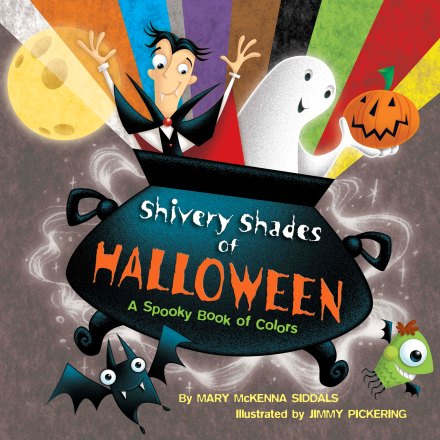
Shivery Shades of Halloween: A Spooky Book of Colors
Written by Mary McKenna Siddals | Illustrated by Jimmy Pickering
Have you ever thought, “What color is Halloween?” Sure, we all know it’s orange and black—but what about the rest of the color wheel? Tell me—what’s your favorite color? Purple? Let me look through Shivery Shades of Halloween…Yes! Halloween is purple—“Twilight, / Shadows, / Monsters lurking, / Secret potion— / Poof! It’s working! Dusky-musky, bruisy-oozy, cruelish-ghoulish / Blotch of purple.”
Hey! This is fun! Give me another one! Gray, you say? Hang on…. Yes! Halloween is Gray! “Tombstone, gargoyle, / Dungeon wall, / Rats and rubble, / Haunted hall, / Dusty-fusty, dimly-grimly, shady-fraidy / Shroud of gray.”
Image copyright Jimmy Pickering, text copyright Mary McKenna Siddals. Courtesy of Random House Books for Young Readers
Okay, now it’s my turn. I’m choosing…Red. Yep! Halloween is also Red: “Tip of fang, / Flash of cape, / Horns and tail, / A gash, a gape, Bloody-ruddy, burning-churning, blushing-gushing / Stain of red.”
Wild! And that’s just the beginning! There are also spirited, spooky rhymes about brown, yellow, blue, white, green, and, of course, orange and black.
Image copyright Jimmy Pickering, text copyright Mary McKenna Siddals. Courtesy of Random House Books for Young Readers
Mary McKenna Siddals brings joy and a love of words—their sounds and their effects—to her verses that transport kids to the throbbing heart of Halloween on the broomsticks of color. In Shivery Shades of Halloween, Siddals presents all the spine-tingling places, characters, and objects that make this holiday, and any mystery, so much chilling, thrilling fun. With giggles, ewwws, and a few shivers, kids will delight in the original and imaginative phrasing in this clever concept book.
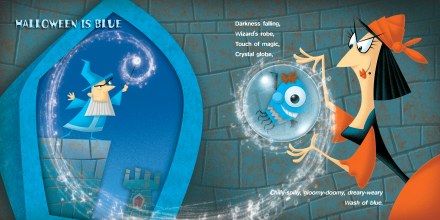
Jimmy Pickering’s vibrant, full-bleed illustrations ooze, flash, and swirl with the colors of Halloween. For Green, a “queasy-peasy” web-eared reptile slurps a “vile brew” from a test tube as an evil scientist looks on and the walls seep with a thick green sludge. Purple zaps and sparks as the reptile is transformed into a smiling goblin with bats’ wings and five legs. This goblin then leads readers from page to page where they meet a tricky ghost, a haunted graveyard, a spell-casting wizard and crystal-ball-reading witch, a floating candlestick in a haunted house, a howling werewolf, a dancing caldron, a clumsy demon, and a trio of trick-or-treaters. Each painting incorporates touches of the other colors introduced, creating eye-catching and suspense-building pages.
Shivery Shades of Halloween is a book that kids will want to hear and you will want to read over and over. For teachers, the book makes a wonderful resource for writing lessons and the power of evocative words not only around Halloween, but at any time of the year. Shivery Shades of Halloween is one concept book that transcends its holiday theme and would be a welcome addition to home bookshelves as well as school and other libraries.
Ages 2 – 7
Random House Books for Young Readers, 2014 | ISBN 978-0385369992
Take a peek at Victoria scaring up some fun by reading Shivery Shades of Halloween!
To learn more about Mary McKenna Siddals and her other books, visit her website! You’ll also find lots of activities as well as activity sheets to extend your enjoyment of Shivery Shades of Halloween: A Spooky Book of Colors as well as her other books.
Discover more about Jimmy Pickering and view a gallery of his illustrations, paintings, sculpture and more on his website. You can also find him on Facebook!
Halloween Activity
Spooky Halloween Mo-BOO-ile
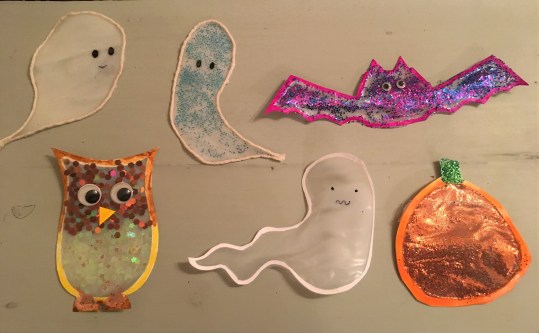
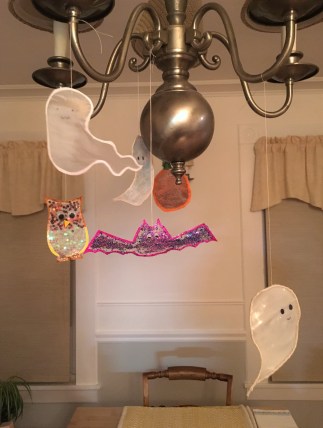
With glue, glitter, and your imagination you can make your love of Halloween and its ghosts, ghouls, pumpkins, and more colorfully transparent to all!
Poster board or other heavy stock paper or cardboard
White glue
Glitter in a variety of colors
Googly eyes (optional)
Scissors
Wax paper
Popsicle or craft sticks
Needle
White thread (or any color)
Fine-tip permanent marker
Hot glue gun or regular glue
Directions
Print the Halloween Figures templates
Cut out the figures
Trace the figures onto the poster board
Cut out the figures around the outside edge and also along the inside edge
Lay out the figure templates on the wax paper
Gently pour some white glue into the center of the figure template
Smooth the glue completely to the edges of the figure template, adding glue if needed
Sprinkle glitter on the glue, as much or as little as you’d like
To dry the glue
Let the figures sit overnight OR:
Place the figures on the wax paper in a warm oven. Turn the oven on to 200 – 250 degrees and let it come up to heat. Then turn the oven off and place the figures inside. Check after 15 minutes and check frequently until dry.
After the glue is dry
Add faces to the ghosts with a permanent marker
Add googly eyes with the hot glue or regular glue
If desired, color the edge of the template to match the color of the glitter
To hang figures
Thread a needle with the desired length of thread and gently push the needle through the glue near the top of the figure.
Tie the thread around a chandelier, curtain rod, or any other place you would like to decorate
Founded in 1992 by a woman who rescued a sheep from wooly circumstances, Hug a Sheep Day gives us time to appreciate the warmth and comfort these animals provide through their soft fleece. As winter approaches in many parts of the world, many of us would be lost and cold without our favorite wool sweaters. If you want to take full advantage of today’s celebration, find a farm or petting zoo where you can give a sheep or lamb a hug.
Six Creepy Sheep
Written by Judith Ross Enderle and Stephanie Jacob Gordon | Illustrated by John O’Brien
Six sheep just hanging out on Halloween night decided to go trick-or-treating. This spur-of-the-moment idea doesn’t leave them much time for elaborate costumes, so they cut holes in sheets and toss them over their heads. Then with pumpkin buckets in hoof and “on little sheep feet,” the “six creepy sheep went a-haunting UNTIL…they passed a passel of pirates, and one creepy sheep turned tail with a shriek.”
Five creepy sheep continue their haunting UNTIL…a flock of fairies crosses their path, sending one sheep running with a shriek. Down to four, the creepy sheep bravely head down the path again UNTIL…a herd of hobos happen by, “and one creepy sheep turned tail with a shriek.” Three bold sheep “on little sheep feet” tip toe through the forest UNTIL… “they glimpsed a gaggle of goblins” that sends one shrieking on its way.
Now two creepy sheep, more courageous than the others, hurry on as spooky trees wave and the wind howls UNTIL… “they whisked by a warren of witches” which is just too much for one of the sheep and it…well, you know! Under the bright full moon the last creepy sheep has come to the old barn that was the group’s final destination. Jack-o’-lanterns light the doorway, and the windows glow. The fearless ghostly sheep calls out, “Sheep trick or treat.” Then the farmer swings open the door to a barnyard Halloween party with music, pumpkin pie, apple cider…and all the sheep’s friends!
When the holiday is “Hug a Sheep Day” to celebrate those sweet, gentle animals that say Baaaa instead of Booo, but the specter of Halloween is everywhere, what’s a reviewer to do? The classic Six Creepy Sheep is the perfect solution! Judith Ross Enderle and Stephanie Jacob Gordon created a concept book that will keep little readers on their little feet as they count down the flock of sheep that go “a-haunting” on Halloween night. Alliterative verses introduce the other trick-or-treaters who so frighten the sheep that their numbers dwindle with each page. The repetitive phrasing makes Six Creepy Sheep a fun read-along, and the inclusive ending will charm kids.
John O’Brien’s pen and ink and watercolor illustrations are just spooky enough to create a slightly shivery story time for young readers. Kids will giggle at the orange-fleeced sheep wearing ghost costumes and walking on two legs. The site of the sheep fleeing in fright will also delight little ones as they pluck up their courage and proudly know that they would never be afraid of the pirates, fairies, hobos, goblins, and witches the sheep encounter. The forest, rendered in muted shades of purple, green, blue, and orange, is populated with trees that appear eerily alive and add to the Halloween atmosphere.
More readily available at libraries and with used booksellers, Six Creepy Sheep is a cute addition to your Halloween reading list.
Ages 3 – 6
Scholastic, 1992 | ISBN 978-0590119481
To learn more about John O’Brien and his artwork for children’s books, The New Yorker, and other publications, visit his website!
Hug a Sheep Day Activity
Sheep on a Farm Coloring Page
With their fluffy wool and sweet Baaaa, sheep are a favorite of kids and adults.Enjoy this printable Sheep on a Farm Coloring Page.
Sure, there’s that superstition about having bad luck if a black cat crosses your path, and it’s fun to indulge it and feel a little scared around Halloween, but, really, black cats are just like other cats. They’re beautiful, sleek, stealthy, and have lots of love to give—or not (they are cats, after all). If you are thinking of adopting a cat into your home, consider choosing a black cat. Because of the superstition, they are less likely to be adopted from shelters, leaving many precious kitties without families.
Black Cat, White Cat
By Silvia Borando
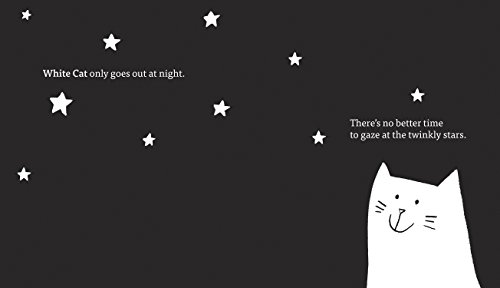
“Ever since he was a kitten, Black Cat has been entirely black….from the tip of his nose to the tip of his tail.” White cat is entirely white “from the tip of her nose to the tip of her tail.” Black Cat likes to roam during the day and watch the black swallows swoop through the sky. White Cat prefers nighttime when the twinkling stars gleam.
Copyright Silvia Borando, courtesy of Candlewick Press
Black cat becomes curious about the night, though, and asks his friend Blackbird what he could see in the darkened sky. Blackbird doesn’t know because he is asleep in his nest during the night. Blackbird suggests that Black Cat go out when the sun goes down and “see what you can see.” At the same time White Cat wonders what the daytime holds. She asks her friend Snowy Owl, but Snowy Owl doesn’t know because she is always asleep by the time the sun comes up. Snowy Owl suggests White Cat go out during the day and “see what she can see.”
Copyright Silvia Borando, courtesy of Candlewick Press
With good wishes from their friends, both Black Cat and White Cat head off on their new adventures, and somewhere between day and night, Black Cat meets White Cat. They tell each other where they are going and invite the other along with them. They agree, and so “White Cat takes Black Cat to discover the night.” Then Black Cat introduces White Cat to the day.
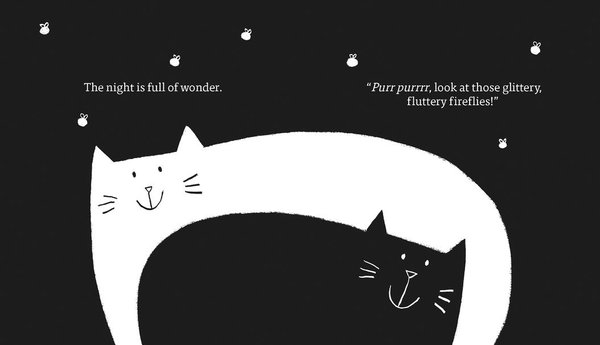
“The night is full of wonder. ‘Purr, purrrr, look at those glittery, fluttery fireflies,’” Black Cat says. “And the day is full of surprise. ‘Meow, look at those busy, buzzy bumblebees,’” White Cat exclaims. Black Cat shows White Cat all of his favorite daytime things, such as “daisies, doves, and butterflies…” while White Cat dishes up the most delicious nighttime goodies—“snakes, bats, and mice.”
From then on Black Cat and White Cat are inseparable whether it’s daytime or nighttime. “So inseparable, in fact, that they have one, two, three, four, five, SIX… KITTENS! And can you guess what color they are? Orange!”
Copyright Silvia Borando, courtesy of Candlewick Press
In her adorable book that proves opposites really do attract, Silvia Borando presents two cute cats that live in only half the world until their curiosity and friendship broaden their horizons. Borando’s gentle, lyrical language elevates this concept book to include the ideas that treasures can be found outside one’s comfort zone and that mutual sharing of one’s life and favorite things leads to strong relationships–even magic and sometimes the seemingly impossible! The soft curves of the figures and stark white-on-black and black-on-white pages make for striking illustrations that will delight even the youngest child. The final spread of the six orange kittens will delight little readers.
Wonderful for story time or bedtime, Black Cat, White Cat is a sweet addition to home libraries for young readers.
Ages birth – 5
Candlewick, 2015 | ISBN 978-0763681067
Whether it’s day or night, watch this Black Cat, White Cat book trailer!
Black Cat Day Activity
Cute Cat Coloring Page
Today is black cat day, but you can color this printable Cute Cat Coloring Page any way you’d like to!