June 28 – Paul Bunyan Day

celebrate-picture-books-picture-book-review-paul-bunyan-and-babe-the-blue-ox-the-great-pancake-adventure

About the Holiday

The tales of Paul Bunyan, a logger of superhuman size and strength, and his companion Babe the Blue Ox belong to some of the most popular folklore of early North America. Many think his name stemmed from the Quebec bon yenne!, which expresses surprise or astonishment. The phrase would be fitting as Paul Bunyan is said to have accomplished many feats, including creating the Grand Canyon when he walked through the area dragging his ax and forming the Great Lakes as a watering hole for Babe. In 1916 freelance writer and adman William B. Laughead took the figure of Paul Bunyan for an advertising campaign for the Red River Lumber Company, and the stories received new burnishing and popularity.

To celebrate today’s holiday research folklore about Paul Bunyan and Babe, take a walk in the woods Bunyan loved so well, and read today’s book!

Paul Bunyan and Babe the Blue Ox: The Great Pancake Adventure

By Matt Luckhurst

Everyone knows that Paul Bunyan and his best friend Babe the Blue Ox were “the greatest lumberjacks to every work the forests.” But not many people know just how that came to be. It all started because Paul was a very big boy in a very small town. He found it hard to concentrate on school because he was always thinking about his mom’s pancakes. “‘Math,” Paul said, “is just not very tasty.’”

Now, Paul and Babe were lucky enough to live in an area where lots of fresh fruit and vegetables were grown, but they only wanted pancakes. In fact when their mom tried to feed them broccoli, they spit it right out! So Paul’s mom baked stacks and stacks of pancakes until she was out of breath—plus she had fields to tend to. Paul and Babe tried to free up time for Mom by working in the fields, “but their big feet just squished and squashed everything in sight.”

celebrate-picture-books-picture-book-review-paul-bunyan-and-babe-the-blue-ox-the-great-pancake-adventure

Finally there were just not enough pancakes at home, so Paul hugged his mom and set off into the deep dark forest to find his “pancake fortune” with Babe at his heels. With their heads in the clouds and their bellies empty, they happened upon a lumberman with a huge problem. The Syrup River was dammed up with pancakes and the logs couldn’t get through. It was just the job for Paul and Babe!!

Paul and Babe ate every last pancake until the river was clear. The lumberman was so impressed he offered them a job on the spot! And the best part was that they would be paid in pancakes! The trio tromped from Wisconsin to California logging the land and making their mark. In Minnesota it was “so cold that al Paul’s words froze before they could make a sound. They say you can still hear his voice in the forests there today as they thaw out.” Further west Paul and Babe had a little something to do with creating the Rocky Mountains, and the Grand Canyon would still be a flat plateau if it weren’t for Babe’s voracious appetite.

But one day Babe fell ill, and Paul was feeling a little under the weather himself. The doctor gave them a grave diagnosis. “‘You seem to have been eating too many pancakes!’” he announced. Paul was flabbergasted—how could there be such a thing as too many pancakes?! But the doctor explained that a balanced diet was best. Paul pondered where he could find good food. Then it hit him! Paul and Babe said goodbye and headed back home.

celebrate-picture-books-picture-book-review-paul-bunyan-and-babe-the-blue-ox-the-great-pancake-adventure

All images courtesy of Matt Luckhurst (mattluckhurst.com)

Mom was thrilled to see them and cooked plenty of nutritious meals to make them healthy. They stayed in town and grew “Bunyan sized veggies,” helped the townspeople and always listened to Mom. And they never ate another pancake ever again! Well….

As Matt Luckhurst so adroitly knows, there is no more fascinating figure of North American folklore than Paul Bunyan and no greater meal than a pancake breakfast! Combining the two is sweet genius and rollicking fun to boot! Tall tales capture the imagination, and Luckhurst has included plenty of fantastic events to keep kids enthralled from page to page. Luckhurst’s larger-than-life illustrations burst with color and dynamic 3-D typography that enhance the humor and heart of Paul and Babe’s predicament. The juxtaposition of sizes and folk-art influences create unique, eye-catching pages, and Paul and Babe’s endearing innocence make them loveable characters.

Perfect for folktale lovers, pancake aficionados, kids who follow a singular vision, and anyone who loves a good yarn, Paul Bunyan and Babe the Blue Ox: The Great Pancake Adventure is great fun and would be an often-read addition to a child’s bookshelf.

Ages 4 – 8

Abrams Books for Young Readers, 2012 | ISBN 978-1419704208

Take a peek at this awesome trailer for Paul Bunyan and Babe the Blue Ox: The Great Pancake Adventure!

Copyright Matt Luckhurst

Paul Bunyan Day Activity
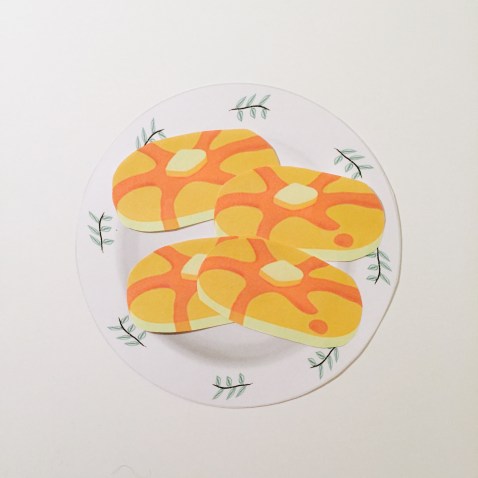
celebrate-picture-books-picture-book-review-pancake-game

Pancake Flip-Out

Pancakes are served in a stack because they’re so delicious each one doesn’t last long! This game gives you the chance to see how many pancakes you can flip onto a plate! You can play this game several ways:

  1. Give each player the same number of pancakes and see how many they can toss onto the plate during their turn
  2. Make a target with the plate in the middle and draw 3 concentric circles around it. Hitting the target can earn you 20 points. Getting your pancake in the first circle around the plate earns you 15 point, the second circle is worth 10 points, and the third is worth 5 points. Rotate through the players as many times as you like and add up the points at the end. The player with the most points wins!
  3. Instead of tossing the pancakes with your hands, try throwing them with a spatula!
  4. Make up your own rules—and have fun!

Supplies

Directions

  1. Print the Pancakes and Breakfast Plates and cut them out
  2. Glue the pancakes and plate to poster board, cardboard, or foam to give the pancakes more weight for throwing and the plate more support
  3. Once dry, the game pieces are ready for fun!

Picture Book Review

April 15 – Take a Wild Guess Day

Guess Who, Haiku by Deanna Caswell and Bob Shea picture book review

About the Holiday

Do you have a knack for guessing right answers? Then today is your day! Conjured up by Jim Barber to celebrate hunches, surmises, estimates, and other forms of speculation, today is the perfect time to put your powers of deduction to work. Enjoy the day with games of chance, shell games, card tricks, guessing competitions, or friendly wagers. Just don’t guess on your taxes!

Guess Who, Haiku

Written by Deanna Caswell | Illustrated by Bob Shea


Down on the farm the animals are playing games and they invite readers to join in the fun! Combining poetry with a guessing game, this cute book introduces younger children to haiku. On each page an animal presents a riddle about another animal in the form of a haiku. When readers turn the page, they discover the answer to the riddle as well as another one to solve.

celebrate-picture-books-picture-book-review-guess-who-haiku-cow-haiku

Image copyright Bob Shea, text copyright Deanna Caswell. Courtesy of Harry N. Abrams Books

As morning dawns the first haiku reveals: “new day on the farm / muffled mooing announces / a fresh pail of milk”. Then kids are asked, “Can you guess who from this haiku?” Flipping the page, kids see a smiling cow who in turn has a haiku for them: “flower visitors / busy buzzing in the field / black and yellow stripes”.

Other animals familiar to kids—a horse, bird, fish, mouse, cat, dog, and this guy: “from a lily pad / keen eyes spy a careless fly / a sticky tongue—SNAP!”— also puzzle over each other from page to page. The final haiku describes an animal like no other: “two hands hold a book / guessing animals’ puzzles / written in haiku”. Who can it be? Kids will giggle and beam when they discover that they too are in the book!

celebrate-picture-books-picture-book-review-guess-who-haiku-cow-haiku

Image copyright Bob Shea, text copyright Deanna Caswell. Courtesy of Harry N. Abrams Books

Deanna Caswell’s Guess Who, Haiku is a fun way to get kids interacting with poetry and the very accessible haiku form. Her clever riddles contain lovely images and lyrical alliteration that make these poems as enjoyable to read as they are to hear.

Bob Shea’s animals are adorably illustrated on vibrant solid-colored backgrounds, and each haiku is accompanied by an image that helps kids guess the answer to the riddle. The text and illustrations work together to make Guess Who, Haiku a wonderful way to spend time with kids—who, after reading, may want to make up some poems of their own!

Ages 3 – 6

 Harry N. Abrams, 2016 | ISBN 978-1419718892

Check out a gallery of work by Bob Shea on his website!

Take a Wild Guess Day Activity

CPB - Animal Matching Cards

Match Up the Animals! Game


Test your powers of memory—or your ability to guess correctly—with this Animal Pairs matching game!

Supplies

Directions

  1. Print the Animal Pairs Cards, print two pages to have double cards. To make the game more difficult print 3 or more pages to find 3 or more groups of matching animals
  2. Color the cards
  3. Cut out the cards
  4. Lay the cards face down on a table in random order
  5. Turn over cards to look for matching pairs
  6. When you find a matching pair leave the cards face up
  7. Continue playing until you find all the matching animal pairs or groups

Picture Book Review

February 25 – National Chili Day

Armadilly Chili picture book review

About the Holiday

What could be more satisfying on a mid-winter day than a spicy bowl of chili?  Whether made with meat or veggies, combined with macaroni, or served in potato skins, the simmered flavors make for a scrumptious meal. Although the origins of chili are lost to history, it’s believed that the dish is a southwestern, specifically Texan, concoction. It began to attract attention in the early 1800s, and by the 1880s”Chili Queens” were selling “bowls o’red” at chili stands throughout San Antonio. In 1893 the San Antonio Chili Stand made an appearance at the Chicago World’s Fair. It’s popularity took off across Texas and throughout the west by the 1920s. When the Great Depression hit, chili became one of the only affordable meals for the hungry population.

Armadilly Chili

Written by Helen Ketteman | Illustrated by Will Terry


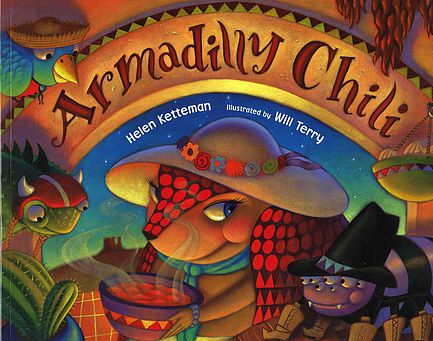
What a hoot! The knee-slappin’, root-a-tootin’ phrasing in Hellen Ketteman’s Armadilly Chili is shor ‘nuf gonna make this a favorite on any child’s bookshelf. While the plot may be familiar, the southwest setting and Miss Billie Armadilly put a fresh, funny twist on it.

celebrate-picture-books-picture-book-review-armadilly-chili-gathering-ingredients

Image copyright Will Terry, courtesy of willterry.com

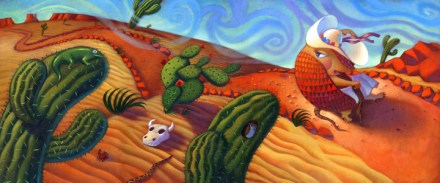
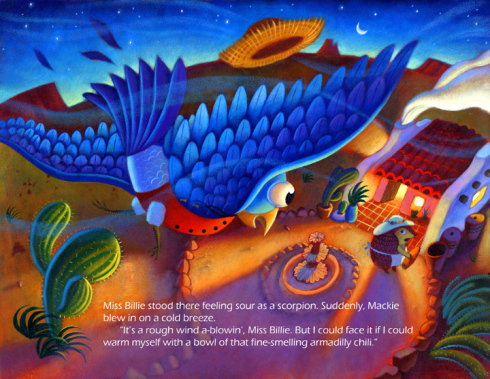
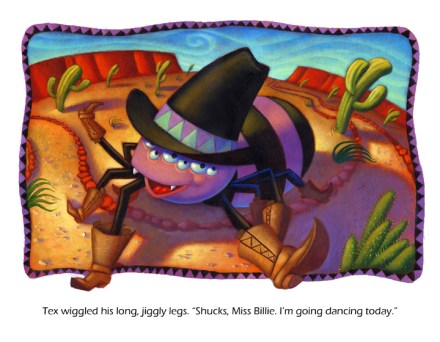
Miss Billie Armadilly is gathering ingredients for her hot armadilly chili as a blue norther blows in. She’s gathering beetles when her friend Tex, a many eyed tarantula tip taps by. When Billie asks him to help her collect beetles, he tells her he can’t because he’s going dancing. Miss Billie harrumphs and does it herself. Next Miss Billie is picking peppers, and when Mackie the bluebird flies in she thinks she has some help. Once again, though, she’s left on her own since Mackie is going to the movies. Her friend Taffy, the horned toad, begs off from chopping prickly pear, saying he’s got plans to go skating.

celebrate-picture-books-picture-book-review-armadilly-chili-Mackie-flies

Image copyright Will Terry, text copyright Helen Ketteman, courtesy of willterry.com

At home, Miss Billie stirs her chili to a scrumptious bubble. The aroma entices first Tex, then Mackie, and finally Taffy to come a’knockin’ at her door looking for a bowlful. Billie has something to say about that—specifically, “no workin’ with Billie, no sharin’ the chili!”

Billie’s friends hurry away, and Billie sits down to her feast. But after all that work, the chili tastes as “flat as a Texas prairie.” What’s wrong? She realizes what the missing ingredient is just as the doorbell rings. She opens the door to find her friends standing there with bags in their hands. What’s in those sacks? Apologies! And hot apple cider, jalapeno biscuits, and homemade chocolate fudge. Now that the friends are all together, the chili tastes just right, and they laugh and talk and eat throughout the blustery night.

celebrate-picture-books-picture-book-review-armadilly-chili-tex

Image copyright Will Terry, text copyright Helen Ketteman, courtesy of willterry.com

Helen Ketteman’s fast-paced Armadilly Chili is a welcome take on what it means to be a good friend. Her Western setting, lively language, and fast pacing will keep kids laughing and rooting for Billie and her pals. Will Terry’s bright illustrations washed with a palette of deep reds, oranges, greens, and yellows firmly sets the story in the Southwest. Billie’s facial expressions as each of her friends abandon her to her chores are priceless, and their final camaraderie is highly satisfying.

Ages 4 – 8

Albert Whitman & Company, 2008 | ISBN 978-0807504581

Discover more about Helen Ketteman and her books on her website!

View a gallery of illustration work, drawings, and picture books by Will Terry on his website!

National Chili Day Activity

CPB - Chili Pepper Game

Hot, Hot, Hot! Chili Pepper Chili Game


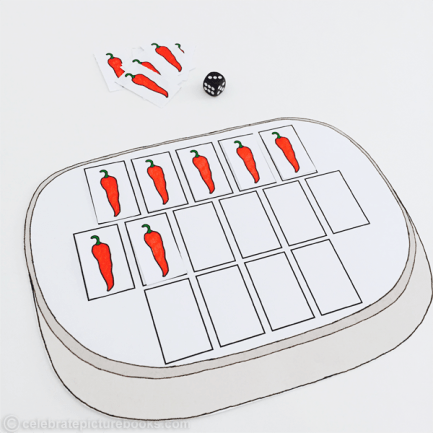
Chili just isn’t chili without a little heat! But can you take 15 chili peppers in your bowl? If you want to win the Hot, Hot, Hot! Chili Pepper Chili Game you’ll have to!

Object of the Game

The object of the game is to collect 15 chili peppers in your bowl before any other player.

Supplies

Rules

  1. Any number of players can play at one time. Print 1 Chili Bowl game board and 1 set of 15 Chili Pepper cards for each player
  2. Give 1 Chili Bowl Game Board to each player
  3. Place the Chili Pepper Cards in a pile or in a bowl
  4. Roll the die to see who goes first. The person with the highest roll goes first
  5. To begin play, the first player must roll a 1, 2, or 3. They should roll until they get one of these numbers.
  6. Players roll the die and collect or lose chili pepper cards by the number of dots on the die. If you roll a:
  • 1 – Pick up 1 chili pepper card and place it on your chili bowl game board
  • 2 – Pick up 2 chili pepper cards and place them on your chili bowl game board
  • 3 – Pick up 3 chili pepper cards and place them on your chili bowl game board
  • 4 – Get a chili pepper card from the player on your left
  • 5 – Give a chili pepper card to the player on your left
  • 6 – Lose a turn

     7. If a player does not have chili pepper cards to give to another player or if the player on           their left has no cards to give, the player rolls again.

    8. Continue play until one player has filled their Chili Bowl with chili peppers!

February 22 – Museum Advocacy Day

CPB - How the Dinosaur Got to the Museum II

About the Holiday

Today is a day when we can show our museum curators and representatives in government how much we value museums. Without these grand (and sometimes small) buildings dedicated to preserving and teaching about our historical, scientific, and cultural achievements, our lives would be much poorer. Show your support for museum funding by visiting and/or donating to your favorite museum!

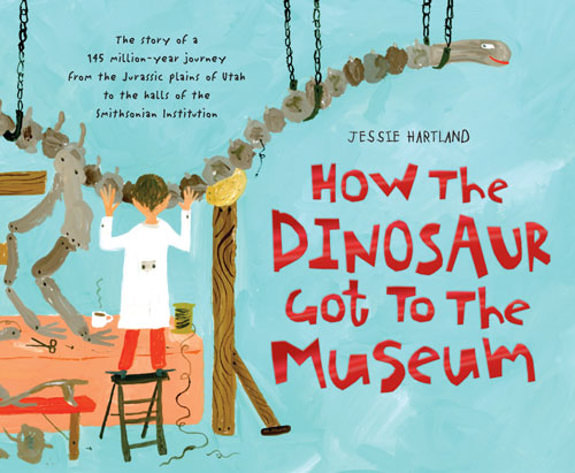
Another wonderful way to celebrate our custodians of history, science, art, and life is by reading the clever How the Dinosaur Got to the Museum / How the Sphinx Got to the Museum / How the Meteorite Got to the Museum series by author-illustrator Jessie Hartland.

How the Dinosaur Got to the Museum

By Jessie Hartland


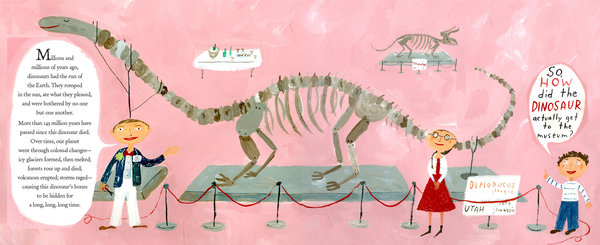
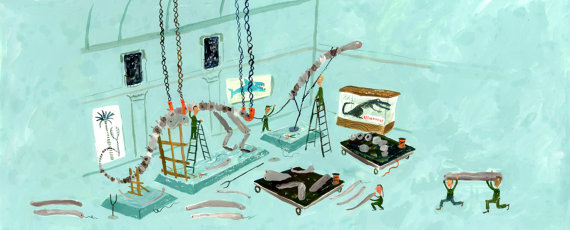
“So…” asks a little boy visiting the Smithsonian Museum of Natural History, “how did the dinosaur get to the museum?” Thus begins the tale—not of the dinosaur’s life, but of its journey from life to the museum exhibit hall.

celebrate-picture-books-picture-book-review-how-the-dinosaur-got-to-the-museum-talking-about-dinosaur

Image and text copyright Jesse Harland, courtesy of Blue Apple Books

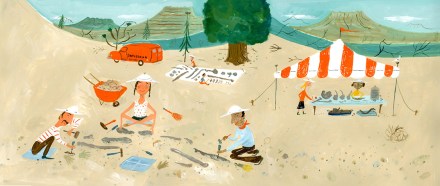
One hundred and forty-five million years ago, the dinosaur roamed the plains of what is now Utah, Overcome by weather and evolutionary events, the dino is buried and much, much later once again exposed. A Dinosaur Hunter finds one large bone and believes it to be from a Diplodocus Longus. He calls in the Paleontologist who confirms it. A team of Excavators arrives and unearths the rest of the skeleton.

The Movers pack the skeleton which was found by the Dinosaur Hunter, confirmed by the Paleontologist, and dug up by the Excavators and load it on a train that transports it to the Smithsonian. Here, the bones are cleaned and preserved by the Preparators, who discover that the head and neck are missing!

celebrate-picture-books-picture-book-review-how-the-dinosaur-got-to-the-museum-digging

Image copyright Jesse Harland, courtesy of Blue Apple Books

The Curator locates a plaster cast at another museum and work continues. The Diplodocus is assembled, but in the darkness the Night Watchman trips over its tail and breaks it! In come the Welders to fix it, and finally the Riggers can display the skeleton.

The Exhibits Team creates a background, lighting, and signs for Diplodocus, and the Cleaners give it a final dusting before the Director invites the public to view the magnificent exhibit with a speech and a toast.

celebrate-picture-books-picture-book-review-how-the-dinosaur-got-to-the-museum-exhibit

Image copyright Jesse Harland, courtesy of Blue Apple Books

Jessie Hartland’s bold, colorful illustrations offer a child’s-view perspective on the behind-the-scenes working of a museum, while her highly entertaining and educational text will keep kids giggling and reciting along as each page builds on the next to reveal the story of the men, women, and processes engaged in creating a museum exhibit.

Ages 5 – 9

Blue Apple Books, New Jersey, 2011 | ISBN 978-1609050900

Museum Advocacy Day Activity

CPB - Cookie Jar Museum (2)

Create a Museum Exhibit

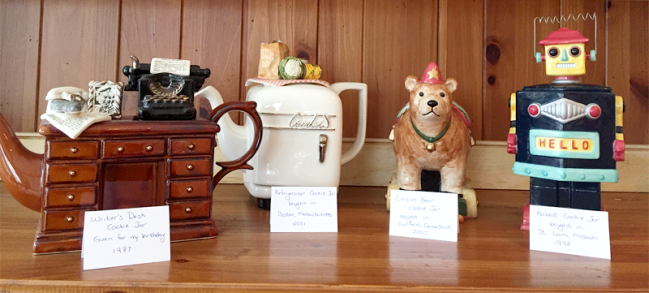
Every item has a story. Is there a funny anecdote behind that knick-knack on the shelf? Does your favorite serving dish hold sentimental value? A fun and educational way for kids to learn family stories and interact with their own history is to create a museum exhibit of objects in your home.

For teachers this can be a fun classroom activity that incorporates writing, art, and speaking, and categorizing skills. Students can use objects in the classroom or bring items from home to set up museum exhibits. This activity can be done as a whole-class project or by smaller groups, who then present their exhibit to the rest of the class.

Supplies

  • A number of household or classroom items
  • Paper or index cards
  • Markers
  • A table, shelf, or other area for display

Directions

  1. To get started have children gather a number of items from around the house to be the subjects of their exhibit. An exhibit can have a theme, such as Grandma’s China or Travel Souvenirs, or it can contain random items of your child’s choice, such as toys, plants, tools, even the furniture they see and use every day.
  2. Using the paper or cards and markers, children can create labels for their exhibit items. Older children will be able to write the labels themselves; younger children may need adult help.
  3. Spend a little time relating the story behind each object: where it came from, how long you’ve had it, when and how it was used in the past, and include any funny or touching memories attached to the item. Or let your child’s imagination run free, and let them create histories for the objects.
  4. When the labels are finished, arrange the items on a table, shelf, or in a room, and let your child lead family members or classmates on a tour. You can even share the exhibit with family and friends on social media.
  5. If extended family members live in your area, this is a wonderful way for your child to interact with them and learn about their heritage.

February 6 – Lace Day

celebrate-picture-books-picture-book-review-fionas-lace-cover

About the Holiday

Lace, that delicate material that trims clothing, covers tables, ties up hair, and makes anything seem more dainty and lovely, has been used since the 1500s. When you look at the intricate patterns and fine threads of lace, it’s hard to believe that people once made it all by hand. Lace makers were paid well for their art by the fashion industry, which used it to attract distinguished customers. While lace is mostly made by machines now, the handcraft is making a comeback. Today’s reviewed picture book is about a girl whose lace work was invaluable.

Fiona’s Lace

By Patricia Polacco


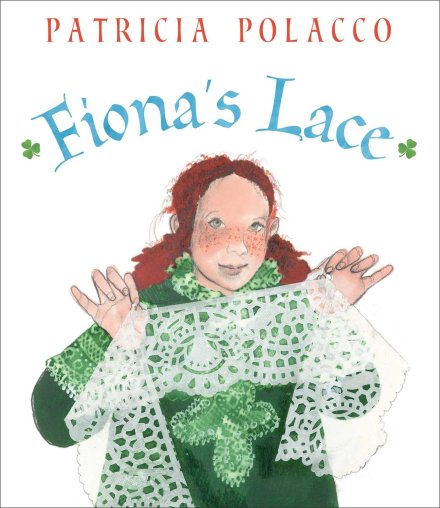
In Fiona’s Lace author-illustrator Patricia Polacco weaves a tale of family love and America’s early immigrant heritage that is as intricate and lovely as the material we celebrate today. The story begins in Ireland, where Fiona and her sister Ailish live with their muther and da. They live happily in Glen Kerry, where their father works in the textile mill and their mother teaches Fiona her art of lace making.

celebrate-picture-books-picture-book-review-fiona's-lace-ma-teaches-lacemaking

Copyright Patricia Polacco, courtesy of simonandschuster.com

In the evenings the girls are entertained by family stories, especially their favorite about how, when their parents first met, their mother left a trail of lace from the factory to her house for her young suitor to follow.

When the textile mill closes, Fiona’s family signs a contract indenturing themselves to a family in Chicago. The voyage to America is long and arduous, but when they arrive in Chicago they marvel at the grand houses and elegant clothes, imagining that this awaits them too in their new home. The reality, however, is much different. Their 2-room apartment is ramshackle, and only by working two jobs can their parents make enough money to live on.

celebrate-picture-books-picture-book-review-fiona's-lace-fiona-gets-job

Copyright Patricia Polacco, courtesy of simonandschuster.com

Fiona wants to help and soon finds that dressmakers will pay handsomely for the lace she makes. The family’s money tin begins to fill up and they are prospering. One night while Muther and Da are away working, a fire rages through Chicago. Fiona and Ailish escape with only the money tin and Fiona’s lace. They run far from home, but worry—how will their parents find them?

Remembering their favorite story, Fiona cuts her lace into strips and ties bits of it along their route to their hiding place. The girls cower in fear until they hear the familiar voices of their parents. Happily reunited, the family lets go of what they have lost, but Ailish cries over the now sooty, torn lace. Ma reassures her and brings comfort, revealing that far from being ruined, this scorched lace is the most valuable and cherished of all because it saved the family.

celebrate-picture-books-picture-book-review-fiona's-lace-trail-of-lace-story

Copyright Patricia Polacco, courtesy of simonandschuster.com

Patricia Polacco’s heartwarming and harrowing story of an Irish immigrant family is a beautiful reminder of the unique talents and strong bonds that built America. Readers will be enthralled by Polacco’s realistic dialogue and detailed storytelling in this compelling and suspenseful tale and will cheer as Ailish cleverly uses her ma and pa’s trick and her own skills to save her family.

Polacco’s gorgeous illustrations bring the time period alive for young readers, portraying the intricate art of lacemaking and the clothing styles that made use of this delicate trimming. Her depictions of tenement living are realistic, yet reveal the love and close family ties within through a warm color palette and the inclusion of cozy comforts brought from Ireland.

Fiona’s Lace is a wonderful book for classroom and home story times.

Ages: 4 – 8

Simon & Schuster, New York 2014 | ISBN 978-1442487246

Discover more about Patricia Polacco and her many, many books on her website!

Lace Day Activity

Hide-and-Seek Game

While Fiona and her sister used a lace trail to lead their parents to their hiding place, you can have fun making a hide-and-seek game for your friends. This game can be played inside or outside

Supplies

  • 1 or 2 yards of lace, cut into sections about 6-inches each. You can use lace to celebrate Lace Day or use string, ribbon, or other kinds of material
  • Choose something to hide – this can be a toy, a secret letter, a snack, or anything

Directions

  1. Hide the item you choose in a secret place
  2. Determine the starting place for your hide-and-seek game
  3. Along the route from the starting point to the hidden item, tie the sections of lace onto things like lamps, furniture, stair banisters, door knobs, etc. if  you’re playing inside. If you are playing outside, tie it onto trees, bushes, bird feeders, swing sets, etc.
  4. For very young children the trail of lace can be straightforward; for older children the trail can be longer and more difficult

February 4 – Homemade Soup Day


celebrate-picture-books-picture-book-review-soup-day-cover

About the Holiday

On a cold February day (or even a warm one if you live in a southern climate!), there’s nothing more satisfying than a steaming-hot bowl of your favorite soup! While there are many tasty canned soups, in honor of today you may want to try creating your own concoction. Why not check out recipes from your heritage, geographic location, or even your favorite book? Bon appétit!

Soup Day

By Melissa Iwai


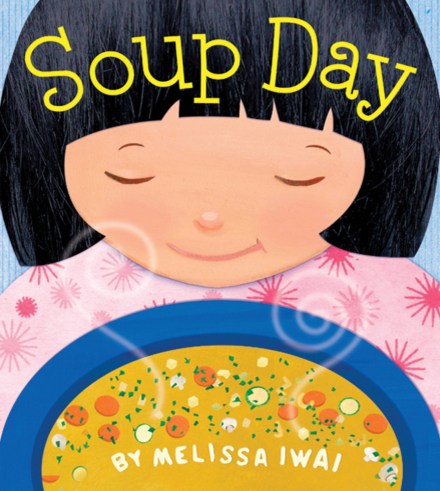
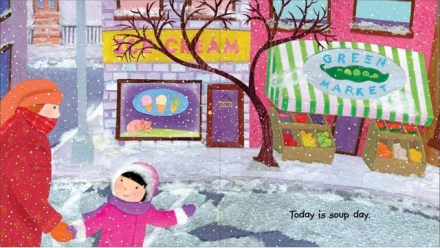
This is the perfect book for a cold winter day that celebrates the warmth and deliciousness of soup! In author-illustrator Melissa Iwai’s delightful book, the white flakes are falling and the sidewalks are piled high with snow as a little girl and her mother make their way to the market to buy ingredients for their homemade soup. At the store they fill their basket with celery, potatoes, mushrooms, carrots, onions, and more.

celebrate-picture-books-picture-book-review-soup-day-today-2

Copyright Melissa Iwai, courtesy of us.macmillan.com

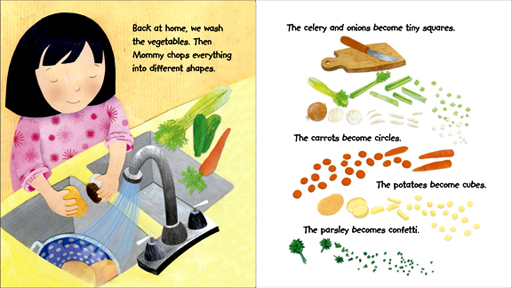
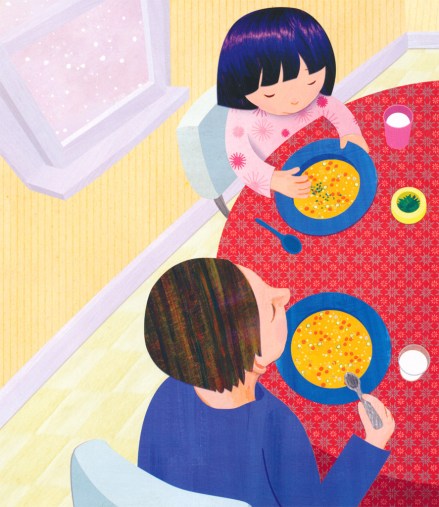
Back at home the little girl and her mom chop the vegetables, put the ingredients in a pot, and simmer the soup until its steamy. While they wait they play games and read together. Later the girl and her mother add spices and alphabet pasta to the bubbling soup. When Daddy comes home they enjoy the delicious meal.

celebrate-picture-books-picture-book-review-soup-day-cutting-veggies

Copyright Melissa Iwai, courtesy of us.macmillan.com

Smoothly integrated into the story are lessons in counting and shapes, which makes the book one that would be fun to replicate with older children—in fact there is a recipe for soup on the last page!

celebrate-picture-books-picture-book-review-soup-day-eating-soup

Copyright Melissa Iwai, courtesy of us.macmillan.com

Iwai’s bold, vivid images are tantalizing. As you turn through the pages you can almost taste the fresh vegetables and wish you could grab some of that produce for yourself. The sweet expressions of the girl and her mother show how much they enjoy spending time together making this special meal.

Ages 2 – 6

Henry Holt, Christy Ottaviano Books, New York, 2010 | ISBN 978-0805090048

Homemade Soup Day Activity

Make Silly Soup


You can create Silly Soup from anything but the kitchen sink in the kitchen sink! Just gather a bunch of fun “ingredients” and stir them together to make soup fit for a…monster? Ogre? Fairy? Your favorite stuffed animal? Who would you like to feed?

Note for Parents: This can be a fun way to teach your child about different foods and kitchen tools. Let your child see and smell different spices as they add them to their soup. Explain the different shapes of pasta. You can even teach about color by combining food colorings to see what happens. Add a science-based experiment by letting your child watch what happens to butter, sugar, or salt when they are placed in warm water.

When all the ingredients are added, use a variety of kitchen tools to stir it up! Show your child a big serving spoon, slotted spoon, whisk, spatula, ladle, teaspoons, and whatever other tool they may like to use.

*Remember, Silly Soup is just for making, not for eating!

Supplies

  • Big pot or bowl
  • Food coloring
  • Sprinkles
  • Glitter
  • Spices
  • Small pasta pieces
  • Butter
  • Sugar
  • Anything of your choice

Directions

  1. Add water to pot or bowl
  2. Add ingredients
  3. Stir
  4. Make up a story about who will eat your soup!

February 2 – Sled Dog Day

celebrate-picture-books-picture-book-review-akiak-a-take-from-the-iditarod-cover

About the Holiday

On this day we honor the sled dogs who have bravely risked their lives to help human beings survive and flourish in some of the harshest landscapes from our earliest history. One of these memorable times occurred in 1925 when a diphtheria epidemic swept through Nome, Alaska. The only anti-toxin that could help was in Anchorage—more than 900 miles away! The weather was horrific and the only way for the serum to reach the ailing population in time was by dog sled. Through incredible bravery, strength, and perseverance, a relay of dog-sled teams completed the run and delivered the serum.

Today’s Iditarod honors this heroic effort. While this picture book review revolves around the Iditarod, if you would like to read about the serum run and a brave sled dog that made the success of the project possible, I highly recommend another picture book by Robert Blake: Togo.

Akiak: A Tale from the Iditarod

Written and Illustrated by  Robert J. Blake

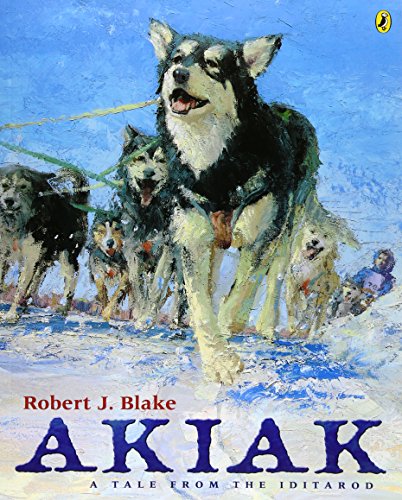
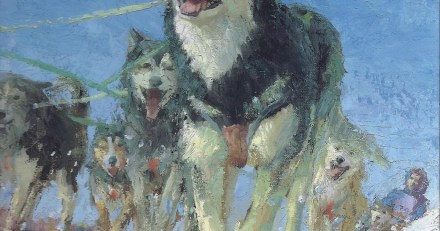
The annual Iditarod is the setting for this dramatic outdoor adventure that pits mushers and their sled dogs against the harshest climate and each other. Akiak is a veteran of this grueling race from Anchorage to Nome, Alaska. She has led a team of dogs to a fifth, third, and second place, but that winning spot has been so elusive. This year Akiak is 10 years old and it will be her last chance to bring home a first-place finish for the 16-dog team and Mick, her musher.

celebrate-picture-books-picture-book-review-akiak-a-take-from-the-iditarod-sled-team

Image copyright Robert J. Blake, courtesy of Puffin Books

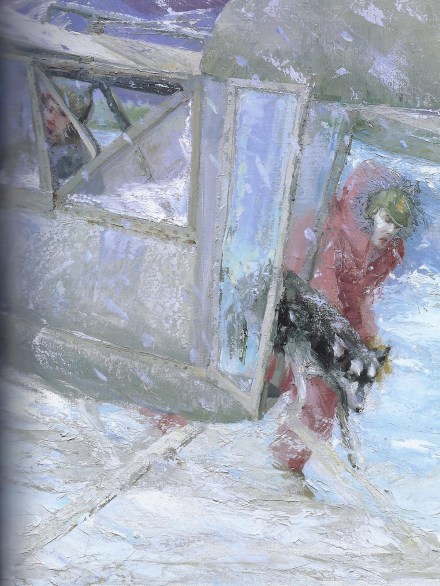
Akiak possesses the drive and heart to lead the sled up and over dangerously steep hills, through icy water and deep snow, and through howling storms. On Day 3 Akiak, Mick, and the other dogs pass Willy Ketcham, their main rival, and the race is looking good. But on the fourth day of the race, ice jams Akiak’s paw and she can’t continue. Mick leaves her at a checkpoint to be flown home while another of the dog team takes her place.

celebrate-picture-books-picture-book-review-akiak-a-take-from-the-iditarod-akiak-goes-outside

Image copyright Robert J. Blake, courtesy of Puffin Books

But Akiak won’t give up easily. Taking advantage of difficult weather, she is able to escape from the handlers putting her on the plane and speeds away, following her knowledge of the trail and the scent of the team to find Mick.

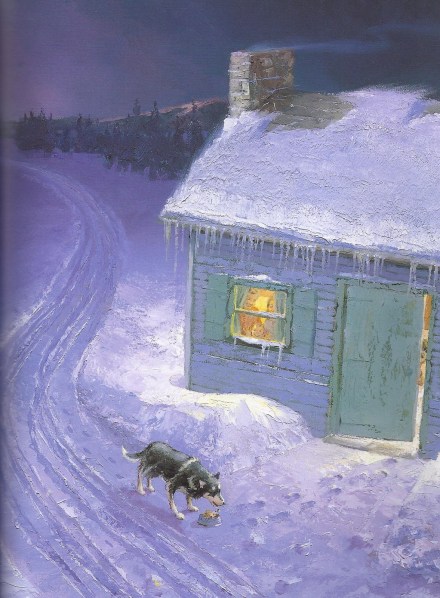
Akiak waits out a blizzard, outsmarts trail volunteers who try to catch her, and endures hunger and thirst to narrow the distance between her and Mick. With the help along the trail, Akiak comes closer to her old team. Finally on day 10, just when the team and Mick need her most, Akiak catches up with them! The Iditarod rules say Akiak can’t be put back on the team, but that doesn’t mean she still can’t help.

celebrate-picture-books-picture-book-review-akiak-a-take-from-the-iditarod-akiak-gets-food-along-the-way

Image copyright Robert J. Blake, courtesy of Puffin Books

Akiak knows something Mick doesn’t. While the team is floundering among crisscrossing trail marks, Akiak nudges them onto the right track. Akiak jumps in the sled with Mick, and they glide into Nome ahead of Ketcham – triumphant!

Author-illustrator Robert Blake has created a fast-paced adventure full of as many twists and turns as the Iditarod trail itself. Children of all ages will cheer Akiak along on his journey. Blake’s oil painting illustrations bring to life the whipping snow, howling winds, and deep drifts of this forbidding landscape. The movement and determination of Akiak and the other sled dogs are rendered beautifully as they strive to win. Alaska’s vast beauty becomes a character itself in the icy blue and white tones of Blake’s work.

Ages 4 – 8

Puffin Books, New York, 2004 | ISBN 978-0142401859

Discover more about Robert Blake and his many books, plus sketchbooks and a video on his website!

Sled Dog Day Activity

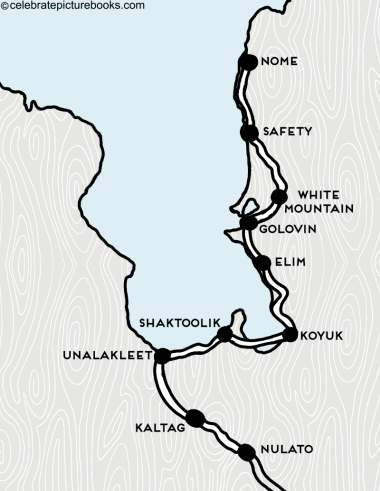
CPB - Iditarod game map

Race the Iditarod Trail! Board Game


Play Race the Iditarod Trail—a game as wild as the run itself! The game board, playing cards, and instructions can all be found here (save images to print a full page):

Even Years Route

Odd Years Route