June 11 – Making Life Beautiful Day

celebrate-picture-books-picture-book-review-the-color-collector-cover

About the Holiday

Today’s holiday was established by Apriori Beauty in 2015 to recognize all those people who make life more fun, meaningful, joyful—more beautiful—for someone else. This can be done in so many ways. Spending more time talking with someone lets them know you care. Sharing your talent for baking, art, music, gardening, home repair, or any skill with a friend, family member, or coworker brings joy to them and you. Even just giving a smile to those you meet can brighten someone’s day. Making someone else feel good will make life more beautiful for you too!

The Color Collector

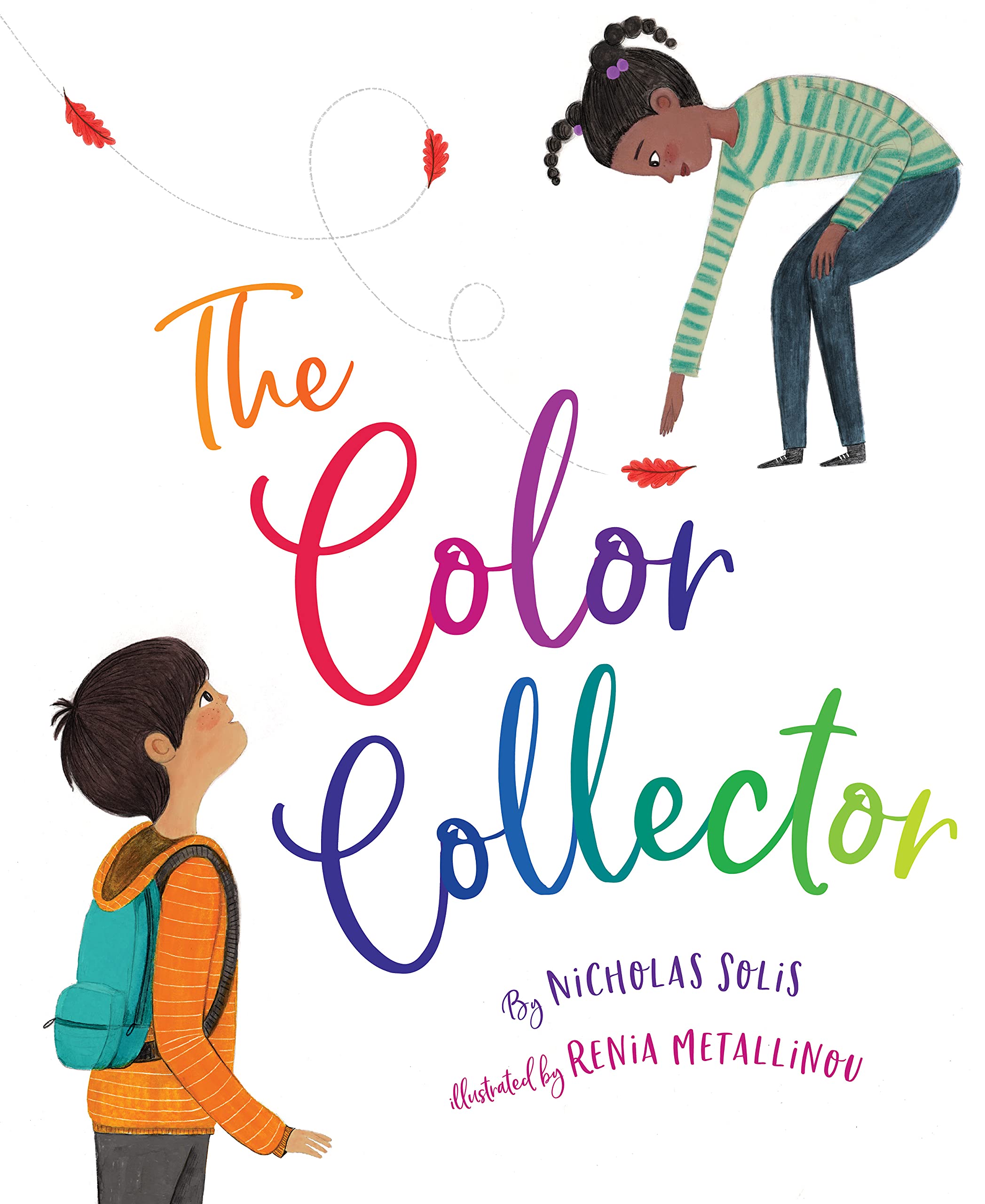
Written by Nicholas Solis | Illustrated by Renia Metallinou


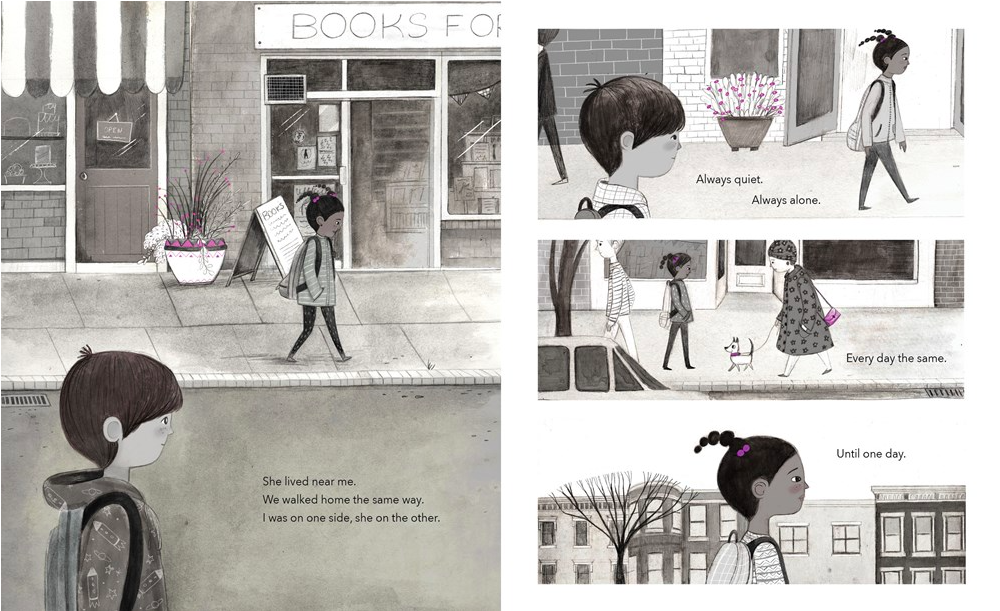
A boy notices a new girl, Violet, at school. He knows what it’s like to be the new kid, so he waves to her as she sits on a bench alone, reading. She gives him a small smile—he thinks—but doesn’t say anything. He knew that Violet lived near him because they always “walked home the same way,” although he “was on one side, she on the other.” She was “always quiet. Always alone.”

celebrate-picture-books-picture-book-review-the-color-collector-walking

Image copyright Renia Metallinou, 2021, text copyright Nicholas Solis, 2021. Courtesy of Sleeping Bear Press.

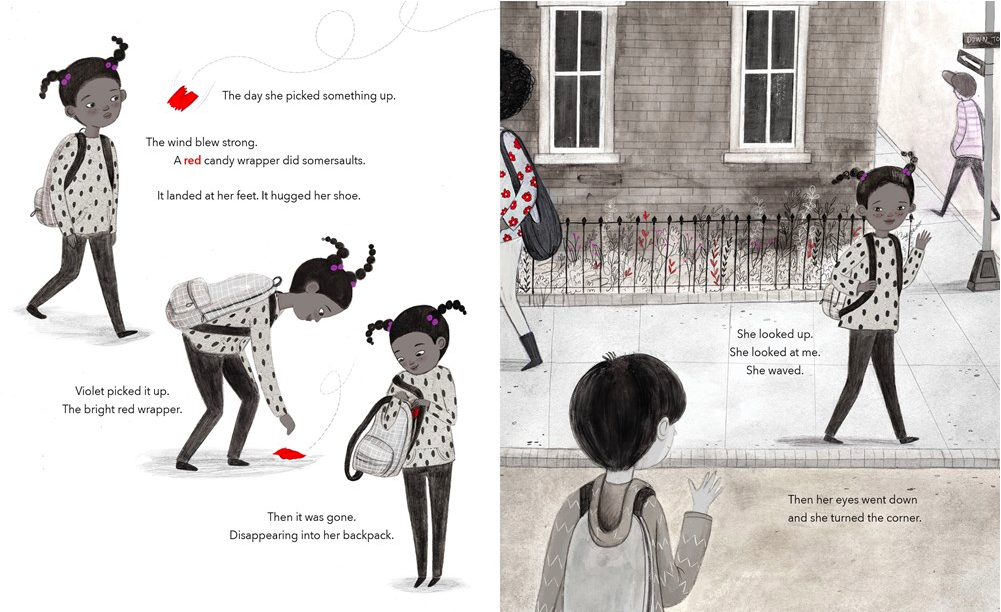
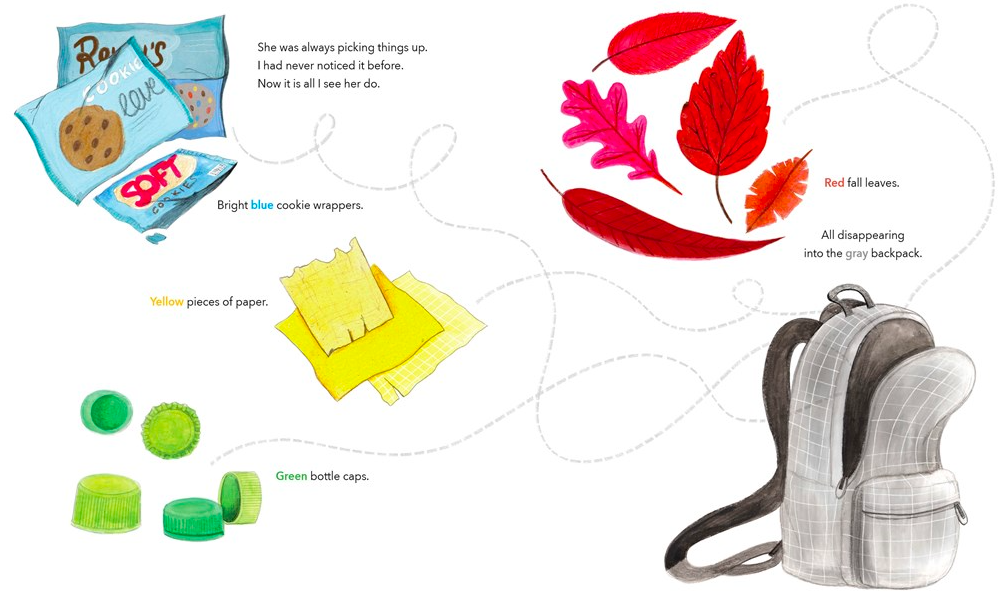
It was always the same until one day when the wind blew a red candy wrapper Violet’s way and the boy watched her pick it up and put it in her backpack. When she looked up, Violet saw the boy watching. “She looked at me,” he says. “She waved. Then her eyes went down and she turned the corner.” Now, the boy noticed how many things Violet picked up along the way home. “Bright blue cookie wrappers. Yellow pieces of paper. Green bottle caps. Red fall leaves. All disappearing into the gray backpack.”

celebrate-picture-books-picture-book-review-the-color-collector-paper

Image copyright Renia Metallinou, 2021, text copyright Nicholas Solis, 2021. Courtesy of Sleeping Bear Press.

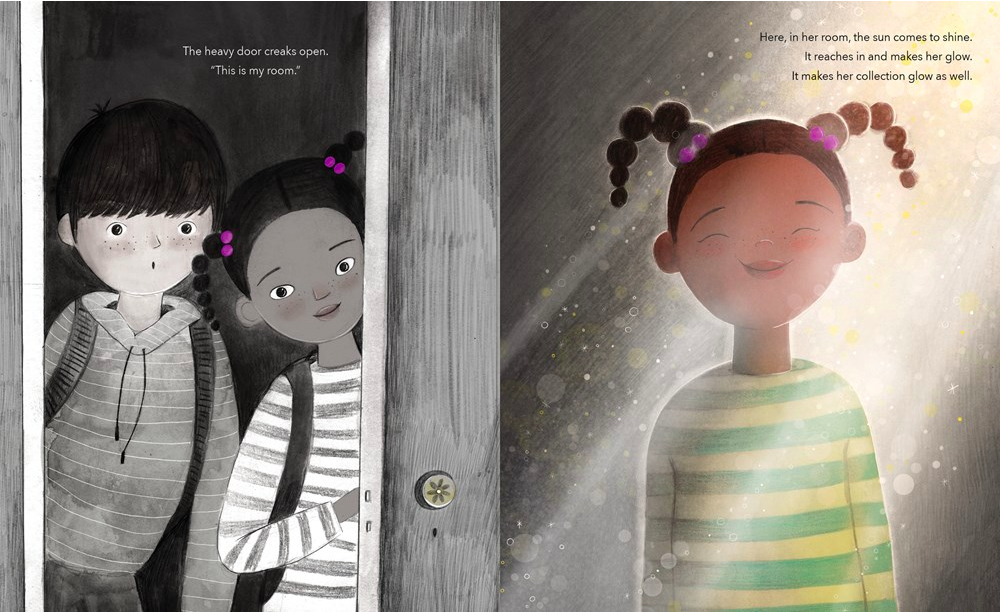
One day the boy crosses the street and asks Violet what she does with the things she picks up. Violet invites him to come see. They come to a brownstone and up a few flights of stairs, Violet takes him inside her home and opens the door to her room. “Here in her room, the sun comes to shine,” the boy says. “It reaches in and makes her glow. It makes her collection glow as well.”

celebrate-picture-books-picture-book-review-the-color-collector-colorful-items

Image copyright Renia Metallinou, 2021, text copyright Nicholas Solis, 2021. Courtesy of Sleeping Bear Press.

What the boy sees—on the walls, the ceiling, the door—is “her sky, her beach, her village” recreated from the wrappers, paper, leaves, caps, and other bits she’s found. “We came here for a better life,” Violet tells the boy. “I miss home, though. I miss the sounds and smells. And I miss the colors.” The boy tells her the mural is beautiful. Then Violet tells him stories about her village, the people there, and the ocean. The boy and Violet “sit and talk. Then laugh. Then talk some more.” The boy sees that Violet is not so sad or alone anymore, and he’s glad to be her friend. When he leaves, he and Violet wave goodbye and “smile the same.” One the way home, the wind blows a red leaf his way. He picks it up and puts it in his backpack.

celebrate-picture-books-picture-book-review-the-color-collector-light

Image copyright Renia Metallinou, 2021, text copyright Nicholas Solis, 2021. Courtesy of Sleeping Bear Press.

Poignant and honest, Nicholas Solis’s multilayered story touches on friendship, loneliness, new experiences, immigration, creativity, and how acts of welcome, empathy, and kindness can change perspectives and bring joy to life. Told from the boy’s point of view in short, straightforward observations, the story captures readers’ emotions and curiosity as they walk with him and Violet, waiting to see why the reason for her collection. As days and maybe weeks or months pass before the boy speaks to Violet, readers on “both sides of the street” (those who are hesitant to talk and share as well as those who would like to get to know someone better) learn that friendship takes time, patience, trust, and sincere interest. 

Renia Metallinou adds visual eloquence to the story with his gray- and dun-hued illustrations, which pick up increasing hints of color as Violet and the boy grow closer to Violet’s house and finally explode with vibrancy when she opens the door to her room. The first clue of the importance of color to the “new girl” is in her name, and to punctuate this fact, Metallinou gives Violet purple hairbands for her braids. As Violet walks home on a parallel track to the boy, purple tints the pots and flowers decorating the sidewalk, a woman’s purse, and her dog’s collar as if to show that Violet is already assimilating and contributing to her new community.

After she picks up the red wrapper, red flowers, and accents dot the next page, and after the boy describes the blue, yellow, and green items she finds, the trees gain red and yellow leaves, container gardens overflow with greenery, an orange cat watches a trio of red-bellied birds, and blue curtains hang in a downstairs room. But it’s when Violet opens her bedroom door that the real magic happens.

Readers are treated to one more two-page spread of suspense, heightened by the boy’s look of wonder and Violet’s proud gaze. Surrounded by light, Violet smiles. Her gray-and-white-striped shirt turns green and yellow, her brown skin glows with joy. Then readers turn the page and, like the boy, step into a sun-drenched coastal village with candy-colored buildings, lush foliage, a sparkling sea, and a woman – perhaps Violet’s grandmother – looking toward the horizon, maybe looking for Violet herself. Metallinou has made Violet’s mural a masterpiece of art, life, longing, and love. As Violet’s stories pour forth, she and the boy discover how to let their true colors show.

A beautiful and evocative story about the power of friendship, empathy, and kindness, The Color Collector provides a unique and highly effective way for kids and adults to talk about feelings of loneliness, homesickness, making new friends, opening up to others, and many other feelings kids experience. The book could spark meaningful art projects for classrooms and homeschoolers and would be an excellent addition to home, school, and public libraries.

Ages 6 – 9 

Sleeping Bear Press, 2021 | ISBN 978-1534111059

Discover more about Nicholas Solis and his books on his website.

To learn more about Renia Metallinou, her books, and her art, visit her website.

National Making Life Beautiful Day Activity

celebrate-picture-books-picture-book-review-initial-bookend

Initial Bookend or Decoration


Today’s holiday is all about making someone feel special. With this easy craft, kids can make a gift for a family member, friend, or teacher that shows them why they think the person makes the world more beautiful. And don’t forget to make one for yourself too!

Supplies

  • Wooden letter block of the recipient’s first initial or both initials
  • Chalkboard paint
  • Chalk
  • Paint brush

Directions

  1. Paint the wooden letter with the chalkboard paint, let dry
  2. With the chalk, write words on the letter that you think best describe the person you’re giving it to
  3. Wrap and give your letter!

celebrate-picture-books-picture-book-review-the-color-collector-cover

You can find The Color Collector at these booksellers

Amazon | Barnes & Noble | Books-a-Million

To support your local independent bookstore, order from

Bookshop | IndieBound

Picture Book Review

June 10 – It’s National Rivers Month

celebrate-picture-books-picture-book-review-mae-the-mayfly-cover

About the Holiday

Rivers are beautiful, provide recreation, and are crucial to our water supply. Did you know that in the United States 65% of our drinking water comes from rivers and streams? This month environmentalists and others work to promote awareness of the importance of keeping the nation’s rivers pollution free to protect the fish and animals that call them home and increase enjoyment for all. To help the cause, find out how you can help an environmental organization in your area. This year get to know your local river system and the insects and animals that live in and near these rivers. 

Thanks to Sleeping Bear Press for sending me a copy of Mae the Mayfly for review consideration. All opinions of the book are my own.

Mae the Mayfly

Written by Denise Brennan-Nelson | Illustrated by Florence Weiser


“Near the bank of the river one warm spring day / a new life began, and her name was Mae.” Before her mama said goodbye, she hugged her daughter and told her that she had her “whole life—a day, perhaps more” to explore her world. As Mae flitted along the river, a large, hungry trout waited for just the right moment to lure her in. It smiled deceitfully and beckoned to her, and, even though her inner voice told her not to, Mae flew down closer to take a look.

celebrate-picture-books-picture-book-review-mae-the-mayfly-fish

Image by Florence Weiser, 2020, text copyright Denise Brennan-Nelson, 2020. Courtesy of Sleeping Bear Press.

That’s when the trout leapt from the water to snatch Mae from the air. But she darted and dodged and got away. Shaking with fear, Mae found a hole in a hollow tree and flew in. “I’ll stay here forever! I’m not coming out!” she told herself.  But once her heart stopped beating so loud, she heard a happy tweet and peeked out of the tree. She saw a mother robin feeding her chicks and a spider web glittered in the sun. “The mist on the river was a fine, pink cloak. / A bullfrog bellowed his morning croak.” 

Mae remembered what her Mama had said and “launched herself from the dark, hollow place.” She followed the river, where she saw flowers and birds, a deer and a bear and one “stubby toad.” Then, she came to a clearing where she found “a singing, dancing jamboree… a wild mayfly jubilee! / Joining in, Mae danced with glee!”

celebrate-picture-books-picture-book-review-mae-the-mayfly-bird

Image by Florence Weiser, 2020, text copyright Denise Brennan-Nelson, 2020. Courtesy of Sleeping Bear Press.

As morning turned to afternoon, Mae was floating on the breeze when she heard a call for help. She went in search of who it was and found Trout lying motionless and barely breathing. Fearful that he might leap at her again, she carefully went closer to inspect. “But Trout was weak, no flip or flail. / Tangled line had caught his tail.” Then Mae noticed something else—his shimmering “rainbow stripes in every hue, silver, pink, and shades of blue.” And in his eyes she saw his fear and realized that she and Trout were alike.

Mae went to work to try to free him. The knot was tight, but Mae worked patiently until the line slipped free and Trout swam away with the current. Mae hoped that he would be okay. Just then she saw a flash as Trout returned and with a flip of his tail said, “Thank you.” As nighttime settled over the river and the moon rose high, Mae settled on a cattail leaf. She listened to the bullfrogs and watched the fireflies glow. “The stars came out early for  sweet, little Mae. / She counted each one… then called it a day.”

Back matter includes a message about mindfulness, an exercise to try and facts about mayflies.

celebrate-picture-books-picture-book-review-mae-the-mayfly-fishing-line

Image by Florence Weiser, 2020, text copyright Denise Brennan-Nelson, 2020. Courtesy of Sleeping Bear Press.

Soaring and uplifting, Denise Brennan-Nelson’s unique story reminds children and adults alike to live each day to the fullest and reveals where the treasures that make life so fulfilling can be found. The short lifespan of a mayfly gives Brennan-Nelson a perfect canvas for compressing the lessons of a lifetime into one day, and her superlative storytelling incorporates parental love, fear, appreciation for our surroundings, courage, selflessness, and friendship. Her language is triumphant, carried breezily on rhyming couplets that are a joy to read aloud. The pitch-perfect ending may bring a tear to the eye but spur readers to find the beauty in every day.

Through Florence Weiser’s lovely textured illustrations, readers can almost feel the breeze ruffling the tall grasses, the spray of river water, and the warmth of the sun as they follow Mae on her adventure. Mae is a cutie with lacy wings and a sweet, expressive face. A powerful image of empathy comes in a close-up, two-page spread in which Mae, looking into Trout’s frightened eye, sees her own reflection. Whereas up to now Mae has been an observer of life, she now becomes an active participant by helping a fellow creature. Working in perfect tandem with Brennan-Nelson’s text, Weiser’s pages take readers on a journey of growth and discovery they’ll take to heart. Calming shades of green dotted with subtle pinks, purples blues, and browns reflect Mae’s mindful approach to life, making this a delightful book to share for quiet story times.

Beautiful and resonant, Mae the Mayfly is highly recommended and would be an often-asked-for addition to home, school, and public library collections.

Ages 5 – 8

Sleeping Bear Press, 2020 | ISBN 978-1534110519

Discover more about Denise Brennan-Nelson and her books on her website.

To learn more about Florence Weiser, her books, and her art, visit her website.

Meet Denise Brennan-Nelson

celebrate-picture-books-picture-book-review-Denise-Brennan-Nelson-headshot

Denise Brennan-Nelson has written a number of books for children, including Tallulah: Mermaid of the Great Lakes, Leopold the Lion, Someday Is Not a Day of the Week, My Momma Likes to Say, Santa’s Secret, and the popular Willow series. As a national speaker, Denise encourages adults and children to tap into their imaginations to create richer, fuller lives. She travels the country, sharing her reading and writing enthusiasm with schoolchildren and teachers. Denise lives in Howell, Michigan with her husband, Bob. She strives to spend each day teaching and learning with a creative spirit. Find out more about Denise at www.denisebrennannelson.com.

Today, I’m really thrilled to be talking with Denise Brennan-Nelson about her inspiring story, her journey in writing it, and how we can all appreciate the life around us. My blog partner Jakki’s sons, Jack and Steve, also loves Mae the Mayfly and had a few questions of their own. 

Jack wonders: What inspired you to write about a mayfly? 

The inspiration to write about a mayfly came when I discovered that they live, on an average, only one day. I started digging and discovered that while mayflies have many interesting qualities, it was their life cycle that reeled me in and set the basis for the story: a mayfly begins as an egg, then hatches into a nymph. It then lives as a nymph for one to three years before emerging from the water as an adult. Once they have molted––the only insect known to molt twice!––they only have about a day to live. ONE DAY? How do you live your entire life in ONE day? Where would you go? What would you do? I had so many questions. And so, the journey began!

Steve would like to know: Where is your favorite place to go and enjoy nature?

Our backyard has many trees and a few paths to meander on. One of those paths leads to a playhouse that my husband built years ago for our children, Rebecca and Rachel. I love to sit on the steps and take it all in––especially the forever-changing trees and the way the light filters through them. It’s quiet and I watch the birds and the chipmunks, squirrels, and occasionally deer show up. It’s far enough away from our house that I can forget about my “to-do” list and relax.

There are also a couple of parks nearby that have trails and lakes and offer a beautiful place to enjoy nature.

Jack and Steve asked if you spent a lot of time at a pond while creating the story.

No, I didn’t spend a lot of time at a pond, but I did a lot of research to help me visualize the setting.

In early drafts, I pictured Mae’s life beginning on a pond but as the story emerged it turned into a river. Unlike a pond, a river “flows.” It seemed to fit with the ebb and flow of Mae’s life.

The river became integral to the story; Mae’s life began there, she experiences a harrowing ordeal with Trout, which causes her to flee the river out of fear, but ultimately, Mae returns “home” to the river and completes her life. (This was in keeping with a mayfly’s lifecycle.)  

Hi Denise! I love your answers to Jack and Steve’s questions! What an amazing character a mayfly makes. You’ve published many, many books for kids. What inspired you to become a children’s writer? What’s the best part about your job?

I had been happily writing for myself – journals and poetry mostly – when inspiration came knocking at my door in the form of a documented study about bumblebees. According to scientists, bumblebees are not “equipped” to fly. Aeronautically, their wings are too small for their bodies. Upon hearing that, I was compelled to write what was in my head and my heart. I wanted to answer the questions I had: What would happen if bumblebees found out about their small wings? Would fear and doubt stop them from doing what they love to do? Once it was written, I felt I had written something that I wanted to share with others. Four years and many rejection letters later, my first book, Buzzy the Bumblebee was published.

The best part about my job is creating something – taking an idea and turning it into something new that entertains and inspires children and adults. I also love the freedom to work when and where I want to, often in my pajamas in the wee hours of the morning.

Mae the Mayfly is a gorgeous, poignant reminder for both kids and adults to look around and appreciate the beauty all around us. Not only the mayfly, but all of the sights that Mae sees are ephemeral parts of nature. How did you choose each of these?

I felt they had to be simple, yet remarkable acts of nature that would draw Mae out from the hollow of a tree. You know that awe-inspiring feeling you get when you discover a bird’s nest or a spider’s web? That was the basis for the sights and sounds Mae encountered.

I also drew from a trip to Yellowstone where the vivid images of rivers, flowers, bear cubs, and other magnificent acts of nature are forever embedded in my mind.

The rhymes of Mae the Mayfly are as light as she is, and your rhythm is as jaunty as a mayfly’s flight. Could you describe your journey in writing this story?

After learning of a mayfly’s short lifespan, the mulling-over period ensued. A lot of thinking and dialogue in my head takes place before taking pen to paper. Often, I share my initial thoughts with family and friends which helps the pieces come together.

I did more research, too. I watched a video showing how some mayfly nymphs resist the pull to come to the surface when it is time to shed their outer covering and expose their wings. After spending years at the bottom of the dark river, why would they resist? I wondered. Why would they want to stay at the bottom of the river when they could break through the surface into the light, and fly––if only for a day?

Ah, fear.

It was starting to come together – I would write about a mayfly and how beautiful and meaningful one day could be, if she can overcome her fears.

Initially, the story was written in prose and then I wrote it in verse. At one point, I even wrote a funny version for my kids about Mae being stubborn and not listening to her mama. That version didn’t end well for Mae, because, well, she didn’t listen to her mama! My kids got a kick out of it.

Before she was Mae, she was Martha. From Martha to Marvin. Then I changed it to May. And then May became Mae.

My first submission was declined. So, I gave it a rest. The idea was there but I needed to start over. I believed in this story with my whole being and I wasn’t giving up. In June 2018, I resubmitted it and in August I learned that Sleeping Bear Press wanted to move forward with it. I signed the contract in September and it was released in March of 2020 amid a pandemic. It wasn’t the launch I envisioned, but the story is about appreciating the simple things and living life to the fullest. It is also about empathy, fear, and gratitude. Perhaps the timing was just right.

Florence Weiser’s illustrations are adorable while truly highlighting the beauty of what Mae sees. Do you have a favorite spread? Why do you love it?

I love the cover and the end sheets, and the illustration of Mama saying good-bye to Mae tugs at my heart. But my favorite is the spread where Mae encounters Trout tangled in fishing line and Mae sees herself – literally and figuratively – in Trout’s eyes. Mae is confronted with a difficult decision between fear, or courage and compassion. This was a pivotal part of the story and Florence did a remarkable job capturing the emotion of both Mae and Trout.

You encourage people to be aware of and open to inspiration and those small moments in life that make them the best version of themselves they can be. How can kids and adults practice this kind of mindfulness while at home during this time of self-isolating and social distancing?

In a robust and enthusiastic voice my dad often proclaims, “This is living!” He says it with such conviction that you might think he won the lottery. On the contrary, he says it to express his delight over life’s simple/small pleasures; a sunset, eating a fresh-picked tomato from the vine, watching the birds, the daffodils sprouting, a delectable meal, a rainstorm . . .

I am by no means an expert on mindfulness, but I have learned a few things that help me enjoy life a little bit more:

  • Be aware/pay attention – the list of things to delight over is endless when we notice what is going on around us
  • Make room for quiet time and stillness every day
  • Focus on one thing at a time and do it with intention and purpose
  • Write down 3-5 things daily that you are grateful for. Do it as a family with a “family journal” or get a notebook for every member and make it a nightly ritual

Lately I’ve been asking people, “What do you like most about the shelter-in-place order that we are being asked to follow?” Over and over, I’ve heard, “It feels good to slow down . . . less hectic . . .” I hope we emerge from this unique experience with the realization that life is not a race, it’s a gift.

What inspires you each time you start a new story?

When I have an idea that interests me I feel invigorated and purposeful. What can I do with it? Where will it take me? What can I learn from it?

In Bird by Bird, Anne Lamott writes, “If you are writing the clearest, truest words you can find and doing the best you can to understand and communicate, this will shine on paper like its only little lighthouse.”

Each time I begin a story I am hopeful that what I write “will shine on paper like its own little lighthouse.”

Thanks so much, Denise! This has been such a wonderful talk! I wish you all the best with Mae, the Mayfly and can’t wait to see more from you in the future.

You can connect with Denise Brennan-Nelson on 

Her website | Facebook | Twitter

National Rivers Month Activity

celebrate-picture-books-picture-book-review-rivers-word-search

World Rivers Word Search Puzzle


The world’s rivers provide homes for fish, animals, and birds; offer opportunities for recreation; and supply drinking water for millions. Can you find the names of twenty rivers of the world in this printable puzzle? Then learn where each river runs!

World Rivers Word Search | World Rivers Word Search Solution

celebrate-picture-books-picture-book-review-mae-the-mayfly-cover

You can find Mae the Mayfly at these booksellers

Amazon | Barnes & Noble | Books-a-Million | Sleeping Bear Press

To support your local independent bookstore, order from

Bookshop | IndieBound 

Picture Book Review

June 9 – It’s International Clothesline Week

celebrate-picture-books-picture-book-review-a-brief-history-of-underpants-cover

About the Holiday

International Clothesline Week was established by Gary Drisdelle to encourage people to hang their laundry on outdoor clotheslines or indoor drying racks as a way to engage in and think about more sustainable living. Hanging up laundry has many benefits for you and the environment, from saving on electricity to providing natural exercise to cutting down on ironing. And that fresh, sun-dried smell can’t be beat. This week-long holiday also gives you a chance to appreciate that hamper or basket full of laundry sitting in your house right now. If you think laundry is drudgery now, wait until you learn how our long-ago ancestors handled it in today’s book!

A Brief History of Underpants

Written by Christine Van Zandt | Illustrated by Harry Briggs


Have you ever wondered, while you’re pulling on your underwear, where and how this whole tradition started? Well, you’re about to find out in four fun chapters that iron out the facts—no ifs, ands, or… well, you know! Chapter 1: Crusty Old Buns takes readers back in time when our earlies ancestors “needed protection from spiky plants, curious bugs, and the weather.” We come from some pretty smart stock, it seems, as these prehistoric people made undergarments from “natural plant and animal materials.” How do we know? Archaeologists have dug up the evidence and continue to find more examples all the time. You’ll also find out how early ancestors of the Inuit kept their buns warm and how the first Europeans protected themselves too.

celebrate-picture-books-picture-book-review-a-brief-history-of-underpants-chapter-1

Image copyright Harry Briggs, 2021, text copyright Christine Van Zandt, 2021. Courtesy of becker&mayer! kids, Quarto Knows.

In Chapter 2: Underpants around the World, readers travel to ancient Egypt to learn about the schenti—a kind of wrap-around loincloth. While the common folks’ schenti was made from rough fabric, pharaohs’ fannies were graced by more gentile cloth. “King Tut’s royal rear was covered with a fancy, silky” schenti, and “because this famous Egyptian pharaoh believed in life after death, he was buried with 145 pairs of underpants.” After all, who “wants to be stuck doing laundry in the afterlife?”

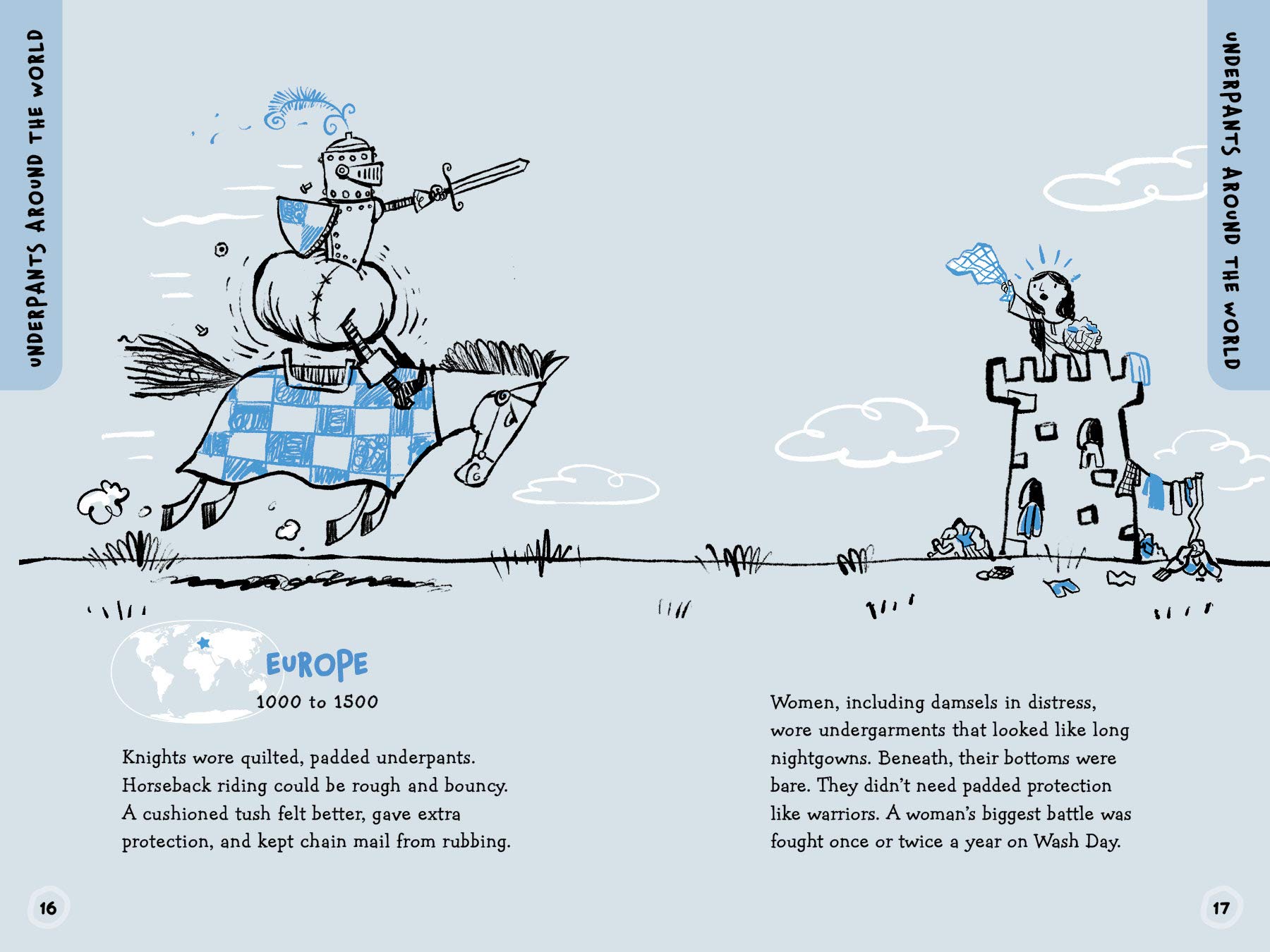
Between 1000 and 1500 warriors in Mongolia and Knights in Europe discovered that the right kind of underwear offered protection from pointy arrows and long, bouncy horse rides. And what about women during this time? European women kept their bottoms bare under their long skirts, but they did have to contend with washing everyone else’s “once or twice a year on Wash Day.” Washing—clothes and people—was inconvenient to say the least in those days, but a good soak in “ashes mixed with pee helped remove stains, brighten colors, and degrease spots” and a vigorous scrubbing on rocks in the river did the rest.

celebrate-picture-books-picture-book-review-a-brief-history-of-underpants-europe

Image copyright Harry Briggs, 2021, text copyright Christine Van Zandt, 2021. Courtesy of becker&mayer! kids, Quarto Knows.

In Central and South America, North America, Australia, and New Zealand, a person’s social standing was instantly recognizable by the style, material, color and adornments of their loincloth. And in India, Mahatma Gandhi used his dhoti as a powerful symbol in the country’s fight for independence from Britain in the early to mid-1900s.

Chapter 3: Cheeky Inventions takes kids on a fast-paced, surprising history of innovations large and small that revolutionized the making and wearing of undies—and perhaps most importantly the time spent in the bathroom. Chapter 4: Tushes Today Worldwide reveals a few ways people have fun celebrating and strutting their underwear, and if you’ve ever wondered how the astronauts in the International Space Station handle the whole underwear thing, you’ll find the answers here.

So, that takes us up to current times, but we’re not done yet! Kids learn how to make and wear a Japanese fundoshi, worn by Samurai warriors, they’ll find a couple of jokes to share, and there’s a list of books for further reading.

celebrate-picture-books-picture-book-review-a-brief-history-of-underpants-space

Image copyright Harry Briggs, 2021, text copyright Christine Van Zandt, 2021. Courtesy of becker&mayer! kids, Quarto Knows.

Full of puns and cheeky asides, Christine Van Zandt’s A Brief History of Underpants uncovers fascinating facts about these garments we take for granted while also revealing tidbits of historical, cultural, and societal traditions from earliest times to the present. Van Zandt’s breezy writing, punctuated by lots of “ewww”-inspiring descriptions, will keep kids laughing and learning and even the most reluctant reader riveted to the pages.

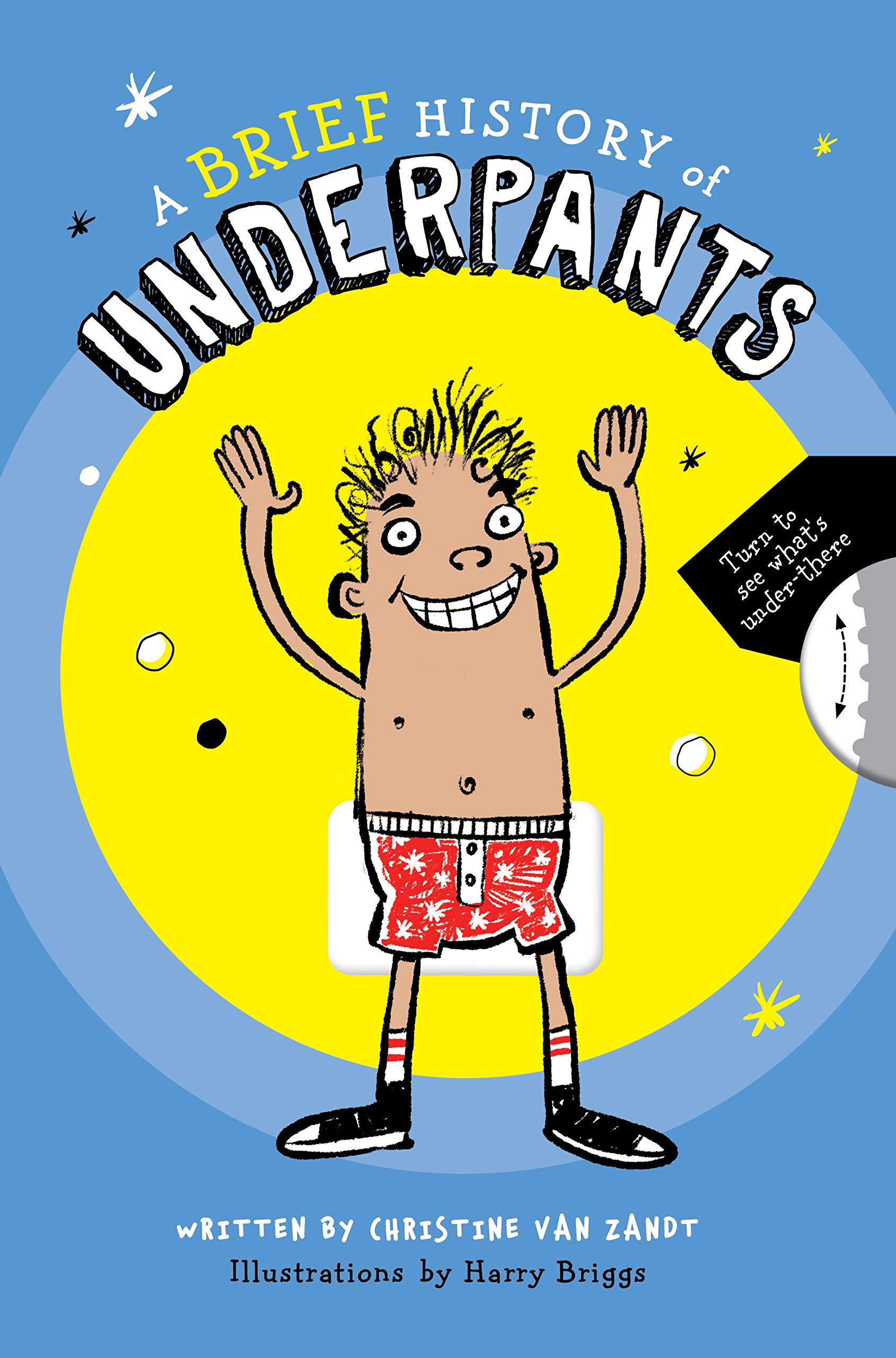
Harry Briggs’ silly cartoon illustrations will have kids laughing out loud as a self-assured King Tut struts across the desert past a pyramid of undies while a less-fortunate Egyptian whips up a vat of red dye made of “sheep poop and rotten olive oil;” Genghis Khan safely pulls a poisoned arrow from his silk under-armor; and downtrodden women gather at the riverbank on the annual Washing Day. A naked caribou, flaming underwear, and a pair of underpants that stretches to fit eleven people are just a few of the funny images that will keep kids turning the pages. Readers will have fun turning the wheel on the front cover to give the kid a revolving evolution of underwear.

Witty, intriguing, and informative, A Brief History of Underpants will captivate any child and makes a unique addition to history or social studies lessons for teachers and homeschoolers.

Ages 4 – 8

becker&mayer! kids, 2021 | ISBN 978-0760370605

Discover more about Christine Van Zandt and her books on her website.

To learn more about Harry Briggs, his books, and his art, visit his website.

celebrate-picture-books-picture-book-review-a-brief-history-of-underpants-cover

You can find A Brief History of Underpants at these booksellers

Amazon | Barnes & Noble | Books-a-Million

To support your local independent bookstore, order from

Bookshop | IndieBound

Picture Book Review
 

June 8 – World Oceans Day

celebrate-picture-books-picture-book-review-ocean-soup-cover

About the Holiday

Since 1992, The United Nations has sponsored World Oceans Day on this date to raise awareness of the importance of the Earth’s seas. Institutions, science centers, schools, research centers, businesses, governments, and communities around the world take part in special events, webinars, meetings, a photography contest, and other programs. This year’s theme is “The Ocean: Life and Livelihoods” and sheds “light on the wonder of the ocean and how it is our lifesource, supporting humanity and every other organism on earth.” This year’s virtual program begins at 10:00 a.m. and features a line up of thought-leaders, celebrities, community activists, entrepreneurs, and industry experts. The day ends with a concert given by musical artists from around the world. For more information on World Oceans Day, visit the UN World Oceans Day website. For educational resources, click here. To see the schedule of events, click here.

Ocean Soup: A Recipe for You, Me, and a Cleaner Sea

Written by Meeg Pincus | Illustrated by Lucy Semple


“From afar the vast ocean appears pure and clean. / How if sparkles and shimmers—a beautiful scene.” But what will you find if you look at just a small portion of the ocean—even a tiny drop—up close? Under a microscope, “the sea looks more like…soup” with “ingredients” that have been simmering for decades. And what’s in this soup? Many “chefs” have created it with Styrofoam cups and their lids; single-use bottles, bags, and straws; microbead soaps, synthetic materials, and balloons.

celebrate-picture-books-picture-book-review-ocean-soup-microscope

Image copyright Lucy Semple, 2021, text copyright Meeg Pincus, 2021. Courtesy of Sleeping Bear Press.

“The real problem is plastic; it’s in all that stuff. Whether hard or elastic, that plastic is tough!” Dumps around the world are overflowing with plastic, and much of it ends up in the ocean “churning round the five gyres— / the huge saltwater whirlpools / where breakdown transpires.” As the plastic churns under the sun, it turns into “specks” that can’t be removed. This plastic soup is “…gulped by the dolphins, the whales, and the seals, / and it’s slurped by the fish, / and the plankton and eels.”

celebrate-picture-books-picture-book-review-ocean-soup-beach

Image copyright Lucy Semple, 2021, text copyright Meeg Pincus, 2021. Courtesy of Sleeping Bear Press.

This confetti of plastic is found above the water in icebergs and deep on the ocean floor. If it’s in the fish that we eat, “is it in you and me” too? To clean up the oceans, we need new chefs and a new recipe for ending the manufacturing of plastic, practicing new habits with sustainable, reusable materials, and refusing products packaged in plastic. “Ocean soup may have simmered before we were here, / but the call for us all to pitch in rings out clear.”

Extensive backmatter includes an author’s note; a discussion about the invention of plastics and the astounding amount of “‘plastic smog'” that is in the ocean, as well as a description of how gyres break down plastic into tiny particles. Readers also learn what eight types of plastic are the worst polluters and are given ten steps for reducing daily plastic use. 

celebrate-picture-books-picture-book-review-ocean-soup-gyres

Image copyright Lucy Semple, 2021, text copyright Meeg Pincus, 2021. Courtesy of Sleeping Bear Press.

Meeg Pincus’s eye-opening comparison between the ocean and a pot of soup gives young readers crucial information about the plight of our oceans that is easy to understand and visualize. Her entreaty to look closely at what lies beneath the shimmering blue surface of the water grabs readers’ attention, and her short history of how and when plastics came on the scene provides context and perspective. The plastics Pincus mentions show the magnitude of the problem, and kids will be familiar with most if not all of these products. Pincus’s unstinting rhyming verses present the science of how plastic is shredded by the sea, where it ends up, and how it is ingested by ocean creatures in a way that is sure to spur readers to action. Her examples of ways we can reduce our plastic use within the story and in the backmatter empowers readers of all ages to make changes to protect the Earth’s oceans now and for future generations.

Lucy Semple’s bold illustrations show kids exactly how pervasive the kinds of containers, toys, wrappers, and other plastic products that are polluting our oceans really are and how blithely we use them. Through successive panels she demonstrates how plastic bags, bottles, straws, and cups break apart due to sun and water currents, and a double-spread map orients kids to where the five gyres are found. Images of sea creatures gulping down the tiny shards of plastic are effective and will resonate with children, as will the final pages where readers will find reinforcement for new habits of using and promoting recycled and reusable products.

An excellent overview of and introduction to the crisis of plastics in the world’s oceans, Ocean Soup: A Recipe for You, Me, and a Cleaner Sea will spark in readers a desire to embrace more sustainable products, adopt better recycling habits, and take action to reduce plastics use. The book would be an impactful way to begin science, environment, history, and other cross-curricular lessons as well as a jumping off place for more extensive research in classrooms and for homeschoolers. Ocean Soup is highly recommended for home bookshelves and is a must for school and public library collections.

Ages 6 – 9 

Sleeping Bear Press, 2021 | ISBN 978-1534111189

Discover more about Meeg Pincus and her books on her website.

You can connect with Lucy Semple on Instagram and Twitter.

World Oceans Day Activity

celebrate-picture-books-picture-book-review-Turtle-Swimming-coloring-page

Sea Creatures Coloring Pages


Grab your crayons and enjoy these printable coloring pages of favorite sea creatures!

Fish | Octopus | Seahorse | Turtle

celebrate-picture-books-picture-book-review-ocean-soup-cover

You can find Ocean Soup: A Recipe for You, Me, and a Cleaner Sea at these booksellers

Amazon | Barnes & Noble | Books-a-Million

To support your local independent bookstore, order from

Bookshop | IndieBound

Picture Book Review
June 7 – Celebrating Our First Middle Grade Monday

celebrate-picture-books-middle-grade-review-dragon-mountain-cover

About the Holiday

I’m thrilled to welcome back Jakki Licare, who took time away from the blog to help her boys with virtual schooling. Jakki and I are also excited to tell you that on the first Monday of every month, Celebrate Picture Books will become Celebrate Middle Grade Books, with Jakki’s reviews of fantastic books for older kids. What does she have up first? A book that has it all – dragons, suspense, magic, and a new team of smart, brave, kind, and funny friends for readers to take adventures with. 

Thanks to Sterling Children’s Books for sharing a copy of Dragon Mountain for review consideration. All opinions are my own.

Review by Jakki Licare

Dragon Mountain 

By Katie and Kevin Tsang 


Synopsis

This synopsis contains spoilers

Billy Chan is dreading summer because his parents have shipped him off from his home in San Francisco to attend a summer camp in China so he can brush up on his Mandarin and “‘learn more about his Chinese heritage.'” But when he is paired with Dylan O’Donnell, Charlotte Bell, and Liu Ling-Fei for a scavenger hunt things start to look up. Determined to win, the kids take a shortcut – which they instantly regret when a tiger chases them. Unable to get away, the kids link hands and face off against the tiger together in front of a mountain. Incredibly, the tiger backs away and vanishes into thin air.

When they return back to camp, Ling-Fei realizes that she’s lost the necklace her grandmother gave her. The next morning the kids go back to search for Ling-Fei’s missing necklace. As they search the area, Billy realizes that they’ve lost something else – Ling-Fei! One by one the kids go missing, until Billy is all alone. Billy is convinced that something is pulling them into the mountain and he marches in to find his friends.

Deep within the mountain, he finds his friends trapped by a group of dragons. The dragons are glad that the children came because they’ve been waiting for the prophesized four to open it. The dragons explain that the mountain contains a special portal that connects the human and dragon realms together. These dragons are the portal guardians. An evil dragon, known as the Dragon of Death, tried to come through the portal thousands of years ago to maximize its powers by bonding with a human. The guardians fought to keep the Dragon of Death out, but they were unable to defeat the Dragon of Death so they sent her through a time portal. As they sent her back, she cast a spell that sealed the guardians in the mountain until they met their human matches. 

One of the dragons has the ability to see into the future, and she has seen the Dragon of Death coming back and enslaving the human realm. The kids want to protect their world and agree to bond with the dragons. The kids bond with their dragons by naming them. Once they’re bonded, the dragons are stronger in ability as well as size. Three of the dragons have magical pearls that will give the kids super powers: Charlotte receives super strength, Ling-Fei can sense nature, and Dylan has the power of persuasion. Billy’s dragon doesn’t have a pearl, but they know the fourth pearl is close. Billy realizes he has seen it at the summer camp. 

The kids head back to camp and break into the owner’s office that night. Billy finds the pearl on top of a bookshelf. When he grabs it, he loses his balance and does a perfect backwards flip. Billy now has agility superpowers. Now that they have the pearls and are bonded, the children are ready for the dragon realm. But the dragons find the entrance is still barred to them by the curse. The kids have to go through on their own to open the entrance for the dragons. The tiger that chased them earlier is waiting for them and is the keeper of the curse. The tiger attacks them with electric bolts and Billy distracts it. Using her powers, Ling-Fei learns that they must destroy the tiger’s heart. Charlotte uses her super strength and rips the tiger’s heart out.  

Now they can enter the Dragon Realm with their dragons, but they find that the entire dragon Realm is poisoned. The dragons then have to fight off the the Dragon of Death’s helpers, Noxwings, and soon the dragons are captured. With the help of Billy’s dragon, though, the kids are able to get away. The kids travel through the dragon realm on their own and have many adventures in which they must use their powers and wit to help them survive this dangerous land.

They finally reach the Nowxing’s camp and find hundreds of cages filled with captured dragons. The Noxwings are opening a portal to bring back the Dragon of Death by draining the dragons of their energy. The kids learn that if they destroy the floating flames that surround the portal, the cages will open and the portal will close. The kids work together and destroy the flames, but Billy is attacked. He’s about to be killed when his dragon swoops in and saves him.

They’re winning the battle and the portal is almost closed when the summer camp’s owner appears out of the forest. He grabs Dylan and heads toward the portal. He created the whole summer camp just to find the children he needed to open the dragon realm. The owner is determined to bring back the Dragon of Death. He jumps through, pulling Dylan with him. The kids are determined to get their friend back and all the freed dragons swear to help them. The kids and their dragons will travel through time to save Dylan and defeat the Dragon of Death.

Review


This fast-paced book will be sure to keep your middle grader’s attention. The writing is very immersive and you’re soon off on one adventure after another. Perfect for 8-12 year olds who love dragons and are looking for fun characters that you can’t help rooting for. Katie and Kevin Tsang’s dragons were inspired by both Chinese and European folklore and they even blended two of the dragons to create hybrids of both cultures. They also drew inspiration from the Chinese symbols of the Eight Great Treasures to create the eight pearls in Dragon Mountain which give the kids their superpowers. 

My favorite part of this book was how the characters work through their problems together. All of the characters are incredibly different and often their personalities clash, but they’re able to talk through their troubles together. After the children are separated from their dragons in the Dragon Realm, Charlotte is angry with Billy for running away. The group falls apart as they can’t agree on what to do. But after talking it through they’re able to come up with the beginnings of a plan that they can all agree with. This is one example of how the Tsangs do an amazing job of focusing on the intricacies of team work and thread it through the plot of the story. 

Billy Chan, the main character, is a surfing champ who is also good at keeping his head in stressful situations. Dylan O’Donnell is friendly, funny, and very cautious. Charlotte Bell is competitive, motivated, and smart. And Liu Ling-Fei is sweet, quiet, and generous. When the dragons are introduced, we learn that each child is destined to bond with a dragon. My kids and I loved guessing who was going to be matched with who. Some of the bonds were surprising.

My seven year old especially loved the dragons in this book. They start off as menacing and scary but, just like Billy and his friends, we soon learn to trust them. Each dragon’s personality is as unique as those of the kids, and they each carry their own powers that we learn about along the way.  I’m looking forward to the second book so we can spend more time with the dragons!

There are two distinct story worlds. The first part of the story takes place in a Chinese mountain. We get a very brief introduction to the summer camp before we are swept into the mountain. The other half of the book is spent in the dragon realm which is full of floating islands and has three moons and a mysterious red dome. The dragon realm’s barren world accurately reflects the danger the kids are in and increases the reader’s anxiety. As the kids try to maneuver through this foreign terrain, they come across many new and unexpected dangers. My son’s favorite part is when the kids have to bargain with a rock troll.

Dragon Mountain is a fast-paced, immersive adventure book that’s perfect for dragon lovers of all ages especially fans of How to Train Your Dragon and will make a great addition to class libraries as well personal libraries.

Parental Considerations: This book does contain fantasy fighting.

Ages 8 – 12

Grade Level 3 – 7 | AR Level: 4.8

Sterling Children’s Books 2020 | ISBN 978-1454935964

You can learn more about Katie & Kevin Tsang, their Dragon Realm series, and their Sam Wu Is Not Afraid series on their website.

Adventure into the Dragon Realm with this book trailer!

celebrate-picture-books-middle-grade-review-dragon-mountain-cover

You can find Dragon Mountain at these booksellers

Amazon | Barnes & Noble | Books-a-Million

To support your local independent bookstore, order from

Bookshop | IndieBound

Picture Book Review
June 5 – World Environment Day

celebrate-picture-books-picture-book-review-this-little-environmentalist-cover

About the Holiday

Sponsored by the United Nations, World Environment Day encourages worldwide awareness and action for the protection of the environment. Each year a different country hosts the day’s events. This year Pakistan has been chosen as the host country. Today’s holiday also launches the UN Decade on Ecosystem Restoration, which runs from 2021 to 2030 and “aims to prevent, halt, and reverse the degradation of ecosystems on every continent and in every ocean.” This work is crucial to the survival of our planet. The statistics are alarming. Studies have found that every three seconds the world loses enough forest to cover a soccer field and over the last century, half of our wetlands and as much as fifty per cent of our coral reefs have been destroyed. This year’s theme is “Reimagine. Recreate. Restore.” Everyone is needed to make a difference. You can learn more about World Environment Day, the UN Decade on Ecosystem Restoration, and how you can join the #GenerationRestoration movement on the UN World Environment Day website.

This Little Environmentalist: A Love-the-Earth Primer

Written by Joan Holub | Illustrated by Daniel Roode


Take any little one outside and they’re immediately fascinated with plants, animals, and bugs they see. They want to play in the water at the beach or lake. And who doesn’t like to take a boat ride on a river? When they look up, there are fluffy clouds and birds passing by, and, of course, the tall trees provide shade for outdoor play. Kids instinctively want to protect nature and seem to be born with compassion for animals – their pets and those that live in the wild. 

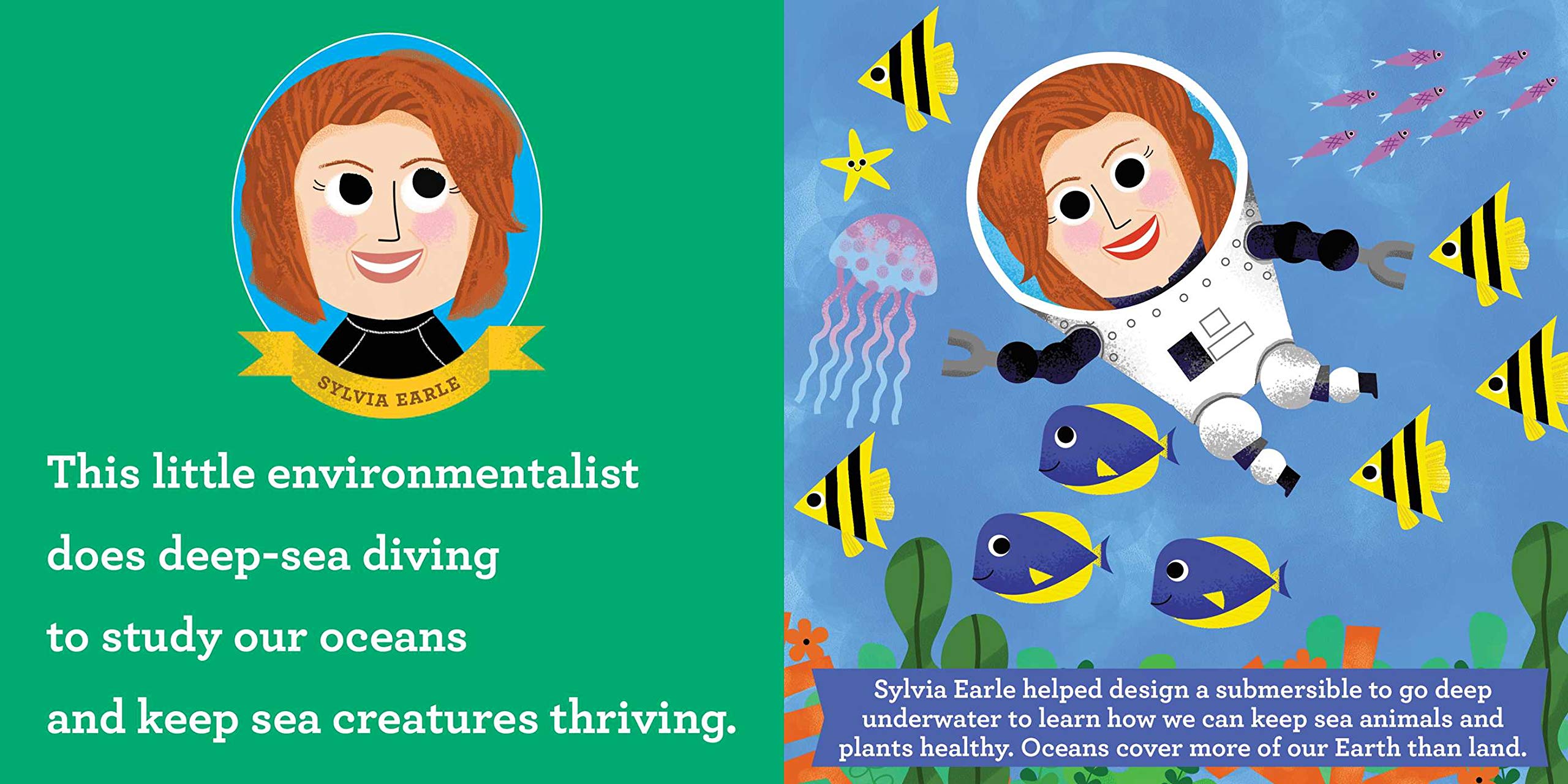
celebrate-picture-books-picture-book-review-this-little-environmentalist-sylvia-earle

Image copyright Daniel Roode, 2021, text copyright Joan Holub, 2021. Courtesy of Little Simon.

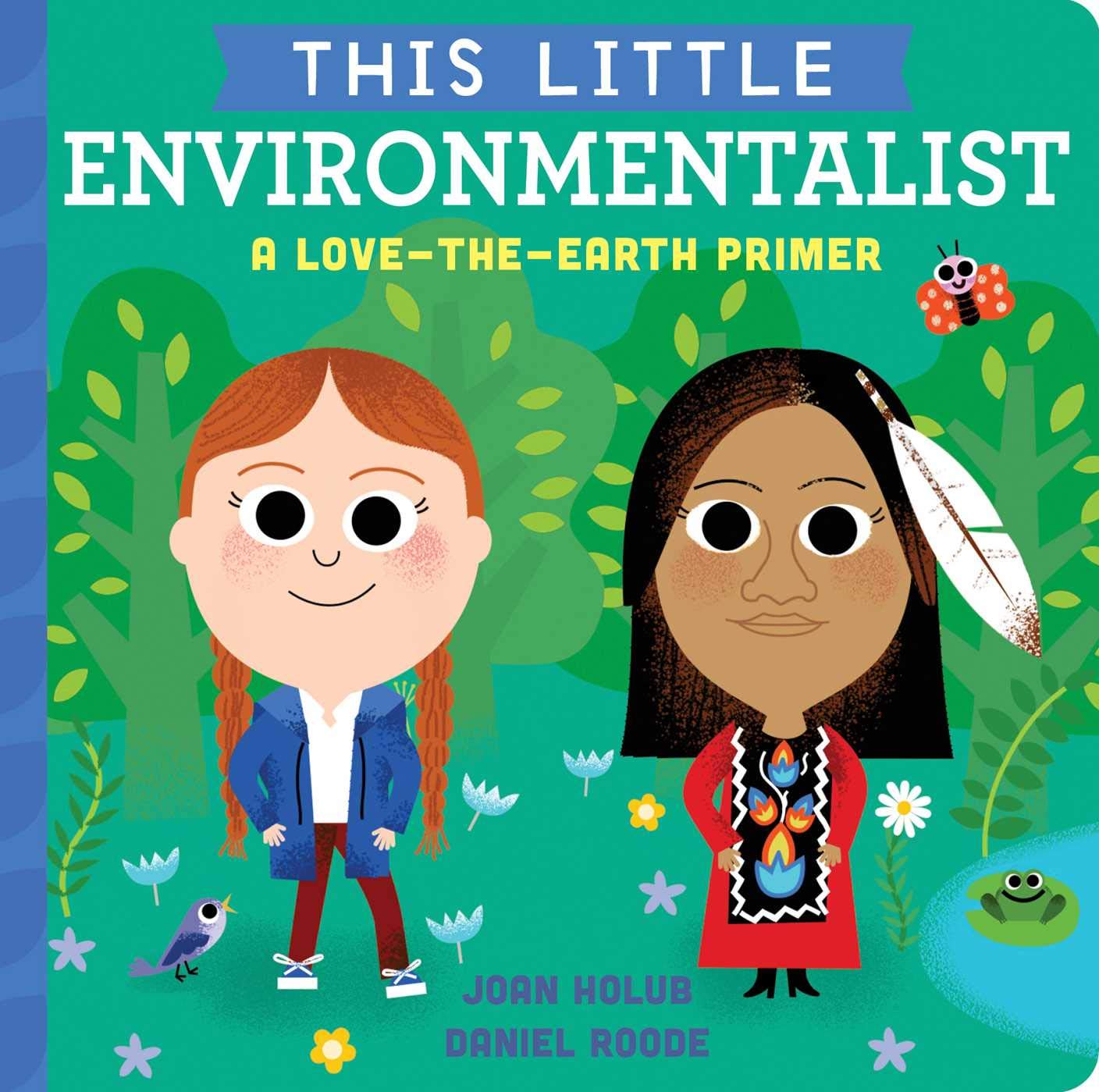
This Little Environmentalist: A Love-the-Earth Primer recognizes young children’s desire to help and learn more about nature with mini-biographies of ten people who have found distinct ways to preserve the environment today and for future generations. Each biography is introduced with a rhyming verse that makes it easy for little readers to understand and remember how each of these activists made an impact. They then learn more specifics about each person’s work to protect open land, inspire new environmental laws, save forests, support clean water, and fight against climate change.

celebrate-picture-books-picture-book-review-this-little-environmentalist-wangari-maathai

Image copyright Daniel Roode, 2021, text copyright Joan Holub, 2021. Courtesy of Little Simon.

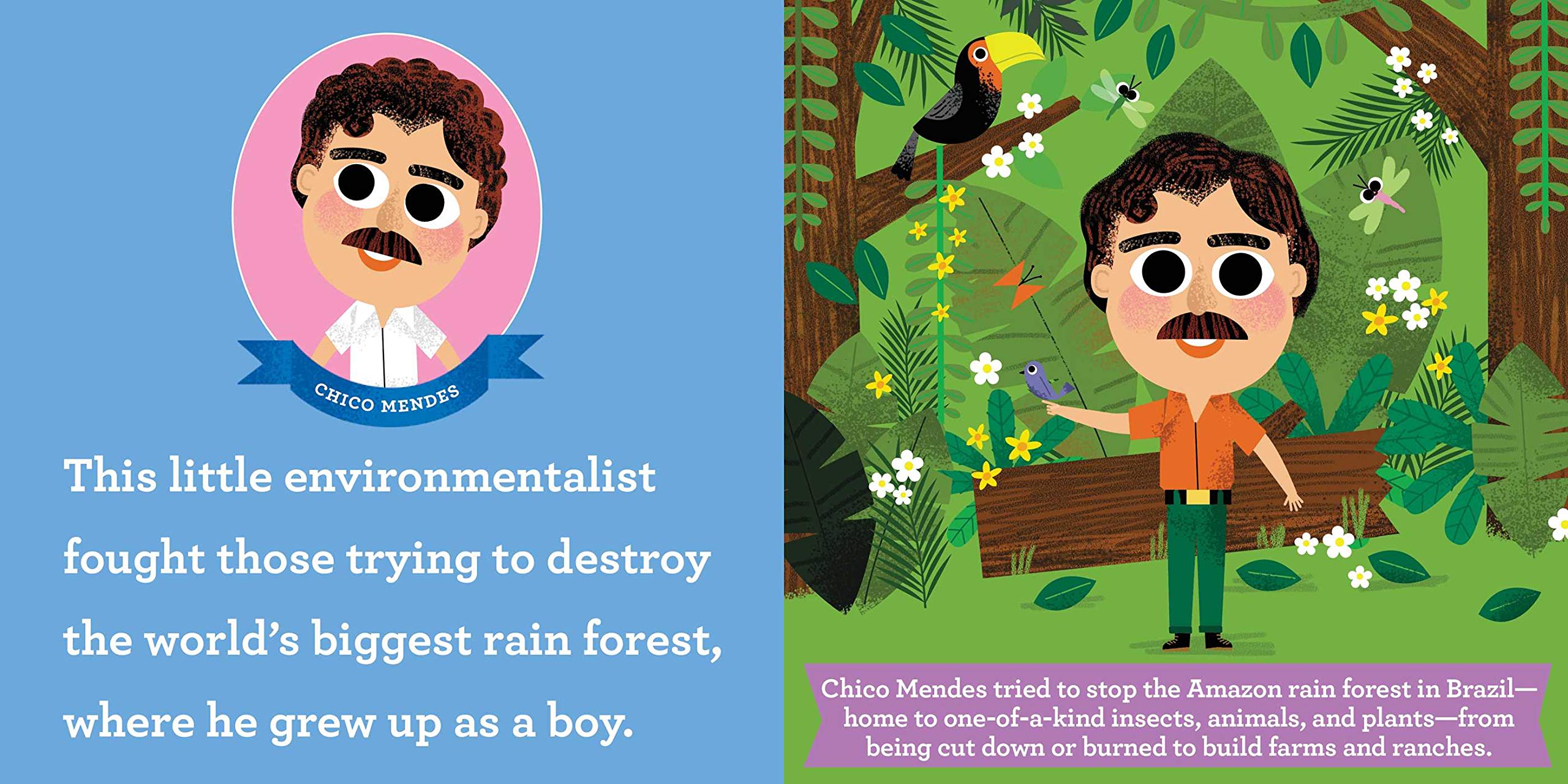
Children learn about Edgar J. Helm, who created the Goodwill company that provided jobs and decreased trash; Wangari Maathai, who “got African women to plant millions of trees in Kenya to provide fruit, shade from the sun, wood for building , and firewood for cooking”; Vandana Shiva, who encourages farmers and communities to create seed banks for the future; Miranda Wang and Jeanny Yao who have devised a way to “break down hard-to-recycle plastic trash”; and six more influential environmentalists.

Following these ten biographies are one– or two-sentence profiles of seventeen other people, including writers, artists, politicians, scientists, and other visionaries who are involved in protecting our earth. The last frame is left blank for the next environmentalist on the scene – could it be you?

celebrate-picture-books-picture-book-review-this-little-environmentalist-chico-mendes

Image copyright Daniel Roode, 2021, text copyright Joan Holub, 2021. Courtesy of Little Simon.

With her straightforward and informative text, Joan Holub will inspire kids to follow in the footsteps of well-known personalities and community leaders and keep an eye out for ways they can make a difference at home, school, or in their neighborhood. Inclusion of environmentalists from around the world give readers knowledge about a wide range of environmental concerns and innovative ideas people have for addressing them.

Daniel Roode’s bright and engaging illustrations help kids visualize the place where each environmentalist lives and the type of work they do. Background details give kids and adults plenty to talk about as they read and as they take walks in the neighborhood, go to the park, visit the grocery story and farmers market, and notice more about their own area.

A smart, inclusive, and timely addition to the This Little series, This Little Environmentalist: A Love-the-Earth Primer is a must for fans of the series as well as for classroom and public library collections.

Ages 3 – 5

Little Simon, 2021 | ISBN 978-1534475588

World Environment Day Activity

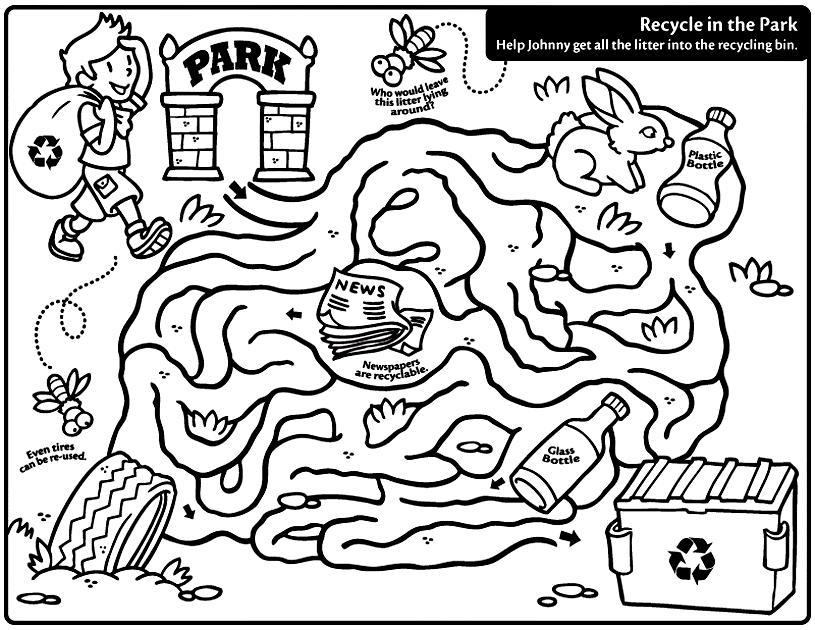
celebrate-picture-books-picture-book-review-recycling-maze

Recycling Maze


This little boy wants to help the environment! Can you help him pick up recyclable items in this printable maze?

Recycling Maze

celebrate-picture-books-picture-book-review-this-little-environmentalist-cover

You can find This Little Environmentalist at these booksellers

Amazon | Barnes & Noble | Books-a-Million

To support your local independent bookstore, order from

Bookshop | IndieBound

Picture Book Review
June 4 – National Doughnut Day

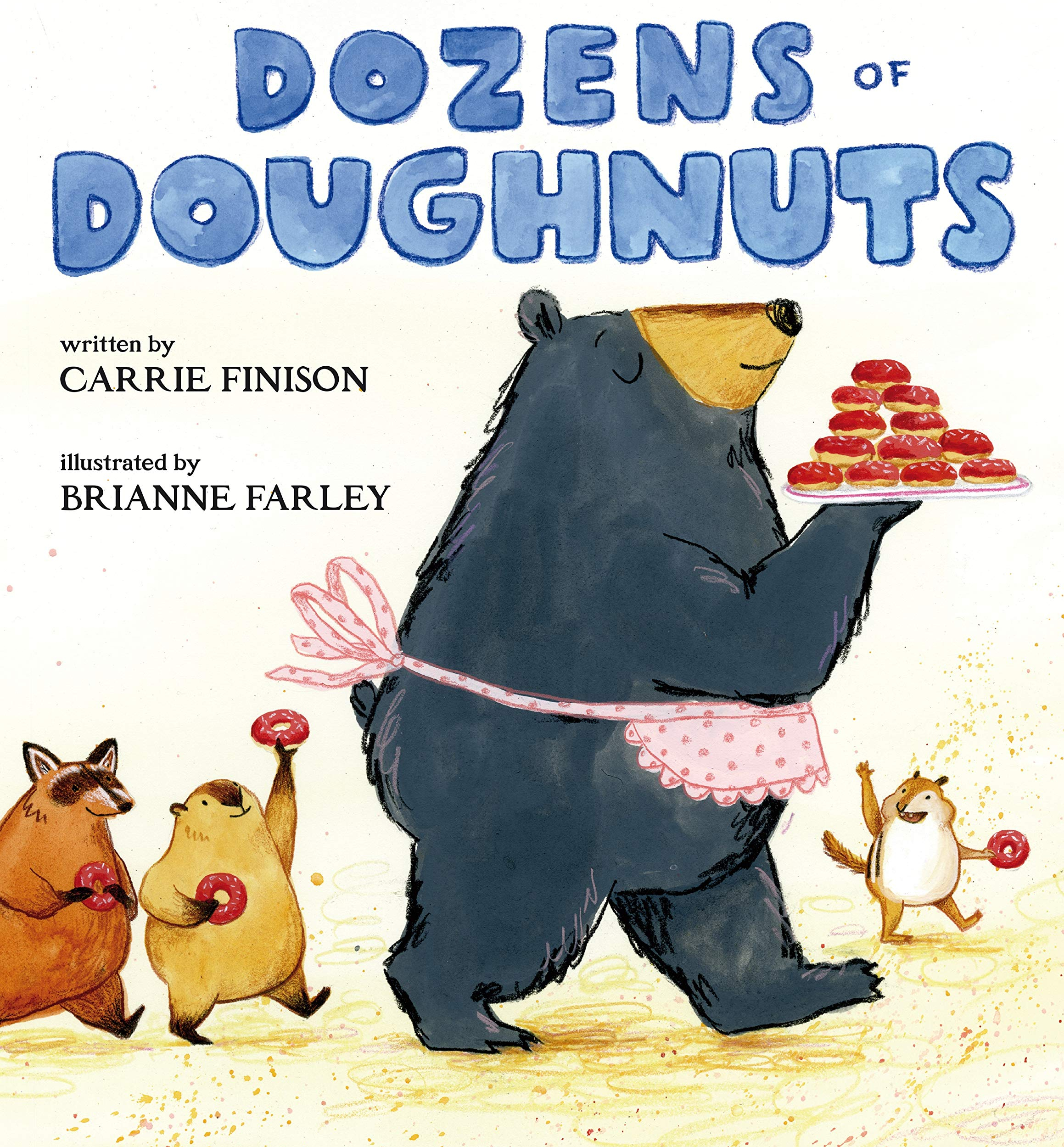
celebrate-picture-books-picture-book-review-dozens-of-doughnuts-cover

About the Holiday

National Doughnut Day may be one of the most delicious holidays of the year, but did you know that the day has a charitable history? The holiday was established in 1938 by the Salvation Army to honor the women who served doughnuts and other home-cooked foods to soldiers on the front lines in France during World War I. Two hundred and fifty Salvation Army “Lassies” volunteered to provide this morale boost to the troops. Salvation Army Ensign Margaret Sheldon “wrote of one busy day: “Today I made 22 pies, 300 doughnuts, 700 cups of coffee.'”

National Doughnut Day began as a fundraiser by Chicago’s Salvation Army to help the needy during the Great Depression. The holiday continues to be a fundraiser in Chicago and other cities and is supported by national and local businesses.  Doughnut lovers can also take advantage of special offers at doughnut shops across the country.

Dozens of Doughnuts

Written by Carrie Finison | Illutrated by Brianne Farley


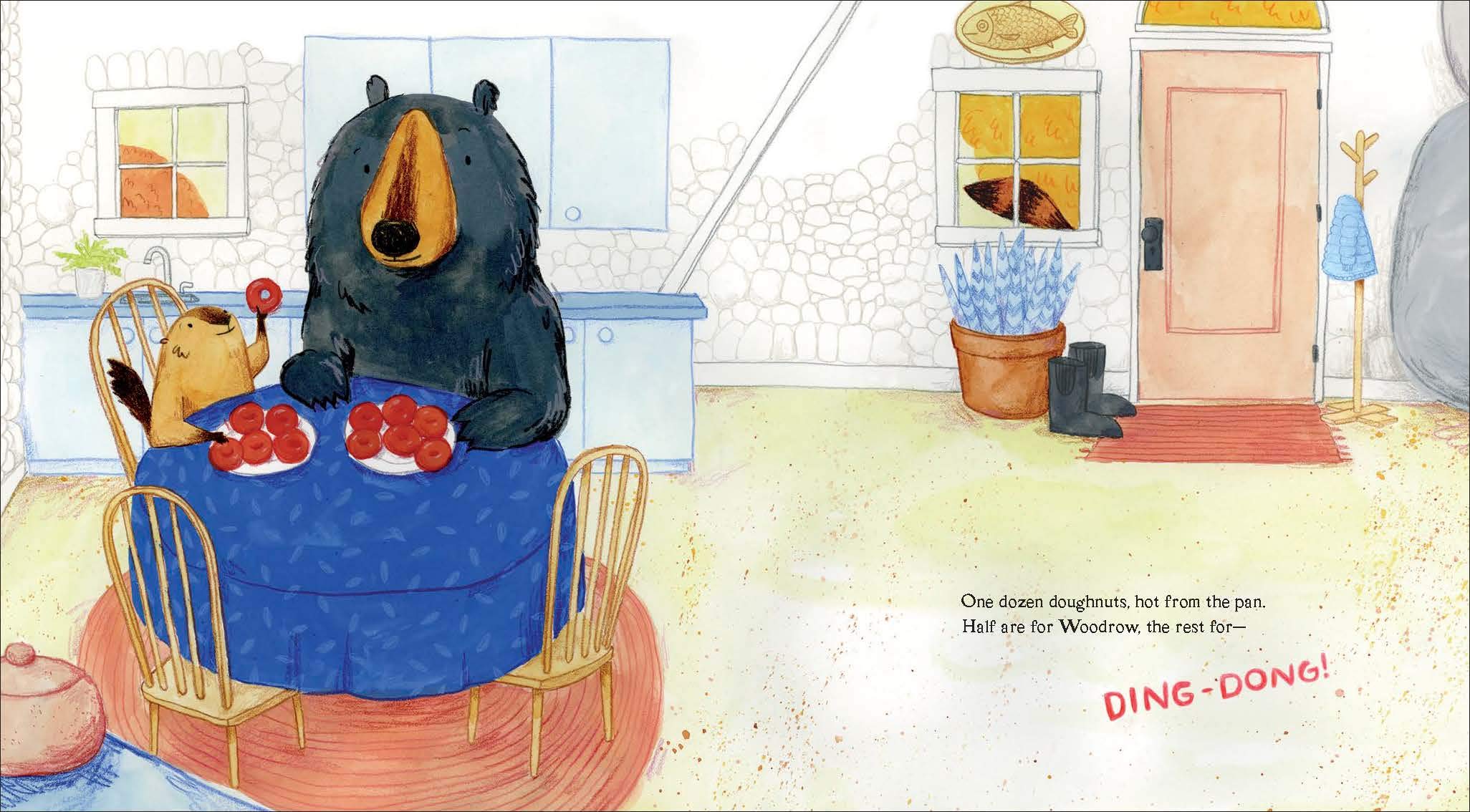
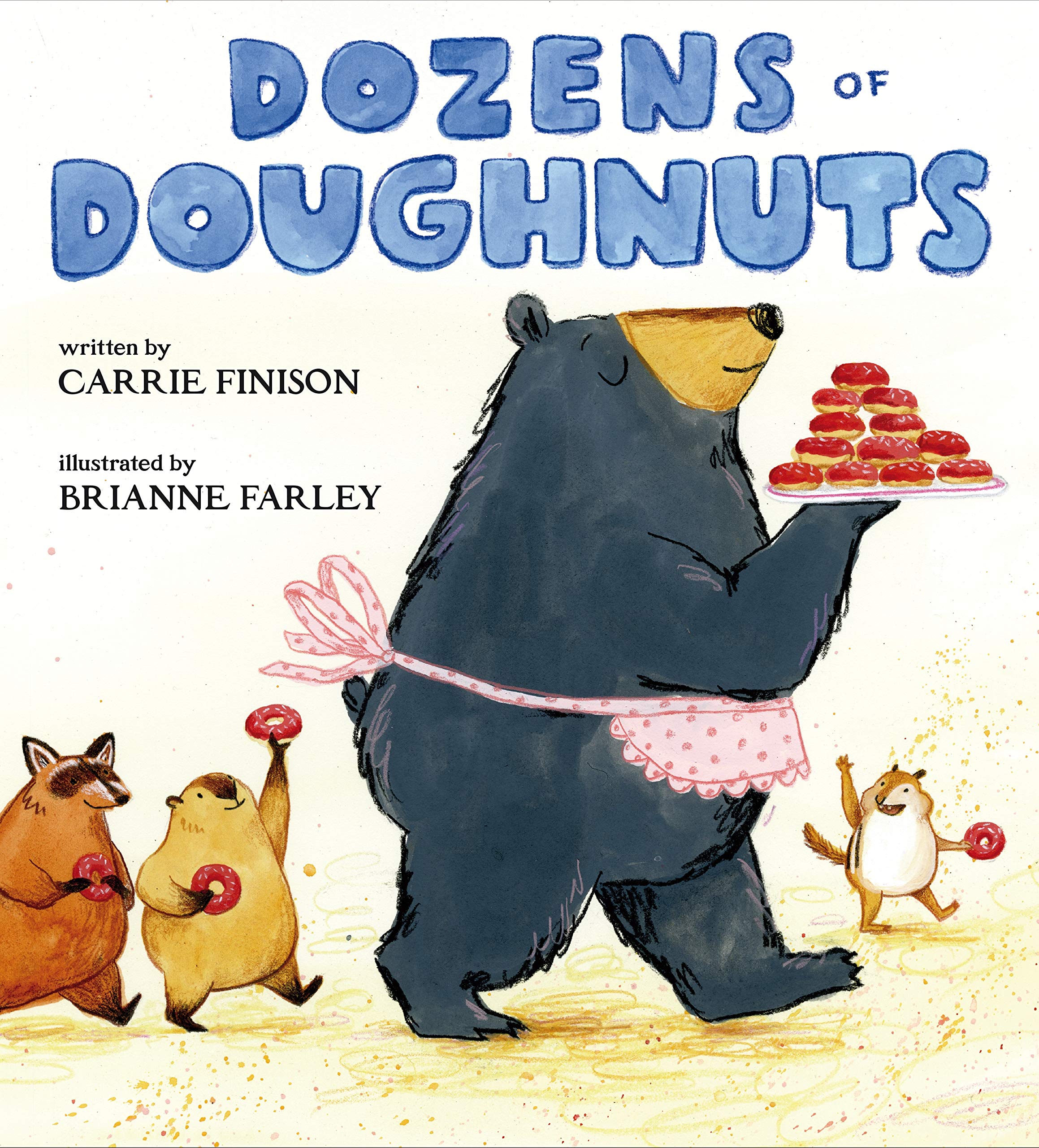
On a bright autumn morning, LouAnn is busy making a dozen doughnuts—her last treat before her long winter nap. “One dozen doughnuts, hot from the pan. / Toasty, and tasty, and ALL for— / DING-DONG! / ‘Woodrow?’” At the door stands a little beaver. LouAnn invites him in and seats him at the kitchen table. They’re just about to split the doughnuts when the doorbell chimes again.

celebrate-picture-books-picture-book-review-dozens-of-doughnuts-woodrow

Image copyright Brianne Farley, 2020, text copyright Carrie Finison, 2020. Courtesy of G.P. Putnam’s Sons Books for Young Readers.

This time it’s Clyde, the raccoon. LouAnn welcomes him in and offers him her plate of doughnuts while she whips up another batch. These doughnuts—four for each—are frosted in blue. They’re all about to take a bite when “DING-DONG!” Tospy the possum arrives. “‘Delicious!’ cries Topsy. / She gulps down a swallow. / LouAnn’s heart feels warm, / but her belly feels hollow.” She stirs and she fries and soon has “One dozen doughnuts, hot from the pan. / Some for each friend, and the rest for— / DING-DONG! / ‘Mouffette?’”

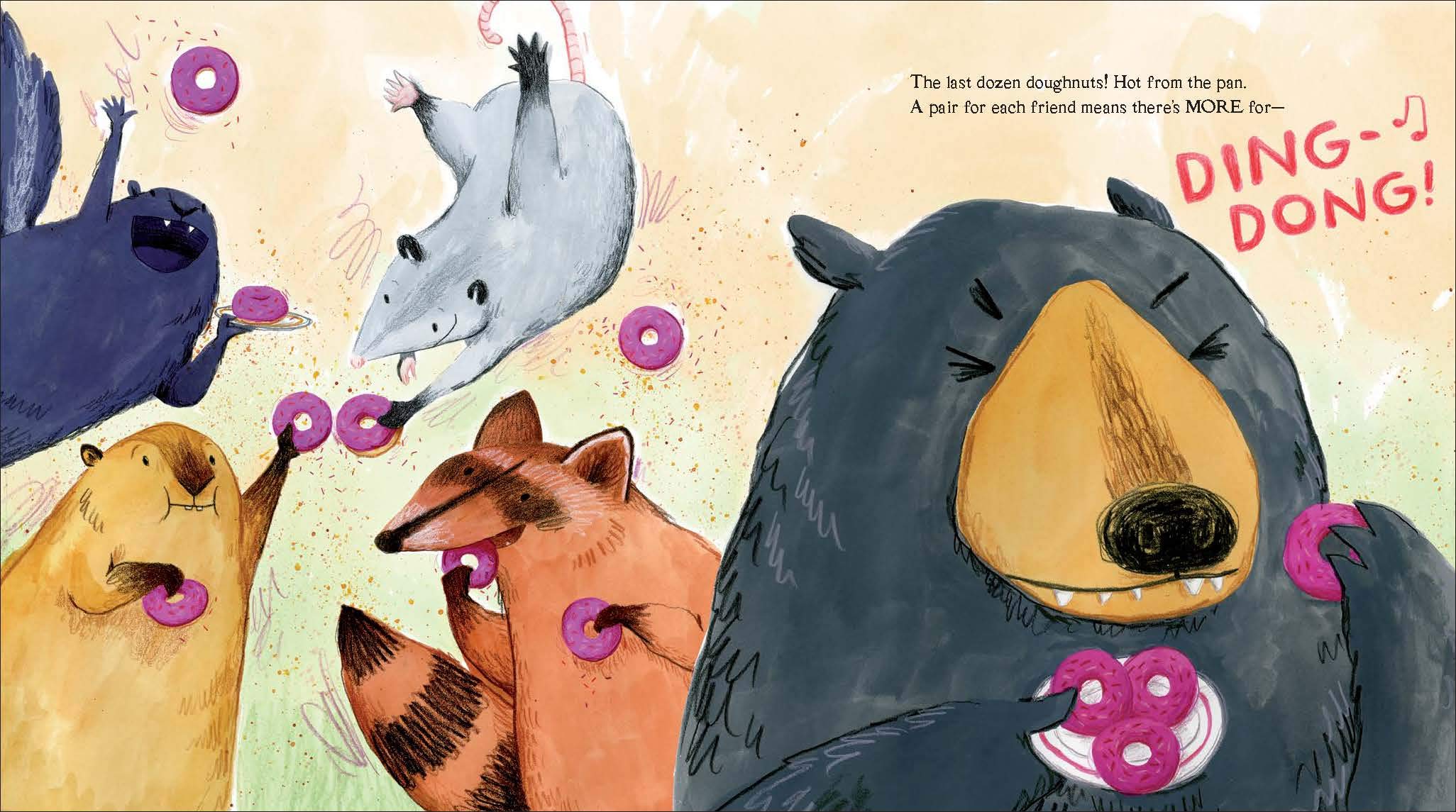
celebrate-picture-books-picture-book-review-dozens-of-doughnuts-last-dozen

Image copyright Brianne Farley, 2020, text copyright Carrie Finison, 2020. Courtesy of G.P. Putnam’s Sons Books for Young Readers.

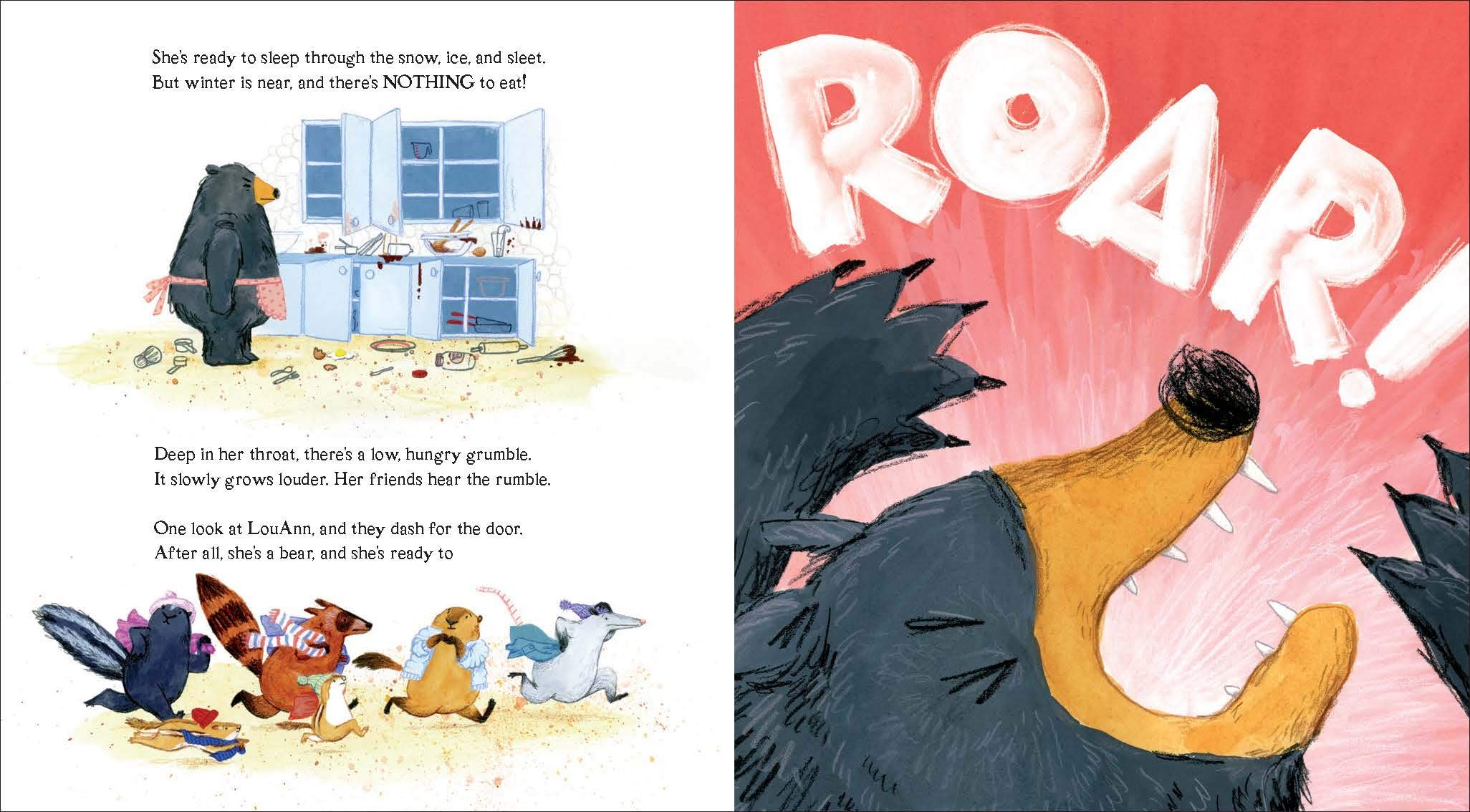
A skunk joins the group, nibbling and toasting with three doughnuts each as LouAnn uses her last egg to make more. This is it—the last dozen doughnuts. LouAnn is ready to munch when… you know! But there’s not a friend at the door—there are two! Two little chipmunks cram their cheeks full. And LouAnn? “She’s ready to sleep through the snow, ice, and sleet. / But winter is near and there’s NOTHING to eat!”

celebrate-picture-books-picture-book-review-dozens-of-doughnuts-roar

Image copyright Brianne Farley, 2020, text copyright Carrie Finison, 2020. Courtesy of G.P. Putnam’s Sons Books for Young Readers.

From deep down in her grumbling, rumbling belly there emerges a huge “ROAR!”  as all of the friends “dash for the door.” LouAnn cries it out and collapses on the floor. Then “DING-DONG!” Who could be left? Who is there now? It seems Woodrow and Clyde, Topsy and Mouffette, and even Chip and Chomp are more observant than they might have seemed. They’ve brought milk and flour, eggs and supplies. And after snugging LouAnn into her favorite chair, they go to work. Soon there are “dozens of doughnuts, / hot from the pan. / Stacked up in heaps, and they’re ALL for LouAnn!” But does she gobble them all down, or are there some left for—?

celebrate-picture-books-picture-book-review-dozens-of-doughnuts-surprise

Image copyright Brianne Farley, 2020, text copyright Carrie Finison, 2020. Courtesy of G.P. Putnam’s Sons Books for Young Readers.

Carrie Finison’s bright, bouncy rhythm and perfect rhymes set up brilliant suspenseful page turns that, while disappointing for LouAnn the Bear, will have readers in gales of giggles and chiming along after the first surprising twist. LouAnn’s ready willingness to share her dozens of doughnuts is kindness at its best and also provide an invitation for kids to do a little math as each friend shares in LouAnn’s generosity. When LouAnn, getting hungrier and sleepier, finally cracks, sending her friends running, the final “DING-DONG!” ushers in another sweet surprise. Just like readers, it seems LouAnn’s friends have been paying attention to the numbers, and they want to be sure that LouAnn gets her equal share too. Finison’s storytelling provides a baker’s dozen of delight and will become a favorite read aloud for any child.

Deliciously enchanting, Brianne Farley’s illustrations introduce some of the most adorable forest animals around as they come to visit LouAnn, lured by the aroma of her doughnuts. Farley has designed for LouAnn a little stone house that’s an ingenious update on a bear’s cave and has decorated it with from a fresh color palette. Likewise, her autumn foliage makes use of creative raspberry russets and glowing yellows. LouAnn’s facial expressions clearly depict her waning enthusiasm for all the interruptions, but also her gracious personality once she opens the door. Kids will love watching the window beside the front door and trying to guess who each new guest will be.

The detailed images of doughnuts on each animal’s plate makes it easy for children and adults to talk about math concepts, including counting, adding, subtracting, multiplying, dividing, and sorting. When hunger and weariness finally overtake LouAnn, kids and adults will recognize her meltdown and commiserate with her. The return of LouAnn’s friends with supplies and good cheer makes this pre-hibernation party one that all children will want to attend (with their own doughnuts, of course!).

Endearing to the max, Dozens of Doughnuts is a joy to share and is sure to stir up enthusiasm for repeat readings at home, in the classroom, or for public library collections.

Ages 3 – 8

G.P. Putnam’s Sons Books for Young Readers, 2020 | ISBN 978-0525518358

Discover more about Carrie Finison and her books on her website.

To learn more about Brianne Farley, her books, and her art, visit her website.

National Doughnut Day Activity

celebrate-picture-books-picture-book-review-cd-doughnut-craft

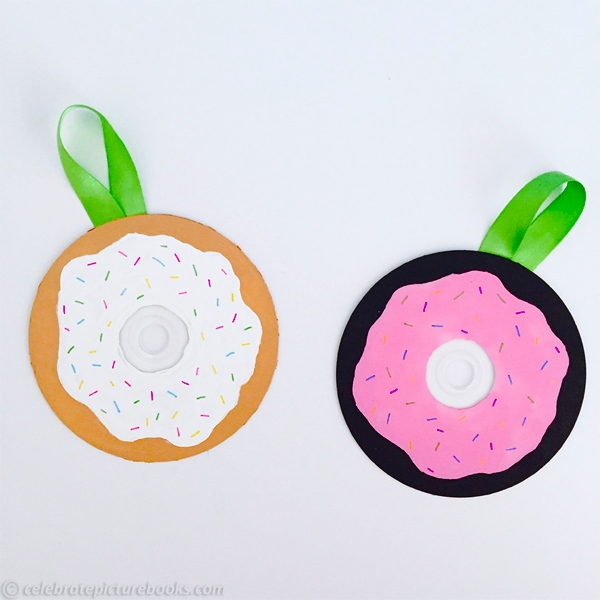
Disk Doughnut Decor


Are some of  your CDs or DVDs a little passé? Not if you can turn them into cute décor like this doughnut – or bagel – hanging.

Supplies

  • Unused CDs or DVDs or cut circles from cardboard, foam board or poster board
  • Craft paint in tan, black, pink, yellow, white (or any colors you want for the doughnut and the icing)
  • Ribbon, any color and length you want
  • Fine-tip markers in bright colors
  • Glue
  • Glue dots (optional)
  • Paint brush

Directions

  1. Paint a wavy edge around the CD or other material and let dry
  2. Add “frosting” by painting from the wavy line inward to the clear center of the CD, leaving the clear circle unpainted. If using another material, draw and cut a center “hole” for your doughnut.
  3. When the “frosting” is dry, draw sprinkles on it with the markers
  4. With the ribbon make a loop hanger and attach it to the back of the CD with glue or glue dots
  5. Hang your decoration

celebrate-picture-books-picture-book-review-dozens-of-doughnuts-cover

You can find Dozens of Doughnuts at these booksellers

Amazon| Barnes & Noble | Bookshop 

Picture Book Review