August 22 – National Tooth Fairy Day

celebrate-picture-books-picture-book-review-tooth-by-tooth-cover

About the Holiday

Today’s holiday celebrates the mythical (shhhh!) fun of the Tooth Fairy. When a child loses a tooth, they put it under their pillow and that night the Tooth Fairy comes, takes the tooth, and leaves money. What the sprite does with the teeth is a mystery and many theories abound. The mystery of how the whole thing got started is explained here! I had never heard this story, so was excited to find it in my research!

In 1927 Esther Watkins Arnold wrote an eight-page play called The Tooth Fairy. In the same year none other than Sir Arthur Conan Doyle claimed that fairies and gnomes were real and by proof published pictures of two girls surrounded by “verified” fairies. In 1928 schools began performing Esther Arnold’s play, and kids took it to heart, leaving their teeth under their pillows. The rest of the story is, as Sherlock Holmes would say, “Elementary!”

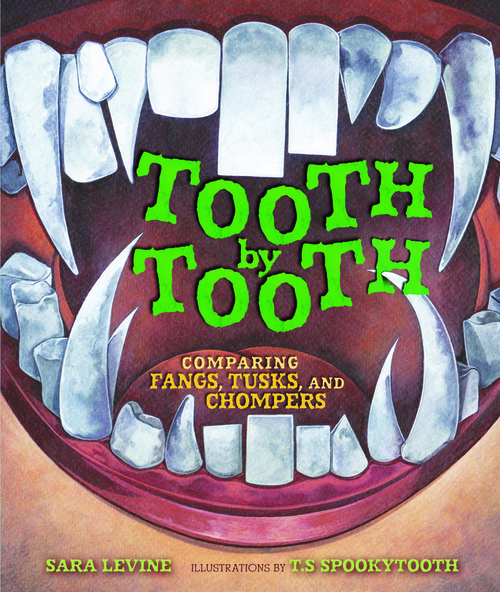
Tooth By Tooth: Comparing Fangs, Tusks, and Chompers

Written by Sara Levine | Illustrated by T. S. Spookytooth


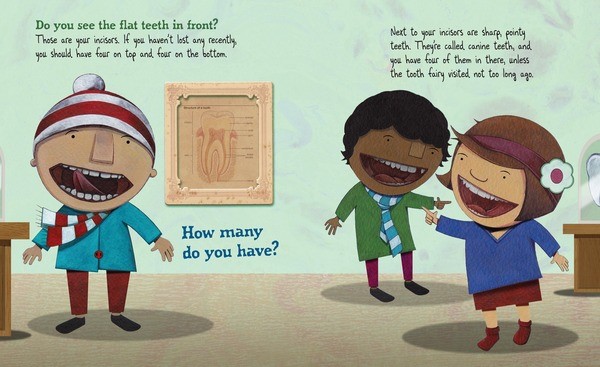
“Open wide!” a little girl with a good set of teeth herself encourages on the first page of this fun nonfiction book. “Look at all the chompers in there.” Mirror in hand she proceeds to reveal that human teeth are unusual because we are mammals, and mammal teeth come in different shapes and sizes. In fact there are three distinct types. A little boy takes over to describe them. Incisors are the four flat teeth in a person’s mouth—two on the top and two on the bottom right in front.

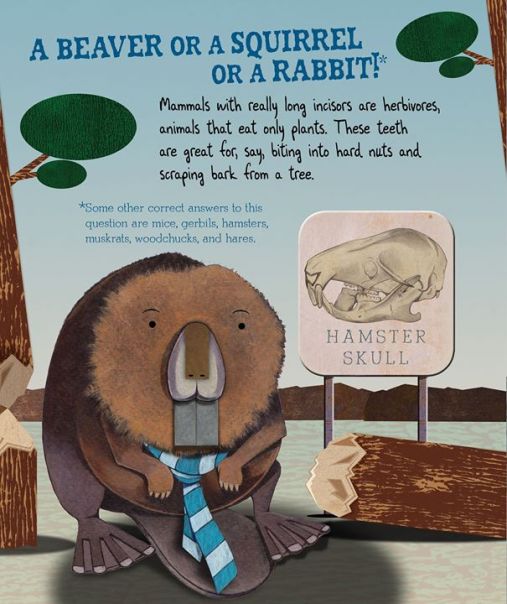
The four pointy teeth next to the incisors are canines, and the rest of the teeth are molars. Other mammals also have these teeth, and you can tell what an animal eats by which type is largest. For example, say your incisors were bigger than all your other teeth and they were so big they stuck out of your mouth even when it was closed, then you would be a beaver…or a squirrel…or a rabbit. These animals are herbivores and their oversized incisors help them break into nuts and scrape bark from trees.
celebrate-picture-books-picture-book-review-tooth-by-tooth-human-teeth

Image copyright T. S. Spookytooth, courtesy of Lerner Books

From here on Tooth by Tooth offers up amusing illustrations and “what kind of animal would you be if…” questions to spark kids’ powers of recognition. How about if your canines were so long they poked out of your mouth? Well, then you could be a “seal or a cat or a dog or a bear!” All these animals eat meat and need the sharp teeth to do it.

What if you had really tall molars? Then you’d be a “horse or a cow or a giraffe!” These guys use their molars to grind up grass. And if all your teeth were the same height? Come on…you know! You’d be you! Because humans eat plants and meat, we “need teeth that do many different jobs.”

But there are a lot more wacky teeth out there waiting for us to brush up on. So let’s get started. What if “two of your top incisors were so long that they grew out of your mouth and pointed to the sky? What if they were so long you could use them to carry your school bag?” You’ve probably guessed this one—you’d be an elephant. While an elephant’s tusks aren’t used for eating, they are used to procure the bark, roots, and other plant material that make up the elephant’s diet.
celebrate-picture-books-picture-book-review-tooth-by-tooth-beaver

Image copyright T. S. Spookytooth, courtesy of Lerner Books

What if you could almost trip over your canine teeth? Yep, you’d be a walrus, and you would use those sharp bad boys to poke holes in the ice to grab your favorite oysters and clams. But after eating they’re not done using their teeth. “After diving down for a meal, walruses can use their tusks to pull themselves back up onto the ice for a nap. Imagine if “your top and bottom canine teeth curled up out of your mouth so you had two pairs of tusks?” Or if your one upper canine grew through your upper lip and kept on growing?  Or if you had no teeth at all? Yikes! The remarkable answers are just a read away!

Fish, amphibians, and reptiles also have teeth of a sort, but because they are all the same shape and size, they don’t get special names—that doesn’t mean you can ignore them, though, because sharks are among this group, and you know what they can do!

More information about mammals, mammal teeth, a glossary, and a list of online and print references follow the text.

There’s nothing like the Wow! factor to capture kids’ attention, and Sara Levine uses it to humorous and fascinating effect in Tooth by Tooth: Comparing Fangs, Tusks, and Chompers. After giving a solid description of each kind of tooth and what it is used for in language that kids use and will relate to, Levine begins her guessing game that leads to even more discovery. We’ve all seen elephants and walruses with their mighty tusks, but how many know what they are really used for? And what about warthogs and narwhals? It’s all here in this creative nonfiction title.

T. S. Spookytooth took a big bite out of the “how to make kids laugh” manual in illustrating each question and type of tooth. Pictures of girls and boys with enormous teeth jutting this way and that will make readers glad to be human. And while the animals that belong to each molar, incisor, or canine sport the scarf, bow, or head band of its human counterpart, they are clearly and scientifically drawn to provide full understanding. Animal skulls also demonstrate the placement of teeth. The cover, with its close enough to eat you view of a very scary mouth is a show stopper and will attract kids as soon as they see it.

Ages 5 – 9

Millbrook Press, Lerner Books, 2016 | ISBN 978-1467752152

Check out Sara Levine’s website for more books, stuff for kids, teachers’ resources, and more!

View a gallery of T. S. Spookytooth’s art and read his biography (?!) on his website!

National Tooth Fairy Day Activity

celebrate-picture-books-picture-book-review-kid-shaped-maze

Smile! Kids are A-maze-ing! Maze


Smile with those pearly whites as you find your way through this printable Kids are A-maze-ing maze! Here’s the Solution!

August 15 – National Relaxation Day

celebrate-picture-books-picture-book-review-whoosh!-lonnie-johnson's-super-soaking-stream-of-inventions-cover

About the Holiday

Relaxation Day was founded in 1985 by then fourth-grader Sean Moeller, who already knew a thing or two about balance in life when he suggested that “cleaning and real work are not part of relaxation.” Today’s holiday gives you permission to kick back and enjoy yourself. The subject of today’s book invented a great way to take advantage of a day off—and also demonstrates that sometimes work and relaxation go hand-in-hand!

WHOOSH! Lonnie Johnson’s Super-Soaking Stream of Inventions

Written by Chris Barton | Illustrated by Don Tate


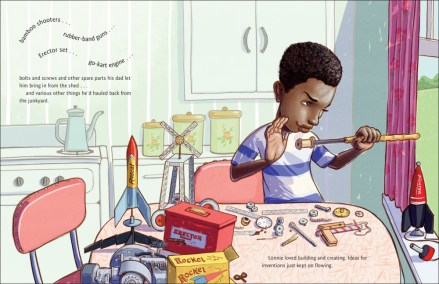
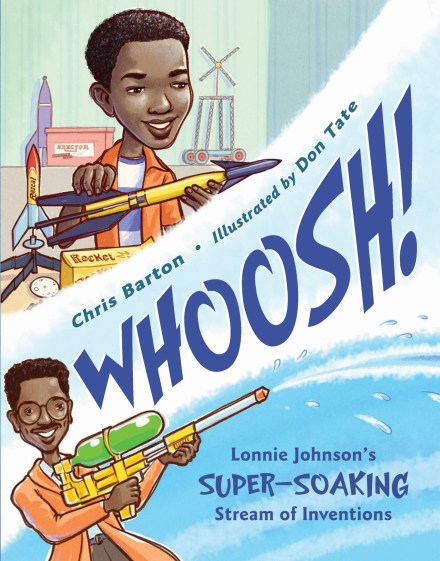
Lonnie Johnson had a way with stuff. In his hands bolts and screws, gears and springs, spools, clothespins, “spare parts his dad let him bring in from the shed, and various other things he’d hauled back from the junkyard” fueled Lonnie’s ideas for inventions and rocket ships. The kids at school loved to watch him launch the rockets he’d devised on the playground. Lonnie wanted to have a career as an engineer. Getting there took a lot of determination and courage. Once, the results of a standardized test said that he would not make a good engineer. Lonnie felt discouraged, but he knew that the person who had graded his test didn’t know him—or Linex.

celebrate-picture-books-picture-book-review-whoosh!-lonnie-johnson's-super-soaking-stream-of-inventions-young-lonnie-inventing

Image copyright Don Tate, courtesy of charlesbridge.com

Linex was the robot Lonnie had built from scrap metal. “Compressed –air cylinders and valves allowed Linex’s body to turn and its arms to move. The switches came from an old, broken jukebox. Lonnie used a tape recorder to program Linex, and as a bonus the reels looked like eyes.” Lonnie’s goal was to enter Linex in a science fair, but first he wanted to be able to program it. It took several years before he discovered how. Using his little sister’s walkie-talkie, Lonnie took Linex to the “1968 science fair at the University of Alabama—where only five years earlier, African American students hadn’t even been allowed.” Lonnie’s team won first place.

Lonnie went to college at Tuskegee Institute, where he realized his dream of becoming an engineer. His career “took him beyond Alabama—way beyond.”  He went to work for NASA. Before the orbiter Galileo could be sent to Jupiter, Lonnie developed a system that would ensure the craft would have a constant supply of power for its computer memory in case the main power was lost. Some fellow scientists doubted his idea would work, but it did. “As it photographed Jupiter and its moons, Galileo was supported by the power package that Lonnie designed.”

celebrate-picture-books-picture-book-review-whoosh!-lonnie-johnson's-super-soaking-stream-of-inventions-linex

Image copyright Don Tate, courtesy of charlesbridge.com

Even though Lonnie worked for NASA, he continued tinkering with his own ideas—in his own workshop. One problem he was trying to solve involved the need for the world’s refrigerators and air conditioners to have a cooling system that didn’t use the damaging chemical R-12. “He had an idea for using water and air pressure instead.” He built a prototype and experimented with it in his bathroom sink. When he turned his pump and nozzle on, a stream of water blasted across the room.

Suddenly, Lonnie saw another use for his invention—as a water gun. He created a design small enough for children’s hands, and tested it at a picnic, where it was a hit. Lonnie took his idea to a toy company…and another…and another. Finally one company agreed to make his water gun. Spurred on by this success, Lonnie found investors to help him build other original inventions: “a water-propelled toy airplane, two kinds of engines, and his cooling system” that had led to the water gun. He even quit his day job to devote his time to inventing.

But things don’t always work out. Each project fell through—even the water gun. It was a scary time as he and his family had to move out of their house and into an apartment. But Lonnie believed in himself. He took his water gun to another toy company. In 1989 he found a toy company willing to take a look. Lonnie made the trip to Philadelphia and wowed the executives with his invention.

celebrate-picture-books-picture-book-review-whoosh!-lonnie-johnson's-super-soaking-stream-of-inventions-water-powered-nozzle

Image copyright Don Tate, courtesy of charlesbridge.com

Now kids everywhere enjoy the fun of the Super Soaker. Today, Lonnie can be found in his workshop doing what he loves: “facing challenges, solving problems and building things” because “his ideas just keep on flowing.”

Chris Barton’s biography of Lonnie Johnson is a fascinating look at a man who succeeds in turning “No” into “Yes” by the power of his intelligence, ideas, and determination. Kids will love hearing about how one of their favorite toys came to be and will be inspired to chase their own dreams despite challenges and setbacks. Barton’s detailed narration provides a full picture of Lonnie Johnson and his times, specifics that attract and inform like-minded kids. Including the results of Lonnie’s exam should encourage kids who think differently. The story is enhanced by the conversational tone that makes it accessible to kids of all ages.

Don Tate illuminates Lonnie Johnson’s life story with his bold, full-bleed paintings that follow Lonnie from his being a child with big ideas to becoming a man who has seen these ideas through to success. With an eyebrow raised in concentration, young Lonnie demonstrates confidence and skill as he works on an invention, and kids will love seeing the tools of his trade laid out on the kitchen table. With his eyes narrowed in frustration and disappointment, Lonnie reads the results of his childhood exam. As Lonnie grows older and designs systems for NASA, the illustrations depict the schematics of the Galileo power package and Lonnie’s surprise at the strength of the water stream in his prototype cooling design. As all kids know, the spurt of a Super Soaker is awesome, and this fact is demonstrated in a “Wowing” fold-out page.

WHOOSH! Lonnie Johnson’s Super-Soaking Stream of Inventions is a welcome biography of the man who designs systems for the greater world but has never lost his youthful enthusiasm to invent.

Ages 5 – 10

Charlesbridge, 2016 | ISBN 978-1580892971

Check out more fiction and nonfiction books by Chris Barton on his website!

Discover more books written and illustrated by Don Tate as well as a portfolio of his work and book-related activity guides on his website!

National Relaxation Day Activity

celebrate-picture-books-picture-book-review-kids-in-pool-coloring-page

Dive In! Coloring Page


The Super Soaker is a great way to cool off! Another relaxing water activity is swimming in a pool! So dive in to this printable cool pool Dive In! Coloring Page!

August 12 – International Youth Day

celebrate-picture-books-picture-book-review-nadia-the-girl-who-couldn't-sit-still-cover

Image copyright Christine Davenier, courtesy of Houghton Mifflin Harcourt Publishing Co.

About the Holiday

In so many ways children and young adults are not only our future but they lead the world forward now. In recognition of this, the United Nations established International Youth Day to work toward ensuring that all children have access to resources to make positive and progressive choices. The theme for this year’s International Youth Day revolves around sustainable consumption, an important topic for the world our young people are inheriting.

It’s fitting that today’s holiday comes during the Olympic Games, a showcase of the best determination, hope, and spirit of today’s youth and tomorrow’s promise. A “perfect” reminder of that is the subject of today’s book!

Nadia: The Girl Who Couldn’t Sit Still

Written by Karlin Gray | Illustrated by Christine Davenier


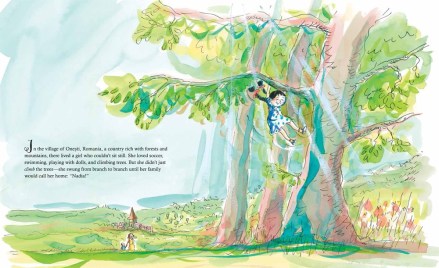
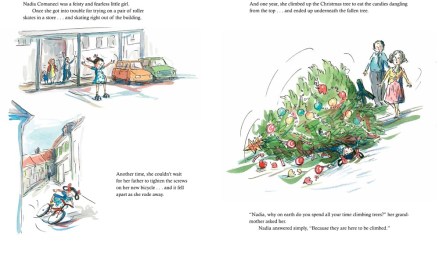
“In the village of Oneşti, Romania, a country rich with forests and mountains” Nadia Comaneci could often be seen swinging from tree branch to tree branch. She was a little girl who loved to play. She was “feisty and fearless,” attempting new things on a whim and always with a sense of adventure. Once she tried on a pair of roller skates and skated right out of the store! Another time she was so impatient to ride her new bike that she pedaled off before her father could even tighten the screws. The bike “fell apart as she rode away.” And one year her love of climbing trees extended to the family Christmas tree, which toppled over on her, pinning her to the ground.

To channel all that energy, Nadia’s mother enrolled her in gymnastics lessons. Nadia’s eyes lit up when she saw the room full of ropes, ladders, bars, mats, and trampolines to discover, but she didn’t leave her new skills at the gym. Nadia and a friend cartwheeled around the school playground, capturing the attention of Bela and Marta Karolyi, who owned a gymnastics school. They invited the girls to join.

celebrate-picture-books-picture-book-review-nadia-the-girl-who-couldn't-sit-still-swinging-in-trees

Image copyright Christine Davenier, courtesy of karlingray.com

Nadia was only 6 when she began studying with Bela and Marta. Immediately, she discovered that she liked gymnastics better than her school subjects. She progressed quickly from performing “a straight cartwheel on a line painted on the floor” to doing it on a low balance beam and finally on the high balance beam. She began learning harder and harder moves, “flying from bar to bar, from floor to vault, and high above the beam.”

At 9 years old, Nadia competed in her first National Junior Championship. Despite her skill and hard work, she fell from the high beam during a leap not once but three times. Nadia finished the competition in 13th place. Her disappointment only strengthened her resolve. She went back to the gym and continued to practice many hours every day. Her determination paid off, “and at the next National Junior Championship games, she won first place.”

The ultimate recognition of her skill came when she was chosen to be part of the 1976 Romanian Olympic team. The games were held in Montreal, Canada, and all eyes were on the returning gold medalists from Russia, Olga Korbut and Lyudmila Turischeva. But excitement soon filled the venue as Nadia performed on the beam, the floor, and the vault where she scored 9.9, 9.75, and 9.7 on a scale of 1 (the lowest score) to 10 (a perfect score). The next event was the uneven parallel bars on which Olga Korbut had just scored a 9.9. “Nadia mounted the bars. Now fourteen years old, she was a long way from the forests in Romania. But she swung around as easily as she had jumped from branch to branch as a little girl. The audience gasped as she twirled and whipped and flipped.”

celebrate-picture-books-picture-book-review-nadia-the-girl-who-couldn't-sit-still-gym

Image copyright Christine Davenier, courtesy of karlingray.com

Nadia dismounted and landed perfectly on the mat below as the audience “exploded with applause.” Nadia returned to her team to wait for her score. And wait…and wait. Finally, the score appeared on the board—1.00. The worst score. How could that be? “‘What is Nadia’s score?’” Bela asked the judges. “One of the officials held up ten fingers as a voice announced over the loudspeaker: ‘Ladies and gentlemen, for the very first time in Olympic history, Nadia Comaneci has received the score of a perfect ten!’”

Because no one had ever achieved a 10 before, the scoreboards were programmed only for a high of 9.9. Nadia couldn’t bask in her accomplishment for long, however. She moved on to her next event—and her next perfect 10! “When the competition ended, she had earned seven perfect 10s.” At the medal ceremony both Olga and Lyudmila congratulated their competitor as the new Olympic champion. In all Nadia won five medals and became the youngest ever Olympic gold medalist in gymnastics.

celebrate-picture-books-picture-book-review-nadia-the-girl-who-couldn't-sit-still-balance-beam

Image copyright Christine Davenier, courtesy of karlingray.com

Nadia became a darling of the press. They surrounded her, asking “how it felt to have the world’s attention, if she had been confident she would win, and when she would retire.” She answered each reporter with enthusiasm and confidence, and promising that she was a long way from retiring. When she returned home, it seemed that all of Romania had come out to welcome her and her teammates—even the country’s president.

Now Nadia was famous all over the world. She returned to practicing and inventing new routines, preparing for other competitions and the 1980 Olympic Games. She had come far from swinging branch to branch in the trees of Oneşti, but she would always be that little girl who couldn’t sit still.

Karlin Gray’s compelling biography captures all the spunk and spirit of Nadia Comaneci that made the world fall in love with her at the 1976 Olympic Games. Adults of a certain age well remember watching her in astonishment as she seemed to effortlessly swirl, twirl, and flip through her routines, flashing her sweet smile as she waved to fans. In the first pages Gray reveals anecdotes of Nadia’s adventurous nature that will captivate readers even as they giggle at her predicaments.

celebrate-picture-books-picture-book-review-nadia-the-girl-who-couldn't-sit-still-mishaps

Image copyright Christine Davenier, courtesy of karlingray.com

The straightforward narration of Nadia’s trajectory from playground cartwheeler to Olympic champion enhances both the gritty determination of her studies with her coaches as well as the suspense of her competitions. All children—no matter what their talent—will draw inspiration from Nadia’s story, which includes disappointments as well as unbounded accomplishments. Gray’s lyrical language flows as smoothly as Nadia flew through the air and will land in readers’ hearts as a perfect 10.

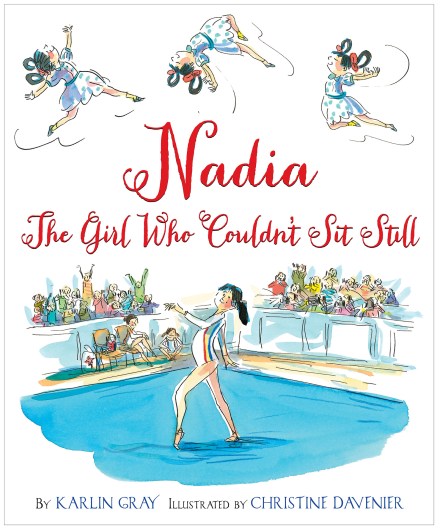
From the cover, which sports Nadia in her iconic floor exercise pose, to the last page, Christine Davenier depicts the world of gymnastics with beauty and the kind of realistic details that create a classic. The two-page spread of the gym where 6-year-old Nadia learns to love gymnastics portrays the enormity of the space and the equipment for a small girl—as well as the enormity of her achievement.

Kids will love the almost “play-by-play” illustrations of how Nadia learned to perform her feats, from starting with a line on the floor to perfecting the high beam and more. Nadia is shown leaping, somersaulting, doing handstands, and even wavering and falling as she practices and competes. The thrill of the Olympic Games, from the opening ceremonies, to the rapt and cheering audiences to the awards ceremony are drawn with stirring action, color, and attention to the specifics of that very special 1976 summer in Montreal.

An Afterword expands on Nadia Comaneci’s courageous life choices and career post-gymnastics and includes a timeline, notes, a selected bibliography, and websites for further study.

Nadia: The Girl Who Couldn’t Sit Still will fascinate kids and would be a very welcome addition to school classroom—as well as home—libraries.

Ages 5 – 10

Houghton Mifflin Harcourt, 2016 | ISBN 978-0544319608

Visit Karlin Gray‘s website to learn more about her and to download fun activities!

View a gallery of artwork by Christine Davenier on her website!

Discover more about Nadia: The Girl Who Couldn’t Sit Still on the Houghton Mifflin Harcourt website!

International Youth Day Activity

celebrate-picture-books-picture-book-review-rhythmic-gymnastics-ribbon-craft

Rhythmic Gymnastics Ribbon


You can recreate the grace of rhythmic gymnastics with this easy craft! The swirling beauty of the ribbon makes any movement fun!

Supplies

  • 12-inch dowel
  • 6-foot length of ribbon
  • Paint the same color as the ribbon
  • Hot glue gun or strong glue
  • Paint brush

Directions

  1. Paint the dowel and let dry
  2. Glue the edge of the ribbon to one end of the dowel. Wrap the ribbon about ½ inch around the dowel and secure with glue. Let glue dry.

Picture Book Review

July 31 – Uncommon Instrument Awareness Day

celebrate-picture-books-picture-book-review-ada's-violin-cover

About the Holiday

Today is the day to be musically experimental. Intriguing, inventive instruments that make a wide variety of sounds exist in every corner of the world. From Russia comes the contrabass balalaika, a triangular stringed instrument. The cimbalom, a concert hammered dulcimer, originated in Hungary. And only the Welsh could give us an instrument with no vowels: the crwth. Glass, water, and lightning are also used to make beautiful sounds, and the Holophonor—a musical instrument and hologram projector all in one—is perfect for Elvis sightings wherever he is! So, play a different instrument or research one, and read the inspiring story in today’s book!

Ada’s Violin: The Story of the Recycled Orchestra of Paraguay

Written by Susan Hood | Illustrated by Sally Wern Comport


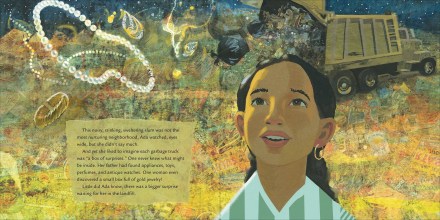
Ada Ríos is growing up in Cateura, a town built of trash as the main garbage dump for the capital city of Paraguay. Every morning the refuse trucks rumble into town to deposit their loads—1,500 tons of trash every day. The citizens of Cateura—gancheros or recyclers—go to work sifting through the mounds and tearing into bags looking for anything valuable enough to recycle or sell. Cardboard is worth 5 cents a pound, plastic 10 cents a pound.

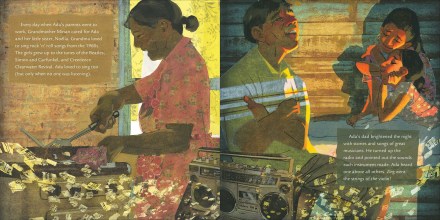
Ada knows the landfill can hold surprises—“Her father, a ganchero, had found appliances, toys, perfumes, and antique watches.”—but she can never imagine what it holds for her. When Ada and her sister were little, their grandmother watched them while their parents worked. They loved to listen to music, to sing, and to learn stories of musicians and the sounds of different instruments. Ada fell in love with the violin.

celebrate-picture-books-picture-book-review-ada's-violin-making-singing

Image copyright Sally Wern Comport, courtesy of simonandschuster.com

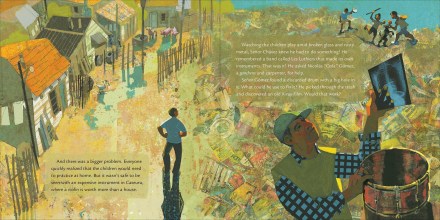
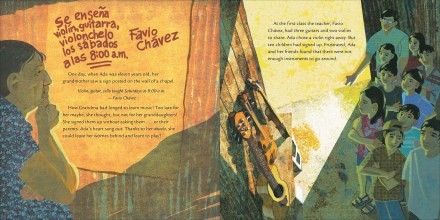
As the girls grow older and go to school, they venture farther into town, but there is little to fill their time. Many kids join gangs or get into fights. When Ada is 11 her grandmother signs her and her sister up for music lessons being offered by a new man in town named Favio Chávez. “Ada’s heart sang out” when she hears the news. On the first day ten children show up to play the five instruments available. But a bigger problem looms: the three guitars and two violins cannot be taken home for practicing as they are magnets for thieves. In Cateura a violin is worth more than a house.

But Favio Chávez has an idea. With help from Nicolás Gómez, a ganchero and carpenter, they pull bits and pieces from the landfill. An old broken drum and an X-ray film become a workable drum, water pipes become flutes, packing crates become guitars and violins, and oil drums become cellos. “Ada chose a violin made from an old paint can, an aluminum baking tray, a fork, and pieces of wooden crates. Worthless to thieves, it was invaluable to her. It was a violin of her very own.”

celebrate-picture-books-picture-book-review-ada's-violin-making-instruments

Image copyright Sally Wern Comport, courtesy of simonandschuster.com

The children practice tirelessly outside in 100-degree heat until the initial “screeches, twangs, and tweets hit all the right notes. Their class became ‘a small island’ where Chávez taught them to respect themselves and one another.” They become known as The Recycled Orchestra. Music now fills the air, adding a soundtrack of beauty to the grueling work. The orchestra is soon invited to play concerts in Cateura and the capital city of Asunción. When word spreads of their talent, they receive offers to play from other cities and even other countries.

When Ada is 16 The Recycled Orchestra is invited to tour with a world-famous rock band. As Ada takes the stage in front of 35,000 people in Bogotá, Colombia, she is afraid, but the audience cheers for them and sings along as they play. On that night the children discover a new life. “Buried in the trash was music. And buried in themselves was something to be proud of.”

celebrate-picture-books-picture-book-review-ada's-violin-lessons

Image copyright Sally Wern Comport, courtesy of simonandschuster.com

An extensive author’s note plus a photograph of The Recycled Orchestra, websites, and videos follow the text, as well as a list of sources.

Ada’s Violin is also available in a Spanish edition—El violín de Ada: La Historia de la Orquesta de Instrumentos Reciclados del Paraguay.

Susan Hood has brought to light an incredible story of perseverance, hope, and the ability of music and other arts to provide opportunities and self-confidence that change lives. Told with unstinting honesty and sensitivity, Hood’s biography of Ada Ríos, Favio Chávez, and The Recycled Orchestra will inspire all who read it. The well-paced text offers revealing details on every page and flows with a lyrical quality that enhances the effect of the story and its impact. From the first sentence to the last, both children and adults will be riveted to The Recycled Orchestra.

celebrate-picture-books-picture-book-review-ada's-violin-hope

Image copyright Sally Wern Comport, courtesy of simonandschuster.com

Sally Wern Comport’s paintings beautifully capture the human spirit that shines through and drives people to astonishing achievements even in the most adverse conditions. With intricately created collages of rich hues, Comport depicts the town of Cateura and the mountains of trash the citizens work and play on. Warm lighting illuminates faces full of dreams and love, and readers will linger over depictions of the instruments workshop and cheer along with the concert audience as the children receive recognition. The full-bleed, two-page spreads echo the expanded world music gave to the children in the orchestra and the adults who heard them as music score confetti flutters throughout.

Both school classrooms and home libraries will benefit from the stirring message of Ada’s Violin.

Ages 4 and up

Simon & Schuster Books for Young Readers, 2016 | ISBN 978-1481430951 (English edition); 978-1481466578 (Spanish edition)

Discover more about Susan Hood and her books, plus fun activities for kids and information for teachers and parents on her website!

View a gallery of Sally Wern Comport’s artwork on her website!

Uncommon Instrument Awareness Day Activity

celebrate-picture-books-picture-book-review-homemade-musical-instrument


Make Your Own Musical Instrument


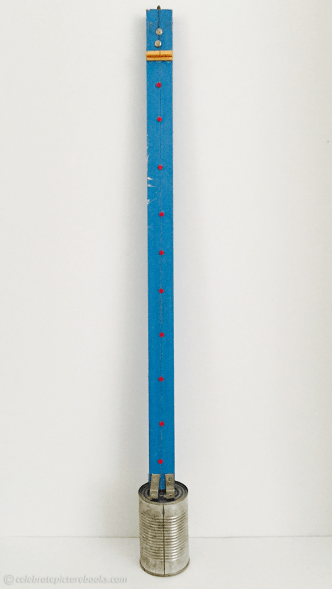
Inspiration for sound can come from almost any object! Look around your house or classroom and discover the music in boxes, cans, blocks of wood, plastic egg cartons or deli containers, and more. Add string or wire for plucking, sticks for drumming, or beans for shaking. With a little glue, tape, or hardware and some creativity, you’ll be making your own rhythms in no time!

Supplies for the instrument shown in the picture above

  • Tin can
  • Two small L brackets
  • Piece of wooden molding, 2 1/2 feet by 1 1/2 inches by 3/4 inches
  • Five small strips of wood to raise the wire off the neck of the instrument. I used long wooden fireplace matches cut into 1 1/2″ sections 
  • Thin wire
  • Small circular hook screw or regular screw
  • Two tacks
  • A nail, screw, or piece of wood that will fit horizontally in the mouth of the can
  • a small nail to make a hole in the can
  • Hammer
  • Strong Glue
  • Paint
  • Foam decorative dots

Directions

  1. Paint the wood and let dry
  2. Paint the small strips of wood and let dry
  3. Decorate the can with paint, sticker, duct tape, or paper
  4. With the hammer and small nail, make a hole in the center of the bottom of the can
  5. Wrap one end of the wire around the nail and glue so it is firmly in place
  6. Feed the other end of the wire through the hole in the bottom of the can
  7. Screw or glue two L brackets to one end of the wood molding so that the bottom of the L is flush with the bottom of the wood molding and there is space between the brackets. This makes the neck of the instrument
  8. Screw the circular or regular screw into the top, center of the wooden molding
  9. When the wooden strips are dry, glue three side by side 3 inches from the top of the molding. Glue two more matches, one on top of the other on the center strip.
  10. When the L brackets are dry, glue them (and the neck of the instrument) to the can, making sure the brackets are on either side of the hole in the can. Make sure the wire is out of the hole. 
  11. When the brackets are firmly attached to the can, pull the wire to the top of the neck. Settle it in the center of the small pieces of wood, so that the wire is not touching the neck.
  12. Wrap the wire around the screw at the top of the molding until it is firmly in place and the wire is taut. 
  13. Secure the wire to the neck with the tacks
  14. Mark the “frets” with the foam dots

Picture Book Review


July 28 – It’s Culinary Arts Month

celebrate-picture-books-picture-book-review-cake-day-cover

About the Holiday

The recipe—the step-by-step recitation of the ingredients and process for making any dish—is the heart of the culinary arts. Following along, improvising in just the right places, and inventing completely new tastes is its own special kind of literacy. Today we say goodbye to Culinary Arts Month, but hope that the joy of cooking delicious treats and reading fabulous books together remain common, fun activities with which to explore life and love—as shown with today’s book!

Cake Day

Written by Ellen Mayer | Illustrated by Estelle Corke


An adorable little boy runs to his grandma, excited that it’s “Cake Day!” “That’s right,” his grandma agrees, “Today we’re going to bake a cake!” The boy, hardly able to see over the counter, wants to be picked up and see what’s in the cabinet. His grandma happily obliges, and the pair carefully pick the ingredients for their cake.

“‘Hmmm…we need flour, salt, baking powder, and sugar to make a cake,’ says Grandma.” With all the ingredients set on the table, the two start measuring. The little chef is eager and curious: “Cake Day! How much, Grandma? As the flour pours into the cup, a soft, powdery cloud envelops them. “Too much, Grandma!” the delighted boy laughs. The two work side by side, Grandma adding the eggs while her grandson pours in the milk.

celebrate-picture-books-picture-book-review-cake-day-cover

Image copyright Estelle Corke, courtesy of Star Bright Books

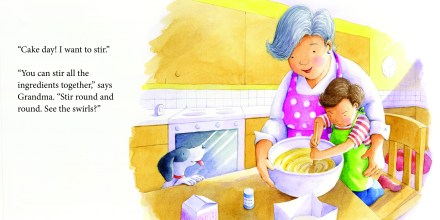
As the ingredients start to mesh, Grandma exclaims, “‘Look! What’s happening to the batter?’” The little boy wants to help it along and takes up the wooden spoon. Round and round he stirs, creating swirls in the yellow batter until it’s ready for the oven. “‘Bake day! Your turn, Grandma!” the boy stands wide-eyed as his grandma slides the deep pan into the oven.

The little boy and his dog settle in front of the oven to watch the cake bake. With eagerness the boy asks, “‘Cake day! Ready, Grandma?” Grandma encourages her grandson’s inquisitiveness and explains the process: “‘We have to wait until the cake rises. The heat makes it rise. When you hear the timer go BEEP BEEP it will be ready.’” At last the cake comes out of the oven, but it’s not ready to be decorated yet. First, they must wait for it to cool.

In a short time the high, golden cake can be iced and decorated. The little boy vigorously shakes a jar of sprinkles over the top, scattering a rainbow of colors across the white frosting. The cake is beautiful and just the right complement to the little boy’s Cake Day, Bake Day, Shake Day—Birthday!

Ellen Mayer’s language-rich and playful story of a small child and his grandmother baking together is a wonderful introduction not only to reading but to the type of full-sentence conversational modeling that improves and increases literacy. The steps to baking the birthday cake flow organically and lyrically through the loving relationship between the little boy and his grandma, enticing young readers to learn more about the world around them and how it works. The repeated phrases “Cake day! Bake day!,” and “Ready, Grandma?” as well as the boy’s short statements offer opportunities for kids to read along and learn new vocabulary as they develop important language skills.

Estelle Corke’s cheery illustrations glow with enthusiasm and the close bond between grandmother and grandson. The grandmother lifts, steadies, and holds the boy while still allowing him to perform all the tasks he can. The little boy, in his green apron, delights in every aspect of the baking process, his eagerness expressed in his animated smile and keen participation. The homey kitchen is awash in inviting colors and objects that children will recognize. The clearly drawn boxes and jars of ingredients, kitchen tools, and furnishings offer readers a chance to practice their vocabulary and learn new words.

Ages Birth – 5

Star Bright Books, 2016 | ISBN 978-1595727466

To see more books by Ellen Mayer as well as language development and reading strategies for young children, visit her website!

Visit Estelle Corke’s website to view a gallery of her artwork!

Star Bright Books publishes fiction nonfiction, and bilingual “great books for great kids” and provides literacy resources for readers.

Culinary Arts Month Activity

celebrate-picture-books-picture-book-review-cake-day-grandma's-cake

Image copyright Ellen Mayer

Grandma’s Cake


Grandma and her grandson baked a delicious, special cake—and now you can too! Here’s the full recipe that Grandma uses. Recipe courtesy of Ellen Mayer.

A Simple Sponge Cake Recipe

Ingredients

  • 1 stick unsalted butter, softened, plus a little to grease cake pan.
  • 1 1/2 cups sugar
  • 2 cups all-purpose flour
  • 1/4 teaspoon salt
  • 2 teaspoons baking powder
  • 3 large eggs at room temperature
  • 2 teaspoons vanilla extract
  • 3/4 cup milk
  • You will need: 3 mixing bowls:
  1. 1 to cream butter and sugar
  2. 1 to mix flour, baking powder and salt
  3. 1 in which to beat the eggs
  • A 7-inch diameter, deep cake pan

Directions

  1. Butter pan and dust with flour.
  2. Set the rack at the middle of the oven.
  3. Preheat oven to 350 degrees.
  4. Sift flour, baking powder, and salt into a bowl and set aside.
  5. In large mixing bowl, beat butter and sugar until light and fluffy. In the third bowl, beat the eggs and add milk.
  6. Add 1/3 of the flour mixture to butter mixture then alternate with the egg and milk mixture. Continue to alternate ending with flour mixture. Scrape bowl and beater often.
  7. Add vanilla and mix well.
  8. Pour batter into prepared pan and smooth top with a spatula.
  9. Bake cake about 45 minutes. Insert knife or wooden skewer into the center. If it emerges clean, the cake is done. If not, bake for 5 more minutes.
  10. Remove cake from oven and allow to set for 5 minutes.
  11. Turn cake out onto a cake rack and leave to cool.

Grandma’s Favorite Frosting

  • 8 oz cream cheese
  • 1 1⁄2 cups confectioners’ sugar
  • 1⁄4 stick butter
  • 1 teaspoon vanilla extract
  1. Blend all ingredients together with a mixer until smooth
  2. Spread on the top and sides of cake
  3. Decorate with sprinkles or your favorite topping

Picture Book Review

July 26 – It’s Park and Recreation Month

celebrate-picture-books-picture-book-review-the-streak-how-joe-dimaggio-became-america's-hero-cover

About the Holiday

This month we recognize all the parks—national, state, local, and more—that provide fun and recreation for those who love the great outdoors. There is perhaps no sport that combines the physical aspects of “park” with the spirit of “recreation” quite like baseball. The crack of the bat connecting with the ball for a home run, the thwack of an outfield catch, the collective cheers, and the aroma of ballpark snacks all mix to create a perfect outing—whether your team wins or not!

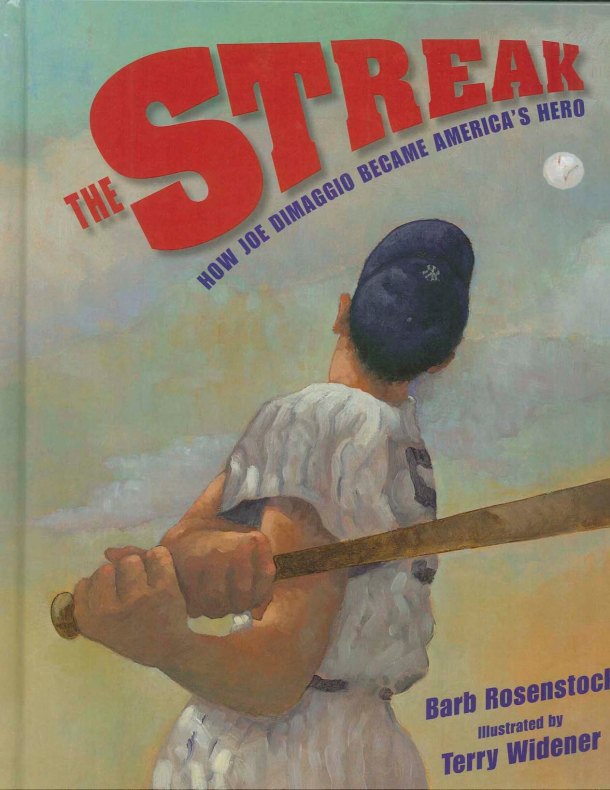
The Streak: How Joe DiMaggio Became America’s Hero

Written by Barb Rosenstock | Illustrated by Terry Widener


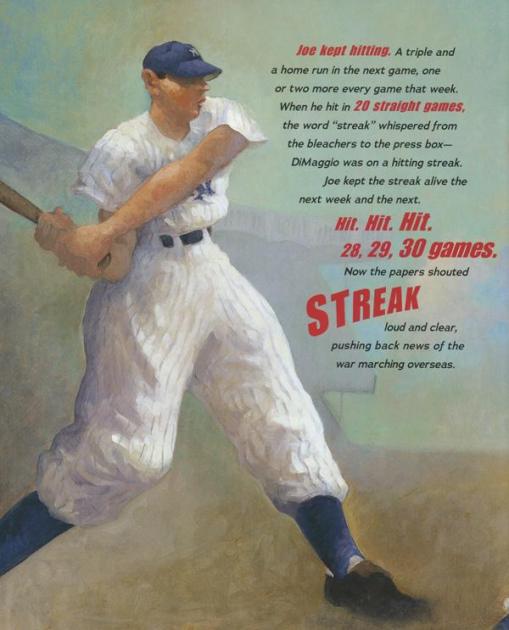
With a single hit to left field, Joe DiMaggio turned a pre-World War II summer into something that cheered and united all Americans. It was May 15, 1941 when the New York Yankees sent Joe to the plate. He hit a single—not much to help them overcome their 13 to 1 loss, but it was in the next game and the next and the next…that people started to take notice. In every game Joe made a hit. Some were home runs, some triples or doubles, and when “he hit in 20 straight games, the word ‘streak’ whispered from the bleachers to the press box—DiMaggio was on a hitting streak.”When Joe reached 30 straight games with a hit, the newspapers printed bold headlines and articles that temporarily pushed “back news of the war marching overseas.”

Joe DiMaggio wasn’t like other well-known players. He was the son of immigrants and grew up in San Francisco with eight brothers and sisters, working in the family fishing business and selling newspapers to make extra money. He was used to hard work, and this ethic served him well as a baseball player.

Everyone knew about Joe’s bat “Betsy Ann” and the care he gave her. He had treated her wood and sanded her handle, shaving off “fractions of an ounce until she fit his hands alone. Betsy Ann was his treasured ‘ball bat,’ used for games only.” When Joe faced the pitcher at the plate, he didn’t go through an elaborate routine. His wide-legged stance was well recognized by fans who knew he would get the job done. And that summer in 1941 he did.

celebrate-picture-books-picture-book-review-the-streak-how-joe-dimaggio-became-america's-hero-joe-hitting

Image copyright Terry Widener, courtesy of terrywidenerart.com

He and Betsy Ann “whipped around, smashing fastballs, knuckleballs, screwballs, and curves. DiMaggio could hit off anyone, any pitch, anywhere.” Soon he was in sight of the record—41 games. Every pitcher wanted to be the one to end Joe’s streak, and with each game America was on the edge of its seat. Joe felt the responsibility. He didn’t show it on the field, but in his off time he hardly slept, his stomach hurt, and he couldn’t eat.

The streak continued—38…39…40. Tying the record at 41 and breaking it would come in a doubleheader against the Washington Senators. The bleachers were packed that hot 29th of June. In the first game Joe tied the record. The second game would test Joe’s mettle. When his turn at bat came, he reached for Betsy Ann. She wasn’t in the dugout. He saw right fielder Tommy Henrich taking practice swings and yelled to him that he had Betsy Ann. But he didn’t. All the Yankees players searched the dugout for Joe’s bat, but Betsy Ann was nowhere to be seen. Someone has stolen her.

Joe grabbed another bat, but with three times up and three times out, it looked as if Joe’s streak was over. Then Tommy held out his own bat with the reassurance that “there’s some hits in here.” Joe took Tommy’s bat and went to the mound. He took his wide-legged stance and went to work. On the second pitch “Joe whacked a line drive past the left fielder’s glove. Stomping screams shook the stands. No one could stop DiMaggio. No one.”

celebrate-picture-books-picture-book-review-the-streak-how-joe-dimaggio-became-america's-hero-joe-hitting

Image copyright Terry Widener

Joe focused on the game, rounding first on his way to second base. But suddenly with the cheers of the fans ringing in his ears, his accomplishment settled in. “He tipped his cap, flickered a smile, and trotted weak-kneed back to first.” He got a pat on the back from the first base coach, a handshake from the Senators’ first baseman, and adoration from the kids and adults in the stands. With one hit—and 41 more—Joe was America’s hero.

A week later Betsy Ann was found in New Jersey and given back to Joe. His streak continued to 56 games, and he helped the Yankees win the 1941 World Series. When America became involved in World War II, people could remember “watching sureness and strength win against impossible odds. The country learned to pull together and celebrate together. It was ready to go to work” the way Joe DiMaggio had.

Barb Rosenstock sets this poignant biography of one of baseball’s greats firmly within the atmosphere that made Joe DiMaggio’s achievement about much more than baseball. With prose that echoes DiMaggio’s gentle strength, Rosenstock recreates the excitement, growing suspense, and mystery surrounding his phenomenal streak. With lovely, flowing description Rosenstock deftly sprinkles in DiMaggio’s working-class immigrant background, his emotions, and historical events, giving The Streak depth and resonance for today’s readers.

Accompanying the text are Terry Widener’s dramatic paintings. Opening the pages is akin to strolling through an art gallery exhibition. The depictions of the players swing, twist, slide, and throw with realistic action. As an infielder fumbles DiMaggio’s hit in one foreground illustration, Joe can be seen in the background dropping Betsy Ann and taking off for first base. DiMaggio’s signature stance, the frantic search for Betsy Ann, DiMaggio’s weariness, and the press that followed his every swing are all gorgeously rendered in muted tones of green, gold, and brown. Sports fans will love the pictures of the baseball stadiums and the close-up view of Betsy Ann.

An extensive Author’s Note, DiMaggio’s career statistics, and resources follow the text.

The Streak: How Joe DiMaggio Became America’s Hero would be a welcome addition to any library.

Ages 6 and up

Calkins Creek Books, Boyds Mills Press, 2014 | ISBN 978-1590789926

To see more books by Barb Rosenstock as well as extensive educational guides for The Streak and other books, visit her website!

Learn more about Terry Widener, his books, and his art on his website!

Take a look at the trailer for The Streak—it’s a home run!

Park and Recreation Day Activity

celebrate-picture-books-picture-book-review-baseball-word-search

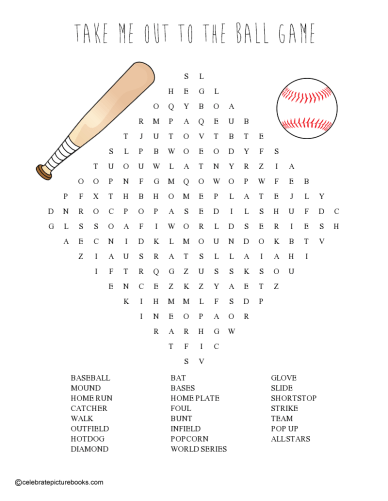
Take Me Out to the Ballgame Word Search


Diamonds aren’t just for playing baseball—they make great word search puzzles too! Take a run at this printable Take Me Out to the Ball Game word search! 

July 19 – It’s National Zookeepers Week

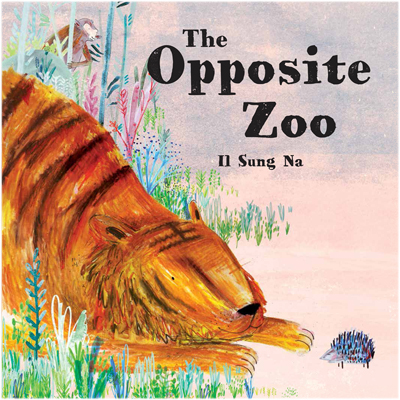
celebrate-picture-books-picture-book-review-the-opposite-zoo-cover

About the Holiday

Every year more than 180 million people visit zoos and aquariums in the United States. Caring for the animals that live in these zoological parks, maintaining the facilities, and educating guests about the scientific facts and personal stories of the animals under their care is more than just a profession for zoo keepers—it’s a passion! Today’s holiday raises awareness of the day-to-day work of zoo keepers who protect and preserve the world’s species.

The Opposite Zoo

By Il Sung Na


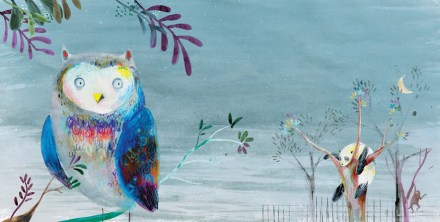
The Dark of twilight has descended on the Opposite Zoo and all the visitors are gone. But the clever monkey finds his door Open! He creeps out to explore the zoo by night. Two animals sit amid the tree tops. The owl is Awake, while the panda hangs suspended in the branches, Asleep. The lion, having a final stretch before snoozing, is Hairy, but the hippo taking a late dip is Bald.

celebrate-picture-books-picture-book-review-the-opposite-zoo-interior-art-owl

Image copyright Il Sung Na, courtesy of ilsungna.com

The Tall giraffe, munching leaves, towers over the trees as well as the Short pig who is feeding her piglets. The monkey plays peek-a-boo with a Shy iguana as it climbs a rock to watch the Bold peacock fan his beautiful tail feathers.

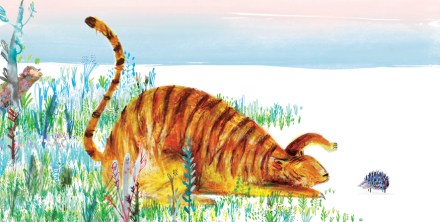
The tiger, with his Soft fur, is intrigued by the Prickly hedgehog, and the Black seals frolic in the pond while the White swans float majestically above. The monkey then hitches a ride on the tail of a Fast cheetah, leaving the Slow sloth to meander on its way. Oh those Noisy monkeys! Are they bothering the Quiet turtle?

celebrate-picture-books-picture-book-review-the-opposite-zoo-interior-art-tiger

Image copyright Il Sung Na, courtesy of ilsungna.com

The prowling monkey has had a long night of fun, but now the sun is Bright. He hurries back to his tree just in time for his door to Close—because now the Opposite Zoo is Open!

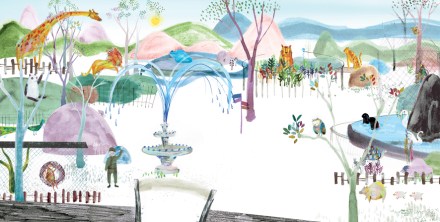
The Opposite Zoo combines several concepts—opposites, animals, and a search-and-find element—into a fun romp for young readers. The story is appropriately simple and serves as the frame for Il Sung Na’s stunning paintings: The fiery lion, tiger, and cheetah crackle with orange energy. The owl is a midnight blue tapestry, and the peacock’s tail is as graceful and intricate as a fine Asian fan. Na’s vibrant colors are set against delicate, softly hued backgrounds. Readers will love following the silly monkey through each picture and pointing out his shenanigans.

The Opposite Zoo is a wonderful choice as a new baby gift or for youngest children’s libraries.

Ages birth – 5

celebrate-picture-books-picture-book-review-the-opposite-zoo-interior-art-zoo

Image copyright Il Sung Na, courtesy of ilsungna.com

Knopf Books for Young Readers, 2016 | ISBN 978-0553511277

View more artwork and books by Il Sung Na on his website!

National Zoo Keepers Week Activity

celebrate-picture-books-picture-book-review-opposites-crossword-puzzle

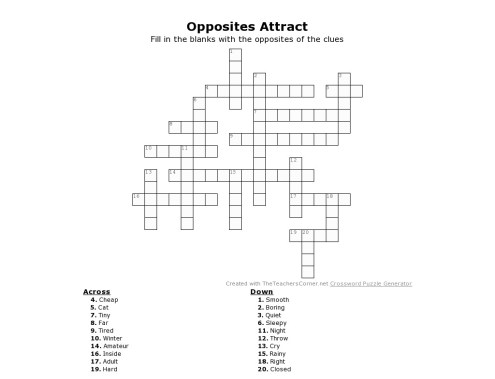
Opposites Attract Crossword Puzzle


Some words go hand in hand even though they’re different. Find the words that make pairs fill in the blanks of this printable Opposites Attract Crossword Puzzle