Established by Petfinder, this week-long holiday aims to raise awareness of all those animals in shelters who, because of age, health, size, or even color, are overlooked for adoption. But these animals have a lot of love to give, and the bonds you can form with a special-needs or unusual pet can change your life. To learn more about the Adopt a Less-Adoptable Pet Week and how you can help deserving animals find a forever home throughout the year, visitPetfinder Pro.
Thanks to Sleeping Bear Press for sending me a copy of Tails from the Animal Shelter for review consideration. All opinions about the book are my own.
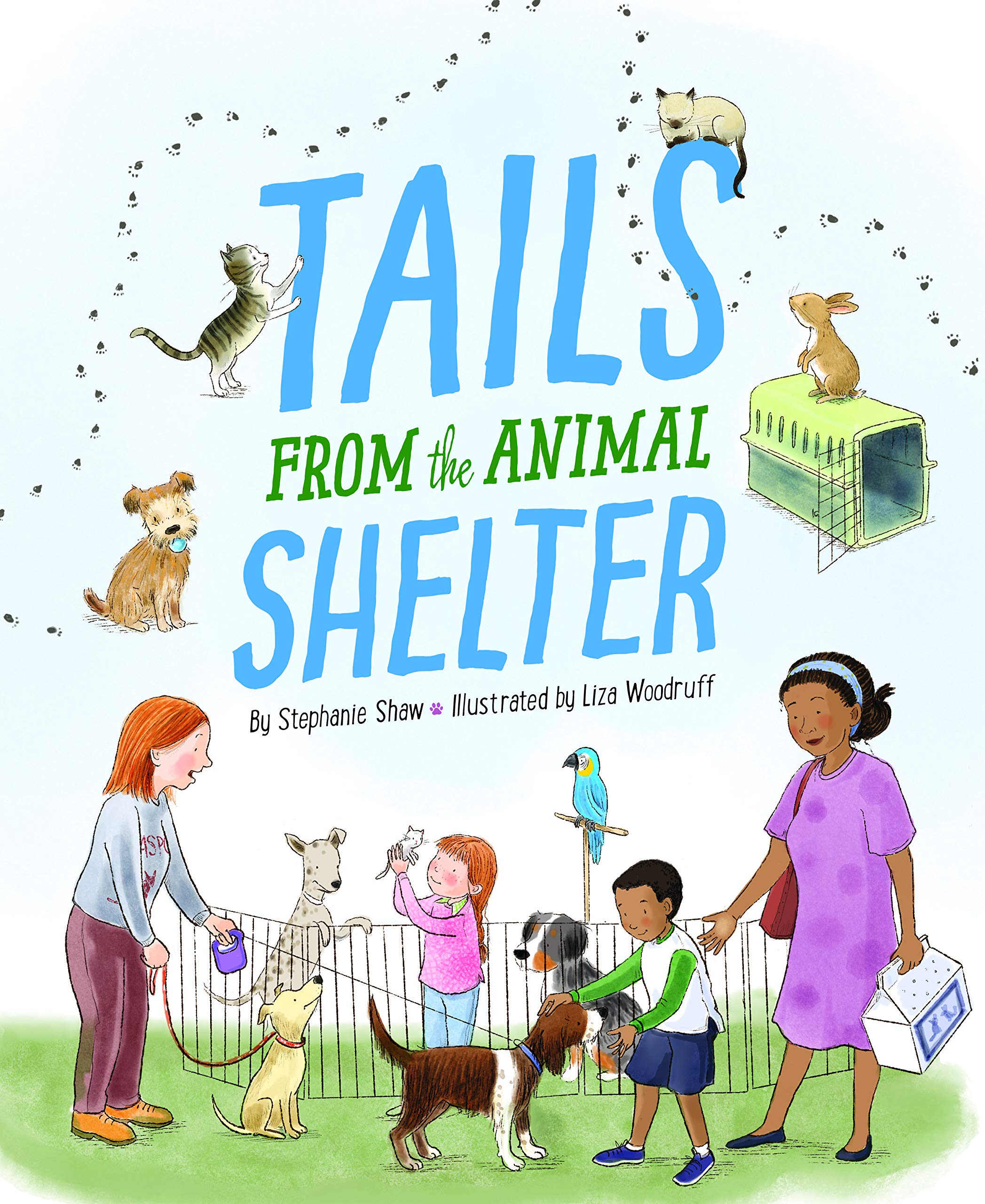
Tails from the Animal Shelter
Written by Stephanie Shaw | Illustrated by Liza Woodruff
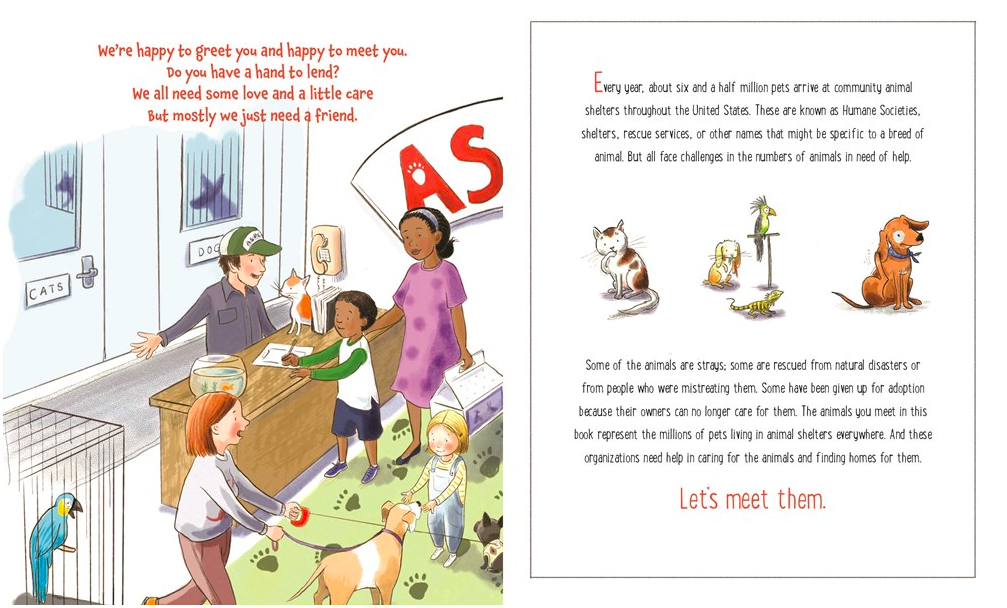
Welcome to the Humane Society Animal Shelter! The animals are waiting to meet you, and the staff are happy to introduce you to the wonderful animals who are available for adoption. While most animals who arrive at shelters across the country are dogs or cats, there are lots of other pets looking for a new home. Why do some animals come to live in a shelter? The book reveals many reasons. Among them are that “some of the animals are strays; some are rescued from natural disasters” and “some have been given up for adoption because their owners can no longer care for them.”
Image copyright Liza Woodruff, 2020, text copyright Stephanie Shaw, 2020. Courtesy of Sleeping Bear Press.
Are you ready to find a new friend? If it’s a puppy you’re looking for, you’ll love Tinkle, who’s so excited to see you that he “cannot help but piddle.” But it’s okay. “Happy puppies always dribble….As time passes and pups grow, / This little guy won’t pee ‘hello.’” If you don’t know what type of dog is best for your family, the staff at the shelter can help match you to the perfect one.
Cats also make wonderful pets for many reasons. Whether you like long-haired or short-haired, large or small cats, you’ll find just the right fit for your family at the shelter. Not ready for a long-term commitment? You can look into fostering a newborn kitten to get them ready for adoption. What kinds of kittens will you find? All sorts, like Ariel, who says: “I’m an acrobat cat! / I can climb anywhere! / I’ll roll in a ball and then / leap to a chair!”
Image copyright Liza Woodruff, 2020, text copyright Stephanie Shaw, 2020. Courtesy of Sleeping Bear Press.
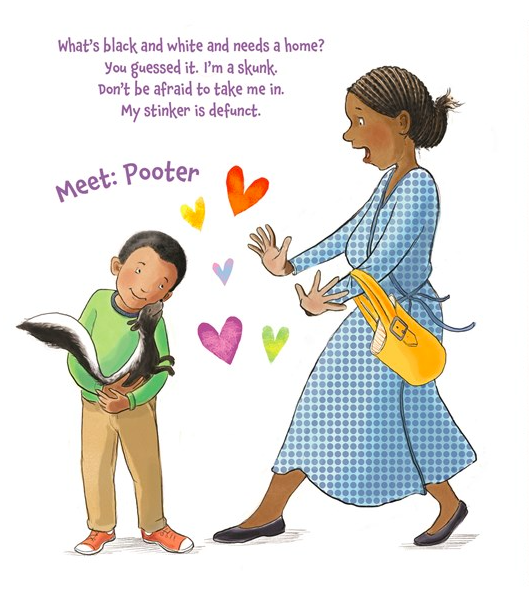
These dogs and puppies, cats and kittens are only a few of the animals that turn up needing a new home. Take Pooter, for example. Pooter is black and white and, despite the recognizable stripe down its back, does not stink. Skunks that make their way to shelters “have never lived in the wild” and have had surgery so they cannot make their “smelly spray.”
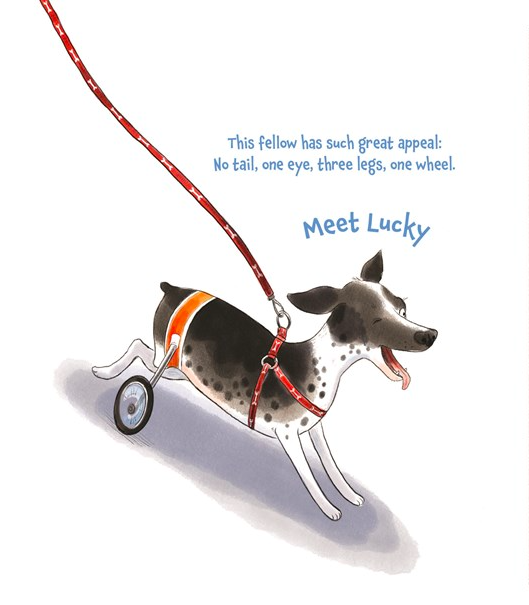
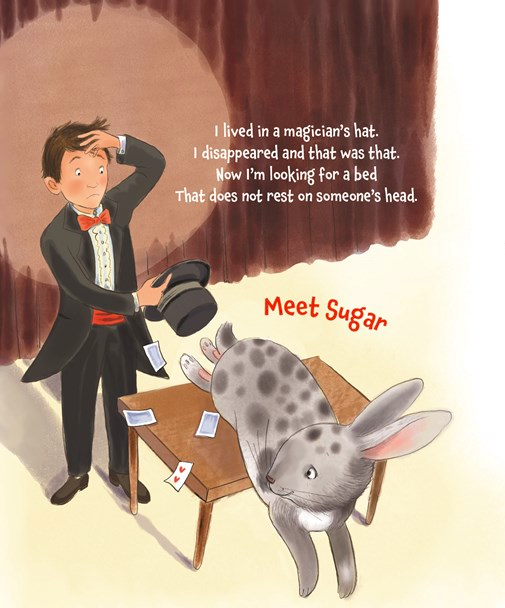
Veterinary advances have improved the lives of injured animals or animals with health problems. Animals with special needs can now be fitted with “rear-support leashes or wheelchairs” and “can live happily for many years.” If you can adopt “an animal with special needs [you] will bring a grateful and loyal pet into your family.” A popular pet that has some surprising talents, a rabbit can also be a top choice for people who live in a smaller home. Trained to use a litter box, rabbits “can live indoors just like cats do.”
Image copyright Liza Woodruff, 2020, text copyright Stephanie Shaw, 2020. Courtesy of Sleeping Bear Press.
If you live on a farm or have a lot of land in an area that allows for farm animals, you may be interested in Hamlet, who tells readers, “I am a sweet potbellied pig. / I started small but I grew BIG….I know some tricks. I’m neat and clean. / I’m many things. I’m just not… / lean.” Around the nation there are many “pigs, goats, sheep, and chickens [that] need new homes. There are over two hundred thousand horses alone rescued or surrendered to shelter care every year.”
Along with detailed descriptions of the birds, reptiles, and senior animals that also make loving pets, the book is packed with information about how and why certain animals come to shelters and programs that sponsor a variety of animals and help get them ready for adoption. Back matter reveals how animal shelters were established, gives extensive tips on and issues to consider when adopting a shelter animal, lists ways people can help shelter animals even if they can’t adopt, and provides online resources for learning more and finding shelters in your area.
Image copyright Liza Woodruff, 2020, text copyright Stephanie Shaw, 2020. Courtesy of Sleeping Bear Press.
In her fascinating and accessible text, Stephanie Shaw combines poetry with facts and interesting tidbits about each type of animal to discuss why they make excellent pets for the right person or living condition. Her humorous, whimsical verses that accompany each category and introduce a particular animal will charm kids with a snapshot of the animal’s personality. Kids will also enjoy talking about how each name fits the animal.
Liza Woodruff’s cheery illustrations will enchant animal lovers with adorable images of funny, loving, and endearing animals happy to find a forever home. The joy that pets bring to a family is evident as kids hug, play with, and react to their pets.
An excellent introduction to shelter animals and pet ownership, Tails from the Animal Shelter is highly recommended for any family thinking about adopting a pet as well as for young animal lovers and kids interested in veterinary medicine or volunteering to help animals. The book would also make a favorite addition to school and public library collections.
Ages 5 – 8
Sleeping Bear Press, 2020 | ISBN 978-1534110489
Discover more about Stephanie Shaw and her books on her website.
To learn more about Liza Woodruff, her books, and her art, visit her website.
Adopt a Less-Adoptable Pet Week Activity
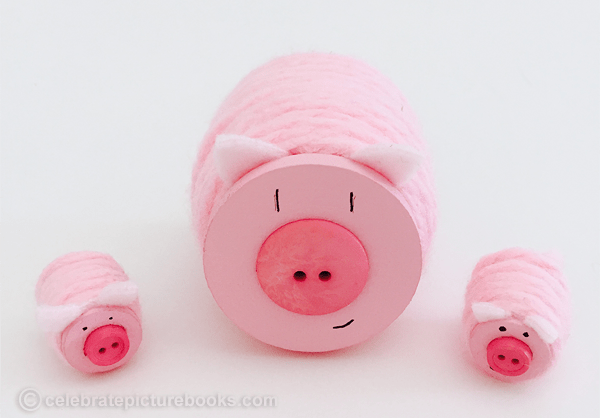
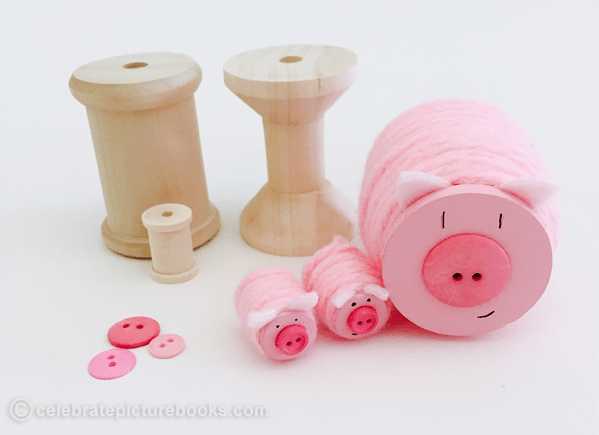
Roly Poly Spool Potbellied Pig and Piglets
Get ready to have fun making this cute and easy craft! Ham it up with your own pig and piglets who can keep you company on your desk, near your bed or anywhere it’s fun to play!
2 ½-inch wooden spoon, available from craft stores
1-inch wooden spool, available from craft stores
Pink yarn, I used a wide-strand yarn
Pink fleece or felt
Pink craft paint
Pink 5/8-inch or 1-inch flat button with two holes
Pink 3/8-inch flat button with two holes
Paint brush
Scissors
Glue
Black marker
Directions
Print Pigs Ears Template
Trace the ears onto the fleece or felt and cut them out.
Paint the spool with the pink paint
Let spool dry
When the spool is dry, glue the ears to the spool, letting the ears stick up over the rim of the spool.
Wrap yarn in straight layers around spool until the body of the pig is a little bigger than the end of the spool, which will be the face
Cut yarn off skein and glue the end to the body
To make the nose, glue the button over the hole in the middle of the spool
Mark the eyes and mouth with a marker
To make the tail for the large pig, cut a 4-inch long piece of yarn. Tie a triple knot in the yarn (or a knot big enough to fill the hole in the spool). Then tie a single knot near the other end of the yarn. Insert the large knot into the spool’s hole at the back of the pig. Trim the yarn in front of the second knot as needed.
To make the tail for the piglets, tie a single knot in the yarn and another single knot below the first. Insert one of the single knots into the hole. Trim yarn as needed.
You can find Tails from the Animal Shelter at these booksellers
Established by the National Honey Board in conjunction with the US Department of Agriculture in 1989, National Honey Month celebrates beekeepers, bees, and of course honey. September was chosen for this honor because here in the US, it’s the time when bees begin to secure their hive and prepare for winter and well as the month when the majority of honey is harvested. To celebrate this month, explore a variety of honey flavors, try a few new recipes that incorporate honey, and learn all the buzz about bees, honey, and beekeeping with today’s book!
I’d like to thank Sleeping Bear Press for sharing H is for Honey Bee: A Beekeeping Alphabet with me for review consideration. All opinions are my own.
H is for Honey Bee: A Beekeeping Alphabet
Written by Robbyn Smith van Frankenhuyzen | Illustrated by Eileen Ryan Ewen
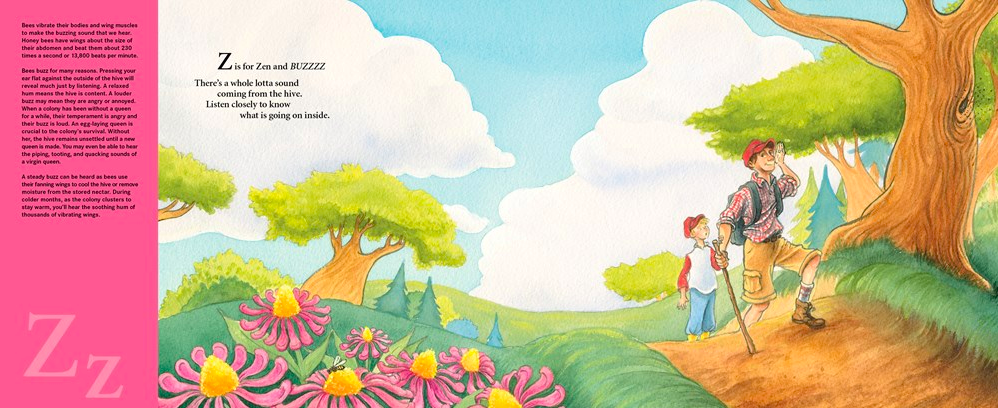
If your garden or yard is anything like mine, the bees are humming around late-summer blooms and tracing their circuitous route to nearby or far-flung hives. The mystery and marvel of how honey bees convert powdery pollen into sweet honey never fails to awe and delight. In H is for Honey Bee, readers of all ages discover fascinating facts and stories about Bees from Apis mellifera (“Apis is the clue that we’re talking about a bee. / And mellifera means it’s all about honey”) to Z “for Zen and BUZZZZ.”
Image copyright Eileen Ryan Ewen, 2020, text copyright Robbyn Smith van Frankenhuyzen, 2020. Courtesy of Sleeping Bear Press.
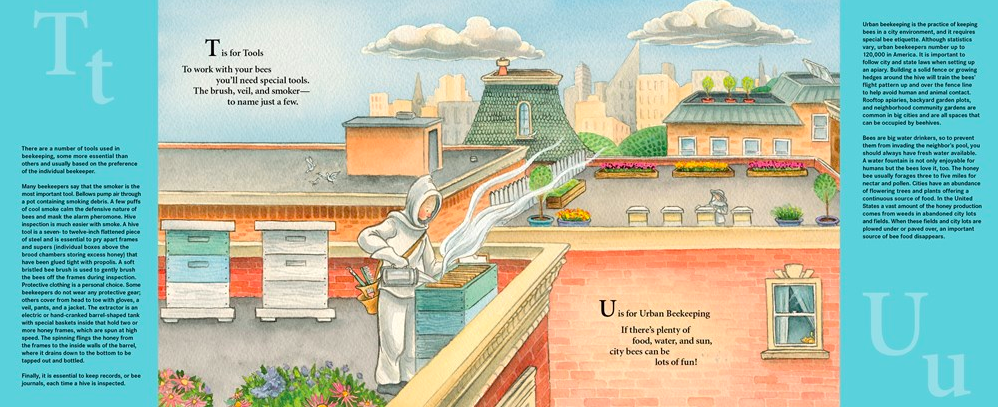
In between children learn all about a bee hive, its resident bees (from Drones to Guards to the Queen), how bees communicate, and at E how organized beekeeping dates back to 2400 BC and how important it was to Egyptian culture. “Found on hieroglyphs in the sun temple of Pharaoh Ne-user-re near Cairo, Egypt, an Egyptian peasant is depicted smoking stacked hives while other workers are storing and sealing honey in jars.”
Image copyright Eileen Ryan Ewen, 2020, text copyright Robbyn Smith van Frankenhuyzen, 2020. Courtesy of Sleeping Bear Press.
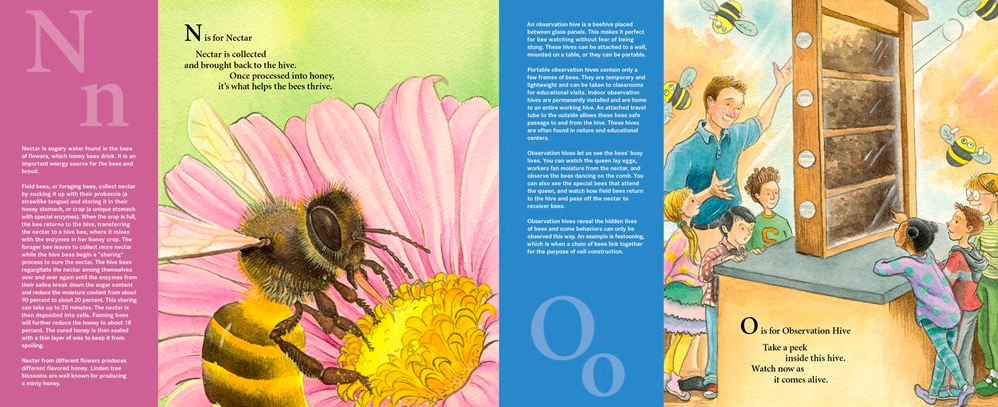
At L kids learn about Lorenzo Langstroth, “the father of humane, practical beekeeping.” After discovering that natural hives had small passages that allowed bees to move freely though them, he invented a hive with removable frames that didn’t upset the other bees or damage the combs. Langstroth’s hive paved the way for other innovations, such as the Observation Hive at O, that gives people a clear view of bees at work. “You can watch the queen lay eggs, workers fan moisture from the nectar, and observe the bees dancing on the comb” and other marvels of a bee’s day.
Image copyright Eileen Ryan Ewen, 2020, text copyright Robbyn Smith van Frankenhuyzen, 2020. Courtesy of Sleeping Bear Press.
Humans aren’t the only innovative ones, and readers will be fascinated to learn about Propolis at P, which bees make from their own saliva and other natural ingredients to protect their hive. V is for Venom—the bee’s defense that is more fun to learn about than experience. If you’re interested in where Beeswax comes from, just flip to W, and if you want to know how to tell if a hive is happy, Z is where you’ll find it.
Back matter includes resources on how you can create a safe and productive atmosphere for bees in your own yard, tips for becoming a beekeeper, and fun facts about busy bees.
Image copyright Eileen Ryan Ewen, 2020, text copyright Robbyn Smith van Frankenhuyzen, 2020. Courtesy of Sleeping Bear Press.
Through charming and informative four-line rhymes and a column of detailed facts for each letter of the alphabet, Robbyn Smith van Frankenhuyzen presents a full and exhilarating look at bees, honey, and the job of beekeeping. She describes the behavior of bees—from how they communicate to how they survive winter temperatures to how the queen rules the hive and more—as well as the dangers bees face, from inside the hive and out, in vivid language that will captivate kids. Discussions on the healthy properties of honey as well as the joys of amateur beekeeping are here as well.
Accompanying the text are Eileen Ryan Ewen’s vibrant illustrations that give readers an up-close view of honey bees developing from egg to adult, gathering nectar, and working in their hive. Kids also meet Lorenzo Langstroth, see beekeepers working at their hives in yards and on rooftops, and travel down the Nile River with ancient beekeepers who moved their hives to continually provide them with the nectar and pollen they needed. Each page invites lingering to see and discuss all the details.
A well-rounded and comprehensive resource for those interested in bees and insects, gardeners of any age, and kids who love nature as well as for elementary and middle-grade science classes, H is for Honey Bee: A Beekeeping Alphabet is highly recommended for home, school, and public libraries.
In 2013, Victoria Twead and Alan Parks, who have written about their life stories themselves, established today’s holiday to foster a warm and welcoming community for readers and writers of memoirs. The idea took off and now We Love Memoirs Day brings the art and heart of this personal form of writing to people across the world. If you like to read memoirs, today’s a terrific day to visit your local bookstore or library and pick one up. If you’ve ever thought of penning the story of your own life and/or family, today’s holiday gives you the perfect opportunity to start!
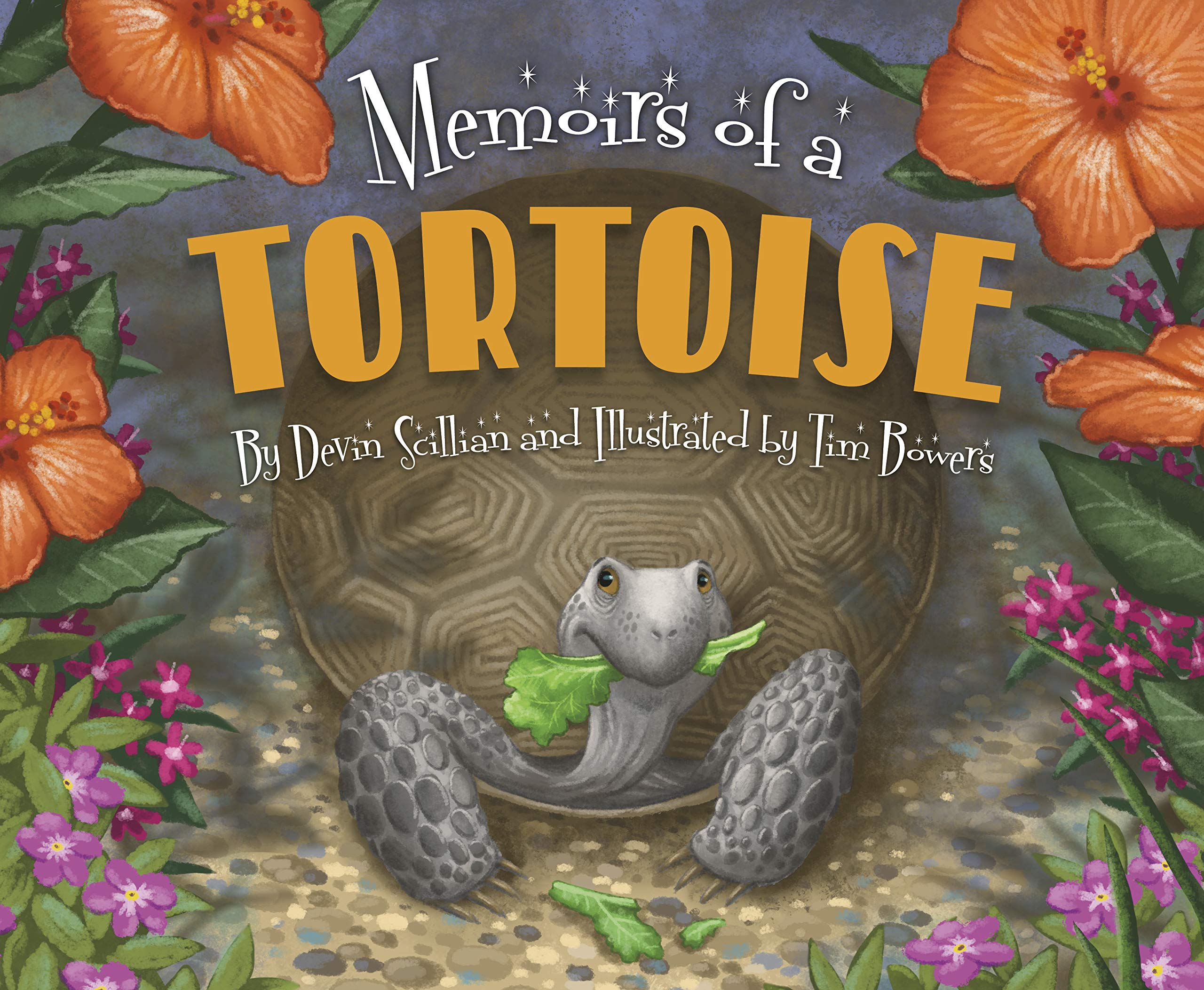
Memoirs of a Tortoise
Written by Devin Scillian | Illustrated by Tim Bowers
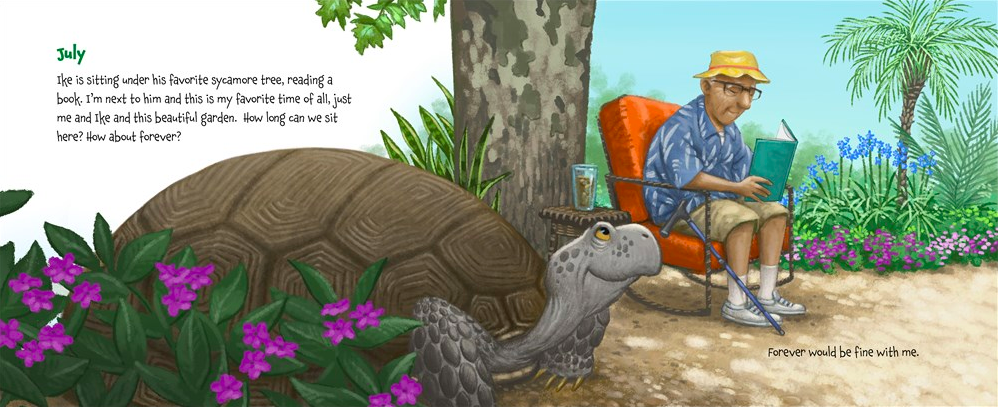
It’s April and Oliver the tortoise is in his garden with his pet, Ike. Ike has brought him “a plate of lettuce and dandelions and a bright, crunchy apple.” Oliver loves Ike and he can tell that Ike loves him too by the way he runs his hand over his shell. “This, this is life and it’s beautiful,” Oliver thinks. In May, Ike throws a stick that Oliver will never fetch, and they laugh over this old, favorite joke. Oliver thinks, “Eighty times I’ve watched spring arrive in the garden, and it’s always perfect.” He spies a bit of red on the other side of the garden and ambles off to investigate.
It’s June by the time he reaches the hibiscus grove. Oliver enjoys taking things slow—just like Ike does. July and August pass with special moments of companionship and fun. As September comes, life begins slowing down. “The days are getting shorter” and Ike is “taking lots of naps in the garden.” Oliver enjoys having Ike nearby and decides that “the next time he throws the stick, I’m going to fetch it.”
Image copyright Tim Bowers, 2020, text copyright Devin Scillian, 2020. Courtesy of Sleeping Bear Press.
October arrives, but the regular routine of the garden has been broken. Oliver hasn’t seen Ike or been fed in several days. Oliver makes due with pumpkin from the garden, but he misses Ike. By November, Oliver is “afraid Ike is gone.” The idea makes him sad. After all, he thinks, Ike was still so young. He was 80 years old.” Oliver had thought they would grow old together and wonders where Ike is. In December, Oliver decides to go talk to someone who has more experience than he does—his mother, who is 137 years old.
It takes Oliver until February to cross the ten gardens between Ike’s house and where his mother lives. When Oliver’s mother sees her son, “she smiles wide and her eyes sparkle.” Oliver tells his mother that Ike is gone. She understands his sadness and tells him how much Ike loved him. But Oliver wonders why Ike couldn’t stay with him.
Oliver’s mother explains “we only get to have pets in our lives for a little while.” Then she offers words of comfort: “And when they’re gone, we count all those beautiful days we were lucky enough to have them with us. We’re so lucky.”
Oliver has enjoyed his visit with his mother, but in March he’s on his way back home. When he arrives in his own garden, the door of the house opens. Oliver turns instinctively expecting to see Ike, but it’s Ted, Ike’s son. He brings Oliver “a tray of lettuce and dandelions and a bright, crunchy apple.” He rubs Oliver’s shell just like Ike used to do and tells Oliver he’s glad he came home. Ted tosses a stick and the two laugh. “This, for me and Ted, this is life,” Oliver thinks. And he knows his mother was right when she said they were so lucky.
Image copyright Tim Bowers, 2020, text copyright Devin Scillian, 2020. Courtesy of Sleeping Bear Press.
Devin Scillian’s Memoirs of a Tortoise has it all—humor, poignancy, and a life lesson about the precious moments we share with loved ones. Using the longevity of tortoises, Scillian flips the script on the pet and human relationship with tender and emotional effect. When Ike passes away and Oliver is confused and sad, he confidently sets out to find answers and comfort from someone he can trust—his mother. The ten gardens between their homes may not seem far to us, but to Ike and his mom it’s the equivalent of towns, states, or even countries for us.
This seamless blending of the tortoises’ experience and that of readers’ is both the charm and genius of Scillian’s story. Oliver’s straightforward comments and questions about loss echo those of children and will resonate with them. As Oliver’s mother reminds him to enjoy every day and be thankful for the time he spends with his pets and as Ted enters his life, readers will understand that her advice to embrace all the parts of life applies to them as well.
Tim Bowers’ endearing Oliver is a sweet companion on this journey through a formative experience. As Oliver spends time and enjoys inside jokes with kindly Ike, readers will recognize not only the pet and owner bond but the relationship between children and grandparents. Bowers’ lush depictions of Ike’s garden where he and Oliver play or sit quietly side by side portray the beauty of life that Oliver’s mother so wisely recognizes. Ike’s slowing down and passing away are drawn with sensitivity and through images that allow adults and children to discuss facts and feelings about death, mourning, acceptance, and the cycles of life.
Uplifting and full of wisdom, Memoirs of a Tortoise, is highly recommended for home bookshelves and a must for school and public library collections.
Ages 6 – 9
Sleeping Bear Press, 2020 | ISBN 978-1534110199
Discover more about Devin Scillian, his books, journalism, music, and more on his website.
To learn more about Tim Bowers, his books, and his art, visit his website.
We Love Memoirs Day Activity
Follow the Turtles! Game
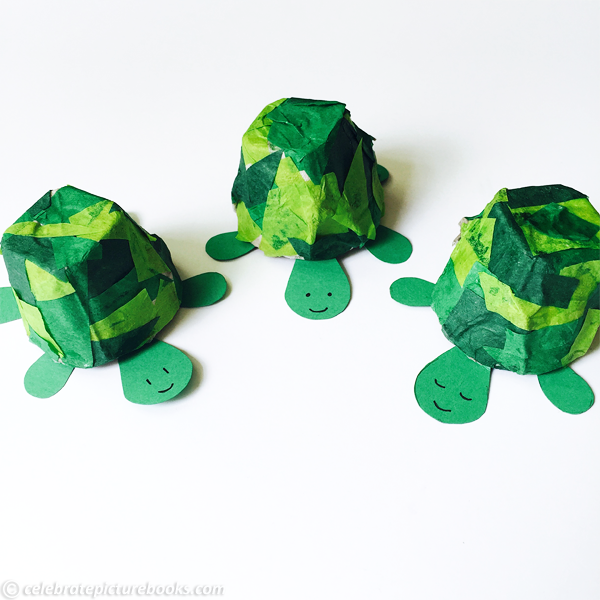
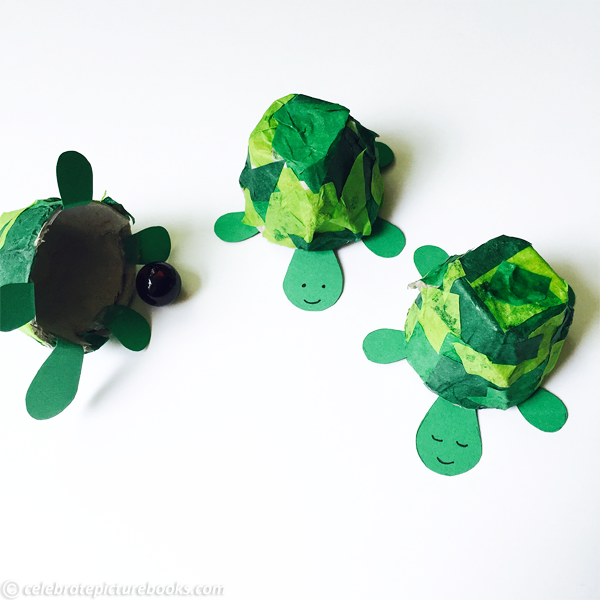
You can make this fun game from recycled materials and a little creativity! When you’re finished making the turtle shells, have fun guessing where the marble, bead or bean is hiding!
Supplies
Cardboard egg carton
Green tissue paper in different hues
Green construction or craft paper
A marble, bead, or bean
Glue
Scissors
Directions
Cut the egg carton apart into individual cups. You will need 3 cups for each game made.
Cut the rims of the cups so they sit flat on a table.
If the cups have open sides, fit two cups inside one another to fill the gaps
Cut the tissue paper into small shapes
Brush glue on a cup (I used a paper towel to apply glue)
Cover the egg cup with pieces of tissue paper. Repeat with other cups.
Let dry
Cut a head and feet from the green craft paper
Tape or glue the edges of head and feet to the inside of the cups
Add a face to the head
To play the game:
Line up the cups on a table
Put a bead, bean, or marble under one of the cups
Show the other player which cup the object is under
Quickly move the cups around each other several times
Ask the other player which cup they think the object is under
Take turns playing
Extra Game: Make three more and play turtle tic-tac-toe!
You can find Memoirs of a Tortoise at these booksellers
Today is a day to celebrate the simple pleasures of toasting marshmallows. Whether you like your marshmallows just lightly browned or blackened to a crisp, these ooey-gooey delights are fun to make and fun to eat! Why not make a campfire, start up the fire pit or grill, or even set the oven to broil and toast up some marshmallows today?
Digger and Daisy Go Camping
Written by Judy Young | Illustrated by Dana Sullivan
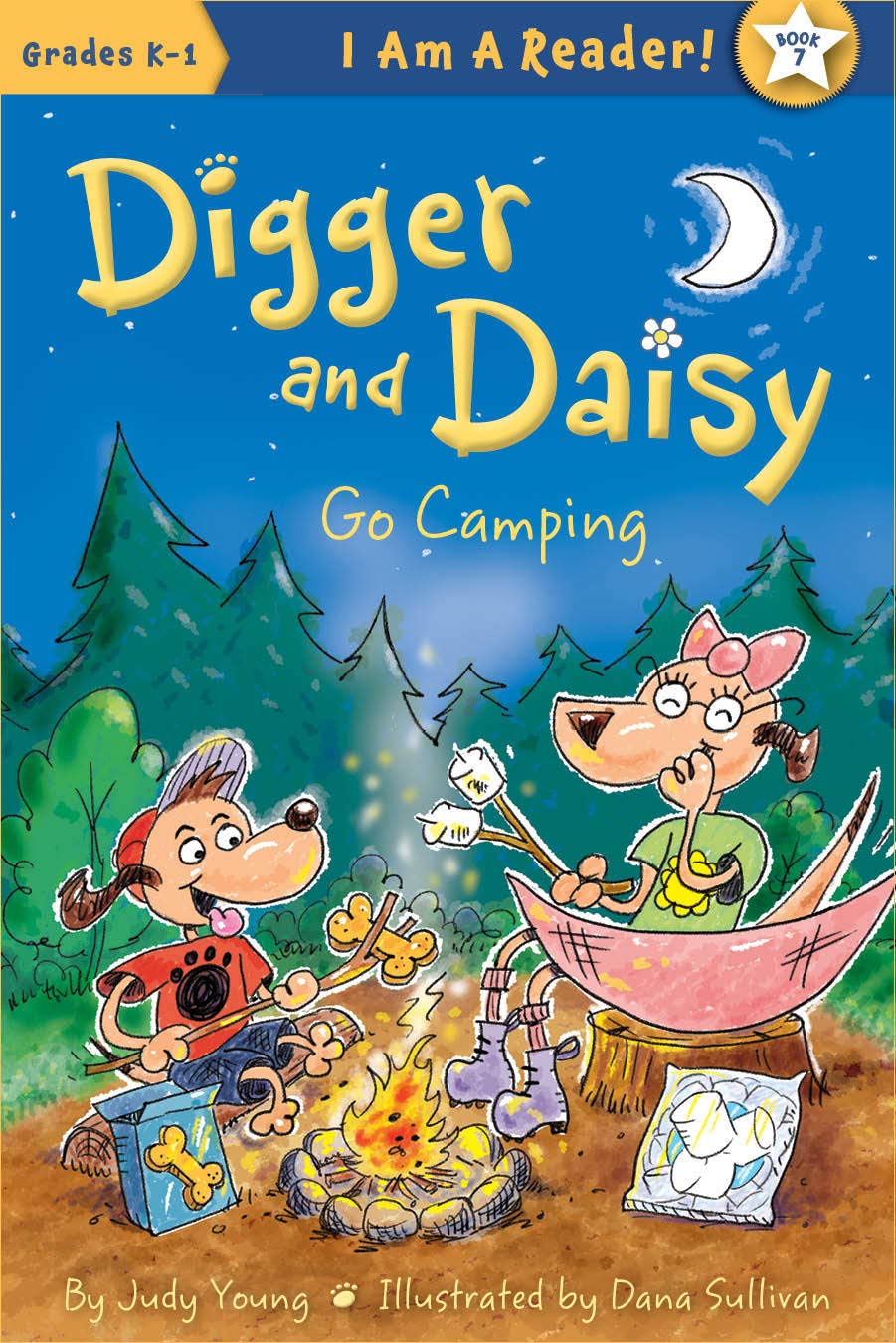
Summer vacation has come and Digger and Daisy are packing up for another adventure together. At least Daisy is. She’s excited to go camping, “but Digger is worried. There might be bears,” he thinks. With reassurance from Daisy that the trip will be fun, Digger fills his own backpack and grabs his sleeping bag. Out on the trail, “There is a noise. Digger hears it. He looks all around. He is worried. ‘I hear a bear!’ says Digger.”
Image copyright Dana Sullivan, 2019, text copyright Judy Young, 2019. Courtesy of Sleeping Bear Press.
Daisy points out that “bears growl” and the sound Digger hears is just a bird singing in a tree. Digger and Daisy sing along too all the way to the lake. Here there’s another noise that worries Digger. “‘I hear a bear!’” he tells Daisy. But this sound is just a fish jumping, and soon Daisy and Digger are splashing along with it. After a nice swim, Daisy thinks a fire will warm them up. While they’re picking up sticks, Digger hears another noise that he’s sure is a bear. But this sound isn’t a growl either. It’s a squirrel munching on nuts.
Image copyright Dana Sullivan, 2019, text copyright Judy Young, 2019. Courtesy of Sleeping Bear Press.
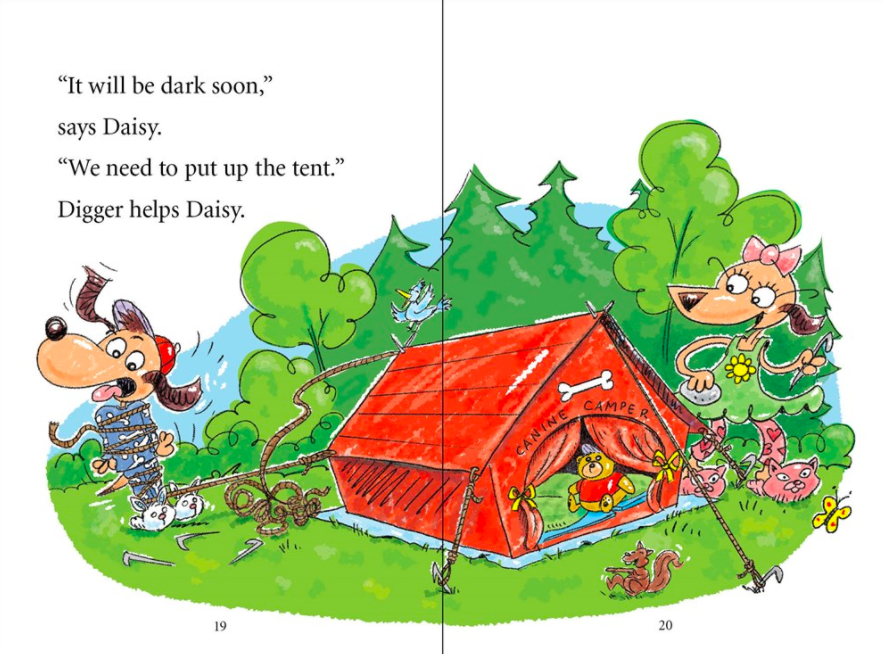
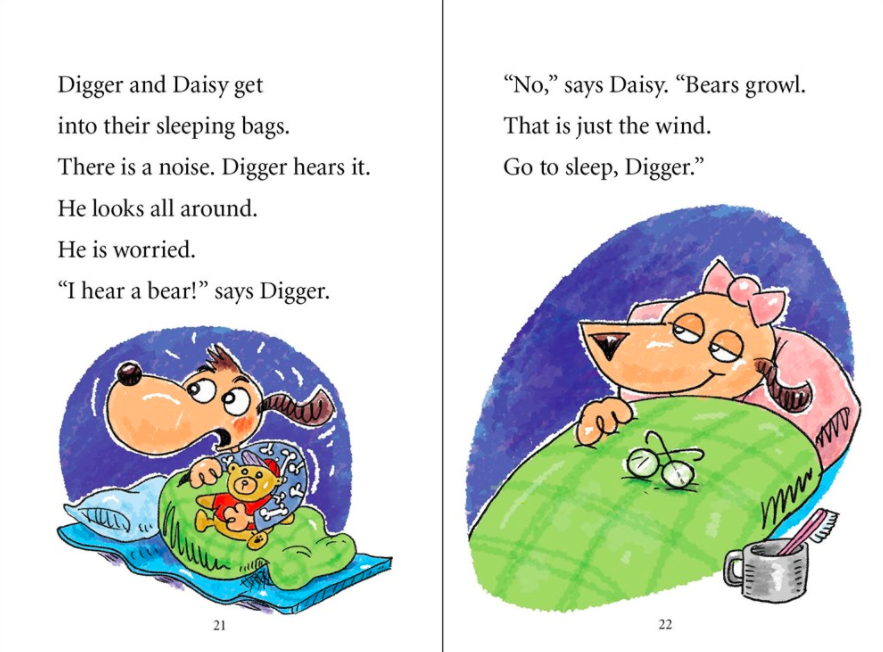
Digger and Daisy enjoy roasted nuts too along with their hot dogs and marshmallows. “‘It will be dark soon,’ says Daisy. ‘We need to put up the tent.’” Daisy feels safe and cozy in her sleeping bag, but Digger hears a noise. “He looks all around. He is worried. ‘I hear a bear!’ says Digger.” But this sound isn’t a growl—Daisy tells him it’s a howl from the wind.
Image copyright Dana Sullivan, 2019, text copyright Judy Young, 2019. Courtesy of Sleeping Bear Press.
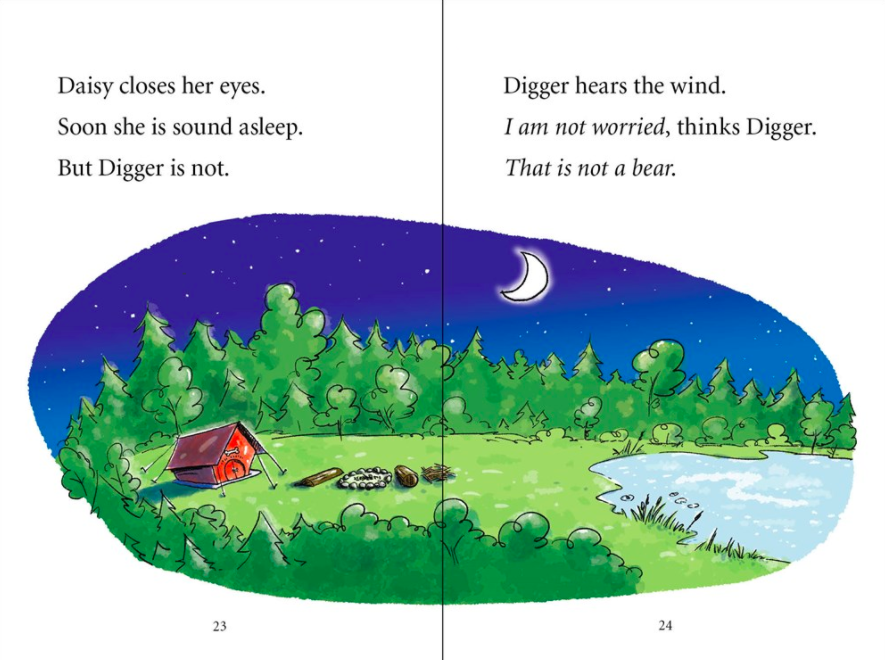
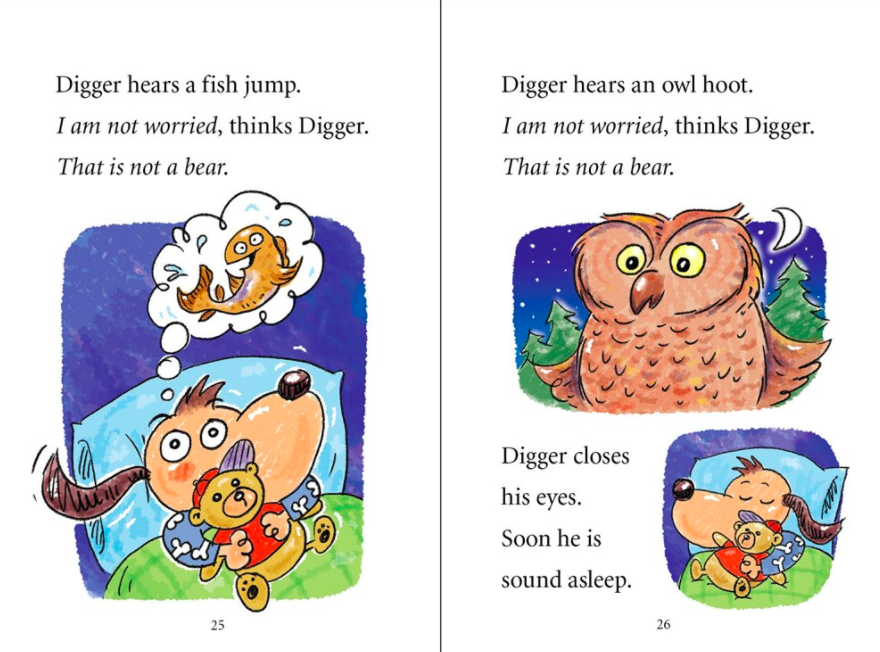
Daisy quickly falls asleep, but Digger doesn’t. He listens to all the sounds and recognizes the wind, a jumping fish, and the hoot of an owl. Satisfied, “Digger closes his eyes. Soon he is sound asleep.” Suddenly, there is a noise that Digger does not hear. It wakes Daisy. She shines her flashlight all around. “She is worried. ‘Digger, wake up! I hear a bear!’ says Daisy.” When Digger opens his eyes, the sound stops. Is a bear on their trail, or was it something a little tamer?
Image copyright Dana Sullivan, 2019, text copyright Judy Young, 2019. Courtesy of Sleeping Bear Press.
In their seventh adventure, Daisy plans an overnight camping trip. Daisy’s protective older-sibling instincts are sweetly in evidence as she encourages Digger to put his fear of bears aside and join her. Once in the forest, she reassures him that the noises he hears are harmless woodland creatures. Kids will love catching up with their favorite canine duo through Judy Young’s simple sentences that contain enough repetition of key words to bolster early readers’ confidence as well as accumulative drama, gentle suspense, and a humorous ending.
Every camping trip is filled with moments of wonder and humor, and Digger and Daisy’s adventure is no exception. In Dana Sullivan’s colorful snapshots, the birds are singing, butterflies flutter along, a gymnastic fish startles a fly, and a squirrel stuffs its cheeks with nuts. Daisy sports her trademark tutu skirt (even her bathing suit is a one-piece tutu), and Digger has not forgotten his favorite cap. Young readers will giggle as Digger panics, sending his firewood flying, and gets tied up in the tent ropes. They’ll also appreciate Sullivan’s cleverness in making Daisy and Digger’s tent look like a red doghouse. Of course, the siblings’ loving relationship is a highlight of this series, and this story strengthens that bond as Daisy takes care of her little brother and he in turn trusts her.
Fans of Digger and Daisy will want to add this new adventure to their collection. Digger and Daisy Go Camping also makes a sweet introduction to the series and will entice readers who have not yet met this brother and sister team to explore all of their escapades. The book would make a welcome addition to classroom and public library shelves as well.
Ages 5 – 7
Sleeping Bear Press, 2019 | ISBN 978-1534110229 (Hardcover) | ISBN 978-1534110236 (Paperback)
Discover more about Judy Young and her books on her website.
To learn more about Dana Sullivan, his books, and his art, visit her website.
Toasted Marshmallow Day Activity
A Fun In-Home Campfire
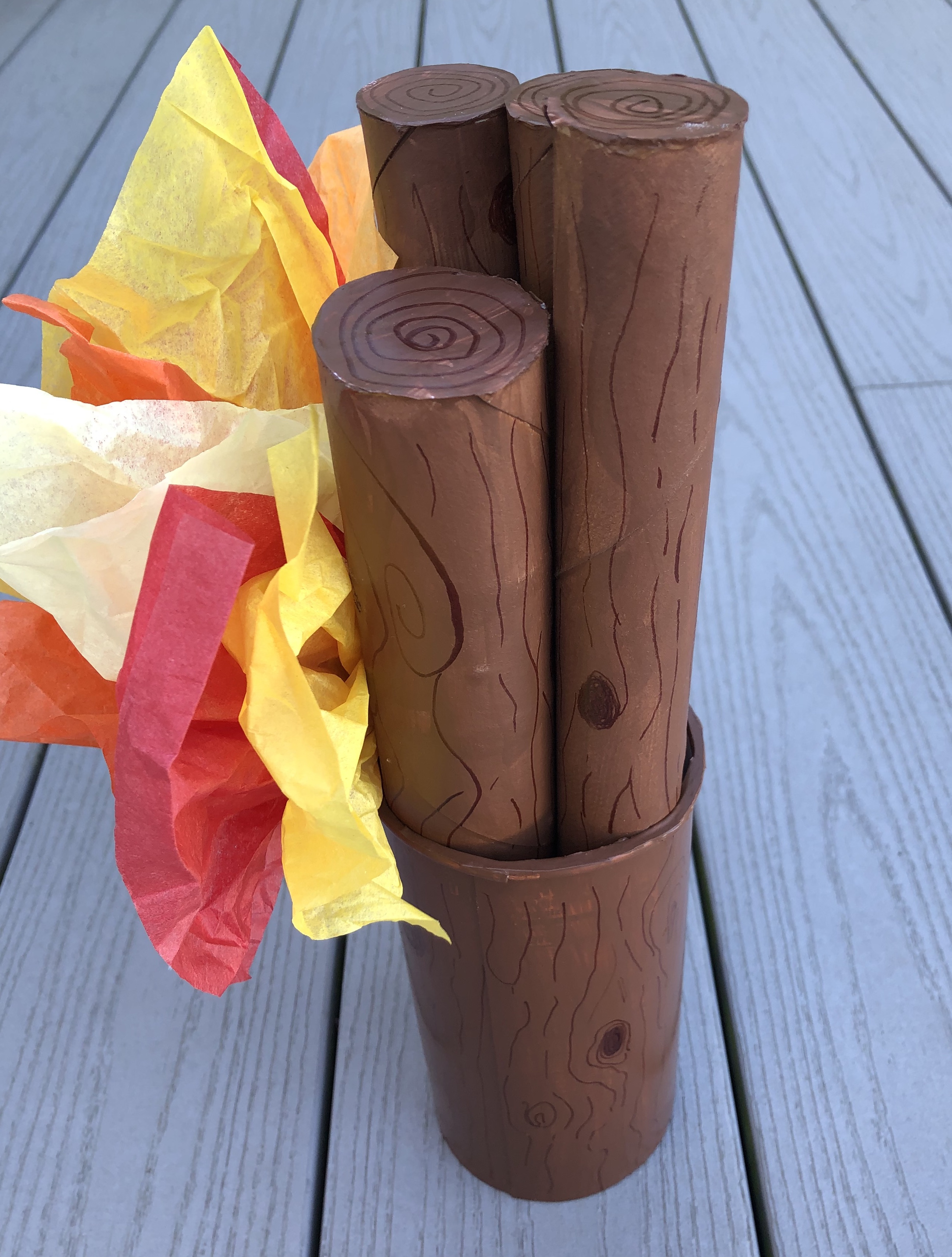
Kids and their friends and family can enjoy the cozy fun of a campfire in their own family room with this craft that’s easy to make from recycled materials. While the supplies might make the campfire artificial, kids will love it if the marshmallows are the real thing!
Supplies
Three or four paper or cardboard tubes
Cylindrical bread crumbs or oatmeal container
Tissue paper in red, orange, and yellow
Brown craft paint
Brown marker
Brown construction paper or white paper
Strong glue or hot glue gun
Chopsticks (one for each person)
Marshmallows
Directions
To Make the Logs
Cover the ends of the tubes with circles of brown construction paper or white paper and glue into place
Paint the tubes and the ends if needed, let dry
Paint the sides of the cylindrical container with the brown paint, let dry
With the marker draw tree rings on the ends of the tubes. Decorate the sides with wavy lines, adding a few knot holes and swirls.
To Make the Fire
Cut 9 squares from the tissue paper (3 in each color, about 8 to 6-inch square)
Layer the colors and gather them together at one tip. Fold over and hold them together with a rubber band.
To Assemble the Campfire
Stack the tube logs
Put the tissue paper fire in the middle of the logs
To “Roast” Marshmallows
Stick marshmallows on chopsticks for “roasting” and eating!
You can keep your logs and fire in the cylindrical log until the next time!
You can find Digger and Daisy Go Camping at these booksellers
Is fishing your thing? Do you like nothing better than heading down to the lake or stream and spending a relaxing day with a fishing pole, some bait, and the possibility of reeling in a “big one?” Perhaps you like fly fishing better, challenging yourself to flick that hook in just the right place. Then again, maybe taking a boat out to deep water and pitting yourself against the truly big fish is more your style. However you like to fish, make some time to enjoy your hobby this month!
Back Roads, Country Toads
Written by Devin Scillian | Illustrated by Tim Bowers
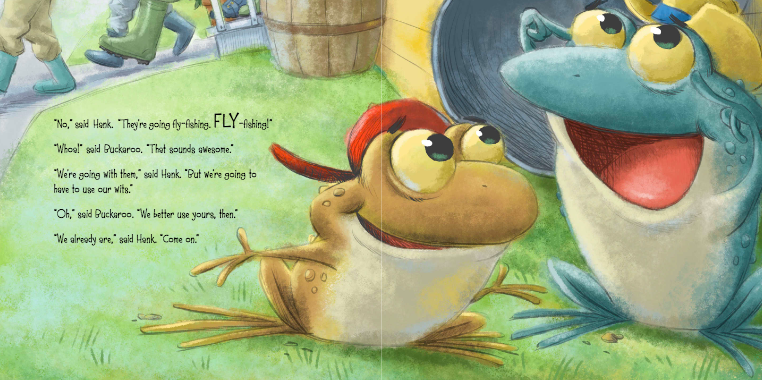
Best toady friends, Hank and Buckaroo, were just hanging out in “their favorite drainpipe near Cooper’s General Store” sipping the last drops from a discarded bottle of strawberry soda when they overheard Mr. Cooper and his friends talking about going fly-fishing. Hank and Buckaroo thought FLY-fishing sounded awesome and wanted to go along. They spied the perfect place to catch a ride: the fishermen’s open lunch basket. With a KERPLOP! they jumped in.
Image copyright Tim Bowers, 2019, text copyright Devin Scillian, 2019. Courtesy of Sleeping Bear Press.
Soon they were on their way to what Buckaroo said would be “‘the greatest day of their lives.’” “‘Toadally,’” agreed Hank. While they rode to the fishing stream, Hank and Buckaroo sang “When You Fish Upon a Star,” and as soon as the truck stopped they jumped out and hid in a nearby bush. But Emmitt the raccoon was already there. Hank and Buckaroo were reveling in the glory that was going to be that day’s “‘fly cafeteria’” and “‘down-home big-time fly barbecue’” when Emmitt gave them the bad news. Hank didn’t believe it. He thought “‘fishing WITH flies’” instead of “‘fishing FOR flies’” sounded ridiculous.
Image copyright Tim Bowers, 2019, text copyright Devin Scillian, 2019. Courtesy of Sleeping Bear Press.
And just then a nice juicy fly sailed by. Hank leaped and released his long tongue, but Emmitt pulled him back just before he grabbed onto the fake fly. The three watched as the fishermen caught fish after fish with the imitation flies. Hank and Buckaroo couldn’t imagine what Mr. Cooper and the rest of the fishermen would want with “‘those smelly fish.’” Emmitt disagreed—he loved smelly fish. To prove his point, he ran up and snatched one from the fishermen’s bucket.
Image copyright Tim Bowers, 2019, text copyright Devin Scillian, 2019. Courtesy of Sleeping Bear Press.
Seeing the fish, Hank had a brainstorm and asked to “‘borrow’” Emmitt’s fish. He placed it on a rock in the sun and went back to their hiding place in the bushes. Emmitt and Buckaroo were confused. But “before long, a swarm of flies hovered over the fish.” When there was a large cloud of flies, “Hank croaked, ‘Let’s go fishing!’” Their tongues snapped in the air, reeling in dozens of flies. When they were filled to the brim, they gave the fish back to Emmitt and happily made plans to go fly-fishing again the next Saturday.
Image copyright Tim Bowers, 2019, text copyright Devin Scillian, 2019. Courtesy of Sleeping Bear Press.
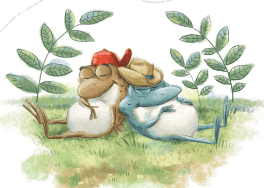
Devin Scillian’s clever, pun-filled fish story has everything needed to hook young readers and deliver a funny story time. With the lure of all the flies they can eat, Hank and Buckaroo take action to have the best day of their lives and discover a new hobby. When they meet up with Emmitt the raccoon and learn that their initial idea was a bit off the mark, Hank shows persistence and innovative thinking to make their fishing dreams come true. Demonstrating acceptance of each other’s different tastes and some creative cooperation, the camaraderie among Hank, Buckaroo, and Emmitt serves as a good example for readers. The close bond between Hank and Buckaroo—and their hilarious dialog—will endear them to kids, leaving them wanting more from this “toadally” charming duo.
Tim Bowers’ energetic toads, with their wide smiles, eager eyes, and spirited personalities are obvious best friends from the first page. Bowers’ vibrant, action-packed illustrations are laugh-out-loud funny as Buckaroo and Hank grow giddy at the thought of all those flies they’re going to catch, flick their loooong tongues, and hobble down the road with overstuffed bellies. Emmitt may chuckle at the toads’ misinterpretation of “fly-fishing,” but he’s a true and trusting friend to rescue Hank from a fisherman’s line and lend his filched treat to attract their lunch. In the background, images of the two fishermen and their young protégés casting their lines and reeling in bucket-loads of fish add depth, interest, and visual clues for readers.
A comical, well-developed tale that will captivate kids, Back Roads, Country Toads is a winner for group story times or one-on-one fun at home, in the classroom, or for public libraries.
Ages 5 – 8
Sleeping Bear Press, 2019 | ISBN 978-153411039
Discover more about Devin Scillian, his books, music, and journalism on his website.
To learn more about Tim Bowers, his books, and his art, visit his website.
National Fishing Month Activity
Tackle the Tackle Box Board Game
A good fisherman always needs a well-stocked tackle box. Play the Tackle the Tackle Box Game to earn lures, bobbers, hooks and more to fill your box. The first player to complete their set is the winner! For more fun, you can color the tackle box items any way you like. There are even three extra cards for you to draw your own tackle box items!
Today we celebrate the ratification of the 19th Amendment, which guaranteed a woman’s right to vote. Yet even as we commemorate this achievement, we must remain vigilant to protect our voting rights and access and teach children that most-important lesson – that every voice, every vote is important. Today’s book reveals the true story of that nail-biting vote for the 19th amendment while also keeping it’s eye on the future. For more information on the history of suffrage and to learn more about the brave women on the front lines of progress, visit the 2020 Women’s Vote Centennial Initiative website and Women’s Vote Centennial. You’ll find extensive resources, curriculum for middle school and high school students, as well as online exhibits, videos, and so much more.
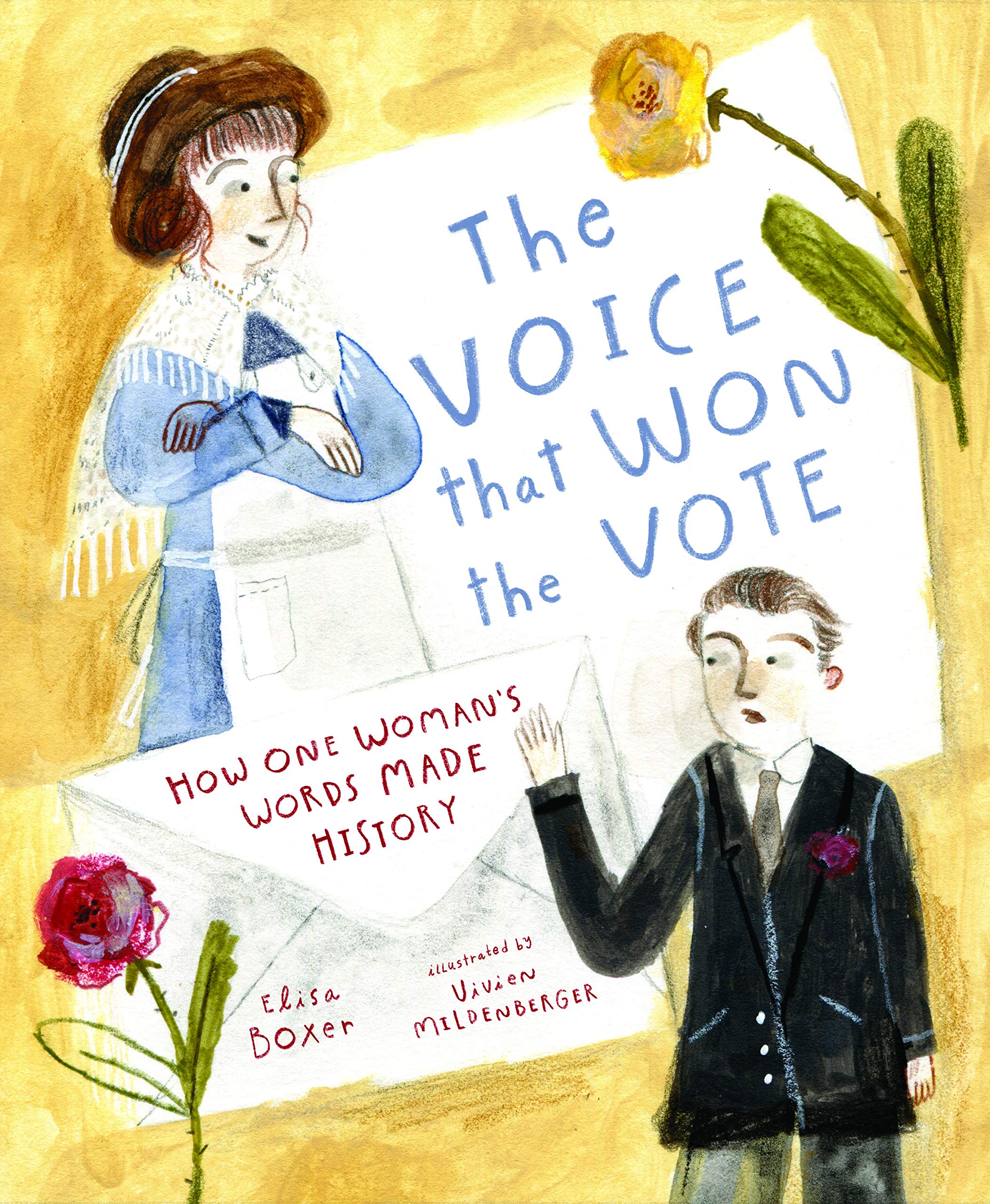
The Voice that Won the Vote: How One Woman’s Words Made History
Written by Elisa Boxer | Illustrated by Vivien Mildenberger
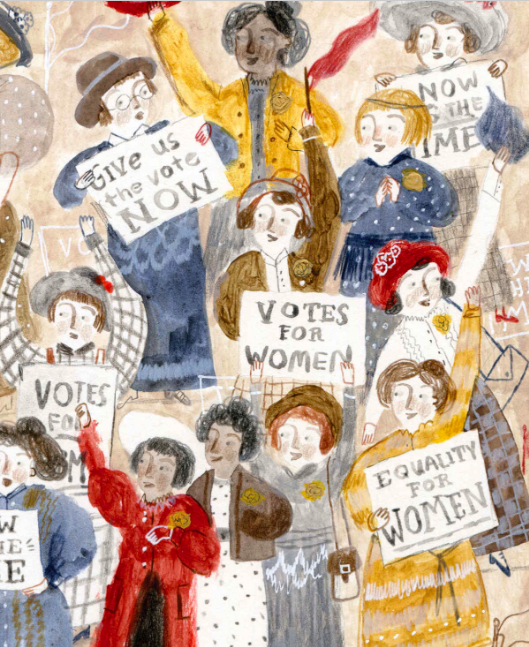
The year was 1920 and women were demanding the right to vote, just as they had been for the last seventy-five years. But all of their meetings, shouting, and signs were silenced. Men called the women “troublemakers” and “uncivilized.” Some men said it would “cause chaos” if women could vote, and others said “‘the only vote a woman needs is the vote to choose her husband.” There were even other women who thought women shouldn’t vote.
Image copyright Vivien Mildenberger, 2020, text copyright Elisa Boxer, 2020. Courtesy of Sleeping Bear Press.
But then there was Febb Burn from East Tennessee who had gone to college, become a teacher, and loved to keep learning. She was especially interested in laws and how they were made, and every year as she watched her farmhands head off to vote on election day, she wanted to be able to go too. Finally, she grew so tired of being “shut out of the process” that she wrote a letter to her son.
Who was her son? His name was Harry Burn, and he was the “youngest lawmaker in Tennessee.” As he read his mother’s letter, he watched out his window as people from across the country gathered to decide the fate of women’s suffrage. One round of voting had already taken place, and it had resulted in a tie. Thirty-five states had voted yes on the issue, but thirty-six were needed to make it a law. Harry Burn for Tennessee had been one of the “no” votes in the first round. Now in the second round, Harry Burn would be the deciding vote. A “no” would deny women the vote, while a “yes” would change elections forever.
Image copyright Vivien Mildenberger, 2020, text copyright Elisa Boxer, 2020. Courtesy of Sleeping Bear Press.
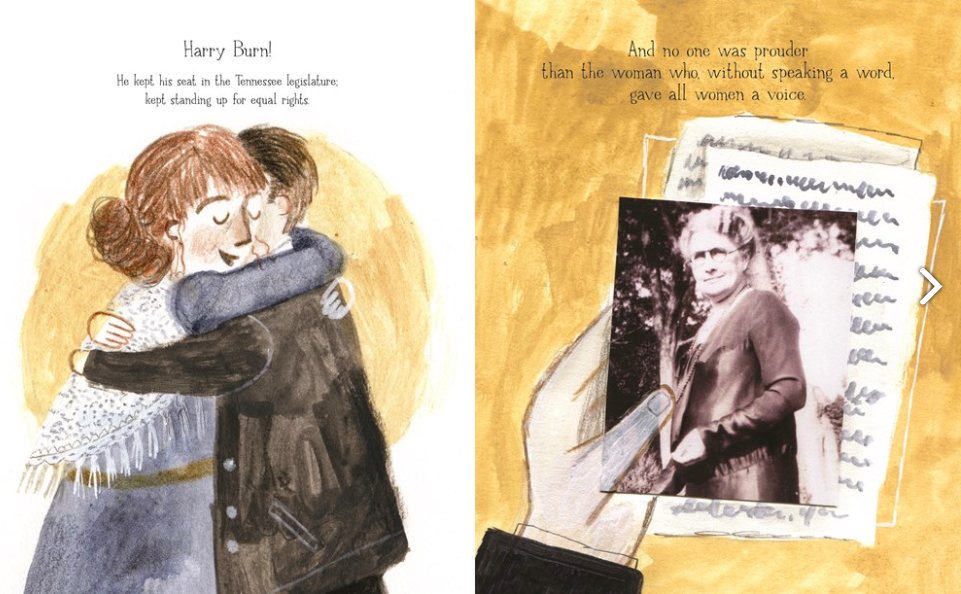
“He knew that most of the people who had elected him hated the idea of women voting.” Many of them were even in the audience and were counting on him. He was, after all, wearing a red rose—”the symbol of keeping women in the home, and out of the voting booth”—in his pocket. When it came time for Harry to vote, all eyes were on him as he said “‘Yes.’” The officials thought he’d “made a mistake” or “gotten confused,” but he hadn’t. The suffragettes cheered and hugged.
Everyone wanted to know why Harry Burn had changed his mind. In answer, he pulled from his pocket the letter his mother had written urging him to vote for suffrage. Harry constituents were shocked and angry. They vowed to vote against him in the next election. The headlines in the newspapers said that Harry had ruined his career. But Harry already knew that. He knew that his vote would mean “giving up his seat in the Tennessee House of Representatives.”
Image copyright Vivien Mildenberger, 2020, text copyright Elisa Boxer, 2020. Courtesy of Sleeping Bear Press.
When interviewed for newspaper articles, Harry said that he had followed his conscience that all people should have the right to vote. At last the election was held, and Harry awaited his fate as all the votes were counted. Who would be the next Tennessee Representative? Harry Burn! “And no one was prouder than the woman who, without speaking a word, gave all women a vote.”
In an Author’s Note, Elisa Boxer talks more about the women’s suffrage movement, the courage to stand up for what you believe in, and the power of using the vote to voice your opinion. A timeline of significant events in the women’s suffrage movement is also included.
Image copyright Vivien Mildenberger, 2020, text copyright Elisa Boxer, 2020. Courtesy of Sleeping Bear Press.
For anyone wondering about the power of one vote, Elisa Boxer puts all doubts to rest with her engaging recounting of this little-known true story. While Harry Burn’s vote took place 100 years ago, the courage he showed in standing up for his own conscience and in opposition to what was expected of him reverberates today. Boxer opens the story with a clear and meaningful definition of how a vote equals one’s voice, instilling in children who are learning to speak up for themselves in classrooms, on social media, and elsewhere the importance of voting when they come of age.
Her inclusion of quotes revealing the reasons behind opposition to women’s suffrage will be eye-opening. Her well-paced building of suspense going into the second vote and the aftermath will have kids on the edge of their seat and offers many opportunities to discuss the mechanisms of politics, expectations, and courage. Through her straightforward yet multilayered storytelling, Boxer presents two heroes for children to look up to: Harry, who put the good of the country and women ahead of his own career and Febb, who used her voice to make lasting change.
Image copyright Vivien Mildenberger, 2020. Courtesy of Sleeping Bear Press.
Vivien Mildenberger’s lovely, textured illustrations take readers back to the pivotal year of 1920, when vocal suffragettes faced their equally vocal opposition and Febb Burn, sitting on her front porch decided to write her life-changing letter. Images of politicians sporting yellow and red roses reveal the long tradition of color as an identifying symbol. An especially powerful spread comes after Harry’s vote as he walks among his angry constituents, all of whom shun him behind newspapers full of articles about the historic vote. The inclusion of the actual Febb Burn’s letter to Harry and a photograph of Febb give readers see and hear from this influential woman.
A stirring true story about the power of one person to make a difference, The Voice that Won the Vote is highly recommended for home, school, and public library collections.
Discover more about Elisa Boxer, her book, journalism, and other work on her website.
To learn more about Vivien Mildenberger, her books, and her art on her website.
Meet Elisa Boxer
Elisa Boxer is an Emmy-winning journalist and columnist whose work has appeared in publications including The New York Times, Inc., and Fast Company. She has always been passionate about children’s literature, and finds herself especially drawn to stories of unsung heroes like Febb and Harry Burn. The Voice That Won the Vote is her first book, and she hopes it inspires children to give voice to what matters to them. Elisa lives in Maine with her family.
Today, I’m excited to chat with Elisa Boxer about her timely The Voice Who Won the Vote, her work as a journalist, and the themes woven through all of her stories. Elisa also gives kids an intriguing writing prompt. And my blogging partner Jakki’s sons, Steve and Jack, are back with their questions too!
Steve asked: How did you find the letter Febb Burn wrote to her son?
Hi Steve! So glad you liked the book. The story of how I found the letter goes back to a couple of years ago when my agent, Steven Chudney, let me know that 2020 would be the 100th Anniversary of women getting the right to vote. He asked if I could come up with a picture book about it. I’ve always been drawn to stories of unsung heroes, so I scoured the internet for little-known figures in the suffrage movement. When I stumbled across the story of Febb Burn and learned that she was the mom who saved suffrage, I knew this was a story I wanted to tell! More digging led me to the online archives at the Knox County Library in Tennessee. These archives included the letter.
I think it’s so cool to see the original papers that Harry received and read that day in the legislature back in 1920. And to see Febb’s actual handwriting! Aaah! I tend to geek out over historical documents like this.
Jack wondered: How much research did you have to do?
Hi Jack! The short answer is: Lots. After I found Febb’s story on the internet, I read as many articles online as I could find. I also read several books about the women’s suffrage movement. I wanted more background information to put the story in context, and I also wanted to know more about the legislative session in Tennessee that led to Harry Burn tipping the scales and giving women the right to vote. I also enlisted the help of the Special Collections department at the University of Tennessee Libraries. One of the most exciting things they shared with me was a scanned version of Harry Burn’s personal scrapbook from 1920, containing newspaper clippings and headlines from his historic vote!
Jack and Steve would like to know: Is voting important to you?
Definitely. I started the book with the line: “A vote is a voice,” because I believe that voting is one of the most powerful ways we can have our say in society.
Hi Elisa! I read in your bio that even as a child you loved to write. In fact, if readers look on your website they’ll see a picture of quite a large group of books with covers written in crayon. I’m sure kids would love to know what some of those stories were about. Can you share a few of the ideas you wrote about as a child?
Sure! It’s fun to look back on those and see some common themes, like defying authority (You Can’t Catch Me, for example, about a girl outrunning her parents) and grief (I wrote The Kitten and the Puppy after losing my beloved dog). And then, there was a book about a dinosaur making friends with a little girl and moving into her house, which I think I wrote because I had just learned how to draw dinosaurs ;).
With your early interest in writing books, did you ever consider becoming a children’s writer or novelist before going into journalism? What was it about journalism that attracted you?
Even though I’ve loved reading and writing children’s books for as long as I can remember, I never really considered making a career of it. I wish I had followed that passion earlier. I’m 49 and my first book was just published. So if you have any interest in creating children’s books, don’t wait as long as I did! Although, having said that, I really do love print and broadcast journalism. My specialty has always been long-form journalism, which involves in-depth research, multiple interviews, and spending time crafting a story. A lot like writing nonfiction picture books, actually. A couple of years ago, I got sidelined with a severe case of Lyme disease. It hurt to move and breathe and I was basically housebound. So that’s when I decided to re-visit my childhood passion. I began dusting off old picture book manuscripts, revising them, and querying agents.
Your stories in print for newspapers and for television news have garnered many awards. What aspects of story do you infuse into each of your pieces? What do you like best about each medium?
(Blushing). I am always looking for the soul of the story. Even with straight news pieces, I want to find people and circumstances to bring those stories to life in a way that readers or viewers can relate to. The thing I like best is the same for each medium, and that is finding the point of emotional resonance, the subtext, the theme that will stick with the audience long after they put down the paper or the magazine or turn off the TV. In fact, that’s one of the reasons I love books so much: people pick them up again and again. Sure, you can save a newspaper or magazine article that resonates with you. But it’s not the same as that feeling of finishing a book, internalizing its message, holding it in your hands and knowing it’s yours to return to whenever you want.
It seems very fitting that your first published book is a picture book. What is it about Febb Burn’s story that you think is most important for kids to know?
I really want kids to know how much their voices matter. It’s so easy to feel powerless, especially given the state of the world right now. But I hope kids come away from the book realizing that one small act of courage, in the form of giving voice to what matters to them, really can change the world.
Vivien Mildenberger’s illustrations are so evocative of 1920. What was your first reaction to seeing your story illustrated? Do you have a favorite spread?
Aren’t Vivien’s illustrations amazing? I’m still blown away by them every time I see the book. When I first saw her work on her website, even before I saw her illustrations for the book, I knew that her old-world style would be a perfect fit for this story. And then when I first saw her preliminary sketches, I thought, WHOA, this is going to be even better than I could have imagined. Hmmm, it’s tough to pick a favorite spread. But I’d have to say the one where Harry Burn is looking out the window of the state capitol, watching the throngs of people arrive to witness history. She really captures the mood here. “America was on the verge of change,” the text reads. You can’t even see Harry’s face, but Vivien somehow managed to convey so much tension and anticipation in this spread. You can feel his inner struggle to do what’s right and follow his heart in the face of opposition.
What’s up next for you?
I’m super excited to say that I have several more picture books on the way during the next couple of years, all nonfiction. I’m also working on a chapter book and two middle grade books, one nonfiction and the other historical fiction.
As kids stay home and are schooled at home, it’s wonderful to see them interacting with the kidlit community. Would you like to give readers a writing prompt?
It really is so wonderful to be interacting with kids, their parents and their teachers. As for a prompt, I’d ask kids: With the world the way it is, what are the words, the scenes, the images, and the messages that would touch your heart? In other words, what is the book you need right now? Take one small step to start creating it. And then another…
Thanks, Elisa! It’s been wonderful talking with you! I wish you all the best with The Voice Who Won the Vote, and I can’t wait to read your upcoming books. I hope we’ll have a chance to chat again!
For kids, going back to school means new art projects and using their creativity and ingenuity. For many it also means getting to know a new class pet or sharing their school day at home with a beloved furry or feathered friend. In today’s book the two are combined in a sweet and funny beginning reader – the third book in the kid-favorite Tip and Tucker series.
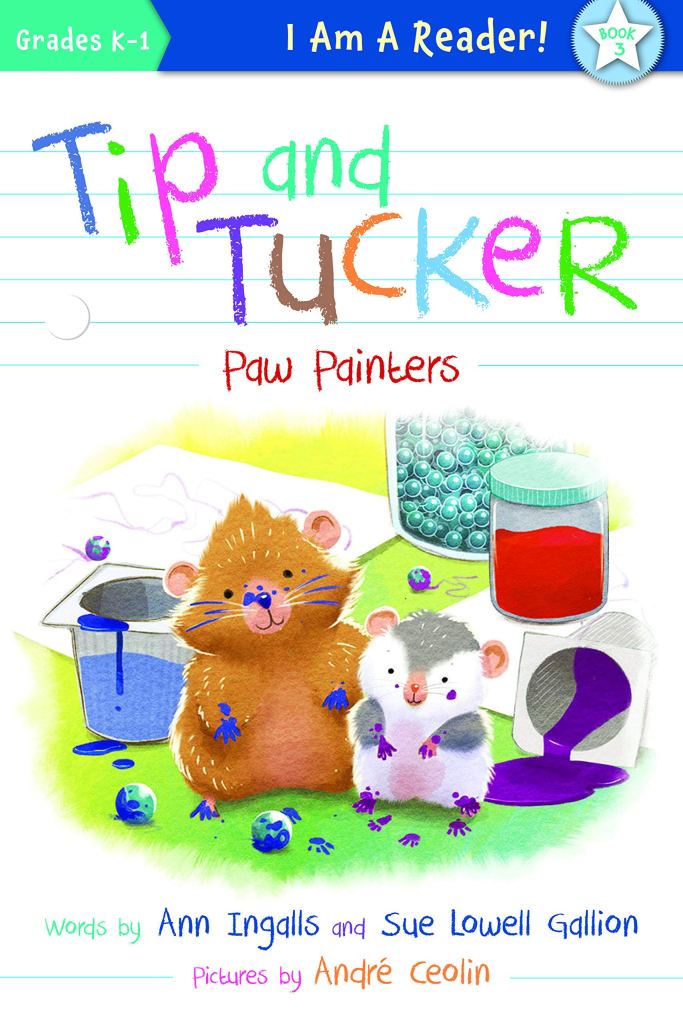
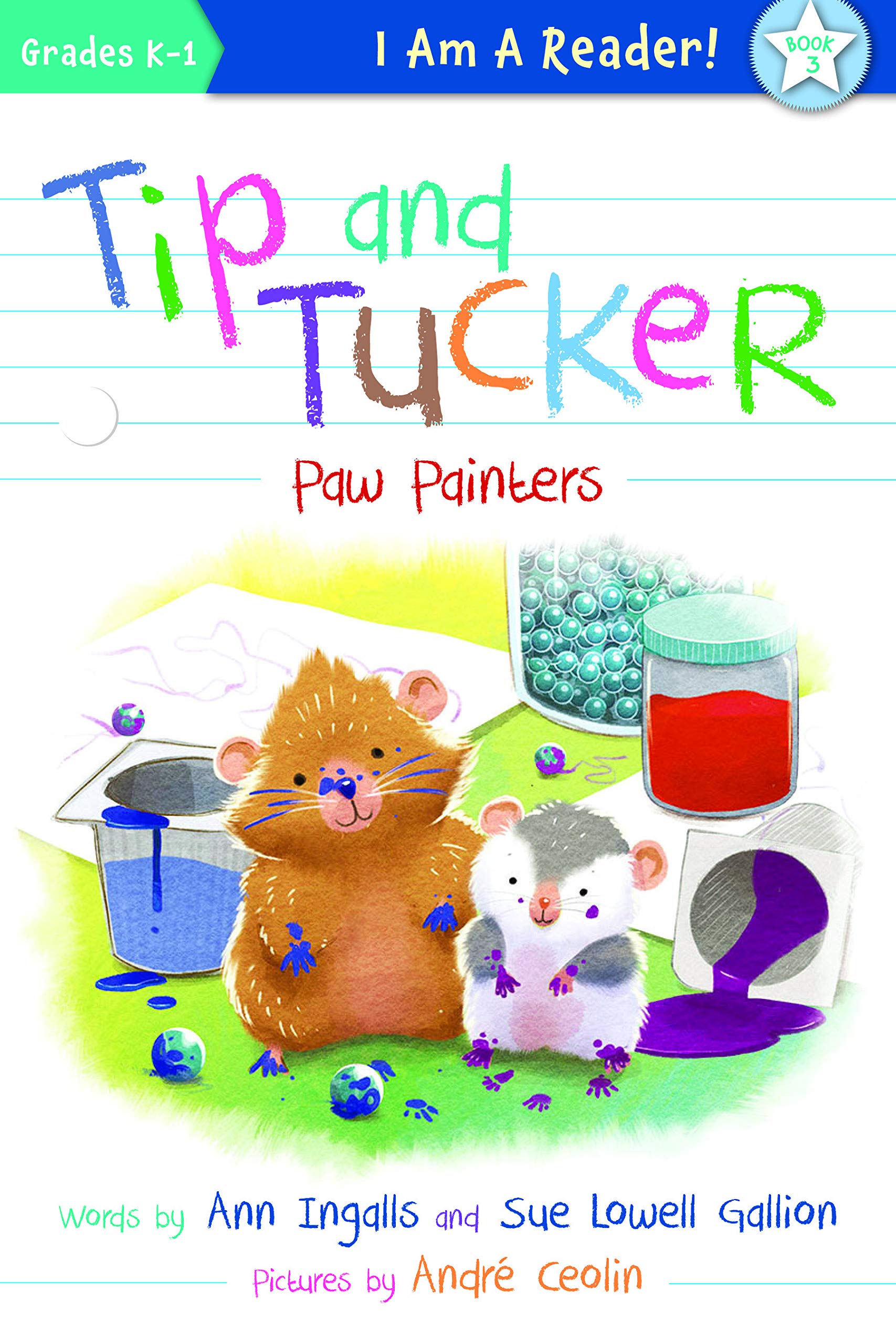
Tip and Tucker Paw Painters
Written by Ann Ingalls and Sue Lowell Gallion | Illustrated by André Ceolin
It’s art week in Mr. Lopez’s class, and the kids are choosing between painting with marbles and building with boxes—or doing both. The colors of paint available are listed on the whiteboard in English and Spanish. Emma picks up her marble as Tucker, one of the class’s hamsters, peeks over the top of his cage at all those boxes.
Image copyright André Ceolin, 2020, text copyright Ann Ingalls and Sue Lowell Gallion, 2020. Courtesy of Sleeping Bear Press.
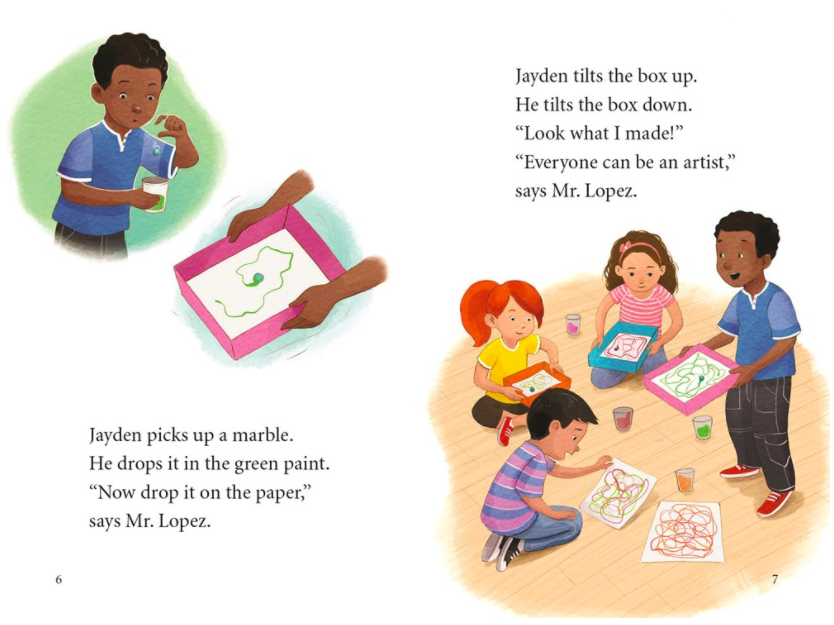
Jayden has chosen to paint with marbles too. “He drops it in the green paint. ‘Now drop it on the paper,’ says Mr. Lopez.” Jayden puts a sheet of paper in his box and drops the green-painted marble on top. He “tilts the box up and down.” A squiggly line snakes around Jayden’s paper. “‘Everyone can be an artist,’ says Mr. Lopez.”
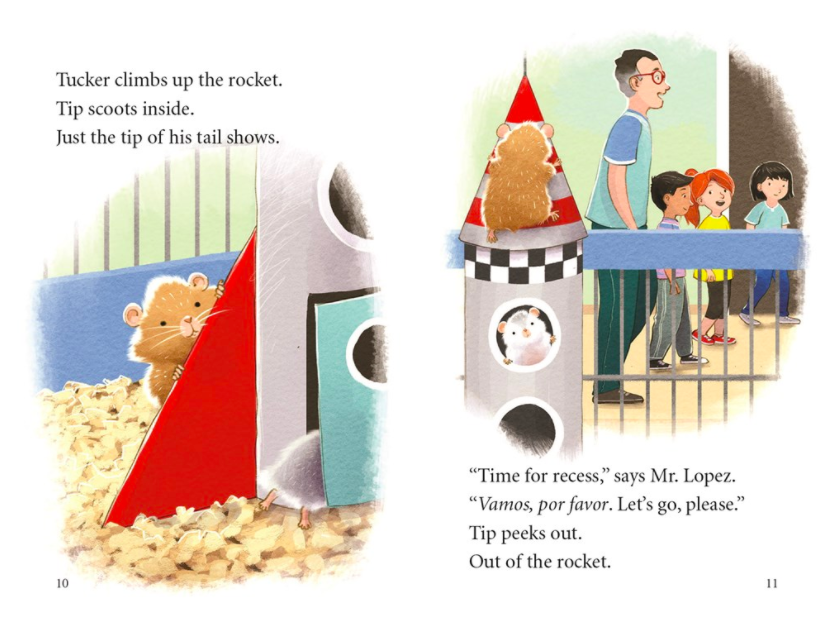
Emma and Pim are making a rocket with the boxes. It’s a special rocket to go in Tip and Tucker’s cage. Tucker climbs up the outside of the rocket while Tip scurries inside. They watch the class go to recess. Tucker wants Tip to join him at the top of the rocket, but when he gets there, “the rocket tips. The hamsters tumble.” They “BUMP! THUMP!” onto the tabletop.
Image copyright André Ceolin, 2020, text copyright Ann Ingalls and Sue Lowell Gallion, 2020. Courtesy of Sleeping Bear Press.
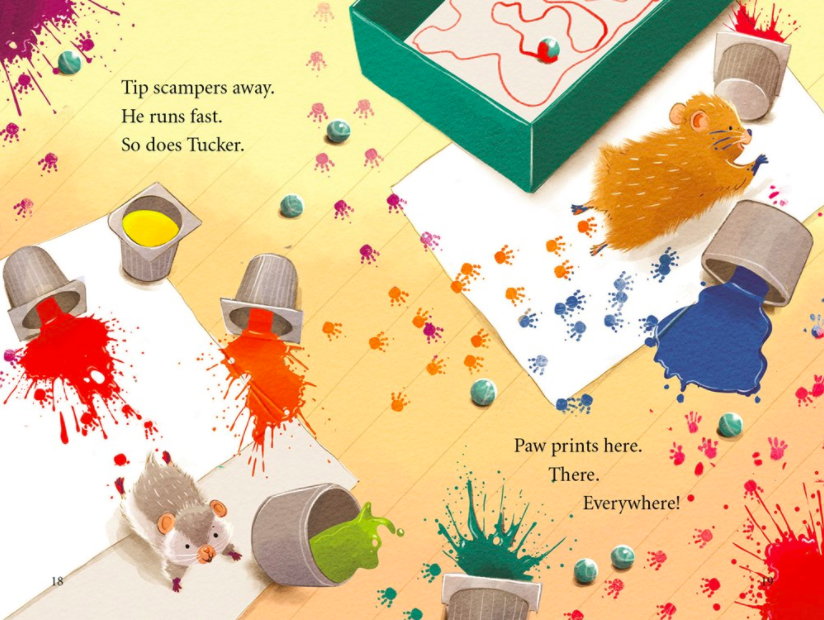
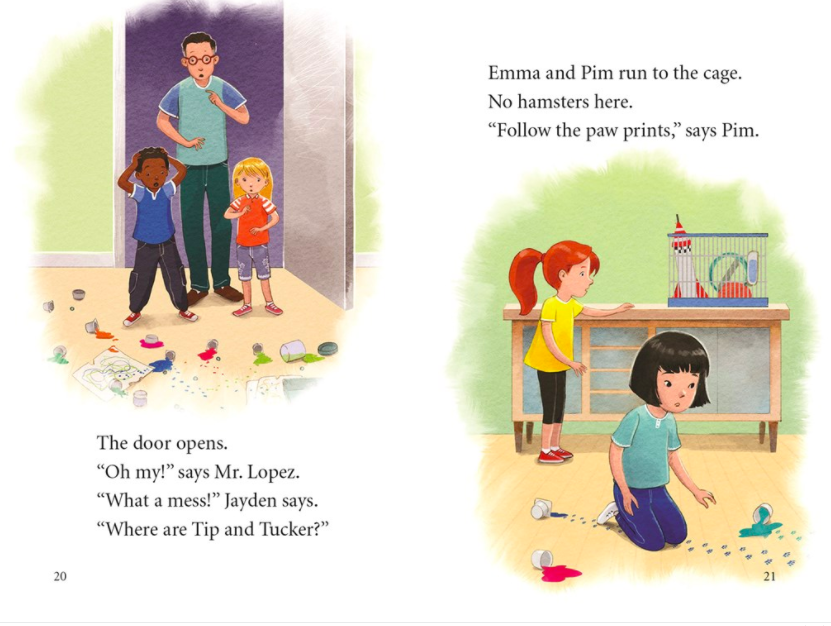
Tucker inspects a cup of paint, and when he looks up his whiskers are blue. Tip topples a cup of purple paint. “Now Tip’s paws are purple!” Both Tip and Tucker run away, leaving “paw prints here. There. Everywhere!” When the class returns from recess, they find a big mess, but no hamsters. “‘Follow the paw prints,’ says Pim.” The paw prints lead Carlos to his nibbled painting and Mr. Lopez to his nibbled lunch bag.
Image copyright André Ceolin, 2020, text copyright Ann Ingalls and Sue Lowell Gallion, 2020. Courtesy of Sleeping Bear Press.
But what, the kids wonder, is that crunching sound coming from inside the bag? Tip and Tucker wonder what that noise is that’s coming from outside the bag. Tucker “peeks out of the bag. Tip peeks too.” The class goes to work cleaning their room—and Tip and Tucker. While the hamsters settle in for a nap, Mr. Lopez hangs the students’ marble paintings, including one decorated with tiny paw prints. Then the class goes to lunch. In the quiet room, Tip wakes up Tucker and points to the wall. “Sleepy Tucker looks. ‘We are artists too!’ Tip says.”
Image copyright André Ceolin, 2020, text copyright Ann Ingalls and Sue Lowell Gallion, 2020. Courtesy of Sleeping Bear Press.
Tip and Tucker, back at school in their third adventure, are as cute and mischievous as ever. Children who are beginning to read independently will be charmed by Ann Ingalls’ and Sue Lowell Gallion’s tiny duo who make a big mess while the class is away in this high-interest and humorous story that also introduces an easy, satisfying art project to do in school or at home. For beginning readers, the authors’ short sentences, dialogue, and repeated words and phrases build confidence while instilling an appreciation for the fun of reading. As clues are dropped and suspense increases, fans of the series will eagerly read each page to discover what their favorite class pets get up to this time. Their funny discovery and the responses of the children are endearing, and the addition of Tip and Tucker’s work of art on the classroom wall reinforces the story’s themes of creativity and inclusion.
Readers will enthusiastically welcome back André Ceolin’s adorable Tip and Tucker and be happy to rejoin Mr. Lopez’s class with their friends Pim, Jayden, Emma, Carlos, and the others. Little Tucker with his blue whiskers and Tip with his purple paws will melt kids’ hearts, and their willy-nilly dash around the classroom is sure to bring on the giggles. Ceolin clearly depicts the concepts presented in the text on each page so that beginning readers can make the association between perhaps unknown words and their meaning. Images of the children’s happy faces as they create their art projects and cooperate in cleaning up contrast with their shock upon seeing their messy classroom and nibbled papers and their concern for Tip and Tucker. Tip and Tucker also display feelings of curiosity, joy, and surprise. These portrayals help kids explore their emotions and learn how to navigate new experiences.
Sure to captivate new and beginning readers, Tip and Tucker Paw Painters is one to add to your home, classroom, or public library collection. Check out the other I Am a Reader: Tip and Tucker books as well as an interview with Ann Ingalls and Sue Lowell Gallion here:
Sleeping Bear Press, 2020 | ISBN 978-1534110991 (Hardcover) | ISBN 978-1534111004 (Paperback)
Discover more about Ann Ingalls and her books on her website.
To learn more about Sue Lowell Gallion and her books, visit her website.
You can learn more about André Ceolin and find a portfolio of his work on his website.
Back to School Month Activity
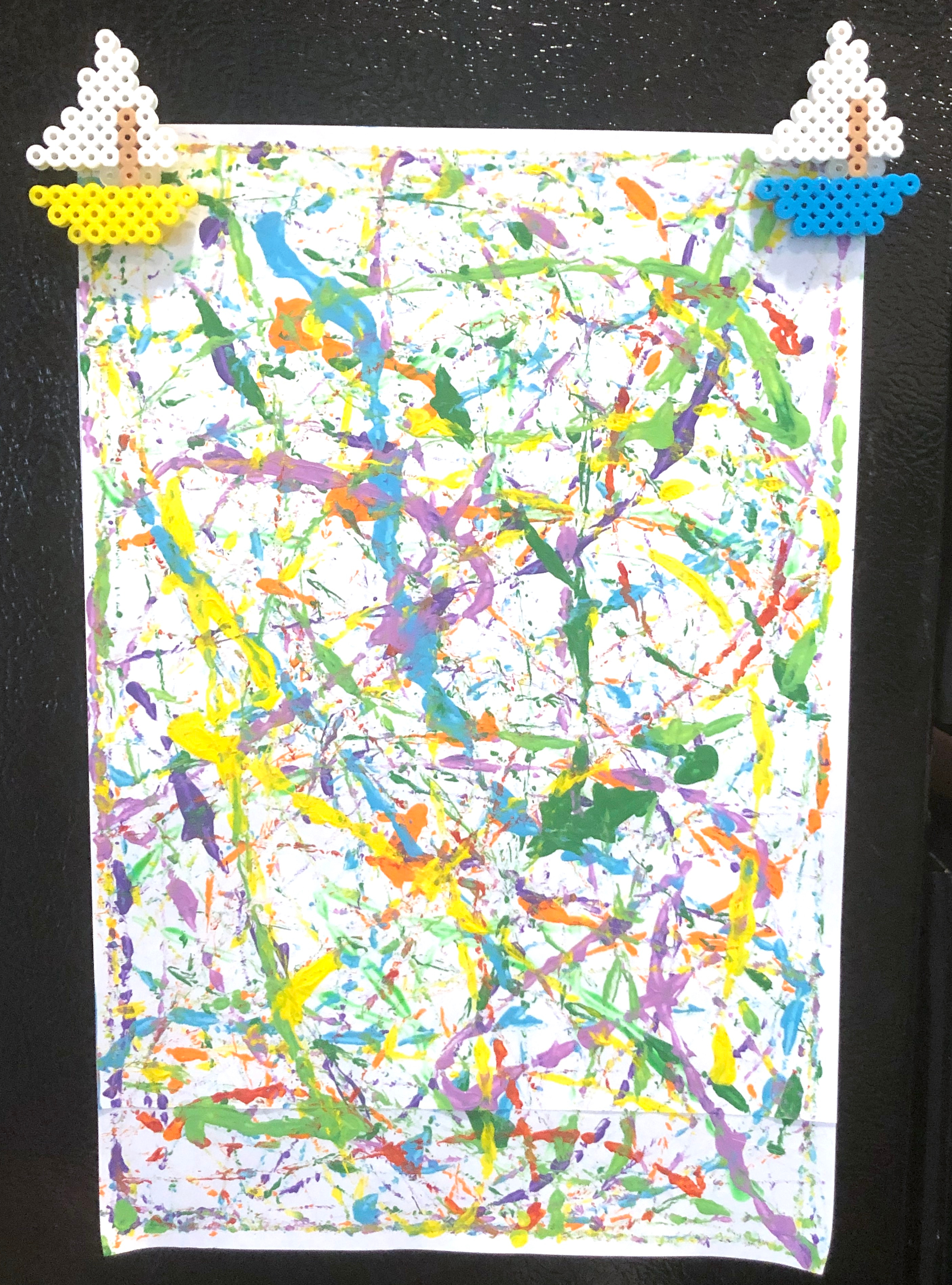
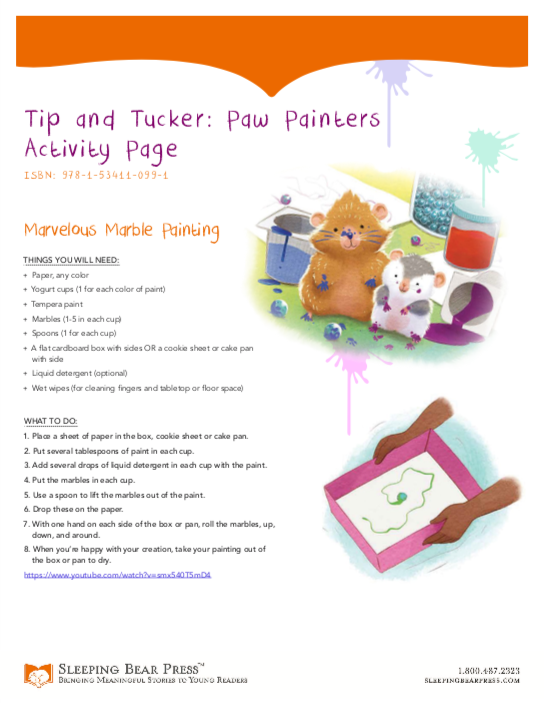
Marble Painting with Tip and Tucker Paw Painters Activity Sheet
You can make a marble painting just like the kids in Mr. Lopez’s class with these printable directions from Sleeping Bear Press. And… you can even get as messy as Tip and Tucker!