December 17 – It’s Cat Lover’s Month

celebrate-picture-books-picture-book-review-max-attacks-cover

About the Holiday

If you share a home with a cat, then you know how these furry friends can change your life. Whether you love them for their playful antics, for their companionship, or for their independent spirit, your life just wouldn’t be the same without them. Cat Lovers Month is the perfect time to lavish your cat. or kitten with some extra love and attention. If you’re considering adopting a cat, now may be the time to contact your local animal shelter or rescue group to see if you can give a cat a forever home.

Thanks go to Atheneum Books for Young Readers for sending me a copy of Max… Attacks for review consideration. All opinions about the book are my own. 

Max… Attacks

Written by Kathi Appelt | Illustrated by Penelope Dullaghan


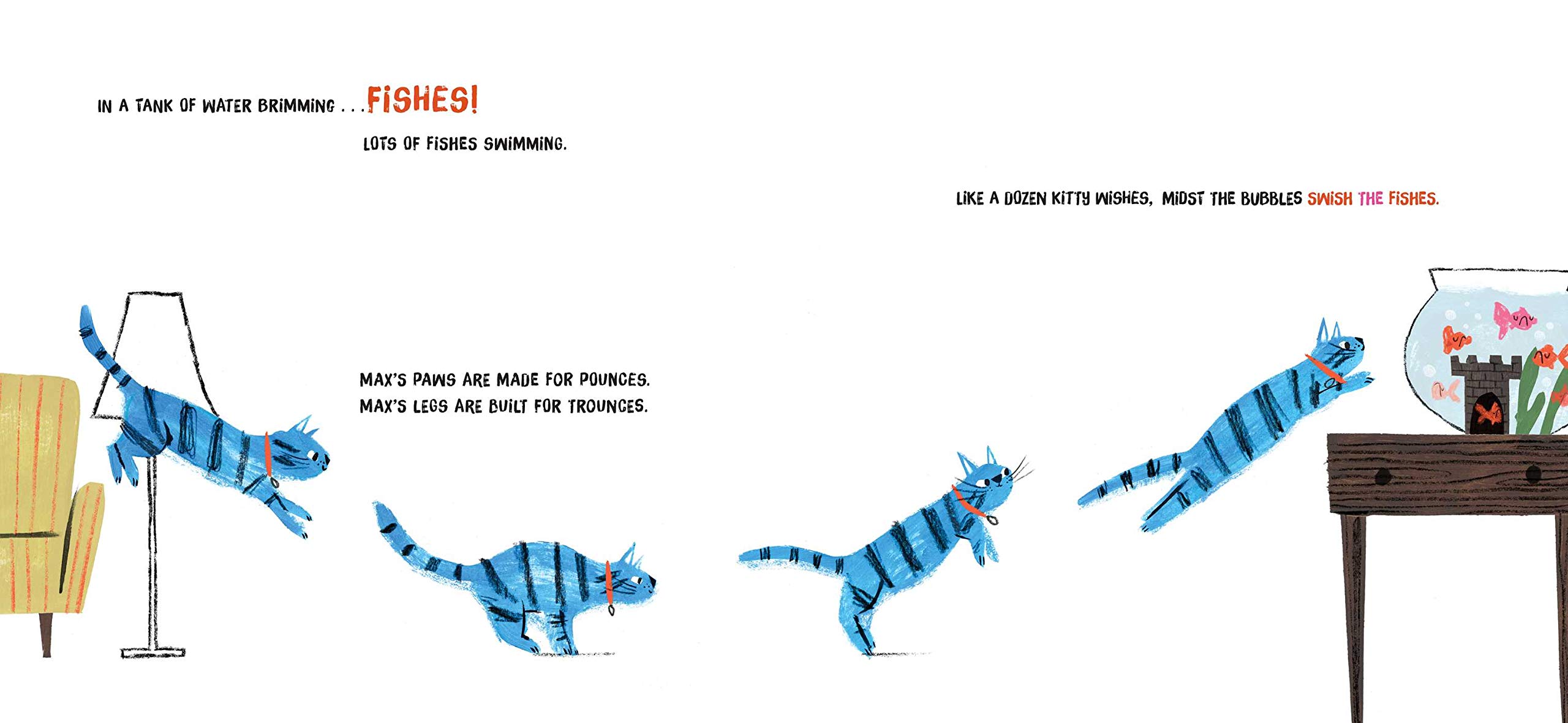
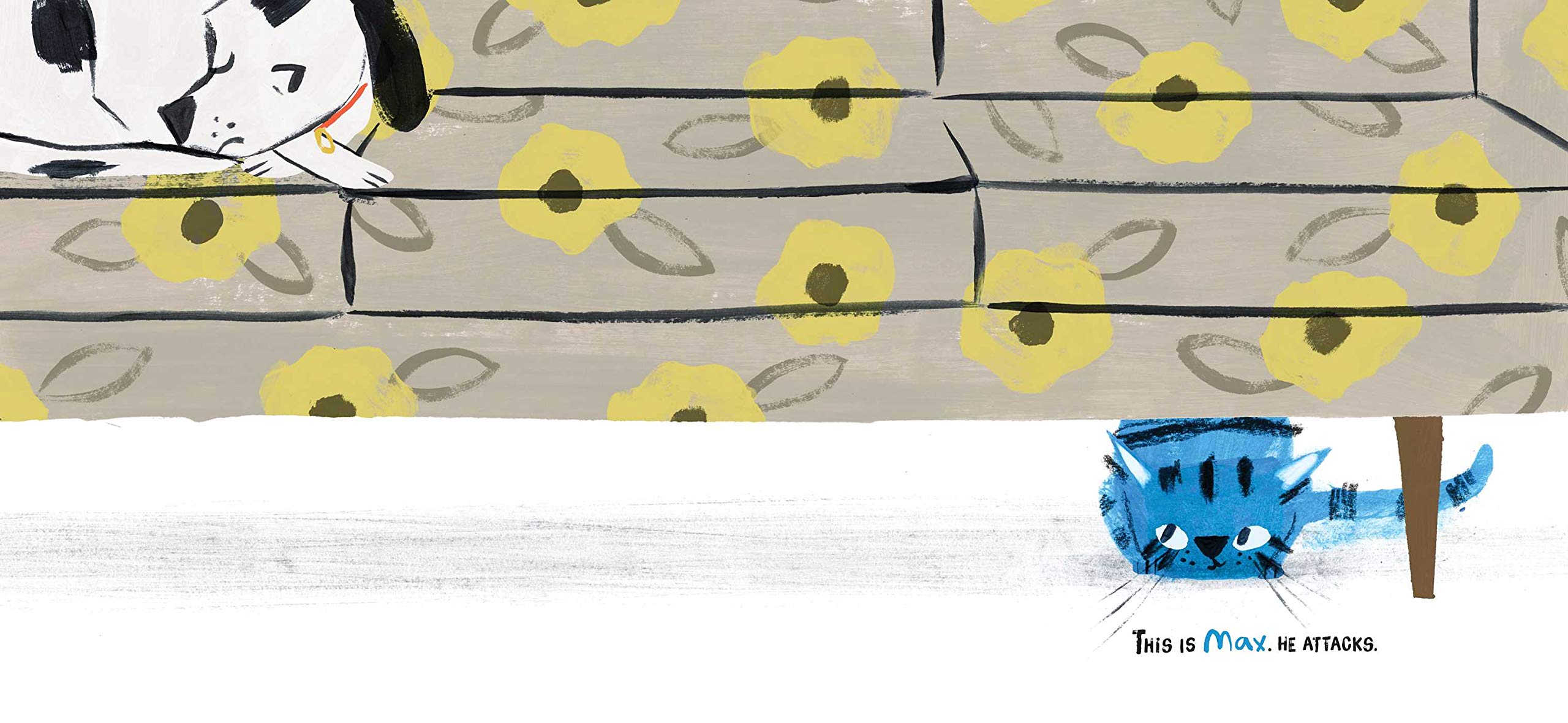
See Max crouching under the chair? He’s getting ready to do what he does best: attack! On the table sits a bowl of fish. “Max’s paws are made for pounces. / Max’s legs are built for trounces.” He springs…he leaps… “but hold on….” On the screen door crawls a lizard watched with curiosity by the dog. In a moment Max is there: “Max one. Dog none.”
celebrate-picture-books-picture-book-review-max-attacks-fish-bowl

Image Penelope Dullaghan, 2019, text copyright Kathi Appelt, 2019. Courtesy of Atheneum/Caitlyn Dlouhy Books.

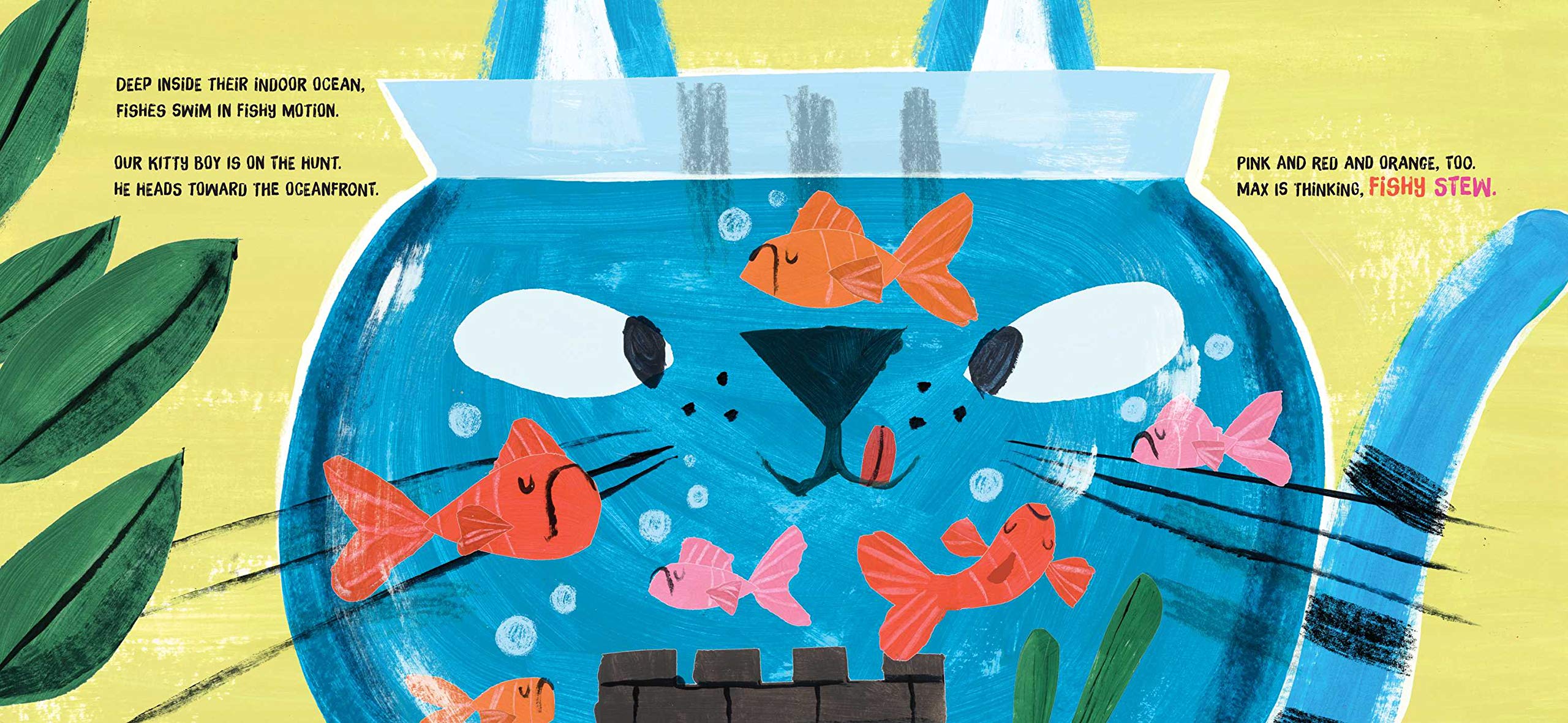
Back to the fishbowl Max creeps. He gets up close and licks his lips, but then he smells “his favorite catnip bird.” He takes time out to play, but the paw-flung toy gets lost. Perhaps it’s in “the basket filled with dirty socks?” Yes! “Oh happy day, this basket rocks.” With the socks all snagged and bitten through, Max dreams again of “fishy stew.”

But, wait! What’s that swaying underneath the table? It’s none other than a shoelace begging to be attacked. A few swats and swings later, “our sneaky boy is on the creep. / He peers into the ocean deep. / Back and forth those fishes go… / swishy swashy, to and fro.” Max climbs up on the table and “perches on that bowl of water. / Lower… lower… teeter-…totter.”
celebrate-picture-books-picture-book-review-max-attacks-running

Image Penelope Dullaghan, 2019, text copyright Kathi Appelt, 2019. Courtesy of Atheneum/Caitlyn Dlouhy Books.

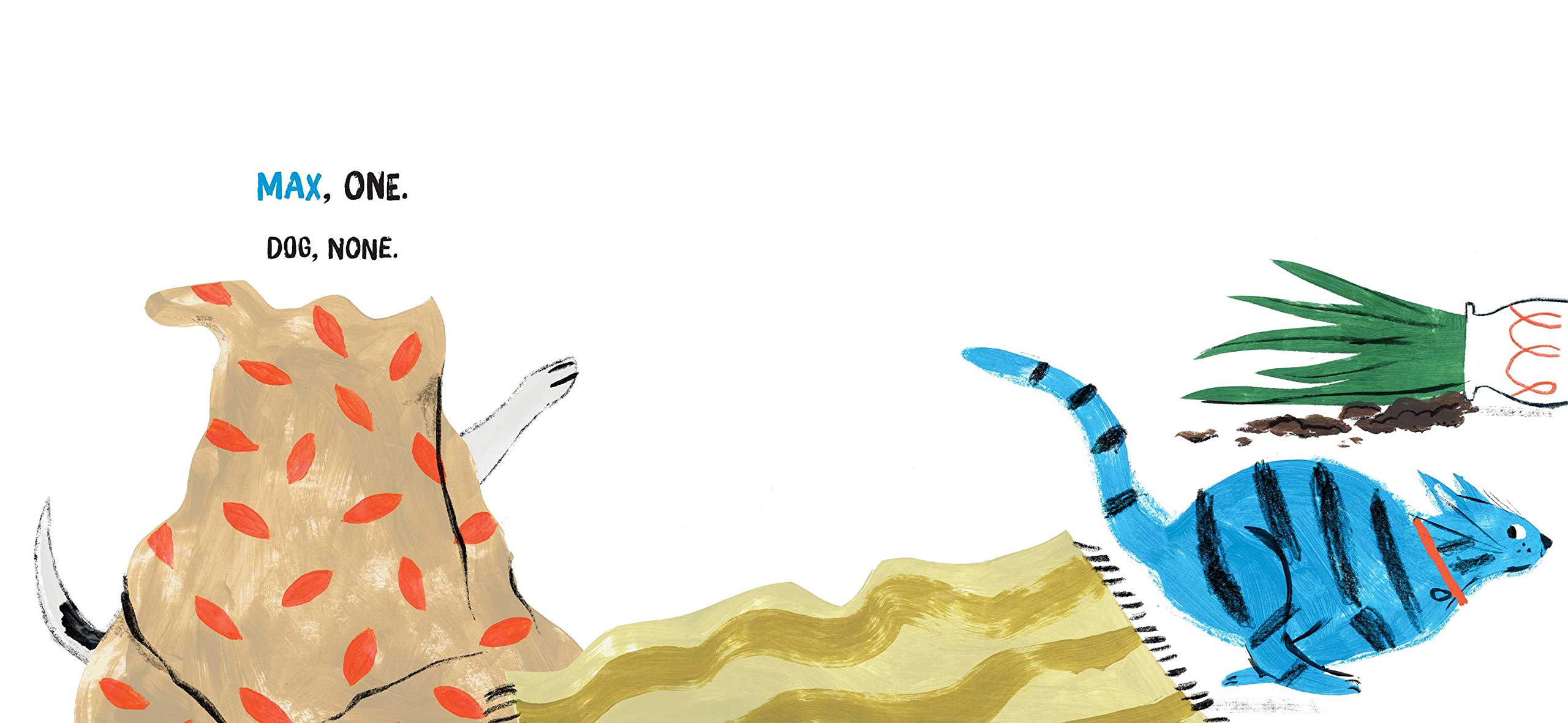
Splash! The fish don’t mind the waves he makes, and Max? He needed a bath anyway. Besides, he sees his dinner bowl he can attack. Satisfied and tired Max curls up on his rug. “He’s done, kaput, stopped in his tracks. / A mighty nap attacks our Max.” And those fishies are so proud to show: “Max none. Fish, six plus one.”
celebrate-picture-books-picture-book-review-max-attacks-fishy-stew

Image Penelope Dullaghan, 2019, text copyright Kathi Appelt, 2019. Courtesy of Atheneum/Caitlyn Dlouhy Books.

Kathi Appelt’s infectious rhythm is as bouncy and jaunty as a fun-loving, curious cat and perfectly captures the mercurial nature of felines. Appelt’s verses are rich in sprightly vocabulary that moves the story along at the pace of a playful kitten while introducing charming, unexpected rhymes. Cat lovers will appreciate the humorous nod toward some of a cat’s favorite things, including shoe laces, any creepy-crawly, smelly socks, and a catnip toy. Lots of action, onomatopoeia, and internal thoughts put kids in Max’s point of view: a most wonderful place to be. 
celebrate-picture-books-picture-book-review-max-attacks-under-bed

Image Penelope Dullaghan, 2019, text copyright Kathi Appelt, 2019. Courtesy of Atheneum/Caitlyn Dlouhy Books.

Penelope Dullaghan’s mixed media illustrations snap with personality and motion as Max leaps from one fascination to another. Her fresh, vivid images are set on plenty of white space, giving Max full range for his playful antics, and her dynamic and colorful typography contribute to the frolicking fun. With the dog shrouded in curtains and the potted plant tipped on its side, Dulligan’s Max hightails it off the page and away from his mess with a sly backward glance and just the hint of a smile. A laundry basket full of socks is no match for Max’s gamboling and sharp teeth and claws, and that dangling shoelace (shown from Max’s eye view) is just too tempting to resist. Kids will revel in the suspense when Max teeters on the fishbowl, and thrill to his ninja-style attack on his food bowl. Max’s innocent nap time face will elicit lots of “awwws,” and that one eye open on the last page is sure to entice a repeat reading.

A joy to read aloud and sure to be a much-asked-for favorite, Max… Attacks is a book you’ll want to pick up for yourself and as a gift. The book would be a purr-fect addition to home, classroom, and public library collections.

Ages 4 – 8

Atheneum/Caitlyn Dlouhy Books, 2019 | ISBN 978-1481451468

Discover more about Kathi Appelt and her books on her website.

To learn more about Penelope Dullaghan, her books, and her art, visit her website.

Cat World Domination Day Activity

celebrate-picture-books-picture-book-review-wooden-bead-cat-craft

A Little Ball of Kitten


This sweet little kitten is easy to make and can keep you company on your desk or shelf! Since every kitten is different, you can make yours to look just the way you want. Here’s how I made mine:

Supplies

  • Wooden ball with a flat bottom, available in craft stores and in different sizes
  • Craft paint in any color kitten you’d like (I used red and yellow and mixed it to make a mottled orange)
  • Craft paint in pink or white for the inner ear
  • Scrap of fleece for the ears. Fleece is easily shaped to the rounded ball and when painted is stiff enough to stand up on its own.
  • Thin, colored wire in several colors for the tail (string or twine, wrapped wire, fleece, stiff paper, and other materials could also be used)
  • Paint brush
  • Permanent marker for making the face
  • Hot glue gun or strong glue

Directions

  1. Paint the wooden ball and let dry
  2. Paint the scrap of fleece to match the wooden ball, let dry
  3. Cut out small triangular shapes for the ears. Round the bottom of the ears slightly so they fit the shape of the ball
  4. If making a tail from several colors of thin wire, twist them together, leaving one end untwisted
  5. With the glue gun or strong glue attach the ears to the top of the head
  6. With the glue gun attach the tail to the back of the wooden ball in the center near the base
  7. With the marker, draw eyes, nose, and mouth for the face and semicircles near the bottom for the paws

celebrate-picture-books-picture-book-review-max-attacks-cover

You can find Max… Attacks at these booksellers

Amazon | Barnes & Noble | Books-a-Million

To support your local independent bookstore, order from

Bookshop | IndieBound

Picture Book Review

December 16 – It’s Time for the Christmas Bird Count

celebrate-picture-books-picture-book-review-the-atlas-of-amazing-birds-cover

About the Holiday

Concerned with declining bird populations, ornithologist Frank M. Chapman suggested a new holiday tradition—a Christmas Bird Census that would count birds instead of hunting them. The first census took place on December 25, 1900. On that day, twenty-seven birders, centered mostly in northeastern North America, counted 90 species of birds. The tradition has grown tremendously from those humble beginnings. Today, tens of thousands of volunteers throughout the Americas brave all types of weather to conduct the count, which helps conservationists and scientific organizations create strategies for protecting the health and habitats of bird populations. The Christmas Bird Count is now held from December 14 through January 5. To learn more or to get involved yourself, visit the Audubon website.

The Atlas of Amazing Birds

By Matt Sewell

If you have a budding ornithologist in the family, they will be awed by Matt Sewell’s gorgeous compendium of more than 150 birds from around the world. Organized by continent—Europe, North and Central America, South America, Antarctica, Oceana, Asia, and Africa—each chapter begins with a green watercolor map of the area delineated into the countries within its borders and includes a short introduction to the size, climate, surrounding oceans, and number of birds found there.

celebrate-picture-books-picture-book-review-the-atlas-of-amazing-birds-painted-buntings

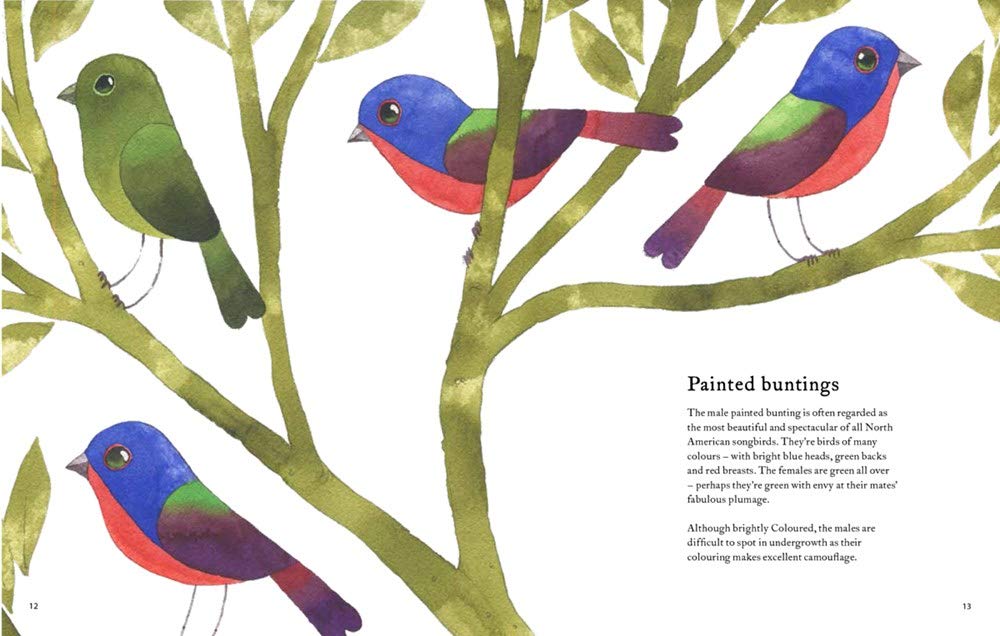
Copyright Matt Sewell, 2019, courtesy of Princeton Architectural Press.

The first stop on this ornithological tour is Europe, where readers discover first the European roller, a lovely species with a cyan body and rust-and-blue-mottled wings that summers in Southern Europe and the Middle East and winters in Africa. This bird’s beauty belies the less-than-attractive way they have for protecting themselves as chicks in which “they can vomit a foul-smelling liquid over themselves to keep predators at bay.”

The European golden-plover chick—a little fluff of green and white that blends in with its mossy surroundings—takes a different tack: By looking like “a small clump of cotton balls flecked with gold leaf, it is possibly one of the cutest chicks out there.” With its speedy wingbeats, the European golden-plover also claims another mark of distinction as the “genesis for the idea for the book of Guinness World Records.”

celebrate-picture-books-picture-book-review-the-atlas-of-amazing-birds-woodpecker

Copyright Matt Sewell, 2019, courtesy of Princeton Architectural Press.

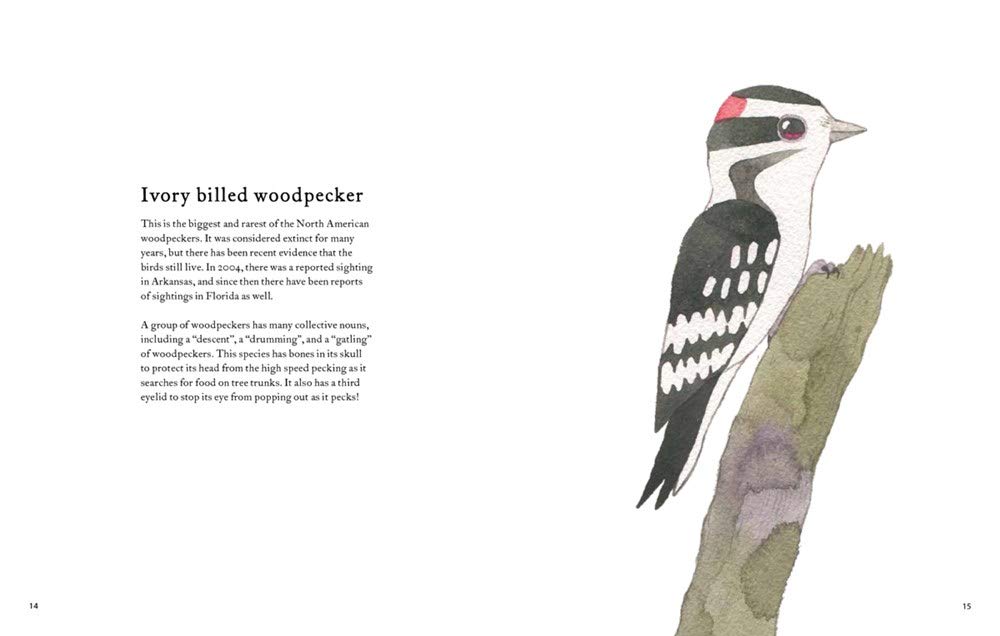
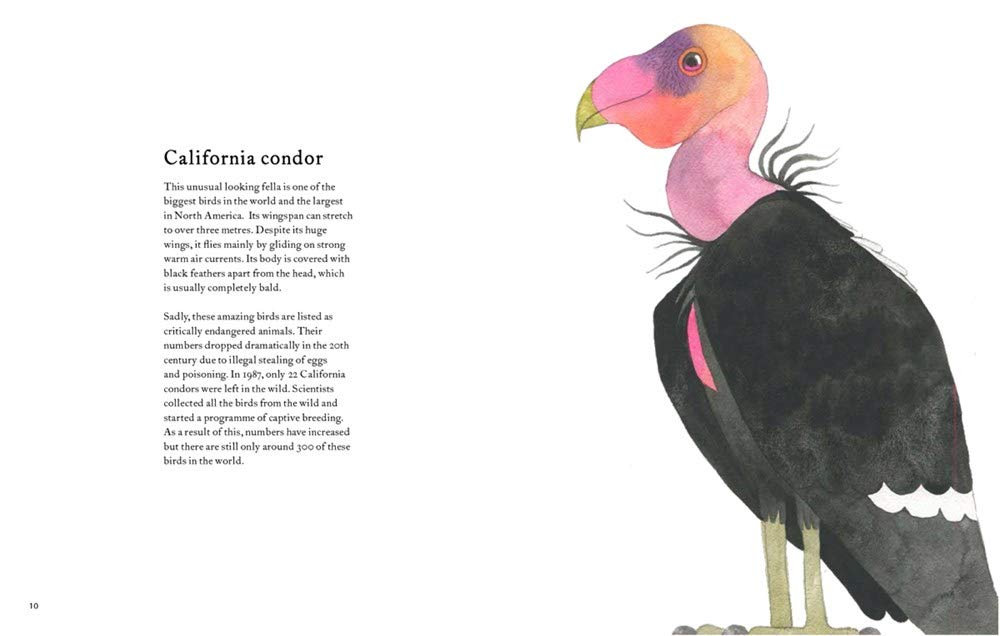
North America and Central America are home to more than 900 species of birds. Many are as colorful as a child’s painting, including the Montezuma oropendola, painted bunting, indigo bunting, and the resplendent quetzal, which boasts an iridescent blue tail that can reach over 2 feet long. Unique among birds is the common poorwill, a North American nightjar, which besides being nocturnal, “is possibly the only bird that hibernates.” Mottled gray and brown, the common poorwill perfectly blends into rocky crevices. “It has a low odor so it cannot be detected by predators, and it can descend into a sleepy torpor for months.”

celebrate-picture-books-picture-book-review-the-atlas-of-amazing-birds-riflebird

Copyright Matt Sewell, 2019, courtesy of Princeton Architectural Press.

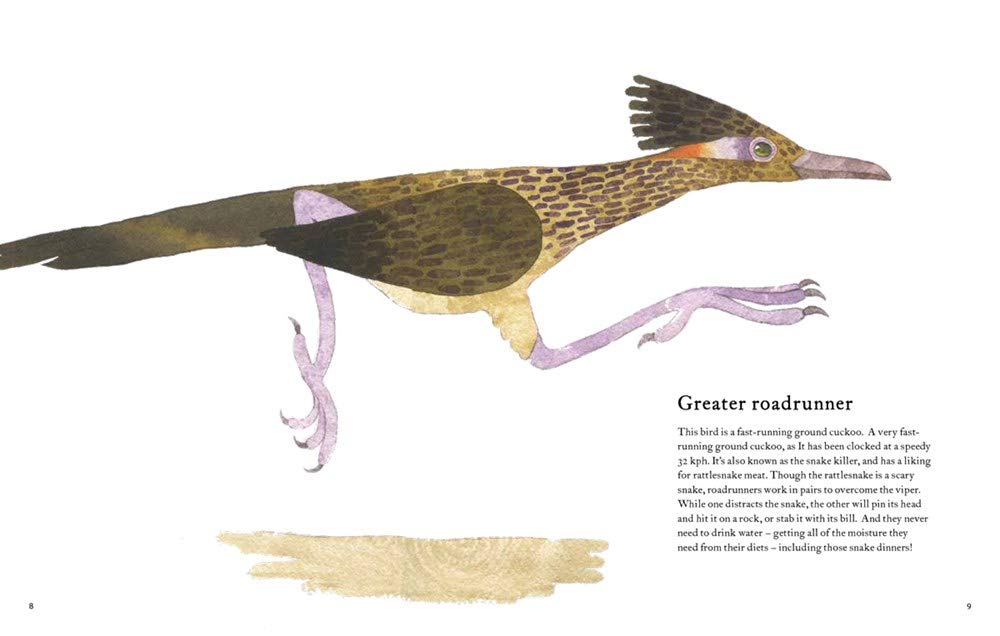
South America, with its vast expanse of land and variety of climates hosts “more than 3,400 known species of birds, more than any other continent.” With that many different types of birds, South America offers ornithologists a full range of species to study from familiar faces, such as the hyacinth macaw and the keel-billed toucan, to truly wondrous creatures, such as these: the sunbittern, which upon opening its wings presents a frightening “mask” of markings to scare away predators; the white bellbird, which has a single wattle above its beak that can be inflated to appear much like a unicorn’s horn; and the oilbird, which you cannot be faulted for mistaking for a bat as it “breeds and roosts in the totally dark interiors of caves,” uses echolocation to navigate here, and flies at night. Among the other weird and distinctive birds of this region is the hoatzin, “known as the reptile bird” because it “dates back 64 million years, which is roughly when all the big land-based dinosaurs disappeared.”

celebrate-picture-books-picture-book-review-the-atlas-of-amazing-birds-roadrunner

Copyright Matt Sewell, 2019, courtesy of Princeton Architectural Press.

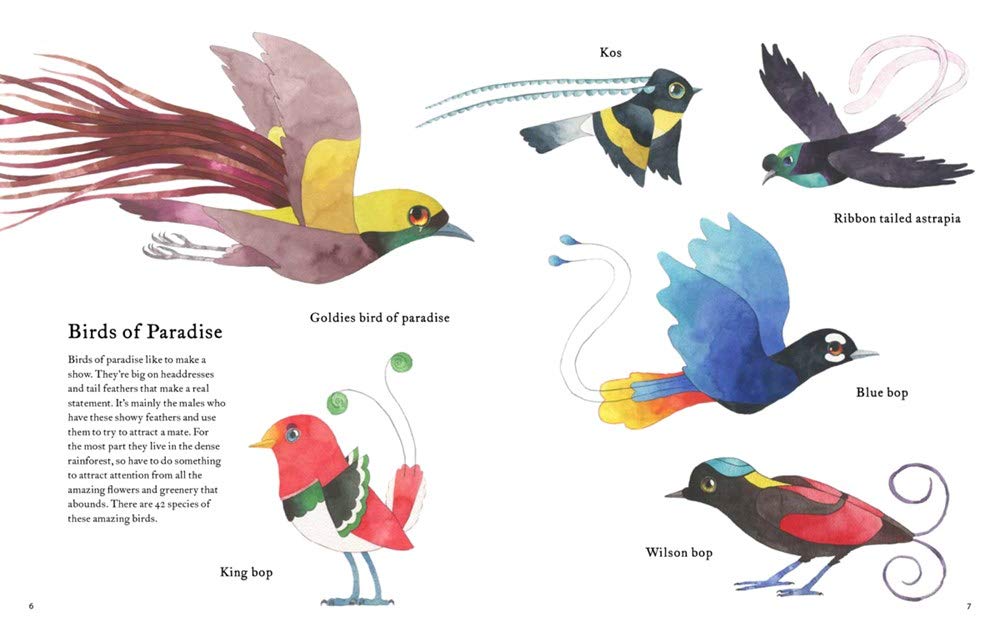
Oceania, comprising Australia, Papua New Guinea, the Solomon Islands, Vanuatu, Fiji, and New Zealand, provides shelter to “some of the most brilliant and flamboyant birds in the world….” These include a variety of birds-of-paradise, each of which sport colorful and intricate features that would look just as at home on ornaments and party favors. One of the most unusual birds may be the multi-talented superb lyrebird. Not only does the male possess fabulous peacock-like tail feathers that seem part quill-pen, part feather duster, it is a master mimic. “It can imitate just about any other bird it hears, as well as other sounds, such as chainsaws, telephones, barking dingoes, roaring cars, and crying babies—often repeated one after the next.”

celebrate-picture-books-picture-book-review-the-atlas-of-amazing-birds-birds-of-paradise

Copyright Matt Sewell, 2019, courtesy of Princeton Architectural Press.

Combined, Antarctica, Asia, and Africa also give homes to more than 6,000 species of some of the most adorable, beloved, brilliant, and extraordinary birds in the world. Readers will meet penguins and birds with vibrant blocks of color as sculpted as any stained-glass window—such as the Malabar trogon of India and Sri Lanka, the Himalayan monal, and Ruspoli’s turaco of southern Ethiopia.

They’ll also get to know towering birds, such as the secretarybird and the ostrich, and formidable-looking creatures, such as the marabou stork and the shoebill. To tie up this description that barely scratches the surface of all that bird-lovers will learn, I present the common tailorbird of tropical Asia—a clever and industrious little warbler that sews leaves together to create a cup of a nest that it lines with cobwebs to further confound predators.

celebrate-picture-books-picture-book-review-the-atlas-of-amazing-birds-condor

Copyright Matt Sewell, 2019, courtesy of Princeton Architectural Press.

Matt Sewell knows just how to entice young readers with engaging, humorous, and insightful text that provides a robust and individual introduction to each bird as well as their status in the world. Every entry is accompanied by brilliant watercolors that highlight each species’ spectacular, surprising, and sometimes even seemingly Dr. Seussian plumage. Dipping in and out of the pages will inspire children and adults to learn more about birds, geography, and how they can become stewards for our feathered friends.

The Atlas of Amazing Birds is highly recommended for bird and nature lovers and would make an excellent addition to home, school, and public library collections.

Ages 5 – 10

Princeton Architectural Press, 2019 | ISBN 978-1616898571

To learn more about Matt Sewell, his books, and his art, visit his website.

Christmas Bird Count Activity

celebrate-picture-books-picture-book-review-beautiful-birds-word-search

Beautiful Birds Word Search Puzzle

It’s fun to watch for different kinds of birds when you take a walk or in your own backyard. Can you find the names of twenty types of birds in this printable Beautiful Birds Word Search Puzzle? Here’s the Solution!

celebrate-picture-books-picture-book-review-the-atlas-of-amazing-birds-cover

You can find The Atlas of Amazing Birds at these booksellers

Amazon | Barnes & Noble | Books-a-Million

To support your local independent bookstore, order from

Bookshop | Indiebound

Picture Book Review
December 15 – International Tea Day

celebrate-picture-books-picture-book-review-teatime-around-the-world-cover

About the Holiday

Established in 2005 in New Deli, India, International Tea Day was created to raise awareness within the governments of tea-growing countries of the rights of tea workers, their conditions, and their economic contributions. Today, the holiday is commemorated widely in tea-growing nations. Some of the issues the day focuses on include wages, medical care, and education for women tea workers, who make up fifty percent of of the workforce on tea plantations. Following water, tea is the most widely drunk beverage in the world. To celebrate today, enjoy a cuppa with a cookie, a scone, or another favorite treat. 

Teatime Around the World

Written by Denyse Waissbluth | Illustrated by Chelsea O’Byrne


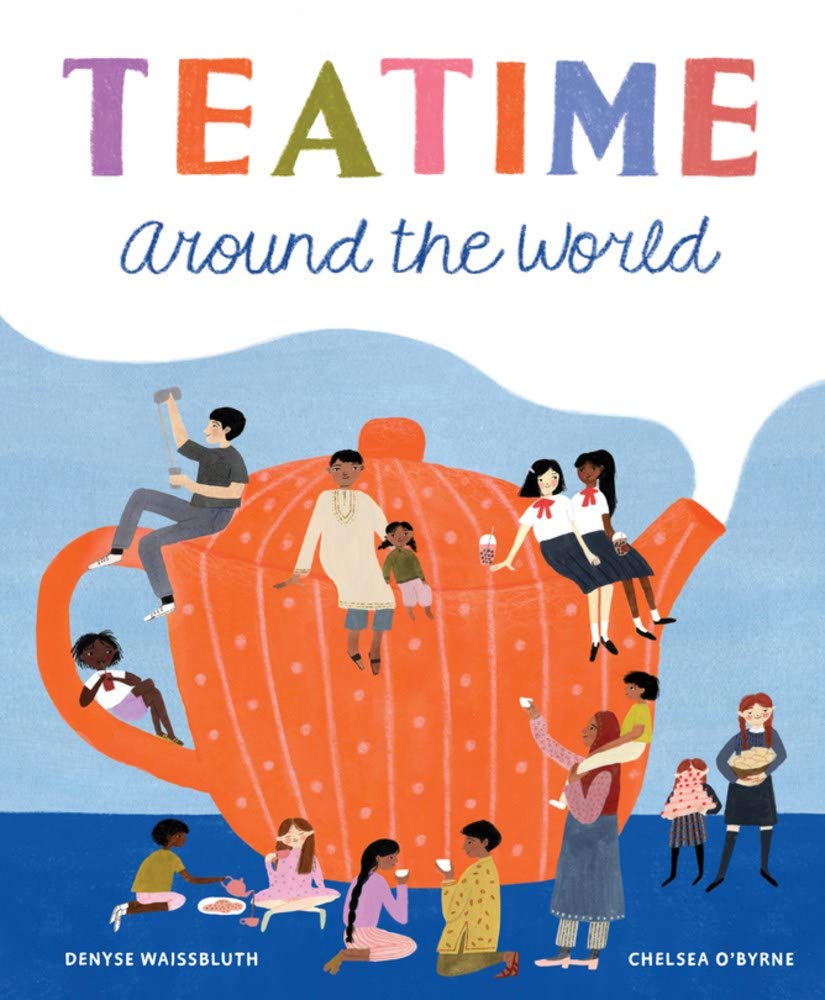
Two women sit at a table with steaming cups of tea in front of them, talking. “Tea for one. Tea for two.” To the side sits a teapot, its contents still warm. At their feet a child is having a tea party with a bear, jauntily clad in a feathered hat. Cookies, strawberries, and croissants fill out this feast served from a special tea set. “Tea for me. Tea for you.” Tea time continues in Morocco, where a father and child kneel on pillows. The father pours out three cups of mint tea. Made with green tea, mint, and sugar, each cup of tea will have “a slightly different taste.”

celebrate-picture-books-picture-book-review-teatime-around-the-world-sugar

Image copyright Chelsea O’Byrne, 2020, text copyright Denyse Waissbluth, 2020. Courtesy of Greystone Books.

In India a street vendor sells a cup of masala chai to a woman, who’s looking for a peaceful break during her day. The “strong tea and spices like cinnamon, ginger, cloves, cardamom, and pepper…boiled with milk and sweetened” will hit the spot. Hot tea is relaxing, but on a hot day there’s nothing more refreshing than a glass of iced tea. In Thailand, locals and tourists enjoy cha yen, sold from street vendors’ carts. This “strongly brewed sweet tea is poured over ice and drunk from a bag through a straw. Indigenous people in North America soothe fevers, colds, sore muscles, and even sleepless nights with tea made from “berries, plants, and roots.”

celebrate-picture-books-picture-book-review-teatime-around-the-world-russia

Image copyright Chelsea O’Byrne, 2020, text copyright Denyse Waissbluth, 2020. Courtesy of Greystone Books.

Special tea times—like chanoyu, the Japanese tea ceremony during which matcha, a powdered green tea is served, and afternoon tea, enjoyed with trays of treats world wide—bring people together for comforting respites. You’ll be interested to discover the origins of afternoon tea too! Tea can be served quietly or dramatically, like “teh tarik, or pulled tea…the national drink of Malaysia,” is “poured from up high, or ‘pulled’ between two mugs, to make it frothy.”

celebrate-picture-books-picture-book-review-teatime-around-the-world-poured

Image copyright Chelsea O’Byrne, 2020, text copyright Denyse Waissbluth, 2020. Courtesy of Greystone Books.

Tea is as old as its discovery thousands of years ago in China and as new as bubble tea, created in Taiwan in the 1980s. In Argentina, Chile, and Uruguay, yerba maté tea is served in hollowed-out gourds with a “special straw called a bombilla,” while in Jamaica sorrel, made from roselle hibiscus buds, “spiced with ginger, cloves, and sugar,” is perfect for any festive occasion. No matter where you live, what flavors of tea you enjoy, or how you serve it, you can always count on “tea for one. / Tea for two. / Loved by all / the whole world through.”

celebrate-picture-books-picture-book-review-teatime-around-the-world-for-group

Image copyright Chelsea O’Byrne, 2020, text copyright Denyse Waissbluth, 2020. Courtesy of Greystone Books.

With a lilting poem that flows from page to page, Denyse Waissbluth introduces unique flavors, special brew methods, and the comforting feeling a cup of hot or iced tea infuses into a day. The shared experience of tea drinking provides a fascinating touchstone for Waissbluth’s travelogue that takes kids around the world to experience the rituals, recipes, and traditions from each country that makes their tea unique. Waissbluth’s conversational style will appeal to kids looking to learn how global cultures are similar to and different from their own.

Chelsea O’Byrne’s lovely matte illustrations take children to cities, the countryside, and the seaside around the globe, revealing not only diverse scenes of how tea is made, served, and enjoyed, but homes, food, and clothing as well. Children will be excited to see such homey and intimate portraits of their peers around the world.

Sure to spur readers to learn more about the countries featured and entice them to try their signature teas, Teatime Around the World would enhance geography, history, and multicultural lessons for school and homeschooling and is highly recommended for school and public library collections.

Ages 3 – 7

Greystone Books, 2020 | ISBN 978-1771646017

You can connect with Denyse Waissbluth on Instagram.

To learn more about Chelsea O’Byrne, her books, and her art, visit her website.

International Tea Day Activity

celebrate-picture-books-picture-book-review-tea-word-search-puzzle

Tea for You! Word Search


Can you find the names of eighteen delicious teas from around the world in this printable puzzle?

Tea for You! Word Search Puzzle | Tea for You! Word Search Solution

celebrate-picture-books-picture-book-review-teatime-around-the-world-cover

You can find Teatime Around the World at these booksellers

Amazon | Barnes & Noble | Books-a-Million

To support your local independent bookstore, order from

Bookshop | IndieBound

Picture Book Review
December 14 – It’s Read a New Book Month

celebrate-picture-books-picture-book-review-eye-by-eye-comparing-how-animals-see-cover

About the Holiday

For kids who love nonfiction, this year has brought a bumper crop of creative, fascinating, and informative books on all topics from biographies to history to science and beyond. Innovative, interactive, and humorous, these books for all ages – even babies – open up the world for children in ways that resonate and make learning exciting and fun. Today’s book will have kids looking at the animals around them in a whole new way.

Eye by Eye: Comparing How Animals See

Written by Sara Levine | Illustrated by T.S Spookytooth


“Have you ever wondered what it would be like to see the world through someone else’s eyes?” Let’s make that musing even more intriguing—How would the world look if you gazed out at it through the eyes of an animal, insect, or bird (you know… a bird’s eye view)? Say, for instance, you had eight eyes dotting your face. “What kind of animal would you be, then?” Hmmm… With “four big eyes on the front of its face…” and “four smaller eyes on the top of its head,” the jumping spider can see what’s above and in front of it.

What if your eyes weren’t on your face at all, but on your arms instead? who would that be? Or how would you like it if your eyes were on “long stalks sticking out of the top of your head?” That might come in handy in a crowded movie theater or museum, but the animal with these eyes doesn’t really frequent those kinds of places. It’s more of an outdoorsman. Can you guess? While you’re contemplating that, you’re also going to want to learn about the animals whose eyes move to other parts of their face and the animals whose eyes are fixed in place.

Now, look deeeep into your eyes. What do you see? A pupil! What shape is it? Would it surprise you to learn that there are animals whose pupils are oval or even rectangular? Cat lovers know that their fav animals have oval pupils, but so do other “predators that hide and then ambush their prey.” Their unique eyes help them “judge distance and plan its attack without making any movements that might scare away its meal.” Animals with rectangular eyes use their peepers to stay safe. Which animals do you think those would be?

celebrate-picture-books-picture-book-review-eye-by-eye-comparing-how-animals-see-eight-eyes

Image copyright T.S Spookytooth, 2020, text copyright Sara Levine, 2020. Courtesy of Millbrook Press.

Some animals, including some humans, can’t see the colors red and green. You know this as color-blindness, but have you ever wondered exactly how color-blind people or animals view the world? Side-by-side pages show you! And that bird’s-eye-view? Because of the way birds’ eyes are constructed, their world is even more colorful than ours! How much more? “We have no idea… since our eyes can’t give us this information. But it’s pretty cool to know that there are things that exist out there that humans can’t see at all.”

One last question: What kind of animal could read the words in this book? If you know the answer, “you are a human who is using your eyes to read.” While other animals can’t read words, they can read the signs other animals and even plants provide. What are some of these? The answers plus even more fascinating information can be yours in the blink of an eye.

Back matter includes hands-on activities kids can do to “see” the way two animals do, a close-up examination of a human’s pupil, and a glossary as well as a list of books and websites for further research.

Sara Levine’s eye-opening guide to how a wide variety of creatures in the animal kingdom see will enthrall kids. In the fourth book of her Animal by Animal series, Levine continues her kid-enticing combination of humor and science to teach children about the specialized eyes that help animals navigate their particular environments. Her conversational storytelling, sprinkled with questions, will have kids engaged in the kind of predicting that reinforces learning. Levine’s detailed answers to the questions, including benefits of particular eye shapes or placement, physiological characteristics and adaptations, and the names of additional animals that share the same types of eyes, are enlightening will inspire young scientists to discover more about their world. 

A highlight of the Animal by Animal series is the artwork by T.S Spookytooth, who excels at translating Levine’s vision into illustrations that get kids giggling and learning. The first page starts off in familiar territory: a glasses-wearing girl stares eye-to-eye with the little wiener dog she’s holding in her hands. But turn the page and this same girl now sports eight eyes and two cleverly constructed pairs of glasses while other kids—and clues for discussions to come—stand by. On the next pages, eyeballs jut from the ends of six arms, peer out from long, wiggly stalks, and migrate across a girl’s face. These images will have kids laughing and riveted to the pages, while Spookytooth’s realistic depictions of the animals these eyes belong to will long remain in their memory. Insets of enlarged eyes allow kids to see the particular formation of eyes and pupils up close. The side-by-side page spread showing full-color human vision and the vision of someone who is color-blind is enlightening. Kids will enjoy following the pet crocodile from page to page and discussing all the reasons for its distinctive eyes. The diverse group of kids are charming companions on this educational journey.

An exciting and fascinating way to spur children to explore and learn about animals, nature, and themselves, Eye by Eye: Comparing How Animals See is a top pick for home, school and public library collections.

Ages 5 – 10

Millbrook Press, 2020 | ISBN 978-1541538382

Discover more about Sara Levine and her books on her website.

To learn more about T.S Spookytooth, his books, and his art, visit his website.

celebrate-picture-books-picture-book-review-eye-by-eye-comparing-how-animals-see-cover

You can find Eye by Eye: Comparing How Animals See at these booksellers

Amazon | Barnes & Noble | Books-a-Million

To support your local independent bookstore, order from

Bookshop | IndieBound

Picture Book Review
December 12 – Get Ready for Christmas

celebrate-picture-books-picture-book-review-a-christmas-carol-lit-for-little-hands-cover

About the Holiday

It just isn’t Christmas without reading favorite traditional stories. Familiar characters, heartfelt themes, and feelings of warmth and excitement are tucked inside the pages just waiting to be released again after a long year. Today’s book allows you to share one of the oldest and most beloved Christmas classics with the youngest members of your family.

Thanks to Familius for sending me a copy of A Christmas Carol: Lit for Little Hands for review consideration. all opinions of the book are my own. This post contains an affiliate link.

A Christmas Carol: Lit for Little Hands

Adapted by Brooke Jorden | Illustrated by David Miles


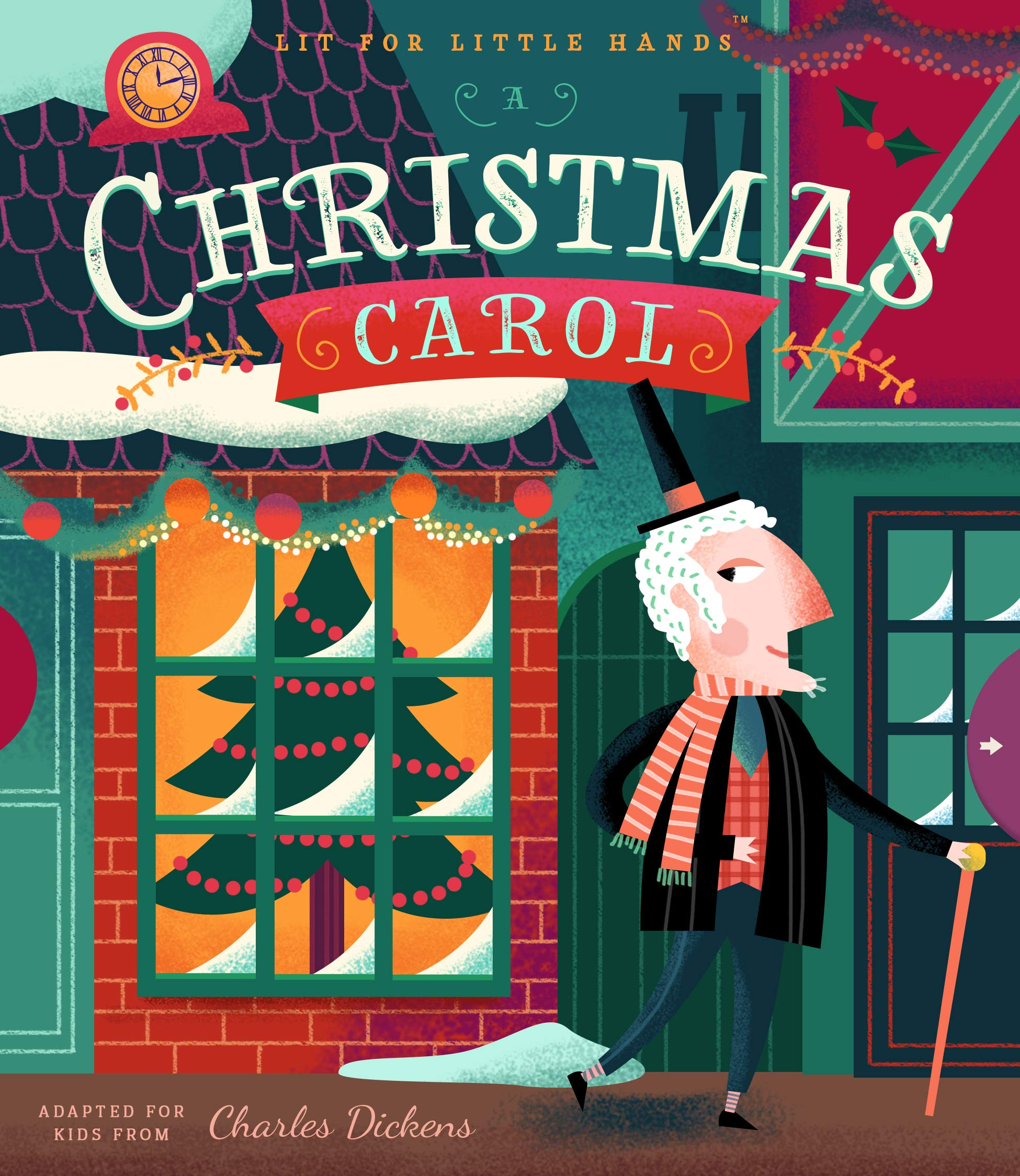
One of the world’s most recognizable novels, Charles Dickens’ A Christmas Carol has thrilled readers ever since it was published on December 19, 1843. The novel’s combination of spooky ghosts, a loving family, and a lost soul in need of redemption keeps readers and listeners enthralled no matter how many times they’ve read it. But why should adults and older kids have all the fun? Now, with this Lit for Little Hands board book, even the youngest readers can enjoy all the intrigue of A Christmas Carol.

celebrate-picture-books-picture-book-review-a-christmas-carol-lit-for-little-hands-counting-house

Image copyright David Miles, 2019, text copyright Brooke Jorden, 2019. Courtesy of Familius.

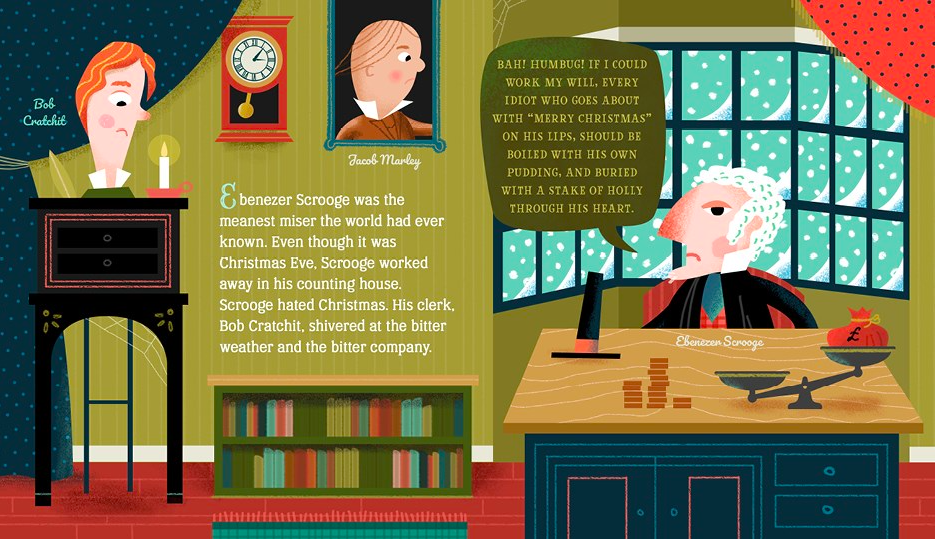
Brooke Jorden’s nimble adaptation loses none of the snap of the original. Turn to the first page and there is Bob Cratchit toiling away under the gaze of a stern Ebenezer Scrooge who “was the meanest miser the world had ever known.” The counting house is as cold as Scrooge’s hatred of Christmas. On a pull-out tab kids even see him send away a little boy who’s come caroling. That night at home “a terrible clanking noise” interrupts Scrooge’s meager meal. What we know—but little ones might not—is what lurks on the other side of Scrooge’s door. With the pull of a tab, kids slide open the door to reveal the ghostly figure of Jacob Marley “surrounded by a heavy iron chain: punishment for all the cruel things Marley had done while he was alive.” He tells Scrooge he’s in for the same unless he changes his ways and tells him to expect three more ghosts.

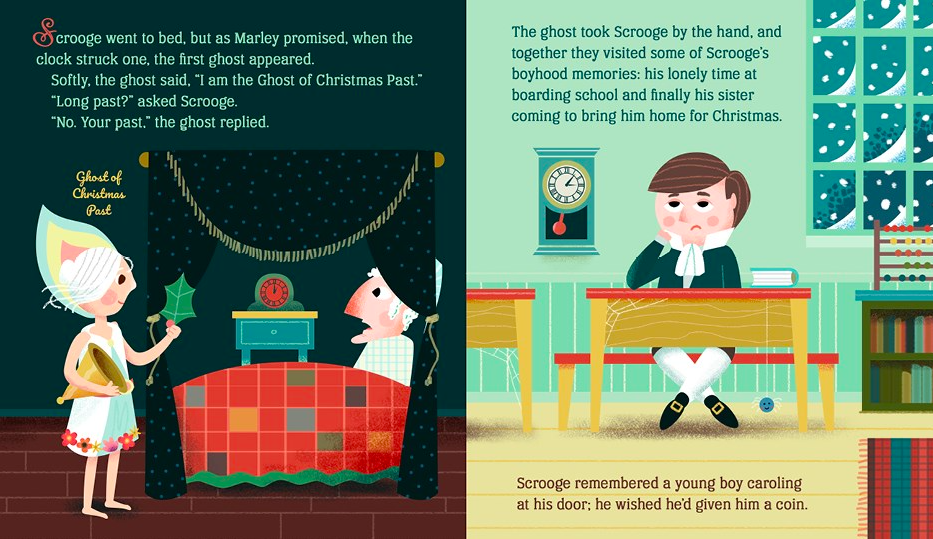
Another turn of the page brings the Ghost of Christmas past. When kids pull the tab, the ghost and Scrooge fly from the window into the night sky and to the boarding school where Scrooge spent lonely Christmas’s alone. It makes Scrooge think of the boy who’d come caroling and sorry that he hadn’t given him a bit of money. As you may remember, the Ghost of Christmas Past also takes Scrooge to a party given by his former boss Mr. Fezziwig. Kids can spin a wheel and set old Scrooge dancing round and round with his younger self and his former colleagues and friends. “Scrooge remembered the joy he used to feel around Christmas, surrounded by friends and a kind employer.” He realizes that when money became the most important thing to him, he became sad and friendless.

celebrate-picture-books-picture-book-review-a-christmas-carol-lit-for-little-hands-christmas-past

Image copyright David Miles, 2019, text copyright Brooke Jorden, 2019. Courtesy of Familius.

When the clock strikes two, the Ghost of Christmas Present appears in the midst of an enormous feast, Nearby a fire quivers and crackles as kids spin the wheel. The ghost transports Scrooge to the window of Bob Cratchit’s house, where he sees the large family having dinner. With a toggle, readers can set Tiny Tim’s famous cheery toast in motion as Scrooge “marveled that the Cratchit family has so little and yet were so happy.”

Scrooge didn’t have long to wait until the Ghost of Christmas Yet to Come visited. In a cemetery, Scrooge saw Mr. and Mrs. Cratchit crying at Tiny Tim’s gravestone. The sight broke his heart, but then the ghost pointed Scrooge to another stone. Who’s is it? Children pull a tab that reveals the engraved name: Ebenezzer Scrooge. When he woke up the next morning, “Scrooge knew he must change.” He went out into town spreading Christmas cheer and “became as good a man as the world had ever known.”

celebrate-picture-books-picture-book-review-a-christmas-carol-lit-for-little-hands-christmas-present

Image copyright David Miles, 2019, text copyright Brooke Jorden, 2019. Courtesy of Familius.

Quotations from Dickens’ original novel are sprinkled throughout the text, giving it the Old-World atmosphere that contributes so much to the effect of the story. With each visit of a ghost, Brooke Jorden includes a lesson that Scrooge learns or a memory he has of a recent time when he could have been generous or happy and chose not to, allowing young readers to understand how the ghosts affect Scrooge and how he changes in that night. Jorden chooses evocative language that kids will enjoy hearing and learning. Jorden’s board book version of A Christmas Carol demonstrates anew the genius of Charles Dickens in this story that touches all ages and is ever timely.

Using fresh tones of red and green, David Miles brings 1800’s England to life for kids. Bob Cratchit scratches away in his ledger with a quill pen and only a candle for light as thick snow falls outside the window. At home, Scrooge sits in a darkened room where the eerie, translucent ghost of Jacob Marley, wrapped in a chain, is sure to impress. Miles’ image of the feast surrounding the Ghost of Christmas Present contrasts sharply with the small turkey and plum pudding on the Cratchit’s table, a detail that will resonate with today’s children just as it did when the novel was first published. The Ghost of Christmas Yet to Come is appropriately spooky, but not too frightening for young children. When Scrooge wakes up a changed man, the dark shades of Miles’ pages give way to bright pinks and cheery aqua, and the icy blizzard has ended.

Terrific fun and a fabulous way to share this classic with kids (adults will get a kick out of it too), Lit for Little Hands: A Christmas Carol would be a quick favorite on home, school, and public library bookshelves.

Ages 3 – 6

Familius, 2019 | ISBN 978-1641701518

You can find more books from Familius that joyfully reflect the habits of happy families, including reading, talking, laughing, eating, working, loving, healing, learning, and playing together as well as the Familius blog The Habit Hub here.

Get Ready for Christmas Activity

celebrate-picture-books-picture-book-review-snowflake-matching-puzzle

It’s Snowing! Matching Puzzle


If you’re wishing for a white Christmas, you’ll enjoy finding the pairs of identical snowflakes in this printable puzzle.

It’s Snowing! Matching Puzzle

celebrate-picture-books-picture-book-review-a-christmas-carol-lit-for-little-hands-cover

You can purchase Lit for Little Hands: A Christmas Carol at Familius

Picture Book Review


December 11 – Read a New Book Month

celebrate-picture-books-picture-book-review-snow-falls-cover

About the Holiday

There’s nothing better than spending the chilly days of winter snuggled up with new books. Kids love cuddling up and sharing laughs, poignant moments, fascinating facts, and the changes seasons bring through books. If you’re looking for a way to celebrate Read A New Book Month, check out the new titles at your favorite bookstore and buy one, two, or a whole stockingful to wrap up for the holidays. After all, a looong winter’s ahead!

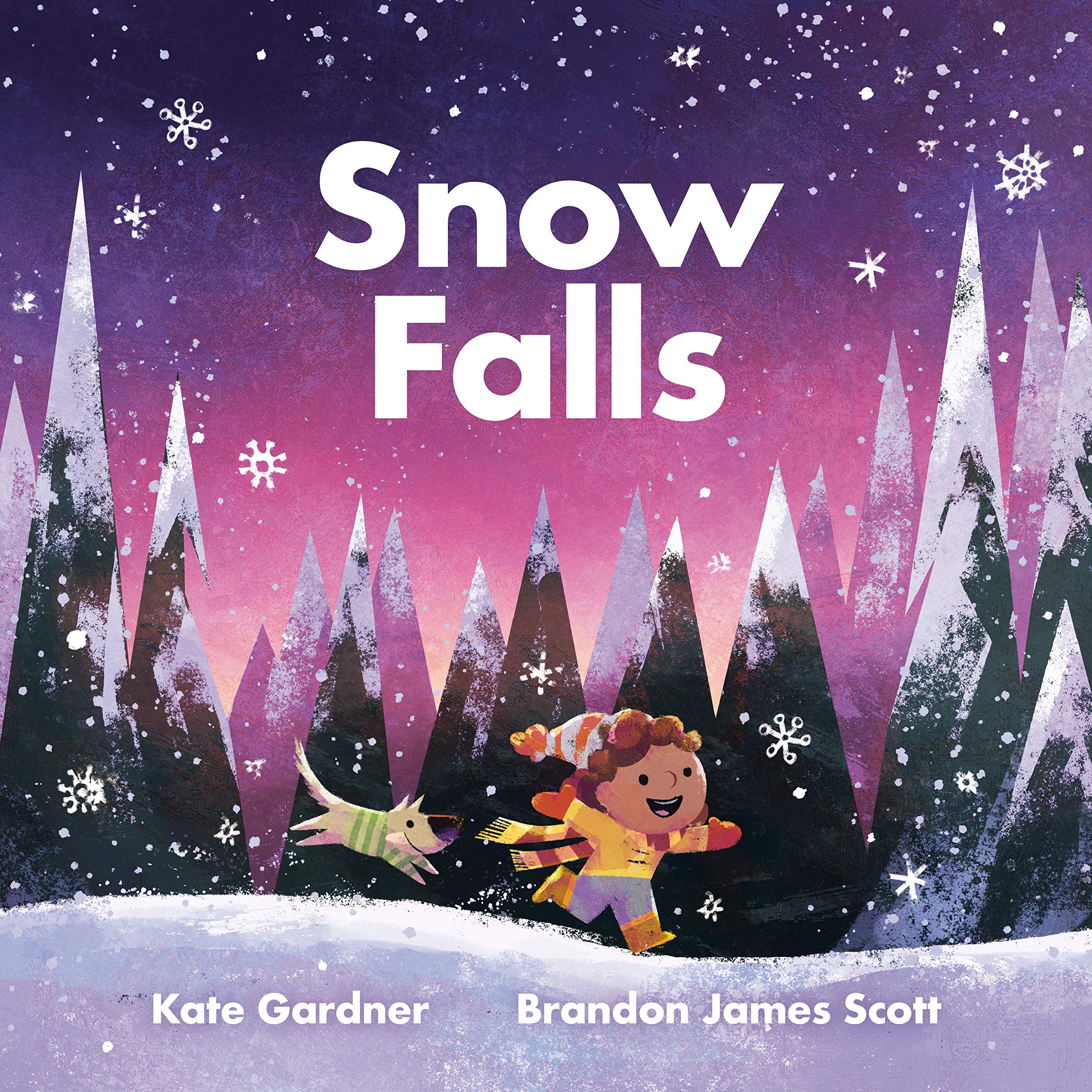
Snow Falls

Written by Kate Gardner | Illustrated by Brandon James Scott


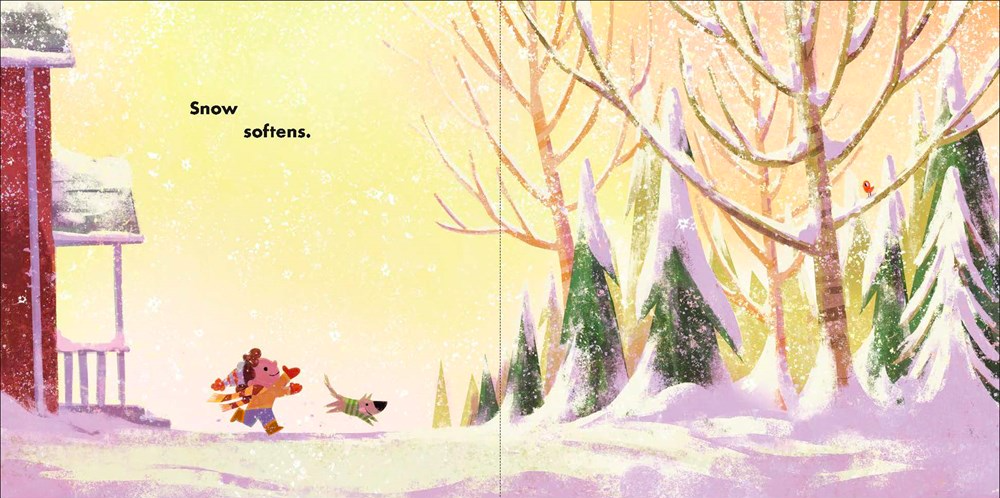
Through three seasons of the year when rain falls outside our windows, we keep on working, playing, watching TV, or using our computers or phones. But add colder temperatures and those raindrops turn to snowflakes that have us up and at the windows marveling at their beauty. Little ones become especially wide-eyed and excited to get outside as “snow softens” sturdy tree branches, angled rooftops, flat ground, and even the sounds in the air.

celebrate-picture-books-picture-book-review-snow-falls-softens

Image copyright Brandon James Scott, 2020, text copyright Kate Gardner, 2020. Courtesy of Tundra Books.

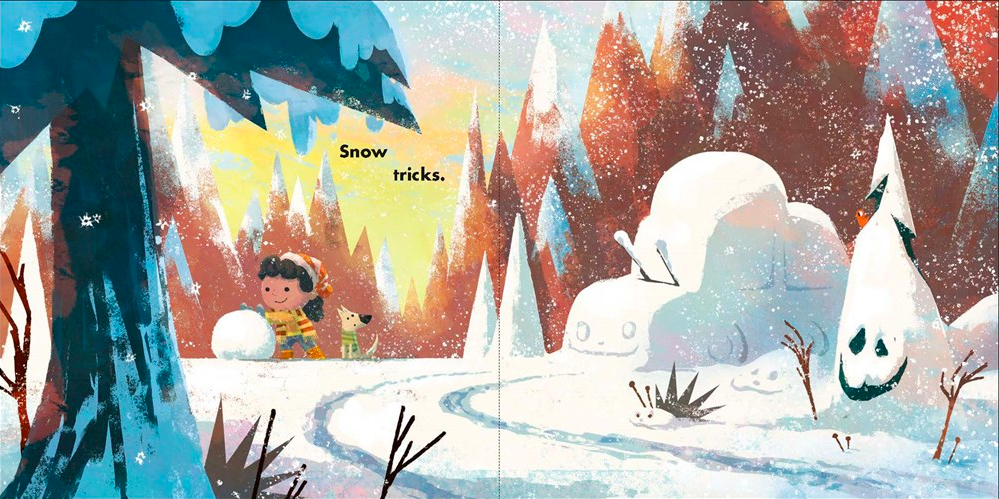
The white-blanketed earth becomes an adventurer’s paradise as “snow tracks,” allowing wanderers to retrace their footsteps and find their way home. Of course, kids with sleds know that “snow slides,” turning every hill into a challenge that beckons and sometimes—at the bottom—becomes topsy-turvy fun where, maybe, “snow hides” a lost mitten, hat, or scarf.

celebrate-picture-books-picture-book-review-snow-falls-tricks

Image copyright Brandon James Scott, 2020, text copyright Kate Gardner, 2020. Courtesy of Tundra Books.

There are days where “snow snows… and snows… and snows.” Then there’s enough white, fluffy, perfectly sticky fluff to make snowmen where “snow smiles” or soft balls so “snow flies.” But then there come the days where the sun is warm and the snow slowly slips away, revealing the world again until the next snowy day.

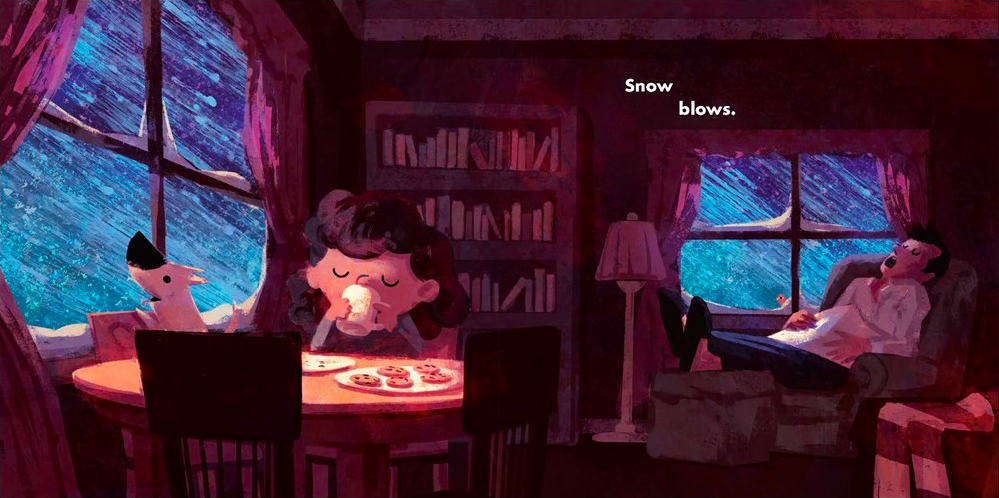
celebrate-picture-books-picture-book-review-snow-falls-blows

Image copyright Brandon James Scott, 2020, text copyright Kate Gardner, 2020. Courtesy of Tundra Books.

As wonder-filled and enticing as the first snow of the season, Kate Gardner’s lyrical ode to kids’ favorite winter playmate highlights the ways snow transforms the world, from the way it looks to the activities it allows even to the cozy moments it creates inside. Garner’s two-word sentences drift from page to page on alliteration, rhymes, consonance, and assonance as smoothly as a sled on a hill. Children will love reading along and talking about their own memories of snowy day fun.

Brandon James Scott’s soft, textured scenes, “painted digitally in the evenings of a snowy Canadian winter,” begin—as most snows do for kids—seen from just above the windowsill as the first flakes fall. Looking into a cozy house, readers see a little girl peeking out. On hooks hang a striped scarf, knitted hat, and dog sweater that will feature in the pages to come. As the little girl runs out into the winter wonderland, the white world is punctuated with a tiny red bird that kids will love searching for from page to page. 

Various perspectives give children different views of the snow-covered neighborhood. Scott also captures a glorious gold, pink, and violet sunset as well as the way snow swirls into the air, buffeted by icy gusts. When the girl lands head first into the snow at the bottom of the sledding hill, Scott begins a storyline for the scarf that kids will eagerly follow. Hot chocolate and cookies, a forest of snowmen, snowball fights, and the mercurial melting that forms islands, paths, and monster footprints are all chronicled too in Scott’s lovely pages, which are wrapped in a sparkling jacket that gives way to the girl and her dog making snow angels underneath.

A book adults and children will want to share again and again throughout the winter and when hot weather calls for relief, Snow Falls would make a wonderful gift and is highly recommended for home, school, and public library collections.

Ages 3 – 7

Tundra Books, 2020 | ISBN 978-1101919217

To learn more about Brandon James Scott, his books, and his art, visit his website.

Read a New Book Month Activity

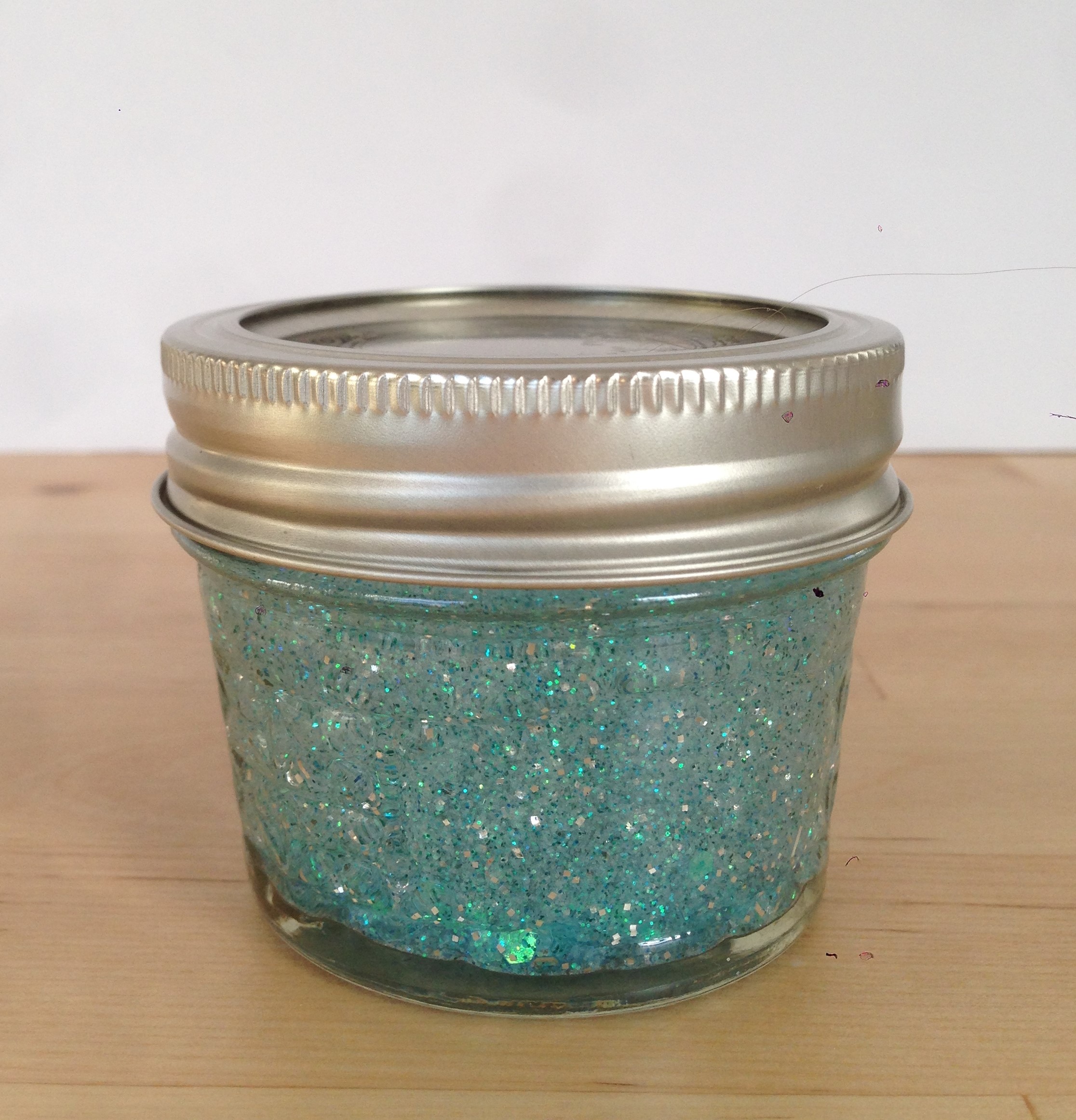
celebrate-picture-books-picture-book-review-mind-jar

Snowy Day Mindfulness Jar

You can capture the beauty of a glittering snowfall in this easy craft—that also makes a special gift for a friend!

Supplies

  • Small to medium mason jar or other decorative jar with a tight lid
  • White glitter glue,
  • Light blue glitter glue,
  • Fine white and/or blue glitter
  • Large white and/or blue glitter
  • Warm water

Directions

1. For every 1/2 cup of warm water add:

  • 1 1/2 teaspoons white glitter glue
  • 1/2 teaspoon blue glitter glue
  • 2 teaspoons fine glitter glue
  • 1/2 teaspoon large glitter

2. Close lid tightly

3. Shake

As glue dissolves, the liquid will become clearer and the glitter will remain suspended in it

celebrate-picture-books-picture-book-review-snow-falls-cover

You can find Snow Falls at these booksellers

Amazon | Barnes & Noble | Bookshop 

Picture Book Review

December 10 – National Dewey Decimal System Day

celebrate-picture-books-picture-book-review-melvil-dewey-cover

About the Holiday

Today, library lovers and readers of all kinds honor Melvil Dewey who was born on this date in 1851 and at the age of twenty-one revolutionized the way libraries organized their collections with an elegant numerical system that gave each book their own place on the shelf. Dewey went on to make more changes within libraries from whom they served to who ran them even to the amount of noise that was allowed inside—Shhh! To celebrate today, show your local librarians and library staff how much you appreciate them by sending them a thank you email or leaving an encouraging comment on their social media. To learn more about Melvil Dewey, kids will also want to check out today’s book.

The Efficient, Inventive (Often Annoying) Melvil Dewey

Written by Alexis O’Neill | Illustrated by Edwin Fotheringham


Melvil Dewey is one organized kid! He spends his free time labeling his mother’s pantry and then the basement. He records all of his pertinent personal information and balances his finances in a ledger. And when he has enough money he heads to the bookstore—on foot—ten miles away. “Melvil loves books.” What do you imagine he buys there? If you guessed Webster’s American Dictionary of the English Language—unabridged version—you’re right!

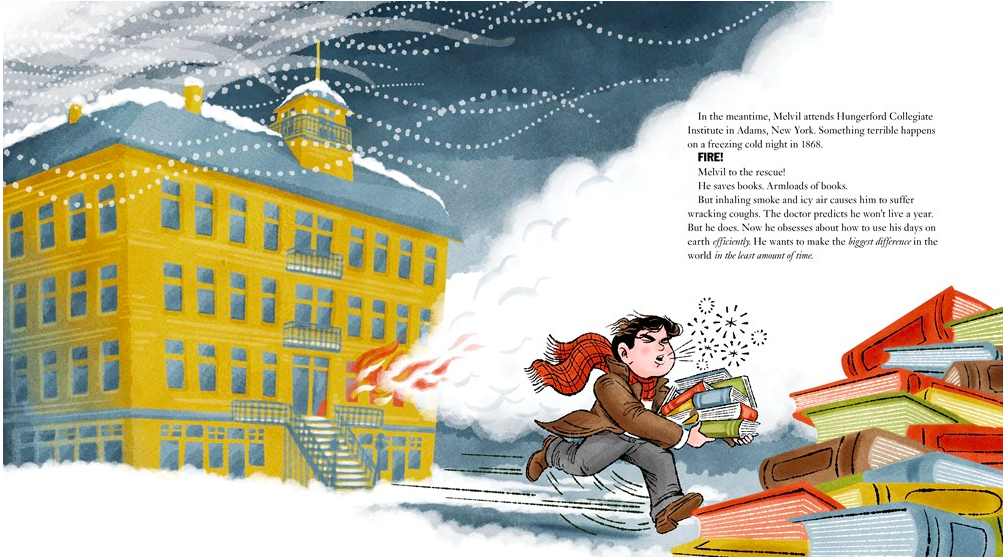
At night before going to sleep, Melvil wonders what he’ll do with his life. He wants to do something valuable, something meaningful. But what? A fire at Hungerford Collegiate Institute in Adams, New York, where Melvil goes to school, gives him a new perspective. While rescuing books, smoke inhalation causes damage to his lungs. The doctors say he won’t live a year, but he proves them wrong. Now, however, he wants to word “efficiently. He wants to make the biggest difference in the world in the least amount of time.”

celebrate-picture-books-picture-book-review-melvil-dewey-fire

Image copyright Edwin Fotheringham, 2020, text copyright Alexis O’Neill, 2020. Courtesy of Calkins Creek.

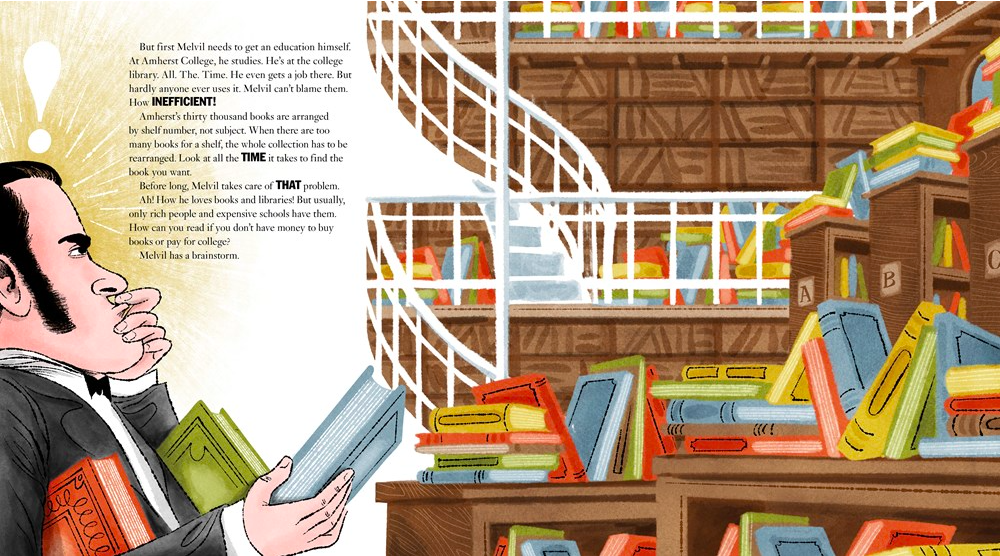
Noticing the large number of immigrants entering the country, Melvil decides he want to help them learn English and get an education as quickly as possible. Books would do that. After all, Melvil believes that steam power and electricity pale in importance to reading. First, though, Melvil needs to go to college. He chooses Amherst College and spends copious amounts of time at the library. “He even gets a job there.” But he notices that the library is woefully underused. Melvil can understand it. Instead of grouped by subject, the books—all 30,000 of them—are organized by shelf number, which requires frequent rearranging as new books are added.

Melvil loved libraries, but only rich institutions and wealthy people could afford to have them. Melvile believes in free public libraries for everyone. But as Melvil studies the problems of libraries, he discovers that no two libraries organize their books the same way. And some don’t even seem to bother with orgnainzation—they just stack the “books from floor to ceiling.” In addition to books and libraries, Melvil loves decimals. He ponders and muses, and then, suddenly, he has it! “He gets the idea of using numbers and decimals to organize library books.”

celebrate-picture-books-picture-book-review-melvil-dewey-disorganization

Image copyright Edwin Fotheringham, 2020, text copyright Alexis O’Neill, 2020. Courtesy of Calkins Creek.

After extensive research, “Melvil assigns numbers to ten broad classes of knowledge. He divides these into divisions and the divisions into sections and subclasses. When displayed on the spine of the books and the books neatly tucked away on shelves, finding what you want becomes “totally efficient!” The trustees at Columbia College in New York invite Melvil to become their head librarian. Once installed, Melvil begins to think bigger. He wants to open a whole school dedicated to training librarians, and… he thinks women would be perfect for this profession. Their qualifications in his eyes? “…clear heads, strong hands, and great hearts. (Also, they will work for less money than men.)” But Columbia College’s trustees are aghast. Women are not welcome on their campus. Melvil is not to be dissuaded.

He secretly opens his school in a storeroom across the street from Columbia with twenty students, seventeen of which are women. He rushes through his lessons for best efficiency, then back at his job tinkers with the rules of the library. He instates a strict quiet policy—even going to far as to put rubber tips on chair and table legs and rubber wheels on book carts. Librarians and staff are given slippers to wear. And, of course, there is NO talking.

celebrate-picture-books-picture-book-review-melvil-dewey-train

Image copyright Edwin Fotheringham, 2020, text copyright Alexis O’Neill, 2020. Courtesy of Calkins Creek.

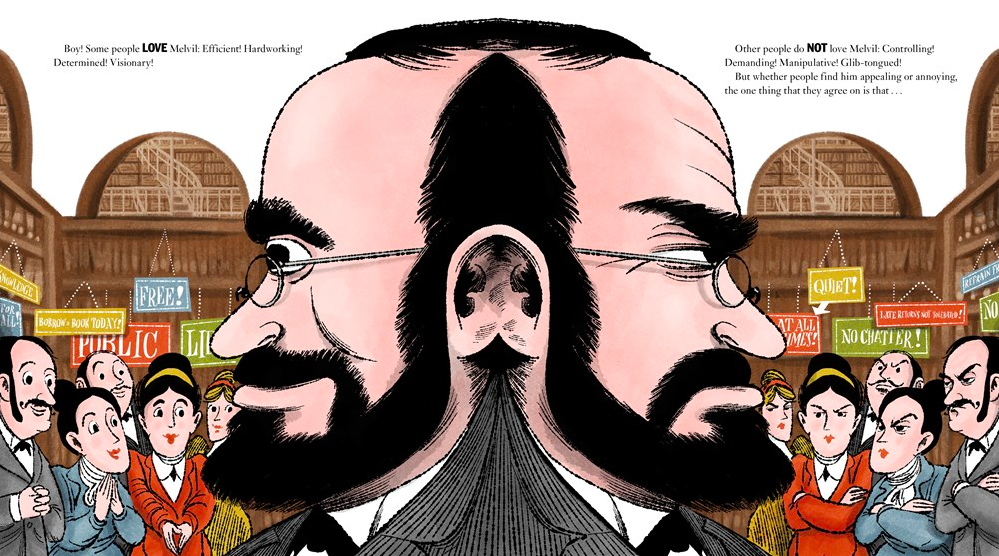
Melvil’s flood of ideas, constant changes, and insistent personality upsets people, but he barrels on. He becomes the State Librarian for New York, “organizes the New York State Library Association… provides books for the blind…and launches a traveling library system.” He even helps establish the Children’s Library Association, among other work. People were still divided in their opinions of Melvil, but one thing they all could agree on was that he fulfilled the wishes he had as a boy to “make a difference in the world.”

Extensive back matter includes an Author’s Note with an honest assessment of his successes and faults that in itself can prompt discussions of the legacy people leave behind, a timeline of his life, a discussion on other reforms he championed, a quick overview of how Dewey’s classification system works, and a list of selected sources.

celebrate-picture-books-picture-book-review-melvil-dewey-dual-personality

Image copyright Edwin Fotheringham, 2020, text copyright Alexis O’Neill, 2020. Courtesy of Calkins Creek.

No fusty, dusty story of the Dewey Decimal System this! Alexis O’Neill’s present-tense storytelling sweeps readers up in a whirlwind of the ideas, dreams, quirks, and persuasive, even steamrolling personality of Melvil Dewey. (And if you wonder about that unusual spelling, the answer is here too.)  Her wry delivery masterfully straddles the divide between the numerous contributions he made to the library system and the anger his convictions and obsessions often caused. She invites kids into Dewey’s mind and actions as ideas spark, flame, and fuel innovation. The details O’Neill includes about the times, the pre-Dewey system of library organization, and Dewey’s hand in expanding the reach of libraries as well as his often abrasive personality gives adults and children plenty to unpack, discuss, and research.

Edwin Fotheringham matches O’Neill’s robust storytelling with action-packed illustrations that seem to sprint across the pages as quickly as notions raced through Melvil Dewey’s mind. Striking images—such as a speeding train hurtling into a tunnel made from an overturned book and later smashing through a mountain of books; the moment when Dewey is struck with the decimal-system answer to his problem; and a class lecture given at 180 words per minute—reveal the whirlwind pace of Dewey’s life. A two-page spread in which two profiles of Dewey—one smiling and one scowling—meet in the middle demonstrate the dual nature of this complex man and the contrasting reactions to his beliefs. Fotheringham brings the shotgun quality of Dewey’s thoughts to life with bold, emphatic typography that highlights concepts important to him while hinting at the conviction he had in his own ideas and solutions. 

The Efficient, Inventive (Often Annoying) Melvil Dewey is a compelling biography which can be read to inform children of all ages about a man who wished to make an impact on the world and succeeded in ways that nearly all people recognize. The book can also be used to stimulate important discussions about difficult and current issues with older children when used with the back matter and further research. The book will be fascinating and eye-opening for library lovers unfamiliar with the early history of libraries. It well deserves a place on school and public library shelves.

Ages 7 – 10 and up

Calkins Creek, 2020 | ISBN 978-1684371983

Discover more about Alexis O’Neill and her books on her website.

To learn more about Edwin Fotheringham, his books, and his art, visit his website.

National Dewey Decimal System Day Activity

celebrate-picture-books-picture-book-review-book-love-word-search-puzzle

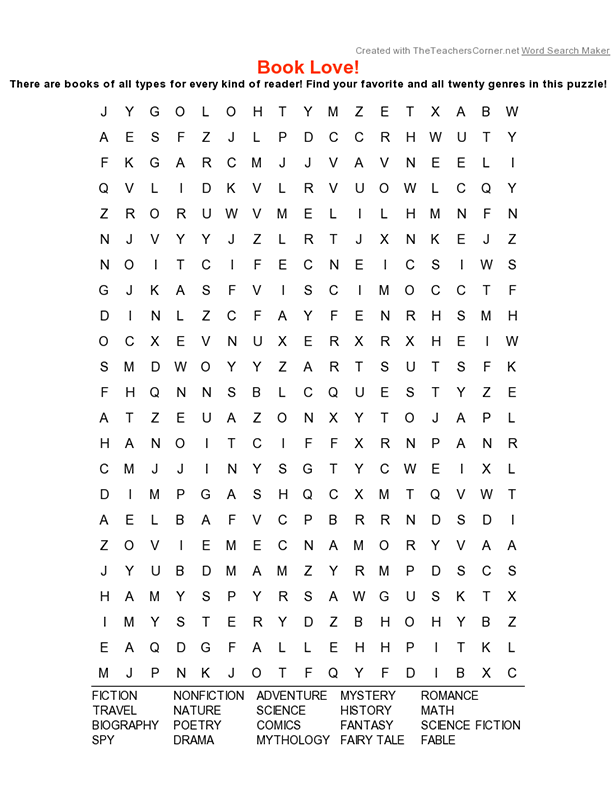
Book Love! Word Search


There are all kinds of books for every reader. Find your favorite along with twenty favorite genres in this printable puzzle.

Book Love! Word Search Puzzle | Book Love! Word Search Solution

celebrate-picture-books-picture-book-review-melvil-dewey-cover

You can find he Efficient, Inventive (Often Annoying) Melvil Dewey at these booksellers

Amazon | Barnes & Noble | Books-a-Million

To support your local independent bookstore, order from

Bookshop | IndieBound

Picture Book Review