January 17 – World Snow Day

celebrate-picture-books-picture-book-review-croc-and-turtle-snow-fun-cover

About the Holiday

World Snow Day was established by FIS (Fédération Internationale de Ski) to promote and raise awareness of recreational skiing and snowboarding. In recent years the numbers of people participating in snow related activities has dropped. World Snow Day is one of the key initiatives introduced by FIS to reverse this decline. While there are many reasons for people – especially children – to engage in winter sports, two stand out. In addition to the health benefits of participating in skiing and snowboarding, being out on the slopes gives kids an appreciation for nature that will inspire them to help preserve the environment in the future. To celebrate today, take your kids out for some winter fun… or… stay in for some cozy fun – both are perfect ways to spend a day as you’ll see in today’s book.

Thanks to Bloomsbury for sending me a copy of Croc & Turtle: Snow Fun! for review consideration. All opinions on the book are my own. 

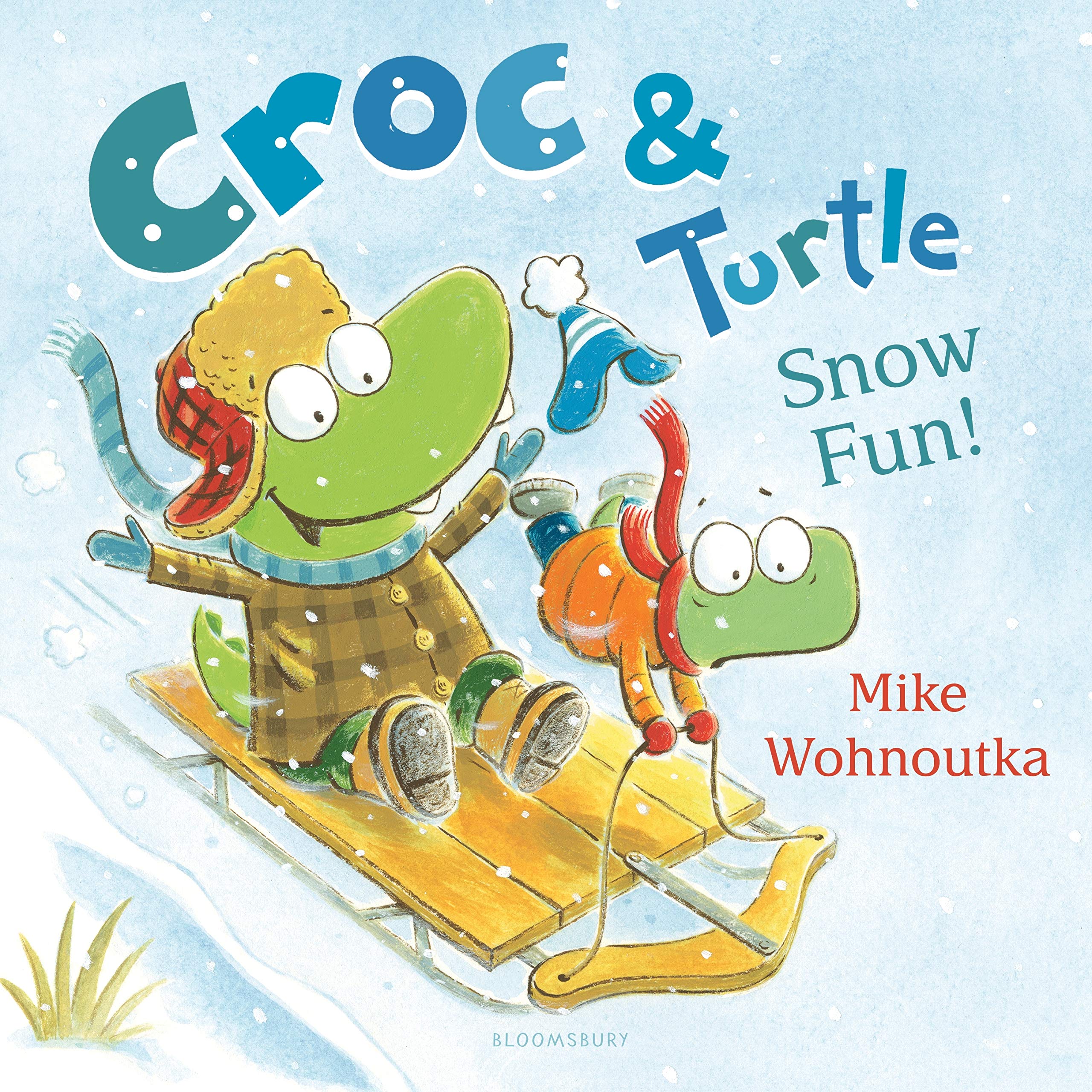
Croc & Turtle: Snow Fun!

By Mike Wohnoutka


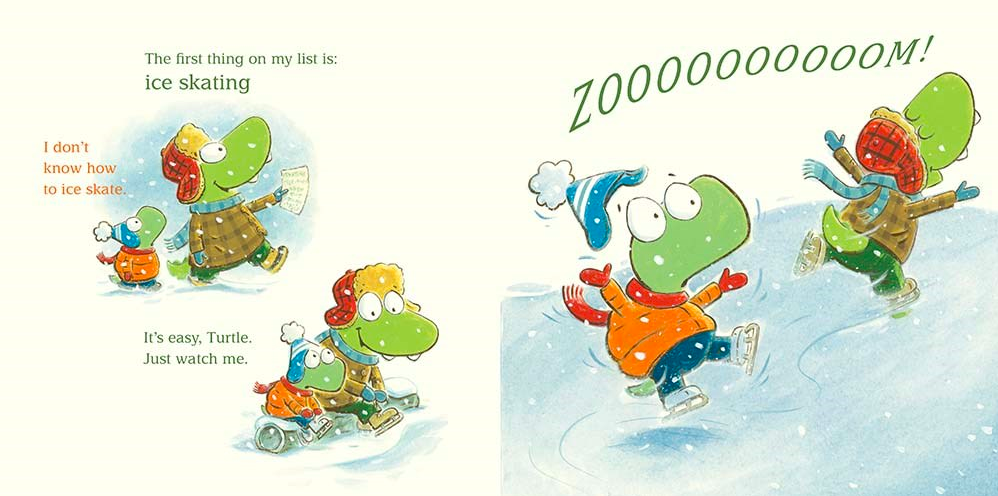
The snow is falling and Croc runs to Turtle’s house with a list of fun things to do. Turtle comes to the door with another list. They’re both a little surprised to find such opposite activities on each other’s lists, but Turtle thinks it will be fun to “do everything on both lists.” First, they head out to the pond to ice skate. But Turtle doesn’t know how. Croc says to just follow along, but in all of Croc’s zooming, whooshing, and twirling, Turtle is left dizzy and flat out on the ice. Croc thinks being outside is the best, but Turtle’s ready to go inside.
celebrate-picture-books-picture-book-review-croc-and-turtle-snow-fun-paper-skating

Copyright Mike Wohnoutka, 2019, courtesy of Bloomsbury Children’s Books.

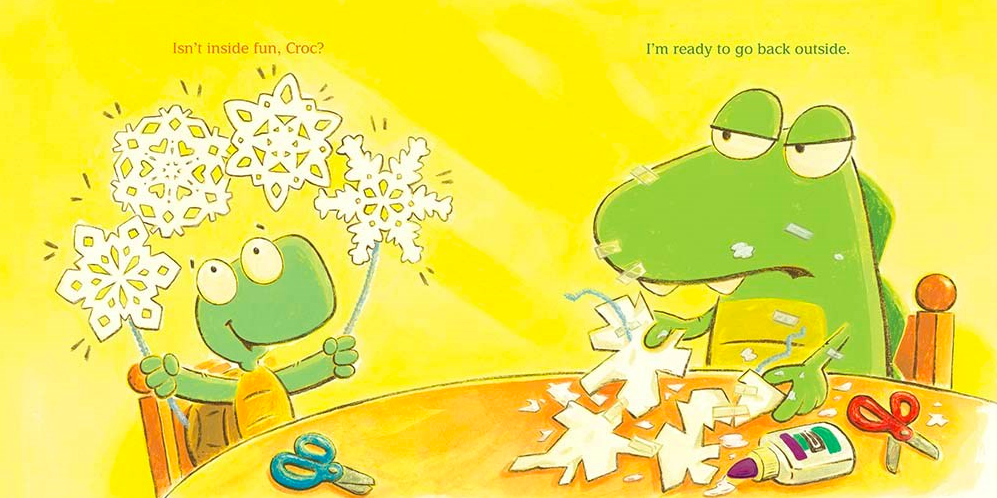
Inside, Turtle has all the craft supplies to make paper snowflakes. Croc says, “I’m not very good at paper snowflakes.” Turtle, snipping away energetically, says, “Just watch me.” Turtle unfolds the paper and displays an intricate four-snowflake arch, while Croc’s four angled blocks of paper, taped and glued together, lie in front of him.

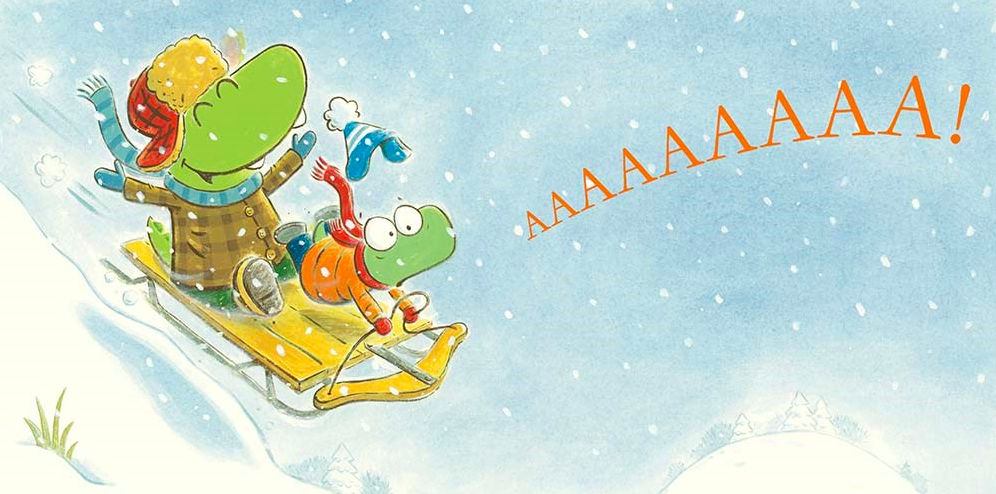
Outside again, Croc’s happy to go sledding, but Turtle’s feet are freezing. Uncertainly, Turtle sits in front of Croc. The screaming starts as the sled bumps and jumps down the hill. Buried up to their necks in snow, Croc is exhilarated, but for Turtle “it’s time to go back inside.” In the house, Turtle begins spreading the 1,000 pieces of a jigsaw puzzle on the floor in front of a roaring fire as Croc flops nearby in utter boredom.
celebrate-picture-books-picture-book-review-croc-and-turtle-snow-fun-paper-snowflakes

Copyright Mike Wohnoutka, 2019, courtesy of Bloomsbury Children’s Books.

He wants to go back out, but Turtle finds it “too cold and too dangerous.” In a huff, Croc stomps outside. Turtle fumes and stays inside. But Croc finds that throwing snowballs and skiing without Turtle is no fun, and Turtle misses Croc while coloring and playing cards. Then there’s a knock at the door. It’s Croc with an apology. Turtle apologizes too.  Croc ponders: how can they “be inside and outside and together?” Then Turtle whispers an idea into Croc’s ear.
celebrate-picture-books-picture-book-review-croc-and-turtle-snow-fun-sledding

Copyright Mike Wohnoutka, 2019, courtesy of Bloomsbury Children’s Books.

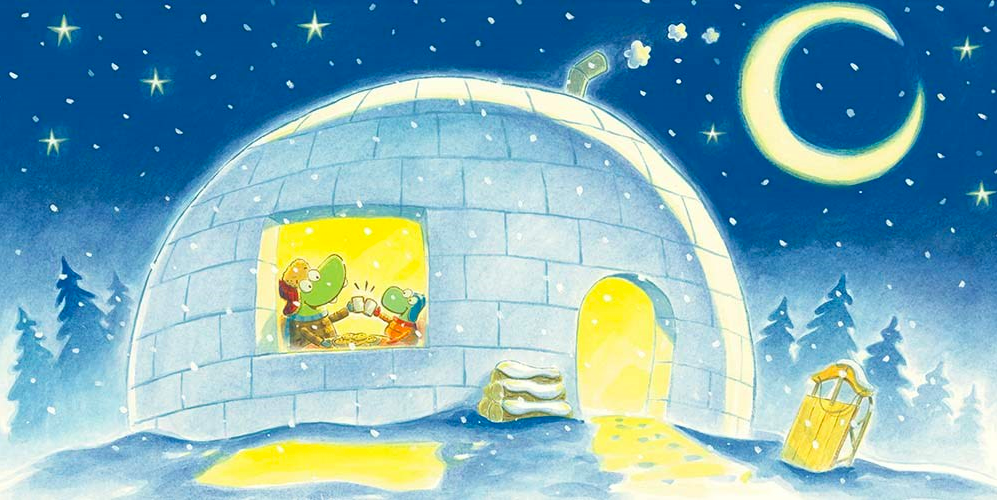
Inside, Turtle gets out the recipe book, eggs, flour, and other ingredients. Outside, Croc pats and shapes snow into blocks. Soon, Turtle has a tray full of cookies and hot chocolate, and Croc is pulling a sled loaded with Turtle’s table, chairs, and slippers to… their warm, cozy igloo so they can be “outside…and inside…and together.”
celebrate-picture-books-picture-book-review-croc-and-turtle-snow-fun-igloo

Copyright Mike Wohnoutka, 2019, courtesy of Bloomsbury Children’s Books.

Mike Wohnoutka’s best friends Croc and Turtle are back in a cold-weather adventure that will warm readers’ hearts. Their enthusiasm to play together sparkles in their bright smiles and cheery greetings, they even overcome the initial momentary shock that Croc prefers outside, while Turtle is a homebody. As the two try to enjoy each other’s activities, though, their different personalities cause a rift. Little ones needn’t worry about these two besties, however.  It only takes a few minutes for each to realize winter is no fun without the other.

In a tender lesson, Wohnoutka shows Croc and Turtle apologizing for their role in the tiff and then quickly moving on to working together to come up with a solution. The result of their creative problem solving will delight kids and is a clever activity that can be adapted for play at home. Wohnoutka’s inside and outside pursuits for Croc and Turtle are well chosen and will resonate with readers even as they giggle at the outcomes.

Just as in Wohnoutka’s first tale—Croc and Turtle! The Bestest Friends Ever!—these bright green friends with their expressive eyes will charm readers. Wohnoutka’s vivid imagery always puts the spotlight on Croc and Turtle, allowing the youngest readers to easily connect the text with the action, while older readers soak up all the humor and emotion in this enchanting story. Inside, Turtle’s home glows with warmth, while outside, you can almost feel the crisp, frosty air and the snowflakes drifting down. The final image brings both of these welcome winter delights together.

Whether you’re already fans of Croc and Turtle or meeting them for the first time, Croc & Turtle: Snow Fun! is a sweet addition to home bookshelves. The book will also be a favorite in preschool and kindergarten classrooms and in public library collections.

Ages 3 – 6

Bloomsbury Children’s Books, 2019 | ISBN 978-1681196374

Discover more about Mike Wohnoutka, his books, and his art, on his website.

World Snow Day Activity
celebrate-picture-books-picture-book-review-sock-snowman-craft

Snow Buddies


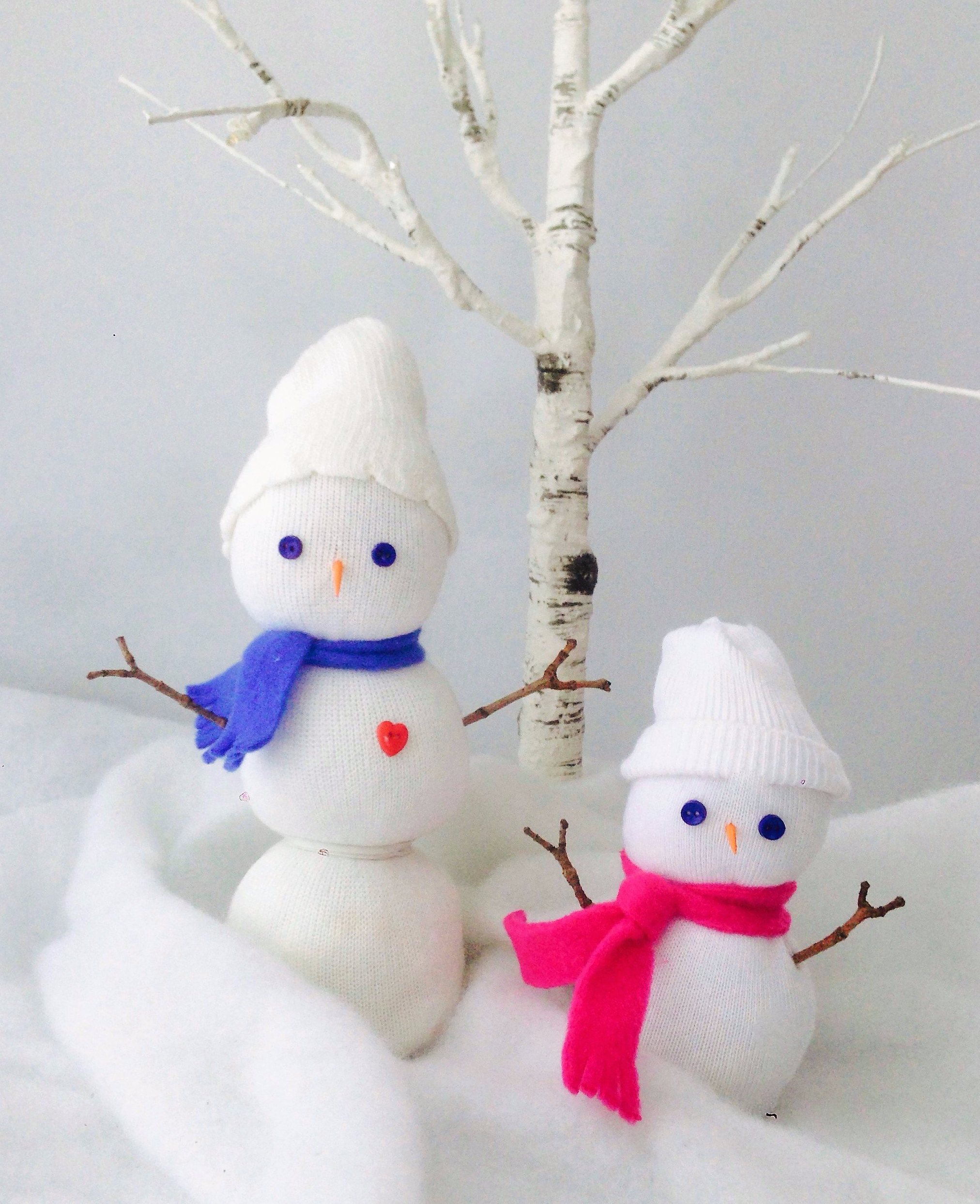
This is a great craft for kids to share with a friend. Grab a pair of socks and have fun making these snow buddies! 

Supplies

  • White dress ankle socks
  • Polyester Fiber Fill
  • Tiny buttons
  • Fleece or ribbon, enough for a little scarf
  • Toothpicks
  • Twigs
  • Orange craft paint
  • Cardboard
  • White rubber bands, one or two depending on the size of the snowman
  • Fabric or craft glue
  • Small hair band (optional)

Directions

To Make the Snowman

  1. Cut a circle from the cardboard about 2 inches in diameter for the base
  2. Place the cardboard circle in the bottom of the sock
  3. Fill the sock with fiber fill about ¾ full or to where the ribbed ankle cuff begins. Pack tightly while making a sausage shape. You can make your snowman different shapes with the amount of fill you use.
  4. Stretch out the cuff of the sock and tie it off near the top of the fill either with a loop knot or with the hairband.
  5. Fold the cuff down around the top of the filled sock to make the hat.
  6. Wrap a rubber band around the middle of the sock to make a two-snowball snowman. For a three-snowball snowman, use two rubber bands. Adjust the rubber bands to make the “snowballs” different sizes.

To Make the Scarf

  1. Cut a strip of fleece or ribbon 8 to 10 inches long by ½ inch wide
  2. Tie the fleece or ribbon around the neck of the snowman
  3. To Make the Nose
  4. Dip one end of the toothpick into orange paint, let dry
  5. Cut the toothpick in half
  6. Stick the toothpick into the head or top portion of the snowman

To Make the Arms

  1. Insert small twigs into each side of the body of the snowman
  2. You can also use wire or cardboard to make the arms
  3. Attach two mini-buttons to the face for eyes with the fabric or craft glue
  4. Display your Snow Buddy

celebrate-picture-books-picture-book-review-croc-and-turtle-snow-fun-cover

You can find Croc & Turtle: Snow Fun! at these booksellers

Amazon | Barnes & Noble | Books-a-Million

To support your local independent bookstore, order from

Bookshop | IndieBound

Picture Book Review 

January 16 – Appreciate a Dragon Day

celebrate-picture-books-picture-book-review-the-book-dragon-cover

About the Holiday

Appreciate a Dragon Day was established in 2004 by author Danita K. Paul to celebrate the publication of her novel DragonSpell, the first book in her Dragon Keepers Chronicles series. The holiday now encourages all readers to get involved with reading through fun activities—dragon-themed, of course! Teachers, librarians, and all those who love reading can find lots of suggestions for creative ideas that encompass art, crafts, displays, drama, and many other mediums on Danita K. Paul’s website. So, round up your favorite dragon books and breathe some fire into your reading today!

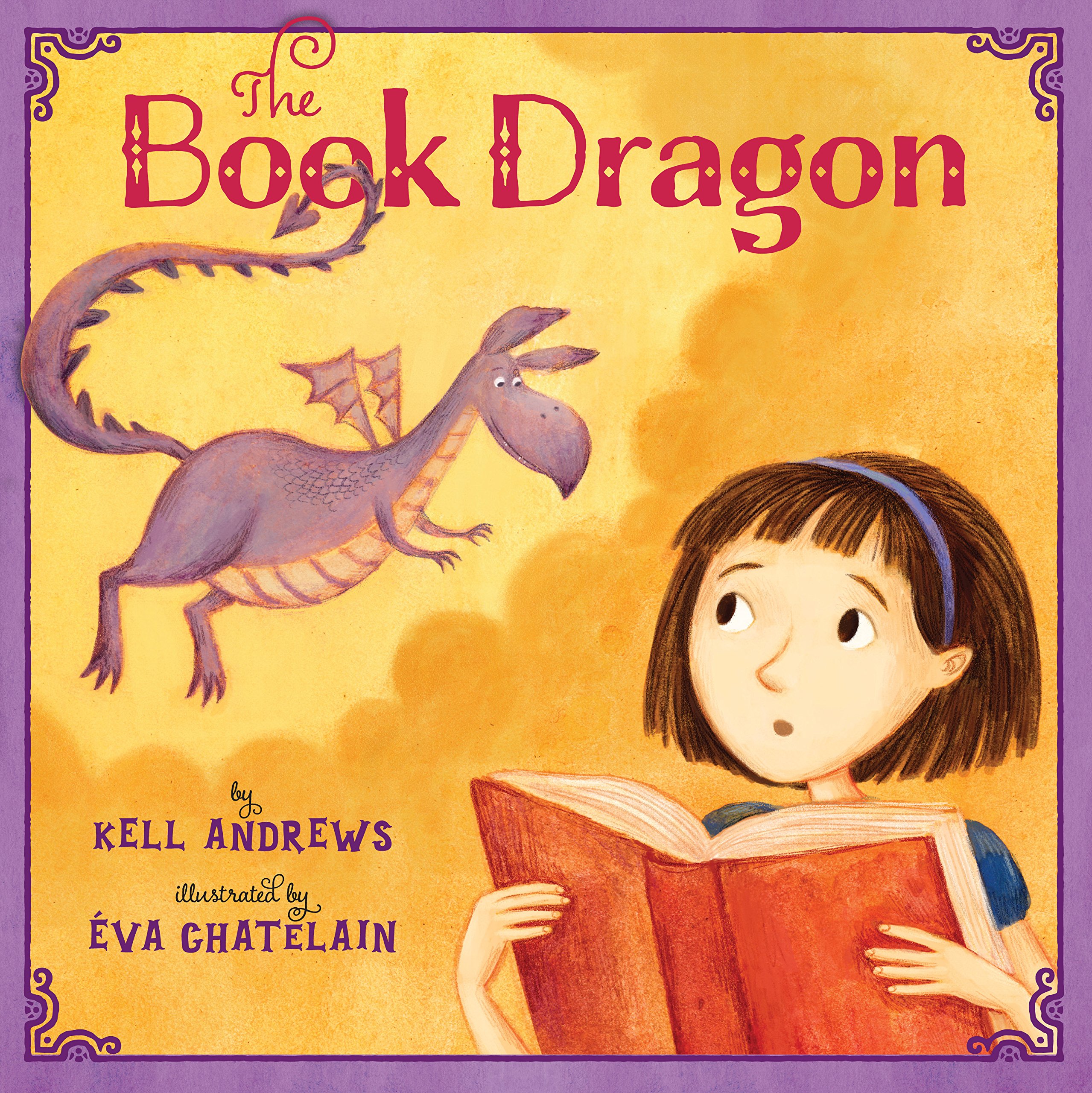
The Book Dragon

Written by Kell Andrews | Illustrated by Éva Chatelain


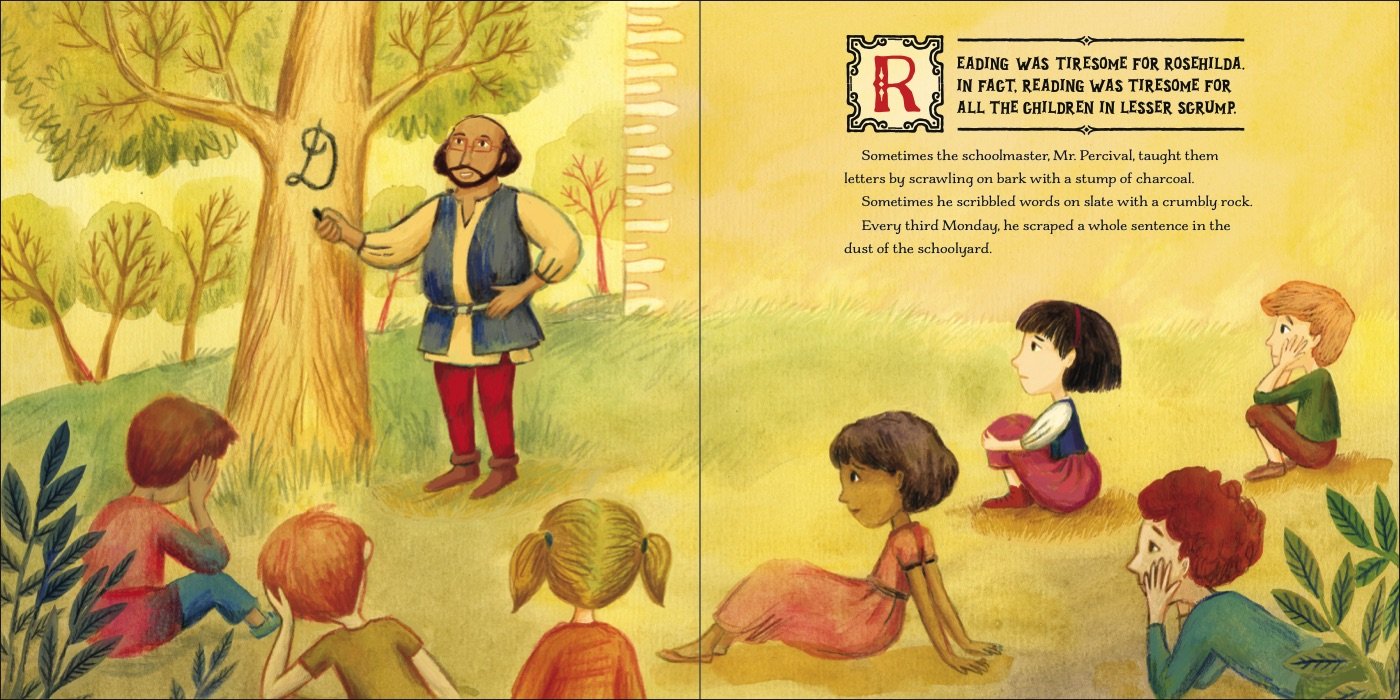
In Lesser Scrump, reading was a chore. To teach the alphabet, the schoolmaster, Mr. Percival, drew on tree trunks with bits of charcoal, scratched on slate with a rock, or drew in the dirt of the schoolyard. One day, Rosehilda said that “‘reading would be more fun if the letters and words were written as stories.’” She even suggested writing them with ink on papers that could be put together. The students were shocked and “Mr. Percival sent Rosehilda home with a stern note scratched onto a leaf.”

celebrate-picture-books-picture-book-review-the-book-dragon-writing

Image copyright Éva Chatelain, 2018, text copyright Kell Andrews, 2018. Courtesy of Sterling Children’s Books.

When Rosehilda got home she asked her grandfather what all the fuss was about. He told her about the Book Dragon, who instead of hoarding gold, collected books. Rosehilda had never heard of a book, and her grandfather explained that it was “letters and words written on papers that are attached together.” He pointed out the window to Scrump Mountain and told Rosehilda that the Book Dragon lived deep inside and stole any book brought into the village.  

The next day at school, Rosehilda declared that the school needed books and that she was not afraid of the Book Dragon. Mr. Percival explained that after the dragon snatched a book, she terrorized the villagers the next night, and he sent her home again with another note etched into a candle stub. On the way home, Rosehilda met a peddler who had a book in her pile of wares. She gave it to Rosehilda in exchange for the candle stub.

celebrate-picture-books-picture-book-review-the-book-dragon-story

Image copyright Éva Chatelain, 2018, text copyright Kell Andrews, 2018. Courtesy of Sterling Children’s Books.

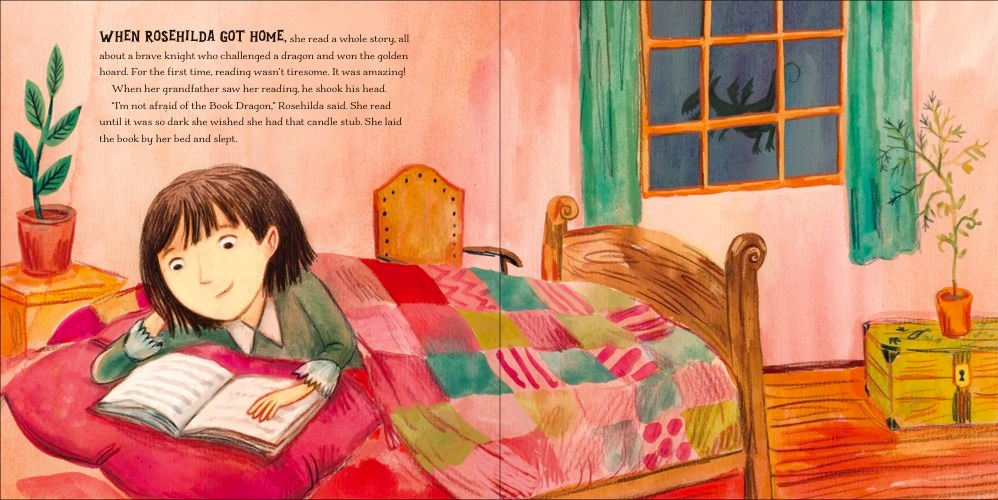
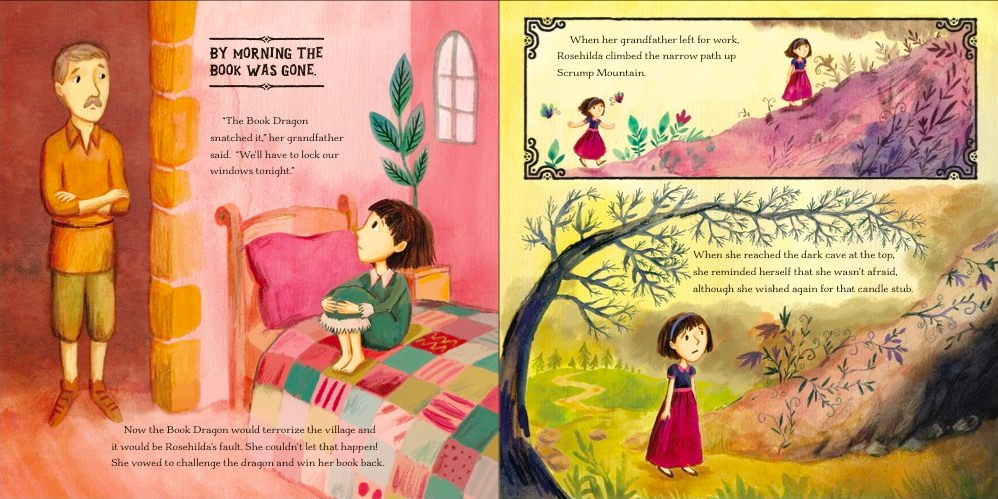
That night Rosehilda read a story about a brave knight who defeated a dragon and won its hoard of gold. “For the first time, reading wasn’t tiresome. It was amazing!” In the morning, the book was gone. Rosehilda’s grandfather told her that they and all the villagers would have to lock their windows that night. Rosehilda felt guilty. “She vowed to challenge the dragon and win her book back.”

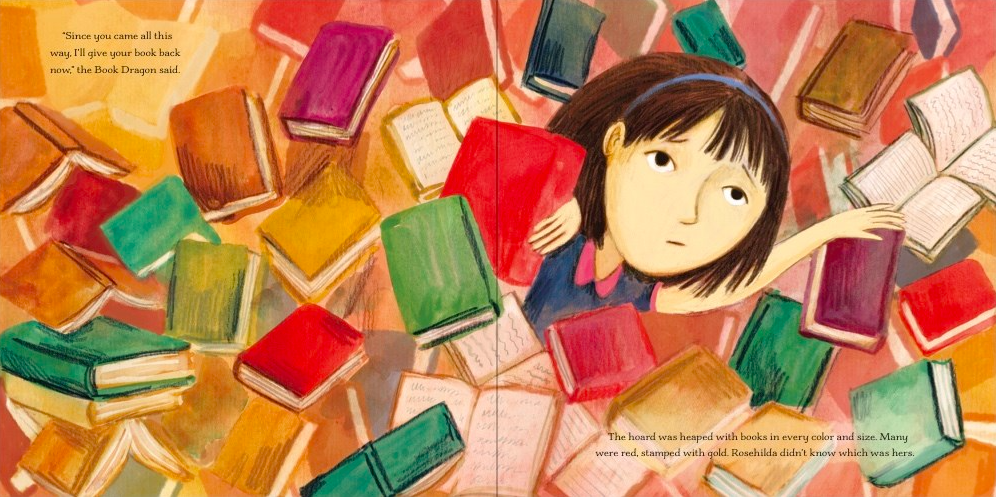
She went to the top of Scrump Mountain and peered into the dragon’s cave. The Book Dragon was lying atop an immense pile of books. She looked surprised to see Rosehilda standing there. Rosehilda summoned her courage and demanded that the dragon return her book. The Book Dragon apologized and explained that because she was too big to live in the village, books were the only friends she had.

celebrate-picture-books-picture-book-review-the-book-dragon-book-missing

Image copyright Éva Chatelain, 2018, text copyright Kell Andrews, 2018. Courtesy of Sterling Children’s Books.

Rosehilda scolded the dragon for stealing so many books. The dragon said she only meant to borrow them, but when she tried to return them, the windows were locked and people screamed when she knocked. The dragon agreed to give Rosehilda her book back, but Rosehilda had a hard time finding it among so many books.

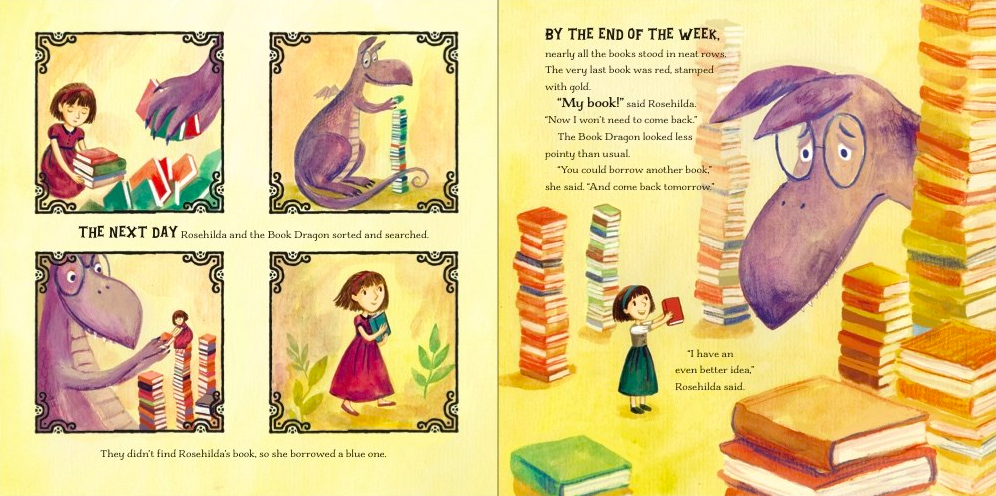
While searching for it, Rosehilda and the Book Dragon began stacking the books “by subject and author.” At the end of the day, they had plenty of piles and more books to sort, and Rosehilda hadn’t found her book. The Book Dragon suggested she borrow a different one. She read late into the night, and the next day she went back to the dragon’s cave to help sort books. She left with another book. This went on all week.

celebrate-picture-books-picture-book-review-the-book-dragon-pile

Image copyright Éva Chatelain, 2018, text copyright Kell Andrews, 2018. Courtesy of Sterling Children’s Books.

Finally, all the books were sorted and Rosehilda found her book. She was excited that she wouldn’t have to come back, but the Book Dragon looked sad and suggested that she “borrow another book…and come back tomorrow.” That gave Rosehilda an idea. The next day at school, Mr. Percival and the other students were horrified to see the dragon outside their window, but Rosehilda explained that she was just returning their books. Now the Book Dragon oversees the “Official Village Library of Lesser Scrump,” and everyone reads as much as they want!

celebrate-picture-books-picture-book-review-the-book-dragon-book-found

Image copyright Éva Chatelain, 2018, text copyright Kell Andrews, 2018. Courtesy of Sterling Children’s Books.

Kell Andrew’s clever story will delight book lovers of all scales with its mix of fantasy, mystery, courage, and friendship. Fearless Rosehilda is a plucky role model for all kids, and the Book Dragon’s desire for company will melt readers’ hearts faster than a breath of fire. Andrew’s storytelling reflects the best of fairy tale lore for a modern audience, with touches of humor, mistaken motives, and a creative resolution.

Éva Chatelain bridges the medieval and the familiar in her bright illustrations that draw on the rich yellows, reds, and greens of leather-bound books, piles of gold, fiery emotions, and woodland villages. Chatelain introduces brave Rosehilda as she challenges her teacher and buys a book,  but she also reveals the trepidation Rosehilda overcomes to confront the Book Dragon, showing readers that even the most courageous people can feel fear too. As Rosehilda reads her treasured book, kids’ suspense will quicken to see the silhouette of the dragon outside her window. The stacks of books that Rosehilda and the Book Dragon build are cunning references to library stacks, and the final images of a happy town and a happy (dragon) librarian will charm readers.

An enchanting story for book buffs, dragon devotees, and fairy tale fans, The Book Dragon would be a favorite addition to story times and home, classroom, and public libraries.

Ages 3 – 7

Sterling Children’s Books, 2018 | ISBN 978-1454926856

Discover more about Kell Andrews and her books on her website.

To learn more about Éva Chatelain, her books, and her art, visit her website.

Appreciate a Dragon Day Activity

celebrate-picture-books-picture-book-review-darling-dragon-match-puzzle

Darling Dragon Matching Puzzle


In this group of darling dragons, each dragon has a twin. Can you help them find each other in this printable puzzle?

Darling Dragon Matching Puzzle

celebrate-picture-books-picture-book-review-the-book-dragon-cover

You can find The Book Dragon at these booksellers

Amazon | Barnes & Noble | Books-a-Million | IndieBound

Picture Book Review

January 14 – World Logic Day

celebrate-picture-books-picture-book-review-lia-&-luís-who-has-more-cover

About the Holiday

World Logic Day, sponsored by UNESCO in association with the International Council for Philosophy and Human Sciences aims to raise awareness and appreciation of the intellectual history, significance, and practical uses of logic to the broad community of scientists as well as the public. Celebrations of the holiday center on promoting international cooperation, supporting the development and activities of logic within universities, research facilities, and schools, and enhancing the understanding of logic and its implications for science, technology, and innovation.

Lia & Luís: Who Has More? (Storytelling Math)

Written by Ana Crespo | Illustrated by Giovana Medeiros


When Luís and his sister Lia were playing together, Luís worked quickly and bragged about the rickety tower he’d built. Lia didn’t really mind because she liked to take her time. Lia’s tower may have been shorter, but it stayed up longer. After playing, they ran “downstairs to their family’s store [to] pick their favorite Brazilian snacks.” Luís told his father, “I want biscoito de polvilho, Papai!” while Lia said, “Coxinhas de galinha, please!”

celebrate-picture-books-picture-book-review-lia-&-luís-who-has-more-bragging

Image copyright Giovana Medeiros, 2020, text copyright Ana Crespo, 2020. Courtesy of Charlesbridge.

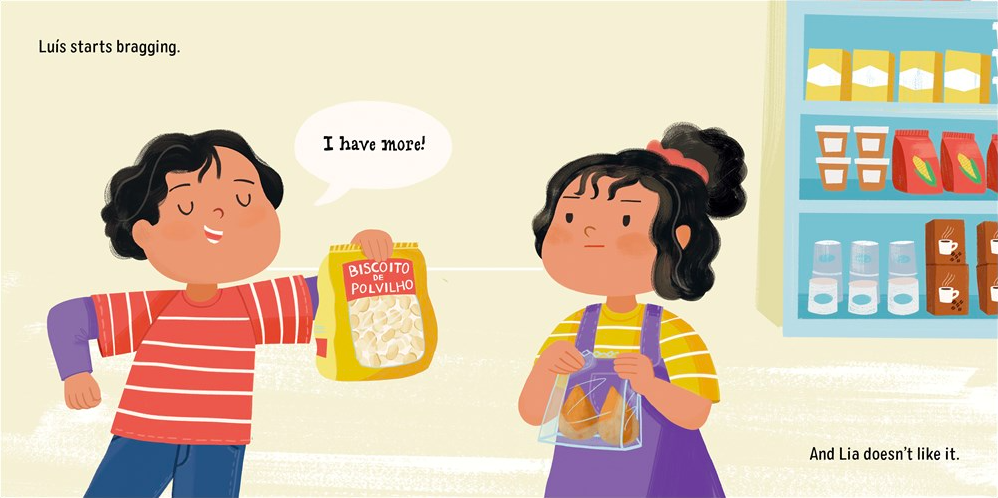
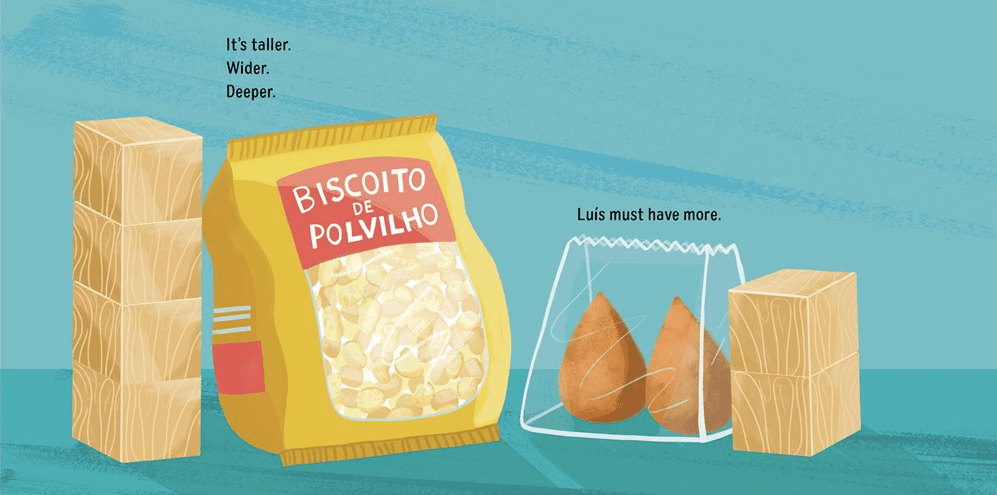
Papai handed Luís a bag of little nuggets and put two pear-shaped treats in a bag for Lia. Again, Luís began bragging, showing his sister that he had more than she did. This time Lia didn’t like it. But was Luís right? His bag was bigger than Lia’s. It was four blocks high and Lia’s bag was only two blocks high. Luís’s bag was also wider and deeper than Lia’s.

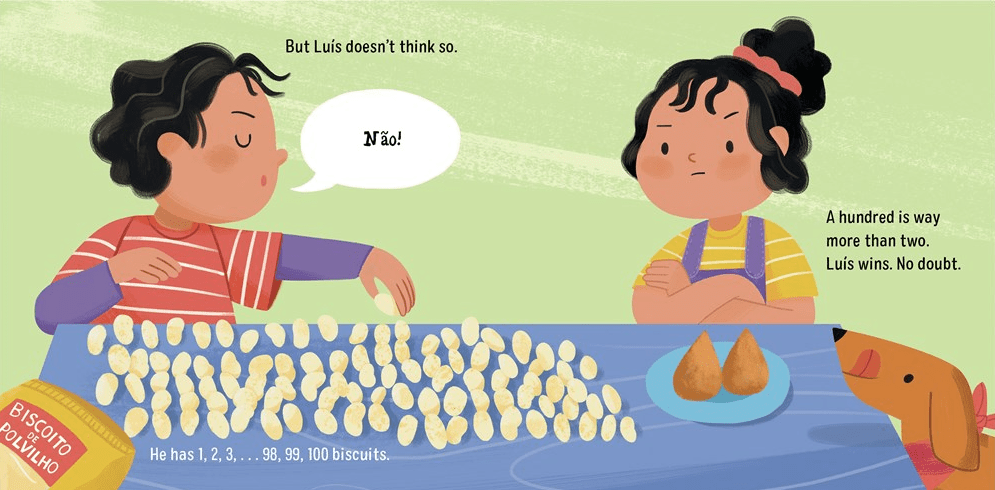
But Lia noticed something else. “Can’t you count?” she says then points out that she has two croquettes while her brother has only one bag. Could she be right about having more? Luís can’t leave this challenge unanswered, so he opens his bag and spills out the contents on the table. Lia looks at all of the tiny nuggets but is still unconvinced. She picks up a biscuit and a croquette. They are definitely different sizes and weights.

celebrate-picture-books-picture-book-review-lia-&-luís-who-has-more-biscuit-bag-taller

Image copyright Giovana Medeiros, 2020, text copyright Ana Crespo, 2020. Courtesy of Charlesbridge.

Luís begins to put a biscuit in his mouth, but Lia wants him to wait. “Para!” she tells him. Lia takes some time thinking about the problem. Finally, she has an idea. She gets the scale from the family store and puts her croquettes on one side and Luís’s biscuits on the other. The scale dips toward Lia; “she wins.” Lia doesn’t like seeing her brother so sad. She thinks again and has another idea. She breaks off a bit of a croquette and adds it to Luís’s biscuits. The scale balances! They eat up all their snacks. Will Papai give them mais?

Following the text readers will find a Glossary of Portuguese words used in the story and an Exploring the Math page, which describes the math concepts contained in the story as well as activities kids and adults can do to reinforce the math learning.

celebrate-picture-books-picture-book-review-lia-&-luís-who-has-more-one-hundred-biscuits

Image copyright Giovana Medeiros, 2020, text copyright Ana Crespo, 2020. Courtesy of Charlesbridge.

In her charming Storytelling Math book, Ana Crespo effectively uses siblings’ natural competitive spirit to explore concepts of comparing and measurement. These include size (and the comparatives taller, wider, deeper), quantity, and weight. As the story opens, Luís has built a taller tower than his sister, the image of which is later used to compare Lia’s snack to Luís’s. Crespo combines an engaged narrator plus dialogue sprinkled with Portuguese words that are organically defined to create a lesson in math that will keep readers turning the pages to see who actually does have more. As Lia and Luís try various methods to find an answer, kids can take time too to think about how they would solve the problem and discuss the idea of “more” and how they would define it. Lia and Luís may be competitive, but they’re also cooperative, making this a sweet sibling story as well.

Giovana Medeiros’s bright, crisp illustrations of these enthusiastic twins clearly depicts the math concepts discussed while also portraying the distinct personalities of Lia and Luís, inviting readers to root for one or the other or to just wait and see who wins. Medeiros includes lots of other opportunities to interact with math through counting the twins’ blocks, items on the shelves and in the display case of the family’s store, and the biscuits poured out on the table. Images of the balance scale allows kids to see how Lia’s croquettes weigh more and how adding a bit of one gives Luís the same amount by weight that Lia has. Speech bubbles and the characters’ actions help readers translate the Portuguese words themselves.

Sure to inspire kids to explore the cabinet, fridge, or classroom and engage with the math of comparing and measuring for themselves, Lia & Luís: Who Has More? would be a fun book to add to home, classroom, and public library collections to spark observations and experimentation that lead to deeper STEM learning.

Ages 3 – 6

Charlesbridge, 2020 | ISBN 978-1623541279 (Hardcover) | ISBN 978-1623541859 (Paperback)

Discover more about Ana Crespo and her books on her website.

To learn more about Giovana Medeiros, her books, and her art, visit her website.

World Logic Day Activity

Screen Shot 2021-01-13 at 4.21.02 PMcelebrate-picture-books-picture-book-review-lia-&-luís-who-has-more-activity-guide

Lia & Luís: Who Has More? Activity Kit


You can have fun experimenting with math using your toys, snacks, and other household items with the downloadable Activity Kit available on the Charlesbridge website!

celebrate-picture-books-picture-book-review-lia-&-luís-who-has-more-cover

You can find Lia & Luís: Who Has More? at these booksellers

Amazon | Barnes & Noble | Books-a-Million

To support your local independent bookseller, order from

Bookshop | IndieBound

Picture Book Review

January 13 – Skeptics Day

celebrate-picture-books-picture-book-review-there-must-be-more-than-that-cover

About the Holiday

If you’re attuned to holidays like I am, you may be thinking, “Wasn’t Skeptics Day October 13?”, or even, “I thought Skeptics Day is celebrated on November 4.” And it seems from my research that you’d be right—on both counts, which might lead you to be, well… skeptical about the validity of today’s holiday. But perhaps that was the point the founder or founders of this holiday were trying to make. Instead of simply accepting what you’re told, a skeptic questions what they hear or read and looks for facts to back it up. Kids are born skeptics, always asking “Why?” “When?” “Where?” “Who?” and “How?” To celebrate today, why not spend some time with your kids learning more about a subject you’re interested in.

There Must Be More Than That!

By Shinsuke Yoshitake


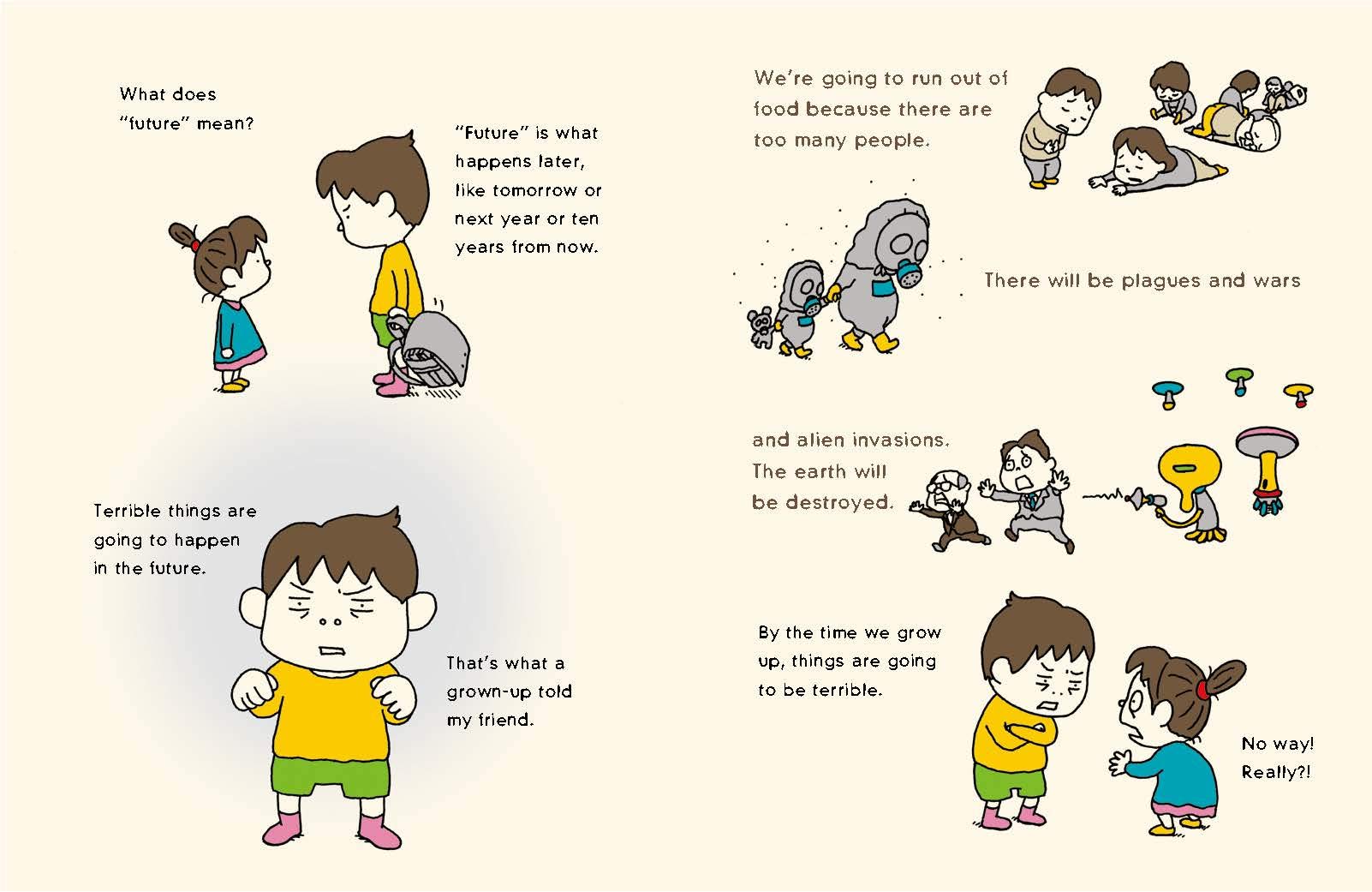
A little girl stands at the sliding glass doors looking out at the pouring rain. She’s disappointed because her father had said the day would be sunny. She thinks to herself, “…you can’t always trust grown-ups.” Then her big brother comes along and tells her all about the apocalyptic events that may possibly doom the earth and their futures. Things like running out of food, wars, even alien invasions. He heard it from a friend, who heard it from an adult. His sister is shocked and afraid.

celebrate-picture-books-picture-book-review-there-must-be-more-than-that-rain

Copyright Shinsuke Yoshitake, 2020, courtesy of Chronicle Books.

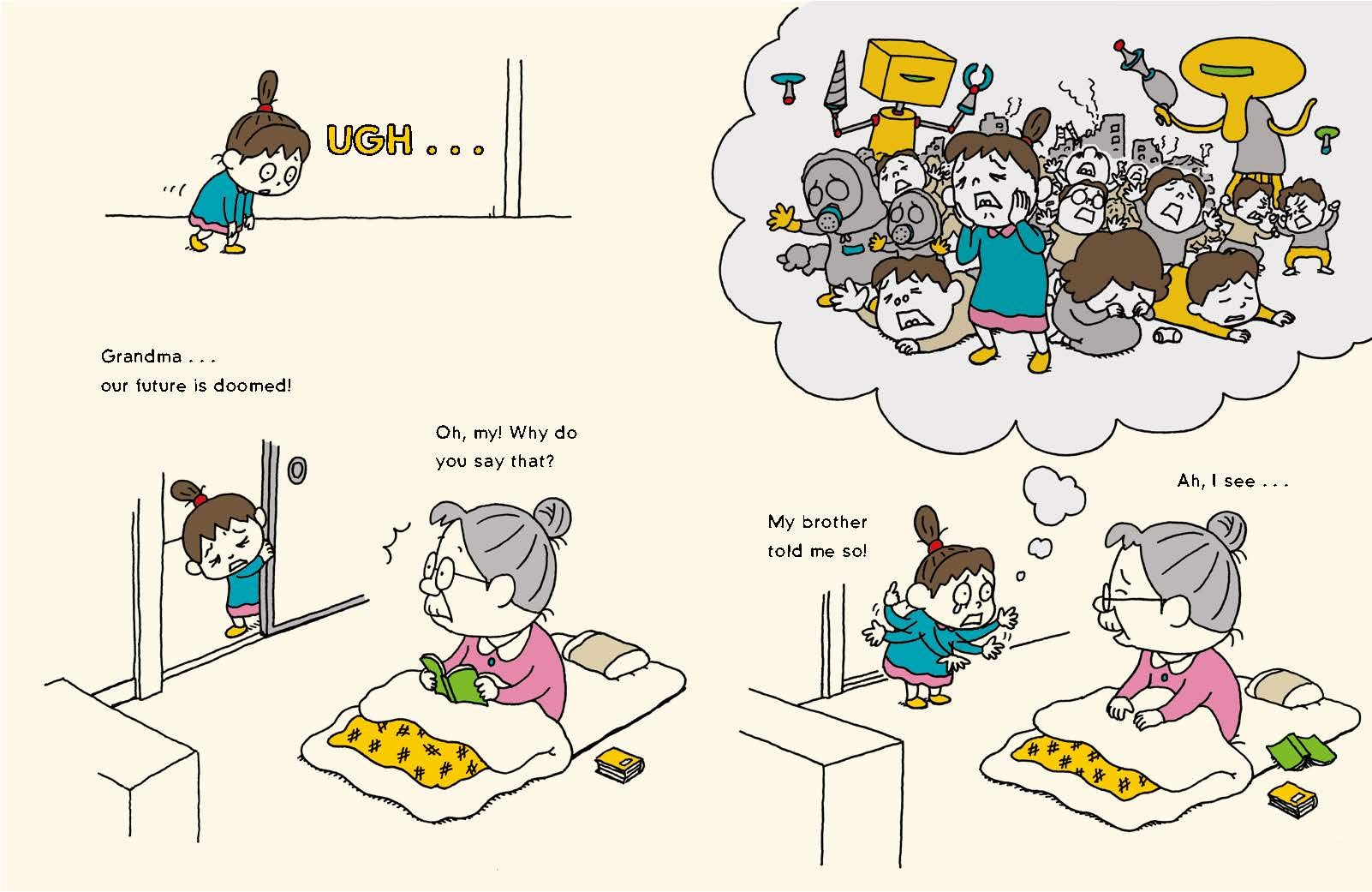
With a heavy heart, she goes to her grandma’s room and reveals what her brother has told her. “Ah, I see…,” Grandma responds. She reassures her granddaughter that no one really knows what will happen and that along with the bad, good things happen too. “Grown-ups act like they can predict the future… but they’re not always right,” she says. And when there’s a choice to be made, they often provide only two things to pick from, when there are actually many more and it’s okay to choose from those.

The little girl realizes that more choices means more possible futures, and she tells her brother so. She already has lots of ideas about the cool things the future might bring—like “a future where it’s okay to spend the day in pajamas…. A future where someone always catches the strawberry you drop…. A future where your room has a zero-gravity switch.” Her brother thinks the strawberry idea sounds great.

celebrate-picture-books-picture-book-review-there-must-be-more-than-that-future

Copyright Shinsuke Yoshitake, 2020, courtesy of Chronicle Books.

The little girl is jazzed to think about other futures. She thinks about alternatives to throwing away old shoes, hiding uneaten carrots, and even keeping her mom from getting mad if she gets paint on her clothes. “I’m a slow runner,” she confesses, “but does that mean I’ll never come in first place? No! I might be ‘first place’ in a funny-face contest!”

Her thoughts begin to branch out, and she decides that between polar opposites like “‘love it or hate it,’” “‘good or bad,’” “‘friend or enemy,’” there may be many more emotions to choose from. In fact, the little girl is so excited by her new perspective that she tells her grandma that she wants to make a career out of “thinking up different futures.” Her grandma thinks that’s marvelous, but gently tells her that she probably won’t be around to see them. But the little girl is determined and imagines several scenarios that mean a brighter and longer life for her grandmother. Grandma laughs and agrees that “there must be more for me than that!”

celebrate-picture-books-picture-book-review-there-must-be-more-than-that-grandma

Copyright Shinsuke Yoshitake, 2020, courtesy of Chronicle Books.

Cheered, the little girl goes to the kitchen to find out what’s for dinner. Although they’re just having leftovers, Mom offers to make her an egg. “Boiled or fried?” she asks. Exasperated, the girl tells her mom about all the other ways an egg can be cooked, used, and played with. They can be scrambled or rolled, painted or stickered, and put in a shoe, a book, or a belly button. They can even be stacked on top of each other or used to make a tall tower. Her mother gets the idea and says she can have her egg made any way she wants. “Hmmm,” the little girl ponders. What do you think she chooses?

celebrate-picture-books-picture-book-review-there-must-be-more-than-that-choices

Copyright Shinsuke Yoshitake, 2020, courtesy of Chronicle Books.

Shinsuke Yoshitake’s profound observations, expressed in kid-friendly, sometimes even silly examples, emboldens children to look beyond the choices they’re given by others and create the present and future they desire. Yoshitake touches on serious subjects that children hear discussed by adults, on the news, and in school that can lead to a frightening sense of no control but flips the narrative to show kids that they do have the power to influence events and change them for the better. The choices Yoshitake poses—love or hate, good or bad, friend or enemy—will get kids thinking about other such pairs they’re presented with every day and the nuanced scales between them that more correctly represent their feelings. After showing the little girl giving her grandma a pep talk and convincing her mom that there are a myriad things to do with eggs, Yoshitake ends the story on a comic note so attuned to kids’ enthusiasm for new ideas.

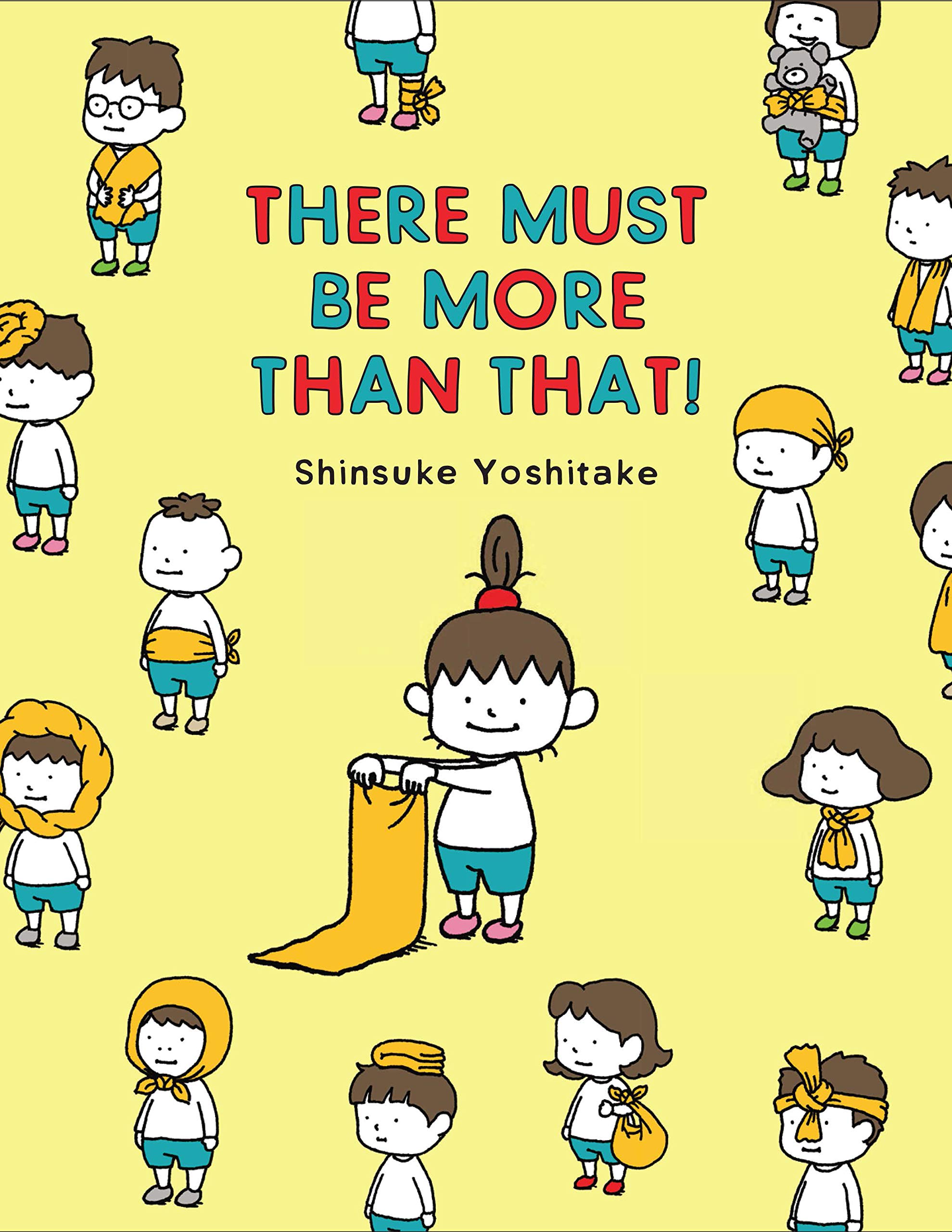
Yoshitake accompanies his story with laugh-out-loud illustrations of a little girl who cycles through emotions from anger to doomed to thoughtful to determined and finally to joyful after her brother reveals bad news about the future. Kids will be fully onboard for the fantastical future the girl envisions and the whimsical ways Yoshitake depicts the multitude of options that are available with just a little more thought. A two-page spread with twenty-three different types of eggs will set kids giggling and no doubt wanting to try them all. Likewise, the book’s cover hints at what’s inside with a display of many things a simple piece of cloth can become.

There Must Be More Than That! is a smart, sophisticated, and lighthearted way to shift a child’s perspective and empower them to shed the burdens of the world and create the life they want—on both a small and large scale. The book is sure to be a favorite on home, classroom, and public library shelves.

Ages 5 – 8

Chronicle Books, 2020 | ISBN 978-1452183220

Skeptics Day Activity

celebrate-picture-books-picture-book-review-find-the-differences-kids-reading

Find the Differences Puzzles


Are you someone who looks at things skeptically? Do you want to learn the facts before you believe what you see or hear? If so, you’ll enjoy these printable puzzles and see for yourself whether they are the same or different.

Kids Reading Puzzle (easier) | Kid’s Bedroom Puzzle and Solution | Girl Selling Flowers Puzzle and Solution

celebrate-picture-books-picture-book-review-there-must-be-more-than-that-cover

You can find There Must Be More Than That! at these booksellers

Amazon | Barnes & Noble | Books-a-Million

To support your local independent bookseller, order from

Bookshop | IndieBound

Picture Book Review

January 12 – Poetry at Work Day

celebrate-picture-books-picture-book-review-this-poem-is-a-nest-cover

About the Holiday

Today’s holiday encourages people to consider their jobs, their office environment, their coworkers, and maybe even that snack in the desk drawer through the lens of poetry. This year, if you’re working from home, your sphere of inspiration is nearly limitless. Whether your thoughts on what you see and hear tend toward poignancy, inspiration, or humor, take a moment to jot them down. Then share your poem or poems with your family or friends!  

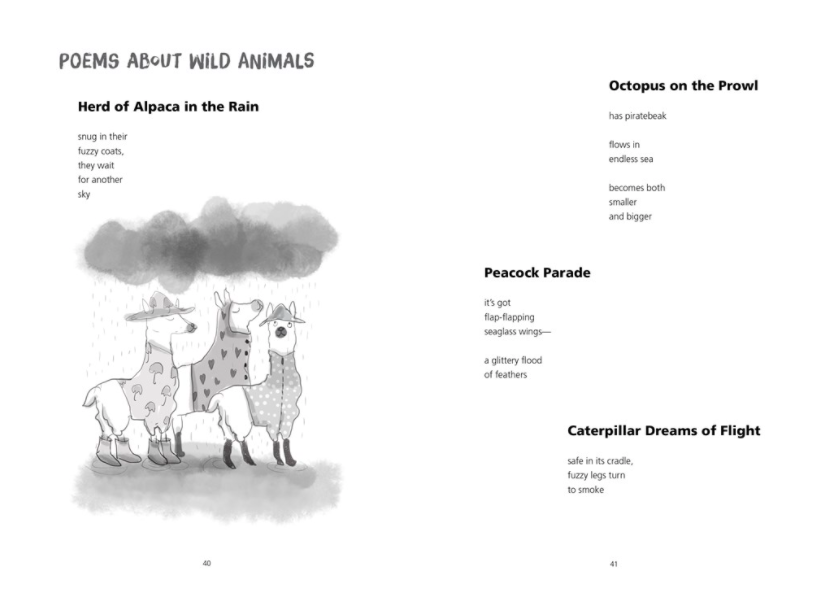
This Poem is a Nest

Written by Irene Latham | Illustrated by Johanna Wright


In the introduction to her astonishing poems, Irene Latham explains the concept of “nestling poems,” which provides the structure to her collection. Similar to “found” poems, that can use the words from any source text to create other poems, nestling poems use words discovered within another poem. In the case of This Poem is a Nest, Latham first penned four poems about a single nest surviving through a year of season and then found 161 other poems inside them. These other poems—some small, even tiny snippets—pack a powerful ability to wow, just like a single candy in a large assorted box.

First, readers are introduced to the nest in Spring, where “safe in its crook, it’s a cradle that sways across day and dark.” There are “fragile eggs,” but soon “the happy nest overflows with flap-flapping and endless feast.” In Summer after the robins have flown away, the “empty nest becomes nothing more than a morning house of light.” Below, the tree hosts other creatures who call it home or use it as a resting place.

celebrate-picture-books-picture-book-review-this-poem-is-a-nest-time

Image copyright Johanna Wright, 2020, text copyright Irene Latham, 2020. Courtesy of Wordsong.

In Autumn, readers are invited to climb the “branches like a ladder— / up and up—where the crispcool world turns both smaller and bigger.” From here one can see “distant woodsmoke” and quiet creatures going about their day. Winter brings a new resident to the nest, a tiny mouse who “makes needed repairs” and lays in stores of food for the snowy days ahead.

After reading these four three-stanza poems, readers enter Part II, where Latham’s nestling poems are divided into seven categories. The first explores the idea of time, and Latham begins by marking the passing of a day. With Dawn, “day rustles open / overflows / morning boat” while at Dusk “sky weaves / gold-dust / world / turns.” But Latham knows there are those other hours, the hours when a profound Middle-of-the-Night Question may come: “wing away, / or take / the stage?” Latham next reveals truths about the months of the year, the seasons, and—in clever “Before & After Poems”—the emotions that lead up to and follow an announcement, a storm, and a game (one that is won and one that is lost).

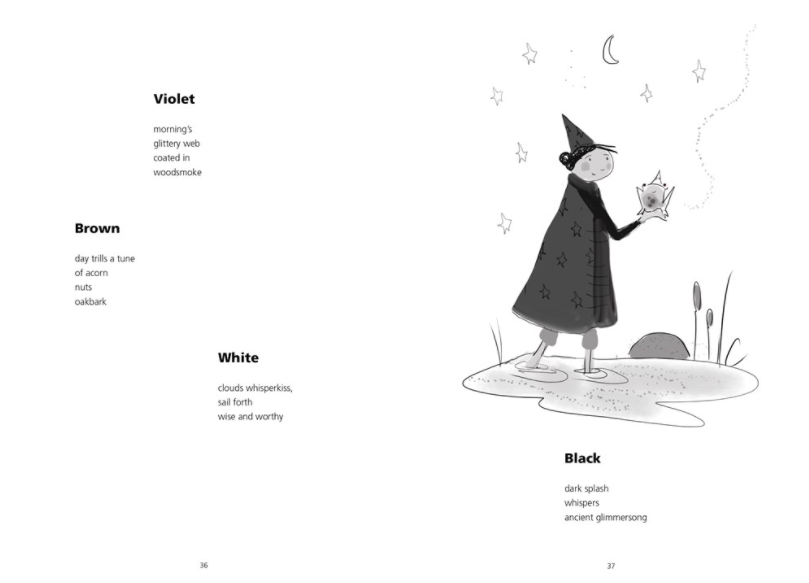
The next chapter titled “Color My World” gives physical shape to nature’s hues from Red (“autumn leaves / puddle / beneath roof / of sky”) to Black (“dark splash / whispers / ancient glimmersong”). In the following chapter—”Animals Among Us”—Latham describes a menagerie of animals, including the beauty of a Papa Emperor Penguin with Egg: “feet stitched / together, / both anchor / and dream.” She also shares lessons that wildlife can teach us about meeting life’s challenges, such as how to hang in there and how to combat boredom, how to find the power in imagination, and what to do if something is wrong or you’re feeling down.

celebrate-picture-books-picture-book-review-this-poem-is-a-nest-colors

Image copyright Johanna Wright, 2020, text copyright Irene Latham, 2020. Courtesy of Wordsong.

In Chapter Four—”Only Human”—Latham looks at our emotions with observations that are weighty, thrilling, hopeful, and joyous. Of course, we are not alone in life, and Latham finds poems within her nest to describe relationships with friends, parents, and teachers and others. As a poet Latham knows a thing or two about a Love of Words, and in a short chapter she has fun creating poems that will surprise and delight.

From their nest, birds look out on a vast landscape. Likewise Latham presents readers with poetic “Views and Vistas.” Children can roam from the Desert to a Meadow; and explore a Cave, a Fox Den, and an Iceberg. Expanding out into the world, kids visit the African Serengeti, the Australian Outback, Tahiti, and the Amazon River, among other spots. Pan out even farther and readers contemplate space, the sun, the constellations, and all of the planets—including Pluto, despite its demotion.

At last, Latham includes a few final verses about poems and poets themselves and leaves readers with My Wish for You: blue adventure / in seaglass morning— / green buzz, / gold thrumming— / life / a poem” Backmatter consists of detailed tips on how poets or would-be-poets can write their own nestling poems.

celebrate-picture-books-picture-book-review-this-poem-is-a-nest-animals

Image copyright Johanna Wright, 2020, text copyright Irene Latham, 2020. Courtesy of Wordsong.

Lovely, deep, and awe-inspiring, Irene Latham’s poems allow readers to discover the world with microscopic precision and a broad view from as far away as outer space. As you read the poems, it’s intriguing to go back to the first four poems and find the individual words in their original context. As meaningful is to let the small verses float in your mind and take root in your heart. Many will make you look at and consider objects, places, time periods, and emotions in ways that bring new insight and understanding, hope, joy and peace.

Johanna Wright’s lovely black-and-white line drawings, shaded with a gray scale offer whimsical interpretations of Latham’s poems and introduce each chapter with thoughtful, creative, and happy children interacting with each other and their world. A few sweet, individual drawings include a mother and child snuggling under a warm quilt for December; a snail whose shell contains true contentment in All You Need, According to a Snail; two children painting the sky with stars in Painting; and a little girl sleeping in the crook of a crescent moon while her dreams become poems in While You Sleep.

For any poetry lover—whether adult or child—or anyone looking to experience the world afresh, This Poem is a Nest is a must. Original, creative, and beautiful, the book would enhance any home, classroom, or public library collection.

Ages 7 – 14 and up

Wordsong, 2020 | ISBN 978-1684373635

Discover more about Irene Latham, her books, and her poetry on her website.

To learn more about Johanna Wright, her books, and her art, visit her website.

Poetry at Work Day Activity

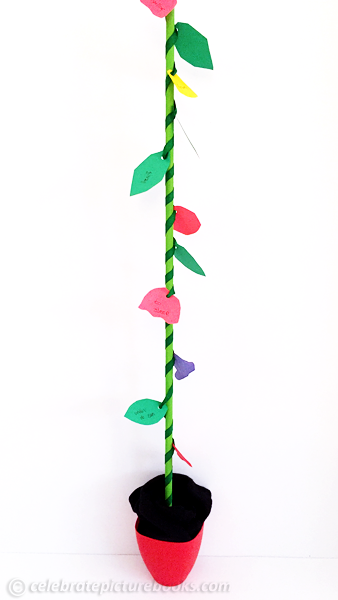
celebrate-picture-books-picture-book-review-grow-a-poem-craft

Grow Your Own Poem


A poem often grows in your imagination like a beautiful plant—starting from the seed of an idea, breaking through your consciousness, and growing and blooming into full form. With this craft you can create a unique poem that is also a piece of art!

Supplies

  • Printable Leaves Template
  • Printable Flower Template
  • Wooden dowel, 36-inch-long, ½-inch diameter, available in craft or hardware stores
  • Green ribbon, 48 inches long
  • Green craft paint
  • Green paper for printing leaves (white paper if children would like to color the leaves)
  • Colored paper for printing flowers (white paper if children would like to color the flowers)
  • Flower pot or box
  • Oasis, clay, or dirt
  • Hole punch
  • Glue
  • Markers or pens for writing words
  • Crayons or colored pencils if children are to color leaves and flowers

Directions

  1. Paint the dowel green, let dry
  2. Print the leaves and flower templates
  3. Cut out the leaves and flowers
  4. Punch a hole in the bottom of the leaves or flowers
  5. Write words, phrases, or full sentences of your poem on the leaf and flower templates
  6. String the leaves and flowers onto the green ribbon (if you want the poem to read from top to bottom string the words onto the ribbon in order from first to last)
  7. Attach the ribbon to the bottom of the pole with glue or tape
  8. Wrap the ribbon around the pole, leaving spaces between the ribbon
  9. Move the leaves and flowers so they stick out from the pole or look the way you want them to.
  10. Put oasis or clay in the flower pot or box
  11. Stick your poem pole in the pot
  12. Display your poem!

celebrate-picture-books-picture-book-review-this-poem-is-a-nest-cover

You can find This Poem is a Nest at these booksellers

Amazon | Barnes & Noble | Books-a-Million

To support your local independent bookstore, order from

Bookshop | IndieBound

Picture Book Review

January 11 – Heritage Treasures Day

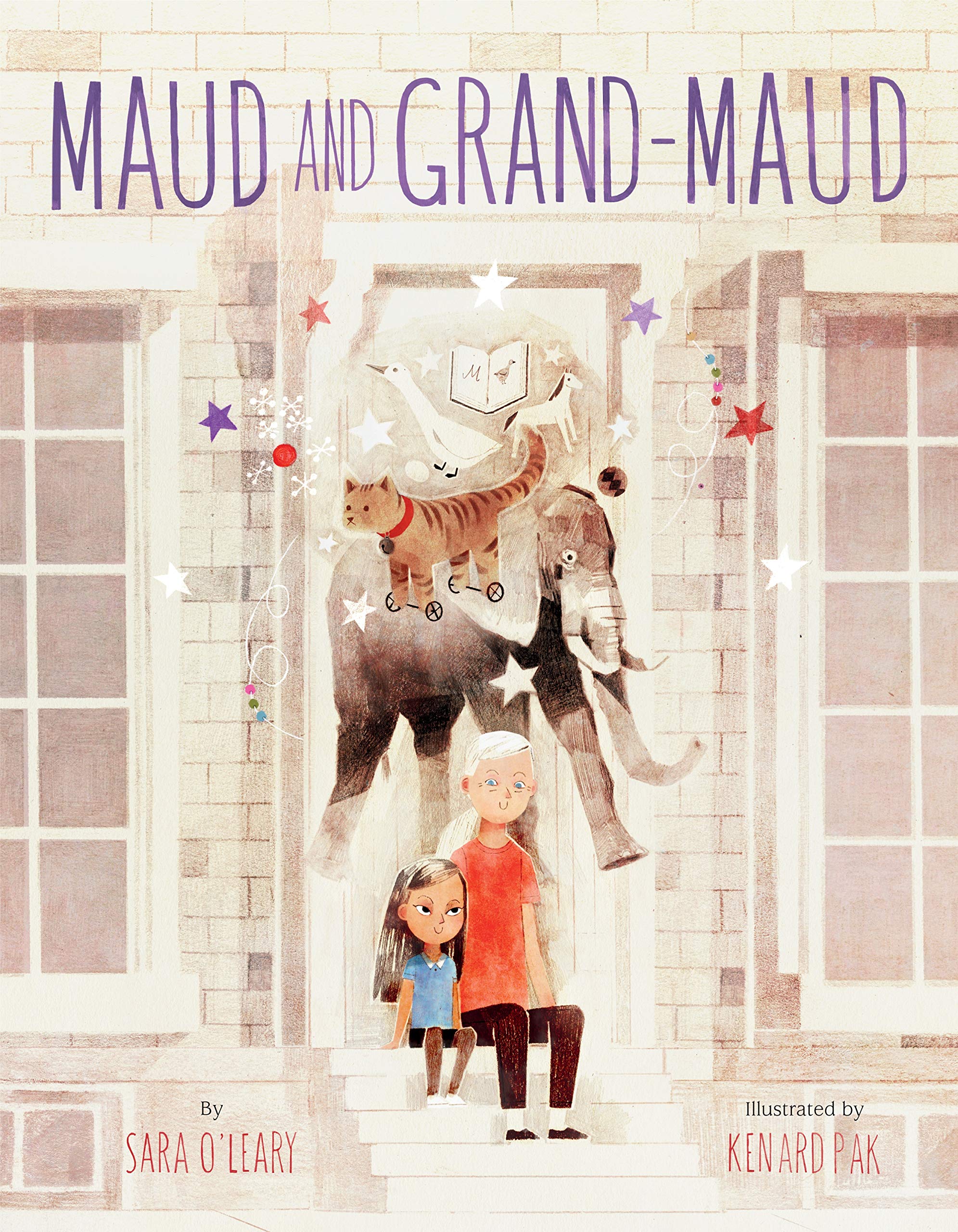
celebrate-picture-books-picture-book-review-maud-and-grand-maud-cover

About the Holiday

Heritage Treasures Day is an initiative established in the United Kingdom by the Heritage Lottery Fund in 1994 to preserve important parts of human history. Since that time nearly eight billion pounds raised through the national lottery have been dispersed to support more than 40,000 projects. Multiple funds have been created to support various types of programs. For example, “Sharing Heritage” provides money for local heritage sites ranging from personal memories to the conservation of an area’s wildlife, while “Our Heritage” is used to preserve archaeological sites, endangered wildlife, and museum collections. Heritage Grants are given to large projects such as the preservation and restoration of Stonehenge. Today’s holiday celebrates these efforts and raises global awareness of the importance of protecting and passing on our shared history. To celebrate on a smaller scale, take an opportunity to talk about your family’s stories, history, and legacy with your kids.

Maud and Grand-Maud

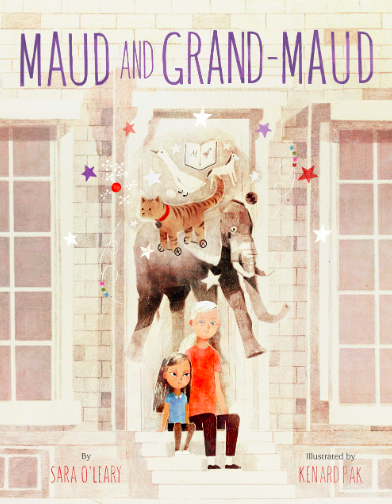
Written by Sara O’Leary | Illustrated by Kenard Pak


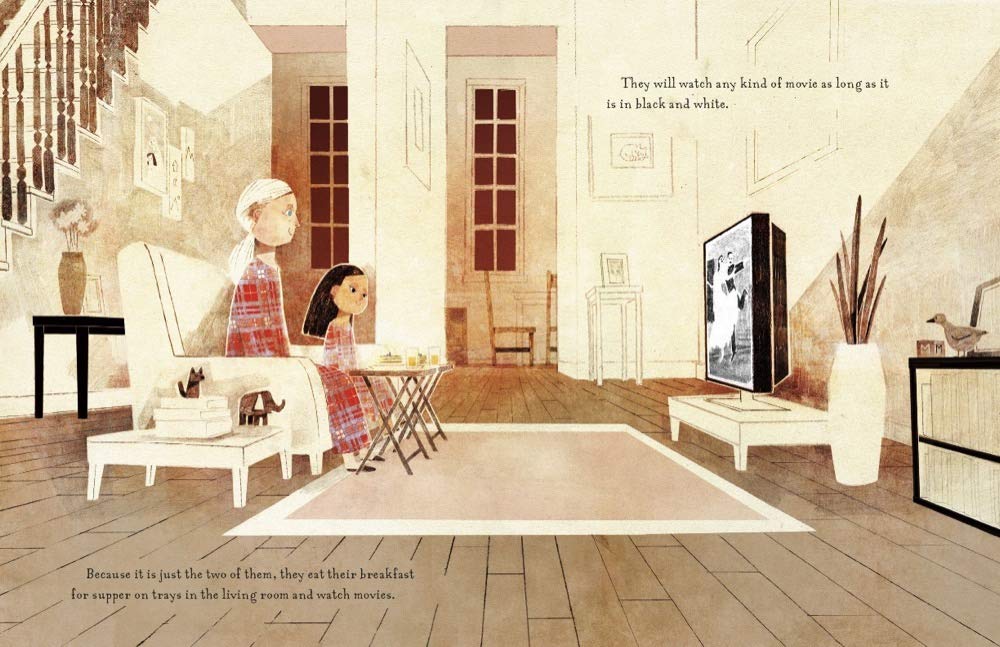
On certain Saturdays Maud gets to sleep over at Grand-Maud’s house. She sleeps in a special nightgown that Grand-Maud made for her. “The nightgown goes all the way to the floor, and is made out of plaid flannel, and is softer than anything.” Grand-Maud even made herself one to match. Once dressed, they have breakfast for dinner eaten on trays in front of the TV, where they watch old black and white movies. Maud thinks everything was black and white when Grand-Maud was a child.

celebrate-picture-books-picture-book-review-maud-and-grand-maud-dinner

Image copyrigh Kenard Pak, 2020, text copyright Sara O’Leary, 2020. Courtesy of Random House.

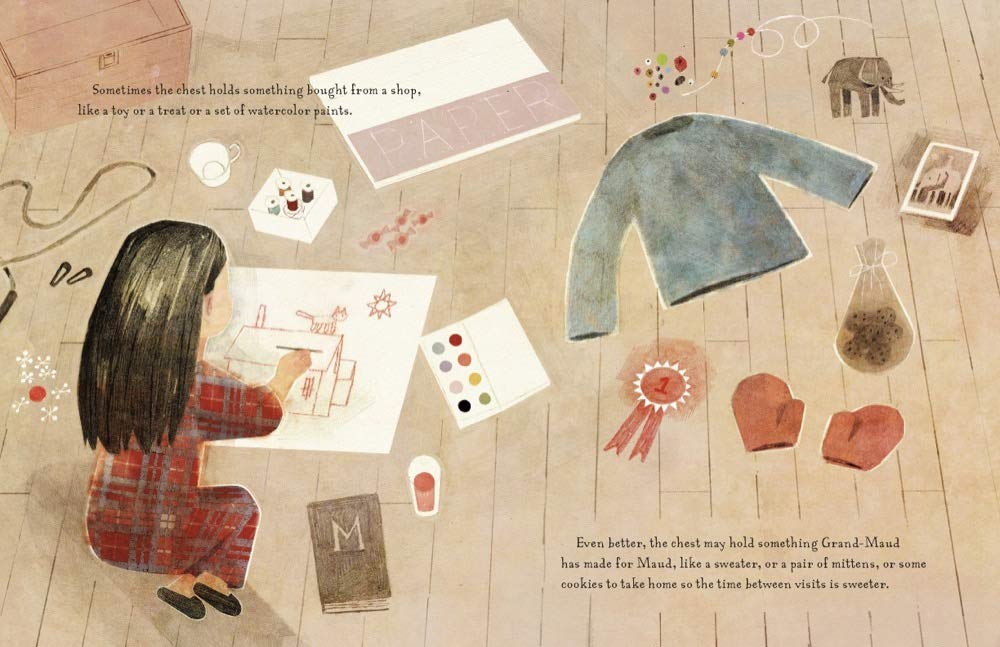
At bedtime, Maud snuggles into the extra twin bed in Grand-Maud’s room. In this bed Maud always has good dreams, and under the bed hides a wooden chest in which “there is always something new for Maud placed inside, even when Grand-Maud doesn’t know she will be visiting.” Sometimes the thing is something bought new for Maud to use or play with. Other times Grand-Maud has made something for Maud, like “…a pair of mittens, or some cookies to take home so the time between visits is sweeter.”

celebrate-picture-books-picture-book-review-maud-and-grand-maud-chest-treasures

Image copyrigh Kenard Pak, 2020, text copyright Sara O’Leary, 2020. Courtesy of Random House.

But the best times are when the chest holds “something from when Grand-Maud was a little girl herself.” Once Maud found a heart-shaped stone that Grand-Maud had carried in her pocket for a whole year. Now Maud carries it in hers. This time, Maud pulls out a book of fairy tales that Grand-Maud had written her name in. Maud was happy to see her own name in it.

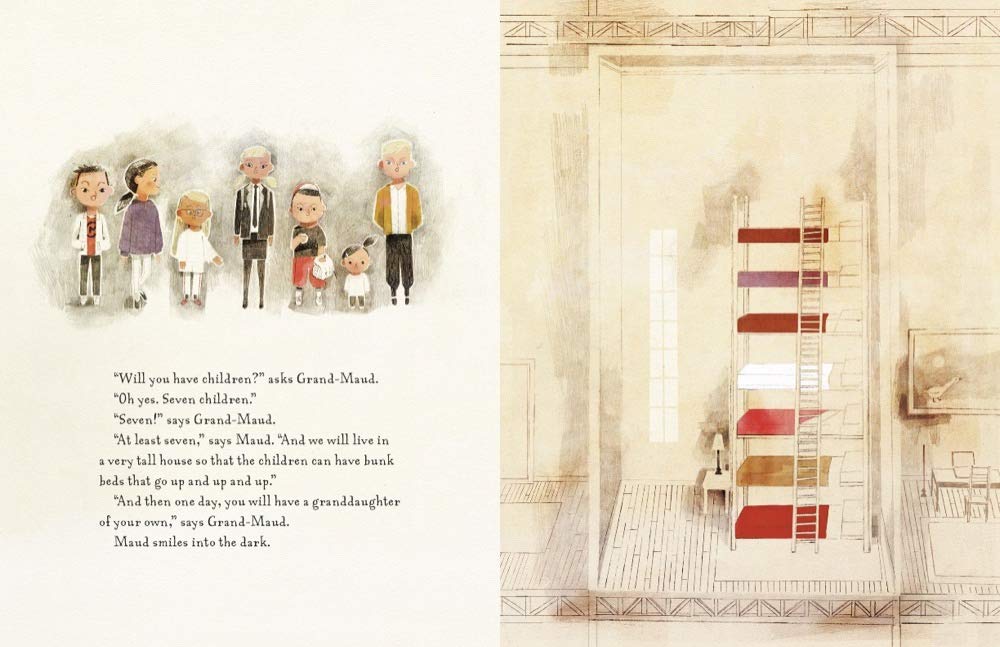
That night, with the lights dimmed, Grand-Maud and Maud talked about the future. Maud said she wants to be a writer and have at least seven children. She imagines living in “‘…a very tall house so that the children can have bunk beds that go up and up and up.’” Grand-Maud says that later Maud will have her own granddaughter. The thought makes Maud smile. In her dream she lives in an apartment just like Grand-Maud’s and is standing at the doorstep to welcome Maud for a special visit.

celebrate-picture-books-picture-book-review-maud-and-grand-maud-bunkbeds

Image copyrigh Kenard Pak, 2020, text copyright Sara O’Leary, 2020. Courtesy of Random House.

Sara O’Leary’s story about the connection between a grandmother and her granddaughter who share the same name is sweet and endearing. With homey details—a homemade nightgown, breakfast for dinner, and especially the wooden chest that always holds a surprise, O’Leary perfectly captures the comforting love and sense of adventure children feel when spending time with their grandparents. The old movies Maud and Grand-Maud watch together, the treasures Grand-Maud passes down to Maud, and the interest Grand-Maud shows in her granddaughter’s future all demonstrate simple but meaningful ways for older and younger generations to share their experiences and build understanding and strong bonds. O’Leary’s straightforward and lovely storytelling, highlighted with realistic dialogue, makes for rich and cuddly story times that can lead to discussions between kids and adults about their own family heritage. Her moving ending charms with a look toward a future of continued family ties.

Kenard Pak’s soft illustrations in warm browns, reds, and blues will enchant readers as they are invited into Grand-Maud’s cozy brownstone apartment to share a sleepover with Maud. Pak alternates between images of the close-knit grandmother and granddaughter, happy to be sitting side by side while sharing meals, memories, and talks of the future, with pages that give children a closer look at their breakfast supper, the enticing wooden chest and past items it has contained, and Maud’s imaginings, including the stories she’ll write, her future children’s bunkbeds, and that childlike idea that the world in the era of black-and-white movies was also black and white.

As snug and as full of love as a hug, Maud and Grand-Maud is a tender book for grandparents and grandkids to read together or for parents and children to cuddle up with whenever they’re missing Grandma. The book would make a favorite read to spark conversations about family history and family stories. Maud and Grand-Maud is highly recommended for home, school, and public library collections.

Ages 3 – 8

Random House / Penguin Random House Canada, 2020 | ISBN 978-0399554582

Discover more about Sara O’Leary and her books on her website

To learn more about Kenard Pak, his books, and his art, visit his website.

Heritage Treasures Day Activity

CPB - Cookie Jar Museum (2)

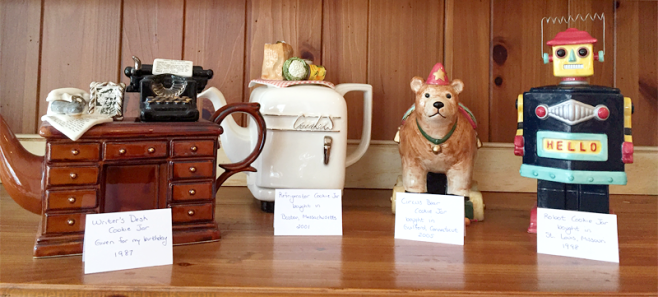
Create a Family Story Exhibit


Every item has a story. A fun and educational way for kids to learn family stories and interact with their own history is for family members to each create an exhibit of favorite or meaningful objects in your home. Tags can tell how each item was obtained, any funny or interesting story that is attached to it, and what it means to the owner. Displaying and talking about the exhibits can be a fun way to spend time together while seeing common objects in a whole new light.

Supplies

  • A number of household 
  • Paper or index cards
  • Marker, pen, or pencil
  • A table, shelf, or other area for display

Directions

  1. To get started help children gather a number of items from around the house to be the subjects of their exhibit. An exhibit can have a theme, such as Travel Souvenirs, or it can contain random items of your child’s choice, like toys, plants, tools, or artwork.
  2. Using the paper or cards, children can create labels for their exhibit items. Older children can write the labels themselves; younger children may need adult help.
  3. Spend a little time relating the story behind each object: where it came from, how long you’ve had it, and when and how it was used in the past. Include any funny or touching memories attached to the item. Or let your child’s imagination run free, and let them create histories for the objects.
  4. When the labels are finished, arrange the items on a table, shelf, or in a room, and let your child lead family members on a tour. You can even share the exhibit with family and friends on FaceTime, Skype, Zoom, or other app.

celebrate-picture-books-picture-book-review-maud-and-grand-maud-cover

You can find Maud and Grand-Maud at these booksellers

Amazon | Barnes & Noble | Books-a-Million

To support your local independent bookseller, order from

Bookshop | IndieBound

Picture Book Review
January 8 – National Bubble Bath Day

celebrate-picture-books-picture-book-review-bobby-babinski's-bathtub-cover

About the Holiday

No matter whether you’re having a cold, snowy day or a warm, sunny day, a bubble bath can be just the thing for relaxing or having a bit more playtime at the end of the day. This year marks the 60th anniversary of Mr. Bubble, founded by Mr. Harold Schafer and the God Seal Company of North Dakota. To celebrate today, plan a little luxury for yourself and some splashy, giggly fun for the kids!

Bobby Babinski’s Bathtub

Written by Judy Young | Illustrated by Kevin M. Barry


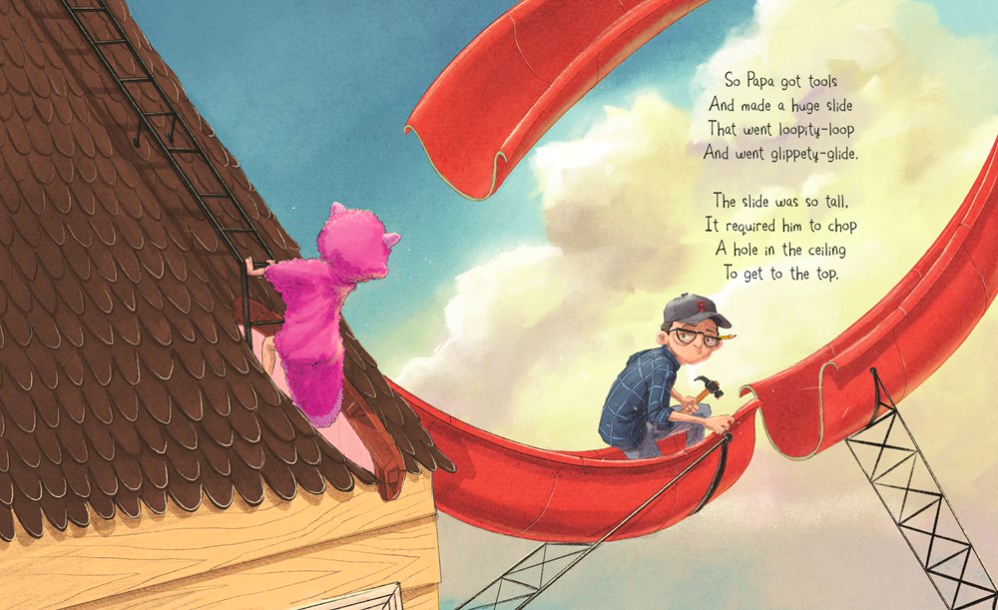
It was bath time for Bobby Babinski and while he didn’t mind the actual scrubbing, he really did not like climbing into their deep, webfooted tub. “So, Papa got tools, / And he made a huge slide / that went loopity-loop / and went glippety-glide.” It soared so tall from the ground that Papa had to cut a hole in the roof for Bobby to ride. He got on and then “down toward the bathtub / He zoomed with a flash. / Then Bobby Babinski slid in with a splash.”

celebrate-picture-books-picture-book-review-bobby-babinski's-bathtub-slide

Image copyright Kevin M. Barry, 2020, text copyright Judy Young, 2020. Courtesy of Sleeping Bear Press.

That was lots of fun, but when he got to the tub Bobby found nothing to play with. So with a pail Papa caught “…a whale / two dolphins, three crabs, / And some tropical fish” that could have been fun if they didn’t take up every inch of the tub. So, Papa dug up the yard and made a bathtub as big as a lake.

“Now Papa unwrapped / a bar of white soap / And tossed it to Bobby, / But Bobby said, ‘Nope.’” Seems Bobby had trouble controlling the suds, so Papa came back with an eight-armed solution, and “soon Bobby Babinski / Was covered with bubbles.” With a squirt from the hose, Bobby was clean.

celebrate-picture-books-picture-book-review-bobby-babinski's-bathtub-whale

Image copyright Kevin M. Barry, 2020, text copyright Judy Young, 2020. Courtesy of Sleeping Bear Press.

Papa offered a towel, but Bobby wanted to dry off in the sun. An island would do it, so Papa built him one. When Bobby was dry he was ready to go home, but the island and house were separated by water. Papa was clever and he summoned a “huge flying bird.” It deposited Bobby next to his dad who was holding up pj’s and ready to put him to bed. “But Bobby Babinski said, ‘No!’ / With a grin. / ‘I want to have bath time / All over again!’”

celebrate-picture-books-picture-book-review-bobby-babinski's-bathtub-octopus

Image copyright Kevin M. Barry, 2020, text copyright Judy Young, 2020. Courtesy of Sleeping Bear Press.

Whether your kids run to or from the tub at bath time, they’ll rush to join story time if Bobby Babinski’s Bathtub  is pulled from the shelf. Bubbly and imaginative, Judy Young’s rhyming storytelling will have kids laughing out loud as Bobby’s dad creates a bathtub experience kids can only dream about. Nonstop action and the best that amusement parks have to offer make for escalating fun that, like Bobby, readers will beg for again and again.

Kevin M. Barry’s dynamic and humorous illustrations will wow kids, and his impish boy is rakish and endearing as he enthusiastically enjoys each of his father’s inventive solutions only to come up with more and more objections to the bath time process. Hilarious facial expressions on both Bobby and the sea creatures that Papa finds to fulfill Bobby’s whims will have kids giggling with delight, and parents will discover some familiar looks on Papa’s face as well.

Fun from the first drip to the last splash, Bobby Babinski’s Bathtub is sure to be a quick favorite for rambunctious story times. The book would be a go-to addition for home, school, and public library collections.

Ages 5 – 7

Sleeping Bear Press, 2020 | ISBN 978-1534110328

Discover more about Judy Young and her books on her website.

To learn more about Kevin M. Barry, his books, and his art, visit his website.

National Bubble Bath Day Activity

celebrate-picture-books-picture-book-review-tug-boat-craft-front

Tugboat Bathtub Toy Craft


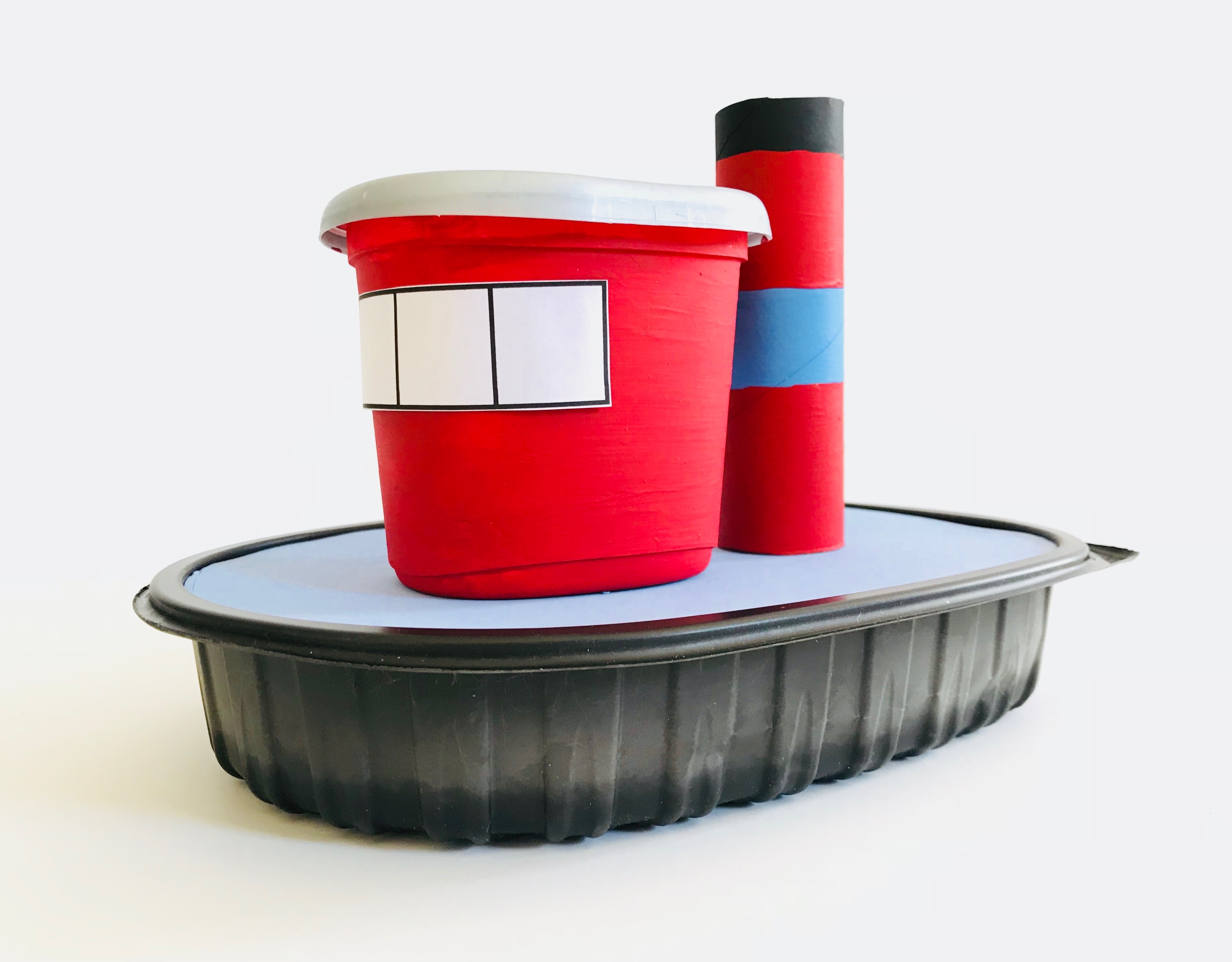
Tugboats are always there when a ship needs help or guidance—just like a parent or caregiver. With a few recycled materials, adults and children can have fun making this Tugboat Bathtub Toy that you’ll love to play with in the tub or pool.

Supplies

  • Printable Windows and Life Ring Template
  • Printable Deck Template
  • Container from a grocery store rotisserie chicken
  • One 16-ounce cream cheese container with lid (or other such container)
  • Paper towel tube
  • Cardboard (can use a cereal box)
  • Foam sheet in whatever color you would like the deck to be. (optional, see To Make the Deck options)
  • Two colors of paint in whatever colors you would like your cabin and deck (if painting it) to be
  • Paint brush
  • Glue gun
  • Tape

celebrate-picture-books-picture-book-review-tug-boat-craft-back

Directions

To Make the Deck

  1. Trace the deck template on the cardboard, cut out and trim if necessary.
  2. Trace the deck template on the foam sheet, cut out and trim if necessary. The foam sheet gives waterproofing to the cardboard deck.

To Make the Boat

  1. Wash and dry rotisserie chicken container. The curved part of the container will be the front of the boat.
  2. Set the cardboard into the rim of the rotisserie chicken container. If needed glue with hot glue gun.
  3. Set the foam sheet on top of the cardboard

To Make the Cabin

  1. Print and cut out the windows, life ring, and deck template
  2. Wash and dry cream cheese container
  3. Paint the cream cheese container in the color chosen, let dry
  4. Put the lid on the cream cheese container to make the roof of the cabin
  5. Glue or tape the windows to one curved side of the cream cheese container
  6. Glue or tape the life ring to the opposite side of the cream cheese container
  7. With the glue gun attach the bottom of the cream cheese container to the deck, a little forward of half-way

To Make the Steam Pipe

  1. Cut a 5-inch section from the paper towel tube
  2. Paint alternating stripes of the deck color and the cabin color, let dry
  3. With the glue gun, attach the steam pipe to the deck close behind, but not touching, the cabin

Enjoy floating your tugboat in the bathtub or pool!

celebrate-picture-books-picture-book-review-bobby-babinski's-bathtub-cover

You can find Bobby Babinski’s Bathtub at these booksellers

Amazon | Barnes & Noble | Books-a-Million

To support your local independent bookstore, order from

Bookshelf | IndieBound

Picture Book Review