February 17 – It’s Black History Month

celebrate-picture-books-picture-book-review-the-faith-of-elijah-cummings-cover

About the Holiday

Black History Month celebrates the achievements and contributions of African Americans in United States History. Originally a week-long observance initiated by writer and educator Dr. Carter G. Woodson in1926 and occurring during the second week in February to commemorate the birthdays of Frederick Douglass and Abraham Lincoln, Black History Month was officially established in 1976 by then president Gerald Ford. The holiday is now celebrated across the country with special events in schools, churches, and community centers.

The theme for 2022 is “Black Health and Wellness” and focuses on the legacy of not only Black scholars and medical practitioners in Western medicine, but also on alternate ways of practicing medicine throughout the African Diaspora. The 2022 theme considers activities, rituals, and initiatives that Black communities engage in to live healthy lives.

To learn more about Black History Month, find information on this year’s events, access resources for more research, and find content for teachers, visit the BlackHistoryMonth.gov

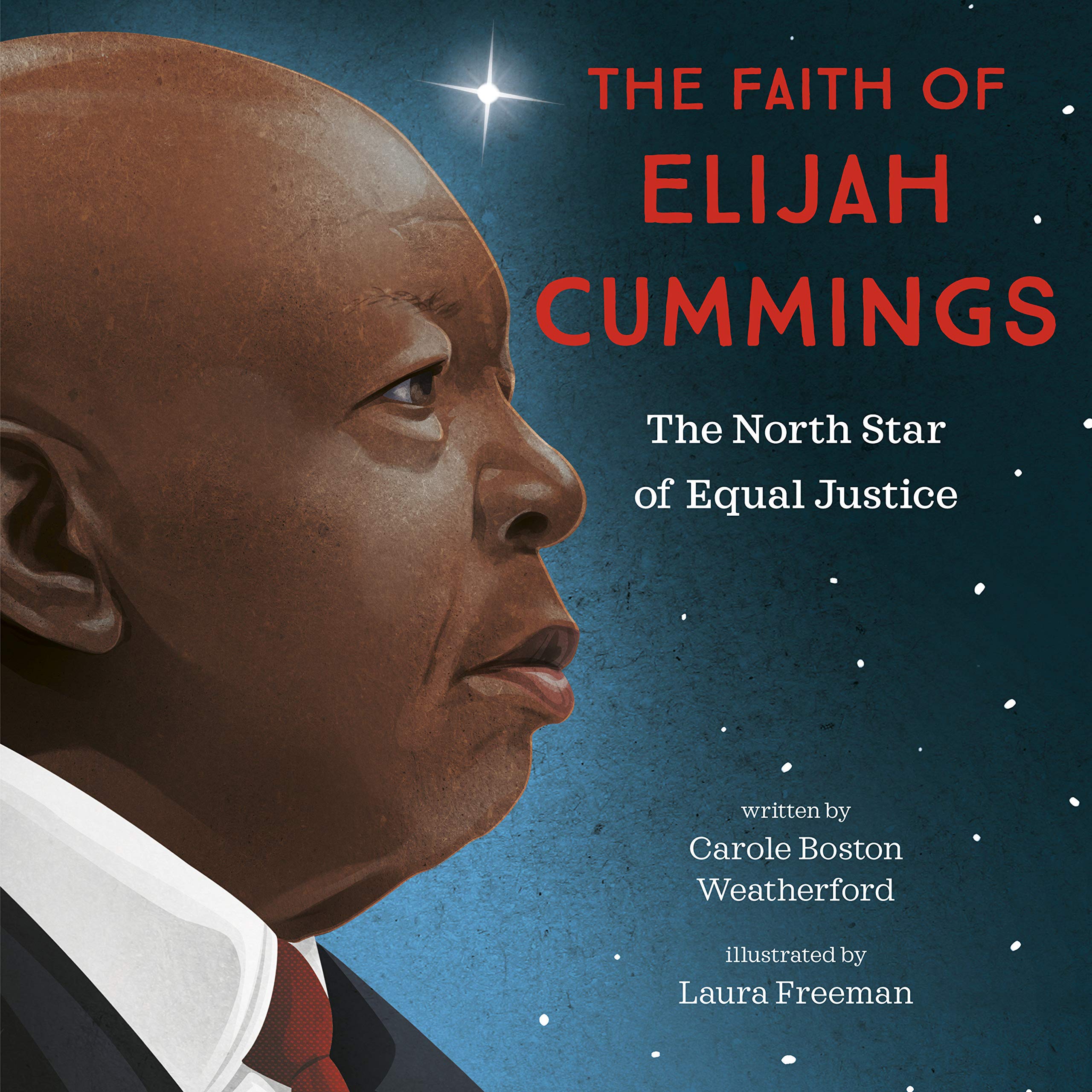
The Faith of Elijah Cummings: The North Star of Equal Justice

Written by Carole Boston Weatherford | Illustrated by Laura Freeman

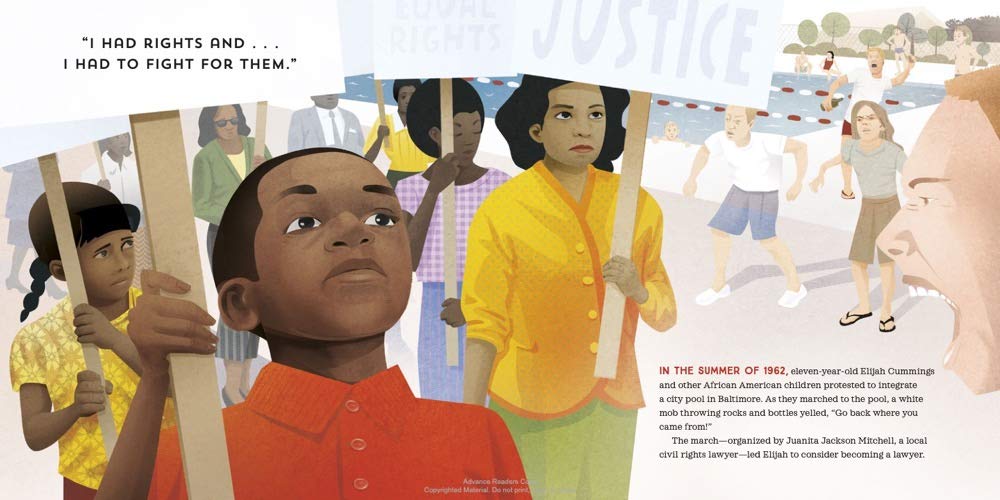
During the summer of 1962, when Elijah Cummings was eleven years old, he and other African American children marched for the integration of a Baltimore city pool. They were met with a white mob who shouted at them to “‘Go back where you came from!'” and threw rocks and bottles at them. This protest, organized by civil rights lawyer Juanita Jackson Mitchell, inspired Elijah to consider becoming a lawyer also.

Elijah’s parents had moved to Maryland from South Carolina in the 1940s, where they had worked the land where their parents had once been enslaved and where “Blacks were beaten for seeking voting rights. Elijah, his parents, and his six siblings lived in a four-room row house, where his mother and father – having only a fourth-grade education – stressed the importance of schooling. But for inquisitive Elijah, the nuts and bolts of reading and writing were elusive. Because of the cramped conditions at home, Elijah took to studying at the library, where the librarians tutored him after their shifts and made it possible for Elijah to succeed.

celebrate-picture-books-picture-book-review-the-faith-of-elijah-cummings-march

Image copyright Laura Freeman, 2022, text copyright Carole Boston Weatherford, 2022. Courtesy of Random House Studio.

Through hard work, scrimping, and saving, Elijah’s parents were able to buy a house with more room and a yard. Here, Elijah’s mother became a preacher and grew her small group of women who met in their home’s basement into a small church, the Victory Prayer Chapel. In addition to leading services, Elijah’s mother lived what she believed by helping those in need. Elijah’s father inspired him to become all that he could be. 

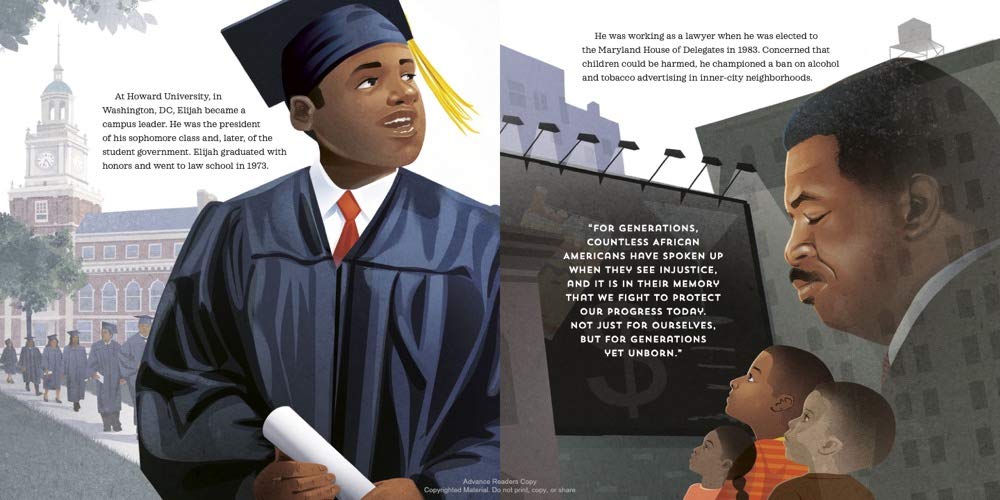
Even as a young boy, Elijah worked hard and, on Sundays after church, he listened to Rev. Martin Luther King’s speeches by transistor radio. He watched as African American boys were put into reform school, and he vowed to become a lawyer, but his high school guidance counselor tried to dissuade him. With the help of his parents and the pharmacist at the drug store where he worked, Elijah attended Howard University, where he was a standout student and leader. He became a lawyer and in 1983 was elected to the Maryland House of Delegates.

celebrate-picture-books-picture-book-review-the-faith-of-elijah-cummings-college

Image copyright Laura Freeman, 2022, text copyright Carole Boston Weatherford, 2022. Courtesy of Random House Studio.

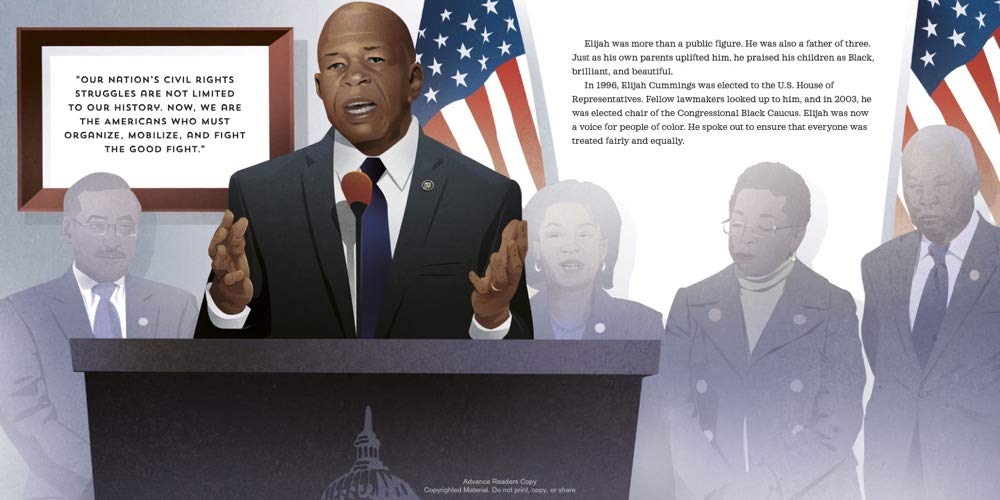
“In 1996, Elijah Cummings was elected to the U.S. House of Representatives,” and later became the chair of the Congressional Black Caucus. “He spoke out to ensure that everyone was treated fairly and equally.” Even though he was a leader in Washington DC, Elijah continued to live in his inner-city Baltimore neighborhood, and during the protests against police brutality in 2015, he appealed for calm as he walked “with residents singing an African American spiritual: ‘This little light of mine, I’m gonna let it shine.'” Before his death in 2019, Elijah Cummings was named chair of the House Committee on Oversight and Reform, where, as he had for his entire career, he advocated for change now and for the future our children will inherit.

Quotes by Elijah Cummings on his inspirations, work, and beliefs included throughout the story allow readers to hear in Cummings’ own words his passion and dedication to creating a more equitable and caring America for all. 

A Foreword reprints remarks given by Speaker of the House of Representatives Nancy Pelosi at Elijah Cummings’ funeral on October 25, 2019. Back matter includes an excerpt of the statement from the Congressional Black Caucus upon Cummings’ death on October 17, a Timeline of his life and work, a Bibliography, and Source Notes for the Cummings’ quotes found throughout the story.

celebrate-picture-books-picture-book-review-the-faith-of-elijah-cummings-house-of-representatives

Image copyright Laura Freeman, 2022, text copyright Carole Boston Weatherford, 2022. Courtesy of Random House Studio.

Carole Boston Weatherford’s moving biography of Elijah Cummings highlights the strong and supportive family unit that inspired and sustained Elijah as he grew from a thoughtful and hardworking boy into an empathetic and influential leader. Her focus on formative events in Cummings’ life depict how early experiences often shape the person children become while continuing to inform their opinions, beliefs, and occupations. Through his own words, Weatherford reveals Cummings’ commitment to the children who will read this biography as well as to all young people who will benefit from and carry on his work.

In her rich and expressive illustrations, Laura Freeman recreates pivotal events, touching examples of the Cummings’ family solidarity, and community-based actions inspired by the family’s religious faith to paint a portrait of Elijah’s youth and young adulthood. As he rises to the highest levels within the US Congress, while never losing touch with the neighborhood and people he loved, Freeman’s striking images will entice readers to learn more about Elijah Cummings’ legislative legacy and the workings of Congress and to, perhaps, become involved in their own community.

A masterful biography of Elijah Cummings that deftly interweaves the internal and external influences of his youth with their lifelong effects on his principles, his work, and his lasting influence, The Faith of Elijah Cummings is highly recommended for home bookshelves and a must for school and public library collections.

Ages 6 – 9 

Random House Studio, 2022 | ISBN 978-0593306505

Discover more about Carole Boston Weatherford and her books on her website.

To learn more about Laura Freeman, her books, and her art, visit her website.

celebrate-picture-books-picture-book-review-the-faith-of-elijah-cummings-cover

You can find The Faith of Elijah Cummings at these booksellers

Amazon | Barnes & Noble | Books-a-Million

To support your local independent bookstore, order from 

Bookshop | IndieBound

Picture Book Review

February 11 – International Women and Girls in Science Day

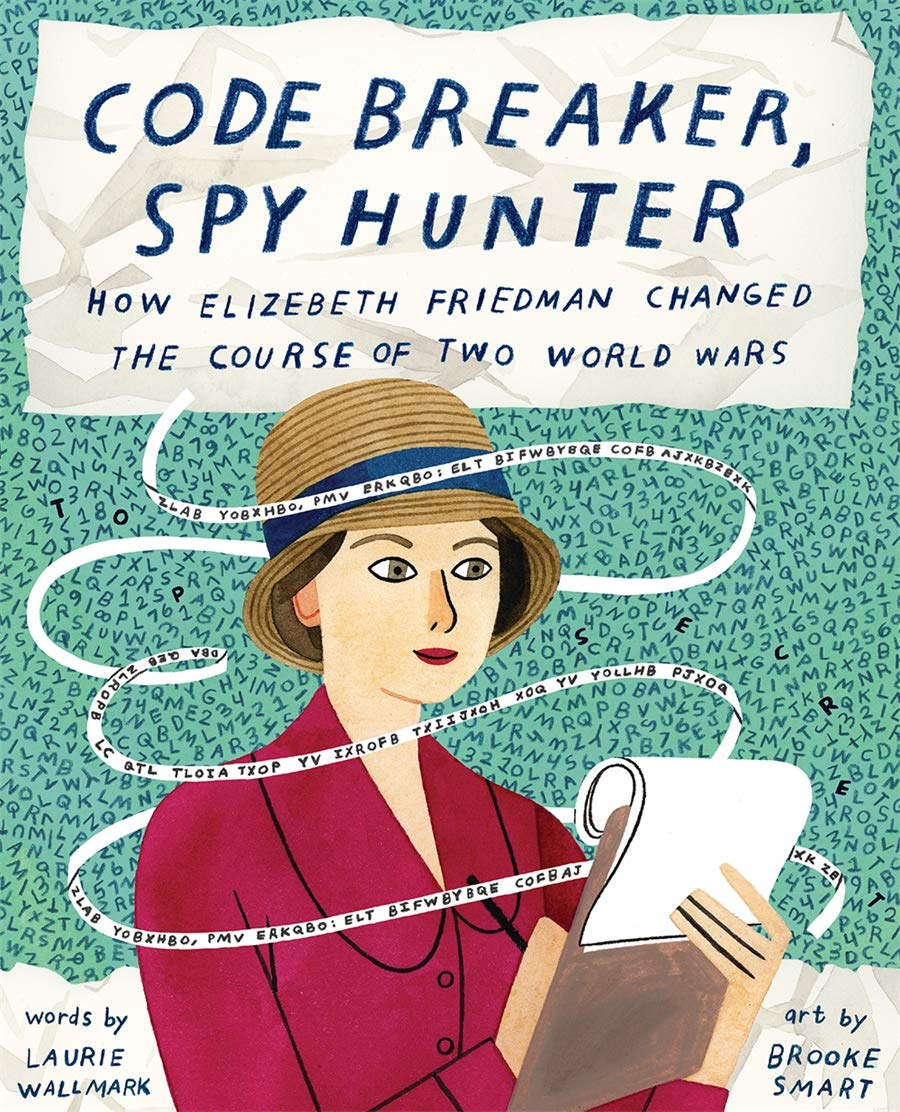
celebrate-picture-books-picture-book-review-code-breaker-spy-hunter-cover

About the Holiday

Gender equality around the world has always been a core issue for the United Nations. As such, on December 22, 2015 the United Nations General Assembly established an International Day to recognize the critical role women and girls play in science and technology. This year’s theme is “Equity, Diversity, and Inclusion: Water Unites Us.” As described in UN reports, by 2030 “billions of people around the world will be unable to access safely managed household drinking water, sanitation, and hygiene services unless access progress rates quadruple. Rising demand, poor management, and failure to conserve water resources, compounded by climate change, represent key challenges, urgently requiring a new sustainable holistic approach to support aligning strategies on water.”

Today’s celebration will bring together women in science and experts from around the world and government officials as well as representatives of international organizations and the private sector to discuss the importance of water in achieving the three pillars of sustainable development – economic prosperity, social justice, and environmental integrity. The program will also feature, for the first time, a unique Ebru Water Art Performance to celebrate the 7th Anniversary of the #February11 Global Movement. To access the virtual assembly, visit womeninscienceday.org. To learn more about today’s initiative as well as videos about past observances, visit the UN website

Thanks to Abrams Books for Young Readers and Blue Slip Media for sending me a copy of Code Breaker, Spy Hunter for review consideration. All opinions of the book are my own. I’m excited to be teaming with them for a giveaway of the book. See details below.

Code Breaker, Spy Hunter: How Elizebeth Friedman Changed the Course of Two World Wars

Written by Laurie Wallmark | Illustrated by Brooke Smart


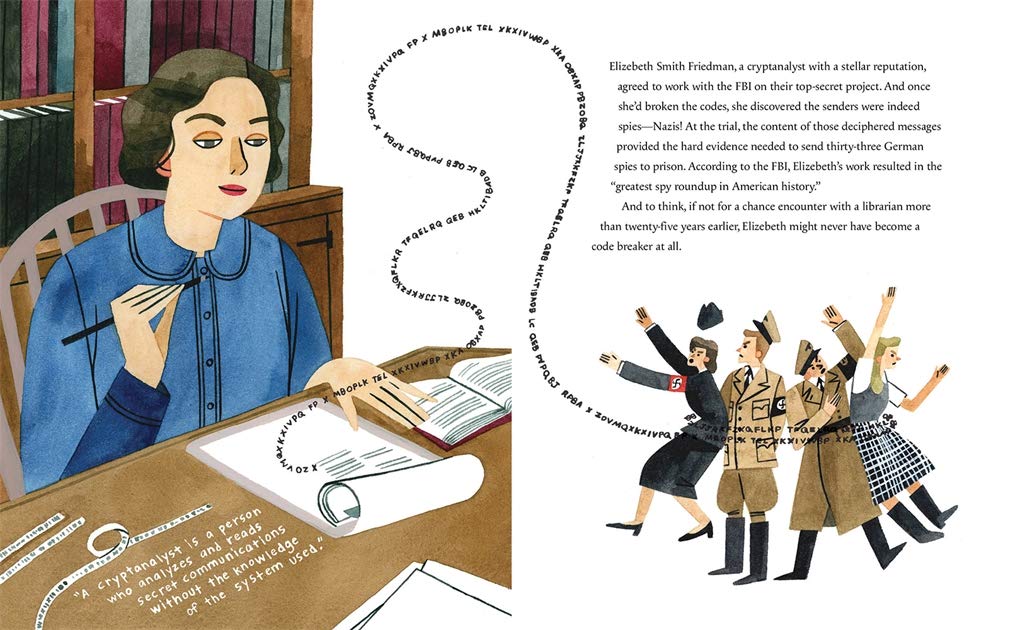
In Code Breaker, Spy Hunter, readers open the cover to an intriguing question: “Could it be? Had enemy spies sneaked into the United States?” World War II was raging, but the United States had not yet joined the effort. And yet the “FBI had intercepted hundreds of coded messages from a secret base in New York.” The problem was no one could read them. Who did the FBI turn to? Elizebeth Smith Friedman, who broke the codes, discovered a cadre of Nazi spies, and provided the evidence “to send thirty-three German spies to prison.” Who was Elizebeth Friedman? Children are about to find out!

celebrate-picture-books-picture-book-review-code-breaker-spy-hunter-cryptanalyst

Image copyright Brooke Smart, 2021, text copyright Laurie Wallmark, 2021. Courtesy of Abrams Books for Young Readers.

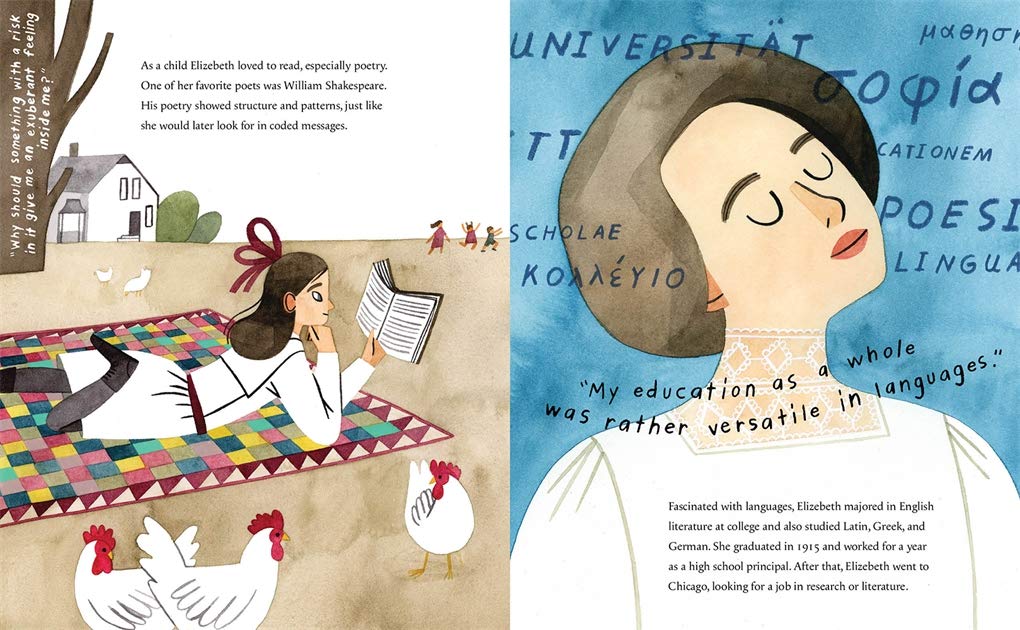
As a child, Elizebeth loved poetry and especially the work of William Shakespeare, with its structure and patterns. In college, she studied English literature, Latin, Greek, and German. While looking for a job in Chicago in 1916, she met the eccentric George Fabyan, who was trying to prove that Francis Bacon was the true writer of Shakespeare’s plays. He hired Elizebeth to “find secret messages Bacon had supposedly hidden in the plays. But the more she explored the plays, the more convinced she became that there were no hidden messages.”

Elizebeth shared her thoughts with a friend, William Friedman, who also loved puzzles and secret codes. Over a year’s time, their discussions resulted in a stronger friendship and finally marriage. In 1917, the US entered World War I and Fabyan asked Elizebeth and William to establish “the country’s first code-breaking unit, the Riverbank Department of Cyphers…. Their methods are now considered the basis for the modern science of cryptology, the study of secret codes.”

celebrate-picture-books-picture-book-review-code-breaker-spy-hunter-childhood

Image copyright Brooke Smart, 2021, text copyright Laurie Wallmark, 2021. Courtesy of Abrams Books for Young Readers.

In 1921, Elizebeth and William moved to Washington D.C., where they worked as code breakers for the Army. At the time, the Army used a large, cumbersome machine to convert messages into code, which precluded soldiers in the field from sending intelligence back. Elizebeth and William invented a complex code that used “only pencil and paper.” After the war, Elizebeth settled down to write books and raise a family, but still the entreaties came to decode messages for court cases sometimes thousands of miles away.

In 1925 with Prohibition the law of the land, smugglers were running rampant. The Coast Guard summoned her, and within three months Elizebeth had cracked “two years of backlogged messages.” Her work and court testimony that helped to convict smugglers made Elizebeth a recognized expert in the new field of cryptology, and when the work became overwhelming for just two people, she created the Coast Guard’s first code-breaking unit.

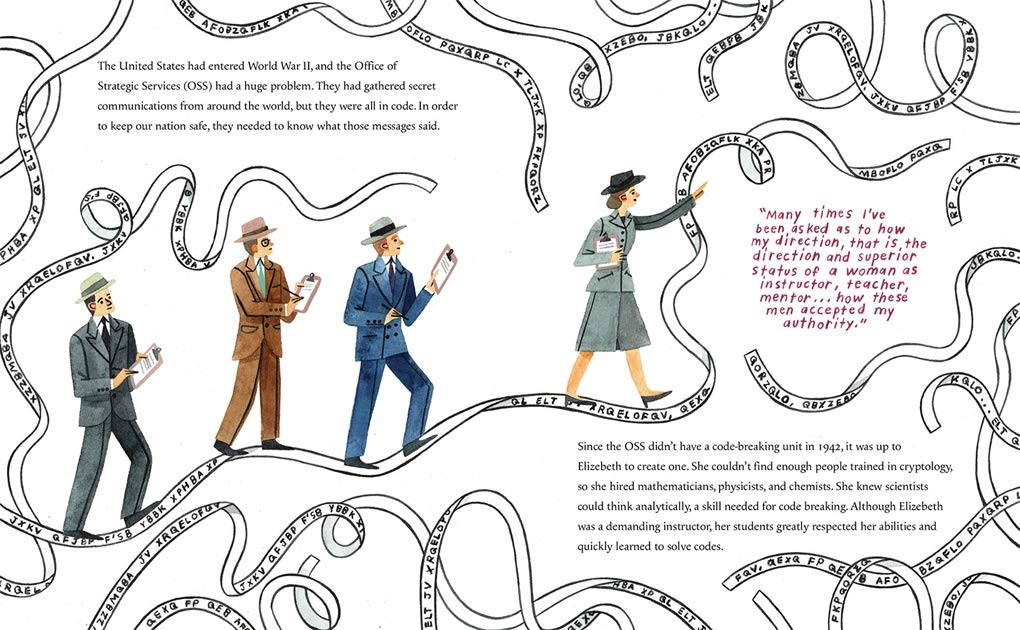
With the entry of the US in World War II, Elizebeth’s expertise was once again needed. Again, she needed to create a code-breaking unit, and in 1942 she hired and taught “mathematicians, physicists, and chemists” the skills of cryptology. Now, Elizebeth’s team was learning important war information about the Nazi’s movements and plans. When the FBI director wanted to nab the spies, Elizebeth recommended waiting “until the military could learn more of the enemy’s secrets.” But he disagreed and raided their hiding place. The spies that escaped quickly changed their codes, making their communications harder to decipher. The FBI director took all the credit for breaking the codes and catching the spies.

celebrate-picture-books-picture-book-review-code-breaker-spy-hunter-world-war-II

Image copyright Brooke Smart, 2021, text copyright Laurie Wallmark, 2021. Courtesy of Abrams Books for Young Readers.

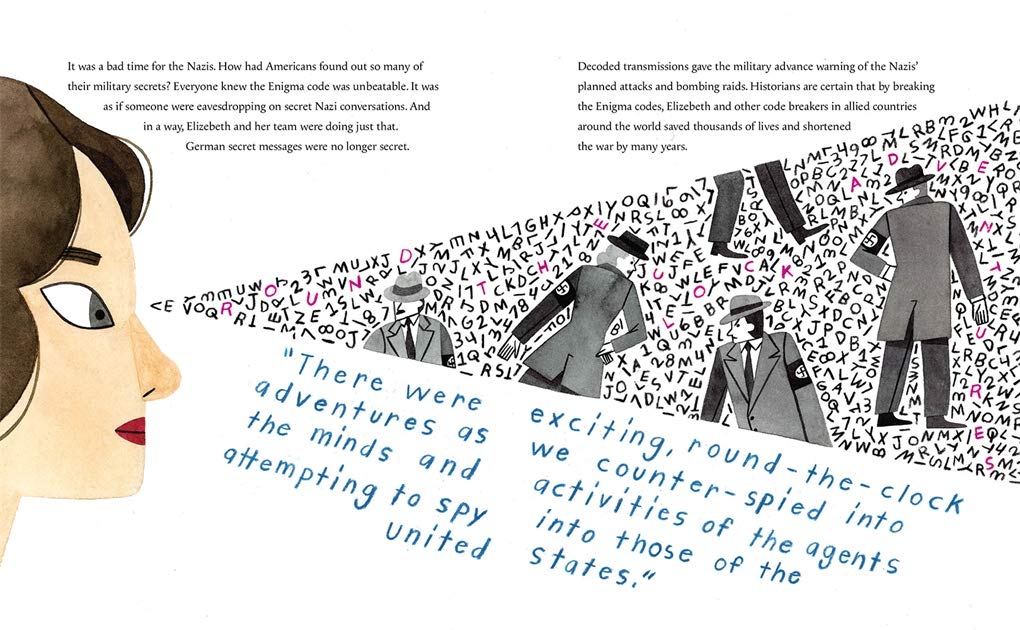
As the war progressed, Elizebeth helped capture an American spy working for the Japanese, and when the Germans developed Enigma, a powerful code-making machine that could “create billions of different cipher alphabets, it was Elizebeth’s team that broke the code for the United States. In Allied countries around the world, other cryptologists were also decrypting Enigma messages. The Nazis were now at a disadvantage, their planned attacks thwarted. Historians believe the work of these code breakers “saved thousands of lives and shortened the war by many years.”

Throughout her life Elizebeth could not speak a word about her work, even to her family. It was classified as Top Secret Ultra by the government and kept locked in the National Archives. At last, in 2015, Elizebeth’s work was declassified. “She is now considered one of the most gifted and influential code breakers of all time.”

celebrate-picture-books-picture-book-review-code-breaker-spy-hunter-counter-spied

Image copyright Brooke Smart, 2021, text copyright Laurie Wallmark, 2021. Courtesy of Abrams Books for Young Readers.

Compelling and wonderfully detailed, Laurie Wallmark’s biography of Elizebeth Friedman immerses children in the world of war-time spies, where cracking codes equaled saved lives and battles won. Wallmark’s storytelling of Elizabeth’s trajectory from Shakespeare scholar to ultra-secret code cracker reads like a thriller and is sprinkled throughout with quotes from Elizebeth that give kids a sense of her personality and the demands of her career. By including several cases Elizebeth was instrumental in solving, Wallmark provides readers with historical context on the broad range of nefarious activity that relied on secret codes to inform their knowledge of today’s uses of encryption as well as international spy networks. Each page is a celebration of Elizebeth’s talent, intelligence, and accomplishments, and her incredible story will enthrall readers.

Brooke Smart’s watercolor and gouache illustrations offer enticing glimpses into the past while following Elizebeth as she meets George Fabyon who shows her around his museum-like house while carrying a small monkey on his shoulder, establishes the United States’ first code-breaking unit, testifies in court, and thwarts the Nazis’ war plans. Interspersed with Smart’s realistic depictions of Elizebeth’s life are images in which lines of coded messages snake across the page, giving readers a look at the kinds of unreadable text Elizebeth and her teams cracked. In addition to presenting a visual representation of the tangled communications that eventually nabbed our enemies, two of these clever illustrations contain messages of their own.

A superlative biography that would enhance any history, social studies, language arts, or STEM curriculum as well as captivate kids who love spy, military, and detective stories, Code Breaker, Spy Hunter: How Elizebeth Friedman Changed the Course of Two World Wars is highly recommended for home bookshelves and is a must for school and library collections.

Ages 7 – 11

Abrams Books for Young Readers, 2021 | ISBN 978-1419739637

Discover more about Laurie Wallmark and her books on her website.

To learn more about Brooke Smart, her books, and her art, visit her website.

International Women and Girls in Science Day Activity

celebrate-picture-books-picture-book-review-pig-pen-cipher

Send a Secret Message


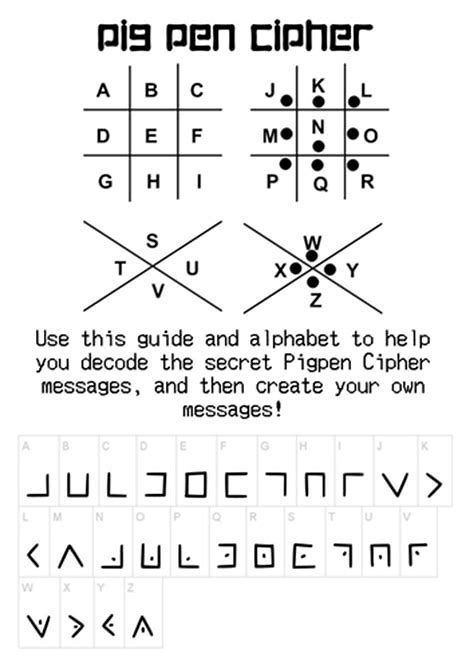
Would you like to be a code breaker – or a spy? Get started with this Pigpen Cipher that makes sending secret messages to friends, siblings, and other family easy and fun. This ancient code is called the Pigpen Cipher because each letter is in its own “pen.” Use it as originally developed then try mixing the letters and pens to create new codes. 

Pigpen Cipher Key

celebrate-picture-books-picture-book-review-code-breaker-spy-hunter-cover

You can find Code Breaker, Spy Hunter at these booksellers

Amazon | Barnes & Noble | Books-a-Million

To support your local independent bookstore, order from 

Bookshop | IndieBound

Picture Book Review
January 27 – International Holocaust Remembrance Day

celebrate-picture-books-picture-book-review-anne-frank-the-girl-heard-around-the-world-cover

About the Holiday

International Holocaust Remembrance Day was officially declared in November 2005 by the United Nations General Assembly. Every year on January 27th, “UNESCO pays tribute to the memory of the victims of the Holocaust and reaffirms its unwavering commitment to counter antisemitism, racism, and other forms of intolerance that may lead to group-targeted violence.” The date marks the day that the Nazi Concentration and Extermination Camp of Auschwitz-Birkenau was liberated by Soviet troops in 1945. This year commemorates the 77th anniversary of the liberation. This year UNESCO is presenting a series of mostly online events, including a commemoration ceremony, a panel discussion on the legacy of Jewish artists who died during the Holocaust and the United Nations, and a photography exhibition titled Generations: Portraits of Holocaust Survivors by the Royal Photographic Society of Great Britain, showcasing over 50 contemporary photos of Holocaust survivors and their families. To learn more about how to watch the events, visit the UNESCO International Holocaust Remembrance Day website. You can also find many excellent resources and personal stories on the United States Holocaust Museum website.

Anne Frank: The Girl Heard Around the World

Written by Linda Elovitz Marshall | Illustrated by Aura Lewis


“All her life, Anne Frank wanted to be heard. Really, truly heard.” But sometimes no matter how loudly or entertainingly she talked, no one listened or seemed to understand. Anne’s family, “like many other Jewish families, had lived in Germany for centuries,” but when Adolf Hitler began to govern the country, Jewish families were in danger. When Anne was four years old, her family, hoping to find safety, moved to Amsterdam in the Netherlands. Here, Anne lived happily, “making mischief with her friends, telling jokes, and having fun. “In school, she talked and talked.”

celebrate-picture-books-picture-book-review-anne-frank-the-girl-heard-around-the-world-portrait

Image copyright Aura Lewis, 2020, text copyright Linda Elovitz Marshall, 2020. Courtesy of Orchard Books.

But in 1940, Hitler and his Nazi’s took over the Netherlands too, and life for Jewish people living there was no longer safe. Anyone who talked against the Nazis could be arrested, but Anne needed to express her opinions. On her 13th birthday Anne received a red plaid diary; she named it “Kitty.” In Kitty, Anne could share all of her thoughts and feelings about what was happening in her country. She wrote about the rules that restricted Jews from normal life, that made all Jews wear a yellow star that distinguished them from others. But Anne also wrote about school and other subjects. “Anne realized that by writing, she could speak her mind in a new way. She could really, truly be heard.”

celebrate-picture-books-picture-book-review-anne-frank-the-girl-heard-around-the-world-childhood

Image copyright Aura Lewis, 2020, text copyright Linda Elovitz Marshall, 2020. Courtesy of Orchard Books.

Then on a morning in 1942, Anne’s mother woke her, telling her that they needed to leave quickly and hide. Anne “packed her most treasured things.” Her diary was the first thing she packed. She and her family as well as four other people hid in a secret room in the warehouse where Anne’s father worked. Non-Jewish friends who also worked in the warehouse brought them food and supplies. While Anne tried to make the best of her life in hiding, she was lonely and always careful to whisper and tiptoe so the other workers in the factory did not discover them.

celebrate-picture-books-picture-book-review-anne-frank-the-girl-heard-around-the-world-writing

Image copyright Aura Lewis, 2020, text copyright Linda Elovitz Marshall, 2020. Courtesy of Orchard Books.

Now, Anne’s diary was even more important to her. In Kitty she wrote about her fears and feelings, her days and the things she missed. “She wrote about wishing people could live together, in peace,” and Kitty “was always there to listen, always there to understand.” Anne also wrote stories about a teddy bear, a fairy, and a caring grandmother. Once, water seeped in and soaked her diary. Anne rushed to hang the pages to dry. Anne wrote and wrote for two years. She hoped to publish a book about her experience.

celebrate-picture-books-picture-book-review-anne-frank-the-girl-heard-around-the-world-crying

Image copyright Aura Lewis, 2020, text copyright Linda Elovitz Marshall, 2020. Courtesy of Orchard Books.

“But on August 4, 1944, Nazi police discovered the secret hiding place.” Anne, her family, and all of the people living in the warehouse room were taken away. “One of their non-Jewish friends found Anne’s diary and writings and kept them safe,” hoping to return them to her. But just weeks before the war ended in 1945, Anne died. Anne’s father was the only one to survive. After the war ended, Anne’s father fulfilled her dream and published Anne Frank: The Diary of a Young Girl. Anne’s book has been read by people around the world and continues to speak for her in the hearts of readers everywhere.

Back matter includes more about Anne, her family, the Nazis and how Anne’s diary was saved; a timeline of Anne’s family, the rise of Hitler, and the war years; an Author’s Note; and lists of sources, suggested further reading, and websites.

celebrate-picture-books-picture-book-review-anne-frank-the-girl-heard-around-the-world-world-reads

Image copyright Aura Lewis, 2020, text copyright Linda Elovitz Marshall, 2020. Courtesy of Orchard Books.

Linda Elovitz Marshall’s moving telling of Anne Frank’s life and dreams, focusing on her beloved diary will resonate with children, who, like Anne, want to be heard. In her evocative storytelling, Marshall creates a rich portrait of Anne as a vivacious child who was also smart and thoughtful. Mirroring the devastating disruptions in Anne’s and her family’s life, Marshall intersperses pages of straightforward text which describes the rise of Hitler and the Nazis and emphasizes ways in which they restricted and silenced the Jewish population, reinforcing her book’s theme. The examples Marshall gives—riding bikes, going to the movies, having to wear an identification star—will impress upon children the changes in Anne’s life.

When Anne and her family move to the Secret Annex, Marshall superbly reveals the conditions of their confinement through Anne’s writing and how her diary was her lifeline and her confidant. The family’s eventual discovery is written factually but with sensitivity, fitting for picture book readers. The final spread honors the influence Anne Frank has had on the world with her diary—her voice that could not be silenced.

In Aura Lewis’s emotionally resonant illustrations, readers first meet Anne Frank in a snapshot that shows her as kind, thoughtful, and seemingly wise beyond her years. Vibrant scenes of Anne with her family in Germany and later with family and friends in Amsterdam give way to somber, gray-toned images that reflect Hitler’s takeover and the dangers Anne, her family, and all Jewish people faced. Lewis clearly sketches Anne’s childhood enthusiasms and hope and, especially, her pleasure at receiving her diary. Also, readily recognizable are Anne’s feelings of fear, frustration, and sadness. Lewis portrays Anne in signature orange and plaid, reflecting the deep interconnection between Anne and her diary. This visual metaphor is then carried onto the final spread, where a variety of people of all ages read Anne Frank: The Diary of a Young Girl.

An excellent book to introduce young children to Anne Frank, a most influential and inspiring young girl, Anne Frank: The Girl Heard Around the World would be a meaningful addition to home bookshelves and is a must for school and public library collections.

Ages 6 – 8

Orchard Books, 2020 | ISBN 978-1338312294

Discover more about Linda Elovitz Marshall and her books, visit her website.

To learn more about Aura Lewis, her books, and her art, visit her website.

National Dear Diary Day Activity

celebrate-picture-books-picture-book-review-anne-frank-word-search

Anne Frank and Her Diary Word Search


Find the twenty words associated with Anne Frank, her life, and her diary in this printable puzzle

Anne Frank and Her Diary Word Search Puzzle | Anne Frank and Her Diary Word Search Solution

celebrate-picture-books-picture-book-review-anne-frank-the-girl-heard-around-the-world-cover

You can find Anne Frank: The Girl Heard Around the World at these booksellers

Amazon | Barnes & Noble | Books-a-Million

To support your local independent bookstore, order from

Bookshop | IndieBound

Picture Book Review

December 28 – Endangered Species Act Day

celebrate-picture-books-picture-book-review-a-voice-for-the-everglades-cover

About the Holiday

The Endangered Species Act was signed into law in by President Richard Nixon on this date in 1973.  The primary law in the United States for protecting imperiled species, the Act protects critically imperiled species from extinction as a result of the consequences of economic growth and development undeterred by concern for conservation. The US Supreme Court called it “the most comprehensive legislation for the preservation of endangered species enacted by any nation”. The purposes of the Endangered Species Act are to prevent extinction and to recover species to the point where the law’s protections are not needed, therefore protecting diverse species as well as the ecosystems in which they live or depend on. Today’s book reveals the story of a National Park that provides a unique refuge for many rare and endangered species. To celebrate the holiday, learn more about how the Endangered Species Act affects your state.

Thanks go to Albert Whitman & Company for sharing a copy of A Voice for the Everglades: Marjory Stoneman Douglas with me for review consideration. All opinions on the book are my own.

A Voice for the Everglades: Marjory Stoneman Douglas (Part of the She Made History Series)

Written by Vicki Conrad | Illustrated by Ibon Adarne and Rachel Yew


“Long ago a trickle of water / spilled from a lake / and formed a tiny stream.” The stream spread until it covered almost half of the state of Florida, creating a shallow lake that moved like a slowly running river – “a river bursting with wildlife, / whispering to the world / to listen, to notice, to discover its wonders.” Mangroves and cypress trees grow from the water, the soil fed by the cycles of growing and dying sawgrass. The water, trees, and grass attract a “rainbow of birds” that wade in the shallows, hunting for food. “These are the Everglades. / The wildest, richest, and most diverse ecosystem in all the world – / every plant and animal needing another to survive.”

celebrate-picture-books-picture-book-review-a-voice-for-the-everglades-stream

Image copyright Ibon Adarne and Rachel Yew, 2021, text copyright Vicki Conrad. Courtesy of Albert Whitman & Company.

But leaders and developers wanted to drain the water to create land to build on, land they could sell, land with which they could make money. They pumped the water out and built dams and drains to make farmland, but the farmland turned dry and burned easily. The animals and birds fled. The ecosystem was “desperate for a voice to protect them.”

When Marjory traveled from Massachusetts to Florida and saw the beautiful scenery, she knew immediately that this was her new home. She made a friend, Ernest, and together they spent time paddling a boat through the Everglades, “watching whirling wheels of white birds dance” and spying panthers, alligators, turtles, manatees, and more of the animals that lived there. Where other people saw a swamp, Marjory and Ernest saw “treasure.”

Marjory and Ernest wanted to do something to preserve the Everglades. They studied the map and the formation of the Everglades. Marjory called it “a river of grass.” Ernest wrote a bill for the United States Congress to consider, and “Marjory wrote a poem, / hopeful it would move Congress.” Although lawmakers did tour the Everglades and see its miraculous sights, the bill did not pass.

celebrate-picture-books-picture-book-review-a-voice-for-the-everglades-train

Image copyright Ibon Adarne and Rachel Yew, 2021, text copyright Vicki Conrad. Courtesy of Albert Whitman & Company.

Marjory decided to write a book about the area she loved, and in 1947 The Everglades: River of Grass was published. Her book helped people see the marvels that lived within the Everglades: “the manatee munching seagrass / protecting her calf from harm”; “the red-bellied turtle, / laying eggs in the abandoned alligator nest, / dry and protected from water.”; the only place in the world where an alligator and a crocodile live together.”

At last people began to take notice – and care. Their voices joined with Marjory’s and Ernest’s and Everglades National Park was established that same year. “Yet only one-fourth of the Everglades was protected.” Marjory understood that “all the ecosystems needed one another.” When plans to build the world’s largest airport on land that was part of the Everglades, Marjory, now eighty years old, established the Friends of the Everglades, and their three-thousand voices convinced President Richard Nixon to stop the building.

Marjory continued to fight for the Everglades, giving speeches and putting hecklers in their place. When she was ninety-nine years old, Marjory could be found chipping away at a concrete drain to restore the land to its former waterway. At 105 years old, Marjory was awarded the Presidential Medal of Freedom. Adults and children sent her letters thanking her for saving the Everglades, but Marjory knew there would always be more work to be done to protect this unique ecosystem.

Back matter includes an extensive, illustrated discussion of the Everglades ecosystem, the nine different habitats that make it such a unique area, and many of the plants, animals, birds, and fish that call it home. More on the life of Marjory Stoneman Douglas and her legacy as well as how readers can help the Everglades are also included.

celebrate-picture-books-picture-book-review-a-voice-for-the-everglades-national-park

Image copyright Ibon Adarne and Rachel Yew, 2021, text copyright Vicki Conrad. Courtesy of Albert Whitman & Company.

A compelling biography of a woman with vision and grit who took on a nearly impossible task and saved one of the world’s unique environmental treasures, A Voice for the Everglades: Marjory Stoneman Douglas will inspire young environmentalists and would serve as a captivating resource to begin studies about ecosystems, conservation, endangered and rare species, and many other topics revolving around nature science. Marjory Stoneman Douglas, whose perseverance, dedication, and voice still resonate today, continues to be a role model for children and adults alike.

Through Vicki Conrad’s lyrical text and light incorporation of a “This is the House that Jack Built” cadence readers see how people’s actions build on and affect each other – whether detrimentally (as the building plans; pumps, dams, and drains; and disappearing wildlife do) or beneficially (as Marjory’s and Ernest’s appeals to Congress, Marjory’s writings, and her continued advocacy do) and understand that once voice can make a difference. Conrad does an excellent job of portraying the beauty and uniqueness of the Everglades and giving kids a view of the many wonders to be found there.

In their vivid illustrations, Ibon Adarne and Rachel Yew depict the rich colors of the diverse flora and fauna found in the nine cohesive habitats, from the vibrant pink roseate spoonbills to the purple passion flowers to the elusive crocodiles and the breathtaking, fiery sunsets that blanket them all. Adarne and Yew also allow children to navigate the meandering waterways that weave through the mangroves and sawgrass in their slow, steady, and life-giving pace. The breadth of wildlife within the pages offer many opportunities for further learning and research at home and at school.

An enticing and educational look at one of the world’s most valued natural treasures – whose story and resources continues to influence nature studies and advocacy today – A Voice for the Everglades: Marjory Stoneman Douglas is a book that every school and public library will want to add to its collection and would be an inspiring inclusion for home bookshelves for nature lovers and homeschoolers.

Ages 4 – 8

Albert Whitman & Company, 2021 | ISBN 978-0807584965

Discover more about Vicki Conrad and her books on her website.

You can connect with Ibon Adarne on Twitter.

You can connect with Rachel Yew on Twitter.

Endangered Species Act Day Activity

celebrate-picture-books-picture-book-review-everglades-national-park-coloring-page

Everglades National Park Coloring Page


Travel to the Everglades and see the diverse wildlife that lives there with this printable coloring page!

Everglades National Park Coloring Page 

celebrate-picture-books-picture-book-review-a-voice-for-the-everglades-cover

You can find A Voice for the Everglades: Marjory Stoneman Douglas at these booksellers

Amazon | Barnes & Noble | Books-a-Million

To support our local independent bookstore, order from 

Bookshop | IndieBound

Picture Book Review

December 7 – National Letter Writing Day

celebrate-picture-books-picture-book-review-dear-mr-dickens-cover

About the Holiday

Many young wishers know all about writing letters in December, so it should come as no surprise that a letter-writing day be included in this month’s calendar. Today’s holiday celebrates all forms of personal communication written by hand and remembers correspondences from the past that have given us such insight into our favorite poets, novelists, historical figures, and more. Sure, email might be faster, but there’s a certain luxury in taking the time to write your thoughts on paper as well as an palpable excitement in holding a heartfelt letter in your hands. Today’s book also reminds us that letters can often change minds, hearts, and actions.

Dear Mr. Dickens

Written by Nancy Churnin | Illustrated by Bethany Stancliffe


Like most people at the time, Eliza Davis looked forward to every new story Charles Dickens published in his weekly magazine, All the Year Round. And when he began publishing books, she eagerly read those too. “What made Charles Dickens a hero in Eliza’s eyes is that he used the power of his pen to help others.” After people read about the harsh conditions children faced at workhouses, they demanded change. And when they “were moved to tears by tales of families struggling in desperate, dirty conditions, they gave what they could to charities. As did Eliza.” 

But while reading Oliver Twist, there was one aspect of the story that distressed Eliza. As a follower of the Jewish faith, she was disturbed by Dickens’ portrayal of Fagin as an “‘old shriveled Jew'” who taught Oliver how to steal. Fagin was “described…as dishonest, selfish, cruel, and ugly.” And each time she read “the Jew,…the word hurt like a hammer on Eliza’s heart.” Prejudice against Jews in England was already bad, and Eliza felt Dickens’ stories would made conditions worse.

celebrate-picture-books-picture-book-review-dear-mr-dickens-stories

Image copyright Bethany Stancliffe, 2021, text copyright Nancy Churnin, 2021. Courtesy of Albert Whitman & Company.

She decided to write a letter to Charles Dickens, but she worried about his reaction. In her letter she said that his “portrayal of Fagin encouraged ‘a vile prejudice.’ She asked him to ‘atone for a great wrong.'” As she posted her letter, she wondered if she would get a response. About two weeks later, Eliza did receive an answer to her letter. In it Dickens replied that Fagin was based on real criminals and that there there were “other bad people in the book who are not Jewish.” He took exception to her request to atone by saying that “any Jewish people who thought him unfair or unkind…were not ‘sensible’ or ‘just’ or ‘good tempered.'”

Eliza was disheartened as she read the letter, and she sat down and composed another letter in response. Thinking of Dickens’ story A Christmas Carol, Eliza reminded him of his past love for the novel Ivanhoe, which included positive, noble Jewish characters. She mentioned his present novel, in which while “some of his non-Jewish characters were criminals, all his Jewish characters were criminals.” Then she stated that future readers would “judge him by how he judged others.”

This time Eliza did not receive an answer. She knew that Dickens was working on a new novel, and when it began to appear serialized in monthly installments, she hurried to buy them, wondering if there would be other Jewish characters and how they would be depicted. When, as she read Our Mutual Friend, she realized Dickens had included another Jewish character, she trembled, wondering what they would be like. 

celebrate-picture-books-picture-book-review-dear-mr-dickens-change

Image copyright Bethany Stancliffe, 2021, text copyright Nancy Churnin, 2021. Courtesy of Albert Whitman & Company.

Eliza was elated to see that Mr. Riah – named after the Hebrew word for friend, re’a – was “generous and loyal” and that a young girl he helps remarks about the Jews, “‘I think there cannot be kinder people in the world.'” She immediately sat down to pen another letter to Charles Dickens. This one thanking him for his great compliment to her and the Jewish people. He wrote back with much pleasure and revealed that in the future he wanted his work to reflect his true friendship with Jewish people.

To show his sincerity, he published essays condemning prejudice and in the reprint of Oliver Twist, he replaced mentions of “the Jew” with Fagin’s name so as to “make it clear that Fagin didn’t represent all Jewish people.” Eliza sent Charles Dickens one more letter – this time with the gift of an English-Hebrew Bible – praising his ability to right a wrong, and Dickens responded with one more letter thanking Eliza for speaking up.

An extensive Author’s Note reveals more about the history of prejudice against Jewish people in England from the 1200s until 1846, when attitudes began to change and a repressive law was repealed. Nancy Churnin also includes more details about Eliza Davis the communications between her and Charles Dickens, and Dickens’ daughter upon his death. Source Notes and acknowledgments are also included.

celebrate-picture-books-picture-book-review-dear-mr-dickens-jewish-characters

Image copyright Bethany Stancliffe, 2021, text copyright Nancy Churnin, 2021. Courtesy of Albert Whitman & Company.

Nancy Churnin’s compelling story about the facts surrounding the correspondence between Eliza Davis and Charles Dickens shines a spotlight on a little-known, but important series of events in the life and inspiration behind Dickens’ growth and responsiveness as a writer. Eliza Davis, who acted on her convictions with confidence and courage, makes an inspiring role model for children who may want to voice their opinions on wrongs they see, read, or hear about.

Churnin’s introduction of A Christmas Carol, a novel that most children and adults know, allows readers to understand the important and influential connection between a person’s thoughts, words, and writing and their actions. It also provides a deeper resonance to Eliza Davis’s reminder to Dickens of his past, present, and future and to Dickens own change of heart from his first reply to Eliza to his portrayal of the Jewish character in Our Mutual Friend and his other actions.

Bethany Stancliffe takes readers back to the the 1800s in her rich illustrations full of details of the period. Kids will be interested to see how authors published their work at the time. Her faithful depictions of Eliza Davis and Charles Dickens informs readers on the influence that a young person had on such an established and lauded author. Eliza’s pleasure in Dickens’ stories and her pain on encountering the prejudicial portrayal of Jewish characters is clear, which makes her dilemma all the more meaningful. The final spread, in which Eliza Davis and Charles Dickens, facing each other, are connected by the letters they exchanged.

An important story about a beloved author and the woman who influenced his work and life, Dear Mr. Dickens will spark conversations on issues of prejudice, standing up for ones beliefs, personal change, courage to address wrongs, and many other topics. The book is highly recommended for home bookshelves and a must for school and public libraries.

Ages 4 – 8

Albert Whitman & Company, 2021 | ISBN 978-0807515303

Discover more about Nancy Churnin and her books on her website.

To learn more about Bethany Stancliffe, her books, and her art, visit her website.

National Letter Writing Day Activity

picture-book-reviews-quill-pen-craft

Fashion a Quill Pen


Writing a proper letter is more fun with a fancy pen! you can fashion your own quill pen or liven up a ballpoint pen or a marker with this craft!

Supplies

  • Medium to large size feather with quill, available at craft stores (optional)
  • Ballpoint pen or marker (optional)
  • Clay, oven-bake or air-dry, in various colors if desired
  • Wire, beads, paint, and/or markers for decorating     
  • Scissors
  • Baking pan for oven-bake clay

Directions

  1. Roll clay 2 ½ inches to 4 inches long 
  2. Push the quill end of the feather into the clay OR cover the ballpoint pen or marker in clay
  3. Add bits of clay or roll sections of the clay between your fingers to give the clay shape
  4. To make the twisted shape pen, twist the length of clay around itself before adding the feather
  5. Shape the end or cut it with scissors to make the pointed writing nib
  6. If using air-dry clay: Add beads and/or wire and let clay dry around feather
  7. If using oven-bake clay: Add beads and other layers of clay before baking then carefully remove feather. Bake clay according to package directions
  8. Add wire and other decorations after clay has baked and cooled
  9. Reinsert feather into clay

celebrate-picture-books-picture-book-review-dear-mr-dickens-cover

You can find Dear Mr. Dickens at these booksellers

Amazon | Barnes & Noble | Books-a-Million

To support your local independent bookstore, order from

Bookshop | IndieBound

Picture Book Review
December 3 – International Day of Persons with Disabilities

celebrate-picture-books-picture-book-review-we-want-to-go-to-school-cover

About the Holiday

Today we honor International Day of Persons with Disabilities, a holiday that raises awareness for people of different physical and mental abilities across the globe. The day was proclaimed an international holiday in 1992 by the United Nations in order to appreciate members of our society who are often marginalized or ignored because of their different abilities. Today we recognize the importance of creating a world in which everyone feels like an active, respected member and cultivating a society that is accessible and designed for all of us. To celebrate International Day of Persons with Disabilities learn more about the fight for disability education rights or talk to someone you know with a disability about their experiences. You can also visit the IDPWD website to learn about available services, resources, and how you can get involved. We Want to Go to School! is a perfect way to start a conversation with a child about education equality for people with disabilities.

Thank you to Albert Whitman & Company for sharing a copy of We Want to Go to School! with me for review consideration. All opinions on the book are my own.

Review by Dorothy Levine

We Want to Go to School!: The Fight for Disability Rights

Written by Maryann Cocca-Leffler | Illustrated by Janine Leffler


When Janine was born with a disability called cerebral palsy, she had lots of teachers to help her learn. With the aid from different instructors who helped build her speech, her muscles, and her hand coordination, Janine was able to learn, play, study, and graduate school with the rest of her peers. This would not have been true, however, had she been born a decade earlier. Before 1971, millions of kids with disabilities were banned from attending public schools.

celebrate-picture-books-picture-book-review-we-want-to-go-to-school-early-1970s

Image copyright Janine Leffler, 2021, text copyright Maryann Cocca-Leffler, 2021. Courtesy of Albert Whitman & Company.

Janine explains that the people in charge claimed that children with disabilities shouldn’t go to school with everyone else because it would take too much money to fund education for them, and that those with disabilities would distract the other children. They even tried to say children with disabilities wouldn’t be able to learn. The real reason so many children with disabilities had to stay home or in hospitals instead of going to school was because of people’s prejudice.

Many parents of Black children had also experienced discrimination when they were in school. Before 1954, Black children had to go to separate schools that were not given nearly as many resources or good teachers as the white kids received in public schools. Similarly, children with disabilities in some places could take a test to go to public school, but they then were placed in separate, or segregated, classrooms and not given the same quality of education as the other kids. “But in 1971 in Washington, DC, seven school-age children were tired of hearing NO! They wanted to go to school too.” When other families heard about the lawsuit these seven families had started, they joined in too.

celebrate-picture-books-picture-book-review-we-want-to-go-to-school-1971

Image copyright Janine Leffler, 2021, text copyright Maryann Cocca-Leffler, 2021. Courtesy of Albert Whitman & Company.

So many children were not receiving public education because of disabilities, that all together they could file a class action lawsuit, “which meant that it stood up for a lot of children. And I mean a LOT! 18,000 students from the Washington, DC, area were also not receiving a public education because of their disabilities. Try to imagine 18,000. Then try to imagine 8,00,000 (8 million)! That’s how many children in the United States weren’t getting an education because they had disabilities.”

celebrate-picture-books-picture-book-review-we-want-to-go-to-school-families

Image copyright Janine Leffler, 2021, text copyright Maryann Cocca-Leffler, 2021. Courtesy of Albert Whitman & Company.

Joseph C. Waddy, the judge on the case took eleven long months to deliberate over his decision – “On the one hand, he knew that it would cost a lot of money to provide an education to these children. On the other hand, shouldn’t schools be spending their money on ALL children?” – Finally, Judge Waddy decided, and the families won! “All across the country, millions of students with disabilities could finally go to school and get the education they needed and deserved.” The text concludes with one final note from Janine: “Thank you, Peter, Janice, Jerome, Michael, George, Steven, and Duane. You changed many lives…including mine.”

After the resolution of Janine’s recounting of this landmark case, a page entitled “About Disability Education Rights in the United States” provides more details on the key points for readers and educators. The informational spread includes a direct quote from Judge Waddy’s ruling and a timeline of important landmarks for disability rights and education. In personal notes from Janine Leffler and her mom, Maryann, the authors talk about their connections to the disabled community. This insightful page concludes with a personal note from the last surviving Plaintiff’s Attorney on the case: Paul R. Dimond.

celebrate-picture-books-picture-book-review-we-want-to-go-to-school-kids

Image copyright Janine Leffler, 2021, text copyright Maryann Cocca-Leffler, 2021. Courtesy of Albert Whitman & Company.

Janine Leffler and Maryann Cocca-Leffler collaborate to tell the important story of the Mills v. Board of Education of the District Columbia case that served as a critical turning point in the fight for disability education rights. Through Janine’s personal narration of the case, the two authors succinctly explain the unfolding of this history in terms that are engaging and easy to understand for young readers. Speech bubbles and intertwined text with illustrations make the story engaging and exciting for young readers to follow. On the page that states how many children with disabilities were not allowed to go to school in DC, and more widely across the US, the whole spread features 1,000 tiny faces of kids, to help readers fathom the enormity of 18,000 people, let alone 8 million. The children in the story represent a diverse crowd of races, genders, and abilities. A joy to read, and an essential story to learn. Education matters.

Ages 5 – 9

Albert Whitman & Company, 2021 | ISBN 978-0807535189

You can find an Educator’s Guide to download on the Albert Whitman & Company website here.

Discover more about Maryann Cocca-Leffler, her books, and her musical on her website.

To meet and learn about Janine Leffler and discover the books and other creative endeavors she has inspired, visit Janine’s Party.

celebrate-picture-books-picture-book-review-we-want-to-go-to-school-cover

You can find We Want to Go to School!: The Fight for Disability Rights at these booksellers

Amazon | Barnes & Noble | Books-a-Million

To support your local independent bookstore, order from

Bookshop | IndieBound

Picture Book Review
November 17 – It’s Inspirational Role Models Month

celebrate-picture-books-picture-book-review-who-is-a-scientist-cover

About the Holiday

In 2005 Detroit native Darlene House, who made her mark in communications jobs held by few minorities or women, created National Inspirational Role Models Month to encourage people, and especially young people, to look for those who inspire them to be the best they can be. By identifying role models within their community, in the world at large, or at some time in history and studying their character, motivations, actions, House believed that people would find the inspiration that leads to success. Darlene House was motivated by her two strong women: the trailblazing journalist and editor Ida B. Wells Barnett and her own maternal grandmother, entrepreneur and motivational speaker Louisiana Hines (who lived to be “a still vibrant” 114). This month, talk with your kids about their role models, the qualities that make them so, and how they may want to emulate their hero. Today’s book offers biographies of scientists who are changing the world to get you started! To learn more about today’s holiday, visit the NIRMM website.

Thanks to Millbrook Press and Barbara Fisch at Blue Slip Media for sharing a copy of Who Is a Scientist? for review consideration. All opinions on the book are my own. I’m excited to be featuring this book again with a giveway sponsored by Millbrook Press and Blue Slip Media. See the details below.
Who Is a Scientist?

By Laura Gehl


Do you love science and think that maybe you’d like to be a scientist when you grow up? But do you also love to dance or surf to paint or bake? Maybe you like to play soccer or ride a motorcycle or you’re considering getting a tattoo like your mom or dad and you think that none of those are things a scientist would do. Maybe you think of scientists as a little bit stuffy with their white coats and endless graphs. Well, think again!

In Who Is a Scientist? Laura Gehl introduces you to fourteen scientists who smash those ideas. And what’s more they’re involved in some pretty fascinating and life-changing sciences and projects that you may never have heard about before but that may inspire you. For example, you’ll meet Isha M. Renata López who works as a meteorologist but “also loves to dance, play volleyball, and eat chocolate.” What’s great about her job? She alerts people to changes in the weather, and when a big storm, blizzard, hurricane, or tornado is coming, she works with emergency crews, the media, and the local government to make sure everyone knows so they can stay safe.

celebrate-picture-books-picture-book-review-who-is-a-scientist-meteorologist

Copyright Laura Gehl, 2021, courtesy of Millbrook Press.

“Jagmeet Kanwal studies bats and zebrafish to help figure out how the human brain makes decisions.” He’s also working to discover “how our brains allow us to hear different types of sounds.” He’s hoping to be able to “help people with depression, Parkinson’s disease, and memory loss.” What else does Jagmeet like to do? He’s also a painter and nature photographer.

If you like math, you may want to become a mathematician like Mark Lewis, who studies operations research during work hours and enjoys playing basketball in his off time. This kind of science “uses math to help business make good decisions” that affect consumer, such as how long people wait in line, how much items cost, and how transportation can move faster.

celebrate-picture-books-picture-book-review-who-is-a-scientist-environmental-scientist

Copyright Laura Gehl, 2021, courtesy of Millbrook Press.

Perhaps you’re interested in health and medical research like Tishina Okegbe whose work makes sure that mothers, babies, and children in Africa and Asia “have access to high-quality health-care services. In her free time, Tishina likes “visiting new places, belly dancing, and eating pizza and ice cream.”

Whether you’re interested in food systems and farming, how the brain works, the environment, space, dinosaurs, or computers, the scientists will inspire you to enjoy all of your passions. In fact, the extracurricular activities you enjoy the most may just lead you to a career you’ll love. The definition of who and what a scientist is broad and exciting as you’ll see when you meet these men and women who are changing the world while being themselves.

Back matter includes a QR code that readers can scan to view a video in which each profiled scientist introduces themselves. There’s also a flow chart that can lead kids to the type of scientist they might want to be or at least research further based on their interests.
celebrate-picture-books-picture-book-review-who-is-a-scientist-environmental-engineer

Copyright Laura Gehl, 2021, courtesy of Millbrook Press.

Laura Gehl’s engaging and inspiring look at a variety of scientists and their disciplines will get all kids excited about the wide range of work going on around them and the people who make it happen. Her profiles of these thinkers, activists, and active members of their communities show kids that they don’t need to be defined only by their career and that scientists—who are needed now more than ever—are a diverse group and welcoming to all. Each profile is accompanied by photographs of the scientist in their lab or other work environment as well as action shots of them enjoying their off time in their favorite pursuits.

A smart, inviting, and educational introduction to the people who are helping to make the world a better place through science and other STEM-related fields, Who Is a Scientist? is sure to inform readers on the wide-range of specialized work that falls under the umbrella of science and spark their interest in learning where they may fit in. The book is highly recommended for home bookshelves and is a must for classroom, school, and public libraries.

Ages 4 – 9

Millbrook Press, 2021 | ISBN 978-1728441085

Meet the scientists in this Who Is a Scientist? Book Trailer!

One Question with Laura Gehl

celebrate-picture-books-picture-book-review-laura-gehl-headshot

Laura Gehl is the author of more than a dozen books for children, including One Big Pair of Underwear, Except When They Don’t, the Peep and Egg series, and the Baby Scientist and Brilliant Baby board books. In addition to being an author, Dr. Gehl has a PhD in neuroscience and is the mother of four children. She lives with her family in Maryland. 

You can connect with Laura on her Website | Facebook | Instagram | Twitter

Hi Laura! I loved reading your book and getting to know some of the scientists working today. I also enjoyed seeing how some of their other interests are reflected in their work while others are great ways to relax and play—definitely something kids can relate to!

I was wondering if or how a previous job (or jobs) has influenced your writing and the kinds of books you write. 

I used to work in a neurobiology lab, and I also used to teach science. Both of those jobs made me want to write books about science and scientists! When I taught science, I realized that very few kids had met a real scientist or had read about any scientists more recent than Albert Einstein or Marie Curie. Flash forward twenty years and my new photo-illustrated picture book Who Is a Scientist? features fourteen real scientists working today in different fields from astronomy to entomology to paleontology. While the book talks about the fascinating work these scientists are doing, it also talks about the other things the scientists love…like dancing, soccer, junk food, watching movies, and playing with their pets. I hope this book helps kids realize that scientists are just like them—curious people with lots of different passions who like to ask and answer interesting questions.
Thanks, Laura! Through your books you’ve found a perfect way to share your love and knowledge of science with kids! I wish you all the best with Who Is a Scientist?!

You can find a Teacher’s Guide to Who Is a Scientist? and her other books on Laura Gehl’s website here.

Who Is a Scientist? Giveaway

I’m happy to be teaming with Millbrook Press and Blue Slip Media in a giveaway of:

  • One (1) copy of Who Is a Scientist? by Laura Gehl 

To enter:

  • Follow Celebrate Picture Books
  • Retweet a giveaway tweet
  • Bonus: Reply with your favorite scientist for extra entry

This giveaway is open from November 17 to November 22 and ends at 8:00 p.m. EST.

A winner will be chosen on November 23. 

Prizing provided by Millbrook Press and Blue Slip Media

Giveaway open to U.S. addresses only. | No Giveaway Accounts 

Inspirational Role Models Month Activity

celebrate-picture-books-picture-book-review-scientists-word-search-puzzle

Be a Scientist!


If you’re dreaming of being a scientist, you could grow up to be one of the scientists in this printable word search puzzle. Which would you choose?

What Kind of Scientist Would You Be? Puzzle | What Kind of Scientist Would You Be? Solution

celebrate-picture-books-picture-book-review-who-is-a-scientist-cover

You can find Who Is a Scientist? at these booksellers. Due to shipping delays, preorders are now being taken.

Amazon | Barnes & Noble | Books-a-Million

To support your local independent bookstore, order from

BookshopIndieBound

Picture Book Review