October 29 – It’s National Book Month

celebrate-picture-books-picture-book-review-the-animals-would-not-sleep-cover

About the Holiday

For readers every month is National Book Month, but October is especially set aside to highlight books and the love of reading. Fall is a book bonanza as publishers release new books in all categories and the holiday gift-giving season beckons. Books, of course, make superb gifts for all ages! So whether you’re looking for a new or new-to-you book to read right now, or new titles to give to all the family and friends who will be on your list, this month is a perfect time to check out your local bookstore to see what wonderful books are on the shelves! This month is also a perfect time to discover books that get kids excited about math and science in a whole new way – like today’s book!

Thank you to Charlesbridge for sending me a copy of  The Animals Would Not Sleep! for review consideration. All opinions about the books are my own.

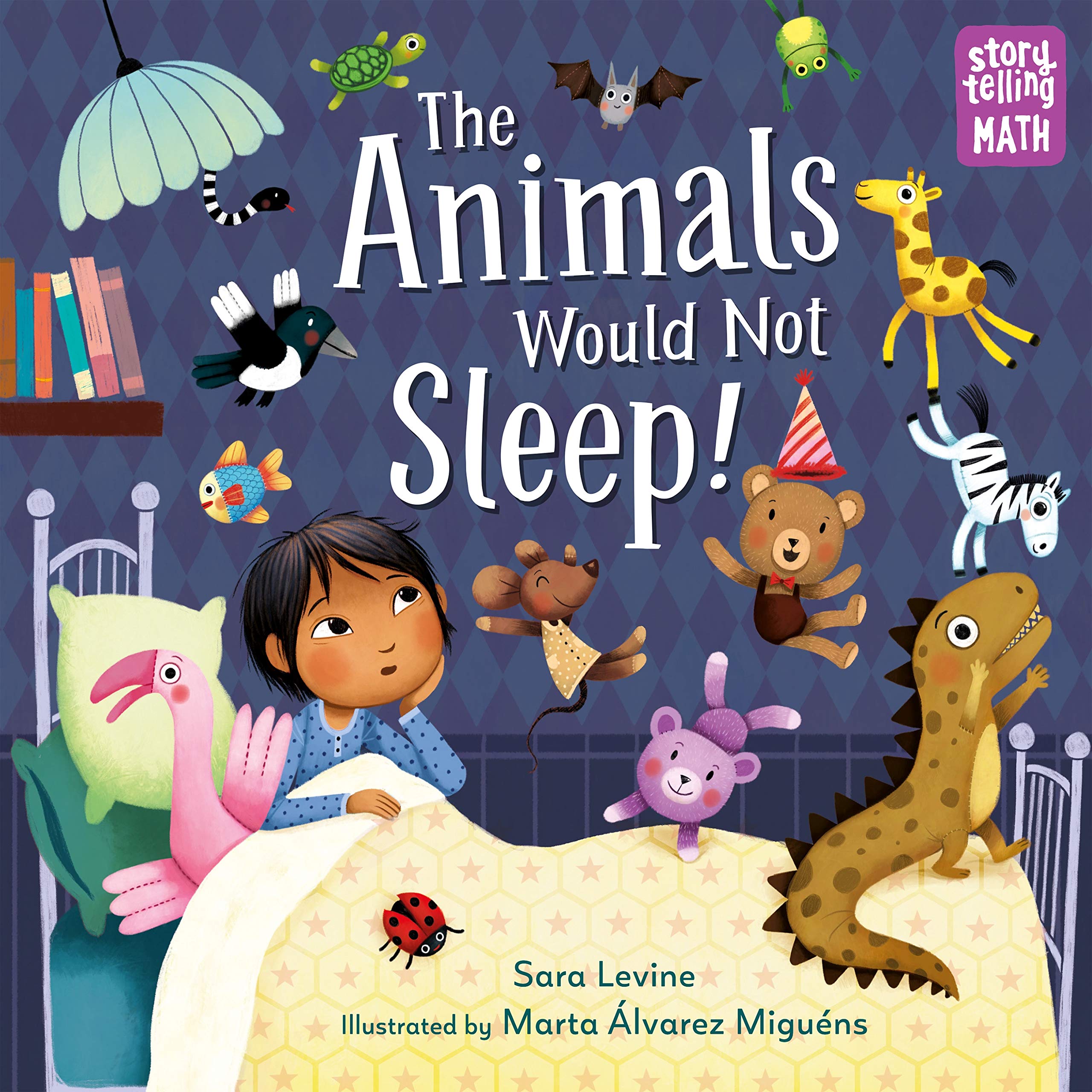
The Animals Would Not Sleep!

Written by Sara Levine | Illustrated by Marta Álvarez Miguéns


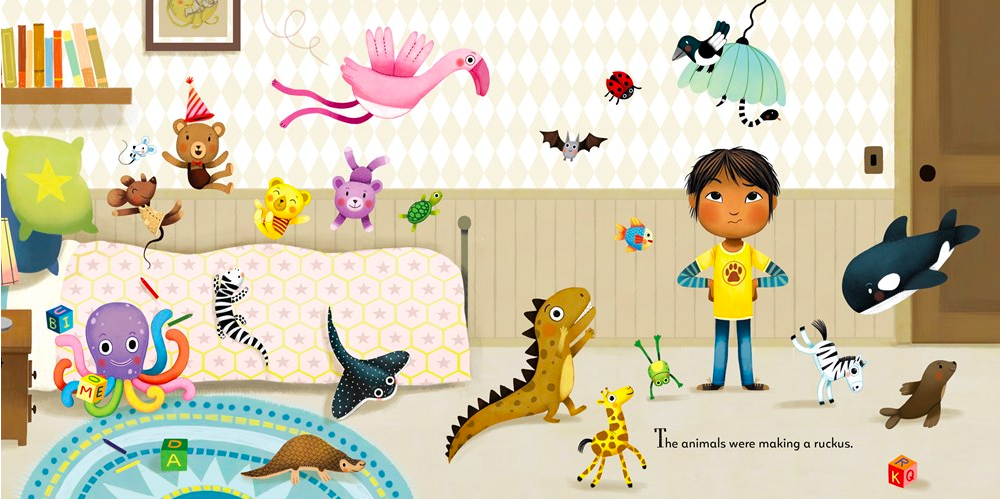
All of Marco’s stuffed “animals were making a ruckus” when his mom told him it was time to get cleaned up and ready for bed. She wanted to see all the toys put away, so Marco, who thought like a scientist, got to work. He wanted to sort his animals like a scientist would, so he got out three baskets and made signs for Flying Animals, Swimming Animals, and Animals That Move on Land. Then he picked up his dancing flamingo, bird, bat, and ladybug and put them in the first basket. He placed his octopus, stingray, frog, fish, whale, and seal in the second basket, and his dinosaur, giraffe, bears, snake, pangolin, gecko, mice, and zebra in the third basket.

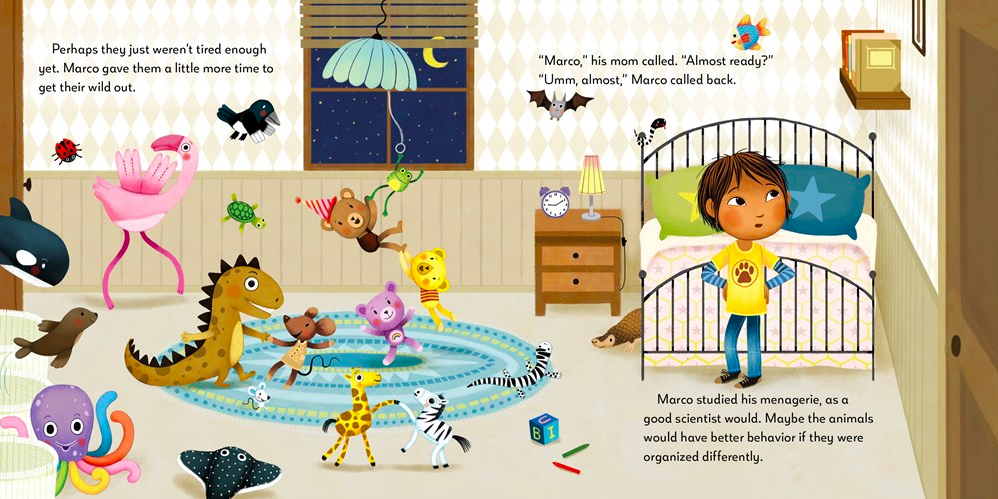
But the animals were still wide awake, and “they egged one another on until not one remained in its container.” Marco thought they would settle down, but when his mom called the second time, he reconsidered his strategy. This time he made signs that sorted the animals by color, but zebra started to cry. He was afraid being in such close quarters with snake and stingray, plus he missed his friend giraffe.
celebrate-picture-books-picture-book-review-the-animals-would-not-sleep-ruckus

Image copyright Marta Álvarez Miguéns, 2020, text copyright Sara Levine, 2020. Courtesy of Charlesbridge.

Marco decided to try again. He took all of his animals out and made signs that read Small, Medium, and Large. Things seemed quiet and Marco began to put on his pajamas. But then he heard some kind of moaning or groaning coming from the Large basket. When he went to check, Dinosaur and Dancing Flamingo complained about being too cramped. Plus, Dancing Flamingo missed Rainbow Bear. Then he heard noises from the Small basket. Those animals weren’t happy either.

Marco’s mom gave him two minutes to get it all sorted out. Fortunately for Marco, “being a scientist, he was used to coming up with ideas and thinking outside the box.” The animals were getting tired and Yellow Bear had just burst into tears for no apparent reason. Like a good scientist, Marco cared about his animals and wanted them to be happy. He had one more sorting idea. With the large animals, medium-sized animals, and small animals all tucked in with plenty of room, friends nearby, and cozy warmth on Marco’s bed, Marco got under the covers and got a goodnight kiss from Mom. Then they all fell happily to sleep.

Back matter includes an illustrated Author’s Note about the way scientists sort, or classify, animals by characteristics and a discussion that explores the math in the story as well as Try This! tips for adults to engage children in sorting by Karen Economopoulos, co-director of the Investigations Center for Curriculum and Professional Development at TERC.
celebrate-picture-books-picture-book-review-the-animals-would-not-sleep-marco

Image copyright Marta Álvarez Miguéns, 2020, text copyright Sara Levine, 2020. Courtesy of Charlesbridge.

Perfectly capturing the way young children interact with their toys, Sara Levine combines imagination and scientific thinking in her inventive story, part of the Storytelling Math series from Charlesbridge. In Marco, who’s proud of his scientific thinking, Levine shows readers that they too already have this ability. Marco’s empathy for his animals’ when they are unhappy will engage children in thinking, along with Marco, about classification and the various ways the animals can be sorted, getting them excited about how math is used every day. Levine’s use of realistic dialogue that echoes bedtime routines in many homes and gives each character—human and animal—distinct personalities will draw kids in to this charming story that is organically infused with strong math lessons. Levine gives Marco a sweet final solution to his problem that will please kids and have them wanting to think like a scientist too.

Marta Álvarez Miguéns opens the story with an enchantingly wild two-page spread of Marco standing in the middle of his room as his toys bounce on the bed, climb blocks, juggle, fly, and cause a ruckus. Turn the page and, as Mom peeks into the room, these animals now lie motionless around the room. When Marco sorts his animals into the baskets, readers can clearly see which animals go where and why. Kids will knowingly giggle when the just-sorted animals spring from their resting places to prolong bedtime. Miguéns also plainly depicts Marco’s and the animals’ facial expressions from happy and playful to sad and crying to peaceful and satisfied. These images give adults and children an opportunity to discuss emotions and how to recognize various clues in faces, a skill important for social-emotional learning. Vivid colors, adorable animals, details such as alphabet blocks that stack or are turned to spell words, and kid-appealing décor will have kids wanting to come back again and again.

A book that’s sure to become a favorite at bedtime or to enhance classroom or homeschooling curriculum, The Animals Would Not Sleep! will spark mathematical and scientific thinking and recognition in all young learners. The book offers an irresistible invitation to experiment and interact with math and science and is a must for home, school, and public library collections.

Ages 3 – 6

Charlesbridge, 2020 | ISBN 978-1623541286 (Hardcover) | ISBN 978-1623541972 (Paperback) 

Discover more about Sara Levine and her books on her website.

To learn more about Marta Álvarez Miguéns, her books, and her art, visit her website.

About Storytelling Math

Storytelling Math offers books that celebrate children using math in their daily lives as they play, build, collaborate, compromise, and discover the world around them. Each story features characters of color who are empowered to solve problems, enjoy activities, and help out using their knowledge of and experimenting with math. Free downloadable hands-on activity kits are available for each book on the Charlesbridge website. Sharing these joyful stories with your littlest ones and older kids will make them eager to explore, use, and learn more about math every day. You can learn more about Storytelling Math on the Charlesbridge website

Storytelling Math: Math, Diversity, and the Power of Story was developed with Marlene Kliman at TERC—a nonprofit dedicated to STEM education—under a grant from the Heising-Simons Foundation.

Enjoy this The Animals Would Not Sleep! trailer with Author Sara Levine!

National Book Month Activity
celebrate-picture-books-picture-book-review-the-animals-would-not-sleep-activity-logo

The Animals Would Not Sleep! Activity Kit


You can have fun sorting and exploring math with your class or family with the Activity Kit for The Animals Would Not Sleep on the Charlesbridge website. Download it here!

The Animals Would Not Sleep Activity Kit

celebrate-picture-books-picture-book-review-the-animals-would-not-sleep-cover

You can find The Animals Would Not Sleep! at these booksellers

Amazon | Barnes & Noble | Books-a-Million

To support your local independent bookstore, order from

Bookshop | IndieBound

Picture Book Review

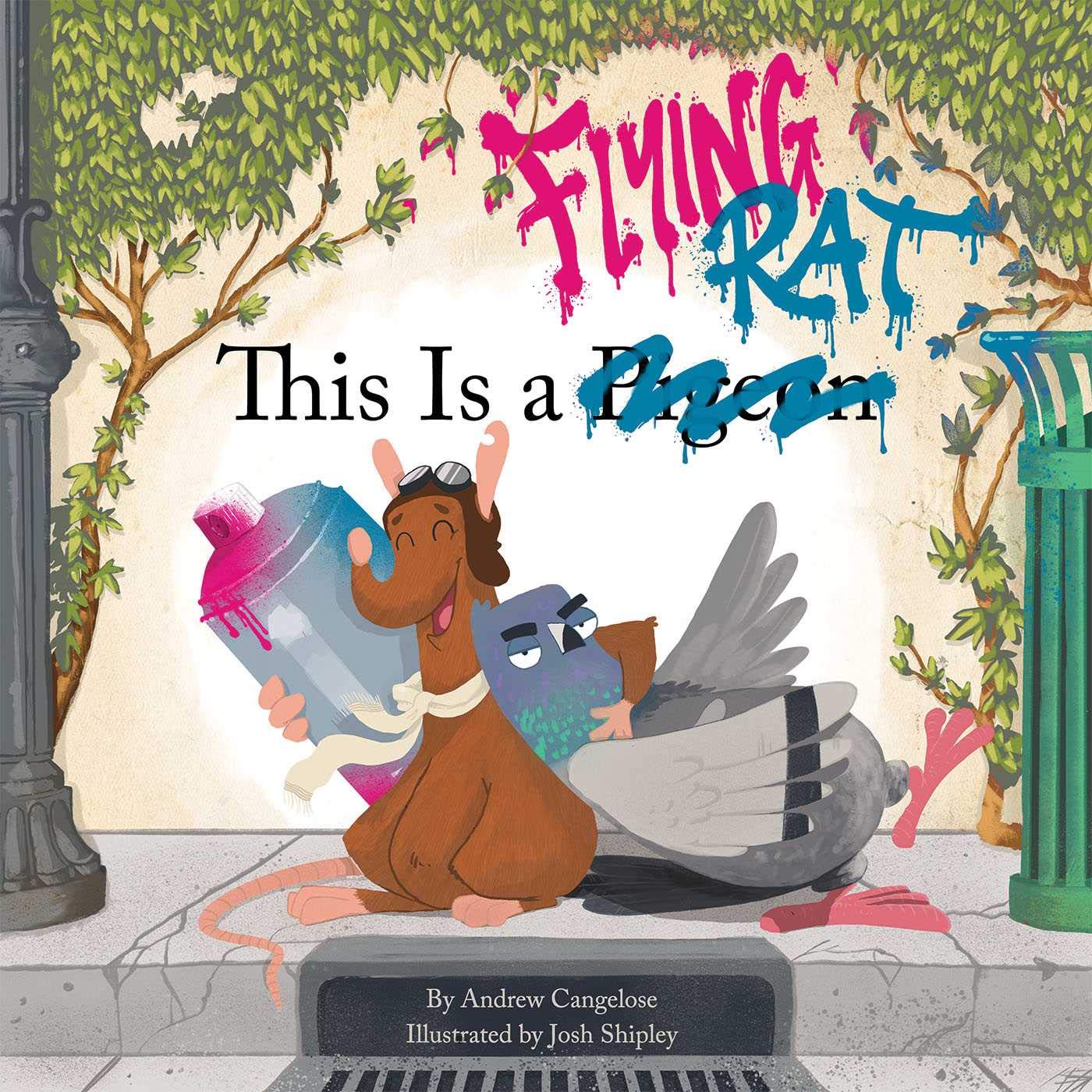
October 27 – Celebrating the Book Birthday of This Is a Flying Rat

celebrate-picture-books-picture-book-review-this-is-a-flying-rat-cover

About the Holiday

Celebrating a new book on its birthday is always exciting. Just like the kids they’re written for, each book has its own personality and take on the world. Today’s book is funny, smart, clever, and educational. Take a look!

This Is a Flying Rat

Written by Andrew Cangelose | Illustrated by Josh Shipley


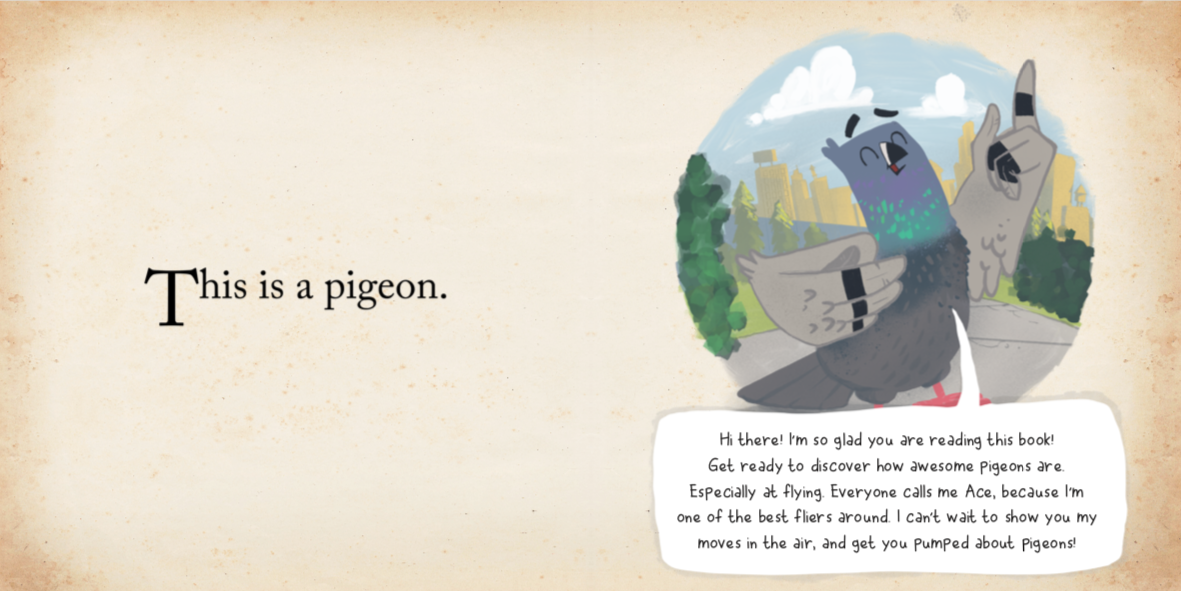
As a narrator begins a recitation on pigeons, a very vocal pigeon breaks in to extoll the awesomeness of his breed, especially their flying power. “Everyone calls me Ace,” he says, “because I’m one of the best fliers around.” He can’t wait to prove it. “Pigeons are a member of the same bird family as doves. In fact, they are sometimes called ‘rock doves,’” the narrator intones.

celebrate-picture-books-picture-book-review-this-is-a-flying-rat-awesome

Image copyright Josh Shipley, 2020, text copyright Andrew Cangelose, 2020. Courtesy of Oni Press.

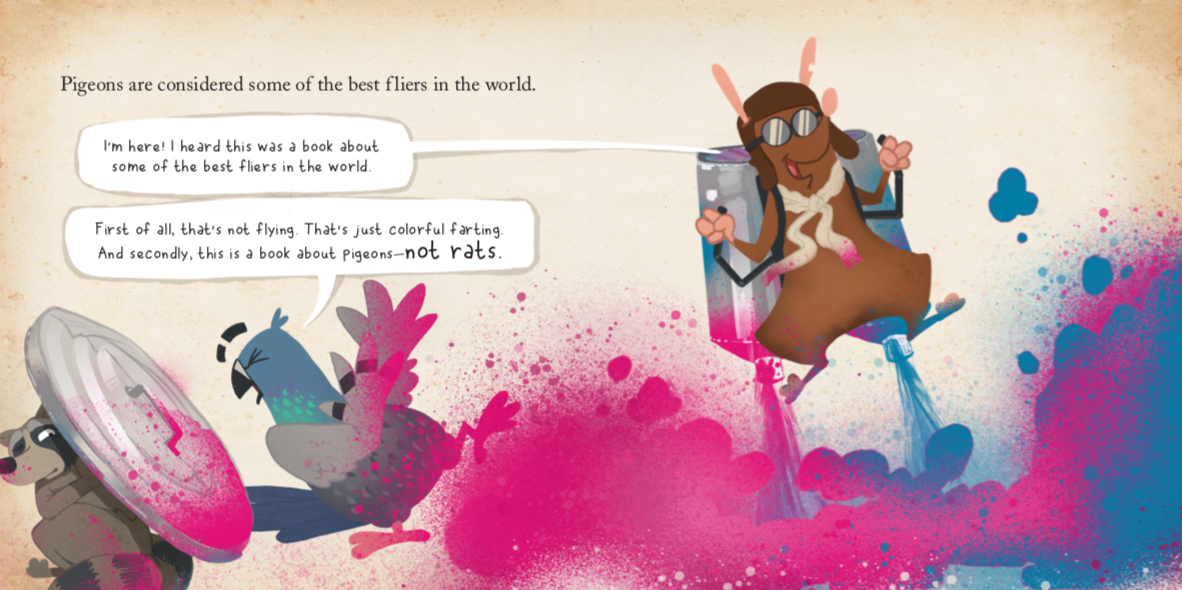
Ace is wholeheartedly agreeing that he does, indeed, rock when a raccoon interrupts to point out a flying rat. Ace is offended, but it turns out that the raccoon doesn’t mean him, but the rat with a jet pack spewing pink and blue ink coming their way. Just as the narrator is getting to the good part: “Pigeons are considered some of the best fliers in the world,” the rat crosses out “Pigeons” and writes “Flying rats” in pink ink.

celebrate-picture-books-picture-book-review-this-is-a-flying-rat-jet-pack

Image copyright Josh Shipley, 2020, text copyright Andrew Cangelose, 2020. Courtesy of Oni Press.

Again, Ace protests, so the rat decides he’ll just be a pigeon too. But Ace isn’t going to let him get away with that that easily. To be a pigeon, the rat has to do other pigeon stuff too. The narrator goes on to describe a pigeon’s eating habits, which can include garbage. The rat is happy to oblige this dietary quirk. Pigeons also have feathers and wings, the narrator reveals. Out of the trash come…you guessed it…check! and check!

celebrate-picture-books-picture-book-review-this-is-a-flying-rat-pigeon

Image copyright Josh Shipley, 2020, text copyright Andrew Cangelose, 2020. Courtesy of Oni Press.

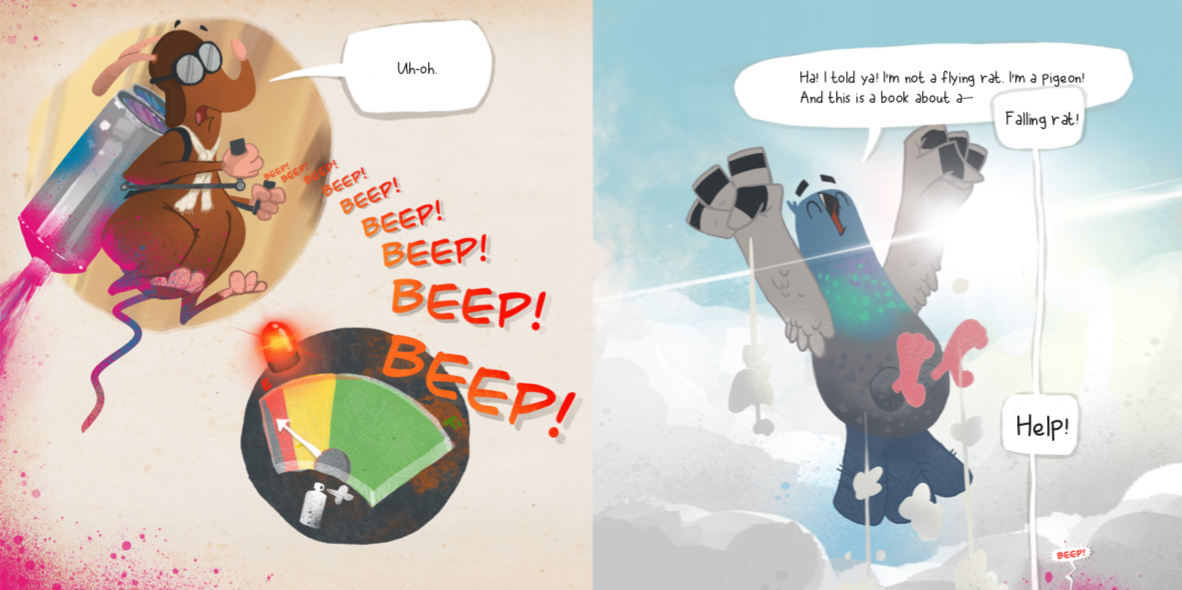
Finally, the narrator gets to flying. But thanks to the jet pack, the rat is just as agile and persevering as Ace. The two are just in a race to the top of a skyscraper when the rat’s fuel burns out. Now he’s not so much a flying rat as a falling rat. Down he plummets just as the narrator reveals that pigeons are social flyers—never found alone. Ace gets it and rockets toward the ground, rescuing the rat just before….

The rat is grateful and apologetic for trying to take over the book, and he acknowledges that Ace is the real pigeon. On Ace’s side, he’s warmed up to having a friend while the narrator’s next chilling fact about pigeon predators has Ace considering joining the other side.

celebrate-picture-books-picture-book-review-this-is-a-flying-rat-fuel-gone

Image copyright Josh Shipley, 2020, text copyright Andrew Cangelose, 2020. Courtesy of Oni Press.

Andrew Cangelose’s pitch-perfect mashup of sedate nature programming and laugh-out-loud interruptions is education at its ingenious best. As the rat challenges Ace’s claims to flying glory, kids are the winners, learning facts about pigeons they won’t soon forget. Cangelose has given Ace and the rat distinct personalities and plenty of attitude to keep the giggle’s going. The combination of straightforward narration and dialogue makes the story a joy to read and would even lend itself to turning the text into a classroom play. The resulting friendship between Ace and the rat is a natural outgrowth of pigeons’ flocking behavior and makes a case for pigeons being a bit like humans too.

Josh Shipley feathers the story with urban details as the rat attempts to prove he’s really a pigeon. Ace, with his squared-off head and familiar multihued sheen, is a portrait of pride, indignation, and knowing looks that will delight kids. The rat, clinging to his jet pack, is sure to win over converts with his ever-present smile and bold self-assurance. The appearance of a pompadour-wearing squirrel clutching an armful of garbage will draw lots of laughs. Shipley depicts Ace’s change of heart about the rat with a sweetness that will charm kids.

Humorous creative nonfiction that kids will really respond to, This Is a Flying Rat would be a fun addition to home bookshelves and a high-interest accompaniment to classroom nature and science lessons, making it a great choice for school and public libraries as well.

Ages 4 – 8

Oni Press, 2020 | ISBN 978-1620107751

celebrate-picture-books-picture-book-review-this-is-a-flying-rat-cover

You can find This Is a Flying Rat at these booksellers

Amazon | Barnes & Noble | Books-a-Million

To support your local independent bookstore, order from

Bookshop | IndieBound

October 14 – National Fossil Day

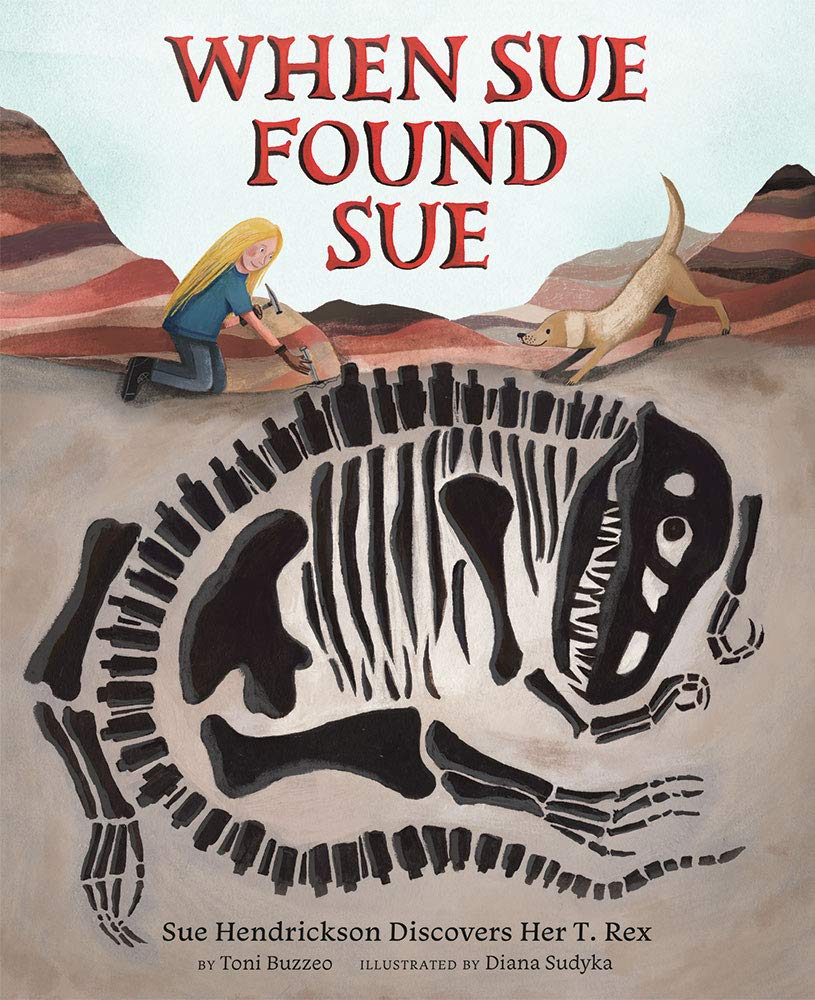
celebrate-picture-books-picture-book-review-when-sue-found-sue-cover

About the Holiday

Welcome to the 11th anniversary of National Fossil Day! Today’s holiday puts a spotlight on paleontology and its value in the scientific community and for education. The day raises awareness of the importance of preserving fossils for future generations. To celebrate today and Earth Science Week all this week, learn more about the prehistory of your area, or read up on fossils and prehistoric creatures. Visit the National Park Service Website to learn more about today’s holiday and find many resources for classrooms, homeschooling, and family fun. There you’ll find to download a Junior Paleontology Activity Book that can help kids explore the ways paleontologists work and learn about Earth’s history, ancient plants and animals as well as changes to past climate and environments. You’ll also find 20 ideas for digging into paleontology with links to museums and national parks, a site where you can view fossils in 3D, coloring pages, and even learn your state’s fossil.

Thanks to Abrams Books for Young Readers for sending me a copy of When Sue Found Sue for review consideration. All opinions about the book are my own.

When Sue Found Sue: Sue Hendrickson Discovers Her T. Rex

Written by Toni Buzzeo | Illustrated by Diana Sudyka


Sue Hendrickson was an expert at finding things. The lure of buried or lost treasures kept her busy in her hometown of Munster, Indiana. “Born shy and incredibly smart,” Sue devoured books, discovering everything she could about the things that interested her. One of her favorite places was the Field Museum of Natural History in Chicago. There, she reveled in the treasures others had found and dreamed of the day when she could “search the wide world for hidden treasure on her own.”

celebrate-picture-books-picture-book-review-when-sue-found-sue-collection

Image copyright Diana Sudyka, 2019, text copyright Toni Buzzeo, 2019. Courtesy of Abrams Books for Young Readers.

When she was seventeen, Sue began her life of treasure hunting, joining teams that searched for sunken boats, airplanes, and even cars. She went to Dominican amber mines looking for prehistoric butterflies and deserts of Peru searching for whale fossils. Finally, she headed to South Dakota to dig for dinosaurs.

She spent four summers unearthing duck-billed dinosaurs, using more and more delicate tools to expose the bones. But near the end of her fourth summer, “Sue Hendrickson felt pulled to a sandstone cliff far off in the distance.” When she had the opportunity, she took her golden retriever and hiked the seven miles to the rock.

celebrate-picture-books-picture-book-review-when-sue-found-sue-alley

Image copyright Diana Sudyka, 2019, text copyright Toni Buzzeo, 2019. Courtesy of Abrams Books for Young Readers.

Walking around the perimeter, she noticed what looked like bones lying on the ground. When she looked up, she was astonished to see “three enormous backbones protruding from the cliff.” The size told her they must be from a Tyrannosaurus rex. Sue hurried back to her campsite and told her team the exciting news. They “immediately named the dinosaur Sue the T. rex.”

celebrate-picture-books-picture-book-review-when-sue-found-sue-ocean

Image copyright Diana Sudyka, 2019, text copyright Toni Buzzeo, 2019. Courtesy of Abrams Books for Young Readers.

It took five full days for the team to expose the skeleton. Then they mapped the location of each bone, photographing and drawing them. At last they began removing them, and after three weeks the bones were trucked to the Black Hills Institute. Eventually, Sue the T. rex was moved to the Field Museum in Chicago. If you visit the museum today, you will see Sue towering over you. “She is the world’s largest, most complete, best-preserved Tyrannosaurus rex fossil discovered so far”—discovered by a woman who was born to find things.

An Author’s Note about Sue Hendrickson and the battle over the T. rex skeleton as well as resources for further study and a photograph of Sue the T. rex follow the text.

celebrate-picture-books-picture-book-review-when-sue-found-sue-excavating

Image copyright Diana Sudyka, 2019, text copyright Toni Buzzeo, 2019. Courtesy of Abrams Books for Young Readers.

Toni Buzzeo’s inspiring story of how Sue Hendrickson discovered the most complete and best-preserved T. rex fossil delves into more than the finding and excavating of the skeleton. Buzzeo also emphasizes Hendrickson’s personality and long-held love of treasure hunting, qualities that informed and aided her career choice. Readers who also harbor dreams outside the mainstream and have a steady focus will find much to admire in Buzzeo’s storytelling and Sue’s example. Kids will be awed by Sue’s early treasure-hunting exploits and fascinated by the painstaking process of unearthing fossils. When Sue follows her intuition to the cliff—without explanation or facts—readers will be reminded that they can rely on their own curiosity, experience, and ideas to carry them forward. With nods toward the value of teamwork and sprinkled with Sue’s own words about her moment of discovery, the story exposes the bones of a life well-lived and points children in the right direction.

Screen Shot 2019-05-14 at 4.33.48 PM

Diana Sudyka opens the story of Sue Hendrickson with a lovely collage of the treasures she found and studied as a child and that led to her life-long love of discovery. As Sue grows, she visits the Field Museum, with its exhibits of a Triceratops and Hadrosaurus. Fast-forward several years and she’s swimming in a sea dotted with colorful coral toward an old sunken ship. But the centerpiece of the story takes place in the South Dakota hills, the layers of rock painted in stripes of earthy brown, rust, rose, and ivory. As the team works late nights to excavate the bones, a T. rex constellation appears above the team in the starry sky, urging them on. A two-page spread of how Sue the T. rex fossil appeared in its entirety in the ground is sure to elicit plenty of “Wows!,” and a rendition of Sue on exhibit in the Field Museum will no doubt inspire some travel wishes.

A book about a modern-day scientist that will engage and inspire children with scientific aspirations of their own as well as a celebration of individuality and big dreams and a must for dinosaur lovers, When Sue Found Sue would be a T. riffic addition to home, school, and public library collections.

Ages 4 – 8

Abrams Books for Young Readers, 2019 | ISBN 978-1419731631

Discover more about Toni Buzzeo and her books on her website.

To learn more about Diana Sudyka, her books, and her art, visit her website.

National Dinosaur Day Activity

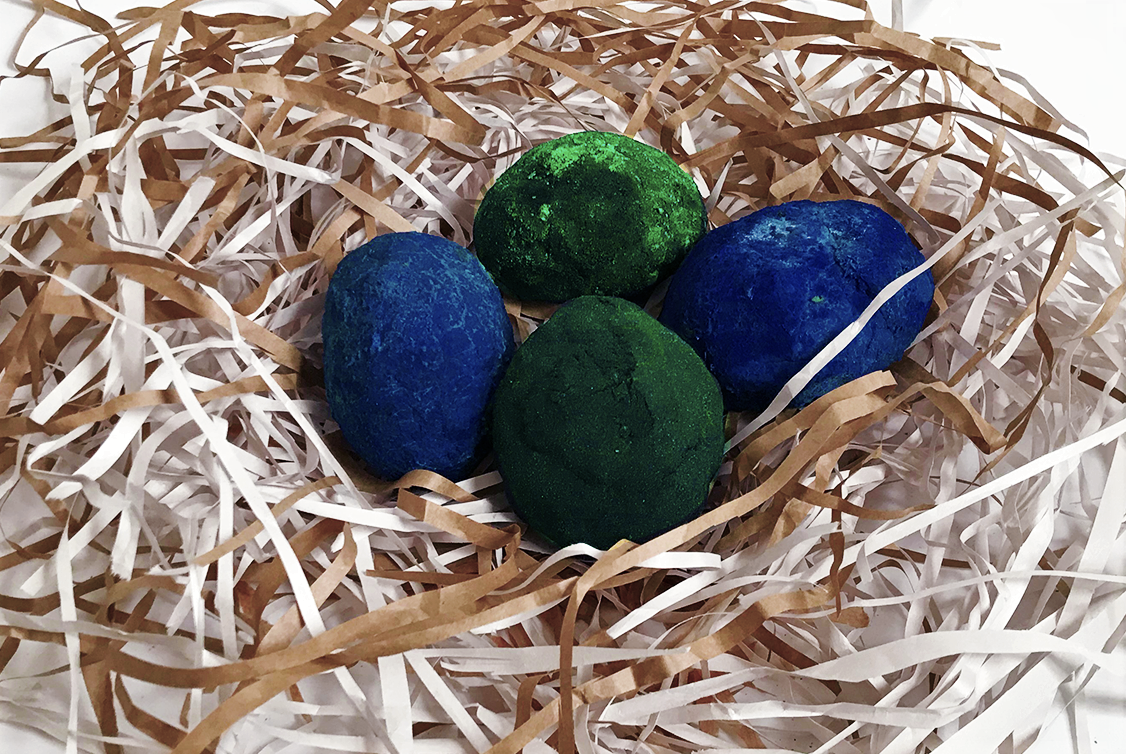
celebrate-picture-books-picture-book-review-dinosaur-eggs-craft-nest

Hatch Your Own Dinosaur Eggs


Think there are no more dinosaur eggs to be found? Think again! You can make your own with this easy craft that will have you hatching some T.-rex-size fun! All you need are a few simple ingredients!

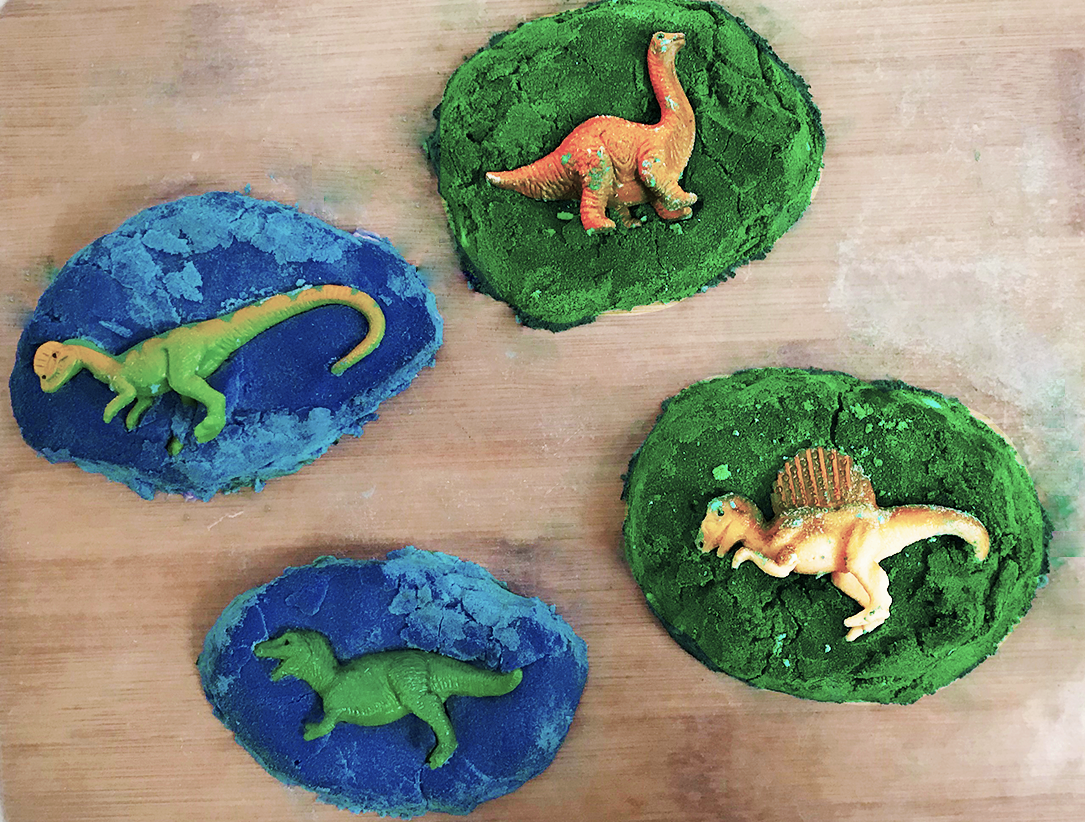
celebrate-picture-books-picture-book-review-dinosaur-eggs-craft-open-eggs

Supplies

  • Old clothes or apron
  • Large box of baking soda (makes between 6 and 8 eggs)
  • Food coloring
  • Water
  • Plastic dinosaur toys
  • Bowl
  • Fork
  • Spoon
  • Wax paper
  • Baking sheet
  • Foil
  • Vinegar
  • Spray bottle (optional)
  • Plastic or metal spoon, stick, popsicle stick, or other implement to chisel with
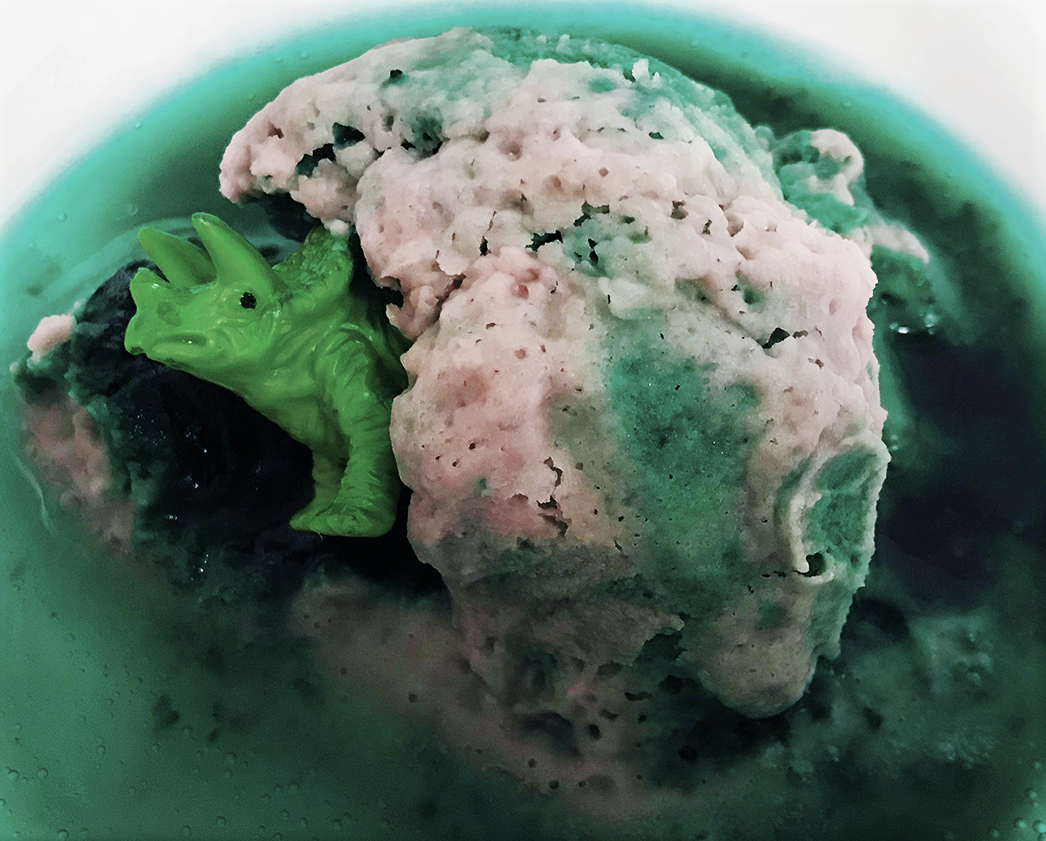
celebrate-picture-books-picture-book-review-dinosaur-eggs-craft-vinegar-egg-open-darker

Spray the egg with vinegar to hatch your dinosaur

Directions

  1. Wear old clothes or an apron
  2. Cover work surface with wax paper, parchment paper, newspaper, or other protection. Food coloring can stain some surfaces
  3. Pour baking soda into the bowl
  4. Add drops of food coloring in whatever color you’d like your eggs to be. The eggs will darken when baked.
  5. Mix in the food coloring with the fork. You may want to use your hands, too
  6. When the baking soda is the color you want it, begin adding water a little at a time
  7. Add water until the baking soda holds together when you squeeze it in your hand
  8. When the baking soda is the right consistency, spoon some out into your hand or onto wax paper
  9. Push one plastic dinosaur into the middle
  10. Cover the dinosaur with more of the baking soda mixture
  11. Carefully form it into an egg shape
  12. Repeat with other dinosaurs
celebrate-picture-books-picture-book-review-dinosaur-eggs-craft-chiseled -darker

Chisel the egg open to hatch your dinosaur

To Bake the Eggs

  1. Set the oven or toaster oven to 200 to 225 degrees
  2. Set the eggs on a baking sheet lined with foil
  3. Bake the eggs for 15 minutes, check
  4. Turn the eggs over and bake for 10 to 15 more minutes
  5. Remove from oven and let cool

To Hatch the Eggs

  1. Eggs can be hatched by chiseling them with a spoon, stick, or other implement
  2. Eggs can also be hatched by spraying or sprinkling them with vinegar

celebrate-picture-books-picture-book-review-when-sue-found-sue-cover

You can find When Sue Found Sue: Sue Hendrickson Discovers Her T. Rex at these booksellers

Amazon | Barnes & Noble | Books-a-Million

To support your local independent bookstore, order from

Bookshop | IndieBound

Picture Book Review
October 12 – National Farmers Day

celebrate-picture-books-picture-book-review-the-farm-that-feeds-us-cover

About the Holiday

National Farmers Day events have taken place across the country since the 1800s, and these days events are held on different dates in different towns throughout the fall. The holiday celebrates the hardworking farmers who grow and raise the food that fills our grocery stores, farm markets, and tables. Beyond food, farmers contribute to our economy across industries.

Thanks to Quarto Knows for sending me a copy of The Farm That Feeds Us for review consideration. I used a digital copy of The Kitchen Pantry Scientist: Chemistry for Kids for my review. All opinions on the books are my own.

Introducing Quarto Classroom

celebrate-picture-books-picture-book-review-Quarto-Classroom-Logo

New this year, Quarto Classroom is a free video library on YouTube of expert authors using their books to teach everything from math to arts & crafts to social emotional learning. There are videos and activity sheets for every age, which can be used as supplements to your normal school curriculum—plus, you to get to know some pretty cool authors! Perfect to enhance virtual schooling and homeschooling, the videos and materials are exciting ways to engage your kids in hands-on learning. Today, I’m reviewing two books that approach science in different ways. The first covers the science of organic farming, and the second gets kids involved in chemistry experiments in their own kitchen. You can find all the available videos on various topics at Quarto Classroom.

The Farm That Feeds Us: A Year in the Life of an Organic Farm

Written by Nancy Castaldo | Illustrated by Ginnie Hsu


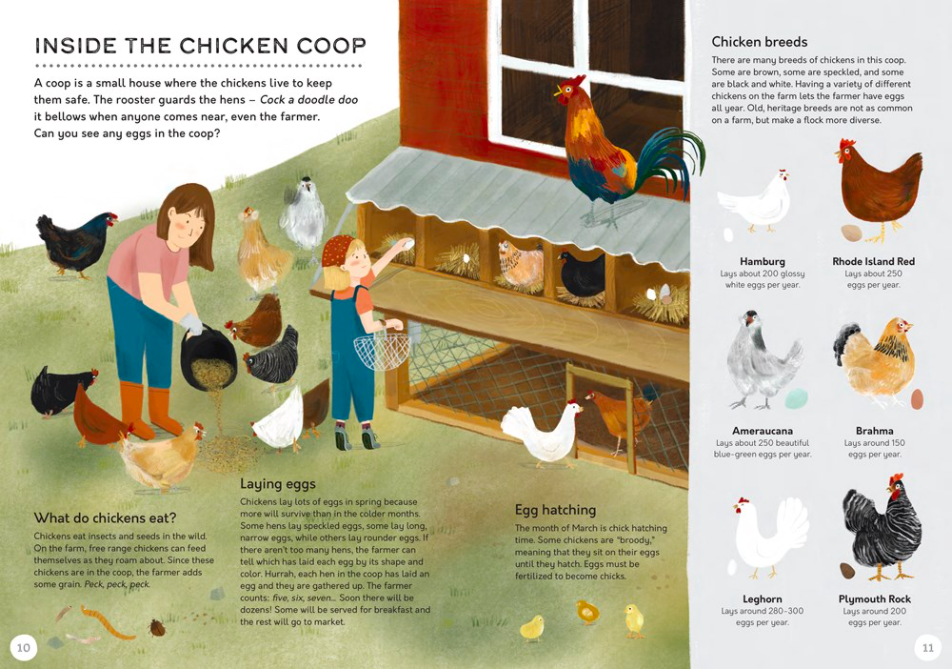
This encyclopedic beauty takes readers to an organic family farm, where they spend a year learning about various types of farms and then get a close-up look at the activities and transformations that take place from season to season. In Spring, the farmer is up before the birds to feed the animals and mild the cows and goats. The chicken coop is busy as the kids feed the chickens and rooster and collect eggs. Some chickens are “broody” today—sitting on their eggs until they hatch. What kind of chickens are there? This coop is home to Hamburg, Rhode Island Red, Ameraucana, Brahma, Plymouth Rock, and Leghorn, which can lay “around 280–300 eggs per year.”

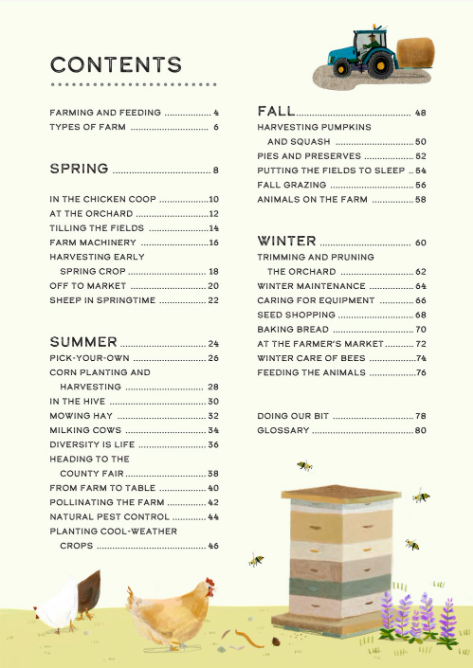
Out in the orchard among the apple, cherry, pear, and plum trees, the bee hives are being checked. In the fields, the farmer is tilling the soil to plant lettuce, carrots, beans, radishes, beets, and peas. You can see many kinds of equipment and machinery farmers use here. Some crops love the cool weather of early spring, so workers are already harvesting the peas, lettuces and greens, asparagus, and radishes. Then it’s off to the farm market to sell the food to eager customers.

celebrate-picture-books-picture-book-review-the-farm-that-feeds-us-chicken-coop

Image copyright Ginnie Hsu, 2020, text copyright Nancy Castaldo, 2020. Courtesy of Words & Pictures, Quarto Knows.

With temperatures getting warmer, it’s time to sheer the sheep. Lambs are born now too. You can see and learn about six breeds of sheep that are found around the world. Summer brings thousands of strawberries, raspberries, and cherries in the farm’s pick-your-own fields. Summer also means corn, which comes in many colors and is used for different purposes, from feeding people and livestock to making fuel. “Some varieties of corn have hears filled with kernels that look like multi-colored gems. Come take a look!

Twice a day the cows are milked. “On some industrial farms, cows are kept in pens and are bred to produce unnaturally high volumes of milk. On this organic, family farm, the cows are free to roam around” pesticide-free fields. Without antibiotics or hormones to increase milk production, their milk is “healthier for people to drink.” You can learn about five distinct breeds of cows here too.

It’s been an exciting time for the farmers! This weekend was the county fair, where “farmers come from all over the county to show off their produce and livestock.” Come take a look at all the exhibits! Then a local chef visits, eager to learn about the fresh produce and heirloom varieties available. “Squash blossoms, tomatoes, and radishes are picked and packed for the chef to take back to the kitchen for tonight’s menu.” You can also learn about food distribution and why eating local is healthier and more delicious.

celebrate-picture-books-picture-book-review-the-farm-that-feeds-us-chicken-farm-machinery

Image copyright Ginnie Hsu, 2020, text copyright Nancy Castaldo, 2020. Courtesy of Words & Pictures, Quarto Knows.

While large farms often use manmade pesticides to thwart insects and other pests, “organic farms use many different methods, including crop rotation, crop isolation, and growing other plants nearby that ward off pests.” Take a look at how these methods work.

Autumn brings pumpkins—in so many varieties! Orange, white, and green; warty, smooth, and tiny, each pumpkin has its own use and flavor. In the farmhouse kitchen, freshly picked fruit and vegetables are becoming jams, pies, sauces, and chutneys. In preparation for winter, the fields must be “put to sleep to keep the soil healthy for the spring plantings. Discover how important cover crops, mowing, and even fall grazing by the animals is to the farm’s health.

While no crops are growing during the winter, that doesn’t mean things slow down on the farm. Now is the time when repairs and cleaning are done, the apple trees are pruned, and logs are split for the woodstove. The bee hives are also wrapped to keep them warm. As the snow falls, the family feeds the animals in the barn and then gathers around and chooses the seeds they want to plant in the spring.

A bread recipe, a discussion on how we can make a difference to ensure a variety of healthy food remains available, and a glossary of words used in the book close out the text.

celebrate-picture-books-picture-book-review-the-farm-that-feeds-us-contents

Nancy Castaldo’s gorgeous and informative book, written in a lyrical, conversational style and full of fascinating details about the life of a farm and its crops and animals will entice readers to learn more about their local farms, the food grown there, and shopping at farmers markets.

Ginnie Hsu’s bright and homey illustrations will enchant readers of all ages as they discover realistic depictions of farm equipment, planting methods, crops, animals, and the beauty and intricacies of a small farm. Two-page spreads allow for detailed and panoramic views of the always-changing scenery and activities that make a farm such an exciting and intriguing place.

Whether you’re a teacher, homeschooler, or gardener; love farms; or are a proponent of an organic lifestyle, The Farm That Feeds Us would be an excellent accompaniment to science, social studies, and environmental lessons. The book offers untold opportunities to spark further research into the topics presented and ideas for classroom or home gardens. It is highly recommended for home bookshelves and is a must for school and public libraries.

Ages 7 – 11

Words & Pictures, Quarto Knows, 2020 | ISBN 978-0711242531

Discover more about Nancy Castaldo and her books on her website

To learn more about Ginnie Hsu and view a portfolio of her art, visit her website.

celebrate-picture-books-picture-book-review-the-farm-that-feeds-us-cover

You can find The Farm That Feeds Us at these booksellers

Amazon | Barnes & Noble | Books-a-Million

To support your local independent bookstore, order from 

Bookshop | IndieBound

The Farm That Feeds Us Quarto Classroom Video

You can visit with Nancy Castaldo as she reads from her book and talks about food from her local farms as well as about food you may find in your own pantry, clothing hanging in your closet, and other items in your house and the farms where they came from. Nancy invites kids to go on a scavenger hunt in their classroom or home to discover how many things we eat and use come from farms. You can find her video and download a teachers’ guide on the Quarto Classroom website under Science.

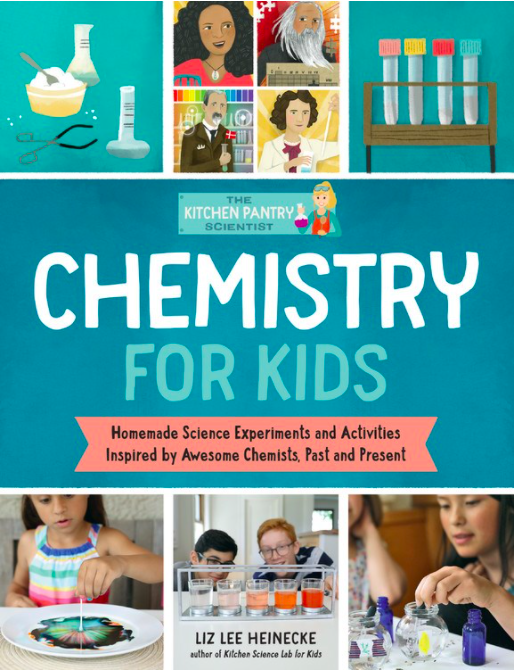
celebrate-picture-books-picture-book-review-chemistry-for-kids-coverThe Kitchen Pantry Scientist: Chemistry for Kids 

By Liz Lee Heinecke | Illustrated by Kelly Anne Dalton | Photography by Amber Procaccini Photography


Replicating the experiments of twenty-five of the world’s most influential scientists from 1200 BCE to 1975 will give children and young people an appreciation for the long history and vast influence of chemistry since the beginning of time. Along with each experiment, readers learn about the scientists, background on their work, and “where you can still find it used or reflected in today’s world.”

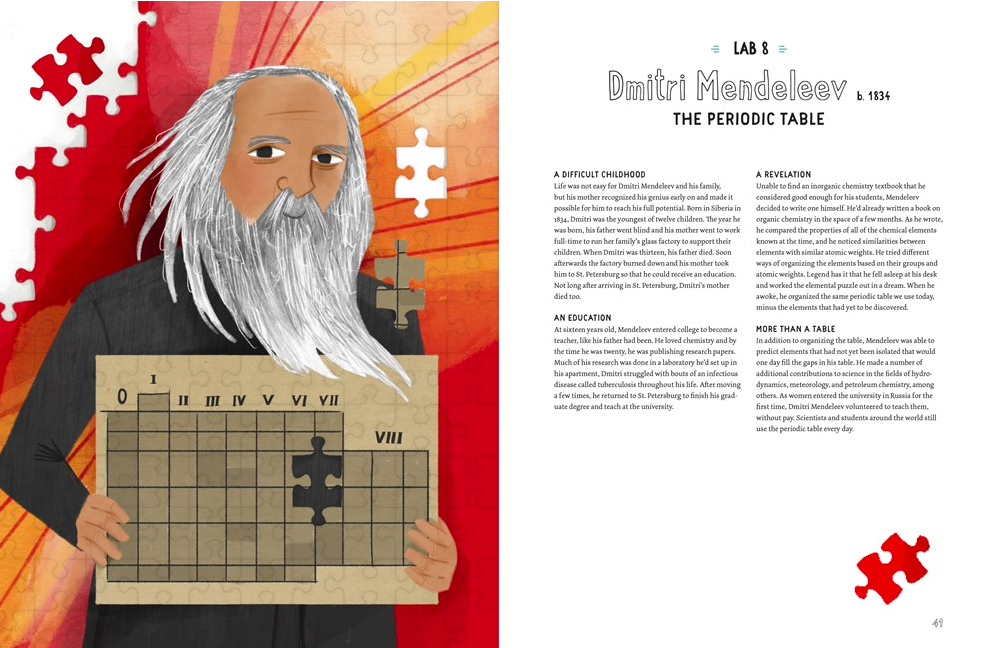
celebrate-picture-books-picture-book-review-chemistry-for-kids-dmitri-mendeleev

Image copyright Kelly Anne Dalton, 2020, text copyright Liz Lee Heinecke, 2020. Courtesy of Quarry Books, Quarto Knows.

First up is Tapputi-Belatikallim—a woman and the first recorded chemist, who lived in ancient Mesopotamia over 3200 years ago. Her position within the royal household was that of fragrance preparer, an important role as scents were “believed to transcend the physical world to reach their gods, who would be pleased by their sacrifice.” Her recipe “includes the first description of a distillation apparatus ever recorded and a number of her methods are still used today….” With a slow cooker or pot, fresh or dried lemon, herbs, or flowers, and other common kitchen tools, readers can create their own fragrance. Clear photographs show budding chemists the steps to success.

What would carbonated-drink fans do without their sparkling bubbles? Fortunately, because of Joseph Priestley’s work in 1767, they’ll never need to know. With baking soda and vinegar, young scientists can go beyond the volcano and create their own carbonated water. They’ll also learn more about this man who was ahead of his time in many ways. Don’t put the vinegar away too soon! With the next experiment, kids can turn a pad of steel wool into a powdery rust with oxidation—just like Antoine Lavoisier.

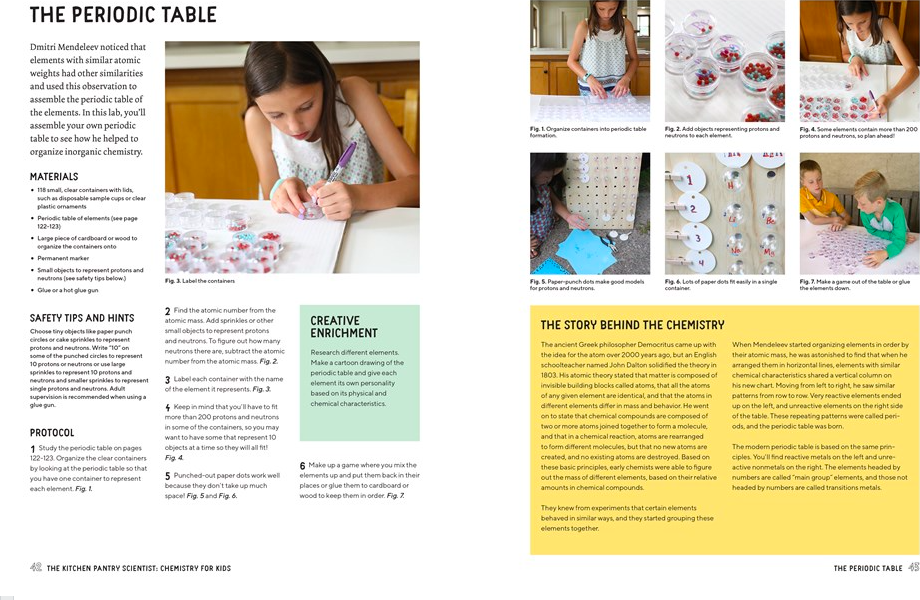
celebrate-picture-books-picture-book-review-chemistry-for-kids-periodic-table

Photographs copyright Amber Procaccini, copyright 2020, text copyright Liz Lee Heinecke, 2020. Courtesy of Quarry Books, Quarto Knows.

Can’t quite get your head around the periodic table? With this experiment you can make your own and really see what’s up with all of those protons and neutrons! Who came up with the periodic table? That would be Dmitri Mendeleev, who legend has it dreamed up the format in…well…a dream. Can washing dishes ever be more than a chore? For Agnes Pockels, born in 1862, it led to a revelation about surface tension and how various soaps and other materials could disturb it. Get out a plate, some water, milk, food coloring, oil, and other ingredients and get to work!

How do you smell? I mean…how well can you smell? In 1991 Dr. Linda Buck discovered “a group of genes that no one had ever seen before. These genes coded for a group of 350 smell receptors that work in combination to detect thousands of different odors. “In 2004 Linda and her colleague Richard Axel won the Noble Prize in Physiology or Medicine for their discoveries of odorant receptors….” With the experiment here, you and your family can discover how sensitive your nose is by blind-testing a variety of objects.

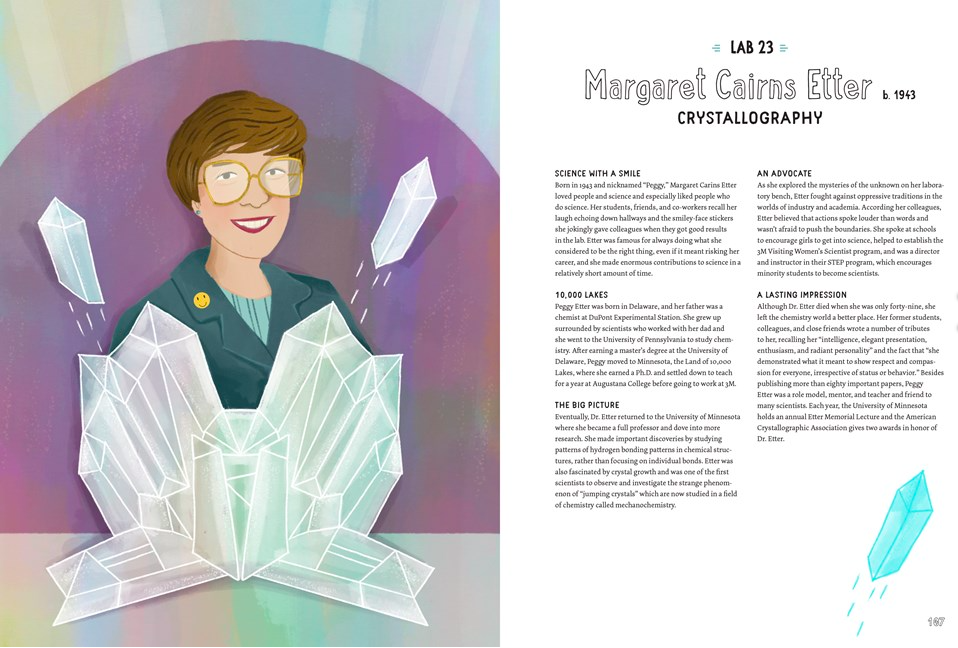
celebrate-picture-books-picture-book-review-chemistry-for-kids-margaret-cairns-etter

Image copyright Kelly Anne Dalton, 2020, text copyright Liz Lee Heinecke, 2020. Courtesy of Quarry Books, Quarto Knows.

The next time your teacher, mom, or dad sees you using your phone in class, it might be because you’re doing Raychelle Burks’ colorimetric sensors experiment. With an app you can turn your phone into a spectrometer to test RGB ratings for a series of diluted liquids. Burks’ current research is focused on designing “sensing systems that can identify chemical clues tied to crime.” Who knows—you may find yourself working as a CSI after getting hooked by the science behind this fascinating experiment.

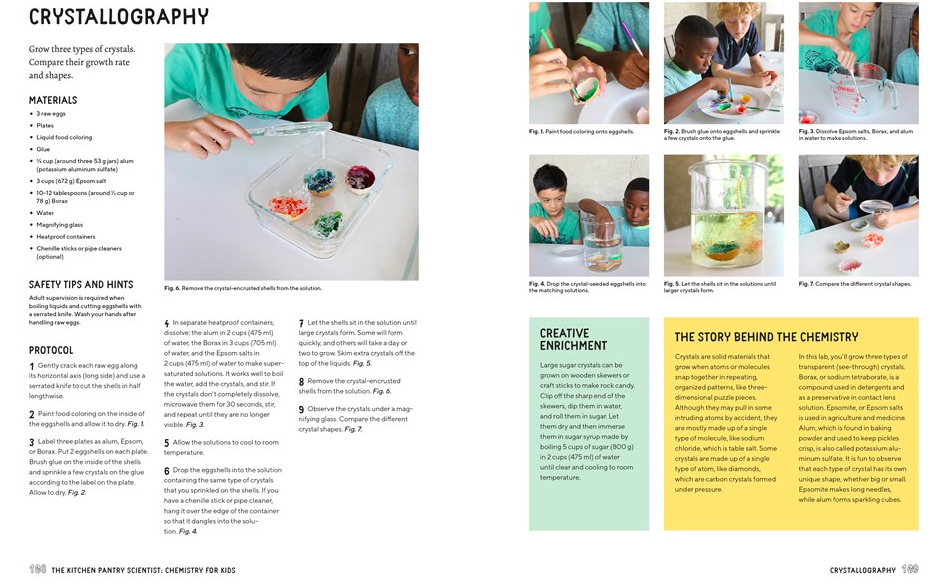
Along the way, young scientists can make soap, create chemical batteries, work with synthetic dyes, make lava lamps to test temperature and chemical reactions, do elemental extraction, discover the pH scale, learn about chromatography, extract organic oils, make crystals, extract medicinal compounds from aloe, and take part in many more educational and fun experiments. A glossary, the periodic table, and a list of resources and references follows the text.

celebrate-picture-books-picture-book-review-chemistry-for-kids-crystallography

Photographs copyright Amber Procaccini, copyright 2020, text copyright Liz Lee Heinecke, 2020. Courtesy of Quarry Books, Quarto Knows.

Prior to each experiment, readers learn about each chemist through Kitchen Pantry Scientist Liz Lee Heinecke’s lively biographies that spotlight stories from the scientist’s childhood, family life, education, early work, and influence on the world at large.

Kelly Anne Dalton’s engaging and vivid illustrated portraits of each chemist introduce each experiment and set the scientist in her or his time period.

A superb reference and resource for schools, homeschooling, today’s virtual schooling as well as for kids who just like to tinker (like many of the scientists highlighted), Chemistry for Kids would be a favorite go-to book for science lessons and free time and is highly recommended for home, school, and public library collections. The book would also make an excellent gift.

Ages 7 – 12

Quarry Books/QuartoKnows, 2020 | ISBN 978-1631598302

To learn more about Liz Lee Heinecke, her books, and her work, visit her website The Kitchen Pantry Scientist.

Discover more about Kelly Anne Dalton, her books, and her art on her website.

Chemistry for Kids Quarto Classroom Video

Liz Lee Heinecke invites you into her kitchen to talk about her book and hear the story of Agnus Pockles. Following the reading she takes kids step-by-step through Agnus’s experiment on surface tension, using milk and food coloring to explain how this phenomenon works. She then shows how detergents break surface tension with dramatic results. You can find Liz’s video and download a teachers’ guide at the Quarto Classroom website under Science.

celebrate-picture-books-picture-book-review-chemistry-for-kids-cover

You can find Chemistry for Kids at these booksellers

Amazon | Barnes & Noble | Books-a-Million

To support your local independent bookstore, order from

Bookshop | IndieBound

Picture Book Review


September 16 – Collect Rocks Day

celebrate-picture-books-picture-book-review-old-rock-is-not-boring-cover

About the Holiday

Today’s holiday allows anyone who just can’t resist picking up a particularly pretty or unusual stone to indulge their whims and fancies. Rock collecting can be a fun and educational hobby as each type of stone has its own fascinating history and science to learn about. Why not go on a hike today and discover the unique shapes, colors, and feel of the rocks below your feet.

I received a copy of Old Rock (is not boring) from G. P. Putnam’s Sons for review consideration. All opinions are my own.

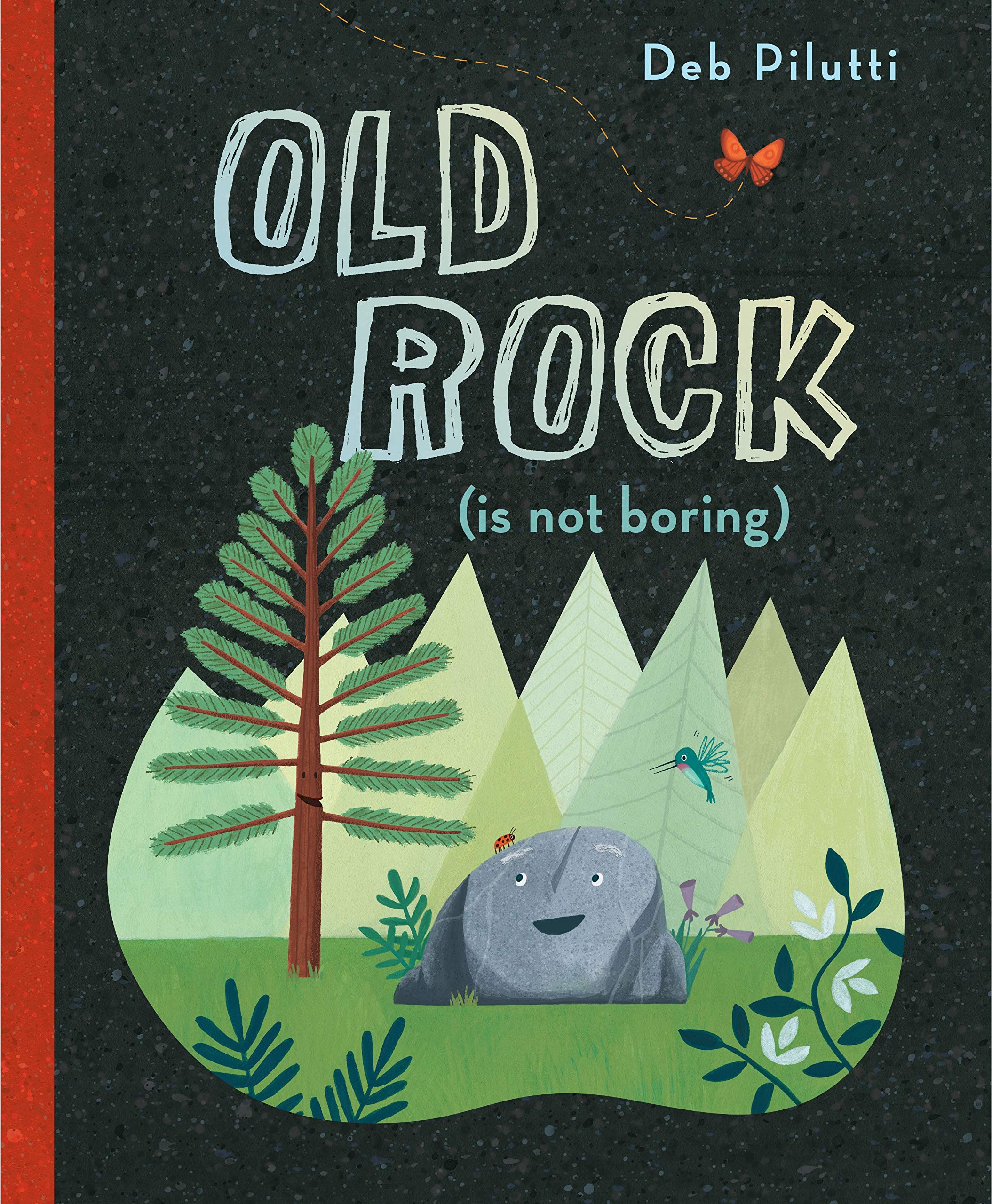
Old Rock (is not boring)

By Deb Pilutti


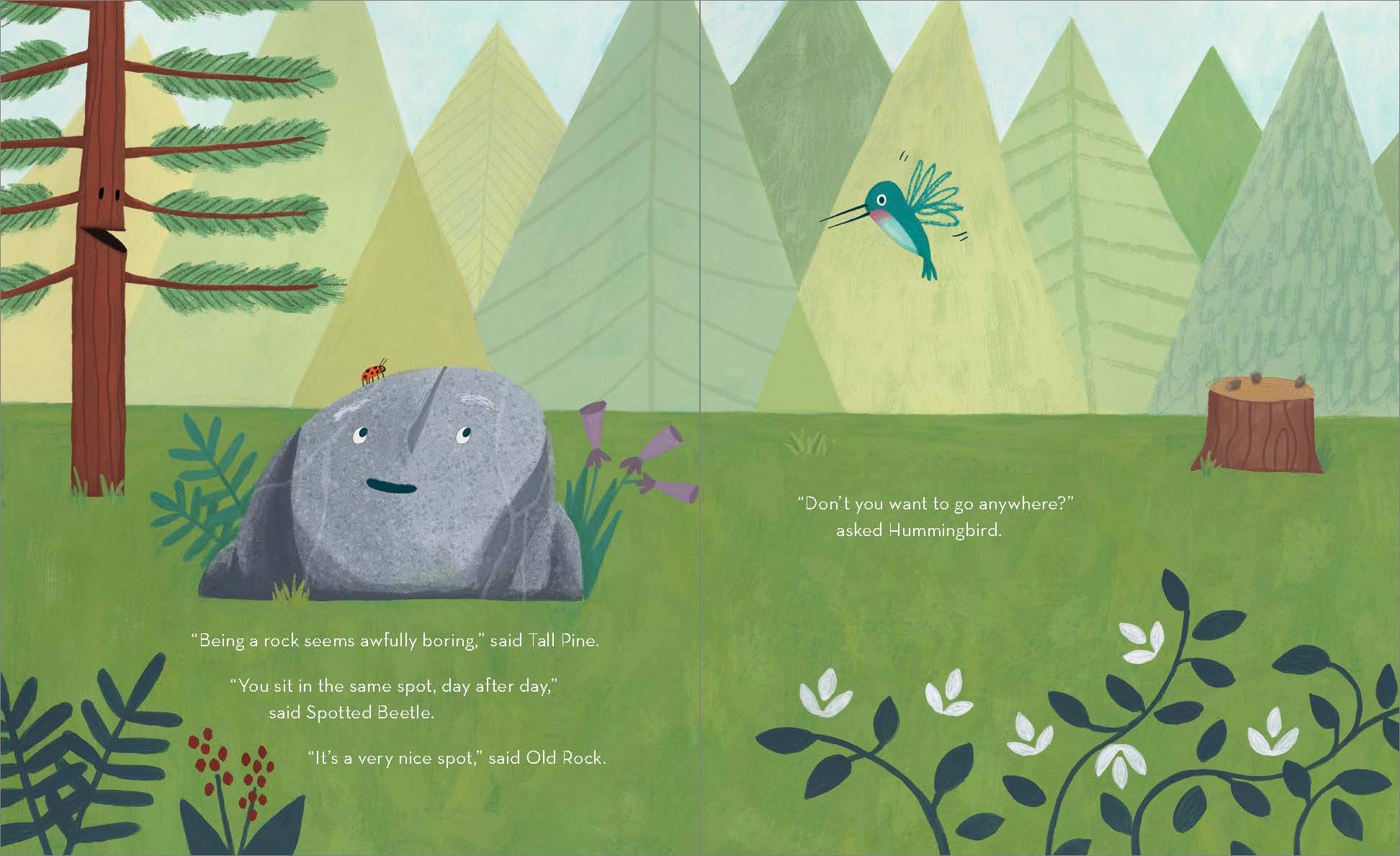
It seemed that Old Rock had been sitting in the same spot forever. Tall Pine and Spotted Beetle thought being a rock must be pretty boring. Hummingbird wondered, “‘Don’t you ever want to go anywhere?’” She knew she would be if she couldn’t fly all over the world and taste exotic nectars. But Old Rock had flown once, and he began to tell his story.

celebrate-picture-books-picture-book-review-old-rock-is-not-boring-hummingbird

Copyright Deb Pilutti, 2020, courtesy of G. P. Putnam’s Sons Books for Young Readers.

It was during the time when he was surrounded by darkness, but then the volcano erupted and Old Rock “‘soared through a fiery sky into the bright light of a new world.’” Tall Pine, Spotted Beetle, and Hummingbird weren’t very impressed. They still thought Old Rock must be bored. Spotted Beetle told him how much he might see if he climbed to Tall Pine’s very highest branch.

celebrate-picture-books-picture-book-review-old-rock-is-not-boring-volcano

Copyright Deb Pilutti, 2020, courtesy of G. P. Putnam’s Sons Books for Young Readers.

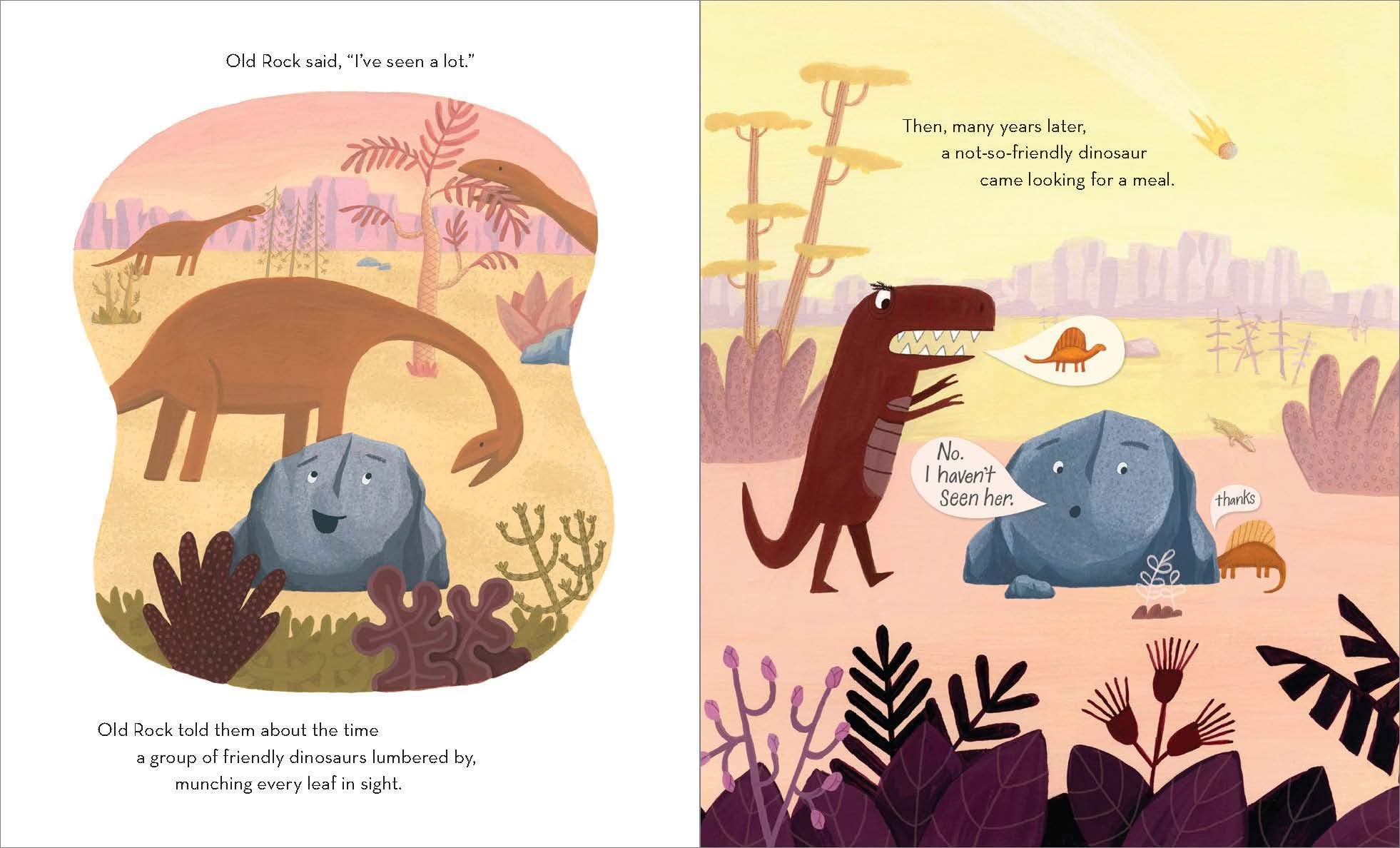
Old Rock countered that he had seen a lot. He’d watched dinosaurs pass by and had even hidden a spinosaurus from a hungry T. rex. He’d traveled in a glacier and been left teetering on a ridge overlooking a vast desert, where he “could see the place where the sky touches the earth.” Spotted Beetle and Hummingbird were intrigued, but Tall Pine dismissed these experiences as “ages ago.” He wanted to know about now. Didn’t Old Rock feel like moving? Tall Pine showed Old Rock how his limbs could dance in the wind.

celebrate-picture-books-picture-book-review-old-rock-is-not-boring-dinosaurs

Copyright Deb Pilutti, 2020, courtesy of G. P. Putnam’s Sons Books for Young Readers.

While Old Rock couldn’t dance, he did recall how he’d turned somersaults off the ridge, landing in a prairie where mastodons grazed near a lake. Tall Pine, Spotted Beetle, and Hummingbird were mesmerized by Old Rock’s story and wanted to know what had happened next. Out of the prairie, sprang a pine forest, Old Rock revealed. And from one of the pine trees a pinecone fell and a seed was released. That seed grew “to be the tall pine who dances in the wind and keeps me company.” Sometimes, he continued, a spotted beetle and a hummingbird meander by. Old Rock was very pleased with his spot, and the others had to agree that it was “very nice” and “not boring at all.”

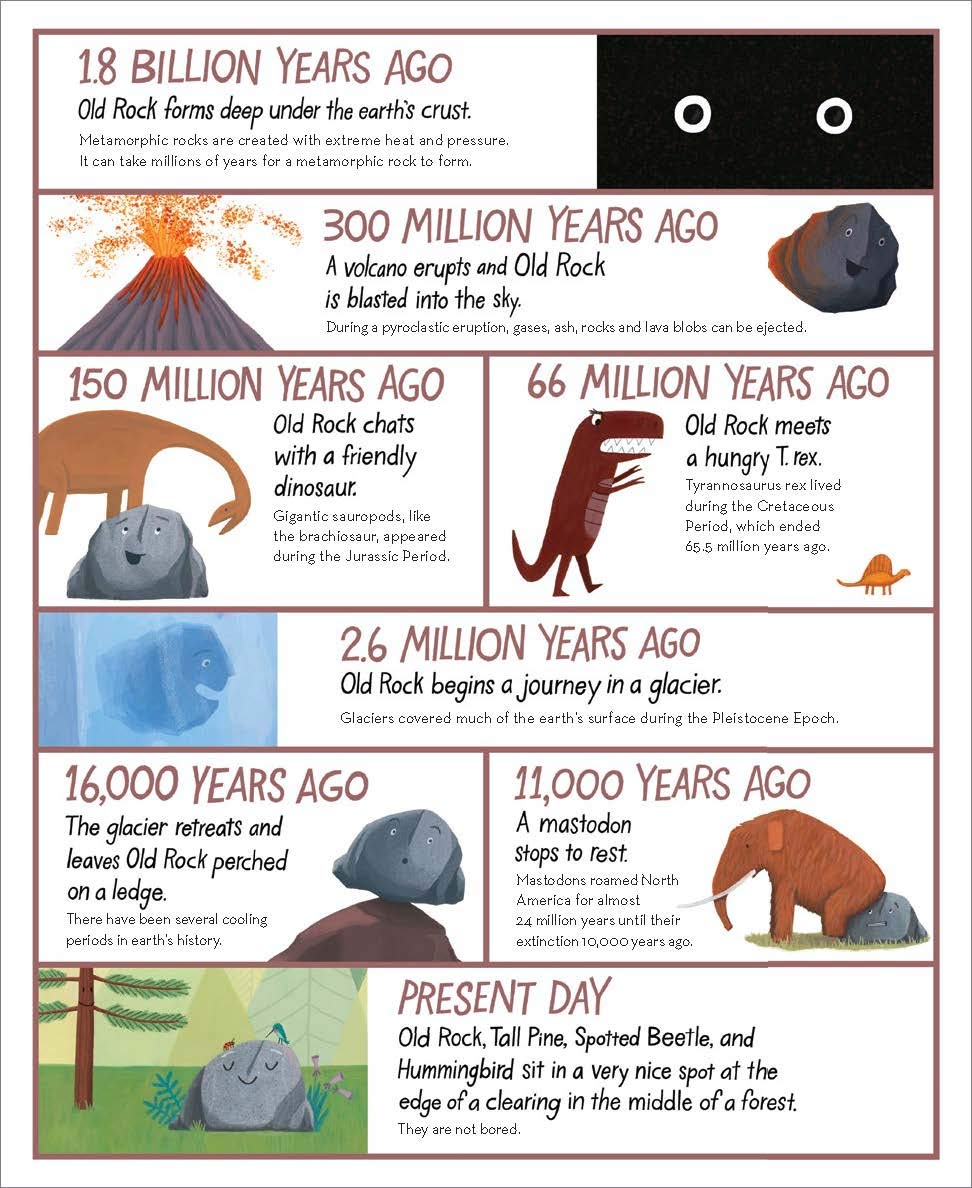
An illustrated timeline of Old Rock’s life from 18 billion years ago to the present day follows the text.

celebrate-picture-books-picture-book-review-old-rock-is-not-boring-time-line

Copyright Deb Pilutti, 2020, courtesy of G. P. Putnam’s Sons Books for Young Readers.

So much clever thought went into Deb Pilutti’s Old Rock as she reveals to kids what a fascinating and active life the rocks and boulders we see every day have had. Tall Pine, Spotted Beetle, and Hummingbird’s skepticism keeps the suspense building as Old Rock rolls out stories of his various travels and talents. Once he has them hooked, they—like young readers—want to hear more, leading to the just-right ending that sweetly encompasses shared history, happiness with one’s place in life, and friendship. The trio’s questions to Old Rock and their related experiences also engage children to think about issues and opinions from a variety of perspectives.

Pilutti’s mixed-media illustrations are nicely textured to bring out Old Rock’s grainy surface while highlighting nature’s vivid colors. Her vignettes from the dinosaur eras, the ice age (where the skeletons of dinosaurs are also swept up and away in the same glacier as Old Rock), and beyond impress upon readers the long time-frame involved, how the earth has changed, and even the fascinating science of the fossil record.

A multi-layered story, perfect for general story times or as a lead in to science lessons and to promote discussion and research in the classroom, Old Rock (is not boring) would be an original and exciting addition to home, classroom, and public library collections.

Ages 4 – 8

G. P. Putnam’s Sons Books for Young Readers, 2020 | ISBN 978-0525518181

To learn more about Deb Pilutti, her books, and her art, visit her website.

Collect Rocks Day Activity

CPB - rock painting craft

Rock This Craft!


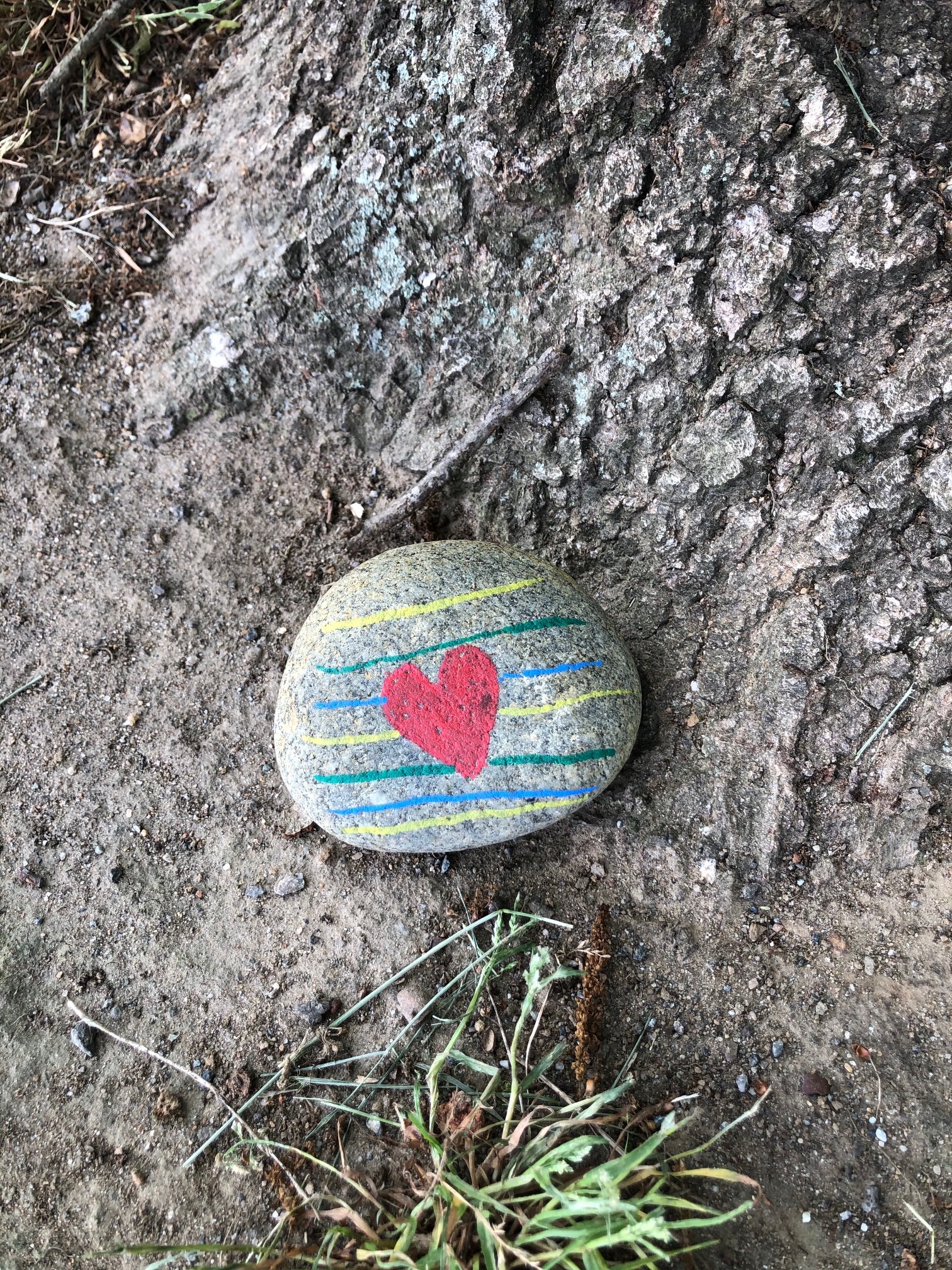
Smooth stones can give talented artists like yourself a natural canvas for your creativity! So collect some rocks and use your imagination to design rocks to leave for people to find on paths or sidewalks, near a store, or anywhere in your neighborhood. You may even want to leave one outside your local library. That’s where I found the rock pictured here!

Supplies

  • Smooth stones in various sizes
  • Paint or markers
  • Small magnets, available at craft stores
  • Jewelry pins, available at craft stores
  • Paint brush
  • Strong glue

Directions

  1. Find stones in your yard or neighborhood or buy them at a craft store or garden center
  2. Wash and dry rocks as needed
  3. Design and paint an image on the stone
  4. Have fun finding spots to leave your works of art!

celebrate-picture-books-picture-book-review-old-rock-is-not-boring-cover

You can find Old Rock (is not boring) at these booksellers

Amazon | Barnes & Noble | Books-a-Million

To support your local independent bookstore, order from

BookshopIndieBound

Picture Book Review
September 4 – National Wildlife Day

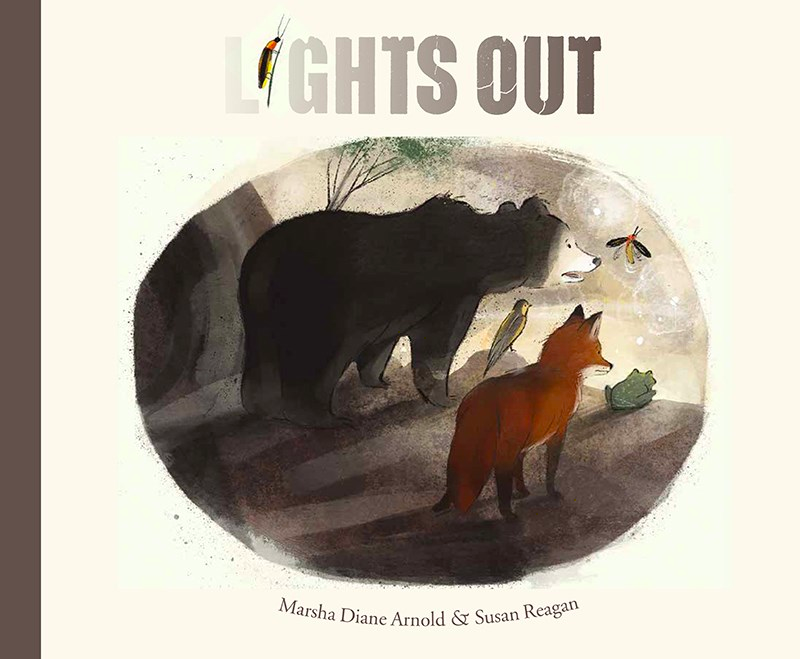
celebrate-picture-books-picture-book-review-Lights-Out-cover

About the Holiday

National Wildlife Day was established in 2005 by author and pet lifestyle expert Colleen Paige to promote awareness of the importance of conservation of animals, habitats, and the environment worldwide as well as to acknowledge the education and conservation work of zoos and animal sanctuaries. To honor the memory and birthday of Steve Irwin, National Wildlife Day is also celebrated on February 2. To celebrate today’s holiday, take time to learn about what you can do to help protect the environment. One action might be as easy as turning off a light – as today’s book shows.

Lights Out

Written by Marsha Diane Arnold | Illustrated by Susan Reagan


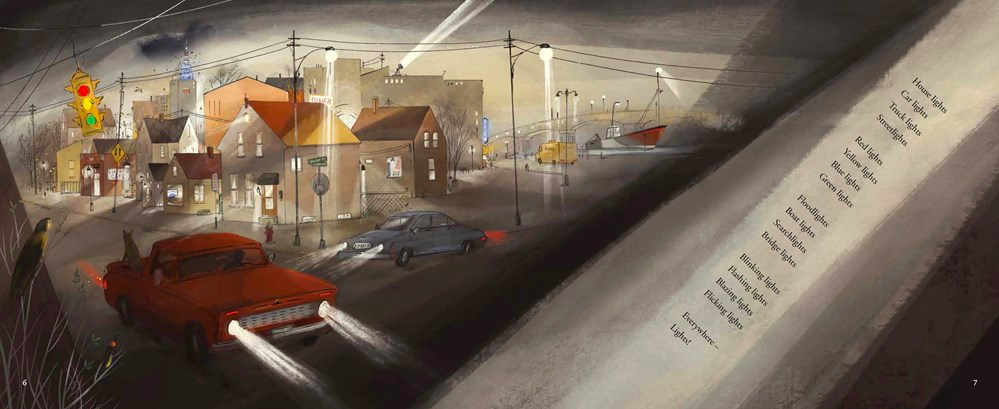
A little fox peeks out of her den. It’s night, but her surroundings are lit up as if it were noon. A Beetle hovers nearby taking in all the “House lights / Car lights / Truck lights / Street lights… / Blinking lights / Flashing lights / Blazing lights / Flickering lights.” There are lights in every color and on every structure. Fox and Beetle wonder where Darkness is—the dark of Night that invites coyotes to sing, owls to hunt, foxes to hunt, and beetles to become “more than beetles.” Perhaps, they think, Night is lost.

celebrate-picture-books-picture-book-review-Lights-Out-city

Image copyright Susan Reagan, 2020, text copyright Marsha Diane Arnold, 2020. Courtesy of Creative Editions.

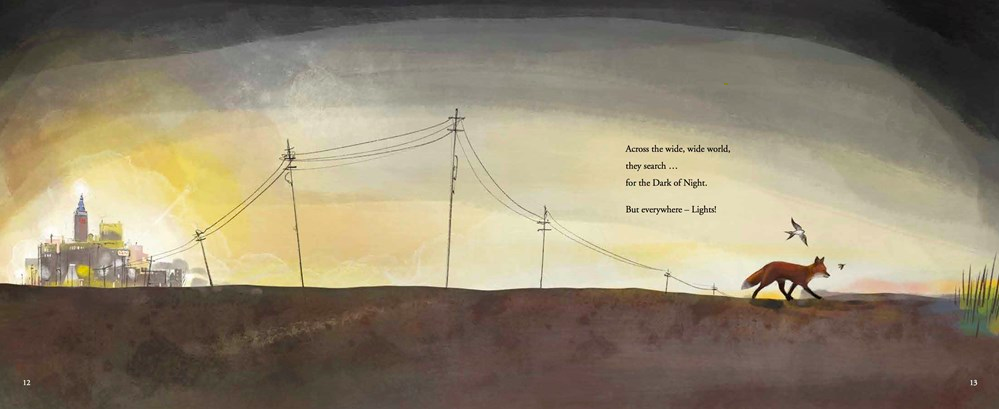
Fox and Beetle set out to find Night. They pass a wetlands, where Frog waits in vain for darkness to lend his voice to the nighttime chorus. “Across the wide, wide world, / they search… / for the Dark of Night. / But everywhere – Lights!” Up on the mountain, Bear is waiting for the signal to hibernate, but the brightness keeps him awake. Frog and Bear join in the search for Night.

celebrate-picture-books-picture-book-review-Lights-Out-wandering

Image copyright Susan Reagan, 2020, text copyright Marsha Diane Arnold, 2020. Courtesy of Creative Editions.

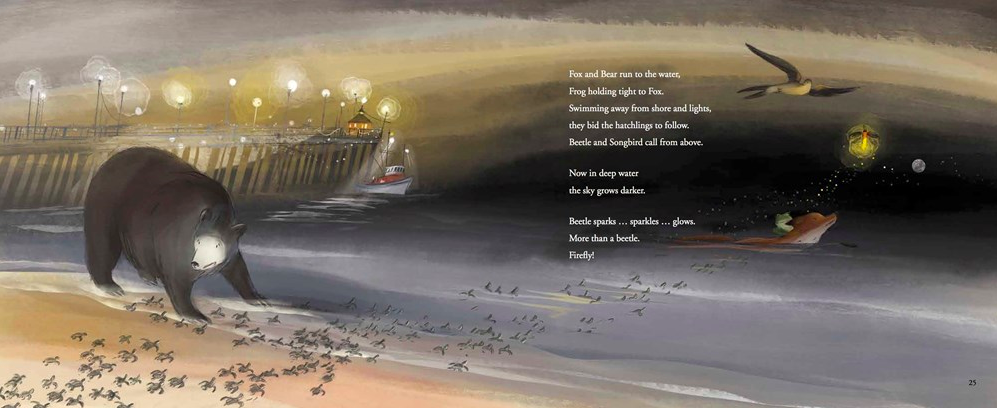
Fox and Beetle travel through forests and fields, over deserts and dunes, and across wide prairies, but don’t find Night. When they come to the seashore, they witness baby turtles hatching. Instead of scuttling toward the ocean, they’re running toward the lights of the boardwalk shops. Frog stops the little turtles then Bear, Fox, and Frog wade out into the waves and shows them the way.

celebrate-picture-books-picture-book-review-Lights-Out-turtles

Image copyright Susan Reagan, 2020, text copyright Marsha Diane Arnold, 2020. Courtesy of Creative Editions.

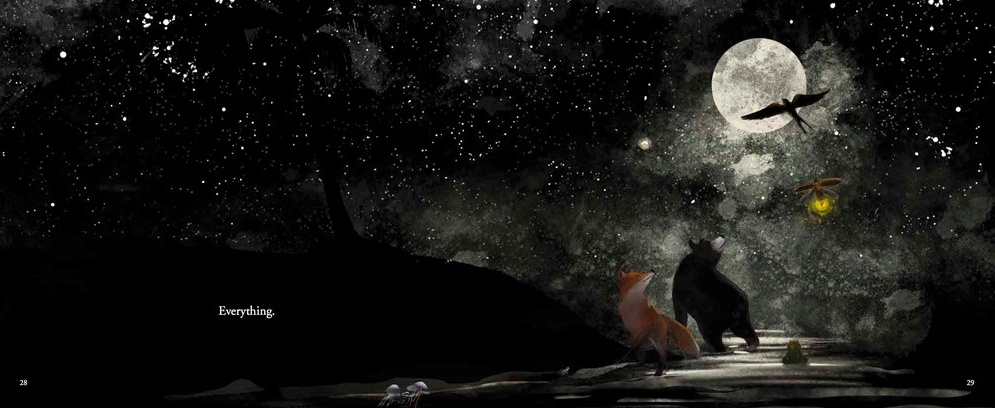
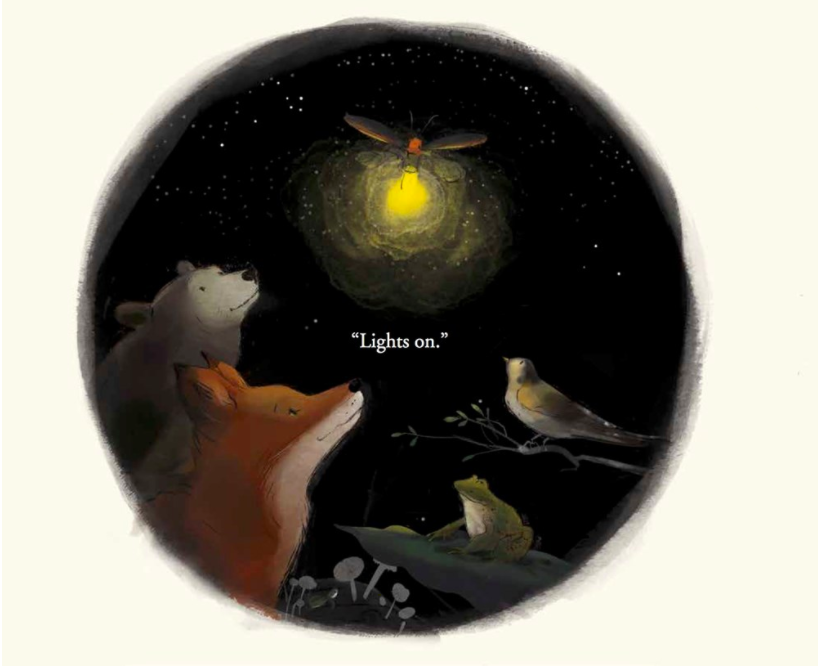
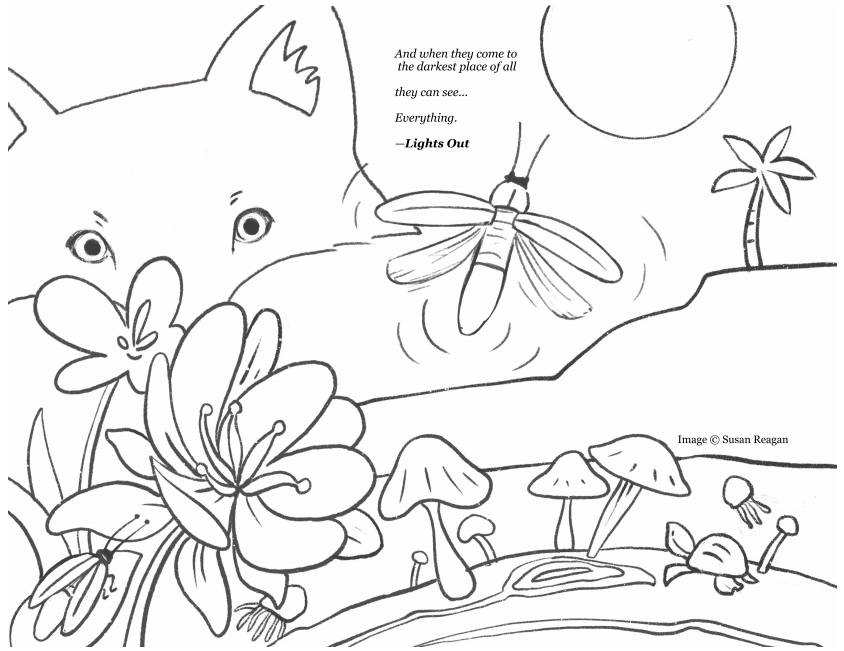
The three friends swim “away from shore and lights” while Beetle and Songbird fly above. Out here, where the sky is dark, Beetle at last sparks and glows. At last the friends reach a far-away island that’s cloaked in darkness. Here “they can see…Everything…. / Mushrooms glowing / Fireflies / Moonlit garden / Shining eyes / Nighttime weavers / Webs of stars / Constellations / Venus, Mars….” Here, they find Night.

An Author’s Note discussing light pollution and its effect on animals and humans and including a resource where readers can learn more about light pollution and what we can do to help precedes the story.

celebrate-picture-books-picture-book-review-Lights-Out-moon

Image copyright Susan Reagan, 2020, text copyright Marsha Diane Arnold, 2020. Courtesy of Creative Editions.

Marsha Diane Arnold’s affecting story about how light pollution changes animal behavior and confuses the natural order of life is a poignant appeal to today’s young environmentally conscious kids, sparking an awareness of the extent of the problem while inviting them to consider ways to restore the darkness of night so important to the health of our planet. Through non-rhyming, yet lyrical language, Arnold takes readers on a journey to find Night. As the friends search place after place, children come to understand that light pollution is a worldwide issue.

Arnold’s capitalization of Night and Darkness makes them characters in the story as well, imbued with living traits and purpose that are just as crucial to wildlife as food and shelter. In one powerful combination of text and illustration, a list of light sources streams from corner to corner in a beam of white light. The number of examples builds to create a glaring realization of all the types of lights that keep the world turned on twenty-four hours a day. After reading Lights Out, children and adults will find themselves paying attention to the lights around them and even in and near their own home.

celebrate-picture-books-picture-book-review-Lights-Out-lights-on

Image copyright Susan Reagan, 2020, text copyright Marsha Diane Arnold, 2020. Courtesy of Creative Editions.

Susan Reagan’s stunning illustrations of cities, waterways, and even out-of-the-way places bathed in a permanent twilight by street lamps, headlights, lighted windows, neon signs, and more are compelling reminders of just how pervasive light pollution is. As the animals wander from place to place looking for Night, their weary and distressed expressions reflect the loss of their natural nocturnal activities. When Beetle and Fox and their friends reach the distant island, Reagan’s gorgeous spreads of a star-and-moonlit sky and vegetation, in which nocturnal animals hunt, luminescent flowers glow, and spider webs glint will have readers taking a nighttime jaunt to discover what they can see in their surroundings.

A unique and important book that raises awareness not only about light pollution but about natural cycles of sleep and wakefulness, Lights Out would be an excellent addition to lessons in science and the environment and is highly recommended for home, school, and public library collections.

Ages 6 – 8

Creative Editions, 2020 | ISBN 978-1568463407

Discover more about Marsha Diane Arnold and her books on her website.

To learn more about Susan Reagan, her books, and her art, visit her website.

National Wildlife Day Activity

celebrate-picture-books-picture-book-review-Lights-Out-activity

Image copyright Susan Reagan, 2020, text copyright Marsha Diane Arnold, 2020. Courtesy of Creative Editions.

Lights Out Activity Kit


This extensive Activity Kit gives teachers, homeschoolers, and parents many ways to engage with Lights Out in the disciplines of science, language arts, art, and social action. Through the various activities, children will learn about light pollution and its effects as well as about the ways in which darkness benefits wildlife. You can download the kit from Marsha Diane Arnold’s website:

Lights Out Activity Kit

celebrate-picture-books-picture-book-review-Lights-Out-cover

You can find Lights Out at these booksellers

Amazon | Barnes & Noble | Books-a-Million

To support your local independent bookstore, order from

Bookshop | IndieBound

Picture Book Review
July 22 – World Brain Day

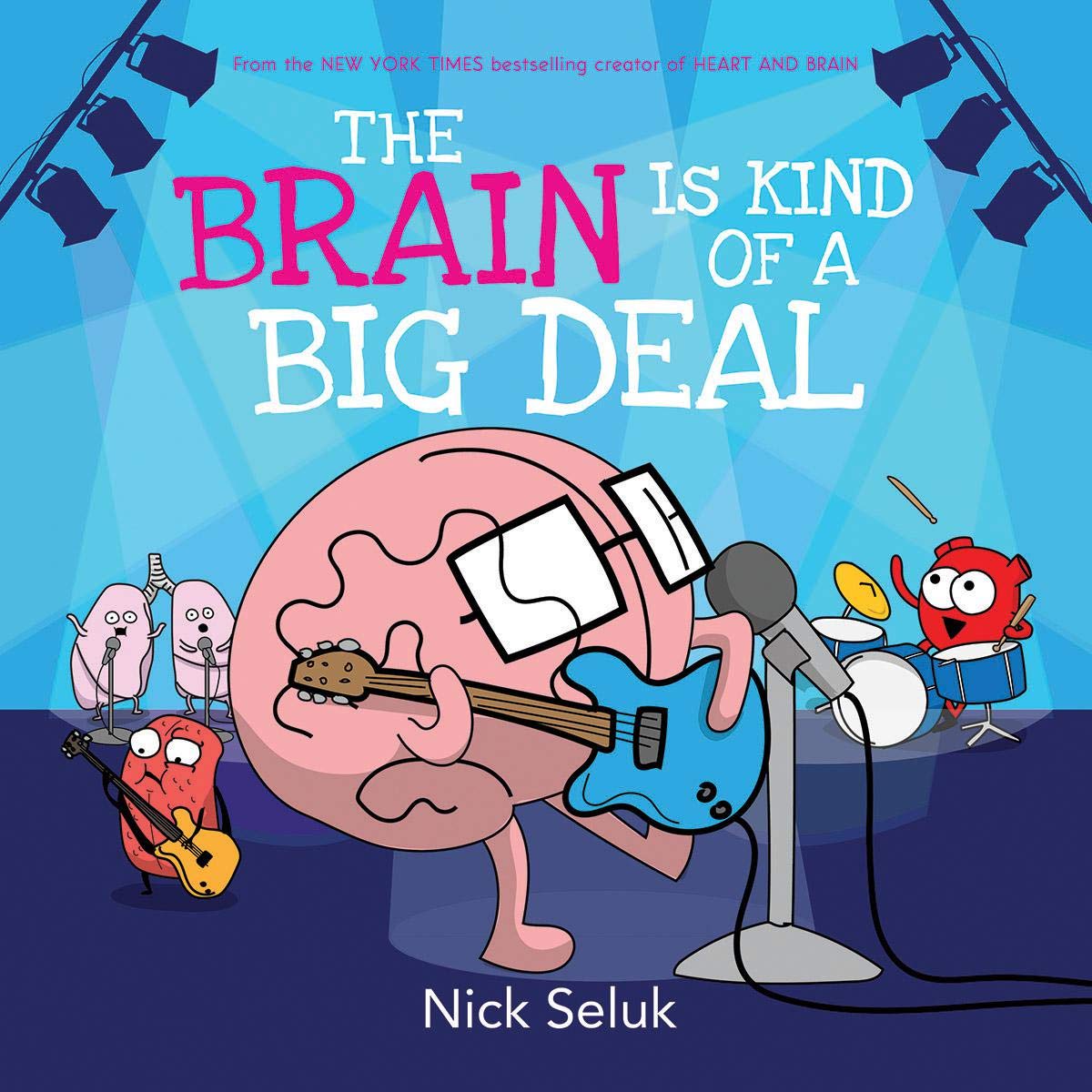
celebrate-picture-books-picture-book-review-the-brain-is-kind-of-a-big-deal-cover

About the Holiday

Established in 2014 by the World Federation of Neurology, the objective of the day is to raise public awareness and promote advocacy related to brain health. Each year the a new theme is chosen to inform the year’s research, policy, and action. This year’s theme is “Move Together to End Parkinson’s Disease.” Through this initiative, the World Federation of Neurology will coordinate with more than 122 global organizations to advocate for improved patient care, education, and additional research for those living with Parkinson’s Disease, a neurodegenerative brain disease that affects the mind, movement, and almost all aspects of brain function, as well as their caregivers. Learning about the brain and its functions early in life can inspire an interest in adopting a healthy diet and lifestyle as they grow up. Today’s book with its high-interest presentation is a perfect place to start.
The Brain Is Kind of a Big Deal

By Nick Seluk


Are you a fan of The Brainiacs? You know, that group led by the Brain that keeps you humming along all day, every day? Yeah, they’re at the top of the (medical) charts, and it’s the Brain that keeps them there. Want to know more about how their body of work all comes together? Then settle in with Nick Seluk’s hip, informative, and clever introduction to the brain and all that it does from its command center “inside of your head, behind your eyes, and under your hair.” From there the brain works continuously, collecting and remembering “information about everything you experience.”

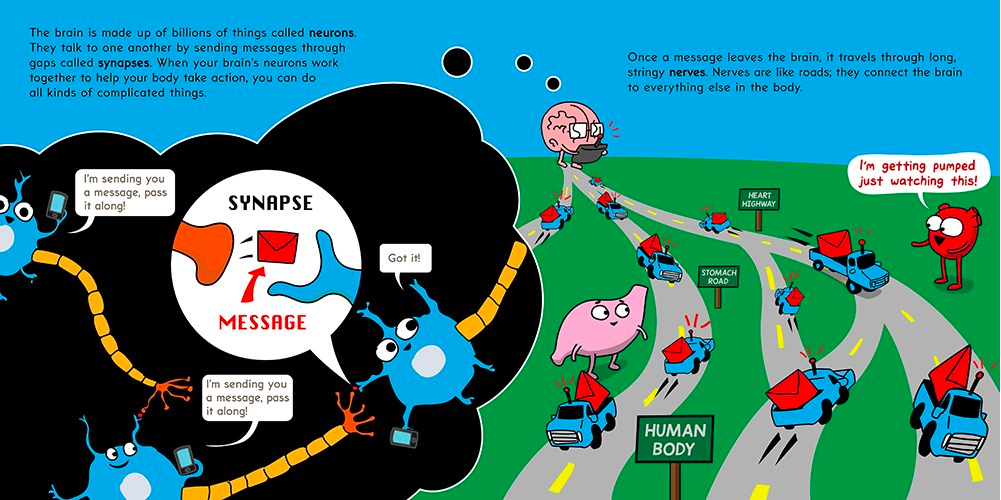
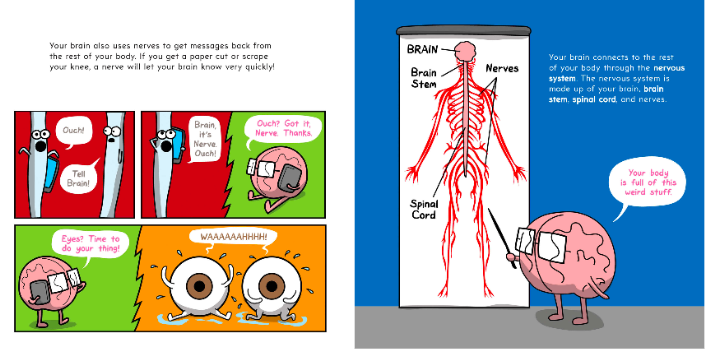
celebrate-picture-books-picture-book-review-the-brain-is-kind-of-a-big-deal-nervous-system

Copyright Nick Seluk, 2019, courtesy of Orchard Books, Scholastic, Inc.

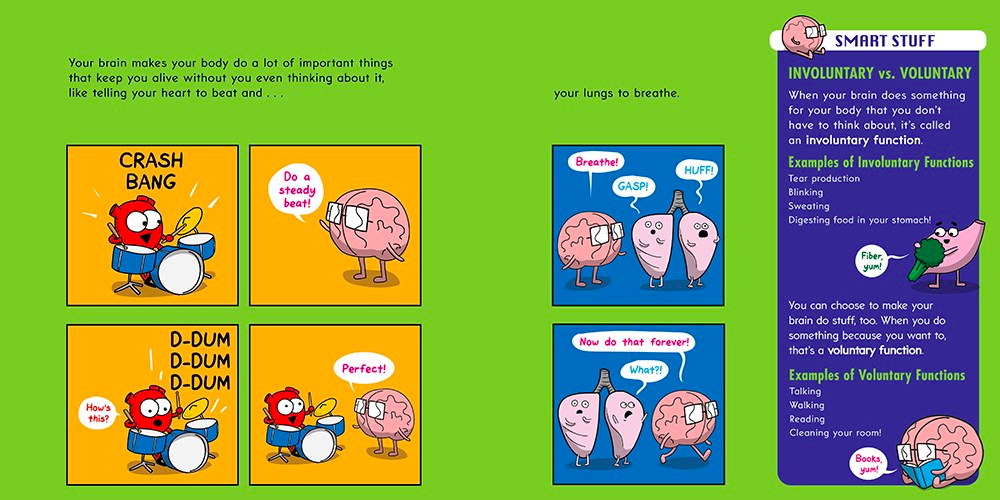
Ready to turn the page? You can’t do it without your brain telling your arm, your hand, and your fingers what to do—and in what seems like no time at all. As you turn the pages you’ll learn how the brain sends these messages to the muscles and organs through synapses, which is a little bit like passing notes in class, and along a “highway” of nerves. Turn a few more pages and you’ll learn about involuntary and voluntary functions, how you know when to eat and when you’re full, and how when you sleep and dream, your brain gets ready for the next day.” Even when “…it dreams about weird stuff.”

celebrate-picture-books-picture-book-review-the-brain-is-kind-of-a-big-deal-ouch

Copyright Nick Seluk, 2019, courtesy of Orchard Books, Scholastic, Inc.

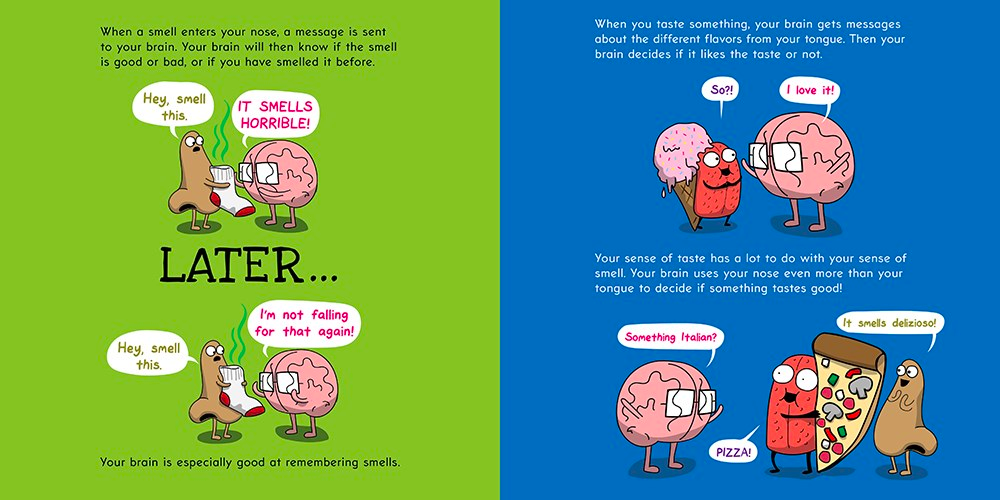
But the Brain isn’t a solo act. He collaborates with the senses, which work through the eyes, ears, nose, tongue, and nervous system, to collect data that helps you remember what things look, sound, smell, and feel like. The brain is great at doing stuff, but it’s also an awesome thinker. With your own incredible brain “you can imagine things and solve problems just by thinking about them.” Ideas aren’t the only things that come from the brain; feelings to too. And the interesting thing about this is that while “you feel happy, sad, angry, or scared without ever having to learn how, you can control how you react when you feel something….” So, what does all of this brain power add up to? Everything that makes you YOU!”

celebrate-picture-books-picture-book-review-the-brain-is-kind-of-a-big-deal-heart

Copyright Nick Seluk, 2019, courtesy of Orchard Books, Scholastic, Inc.

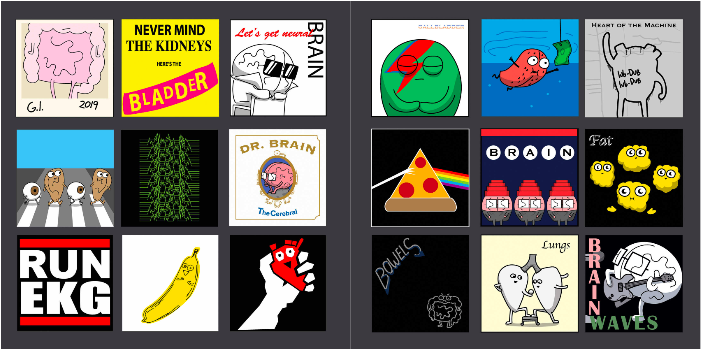
Back matter includes a glossary of terms found in the book, wild facts about animal brains (did you know “a cockroach can live for weeks without its head and brain?”), and a round up The Brainiacs bandmates’ social media posts. The reverse side of the book jacket contains a The Brainiacs concert poster. The front end papers’ riffs on album covers can make for fun adult/child nostalgia bonding,

celebrate-picture-books-picture-book-review-the-brain-is-kind-of-a-big-deal-sock

Copyright Nick Seluk, 2019, courtesy of Orchard Books, Scholastic, Inc.

Fascinating facts about the brain and how it works are accompanied by Nick Seluk’s charming cartoon-style illustrations of anthropomorphized organs, muscles, neurons, and of course the star of the book, the brain—a spectacle-wearing pink orb. These characters are full of personality and puns while taking orders from upstairs. The heart is “pumped” watching messages speed along the nervous system; eyes cry when they receiving the command after an “ouch!” is sent from a nerve to the brain; and the lungs are astonished to learn they must gasp and huff “forever.” Seluk’s writing is clear and engaging, translating the communications from the brain to the rest of the body into steps and purposes that children can understand. Seluk’s sly humor, sprinkled throughout the book, is always in service of the text and allows kids to relate to the concept at hand.

Screen Shot 2019-11-07 at 8.38.00 PM

As the brain recalls information it’s learned, it huddles in a command center where the computer identifies a tree by these attributes. “Sight: Green and Brown; Sound: Rustling; Touch: Rough; Taste: Gross.” When the brain sees a hand hovering over a stove burner, it goes to work. The ring is “bright red, stove says ‘On,’ Mom said ‘No,’ smells hot.” The brain sends out its urgent warning: “Abort! Don’t touch that! Remember last time?! The brain sure does, as the picture of it with bandaged hands on the computer screen shows. Full-bleed, vibrant backgrounds set off the comic-strip panels, funny interactions between Brain and Nose, Ears, Tongue, and other body parts, and Smart Stuff sidebars full of interesting tidbits. Kids will gain valuable knowledge about the body as they giggle through the text in Seluk’s sharp presentation that deftly navigates the dual hemispheres of fun and learning to spotlight the brain for the rock star it is.

You can’t go wrong by adding The Brain is Kind of a Big Deal to your home, classroom, or public library. It is—as they say—a no brainer!

Ages 6 – 8

Orchard Books, 2019 | ISBN 978-1338167009

Discover more about Nick Seluk, his books, his art, and so much more on his website.

World Brain Day Activity

celebrate-picture-books-picture-book-review-scientists-word-search-puzzle

Be a Scientist!


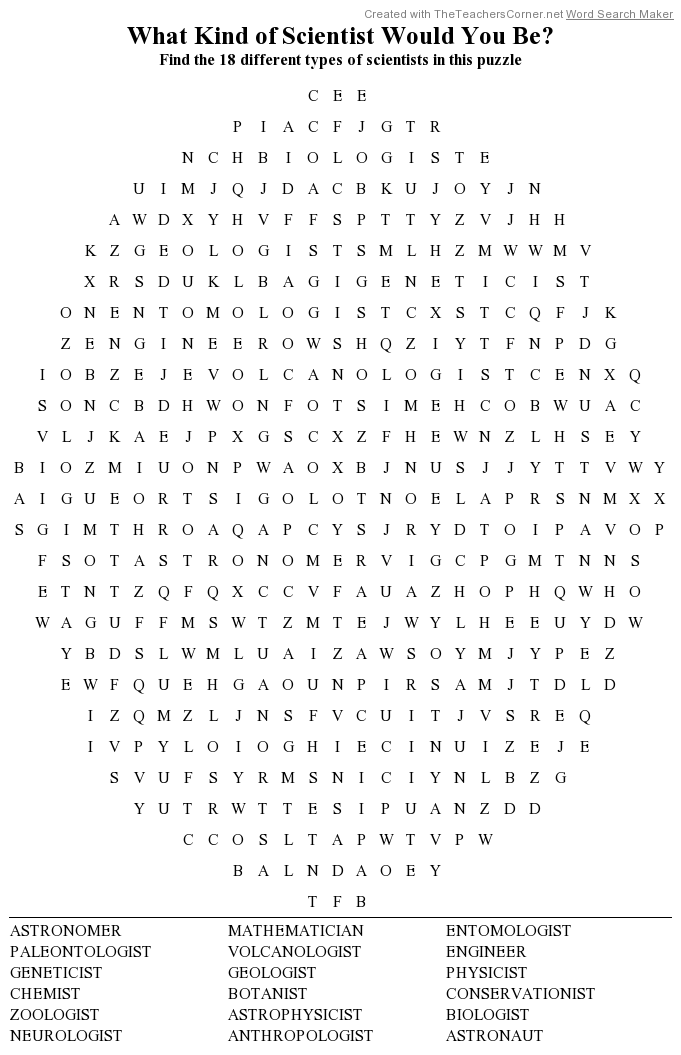
Do people call you a brain? Do you love STEM subjects at school? If so, you might want to consider science as a career. There are eighteen scientists in this printable word search puzzle. Which job would you choose?

What Kind of Scientist Would You Be? Puzzle and Solution

celebrate-picture-books-picture-book-review-the-brain-is-kind-of-a-big-deal-cover

You can find The Brain is Kind of a Big Deal at these booksellers

Amazon | Barnes & Noble | Books-a-Million

To support your local independent bookstore, order from

Bookshop |  IndieBound

Picture Book Review