May 20 – Learn to Swim Day

celebrate-picture-books-picture-book-review-splatypus-coverAbout the Holiday

Established by Swimways in 2012, today’s holiday is dedicated to educating parents, caregivers, and children about water safety and the importance of learning to swim. With summer officially beginning this weekend, kids will be soon be cooling off at beaches, lakes, rivers, and pools. Knowing how to swim and learning to recognize dangers and water hazards are crucial skills for swimmers of all ages. To learn more about education programs and fun ways to celebrate Learn to Swim Day, visit the Swimways website!

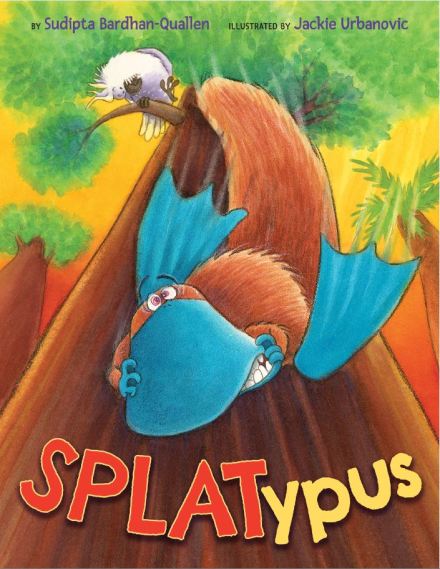
SPLATypus

Written by Sudipta Bardhan-Quallen | Illustrated by Jackie Urbanovic


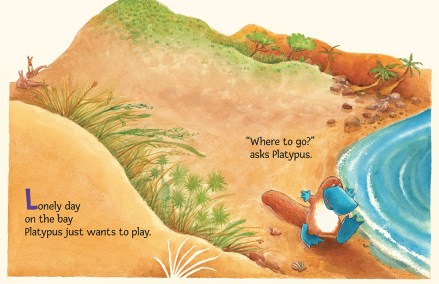
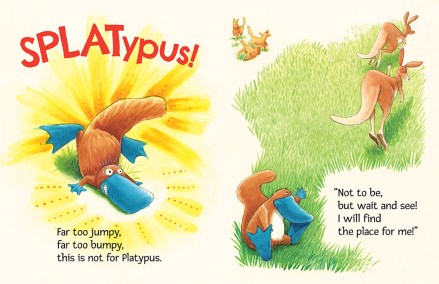
Platypus is feeling lonely as he walks along the shore looking for someone to play with. When a couple of kangaroos hop by, Platypus is happy to see them. “‘I’ll jump too!’” he shouts. He takes off on his blue, webbed feet “skipping, hopping, dipping, dropping.” But he loses control and falls flat on his bill—“Splatypus!” Platypus waves goodbye to the kangaroos, sure that he’ll soon find his place.

Next, two dingoes chase / and run with grace. / Platypus says, ‘I’ll go race!’” But where the dogs leap easily over a fallen log, Platypus struggles and strains to pull himself on top. Then—whoa!—he wobbles and teeters and tumbles and rolls—“Splatypus!” Although trying to be as agile as a dingo didn’t work out, Playpus isn’t giving up on finding where he belongs.
celebrate-picture-books-picture-book-review-splatypus-by-the-bay

Image copyright Jackie Urbanovic, text copyright Sudipta Bardhan-Quallen. Courtesy of Two Lions

Up in a tree, Platypus watches a group of possums playing in the branches. He scrambles to join them, but his hands and feet slip and slide on the smooth trunk and he lands bonk on his head. Suddenly, he sees “fruit bats fly / across the sky. / Platypus says, / ‘I’ll soar high!’” He runs up a cliff to launch himself into the air, but the rocky path trips him up. When he finally reaches the edge, he leaps, flapping his arms and legs. But instead of soaring he goes “Splatypus!”

Poor Platypus! “Nothing’s easy. / Tummy’s queasy. / So discouraged, / lost his courage.” He decides to give up on flying, climbing, and jumping. The day is almost over and still Platypus hasn’t found any friends. He goes to sleep in the shade of a palm tree. The next morning, still feeling dejected, Platypus worries that the day will be no fun. As he strolls near the edge of the bay, however, he spots some swans swimming by and then two “penguins cry / a soggy ‘Hi!’”
celebrate-picture-books-picture-book-review-splatypus-kangaroos

Image copyright Jackie Urbanovic, text copyright Sudipta Bardhan-Quallen. Courtesy of Two Lions

They look as if they are having so much fun that Platypus decides to try one more time to join in. He wades into the water and dives in. With a “ker-sploosh, ker-splash!” Platypus finds that he’s a natural! Now, “water wiggling, all are giggling.” As he floats and paddles with the penguins, swans, fish, and turtles, he “looks around, / at last he’s found / the perfect place for Splatypus.”

Little ones will giggle from beginning to end of this funny story that shows that sometimes you have to try a lot of different things before you find your perfect niche. Platypus’s can-do attitude and perseverance are great lessons for children beginning to navigate school, activities, and friendships. Sudipta Bardhan-Quallen’s rollicking rhythm and easy-to-repeat rhymes will have kids reading—and most likely moving—along with the story.

Jackie Urbanovic takes kids to the coast of Australia to meet kangaroos, dingoes, possums, fruit bats, and even a sea dragon in her sunny illustrations. Little Platypus, with his blue feet, hands, and bill, is adorable as he tries activity after activity with little success. When he finally finds some swimming buddies, kids will cheer to see the satisfied smile on his face.  The large type face will invite beginning readers to try reading for themselves—and persistent Platypus is a good role model along the journey.

Ages 3 – 7

Two Lions, 2017 | ISBN 978-1503939202

Discover more about Sudipta Bardhan-Quallen and her books as well as downloadable teacher’s guides on her website!

You’ll find books, a portfolio of art, coloring pages and more by Jackie Urbanovic on her website!

Learn to Swim Day Activity
celebrate-picture-books-picture-book-review-in-the-swim-maze

In the Swim! Maze


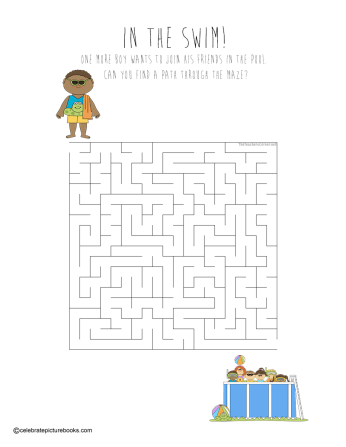
One little boy would like to join his friends in the pool. Can you help him by finding a path through this printable In the Swim maze? Here’s the Solution!

Picture Book Review

April 28 – It’s the Week of the Young Child

celebrate-picture-books-picture-book-review-i-want-to-grow-cover

About the Holiday

The Week of the Young Child is an annual initiative hosted by the National Association for the Education of Young Children to celebrate learning, young children, their families, and their teachers. Daily themes focus on ways that children learn. This year those included Music Monday, Tasty Tuesday, Work Together Wednesday, Artsy Thursday, and today—Family Friday, in which people are encouraged to share their family stories. Today’s book also takes a look at a common childhood topic through which kids learn about themselves and others.

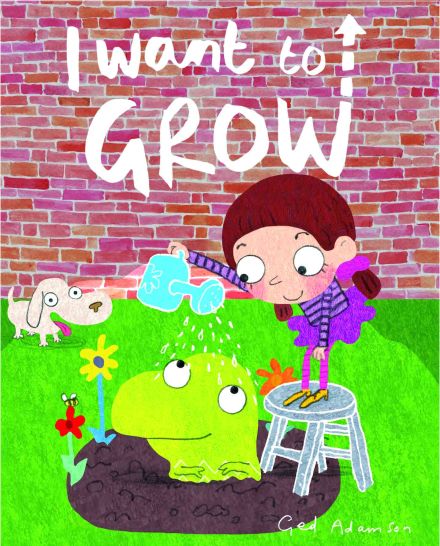
I Want to Grow

By Ged Adamson

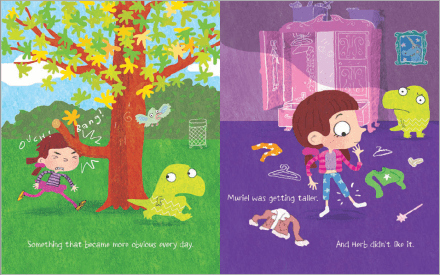
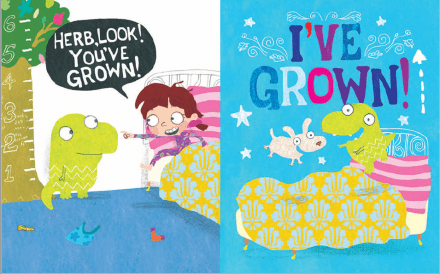
One day while Herb and Muriel were strolling through the neighborhood, Herb noticed something a little different. Every day this disturbing trend continued. The fact was impossible to ignore—“Muriel was getting taller. And Herb didn’t like it.” He didn’t mind that she could now see over the fence or reach things on high shelves, it was just that…well… “he wasn’t getting any taller himself.”

celebrate-picture-books-picture-book-review-i-want-to-grow-muriel-growing

Copyright Ged Adamson, 2017. Courtesy of Boyds Mills Press

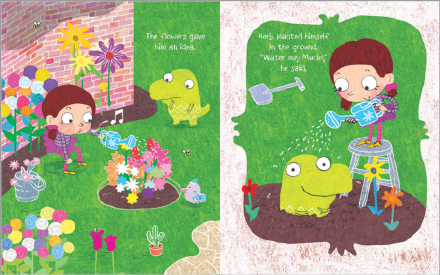
So Herb looked around for a way to rectify the situation. The flowers in Muriel’s garden were reaching for the sky. Perhaps planting himself in the ground would make him grow. But no matter how much Muriel watered him, nothing happened. He shook off the dirt and went to find Muriel. She was in the kitchen working with clay. Herb watched her roll a small piece of clay into a looong piece. That looked promising, so Herb asked for Muriel’s help. “She rolled him back and forth until her arms ached. But he didn’t get any longer. Just dizzy and a little queasy.”

celebrate-picture-books-picture-book-review-i-want-to-grow-garden

Copyright Ged Adamson, 2017. Courtesy of Boyds Mills Press

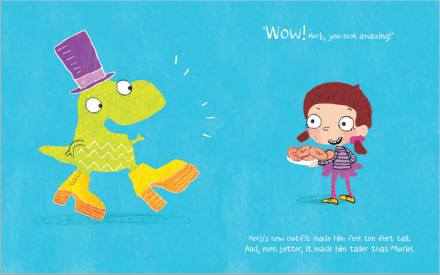
Maybe if he just willed himself to grow, he would, Herb thought. He stressed and strained until he was red in the face, but he remained as short as ever. Muriel knew Herb was having a hard time, so she made him a special treat of tea and doughnuts. When he approached, Muriel immediately recognized a difference. Herb was tall top and bottom. Both Herb and Muriel loved the new look—the high wedge shoes and top hat looked amazing! But standing and walking proved to be perilous.

celebrate-picture-books-picture-book-i-want-to-grow-shoes

Copyright Ged Adamson, 2017. Courtesy of Boyds Mills Press

Herb went to bed feeling a little dejected. In the morning, though, Herb had a pleasant surprise. When he went to wake up Muriel, she noticed something right away. Herb had grown! He was so excited that he “jumped and cheered.” Suddenly, Muriel realized that she had grown too. Herb could see that something was on her mind and asked. It’s “nothing, Herb. Nothing at all,” she said. “Let’s celebrate your new tallness!” And that is just what they did. After that Herb didn’t “worry about catching up with Muriel because he was growing!”

celebrate-picture-books-picture-book-review-i-want-to-grow-cheering

Copyright Ged Adamson, 2017. Courtesy of Boyds Mills Press

Ged Adamson’s wit and whimsy go a long way in assuaging childhood doubts and worries in his funny book. The issue of growth is a common one as siblings, friends, and classmates often compare themselves and watch as those around them grow taller or they themselves begin to outpace the rest. The uncertainty of being different can be troubling and set up unnecessary anxiety.

Adamson’s I Want to Grow offers kids reassurance that nature will take its course while also making them laugh at Herb’s attempts to speed the process. Muriel’s empathy and kindness toward Herb is another wonderful life lesson for readers navigating the quirks and changes of childhood. Adamson’s distinctive illustrations combine vibrant colors, sketched-in details, and sweet, round-eyed characters to enchant kids and boost both the humor and sweetness factor of this heartening story.

I Want to Grow is a great book to share with kids who may be feeling unsure about their height—or any such issue.

Ages 4 – 8

Boyds Mills Press, 2017 | ISBN 978-1629795850

Check out more about Ged Adamson, his books, and his art on his website!

Week of the Young Child Activity

celebrate-picture-books-picure-book-review-window-terrarium-1

Window Pane Terrarium

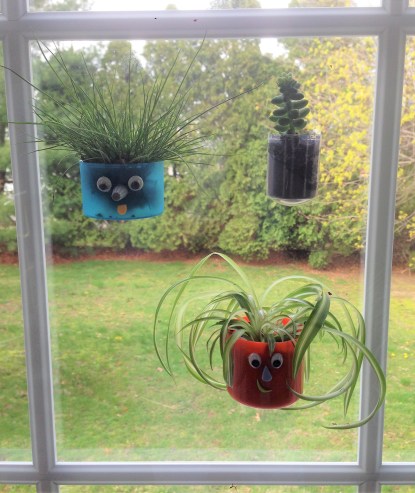
With this easy craft for spring and summer that combines creativity, recycled materials, a little science, and an opportunity to watch your efforts grow, you can turn a window pane into a little garden.

Supplies

  • Small, light recycled plastic containers with no lip – small cups or colorful tops from shaving cream or other such cans
  • Googly eyes, foam, paint or other materials to decorate the container
  • Soil
  • Seeds or small plants (small succulents, air plants, spider plants, and grass work well)
  • Adhesive Velcro mounting strips in an appropriate weight category
  • Spoon

Directions

  1. Clean and dry containers
  2. Decorate containers with eyes and foam to make faces, or in any way you wish
  3. Fill container with soil
  4. Add seeds or plants
  5. Attach Velcro strips to back of container
  6. Attach firmly to window pane

Alternately: line up containers on a window sill for a colorful indoor garden

Picture Book Review

April 21 – It’s Celebrate Diversity Month

celebrate-picture-books-picture-book-review-the-ugly-dumpling-cover

About the Holiday

The month of April is set aside for people to recognize and appreciate the varied cultures and beliefs around the world. Instead of finding division and differences, we should celebrate the beauty and wonder of our multifaceted planet. This month offers a great opportunity to discover ways to incorporate acceptance and inclusiveness throughout your life.

The Ugly Dumpling

Written by Stephani Campisi | Illustrated by Shahar Kober


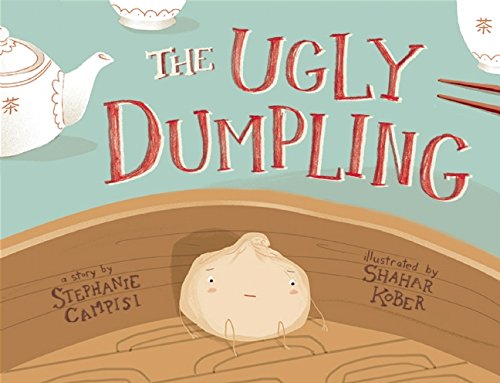
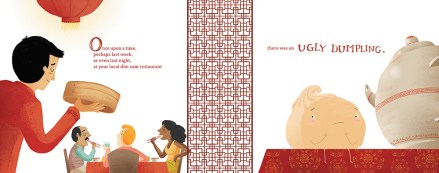
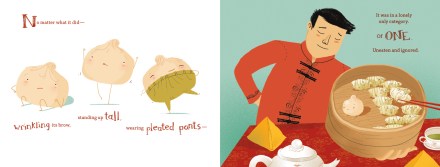
“Once upon a time, perhaps last week, or even last night, at your local dim sum restaurant…there was an ugly dumpling.” Sure, you might think all dumplings are ugly, but we’re talking about one particular ugly dumpling. It tried all sorts of tricks to make itself more attractive, but it still remained lonely and uneaten. It sat dejected until a cockroach traversing the kitchen caught sight of it and immediately fell in love.

celebrate-picture-books-picture-book-review-the-ugly-dumpling-interior-art-dim-sum-restaurant

Image copyright Shahar Kober, text copyright Stephani Campisi. Courtesy of Mighty Media Press.

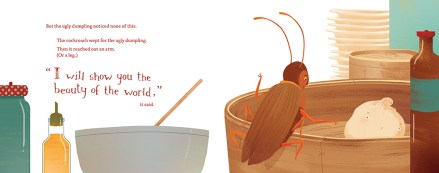
The cockroach “reached out an arm. (Or a leg)” toward the dumpling and offered to show it the beauty of the world. Together they traveled to cities near and far, experiencing them through culinary lenses—stacked-plate skyscrapers, piled-dishes skylines, and chopstick bridges that took them over flour mountains and folded-napkin peaks. Then, in a certain restaurant, the dumpling saw something astonishing! Not only one, but two, three, four, and more dumplings just like itself!

celebrate-picture-books-picture-book-review-the-ugly-dumpling-trying-to-fit-in

Image copyright Shahar Kober, text copyright Stephani Campisi. Courtesy of Mighty Media Press.

Suddenly the ugly dumpling realized that it was not a dumpling at all, but a “steamed bun—a golden-hearted, smooth-skinned steamed bun, exactly like all the other steamed buns in the world.” The ugly dumpling puffed with meaning, importance, and…yeast! The restaurant patrons and staff and even the other steamed buns took notice. The cockroach by the ugly dumpling’s side cheered to see its friend receiving so much attention.

celebrate-picture-books-picture-book-review-the-ugly-dumpling-roach

Image copyright Shahar Kober, text copyright Stephani Campisi. Courtesy of Mighty Media Press.

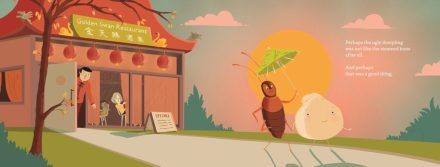
The people’s wide eyes and astonished expressions were not for the dumpling, however. Instead, they registered horror at the insect in their midst. The ugly dumpling was familiar with that look and did “something quite beautiful. It reached out an arm. (Or a leg.) And it led the cockroach out into the world, The beautiful, beautiful world.” And in that moment the ugly dumpling realized that it “was not like all the other steamed buns after all” and that “perhaps that was a good thing.”

celebrate-picture-books-picture-book-review-the-ugly-dumpling-leaving-together

Image copyright Shahar Kober, text copyright Stephani Campisi. Courtesy of Mighty Media Press.

Stephani Campisi’s The Ugly Dumpling is a fresh and delectable dish-up of the classic Ugly Duckling story for a new audience. Stuffed with charm and off-beat humor, this tale of friendship and diversity embraces all who feel at odds with their environment—with or without the recognition of why. Its sweet and insightful ending emphasizes the idea that finding your niche does not always mean fitting in with a certain crowd, and that having the courage to strike out on your own path leads to beautiful relationships and personal happiness.

celebrate-picture-books-picture-book-review-the-ugly-dumpling-different-dumplings

Image copyright Shahar Kober, text copyright Stephani Campisi. Courtesy of Mighty Media Press.

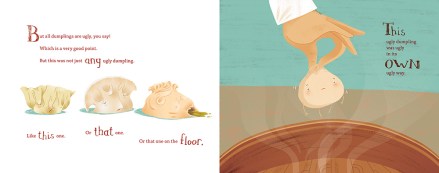
Shahar Kober’s dumpling is anything but “ugly.” His adorable puffed dough, lonely and ignored for not adhering to the mold, will melt readers’ hearts as he tries anything and everything—including green pleated pants—to fit in. Kobar’s stylish drawings are the perfect underscore to Stephani Campisi’s quick, dry wit—as in his rendition of three uglier-than-the-next dumplings—and if cockroaches were really as cute as Kober’s, we’d all set out a different kind of Roach Motel. A clever bit of typography transforms steam coming from a wok into the word HISS, and the restaurant scenes will make readers hungry for their favorite Asian eatery.

As readers turn to the last pages and watch the steamed bun and the cockroach leave the restaurant hand in hand (foot in foot?) under the shade of a paper umbrella, they will want to turn back to the beginning and start over again. The Ugly Dumpling is a must read and a wonderful addition to children’s bookshelves.

Ages 2 – 9

Mighty Media, 2016 | ISBN 978-1938063671

Get to know more about Stephanie Campisi and her work on her website!

To view a gallery of art by Shahar Kober for books, magazines, animation, and more, visit his website!

Check out the Mighty Media Press website for more about The Ugly Dumpling and a-dough-able coloring pages!

Take a look at the trailer for The Ugly Dumpling!

Celebrate Diversity Month Activity

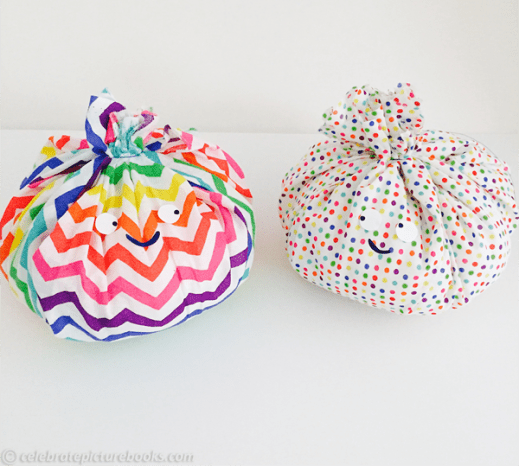
celebrate-picture-books-picture-book-review-dumpling plush craft

Embrace Your Inner Dumpling Plush


We are all beautiful “dumplings” in one way or another! With this easy craft you can create a huggable friend and show others what you’re made of!

Supplies

  • Square piece of cloth in any fabric and color. Size of plush depends on size of cloth (the plushes shown are made from 18”-square cotton fabric)
  • Poly fill (the plushes shown use about 1 1/8 ounces of fill)
  • White cloth for eyes and mouth
  • Twine or string
  • Fabric glue

Directions

  1. Cut the corners from the square cloth to make a circular piece of cloth
  2. Fill the middle with poly fill
  3. Pull the edges of the cloth up and around the fill
  4. Tie the top closed with the twine or string
  5. To make the face, cut small circles and a mouth from the white cloth
  6. Smooth out a section of the dumpling body
  7. Glue the face to the body with fabric glue

Picture Book Review

March 21 – World Poetry Day

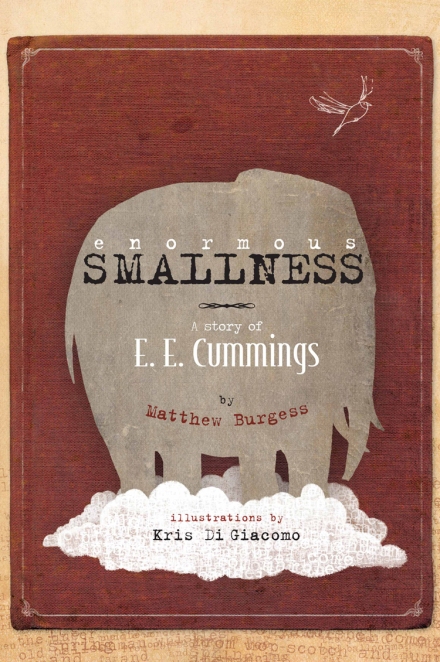
celebrate-picture-books-picture-book-review-enormous-smallness-cover

About the Holiday

Sponsored by the United Nations Educational, Scientific, and Cultural Organization (UNESCO), World Poetry Day celebrates one of the world’s oldest and most treasured forms of linguistic expression. On this day we honor the poets who translate physical beauty into words, expose social injustice in heartrending verse, and make us laugh with quirky juxtapositions. To celebrate the holiday, attend a poetry reading, revisit poems from your favorite author or discover a new writer, or pen a poem yourself!

enormous SMALLNESS: A Story of E. E. Cummings

Written by Matthew Burgess | Illustrated by Kris Di Giacomo


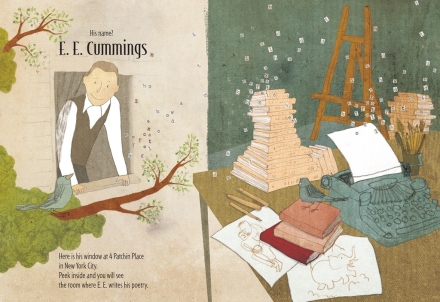
Hello! Welcome to 4 Patchin Place, the home of poet E. E. Cummings! This is where he wrote his poetry on a clackety typewriter, stopping only for tea poured out by the love of his life, Marion Moorehouse. How did he become a poet? That is an interesting story! E. E. was born Edward Estlin Cummings on October 14, 1894 in Cambridge, Massachusetts. His house was full of extended family, a handyman, a maid, and several pets. From an early age he loved to translate the things he saw into words. “His first poem flew out of his mouth when he was only three: “‘Oh, my little / birdie, Oh / with his little / toe, toe, toe!’”

celebrate-picture-books-picture-book-review-enormous-smallness-welcome

Image copyright Kris Di Giacomo, text copyright Matthew Burgess. Courtesy of Enchanted Lion Books

Estlin’s mother wrote down all the poems he told her and made a little book of them, titled “‘Estlin’s Original Poems.’” When he was six, he expressed his love of nature in a poem about trees, and when his mother asked him what else he saw, he “looked around as if his eyes were on tiptoes and when his heart jumped he said another poem: “‘On the chair is sitting / Daddy with his book. / Took it from the bookcase / Beaming in his look.’”

celebrate-picture-books-picture-book-review-enormous-smallness-elephant

Image copyright Kris Di Giacomo, text copyright Matthew Burgess. Courtesy of Enchanted Lion Books

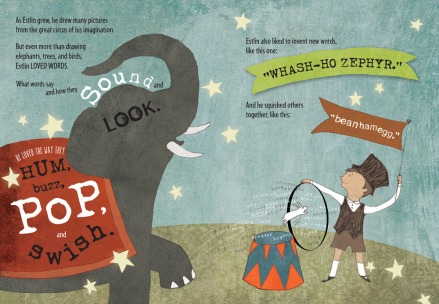
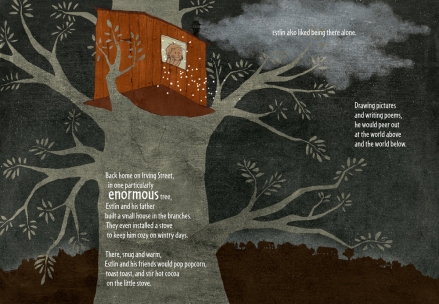
As he grew, Estlin was fascinated by the animals he saw at the circus and in the zoo. He drew pictures of them and wrote about them, using the words he loved so well—and even making up his own words. Estlin had a zest for life and for making life fun for himself and his little sister. During the summers, the family traveled to Joy Farm in New Hampshire, where Estlin swam, milked the cow, rode a donkey, and wandered through the fields and forest. His father had built him a little log cabin in the woods, and in the afternoons Estlin went there to draw and write. At home he also had a special place all his own. In an enormous tree his father built a tree house, complete with stove to keep him warm on cold days.

celebrate-picture-books-picture-book-review-enormous-smallness-tree-house

Image copyright Kris Di Giacomo, text copyright Matthew Burgess. Courtesy of matthewjohnburgess.com

Estlin had support for his writing at school too. His favorite teacher encouraged him saying, “anything is possible, / as long as you are true to yourself / and never give up, even when the world / seems to say, stop!” From his Uncle George, Estlin received a guide to writing poems. Estlin followed the rules in the book, penning poems nearly every day. When Estlin was 17 he attended Harvard College and began publishing his poems in the school’s magazines. While at Harvard, Estlin realized he had to follow his heart to be happy. He wanted to be like the new artists who were shaping the world—people like Gertrude Stein, Paul Cezanne, and Igor Stravinsky, “artists who were,” he once said, “challenging the way we think and see.”

celebrate-picture-books-picture-book-review-enormous-smallness-paris

Image copyright Kris Di Giacomo, text copyright Matthew Burgess. Courtesy of Enchanted Lion Books

After he graduated, Estlin returned home, but when he had saved enough money he moved to New York and fell in love with the city immediately. He and his friends took in everything new the city had to offer. Soon, however, the United States entered World War II. On April 17, 1917 Estlin volunteered to be an ambulance driver in France. Before he received his assignment, though, he had time to explore Paris. He was “bowled over by the museums, the ballet, and the colorful, crowded streets.” He enjoyed the city so much he returned often during his lifetime.

During the war, Estlin was mistaken for a spy and sent to prison for several months. After the war he wrote a book about his experiences titled The Enormous Room by E. E. Cummings. “The book was published and praised! Estlin was becoming E. E.!” A year later he published his first book of poetry—Tulips & Chimneys. In his poems he experimented with punctuation and using lower case letters instead of capitals.

celebrate-picture-books-picture-book-review-enormous-smallness-yes

Image copyright Kris Di Giacomo, text copyright Matthew Burgess. Courtesy of matthewjohnburgess.com

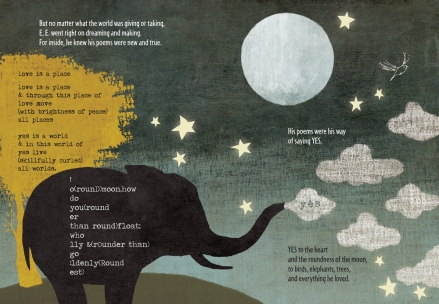
Through his fanciful typography, E. E. “wanted his reader’s eyes to be on tiptoes too, seeing and reading poetry (inaway) that was new.” But some people didn’t understand or like his poetry; it was too strange and too small, they said. But E. E. knew he had to stay true to himself. He believed that “his poems were new and true” and “were his way of saying YES” to everything he loved. As time went on more and more people began to “see the beauty of E. E.’s poetry, and he became one of the most beloved poets in America.”

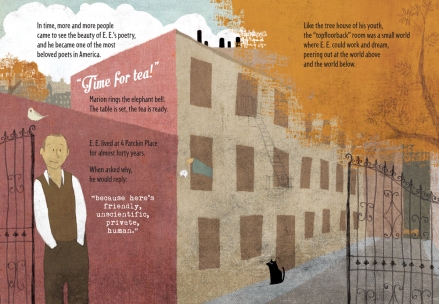
E. E. Cummings lived and worked at 4 Patchin Place for almost 40 years, but in his mind he would often return to his childhood home. He “could still see himself as a boy gazing out at the sunset”—a memory that he put into words: who are you,little i / (five or six years old) / peering from some high / window;at the gold / of November sunset / (and feeling:that if day has to become night / this is a beautiful way)”

celebrate-picture-books-picture-book-review-enormous-smallness-patchin-place

Image copyright Kris Di Giacomo, text copyright Matthew Burgess. Courtesy of matthewjohnburgess.com

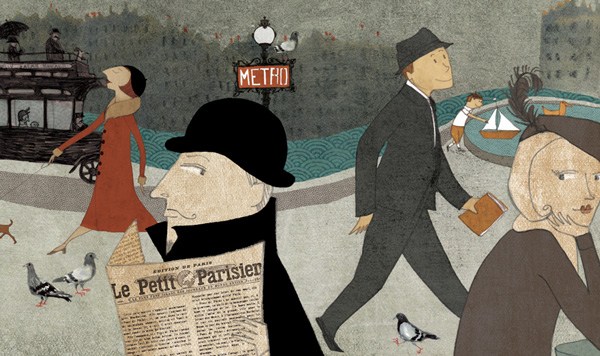
Simply put, Matthew Burgess’s enormous SMALLNESS: A Story of E. E. Cummings is a biography that will make you smile. Upbeat and full of the wonder and whimsy that influenced Estlin Cummings’ prodigious talent, the story encourages readers to always follow their heart. Burgess’s easy-going, conversational style invites kids along on the journey of Cumming’s life, stopping off at points that resonate with kids—early imaginary play, school, family vacations, home life, college, travel, and ultimate success. Seeing the support Cummings received throughout his life will inspire young readers just starting out on their own roads of discovery.

Kris Di Giacomo’s enchanting illustrations will immediately capture the imagination of readers. The playful quality of Cummings’ personality and poems is mirrored in each spread as a variety of children’s drawings and typography are sprinkled throughout. As six-year-old Estlin composes poems for his mother, he stands on tiptoe in his nightshirt surrounded by toys; he experiences life from rooftop and treetop and gazes into the night from his tree house; New York lights up with fireworks and the lights of Broadway; and his poems spring from the pages in their own inimitable way.

For children interested in writing, biographies, history, the arts, and the life of the imagination, enormous SMALLNESS: A Story of E. E. Cummings is a perfect choice for their home bookshelves.

A chronology of E. E. Cummings’ life, five poems, and an Author’s Note follow the text.

Ages 4 – 9

Enchanted Lion Publishing, 2015 | ISBN 978-1592701711

To learn more about Matthew Burgess, his books, and his poetry, visit his website!

View a gallery of illustration by Kris Di Giacomo on her website!

World Poetry Day Activity

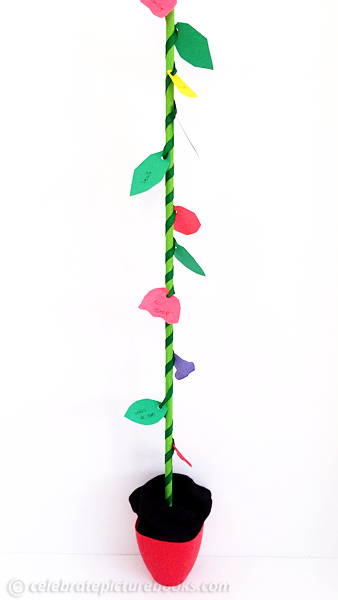
celebrate-picture-books-picture-book-review-grow-a-poem-craft


Grow a Poem


A poem often grows in your imagination like a beautiful plant—starting from the seed of an idea, breaking through your consciousness, and growing and blooming into full form. With this craft you can create a unique poem that is also an art piece!

Supplies

  • Printable Leaves Template
  • Printable Flower Template
  • Wooden dowel, 36-inch-long, ½-inch diameter, available in craft or hardware stores
  • Green ribbon, 48 inches long
  • Green craft paint
  • Green paper for printing leaves (white paper if children would like to color the leaves)
  • Colored paper for printing flowers (white paper if children would like to color the flowers)
  • Flower pot or box
  • Oasis, clay, or dirt
  • Hole punch
  • Glue
  • Markers or pens for writing words
  • Crayons or colored pencils if children are to color leaves and flowers

Directions

  1. Paint the dowel green, let dry
  2. Print the leaves and flower templates
  3. Cut out the leaves and flowers
  4. Punch a hole in the bottom of the leaves or flowers
  5. Write words, phrases, or full sentences of your poem on the leaf and flower templates
  6. String the leaves and flowers onto the green ribbon (if you want the poem to read from top to bottom string the words onto the ribbon in order from first to last)
  7. Attach the ribbon to the bottom of the pole with glue or tape
  8. Wrap the ribbon around the pole, leaving spaces between the ribbon
  9. Move the leaves and flowers so they stick out from the pole or look the way you want them to.
  10. Put oasis or clay in the flower pot or box
  11. Stick your poem pole in the pot
  12. Display your poem!

Picture Book Review
March 7 – Unique Names Day

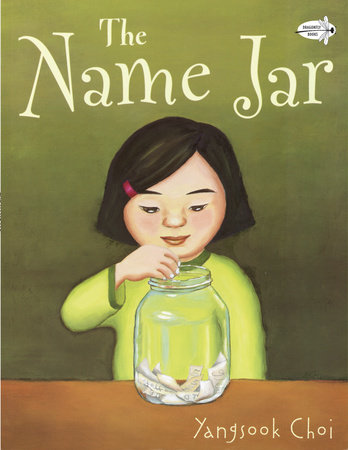
The Name Jar by Yangsook Choi Picture Book Review
About the Holiday

Established in 1997 as part of Celebrate Your Name Week, Unique Names Day celebrates uncommon or uncommonly spelled names and encourages those with unique names to always take pride in their name. One way to celebrate is to find out more about your name and how or why your parents chose it.

The Name Jar

By Yangsook Choi


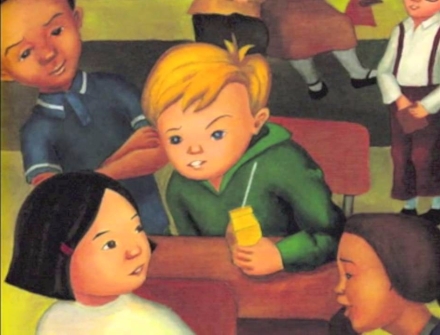
Unhei has recently moved to the United States from Korea. Although Unhei is excited about the first day of school, on the bus ride she misses her former home and looks at the wooden name stamp her grandmother gave her. A boy sitting behind Unhei notices the unfamiliar object and asks about it. Then other kids notice Unhei. They ask what her name is and when she answers, they mispronounce it, laughing and making jokes.

celebrate-picture-books-picture-book-review-the-name-jar-on-the-bus

Image copyright Yangsook Choi, courtesy of Random House

Unhei is embarrassed and glad that when the bus drops them off that those kids head to a different classroom than hers. As Unhei enters her own room, her classmates smile and greet her—it is obvious that their teacher has prepared them for a new student, and they are excited.

Of course, they first question her about her name, and remembering the experience on the bus, Unhei is reluctant to answer. She quickly says that she hasn’t picked a name yet, but will tell them next week. When she gets home, Unhei tells her mother that she wants an American name, a name that is easy to pronounce.

Her mother is dismayed; Unhei’s name was chosen by a master so that it would describe her uniqueness. But Unhei doesn’t want to be different, she just wants to fit in. Later while she and her mother are at a Korean grocery store, she introduces herself to the owner, who exclaims that her name is beautiful and means “grace” in English. 

celebrate-picture-books-picture-book-review-the-name-jar-mom

Image copyright Yangsook Choi, courtesy of Random House

That evening Unhei tries out American names in front of the mirror—Amanda, Laura, Susie—but they don’t feel or sound right. The next day at school Unhei finds a jar on her desk with pieces of paper in it. On each piece of paper is a name—suggestions from each of her classmates. Her new friends have chosen these names thoughtfully. Daisy is the nickname of one girl’s baby sister; Tamela is a smart and brave heroine from a story; and Wensday is the day Unhei joined their class.

At the end of the school day, a classmate named Joey comes to her. He knows she actually does have a name, and Unhei, while not wanting to say it out loud, shows him the characters on her wooden stamp. Joey thinks it is beautiful and asks to keep the paper. Day by day the glass jar fills up with names. Unhei will have to choose soon.

One Saturday Unhei returns to the Korean grocery store. When Mr. Kim calls her by name, the one other customer turns around. It’s Joey! Carefully and slowly he says Unheis name until he gets it right. On Monday when Unhei enters the classroom, she discovers that the jar is missing. It’s all right, though, Unhei has chosen her name.

celebrate-picture-books-picture-book-review-the-name-jar-friend

Image copyright Yangsook Choi, courtesy of Random House

She walks to the chalkboard and writes her real name in English and Korean. She tells the class that her name means “grace.” Other kids reveal the meaning of their names, and they all practice saying Unhei’s name. That evening Joey comes to visit. He explains that he took the jar because he wanted Unhei to keep her original name. He suggests putting Korean nicknames into the jar for their classmates to pick. He has already chosen his Korean name with the help of Mr. Kim. It is the prefect nickname: Chinku, which means “friend.”

Ages 3 – 8

Random House, Dragonfly Books, 2003 | ISBN  978-0440417996

Discover more about Yangsook Choi, her books, and her art on her website!

Yangsook Choi’s The Name Jar is as timely now as when it was first written. Through compelling and detailed storytelling, Choi explores the themes of identity, empathy, family, friendship, and more  with sometimes heartbreaking honesty. Unhei’s varied experiences at school, at home, and at the market provide an opportunity for adults and children to discuss and embrace the diversity of our multicultural world. Choi’s warm-toned illustrations reveal the conflicts that Unhei encounters and her growing confidence as she makes friends with Mr. Kim and Joey who accepts her as she is. 

Unique Names Day Activity

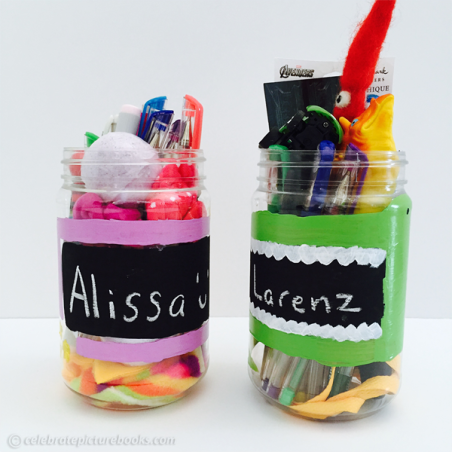
CPB - Name Jars standing

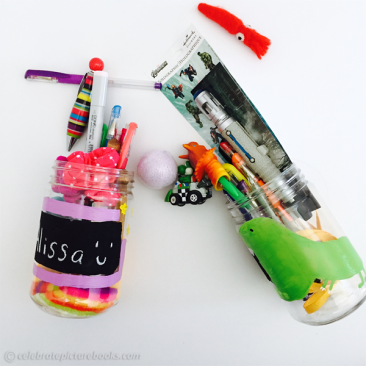
Love Your Name Organizer Jar


Everyone needs a place to store their special stuff! Here’s a way to recycle a plastic jar and make a cool organizer jar with your name on it. This organizer jar also makes a great gift for your friends!

Supplies

  • A large plastic jar, such as a peanut butter jar or mayonnaise jar, cleaned out and with the label removed
  • Acrylic multi-surface paint or markers
  • Chalkboard paint
  • Paint brush
  • Chalk

CPB - Name Jars on sides

Directions

  1. Paint a rectangle on the front of the jar with chalkboard paint
  2. Decorate the rest of the jar with paint, markers, or paper just the way you want! My green jar sports a friendly dinosaur!

Picture Book Review
February 3 – Feed the Birds Day

celebrate-picture-books-picture-book-review-I-am-henry-finch-cover

About the Holiday

As the snow piles up and the harsh weather of winter sets in, it’s harder and harder for our feathered friends to find food. Today’s holiday reminds us that we should hang feeders with seed and suet to help birds stay healthy during these cold months.

I Am Henry Finch

Written by Alexis Deacon | Illustrated by Viviane Schwarz


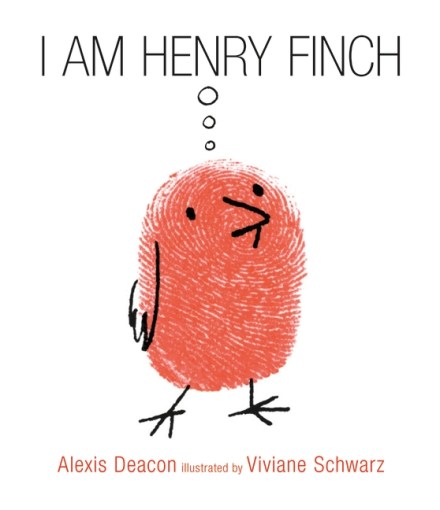
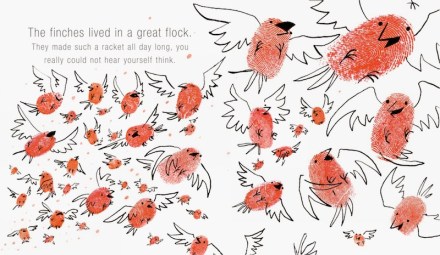
The finches were a talkative bunch. In the morning the flock traded “good mornings”: “‘Good morning, Aziz Finch!’ ‘Good morning, George Finch!’ ‘Good morning, Tiffy Finch!’ ‘Good morning, Henry Finch!’” In the afternoon, they wished each other “Good afternoon!” Evening brought wishes of “Good evening!” And “at night, they said GOOD NIGHT.” The next day the round robin salutations began again. They were only interrupted when the Beast came.

celebrate-picture-books-picture-book-review-I-am-henry-finch-flock

Image copyright Viviane Schwarz, text copyright Alexis Deacon. Courtesy of vivianesxhwarz.blogspot.com

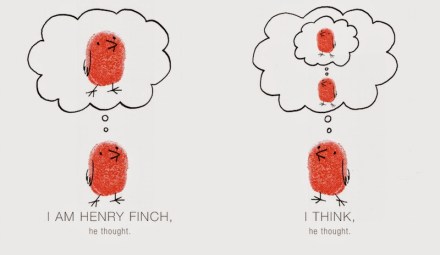
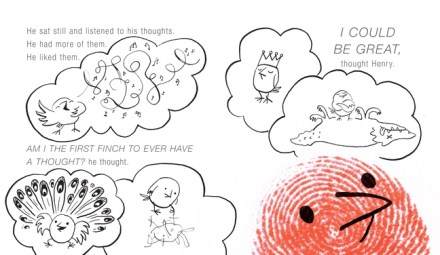
“Then they would all shout, THE BEAST, THE BEAST! And fly as fast as they could to the top of the nearest tree, where they would sit and shout until the Beast moved on.” It remained this way until one night “a little finch woke up in the dark and quiet. He had a thought, and he heard it. I AM HENRY FINCH, he thought.” He considered this thought as well as many others. He wondered if other finches had thoughts like his. He imagined himself defeating the Beast. “I COULD BE GREAT, thought Henry.”

The next morning the Beast did come. Henry envisioned himself standing atop the vanquished Beast and decided now “was the time for greatness.” Screaming his name, he flew directly at his foe…and was…swallowed. Inside the belly of the Beast, Henry had disparaging thoughts. “YOU ARE A FOOL, HENRY FINCH, he thought.” He regretted becoming the beast’s dinner. His troubled mind raced ahead through what would happen to him in the Beast’s digestion process, and yet he continued to think.

celebrate-picture-books-picture-book-review-I-am-henry-finch-I-think

Image copyright Viviane Schwarz, text copyright Alexis Deacon. Courtesy of vivianesxhwarz.blogspot.com

He pondered, “WHO AM I?”and concluded that even if he wasn’t Henry Finch, he was something. “I AM,” he decided, and then he considered the cyclical nature of…well…nature. “IT IS,” he realized. He listened to the grumbling, gurgling sounds inside the Beast. He could “even hear the thoughts of Beast.” It was on the hunt for any “crawling, swimming, flying, walking” creature it could find to feed his family. Henry had had enough. “NO!” he thought. The Beast heard Henry’s thought, and the next one and the next one that told the Beast that all creatures have families and that from now on the Beast would eat only plants because they “have parts to spare.”

Yes, the Beast determined, “I WILL EAT PLANTS,” and when Henry told the Beast to open his mouth wide, the Beast complied. Out popped Henry much to the surprise and delight of the other finches. Henry told them everything that had happened. When he was finished, a small finch piped up, “I HAVE HAD A THOUGHT. GOOD-BYE, EVERYONE. I WILL COME BACK.” She flew off guided by her vision of landing atop a mountain. One by one, every finch envisioned its own great deed and flew away to achieve it, promising to return. And Henry? Gazing up at them as they disappeared into the sky, “he smiled a finch smile. GREAT! thought Henry.”

celebrate-picture-books-picture-book-review-I-am-henry-finch-could-be-great

Image copyright Viviane Schwarz, text copyright Alexis Deacon. Courtesy of candlewick.com

Alexis Deacon’s unique tale is sure to raise plenty of giggles and “Oh, no’s!” followed by more giggles and finally cheers as Henry comes to terms with his greatness and despite his diminutive size vanquishes the Beast. Like René Descartes before him, Henry comes to the conclusion that “I think, therefore I am,” and with pluck and self-confidence decides that his existence warrants attention and respect. Deacon’s inspirational story is perfectly aimed at his young audience who are just beginning to “have thoughts” about who they are, who they want to be, and what they want to do. Henry’s wavering and uncertainty are presented with honesty and humor that will resonate with kids, and his final victory is a joy.

celebrate-picture-books-picture-book-review-I-am-henry-finch-wake-up

Image copyright Viviane Schwarz, text copyright Alexis Deacon. Courtesy of vivianesxhwarz.blogspot.com

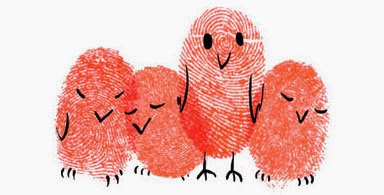
Viviane Schwarz could not have hit upon a more ideal way to depict Henry and the other finches than in the red fingerprints that determine their individuality. With only a few changes to his sketched-in features, adorable Henry becomes sweet, fearful, resolute, courageous, and of course thoughtful. The blue Beast with its mold-green tongue dominates the pages when it appears and dwarfs the tiny birds and other creatures it slurps up. When Henry is eaten and slides through the Beast’s digestive system, the pages turn appropriately black until Henry decides that “NO!” he is not going to become dinner today. A two-page spread of the life cycle for birds, insects, snakes, rats, plants, and even the Beast is a beauty.

I Am Henry Finch is a book that stirs emotions and stimulates discussion, and Henry—like another literary Finch who refused to accept the status quo—is a terrific hero to add to any home bookshelf.

Ages 5 – 8

Candlewick, 2015 | ISBN 978-0763678128

You can connect with Alexis Deacon on his blog “A Place to Call Home.”

You’ll find more about Viviane Schwarz, her books, and her Cat and Bag web comic as well as videos, worksheets, and other goodies on her website.

Feed the Birds Day Activity

cpb-bird-feeder-i

Pining for Seeds Pinecone Birdfeeder


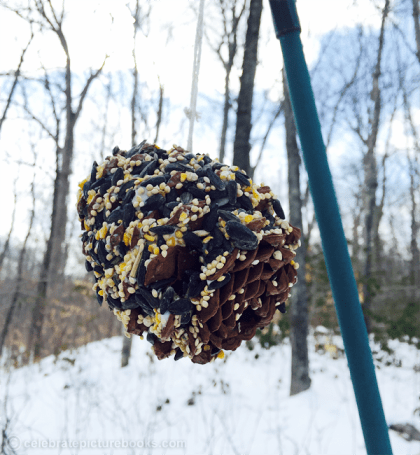
Pinecone birdfeeders are quick to make and great for your backyard fliers. The combination of peanut butter, lard, or vegetable shortening and a quality seed mixture provide birds with the fat and nutrition they need to stay warm and healthy during the winter.

Supplies

  • Pinecones
  • Peanut butter, vegetable shortening, or lard
  • Birdseed
  • String
  • Knife or wooden spreader
  • Spoon

Directions

  1. Tie a long length of string around the middle of the pinecone
  2. Spread the peanut butter, vegetable shortening, or lard on the pinecone
  3. Sprinkle a thick coating of birdseed on the pinecone, pressing it into the covering so it will stick
  4. Tie the pinecone feeder onto a tree branch or other structure
  5. Watch the birds enjoy their meal!

Picture Book Review
January 27 – It’s Creativity Month

celebrate-picture-books-picture-book-review-stitchin'-and-pullin'-a-gee's-bend-quilt-cover

About the Holiday

January is a time for reflection and new beginnings. What better time to start thinking creatively and finding your inner artist, scientist, inventor, thinker? Go ahead and do the thing you’ve always wanted to do!

Stitchin’ and Pullin’: A Gee’s Bend Quilt

Written by Patricia C. McKissack | Illustrated by Cozbi A. Cabrera

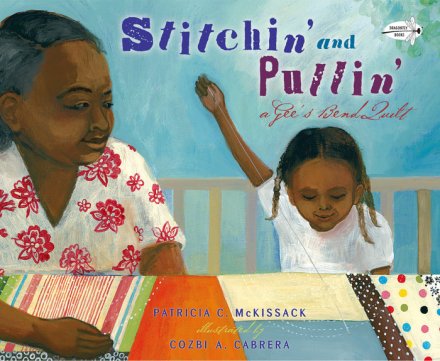
In this story told through poems, a little girl begins telling of her life, starting with a recitation on Gee’s Bend Women: “Gee’s Bend women are / Mothers and Grandmothers / Wives / Sisters and Daughters / Widows.” They are every kind of woman you know, doing every type of work and activity. “Gee’s Bend women are / Talented and Creative / Capable / Makers of artful quilts / Unmatched. / Gee’s Bend women are / Relatives / Neighbors / Friends— / Same as me.”

In Who Would Have Thought, the girl muses on how perceptions change. “For as long as anyone can remember,” she says, the women of Gee’s Bend, Alabama have created quilts that were slept under, sat on, and wrapped around the sick or cold. But now those same quilts are “…hanging on museum walls, / their makers famous….”

When she was just a tot “Baby Girl” reveals in Beneath the Quilting Frame, she played under the quilting frame, listening to her “mama, grandma, and great-gran / as they sewed, talked, sang, and laughed / above my tented playground.” She remembers the “steady fingers  /[that] pieced together colorful scraps of familiar cloth / into something / more lovely / than anything they had been before” as her mother sang her a lullaby.

celebrate-picture-books-picture-book-review-stitchin'-and-pullin'-a-gee's-bend-quilt-puzzling-the-pieces

Image copyright Cozbi A. Cabrera, courtesy of Random House Books for Young Readers

In Something Else, “Baby Girl” is growing too big to play beneath the frame. Her legs becoming longer and her mind full of “recipes for eleven kinds of jelly…how to get rid of mold…and the words to a hundred hymns and gospel songs” while she waits her turn at the frame. Finally, in Where to Start? her time comes. The girl asks her mama how to begin and she answers, “‘Look for the heart. / When you find the heart, / your work will leap to life… / strong, beautiful, and… / independent.’”

In Remembering, the girl thinks about how her mama has told her that “cloth has a memory.” As she chooses the cloth that will become her quilt she sees the life and the history in each. 

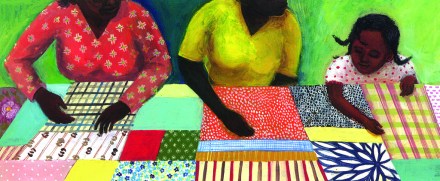
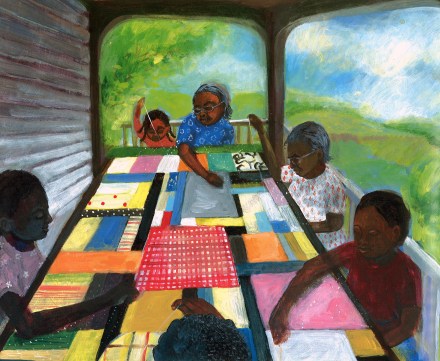
Nothing Wasted sees Grandma pulling apart a red-and-white gingham dress stitch by stitch to become a quilting square that the girl suddenly knows “will be the heart of my quilt.” In Puzzling the Pieces the girl and her grandma stand over the quilting frame fitting the squares together in the perfect way to tell the girl’s story. Her quilt comes together piece by piece to tell the history of Gee’s Bend in The River Island. The brown strips along three sides mirror the muddy waters surrounding her town. The fourth side is a green strip—“a symbol of the fields where my ancestors / worked cotton from can to can’t— / can see in the morning until / can’t see at night.” Lined up next to the green strip are six squares representing the small communities “where families with / the same name / are not kin by blood / but by plantation.”

Being Discovered is portrayed with “a large smoke-gray square”—the color of the Great Depression and the 15 minutes of fame Gee’s Bend garnered when discovered “by sociologists, historians, / educators, and journalists” who came and went, leaving Gee’s Bend “the way it had been / before being discovered.”

celebrate-picture-books-picture-book-review-stitchin'-and-pullin'-a-gee's-bend-quilt-understanding-comes-later

Image copyright Cozbi A. Cabrera, courtesy of Random House Books for Young Readers

In Colors, the girl’s grandma explains the meanings and feelings behind each colored cloth. “Blue cools. / Red is loud and hard to control, / like fire and a gossiping tongue.” Green, orange, yellow, white, pink, and all the others have their own personalities. “Grandma says, / ‘Colors show how you / feel deep down inside.’”

In Pinky, the harrowing facts of the march from Selma to Montgomery, Alabama frame the story of one marcher, Mr. Willie Quill who broke horses for the Alabama State Mounted Patrol and was saved from the Police attacks when one of the horses he’d trained knew his voice. In Dr. King Brings Hope, the little girl adds a “Patch of bright pink / to remember Pinky’s story. / Next to it I sew / a spotless white patch for the hope Dr. Martin Luther King / brought to the Bend” and goes on to tell how her grandma saw Dr. King at Pleasant Grove Baptist Church and what it meant to her.

By and By follows the girl as she adds “golden thank-yous, for James Reeb,” a “bright blue piece of velvet for Viola Liuzzo,” and a “big plaid people circle of white, black, brown, yellow, and red for Reverend Dr. King, all “killed for believing in justice.”

In the 1960s, The Sewing Bee tells, Gee’s Bend quilters were once again discovered. There were buyers for the handmade quilts, but stipulations. The girl asks her grandma if she was part of the Bee, to which she replies, “‘Yes, / more money. Less freedom. I chose to stay free.’”

At last all of the patches are laid out and the time comes to stitch the girl’s quilt. Five women stand at the frame “all stitchin’ and pullin.’” They work “in a slow and steady rhythm” relaxing and enjoying being together until the quilt is finished. In Finished, the last stitch is sewn, and the thread bitten and knotted. The girl has hundreds of ideas for future quilts. “Quilts that are about me, / the place where I live, / and the people / who have been here for generations.”

Further poems unite the history of “Baby Girl,” her family, and neighbors, and an Author’s Note about quilting and the women of Gee’s Bend follow the text.

Patricia McKessack’s free verse poems capture the close relationships and camaraderie of the generations of women who join around the quilting frame to share and pass down their art and their heart. McKessack’s conversational verses, on page after page like the patches of a quilt, reveal the complexity of this handmade art form in the way intimate talks between friends unveil a life. Readers learn not only about the little girl and her own thoughts, but the history and influence of her immediate family, world events, inspirational figures, and deeply held beliefs that make her who she is and ties her to the other Gee’s Bend women.

Cozbi A. Cabrera’s stunning acrylic paintings take readers inside the heart of the Gee’s Bend women, depicting the girl’s home, the table-sized quilting frame where the women collectively work, the plantations, the protests, and the changes that came but did not unravel the convictions, values, and love of the little girl’s family. Readers can almost hear the talking and singing of the Gee’s Bend women as they stitch their quilts, and the comforting, embracing environment is evident on every page. Cabrera’s portraits of the little girl, her mama, and her grandma are particularly moving. For What Changed, Cabrera depicts a yellow school bus appearing on the dirt road from the right hand corner of the page. In the side mirror a dot of a house comes into view, reminding readers that no matter how far these women are from home, Gee’s Bend is always with them.

Children—and adults—will find Stitchin’ and Pullin’: A Gee’s Bend Quilt inspirational and uplifting. This volume of poetry can be read at one sitting and delved into again and again, making it a wonderful choice for home libraries and a must for school, public, and other libraries.

Ages 5 – 12

Dragonfly Books, Random House, 2016 (paperback edition) | ISBN 978-0399549502

View a gallery  of fashion designs, dolls, and other handmade art work by Cozbi A. Cabrera on her website!
Creativity Month Activity

celebrate-picture-books-picture-book-review-stars-quilt-coloring-page

Design a Quilt Coloring Pages

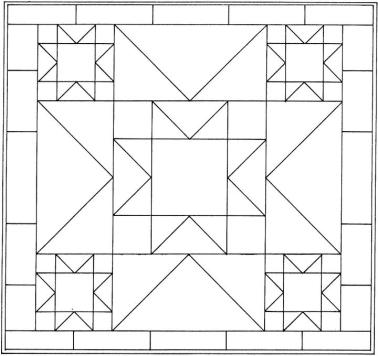
Quilts are so much more than pieces of material sewn together—they’re life stories! Here are two quilt coloring pages for you to design and color. What does each piece mean to you? As you color each section, write a sentence about an event or thought that is important to you.

Quilt Template 1 | Quilt Template 2

Picture Book Review