This month we celebrate all things creative! There are so many ways to be creative, from the arts to how you organize and manage your life at home and at work. Sometimes, special events, unusual problems, or particular people inspire—or necessitate—creative thinking. Today’s sweet story is one example!
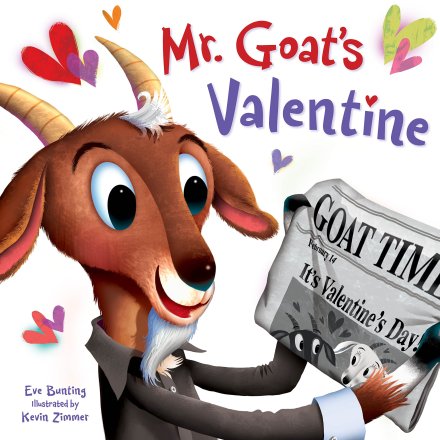
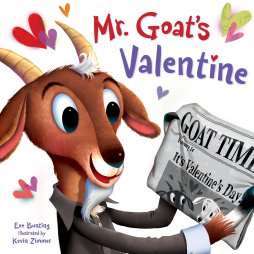
Mr. Goat’s Valentine
Written by Eve Bunting | Illustrated by Kevin Zimmer
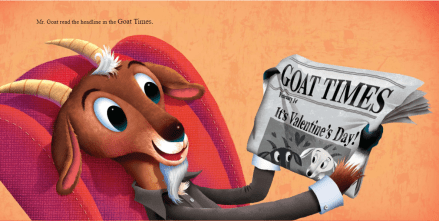
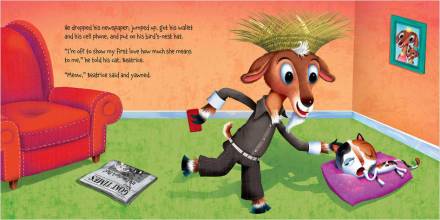
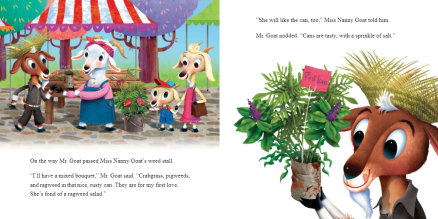
When Mr. Goat read in the newspaper that it was Valentine’s Day, he jumped up, grabbed his phone and favorite hat, and headed out, determined to show his first love how much she meant to him. On the way he stopped off at Miss Nanny Goat’s weed stall and bought a “mixed bouquet” of “crabgrass, pigweeds, and ragweed” beautifully arranged in a “nice, rusty can.” Mr. Goat knew his first love liked ragweed salad, and Miss Nanny Goat assured him that she would like the can too. Mr. Goat agreed. There was nothing like a rusty can with a pinch of salt.
Image copyright Kevin Zimmer, 2018, text copyright Eve Bunting, 2018. Courtesy of Sleeping Bear Press.
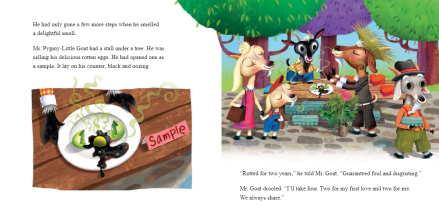
The aroma from Mr. Pygmy-Little Goat’s stand enticed Mr. Goat to stop and look over his treats. The sample rotten egg looked so yummy—black and oozing on the plate—that Mr. Goat bought four. They have been “rotted for two years” and are “guaranteed foul and disgusting,” Mr. Pygmy-Little Goat boasted as he placed the four eggs carefully into a red, heart-shaped box and tied it up with a red ribbon. Not only would the eggs make the perfect dinner, the red bow would be a delicious dessert.
Image copyright Kevin Zimmer, 2018, text copyright Eve Bunting, 2018. Courtesy of Sleeping Bear Press.
Mr. Goat walked on, passing up the fruit and vegetable stand with its fresh oranges, apples, and pears, but made time to talk to Miss Skunk when she approached him with her Eau de Skunk perfume cart. As she spritzed Mr. Goat with a sample of her special perfume, she reminded him that a Valentine’s card would be just right for his first love.
Image copyright Kevin Zimmer, 2018, text copyright Eve Bunting, 2018. Courtesy of Sleeping Bear Press.
Mr. Goat continued on with just the faintest alluring reek and thought about what Miss Skunk had said. He didn’t have a card, but, he decided he could “‘compose a song and serenade her.’” It didn’t take long for Mr. Goat to write his ditty. He hurried on to his first love’s house. Standing at the door, he “burst into song. When I was a little kid / It didn’t matter what I did. / If I climbed too high and fell / You’d kiss the hurt and make it well. / You have loved me from the start / I love you with all my heart!”
Suddenly, the door opened, and Mr. Goat’s first love smiled at him. Mr. Goat handed her the bouquet and red box and exclaimed, “‘Happy Valentine’s Day, Mother!’”
Image copyright Kevin Zimmer, 2018, text copyright Eve Bunting, 2018. Courtesy of Sleeping Bear Press.
Eve Bunting’s exceptional flair for engaging children is on full display in her funny, ewww-ful tribute to Valentine’s Day. The hearts of little ones swell with love around this holiday, and Bunting taps into their enthusiasm to get just the right gift for Mom. Readers will laugh at what might seem unusual gifts while also appreciating Mr. Goat’s thoughtfulness. Young children may wonder who Mr. Goat’s “first love” is as he shops from stall to stall, but as he makes up his song, most will figure it out and be happy to be in on the twist ending.
Kevin Zimmer’s cheery digital art showcases the sweet emotions that Mr. Goat has for his first love. His eyes grow wide at the delectable weed bouquet and rotten eggs, he contemplates the perfect words for his song, and smiles adorably when his mom opens the door. The less-than-fresh take on the idea of a Farmers Market will delight kids familiar with these types of stands. The other goats out shopping on this Valentine’s Day are equally as cute as Mr. Goat and provide camaraderie among this community that likes things a little bit rotten. As the door opens in the final spread, revealing Mr. Goat’s first love, children will be happy to know that the love between parent and child continues even when a “kid” is no longer a kid.
Mr. Goat’s Valentine is a sweet, original story for Valentine’s Day and throughout the year that is perfect for humorous home, classroom, and library story times.
Ages 4 – 7
Sleeping Bear Press, 2018 | ISBN 978-1585369447
Learn more about Kevin Zimmer and his art on his website.
Creativity Month Activity
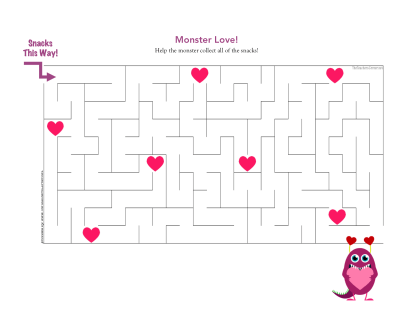
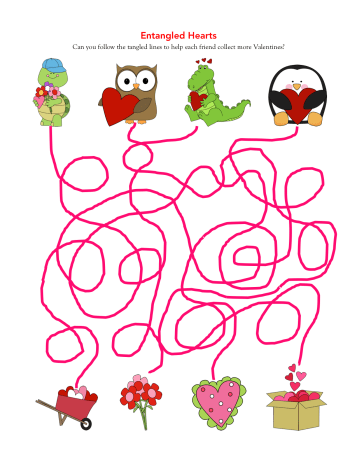
Entangled Hearts Matching Puzzle
These friends are collecting valentines! Can you help them follow the paths to find more in this printable puzzle?
You know how gray days (literal and metaphorical) make you feel—grumpy, irritable, standoffish. Today is a day when it’s ok to indulge—and maybe even celebrate—those feelings. Remember, grouchiness can lead to change, so take control and do what you can to alleviate the situation. Whether you choose to stay home today and do nothing or get out there and make the best of it, have a happy Curmudgeon’s Day!
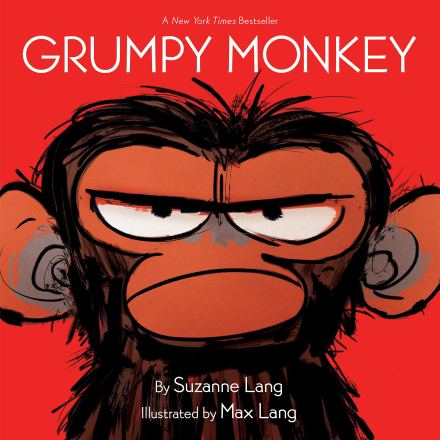
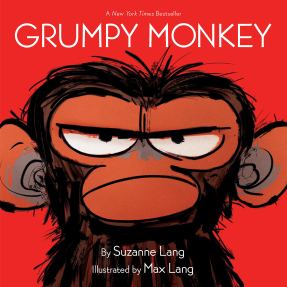
Grumpy Monkey
Written by Suzanne Lang | Illustrated by Max Lang
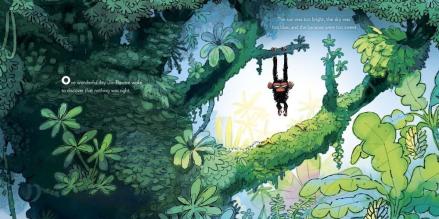
Jim Panzee woke up feeling pretty rotten. “The sun was too bright, the sky was too blue, and the bananas were too sweet.” Jim didn’t know why he was feeling this way. Norman the gorilla, Jim’s next-door neighbor, suggested that he might be grumpy. But Jim insisted that that wasn’t the problem. As the two walked along, they met Marabou, a long-legged bird. Norman explained that Jim was grumpy, but Jim denied it. Marabou pointed out that even Jim’s hunched posture showed his grumpiness. Jim wiggled his arms and shook his legs to prove how un-grumpy he was.
Image copyright Max Lang, 2018, text copyright Suzanne Lang, 2018. Courtesy of Random House Books for Young Readers.
Next, they met Lemur, and Norman told him all about Jim’s grumpiness. Lemur couldn’t understand it, especially since it was “‘such a wonderful day.’” “‘Grumpy! Me? I’m not grumpy,’ said Jim.” Lemur said Jim’s grumpiness was obvious from the way he furrowed his eyebrows, so Jim raised them. They continued walking until Jim “tripped over Snake.” Norman gasped; this would only make Jim grumpier, he thought. Jim reminded Norman that he wasn’t grumpy in the first place. Snake wanted to know then, if that was true, why Jim was frowning. Jim obliged and put on a big smile.
Now Jim looked happy, but he still wasn’t happy. Everyone, it seemed, “wanted Jim to enjoy this wonderful day.” The birds wanted him to sing along with them, but Jim just scowled. The other monkeys wanted Jim to swing with them, but he just swatted their welcoming hands away. The zebras invited him to roll in the dust with them, and the peacocks wanted him to stroll along with them, but Jim didn’t feel like doing these things either.
Image copyright Max Lang, 2018, text copyright Suzanne Lang, 2018. Courtesy of Random House Books for Young Readers.
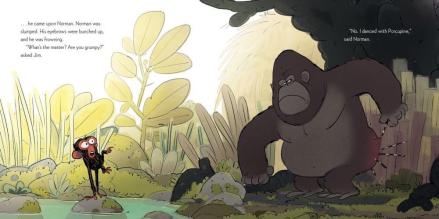
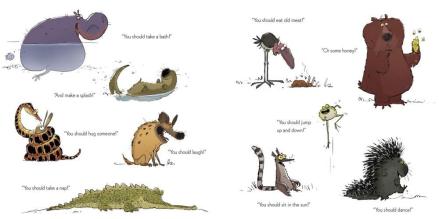
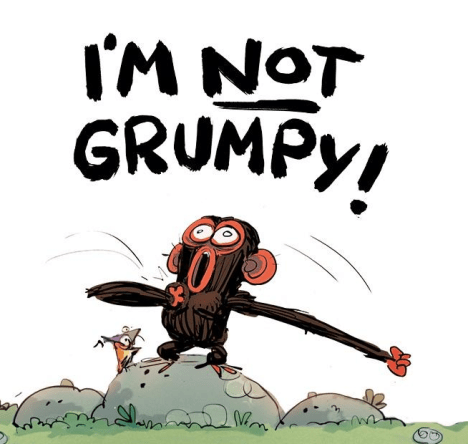
Everyone had an idea on how to make Jim less grumpy, but Jim simply hunkered down and exploded: “‘I’M NOT GRUMPY!’ And he stormed off.” Jim felt bad for shouting at everyone, but he felt even worse for himself. He decided that maybe he was grumpy and he began to feel really sad. Just then, though, he saw Norman. “Norman was slumped. His eyebrows were bunched up, and he was frowning.” Jim asked him if he was grumpy.
It wasn’t that, Norman replied. He was sore from getting quills stuck in his behind while dancing with Porcupine. Jim asked him if he was okay, and Norman said, “‘It hurts but I’ll probably feel better soon enough.’” Then Norman asked Jim if he was still feeling grumpy. Norman admitted he was, but said, “‘I’ll probably feel better soon enough, too. For now, I need to be grumpy.’” The two friends agreed that it was a good day to be grumpy, which made them feel a little better already.
Image copyright Max Lang, 2018, text copyright Suzanne Lang, 2018. Courtesy of Random House Books for Young Readers.
Suzanne Lang’s funny story belies an important truth about feelings for kids and adults: sometimes you just feel grumpy, and the best way to assuage it is to acknowledge the feeling, stew a bit, and let happiness return. Well-meaning Norman is a true friend who, after trying to cheer Jim up and suffering his own grumpiness-inducing mishap, comes to understand that like physical pain, sadness takes time to heal too. Readers will laugh at Jim’s attempts to embrace his friends’ suggestions while understanding that these surface “fixes” don’t get to the root of what’s bothering Jim. Children will also giggle at Norman’s sticky situation but show him plenty of empathy too. The pair’s final camaraderie is heartwarming.
Image copyright Max Lang, 2018, text copyright Suzanne Lang, 2018. Courtesy of Random House Books for Young Readers.
Max Lang’s lush illustrations overflow with style and humor that kids will love. Little Jim with his surly glower tries to make his friends happy, but readers will recognize his half-hearted attempts—from wiggling his arms to raising his eyebrows to forcing a smile—as things they’ve probably done themselves. As more and more of Jim’s friends get in on the act, their cartoony expressions will make kids laugh. When Jim just can’t take it anymore and beats his chest while shouting, both children and adults will have a chuckle over how spot-on this portrayal is. The quiet companionship between Norman and Jim that follows is a welcome image of acceptance.
A book that offers a humorous way for kids and adults to talk about not only sadness but other emotions that can sometimes overwhelm, Grumpy Monkey is an excellent choice for home, classroom, and public libraries.
Ages 3 – 7
Random House Books for Young Readers, 2018 | ISBN 978-0553537864
To learn more about Max Lang, his books, and his art, visit his website.
Curmudgeon’s Day Activity
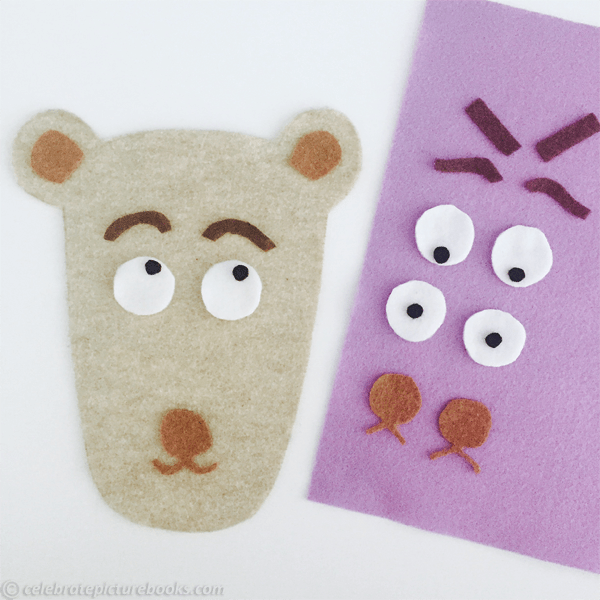
How Do You Feel? Emotions Storytelling Bear
With this Emotions Storytelling Bear, you and your child can talk about different emotions and feelings while changing the expressions on the bear’s face. Use the templates and/or make your own facial features. You can also use the bear to make up stories or play a game.
If you love to garden, you may want to get involved with National Seed Swap Day! The first Seed Swap Day was held in Washington DC in 2006. Since then it has grown to be a nation-wide event as gardeners get together to trade the seeds from their best plants. Not only does this improve the biodiversity in your local area, it’s a great way to make new friends! To learn more about what events are planned in your area, visit the official National Seed Swap blog.
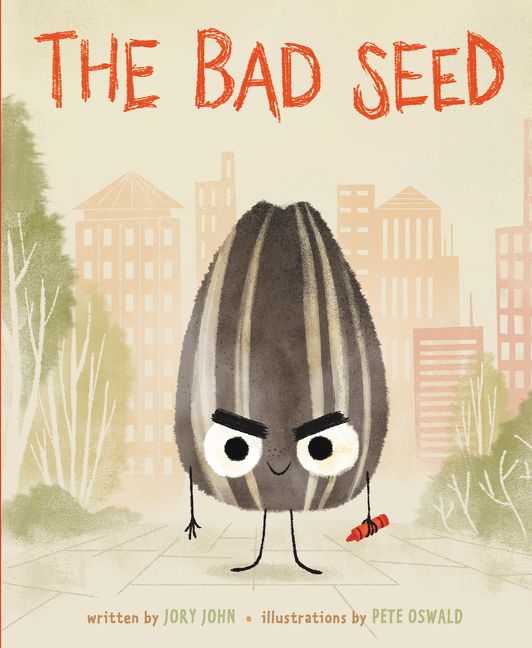
The Bad Seed
Written by Jory John | Illustrated by Pete Oswald
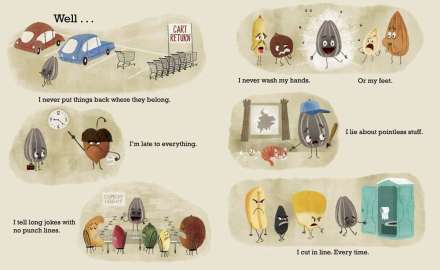
A sunflower seed stares straight off the page and admits it: “I’m a bad seed. A baaaaaaaad seed.” He knows that all the other seeds would agree. They point him out and mumble, “There goes a baaaad seed.” You might wonder just how bad a seed he can be. Well…pretty bad. In fact, he’ll tell you himself. Are you ready? Take a listen: “I never put things back where they belong. I’m late to everything. I tell long jokes with no punchlines.”
Image copyright Pete Oswald, 2017, text copyright Jory John, 2017. Courtesy of HarperCollins.
Heard enough? Still think this seed may not be so bad? Well, what if you knew he was unhygienic, a little untruthful, and sometimes a lot inconsiderate. Why does he do this stuff? You know why: he’s “a bad seed. A baaaad seed.” You might ponder if he was always this way. The answer’s No. In fact, he “was born a humble seed on a simple sunflower in an unremarkable field.”
Image copyright Pete Oswald, 2017, text copyright Jory John, 2017. Courtesy of HarperCollins.
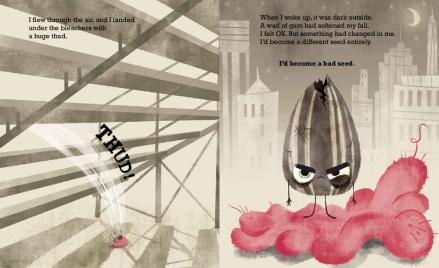
He just hung out with his big family of seeds until the flower began to droop, the seeds scattered, and then…he found himself in a bag. In a terrifying moment, he was almost eaten by a giant with a big, scary mouth, but he was “spit out at the last possible second.” He landed under some bleachers, and when he woke up he found his life changed forever. He had “become a different seed entirely.” He’d “become a bad seed.”
Image copyright Pete Oswald, 2017, text copyright Jory John, 2017. Courtesy of HarperCollins.
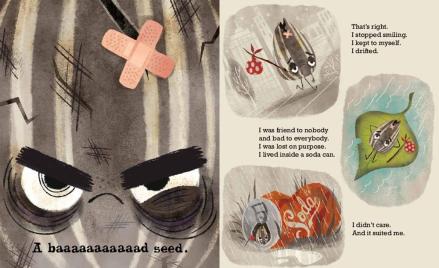
He was in unknown territory, and all by himself. He’s happy to share the sad details: “I stopped smiling. I kept to myself. I drifted. I was friend to nobody and bad to everybody. I was lost on purpose. I lived inside a soda can. I didn’t care. And it suited me.” That is it did suit him until recently. This seed did some soul searching, and decided to be better.
Image copyright Pete Oswald, 2017, text copyright Jory John, 2017. Courtesy of HarperCollins.
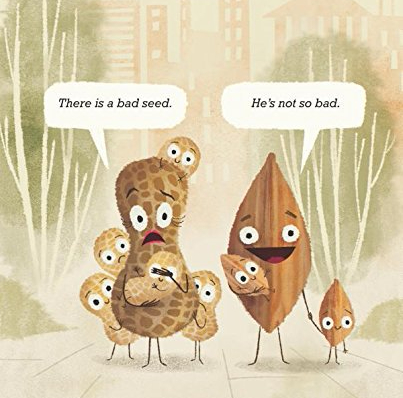
So now he still does some of that bad stuff (did you hear someone talking during a movie? That was probably him), but he does some good stuff too—like having good manners and smiling at people. Now, he says, “even though I still feel bad, sometimes, I also feel kind of good. It’s sort of a mix.” He’s just going to keep trying, and thinking, and readjusting his behavior and view of himself. Now when he’s walking down the street, he still hears, “There goes that bad seed.” But he also hears, “Actually, he’s not all that bad anymore.”
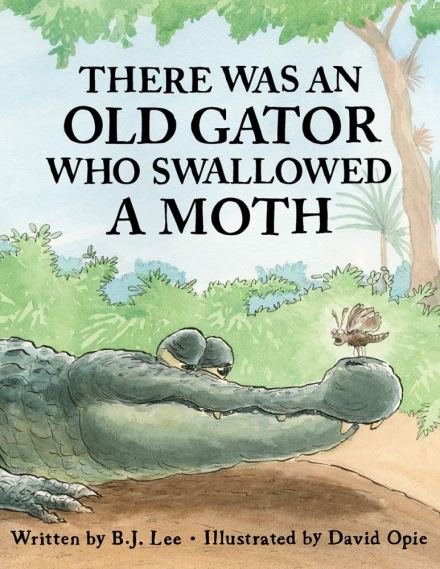
Image copyright Pete Oswald, 2017, text copyright Jory John, 2017. Courtesy of HarperCollins.
Jory John’s sly look at bad behavior is a sophisticated psychological thriller for the youngest set. With a light touch, John explores some of the events that can cause sadness, loneliness, and even personality changes. As the once-happy seed loses his home, scatters from family, and ends up a bit bruised and battered, he sees his once sunny life turn dark.
With a hardened heart, he goes about his days, acting badly and letting the comments of others define him. To his credit, however, this seed has the presence of mind—and enough honesty—to recognize his bad behavior and also to know that only he can change it. The niceties that the seed foregoes will have kids and adults laughing out loud as his reputation seems more roguish than the reality. And the authentic ending holds a reassuring kernel of truth—life is a bit of a mix, but happiness often wins out.
Image copyright Pete Oswald, 2017, text copyright Jory John, 2017. Courtesy of HarperCollins.
Looking at Pete Oswald’s adorable illustrations, it’s understandable if you don’t quite believe the sunflower seed when he says he’s a baaaad seed. Sure, he scowls and furrows his brow, butts in line, and gets a bit stinky, but underneath that hard shell, lies the heart of a softie. The other seeds in the neighborhood—pistachios, peanuts, almonds, chestnuts, cashews, and more—are fed up with him, though, registering fear, dismay, and even anger over the sunflower’s behavior. When the sunflower seed has a change of heart, however, others take note, and he gets another crack at life.
The Bad Seed is a funny book that kids will love to hear again and again. It also provides many teachable moments for those times when life gets a little discouraging. If you’re looking for an original book that has a bit of everything to add to a home, classroom, or public library, The Bad Seed is a good—no, great—choice.
Ages 4 – 8
HarperCollins, 2017 | ISBN 978-0062467768
Discover more about Jory John and his books on his website
Learn more about Pete Oswalk and view a portfolio of his artwork on his tumblr.
How good is this The Bad Seed book trailer? Take a look!
National Seed Swap Day Activity
Seed Packet Coloring Pages
All of your favorite veggies come from seeds, of course!, and those seeds come in packets that are little bits of art. Grab your crayons or pencils and color these printable Seed Packet Coloring Pages.
Today, we recognize Florida—the 27th state to enter the Union. Did you know that Florida is home to the oldest established city in the country? Founded by Spanish explorers in 1565, St. Augustine remains a fascinating city that combines an intriguing history of religious settlements, pirate treasure hunters, and a tug of war over ownership among Britain, Spain, and France with the modern beauty of a thriving community. Of course, Florida is well-known as an international tourist destination for its theme parks, wide open beaches, and warm weather. The state is also home to animals, insects, and reptiles unseen in the rest of the United States—a fact that today’s book riffs on.
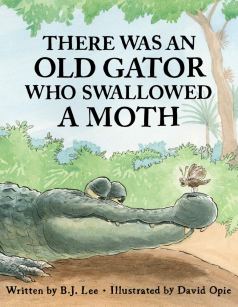
There Was an Old Gator Who Swallowed a Moth
Written by B.J. Lee | Illustrated by David Opie
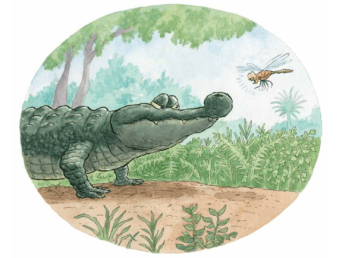
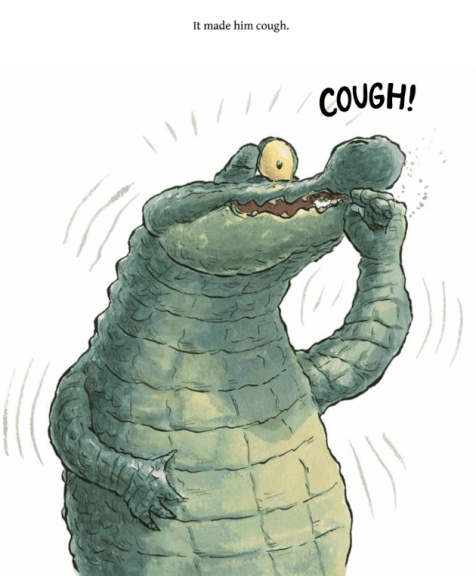
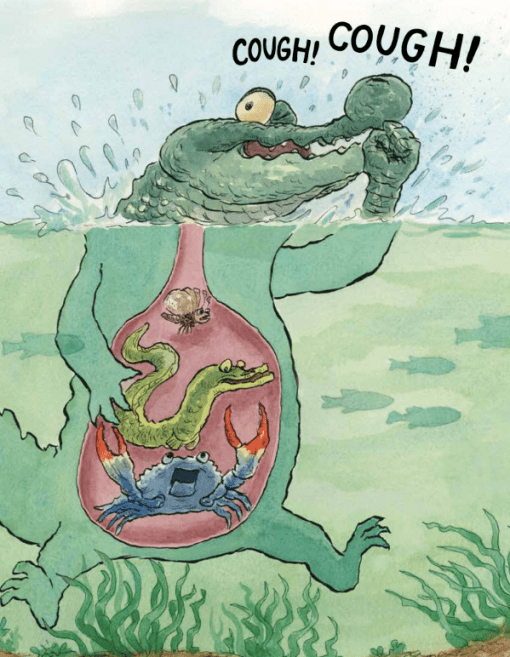
“There was an old gator who swallowed a moth. I don’t know why he swallowed the moth. It made him cough.” And with this culinary choice, readers are off on a wild jaunt full of suspense, humor, and big, sharp teeth. To catch that moth, the gator gobbled down a crab, but that scuttling bugger just filled his tummy with pain. To “nab the crab” the gator decided to “swallow an eel. / Quite an ordeal to swallow an eel!”
Image copyright David Opie, 2019, text copyright B.J. Lee, 2019. Courtesy of Pelican Publishing Company.
But the eel didn’t help, and the cough persisted. What could the old gator do? He swallowed creature after creature to resolve a cascading number of problems until “he swallowed a manatee.” It was clear “he lost his sanity to swallow a manatee!” Because now that old gator’s stomach was getting pretty cramped. There wasn’t a lot of nabbing or catching going on in there, and there was still that moth to take care of. The distressed gator then spied just the enforcer that might get the job done and gulped it down too.
Image copyright David Opie, 2019, text copyright B.J. Lee, 2019. Courtesy of Pelican Publishing Company.
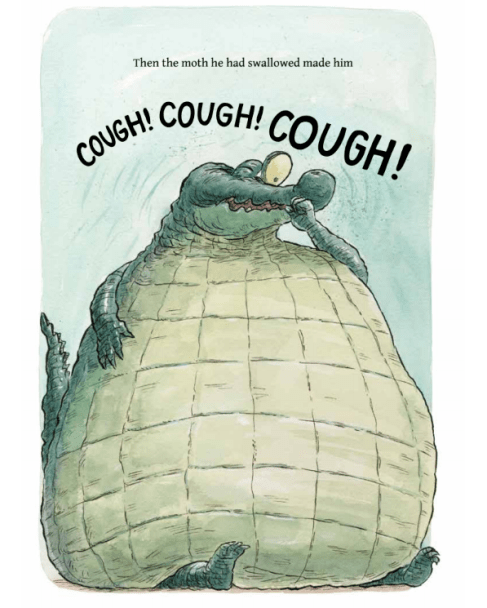
After such a big meal, the gator needed a bit of a drink, and the lagoon looked so refreshing! Just then, when that old gator was fully…well…full, that pesky moth fluttered its wings and made the poor guy “cough! Cough! Cough!” And what did that one little last cough do? Well, let’s just say the story has a splashing…I mean smashing…ending!
Image copyright David Opie, 2019, text copyright B.J. Lee, 2019. Courtesy of Pelican Publishing Company.
B.J. Lee gives the favorite cumulative rhyming There Was an Old Lady story a reptilian remodeling that kids will find irresistible as the old gator guzzles down a host of Florida denizens with hilarious results. Lee, an award-winning poet, has an engaging way with words and phrasing that creates surprising rhymes and rib-tickling rhythms. Clever alliteration and action-packed verbs move the story along at a clip that mirrors an alligator’s voracious appetite and will keep young readers on the edge of their seat to see which animal becomes the gator’s next snack. Kids may even enjoy trying to come up with their own rhyming line to add to the story.
David Opie’s illustrations of the anguished alligator and his unsuspecting “remedies” are a hoot. Opie accomplishes just the right combination of suspense and humor with his juxtaposition between realistic depictions of the coastal animals and gut-busting portrayals of these creatures crammed into the gator’s belly. As the gator grows rounder and rounder, readers will be wondering how it will all end. The final spreads of the tormented gator are sure to elicit an “Oh!” or “Ew!” or two and plenty of guffaws.
There Was an Old Gator Who Swallowed a Moth is a fun and funny choice for story time, and its comical repetition will prompt enthusiastic read-alongs. The book would be a sunny choice for home, classroom, and public libraries.
Ages 5 and up
Pelican Publishing Company, 2019 | ISBN 978-1455624416
Discover more about B.J. Lee, her books, and her poetry on her website.
To learn more about David Opie, his books, and his art, visit his website.
Meet Author B. J. Lee
Thank you, Kathryn, for having me on your blog! There Was an Old Gator Who Swallowed a Moth is getting a lot of love and I appreciate that! I also appreciate that you asked me about my poetry since, even in my picture books, I try to incorporate some aspect of poetry, such as lyrical language, rhyme and, in the case of Gator, cumulative rhyme.
There Was an Old Gator Who Swallowed a Moth is your debut picture book. What drew you to creating a Florida-themed version of this well-known classic?
It wasn’t so much that I set out to write a Florida themed version of There Was an Old Lady Who Swallowed a Fly, it was more that I had a gator character in mind and he pretty much chose this classical structure.
Have you always loved to write? When did you publish your first poem? Can you tell readers a bit about your journey to becoming a published writer?
Yes, I have always enjoyed writing. My sixth-grade teacher encouraged me to write plays! But I didn’t really realize I was a writer until, as an adult, I started writing a novel, which I never finished because my health intervened. In 2006 I had a shoulder operation which left me with severe bicep tendinitis, and for two years I couldn’t write, couldn’t even hold a pencil. My husband said “Write something shorter. Write poetry.” But I didn’t know how to write poetry. He had planted something in my mind, though. I started studying poetry and then began to write it. My first poem was published in the SCBWI Bulletin in 2010. And so, I became a poet quite by accident. In a way I’m almost grateful for the bicep tendinitis, because I would not have become a poet without that hiccup in my journey. And I’ve picked up the novel again, resurrecting it as a verse novel.
I wasn’t surprised when I saw that you worked as a librarian at the Boston Conservatory at Berklee and play the piano since your poetry has such a musical quality to it. Did you ever consider becoming a musician or songwriter? How does your musical background influence your poetry?
Thank you for saying that my poetry has a musical quality. I have heard that before but I am unaware of trying to incorporate any musicality into my poetry. I am a pianist, jazz singer, and even enjoyed a brief stint as lead singer in a local rock ‘n’ roll band. Recently, I have written some songs for a current work in progress in which the main character is a singer-songwriter.
What is your favorite form of poetry to write and why? Do you write poetry for adults as well as children? What do you find satisfying about both?
I enjoy writing many forms of poetry but I guess I like the challenge of writing in repeating forms, such as the villanelle, the triolet, the pantoum and the roundel. I blog at Today’s Little Ditty, where I am an authority on poetic forms.
However, I am continually challenging myself to write new forms of poetry, like free verse and performance poetry such as rap. I have written poetry for adults; however, since I am a children’s author, I try to stick with children’s poetry, including work for very young children through young adult and have over 100 poems published in anthologies and magazines.
The breadth of subjects you’ve written about—from sea glass to termites to naughty poodles and so many more—is truly inspiring! Can you talk about how and why certain subjects spark your creativity and how you follow that to a completed poem?
As far as subject matter, I’m very interested in the natural world and animals, so those subjects often show up in my work. Sometimes I write to prompts from anthologists. Once I have a subject that begs a poem, I simply try to find the best form to present it. Sometimes the poem may not work at all, and I’ll have to select a new form. Sometimes poems just start in my head and I have to be very quick to capture them.
Your poetry appears in children’s magazines, including Highlights and Spider, in publications for schools and many others, and in anthologies such as those published by National Geographic and Wordsong. Do you ever hear from young readers about your work? Do you have an anecdote from a letter or reading event that you’d like to share?
Yes, I do hear from young readers, which is very gratifying. In one case a Vietnamese teacher contacted me telling me that her phonics students are using my poem, A Garden Prayer, to learn English. That was when I realized that my poetry has gone around the world.
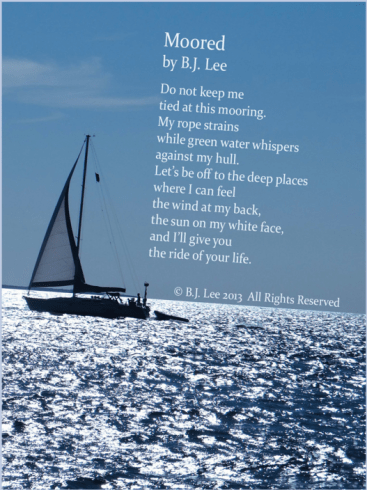
In another case, a woman contacted me from St. John’s, Nova Scotia, to ask me if they could use my poem, Moored, on a sculpture in Bannerman Park for a woman who died at a young age and who had always loved sailing. Of course I said yes! The proposed sculptor is Luben Boikov.
I’ve read some of your very clever poems that have been finalists—and winners!—in the Think, Kid, Think! Madness Poetry Tournament held in April on thinkkidthink.com. Can you talk a little about the tournament and being an authlete?
Yes, the Think Kids Think March Madness poetry tournament is a wonderful event for children’s poets. I loved being an authlete and competing but it’s very difficult to write a quality poem in a short amount of time. It was like pulling college all-nighters!
Do you have any advice for aspiring poets—children or adults?
My advice for aspiring poets, both children and adults, is: find the metaphor.
What’s up next for you?
I’m currently writing a verse novel as well as picture books and poetry collections.
What is your favorite holiday and why?
My favorite holiday is Valentine’s Day because: love.
Can you talk about one of your poems that incorporates a holiday theme?
I’ve written a few holiday poems including “Groundhognostication,” which appears in National Geographic’s Poetry of US.
Thanks for this wonderful chat, B.J.! I’ve loved learning more about your poetry and other work. I wish you all the best with There Was an Old Gator Who Swallowed a Moth!
Getting a compliment can make the world seem brighter. Maybe this is what inspired New Hampshire residents Kathy Chamberlin and Debby Hoffman to create National Compliment Day in 1998. How to celebrate today’s holiday is simple. Take a look around and when you see something about someone that you like, tell them! Does your friend’s sense of humor always lift your spirit? Tell them! Did your employee do a great job today? Tell them! Are your kids the light of your life? Tell them why! You don’t have to limit your compliments to friends and family either. Giving a compliment to someone you don’t know may just make a big difference in their day. So, today, be generous with those nice comments!
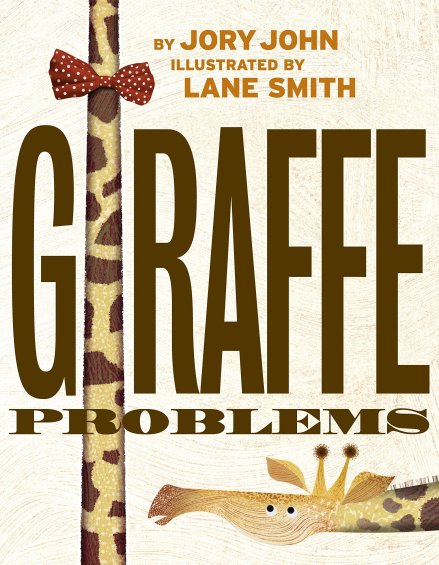
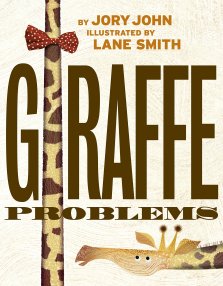
Giraffe Problems
Written by Jory John | Illustrated by Lane Smith
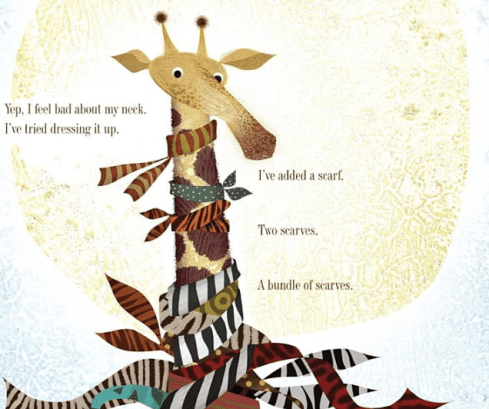
Giraffe was self-conscious about his neck—and why not? After all, it just seemed “too long. Too bendy. Too narrow. Too dopey” and “too” so many other things. All-in-all, he summed it up this way: “Yes, my neck is too necky.” Giraffe could feel everyone staring at it. He’d tried “dressing it up,” and hiding, but nothing made it better.
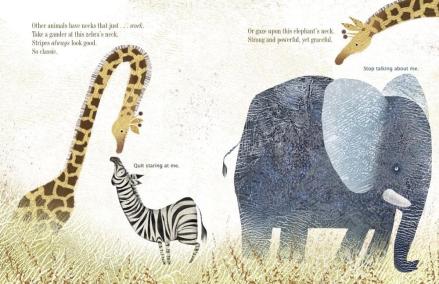
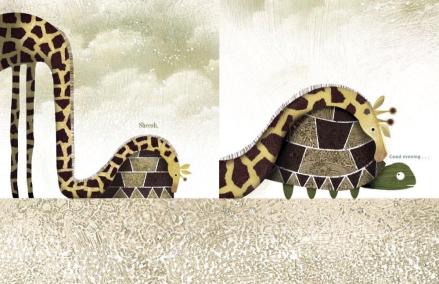
No other animals had such a ridiculous neck. Zebra’s was stylishly striped; Elephant’s was “strong and powerful, yet graceful”; and Lion’s was “adorned with a glorious mane of flowing locks.” Even the reassurances Giraffe’s mom gave didn’t make him feel better. In despair, Giraffe laid his long neck on a rock and sighed. But the rock turned out to be a turtle shell—with a turtle inside.
Image copyright Lane Smith, 2018, text copyright Jory John, 2018. Courtesy of Random House Books for Young Readers.
What luck! Turtle had been watching Giraffe from afar and thought his neck was pretty spiffy. Turtle said, “Oh, how I wish my neck looked like yours! I’d get so much done in a day.” He longed to be able to look around properly and grab things that were high up. But instead Turtle was “saddled with this little excuse for a neck.” Turtle even demonstrated how far his neck could reach—which was not far at all.
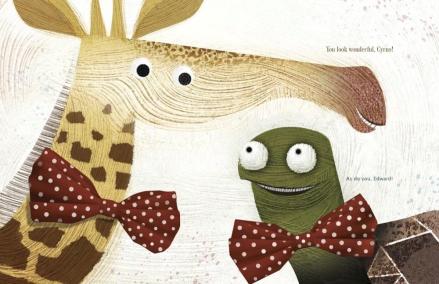
Giraffe was nonplussed to find another neck sufferer. But they were happy to have found each other. Turtle introduced himself as Cyrus, and Giraffe said his name was Edward. In this spirit of camaraderie, Cyrus confessed a secret. “There is a hill in the distance, which you can surely see from your great vantage. I’ve stood on that very hill for seven straight days now staring skyward, watching as a single piece of fruit—a lone banana!—slowly changed from green to yellow, ripening.” Cyrus’s frustration poured forth as he explained how he’d spent sleepless nights waiting for the fruit to drop so he could taste just a bit of it. Then came the disappointment and self-recrimination as he revealed how foolish he felt as he stretched his “neck toward those greedy branches, only to be limited by my own physical shortcomings.” He topped off this soliloquy with a small smile.
Image copyright Lane Smith, 2018, text copyright Jory John, 2018. Courtesy of Random House Books for Young Readers.
Edward summed it up, just to be sure. “You want a banana from a tree.” That is indeed what Cyrus wanted. Easy as one, two, three, Edward plucked the banana from its branch and dropped it in front of Cyrus. Cyrus gobbled it up and declared it delicious. In thanks, Cyrus complimented Edward on his “impressive” neck that allows him “to do amazing things.” In return, Edward complimented Cyrus’s neck, saying “it’s elegant and dignified, and it works well with your shell. They each appreciated the other’s viewpoint then Edward had a suggestion for his new friend. Soon, each was smiling and complimenting the other on how they looked in their handsome bowties. And for the first time ever, both Edward and Cyrus felt good about their necks.
Image copyright Lane Smith, 2018, text copyright Jory John, 2018. Courtesy of Random House Books for Young Readers.
Who knew animals have the same insecurities as people? Jory John, that’s who—much to readers’ benefit! John’s completely original story about a giraffe and a turtle who both despair about the state of their necks will make readers laugh out loud even as they empathize with these two endearing characters. Edward’s flowery reveries comparing his own imperfect neck to those of his fellow animals and Cyrus’s burst of vexation at the limits of his neck are hilarious—and, really, who doesn’t feel this vociferous sometimes? Following this, the friendship forged by Edward’s ease at fulfilling Cyrus’s simple request provides a satisfying ending that’s all the more charming for its modest honesty—and bowties.
Image copyright Lane Smith, 2018, text copyright Jory John, 2018. Courtesy of Random House Books for Young Readers.
When Jory John and Lane Smith team up, you always know you’ll be opening the cover to an exceptional experience. Here, sweet Edward juts onto pages with a neck so long that often only his head and neck, or body and neck, or just his neck appear. His attempts at disguising his most noticeable feature under neckties, behind palm trees, and in other natural surroundings will only make readers love him more. Edward is a born storyteller with a beautifully inlaid shell and an expressive face that makes his confession all the more touching. Alert readers will notice that the supposedly gawking animals all have their own unique features and perhaps are as self-conscious as Edward is. The muted and mottled browns, greens, reds, and golds that color the textured images are perfectly suited for the natural environment, and a gatefold page that flips up to let Edward procure the banana will delight kids.
Giraffe Problems is a must for fun story times as well as for when a child (or adult) needs a bit of a boost. The book would be an often-asked-for addition to home, classroom, and library bookshelves. And if you’re looking for more adorable animals with problems, check out Jory John and Lane Smith’s Penguin Problems!
Ages 3 – 7
Random House Books for Young Readers, 2018 | ISBN 978-1524772031
Discover more about Jory John and his books on his website.
To learn more about Lane Smith, his books, and his art, visit his website.
National Compliment Day Activity
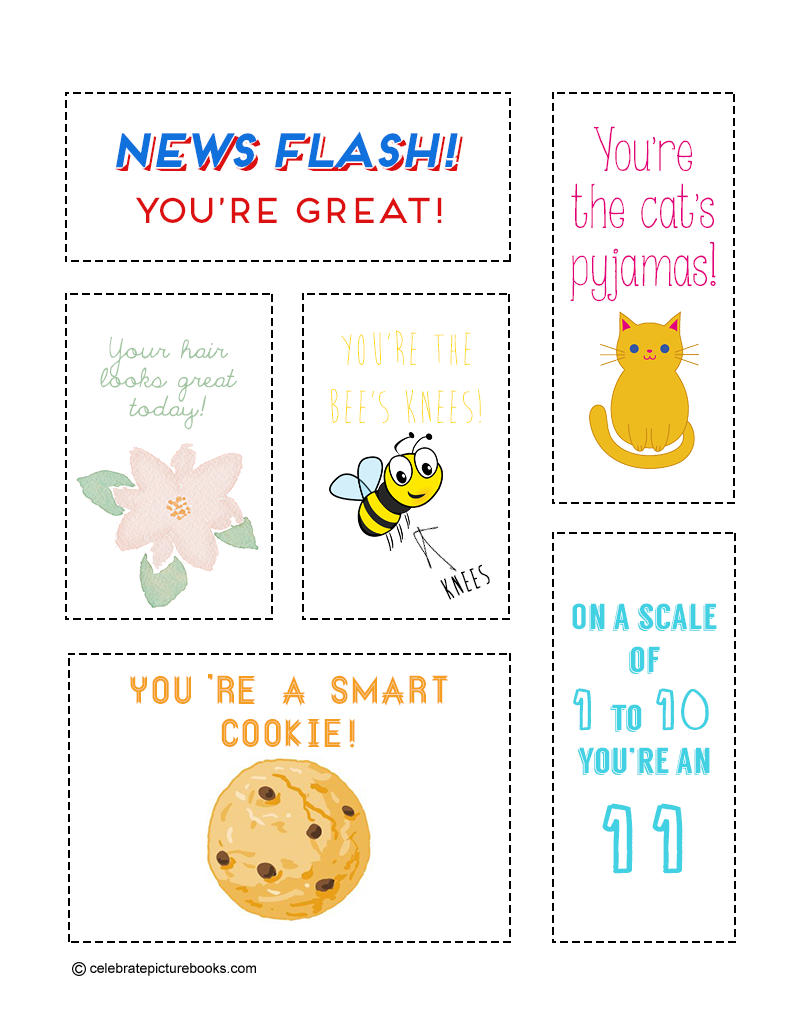
Caring Compliment Cards
Sharing a compliment is a great way to brighten someone’s day and make new friends! With these printable cards, you’ll always have a sweet compliment at hand to give to a friend, a teacher, a librarian, or anyone who looks as if they need encouragement.
Today’s holiday is as simple as it sounds. Established to encourage people to show more emotion in public. National Hugging Day lets you show the people you love just how much you love them—with a nice, big hug!
Hug Machine
By Scott Campbell
A little boy comes over the hill, robot-long arms raised and hands ready to do some serious hugging. “Whoa! Here I Come! I am the Hug Machine!” he announces. He hugs his mom around the knees while she’s cooking. His dad is reading the newspaper when his knees are squeezed. And his sister keeps talking on the phone while she gets her hug from “the hug machine.”
Copyright Scott Campbell, 2014, courtesy of simonandschuster.com.
Then the little boy goes out into his neighborhood where he hugs a policeman, a woman watering her plants, a businessman waiting for the bus, two unsuspecting women, and a little girl. He even hugs (very gently) the girl’s helium balloon. In fact, the boy hugs everything in his path—trees, fire hydrants, park benches, and mailboxes. “No one escapes the Hug Machine.”
Copyright Scott Campbell, 2014, courtesy of simonandschuster.com.
The boy’s hugs make everyone feel just right. It doesn’t matter if the things are big or small, soft or hard, square or long, the Hug Machine embraces them all. When he spies a crying baby, the Hug Machine goes to work. In a moment the “hug’s accomplished,” and the baby is smiling. But “what about me?” the porcupine asks. “No one ever hugs me.” Outfitted in a baseball catcher’s mask, with a pillow tied around his middle, and sporting oven mitts, the boy gives the porcupine a great big cuddle. “They are missing out!” the boy exclaims.
Copyright Scott Campbell, 2014, courtesy of simonandschuster.com.
A whale thinks it is too big to be hugged, but the boy finds a ladder, climbs to the top and gives a sliding hug all the way to the whale’s tail. How does the Hug Machine stay in prime hugging shape with lots of energy? Pizza, of course! And after a couple of slices, the Hug Machine is ready to get back out there! He runs through his neighborhood hugging everyone and everything in sight. There’s even a huge hug for you!
Copyright Scott Campbell, 2014, courtesy of simonandschuster.com.
After that spurt of hugging, the Hug Machine is tuckered out. “Hug Machine can hug no more,” the boy says as he lies on the floor. But a pair of hands reaches out. “Why, yes,” the boy says, as his mom scoops him up into a hug of his own. “The Hug Machine is always open for business.”
Copyright Scott Campbell, 2014, courtesy of simonandschuster.com.
Scott Campbell’s Hug Machine is as adorably irresistible as little ones’ enthusiastic and spontaneous demonstrations of love. Readers will giggle when they see all the people and things this Hug Machine embraces without question and sometimes with creativity. Kids will also love the double spread, wide-armed hug just for them. The repeated phrases make this a perfect read aloud and read along for even the youngest readers.
Copyright Scott Campbell, 2014, courtesy of simonandschuster.com.
Campbell’s illustrations are always endearing. The surprised recipients of the little boy’s hugs are left with a smile on their face, and even the inanimate objects seem to gain a stronger sense of purpose after being hugged. The little boy’s wide eyes and always-ready arms and hands mirror the eagerness of children to find and react to any recognized needs. And pizza, of course, is the perfect kid fuel.
With plenty of opportunities for laughs and lots of hugs, as well as offering a fantastic way to talk about emotions, empathy, and kindness, Hug Machine is a terrific book to add to home and classroom bookshelves.
Discover more about Scott Campbell and a portfolio of his work on his website.
National Hugging Day Activity
Free Hug Coupons
Everyone needs a hug now and then! With these printable Free Hug Coupons you can be sure that all of your favorite people get a sweet hug when they need it most.
Is your motto “So many books, so little time?” Is every shelf, nook, and cupboard in your house filled with books? Is your library card the first one on your ring? If so, you’ll love Book Blitz Month! During this month book lovers are given the green light to read, read, read as many books as possible! For kids, Book Blitz Month can be particularly exciting. Sit down with your child or students and make a stack of books they’d like to read. Find time every day to read one, two, or a few of the books in the pile. Seeing the stack shrink gives kids a sense of accomplishment, and they’ll love building it up again! Mix reading with fun activities to encourage a new generation of avid readers!
I received a copy of Duck and Hippo: The Secret Valentine to check out. All opinions are my own.
Duck and Hippo: The Secret Valentine
Written by Jonathan London | Illustrated by Andrew Joyner
Duck was meandering down the lane when she heard birds happily twittering over their Valentine’s Day cards. Suddenly, Duck realized that she didn’t have a valentine, but in the next moment she came up with an idea. Later that day, while Hippo was dusting his house there was a knock at the door. He rushed over hoping that it was Duck, but when he opened the door he found only a card that said, “Happy Valentine’s Day! Come to the park today at 4 pm. And bring something for your Valentine!” The card wasn’t signed, and all Hippo saw was a “white feather floating down, landing softly on the ground.”
Image copyright Andrew Joyner, 2018, text copyright Jonathan London, 2018. Courtesy of Two Lions Publishing.
Down at the pond, Turtle was napping when he heard a splash. He woke up to find a card floating on a nearby lily pad. The heart on the front “reminded him, just a little bit, of a pizza with a slice out of it!” The card had the same message as Hippo’s and it wasn’t signed either. Turtle was disappointed to find his valentine, Pig, wasn’t there.
Pig was at her pizza shop. As she was tossing dough in the air, the bell above her door jangled. Pig was startled and the dough fell on her head. When she got cleaned off, she saw a card with a heart on it under her door. The card told her to come to the park at four o’clock and bring something for her valentine. “Pig blushed and raced outside, hoping to catch a glimpse of her valentine. ‘Turtle! Are you there?’” she called.
At his market, Elephant was excited to discover a card in his mailbox. He twirled around so quickly, trying to catch a glimpse of Duck or Pig that he fell down and crumpled his trunk. “He sat up and rubbed it. Then he held the card against his heart and beamed.” Back at Hippo’s house, it was only one o’clock, but he was dressed in his finest suit and brushed his teeth. At two o’clock, Turtle grabbed his basket full of doughnuts and headed for the park.
Image copyright Andrew Joyner, 2018, text copyright Jonathan London, 2018. Courtesy of Two Lions Publishing.
At three o’clock, Pig was in the bathtub. She quickly scrubbed away the pizza dough, dried off, and put on her favorite dress. She hurried out, holding a pizza box aloft. Elephant left his house at three thirty with a bouquet of flowers held in his trunk, and with fifteen minutes to spare, Hippo hurried down the path “with a box of chocolate and flowers, hoping that Duck would be there.”
Exactly at four o’clock the four friends arrived at the part, “but…where, OH WHERE, was Duck?” Just then, Duck popped out of a bush and announced, “‘TA-DA! I’m the secret valentine!’” She presented Hippo with a rose, and said, “‘The best valentines are friends!’” Everyone danced and cheered, and then they sat down for a picnic and passed around their cards and goodies and enjoyed spending Valentine’s Day together.
Image copyright Andrew Joyner, 2018, text copyright Jonathan London, 2018. Courtesy of Two Lions Publishing.
Jonathan London’s beloved Duck and Hippo and their friends are back in a sweet Valentine’s Day story that combines humor and mystery with a heartwarming message about friendship. Duck’s ingenious idea for each friend to bring something for their valentine will get kids thinking about the nice things they can do for their friends and others to show how much they appreciate them. Little readers will giggle at the mishaps that befall each character and empathize with the bit of nervousness each one experiences when presented with their card. The happy enthusiasm of this group of friends is as infectious as ever and may inspire your own Valentine’s Day picnic.
Fans of Duck, Hippo, Turtle, Pig, and Elephant will be happy to be reunited with their favorite characters through Andrew Joyner’s bright and inviting illustrations. As readers drop in to watch each friend receive their card, they’ll love hunting for the hint at who the secret valentine is. Suspense grows as each character gets ready, and little ones can discover what time it is on a variety of clocks, which may spark an interest in finding similar clocks in their own homes and towns. The final pages showing the five friends and the birds celebrating the holiday together are joyful and full of love.
An adorable and feel-good story to share at Valentine’s Day or whenever love is in the air, Duck and Hippo: The Secret Valentine is fun addition to the series and to home, classroom, and public libraries.
Ages 3 – 7
Two Lions, 2018 | ISBN 978-1503900356
To learn more about Andrew Joyner, his books, and his art, visit his website.
It’s no mystery that you’ll love this Duck and Hippo: The Secret Valentine book trailer!
Book Blitz Month Activity
I Love You! Jar
Do you ever feel like saying “I love you” to friends and siblings, but don’t know how? Here’s a gift you can make that will tell them what is in your heart.
Supplies
A clear jar with a lid—you can use a recyclable jar or buy a mason jar or other decorative jar at a craft store
Red felt
Scissors
Directions
1. Cut red hearts from the felt
2. Add hearts to the jar—you can add as many as you like and even continue to fill the jar after you’ve given it away. Here are some ideas:
Add one heart for each year you have known your friend
Add one heart for each thing you love about your friend, sibling or others (write those traits on the hearts)
Give a new heart whenever the recipient of your jar does something nice for you
Encourage the recipient of your jar to pass the love along! Tell them they can give a heart from the jar to someone that they have special feelings for.
4. Give your I Love You! jar to a friend, your parents, your siblings, or anyone who fills your heart with joy.
You can find Duck and Hippo: The Secret Valentine at these booksellers