February 12 – Abraham Lincoln’s Birthday

celebrate-picture-books-picture-book-review-honey-the-dog-who-saved-lincoln-cover

About the Holiday

Today, we celebrate the birthday of Abraham Lincoln, who was born February 12, 1809. He was elected president in 1861, shortly before the beginning of the Civil War, and went on to become one of the most beloved presidents in the nation’s history. In 1863, Lincoln signed the Emancipation Proclamation, which freed all slaves in rebel states and led to the abolition of slavery across the country. Lincoln’s birthday is celebrated in various ways throughout the United States. Organizations and institutions dedicated to teaching and preserving Lincoln’s legacy often hold large-scale events. A wreath-laying ceremony and reading of the Gettysburg Address is traditionally held at the Lincoln Memorial in Washington DC. Take some time today and on Presidents Day, which is observed on February 17 and commemorates the birthdays of George Washington and Abraham Lincoln, while remembering all those who have served as president.

I received a copy of Honey, the Dog Who Saved Abe Lincoln from Katherine Tegan Books for review consideration. All opinions are my own. I’m happy to be partnering with HarperCollins. 

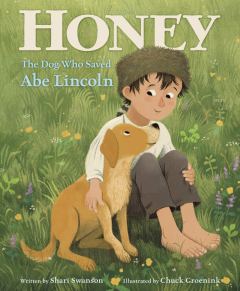
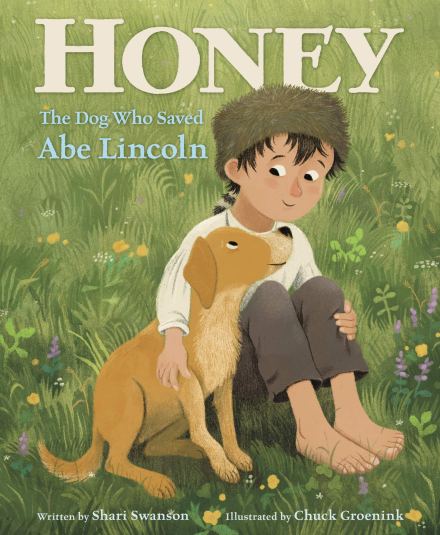
Honey, the Dog Who Saved Abe Lincoln

Written by Shari Swanson | Illustrated by Chuck Groenink


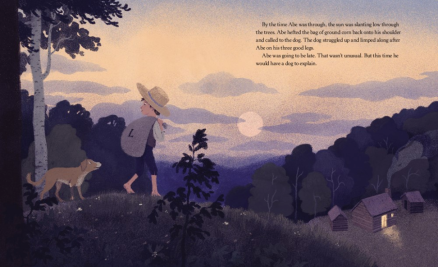
Young Abe Lincoln was deep in the forest when he heard the whistle that told him the corn he’d brought to the mill was ready. He knew he’d be late, but it was worth it to have saved a frog from the jaws of a snake. When Abe got back to the mill, John Hodgen, the miller, wondered what it had been this time that had kept Abe so long. “‘I just can’t move along fast like some boys, Mr. John, because I see so many little foolish things that make me stop. I can’t help it to save my life,“‘ Abe answered.
celebrate-picture-books-picture-book-review-honey-the-dog-who-saved-lincoln-late

Image copyright Chuck Groenink, 2020, text copyright Shari Swanson, 2020. Courtesy of Kathrerine Tegen Books.

On his way home, he heard rustling in the bushes. At the bottom of a cliff, Abe found a dog with a broken leg. Although he “was only seven years old, Abe had spent his whole life on a Kentucky farm and knew how to tend to animals.” He cut a small branch to make a splint and peeled bark from a pawpaw bush to use as a bandage. He tied it all together with rawhide from his belt. It was already dark when Abe and the dog reached home.

Even though his mother knew he was prone to lateness, she’d been worried, but Abe told her about the “‘honey of a dog’” he’d found and begged her to let him keep it. “‘He’ll do lots of good things for me,’ he told her. ‘You just watch and see.’” Abe’s mother relented and soon Honey was on the mend. Even though, once healed, Honey’s foot was curved, he was able to keep up with Abe on his adventures.
celebrate-picture-books-picture-book-review-honey-the-dog-who-saved-lincoln-cave

Image copyright Chuck Groenink, 2020, text copyright Shari Swanson, 2020. Courtesy of Kathrerine Tegen Books.

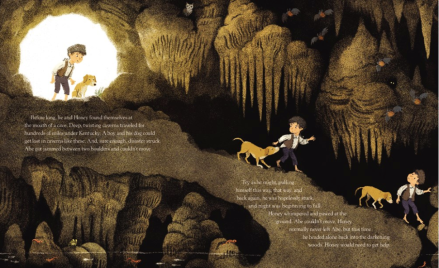
On another day, after Abe had dropped off his grain at the mill, he grew tired of waiting and wandered into the woods, where they found the mouth of a cave. “Deep, twisting caverns traveled for hundreds of miles under Kentucky. A boy and his dog could get lost in caverns like these.” Abe and Honey made their way down into the rocky darkness. Abe was too busy looking around at the stalactites, bats, and other creatures who lurked in the shadows to notice the gap between two boulders. In a moment he was stuck tight. “Honey normally never left Abe, but this time he headed alone back into the darkening woods” to get help.

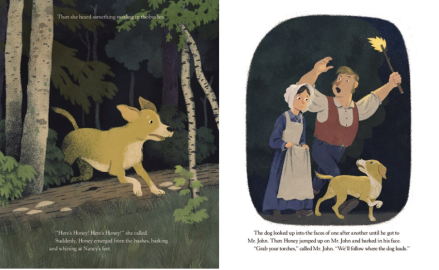
Meanwhile, everyone in town had gathered to look for Abe. Abe’s mother was at least relieved to know that Honey was with her son to protect him. As the search party began to look, Abe’s mother heard a noise in the bushes. Then she saw Honey dashing toward her. He barked and whined, but when he saw Mr. John, Honey “jumped up…and barked in his face.” Mr. John called for everyone to follow Honey.
celebrate-picture-books-picture-book-review-honey-the-dog-who-saved-lincoln-rescue

Image copyright Chuck Groenink, 2020, text copyright Shari Swanson, 2020. Courtesy of Kathrerine Tegen Books.

Honey led them through the forest to the cave’s entrance. Mr. John blew on his whistle, and Abe answered. Mr. John crept in and found Abe. There was no room for him to swing a sledge hammer to break the rock, so he pulled him out “even though it meant leaving some of the boy’s hide behind.” Once outside, Abe’s mother rushed to hug him and Honey. Abe had been right about Honey doing great things. And for many more years, Honey and Abe enjoyed adventures together.

Back matter includes a timeline recounting Abraham Lincoln’s major life events as well as his adventures with animals throughout his life.
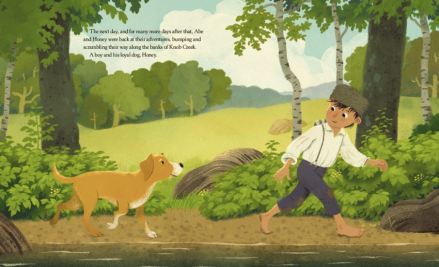
celebrate-picture-books-picture-book-review-honey-the-dog-who-saved-lincoln-more-adventures

Image copyright Chuck Groenink, 2020, text copyright Shari Swanson, 2020. Courtesy of Kathrerine Tegen Books.

In her enchanting story, Shari Swanson introduces young readers to the boy who would grow up to be the 16th president of the United States. Children meet this beloved man as a peer, discovering that his kindness, self-deprecation, sense of humor, and big heart were always part of his personality and guided him throughout his life, during good times and times of turmoil. Abraham Lincoln’s voice drives Swanson’s storytelling, which is charming and uplifting and gives a feel for the community that raised a president. Children may be awed by the responsibility Abe took on as a mere seven-year-old but will also recognize and appreciate his knowledge, competence, and confidence. Abe’s relationship with Honey is heartwarming, demonstrating that love and loyalty are repaid in many ways.

Chuck Groenink’s digital illustrations shine with sun-dappled Kentucky forest scenes and raise the stakes with foreboding and atmospheric images of the darkened cavern. His double-page spreads give readers close-up views of the action in the story as well as places they may not be familiar with, such as the mill and the Lincoln family’s log cabin. Images of Abe setting Honey’s broken paw, sneaking table scraps to Honey, and rescuing a variety of animals will delight kids. Torchlit scenes of the nighttime search party and dramatic rescue will have readers on the edge of their seats but knowing that Honey is watching out for Abe, they will be as certain of the triumphant ending.

A charming and compelling story for teaching young children about Abraham Lincoln and the lessons his life exhibits, Honey, the Dog Who Saved Abe Lincoln would be a first-rate addition to home, school, and public library collections.

Ages 4 – 8

Katherine Tegen Books, an imprint of HarperCollins, 2020 | ISBN 978-0062699008

Discover more about Shari Swanson and her books on her website. You’ll also find an educators’ curriculum guide and a child’s activity kit to download on her website. or here:

Educators’ Curriculum Guide | Activity Kit for Kids

To learn more about Chuck Groenink, his books, and his art, visit his website.

Abraham Lincoln’s Birthday Activity
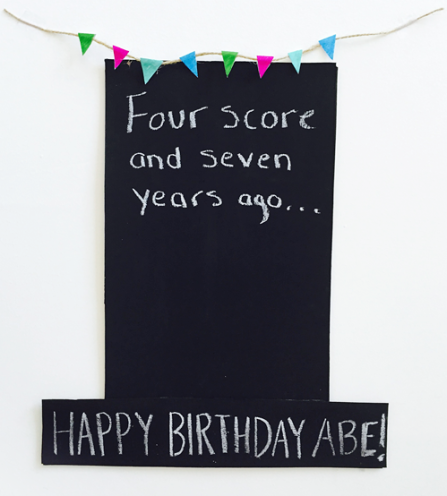
CPB - Abe Lincoln's Top Hat chalkboard (2)

Abe Lincoln’s Top Hat Chalkboard


Abraham Lincoln was known for the black top hat he wore – and for his inspiring words In this activity you can learn how to make a top hat chalkboard to use for your own drawings or inspiring words!

Supplies

  • Cereal Box (I used a large sized cereal box), cardboard or poster board
  • Chalkboard Paint (black)
  • Paint brush
  • Hot Glue Gun or extra-strength glue
  • Removable mounting squares
  • Chalk

Directions

  1. If you are using cardboard or poster board: cut a rectangle at least 8 inches wide by 12 inches long for the hat and 12 inches long by 2 inches wide for the brim (but your top hat can be any size you’d like!)
  2. If you are using a Cereal Box: open the seams of the Cereal Box
  3. Cut the panels of the cereal box apart
  4. Take one face panel and one side panel
  5. With the chalkboard paint, paint both panels
  6. Let the panels dry
  7. Attach the side panel to the bottom of the face panel to create the shape of Lincoln’s top hat
  8. Hang Abe Lincoln’s Top Hat Chalkboard 

celebrate-picture-books-picture-book-review-honey-the-dog-who-saved-lincoln-cover

You can find Honey, the Dog Who Saved Abe Lincoln at these booksellers

Amazon | Barnes & Noble | Books-a-Million | IndieBound

Picture Book Review

November 15 – It’s Geography Awareness Week

celebrate-picture-books-picture-book-review-manhattan-mapping-the-story-of-an-island-cover

About the Holiday

Today’s holiday was instituted in 1994 by National Geographic to get people excited about geography and its importance to education and everyday life. As defined by National Geographic, geography is “the study of places and the relationships between people and their environments.” This discipline includes how humans interact with the environment and the impact of location on people. These important questions affect a wide range of issues. More than 100,000 people across the country participate in Geography Awareness Week through special events, focused lessons and activities in classrooms, and attention by government and business policy-makers. To learn more about the week and discover resources for further education, visit the National Geographic website.

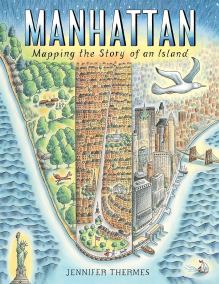
Manhattan: Mapping the Story of an Island

By Jennifer Thermes


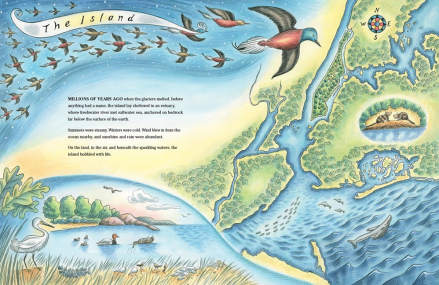
Jennifer Thermes’ phenomenal work of history and geography begins on the front and back endpapers, where a detailed and tagged map of Manhattan, with its gridded streets and unique landmarks awaits investigation. But how did it become this bustling world leader? Thermes reveals that even from its formation millions of years ago as a sheltered bit of land, fed by both fresh and salt water, the island “bubbled with life.” Continuing on from this lyrical beginning, Thermes’ love for New York shines on every exquisite page.

celebrate-picture-books-picture-book-review-manhattan-mapping-the-story-of-an-island-beginning

Copyright Jennifer Thermes, 2019. Courtesy of Harry N. Abrams.

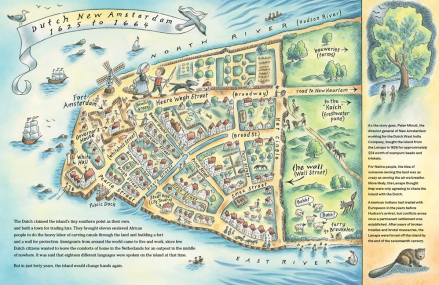
Alternating between sweeping vistas of the island, immersive images of major events, and meticulous maps—complete with tiny homes and buildings, people at work and play, and hand-lettered street names—that show the growth of the city, Thermes presents a feast for the eyes. Her full-bleed, oversized illustrations, rendered in a gorgeous color palette, create in themselves a comprehensive overview of history seen through changing clothing, transportation, and home styles to name just a few telling elements. Studying the maps, a reader can’t be faulted for feeling as if they might come to life at any moment.

She introduces readers to the Lenape, who for thousands of years called the island home. They named it “Mannahatta, which means ‘island of many hills.’” As the seasons changed, the people moved from one part of the island to another, establishing villages “with names like Sapokanikan and Shroakapok and fishing, farming, and foraging for “what they needed and nothing more.”

celebrate-picture-books-picture-book-review-manhattan-mapping-the-story-of-an-island-dutch

Copyright Jennifer Thermes, 2019. Courtesy of Harry N. Abrams.

Thermes then follows explorer Henry Hudson, whose reports back home about the island’s riches would change the island forever. She marks historical periods from 1625 to today with elegant banners that give the dates and changing names for this coveted landmass. Thermes’ storytelling eloquently reveals the complexity of the island’s development from canals dug and filled in, expansion of its width with landfill that included “rocks and earth, broken crockery, oyster shells, wood from old shipwrecks, rotting garbage, and even dead animals” to the adoption of the grid system.

The impact of slavery, the divides between rich and poor, the influence of business and industry, and the continual effects of modernization are woven throughout Thermes’ pages, sometimes coalescing as in the story of Collect Pond, once “the island’s best source of fresh water,” which became, in turn, the site of a cemetery for free Africans, polluted by “breweries, tanneries, and slaughterhouses,” a neighborhood for the wealthy, an area plagued by gangs and violence, and finally, in 2006, a national monument commemorating the old African Burial Ground. Each clearly articulated description gives readers a robust and eye-opening history of this city that is in many ways a microcosm of America.

celebrate-picture-books-picture-book-review-manhattan-mapping-the-story-of-an-island-british-new-york

Copyright Jennifer Thermes, 2019. Courtesy of Harry N. Abrams.

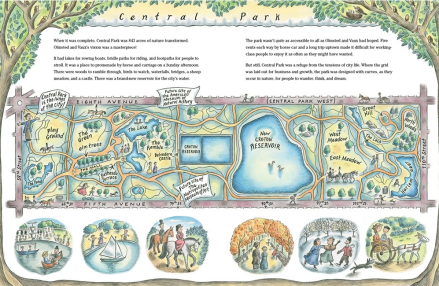
With the Revolutionary War behind them and a new nation in front, people thronged to what was now New York, New York, U.S.A. With much rebuilding needed, “Shipbuilders, sailmakers, carpenters, blacksmiths, and all kinds of artisans crowded the city again…. The city on the island was branching out in all directions. It needed a plan.” The plan came in the form of a grid system. The execution of the plan saw the island’s hills leveled, new roads built and old roads straightened, houses in the way torn down, and people relocated. When the dust settled, “the city commissioners had thought it would take centuries to fill the grid with buildings. It only took sixty years.”

celebrate-picture-books-picture-book-review-manhattan-mapping-the-story-of-an-island-british-central-park

Copyright Jennifer Thermes, 2019. Courtesy of Harry N. Abrams.

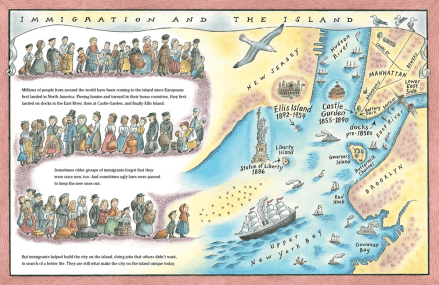
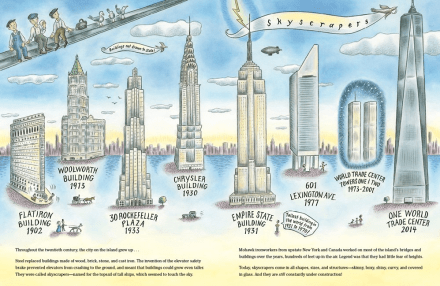
The Great Fire of 1835, the building of Central Park, the history of immigration, the gilded age of the late 1800s, and the Great Blizzard of 1888, which spurred the building of the subway, are a few more of the events readers will learn about. As an island, Manhattan’s story is also written its bridges, and everyone knows the names of the famous skyscrapers that make the city’s skyline unique. Stirring images of these landmarks are here too.

celebrate-picture-books-picture-book-review-manhattan-mapping-the-story-of-an-island-immigration

Copyright Jennifer Thermes, 2019. Courtesy of Harry N. Abrams.

The city continues to be changed by environmental events, such as Hurricane Sandy of 2012, and buoyed by improvements like the cleaning of the Bronx River that has prompted beavers to return “for the first time in more than two hundred years.” As Thermes says in conclusion: “Reminders are everywhere that through centuries of constant change humans and nature will always exist together. And beneath the city’s concrete crust, the island endures.”

celebrate-picture-books-picture-book-review-manhattan-mapping-the-story-of-an-island-skyscrapers

Copyright Jennifer Thermes, 2019. Courtesy of Harry N. Abrams.

A stunning achievement, Manhattan: Mapping the Story of an Island is a must addition to home, school, and classroom collections. This is a book that readers will want to dip into again and again to discover all it has to offer. Opportunities for cross-curricular lessons abound from history to geography, language arts to math, art and architecture to environmental science, and beyond. Manhattan makes a wonderful gift for children and teachers and, of course, for any New York lover of any age.

Ages 8 – 12 and up

Harry N. Abrams, 2019 | ISBN 978-1419736551

To learn more about Jennifer Thermes, her books, and her art, visit her website.

National Geography Day Activity

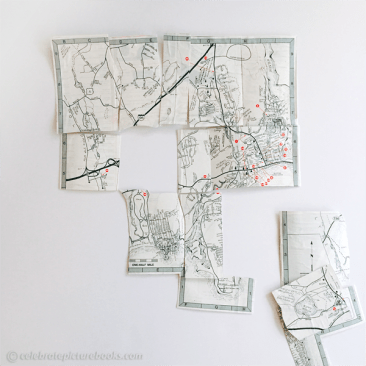
CPB - Map Day II

Map Jigsaw Puzzle


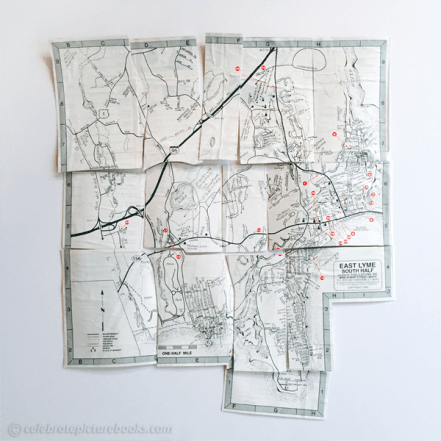
Sometimes reading a map is like putting together a puzzle—so why not make a puzzle out of a map? It can be fun to use a map of your town or state or to use a map of a state or country you’d like to visit!

Supplies

  • Small to medium size map (maps are often offered free at tourist stops, town halls, or other tourist information offices or racks)
  • Poster board
  • Glue
  • Scissors

CPB - Map Day

Directions

  1. Use the entire map or cut a desired-sized section from a map
  2. Glue the map to the poster board, let dry
  3. Cut the map from the poster board
  4. Cut the map into puzzle sections, these can be straight-sided sections or ones with interconnecting parts.

celebrate-picture-books-picture-book-review-manhattan-mapping-the-story-of-an-island-cover

You can find Manhattan: Mapping the Story of an Island at these booksellers

Amazon | Barnes & Noble | Books-a-Million | IndieBound

Picture Book Review

November 11 – Veterans Day

celebrate-picture-books-picture-book-review-sergeant-billy-cover

About the Holiday

Veterans Day is observed each year on this date to honor and thank all members of the military who are currently serving or have served in the United States Armed Forces. The official ceremony begins at 11:00 a.m. with a wreath laying at the Tomb of the Unknowns at Arlington Cemetery and then continues inside the Memorial Amphitheater with a parade of colors by veterans’ organizations and comments by dignitaries. While an official government holiday, some schools remain in session, holding special ceremonies of their own and inviting veterans to relate their experiences.

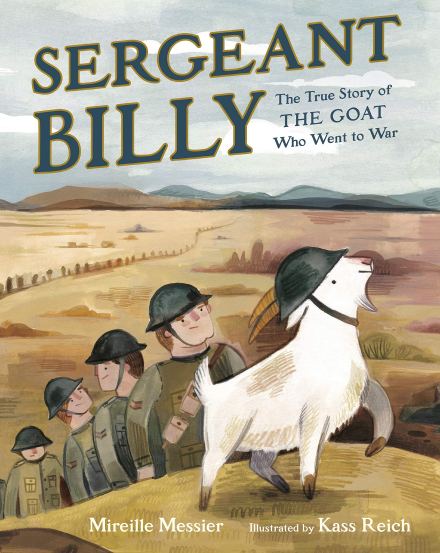
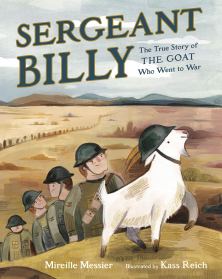
Sergeant Billy: The True Story of the Goat Who Went to War

Written by Mireille Messier | Illustrated by Kass Reich


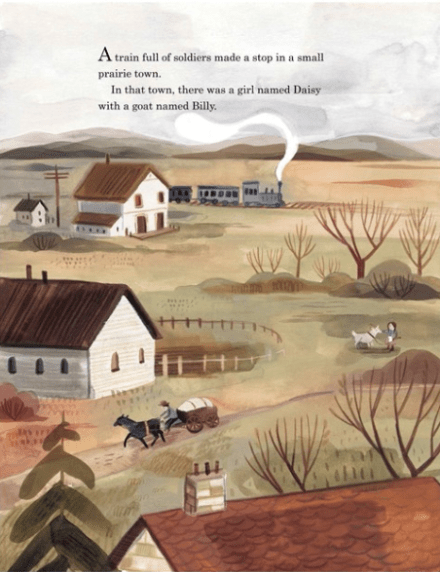
When a train full of soldiers stopped in a small town, they met a girl named Daisy and her goat, Billy. “The soldiers were going to war and they thought Billy would bring them luck.” Although Daisy loved her pet, she said they could take Billy with them if they promised to bring him back. During the bus ride to training camp for the Fifth Battalion, Billy endeared himself to the men with his antics, and they began calling him Private Billy. “And that’s how Billy joined the army.”

celebrate-picture-books-picture-book-review-sergeant-billy-trian

Image copyright Kass Reich, 2019, text copyright Mireille Messier, 2019. Courtesy of Tundra Books.

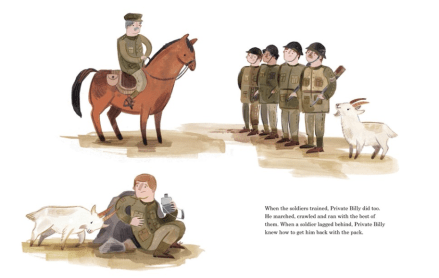
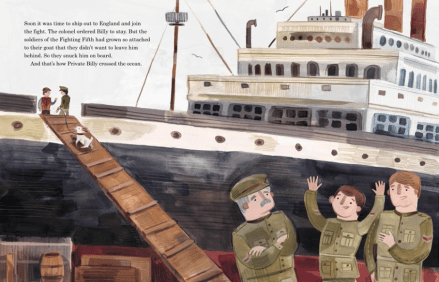
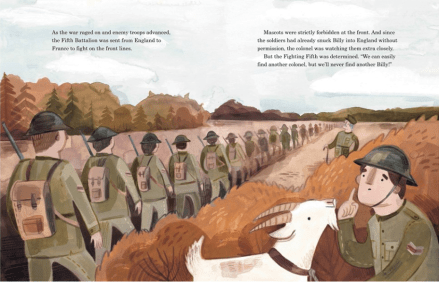
Billy trained with the soldiers and encouraged them with a push when they fell behind. When the soldiers were sent to England, they snuck Billy on board the ship. “And that’s how Private Billy crossed the ocean.” As time went on, the Fifth Battalion was sent to France. “Mascots were strictly forbidden at the front,” but the men hid Billy in an empty orange crate and “that’s how Private Billy went to the front lines.” Billy seemed to be the perfect solider. He didn’t mind the adverse conditions, the “foul food” or “even the rats.”

celebrate-picture-books-picture-book-review-sergeant-billy-horse

Image copyright Kass Reich, 2019, text copyright Mireille Messier, 2019. Courtesy of Tundra Books.

Billy celebrated victories and comforted soldiers during defeats and loneliness. The soldiers even wrote home about their beloved mascot. Even though food rations were short, Billy was happy with socks, napkins, or once even secret documents. For that misdeed, the colonel “placed the goat under arrest. And that’s how Private Billy went to jail for being a spy.” While Billy was locked up, the soldiers became bored, discontented, argumentative, and unhappy. So Billy received a pardon and was returned to the troops.

celebrate-picture-books-picture-book-review-sergeant-billy-ship

Image copyright Kass Reich, 2019, text copyright Mireille Messier, 2019. Courtesy of Tundra Books.

After many brave deeds, such as capturing an enemy guardsman and saving some “soldiers’ lives by head-butting them into a trench seconds before a shell exploded right where they had been standing,” private Billy was promoted to Sergeant Billy. Billy knew he could always count on the soldiers, and the soldiers knew they could always count on Billy. For his “exceptional bravery,” Billy was awarded the Mons Star. The war raged for years, but, finally, peace was declared. The soldiers—and Billy—were ready to return home. They traveled over land and across the ocean and brought Billy back to Daisy, just as they had promised.

An Author’s Note explains more about animal mascots and the way animals were used during WWI. Readers can see photographs of Billy, Daisy, and the soldiers he served with as well.

celebrate-picture-books-picture-book-review-sergeant-billy-fifth-fattlion

Image copyright Kass Reich, 2019, text copyright Mireille Messier, 2019. Courtesy of Tundra Books.

Mireille Messier’s charming storytelling brings to life the extraordinary World War I experience of a goat and the soldiers who loved him. Her easy-to-follow timeline, containing humorous incidents, clever ploys to move Billy from place to place, and harrowing exploits, will capture readers’ attention and hearts. Along the way, children learn about conditions and events of war. Messier’s repeated phrasing “And that’s how Billy…” moves the story forward while contributing to the cumulative effect of Billy’s positive influence on the troops and his role in battle.

Kass Reich’s captivating illustrations immerse readers in the wartime atmosphere while focusing on Billy and his endearing personality. Seeing Billy giving a tired soldier a nudge with his horns, being smuggled from place to place, comforting a soldier, and nibbling on secret documents allows children not only to visualize these events but to understand how important Billy was to the morale of the men, whose emotions are honestly depicted. Images of Billy happily wallowing in mud, playing with rats, and gobbling down anything he finds will have kids giggling while those of Billy saving lives and getting medals will wow them. His safe passage back home to Daisy is a delightful and satisfying ending.

A superbly told story, Sergeant Billy: The True Story of the Goat Who Went to War, is highly recommended. The book would make an excellent addition to home, classroom, and public library collections for general story times and especially those around Veteran’s Day, Memorial Day, and other patriotic holidays.

Ages 4 – 8

Tundra Books, 2019 | ISBN 978-0735264427

Discover more about Mireille Messier and her books on her website.

To learn more about Kass Reich, her books, and her art, visit her website.

Watch the Sergeant Billy book trailer!

Veterans Day Activity

celebrate-picture-books-picture-book-review-veterans-day-word-search-puzzle

Happy Veterans Day! Word Search Puzzle


Can you find the twenty-one Veterans Day related words in this printable puzzle?

Happy Veterans Day! Word Search Puzzle | Happy Veterans Day! Word Search Solution

celebrate-picture-books-picture-book-review-sergeant-billy-cover

You can find Sergeant Billy: The True Story of the Goat Who Went to War at these booksellers

Amazon | Barnes & Noble | Books-a-Million | IndieBound

Picture Book Review
August 19 – World Photography Day

celebrate-picture-books-picture-book-review-Hector-cover

About the Holiday

Photography is all about providing information through images. A picture really can be worth a thousand words in capturing a moment of surprise, joy, danger, or sadness. Well-placed photographers, videographers, and cinematographers have given voice to some of society’s pivotal moments, allowing the whole world to witness change, sometimes as it happens. Today we celebrate the “art, craft, science, and history of photography,” as well as those photographers who often put themselves in danger to get the story as well as those who bring us much-needed lighter moments. To learn more visit the World Photography Day website.

Hector: A Boy, a Protest, and the Photograph that Changed Apartheid

By Adrienne Wright

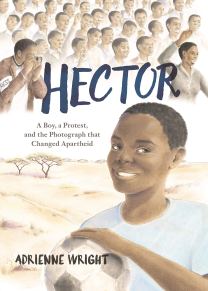
This powerfully emotional book opens with a recollection by Sam Nzima, the photojournalist who captured this pivotal event and a brief history of South Africa and the segregation and governmental restrictions that led up to the protest in 1976 which resulted in Hector Zolile Pieterson’s death. The compelling story, illustrated in graphic novel style, is broken up into three “chapters.”

celebrate-picture-books-picture-book-review-Hector-Hector

Copyright Adrienne Wright, 2019, courtesy of Page Street Kids.

The first introduces Hector, a twelve-year-old boy who loved playing soccer, watching movies, and visiting family. After his normal weekend chores, Hector would run errands for his neighbors to make a little money. Hector was happy, but things were changing at his school. The government had passed a law that instead of the international language English, black students must be taught half of their subjects in Afrikaans, a language derived from Dutch and spoken by descendants of the early Dutch settlers. This “added hardship to students and teachers in an already oppressive education system.” As he counted the money he’d made, his mother reminds him to count in Afrikaans, since that is what will be required in school.

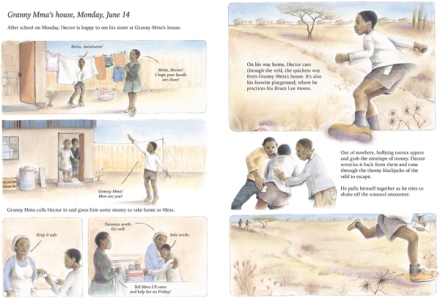
On June 14, 1976 Hector visited his granny Mma. When he left, she gave him some money for his mother. On the way home, he was waylaid by men trying to steal the money. Hector was able to escape with the money and decides not to worry his Mma by telling her. On June 16, Hector heads off to school, but when he gets there, he sees the students “chanting and singing” as they all march toward Orlando Stadium to protest the new Afrikaans law. “More students join in, and soon hundreds, then thousands of people are marching. Hector is swept up in the excited activity of the growing crowd.”

celebrate-picture-books-picture-book-review-Hector-june-14

Copyright Adrienne Wright, 2019, courtesy of Page Street Kids.

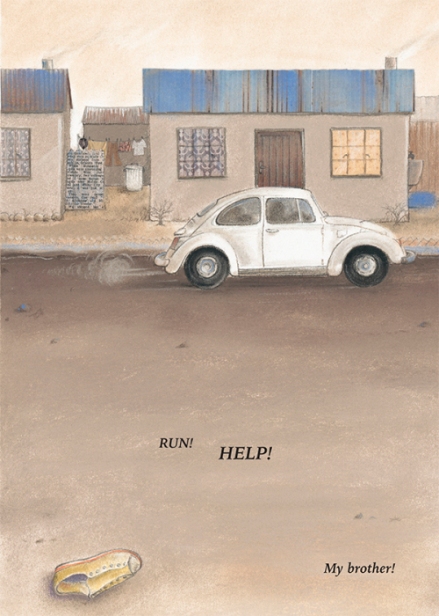
Ahead on the road the protesters see the police and a blockade. The students begin marching down another street. They wave signs and sing the “government-banned anthem, ‘Nkosi Sikelel’ iAfrica’—’God Bless Africa.’” The police confront the students, blowing their whistles, shouting, and throwing tear gas. Suddenly, Hector hears his sister, Antoinette’s voice warning him to run home. Shots ring out.

The second chapter introduces Antoinette, who on June 16 is leaving for school from Granny Mma’s house. She knows about the planned protest but says nothing to Granny Mma. She joins the crowd waving signs and chanting. Then “POW! Tear gas explodes in the air. Students scatter in all directions,” and Antoinette sees Hector. As they run for cover, they become separated. Shots ring out all around them. When the smoke dissipates, Antoinette sees a teenager running towards a car with a boy in his arms. “She can’t see the child’s face, but when she sees his shoe…”

celebrrate-picture-books-picture-book-review-Hector-protest-group

Copyright Adrienne Wright, 2019, courtesy of Page Street Kids.

Chapter three takes readers behind the lens of Sam Nzima’s camera. On assignment for The World newspaper, Sam is documenting the protest through his photographs. “The protest begins. / The students march. / Sam snaps photos…. / The police barricades go up. / The children sing. / Sam snaps photos. / The police shoot! / Sam snaps.”

The police see Sam taking pictures and confiscate his film. But Sam has hidden the most important roll in his sock. “His picture of Hector, Antoinette, and another student runs on the front page of the newspaper.” At Granny Mma’s house, Hector’s family grieves his loss; around the world “Hector lives on as a compelling symbol of the cost of apartheid and the change sparked by students that day.”

The final spread shows the black-and-white photograph of Mbuyisa Makhubu carrying Hector with Antoinette running alongside. Back matter includes a short discussion that expands on the events of June 16, 1976 and the years that followed in the fight against Apartheid. An Author’s Note; short biographies of Hector, Antoinette, Sam Nzima, and Mbuyisa Makhubu; and a glossary also follow the story.

celebrate-picture-books-picture-book-review-Hector-help

Copyright Adrienne Wright, 2019, courtesy of Page Street Kids.

Adrienne Wright’s gripping storytelling and evocative illustrations go hand-in-hand to present a full portrait of young Hector, his life, his sweet nature, and his dreams. His family’s close bonds and their concern for each other is evident in the dialog that accompanies images of Hector playing, helping Mma and Granny Mma, running errands, and interacting with his sisters. As June 16 dawns, Wright sketches a normal day, with Hector joking with his mother at home and his friend on the way to school.

As it did for Hector, the protest comes as a surprise for readers, sweeping them up into the action just as Hector was. Antoinette’s chapter is the shortest but gripping in its pacing that mirrors the turmoil of the day and her tragedy. As readers enter Sam’s viewpoint, they see, blocked off in vertical and horizontal frames, the pictures of celebrating and happy, yet serious students marching to make a difference. The moment of the shot is seen through Sam’s lens and clouded in smoke.

Wright’s use of overlapping storylines as she transitions from Hector’s account to Antoinette’s and then to Sam’s adds to the tension, drawing readers in and reinforcing their understanding of the atmosphere and what the students were protesting. The final, nearly full-page reproduction of the actual photograph is an unflinching look at the reality of that day, what it stands for, and its personal cost.

A profound narrative for teaching children about South African history, the costs of discrimination, and the personal stories involved in any conflict, Hector is an important book to add to school and public library collections.

Ages: The book is targeted for children from eight to twelve, but adults should be mindful of the maturity and sensitivity of readers. Hector would also be a compelling inclusion in middle school and even early high school social studies and history classes.

Page Street Kids, 2019 | ISBN 978-1624146916

To learn more about Adrienne Wright and her work, visit her website.

World Photography Day Activity

CPB - New Professionals Picture

News Professionals Clothespin Figures


Photojournalists and journalists cover the news and sometimes put themselves in danger to bring readers true stories of events happening around the world. With this craft, you can make these clothespin figures that honor the men and women who work to keep us all informed.

Supplies

Directions

  1. Draw a face and hair on the clothespin
  2. Cut out the clothes you want your journalist or photographer to wear
  3. Wrap the clothes around the clothespin. The slit in the clothespin should be on the side.
  4. Tape the clothes together
  5. Cut out the camera
  6. Tape one end of a short length of thread to the right top corner of the camera and the other end of the thread to the left corner. Now you can hang the camera around the figure’s neck.

Idea for displaying the figures

  • Attach a wire or string to the wall and pin the figure to it
  • Pin it to your bulletin board or on the rim of a desk organizer

celebrate-picture-books-picture-book-review-Hector-cover

You can find Hector: A Boy, a Protest, and the Photograph that Changed Apartheid at these booksellers

Amazon | Barnes & Noble | Books-a-Million | IndieBound

Picture Book Review
August 2 – National Coloring Book Day

celebrate-picture-books-picture-book-review-the-crayon-man-cover

About the Holiday

A few years back adults discovered (or rediscovered) what kids already know—that coloring is fun! Not only is it fun, but letting your creativity turn a page from black-and-white to full-color is relaxing and satisfying. Today’s holiday was established in May 2015 by Dover Publications, a leader in the coloring book industry. In fact, Dover published the first coloring book for adults—Antique Automobiles Coloring Book—in 1970. You know how to celebrate today! Grab your box of crayons, your kids, and your friends and have a coloring party! To learn more about the holiday and download a free mini coloring book visit the Coloring Book Day website. You can find more coloring pages to download on the Crayola website. To learn more about the man who invented crayons, keep reading!

The Crayon Man: The True Story of the Invention of Crayola Crayons

Written by Natascha Biebow | Illustrated by Steven Salerno


Edwin Binney was an inventor who truly appreciated all the colors around him. In fact, “color made him really, really HAPPY!” Perhaps he loved color so much because all day long in the mill where he worked he was surrounded by nothing but black: “black dust, black tar, black smoke, black ink, black dye, black shoe polish. His company sold carbon black, a new kind of pigment, or colored substance, make from the soot of burning oil and natural gas.” Edwin worked with his cousin C. Harold Smith, and their company was called Binney and Smith.

celebrate-picture-books-picture-book-review-the-crayon-man-cardinal

Image copyright Steven Salerno, 2019, text copyright Natascha Biebow, 2019. Courtesy of HMH Books for Young Readers.

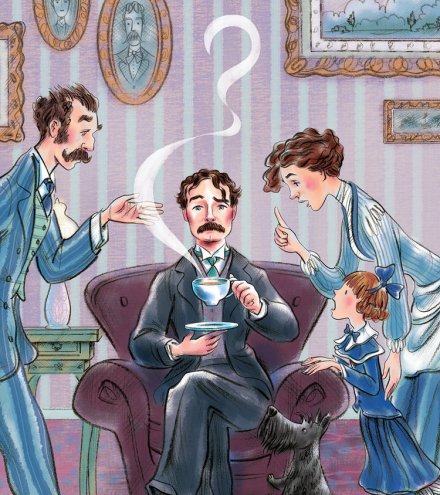
While Harold was the salesman, Edwin was the tinkerer who had made better pencils for writing on slate and a wax crayon that wrote on both paper and wood. His wife, Alice, thought he was just the person to create better crayons for kids. The existing crayons were too big and clunky, and artists’ crayons were too expensive.

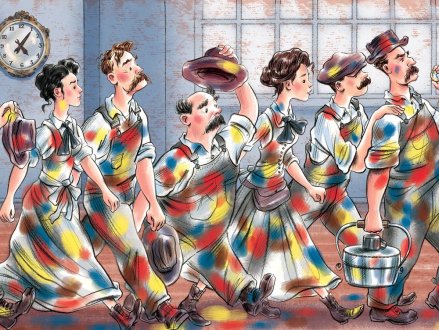
Edwin gave it some thought and started experimenting with wax for substance and rocks and minerals for color. Then he and his workers fine-tuned their batches, adding only “a pinch of this pigment, a sploosh of that one, a little hotter, a little cooler…and voilà, LOTS of different shades!” Now, instead of being covered in black dust at the end of the day, “Edwin came home covered in color.”

celebrate-picture-books-picture-book-review-the-crayon-man-tea

Image copyright Steven Salerno, 2019, text copyright Natascha Biebow, 2019. Courtesy of HMH Books for Young Readers.

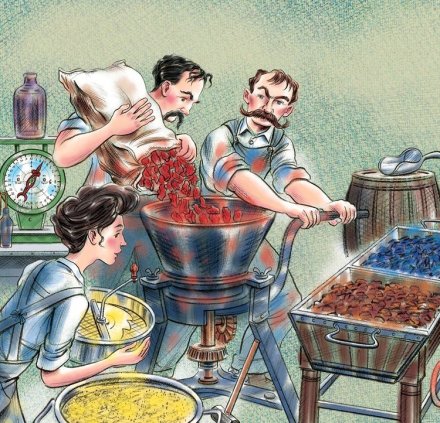
At the factory, Edwin’s team worked on their top-secret formula and finally poured the mixtures into “thin, crayon-shaped molds” to make crayons that were just the right size for children. Finally, in 1903, Edwin had the product he wanted. “He’d invented a new kind of colored crayon” and wanted a new name to go with it. Alice had just the right suggestion, and Crayola crayons were born.

The first boxes contained eight colors and sold for a nickel. As they shipped out to stores, Edwin wondered if the kids would like them. Children loved their fine points, clear lines, and long-lasting color. By this time, inexpensive paper was also available, so kids didn’t have to draw or write on slate tablets anymore.

celebrate-picture-books-picture-book-review-the-crayon-man-hopper

Image copyright Steven Salerno, 2019, text copyright Natascha Biebow, 2019. Courtesy of HMH Books for Young Readers.

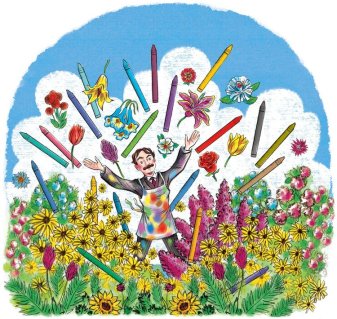
At the St. Louis World’s Fair in 1904, Edwin’s Crayola crayons won a gold medal. As time went on, Edwin and his team made even more colors, many inspired by nature and even the flowers in Edwin’s own garden. Some of the colors you’ll find in a box today were given their names by children, including “macaroni and cheese” and “robin’s egg blue.” Now, kids all around the world can create just the picture they want, with lots and lots of color.

Back matter includes an illustrated description of the process of making Crayola crayons, an extended biography of Edwin Binney, and a bibliography of resources.

celebrate-picture-books-picture-book-review-the-crayon-man-workers

Image copyright Steven Salerno, 2019, text copyright Natascha Biebow, 2019. Courtesy of HMH Books for Young Readers.

Natascha Biebow’s quickly paced biography of Edwin Binney and the invention of Crayola crayons is a deft portrait of the man and his times that were on the cusp of and central to so many innovations that created the modern world. Biebow’s emphasis on Binney’s willingness to listen and match his inventions to people’s needs is a lesson on collaboration and the true spirit of invention for today’s future pioneers. In her fascinating and accessible text, Biebow relates the problems with late 1800s writing and drawing mediums while also building suspense on how Binney and his team created the new crayons. Children will be awed to discover the thought, experiments, and materials that went into those first thin sticks of color. Short paragraphs that explain more factual information about topics in the story, including carbon black, the availability of paper, European crayons, and pigments are sprinkled throughout the pages.

celebrate-picture-books-picture-book-review-the-crayon-man-field

Image copyright Steven Salerno, 2019, text copyright Natascha Biebow, 2019. Courtesy of HMH Books for Young Readers.

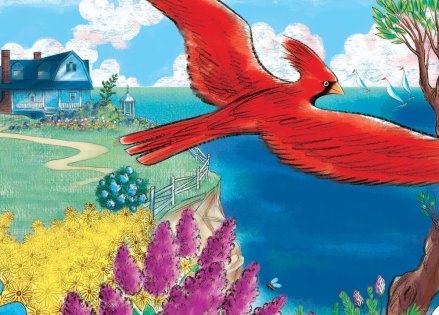
Steven Salerno’s color-drenched pages are beautiful tributes to the man who brought a new age of color into children’s lives. In a clever page turn, Edwin Binney stands in his garden with his arms outstretched appreciating the rainbow of flowers, the deep-blue sea, the light-blue sky, and a fiery red cardinal flying by. The next page takes kids into Binney’s mill, where he stands in the same position, but now seeming to bemoan the sooty environment. Salerno brings the time period alive for kids through hair and clothing styles and school and home furnishings. Several pages give readers a field trip into Binney’s secret lab to see the mechanics of making crayons at work. The front and end papers invite kids to give the wrapper-less crayons pictured a name based on their colors and then to make a drawing of their own.

A high-interest biography of the man who changed the way kids could interpret their world, The Crayon Man is a must for young inventors, artists, and thinkers as well as for classroom story times, social studies lessons, and art classes. The book would be a welcome addition to home, school, and public libraries.

Ages 6 – 9

HMH Books for Young Readers, 2019 | ISBN 978-1328866844

Discover more about Natascha Biebow and her books on her website.

To learn more about Steven Salerno, his books, and his art, visit his website.

National Coloring Book Day Activity

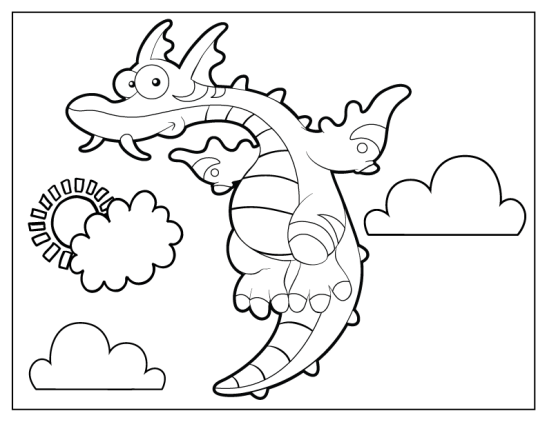
celebrate-picture-books-picture-book-review-Dragon-coloring-page

Cool Coloring Pages


You know what to do on Coloring Book Day! Here are three coloring pages for you to print and enjoy!

Cave kid Coloring Page | Dragon Coloring Page | Mermaid Coloring Page

celebrate-picture-books-picture-book-review-the-crayon-man-cover

You can find The Crayon Man: The True Story of the Invention of Crayola Crayons at these booksellers

Amazon | Barnes & Noble | Books-a-Million | IndieBound

Picture Book Review

May 8 – National Bike to School Day

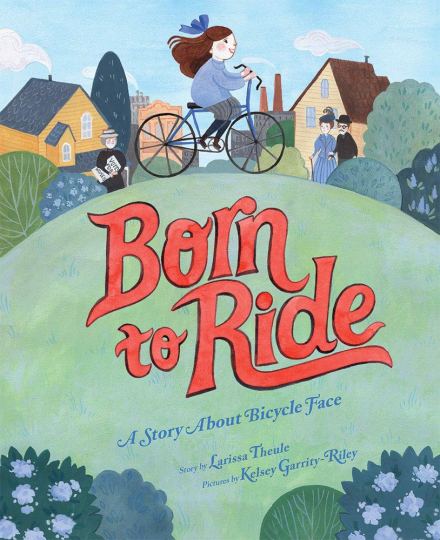
celebrate-picture-books-picture-book-review-born-to-ride-cover

About the Holiday

Established in 2012, National Bike to School Day raises awareness for communities to provide safe biking and walking routes for children and young people. Nearly 3,000 cities and towns across the country have planned events to get people to leave their cars at home and enjoy fresh air and exercise on their way to school. Although only a one-day holiday, National Bike to School Day encourages communities to continue developing safe ways for children to walk to school, including walking buses and bike trains. To learn more about events in your area or how you can get involved in making your own community safer for walking and biking visit walkbiketoschool.org.

Abrams Books for Young Readers sent me a copy of Born to Ride for review consideration. All opinions are my own. I’m happy to be partnering with Abrams Books in a giveaway of the book. See details below.

Born to Ride: A Story about Bicycle Face

Written by Larissa Theule | Illustrated by Kelsey Garrity-Riley

Open the cover of this remarkable picture book to a two-page illustration and you might notice something unusual—for our time. What is it? Read on and see…

As Louisa Belinda Bellflower gazed out her window at a man riding a bicycle in Rochester, New York, in 1896, she wished that she could ride one too. But girls and women weren’t allowed to ride bicycles, just as they weren’t allowed to vote or wear pants. Louisa’s brother, Joe, had a brand-new bike, and “riding it looked like a whole lot of fun.”

celebrate-picture-books-picture-book-review-born-to-ride-falling

Image copyright Kelsey Garrity-Riley, 2019, text copyright Larissa Theule, 2019. Courtesy of Abrams Books for Young People.

One day, Louisa took off her frilly skirt and put on her brother’s pants and asked him to teach her how to ride. There were, however, a couple of concerns. One was what would their mother say? Another was the horrible medical condition, bicycle face. Everyone knew about it, and Doctor Brown was strict on this matter. He said, “‘girls aren’t strong enough to balance, that your eyes will bulge, and your jaw will close up from the strain of trying—maybe FOREVER.’”

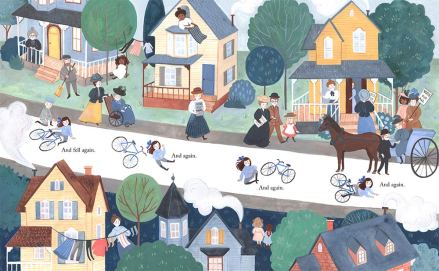
Louisa considered this fate, but Joe didn’t have any of these symptoms. Even though she was a little nervous, she tried it anyway. Louisa fell again and again, but when Joe asked her if she wanted to quit, she continued. She began peddling again and soon had the knack for it. “With some alarm, she felt her eyes bulge, and her mouth widen—into a gigantic, joyous smile.”

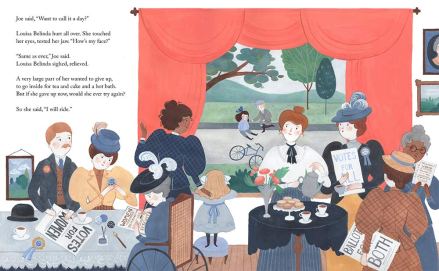
celebrate-picture-books-picture-book-review-born-to-ride-tea

Image copyright Kelsey Garrity-Riley, 2019, text copyright Larissa Theule, 2019. Courtesy of Abrams Books for Young People.

She rode back and forth down the path and when she got home, her mother said, “‘those pants look quite practical, Louisa Belinda,’” And Louisa turned a somersault just to show her she was right. Then Louisa’s mother asked Joe if Father’s bike was in good shape. Joe said it was, and their mother set about converting her skirt into a pair of pants. When they were finished, Louisa and her mother wheeled the bikes out side-by-side and took off. “‘Mother,’” Louisa said, “‘what will your bicycle face be, I wonder!’”

You only need to turn the page to see. Louisa’s mother is smiling and that original two-page spread has been transformed with lots of women and girls riding the roads that lead to the Votes for Women rally in the town green.

An extensive Author’s Note follows the text and explains the origin of “bicycle face” and other such imagined bicycle-related maladies as well as the opposition to women’s riding bicycles. Also included is a discussion on the women’s suffrage movement.

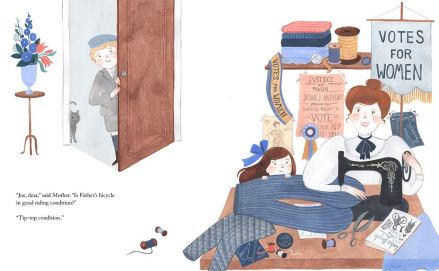
celebrate-picture-books-picture-book-review-born-to-ride-sewing

Image copyright Kelsey Garrity-Riley, 2019, text copyright Larissa Theule, 2019. Courtesy of Abrams Books for Young People.

Both children and adult readers will be astounded at Larissa Theule’s eye-opening story that reveals just one of the many obstacles women have had to overcome in their quest for equal rights. Theule’s story, told through the eyes of a girl with pluck and self-confidence, is well targeted to her young audience with an engaging undercurrent of humor at the nonsensical reasoning behind the ban on women’s bicycle riding and even the constricting clothing of the time for girls and boys. As Louisa falls again and again while learning to ride, Theule infuses her story with the idea that perseverance wins out—a concept she not only applies to learning a new skill, but to the parallel story of women’s suffrage that runs throughout the illustrations.

Kelsey Garrity-Riley’s charming illustrations evoke the late 1800s, giving kids a view of history with Victorian-style houses; skirts, bloomers, and pinafores for girls and short-pant suits for boys; and an old-fashioned sewing machine. Adding depth and context to the story, Garrity-Riley follows Louisa and Joe’s mother as she paints “Votes for Women” and “Ballots for Both” signs and later hosts a women’s suffrage tea attended by white and dark-skinned women, a woman in a wheelchair, and one progressive man. Garrity-Riley cleverly combines images of Louisa’s indomitable spirit with these depictions of protest to reinforce the theme and lesson of the story.

To  jumpstart discussions about equal rights for all, Born to Ride: A Story about Bicycle Face is a unique and fascinating addition to home, school, and public libraries.

Ages 4 – 8

Abrams Books for Young Readers, 2019 | ISBN 978-1419734120

Discover more about Larissa Theule and her books on her website.

To learn more about Kelsey Garrity-Riley, her books, and her art, visit her website.

National Bike to School Day Activity

celebrate-picture-books-picture-book-review-bicycle-maze 2

Ride with Me! Maze

Two girls want to ride bikes together. Can you help them find each other in this printable maze?

Ride with Me! Puzzle | Ride with Me! Puzzle Solution

celebrate-picture-books-picture-book-review-born-to-ride-cover

You can find Born to Ride: A Story about Bicycle Face at these booksellers

Amazon | Barnes & Noble | Books-a-Million | IndieBound

Picture Book Review
January 31 – Inspire Your Heart with Art Day

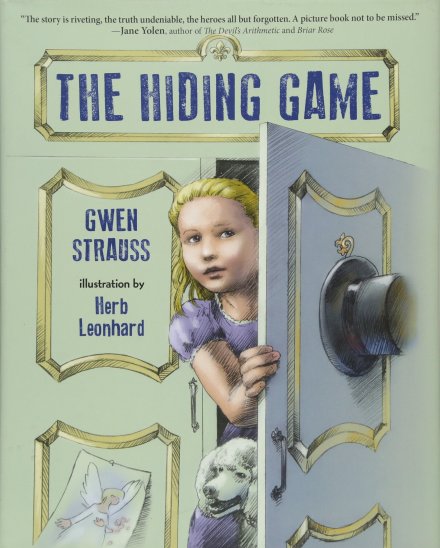
celebrate-picture-books-picture-book-review-the-hiding-game-cover

About the Holiday

Celebrating art is always a great thing! Today we champion that feeling you get inside when you create or experience art—no matter what kind is your favorite. Paintings, books, music, sculpture, quilts, photography, and other arts show you a bit of the world in a new way—a way, perhaps, you’ve never thought of before. Art can inspire, gladden, sadden, anger, teach, and compel action. It can also provide joy and inspiration when you need it most—as you’ll see in today’s book. Celebrate today’s holiday by visiting a museum, bookstore, library, concert, or gallery.

The Hiding Game

Written by Gwen Strauss | Illustrated by Herb Leonhard

It was October of 1940, and after moving from place to place to stay “one step ahead of the German soldiers,” Aube and her family had found a home where they could “live together until it was their turn to flee to safety. The Villa Air-Bel was rented by Varian Fry—a magician—and his assistant Danny Bénédite and served as a place to hide those looking to escape the war-torn country. On Sundays, the house was full of “thinkers, artists and writers who had to hide from the German soldiers because of their ideas of freedom and liberty” like Aube’s parents.

On those days, everyone played games, danced and made collages. One of Aube’s favorite games was Cadavre Exquis, in which a piece of paper was folded and each participant drew a design on one fold. When the whole paper was unfolded, amazing, artistic pictures emerged. These games and entertainment, Aube’s father told her, were their ways of fighting against fear. Because of the danger, many things had to be hidden at the Villa, including the radio and the cow that provided milk. Many ingredients for cooking were scarce. But even then Aube’s father used art to lighten the mood, leaving a drawing of a roast beef in the pantry where a real roast should have been.

Because the authorities were reading Varian and Danny’s mail and were listening to their phone calls, they had devised a way of hiding messages in toothpaste tubes that escaped the guard’s searches. The messages went to other people helping along the escape route to tell them who to expect next. Everyone in the house also had to have a special hiding place in case the police came. Aube chose the an old cabinet in the kitchen.

celebrate-picture-books-picture-book-review-the-hiding-game-tree

Image copyright Herb Leonhard, 2017, text copyright Gwen Strauss, 2017. Courtesy of Pelican Publishing Company.

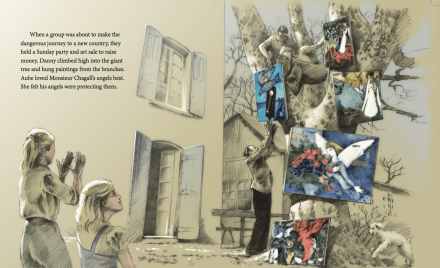
Whenever a new group of people were scheduled to “make the dangerous journey to a new country, they held a Sunday party and art sale to raise money.” Canvases painted by famous artists were hung among the branches of a large tree on the Villa grounds. When winter came, the Villa was so cold everyone had to wear all of their clothes to stay warm. They kept their spirits warm, too, by singing their favorite songs.

During the winter Danny visited camps where people were being held under terrible conditions. “Aube understood now that the danger was that they would be sent to the camps,” where people were dying of starvation and disease. They had little clothes and no blankets even though it was snowing. The people, Danny said, were going to freeze. Aube thought of the game freeze tag and worried about all of those “people freezing, waiting for someone to set them free.”

One day in December, the police raided the Villa. They took away all the men, including Danny, Varian, and Aube’s papa. Aube cowered in the kitchen cabinet with their dog in fear. The next week, the men were released, but they knew that the police would be back. Danny and Varian began to plan their escape. Before they all left, Aube’s father devised one more game. Each artist would paint their own version of a playing card to create a collective work of art. “The cards would remind them that they had laughed together and stayed free in their hearts even during the darkest times.”

Aube’s family were placed on a ship sailing to South America, and on February 18, 1941 they left the Villa and Danny and Varian behind and made the one-month-long journey to freedom. Several months later, Varian was “forced to leave France and return to America.” Danny went underground and “helped another 300 people escape France.” In 1943, however, Danny was “arrested by the Nazis and sentenced to death.” Just as he was facing the firing squad, soldiers fighting the Nazis burst through the gates of the camp and freed him and the other inmates.

celebrate-picture-books-picture-book-review-the-hiding-game-villa-air-bel

Image copyright Herb Leonhard, 2017, courtesy of Pelican Publishing Company.

Gwen Strauss includes extensive backmatter on this true-life story about her great-uncle Danny Bénédite. A detailed account of the work by Varian Fry, Danny Bénédite, and the American Rescue Committee, complete with photographs, as well as short biographies of some of the artists who visited the Villa (and a compelling list of others) plus resources for further study round out this compelling book.

Clearly written and with details from a child’s point of view that will resonate with readers, The Hiding Game is an absorbing tribute not only to two men involved in the Nazi resistance movement but to the resilience that uplifts people during the darkest times. This fascinating true story also offers a glimpse into the important role that artists and writers play in shining a light on history, interpreting it, and fighting against forces that destroy. Rich with the atmosphere of intrigue, suspense, and simple pleasures enjoyed, Strauss’s dynamic storytelling will thrill children. The Hiding Game will prompt them to learn more about this time period and will inspire in them their own acts of heroism.

Herb Leonhard’s realistic drawings of the Villa Air-Bel, the families who stopped there on their way to freedom, the moments of joy that sustained them, and the secret measures necessary for people’s safety take readers into the heart of the story and allow them to witness the danger and the creativity that swirled side-by-side within the Villa and the people living there. Largely depicted in somber tones of gray and green, the pages brighten with glowing yellows during times of laughter, games, and creativity. An illustration of the mammoth tree hung with canvases by famous artists will impress children, and the final image will leave an indelible and thought-provoking impression on young readers and adults.
An excellent book for facilitating discussions about World War II and the Holocaust with children at home and in the classroom as well as offering opportunities for cross-curricular learning in history, art, reading, and more, The Hiding Game is a superb choice to add to home, school, and public libraries.

Ages 7 – 12

Pelican Publishing Company, 2017 | ISBN 978-1455622658

Discover more about Gwen Strauss and her books on her website.

To learn more about Herb Leonhard, his books, and his art, visit his website.

Inspire Your Heart with Art Day Activity

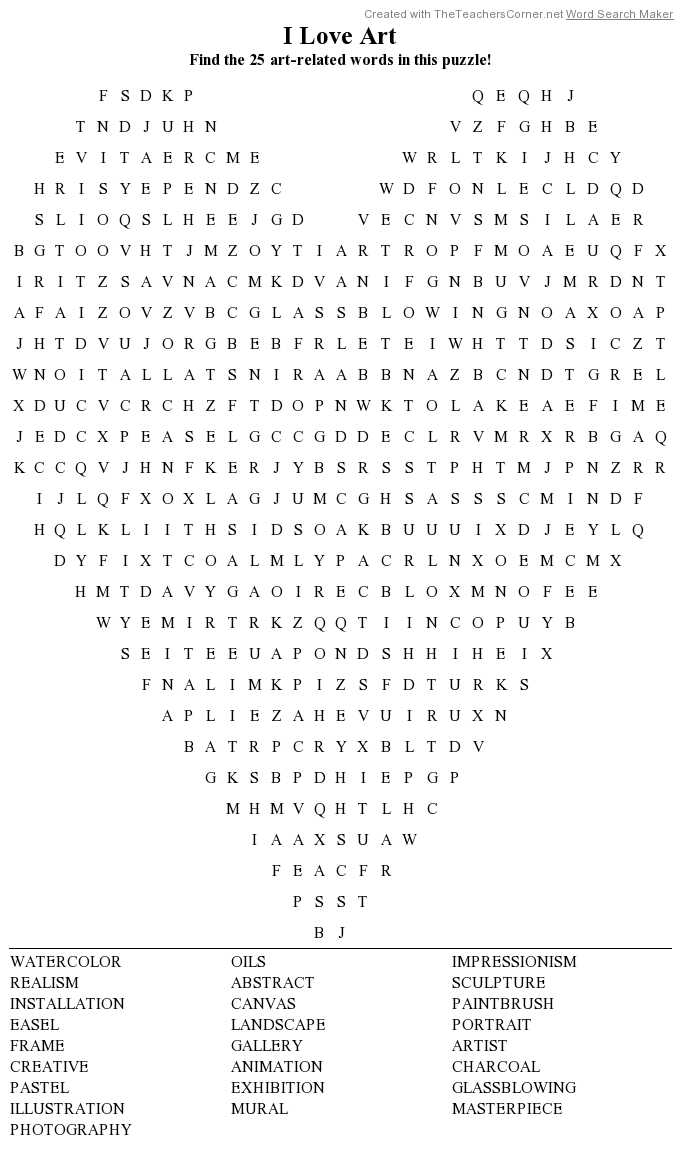
I Love Art! Word Search Puzzle

Art has a language all its own! Have fun finding the twenty-five art-related words in this printable puzzle.

I Love Art! Word Search Puzzle and I Love Art! Word Search Solution

celebrate-picture-books-picture-book-review-the-hiding-game-cover

You can find The Hiding Game at these booksellers

Amazon | Barnes & Noble | Books-a-Million | IndieBound

Picture Book Review