May 18 – It’s National Family Month

celebrate-picture-books-picture-book-review-Arletis-Abuelo-and-the-Message-in-a-Bottle-cover

About the Holiday

Established by KidsPeace, a private, not-for-profit organization dedicated to helping children and families since 1882, National Family Month is observed during the five-week period between Mother’s Day in May and Father’s Day in June. It coincides with the usual end of the school year, and raises awareness of the important role mothers and fathers as well as grandparents and extended family play as a support system for their children. To observe the holiday spend time talking with your kids about topics of importance to them and plan activities for fun and to help them achieve their goals.  

Thank you to Star Bright Books for sharing a copy of Arletis, Abuel, and the Message in a Bottle for review consideration. All opinions on the book are my own.

Arletis, Abuelo, and the Message in a Bottle

Written by Lea Aschkenas | Illustrated by Cornelius Van Wright and Ying-Hwa Hu


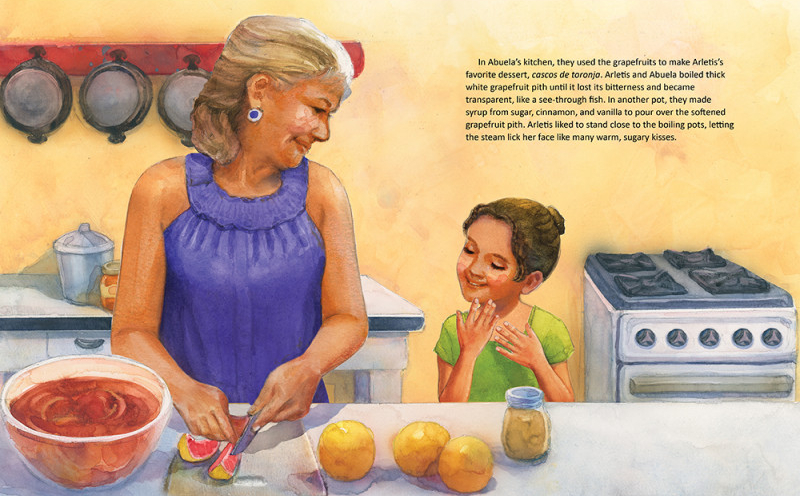
Growing up in Cuba, Arletis loved studying maps and wondering about the people and places beyond her island. “Her whole life took place on the long, unnamed street that ran in front of the unnumbered house, where she lived.” Some afternoons, she took the horse-drawn carriage that transported people around town to visit her abuela. While she was there, Abuela told her funny stories about her abuelo, who had died before she was born. Sometimes tears would form in Abuela’s eyes as she talked about her husband. Then “Arletis would suggest they pick the grapefruits that grew like miniature suns in the trees Abuela had planted when she was young” to make her favorite treat cascos de toronja.

celebrate-picture-books-picture-book-review-Arletis-Abuelo-and-the-Message-in-a-Bottle-carriage

Image copyright Cornelius Van Wright and Ying-Hwa Hu, 2023, text copyright Lea Aschkenas, 2023. Courtesy of Star Bright Books.

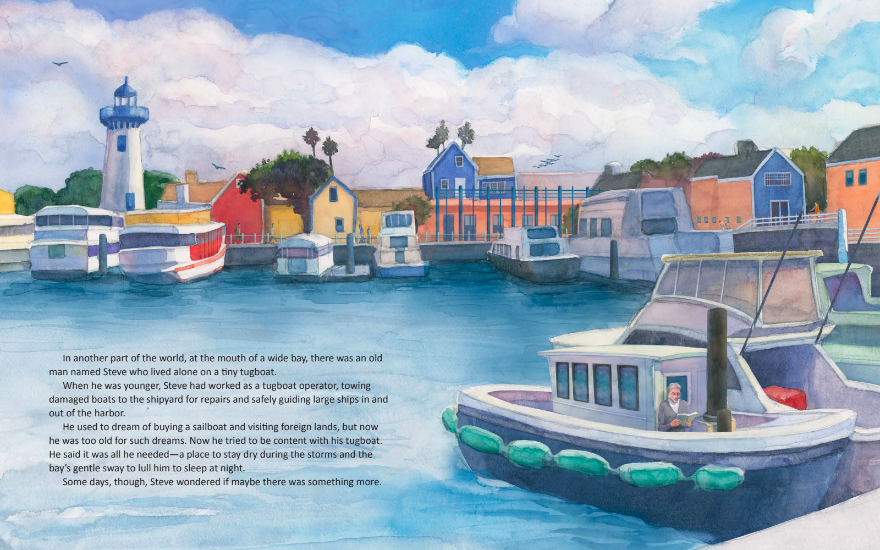
Arletis’s life was rich with delicious fruit that grew in trees along her street, swimming in the river when the heat became “so heavy and thick it rolled down the street in dizzying waves,” and playing her favorite game: choreographer, in which she, her cousin, and neighborhood kids danced to the music on the radio. Arletis loved her street, but sometimes she wondered if there was more. In another part of the world—off the coast of Sausalito, California—a man named Steve lived alone on the tugboat with which he had once made his living. While Steve was content on his tugboat, he too wondered if there was more.
celebrate-picture-books-picture-book-review-Arletis-Abuelo-and-the-Message-in-a-Bottle-abuela

Image copyright Cornelius Van Wright and Ying-Hwa Hu, 2023, text copyright Lea Aschkenas, 2023. Courtesy of Star Bright Books.

For Arletis’s eighth birthday, her parents rented a beach house for a weekend vacation to Playa Bailén, about 30 miles from home. On the bus ride there, Arletis, for the first time, saw the ocean that surrounded her island. On her birthday, Arletis took a walk along the beach and found a green bottle. The top was sealed with tape, and inside she could see a rolled up piece of paper. The paper turned out to be a letter written in a foreign language. Arletis was excited to realize that the bottle had come from another country.

Even though Arletis couldn’t read the words, she wrote a letter about “her life, about her family and her beautiful street. She asked every question she could think of about life in this other country” and she mailed it to the address provided at the bottom of the message from the bottle. When Steve received the letter, he immediately knew it was a response to his message in the bottle that he had given to a friend who was sailing down the coast and through the Panama Canal. The friend had dropped the bottle into the sea after he’d sailed into the Caribbean Sea.
celebrate-picture-books-picture-book-review-Arletis-Abuelo-and-the-Message-in-a-Bottle-Steve-on-tug

Image copyright Cornelius Van Wright and Ying-Hwa Hu, 2023, text copyright Lea Aschkenas, 2023. Courtesy of Star Bright Books.

Steve was thrilled to receive Arletis’s letter. He had begun studying Spanish and “had been wishing for someone to practice with.” Two months had gone by since Arletis had sent her letter when she heard the mail carrier call out her name and hand her an envelope. It was the first letter Arletis had ever received, and she handled it with great care. Steve had answered all her questions and even sent a picture of himself and his tugboat. Arletis thought Steve looked “old enough to be a grandfather. Arletis had always wished for a grandfather, so she decided to address her next letter, ‘Querido Abuelo Esteban.’ ‘Dear Grandfather Steve'” and invited him to visit her and her family one day.

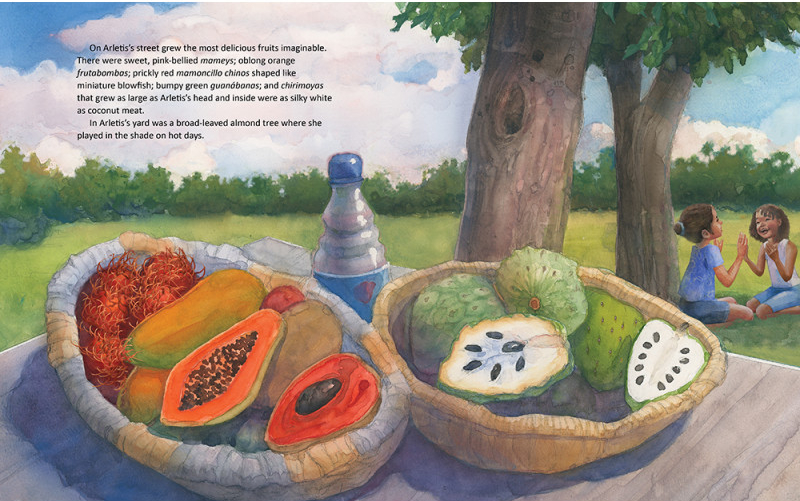
Arletis and Abuelo Esteban began writing to each other monthly then in one letter, Abuelo Esteban said he would be coming for a visit. “Arletis couldn’t stop smiling.” When Abuelo Esteban arrived, he brought a gift. It was a map he had drawn “showing the path his bottle had taken, first on his friend’s boat and then on the wide open sea to Arletis’s island. It was the most beautiful map Arletis had ever seen.” During the five days that Abuelo Esteban spent with Arletis’s family, he played baseball with her friends, swam in the river, and enjoyed some of Arletis’s favorite foods. 
celebrate-picture-books-picture-book-review-Arletis-Abuelo-and-the-Message-in-a-Bottle-fruit

Image copyright Cornelius Van Wright and Ying-Hwa Hu, 2023, text copyright Lea Aschkenas, 2023. Courtesy of Star Bright Books.

On Abuelo Esteban’s last night visiting, Arletis’s mother and Abuela made a special dinner, complete with Arletis’s favorite dessert, cascos de toronja. Abuelo Esteban loved it too. He showed everyone pictures of his tugboat and the dock where it was moored. Arletis thought the dock looked just like a little island surrounded by water. When she asked Abuelo Esteban if he thought an island was a good place to live, he replied, “‘Yes, I think so. Especially if there is another island where you have family you can visit.'” 

Backmatter includes an Author’s Note that outlines how Lea Aschkenas first met Abuelo Esteban at the Sausalito library where she worked and learned about his story. She adds an update to the story about both Arletis, now an adult, and Steve, who has continued to visit his “familia de corazón”— his family of the heart. A recipe for cascos de toronja, glossary of the Spanish words found in the story, and a list of references for further reading, viewing, and listening in both English and Spanish are also included.

celebrate-picture-books-picture-book-review-Arletis-Abuelo-and-the-Message-in-a-Bottle-Steve-playing-baseball

Image copyright Cornelius Van Wright and Ying-Hwa Hu, 2023, text copyright Lea Aschkenas, 2023. Courtesy of Star Bright Books.

Lea Aschkenas’s gentle and uplifting story immerses readers in the sights, sounds, flavors, and warm hearts of Cuba. Her comprehensive storytelling is filled with the types of details about Arletis’s life that will captivate readers and resonate with their own love for spontaneous fun, favorite foods, and family relationships. Aschkenas’s lovely descriptive language—Cuba is an “alligator-shaped island,” boiled grapefruit pith for cascos de toronja is as transparent as “a see-through fish,” Arletis and Abuelo Esteban exchange letters “as regularly as the monthly full moon”—and Spanish words and phrases sprinkled throughout the text paint pictures in children’s minds of the special beauty of Cuba.

Through Cornelius Van Wright and Ying-Hwa Hu’s stunning watercolor illustrations, readers travel to Cuba to revel in the brilliant colors of the buildings and homes, the luscious hues of tropical fruit, the jewel-like water of the rivers and ocean, and, especially, the sunny smiles of the country’s people. When the story turns to the Sausalito dock where Steve lives, children see that the landscape is similar, with homes and businesses painted in pinks, yellow, red, and blue. Palm trees dot the skyline, and the ocean is as blue as the sky. Van Wright and Hu enchantingly capture Arletis’s wanderlust and her excitement to connect with Steve, with whom she immediately forms a grandfatherly bond. Images of Arletis cooking with her Abuela, dancing and playing baseball with friends, and sitting around the family dinner table with Abuela Esteban will charm children as they take this true story into their heart.

Wonderfully evocative and multilayered, Arletis, Abuelo, and the Message in a Bottle is a remarkable story of family, friendship, pride in one’s country, and the joys to be found in reaching out to others across the world. The book is a heartfelt choice for story times at home and school and would make an impactful addition to any classroom or homeschool geography or social studies curriculum. Arletis, Abuelo, and the Message in a Bottle is highly recommended for all home, school, and public library collections. The book is also available in a Spanish edition: Arletis, abuelo y el mensaje en la botella.

Ages 4 – 8

Star Bright Books, 2023 | ISBN 978-1595729699 (English Hardcover) | ISBN 978-1595729705 (English Paperback) | ISBN 978-1595729729 (Spanish Hardcover) | ISBN 978-1595729712 (Spanish Paperback)

About the Author

LEA ASCHKENAS has written book reviews and articles for Washington Post Book World, Los Angeles Review of Books, and Salon. She is also the author of a travel memoir, Es Cuba: Life and Love on an Illegal Island. She fell in love with Cuba and its people on her first trip to the island in the year 2000 and has been returning nearly every year since. Arletis, Abuelo, and the Message in a Bottle is her first book for children. Lea lives in Northern California where she works as a public librarian and teaches with the California Poets in the Schools program. Visit Lea at: leaaschkenas.com

About the Illustrators

CORNELIUS VAN WRIGHT and YING-HWA HU are a husband and wife children’s book illustration team. They have worked on many assignments together, but have also illustrated numerous projects and books individually. They have won a number of awards for their books. Their work has been exhibited at the Bologna Book Fair and the Society of Illustrators’ “The Original Art” show. Cornelius and Ying-Hwa live in New York City. You can learn more about Cornelius and Ying-Hwa Hu and their work at pencilmoonstudio.com. Visit Ying-Hwa Hu at yinghwahu.com.

celebrate-picture-books-picture-book-review-Arletis-Abuelo-and-the-Message-in-a-Bottle-cover

You can find Arletis, Abuelo, and the Message in a Bottle or the Spanish Edition, Arletis, abuelo y el mensaje en la botella, at these booksellers

Amazon | Barnes & Noble | Books-a-Million

Arletis, abuelo y el mensaje en la botella

Amazon | Barnes & Noble | Books-a-Million

To support your local independent bookstore, order from

Bookshop: English Edition | Spanish Edition


Picture Book Review

March 10 – It’s Sing with Your Child Month

celebrate-picture-books-picture-book-review-rooftop-garden-cover

About the Holiday

Sing with Your Child Month was established 15 years ago by Music Together LLC and its founder Kenneth K. Guilmartin. The organization chose March and its ushering in of Spring and rebirth as a reminder of our most precious resource: our children. When parents, grandparents, teachers, and other caregivers sing and make music together with children, they form everlasting bonds, helping children to feel secure and putting them on the road to success. Research shows that early music education and participation has a large impact not only on musical growth but also on academic skill development and achievement. Singing with children boosts their language development and their reading and math learning.

But engaging in singing together isn’t all about education. It provides for times of fun and much-needed relaxation too! You don’t have to be a great vocalist to sing with kids, either! Just share favorite songs, silly songs, those old campfire songs, and songs kids learn in school and discover a whole new way to enjoy time together. Today’s book with its story and singalong audio and video included is a terrific place to start! To learn more about the benefits of singing with children, visit the National Association for the Education of Young Children website.

Thanks to Barefoot Books and Danna Smith for sharing a digital copy of Rooftop Garden with me for review consideration. All opinions on the book are my own.

Rooftop Garden

Written by Danna Smith | Illustrated by Pati Aguilera | Sung by Holly Turton


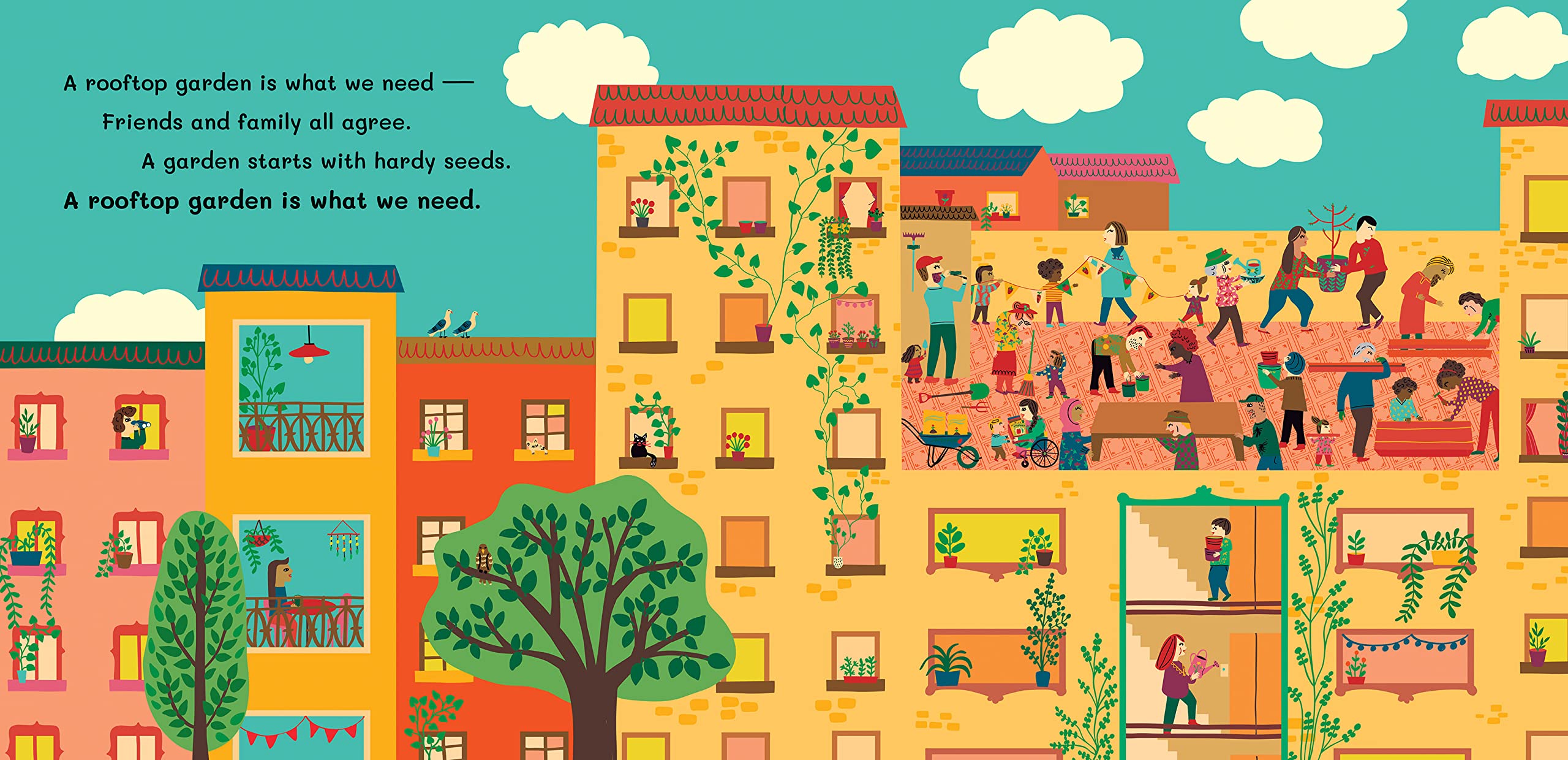
On a spacious apartment building rooftop, tenants, adults and kids alike, are busy building raised planting beds, bringing up pots and tools and watering cans, opening bags of dirt, and installing a sturdy work bench. A group of kids is even hanging a banner to celebrate their new community garden. One bed is all ready for planting, and a cadre of neighbors have gathered around, knowing just what to do: “Dig a hole and in they go. / Sow the seeds with a shovel and hoe. / Plant them, pat them, row by row. / Dig a hole and in they go.” And when all the rows are full, everyone joins in with a chant of encouragement: “Grow, garden! Grow, garden! Grow, garden! Grow, grow, grow!”

celebrate-picture-books-picture-book-review-rooftop-garden-friends

Image copyright Pati Aguilera, 2022, text copyright Danna Smith, 2022. Courtesy of Barefoot Books.

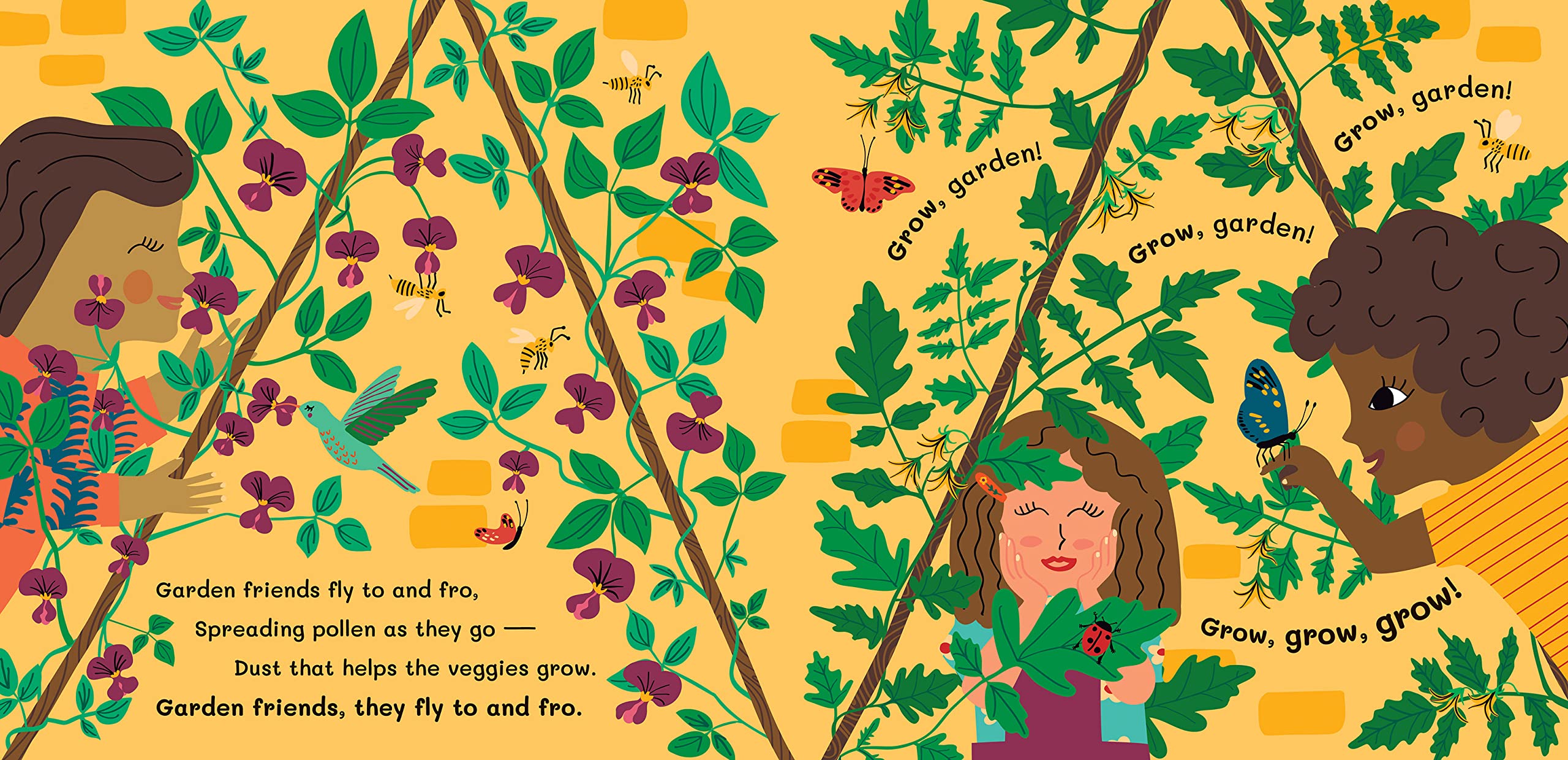
Signs go in to mark where the lettuce, carrots, mint, and sage are planted, and then the waiting begins. Regular watering, sun, and shade spur those seeds to sprout and send tiny shoots reaching for the sun. But that’s not all these tender plants need because in among them hide “pesky weeds” that keep the neighbors working to pick them and pull them before they grow back. The plants are thriving, climbing trestles, crowding pots and garden beds all due to the diligence of the birds, butterflies, and bees who “…fly to and fro, / Spreading pollen as they go— / Dust that helps the veggies grow.” At last it’s time to harvest the “rooftop crop. / Pick and pull and twist—don’t stop! / Fill the baskets to the top.”

celebrate-picture-books-picture-book-review-rooftop-garden-pollinators

Image copyright Pati Aguilera, 2022, text copyright Danna Smith, 2022. Courtesy of Barefoot Books.

And what is the reward for the spring and summer’s attentive work? “A garden feast,” of course! Now, on that same rooftop where the food was grown, all the neighbors sit around a long table and while talking, laughing and, congratulating each other, enjoy a delicious homegrown meal. “A garden feast! Oh, what a treat. Yum, garden! Yum, garden! Yum, garden! Yum, yum, yum!”

Back matter includes a graphic depicting Eight Steps for Growing a Garden, an illustrated guide to Six Stages of Plant Growth, and the musical score to the Rooftop Garden song. The book also includes a QR code that lets readers access a toe-tapping singalong audio with Holly Turton and vibrant video animation of the story.

celebrate-picture-books-picture-book-review-rooftop-garden-feast

Image copyright Pati Aguilera, 2022, text copyright Danna Smith, 2022. Courtesy of Barefoot Books.

Danna Smith plants bountiful seeds of joy for gardening, friends, neighbors, and community in her jaunty story. Through her lively and rhythmically vivacious quatrains, in which the first line repeats as the last line, Smith takes kids through a complete growing season, highlighting the preparatory stage, planting, watering, weeding, encouraging pollinators and discouraging pests, harvesting, and finally enjoying a garden feast. The refrain cheering the garden on to grow, grow, grow will be a favorite for kids to chime in on, and the final celebration after a successful season of farming is sure to spur kids to try some gardening of their own. Yum! Yum! Yum!

Kids will love the vivid colors, easy smiles, and action-packed details in Pati Aguilera’s fresh and fabulous illustrations of this singular apartment building. Along with following the progress of the rooftop garden, children will enjoy lingering over the pages to find kids having fun spritzing each other with misting bottles, see bees and butterflies visiting blossoms, watch little ones getting wheelbarrow rides, and name the fruit and vegetables that have grown in the planting beds and pots. Camaraderie, crops, and caring for the earth all on a rooftop—what could be better?!

The rollicking, “follow-the-ball” singalong with Holly Turton, who lends country charm to her enthusiastic rendition, and delightful animation of the story will entertain kids and adults alike, and both will eagerly put this enchanting song on repeat.

Rooftop Garden is a wonderfully conceived book, singalong, and video collaboration that will entertain all ages and is a top pick for home, classroom, school, and public library collections. The book would also make a favorite choice for extracurricular club and group meetings or outings.

Ages 3 – 7

Barefoot Books, 2022 | ISBN 978-1646864966

Raise your voice and tap your toes with this irresistibly catchy singalong version of Rooftop Garden!

About the Author

Danna Smith is a poet and an award-winning author of numerous books for children. Her nonfiction picture book, The Hawk of the Castle: A Story of Medieval Falconry, received two starred reviews, is a Junior Library Guild Selection, and the recipient of Bank Street College of Education Best Children’s Books of the year. Danna is currently living and writing in northern California. For more information about her books, upcoming releases, and teaching activities, visit her website at dannasmithbooks.com.

About the Illustrator

When Pati Aguilera was a child, she liked to do all kinds of crafts, draw, and spend a lot of time sorting and looking at her pencils. She is Chilean, and has lived a large part of her life in the city of Santiago, where she studied design and became a book illustrator. Today she lives in the countryside with her partner and two daughters, and is building her biggest craft project of her life: her own house! Pati creates her artwork digitally so she can change the composition and palette until she achieves the desired balance and harmony. To view a portfolio of her work, visit her website at patiaguilera.com.

About Holly Turton

Holly Turton is a British vocalist with roots in blues, funk and soul music. When she’s not recording, teaching, singing in schools, or performing live, you can find Holly in her garden potting plants and vegetables for the upcoming season. She currently lives on the beautiful Cornish coast of England. You can visit her at hollyturton.co.uk.

Sing with Your Child Month Activities

celebrate-picture-books-picture-book-review-seed-spheres-activity

Rooftop Garden Seed Spheres Activity


Kids can get ready to grow their own fabulous garden with this fun activity that makes it easy to plant seeds just where you want them. These Seed Spheres make gifts for garden-loving friends and family members, too!

Seed Spheres Activity

celebrate-picture-books-picture-book-review-Rooftop-Garden-booklet-activity

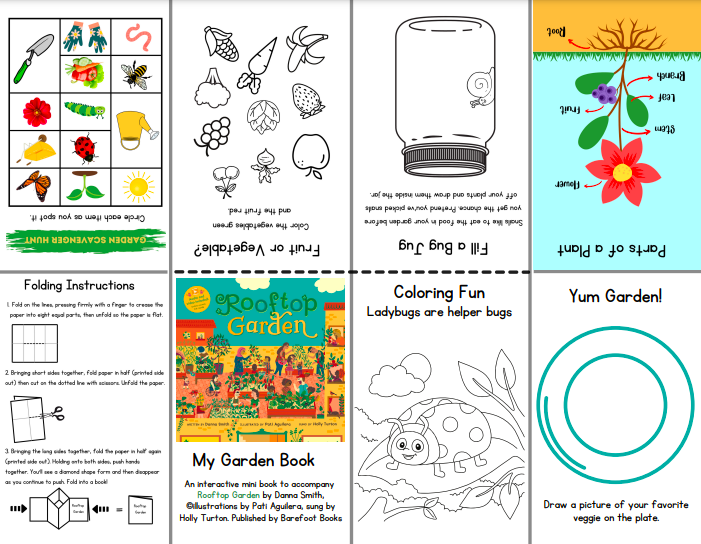
Rooftop Garden Mini Folding Booklet Activity


Here’s a little book of fun activities kids can fold and tuck away in a purse, bag, or pocket to take all the fun of gardening along to the park, the farmers market, or anywhere they’ll have waiting time or down time.

Mini Folding Booklet Activity

celebrate-picture-books-picture-book-review-rooftop-garden-cover

You can find Rooftop Garden at these booksellers

Amazon | Barnes & Noble | Books-a-Million  

To support your local independent bookstore, order from Bookshop

Picture Book Review
 

November 11 – It’s Children’s Book Week

celebrate-picture-books-picture-book-review-building-an-orchestra-of-hope-cover

About the Holiday

Children’s Book Week is the longest-running national literacy program in the United States. The history of the holiday goes back to 1913, when Franklin K. Matthiews, the librarian of the Boy Scouts of America, toured the country to promote a higher standard in children’s books and proposed a Children’s Book Week. He then enlisted the help of Frederic G. Melcher, editor of Publishers Weekly, who believed that “a great nation is a reading nation,” and Anne Carroll Moore, the Superintendent of Children’s Works at the New York Public Library to help spread the word. This year’s theme is “How Do You Book?” The thought-provoking theme encourages readers to think about what they read, where they read, and how they read. To learn more about this literary holiday, visit Every Child a Reader to find out more about the week, how to join online, and lots of bookmarks and activities to download.

Building an Orchestra of Hope: How Favio Chávez Taught Children to Make Music from Trash

Written by Carmen Oliver | Illustrated by Luisa Uribe


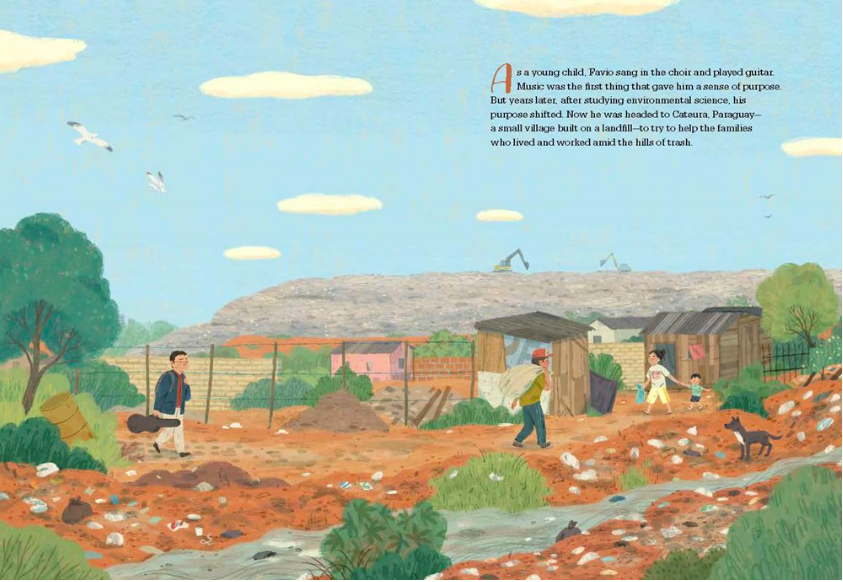
As a child, Favio Chávez looked to music as an important touchstone. When he grew up, he was still involved with music, but his profession was as an environmental engineer. He was given a job in “Cateura, Paraguay—a small village built on a landfill—to try to help the families who lived and worked amid the hills of trash.” When trucks came and dumped load after load of trash, recyclers, called gancheros, filled bags of items they could resell. The air was choked with the stench of garbage, and anywhere the gancheros walked “they waded through filth.” It made Favio sad to think of people living this way.

celebrate-picture-books-picture-book-review-building-an-orchestra-of-hope-arriving

Image copyright Louisa Uribe, 2022, text copyright Carmen Oliver, 2022. Courtesy of Eerdmans Books for Young Readers.

As Favio supervised the gancheros, he “became friends with them and their children. He worried about what kind of lives they would live when they grew up. Besides his job at the landfill, “Favio conducted a youth orchestra in a nearby village.” One day, the people he worked with came to listen. They wondered if their kids could also learn to play instruments. Favio was excited by the prospect. 

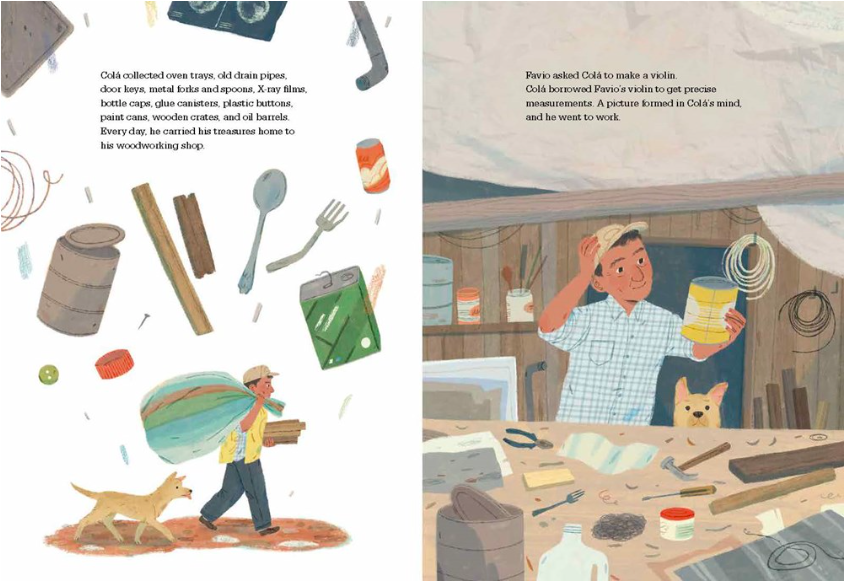
He even brought his own guitars and violins for the children to play, but soon he had more kids in class than he had instruments. But there was another problem too. The instruments were valuable and could attract thieves to the homes of his students. He needed another idea, and while watching Nicolás “Colá” Gómez, a talented carpenter, picking through the trash, he thought of something that might work. 

celebrate-picture-books-picture-book-review-Colá-making-violin

Image copyright Louisa Uribe, 2022, text copyright Carmen Oliver, 2022. Courtesy of Eerdmans Books for Young Readers.

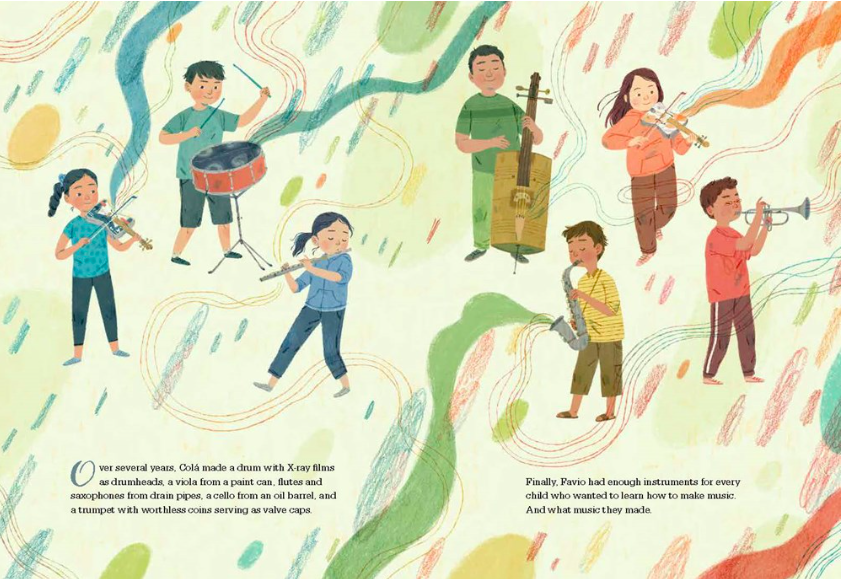
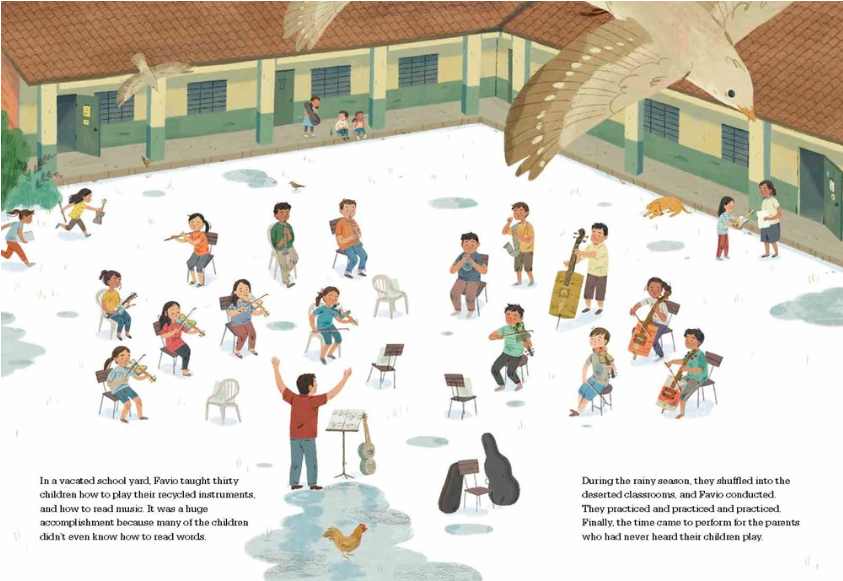
Colá began searching through the piles for anything that he could use to make instruments. He collected cans and pipes, crates and buttons, even X-ray film and eating utensils. As he looked at his materials, Colá envisioned how he could create a violin. Finally with violins and other instruments for each child, Favio began teaching them how to play and how to read music. They practiced and practiced until they were ready to perform for their parents.

celebrate-picture-books-picture-book-review-Colá-making-instruments

Image copyright Louisa Uribe, 2022, text copyright Carmen Oliver, 2022. Courtesy of Eerdmans Books for Young Readers.

At a local church, with the audience packed and excited, the notes of the children’s first song ‘”New York, New York’ floated out the windows and into the warm night air.” The adults were overcome with happiness. While their lives had been only about survival, they now “had hope in their hearts and dreams for a better tomorrow.”

Back matter includes further information about Favio Chávez and the Recycled Orchestra of Cateura from 1975, when Favio was born in Argentina to 2006, when he arrived to work at the Cateura landfill to today, when the Orchestra supports more children and families with building projects, food, computers for school, scholarships, and many more humanitarian efforts. A selected bibliography is also included.

celebrate-picture-books-picture-book-review-building-an-orchestra-of-hope-school-yard-practice

Image copyright Louisa Uribe, 2022, text copyright Carmen Oliver, 2022. Courtesy of Eerdmans Books for Young Readers.

From its earliest days the Recycled Orchestra of Cateura has inspired musicians, authors, movie makers, and listeners from around the world. In Building an Orchestra of Hope, Carmen Oliver tells the story through the lens of a hope fulfilled. As Favio Chávez begins his new job at the landfill educating the gancheros on how to work more efficiently, his initial thought is for the future of the children of the village. Oliver shows how Chávez not only supervised the workers but became their friend, honored to be included. While relating Chávez’s eagerness to share his love of music with the children, Oliver hints at what’s to come with lyrical descriptions of the sounds the glass, metal, and plastic makes as the gancheros rake through the piles of trash. She also includes pertinent facts that allow readers to understand the challenges the community faced and what a monumental undertaking the idea was.

While this story revolves around Favio Chávez, his idea could never have been brought to fruition without the talents of Nicolás “Colá” Gómez, who could envision the instruments and even hear their sound as he pored through the trash for materials. Oliver provides a satisfyingly detailed list of the types of items Colá repurposed and later reveals which items were used to create violins, drums, violas, flutes, saxophones, and trumpets, pages that are sure to pique young crafters’ interest. The emotional ending to this true story will swell the hearts of readers—those who already know about the orchestra and those being introduced to it for the first time.

Louisa Uribe’s soft-hued illustrations realistically depict the village of Cateura and the landfill it is built upon. They meet Favio Chávez and Nicolás Gómez and witness the idea of creating instruments from trash come to life. Uribe’s close up of a violin lets kids see how disparate items are used creatively to replicate each part of the instrument. As instruments are made, the number of children filling the courtyard grows until their hard work and practice is rewarded on a real stage, a microcosm of the growth and impact of one man’s caring and creativity.

Special Note: The inspirational back matter, worthy of its own picture book, will astound readers with just how far-reaching one idea when explored in collaboration with others can be. Themes of the vital importance and life-changing impact of the arts, persistence, determination, overcoming seemingly insurmountable challenges and odds, and the power of hope are what this true story is built on, and this factual back matter is sure to affect readers and get them thinking about how they can make a difference to a cause they believe in.

Powerful, accessible, and impactful, Building an Orchestra of Hope is a must for all home, school, and library collections, not only to tell this compelling, ongoing story but to remind them that their actions, too—from a single kind word or smile to large community effort—can change lives. 

Ages 4 – 9 

Eerdmans Books for Young Readers, 2022 | ISBN 978-0802854674

You can learn more about Luisa Uribe, her books, and her art on her website.

You can connect with Carmen Oliver on Twitter.

Children’s Book Week Activity

celebrate-picture-books-picture-book-review-bookworm-bookmark

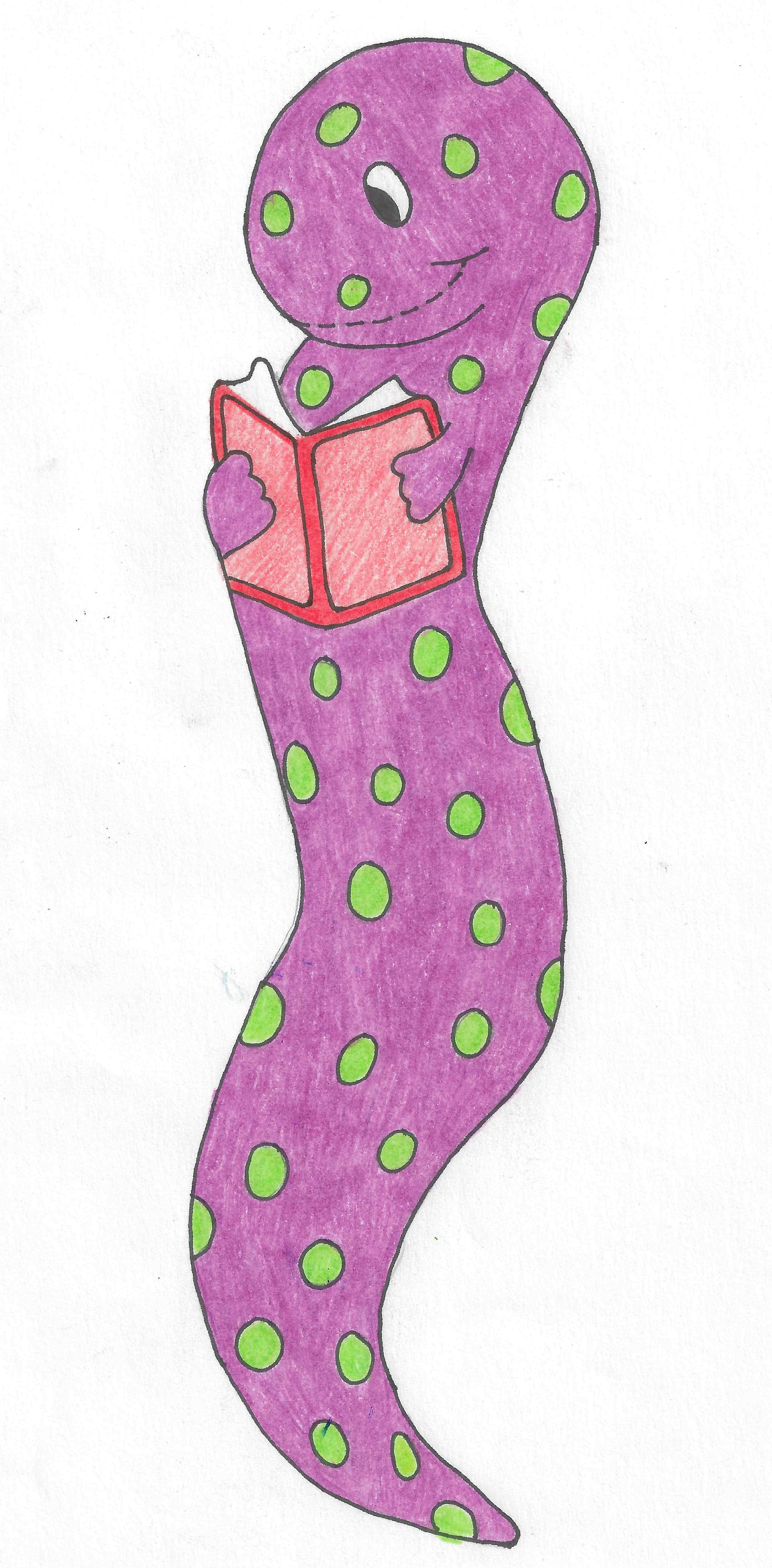
Bookworm Bookmark


Are you a bookworm? If so, then this bookmark is for you! Just print, color, and cut along the dotted line. This little worm will happily save your page for you!

Bookworm Bookmark Template

celebrate-picture-books-picture-book-review-building-an-orchestra-of-hope-cover

You can find Building an Orchestra of Hope at these booksellers

Amazon | Barnes & Noble | Books-a-Million

To support your local independent bookstore, order from

Bookshop | IndieBound

Picture Book Review

October 11 – Celebrating the Book Birthday of Madani’s Best Game

celebrate-picture-books-picture-book-review-madani's-best-game-cover

Thanks to Eerdmans Books for Young Readers for sharing a copy of Madani’s Best Game with me for review consideration. All opinions on the book are my own.

Madani’s Best Game

Written by Fran Pintadera | Illustrated by Raquel Catalina | Translated from the Spanish by Lawrence Schimel


“Our whole neighborhood knows it: no one plays soccer like Madani does.” Thus, a teammate of Madani’s begins the story about this friend who captivates the neighborhood (and sometimes it seems the whole world) with his barefoot ball-handling prowess. Madani has elevated the team’s game to “the best soccer we’ve ever seen.” After Madani has scored a “Gooooal!” the sound of the cheers soars above the playing field and “…crosses through doorways, rushes past the magazine stand, slips down alleyways, swirls around the fountain, and, growing fainter and fainter, climbs the steps up to Madani’s house.” 

celebrate-picture-books-picture-book-review-madani's-best-game-bare-feet

Image copyright Raquel Catalina, 2022, text copyright Fran Pintadera, 2022. Courtesy of Eerdmans Books for Young Readers.

There, his mother hears it and knows the cheers are for Madani. She wishes she could attend his games, but she’s a seamstress and has so many garments to sew by hand. After the game, Madani’s teammates can only imagine how much better he would play if he only had a good pair of cleats. Their team might even be able to beat the Southside team—their biggest rival.

celebrate-picture-books-picture-book-review-madani's-best-game-madani's-moves

Image copyright Raquel Catalina, 2022, text copyright Fran Pintadera, 2022. Courtesy of Eerdmans Books for Young Readers.

The members of the team know that Madani’s saving up money in a special tin that gets heavier every time he declines to buy a snack, walks to away games instead of riding the bus, and makes other sacrifices. They know that when the box is full, Madani’s going shopping. “…then our games will be better than ever!’” he says, and they all dream of the day Madani buys his new cleats.

celebrate-picture-books-picture-book-review-madani's-best-game-listening

Image copyright Raquel Catalina, 2022, text copyright Fran Pintadera, 2022. Courtesy of Eerdmans Books for Young Readers.

The big game against Southside is only a day away, but Madani doesn’t come to practice. Instead, his friends watch him head downtown with the tin under his arm. Without Madani at practice, the team falls apart, but they don’t worry. Finally, they thought, their dreams of new cleats and beating Southside would come true!

When Madani shows up at the game the next day, “he looks radiant,” but he’s still barefoot. His teammates question him about his new cleats, but Madani doesn’t know what they’re talking about. The money wasn’t for shoes but for a present for his mother so that “‘she’ll be able to finish her work faster and come watch me play every Saturday.’”

celebrate-picture-books-picture-book-review-madani's-best-game-mother

Image copyright Raquel Catalina, 2022, text copyright Fran Pintadera, 2022. Courtesy of Eerdmans Books for Young Readers.

Madani’s friends still don’t quite get it, but the game begins, and in moments Madani has already stolen the ball away from the Southside players, run downfield and scored. He looks into the stands, sees his mother, and shouts “‘This goal is for you, Mom!’” Madani makes another goal, but Southside scores too, and the game ends in a tie. It’s okay, though, Madani’s teammate says, “‘because now more than ever, everyone in the neighborhood knows … There’s no player like Madani!’”

Back matter consists of notes from Fran Pintadera and Raquel Catalina that reveal their creative journeys and connections to this story.

celebrate-picture-books-picture-book-review-madani's-best-game-mother-at-game

Image copyright Raquel Catalina, 2022, text copyright Fran Pintadera, 2022. Courtesy of Eerdmans Books for Young Readers.

Fran Pintadera, who based Madani’s Best Game on his experiences as a social educator in new immigrant housing, tells his story with open-hearted affection for his subject as well as the relationships between teammates and mother and child. Through his perceptive and humorously observed details and lyrical language, Pintadera captures the wide-eyed wonder of children in awe of a great player (or artist, singer, scientist, or other talent). When Madani gets the ball, readers will hold their breath along with the neighbors, traffic, and even pigeons while he entertains the crowd and scores a goal. Then the action begins again, but this time the suspense revolves not around the game but on what Madani will buy. The answer is joyous, affirming family devotion and revealing the pure giving nature of a child’s heart.

From their first introduction to Madani, smiling out from the page, his bare foot on a soccer ball, readers will be captivated by him, his teammates, his neighborhood, and the game. Raquel Catalina’s endearing pencil, gouache, and colored pencil illustrations charm with realistic images of kids on the soccer field surrounded by city onlookers. Catalina creates not only gorgeous visuals of Madani’s supportive neighborhood, but an almost auditory experience as well.

Readers can almost hear the players’ running feet, the sudden cheers, the flap of the rising pigeons’ wings, and – as the celebration reaches Madani’s mother’s ears – even the whisper of her sewing needle through the fabric on her knees. Catalina deftly weaves the theme of friendship, between people both young and old, throughout the pages, enhancing the bond between Madoni and his mom as well as Madani’s teammates’ understanding of the true importance of that long-awaited game.

A beautiful poignant, joyful, and affirming story of family and friendship, Madani’s Best Game is a read aloud that adults and kids will love to share over and over. The book is a must for all home, classroom, school, and public libraries.

Ages 5 – 9

Eerdmans Books for Young Readers, 2022 | ISBN 978-0802855978

You can discover more about Fran Pintadera and his work on his website and connect with him on Instagram.

To learn more about Raquel Catalina, her books, and her art, visit her website. You can also connect with her on Instagram.

You can connect with Lawrence Schimel and learn more about his writing and his translating work on Instagram and Twitter.

celebrate-picture-books-picture-book-review-madani's-best-game-cover

You can find Madani’s Best Game at these booksellers

Amazon | Barnes & Noble | Books-a-Million

To support your local independent bookstore, order from

Bookshop | IndieBound

Picture Book Review
Picture Book Revi

January 10 – It’s National Hot Tea Month

celebrate-picture-books-picture-book-review-teatime-around-the-world-cover

About the Holiday

I must confess that this is one of my favorite holidays. To me there’s nothing better than waking up with a well-steeped cup of tea, writing while a favorite mug brimming with hot tea sweetened with honey sits nearby, enjoying scones with clotted cream and jam and a hot cuppa…well…you get the picture. People have drunk tea since earliest times for its soothing and medicinal properties. Mellower than coffee and available in endless varieties and tastes, hot tea is just the thing for relaxing moments. Today, enjoy your favorite tea or try a new kind! There’s a world of tea to be discovered – as today’s book reveals!

Thank you to Greystone Books for sharing a copy of Teatime Around the World with me for review consideration. All opinions on the book are my own.

Teatime Around the World

Written by Denyse Waissbluth | Illustrated by Chelsea O’Byrne

Two women sit at a table with steaming cups of tea in front of them, talking. “Tea for one. Tea for two.” To the side sits a teapot, its contents still warm. At their feet a child is having a tea party with a bear, jauntily clad in a feathered hat. Cookies, strawberries, and croissants fill out this feast served from a special tea set. “Tea for me. Tea for you.” Tea time continues in Morocco, where a father and child kneel on pillows. The father pours out three cups of mint tea. Made with green tea, mint, and sugar, each cup of tea will have “a slightly different taste.”

celebrate-picture-books-picture-book-review-teatime-around-the-world-sugar

Image copyright Chelsea O’Byrne, 2020, text copyright Denyse Waissbluth, 2020. Courtesy of Greystone Books.

In India a street vendor sells a cup of masala chai to a woman, who’s looking for a peaceful break during her day. The “strong tea and spices like cinnamon, ginger, cloves, cardamom, and pepper…boiled with milk and sweetened” will hit the spot. Hot tea is relaxing, but on a hot day there’s nothing more refreshing than a glass of iced tea. In Thailand, locals and tourists enjoy cha yen, sold from street vendors’ carts. This “strongly brewed sweet tea is poured over ice and drunk from a bag through a straw. Indigenous people in North America soothe fevers, colds, sore muscles, and even sleepless nights with tea made from “berries, plants, and roots.”

celebrate-picture-books-picture-book-review-teatime-around-the-world-russia

Image copyright Chelsea O’Byrne, 2020, text copyright Denyse Waissbluth, 2020. Courtesy of Greystone Books.

Special tea times—like chanoyu, the Japanese tea ceremony during which matcha, a powdered green tea is served, and afternoon tea, enjoyed with trays of treats world wide—bring people together for comforting respites. You’ll be interested to discover the origins of afternoon tea too! Tea can be served quietly or dramatically, like “teh tarik, or pulled tea…the national drink of Malaysia,” is “poured from up high, or ‘pulled’ between two mugs, to make it frothy.”

celebrate-picture-books-picture-book-review-teatime-around-the-world-poured

Image copyright Chelsea O’Byrne, 2020, text copyright Denyse Waissbluth, 2020. Courtesy of Greystone Books.

Tea is as old as its discovery thousands of years ago in China and as new as bubble tea, created in Taiwan in the 1980s. In Argentina, Chile, and Uruguay, yerba maté tea is served in hollowed-out gourds with a “special straw called a bombilla,” while in Jamaica sorrel, made from roselle hibiscus buds, “spiced with ginger, cloves, and sugar,” is perfect for any festive occasion. No matter where you live, what flavors of tea you enjoy, or how you serve it, you can always count on “tea for one. / Tea for two. / Loved by all / the whole world through.”

celebrate-picture-books-picture-book-review-teatime-around-the-world-for-group

Image copyright Chelsea O’Byrne, 2020, text copyright Denyse Waissbluth, 2020. Courtesy of Greystone Books.

With a lilting poem that flows from page to page, Denyse Waissbluth introduces unique flavors, special brew methods, and the comforting feeling a cup of hot or iced tea infuses into a day. The shared experience of tea drinking provides a fascinating touchstone for Waissbluth’s travelogue that takes kids around the world to experience the rituals, recipes, and traditions from each country that make their tea unique. Waissbluth’s conversational style will appeal to kids looking to learn how global cultures are similar to and different from their own.

Chelsea O’Byrne’s lovely matte illustrations take children to cities, the countryside, and the seaside around the globe, revealing not only diverse scenes of how tea is made, served, and enjoyed, but homes, food, and clothing as well. Children will be excited to see such homey and intimate portraits of their peers around the world.

Sure to spur readers to learn more about the countries featured and entice them to try their signature teas, Teatime Around the World would enhance geography, history, and multicultural lessons for school and homeschooling and is highly recommended for school and public library collections.

Ages 3 – 7

Greystone Books, 2020 | ISBN 978-1771646017

You can connect with Denyse Waissbluth on Instagram.

To learn more about Chelsea O’Byrne, her books, and her art, visit her website.

National Hot Tea Month Activity

celebrate-picture-books-picture-book-review-tea-word-search-puzzle

Tea for You! Word Search

Can you find the names of eighteen delicious teas from around the world in this printable puzzle?

Tea for You! Word Search Puzzle | Tea for You! Word Search Solution

celebrate-picture-books-picture-book-review-teatime-around-the-world-cover

You can find Teatime Around the World at these booksellers

Amazon | Barnes & Noble | Bookshop 

Picture Book Review
January 3 – It’s International Quality of Life Month

celebrate-picture-books-picture-book-review-nobody-owns-the-moon-cover

About the Holiday

How one achieves their definition of a good quality of life may differ for every person, but in general it encompasses being happy and satisfied with one’s relationships, work, living conditions, and self. Whether you find happiness and quality of life in outdoor or indoor pursuits, with others or alone, at work or at home, this month’s holiday gives you time to get in touch with your inner quiet place and reflect on changes or improvements to bring you more peace and happiness in life.

I’d like to thank Berbay Publishing for sharing a copy of Nobody Owns the Moon with me for review consideration. All opinions on the book are my own.

Special Note: As I have been asked to take on extra shifts as a staff member at my local public library due to personnel shortages, I will be taking a break from posting daily reviews over the next coming months. In between new reviews, I invite you to explore all of the holidays, author and illustrator interviews, activities, and, of course, the wonderful books featured on Celebrate Picture Books.

Nobody Owns the Moon

By Tohby Riddle


Upon the opening pages readers are treated to an engaging treatise on the success (or not so) of certain animals trying to “make a life for itself in cities.” The fox, we learn, is especially adept because it is “quick-witted and able to eat a variety of foods.” We are then introduced to one such city-dweller, Clive Prendergast – a self-named fox because his real name “can only be pronounced by foxes.”

celebrate-picture-books-picture-book-review-nobody-owns-the-moon-fox

Copyright Tohby Riddle, 2021, courtesy of Berbay Publishing.

Clive lives in a small apartment and works on a factory production line. At night he takes to the streets, visiting food stalls and watching the interesting goings-on. Clive has a few friends, but the one he sees the most is Humphrey, a donkey who is “one of those creatures that live in cities with less success than foxes” and “doesn’t always have a fixed address.” While Humphrey has had jobs, he has trouble keeping them. Right now he’s working as a piano removalist.

One day Clive saw Humphrey sitting on the stone steps of “a statue of a great conqueror.” Clive thought he looked tired and underfed. Then he noticed a blue envelop sticking out of Humphrey’s tote bag. It turned out that Humphrey had found it in the street and planned on eating it, but thinking Clive was also hungry he offered it to him without a second thought. When Clive opened the envelope, he found two tickets to that night’s performance at the theatre. They should go, he said.

celebrate-picture-books-picture-book-review-nobody-owns-the-moon-humphrey

Copyright Tohby Riddle, 2021, courtesy of Berbay Publishing.

“That night Humphrey and Clive attended the premier of Nobody Owns the Moon – the latest play by the city’s most celebrated playwright. Before the show, ticket-holders were treated to hors d’ oeuvres and punch. Then they were shown to their front-row balcony seats. The play was wonderful, full of humor and poignancy. Tears filled Humphrey’s eyes at the show’s “bittersweet ending” and again as they enjoyed a beverage and “large slice of cake in the theatre’s elegant restaurant.”

Filled with the wonder of the evening, Clive and Humphrey headed out into the “glimmering melee of lights and sounds that was their city at night. “‘This is our town!'” they exclaimed to each other, and before they went “their separate ways, Humphrey gave Clive a big hug goodnight.”

celebrate-picture-books-picture-book-review-nobody-owns-the-moon-city

Copyright Tohby Riddle, 2021, courtesy of Berbay Publishing.

Immersive and openhearted, Tohby Riddle’s poignant friendship tale is as surprising and inclusive as the invitation Humphrey finds. Opening with lines that could come straight from a nature documentary, the story quickly becomes interwoven with an air of mystery and anticipation as Clive Prendergast and Humphrey are introduced. Riddle’s inclusion of smart details, such as Clive’s fox name being unpronounceable to humans and Humphrey’s job that takes advantage of a donkey’s strong back, adds a verisimilitude that will delight readers. The emotional core of the story comes with Clive’s and Humphrey’s friendship, which is equitable and caring and full of generosity. The discovery and use of the theater invitation ushers in sumptuous scenes of a glittering theater, delicious food, and a life-affirming performance while also touching on the importance of satisfying the body and the soul, however one defines this.

Equally captivating are Riddle’s collage-style illustrations, which incorporate sly humor and thought-provoking perspectives. The book opens with an illustration of Clive Prendergast lounging in a comfortable armchair between Vincent van Gogh’s painting “A Wheatfield, with Cypresses” and a window which frames a view of the city that cleverly mirrors the famous artwork. Clive’s position suggests his comfort in both environments. Humphrey’s difficulties fitting in, on the other hand, are depicted in an Italian restaurant where, distracted for a moment, the plates of spaghetti and meatballs he’s carrying tip precariously over a customer sitting under a photograph of the Leaning Tower of Pisa. Other images that contribute to the depth and atmosphere of this book are theater posters advertising Vaudeville and magic acts, Russian nesting dolls and fresh foods for sale in Clive’s multicultural neighborhood, and the copy of Walt Whitman’s Leaves of Grass next to a view-master in Humphrey’s tote bag.

The city’s human inhabitants are all depicted in flat grays and browns while the animals – pigeons, a crocodile, a dancing bear – are portrayed in textured full color. This dichotomy begins to fade at the theater, where a waiter in formal dress offers Humphrey hors d’ oeuvres, in the balcony row where Clive and Humphrey sit, and in the restaurant after the show, a change that offers opportunities for readers to talk about acceptance and how we look at others. The moving ending is eloquent in it’s simple embrace of individuality and acceptance.

A touching, multi-level story that will enchant and impact readers, Nobody Owns the Moon will become a favorite and is a must for home, classroom, school, and public library collections.

Ages 4 – 8

Berbay Publishing, 2021 | ISBN 978-0994384195

Discover more about Tohby Riddle, his books, and his art on his website.

International Quality of Life Activity

celebrate-picture-books-picture-book-review-smile-cards-craft

Share a Smile Cards


Life is better when you share smiles with those you know—and those you don’t! Try it! When you’re out today at school or other places, give someone a smile. You can be sure that you will have made their day and your day better! These cards are another way you can share a smile. Why not slip one into your dad’s pocket or your mom’s purse, put one in your friend’s backpack, or sneak one onto your teacher’s desk? You can even leave one somewhere for a stranger to find! Have fun sharing your smiles, and see how much better you and the others around you feel!

Click here to print your Share a Smile Cards.

celebrate-picture-books-picture-book-review-nobody-owns-the-moon-cover

You can find Nobody Owns the Moon at these booksellers

Amazon | Barnes & Noble | Books-a-Million

To support your local independent bookstore, order from

Bookshop | IndieBound

Picture Book Review
November 28 – Celebrate Hanukkah

celebrate-picture-books-picture-book-review-the-ninth-night-of-hanukkah-cover

About the Holiday

Hanukkah, the Festival of Lights, is the Jewish wintertime celebration that commemorates the victory of the small Maccabean army over the much more powerful Greek/Syrian forces and the rededication of the Holy Temple during the second century BCE. Hanukkah is celebrated for eight days in remembrance of the miracle of the oil lamp, which at the time only held enough oil for one day yet burned for eight days. This year Hanukkah takes place from December 10 through 18.

Thanks to Sterling Children’s Books for sharing a copy of The Ninth Night of Hanukkah with me for review consideration. All opinions on the book are my own.
The Ninth Night of Hanukkah

Written by Erica S. Perl | Illustrated by Shahar Kober


A family has just moved into their new apartment. It’s the first night of Hanukkah, but they can’t find their Hanukkah things amidst all the boxes. So, without the menorah or delicious latkes, Mom, Dad, Rachel, and Max sit on the floor eating pizza. “It was nice…but it didn’t feel quite like Hanukkah.” On the second night, they still hadn’t found the menorah, but Rachel and Max made one from a piece of wood, their jar of nuts and bolts, and some craft paint. It was all ready to light, when Mom discovered that they didn’t have the candles either.
celebrate-picture-books-picture-book-review-the-ninth-night-of-hanukkah-missing-menorah

Image copyright Shahar Kober, 2020, text copyright Erica S. Perl, 2020. Courtesy of Sterling Children’s Books.

With the stores closed, Rachel and Max went next door to apartment 2C. They introduced themselves to Mrs. Mendez and explained their situation. She offered the only candles she had—a box of birthday candles. “Dad lit the shamash. Max and Rachel each used it to light a candle.” Then they opened presents. While it was nice, it still “didn’t feel quite like Hanukkah.
On the third night, the “lucky latke pan” was nowhere to be found, but Max appeared with a steaming plate of French fries from Joe, the super, who lived downstairs.

By the fourth night of Hanukkah, Mom and Dad were beginning to think the box with their Hanukkah things had gotten lost. Max wanted to play dreidel, so while Mom called the moving company, Max and Rachel met the Watson twins, who didn’t have a dreidel, but they did have a toy that spun and spun. On the fifth night, Rachel and Max had made their own dreidel, “which meant they needed gelt.” On the fourth floor, Max and Rachel met Mr. Patel, who handed Max the only chocolate he had—a bag of chocolate chips. All of these substitutions were “nice…but it didn’t feel quite like Hanukkah.”

celebrate-picture-books-picture-book-review-the-ninth-night-of-hanukkah-shamash

Image copyright Shahar Kober, 2020, text copyright Erica S. Perl, 2020. Courtesy of Sterling Children’s Books.

Each night of Hanukkah Max and Rachel missed a different part of their Hanukkah celebration, and each night a new neighbor did the best they could to supply it. On the morning after the eighth night of Hanukkah, a delivery person showed up at the door with Mom’s guitar. She suggested a sing-along, but Rachel reminded her that Hanukkah was over. Max, however, had another idea and pointed to the ninth candle on the menorah. This gave Rachel an idea too, and she and Max whispered and planned. Then they waited. Soon “there was a knock on the door. And another. And another.”
When all the neighbors had gathered, Max and Rachel explained their Shamash Night celebration. Like the Shamash candle “helps light all the other candles,” they said, their new neighbors had helped them celebrate Hanukkah. “‘So we wanted to say thanks—to the Shamash and to you,’” Rachel said. Just then the delivery person appeared with the long-lost box. On the ninth night in their new home, Mom and Dad, Rachel and Max ate, played, sang, and danced with all of their new friends, “and best of all, it felt exactly like Hanukkah.”

An Author’s Note following the story tells about the history and tradition of the shamash candle and the idea that sparked the writing of The Ninth Night of Hanukkah. Erica S. Perl also provides a guide on how families can hold their own “Shamash Night.”

celebrate-picture-books-picture-book-review-the-ninth-night-of-hanukkah-party

Image copyright Shahar Kober, 2020, text copyright Erica S. Perl, 2020. Courtesy of Sterling Children’s Books.

Community, resilience, and children’s creativity infuse every page of Erica S. Perl’s story that’s a wonderful Hanukkah read as well as a story families will want to share all year around. The apartment-house setting and the family’s just-moved-in situation combine to create a charming microcosm of making friends, getting to know new neighbors, and discovering the generosity of strangers. Rachel and Max, creative, close-knit, and accommodating, will captivate kids as they go along on their scavenger hunts for the makings of a homey Hanukkah celebration.

Perl’s substitutions—from birthday candles to French fries to a ukulele will appeal to readers. The repeated phrase “It was nice, but it didn’t feel quite like Hanukkah” applies to many make-do conditions and will resonate with children. It also provides suspense and a nice counterpoint for when the night does finally fulfill the Hanukkah feeling. Max and Rachel’s “Shamash Night” offers a message of gratitude not only for things but for friendship.

Shahar Kober’s warm-toned illustrations mirror the heartfelt story and the kindness of the diverse group of neighbors as they provide workable solutions to Max and Rachel’s requests. Images of Rachel and Max creating a homemade menorah, dreidel, and wrapping paper may inspire kids to design their own Hanukkah or other holiday decorations and traditional items. Kober’s cartoon-style characters are expressive, demonstrating their disappointment in missing their well-loved Hanukkah things but more so their cheerful acceptance of what the neighbors can provide. Kids will enjoy watching the antics of the family’s cat, who likes to be in the middle of the action, but also is happy to make do with a moving box as a new napping spot.

A heartwarming and joyful Hanukkah story with messages of kindness, generosity, acceptance and a loving sibling relationship, The Ninth Night of Hanukkah is highly recommended for all home, school, and public library collections.

Ages 3 – 8 and up

Sterling Children’s Books, 2020 | ISBN 978-1454940883

Discover more about Erica S. Perl and her books on her website.

To learn more about Shahar Kober, his books, and his art, visit his website.

Celebrate Hanukkah Activity

celebrate-picture-books-picture-book-review-hanukkah-craft

Star of David Decoration


Kids can add a bit of sparkle to their Hanukkah celebrations with this Star of David craft.

Supplies

  • 6 mini craft sticks
  • 2 round lids from clear plastic deli containers
  • Silver glitter
  • Blue craft paint
  • Clear-drying glue
  • Thin ribbon or string, 8 – 10 inches long

Directions

To Make the Star of David

  1. Paint the craft sticks with the blue paint, let dry
  2. Glue three of the craft sticks together to form a triangle; repeat with the other three sticks
  3. Glue the two triangles together to create a Star of David
  4. Glue a short length of ribbon to the top back of the Star of David

To Make the Case

  1. Apply a thin layer of clear-drying glue to the top, indented side of one of the lids
  2. Sprinkle the lid with the glitter, let dry
  3. When the glue is dry, center the Star of David in the lid with the ribbon trailing over the rim of the lid. The Star of David will be free hanging inside the case from the ribbon.
  4. Glue the rim of the indented side of the second lid to the rim of the first lid
  5. When dry, tie the ribbon into a loop for hanging

celebrate-picture-books-picture-book-review-the-ninth-night-of-hanukkah-cover

You can find The Ninth Night of Hanukkah at these booksellers

Amazon | Barnes & Noble | Books-a-Million

To support your local independent bookstore, order from

Bookshop | IndieBound

Picture Book Review