May 12 – It’s Gifts from the Garden Month

celebrate-picture-books-picture-book-review-badger's-perfect-garden-cover

About the Holiday

If you’re into gardening then you know what a joy it is to harvest your vegetables and fruit or cut a beautiful bouquet of flowers. But gardens provide so many more gifts than these. Digging the dirt, planting the seeds, and even keeping the weeds at bay can be a mindful, relaxing experience as well as good exercise. Watching plants sprout and grow gives an appreciation for the wonder of nature. And a garden beautifies the view whether it’s a large plot or a window box. So, celebrate this month by enjoying all the gifts of your garden.

I received a copy of Badger’s Perfect Garden from Sleeping Bear Press for review consideration. All opinions are my own. 

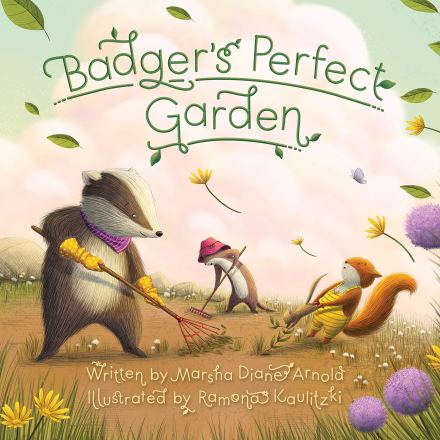
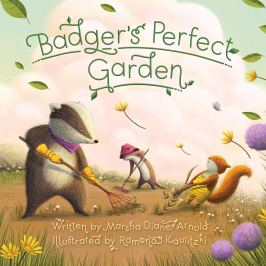
Badger’s Perfect Garden

Written by Marsha Diane Arnold | Illustrated by Ramona Kaulitzki


On a spring morning, Red Squirrel watched as Badger brought out all of his jars of the seeds he had collected and kept safe all winter. He was planning on planting a perfect garden. Red Squirrel noticed that all the seeds looked different. Badger explained that they were “‘all kinds. Green and brown. Flat and round, Bumpy and smooth. Whirly-curly and straight as my whiskers.’”
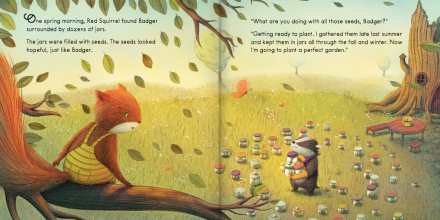
celebrate-picture-books-picture-book-review-badgers-perfect-garden-seeds

Image copyright Ramona Kaulitzki, 2019, text copyright Marsha Diane Arnold, 2019. Courtesy of Sleeping Bear Press.

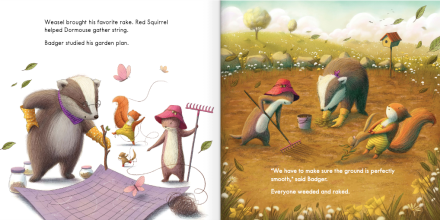
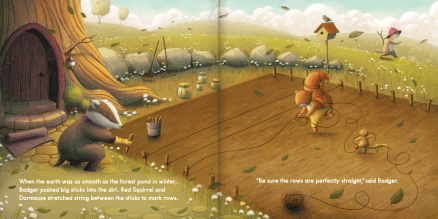
Red Squirrel wanted to help plant them. As Badger carefully studied his garden plan, Weasel showed up with his rake and Dormouse gathered string. Everyone helped Badger weed and rake his garden plot until it was smooth. Then they set up stakes on each side and ran string between them to make perfect rows. After that Weasel poked holes in the dirt for the seeds. Badger directed where each seed should go so that each type stayed together. That evening the friends had a party with muffins and mulberry juice, and Badger “imagined the plants that would grow in perfect rows in his perfect garden.”

The next morning, just in time, it began to rain. But the next day the rain turned heavy, and the day after that it became a deluge. Badger ran out into the storm to try to save his garden, but the strings collapsed and the soil washed away. Badger sniffled as he thought of his ruined garden. His friends tried to cheer him up by telling him they’d help gather new seeds in the summer, but Badger despaired of not having his perfect garden this year.
celebrate-picture-books-picture-book-review-badgers-perfect-garden-plan

Image copyright Ramona Kaulitzki, 2019, text copyright Marsha Diane Arnold, 2019. Courtesy of Sleeping Bear Press.

To ward off the sadness, Badger kept busy reading, cleaning, exercising, and sleeping. One summer day, he heard a knock on his door. It was Red Squirrel, Weasel, and Dormouse. They grabbed Badger’s hand and pulled him outside to a glorious field of wildflowers. Badger gazed at it in wonder. “‘Those can’t be my seeds,’ said Badger, rubbing his eyes. They’re all mixed up.’” But they were! The wild garden  was a “jumble-tumble of shapes and sizes. They made him feel jumbly and tumbly, too.” Badger thought it was “the most perfect garden of all,” and the friends raced into it for a perfect summer celebration.
celebrate-picture-books-picture-book-review-badgers-perfect-garden-planting

Image copyright Ramona Kaulitzki, 2019, text copyright Marsha Diane Arnold, 2019. Courtesy of Sleeping Bear Press.

Marsha Diane Arnold fills Badger’s Perfect Garden with sprightly, lyrical language that makes the story a delight to read. Little gardeners will relish the descriptions of Badger’s seeds and enjoy the precision of planting day. As the rains come, kids will empathize with Badger’s disappointment, knowing how it feels when plans don’t work out quite right. But the riotous results will spark their own happy, “jumbly-tumbly” excitement for Badger, his friends, and even their own endeavors. in the beauty of the wild, carefree, mixed-up garden can see the joy that can be found in new experiences outside one’s comfort zone.

Ramona Kaulitzki’s charming illustrations are a perfect mix of the whimsical and the realistic and will captivate readers. With soft colors and flowing textures, Kaulitzki depicts early spring with its light green grasses and mellow, cloud-filled skies. When stormy days come, the sky turns purple and rain whips through Badger’s garden, leaving things topsy-turvy and Badger’s plans uprooted. Late summer brings a series of show-stopping two-page spreads, where flowers of all kinds and colors mix with vegetable plants to attract bees and butterflies and, of course, provide the perfect spot for a summer party.

Beautiful through and through, Badger’s Perfect Garden plants the seeds of gentle encouragement, heartening friendship, and cheerful celebration. The book would be a favorite addition to home, classroom, and public library collections.

Ages 5 – 8

Sleeping Bear Press, 2019 | ISBN 978-1534110007

Discover more about Marsha Diane Arnold and her books on her website.

To learn more about Ramona Kaulitzki, her books, and her art, visit her website.

Q & A with Marsha Diane Arnold
celebrate-picture-books-picture-book-review-marsha-diane-arnold-childhood-photo

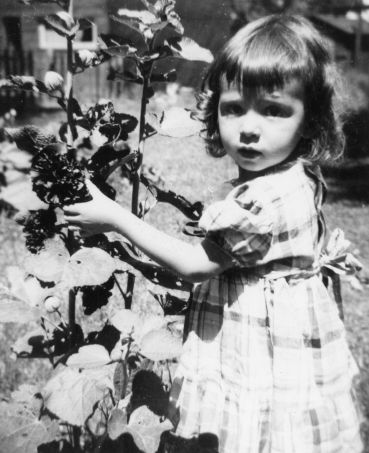
Called a “born storyteller” by the media, Marsha Diane Arnold’s award-winning picture books have sold over one million copies and been called, “whimsical,” “inspiring,” and “uplifting.” Marsha was raised on a Kansas farm, lived most of her life in Sonoma County, California, a place Luther Burbank called “the chosen spot of all this earth as far as Nature is concerned,” and now lives with her husband, near her family, in Alva, Florida. Nothing makes her happier than standing in her backyard in the midst of dragonflies, listening to cardinals sing.

I’m so glad to be chatting with you, Marsha, about her newest book, Badger’s Perfect Garden! This story seems to have a close personal connection for you. Can you talk a little bit about what inspired you to write this book?

Having a father who was a farmer and gardener and a mother who was a perfectionist, must have had something to do with it! I grew up surrounded by nature, animals, and gardens. Growing up with so many animals around me, I talked with them all the time and I felt they talked back, so anthropomorphism comes easily to me. Illustrations of animal characters are so often enchanting, drawing young children into a book. They can create a strong emotional connection for children to learn from and remember.

Can you tell me more about what it was like growing up on a farm? What kind of farming did your family do?

My father was most proud of being a dairy farmer, but he, his father before him, and his five brothers also grew wheat and corn. I often stayed with my grandmother during the day; I loved being on the farm. Grandmother had to feed 8 children, Grandpa Henry, and herself, so she had a huge vegetable garden and did home canning. But her heart was with her flower gardens. There was spirea, yards and yards of bearded iris, a line of lilacs from the house to the outhouse, petunias, Bachelor buttons, hollyhocks, and more. Badger and Grandmother would have been fast friends.

As a child, what was your favorite part of farming or the farm? What do you appreciate more now as an adult?

I most loved being around the farm animals, although I was a bit frightened of those protective hens when I had to collect the eggs, and I enjoyed helping my father with the calves. One of our neighbors had a pet raccoon that I have fond memories of “hanging out” with, often in my friend’s tree house. (Remember, it was a long time ago and there were no wild animal rehabilitation centers near us.)
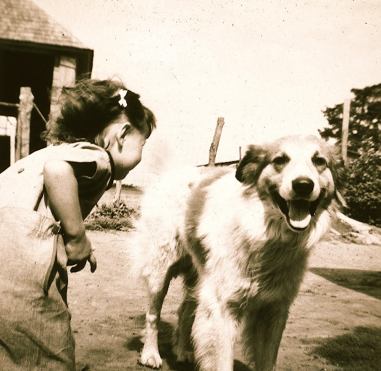
celebrate-picture-books-picture-book-review-Marsha-Diane-Arnold-and-dog

Marsha having fun with her dog.

celebrate-picture-books-picture-book-review-Marsha-Diane-Arnold-and-calf

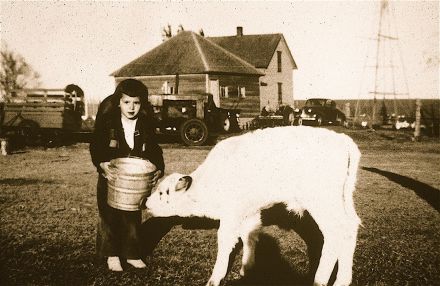
Marsha hanging out with a calf on her family’s farm.

I think I always appreciated the freedom of big spaces and gardens to play in and trees and barns (don’t tell) to climb on, but now I realize even more how very lucky I was.

Have you continued the family farming tradition?

I had a spectacular garden in Sonoma County, California. Mostly I grew flowers and a small plot of fruit trees. My favorite part of creating the gardens was designing them, using the land as my canvas. I collected over 50 heirloom roses, selecting plants for their fragrance and color. I loved the stories that came with them, like, “This one was collected from an old farm house in Windsor.” I had over 30 sweet pea varieties. There’s nothing better than a home filled with the fragrance of sweet peas. Most of my fruits were “antique” varieties. There was a Spitzenburg, reputed to have been Thomas Jefferson’s favorite apple, and a Calville Blanc, traced back to 1598 France. The fruit from my trees was unique and absolutely delicious. The stories behind them were delicious too.
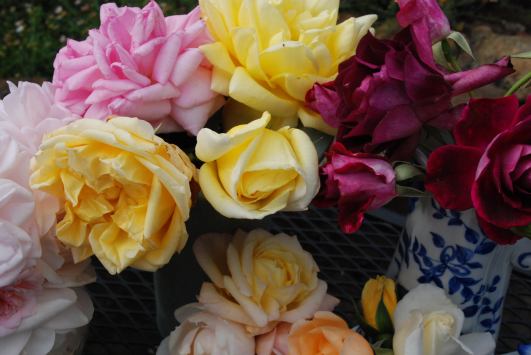
celebrate-picture-books-picture-book-review-flowers

Roses from Marsha’s flower garden.

celebrate-picture-books-picture-book-review-sweetpeas

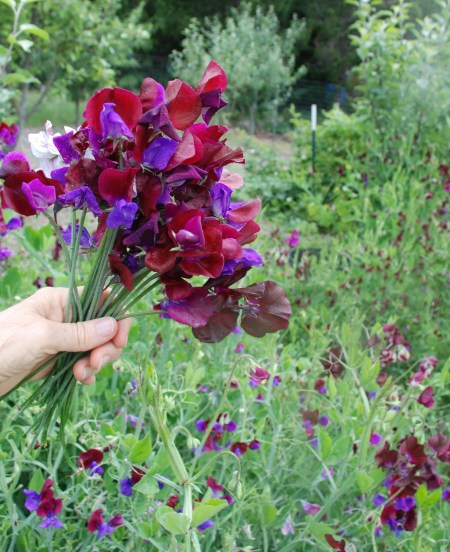
A beautiful bouquet of sweet peas.

How have your experiences with nature influenced your writing for children?

When a child grows up surrounded by nature, he or she grows to understand it and respect it. I learned to see the small things in nature, like my father before me. His neighbors said he knew the name of every wildflower or “weed” in the county. When you pay attention to something in that way, you come to love it and it becomes part of you. So, nature is what I write about, from my first book Heart of a Tiger, about a small kitten who had a dream to give himself a name like that of the Magnificent Bengal Tiger, to Galápagos Girl, about the unique animals of the Galápagos Islands, to the jumble tumble beauty of Badger’s Perfect Garden.
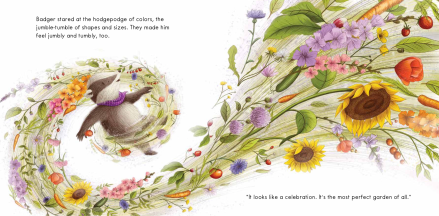
celebrate-picture-books-picture-book-review-badgers-perfect-garden-swirl

Image copyright Ramona Kaulitzki, 2019, text copyright Marsha Diane Arnold, 2019. Courtesy of Sleeping Bear Press.

What is your favorite wildflower and why?

Wild rose! At our California home, there was a wild rose growing in our gully. Every spring I would walk down the hill to see if it was still blooming. When I was diagnosed with breast cancer, I looked carefully for it each year, telling myself that if it was still in bloom, in the shade of our oak forest, alone and straggly, I would still be well. I’m sure it’s blooming still.

Thank you for sharing so much about your passion for nature and what joy living fully within it can bring. I wish you all the best with Badger’s Perfect Garden and all of your wonderful books!

You can connect with Marsha Diane Arnold on

Her website | Facebook | Twitter | Instagram

Spring Equinox Activity

celebrate-picture-books-picture-book-review-flower-garden-game

Plant a Flower Garden Game


With this fun game you and your family and friends can grow gardens inside! Roll the dice to see whose garden will fully blossom first!

Supplies

Directions

Object: The object of the game is for each player to fill their garden or garden rows with flowers. Depending on the ages of the players, the game can be adjusted to fill all of the rows, some or all rows, or just one.           

  1. Print one Game Board for each player
  2. Print one or more sets of Flower Playing Cards for each player, depending on how  (for sturdier playing items, print on card stock)
  3. Cut the flowers into their individual playing cards
  4. Print one Flower Playing Die and assemble it (for a sturdier die, print on card stock)
  5. Color the “dirt” on the Garden Plot with the crayon (optional)
  6. Choose a player to go first
  7. The player rolls the die and then “plants” the flower rolled in a row on the game board
  8. Play moves to the person on the right
  9. Players continue rolling the die and “planting” flowers until each of the number of determined rows have been filled with flowers or one row has been filled with all six flowers.
  10. The first person to “grow” all of their flowers wins!
celebrate-picture-books-picture-book-review-badger's-perfect-garden-cover

You can find Badger’s Perfect Garden at these booksellers

Amazon | Barnes & Noble | Books-a-Million | Sleeping Bear Press

Support your local independent bookstore with these book sellers

Bookshop | IndieBound 

Picture Book Review


May 11 – National Eat What You Want Day

celebrate-picture-books-picture-book-review-chip-and-curly-cover

About the Holiday

Feel like your diet is out the window what with staying home or ordering take out? Has good nutrition taken a hit because ingredients are at a premium? Don’t stress! Today’s holiday gives you permission to eat that doughnut or cupcake or pizza or whatever you want without feeling guilty. Besides, sometimes indulging a little jumpstarts your metabolism and provides motivation for the long haul. Lately, I’ve been craving French fries, so in honor of that, I’m celebrating two best spuds that are fry-tfully good sports.

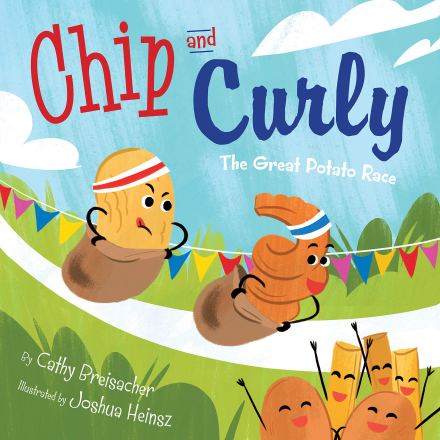
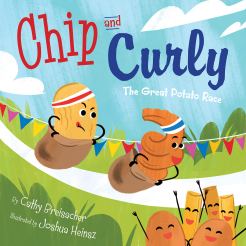
Chip and Curly, The Great Potato Race

Written by Cathy Breisacher | Illustrated by Joshua Heinsz


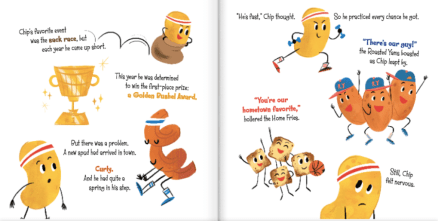
Spud City was about to hold its annual festival, and everyone was excited. Chip was practicing for the sack race. This year “he was determined to win the first-place prize: a Golden Bushel Award.” But a new spud in town—Curly—had a “spring in his step” and seemed to be real competition. Even though the other potatoes cheered him on, Chip was nervous.

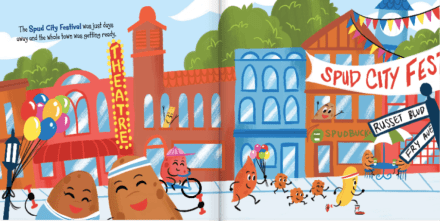
On the day of the festival, the race route was lined with spectators. The couch potatoes lounged near the path while “the French Fries stood with their Tater Tots.” Even the sweet potato cheerleaders were waving pompoms and shouting. Just before the race began, Curly took a place next to Chip at the starting line.

celebrate-picture-books-picture-book-review-chip-and-curly-spud-city

Image copyright Joshua Heinsz, 2019, text copyright Cathy Breisacher, 2019. Courtesy of Sleeping Bear Press.

When the whistle blew, Chip took off. He was in the lead until he heard someone behind him. “‘Look out!’ the BBQ Chips shouted. ‘Here comes a hot potato!’” Chip raced on, but then Curly bounced in front of him and even though Chip gave it his all, he couldn’t catch up. A moment later, though, Curly tripped and fell, leaving the path—and the race—wide open for Chip.

Chip hopped past Curly and was in clear sight of the finish line when he realized “he felt rotten.” He glanced back and “hashed it over in his mind.” He decided the only right thing to do was to go back. He offered Curly a hand up, and together they bounded down the route and past the other racers. But Curly was too quick for Chip, and he broke through the tape first. “In an instant, Chip’s dreams of winning were mashed.” 

Chip was just about to leave when Curly asked him to be his partner in the relay race. Curly thought they made a great team. They practiced until they found their groove. Everything was looking good until a new team showed up….

celebrate-picture-books-picture-book-review-chip-and-curly-practicing

Image copyright Joshua Heinsz, 2019, text copyright Cathy Breisacher, 2019. Courtesy of Sleeping Bear Press.

Kids will devour Cathy Breisacher’s pun-filled romp that takes them to Spud City’s annual festival, where Chip and Curly face off to win a Golden Bushel Award in the sack race. While Chip pulls out to an early lead, Curly bounces back and threatens Chip’s years-long dream to win. A misstep by Curly gives Chip the opportunity to achieve his goal, but in his decision, Breisacher shows readers true sportsmanship and integrity. Curly also displays the qualities of a gracious winner, and as the two work together to perfect their relay skills, a friendship sprouts. The final scene offers a funny “oh, no!” moment while also reminding readers that winning can be fleeting, but friendship and staying true to oneself endure.

Joshua Heinsz populates Spud City with a wide array of taters—from tots to waffle fries, sweet potatoes to twice-bakeds, French fries to home fries, and more. Heinsz adds plenty of visual humor to the mix with clever street sign and shop names, and the couch potatoes are, ingeniously, those impossible-to-peel curved ones that lurk in many a 5-pound bag. Kids will love picking out their favorite kind of potato, and the expressive spuds will have readers captivated from the very first page.

For rollicking story times that also offer opportunities to discuss the nature of competition and friendship, Chip and Curly, The Great Potato Race is one to add to your home, classroom, or library shelf.

Ages 5 – 8

Sleeping Bear Press, 2019 | ISBN 978-1585364084

Learn more about Cathy Breisacher and her books on her website.

To learn more about Joshua Heinsz, his books, and his art on his website.

A Chat with Cathy Breisacher

011CB

It’s so great to be talking with you again! This must be a really exciting—and busy!—time for you, so I’m thrilled to have you stop by!

You’ve mentioned that the inspiration for this story was a local potato festival. Can you describe that event a bit and tell what sparked the idea for Chip and Curly?

Every year, on the last Saturday in September, a town not far from where I live holds a Potato Fest.  The county where it is located is the second-largest supplier of potatoes in the state. People come from all around and a good portion of the downtown area is closed off for the event. There are tons and tons of vendors selling a variety of crafts, and the food vendors whip up all kinds of potato treats: sweet potato fries, potato candy, baked potatoes, pierogi, potato soup, French fries, potato bread, etc. There is live music as well as games for the kids. I love the fall season, and this is a great kick-off to the fall. I try to attend every year. So, in 2016 when I wrote this story, I thought about the potato festival and all of the kinds of potatoes that are sold at the event.  The names CHIP AND CURLY came to me and the idea for the story just flowed from there.

Of course, I have to ask—what’s your favorite kind of potato? Do you have a favorite recipe? Would you like to share it?

 I love twice baked potatoes. They are probably my favorite. But, there really isn’t a potato I don’t like. I also love perogies and sweet potato fries. Oh my goodness…it’s hard to choose just one. 

I’ll share a recipe for Cheesy Hash Brown potatoes that are gobbled up at many family events. They are so easy to make.

CHEESY HASH BROWN POTATOES

26 oz. Bag of frozen shredded hash brown potatoes (thawed)
2 cups Sharp cheddar cheese (shredded)
16 ounces sour cream
1 (10 1/2 ounce) can cream of mushroom soup
1 ½ sticks butter
3 cups Crushed corn flakes
1 teaspoon garlic salt and pepper to taste

Thaw the hash browns.  Melt 1 stick of butter and mix it with the hash browns.  Pour into 9 x13 pan.  Mix the sour cream, soup and cheese in a bowl. Spread over the potatoes. Melt ½ stick of butter and mix it with the crushed corn flakes.  Sprinkle over the potatoes. Bake at 350 degrees for an hour.

Being competitive can take so many forms. Do you consider yourself competitive? If so, in what way?

Yes, I’m definitely competitive. I always want to put 110% into things that I do. If there is a challenge of some sort, I am in it to win it. J In the past couple of years, I’ve been intrigued with Escape Rooms and trying to solve all of the clues before the time runs out. Recently, I heard of an Escape Room that no one has “broke out of” yet.  I want to be the first! J

Chip and Curly is loaded with puns and really clever word play! The story must have been a blast, but also challenging to write. Can you talk a little about how you put it all together?

Chip and Curly was definitely a fun story to write. I just pulled out my first version of this story, and it has so few puns in it. I didn’t initially write this story to be punny.  But, as I was doing my first set of revisions, a pun popped in my head.  More puns came to me as I continued to revise. It wasn’t long before I knew this had to be a story that centered on potato puns. I scoured the Internet to find words associated with potatoes. I must have looked at every list that exists online. The tricky part was to include those words and phrases that fit nicely with the story. I didn’t want to include something just to include it if the word or phrase really didn’t flow with the storyline. My amazing editor, Sarah Rockett, had excellent suggestions for tweaking the story a bit more after she acquired it. And I was delighted with the fun, playful, colorful art provided by the illustrator, Joshua Heinsz.

After practicing for a year to win a Golden Bushel Award for the sack race, Chip makes a surprising decision part way through the race. What would you like kids to take away from the story?

This is the crucial part of the story. I want kids to know that competing can be a lot of fun. And it can feel good to win at something, too. However, practicing good sportsmanship is important and helps build character. When we show respect toward our opponents, we can still have fun and compete, but it helps us to keep our focus on what’s most important—treating one another the way we want to be treated.

Since CaveKid Birthday was released in March, what’s been the best part of being a published author? The most surprising? As a librarian, how does it feel to see your own book on your library’s shelf?

Gosh, there is so much I am enjoying about being a published author. I love meeting new people (kids and adults) at book events and talking with them about stories. It has also been a treat to see friends and family who I haven’t seen for a while. Being a school librarian, I get an extra treat when kids ask to check out my book. That has truly meant the world to me. When my students tell me they love my books, my heart just completely melts.

During our first interview for CaveKid Birthday how did I miss that you’re from Hollidaysburg, Pennsylvania? Does the town live up to its celebratory name? Do you have a favorite town celebration or spot to write or visit?

Hmmm…very good question. The town where I live is a true community. People really get behind and support the schools, sports teams, agencies, fundraising events, etc. So I guess you can say that the people who live in Hollidaysburg celebrate one another’s aspirations and accomplishments. I am proud to live in this town. I do have a few favorite spots that I like to visit. There are a couple of parks that are so beautiful and serene. They are a great place to spend timejyeither alone or with family and friends. As for a favorite town celebration, I would have to say the Winterfest Light-Up Night that is held at the end of November each year. There are festivities in the downtown area and everything is decorated for Christmas. Local restaurants hold soup samplings and people vote on their favorite. Santa arrives and a giant tree is lit up that evening. There are ice carvings, too. It’s such a fun night and everyone is in the holiday spirit.

Thanks, Cathy! I can’t wait to try those delish-sounding potatoes! I know you’ll have lots of fun with Chip and Curly, and I wish you all the best with all of your books!

You can connect with Cathy Breisacher on

Her website | Facebook | Twitter

National Eat What You Want Day Activity

celebrate-picture-books-picture-book-review-appealing-potatoes-game-cards

Appealing Potatoes Game


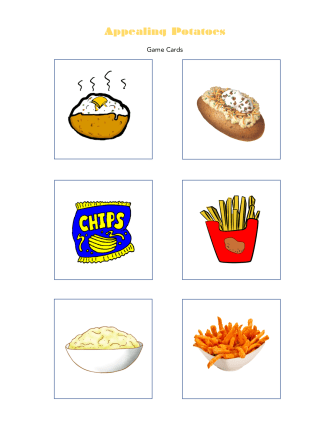
If you love potatoes, you can never get enough! Race to fill your plate with all six kinds of potatoes in this fun game!

Supplies

Directions

  1. Print a game board and set of game cards for each player.
  2. Choose a player to go first.
  3. Taking turns, each player rolls the paper die and places a game card matching the rolled potato to their plate
  4. Or: If using a regular playing die, use the corresponding number and kind of potato listed below
  5. The first player to add all six kinds of potatoes to their plate is the winner.

Corresponding Numbers and Potatoes:

  1. Mashed Potatoes
  2. French Fries
  3. Potato Chips
  4. Baked Potato
  5. Twice-baked Potato
  6. Sweet Potato Fries

celebrate-picture-books-picture-book-review-chip-and-curly-cover

You can find Chip and Curly, the Great Potato Race at these booksellers

Amazon | Barnes & Noble | Books-a-Million | Bookshop | IndieBound

Picture Book Review


May 8 – It’s Get Caught Reading Month

celebrate-picture-books-picture-book-review-two-tough-trucks-cover

About the Holiday

The Get Caught Reading campaign was initiated in 1999 by the Association of American Publishers with the idea to promote literacy and language development through reading to children and encouraging them to read on their own. As part of the campaign, posters of celebrities, dignitaries, and even fictional characters enjoying a book are available for schools, libraries, and other organizations to hang where kids will see them. The excitement of reading also takes over social media all month long, which this year is more important than ever. To celebrate this holiday, make sure you stock up on new and favorite books or download ebooks or audiobooks from your library and get caught reading! Learn more by visiting the Get Caught Reading website and the Every Child a Reader website.

I received a copy of Two Tough Trucks from Orchard Books for review consideration. All opinions are my own.

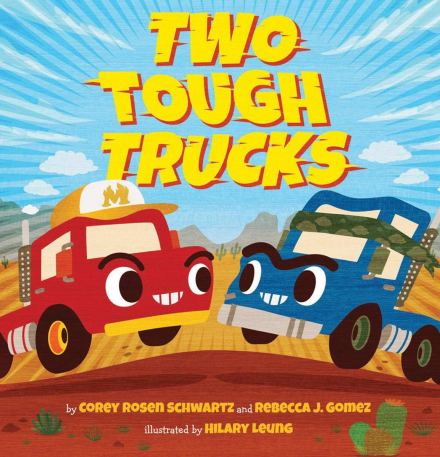
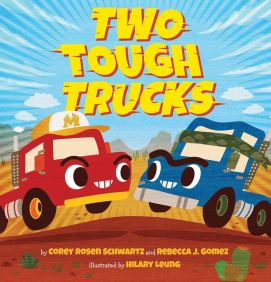
Two Tough Trucks

Written by Corey Rosen Schwartz and Rebecca J. Gomez | Illustrated by Hilary Leung


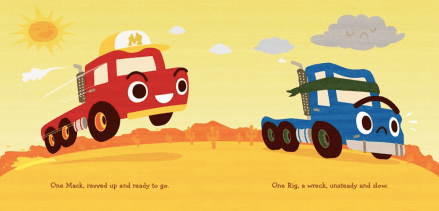
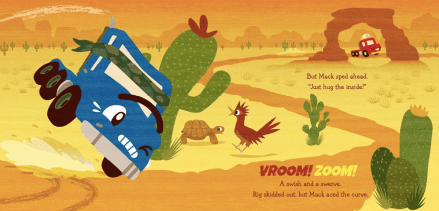
One morning, two trucks are ready “for their first day of class.” But Rig’s “riding the brakes” while Mack’s “hitting the gas.” In their classroom, their teacher Miss Rhodes pairs these two up for a practice run on the track. First up is the circuit, with twists and a hairpin turn. Rig feels shaky, but Mack’s “a speedy red blur.” Mack picks up speed going into the turn and keeps on going, but Rig hits the brakes and skids off the course.

celebrate-picture-books-picture-book-review-two-tough-trucks-meeting

Image copyright Hilary Leung, 2019, text copyright Corey Rosen Schwartz and Rebecca J. Gomez, 2019. Courtesy of Orchard Books.

Next comes learning to downshift while climbing a hill. Mack breezes up as Rig carefully inches along. First to the top, Mack gloats, “‘I knew I was fast.’” And although Rig tried his best he “finished dead last.” Mack thought Rig was just dragging him down. For Rig, Mack just seemed liked a braggart. As he vroomed, Mack fumed and left Rig “in the dust.”

celebrate-picture-books-picture-book-review-two-tough-trucks-sharp-curve

Image copyright Hilary Leung, 2019, text copyright Corey Rosen Schwartz and Rebecca J. Gomez, 2019. Courtesy of Orchard Books.

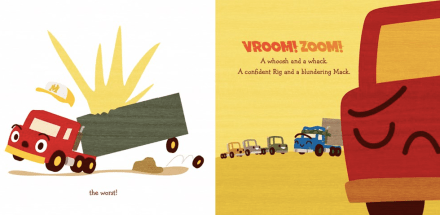
The students moved on to practicing backing up. As they moved around traffic cones,  “they veered and corrected, / they turned and reversed. / Rig had good instincts, but Mack was… the worst.” Rig aced the course, but Mack? He was ready to quit until Rig steered him right. “Vroom! Zoom! / They backtracked and bumped. / A Mack making progress, / a Rig feeling pumped!”

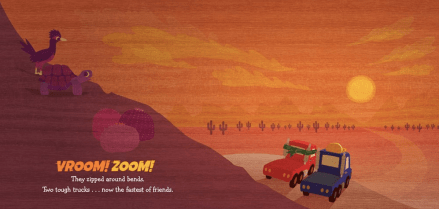
Mack was surprised that Rig had helped him, but for Rig it was just the right thing to do. They headed back to the track and took it by storm. These two trucks were “now the fastest of friends.”

celebrate-picture-books-picture-book-review-two-tough-trucks-blundering-mack

Image copyright Hilary Leung, 2019, text copyright Corey Rosen Schwartz and Rebecca J. Gomez, 2019. Courtesy of Orchard Books.

Like life’s road itself, this original story of two trucks with distinct personalities and different strengths has many twists and turns and takes little ones on a multilayered journey of discovery. While Mack is rarin’ to go on his first day of truck school, Rig is more hesitant. When these two are teamed up for the day, Mack’s fast and daring approach to the track seems to be the right one as he nails the sharp curve and is the first to reach the peak of the hill, leaving Rig far behind. These early successes cause him to honk his own horn and complain about Rig.

But then in a clever literal and metaphorical reversal, Rig’s thoughtful restraint makes backing up his forte. In Mack’s reaction to being last, Corey Rosen Schwartz and Rebecca Gomez gently ramp up life lessons about perseverance and losing gracefully. Rig then goes on to demonstrate another winning trait in his generosity to teach Mack the finer points of driving in reverse. Mack’s acceptance of Rig’s kindness shows that the experience has taught him to be humble. Kudos to Miss Rhodes for creating a track that leads to strong bonds and friendship.

A book by Schwartz and Gomez always charms with smart rhyming and jaunty rhythms and Two Tough Trucks is no exception. Ingenious puns, evocative and active vocabulary, and plenty of “vrooms” and “zooms” for kids to chime in on make this book a lively read aloud.

celebrate-picture-books-picture-book-review-two-tough-trucks-sunset

Image copyright Hilary Leung, 2019, text copyright Corey Rosen Schwartz and Rebecca J. Gomez, 2019. Courtesy of Orchard Books.

Hilary Leung’s textured and boldly colored pages will thrill little readers as Mack and Rig take center stage on the dusty, western track. Mack’s confidence shows in his straight, crisp lines and grinning grill while Rig’s wariness takes the form of wobbly tires, bent frame, furrowed brow, and grimacing grill. Fittingly, the Truck School building is shaped like a parking garage, complete with a spiral ramp that takes students to the second and third story. Cacti, roadrunners, and craggy rock formations dot the sun-drenched desert track where Mack, Rig, and the rest of the students strut their stuff.

A joy to read out loud and a story kids will want to hear again and again, Two Tough Trucks is highly recommended for home bookshelves, preschool and kindergarten classrooms, and public libraries.

Ages 3 – 5

Orchard Books, 2019 | ISBN 978-1338236545

Discover more about Corey Rosen Schwartz and her books on her website.

To learn more about Rebecca J. Gomez and her books, visit her website.

To view a portfolio of work by Hilary Leung and learn more about his work, visit her website.

Get Caught Reading Month Activity

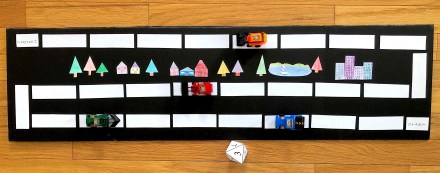
celebrate-picture-books-picture-book-review-truck-racing-game-wood

Racing for Friendship Game


Here’s a racing game that kids will love! With poster board, paper, and chalk or other art supplies, kids can place their track in a city, the country, the desert, or even in outer space! Once the scene is ready, get out your own toy cars or trucks to play with or use the printable truck game pieces included below. Use a traditional playing die or the included printable 8-sided playing die. The first player to the finish line wins—or shake it up a bit and make the last person to the line the winner.

The track can be laid out on the floor and taped in place or created on poster board or paper with the supplies below:

Supplies

  • Poster board or tri-fold display board. I used a 12-inch by 4-foot section of a tri-fold board in my example. This allows you to fold up the board for easier storing.
  • White paper
  • Chalk, crayons, or colored pencils
  • Glue or tape
  • Scissors
  • Toy trucks or cars
  • Printable Truck Game Pieces (optional)
  • Printable 8-sided Playing Die

Directions

  1. Cut 30 4- or 5-inch by 1½-inch strips from the white paper
  2. Have kids lay out a track on the board using the white paper strips (each strip is one space) leaving room in between the rows for scenery
  3. Glue or tape the strips in place
  4. Draw scenery around the track OR cut trees, buildings, landmarks, or other scenery from paper and color. Glue or tape to board. 
  5. Print and assemble 8-sided playing die with tape (optional)
  6. Give each player a toy truck or car. Alternately, print and cut out included Truck Game Pieces. (To make them sturdier, print on heavy paper or glue them to cardboard)
  7. Choose a player to go first
  8. Players take turns rolling the die and moving the appropriate number of spaces
  9. The first (or last) player to the finish line is the winner

celebrate-picture-books-picture-book-review-two-tough-trucks-cover

You can find Two Tough Trucks at these booksellers

Amazon | Barnes & Noble | Books-a-Million | IndieBound

celebrate-picture-books-picture-book-review-two-tough-trucks-get-lost-cover

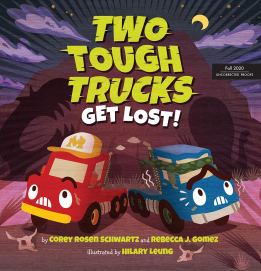
Vroom and zoom with Mack and Rig in Two Tough Trucks Get Lost!, a new  adventure coming on September 1! You can preorder it here

Amazon | Barnes & Noble | Books-a-Million | IndieBound


April 14 – National Gardening Day

celebrate-picture-books-picture-book-review-in-the-garden-cover

About the Holiday

For many of us, spring means gardening. Today’s holiday encourages avid gardeners and those new to this rewarding activity to turn over some dirt, plant seeds, and prepare to tend the little sprouts on their way through the season. While this year may pose challenges to regular gardening routines, ordering options, creative solutions

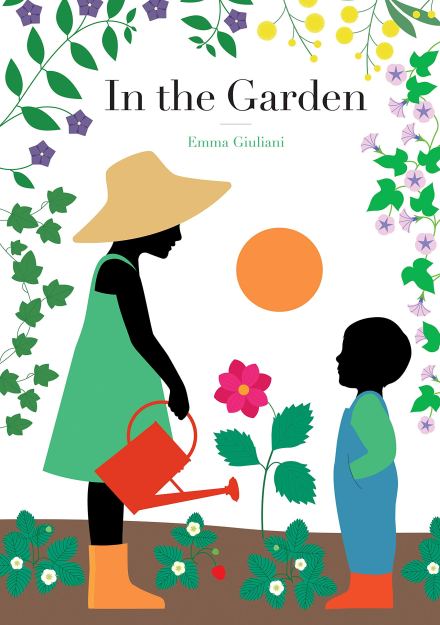
In the Garden

By Emma Giuliani


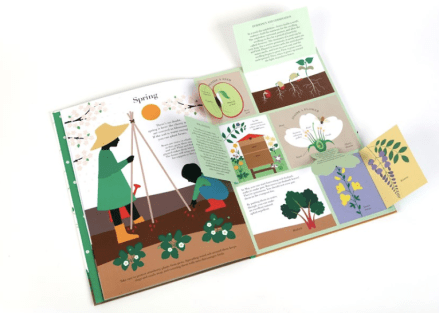
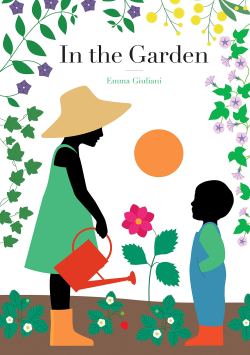
In her stunningly illustrated interactive guide through the seasons, Emma Giuliani introduces Plum and her little brother, Robin, and invites readers to join them as they tend to their garden and all the plants, animals, and birds that call it home. Plum and Robin begin at winter’s end. “This morning it’s cold. It’s not yet spring, but, in the garden, Plum and her brother Robin see the first catkins appearing on the branches of the willows and hazels. The blossoming mimosa makes the gardeners impatient for spring to come.” As Robin counts the long, drooping catkins, Plum rakes a layer of compost over the ground. On the facing page, children get a close-up view of the fuzzy catkins, can peek inside a bud, burrow underground with earthworms just waking from hibernation, and view a few early bloomers. They also learn about what makes up the earth’s soil and get a recipe for compost.

celebrate-picture-books-picture-book-review-in-the-garden-shed

Copyright Emma Giuliani, 2020, courtesy of Princeton Architectural Press.

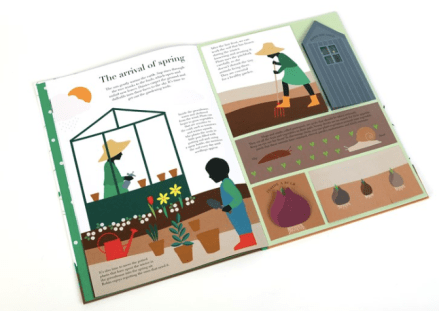
With the arrival of spring, Plum is in her little greenhouse, planting vegetable seeds and spritzing the soil with water to keep it moist while Robin repots some plants who have spent the winter in the greenhouse. Outside, Plum aerates the garden bed with a pitchfork, careful of any tiny creatures below. Children can open the door to Plum’s well-stocked shed to see all the tools tidily stored there and lift the flaps to look inside a bulb and help a hyacinth, a daffodil, and a tulip grow.

celebrate-picture-books-picture-book-review-in-the-garden-open-shed

Copyright Emma Giuliani, 2020, courtesy of Princeton Architectural Press.

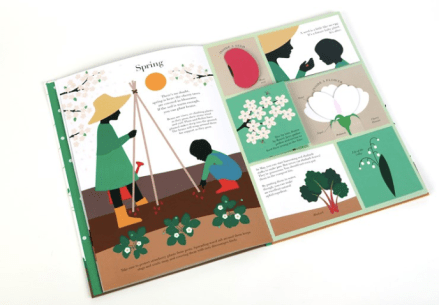
At last the warm weather of spring has arrived. The cherry trees are blossoming, and Plum and Robin are setting stakes and planting bean seeds. Next, they provide protection for the tender strawberry plants that are beginning to bloom. Young gardeners will enjoy opening a bean seed to learn what’s inside and then following its growing process. The bees are visiting the cherry blossoms, pollinating the flowers and making honey. What does a bee see as it hovers around the flower? Pull down the flap to see for yourself and learn all the parts of a flower. What other plants are flowering now? Open the flap to see!

celebrate-picture-books-picture-book-review-in-the-garden-spring

Copyright Emma Giuliani, 2020, courtesy of Princeton Architectural Press.

Summer begins and “what a joy to be in the garden in June! The gentle breeze, the smell of cut grass, and the tangy taste of strawberries and cherries make the gardeners smile.” While Plum waters the tomato plants, “Robin looks for ripe strawberries under the leaves.” Join him! Robin is also picking cherries before the birds eat them. How do those bright red, round fruits grow? Lift the flap to learn and see how they develop from flower to fruit. Plum is getting help with the aphids on the bean plants from industrious—and hungry—ladybugs. “Dragonfly larvae are transforming into graceful flying insects….Their presence is a sign of a healthy garden.”

celebrate-picture-books-picture-book-review-in-the-garden-open-spring

Copyright Emma Giuliani, 2020, courtesy of Princeton Architectural Press.

It’s high summer and the garden is glorious. Bean pods hang from the vines, and Plum contemplates whether they are ready to pick. She may leave some “husks dry out on the plant before picking them.” Dried completely indoors, they can be stored and eaten during the fall and winter. Take a look inside a pod to see the seven red beans there. Flowers greet you too: an orange marigold with petals like a pinwheel, a brilliant pink and purple fuchsia, and a perky mignon dahlia. Robin took cuttings of these plants and potted them to grow some more. Learn how you can do that with your plants too!

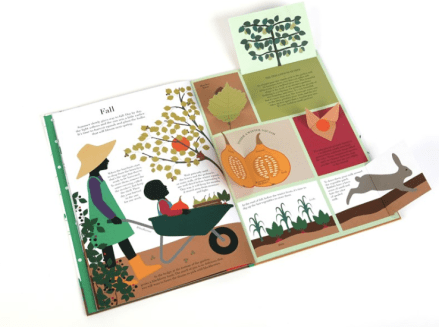
The summer heat is waning and the days are growing shorter. Fall is here. The catkins of early spring have become hazelnuts that are ready to be harvested. Even the squirrel approves! Plum and Robin teach you how to store them—and when to pick the winter squash and keep them for months as well. Can you count the number of seeds inside the winter squash? Plum’s beautiful trellised pear tree is bearing sweet fruit. Yum! But look out—a crafty rabbit is after the last leafy vegetables in the garden. No need for a fence, though. Milk will do the trick of shooing him away.

celebrate-picture-books-picture-book-review-in-the-garden-open-fall

Copyright Emma Giuliani, 2020, courtesy of Princeton Architectural Press.

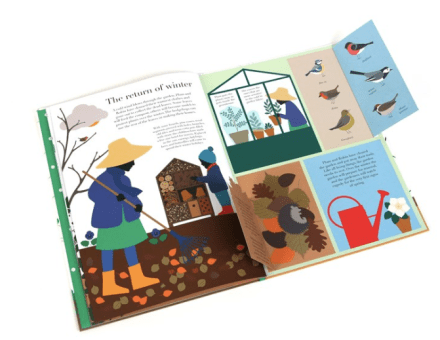
The air is chilly again and winter is on the horizon. “Plum and Robin have donned their warmest clothes and gone out to collect the dead leaves. Some leaves will feed the compost, others will become mulch to protect plants over the winter. The hedgehogs can use the rest of the leaves in making their homes.” Do you see the pile of crunchy leaves? Lift them gently…shhh! A hedgehog is snoozing underneath. Robin and Plum have built an insect hotel to keep the bugs cozy during the winter and have filled the greenhouse again. For the colorful birds who stay awhile or all winter, Robin and Plum put out a bird feeder and fill it with locally produced seeds.

After putting all of their tools back in the shed, Plum and Robin head indoors to plan next year’s garden and “watch eagerly for the very first signs of spring.”

celebrate-picture-books-picture-book-review-in-the-garden-open-winter

Copyright Emma Giuliani, 2020, courtesy of Princeton Architectural Press.

If your family tends a garden or is thinking of starting one, Emma Guiliani’s superb book is a must. At 16 inches tall, In the Garden provides fascinating facts about plants, insects, and animals; helpful tips on when and how to plant a variety of fruit, vegetables, and flowers, information on natural ways to ward off pests; and how to recognize when fruit and vegetables are ready for picking and how to store them. Through copious flaps, children get inside views of flowers, seeds, buds, and vegetables to learn the names of each part and how they contribute to the growth of the plant. Along the way, young and adult gardeners discover how early gardening can begin, directions on how to create and use compost, when bushes can be planted, information on pollination; and how to winter over the garden for the coming spring.

Giuliani’s crisp, lush illustrations are marvels, combining intricate paper cuts that replicate the shapes of delicate bulbs and buds, flowers and seeds, smooth and serrated leaves, the long bean pod, and even Plum’s garden shed with a window in the door. Her extraordinarily beautiful color palette immerses readers in the garden experience; you can almost smell the rich earth, hear the bees buzzing at the blossoms, and feel the air changing season to season.

A brilliant resource and a joy to peruse, In the Garden is a book that adults and children—both gardeners or nature lovers—will share throughout the seasons and from year to year. The book is most highly recommended for home, school, and public library collections.

Ages 7 – 12

Princeton Architectural Press, 2020 | ISBN 978-1616898939

You can connect with Emma Giuliani on Instagram.

National Gardening Day Activity

celebrate-picture-books-picture-book-review-flower-garden-game

Plant a Flower Garden Game


With this fun game you and your family and friends can grow gardens inside! Roll the dice to see whose garden will fully blossom first!

Supplies

Directions

Object: The object of the game is for each player to fill their garden or garden rows with flowers. Depending on the ages of the players, the game can be adjusted to fill all of the rows, some or all rows, or just one.           

  1. Print one Game Board for each player
  2. Print one or more sets of Flower Playing Cards for each player, depending on how  (for sturdier playing items, print on card stock)
  3. Cut the flowers into their individual playing cards
  4. Print one Flower Playing Die and assemble it (for a sturdier die, print on card stock)
  5. Color the “dirt” on the Garden Plot with the crayon (optional)
  6. Choose a player to go first
  7. The player rolls the die and then “plants” the flower rolled in a row on the game board
  8. Play moves to the person on the right
  9. Players continue rolling the die and “planting” flowers until each of the number of determined rows have been filled with flowers or one row has been filled with all six flowers.
  10. The first person to “grow” all of their flowers wins!

To play a printable Vegetable Garden Board Game, click here.

celebrate-picture-books-picture-book-review-in-the-garden-cover

You can find In the Garden at these booksellers

Amazon | Barnes & Noble | Books-a-Million | IndieBound | Princeton Architectural Press

Picture Book Review
April 1 – Reading is Funny Day and Interview with Author Lori Degman

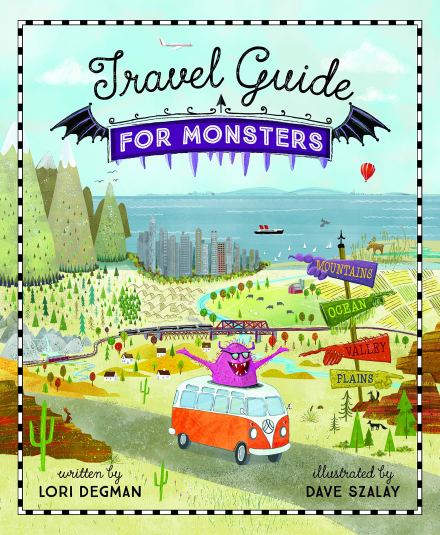
celebrate-picture-books-picture-book-review-travel-guide-for-monsters-cover

About the Holiday

Nothing’s better than hearing the giggles of a child reading a funny book! And thanks to today’s holiday, that sound can echo through your home all day long. It’s easy to celebrate too. Just grab your favorite funny books or find read alouds by your favorite authors and illustrators and settle in for a day of laughs. Or do a bit of both! And if you’re looking for a new book to add to your shelf, check into ordering today’s book for a fun trip around the country!

Travel Guide for Monsters

Written by Lori Degman | Illustrated by Dave Szalay


If you’ve ever wondered what it would be like to travel with monsters from coast to coast across America, then pack your bags and let’s get started! First stop is San Fransisco, California, where we hop a trolley for sightseeing. But maybe before we go on you should know: “While riding on a cable car, / Your monster should be cautious. / The ups and downs of Frisco hills / can make a monster nauseuous!” After taking in all the grandeur of the Bay Area, head down to Hollywood, where you and your monster can do some stargazing.

celebrate-picture-books-picture-book-review-travel-guide-for-monsters-geysers

Image copyright Dave Szalay, 2020, text copyright Lori Degman, 2020. Courtesy of Sleeping Bear Press.

Traveling east, you can visit the Grand Canyon in Arizona and  take a tour of Wyoming. While there… “You’re likely to get thirsty when you / hike up in the mountains. / Make sure to warn your monster / that those geysers are not fountains.” South Dakota and Mount Rushmore are next on the itinerary then it’s on to Chicago for some “face time” at the ballpark. In Nashville, Tennessee, your monster will love to kick up his (cowboy booted) heels to some down-home fiddle music.

A swing through the south just isn’t complete without enjoying Florida’s amusement parks or a wild adventure: “Down south among the everglades, / your monster should wear waders / when playing ‘Marco Polo’ / with the crocodiles and gators.” If your monster likes swimming, he’ll love the beaches in Massachusetts—just watch his choice of snacks!

While on the East Coast, don’t forget to visit our nation’s capital in Washington DC and New York State, where your monster can get a bird’s eye view from the crown of Lady Liberty and make a splash at Niagara Falls. And when you finally get back home, you may have just one lingering question about your trip: “How will you explain your monster’s crazy souvenirs?”

celebrate-picture-books-picture-book-review-travel-guide-for-monsters-statue-of-liberty

Image copyright Dave Szalay, 2020, text copyright Lori Degman, 2020. Courtesy of Sleeping Bear Press.

Clever and funny, Lori Degman’s rhymed verses follow a high-interest itinerary across the country and will delight kids, who will very much wish they could join in the ultra-fun, little-bit-risky, and larger-than-life activities in each of the landmarks visited. These snapshots of America take in transportation, celebrity, grandeur, sports, music, and history and will spark an interest in learning more about each city and attraction.

Accompanying Degman’s story are Dave Szalay’s vivid depictions of each landmark, where some of the cutest—I mean most fearsome—monsters sightsee their way to hilarious result. Each image is framed with site-appropriate wallpaper, sporting a shield with the state’s name, a compass showing the state’s direction, and a little mode of transportation—from retro cars to trains to buses to airplanes. Szalay’s realistic portraits of each landmark will entice kids to look up the actual destination, and they’ll love picking out their favorite from among their whimsical travel buddies.

A laugh-out-loud and captivating travelogue for monster fans and monster fans of travel alike, Travel Guide for Monsters would be an often-asked-for addition to home, school, and public library bookshelves.

Ages 5 – 8

Sleeping Bear Press, 2020 | ISBN 978-1534110373

Discover more about Lori Degman on her website.

To learn more about Dave Szalay, his books, and his art, visit his website.

Meet Lori Degman

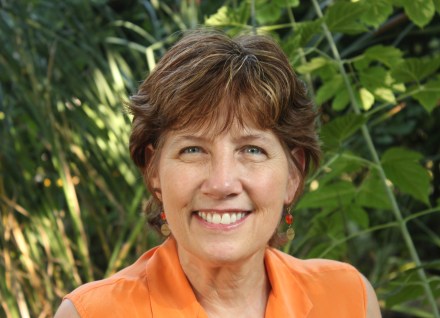
celebrate-picture-books-picture-book-review-Lori Degman Headshot

Today, I’m monstrously exited to be talking with Lori Degman about her book, traveling, and her special musical talent! My blog partner Jakki’s two sons also get in on the fun with a few questions of their own!

Thanks so much for having me on your blog, Kathy!

Jack would like to know: How did you get the idea for travel guide for monsters? 

Hi Jack! I actually got the original idea from another Jack – Colin Jack, the illustrator of my first book, 1 Zany Zoo. About eight years ago, Colin asked me if I could write a picture book about teaching monsters manners when traveling on public transportation. I tried, but I just couldn’t come up with anything I liked. About a year later I tried again and, instead of focusing on the type of transportation, I focused on location. I wrote the first stanza, “When traveling with monsters on a trip across the nation/this guide will give you tips to have a marvelous vacation”, then followed the same rhyme scheme and wrote couplets about different locations around the country.                                                 

Steve asks: Did you travel to places in your book? 

Hi Steve! I didn’t travel to any of the places to research them, but I’ve been to most of them on vacations in the past. I would love to go to each of them and talk to kids about the book at each place – maybe one of these days!                            

Steve and Jack were wondering: We really like the monsters. Do you know how Dave Szalay came up with them? Do you have a favorite monster?

I love the monsters too! I don’t know how Dave came up with them, so I went straight to the source and here is Dave’s answer: “I looked at the word history of monsters, mythology, legends, and folktales.  I read about the characteristics of monsters throughout history and then invented each monster based on what I learned.” 

celebrate-picture-books-picture-book-review-Dave-Szalay-Headshot

Dave Szalay chats about his monsters with Jack and Steve from his studio.

Me again – It’s really hard to pick a favorite monster because they’re all so great!  But, probably the monster in the Everglades is my favorite.  I especially love his waders. 

celebrate-picture-books-picture-book-review-travel-guide-for-monsters-everglades

Image copyright Dave Szalay, 2020, text copyright Lori Degman, 2020. Courtesy of Sleeping Bear Press.

Hi Lori! Jack and Steve had some awesome questions, and I love your and Dave’s (thanks, Dave!) answers. I really enjoyed your clever rhymes and the monsters’ experiences. Could you take readers through a little bit of your process of writing this book?

Thanks so much, Kathy!  Once I established the rhyme scheme I was going to use and my plan to include different travel locations (as mentioned in question #1), I started listing places I’d been, like Mt. Rushmore, Statue of Liberty, Washington DC, and some places I’ve never been but want to visit in the future, like Niagara Falls and Cape Cod. Then I came up with ideas of some fun and silly things you’d tell your monster to do – or not to do – at these locations. Some of the locations went through several revisions with different tourist attractions. I think my hometown of Chicago had the most changes. First, I wrote about the elevated trains, then about the museums, and finally I wrote about Wrigley field – home of the Chicago Cubs. After writing the thirteen couplets, it was just a matter of getting the meter and rhyme just right.

You grew up and still live in Chicago. If you were going to take a trip, would you head north, south, east, or west? Why?

Within the United States, I’d like to take a road trip to all the states in the northeast. I’ve only spent time in New York City, Boston, and Washington DC, so I’d love to see all the other states up there. I’d probably go in the fall to see the changing leaves!

In your bio, you say that you love to write song parodies. How did you start doing them? Do you get to share these anywhere? Can you give readers a verse or two?

I wrote song parodies now and then, just for fun. But I started doing it a lot when I decided to write a musical for my long-time college friends and me. I wrote The Sound of MacMurray (our college) using the songs from The Sound of Music. Then I wrote a Christmas songbook for us, rewriting popular Christmas carols. When my friends and I turned 50, I wrote a song for each of them – and they wrote one for me. There are a lot of inside jokes in those songs, so I don’t think they’d be very funny to you. I did write a short song when my friend was diagnosed with Hashimoto Thyroiditis. It wasn’t serious or life threatening, otherwise I wouldn’t joke about it. But, when she told me the name of it, I knew I had to write a song about it! The song, Supercalifragilisticexpialidocious from Mary Poppins fit perfectly. Here’s the song:                                                                                      “Hashimoto Thyroiditis, that’s her diagnosis / just a goiter on her neck so it’s a good prognosis / if she takes her medicine, that’s all the risk it poses / Hashimoto Thyroiditis, that’s her diagnosis.”

Just from reading your extensive 2020 event schedule, it looks like you love to meet with your readers. What do you like best about meeting with fans of your books?

As I’m writing this, I’m in my house for the 10th day in a row because of the Coronavirus! Because of that, my bookstore and school visits will most likely be canceled, which makes me really sad. I’m going to try to reschedule them for next school year. I was a teacher for 32 years and I’ve always loved children, so school visits are so much fun for me! I love motivating kids to read and write and use their imaginations.                                                                                               

Did your family take trips when you were a child? Do you remember one that made a special impression? Would you like to share a memory from a trip with your own kids?

Growing up, I had two sisters and one brother and my mom raised us by herself. She had to work a lot and we didn’t have much money, so we didn’t go on many trips. Sometimes we’d drive to our aunt and uncle’s cottage on a lake or to the Wisconsin Dells. The one big trip we took, when I was 9, was a driving trip to Washington DC and then down to Nashville to visit our cousins. That was before they had seat belts, so my three siblings and I squeezed into the back seat of our car the whole way. That was before cars had air-conditioning too, which made it a really long, hot drive.

The most exciting trip we took with my own kids was to London, England. Luckily for me, I won a trip for two there, including airfare and hotel, so we only had to buy the airplane tickets for our kids! Speaking of winning trips – I’ve also won trips to San Francisco and Hawaii! I’m pretty lucky I guess.

Traveling is always fun, but staycations are fun too. What’s one of your favorite tourist attractions in Chicago? What’s a favorite not-so-well-known spot?

I love the Art Institute of Chicago! It’s so huge, there’s always something new to see when you go there.  Plus, they have special exhibits all the time. All of the Chicago museums are really cool!

A fun not-so-well-known thing to do in Chicago is take an architectural boat tour. There are a couple of companies that will take you down the Chicago River and a guide will tell the history of the different buildings and their architects. It’s fun – but make sure to do it on a warm day!

What’s up next for you?

I don’t have any picture books under contract right now but I have several manuscripts out on submission, so hopefully that will change soon. In the meantime, I’m enjoying writing, doing school visits (once they’re open again) and spending time with family and friends!

Thanks, Lori! It’s been so fun chatting with you! Kids will have a blast traveling vicariously with your and Dave’s monsters!

You can connect with Lori on Facebook | Instagram | Twitter

Reading is Funny Day Activity

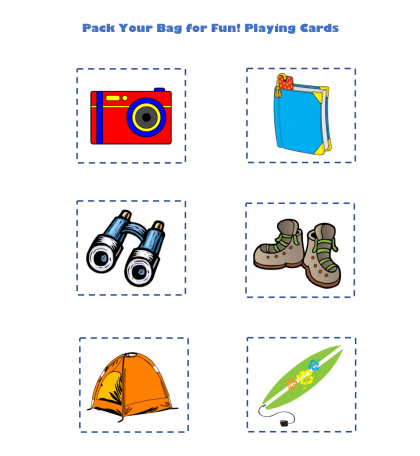
celebrate-picture-books-picture-book-review-suitcase-board-game-playing-cards

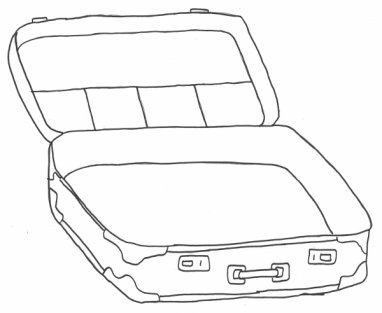
Pack Your Bags for Fun! Board Game


If you love to travel, you know the first thing you have to do is pack your suitcase. With this printable game you can stuff your bag full of everything you’ll need for an awesome trip!

Supplies

celebrate-picture-books-picture-book-review-pack-your-bag-game-board

Directions

  1. Print one game board and set of playing cards for each player
  2. Print one playing die
  3. Players can color their suitcase game board if they’d like
  4. Cut out individual game cards and give a set to each player
  5. Cut out and assemble playing die, taping edges together
  6. Choose a player to go first. Play continues to the right.
  7. Players roll the die to place items on their backpack
  8. The first player to get all six items is the winner

celebrate-picture-books-picture-book-review-travel-guide-for-monsters-cover

You can find Travel Guide for Monsters at these booksellers

Anderson’s Bookshop | Barbara’s Bookstore | Between the Lynes | Booked | The Book Stall | Amazon | IndieBound 

Picture Book Review


March 19 – The Spring Equinox

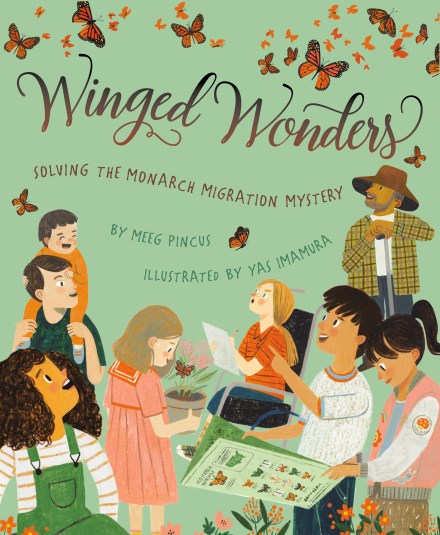
celebrate-picture-books-picture-book-review-winged-wonders-cover

About the Holiday

Today, we celebrate the first day of spring! What makes the equinox so special? On this date, day and night are equally long around the globe. With longer days and warmer weather, thoughts turn to nature and renewal. For many this means gardening for ourselves and for the returning bees and butterflies. Today’s book takes a look at one of nature’s most inspiring creatures – the monarch butterfly. 

I received a copy of Winged Wonders from Sleeping Bear Press for review of consideration. All opinions about the book are my own.

Winged Wonders: Solving the Migration Mystery

Written by Meeg Pincus | Illustrated by Yas Imamura


For centuries people pondered the mystery of the monarch butterflies that “swooped in for a spell, like clockwork” from who-knew-where and fluttered off to some unseen destination. People all along their route, “from southern Canada…through the middle of the United States…and all the way to central Mexico” wondered about this annual event. The mystery was finally solved in 1976. What was it that set these butterflies soaring? The newspapers called it “The Great Monarch Migration.”

celebrate-picture-books-picture-book-review-winged-wonders-citizen-scientists

Image copyright Yas Imamura, 2020, text copyright Meeg Pincus, 2020. Courtesy of Sleeping Bear Press.

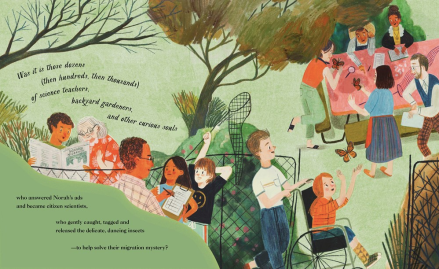
You might wonder who the person was who “tracked these winged wonders from one end of the continent to the other” and “found their secret roosting place, a marvel of nature.” Perhaps it was Fred, a scientist from Canada, who spent thirty years studying the monarchs and tagging their wings. Or maybe it was his wife, Norah, who sought help in tagging monarchs’ wings from volunteers across the country and “logged and mapped every tidbit of information they sent in to the lab.”

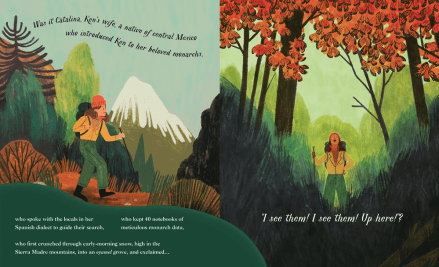
Could it have been the thousands of “science teachers, backyard gardeners, and other curious souls” who answered Norah’s plea? Or you might want to consider Ken and Catalina, a couple in Mexico who spent two years “trying to track the butterflies’ twisting trail” with the help of villagers and farmers. You might even say that it was Jim, a science teacher in Minnesota, who caught and tagged a very particular one-among-millions monarch.

celebrate-picture-books-picture-book-review-winged-wonders-catalina

Image copyright Yas Imamura, 2020, text copyright Meeg Pincus, 2020. Courtesy of Sleeping Bear Press.

So who was it? Who made that 1976 discovery? If you say all of them, you’re right! Communities across the North American countries of Canada, America, and Mexico came together to solve the mystery of one of nature’s most astounding phenomena. But now, another question concerning monarchs looms: “How will they survive?” Since that first discovery, the monarch population has dropped from “at least a billion to millions—a handful now to each hundred then” due to pesticides, pollution, and habitat destruction. Who do you think can help solve this monarch question? “The answer is really no mystery at all.”

An extensive Author’s Note following the text offers more information about the monarch migration discovery as well as ideas and projects for helping the monarch population grow and thrive.

celebrate-picture-books-picture-book-review-winged-wonders-caterpillars

Image copyright Yas Imamura, 2020, text copyright Meeg Pincus, 2020. Courtesy of Sleeping Bear Press.

Mirroring the flight of the monarchs, Meeg Pincus entices readers along the route of her story with fascinating facts about the personalities and eager citizen scientists who dedicated their lives and contributed their time to catching, tagging, and tracking these beautiful butterflies. Surprising details reveal the commitment in time and effort of so many people who enthusiastically answered Norah’s call for help. Her questioning format builds this same feel of excitement and community as page-by-page more people are added for readers to learn about and consider. Pincus’s lyrical storytelling is as buoyant and lovely as her subject while providing readers with a depth of knowledge about the process and experiences of the people along the way.

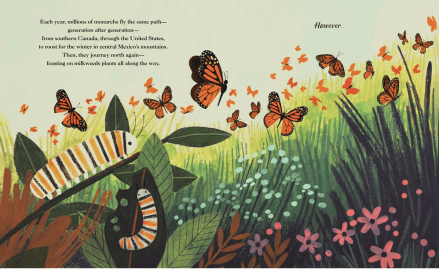
Yas Imamura’s delicate butterflies flutter above multi-hued green hills, busy downtown shops, and a golden desert before congregating like autumn leaves on a solitary tree as a deer looks on. Readers then begin to meet the scientists & participants: Fred and Norah in their well-packed car awed at spotting a monarch along their route, experimenting with wing tags, and mapping monarch sightings; a diverse group of kids and adults catching, tagging, and releasing butterflies; Ken and Catalina and the people of central Mexico, who share their colorful Día de los Muertos celebrations with these winged visitors; and finally Jim and his students.

Imamura’s glorious color palette complements the orange monarchs with soft pinks, corals, yellows, and reds while dramatically highlighting them against dark green backgrounds. Show-stopping scenes of the monarchs gathered on tree trunks and branches and the final spread of a butterfly garden are awe-inspiring and will spark children’s interest in helping to protect and help these unique creatures.

Winged Wonders: Solving the Monarch Migration Mystery is a must for home, school, and public library collections for nature lovers, citizen scientists, and any child who is a budding environmentalist as well as for lessons on science and community engagement.

Ages 7 – 10

Sleeping Bear Press, 2020 | ISBN 978-1534110403

Discover more about Meeg Pincus and her books on her website.

To learn more about Yas Imamura, her books, and her art, visit her website.

You can download an Educational Guide with activities for Winged Wonders on the Sleeping Bear Press website.

Spring Equinox Activity

celebrate-picture-books-picture-book-review-flower-garden-game

Plant a Flower Garden Game


With this fun game you and your family and friends can grow gardens inside! Roll the dice to see whose garden will fully blossom first!

Supplies

Directions

Object: The object of the game is for each player to fill their garden or garden row with flowers. Depending on the ages of the players, the game can be adjusted to fill all of the rows, some or all rows, or just one. 

Options:

  • Players can “plant” each of the six rows with multiple flowers of the same type
  • Each player can be assigned a single row and “plant” one each of the six types of flowers 
  1. Print number of Game Boards needed 
  2. Print one or more sets of Flower Playing Cards for each player, depending on how many of each flower the players want to put in each row (For example: fewer for younger children, more for older). For sturdier playing items, print on card stock.
  3. Cut the playing cards apart
  4. Print one Flower Playing Die and assemble (for a sturdier die, print on card stock)
  5. Color the “dirt” on the Garden Plot (optional)
  6. Choose a player to go first
  7. The player rolls the die and then “plants” the flower rolled in a row on the game board
  8. Play moves to the person on the right
  9. Players continue rolling the die and “planting” flowers until each of the number of determined rows have been filled with flowers or one row has been filled with all six flowers.
  10. The first person to “grow” all of their flowers wins!

celebrate-picture-books-picture-book-review-winged-wonders-cover

You can find Winged Wonders: Solving the Monarch Migration Mystery at these booksellers

Amazon | Barnes & Noble | Books-a-Million | IndieBound

Picture Book Review
March 3 – World Wildlife Day

celebrate-picture-books-picture-book-review-extinct-cover

About the Holiday

This United Nations-sponsored holiday was established in 2013 to celebrate the world’s wild animals and plants and to raise awareness of the perils they face. Since that time, World Wildlife Day has grown to be the most important global event dedicated to wildlife. Each year, the organizers adopt a theme addressing a pressing wildlife issue. This year’s theme is Sustaining All Life on Earth and encompasses raising awareness of the importance of biodiversity to the environment and to humans as well. The world relies on its biodiversity for clean air and water, food, energy, and materials of all types. But our biodiversity is in danger through unsustainable human activities. It is up to us to decide and act now for the future. Today’s book gives readers a good place to start in seeing species we’ve recently lost and how we can help. To learn more visit the World Wildlife Day website.

I received a copy of Extinct from Phaidon Press for review consideration. All opinions of the book are my own.

Extinct: An Illustrated Exploration of Animals That Have Disappeared

Written by Lucas Riera | Illustrated by Jack Tite


When most people hear the word extinct, they picture T-rex, brontosaurus, or maybe a mastodon. Images of bones long buried and museum exhibits of fossils come to mind. But Extinct: An Illustrated Exploration of Animals That Have Disappeared introduces young readers to the fact that “species become extinct all the time—in fact, it’s happening right now.” Lucas Riera and Jack Tite focus on 90 species that have been lost recently, specifically from the 20th century to today. These animals from all habitats are familiar to children and provide examples of how and why certain species are disappearing. For young conservationists, the stories and facts included offer a roadmap to future action and protective measures while honoring these beautiful animals.

celebrate-picture-books-picture-book-review-extinct-predators

Image copyright Jack Tite, 2019, text copyright Lucas Riera, 2019. Courtesy of Phaidon Press.

Turning to the first page, readers meet six big cats that have disappeared from their homelands due to habitat destruction or hunting. The Formosan clouded leopard, a great climber native to Taiwan and named for the “distinctive shape of their spots,” succumbed to the loss of their natural habitat through logging. “The species was declared extinct in 2013. However, in 2019, two unconfirmed sightings have given hope that they may still be out there.” Also on this page, children are introduced to Tibbles—a house cat (or lighthouse cat, to be more precise) that single-pawedly wiped out the population of New Zealand’s Stephens Island wrens.

Next, children learn about the Thylacine (aka Tasmanian tiger or Tasmanian wolf). Striped like a tiger, carnivorous like a wolf, and the size of a large dog, Thylacines were actually marsupials, capable of hoping on their back legs. Their population dwindled to one by 1933 because of hunting by settlers and through their dogs, which killed the Thylacine’s prey and introduced diseases. “The last specimen was captured in 1933 and lived out its lonely life in an Australian zoo until September 7, 1936.

celebrate-picture-books-picture-book-review-extinct-athletes

Image copyright Jack Tite, 2019, text copyright Lucas Riera, 2019. Courtesy of Phaidon Press.

Speaking of marsupials, Riera highlights seven of these distinctive creatures, ranging from mouse-sized to about three feet tall, that once hopped their way across grasslands and deserts. Many fell victim to foxes, other predators, and habitat change. These include the crescent nail-tail wallaby, the yallara, and the pig-footed bandicoot, which was the size of a cat, had the streamlined face of a bird and whose front feet resembled pigs’ hooves while their back feet were more like horses’ hooves.

Twelve species of reptiles, including three types of giant tortoise, a turtle, skinks, lizards, and snakes, as well as nine species of amphibians, including toads, newts, salamanders, and frogs will fascinate kids. One of these—the gastric brooding frog—may have been one of the most unusual creatures in the forest. What made them unique? “The females swallowed their eggs during gestation. The eggs grew inside her belly! After six weeks, her developed babies would emerge from her mouth. Sadly, these wonderful weirdos have been extinct since 2002.”

celebrate-picture-books-picture-book-review-extinct-the-swimmers

Image copyright Jack Tite, 2019, text copyright Lucas Riera, 2019. Courtesy of Phaidon Press.

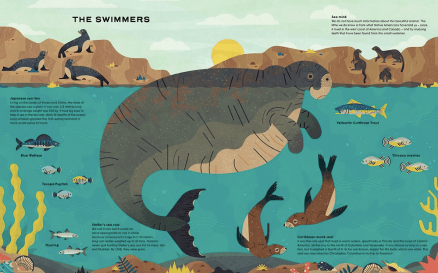
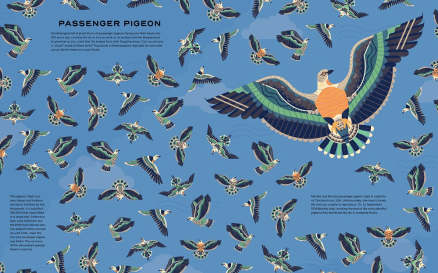
Two-page spreads are also dedicated to Amazing Athletes, Superb Swimmers, Big and Beautiful rhinos and hippo, Powerful Pack wolves, Birds, Primates, and Fantastic Foragers, including the Caucasian wisent, a bison that once thrived in the cold mountains of Eastern Europe. “In the 19th century, their population numbered in the thousands, but then humans settled in the mountains and hunting ensued. In 1927, poachers killed the last three individuals that lived in the wild.” In addition to the Thylacine, Riera highlights three other individual animals—the passenger pigeon, the great auk, and the California Grizzly.

celebrate-picture-books-picture-book-review-extinct-big-and-beautiful

Image copyright Jack Tite, 2019, text copyright Lucas Riera, 2019. Courtesy of Phaidon Press.

Following the species profiles, Riera presents an extensive discussion of extinction today, including the fact that currently “the rate of extinction is estimated to be much faster than the natural rate—by as much as 1,000 times”—and that “it’s the sixth time in billions of years that levels of extinction have been extremely high.” He also reveals causes of extinction, wildlife organizations and examples of positive results, and summaries of work to protect three critically endangered animals. On the next page, Jack Tite depicts more critically endangered animals being tracked by the International Union for Conservation of Nature. Finally, concerned children and adults will find resources for getting involved on local and international levels as well as tips for being more environmentally conscious.

celebrate-picture-books-picture-book-review-extinct-passenger-pigeon

Image copyright Jack Tite, 2019, text copyright Lucas Riera, 2019. Courtesy of Phaidon Press.

Lucas Riera introduces readers to this wide variety of animals through fascinating, conversational, and descriptive paragraphs that reveal tidbits about their distinctive features, where they lived, and how they became extinct. Dates of extinction are eye-opening, especially those for creatures that have disappeared within the lifetime of many young readers. Pages packed with reptiles, birds, amphibians and more, invite children to explore these animals further and present jumping off points for nature and environmental science classes for a wide age range of students.

In this stunning oversized book, Jack Tite accompanies the text with vibrant, eye-catching imagery of animals prowling, leaping, swimming, running, and otherwise on the move that gives readers an up-close view of their beautiful markings and distinguishing traits. Textured backgrounds place the animals in their natural environments from sun-drenched deserts to deep seas to tropical forests and beyond. In what may be a plea for the future, most of the animals gaze out from the page directly at readers, seeming to invite them to learn more and engage them in conservation efforts.

Full of information about environmental science, extinction, and animals that once roamed our planet, Extinct: An Illustrated Exploration of Animals That Have Disappeared is a lush and deep resource for young nature lovers and conservationists at home, in schools, and for public libraries.

Ages 5 and up

Phaidon Press, 2019 | ISBN 978-1838660376

To learn more about Jack Tite, his books, and his art, visit his website.

National Wildlife Day Activity

celebrate-picture-books-picture-book-review-wonderful-wildlife-board-game

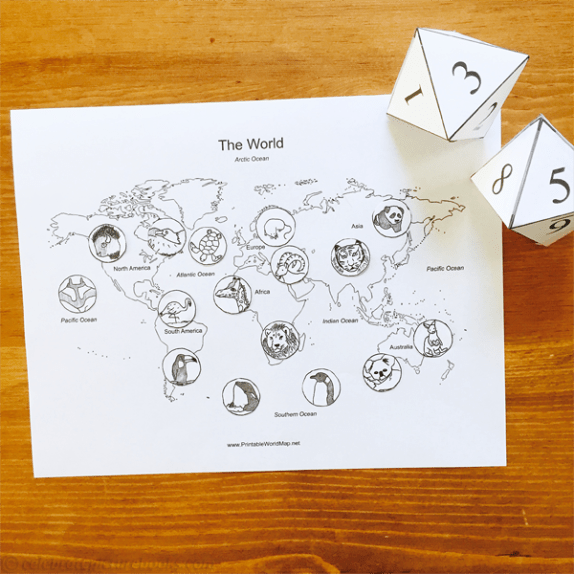
Fascinating animals are found in every part of the world. Play this fun printable Wonderful Wildlife Board Game to match each animal to the area where it lives.

Supplies

Directions

  1. Print a World Map for each player
  2. Print one set of 16 Wildlife Tokens for each player
  3. Print two copies of the 8-sided die, fold, and tape together
  4. If you would like, color the map and tokens
  5. Choose a player to go first
  6. Each player rolls both dice and places an animal on their map according to these corresponding sums of the dice as shown on printable guide
  7. The first player to fill their map is the winner!

celebrate-picture-books-picture-book-review-extinct-cover

You can find Extinct: An Illustrated Exploration of Animals That Have Disappeared at these booksellers

Amazon | Barnes & Noble | Books-a-Million | IndieBound

Picture Book Review