September 1 – It’s Read a New Book Month

celebrate-picture-books-picture-book-review-the-boy-and-the-mountain-cover

About the Holiday

The beginning of a new school year is a terrific time to celebrate Read a New Book Month—especially for kids. Whether their reading tastes have broadened, their reading level has changed, or they’ve discovered new and fascinating topics to explore over the summer months, there are new books just waiting for them! The books may be recently published—like today’s book—or just new to your child, there are countless fictional stories and nonfiction books ready to inspire learning, to laugh or cry with, and to share with friends. This month visit your local bookstore and library and stock up on books for your kids and everyone in the family! 

The Boy and the Mountain

Written by Mario Bellini | Illustrated by Marianna Coppo


“There once was a boy who always looked at a mountain.” It was the first thing he looked at in the morning and the last thing he said good night to before going to bed. The boy loved to draw, and one day he “decided to draw the mountain.” His first attempt didn’t look anything like the mountain he saw out his window. When he looked closer, he realized “the mountain was covered with trees,” so he added trees. 

celebrate-picture-books-picture-book-review-the-boy-and-the-mountain-drawing

Image copyright Marianna Coppo, 2022, text copyright Mario Bellini, 2022. Courtesy of Tundra Books.

Still, his picture wasn’t quite right. Next, he noticed the sky and clouds around the mountain and drew those, but his picture “still didn’t look the same as the real thing.” He tried drawing the mountain at different times of day and in different weather, but “he was never happy with what he had drawn.” 

One day, the boy decided to get a closer look. He took his dog and headed out. One the way, he met a goat and drew a picture of it in his sketchbook. The goat decided to come along. When a flock of birds flew by, the boy drew those too. One bird left the flock to follow the boy and his dog and the goat. When they stopped at a stream for a drink of water, the boy drew that too.

celebrate-picture-books-picture-book-review-the-boy-and-the-mountain-trees

Image copyright Marianna Coppo, 2022, text copyright Mario Bellini, 2022. Courtesy of Tundra Books.

It was fall, and the ground was covered in leaves. The boy “wanted to draw them all,” but even though he drew many of them, there was no way they would all fit on the page. He continued on up and up into the forest and beyond. Along the way, he picked up other followers, including a frog, a bear, and a beaver. When he had left the trees behind, there was very little to draw “until he looked more closely” and saw a tiny white flower poking up between some rocks. He drew it.
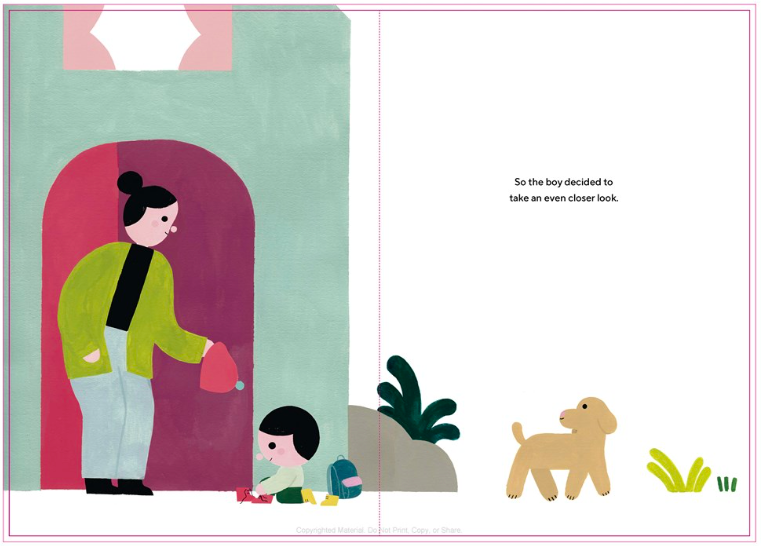
celebrate-picture-books-picture-book-review-the-boy-and-the-mountain-hike

Image copyright Marianna Coppo, 2022, text copyright Mario Bellini, 2022. Courtesy of Tundra Books.

At last he came to the mountain’s peak. He sat down and flipped through his sketchbook, but he still wasn’t satisfied with his drawings. It was then that he became aware of the goat, the bear, the frog, the bird, the beaver, and a snail who had joined him. “‘Ohhh … hello!'” he said. They played until it was time to go home. The bear gave the boy a ride home on his shoulders. Once home, the boy promised that he would see them all again soon. That night before going to sleep, the boy drew the mountain again with his new perspective. This time his drawing was complete—and the boy was completely satisfied with it.

celebrate-picture-books-picture-book-review-the-boy-and-the-mountain-goat

Image copyright Marianna Coppo, 2022, text copyright Mario Bellini, 2022. Courtesy of Tundra Books.

Mario Bellini’s thoughtful and well-paced adventure gently guides readers to consider not only their perspective on big and small topics of life but where and how they fit into the wider world. Just as children observe the world from their vantage points of home, school, and activities, the boy in the story looks at the mountain and tries to make sense of it by drawing it. Then, like kids slowly adding bits of what the world has to offer to their lives, the boy includes trees, clouds, and different times of day to his drawing. But he thinks there must be something more, and, now braver and more knowledgeable, he ventures out to get a better look. 

Along the way he sees more of the world and interacts with what he encounters in the way that means the most to him. Some of these experiences turn out well, and others don’t, but he persists. When it appears that he’s finally come to the end of his journey, he sits down (alone, or so he thinks) and ponders his single-subject, disjointed pictures. When he finally notices all of the animals who have joined him on his trek and embraces them as friends, the boy discovers an interconnectedness that has been missing for him all along. At last, with his final drawing, the boy is able to be satisfied with his knowledge, understanding, and place in his world.

Marianna Coppo’s delightful rounded illustrations lend a quiet elegance to the story while allowing readers to view the boy’s drawings for themselves and then join him on his journey to see the mountain up close. Kids will enjoy noticing the animals that begin to populate the boy’s sphere, even while he is unaware that they are following him. The boy’s drawings of the river, the leaf-strewn forest floor, and the hidden mountain peak give kids and adults an opportunity to talk about times when things go wrong, when life seems overcrowded or overwhelming, and when goals seem elusive. Coppo also helps kids see that surprises can be found in the most unlikely of places as well as when you least expect them. 

A multi-layered story that invites thought, observation, conversation, and discovery (of both the self and the world), The Boy and the Mountain would be a favorite read for quiet story times or as a prelude to any new experience at home or in school. The book is highly recommended for home bookshelves as well as classroom, school, and public libraries.

Ages 3 – 7

Tundra Books, 2022 | ISBN 978-0735270251

You can connect with Marianna Coppo on Instagram and Twitter.

Read a New Book Month Activity

celebrate-picture-books-picture-book-review-take-a-bookworm-trek-maze

Take a Bookworm Trek! Maze


These two friends love reading! Can you help them through the maze to meet the bookworm? 

Take a Bookworm Trek! Maze Puzzle | Take a Bookworm Trek! Maze Solution

celebrate-picture-books-picture-book-review-the-boy-and-the-mountain-cover

You can find The Boy and the Mountain at these booksellers

Amazon | Barnes & Noble | Books-a-Million

To support your local independent bookstore, order from 

Bookshop | IndieBound

Picture Book Review
August 27 – It’s National Inventors Month

celebrate-picture-books-picture-book-review-how-was-that-built-cover

About the Holiday

While dates for this holiday may vary – some say May while others celebrate in August, National Inventors Month was established in 1998 by the United Inventors Association of the USA, the Academy of Applied Science, and Inventors’ Digest magazine. This month-long holiday recognizes the imagination and talent of individuals who dare to think differently to create new products, services, and ways of doing things that make a positive contribution to the world. Today, I’m sharing a book that highlights those who reach for the sky, dive under the sea, and look for opportunities to better help and connect people through the structures we use and live in. If you harbor dreams of being an inventor—on a large or small scale—look for opportunities to share your ideas!

How Was that Built?

Written by Roma Agrawal | Illustrated by Katie Hickey


They seem to have sprung from the ground, they soar into the clouds, they cross vast waterways—over and under the ripples and waves, and they come in all shapes and sizes. What are they? Buildings! For lovers of architecture, engineering, and just the marvels that people can construct, Roma Agrawal’s compendium of some of the world’s most incredible buildings will leave them enthralled—and much more knowledgeable on how these structures came to be.

In fifteen chapters, Agrawal reveals all the nuts and bolts about how buildings are secured on difficult sites (such as on sinking ground, in the sea, underground, and on ice); constructed to be tall, long, or able to move; and made to serve civic purposes. In addition to detailed explanations of the conditions architects and engineers must take into consideration when designing and constructing a building, bridge, or other structure, Agrawal clearly describes the materials used, how they are made, and why each is chosen for a particular job.

celebrate-picture-books-picture-book-review-how-was-that-built-emily-warren

Image copyright Katie Hickey, 2022, text copyright Roma Agrawal, 2022. Courtesy of Bloomsbury Children’s Books.

Rounding out each chapter, Agrawal goes in depth on one world building that demonstrates her topic. For example, In the first chapter she introduces readers to the Metropolitan Cathedral in Mexico City, which was built on top of an old Aztec pyramid in the middle of a filled-in lake. When it began sinking and tilting, engineers in the 1990s devised an intriguing way to save it. If you’re a fan of skyscrapers and wonder just how they’re built, a chapter on The Shard in London, which “is over 1,000 feet tall…and has 11,000 glass panels” (and for which Roma Agrawal worked as an engineer) reveals the secrets of a strong core and the incredible machinery that allows workers to keep going up and up.

Readers who love bridges will find two chapters on these beautiful and intricate structures. One reveals the fascinating story of how the construction of the Brooklyn Bridge overcame many challenges under the direction of Emily Warren, a woman who broke barrios for women in the engineering field. Another describes six different types of bridges as well as where they are used and why.

Readers also learn about concrete and how arches and domes work. They then explore the Pantheon and discover how it has stood for nearly 2,000 years. Other concrete structures from around the world are also discussed. You may not think too much about sewers, but imagine living without them! You’ll get a good (and stinky) idea about the conditions in London hundreds of years ago before Joseph Bazalgette designed and built the first sewer system. How did he do it? Agrawal breaks it down and then talks about today’s modern sewers.

celebrate-picture-books-picture-book-review-how-was-that-built-the-shard

Image copyright Katie Hickey, 2022, text copyright Roma Agrawal, 2022. Courtesy of Bloomsbury Children’s Books.

You’ll also find chapters on dams, tunnels, and buildings with moveable parts—or buildings like the Halley VI research station in Antarctica that can be moved easily in their entirety to avoid snow or ice that may crack beneath them. Then there are the challenges of building under the sea and in outer space. While astronauts now rely on the International Space Station, “some engineers and scientists are studying how to build structures on the Moon! Then researchers could live there for a long time to carry out their experiments and learn more about outer space.” What considerations must engineers take into account and what materials will they use? Agrawal fills readers in. She then closes her book with a look toward the future and talks about new materials and methods of building that may transform our world.

Sprinkled throughout the book are “Try It At Home” prompts for experiments that readers can easily do at home to visually interact with the concepts Agrawal lays out, such as using malted milk balls and raisins to understand “how carbon atoms make steel stronger” and making a pneumatic caisson with just a few household items.

Back matter includes a glossary of terms found in the book and brief biographies of ten influential engineers from the past and present.

celebrate-picture-books-picture-book-review-how-was-that-built-outer-space

Image copyright Katie Hickey, 2022, text copyright Roma Agrawal, 2022. Courtesy of Bloomsbury Children’s Books.

Readers of all ages will be engrossed by Roma Agrawal’s guide through the architecture and engineering that go into housing, moving, connecting, and supporting the world’s population. Every page contains fascinating details and interesting tidbits culled from Agrawal’s extensive experience as an engineer. These go far beyond an introduction to landmark buildings to show readers exactly how each type of building works. Relayed in a simple-to-understand, conversational style, her text is also broken up into short paragraphs that are easily digestible and invite further research, making this a superb resource for schools, homeschooling, and enthusiasts of all things engineering and architectural. Agrawal’s inclusion of structures from the past reveal the ingenuity of our ancestors and how they still influence today’s engineers and architects. Kids who love geography, archaeology, astronomy, and learning about all the intricate workings of the world will be enthralled with this book.

Katie Hickey gives readers an insider’s view of these phenomenal buildings with her stylish and incredibly detailed illustrations. Cityscapes allow children to understand the scale of skyscrapers from around the world and the beauty and breadth of New York City’s Brooklyn Bridge. Hickey whisks readers off to London to see The Shard; to New Zealand to view Te matau ā pohe, a bascule bridge whose shape was inspired by a fish hook; to Japan, where the Sapporo Dome accommodates soccer and baseball games with a moveable field of natural turf; and to Africa to stand on the edge of the Katse Dam and look 600 feet down into its reservoir. Along with this world tour, Hickey helps readers visualize the intricate working parts of certain buildings and bridges with interior views and small insets that demonstrate the physics of each design. Images of various types of cranes, pulleys, and other machinery also reveal the science behind building each structure.

A rich and comprehensive resource on the intricate engineering that goes into designing and building complex structures while also sharing the stories behind them, How Was that Built? will captivate readers of all ages. The book is a must for any STEM, science, art, or archaeology lover and belongs in all school and public library collections. 

Ages 6 and up

Bloomsbury Children’s Books, 2022 | ISBN 978-1547609291

Roma Agrawal is a structural engineer who builds big. From footbridges and sculptures, to train stations and skyscrapers – including The Shard – she has left an indelible mark on London’s landscape. She is a tireless promoter of engineering and technical careers to young people, particularly under-represented groups such as women. She has advised policymakers and governments on science education, and has given talks to thousands around the world at universities, schools and organizations, including two for TEDx. Roma has been awarded international awards for her technical prowess and success in promoting the profession, including the prestigious Royal Academy of Engineering’s Rooke Award. 

Discover more about Roma Agrawal and her work on her website, and connect with her on Instagram | Twitter. You can read an interview with Roma Agrawal in Publishers Weekly here.

To view a portfolio of work by Katie Hickey, visit Pickled Ink. You can connect with Katie Hickey on Instagram | Twitter 

National Inventors Month Activity

celebrate-picture-books-picture-book-review-spaghetti-box-bridge-craft

Build a Remarkable Recycled Bridge


You don’t need fancy blocks and construction materials to build a bridge! Little ones will be fascinated to put together a bridge made out of items you already have at home or that may even be slated for the recycle bin. Spaghetti boxes make great roadways, and cut-up egg cartons can be used as supports.

Build a Whole Town

Want to give your bridge a town with a river to span – or maybe two towns to connect? Cereal boxes and pasta boxes make great skyscrapers, apartment buildings, fire stations, and more. Need a farm silo? Grab a peanut butter jar, oatmeal container, or aluminum can. Cut a meandering river for your bridge to span from paper or cardboard. You can use them as is or—if your kids are sticklers for a little more detail—add some paint and details! So look around at the raw materials around you, use your imagination, and get creative!

celebrate-picture-books-picture-book-review-how-was-that-built-cover

You can find How Was that Built? at these booksellers

Amazon | Barnes & Noble | Books-a-Million

To support your local independent bookstore, order from

Bookshop | IndieBound

Picture Book Review
May 18 – International Museum Day

celebrate-picture-books-picture-book-review-the-ultimate-art-museum-cover

About the Holiday

International Museum day was created in 1977 by the International Council of Museums to raise awareness that “museums are an important means of cultural exchange, enrichment of cultures and development of mutual understanding, cooperation and peace among peoples.” The theme for this year is “The Power of Museums.” Museums are not just repositories of the past. They are vital and active members of the communities they serve and as such can be leaders in tackling some of society’s biggest issues. This year the International Council of Museums aimsto “explore the potential of museums to bring about positive change in their communities through three lenses: the power of achieving sustainability, the power of innovating digitalization and accessibility, and the power of community building through education. To learn more about these initiatives, visit the ICOM website. Celebrate International Museum Day by visiting a museum near you – or visit many world-famous museums through today’s book.

The Ultimate Art Museum

By Ferren Gipson

A blurb on the cover of this astounding book sums up the lofty goals it achieves: “40,000 years of the world’s most amazing art in one dream museum!” Indeed, once readers open the cover and accept the “ticket” offered, they can peruse the museum map that lays out the three wings, 18 galleries, and 128 rooms, plus a cafe and garden, that await them. An note from author Ferren Gipson introduces readers to the range of ways art can influence and reflect their times and the people who lived during different eras.

Gipson’s conversational style follows visitors to this unique museum from page to page, prompting them to look, consider, understand, and make connections. On some pages, a question or comment marked by an eye sends readers to another gallery or room to compare artworks, subjects, or themes across time and cultures. Some of these give a page number to consult, while others allow readers to study a room or gallery to find the artwork referred to.

celebrate-picture-books-picture-book-review-the-ultimate-art-museum-galleries

Copyright Ferren Gipson, 2021, courtesy of Phaidon.

Wing 1, appropriately, presents “treasures from the world’s earliest civilizations and the earliest art ever made.” Here, children and adults will find cave art; figurines carved from ivory, bone, and stone; treasures from ancient empires, carved reliefs, the painted, sculpted, and gilded wonders of ancient Egypt, Greece, and Rome. The intricate art of the Byzantine, early Islamic, and Medieval worlds demonstrate important aspects of these cultures as do works from ancient East Asia well as South and Southeast Asia. Readers then cross the Atlantic Ocean to discover the pottery, sculptures, and fabrics created by Native societies of North and South America. Each artwork is accompanied by a paragraph that will draw children in with clear, concise, and fascinating descriptions of the artwork, what it means, and, sometimes, even secrets that it holds.

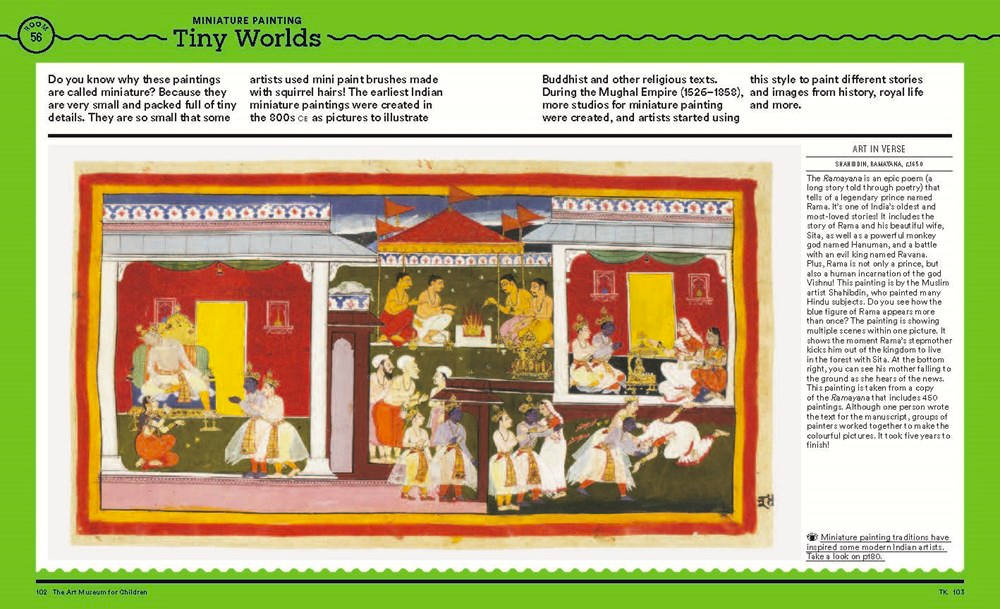
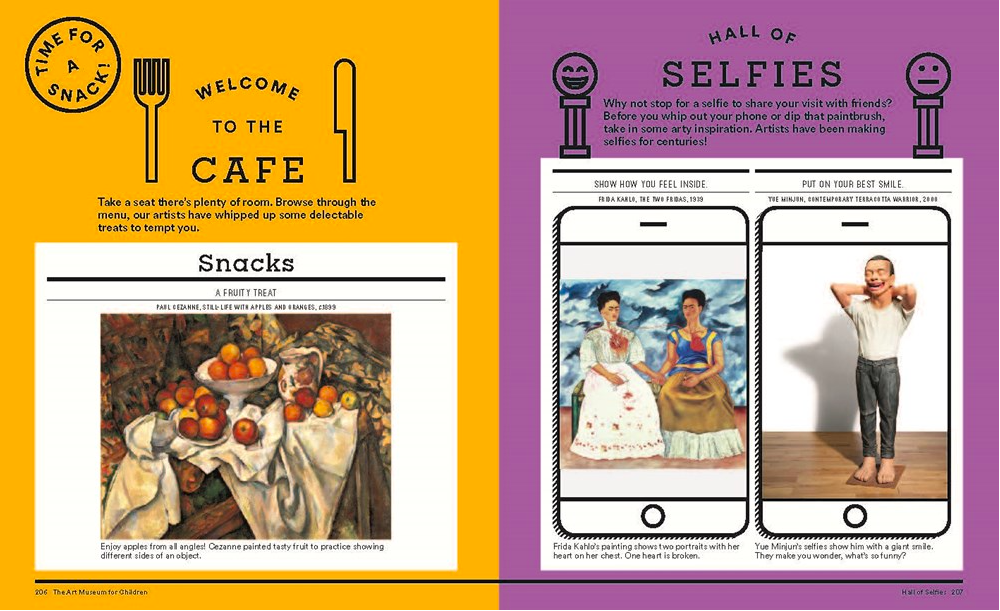
Time for a break? Turn the page and enter the Café, where the “menu,” consisting of “Snacks, Mains, and Dessert” offers delectable choices depicted in paintings and sculpture. Refreshed, readers can step into Wing 2, where the galleries hold treasures from the 1200s to the 1800s created in Asia, including book illustrations, a palepai cloth, a puppet, scholar paintings, porceline, folding screens, carpets, and even the Taj Mahal.

The Renaissance comes to Europe with an impressive display of curiosity and learning that resulted in many changes to society and art. “Artists came up with better ways to mix oil paints and began to paint on canvas for the first time. And what scientists learned about the human body helped them paint and sculpt people who looked very real.” The subjects of artworks expanded too to include “portraits, mythology, and everyday life.” Dragon lovers can take up the challenge to compare two dragons – one created by an Italian master and the other found on a Chinese vase from the Yuan Dynasty.

celebrate-picture-books-picture-book-review-the-ultimate-art-museum-miniatures

Copyright Ferren Gipson, 2021, courtesy of Phaidon.

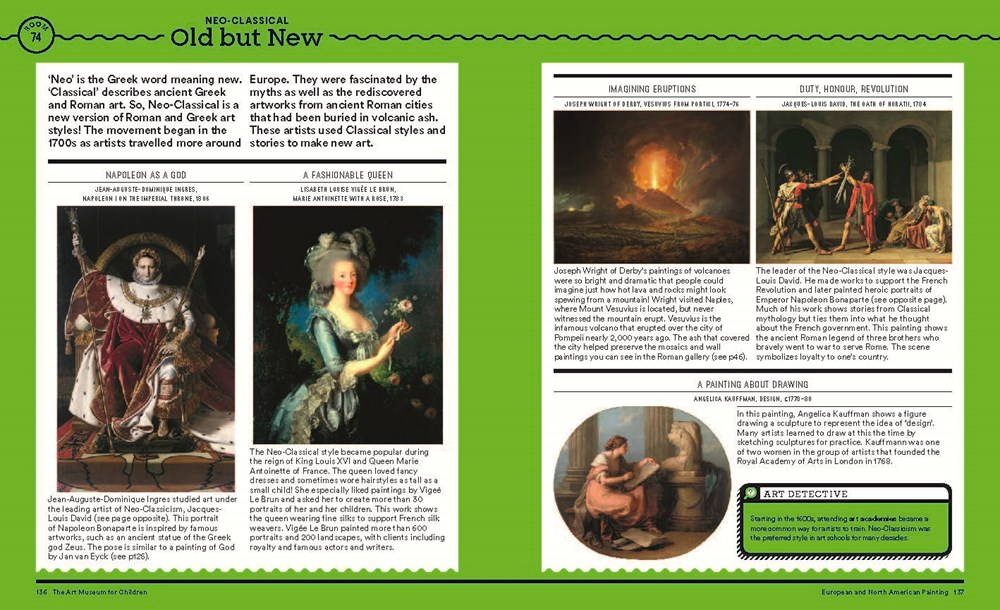
From 1600 – 1850, dramatic and lifelike paintings became popular. Dark shadows and highlighted areas gave paintings an atmospheric feel that invited viewers to look closely. In one of Diego Velázquez’s famous Las Meninas painting, all of the people portrayed seem to be looking out from the canvas at you. But who are they really looking at? The answer can be found reflected in a mirror on the back wall. In addition to realistic family and town life, landscapes also became popular during this time.

Moving to another room, readers will find that the art of the Pacific Islands is distinctively different in its depictions of “images of gods, spirits, and ancestors of the people who lived there.” Those works created from stone and wood have survived through the ages while “others, such as objects made from delicate spider webs or flowers, have disappeared.” Art from the continent of Africa is up next. With its many unique kingdoms and communities, Africa has produced unique artworks that “celebrate leaders and tell the stories of Africa’s great empires and civilizations.” Clay, wood, metal, ivory, and cloth have been used to “create art with spiritual and practical purposes.”

Ah! Time for a walk through the garden. Which path will you take? The one past Georgia O’Keefe’s “Red Poppy” or one where you can see a moth and a caterpillar on the branch of a citrus tree? Perhaps you’d like to stroll through a hurricane with a tiger on your trail with Henri Rousseau’s “Tiger in a Tropical Storm (Surprised)” or maybe you’d like a fragrant walk through Gustav Klimt’s “Flower Garden.”

 
celebrate-picture-books-picture-book-review-the-ultimate-art-museum-neo-classical

Copyright Ferren Gipson, 2021, courtesy of Phaidon.

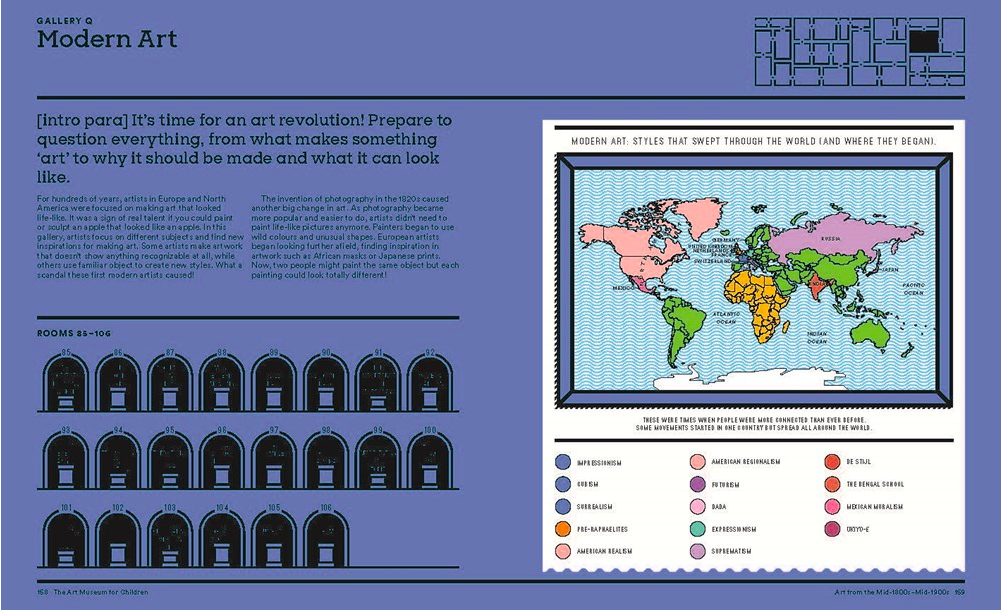
Wing 3 takes readers to modern times, when “almost anything is possible in art!” In this wing, visitors will see “art that does not have a set purpose.” Instead, the artists represented here “created works that were experimental and personal. They used unusual materials and tried exciting techniques.” In these rooms, readers will encounter the Impressionists, who were interested in capturing a moment in time,  and Post-Impressionists, who experimented with color, techniques, and subject matter. Readers will no doubt recognize paintings by Mary Cassatt, Vincent Van Gogh, and Georges Seurat.

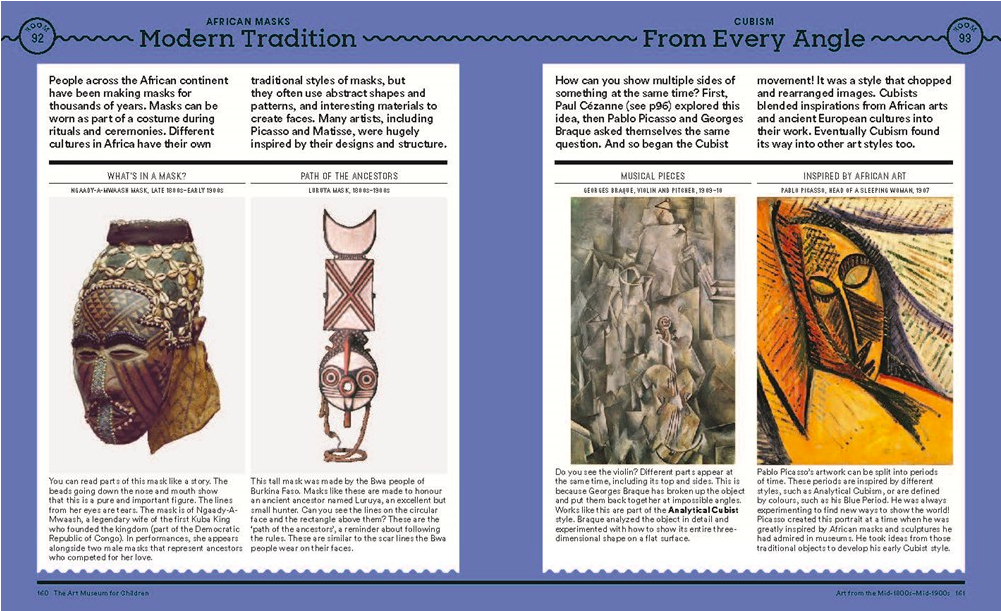
American realist painters took city scenes, sports events, tender moments between family members, and many other topics. The Cubist period began when some artists experimented in showing their subject from a variety of angles at one time. Paul Cézanne, Pablo Picasso, and Georges Braque are just a few of the famous artists who “chopped up and rearranged images” to make a new style of art.

celebrate-picture-books-picture-book-review-the-ultimate-art-museum-map

Copyright Ferren Gipson, 2021, courtesy of Phaidon.

Visitors will also learn about the Dada movement, Expressionism, and American Regionalism. Photography took center stage as cameras became lighter and easier to use. The art of the Harlem Renaissance by Black Americans is reflected in a painting of Harriet Tubman by William H. Johnson, a bronze bust of a boy by Augusta Savage, and a quilt by Harriet Powers – one of only two that still exist.

After visiting a room of modern works from India and Mexico, readers enter the dizzying world of the Surrealists. Surrealism “shows real objects but in a completely fantastical way. It explores how dreams, imaginations, and the inner workings of the mind can be shown in art.” A train emerging from the “tunnel” of a fireplace, a fur teacup, saucer, and spoon, and Salvador Dali’s “drooping” clocks are a few of the works you’ll find here.

celebrate-picture-books-picture-book-review-the-ultimate-art-museum-cubism

Copyright Ferren Gipson, 2021, courtesy of Phaidon.

In Wing 3, readers will also learn about Collages, Abstract Expressionism, Minimalism, Conceptual art, and Op art that boggle the eyes and mind with their optical illusions. Pop art, Installations, contemporary sculptures large and small as well as Alexander Calder’s mobiles and artwork created from light stand side-by-side with Christo and Jeanne-Claude’s outdoor wrapping installations, Aboriginal Australian art, Feminist art, Chicanx art, performance art, video art, contemporary art, and so much more. If you’re a fan of selfies, you’ll want to stop at the Hall of Selfies and see how four artists anticipated and/or reflect this very modern art form.

Helpful maps accompany each wing and gallery change to show readers where the art in that gallery comes from or its influence. A smaller map inset often orients readers to where the region represented is situated in the world at large.

Back matter includes an Author’s Note, a map of 54 major museums around the world, a glossary of terms found in the text, and an index.

celebrate-picture-books-picture-book-review-the-ultimate-art-museum-selfies

Copyright Ferren Gipson, 2021, courtesy of Phaidon.

Ferren Gipson is the “cool” docent every visitor wants as their tour leader on a trip to a museum. Full of enthusiasm for art and its impact, gifted with a wealth of knowledge, and quick with a fun fact, a humorous aside, or an intriguing nugget of perspective, Gipson will wow kids and adults alike with her love of all kinds of art. Open The Ultimate Art Museum to any page and readers will immediately be absorbed by whatever style of art or time in history they’ve hit upon and will eagerly wander from gallery to gallery, room to room, page to page to learn more.

The Ultimate Art Museum has applications for strong cross-curricular study for teachers and homeschoolers, expertly connecting history, art, changing societies, and more visually and textually. Gipson’s entertaining and thorough treatment of her topic will get kids excited about visiting museums of all kinds, and arm-chair travelers will wile away many happy hours wandering its pages. 

The Ultimate Art Museum is a must for classrooms and school and public libraries and would be a much-loved addition to home bookshelves or coffee tables.  

Ages 8 and up

Phaidon, 2021 | ISBN 978-1838663780

Discover more about Ferren Gipson, her books, work, and podcast “Art Matters” on her website.

International Museum Day Activity

CPB - Cookie Jar Museum (2)

Create a Museum Exhibit

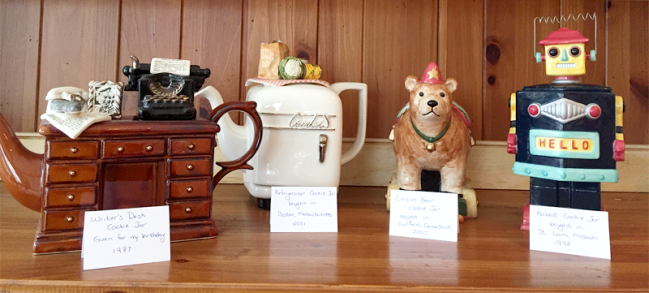
Every item has a story. Maybe there’s a funny anecdote behind that knick-knack on your shelf. Perhaps your favorite serving dish holds sentimental value. How about your child’s best-loved toy or a drawing or craft they’ve made? A fun and educational way for kids to learn family stories and interact with their own history is to create a museum exhibit of objects in your home.

For teachers this can be a fun classroom activity that incorporates writing, art, and speaking as well as categorizing skills. Students can use objects in the classroom or bring items from home to set up museum exhibits. This activity can be done as a whole-class project or by smaller groups, who then present their exhibit to the rest of the class.

Supplies

  • A number of household or classroom items
  • Paper or index cards
  • Markers
  • A table, shelf, or other area for display

Directions

  1. To get started help children gather a number of items from around the house to be the subjects of their exhibit. An exhibit can have a theme, such as Grandma’s China or Travel Souvenirs, or it can contain random items of your child’s choice, such as toys, plants, tools, even the furniture they see and use every day.
  2. Using the paper or cards and markers, children can create labels for their exhibit items. Older children will be able to write the labels themselves; younger children may need adult help.
  3. Spend a little time relating the story behind each object: where it came from, how long you’ve had it, when and how it was used in the past, and include any funny or touching memories attached to the item. Or let your child’s imagination run free, and let them create histories for the objects.
  4. When the labels are finished, arrange the items on a table, shelf, or in a room, and let your child lead family members or classmates on a tour. You can even share the exhibit with family and friends on social media.
  5. If extended family members live in your area, this is a wonderful way for your child to interact with them and learn about their heritage.

celebrate-picture-books-picture-book-review-the-ultimate-art-museum-cover

You can find The Ultimate Art Museum at these booksellers

Amazon | Barnes & Noble | Books-a-Million

To support your local independent bookstore, order from

Bookshop | IndieBound

Picture Book Review

February 22 – National Dog Walking Day

celebrate-picture-books-picture-book-review-the-dog-walk-cover

About the Holiday

Whether you’re still in the midst of winter or spring is knocking on the door, dog owners know that one part – maybe the best part – of their day will be spent taking their beloved pooches for a walk. Today’s holiday celebrates this special time people share with their pets and encourages them to make today’s walk extra fun by taking a new route or rewarding your pup with a few extra treats or minutes of playtime. 

Thanks to Floris Books for sharing a copy of The Dog Walk with me for review consideration. All opinions on the book are my own.

The Dog Walk

By Sven Nordqvist


Anyone who spends time outside with their pet knows that you start to see the yard, neighborhood, and perhaps even the world in a different way. Small details of nature, hidden creatures or objects, odors and sounds wafting on the breeze, and people passing by all become new when seen through the eyes of an animal. In his wildly whimsical The Dog Walk, Sven Nordqvist takes readers on a wordless meandering out of the city and into fantastical worlds where anything is possible.

celebrate-picture-books-picture-book-review-the-dog-walk-bandshell

Copyright Sven Nordqvist, 2021, courtesy of Floris Books.

The frame for this adventure is the titular dog walk, in which a child takes their grandmother’s shaggy pet for a jaunt, setting up dazzling discovery as well as an amusing search-and-find puzzle. Following along on this journey, kids and adults are treated to Nordqvist’s endlessly delightful creativity that plays with perspective and size, the expected and the extraordinary and invites readers to look, look again, and ponder.

As the train leaves the station, traversing a bridge that elevates it high above rolling hills and the vast tree houses residents call home as well as a derelict stone castle that now serves as the trunk of a tree, a giant chess board, and giggle-inducing images of a man rowing a boat with a giraffe as passenger (cargo that requires the drawbridge to be raised and traffic to back up) and a bull sitting on the river’s bank and enjoying a tuft of grass like a person picnicking while his bovine friends chomp grass the regular way.

celebrate-picture-books-picture-book-review-the-dog-walk-seaside

Copyright Sven Nordqvist, 2021, courtesy of Floris Books.

The train is headed for a maze of tracks that twist their way through a castle that houses no fewer than five kings and boasts a turret-top pool. The next stop is a sculpture and animal park, where readers will want to stop and join the cleverly posed statues that tour the gravel paths via goat-pulled platforms and a variety of familiar and fanciful creatures welcome them.

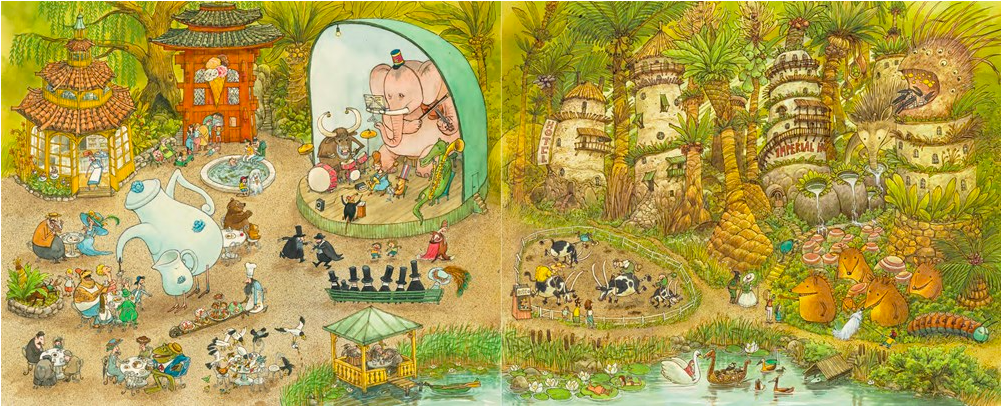
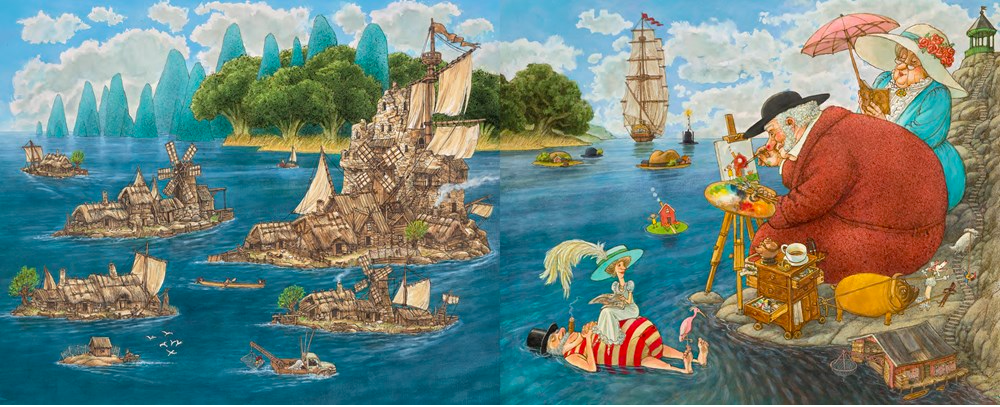
Continuing on, take in the orchestra that’s playing in the bandshell while the appreciative audience enjoys pastries, ice cream, and tea served by a walking teapot and creamer. Further on, readers come to a seaside vista, where small islands of thatched buildings set sail. And if there’s no wind to power them, that’s okay because each island has its own windmill. On shore, a giant couple sit enjoying the sun; the woman reads under a parasol, while the man, his painting supplies at hand, carefully recreates the tiny kindergarten-drawing island. Other islands dotting the inlet are in the shape of hats, while the harbor’s lighthouse is a burning candle atop a top hat.

celebrate-picture-books-picture-book-review-the-dog-walk-antiques-store

Copyright Sven Nordqvist, 2021, courtesy of Floris Books.

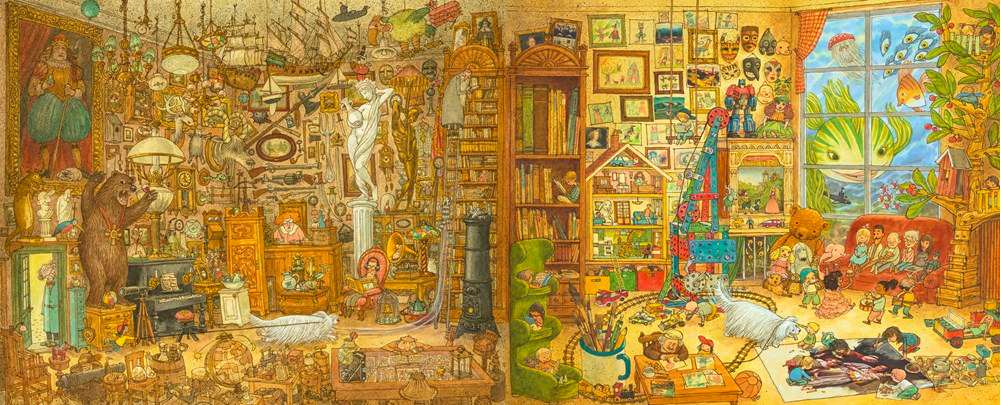
After a bite of lunch, the child is literally dragged into an antiques store – breathtaking in its intricacies – when the pooch chases a cat inside. This showstopper of a two-page spread juxtaposes items from homes of yesteryear with those of today with, of course, surreal and inventive additions to capture readers’ attention and imagination. From here, the walk takes the child into more bucolic scenery, where the dog gets to frolic with other animals while blueberries are picked from tall trees by a well-steered dragonfly.

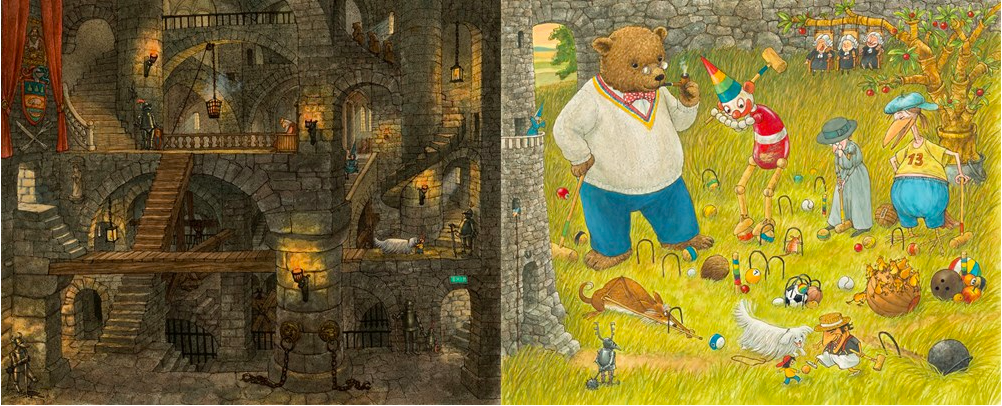
Then dodging spitballs through a field, the two come to a sleepy castle where Escher-like stairways lead to the exit and a game of croquet – or is it billards? It’s nearly time to get back home, but first the dog becomes distracted in a community of cats. But nothing – not even a bicyclist balancing on a huge orange; a unicyclist juggling lit torches, an ax, a knife, and a toaster; or a hot dog big enough to fee four – can arrest the dog’s attention when it sees… Grandma!

celebrate-picture-books-picture-book-review-the-dog-walk-croquet

Copyright Sven Nordqvist, 2021, courtesy of Floris Books.

Beyond lingering over Sven Nordqvist’s hilarious, ingenious, and unbelievably detailed drawings, The Dog Walk offers unending opportunities to expand on and engage with every page. Whether embraced in a classroom or at home, every page provides plenty of inspiration for kids to create their own stories, artwork, inventions, games, and so much more based on the images. Searching for repeated themes, objects, and creatures will also keep kids happily occupied. 

A book for sharing or enjoying individually that will spark laughs, awe, inspiration, and fun conversations, The Dog Walk would make a treasured gift and is a highly rewarding and recommended addition to home, school and public library collections.

Ages 3 and up

Floris Books, 2021 | ISBN 978-1782507437

National Dog Walking Day Activities

celebrate-picture-books-picture-book-review-i-love-dogs-wordsearch-puzzle-shorter-size

I Love Dogs! Word Search Puzzle


If you love dogs, you’ll have fun discovering the names of eighteen dog breeds in this printable word search puzzle!

I Love Dogs! Word Search Puzzle | I Love Dogs! Word Search Solution

CPB - Peppy Puppies Match Up Puzzle

Peppy Puppies Match Up Puzzle


Each of the puppies has a friend. Can you match them up based on one trait? There may be multiple right answers! Why do you think the dogs you chose go together in this printable puzzle?

Peppy Puppies Match Up Puzzle

celebrate-picture-books-picture-book-review-the-dog-walk-cover

You can find The Dog Walk at these booksellers

Amazon | Barnes & Noble | Books-a-Million

To support your local independent bookstore, order from

Bookshop | IndieBound

Picture Book Review


September 29 – It’s Intergeneration Month

celebrate-picture-books-picture-book-review-shaped-by-her-hands-cover

About the Holiday

Cuddle ‘round for two loving holidays—Intergeneration Month and National Attend Your Grandchild’s Birth Day—which each encourage grandparents to be present figures in their grandchildren’s lives starting from birth! Already, many grandparents across the globe play active roles in caring for children. In the US alone, 4.8 million preschoolers were under the care of grandparents in 2011. Whether you are a grandchild, parent, or grandparent, it is important to support family and spread some love. Hug someone special today to celebrate this holiday. In honor of this day, we present a story about artist Maria Povika Martinez, co-written by her great-granddaughter. Her historical account teaches the importance of love, family, and the passing down of knowledge through generations.

Thanks to Albert Whitman & Company for sharing a copy of Shaped By Her Hands with me for review consideration. All opinions on the book are my own.

Review by Dorothy Levine

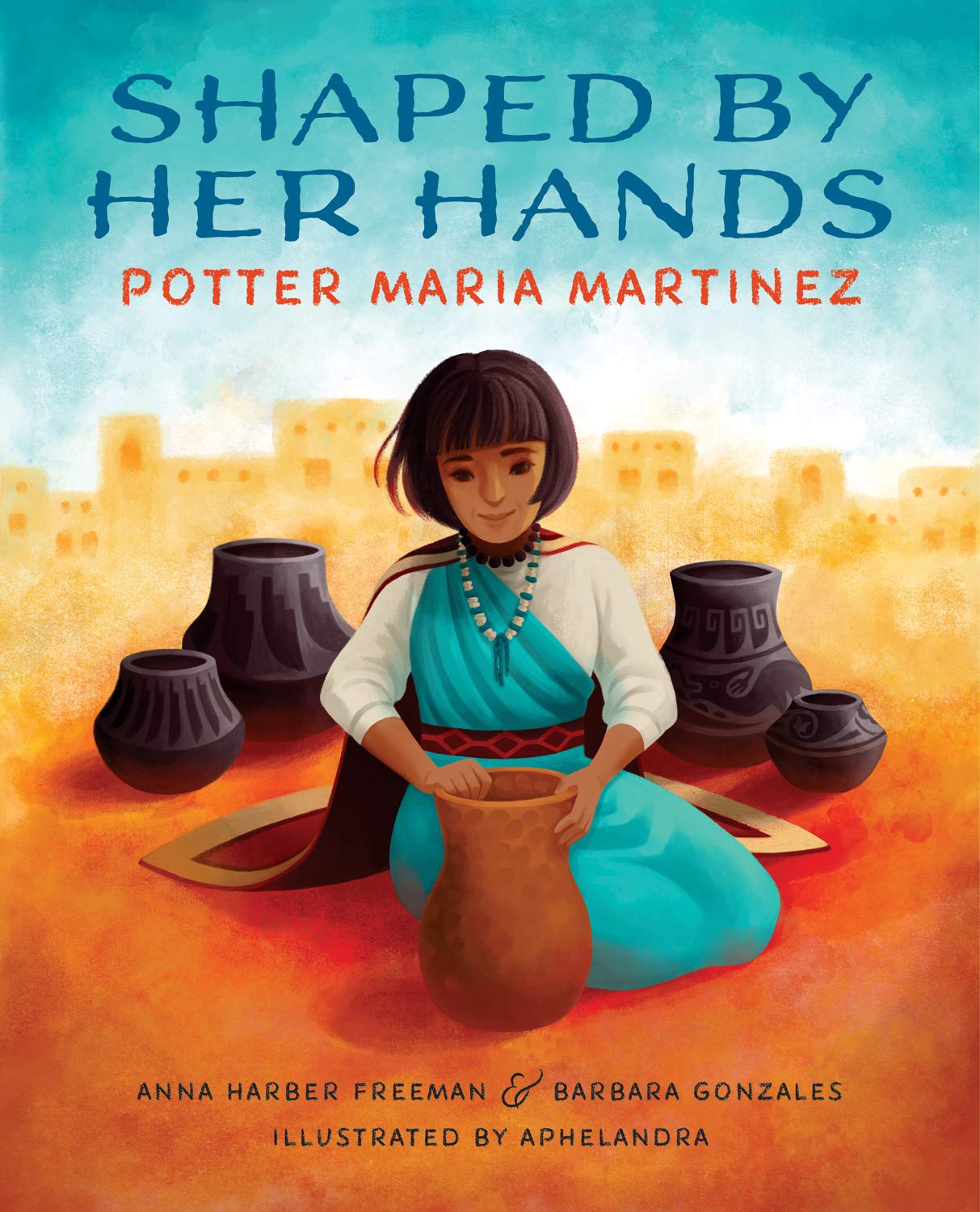
Shaped By Her Hands: Potter Maria Martinez (Part of the She Made History Series)

Written by Anna Harber Freeman and Barbara Gonzales | Illustrated by Aphelandra

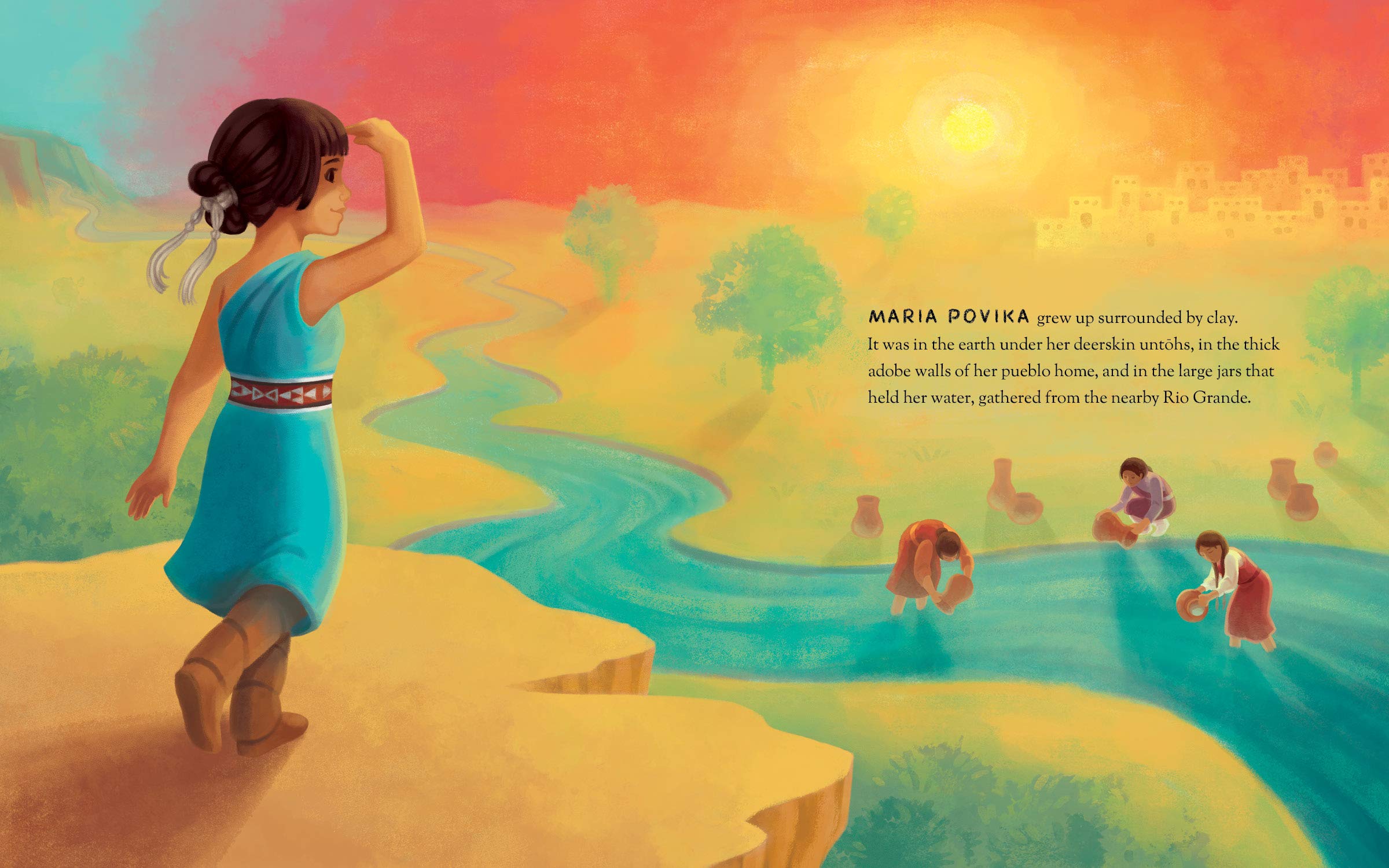
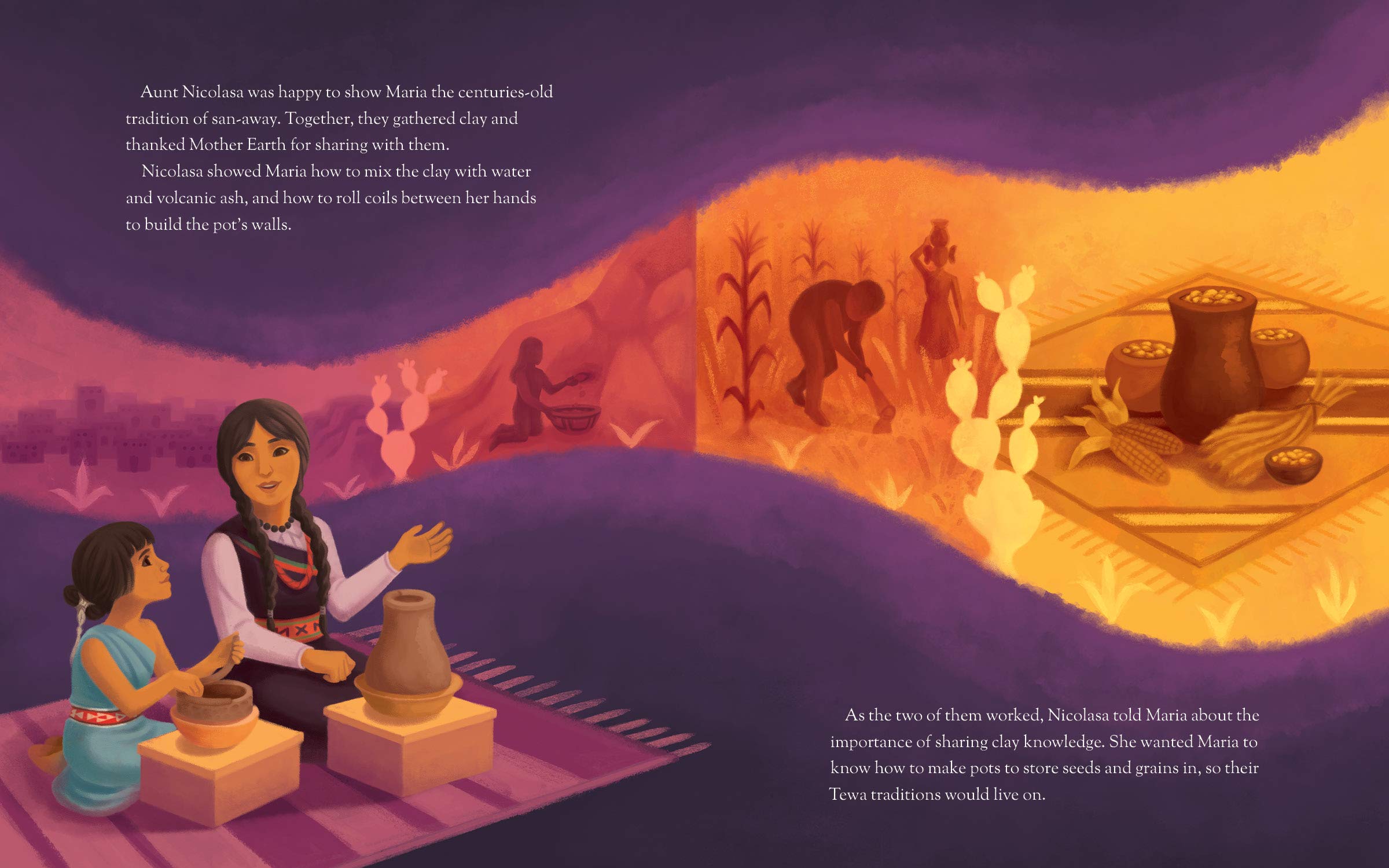
As a child growing up in the pueblo of San Ildefonso, New Mexico in the 1890s, Maria always loved clay. While her siblings played with straw dolls and her parents planted crops, Maria spent her time making clay pots. But, to her frustration, her pots would always crack when she set them out to dry in the sun. Maria’s aunt, or ko-ōo, Nicolasa offered to help and showed Maria “the centuries-old tradition of san-away.” Nicolasa still made clay pots using these traditional methods, even though more and more people were buying tin pots from stores. 

celebrate-picture-books-picture-book-review-shaped-by-her-hands-river

Image copyright Aphelandra, 2021, text copyright Anna Harber Freeman and Barbara Gonzales, 2021. Courtesy of Albert Whitman & Company.

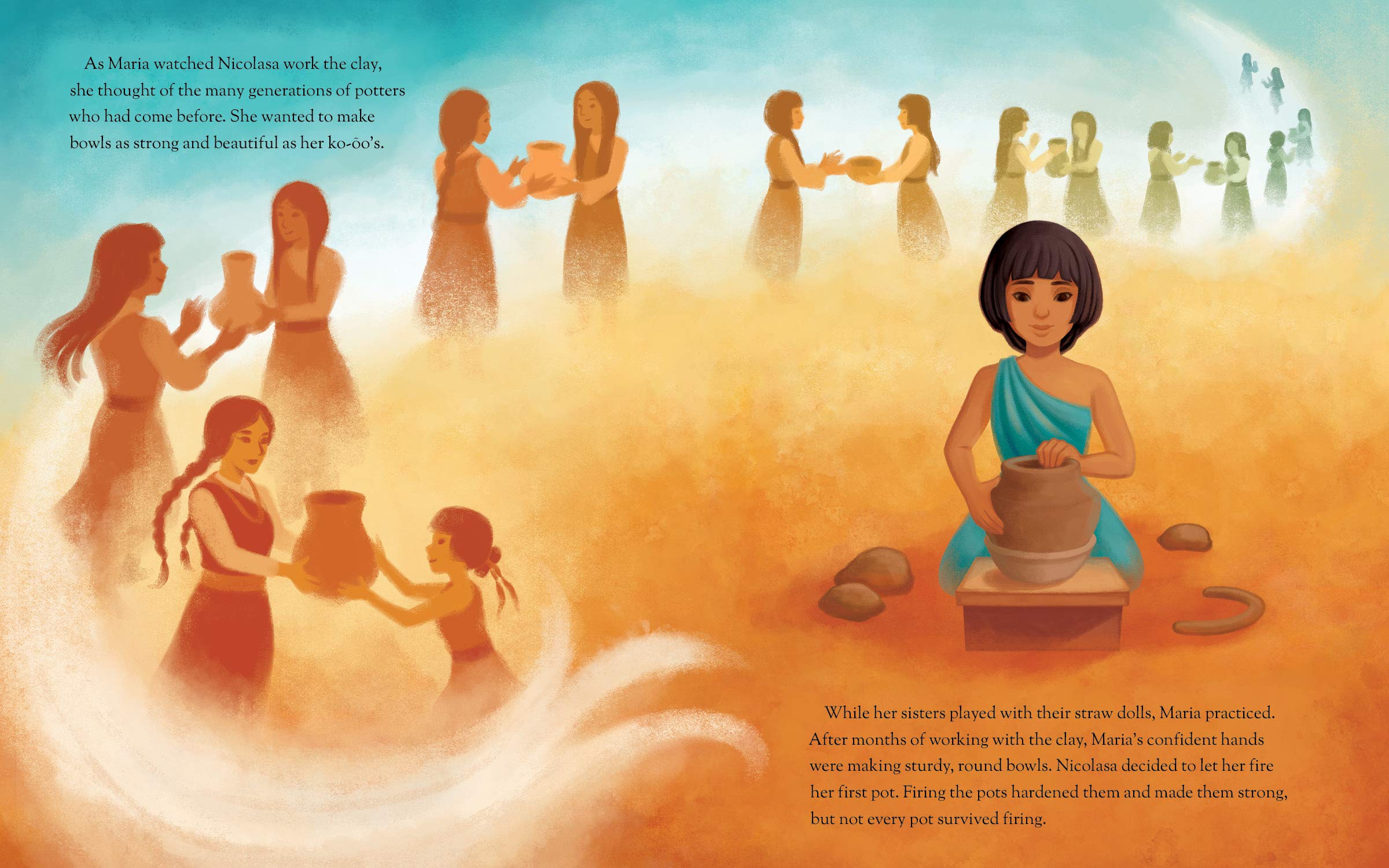
Nicolasa taught Maria how to coil the clay in circles and then lay the pots together on a fire to make them dry, solid, and strong. “As Maria watched Nicolasa work the clay, she thought of the many generations of potters who had come before. She wanted to make bowls as strong and beautiful as her ko-ōo’s.” Nicolasa and Maria thanked Mother Earth for the clay she shared with them. 

When Maria grew older, she continued to make pots and gained a reputation for her skilled work. One day in 1908, an archeologist named Edgar Lee Hewett came to visit Maria. He had discovered an old shard of black pottery in a dig nearby. Mr. Hewett wanted to know if Maria could recreate a pot in the similar style. She decided to take on the challenge.

celebrate-picture-books-picture-book-review-shaped-by-her-hands-Nicolasa

Image copyright Aphelandra, 2021, text copyright Anna Harber Freeman and Barbara Gonzales, 2021. Courtesy of Albert Whitman & Company.

After much experimentation, Maria and her husband, Julian Martinez, discovered a technique: “One afternoon, they tried smothering the fire to keep the smoke in. When they pulled out the pot, it was shiny, and black as a raven.” With this new method, Maria combined her own style with old traditions to create a new style of pottery that was marvelous. Mr. Hewitt took some of these pots Maria made. “He put one of the pots in the Museum of New Mexico, where he worked.” The others he took to shops in Santa Fe. To Maria’s surprise, they sold like crazy! Julian began to paint designs on the black shiny pots—decorations of serpents, feathers, and water—using a yucca-blade brush. 

As more and more pots sold, Maria and Julian taught the rest of her family and some friends to make the pots with them. They became so famous that many people across the country invited them to demonstrate their skills to others. When Maria’s husband died, she continued to make pots with her family. “First, her children came to paint the designs. Later, her grandchildren came to help with the painting and polishing. They made pots as a family, remembering to thank Mother Earth, and teaching new hands to form, polish, and design.” 

The story is followed by back matter that provides more information about Maria, the Tewa people, and the San Ildefonso Pueblo for readers. Both authors include a note about how they were influenced by Maria and why they believe it is important to share her story with young people today. 

celebrate-picture-books-picture-book-review-shaped-by-her-hands-generations

Image copyright Aphelandra, 2021, text copyright Anna Harber Freeman and Barbara Gonzales, 2021. Courtesy of Albert Whitman & Company.

The story is co-written by Barbara Gonzales, the great-grandchild of Maria, and Anna Harber Freeman, whose grandmother was a member of the Osage Nation and who is a lifelong fan of Maria’s work with degrees in multicultural education and art. Their biography of Maria Martinez shines with its lyrical, straightforward telling that reveals the deep history of the Tewa people as well as the meaning and uses of the pottery that Maria and her ko-ōo Nicolasa created by hand. The importance of passing down knowledge and traditions from one generation to another is organically woven throughout the story. Many readers will recognize Maria and Julian’s distinctive pottery and be inspired by the history behind it.

Aphelandra is a descendant of the Oneida Nation, and the daughter of a crafts artist and landscaper. She writes that she grew up surrounded by natural beauty and creativity, which can be seen in her illustrations. The illustrations in Shaped by Her Hands consist largely of soft yellow, green, and red hues. In the part of the story in which Maria is sent off to boarding school, the colorful tones found throughout the book are confined to a single window, depicting the feeling of entrapment and homesickness Maria felt. Aphelandra vividly weaves in the storytelling of past generations through her use of color, shadow and circular imagery. Her painted landscapes gorgeously depict the natural San Ildefonso scenery. 

This beautifully crafted tale shares the history of Maria Povika Martinez while introducing readers to Tewa people’s values of kindness, passing on of knowledge, and respect for elders and Mother Earth. An inspiring read for all children, especially those interested in artistic and creative endeavors, Shaped By Her Hands: Potter Maria Martinez is highly recommended for home bookshelves and a must for school and public library collections.

Ages 4 – 9 

Albert Whitman & Company, 2021 | ISBN 978-0807575994

Discover more about Anna Harber Freeman and her books on her website.

To learn more about Barbara Gonzales and her pottery and to view a video with Barbara and other artists discussing an exhibition of San Ildefonso Pueblo potters at the Museum of Indian Arts and Culture, visit the adobe gallery website.

You can learn more about Aphelandra, her books, and her artwork on her website.

Intergeneration Month Activity

Highlights Kids Homemade Clay figures

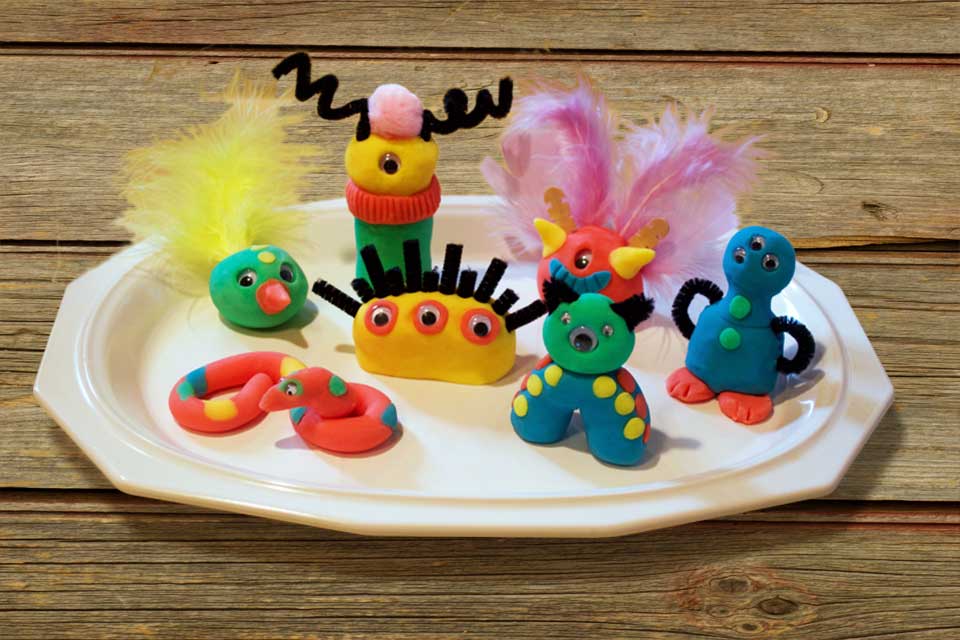
Photo and craft sample by Madison McClain, courtesy of Highlights Kids (highlightskids.com)

This craft comes from Highlights Homemade Clay, by Marie E. Cecchini posted on April 12, 2016. You can find the post on the Highlights kids website.

Make your own homemade clay in honor of Maria’s art form then make your own pot or creation!

What you’ll need

  • 2 cups baking soda
  • 1 cup cornstarch
  • 1 ¼ cups water
  • Cooking pot
  • Food coloring (optional)
  • Wiggly eyes, chenille sticks, pompoms, feathers, etc. (optional)

What to do

Note: Food coloring can be added to the water before mixing in the other ingredients or can be added to the clay after it has cooled. Adding coloring later may be a little messier, but you can divide the clay and create different batches of various colors.

  1. Combine ingredients in the pot and cook mixture over medium heat, stirring until it thickens to a consistency like mashed potatoes.
  2. Let the clay cool
  3. Knead the clay until smooth.
  4. Make creations!
  5. Leave clay pieces in the sun to dry.

celebrate-picture-books-picture-book-review-shaped-by-her-hands-cover

You can find Shaped By Her Hands: Potter Maria Martinez at these booksellers

Amazon | Barnes & Noble | Books-a-Million

To support your local independent bookstore, order from

Bookshop | IndieBound

Picture Book Review

September 15 – International Dot Day

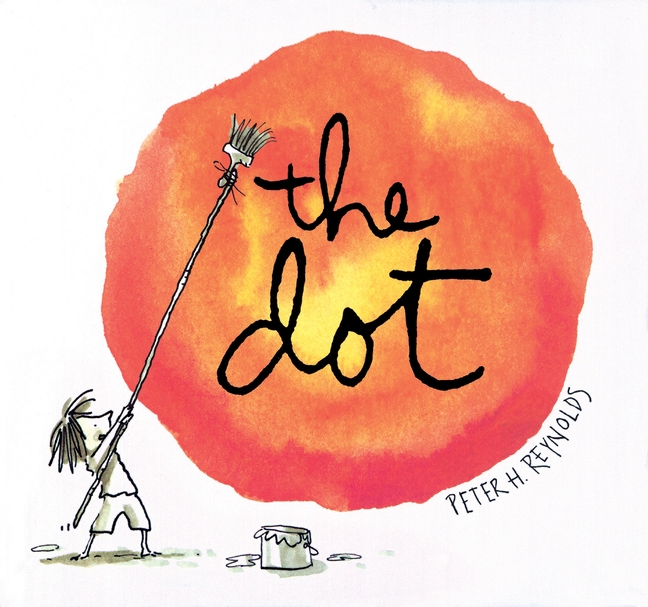
celebrate-picture-books-picture-book-review-the-dot-cover

About the Holiday

Usually, I match books to existing holidays. Today, though, I have the pleasure of posting a review of a book that established a holiday. On September 15, 2009 teacher Terry Shay introduced his class to Peter H. Reynold’s The Dot. From that one event grew a national and then an international celebration of creativity and the freedom to make art with your heart. All around the world, school children and adults are inspired on this day to make their mark and celebrate creativity, courage, and collaboration. For more information, to download posters, coloring pages, postcards, badges, and other resources and to join in on a live event starting at 10:00 a.m. PT, visit the International Dot Day website.

The Dot

By Peter H. Reynolds


At the end of art class, Vashti looked at her paper. It was still as blank as it was at the beginning of art class. Her teacher came over and took a peek. She saw right away that Vashti had drawn “‘a polar bear in a snowstorm.’” Vashti wasn’t fooled by the joke. “‘I just CAN’T draw,’” she said. But her teacher had a suggestion. “‘Just make a mark and see where it takes you.’”

celebrate-picture-books-picture-book-review-the-dot-vashti-jabs-paper

Copyright Peter H. Reynolds, 2003, courtesy of Candlewick Press.

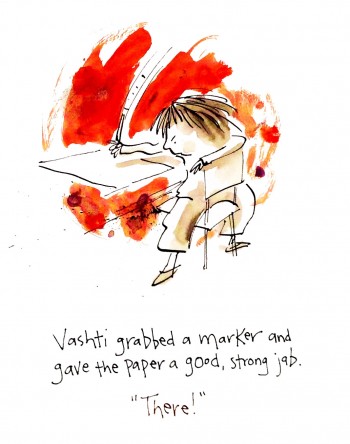
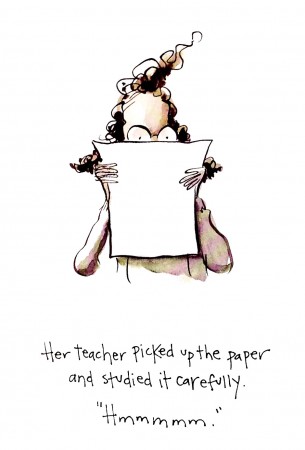
Vashti jabbed at the paper with a marker, making a dot right in the center. Her teacher studied her drawing carefully then told Vashti to sign it. That, at least, was something Vashti could do. She signed her name and gave the paper to her teacher. At the next week’s art class, Vashti was stunned to see her dot framed and hanging above the teacher’s desk. She looked at the tiny mark and decided that she could do better than that.

celebrate-picture-books-picture-book-review-the-dot-teacher

Copyright Peter H. Reynolds, 2003, courtesy of Candlewick Press.

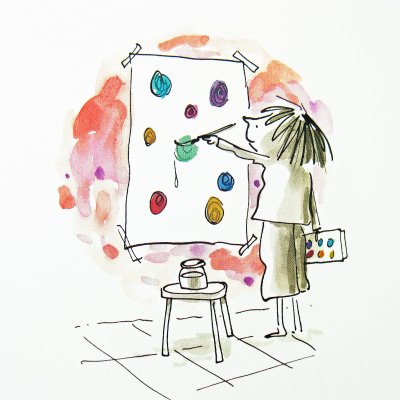
Vashti opened her watercolor set and began. She “painted and painted. A red dot. A purple dot. A yellow dot. A blue dot.” Then she discovered that blue mixed with yellow made a green dot. Vashti went to the easel and began painting lots of little dots in all sorts of colors. She realized if she could make little dots, she could make big dots. She knelt down on the floor with a big piece of paper and a big brush and created a huge dot.

celebrate-picture-books-picture-book-review-the-dot-experimenting-with-dots

Copyright Peter H. Reynolds, 2003, courtesy of Candlewick Press.

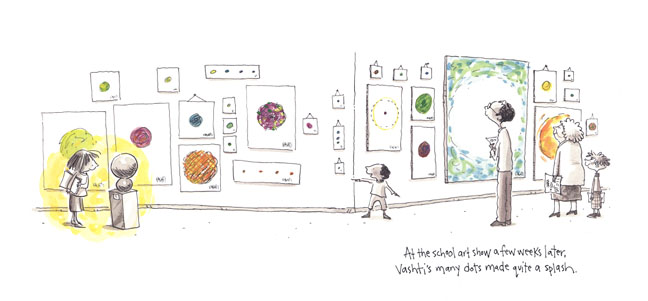
Then on an enormous canvas Vashti “made a dot by not making a dot.” At the school art show, Vashti’s dot paintings covered two walls and were quite a hit. Coming around the corner a little boy spied Vashti. He came close and told her, “‘You’re a really great artist. I wish I could draw.’” Vashti was encouraging, but the little boy said he couldn’t even “‘draw a straight line with a ruler.’”

Vashti wanted to see. She handed the boy a blank sheet of paper. With a quivering pencil, he drew a line and handed the paper back to her. Vashti studied the wavy line for a minute, and then gave the paper back. “‘Please…sign it,’” she said.

celebrate-picture-books-picture-book-review-the-dot-art-show-II

Copyright Peter H. Reynolds, 2003, courtesy of Candlewick Press.

Peter H. Reynold’s classic story of a little girl who believes she can’t draw is inspirational for anyone at any age who listens too closely to that voice in their head that stops them from letting go and doing. Whether it’s painting, writing, changing the décor of one’s house, updating a wardrobe, getting healthy, or even taking a class, the project often seems insurmountable. But what if you could start with a YouTube video, one step, a pair of earrings, a pillow, a word, or…a dot? Reynolds says you can! With his straightforward storytelling, Reynolds gives readers permission to play, experiment, and feel free.

celebrate-picture-books-picture-book-review-the-dot-little-boy

Copyright Peter H. Reynolds, 2003, courtesy of Candlewick Press.

Reynold’s familiar line drawings that sketch out adorable Vashti and her wise teacher are punctuated by the colorful dots that Vashti draws in profusion. Even Vashti, herself, is surrounded by circular auras of color throughout the story, reflecting her talent and creative spirit. The final scene of the art show gallery is a revelation, showing readers that one’s work or life work adds up to an impressive display of the self.

Through and through The Dot is charming, moving, and encouraging. It is a must addition to home libraries, public libraries, and classrooms.

Ages 5 and up

Candlewick Press, 2003 | 978-0763619619

To learn more about International Dot Day and find ideas and resources for classrooms, libraries, and booksellers, a variety of coloring pages to download, and a gallery of projects, visit the International Dot Day website

You’ll learn more about Peter H, Reynolds, his books, and his art as well as find lots of inspiration and creative tips on his website!

International Dot Day Activity

celebrate-picture-books-picture-book-review-dot-day-mini-poster

Make Your Mark! Mini-Poster Coloring Page


Grab your favorite paints, markers, crayons and Make Your Mark with this printable mini-poster from Peter Reynolds!

Make Your Mark! Mini-Poster

celebrate-picture-books-picture-book-review-the-dot-cover

You can find The Dot at these booksellers

Amazon | Barnes & Noble | Books-a-Million

To support your local independent bookstore, order from

Bookshop | IndieBound

Picture Book Review
August 19 – World Photography Day

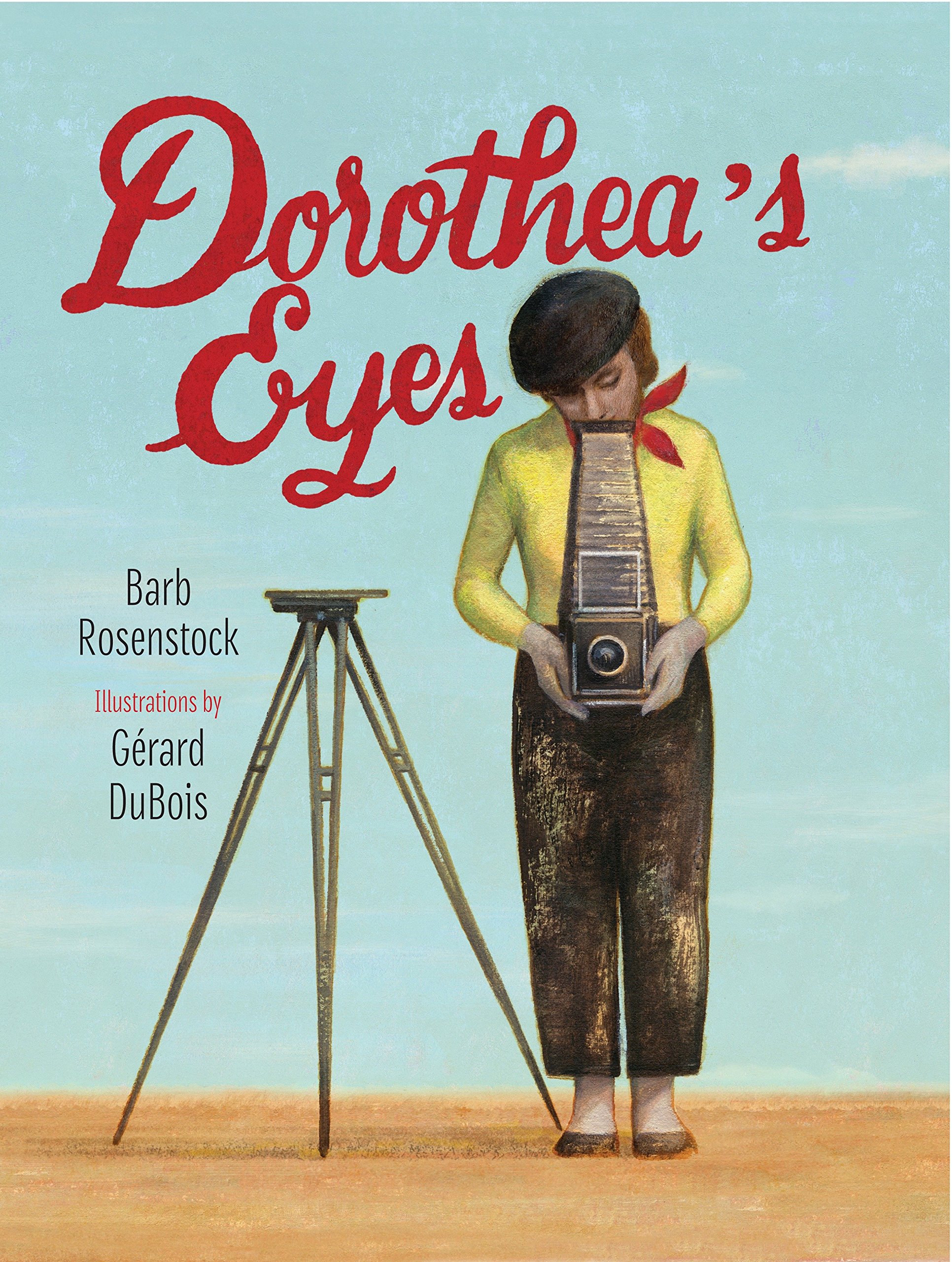
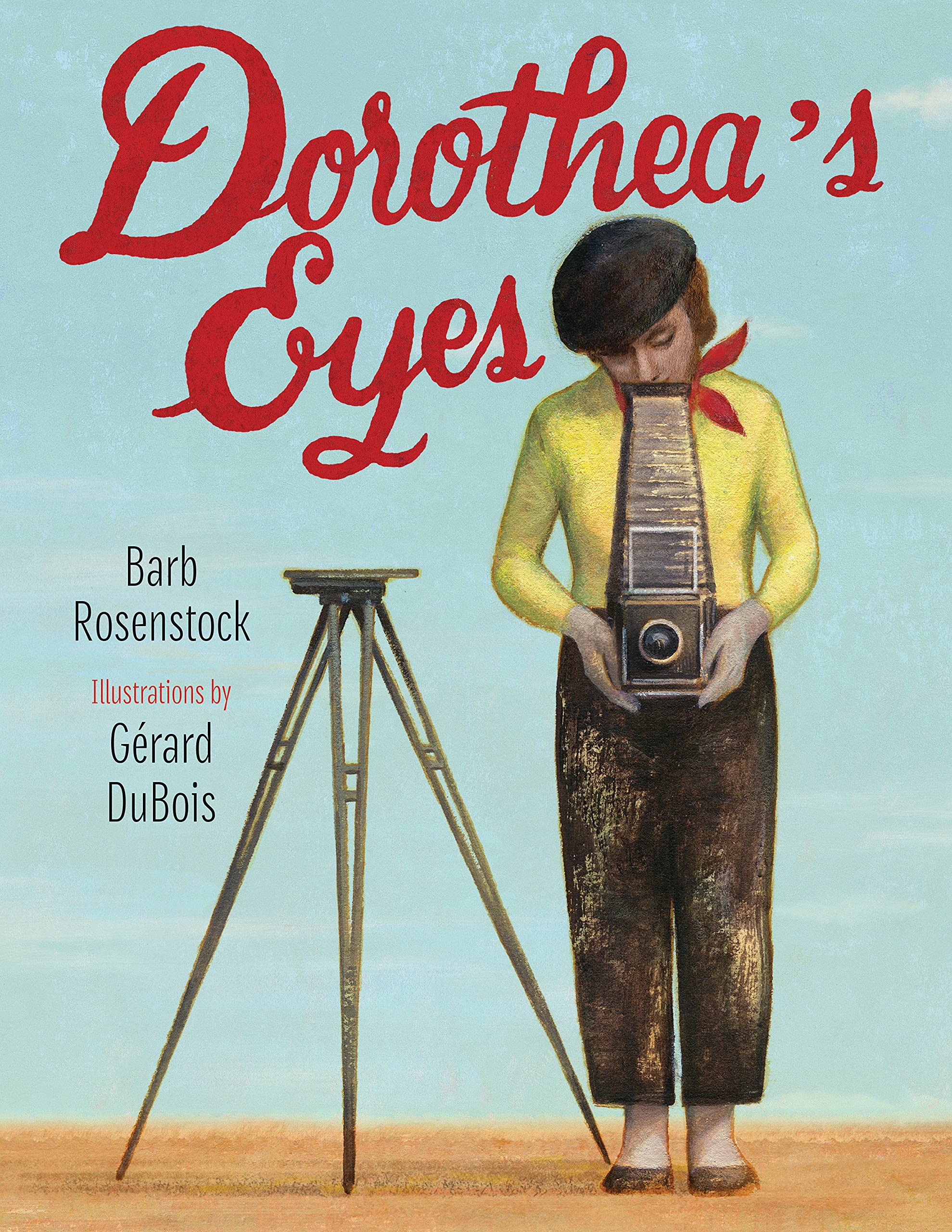
celebrate-picture-books-picture-book-review-dorothea's-eyes-cover

About the Holiday

Photography is all about providing information and emotion through images. A picture really can be worth a thousand words in capturing a moment of surprise, joy, danger, or sadness. Well-placed photographers, videographers, and cinematographers have given voice to some of society’s pivotal moments, allowing the whole world to witness change, often as it is happening. Today we celebrate the “art, craft, science, and history of photography,” as well as those photographers who often put themselves in danger to get the story and those who bring us much-needed lighter moments. To learn more visit the World Photography Day website.

Dorothea’s Eyes: Dorothea Lange Photographs the Truth

Written by Barb Rosenstock | Illustrated by Gérard DuBois


When Dorothea Lange opens her green eyes, she sees things others miss. In the shadows, in patterns within the grain of wooden tables, in the repeated shapes of windows on a wall, and most especially in people’s faces. “Dorothea loves faces! When Dorothea looks at faces, it’s like she’s hugging the world.”

At seven years old Dorothea contracts polio, which withered her right leg and left her with a permanent limp. Other kids tease her and make her want to hide, and although her mother encourages her Dorothea pretends to be invisible. When her father leaves his family, her mother gets a job in New York and Dorothea goes to a new school. Because she is different, she feels lonely.

celebrate-picture-books-picture-book-review-dorothea's-eyes-great-market

Image copyright Gérard DuBois, 2016, text copyright Barb Rosenstock, 2016. Courtesy of Calkins Creek.

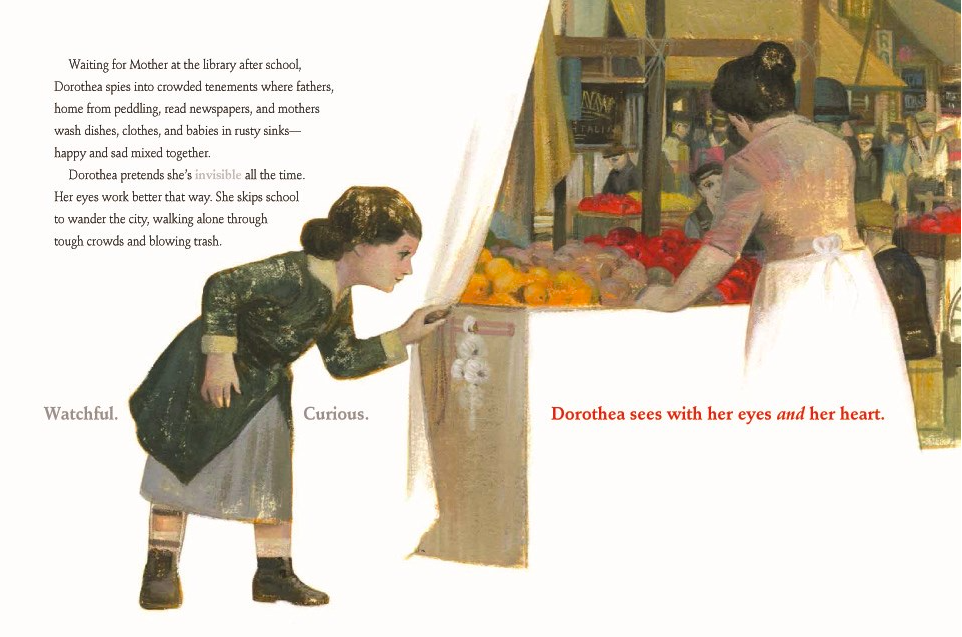
As Dorothea waits for her mother to finish work, she looks around her, spying “into crowded tenements where fathers, home from peddling, read newspapers, and mothers wash dishes, clothes, and babies in rusty sinks—happy and sad mixed together.” She begins to skip school to wander the city, gazing at it with her curious eyes and heart.

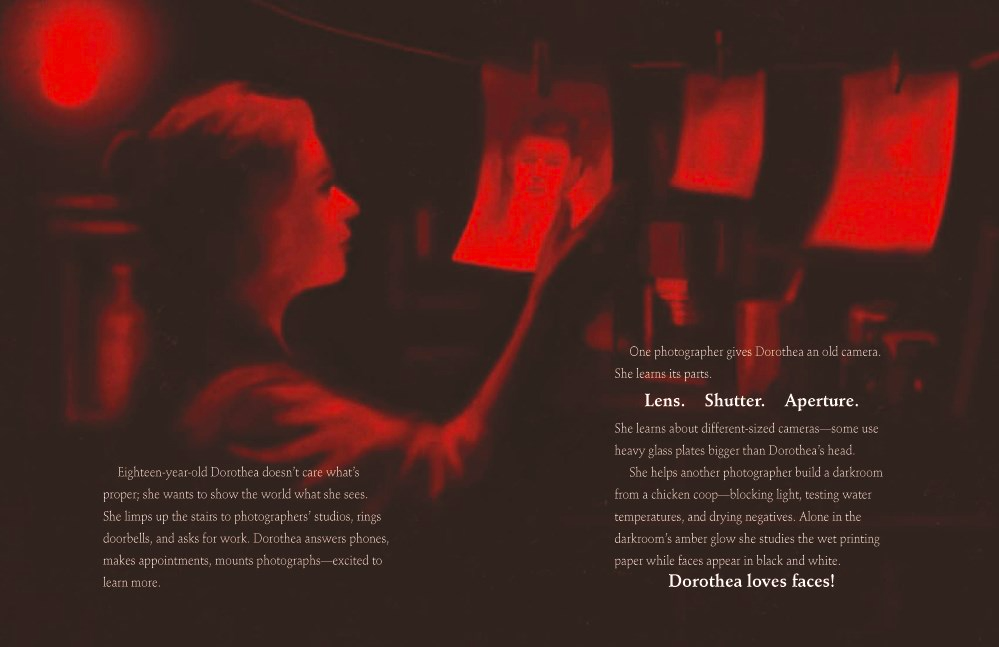
When Dorothea grows up she decides to become a photographer. Her family is surprised because it’s not a ladylike profession. She’s determined, thought, and works any job she can find in the photography industry, learning about cameras, darkrooms, negatives, and the printing process. “Alone in the darkroom’s amber glow, she studies the wet printing paper while faces appear in black and white. Dorothea loves faces!”

celebrate-picture-books-picture-book-review-dorothea's-eyes-great-dark-room

Image copyright Gérard DuBois, 2016, text copyright Barb Rosenstock, 2016. Courtesy of Calkins Creek.

As a young woman Dorothea travels west to San Francisco. There, her money is stolen, so she stays, gets a job, and starts her own portrait studio. Her work makes her famous and the richest families in California seek her out to take their photos. She makes money, gains friends, gets married, and starts a family of her own. But she always wonders, “Am I using my eyes and my heart?”

celebrate-picture-books-picture-book-review-dorothea's-eyes-great-depression

Image copyright Gérard DuBois, 2016, text copyright Barb Rosenstock, 2016. Courtesy of Calkins Creek.

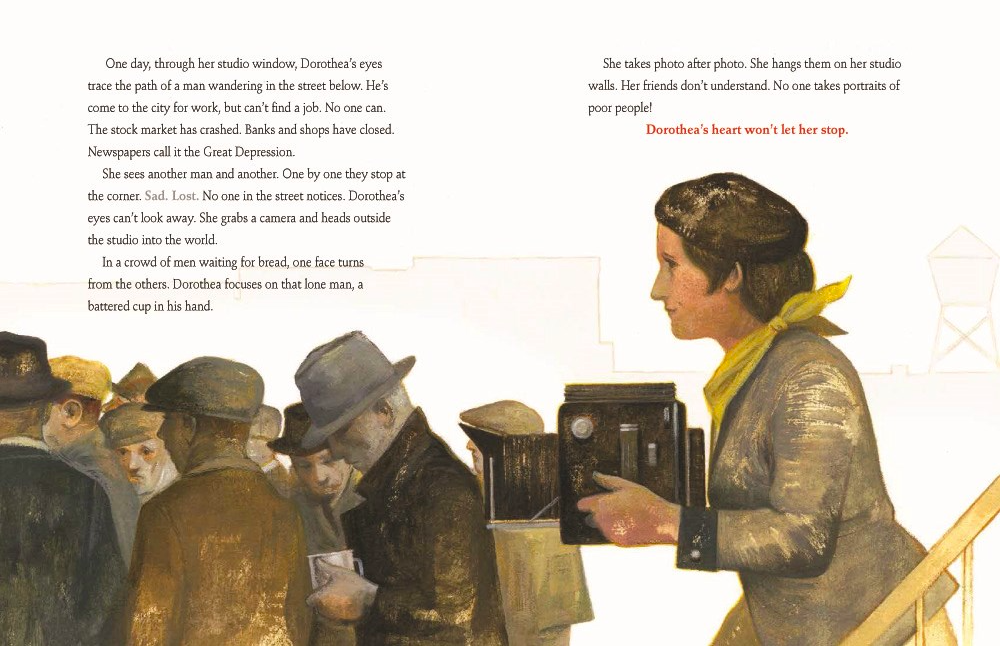
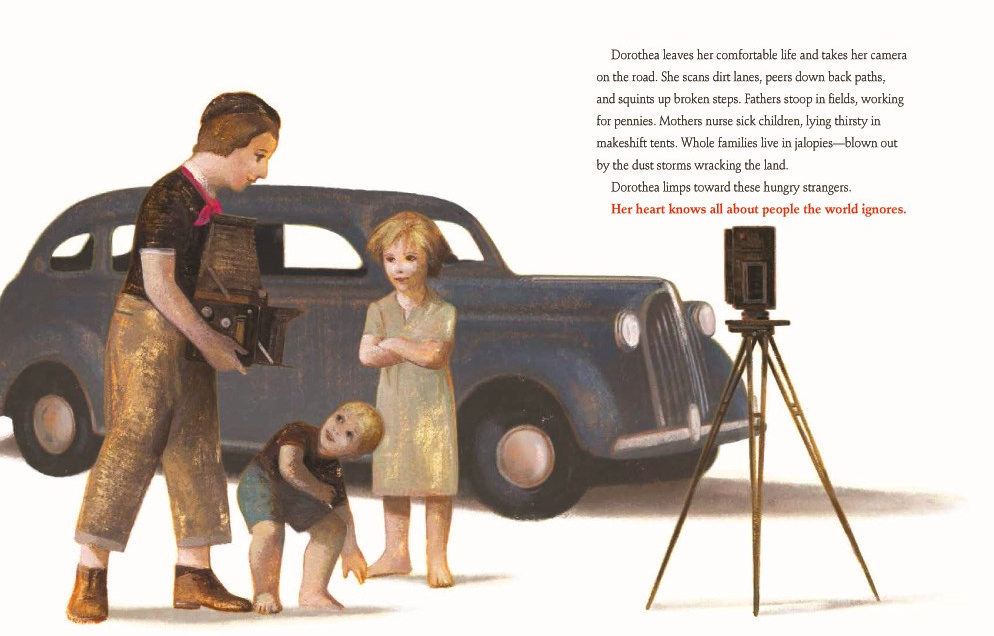
When the stock market crashes and the Great Depression sweeps the country, Dorothea focuses her camera on the desperate and the downtrodden. Her friends don’t understand, but Dorothea sees into these poor people’s hearts. She “knows all about people the world ignores.” For five years she goes out into the fields, peers into tents, documents families living in their cars, crouches in the dirt to reveal the stories of the people struggling with the devastation wrought by the Dust Bowl.

celebrate-picture-books-picture-book-review-dorothea's-eyes-kids

Image copyright Gérard DuBois, 2016, text copyright Barb Rosenstock, 2016. Courtesy of Calkins Creek.

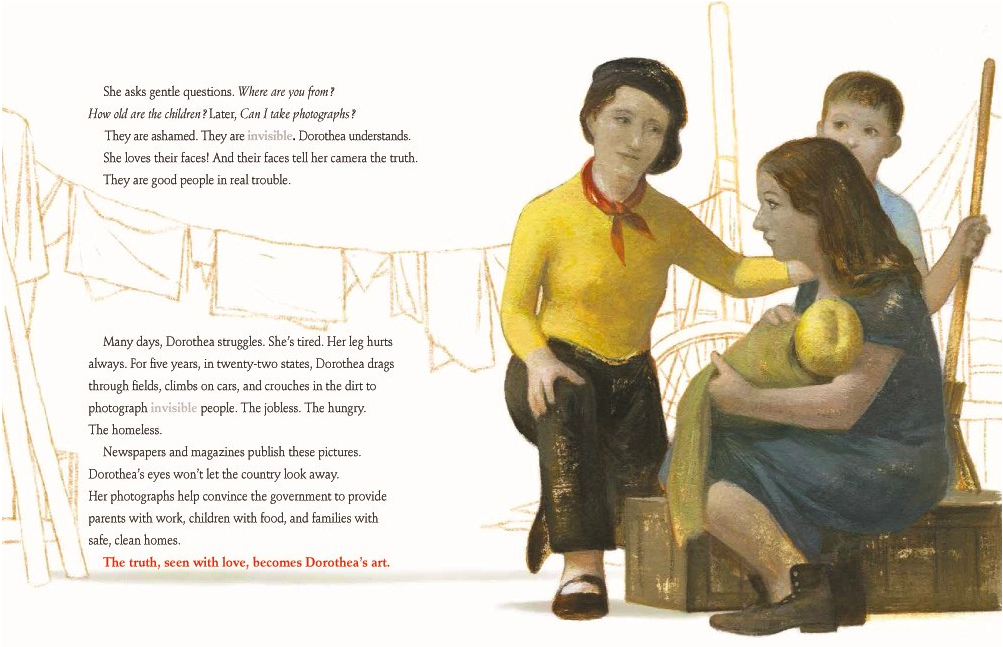
Newspapers and magazines publish her pictures. “Her photographs help convince the government to provide parents with work, children with food, and families with safe, clean homes. “The truth, seen with love, becomes Dorothea’s art.” Dorothea’s photographs are still known today. Their subjects continue to help us see others with our hearts.

Backmatter includes six of Dorothea Lange’s most famous and recognizable photographs—ones that are still as riveting today as they were in the 1930s. Further information on her life and work is provided as well as sources where her photographs can be viewed, resources for further study, and a timeline of her life.

celebrate-picture-books-picture-book-review-dorothea's-eyes-san-francisco

Image copyright Gérard DuBois, 2016, text copyright Barb Rosenstock, 2016. Courtesy of Calkins Creek.

Barb Rosenstock brings Dorothea Lange’s vision to the page with love, honesty, and understanding in this excellent biography of a woman whose photographs defined the Great Depression and Dust Bowl era. Lange’s life-long connection to the poor and often overlooked people of the world is beautifully described and explained in a gentle, compassionate way that will resonate with children. Rosenstock’s language is lyrical with staccato sentences that echo the clicks of Lange’s shutter capturing life’s reality with her eyes and her heart.

Gérard DuBois’s illustrations are arresting and set Dorothea Lange’s story firmly in its historical and emotional landscape. Rendered in acrylic and digital imagery, they feature the muted colors and style of book illustrations from long ago. By placing the images of Dorothea, her family, and her photography subjects against white backgrounds, DuBois emphasizes Lange’s focus on the people she met and faces that inspired her. Distressed textures accentuate the troubled times and the anguish of both Dorothea and her subjects.

Ages 7 – 12

Calkins Creek, 2016 | ISBN 978-1629792088 (Hardcover, 2018) | ISBN 978-1635925630 (Paperback, 2022)

Paperback edition will be released on February 1, 2022. The book is available for preorder now.

Discover all the amazing books by Barb Rosenstock on her website!

View a portfolio of art and book illustration by Gérard DuBois on his website!

Enjoy a snapshot of Dorothea’s Eyes!

World Photography Day Activity

CPB - New Professionals Picture

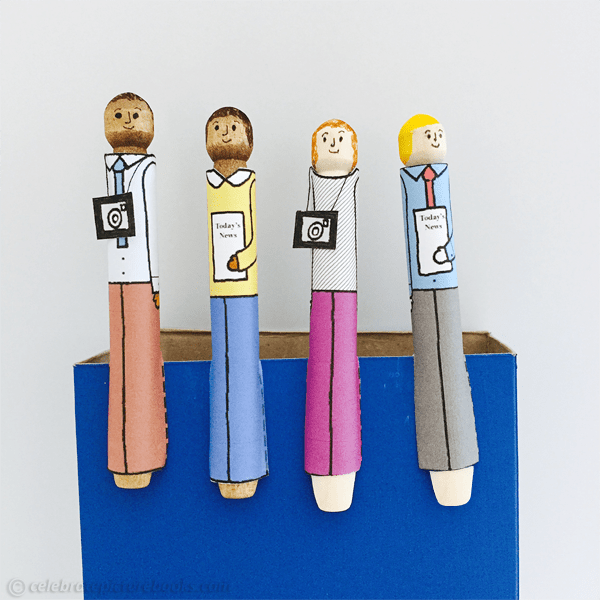
News Professionals Clothespin Figures


Make one of these clothespin figures that honors the men and women photographers and writers who work to keep the world informed.

Supplies

Directions

  1. Draw a face and hair on the clothespin
  2. Cut out the clothes you want your journalist or photographer to wear
  3. Wrap the clothes around the clothespin. The slit in the clothespin should be on the side.
  4. Tape the clothes together
  5. Cut out the camera
  6. Tape one end of a short length of thread to the right top corner of the camera and the other end of the thread to the left corner. Now you can hang the camera around the figure’s neck.

Idea for displaying the figures

  • Attach a wire or string to the wall and pin the figure to it
  • Pin it to your bulletin board or on the rim of a desk organizer

celebrate-picture-books-picture-book-review-dorothea's-eyes-cover

You can find Dorothea’s Eyes: Dorothea Lange Photographs the Truth at these booksellers

Amazon | Barnes & Noble | Books-a-Million

To support your local independent bookstore, order from

Bookshop | IndieBound

Picture Book Review