On this day in 1911 schools in Iowa first celebrated Constitution Day, commemorating the date in 1787, when our Founding Fathers signed the Constitution of the United States. in 1952 Citizenship Day was moved from May to coincide with Constitution Day. In addition to honoring our constitution, Americans are also encouraged to reflect on the rights and responsibilities of citizenship and what it means to be a U.S. citizen. We also recognize those who are taking steps to become U.S. citizens and all those who are seeking a better life here.
Thanks to Albert Whitman Books for Young Readers for providing me with a digital copy of A Vote is a Powerful Thing for review consideration. All opinions on the book are my own.
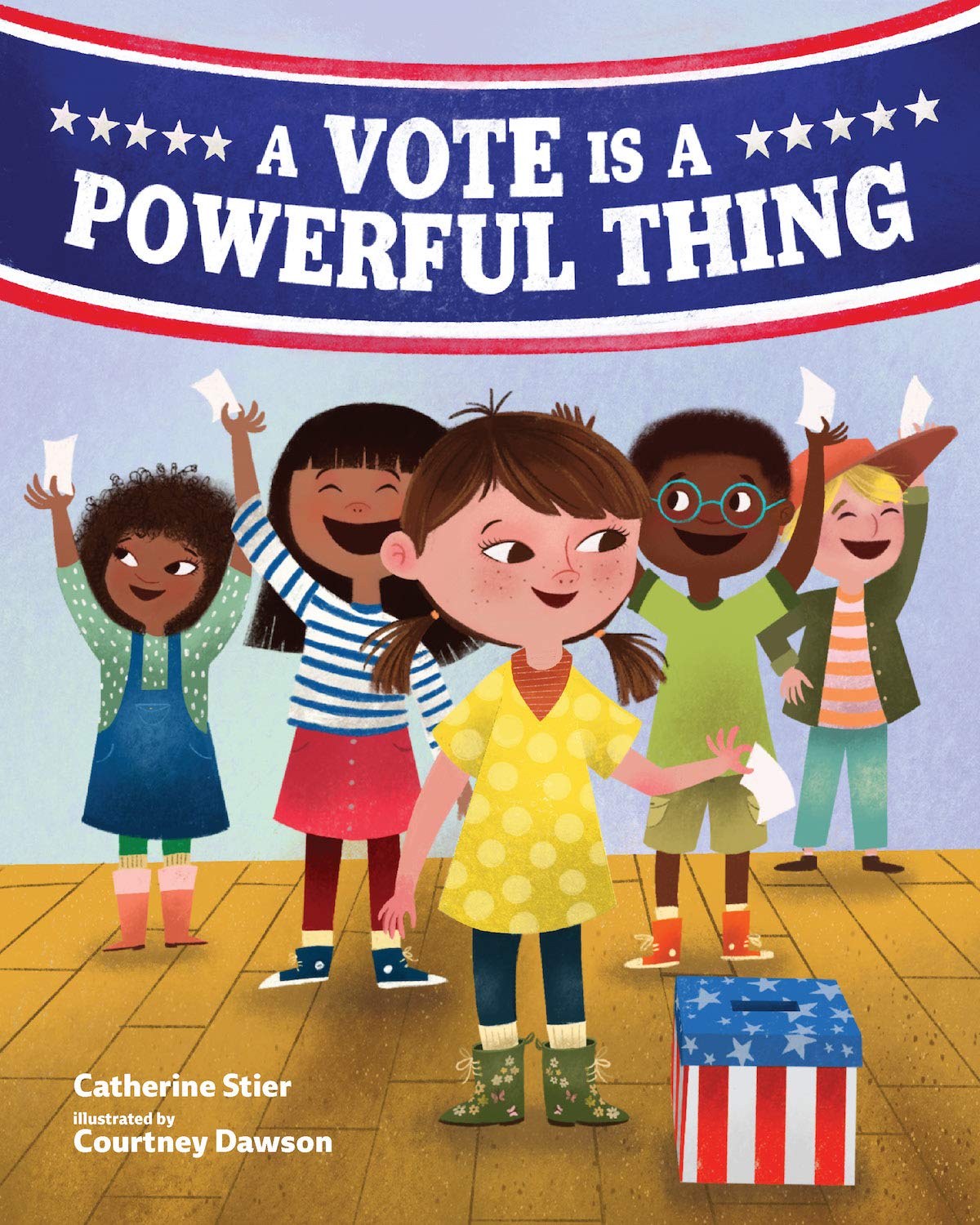
A Vote is a Powerful Thing
Written by Catherine Stier | illustrated by Courtney Dawson
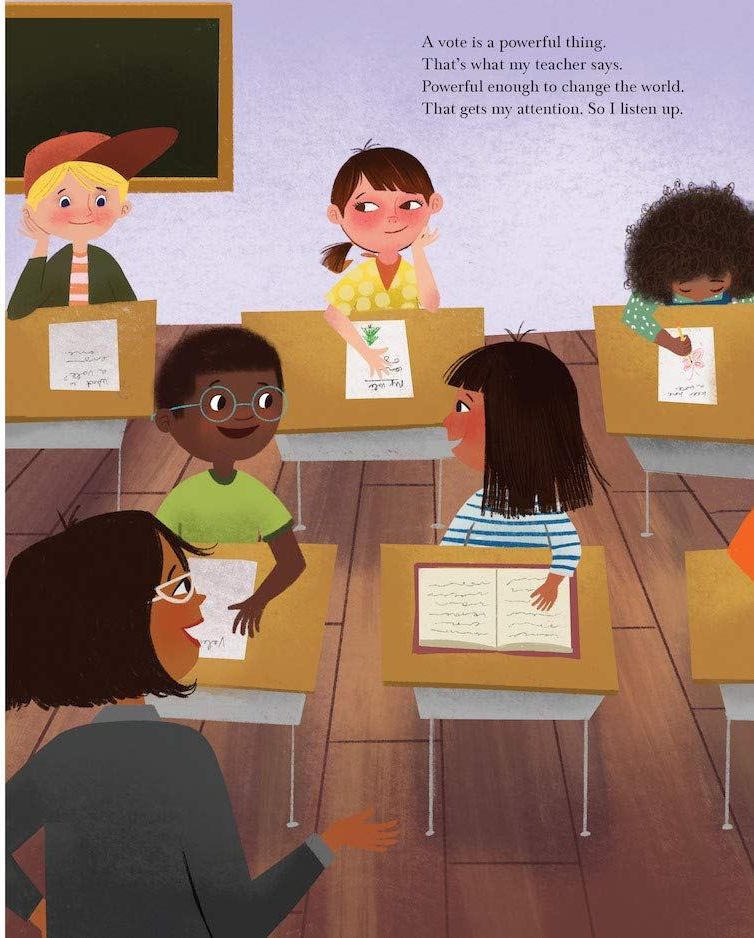
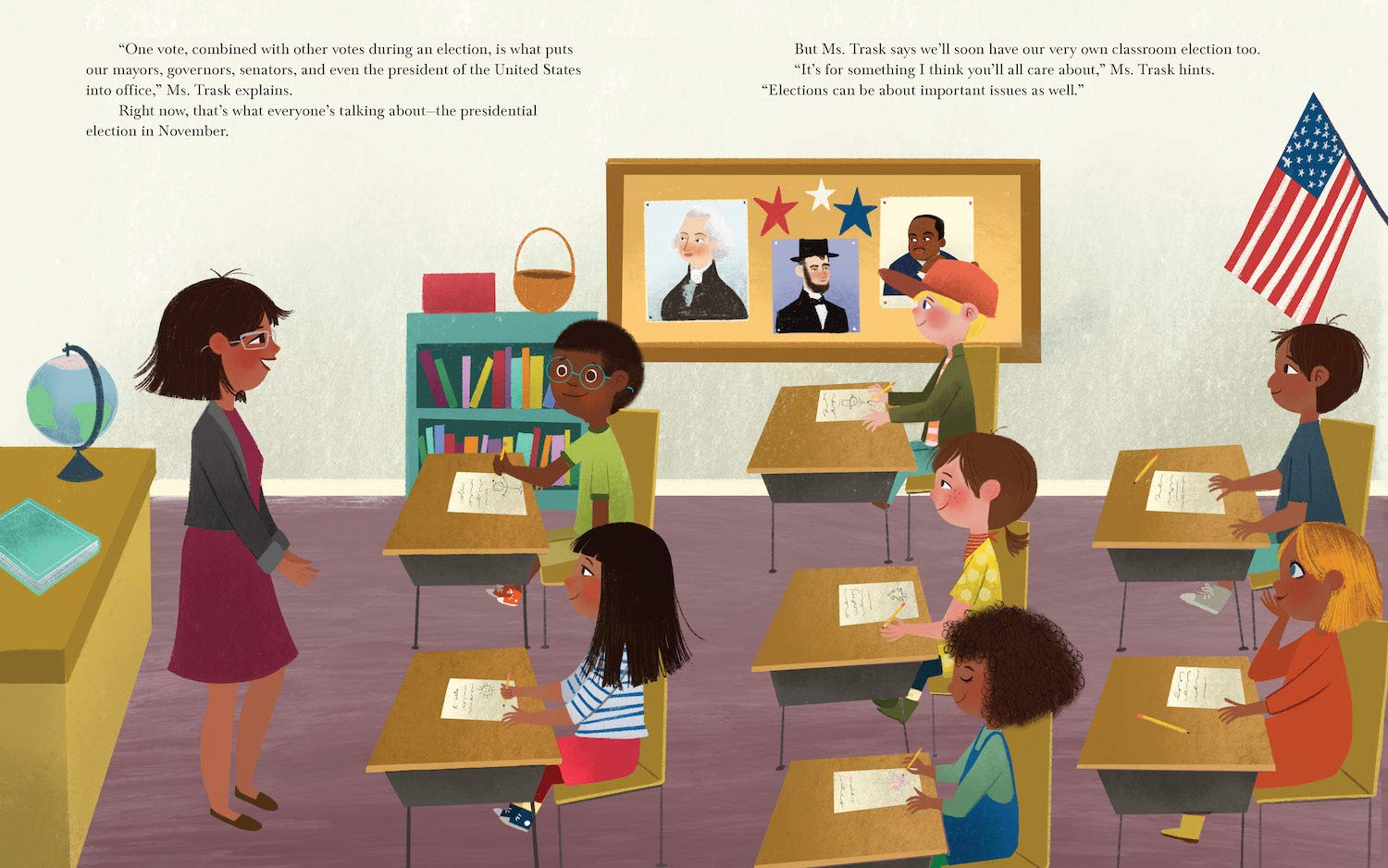
Ms. Trask is teaching about elections and voting to her class. When she says that “‘a vote is a powerful thing…. Powerful enough to change the world,’” Callie pays particular attention, so she can tell readers all about it. In the election coming up in November, “one vote, combined with other votes…,’” Ms. Trask explains, “‘is what puts mayors, governors, senators, and even the president of the United States into office.’” To demonstrate the power of voting, Ms. Trask is going to hold a classroom election about an issue that she thinks will pique the kids’ interest.
Callie has already been introduced to the idea of campaigning and voting through her grandmother, who is working to save the local wilderness park, where, Callie says, “I saw my first mountain laurel in full bloom, my first turtle in a pond, my first swallowtail butterfly.” Ms. Trask goes on to tell the class that not only are elections about people, they’re about “‘important issues as well.’”
Image copyright Courtney Dawson, 2020, text copyright Catherine Stier, 2020. Courtesy of Albert Whitman Books for Young Readers.
The next morning Ms. Trask reveals the issue that the class will vote on—where they’ll take their next field trip. The candidates are the cookie factory and the wilderness park. Some kids love the idea of the free samples at the cookie factor, while others like the walking trail at the park. As they discuss the options, Callie realizes that where the class goes is important to her. She raises her hand and asks if she can “‘campaign in support of the wilderness park.’” At home, she creates posters and writes a speech. Lynn is campaigning in favor of the cookie factory.
On election day, Lynn gives her speech first. She talks about what the class could learn about food and science—and reminds her classmates about the free cookies. Even Callie agrees that the factory is a good option. Then it’s Callie’s turn. She tells the class about how special the park is and describes some of the animals she’s seen. Callie also reveals what scientists say are the benefits of being outdoors.
Image copyright Courtney Dawson, 2020, text copyright Catherine Stier, 2020. Courtesy of Albert Whitman Books for Young Readers.
After the speeches, everyone receives a piece of paper, writes their choice on it, and places it in the ballot box. As Ms. Trask holds up the last ballot, she congratulates Lynn and Callie on their campaigns. She says they both did such an excellent job “‘that the election is tied now, with just one vote left to count.’” She unfolds the slip of paper and reads…Wilderness Park.
On the day of the field trip, the kids explore the rocks and plants. They even see a fox. The kids are all excited and want to share the experience with their families. Their enthusiasm gives Callie hope that people will vote to fund the park during the town’s election. On voting day, Callie’s happy to stand next to her grandma at the polling place with a sign to “Vote Yes!” because she knows how valuable just one vote can be.
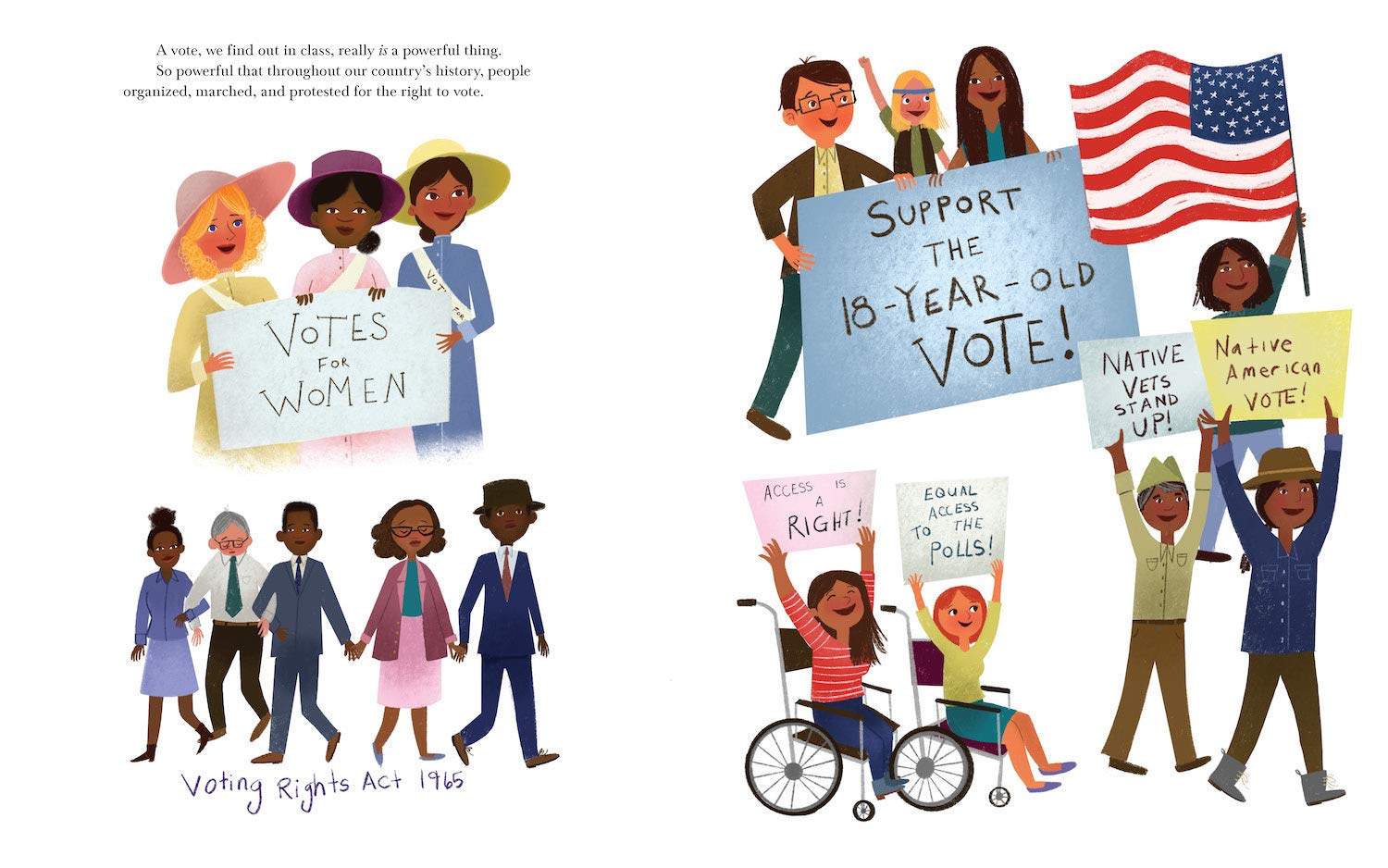
Extensive back matter discusses the concept of voting, who can vote, and how citizens vote as well as gives a timeline of United States voting rights from 1870 to 1990. A list of resources for further reading and research is also included.
Image copyright Courtney Dawson, 2020, text copyright Catherine Stier, 2020. Courtesy of Albert Whitman Books for Young Readers.
Catherine Stier’s comprehensive and engaging story outlines facts about elections and the importance of voting—not only for candidates, but also about important issues—in an easy-to-follow and organic way. Stier’s use of two high-interest issues, both of which have educational merit, gives children a glimpse of the difficult choices voters are faced with. Callie’s appreciation for Lynn’s opinion and Lynn’s enthusiasm for the wildlife park field trip show readers that disagreements can be handled respectfully and amicably. Through her first-person storytelling that is rich with dialogue, Stier creates a personal narrative that will resonate with children, many of whom most likely have issues that are important to them. As the last vote counted breaks a tie, readers learn how important it is for everyone to vote.
Courtney Dawson’s bright illustrations of a diverse classroom learning about elections and voting give children snapshots of historical events in US voting history that may surprise them spur them to learn more as well as images that are recognizable from community activism. As Callie prepares her speech and posters, readers see the wildlife and scenery that makes the issue of the field trip so important to her and come to understand the time and effort that candidates put into their campaign. Clear images of the children—and later, their families—casting their ballots reinforces the concept of this valuable right. The final image can empower children to get involved in their own community or school to make a difference in issues that are important to them.
An excellent book to introduce the concept of elections and voting for candidates and issues, with many opportunities within the text and illustrations to initiate discussion, A Vote is a Powerful Thing would be a welcome addition to home, classroom, and public library collections.
Ages 4 – 8
Albert Whitman Books for Young Readers, 2020 | ISBN 978-0807584989
Discover more about Catherine Stier and her books, visit her website
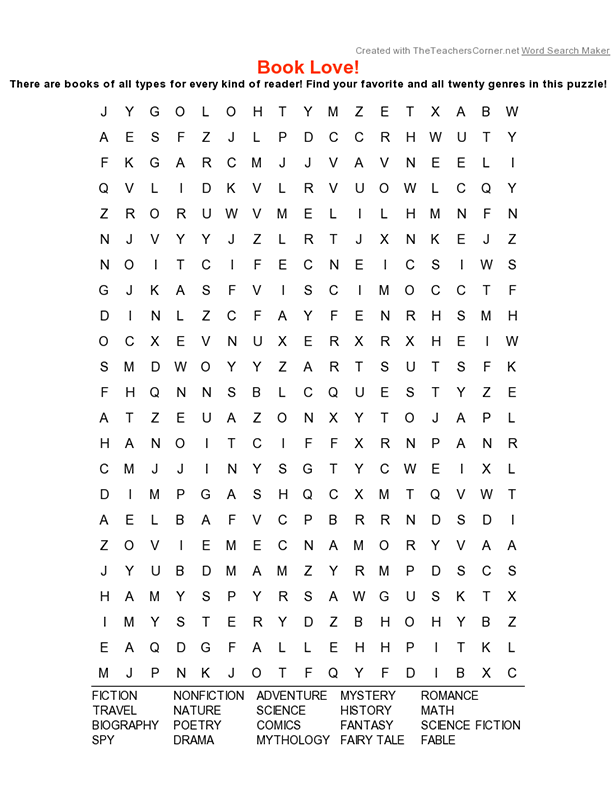
Read a New Book Month Activity
Vote! Word Search Puzzle
Can you find the twenty words related to elections in this printable word search puzzle?
In 1966 UNESCO (United Nations Organization for Education, Science and Culture) established International Literacy Day on this date to “actively mobilize the international community to promote literacy as an instrument to empower individuals, communities, and societies.” This year, the COVID-19 pandemic has affected education and educational resources around the world. In response, this year’s initiative focuses on “‘literacy teaching and learning in the COVID-19 crisis and beyond,’ and especially on the role of educators and changing pedagogies.” 2020 also ushers in a new five-year program: UNESCO Strategy for Youth and Adult Literacy to develop policies and strategies to address the learning needs of disadvantaged groups, especially women and girls; to leverage digital technologies to expand access and improve outcomes; and to monitor and assess literacy programs. To learn more about today’s holiday and UNESCO’s global literacy programs, visit the United Nations International Literacy Day webpage.
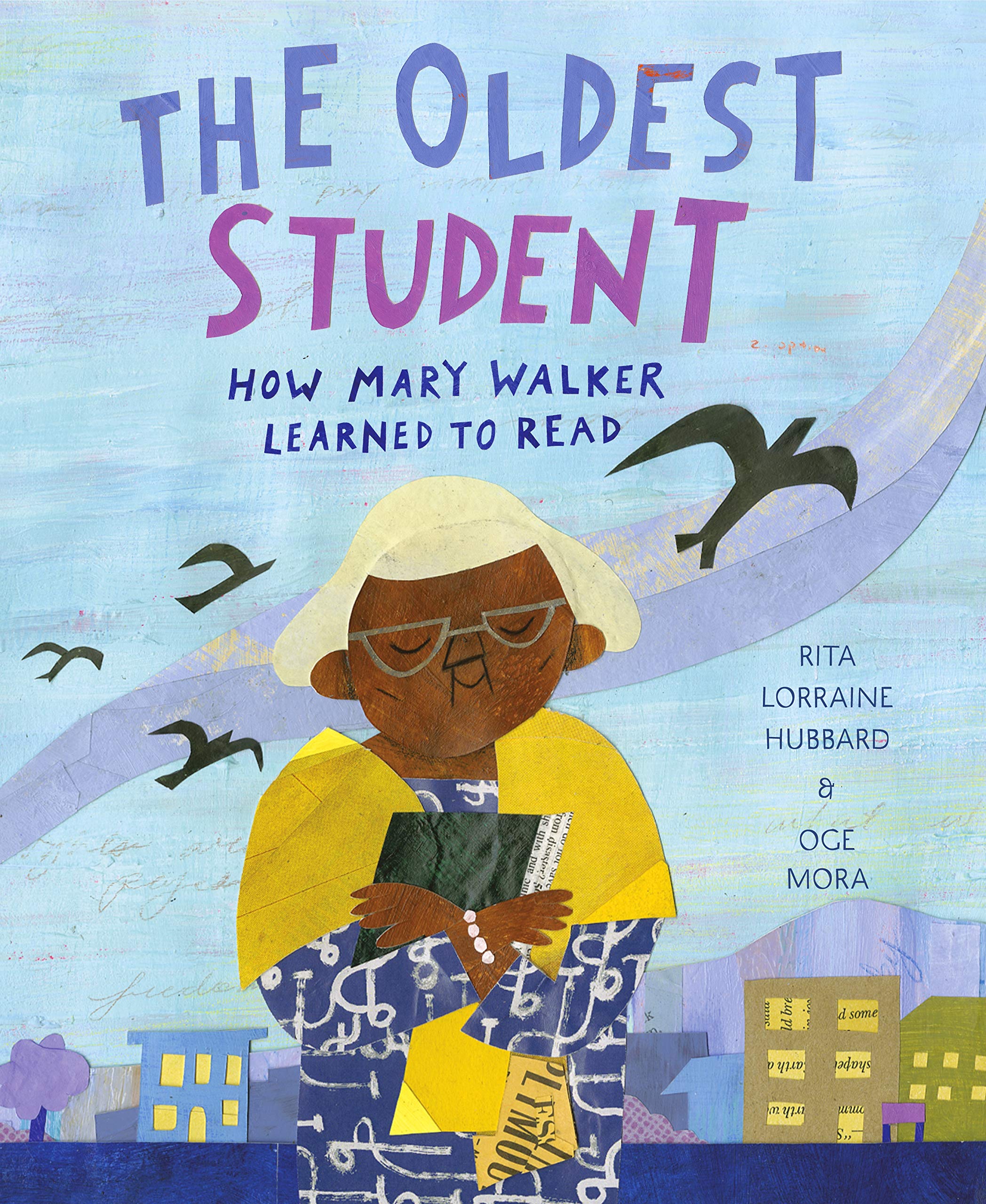
The Oldest Student: How Mary Walker Learned to Read
Written by Rita Lorraine Hubbard | Illustrated by Oge Mora
As a child slave on an Alabama plantation, Mary Walker knew the rules: Keep working and no learning to read or write. But when she stopped for a moment to rest while “picking cotton, toting water to Papa and the other slaves who chopped wood for the train tracks, or helping Mama clean the Big House,” she watched the birds and dreamed of being free. In bed at night, she would think “When I’m free, I’ll go where I want and rest when I want. And I’ll learn to read too.”
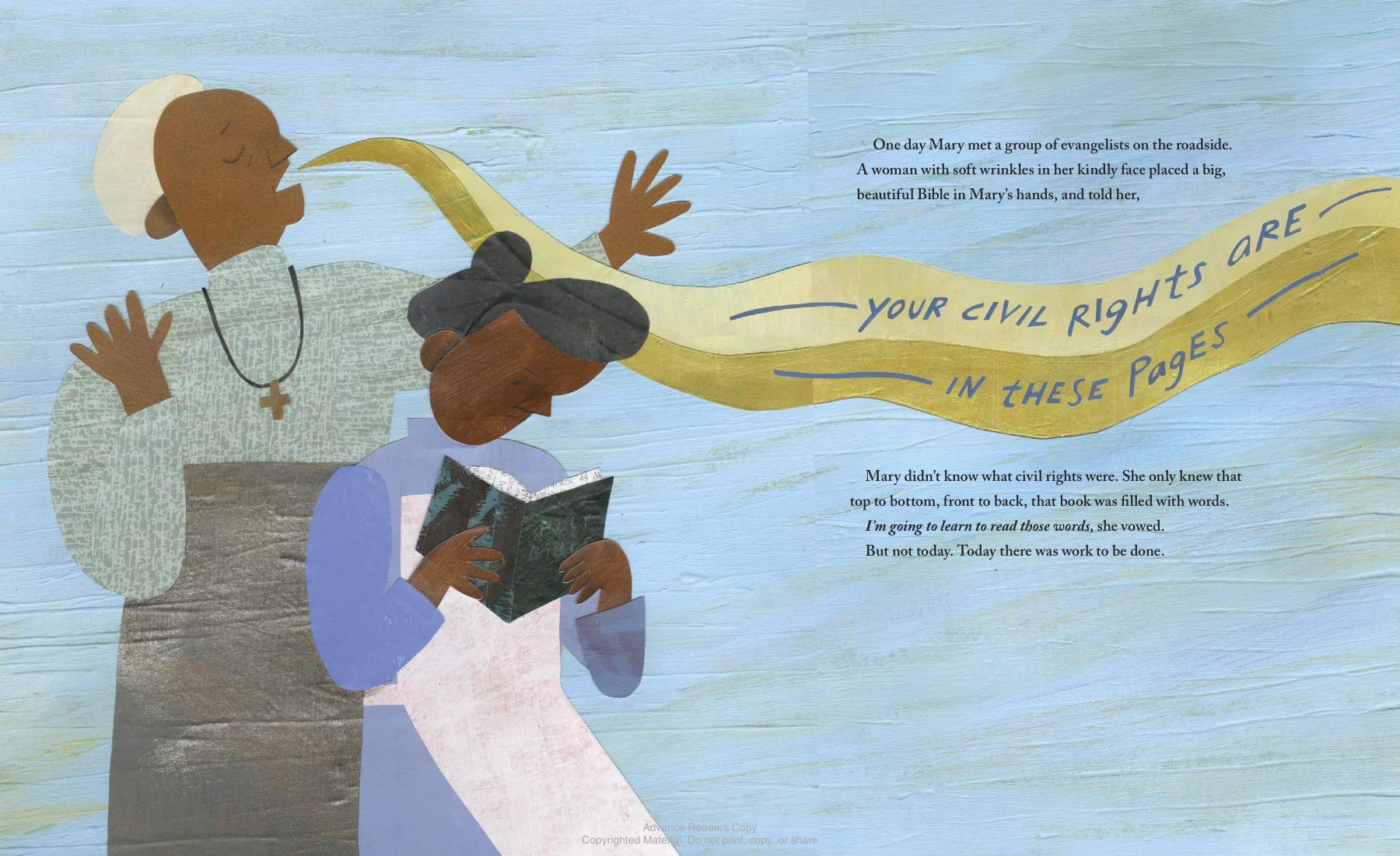
When Mary was fifteen, the Emancipation Proclamation was signed. While many freed slaves moved north, Mary and her family, like others, chose to stay in the South. With the help of the Freedmen’s Bureau, they moved into a one-room cabin. To raise money, Mary worked long hours every day of the week without a break to eat, drink, or even use the outhouse. “At week’s end, she would offer Mama the one lonely quarter she had earned.” One day, Mary met an evangelist who gave her a Bible, telling her “Your civil rights are in these pages.”
Image copyright Oge Mora, 2020, text copyright Rita Lorraine Hubbard, 2020. Courtesy of Schwartz & Wade.
Mary didn’t know what that meant. “She only knew that top to bottom, front to back, that book was filled with words”—words she vowed to learn…someday. But first came marriage, sharecropping, and a son. When a friend wrote his birth date in the Bible, all Mary could do was make a mark beside the words.
When Mary’s first husband died, she married again and had two more sons. To bring them up, Mary spent the next forty years sharecropping and doing odd jobs to help support her family. Eventually, the family moved to Chattanooga, Tennessee. Mary was sixty-eight and too old to farm, but she still cooked, cleaned, and cared for other people’s children to make money. She also cooked and sold food to support her church. On Sunday’s she listened to the preacher while clutching “her family Bible—the Bible she still couldn’t read.”
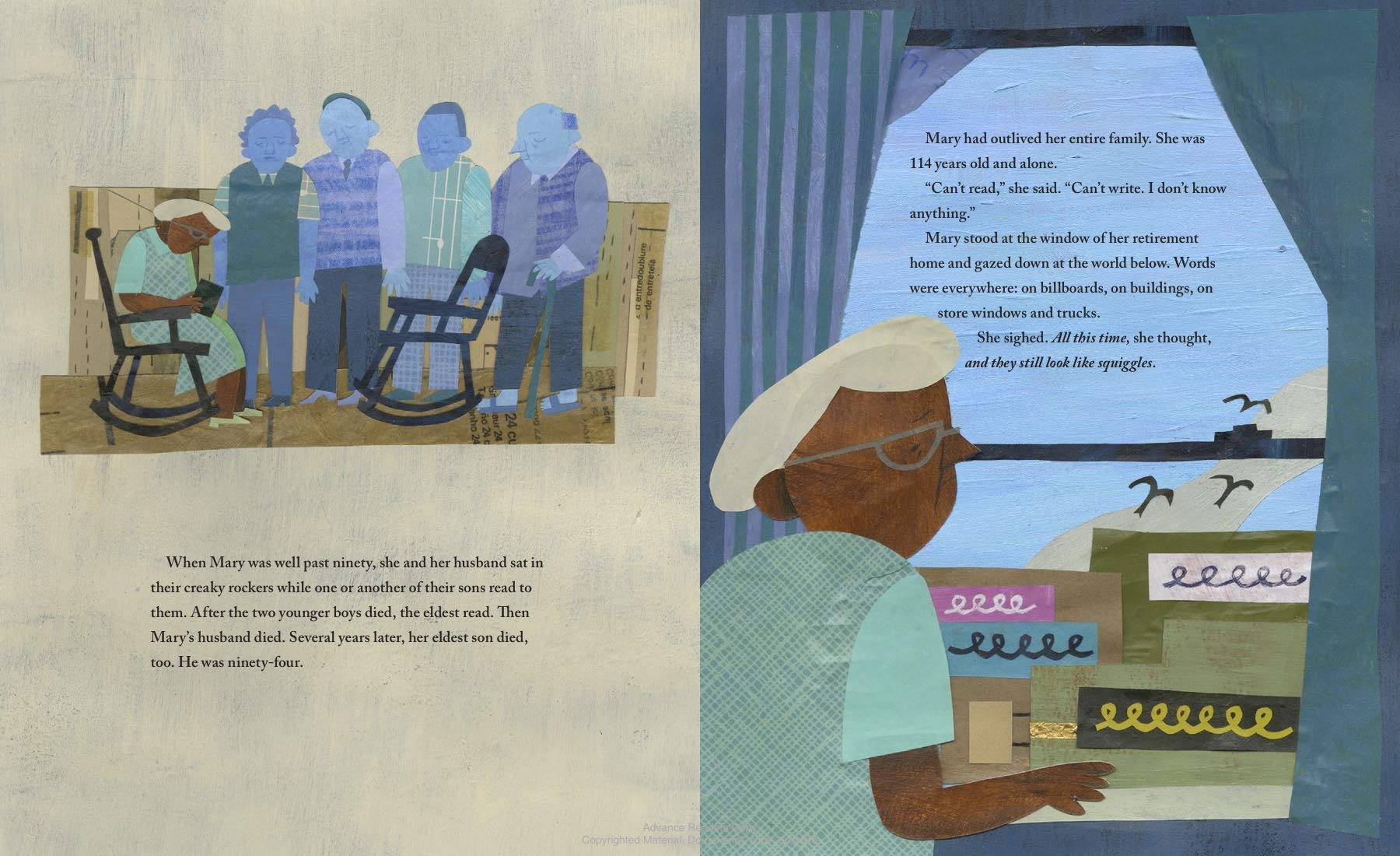
“When Mary was well past ninety,” her sons read to her and her husband. As time passed, her younger sons died and then her husband. Her oldest son died at the age of ninety-four, leaving Mary alone and living in a retirement home. As she looked out the window at the signs and billboards, “she sighed. All this time, she thought, and they still look like squiggles.”
Image copyright Oge Mora, 2020, text copyright Rita Lorraine Hubbard, 2020. Courtesy of Schwartz & Wade.
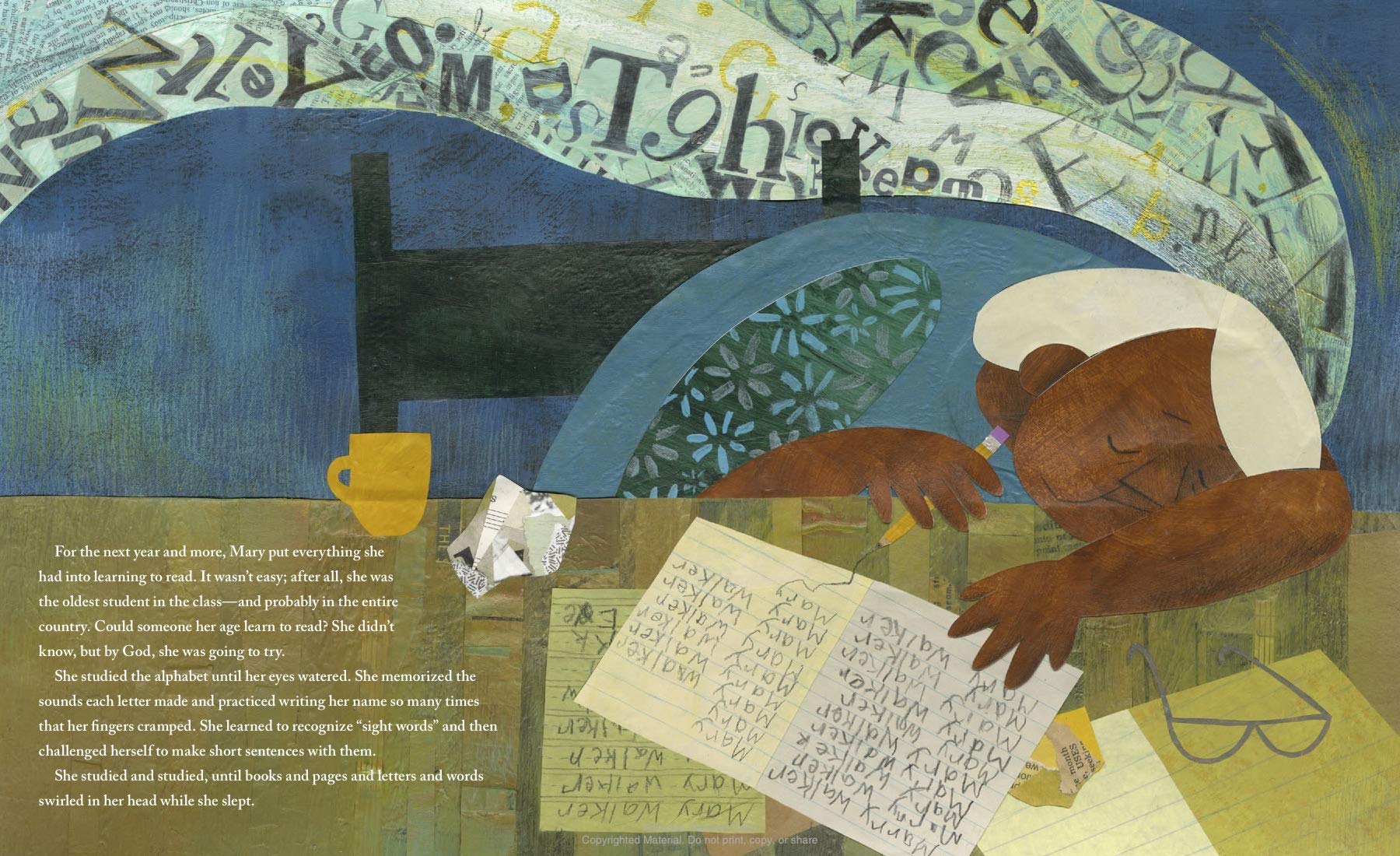
When her retirement home offered a reading class, Mary joined in. At 114, “she was the oldest student in the class—and probably in the entire country.” For the next year and longer, she studied and wrote and memorized. She began recognizing sight words and putting them together into short sentences. All of Mary’s hard work came together, and at last at the age of 116, she could read! Mary’s story traveled across the country, and journalists came to interview her. A representative from the US Department of Education pronounced her “‘the world’s oldest student.’”
“Mary felt complete.” When she felt lonely, she read her Bible or the signs she could see from her window. In Chattanooga, Mary’s accomplishment was celebrated with annual birthday parties. President Lyndon B. Johnson sent her a letter when she turned 118 in 1969, and President Richard Nixon sent a card when she turned 121. Among all the gifts she received over those years, her favorite was a ride in small airplane that dipped and soared like the birds she had watched as a child. As she looked at the landscape below, “Mary decided that flying was a lot like reading: they both made a body feel as free as a bird.” Each year, to start her birthday celebration, Mary read to the people gathered and as she closed the book, she always said, “You’re never too old to learn.”
An Author’s Note that reveals more about Mary Walker’s life follows the text.
Image copyright Oge Mora, 2020, text copyright Rita Lorraine Hubbard, 2020. Courtesy of Schwartz & Wade.
Rita Lorraine Hubbard’s moving portrait of Mary Walker and her resolve to learn to read even at an advanced age is inspirational for all. Hubbard’s straightforward storytelling focuses on Mary’s grueling work and the obstacles and responsibilities that delayed her education while also revealing her resilience, her generosity, and the strong bonds she shared with her family. Mary’s equating reading and education with freedom even as a child will resonate with today’s students and offers encouragement when lessons are difficult. With excellent pacing and a depth of details that will keep children riveted to this true story, Hubbard tells not only Mary’s history but that of many African-American families, making The Oldest Student a poignant book to share for reading, history, and social studies in classrooms as well as for home story times.
Oge Mora’s collage-style illustrations, incorporating strips of written text and musical scores, enrich Hubbard’s story with images of Mary working as a slave and later at various jobs always surrounded by words she cannot read. Later, as Mary gazes out of the window of her retirement home and passes fliers on the bulletin board there, the signs and papers are covered in squiggles, giving young readers an idea of how Mary sees the written world. After Mary learns to read, Mora replaces these with the actual signs, a clear example of the difference the ability to read makes. Mora’s early depictions of Mary, her head and back bowed by arduous, exhausting labor, are heartbreaking, making later images of her, head held high with pride and accomplishment, all the more emotional.
An uplifting and powerful lesson on perseverance and never giving up on a dream, The Oldest Student: How Mary Walker Learned to Read is highly recommended for home bookshelves and a must for school and library collections.
On August 25, 1916, President Woodrow Willson signed what is now called the Organic Act, establishing the National Park Service. In the 104 years since that historic signing, 400 areas in each of the 50 states, U.S. territories, and the District of Columbia, totaling 84 million acres, have been designated as national parks. Today we honor the park rangers who conserve and preserve these natural wonders and educate visitors. To discover national parks near you and their stories as well as to learn more about the week and how to help out all year round, visit the National Park Foundation website and the National Park Service website.
Thanks to Albert Whitman for sending me a copy of If I Were a Park Ranger for review consideration. All opinions about the book are my own.
If I Were a Park Ranger
Written by Catherine Stier | Illustrated by Patrick Corrigan
If you love trees, animals, and all the beauty of nature, you may think about being a park ranger in one of the United States national parks. How would you get there? By studying “wildlife biology, conservation, or education” in college. Historian William Stegner called national parks “America’s ‘best idea.’” Being a park ranger means you’d be part of a proud history of people who have cared for the “country’s most beautiful, historic, and unique areas.”
Image copyright Patrick Corrigan, 2019, text copyright Catherine Stier, 2019. Courtesy of Albert Whitman & Company.
Who are some of these people? Stephen Mather and Horace Albright were the first directors of the National Park Service, Captain Charles Young was “the first African American superintendent of a national park,” and Gerard Baker “brought Native American heritage and perspectives to the parks.” There are also writers, like Marjory Stoneman Douglas ,and artists, like John Muir and Ansel Adams, who shared the grandeur of the parks.
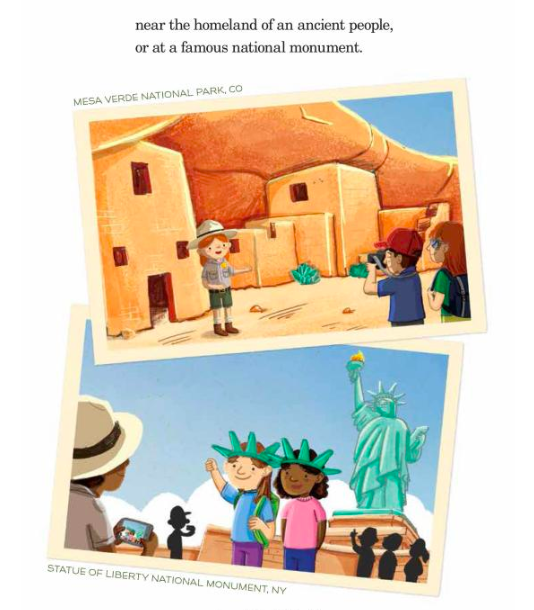
Park rangers work in some of the most exciting places in the country—in caves, deserts, and mountains and near volcanos or the sea shore. And that’s just the beginning! Ships, homes, battlefields, and monuments are also part of the National Park System. As a park ranger, you would protect the animals, plants, and buildings, you might work with scientists, or archaeologists, and you would help visitors gain new perspectives. How would you do that?
You’d “be a great storyteller.” As part of your job, you’d “learn about the natural history, the human history, and the legends” of you park so you “could share those tales…” and maybe “a few spooky campfire stories too.” You’d also learn all about the animals and landmarks of your park so you could provide interesting tours.
Image copyright Patrick Corrigan, 2019, text copyright Catherine Stier, 2019. Courtesy of Albert Whitman & Company.
Rangers are always on the lookout for fires, bad weather, or visitors who require help and alert emergency services when they’re needed. But rangers don’t spend all of their time outdoors. Sometimes they spend time inside using “computers to design exhibits, make maps, write articles, and keep track of endangered animal populations” or keep the park’s website updated. Park rangers are also invited to talk to students in schools and for organizations.
If you were a park ranger, you would make a big impact. Your park would be “cleaner and safer,” the “animals living there would be stronger and healthier,” and visitors might “experience something astonishing…a moment that could happen nowhere else in the world. A moment they’d remember forever” all because of you!
An Author’s Note reveals other riches of the National Park System, including STEM research, creative programs, artifacts and primary source materials, and more as well as a discussion on the education and various roles of rangers and a link where kids can find out about becoming a junior ranger at many parks.
Image copyright Patrick Corrigan, 2019, text copyright Catherine Stier, 2019. Courtesy of Albert Whitman & Company.
Catherine Stier’s inspiring look at the role of a ranger in the National Park Service takes readers from shore to shore and shows them the exciting and diverse jobs that are part of a ranger’s day. Stier’s use of the first-person point of view empowers readers to see themselves as a ranger protecting the treasures of the park and sharing them with visitors. Her straightforward storytelling is full of details readers will love about the duties of a park ranger and the parks themselves. Her stirring ending swells the heart. It’s certain to plant the seed of interest in jobs within the National Park Service as well as in planning a vacation trip to one of these beautiful areas.
Image copyright Patrick Corrigan, 2019, text copyright Catherine Stier, 2019. Courtesy of Albert Whitman & Company.
Through vibrant snapshots and two-page spreads, Patrick Corrigan transports readers to twenty-five national parks, including Redwood National Park, California; Hawai’i Volcanoes National Park; Petroglyph National Monument, New Mexico; Acadia National Park, Maine; and Great Smoky Mountains National Park. To immerse young readers in the story, the rangers are depicted as diverse children helping visitors, giving talks, protecting animals, translating petroglyphs, giving tours, calling firefighters, and even brushing dirt from an unearthed animal skull. In one image a ranger gives a flashlight tour of Mammoth Cave National Park to a girl who uses a wheelchair, and in another a ranger uses sign language to describe the beauty of her park. Children will want to linger over the pages to take in all the details and will be moved to learn more about each park.
Sure to spark expressions of “ooh,” “ahh,” and “I’d like to do that!,” If I Were a Park Ranger makes an inspiring addition to classroom geography and nature lessons and would be a terrific addition to home libraries for kids who love nature and travel and would like to explore future possibilities.
Ages 5 – 9
Albert Whitman and Company, 2019 | ISBN 978-0807535455
Discover more aboutCatherine Stierand her books on her website.
To learn more about Patrick Corrigan, his books, and his art, visit his website.
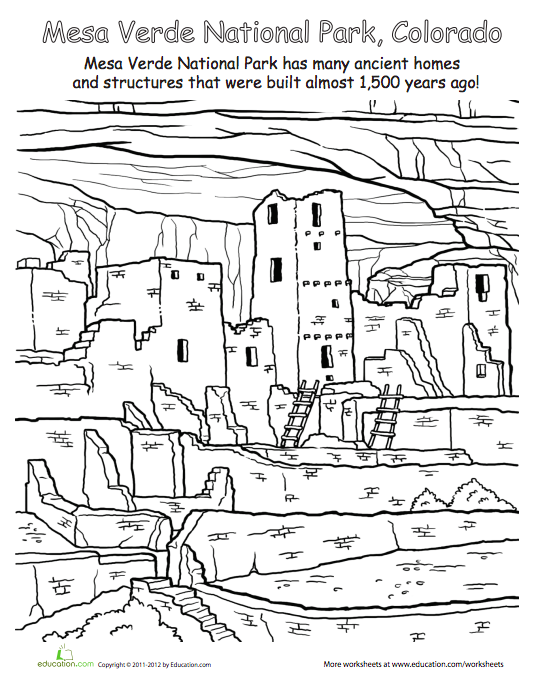
National Park Week Activity
Majestic Parks Coloring Pages
You may not be able to visit all of these parks, but you can still enjoy their beauty with these printable coloring pages!
Today we celebrate the ratification of the 19th Amendment, which guaranteed a woman’s right to vote. Yet even as we commemorate this achievement, we must remain vigilant to protect our voting rights and access and teach children that most-important lesson – that every voice, every vote is important. Today’s book reveals the true story of that nail-biting vote for the 19th amendment while also keeping it’s eye on the future. For more information on the history of suffrage and to learn more about the brave women on the front lines of progress, visit the 2020 Women’s Vote Centennial Initiative website and Women’s Vote Centennial. You’ll find extensive resources, curriculum for middle school and high school students, as well as online exhibits, videos, and so much more.
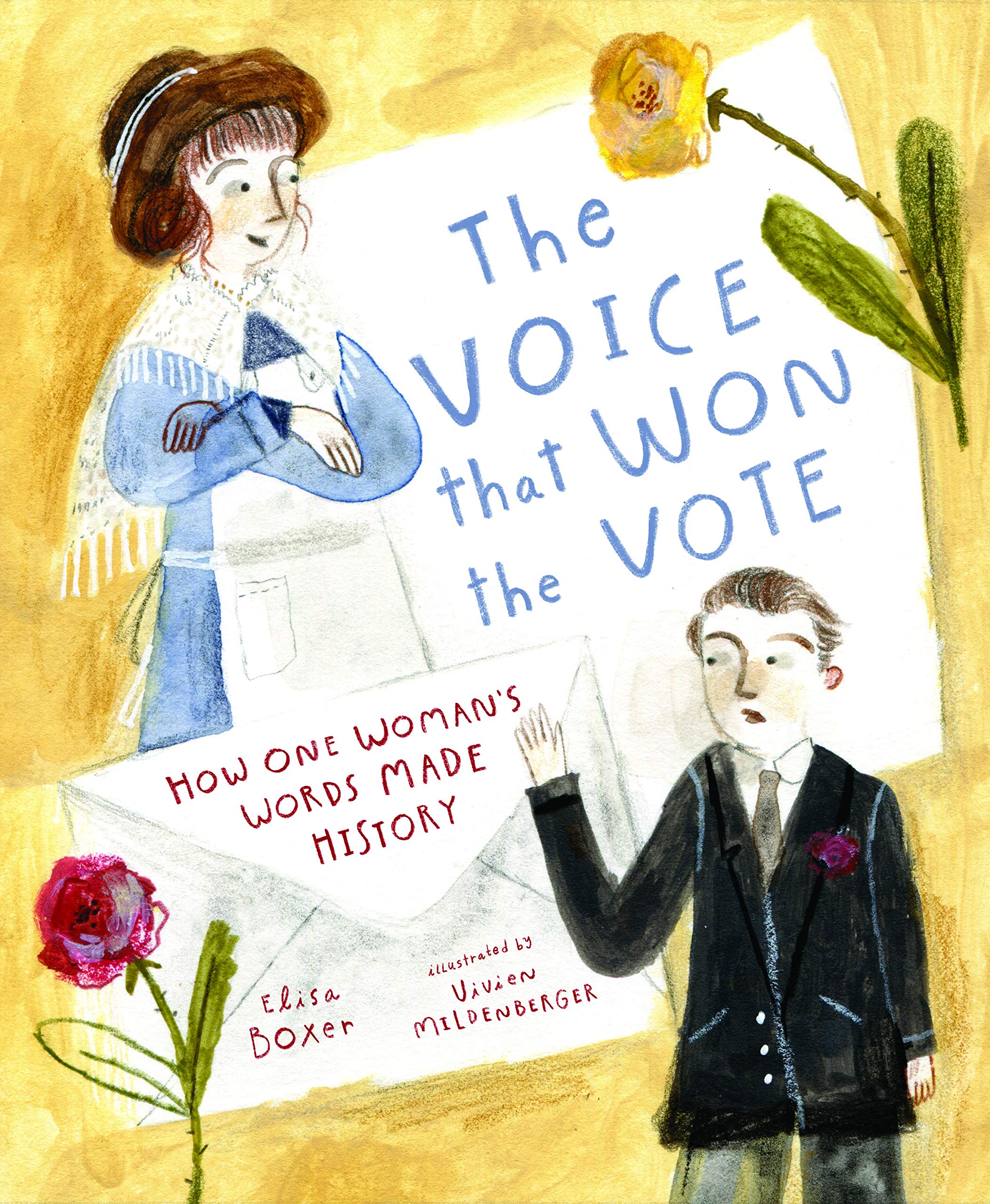
The Voice that Won the Vote: How One Woman’s Words Made History
Written by Elisa Boxer | Illustrated by Vivien Mildenberger
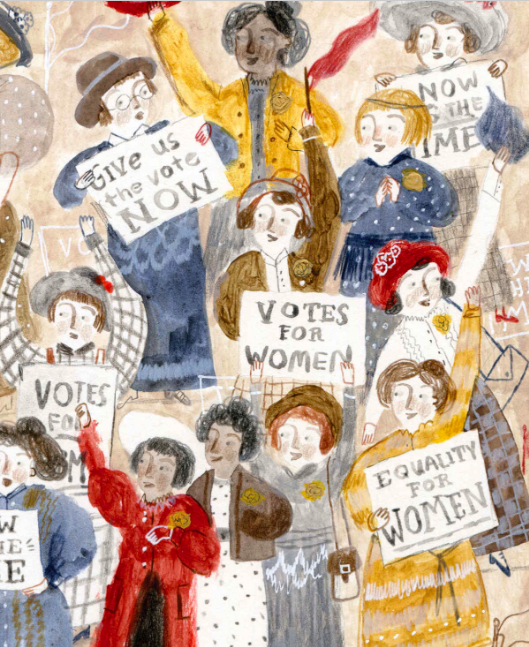
The year was 1920 and women were demanding the right to vote, just as they had been for the last seventy-five years. But all of their meetings, shouting, and signs were silenced. Men called the women “troublemakers” and “uncivilized.” Some men said it would “cause chaos” if women could vote, and others said “‘the only vote a woman needs is the vote to choose her husband.” There were even other women who thought women shouldn’t vote.
Image copyright Vivien Mildenberger, 2020, text copyright Elisa Boxer, 2020. Courtesy of Sleeping Bear Press.
But then there was Febb Burn from East Tennessee who had gone to college, become a teacher, and loved to keep learning. She was especially interested in laws and how they were made, and every year as she watched her farmhands head off to vote on election day, she wanted to be able to go too. Finally, she grew so tired of being “shut out of the process” that she wrote a letter to her son.
Who was her son? His name was Harry Burn, and he was the “youngest lawmaker in Tennessee.” As he read his mother’s letter, he watched out his window as people from across the country gathered to decide the fate of women’s suffrage. One round of voting had already taken place, and it had resulted in a tie. Thirty-five states had voted yes on the issue, but thirty-six were needed to make it a law. Harry Burn for Tennessee had been one of the “no” votes in the first round. Now in the second round, Harry Burn would be the deciding vote. A “no” would deny women the vote, while a “yes” would change elections forever.
Image copyright Vivien Mildenberger, 2020, text copyright Elisa Boxer, 2020. Courtesy of Sleeping Bear Press.
“He knew that most of the people who had elected him hated the idea of women voting.” Many of them were even in the audience and were counting on him. He was, after all, wearing a red rose—”the symbol of keeping women in the home, and out of the voting booth”—in his pocket. When it came time for Harry to vote, all eyes were on him as he said “‘Yes.’” The officials thought he’d “made a mistake” or “gotten confused,” but he hadn’t. The suffragettes cheered and hugged.
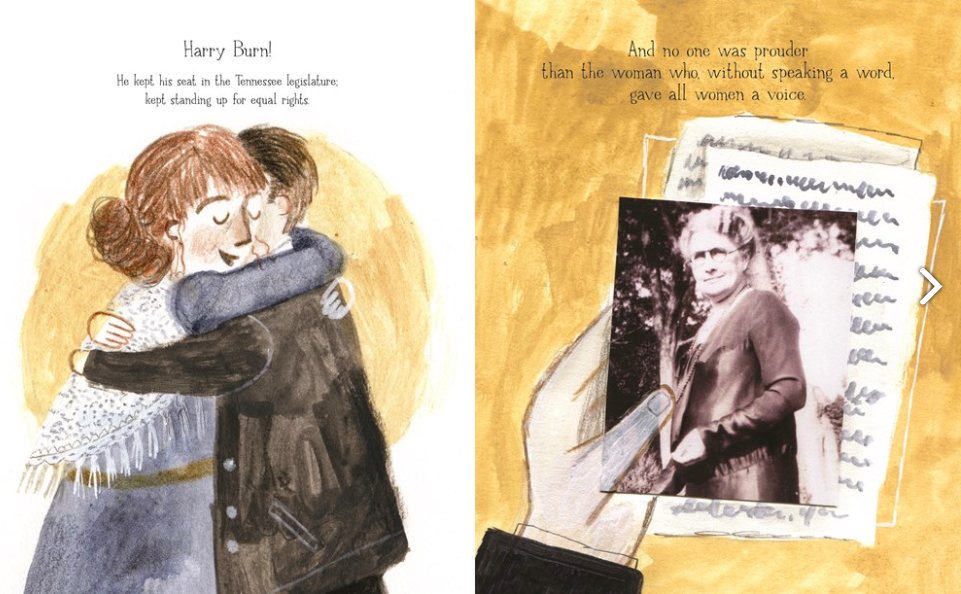
Everyone wanted to know why Harry Burn had changed his mind. In answer, he pulled from his pocket the letter his mother had written urging him to vote for suffrage. Harry constituents were shocked and angry. They vowed to vote against him in the next election. The headlines in the newspapers said that Harry had ruined his career. But Harry already knew that. He knew that his vote would mean “giving up his seat in the Tennessee House of Representatives.”
Image copyright Vivien Mildenberger, 2020, text copyright Elisa Boxer, 2020. Courtesy of Sleeping Bear Press.
When interviewed for newspaper articles, Harry said that he had followed his conscience that all people should have the right to vote. At last the election was held, and Harry awaited his fate as all the votes were counted. Who would be the next Tennessee Representative? Harry Burn! “And no one was prouder than the woman who, without speaking a word, gave all women a vote.”
In an Author’s Note, Elisa Boxer talks more about the women’s suffrage movement, the courage to stand up for what you believe in, and the power of using the vote to voice your opinion. A timeline of significant events in the women’s suffrage movement is also included.
Image copyright Vivien Mildenberger, 2020, text copyright Elisa Boxer, 2020. Courtesy of Sleeping Bear Press.
For anyone wondering about the power of one vote, Elisa Boxer puts all doubts to rest with her engaging recounting of this little-known true story. While Harry Burn’s vote took place 100 years ago, the courage he showed in standing up for his own conscience and in opposition to what was expected of him reverberates today. Boxer opens the story with a clear and meaningful definition of how a vote equals one’s voice, instilling in children who are learning to speak up for themselves in classrooms, on social media, and elsewhere the importance of voting when they come of age.
Her inclusion of quotes revealing the reasons behind opposition to women’s suffrage will be eye-opening. Her well-paced building of suspense going into the second vote and the aftermath will have kids on the edge of their seat and offers many opportunities to discuss the mechanisms of politics, expectations, and courage. Through her straightforward yet multilayered storytelling, Boxer presents two heroes for children to look up to: Harry, who put the good of the country and women ahead of his own career and Febb, who used her voice to make lasting change.
Image copyright Vivien Mildenberger, 2020. Courtesy of Sleeping Bear Press.
Vivien Mildenberger’s lovely, textured illustrations take readers back to the pivotal year of 1920, when vocal suffragettes faced their equally vocal opposition and Febb Burn, sitting on her front porch decided to write her life-changing letter. Images of politicians sporting yellow and red roses reveal the long tradition of color as an identifying symbol. An especially powerful spread comes after Harry’s vote as he walks among his angry constituents, all of whom shun him behind newspapers full of articles about the historic vote. The inclusion of the actual Febb Burn’s letter to Harry and a photograph of Febb give readers see and hear from this influential woman.
A stirring true story about the power of one person to make a difference, The Voice that Won the Vote is highly recommended for home, school, and public library collections.
Discover more about Elisa Boxer, her book, journalism, and other work on her website.
To learn more about Vivien Mildenberger, her books, and her art on her website.
Meet Elisa Boxer
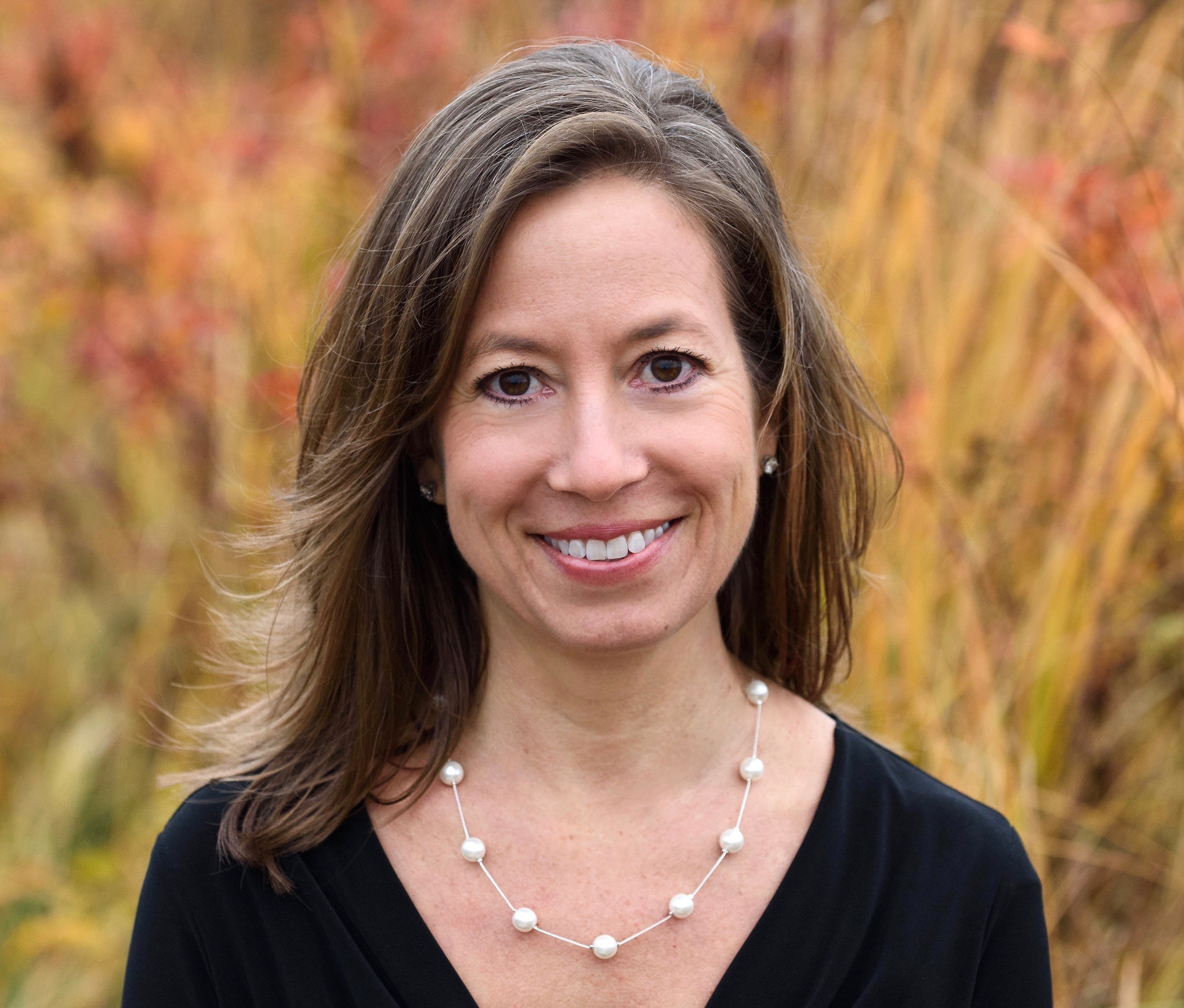
Elisa Boxer is an Emmy-winning journalist and columnist whose work has appeared in publications including The New York Times, Inc., and Fast Company. She has always been passionate about children’s literature, and finds herself especially drawn to stories of unsung heroes like Febb and Harry Burn. The Voice That Won the Vote is her first book, and she hopes it inspires children to give voice to what matters to them. Elisa lives in Maine with her family.
Today, I’m excited to chat with Elisa Boxer about her timely The Voice Who Won the Vote, her work as a journalist, and the themes woven through all of her stories. Elisa also gives kids an intriguing writing prompt. And my blogging partner Jakki’s sons, Steve and Jack, are back with their questions too!
Steve asked: How did you find the letter Febb Burn wrote to her son?
Hi Steve! So glad you liked the book. The story of how I found the letter goes back to a couple of years ago when my agent, Steven Chudney, let me know that 2020 would be the 100th Anniversary of women getting the right to vote. He asked if I could come up with a picture book about it. I’ve always been drawn to stories of unsung heroes, so I scoured the internet for little-known figures in the suffrage movement. When I stumbled across the story of Febb Burn and learned that she was the mom who saved suffrage, I knew this was a story I wanted to tell! More digging led me to the online archives at the Knox County Library in Tennessee. These archives included the letter.
I think it’s so cool to see the original papers that Harry received and read that day in the legislature back in 1920. And to see Febb’s actual handwriting! Aaah! I tend to geek out over historical documents like this.
Jack wondered: How much research did you have to do?
Hi Jack! The short answer is: Lots. After I found Febb’s story on the internet, I read as many articles online as I could find. I also read several books about the women’s suffrage movement. I wanted more background information to put the story in context, and I also wanted to know more about the legislative session in Tennessee that led to Harry Burn tipping the scales and giving women the right to vote. I also enlisted the help of the Special Collections department at the University of Tennessee Libraries. One of the most exciting things they shared with me was a scanned version of Harry Burn’s personal scrapbook from 1920, containing newspaper clippings and headlines from his historic vote!
Jack and Steve would like to know: Is voting important to you?
Definitely. I started the book with the line: “A vote is a voice,” because I believe that voting is one of the most powerful ways we can have our say in society.
Hi Elisa! I read in your bio that even as a child you loved to write. In fact, if readers look on your website they’ll see a picture of quite a large group of books with covers written in crayon. I’m sure kids would love to know what some of those stories were about. Can you share a few of the ideas you wrote about as a child?
Sure! It’s fun to look back on those and see some common themes, like defying authority (You Can’t Catch Me, for example, about a girl outrunning her parents) and grief (I wrote The Kitten and the Puppy after losing my beloved dog). And then, there was a book about a dinosaur making friends with a little girl and moving into her house, which I think I wrote because I had just learned how to draw dinosaurs ;).
With your early interest in writing books, did you ever consider becoming a children’s writer or novelist before going into journalism? What was it about journalism that attracted you?
Even though I’ve loved reading and writing children’s books for as long as I can remember, I never really considered making a career of it. I wish I had followed that passion earlier. I’m 49 and my first book was just published. So if you have any interest in creating children’s books, don’t wait as long as I did! Although, having said that, I really do love print and broadcast journalism. My specialty has always been long-form journalism, which involves in-depth research, multiple interviews, and spending time crafting a story. A lot like writing nonfiction picture books, actually. A couple of years ago, I got sidelined with a severe case of Lyme disease. It hurt to move and breathe and I was basically housebound. So that’s when I decided to re-visit my childhood passion. I began dusting off old picture book manuscripts, revising them, and querying agents.
Your stories in print for newspapers and for television news have garnered many awards. What aspects of story do you infuse into each of your pieces? What do you like best about each medium?
(Blushing). I am always looking for the soul of the story. Even with straight news pieces, I want to find people and circumstances to bring those stories to life in a way that readers or viewers can relate to. The thing I like best is the same for each medium, and that is finding the point of emotional resonance, the subtext, the theme that will stick with the audience long after they put down the paper or the magazine or turn off the TV. In fact, that’s one of the reasons I love books so much: people pick them up again and again. Sure, you can save a newspaper or magazine article that resonates with you. But it’s not the same as that feeling of finishing a book, internalizing its message, holding it in your hands and knowing it’s yours to return to whenever you want.
It seems very fitting that your first published book is a picture book. What is it about Febb Burn’s story that you think is most important for kids to know?
I really want kids to know how much their voices matter. It’s so easy to feel powerless, especially given the state of the world right now. But I hope kids come away from the book realizing that one small act of courage, in the form of giving voice to what matters to them, really can change the world.
Vivien Mildenberger’s illustrations are so evocative of 1920. What was your first reaction to seeing your story illustrated? Do you have a favorite spread?
Aren’t Vivien’s illustrations amazing? I’m still blown away by them every time I see the book. When I first saw her work on her website, even before I saw her illustrations for the book, I knew that her old-world style would be a perfect fit for this story. And then when I first saw her preliminary sketches, I thought, WHOA, this is going to be even better than I could have imagined. Hmmm, it’s tough to pick a favorite spread. But I’d have to say the one where Harry Burn is looking out the window of the state capitol, watching the throngs of people arrive to witness history. She really captures the mood here. “America was on the verge of change,” the text reads. You can’t even see Harry’s face, but Vivien somehow managed to convey so much tension and anticipation in this spread. You can feel his inner struggle to do what’s right and follow his heart in the face of opposition.
What’s up next for you?
I’m super excited to say that I have several more picture books on the way during the next couple of years, all nonfiction. I’m also working on a chapter book and two middle grade books, one nonfiction and the other historical fiction.
As kids stay home and are schooled at home, it’s wonderful to see them interacting with the kidlit community. Would you like to give readers a writing prompt?
It really is so wonderful to be interacting with kids, their parents and their teachers. As for a prompt, I’d ask kids: With the world the way it is, what are the words, the scenes, the images, and the messages that would touch your heart? In other words, what is the book you need right now? Take one small step to start creating it. And then another…
Thanks, Elisa! It’s been wonderful talking with you! I wish you all the best with The Voice Who Won the Vote, and I can’t wait to read your upcoming books. I hope we’ll have a chance to chat again!
Kids love going to restaurants that provide a fun placemat and crayons to color with while they wait. But what happens to those crayons when the meal is over? Most times they’re thrown in the trash with the napkins and straws and other items left behind. Wouldn’t it be great if those gently used crayons could go on to be used by other kids at schools that can’t afford such supplies? They can! Begun by Crayon Collection, National Crayon Collection Month encourages restaurants, hotels, and other organizations that provide free crayons to collect the ones left behind and donate them to under-serviced schools. As school arts programs are threatened with budget cuts, these important supplies can make a big difference in the lives of students. The ability of children to express their creativity is a crucial part of their education and growth. You can get involved too! To learn how you can make an impact, visit CrayonCollection.org. Or look into donating crayons (and other supplies) to a school in your area.
The Crayon Man: The True Story of the Invention of Crayola Crayons
Written by Natascha Biebow | Illustrated by Steven Salerno
Edwin Binney was an inventor who truly appreciated all the colors around him. In fact, “color made him really, really HAPPY!” Perhaps he loved color so much because all day long in the mill where he worked he was surrounded by nothing but black: “black dust, black tar, black smoke, black ink, black dye, black shoe polish. His company sold carbon black, a new kind of pigment, or colored substance, make from the soot of burning oil and natural gas.” Edwin worked with his cousin C. Harold Smith, and their company was called Binney and Smith.
Image copyright Steven Salerno, 2019, text copyright Natascha Biebow, 2019. Courtesy of HMH Books for Young Readers.
While Harold was the salesman, Edwin was the tinkerer who had made better pencils for writing on slate and a wax crayon that wrote on both paper and wood. His wife, Alice, thought he was just the person to create better crayons for kids. The existing crayons were too big and clunky, and artists’ crayons were too expensive.
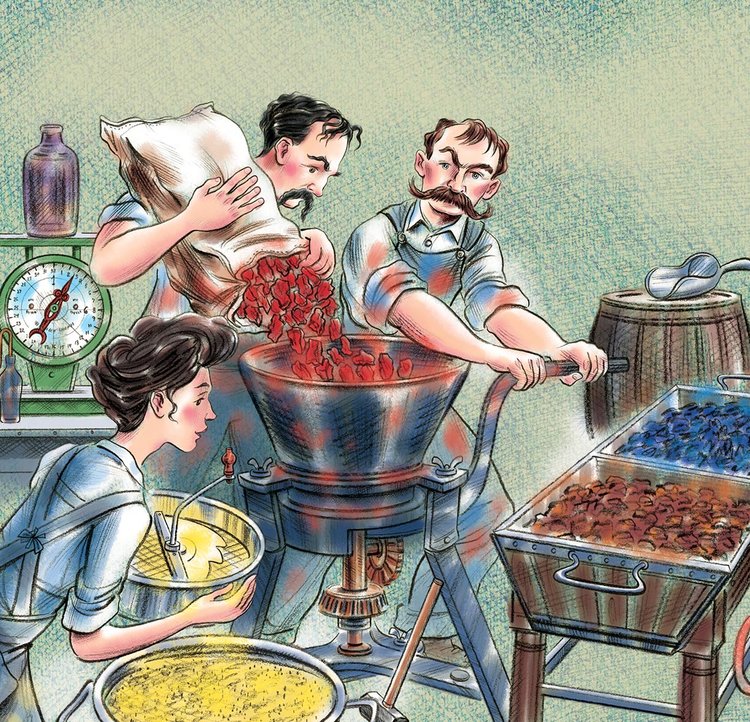
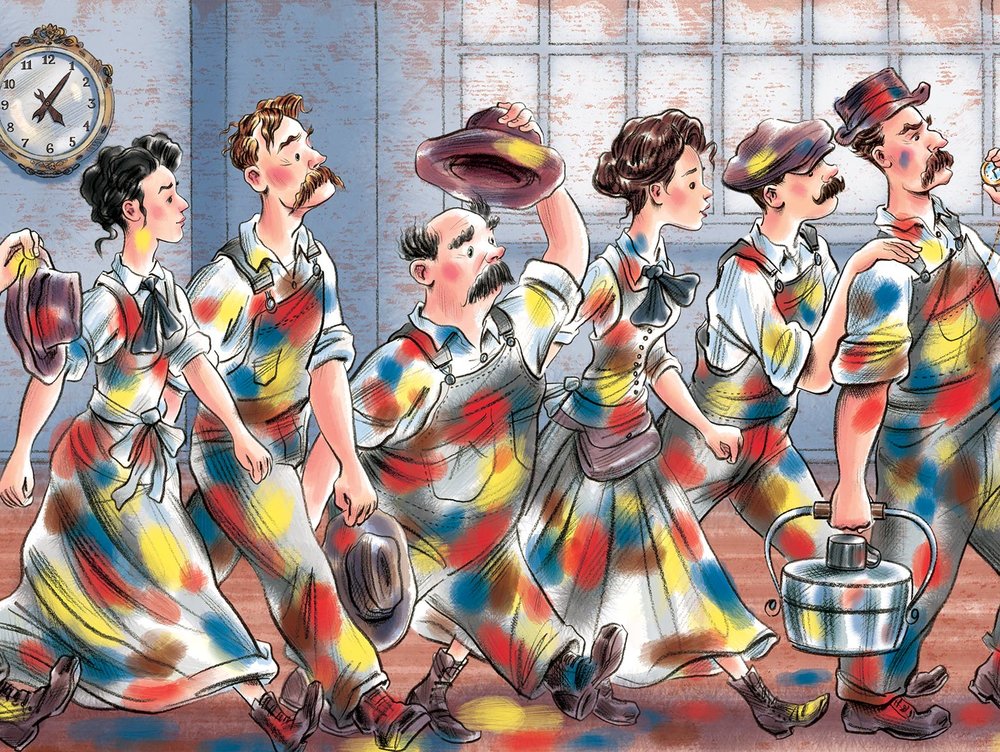
Edwin gave it some thought and started experimenting with wax for substance and rocks and minerals for color. Then he and his workers fine-tuned their batches, adding only “a pinch of this pigment, a sploosh of that one, a little hotter, a little cooler…and voilà, LOTS of different shades!” Now, instead of being covered in black dust at the end of the day, “Edwin came home covered in color.”
Image copyright Steven Salerno, 2019, text copyright Natascha Biebow, 2019. Courtesy of HMH Books for Young Readers.
At the factory, Edwin’s team worked on their top-secret formula and finally poured the mixtures into “thin, crayon-shaped molds” to make crayons that were just the right size for children. Finally, in 1903, Edwin had the product he wanted. “He’d invented a new kind of colored crayon” and wanted a new name to go with it. Alice had just the right suggestion, and Crayola crayons were born.
The first boxes contained eight colors and sold for a nickel. As they shipped out to stores, Edwin wondered if the kids would like them. Children loved their fine points, clear lines, and long-lasting color. By this time, inexpensive paper was also available, so kids didn’t have to draw or write on slate tablets anymore.
Image copyright Steven Salerno, 2019, text copyright Natascha Biebow, 2019. Courtesy of HMH Books for Young Readers.
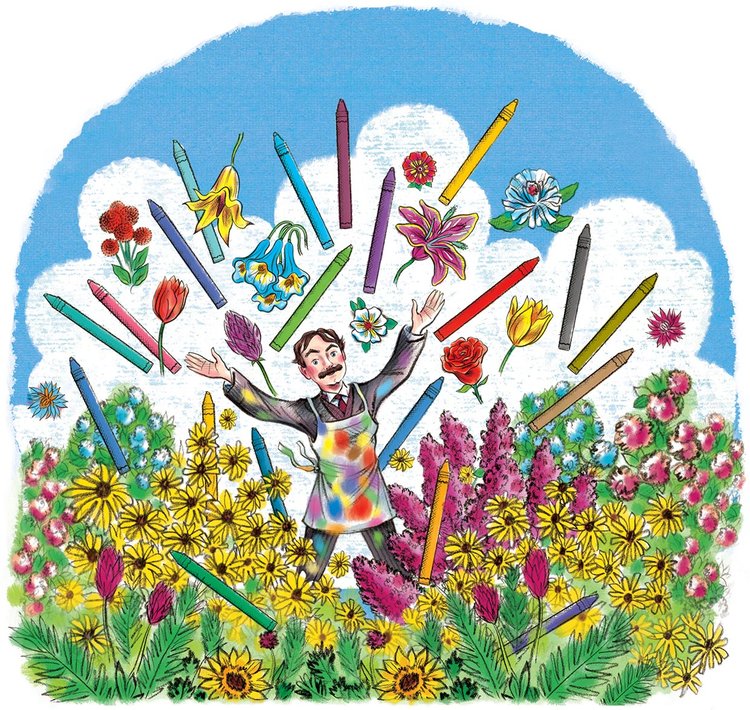
At the St. Louis World’s Fair in 1904, Edwin’s Crayola crayons won a gold medal. As time went on, Edwin and his team made even more colors, many inspired by nature and even the flowers in Edwin’s own garden. Some of the colors you’ll find in a box today were given their names by children, including “macaroni and cheese” and “robin’s egg blue.” Now, kids all around the world can create just the picture they want, with lots and lots of color.
Back matter includes an illustrated description of the process of making Crayola crayons, an extended biography of Edwin Binney, and a bibliography of resources.
Image copyright Steven Salerno, 2019, text copyright Natascha Biebow, 2019. Courtesy of HMH Books for Young Readers.
Natascha Biebow’s quickly paced biography of Edwin Binney and the invention of Crayola crayons is a deft portrait of the man and his times that were on the cusp of and central to so many innovations that created the modern world. Biebow’s emphasis on Binney’s willingness to listen and match his inventions to people’s needs is a lesson on collaboration and the true spirit of invention for today’s future pioneers. In her fascinating and accessible text, Biebow relates the problems with late 1800s writing and drawing mediums while also building suspense on how Binney and his team created the new crayons. Children will be awed to discover the thought, experiments, and materials that went into those first thin sticks of color. Short paragraphs that explain more factual information about topics in the story, including carbon black, the availability of paper, European crayons, and pigments are sprinkled throughout the pages.
Image copyright Steven Salerno, 2019, text copyright Natascha Biebow, 2019. Courtesy of HMH Books for Young Readers.
Steven Salerno’s color-drenched pages are beautiful tributes to the man who brought a new age of color into children’s lives. In a clever page turn, Edwin Binney stands in his garden with his arms outstretched appreciating the rainbow of flowers, the deep-blue sea, the light-blue sky, and a fiery red cardinal flying by. The next page takes kids into Binney’s mill, where he stands in the same position, but now seeming to bemoan the sooty environment. Salerno brings the time period alive for kids through hair and clothing styles and school and home furnishings. Several pages give readers a field trip into Binney’s secret lab to see the mechanics of making crayons at work. The front and end papers invite kids to give the wrapper-less crayons pictured a name based on their colors and then to make a drawing of their own.
A high-interest biography of the man who changed the way kids could interpret their world, The Crayon Man is a must for young inventors, artists, and thinkers as well as for classroom story times, social studies lessons, and art classes. The book would be a welcome addition to home, school, and public libraries.
Ages 6 – 9
HMH Books for Young Readers, 2019 | ISBN 978-1328866844
Discover more aboutNatascha Biebowand her books on her website.
To learn more aboutSteven Salerno, his books, and his art, visit his website.
National Coloring Book Day Activity
Cool Coloring Pages
You know what to do during Crayon Collection Month! Collect some crayons and enjoy these printable coloring pages for you to print and enjoy!
Gary Freiberg chose the day in 1877 that Thomas Edison invented the phonograph to encourage people to enjoy music on vinyl records. Whether you grew up listening to records or are a recent convert to this art form that has had lasting appeal even in this technological age, today’s holiday gives music lovers an excuse to enjoy their favorite artists – and, of course, the subject of today’s book should be among them!
Elvis Is King
Written by Jonah Winter | Illustrated by Red Nose Studio
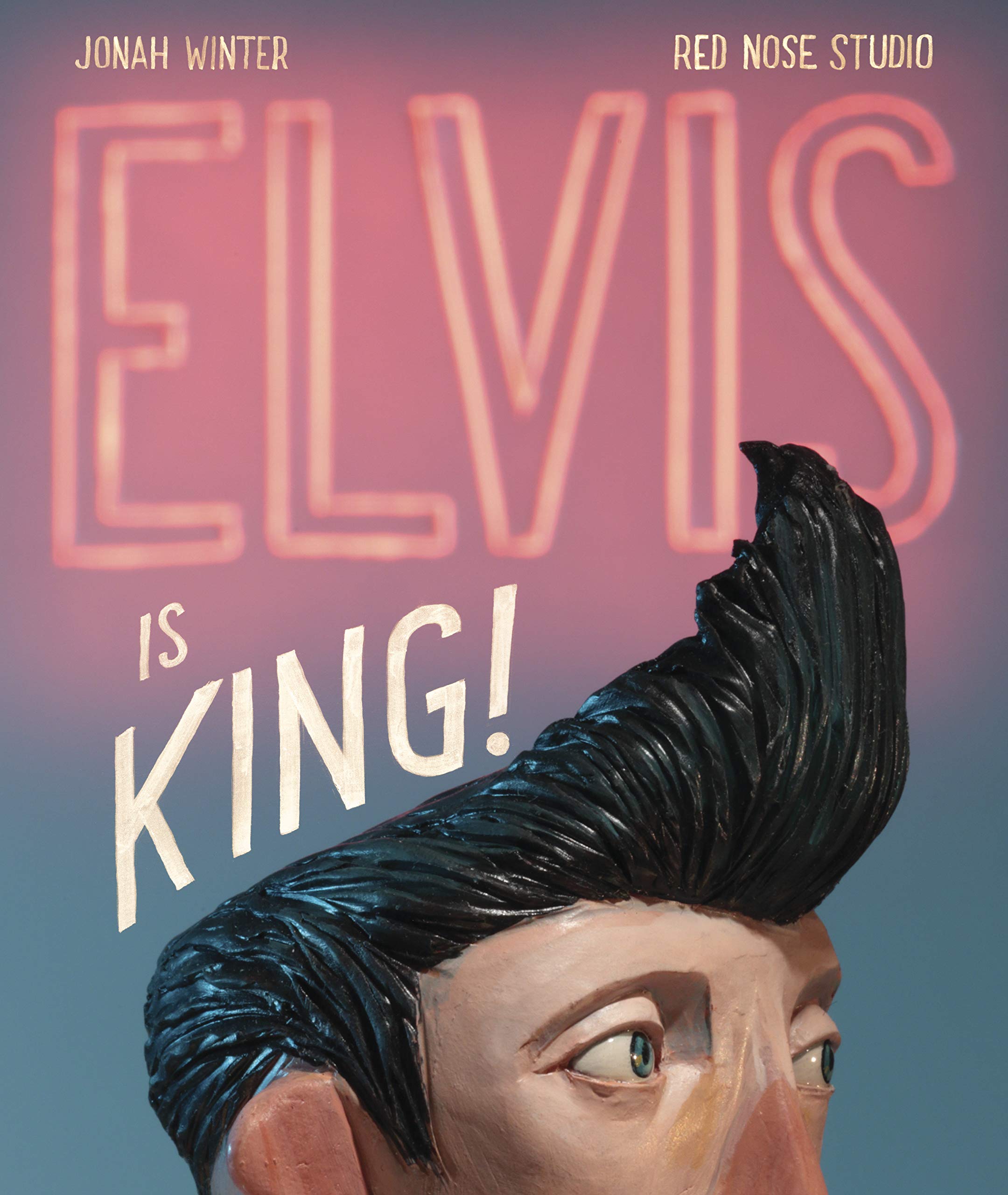
Elvis is King by Jonah Winter and Chris Sickels’ Red Nose Studio is an eye-popping wonder for fans of The King of Rock ‘n’ Roll wanting to share their love for Elvis with their kids. In short, lyrical chapters with dramatic titles that are cleverly reminiscent of the sensational headlines Elvis generated throughout his life (and even after), Winter peels back Elvis’s rags-to-riches story, encapsulating the depth of poverty, talent, and ambition that fueled his life. It’s all here—his birth “in a humble shack / on the wrong side of the railroad tracks, / the side where the poorest of the poor people live…;” his reason for being: singing; and the county fair talent show, where ten-year-old Elvis got his first taste of adoration and a “Fifth Prize!” award.
Image copyright Red Nose Studio, 2019, text copyright Jonah Winter, 2019. Courtesy of Schwartz & Wade.
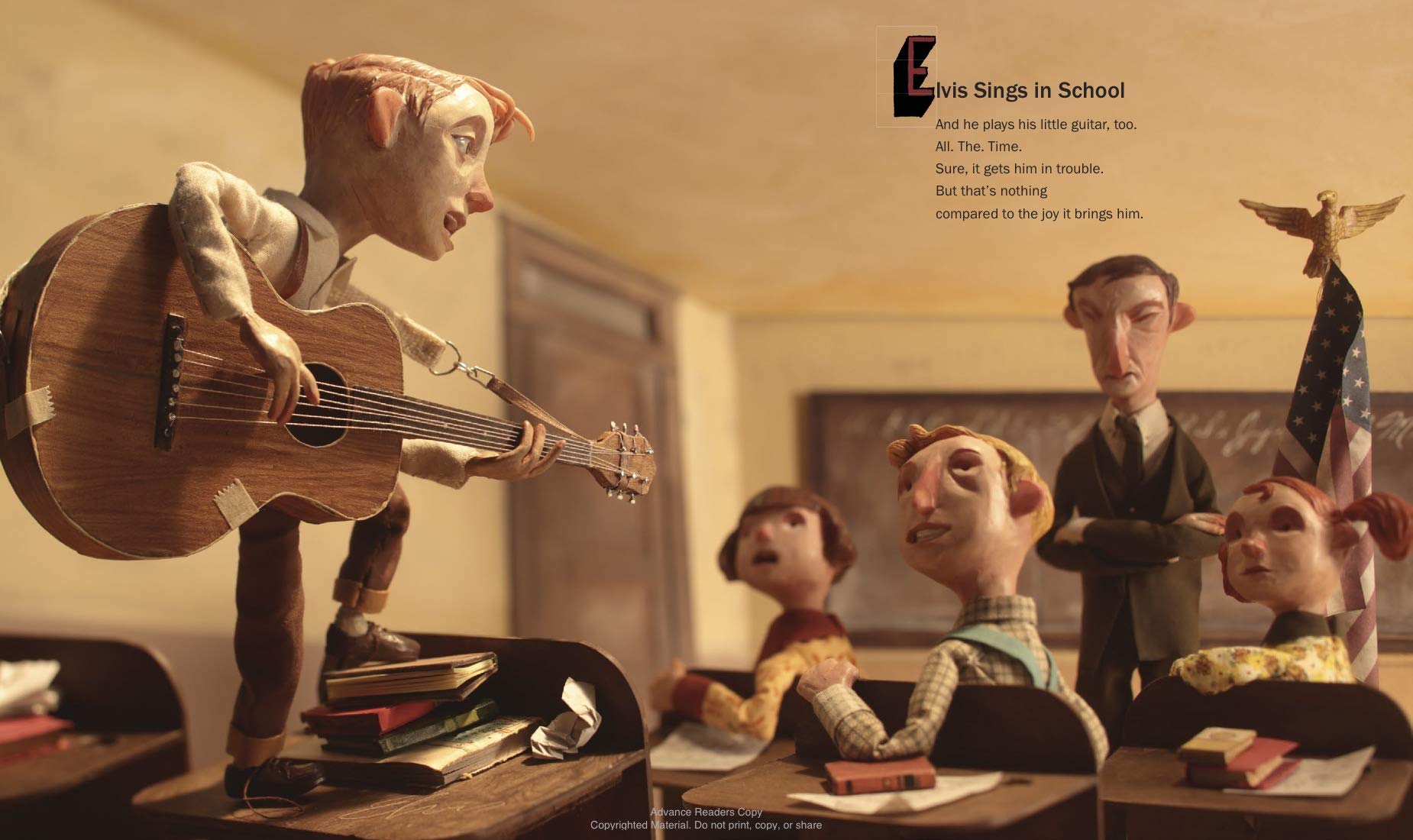
Kids walk into the hardware store with Elvis’s barefoot mama, who “with pennies she saved…/ buys her eleven-year-old birthday boy / the most important gift he will ever receive. / It will be the key to his salvation.” Elvis plays that guitar everywhere, “All. The. Time.” There’s the moment Elvis overheard gospel singing coming from the African American Church and “The First Cheeseburger Ever Eaten by Elvis.” And that question: Why peanut butter and banana sandwiches? The answer’s here too.
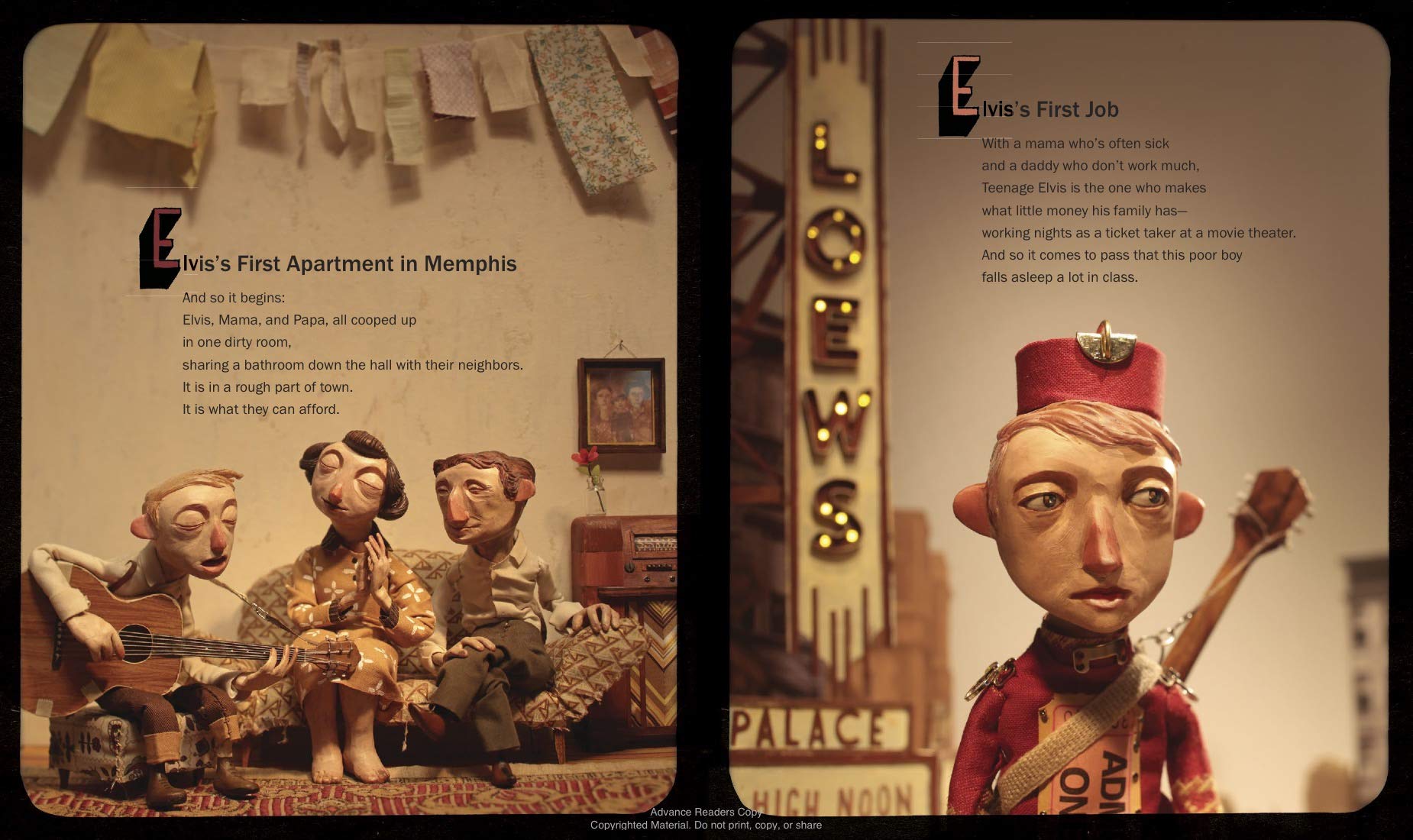
When the family moves to Memphis, it’s up to teenage Elvis to make the money by “working nights as a ticket taker at a movie theater.” Then, suddenly during those years, Elvis finds the “Weird Teenage Elvis” inside him. He dyes his blond hair black and waxes it into a wave. At a thrift shop he buys green pants, a pink shirt, and a checkered jacket. Then at the high school talent show, he “KNOCKS ‘EM DEAD with his song.” And not only that “something happens, something big, when he’s up there: / He is no longer shy! / He can be whatever he wants to be—let loose, go crazy!”
Image copyright Red Nose Studio, 2019, text copyright Jonah Winter, 2019. Courtesy of Schwartz & Wade.
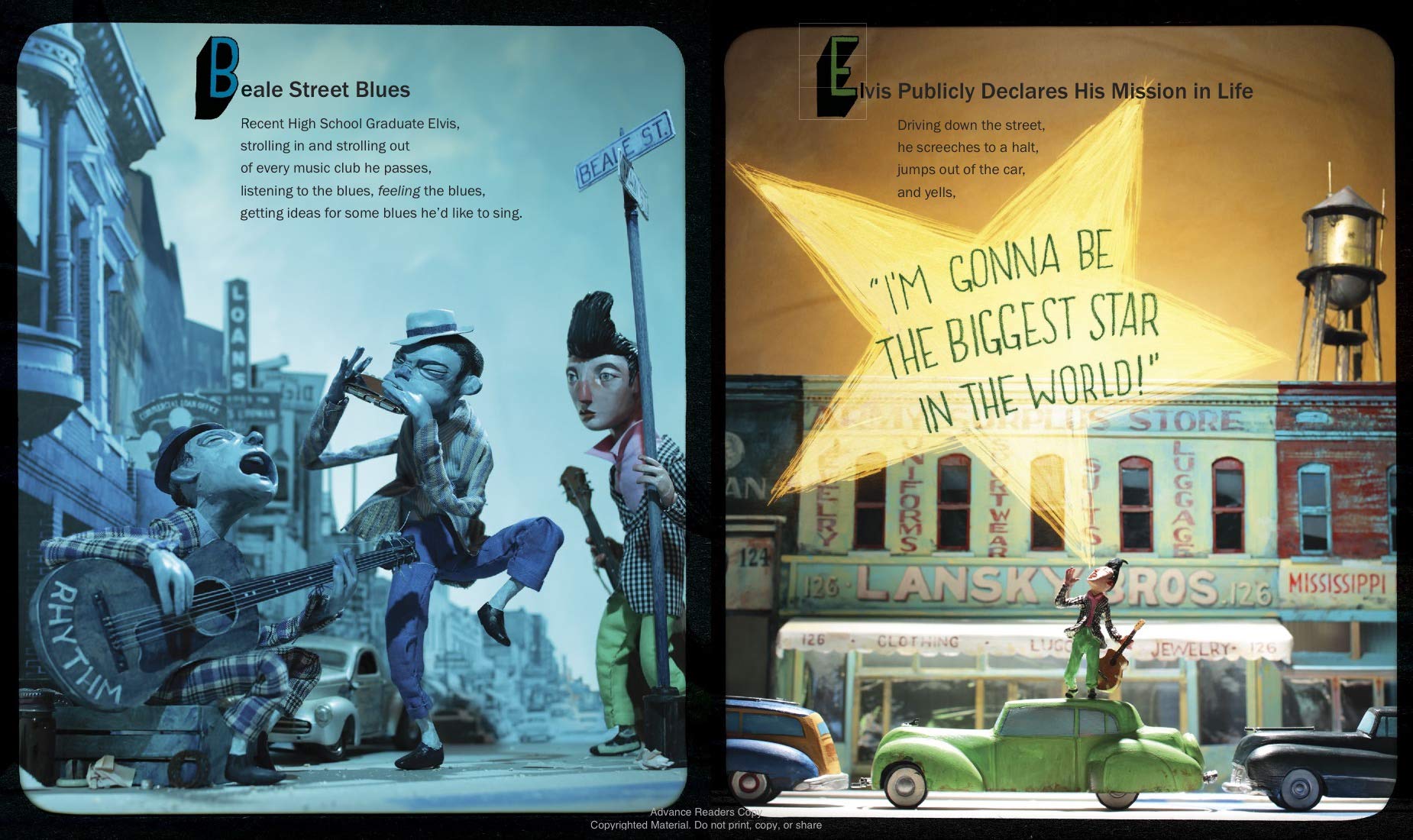
Along the way he falls in love, graduates from high school, and soaks up the sounds of the blues on Beale Street. For his mama’s birthday, he goes to Sun Studios, where anyone can record themselves singing. “(It also makes *real* records of big-time singers— / and Sly Elvis knows this.)” Elvis has his first recorded song for just $3.98. A bit later he gets the call he’s been hoping for from Sun Studios and discovers his signature sound and moves. The song—”That’s All Right”—plays on the radio, and where’s Elvis? Hiding out. Will people like it? Five thousand requests and fifteen replays in one night say Yes!
And when Elvis walks on stage for the first time to sing his song, he’s met with an “AVALANCHE of screaming—in a good way!” Goggle-eyed girls just want to be near him, and it’s the same no matter where he travels. This “Good-Lookin’ Heartthrob Elvis” is soon to lose his “One True Love, / his little darlin’, Dixie Locke. He uses that feeling, though, in a song—”Heartbreak Hotel” that “rises to number 1 on the pop charts.” So “What Is This Crazy Music, Anyway?” It’s not exactly country and it’s not exactly rhythm and blues. “It’s… / ROCK ‘N’ ROLL, baby. / And Elvis is its KING…!”
Image copyright Red Nose Studio, 2019, text copyright Jonah Winter, 2019. Courtesy of Schwartz & Wade.
Jonah Winter’s biography is in every way a loving tribute to Elvis Presley that also winks at his larger-than-life persona and the world’s obsession with him. Well-chosen adjectives presented in initial caps and attached to Elvis’s name, give titles to the phases of Elvis’s life and present an evocative way to show what and where he grew from and left behind on his rise to fame. Sprinkled with southern vernacular and touched with the cadence of a slow, considered southern drawl, Winter’s ingenious verses mirror song lyrics and echo themes that not only make up the country and blues standards that influenced Elvis’s music but that applied to his life.
As always Chris Sickels’ Red Nose Studio artwork is nothing short of astounding. Each illustration is composed as a 3-D set handcrafted from polymer clay, wood, wire, fabric, and found objects. The intricate details and moving emotions, demonstrated in a look, by a gesture, and through perspective, give the illustrations a realism that goes beyond a photographic depiction to illuminate the heart of Elvis Presley’s story. Readers will want to linger over every page to absorb the cultural landscape and life-affirming moments that created The King of Rock ‘n’ Roll.
A joy to read aloud, Elvis Is King is an inspirational story for anyone with a dream, big or small. The personal, yet universal, story and phenomenal art make the book a stirring addition for home, school, and public libraries.
Ages 4 – 8
Schwartz & Wade, 2019 | ISBN 978-0399554704
Discover more about Jonah Winter and his books on his website.
To learn more about the work of Chris Sickels and Red Nose Studio, visit his website.
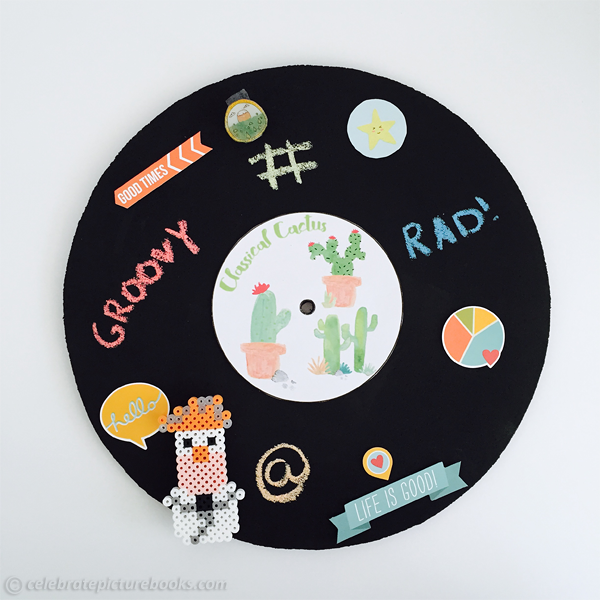
National Vinyl Record Day Activity
Make a Record Chalkboard Bulletin Board
Would you love to make a record some day? Why wait? In this fun craft you can create your own record bulletin board—and even create your own label art! While this record may not spin on turntables around the world, it will drop in a more important place—your very own room!
Since 1956, hot dogs have been top dog throughout July. Independence Day, summer picnics, and camping trips are just a few of the events that are more fun with this versatile favorite. Enjoyed throughout the world, hot dogs even get their own special days in the U.S., Great Britain, Canada, Australia and other countries. A favorite of kids and adults alike, hot dogs can be enjoyed plain or loaded with everything from mustard to chili. While Hot Dog Month may be winding down, there’s still plenty of summer left to enjoy this simple meal.
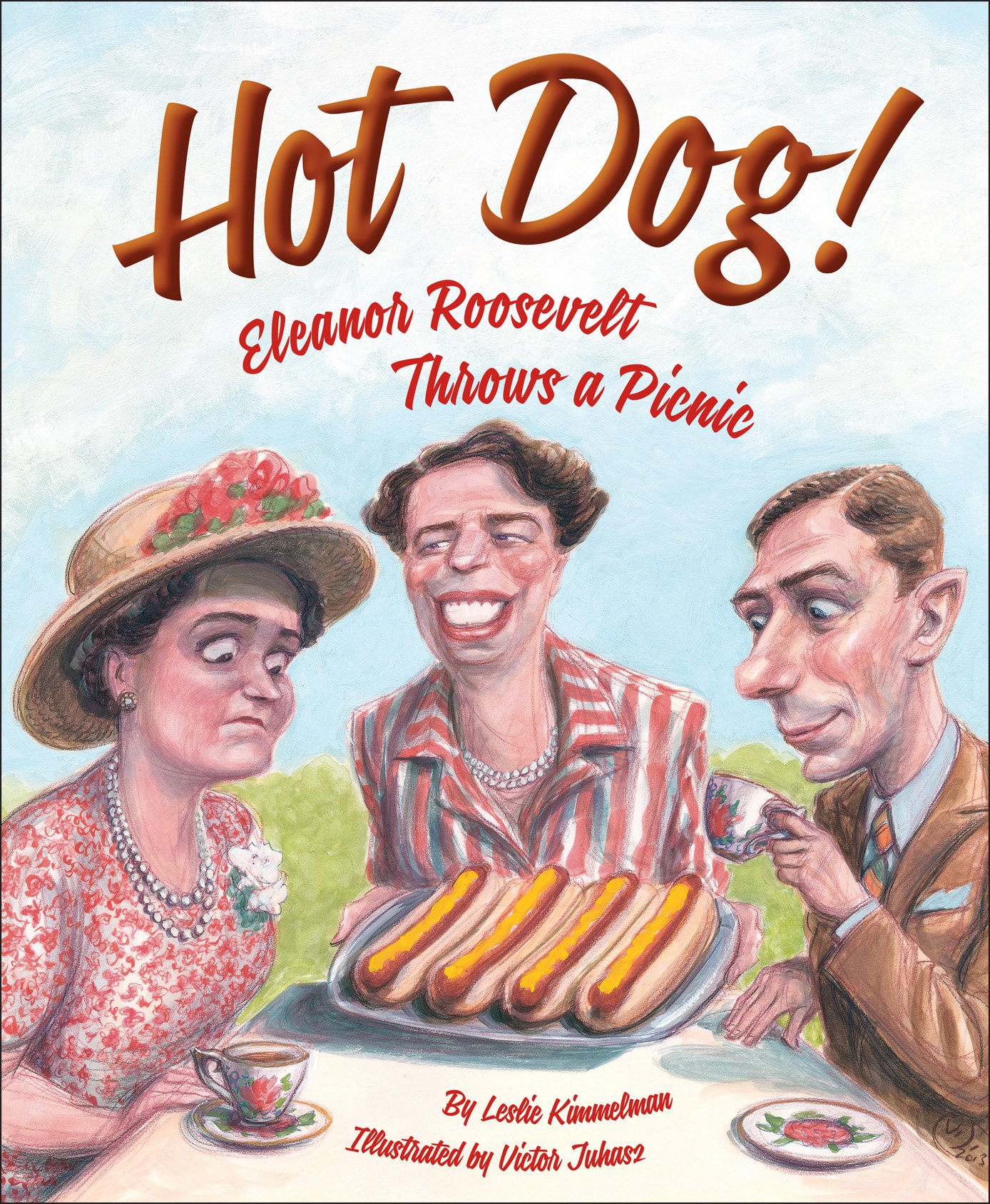
Hot Dog! Eleanor Roosevelt Throws a Picnic
Written by Leslie Kimmelman | Illustrated by Victor Juhasz
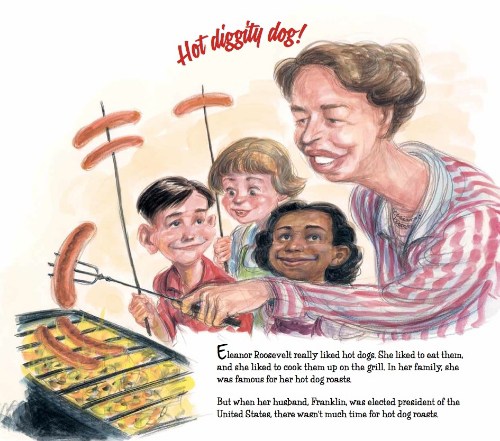
Before Eleanor Roosevelt became the first lady of the United States, she loved to grill up hot dog roasts for her family and friends. You see, Eleanor loved hot dogs! But after her husband Franklin became President, Eleanor had important duties. “Things were tough in the United States in the 1930s,” and since Franklin “couldn’t walk or move about easily, he counted on Eleanor to travel around the country for him” talking to people to see how the government could make things better. “Soon Eleanor was as popular as the president.”
Image copyright Victor Juhasz, 2014, text copyright Leslie Kimmelman, 2014. Courtesy of Sleeping Bear Press.
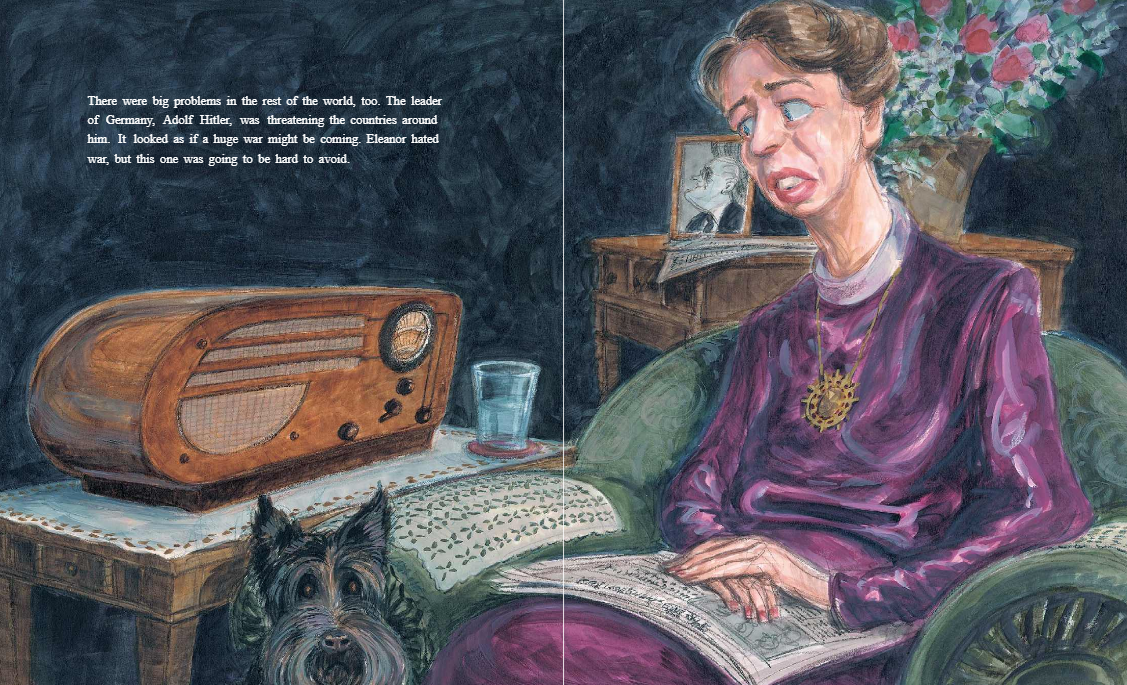
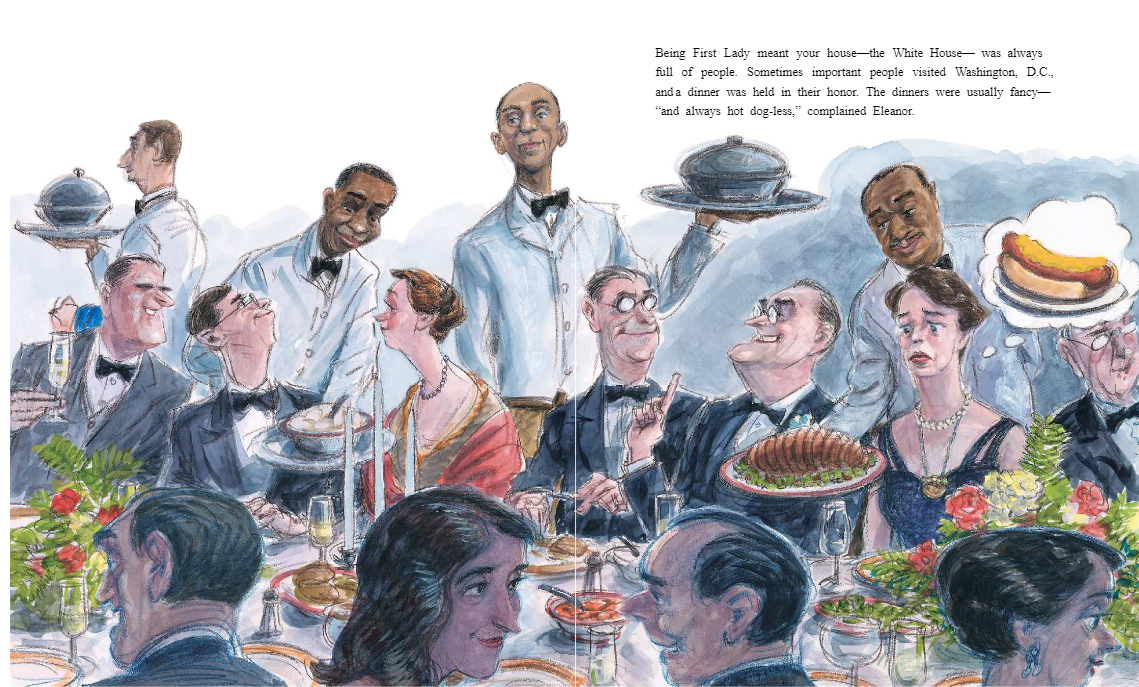
Not only was the United States suffering through a depression, it looked like the world would soon be at war. Eleanor presided over many fancy dinners in the White House given in honor of important people. These dinners, complained Eleanor, were “always hot dog-less.” Then, in 1939, the king and queen of England decided they would visit America to commemorate the 150th anniversary of our country’s independence from Britain. No English monarch had visited America in all that time.
Image copyright Victor Juhasz, 2014, text copyright Leslie Kimmelman, 2014. Courtesy of Sleeping Bear Press.
Eleanor did a little research and discovered that Queen Elizabeth was a distant cousin of George Washington. “‘She’s practically a member of the American family!’” Elizabeth exclaimed. “‘So to celebrate the first royal visit,’ Eleanor continued, ‘we need an all-American picnic.’” But first, came a fancy dinner. Following that, the Roosevelts and the king and queen drove to Hyde Park, New York, where the Roosevelts had an estate.
Image copyright Victor Juhasz, 2014, text copyright Leslie Kimmelman, 2014. Courtesy of Sleeping Bear Press.
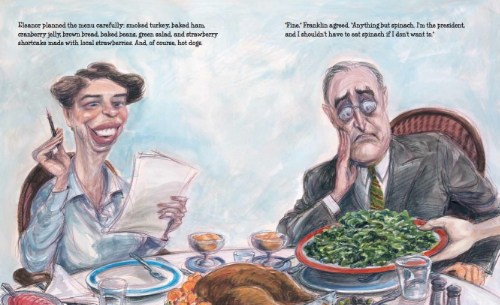
Eleanor planned her picnic to be held at a simple stone house on the property owned by the president, where the scenery was as pretty as it gets. Eleanor packed the menu full of traditional American favorites, including turkey, ham, cranberry jelly, baked beans, strawberry shortcake—and, of course, hot dogs. When the details of the menu were released, the White House was inundated with letters from all over the country protesting that hot dogs should not be offered to the queen.
Image copyright Victor Juhasz, 2014, text copyright Leslie Kimmelman, 2014. Courtesy of Sleeping Bear Press.
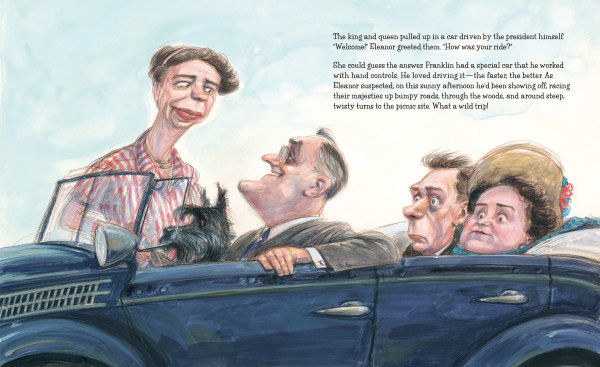
Eleanor answered the protesters in her daily newspaper column. She reassured them that there would be “plenty of other food, and…the more important guests will be served with due formality.” On June 11, Eleanor finished her morning routine and rushed to the cottage to prepare for the picnic. As the king and queen arrived—driven by the president himself in a specially outfitted car—Eleanor could see from the expressions on the royal faces that Franklin hadn’t resisted the temptation to show off, “racing their majesties up bumpy roads, through the woods, and around steep, twisty turns to the picnic site.”
When it came to eat, King George picked up a hot dog and “ate it with gusto … and mustard!” He even had seconds. And the queen? She daintily cut hers up with a fork and knife. After dinner, King George and Queen Elizabeth began their trip back to England with a train ride. Townspeople flocked to the station and stood along the banks of the Hudson River to see them off.
Image copyright Victor Juhasz, 2014, text copyright Leslie Kimmelman, 2014. Courtesy of Sleeping Bear Press.
Three months later, World War II began. England and America fought side by side to defeat their enemies. The Roosevelts had promised to visit Queen Elizabeth and King George, but Franklin died before the war’s end. Eleanor later made the trip alone. On June 11, 1989 another picnic was held at Hyde Park in remembrance of that other picnic fifty years earlier. Some of the guests had been children at that first memorable party, and Queen Elizabeth “sent a special message: ‘The memory of the picnic was a source of strength and comfort to the king and me through the dark days of the Second World War….’” And what did the guests enjoy at that second picnic? The menu was “exactly the same—right down to the hot diggity dogs!”
An Author’s Note adding a bit more information about Franklin and Eleanor Roosevelt and King George IV and Queen Elizabeth follow the text.
Image copyright Victor Juhasz, 2014, text copyright Leslie Kimmelman, 2014. Courtesy of Sleeping Bear Press.
Leslie Kimmelman’s engaging and smoothly paced story captures Eleanor Roosevelt’s warm-hearted personality and down-home friendliness that made her one of American history’s most beloved first ladies. Details of Eleanor’s White House duties juxtaposed with humorous anecdotes about her love of hot dogs, reaction to her choice of menu, and Franklin’s penchant for driving create a well-rounded portrait of a particular time in history. Including 1989’s 50th anniversary picnic reminds readers of the ongoing friendship between America and Great Britain.
Victor Juhasz uses lush, caricature-style art to great effect in representing the 1930s to ‘40s time period, the lavish trappings of the White House, and Eleanor’s larger-than-life personality and influence. Her wide smile and can-do attitude as well as her self-confidence are on display for young readers to appreciate and emulate. Other character’s facial expressions clearly spotlight the humorous incidents but also the seriousness of the times. And, of course, those hot dogs that Eleanor loved so much look good enough to eat!
For young readers interested in history, culinary arts, and biographies, adding Hot Dog! Eleanor Roosevelt Throws a Picnic to their reading menu would be a treat. Teachers will also find the book an engaging inclusion to lessons on the historical time period, women in history in general, and Eleanor Roosevelt in particular.
Ages 8 – 11
Sleeping Bear Press, 2014 | ISBN 978-1585368303
Discover more about Leslie Kimmelman and her books on her website.
To learn more about Victor Juhasz, his books, and his art, visit his website.
National Hot Dog Month Activity
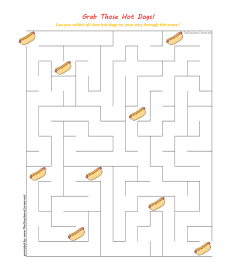
Grab Those Hot Dogs!
There are delicious hot dogs scattered throughout this maze! Can you collect all nine on the way from start to finish in this printable puzzle?
















 celebratepicturebooks.com