You can find rocks almost everywhere you go—from tiny pebbles to imposing boulders. Most of the time we may not pay much attention to the pebbles under our feet or the rock formations we pass frequently, but today’s holiday encourages people to really take a look at the variety of sizes and colors that make each rock unique. Rock collecting can be a fun and educational hobby as each type of stone has its own fascinating history and science to learn about. Why not get outside, do a bit of rock hunting, and start your collections today?!
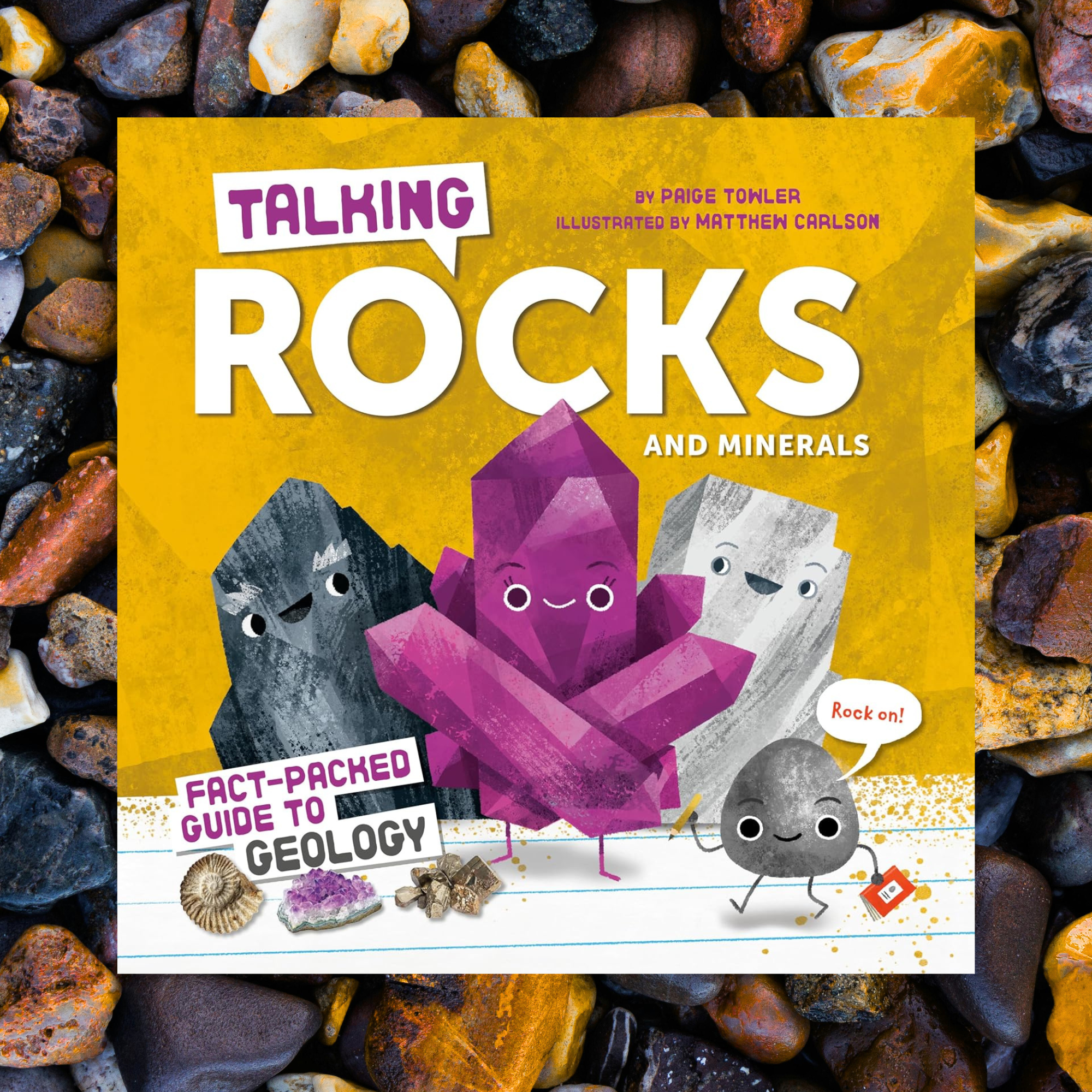
Talking Rocks and Minerals: Fact-Packed Guide to Geology
Written by Paige Towler | Illustrated by Matthew Carlson
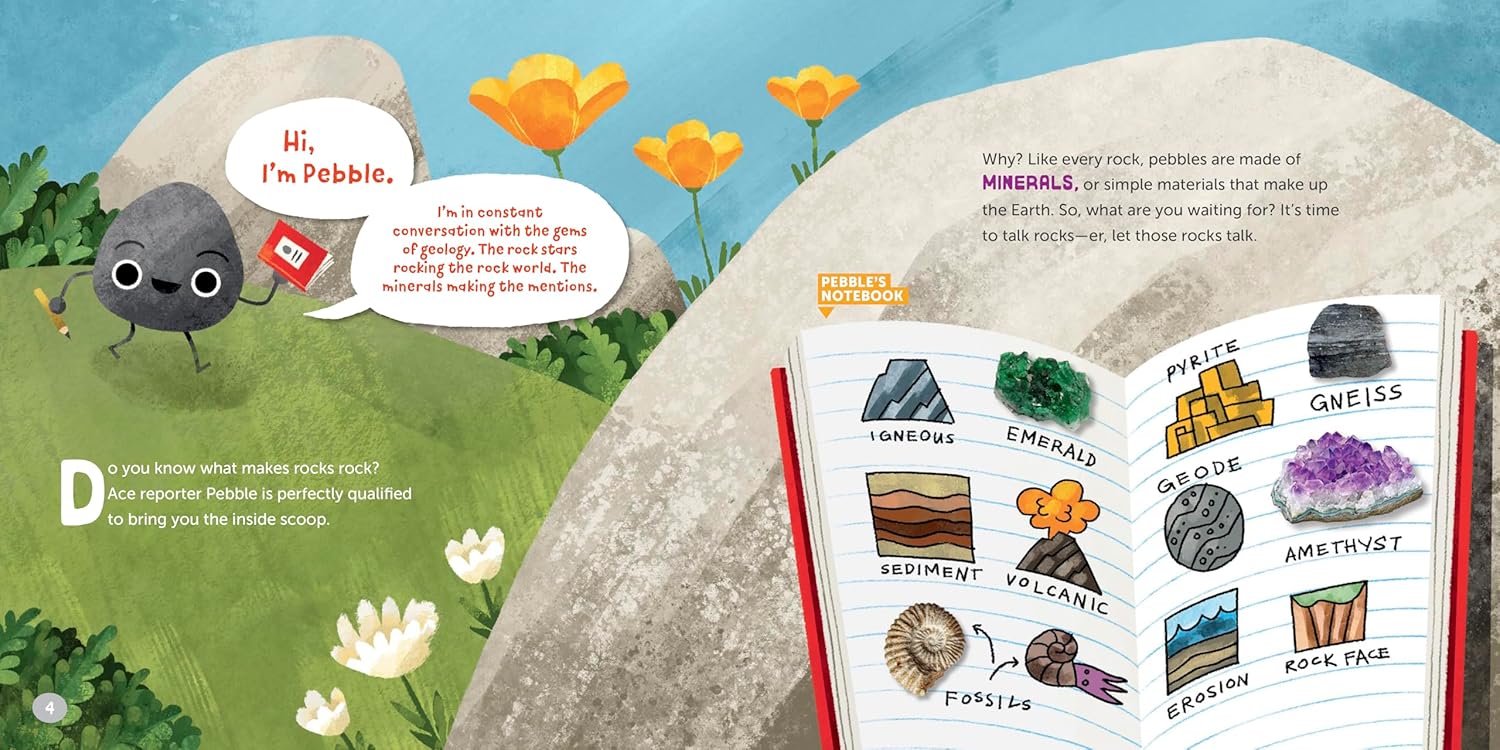
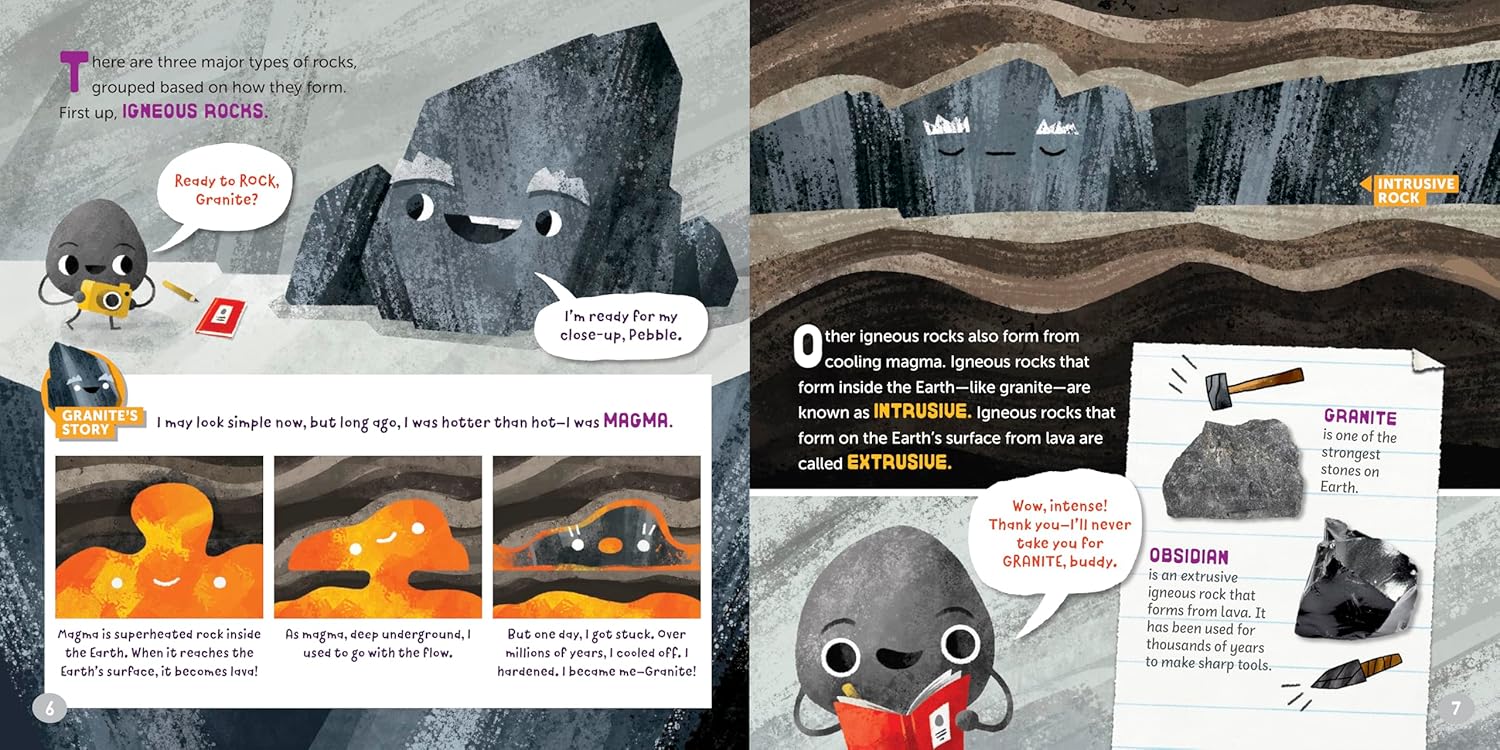
In Talking Rocks and Minerals, readers meet ace reporter Pebble, whose resume boasts, “I’m in constant conversation with the gems of geology. The rock stars of rocking the rock world. The minerals making the mentions.” And he’s not kidding! A quick scan of his notebook reveals interviews scheduled with all the big names in rock, and he’s sent an open invitation for kids to come along and hear what they have to say. First up, readers meet an igneous rock, who regales them with memories of long, long, long ago when he started out as magma then cooled to become granite, “one of the strongest stones on earth.”
From there, Pebble moves on to talk to Coal and Limestone and discovers the layered story of what it’s like being a sedimentary rock. A couple of geodes then roll by to give kids a peek of the secrets they hold inside and make their story “crystal clear.” Amethyst gives an exclusive, showing how this royal gem developed, from when “a volcano blew its top” to the gamma rays that turned it purple. Pebble then introduces kids to two types of metamorphic rock—Marble and Gneiss—that start out as one kind of stone but under pressure and heat become another.
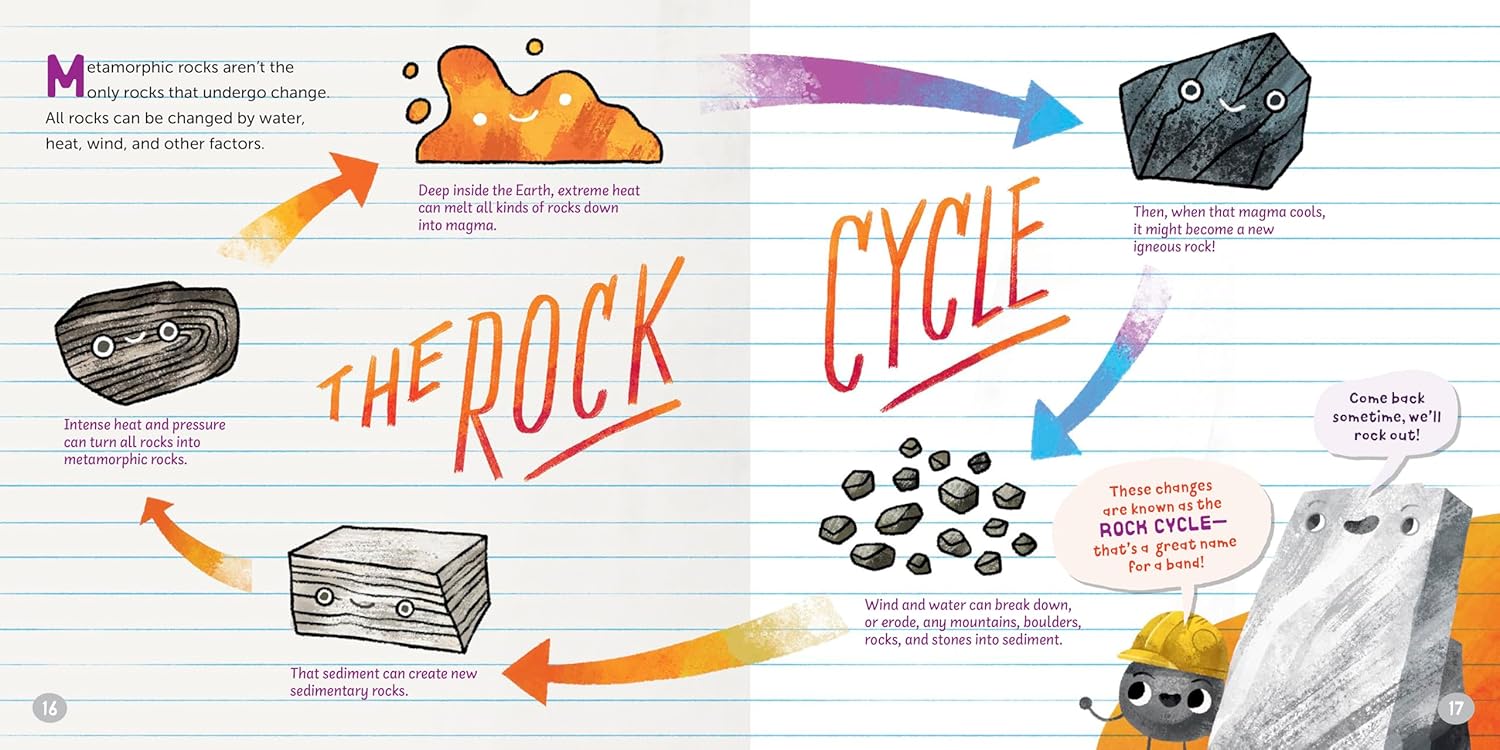
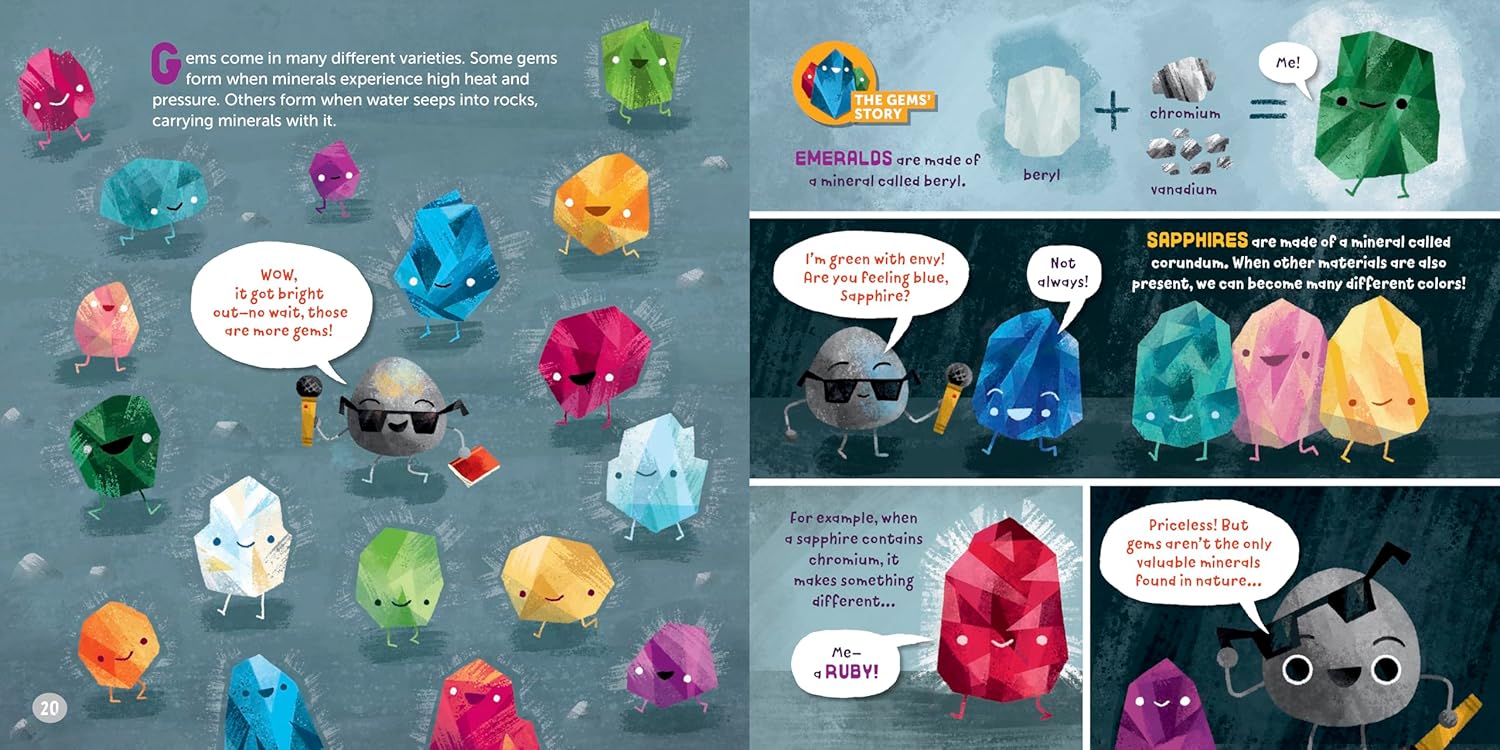
After learning the steps to the rock cycle, kids go deep underground to meet Diamond and learn how diamonds are formed from carbon and how they appear before they’re polished to a shine. Pebble interviews other gems too, like Emerald, Sapphire, and Ruby, who shine a light on how different minerals create such a variety of colorful and valuable stones.
Emerging from underground, Pebble talks with pyrite, a shiny, golden mineral that often fooled prospectors during California’s gold rush, who has a surprising revelation to share. Continuing his walk, Pebble encounters a dinosaur fossil, who recounts how bones, leaves, and footprints become fossilized, leaving evidence of creatures and plants from eons ago. Speaking of eons ago, a trio of space rocks drop in—assuring Pebble “We come in pieces.”—to contrast asteroids from meteorites and tell how meteorites come to Earth.
Surrounded by all of his new friends, Pebbles signs off, but the learning continues. Back matter includes a glossary, a note from a geologist, a list of ideas on how kids can become rock hounds, and a bibliography of more books to check out.
Gem-packed with puns, jokes, and hard-core facts, Paige Towler’s Talking Rocks and Minerals will excite kids already enthralled with geology and spark enthusiasm in those unfamiliar with the science, variety, and history of rocks we see every day as well as the stones we prize as valuable. Towler’s accessible text will appeal to all learners, making the book an excellent resource for educators. Her conversational delivery draws children in, creating a personal connection between them and the subject that will continue as they grow in their scientific studies.
Matthew Carlson’s eye-catching pages reflect how children learn today, offering adorable interacting characters, separate panels or full-page spreads that illustrate particular facts or scientific processes, and a wealth of detail that allows children to see the layers in sedimentary rock, look inside a geode, follow the rock cycle and the preservation of prehistoric creatures in fossils, and watch an asteroid plummet through Earth’s atmosphere to become a meteorite, among so many other elements.
A brilliant teaming of author and illustrator, Talking Rocks and Minerals: Fact-Packed Guide to Geology is an enriching and enlightening STEM book that is a must for all elementary classrooms, geology-loving children, science educators, and library collections.
Ages 6 – 9
Grosset & Dunlap, 2025 | ISBN 978-0593890950
About the Author
Paige Towler is a children’s book author and poet living in Washington, DC. She loves writing scary stories, tales about animals, and nonfiction facts about the weird and wonderful world around us. Her previous picture books include Mysterious, Marvelous Octopus! (National Geographic Kids), Baby Bat Bedtime(Smithsonian Institution/Sleeping Bear Press),Yoga Animals(National Geographic Kids), and more. Visit her at paigetowler.com.
About the Illustrator
Matthew Carlson is an illustrator, game designer, and graphic designer in Northern California. He studied art and English literature at the University of California, Berkeley. He’s illustrated projects for Robert Mondavi Wines, Facebook, and Twitter, and is currently the director of UX Design for Education, Fonts, and Drawing & Painting at Adobe. Originally from Seattle, Washington, Matthew now lives in Marin, California, with his partner, two kids, two dogs, and a growing collection of rocks.
You can purchase Talking Rocks and Minerals: Fact-Packed Guide to Geology from these booksellers:
This time of year is perfect for gathering with family and friends and spending those cold, indoor days making sweet treats and savory dishes! Baking together is a great way to teach valuable cooking skills and a little math. Talking with kids while baking is fun too! Tell old family stories, talk about favorite recipes, and share funny or memorable culinary experiences. Of course, the best part of baking together is eating the delicious meals or treats afterward!
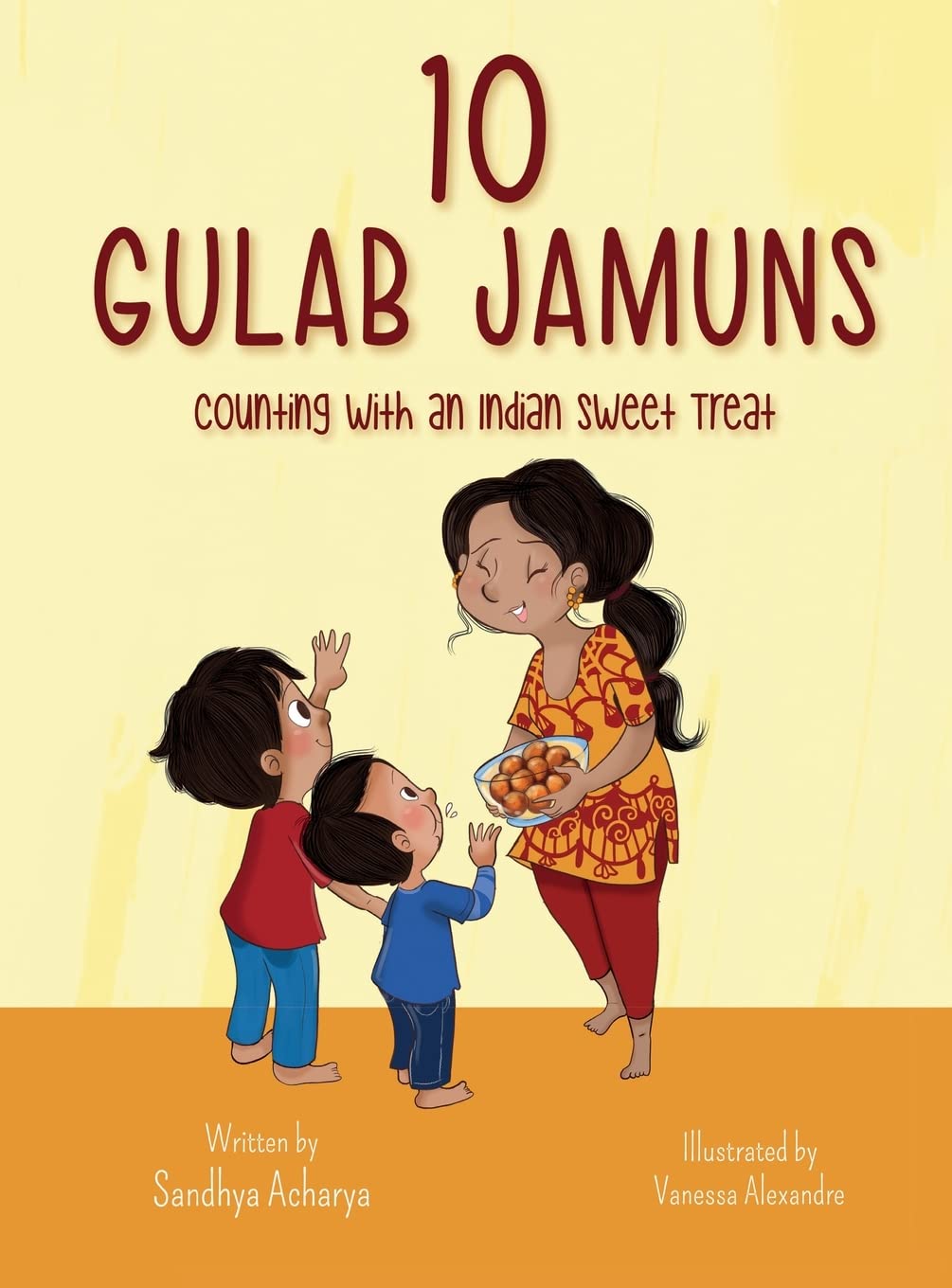
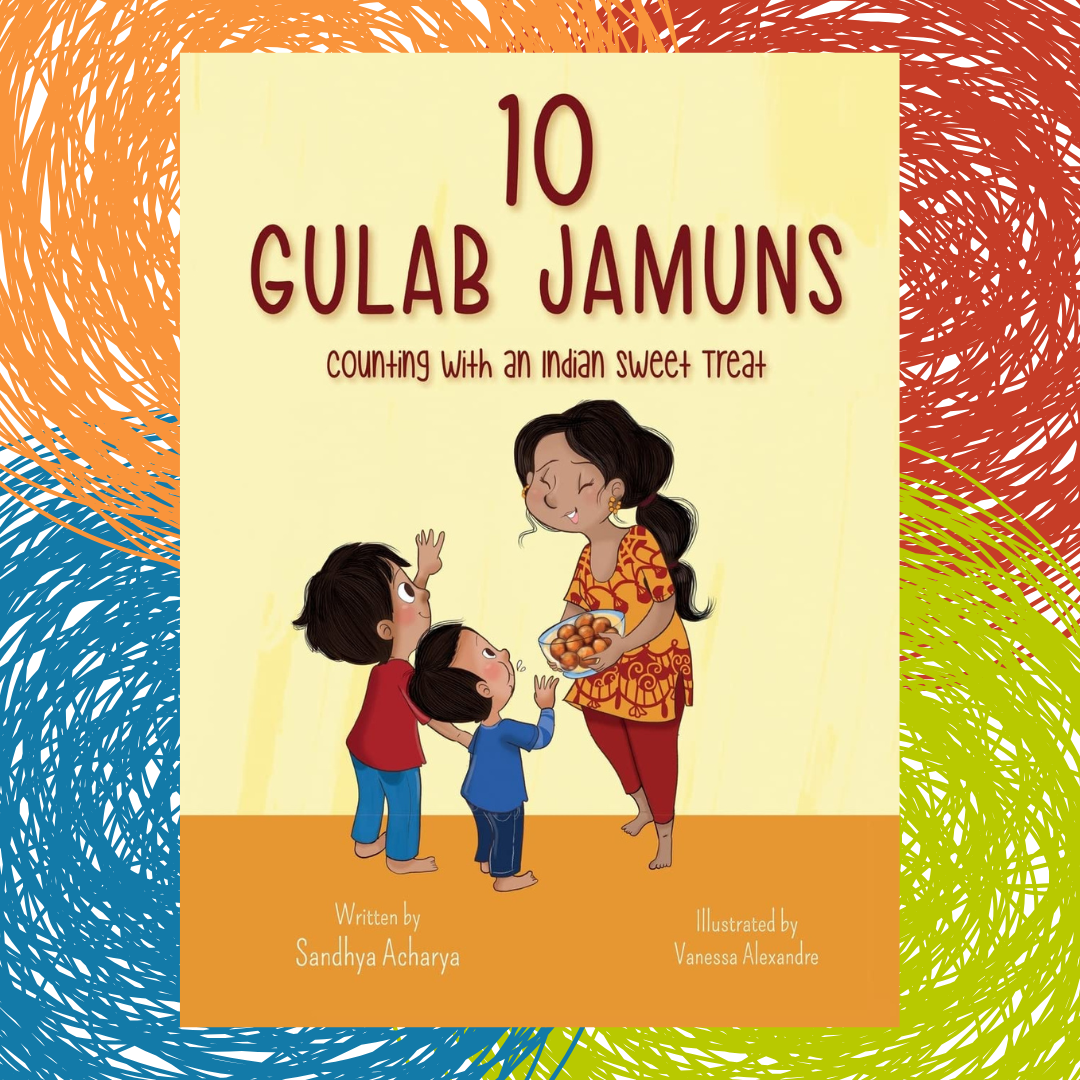
10 Gulub Jamuns: Counting with an Indian Sweet Treat
Written by Sandhya Acharya | Illustrated by Vanessa Alexandre
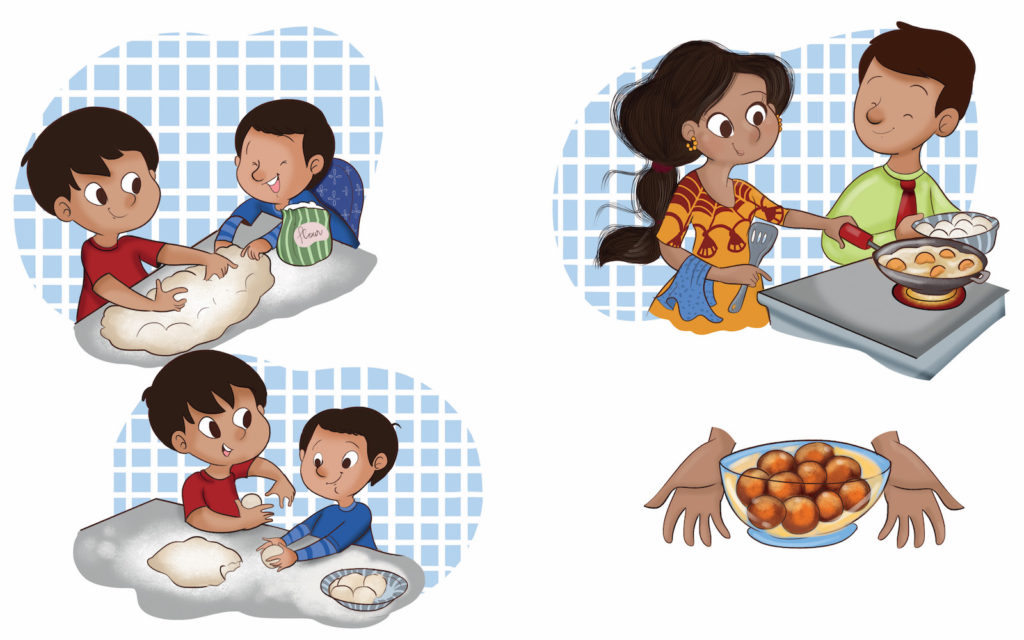
Idu and his little brother Adu were excited to help their mom get ready for their friends Dia and Mia and their parents who would be coming later that evening for dinner. The delicious aroma of spices Mamma’s cooking already perfumed the house. At last it was time for Mamma to make the dessert: gulab jamuns! Idu and Adu tried to imagine what gulab jamuns were. “‘They are little round sweets that look like doughnuts,'” their mother explained. “‘They are soaked in sugary syrup so when you bite into one, they melt in your mouth.'” Idu and Adu thought they sounded yummy.
After the treats were finished, Idu counted them in the bowl. “‘1, 2, 3, 4, 5, 6, 7, 8, 9, 10. 10 gulab jamuns!'” Adu echoed his big brother: “’10 gulab jamuns!'” Mamma sent the boys off to play, but the bowl of sweets was too enticing. Adu climbed onto the table and ate one. Then he stuffed his cheeks with two more.
Idu thought his brother was funny until Mamma caught them. She asked Idu to tell her how many gulab jamuns she had made and then count how many were left. “‘1, 2, 3, 4, 5, 6, 7. 7 gulab jamuns,'” he answered. “‘Swa gua amoons,’ Adu repeated” through his full mouth. When Mamma asked what had happened to the other three, Idu told her. Then she wanted to know how it had happened.
Idu obliged, exactly imitating Adu’s actions. Adu then turned and gave Mamma a big sweet-treat smile. Mamma laughed, then grabbed one gulab jamun for herself and handed one each to her sons. That left just one more for . . . Daddy, who was just coming home from work. But what would they serve their special guests for dessert now? Idu and Adu enthusiastically offered to help their mother make more. Later, after dinner, Idu and Adu helped pass out the gulab jamuns, but there were two left over. Why? Idu’s and Adu’s bellies were already full of their new favorite dessert!
Sandhya Acharya’s humorous counting story is the recipe for an entertaining read aloud the whole family will enjoy. Adu and Idu’s sibling shenanigans will have young readers giggling, and the naturally occurring opportunities for kids to count the gulab jamuns offer a fun way for them to engage with math. The exercise can even be extended at home or in classrooms as children add or subtract treats or other foods from their own plates. A multilayered story, 10 Gulab Jamuns also contains gentle lessons in honesty, taking responsibility, and making amends for one’s behavior,
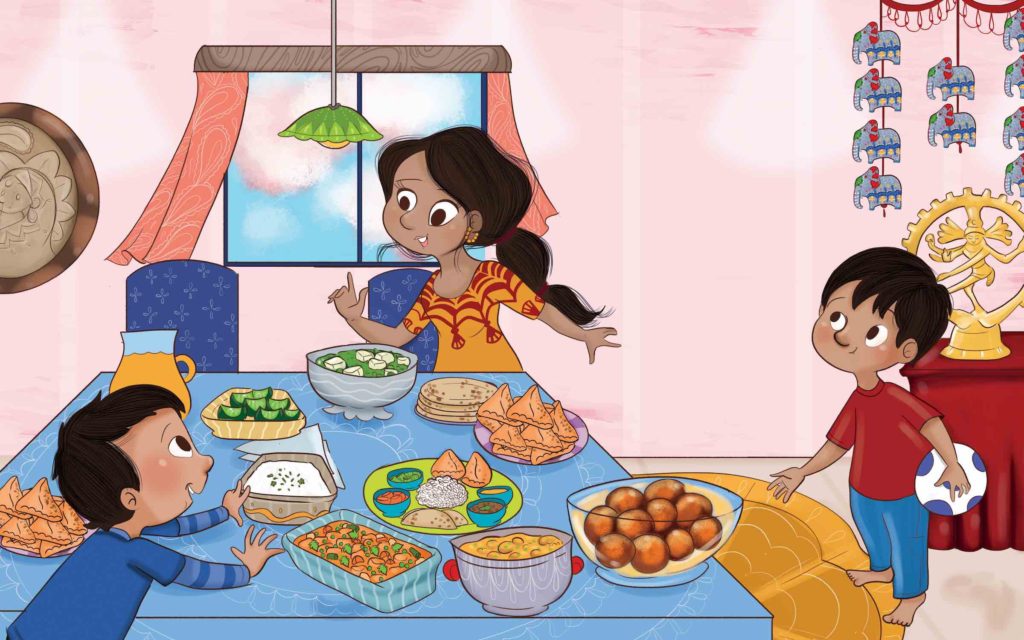
Vanessa Alexandre’s vivid and expressive illustrations bring out all the comical fun as Adu and Idu sneak the sweet treats, get caught, and ultimately help their mother make more. Children will especially like images of the brothers’ playful mischief-making, the bright kitchen and table laden with delicious Indian foods, and the cheerful depictions of a traditional Indian home and clothing.
A heartwarming, dialogue-rich story you can count on to become a favorite, 10 Gulab Jamuns would be a delightful addition to home, classroom, and library collections.
Ages 2 – 7
Sandhya Acharya, 2022 | ISBN 979-8985609516
About the Author
Sandhya Acharya grew up in Mumbai, India and now lives in the Bay Area. She is a mother to two young boys from whom she often draws inspiration for her writing. She worked in corporate finance and is a dance enthusiast as well. She hopes her readers have as much fun as she did with this story.
Bake for Family Fun Month Activity
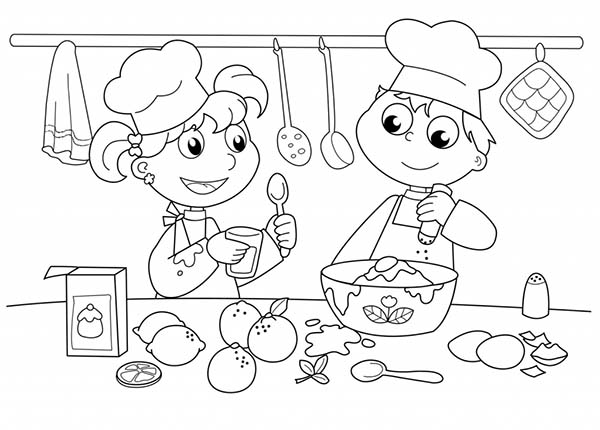
Let’s Bake Together Coloring Page
It’s fun for friends or siblings to create new recipes or just cook up some favorite treats! Have fun with this sweet coloring page!
You can purchase 10 Gulab Jamuns at these booksellers
Today’s holiday was established in 1983 and is celebrated on February 11 to honor the birthday of Thomas Edison. The day recognizes the spirit of inventors who look at life a little differently, let their imagination fly, and create a new . . . something! While we often think of inventions that change the world on a day like today, simple ideas implemented at home also make a big impact—or just lead to lots of fun. If you and/or your kids enjoy being creative, today’s the day to tinker around with your ideas.
Thanks to Eerdman’s Books for Young Readers for sharing a digital copy of The Quiet One with me!
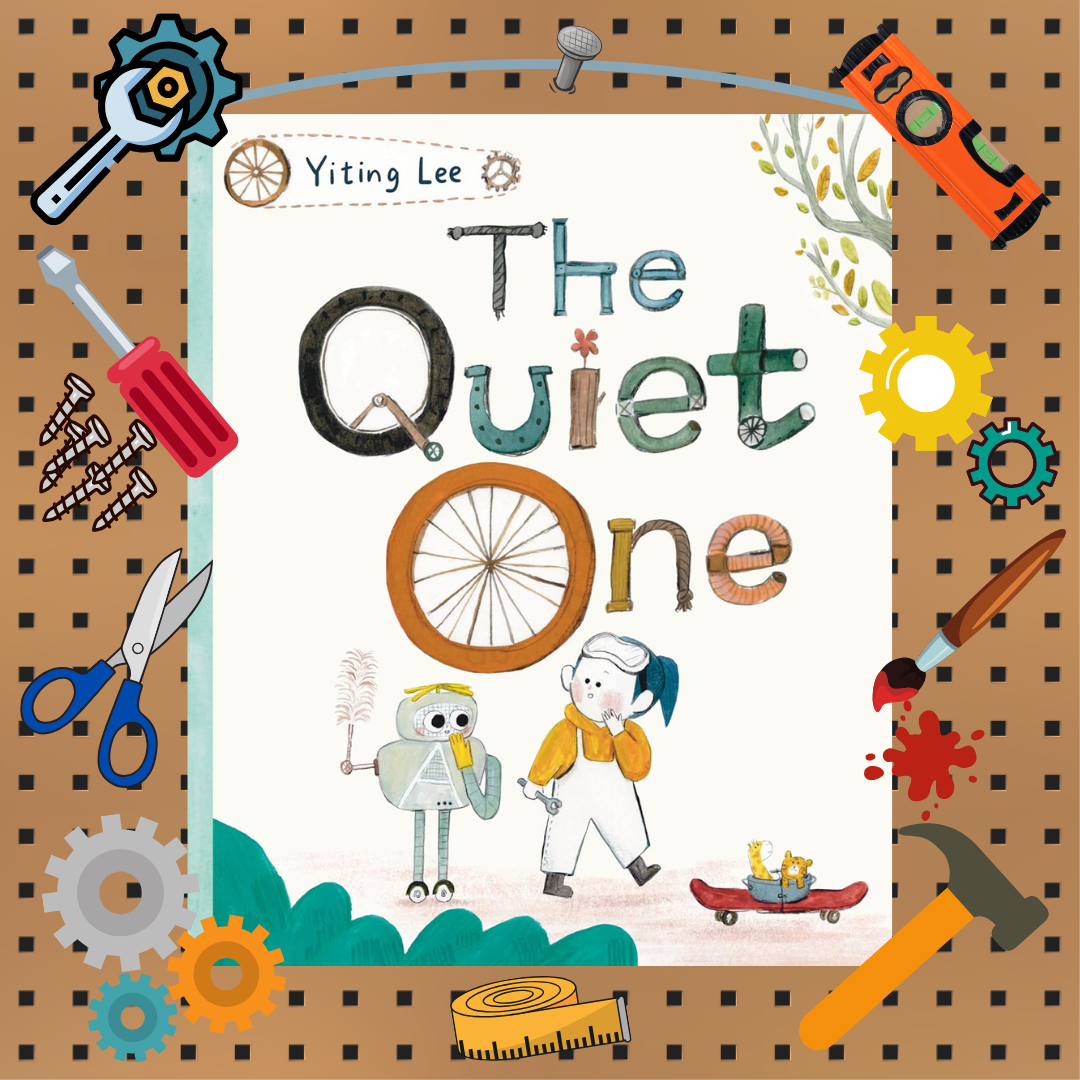
The Quiet One
By Yiting Lee
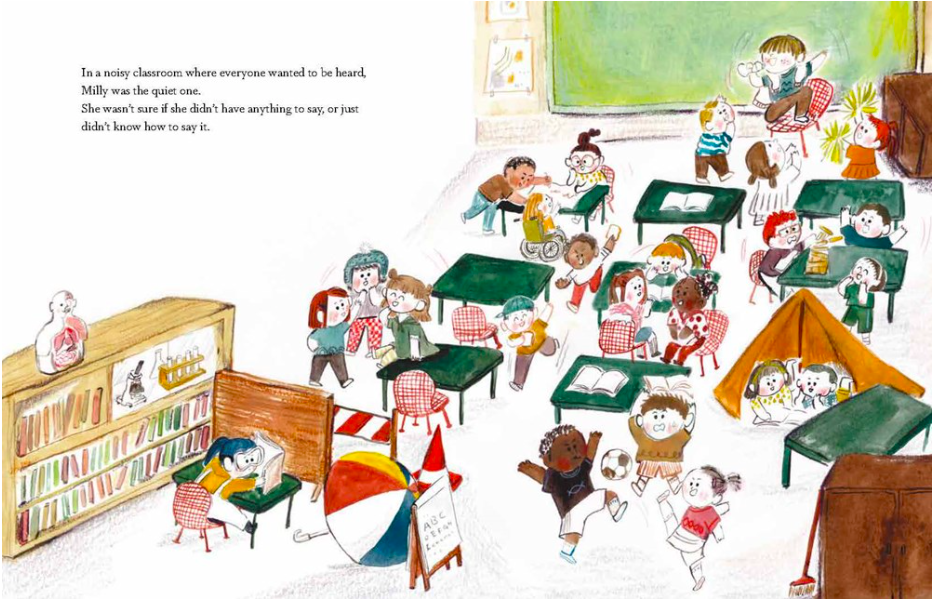
In her noisy classroom, Milly was the quiet one. She wasn’t exactly sure why she didn’t join in with her talkative classmates or why she especially dreaded Show and Tell, which was coming up on Friday. She most liked hanging out in her “secret place”—a shed filled with all sorts of things people didn’t need anymore or had forgotten. Milly was happy in her own company and liked to entertain herself by transforming other people’s old junk into amazing inventions like a running wheel for the shed’s mice and a working train from unused roller skates.
Copyright Yiting Lee, 2025. Courtesy of Eerdmans Books for Young Readers.
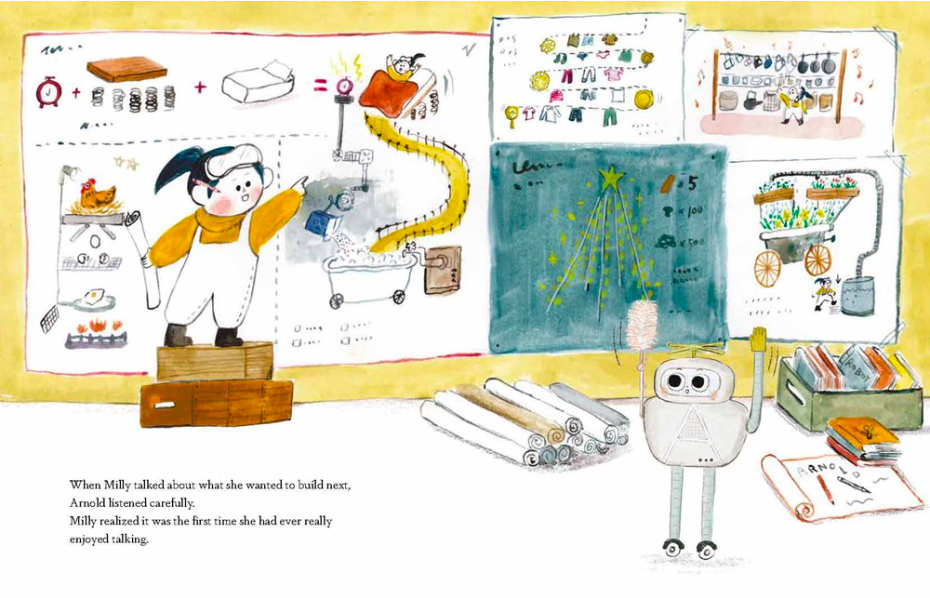
Then Milly found a broken cleaning robot. Getting out her toolbox, two caster wheels, and other supplies, Milly went to work. When she was finished and rebooted the robot, she was astonished to discover that it could talk—”Hi, I’m Arnold,” it said. Milly told Arnold her name. All afternoon Milly and Arnold worked to turn Milly’s secret place into a playground. Then as Milly explained what she wanted to build next, she “realized it was the first time she ever really enjoyed talking.”
Copyright Yiting Lee, 2025. Courtesy of Eerdmans Books for Young Readers.
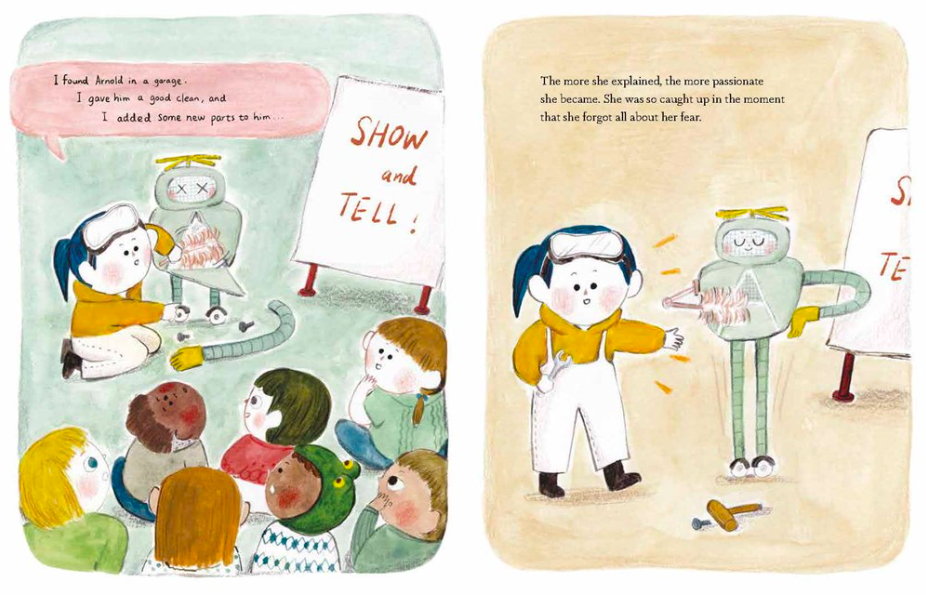
Milly was still nervous about Show and Tell, but Arnold told her he would go with her and she could talk about him. On Friday, under the gaze of her classmates who seemed to loom above her, Milly froze. Arnold came to the rescue. He introduced himself and began: “Milly made me out of . . . of . . .”. He stopped, not knowing what came next. But Milly found her voice and finished the story, becoming more passionate about her subject as she went along. In fact, “she was so caught up in the moment that she forgot all about her fear.” Her classmates thought Milly was amazing, and Milly, later playing with her new friends on the playground she and Arnold had built, “was happy that she had been heard.”
Copyright Yiting Lee, 2025. Courtesy of Eerdmans Books for Young Readers.
Yiting Lee’s story offers reassurance to quiet, introspective children as well as to those who feel anxious when talking in or to a group. Through Milly’s experience, such children may feel encouraged to talk about a special skill, experience, or talent or to share the “stage” with a supportive friend who can help them overcome their fear. Lee also reminds readers that—as a favorite teacher of mine liked to say—”still waters run deep”, and that beneath a quiet exterior often bubbles unique perspectives, creativity, and loyal friendship.
Lee’s charming, cartoon illustrations contrast how Milly shrinks in her raucous classroom with how she comes alive in the junk shed—for her, a lab full of exploration, inspiration, and energy. Readers will enjoy stopping to look over all the images of Milly’s inventions and be inspired to create a few themselves.
A fast-paced, multilayered and inspiring story to spark confidence, foster understanding, and build connections among kids of all talents, The Quiet One offers a valuable resource for classrooms and school libraries and is a heartening choice for home and library collections.
Ages 4 – 8
Eerdman’s Books for Young Readers, 2025 | ISBN 978-0802856418
About the Author/illustrator
Yiting Lee was once the quiet one in class, much like Milly. She followed her love of art to earn her MA in children’s book illustration at the University of Cambridge. Originally from Taiwan, Yiting currently lives in Surrey, England, where she has illustrated books like What’s the Rush?(Princeton Architectural) and Little Dinosaurs, Big Feelings(Magic Cat). Follow her on Instagram @yitinglee_art and visit her website at yitinglee.com.
National Inventors’ Day Activity
Inventor’s Box
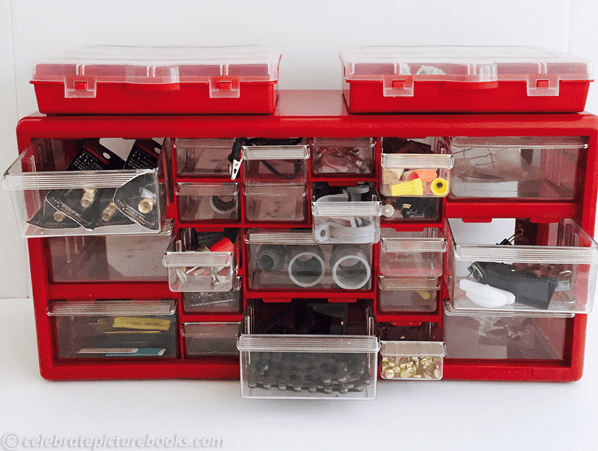
For young inventors or tinkerers, having bits and pieces of this and that as well as some tools to work with all stored in one place encourages creative thinking. Filling the drawers of a tool case, a tool box, or a tackle box with items like springs, brads, wheels, hinges, plastic piping, pieces of wood, glue, tape, and simple tools can spark a child’s imagination. Take your child along to the craft or hardware store and choose items together!
You can purchase The Quiet One at these booksellers
Learning—and the success that comes with it—can be easier and more fun when it’s shared with a mentor. Teachers, instructors, coaches, crafters, family members, and other adults like passing on their knowledge to younger generations, and while kids gain valuable skills, they also benefit from the bonds that form between them and their mentor. If you’re interested in becoming a mentor check out the resources at mentoring.org. National Mentoring Month is also a terrific time to thank a mentor in your life and tell them what a difference they made.
Thanks to Tundra Books for sharing a copy of Professor Goose Debunks the Three Little Pigs with me for review consideration. All opinions on the book are my own.
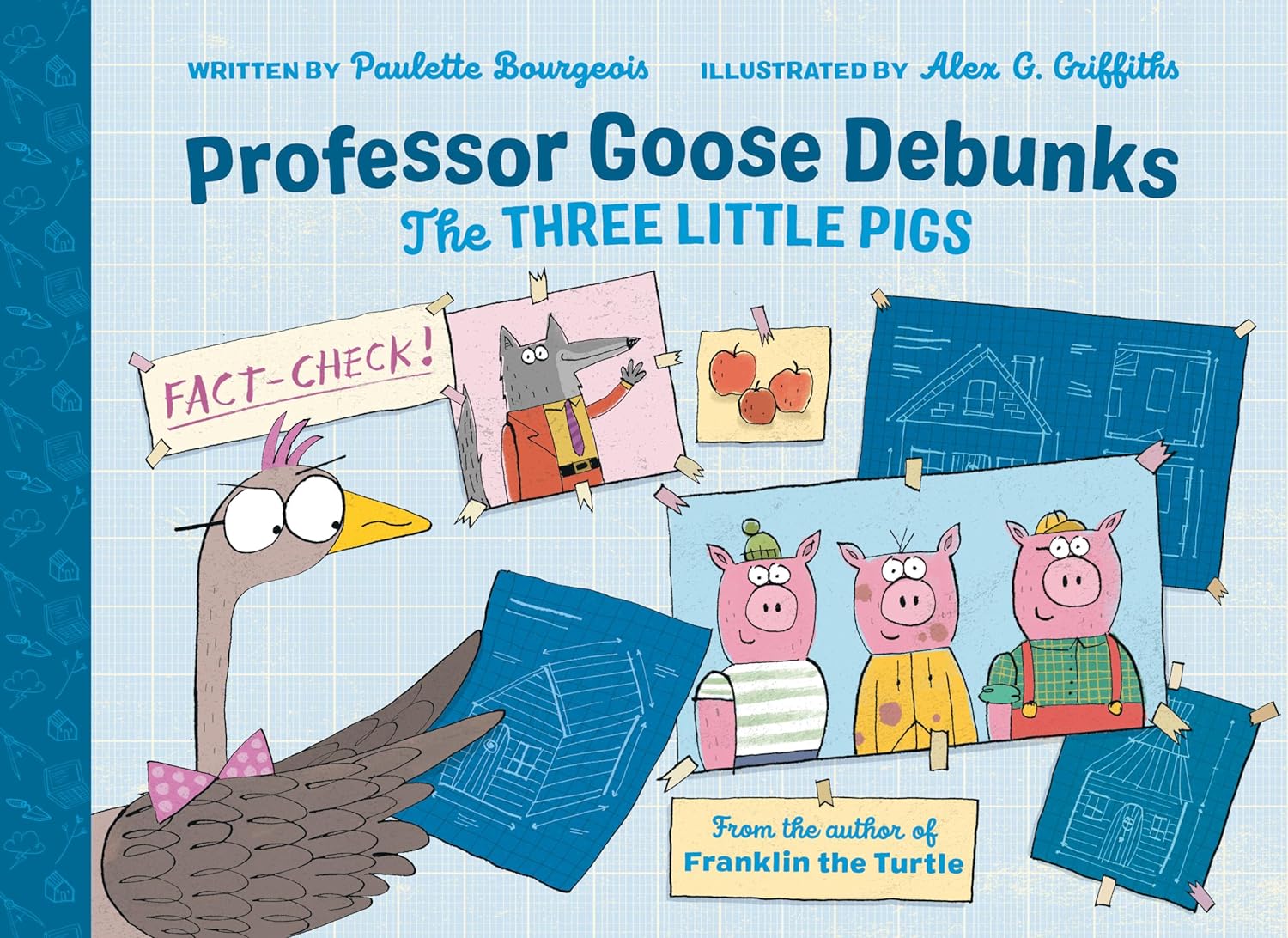
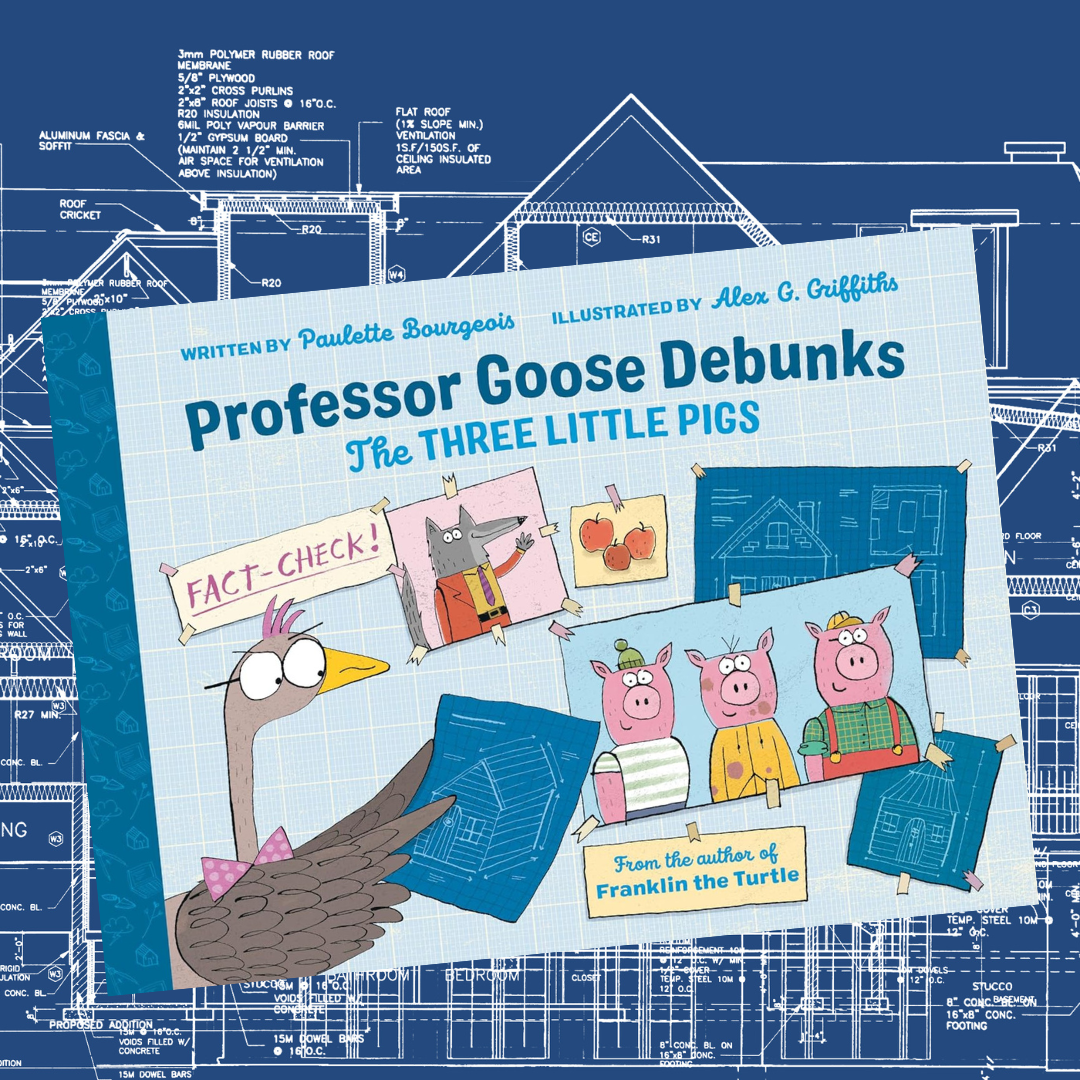
Professor Goose Debunks the Three Little Pigs
Written by Paulette Bourgeoise | Illustrated by Alex G. Griffiths
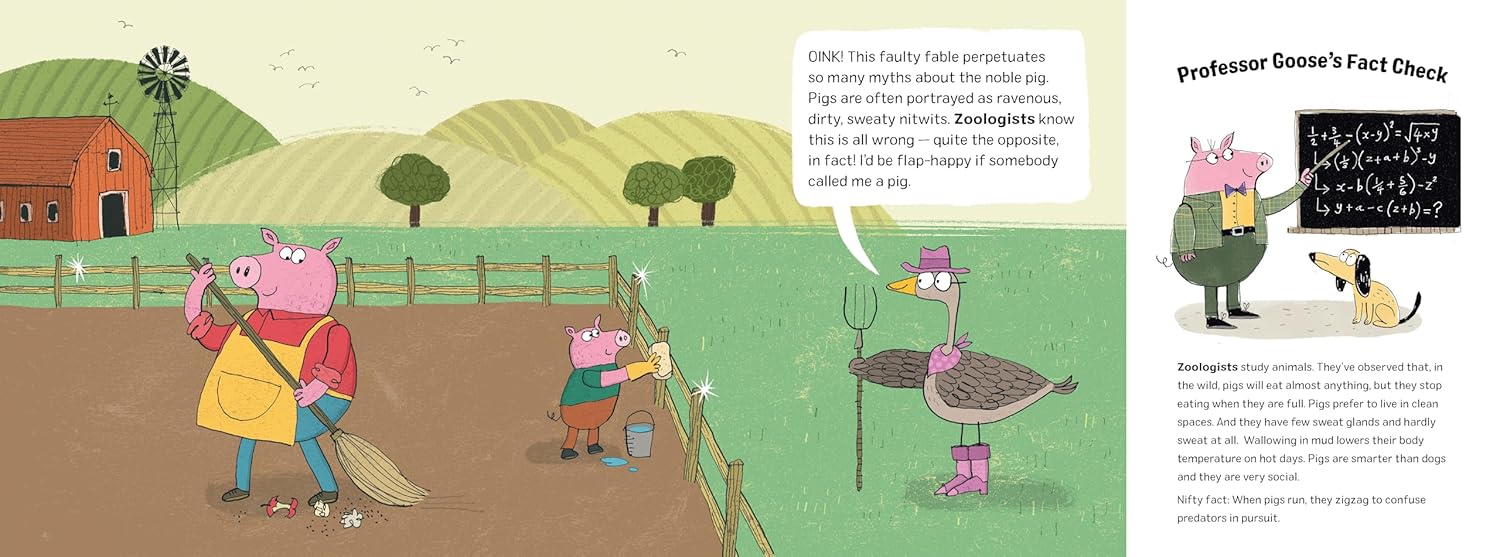
Professor Marie Curious Goose—”renowned and distinguished scientist”—is on a mission to correct the science in her great-aunt Mother Goose’s stories. This time, she’s tackling The Three Little Pigs. The story starts off in the familiar way: “Once upon a time, there were three little pigs.” The first pig liked to eat and play. The second little pig liked to laze in the mud. And the third little pig worked hard and sweated every day. One day their mother sends them off into the world with the admonition to “‘Save your own bacon!'” Sounds about right, right?
Image copyright Alex G. Griffiths, 2024, text copyright Paulette Bourgeois, 2024. Courtesy of Tundra Books.
But wait! Before you move on in the story, Professor Goose reveals that even these brief profiles are full of erroneous myths! To clear things up, the professor imparts zoologist-approved information, including such facts as pigs don’t gorge themselves, they lay in mud to lower “their body temperature on hot days,” and, because pigs have few sweat glands, they always stay fresh and dry.
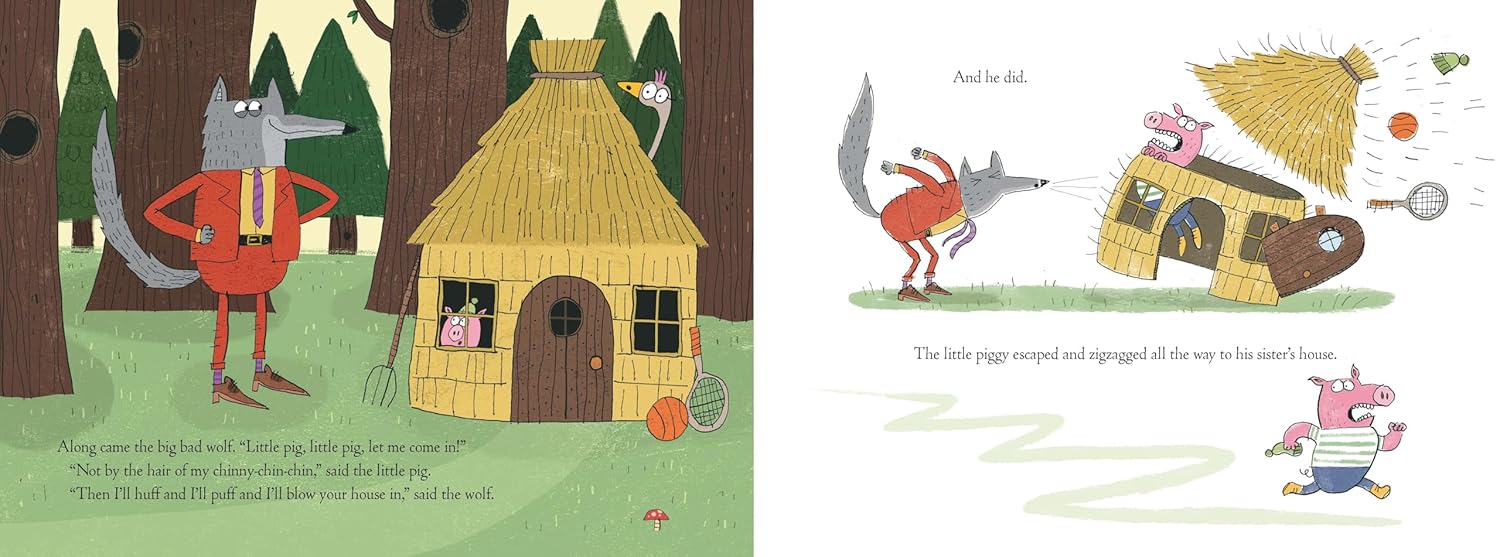
Finally on their own, the siblings get down to the business of living their best lives. The first little pig builds himself a house of straw then goes off to play basketball. Here, Professor Goose takes a moment to imaprt a lesson on the states of Matter and what Matter is made of. By now the wolf has caught up with the first little pig, who rebuffs him with the familiar “‘Not by the hair of my chinny-chin-chin.'” Despite this the wolf does his huffing and puffing—you know the drill—and the pig runs off to his sister’s house. But waaaiit . . .. The prof takes exception to a few tidbits here, too, such as the chinny-chin-chin line and the house destruction method.
Image copyright Alex G. Griffiths, 2024, text copyright Paulette Bourgeois, 2024. Courtesy of Tundra Books.
Soon, while the wolf is menacing the second little pig, Professor Goose works herself into a lather over the “lone wolf” attack and the story’s depiction of wolves in general. To calm herself down, she instructs readers in details about structures and construction.
Undeterred, the wolf high tails it to the third little pig’s house of bricks, where she and her siblings are cozily ensconced. The wolf huffs and puffs, can’t blow the brick house down, and the pigs are triumphant. But is this where the story ends? No! The prof explains how many fairy tales—just like this one—use a pattern of three and that patterns are found in everything, including nature, music, and math. Finally, Professor Goose concludes with her own version of what became of these three pig siblings—and the story even turns out well for the wolf!
Image copyright Alex G. Griffiths, 2024, text copyright Paulette Bourgeois, 2024. Courtesy of Tundra Books.
Paulette Bourgeouis’s clever take on the familiar tale of The Three Little Pigs will have kids captivated and laughing from beginning to end as Professor Goose points out foibles in the story and connects the setting, the wolf’s powerful breath, the pigs’ houses, the pigs themselves, and the story’s structure to a wide range of scientific principles. Through Professor Goose’s Fact Checks, kids learn surprising and educational facts about zoology, matter, weather, architecture, patterns, and even coding.
Alex G. Griffith’s engaging illustrations make for a fun and funny learning experience that will have kids in stitches and their eyes glued to every page. Griffith’s tiny details, facial expressions, and slap-stick humor give a fresh, comic-style look to this well-known story and enhance the science-based facts this fractured fairytale is built on for today’s kids.
A unique retelling of a favorite classic that takes superb advantage of all a fractured fairy tale can offer, Professor Goose Debunks The Three Little Pigs is sure to be asked for again and again…and again. The STEM-related connections make this book a terrific and educational introduction to a variety of units for science educators.
Ages 3 – 8 and up
Tundra Books, 2024 | ISBN 978-0735267329
About the Author
Paulette Bourgeouis is best known for creating Franklin the Turtle, the character who appears in the bestselling picture books illustrated by Brenda Clark. The series has been translated into thirty-eight languages and adapted into an animated television series, merchandise, and feature-length films. She is also the author of award-winning books for children including Oma’s Quilt, which was developed as a short film by the National Film Board of Canada, and more than two dozen non-fiction science books. She is a member of the Order of Canada, received an honorary doctorate degree from Western University, an award of merit from the Canadian Association of Occupational Therapists and most recently graduated with an M.F.A. in Creative Writing from the University of British Columbia. Paulette frequently teaches and she has been the writer-in-residence at UBC, Whistler, BC, and Terra Nova National Park, Newfoundland.
About the Illustrator
Alex G. Griffiths is a children’s book illustrator originally from London, UK. The majority of his work is done by hand, using a combination of pen and ink line work and brush textures in a messy way to create an unusual illustration style. He now lives in Canada with his wife and two children. Visit him at alexgfriffiths.com.
National Mentoring Month Activity
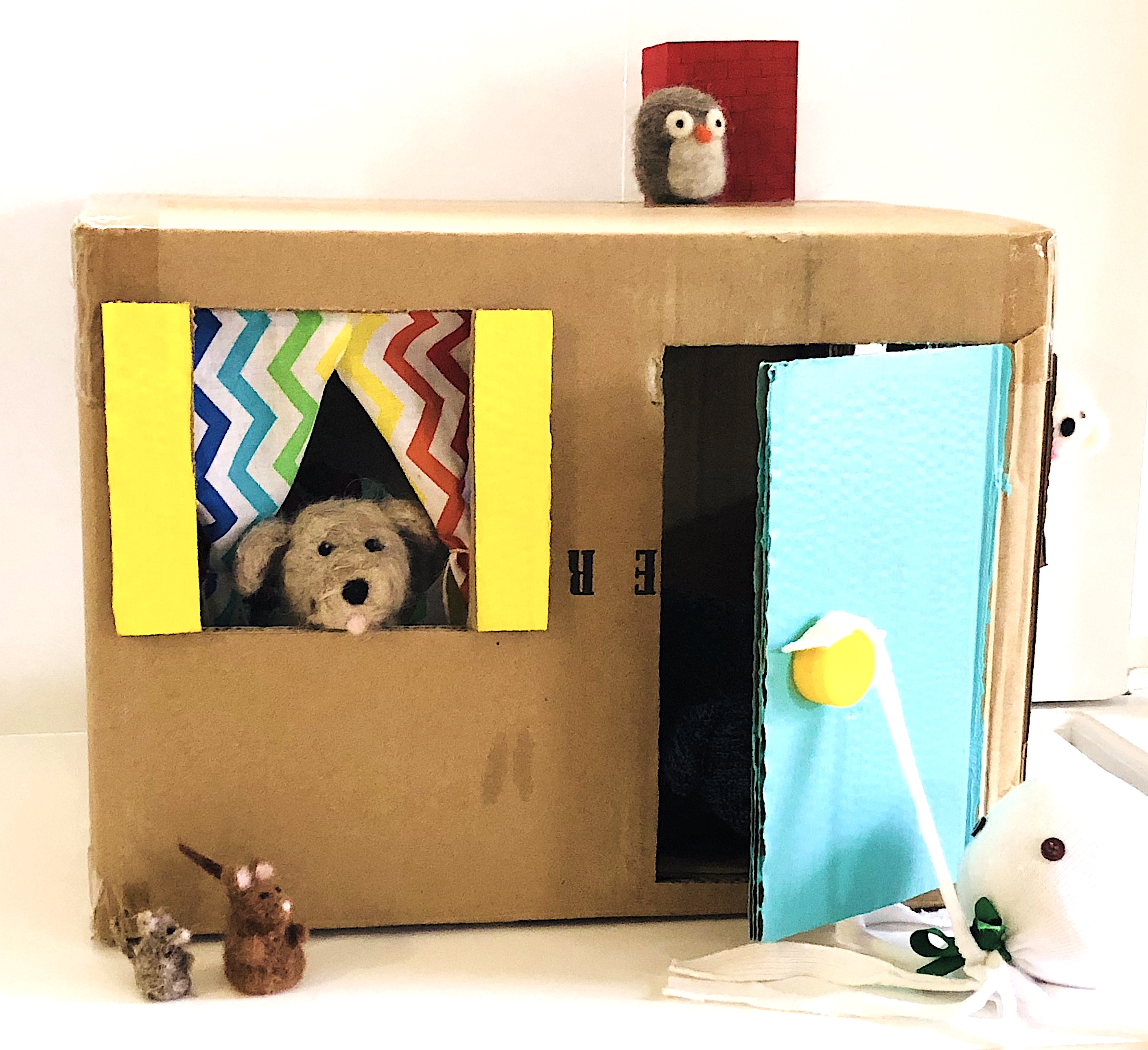
Cardboard Playhouse
Kids love pretending with their toys and playhouses. With this craft you and your child can make a playhouse with recycled items and lots of imagination. While you and your child make the house, talk about the building process and ask questions that get them thinking about how various parts of a house work. Once the house is finished, kids can make up their own stories with it—or create their own fractured tale of The Three Little Pigs!
Supplies
Cardboard box
2. Recycled items, such as:
Bottle caps for door knobs,
Small boxes for a chimney
Use the cardboard cut from the windows to make shutters
Scraps of cloth for curtains
3. Craft paint
4. Markers
5. Glue
You can purchase Professor Goose Debunks the Three Little Pigs at these booksellers
Today I’m highlighting two upcoming holidays that celebrate science and introduce kids to the wide-ranging applications that science, engineering, technology, and math have on our lives now and as we move into the future.
STEM Day — November 8
Instituted in 2015, National STEM Day aims to encourage kids to explore the fields of science technology, engineering, and math. This year’s theme is “Hands on Learning” to promote creative and impactful experimentation, innovation, and discovery. Children who are introduced early on to the workings of math and science do better as they advance through school and are more likely to choose science-based careers. Solving many of the problems that the world now faces relies on having a workforce who can think inventively to design a better future for us all. To learn more about STEM and to find lots of free ideas and activities to get kids excited about these subjects all year around—from awesome virtual field trips to labs, space centers, museums, and more to detailed lesson plans and printables to hands-on activities from the National Inventors Hall of Fame—visit Create & Learn.
World Science Day for Peace and Development — November 10
This annual, internationally observed day highlights the importance of science in and for society and is sponsored by the United Nations. Its aim is to promote education and awareness of scientific issues that affect the world and its sustainability as well as to underscore the role that scientists play in improving our lives and developing solutions for the future.
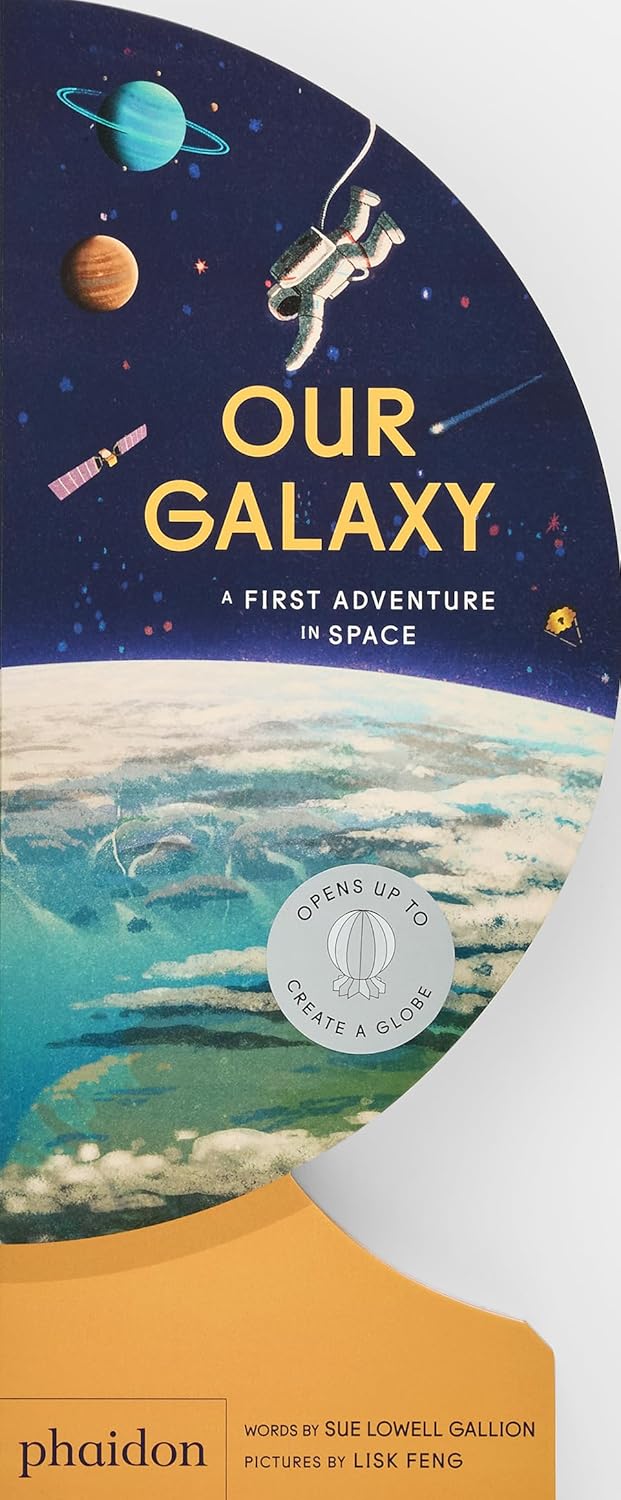
Thanks go to Phaidon for sharing a copy of Our Galaxy: A First Book of Space with me for review consideration. All opinions on the book are my own.
Our Galaxy: A First Adventure in Space
Written by Sue Lowell Gallion | Illustrated by Lisk Feng
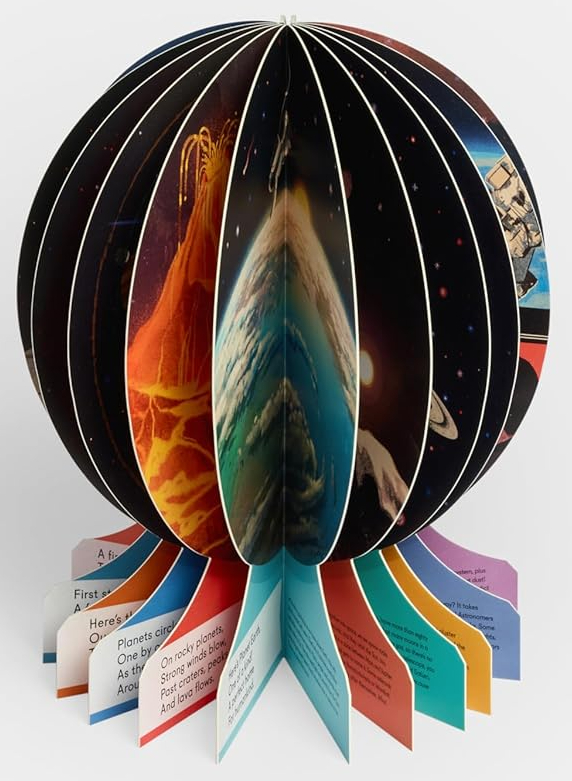
If you want to WOW your young children, students, or library patrons and make them eager to learn about space, science, technology, engineering, and math, open the cover of Our Galaxy: A First Adventure in Space. Then open it a little more . . . and a little more . . . and all the way around until this awe-inspiring book becomes a sturdy, freestanding globe full of adventure and exploration.
Image copyright Lisk Feng, 2024, text copyright Sue Lowell Gallion. Courtesy of Phaidon.
As this journey into space begins, readers find themselves in a planetarium, where Lisk Feng’s mesmerizing illustration of an enormous telescope aimed at the starry sky hints at the marvels above. Sue Lowell Gallion’s accompanying rhyming couplet invites kids to “Start at sunset, / Scan the sky. / Let’s take a voyage, / Way up high!”
On the next page readers join viewers on shore to count down “5, 4, 3, 2, 1 . . . Liftoff!” As a rocket is propelled upwards by a fiery blast, a short paragraph explains that “some rockets are like high-tech delivery vehicles” supplying the International Space Station while “other rockets are an astronaut’s ride into space.” She then asks kids whether they’d rather “watch a rocket launch” or “be on board,” a great way to get kids thinking and joining in.
Image copyright Lisk Feng, 2024, text copyright Sue Lowell Gallion. Courtesy of Phaidon.
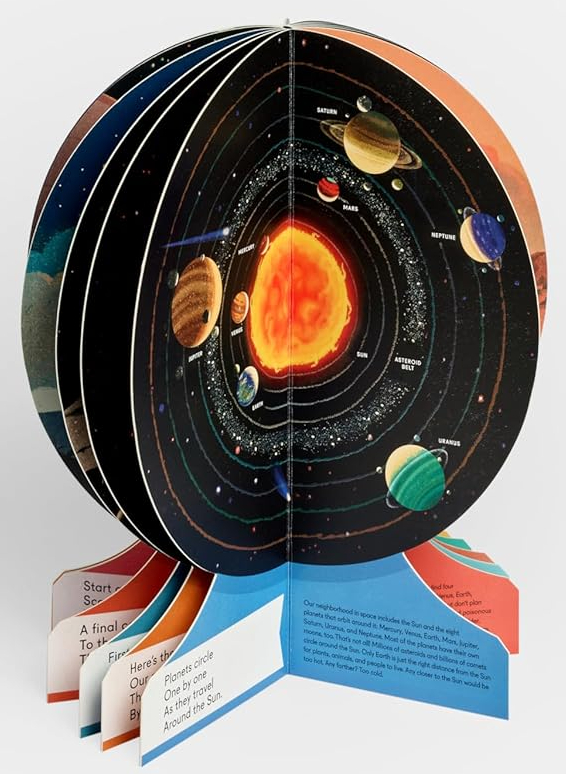
Appropriately, the rocket’s first stop is the Moon. In Feng’s gorgeous painting, kids are beckoned to join two astronauts using a vehicle on the rocky surface as Gallion imparts information about this “familiar face”—facts about the Moon’s orbit, its astronaut visitors, and the long-lasting imprint they’ve made on the Moon. Of course, we wouldn’t be able to take a voyage like this—or even live on Earth—without the Sun, “Our nearest star, / The brightest in our sky, / By far.” Children can almost feel the heat radiating from the sun as they learn about the Sun’s power and size.
Image copyright Lisk Feng, 2024, text copyright Sue Lowell Gallion. Courtesy of Phaidon.
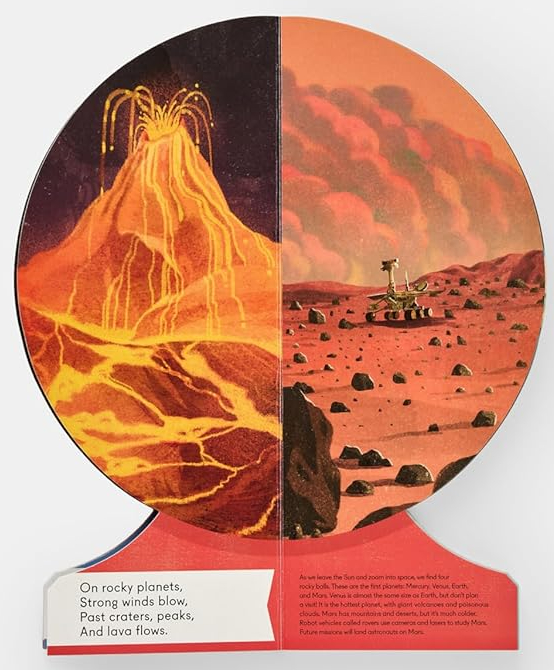
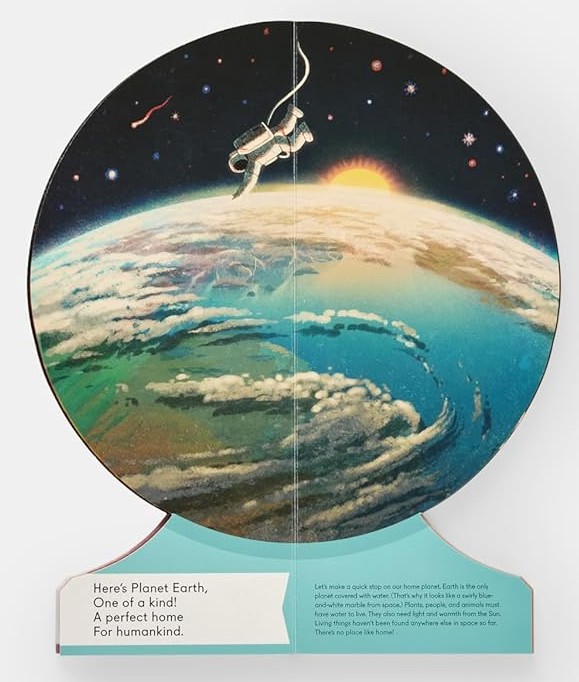
On following pages, kids also learn about our solar system; meet the four rocky planets of Mercury, Venus (complete with a scorching look at one of its volcanoes), Earth, and Mars (which astronauts plan to visit in the future); and discover why Earth is “One of a kind! / A perfect home / For humankind.”
Planets aren’t the only objects in space. On their journey, readers also learn about asteroids—what they are, where they’re found, and even some of their funny names—before zipping on to uncover fascinating tidbits about Jupiter, Saturn, Uranus, and Neptune.
Image copyright Lisk Feng, 2024, text copyright Sue Lowell Gallion. Courtesy of Phaidon.
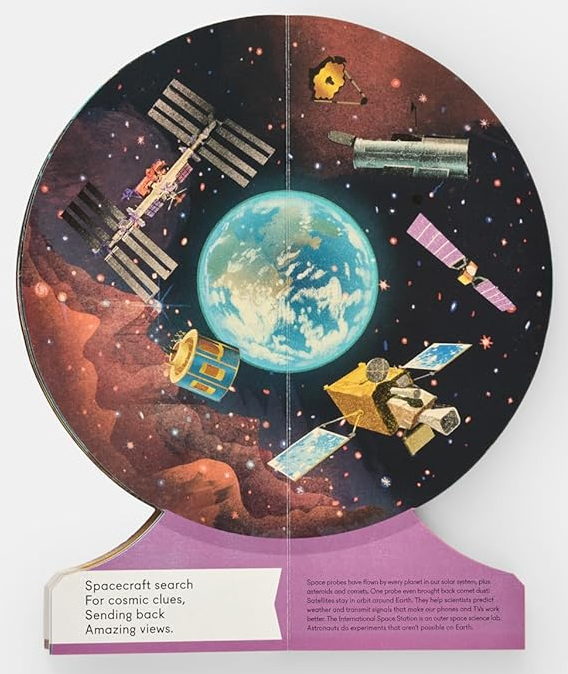
Future scientists and astronauts will want to accept Lisk Feng’s invitation to join astronauts working on the International Space Station and floating in the cosmos. They’ll view a giant telescope that informs scientists about our galaxy and beyond and the technology that monitors space and records data. Kids will also be intrigued by the illustrations of space probes and satellites that, in addition to teaching us about objects light years away, help “scientists predict weather and transmit signals that make out phones and TVs work better.” Returning to Earth, readers have a chance to contemplate “Our universe, / A starry show, / With mysteries / We want to know!”
Image copyright Lisk Feng, 2024, text copyright Sue Lowell Gallion. Courtesy of Phaidon.
In her poetic and accessible multi-layered text, Sue Lowell Gallion engages both the youngest readers and those ready for more in-depth facts in an inspiring and educational exploration of the wonders of space and a celebration of human curiosity that has propelled us to tremendous scientific achievements. The rigorously researched text is also sprinkled with engaging questions that will get kids excited about joining in discussions at school or at home, while opening their imaginations to what they could accomplish in their future.
In her stunning, realistic illustrations, Lisk Feng captures the breathtaking beauty and vastness of space. Her dazzling images of our solar system are textured and detailed, urging children to look closer (is that a satellite among the asteroids?) and appreciate not only what lies beyond but humans’ early accomplishments as well as the technology that marks our contemporary era of space exploration.
Sure to ignite wonder, curiosity, and a desire to learn more about space, science, and technology, Our Galaxy: A First Adventure in Space offers endless inspiration for teachers and educators, homeschoolers, and any child enthralled with space. The unique format allows for easy and eye-catching display and will entice kids to dip into this book again and again, making it a must addition to school, public library, and home collections.
Ages 2 – 5+
Phaidon Press, 2024 | Oversized Boardbook: ISBN 978-1838668839
Pair Our Galaxy: A First Adventure in Space with Our World: A First Book of Geography when kids are ready to explore all the wonders on our home planet.
Get Ready for STEM Day & World Science Day Day Activity
“I Am the Future of STEM” Activity Book
The coloring pages, puzzles, and other activities in this comprehensive activity book makes an impactful addition to any lesson or simply makes free time fun!
Do you feel like you’ve been on a diet forever? Have you been denying yourself a favorite treat because maybe it’s not the best thing you can eat? Or do you find yourself always making meals to suit everyone else’s taste when what you really want is just a grilled cheese sandwich? If so, today’s holiday gives you carte blanche to enjoy the foods you want without feeling guilty. It also seems like a fitting day to learn about the rather unusual (at least to us) diet of many creatures in the animal kingdom—and that’s where today’s book come in!
Poop for Breakfast: Why Some Animals Eat It
Written by Sara Levine | Illustrated by Florence Weiser
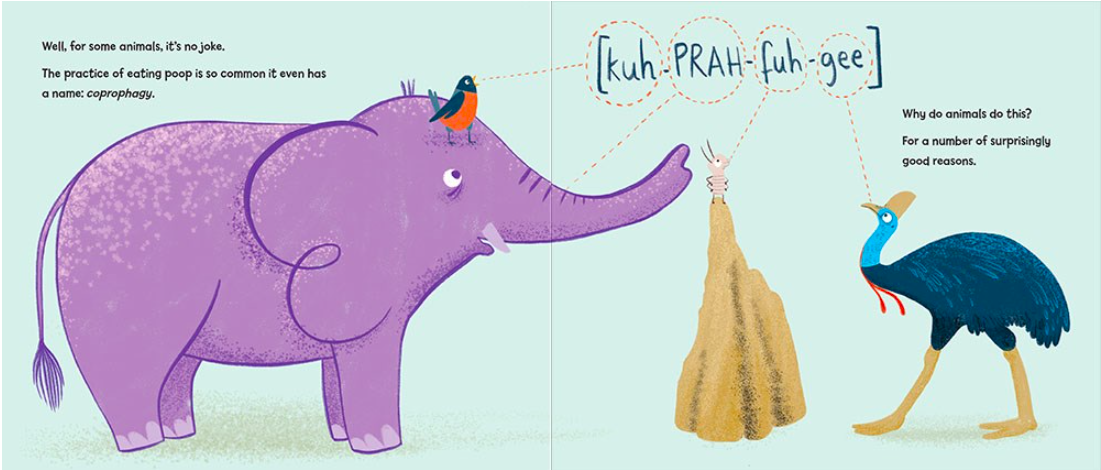
So, you wake up starving for a delicious meal. You’ve been dreaming of pancakes, maybe, or a plate of eggs and bacon. But when you get to the table, there’s a bowl of poop waiting for you?! Come on! While you might sulk (and probably hold your nose), there are plenty of creatures who’d be thinking “Bring it on!” Who are these critters? They’re animals that practice coprophagy, and they do it “for a number of surprisingly good reasons,” Sara Levine reveals.
Image copyright Florence Weiser, 2023, text copyright Sara Levine, 2023. Courtesy of Millbrook Press.
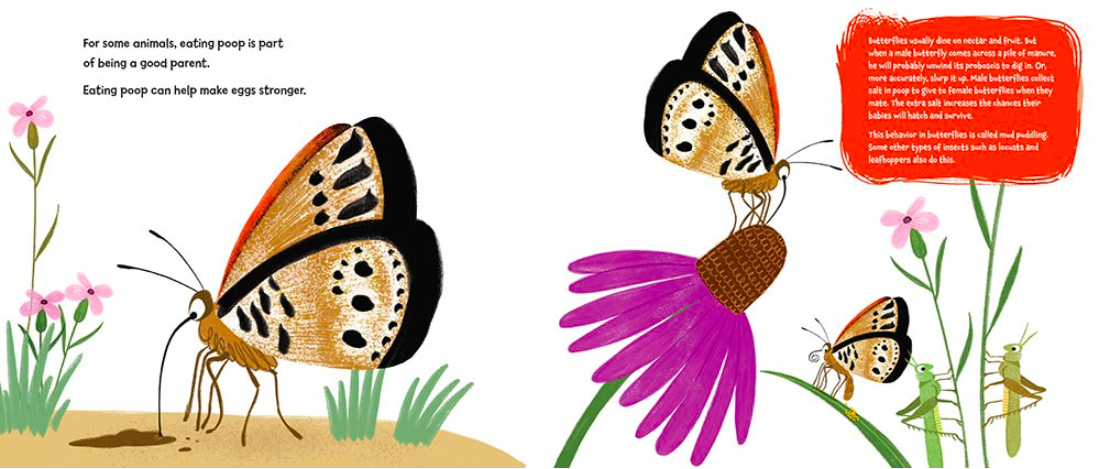
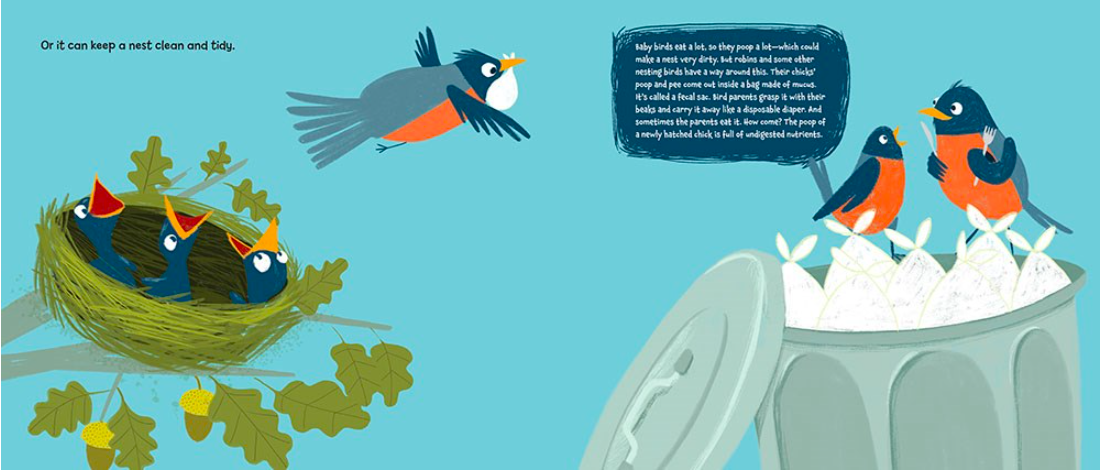
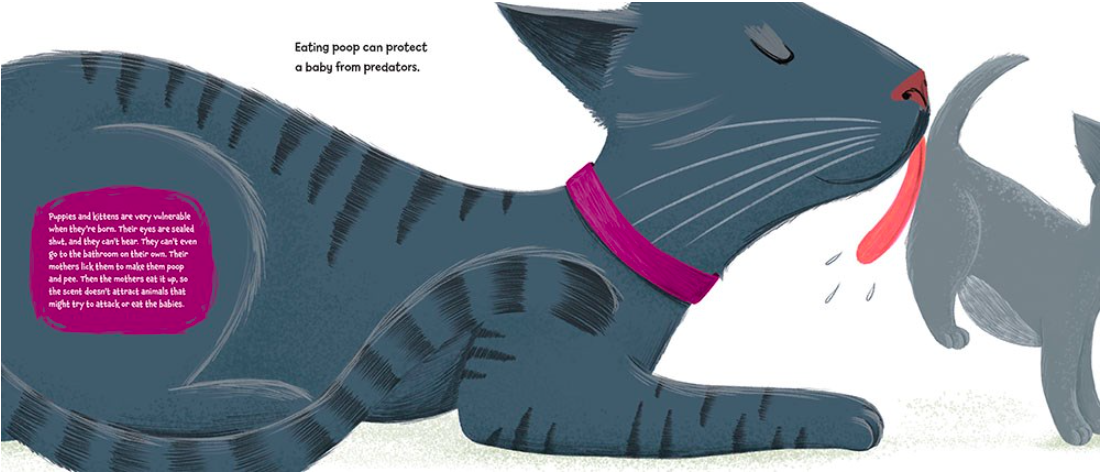
For some animals eating poop is just part of being a Number 1 (or maybe Number 2 is better in this case) parent. Butterflies, cats, and dogs as well as robins and other birds all have specific reasons for dining on doo-doo, from making eggs strong to protecting their babies from predators to keeping “a nest clean and tidy.” Birds have a particularly fascinating way to do this. Since baby birds eat a lot, they poop a lot. Keeping up with that level of cleaning could be daunting. Amazingly, though, these “chicks’ poop and pee come out inside a bag made of mucus. It’s called a fecal sac. Bird parents grasp it with their beaks and carry it away like a disposable diaper. And sometimes the parents eat it. How come? The poop of a newly hatched chick is full of undigested nutrients.”
Image copyright Florence Weiser, 2023, text copyright Sara Levine, 2023. Courtesy of Millbrook Press.
While these animals eat poop for external or aesthetic reasons, others engage in coprophagy to keep their digestive system working well. Still others, because of the length or shape of their digestive tract, require that food travels through their body twice to extract all of the nutrients. If you have a rabbit, hamster, guinea pig, or other small rodent as a pet, you know that their poop looks like little round balls or small pellets. As Levine tells readers, “this is the poop that has been through their digestive tract a second time. The first poop comes out soft, sticky, and full of nutrients. It’s called a cecotrope (SEE-ca-trope),” and these animals “gobble it up at night when it comes out. That’s why you don’t see it” in the cage.
Image copyright Florence Weiser, 2023, text copyright Sara Levine, 2023. Courtesy of Millbrook Press.
Since there are so many creatures who do eat poop, why don’t humans? Levine has included a whole list of reasons (and, yes, the frowny- crinkled-nose-face you’re making right now is one of them) for why we don’t—and don’t need to. She’s also provided back matter that includes “The Scoop on Poop”—an explanation of what poop and pee are, how they’re created in the body, and how they’re eliminated through the anus and the urethra as well as a paragraph about creatures that have a single cloaca instead of two openings. Kids will also have fun becoming “poop detectives” with the help of Levine’s and illustrator Florence Weiser’s guide to the sizes and shapes of poop from common pets and wildlife and playing a silly synonym game.
Image copyright Florence Weiser, 2023, text copyright Sara Levine, 2023. Courtesy of Millbrook Press.
Sara Levine is exceptional at presenting fascinating nature science topics in humorous and accessible ways for young audiences, and her latest book is no exception, Leaning into the “Ewww!” factor, Levine dishes up short, take-away reasons certain animals, birds, and insects practice coprophagy followed up with longer passages that explain the science and/or behavior behind them in easy-to-understand language sprinkled with humor that will keep readers riveted to this already high-interest subject.
Florence Weiser’s colorful illustrations perfectly bridge the humorous and the scientific nature of Levine’s text. Readers’ skeptical view of this “gross” habit is amusingly juxtaposed with creatures’ excited anticipation of a delicious meal through the characters’ facial expressions while the anatomical reasons for or against coprophagy are clearly depicted in images of human and various animals’ digestive systems.
Anatomy and nature science education at its best, Poop for Breakfast: Why Some Animals Eat It will keep kids enthralled as each page turn brings on a new round of giggles and avid learning. The book would enhance any home STEM collection and is a must for classroom, school, and public library bookshelves.
Ages 5 – 10
Millbrook Press, 2023 | ISBN 978-1728457963
About the Author
Sara Levine is an author, educator, and veterinarian. Her science books for children include the Animal by Animal series, Germs Up Close, and A Peek at Beaks: Tools Birds Use. Her books have received a number of awards including AAAS/Subaru SB&F Prize, Utah Beehive Book Award, Cook Prize finalist, Monarch Award master list, and Bank Street College Best Children’s Book of the Year.
About the Illustrator
Florence Weiser is a French illustrator currently based in beautiful, rainy Belgium. While growing up in Luxembourg, she always knew she wanted to draw and draw. She lives and works surrounded by nature, from which she gathers most of her inspiration.
You can find Poop for Breakfast: Why Some Animals Eat It at these booksellers
If your motto is “So many books, so little time” then you’ll be happy to know that January is Book Blitz Month! During this month book lovers are given the green light to read as many books as possible! For kids, Book Blitz Month can be particularly exciting as they discover new fiction and nonfiction that captivates their imagination. To celebrate, take your kids to a local bookstore and the library to find new and favorite books to binge on all month long. If you don’t have a dedicated space for your children’s books, this month is also a great time to create a home library for your child so that they have a shelf, a crate, or even a whole bookcase of stories they can enjoy again and again!
I’d like to thank Lydia Lukidis for sharing a digital copy of Deep, Deep Down: The Secret Underwater Poetry of the Mariana Trench with me for review consideration. All opinions on the book are my own. You can read my interview with Lydia below.
Deep, Deep Down: The Secret Underwater Poetry of the Mariana Trench
Written by Lydia Lukidis | Illustrated by Juan Calle
Imagine being invited to visit a mysterious place where only a few have ever been; where only they have truly seen the creatures that inhabit it; and where it’s murky depths are accessible by only one type of vehicle. Would you dare to go? Lydia Lukidis and Juan Calle extend just such an invitation, but no notes for missing school, packing a suitcase, or plucking of courage need to be considered, for through their phenomenal book, readers find a seat in the incredible submersible that will transport them to “…the deepest underwater valley in the world”: the Mariana Trench.
Image copyright Juan Calle, 2022, text copyright Lydia Lukidis, 2022. Courtesy of Capstone Editions.
The submersible plunges deeper and deeper to where the sun doesn’t penetrate. Here, in the darkness, “food is scarce, and a bone-chilling cold blasts through the water. Earthquakes shake the ocean floor, and the water pressure, like a thick, heavy blanket with a thousand hands, presses down, / down, / down.” What flashes by the porthole window? A monster? No—a fish with a long and slender tail perfectly suited for its austere home, where it can survive for months without eating if necessary. “Diving deeper, a long, thin body slinks and sways, ever so slowly. The cutthroat eel is not fearsome, some rather, mesmerizing.”
The light beam of the submersible also reveals feathery crinoids “twirling and whirling like an underwater acrobat,” and a curious snailfish “dances, ghost-like, to the rhythms of the ocean” as it comes to take its own peek in the window from the other side. Snailfish aren’t affected by the heavy water pressure because “they can swim deeper than any other fish in the world. That’s because their bodies contain RMAO. This special substance protects the fish from high pressure, making sure their bodies aren’t crushed.”
Image copyright Juan Calle, 2022, text copyright Lydia Lukidis, 2022. Courtesy of Capstone Editions.
It might seem impossible to sink still lower, but the submersible plummets into water populated by tiny creatures, almost insect-like with their multiple pairs of legs and long antennae that propel them and help them find food. But explorers are not at the very bottom of the Mariana Trench even yet. The submersible floats slowly down to the bottom—“the very deepest spot on Earth. Look out the window . . . and witness a world of surprises.” Extraordinary creatures, some small, soft, and translucent and others—neither plant nor animal—large and with protective shells, and all adapted to thrive in their formidable surroundings will amaze you.
At last it’s time for the submersible to return to the surface. Slowly, it makes its way through the darkness to lighter seas, where it passes by more familiar fish and other creatures on its way to “SPLASH!” surfacing once again and “leaving the marvels of the Mariana Trench far below” still waiting to be explored again.
Insets of scientific information on diet, anatomical adaptations, and other aspects that make them suited to their environment also accompany the introduction of each sea creature.
Back matter includes an illustrated cutaway of the ocean above and descending into the Mariana Trench with various sea creatures labeled and oriented to the level in which they are found; “Did You Know?” facts about the water pressure in the Trench, its creation, and how many people have visited; why the Mariana Trench matters; an author’s note; and a glossary.
Image copyright Juan Calle, 2022, text copyright Lydia Lukidis, 2022. Courtesy of Capstone Editions.
When undertaking an excursion into unknown territory—especially through words and pictures—explorers need guides who can truly immerse them not only in the sights and sounds of an area but also the rhythms and almost intangible aura that makes it so uniquely compelling. Readers of all ages find that quality in Deep, Deep Down. Lydia Lukidis’s lithe and lyrical language is at once straightforward—answering questions any reader might have—and evocative—capturing the enigmatic and secret world at the bottom of the Earth as it flashes into view or slowly reveals itself and retreats again. Her vocabulary, rich with active verbs, ensures that readers appreciate the Mariana Trench as teeming with life and alive with wonders more amazing than we can even imagine.
Don’t be surprised if you find yourself forgetting that you’re looking at illustrations of a vampire squid, anglerfish, rattail fish, cutthroat eels, crinoids, and even the rocky and sandy ocean floor instead of photographs as you inspect Juan Calle’s magnificent pages. As the submersible—seen from many angles—plunges into darker and darker water, bioluminescent fish begin to appear alongside their grayer sea mates (children will enjoy pointing out the dark shapes that lurk in the shadows of the submersible and the stony outcroppings.)
As a rattail drifts into view, each rose-gold scale is visible, shimmering in the beam of light thrown from the submersible; it’s blue eye seemingly as curious about readers as they are about this unusual fish. Calle mesmerizes with careful details, shading, and perspective that portrays each creature in all of their weird and wonderful floating, creeping, or stock-still spectacle.
Deep, Deep Down: The Secret Underwater Poetry of the Mariana Trench will thrill ocean and nature lovers and will spur increased interest and research into this unique, nearly untouched habitat that we are only now beginning to discover. The book is a must for any environmental science enthusiast at home and for all classroom, school, and public library collections.
Ages 7 – 10
Capstone Editions, 2022 | ISBN 978-1684466153
About the Illustrator
Juan Calle is a former biologist turned science illustrator, trained on the Science Illustration program at UC Monterrey Bay. He worked early on his illustrator career for field guides of plants and animals of his country of origin, Colombia, and now owns and works in his art studio, LIBERUM DONUM in Bogota, Columbia, creating concept art, storyboarding and his passion: comic books. You can connect with Juan onInstagram.
Take a plunge into Deep, Deep Down with this book trailer!
Meet Lydia Lukidis
Lydia Lukidis is the author of 50+ trade and educational books for children. Her titles include DANCING THROUGH SPACE: Dr. Mae Jemison Soars to New Heights (Albert Whitman, 2024), DEEP, DEEP, DOWN: The Secret Underwater Poetry of the Mariana Trench (Capstone, 2023), THE BROKEN BEES’ NEST (Kane Press, 2019) which was nominated for a Cybils Award, and NO BEARS ALLOWED (Clear Fork Media, 2019). A science enthusiast from a young age, she now incorporates her studies in science and her everlasting curiosity into her books.
Lydia is an active member of SCBWI, CANSCAIP, 12 x 12, and The Authors Guild. She’s very involved in the kidlit community and also volunteers as a judge on Rate your Story. Another passion of hers is fostering love for children’s literacy through the writing workshops she regularly offers in elementary schools. Lydia is represented by literary agent Miranda Paul from the Erin Murphy Literary Agency.
Hi Lydia! I’m really thrilled to have the chance to talk to you about this gorgeous book, how it all came together, and your other work as a writer.
You have degrees in Pure and Applied Science as well as English Literature. After graduating from college did you work in the science field? If so, can you talk about your work a little? How has your science background influenced your writing?
When I was younger, I was drawn to both science and the arts. I once saw them as mutually exclusive but then came to realize how connected these disciplines are. Upon graduating university, I did something completely out of left field but that satiated my artistic desires. I started my own jewelry line! After that, I became a puppeteer, writing plays for children. That brought me back to my love of writing, and here I am writing kidlit. I often focus on STEM topics so it’s full circle. I feel like this is truly where I belong.
What drew you to write about the Mariana Trench for children? What kind of research did you do in creating this book?
In 2019, I read an article about how scientists found a plastic bag floating in the Mariana Trench. They also discovered plastic in the belly of various marine animals. My heart sank. I wondered how we human beings managed to start damaging one of the most remote places on the planet.
At that point, I didn’t know that much about the Mariana Trench and my curiosity grew. I began my research on the internet and then came to realize most of that information was false. The book really came together once I interviewed a slew of experts (7 in total) who’ve devoted their lives to studying the deep sea, the hadal zone, and geology. They also helped me find the right books and articles to read for updated information.
What was the most surprising thing you learned during your research? Do you have a favorite creature or one that you’d like to learn more about?
The most surprising thing was that despite the hostile conditions in the trench (no sunlight, scarcity of food, and crushing pressure), life still thrives deep, deep down. Though, the creatures are not what you would expect. There aren’t any sharks, for example, or any large creatures for that matter. My favorite has to be the sea cucumber. I must have watched hours and hours of them oscillating and floating, like underwater ballet. I was love struck!
Your storytelling in Deep, Deep Down is so fluid and as mesmerizing as the Mariana Trench itself. Can you talk about your writing process for this book and how you achieved such a visceral experience for readers?
Wow, what a compliment! Writing this book was nothing short of magical. I’m normally very hard on myself and many books don’t even make it to my agent. Other books take years to figure out. With nonfiction, finding the right structure is crucial. But somehow, with DEEP, DEEP DOWN, I didn’t have my usual “tormented writing struggle.” The writing was fluid and literally flowed out, and never changed in structure. There was a lot of editing, to be sure, I had to rewrite the manuscripts over 55 times to get the facts right, but the vision never changed. Will that always be the case? No! The next book I tried to write crashed and burned (maybe to be resurrected one day), so I’m grateful for this experience.
As a biologist who turned to illustration and who studied at the University of California at Monterrey Bay, Juan Calle must have been a dream match for Deep, Deep Down. Can you talk about how was he paired with your manuscript? When during the publication process did you begin to see his work? What emotions did his interpretations of your words stir in you?
Yes! It was Capstone who wisely suggested Juan. When I saw the proofs, I think my jaw hit the floor. He did SUCH a great job at getting all the details right (and believe me, it was tough—I had made a 20-page document with reference photos and notes vetted by Dr. Gerringer, my main consultant.) Although we never met, spoke, or even corresponded via email, Juan was able to follow my direction and bring his own flavor to the table. I think I first started seeing artwork about 8 months ago, so it was a speedy process. His work was stunning and scientifically accurate, although we couldn’t always draw everything to scale. It was also infused with magic.
What do you hope children will take away from Deep, Deep Down?
My goal in writing this book was twofold: firstly, to educate children on the deepest ocean of our world and debunk the myth that “scary” creatures live within its depths, and, secondly, to talk about ocean conservation and the importance of this fascinating ecosystem.
Kids may think the Trench is so far removed from their lives and that their actions don’t matter, or that what happens in the Trench doesn’t affect them. But that’s simply not true. Everything is connected, and I’d like to remind them that our actions affect our planet, even in its deepest spots.
You’ve written over 50 books for children and are very active in the writing community. What do you love best about being an author? What do you find rewarding about helping other writers succeed?
Thank you for the sweet words! I got my start with work-for-hire and most of my published books are for the educational market. DEEP, DEEP DOWN is my first trade nonfiction book, so it feels like a big accomplishment.
What do I love about writing? Everything. That said, it’s also a tough profession and every year, I usually have a moment when I reassess why I keep choosing this craft.
I also love supporting the kidlit community; it comes deep from the heart. I know what it is to struggle as a writer, and I see so many others struggling, hustling, working so hard. I like to support and acknowledge their efforts. Every little achievement is a milestone and should be celebrated!
What’s up next for you?
I’m excited to have just announced my second trade nonfiction book, DANCING THROUGH SPACE: Dr. Mae Jemison Soars to New Heights (Albert Whitman, 2024). I actually wrote this in 2015, and it’s a very long and convoluted story about how it got acquired. I did think long and hard whether or not I should tell this story and I ultimately decided to follow my heart because I felt so connected to the hook of the story. I invested in a sensitivity reader and will do so again once we start the editing process at Albert Whitman. They also chose a fantastic illustrator, Sawyer Cloud.
Other than that, I’m knee deep in other WIPs, some of them fiction. I wanted to try to stay in one lane as an author but it’s just not happening—it seems there are different stories of different genres inside me that need to come out. I’m always following the flow of my inspiration, which is often not linear!
Thanks again, Lydia, for sharing so much about your writing life! I know readers are going to love Deep, Deep Down and will be looking forward to Dancing Through Space!
Book Blitz Month Activity
Creatures of the Mariana Trench Word Search
The Mariana Trench is home to so many amazing creatures! Can you find the names of seventeen in this printable word search puzzle?














 celebratepicturebooks.com