March 31—Eiffel Tower Day

celebrate-picture-books-picture-book-review-antoinette-cover

About the Holiday

Today we say Ooh-La-La for one of the world’s most striking and recognizable monuments—the Eiffel Tower. The tower was erected in 1889 for the International Exhibition of Paris, which celebrated the 100th anniversary of the French Revolution. Construction took 2 years, 2 months, and 5 days. This iconic landmark was named for the chief engineer, Gustave Eiffel, and has inspired generations of locals and visitors alike.

Antoinette

Written by Kelly DiPucchio | Illustrated by Christian Robinson


On a day which seemed like most others, Mrs. Bulldog spied out the window at her puppies playing in the yard. Rocky, Ricky, Bruno, and Antoinette scrambled around, chasing each other back and forth. They darted through the door and dashed around the kitchen. They are always so energetic “and ridiculously cute, but please don’t tell them that.”
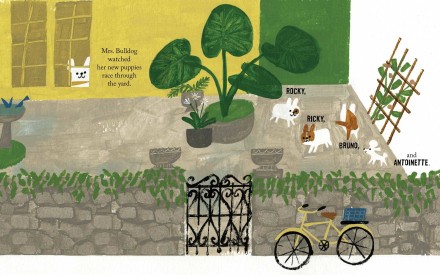
celebrate-picture-books-picture-book-review-antoinette-in-the-yard

Image copyright Christian Robinson, text copyright Kelly DiPucchio. Courtesy of simonandschuster.com.

When Mrs. Bulldog looked at her children, she knew that each was special. The boys had already demonstrated some of their talents. “Bruno was strong, Rocky was clever, and Ricky was fast.” Antoinette was still pondering her unique talent, but her mother was not worried. “‘You have something extra special. I can feel it in my bones!’” she told her daughter, but Antoinette had some doubts.

“Every day the family went to the park to play with their doggy friends,” and this day was no different. When they got there, Antoinette was happy to see Fi-Fi, Foo-Foo, Ooh-La-La, and especially Gaston. The puppies frolicked on the lawn, racing around after balls and butterflies and enjoying tasty biscuits. Suddenly, though, everyone noticed a problem. One of the puppies seemed to be missing!

celebrate-picture-books-picture-book-review-antoinette-puppies-playing

Image copyright Christian Robinson, text copyright Kelly DiPucchio. Courtesy of simonandschuster.com.

The little ones lined up to be counted. There were Rocky, Ricky, Antoinette, Fi-Fi, Foo-Foo, and Gaston—but no Ooh-La-La! Mrs. Poodle was frantic, but Mrs. Bulldog reassured her. “‘We will find her!’ she insisted.” Clever Rocky followed some footprints he found in the mud, but they did not lead to Ooh-La-La. Ricky ran around the lake, but only found a family of ducks. With his super strength, Bruno checked under boulders, but Ooh-La-La was not hiding under any of them.

“In that moment Antoinette felt a tug in her heart and a twitch in her nose.” She followed the scent from sidewalk cafes to street vendors to sign posts. She hurried past “buggies and bicycles and broomsticks.” Nothing could deter her. Her nose led her to the Louvre, where Antoinette barked excitedly, but the guard would not let her through the door. In a dizzying dash, she wound round and around the guard, skirted past him, and sprinted into the museum.

celebrate-picture-books-picture-book-review-antoinette-woman-feeding-birds

Image copyright Christian Robinson, text copyright Kelly DiPucchio. Courtesy of simonandschuster.com.

Antoinette scurried passed the crowds admiring the art and leaped to the top of a tall sculpture just in time “to save Ooh-La-La from a perilous fall” as she chased a butterfly. Mrs. Poodle was overwhelmed with gratitude. Mrs. Bulldog beamed with pride at her brave daughter, and the two shared a knowing look. Gaston looked on with a special smile of his own.

That is a story from long ago. Today, Antoinette and Gaston are raising a family of their own, and Antoinette is “one of the most famous police dogs ever to patrol the streets of Paris.” If you’d like, you can visit her statue in the park!

celebrate-picture-books-picture-book-review-antoinette-artist

Image copyright Christian Robinson, text copyright Kelly DiPucchio. Courtesy of simonandschuster.com.

Antoinette gets her own adventure and discovers her special talent in Kelly DiPucchio’s sequel to Gaston. With three bounding brothers, Antoinette feels a little lost in the shuffle, wondering when she’ll discover what she’s good at. Young readers with precocious siblings or friends will empathize with Antoinette’s feelings and be bolstered by her shining moment, which demonstrates that abilities often appear at the most unexpected—and crucial—times. The delightful ending provides a clever and satisfying answer to the story’s main question.

Christian Robinson’s jaunty illustrations of Antoinette and her brothers and friends will cheer fans of Gaston and enchant new readers. Kids will love following the bouncy puppies through the park, where an artist paints the fountain, a woman feeds the pigeons, and a man creates enormous bubbles to float in the air. As Antoinette races through Paris to find Ooh-La-La, readers can track her from page to page through the charming streets and finally to the Louve. Robinson’s soothing, muted blues, greens, and browns lend sophistication to this sweet blended family tale.

Antoinette is an adorable story that is sure to become a favorite of little ones. On its own or paired with Gaston, Antoinette would make a wonderful addition to home bookshelves.

Ages 4 – 8

Atheneum Books for Young Readers, Simon & Schuster, 2017 | ISBN 978-1481457835

Discover more about Kelly DiPucchio and her books on her website!

Check out Christian Robinson’s books and learn more about him and his artwork on his website!

Eiffel Tower Day Activity
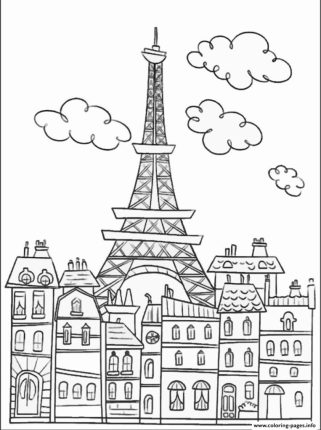
celebrate-picture-books-picture-book-review-eiffel-tower-coloring-page

Eiffel Tower Over Paris Coloring Page


Paris is a gorgeous city, full of color and light. Grab your pencils, markers, or crayons and enjoy this printable Eiffel Tower Over Paris Coloring Page.

Picture Book Review

December 18 – Bake Cookies Day

celebrate-picture-books-picture-book-review-the-way-the-cookie-crumbled-cover

About the Holiday

Winter and the holiday season just doesn’t seem right without cookies. Baking those traditional morsels passed down from generation to generation makes the house smell yummy, creates family bonds, and provides delicious gifts for parties, neighbors, friends, and even you! To celebrate, bake up a batch or two of your favorite cookies, and discover fascinating facts in today’s book!

The Way the Cookie Crumbled

Written by Jody Jenson Shaffer | Illustrated by Kelly Kennedy


You might love lemon cookies, chomp chocolate chip cookies, and munch macaroons, but do you know where cookies came from or their perhaps less-than-delicious beginnings? Well, one of our fav snacks most likely got its start on a hot rock around 10,000 years ago. Ingenious farmers created a paste of wheat and water and baked this concoction by the heat of the sun. Convenient? Sure! Tasty? Maybe not so much.

celebrate-picture-books-picture-book-review-the-way-the-cookie-crumbled-clay-oven

Image copyright Kelly Kennedy, text copyright Jody Jensen Shaffer. Courtesy of Simon Spotlight, Simon & Schuster.

Fast forward to the 600s and the Persians began making improvements to the recipe. “They added things like eggs, butter, cream, fruit, honey, and eventually sugar. By this time hot rocks had been replaced by clay ovens. But the temperature was hard to determine, so “bakers dropped a bit of batter in them as a test.” While the batter went on to be used for cakes, these “tiny test cakes became treats themselves—what we would now call cookies.”

As time went by and people began traveling more, new ingredients, such as ginger, cinnamon, nutmeg, and powdered deer horns were introduced. Wait!…What? That’s right…ground up deer horns were used like baking powder and baking soda are used today to make baked goods rise. It wasn’t until 1850 that those conveniences came around; and not until the early 1900s that ovens and refrigerators made baking and storing foods easier.

celebrate-picture-books-picture-book-review-the-way-the-cookie-crumbled-shopping

Image copyright Kelly Kennedy, text copyright Jody Jensen Shaffer. Courtesy of Simon Spotlight, Simon & Schuster.

English and Dutch immigrants brought these hand-held treats to America, and while everyone enjoyed them, during the Revolutionary War Americans didn’t want anything to do with British things. This might have been when we adopted the word “cookie” instead of the English “biscuit.” Whatever they were called, though, they were still mostly made in home kitchens. That changed when a New York company imported machines to make crackers in factories and cookie companies followed suit.

But why are cookies so popular at this time of year? It seems that long, long ago, fruit and nuts were considered party food. I know, right? As time went on people rethought their party platters, and cookies won out. Even Queen Elizabeth I got in on the fun, having “gingerbread men made in the shape of her favorite advisors. Sweet!” Of course, she’s not the only famous person to get special cookies—how about that jolly old elf in the red suit? You’ll have to read the book to see how that tradition got started. Let’s just say that around the same time, another tradition took off—that of putting chocolate chips in cookie batter.

Of course cookies kept evolving by adding different flavors, changing shapes, including filling and in other ways. Today, stores shelves and bakeries are loaded with a vast variety of cookies, and home bakers are inventing new recipes all the time. Cookies are favorites the world over, and lucky for us they have a very bright future!

celebrate-picture-books-picture-book-review-the-way-the-cookie-crumbled-vendors

Image copyright Kelly Kennedy, text copyright Jody Jensen Shaffer. Courtesy of Simon Spotlight, Simon & Schuster.

After becoming a “history of fun stuff expert on cookies,” readers can learn even more with pages dedicated to traditional cookies from around the world, the science behind baking cookies, and of course a recipe. There’s even a quiz so kids can test their newly acquired knowledge.

In her History of Fun Stuff: The Way the Cookie Crumbled early reader, Jody Jensen Shaffer introduces kids to the fascinating origins of one of their favorite snack foods. With tidbits sure to amaze and even raise giggles, Shaffer reveals not only the history of cookies, but facts on the development of cooking, the changes in baking methods, and the beginnings of automation. Her breezy, conversational style is perfectly aimed at her young audience, and the inclusion of facts on well-known favorites makes history relatable, relevant, and entertaining.

Kelly Kennedy infuses his cartoon-inspired illustrations with humor and realism to creatively depict the concepts in the text. His full and half-page vibrant and dynamic scenes of people baking in various types of ovens, shopping for ingredients, selling cookies, and more excellently bridge the transition from picture books to chapter books for developing readers. Images of clay ovens, Colonial homes, early-model refrigerators, factory assembly lines, and others bring the text to life is ways that kids respond to.

For developing independent readers or as a read-to for kids interested in history, baking, and the origins of one of their favorite snacks, The Way the Cookie Crumbled dishes up a winning gift or addition to a child’s library.

Ages 6 – 8

Simon Spotlight, Simon & Schuster, 2016 | ISBN 978-1481461801

To learn more about Jody Jensen Shaffer and her other books, visit her blog!

A gallery of illustration work for kids and adults as well as video awaits at Kelly Kennedy’s website!

Bake Cookies Day Activity

celebrate-picture-books-picture-book-review-boy-and-girl-baking-coloring-page

Bake up Fun! Coloring Pages


It’s fun to whip up a recipe together and then enjoy the results! With these two printable Bake up Fun! Coloring Pages, you can do both!

Boy and girl baking together | Delicious baked cookies

Picture Book Review
November 9 – National Aviation History Month

celebrate-picture-books-picture-book-review-wind-fliers-cover

About the Holiday

If you look back in history you see that people have always been fascinated with flight. The first kite was invented in 1000 BCE in China; around 400 BCE Archytas of Tarentum developed a steam-powered pigeon; and most people are familiar with the designs of flying machines that Leonardo de Vinci created in the late 1400s. An important discovery that led inventors in the right direction came in 1680 when an Italian mathematician determined that human muscles were incompatible with flight.

Zip ahead about 100 years and the first hot-air balloon flight was undertaken, which led to more and more complex technology, resulting in Wilbur and Orville Wright’s flight in 1903. From there, it seemed, the sky was the limit. Amelia Earhart became the first woman to complete a trans-Atlantic Ocean solo flight in 1932, and in 1947 Charles Yeager broke the sound barrier. But it’s astounding to think that from that modest 12-second first flight by the Wright Brothers to the first man in space—Soviet cosmonaut Yuri Gagarin—it took only 58 years! Today astronauts from countries around the world live and work in the International Space Station, and spacecraft are traversing deep space.

Wind Flyers

Written by Angela Johnson | Illustrated by Loren Long

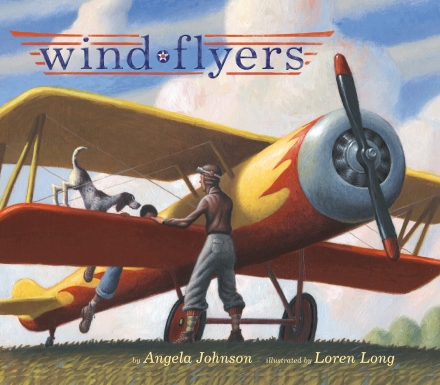
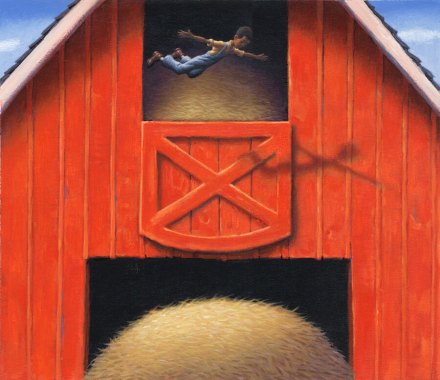
With pride a young African-American boy tells the story of his great-great-uncle who was a Tuskegee Airman in World War II. His uncle was “a smooth wind flyer. A Tuskegee wind flyer…,” the boy says. He knows well his uncle’s history—how like a bird, his uncle believed he was born to fly. “With his arms flapping, he jumped off a chicken coop at the age of five,” and when he was only seven he soared from a lofty barn into a pile of hay. His first real flight came at the age of eleven, when he paid 75 cents to be a passenger with a barnstormer.

celebrate-picture-books-picture-book-review-wind-fliers-jumping-from-hayloft

Image copyright Loren Long, courtesy of Simon & Schuster

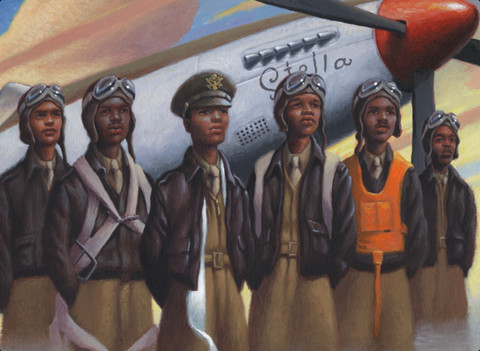
Flying over lakes and fields, his uncle felt as if he were in Heaven, among clouds “like soft blankets, saying, ‘Come on in, get warm. Stay awhile and be a wind flyer too.’” The experience changed him forever. In fact he “cried when they landed because then he knew what it was like to go into the wind, against the wind, beyond the wind.” As a young adult his uncle contributed his dream and his skills to the World War II effort, becoming a Tuskegee Airman, one of the first black pilots in the United States military.

celebrate-picture-books-picture-book-review-wind-fliers-tuskegee-arimen

Image copyright Loren Long, courtesy of Simon & Schuster

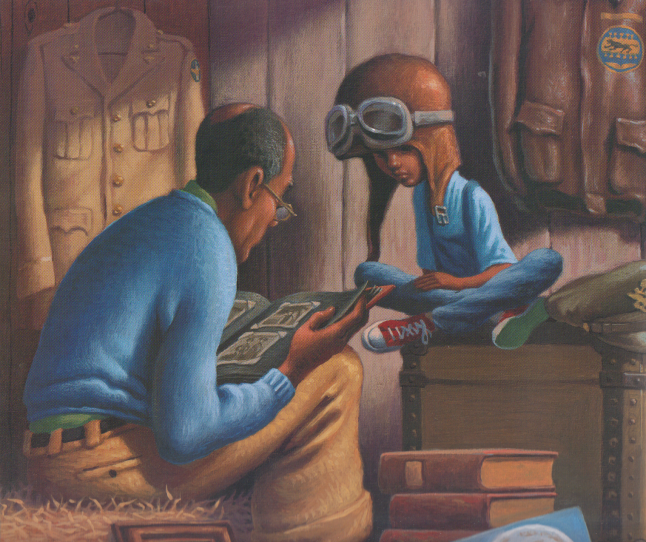
As the pair sit in the uncle’s barn, surrounded by his military uniform, leather jacket, and other memories of his flying career—after the war to continue flying he became a crop duster—the pair look through old photographs, seeing once more those young and brave pilots—the Tuskegee wind flyers. Planes are different now, Uncle says, but the clouds remain the same. The boy and his uncle climb to the highest point of the uncle’s barn to watch the jets—and in those moments they once more become the smooth wind flyers, flying into the wind and beyond.

celebrate-picture-books-picture-book-review-wind-fliers-grandfather-and-grandson

Image copyright Loren Long, courtesy of Simon & Schuster

In her soaring, rhythmic language, Angela Johnson captures the dreams and yearning of a young boy whose greatest desire is to fly among the clouds. Her combination of straight narration with lyrical lines as he joins the Tuskegee Airman in World War II enhances the sense of achievement and pride the young pilots felt. The structure of the story is well chosen, as relating the uncle’s life from childhood through old age through the eyes of his nephew strengthens the themes of strong familial relationships as well as shared dreams across generations.

Loren Long gives Wind Flyers additional power with his strong, vibrant paintings. Two-page spreads provide a sense of the vastness of the skies that so enticed the young would-be pilot. Even the clouds echo the emotion of the page—fluffy, floating, and alive in the flight scenes while linear, flat, and stationary when the plane and the uncle are earthbound. Realistic portrayals of the boy, his uncle, and the other Tuskegee Airmen are reminiscent of the WPA murals of the 1940s while still setting this book firmly in today for a new generation.

Wind Flyers is a wonderful book to share with aviation buffs, budding historians, and dreamers of all types and would make a welcome thoughtful book for quiet story times.

Ages 4 – 9

Simon & Schuster Books for Young People, 2007 | ISBN 978-0689848797

To learn more about Angela Johnson‘s books for all ages, visit her website!

View a gallery of artwork for picture books and other media by Loren Long, visit his website!

National Aviation History Month Activity

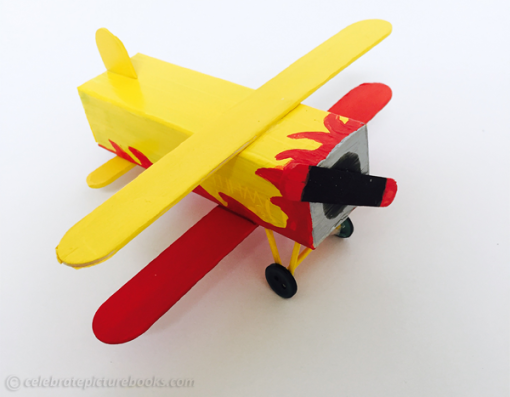
CPB - Biplane side

Head in the Clouds Box Biplane

If you love airplanes and flying, you’ll have fun making your own plane from recycled materials! Use your creativity to decorate your plane while you imagine yourself flying through the clouds on a beautiful day. Younger children will have fun sharing this activity with an adult or older sibling too!

Supplies

  • Travel-size toothpaste box
  • 3 6-inch x 1/2-inch craft sticks
  • 2  2 1/2-inch x 7/8-inch mini craft sticks
  • 5 Round toothpicks, with points cut off
  • Paint in whatever colors you like for your design
  • 4 small buttons 
  • 2 mini buttons
  • Paint brushes
  • Strong glue or glue gun

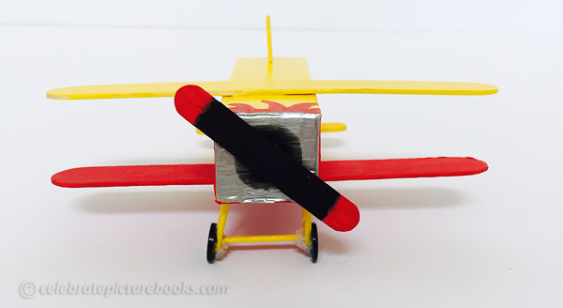
CPB - Biplane front

Directions

  1. Empty toothpaste box
  2. Paint toothpaste box and decorate it
  3. Paint the craft sticks and 5 toothpicks
  4. Paint one small craft stick to be the propeller
  5. Let all objects dry

To assemble the biplane

  1. For the Bottom Wing – Glue one 6-inch-long craft stick to the bottom of the plane about 1 inch from the end of the box that is the front of the plane
  2. For the Top Wing – Glue the other 6-inch-long craft stick to the top of the plane about 1 inch from the front of the plane
  3. For the Tail – Glue one mini craft stick to the bottom of the box about ¾ inches from the end that is the back of the plane
  4. For the Vertical Rudder – Cut the end from one of the painted 6-inch-long craft sticks, glue this to the back of the box, placing it perpendicular against the edge and half-way between each side

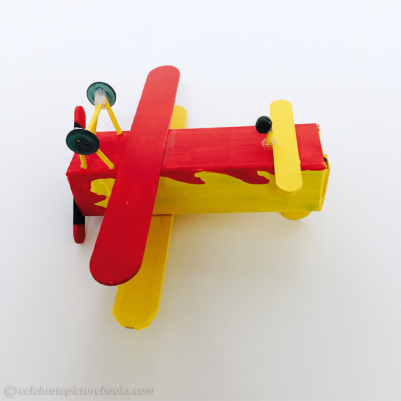
CPB - Biplane bottom

To assemble the front wheels

  1. Cut 4 painted toothpicks to a length of ¾-inches long
  2. Cut one painted toothpick to a length of 1-inch long
  3. Glue 2 of the 3/4-inch toothpicks to the back of 1 button, the ends of the toothpicks on the button should be touching and the other end apart so the toothpicks form a V
  4. Repeat the above step for the other wheel
  5. Let the glue dry
  6. Glue the 1-inch long toothpick between the wheels at the center of each wheel to keep them together and give them stability. Let dry

To make the back wheel

  1. Cut two ¼-inch lengths of painted toothpick and glue them together. Let dry
  2. Glue two mini buttons together to form the back wheel. Let dry
  3. Glue the ¼-inch toothpicks to the mini buttons. Let dry
  4. Glue these to the bottom of the plane in the center of the box directly in front of and touching the tail

Display your biplane!

Picture Book Review
Picture Book Review

September 22 – Elephant Appreciation Day

celebrate-picture-books-picture-book-review-strictly-no-elephants-cover

About the Holiday

While today’s holiday was established in 1996 by Mission Media and its owner Wayne Hepburn because of Hepburn’s love for elephants, the day has garnered official recognition and deserves wide acknowledgement. These gentile, giant animals need our protection from environmental and human dangers. To celebrate today’s holiday visit a zoo or animal preserve, watch a documentary on elephants, or consider donating to their cause.

Strictly No Elephants

Written by Lisa Mantchev | Illustrated by Taeeun Yoo


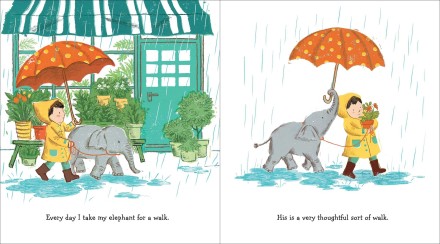
A little boy, his adorable pet elephant by his side, kneels on his bed and gazes out the window at the brownstones across the street. There he sees other kids with their—more conventional—pets: a bird, a cat, a fish, and dogs. “The trouble with having a tiny elephant for a pet is that you never quite fit in,” the boy reveals. Every day the boy takes his elephant for a walk, but even in this common pet-owner activity, the boy and the elephant show their special relationship. The elephant is thoughtful—protecting the boy with an umbrella on rainy days—and the boy is considerate—carrying his elephant over cracks in the sidewalk that frighten it. Why? Because “that’s what friends do: lift each other over the cracks.”

celebrate-picture-books-picture-book-review-strictly-no-elephants-thoughtful-pet

Image copyright Taeeun Yoo, courtesy of simonandschuster.com

On this particular day the boy winds a red scarf around his elephant’s neck and joins the parade of kids on their way to Number 17 where the Pet Club meets. The elephant is reluctant, but the boy is reassuring, even carrying his pet on his back the last few feet. “‘It’ll be fine,’” he says. But when they reach the apartment, there’s a sign on the door that reads “Strictly No Elephants.” There’s even a picture of a crossed out elephant on the sign.

The elephant understands all too well and leads the boy back onto the sidewalk, now ignoring the cracks. “‘That’s what friends do: brave the scary things for you,’” the boy says. The day has suddenly become rainy, and they are caught on the sidewalk without an umbrella. Taking shelter under an awning, the two find a little girl holding her pet skunk. “‘Did you try to go to the Pet Club meeting too?’” she asks. “‘Yes,’” the boy says, “‘But they don’t allow elephants.’”

celebrate-picture-books-picture-book-review-strictly-no-elephants-girl-with-skunk

Image copyright Taeeun Yoo, courtesy of simonandschuster.com

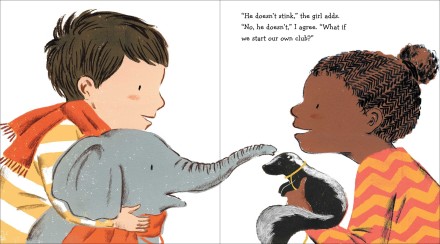
While the sign may not explicitly forbid skunks, the little girl says that the other members didn’t want to play with her and her skunk either. Wisely, the boy tells her “‘They don’t know any better.’” The elephant reaches out its trunk toward the skunk with the girl’s reassurance that he doesn’t stink. The two new friends decide to start their own pet club and head down the sidewalk to find a venue. The boy makes sure that his elephant follows because friends “‘never leave anyone behind.’”

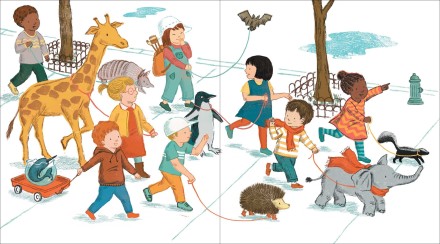
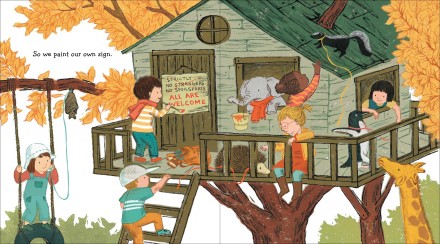
On the way the boy, girl, elephant, and skunk encounter a whole crowd of kids with unusual pets—a tiny giraffe, a mini narwhal, an armadillo, a bat, a hedgehog, and a penguin. They come to a park, complete with tree house, that is perfect for their club. The kids and pets eagerly adopt their new play space—swinging on the tire swing, waddling around the balcony, exploring the roof, playing tag, reading, and more. The boy quickly does the most important thing of all: he paints a new sign for the clubhouse door. “Strictly No Strangers, No Spoilsports ALL ARE WELCOME” it reads. And if you need directions to the club, the boy’s tiny elephant will give them to you “‘because that’s what friends do.’”

celebrate-picture-books-picture-book-review-strictly-no-elephants-new-friends

Image copyright Taeeun Yoo, courtesy of simonandschuster.com

Lisa Mantchev has written a story addressing the types of isolation and rejection that kids (and adults) can face sometimes because of a single perceived difference in an uplifting and productive way. With gentle honesty and thoughtfulness, Mantchev invites kids—on both sides of this “elephant in the room” issue to consider their actions, attitudes, and responses to others. As Mantchev reveals, more inclusiveness leads to more understanding and better relationships. Her lyrical language and sweet reminders of “what friends do” elevate this tribute to camaraderie and companionship and make it a story kids will want to hear again and again.

celebrate-picture-books-picture-book-review-strictly-no-elephants-new-clubhouse

Image copyright Taeeun Yoo, courtesy of simonandschuster.com

Taeeun Yoo’s adorable illustrations of the boy, his tiny pet elephant, and the other animal-and-owner pairs are irresistible. Any reader would want pets as cute and adaptable as these, which may lead to questions about why and how they could be excluded from the club. As the boy and his elephant are turned away from the Pet Club door, the day turns dark and stormy. The two-page spread is rendered in somber shades, except for the little boy with his yellow-striped shirt and red scarf, the elephant sporting a matching red scarf, and the soon-to-be-met African-American girl who wears a red and yellow-striped dress, emphasizing the connections between these two children. The final pages in which the new friends meet and play together are joyful, inviting all readers to “join the club.”

Strictly No Elephants gives readers so much to see, think about, and discuss. The book is a must for school and classroom libraries and would be a very welcome addition to children’s home bookshelves.

Ages 4 – 8

Simon & Schuster, 2015 | ISBN 978-1481416474

Discover Lisa Mantchev’s books for children, young adults, and adults on her website.

See a gallery of books by Taeeun Yoo on her website!

Elephant Appreciation Day Activity

celebrate-picture-books-picture-book-review-spool-elephants-craft

Image copyright Celebrate Picture Books, 2016

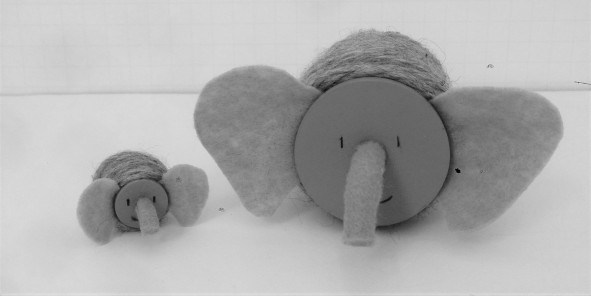
Spool Elephant


Who wouldn’t like a tiny elephant for a pet?! With this easy craft you can make your own little pal to keep you company.

Supplies

  • Printable Elephant Ears Template
  • 1¾-inch wooden spool with center hole, available at craft stores
  • ¾ -inch wooden spool with center hole, available at craft stores
  • Gray craft paint
  • Chunky gray yarn
  • Gray felt, 1 8 ½ x 11 piece
  • Paint brush
  • Black fine-tip marker
  • Hot glue gun or fabric glue

Directions

To Make the Ears

  1. Print the Elephant Ears Template
  2. Trace and cut out the large and small ears

To Make the Body

  1. Paint the spools with the gray paint, let dry
  2. Glue the tab on the ears to the body of the spool to secure, allowing the ears to stick out on either side of one flat end of the spools
  3. Wind the gray yarn back and forth around the spool, creating several layers of thickness
  4. When the body is as thick as you desire, cut the end and secure with glue

To Make the Trunk

  1. Cut a 2 x 4-inch piece of felt for the large elephant; 1/2 x 2-inch piece for small elephant
  2. Roll tightly and secure with glue
  3. Feed one end of the roll into the hole in the middle of the spool
  4. Cut to desired length

To Make the Tail

  1. Twist a small length of yarn and push it into the hole on the back of the spool
  2. With the marker draw eyes and a mouth on the face

Picture Book Review

September 9 – It’s National Courtesy Month

celebrate-picture-books-picture-book-review-the-black-and-white-factory-cover

About the Holiday

September has been designated as National Courtesy Month to remind us that good manners and watching out for others, goes a long way toward making the world a more cooperative and happy place. Sometimes common courtesy is as black and white as directly following the rules…but sometimes…well, I’ll let you decide…

The Black and White Factory

Written by Eric Telchin | Illustrated by Diego Funck


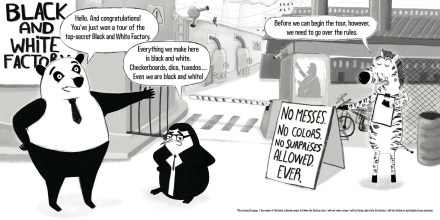
You are one lucky reader! You have won a tour of the Black and White Factory where the employees are hard at work making products like checkerboards, dice, tuxedos…you know the stuff. Even the bosses—a panda and a penguin—are in black and white. Before you start your tour, you’re met by a zebra foreman who goes over the rules of the factory. And they are these:

“No Messes, No Colors, No Surprises Allowed.” When? “Ever.”

As you proceed inside your first stop is the billiard ball machine—8 balls only, of course! It doesn’t take you long to be ushered into the “top-secret Experiment Room,” where innovative products are being developed. You may be the first ever to see “trick dominoes that are impossible to knock over” and new black-and-white-paint in either checkerboard or polka-dot. Another prototype displayed on a wall chart is “never-melting vanilla ice cream.” Also prominently displayed are the factory’s rules: “No Messes, No Colors, No Surprises Allowed. Ever.”

celebrate-picture-books-picture-book-review-the-black-and-white-factory-outside-factory

Image copyright Diego Funck, text copyright Eric Telchin, courtesy of simonandschuster.com

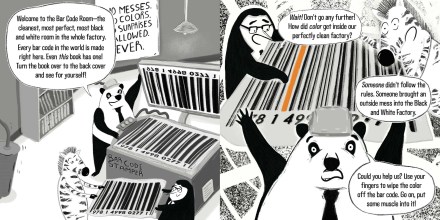
Moving on you push the button leading to the Animal Room. Housed here are white Dalmatians, dairy cows, and skunks who are being sprayed with their distinctive black marks. An elevator takes you to the Bar Code Room. While waiting for your car, you are exhorted to remember the rules: “No Messes, No Colors, No Surprises Allowed. Ever.” The Bar Code Room is “the cleanest, most perfect, most black and white room in the whole factory. Every bar code in the world is make right here.” Even the one for the book you’re reading! Turn it over and see!

celebrate-picture-books-picture-book-review-the-black-and-white-factory-factory-floor

Image copyright Diego Funck, text copyright Eric Telchin, courtesy of simonandschuster.com

“Wait!” Wait!! Turn the book back! A stripe of yellow has seeped into the factory! “Someone didn’t follow the rules. Someone brought an outside mess into the Black and White Factory.” The bosses need your help! Can you “use your fingers to wipe the color off the bar code?” Oh, no, no, no! That just made it worse—now it’s smudged yellow and orange! “Quick! Do something! Rub the colors with your sleeve. Or your elbow. Something.”

We interrupt this review to remind you of the RULES: “No Messes, No Colors, No Surprises Allowed. Ever.” Right, then, back to our dilemma. Now the colors are dripping! It’s such a mess! Suddenly, the zebra has an idea. He asks you to “hold the book upright and tilt it so the color drips down the bottom of the page.” Okay—phew!—great job!

Oh, no!! More colors are creeping in! “Swirl the book so the colors fly off the page,” the penguin orders. You are one strong swirler—the zebra, penguin, and panda are all topsy-turvy, and now the factory looks like an abstract painting! This definitely is not good. “What a mess! The Black and White Factory is ruined.” But the panda may have an idea. Everyone, “back to the top-secret Experiment Room.” There the panda, zebra, and penguin, splattered in paint, stand in front of the “Air-powered comprehensive cleaning contraption.” They just need your help in getting it started. Can you blow into the nozzle? Harder? Come on, put some oomph into it! All right!

celebrate-picture-books-picture-book-review-the-black-and-white-factory-bar-code-room

Image copyright Diego Funck, text copyright Eric Telchin, courtesy of simonandschuster.com

The machine’s at 100% power! The machine shakes and whirrs with a color overload. It explodes with a rainbow of colors that covers everything in the factory. The panda, zebra, and penguin stand in the midst of it. “Everything is so…different,” says the panda. “It’s…colorful…,” adds the penguin. “And wonderful!” concludes the zebra. There’s just one problem…The RULES: “No Messes, No Colors, No Surprises Allowed. Ever.” Hmmmm….

How about: “No Messes, No Colors, No Surprises Allowed. ForEver.”

Yes! Much better! So “that concludes the Best. Tour. Ever!” Off you go—just don’t forget the rules: “Messes, Colors, Surprises Allowed. Forever.”

Eric Telchin’s The Black and White Factory will have kids tipping, tilting, swinging, and even reading this fun and funny interactive picture book. Directly addressing the reader, the three staid and rule-abiding managers of a very focused factory, play straight-man to the child’s laugh inducing and unintentional “mistakes” that lead to a brighter future. With the pacing of a favorite theme-park ride, the story has a suspenseful “Oh, no! What’s going to happen?” feeling as readers progress from page to page until the first tinge of yellow precipitates the humorous chaos to come.

Diego Funck’s sly illustrations riff on the black-and-white theme, as he designed a clever product line in line with “the rules.” Kids will want to linger over the pages to catch all the jokes and visual puns. The reactions of the three employees of The Black and White Factory will make readers laugh too as they endeavor to hang on to their beloved rules in the midst of their changing world. The bold colors of the transformed factory are as refreshing as the sun after a dark, rainy day.

The theme that creativity and expression come from making messes and allowing surprises to happen is a welcome idea and one that leads to innovation and personal freedom. The Black and White Factory is sure to be asked for again and again!

Ages 4 – 7

little bee books, 2016 | ISBN 978-1499802771

Learn more about Eric Telchin on his websites – erictelchin.com and boyseeshearts.com

To view a portfolio of Diego Funck’s artwork, visit his website!

National Courtesy Month Activity

celebrate-picture-books-picture-book-review-black-and-color-crayon-craft-boat

Let Your Colors Shine Through! Craft


With this easy-to-make craft you can show your colors and your creativity!

Supplies

  • Heavy stock paper
  • Crayons, a variety of colors and black

celebrate-picture-books-picture-book-review-black-and-color-crayon-craft-colors

celebrate-picture-books-picture-book-review-black-and-color-crayon-craft-black-crayon

Directions

  1. Color the paper with blocks, stripes, or splotches of color
  2. Cover the colored paper entirely with the black crayon
  3. Scrape a design in the black crayon, exposing the colors beneath

Picture Book Review
September 8 – International Literacy Day

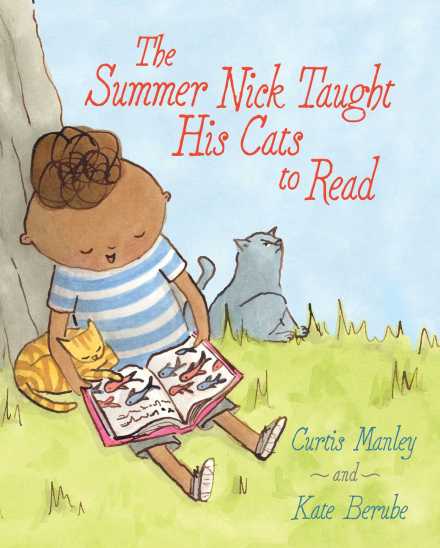
celebrate-picture-books-picture-book-review-the-summer-nick-taught-his-cats-to-read-cover

About the Holiday

In 1966 UNESCO (United Nations Organization for Education, Science and Culture) established International Literacy Day on this date to “actively mobilize the international community to promote literacy as an instrument to empower individuals, communities, and societies.” Marking its 50th anniversary, International Literacy Day is this year celebrating the theme “Reading the Past, Writing the Future” to commemorate five decades of efforts to increase in literacy rates around the world and the progress made. “It also looks to innovative solutions to further boost literacy in the future.” With a focus on innovation, International Literacy Prizes are also awarded to people with outstanding solutions that can drive literacy towards achieving future goals.

The World Literacy Foundation also celebrates today’s holiday with the 2016 campaign “The Sky’s the Limit,” which aims to eliminate the digital divide for students in the developing world.

The Summer Nick Taught His Cats to Read

Written by Curtis Manley | Illustrated by Kate Berube


One summer Nick, Verne, and Stevenson did everything together. Nick is a little boy and Verne and Stevenson are two very different cats. Nick and Verne loved to spend time near the water—Stevenson tolerated it. Nick and Verne slept happily in a tent under the stars—Stevenson barely shut his eyes. While Nick rode his bike Verne eagerly sat in the front basket—Stevenson hunkered down in a box on the back. But when Nick sat down to read, both cats had their own ideas of fun—like lying on top of the book—and Nick could hardly read a sentence.

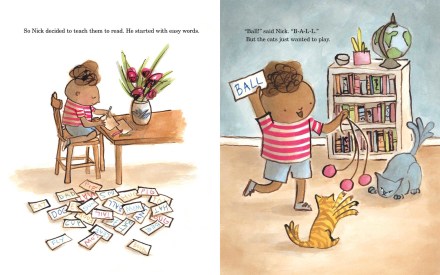
celebrate-picture-books-picture-book-review-the-summer-nick-taught-his-cats-to-read-ball

Image copyright Kate Berube, text copyright Curtis Manley, courtesy of simonandschuster.com

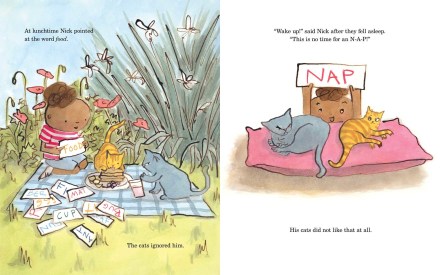
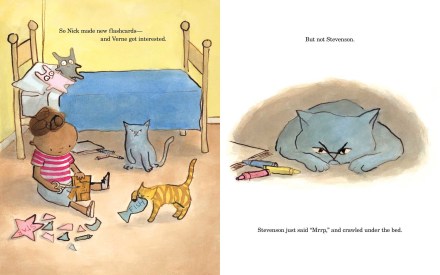
“So Nick decided to teach them how to read. He made flash cards and started with easy words” like “ball,” but Verne and Stevenson just wanted to play with the ball. While the three had a picnic on the lawn, “Nick pointed to the word food. The cats ignored him.” When the cats snoozed Nick woke them with a sign. “‘This is no time for an N-A-P!’” he said. Neither cat responded well, so Nick tried a new tactic. He made word-shaped flash cards. Verne took a nibble of “F-I-S-H,” but Stevenson hid under the bed.

celebrate-picture-books-picture-book-review-the-summer-nick-taught-his-cats-to-read-food-flash-cards

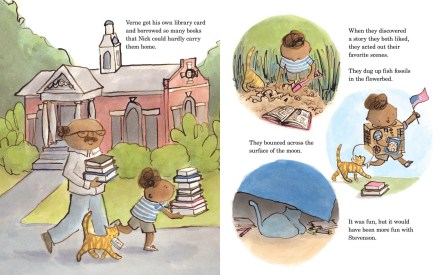
Nick began to see that Verne liked stories about cats and fish. “Verne loved fish. He followed along as Nick read, learning the sounds of the letters.” He even read by himself, discovering new stories, especially 2,000 Leagues Under the Sea. But Stevenson? When Nick spelled words for him, he merely ran under the porch, hissing. By this time Verne was reading so many books that he got his own library card and Nick needed help carrying all of his books home. Nick and Verne had fun acting out their favorite stories, but they missed Stevenson.

One day “Verne discovered a treasure under the bed—a great stack of Stevenson’s pirate drawings. “‘Wow!’” Nick whispered. “‘Stevenson drew a story.’” Nick and Verne put the pages together and began to write words to go with them. When the story was finished, Nick, Verne, and Stevenson “squeezed under the porch, gave Stevenson an eye patch, and read The Tale of One-Eyed Stevenson and the Pirate Gold. Stevenson listened and followed along. He didn’t run away. Or hiss. Not even once.”

celebrate-picture-books-picture-book-review-the-summer-nick-taught-his-cats-to-read-library

Image copyright Kate Berube, text copyright Curtis Manley, courtesy of simonandschuster.com


Suddenly, Stevenson couldn’t get enough of books.  Even before Nick woke up, Stevenson could be found with his nose in Treasure Island or another adventure book, and whenever Nick and Verne played pirates, Stevenson joined in. He helped bring down “scurvy mutineers” and found buried treasure. Now the three readers do everything together. They “hunt for dinosaurs in the lost world behind the garden…race around the yard in eighty seconds…and journey to the center of the basement.” And while they all like to read on their own, they also like it when someone reads to them. “Hmmm…,” Nick thinks, maybe next he could teach his cats to talk. “‘Meow,’ says Stevenson.”

celebrate-picture-books-picture-book-review-the-summer-nick-taught-his-cats-to-read-grumpy-stevenson

Image copyright Kate Berube, text copyright Curtis Manley, courtesy of simonandschuster.com

Curtis Manley’s adorable tribute to reading and learning to read using cats, with their variety of personalities, is inspired. Just as some people respond more to the words while others are attracted by the pictures, Verne and Stevenson have their own relationships with books. The names of the cats and their preferred reading material are also reminders that books are personal, and disinterest in one type of story does not reflect disinterest in all stories. Manley’s text makes for a joyful read-aloud as his language and phrasing is evocative, lyrical, and imaginative.

In perfect accompaniment, Kate Berube brings this creative story to life, illustrating the tender relationship between Nick and his pets as well as emphasizing the humor and distinct personalities inherent in orange striped Verne and smoky gray Stevenson that influence their journeys to literacy. Depictions of the various books Verne and Stevenson are drawn to highlight the literary references in the trio’s further play. Readers will want to stop and peruse the page of library shelves, where such books as “Harry Picaroon and the Swashbuckler’s Stone”, “Harold and the Purple Canon”, “Millions of Rats”, and “Where the Wild Pirates Are” wait to be checked out in the Pirates section.

Kids will eagerly want to adopt The Summer Nick Taught His Cats to Read, and it will snuggle in nicely on children’s bookshelves.

Ages 4 – 8

Simon & Schuster Books for Young Readers, 2016 | ISBN 978-1481435697

Discover “the facts, fictions, poems, and numbers” of Curtis Manley on his website!

View a gallery of Kate Berube‘s art on her website!

International Literacy Day Activity

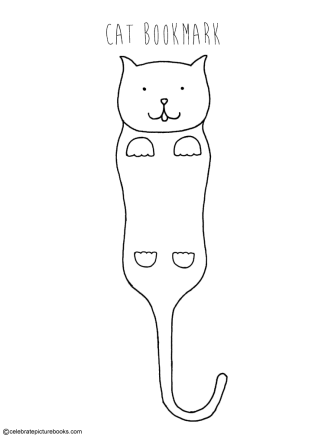
CPB - Cat Bookmark (2)

Feline Fine about Reading Bookmark


This want-to-be literary lion feels fine about reading! Let it hold your page while you’re away! Print your Feline Fine about Reading Bookmark and color it!

Picture Book Review

July 31 – Uncommon Instrument Awareness Day

celebrate-picture-books-picture-book-review-ada's-violin-cover

About the Holiday

Today is the day to be musically experimental. Intriguing, inventive instruments that make a wide variety of sounds exist in every corner of the world. From Russia comes the contrabass balalaika, a triangular stringed instrument. The cimbalom, a concert hammered dulcimer, originated in Hungary. And only the Welsh could give us an instrument with no vowels: the crwth. Glass, water, and lightning are also used to make beautiful sounds, and the Holophonor—a musical instrument and hologram projector all in one—is perfect for Elvis sightings wherever he is! So, play a different instrument or research one, and read the inspiring story in today’s book!

Ada’s Violin: The Story of the Recycled Orchestra of Paraguay

Written by Susan Hood | Illustrated by Sally Wern Comport


Ada Ríos is growing up in Cateura, a town built of trash as the main garbage dump for the capital city of Paraguay. Every morning the refuse trucks rumble into town to deposit their loads—1,500 tons of trash every day. The citizens of Cateura—gancheros or recyclers—go to work sifting through the mounds and tearing into bags looking for anything valuable enough to recycle or sell. Cardboard is worth 5 cents a pound, plastic 10 cents a pound.

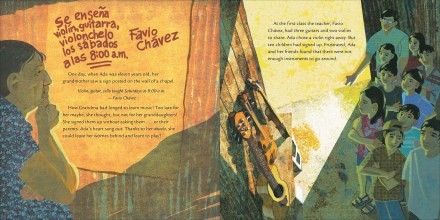
Ada knows the landfill can hold surprises—“Her father, a ganchero, had found appliances, toys, perfumes, and antique watches.”—but she can never imagine what it holds for her. When Ada and her sister were little, their grandmother watched them while their parents worked. They loved to listen to music, to sing, and to learn stories of musicians and the sounds of different instruments. Ada fell in love with the violin.

celebrate-picture-books-picture-book-review-ada's-violin-making-singing

Image copyright Sally Wern Comport, courtesy of simonandschuster.com

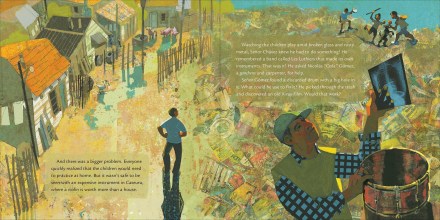
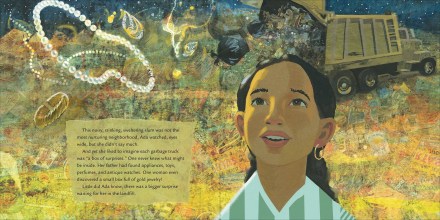
As the girls grow older and go to school, they venture farther into town, but there is little to fill their time. Many kids join gangs or get into fights. When Ada is 11 her grandmother signs her and her sister up for music lessons being offered by a new man in town named Favio Chávez. “Ada’s heart sang out” when she hears the news. On the first day ten children show up to play the five instruments available. But a bigger problem looms: the three guitars and two violins cannot be taken home for practicing as they are magnets for thieves. In Cateura a violin is worth more than a house.

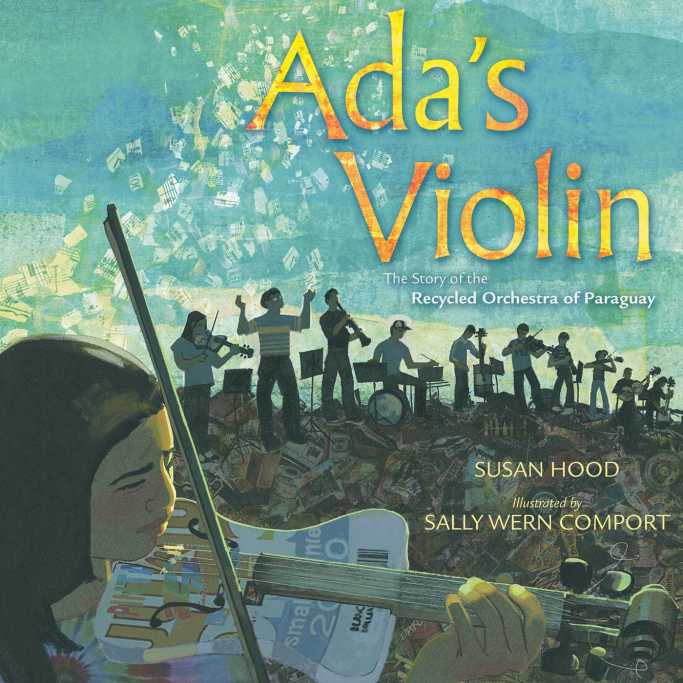
But Favio Chávez has an idea. With help from Nicolás Gómez, a ganchero and carpenter, they pull bits and pieces from the landfill. An old broken drum and an X-ray film become a workable drum, water pipes become flutes, packing crates become guitars and violins, and oil drums become cellos. “Ada chose a violin made from an old paint can, an aluminum baking tray, a fork, and pieces of wooden crates. Worthless to thieves, it was invaluable to her. It was a violin of her very own.”

celebrate-picture-books-picture-book-review-ada's-violin-making-instruments

Image copyright Sally Wern Comport, courtesy of simonandschuster.com

The children practice tirelessly outside in 100-degree heat until the initial “screeches, twangs, and tweets hit all the right notes. Their class became ‘a small island’ where Chávez taught them to respect themselves and one another.” They become known as The Recycled Orchestra. Music now fills the air, adding a soundtrack of beauty to the grueling work. The orchestra is soon invited to play concerts in Cateura and the capital city of Asunción. When word spreads of their talent, they receive offers to play from other cities and even other countries.

When Ada is 16 The Recycled Orchestra is invited to tour with a world-famous rock band. As Ada takes the stage in front of 35,000 people in Bogotá, Colombia, she is afraid, but the audience cheers for them and sings along as they play. On that night the children discover a new life. “Buried in the trash was music. And buried in themselves was something to be proud of.”

celebrate-picture-books-picture-book-review-ada's-violin-lessons

Image copyright Sally Wern Comport, courtesy of simonandschuster.com

An extensive author’s note plus a photograph of The Recycled Orchestra, websites, and videos follow the text, as well as a list of sources.

Ada’s Violin is also available in a Spanish edition—El violín de Ada: La Historia de la Orquesta de Instrumentos Reciclados del Paraguay.

Susan Hood has brought to light an incredible story of perseverance, hope, and the ability of music and other arts to provide opportunities and self-confidence that change lives. Told with unstinting honesty and sensitivity, Hood’s biography of Ada Ríos, Favio Chávez, and The Recycled Orchestra will inspire all who read it. The well-paced text offers revealing details on every page and flows with a lyrical quality that enhances the effect of the story and its impact. From the first sentence to the last, both children and adults will be riveted to The Recycled Orchestra.

celebrate-picture-books-picture-book-review-ada's-violin-hope

Image copyright Sally Wern Comport, courtesy of simonandschuster.com

Sally Wern Comport’s paintings beautifully capture the human spirit that shines through and drives people to astonishing achievements even in the most adverse conditions. With intricately created collages of rich hues, Comport depicts the town of Cateura and the mountains of trash the citizens work and play on. Warm lighting illuminates faces full of dreams and love, and readers will linger over depictions of the instruments workshop and cheer along with the concert audience as the children receive recognition. The full-bleed, two-page spreads echo the expanded world music gave to the children in the orchestra and the adults who heard them as music score confetti flutters throughout.

Both school classrooms and home libraries will benefit from the stirring message of Ada’s Violin.

Ages 4 and up

Simon & Schuster Books for Young Readers, 2016 | ISBN 978-1481430951 (English edition); 978-1481466578 (Spanish edition)

Discover more about Susan Hood and her books, plus fun activities for kids and information for teachers and parents on her website!

View a gallery of Sally Wern Comport’s artwork on her website!

Uncommon Instrument Awareness Day Activity

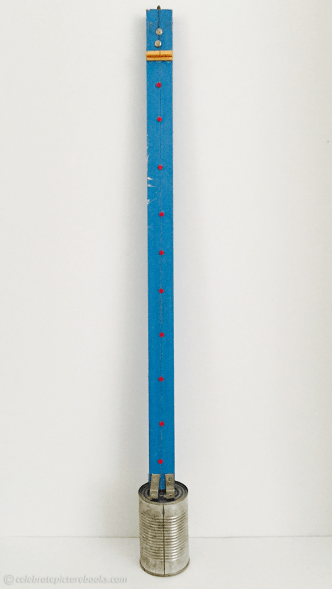
celebrate-picture-books-picture-book-review-homemade-musical-instrument


Make Your Own Musical Instrument


Inspiration for sound can come from almost any object! Look around your house or classroom and discover the music in boxes, cans, blocks of wood, plastic egg cartons or deli containers, and more. Add string or wire for plucking, sticks for drumming, or beans for shaking. With a little glue, tape, or hardware and some creativity, you’ll be making your own rhythms in no time!

Supplies for the instrument shown in the picture above

  • Tin can
  • Two small L brackets
  • Piece of wooden molding, 2 1/2 feet by 1 1/2 inches by 3/4 inches
  • Five small strips of wood to raise the wire off the neck of the instrument. I used long wooden fireplace matches cut into 1 1/2″ sections 
  • Thin wire
  • Small circular hook screw or regular screw
  • Two tacks
  • A nail, screw, or piece of wood that will fit horizontally in the mouth of the can
  • a small nail to make a hole in the can
  • Hammer
  • Strong Glue
  • Paint
  • Foam decorative dots

Directions

  1. Paint the wood and let dry
  2. Paint the small strips of wood and let dry
  3. Decorate the can with paint, sticker, duct tape, or paper
  4. With the hammer and small nail, make a hole in the center of the bottom of the can
  5. Wrap one end of the wire around the nail and glue so it is firmly in place
  6. Feed the other end of the wire through the hole in the bottom of the can
  7. Screw or glue two L brackets to one end of the wood molding so that the bottom of the L is flush with the bottom of the wood molding and there is space between the brackets. This makes the neck of the instrument
  8. Screw the circular or regular screw into the top, center of the wooden molding
  9. When the wooden strips are dry, glue three side by side 3 inches from the top of the molding. Glue two more matches, one on top of the other on the center strip.
  10. When the L brackets are dry, glue them (and the neck of the instrument) to the can, making sure the brackets are on either side of the hole in the can. Make sure the wire is out of the hole. 
  11. When the brackets are firmly attached to the can, pull the wire to the top of the neck. Settle it in the center of the small pieces of wood, so that the wire is not touching the neck.
  12. Wrap the wire around the screw at the top of the molding until it is firmly in place and the wire is taut. 
  13. Secure the wire to the neck with the tacks
  14. Mark the “frets” with the foam dots

Picture Book Review