August 26 – National Dog Day

About the Holiday

In 2004 Pet and Family Lifestyle Expert and Animal Advocate Colleen Paige established National Dog Day to remind people – especially those who may be looking for a new pet – of all the dogs in shelters that need forever homes. The day also celebrates dogs of all breeds and honors the work of these faithful friends, whether they are family pets or specially trained as service dogs, police dogs, or search-and-rescue dogs. If you’re thinking of adding a new family member of the furry kind, or if you’d just like to make a difference to animals in shelter care, call or visit your local humane society, other shelter, or rescue organization.

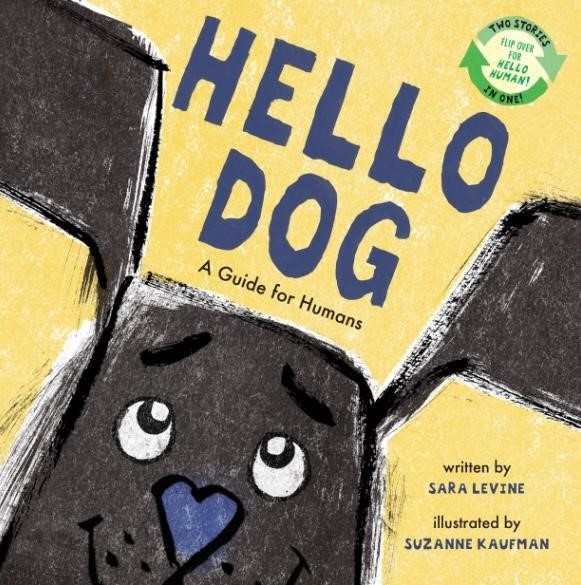
Hello Dog / Hello Human (Flip Book): Two Stories in One!

Written by Sara Levine | Illustrated by Suzanne Kaufman


With their curly hair or sleek coats, sweet faces, and eager natures, dogs are natural kid magnets. But that doesn’t mean they’re always ready to be pet or played with. In Hello Dog / Hello Human, Sara Levine cleverly teaches children and adults how to recognize the traits of a receptive dog and how exactly to approach and engage with a dog you haven’t met yet.
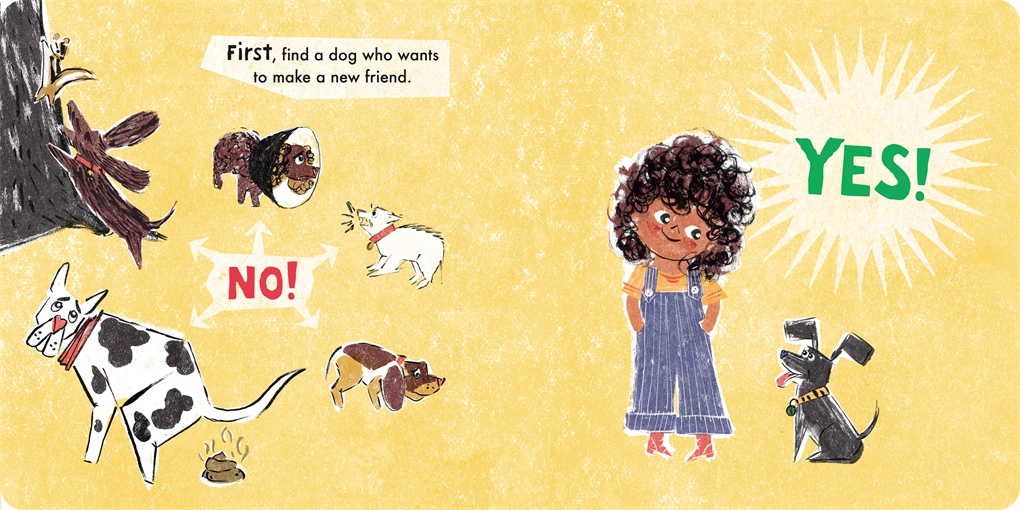
Illustration © 2025 by Suzanne Kaufman. Text © 2025 by Sara Levine. Courtesy of Roaring Brook Press.

It’s easy enough to ask a dog’s human for permission to pet their dog, but getting the dog’s permission can be a bit trickier. Behind the Hello Dog cover, Levine shows kids how to read a dog’s body language, an important skill as “dogs speak with their bodies.” Once a child has determined that the dog isn’t too busy, too shy, or too distracted, Levine goes on to reveal the human behaviors dogs consider rude and the ones they find to be polite. If a person gets a signal that their initial overtures are accepted, only then should they put out their hand to pet that furry coat.
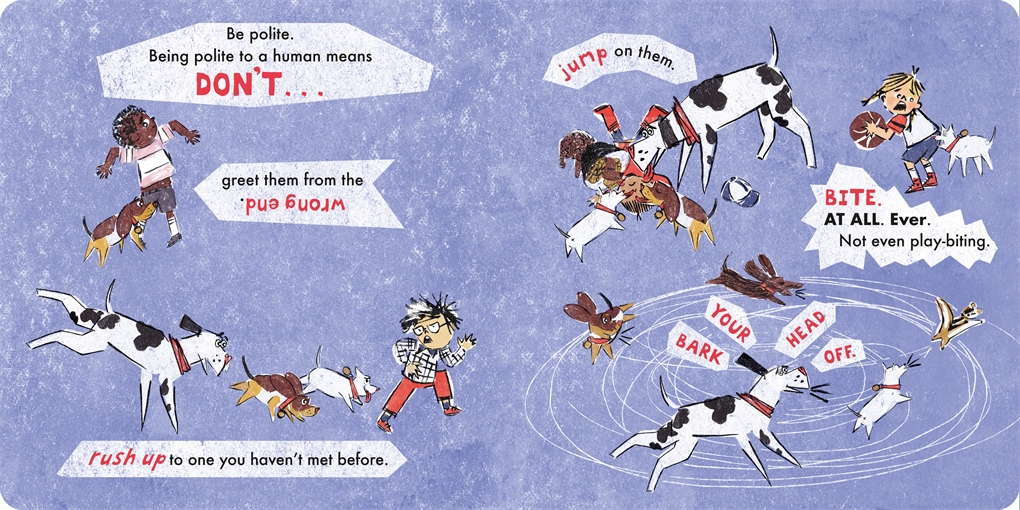
Illustration © 2025 by Suzanne Kaufman. Text © 2025 by Sara Levine. Courtesy of Roaring Brook Press.

But turn-about is fair play, and by just flipping the book over, that’s what readers find! Open the Hello Human cover, and dogs get a primer on meeting kids (with a dollop of humor, readers may also interpret these tips as courteous ways for meeting new people as well). So how does today’s discerning dog go about choosing the right human to make friends with? Well, they can read the body language. Turns out, people say a lot with their gestures and expressions too. They also use words, and it benefits both dog and human if they’re on the same page with some simple terms, especially “Sit.” While some canines may find it incredible, people tend to prefer a quiet, stationary, even non-slobbery greeting. Levine expands on these and other steps and shows what kind of welcome leads to that scratch behind the ears that, for any pup, is so rewarding.
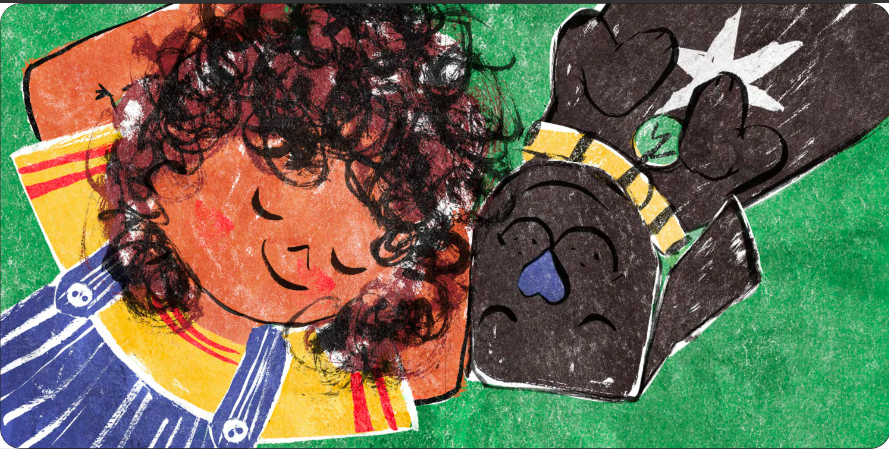
Illustration © 2025 by Suzanne Kaufman. Text © 2025 by Sara Levine. Courtesy of Roaring Brook Press.

Working perfectly in synch, author and veterinarian Sara Levine and illustrator Suzanne Kaufman have created a clever book that children and adults will find helpful whether they’re adopting a new dog or learning how to interact with dogs they meet at friends’ homes or while out in the park or neighborhood. 

Levine’s straightforward and easy-to-understand steps are punctuated by Kaufman’s humorous depictions of expressive dogs of various breeds engaging in natural, madcap doggy behavior. These energetic pups appear in both stories along with a sweet child and an adorable, well-mannered pooch who’s ready to make a friend. A comical subplot involving a squirrel chase also ties the two sections together.

Educational and entertaining, Hello Dog / Hello Human is an exciting, multi-interest nonfiction story for home bookshelves that kids will want to hear often and even chime in on. The text is especially welcoming to new and emerging readers. Librarians will love displaying the book and recommending it to a wide range of patrons.

Ages 4 – 8

Roaring Brook Press, 2025 | ISBN 978-1250797025

About the Author

Sara Levine is an award-winning picture book author, veterinarian, and science educator. Her books which include Bone by BoneTooth by ToothFlower TalkSensitive, and The Animals Would Not Sleep! have received the AAAS/Subaru SB&F Prize, Bank Street College Best Book of the Year, Beehive Book Award, Cook Prize, and the Mathical Book Prize. She loves doing school and library programs. Visit her at saralevinebooks.com.

About the Illustrator

Suzanne Kaufman is the illustrator of Samanthasaurus Rex, written by B. B. Mandell; Naughty Claudine Christmas, written by Patrick Jennings; 100 Bugs!, written by Kate Narita; and the author and illustrator of I Love Monkey and It’s Confiscated. She lives in Seattle with her family. Visit her at suzannekaufman.com.

National Dog Day Activity
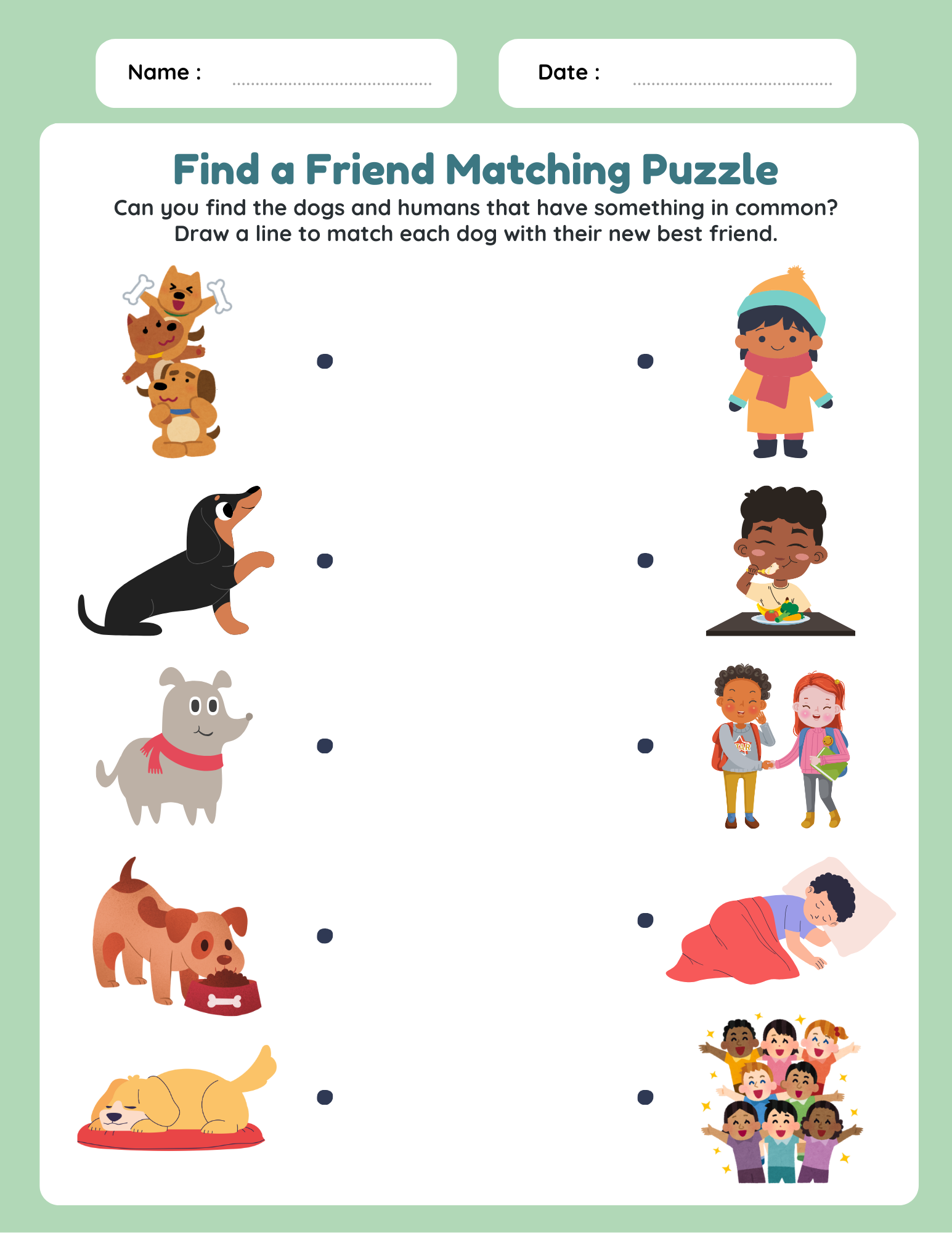
Find a Friend Matching Puzzle


Dogs and their humans often have personalities or even their appearance in common. Can you match up these sweet pups with their new best friend in this Find a Friend Matching Puzzle?

Find a Friend Matching Puzzle with Light Green Border | Find a Friend Matching Puzzle with No Border
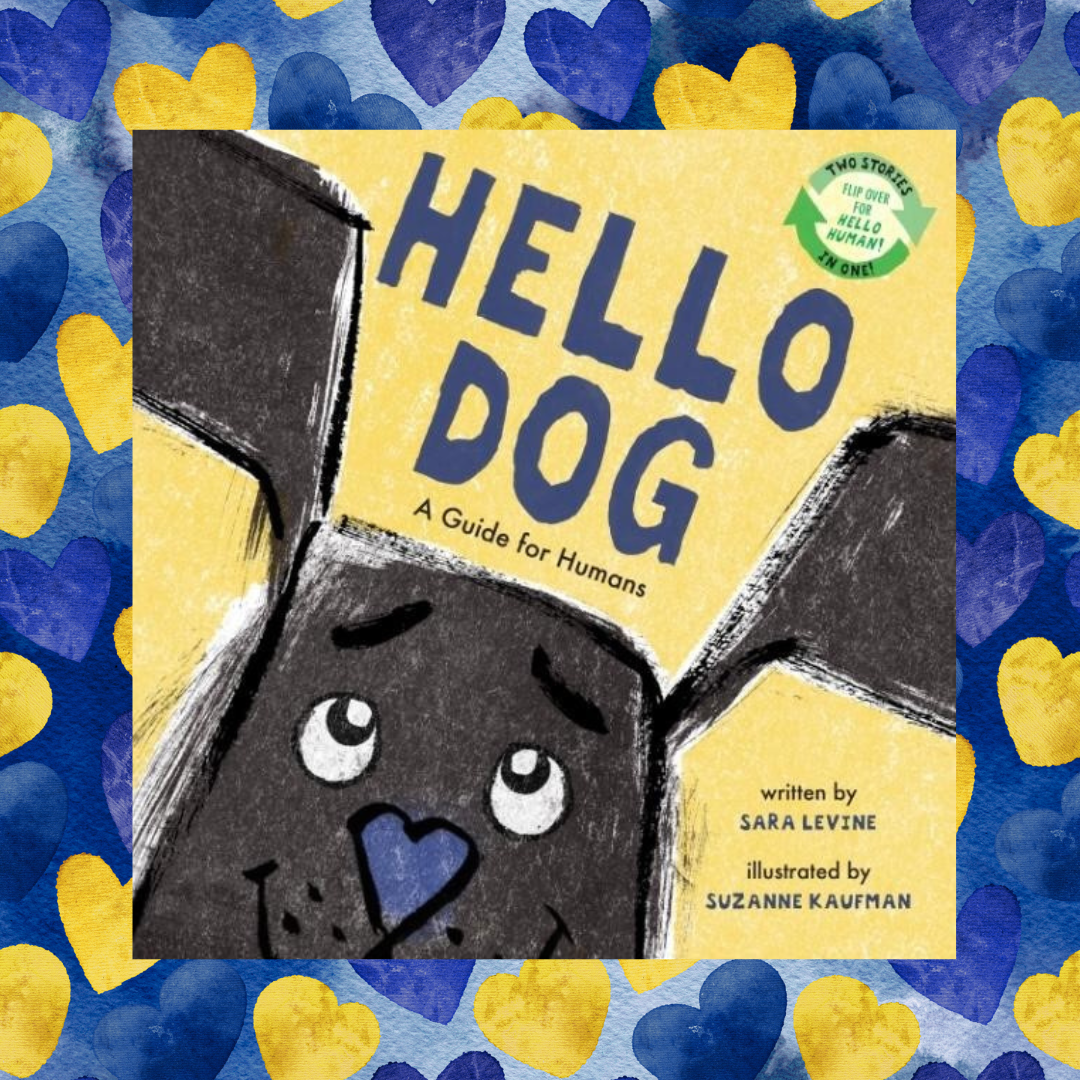
You can purchase Hello Dog / Hello Human from these booksellers

Amazon | Barnes & Noble | Bookshop (discounted books and support for your local independent bookstore)

Picture Book Review

February 21 – It’s National Nest Box Week

About the Holiday

National Nest Box Week was established in the United Kingdom in 1997 to highlight how birds are often displaced from their natural nesting places with the destruction of the woodlands and fields birds call home. The holiday encourages people to pay attention to their local nesting birds and put up nest boxes to support the conservation of breeding birds. No matter where you live, birds’ ecosystems are fragile. You can make a big difference in the survival of your local bird population by building and maintaining nesting boxes for the spring and summer months. To learn how more about the holiday and how you can help, visit nestboxweek.com.

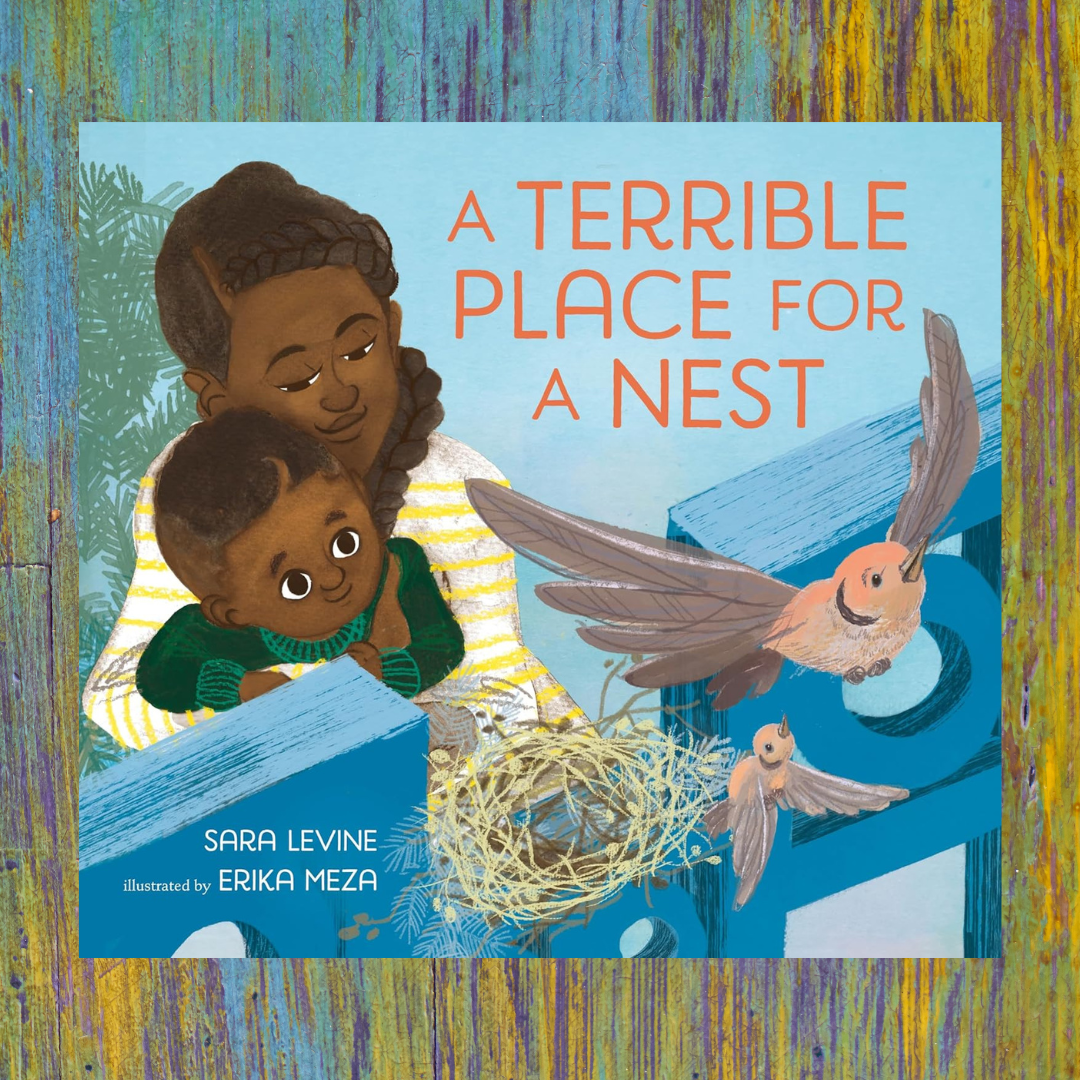
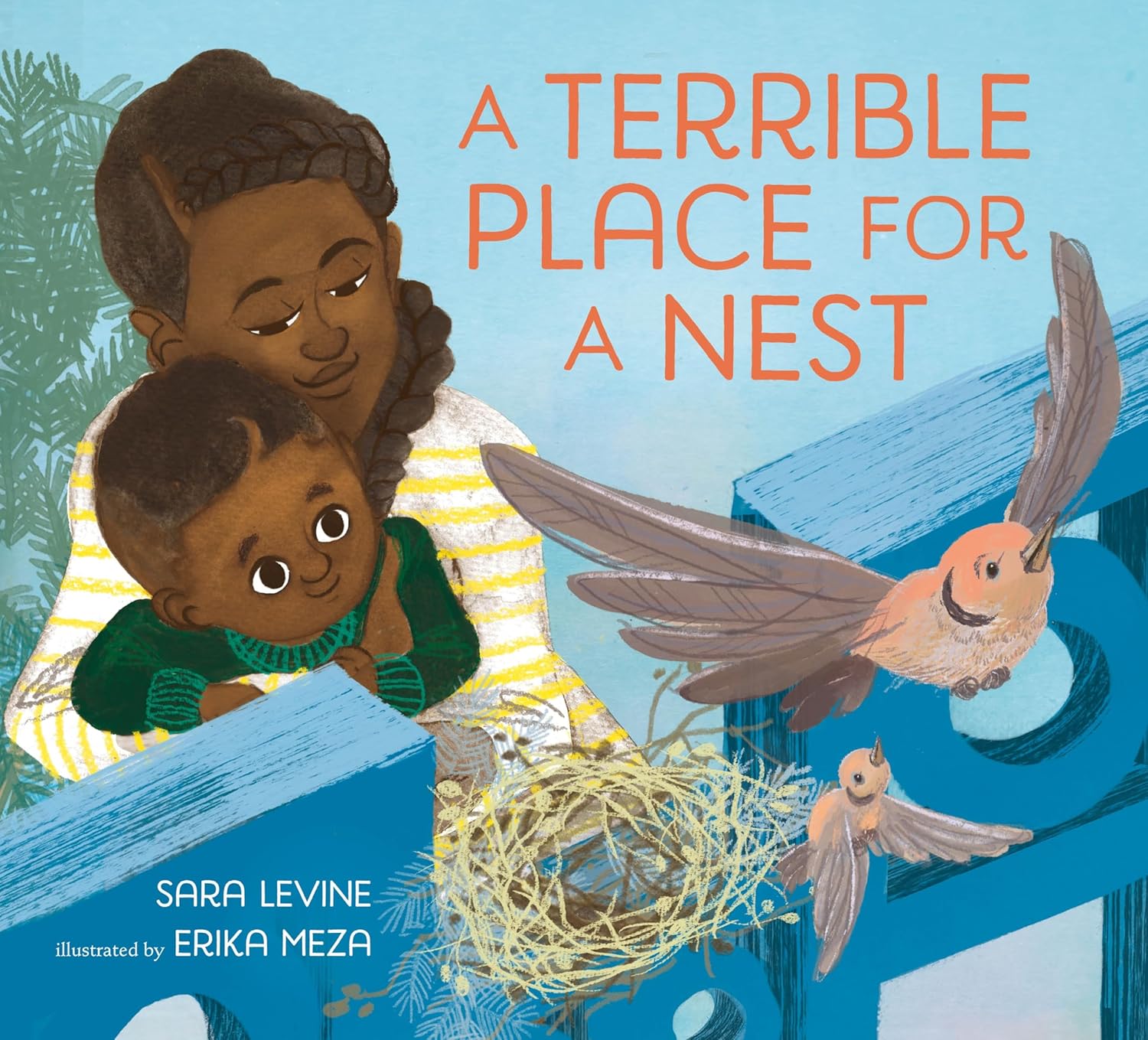
A Terrible Place for a Nest

Written by Sara Levine | Illustrated by Erika Meza


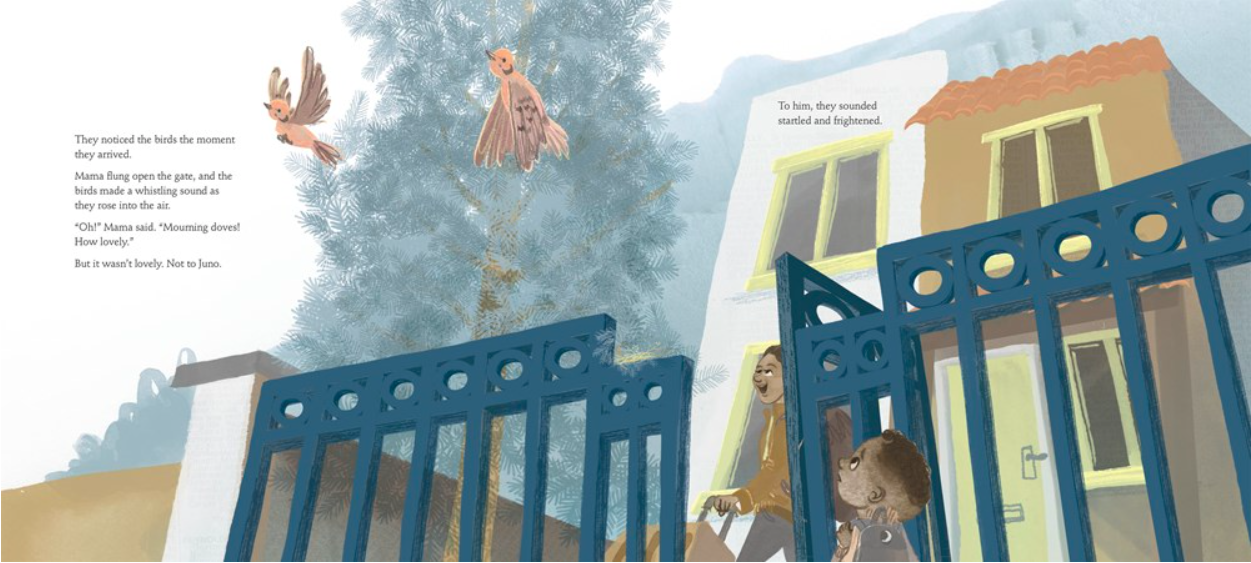
Displaced from their home, a mother and her son, Juno, move to a new place in a new neighborhood. Juno’s mother takes solace in the mourning doves that greet them, but Juno hears sadness and fear in their whistling coos. Nothing about the move feels right to Juno. He can’t get his favorite cereal at the grocery store, and he tells his mama that he’s “‘never going to fall asleep'” in his new room. 

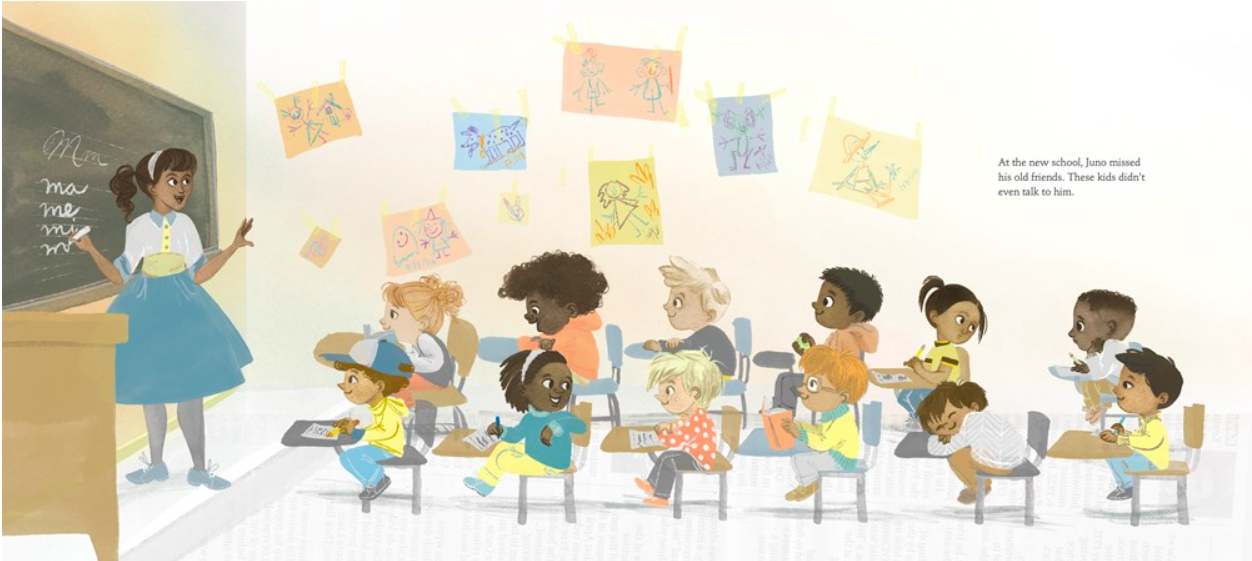
At school he sits alone with no one to talk to. When he gets home he yells, “‘This is a terrible place!,'” frightening the mourning doves from their nest on the gate. The next day, when the movers come, they knock the nest from its perch, breaking the eggs and confirming to Juno his feelings about their new home.

Illustration © 2024, Erika Meza; text © 2024 Sara Levine. Courtesy of Roaring Brook Press.

Later, Juno tries to rebuild the nest, and he and his mom buy millet seed to feed them. They’re happy to see the birds return to the yard—although the nest sits empty for days and weeks. Meanwhile, at school, Juno makes a friend of the girl who sits in front of him, talking and drawing and making paper birds together.

Still, no birds occupy the nest. At night in his unfamiliar room, where unpacked boxes of books and art supplies stand stacked against the wall, Juno thinks “maybe it didn’t feel safe to them.” But then one day, Juno notices with excitement that, just as he and his mom are settling into their new home, a dove is snugged into the nest. “Mama said this meant there were eggs.”

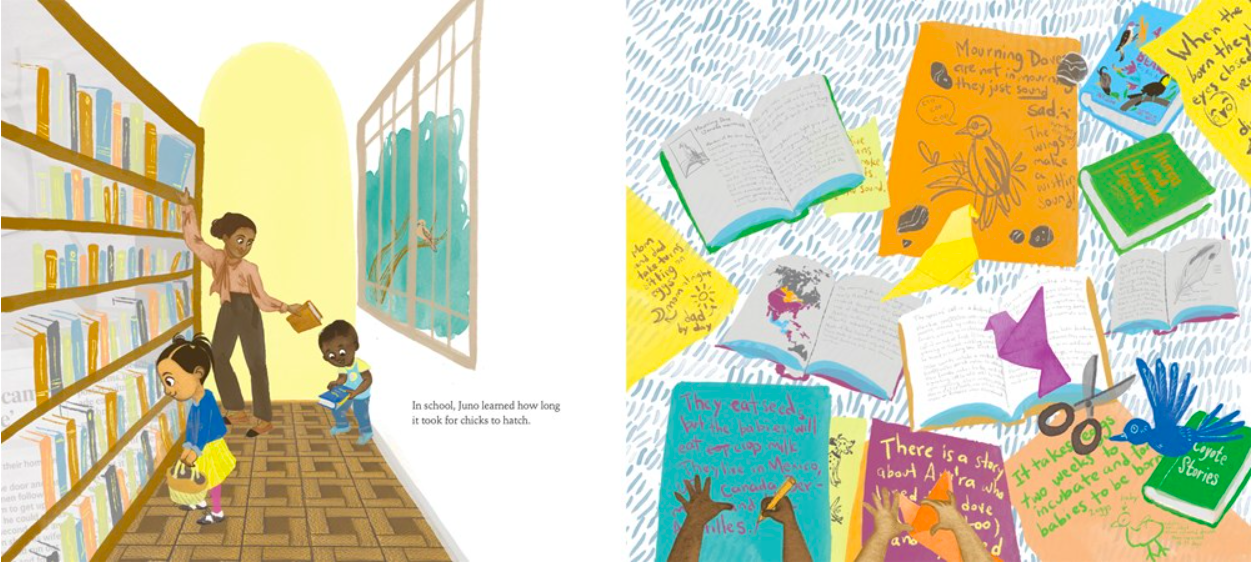
Illustration © 2024, Erika Meza; text © 2024 Sara Levine. Courtesy of Roaring Brook Press.

Juno and his new friend go to the school library to learn everything they can about mourning doves. On colored paper they write facts and draw pictures of adult and baby birds. And most importantly they make signs for the fence and gate, alerting people to the fragile nest and baby doves.

Then one bright, sunny morning, Juno looks out his window and sees babies! In their protected nest, the small mourning doves grow until one afternoon as Juno, his friend, and his mom enjoy a picnic in the yard, he watches as the fledglings fly from their nest. “‘I told them it wasn’t a great place for a nest,'” Juno says, but later that night, happily cuddled up with his mom, they agree, “But we made it work.”

Illustration © 2024, Erika Meza; text © 2024 Sara Levine. Courtesy of Roaring Brook Press.

In her honest and poignant story, Sara Levine allows her young protagonist to give vent to his true feelings. While he first reproaches the mourning doves for their poor choice of nesting place, his own deep disappointment, sorrow, and loneliness spill out when the eggs break. As weeks pass, however, Levine shows that just as Juno repairs the nest and makes his yard inviting for the doves again, he also makes a new friend, assimilates into school, and finds comfort in books and creating once more. Levine’s child-centered story is all the stronger for the quiet support Juno’s mother gives him, allowing him the space, time, and freedom to feel his emotions and work them out in his own way. Her final line, “‘But we made it work,'” offers optimism, camaraderie, and confidence in the face of change—the type of powerful spirit that can sustain us all.

In her affecting illustrations, Erika Meza uses color, facial expressions, and visual metaphors to compellingly show readers Juno’s transition as he navigates his way to acceptance of his new home. As the story begins, Meza uses darker and muted colors on the house and gate. As the doves accept Juno’s help, the colors brighten. Likewise, in the beginning, Juno and his mother appear sad and at a loss. Meza portrays Juno’s brown-painted room from above, as if readers are peering into a cardboard moving box. But as Juno makes friends, regains his love of learning, and the doves return, Meza’s color palette turns vivid, smiles return to Juno’s and Mama’s faces, and even the dark of night is dispelled by the dazzling light of the bedroom lamp as Juno and his mom snuggle together.

A candid story about moving away from home that is also applicable for other types of unexpected changes, A Terrible Place for a Nest validates the emotions children can experience when adjusting to new surroundings. For children struggling with change, especially, the story’s focus on taking time to adapt offers comfort and reassurance.

A Terrible Place for a Nest is highly recommended for families with a child or children who have difficulty with change and a must for school and public library collections.

Ages 4 – 8

Roaring Brook Press, 2024 | ISBN 978-1250861221

About the Author

Sara Levine is an award-winning picture book author, veterinarian and science educator. Her books, which include Bone by BoneTooth by ToothFlower TalkSensitive, and The Animals Would Not Sleep!, have received the AAAS/Subaru SB&F Prize, Bank Street College Best Book of the Year, Beehive Book Award, Cook Prize and the Mathical Book Prize. She loves doing school and library programs. Visit Sara at saralevinebooks.com.

About the Illustrator

Erika Meza grew up in Mexico and moved houses more often than she had birthdays. Having studied illustration in Paris, she now lives in London―her thirty-sixth address―where she paints, writes her own stories, and practices her uncanny ability to pack efficiently. Erika loves exploring, learning about many different places and cultures, and finding joy in the people who allow you to be yourself. Visit Erica at ericameza.com.

National Nest Box Week Activity

Watch a pair of mourning doves raise their nestlings from hatching to leaving the nest in this sweet video from Gary’s Backyard.

You can purchase A Terrible Place for a Nest at these booksellers

Amazon | Barnes & Noble | Bookshop (to support your local independent bookstore)

February 10 – National Poop Day

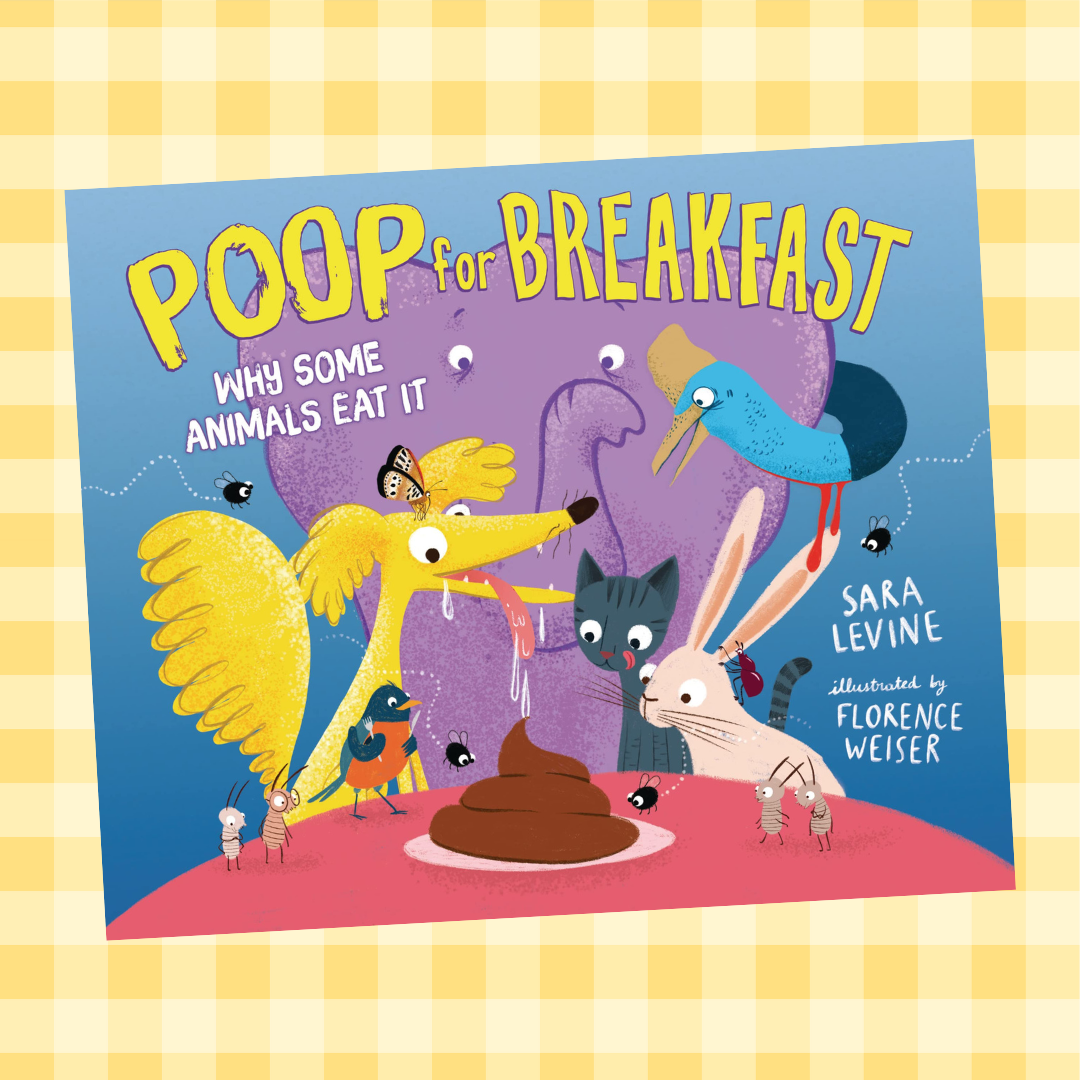
celebrate-picture-books-picture-book-review-poop-for-breakfast-cover

About the Holiday

Who knew poop could inspire such a thoughtful and health-conscious holiday? But it has! Initiated in 2016 by the Madison Children’s Museum in Wisconsin to celebrate and educate the public on digestion and excretion, the day has become a fun, educational way to encourage people to be more aware of their digestive health and hygiene as well as that of their pets. By normalizing conversations about poop, the holiday aims to improve overall health practices and increase understanding of how our bodies work. The topic is no less fascinating in the world of wildlife, as today’s book shows.

Thank you to Sara Levine and Millbrook Press for sharing a copy of Poop for Breakfast: Why Some Animals Eat It with me!

Poop for Breakfast: Why Some Animals Eat It 

Written by Sara Levine | Illustrated by Florence Weiser


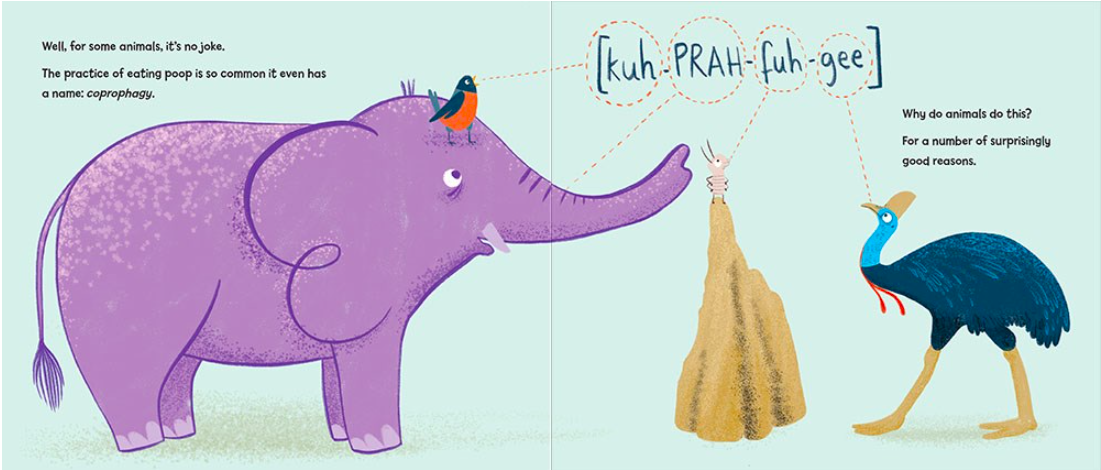
So, you wake up starving for a delicious meal. You’ve been dreaming of pancakes, maybe, or a plate of eggs and bacon. But when you get to the table, there’s a bowl of poop waiting for you?! What’s going on?! While you might sulk (and probably hold your nose), there are plenty of creatures who’d be thinking “Bring it on!” Who are these critters? They’re animals that practice coprophagy, and they do it “for a number of surprisingly good reasons,” as Sara Levine reveals.

celebrate-picture-books-picture-book-review-poop-for-breakfast-coprophagy

Image copyright Florence Weiser, 2023, text copyright Sara Levine, 2023. Courtesy of Millbrook Press.

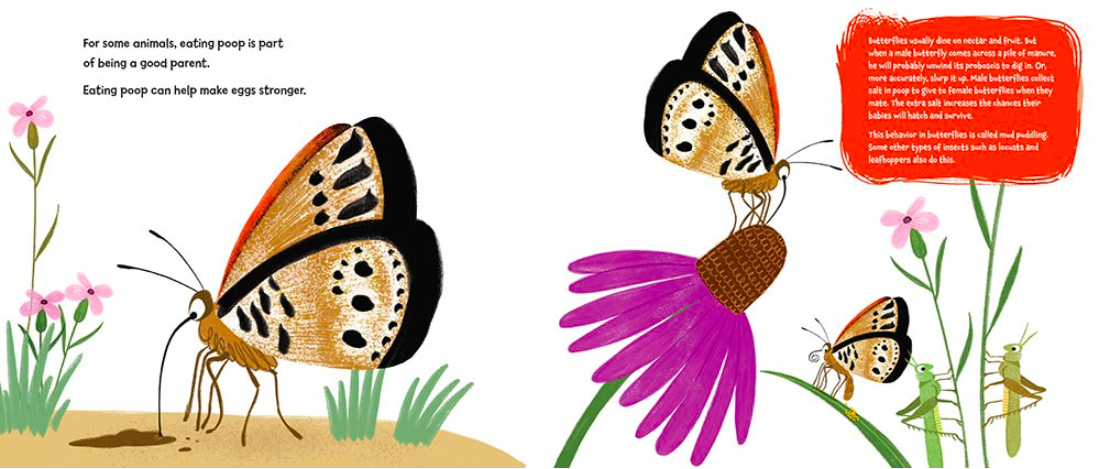
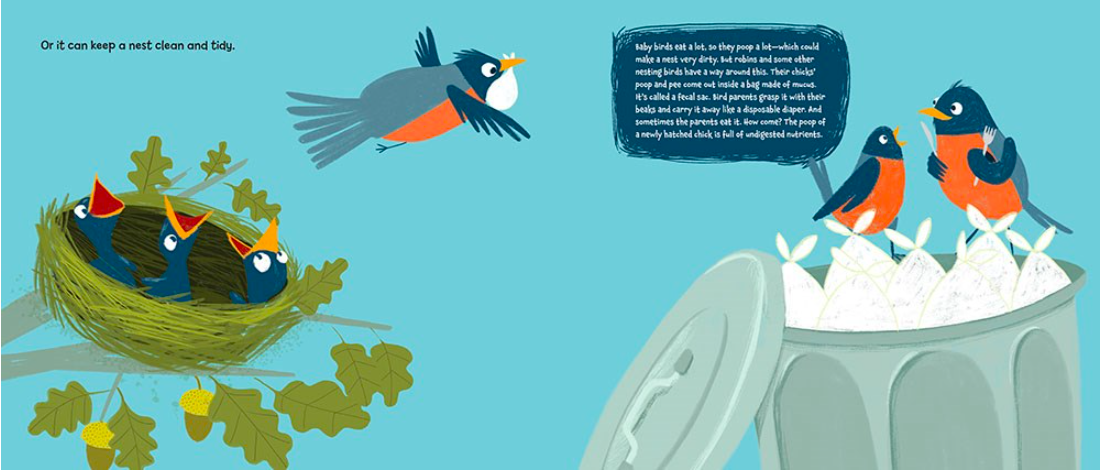
For some animals eating poop is just part of being a Number 1 (or maybe Number 2 is better in this case) parent. Butterflies, cats, and dogs as well as robins and other birds all have specific reasons for dining on doo-doo, from making eggs strong to protecting their babies from predators to keeping “a nest clean and tidy.” 

While these animals eat poop for external or aesthetic reasons, others engage in coprophagy to keep their digestive system working well. Still others, because of the length or shape of their digestive tract, require that food travels through their body twice to extract all of the nutrients. If you have a rabbit, hamster, guinea pig, or other small rodent as a pet, you know that their poop looks like little round balls or small pellets. As Levine tells readers, “this is the poop that has been through their digestive tract a second time. These animals’ first poop comes out soft, sticky, and full of nutrients. It’s called a cecotrope (SEE-ca-trope).” They then “gobble it up at night when it comes out. That’s why you don’t see it” in the cage.

celebrate-picture-books-picture-book-review-poop-for-breakfast-butterflies

Image copyright Florence Weiser, 2023, text copyright Sara Levine, 2023. Courtesy of Millbrook Press.

Since there are so many creatures who do eat poop, why don’t humans? Levine has included a whole list of reasons for why we don’t—and don’t need to. She also provides back matter that includes “The Scoop on Poop”—an explanation of what poop and pee are, how they’re created in the body, and how they’re eliminated. Kids will also have fun becoming “poop detectives” with the help of the illustrated poop identification guide for common pets and wildlife and also by playing a synonym game.

celebrate-picture-books-picture-book-review-poop-for-breakfast-robins

Image copyright Florence Weiser, 2023, text copyright Sara Levine, 2023. Courtesy of Millbrook Press.

Sara Levine is exceptional at presenting fascinating nature science topics in humorous and accessible ways for young audiences, and her latest book is no exception, Leaning into the “Ewww!” factor, Levine dishes up short, take-away reasons certain animals, birds, and insects practice coprophagy followed up with longer passages that explain the science and/or behavior behind them in easy-to-understand language sprinkled with humor that will keep readers riveted to this already high-interest subject.

Florence Weiser’s colorful illustrations perfectly bridge the humorous and the scientific nature of Levine’s text. Readers’ skeptical view of this “gross” habit is amusingly juxtaposed with creatures’ excited anticipation of a delicious meal through the characters’ facial expressions while the anatomical reasons for or against coprophagy are clearly depicted in images of human and various animals’ digestive systems.

Anatomy and nature science education at its best, Poop for Breakfast: Why Some Animals Eat It will keep kids enthralled as each page turn brings on a new round of giggles and avid learning. The book would enhance any home STEM collection and is a must for classroom, school, and public library bookshelves.

Ages 5 – 10

Millbrook Press, 2023 | ISBN 978-1728457963

About the Author

Sara Levine is an author, educator, and veterinarian. Her science books for children include the Animal by Animal series, Germs Up Close, and A Peek at Beaks: Tools Birds Use. Her books have received a number of awards including AAAS/Subaru SB&F Prize, Utah Beehive Book Award, Cook Prize finalist, Monarch Award master list, and Bank Street College Best Children’s Book of the Year. Visit her at saralevine.com and on Instagram at saralevinebooks.

About the Illustrator

Florence Weiser is a French illustrator currently based in beautiful, rainy Belgium. While growing up in Luxembourg, she always knew she wanted to draw and draw. She lives and works surrounded by nature, from which she gathers most of her inspiration. Visit her at florenceweiser.com and on Instagram at florence_weiser_illustration

You can find Poop for Breakfast: Why Some Animals Eat It at these booksellers

Amazon | Barnes & Noble | Bookshop (to support your local independent bookstore)

Picture Book Review
December 10 – It’s Read a New Book Month

celebrate-picture-books-picture-book-review-a-peek-at-beaks-cover

About the Holiday

The month of December is a gift-giver’s delight and looking at the long winter ahead there’s no better gift for everyone on your list than a book (or two or…). With so many new books hitting bookstore shelves, there really is a perfect book to fit everyone’s taste. Young children, especially, benefit from reading a wide range of picture books from laugh-out-loud or touching stories to nonfiction that introduces them to influential people, science, history, and nature. If you’re looking for gifts to give, it’s not too late to head to your local bookstore or their online shop to find books that will make your child’s eyes light up.

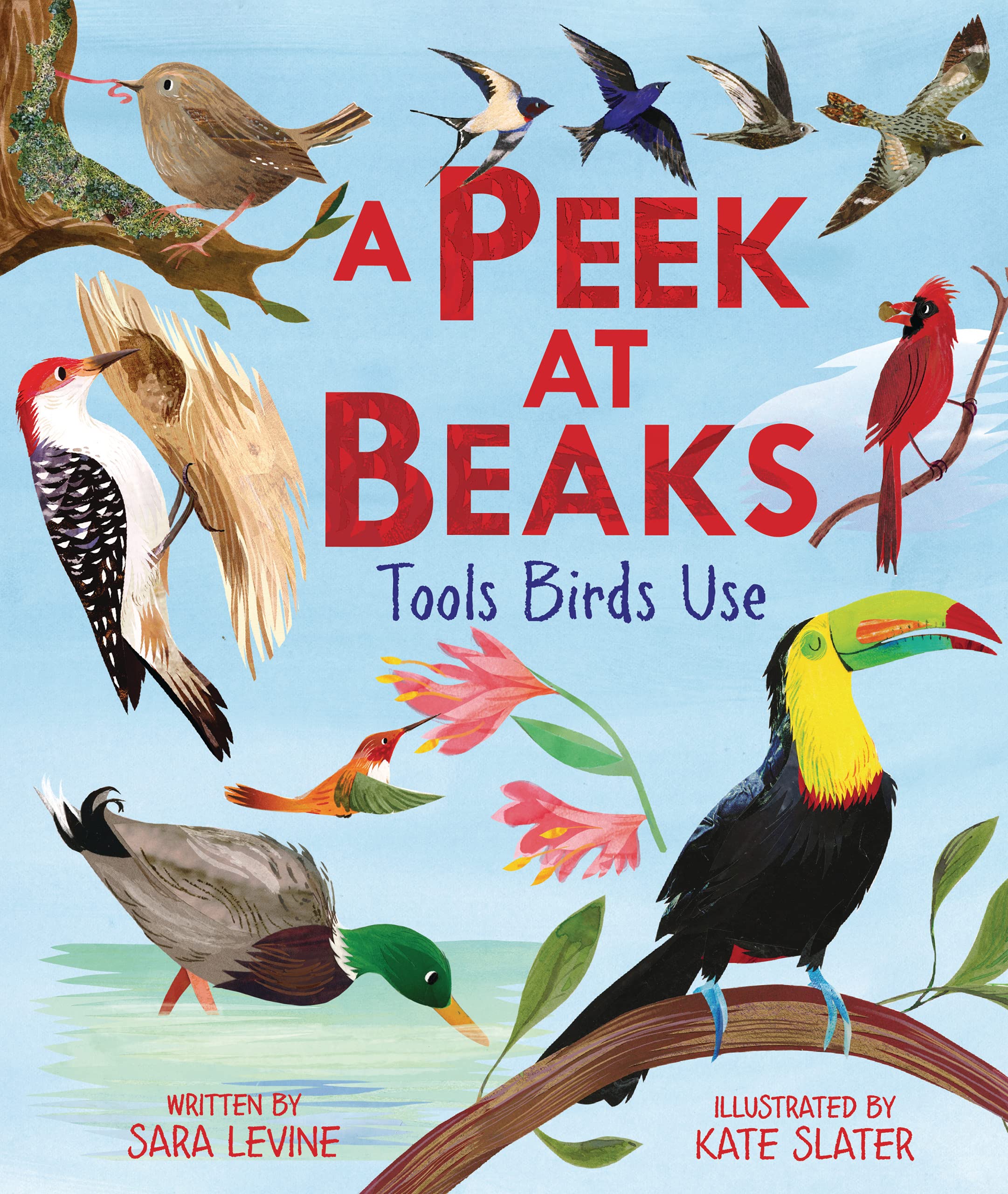
A Peek at Beaks: Tools Birds Use

Written by Sara Levine | Illustrated by Kate Slater


When you “slurp up your milkshake” or cut up your meat or even cool down with an air conditioner, do you ever wonder how birds accomplish these things? They don’t have hands to hold tools, but that’s okay because each type of bird has just the tool they need to survive handily attached right to its face – its beak! How does each bird use its beak to find food? Sara Levine and Kate Slater let you take a peek at how birds’ beaks are uniquely suited for the foods they eat and the places where they find it as well as for grooming and nest-building.

celebrate-picture-books-picture-book-review-a-peek-at-beaks-birdwatching

Image copyright Kate Slater, 2021, text copyright Sara Levine, 2021. Courtesy of Millbrook Press.

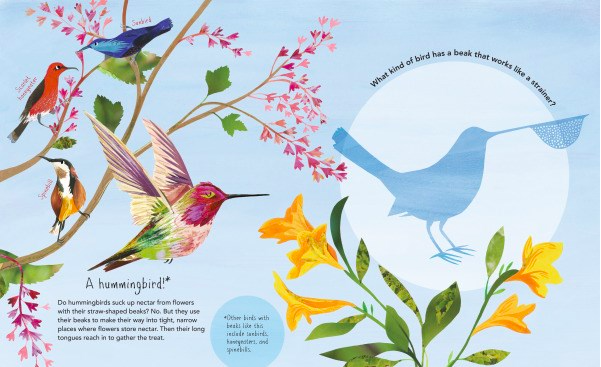
Take that straw we people use to sip up every last drop of a delicious milkshake or glass of lemonade, for instance. Which bird “has a beak shaped like a straw? A hummingbird!” And while hummingbirds don’t “suck up nectar from flowers” through their beaks, “they use their beaks to make their way into tight, narrow places where flowers store nectar. Then their long tongues reach in to gather the treat.” 

If you look into the family toolbox, you’ll probably find a hammer and a needle-nosed pliers. Are there birds whose beaks do similar jobs as these? You bet! The rat-a-tat-tat of a woodpecker searching for grubs or insects in a tree trunk sounds just about the same as the tap-tap-tap or bang-bang-bang of a hammer, and there are shoreline birds that use their long, thin beaks to “probe deep into the mud to find crustaceans, insects, and worms. A special sensory organ at the beak’s tip lets the bird feel when a meal is nearby.” Can you guess which ones they are?

celebrate-picture-books-picture-book-review-a-peek-at-beaks-straw

Image copyright Kate Slater, 2021, text copyright Sara Levine, 2021. Courtesy of Millbrook Press.

Kids who love helping out in the kitchen will be fascinated to learn that there are birds with beaks that act as strainers, nutcrackers, knives, and tongs. And if you think we’re sophisticated with our central air-conditioning one very distinct bird is born with this capability, while a more common bird has one-upped our technological advances by offering it’s chicks a one-touch “take-out” button long before the smartphone was ever developed. 

celebrate-picture-books-picture-book-review-a-peek-at-beaks-hummingbird

Image copyright Kate Slater, 2021, text copyright Sara Levine, 2021. Courtesy of Millbrook Press.

Sure, you might think – birds can find food and build nests with their beaks, but can they show love? The answer is… Yes! The gannet is especially adept at demonstrating their feelings, and they don’t care who hears it. While “many birds show affection with their beaks,… gannets particularly stand out. These birds raise their beaks in the air and clatter them together to show how much they like each other.” After you’ve learned about all of these amazing birds and their beaks, maybe you’d like to raise a ruckus to show your appreciation too! 

Back matter includes a discussion on the evolution of bird beaks and how they change over time and a list of other books for further reading.

celebrate-picture-books-picture-book-review-a-peek-at-beaks-needle-nosed-pliers

Image copyright Kate Slater, 2021, text copyright Sara Levine, 2021. Courtesy of Millbrook Press.

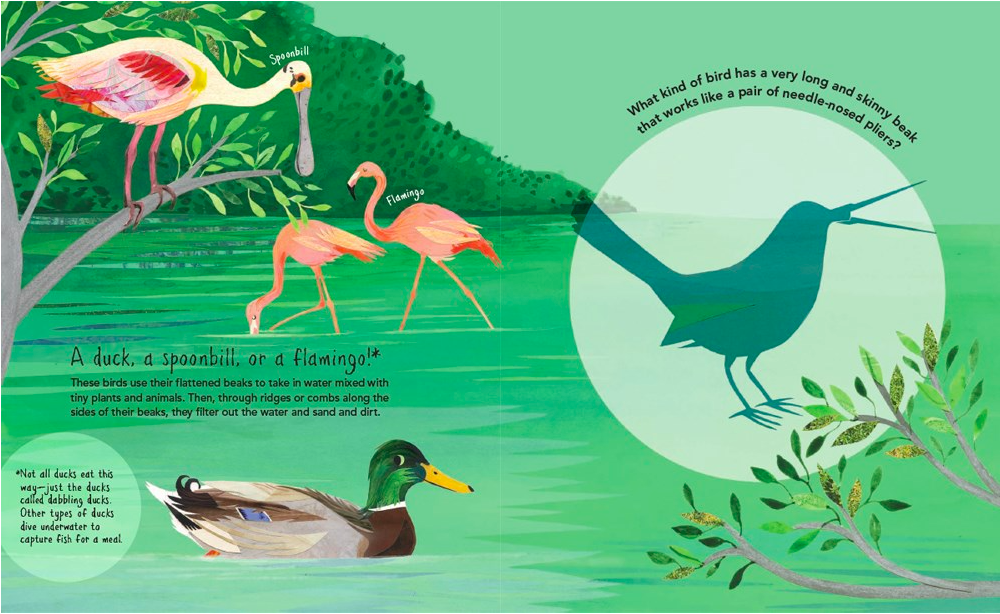
Bird, nature, and science lovers as well as teachers and homeschoolers will be fascinated with Sara Levine’s clever way to engage kids in learning about birds by comparing their beaks to well-known tools children and adults use every day. Especially interesting are descriptions of the birds whose beaks’ special abilities are hidden, such as water birds that use their beaks as strainers to filter out water, sand and dirt before swallowing the nutritious plants and animals left behind. Along with information on the construction of birds’ beaks and how, exactly, birds use them, readers learn about the diet of various species and where they hunt for food.

Levine is always an insightful and captivating educator who sparks kids’ interest in nature-science learning and spurs them to further research. Her question-and-answer format gets kids thinking, observing, and theorizing in a way that increases understanding and resonates across subject matter. At-home birdwatchers will also enjoy watching out for the birds depicted in this book and their behavior.

Kate Slater’s mixed-media collage illustrations are vibrant and textured, adding lovely depth to each page. Her silhouettes of birds sporting tool where it’s beak should be are intriguing invitations for kids to ponder and guess at the answers to Levine’s questions before turning the page to discover the answer. Slater populates the pages with a wide variety of birds, realistically depicted, that will kindle an interest in readers and adults to delve into further research on these fascinating and charming creatures.

A unique and high-interest way to engage kids in learning about birds and nature, A Peek at Beaks: Tools Birds Use is highly recommended for bird-lovers at home as well as for science, environment, and nature learning collections in schools and public libraries. 

Ages 5 – 9

Millbrook Press, 2021 | ISBN 978-1541587342

Discover more about Sara Levine and her books on her website.

To learn more about Kate Slater, her books, and her art, visit her website.

Read a New Book Month Activity

celebrate-picture-books-picture-book-review-bird-coloring-page-2

Busy Birds Coloring Pages


These birds are busy looking for and gathering food to eat! Grab your crayons, pencils, or markers, print the pages, and give the birds and their surroundings some color!

Hummingbird at Flower | Robin Grabbing a Worm | Bird on Branch

celebrate-picture-books-picture-book-review-a-peek-at-beaks-cover

You can find A Peek at Beaks: Tools Birds Use at these booksellers

Amazon | Barnes & Noble | Books-a-Million

To support your local independent bookstore, order from

Bookshop | IndieBound

Picture Book Review

July 8 – Math 2.0 Day

celebrate-picture-books-picture-book-review-the-animals-would-not-sleep-cover

About the Holiday

Established in 2009, Math 2.0 Day celebrates math and technology and how these two disciplines complement each other. The day was conceived to bring together mathematicians, programmers, engineers, educators, and managers to raise awareness of the importance of math literacy at all levels of education. For kids a love of math and technology begins early as they experiment and explore every day during playtime, family time and even, as today’s book shows, at bedtime.

Thank you to Charlesbridge for sending me a copy of  The Animals Would Not Sleep! for review consideration. All opinions about the books are my own.

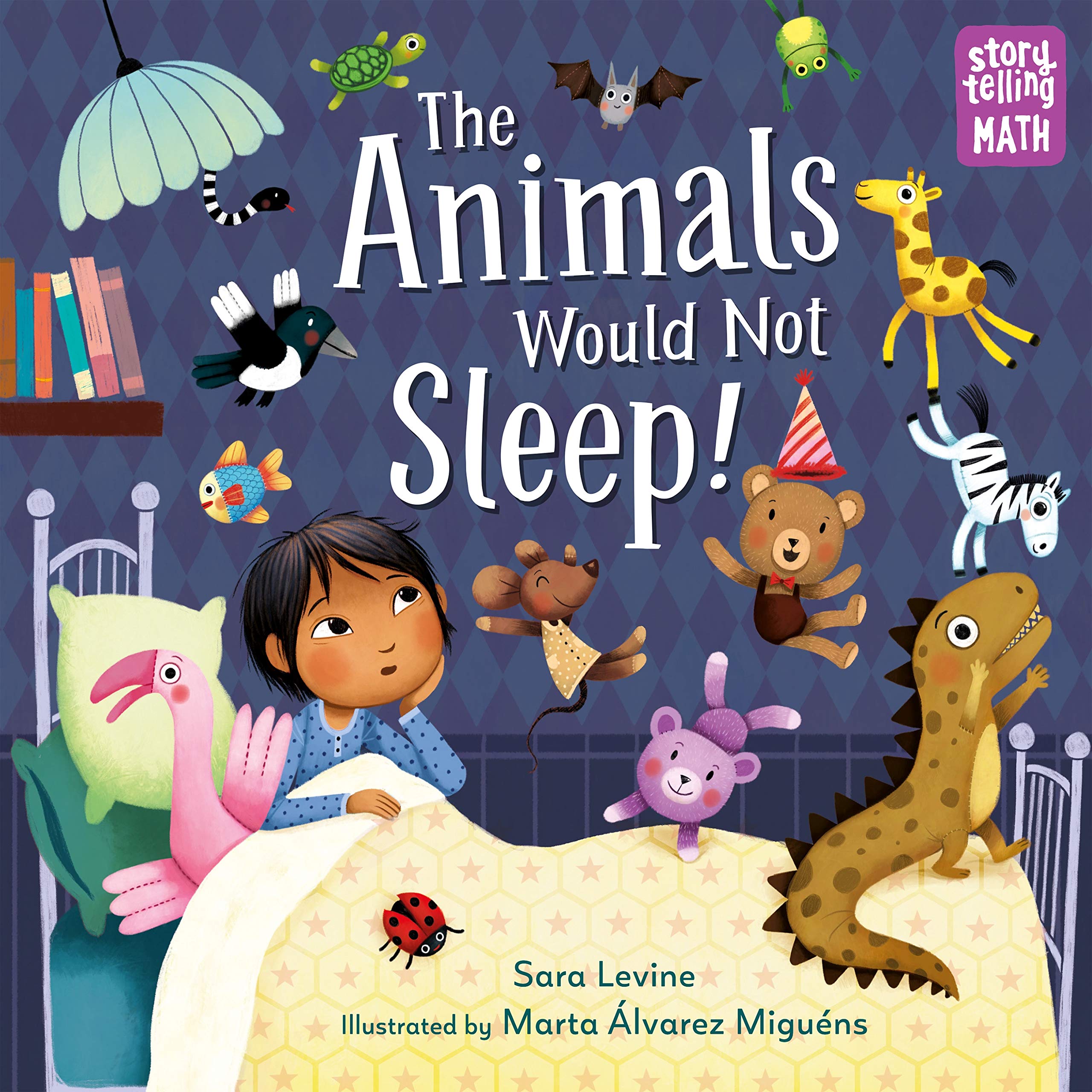
The Animals Would Not Sleep!

Written by Sara Levine | Illustrated by Marta Álvarez Miguéns


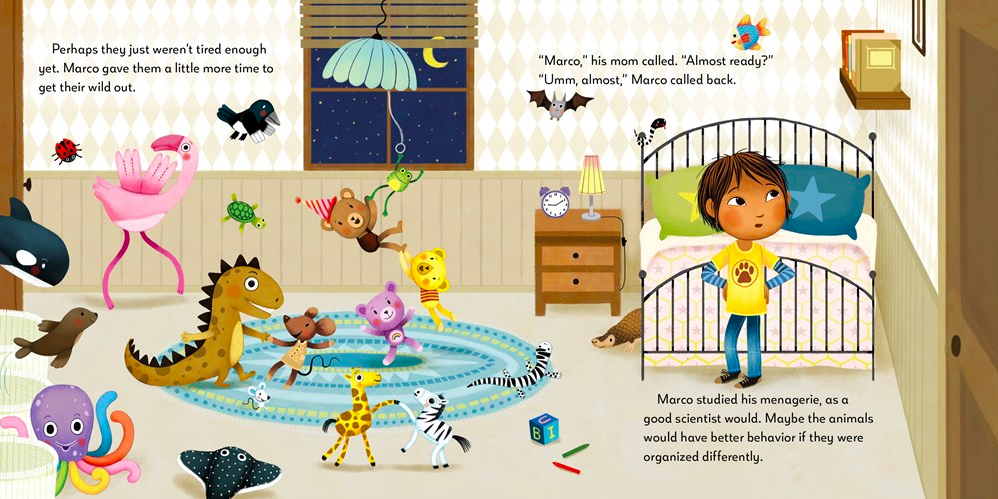
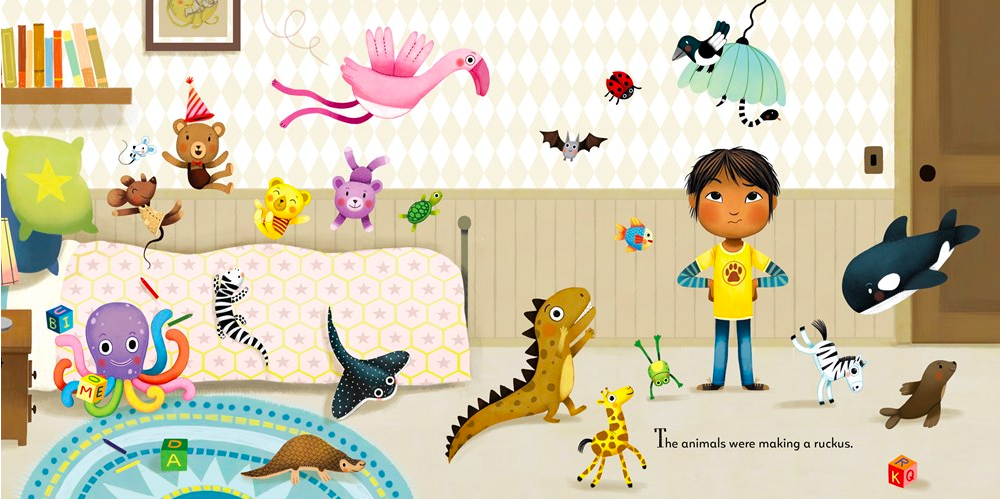
All of Marco’s stuffed “animals were making a ruckus” when his mom told him it was time to get cleaned up and ready for bed. She wanted to see all the toys put away, so Marco, who thought like a scientist, got to work. He wanted to sort his animals like a scientist would, so he got out three baskets and made signs for Flying Animals, Swimming Animals, and Animals That Move on Land. Then he picked up his dancing flamingo, bird, bat, and ladybug and put them in the first basket. He placed his octopus, stingray, frog, fish, whale, and seal in the second basket, and his dinosaur, giraffe, bears, snake, pangolin, gecko, mice, and zebra in the third basket.

But the animals were still wide awake, and “they egged one another on until not one remained in its container.” Marco thought they would settle down, but when his mom called the second time, he reconsidered his strategy. This time he made signs that sorted the animals by color, but zebra started to cry. He was afraid being in such close quarters with black-and-white snake and stingray, plus he missed his friend giraffe.

celebrate-picture-books-picture-book-review-the-animals-would-not-sleep-ruckus

Image copyright Marta Álvarez Miguéns, 2020, text copyright Sara Levine, 2020. Courtesy of Charlesbridge.

Marco decided to try again. He took all of his animals out and made signs that read Small, Medium, and Large. Things seemed to quiet down, so Marco began to put on his pajamas. But then he heard moaning and groaning coming from the Large basket. When he went to check, Dinosaur and Dancing Flamingo complained about being too cramped. Plus, Dancing Flamingo missed Rainbow Bear. Then he heard noises from the Small basket. Those animals weren’t happy either.

Marco’s mom gave him two minutes to get it all sorted out. Fortunately for Marco, being a scientist meant “he was used to coming up with ideas and thinking outside the box.” The animals were getting tired, and Yellow Bear had just burst into tears for no apparent reason. Like a good scientist, Marco cared about his animals and wanted them to be happy. He had one more sorting idea. With the large animals, medium-sized animals, and small animals all tucked in with plenty of room and their friends nearby on Marco’s bed, Marco got under the cozy covers. He got a goodnight kiss from Mom and then they all fell happily to sleep.

Back matter includes an illustrated Author’s Note about the way scientists sort, or classify, animals by their characteristics as well as a discussion that explores the math in the story. “Try This!” tips provided by Karen Economopoulos, co-director of the Investigations Center for Curriculum and Professional Development at TERC, give adults ideas for various ways to engage children in sorting.

celebrate-picture-books-picture-book-review-the-animals-would-not-sleep-marco

Image copyright Marta Álvarez Miguéns, 2020, text copyright Sara Levine, 2020. Courtesy of Charlesbridge.

Perfectly capturing the way young children interact with their toys, Sara Levine combines imagination and scientific thinking in her inventive story, part of the Storytelling Math series from Charlesbridge. In Marco, who’s proud of his scientific thinking, Levine shows readers that they, too, already think like a scientist. Marco’s empathy for his animals’ complaints will get kids thinking about classification and the various ways they might sort the animals. Levine’s use of realistic dialogue that echoes bedtime routines in many homes and gives each character—human and animal—distinct personalities will draw kids in to this charming story that is organically infused with strong math lessons. Levine gives Marco a sweet final solution to his problem that will please kids and have them wanting to extend the lessons in the story to their own toys and/or household objects while they think like a scientist too.

Marta Álvarez Miguéns opens the story with an enchantingly wild two-page spread where Marco stands in the middle of his room as his toys bounce on the bed, climb blocks, juggle, fly, and cause a ruckus. Turn the page, though, and these animals now lie motionless around the room as Mom peeks in to check on Marco. When Marco sorts his animals into the baskets, readers can clearly see which animals go where and why. Kids will knowingly giggle when the just-sorted animals spring from their resting places to prolong bedtime. Miguéns also plainly depicts Marco’s and the animals’ facial expressions from happy and playful to sad and crying to peaceful and satisfied. These images give adults and children an opportunity to discuss emotions and how to recognize various clues in faces, a skill important for social-emotional learning. Vivid colors, adorable animals, details such as alphabet blocks that stack or are turned to spell words, and kid-appealing décor will have kids wanting to come back again and again.

A book that’s sure to become a favorite at bedtime or to enhance classroom or homeschooling curriculum, The Animals Would Not Sleep! will spark mathematical and scientific thinking and recognition in all young learners. The book offers an irresistible invitation to experiment and interact with math and science and is a must for home, school, and public library collections.

Ages 3 – 6

Charlesbridge, 2020 | ISBN 978-1623541286 (Hardcover) | ISBN 978-1623541972 (Paperback) 

Discover more about Sara Levine and her books on her website.

To learn more about Marta Álvarez Miguéns, her books, and her art, visit her website.

About Storytelling Math

Storytelling Math offers books that celebrate children using math in their daily lives as they play, build, collaborate, compromise, and discover the world around them. Each story features characters of color who are empowered to solve problems, enjoy activities, and help out using their knowledge of and experimenting with math. Free downloadable hands-on activity kits are available for each book on the Charlesbridge website. Sharing these joyful stories with your littlest ones and older kids will make them eager to explore, use, and learn more about math every day. You can learn more about Storytelling Math on the Charlesbridge website

Storytelling Math: Math, Diversity, and the Power of Story was developed with Marlene Kliman at TERC—a nonprofit dedicated to STEM education—under a grant from the Heising-Simons Foundation.

Enjoy this The Animals Would Not Sleep! trailer with Author Sara Levine!

National Book Month Activity

celebrate-picture-books-picture-book-review-the-animals-would-not-sleep-activity-logo

The Animals Would Not Sleep! Activity Kit


You can have fun sorting and exploring math with your class or family with the Activity Kit for The Animals Would Not Sleep on the Charlesbridge website. Download it here!

The Animals Would Not Sleep Activity Kit

celebrate-picture-books-picture-book-review-the-animals-would-not-sleep-cover

You can find The Animals Would Not Sleep! at these booksellers

Amazon | Barnes & Noble | Books-a-Million

To support your local independent bookstore, order from

Bookshop | IndieBound

Picture Book Review
April 20 – It’s Medical Laboratory Professionals Week

celebrate-picture-books-picture-book-review-germs-up-close-cover

About the Holiday

Instituted in 1975, Medical Laboratory Professionals Week aims to raise awareness of and an appreciation for the importance of laboratory professionals to patient care. Better and more accurate diagnoses as well as targeted treatment are accomplished through the specialized knowledge and dedication of laboratory technicians. This year, especially, we celebrate these individuals who have worked tirelessly to help create a vaccine to combat the COVID-19 virus. Laboratory Science can be an exciting and rewarding career choice for science– and medical-minded students. To learn more about today’s holiday and the work of laboratory professionals, visit the American Society for Clinical Laboratory Science website and LibraryScienceCareers.

Germs Up Close

By Sara Levine


You know they’re there. It’s hard to forget, since people keep reminding you: “wash your hands,” “use sanitizer,” “sneeze into your elbow,” “don’t leave food out too long.” But since you can’t see the germs, it can be hard to remember all the time. If only you could see what everyone is warning you about that might make it easier. Well, now you can with Sara Levine’s book Germs Up Close (and I mean really, really close), which also tells you exactly where germs come from and what they do.

How can you see a germ? “With special magnifying equipment and some dye to make their parts show up,” you can see exactly what different kinds of bacteria, protozoa, fungi, and viruses look like. And you might be surprised to discover that they are very “interesting and beautiful to look at.” Levine lets you in on some fascinating facts about each type of germ, including how its name is pronounced, its common name, its microscopic appearance, where it lives, some diseases it causes, and some more you ought to know. So, let’s get started.

Okay, let’s have a show of (clean) hands! “Have you ever had a cavity? An ear infection? Strep throat?” Yeah? Then you’re already acquainted with bacteria. Sounds bad, huh? Well, yes and no. Levine explains that the majority of bacteria on your body are actually helpful. It’s the bad bacteria that can make us sick that are called germs. In her section on bacteria, Levine introduces kids to salmonella, spirillum, staphylococcus, streptococcus, and Escherichia coli (better known as E. coli) with colorful photographs of each of these “round, hotdog-shaped, or wormlike and squiggly bacteria.

Next up are protozoa. You know not to drink pond water or dirty water, right? These little, one-cell-big guys are the reason why. Here, kids learn about “trypanosoma, the germ that causes sleeping sickness,” plasmodium, which causes malaria, and giardia, which causes giardiasis, an intestinal infection. Turning the page, they’ll discover different kinds of fungi, some of which are edible, like mushrooms and yeast, and others which can produce itchy rashes, yeast infections, or ringworm. 

celebrate-picture-books-picture-book-review-germs-up-close-bacteria

Copyright Sara Levine, 2021, courtesy of Millbrook Press.

And now we come to a germ you’re all very familiar with: the virus. If you’ve had a cold or the flu or “been vaccinated against viral infections that used to be very common such as mumps, measles, and chickenpox,” you’ve heard about viruses. And, of course, we all know about the coronavirus. But what do these germs look like? Kids get to see them in all of their round, peas-in-a-pod, peanut-shaped, or knob-covered wonder. 

But how can we stop germs in their tracks or fight them when they do invade? “The good news is that our bodies take care of most of this for us” through our immune system. Levine gives kids a detailed overview of the ways our skin, mucus, saliva, and stomach acid combat the germs that assail us. She also talks about the different kinds of white blood cells we have and how each kills germs. Illustrations show what the five types of white blood cells look like and their comparative sizes.

Levine reminds kids of all the ways people can protect themselves from surface and air-borne germs as well as germs that are transmitted through food and water. Her discussion on vaccines explains how they work and prepare white blood cells to recognize and fight germs. Still, sometimes we do get sick, and Levine reassures kids that there are medicines for each kind of germ that can make the better.

A glossary, a list of eleven careers that revolve around germs or helping sick people, and resources for further reading or research follow the text.

Sara Levine strikes just the right balance of humor and hard science facts in her engaging and educational book about the germs that make us sick as well as good bacteria and fungi, how our body protects us from most germs, and the vaccines and medicines that help us get well. Through her compelling writing style, Levine presents complex concepts in ways that make it easy for readers to embrace biological and medical science and get excited about research and learning more.

The stunning color photographs of various types of bacteria, fungi, protozoa, and viruses with their unusual shapes – some sporting protrusions like a hairbrush and others that look like they could be the stars of their own sci-fi picture book or TV show – will wow kids and spark a fascination for this important field of knowledge and research.

A fantastic book to add to home libraries for kids who are interested in medicine, biology, veterinary science, and other research sciences, Germs Up Close is a must for school libraries to enhance science, STEM, and research lessons as well as for public library collections.

Ages 5 – 10

Millbrook Press, 2021 | ISBN 978-1728424088

Discover more about Sara Levine and her books on her website.

Medical Laboratory Professionals Week Activity

celebrate-picture-books-picture-book-review-germs-word-search

Look Out for Germs! Word Search


Find the twenty-three words associated with germs in this printable word search puzzle.

Look Out for Germs! Word Search Puzzle | Look Out for Germs! Word Search Solution

celebrate-picture-books-picture-book-review-germs-up-close-cover

You can find Germs Up Close at these booksellers

Amazon | Barnes & Noble | Books-a-Million

To support your local independent bookstore, order from

Bookshop | IndieBound

Picture Book Review
December 14 – It’s Read a New Book Month

celebrate-picture-books-picture-book-review-eye-by-eye-comparing-how-animals-see-cover

About the Holiday

For kids who love nonfiction, this year has brought a bumper crop of creative, fascinating, and informative books on all topics from biographies to history to science and beyond. Innovative, interactive, and humorous, these books for all ages – even babies – open up the world for children in ways that resonate and make learning exciting and fun. Today’s book will have kids looking at the animals around them in a whole new way.

Eye by Eye: Comparing How Animals See

Written by Sara Levine | Illustrated by T.S Spookytooth


“Have you ever wondered what it would be like to see the world through someone else’s eyes?” Let’s make that musing even more intriguing—How would the world look if you gazed out at it through the eyes of an animal, insect, or bird (you know… a bird’s eye view)? Say, for instance, you had eight eyes dotting your face. “What kind of animal would you be, then?” Hmmm… With “four big eyes on the front of its face…” and “four smaller eyes on the top of its head,” the jumping spider can see what’s above and in front of it.

What if your eyes weren’t on your face at all, but on your arms instead? who would that be? Or how would you like it if your eyes were on “long stalks sticking out of the top of your head?” That might come in handy in a crowded movie theater or museum, but the animal with these eyes doesn’t really frequent those kinds of places. It’s more of an outdoorsman. Can you guess? While you’re contemplating that, you’re also going to want to learn about the animals whose eyes move to other parts of their face and the animals whose eyes are fixed in place.

Now, look deeeep into your eyes. What do you see? A pupil! What shape is it? Would it surprise you to learn that there are animals whose pupils are oval or even rectangular? Cat lovers know that their fav animals have oval pupils, but so do other “predators that hide and then ambush their prey.” Their unique eyes help them “judge distance and plan its attack without making any movements that might scare away its meal.” Animals with rectangular eyes use their peepers to stay safe. Which animals do you think those would be?

celebrate-picture-books-picture-book-review-eye-by-eye-comparing-how-animals-see-eight-eyes

Image copyright T.S Spookytooth, 2020, text copyright Sara Levine, 2020. Courtesy of Millbrook Press.

Some animals, including some humans, can’t see the colors red and green. You know this as color-blindness, but have you ever wondered exactly how color-blind people or animals view the world? Side-by-side pages show you! And that bird’s-eye-view? Because of the way birds’ eyes are constructed, their world is even more colorful than ours! How much more? “We have no idea… since our eyes can’t give us this information. But it’s pretty cool to know that there are things that exist out there that humans can’t see at all.”

One last question: What kind of animal could read the words in this book? If you know the answer, “you are a human who is using your eyes to read.” While other animals can’t read words, they can read the signs other animals and even plants provide. What are some of these? The answers plus even more fascinating information can be yours in the blink of an eye.

Back matter includes hands-on activities kids can do to “see” the way two animals do, a close-up examination of a human’s pupil, and a glossary as well as a list of books and websites for further research.

Sara Levine’s eye-opening guide to how a wide variety of creatures in the animal kingdom see will enthrall kids. In the fourth book of her Animal by Animal series, Levine continues her kid-enticing combination of humor and science to teach children about the specialized eyes that help animals navigate their particular environments. Her conversational storytelling, sprinkled with questions, will have kids engaged in the kind of predicting that reinforces learning. Levine’s detailed answers to the questions, including benefits of particular eye shapes or placement, physiological characteristics and adaptations, and the names of additional animals that share the same types of eyes, are enlightening will inspire young scientists to discover more about their world. 

A highlight of the Animal by Animal series is the artwork by T.S Spookytooth, who excels at translating Levine’s vision into illustrations that get kids giggling and learning. The first page starts off in familiar territory: a glasses-wearing girl stares eye-to-eye with the little wiener dog she’s holding in her hands. But turn the page and this same girl now sports eight eyes and two cleverly constructed pairs of glasses while other kids—and clues for discussions to come—stand by. On the next pages, eyeballs jut from the ends of six arms, peer out from long, wiggly stalks, and migrate across a girl’s face. These images will have kids laughing and riveted to the pages, while Spookytooth’s realistic depictions of the animals these eyes belong to will long remain in their memory. Insets of enlarged eyes allow kids to see the particular formation of eyes and pupils up close. The side-by-side page spread showing full-color human vision and the vision of someone who is color-blind is enlightening. Kids will enjoy following the pet crocodile from page to page and discussing all the reasons for its distinctive eyes. The diverse group of kids are charming companions on this educational journey.

An exciting and fascinating way to spur children to explore and learn about animals, nature, and themselves, Eye by Eye: Comparing How Animals See is a top pick for home, school and public library collections.

Ages 5 – 10

Millbrook Press, 2020 | ISBN 978-1541538382

Discover more about Sara Levine and her books on her website.

To learn more about T.S Spookytooth, his books, and his art, visit his website.

celebrate-picture-books-picture-book-review-eye-by-eye-comparing-how-animals-see-cover

You can find Eye by Eye: Comparing How Animals See at these booksellers

Amazon | Barnes & Noble | Books-a-Million

To support your local independent bookstore, order from

Bookshop | IndieBound

Picture Book Review