March 14 – Moth-er Day and Interview with Author Karlin Gray

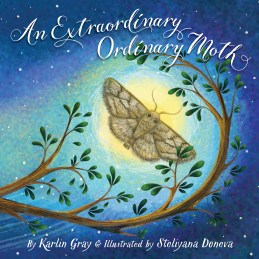
celebrate-picture-books-picture-book-review-an-extraordinary-ordinary-moth-cover

About the Holiday

Did you know that some moths are even more beautiful than butterflies? It’s true! Adorned in vibrant oranges, greens, blues, and reds and with patterns more intricate than the finest fabrics, moths are some of nature’s loveliest creatures. With spring right around the corner, moths will once again be emerging in woods, fields, and gardens, so today take a little time to celebrate these often overlooked insects and learn more about them and their habitats.

Sleeping Bear Press sent me a copy of An Extraordinary Ordinary Moth to check out. All opinions are my own. 

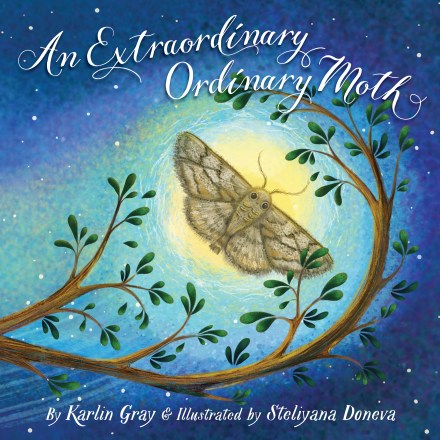
An Extraordinary Ordinary Moth

Written by Karlin Gray | Illustrated by Steliyana Doneva


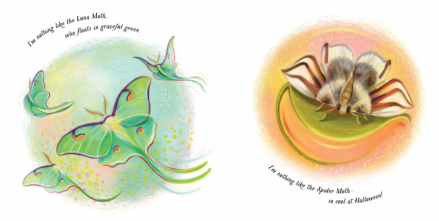
As a grayish-brown moth flits among the leaves framed by the full moon, he says, “I’m an ordinary moth, / as you can plainly see. / A dusty, grayish, dull insect— / nothing-special me.”  He compares himself to the Luna Moth “who floats in graceful green” and to the Spider Moth who’s “so cool at Halloween!” He’s nothing like the Hummingbird Moth who mimics its namesake bird, and he can’t hide like the Wood Nymph Moth that looks like “birdy dung.” He’s much smaller than the Atlas Moth and not as pretty as a butterfly. While all of these are special—extraordinary even—this little guy thinks he is just “a dusty, grayish moth— / very ordinary.”
celebrate-picture-books-picture-book-review-an-extraordinary-ordinary-moth-luna

Image copyright Steliyana Doneva, 2018, text copyright Karlin Gray, 2018. Courtesy of Sleeping Bear Press.

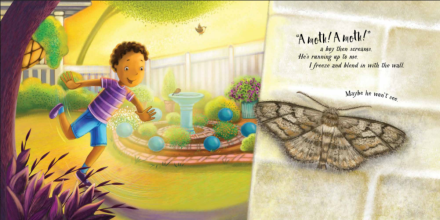
But then a little boy runs through the yard shouting “‘A moth! A moth!’” The moth freezes against a wall, afraid and unsure and hoping to hide. But when the moth sees the excitement in the boy’s eyes, he moves “toward his joyful light.” He lands in the boy’s hands, uncertain still if he’ll be shooed away. And sure enough, the boy’s sister screams, “‘Ew, a bug!’” When she knocks her brother’s hand away, the moth flies off.
celebrate-picture-books-picture-book-review-an-extraordinary-ordinary-moth-hiding

Image copyright Steliyana Doneva, 2018, text copyright Karlin Gray, 2018. Courtesy of Sleeping Bear Press.

The moth hears the boy tell his sister, “‘Hey, it’s an insect—not a bug— / and my favorite kind!’” then he sees the boy trailing him “all through the yard. / with her two steps behind.” She thinks the moth is nothing special, but her brother disagrees. And as the moth alights on his finger, he shows her why. What looks like dust are really “‘scales that keep him warm at night. / And they flake off in a web so he escapes all right.’”
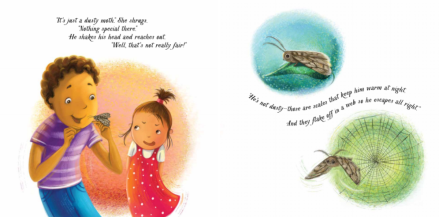
celebrate-picture-books-picture-book-review-an-extraordinary-ordinary-moth-web

Image copyright Steliyana Doneva, 2018, text copyright Karlin Gray, 2018. Courtesy of Sleeping Bear Press.

The little girl’s a bit more interested but thinks his color is “kind of blah.” The boy explains that the moth is the color of tree bark and can camouflage himself during the day while he sleeps. Then at night he’s ready to fly, guided by moonlight and the scents he smells through his antennae. Now the little girl thinks the moth is pretty cool. She calls their mom to come and see, and when Mom wants to know what bug they found, “the girl says, ‘Mom—a moth’s an insect, / and out favorite kind!’”

Hearing that, the moth soars in the moonlight with a new self image—“So how ‘bout THAT?! / I’m someone’s FAVORITE! / Little grayish me— / proof of how / EXTRAORDINARY / ordinary can be.”
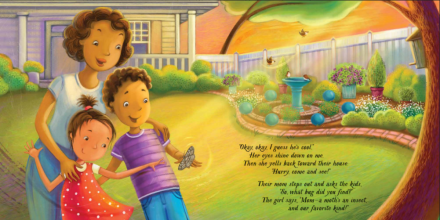
celebrate-picture-books-picture-book-review-an-extraordinary-ordinary-moth-mom

Image copyright Steliyana Doneva, 2018, text copyright Karlin Gray, 2018. Courtesy of Sleeping Bear Press.

Ten Extraordinary Facts about Moths, as well as an activity for constructing a moth observation box follow the text.

Through her vivacious rhymes, Karlin Gray elevates the “ordinary” back-porch moth to star status with fascinating facts that will lure kids to discover more. The conversational verses echo a sweet sibling relationship while the moth, overhearing them, begins to appreciate himself. The bookending of the children’s story with the moth’s thoughts—first comparing himself to other moths and later realizing his own merits—will encourage readers to think about the nature of nature and about the importance of positive interactions with others. Told from the moth’s point of view, the story also has a deeper meaning, reminding readers that, like this moth, people also have special talents  that make them exceptional. Taking extra time to really learn about another’s unique qualities and to get to know them is exciting and has benefits for all.  
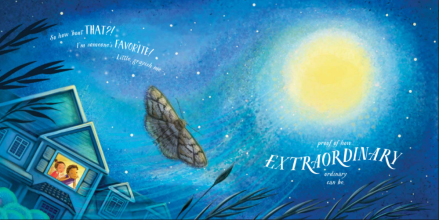
celebrate-picture-books-picture-book-review-an-extraordinary-ordinary-moth-moonlight

Image copyright Steliyana Doneva, 2018, text copyright Karlin Gray, 2018. Courtesy of Sleeping Bear Press.

Steliyana Doneva’s gorgeous illustrations of moths and butterflies will dazzle insect-loving kids and convert the more squeamish. Doneva captures each delicate marking and texture of the little grayish moth as it flits in the light and camouflages itself on the wall and tree. The moth is also well spotlighted against Doneva’s vibrant backyard oasis where the little boy and his sister discover him. Nighttime scenes sparkle with starlight, and the full moon brings out the rich blues of an evening sky. The boy’s enthusiasm for moths and nature is infectious and will captivate young readers, enticing them to look closer at the world around them.

An Extraordinary Ordinary Moth is a beautiful, eye-opening book that would spur further discovery for nature and science lovers at home and in science or STEM classrooms.

Ages 4 – 8

Sleeping Bear Press, 2018 | ISBN 978-1-58536-372-8

Discover more about Karlin Gray and her books on her website.

View a portfolio of work by Steliyana Doneva and learn more about her on her website.

Download and have fun with these An Extraordinary Ordinary Moth Activity Sheets!

An Extraordinary Ordinary Moth Matching | An Extraordinary Ordinary Moth Fill in the Blank

Moth-er Day Activity
celebrate-picture-books-picture-book-review-tree-branch-with-white-cocoons

Beautiful Moths Game


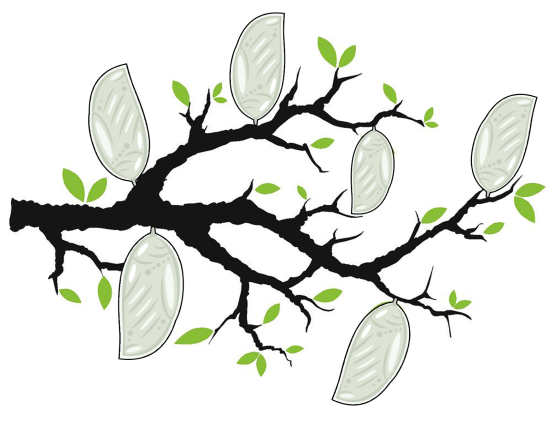
Moths go through many stages of metamorphosis—from egg to caterpillar to cocoon— before they finally emerge as a moth. In this game, help six moths emerge from their cocoons to win!

Supplies

celebrate-picture-books-picture-book-review-moth-cards

Directions

  1. Print a Tree Branch Game Board and set of Moth Cards for each player
  2. Print one Moth Playing Die
  3. Choose a player to go first
  4. The first player rolls the die and places the matching moth card on one of the cocoons on the Tree Branch Game Board
  5. Play then moves to the player on the left
  6. Players continue to roll the die and place moths on each cocoon
  7. If a player rolls a moth that they already have placed on their game board, they pass the die to the next player and wait for their next turn.
  8. The player who fills their Tree Branch with moths first is the winner

Meet Karlin Gray

celebrate-picture-books-picture-book-review-interview-with-karlin-gray-headshot

Today I’m excited to talk with Karlin Gray about how moths became extraordinary in her eyes, what types of characters she’s drawn to, and what might be the best holiday in the world

Did you like to write as a child? How did you get started writing books for children?

Yes, I did like to write as a child. When I was little, I would retell stories like Alice in Wonderland, changing the names and some details. Someone must have explained ‘plagiarism’ to me and, eventually, I learned to write my own stories.

I started writing picture books when my son was a toddler (about seven years ago). I joined a local writing center where I workshopped all three of my contracted books, including AN EXTRAORDINARY ORDINARY MOTH.

Before you began working in the publishing field and writing for children, you worked for newspapers. Can you talk a little about that experience? What did you like most about it? Has it influenced your work for children?

After college, my first two jobs were graphic design positions at weekly newspapers in Northern Virginia and D.C. I loved learning about the publishing process—how words and images were selected, designed, printed, and distributed. It’s a fast-paced, exhausting business. But those jobs taught me to work on a deadline which helps me as a children’s book writer, for sure!

What inspired you to write about moths?

My son. When he was three, he announced that the moth was his favorite insect. I imagined that moth was having a bad day—comparing himself to “cooler” moths like the Luna moth or Spider moth—and then overheard my son’s statement. It’s a nice reminder that sometimes it takes just one kind comment to improve someone’s day.

What do you think makes the “ordinary” extraordinary?

Perspective. My son saw something special in a creature that I never really considered. But his interest piqued my interest, so I did some research. That led me to learning several amazing things about moths. Now, instead of shooing them away, I celebrate moths in An Extraordinary Ordinary Moth.

What was your process in writing An Extraordinary Ordinary Moth?

Once the first line popped into my head—“I’m an ordinary moth, as you can plainly see…”—the story was set in rhyme. Usually, I research then write a story. But here, I did my research as I wrote the manuscript. The first draft took a couple days and was MESSY. I workshopped the manuscript on and off for two years, tightening the story, rhyme, and meter. I eliminated a whole stanza where the ordinary moth compares itself to other moths like the poodle moth. Trust me, it wasn’t easy cutting out the poodle moth! But, like they say, sometimes you have to kill your darlings.

Do you have a favorite place to write? If so, can you describe it a little? Do you have a favorite thing on your desk or in your writing space?

In my house I have an office but I don’t do much writing there. I usually move from the dining table to the kitchen table to the outside table when it’s warm.

In an earlier interview, you mentioned that you had “stories about presidents, magicians, explorers, athletes, mermaids, monsters, scarecrows, cats, mice, and one sad moth” in your desk drawer. What types of characters—or personalities—attract your creative interest? Do you have a preference for nonfiction? If so, why?

Oh yeah, I guess I’ll have to change that since the “sad moth” is out of the drawer and on the cover of a book. I’m a sucker for characters whose “flaws” are really their strengths, and I love a good finding-your-tribe story. Both nonfiction and fiction stories appeal to me but I enjoy the challenge of taking a true story and translating it into a picture book—selecting a character and timeframe, finding dialogue and active details, setting the tone and style, and staying true to the facts as well as the heart of the story.

In your website biography you have links to “things you like.” These are amazing and range from The American Mural Project to Storyline Online to the Landfill Harmonic. Can you talk about what draws you to these types of projects? Why do you think they are important not only for those directly involved in them, but for all kids—and adults?

Those two projects have a lot of heart. I met Ellen—she is a tiny person who has a big personality and a HUGE dream. The fact that one person had a goal to make the biggest indoor art installation is worthy of a book right there! And the Landfill Harmonic group—kids making music with trash!—was made into a book, Ada’s Violin by Susan Hood. I think both of those stories appeal to kids because it shows them that there are no limitations in art.

What’s the best part about writing for kids?

So many things…but probably the best is when kids tell me that they want to be a writer when they grow up. My response is always: “If I could do it, you can do it.”

You share your books at school and bookstore events. Do you have any anecdote from an event you’d like to share?

Twice a month I volunteer at a nearby school where I read books selected by the teacher. When I read my first book NADIA to the kids, the first graders had a hard time believing that I was the author. They knew me as someone who visited every other week and read a book from their shelves. They didn’t know me as a writer so that was a fun surprise for them.

What’s up next for you?

My next picture book is a biography of Serena Williams—SERENA: THE LITTLEST SISTER—and will be published in early 2019.

What is your favorite holiday and why?

Probably New Year’s Eve. We can see the town fireworks from our back deck so we invite a few families over for a casual get-together. It’s a nice way to end the year and the kids love staying up past midnight.

And, until your email, I didn’t know there was a Moth-er Day. (Not to be confused with Mother’s Day.) Very cool. The moth is also celebrated during National Moth Week in July: http://nationalmothweek.org

Do you have any anecdote from a holiday that you’d like to share?

When I was 10-14 years old, I lived in Japan because my dad worked with the military. I remember feeling sorry for Japanese kids because they didn’t celebrate holidays like Christmas or Halloween. But once I discovered that they had an even better holiday—Children’s Day!!—then I just felt sorry for myself.

Thanks so much for this great chat, Karlin! I wish you all the best with An Extraordinary Ordinary Moth and all of your books!
celebrate-picture-books-picture-book-review-an-extraordinary-ordinary-moth-cover

You can find An Extraordinary Ordinary Moth at these booksellers:

Amazon | Barnes & Noble | Books-a-Million | IndieBound | Sleeping Bear Press

You can connect with Karlin Gray on

Facebook | Pinterest | Twitter

Picture Book Review

March 8 – International Women’s Day

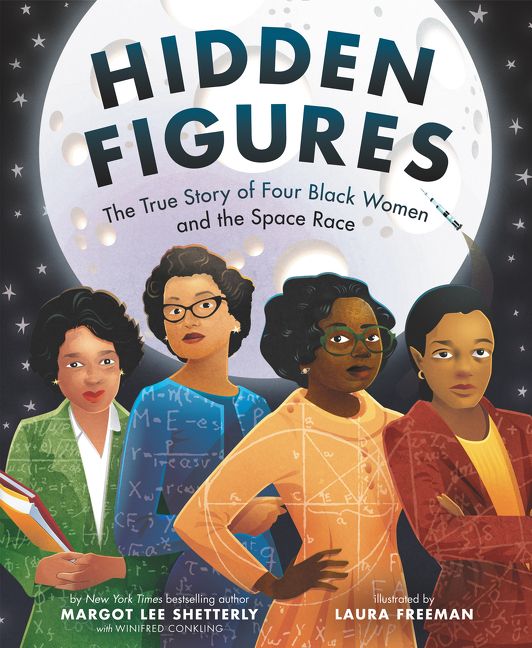
celebrate-picture-books-picture-book-review-hidden-figures-the-true-story-of-four-black-women-and-the-space-race-cover

About the Holiday

Today’s holiday is celebrated around the world and focuses on the social, economic, cultural, and political accomplishments of women. Spurred on by recent events and increased activism, this year’s theme is “Press for Progress: a Push for Gender Parity worldwide.” Rallies, performances, and discussions as well as special events and lessons in schools are just some of the ways that International Women’s Day is commemorated.

Hidden Figures: The True Story of Four Black Women and the Space Race

Written by Margot Lee Shetterly | Illustrated by Laura Freeman


“Dorothy Vaughan, Mary Jackson, Katherine Johnson, and Christine Darden were good at math…really good.” The United States was involved in World War II, and Dorothy wanted to help the war effort by working for the National Advisory Committee for Aeronautics to make planes faster, stronger, and safer. Developing new airplanes required lots of tests at the Langley Laboratory in Virginia. Today, we use computers to do the kinds of math needed, “but in the 1940s computers were actual people like Dorothy, Mary, Katherine, and Christine.”

celebrate-picture-books-picture-book-review-hidden-figures-the-true-story-of-four-black-women-and-the-space-race-dorothy

Copyright Laura Freeman, 2018, courtesy of lfreemanart.com.

Even though Dorothy was a woman and an African-American in the segregated South, Dorothy did not think her dream of getting a job was impossible. After all, she was really good at math. She applied and was hired as a computer. At Langley, whites and blacks worked in different buildings and had separate facilities. After the United States won the war, Dorothy stayed on to create better aircraft.

Now America and Russia were in competition to build the best airplanes. This required more math, more tests, and more computers. Mary Jackson was hired at Langley to test model airplanes in wind tunnels. Mary had her sights set on becoming an engineer, but most of the engineers were men. To prepare, Mary needed to take advanced math classes, “but she was not allowed into the white high school where the classes were taught.” Mary didn’t take no for an answer. She got special permission to take classes, got good grades, and “became the first African-American female engineer at the laboratory.”

celebrate-picture-books-picture-book-review-hidden-figures-the-true-story-of-four-black-women-and-the-space-race-katherine

Copyright Laura Freeman, 2018, courtesy of HarperCollins.

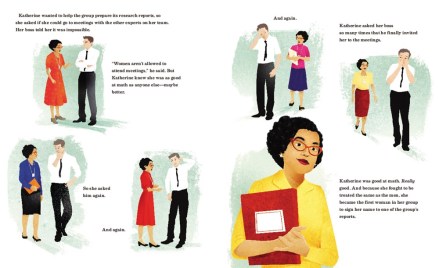
In 1953 Katherine Jackson was hired for a team who tested airplanes while they were in the air. Her work was to analyze turbulence to make planes safer in dangerous gusts of wind. She wanted to go to her team’s meetings, but she was told by her boss again and again that it was impossible; women were not allowed to attend meetings. At last her persistence paid off, and she became the first woman to sign one of the group’s reports.

When machine computers were installed at Langley in the 1950s, they were faster than the human computers but made many mistakes. “Dorothy learned how to program the computers so they got the right answers and taught the other women in her group how to program too.”

In 1957 Russia launched a satellite into space, ramping up the competition with the United States. Now “the United States started building satellites to explore space too,” and the name of the agency was changed to the National Aeronautics and Space Agency or NASA. Then President John F, Kennedy set a goal of sending a man to the moon. First, however, there would need to be many experiments, new space craft, and tests to send astronauts into orbit. This meant more people who were good at math would be needed.

celebrate-picture-books-picture-book-review-hidden-figures-the-true-story-of-four-black-women-and-the-space-race-separate-offices

Copyright Laura Freeman, 2018, courtesy of lfreemanart.com.

When the first manned space flight was planned, Katherine calculated the trajectory that would take John Glenn into space and bring him home again. In 1967 Dorothy Darden came to work at Langley. She loved electronic computers and wanted to become an engineer. “Her first job was to help with NASA’s mission to the moon.”

When Neal Armstrong stepped onto the moon’s surface for the first time on July 20, 1969, he said it was a giant leap for mankind. “It was also a giant leap for Dorothy, Mary, Katherine, Christine, and all of the other computers and engineers who had worked at the lab over the years.” The moon landing was just the beginning. NASA engineers were already dreaming of trips to other planets and super-fast spacecraft. And although it would be hard and require a lot of numbers, “Dorothy, Mary, Katherine, Christine knew one thing: with hard work, perseverance, and a love of math, anything was possible.”

celebrate-picture-books-picture-book-review-hidden-figures-the-true-story-of-four-black-women-and-the-space-race-four-women

Copyright Laura Freeman, 2018, courtesy of HarperCollins.

Margot Lee Shetterly brings her compelling story Hidden Figures to children in this exceptional picture book that skillfully reveals the talents and dreams of Dorothy, Mary, Katherine, Christine as well as the work atmosphere and social injustices of the time period. While acknowledging the struggles and obstacles the four women faced, Shetterly keeps her focus on the incredible achievements of these brilliant women and the positive changes and opportunities for others they created. Brief-yet-detailed descriptions and explanations of math, science, and computer terms flow smoothly in the text, allowing all readers to understand and appreciate the women’s work.

As Dorothy, Mary, Katherine, Christine each begin their work at Langley as young women, Laura Freeman establishes their dreams and their particular field of expertise through richly colorful illustrations that highlight the schematics, tools, equipment, and models they used. In one particularly affecting spread, Dorothy, Mary, Katherine, and Christine go off to their offices on the left-hand side, and their white counterparts head out to theirs on the right-hand side while the blueprint of their building lies under their feet. Dorothy, Mary, Katherine, and Christine’s clothing is also mirrored in color by the women on the other side of the fold. Period dress and electronics show progression through the years, and kids may marvel at the size of early computers. The final image of Dorothy, Mary, Katherine, and Christine as older women is moving and inspirational.

Hidden Figures: The True Story of Four Black Women and the Space Race is an outstanding biography of four women who contributed their gifts for math as well as their self-confidence not only to science but to dreamers in their own and future generations. The book would be a stirring choice for classroom and home libraries.

Ages 4 – 8

HarperCollins, 2018 | ISBN 978-0062742469

Discover more about Margot Lee Shetterly and her books on her website.

To learn more about Laura Freeman, her books, and her art, visit her website.

International Women’s Day Activity

celebrate-picture-books-picture-book-review-women-in-stem-coloring-book

Women in STEM Coloring Book


Discover five women who broke barriers  and made important contributions to the science, technology, engineering, and math fields in this printable  Women in STEM Coloring Book created by the United States Department of Energy.


Picture Book Review
March 3 – World Wildlife Day

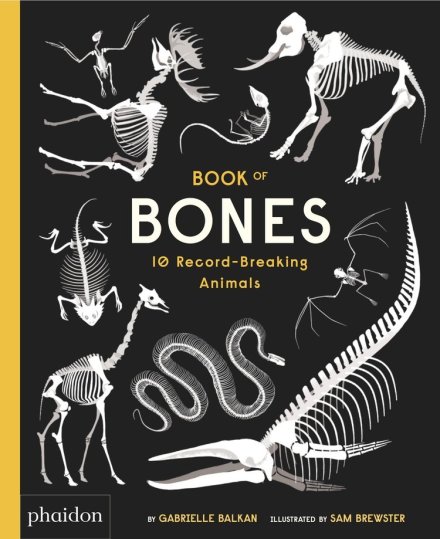
celebrate-picture-books-picture-book-review-book-of-bones-cover

About the Holiday

This United Nations-sponsored holiday was established in 2013 to celebrate the world’s wild animals and plants and to raise awareness of the perils they face. Since that time, World Wildlife Day has grown to be the most important global event dedicated to wildlife. This year’s theme is “Big cats: predators under threat.” The big cats are some of nature’s most majestic animals, and they are now being threatened by habitat destruction, declining prey populations, conflicts with people, poaching, and illegal trade. It is up to us to protect the animals that share our planet. To commemorate today’s holiday, learn more about the world’s creatures and consider donating to a wildlife cause. To learn more about the holiday, visit the official website of UN World Wildlife Day.

Book of Bones: 10 Record-Breaking Animals

Written by Gabrielle Balkan | Illustrated by Sam Brewster


When you think about bones, you know a lot, right? You know they’re hard and not soft, you know they form your skeleton and that they come in different sizes and various shapes, and you know that all vertebrates have them. But have you ever wondered “which animal has the biggest bone in the world? Or the smallest, Or the spikiest?” Well, you’re about to find out thanks to this big book all about bones.

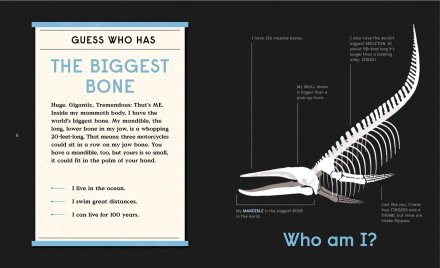
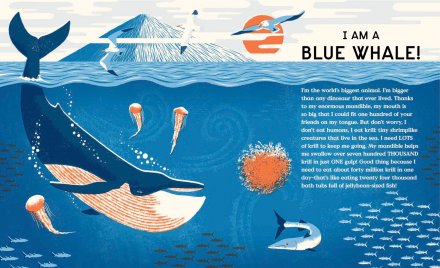
So, let’s get started! About that biggest bone…would you like to take a guess who it belongs to? Here are some clues: This mandible bone “is a whopping 20 feet long. That means three motorcycles could sit in a row” on it. The animal it belongs to lives in the ocean, swims great distances, and “can live for 100 years.” Just take a look at the skeleton on the next page with one long spine, two flippers, fifteen pairs of ribs and a huge skull. Good guess! Let’s turn the page and see… Yes, it is a Blue Whale!

celebrate-picture-books-picture-book-review-book-of-bones-whale-skeleton

Image copyright Sam Brewster, 2017, text copyright Gabrielle Balkan, 2017. Courtesy of Phaidon Press.

Now that you know, you can learn more about the blue whale—like how its mouth is so big that you and one hundred of your friends could fit on its tongue, how it eats 700,000 krill in one gulp, and slurps down 40,000,000 krill every day! Go ahead—touch the illustration of the whale. Feel all of those bones?

Ready for another one? Okay! We did the biggest, how about the smallest bones? Here are some clues from the animal herself: “I am teeny tiny. My skull is smaller than your pinky nail….Inside my ears are the smallest bones in the world: my hammer, anvil, and stirrup bones,” which are about the size of a • . You’d find this animal on farms, in gardens and in olive groves, and even though it’s small, its bite is poisonous. But you’d have to look very closely to find it because its skeleton is “the size of a paperclip and weighs less than a single raisin. What is it? The Etruscan Shrew! You can pet it to feel its bones—this one isn’t venomous.

celebrate-picture-books-picture-book-review-book-of-bones-whale

Image copyright Sam Brewster, 2017, text copyright Gabrielle Balkan, 2017. Courtesy of Phaidon Press.

Imagine if your bones were as thin as a strand of spaghetti. It might make lifting heavy boxes and throwing baseballs or running on the playground pretty hard, if not impossible. But for this next animal having such thin bones is just right. Let’s see if you can guess what it is from these clues: “I sleep upside down, snuggled with my family. I flit through cool limestone caves. I am an amazing flyer…but can’t walk very well.” You know it—it’s a bumblebee bat!

This bat is as small as its namesake, and its thin finger bones support its wings. “If your finger bones were as long and thin as [the bumblebee bat’s], your pinky would be as thin as a strand of hair and keep going past your toes!”

celebrate-picture-books-picture-book-review-book-of-bones-fewest-bon

Image copyright Sam Brewster, 2017, text copyright Gabrielle Balkan, 2017. Courtesy of Phaidon Press.

This is fun! How about another? Guess who has the spikiest bones? You’d find these bones covered with keratin on top of the animal’s head to protect its brain—and to keep it from being eaten by snakes or coyotes or other predators. This animal lives in the deserts of Arizona, eats ants, and…can shoot stinky blood from its eyes when threatened! What is it? It’s a Regal Horned Lizard! Now, feel those spiky horns and all of the rib bones that make this lizard so round.

You’re a great guesser! So try them all—there are a lot more animals to discover and fascinating facts to learn in this book! No bones about it! You’ll find out more about the Reticulated Python, Reticulated Giraffe, African Bush Elephant, Peregrine Falcon, Alaska Moose, and Hammerhead Shark. At the end, there’s also a Glossary of Bone Words for you to bone up on!

celebrate-picture-books-picture-book-review-book-of-bones-dinosaur

Image copyright Sam Brewster, 2017, text copyright Gabrielle Balkan, 2017. Courtesy of Phaidon Press.

Gabrielle Balkan makes learning about the ten animals Book of Bones exciting by including the kinds of facts that kids find most eye-popping and eww-inspiring described in ways that they can relate to. Comparing the size of an animal to a paperclip or the thickness of a bone to a strand of spaghetti creates an immediate visual that makes budding scientists want to learn more. Balkan’s conversational style lends a personal touch to the text—as if the reader is interacting with a wildlife expert one-on-one.

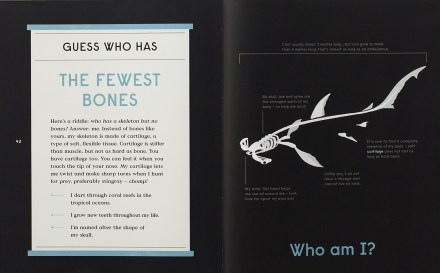
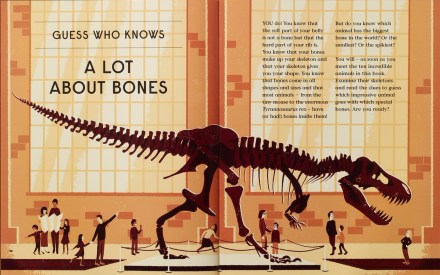
Opening the oversized Book of Bones is like walking into a natural history museum where skeleton exhibits stand side by side with natural habitat dioramas. Sam Brewster introduces each animal with accurately drawn skeletons on black backgrounds that let readers see the placement of each bone. Special features are called out in a whisper of gray, adding to the museum display feel. Turning the page allows children to see each animal in its vibrant, natural habitat. Ingenious printing lets readers feel and see the rough bones beneath the skin.

A fun, fact-filled resource for nature lovers, Book of Bones: 10 Record-Breaking Animals would make a great gift and addition to classroom, school library, public library, and home bookshelves.

Ages 8 – 12

Phaidon Press, 2017 | ISBN 978-0714875125

Discover more about Gabrielle Balkan and her books on her website.

To view a portfolio of illustration work by Sam Brewster, visit his website.

World Wildlife Day Activity

celebrate-picture-books-picture-book-review-lioness-and-cub-coloring-page

Lion and Lioness Coloring Pages


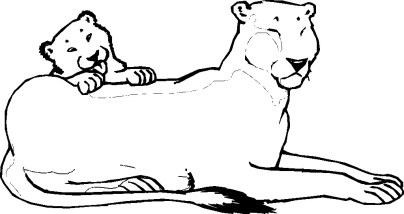
The lion is one of the most majestic of the big cats, and is—of course—the king (and queen) of the jungle. Here are two lion coloring pages for you to enjoy!

Lion Coloring Page | Lioness and Cub Coloring Page

Picture Book Review
February 11 – National Inventors’ Day

celebrate-picture-books-picture-book-review-women-in-science-cover

About the Holiday

Today’s holiday recognizes the spirit of inventors—those women and men, girls and boys who look at life just a little bit differently and not only imagine the “what if?” but make it happen. Inventors come from all backgrounds and with all different kinds of experience. Today, we celebrate those pioneers of the past, present, and future! If you have a creative mind, today’s the day to tinker around with your idea. Inventions don’t always have to change the world. Have a better way of organizing your closets, a new game to play with your pet, or a new recipe to use the leftovers in the fridge? Go for it—and be proud of yourself!

Women in Science: 50 Fearless Pioneers Who Changed the World

By Rachel Ignotofsky

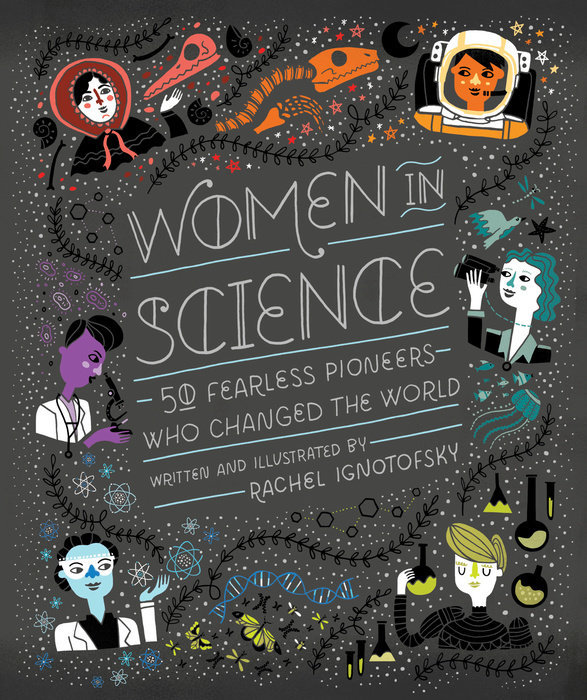
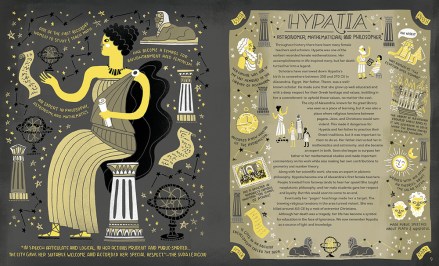
“Nothing says trouble like a woman in pants.” With this revealing attitude from the 1930s, Rachel Ignotofsky introduces her scintillating biographies of 50 intelligent, self-confident, persevering, and inspiring women working in engineering, math, medicine, psychology, geology, physics, astronomy, and more sciences from ancient history through today. The book begins with Hypatia who lived in Greece in the late 300s to early 400s CE and became an expert in astronomy, philosophy,and mathematics, making “contributions to geometry and number theory.” She became one of Alexandria’s first female teachers, “invented a new version of the hydrometer,” and can be found among the intellects in Raphael’s painting “The School of Athens.”

celebrate-picture-books-picture-book-review-women-in-science-hypatia

Image and text copyright Rachel Ignotofsky, courtesy of rachelignotofskydesign.com

Zipping ahead to 1647 readers find Maria Sibylla Merian, considered one of the “greatest scientific illustrators of all time.” Her specialty was entomology. By carefully documenting the lifespan of butterflies, she taught people about the science of metamorphosis, publishing a book on the subject filled with notes and illustrations in 1679. Later she scoured the rainforests of South America, gathering information on never-before-seen insects from that region. Her book, The Metamorphosis of the Insects of Suriname “was published in 1705 and became a hit all over Europe.” Maria was so famous, her picture appeared on German money and stamps.

celebrate-picture-books-picture-book-review-women-in-science-mary-anning

Image and text copyright Rachel Ignotofsky, courtesy of rachelignotofskydesign.com

Other women in the nature sciences include Mary Anning, who as a child discovered the first complete ichthyosaur skeleton and went on to become a paleontologist; Mary Agnes Chase, a botanist and expert on grasses; Marjorie Stoneman Douglas, who as a conservationist helped save the Florida Everglades; and Joan Beauchamp Procter, a zoologist specializing in reptiles who discovered the Peninsula Dragon Lizard in 1923; and more.

celebrate-picture-books-picture-book-review-women-in-science-marie-curie

Image and text copyright Rachel Ignotofsky, courtesy of rachelignotofskydesign.com

One of the earliest women astronomers and mathematicians was Wang Zhenyi, born in China in 1768. Creating her own eclipse model, she proved her advanced “theories about how the moon blocks our view of the sun—or the earth blocks the sun’s light from reaching the moon—during an eclipse.” She also measured the stars and explained the rotation of the solar system. At the age of 24 she published the 5-volume Simple Principles of Calculation. Zhenyi died at the age of 29, but in her short life she published many books on math and astronomy as well as books of poetry.

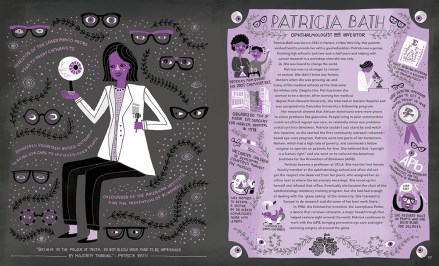
celebrate-picture-books-picture-book-review-women-in-science-patricia-bath

Image and text copyright Rachel Ignotofsky, courtesy of rachelignotofskydesign.com

Women in Science includes many other women who have looked to the stars and mathematics for their careers. Some of these are: Ada Lovelace, the first person to write a computer program; Emmy Noether, who helped Albert Einstein develop his theory relativity, created the field of abstract algebra, and “made new connections between energy and time, and angular momentum”; Cecilia Payne-Gaposchkin a quantum physicist in 1900s England who “discovered that the sun is made mostly of hydrogen and helium gas” and in 1956 became Harvard University’s first astronomy professor; Mae Jemison, who in 1992 became the first African-American woman in space and later started her own technology consulting firm as well as founding BioSentient Corporation, and a science camp for kids; plus many others.

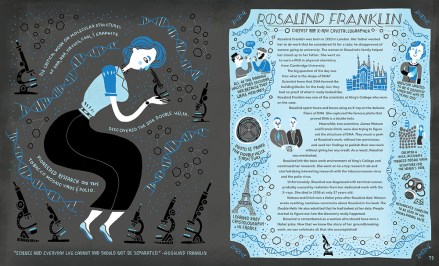
celebrate-picture-books-picture-book-review-women-in-science-rosalind-franklin

Image and text copyright Rachel Ignotofsky, courtesy of rachelignotofskydesign.com

The book also features Engineers, such as Hertha Ayrton who improved electric lights by inventing “a new rod that made a clean and quiet bright light” and the Ayrton fan that blew away mustard gas during World War I; and Lillian Gilbreth, who used her theories of “organizational psychology” in inventing the foot pedal for garbage cans, shelving for refrigerators, and even the “work triangle” for kitchens “that determines the distance from the sink to the stove” and saves time. There are Geneticists such as Nettie Stevens who discovered the “X” and “Y” chromosomes, and Barbara McClintock—the pants wearer from the beginning of the post—and the first person “to make a complete genetic map of corn” and discover jumping genes, or “transposons.”

The field of Medicine has benefited from women such as Elizabeth Blackwell, the first woman doctor; Alice Ball, a chemist and the first African-American woman to graduate from the University of Hawaii, who helped cure leprosy with her chemical work; and Gerty Cori who discovered how our bodies covert glucose, helping us better understand diabetes. In 1947 she became the first American woman to win a Nobel Prize.

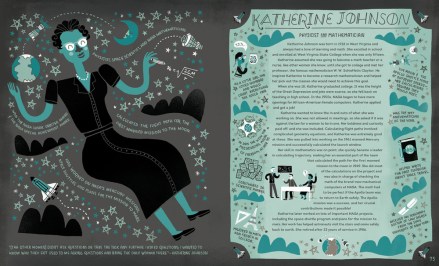
celebrate-picture-books-picture-book-review-women-in-science-katherine-johnson

Image and text copyright Rachel Ignotofsky, courtesy of rachelignotofskydesign.com

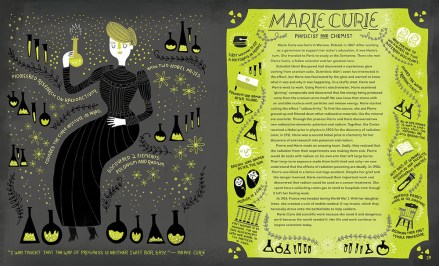
And this list only begins to scratch the surface of all the fascinating stories of women who overcame social, political, and personal obstacles to follow where their intelligence took them. Inspirational, entertaining, and undeniably eye-catching Rachel Ignotofsky’s Women in Science presents expertly written, one-page biographies that hit all the high (and sometimes unfortunate low) points in these scientist’s lives. The striking layout of both the text and illustrations keep readers riveted to the page, The left-hand side contains a representational drawing of the scientist surrounded by the subjects and materials of her work as well as trivia about her and a quotation. On the right-hand page, small illustrated facts frame the woman’s life story.

Interspersed between the biographies are pages offering a timeline of women’s milestones, depicting lab tools, and graphing statistics of women in STEM. The back matter is impressive, with two more pages presenting 15 more scientists, a four-page, illustrated glossary, resources including films, websites, and books, and an index. Rachel Ignotofsky concludes her book by saying, “Let us celebrate these trailblazers so we can inspire the next generation. Together, we can pick up where they left off and continue the search for knowledge. So go out and tackle new problems, find your answers and learn everything you can to make your own discoveries!”

Ages 7 and up

Ten Speed Press, 2016 | ISBN 978-160774976

To discover more books by Rachel Ignotofsky, visit her website!

National Inventors’ Day Activity

celebrate-picture-books-picture-book-review-scientists-word-search

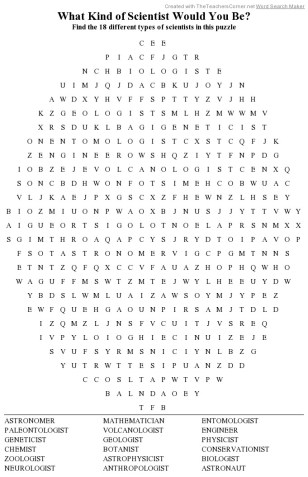
What Kind of Scientist Would You Be? Word Search

Scientists like the women in today’s book make inventions for every area of life! In the future you might become a scientist and develop something new or different. If so, what kind of scientist would you like to be? Find the names of eighteen scientists in this printable puzzle! Then pick one and write why you would like to be that type of scientist!

What Kind of Scientist Would You Be? Puzzle What Kind of Scientist Would You Be? Puzzle Solution!  

Picture Book Review
February 2 – It’s National Women Inventors Month

celebrate-picture-books-picture-book-review-the-girl-who-thought-in-pictures-cover

About the Holiday

This month we celebrate all the women, past and present, who have changed the world for the better with their inventions and innovations! Every day, women are working in all industries researching and creating the next products, services, medicines, machinery, games, and some things we can’t even imagine yet that will revolutionize the way we live. Who are these women? They might be your friends, neighbors, sisters, daughters—or maybe even you! To celebrate this month, read up on amazing women inventors, and, if you have a big idea, work to get it noticed and on the market!

The Girl Who Thought in Pictures: The Story of Dr. Temple Grandin

Written by Julia Finley Mosca | Illustrated by Daniel Rieley


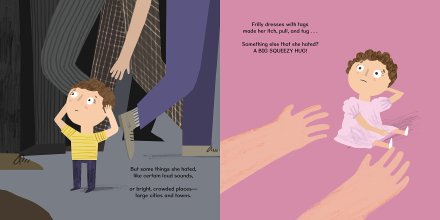
If you feel different and sometimes discouraged, the story of Temple Grandin may help you see that everyone has a talent and their own place in the world. Temple was born in Boston and “unique from the start, / an unusual girl, / she loved spinning in circles / and watching things twirl.” Loud sounds, big crowds, bright lights, and scratchy clothes disturbed her. And she did not like to get a “big squeezy hug.”

celebrate-picture-books-picture-book-review-the-girl-who-thought-in-pictures-too-loud

Image copyright Daniel Rieley, 2017, text copyright Julia Finley Mosca, 2017. Courtesy of The Innovation Press.

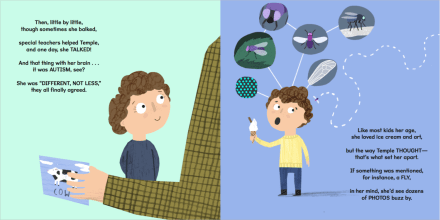
When she became overloaded with stress and frustration, Temple was known to “kick, holler, bang, shrieeeeek! Yet, still, by age three, not one word did she speak.” People told Temple’s parents that she’d never be normal and to send her away, but her mother would not hear of it. With a lot of work, special teachers helped Temple learn to talk. “And that thing with her brain… / it was AUTISM, see? / She was ‘different not less,’ / they all finally agreed.”

celebrate-picture-books-picture-book-review-the-girl-who-thought-in-pictures-doctor

Image copyright Daniel Rieley, 2017, text copyright Julia Finley Mosca, 2017. Courtesy of The Innovation Press.

While Temple was like her peers in many ways, she interacted with words differently. “If something was mentioned, / for instance, a fly, / in her mind, she’d see dozens / of PHOTOS buzz by.” Her different view point made it hard for her at school. The other kids chased her and teased her for the way that she acted and for “…saying things / over and over. / and over… / and over… / AND over.” When she had finally had enough, “she threw a book at a kid / and was kicked out of school!” No one understood Temple and Temple couldn’t understand them.

celebrate-picture-books-picture-book-review-the-girl-who-thought-in-pictures-fly

Image copyright Daniel Rieley, 2017, text copyright Julia Finley Mosca, 2017. Courtesy of The Innovation Press.

Her mother then sent her to visit her aunt, who lived on a ranch out west. Here, among the animals, Temple felt better. Her favorites were the cows, so silent and sweet. “At a NEW school that fall, / Temple found more support / said a teacher who taught her: / ‘You’ll never fall short.” That teacher was right, and at engineering and science she felt right at home.

Her first invention—made from memory—was “a machine / like she’d seen on some farms, / an INVENTION that hugged her / with boards, and not arms.” In this device she felt snug and calm, just like the cows. As she began to succeed, Temple came to see that her attention to detail was a benefit, and she began to feel special. Then she learned about farms where the cows were not treated kindly and resolved to change that.

celebrate-picture-books-picture-book-review-the-girl-who-thought-in-pictures-cows

Image copyright Daniel Rieley, 2017, text copyright Julia Finley Mosca, 2017. Courtesy of The Innovation Press.

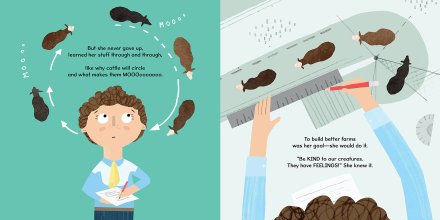
She went on to college and became an expert on farms, earning three degrees. Telling people about her ideas for farming improvements was sometimes scary because they ignored her and, well…weren’t very sweet. But she didn’t give up. She learned more about cattle, like why they circle and moo. “To build better farms / was her goal—she would do it. / ‘Be KIND to our creatures. / They have FEELINGS!’ She knew it.”

It took time, but people began to see that Temple was right, and farm after farm implemented her ideas. She won awards for this work and other ideas, a movie was made about her life, and she now travels the world telling her story and teaching: “‘Each person is special– / so UNIQUE are our minds. / This world needs YOUR ideas. / It takes brains of ALL kinds!”

celebrate-picture-books-picture-book-review-the-girl-who-thought-in-pictures-letter

Image copyright Daniel Rieley, 2017, text copyright Julia Finley Mosca, 2017. Courtesy of The Innovation Press.

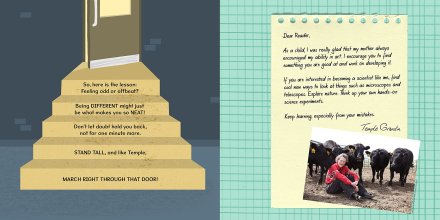
A letter from Temple Grandin to young readers, extensive information about Temple and tidbits from her interview with the author, a timeline of her life, and resources follow the text.

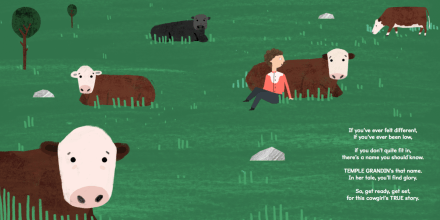
Julia Finley Mosca’s insightful biography of Temple Grandin offers inspiration and encouragement to children at those times when life seems difficult or if they feel misunderstood. Childhood can be filled with moments—both small and large, short or long—when comfort and reassurance are needed. Mosca’s rhyming verses make Temple’s story accessible to a wide age range of readers while providing an inclusive way to show how autism creates a different way of experiencing the world. Temple’s supportive teachers are role models for all educators. Temple Grandin’s fascinating life demonstrates that there is a niche for everyone and that through understanding, perseverance, and acceptance, all children can go far.

celebrate-picture-books-picture-book-review-the-girl-who-thought-in-pictures-cows-in-field

Image copyright Daniel Rieley, 2017, text copyright Julia Finley Mosca, 2017. Courtesy of The Innovation Press.

Daniel Rieley’s cartoon-style illustrations will resonate with readers as Temple takes in everything she sees with wide-open eyes and interprets it in her own way—even before she can speak. The separation between Temple and the other students at her first school is poignantly communicated in a two-page spread in which pointing hands and a lobbed ball of paper appear from the left-hand margin and Temple reads alone on the far side of the right-hand page. Temple’s ability to think in pictures is demonstrated throughout the book with inset images. Readers see some of the farming practices Temple wanted to change, her original drawings, and the resulting equipment now used on farms to improve the conditions of the animals raised there.

The Girl Who Thought in Pictures: The Story of Dr. Temple Grandin is a moving and motivational story for all children and is a must for school and public libraries.

Ages 5 – 10

The Innovation Press, 2017 | ISBN  978-1943147304

Discover more about Julia Finley Mosca and her Amazing Scientists series on the Amazing Scientists website.

Learn more about Daniel Rieley, his books, and his art on his website.

National Women Inventors Month Activity

celebrate-picture-books-picture-book-review-women-in-stem-coloring-book

Historical Women in STEM Coloring Book


From civil engineering to chemistry and botany from radio waves to computer programming, the five women in this coloring book changed science and the world. Enjoy coloring the pages and learning about these amazing women in this printable: Historical Women in STEM Coloring Book

Picture Book Review
January 29 – It’s Book Blitz Month

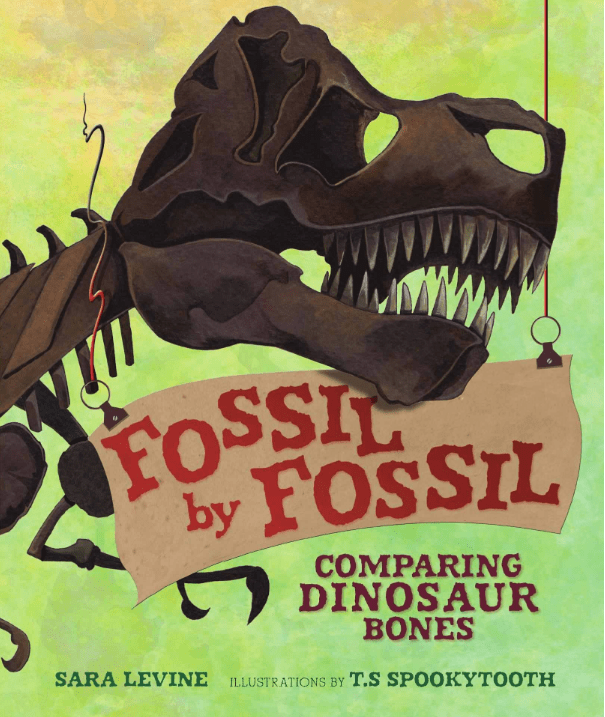
celebrate-picture-books-picture-book-review-fossil-by-fossil-cover-II

About the Holiday

Is your motto “So many books, so little time?” Is every shelf, nook, and cupboard in your house filled with books? Is your library card the first one on your ring? If so, you’ll love Book Blitz Month! During this month book lovers are given the green light to read, read, read as many books as possible! Or if there’s a tome you’ve always wanted to tackle, crack the cover and let yourself become immersed in someone else’s story. For kids, Book Blitz Month can be particularly exciting. Sit down with your child or students and make a stack of books they’d like to read. Find time every day to read one, two, or a few of the books in the pile. Seeing the stack shrink gives kids a sense of accomplishment, and they might even want to build it up again! Mix reading with fun activities to encourage a new generation of avid readers!

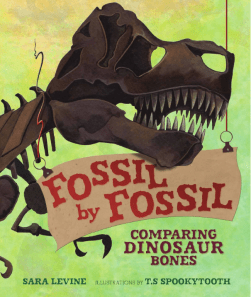
Fossil by Fossil: Comparing Dinosaur Bones

Written by Sara Levine | Written by T.S Spookytooth


You like dinosaurs, right? I mean, who doesn’t? Of course, I’m not talking about those folks with outdated ideas or that old clunker in the garage that you just can’t part with. I’m talking about the big, huge carnivores and herbivores that roamed the earth millions of years ago—parasaurolophus, diplodocus, apatosaurus, brontosaurus, t-rex, and all the rest that have fun-to-say names. You might think that having those guys and gals around now would be fun, but how would you feel if you, yourself, were a dinosaur?

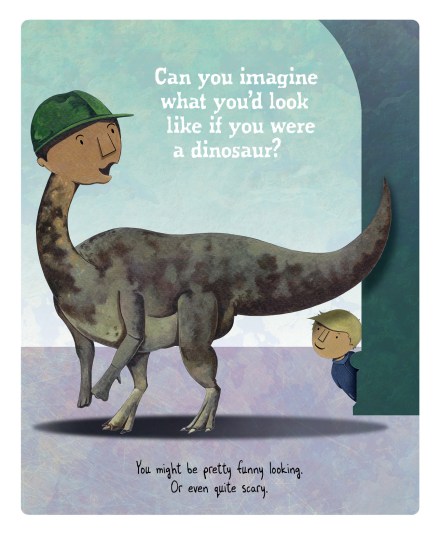
celebrate-picture-books-picture-book-review-fossil-by-fossil-funny-and-scary

Image copyright T.S Spookytooth, 2018, text copyright Sara Levine, 2018. Courtesy of Millbrook Press.

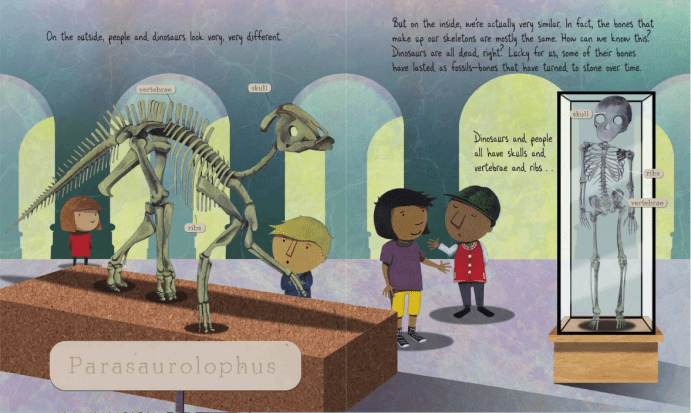
Does that thought make you laugh or maybe shudder a little? Well, if you were a dinosaur “you might be pretty funny looking. Or even quite scary.” If you think it’s totally impossible that you could be a dinosaur, you might want to reconsider: Sure, “on the outside, people and dinosaurs look very, very different. But on the inside, we’re actually very similar.” Compare some dinosaur fossils and a human skeleton, and you’ll see!

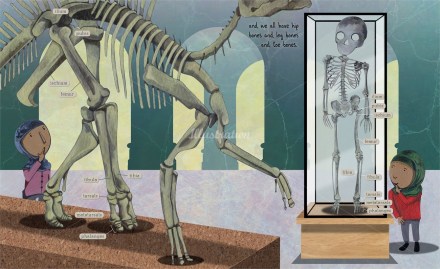
celebrate-picture-books-picture-book-review-fossil-by-fossil-parasaurolophus

Image copyright T.S Spookytooth, 2018, text copyright Sara Levine, 2018. Courtesy of Millbrook Press.

Dinos have skulls, and—yep—you’ve got one too! Vertebrae and ribs? Dinosaur, check; you, check. How about scapula, humerus, ulna, radius, metacarpals, and phalanges? Yes, yes, yes, yes, yes, and yes! And that’s just in our arms and in a dinosaur’s front legs! We both have “hip bones and leg bones and toe bones” too! So why aren’t we dinosaurs? And why aren’t dinosaurs people?

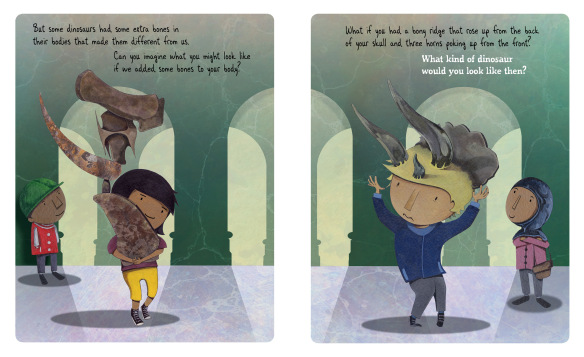
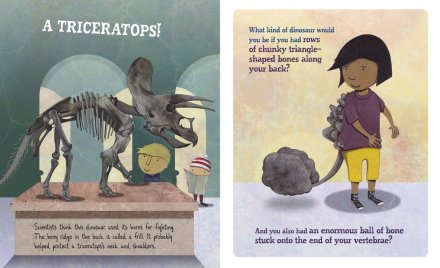
That’s because “dinosaurs had some extra bones in their bodies that made them different from us.” Would you like to try some of these on for size? Imagine having a bony ridge jutting out from the back of your head and two big horns and one littler one jutting out the front? “What kind of dinosaur would you look like then?” You got it! A triceratops! Nowadays all those enhancements would just make it hard to wear a hoodie, but back in the Cretaceous Period? “Scientists think this dinosaur used its horns for fighting.” The frill in the back “probably helped protect a triceratops’s neck and shoulders.”

celebrate-picture-books-picture-book-review-fossil-by-fossil-stack-of-bones

Image copyright T.S Spookytooth, 2018, text copyright Sara Levine, 2018. Courtesy of Millbrook Press.

This is fun! Let’s try another one…How about if you had “rows of chunky triangle-shaped bones along your back and…an enormous ball of bone stuck onto the end of your vertebrae?” Well, you wouldn’t be a world-class runner and dunking a basketball would probably be out of the question. Why? Because you’d be an ankylosaurus, and the “bones on the end of this dinosaur’s tail weighed more than 60 pounds (27 kg).” You would be a pretty awesome competitor, though—even for the likes of T-rex!

What if those bones along your back ranged from small to huge and ran from your head to the end of your long tail, which, by the way, ended with a few knife-sharp spikes? Then, you’d be a stegosaurus! And what would you do with those plates on your back? Good question! Maybe they’d gather sun like solar panels and keep you warm, or maybe you’d just flash them around to impress your friends.

celebrate-picture-books-picture-book-review-fossil-by-fossil-triceratops

Image copyright T.S Spookytooth, 2018, text copyright Sara Levine, 2018. Courtesy of Millbrook Press.

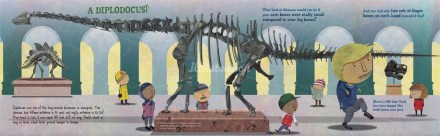
Is having more of something ever a bad thing? You might think so if you looked like our next dinosaur. “What if we added lots and lots of extra vertebrae in your neck? And what if your vertebrae didn’t stop at your rear end but kept going and going and going? What kind of dinosaur would you be then?” Here’s a hint: a picture of you wouldn’t even fit on a regular two-page spread in a book! That’s right—it takes four pages to fit you in because you would be a diplodocus! You’d be so long it would take three school buses to get you to class!

From large we move onto small—small arms that is and only two fingers on each hand instead of five. Any ideas? What if I added that “you’d also have dagger-like teeth lining your jaw?” Yeah, you know it! A tyrannosaurus rex! And what did t-rex use those small arms for? “Scientists think it might have used its puny front legs to help it get up after lying down for a rest.”

celebrate-picture-books-picture-book-review-fossil-by-fossil-diplodocus

Image copyright T.S Spookytooth, 2018, text copyright Sara Levine, 2018. Courtesy of Millbrook Press.

Okay, so those are just some of the dinosaurs that lived on land. But there were other ones in the sea and in the air. Imagine if your nostrils were on the top of your head, your skull was long and pointy, and your arms and legs were more like paddles. What would you be good at? Exactly! You’d be an excellent swimmer—which would make you an ichthyosaur!

Let’s do one more! What would you be able to do if your “pinky bones grew really, really long and a membrane of skin was attached to these bones?” Sure! You’d be able to fly, and as a pterosaur, you’d be the first animal with bones to accomplish that amazing feat.

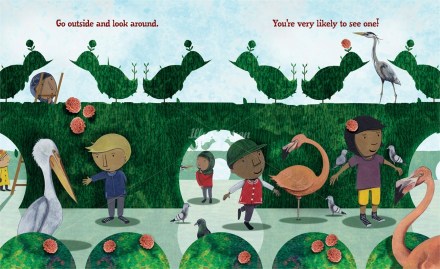
Now, you may have seen dinosaur skeletons in a museum and felt a little sad that you’d never see these creatures in person, but did you know that “you may have even seen one already today? What kind of animal would you be if you were a dinosaur living on Earth right now?” You’ll want to look skyward for this answer. “Scientists now consider birds to be dinosaurs,” and that they “use their first three fingers” to fly. “So if you want to find a dinosaur…Go outside and look around. You’re very likely to see one!”

Backmatter includes a discussion on birds as dinosaurs, a list of dinosaur groups, a glossary, a pronunciation guide, and resources for further study.

celebrate-picture-books-picture-book-review-fossil-by-fossil-birds

Image copyright T.S Spookytooth, 2018, text copyright Sara Levine, 2018. Courtesy of Millbrook Press.

Sara Levine draws on kids’ love of dinosaurs and their growing knowledge of human anatomy to create this mashup of science and laughs that teaches as much as it delights. By revealing on the first two pages that kid and dinosaur skeletons have many of the same kinds of bones, Levine immediately taps that “Wow!” factor that keeps children engaged in a topic.

Add on the funny “what if…” descriptions and illustrations of children sporting bony projections, long tails and necks, noses and fingers, and you’ve got a science book that readers can’t put down. Along the way, budding archaeologists and paleontologists learn facts about each dinosaur and the purpose of their particular anatomical feature or features. Levine’s conversational tone directly addresses her readers and makes learning as fun as going on a field trip with your best friend—how cool is that?

celebrate-picture-books-picture-book-review-fossil-by-fossil-skeletons

Image copyright T.S Spookytooth, 2018, text copyright Sara Levine, 2018. Courtesy of Millbrook Press.

Readers needn’t worry if they can’t quite imagine having horns sticking out of their head, being eighty feet long, or having pinky fingers long enough to roast marshmallows on. T.S Spookytooth has it all covered. As the diverse group of kids visit a museum of natural history, they suddenly find themselves sporting prehistoric traits that confound, surprise, and—as it is with kids—amuse them. Each dinosaur’s skeleton (as well as a human skeleton) is drawn clearly and with realistically.

The double gate-fold illustration of the diplodocus is a show-stopper, and you can bet that children will want to count the vertebrae! Spookytooth’s color palette and imagery beautifully represents the interior of a museum and shows the dinosaurs off to best advantage. The final two-page spread of the children interacting with today’s dinosaurs is whimsical, will inspire kids to look at birds differently, and holds a question—is there an imposter among them?

Fossil by Fossil: Comparing Dinosaur Skeletons would be a favorite addition to home bookshelves as well as classroom, school, and public libraries to spur enthusiastic learning.

Ages 5 – 10

Millbrook Press, 2018 | ISBN 978-1467794893

Discover more about Sara Levine and her books on her website

Learn more about T.S Spookytooth and his illustration work on his website

Book Blitz Month Activity

celebrate-picture-books-picture-book-review-dinosaur-eggs-craft-nest

Hatch Your Own Dinosaur Eggs

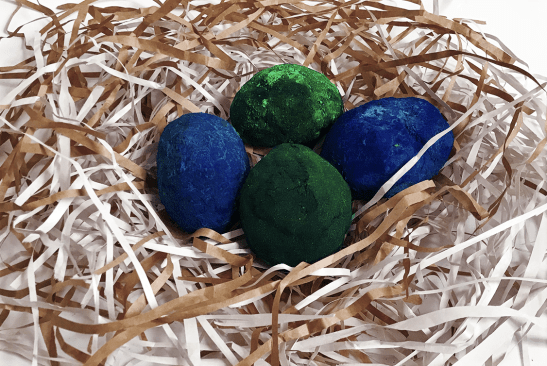
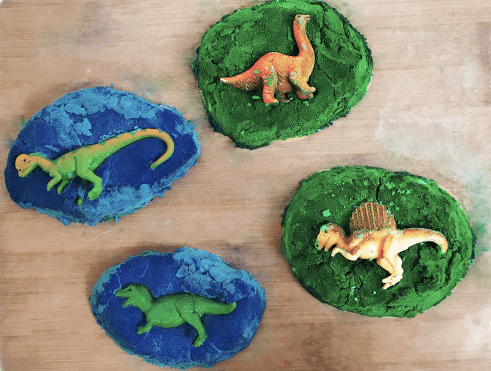
Think there are no more dinosaur eggs? Think again! You can make your own with this easy craft that will have you hatching some t-rex-size fun! All you need are a few simple ingredients!

celebrate-picture-books-picture-book-review-dinosaur-eggs-craft-open-eggs

Supplies

  • Old clothes or apron
  • Large box of baking soda (makes between 6 and 8 eggs)
  • Food coloring
  • Water
  • Plastic dinosaur toys
  • Bowl
  • Fork
  • Spoon
  • Wax paper
  • Baking sheet
  • Foil
  • Vinegar
  • Spray bottle (optional)
  • Plastic or metal spoon, stick, popsicle stick, or other implement to chisel with
celebrate-picture-books-picture-book-review-dinosaur-eggs-craft-vinegar-egg-open-darker

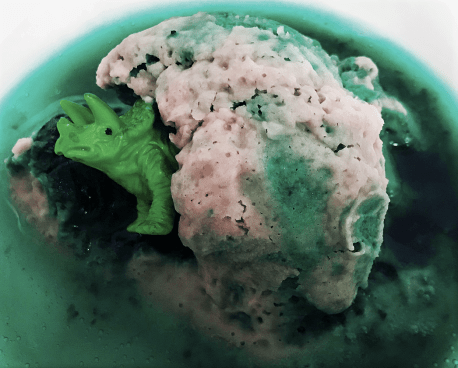
Spray the egg with vinegar to hatch your dinosaur

Directions

  1. Wear old clothes or an apron
  2. Cover work surface with wax paper, parchment paper, newspaper, or other protection. Food coloring can stain some surfaces
  3. Pour baking soda into the bowl
  4. Add drops of food coloring in whatever color you’d like your eggs to be. The eggs will darken when baked.
  5. Mix in the food coloring with the fork. You may want to use your hands, too
  6. When the baking soda is the color you want it, begin adding water a little at a time
  7. Add water until the baking soda holds together when you squeeze it in your hand
  8. When the baking soda is the right consistency, spoon some out into your hand or onto wax paper
  9. Push one plastic dinosaur into the middle
  10. Cover the dinosaur with more of the baking soda mixture
  11. Carefully form it into an egg shape
  12. Repeat with other dinosaurs
celebrate-picture-books-picture-book-review-dinosaur-eggs-craft-chiseled -darker

Chisel the egg open to hatch your dinosaur

To Bake the Eggs

  1. Set the oven or toaster oven to 200 to 225 degrees
  2. Set the eggs on a baking sheet lined with foil
  3. Bake the eggs for 15 minutes, check
  4. Turn the eggs over and bake for 10 to 15 more minutes
  5. Remove from oven and let cool

To Hatch the Eggs

  1. Eggs can be hatched by chiseling them with a spoon, stick, or other implement
  2. Eggs can also be hatched by spraying or sprinkling them with vinegar

celebrate-picture-books-picture-book-review-fossil-by-fossil-cover-II

You can find Fossil by Fossil: Comparing Dinosaur Bones at these booksellers

Amazon | Barnes & Noble | Books-a-Million | Indiebound

Picture Book Review


October 8 – It’s World Space Week

celebrate-picture-books-picture-book-review-to-the-stars-cover

About the Holiday

First declared by the United Nations in 1999, World Space Week has grown to be the largest public space-related event in the world. The week celebrates the advancement and contributions of space technology and exploration. This year’s theme is “Exploring New Worlds in Space” and aims to encourage and inspire new experimentation, discovery and participation in advancing ways to explore the cosmos beyond earth.

To the Stars! The First American Woman to Walk in Space

Written by Carmella Van Vleet and Dr. Kathy Sullivan | Illustrated by Nicole Wong


As a child Kathy Sullivan loved to explore. Her father designed airplanes, and when he brought home blueprints, she carefully studied every line and curve. When she saw airplanes in the sky she wished she were on them, flying to exciting locations all over the world. Maps and foreign languages fascinated her. “Their strange symbols, exotic tales, and musical sounds made her feel like the world was waiting for her.” Kathy wanted to see that whole world and thought maybe she’d like to be a spy or a diplomat, but her friends and other adults told her those weren’t jobs for women.

celebrate-picture-books-picture-book-review-to-the-stars-blueprints

Image copyright Nicole Wong, courtesy of nicole-wong.com

But Kathy always followed her heart. She loved going fishing with her dad and brother and finishing the day with a swim. She “delighted in how her arms and legs moved in slow motion underwater.” Kathy was still a teenager when she learned how to pilot a plane. At first the busy instrument panel made her nervous, but she quickly learned how to manage all the “dials, buttons, and numbers.”

Kathy got a taste for the thrill of space when she bravely jumped at the opportunity to ride in a Breezy—an open-air-framework plane. Sitting at the very tip of the airplane, in front of the pilot, Kathy had a bird’s eye view. “The wind rushed past her face so fast it pushed her cheeks back. Higher! Faster! Young Kathy looked at the ground below her feet. She felt like she could see the whole world.”

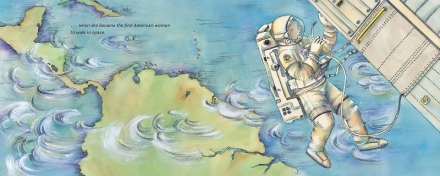
As an adult, Kathy put all of these experiences to good use as she studied complex science that would lead her to NASA. And when she became the first American woman to walk in space, she fulfilled her childhood dream to see the whole world!

celebrate-picture-books-picture-book-review-to-the-stars-spacewalk

Image copyright Nicole Wong, courtesy of charlesbridge.com

Carmella Van Vleet and Dr. Kathy Sullivan, have written a compelling biography of Dr. Sullivan that not only tells the story of her adult achievements, but also reveals the childhood and teenage motivations and influences that fostered her journey to the stars. As each event in Kathy’s young life is introduced, it is followed by an adult accomplishment: Kathy’s poring over her father’s aircraft blueprints leads to a spread of college-age Kathy studying charts in textbooks. Her enjoyment of swimming underwater is followed by an illustration showing her NASA training underwater. Her initial introduction to a plane’s instrument panel informs her later responsibilities inside the spacecraft. And the question she once asked herself as a child—what kind of job would allow her to see the whole world—is answered as the astronaut Kathy gazes down at Earth from space.

celebrate-picture-books-picture-book-review-to-the-stars-breezy

Image copyright Nicole Wong, courtesy of charlesbridge.com

Nicole Wong’s lovely, realistic watercolor and ink paintings clearly show readers Kathy Sullivan’s trajectory from curious girl to accomplished astronaut. The blueprints that Kathy studies are filled with schematics. The aqua water she swims in swirls and bubbles in the wake of her cannonball dive, and the crisscrossing fields lay like a mottled green quilt under the Breezy. Especially stunning and effective are the illustrations of Dr. Sullivan’s work with NASA. Kids will love the up-close view of the spacecraft’s instrument panel with its myriad buttons and dials. Likewise, they will find the gorgeous two-page spreads of the space shuttle’s launch, the view from the cockpit, and Kathy’s spacewalk particularly thrilling.
Following the text is a personal note from Kathy Sullivan to her young readers. More extensive biographical notes reveal how Dr. Sullivan discovered her love of science as well as information on the NASA missions she supported. Two more pages highlight the women of the first space-shuttle class, which included Kathy Sullivan, and other firsts by eight other women in space.

To the Stars is a wonderful book to teach children that following their own heart is the best path to future happiness and personal accomplishment. It’s a beautiful addition to any budding scientist’s or adventurer’s library!

Ages 5 – 9

Charlesbridge, 2016 | ISBN 978-1580896443

To find fun activities for To the Stars—including how to make space play dough—as well as other books by Carmella Van Vleet, visit her website!

To learn more about Nicole Wong and view a portfolio of her artwork, visit her website!
World Space Week Activity

celebrate-picture-books-picture-book-review-astronaut-coloring-page


Astronaut Coloring Page


Would you like to be an astronaut? Draw yourself in this spacesuit and then grab your crayons, pencils, or markers and have fun with this printable Astronaut Coloring Page!
Picture Book Review