December 16 – It’s Read a New Book Month

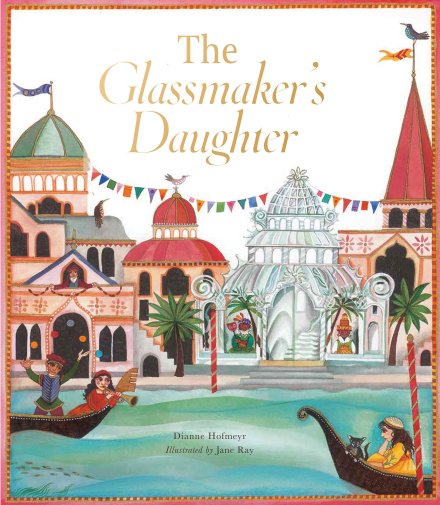
celebrate-picture-books-picture-book-review-the glassmaker's-daughter-cover

About the Holiday

With so many gift-giving opportunities this month, December is the perfect time to discover new books for any age! The delight, wonder, and shared experiences of great books is one of the best presents you can give. This month visit your local bookstore and pick out a special book for the loved ones on your list. (And don’t forget to treat yourself!)

The Glassmaker’s Daughter

Written by Dianne Hofmeyr | Illustrated by Jane Ray


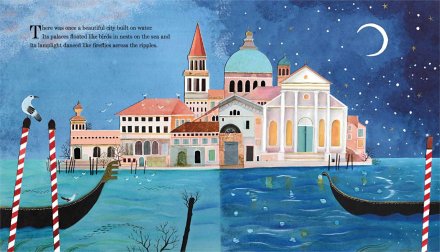
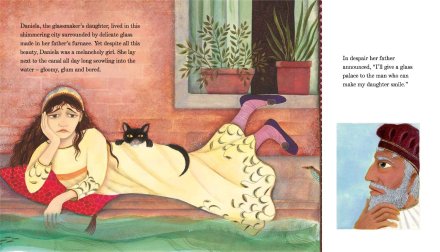
Have you heard about the wondrous city built on water? “Its palaces floated like birds in nests on the the sea and its lamplight danced like fireflies across the ripples.” In one of these beautiful buildings lived Daniela, the glassmaker’s daughter. You might think that Daniela would be happy to be surrounded by so much loveliness, but instead she spent her days staring glumly into the canal. Her father, wanting his daughter to be happy, offered a glass palace to the person who could make his daughter smile.”

celebrate-picture-books-picture-book-review-the glassmaker's-daughter-venice

Image copyright Jane Ray, 2017, text copyright Dianne Hofmeyr. Courtesy of Frances Lincoln Children’s Books.

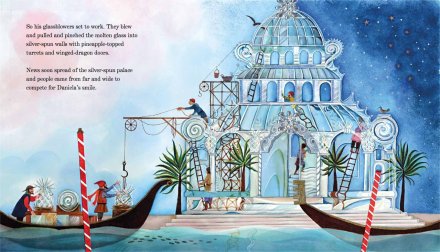
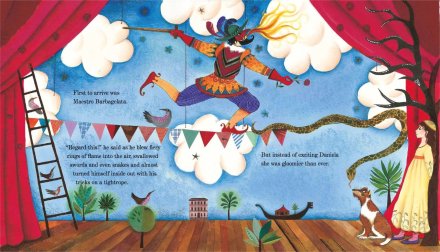
Right away he had his glassmakers begin construction. “They blew and pulled and pinched the molten glass into sliver-spun walls with pineapple-topped turrets and winged-dragon doors.” Soon people where coming from all over to try to make Daniela smile. First was Maestro Barbagelata, who could breathe fire, swallow swords and snakes, and do tricks on a tightrope. But his performance just made Daniela “gloomier than ever.”

celebrate-picture-books-picture-book-review-the glassmaker's-daughter-glum

Image copyright Jane Ray, 2017, text copyright Dianne Hofmeyr. Courtesy of Frances Lincoln Children’s Books.

Next the mask maker Donna Violetta Rufina Zangara arrived with a carriage full of masks made with jewels, birds’ eggs, shells and pearls, and peacock feathers. But Daniela was not enticed by these masks; in fact, they made her “glummer than ever.” Leonardo Leonino Grandi brought his fierce lion, which instead of amazing Daniela caused Leonardo to topple from his gondola into the water. “But even this didn’t bring a smile to Daniela’s lips.”

So many tradespeople, performers, tricksters, and adventurers were sure that they could make Daniella smile, but none of them succeeded. Daniela’s father was at a loss. But down in a corner of the glassmaker’s workshop Angelo thought he knew just what to do. He “longed more than anyone to make Daniela smile.” As he removed the hot glass from the furnace and began blowing it, he whispered, “‘Flux and fire.’” As he laid the glass flat and spread slivers of silver mercury on the surface, he chanted, “‘Mercury and tin,’” As he smoothed the slivers, he said, “‘Foiled and finished. And polished thin,’” When he finished “he sang his secret song again.”

celebrate-picture-books-picture-book-review-the glassmaker's-daughter-glass-palace

Image copyright Jane Ray, 2017, text copyright Dianne Hofmeyr. Courtesy of Frances Lincoln Children’s Books.

The other glassmakers scoffed when Angelo told them he was making something that would make Daniela smile. But with his gift carefully wrapped, Angelo went in search of Daniela. When he found her and she saw the glass in his hand, she rejected his gift. But Angelo told her to “‘Look again, Principessa. This is no ordinary piece of glass. It’s different. Look into it.”

Daniela did as she was told, and when Angelo asked her what she saw, Daniela described “a creature with a mouth like an upside-down slice of lemon and the eyes of a cross dragon.” She thought it was the funniest face she had ever seen. And right before her eyes, the face changed. The lips turned up and the eyes began to shine. “Daniela burst out laughing.” As she laughed, the newly made glass palace began to splinter and crack until the “entire palace fell to smithereens.”

celebrate-picture-books-picture-book-review-the glassmaker's-daughter-sword-swallower

Image copyright Jane Ray, 2017, text copyright Dianne Hofmeyr. Courtesy of Frances Lincoln Children’s Books.

Daniela’s father promised to build Angelo another palace if he would only tell him how his “magic glass” had made his daughter smile. But Angelo told him that Daniela had changed herself. “‘My glass only reflects what’s already there,’” he said. “‘Happiness is inside all of us. You only have to discover it.’” Daniela agreed, and laughed once more as she peered into the glass. The sound of her laughter set every bell in the city ringing. Men, women, and children began to laugh with her. They danced and played. Even the Grand Doge emerged from his palace to join in the celebration.

So if you hear the bells of Venice ringing, you know that Daniela is laughing, and if you “peep into a looking glass,” you will most likely see a smile on your face too.

A brief and fascinating history of glassmaking and mirror making precedes the story.

celebrate-picture-books-picture-book-review-the glassmaker's-daughter-mask-maker

celebrate-picture-books-picture-book-review-the glassmaker’s-daughter-sword-swallower

Written in the style of classic fairy tales, Dianne Hofmeyr’s story has a very contemporary message—one that is a timely reminder and allows young readers to embrace their power to determine their own happiness. Children may smile at the various attempts to please Daniela, but they—like Angelo—will also appreciate and understand that Daniela was searching not for outward but inward happiness all along.  

Jane Ray’s lush illustrations mirror the colors and atmosphere of Venice, as the performers don carnival masks and costumes, gondolas are poled along the canals, and the dark glassmaker’s workshop glows with molten glass. The delicate and lovely glass palace depicted at the beginning of the story shatters into shimmering shards in a two-page spread which makes dazzling use of iridescent paper accents. This stunning image is a beautiful metaphor for Daniela’s warmth breaking through her seemingly cold and fragile exterior when she finally smiles and laughs.

Ages 4 – 8

Frances Lincoln Children’s Books, 2017 | ISBN 978-1847806765

Discover more about Dianne Hofmeyr and her books on her website

Learn more about Jane Ray, her books, and her art on her website.

Read a New Book Activity

celebrate-picture-books-picture-book-review-I-love-to-read-coloring-page

I Love to Read Coloring Page


If you love books as much as this little bookworm, you’ll like coloring this printable I Love to Read Coloring Page!

Picture Book Review

December 13 – National Day of the Horse

celebrate-picture-books-picture-book-review-thelma-the-unicorn-cover

About the Holiday

Today’s holiday encourages people to commemorate the importance of the horse to the history, culture, and economy of the United States. The domesticated horse that we know today was first introduced by Spanish Explorers. As the country grew, horses became indispensable for transportation, farm and ranch work, and communications. The more than nine million horses that now reside in America depend on people for adequate food, water, shelter, and protection. On this holiday, consider donating to a horse rescue shelter near you.

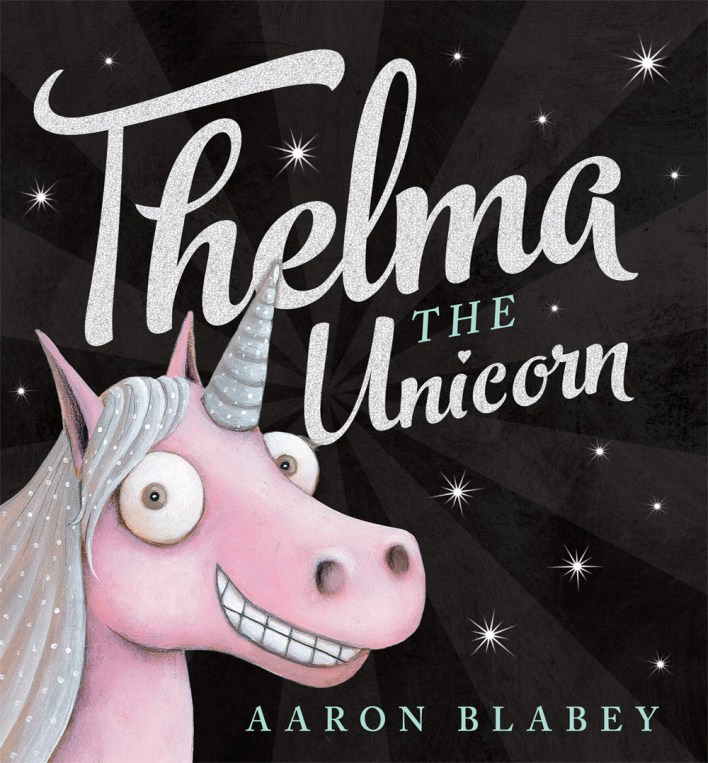
Thelma the Unicorn

By Aaron Blabey


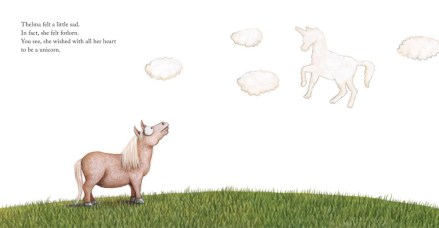
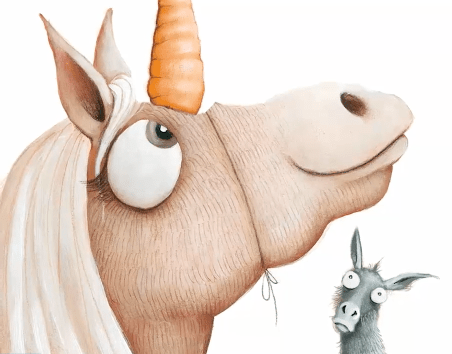
“Thelma felt a little sad. / In fact, she felt forlorn. / You see, she wished with all her heart / to be a unicorn.” Thelma was a little pony—brown and short and overlooked. Her best friend Otis told her, “‘You’re perfect as you are,’” but when Thelma compared herself to the sleek white mare on the farm, she said, “‘I’m not.’” Suddenly, she saw a carrot left over from dinner and had an idea.

celebrate-picture-books-picture-book-review-thelma-the-unicorn-wishing

Copyright Aaron Babey, 2017, courtesy of Scholastic Press.

She tied the carrot to her nose and told Otis, “‘I’ll say that I’m a unicorn! / It might just work… / who knows?’” At this very moment a truck driver passing by caught sight of this spectacle and careened off the side of the road. “As Thelma watched the swerving truck, / it very nearly hit her. / Would you believe that truck was filled / with nice pink paint and glitter?”

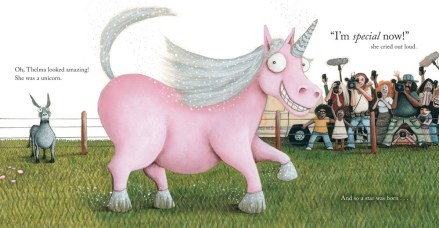
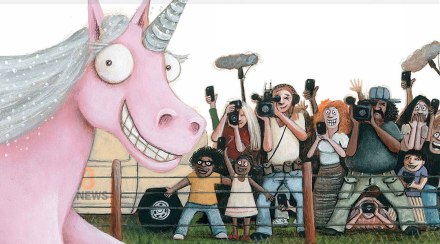
In the blink of an eye Thelma was doused in sparkles and had become what she always dreamed of. She was a unicorn and “special now!” Crowds lined up at the farm gate to see the pink unicorn. The media descended with their cameras and video recorders, and Thelma quickly became a world-wide phenomenon. Everywhere she went fans screamed her name, took pictures, waved signs, and wanted to be near her. She even got her hoofprint on the Walk of Fame.

celebrate-picture-books-picture-book-review-thelma-the-unicorn-becomes-unicorn

Copyright Aaron Babey, 2017, courtesy of Scholastic Press.

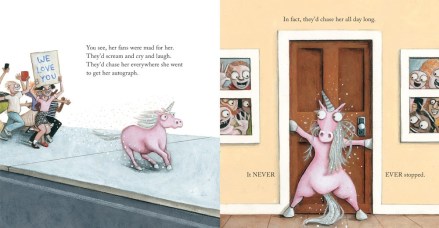
Thelma sailed to foreign ports on a ship named The Fairy Princess, attended by stewards who fulfilled her every wish. “But soon she found that so much fame / was kind of tricky, too….” Her fans mobbed her with crushing zeal, chased after her wherever she went, screamed, cried, laughed, and pointed whenever they saw her, and hounded her day and night for her autograph. “It NEVER EVER stopped.”

When Thelma asked “the screaming crowd” not to chase her anymore, they said “‘We’ll chase you all we want….We’re fans, so it’s allowed.’” Then there were there were the people who “were not her fans at all. / No, some were really mean. / And some just did the meanest things / she’d really ever seen.” Some threw eggs while she roller skated for charity and others held up signs reading “I don’t like unicorns” where she was sure to see them.

celebrate-picture-books-picture-book-review-thelma-the-unicorn-adoring-crowds

Copyright Aaron Babey, 2017, courtesy of Scholastic Press.

Back in her fancy hotel room, all alone and bedraggled, soaked in egg, and with her “horn” losing its luster, Thelma looked at a photo of Otis. “…she felt quite sad, / this famous little pony. / She said, ‘I thought that I’d feel great… / but all I feel is lonely.’” She decided to make a change. She washed off all the pink paint and sparkles and “ditched her magic horn.”

She left and “walked right past the crowd. / They didn’t even notice / She thought how nice that it would be…to see her lovely Otis.” As Thelma stood underneath a tree with Otis, “he asked about her trip.” “‘Oh, it was fun,’” she answered him, “‘But I’d rather be just me.’”

celebrate-picture-books-picture-book-review-thelma-the-unicorn-being-chased

Copyright Aaron Babey, 2017, courtesy of Scholastic Press.

Aaron Blabey’s cautionary tale of a pony who is granted her wish to be “more” than she is, deftly reveals the pitfalls of abandoning your true nature for what appears to be the perks of celebrity with a splash of humor and some no-nonsense honesty. Through Blabey’s smoothly flowing rhymes, readers see that being special is not based on a sparkly appearance that pleases false friends. Instead, each person is remarkable for their unique personalities and talents that true friends will appreciate.

Today’s social media-savvy children will recognize Blabey’s screaming crowds and overzealous fans and will come to understand, with Thelma, that being “in the pink” can be short-lived and glitter soon fades.

celebrate-picture-books-picture-book-review-thelma-the-unicorn-carrot-horn

Copyright Aaron Babey, 2017, courtesy of Scholastic Press.

Blabey’s distinctive illustrations portray Thelma’s transformation from “regular pony” to celebrity unicorn and back again with flair and all the bling that goes along with superstardom. The crowds are giddy, awed, obsessive, and adoring until the backlash starts, which Blabey portrays with candid examples. His final spreads in which Thelma goes unrecognized by her fans and is then lovingly welcomed back by Otis beautifully sum up the theme of the story.

Thelma the Unicorn provides readers and adults a wonderful opportunity to discuss the allure of changing oneself in order to fit in as well as the social media atmosphere that can be so influential in a child’s life. Blabey’s light touch coupled with his honesty makes Thelma the Unicorn a great choice for  home and classroom libraries.

Ages  3 – 7

Scholastic Press, 2017 | ISBN 978-1338158427

Scholastic Press sent me a free copy of Thelma the Unicorn to check out. All opinions are my own.

Discover more about Aaron Blabey, his books, and his art on his website

National Day of the Horse Activity

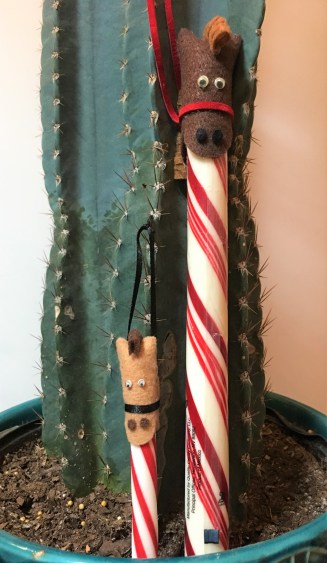
celebrate-picture-books-picture-book-review-horse-candy-stick-cover

Whoa! Candy Stick Cover


There’s no neigh-saying that this isn’t a cute way to give your favorite candy stick a bit of flair!  With a bit of felt and a few other supplies you can make this horse craft. Alternately, this craft can be used with a cardboard tube or wooden dowel.

Supplies

  • Large or small candy stick, cardboard tube or wooden dowel
  • Felt in whatever color you’d like for your horse
  • Felt in a another color for the mane
  • Black felt for the nostrils
  • Thin ribbon or leather lacing
  • Small googly eyes
  • Fabric glue or hot glue gun
  • Scissors
  • Tweezers

Directions

  1. Cut a piece of felt wide enough to wrap around the stick overlapping a little to glue together. It should be long enough to cover about 1 ½ inches of a small candy stick, about 2 ½ inches of a large candy stick, or about 3 to 4 inches of a cardboard tube or wooden dowel.
  2. Wrap the felt around the stick overlapping the edge about ¼ inch and leaving about ½ inch above the top of the stick.
  3. Glue the felt together along the overlapping edge to make a tube that fits the stick tightly

To make the ears

  1. Push down on the center of the back side of the felt that rises above the top of the stick
  2. Apply a drop of glue
  3. Push the center of the front edge of the felt into the glue
  4. The ears will stick up on the sides of the head

To make the horse’s nose and mouth

  1. Remove the felt head from the stick
  2. Pinch the end together
  3. Starting about ½ inch from the bottom, round the corners of the felt tube with the scissors

To make the nostrils

  1. Cut small circles from the black felt
  2. Glue them to the bottom of the horse’s nose
  3. Glue the googly eyes on the horse’s face

To make the mane

  1. Cut a strip of felt as long as the face by 1 inch wide for a large candy stick; about ¾ inch wide for a small candy stick
  2. Fold the felt in half lengthwise
  3. Glue the edges of the felt together, leaving the top unglued
  4. Snip fringe along the length of the felt
  5. Cut a small curve in the bottom of one end of the length of felt so it will fit over the top of the horse’s head
  6. Glue the rest of the length of felt down the back of the horse’s head

To add the reins

  1. Cut a length of narrow ribbon or leather lacing about 6 inches long
  2. Glue the center of the ribbon or lacing to the horse’s face above the nostrils at the level of the trimmed mouth around to the mane
  3. Tie the ends of the ribbon or lacing together

Picture Book Review

November 9 – It’s National Aviation History Month

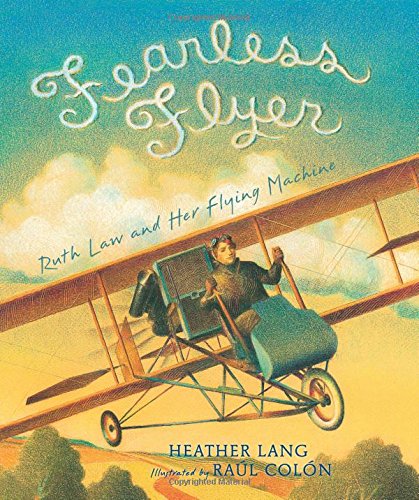
celebrate-picture-books-picture-book-review-fearless-flyer-cover

About the Holiday

National Aviation History Month and is dedicated to exploring, recognizing and celebrating America’s great contributions and achievements in the development of aviation. Human-powered flight has come a long way from its earliest roots in kites and gliders. Hot-air balloons and biplanes gave way long ago to more and more sophisticated airplanes, jets, and rockets that blast into space. To celebrate the month, visit a local museum or read up on some of the pioneers of early flight—like the courageous woman in today’s book.

Fearless Flyer: Ruth Law and Her Flying Machine

Written by Heather Lang | Illustrated by Raúl Colón


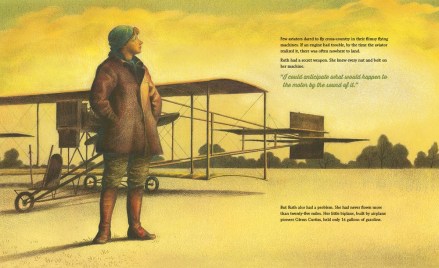
Entertained crowds knew Ruth Law for the loops, the spiral dives, and even the dip of death that she performed in her airshow. But for Ruth these stunts were like standing still. She “longed to fly to get somewhere…somewhere far away.” She decided to make a trip from Chicago to New York City. There weren’t too many aviators brave enough to attempt such a long flight in the type of biplane Ruth flew. They feared that if something went wrong with the engine, they’d never realize it in time to land. But Ruth knew her plane inside and out and figured she “could anticipate what would happen to the motor by the sound of it.”

A trip like the one Ruth envisioned posed another problem, though. Her small biplane held only 16 gallons of gasoline—not enough to make the journey. She asked Glenn Curtis, who built her plane, if she could buy his latest model. This much bigger plane held 205 gallons of gas and had already proven itself for long-distance flight. But Curtis refused. He didn’t believe Ruth could handle the “powerful machine on such a long flight.”

celebrate-picture-books-picture-book-review-fearless-flyer-ruth's-plane

Image copyright Raúl Colón, text copyright Heather Lang. Courtesy of Calkins Creek.

Ruth was not to be deterred. She added three more gas tanks to her plane so that it could hold 53 gallons, installed a cover to protect her legs, and created a scrolling map of the route. Aviation experts said she would fail, but Ruth disagreed. “‘What those men can do a woman can do. I can do,’” she said. On a windy November 19, 1916, Ruth took to the cockpit to begin her nonstop flight. Although she was a little afraid of what lay ahead, she took off, believing that “the scare is part of the thrill” of any experience.

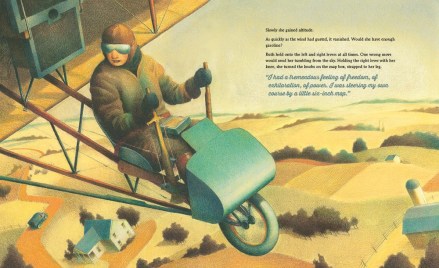
Ruth had counted on the strong wind to help push her farther faster, but just as quickly as it had blown up, the wind stopped. Ruth wondered if she would have enough gasoline after all. Flying over one landmark after another, Ruth felt exhilarated. As she passed over Cleveland, Ohio, though, “the oil gauge registered zero pressure. Something was wrong!” The sounds of her plane’s motors told Ruth a different story. She kept flying.

Soon she was passing over Erie, Pennsylvania—the site of the record-breaking flight by Victor Carlstrom. Even the icy stings of the frigid air couldn’t diminish her excitement. In a moment she was east of Erie and had broken Carlstrom’s record. The thrill of her achievement was tempered, however, by the sputtering of her engine. While there was still a little gas in the plane, it was “too low to feed into the engine.” Ruth tipped the plane forward to give it more gas. Two miles from Hornell, New York, the nearest landing spot, “the engine grumbled its last roar, leaving her with nothing but the silence of the wind.”

celebrate-picture-books-picture-book-review-fearless-flyer-arial-view

Image copyright Raúl Colón, text copyright Heather Lang. Courtesy of Calkins Creek.

Ruth steered the plane as it glided into Hornell—512 miles from Chicago. She was the new American nonstop flight record holder. Ruth’s original plan had been to fly to New York City, so after refueling and grabbing a bite to eat, she took off once again. Weighed down by the full gas tank, the plane barely made it over a hill and tall trees in her path. This was as close to crashing as Ruth ever came—or ever wanted to be.

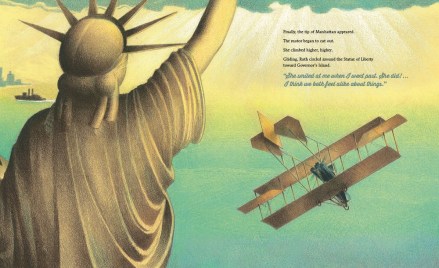
People along the route had already heard about Ruth Law, and they came out to watch and wave. With darkness closing in, Ruth decided that she would have to land short of New York City. She touched down in Binghamton, New York and took up the rest of the flight the next morning. As a thick blanket of fog obscured her view, Ruth flew lower and lower to get her bearings. When she finally spied the tip of Manhattan, she glided in and “circled around the Statue of Liberty toward Governor’s Island.” Of Lady Liberty, Ruth said, “‘She smiled at me when I went past. She did!…I think we both feel alike about things.’”

celebrate-picture-books-picture-book-review-fearless-flyer-statue-of-liberty

Image copyright Raúl Colón, text copyright Heather Lang. Courtesy of Calkins Creek.

Cheered by a celebratory crowd and brass band, Ruth landed on the welcoming earth. Despite the icicles that hung from her hair and the numbing cold, Ruth smiled and waved. She realized then that not only had she broken an aviation record, she had made a point for all women. She later put her thoughts into words: “The sky was my limit and the horizon my sphere. It’s any woman’s sphere if she has nerve and courage and faith in herself.”

An Author’s Note about Ruth Law and her life, complete with photographs, follows the text.

Heather Lang’s thrilling account of Ruth Law’s record-breaking flight from Chicago to New York will have young aviators on the edge of their seat. Law’s flight was filled with suspense from its inception as an idea in a young woman’s mind to its final touchdown, and Lang deftly incorporates the facts as well as Law’s feelings into her well-rounded story. Along the way, readers learn about Ruth and also about early aviation. Ruth Law’s own words, included throughout the story, will inspire children as they see that even though she lived long ago, her thoughts and ideas still ring true today.

Young readers will be fascinated by Raúl Colón’s glowing illustrations of Ruth Law and her flying machine. His detailed drawings of Law’s biplane give children an excellent view of the open-air craft, fostering a true understanding of the courage it took for her to undertake such a flight. Images from Law’s viewpoint in the cockpit allow readers to vicariously travel her path to self-realization and a record-breaking flight.

Ages 5 – 8

Calkins Creek, 2016 | ISBN 978-1620916506

Check out Heather Lang’s website for more about her and her books. You’ll also find links to a video and photos about Ruth Law, a map of her route, and information about her plane as well as a Teacher’s Guide.

Fly along with Ruth in this Fearless Flyer book trailer!

National Aviation History Month Activity

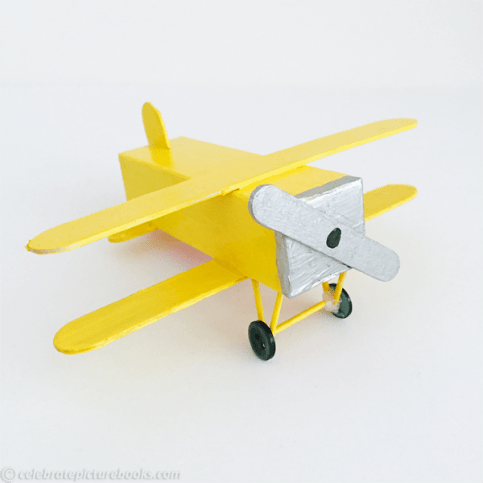
celebrate-picture-books-picture-book-review-biplane-craft

Head in the Clouds Biplane


If you love airplanes and flying, you’ll have fun making your own plane from recycled materials! Use your creativity to decorate your plane while you imagine yourself flying through the clouds on a beautiful day. Younger children will have fun sharing this activity with an adult or older sibling too!

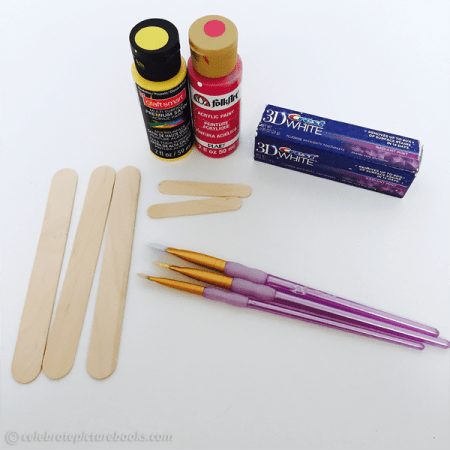
Supplies

  • Travel-size toothpaste box
  • 3 6-inch x 1/2-inch craft sticks
  • 2  2 1/2-inch x 7/8-inch mini craft sticks
  • 5 Round toothpicks, with points cut off
  • Paint in whatever colors you like for your design
  • 4 small buttons
  • 2 mini buttons
  • Paint brushes
  • Strong glue or glue gun

Directions

  1. Empty toothpaste box
  2. Paint toothpaste box and decorate it
  3. Paint the craft sticks and 5 toothpicks
  4. Paint one small craft stick to be the propeller
  5. Let all objects dry

To assemble the biplane

  1. For the Bottom Wing – Glue one 6-inch-long craft stick to the bottom of the plane about 1 inch from the end of the box that is the front of the plane
  2. For the Top Wing – Glue the other 6-inch-long craft stick to the top of the plane about 1 inch from the front of the plane
  3. For the Tail – Glue one mini craft stick to the bottom of the box about ¾ inches from the end that is the back of the plane
  4. For the Vertical Rudder – Cut the end from one of the painted 6-inch-long craft sticks, glue this to the back of the box, placing it perpendicular against the edge and half-way between each side

To assemble the front wheels

  1. Cut 4 painted toothpicks to a length of ¾-inches long
  2. Cut one painted toothpick to a length of 1-inch long
  3. Glue 2 of the 3/4-inch toothpicks to the back of 1 button, the ends of the toothpicks on the button should be touching and the other end apart so the toothpicks form a V
  4. Repeat the above step for the other wheel
  5. Let the glue dry
  6. Glue the 1-inch long toothpick between the wheels at the center of each wheel to keep them together and give them stability. Let dry

To make the back wheel

  1. Cut two ¼-inch lengths of painted toothpick and glue them together. Let dry
  2. Glue two mini buttons together to form the back wheel. Let dry
  3. Glue the ¼-inch toothpicks to the mini buttons. Let dry
  4. Glue these to the bottom of the plane in the center of the box directly in front of and touching the tail

Display your biplane!

Picture Book Review

October 10 – National Face Your Fears Day

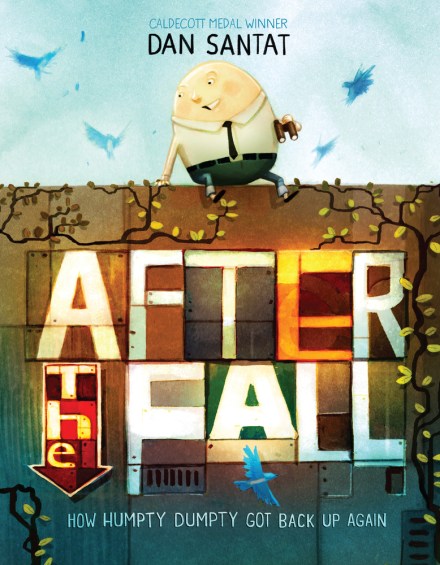
celebrate-picture-books-picture-book-review-after-the-fall-cover

About the Holiday

Going outside your comfort zone can be scary, but being afraid holds you back and affects your quality of life. Today’s holiday encourages people to face their fears and overcome trepidation or hesitance and say, “I’m going to do it!” Perhaps knowing that others are also trying the hard thing today will provide a little extra courage. You never know what you can achieve until you take that first step!

After the Fall (How Humpty Dumpty Got Back Up Again)

By Dan Santat


If readers don’t quite remember what happened to Humpty Dumpty back in the day,  his unfortunate accident is captured on the title page. But this is not a story about falling (we all do that sometimes). Instead, as the subtitle reveals, it’s about the recovery. Here, Humpty Dumpty tells his story his way—what really happened on that fateful day and afterward.

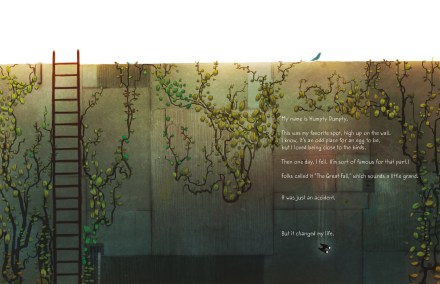
Humpty takes readers back to the scene where it all happened: his “favorite spot high up on the wall.” He acknowledges that it’s a strange place for such a fragile being to be, but up there he felt closer to the birds. He goes on to say that he’s not really comfortable with all the fuss and the fancy “Great Fall” title. It was just a mistake; even if that mistake did change his life.

celebrate-picture-books-picture-book-review-after-the-fall-wall

Copyright Dan Santat, 2017, courtesy us.macmillan.com.

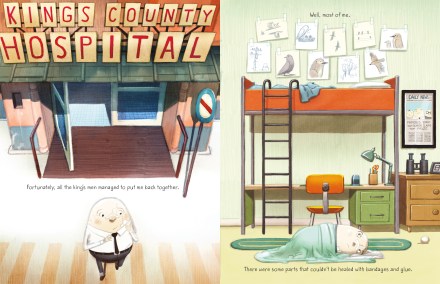
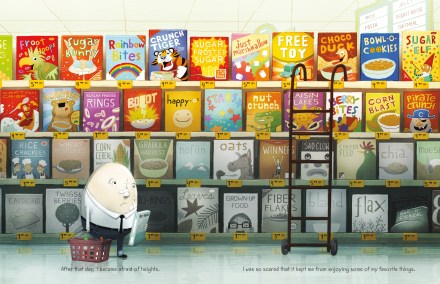
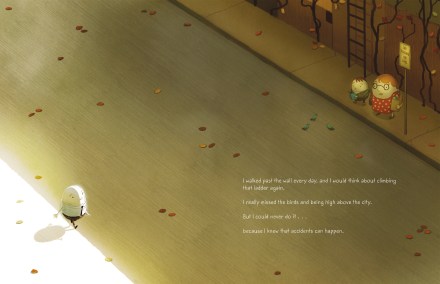
It turns out that despite what we’ve all learned, the king’s men were able to patch Humpty up. Well, at least partly. His shell was repaired, but inside? “There were some parts that couldn’t be healed with bandages and glue.” Where Humpty once loved his bunk bed above his desk, he now slept on a mat on the floor; he only bought items from the lowest grocery store shelves; and even though he passed the wall every day, he knew he could never climb the ladder to the top again.

Humpty resigned himself to watching the birds from the ground through a pair of binoculars. Then, one day, a paper airplane streaked across the sky and gave him an idea. Paper airplanes looked so easy to make, but Humpty found it hard. Day after day he struggled, suffering paper cuts and scratches. One day, though, he “got it just right.” In his hand was a beautiful paper bird.

celebrate-picture-books-picture-book-review-after-the-fall-hospital

Copyright Dan Santat, 2017, courtesy us.macmillan.com.

Humpty took his bird plane outside and launched it into the air. “It flew like nothing could stop it.” Humpty felt happier than he had in ages, and even though watching his plane wasn’t the same as being on top of the wall among the birds, “it was close enough.” But then the unthinkable happened—the bird plane flew over the wall. Humpty was well aware that “unfortunately, accidents happen…they always do.”

For a minute Humpty Dumpty considered walking away. But then he remembered all the work he’d put into his plane, which led him to think about all the things he was missing out on. He looked up that tall, tall ladder and started to climb. The farther up he got, though, the more afraid he became. Without looking up or down, he continued climbing. “One step at a time.”

When he reached the top, he “was no longer afraid.” At that moment, as his shell began to crack and he felt lighter and more powerful. Humpty tells readers that he hopes they won’t remember him as “that egg who was famous for falling,” but as “the egg who got back up and learned how to fly.”

celebrate-picture-books-picture-book-review-after-the-fall-cereals

Copyright Dan Santat, 2017, courtesy us.macmillan.com.

Dan Santat deftly works with preconceived notions and a well-known idiom to turn the nursery rhyme about Humpty Dumpty into an inspirational “happily ever after” story. Just as fears can come to define a person, traditional interpretations of this tale classify Humpty as a chicken egg and specify his lack of repair as physical. But what if, as Santat envisions, Humpty is the egg of a bird that soars and that his hurts are more internal? Then readers can identify with this hero who doesn’t give in and who conquers his fear to come out of his shell and fly. Santat’s honest, straightforward storytelling will resonate with young readers and listeners. The gentle reassurance in After the Fall will encourage children to try again—one step at a time.

celebrate-picture-books-picture-book-review-after-the-fall-walking-past-wall

Copyright Dan Santat, 2017, courtesy us.macmillan.com.

Santat’s luminous illustrations express wonder, humor, and touching moments in ways that not only enhance the story but make readers think about other issues as well.  Children will want to linger over the pages to catch all the references to Humpty’s bird watching hobby, take in the enormity of the wall that Humpty Dumpty confronts, and catch humorous takes on the original rhyme, including Santat’s King’s County Hospital. Adults and kids alike will enjoy poring over and discussing the wall of cereals, and as Humpty’s tiny hand reaches for the next rung on the ladder adults may feel a lump in their throats. When Humpty breaks free of his shell and emerges in the same form as the paper bird he created, readers may consider whether Humpty spent time only working on his toy or on himself as well.

After the Fall is a picture book that offers reassurance and invites deeper discussion. The book would be a welcome addition to home, classroom, and school libraries.

Ages 4 – 8

Roaring Brook Press, 2017 | ISBN 978-1626726826

Learn more about Dan Santat and After the Fall (How Humpty Dumpty Got Back Up Again) on the book’s website.

Face your Fears Day Activity

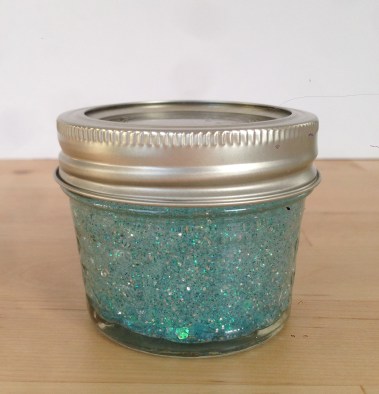
celebrate-picture-books-picture-book-review-mind-jar

Calming Sensory Jar


You can capture the beauty of a glittering snowfall in this easy craft—that also makes a special gift for a friend!

Supplies

  • Small to medium mason jar or other decorative jar with a tight lid
  • White glitter glue,
  • Light blue glitter glue,
  • Fine white and/or blue glitter
  • Large white and/or blue glitter
  • Warm water

Directions

1. For every 1/2 cup of warm water add:

  • 1 1/2 teaspoons white glitter glue
  • 1/2 teaspoon blue glitter glue
  • 2 teaspoons fine glitter glue
  • 1/2 teaspoon large glitter

2. Close lid tight

3. Shake

4. As glue dissolves, the liquid will become clearer and the glitter will remain suspended in it

Picture Books Review


September 26 – Love Note Day

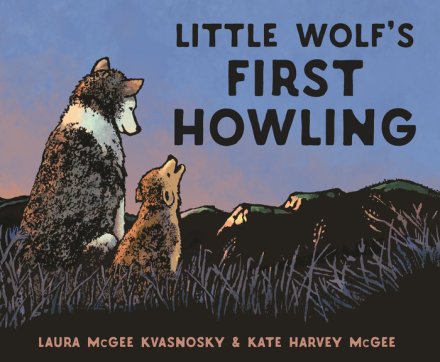
celebrate-picture-books-picture-book-review-little-wolf's-first-howling-cover

About the Holiday

Today’s holiday was established to encourage people to communicate how they feel about each other by writing a note of affection to their special someone, child, or friend. Sure, you can always text your note, but why not get creative? Leave your note on the bathroom mirror, tuck a written message into a lunch bag, hide a post-it in your loved-one’s shoe, or drop a letter off in person and share a cup of tea. Of course, you may choose to send a different kind of love note—as you’ll see in today’s book!

Little Wolf’s First Howling

Written by Laura McGee Kvasnosky | Illustrated by Kate Harvey McGee


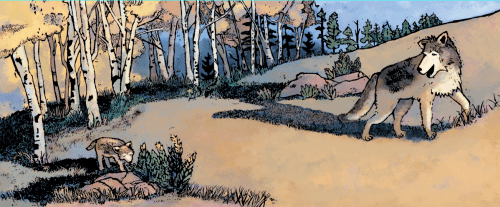
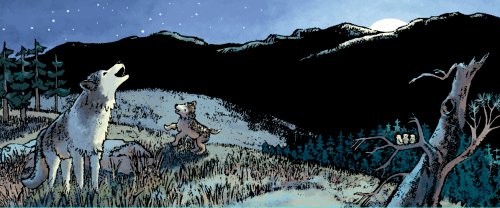
The day had come for a big step in Little Wolf’s education. As Big Wolf led his son to the top of the hill, Little Wolf hung back, exploring every plant and rock formation. “‘Tonight’s the night,’ said Big Wolf, “‘Your first howling.’ Little Wolf’s ears shivered with excitement. ‘I’m ready,’ he said. ‘I’m ready to howl!’” They sat on the hill watching the stars and the moon appear. Little Wolf was eager to start.

celebrate-picture-books-picture-book-review-little-wolf's-first-howling-exploring

Image copyright Kate Harvey McGee, 2017, text copyright Laura McGee Kvasnosky, 2017. Courtesy of Candlewick Press.

First, however, Big Wolf needed to “demonstrate proper howling form.” He stood up, breathed deeply, and lifted his face to the dark sky. “AAAAAAAAAAOOOOOOOOOOOOO,” he howled, letting the last notes fade into the night air. The sound thrilled Little Wolf. He leaped on a fallen tree, raised his head and let out an “aaaaaaaaaaooooooooooooo I’m hoooowling, ‘oooowling, ‘ooooowling!”

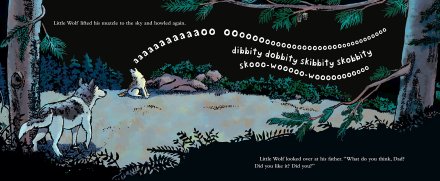
Big Wolf gazed at his son with amusement and surprise and gently told him that he did not use proper finishing form. Again he demonstrated. Little Wolf was sure he knew how to do it now. He raised his head high and gave it all his might. “aaaaaaaaaaoooooooo…dibbity dobbity skibbity skobbity skooo-wooooo-wooooooooooo.” Little Wolf enthusiastically waited for his father’s opinion.

celebrate-picture-books-picture-book-review-little-wolf's-first-howling-small-howl

Image copyright Kate Harvey McGee, 2017, text copyright Laura McGee Kvasnosky, 2017. Courtesy of Candlewick Press.

Big Wolf wanted to be supportive; he wanted to be a good dad. “‘Son, I am proud of your nose, which has led to many new trails. I admire your strength when you tumble with the other pups. Most of all, I love how your ears express your thoughts. But your howling? It is not proper howling form.’”

Little Wolf felt listened carefully one more time as his father showed him again how to howl. The call was beautiful as it echoed over the hills. Then it was Little Wolf’s turn. Inside, his “heart swelled with wildness and joy,” and even though he knew what was welling up inside of him was not correct form, he opened his muzzle and let it out: “skiddily skoddily beep bop, a booobooo booooooooo…boppita boppita wheeee bop, a diddily daddily doooooooooooooo…”

celebrate-picture-books-picture-book-review-little-wolf's-first-howling-big-wolf-demonstrating

Image copyright Kate Harvey McGee, 2017, text copyright Laura McGee Kvasnosky, 2017. Courtesy of Candlewick Press.

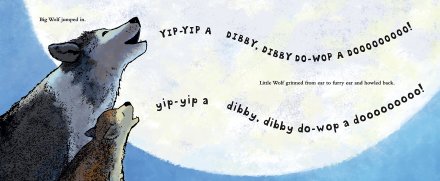
Big Wolf cocked his head and perked up his hears and listened closely. As the notes floated past him, “his tail started wagging. His ears started twitching. His paws started tapping.” Then, before he knew it, he joined in with a “yip-yip a dibby, dibby, do-wop a dooooooooo!,” and Little Wolf repeated it back. As the sky grew darker and the moon rose high, the two voiced filled the valley with jazzy music.

The time grew late, and father and son headed back home. Little Wolf couldn’t wait to tell the others about his first howling. “‘Big Wolf smiled. ‘Oh, I expect they already know,’” he said.

celebrate-picture-books-picture-book-review-little-wolf's-first-howling-howling-together

Image copyright Kate Harvey McGee, 2017, text copyright Laura McGee Kvasnosky, 2017. Courtesy of Candlewick Press.

Laura McGee Kvasnosky’s father and son story is heartening in many ways. Big Wolf’s gentle and patient teaching style shows the love he has for his child while Little Wolf’s eagerness to please his dad is equally warm, but also overflowing with his own personality. In Big Wolf, Kvasnosky has created a wonderful adult character. By prefacing his instructions with Little Wolf’s strengths, Big Wolf demonstrates not only proper howling form, but also a beautiful understanding of how to build Little Wolf’s self-confidence and self-image. His willingness to really listen to Little Wolf’s howling and allow his son to take the lead is a lesson that is enriching for both children and adult readers. Kids will adore howling like Little Wolf, and adults will smile at the last line, which is full of humor and love.

Kate Harvey McGee’s gorgeous nighttime scenery provides the perfect backdrop to this sweet story. As the night grows darker, her blues become lush and deep, highlighting Big and Little Wolf as they raise their voices to the bright full moon. Yellow accents in the flowers, typography, and tiny owlets create a cozy glow that reflects the love between father and son. Stippling of the wolves fur coats brings these beautiful animals to life. Images of the father and son, both close together and a bit farther apart, mirror their relationship and the pup’s growing independence.

Little Wolf’s First Howling is a fantastic read aloud and a cozy book to snuggle up with at bedtime. It would be a much-asked for favorite for home libraries and classrooms.

Ages 3 – 7

Candlewick, 2017 | ISBN 978-0763689711

You can learn more about Laura McGee Kvasnosky and her books—and find cool projects to do too—on her website!

Love Note Day Activity

celebrate-picture-books-picture-book-review-kindness-cards

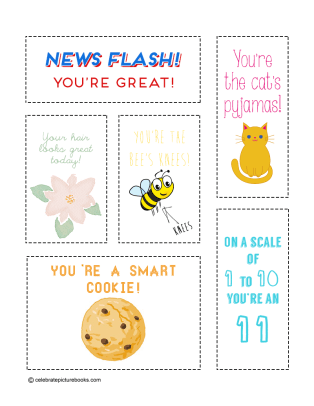
Love Notes to Share


Today’s a perfect time to share your feelings with those you love! Print out these cute Love Notes and give them to your favorite people!

Picture Book Review

September 25 – World Dream Day and Interview with Author Michelle Cuevas

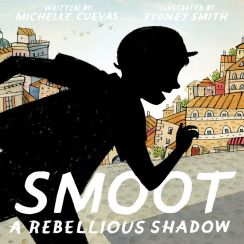
celebrate-picture-books-picture-book-review-smoot-cover

About the Holiday

World Dream Day is a global participatory holiday that encourages individuals, schools, businesses, and families to focus on their dreams and make them reality. Discovering and acting on your dreams can transform not only your life, but the lives of others. Imagine how the world could change if everyone had the opportunity to live their dreams. Today, feel inspired and empowered to do or become whatever you’ve always dreamed of!

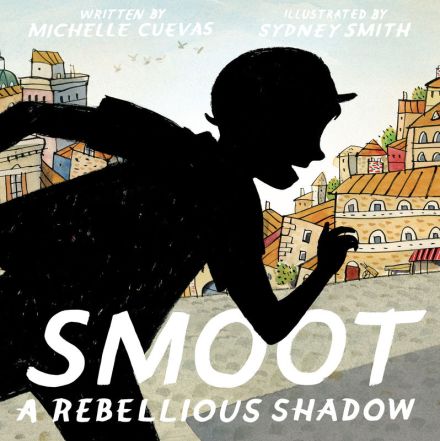
Smoot: A Rebellious Shadow

Written by Michelle Cuevas | Illustrated by Sydney Smith


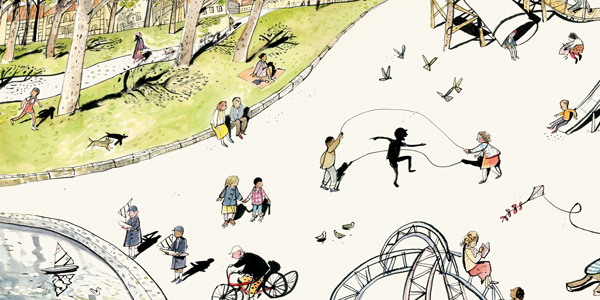
Smoot the Shadow was bored. Bored. Bored. For seven and a half years, he’d been doing the same things over and over. Every day, he and his boy—to whom he was firmly connected—“brushed the same teeth, frowned the same frown, and drew the same pictures—always staying perfectly inside the lines.” Smoot’s boy never jumped, ran, or even laughed, so Smoot never did either.
celebrate-picture-books-picture-book-review-smoot-jumping-rope

Image copyright Sydney Smith, 2017, text copyright Michelle Cuevas, 2017. Courtesy of Dial Books.

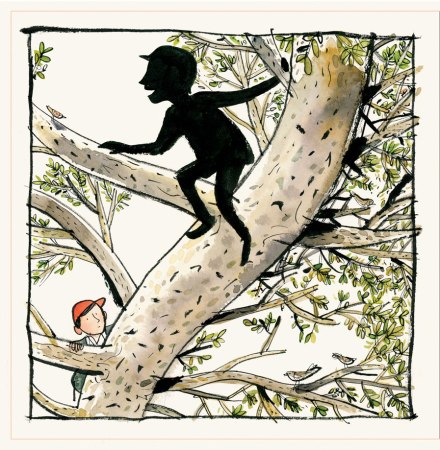
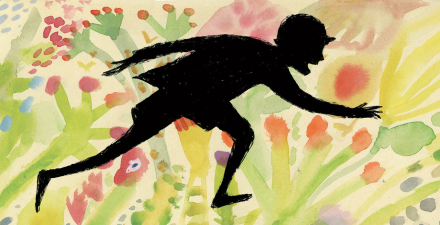
Excet at night. Then, while the boy slept, Smoot dreamed. He dreamed in a multitude of colors about singing, dancing, and having fun. One day, with an unexpected “pop” Smoot became free of his boy. He didn’t waste a moment, but packed a few things and headed out into the world. He jumped rope, rode a carousel and climbed a tree to say hello to a little bird. He even got to dance in a field of multicolored wildflowers just like in his dreams.
celebrate-picture-books-picture-book-review-smoot-climbing-a-tree

Image copyright Sydney Smith, 2017, text copyright Michelle Cuevas, 2017. Courtesy of Dial Books.

Suddenly, other shadows took notice. As they watched Smoot play, they became braver too. “‘If he can follow his dreams, we can too,’” they reasoned. The first shadow to take the plunge was a dandelion. As it soared away into the sky, becoming an indistinct form, people tried to guess what it was. All this attention emboldened the shadows of a cricket and a grasshopper who had “formed a band, but were nervous about playing music in public.” Their shadows, however, picked up their instruments and played “like cool shade on a hot afternoon.”
celebrate-picture-books-picture-book-review-smoot-jumping-dancing-in-flowers

Image copyright Sydney Smith, 2017, text copyright Michelle Cuevas, 2017. Courtesy of Dial Books.

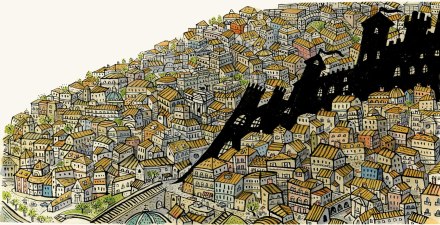
A frog’s shadow discovered his inner prince, and a dragonfly’s shadow floated out over the city as a ferocious dragon. Even a lowly rock’s shadow had dreams of greatness, transforming into “a cathedral, and then a skyscraper, and finally a castle that reached the clouds.” Smoot began to grow afraid of the imagination he’d unleashed. What if the shadows of zoo animals escaped and roamed through town or if the sun was eclipsed by the shadow of an enormous whale? How would anyone catch them?
celebrate-picture-books-picture-book-review-smoot-castle

Image copyright Sydney Smith, 2017, text copyright Michelle Cuevas, 2017. Courtesy of Dial Books.

But Smoot had an idea. He made a castle from the ambitious rock and some others. The frog moved in to live like a prince, and the dragonfly guarded the gate. Then Smoot sang with the grasshopper and cricket to give them more courage, and he blew the dandelion seeds into the air. The shadows all saw that their dreams had come true, so they returned to their owners, who also felt different.

And Smoot’s boy? All the excitement had inspired him to be more like his shadow. After he and his shadow reconnected, they ran, tumbled, jumped in puddles, and played in “singing, ringing, flying, vibrant, dancing color.”

Through her rambunctious shadows, Michelle Cuevas creatively externalizes that small (or loud) voice inside many people that is yearning to be heard and acted on. For many children and adults, giving free reign to their alter ego can feel uncomfortable or even frightening. In her lyrical and uplifting book, Cuevas reveals these dreams for greatness, recognition, or freedom and encourages readers to let go and chase them. She shines a light on how they can take that first step through play, teaming up, or using their imagination and talents to make their dreams come alive.
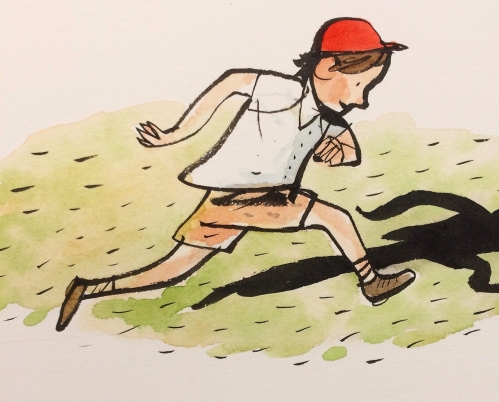
celebrate-picture-books-picture-book-review-smoot-a-rebellious-shadow-boy-runing

Image copyright Sydney Smith, 2017, text copyright Michelle Cuevas, 2017. Courtesy of sydneydraws.tumblr.com.

Sydney Smith’s striking images immediately orient readers to the monotone world the boy lives in. While outside the window colors abound, inside, the boy sits on a gray sofa with a black-and-white rug and his black-and-white dog nearby. The walls are white, the floor is dull, and even the plant—standing away from the light of the window—is browning. Perhaps, however, the painting above the boy offers hope and a little foreshadowing: Black images play on a white canvas, but a swipe of blue and a red dot add lively, colorful accents. Likewise, the red-covered book the boy reads is a bright spot in this otherwise dreary room.

The boy’s shadow, however, dreams in color. When Smoot pops free of his restraints and goes on a play-filled adventure, the illustrations are full of action and vibrancy. Smoot smiles and exults in his freedom. His joy is infectious, and his antics and clever ways of ensuring that each character gets to fulfill their aspirations will inspire children to uncover their own inner world.

Smoot: a Rebellious Shadow is a heartfelt and empowering book for hesitant and more adventurous children alike. It would make an ideal book for home libraries and classrooms.

Ages 4 – 8

Tundra Books, 2017 | ISBN  978-0525429692

Discover more about Michelle Cuevas and her books for children and tweens on her website!

View a portfolio of artwork by Sydney Smith on Tumbler!

World Dream Day Activity
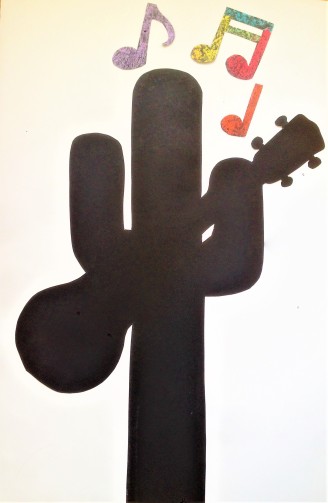
celebrate-picture-books-picture-book-review-shadow-blackboard-2 (2)

Live Your Dream! Shadow Blackboard


Shadows are fun to create and play with! Making a black board from a shadow is a great way to show your imagination while making a useful decoration for your room. Put on your inventive thinking cap and devise a unique shadow by using toys or other objects from home. You can even make a shadow of yourself! Making the blackboard may require two people.

Supplies

  • Black thick poster board, 1 or 2 pieces or a tri-fold depending on how large your blackboard will be
  • Large sheet of white or light paper
  • Objects to create the shadow
  • Pencil
  • Scissors or x-acto knife
  • Mounting squares or tape
  • Chalk

Directions

To Make a Shadow Blackboard from an object or objects

  1. Choose two or three objects, such as toys, musical instruments, shoes, knick-knacks, etc., that will make interesting shapes or ideas. Arrange the objects in a way to create the picture you want. (In the photo above, a cactus-shaped pillow and a ukulele were used to create the shadow)
  2. Either outside in a sunny spot or inside with a light, lay the white paper on the ground
  3. As one person holds the item or items above the paper, trace the shadow.
  4. Alternately, if the objects are large enough, you can arrange them and trace them on the white paper or directly on the black poster board.
  5. Cut the shadow out of the white paper
  6. Trace the shadow on the black poster board with the chalk
  7. Cut the image out of the black poster board
  8. Attach the shadow blackboard to your wall with the mounting squares or tape
  9. Use colored chalk to write or draw your dreams and doodles on your blackboard

To Make a Shadow Blackboard of Yourself

  1. Lie down on the white paper
  2. Strike a pose
  3. Have someone else trace you
  4. Cut out your figure
  5. Trace the figure onto the black poster board
  6. Cut out the figure from the black poster board
  7. Attach to the wall with the mounting squares

Meet Author Michelle Cuevas

celebrate-picture-books-picture-book-review-michelle-cuevas-head-shot

I’m excited to talk with Michelle Cuevas today about Smoot, her research adventures, and her very innovative Halloween costumes!

What draws you to write quiet picture books about introspective characters?

I actually think about this question a lot! I suppose it has to do with being a bit of a lone wolf as a kid – I loved making up song lyrics, building rock gardens, writing a newspaper about the lives of neighborhood animals. I was good at creating little worlds inside my own world, (I have three brothers, so I had company, but mostly the fighting-over-monopoly kind). I also think that in everyday life, it’s not always the big-bad-villain-monster that we’re up against. Often the things we face are inside – fear, loneliness, grief. I like characters who take on that kind of struggle, who make the everyday ‘okay this is hard but I’m going to keep trying’ feel extraordinary.

What was your inspiration for Smoot?

Smoot came to me when I had a couple candles lit and the shadows made me think I should do a book about shadow puppets… or a shadow puppeteer… something in that world. As I started writing, I realized that the most interesting character by far was the shadow. What were the shadow’s innermost dreams? Thoughts? Ideas? A lot of people ask about his name also. I think it’s a combination of “smudge” and “soot,” (though a child I met suggested it could also be “small” and “foot.” Definitely possible). I have such a great time naming characters in my books, I think I would thoroughly enjoy a career at Crayola in the color-naming department.

If you were a runaway shadow, where would you go or what would you do?

If I were a runaway shadow I might like to try being other things for a while – you could go be the shadow of a galloping horse, a skyscraper, a cloud across the surface of the ocean. The possibilities are pretty endless.

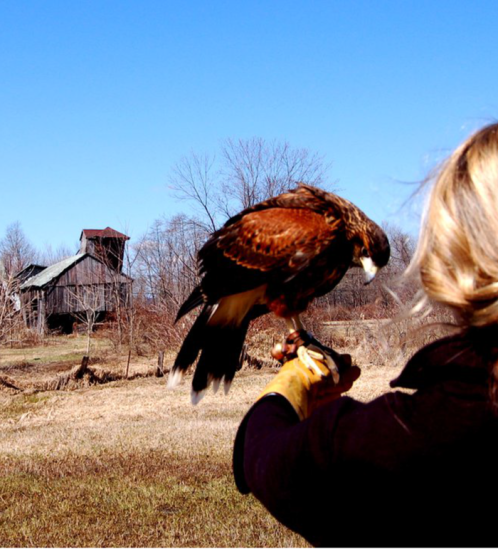
One of your activities is falconry, which conjures up such wonderful images. Could you tell how you became involved in falconry and a little bit about it?
celebrate-picture-books-picture-book-review-michelle-cuevas-interview

I like to do research for my books, so falconry started as research for my second novel about a boy who is half bird and hatched from an egg. I got very interested in it, even looking into getting my own Harris Hawk, but it takes many years and several days of hunting every week. Maybe someday!

I’ve also done research by riding elephants, bird banding with ornithologists, interviewing astrophysicists, spending time with butterflies, and more. It’s a really interesting part of my job!

Your research sounds fascinating and such fun! Is there anything you’d like to try that you haven’t yet?

I like to keep trying new things as a writer, and one new adventure I’m trying is artwork. I LOVED Shel Silverstein as a kid, so I’m pretty sure he’s my inspiration. I’ve been afraid to illustrate my own picture book, so far just sticking to little line drawings in my last two novels.

Perhaps I’ll take a cue from Smoot, be brave, and give picture books a try in the near future!

In your beautiful The Uncorker of Ocean Bottles, the main character collects and delivers messages sent through bottles tossed into the sea. If you were going to write such a note to your readers, what would you say?

My dedication for Uncorker read:

For the Ocean Bottle Senders and Ocean Bottle seekers:

Try. Want. Wish. Tell

Is everyone as intrigued by book dedications as I am? When I read a book, I love imagining who the people are in the dedications, why did the author choose them? I often think about themes of my books when I write a dedication to a specific person. Since Uncorker is about a man with no name, and since the messages sent in bottles are often to no one in particular, I decided my dedication should reflect both of these feelings too.

As an author of middle grade and picture books, what do you find is the best part of writing for children?

The best part of writing for children… well, from my perspective, the best part is the sense of fun. I started out during my fiction MFA writing stories for adults. I’d often turn in stories with talking plants or deer that broke into houses. These stories confused the other writers in my program. Who were they for? Not serious-thinking adults. My mom sent me care packages, often with books inside, mostly kids’ books I had loved when I was younger or new ones she thought looked cute. I read them and it was a light bulb-over-my-head moment. I started writing my first novel about a prolific painting elephant my last year of graduate school and suddenly, my writing felt like me. I was able to do all the wild, free, magical things I had wanted to do all along in my writing. I was finally having fun.

And I think the best part in the “interacting with the world” category is when a child (or adult) says they connected to a character, or that a character’s tale made them cry. We don’t know one another very well, but I know how it feels when a book makes me cry. It’s a remarkable connection, really blows me away every time.

What’s Up Next for You?

Up next for me are visiting schools to talk about my new books Smoot and The Care and Feeding of a Pet Black Hole. In April 2018 I have a new picture book out with Catia Chien called Town of Turtle. It’s about a turtle who decides to do some renovations to his shell, which of course get wildly out of hand.

Since Celebrate Picture Books is a holiday-themed blog, I have to ask: what is your favorite holiday, and do you have any stories you’d like to share?

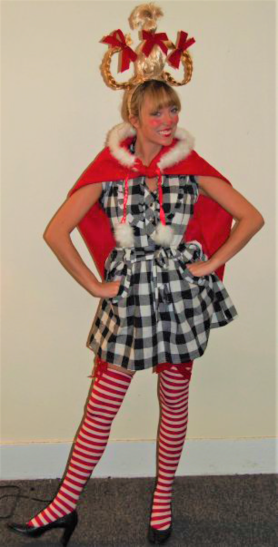
My favorite holiday… I’ve always loved making costumes and the idea of getting to be a character on Halloween. Even in the last few years I’ve been… a pro wrestler, a deer with branch antlers, Cindy Lou-Who, a falconer… the list goes on. Last year I was Lydia Deetz from the movie Beetlejuice. When I was Cindy Lou-Who I spent a couple days making a wire-rigged headpiece with some very architectural hair. Making the costume is half the fun. I have several glue gun burns to prove it.
celebrate-picture-books-picture-book-review-michelle-cuevas-cindy-lou-who.jpg

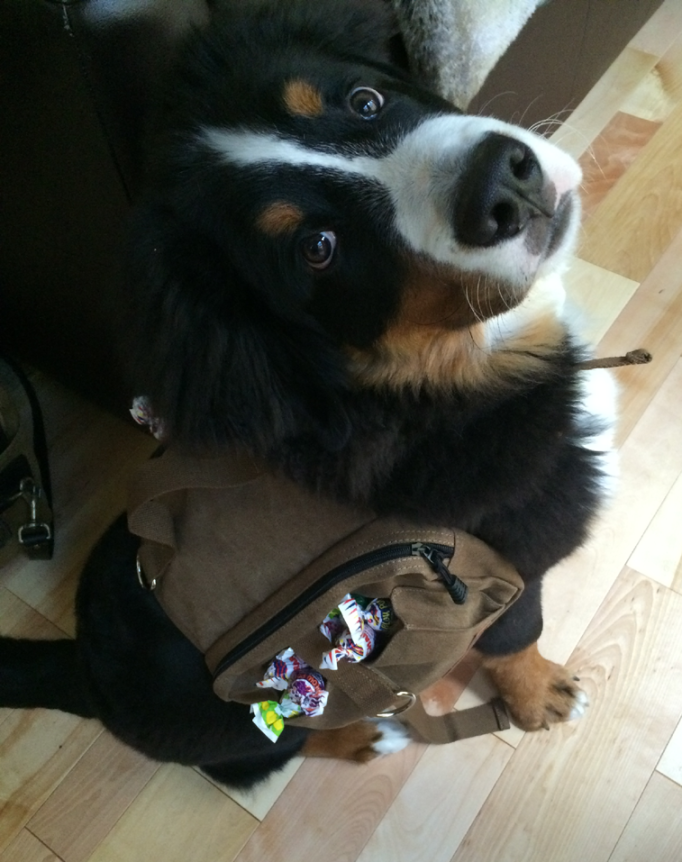
I also got my Bernese Mountain dog a backpack to hand out candy. I don’t usually let him wear clothing, but made an exception for lollipop duty.
celebrate-picture-books-picture-book-review-michelle-cuevas-interview

Thanks, Michelle, for the fun and inspiring interview—and all of the fantastic pics! I wish you all the best with Smoot and all of your other books!
celebrate-picture-books-picture-book-review-smoot-cover

You can find Smoot: A Rebellious Shadow at these booksellers

Amazon | Barnes & Noble | Books-a-Million | IndieBound| Tundra Books 

You can connect with Michelle on: her website | Twitter

Picture Book Review

September 24 – National Punctuation Day

celebrate-picture-books-picture-book-review-exclamation-cover-2

About the Holiday

What’s so great about punctuation? Everything! Using correct punctuation allows you to express exactly what you mean. You’ve seen—and no doubt laughed at—examples of misplaced or misused punctuation: “Let’s eat John” versus “Let’s eat, John” and the random placement of quotation marks when no one’s talking or referencing another source. And while in the grand scheme of things the series comma may not make that much difference, in some cases lawsuits have been won and lost on just this detail. Texting has changed the way punctuation is used—or not. While a smiley face may be a substitute for the exclamation mark or a frowny face an emotive period, in other types of writing, knowing the rules of punctuation is still important. Today, celebrate the way punctuation makes all written communications clearer and more meaningful.

Exclamation Mark

Written by Amy Krouse Rosenthal | Illustrated by Tom Lichtenheld


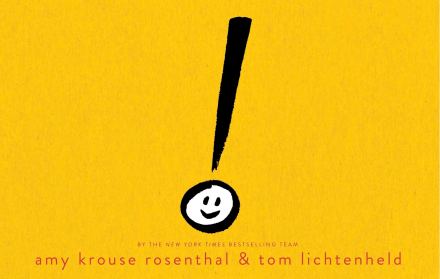
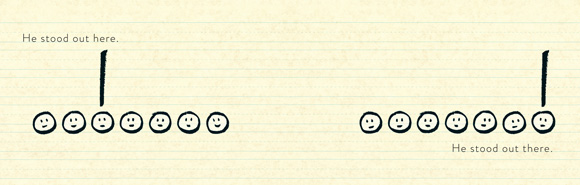
! “stood out from the very beginning.” When he was standing in a row of ……, it didn’t matter if he was in the middle or at the end—he still stuck out. The only time he wasn’t so noticeable was when he laid down to go to sleep. Sometimes he twisted himself into coils and did somersaults to be like the others, but nothing worked. “He just wasn’t like everyone else. Period.” This left him feeling “confused, flummoxed, and deflated.”

celebrate-picture-books-book-review-exclamation-mark-stands-out

Image copyright Tom Lichtenheld, text copyright Amy Krouse Rosenthal. Courtesy of Scholastic Press

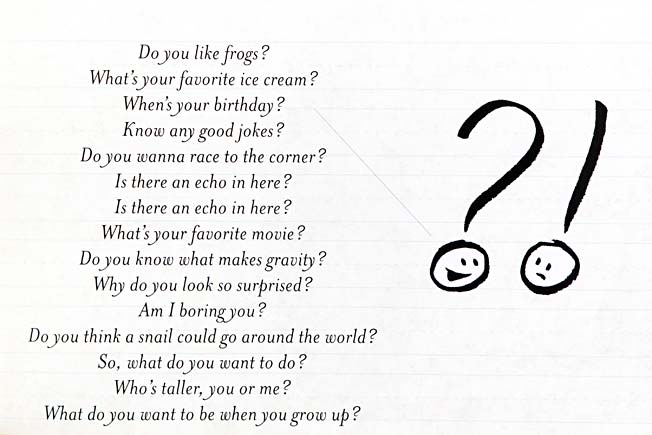
He was just about to run away from all his problems when he met ?. ? rushed right up to him and wanted to know everything. “Who are you?…What’s your favorite color? Do you like frogs?…Do you wanna race to the corner? Is there an echo in here? Is there an echo in here?…Why do you look so surprised?….” The list went on and on.

celebrate-picture-books-book-review-exclamation-mark-lots-of-questions

Image copyright Tom Lichtenheld, text copyright Amy Krouse Rosenthal. Courtesy of Scholastic Press

“STOP!” ! shouted. The sound stunned him. ? smiled and wanted him to do it again. ! didn’t know if he could, so he tried a small “Hi!” “That felt right, so he tried something bigger. Howdy!” And then he said, “Wow!” After that there was no stopping him: “You’re it!…Home run!…Yum!…Look out!…Thanks!…Boo!…Go!”

He rushed off to show everyone what he could do. The …… were delighted and “there was much exclaiming.” Now feeling happy and confident, ! “went off to make his mark.”

celebrate-picture-books-book-review-exclamation-mark-yippee

Image copyright Tom Lichtenheld, text copyright Amy Krouse Rosenthal. Courtesy of Scholastic Press

Amy Krouse Rosenthal’s clever story of an exclamation point searching for self expression is as moving as it is original. Kids will recognize his feelings of sticking out in a crowd and uncertainty of purpose and applaude when ? comes on the scene to befriend !. Readers will giggle knowingly at the barrage of questions, and feel emboldened themselves as ! finds his voice and his own unique contribution.

Tom Lichtenheld’s adorable punctuation marks hanging out on kid-ruled paper demonstrate all the expression and expressions of this well-crafted story. With simple dot eyes and small streak mouths, Lichtenheld animates the various emotions of the periods, exclamation mark, and question mark as they discover !’s special talent with individuality for each. The unbridled exuberance of ?‘s and !’s meeting makes this a terrific book about friendship as well.

! deftly points out “What would we do without exclamation points?” Likewise it asks, “What would we do without each one of us?” The positive message, creatively and humorously presented, makes this book a terrific addition to any child’s library.

Scholastic Press, 2013 | ISBN 978-054543679

You’ll find more about Amy Krouse Rosenthal, her books for children and adults, videos, other projects, and so much more on her website!

Discover a portfolio of books by Tom Lichtenheld as well as fun book-related activities and resources for teachers on his website!

!!!! for this ! book trailer!

National Punctuation Day Activity

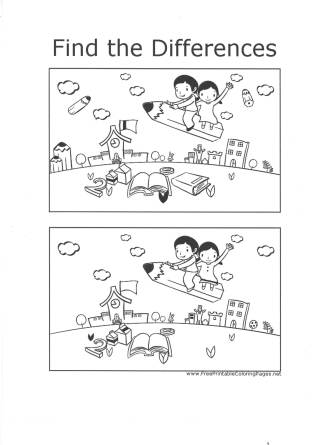
celebrate-picture-books-picture-book-review-pencil-riding-kids-find-the-differencesExcellent Writers Find the Differences Puzzle


These kids love to write and know their punctuation! Can you find the twelve differences in this printable Excellent Writers Find the Differences Puzzle?

Picture Book Review